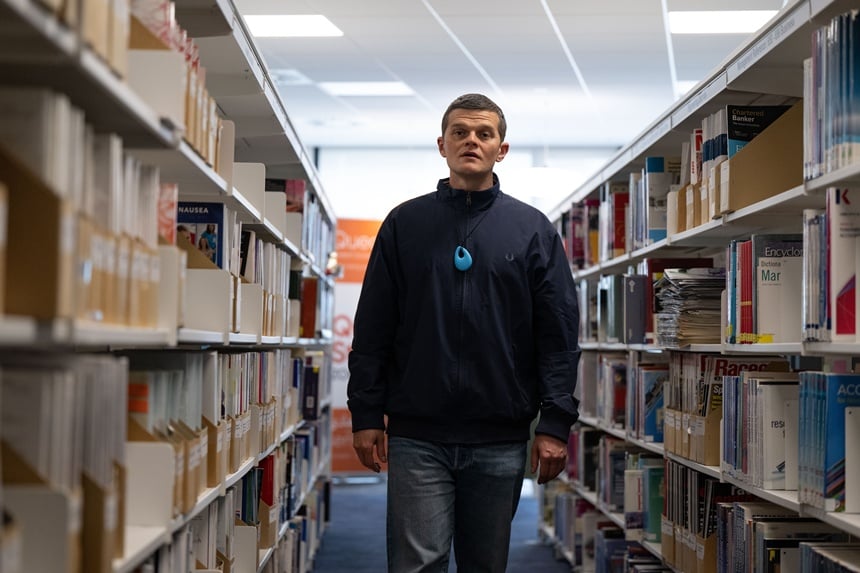
I Swear
⭐️ ⭐️ ⭐️ ⭐️
Rating: R
Run Time: 2 hours
Stars: Robert Aramayo, Scott Ellis Watson, Maxine Peake, Shirley Henderson, Peter Mullan
Writer/Director: Kirk Jones
Reviewed at the Toronto International Film Festival
Everyone feels, at one point and in some way, betrayed by their body. With uncommon compassion and endless good humor, I Swear introduces us to a man who breaks free after a lifetime held prisoner by his own brain.
In the tradition of My Left Foot and The Theory of Everything, writer/director Kirk Jones (Waking Ned Devine) offers the astonishing true story of John Davidson, a Scottish man with Tourette Syndrome who overcame indifference, misunderstanding, and outright violence to become a pioneering advocate for people with TS – eventually being knighted by Queen Elizabeth.
Mercifully, Jones opens his film with that crowning moment, so at the very least we can hold out hope that no matter what happens to John in the interim, things will eventually turn out okay. Life also seems good when we flash back to meet teenaged John (Scott Ellis Watson). A top-tier soccer goalie seemingly on his way to a professional career, young John suddenly finds himself unable to control his limbs. He begins to bark out profanities and insults in class – and often just erupts into incomprehensible barks and yips.
Of course, the adults in John’s life assume he’s a brat, acting out. The schoolmaster whips the boy’s hands raw with a leather belt. When the youngster starts spitting out food uncontrollably, his frustrated mother (Shirley Henderson) makes him eat dinner in the parlor, squatting on the floor, facing the fireplace.
For John, life becomes a waking nightmare. Watson is heartbreaking in the role, eyes panicking, extremities jerking, masterfully tracing an awful trajectory ranging from confusion to anguish to, in a near-tragic episode, utter despair.
Time passes, and presently we find Davidson as a young adult (Robert Aramayo, Elrond on Amazon’s The Lord of the Rings: The Rings of Power). He’s still living at home with his mom, his father having long since stalked out of their lives. A battery of drugs has somewhat dulled his Tourette symptoms, but they’ve also rendered him unable to drive and mildly brain-fogged. Henderson – best known to movie audiences as “Moaning Mona” in the Harry Potter films – plays John’s mother as a somewhat mousy, relentlessly critical caregiver. On shopping trips in town, she endlessly whispers desperate commands, hissing at John not to do the things he simply cannot help doing. Their mutual frustration – with John’s condition and with each other – is palpable.
Navigating a world that rears in revulsion whenever he erupts into uncontrollable sounds and profanities (more than once, his condition lands him in trouble with the cops), John stumbles upon the exceptional patience and understanding of a retired mental health nurse (The Theory of Everything’s Maxine Peake) and the compassion-fueled confidence of a community center maintenance chief (The Magdalene Sisters’ Peter Mullan).
Plumbing reservoirs of resourcefulness and optimism he didn’t realize he’d had, John stakes out parameters that set the boundaries of a full and meaningful life. Ultimately, he makes it his mission to educate the world at large regarding what Tourette’s is (and is not), counseling law enforcement people regarding its symptoms and heading weekend retreats for young people with Tourette’s and their families (all of whom appear here as themselves).
Portraying characters with disabilities can prove to be a career trap – just ask Cuba Gooding Jr. (Radio) and Sean Penn (I Am Sam). Aramayo, however, is miraculous in the lead role, revealing himself as an actor with a keen instinct for portraying a character’s traits without for one second seeming to put on a performance. Here, John’s motivation is not simply a specific reaction to his condition, but a profoundly human desire to live life to its fullest.
In a season of superhero movies, this one rings truest.
Become a Saturday Evening Post member and enjoy unlimited access. Subscribe now