Prophets don’t keep up with current events, auto maker Henry Ford told The Saturday Evening Post in 1929. Just when the doomsayers decide what disaster is coming next, the conditions change.
He was referring to the people who predicted automation would replace human workers. Machines would eventually take over so many jobs, there would be nothing left for people in the work place.
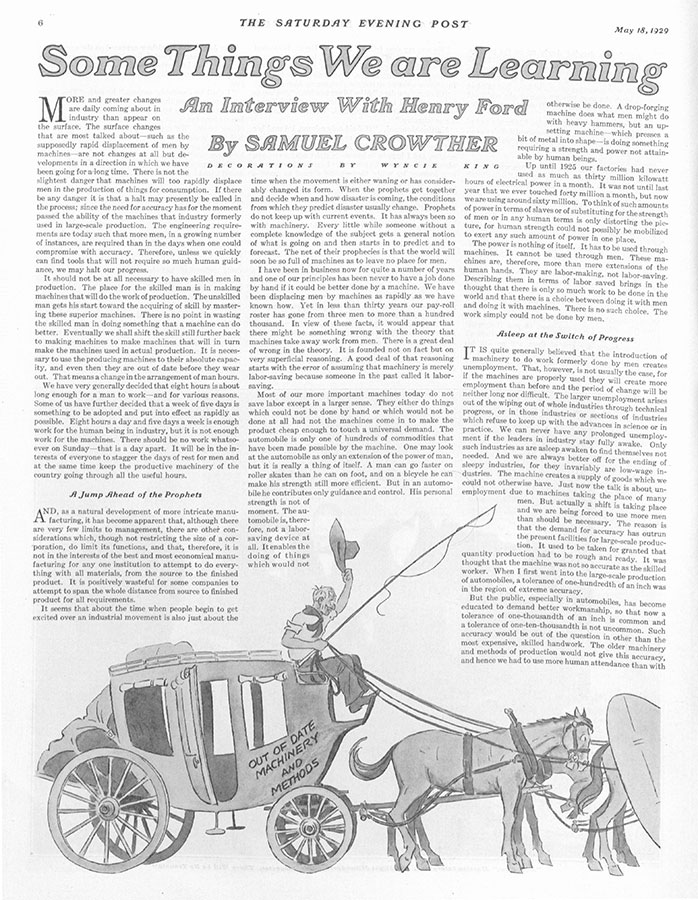
But according to Ford, the prophets didn’t know what they were talking about.
If anyone would have known how automation would affect employment, it would have been Henry Ford. He freely admitted he never had a job done by hand if it could be better done by a machine. “We’ve been displacing men by machines as rapidly as we have known how,” he told the Post. Back in 1913, when he had pioneered the moving assembly line, early automation had boosted the efficiency of auto production so that the time needed to produce a new car dropped from 12 hours to 90 minutes.
Along the way to perfecting the assembly line, he had automated several tasks, according to Assembly magazine. One machine, for instance, would dip the Model T’s wooden wheels into varnish, another would assemble radiators, and another would drill 45 holes into engine blocks — all jobs formerly held by people.
Over the course of 20 years, automation helped Ford improve the quality of his Model T and drop its price from $825 to $360. As the car became more affordable, more people bought them. As demand increased, so did production. Which is why Ford firmly believed automation created jobs. When he started producing Model Ts in 1908, he had just three employees. Now, even with many tasks automated, he had a work force of more than 100,000.
Machines weren’t invented to replace people, he said. They were built to do things that couldn’t be done by human workers; tasks that required greater speed, power, or accuracy. If properly used, they’d make companies more prosperous and create more jobs.
If it was true for Henry Ford, is it true today for other businesses?
There isn’t a simple answer because automation will have multiple effects on a business. For some employees, it will end their jobs. Others will find their jobs transformed. Overall, remaining employees wind up in either higher- or lower-expertise positions.
One working paper from the National Bureau of Economic Research suggests that companies that automate their little- or no-expertise jobs reduce the number of their employees but pay higher wages to those they retain. And companies that automate their high-expertise tasks see increased employment, though with lower pay.
Automation could mean opportunity for workers who get training to work alongside automated systems, according to a Brookings article. On assembly lines, for example, robots have replaced workers with limited skills, but have also created positions for machinists, specialist welders, and robotics technicians who maintain the machines or fit them for new tasks.
The most formidable form of automation these days is Artificial Intelligence. According to one paper, it has produced a 13 percent decline in employment of entry-level workers in select occupations. Goldman Sachs recently determined that AI eliminates 16,000 jobs a month.
A study by McKinsey & Company predicts that AI-directed automation could perform tasks that currently consume 70 percent of employee’s time. Consequently, 12 million workers in Europe and the U.S. will need to change jobs.
But they also report that these losses are partly offset by increased employment in areas where AI supports human workers. Here, as in Ford’s Model T factory, AI can theoretically increase productivity, reduce costs, and increase demand, which leads to higher employment and a stronger economy.
Meanwhile, Forbes is predicting AI will create millions of new jobs — even more than the 78 million predicted by the World Economic Forum. As they see it, its impact on employment will be on a scale similar to what followed the introduction of the automobile or the computer. There will be high demand for people who develop and support AI systems, as well as people who introduce and explain the systems to users.
Industry analyst Josh Bersin says, “AI is making jobs more interesting, more valuable, and ultimately more rewarding (financially and otherwise),” though many of the jobs he sees in the future are highly technical positions in IT and healthcare. Other sources say the workers most likely to benefit from AI will work in data analytics, machine learning, and programming.
Several studies have found that, with some jobs, AI alone can outperform human workers, even when those workers have access to AI. In other jobs, humans outperform AI alone. But in these cases, the humans augmented by AI are even more effective.
One MIT study found humans were best at contextual understanding and emotional intelligence, and AI excelled at repetitive, high-volume or data-driven tasks. But without trial and error, there are currently no clear indications of where each will do their best work.
Among the many unknowns surrounding AI’s impact on jobs is the factor of time. When will all this take place? And when will employees displaced from the jobs find other employment in an AI-driven market?
One thing is certain. Employees will need training to integrate AI into their work, and the quality of the training will determine the success of the new system. Employers may hesitate to give training to their work force that may not stay. But as Henry Ford said, “The only thing worse than training your employees and having them leave is not training them and having them stay.”
Become a Saturday Evening Post member and enjoy unlimited access. Subscribe now