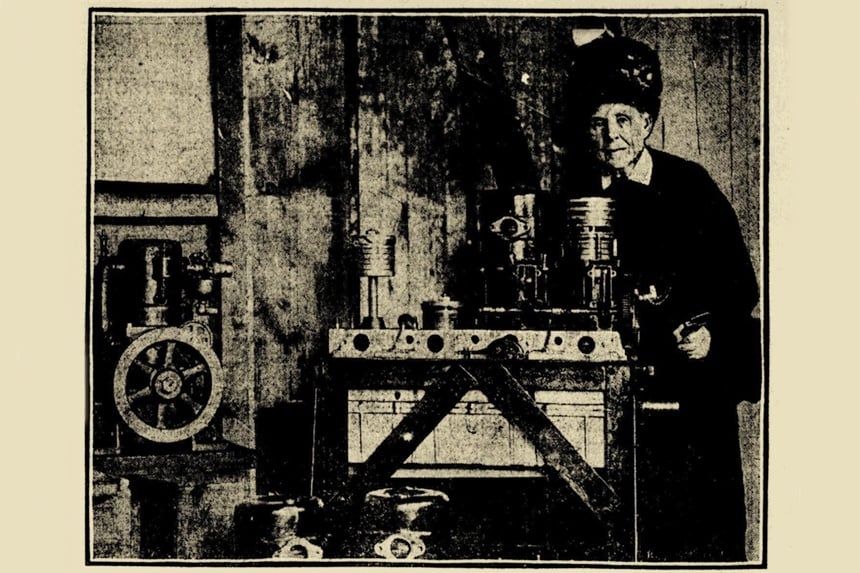
“I’m only sorry I couldn’t have had as good a chance as a boy, and have been put to my trade regularly”
– Margaret Knight, Women in the National Inventors Hall of Fame
Even as a child, Margaret Knight preferred tools to dolls and tea sets. “As a child, I never cared for things that girls usually do. The only things I wanted were a jack knife, a gimlet and pieces of wood,” she told an interviewer from the 1872 The Woman’s Journal. Among her first inventions were toys, kites and sleds for her two brothers and friends.
In 1850, after the death of her father. James Knight, in Maine, her widowed mother Hannah Teal Knight moved the family to Manchester, New Hampshire to work in a cotton mill. Since child labor laws were not yet enacted, 12-year-old Margaret went to work at that city’s Amoskeag Manufacturing Company textile mill.
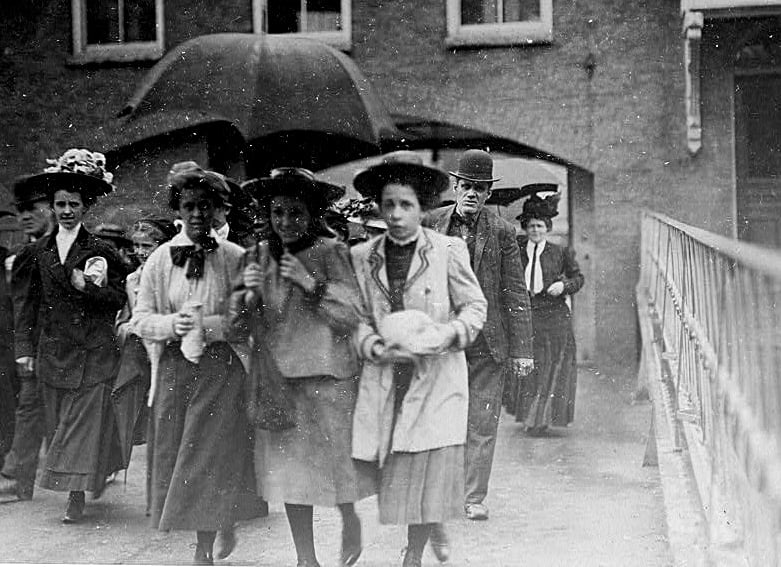
One day a worker was seriously injured when a steel-tipped shuttle flew out of a mechanical loom and stabbed her. Horrified, Knight subsequently invented a safety stop for the loom that was so successful it became widely adopted in other mills.
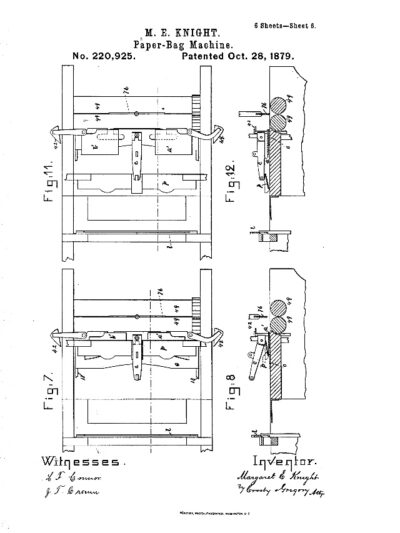
By her late teens, Knight ‘s health was so poor that she left the mill and found work in photography, home repair, engraving, and upholstery. In 1867 she moved to Springfield, Massachusetts where she worked as a bag bundler at the Columbia Paper Bag Company. By 1870 she had invented and received a patent for a paper folding machine to produce bags. To Knight that was only a beginning. Observing that the company’s weak, narrow envelope-style bags limited what shopper could carry, she invented a second machine which cut, folded, and glued paper together to create flat-bottomed brown paper bags familiar to us today. Not only did the new machine eliminate the time-consuming labor needed to make the bags by hand but it’s square bottom enabled shoppers to carry more groceries and other items easily.
To obtain a patent, Knight was required to produce an iron model of her wooden prototype at a machine shop. As it was being created, a machinist named Charles Annan, who was visiting the shop, stole the design and obtained a patent for it. In autumn 1870, when Knight applied for the patent and discovered that Annan owned it, she filed a patent interference lawsuit. Since it was unusual for women to have mechanical training in that era, Annan made the sexist claim during the trial that Knight “could not possibly understand the mechanical complexities of the machine.” He also claimed that his invention was different than Knight’s.
Knight defended her invention by producing hand-drawn blueprints in journals of her work. Several witnesses also testified that Knight had been making drawings and models for the design since 1867. Her former employer testified that “The idea of a machine for the manufacture of square-bottomed bags originated in conversations between Miss Knight and myself. I saw them folded myself and most certainly there is no doubt that it was her idea,” according to Women in the National Inventors Hall of Fame.
Eliza McFarland, from whom Knight had rented rooms since 1867, claimed that the inventor told her “she had a plan for making square bottom bags, like those she pointed out here, by machinery. I know what I saw…I saw her making drawings continually…always of the machine.”
During the trial, Knight also defended her skills by citing her work experience with machine design: “From my earliest recollection I have been connected in some way with machinery. I have worked in manufacturing departments where both wood and iron machinery as used for the purpose of manufacturing different kinds of articles and goods.” On July 11, 1871, the judge awarded Knight U.S. patent No. 116,842 for her invention. That same year, Queen Victoria of the United Kingdom decorated Knight Royal Legion of Honor for her invention of the paper bag machine. In 1879, she obtained a second patent for improvements to the original design. Today the United States produces more than 10 billion paper bags each year.
Knight also established the Eastern Paper Bag Company in Hartford, Connecticut with a business partner and then licensed her machine to the company. By the terms of that agreement, she received a payment of $2,500 with royalties capped at $25,000. Knight lived comfortably on that income, but was never wealthy. Women’s rights activists and suffragettes often cited her as an example of women’s native abilities and skills.
Knight devoted the rest of her life to creating other devices. Among them were a clothing clasp, a cooking spit, a shoe-leather cutting machine, components for rotary engines and motors, a numbering machine, and a window frame and sash. Altogether she obtained 26 patents for her inventions, but created others she never bothered to patent. She was often referred to as “Lady Edison.”
She continued to invent into old age. A New York Times reporter noted in 1913 that Knight was “working twenty hours a day on her eighty-ninth” invention.
Never married, she died on October 12, 1914, at age 76, leaving a modest estate of $275.
Knight was inducted into the National Inventors Hall of Fame in 2006.
Become a Saturday Evening Post member and enjoy unlimited access. Subscribe now



Comments
A great special report on another very remarkable American woman, Nancy. Ms. Knight’s invention of the square (flat) bottom paper bag has made millions of lives easier for over 150 years. I was very glad that she filed that patent interference lawsuit, and won. Very wise of her to have kept the hand-drawn blueprint journals of her work.
I’m glad (in addition) she had witnesses to back up her legitimate claim. She probably knew on some level there would be a sexist ‘claim jumper’ that would pull something like this, was prepared, and won!
She went on to further improve the original bag design in 1879 when she could have just left it alone. Being decorated by Queen Victoria was an extremely high honor. She founded the Eastern Bag Company, and continued working and creating new inventions. It’s shocking though to read her estate was only worth $275 when she passed away, for she was truly the “Lady Edison”.