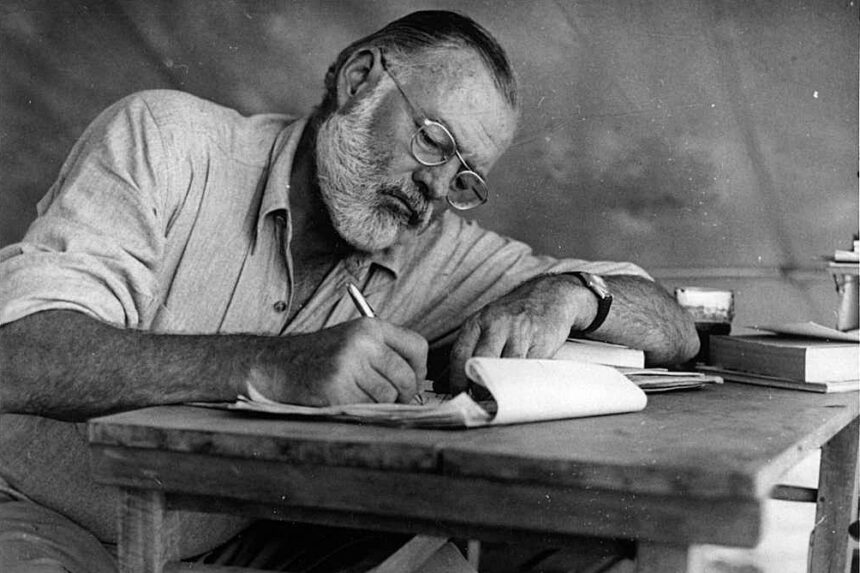
In 1925, Ernest Hemingway published In Our Time, his first collection of short stories. Then only 26, he had been a struggling young writer in Paris mingling with the likes of Gertrude Stein, F. Scott Fitzgerald, Ezra Pound, and others of that “Lost Generation.”
The stories in his first collection were not about the socialites of the Parisian set, however. They set the tone for much of his life’s work: stylistically sparse and populated with characters experiencing grief, violence, and denial. These first stories also introduced Hemingway’s semi-autobiographical character, Nick Adams, who appeared in more than half of the stories. Hemingway would eventually write two dozen Nick Adams stories in all.
In Our Time also features Hemingway’s first published boxing story, “The Battler.” Hemingway loved boxing, which is to say he loved being associated with boxing. It might also be said that he loved the masculine gravitas such an association lent him as a writer. He would go on to revisit the sweet science in his prose, both fiction and nonfiction. He also boxed recreationally, often challenging his literary friends to go a round or two with him. Although there is no actual boxing in “The Battler,” it is notable for its depiction of the effects of brain trauma on a fighter, which Hemingway may have mirrored the trauma he saw while serving in World War I.
“The Battler” is a Nick Adams story. It opens with Adams thrown from a train by a quarrelsome brakeman. Though not a boxer, Adams accounts for himself admirably in the story’s opening line: “Nick stood up.”
Knocked down but not out, Adams walks the rails until he comes upon a campfire. There he meets two men. One is an ex-fighter named Ad Francis who suffers from the brain trauma then called “dementia pugilistica” (now Chronic Traumatic Encephalopathy or CTE). The other is an African-American man named Bugs, who looks out for Francis. Sitting around the fire, they share food with Adams and are having a friendly chat when, without provocation, Francis’s disposition towards Adams shifts abruptly from friendly to aggressive and accusatory. Bugs slips behind his friend and clips the ex-fighter with a whalebone blackjack. Adams is taken aback by the apparent assault, until Bugs explains gently that this is the simplest, safest way to prevent Ad Francis from hurting himself or others when his mood darkens.
While the fighter is unconscious, Bugs sketches the circumstances of Francis’s life. “He took too many beatings, for one thing,” he explains to Adams. “But that just made him sort of simple.” He goes on to describe Francis’s manager, a woman. The press was told she was his sister, when in reality the two were a couple. Their eventual marriage “made a lot of unpleasantness.”
“I remember about it,” Nick says.
Eventually, the wife left, and Francis’s life went downhill. He and Bugs met in jail. “He was busting people all the time after she went away and they put him in jail. I was in for cuttin’ a man.”
Now the two travel around together, he explains, looking after one another and living on a small stipend sent by Francis’s ex-wife. His story concluded, Bugs apologizes for appearing inhospitable but asks Adams to move along, lest his presence further agitate Francis when he wakes up. The story ends with Nick heading in the direction of the train tracks.
In Our Time was well-received in 1925, but it was Hemingway’s 1926 novel, The Sun Also Rises, that landed him on the map. The ensuing decades of work – novels, journalism, and nonfiction – established Hemingway as America’s undisputed literary heavyweight, culminating in his winning the Pulitzer Prize in 1953 for his novella The Old Man and the Sea.
Not long after that international acclaim, on a cool Tuesday evening in October of 1955 three decades after the publication of “The Battler,” an adaptation of Hemingway’s boxing story aired on NBC. It was produced as a live teleplay for Playwrights ’56, a dramatic anthology series that aired bi-weekly original productions. Live drama anthologies were a staple of early television, and programs like Playwrights ’56 gave rise to a score of young American talent, including Paddy Chayefsky, Gore Vidal, and Rod Serling.
Playwrights ’56: The Battler (Uploaded to YouTube by Free The Kinescopes!)
Sponsored by Pontiac, Playwrights ’56 was placed in a risky time slot, airing opposite the popular game show The $64,000 Question. Producer Fred Coe knew they needed something big to attract viewers, and he sought out a story from the recent Pulitzer Prize winning Hemingway to adapt. A representative for the author suggested the relatively under-valued short story “The Battler.” Alongside the Hemingway name, they cast rising star James Dean to play the ex-fighter Ad Francis. Tragedy struck the flagship production, however: Barely two weeks before the live broadcast, Dean was killed in a car accident.
In panic mode, producer Coe plucked a relatively unknown actor from the cast. He was young, good-looking, and importantly, already familiar with the script. That unknown’s name was Paul Newman.
Newman recognized what an opportunity this was, and he threw himself into the role. His performance as the cauliflowered Ad Francis, complete with heavy prosthetics and a slurred affect, earned nearly universal praise and Brando comparisons. The cameras had barely stopped rolling on the soundstage of “The Battler” when Newman’s phone began ringing. Within weeks, he was the frontrunner to play real-life boxer Rocky Graziano in the upcoming film Somebody Up There Likes Me. Newman got the part, and a Hollywood star was born.
Ernest Hemingway had not been directly involved in the Playwrights ’56 production of “The Battler.” Instead, his short story was adapted by A. E. Hotchner and Sidney Carroll. Hotchner was the Hemingway associate who’d originally suggested the story. This connection was no mere coincidence. Hotchner and Hemingway had met in the summer of 1948. Hotchner detailed the unusual circumstances of their meeting in a series of articles for The Saturday Evening Post.
After serving in the Air Force during World War II, Hotchner worked as a freelance assignment agent for Cosmopolitan, functioning as a go-between for potential authors and the magazine. He was sent to Cuba to solicit an essay from Hemingway on “The Future of Literature.” Like many, he’d been in awe of the author as a teenager.
“In my schoolboy fantasies I had identified with Nick Adams,” Hotchner wrote, “as he made his way through a murky world of punch-drunk fighters, killers, suicidal Indians, dope addicts, and whores.”
Hotchner felt the article request was inane, and was too embarrassed to appear in person or even to call. He sent Hemingway a note instead, conceding the ridiculousness of the magazine’s request, and asking only for a written refusal, to allow Hotchner to save face with his bosses and keep his comfortable job.
Hemingway was so impressed by the brash and clear-eyed pragmatism of Hotchner’s note that he invited him out for drinks and deep-sea fishing. The two hit it off immediately, and their personal friendship turned into a business partnership as well. Television was growing rapidly, and Hemingway was receiving offers to have his stories adapted for the small screen. Wishing to avoid this headache, he asked Hotchner to be his mediary to the television executives. Hotchner agreed, and even went a step further, providing his services as script writer for many of the adaptations, exactly as he did with “The Battler” for Playwrights ’56.
The original short story had to be fleshed out and expanded to fill the one hour run time. Gone was the brevity of an opening like “Nick stood up.” For the teleplay, we meet Nick Adams hitchhiking, and we spend several exposition-setting minutes with him conversing with a truck driver. After being dropped off at an all-nite diner, Nick realizes the driver has stolen his wallet. Now penniless, Adams is ejected from the diner. He makes the desperate choice to hop a train, from which he is tossed by the brakeman. At that point both the teleplay and the original short story line up quite squarely for a time.
Clever scenes are added later in the teleplay. In the original, the backstory of Ad Francis is simply narrated by Bugs, but for Playwrights ’56, that backstory gets expanded into full-scale flashbacks acted out on screen. Not only does this pad the run time, it enhances the drama by moving the audience beyond the campfire setting. The audience is taken inside the jail cell where Bugs first meets Francis, and later, inside an empty boxing ring where the relationship between Francis and his wife/manager comes to a poignant and emotional end.
These scenes make the most of the live television medium. When we first meet Ad Francis, he is a broken-down man whose mind is scrambled and face disfigured with scar tissue and cauliflowering. But for the flashbacks, they removed the makeup, revealing the young and handsome face of Paul Newman. It’s a good trick, and it works. The small scale of a live television production suddenly has the wide scope of a feature film.
Hotchner and Newman bonded during that hectic 1955 production, and they remained good friends throughout their lives. When Hotchner compiled some of the Nick Adams stories into a full-length feature film – 1962’s Hemingway’s Adventures of a Young Man – Newman reprised his role as Ad Francis. As with Hemingway, Hotchner’s friendship with Newman blended the personal and the professional in unanticipated ways. The two began selling homemade salad dressing in 1982, and soon each chipped in $20,000 of seed money to found Newman’s Own. Hotchner admits they started the business “as a lark, as a dumb kind of joke,” but they agreed to donate 100 percent of the profits to charity, funding summer camps for children battling cancer.
More than 40 years later, their friendly “joke” has expanded well beyond their private kitchens. The organization is still donating 100 percent of their profits, which now total hundreds of millions of dollars. The pair has encouraged other businesses to adopt this philanthropic model. They even wrote a book on the subject, humorously titled Shameless Exploitation in Pursuit of the Common Good.
Certainly the 26-year-old Ernest Hemingway could not have foreseen the chain of events that would result from including “The Battler” in his debut collection In Our Time. His love of boxing led him to create Ad Francis, and to have his stand-in Nick Adams meet the ex-fighter in a hobo jungle just beyond the railroad tracks. Adapted for the stage and screen by his good friend A. E. Hotchner, “The Battler” launched the career of Paul Newman, who skyrocketed to fame with movies such as Butch Cassidy and the Sundance Kid and The Sting. His celebrity, combined with their philanthropically-minded business model, has resulted in what is no doubt the most unusual origin story in the history of the salad dressing industry.
Become a Saturday Evening Post member and enjoy unlimited access. Subscribe now