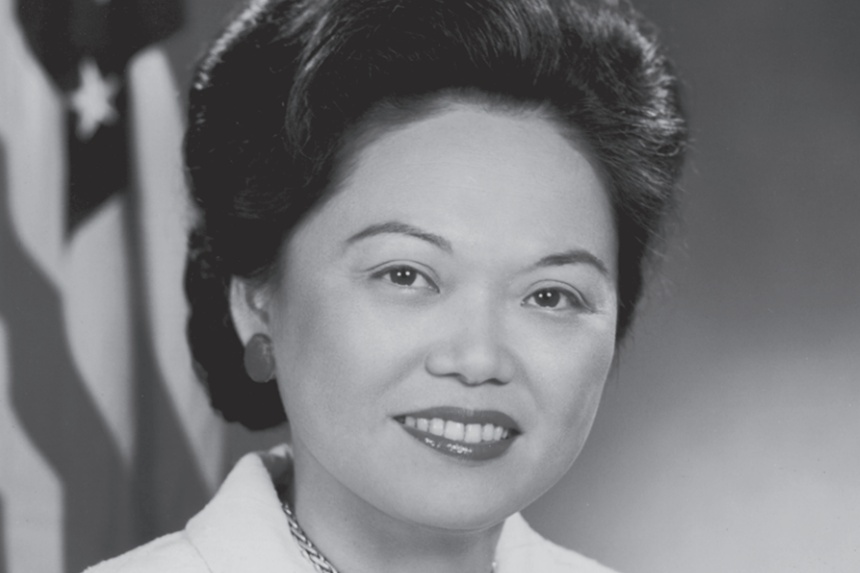
In 1947, Patsy Takemoto Mink wrote to the University of Nebraska’s student paper, The Daily Nebraskan, “When I arrived here, I hoped I could find some link with what I was told America was like. I cannot understand how people, believing they belong to the greatest nation on this Earth, can tolerate such lowly practices.” Her comments addressed the university’s then segregated housing policy that prohibited non-white students from residing within the main dormitory.
Seventeen years later, Mink would walk the steps of Capitol Hill as the first Asian American and non-white woman to hold a seat in the U.S. House of Representatives.
Her journey began on the sugar plantations of Maui, where she was raised as a third-generation immigrant to Japanese grandparents. Growing up on the sugarcane fields, Mink noticed how her Asian and Native Hawaiian neighbors were segregated from the plantation’s often white landowners. Mink’s father, inspired by President Franklin Roosevelt and his experience as the plantation’s land surveyor, was adamant about educating his children on issues of politics. Unlike the other kids, Mink spent much time attending local election rallies with her siblings. It was from listening to campaign speeches and tuning into FDR’s radio addresses that Mink understood the potential politics had to improve daily life.
The Japanese-American experience changed dramatically after the attack on Pearl Harbor, just a day after Mink’s 14th birthday. Japanese-Americans in Hawaiʻi were not confined to internment camps like those on the mainland, but were still seen as suspect and controlled under martial law for the next two years. Judy Tzu-Chun Wu, a historian at UC Berkeley, and Gwendolyn Mink, Patsy Mink’s daughter, write that it was in the years following Pearl Harbor when she “developed a painful awareness of racial, linguistic, and class hierarchies, instituted into the fabric of the school system.” Despite the ever-shifting racial dynamics and witnessing her father be taken in by authorities for questioning after the attack, Mink wasn’t immediately drawn to work in politics.
Rather, the young Mink, inspired as a child by a local physician, sought to become a doctor. After graduating as her high school’s valedictorian in 1944, she enrolled into a pre-med track at the University of Hawaiʻi. But Mink’s undergraduate studies were nothing short of turbulent. In a span of three years, she transferred to two other universities — first Wilson College in Pennsylvania, then the University of Nebraska. During opening week at Wilson College, Mink was ushered into a meeting with the university president who expressed concern for her academic success and social life, assuming that English was not her first language. This encounter was likely Mink’s first brush with a microaggression — the often-unintentional act of racial stereotyping — that led her to transfer out after one semester.
Mink’s experience in Nebraska was no better. There, she challenged the school’s discriminatory housing policy that placed her, as well as other Black, Hispanic, and Asian Americans, in an international student’s dormitory. Mink launched a letter-writing campaign that protested the university’s segregated housing, which eventually forced the board of regents to rescind the policy.
After her two-year-long stay on the mainland, Mink eventually returned to Honolulu to finish her education at the University of Hawaiʻi.
Mink’s future in medicine quickly came to an end. After earning her B.A. degree, Mink applied to dozens of medical programs only to be rejected because she was a woman. Left with few options, she found work as a typist for the Hickam Air Force base in Honolulu.
Mink couldn’t help but feel stuck. With the help of an advisor, she decided to apply to a few law schools, and to her surprise, she was admitted to the University of Chicago’s law program as one of two women. Not long into her first semester, she met John Francis Mink at a dinner held in International House, one of the university’s dormitories. “People just looked at her and wanted to be with her,” the World War II veteran went onto say, and within six months the couple wed.
Chicago winters were harsher than anything Mink had known in Hawaiʻi. After three long years, in 1951, she and her husband graduated. They remained in the city with hopes of finding work and settling down, but Mink struggled to land a spot at a law firm. She wrestled with the Chicago job market for a year before having her daughter Gwendolyn in 1952. Not long after, the pair decided to pick up their things and move back to Honolulu to raise their young daughter.
Finding work in Honolulu proved equally difficult. Again, no law firm would hire Mink — not only was she in an interracial marriage, but she also faced skepticism for being a mother. Each rejection brought the same excuses: that the job required long hours, that she should stay at home to raise her daughter, and that it was ill-advised to be out working late at night. Frustrated, Mink decided to open her own law practice, doing whatever it took, including accepting fish as payment, to get by.
From 1953 onward, Mink practiced law as the first female Japanese-American attorney in her home state, while also providing services for the territorial House of Representatives. Through all this, politics lingered with her. Mink’s investment in the democratic cause began to deepen, founding and serving as the president of the Oahu Young Democrats in 1954, a grassroots political organization of young progressives. Eventually, she ran a brief, and unsuccessful, campaign for a House seat upon Hawaiʻi’s admission as the 50th state in 1959. Despite her loss, Mink refused to be discouraged, finding success in her second bid for Congress in 1964 when an additional congressional seat opened up.
This victory marked the beginning of Mink’s trailblazing political run, spanning 12 terms in the House of Representatives from 1965 to 1977 and 1991 to 2002. With the women’s movement gaining momentum in the late 1960s and 1970s, Mink brought public attention to gendered issues that were generally dismissed, including workplace discrimination, childcare legislation, and educational equality.

Today, Mink is known best for co-authoring and defending Title IX, the landmark civil rights law that prohibits sex-based discrimination in all federally funded educational programs. It is the most widely cited legislation of the Education Amendments of 1972, passed during President Richard Nixon’s tenure. Though Title IX is credited for propelling women’s participation in sports, its primary goal was to mandate equal access for women in both admissions policies and scholarship selection.
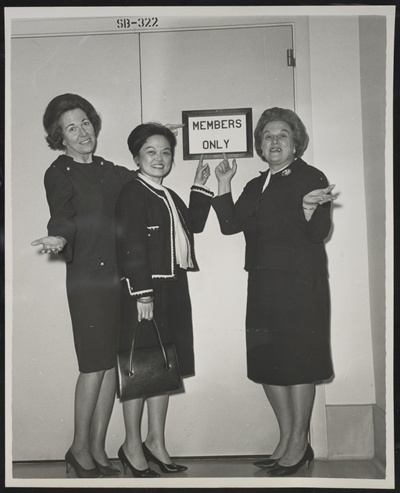
“I certainly consider Title IX one of my most significant accomplishments while I served in Congress from 1965 to 1977,” Mink announced in a speech to Congress on the bill’s 25th anniversary. She championed education as one of the most powerful ways to empower marginalized communities, saying “equal educational opportunities for women and girls is essential for us to achieve parity in all aspects of our society.”
Though Mink is primarily remembered for her contributions to Title IX, she was outspoken about many other issues plaguing women. The congresswoman introduced policies to improve child care and early childhood education, shaped from personal experience of raising her child while balancing a demanding legal career. In 1967, Mink pioneered the first comprehensive child-care bill that required not only custodial care but also educational development services for pre-school-age children from all backgrounds. Mink was also passionate about securing federal funding for women’s centers, feminist studies programs, nonsexist curricula, and training for teachers to make sure that school girls were guaranteed equitable educations.
In addition to defending women’s rights, Mink staunchly supported civil rights and the anti-war movement. Only a few days after being sworn in to Congress in 1965, she helped challenge the election of the all-white Mississippi congressional delegation on account of discrimination, intimidation, and violence against African American voters. Throughout this time, Mink kept Martin Luther King Jr. updated with the happenings on the House floor. She further faced criticism from her peers for attempting to organize peace talks with foreign political leaders to end the U.S. occupation in Vietnam. And her opposition to G. Harrold Carswell’s Supreme Court nomination for his alleged sexism and misogyny “felt very momentous and risky,” according to Mink’s daughter in an interview with The Atlantic.
When she returned to Congress in the 1990s after being away for 14 years, she faced a very different political climate, one that was much less accommodating toward liberal democratic values. Her final terms in office were spent defending the policies she helped implement, including Title IX, against an administration that appeared to have lost sight of its purpose: improving the lives of Americans.
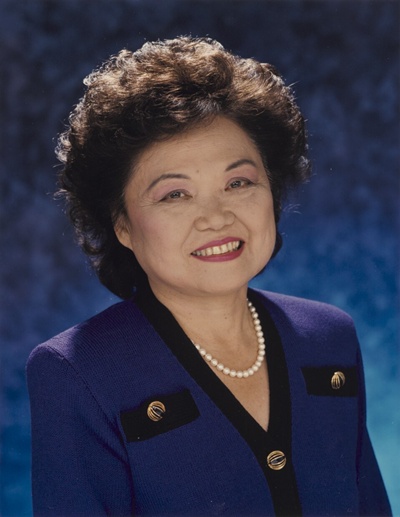
Mink’s contributions were crucial for the burgeoning feminist second wave, demonstrating how intersectionality worked in practice as both a woman and Asian American. She longed to take part in shaping a freer America: “Her personal experience with gender discrimination fueled her desire to make sure other people didn’t have that experience,” Wu said.
After Mink’s death in 2002, Title IX was renamed the Patsy Takemoto Mink Equal Opportunity in Education Act to honor her legacy. Asian American and Pacific Islander (AAPI) Heritage Month may be coming to an end, but we must always be reminded of all that Mink, and other prominent AAPI leaders, risked to ensure that all Americans regardless of race or gender could lead their best lives.
“If to believe in freedom and equality is to be a radical, then I am a radical,” she proclaimed before an audience of 10,000 at the 1960 Democratic National Convention. Mink is celebrated as one of America’s great progressive politicians, but she never saw herself fighting for something inherently special. The late congresswoman battled for what she argued were the most basic needs of our society — fundamental human rights.
Become a Saturday Evening Post member and enjoy unlimited access. Subscribe now