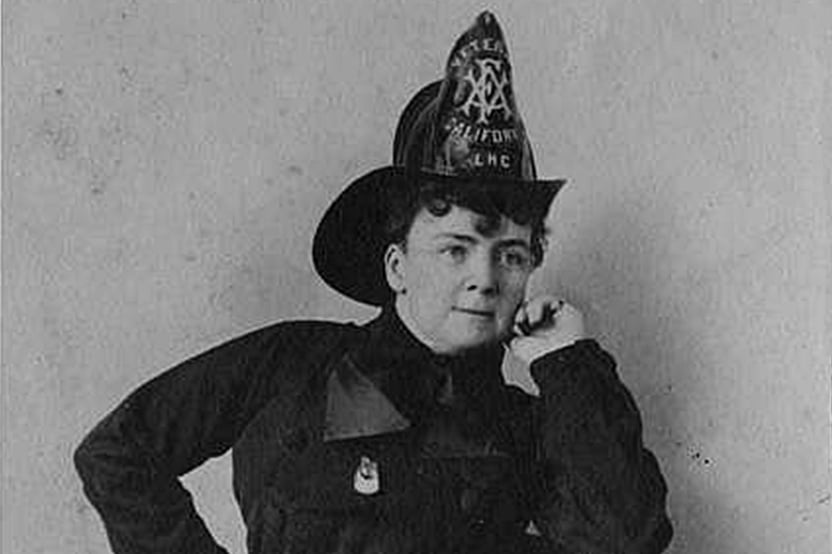
In San Francisco’s elite Victorian society, good girls didn’t smoke cigars, drink bourbon, or collect fiancés, much less chase after horse-drawn fire engines.
Lillie Hitchcock Coit did all of the above.
Born in 1843 in West Point, New York, the dark-haired, dark-eyed girl arrived in San Francisco with her parents in 1851, as the Gold Rush was transforming the sleepy settlement into one of the world’s fastest-growing cities. As the only child of a prosperous physician, she enjoyed every privilege wealth could provide — but had little interest in behaving like a proper Victorian lady.
Lillie Hitchcock Coit is the “most original woman California has produced,” The San Francisco Chronicle declared in 1895.
Her independent spirit — and her equally fierce love for San Francisco — left a legacy still etched into the city’s skyline. Yet among all the stories surrounding Lillie, none shaped her life more than her improbable devotion to San Francisco’s volunteer firefighters.
Answering the Alarm
No one knows exactly how Lillie’s lifelong devotion to firefighters began.
One account, preserved by historian Doris Muscatine in Old San Francisco, tells of an eight-year-old Lillie exploring an abandoned building when a fire broke out. A volunteer from Knickerbocker Engine Company No. 5 chopped through the roof and rescued her. Two of her companions died. Thereafter, whenever No. 5 thundered through the streets, Lillie ran out to help pull the engine.
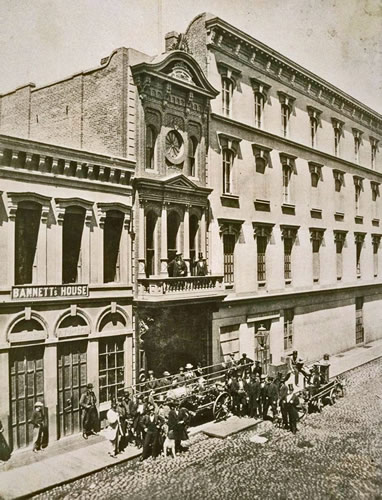
Another story, according to Battalion Chief Frederick J. Bowlen, has her dropping her schoolbooks and helping pull Knickerbocker No. 5 up Telegraph Hill to a fire, shouting, “Come on, you men! Everybody pull!”
Whatever the truth, the outcome was the same.
Against her parents’ wishes, Lillie became a familiar sight, sprinting beside San Francisco’s fire engines (which were hand-drawn by rope until 1866, when they became horse-drawn). The volunteers adopted the fearless little girl as their mascot, and she marched in parades, cheered at engine races, raised money for the volunteers, and eventually became an honorary member of Knickerbocker Engine Company No. 5.
Every October 17 — the anniversary of the fire company’s founding — she celebrated with “her boys,” dressed in a black silk skirt, red fire shirt, black tie, and veteran’s belt, carrying her black helmet. In 1888, the men honored her with a gold “No. 5” pin. She never took it off, wearing it into her grave.
Her devotion to the volunteers was only one expression of a larger trait: Lillie had little interest in living by anyone else’s rules.
Breaking Society’s Rules
Lillie’s father, Dr. Charles McPhail Hitchcock, expected his daughter to conform to society as befitted his social standing. Her mother, Martha Taliaferro Hunter, a Virginia-born writer who counted a young Bret Harte among her literary protégés, largely educated her daughter at home.
Lillie was fluent in French and adept at mathematics, but restless. Hoping to instill discipline, her parents sent her to a convent school.
“Pale but tearless, … she did not rebel,” Miriam Allen deFord writes in They Were San Franciscans. “She obeyed all the rules, she studied diligently, she did as she was told.”
Then she stopped eating. Four days later, the sisters sent her home.
As she grew older, Lillie continued to live by her own rules. She cultivated close friendships with men, occasionally wore men’s clothing, and preferred bourbon to tea. Though she no longer ran alongside the fire wagons, the firefighters remained at the center of her social life.
As Muscatine observes in Old San Francisco, journalists were “aghast at her daring, yet admiring the freedom of spirit that allowed San Franciscans to take her in stride … wondered if her independence did not augur a new era for woman.”
Love on Her Own Terms
Lillie eventually eloped with Benjamin Howard Coit, a stock exchange caller and bon vivant whom her parents dismissed as a fortune hunter. Rather than settling into the quiet life expected of a Victorian wife, according to deFord, she accompanied him to poker games and traveled the world. “She was a real companion to a husband who was, above all, a man’s man,” she writes.
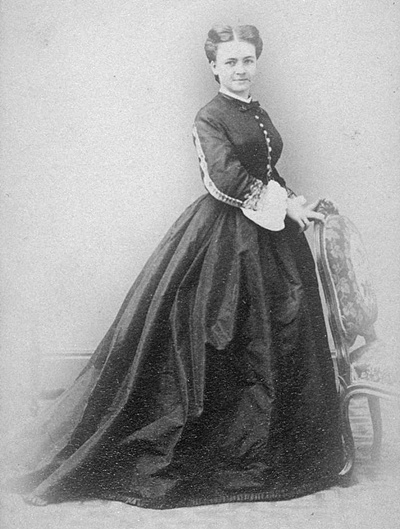
One day, she decided to bleach her thick dark curls. Howard hated the result. Lillie’s solution was characteristically dramatic. “Unabashed, she went to a hairdresser,” deFord writes, “had her head completely shaved, and until her hair grew in again, used three wigs—black, blonde, and red.”
Although the couple eventually separated, they remained friends for the rest of Howard’s life.
Living Life Full Tilt
After her marriage ended, Lillie continued to live much as she always had — on her own terms. Howard died in 1885, followed soon afterward by her father. Though devastated, Lillie inherited both estates and became financially independent.
“Her oddities were those of a great lady who is not afraid to be herself,” deFord writes.
She traveled between San Francisco, Paris, and Hawaii, hosted lavish parties, and delighted in defying expectations. At 57, she scandalized the nation by staging a boxing exhibition in her Palace Hotel suite.
Then in 1904, her extraordinary life took a dark and unexpected turn. As deFord recounts, Lillie was in her suite at the Palace Hotel with family friend Major J. W. McClung when Alexander B. Garnett, who managed the family’s rental properties, burst into the room and shot McClung. “Intrepid as always, she seized the maniac by the shoulders and cried: ‘Don’t shoot! Remember how good my mother was to you, and how good I’ve tried to be!’” McClung died the next day, and Garnett was committed to an asylum. Fearing he might someday escape, Lillie lived in Europe until after his death in 1924.
A Tower Above the Bay
When Lillie Hitchcock Coit died in 1929 at the age of 87, 22 firefighters attended her funeral at Grace Cathedral. Pinned to the lace above her heart was the gold “No. 5” she had worn with such pride throughout her life.

In her will, Coit left one-third of her estate to beautify San Francisco. That gift ultimately funded the construction of Coit Tower. Completed atop Telegraph Hill in 1933, the gleaming white landmark has watched over the city ever since.
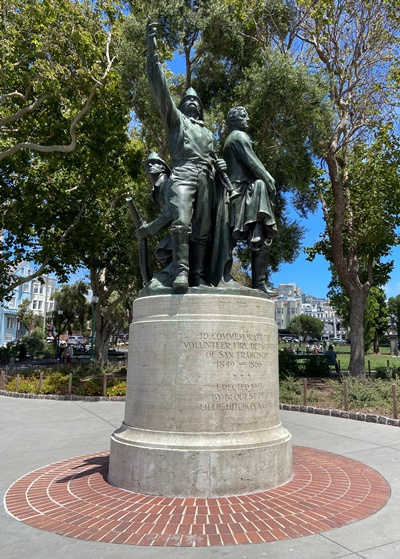
Although many assume the tower was designed to resemble a fire hose nozzle, the similarity is coincidental. Her connection to San Francisco’s firefighters is instead commemorated in a memorial depicting three volunteer firemen in nearby Washington Square.
But Lillie’s true monument is the story of a woman who refused to live by anyone else’s rules and whose love for her adopted city became part of its identity. Every day, thousands of visitors climb the tower that bears her name, few realizing they are also honoring the plucky girl who ran with San Francisco’s volunteer firefighters — and never stopped loving them.
Become a Saturday Evening Post member and enjoy unlimited access. Subscribe now



Comments
Thank you! for the informative article! I did not know the delightful background history to Coit Tower in San Francisco.
Thank you Barbara, for this superb article on Lillie Coit. Her love and care for San Francisco and the volunteer fire department was wonderful, and how they appreciated her support for life, going back to childhood.
She was a very intelligent, sophisticated woman, utilizing her advantages as she saw fit, but not being confined to established/expected gender roles otherwise. I dare say the President would be impressed by her having staged that boxing event in her Palace Hotel suite! If a time travel twist were possible, she may very well have been a special guest in the White House this very month, and shown a wonderful, enchanting time.