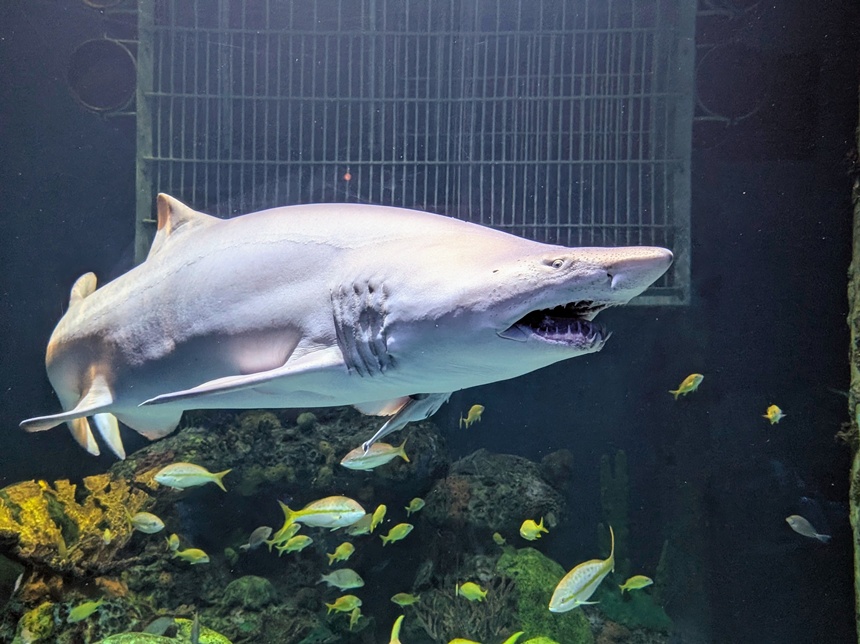
The gray sand tiger shark glides by, its razor teeth sweeping just inches from my fingers. Only the sturdy metal bars of my dive cage separate me from this 10-foot-long undersea predator.
Okay, I’ll come clean. This is all theater. The shark is a species that has killed precisely zero humans in recorded history, and is selected by aquariums everywhere for its menacing look but benign nature. Its knifelike teeth protrude even with the mouth closed, creating a permanent jagged leer.
I’m at the Johnny Morris Wonders of Wildlife National Museum and Aquarium in Springfield, Missouri, partaking in its Out to Sea Shark Dive. Here I’ll spend 20 minutes in what appears to be an underwater drunk tank wearing a helmet that delivers a reliable stream of oxygen to my lungs, a GoPro strapped to my wrist.
The false spectacle of underwater peril is classic Johnny Morris, as I discovered during my three-day visit to what I’ll call Planet Johnny Morris in and around Springfield and Southwest Missouri. Morris is the billionaire CEO of Bass Pro Shops and Cabela’s, the nation’s largest retailers of outdoor equipment.

But Morris is also the impresario of a gargantuan constellation of tourism properties in the Ozarks region. While they may be little known to the population on the coasts, they are magnets for visitors from a catchment area radiating from Missouri into Texas, Illinois, Tennessee, Oklahoma, Kansas, and Iowa. They also draw guests spilling in from nearby Branson.
Planet Johnny Morris includes a 450-acre property called Top of the Rock that includes five golf courses by some of the world’s top designers (including one Morris co-designed with Tiger Woods), an electric cart path that winds past nine handsomely curated waterfalls, and a 10,000-acre private wilderness you can tour by foot, bike, tram, horseback, snorkeled creek crawl, or with a survivalist, naturalist, or fishing guide.
There’s a private 75,000-item collection called the Ancient Ozarks Natural History Museum, a restaurant located in a barn that was originally located on Arnold Palmer’s Pennsylvania farm and moved piece-by-piece to Morris’s property, a 350-bed luxury resort whose guests have included Blake Shelton and Gwen Stafani, among other heartland A-listers, a family fun center where a bowling alley has projections on the walls that make the whole thing look like everything’s underwater, a 20,000-seat musical venue where at Johnny’s personal request the Rolling Stones have played, and, the most recent addition, a sinkhole that swallowed a driving range that Johnny’s turning into an attraction branded “the Cathedral of Nature.”
Not least, there’s also the biggest tourist draw in Missouri, which happens to be the oldest and one of the largest Bass Pro Shops anywhere. One of its many atriums features a “Dream Buck,” a piece of faux taxidermy so massive they had to cut off the roof and lower it in with a crane. Four million people per year make the pilgrimage.
All of which is to say Johnny Morris does things big, and he’s into spectacle. In fact, he’s been called the “Walt Disney of the Ozarks.” Like Walt, he’s a world-class entertainer of vacationing America, though as a born-and-bred-and-never-left resident of Missouri, he brings a middle-American sensibility to everything he touches.
Johnny also brings to all of this a persistent and authentic devotion to conservation. But this is a distinctly red state, Teddy Roosevelt brand of conservationism, one that attracts people who want to protect the outdoors because they camp, hunt, and fish in it — in other words, Bass Pro Shop and Cabela’s customers.
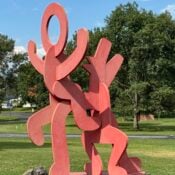
But no matter your personal interests, Planet Johnny Morris is a wild place to explore. I know of no other venue where you can tool around on a golf cart through miles of brilliant forestland decorated with massive wire-form sculptures depicting native fauna and then stop inside a fake cave with fake waterfalls and be served a canned gin cocktail.
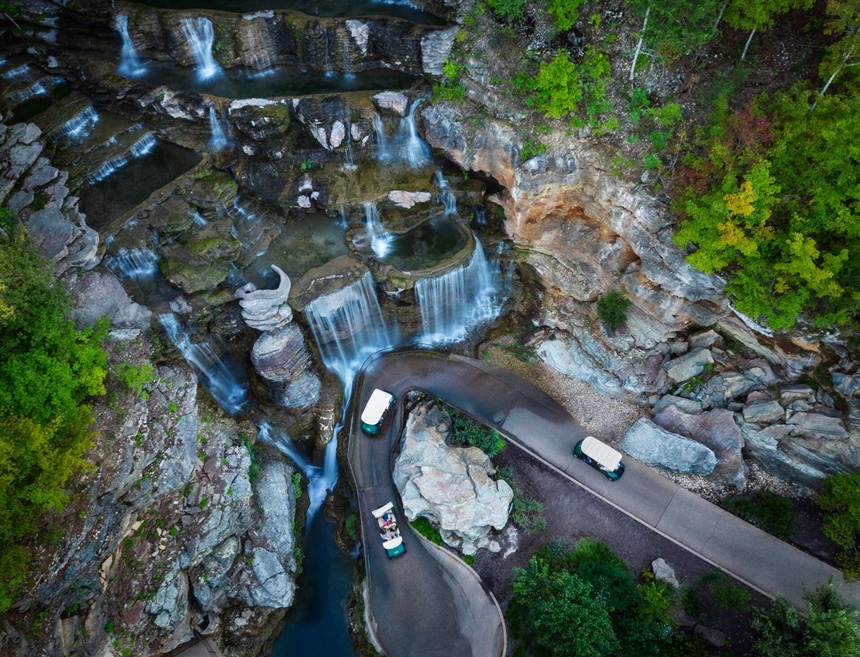
Yes, it was a gorgeous day in the Ozarks, and I was being invited to drink and drive to follow a trail that, we were told, Johnny Morris himself had painstakingly cut through the forest about forty years ago. Like so many things bearing the Johnny Morris name — and they are legion — it was oversized, eccentric, and unforgettable.
***
After the run in the golf cart, I enjoyed a lunch of meltingly tender wagyu fajitas in Arnie’s Barn. On the walls hung photos of Johnny with Arnie, Jack Nicklaus, and other legendary golfers. The bartenders told me that Johnny comes around every once in a while but never pulls rank, waiting to be seated at the hostess stand with other guests. “He’s a very modest man,” one of them said. I said that it was hard to square that modesty with a man who puts his name on so many things and has his picture and stories about himself everywhere.
“I know,” she said with a shrug. “But he’s great to work for. The benefits are really good.” In my observation, the employees of Planet Johnny Morris seemed very happy to be in his orbit.
I retreated downstairs to the Ancient Ozarks Natural History Museum, where signage explained that it was made up of Johnny’s personal 75,000-item collection. It all started when he found an arrowhead on the property when he bought his first 2,260 acres in 1990. It grew as he personally continued his archeological work even as he built his business empire, acquiring items from various collections in the region.
The museum tells the story of the Ozarks starting with a woolly mammoth and ending with the Civil War. It’s a rich collection, full of exotic taxidermy, enough arrowheads to wipe out a very long wagon train, household items of ancient Native Americans, a lot of old guns, a very important collection of skulls and horns, and tributes to great American conservationists, including Teddy Roosevelt and his formative role in the modern conservation movement.
Displays told the story of Native Americans in the Ozarks, portrayed as “the first conservationists.” The storytelling includes the Indians’ eventual forced relocation onto reservations. One display was devoted to the Trail of Tears, the murderous clearing out of native tribes, by means of a forced march west including through parts of Missouri, by edict of President Andrew Jackson in 1830. It was described in some detail, and declared a “dark chapter” of American history.
Right outside the museum, in an infinity pool overlooking a panoramic view of the Ozarks, stands a 20-foot-tall bronze reproduction of a statue called “End of the Trail” by James Earle Fraser, first modeled in 1894. It depicts an exhausted Native American warrior slumped forward on his equally weary horse. It’s said that Fraser intended it as an indictment of U.S. policy toward Indians, including the reservation system. Some people today see it as insensitively depicting a vanished race rather than a living one. Others see it as simple colonialist triumphalism, a high-five to the cowboys for their win in the cowboys-and-Indians game.
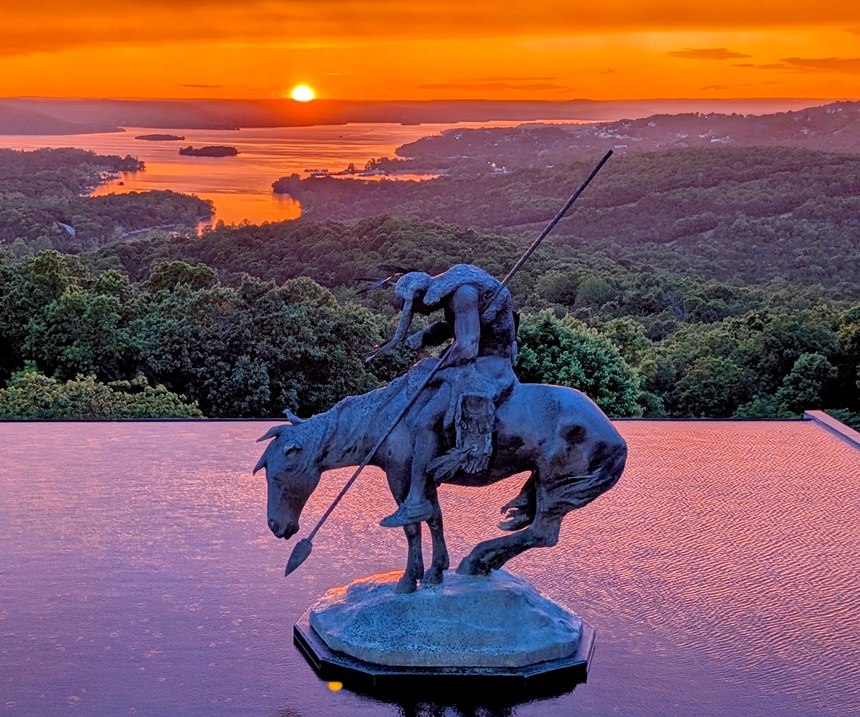
It’s hard to know which meaning Johnny Morris assigns to “End of the Trail.” But after a few days of exploring Planet Johnny Morris, my hunch is that he just really loved the impact it makes, so he put a really big one where everybody would see it.
***
I took a ride on a tram through parts of the 10,000-acre Dogwood Canyon Nature Park with a delightful guide named Joe. He explained that a small portion of the land was conserved — used to hike, bike, fish, tour, forage, educate, serve meals, host marriages, husband livestock, and so forth — but the large majority of it was preserved, which is to say left in its natural state.
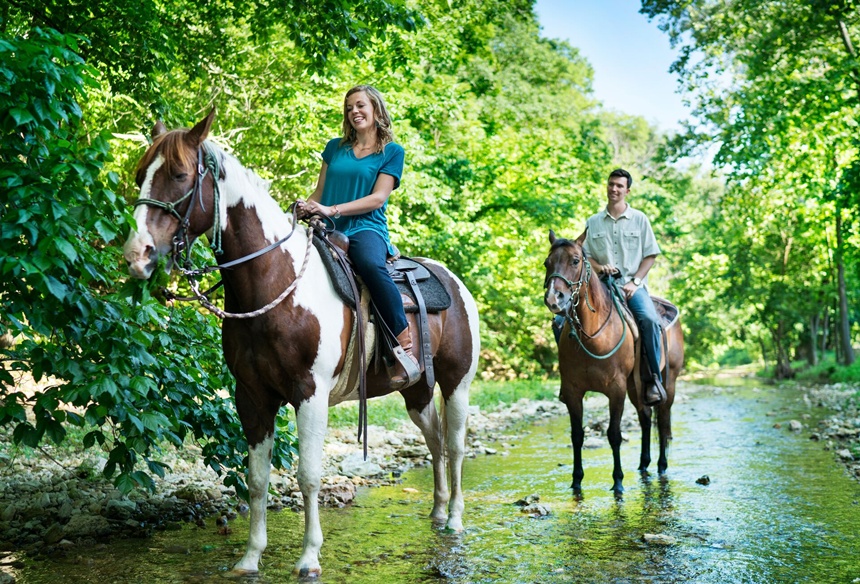
The chunk of the park we saw was very much part of Planet Johnny. I saw the caves where Johnny discovered human remains shortly after buying the property. A waterfall is named for musician Waylon Jennings, Johnny’s best friend. A fishing hole is named after Waylon too, since he had confessed to Johnny that he’d never caught a fish. So Johnny — who’d spent many years fishing as a kid and who, in fact, launched Bass Pro Shops from his parents’ store in 1972 by selling fishing lures — helped Waylon hook his first one. There was the small rustic amphitheater where Johnny Morris got Johnny Cash to play.
After we saw herds of elk and bison, we passed by gates where Joe told us “Johnny has another LLC, where he raises some other bison. Those bison are served in our restaurants. They’re just dying to meet you.” Har!
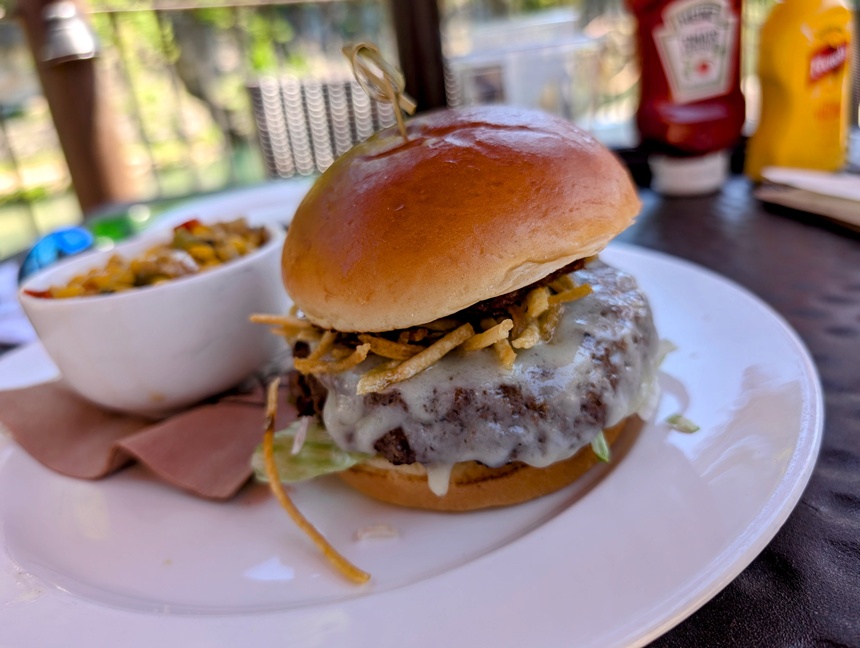
As it happened, I had enjoyed the bison burger at the Dogwood Canyon Mill Restaurant for lunch. The patty’s flavor was excellent, the tomato jam and crisp potato sticks toppings making a great sandwich. The food is very good on Planet Johnny.
The following day, I was riding a horse named Doc through the same park, enjoying the sights, pondering once again how Johnny Morris can do all of these things and remain a modest man. I called up to the guide I’d been conversing with off and on, and asked her if she’d met Johnny.
“Oh, I’ve gone to a couple of Christmas parties where he’s been there,” she said. “He always gives a speech where he talks about how grateful he is for all the people who’ve helped him build his businesses. How he couldn’t do any of it without us. He really appreciates us.” She paused.
“He’s a great boss to work for.”
Since we were riding horses I couldn’t see her face, but I could hear her voice. I swear she got choked up when she was talking about Johnny Morris.
***
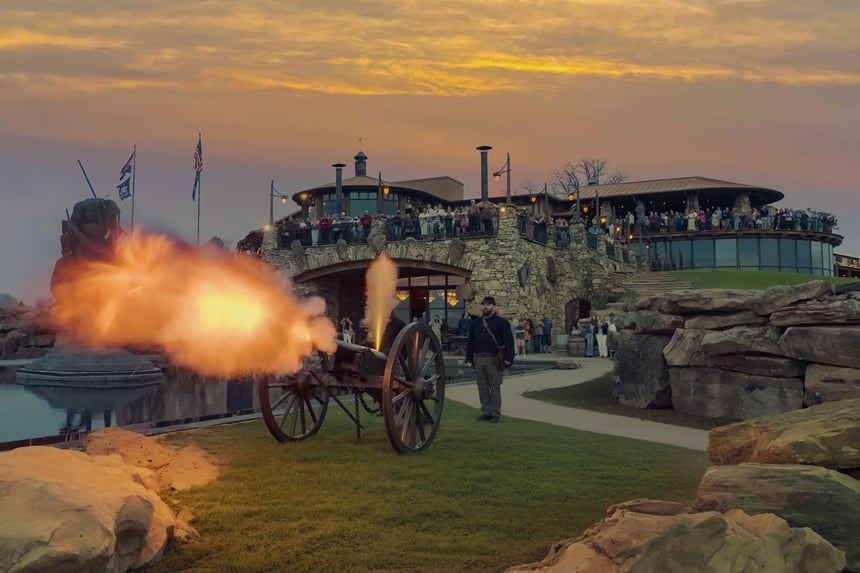
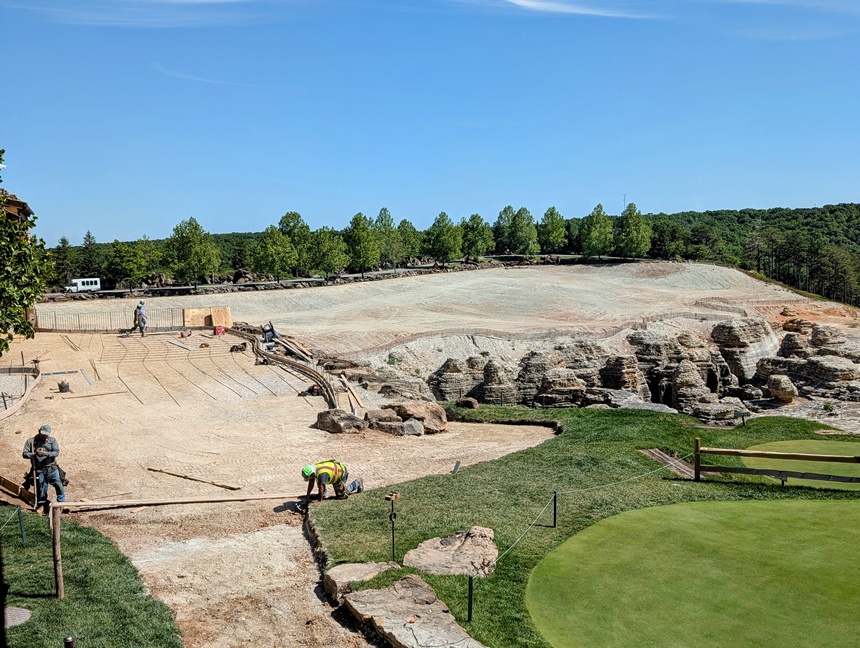
After my superb pork chop dinner at Osage Restaurant (great view of the sinkhole), it was nearly sundown. I retreated to the patio railing below to catch the nightly ceremony personally designed by Johnny Morris.
It happens right near the 17th hole of the putting course, between the beautiful stone chapel where Johnny’s daughter was married and the infinity pool where the “End of the Trail” statue stands. Nearby, two Civil War re-enactors are tending to a cannon.
The view from the railing is of Table Lake and, miles beyond, the rumbling Ozark mountains. The sun, behind a scrim of clouds, slowly lowers itself onto the mountains; pink and orange spill across the lake.
Then, bagpipes begin to squeal. Johnny wanted this to be part of the ceremony to pay tribute to Scotland, the home of the sport of golf.
And just as the sun dips below the horizon — this was 8:08 p.m. on the night I was there — the enactors touch off the cannon. The boom is so heavy I feel it in my sternum.
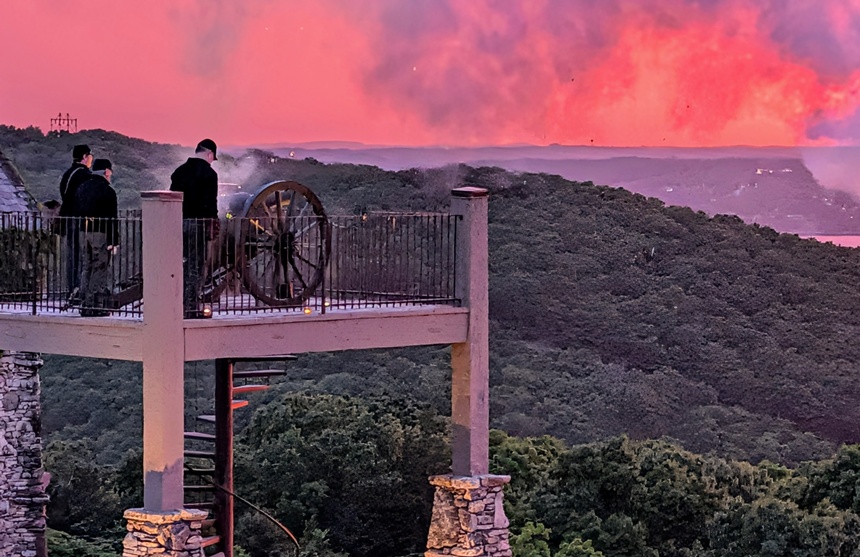
It was all so odd: the putting course, the chapel, the defeated Indian in the infinity pool, the bagpipes, the Civil War cannon, and an Ozarks panorama of stunning grandeur.
It is enormous. It is a spectacle. It is strange. It is the vision of one man.
It is, in other words, life on Planet Johnny Morris.
Become a Saturday Evening Post member and enjoy unlimited access. Subscribe now


Comments
Yes, Johnny Morris will go down in history as one of America’s great conservationists..