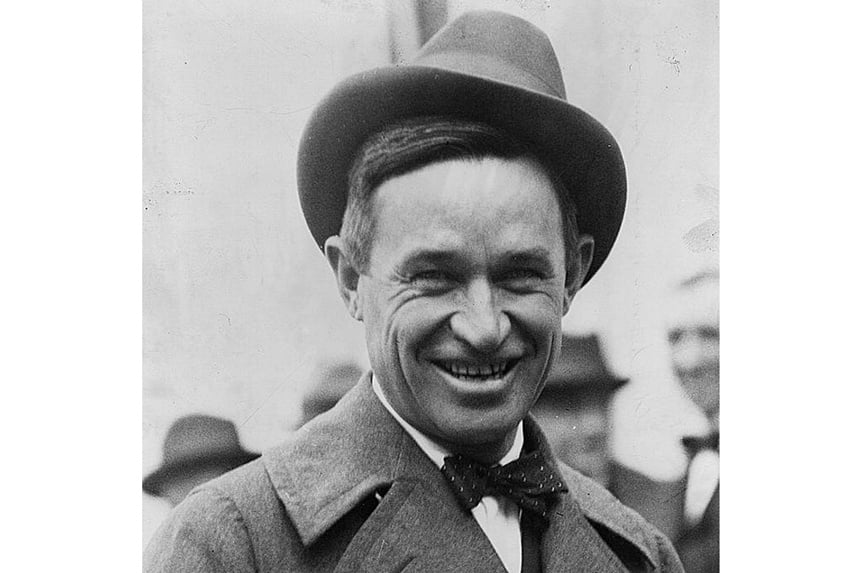
In the early 1930s, no star shined brighter than Will Rogers. He was the number one box office star, the most sought-after public speaker, and the most widely-read newspaper columnist of his day. On top of that, he wrote books, hosted one of the top radio shows in the country, and owned a 359-acre ranch in Southern California that stretched all the way to the Pacific Ocean. He was so famous that when he died in a plane crash in 1935, Congress renamed Route 66 the Will Rogers Highway.
Yet, today, most people outside his home state of Oklahoma know little about him despite easily recognizing his contemporaries like John Wayne, Clark Cable, and Shirley Temple. The reason why is ironic — his studio didn’t want to profit from his death — and unfortunate, because Rogers set an example of treating others — especially those he disagreed with politically — with civility, something our polarized world could use more of today.
This year, Americans outside of Oklahoma may start hearing his name on a more regular basis, though, as Route 66 — still known as the Will Rogers Highway in his home state — celebrates its centennial. In Claremore, Oklahoma, the Will Rogers Memorial Museum has kicked off an $18 million renovation this year, its first major overhaul in decades. Even more likely to generate a buzz is Will to Win. Currently in production with a cast that includes Sean Astin, the movie tells the story of a Chickasaw girl who imagines conversations with Rogers to navigate difficult times.
Humble Beginnings
William Penn Adair Rogers was born on November 4, 1879, in Indian Territory to a Cherokee senator who helped write Oklahoma’s state constitution and his wife, the descendent of a Cherokee chief. As the baby of the family and the only son, Rogers basked in the attention his mother and three older sisters paid him, and he entertained them with his antics. That playfulness continued at school, where he struggled academically but excelled at making his classmates laugh.
Disappointed by Rogers’ carefree nature, his father sent him to several boarding schools, hoping their structured environments would instill some discipline in him. That strategy failed. At home, Rogers spent his free time riding his father’s 60,000-acre ranch and learning to trick rope from African American freedman, Dan Walker.
Excerpts from Will Rogers’ The Ropin’ Fool, a silent film produced by Rogers in 1922 that showcases his trick roping ability. (Uploaded to YouTube by Will Rogers Memorial Museum)
Looking for fun and adventure, Rogers left school to work on a Texas cattle drive, then traveled to Argentina. When he couldn’t find work, he took a job on a horse ranch in South Africa before joining his first wild west show as a trick roper in 1903.
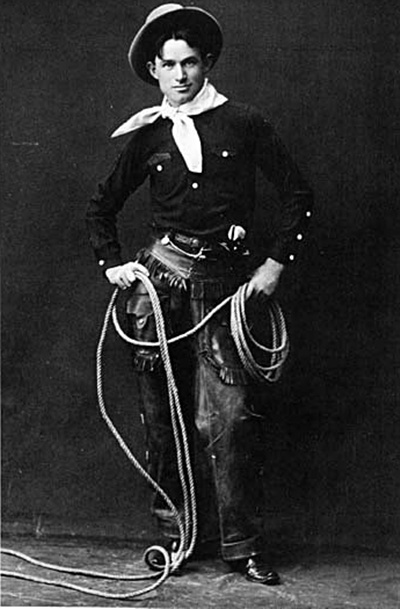
From there, he transitioned into vaudeville, and in 1915, Florenz Ziegfeld hired him to entertain the crowd while his Ziegfeld Follies dancers changed costumes. The role didn’t have any lines, but one night, Rogers commented on a trick he had just missed, and the audience laughed. Soon, he began missing tricks on purpose as an excuse to talk.
“He had a passion for roping and then had that fun loving side of him,” explains Tad Jones, executive director of the Will Rogers Memorial Museum. “You get those two things together — an excellent trick roper with a passion for fun — and you get him on stage. That got him his big start.”
By 1918, Rogers was earning $1,000 a week — roughly $23,000 today — working for the Ziegfeld Follies.
Rising Star
Rogers moved to the big screen with a role in the 1918 silent film Laughing Bill Hyde and worked steadily for the next 10 years, some years appearing in more than half a dozen releases. His popularity didn’t falter when the industry introduced talkies. Jennifer Rogers, Will Rogers’ great granddaughter who works to protect his legacy, says his success didn’t come necessarily from his acting ability but rather his ability to be himself on screen.
A trailer for Judge Priest starring Will Rogers (Uploaded to YouTube by SabuCat)
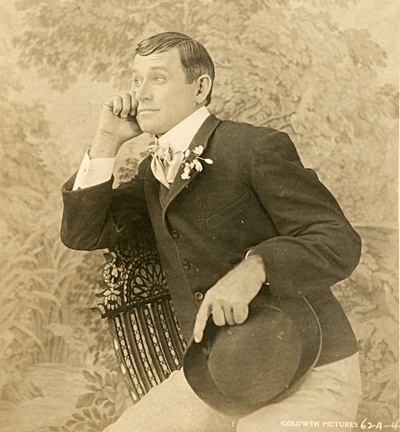
He wrote a lot of his own lines, she explains, and he knew how to entertain people. He could make an audience laugh. Not to mention, people felt like they knew him personally, and to an extent, they did through what he said off-camera and what he wrote. That relationship with his fans goes back to his first spoken lines.
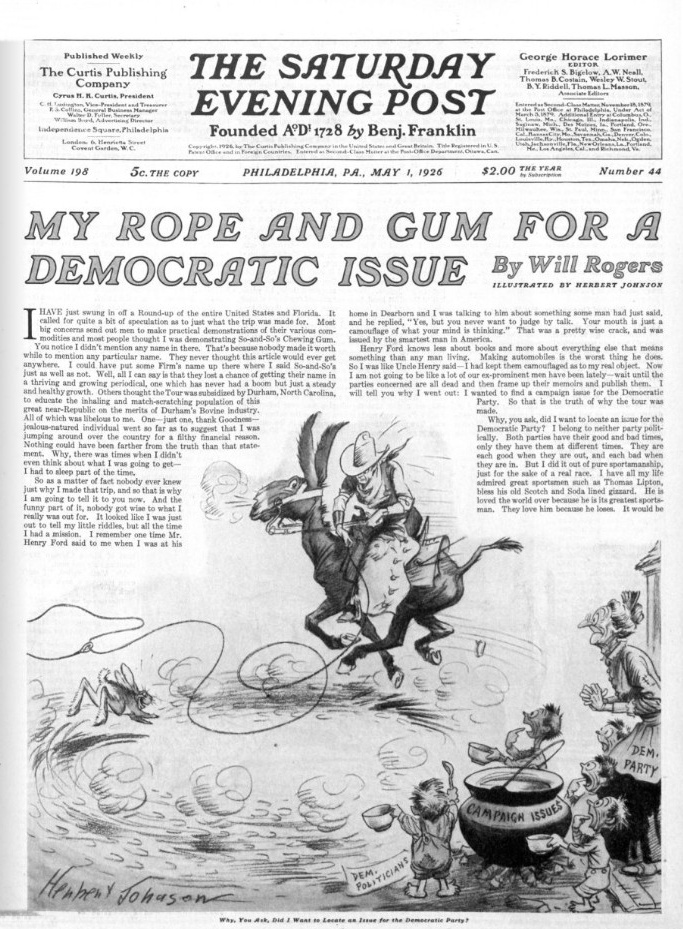
When Rogers began talking during his trick roping act, his simple, direct, and witty manner won audiences over. He went on speaking tours sharing his observations on the day’s news, and in 1922, McNaught Syndicate invited him to write a weekly newspaper column offering similar commentary. As his popularity grew, he expanded into radio, wrote six books, and penned articles for The Saturday Evening Post.
He wasn’t a polished writer or speaker, but that was part of his appeal.
“He was plain spoken, but he had a way of getting to the heart of the matter quickly, and he spoke with kindness,” says Trait Thompson, executive director of the Oklahoma Historical Society. “He could criticize in a way that didn’t make people feel like they’d been criticized. He wasn’t mean.”
People were so hungry for his commentary and homespun humor that when he went overseas in 1926, the New York Times asked him to send them a daily telegram, a practice that continued after his return. At the time of his death in 1935, his Daily Telegram column appeared in over 500 newspapers and reached 40 million readers.
The Height of Celebrity
Thompson says he has a hard time conveying to younger generations just how big a celebrity Rogers was in the early 1930s. Rogers could go anywhere in the world, and people recognized him. He was friends with Henry Ford, Thomas Edison, Walt Disney, the Rockefellers, and presidents. No one today reaches that level of celebrity — the closest he can come up with for younger people is Taylor Swift.
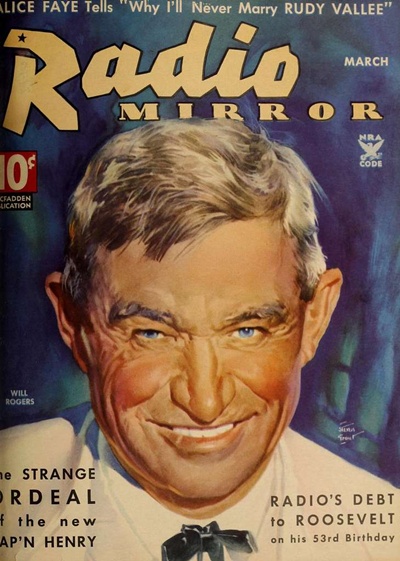
Jones believes even that isn’t a fair comparison.
“You can have your biggest stars in the world like your Taylor Swifts that everybody knows, but she’s in one, maybe two different genres, music and then movies,” Jones points out. “Will crossed four or five. We’re talking radio, movies, public speaking, newspapers, and political pundit. Every medium you can think of at the time, Will Rogers was there.”
Fame was never his goal, though, according to the Rogers family. He simply liked to make people happy, and everything else fell into place. In fact, he was so humble that Jennifer Rogers didn’t even realize her great grandfather was a “big deal” until she saw the Broadway show, The Will Rogers Follies, when she was 22 years old.
“I grew up not really knowing who he was or how famous he was,” she says. “It’s not something that we sat around the table and talked about every night.”
Will Rogers’ Legacy
In early August 1935, Rogers joined friend Wiley Post, the first pilot to fly solo around the world, on a mission to survey air routes between the U.S. and Russia. Their aerial tour continued until August 15 when the two took off from Fairbanks for Point Barrow, Alaska’s northernmost point. Poor visibility forced them to land in a lagoon, where they asked an Inuit family for directions. As they took off again, the engine failed, and the plane plunged into the water, killing both men.
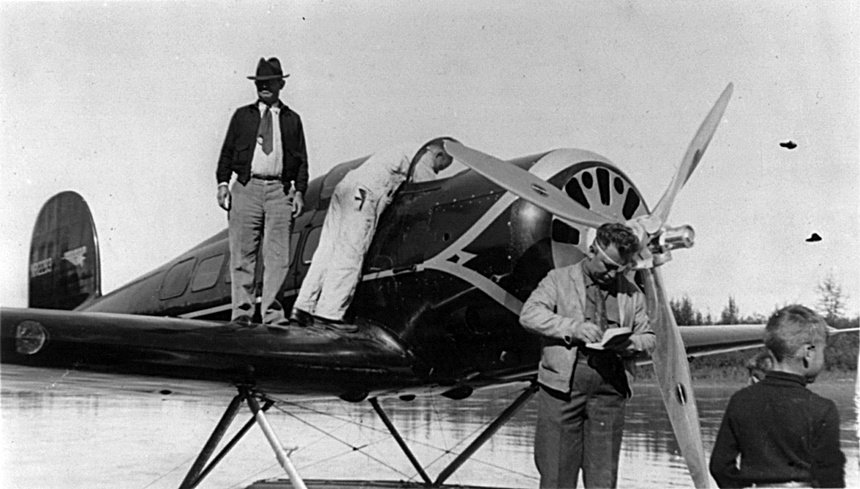
Jones says Rogers’ death devastated the nation because people felt like they’d lost a personal friend. Every morning during the Great Depression, Americans would open the newspaper to see what Rogers had written in his Daily Telegram. He’d put a smile on their face at a time when many didn’t have much to smile about.
After his death, Fox Film Corporation put all of his movies into storage out of respect — they didn’t want to look like they were profiting from his death. However, it may have impacted his name recognition with younger generations.
Today, you can find clips and a few of the 71 movies he made during his career on YouTube (eight are available for purchase), and the Rogers family hopes to persuade Disney, who currently owns the rights to his movies, to release others.
But Rogers’ legacy isn’t just his movies, Jones argues; it’s the example he left us of how to treat those we disagree with, especially when it comes to politics.
Lessons for Today
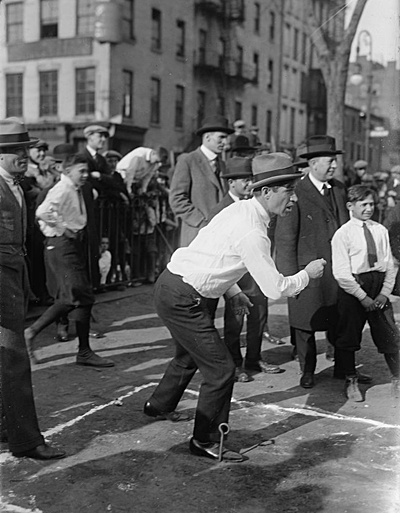
Rogers wrote and spoke about the news of his day, but he always did so with respect for other opinions, Jones says. It’s part of the reason why the museum promotes him as an example of what it means to be a good citizen. He focused on the issues and never attacked the person.
“He wouldn’t say, ‘You’re a terrible person,’” Jones continues. “He’d say, ‘Here’s the issue we’re dealing with and why it’s right or wrong.’ Today, everything is personal, and we think the other side is the enemy.”
His Bacon, Beans, and Limousines speech is a good example of this. In 1931, two years into the Great Depression, President Herbert Hoover gave a radio address outlying his plan for economic recovery, which involved local communities providing aid to those in need rather than the federal government getting involved. To attract the largest possible audience, Hoover asked Rogers to open for him.
Will Rogers – Bacon, Beans, and Limousines (Uploaded to YouTube by Will Rogers Memorial Museum)
Rogers agreed to speak, joking early that he and Hoover might wind up replacing Amos and Andy as radio personalities. Then, he turned to the economy, expressing frustration that so many Americans were out of work and couldn’t feed their families. While he didn’t blame anyone specifically for the crisis, he hinted that maybe the government should provide financial relief. In the end, he thanked Hoover for the invitation to speak and reminded everyone that the president wanted to solve the problem.
Hoover was never the “enemy” in Rogers’ speech; no one was. He simply commented on the crisis and what he saw as the problem, which is why politicians from both sides of the aisle wanted him to mention them. Whether Rogers agreed or disagreed with them, the attention was good publicity.
Jennifer Rogers thinks that if her great grandfather was alive today “he would be extremely disappointed in all of us” because of the way we’re treating each other. He would want us to listen to each other and remember that we’re Americans first and foremost.
Jones sums it up this way: “People look up to George Washington and Abraham Lincoln and other politicians, but I think that as a citizen, Will Rogers is the best role model that our country has every produced in the way that he treated everybody from all walks of life with respect. I think that’s something we can all work towards and emulate.”
Become a Saturday Evening Post member and enjoy unlimited access. Subscribe now


Comments
Thank you for alerting us. We have corrected the error.
The Will Rogers Memorial is located in Claremore, Oklahoma. Not Claremont.
I sure do know a lot about, well, what I know — but I am an ignorant man.
This bit of Roger’s understanding of people has helped me stay humble, I proudly proclaim!
Wow! It’s great to know the life of good actors, and people like Will Rogers. Sense of humor without bad words. All nice and elegant. Thanks, this is a great articulo to read, his biography is excelent.