Disclosure Day
⭐️ ⭐️ ⭐️
Rating: PG-13
Run Time: 2 hours 25 minutes
Stars: Emily Blunt, Josh O’Connor, Colin Firth
Writers: David Koepp, Steven Spielberg
Director: Steven Spielberg
I was hoping that Disclosure Day, Steven Spielberg’s epic tale of the world slowly awakening to the truth about space aliens, would be some sort of unifying magnum opus that narratively tied together the universes of his previous UFO entries, E.T. and Close Encounters of the Third Kind.
Instead, we get an often-thrilling, occasionally immersive, too-often preachy third story that not only stands alone, but also seems to unfold in a world where the events of those earlier films never even happened.
Don’t get me wrong: Spielberg is incapable of making a bad movie, and Disclosure Day has its share of indelible moments. Aside from John Ford and Franco Zeffirelli, it’s hard to name a director who more masterfully utilizes closeups to dissect the inner nature of his characters. I’d defy you to name a single director who more ably combines Big Ideas with the elements of crowd-pleasing entertainment. And as always, Spielberg here draws powerful performances from his cast, especially Emily Blunt as a TV weather woman who is chosen to relate a cosmos-shattering message to the people of Earth.
So, why does this film feel suspiciously like a sleepwalk through Spielberg’s greatest hits? One can imagine the director, beaming like a proud father, leading us along his private cinematic gallery: You’ll spot leitmotifs from the Indiana Jones films, Ready Player One, Minority Report, Always, A.I. – and, in the film’s lengthy motorized chase scenes, a heapin’ helping of Spielberg’s first feature, 1974’s Sugarland Express. Even the soaring score by the always-evocative John Williams – coaxed out of retirement for this project – seems to gaze longingly backward.
Oddly enough, aside from a couple of visual flourishes (shifting shadows on the walls, a momentous encounter at a train crossing) and a plot element in which the aliens imprint information on the brains of sensitive humans, there’s surprisingly little DNA to be found here from E.T. or Close Encounters. (Spielberg, who is casting this film as the final entry in his lifetime Space Aliens Trilogy, seems to be ignoring War of the Worlds in that argument, and I‘m inclined to let him momentarily ignore that H.G. Wells remake.)
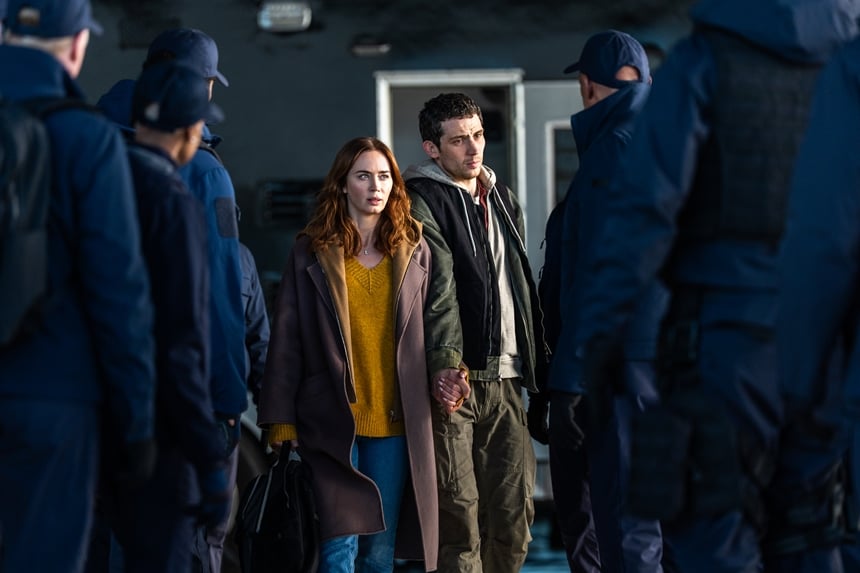
All of which means Disclosure Day needs to stand on its own spindly, alien feet. The film gets an unsteady start, as much of the first half-hour is spent introducing us to way too many major characters, many of whom, at first glance, seem to have nothing to do with each other: There’s weather forecaster Margaret Fairchild (Blunt); Dr. Daniel Kellner (Knives Out’s Josh O’Connor), a scientist who has stolen some mysterious cache of glorified USB memory sticks which may or may not confirm the presence of space aliens among us; Daniel’s plucky girlfriend Jane Blankenship (Bridge of Spies’ Eve Hewson), who refuses to sit out the adventure; Noah Scanlon (Colin Firth, bearded and threatening), the man who will go to murderous ends to keep the world from learning a secret for the ages; and Hugo Wakefield (the always-super-cool Colman Domingo), a guy who seems to have all the answers but suavely refuses to provide even a hint of one. All these characters, it turns out, play outsized roles in the story, which means, unfortunately, that the script by Spielberg and David Koepp (Jurassic Park) simply has too many major characters to flesh out before getting into the action.
And there’s action aplenty, once it starts, brilliantly staged by Spielberg and assembled by his favorite latter-day editor, Sarah Broshar (West Side Story, The Fabelmans). Besides the aforementioned car chases, there’s an absolutely gob-smacking sequence involving a car being dragged by a freight train, but it seems arbitrarily dropped into the film to keep us engaged. Even Spielberg seems to lose interest in the diversion: One second, two characters, having barely escaped with their lives, are trapped inside a piano-filled boxcar, speeding along to who knows where – and the next they’re walking across a field without so much as exchanging a “Whew! I can’t believe we got out of that one!”
Also, there’s lots of talking. Talking of almost European art house quantity. And it’s here that we get to the meat of what Spielberg seems to be asking in his third alien film: How would the world react if everyone, all at once, was confronted with the fact that we are not alone in the universe? It’s a matter that seems to consume most of the film’s characters: Firth’s Noah expounds at length on his conviction that society would collapse in a heap of anarchy, a view shared, at least at the outset, by Daniel’s girlfriend, Jane – a former convent novitiate whose crisis of faith requires some soothing words from her old Mother Superior (Homeland’s Elizabeth Marvel) – yet another narrative level in a movie that layers them on like the toppings of an IHOP breakfast special. The opposing, upbeat, Spielbergian view is taken by Daniel and Hugo, who wax philosophical not only about the people’s right to know, but also about what a singularly unifying event it would be for the entire world.
Meanwhile, I’m thinking, “Hey, can we get back to that train thing?”
Disclosure Day’s two-and-a-half-hour length builds, unsurprisingly, to the day of disclosure, when all is explained to the people of Earth in a firehose of formerly classified clips. It’s here I was hoping to catch a glimpse of Roy Neary climbing aboard Close Encounter’s mother ship or declassified footage of Elliott bicycling past the full moon. But if they appear in Disclosure Day’s climactic montage, I missed them, even on an IMAX screen. For a moment I thought that, just maybe, Daniel and Margaret, who both experienced alien-induced amnesia regarding their childhoods, might turn out to be Elliott and his little sister, Gertie, all grown up and now reunited. Alas, the math simply didn’t work.
In Close Encounters, all is revealed on a Wyoming mountaintop. In E.T., a cathedral-like forest adds mystery to the title character’s departure.
Here, the world changes in a TV studio in Kansas City, Missouri. That’s about as prosaic as it gets. As the staggering news flashes around the globe, Spielberg shows us masses of people – on sidewalks, in traffic, in stores – all staring into their smart phones, dumbfounded by what they are seeing.
Spielberg’s final word here seems to be that this transcendent moment would, at last, unify the world as a great brother-and-sisterhood of beings suddenly bound by realization of their shared place in the universe. But I could not help but see something else: Billions of people staring at their screens, not even glancing up to catch someone else’s eye with a “Can you believe this?” stare. At a moment of universal revelation, every person remains isolated from the rest of humanity.
Just when we could have really used a speech, Disclosure Day goes silent.
Become a Saturday Evening Post member and enjoy unlimited access. Subscribe now