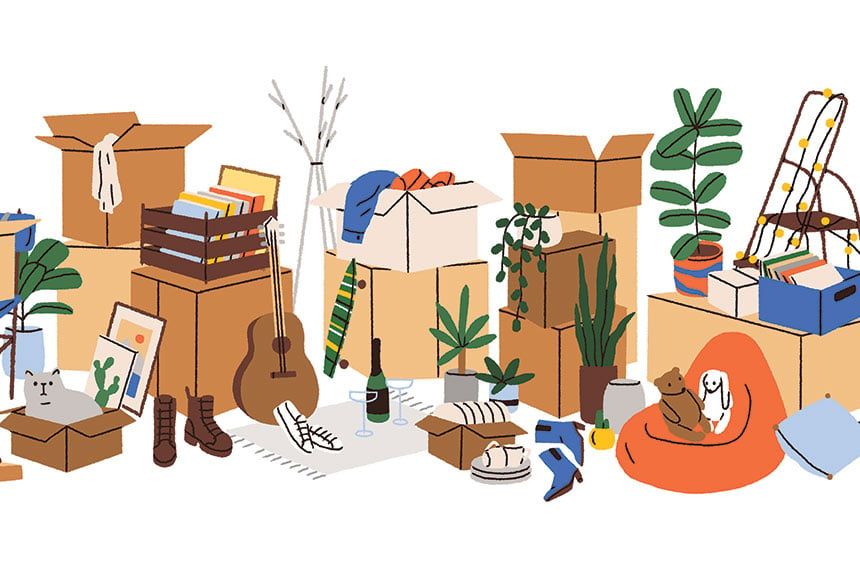
For the past four months, my time has been totally consumed with greater-family stuff. My next-door cousin Nancy died suddenly at the end of January, and we then had to place her partner Lorraine in a memory-care unit two weeks later. Now we are clearing out their home filled with every kind of collection you can think of — from Depression-era glassware to dozens of covered casserole dishes to two dozen salt cellars. Baseball cards. I’ve found over $500 in quarters stacked in film canisters and boxes and coffee cans. Then comes the estate sale, then the house sale. Wash, rinse, and repeat on a house they have in Florida. The job of doing all of this has fallen to me, my two sisters, and my cousin Jan. We are Nancy’s relations.
When Nancy died, her partner Lorraine inherited everything. Unfortunately, Lorraine has Alzheimer’s that is getting to an advanced stage. We honestly had no idea how advanced Lorraine’s Alzheimer’s was when Nancy died, and it left us all reeling and having to provide 24/7 care for her. We found space in a local memory-care unit, so we moved Lorraine to a place where she would be safe. Why, oh why, were no plans made for the future?
Cousin Jan, who is the estate’s executor and has power of attorney, has also inherited the responsibility for Lorraine. Nancy and Lorraine were the most important person in each other’s lives, and they did everything together. Lorraine has been part of our family for 45 years, and it turns out we really didn’t know her at all because Nancy ran the show and Lorraine was like her shadow helpmate. A literal cipher. It has left us gobsmacked.
I have learned so much about Lorraine by cleaning out her room because she kept cards and letters. I found out she has nieces and a sister-in-law who live in the South. That she had a brother, who was 12 or 14 years older than she and died at some point from something. That her father ran a pool hall in Washington, D.C. I will ask Lorraine about these things, and we’ll have an odd little conversation about her childhood. Then she’ll say something like, “Well I’m going to tidy up tomorrow because I’m going to sell those couches over there, and maybe that ugly lamp.” She believes she owns the memory-care unit.
“That sounds like a great idea,” I’ll say. I realize that every bit of information she imparts is suspect at best. But she’s funny, a little snarky, and always happy to see me.
My mind honestly cannot process everything that’s happening because I’m too busy looking in dismay at the 100 strands of Christmas lights. At some point, everything occupies the same place in my mind: Christmas lights, a diamond ring, a film canister of quarters, a collection of ceramic pigs, and a baggie filled with twist ties.
Wise people say, “Do not do this to your kids … clear out your house while you still can.” To a person who likes to tidy up and put things away and create lovely rooms filled with ambience, that sounds like a strategy they would employ. For the rest of us, we look around, throw up our hands, and let ourselves off the hook by thinking our children are strong and have stamina, whereas we need to rest many times a day with our feet up and a book in our hands or maybe a British detective show on the telly. And then there’s the family tradition of assuming that our children will be interested in all the tchotchkes and ephemera generously stashed in every room. After what we’ve been going through over the past several months, I’m seeing the fallacy in that assumption.
I, however, am a sucker for anything with a family connection. Our family has lived in this tiny village for six generations, and the stuff we have could fill a historical society building if we had one. Nancy was very ill for several months before she died. I would visit the house mid-morning most days to see if they needed anything or just to help her pass the time. Even though in terrible pain, Nancy would begin talking, and the next thing I knew a couple of hours had passed. I would look at objects in the room and ask her where they came from. And then we’d have a spirited discussion about the state of the country. After we solved some major political problems, I’d leave.
During those visits I learned more about Nancy’s time in the Philippines with the Peace Corps, which she entered in 1963. I was just amazed that this farm kid from a village of 500 who went to the local teacher’s college and who had not traveled anywhere would have the nerve to join the newly created Peace Corps. She spent two years teaching physical education and English to kids in a small city. That might have been the first and last time she ever flew on a plane, as she was deathly afraid of flying.
After Nancy’s death and Lorraine’s move to the memory-care unit, I found several boxes of baseball cards and laughed when I riffled through them and saw an extensive collection of Cal Ripken Jr. and Ken Griffey Jr. cards from throughout their careers. She and Lorraine loved the Baltimore Orioles. Then I found the box of bobble heads of Orioles players and signed baseballs, which might cement their status as super-fans.
One day, I opened a closet and saw dozens of large photo albums and several boxes labeled “old photos” that had to be dealt with. I can’t throw out photos. In fact, I’ve bought old photos from thrift stores of people I don’t know. I can’t even bear to open the albums or boxes because of my oversized attachment to the medium. And if they’re labeled — and I’m sure they are — they would have to live in my house until my kids have to deal with them. At least one of my kids has a similar affliction to family stuff, so I can almost visualize the albums and boxes of photos in a closet in her house. Then when the contents of her closet are gone through in the future, someone will find them and turn to another person and say, “What are these called, and why do they exist in this form?”
This tidying up of a person’s life happens to all of us. But when you are in the moment, you feel so alone in the endeavor. You find yourself working right along, but then you pick up an object — in this case, a painting of the American West my grandfather painted in the 1940s — and you remember your cousin telling you that granddaddy gave it to her when she graduated from high school. And you just want to hold onto it and never let it go.
Rachel Dickinson is the author of several books; her most recent is The Loneliest Places: Loss, Grief, and the Long Journey Home. Her work has appeared in numerous publications, including The Atlantic, Outside, Men’s Journal, Aeon, Salon, and Audubon.
This article is featured in the July/August 2026 issue of The Saturday Evening Post. Subscribe to the magazine for more art, inspiring stories, fiction, humor, and features from our archives.
Become a Saturday Evening Post member and enjoy unlimited access. Subscribe now



Comments
A lovely piece, and such a good corrective to all of the tedious articles on how we must “declutter” and lead “minimalist” lives! Yes, it is good to dispose of certain kinds of things, but many things have important memories attached, or might be of value to a relative.
My parents were generally good about their gradual deaccessioning–they’d ask us if we wanted certain things, for instance (although what we didn’t want at one point we often realized later that we wanted very much). When my mother died in April, it was not an intolerable job for us to clear her apartment–yet it was not quick. We were happy to give away many health-related items, clothes, etc. The nicer clothes, including the wedding dress from 1949, went to a young cousin’s vintage shop. We will give other young relatives items such as a good set of dishes, or glassware, as wedding presents or housewarming gifts. We are keeping all the photos, letters, and most of the files, as my parents had already disposed of all but the most recent uninteresting files, and also (alas) shredded some letters that we would have wanted kept. We are keeping much more than we expected, but the items we’re keeping have sentimental value and/or are useful and good quality. (I’m sure my mother’s iron from circa 1950 is much better than the one I bought a few years ago to replace one that died on me!)
It’s good to take time to make decisions about these things, if at all possible. We were willing and able to pay for extra time on my mother’s apartment so that we didn’t have to rush. I was also grateful that I had already retired and could put in the time.
What a beautifully written rumination on familial archeology; some of the most interesting discoveries and mysteries about our loved ones and their history are found in left behind photo albums and ephemera. If there is a way to sift through one’s treasures with a family member before they are no longer with us, Rachel provides a household (or two) of reasons – even the quietest of lives holds riches.
I am dealing with this now. Throwing out things which belonged to my loved one feels like throwing out part of them. It’s so hard to do.
Wow, Rachel has written about my conundrum. We have thousands of pictures which are in boxes, computers, clouds, memory cards, etc. And, we cannot discard even the ones which may have no relevance to our family history. But, oh the memories that they can revive. Our kids and grandkids may want them. We can’t toss them. Thank you Rachel for reminding us that we are not alone is how to deal with “stuff.”
Beautiful article that captures what it means to have the things that remind you of beloved family and friends. Thank you.