While the movie-going world greets the latest interpretation of Homer’s epic by director Christopher Nolan, it’s a fine time to look at how The Odyssey has come to screen again and again for over 100 years. From Italian silent films to TV mini-series, interpretations of Odysseus’s journey home from the Trojan War have fascinated audiences. And like many things, it’s not the destination that’s important, but the journey.
Scholars have never quite agreed on the exact origin or authorship of The Odyssey and its predecessor, The Iliad. While they’ve both been attributed to Homer, the most recent academic consensus is that these were more transcriptions of oral tradition and tales set down by previous writers given form and organization, rather than one man writing two epics. The versions we know today were written in Greek and are formally organized into 24 parts each. The Iliad recounts the Trojan War while The Odyssey covers Odysseus’s long journey home. So in a way, it was already like the Hollywood screenwriting process; there’s a big idea, and then everybody has to put their hands on it.
L’Odissea from 1911 (Uploaded to YouTube by psatioat)
The Odyssey first reached the screen in the silent era with 1911’s L’Odissea. An Italian production, it was made in conjunction with Italy’s hosting of the World’s Fair that year and released in the U.S. in 1912. With a $200,000 budget and a 44-minute length, it was perceived as something of an epic for its day. The film actually depicts mythical creatures from the narrative, like the cyclops and Scylla, something that some versions have avoided.
1954 brought another Italian adaptation, but with an American star. Kirk Douglas played the title role in Ulysses (Ulysses being a Latinized version of the name Odysseus). Though reviews were middling, the film was a massive hit in Italy, topping the 1954-1955 box office. It’s also notable for the unique notion of casting Silvana Mangano as both Ulysses’ wife Penelope and sorceress Circe.
In 1968, the tale went to TV. This version, also titled L’Odissea, was a French co-production filmed in Italy and Yugoslavia with the involvement of Italy, France, and Germany’s public broadcasting systems. The eight-episode mini-series drew praise for its efforts to be faithful to the text as well as its special effects, which were done by Italian horror master Mario Bava and Academy Award winner Carlo Rambaldi (who designed E.T.). It boasted an international cast, with Greek, Italian, French, and Yugoslavian talent in major roles; even the U.S. was represented in the form of Bond Girl/Ringo’s wife Barbara Bach, who played Nausicaa.
Another international collaboration, this time between France and Japan, brought us Ulysses 31 in 1981. The 26-episode anime transposed the story into an outer space adventure that mirrored character names and story beats from the original with a variety of twists (such as the wayward ship being a space vessel).
Italy stepped up to the plate again in 1989, this time offering Nostos: The Return. This one went in a very different direction, relying on minimal dialogue that was mostly spoken in an invented language. The film was much more impressionistic, eschewing major events from the epic poem for a larger focus on silence and nature. It’s been well-reviewed over time, but exists in its own space, not so much a direct adaptation as it is a re-imagining.
Another film taking the story in a completely different direction was Ulysses’ Gaze, a 1994 production with scenes in ten countries and almost as many languages. While based thematically on The Odyssey, the movie is really a rumination on the Balkan Wars told through the eyes Harvey Keitel’s filmmaker character that ends on a jarring, tragic note.
The Odyssey mini-series trailer (Uploaded to YouTube by Classic Trailer)
Much more upbeat was the NBC television mini-series version produced by Hallmark Television and American Zoetrope in 1997. Fairly faithful to the overall story and loaded with a who’s-who of international actors, including Armand Assante, Isabella Rossellini, Bernadette Peters, Christopher Lee, Eric Roberts, and Vanessa Williams, it’s an earnest and serious attempt to capture the story on screen. Jim Henson’s Creature Shop did the monster effects. Reviews were mostly positive and Andrei Konchalovsky won the Emmy for Outstanding Direction of a Mini-Series or Special.
Perhaps one of the most beloved takes on The Odyssey is one that many people don’t realize is a take at all. The Coen Brothers’ O Brother, Where Art Thou? explicitly states in its opening credits that it’s an adaptation of The Odyssey, but many of the nods are very subtle. John Goodman’s Klansman with an eyepatch mirrors the cyclops, the three women who get the trio of fugitives blackout drunk are stand-ins for the sirens (Delmar even refers to them as “SI-reens”), and so on. The movie was nominated for two Oscars, and its soundtrack took the Grammy for Album of the Year in 2002.
More recently, just in 2024, The Return adapted the second half of the original, basically eschewing all of the mythological content and monsters and focusing entirely on the drama of the events that occurs after Odysseus reaches Ithaca. The film pairs Ralph Fiennes and Juliette Binoche, who famously co-starred in The English Patient. The dramatic retelling received plaudits for its acting and the inventiveness of sticking to the drama over action (for once).
The Odyssey trailer (Uploaded by Universal Pictures)
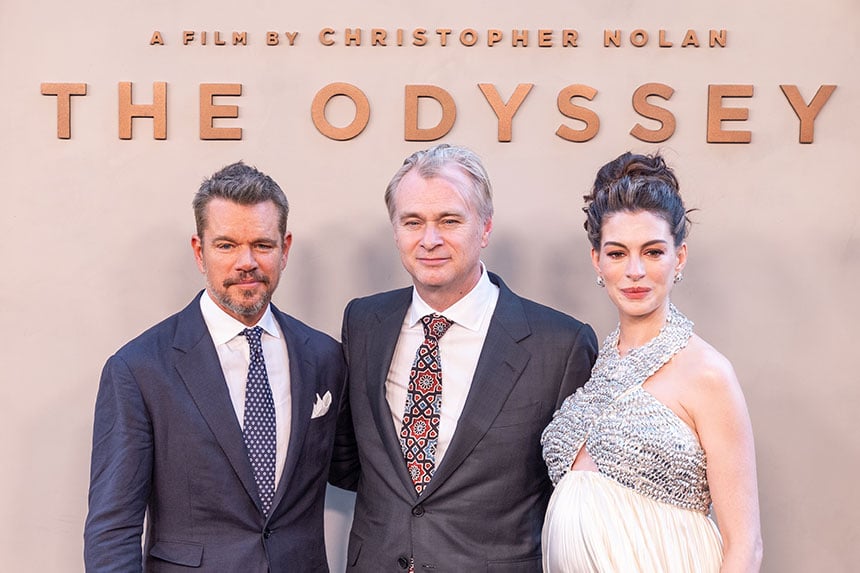
Which brings us to Christopher Nolan’s version, which is already pulling effusive praise for its acting, direction, and Nolan’s dogged resistance to CGI in most of the effects work. The cast comes absolutely loaded, headed by Matt Damon and filled out with Anne Hathaway, Tom Holland, Zendaya, Lupita Nyong’o, Robert Pattinson, Charlize Theron, Samantha Morton, and many more. Prognosticators anticipate a massive opening at the box office and a landslide of award nominations.
But what is it about The Odyssey that keeps bringing filmmakers back to it? What makes it stick in our collective consciousness? At its heart, the story has a simple engine: One man wants to get home against impossible odds. We’ve seen versions of that play out in everything from Watership Down to Toy Story 3, but there’s something inherently dramatic about a person driven to face armies, monsters, magic, and literal gods to get home to his wife, son, and yes, dog. It vibrates on a recognizable frequency because it makes us ask ourselves, “What would I do to just get home?” Time will tell if Nolan has filmed the definitive version of The Odyssey, but it’s likely that, no matter how good or successful it is, future filmmakers will still find a way to put a new spin on that most ancient of journeys.
Become a Saturday Evening Post member and enjoy unlimited access. Subscribe now