Your Health Checkup: Should I Eat Eggs for Breakfast?
“Your Health Checkup” is our online column by Dr. Douglas Zipes, an internationally acclaimed cardiologist, professor, author, inventor, and authority on pacing and electrophysiology. Dr. Zipes is also a contributor to The Saturday Evening Post print magazine. Subscribe to receive thoughtful articles, new fiction, health and wellness advice, and gems from our archive.
Order Dr. Zipes’ new book, Damn the Naysayers: A Doctor’s Memoir.
I like to eat two eggs sunny side up, with hash brown potatoes, rye toast, and a double espresso for breakfast sometimes. Those breakfasts may soon be a just a memory. A new study indicates I may have to substitute egg whites for those sunny siders.
According to a report of almost 30,000 U.S. adults (45 percent men; 31 percent black) collected from six prospective cohort studies and followed for 17.5 years, each additional 300 mg of dietary cholesterol consumed per day (about 187 mg cholesterol makes up a large egg) increased the risk of cardiovascular disease (CVD) and death, by 17 percent and 18 percent, respectively. Each additional half an egg consumed per day increased the risk in a dose dependent fashion. The conclusion was that eating eggs for breakfast was associated with higher risk of cardiovascular disease and death.
Other studies support these conclusions. For example, the Nurses’ Health Study included 73,710 women from 1984 to 2012 and 92,329 women from 1991 to 2013; while the Health Professionals Follow-up Study from 1986 to 2012 included 43,259 men. None had chronic diseases to start. The authors found in over 4,833,042 person-years of follow-up that higher intake of a plant-based diet rich in healthier plant foods (like whole grains, fruits/vegetables, nuts/legumes, oils, tea/coffee) was associated with substantially lower coronary heart disease (CHD) risk, whereas a diet that emphasized animal-derived foods was associated with higher CHD risk.
One can question the results of such observational studies for several confounding reasons, including the accuracy of reporting food intake, knowing people have fallible memories and might exaggerate or underestimate intake of certain foods. However, we now have a potential explanation why plant-based diets are beneficial: reduced inflammation.
Recent studies have firmly established the role of inflammation in promoting coronary artery disease (CAD), and that reducing such inflammation can reduce cardiovascular mortality by almost a third.
It turns out that a diet emphasizing plant-based foods reduces inflammation. Researchers randomized patients with CAD to eight weeks of a vegan diet compared with those randomized to an American Heart Association-recommended diet. The two diets differed by the absence of animal protein in the vegan diet. They found that a marker of inflammation was 1/3 lower in those on the vegan diet compared to the AHA diet, with no difference in body mass index, waist circumference or glycemic control. So the vegan diet reduces inflammation, which would be expected to reduce CAD.
The Mediterranean Diet (MD) also reduces inflammation. In a recent study, baseline MD was assessed in 25,994 initially healthy U.S. women in the Women’s Health Study who were followed up to 12 years. The investigators found that a higher MD intake was associated with approximately one-fourth relative risk reduction in cardiovascular (CV) events. The largest mediators of the CV risk reduction from MD intake were biomarkers of inflammation (accounting for 29.2 percent of the MD-CVD association), glucose metabolism and insulin resistance (27.9 percent), and body mass index (27.3 percent).
The MD can be made more “potent” by supplementing it with nuts or extra-virgin olive oil. In a multicenter trial in Spain, investigators assigned 7447 participants (55 to 80 years of age, 57 percent women) who were at high CV risk, but with no CV disease at enrollment, to one of three diets: a MD supplemented with extra-virgin olive oil, a MD supplemented with mixed nuts, or a control diet (reduced dietary fat). They found that the incidence of major CV events was lower among those assigned to a MD supplemented with extra-virgin olive oil or nuts than among those assigned to a reduced-fat diet.
Sadly, I guess I will have to do without my sunny siders in the future. Maybe if I cook them with extra-virgin olive oil and eat some walnuts on the side I can mitigate the harm. After all, as I’ve said before, moderation in all things, including moderation.
Featured image: Shutterstock
Curtis Stone’s Herbed Deviled Eggs
“Who doesn’t love a deviled egg?” asks celebrity chef Curtis Stone. “Fresh herbs are the key to this recipe. Forgo the spice rack and use fresh chives, parsley, and tarragon — the trinity of flavor for this slight riff on a classic.”
(Makes 12 servings)
2 dozen large eggs
1 cup low-fat mayonnaise
2 tablespoons Dijon mustard
2 tablespoons finely chopped dill pickle
¼ cup finely chopped chives, divided
3 tablespoons finely chopped fresh parsley, divided
3 tablespoons finely chopped fresh tarragon, divided
- Place eggs in pot, cover with water, and bring to boil over medium-high heat. Turn off heat, cover, and let stand for 10 minutes.
- Drain eggs, then run them under cold water until cool enough to handle. Peel and halve eggs lengthwise. (It’s much easier to peel eggs while they are still slightly warm.) Place yolks in medium bowl and set egg whites aside.
- Mix low-fat mayonnaise, mustard, pickles, 3 tablespoons of chives, and 2 tablespoons each of parsley and tarragon into yolks. Season with salt and pepper to taste.
- Finely chop 4 of the least attractive or broken egg white halves and toss them in small bowl with remaining herbs.
- Pipe yolk mixture into remaining egg white halves and garnish with egg white-herb mixture.
Make-Ahead: Eggs can be cooked and peeled up to 2 days ahead. Yolk mixture can be made up to 1 day ahead. Refrigerate egg whites and yolk mixture separately.
Per serving
Calories: 102
Total Fat: 7.5 g
Saturated Fat: 2 g
Sodium: 182 mg
Carbohydrate: 1.5 g
Fiber: 0 g
Protein: 6.5 g
Easter Eggs
I was driving past our town park the Saturday before Easter last year and noticed a swarm of adults scattering thousands of plastic eggs around the park in preparation for an Easter egg hunt. The eggs were in plain sight, consistent with the current thinking that no child should be expected to work up a sweat. The children were lined up behind a rope, the smallest in front, to get first crack at the eggs, applying a standard of fairness that exists nowhere in the world that I know of. I’m as progressive as they come, but if we give this social tinkering its head, we’ll soon be breaking the legs of the faster children to slow them down.
When I was a kid, the town kept its nose out of the Easter egg business. The day before Easter, my mother went to Johnston’s IGA and bought three dozen eggs, vinegar, and food coloring. While she was boiling the eggs, we poured hot water, vinegar, and food coloring in coffee cups, spread the Saturday morning Indianapolis Star on the kitchen table, and dipped the eggs in the cups. If we were feeling especially creative, we might dip the skinny end of one egg in one color and the fat end in another color. Occasionally, we took leave of our senses entirely and left a band of undyed white around the middle.
My oldest brother, Glenn, hid the eggs in roof gutters 30 feet above the ground, buried in the center of thorn bushes, beneath foundation stones, in hornets’ nests and rattlesnake dens, anyplace at all that could result in our death or disfigurement while retrieving them. It took us weeks to find them, and some we never did discover until they worked their way to the Earth’s surface the next winter, heaved up by the frost like boulders. Sometimes, years later, we would hit an egg with the lawn mower, a puff of white would shoot out the side, and a sulfuric odor would hang in a cloud over the yard for days.
The tally was always lopsided, with one of us finding way more eggs than the other four of us — usually Glenn, since he had hidden them in the first place. Complaining was useless, since our parents wouldn’t have done anything about it except to tell us to stop complaining. It would never have occurred to them to place the eggs in plain sight, or to take us by the hand and guide us from egg to egg, or to urge the bigger children to leave some eggs for the smaller children. On the upside, cheating was permitted, and we happily stole from one another to even the score, celebrating the resurrection of Jesus with larceny and deceit.
The one benefit of not finding eggs was not having to eat them. The days following Easter were spent choking down eggs, the yolks clumping in our throats like mud. Then plastic eggs, filled with chocolate and jellybeans, were invented, which was a promising development, though it never took hold at our house. In later years, my mother weakened and bought us each a chocolate bunny. I’m using the word chocolate in the loosest sense. More accurately, they were made of a waxy substance that resembled chocolate, not unlike Ex-Lax and producing much the same effect.
People who keep track of such things report that Easter is the fifth-highest-spending holiday in America, between Valentine’s Day and Father’s Day. It would have lapped Valentine’s Day some time ago, except my parents stopped buying chocolate bunnies for us when we moved from home. But then, life is one disappointment after another, which the kids in our town will never learn if we keep coddling them.
March/April 2014 Limerick Laughs Winner and Runners-Up
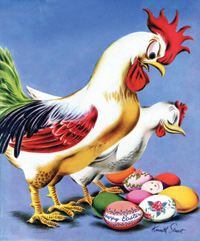
There once was a rooster named Sunny
In love with a young hen named Honey.
Pink, yellow, and blue
Her eggs were a clue
She’s more than just friends with the Bunny.
—Jane Yunker, St. Croix Falls, Wisconsin
Congratulations to Jane Yunker! For her limerick describing Kenneth Stuart’s illustration (above), Jane wins $25—and our gratitude for a job well done. If you’d like to enter the Limerick Laughs Contest for our upcoming issue, submit your limerick via our online entry form.
Of course, Jane’s limerick wasn’t the only one we liked! Here are some of our favorite limericks from our runners-up, in no particular order:
She’s obviously proud of her layin’
Old Rudy’s concern he’s displayin’
But back in the coop
The girls know the scoop.
And who is the Dad they’re not sayin’
—Steve Boneske, Greenfield, New York
Said Rooster to his own dismay:
“Not my hens, such eggs, no way!
There’s but one cock so bold
To make me cluckhold;
That rascal they call Fabergé!”
—William D. Conrad, Vancouver, Washington
They couldn’t tell who was who,
Each egg was a different hue.
Though the hen smiled,
The rooster was riled.
Oh what a ‘fowl’ thing to do!
Louis DiSanto, St. Paul, Minnesota
The rooster who crowed to his honey
Was alarmed when their eggs turned out funny,
He screeched to his hen
“We’ll try it again,
“After donating this batch to the Bunny.”
—Terry Free, Andover, Minnesota
When he looked down, the rooster recoiled
As his plans for a family were spoiled.
While the eggs all looked good
He gave up fatherhood
When he saw that his kids were hardboiled.
—John Peacock, West Dundee, Illinois
Alas, my curiosity begs.
What have you done to those eggs?
The last I knew
My blood line was blue.
Could they have walked in without legs?
—Andrew Janik, Hadley, New York
The hen liked her colored eggs best,
Having left the plain ones in the nest.
But the haughty old rooster,
No Easter egg booster,
Told her to go sit on the rest.
—Ben Lightfoot, Hanston, Kansas
Of all the ridiculous things!
My poor decorated offsprings.
When hatched from the eggs,
They’ll have stems for legs,
And petals all over their wings!
—Angie Gyetvai, Oldcastle, Ontario
This new batch of eggs that we’ve gotten?
I’m feeling like something is rotten.
You’re trying to hide
Some tail on the side,
A tail that (I’m betting) is cotton.
—Jim Schweitzer, Elkhorn, Wisconsin