In a Word: Nostalgia and Homesickness Insanity
Managing editor and logophile Andy Hollandbeck reveals the sometimes surprising roots of common English words and phrases. Remember: Etymology tells us where a word comes from, but not what it means today.
As you gather with friends and family during the holidays, your ruminations will likely lead you to remember other good times, leading to a sense of nostalgia, that bittersweet mix of pleasure and sadness. Nostalgia is commonplace at this time of year, but for 200 years it was considered an acute medical condition that could require hospitalization and lead to death.
The word nostalgia was created in the 17th century from New Latin derived from Greek roots. It begins with nostos “homecoming,” which derives from a much earlier root that means “to return safely home.” The second half comes from algos, meaning “pain or distress” — it also gives us neuralgia (nerve pain) and analgesic (what you take to fight body pain; an- means “without”).
The word first appeared in 1688 in a dissertation by Johannes Hofer, a young German doctor, as a Latin rendering of the German heimweh — “homesickness.” But this was not the standard concept of homesickness that we know today. Swiss mercenaries abroad in particular were thought to suffer from such a powerful homesickness that it could lead to insanity or even death.
Thus, nostalgia entered the English language as a medical diagnosis, and it remained so until the early 20th century. During America’s Civil War, nostalgia was considered a dangerous threat, especially among Union soldiers. In the August 2, 1862, issue of The Saturday Evening Post, one physician explains his experience with it:
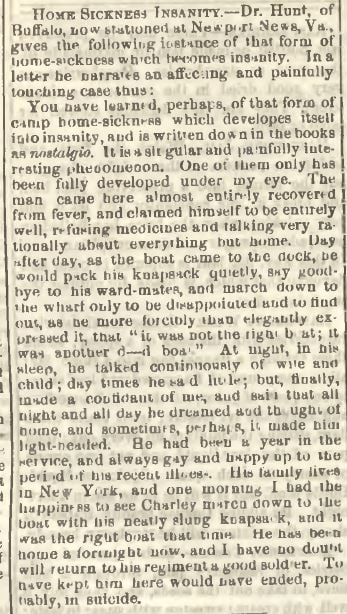
HOME SICKNESS INSANITY — Dr. Hunt, of Buffalo, now stationed at Newport News, Va., gives the following instance of that form of home-sickness which becomes insanity. In a letter he narrates an affecting and painfully touching case thus:
You have learned, perhaps, of that form of camp home-sickness which developes [sic] itself into insanity, and is written down in the books as nostalgia. It is a singular and painfully interesting phenomenon. One of them only has been fully developed under my eye. The man came here almost entirely recovered from fever, and claimed himself to be entirely well, refusing medicines and talking very rationally about everything but home. Day after day, as the boat came to the dock, he would pick up his knapsack quietly, say good-bye to his ward-mates, and march down to the wharf only to be disappointed and to find out, as he more forcibly than elegantly expressed it, that “it was not the right boat; it was another d—d boat.” At night, in his sleep, he talked continuously of wife and child; day times he said little; but, finally, made a confidant of me, and said that all night and all day he dreamed and thought of home, and sometimes, perhaps, it made him light-headed. He had been a year in the service, and always gay and happy up to the period of his recent illness. His family lives in New York, and one morning I had the happiness to see Charley march down to the boat with his neatly slung knapsack, and it was the right boat that time. He has been home a fortnight now, and I have no doubt will return to his regiment a good soldier. To have kept him here would have ended, probably, in suicide.
By 1920, people had begun using nostalgia in a broader and less dire sense to indicate a wistful longing for the past — and that’s how we know the word today.
An interesting side note in nostalgia’s history involves a Swiss physician named Theodor Zwinger. In 1710, he reprinted Hofer’s original dissertation along with new case studies, but he replaced the word nostalgia with pothopatridalgia, reflecting his belief that Swiss soldiers weren’t missing their friends and family but were suffering from the ache (algos) of longing (pothos) for their homeland (patria, from which we derive patriotism).
In a Word: A Preposterous Oxymoron
Managing editor and logophile Andy Hollandbeck reveals the sometimes surprising roots of common English words and phrases. Remember: Etymology tells us where a word comes from, but not what it means today.
Some etymologies are surprising in the way they link seemingly unrelated words. Others are surprising because, despite using a word for decades without recognizing where it comes from, its etymology is so obvious. A word’s derivation can stare you in the face for years without you seeing it, until one day, out of the blue, you have an a-ha! moment, and a word suddenly makes complete sense.
Preposterous, you say?
I agree: Preposterous is the perfect example.
Preposterous isn’t exactly a common word, but it isn’t uncommon either. We might pull out preposterous to point out how ridiculous or utterly absurd a statement or situation is. And perhaps it’s some combination of the word’s pronunciation and the fact that we don’t see it in print very often that causes us to miss that it is constructed from two opposing Latin roots that we use every day — pre- and post-:
- pre- (from prae-) meaning “coming before.” It gives us words like prenatal, preindustrial, and prelude.
- post- (from posterus) meaning “coming after.” It gives us postnatal, postindustrial, and postlude.
Etymologically, preposterous describes something that comes both before and after, which, outside of a Mobius strip, is “contrary to nature,” which is another definition Merriam-Webster gives for the word. It’s an oxymoron, combining roots with opposite meanings — like the word oxymoron itself, which reduces to “keen” + “foolish.”
For what other words have you experienced such a-ha! moments? Let us know in the comments below.
In a Word: A Tale of Two Turkeys
Managing editor and logophile Andy Hollandbeck reveals the sometimes surprising roots of common English words and phrases. Remember: Etymology tells us where a word comes from, but not what it means today.
As you prepare to gather with family and friends next Thursday for Thanksgiving, we offer some pertinent questions (and answers) you can use to help avoid talking about politics over dinner: Why do a bird native to North America and a country in the Middle East have the same name? Are they related somehow? And which came first?
The short answer is yes, the words are related, but the story of their shared etymological history is a complex convolution involving international trade, exploration, and laziness.
Probably sometime during the 15th century, before Columbus set sail, Western Europe was introduced to what today we call the guinea hen, so named because it originated in Guinea on the west coast of Africa. There is some debate about exactly what route the guinea hen took to find its way into Western cuisine: did it come from Turkish traders in Constantinople, a commercial center of the then-growing Ottoman Empire; from Turkish traders on Madagascar; or from the Mamluk Turks of Ethiopia?
No one is entirely sure, but regardless of how the guinea hen entered Europe, it was known in English as the turkey-hen. At the time, the Ottoman Empire was also commonly called the Turkish Empire or just Turkey, and turkey had become a generic word — derived from a Medieval Latin phrase meaning “land of the Turks” — that was used to describe practically anything imported from the “exotic East” through Turkish merchants. Persian rugs, for instance, were called turkey rugs, and Indian flour was called turkey flour.
Fast-forward to the 1500s and the European exploration of the New World. Among the new wildlife these explorers and settlers found was a native bird that, with its fleshy, multicolored head and wrinkled wattle, resembled the turkey-hens they knew back home, though the American fowl were noticeably larger.
Those American turkeys were then brought back to Europe during the mid-16th century — some say by Spanish conquistadors, others by the Portuguese — and, because of their resemblance to the guinea fowl, were also called turkey-hens, or just turkeys. Over time, those American turkeys became the more popular poultry, especially in England, and the name turkey stuck with the bird in a way it didn’t with the guinea hen.
So, through an underdeveloped nomenclature system and a lack of scientific rigor, the bird’s name is ultimately derived from an adjective meant to describe exotic items traded from the East. That’s also where the modern country gets its name.
From the 16th through the 19th centuries, much of what we know today as the Middle East was part of the Ottoman Empire, which, as I said before, was also casually referred to as Turkey. Following the end of World War I in 1918, its capital, Constantinople, was occupied by Allied troops, and through various treaties and agreements, the lands of the once massive empire were repartitioned.
A group of Turkish nationalists, led by Mustafa Kemal Atatürk, rose up in opposition to the repartition and fought what would be known as the Turkish War for Independence. In 1923, with the signing of the Treaty of Lausanne, a new country was officially recognized by members of the young League of Nations. Influenced by European usage, it was called Türkiye Cumhuriyeti — the Republic of Turkey.
In a Word: Guy Fawkes Reunites Treason and Tradition
Managing editor and logophile Andy Hollandbeck reveals the sometimes surprising roots of common English words and phrases. Remember: Etymology tells us where a word comes from, but not what it means today.
Except among fiction writers and the most cynical of us, tradition and treason seem so far apart that they’re practically opposites. It might be surprising, then, to discover how closely related they are etymologically.
Both words evolved from the Latin traditio “teaching, tradition.” Traditio comes from tradere “to hand over,” from tra- (a shorter version of trans-) “across, through” and –dere, from dare “to give.” You can see where a metaphorical handing over comes into play for both words: Traditions are handed down from generation to generation; treason occurs when information is handed over to the wrong people for nefarious reasons.
This is where both words began, but they evolved in different ways before entering the English language.
Old French absorbed traditio — in the “treachery” sense — as traison. During the 13th century, when French was the language of the English law and royalty, the word was adopted into English and evolved into the treason we know today. Later, during the Hundred Years War — which, among other political outcomes, established the English language as the new lingua franca of English aristocracy — writers reached back and borrowed traditio, which became tradition, directly from Latin.
You read that right: English had treason before it had tradition — the words, at any rate.
The failed Gunpowder Plot of 1605 brought these two related words back together in grand fashion. On a tip, Parliament’s House of Lords was searched on November 4 of that year, and Guy Fawkes was discovered guarding 36 barrels of gunpowder, with which he and his conspirators planned to blow up the building the next day, taking King James I and many other government officials with it.
As a celebration of the foiled treason, November 5 was declared a public holiday beginning the very next year. Then known as Gunpowder Treason Day, the tradition of bonfires and burning Guy Fawkes in effigy continues in England today every November 5 as Guy Fawkes Night.
Thus one failed act of treason led to a long-standing tradition in Great Britain.
In a Word: Dancing ’Round the Bonfire
Managing editor and logophile Andy Hollandbeck reveals the sometimes surprising roots of common English words and phrases. Remember: Etymology tells us where a word comes from, but not what it means today.
Many revelers see a midweek Halloween as an opportunity to dress up and party for two weekends — before and after the holiday — instead of just one. Such autumnal parties are prime targets for large, open-air fires — what we know as bonfires. But what exactly is so bon about bonfires?
Samuel Johnson, in his 1755 dictionary, wrote that the word bonfire came from a combination of the French bon “good” and the English fire. His ideas are reflected in other European languages, too; in German, for example, a bonfire is a Freudenfeuer, and in French it’s a feu de joie — both mean “joyous fire.”
But according to Merriam-Webster’s etymologists, Johnson is probably wrong about where the word came from, and their arguments are solid: First, the hybrid combination of French bon and the word fire, which comes straight out of Old English, would have been unusual at the time. Second, considering bonfire’s age, if the bon came from French, we would have expected it to evolve into boonfire instead.
But perhaps the most convincing argument is that the earliest attestation of bonfire in English writing was spelled banefire. Bane is a spelling of bone that persisted in Scotland for centuries. Most likely, then, the original bonfires trace their name back midsummer Celtic rituals in which animal bones were burned to ward off evil spirits.
They were bone fires.
So if you find yourself at a Halloween bonfire this weekend, tossing some leftover chicken bones into the fire not only would be historically accurate, but it could help ward off those creatures of the night at the time of year they are most likely to pay you an unwanted visit.
In a Word: Sarcophagus, the Flesh-Eating Stone
Managing editor and logophile Andy Hollandbeck reveals the sometimes surprising roots of common English words and phrases. Remember: Etymology tells us where a word comes from, but not what it means today.
During October, people turn their thoughts to the gruesome and grotesque as they gear up for the Halloween season. That applies to logophiles as well, and one of the most grotesque etymologies I know is for that staple of horror films, the sarcophagus, the stone coffin whose top slowly scrapes open to release the hungry undead onto an unsuspecting world.
The word sarcophagus isn’t, as you might think, derived from some ancient word for death or cadaver or coffin. It’s much creepier than that.
As the story goes, during ancient times, the people of Troas — an area on the northeast coast of Asia Minor in present-day Turkey — discovered a type of limestone with a useful characteristic. The stone (lithos in Greek), hastened the decomposition of dead bodies. It seemed to eat through the rotting flesh, so they used it to build stone coffins or sometimes just dropped some of it in when they buried their dead.
Whether the limestone was actually reactive in this way is up for debate. A primary source of the story is Pliny the Elder, a Roman scholar and polymath from the first century AD who, though his contributions to history and science were great and long lasting, believed in magic, was superstitions, and tended to exaggerate.
Regardless, that stone from Troas was called, in the local Greek tongue, lithos sarkophagos — sarko- from the Greek word for “flesh,” and -phagos from phagein, “to eat.” Lithos sarkophagos literally translates as “flesh-eating stone.”
Rome borrowed the word into Latin as the noun sarcophagus, and it came to refer not to the stone itself, but specifically to the stone coffin.
The same roots that gave us sarcophagus also informed scientific jargon. Organisms that eat flesh — some bacteria, maggots, zombies — are called sarcophagous (note the additional o) or sarcophagic. So while a sarcophagus itself isn’t sarcophagous, what is inside and trying to get out may well be.
In a Word: A Candidate as White as Snow
Managing editor and logophile Andy Hollandbeck reveals the sometimes surprising roots of common English words and phrases. Remember: Etymology tells us where a word comes from, but not what it means today.
During every election cycle, we watch political candidates try to pass themselves off as being pure as fresh fallen snow while flinging metaphorical mud at their opponents. We don’t fall for it, of course, but etymologically they’re right on the button.
According to Merriam-Webster Dictionaries, as a symbol of a spotless record and unstained reputation, a person running for public office in ancient Rome would wear a white toga that had been rubbed with chalk. The person was called a candidatus, a Latin adjective meaning “dressed in a white toga” that was eventually adapted as a noun. Candidatus is derived from the verb candere, “to be bright or white,” which is also the source of words like candle, candor, and incandescent.
When candidate entered the English language in the 17th century, it still referred to a person who was campaigning for government office, but it had already lost the allusions to togas, chalk, and purity. It wasn’t long before candidate became more generalized, and someone could be a candidate for surgery, a doctoral candidate, or a candidate for a kick in the pants.
Political candidates today wear white less often than they did in Roman times, opting instead for navy suits and red power ties — if you can even see their clothes under all that mud.
Logophile Language Puzzlers: Ranting, Raving, and Reversing
Test your word knowledge with these three questions from the Logophile, and then scroll down for answers and explanations.
- Angry Aaron ______ for 20 minutes against every perceived shortcoming of upper management.
- inveighed
- inveigled
- Morty is such a bibulous guy. You can always find him with a ______ in his hand.
- book
- mirror
- drink
- What word spelled forward means a thing you earn and spelled backward is where you might store it?
Answers and Explanations
- a. inveighed
Inveighed comes from the Latin verb invehere, which literally means “to carry in.” That Latin verb also developed the extended meanings of “to force one’s way into” and “to attack with words,” and it is from these extended meanings that the English word inveigh, “to protest or complain bitterly,” gets its meaning.
Changing only one letter in inveighed yields inveigled, which means “to acquire by flattery or ingenuity,” as opposed to acquiring something honestly. It ultimately finds its roots (through Anglo-French) in the Medieval Latin ab oculis, “lacking eyes, blind.” When someone is being inveigled, they are being hoodwinked and having the wool pulled over their eyes.
- c. drink
Did we catch you guessing a on this one? If so, you’re probably thinking of words like bibliography and Bible, which both trace their ancestry through Middle English to Old French to Latin to Greek and ultimately to the ancient Phoenician city of Byblos, which was a center for the export of papyrus, and early form of paper. However, if Morty always had a book in his hand, he would be described as bibliophilic or bibliomaniacal (or just well-read), but not necessarily bibulous.
If Morty always had a mirror in his hand — assuming it wasn’t spurred by a fear of vampires — he would likely be called narcissistic (after the mythological story of Narcissus), egotistical, or vainglorious … but not bibulous.
Bibulous comes from the Latin word bibere “to drink,” and it refers to being overly fond of drinking, especially of alcoholic beverages. It’s related to the word imbibe.
- reward à drawer
English speakers (and therefore dictionary editors) haven’t yet agreed on what best to call a word that spells another word in reverse. Some of the terms that have surfaced over the last half-century are the recursive semordnilap and emordinlap (that’s palindromes and palindrome in reverse), heteropalindrome, reversagram, heterodrome (meaning “running in a different direction”), and the rather witty backword.
At the moment, though, the most common and accepted term among logophiles appears to be anadrome, from Greek roots that mean “running upward.” The adjective anadromous is a few centuries old and describes fish, such as salmon, that swim upstream for mating season. So if anadrome really does find its place in the language to describe word pairs, the adjective form will probably settle at anadromic, both to differentiate it from the biological anadromous and to mirror the adjective palindromic.
Here are a few more anadromic pairs for your lexical enjoyment:
repaid:diapers
stressed:desserts
gateman:nametag
reknit:tinker
snoops:spoons
straw:warts
In a Word: How Divine Motherhood Gave Us a Galaxy
Managing editor and logophile Andy Hollandbeck reveals the sometimes surprising roots of common English words and phrases. Remember: Etymology tells us where a word comes from, but not what it means today.
Centuries before the era of ubiquitous light pollution, humankind looked to the night sky in awe and wonder and found a remnant of divine motherhood: a cloudy white streak arcing across the starry sky. They didn’t know exactly what it was, so they created myths about how it got there, attributing its existence to the mischief of the gods.
There are multiple versions of that story, but Zeus, King of the Gods, plays a role in all of them.
You might recall from your high school mythology class that Zeus’s jealous father, the titan Kronos, was so worried that his children would one day overthrow him that, one by one, he swallowed their infant bodies whole. On the day that Kronos called for infant Zeus to be brought to him, his wife, Rhea, wrapped a boulder in swaddling clothes and passed it off as the sleeping child. Before Kronos swallowed this faux Zeus, he ordered Rhea to nurse him one last time. In this story, the milk that spurted out when she pressed the rock to her breast became that white streak across the night sky.
In another mythical explanation, Zeus duped the human Alcmene into a roll in the hay and impregnated her. After that child (named Alcides) was born, Alcmene, fearing Hera’s wrath for Zeus’s infidelity, abandoned him in a field in Thebes. Athena rescued the child, her half-brother, and, either from her own sense of mischief or at Zeus’s command, brought him to Hera. Hera either did or did not know the infant was Zeus’s illegitimate child — stories differ — but either way, she nursed him at her own breast. In another version of the story, Zeus himself placed the infant Alcides at Hera’s breast while she was sleeping.
Regardless of how Alcides got there, Hera’s milk bestowed godlike strength upon him. But when Hera woke up — or the young demigod clamped down a little too hard, depending on which story you read —Hera pulled him away, and a spurt of her breast milk created that white arc in the night sky.
I don’t know why the ancient Greeks were so obsessed with making breast milk a centerpiece of this myth, but centuries later, we’re still calling that pale white streak the Milky Way. The ancient Greeks called it that too, only not in English. Stemming from the Greek word for milk, gala, they called it Galaxias, which in English became galaxy.
The word galaxy was synonymous with the Milky Way well into the 19th century. Only then, as technology progressed and our understanding of the vastness of the universe grew, did the galaxy (the Milky Way) become a galaxy (one of many). Had the ancient Greeks built their myth around something else that was white — sheep’s wool, lily petals, polystyrene packing peanuts — our astronomical vocabulary might be vastly different today.
To finish the story of the infant Alcides: He was returned to Alcmene and her husband Amphitryon to be raised as a mortal. In a sad attempt to appease the angry Hera, the child was later renamed Heracles, meaning “glory of Hera.” The Romans — and much later, Hollywood — called him Hercules.
In a Word: Why Vaccines Were Such an Udder Success
Managing editor and logophile Andy Hollandbeck reveals the sometimes surprising roots of common English words and phrases. Remember: Etymology tells us where a word comes from, but not what it means today.
Every year, autumn brings with it many things: cooler temperatures, large bags of “fun size” Halloween candy, pumpkin-spiced everything, and constant reminders to get your flu shot. That “shot,” of course, is the latest influenza vaccine, a word that emerged from the cattle fields of 18th-century Gloucestershire, England. But the story of vaccine starts before that, with smallpox.
Smallpox coexisted with humanity for thousands of years. As human populations in Europe, Asia, and Africa grew, and travel for trade and crusade became more prevalent, smallpox grew and traveled along with us, killing nearly a third of those it infected. In western medicine, the smallpox virus was called variola (after the Latin word for “pustule,” pustules being the most visible symptom of smallpox), and by the 17th century, the only known protection against smallpox was, ironically, intentionally infecting a healthy person with the Variola virus. The process, called variolation, would often enough result in a mild case of smallpox followed by lifetime immunity, but sometimes it led to full-blown smallpox and, for around 2 percent of those inoculated, death.
Still, it was the best possible treatment against the disease that western doctors had to offer. That is, until Edward Jenner got involved.
Edward Jenner was a surgeon and anatomist in Gloucestershire, England. Since he was a boy, he had been told that milkmaids never got smallpox, but no one knew exactly why. Dairy farmers, too, seemed to be immune to smallpox, and, observation by observation, Jenner and others began to deduce a common connection: cowpox.
Cowpox was a much rarer and milder disease that was passed from bovine to human through sores on a cow’s udder. A cowpox infection resulted in much less scarring and seldom ended in death; what’s more, people who survived a cowpox infection seemed to be immune to smallpox. Could this be the answer to the scourge of the Variola virus?
He decided to test his theory in a way that would be both illegal and unethical today: He infected a local boy using the pus from a cowpox sore on milkmaid’s hand. The boy lost his appetite and felt mildly ill for more than a week, but then he recovered fully. Jenner later introduced smallpox into the boy’s system and, sure enough, he showed no reaction. The boy was immune to smallpox!
Jenner published the results of this and further experiments in a pamphlet called “An Inquiry into the Causes and Effects of the Variolae Vaccinae.” Variola vaccinae, “smallpox of the cow” (from the Latin vacca “cow”) was his term for cowpox.
Because the process of introducing cowpox into a person’s system was identical to variolation, he followed the same structure for naming his new procedure, calling it vaccination. He also used the terms vaccine virus and vaccine matter in the pamphlet to describe the material transferred from the cowpox pustule to the patient.
Although vaccine comes from the Latin word meaning “of or from the cow,” today’s flu vaccines probably contain more chicken than cow — most standard vaccines are incubated inside chicken’s eggs.
That we call vaccines vaccines is partially a matter of geography, then. Had Jenner or some other scientist in a different part of the world discovered how to inoculate against smallpox by using horsepox or monkeypox — two other diseases in the same family of viruses — we might today be seeing constant reminders about flu equinations or simianations instead of vaccinations.
In a Word: Putting the ‘Horse’ in ‘Hippopotamus’
Managing editor and logophile Andy Hollandbeck reveals the sometimes surprising roots of common English words and phrases. Remember: Etymology tells us where a word comes from, but not what it means today.
You might think that someone suffering from hippophobia has a debilitating fear of hippopotamuses. But that isn’t the case. The hippo- part hippophobia comes from Greek word hippos “horse” — hippophobia is a fear of horses.
The name for the third largest land animal on the planet comes from the Greek hippos potamios, meaning “river horse,” borrowed into Latin and eventually becoming, by the mid-16th century, hippopotamus. It’s a good descriptive name: It’s got four legs, like a horse, and it spends up to 16 hours a day in the water to keep its hide from drying out.
Don’t even dream of strapping a saddle on one of these big beasts and riding off into the African sunset, though; genetically, hippos are more closely related to pigs and whales than to horses, and according to the National Wildlife Federation, they kill about 3,000 people a year. Best to admire them from a distance.
That leaves us with one question: If hippophobia is a fear of horses, what word describes a debilitating fear of hippopotamuses? If the need ever arose to diagnose such a condition, hippopotamophobia is the likeliest candidate.
About the plural: Hippopotamus didn’t enter English directly from the Greek, but was first borrowed into Latin; therefore, the Latin plural form hippopotami is acceptable. But because hippopotamus is an English word, standard English pluralization rules can be applied to it as well, so hippopotamuses is also an acceptable — and often preferred — plural.
In a Word: When Deadlines Were Dire
Managing editor and logophile Andy Hollandbeck reveals the sometimes surprising roots of common English words and phrases. Remember: Etymology tells us where a word comes from, but not what it means today.
We’ve all missed deadlines before. It can be embarrassing, it can be costly, and it can even get you fired. But none of those results even comes close to what might befall someone who crossed the original deadline.
Deadline traces back to prisoner-of-war camps in the South during the American Civil War — perhaps originally to the horrific prisoner camp at Andersonville, Georgia. Supplies were limited by the war, and barbed wire hadn’t even been invented yet, so there was only so much prison administrators could do to prevent POWs from escaping. They put up walls and fences, but to make it harder for soldiers to slip out, they also established a line on the ground about 20 feet in. Any prisoner who crossed that line was subject to being shot by the Confederate guards.
It was a literal deadline: You cross it, you die.
Around the turn of the century, as printing technology was expanding, deadline returned. Etymologists aren’t positive whether or not the Civil War deadline influenced the printing deadline, which was an imaginary line near the edge of a paper beyond which the printing press could not print anything. Regardless, it wasn’t long before that line on a physical page beyond which work cannot go took a metaphorical turn and became a line in time beyond which work cannot go.
Today’s deadlines are not so dire as they once were. As the novelist Douglas Adams famously wrote, “I love deadlines. I love the whooshing noise they make as they go by.”
What These 4 Words Reveal about Our Changing Language
You don’t have to be some sort of woke neoliberal technocrat to see how a slew of new words have entered the English language in your lifetime. That already massive unabridged dictionary is only getting larger as we gain new words. But less obvious — and far more interesting — is how we lose words.
Now, to say that we lose words isn’t entirely accurate. The English language doesn’t lose words — not really. Open to any page in an unabridged dictionary, and you’ll find not only words you’ve never heard before, but words you’re likely never to hear in a conversation — absume, hogling, whurl, words that are marked as either archaic or obsolete.
Why do so many useful and colorful words fall into obscurity while others flourish? The following four words illustrate some of the evolutionary forces that work upon our language.
Phlogiston: Science Moves On
In 1669, the German physician and alchemist J.J. Becher formulated what came to be known as the Phlogiston Theory to explain how things burned. The theory stated that all materials contain a substance called “combustible earth” — which later scientists renamed phlogiston — that is released during combustion. Wood, for example, was believed to be made up of ash and phlogiston, and when it burned, the phlogiston was released and the ash left behind.
As odd as this sounds today, it was the prevailing theory for more than a century. Scientists running tests based off this theory of combustion (later also applied to metal corrosion) made a number of advancements in chemistry, ultimately leading to the discovery, in 1774, of what English chemist Joseph Priestley called dephlogisticated air.
Thankfully, French chemist Antoine Lavoisier separately identified the element shortly after, and he gave it the name that stuck: oxygen.
The discovery of oxygen put an end to the Phlogiston Theory, as well as to the vocabulary that went along with it. Outside of historical contexts, we don’t get much call to use the word phlogiston in our daily lives anymore, much less dephlogisticated.
It’s happened before, and it will happen again: Words created to explain various scientific and philosophical theories disappear when the theories themselves are disproven through a better understanding of the world. Unless the vocabulary from these disproven theories finds new life in other disciplines (as, for instance, melancholic and sanguine did), they are liable to disappear from the common tongue, consigned to dwindling use in articles about historical oddities. (Like this one.)
Knocker-upper: Upgrading Your Tech
The crowing rooster waking the farm family at the crack of dawn has been a cliché for centuries. It also happens to be true. But as the industrial revolution took off, people left the farm and packed into cities, and they didn’t bring their roosters with them. Before the invention of the adjustable mechanical alarm clock in 1847, and long before the invention of the wake-up call, people needed some other way to make sure they got up in time for work.
Enter the knocker-uppers (also called knocker-ups).
Clients hired a knocker-upper to come to their home at a certain hour and tap on the bedroom window, usually using a long pole with a knob attached to the top, until they woke up. Affordable alarm clocks and the proliferation of electricity ultimately ended knocker-upping as a viable profession — and took the word knocker-upper with it — though the job did survive well into the 20th century.
Although we readily accept the idea that the forward march of technology renders old equipment obsolete, rarely do we stop to think about the vocabulary that we lose along with it. And that’s a long list of lost words, including some beauts like arquebus (a precursor to the musket); rarebrace, poleyn, and vambrace (parts of a suit of armor); and chatelaine (a sort of tool belt for a head housekeeper).
In a few generations — or perhaps just a few years — historians and logophiles may be explaining the obsolete words beeper, modem, and dot-matrix.
Mulatto: Social Pressures on Language
During the centuries that the enslavement of black Africans was considered an acceptable and profitable enterprise, the white European and American men in power developed their own vocabulary to simplify their ability to write oppression into law. Some localities developed complex hierarchal racial classification systems based on how much one’s “pure” blood was “diluted” by races considered inferior.
And that’s where the word mulatto — a person with one white and one black parent — comes from. And it didn’t stop there. The powers that be established a wide lexicon to label people with a mixed-race background, including the words mestizo, griffe, quadroon, and octaroon, this last used to describe a person with one great-grandparent of color.
Sometimes, social and political pressures act deliberately to remove words from the common tongue. The fact that some of these words have effectively disappeared is proof that language obsolescence isn’t always a bad thing.
Today, we’re seeing the same type of downward pressure on the word niggardly and its even more dysphonic noun form niggard. Originally a neutral word meaning “stingy,” niggardly has, after several high-profile incidents involving lawsuits and resignations, become a dog whistle for racists, providing a thin veil of plausible deniability with appeals to etymology. (We see the same with the word uppity.)
Instead of using niggardly, writers are encouraged to reach for a synonym: miserly, tight-fisted, penurious, stingy, and Malthusian could all fit the bill.
Nice: Don’t Be Silly
Santa Claus’ naughty and nice lists were quite different 700 years ago. When nice entered the language in the late 13th century, it meant “foolish” or “stupid.” It’s derived from the Latin nescius, literally “not-knowing.” In the late 1300s, the meaning shifted to indicate a person or actions considered excessively luxurious and then, by 1400, to denote someone who was finely arrayed, shy, or reserved, or something that was precise (as in the phrase “nice and slow”).
By the 1500s, nice was a word used to describe polite society — without any subtext of ignorance or foolishness. And the meaning of nice continued to shift with such rapidity through the 16th, 17th, and 18th centuries that the writer’s intended meaning for the word was not always clear.
Naughty, too, has seen a great change. It was originally an adjective meaning “poor” or “needy.” It described someone who had naught — nothing.
In the evolution of a language, sometimes the words remain but the meaning of the word changes, and it has happened more often than you might think: A computer used to be a person who did calculations. Girl used to describe a child of any gender. In the 16th century, bully was a gender-neutral term of endearment.
The Invention of Camouflage 100 Years Ago
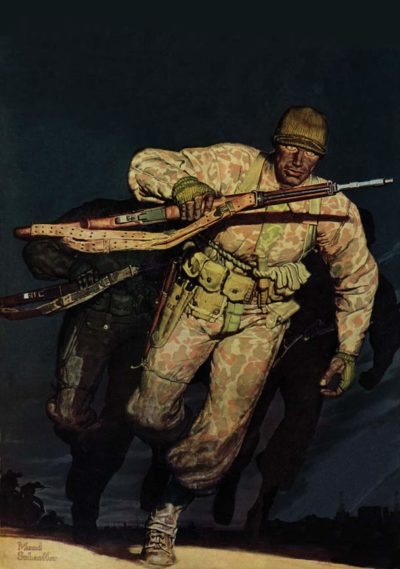
Armies lost the ability to conceal themselves when the airplane appeared above the battlefields of World War I Europe, so soldiers came up with a defense against aerial snooping, and introduced a new word to the English language.
“Camouflage” by Will Irwin, September 29, 1917
 It is pronounced, at present, French fashion, like this — “cam-oo-flazh.” In the theatrical business it signified makeup. The scene painters of the Parisian theaters carried it with them to the war and fixed it in army slang; for just about that time the armies of Europe began to introduce a new branch of tactics into warfare. By the end of the first year, most of the guns and motor transports used near the line were striped with greens, browns, dull yellows; sometimes with pinks and blues. But the stripes were not regular. All lines of union were wavy or broken. Nor did the colors meet each other sharply. For a little distance they were blended. It looked more, perhaps, as though someone had poured a few bucketfuls of paint, hit or miss, over guns and transports.
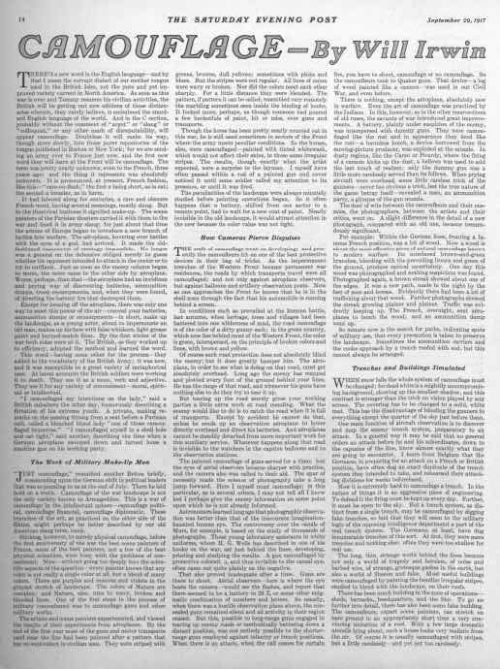
This article is featured in the September/October 2017 issue of The Saturday Evening Post. Subscribe to the magazine for more art, inspiring stories, fiction, humor, and features from our archives.
Logophile Language Puzzlers: Palettes, Nonplussed, Julia Roberts
How well do you know the English language? Here are three puzzlers about vocabulary and usage from the Logophile. Do you know the answers?
- Vincent needs to cleanse his palette, so he reaches for
- toothpaste
- lemon sorbet
- turpentine
- Which boy is nonplussed?
- Tom gapes at the pile of hay, unable to speak. How will he ever find the needle in there?
- Jerry smirks and reaches for the magnet in his pocket.
- What characteristic do sequoias, pneumonia, and Julia Roberts share that sycamores, influenza, and Eric Roberts do not?
Answers and Explanations
1. c. turpentine
English contains three homophones that are easily and quite often confused:
- Palate is the roof of one’s mouth or, metaphorically, one’s sense of taste. As any experienced wine taster knows, the common phrase cleanse your palate refers to act of washing away the flavor residues of what has been previously eaten or drunk to avoid tainting the flavor of the next culinary treat. However, in the question, Vincent didn’t want to cleanse his palate.
- A pallet is the small wooden platform that goods are stacked on for storage and shipping. They keep those goods above any dampness on the floor and leave a space for a forklift to get under the stack and lift it up. Pallet can also refer to a mattress stuffed with straw or a makeshift bed.
- Palette, the word used in the question, is the thin, oblong wooden board — usually with a thumbhole — that painters use to hold and mix paints while they work.
To cleanse his palette, Vincent needs to clean old paint off a piece of wood. Of the three choices, (c) turpentine will work best.
2. a. Tom
The word nonplussed is all too often misused. It was originally an English use of the Latin phrase non plus, “no more,” and meant “a state at which no more can be done or said; a state of perplexity or befuddlement.” Nonplus was also occasionally used as a verb, and perhaps this is where the surviving adjective nonplussed originated from.
Someone who is nonplussed is puzzled or shocked to the point of inaction. It has a long list of fun synonyms, including befuddled, gobsmacked, dumbfounded, and flummoxed. The answer to question 2, then, is a.
Possibly because nonplussed begins with that negating prefix non-, people sometimes mistakenly believe that it means its opposite: unfazed, nonchalant, or unperturbed.
3. They use all the five regular vowels, AEIOU, exactly once.
This happens in the English language more often than you might expect. Other common words that use each vowel exactly once are education, nefarious, questionably, subordinate, and tenacious.
Abstemiously and facetiously are especially noteworthy. Not only do they use all six vowels, AEIOUY, exactly once, but those vowels appear in alphabetical order.
These three questions first appeared in the March/April 2017 issue of the Post. Not a subscriber? You can start a new subscription here.