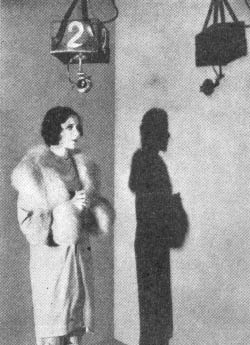
The most popular band in the U.S. during the 1920s was Paul Whiteman and His Orchestra. Though Whiteman was known during his time as the “King of Jazz,” he is a controversial figure to jazz historians today. One reason is because his orchestra for the most part didn’t play what today we think of as real jazz. Their music was completely arranged, the crucial improvisational aspect of jazz almost completely removed. Much of their music bears a greater resemblance to Lawrence Welk than to, say, Benny Goodman.
Nonetheless, Paul Whiteman can be credited with taking the jazz idiom from the dives and juke joints of New Orleans and Chicago and popularizing it among a nationwide, and eventually worldwide, audience.
In 1926, Whiteman contributed a three-part series to the Post simply titled “Jazz,” in which he, along with Mary Margaret McBride — who, over a 40-year career as a radio interviewer, earned the title “The First Lady of Radio” — explains what jazz is and how he came to be the “King of Jazz.”
In the following excerpts from Part I, Whiteman talks about the years leading up to the Roaring Twenties, detailing how he discovered jazz and the hardships and lucky breaks that ultimately led to the creation of his jazz orchestra and its first recording contracts.
This post was published to mark National Jazz Appreciation Month. We’ll publish more historical articles about jazz greats as the month progresses, and you can catch them all in “Jazz History by Men Who Made It.”
Jazz, Part I
By Paul Whiteman and Mary Margaret McBride
Originally published on February 27, 1926
There was every reason why jazz should have burst forth at the touch of a hundred or more orchestra leaders in 1915. The time was ripe for almost any explosion. The war spirit was on the loose. The whole tempo of the country was speeded up. Wheels turned like mad. Every factory was manned by night and day shifts. Americans — and the term included Slavs, Teutons, Orientals, Latins welded into one great mass as if by the gigantic machines they tended — lived harder, faster than ever before. They could not go on so without some new outlet. Work was not enough. And America had not yet found out how to play; the hard-pressed, hard-working young country had no folk songs, no village dances on the green.
A showman, Joseph K. Gorham, gets credit for first realizing the possibilities of the underworld waif. Gorham, a newcomer to New Orleans, heard a group of musicians playing on the street to advertise a prize fight. He was halted first by the perspiring, grotesque energy of the four players. They shook, they pranced, they twisted their lean legs and arms, they swayed like madmen to a fantastic measure wrung from a trombone, clarinet, cornet, and drum. They even tore off their collars, coats, and hats to free themselves for a very frenzy of syncopation. As a finger-snapping black hearer put it, they played “like all de debbils was atter ’em.”
Mr. Gorham, with the sure instinct of the good showman, pushed his way through the excited crowd and interviewed the leader. He discovered that not one of the players in Brown’s Orchestra, as they called themselves, could read a note of music. Nevertheless, the showman knew that he had made a find, and he listed the conductor’s name with an address on Camp Street for future reference.
Brown’s Orchestra was not the first to wear the name “jazz.” Bert Kelly, of Chicago, is credited with inventing the term “jazz band.” He used it to describe a group of musicians that he hired out to the Boosters’ Club at the Morrison Hotel in Chicago. The Boosters’ Club promptly raised all its prices, alleging that this newfangled jazz came high.
Meantime, Brown’s Orchestra had been taken over by Mr. Gorham and placed at Lamb’s Café in Chicago. The players burst upon an unsuspecting world with a bang that nearly shattered Lamb’s roof. The manager hastily telegraphed Mr. Gorham to call off his jazz babies. Gorham instead urged patience and advised the band to “ease down a little.” They did so with great profit to themselves, for soon crowds were being turned away in droves. This, so far as cabaret history goes, was the first official appearance of a jazz band.
Since Mr. Kelly’s experiment with the word, there have been hundreds of attempts to find a new name for modern American music, but the public refuses them all. They are used to “jazz,” and the word expresses something to them that the music seems to mean.
I cannot see that it matters much. Sometimes I regret the origin of the word because I think it probably has stirred up sentiment against the music. But if jazz turns out to be a good product, it won’t really make much difference what it is called. Words, like men, climb up or slip down in the world, and when a word has made good and stands for something real and worthwhile, I am not one to bring up its past against it.
It is a relief to be able to prove at last that I did not invent jazz. I took it where I found it, and I sometimes wish the preachers and club-lady uplifters who put jazz on the grill wouldn’t concentrate on me. I really don’t deserve it. I don’t deserve the snorting editorials in newspapers from Burma to Sydney either.
All I did was to orchestrate jazz. If I had not done it, somebody else would have. The time was ripe for that. Conditions produce the men, not men the conditions. It merely happened that I was the fortunate person who combined the idea, the place, and the time. At least I think I was fortunate. Others are not so sanguine.
I guess it is a good thing I inherited a certain musical knack from my parents, for I lack stick-to-itiveness. Yet I invariably admire the things that are hardest to do. That is what first attracted me to jazz. The popular idea is that jazz is a snap to play. This is all wrong. After you have mastered your instrument, it is easy enough to qualify in a symphony by following the score as written. But a jazz score can never be played as it is written. The musician has to know how to give the jazz effect.
At 16, I started ragging — of course we had not heard of “jazzing” then — the classics. A friend and I won a good deal of notice with this trick from the older members of the Denver Symphony, in which I had then begun to play. They used to keep us at it for hours. Our favorite classic for jazzing was “The Poet and Peasant Overture.”
When Jazz Banishes the Blues
The warden of the Nebraska Insane Asylum heard us and thought our music might soothe his patients. He invited us down for a weekend at the asylum, and we played all the pieces we knew. We made a great hit, especially with an old fellow who thought he was Nero. He was so fascinated with the intricacies of ragtime that he tried to play it on a fiddle he carried around with him, and after that, we had the daily spectacle of watching Nero jazz it up while — he said — Rome burned.
I got my musical education from my father and teachers he selected. All were serious and talented musicians. One was Max Bendix, for whom I worked later in the San Francisco Symphony. I can’t remember the time when I didn’t know the feel of a bow in my hand, and my first lessons were taken from my father when I was such a baby that I actually have no recollection of them.
At 17, I was chief viola player in the Denver Symphony, and five years later went to the Pacific Coast to seek adventure. I finally found the excitement I craved in the San Francisco Exposition and played with the World’s Fair orchestra until the exposition closed. I was at the same time a member of the Minetti String Quartet. When the exposition closed, I looked around for something new to do. By that time I was thoroughly dissatisfied with symphony work. The pay was poor and there was little chance for initiative. And then — along came jazz.
We first met — jazz and I — at a dance dive on the Barbary Coast. It screeched and bellowed at me from a trick platform in the middle of a smoke-hazed, beer-fumed room. And it hit me hard. I had been blue all day, starting with the morning, when I got out on the wrong side of the bed. I’m superstitious sometimes, and that was one of them. I cracked my shaving mirror; there was a button off my coat; my coffee was cold; my three-minute egg hard-boiled; I spilled the salt; it rained; at rehearsal my fiddle went blooey; a wisdom tooth jumped. When the old second violinist moaned that a musician’s life is a dog’s life, I agreed.
By evening I wanted only bed or the Bay. Then Walter Bell, a fellow musician, dropped in and said, “Let’s make a night of it.”
“You may make a whole week of it if you like,” I grouched. “I’m going to bed.”
He was set on taking me out with him, even if he took me on a stretcher.
Brute force finally won. He picked the jazziest of the jazz places — to cheer me up, he said. We ambled at length into a madhouse. Men and women were whirling and twirling feverishly there. Sometimes they snapped their fingers and yelled loud enough to drown the music — if music it was.
My whole body began to sit up and take notice. It was like coming out of blackness into bright light. My blues evaporated when treated by the Georgia Blues that some trombonist was wailing about. My head was dizzy, but my feet seemed to understand that tune. They began to pat wildly. I wanted to whoop. I wanted to dance. I wanted to sing. I did them all. Raucous? Yes. Crude? Undoubtedly. Unmusical? Sure thing. But rhythmic, catching as the smallpox, and spirit-lifting. That was jazz then. I liked it, though it puzzled me. Even then it seemed to me to have vitality, sincerity and truth in it. In spite of its uncouthness, it was trying to say something peculiarly American, just as an uneducated man struggles ungrammatically to express an original and true idea. I wanted to know jazz better.
It was immediately clear that I was going to. Coming as I did from an environment where music was taken for granted as a sort of daily necessity, jazz never did shock me. It only worried and obsessed me. The fantastic beat drummed in my ears long after the strident echoes had died, and sleep for nights became a syncopated mockery. Strains pestered me like a hunch you can’t get the hang of.
In those first days I never thought seriously of taking up jazz playing, yet in the back of my mind was the conviction that I’d have to turn over a new leaf soon if I really wanted to amount to anything. It was the crisis in my life. Spiritually, though there was no reason or excuse for it that I can think of now, I was becoming a loafer, without ambition or purpose. The easy, comfortable, dependent days of my childhood could never come back again. I was out on my own and fast making a mess of life. Perhaps most young men go through the stage. It may be that to all youngsters there comes a time when they wear out their interest in the things they are used to doing and need something fresh and exciting. At least it was so with me.
If I stayed with the symphony I was pretty sure to continue following the line of no resistance. A viola player could go little further than I had already gone. Ready-made scores, study, and methods of playing made it unnecessary for me to attempt any originality. And I had such stores of vitality which had to be turned into some channel. If there was no chance for it to go into my work, it was likely that I would divert it to wild parties and drink.
Don’t imagine for a moment that I thought all this out clearly. I only knew that I was listless, dissatisfied and despondent. Of course, I had money troubles too. All of us did. We often took extra jobs to make ends meet. I drove a taxicab myself for a while and, at that, was usually broke. Then jazz stepped in.
Learning Jazz by Observation
I have to smile when I start presenting jazz in the role of reformer. I began to experiment with the new music because it was interesting. That is to say, soon after I heard jazz for the first time, I resigned my job with the symphony and applied at Tait’s for a place in a jazz band.
I got it, and for two days lived in a sort of daze. The thing that rattled round me like hail wasn’t music in the sense I had known it. I couldn’t understand it — couldn’t get the hang of it. But others were getting it — fat-faced businessmen who had never in their lives listened to any music except cheap, thin, popular tunes; rouged, young-old women who had never once heard a real concert. Something happened to them, just as it happened to me that first night — something that shook off their false faces and made them real and human, spontaneous and alive for once. What on earth was it?
“Jazz it up, jazz it up,” the conductor would snort impatiently at about this point in my reflections. And I would try, but I couldn’t. It was as if something held me too tight inside. I wanted to give myself up to the rhythm like the other players. I wanted to sway and pat and enjoy myself just as they seemed to be doing. But it was no good. The second day the director fired me. He was kind enough, but brief.
“You can’t jazz, that’s all,” he told me. I nodded dully, watching the red hat of a girl at the other end of the room bobbing in an ecstasy of syncopation. Then I walked out of Tait’s, mild as milk, and went home to my hall bedroom on Eddy Street and slept. I slept clear around the clock. When I woke up I was mad.
So they said I couldn’t jazz, did they? Well, I’d show ’em. I’d learn to jazz. I’d learn if it took a year.
You know the thirst for knowledge that always seems to attack the ambitious young man in the advertisement when he reads of mail-order training courses. I felt just like that, but though there are plenty of them now, there were no mail jazz courses then, so I had to invent a method of educating myself. This was to visit the restaurants where jazz was being played. A difficulty arose here. I had no money, and they expected you to order food and drink in all those places. My old awe for head waiters increased during this time about a thousandfold. They were so muscular. I had never noticed what brawny fellows a restaurant uses for head waitering. In an argument with them, one would be nowhere at all.
Luckily I had a fairly presentable dress suit left over from symphony days. In this I made a moderately prosperous-looking figure, and there really was no way that a head waiter who didn’t know me could tell that I hadn’t a dime in my broadcloth pockets. My cue was to appear when the music was at its height. I would hang around the entrance as though waiting for somebody, but really studying the orchestra. If necessary, I would make an effort to get a special kind of table, such as head waiters give only to best-paying patrons. Of course without the proffer of kale [money] I had no chance, and thus my way would be paved for an indignant retreat. The drawback was that this trick couldn’t be used more than once on a restaurant.
These mere snatches of study I eked out with experiments in my hall bedroom. Two landladies put me out during this period on complaint of tenants above and below, for I experimented with my violin as well as pencil and paper. There were no saxophone-proof apartments in those days. No wonder the architect who invented them stands to make a fortune.
After many attempts, I finally worked out an orchestration and learned what I wanted to know about faking. Faking was what the early jazz orchestras relied upon. That is, they had no scores, each man working out his part for himself, faking as he went along. Up to that time, there had never been a jazz orchestration. I made the first and started in the jazz-orchestra business. That sounds simple. But it wasn’t. The first hundred days of any business have their discouragements, and there was nobody hankering for the opportunity to finance my jazz band — not after I had got myself fired because I couldn’t play jazz. However, I managed to borrow a few hundred dollars on personal credit to guarantee my men’s salaries. What I could scrape together was not enough to guarantee any salary for myself though, and so in those days I learned a good deal about plain living and high thinking.
It was slow work gathering men, because I wanted only those who could realize what I was trying to do. I hardly knew myself, except that I saw possibilities in the music if it could be put on a scored, trained basis. The usual jazz orchestra gang was no good for my purpose, and neither were the more set-in-their-way symphony players. I needed musically trained youngsters who were ambitious, slightly discontented, and willing to adventure a little.
In San Francisco band circles, I became known as a sort of nut. Leaders sent the men they discharged and those that they couldn’t handle because of stubborn or freak streaks to me with the message, “Here’s another nut.” Occasionally one of these did fit into my scheme exactly as if he had been created for it. At last I had seven men of spirit and enterprise, all anxious to start.
Then the war broke out. We got the news in the midst of a rehearsal. And that, of course, ended that. In the following 24 hours, I tried all recruiting stations within walking distance and got turned down. In spite of recent thin living, I weighed 300 pounds, and the rules said I was “no good for combatant purposes.”
A Slim Chance of Keeping Fat
After much argument, Washington ruled that I could enlist as a band leader, and I finally put on a Navy uniform, especially made. I had lost my seven picked men, but the Navy had plenty of material for experimentation. Best of all, we had discipline, so that the trombonist couldn’t get off practice whenever he had been out late the night before, and the French horn dared not pipe a word about headaches.
It was a grilling sort of life, and after I was out, I was all nerves. I was short of funds, too, so there was no chance of starting my own orchestra again, and I took charge of the Fairmont Hotel orchestra in San Francisco. I would direct a punchy jazz number and then I would go out of sight and cry for 10 minutes. This went on until I lost exactly a hundred pounds, falling off in three months from 285 to 185. When I went to a doctor, he told me to stop working and worrying.
There I was, a ham symphony player, determined to break into something that the best people then considered the lowest of the low. It didn’t look like much of a future, did it? Yet not long before in New York, if I had only known it, something had happened that showed the mango magic was working.
The original Dixieland Jazz Band went East and was hired by the Reisenweber Café. Remember, up to then, New York had never heard any jazz. Chicago had and New Orleans and San Francisco, but not New York. The café made something of a point of the band’s debut — raised the cover charge and boosted the food prices. The dancers came, too, but when they heard the music, they didn’t know what to make of it.
The band played an entire jazz selection. Not a soul stepped out on the floor. The café manager, standing on the sidelines, was ready to weep with wretchedness. The men guests were suddenly conscious of their high collars and the women of shoes that hurt. And there sat the unhappy band, banging away, surrounded by a scene as festive as a funeral.
Finally the manager, desperate, dry lipped but determined, raised an arm to halt the incomprehensible music. “This is jazz, ladies and gentlemen,” he pleaded. “It’s to be danced to.”
Perhaps it was his woebegone countenance that relieved the strain. At any rate, somebody laughed and every gentleman grabbed his lady and began to cavort. Bang, bang, slap-bang, hip hooray! Jazz had hit New York and New York had gone down before it! In two years, the thing had sprung from New Orleans to Chicago, from Chicago to San Francisco, had taken rough form and overrun the continent, had captured New York and spread from North to South and from East to West, with only isolated portions of New England and New Englandism holding out against it.
A Symphony Past and Jazz Future
A reporter who once came to get a success story from me complained bitterly that I hadn’t undergone enough hardships. He explained that to be of any real value for his kind of tale, I should have started to work at 12 to support an invalid mother and 14 small brothers and sisters. Another thing he deplored was that I hadn’t “fought my way up.” In fact, he intimated that it looked to him as if I’d risen without much trouble and then gone down again of my own accord. That was his opinion of jazz, and he’s not alone in it.
Every day or so somebody emphasizes my horrible jazz present by referring to my honorable symphony and string-quartet past. There are plenty of people who carry around that double-edged knife and use it any time to stab jazz and the leaders of the jazz movement simultaneously.
I am less vulnerable to such digs, now that I’m standing on my own legs with a clear idea of what I am trying to do. And I don’t mind admitting that having the price of a good-sized meal in my pocket adds a lot to my self-confidence. You can’t get away from human nature — at least I can’t — and I have no patience with the idea that art and starvation are twin sisters.
There was a time when legs and pockets gave out all at once. That was after the war, when I broke down at the Fairmont and had to give up my orchestra and take to bed for several months. For a while then, I really did debate whether I hadn’t better let the I-told-you-sos who said jazz would bring me to no good end have it their own way.
I didn’t, but when I finally got well, I hadn’t a penny and was warned by my doctor not to take on much responsibility or hard work for a while. I finally set out to build up a band at the Potter Hotel in Santa Barbara. My old prewar men were too expensive to be thought of in this venture, and so I had to make a new start with raw recruits.
These came chiefly from the high school. Bright, ambitious, nice youngsters they were, thrilled about jazz and eager to learn. The trouble was, not one of them had been taught to read music. Our rehearsals had to be conducted by ear, and I had to build my boys into my musical idea without a trace of musical foundation. It was like making writers of free verse out of children who didn’t know the alphabet. When a lad who could read notes applied for a job, I hailed him as manna from heaven — and he turned out to be the worst of the lot. He knew no more about music than a parrot knows about grammar.
Those untrained children with their desire to learn made me realize what could be done by the schools if they would only take hold. It’s my idea that every child ought to go to school with books under one arm and a horn or some other instrument under the other. Music — that is, music they play themselves — arouses the interest of boys and girls alike and may, I believe, make the bad ones good and the good ones better.
From what I have seen, it seems to me that most music teachers must be teaching music as Latin teachers teach Latin — as though it were a dead language — something without any meaning in real life, something to be learned by rote. Music is a language all right, but a living, changing, vital language. The solemn respect some people give it belongs only to things dead and canonized.
When the Dancers Paid the Fiddler
Hardly a day passed that I didn’t get some new idea for scoring or instrumentation, but I didn’t have, and couldn’t get, an adequate laboratory for testing my inventions. The more I worked with jazz, the surer I was that its authentic vitality would take root and develop on what I called a symphonic basis. I was longing to try it anyway.
Saving money became suddenly a passion with me — spendthrift and wastrel that I had always been. I wanted to save now because I wanted to be able to afford a good orchestra. For a while I led a sort of wandering minstrel life, directing bands in Pasadena, Los Angeles, and San Francisco as opportunity came.
Intent on making as much money as I could as quickly as possible, I joined a group which played for dancing at the beach hotels on a the-dancer-pays-the-fiddler plan. We musicians were equipped with a big can into which our patrons threw dollars in return for jazz. At first this made me miserably ashamed. I felt as if I were acting the cap-holding monkey for the hand-organ grinder on a street corner. But my need for money was so strong just then that when I saw the coins pouring in, I abandoned my scruples.
We players walked about among the crowd, and when one piece was finished, we waited for somebody to feed the can before we started another. The movie folks were good customers — so good that we often allowed credit to the more reliable ones, including Charlie Chaplin. When they were dancing with someone they liked they would hold up their fingers to indicate how much they were willing to pay to have the dance prolonged. We followed them around with our eyes, and as long as they’d continue to hold up fingers from time to time, we continued to play. We enjoyed it — and if some little girl from the provinces was dancing with a movie hero, she certainly did too.
Once it cost an Iowa grocer $60 to keep a famous film vamp for six dances. When we had played four dances without a pause between, people began to drop away. During the fifth, only a few couples still hung on, and when we were going fervently on into the sixth, the last of them puffed off the floor — and still that Iowa grocer danced. But he was fat and perhaps thrift began to stir in the back of his mind, for during the sixth, he held up no more fingers. When we stopped, he came breathless off the floor, and we tackled him for our money. He tried to shade the price until one of our number basely suggested that perhaps he would rather have us send the bill back to his hometown. Then he came through.
A Chance with a Real Orchestra
It wasn’t pretty, but it was certainly life — absurd, chaotic, full of vigor, change, excitement, and battle. Meantime, I was slowly piling up some money, which mostly had to go to pay my debts, and hanging doggedly on to my ambition. It takes money to hold a first-class orchestra together, and there weren’t many people in those days who believed in jazz enough to back it. Not my kind of jazz anyway, for I was regarded as one who had highfaluting and impractical ideas.
One day when I was feeling particularly broke — a new dun had just arrived — he came to see me.
“Think you could make good with a real orchestra if you got the chance?” he asked after a little casual talk.
“Aw, what’s the use?” I muttered, not even looking at hum. “I haven’t got the chance!”
“Are you so sure about that?” he flung back, and there was something in his voice that startled me. I grabbed him by the arm just as he was pretending to walk off.
“What do you mean?” I begged, and I expect he has a scar today from my grip.
“Well,” said he, preparing to dodge thanks by fleeing round the corner. “I’ve just guaranteed your orchestra salaries for a month to the management of the Alexandria in Los Angeles. You start the 13th.”
Another time, that 13th might have given me superstitious pause, but on this one occasion I didn’t even think of it. Moreover, we did open on the 13th, and I’ll never forget the first night if I live to be a million.
Word had got about among some of my friends in the movies that I was going to make my “debut” at the Alexandria, so a lot of the picture people showed up. More than that, they acted as if they were crazy about our music and clapped so much that we were delirious with happiness and played better than we ever did in our lives before.
I think some of them went out between dances and telephoned to friends, because couples kept pouring in. I guess there never was a more generous orchestra than we were that night. We kept playing encore after encore until even the most insatiable dancers cried enough. You see, in spite of the stories about its illicit gayety, Hollywood gets pretty dull of evenings, and the stars were glad enough to have something new to do.
Of course, we were pleased that the first night went off so well, but we knew we weren’t out of the woods yet by a long shot; so the next day and the next, we tried harder and harder. I suppose I must have slept some during that time, but I can’t remember any periods of sweet, dreamless ease. Our first-night customers stayed with us, though, and at the end of the month, John Hernan was told we had made good, and at the end of the year, symphonic jazz had proved so attractive that the Alexandria’s cover receipts had considerably more than doubled.
The Short End of Cooperation
It would seem that I should have been earning plenty of money by this time, but I was not. Starting on a shoestring as I had, we adopted the cooperative plan in the orchestra. I was to have the largest share. That was all right as far as it went, but the difficulty was that whenever one of my men threatened to accept a better offer, I had to take something off my own salary to keep him satisfied.
One day a fellow came up with a telegram. Without a word, he handed it to me and I read an offer from another leader at $25 a week more than he was getting.
“Well?” he prompted, when I didn’t speak.
The reason I didn’t speak was that I was figuring how much I could cut down on what I was getting and still eat regularly. He was a good man and I wanted to be fair with him.
Finally I said, “Will a $30 raise be all right?”
He thought it would and hurried off, jubilant. That week, and for many weeks following, I paid him $30 of my own money — until one day I found out he had faked the telegram. He hadn’t even had another offer.
It was not until much later, when we began to make records, that dissatisfaction arose among the men over the cooperative system and we gave it up. It wasn’t very fair. For instance, in making a record the drummer, who might strike his cymbal once in an entire number, got the same as the man who played five or six instruments and worked every second of the time. After that, I paid the men a straight salary, varying according to ability and usefulness. And from that time I began to make some real money myself.
For quite a while I did the arrangements and orchestrations as well as the conducting, but it was too much for one man; so we took on Ferdie Grofé, symphony player and composer. Now the two of us work out our ideas together.
The chance for the orchestra — or band, we called it then — to go East came when the Ambassador Hotel at Atlantic City was opened. Until we went to Atlantic City, the only recognition we had won, aside from the approval of those who danced to our music, came from persons interested in our trick of jazzing the classics; that is, of applying our peculiar treatment of rhythm and color to well-known masterpieces.
The notice this brought us was not always of the pleasantest. Certain correspondents called us scoundrels and desecrators, and one man described us as ghouls “bestializing the world’s sweetest harmonies” — rather a mixed metaphor, it seemed to me. Seven different kinds of hell were predicted for us, and one woman with a gift of epithet termed us “vultures, devouring the dead masters.”
I don’t get mad at these communications, and I always read them. Sometimes even I can see justice in them. Besides, it’s good to know the worst that people think of us. But of course I don’t agree that we have done such very terrible things to the classics.
I worship certain of the classics myself and respect them all. But I doubt if it hurts Tchaikovsky or even Bach when we rearrange what they have written — provided we choose appropriate compositions of theirs — and play it to people who have not heard it before. I have never had the feeling that I must keep my hands off the dead masters, as people feel that they must not speak the truth of the dead unless it is a complimentary truth.
Atlantic City was like a new world — a world we didn’t like so well at first. After a few weeks of it, the boys wanted to go back to the Coast. The golden sunshine and the wholehearted camaraderie of California had taken on increased enchantment as the distance between us widened. In short, they were homesick.
Even though we eventually did well at the Ambassador, we might have gone home if a phonograph concern had not held a convention at Atlantic City. A representative of the company happened to lunch at the Ambassador and heard us play. It was a good deal like being rushed for a fraternity at college. He came up and urgently insisted that we do nothing about a phonograph contract until he had time to communicate with his firm. Only six of our men had yet come on and I suggested that he wait until he could hear us all.
“We’re much better full force,” I argued.
“Nonsense!” he surprised us by saying. “You can’t be much better than you are now!”
And in a few days we had a nice, fat, two-year contract. After that we got used to cyclone happenings. The Palais Royal Café in New York City also waved a contract at us. Vaudeville scouts approached us. Our pictures were in the papers. The slings and arrows of fortune still pierced us occasionally, but on the whole we were almost surfeited with applause.
Into the midst of our already busy days came now a contract for a season with the Ziegfeld Follies. The first night we played with them was one of the most miserable I ever spent.
We were seated on a platform designed to move forward. When the time came for it to start, it didn’t. We had stage fright anyway, and the failure of the mechanism to work on schedule fairly froze the smiles on our faces. We played on, but I thought we sounded worse than the worst dress rehearsal we had ever had. And then, when we weren’t expecting it, the platform gave a leap like a skittish colt, flinging us forward and almost knocking our teeth loose. I thought, of course, we were a flop, and wouldn’t even read the papers next day. But to my surprise, I heard they had spoken very well of us, and the next night we got on all right.
The Fad for the Foreign
New York is a queer city. I have the theory that novelty, not luck or ability, is what gets by there. New York doesn’t seem to care about merit so much as it does about something new to tickle its eyes, its palate, or its ears.
We knew that to New York we were just a novelty at a dull season, something to make the great city stop, listen, and dance for the time. We had a hankering to be taken seriously. We had an idea that there was something worthwhile about jazz — danceable as it was. We were doing the best we could with it, and once in a while there was the satisfaction of hearing a flapper humming really good music without knowing it was good— something we had sold her.
But no one took us seriously. At that stage, it wouldn’t have done to say anything about jazz being an art, even a lively one. The artistic would merely have scoffed and the flapper and her beau would have looked sheepish at being accused of a liking for anything highbrow.
I thought it would be a good thing to get out of New York for a while. Besides, I had seen, as everybody must see, the American adoration for the European. I knew singers, nice American boys and girls, who were unable to get a hearing in their own country until they had studied in Italy or France. They were not particularly improved by the European period that I could see. On the contrary, they usually lost something — whatever it was that made them distinctive. But the point was, they had gained what the public wanted them to have — foreign flavor — especially if they returned wearing a foreign name.
I figured that my orchestra would probably get more serious consideration for what was in the back of my head to do if we obtained a little of the foreign stamp ourselves. And we wouldn’t need to bring back any Russian prefixes or French suffixes either. The end of it was that we sailed for Europe March 3, 1923. We were a strictly American bunch. Most of us had never been abroad. Wild Westerners all, we had managed to adapt ourselves to Broadway, but Europe was something else again.
There was a terrified lump in my throat as the Statue of Liberty curtsied out of sight. I had a premonition we had better have stayed at home. The boys were excited and confident.
“Lookut what we did to New York,” one encouraged me on a seasick day, when I was proclaiming quite audibly that I wished we had never come.
In 2014, U.S. healthcare spending amounted to 17.5% of the gross domestic product; that translates to $9,523 per person, and it’s only going up. With healthcare sucking up more of our money, reports about Big Pharma CEOs with eight-figure salaries, and lowlifes like Martin Shkreli jacking up the price of medicines to nab an even bigger piece of the pie, it’s no wonder that speculation about the future of medicine is more often met with cynicism than with hope.
But it hasn’t always been this way. Once, medical professions were considered noble callings, undertaken for the good of all. The idea of medicine as a money-making profession was ludicrous. In the following address before the New York State Medical Society in 1849, as recorded in the Post on March 24 of that year, Dr. Alexander Stevens claims that “one-third or more of the whole practice of medical men in New York is done without remuneration.”
We certainly don’t wish to deprive physicians and medical researchers of their livelihoods, but reflecting on the passion, integrity, and philanthropy on which the medical industry in America was founded can only do us good.
Disinterestedness of the Medical Profession
From Dr. Stevens’ address before the New York State Medical Society, February 6, 1849
We claim to constitute, or represent a liberal profession; and the very idea or essence of a liberal profession, as distinguished from a trade, is that the acquisition of money is not its primary object. Nor is it so with physicians.
Was the introduction of inoculation for the smallpox a speculation? Was the discovery of the preventive power of vaccination (the labor of close, unremitting, and careful research during a period of several years) made, or conducted with a view to personal emolument? As a matter of course, Dr. Jenner, as soon as he had completed his discovery, published it — made it free to all mankind.
When quinine was first discovered, the mode of preparing it was immediately made known. Recently when some feeble attempts were stated to have been made to obtain a patent for the use of ether, or to conceal the process of etherization, the indignation of the profession was aroused from one end of our country to the other. The money changers were driven from the temple of Humanity.
Medicine a money-making profession! Why one-third or more of the whole practice of medical men in the city of New York is done without remuneration. The hospitals, the almshouses, the dispensaries, the medical and surgical cliniques, the eye infirmary, the orphan and lying-in asylums, the colored home, the institutions for the blind; in fine, all institutions of a charitable kind, so far as I know, are attended gratuitously; and many of them by some of the oldest and most eminent medical men. Nor are the outdoor poor neglected. When they appeal to physicians, not for advice only, but even for services which keep us from our beds, they rarely ask in vain.
I have witnessed examples of self-denial, of steady holding fast on integrity, by scores of medical men; who, amid the pinchings of poverty, have refused to embark in schemes which would have given them wealth, had they chosen to seek it in the walks of quackery. When will the world do justice to such self-denying philanthropy?
A money-making profession! Why the number of destitute widows and orphans of medical men became so great that a few years since, an association was formed, and is now in progress and successful operation, with a fund raised by their own contributions in New York, to secure from destitution after their death, their wives and children. It would have broken our hearts to have encountered them in our daily visits to the almshouses or asylums.
History does not offer a single instance in which a physician has conspired against the welfare of his patient. The successful exercise of the art brings with it joys that make humanity not an instinct merely, but a ruling passion.
NYC Street to Be Renamed in Honor of Norman Rockwell
We love the iconic American artist Norman Rockwell here at The Saturday Evening Post, of course. But it turns out that the younger generation loves him too. Thanks to several students at Edward A. Reynolds West Side High School, the southeast corner of Amsterdam Avenue at 103rd Street in New York City is being renamed “Norman Rockwell Place” in honor of Rockwell. The students spent a year on their campaign, doing research, visiting the Rockwell museum in Stockbridge, Massachusetts, and making t-shirts, and they even went around the neighborhood to garner support for the name change.
Paul McCartney Not Allowed into Grammy Party
Let’s say you’re a really famous musician, maybe one of the 4 or 5 most famous musicians in the world. Let’s say you were at the Grammy Awards and you wanted to go to one of the after-parties. Do you think you could get in, or would the bouncer at the front door shoo you away?
That’s what happened to Paul McCartney this week after the Grammy Awards broadcast on CBS. In this video shot by TMZ we see McCartney and Beck being turned away from the Tyga party. Before this, I didn’t know if Tyga was the name of a musician, a band, a company, or a shoe, but they tried to get in and couldn’t. So they went back to their car and drove away.
Speaking of TMZ
Have you ever wondered how the gossip site TMZ always seems to get the scoop on celebrities’ dirty laundry? In this revealing New Yorker article, you’ll find out how they get their information, what they pay for it, and how they sometimes partner with celebrities on certain stories.
This could be the start of something. Other chains could get into the act. Going to Dunkin’ Donuts for some coffee? Get your oil changed! Picking up a snow blower at Home Depot? You can get your hair done there, too!
RIP Justice Scalia, George Gaynes, Vanity, Johnny Duncan
George Gaynes also passed away this week. He was 98. You might remember him from the TV shows Punky Brewster and The Days and Nights of Mollie Dodd and movies like Tootsie.
You might remember Vanity, aka Denise Matthews, from her work with Prince. She passed away this week too, at the age of 57.
You might not remember the name Johnny Duncan at all, but you’ve probably come across his work. He played Robin in the 1949 Batman movie serial, which TCM sometimes shows. He passed away at the age of 92. Here’s the first episode (and here are the other 14):
And RIP Harper Lee
Friday morning, we lost American novelist Harper Lee at the age of 89. People speak in awe of the tens of millions of copies her To Kill a Mockingbird has sold since it was published in 1960, but more impressive still is the effect the book has had on readers. In a January 2011 Post article called “Does Fiction Matter?” mystery writer Brad Meltzer answered the title’s question with a resounding “Yes” by pointing out a Library of Congress study that said that when asked which books had made a difference in their lives, the only book people cited more often than To Kill a Mockingbird was the Bible.
“Happy Birthday” Lawsuit Settled
I used to joke that you couldn’t sing “Happy Birthday” at a birthday party anymore without paying a royalty to the two sisters who wrote the song and the company that owned the copyright to the lyrics. Turns out that wasn’t true; you only had to pay for a public performance of the song. But no one has to pay now, because a federal judge has ruled that Warner/Chappell Music actually doesn’t own the rights to the lyrics. Under a deal, the record company will return $14 million in fees it had charged, and it will also no longer charge for the song’s use.
Warner/Chappell actually made over $2 million a year from the song. Every time I hear stories like this, I think of this scene from an episode of Sports Night:
National Grapefruit Month
It doesn’t seem right to have February be the month we celebrate the grapefruit, when it’s more likely to be cold and windy and we’re using the snow blower we just bought at Home Depot. But it’s here, and you still have a couple of weeks to celebrate. We know it’s good for your health — though you should make sure it doesn’t interfere with any medications you’re taking — and it’s a lot more flexible when it comes to recipes than I thought.
The quarterback sits and he stews —
How unfair that his team had to lose!
He can wash his sad face,
But no soap can erase
The stain of the gridiron blues.
—Rose Hester, Brooklyn, New York
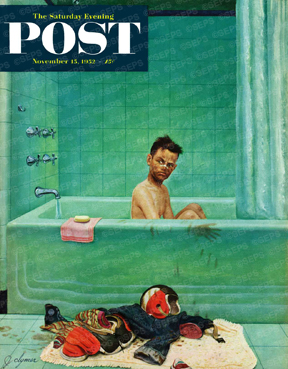
Congratulations to Rose Hester! For her limerick describing the John Clymer illustration Quarterback in the Tub (above), Rose wins $25 — and our gratitude for a job well done. If you’d like to enter the Limerick Laughs Contest for our upcoming issue, submit your limerick via our online entry form.
Of course, Rose’s limerick wasn’t the only one we liked! Here are some of our favorite limericks, from our runners-up, in no particular order:
“Now be a good boy.” His mom said,
“You have to be clean to get fed.
“Though you may be a winner,
“You won’t get your dinner,
“Until I see freckles of red.”
—Robert Kennedy, De Pere, Wisconsin
To my team I’m a star on the field.
With my touchdown our title was sealed!
But with Mom at the door,
And my clothes on the floor,
To the soap I will just have to yield.
—Lynne Lambert, Plantation, Florida
With helmet and gear on the floor
The game left him dirty and sore
He sat in the tub
To scrub-a-dub-dub
“Will somebody PLEASE shut the door?!”
—Steven Hermance, Winnebago, Illinois
The football game was such fun
Tim’s team had finally won!
He came home full of glee
But mom made him flee
To scrub until he was done!
—Kathy Rager, Paterson, New Jersey
It had makings of great football lore —
As he ran in the game-winning score!
But his mother said, “Scrub!!”
And “Go soak in the tub!”
The moment he walked through the door.
—Mary Starn, Orrville, Ohio
Oh, what an embarrassing score!
My morale’s in that pile on the floor.
I wounded my pride
When I bruised my backside
And I don’t want to play anymore!
—Michelle Gordon, Airway Heights, Washington
His helmet and trousers and shirt
And body are covered with dirt.
So slide back that curtain,
Cuz one thing is certain:
An hour-long bath wouldn’t hurt.
—Neal Levin, Bloomfield Hills, Michigan
The game of the year was now past,
They lost, but they fought to the last.
To wash off that grime,
Would take a long time:
But hadn’t the game been a blast?
—James A. Lewis, Merrill, Wisconsin
At the end of the game it would be
A win ‘cuz this lad kicked for three
All the fans, they did scream
He was the star of the team
But his mother was head referee!
Since the killing of Michael Brown in Ferguson, Missouri, last year, reports of unarmed suspects being shot by police have drawn national attention. The Washington Post tracks the number of fatal shootings by police, and notes that 30 of the dead were black and unarmed.
Even more troubling are the videos being posted online showing what appears to be unwarranted violence by police. They challenge assumptions about charges of abuse — and police departments’ claims that their officers act within the law.
Police brutality has been a painful reality to many Americans throughout our history. Police officers in the past have enforced racist policies, broken up peaceful protests and lawful strikes, harassed dissidents and sexual minorities, and forced confessions from convenient suspects.
But such violations of the law never represented the majority of law enforcement officers. And pressure from the public and elected officials has exerted a reforming influence on police practices over time. Abuses still occur, but a growing number of departments are now becoming more transparent in their operations and addressing charges against their officers through civilian review boards.
Civilian review is a significant change from the traditional policy of law-enforcement agencies, which protected officers from any public scrutiny.
Back in 1964, the shooting of a black teenager by an off-duty white policeman in New York sparked six days of rioting in Harlem. In response to tensions between police and the black community of the city, John Lindsay, then mayor of New York, proposed a civilian board that would review complaints against the city’s police.
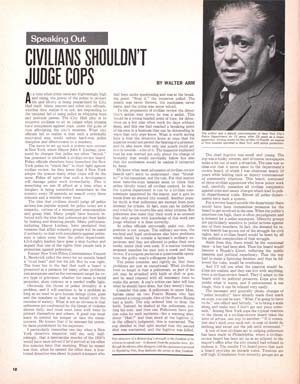
Lindsay’s idea was bitterly denounced by Walter Arm, a former deputy commissioner of the New York Police Department, who published an op-ed in the Post. Its title expressed his opinion succinctly: “Civilians Shouldn’t Judge Cops.”
Arm believed that only police officers were qualified to judge fellow officers. Civilians couldn’t fairly evaluate police officers’ actions based on the complaints of other citizens. Civilian review would “damage police work irremediably … [and] reduce hard-won police discipline and effectiveness to a mockery.”
Officers wouldn’t get an impartial judgment from civilians, Arm wrote, because “police today are a minority, victims of a stereotyped misconception and group libel. … Most advocates of civilian-review boards can’t seem to understand … that ‘brutality’ is the exception, not the rule.”
Police officers were professionals, he argued. Like surgeons, or military officers, they should be judged only by their colleagues. “Their work is so unusual that only people with knowledge of this work can judge whether it is done correctly.”
Arm asserted that police officers rarely misused their power because knew they would face punishment from their superiors. What’s surprising is that he made this claim knowing of widespread illegalities within the New York Police Department. Years earlier, he had written Pay-off! The Inside Story of Big City Corruption, an exposé of how the police were protecting the city’s illegal gambling rackets. Despite uncovering evidence of broad corruption, he believed the New York police administration kept the department clean.
Mayor Lindsay was never able to place the civilians he wanted on the department’s review board. A proposal to authorize direct civilian review of police officers was defeated in a citywide vote. But the idea didn’t die; New York established an all-civilian review board in 1993.
Responding to a demand for greater accountability, several departments across the country are now setting up civilian review boards.
There are currently about 200 such boards across the country and more departments are considering them.
But some departments that have already established civilian review are finding it isn’t the remedy they’d hoped. In 2013 critics found the Baltimore board was ineffective and had little cooperation from the city government. The Department of Justice recently investigated the board in Cleveland, which it found as secretive as the old police review system.
Many police departments still object to civilian review, claiming — as did Arm — that civilians don’t understand what police officers face; the difficulty of acting quickly, decisively, and correctly in dangerous situations.
Civilian reviewers probably can’t understand the challenges of modern police work. But officers may prefer to be judged by their testimony to a review board than by a two-minute video of them shot from a bystander’s smartphone.
The public deserves police officers who act in accordance with the law, and are punished when they betray their authority. But our police also deserve the support, and the assumption of professionalism, from the public. And both deserve the chance to express their concerns over the eroding trust between civilians and cops.
The Post will continue to encourage fair discussion and provide an outlet for both sides to express their views”
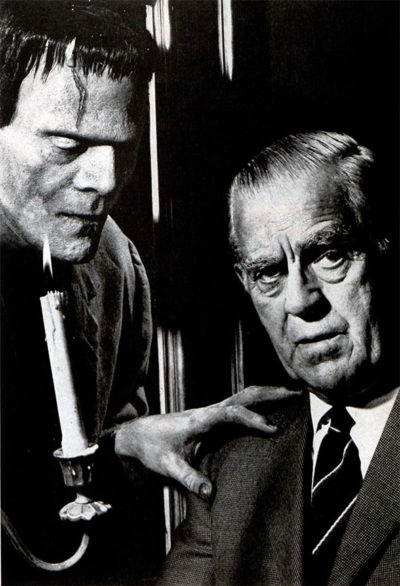
In 1962 the world’s most famous bogeyman, Boris Karloff, looked back at his 30-year career in horror.
Boris Karloff (left), who first played in Frankenstein in 1931, hasn’t been able to shed the monster image.
It is not true that I was born a monster. Hollywood made me one. That was 31 years ago, and I have lived menacingly ever after. While some potential victims have eluded my fangs, claws, and other assorted horrors, I myself have found it almost impossible to escape monster roles.
Take the memorable time in 1947 when I was offered the part of the gentle Professor Linden in a forthcoming Broadway production of The Linden Tree. I was delighted — but the playwright, J.B. Priestley, was not. “Good Lord, not Karloff!” he told producer Maurice Evans. “Put his name up on the marquee and people will think my play is about an ax murder.”
I cabled Priestley in London:
I PROMISE YOU I WOULD NOT HAVE EATEN THE BABY IN THE LAST ACT.
Upon that solemn assurance, he withdrew his objections. The part was mine. But The Linden Tree folded in less than a week, and I’ve always been haunted by the thought that possibly Priestley was right after all.
On rare occasions I have managed to step out of character: As jovial Father Knickerbocker in a Shirley Temple Storybook television show; as a wise Seneca chief in Cecil B. DeMille’s The Unconquered, and in my favorite role of the kindly Gramps in On Borrowed Time in stock. But even then I felt that the audience was waiting for me to unmask and exterminate the rest of the cast.
An Ordinary Childhood
Such morbid expectations also appear to shadow my offstage life. If I stroll into the garden, spade in hand, the postman is almost certain to quip, “Disposing of another body, Mr. Karloff?” Groucho Marx’s standard greeting to me is, “How much do you charge to haunt a house?” Bright young advertising men are forever soliciting testimonials from me for such things as devil’s-food cake.
Actually I am assured that I was a quiet infant, and a gentle boy. No whippings by cruel stepparents scarred my childhood. No sadistic governesses read me horror stories by flickering candlelight. My childhood as William Henry Pratt in the serene London suburb of Enfield was extraordinarily tame. Both my parents died during my childhood. I was reared by one amiable stepsister and seven stern older brothers, who knew exactly what I was going to be — a government servant in the family tradition. But my scholarship, or lack of it, during four years at Uppingham, a boarding school that I attended in 1902–06, bespoke my disinterest in any profession based upon higher learning.
Actually my macabre career was already settled. At the age of nine, I had appeared in a Christmas-play version of Cinderella. Instead of playing the handsome prince, I donned black tights and a skullcap with horns and rallied the forces of evil as the Demon King. From then on I resolved to be an actor.
At Kings College, London, years later, the first-term reports amply reflected the fact that I had attended more plays than classes. I was, in fact, fast becoming a disgrace to the family name. In those days black sheep were exported to Canada or Australia. When I blithely flipped a coin in the family solicitor’’s office, the unfortunate losers were the Canadians.
At 4:30 one morning, a month or so later, I found myself in a Canadian pasture, halter in hand, wondering how to round up four reluctant horses.
A week or so later, at Vancouver, British Columbia, I landed a pick-and-shovel job with the B.C. Electric Company — $2.80 for a 10-hour day — digging drainage ditches and clearing land.
Mumbling and Bumbling
Then one day in an old copy of Billboard, I came across the advertisement of a theatrical agent in nearby Seattle. His name was Kelly. I went to him and shamelessly told him I’d been in all the plays I’d ever seen, that I was forced to retire to Canada temporarily for my health, and was now hale and ready for a comeback. Two months later, while chopping trees, I received a brief note, “Join Jean Russell Stock Company in Kamloops, B. C.—KELLY.” I left my ax sticking in a tree.
On the train I concocted my stage name. Karloff came from relatives on my mother’s side. The Boris I plucked out of the cold Canadian air. I had finally become an actor, but I mumbled, bumbled, missed cues, rammed into furniture, and sent the director’s blood pressure soaring. When the curtain went up, I was getting $30 a week. When it descended, I was down to $15. The play, significantly now, happened to be Molnár’s The Devil.
I learned the acting trade during the next six or seven years, playing vintage pieces like East Lynne and Charlie’s Aunt all over western Canada and the United States, and living on eggs fried on inverted pressing irons in “no cooking” boardinghouses. Then I wandered into movies, via a $5-a-day extra role as a swarthy Mexican soldier in a Doug Fairbanks Sr. film, His Majesty, The American. For the next eight or nine years, I played extra and small featured roles when things were good, loaded cement sacks in warehouses when they weren’t. At 42 I was an obscure actor playing obscure parts. I quit writing home — for I had nothing to write about.
My big break came while I was downing a sandwich-and-tea lunch in the Universal commissary. After a string of sweet-and-kindly roles, I had played the diabolical Galloway, the convict-killer in The Criminal Code. Someone tapped me on the shoulder and said, “Mr. Whale would like to see you at his table.” Jimmy Whale was the most important director on the lot. “We’re getting ready to shoot the Mary Shelley classic, Frankenstein,” Whale said, “and I’d like you to test — for the part of the monster.”
It was a bit shattering, but I felt that any part was better than no part at all. The studio’s head makeup man, Jack Pierce, spent evenings experimenting with me. Slowly, under his skillful touch, the monster’s double-domed forehead, sloping brow, flattened Neanderthal eyelids, and surgical scars materialized. A week later I was ready for the test. I readily passed as a monster.
To fill out the monster costume, I had to wear a doubly quilted suit beneath it. We shot Frankenstein in midsummer. After an hour’s work I would be sopping wet. I’d have to change into a spare undersuit, often still damp from the previous round. So I felt, most of the time, as if I were wearing a clammy shroud myself. No doubt it added to the realism.
The scene where the monster was created, amid booming thunder and flashing lightning, made me as uneasy as anyone. For while I lay half-naked and strapped to Doctor Frankenstein’s table, I could see directly above me the special effects men brandishing the white-hot scissorslike carbons that made the lightning. I hoped that no one up there had butterfingers.
Frankenstein was the first monster film of any consequence ever attempted. That, plus the sensitive theme of a man, Doctor Frankenstein, playing at God, made the then-powerful Hayes office hesitate to release it. But director Whale had filmed it with restraint and delicacy. It finally was released for its premiere on December 6, 1931, at Santa Barbara. I was not even invited and had never seen it. I was just an unimportant freelance actor, the animation for the monster costume.
Then my agent called one morning and said, “Boris, Universal wants you under contract.” I thought, Maybe for once I’ll know where my breakfast is coming from, after more than 20 years of acting. I soon found myself mildly famous — although not by name. On a motoring holiday in France, for example, I lost my way. In the dreadful remains of my schoolboy French, I inquired in a tiny village butcher shop. The proprietor looked me in the face and exclaimed, “Frankenstein’s Monster!” That sort of thing has lasted for 30 years.
A Ghoul Gains Followers
In a Hollywood studio baseball game, Leading Men versus Comedians — my category escapes me at the moment — everyone fled in mock horror when I batted, allowing me to lumber around the bases for a home run. At radio-show rehearsals the orchestra hissed me realistically, and I leered back. Columnists imaginatively concocted the Karloff cocktail — one sip sent the drinker into shock. Monster fans mailed me such birthday gifts as voodoo dolls.
Not everyone, however, felt enthusiasm for monsterism. Some parent and civic groups felt Frankenstein was too horrifying for children to see and should be limited to “adults only.” The children thought otherwise. On the very first Halloween after the film’s release, a crowd of laughing pint-sized ghosts and goblins rang my doorbell and invited me to join in their trick-or-treat rounds. As I wasn’t appropriately costumed, I had to decline. Over the years thousands of children wrote, expressing compassion for the great, weird creature who was so abused by its sadistic keeper that it could only respond to violence with violence. Those children saw beyond the makeup and really understood.
Frankenstein transformed not only my life but also the film industry. It grossed something like $12 million on a $250,000 investment, started a cycle of so-called boy-meets-ghoul horror films and quickly made its producers realize they’d made a dreadful mistake. They let the monster die in the burning mill. In one brief script conference, however, they brought him back alive. Actually, it seems, he had only fallen through the flaming floor into the millpond beneath and could now go on for reels and reels.
The watery opening scene of the sequel, The Bride of Frankenstein, was filmed with me wearing a rubber suit under my costume to ward off chill. But air got into the suit. When I was launched into the pond, my legs flew up in the air, and I floated there like some sort of obscene water lily while I, and everyone else, hooted with laughter. They finally fished me out with a boat hook and deflated me.
In March 1933, I returned to England. My two eldest brothers, Ted and Fred, had retired from Indian Civil Service and were living in London. Jack had been transferred from China to take charge of Far East affairs in the Foreign Office.
A little later I got a surprising reaction from my staid and proper British brothers. Some friends from Hollywood were in London, and before they left for home we gave a sort of joint cocktail party. All went well until a newspaper photographer approached me. “I understand you’ve some brothers here,” he said. “Could we get a photograph or two?”
I was appalled. I thought, How am I going to break this to them? They won’t approve at all. I got them off in a corner and mumbled, “Awfully sorry about this but, you know, publicity and all that. I swear I’m not responsible for the photographer being here. But, well, to cut it short, they want to take pictures of us. They want us in the next room, lined up against the mantelpiece.”
Jockeying for Position
Well, you never saw such a stampede. The three reserved, distinguished elderlies — Ted, who’d been judge of the High Court in Bombay; Fred, who’d administered an entire province in India; and Jack, who’d been chief magistrate of the Consular Court in Shanghai — all but got stuck in the door getting through. And there was quite a to-do about who was to stand where. I fought to keep my composure, but inwardly I was laughing.
Returning to Hollywood, I played the monster in Son of Frankenstein — my third and last such role. Others perpetuated him in later films. In a switch, I twice took the part of Doctor Frankenstein myself and found it comfortable to be less loaded with makeup.
Next I became a succession of crazed scientists. The formula was successful, if not original. The scientist would set out to save mankind. His project would sour and he with it. In the end he’d have to be destroyed regretfully, like a faithful old dog gone mad. The scriptwriters had the insane scientist transplant brains, hearts, lungs, and other vital organs. The cycle ended when they ran out of parts of anatomy that could be photographed decently. While it lasted I:
Robbed graves in The Body Snatcher.
Slew with an ax as the leering executioner Mord, in Tower of London.
Frightened my enemies to death in The Walking Dead.
I also:
Cheated the hangman in The Man They Could Not Hang.
Invoked the curse of the pharaohs as a vengeful mummy in The Mummy.
Aggravated the hells of 18th-century prison life as the warped warder in Bedlam.
Ruthlessly pushed dope to little Jackie Cooper as a dope peddler in Young Donovan’s Kid.
I must confess that I didn’t accept this constant and continual madness quite placidly myself. Once, during the crazed scientist cycle, I said wearily to the producer: “These things are all right, but don’t you think we should perhaps spend a little more in the writing, or change the format?” He was in an expansive mood. He opened his desk drawer and pulled out a great chart. “Here,” he said, “here’s your record. We know exactly how much these pictures are going to make. They cost so much. They earn so much. Even if we spent more on them, they wouldn’t make a cent more. So why change them?”
During my most monstrous years, I naturally associated with such aristocrats of Hollywood villainy as Bela Lugosi[LINK?], Lon Chaney Jr., Peter Lorre, and John Carradine. Offscreen I found them to be the gentlest of men.
One of my own most terrified moments came in 1940, when the noted playwrights Lindsay and Crouse offered me the part of Jonathan in the Broadway production of Arsenic and Old Lace. Keep in mind, I’d never acted on Broadway, but only in the sticks, or in films. What really sold me on taking the part was a line of Jonathan’s in his first scene. He’d just murdered a kindly motorist. Another character says, “He was a nice chap, that man who gave us a lift. You shouldn’t have killed him. Why did you do it?” And Jonathan replies, “He said I looked like Boris Karloff.”
I expected that a line like that, spoofing me so early in the play, would disarm any New York audience. Then I began wondering: Would it? Could I put over a big stage role? By the time I arrived in New York, I was almost shaking from sheer fright. I’d rushed through a hard week at Columbia studios, then taken an all-night flight East. At the theater they handed me a script, and we did something I’d never done in stock or repertory — we sat down, cast and director together, and read cold turkey. I was so tired, and so frightened of my New York role, that I began to stutter — something that always besets me when I’m tired. I rehearsed in stutters for three days, continually thinking that it would cure itself. But instead it grew worse. The third night I wandered the streets of Manhattan wondering what to do. I thought I’d have to walk up to the management and say, “I’m very sorry. I’ve made a mistake, and so have you. I’ve got to get out of your play. Do I owe you anything?”
I walked some more and thought, If I do that, honest though it is, I’ve certainly had it in New York and haven’t done myself an awful lot of good in Hollywood either. Somehow I’ve got to go through with the play.
At 5:30 a.m. I returned to my hotel, catnapped briefly, then went to rehearse. I’d always stuck on the word “Come” in my first line. Now I walked on, took a deep breath and said, “Come in, doctor.” Not a stutter. By that evening all was okay. The show’s reviews were better than okay. It was a big, beautiful hit, and we settled down for a long, happy run of about 1,400 Broadway performances.
Later I played Captain Hook, the villain with the wicked, steel-hooked arm, to Jean Arthur’s Peter Pan on Broadway. At the end of the first act at matinees, we’d peek from behind the curtain and watch the kiddies leaping hopefully off their seats, trying to fly like Peter Pan. After the show I’d corral as many as my dressing room would hold and ask, “Would you like to try on my hook?” Even little blond angels would reply, “Yes, sir.”
They’d turn to the mirror, put on the most terrible face they could make and, without fail, take a terrific swipe at themselves in the glass. Far from being frightened by the villainous Captain Hook, they had caught on to his fun and pomposity. For it is a fundamental instinct of kids to play games, and they knew very well that the swordplay, the ominous crocodile, the poisoning of Peter Pan, and all the assorted stage violence was just a game just good, scary fun.
Villain by profession though I may be, however, I must say that my approval of good scary fun does not extend to shows where blood and guts are sloshed about wholesale, simply to create nightmares.
A Black Sheep No More
Nowadays I find time to play occasional light comedy in Milquetoast roles, to give syndicated radio advice to parents on child rearing and even to make phonograph recordings of childhood favorites such as Mother Goose and The Reluctant Dragon. Occasionally someone asks me if I regret my years as a monster, if the role hasn’t been like an albatross around my neck.
Rubbish! Thanks to the monster, I’ve worked steadily at the work I love best. And I’ve been well paid — in more ways than with money. Here I am, 75 years old this month, no longer the black sheep of the Pratt family, still hard at work, still enjoying life to the fullest. With my wife Evie I commute some 12,000 miles between my old stamping grounds in England and this country. But I must admit one unfulfilled longing. I would love to be in a play in London.
The only time I ever trod the boards there was in a benefit for the Actors’ Orphanage, doing a comedy sketch with Hermione Gingold. Even at that, I was absolutely thrilled. But if I never get to do the “real” thing in London, it would be indecent for me to grumble.
After all, I’ve always been a very happy monster.
“Memoirs of a Monster” by Boris Karloff, as told to Arlene and Howard Eisenberg, The Saturday Evening Post, November 3, 1962
I’ll be honest: I didn’t even know A&P grocery stores were still around. We had one in my hometown that I visited regularly as a kid, but it closed many years ago. There’s a Walgreen’s in that space now. The chain is actually still around in the Northeast, but this week the Great Atlantic & Pacific Tea Co. (A &P) filed for Chapter 11 bankruptcy for the second time in five years and have 120 of its 296 supermarkets lined up to sell to other supermarket chains, including Acme Markets, which plans to turn 76 of the stores into Acme stores. A&P tried to find a buyer for the entire company in 2013 but couldn’t find one.
In addition to operating stores under the name A&P, the company also runs Waldbaum’s, Pathmark, Superfresh, Best Cellars, Food Basics, and The Food Emporium locations. I swear that I didn’t even know that Waldbaum’s was a real place. I heard it for years on Everybody Loves Raymond and I thought it was just a made-up name for Wal-Mart, the way TV shows often use a name like FacePlace to stand for Facebook.
The history of A&P is actually quite fascinating. If you’re interested in the history of supermarkets, that is.
The new stamps are called Summer Harvest and are produce-themed, with pictures of tomatoes and watermelons and cantaloupes. They look like the colorful labels you’d see on old food crates. Stamp collecting has always been one of those things I wanted to get into but I feel like I missed my chance when I was 10 years old. Sure, it’s never too late to start something but starting to collect something that there is so much of now seems rather overwhelming. But these stamps look beautiful.
Oh, and read the comments on The Atlantic article, where you’ll find people who are absolutely flabbergasted that people still use the USPS. Seriously? Even with email and social media and online bill paying, how can people and businesses not use snail mail?
SPECTRE
The full trailer for the next James Bond film, SPECTRE, was released this week:
Looks great, right? The Bond trailers are always well done and the movies are always entertaining. But a suggestion for the next film: Maybe it doesn’t have to be about some painful incident/secret about Bond’s past? Every single Daniel Craig 007 film has followed the same pattern (something happened in Bond’s past, he goes rogue, he’s out for revenge, is he too old, this time it’s personal, etc.). Maybe this could be the end of this particular storyline and we can get to some standalone movies?
SPECTRE premieres in the U.S. on November 6. I’m in line for it right now.
The Problem with Gawker
Five years ago I wrote this about Gawker: “I think we can all agree that Gawker is a terrible web site run by terrible people who write terrible things.” Things haven’t changed at the gossip site since then. If anything, it has gotten worse, and everything sort of imploded this week.
First they put up a story (ordinarily a link would go here but I don’t want to give them any traffic) about a publishing CEO who may have attempted to hire a gay escort, then when the web and social media and Gawker commenters (when even Gawker commenters shake their heads …) freaked out about the sleazy, pointless post, management and Gawker Media head honcho Nick Denton decided to take it down. This, of course, irritated the editorial staff at the site and two of the top editors quit in a huff. How dare the “business side” interfere with the “editorial side”?! What about journalistic ethics?
First, it’s all business side. This is the way publications have always been. Second, maybe the management wouldn’t have to have gotten involved if the editors didn’t approve the post in the first place. Somebody had to be the grown up, though honestly, everyone is acting as if this was “out of bounds” for Gawker when in reality they’ve been publishing stuff like this for years.
Just before resigning, one of the editors not only rang up a $550 lunch bill at expensive NYC restaurant Balthazar, he posted a picture of the receipt on social media. Because his resignation was all about ethics. *Cough.*
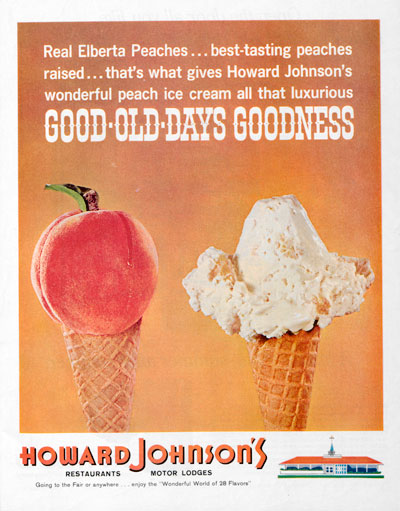
But there’s one orange-roofed restaurant left in the country and it’s in Lake George, New York (there’s another Howard Johnson’s in Bangor, Maine, but it doesn’t have the orange roof and will probably go out of business soon). The New York Timeshas a feature on the restaurant and CBS Sunday Morningwent to the location to interview the owner. Rachael Ray worked there when she was a teen.
Howard Johnson still has a chain of hotels though. It’s part of the Wyndham Hotel Group, which also runs Ramada, Days Inn, and Travelodge.
Upcoming Events and Anniversaries
The debut of Bugs Bunny (July 27, 1940)
The wise-cracking rabbit made his official debut in the Warner Bros./Merrie Melodies cartoon A Wild Hare.
NASA created (July 29, 1958)
The National Aeronautics and Space Administration was initially called the National Aeronautics and Space Agency when first proposed.
President Lyndon Johnson signs Medicare bill (July 30, 1965)
You can read The Saturday Evening Post feature “Medicare: Headache or Cure-All?” from 1967, along with other articles on the American healthcare system.
It’s graduation season, with lots of young people leaving college and going off into the “real world.” It’s also the season for advice to those graduates and commencement speeches.
CNN has a rundown of the celebrities and politicians who have made commencement speeches the past month, including Robert DeNiro, who spoke at New York University’s Tisch School of Arts; Anthony Hopkins, who spoke at Pepperdine University; and former Secretary of State Condoleezza Rice, who spoke at William & Mary.
My favorite commencement speaker this year just might be Stephanie Courtney, who spoke at the Binghamton University in New York. You might know her better from these commercials.
If you’re like me, you often find yourself sitting on your couch, watching television, wearing your ordinary pants, and you look down at those pants and wonder: Why aren’t these digital?
Google is developing what they call “smart fabrics,” clothing that can actually function in the same way a touchscreen does. So with just a touch or a swipe of your fingers you can control your laptop, your phone, maybe even the music or lighting in your house or other appliances. I’ve been hoping one day that someone will make a sweatshirt that will help me control my toaster remotely.
Earthquake!
(Shutterstock)
Could the earthquake and tsunami depicted in the current box-office champ San Andreas actually hit California? Yes, say scientists. So run, run away to Maine, Californians!
Okay, it might not happen exactly the way it happens in the movie, with utter and complete destruction of everything, everywhere. But scientists say that not enough attention is being paid to faults that lie offshore of Southern California and the faults should be taken more seriously. It’s not just the famous San Andreas Fault that people have to worry about.
Part of me would love to experience an earthquake. Is that weird? Not a big one, of course, just something that would make me feel the shaking a bit. On a related note, I got this for Christmas one year when I was a kid. After the first couple of times it wasn’t really fun to play with anymore.
Drones: 1, Pop Singers: 0
(Shutterstock)
You can put this in the same category as “don’t stick your foot down a garbage disposal” and “don’t stick your tongue in a fan.” Singer Enrique Iglesias tried to playfully grab a drone that was filming his concert performance in Tijuana, Mexico. He promptly got his fingers sliced and a very bloody shirt and had to go offstage to get bandaged up. He came back and played for another 30 minutes and then stopped the show because he was still bleeding. He later had surgery on the hand to repair the damage and will continue his tour on July 3.
What’s remarkable is that you can see in the video that Iglesias grabs the drone a first time and gets hurt, but he still decides to grab it a second time. The moral here? Never grab a drone.
Don’t Go on Waikiki Beach at Night
(Shutterstock)
I went to Hawaii in 1989. I’m not a warm weather person at all, but I really enjoyed it. A few nights we walked along Waikiki Beach (one night encountering a bunch of guys in their underwear swimming in the water), which is something I’m sure a lot of people do, especially if you don’t like the heat of the sun during the day.
It’s not really the amount of the fine, it’s the fact that some of the people being fined are actually tourists who are unaware of (or don’t care about) the law. The fines go on your permanent police record (which could be a problem if you’re from out of the country and want to come back in the future), and if there’s a court date set for a hearing, you have to be present for that. If you don’t show up — which some tourists might not be able to do because they live out of state —there might be a criminal warrant issued.
I guess what I’m saying is if you want to hang out on Oahu at night, maybe you can try the Magnum, P.I. house. You’ll have to make arrangements with the new owners though.
National Ketchup Day
Yes, today is the day we celebrate ketchup! Also: catsup! Though I’m not sure if anyone spells it that way anymore. Not sure if ketchup is something I would bother to make myself, but if that’s something that strikes your fancy, Epicurious has a recipe. I don’t know, it seems like more trouble than it’s worth.
Did you know they sell ketchup in stores now?
Upcoming Anniversaries and Events
The Belmont Stakes (June 6)
American Pharoah, who has already won the Kentucky Derby and the Preakness Stakes, goes for the Triple Crown. The race starts at approximately 6:50 p.m.
Secretariat wins the Triple Crown (June 9, 1973)
The last horse to win the Triple Crown did it 42 years ago.
Honestly, I didn’t even know that this was a mystery. I always thought we knew what Shakespeare looked like. Of course, I’m basing this on years and years of TV shows and movies, but I had no reason to think that it wasn’t accurate. But now botanist and historian Mark Griffiths says in Country Life that the image found in a 17th-century book on botany is the “first and only known demonstrably accurate portrait” of Shakespeare.
Of course, a lot of other historians aren’t convinced. Not only is this not the first time someone has claimed to find the “real” image of Shakespeare, this image was found in a book on botany, and some people don’t know why he would have been in such a book.
Can a Machine Replace a Reporter?
(Shutterstock)
One day, everything you read online and maybe even offline (if there is such a thing as offline in the future) will be written by a computer program. Well, okay, maybe not, but it’s not like news organizations aren’t trying.
There are companies creating programs and apps that actually write some of the news stories you read on Yahoo! and the Associated Press. A reporter for NPR, Scott Horsley, decided to challenge one of these programs — with the friendly, innocuous name WordSmith — to see who could write the story quicker and if anyone could tell the difference. Here are the results.
I find this a scary development. Not just the fact that real reporters could see their jobs taken away some day, but also the fact that people think the style and personality of a writer can be duplicated 100 percent. I guess it’s the speed and information they see as the important thing, and it’s only being used for certain stories right now. If this does happen, in 50 years we’ll just be a race of people that consumes news but doesn’t write any of it.
Of course, you have no idea if this very column is being written by … BUFFERING BUFFERING … a computer program. There’s really no way you can tell 01010101010101010101010101010 is there?
The ‘Mad Men’ Finale Explained
It has become commonplace to announce in a review or essay about a TV show that there are spoilers about to be revealed. I’ve never understood that, because if I’m reading a review of a TV show I’m just going to assume that, you know, what’s in the TV show is going to be revealed. Having said that, SPOILERS FOLLOW SO RUN FOR YOUR LIVES IF YOU HAVEN’T SEEN THE MAD MEN FINALE YET.
At the end of the episode, we see Don Draper, who has left everything and everyone behind, meditating on top of a hill in Northern California with several other people in an Esalen-ish retreat. Don has his legs crossed and is in the middle of an “oooooooooommmmm” chant when the camera comes in on his face and he smiles knowingly. We hear a “ding” and immediately the classic “Hilltop” Coca-Cola commercial comes on the screen. End of show.
I think it’s pretty clear what happens: Don gets the idea for the commercial, realizes who he is, and goes back to New York City and creates the ad for McCann Erickson. It’s a positive, non-cynical ending. But so many people online, both critics and casual fans, are seeing the ending as not only cynical and defeatist but also ambiguous. You mean Don learned nothing and goes back to advertising? Does Don create the ad or is it Peggy? Does Don stay at the retreat and change his life again? Is the ad just thrown on the screen because it was released around this same time and involved a hillside full of people and has nothing to do with Don?
Honestly, I think the ending we see is the ending we got. Shows like Lost have changed the way we watch television and what we expect from a series finale, and not for the better. There’s not always a “mystery” to what we see. We have to judge the ending by the information we’re given. It’s almost as if fans and critics are writing some sort of Mad Men fan fiction to “explain” the ending, envisioning what the scene really means and what happens 30 minutes, 30 hours, 30 days after Don smiles. Sure, a lot of things could have happened, but how are we to know? We have to judge it by what happened in the episode (and in the other episodes this season).
And creator/writer Matthew Weiner clarified the ending in a talk with writer A.M. Homes at the New York Public Library on Wednesday night, saying he’s “not for ambiguity for ambiguity’s sake” and (talking about Don and the Coke ad) “the idea that someone in an enlightened state and not just co-option might have created something that is very pure.”
‘Steve Jobs’ Teaser Trailer
Another highlight of the Mad Men finale was the debut of the first trailer for Steve Jobs, the biopic of the Apple Computer guru directed by Danny Boyle and written by Aaron Sorkin (The West Wing, The Social Network). Interesting that for the trailer they’re showing latter-day Jobs with the lighter hair and not younger Jobs:
National Wine Day
(Shutterstock)
I’m a red wine guy. The few times I’ve had white I’ve regretted it and I’ve run back to my Cabernet Sauvignons. But for this Monday, National Wine Day, I’ve decided I’m going to try to get into white wine. I want something light, something smooth, something that won’t scare me off, something very drinkable. Any suggestions?
And by the way, don’t confuse National Wine Day with National Drink Wine Day, which is February 18. I don’t know what the difference is (is there something else you can do with wine besides drink it?), but there you go.
The most famous comet in the universe — probably the only one most people can name — hasn’t been seen around Earth since 1986 and won’t be seen again until 2061, but if you were looking up at the night sky late Tuesday/early Wednesday you could have seen a pretty spectacular meteor shower of the debris left in its wake.
The display actually goes until May 28 but peak visibility for the shower happened a few days ago. This won’t happen again until October with the Orionid meteor shower (expected to peak around October 20), but if you don’t want to wait that long, don’t worry. This is the age of everything online, and Slooh recorded the entire event for us to see (scroll down to the video).
When I was a kid we always thought “Halley’s” rhymed with “dailies.” But it actually rhymes with “alleys.” No matter what Fountains of Wayne said.
Coming Soon: Dead Comics — Live!
Bob Hope portrait Norman Rockwell February 13, 1954
They’ve done it with dead musicians like Michael Jackson and Tupac Shakur, and now we’ll actually be able to see the dead stand-up comics of yesteryear perform live again!
Okay, maybe “live” isn’t the right word to use. The National Comedy Center, a new club that will open next year in Jamestown, New York, will feature hologram performances of stand-up comics and other comedians that have died. So if you have always wanted to see people like Bob Hope and George Carlin and Lenny Bruce but were too young to see them years ago, this will be your chance (pending deals with their estates of course).
There are two questions that this raises: 1) will people be turned off by this because they find it creepy and tasteless? and 2) why didn’t someone come up with this genius idea before? The only question I have is how will this actually work? If it’s a hologram of an actual live performance, that means there was an audience there and they were laughing and the comic had to pause. How will this mesh with the new audience and the new laughter?
The center won’t be too far from where Lucille Ball was born, Celeron, New York, and the owners want to give this a new home. Hopefully it will be fixed by the time the place opens.
Goodbye, MDA Labor Day Telethon
Jerry Lewis at photocall for his movie “Max Rose” at the 66th Festival de Cannes. May 23, 2013 Cannes, France Featureflash / Shutterstock.com
You sort of knew this was coming. When the Muscular Dystrophy Association canned host Jerry Lewis from the show in 2011 after he hosted it for over 60 years, and then cut the show’s length down from 21 1/2 hours to a 2-hour primetime special, you knew it was on its way out. And now it’s official: the MDA is ending the show for good. Why? Because it’s a different world now. The fundraising efforts will now be done mainly online and via other fundraising throughout the year.
It’s actually kind of odd. Sure, on the surface it seems like having a telethon that runs for an entire day is something that’s not needed, something from another time. But isn’t that what made it special and stand out in the first place? There were two things we absolutely knew about Labor Day: We’d soon have to start school again, and Jerry Lewis was going to stay up for a day and raise money for kids.
I’m not sure why this is suddenly a “thing” on the Web, but it is. It’s the “dad bod,” the body a male of a certain age has. He’s a little older (but sometimes young) and he’s kind of in shape but also kind of not. Or as this article puts it, “a nice balance between a beer gut and working out.” In other words, the Web is celebrating guys who are completely normal in every way.
I think I have a granddad bod.
Are Reality Shows Good For You?
(Shutterstock)
Nobody can actually be trying to argue that shows like The Bachelor and The Real Housewives of Beverly Hills are actually good for us, can they? Of course they can!
A new brain-imaging study in the journal NeuroImage (one of my favorite neurology journals) says that by watching reality shows where people throw drinks at each other or get into fights or decide to get married after knowing each other for two weeks, we can actually feel empathy. Researchers at the University of Bonn in Germany call it “vicarious embarrassment,” which is the “ability to squirm in empathy for someone else’s social pain or loss.”
Now, I’m pretty sure I can feel empathy for many people but usually not for people who decide to live their lives on reality shows. Also, maybe it’s not empathy people feel. Maybe it’s more of that embarrassment factor. Sort of like the embarrassment they should feel anyway for watching these shows in the first place.
National Coconut Cream Pie Day
(Shutterstock)
Today is the day to celebrate the coconut cream pie, the official dessert of the inhabitants of Gilligan’s Island. I never could understand how Mary Ann could make those delicious pies, stranded on an island. But when you have characters like the Howells who brought a ton of clothes and money with them for a three-hour boat tour and plots where various people come and go on the island but the cast can’t get rescued, I guess the making of coconut cream pies is one of the more realistic things that happened.
The cover must have shocked more than one reader. The Saturday Evening Post had become known for its cover art, by Norman Rockwell and others, which showed an idealized America. But on September 12, 1964, the cover showed the face of Malcolm X — the radical leader who promoted black power and armed resistance to the status quo.
He had emerged as an important public figure during that year’s wave of angry politics. Just that summer, race riots had erupted in New York, Philadelphia, Chicago, and Jersey City. And as a spokesman for black discontent Malcolm X was, according to the September issue’s accompanying editorial, partially to blame: “The militant hatred he [Malcolm X] preaches was behind some of the violence of the summer riots.”
The editorial expressed no high regard for Malcolm X or the Nation of Islam, which had shaped his militant philosophy. Malcolm X might justify his message of violent resistance because he grew up in a violent world, the editors wrote, but it was the same cruel, unjust world that produced non-violent civil rights leader Dr. Martin Luther King Jr.
“America may consider itself lucky,” the editorial continued, “that in a large poll which The New York Times took in Harlem — by coincidence, just before the riots — King had more than 12 times as many followers as Malcolm X. We say lucky, because this fact shows more patience, forbearance, and trust among Negroes than their past treatment has justified.”
But how long could patience endure before more Americans adopted Malcolm X’s attitude? “The persecuted, neglected, mistreated minority … are equally taxed in all respects, [but] still do not get equal representation, politically or otherwise,” the editorial added. “Taxation without representation is still tyranny, and until all Americans join in providing every citizen with the rights of citizenship, we shall be lucky if Malcolm X is not succeeded by even weirder and more virulent extremists.”
The editorial accompanied a shortened version of Malcolm X’s then unpublished autobiography. The excerpt, provocatively titled “I’m Talking to You, White Man,” gave an account of losing a father to violence and a mother to insanity, drifting into crime and drugs, finding faith in prison through the Nation of Islam and its leader Elijah Muhammad, and taking his spiritual journey even farther.
Readers might have been angered to read Malcolm X’s belief that a mad scientist created the white race. And they might have been irritated to read his response to President Kennedy’s assassination, which started his separation from his mentor Muhammad. Malcolm X had called the president’s murder a case of “the chickens coming home to roost.”
“I said that the hate in white men had not stopped with the killing of defenseless black people, but that, allowed to spread unchecked, it had struck this country’s Chief of State.”
His comment made headlines, of course. Nation of Islam director Muhammad thought the comment was harsh and likely to make life “hard on Muslims in general.” Malcolm agreed to refrain from making any comments for 90 days. But the incident caused a rift in the Nation of Islam community. Soon Malcolm X announced he would open his own mosque in New York City.
However, the excerpt also included another memorable comment, in its conclusion. After returning from a pilgrimage to Mecca, Malcolm X was asked what had most impressed him. He replied, “The brotherhood: The people of all races, colors, from all over the world coming together as one! It has proved to me the power of the One God.”
As a result of what he had seen in the Holy Land, he wrote, “I have turned my direction away from anything that’s racist.” But, in consequence of renouncing racism, “some of the followers of Elijah Muhammad would still consider it a first-rank honor to kill me.”
He had long anticipated a violent death for himself. Earlier in his memoirs, he wrote, “It has always stayed on my mind that I would die by violence. I have done all that I can to be prepared.” And on February 21, 1965, that death came for him. While giving a speech in New York, Malcolm X was gunned down by three members of the Nation of Islam.
At the time of his death, Doubleday & Co. had been preparing to publish the full-length version of his autobiography. His murder caused them to panic. Not knowing whether employees would be at risk after publishing the autobiography, the company pulled the book from production. Grove Press released it later that year. The book has remained in print for 50 years, with millions of copies sold.
Publishing the memoirs of Malcolm X was a bold move for the Post. It marked how far the Post had departed from its 1950s attitude and contents. But the editors believed the magazine should reflect American society. While they didn’t endorse his solution to the problem, they honored his perception and portrayal of it.
Had he lived, Malcolm X would have turned 90 this coming May — a not impossibly old age. We can only guess how he would have developed as a leader. Had he survived the shooting, though, a long life might have been unlikely for him. Even a leader as conciliatory as Dr. Martin Luther King Jr. didn’t survive those turbulent years. Neither man lived to see his 40th birthday.
Born in 1894 in Naples, Italy, John LaGatta was an American immigrant who achieved the American dream by cultivating his passion for art. In creating a unique style of his own, LaGatta reshaped advertising and illustration in the early twentieth century. He used depictions of glamorous, elegant women in a romanticized world of “old Hollywood” to provide an escape from the realities of the Great Depression.
Coming to America with nothing, LaGatta eventually become one of the most sought after illustrators in the country, earning as much as $100,000 a year throughout the 1930s and 40s.
LaGatta’s family arrived in New York City by way of Brazil, originally from Naples, Italy. Living in Manhattan’s Lower East Side, the artist began working in advertising as early as 14 years old in 1908. He began his studies at The New York School of Fine and Applied Art where he studied under famed artists Kenneth Hayes Miller and Frank Alvah Parsons. Even at such a young age, LaGatta was selling sketches to Life magazine to pay for his formal education.
In 1914, the artist moved to Philadelphia with friend and fellow artist Peter Helck to design film posters for Lubian Film Company. He eventually moved to Cleveland, Ohio to join a burgeoning art studio as an in-house artist. While in Cleveland, LaGatta met his future wife of 58 years, Florence Olds. Together, they had two children, son John Hawley Olds LaGatta, and daughter Jeanne Mehit (ne LaGatta).
Eventually LaGatta moved back to New York to keep up with his growing advertising commissions. He kept a house in Sands Point, Long Island, as well as a studio in Manhattan, a farm in Woodstock, and a forty-five foot yacht between Long Island and Manhattan. When the stock market crash hit in 1929, LaGatta’s assets were well protected since he had invested almost entirely in real estate.
His works depicting beautiful, sultry women are considered to be some of the most desirable artwork of the 1920s, 30s, and 40s, making him a “big money” artist. Over the course of his life, his list of consistent advertising clients included Resinol Soap, International Silver Company, Ajax Rubber Company, Laros Lingerie, Hoover Vacuum Cleaners, Paramount Pictures, Campbell’s, Ivory Soap, Kellogg’s, Johnson and Johnson, Spaulding Swimwear, and Chase and Sanborn Coffee.
His multi-media approach to the creation of illustrations also provided a unique perspective. LaGatta work in chalk, pastel, oils, sometimes mixing them as a style he coined “Chalk-and-wash.”
Though LaGatta had become financially successful from his advertising work, he wanted to be in the spotlight on the covers of magazines. He took a six-month hiatus from his advertising commissions and set out for the big leagues to land a cover of The Saturday Evening Post. From his hiatus onward, LaGatta landed covers on the most popular magazines of the era including Ladies’ Home Journal, Cosmopolitan, Women’s Home Companion, Redbook, McCall’s American Magazine, and Harper’s Bazaar.
By the end of the Great Depression and World War II, LaGatta’s depictions of fanciful parties, extravagance, high-fashion, and an overall idealistic escape to the parties of the 1920s, were no longer in demand.
LaGatta moved his family to Santa Monica, California during World War II where he took up commissions for “potboiler” portraitures and, in 1956, teaching. The artist’s old friend, Tink Adams, invited him to join the faculty of The Art Center School in Los Angeles, an offer the artist enthusiastically accepted. LaGatta taught there for 21 years until his death in 1977.
Resurgence: By the 1990s, Cash felt his best work was behind him. American Recordings (album art pictured) would bring his career roaring back to life, winning a generation of fans and a Grammy for Best Contemporary Folk Album in 1995. (Photo courtesy American Recordings)
Those were Rick Rubin’s first words to Johnny Cash when they sat down in the producer’s spacious home high above Sunset Strip in Los Angeles on May 17, 1993, to begin exploring the process of making an album together.
The only child of an upper-middle-class family from Long Island, New York, Rick Rubin grew up on hard rock and punk, but his entry into the record business was via hip-hop, a genre he became obsessed with while a pre-med student at New York University in the late 1970s. He especially loved the way DJs in clubs came up with dynamic sounds by “scratching” — rapidly twisting and turning vinyl recordings on spinning turntables. When he noticed that rap recordings lacked that club energy because producers used real musicians instead of turntable DJs, Rubin began making records in his NYU dorm room employing “scratching” and other bits of turntable wizardry. The difference was immense.
After gaining attention around New York City when the first record he produced was a huge club hit, he teamed with a bright young entrepreneur named Russell Simmons to start Def Jam Recordings, which they would build into the Motown of hip-hop. At Def Jam, Rubin produced such hit acts as the socially conscious Public Enemy and rap ’n’ punk rockers the Beastie Boys. In the early 1990s, wanting to expand his musical terrain, he moved to Los Angeles, where he won even more success and acclaim working with rock and heavy-metal acts, including the Red Hot Chili Peppers, Slayer, and Tom Petty and the Heartbreakers.
The path to Cash grew out of a desire to set new challenges for himself. Instead of working just with youngish rockers, he wanted to connect with someone who was “great and important, but who wasn’t doing their best work. I wanted to see if I could help them do great work again.”
Cash was skeptical when he was told that a rap producer wanted to make a record with him, but he figured, what the heck. He invited Rubin to come to his show at the Rhythm Café, about an hour’s drive south of LA. When the burly young man with the long, unruly beard and gentle, Zen-like manner walked into the dressing room, Cash didn’t know what to make of him. Cash later described his first impression of Rubin as “the ultimate hippie, bald on top, but with hair down over his shoulders, a beard that looked as if it had never been trimmed and clothes that would have done a wino proud.”
To read the entire article, pick up the November/December 2014 issue of The Saturday Evening Post on newsstands or …
Purchase the digital edition for your iPad, Nook, or Android tablet:
To purchase a subscription to the print edition of The Saturday Evening Post:
There once was a rooster named Sunny
In love with a young hen named Honey.
Pink, yellow, and blue
Her eggs were a clue
She’s more than just friends with the Bunny.
—Jane Yunker, St. Croix Falls, Wisconsin
Congratulations to Jane Yunker! For her limerick describing Kenneth Stuart’s illustration (above), Jane wins $25—and our gratitude for a job well done. If you’d like to enter the Limerick Laughs Contest for our upcoming issue, submit your limerick via our online entry form.
Of course, Jane’s limerick wasn’t the only one we liked! Here are some of our favorite limericks from our runners-up, in no particular order:
She’s obviously proud of her layin’
Old Rudy’s concern he’s displayin’
But back in the coop
The girls know the scoop.
And who is the Dad they’re not sayin’
—Steve Boneske, Greenfield, New York
Said Rooster to his own dismay:
“Not my hens, such eggs, no way!
There’s but one cock so bold
To make me cluckhold;
That rascal they call Fabergé!”
—William D. Conrad, Vancouver, Washington
They couldn’t tell who was who,
Each egg was a different hue.
Though the hen smiled,
The rooster was riled.
Oh what a ‘fowl’ thing to do!
Louis DiSanto, St. Paul, Minnesota
The rooster who crowed to his honey
Was alarmed when their eggs turned out funny,
He screeched to his hen
“We’ll try it again,
“After donating this batch to the Bunny.”
—Terry Free, Andover, Minnesota
When he looked down, the rooster recoiled
As his plans for a family were spoiled.
While the eggs all looked good
He gave up fatherhood
When he saw that his kids were hardboiled.
—John Peacock, West Dundee, Illinois
Alas, my curiosity begs.
What have you done to those eggs?
The last I knew
My blood line was blue.
Could they have walked in without legs?
—Andrew Janik, Hadley, New York
The hen liked her colored eggs best,
Having left the plain ones in the nest.
But the haughty old rooster,
No Easter egg booster,
Told her to go sit on the rest.
—Ben Lightfoot, Hanston, Kansas
Of all the ridiculous things!
My poor decorated offsprings.
When hatched from the eggs,
They’ll have stems for legs,
And petals all over their wings!
—Angie Gyetvai, Oldcastle, Ontario
This new batch of eggs that we’ve gotten?
I’m feeling like something is rotten.
You’re trying to hide
Some tail on the side,
A tail that (I’m betting) is cotton.
—Jim Schweitzer, Elkhorn, Wisconsin
Like the 250-year-old house from Ipswich in the Smithsonian’s National Museum of American History, your home has a story to tell and a place in history. Whether you own your house, rent it, or live in an apartment, you and your family can become house detectives and discover the history of your home.
1. Start at home. The best source about your home is the building itself, and everyone in the family can join in this part of the investigation. Look at the separate parts of the building—roof, walls, chimneys, doors, windows, and foundation. Note what materials they are made of and how the different parts are joined to one another. Try to distinguish original materials from later additions.
Look at the style of the house, too, inside and out (and use the books listed on the back panel of this brochure to help identify building styles and materials). The style of a building is a clue to its age—but not proof. In some parts of the country, a building style stays popular longer than in others. Keep careful notes and take pictures. The clues you record will be useful later on in your investigation.
2. Go to the courthouse, or wherever deed records are kept in your community. Using deed records, you can create a chronological list of all of the owners of a piece of property. The list you compile will be the backbone of your home’s history.
Ask for the index to deeds by buyer. Start with the deed to the present owner. Note the seller’s name and the legal description of the property. Then use the index to find the seller’s deed to the same piece of property and note whom the seller bought it from. Work your way back through the deeds to the original owner, make a copy of each deed, and keep track of the page and volume numbers. A sharp increase in the value of the property could mean a building was added to it.
3. Look at other public records, especially if you find gaps in the deed records. Sometimes property passes from one owner to another through a mortgage or a will, and these documents will probably be wherever you found the deeds (or at least nearby).
Mortgage records often contain detailed descriptions of buildings. Wills and other probate records may list one or more of the previous owners, and you can examine the records filed under their names to see if there are any mentions of the property. Local tax records may reveal the dates of additions and improvements to property by a change in its valuation, and maps of property made by surveyors can show a tool shed or a well that no longer exists. Be sure to make photocopies of all the records that you think will be helpful.
A glance at public records could reveal your home's rich history. Photo courtesy of the National Museum of American History.4.Go to the library. To learn more about the people who lived in your home, go to the local history section of your public library or to your local historical society. Ask a librarian to help you find indexes to town and county histories, manuscripts, and other materials about local history. You might find the papers of a former owner or even a diary of life in your home!
City directories often list people’s occupations as well as addresses and can help to establish the dates that a person lived at a particular address. A librarian can also direct you to federal and state census records. They can contain vast amounts of information about households.
A good library or Internet project for children is to create a timeline of American history starting with the approximate construction date of your building. When the kids have completed a simple timeline for the nation, the family can work together to combine it with the timeline for your home and look for connections. You might find a
link between a big event in American history and a small event in your home’s history.
5. Read a map. Your librarian can guide you to city and county maps that may show your building with the owner’s or resident’s name written beside it. Such maps often show the location of old roads and other landmarks that may have disappeared. Insurance maps, especially those produced by the Sanborn Map Co., contain a wealth of information about individual structures, including the materials from which they were built.
6. Look at a picture. Your local library or historical society may have old photographs of your building, or there may be some in your neighbors’ attics. Postcards can be helpful, too. Many towns are represented in nineteenth-century lithographs called “bird’s-eye views,” which sometimes provide an accurate picture of every residence in town. Don’t forget to take a few photographs of your home for the project, or better yet, have children in the family take the photographs or draw pictures of your building.
7. Talk to people. Try to track down former residents or their children. They may be able to help you date changes or tell you stories about their lives in your home. Neighbors can be helpful, too, if they have lived in the neighborhood a long time. The whole family can put together a list of questions to ask the neighbors about your home and neighborhood. While you are talking to them, ask if they have any family pictures that might show your building in the background.
8. Put it all together. When you have finished your research, you will have a stack of written notes, photocopies of documents and maps, and photographs. These are like the pieces of a puzzle. Use them to create a timeline of your home’s past and to write a narrative history. Enlist everyone in the family to help create a scrapbook that weaves together the narrative history, photocopies, drawings, and photographs, and then make enough copies to give your family and friends. Be sure to place a copy in your local historical society or library, so that your home will have a place in history.
9. Is the building you’re living in brand new? Then start your own history of your home. Using some of the steps outlined above, find out what was there before your building was built and why the neighborhood changed. Then take photos of your home and write about your experiences living in it. You will be making history for your family and community.
Further reading. These books to may help in your research:
Barbara J. Howe. Houses and Homes: Exploring Their History.
Nashville, Tennessee: American Association
for State and Local History, 1987.
Howard Hugh. How Old Is This House?
New York: Noonday Press, 1989.
Sally Light. House Histories: A Guide
to Tracing the Genealogy of Your Home.
Spencertown, New York: Golden Hill Press, 1997.
Virginia and Lee McAlester. A Field Guide to American Houses.
New York: Alfred A. Knopf, 1997.
The Oscar-nominated film The Artist shows how much silent movie actors disliked the arrival of sound to cinema. But it wasn’t just the silent actors and actresses who disliked the ‘talkies.’ As Wesley Stout reported in his Post article “Beautiful, But No Longer Dumb,”
There are several hundred thousand, perhaps several million, moviegoers of all kinds and flavors in the United State who continue to protest in this late spring of 1929 that they do not like talking pictures and will not have them.
Though grousing and whining about the end of silence in movie theaters reminded Stout of a movie theater he visited as a boy. Each night, a small audience would gather, slump into the seats, and snooze through the night while the projectionist changed reels and showed the same movie over and over. “The only comment from the house was a contented snoring,” Stout said.
[I suspect] the outcry against talking pictures is being led by those patrons who have found the dim cathedral light, the overstuffed upholsteries and the easily ignored entertainment to be the perfect soporific. They resent having their sleep interrupted.
Technicians move a microphone boom closer to Renee Adoree.
Stout admitted that some Americans disliked ‘talkies’ because they’d only seen the first productions, which had been filmed and shown on inadequate equipment. Other just disliked change, or enjoyed adopting a fashionable opinion. He was particularly surprised the complaints that rose from newspapers’ drama critics—
A majority of whom, until recently, rarely have had a kind word to say of pictures… [Now they] look upon the least silent celluloid as the Ark of the Covenant about to be profaned by vulgar hands.
Not that long ago, Stout reminded readers, silent movies arrived with images of the world without sound.
When pictures first were shown, audiences felt this lack. Lips moved, traffic flowed, shots were fired, horses galloped, pies were thrown, and the Empire State Express flashed through Tarrytown in a world suddenly become stone deaf.
In the course of years we adjusted our ears to this unnatural silence and, creatures of habit that we are, it is the returning sound that now offends our senses.
Now, Stout declared, American audiences would adapt again.
Freed from the constraints of silent filming, studios began producing lavish musicals.
Here is a prediction:
The silent picture will be as dead as the souvenir teaspoon within a very short time, and none but professional adopters of lost causes will mourn at its tomb…
Talking pictures will produce better entertainment for considerably less money.
When the hisses and the catcalls have subsided, we shall proceed…
The addition of speech, music, and sound-effects to moving pictures has expanded their entertainment and artistic possibilities beyond anything the most farsighted can foresee today.
Talkies wouldn’t just offer talk, they’d bring along their own musical accompaniment— and not just a theater organ or piano, but full orchestras, famous singers, and choruses.
Millions have never seen a real musical comedy or revue. Such entertainment has been confined for years to the larger cities and played at prices prohibitive to John and Mary. Shortly they will be available at movie prices to any town large enough to support a wired movie house.
In Stout’s experience, the sound quality of movies already surpassed the best theatrical production. In 1927, he had seen “Show Boat” performed onstage at New York’s Ziegfield Theater. Even though he sat in the tenth row, “I distinguished no two consecutive words of Helen Morgan’s song “Bill.” Then he saw a film version of the play.
I again saw Miss Morgan, just as on Sixth Avenue, New York, except that I saw her more clearly… And I heard every word of the lyrics of “Bill” — lyrics very well worth hearing.
She was in New York and I in Salt Lake, but, the illusion being complete, I forgot that at her first note.
The arrival of talkies, Stout continued, would let comedies move beyond the limits of sight gags. And in drama, the ability to speak lines would enable movies actors to add depth to their performances, and touch audiences as never before. A theater manager had recently told Stout,
Mary Brian prepares for her voice test. She was one of the actresses who successfully moved from silents to sound.
“[in silent movies] the story was unimportant because the real drama went on in [the viewers’] own imaginations.
“All they asked was a push to start them off, and the regulation clinch at the end… They identified themselves with the stars.
“The screen reached them only with images; the actors had no more reality than the watcher invested them with.
“But once an actress spoke, the real woman broke through. Her personality reaches out and shakes the audience out of its private dreams. They are forced to take note of character now.”
The added dimension of speech, according to this manager, would have a “profound effect on daily life.” Movie-makers would be forced to write intelligent dialogue. And youngsters would stop imitating the shallow characters they’d seen in movies because they would see true personalities in movies.
As a prediction, it contained a large dose of wishful thinking. Sound didn’t force movies to become more intelligent and youngsters didn’t stop mimicking insipid role models they saw in movie melodramas. But the potential for sound pictures was still immense— so immense that Stout himself was tempted into making a rash prediction.
Sound recording was soon moving out of the studio onto elaborate backlot stages like this one for "Hearts in Exile."
Very probably the stage —musical, vaudeville and legitimate—oh, yes, legitimate! —will not survive the new competition long.
No pencil can figure how the stage of Shakespeare and his successors can compete with them, even under the highly special conditions of Broadway.
Stout fell into the trap that has swallowed up many other prophets. He believed that the latest innovation in entertainment meant the extinction of any older style. Radio was supposed to bring the death of newspapers. Television would kill radio. The internet would bury television. E-books will replace books in print. And ‘talkies’ meant the end of live theater.
Americans, however, are hungry for entertainment, and never fully abandon any diversion. In a culture where long-playing records continue to survive amid CDs, no medium ever disappears.