Famous Midlife Career Changers
Changing careers in your 30s, 40s, 50s, or even 60s can seem daunting or downright foolish to some. But for a Nobel Prize winner, a legendary female comic, and more, risky—and often multiple—midlife job swaps led to their success.

Toni Morrison
The Pulitzer Prize-winning author of Beloved and the first black woman to receive the Nobel Prize in Literature, Morrison started her professional career as an English professor in Texas, and then taught in Washington, D.C. In her 30s, she moved to New York to become an editor at Random House (first working on textbooks and then moving on to a senior editor position). She published her first novel, The Bluest Eye, at age 40.

John Grisham
Though he’s spent most of his adult life writing best-selling legal thrillers such as Sycamore Row and The Pelican Brief, Grisham spent the first part of his life as a lawyer and political figure. He published his first book, A Time To Kill, at 33, but the 5,000 copies printed received little-to-no recognition. His big break came four years later when he sold the film rights to his second novel The Firm to Paramount Pictures, before it was even published.
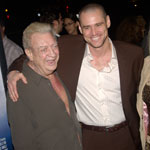
Rodney Dangerfield
Salesman Jacob Cohen had been moonlighting as a standup comic since his early 20s. He finally “got some respect” after his debut performance—under stage name Rodney Dangerfield (left)—on The Ed Sullivan Show at age 46. After long-awaited success, he began acting in his 50s and opened Dangerfield’s Comedy Club, whose stage welcomed little-known comics such as Jerry Seinfeld, Roseanne Barr, and Jim Carrey (right).

Kathryn Joosten
The two-time Emmy Award-winning actress decided to take acting classes at the Steppenwolf Theatre in Chicago in her 40s while she was working full-time as a psychiatric nurse. Joosten moved all the way to Buena Vista, Florida, for her first acting gig as a Walt Disney World performer.

Harland Sanders
Before he convinced the world that 11 is the prime number for a “finger lickin’ good” spice blend, the honorary Kentucky colonel was the ultimate career changer. Army mule-tender, railroad worker, and gas station operator were just a few jobs he held before buying a restaurant in his 40s. There he perfected his Kentucky Fried Chicken, but Sanders really got cooking at age 65 when he was put out of business and turned his recipe into a franchise.
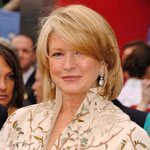
Martha Stewart
Although the homemaking mogul has experienced some legal trouble, Martha Stewart’s career-changing power is inspiring: The former model turned stockbroker in her 20s, and then homemaker to caterer in her 30s. After her catering company was established, she wrote her first book (on entertaining) and began selling her first line of home-goods in her 40s. Nearing and into her 50s, the famous merchandiser became a TV show host, an editor-in-chief, and the billionaire CEO of Martha Stewart Living Omnimedia Inc.
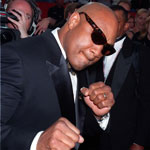
George Foreman
The boxer-turned-minister made a heavyweight comeback winning the world championship at 45—after a 10-year hiatus. Following his win, Foreman was asked to endorse several products including the Lean Mean Grilling Machine (which he helped develop) and Meineke Car Care Centers. Since his midlife victory, Foreman has become an entrepreneur launching a line of cleaning products, shoes for diabetics, a restaurant franchise, and more, and he continues to preach at the church he founded in 1980.

Al Franken
After the former Saturday Night Live producer, writer, and cast member left the sketch comedy show, Al Franken went on to write three books of political satire that hit No. 1 on the New York Times Best Seller list. And he moved to radio, hosting a progressive talk show on Air America. In 2007, Franken (in his late 50s) chose to leave talk radio to pursue (and later win) a U.S. Senate seat. Franken is up for re-election this year.
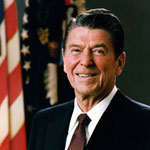
Ronald Reagan
Another actor turned to politics, Ronald Reagan, is the oldest of our mid-life career changers, having been inaugurated at the age of 69. However, the 40th president of the United States took his first step from Hollywood limelight into the political spotlight in his early 50s when he became governor of California.

Ken Jeong
For comedic actor (and doctor) Ken Jeong, laughter won out over medicine. Jeong was a practicing physician performing medical checkups by day and standup routines by night in the early half of his life. He became a full-time actor in his late 30s when, oddly enough, he landed a role playing a doctor in the Judd Apatow film Knocked Up.

Phyllis Diller
Legendary comedian, actor, and author Phyllis Diller quit her day job at age 37 to pursue standup before she had even performed her first comedy routine on stage. Two years after she handed in her notice, Diller appeared on The Tonight Show and became America’s first female comedienne on tour.
Balancing Act
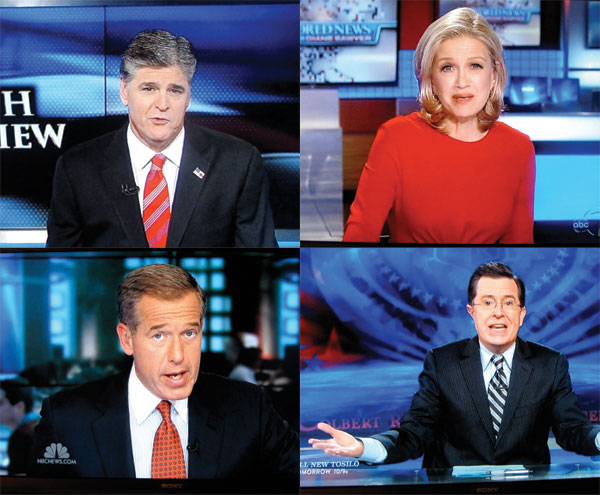
A few days before the 2012 presidential election, Joe Scarborough, the conservative host of Morning Joe on liberal MSNBC, proclaimed, “Anybody that thinks this race is anything but a tossup right now is such an ideologue … they’re jokes.” He felt reports that put Obama ahead were biased, and he had one particular culprit in mind, Nate Silver, a presumably liberal polling expert who calculated that President Obama had a 79 percent chance of beating Romney.
There was just one problem. It turned out to be Scarborough himself whose judgment was clouded by bias—as Silver recognized when he offered to bet the anchorman $1,000 on the outcome of the election, a wager Scarborough wouldn’t take. Silver turned out to be amazingly accurate in how he called the race.
That’s the problem with media bias. We all know it’s there, and we all know we need to see it, detect it, and overcome it if we’re ever going to know the truth, but we also all see it in different places. All too often, we think whoever we agree with is unbiased. It’s the other guy, the one we disagree with, who holds the biased opinion. How, then, are we ever to get at the truth, the truth we need, not only just to know what’s going on, but to be responsible citizens in a democracy?
It’s a very old problem, and it’s not about to go away, though there are definitely things we can do to try to smoke out biased reporting and see the facts more clearly. We’ll get to that later, but first, a little history. Bias in the media wasn’t always considered a negative. In fact, until about 100 years ago, it hardly ever occurred to anyone that media should be unbiased. Everyone agreed that an informed electorate was the basis of a free society, but they didn’t take that to mean that the news should be delivered without a point of view. They did agree, however, that in the U.S. the freedom of the press was sacred. That was a founding principle of our nation, and one of the great things that set us apart from every government that had come before.
The idea of a truly free press was born in 1735, when a New York newspaperman named John Peter Zenger was put on trial for libel for defaming the royal governor. Zenger’s lawyer insisted that he was innocent because what he had printed was the truth. No law at the time protected a journalist who told truth that hurt a public official, but the jury set Zenger free anyway—and established the notion of a press unafraid to speak truth to power as a cornerstone of liberty.
What makes the jury’s decision all the more intriguing is that it was quite well known that Zenger’s paper had been founded expressly to attack the royal governor. Freedom of the press was considered to be quite a separate matter from bias, as indeed it should be. By the time of the American Revolution, the colonies were awash in partisan newspapers and pamphlets. One of the British outrages that led to the Revolution was the Stamp Act—which put a tax on newspapers. In Europe the press had always been controlled by the ruling aristocracy and bent to serve its purposes; in the colonies, it became the weapon of the people, and publications like Thomas Paine’s pamphlet Common Sense fired the people to revolt against their overseas overlords. The only kind of media bias anyone really worried about was bias imposed from above, by the king and his men.
And so, when the Constitution was written its very first amendment stated “Congress shall make no law respecting an establishment of religion, or prohibiting the free exercise thereof; or abridging the freedom of speech, or of the press …”
With those words, a free press was enshrined along with freedom of speech and religion as one of our most crucial liberties. The government went well beyond mere words in supporting it, too. Where other nations heavily taxed their newspapers, the young United States did the opposite. It subsidized them. The Postal Act of 1792, which established the nation’s mail service, gave newspapers discounted postage rates, and legislators often provided funding for papers in their districts.
With that help the American press flourished so much that by 1835 the U.S. had five times as many daily papers as the British Isles. However, high officials often hated and distrusted what the papers printed. In 1798 President John Adams went so far as to push through the notorious Sedition Act, which made it a crime to publish “false, scandalous, and malicious” writings about the president or Congress. The law would backfire badly, turning its victims into free-speech martyrs. Thomas Jefferson got rid of the Sedition Act soon after he was elected president.
Not all bias is political bias. In the 1830s James Gordon Bennett used sensationalism and colorful embroidering of the truth to build his New York Herald into the biggest newspaper in the world. As but one lurid example, his paper described the corpse of a murdered prostitute in 1836 as follows: “The perfect figure, the exquisite limbs, the fine face, the full arms, the beautiful bust, all, all surpassed in every respect the Venus de Medici.”
Newspapers were, after all, businesses first, and the primary concern was selling papers. By 1871 a British observer would describe the typical American newspaper as “a print published by a literary Barnum, whose type, paper, talents, morality, and taste are all equally wretched and inferior; who is certain to give us flippancy for wit, personality for principle, bombast for eloquence, malignity without satire, and news without truth or reliability.”
How biased was the press in the 19th century? In 1860 Bennett’s Herald reported that Abraham Lincoln was “a fourth-rate lecturer who cannot speak good grammar.”
By the end of that century, the United States was a nation of mass-readership newspapers. Joseph Pulitzer’s New York World led the way, with signs in its city room that read, “Accuracy, Accuracy, Accuracy! Who? What? Where? When? How? The Facts—The Color—The Facts!”
Despite the noble motto, in the World and in its archrival, William Randolph Hearst’s Journal, “there was a lot of willful omission and lying,” as Brooke Gladstone, media historian and host of the NPR show On the Media, points out in her book, The Influencing Machine. Hearst himself is best remembered for his (possibly apocryphal) 1897 telegram to the artist Frederic Remington, who told him there was no fighting in Cuba to report on: “Please remain. You furnish the pictures, and I’ll furnish the war.”
The tide began to turn with the century. Adolph Ochs bought The New York Times in 1896 and announced that it would henceforth “give the news … impartially, without fear or favor, regardless of party, sect, or interest involved.” Lack of bias became a new ideal in the Progressive Era of the early 1900s. In 1904 Joseph Pulitzer endowed one of the first journalism schools, at Columbia University, to “raise journalism to the rank of a learned profession,” and others soon followed. In 1922 editors founded their first professional association, the American Society of Newspaper Editors, and drafted a code of ethics that declared, “News reports should be free from opinion or bias of any kind.”
America’s (Not Quite) First Bank Robbery
This piece was originally published as “America’s First Bank Robbery,” but a recent note (March, 2015) from Adam Berlinger brought to our attention an earlier bank robbery than the one described here. Berlinger sent us a link to an article entitled “America’s First Bank Robbery” (a very fine title) written by Ron Avery, which describes the removal of $162,821 from the Bank of Pennsylvania at Carpenters’ Hall in 1798.
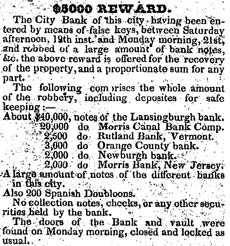
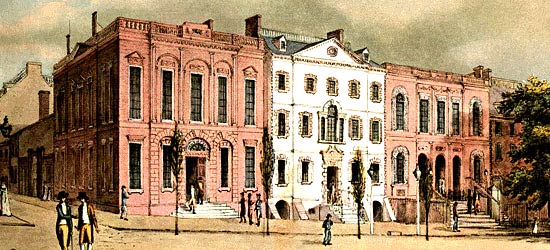
Late on the night of March 20, 1831, two men with a set of homemade keys approached the City Bank of New York. The keys, which had been made from wax impressions of the door locks, enabled the men to let themselves into the bank and lock the doors behind themselves.
What happened that night is generally considered to be the first bank robbery in the U.S. The two men—James Honeyman and William J. Murray—emptied the vault and several safe deposit boxes. By the morning, they had filled several bags with $245,000 in bank notes and coins. It was an incredibly large sum for a robbery, roughly equivalent to $52 million today. The robbery was sensational enough to be rushed into print in the next edition of the Post, under a bold headline offering “$5,000 Reward.”
Honeyman and Murray got away the next morning as the sun rose and the city’s night watchmen went off duty. Carrying the loot under the large capes they were wearing, they hurried to Murray’s house where they divided the money.
Honeyman put his share of the loot into three trunks, then drove to a boarding house, where he rented a private room under the name of Jones.
Less than a month later, the Post was able to report that “something peculiar in his conduct, particularly regarding the trunks, seems to have excited the suspicions of his landlord.”
Once in the rooms, Honeyman divided the stolen money again, taking $37,000 to the house of a Mr. Parkinson, his brother-in-law.
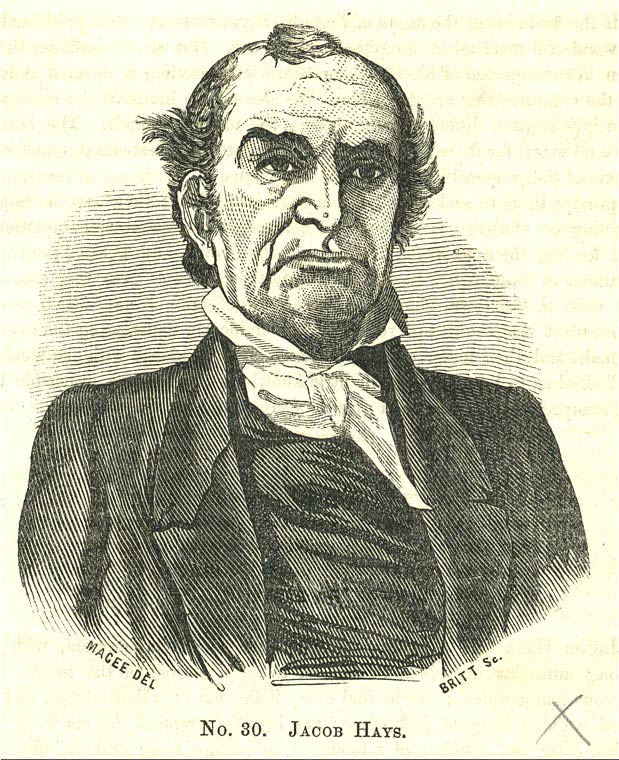
Meanwhile, news of the bank robbery had sped across town and reached the ears of New York’s Chief Constable Jacob Hays. He immediately knew whom to suspect. Honeyman had recently been charged with robbing a store in Brooklyn, but had escaped conviction due to lack of evidence. He had also been caught trying to steal money from a steamboat. And there were rumors that he was still the chief suspect in an English mail-coach robbery. Hays immediately went to Honeyman’s home, but found neither his suspect nor any money.
The following Saturday night, March 24, Honeyman left the boarding house with one of the trunks and told the landlord he would soon return for the others. The landlord, now convinced the trunks contained the stolen bank money, summoned Hays. Together, they opened the remaining trunks where they found $185,758.
The men seated themselves and waited. Three hours later, when Honeyman walked into the room, Hays seized him, put him in handcuffs, and took him before a judge.
The landlord also told Hays that another man had often visited Honeyman. From the description, Hays recognized the man as Murray. The two men were frequently seen together. In fact, they had been close friends ever since meeting in the penal colony at Botany Bay. Both men had beat long odds and escaped Australia to return to England, commit a few more robberies, then flee to the states.
After depositing Honeyman in jail, Hays went to Murray’s house but found the man had fled to Philadelphia. Hays followed after, apprehending Murray and bringing him back to New York for trial.
Both Honeyman and Murray were convicted and sentenced to five years at New York’s Sing Sing prison.
Hays recovered about $176,000 of the stolen money, but had no idea where to find the remaining $69,000. Months passed by, and his searches turned up nothing. City officials accused Hays and one of his associates of keeping the money to themselves.
Then, on September 20, Parkinson entered a bank to exchange some of the bank notes Honeyman had left with him. The bank clerk thought the notes resembled those he had deposited at the City Bank before it was robbed. He notified Hays, who quickly arrested Parkinson. He told the police all he knew and, in exchange for immunity, returned $37,000.
This still left $42,000 unaccounted for, but Hays was exonerated in public opinion. The Post’s editors felt that now, even the most skeptic would see “Mr. Hays is worthy of the important situation which he has so long filled.”
Hays even had the support of the men he’d put behind bars, the Post reported. “While Smith [one of Honeyman’s aliases] and Murray were in prison, awaiting their trial, they were informed that Mr. Hays was openly charged with abstracting that part of the money which was missing. They expressed great indignation at so malignant an accusation and stated that the amount not found had been placed beyond the reach of Hays before Murray was arrested. It can hardly be supposed that any unworthy suspicions can now be attached to this meritorious public servant, who had passed the prime of his years in the discharge of an arduous and unpleasant duty.”