Norman Rockwell’s “Rookie”: The Role of a Lifetime
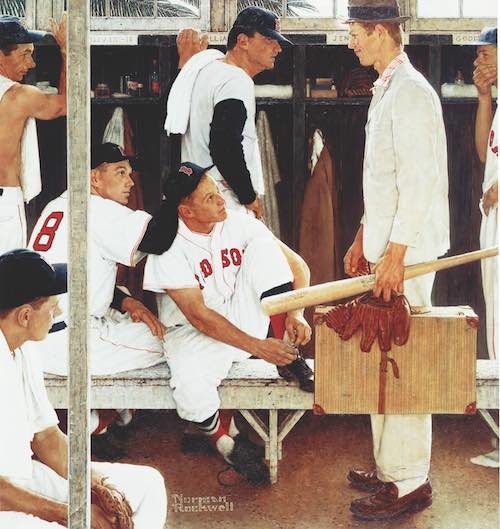
Norman Rockwell
March 2, 1957
When Sherman “Scotty” Safford walked into the Pittsfield High School cafeteria in 1956, he spotted a mysterious man sitting at a nearby table.
“He had a Bing Crosby-type pipe, very wavy hair, and a receding chin,” recalls Scotty, now 75. “I knew he was somebody special, because nobody smoked in that place.”
The mystery man was Norman Rockwell, and he came to Pitts eld High in search of a model. “I was a tall, gangly string bean of a kid,” says Scotty. “At 6-foot-4, I towered over everybody, and obviously this caught his eye.”
Rockwell met Scotty, shared his idea for an upcoming Post cover, and invited the athlete to pose as the talented “hayseed” who shows up on his first day in the major leagues with bat, glove, and suitcase in hand, convinced he’s there to save the team. “As a 17-year-old kid, I couldn’t have been more thrilled,” Scotty recalls.
By the time the issue hit newsstands in March 1957, Scotty was in the Army and stationed at Fort Dix. His mother called with the news, telling him to run to the post exchange and buy as many copies as he could carry.
“I went AWOL,” says Scotty, who wasn’t allowed out of the barracks without a pass. “When I came back, my company commander was there; the executive officer was there; the first sergeant was there. My sergeant was standing at the top of the stairs in front of the door and growled, ‘This better be good, mister!’ I had an armload of magazines and I handed him one and said, ‘I’m on the cover of the Post this week.’ And I walked right by him and went upstairs.”
Only later did the impact of his actions sink in. “The next morning at zero-dark-thirty, we’re standing there, and it’s pitch dark,” Scotty says. “The company commander comes up with the magazine and says, ‘Private Safford, would you sign this for me?’”
Scotty never saw Rockwell again, but The Rookie became an instant classic. “It means so much to me,” Scotty says. “probably more so as time goes on because I realize how special it was.”
-Diana Denny
Cover Gallery: Congrats, Graduates!
As you can see from these covers dating back to 1900, America has always celebrated educational milestones with great pride. We’ve always known that our grads would go on to do amazing things!
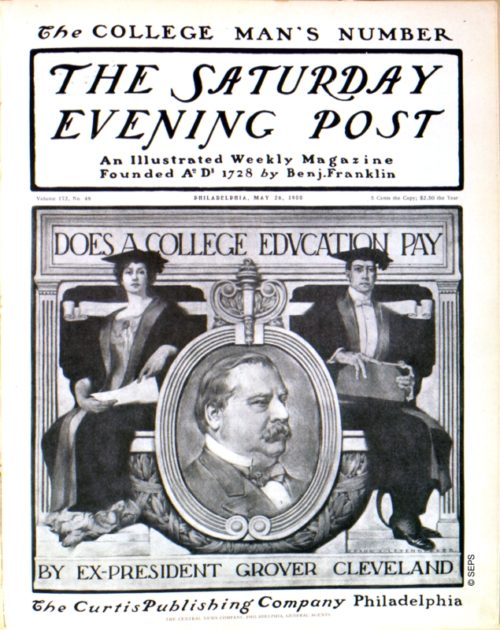
Frank X. Leyendecker
May 26, 1900
This cover of President Cleveland and two college graduates was Frank X. Leyendecker’s first cover for the Saturday Evening Post.
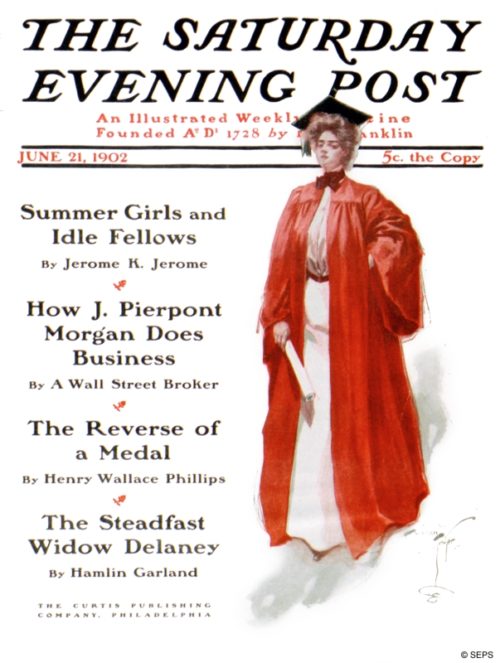
Harrison Fisher
June 21, 1902
The most important work of the early Post period was made up of the elegant paintings of Harrison Fisher. He frequently painted covers that simply presented a lovely woman. Occasionally a prop, like the diploma in this 1902 cover, implied a narrative, but the essential subject remained the woman herself.
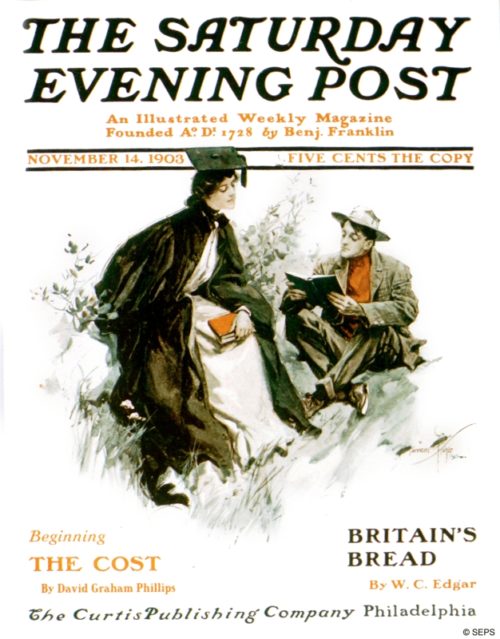
Harrison Fisher
November 14, 1903
This later Harrison Fisher cover shows a couple reading together. Couples doing something romantic was another common theme in Fisher’s covers. Since painting women was his specialty, the woman graduate still remains the focus of this cover.
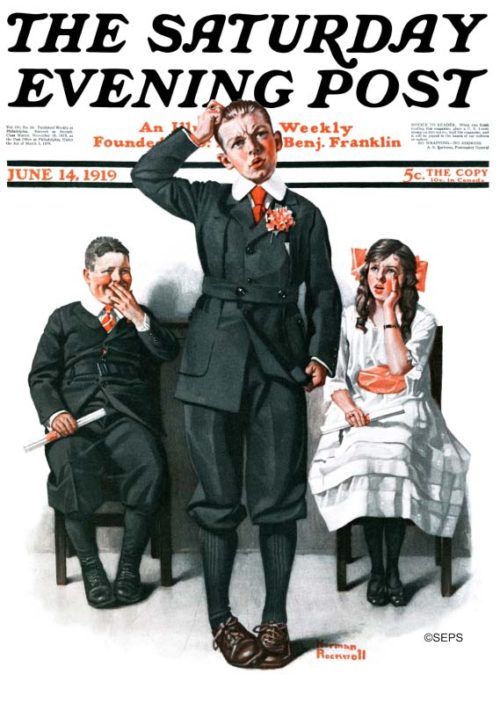
Norman Rockwell
June 14, 1919
This Rockwell cover shows a young student trying to remember his graduation speech. By the look on his face, he doesn’t hear the helpful hints or laughter coming from behind him.
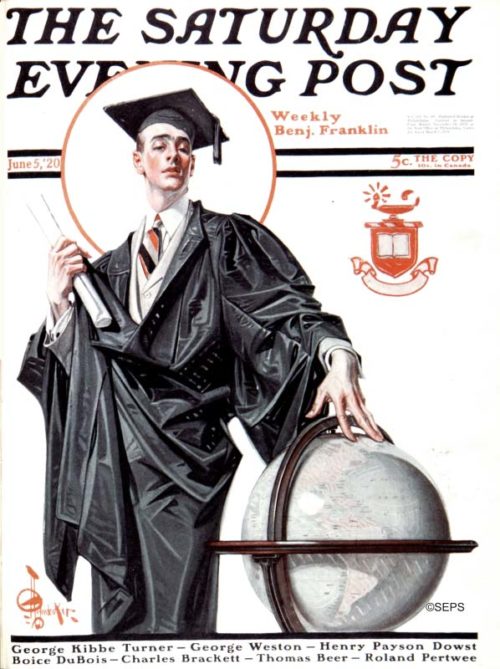
J.C. Leyendecker
June 5, 1920
This J.C. Leyendecker cover shows a college graduate ready to take on the world. Strong male figures were a trademark of many of Leyendecker’s Post covers.
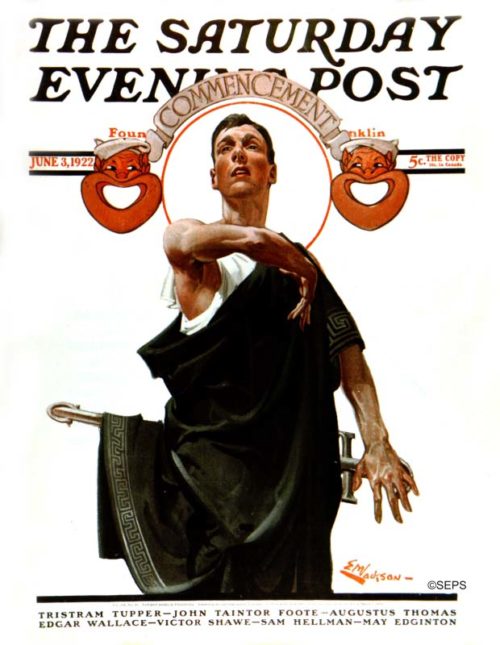
E.M. Jackson
June 3, 1922
This is one of more than 30 covers E.M. Jackson created in the 1920s. While Jackson was mostly known for his paintings of romantic women, he occasionally created a cover focused on a man, like this graduate dressed as a Roman, giving his commencement speech.
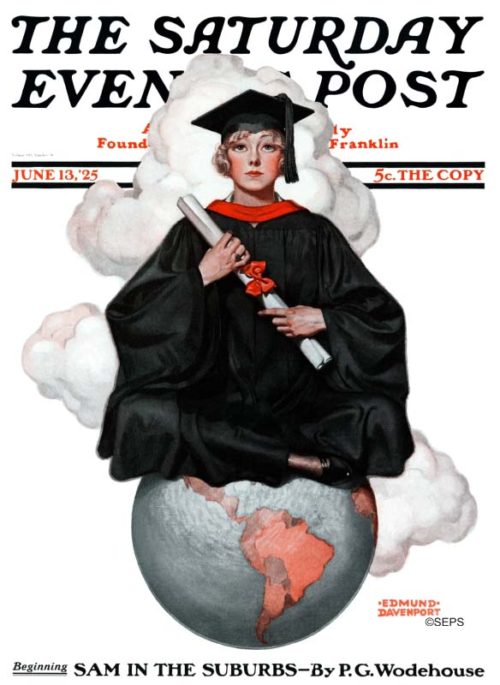
Edmund Davenport
June 13, 1925
This is Edmund Davenport’s third and final cover for the Saturday Evening Post. The clouds behind this graduate make this cover unique and complex compared to Davenport’s other two covers, which have more simple backgrounds.
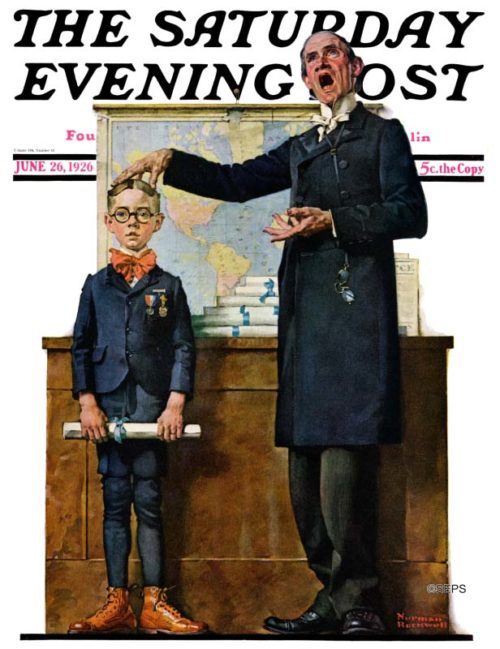
Norman Rockwell
June 26, 1926
In this Rockwell cover a professor hands a young boy his diploma and praises his hard work. It’s assumed that he’s the first in his class based on the large stack of diplomas behind him and the medals on his jacket.
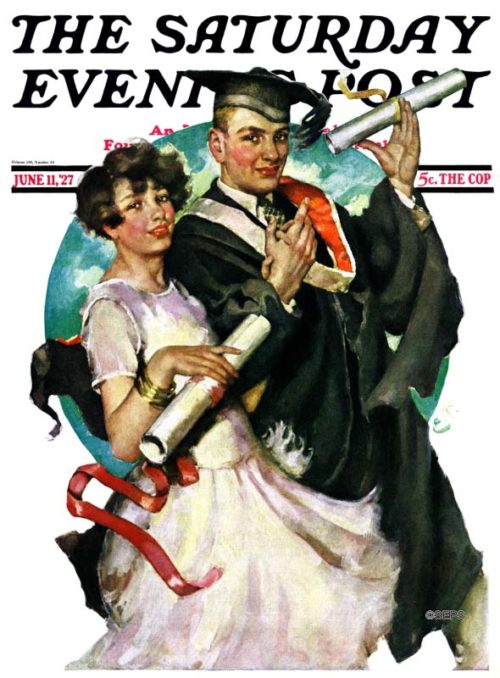
Ellen Pyle
June 11, 1927
This cover was done by one of the Post’s most prolific female artists, Ellen Pyle. Her early Post covers were simple portraits of women. Later on, her work became more detailed and many of her covers have the subject in front of a large, colored circle in the background, just like these graduates on her 1927 cover.
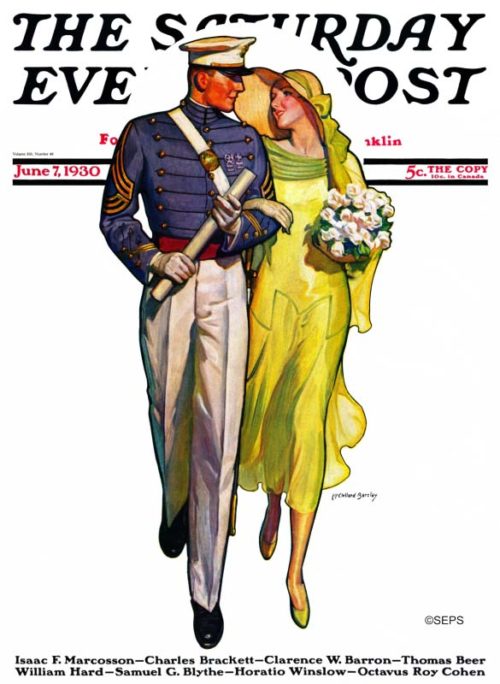
McClelland Barclay
June 7, 1930
This McClelland Barclay cover of a military school graduate and his girl is similar to nearly every other Barclay Post cover. Barclay became well known for his ability to paint strikingly beautiful women in a rather simple setting using bold colors. Barclay painted a total of five Saturday Evening Post covers, and all but one depicts a vibrant couple with an empty background.
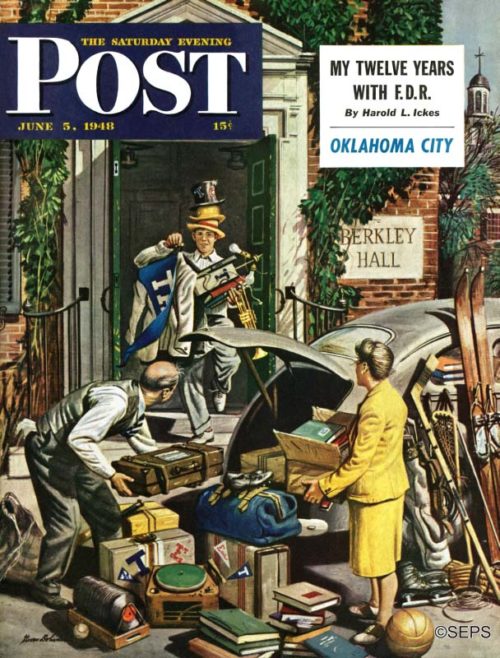
Stevan Dohanos
June 5, 1948
Steve Dohanos’ two sons, Peter and Paul, were in an Eastern boys’ school when he took the family car up to help them move home. A passenger car, he learned, is no proper vehicle for such a job. The artist made his sketches on the Yale campus, but rearranged things to suit his purposes. The boy is George Ritter, of Westport, Connecticut, no Yale man. The artist didn’t use a Yale man, on the remarkable theory that none would like to cut class.
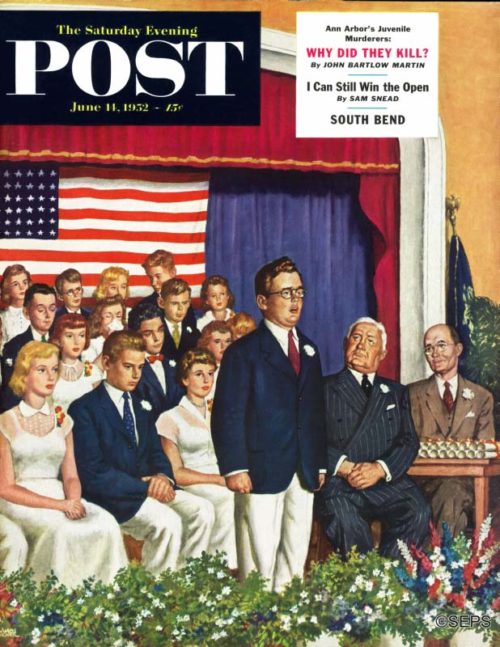
Amos Sewell
June 14, 1952
Once, years ago, a young scholar arose at commencement time to deliver an oration on the Panama Canal, found he had forgotten his entire speech, and started ad-libbing out of the general mass of data he had acquired in the classroom. Everybody vowed it was a grand speech, except his elocution teacher, who nearly had a stroke trying to locate him on her prompting manuscript.
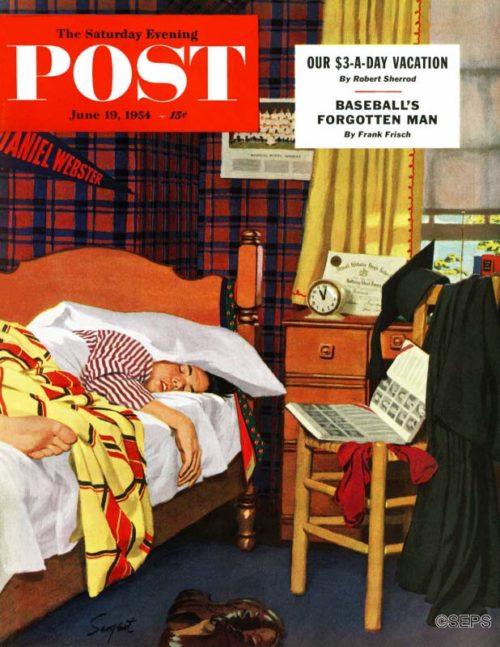
Richard Sargent
June 19, 1954
Now that this young man is going forth from the halls of learning, maybe he is lying there thinking about how his generation soon will he the guardians of civilization, and of what a glorious challenge this is to the youth of today. Or maybe he is asleep. For as Dick Sargent muses with his brush: any guy who manages to finish commencement certainly has forty thousand winks coming.
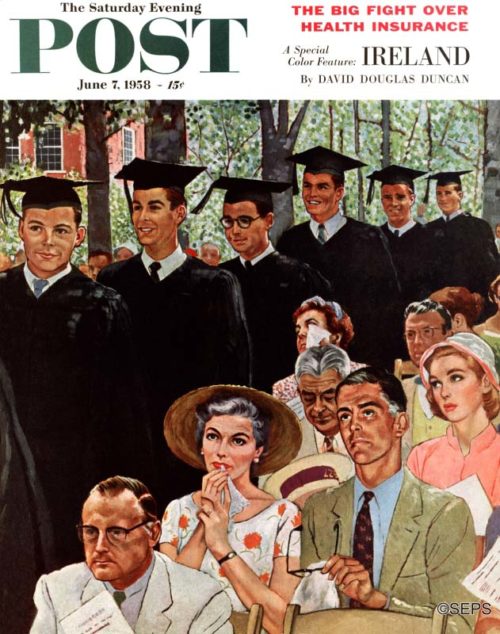
George Hughes
June 7, 1958
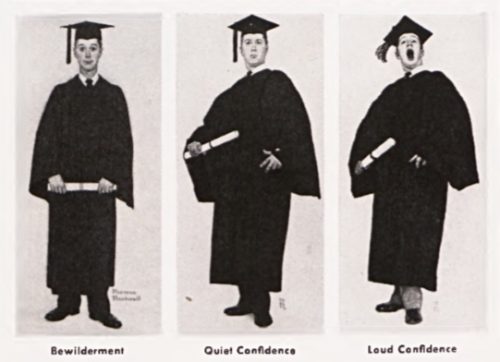
Symbolic of a host of graduating Americans, they have an air of quiet confidence, suggesting that as they help mold the future of this cantankerous old world they may be able to make it behave a little better than in the past. Artist George Hughes worked on this cover at Williams College, where everybody did everything possible to make his stay agreeable—well, short of giving him a degree.
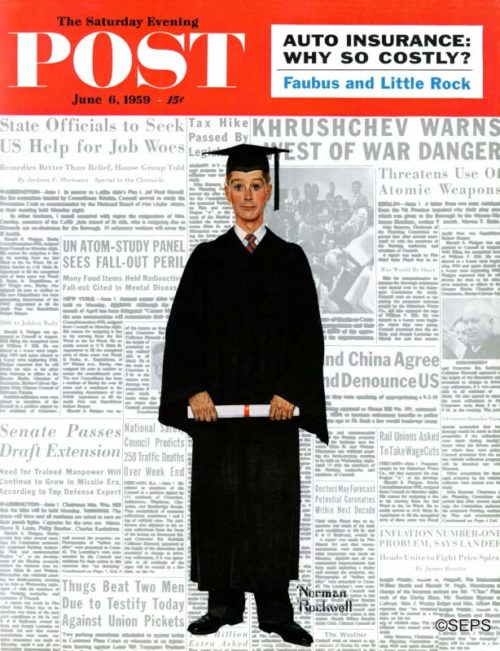
Norman Rockwell
June 6, 1959
Artist Norman Rockwell sketched a couple of undaunted graduates (see below); but then, reflecting on the awfulness of today’s newspaper headlines, he created the bewildered chap on the cover. This one is musing. Boy. aren’t things really screwed up? What to do, I wouldn’t know. But one thing you can bet on: I’ll give it the old college try. Rockwell says, “I like his feet. They look as if he’s standing on eggs.”
Thornton Utz
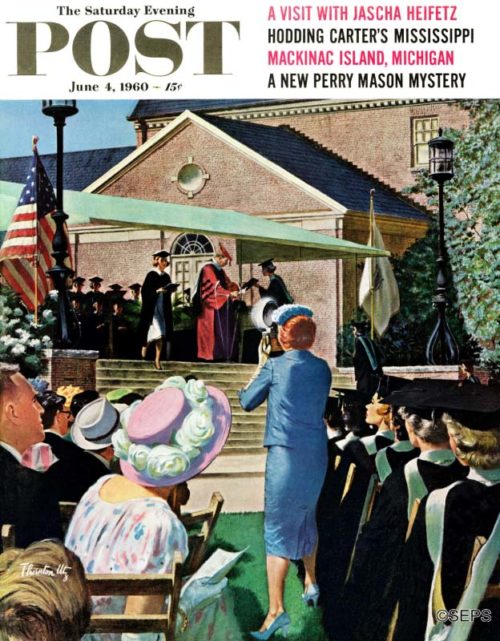
June 4, 1960
Artist Thornton Utz’s scene is Smith College, in Northampton, Massachusetts, where in 1960, Congressman Chester Bowles delivered the commencement address. The congressman’s daughter Sarah was among the 500 young ladies receiving bachelor degrees.
Rockwell Video Minute: Homecoming—Union Station
Learn about Norman Rockwell’s process of painting this merry image from our December 23, 1944, cover, in which friends and families reunite at Chicago’s Union Station.
See all of the videos in our Rockwell Video Minute series at www.saturdayeveningpost/rockwell-video.
Cover Gallery: The Armed Forces
In celebration of Armed Forces Day, we share our favorite covers featuring the brave people who served our country.
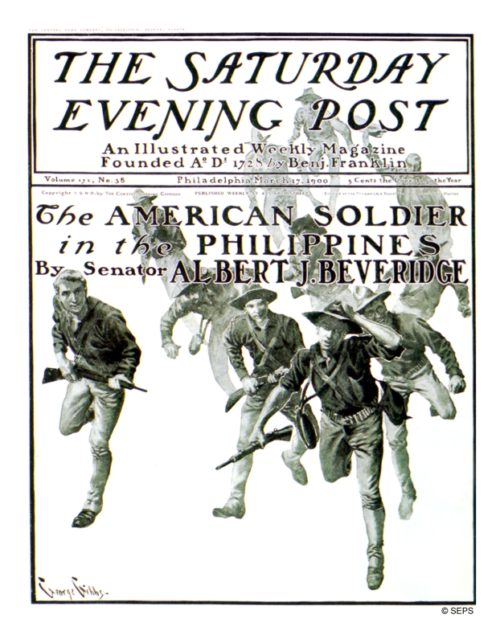
March 17, 1900
George Gibbs
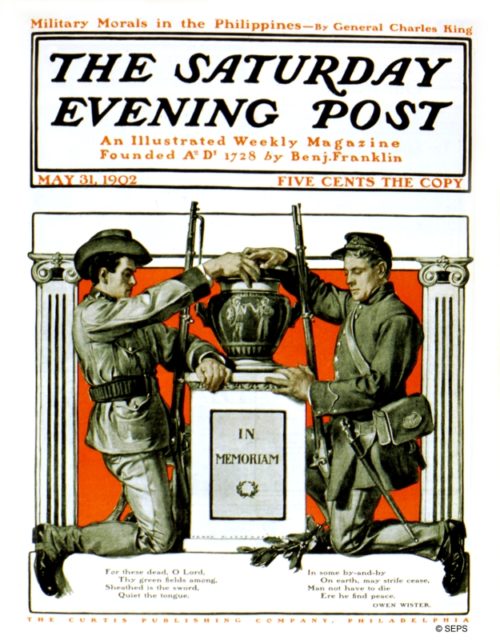
May 31, 1902
Frank X. Leyendecker
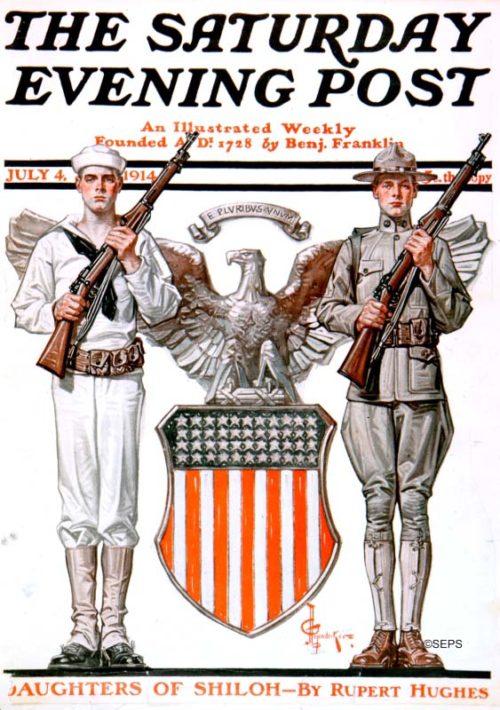
July 4, 1914
J. C. Leyendecker
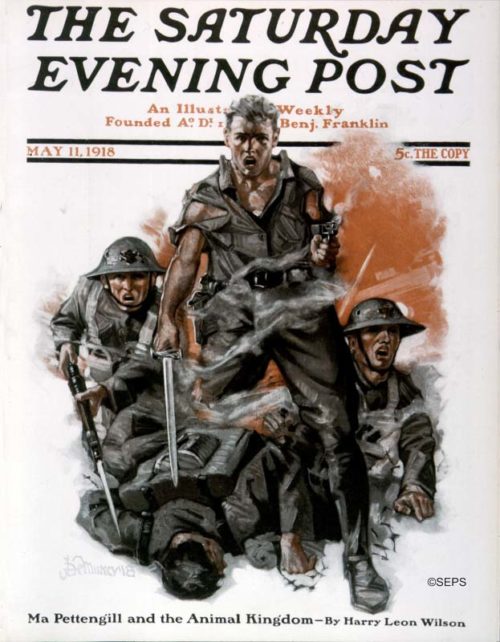
May 11, 1918
Julian De Miskey
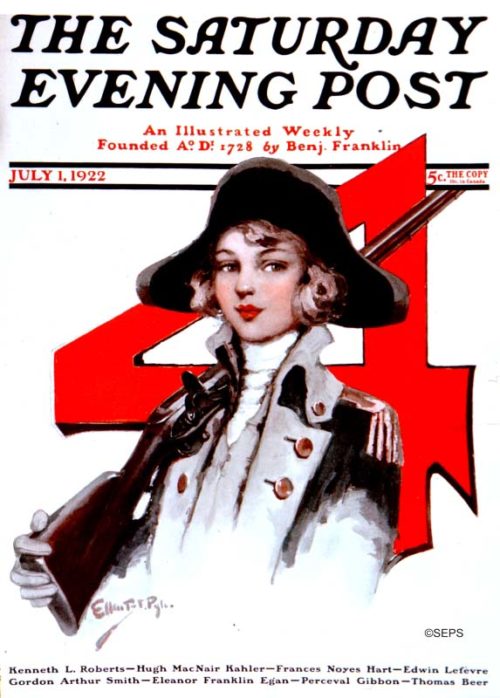
July 1, 1922
Ellen Pyle
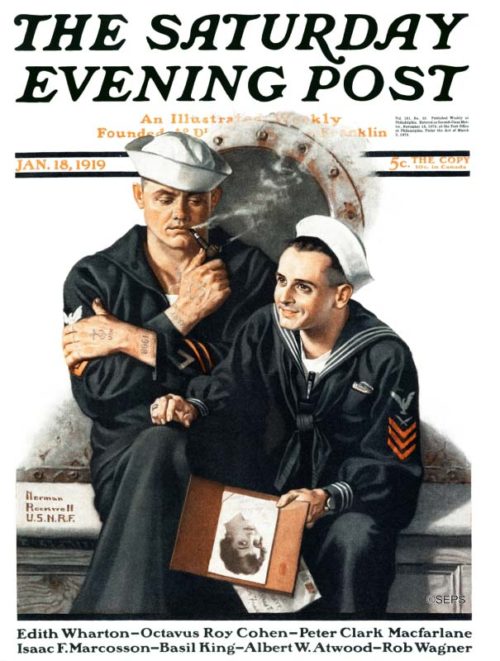
January 18, 1919
Norman Rockwell
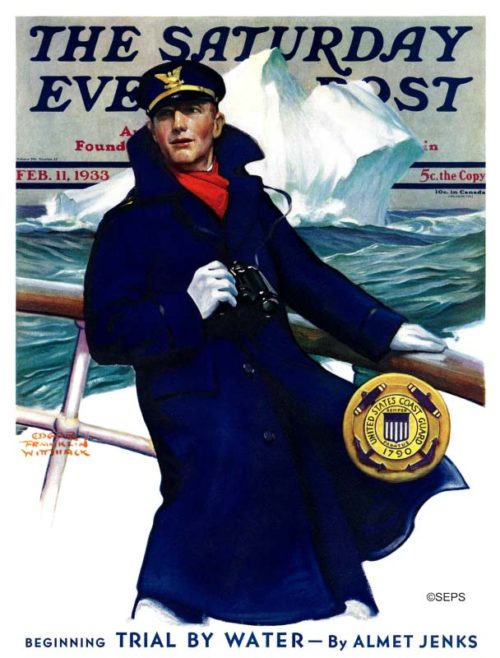
February 11, 1943
Edgar Franklin Wittmack
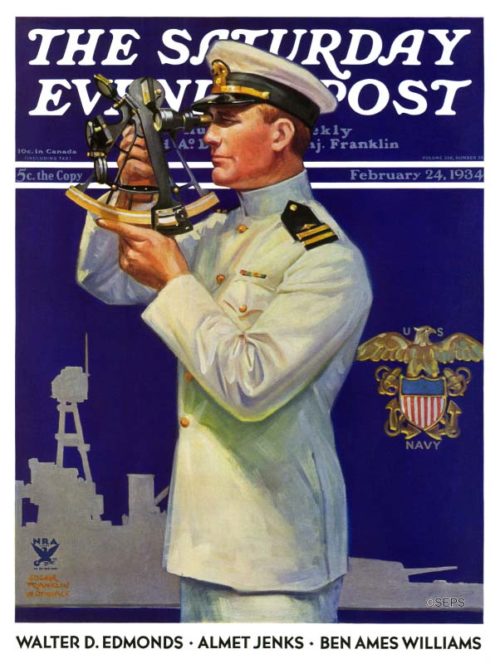
February 24, 1934
Edgar Franklin Wittmack
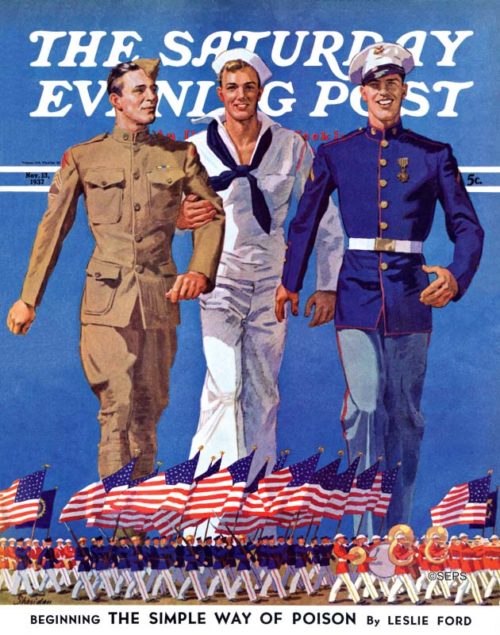
November 13, 1937
John E. Sheridan
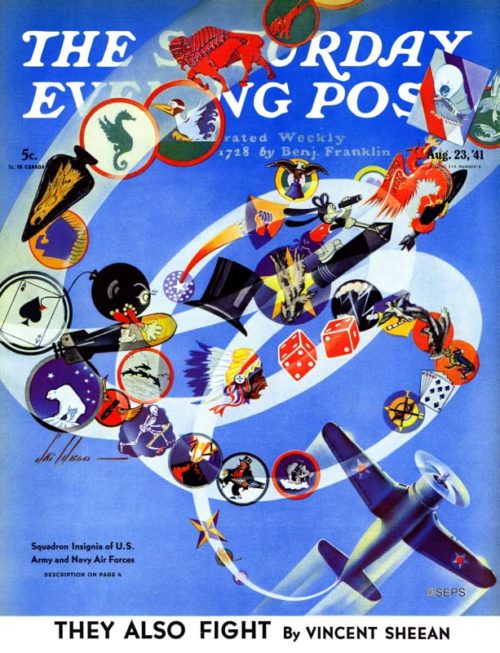
August 23, 1941
Ski Weld
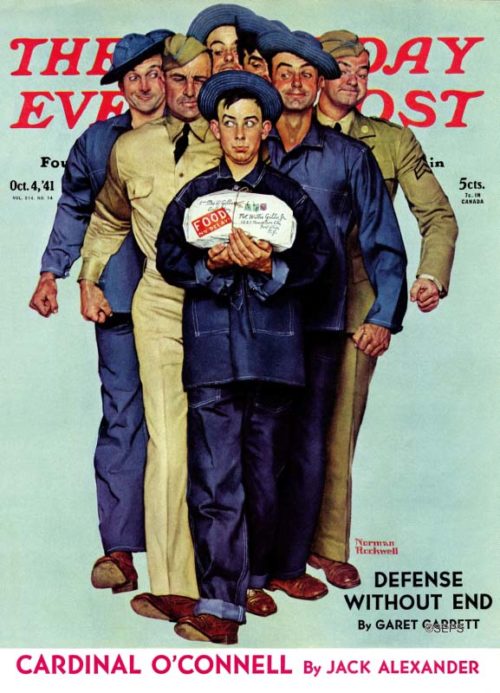
October 4, 1941
Norman Rockwell
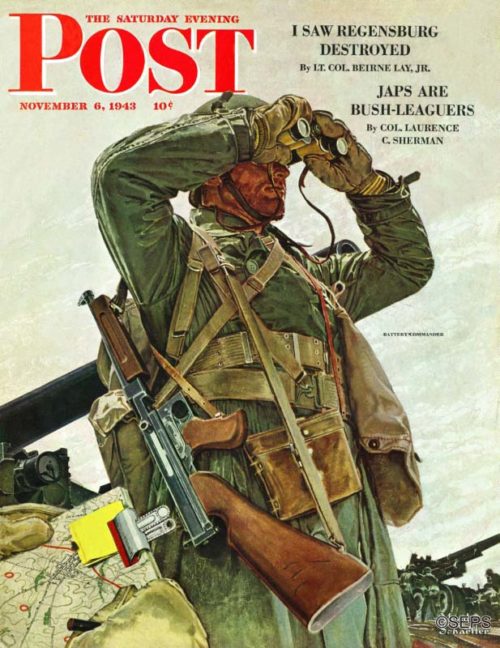
November 6, 1943
Mead Schaeffer
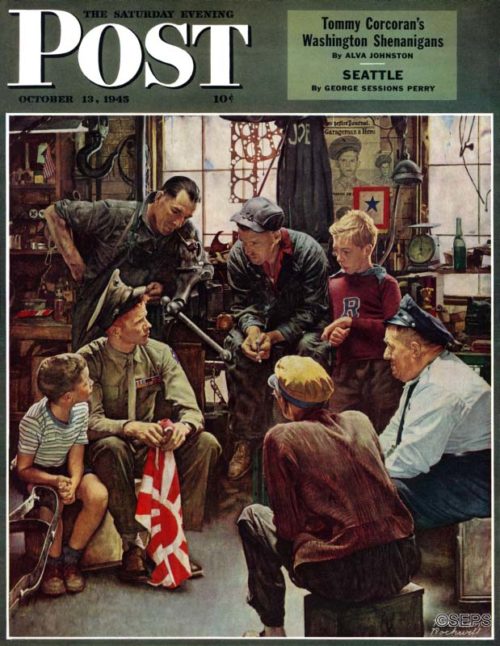
October 13, 1945
Norman Rockwell
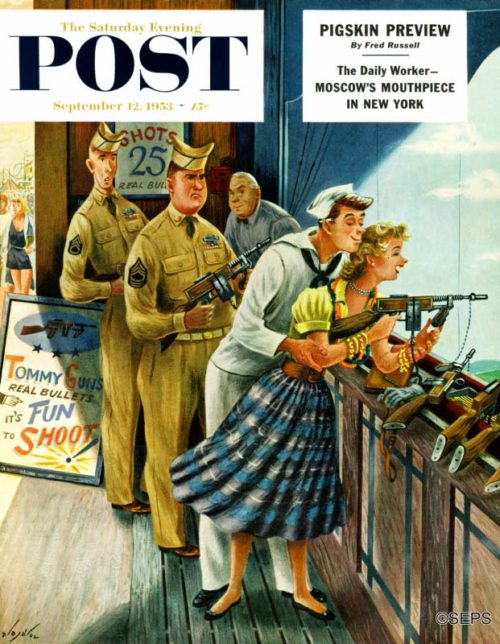
September 12, 1953
Constantin Alajalov
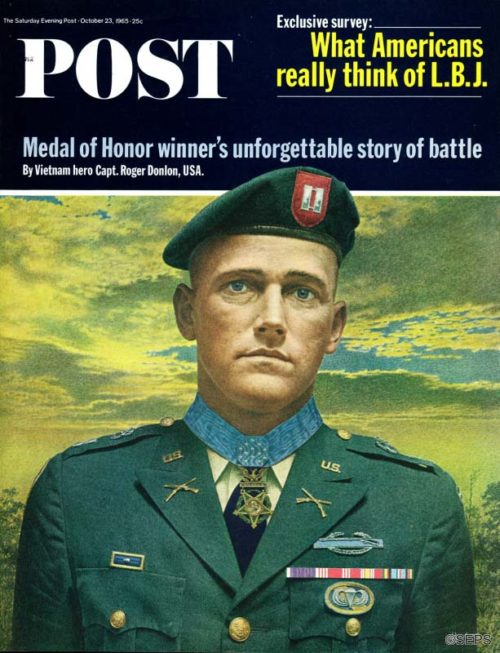
October 23, 1965
Jean L. Huens
Rockwell Video Minute: Shiner
Learn about Norman Rockwell’s process of painting this iconic image from our May 23, 1953, cover, in which a girl — appearing victorious after a schoolyard dust up — waits for the principal.
See all of the videos in our Rockwell Video Minute series at www.saturdayeveningpost/rockwell-video.
Cover Gallery: Firefighters
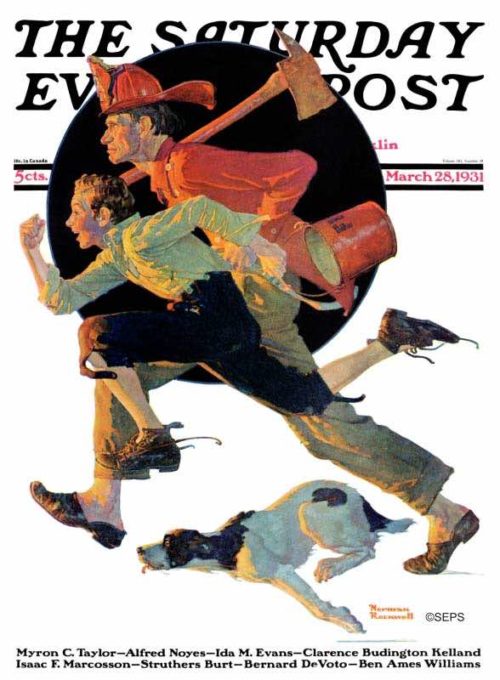
Norman Rockwell
March 28, 1931
A new approach to painting –“dynamic symmetry”- was emerging, and Rockwell’s artist friend told him that he had better begin using it or his work would crumble. His next painting, using this technique, was a disappointment to him. It depicted a stone-faced fireman with an excited lad and his dog rushing to a fire as flames lit the scene. Rockwell gave the painting to a cousin who lived in Philadelphia, and vowed never to wander from the time-tested formulas that had worked so well in the past.
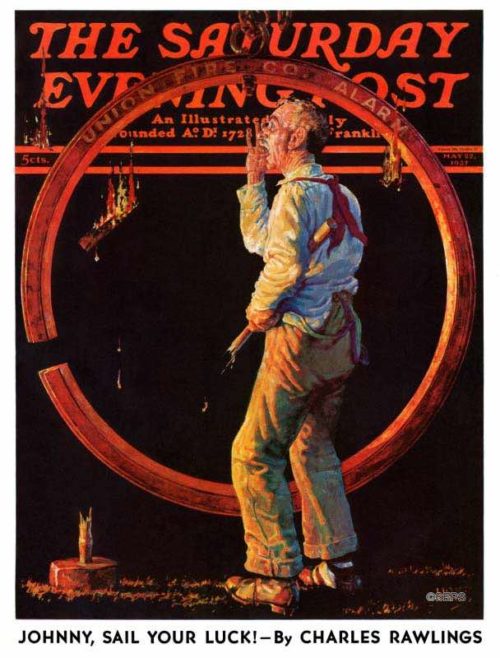
Monte Crews
May 22, 1937
Monte Crews was an illustrator, art teacher, cartoonist, and movie theater owner. Like Norman Rockwell, Crews’ covers are good examples of narrative art, where a single frame tells a detailed story. One can see the sense of urgency in this firefighter’s eyes, as he holds the broken sledge hammer while pieces of burning wood fall around him.
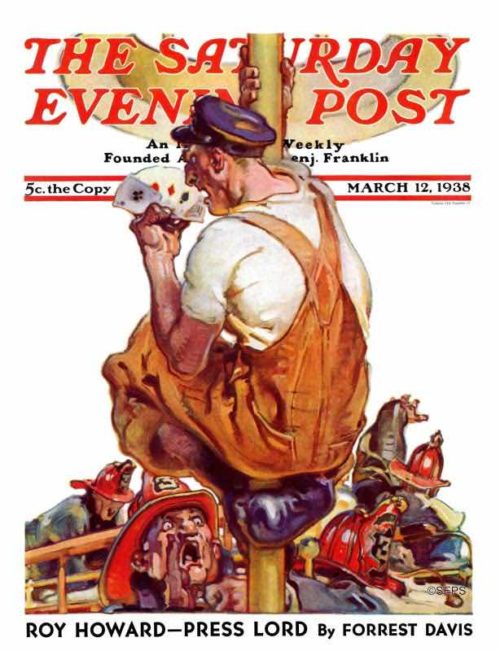
Samul Nelson Abbott
March 12, 1938
Samul Nelson Abbott was known for his intricate and realistic illustrations, and did cover work for many of the major magazines of his day, including The Saturday Evening Post, Woman’s Home Companion, and Ladies’ Home Journal. Abbott painted two covers for the Post.
Norman Rockwell
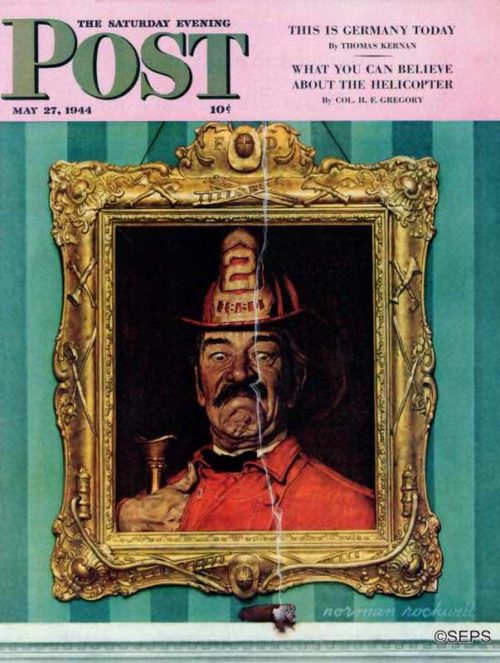
May 27, 1944
One day in the early 1940s, while rummaging through an old junk shop, Rockwell came upon a fancy fireman’s frame. Since it was empty, and he felt he needed to fill it, he painted a cover using the frame and then put a painting into the frame. So actually, the frame generated the picture, and the picture was done for the frame.
Stevan Dohanos
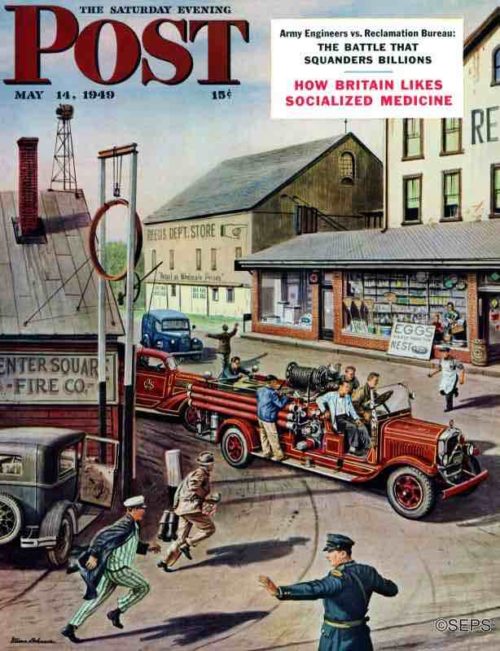
May 14, 1949
[From the editors of the May 14, 1949 issue] Stevan Dohanos, seeking a small-town fire department with good equipment, but not those elaborate trucks that sprout ladders when a button is pressed, found just the thing at Center Square, Pennsylvania, not far from Art Editor Kenneth Stuart’s home. When the fire boys had done posing. John Henryson, company secretary—who is dashing across the cover in pajamas—made Stuart an honorary, nonrunning member of his outfit. Will this burn up Stuart’s home-town firemen at North Wales and raise his fire-insurance rate? Incidentally, four Post artists, long fascinated by that Center Square department store, have tried to figure out a theme for coverizing it, and failed. Too bad a false alarm wasn’t turned in while they were thinking.
Stevan Dohanos
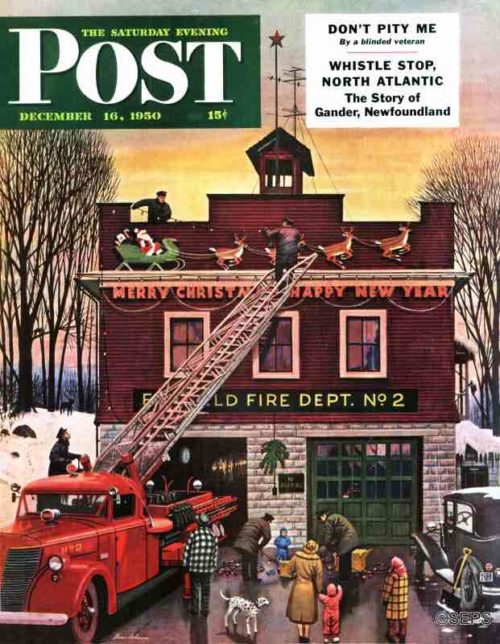
December 16, 1950
[From the editors of the December 16, 1950 issue] This could be the firemen of the Tunxis Hill Department in Fairfield County, Connecticut, but Stevan Dohanos is symbolizing the merry fact that fire brigades all over America know how to get extension ladders into the Christmas spirit. At this season some fire companies gather broken toys from neighborhood children and repair them for youngsters who otherwise might not find anything in their stockings; and that’s another good thing about firemen. Would it take the cheer out of this scene if the boys hung a big placard behind the brightest lights, saying, “As most of us are volunteers, and hope to stay home Christmas, kindly electrify Christmas trees safely, so that they don’t burn up”? But maybe the sign would catch fire.
Stevan Dohanos
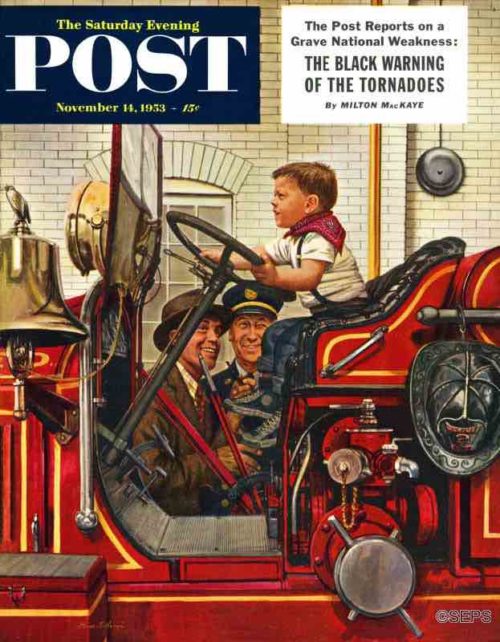
November 14, 1953
[From the editors of the December 16, 1950 issue] It is comforting to reflect that in spite of rocket ships, disintegrator guns and all the charming new ways of imaginatively risking life and limb, one of the biggest thrills in little lives is still a careering, rip-roaring fire engine. Sort of makes you feel that the future of America is secure. Especially as today’s little imaginers are handicapped by fire wagons no longer being towed by thundering, entrancing fire horses—are you antique enough to remember them? When the lad in the Dohanos scene has had his wonderful moment, papa will say, “Now let me sit there and show you how the pedals work”— for papa wants to play fireman too. Once, when a certain papa did that, the firebell rang, and boy! did he scram down out of there.
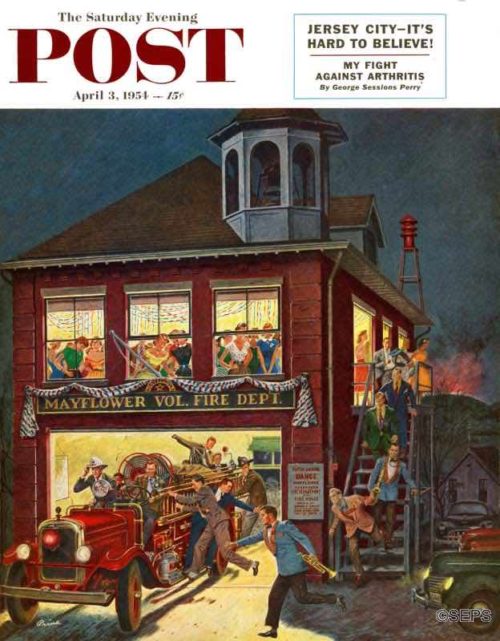
Ben Kimberley Prins
April 3, 1954
[From the editors of the April 3, 1954 issue] What gross inefficiency this is, scheduling the Vol. Fire Dept.’s annual dance the same night as the year’s big fire. The entertainment committee will hear from this, unless they leave town under cover of Ben Prins’ ruddy darkness. One toys with the notion that those flames could be a king-size bonfire organized on the other side of the hill by humorists. More likely the firemen have a grim and dangerous job to do, in which case there will be a special glow of enchantment when the men return safely and again enfold their dear ones in the dance. And then that one fellow now remaining behind with the fire belles won’t turn out to be the beau of the ball. Hey, would he by any chance be the chairman of the entertainment committee?
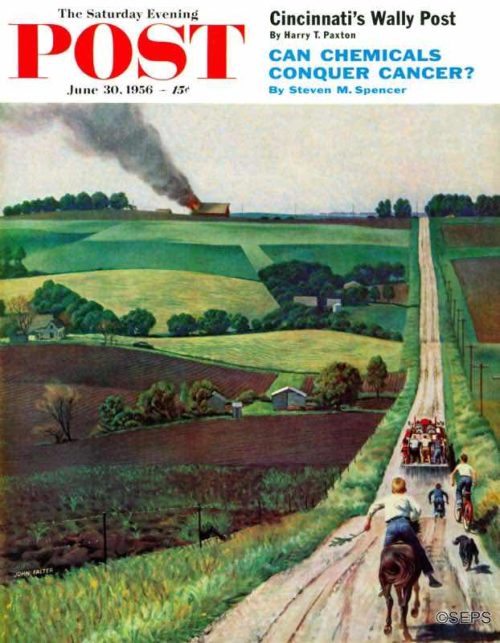
John Falter
June 30, 1956
[From the editors of the June 30, 1956 issue] The scene is out of John Falter’s boyhood, and from this hilltop that looks like an ugly fire. But Falter, having added a modem chemical fire truck which he feels certain will save the barn, reflects that when he starts a fire, he can put it out. Seriously, this evokes a fervent thank-heaven for telephones, gasoline motors, new-fashioned antifire devices, and the know-how and courage of volunteer smoke-eaters. Falter didn’t ride a horse bareback to his long-ago fire; his horse ran away and Johnny dismounted into a passing haystack. Then, finding himself alive, he proceeded on shanks’ mare. To return to 1956, three volunteer boy-models, one on a horse, helped the painter by careering down a steep California hill again and again, which astonished onlookers, as there was no fire.
Cover Gallery: Gone Fishin’
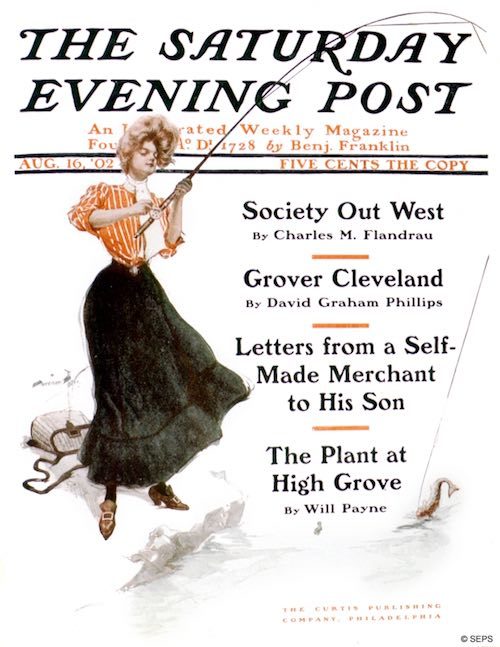
Harrison Fisher
August 16, 1902
Harrison Fisher (1877 –1934) was an American illustrator. Both his father and his grandfather were artists. As you might be able to tell from this cover, Fisher was considered a successor to Charles Dana Gibson, famous for his Gibson Girls.
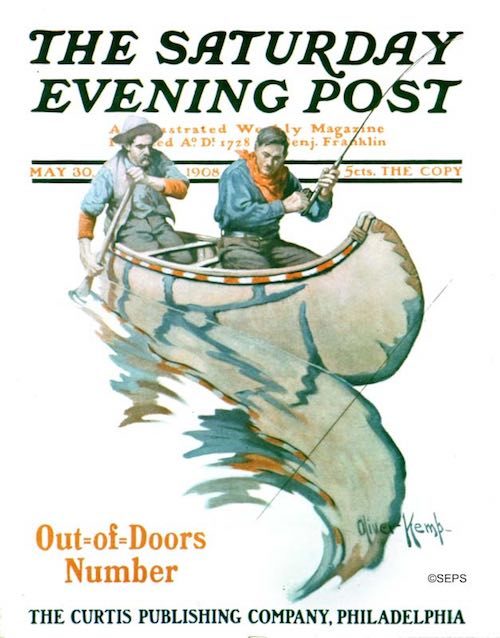
Oliver Kemp
May 30, 1908
Oliver Kemp (1887-1934) painted 11 covers for the Post. He made yearly trips to the Rocky Mountains and was fond of painting scenes of western America. His Post covers all depicted rugged men hunting, fishing, and canoeing, often with a pipe between their teeth.
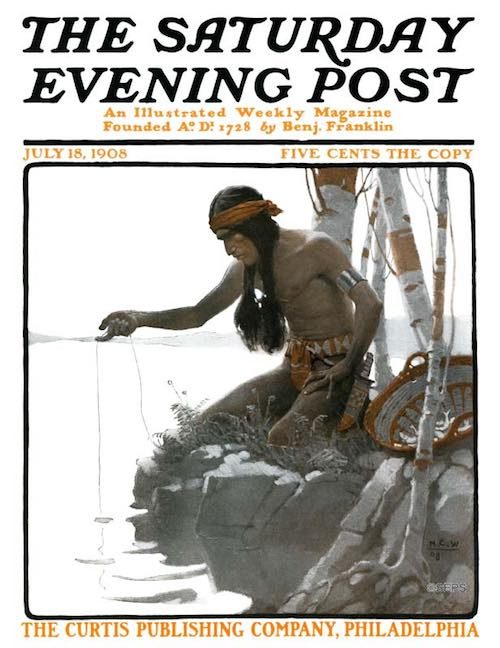
N.C. Wyeth
July 18, 1908
Newell Convers Wyeth (1882 –1945), was probably best known for his illustrations of Scribner’s classics, particularly Treasure Island. He spent part of his twenties out West, learning about cowboy and Native American culture. Wyeth painted his first cover for the Post when he was only 20; he was 25 when he completed “Indian Fishing.” N.C. Wyeth is the father of painter Andrew Wyeth.
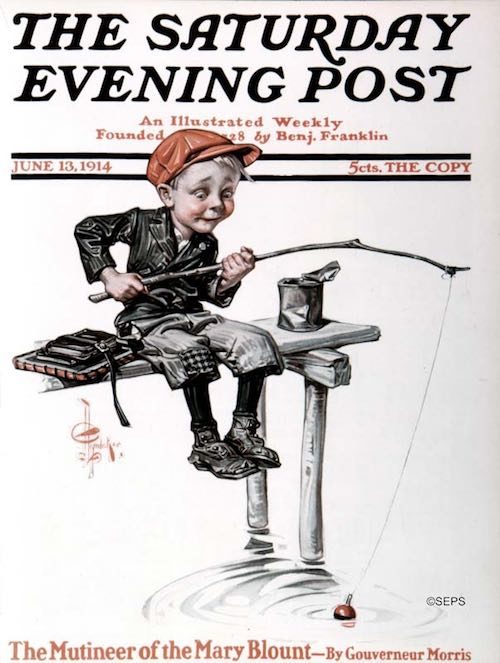
J.C. Leyendecker
June 13, 1914
J.C. Leyendecker was the most prolific cover illustrator for the Post, painting 323 covers. (Rockwell stopped at 322 out of respect for Leyendecker.) It was Leyendecker who popularized the images of a fat, jolly Santa and the New Year’s baby. While Leyendecker’s depictions of men were usually handsome and strapping, many of his children appeared emaciated and sickly, and often had bodies that were disproportionately smaller than their heads.
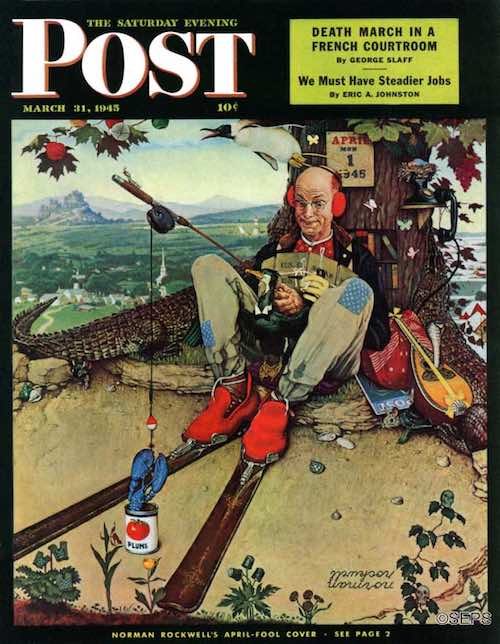
Norman Rockwell
March 31, 1945
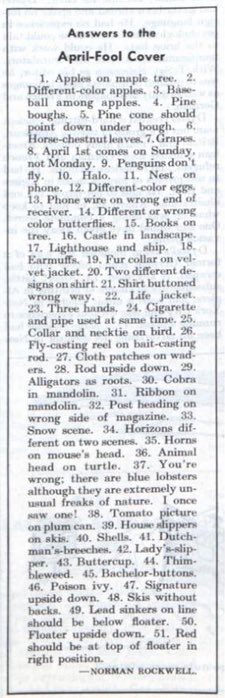
[From the editors of the March 31, 1945 issue] Probably no Post cover has ever been more popular than Norman Rockwell’s first April Fool cover. In this week’s cover, Mr. Rockwell is trying to fool you again, and he probably will succeed. Watch out for the blue lobster. As a matter of fact, we don’t think this one is quite fair, and we’re going to tell you that there is such a thing as a blue lobster. According to Charles Mohr, of the Academy of Natural Sciences in Philadelphia, the blue lobster is a rarity, but every once in a while one of them turns up in Maine waters, and it is completely blue. John Atherton, whose covers are well known to Post readers and who is a neighbor of Mr. Rockwell’s in Arlington, Vermont, once made a peculiar face while he was talking to Mr. Rockwell, and Norman remembered it and used Mr. Atherton with this particular expression as a model for this cover. There are at least fifty mistakes. See how many you can find and compare your findings with those listed on page 80.
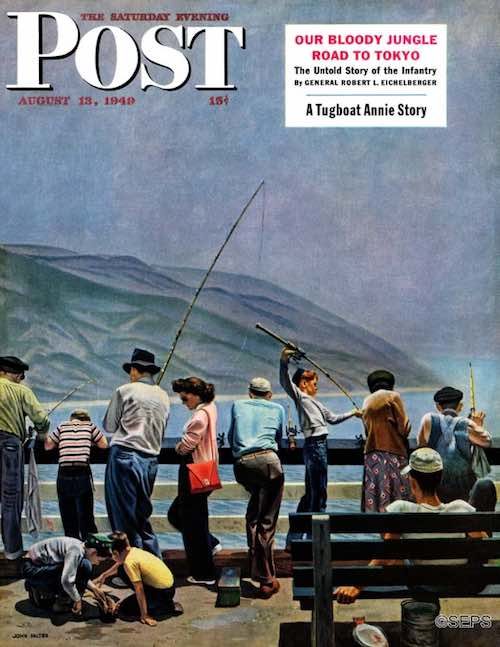
John Falter
August 13, 1949
[From the editors of the March 31, 1949 issue] On the long fishing pier at Santa Monica, California, tourists from all over the United States stand packed together like sardines while they try to catch fish. They are so grimly intent on their work or play or whatever it is that when a baited minnow smacks the water in all that silence, it makes quite a startling splash. Many of the fishermen go through their routine calmly and expertly; occasionally a greenhorn flies into a tizzy, yelps for the landing net and hauls in a dwarf flounder or something else depressing. The kids have a swell time fussing with starfish or reading a wet comic page which was wrapped around a wad of bait. Artist John Falter was non-committal about whether he caught anything—besides a Post cover.
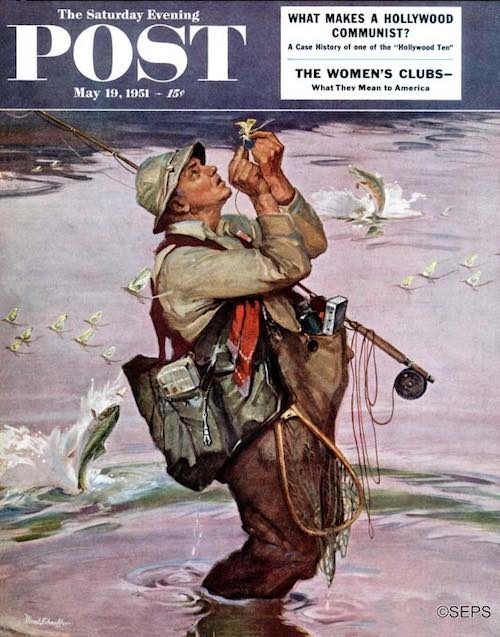
Mead Schaeffer
May 19, 1951
[From the editors of the May 19, 1951 issue] Those flies driving the man and the fish crazy are a variety known to fishermen as Green Drake. We don’t know what the fish call them. Just before this picture was painted, the man was calmly trying to feed the trout another variety of fly and they were calmly ignoring his hospitality. Suddenly, a countless family of Green Drake “nymphs,” which previously had risen to the surface of the water to hatch, discovered that they had wings, and decided to zoom into the wild blue yonder. Mead Schaeffer’s angler is trying to affix an artificial Green Drake to his line before the trout are so full of real Drakes that they sink to the bottom for a nap. Fishermen who experience such crises say that the general confusion is hard to imagine.
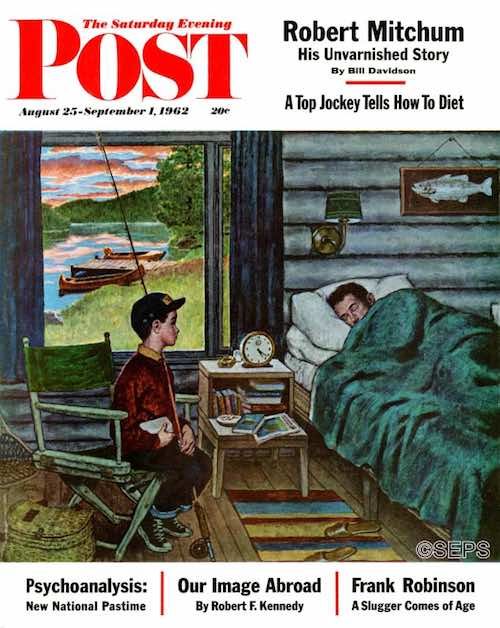
August 25, 1962
Amos Sewell
[From the editors of the August 25, 1962 issue] Forty more minutes to go, broods Amos Sewell’s thwarted young angler, and then Dad will waste still more time washing up and eating and dawdling over his coffee. From the look of this somnolent scene, it is clear that no fish will be disturbed until at least seven o’clock, and then, as any youngster knows, the fish will be settling for a siesta. Why, wonders the young sprat, can’t fathers coordinate their sleeping habits with those of fish?
Cover Gallery: Rainy Days
The weather may be dreary, but these rainy day covers will make you feel cheery!
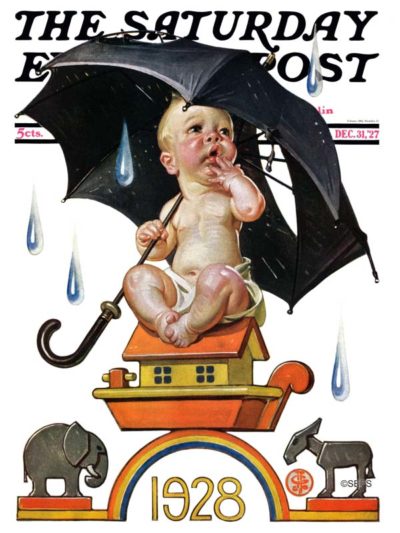
December 31, 1927
J. C. Leyendecker
Artist J. C. Leyendecker was well known for his Baby New Year illustrations that graced many Post covers from the 1910s through the 1940s. Our 1928 baby awaits the possible repeal of Prohibition, symbolized by “wet” weather.
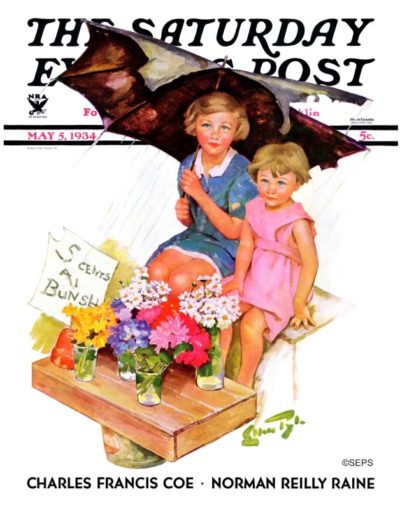
Ellen Pyle
May 4, 1934
The subjects in this illustration were likely artist Ellen Pyle’s own children; they served as the models in more than 20 of her Post covers.
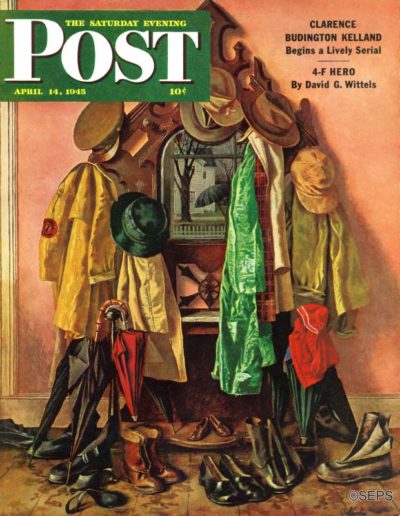
John Atherton
April 14th, 1945
[From the editors of the April 14, 1945 issue] Norman Rockwell suggested the idea to Atherton. The hatrack is in the hall of the Community House at Arlington, Vermont. Neighbors contributed the hats, coats and galoshes seen in the painting.
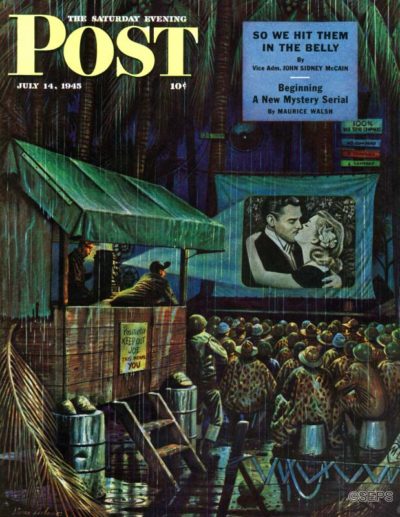
Stevan Dohanos
July 17, 1945
[From the editors of the July 17, 1945 issue] We imagine it is hard for anyone who has never sat on a Pacific spit kit of an island for months on end, contemplating the shapely curves of a can of tinned-pork products for emotional release, to understand Stevan Dohanos’ cover. After such soul-gnawing, a flickering, one-dimensional pin-up girl enlarged many times on an improvised screen must have the pulling power a naked electric-light bulb has for a moth. Most South Pacific movies are now first-run, sometimes world premieres; but when “Wilson” was shown on Okinawa before an audience just back from the front lines, there were eight air-raid interruptions, and the show assumed a three-and-a-half-hour Gone With the Wind proportion. Perhaps the reason why Dohanos’ G.I.’s are willing to sit in the rain is that their bucket seats are really magic carpets taking them home to Main Street for an hour or two.
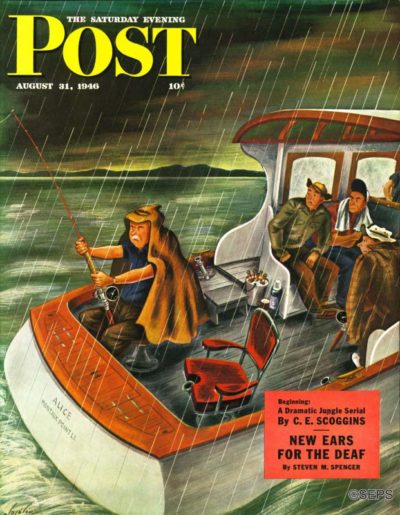
Constantin Alajalov
August 31, 1946
[From the editors of the August 31, 1946 issue] The man who has determined to go fishing, Constantin Alajalov observed when he was in Florida, will go fishing until he catches a fish, in spite of bad weather. Alajalov determined to paint this truth. There were a few things on which he needed to refresh his recollection, but to do this, he needed only to go out in a boat on a similar day. We don’t know how long the average determined fisherman has to wait for a sunny day. We do know how long Alajalov had to wait to catch a rainy one. One fair day followed another. He waited three weeks.
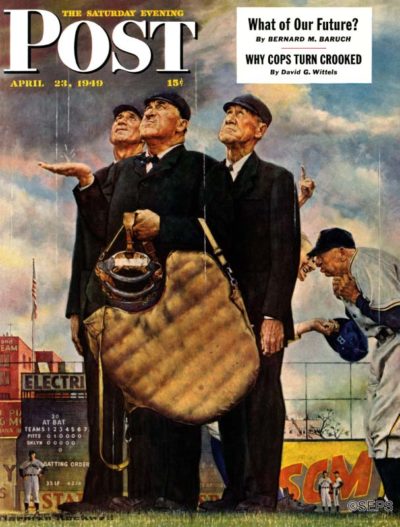
Norman Rockwell
April 23, 1949
[From the editors of the April 23, 1949 issue] This week’s Norman Rockwell cover depicts Ebbets Field, the home of the Brooklyn Dodgers. Here, the Dodgers are trailing the Pittsburgh Pirates 1-0 in the sixth inning. If the arbiters—left to right, Harry Goetz, Beans Reardon and Lou Jorda—call the game because of rain, the score will stand as is, and Pittsburgh will win. This irks the Brooklynites, who dislike having other teams win. In the picture, Clyde Sukeforth, a Brooklyn coach, could well be saying, “You may be all wet, but it ain’t raining a drop!” The huddled
Pittsburgher—Bill Meyer, Pirate manager—is doubtless retorting, “For the love of Abner Doubleday, how can we play ball in this cloudburst?”
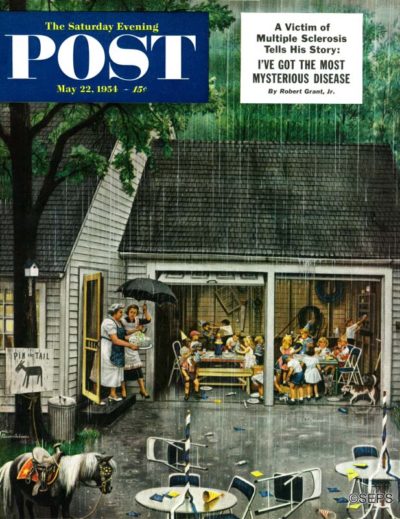
Stevan Dohanos
May 22, 1954
[From the editors of the May 22, 1954 issue] Rather than be depressed by Mr. Dohanos’ soggy scene, note how the deluge has improved the situation. Any birthday party is fun, even if nothing more happens than the duly expected games, grub and slight fights between incompatible little boys. But to arrange for the routine confusion to be stepped up into the joyous chaos of a garden party dispersed by a cloudburst, that’s a charming innovation indeed. And how delightful it is to throw a party in or into a garage, where tools and other weapons are available for favors as well as paper hats, where joy can he so much more unconfined than in an ordinary living-room hullabaloo. Even that pony thinks, Bless the rain—no more work. Fortunately, there isn’t space here for what mother thinks.
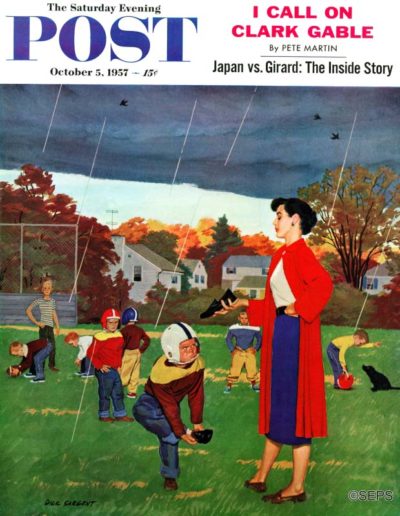
Richard Sargent
October 5, 1957
[From the editors of the October 5, 1957 issue] Women can be such a handicap sometimes—“Aw, ma, halfbacks don’t wear rubbers. Next thing, you’ll want me to make touchdowns with my poncho on. Next thing, you’ll want me to run the end with an umbrella.” To which mother replies, “James, football men obey the quarterback’s signals or get benched. The bench is home. Now then, four, eleven, forty-four, hip—on rubbers!” Well, the maxim says that mothers know best, and if James catches cold by getting wet everywhere except his feet, let’s switch to the maxim that only Monday-morning quarterbacks think of everything. This might have been some action picture if Dick Sargent hadn’t rung in mother; yet let’s settle for the maxim that when it comes to painting, painters know best.
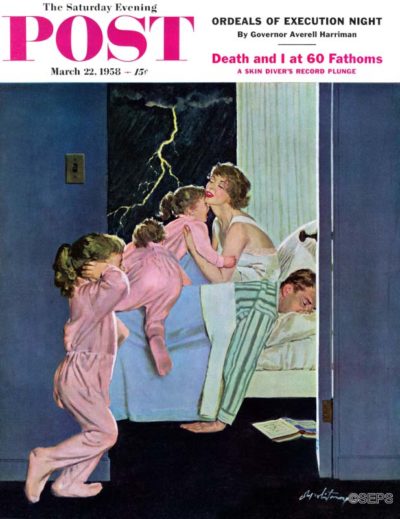
Coby Whitmore
March 22, 1958
[From the editors of the March 22, 1958 issue] Of course, the children haven’t been frightened by Papa’s snoring, but by the awful sounds of Nature on an electrical rampage. So mother will gather them in her arms and love away their fear—mustn’t it be wonderful to be a mother? If that lightning is bedeviling a far-north state, it should signify the breaking up of a winter which certainly needed breaking up; and yet not long ago some northern areas had thunderstorms followed by the blankety-blankest descent of snow for thirty-something years. Let’s leave forecasting to the weatherman, who is welcome to it. Coby Whitmore’s man of the house, buried there in the bed, must be the deepest sleeper this side of the proverbial log. How does mother get him up mornings—rap on his head with the book?
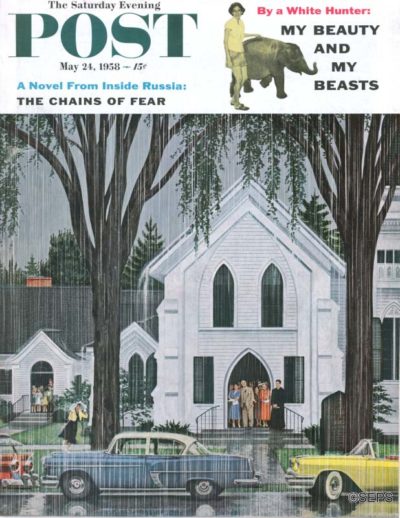
Melbourne E. Brindle
May 24, 1958
[From the editors of the May 25, 1958 issue] This wet cover had its origin in a drought. When crops withered in the Eastern states last summer, the Rev. Benjamin Axleroad, seen there at the door of St. Mark’s Episcopal Church in Bridgewater, Conn., included in his prayers a plea for precipitation. And one Sunday, just as his service ended, down came the rain, exit drought. Weeks later artist Melbourne Brindle, a St. Mark’s vestryman, puzzled some of the congregation by posing them at the church and refusing to tell them what it was all about—surprise, folks, you’re in the Post! Comments on the cover scene: (l) artistic license helped keep that grass green during the drought; (2) if any of the parishioners were out on a golf course during the deluge, how remorseful they must have been that they weren’t in church.
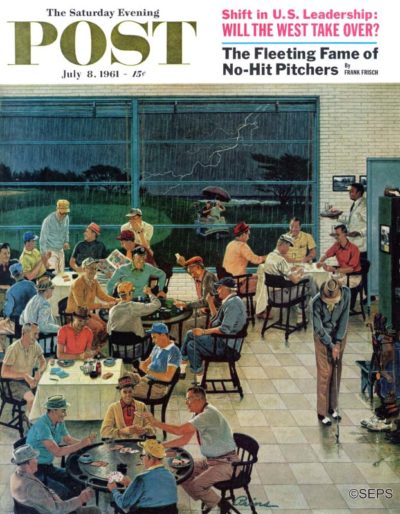
Ben Kimberly Prins
July 8, 1961
[From the editors of the July 8, 1961 issue] How do you like that? On Saturday afternoon—prime time at any golf club—comes the deluge. Well, that’s par for the course, we suppose, and the course in this Ben Prins cover belongs to The Dunes Club of Myrtle Beach, South Carolina. That wave in the background is a fringe of the Atlantic Ocean, not the crest of an oncoming flood. The three-wheeled vehicle under the umbrella is what is known as a caddy car, and its occupants are either fair-weather athletes scurrying toward the indoor recreation of the nineteenth hole, or spirited souls bent on challenging their fellow duffers to a game of motorized water polo. At any rate they’re not slowing down at the putting green. The weather being what it is, they’re probably less concerned about sinking putts than about sinking, period.
Cover Gallery: Let’s Go to the Movies
With the Academy Awards around the corner, we found some Post covers that make us want to grab a bucket of popcorn and watch a great flick!
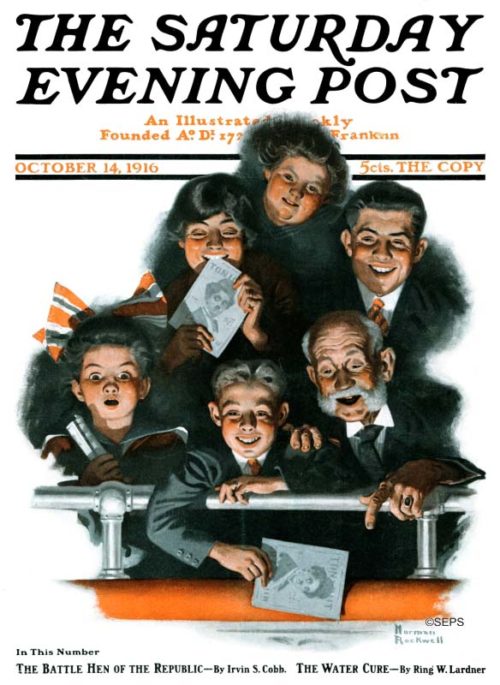
By Norman Rockwell
October 14, 1916
In 1916, Charlie Chaplin’s star was still rising rapidly. By 1916, at age 26, he was making $670,000 a year and in charge of his own studio. He had already appeared in 50 films, including his most well-known, The Tramp.
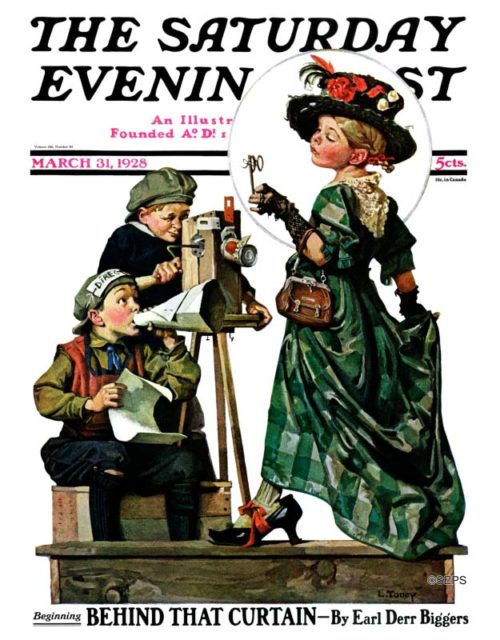
By Lawrence Toney
March 31, 1928
The movie bug has bitten these kids early – looks like we have a budding director, cinematographer, and actress in the making!
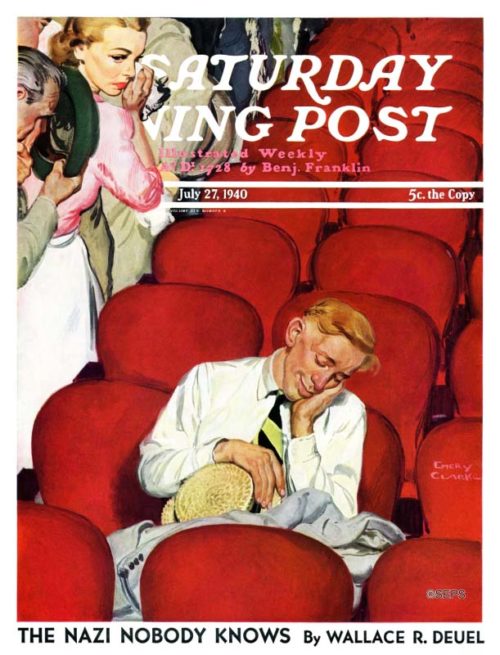
By Emery Clarke
July 27, 1940
He must have been watching Andy Warhol’s Empire.
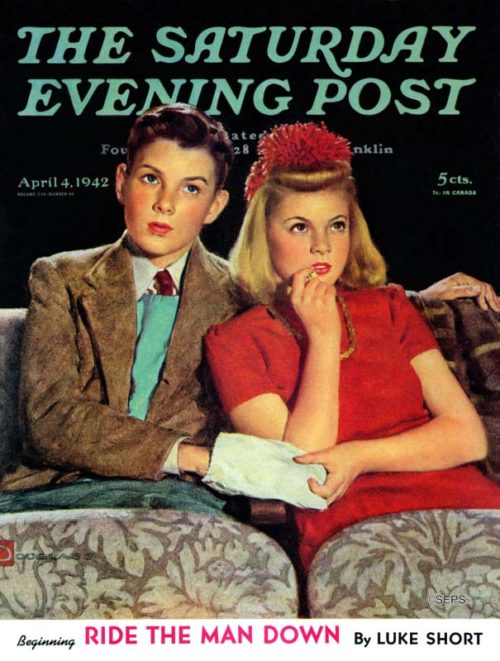
By Douglas Crockwell
April 4, 1942
Bags of popcorn have gotten larger and hair bows have gotten smaller since 1942.
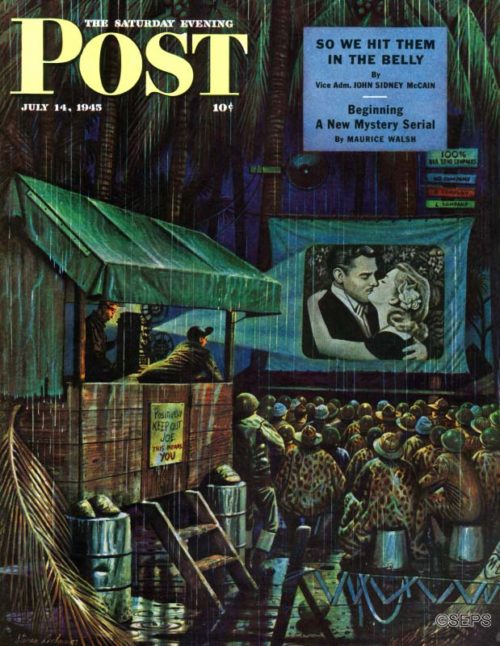
Stevan Dohanos
July 14, 1945
You can’t go wrong with a good romance, even in less-than-ideal circumstances.
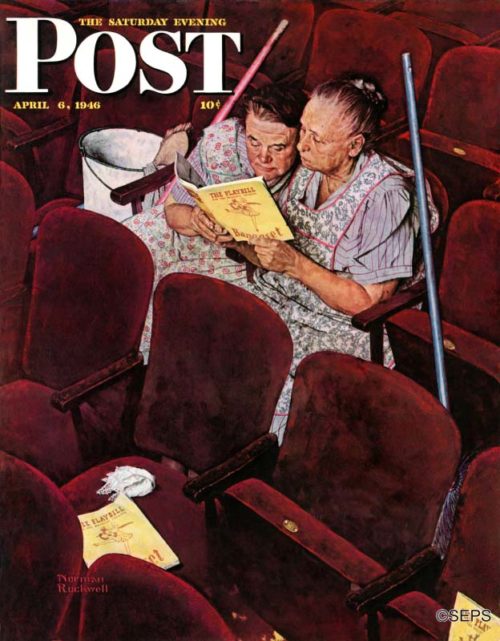
By Norman Rockwell
April 6, 1946
These cleaning ladies are at the theater, not the movies, but we couldn’t resist including this classic Rockwell illustration.
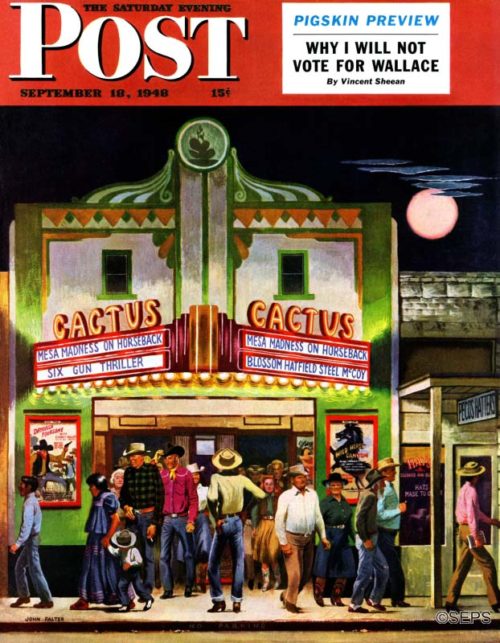
John Falter
September 18, 1948
Illustrator John Falter grew up in the Midwest and started his career in New York, and most of his paintings depict these locations. This southwestern movie theater is an outlier, but reflected Falter’s later interest in western art.
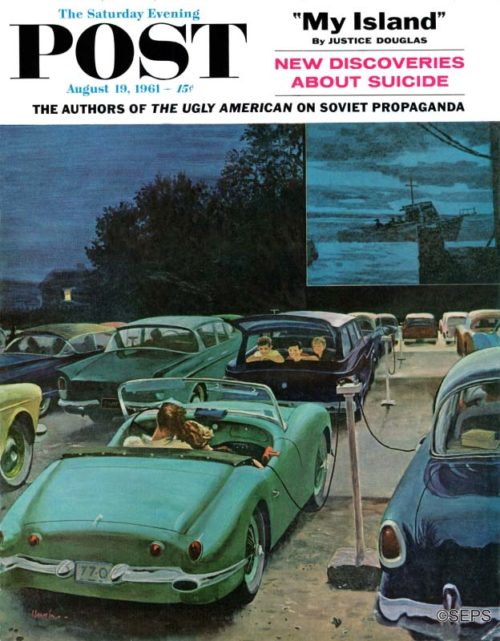
By George Hughes
August 19, 1961
Riding in the “way-back” of your parents’ station wagon has gone the way of the dodo, but you can still find a few drive-in movie theaters here and there.
Cover Gallery: Setting Sail
Have the doldrums? These illustrations of schooners and sloops will buoy your spirits in no time.
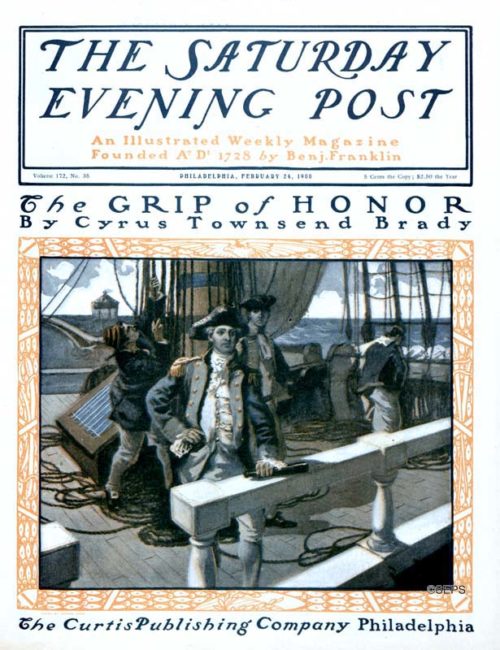
By George Gibbs
February 24, 1900
Illustrator George Gibbs was also an author, having written more than 50 books. Most of his books fell into the the spy and adventure genres, making him a perfect fit to paint this cover to accompany Cyrus Townsend Brady’s story. Gibbs was the illustrator of the first color cover of the Saturday Evening Post, which was published on December 30, 1899.
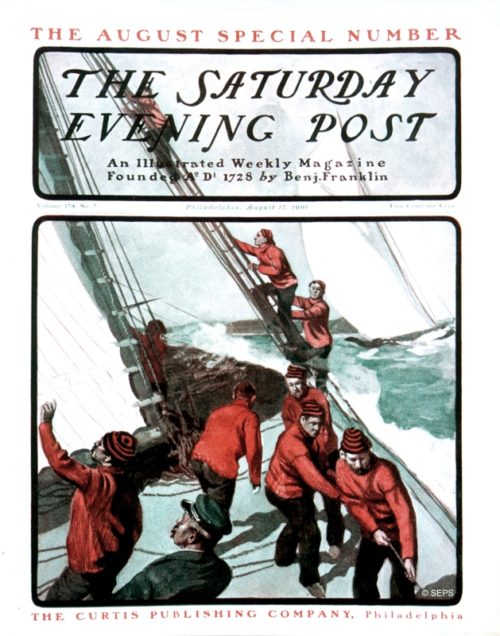
Artist Unknown
August 17, 1901
This cover by an unknown artist was drawn a year after sailing first debuted at the Olympics, in Paris, France in 1900. A Swiss sailor at the games, Hélène de Pourtalès, was the first ever female Gold medalist of the modern Olympic era, according to sailing.org.
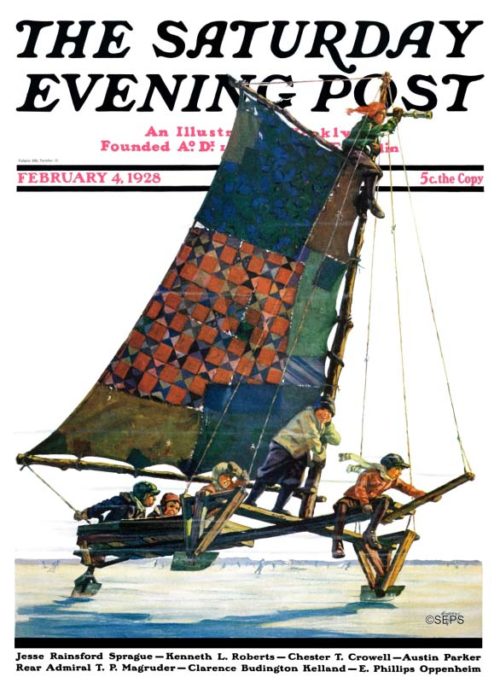
By Eugene Iverd
February 04, 1928
Artist Eugene Iverd grew up in Minnesota, giving him plenty of opportunities to observe ice boating. Iverd was known for painting indelible childhood moments of kids around the campfire, on the football field, in the swimming pool, or on a windswept, frozen lake.
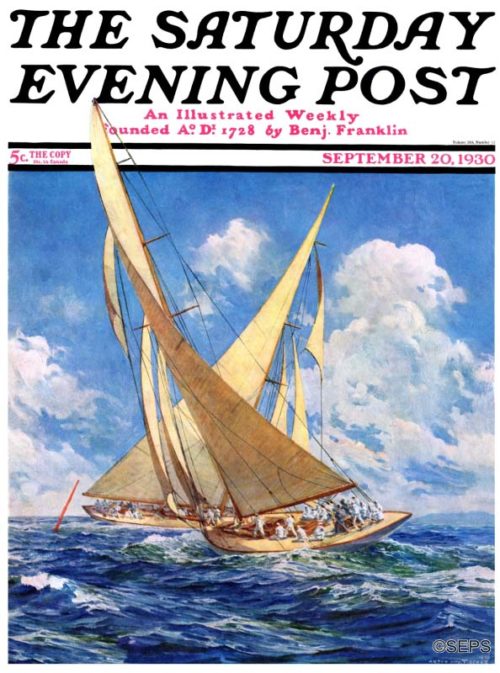
By Anton Otto Fischer
September 20, 1930
Anton Otto Fischer painted hundreds of covers and interior illustrations for the Post. He also illustrated books such as Moby Dick, Treasure Island, and 20,000 Leagues Under the Sea.
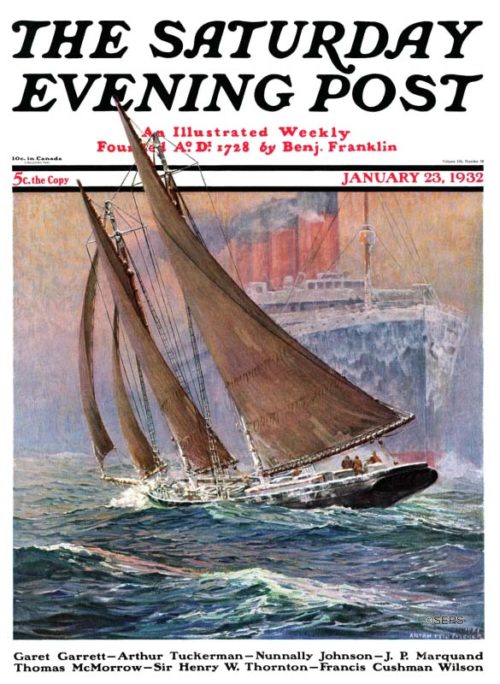
By Anton Otto Fischer
January 23, 1932
This Fischer illustration beautifully captures a moment of drama and also serves as a metaphor for the encroachment of the industrial age over the old ways.
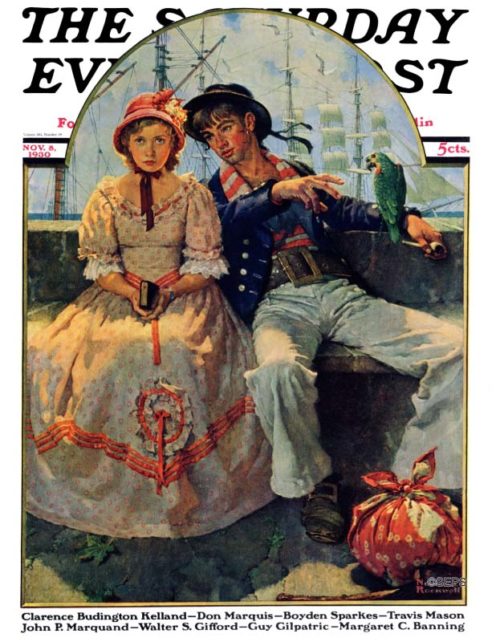
By Norman Rockwell
November 8, 1930
This illustration by Norman Rockwell is a departure from his typical “slice-of-America” scenes.
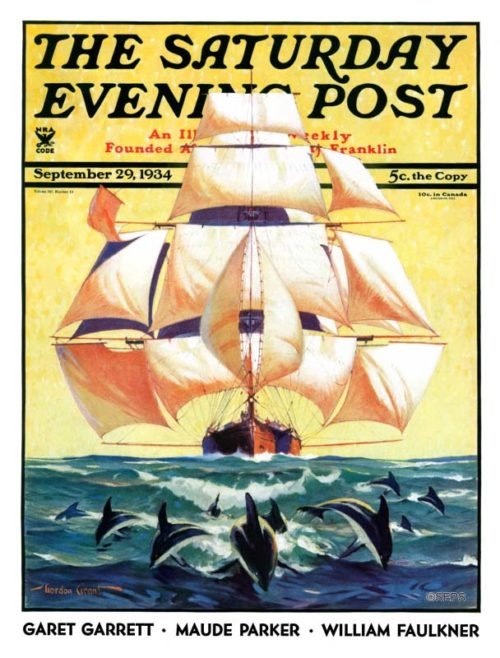
By Gordon Grant
September 29, 1934
Artist Gordon Grant was well known for his maritime covers, particularly his watercolor of the USS Constitution. He was also the cover designer for the first edition of the Boy Scout Handbook in 1911.
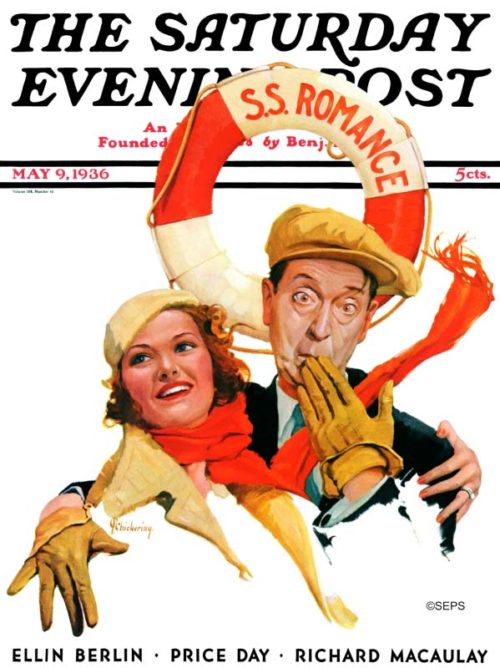
By Charles R. Chickering
May 09, 1936
Charles Chickering got his start as a medical illustrator of the wounded and dead during the World War I, and went on to a career as a postage stamp designer, before painting this winsome cover for the Post.
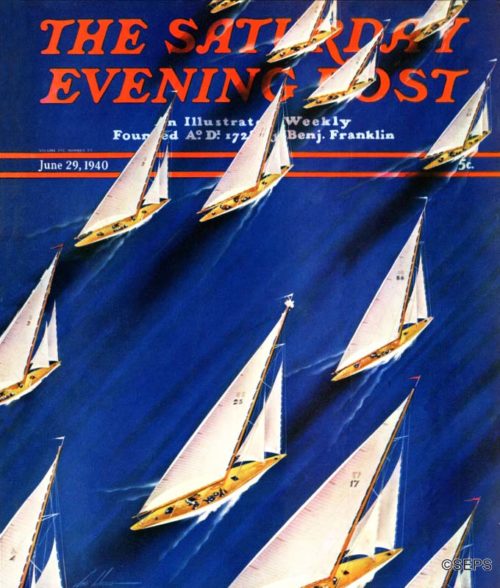
By Ski Weld
June 29, 1940
Ski Weld’s covers always depicted action – skiers jumping, snow geese flying, or, in this case, a stunning regatta of boats sailing.
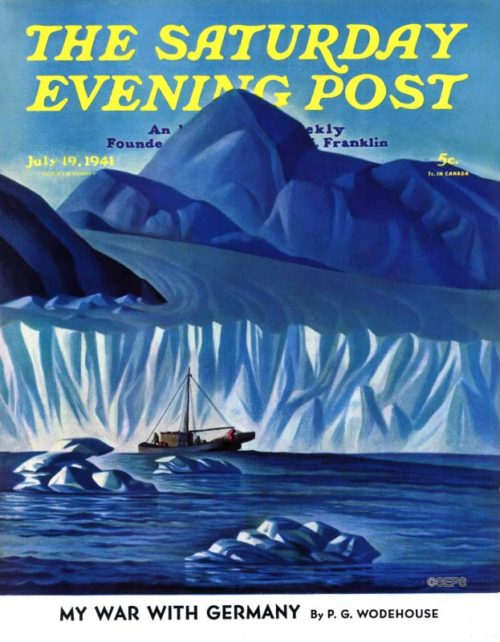
By Dale Nichols
July 19, 1941
Dale Nichols was best known for his paintings of red barns in rural, Midwestern landscapes. This northern scene was a departure from his usual subject matter.
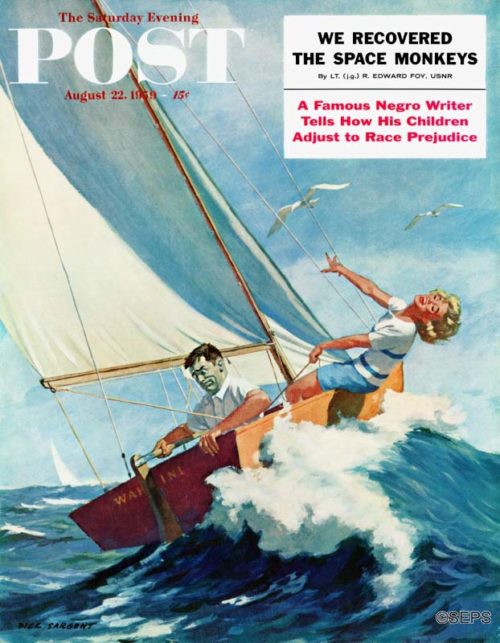
By Richard Sargent
August 22, 1959
Artist Richard Sargent (1911-1979) painted 47 Post covers between 1951 and 1962, when photographs were rapidly replacing magazine illustrations. Sargent often used a playful narrative style where one picture did indeed express a thousand words.
Cover Gallery: Love
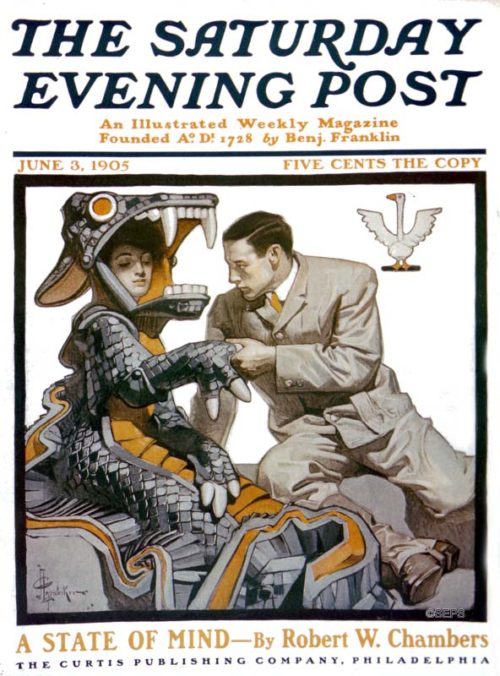
J. C. Leyendecker
June 3, 1905
Nothing says “I love you” like dressing up in a dragon costume.
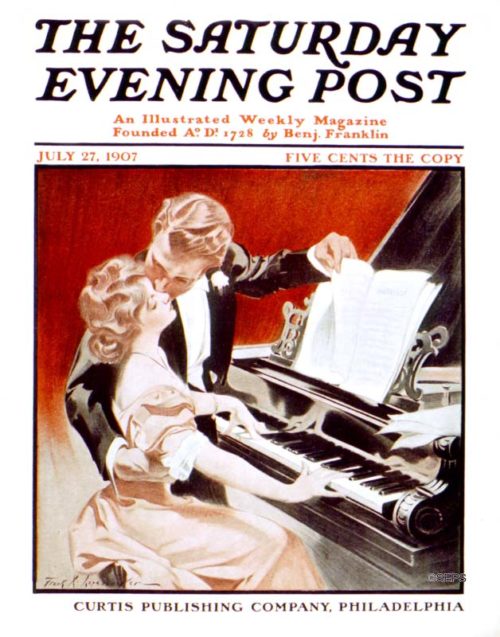
Frank X. Leyendecker
June 27, 1907
Make his heart skip a beat with a beautiful song.
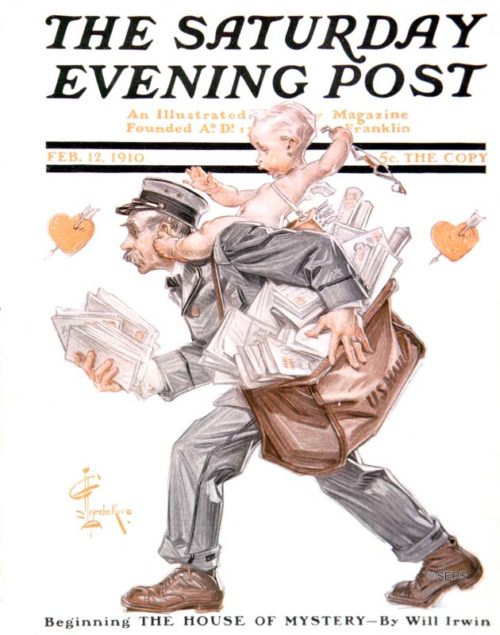
J. C. Leyendecker
February 2, 1910
As Valentine’s Day nears, the Postman and his partner do their best to deliver your love letters on time.
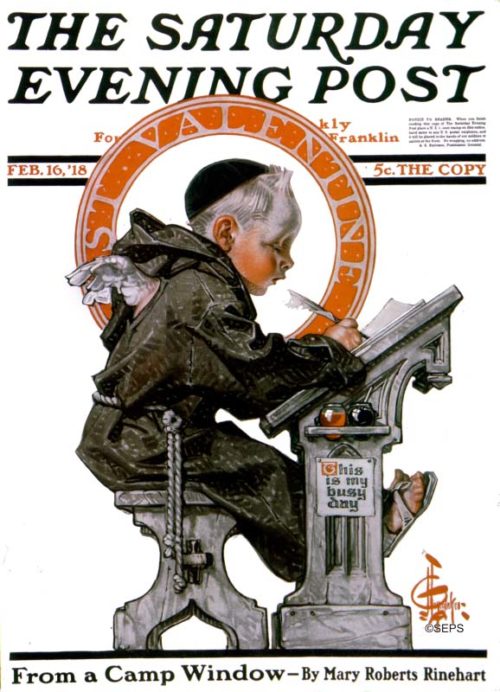
J. C. Leyendecker
February 16, 1918
Love letters don’t write themselves. St. Valentine pens the perfect poem for your paramour.
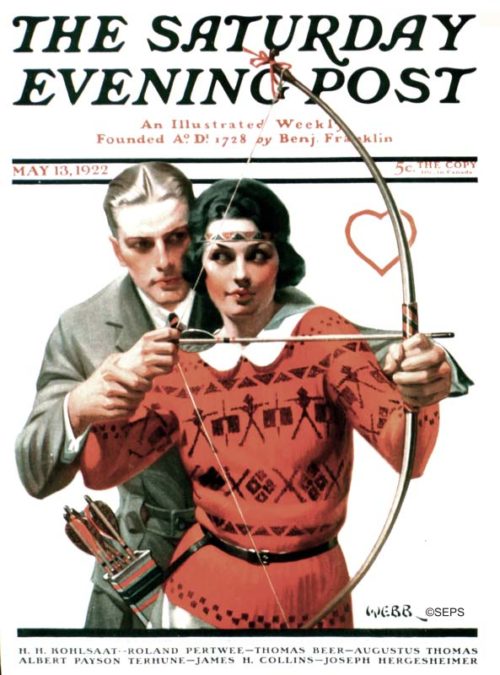
Tom Webb
May 13, 1922
This love struck couple doesn’t need cupid to pierce their hearts.
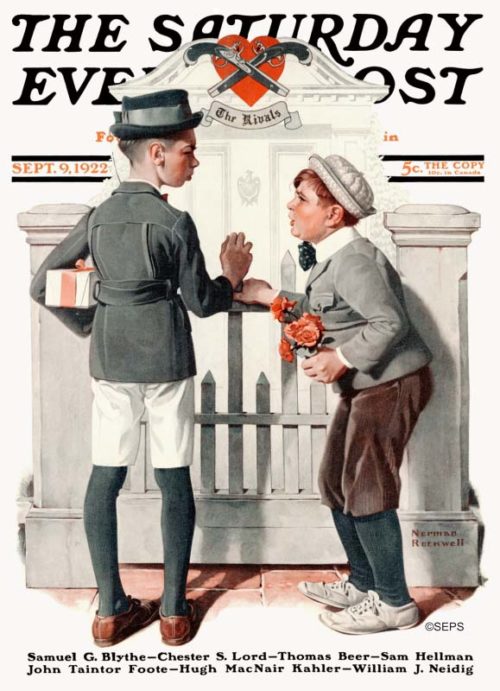
Norman Rockwell
September 9, 1922
Lining up for love is one of many life lessons these lads will encounter.
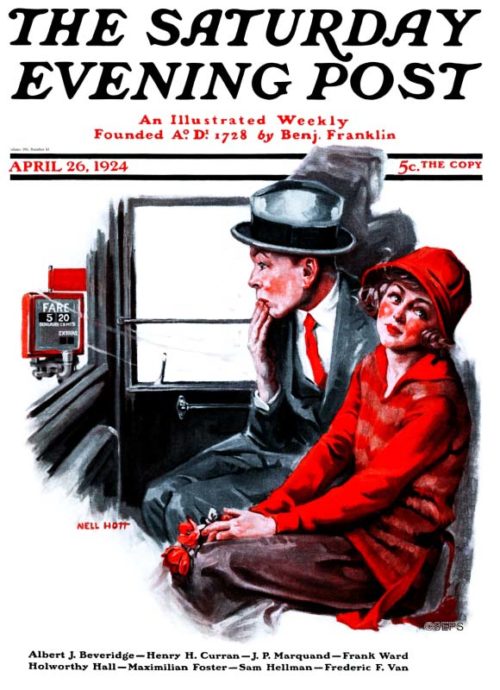
Neil Hott
April 26, 1924
Stretching your last dollar is a simple sacrifice for a romantic night on the town.
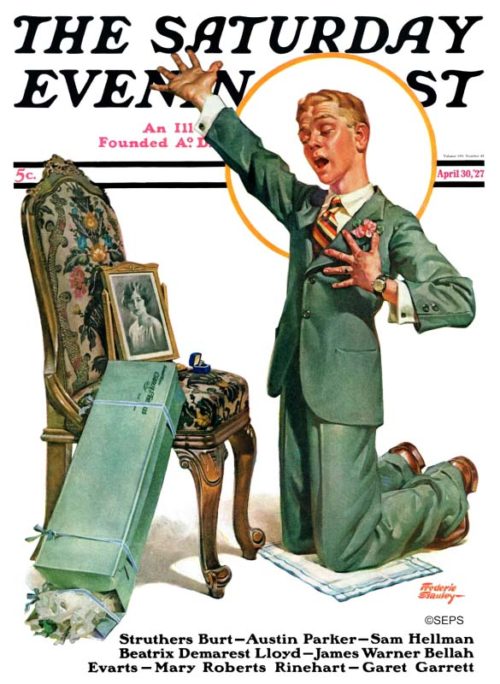
Frederic Stanley
April 30, 1927
Popping the question requires the utmost preparation.
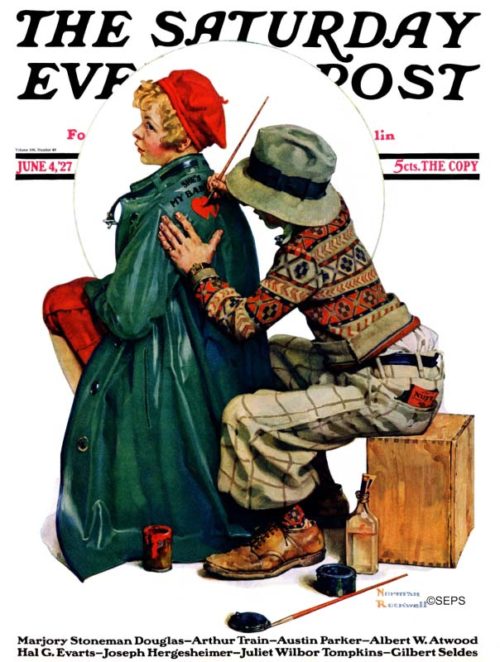
Norman Rockwell
June 4, 1927
This young man hopes to paint his way right into her heart.
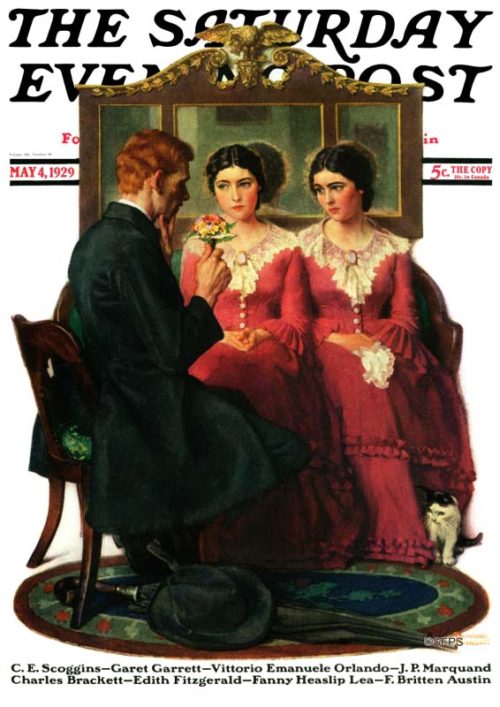
Norman Rockwell
May 4, 1929
A love triangle calls for pretty flowers, but perhaps he should have brought a second bouquet!
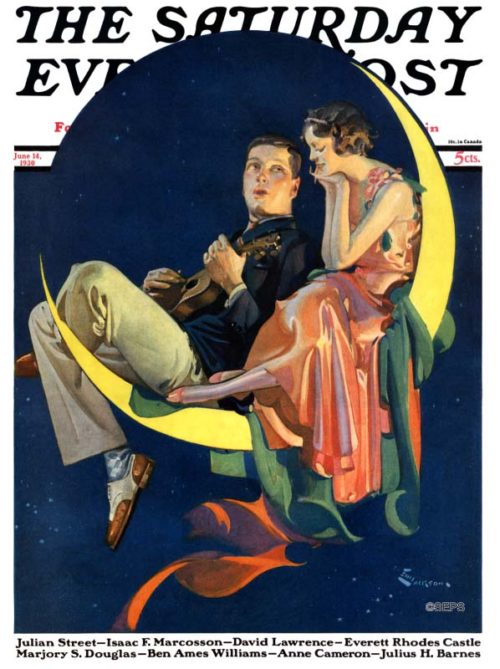
M. Jackson
June 14, 1930
A serenade so stunning, she was over the moon.
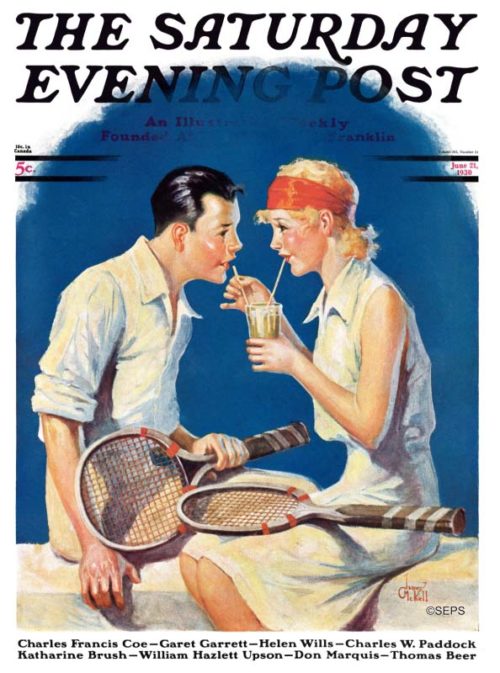
James C. McKell
June 21, 1930
A sweet treat to top off a playful tennis match.
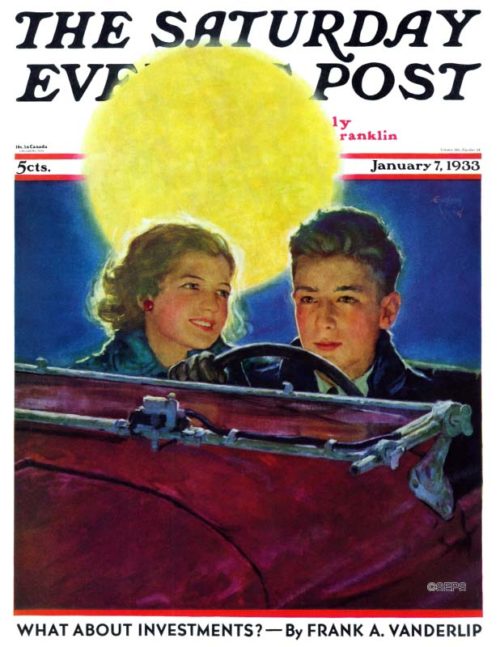
Eugene Iverd
January 7, 1933
The boy of her dreams is even more breathtaking under the glowing moon.
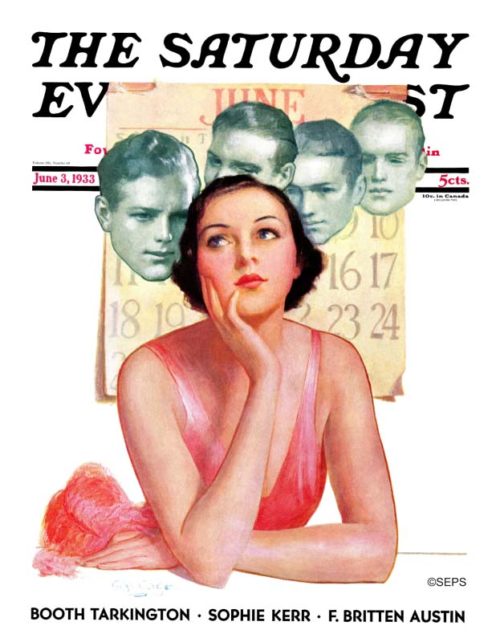
George W. Gage
June 3, 1933
With so many suitors, it’s easy to see why this beauty is beyond vacillating among valentines.
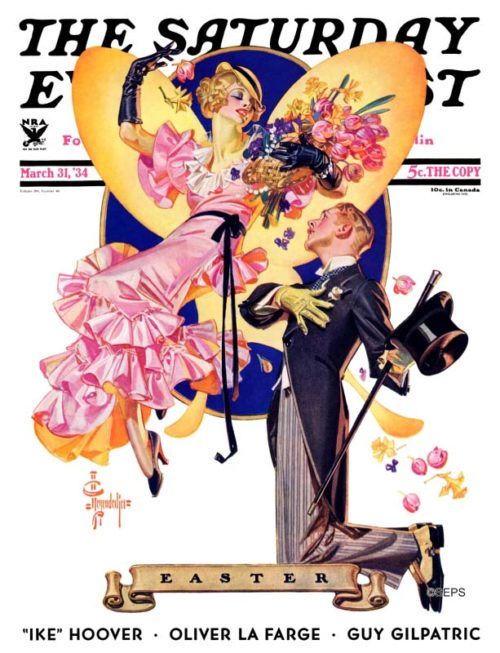
J. C. Leyendecker
March 31, 1934
A pretty pink dress, fresh flowers, and a gentleman with a top hat — the makings of a rousing rendezvous.
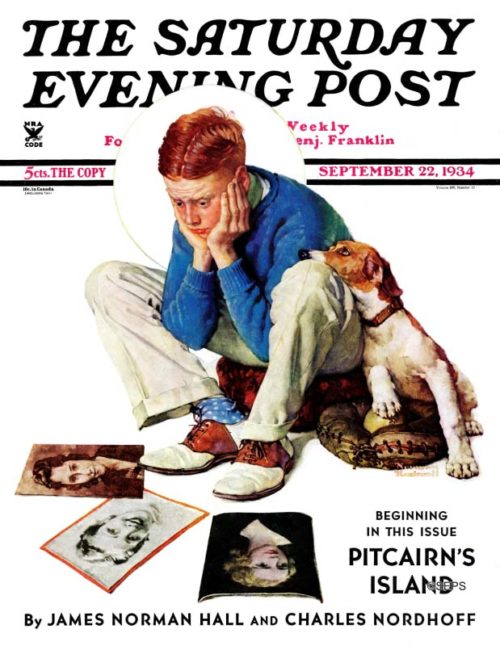
Norman Rockwell
September 22, 1934
A bounty of beauties has left this lad with a lot to think about.
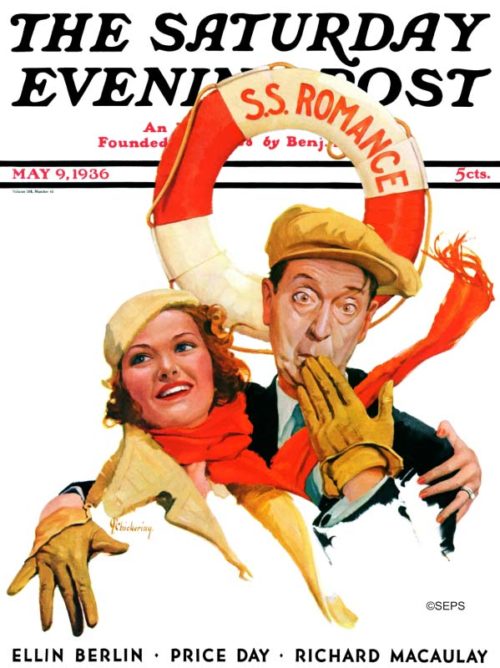
Charles R. Chickering
May 9, 1936
Nothing says a scenic getaway for two like a sea-bound voyage.
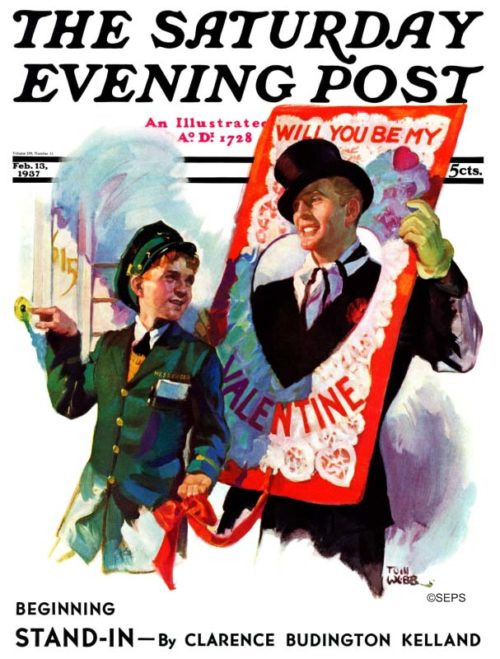
Tom Webb
February 13, 1937
For this well-dressed fella, finding true love starts with a colossal card.
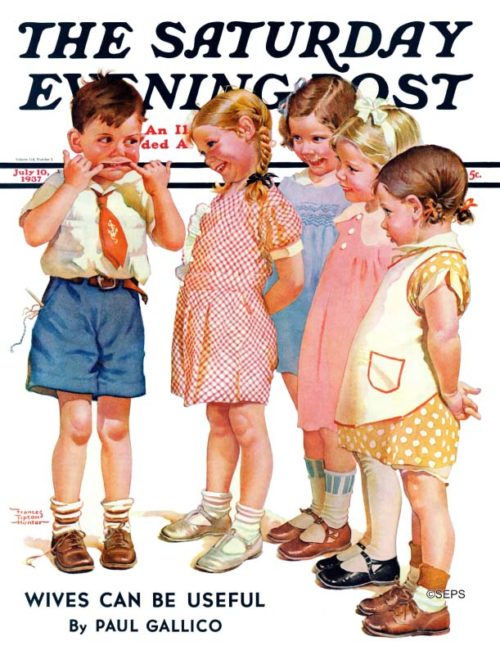
Frances Tipton Hunter
July 10, 1937
Making faces works wonders when you’re five, but soon our larkish lad will need to find new ways of wooing.
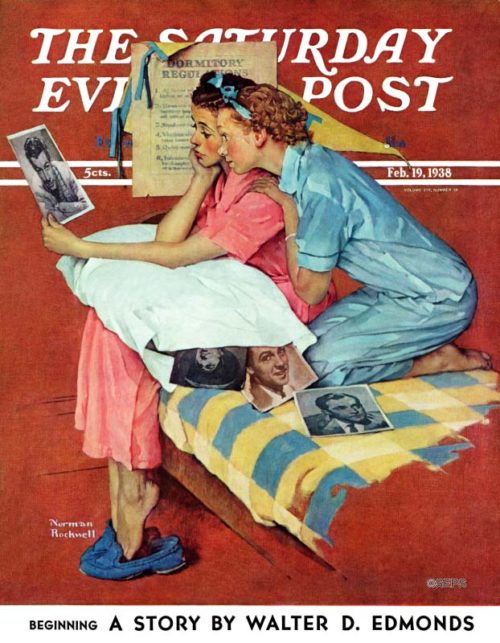
Norman Rockwell
February 19, 1938
Gawking over a gorgeous guy is always sure-fire entertainment for any sleepover.
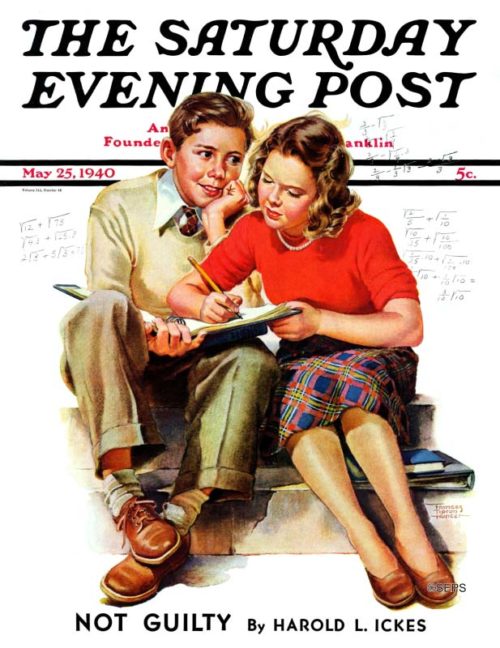
Frances Tipton Hunter
May 25, 1940
This boy is doing more longing than long-divisioning.
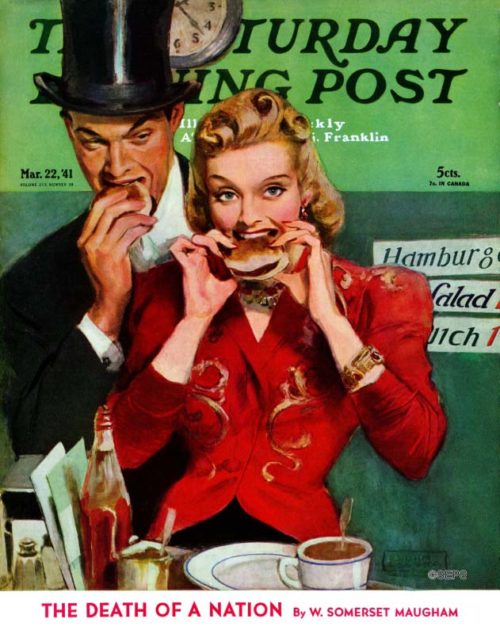
John LaGatta
March 22, 1941
This well-dressed duo dashes off to a diner for a cup of joe and juicy burgers.
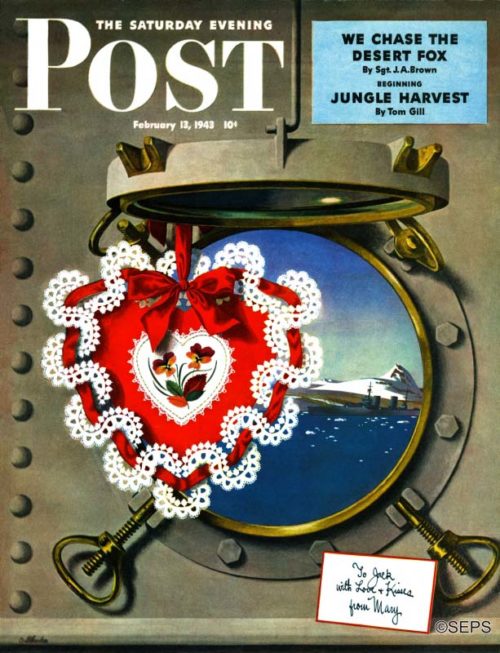
John Atherton
February 13, 1943
Distance makes the heart grow fonder, especially when you’re separated by nothing but sea.
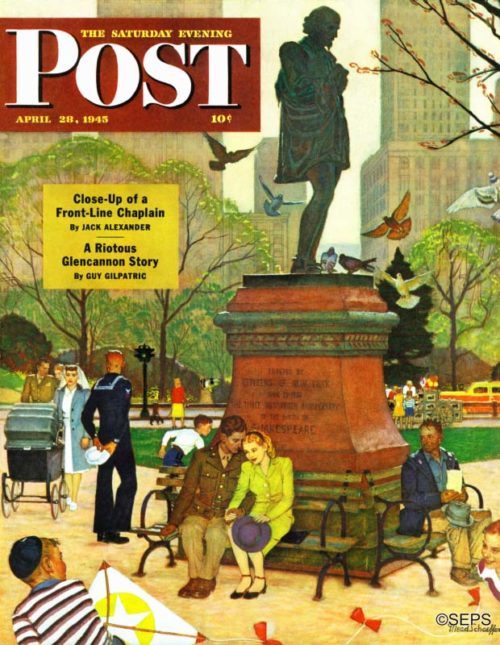
Mead Schaeffer
April 28, 1945
Forget the extravagant getaways — an afternoon stroll in the park works perfectly for this lovely pair.
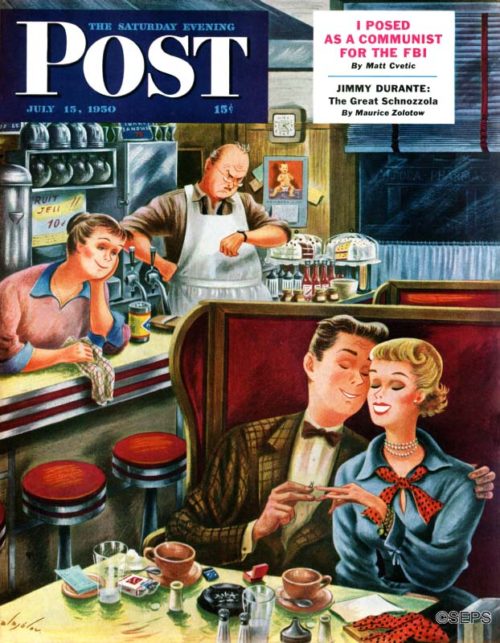
Constantin Alajalov
July 15, 1950
After doors are locked, this lad and his lady linger, perhaps a bit too long.
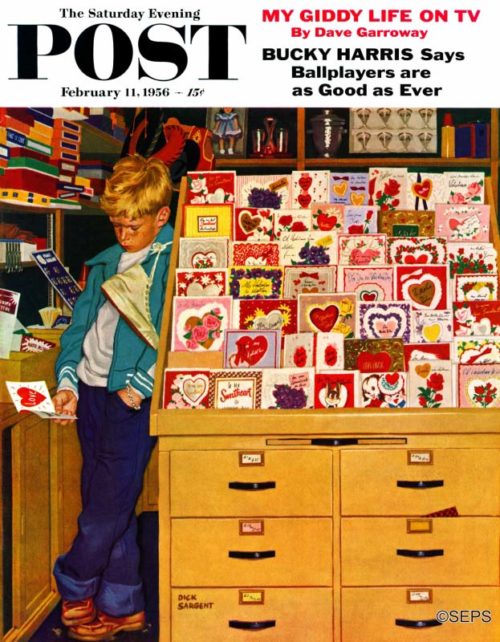
Richard Sargent
February 11, 1956
Picking a V-Day card takes time, especially when she’s your first love.
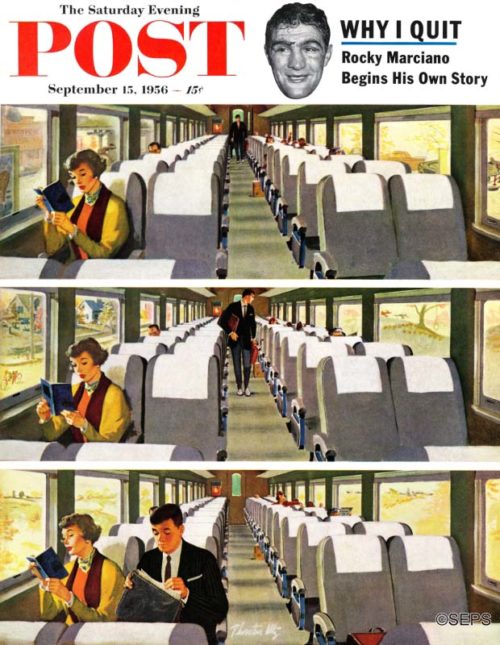
Thornton Utz
September 15, 1956
This gentleman wasn’t shy about chasing down his dream girl.
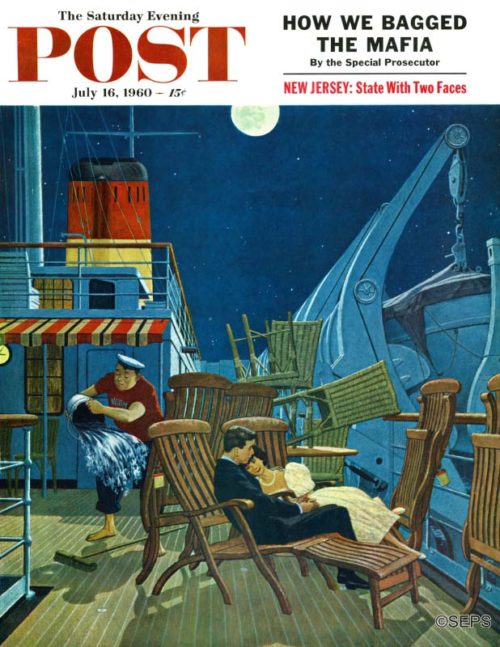
James Williamson
July 16, 1960
This crew member is about to make this crowded corner is a less-than-ideal location for these love birds.
Cover Gallery: Dogs with Jobs
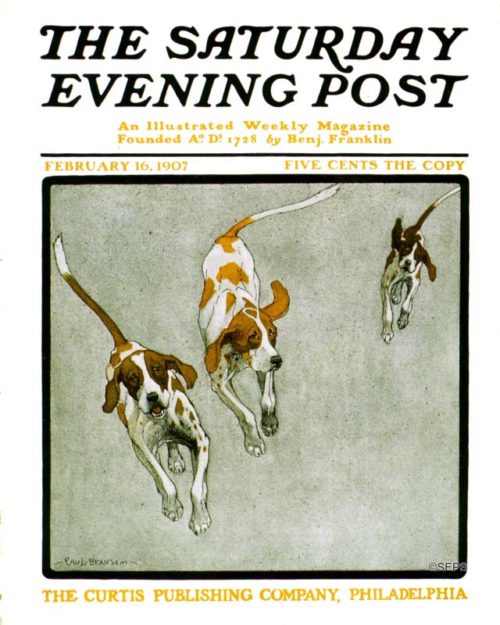
Paul Bransom
February 16, 1907
Paul Bransom illustrated numerous animal covers for the Post. A longtime resident of New York City, Bransom spent summers at Canada Lake in the Adirondacks, where he found much of his inspiration.
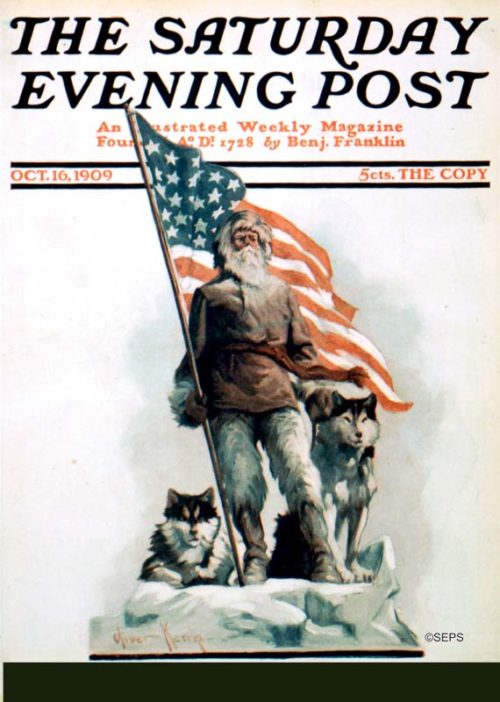
Oliver Kemp
October 16, 1909
Peary made numerous attempts to reach the North Pole, many with the assistance of sled dogs. Whether he actually reached the North Pole is widely debated.
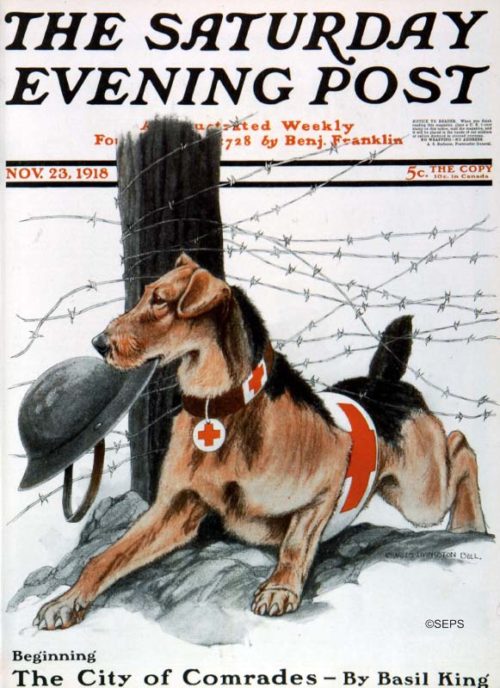
Charles Bull
November 23, 1918
During World War I, dogs were used to locate wounded soldiers on the battlefield and bring back help. Approximately 10,000 dogs were in use by the end of the war.
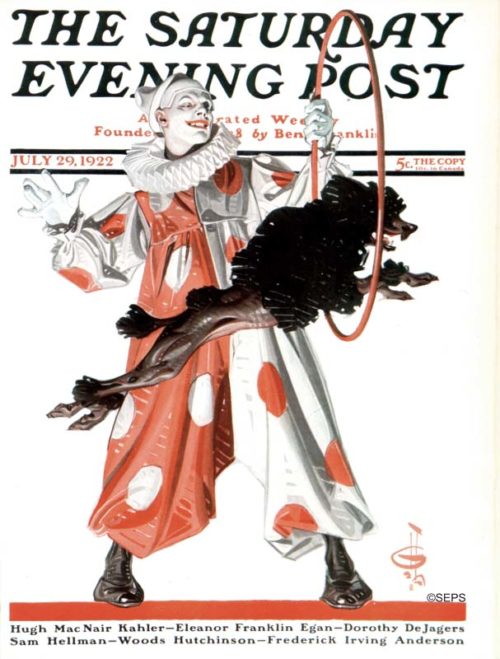
J. C. Leyendecker
July 29, 1922
In the mid-1800s, the Standard Poodle became a popular circus performer because of its intelligence and stamina.
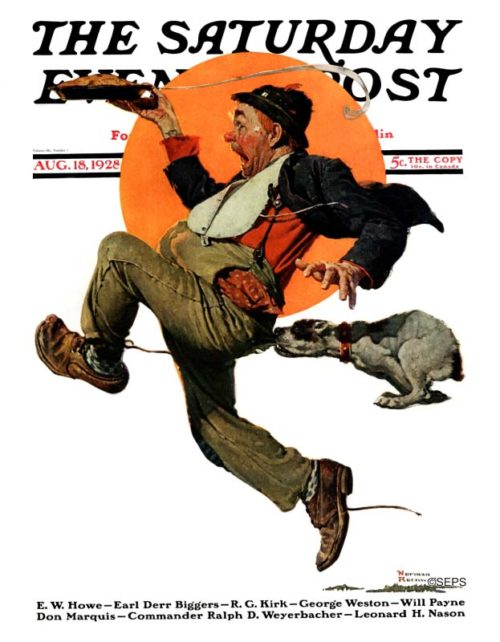
Norman Rockwell
August 18, 1928
The dog has long served in the role of family guardian. Norman Rockwell had earlier portrayed dogs with “hobos” who were down on their luck, but this was the first illustration of the culprit getting a nip in the seat!
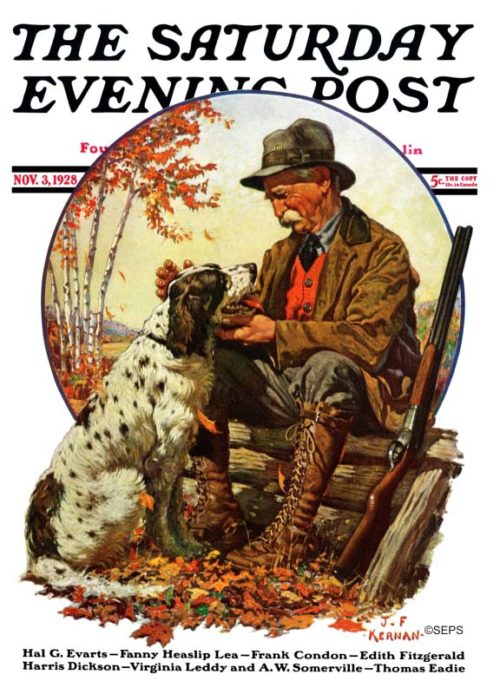
J. F. Kernan
November 3, 1928
An athlete and outdoorsman, artist Joseph Francis Kernan was known as the “poor man’s Norman Rockwell.” But Kernan was a superb illustrator in his own right. His art featured, as he described it, “the human side of outdoor sports, hunting, fishing, and dogs.”
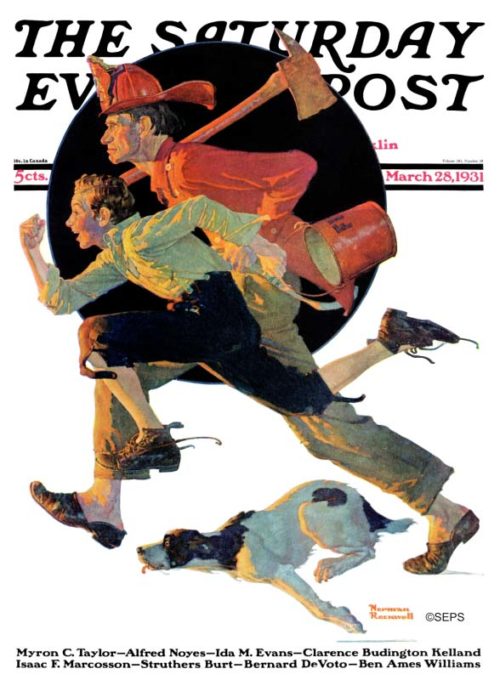
Norman Rockwell
March 28, 1931
A new approach to painting developed by Jay Hambridge – “dynamic symmetry” – was emerging, and Rockwell’s artist friends told him that he had better begin using it. This painting was his first attempt at the technique. Rockwell deemed the idea a failure, and gave the painting to a cousin who lived in Philadelphia. He vowed never to wander from the time-tested formulas that had worked so well in the past.
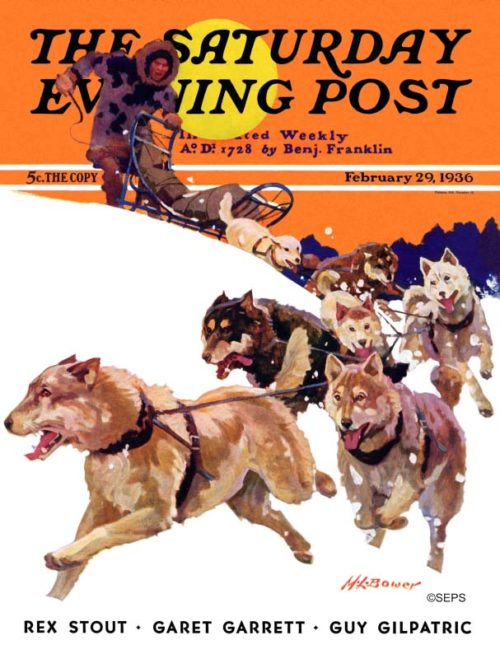
Maurice Bower
February 29, 1936
Maurice Bower primarily painted horses and sports scenes for the Post; this was his only cover featuring dogs.
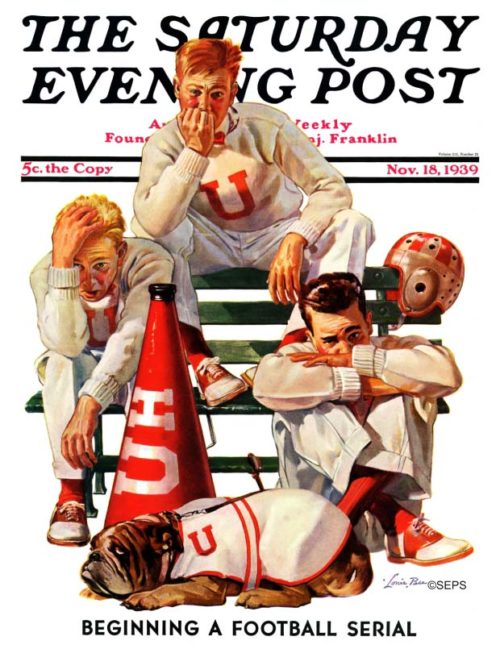
Lonie Bee
November 18, 1939
All of Lonie Bee’s cover illustrations were about the lighter side of sports – in this illustration, the dog seems as sad as the cheerleaders!
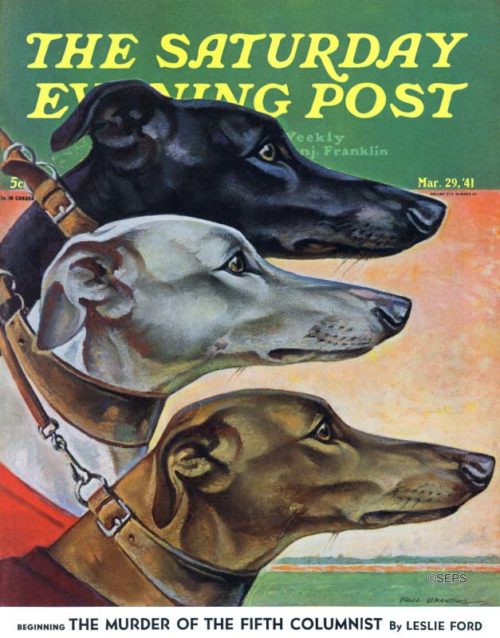
Paul Bransom
March 29, 1941
In the 1930s, dog racing was illegal, and considered by many to be unsavory because of its affiliation with mobsters. When Bransom painted this cover in 1941, only four states had legalized greyhound racing: Florida, Oregon, Massachusetts, and Arizona.
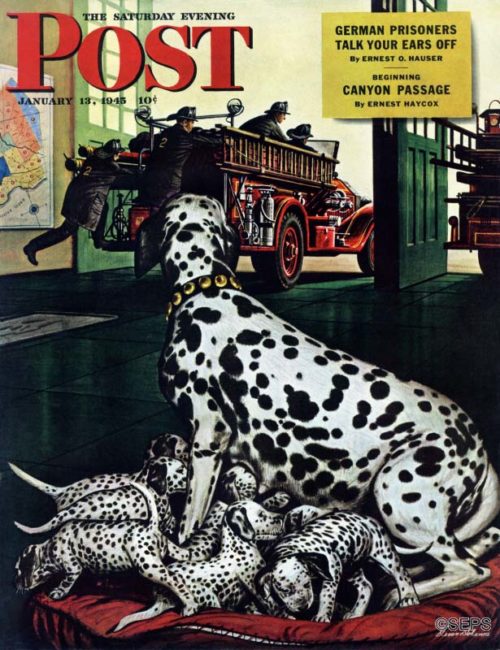
Stevan Dohanos
January 13, 1945
After painting 123 covers for the Post, Stevan Dohanos became chairman of the National Stamp Advisory Committee where he oversaw the art design for over 300 stamps. His depictions include presidential portraits, NATO commemorative stamps from 1959, and the 1967 John F. Kennedy commemorative stamp.
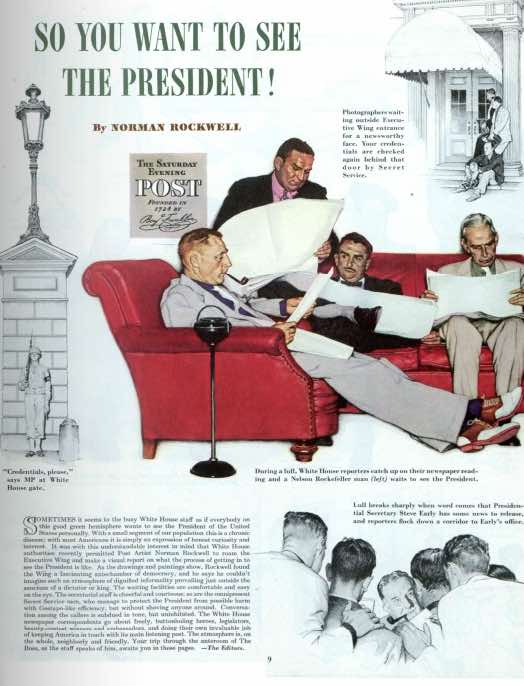
Norman Rockwell Paints an Intimate Tour of the West Wing
In 1943, Norman Rockwell was permitted to roam the Executive Wing of the White House. His drawings perfectly capture the “dignified informality” of the era. Click on the image below to see the complete four-page spread.
Most Popular Art and Cover Galleries of 2016
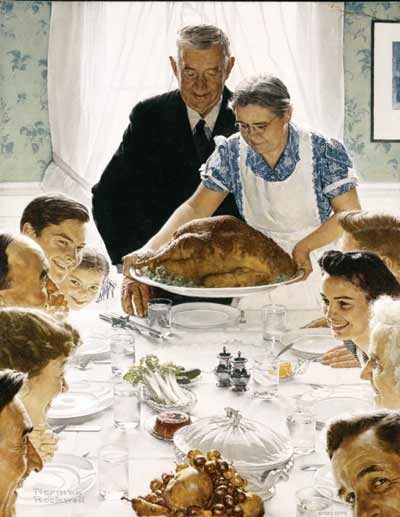
1. Norman Rockwell’s Four Freedoms
Norman Rockwell
March 6, 1943
Inspired by Franklin D. Roosevelt’s famous “Four Freedoms” speech delivered to Congress on the eve of World War II, Norman Rockwell created four paintings depicting simple family scenes, illustrating freedoms Americans often take for granted.
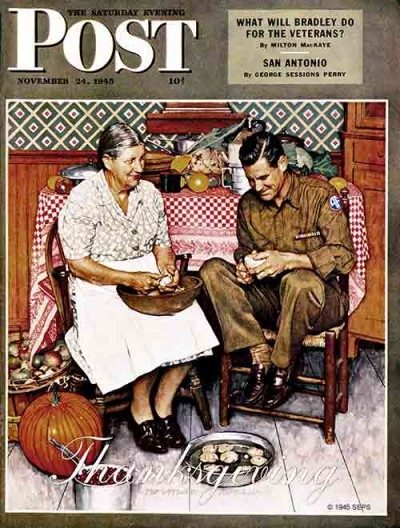
2. Classic Covers: Thanksgiving
Norman Rockwell
November 24, 1945
Norman Rockwell and his mentor, J. C. Leyendecker, not only created more Post covers than any other artists, but also helped shape the way Americans think about Thanksgiving.
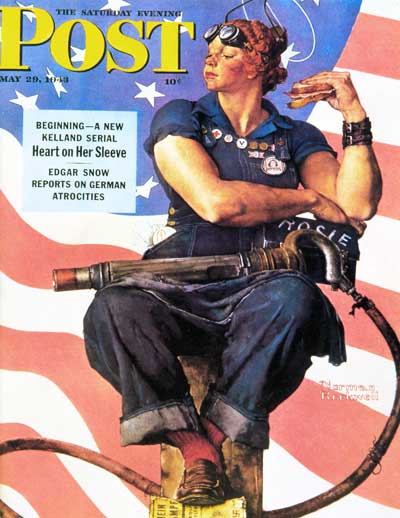
3. Rockwell—1940s
Norman Rockwell
This gallery displays all of Norman Rockwell’s Saturday Evening Post covers from the 1940s, one of his most prolific—and most loved—periods. It is, of course, replete with illustrations from World War II, including this iconic picture of Rosie the Riveter.
4. Rockwell Paints Rockwell
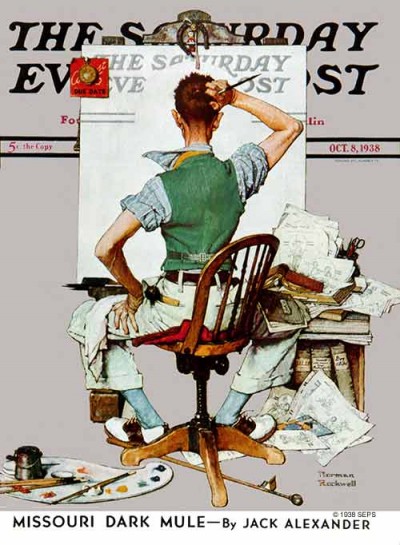
Norman Rockwell
October 8, 1938
How often did Norman Rockwell show up in his own art? You’d be surprised!
5. Rockwell—1930s
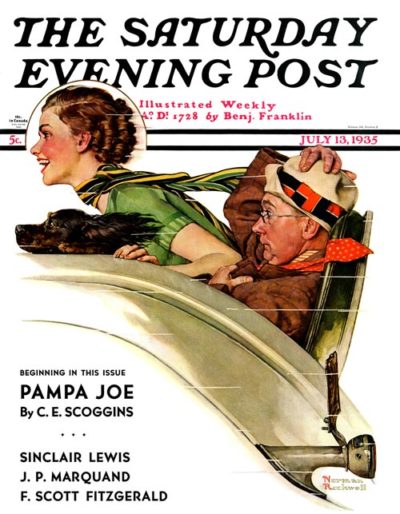
Norman Rockwell
July 13, 1935
Norman Rockwell’s Post covers from the ‘30s feature a wide array of characters—from children to movie stars, from the worldly to the working-class. Throughout this decade, he painted 69 covers for the magazine.
6. Rockwell—1950s
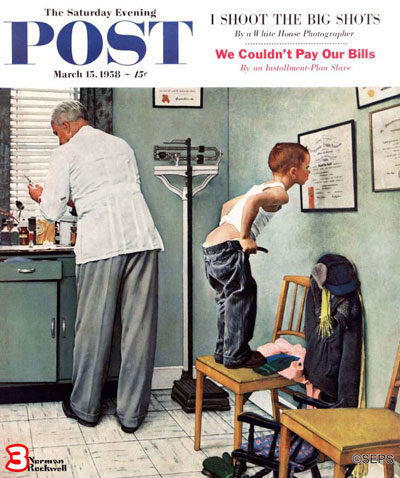
Norman Rockwell
March 15,1958
Rockwell painted some of his best known covers in the 1950s, including “Before the Shot,” (above), “Shiner,” and “Runaway.”
7. J. C. Leyendecker Gallery
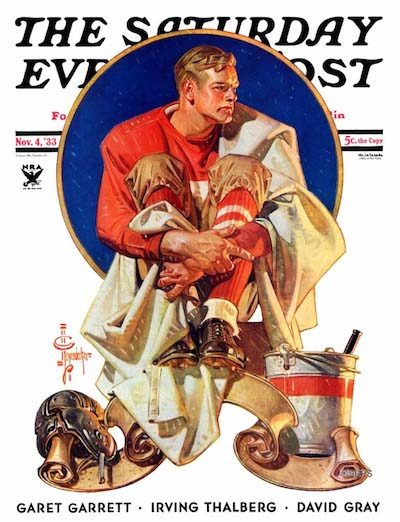
J.C. Leyendecker
November 4, 1933
J. C. Leyendecker was one of the most popular and prolific cover artists for the Post. Norman Rockwell at one time considered Leyendecker his primary mentor, as he heavily influenced Rockwell’s early style and was a true master illustrator of the 20th century.
8. Rockwell—1960s
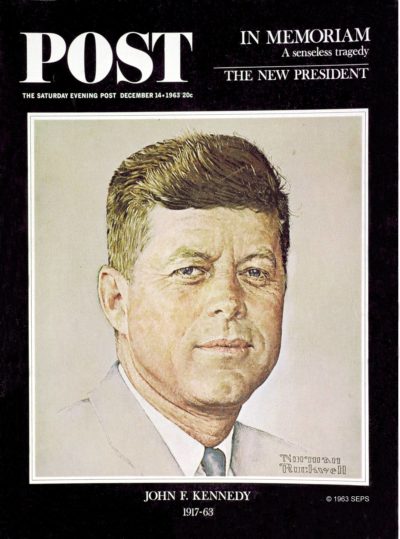
Norman Rockwell
December 14, 1963
This was the last decade that Rockwell painted covers for the Post, including a number of elegant portraits of Kennedy, Nixon, and Nehru.
9. Rockwell’s School Teachers
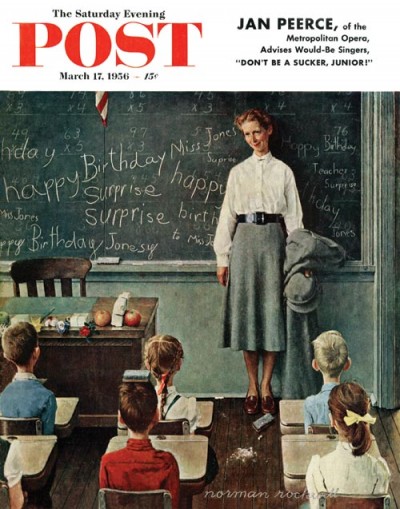
Norman Rockwell
March 17, 1956
“Happy Birthday, Miss Jones” is a Rockwell classic, but it wasn’t without reader complaints. Diana Denny reviews the many portraits of teachers that Rockwell painted.
10. John Falter Gallery
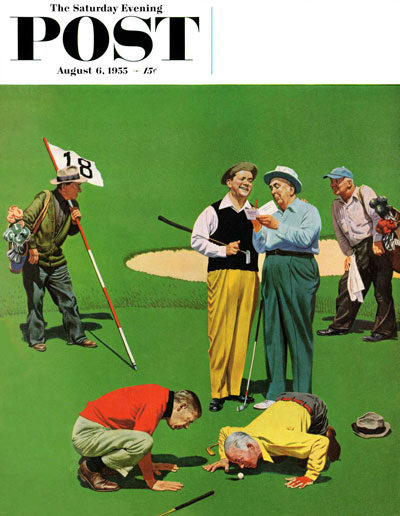
John Falter
August 6, 1955
John Falter created 129 Post covers over the course of his career. Much like Norman Rockwell, his works are simple observations of everyday American life.
Crowd-sourced: Norman Rockwell’s Christmas at Chicago Union Station
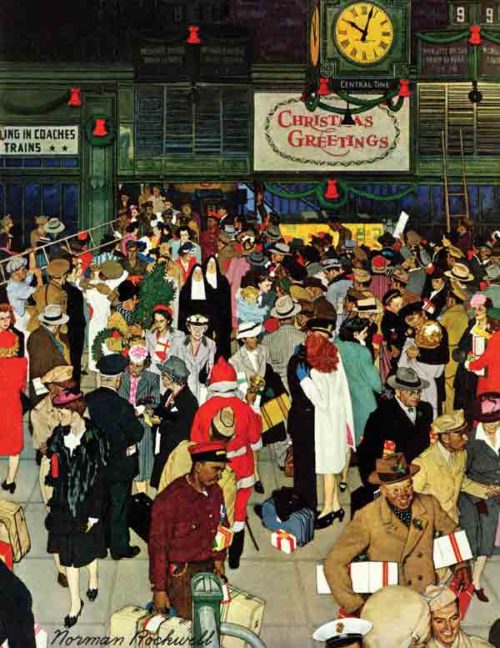
Union Train Station, Chicago, Christmas contains many of Norman Rockwell’s favorite themes — homecoming, reunions, sweethearts, and Christmas — and he wanted to get it just right.
In the planning phase, Rockwell scouted several train locales before choosing the Chicago and Northwestern railroad station. Always concerned with accuracy, the artist asked railroad officials how they planned to decorate for the holidays. They hadn’t decided yet, as Christmas was months away, so they told Rockwell to paint it as he wished and they’d decorate the station to match.
Among the shoppers, you’ll notice some servicemen in the crowd waiting to be reunited with their families. After photographing real servicemen for these scenes, Rockwell recruited women to pose kissing some of the soldiers. The red-haired woman in the foreground kissing an officer was discovered as she hurried through the station. Afterward, when Rockwell thanked her for posing for the kiss, she replied, “Not at all; sorry it wasn’t a time exposure.” Look closely and you’ll see Rockwell himself in the picture; he’s the man waving a folded paper in the upper right.
Classic Covers: Gridiron Grit
America is in love with football, and if these Post covers are indication, they always have been. Glimpse into the hilarity and heartbreak of life on (and off) the field.

Alan Foster
November 12, 1927
Not much is known about illustrator Alan Foster, who created more than 30 covers for the Post. His narrative style is reminiscent of Norman Rockwell’s, and his paintings often capture the silly and joyful moments in life.
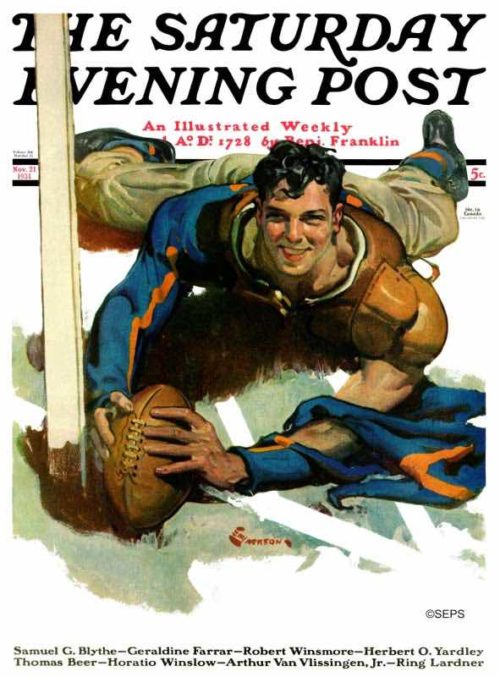
E. M. Jackson
November 21, 1931
An artistic specialty of E.M. Jackson’s was painting women in poses that made them appear seductive and glamorous amidst architecturally authentic backgrounds. Usually, he illustrated for manuscripts involving romance and high society. However, he also illustrated for a wide variety of genres, including murder mystery and (as illustrated in this cover) masculine adventure.
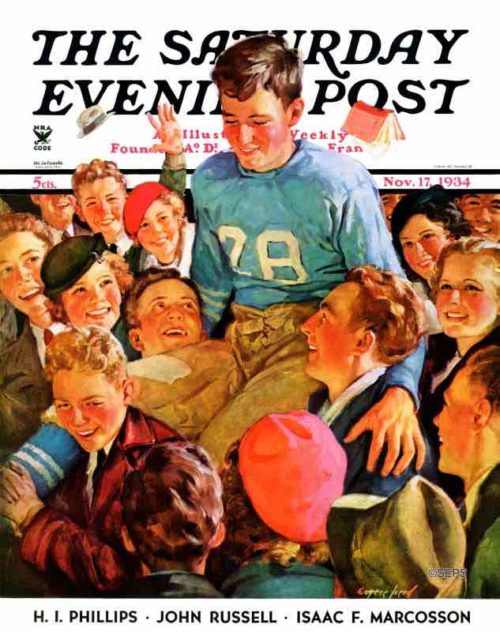
Eugene Iverd
November 17, 1934
Eugene Iverd lived in Erie, Pennsylvania, where he often used children there as his models. Iverd produced 30 covers for The Saturday Evening Post between 1926 and 1936.

Lonie Bee
October 22, 1938
Lonie Bee illustrated 6 covers for the Post, all focused on sports, and most depicting a moment of consternation, whether it was cheerleaders mourning a losing game or a football player trying to sway the ref.
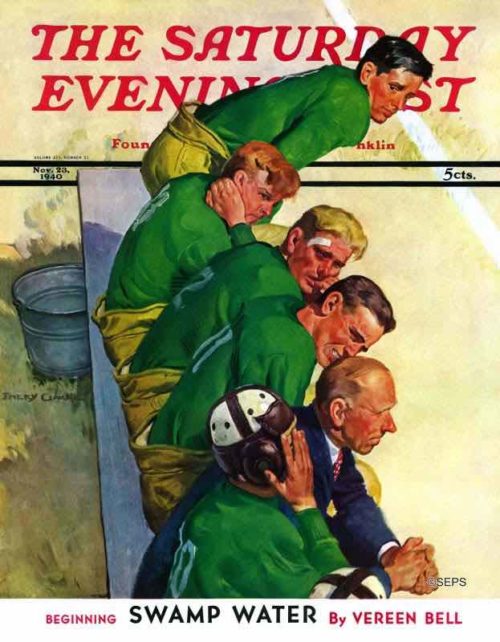
Emery Clarke
November 23, 1940
Emery Clarke was an illustrator of magazine and pulp novel covers, one of the most well-known being the Doc Savage series. He also collaborated with Russell Stamm on the comic strip, The Invisible Scarlet O’Neal.
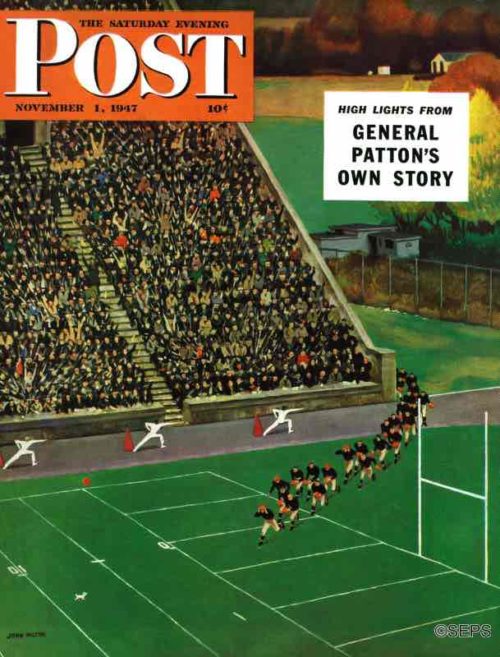
John Falter
November 1, 1947
It seems to John Falter that one of the best moments in football is that curtain-going-up moment when the squads trot out on the field. For one thing, the team in which your hopes are invested always looks pretty good at that stage; even an outfit that is going to take a terrific lacing when the whistle blows can look like champions executing this maneuver. The politic artist said the squad might be that of any school whose colors are orange and black. That takes in a fine range of educational institutions and makes it almost impossible that Falter should have picked a loser. He chose the Princeton stadium for background, and Falter Hypothetical Institute, taking the field, seems to be based on Princeton, without the Tigers’ stripes. (Reprinted from the November 1, 1947 Post)
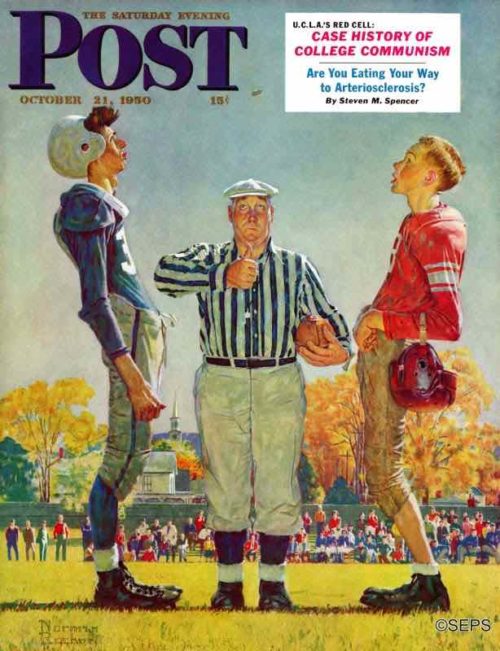
Norman Rockwell
October 21, 1950
With baseball temporarily out of their systems, sport lovers now are concentrating on the gridiron in their constant search for nervous tension. The spotlights of fame play on the collisions of 200-pound colossi in great stadia. But Norman Rockwell reminds us that the super crises are suffered back-country, where Bill Jones, of Mapleville High, strives for the honor of a town where everybody has known him since he was knee-high to a tackling dummy. If Bill wins the game, he’ll not be just a remote newspaper hero, but the idol of the gals in his algebra class and of the mayor he meets walking down the street. If he loses it, the gals will go home teary-eyed, and so may the mayor. “Heads or tails?” grunts Joe Fate, the referee. (Reprinted from the October 21, 1950 Post)
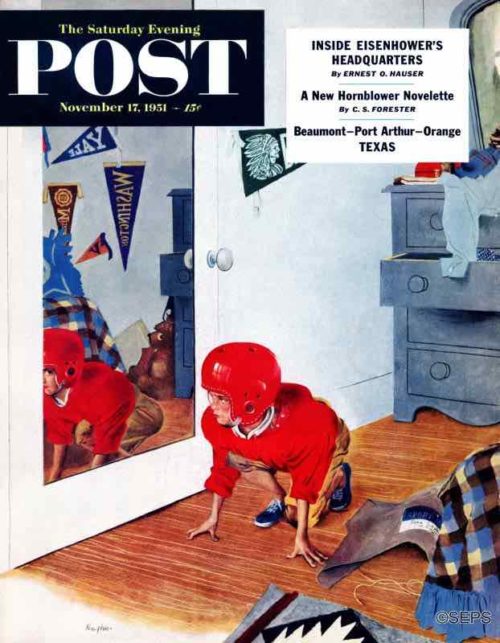
George Hughes
November 17, 1951
This ferocious young grid star, magnified by the terrifying man-from-Mars armor peculiar to football and inflamed by imagination, is about to crunch the enemy’s forward wall, snare a forward pass with his fingertips and weave 70 years down the field for a TD as thousands cheer. Actually, the first play in which he exposes that new uniform to the stark realities of life may see him land on his neck and become a door mat, while some other guy does the crunching. But Artist Hughes says that if this does happen, we can be confident that any lad he would paint will find biting the dust distasteful and will react with such vigor that within a few years he will he offered athletic scholarships to fifteen colleges. (Reprinted from the November 17, 1951 Post)
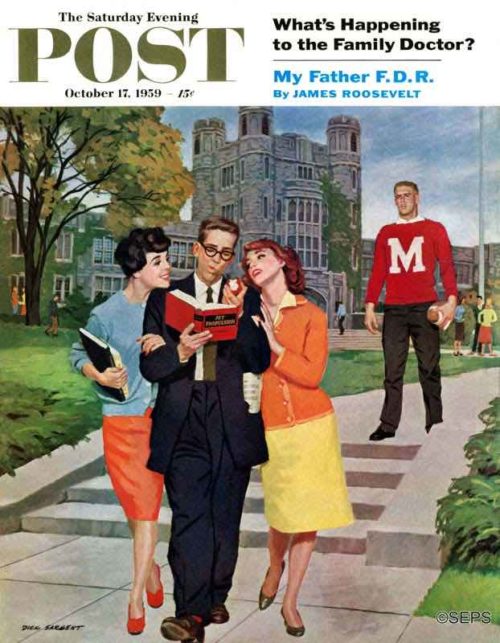
Richard Sargent
October 17, 1959
What strange switch on traditional romance have we here? Those two peaches can’t just be asking for a bite of apple; no, they are applying to a man some seductive apple-polishing with intent to captivate, then capture him. Well, how come that they are chinning themselves on the bony shoulders of H. Arthur Jet and leaving Big M over there looking as if he might break down and cry? Artist Dick Sargent’s theme is that in the fall a young maid’s fancy seriously turns—in these serious days—to thoughts of eventual matrimony, and that H. Arthur is not only a good guy but, being enamored of technology, a potentially good provider. So be it; but let’s not sell Big M short. There is no law against a football star’s becoming another kind of star, too, and lots of them have done so. (Reprinted from the October 17, 1959 Post)
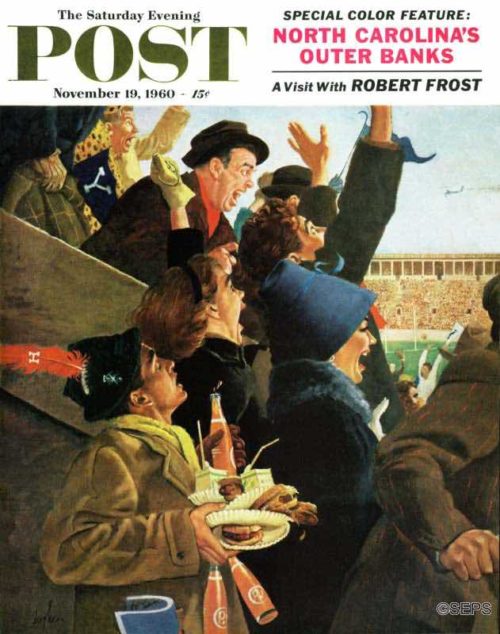
George Hughes
November 19, 1960
The Harvard chap in the foreground is searching for a receiver in the open, but his view is blocked by an exultant pack of Yale Bulldogs. It would seem that while the Crimson was successful at a hot-dog stand, Yale spoiled the attempt at a goalline stand. “Bull-dog! bull-dog! Bow, wow, wow!” shriek the Yale fans, as portrayed by artist George Hughes. (Hughes is neutral. His father-in-law is a Yale graduate, but both his sons-in-law are Harvard.) The Harvard-Yale rivalry commenced in 1875, and Eli Yale has a seventeen-game edge. This week’s combat will be staged at Harvard Stadium — not that the field of battle is likely to affect the outcome. The Bulldogs took a drubbing in 1914, the year the Yale Bowl was dedicated. Yale had the bowl, we read somewhere; Harvard supplied the punch. (Reprinted from the November 19, 1960 Post)