News of the Week: Norman Rockwell, New Network Names, and National Moldy Cheese Day
Norman Rockwell Painting to Be Sold
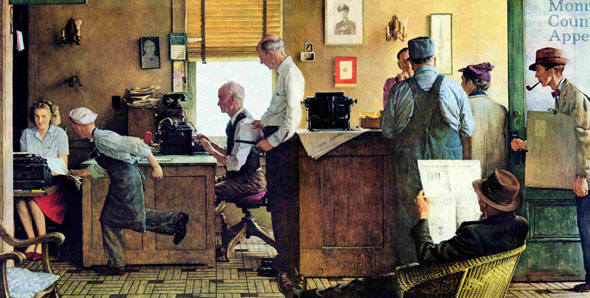
Norman Rockwell
May 25, 1946
What would you do with an extra $10-15 million?
That’s how much the National Press Club expects to get when they sell the Norman Rockwell painting “Norman Rockwell Visits a Country Editor”. Rockwell painted the picture for the May 25, 1946, issue of The Saturday Evening Post. Rockwell gave the original painting to the club in the early ’60s, but the board of directors discovered that the painting’s value had increased so much that it no longer made sense for them to hold on to it, due to insurance and security costs. They want to sell it to pay for various programs they have.
For the past year the painting was on loan to the Norman Rockwell Museum in Stockbridge, Massachusetts. It’s now at Christie’s, where it will be auctioned off on November 19.
ABC Family Is Now … Freeform?
It’s not uncommon for some cable channels to change their name. TV Guide Network became Pop; Discovery Health became OWN (the Oprah Winfrey Network); HDNet became AXS; and SOAPnet became, of all things, Disney Junior. But at least those names made sense. I’m not sure about this one.
ABC Family, which airs shows like The Fosters and Pretty Little Liars, is changing its name to Freeform. But it actually isn’t the first name change for the channel. It started in the late ’70s as CBN (the Christian Broadcasting Network), then it became The Family Channel, then Fox Family Channel, and then ABC Family in 2001. The new name launches in January.
But I’m not really sure what Freeform is even supposed to mean. The channel says they’re doing it to attract younger viewers, because I guess younger people like … free- form jazz? Yup, that’s what I hear all the kids like these days, Snapchat and free-form jazz. They probably could have named it Pickles, and it would have made as much sense. But #Freeform makes for a snappy hashtag.
Tom Hanks Finds Student I.D.
Is there any limit to how nice Tom Hanks can be? (Answer: No.)
The Bridge of Spies star found the I.D. of a Fordham University student in Central Park. Now, a lot of people would have just left it there or given it to someone else to worry about, but Hanks himself tweeted a picture of the I.D. and gave the student, Lauren, a heads up that he had it:
Lauren! I found your Student ID in the park. If you still need it my office will get to you. Hanx. pic.twitter.com/Ee9kK4V4qf
— Tom Hanks (@tomhanks) October 6, 2015
The senior has been talking to many media outlets, including CBS and E! Online and revealed that she doesn’t even have a Twitter account. But one of her teacher’s saw it and showed it to her. According to E!, Lauren has contacted Hanks via his Facebook page but hasn’t heard back yet. She has already spent $20 on a new I.D. but hopes to get her money back when she gets the old one from Hanks (or as he signs his tweets, “Hanx”). Let’s hope she actually gets to meet him and also gets an autograph and picture taken with him.
Everything Old Is New Again

You know you’re getting old when they start remaking TV shows that were on when you were an adult.
We already know that Full House is coming back (as Fuller House on Netflix) and Boy Meets World became Disney’s Girl Meets World and a new X-Files will hit Fox in January, but now we’re going to have a new version of the ’80s action show MacGyver too. The director of the pilot is going to be James Wan, who helmed Furious 7 and was trying to get a big-screen MacGyver made for years. Henry Winkler, who co-produced the original will also be on hand for this one. Since it’s CBS I’m sure it will have to follow a certain formula, so expect MacGyver to be paired with a sexy female partner and they banter back and forth. Also, there will be forensics involved. Let’s hope that Richard Dean Anderson gets at least a cameo in the new series. Maybe he can be the dad to a new MacGyver like John Wesley Shipp plays dad to a new Flash.
If that’s not enough nostalgia for you, 20th Century Fox is doing a reboot of The A-Team; CBS is updating Nancy Drew (this time she’s an NYC cop!); and Fox is doing a series based on Lethal Weapon, which makes sense because, well, every action show on TV seems to be a version of Lethal Weapon. ABC is doing a TV version of the John Candy movie Uncle Buck, which already had a short-lived TV version in 1990 with Kevin Meany. So I guess this is a reboot of a remake (though I’m sure they hope you don’t remember that first TV version).
If they’re taking requests for shows that should come back, may I suggest Sports Night?
Hey, What Happened to the Mary Tyler Moore Statue?
Back in April we told you about the odd Lucille Ball statue that was scaring people because it looked more like a character from The Walking Dead than America’s favorite comedienne. Now comes word that TV Land’s statue for another sitcom icon has been removed.
The statue of Mary Tyler Moore that was standing at the Nicollet Mall in Minneapolis since being created by TV Land back in 2001 is in storage. It shows Mary in her famous “throwing her hat in the air” pose from the opening credits of The Mary Tyler Moore Show. But it has been in storage since construction began at the mall earlier this year, and so far there are no plans to bring it back once construction is completed. TV Land doesn’t want to move it to another location and the network says it’s going to stay in an undisclosed storage facility until the mall is finished in 2017. But the mall is going to have its own design and artwork and there might not be a place for it.
I don’t understand why the city and TV Land can’t find a place for the statue of someone who is probably the most famous citizen to ever live (fictionally) in that city, but if they can’t find a place I’ll happily take it off their hands. It would look great next to my television.
Today Is National Moldy Cheese Day

A day to celebrate moldy cheese? Why not National Stale Potato Chips Day or National Stuff You Left in the Back of the Fridge and Now You Don’t Know What It Is Day? Actually, mold is an important part of some cheeses, especially cheese like blue cheese, so it’s not as crazy as it sounds (here are recipes for Stuffed Celery and Festive Fall Salad, both of which include blue cheese).
But the name. The name is what gets me. Couldn’t we just call it National Cheese Day?
No, because that’s June 4. Not to be confused with National Cheese Lovers’ Day, which is January 20. Got all that?
Upcoming Events and Anniversaries
Columbus Day (October 12)
The Pledge of Allegiance was first recited on Columbus Day in 1892. Read about how the pledge has changed, and the story of its author.
Thanksgiving Canada (October 12)
In the U.S. it falls on the fourth Thursday in November (thanks to FDR), but for our neighbors to the north, turkey day is always the second Monday in October.
Nikita Khrushchev’s speech at the U.N. (October 12, 1960)
Read about the 50th anniversary of the Cuban Missile Crisis — includes a link to 1962 article from the Post covering the Cold War as it happened.
President Dwight D. Eisenhower born (October 14, 1890)
You’ve always wanted Eisenhower’s recipe for barbecue sauce, right? Here it is.
Chuck Yeager breaks sound barrier (October 14, 1947)
The retired brigadier general and pilot (nicknamed “the fastest man alive”) is 92 and has an official website.
P.G. Wodehouse born (October 15, 1881)
I’ve always wanted to read more of this celebrated British author. This Random House site dedicated to Wodehouse is a good place to start.
Norman Rockwell and Faith
My grandfather has been called a “nonbeliever.” Nothing could be further from the truth. Norman Rockwell didn’t go to church as an adult because of his early church experiences as a boy, but he was always very respectful of and moved by religion. He had his own quiet faith.
His parents were Episcopalian and deeply religious. My grandfather was forced to go to church and participate as a choirboy at every church the family attended. He and his brother, Jarvis, were forbidden to play with their toys on Sunday — they weren’t even allowed to read the funny papers. If his mother — who was a hypochondriac and a bit of a hysteric — wasn’t feeling well enough to go to church, the family would sing hymns at home. But most of all, it was the “underside of church life” which revealed itself in those formative years and left Pop with lasting impressions that stayed with him and forever affected his relationship to church, faith, and his outlook on life.
As a choirboy, Norman Rockwell was required to sing at four services on Sunday and rehearse four times a week, including a dress rehearsal every Friday night. He remembered each of his choirmasters vividly. One was a tyrant who bullied and threatened the boys to make them sing like “little angels.” He would shoot the hymnbooks off the top of the piano at them with remarkable precision when they sang off pitch or an incorrect melodic phrase. Another choirmaster would come to rehearsals drunk.
Pop recalled the sexton swearing and grunting as he polished the altar cross with a dirty cloth. He remembered having to dress up in Spanish-American War uniforms to participate in holiday parades. As the smallest boy he would have to self-consciously march all by himself carrying a wooden gun at the very end, the little lone caboose — “the high private in the rear rank,” his father used to say. The man in the motorcar behind him would prod him with a “cowcatcher” to keep him in step. As humiliating as this was for Pop, can’t you just see it as one of his paintings?
Once he was trapped in the belfry with some of the other boys when they accidentally were locked in by the sexton. They had been teasing the girls from a nearby wayward home. It was hours before anyone understood that their screams and waves were not playful hellos but cries for help.
On top of everything else, he and his brother had to walk through a slum with rocks in their hands to get to church and were taunted by gangs of boys and the drunks that would sometimes lurch out at them. In Mamaroneck the church paid Pop $1.50 each week, but his mother made him return the money—something that really irked him, even many years later. That seemed very unfair to my grandfather — he felt he had earned it.
You can begin to get an idea of someone’s faith by reading their personal letters and observing what items they surround themselves with. My grandfather would sometimes sign his notes with “God bless us all.” It is interesting to note that Pop placed two Madonnas in their own special niches in his studio. One overlooked where he painted, the other was by the door over the sofa that he would sometimes take naps on. One of those Madonnas is a hand-carved statue from Peru. He also had a Buddha from Siam. He had a phonograph in his studio at one point and would sing along with a recording of hymns at the top of his lungs all by himself.
© SEPS
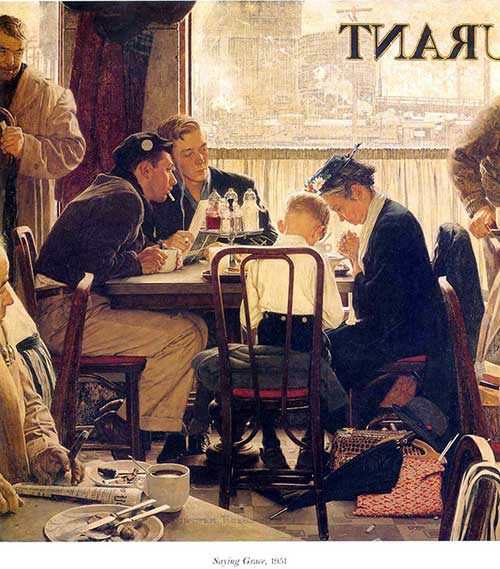
Saying Grace is perhaps my grandfather’s most beloved painting. He painted it in 1951 for the Thanksgiving cover of The Saturday Evening Post. A woman in Philadelphia wrote him about seeing a Mennonite family saying grace in an automat. The image really expresses my grandfather’s attitude — curious, respectful, and accepting but also suggesting that that kind of religion is something of the past. He placed the scene in a shabby railroad restaurant instead of an automat — my grandfather loved the romance of train stations, transition points of many hellos and goodbyes, arrivals and departures, a story in each.
The myriad and clarity of detail in the painting is a wonder and each one is carefully chosen. There is a quiet order in the midst of chaos: the variety of baggage, each person with a different coat and hat — a unique visual identity — the tableware, the cups of coffee. The newspaper in the lower left-hand corner grounds the painting with a sense of time marching forward, just as the background outside the window speaks of the industrial progress that keeps driving forward. Yet the carpetbag beside the old woman speaks of a very different time, the umbrella indicates impending rain explaining the slightly gloomy overcast light that Pop chose. He could have made it a sunny day with a tree and a nice neighborhood outside the window. Instead there is a deeper, silent meaning to this image, which I think can be missed.
The focus of the painting is the boy — a symbol of the innocence and purity of childhood — in the middle of the crushed cigarettes and the debris on the floor, and all the older men who have wised up to life or rather, by their world-weary faces, it seems life has schooled them the way life often does. The boy is the only one with his jacket off. The white shirt draws the viewer’s attention to him. My grandfather understood the beauty and vulnerability of the nape of a child’s neck as any parent certainly does. The old woman is the symbol of a bygone era. Her white scarf ties the two together visually just as their aligned body language does; the boy leans toward her and their faith. Their clothing is out-of-date. Pop bounces light off of the evenly placed fork and knife at the bottom of the picture and that reflection leads the eye once again to the boy and the old woman. The various stares also draw the focus towards them. His cut-off signature playfully mirrors and balances the cut-off “restaurant” sign in the window.
“The people around them were staring, some surprised, some puzzled, some remembering their own lost childhood, but all respectful. If you actually saw such a scene in a railroad station, some of the people staring at the old woman and the boy would have been respectful, some indifferent (probably a majority), some insulting and rude, and perhaps a few would have been angry. But I didn’t see it that way. I just naturally made the people respectful. The picture is not absolutely true to life; it’s not a photograph of an actual scene but the scene as I saw it.” —Norman Rockwell in My Life as an Illustrator
The man posing with the cigarette was Don Winslow, who studied with Pop at the art school my grandfather organized one summer in Vermont. Winslow remained in Vermont afterwards, living in the one-room schoolhouse on the green and acting sometimes as Pop’s assistant. He was talented but troubled. The man next to him is my Uncle Jarvis. Gene Pelham, one of Pop’s photographic assistants, is the man with the paper and cigar.
My grandfather’s favorite poem really says all you need to know about his faith:
Abou Ben Adhem by Leigh Hunt
Abou Ben Adhem (may his tribe increase!)
Awoke one night from a deep dream of peace,
And saw — within the moonlight in his room,
Making it rich, and like a lily in bloom—
An angel writing in a book of gold.
Exceeding peace had made Ben Adhem bold,
And to the presence in the room he said,
‘What writest thou?’ — The vision raised its head,
And with a look made of all sweet accord,
Answered, ‘The names of those who love the Lord.’
‘And is mine one?’ said Abou. ‘Nay, not so,’
Replied the angel. Abou spoke more low,
But cheerly still; and said, ‘I pray thee, then,
Write me as one that loves his fellow men.’
The angel wrote, and vanished. The next night
It came again with a great wakening light,
And showed the names whom love of God had blest,
And lo! Ben Adhem’s name led all the rest.
Perhaps we can all take a cue from my grandfather — it is far more important to respect someone else’s faith than to judge and condemn them for it. Goodwill toward one another is the compass he followed.
Blessings,
Abigail
P.S. It is interesting to note that when the painting was reproduced on the SEP cover, significant portions of the painting were cut off — the faces of the two men on the left and the “U” of the “restaurant” sign in the window in addition to more details on the right were left out. The color was also changed from a sepia-toned theme to a brighter tone with more blue in it. Pop used to complain about this — his work would sometimes be noticeably changed from the original. I believe the fact that his work was seen in reproductions and not in the original form for so many years is one of the main reasons my grandfather’s work was undervalued for so long. The reproductions simply don’t come close to capturing the clarity of detail, technique and color tone.
Cowpoke Covers
Our cover artists saddle up to capture the elusive cowpoke of the Wild West. Whether you played rodeo as a child or are a real-life bronco rider, this week’s cover collection is sure to please.
A good cowboy is a resourceful cowboy. And a good horse knows when to stand still.
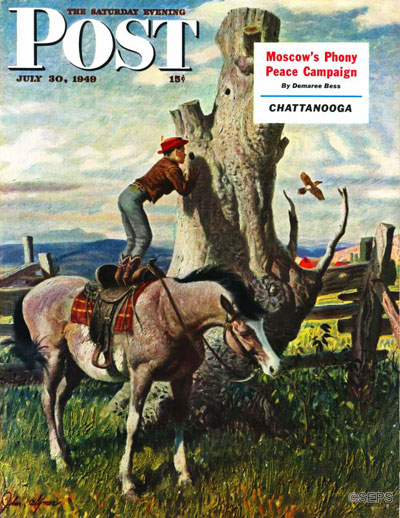
July 30, 1949
Saddle up, partner! This cowgirl looks like she can hold her own.
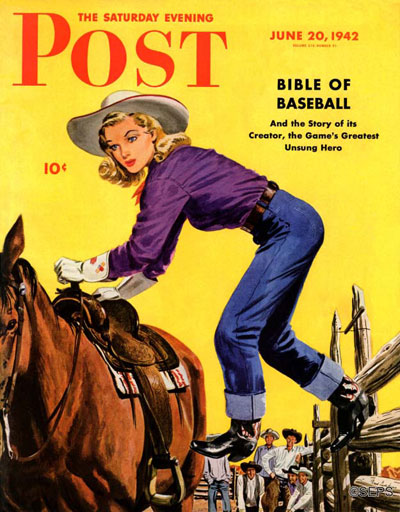
June 20, 1942
These three little gunslingers may be the fastest hands in the neighborhood, but any make-believe cowboy worth his weight in cap guns knows that true grit is determined by how long you can play dead without opening an eye.
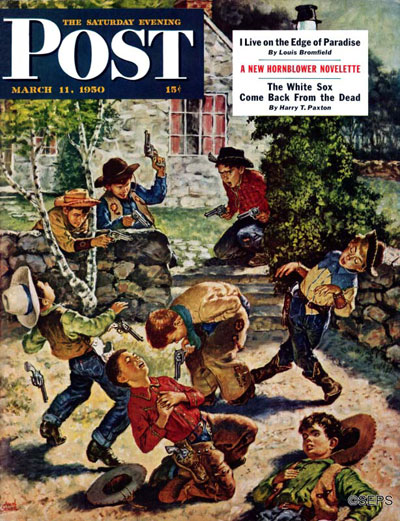
March 11, 1950
Lights, camera, action! To play a cowboy, not only is it important to act the part, you have to look it, too. Bring on the lipstick.
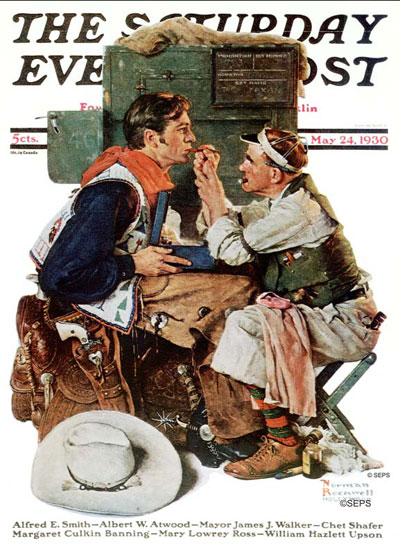
May 24, 1930
Who doesn’t adore a good old-fashioned cowboy? Clearly, this cowpoke knows his duds will never go out of style.
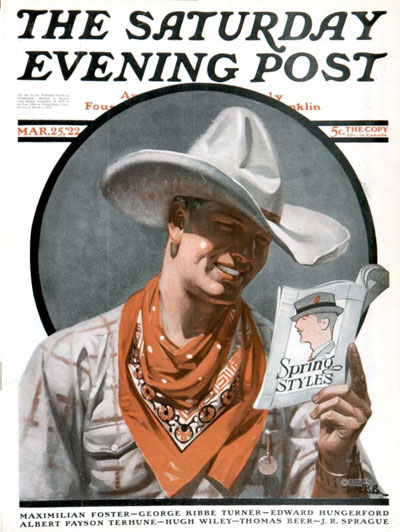
March 25, 1922
Working hard or hardly working? Judging by that pool of water and the boy’s flushed face, we’re going with the former.
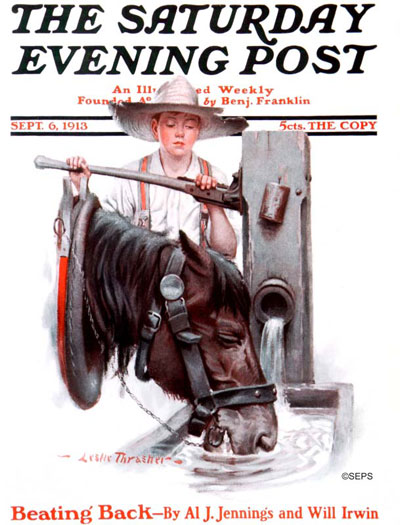
September 6, 1913
That little cowboy must taste as sweet as he looks — prior to the tears, of course.
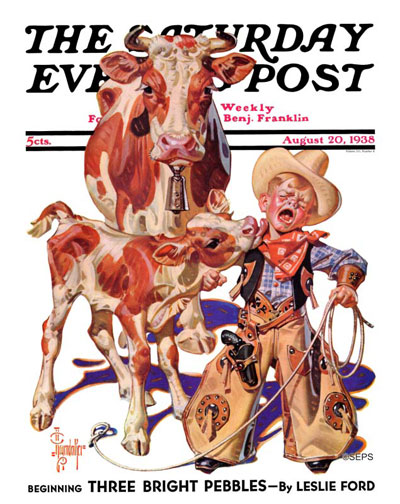
August 20, 1938
ck out the September/October 2015 issue for a look at works of Howard Terpning, one of the today’s masters of Western art.
Inside Job
Though most well-known for Post covers, Norman Rockwell also created dozens of memorable short-story illustrations, including this touching scene for “The Handkerchiefs” by author Dorothy Thomas in The Saturday Evening Post on May 11, 1940. In the tale, a young girl finds a lace handkerchief with initials that lead her to its owner, a wealthy elderly woman who shares her memory of lost love.
Rockwell skillfully orchestrates the composition by placing the table at top, models at center, and the white hat at bottom. The effect is to create a diagonal line that leads the eye to the two main characters. And the handkerchief? You won’t find one. The artist offers no obvious clues as to what the story is about, relying on the power of the image to ignite imaginations and emotions. “Many illustrators of fiction look through a story to find the most dominant or dramatic incident and illustrate that,” Rockwell said. “I prefer to discover the atmosphere of a story — the feeling behind it — and then to express this basic quality.”
Young Valedictorian
I recently was going through our family computer files and found this arresting painting of a little girl that my grandfather did circa 1922 that I had never seen before. It took my breath away. I couldn’t find this image in Norman Rockwell: A Definitive Catalogue by Laurie Norton Moffatt. I posted it on my Facebook page on January 1, 2015, not knowing its title, date, or story. From those who commented, I found out that it is titled Young Valedictorian and was most likely painted for the remarkable Edison Mazda series (1920–1927). I believe it was rejected by Edison Mazda, a division of General Electric, because it does not show the source of the ethereal and dramatic light. It illuminates the little girl in such a way that it recalls Rembrandt, one of my grandfather’s guiding beacons.
It reveals a young girl at her graduation — an initiation, a passage — a Holy Communion of sorts. The elders behind her appear somewhat pleased but are not quite present, a bit distracted. She, on the other hand, is very much present and standing in her newfound power, on the cusp of the next unknown chapter in her life. She stands at the edge of the stage. She holds the symbol of her knowledge in her hands, but she is much more than her diploma. My grandfather painted this around the time that women won the right to vote. She seems to stand for this new, exciting chapter in every girl’s and woman’s life. Note the extraordinary care Rockwell took with the individual ruffles in her dress, the diffused light on her face, the glorious light shining down on her expansive bow, turning it into a crown … the light gently hitting the top of the globe beside her. The world of possibility is hers.
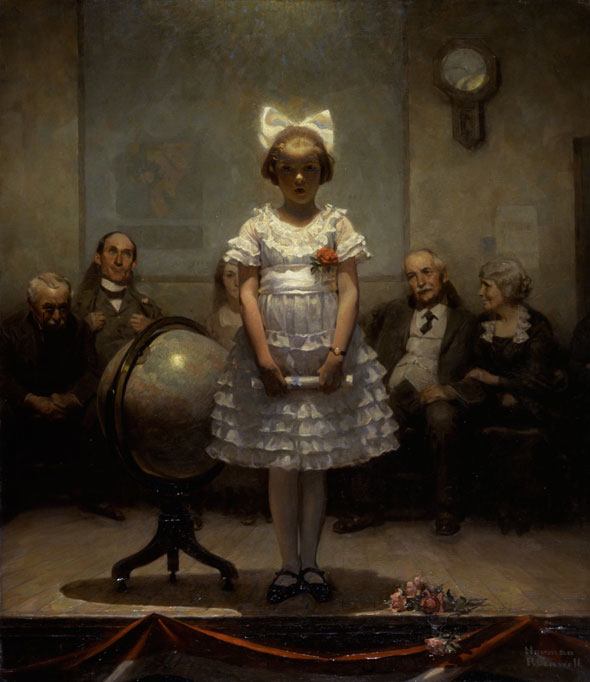
National Museum of American Illustration collection.
© Norman Rockwell Family Agency. All rights reserved.
This painting is on display at the National Museum of American Illustration, run by Judy and Lawrence Cutler, a wonderful museum in one those classic mansions from another era in Newport, Rhode Island. You will find Parrish, Leyendecker, Rockwell, Pyle, among others there. I spoke with Ms. Cutler in my quest to find out more about the mysterious painting. It may be titled Young Valedictorian, but my grandfather never titled his paintings, the titles came later, thought up by editors, etc. It is one of the few works of Rockwell’s to apparently remain unpublished; that is why it is so unknown. A spring drive down to Rhode Island may be in order.
Warmest wishes. As always.
Abigail
‘Red Head’ by Norman Rockwell
Every day is Mother’s Day. None of us would be here without them!
For some of us whose mothers are no longer here, it is a wistful time. Yet, they are still with us. She is there in the daffodils and crocuses she planted years ago that rise out of the ground every year to welcome the spring. Your mother is there in the music you shared — perhaps that special song she sang just for you at bedtime. They will always be here, part of the fabric of our beings and lives. Even the mothers who were not able to be present and available to their children because of difficulties — they play a part in forming you, teaching you to seek out what is missing and go on a journey to find it, no matter what.
I stumbled upon this striking painting of my grandfather’s a few weeks ago. I chose this image specifically for Mother’s Day because it is not remotely sentimental — something my grandfather is frequently accused of being. It is simply a masterfully executed illustration of maternal care. It’s entitled Red Head — an illustration for a story of the same name by Brooke Hanlon that appeared in American Magazine in November 1940:
“No doubt Linda had meant to hold young Tim gingerly, fearfully, but that sort of holding was never part of young Tim’s plans …”
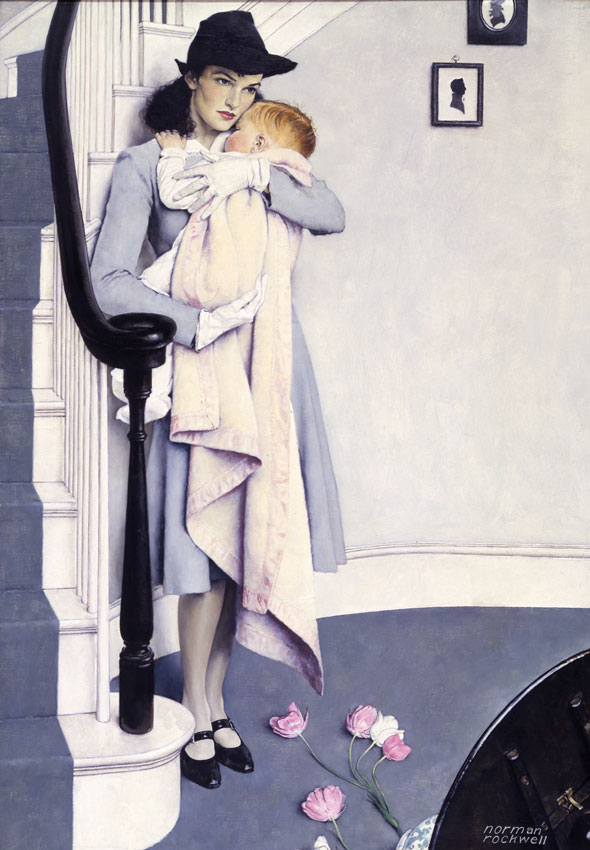
Story illustration for American Magazine, November 1940.
Oil on canvas, 37 1/8″ x 26″.
National Museum of American Illustration collection.
© Norman Rockwell Family Agency. All rights reserved.
Red Head is a stunning study of black, white, and gray tones — gradations of gray — with the only flashes of color being the bright pink of the tulips on the floor, the delicate red of the boy’s hair, the blush tone of the blanket and the deep rose of her lips. There is a coldness to the palette.
The woman, quite rigid, is softened by the little boy in her arms and the awakening of her innate need to protect and nurture him. The choice of hat is fascinating — a fedora that is almost masculine, yet there’s something elfin in its shape. It reminds me of a hat Garbo once wore in a film. It adds to the guarded quality about her. The profile of the hat reflects the silhouettes of the cameo portraits on the wall. Cameos reveal just so much, only a profile, mirroring her somewhat masked emotional state. The magic of the painting is that it is static but very much alive — this is a turning point in this woman’s life, a softening, a shift. The overturned table and scattered flowers illuminate this. The empty stairs reaching upward with the swirling banister indicate movement, rising above the circumstances below.
Norman Rockwell would try out new techniques throughout his career — to stay current, to try to avoid his paintings registering as outdated. Al Parker, known as the Dean of Illustrators, led a new wave of illustrators in the 1930s, including Coby Whitmore and Jon Whitcomb. My grandfather employed some of the techniques from this school — the stark contrast of colors, the pronounced use of white and pastels — to try to keep up with the young upstarts! I personally love the wedding of opposites in the painting, the starkness married with the awakening tenderness — moving beyond the tumbled past into something with promise and possibility.
Warmest wishes and gratitude to all moms,
Abigail
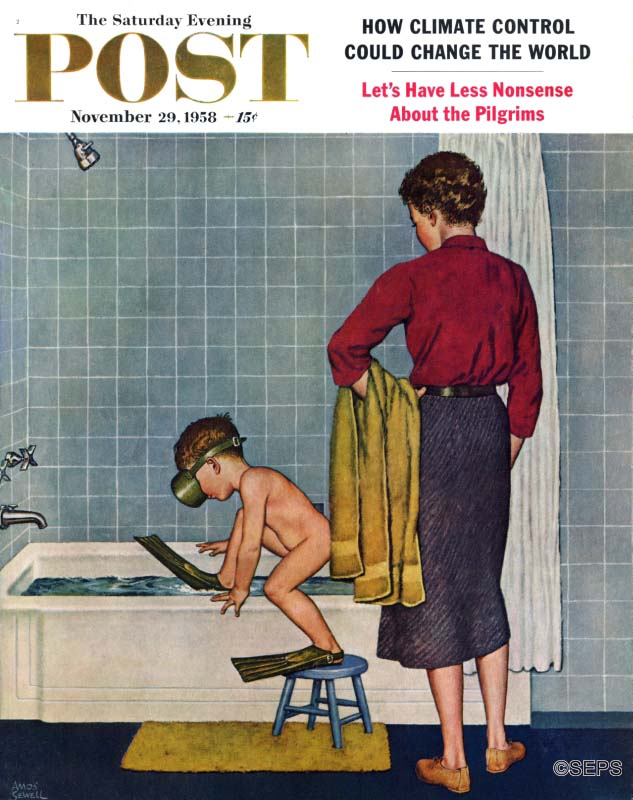
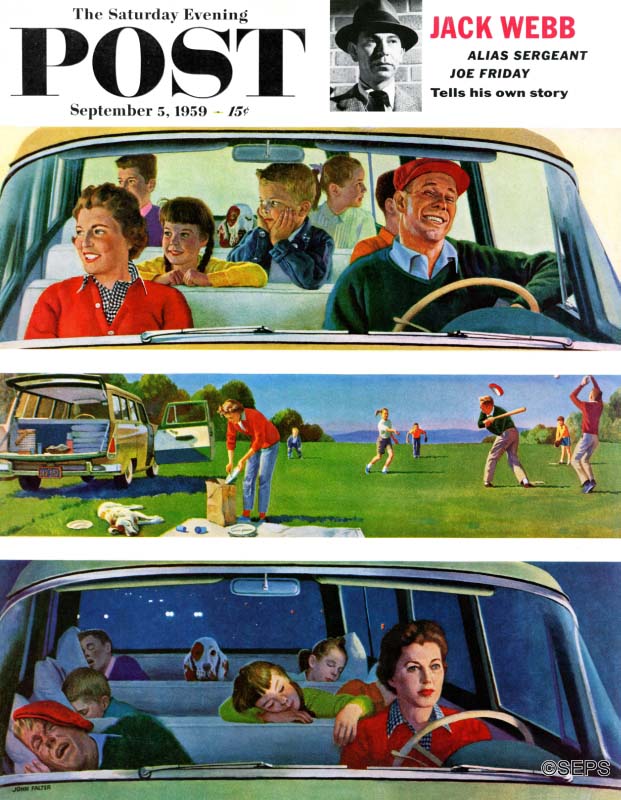
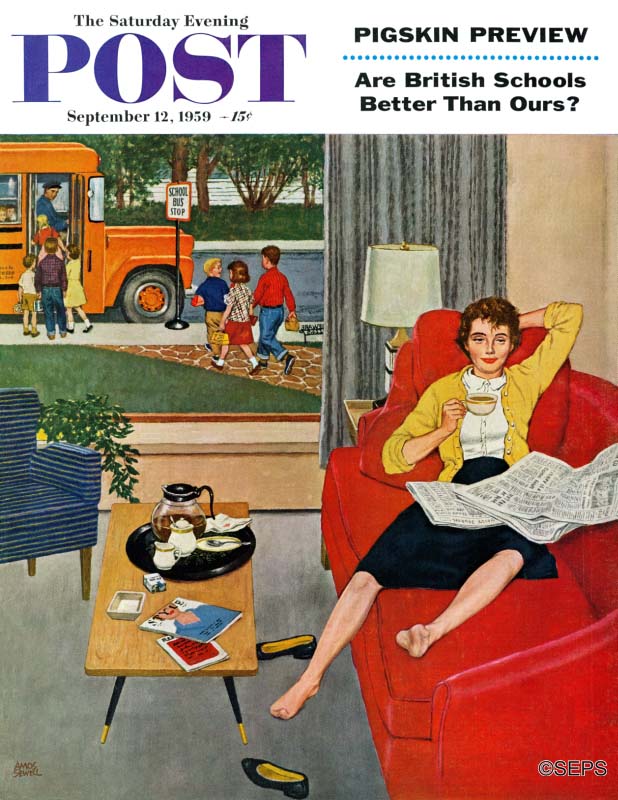
Mother’s Day
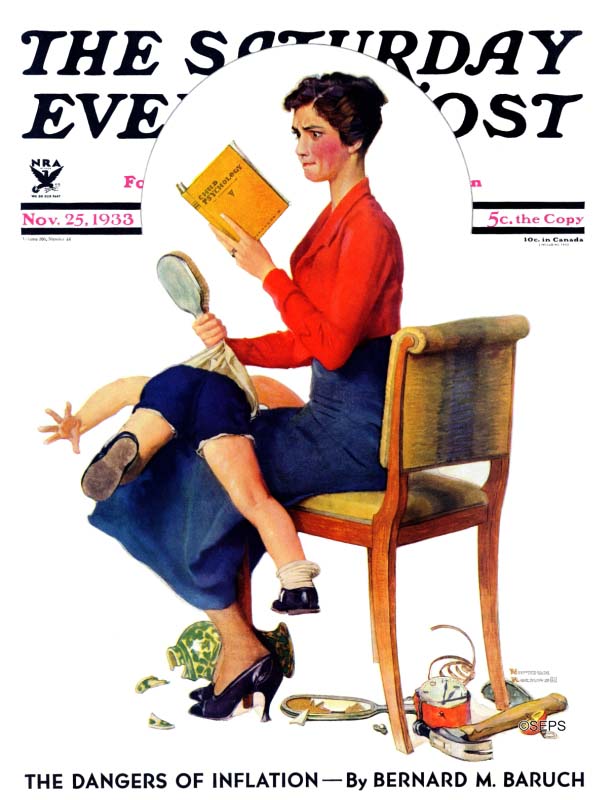
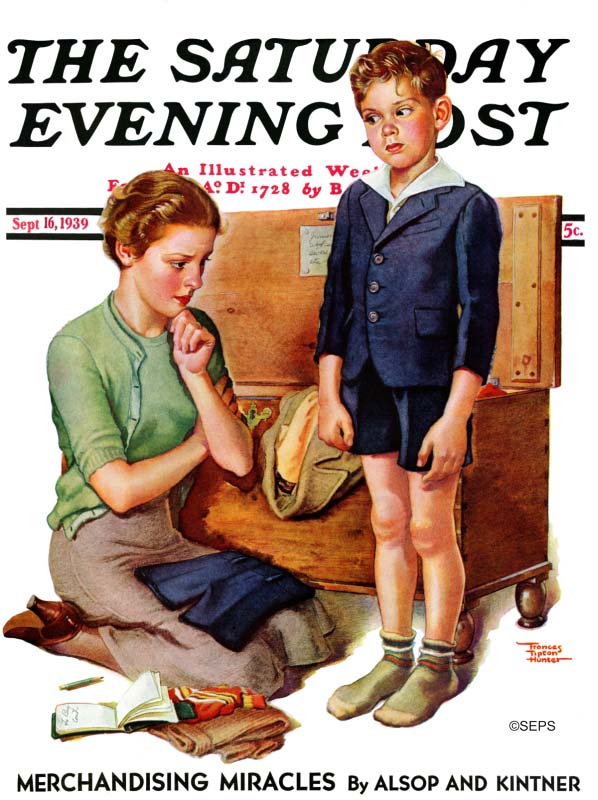
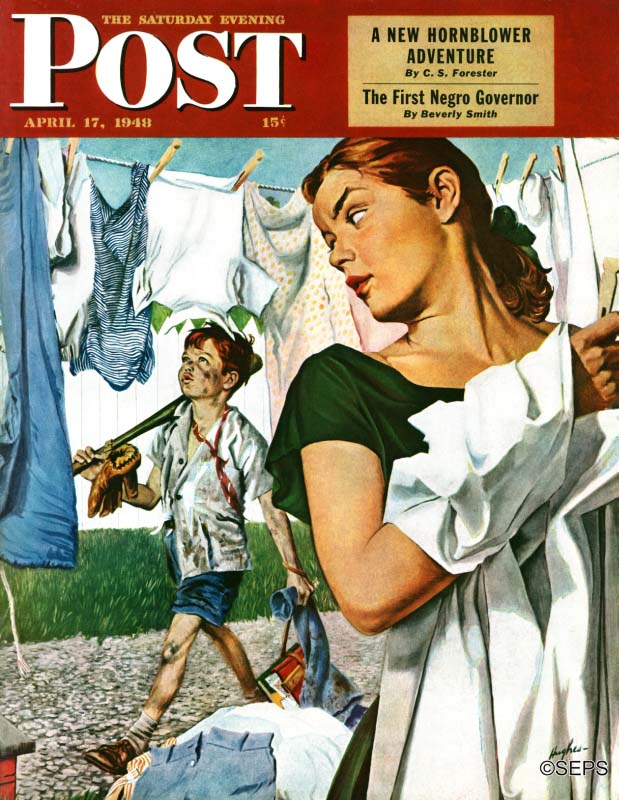
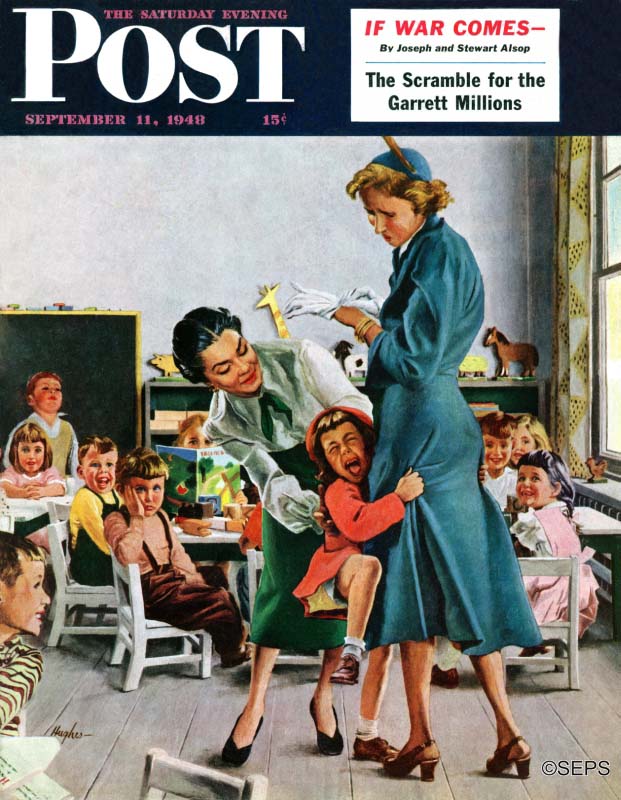
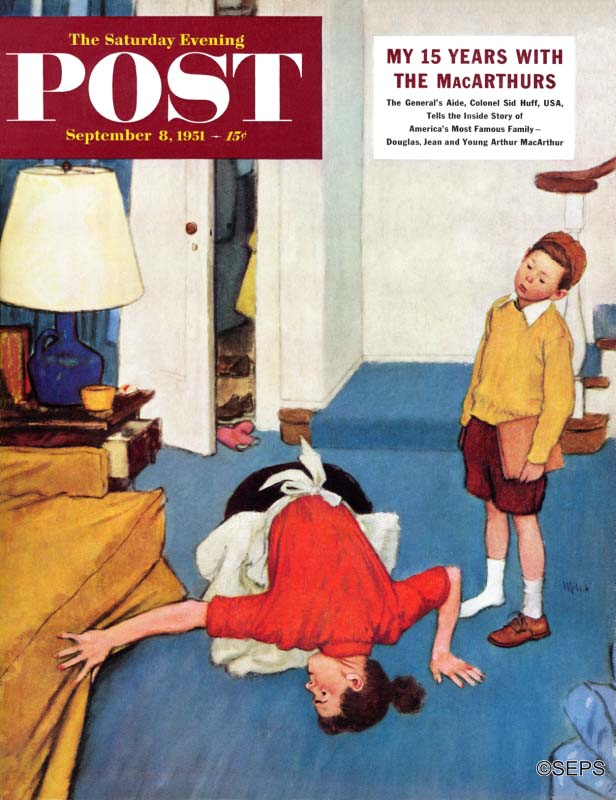
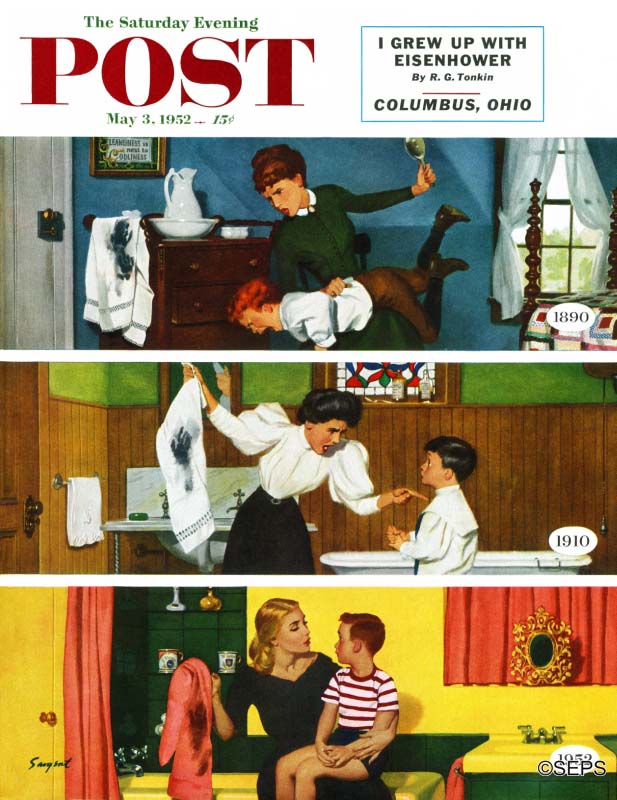
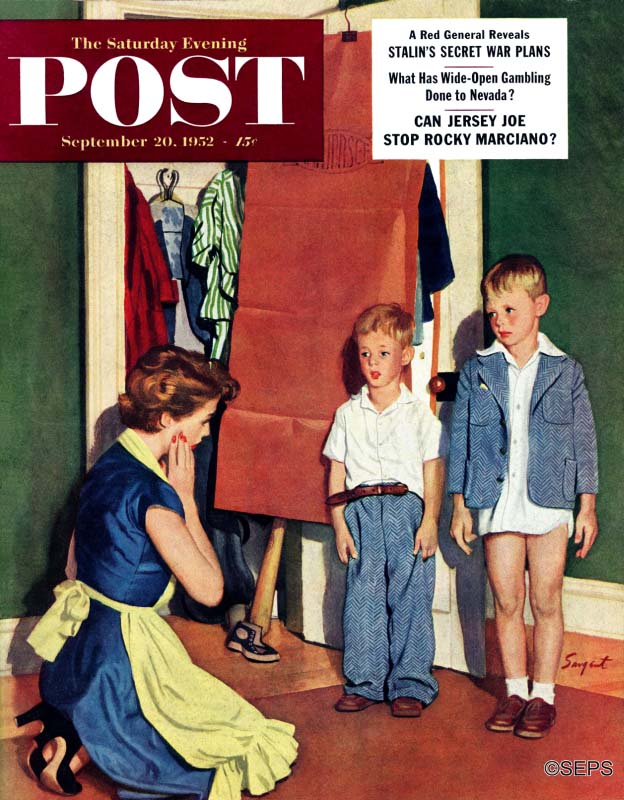
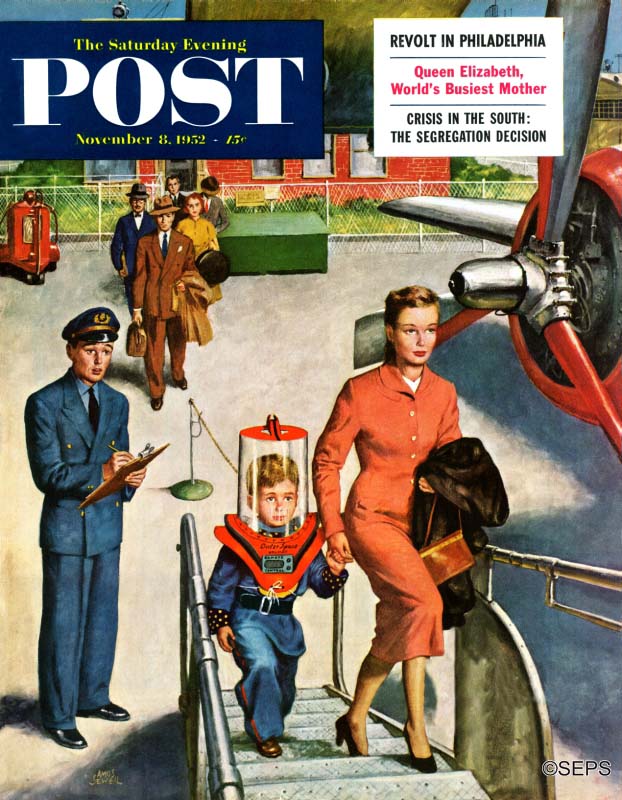
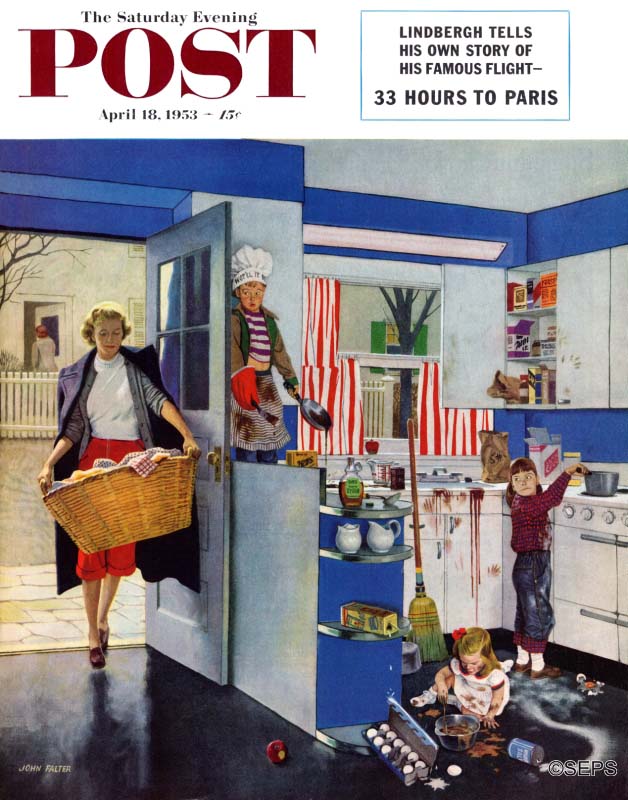
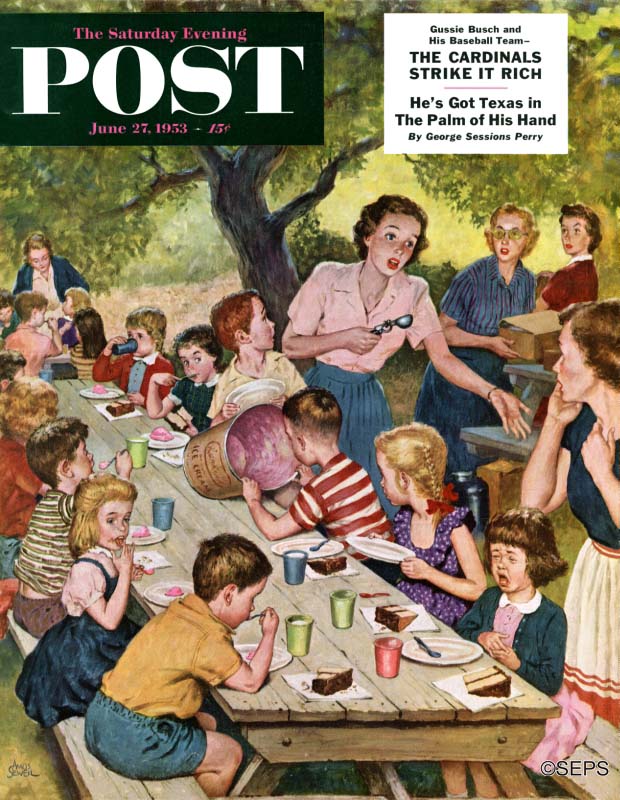
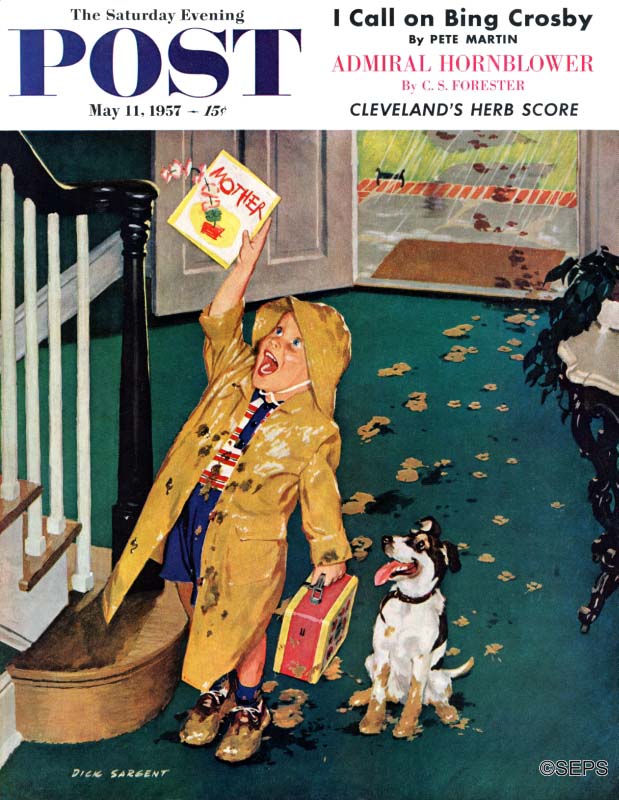
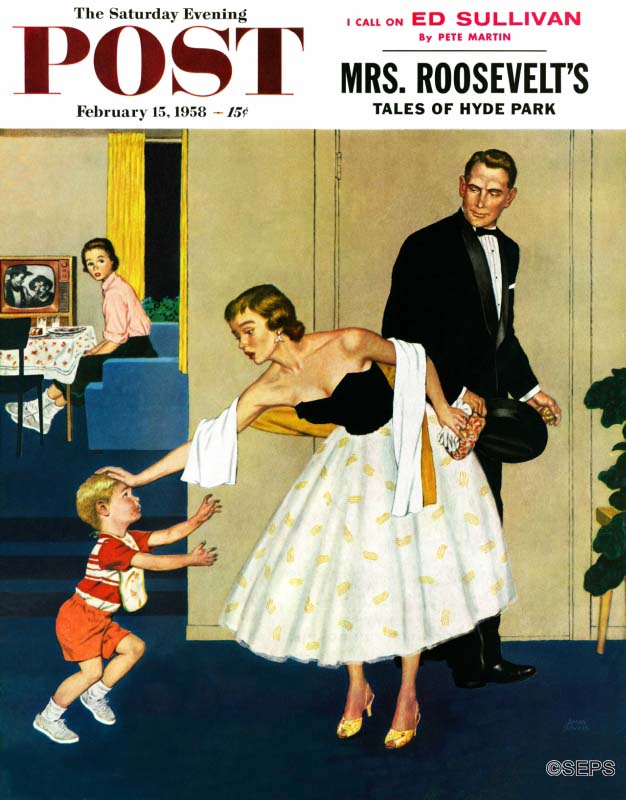
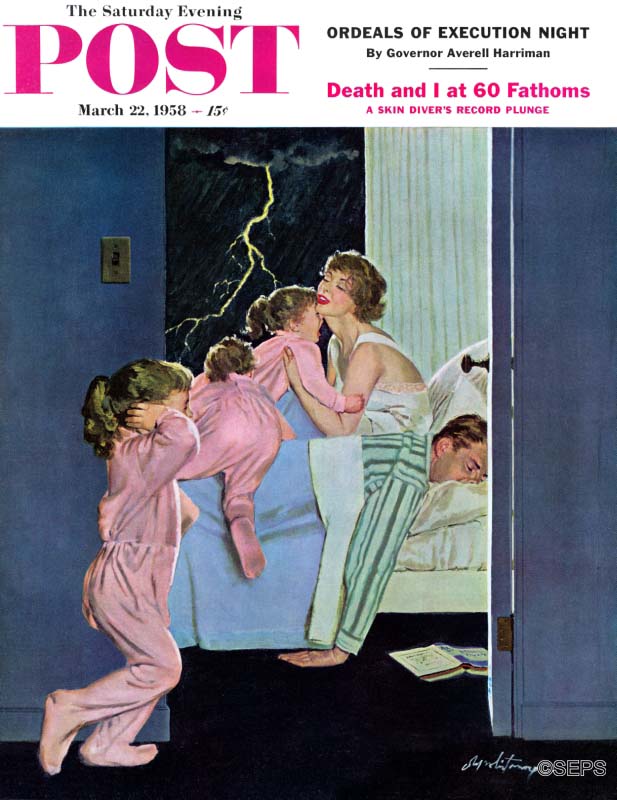
Moments with mom have taken center stage on The Saturday Evening Post cover throughout the 20th century. Norman Rockwell, Richard Sargent, George Hughes, Amos Sewell, and others have shown the special, sometimes challenging, and often humorous roles that moms play. As a salute to mothers everywhere, we present this look at moms on the covers of The Saturday Evening Post.
Celebrating Mom on the covers of The Saturday Evening Post (click on the covers to see larger image):


A Norman Rockwell Myth Debunked
Oh, Pop. My grandfather is 100 percent responsible for this myth — that he couldn’t draw a sexy woman. He said it many times: “I can’t draw a pretty girl, no matter how much I try. I’m afraid that they all look like old men!” One day my father Thomas, his middle son, asked Pop what he meant, and my grandfather explained that he couldn’t draw bodacious, sexy pin-up girls like Vargas and Petty, or even ideally beautiful women like his friend and fellow Post illustrator Coles Phillips, known for his “fadeaway girl.” (Norman Rockwell loved faces with true character in them — either young faces untouched by artifice or guile, or old faces with inerasable histories etched into them; every wrinkle, a story.)
But even a cursory look at Rockwell’s body of work instantly proves my grandfather wrong — he painted pretty, even sexy, women of all ages. Most surprising, I discovered that Pop had a remarkable skill in painting the beauty and allure of women’s legs, particularly the delicate ankles.
One of my favorite examples of Pop’s most seductive females is the woman in this painting (above). Her stance is like a panther about to pounce. We see mostly her back — a psychologically expressive landscape. This is a woman who will do anything to get her way and takes no prisoners. Classic femme fatale. It’s an illustration for the story “Strictly a Sharpshooter,” by D.D. Beauchamp, who later became a Hollywood screenwriter.
The atmosphere and feeling of the painting is very film noir — the gloomy tones, the smoke, the beleaguered boxer, the tough guy in a fedora with a cigar hanging from his mouth. And, of course, the “dame”: “The dame was an ex-stripper in a cheap burlesque, and she was strictly a sharpshooter. She liked fur coats and champagne, and you didn’t buy those things on the kind of dough you made out of club fights.” Pop’s art always stayed close to the details of a story.
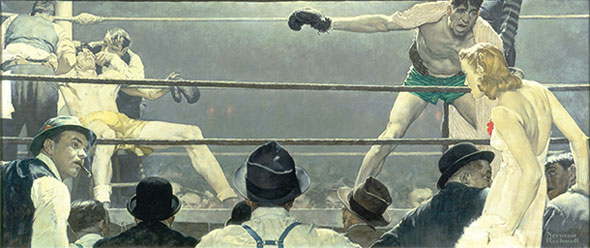
Story illustration for American Magazine, June 1941.
Oil on canvas, 30” x 71”. Norman Rockwell Museum Collections.
© Norman Rockwell Family Agency. All rights reserved.
My grandfather went to a Columbus Circle boxing club to soak up the atmosphere, get a taste and feel for what the ring was really like. He probably used George Bellows’ painting Dempsey and Firpo (1924) as inspiration. Bellows, part of the Ash Can School of artists, was known for his amateur boxing scenes — stark contrast of colors — visceral — muscular — edge and grit. Both Bellows’ and Rockwell’s paintings are done horizontally — the ropes are an important visual that create tension and a sense of imprisonment. Both paintings are dramatically expressive, in the moment. They hint at the light above and play with chiaroscuro, but Bellows’ contrast is more pronounced. Pop’s one error, in my opinion, was comically exaggerating the expression of the boxer. It takes away from the power of the painting. But Rockwell’s also has a marvelous study of fedoras — each one its own character.
Elizabeth (aka Toby) Schaeffer, the wife of one of Pop’s best illustrator friends, Mead Schaeffer, posed as the sexy “sharpshooter.” Gene Pelham, Pop’s photographer in Arlington, Vermont, posed as the tough guy looking at her in disbelief.
When the illustration appeared in American Magazine, June 1941, the bold caption underneath read: “The crowd expected to see a hard-hitting youngster spar with a punch-drunk bum. Instead they saw the battle of the ages — a blue-eyed blonde as the stake.”
So why did my grandfather misstate his skill? My grandfather’s humility was very real, and at times his lack of confidence could be crippling. Perhaps if he sold himself short first, he would beat others to the punch.
Warm wishes as always,
Abigail
———
Strictly a Sharpshooter is part of “American Chronicles: The Art of Norman Rockwell,” currently on view at Tampa Museum of Art, Florida. The painting will return to the Norman Rockwell Museum in the summer.
Happy April Fools’ Day!
Happy April 1!
Norman Rockwell
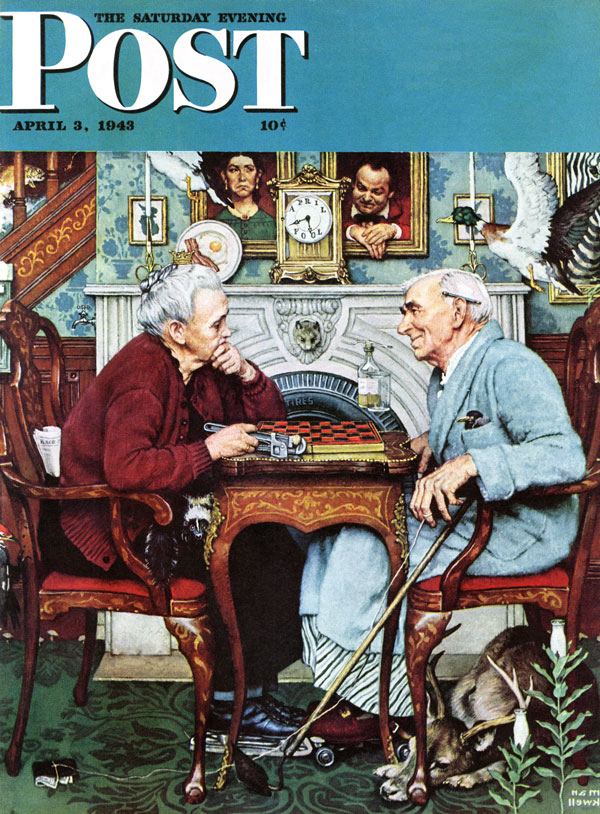
April 3, 1943
Checkers (aka April Fool, 1943) was Norman Rockwell’s first April Fools’ cover — an older couple in a world filled with silly, nonsensical errors. The Saturday Evening Post published it on April 3, 1943. It was my favorite painting of Pop’s when I was growing up. It is such fun to puzzle out. But not only that. My grandfather did something very original — an April Fools’ cover with all the fun mistakes to find, and he painted it with no less mastery than any other painting. I can’t think of another painting like it. He didn’t give it short shrift because it was a “joke.” That’s what makes it particularly special. He creates a whole new world in this painting, one I think many of us would welcome. Everything is turned upside down — a deer instead of a dog underneath the chair, the cane is a hoe, a carved rat’s head on the mantel, a skunk instead of a cat on the lap of the woman, time has even been altered — a fantastical place to escape to.
It’s no surprise that Pop would choose to create this fun painting after the tedious toil of almost seven months to complete the Four Freedoms. I mentioned this in my recent post on Freedom of Speech. He focused so diligently on getting everything right in the Four Freedoms that his impulse was to balance the serious work with the hilarity of an April Fools’ cover. It’s a perfect example of how my grandfather dealt with difficulties. Humor and fun. And always with a good joke — Pop used to say, “He who laughs last lays the golden egg!”
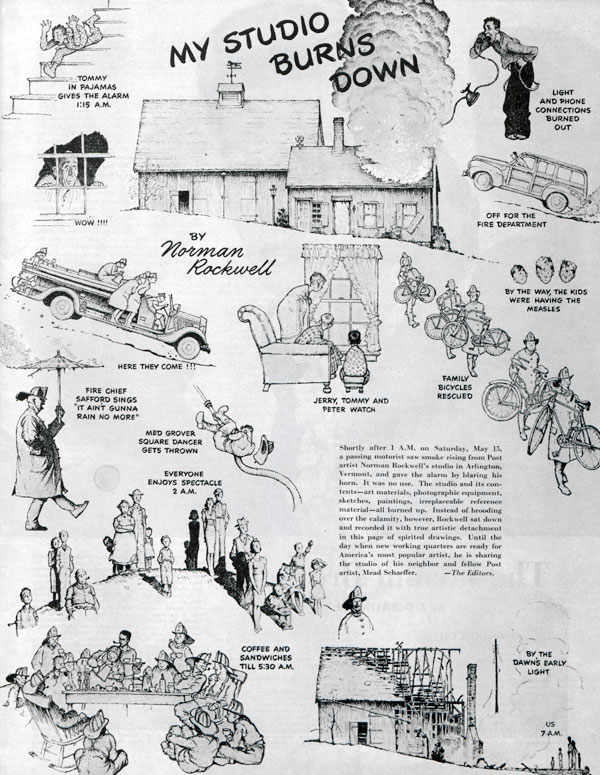
Unfortunately, though, a month later on May 15, my grandfather’s studio burned down. In it were his favorite paintings that he’d been carefully collecting through the years: his large collection of costumes, all the souvenirs and mementos from his travels around the world, his favorite brushes, art books (“all my brains,” he told his friend Clyde Forsythe in a letter describing the loss of the books). Almost his whole world. He had absentmindedly left his pipe near the window seat in his studio. My father, Thomas, was the first to see the fire. He was awakened by the brilliant orange light reflected in his bedroom and the thunder of the studio engulfed in flames. Frightened, Dad ran downstairs and woke the housekeeper and her husband. The telephone wires were burned out so Pop had to get the car and drive to the neighbors’, the Squires, up the one lane dirt road to call the Fire Department.
Almost immediately after the fire, Pop and my grandmother Mary decided to move. They felt the house was too isolated — the nearest neighbors were a mile away. But this is how NR dealt with adverse circumstances — he faced them squarely. I think emotionally it was easier for him to begin all over again, start anew. This is the feeling in many of his paintings — take a difficult situation and find a way, through humor and grace, to move through it and past it.
Norman Rockwell
July 17, 1943
Note NR’s humorous, practically celebratory, page of drawings about the fire — My Studio Burns Down. Its reads almost like a cartoon. My grandfather worked through his darkest moments in his art. He does end the series of drawings with a poignant moment: the family, all alone, looking at the smoldering ruins in the early morning. The scale of the family compared to the scale of the studio says it all. They are very small in the face of the ruins before them.
Warmly,
Abigail
P.S. Our hearts are with all the families and loved ones of those lost in the tragedy of the Germanwings Flight 9525. In the face of deep despair all we can do is come together as one and mourn and comfort each other. Infinite blessings to those souls that departed too soon.
Toy Story
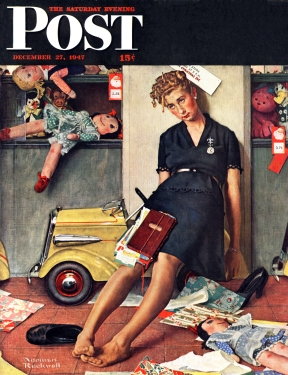
Christmas rush is over. The foot-weary toy department salesgirl has slumped down the wall and into the seat of a toy car — the face of exhaustion. Shoes off and toes seeking relief, she survived another holiday season. Judging by the bulging book in her lap, sales were brisk. Though surrounded by chaos — toys gawking at her from every angle and wrapping paper on the floor — she has momentarily left the building perhaps thinking of her own kids and Christmas nearby.
Santa’s Helper, which graced the issue of the Post on December 27, 1947, is pure Norman Rockwell — visual storytelling at his best. “For me, the story is the first thing and the last thing,” Rockwell once said.
Rockwell began work on this cover during a hot mid-summer in Chicago. Like a movie director, he framed the story around a central idea, chose the models, the settings, the costumes, the props, and directed the pose, even the facial expression. He set the scene in the actual toy department at the big Marshall Field store — then the Grande Dame of American department stores. Marshall Field obligingly supplied him with all manner of toys and props, but as the artist worked he felt he needed more dolls, so went out and bought them himself. A perfectionist, Rockwell was not satisfied with the salesgirl first picked as the model, so for weeks he visited other stores, peering at the help, looking for just the right face. And he found it in the person of Sophie Aumand — a waitress from Springfield, Massachusetts.
And with that final ingredient in place, Rockwell was ready to render the final painting, in the process creating an enduring image of Christmas every American — even today’s frenzied online shoppers — will understand.
Merry Christmas and Happy Holidays to All!
Norman Rockwell
The Saturday Evening Post
December 25, 1948
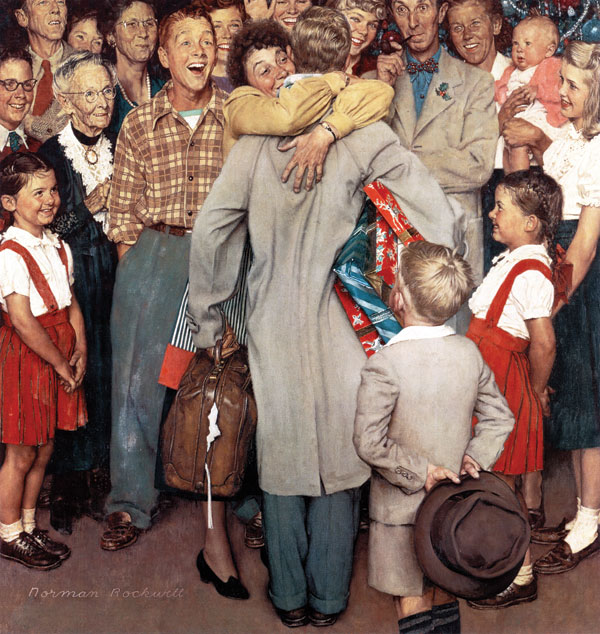
My family spent every Thanksgiving and Christmas at Pop and Molly’s. Those are magical memories for me — my experience of those times was something straight out of one of my grandfather Norman Rockwell’s paintings. We would take the snowy drive up the Taconic to Stockbridge. Pop’s house, especially around the holidays, was its own universe, a place where I felt totally safe and taken care of. The grandchildren had full run of the house, and we would hide in the closets among the musty coats or stage plays in the main hall, explore the attic, have our Canada Dry Ginger Ale and the exotic macadamia nuts that someone sent my grandfather every year from Hawaii … The adults would have their cocktails in the library. And there would be Pop — in his comfortable red chair by the living room fireplace and the twinkling Christmas tree, the wonderful aroma of his pipe filling the air, a bourbon sour in his hand. The cook would call us into dinner at six as the grandfather clock in the front hallway chimed. And we would be greeted by fresh, warm sticky buns (Pop’s favorite) and a wonderful turkey with all the trimmings or a roast beef with Yorkshire pudding (my favorite!).
I have heard people speak of the unrealistic, unattainable, idealistic picture of life in my grandfather’s paintings — “It’s not always as perfect as a Norman Rockwell painting …” Pop’s work isn’t about manifesting some sort of unachievable perfection. His work is about believing in the goodness of people. It’s about looking for that goodness in ourselves and others in the moments we spend with one another.
Instead of being haunted by the idea of perfection, why don’t we instead allow ourselves to be inspired by it — reveling in the possibility of it? It is that possibility that helps to propel us to evolve and grow — and to deepen and expand our vision of what can be.
It’s important to remember that even Norman Rockwell did not have a Norman Rockwell life — he had much the same troubles that we all do as we journey through this life. But he always, no matter what, affirmed life and upheld his vision of how he wanted it to be. And that’s a good template for us all.
Many blessings for a special holiday for each and every one of you and your families — even if your family is you and your dog, or you and a friend! It is the love that makes a family.
Warmly,
Abigail
Happy Thanksgiving to All!
Norman Rockwell
The Saturday Evening Post
March 6, 1943
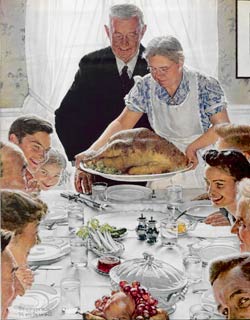
People have always loved my grandfather’s painting, Freedom from Want, which first appeared in The Saturday Evening Post — it’s been celebrated and even lampooned many times. It is a painting about connection and the celebration of that connection.
No one is looking at the turkey or the grandmother and grandfather, and no one is praying or giving thanks — it’s what I call the “happy error” of the painting. Norman Rockwell was all about faces and interactions; if he painted everyone looking down and praying or looking back toward the grandparents and the turkey, you wouldn’t be able to see any of their faces.
Everyone is connecting with someone — the woman on the left is my grandmother Mary, who is conversing with the attractive woman across the table. The old woman is my great-grandmother, Pop’s mother, and she’s looking at Mary. The two men are interacting in the middle of the table (you just can’t see the one man’s face). The grandparents have a lovely, quiet, unspoken connection — the grandfather is clearly there to support her if the turkey gets too heavy. The man looking out at us is there to bring us into the moment, to invite us in.
The act of setting the turkey on the table brings movement into the painting. You can almost hear the lively exchanges at the table. And who is at the other end of the table? I can almost feel Pop’s presence there.
Enjoy your time with your family. In the end, that is what holidays are about. It’s not about getting the turkey with all its trimmings just right, its not about creating the perfect tablescape. It’s about family coming together to celebrate the simplest things — love and gratitude.
Warmest wishes,
Abigail
P.S. Pop always felt he had made the turkey too big. He also used to joke that the turkey was the only model he ever ate!
Mary Whalen Leonard on Posing for ‘Shiner’
Norman Rockwell
The Saturday Evening Post
May 23, 1953
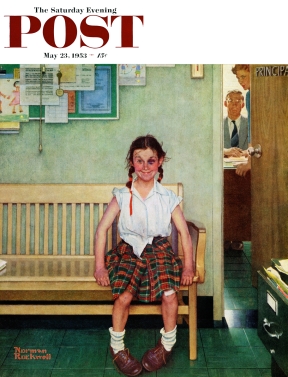
Sometimes in life you have to take a beating — literally or figuratively — to stand up for the truth, yourself, a loved one, or something you truly believe in. And it’s always worth the cost of that battle, as this girl’s triumphant smile, even with that shiner, celebrates.
Mary Whalen Leonard, Norman Rockwell’s favorite female model, who posed for Girl at Mirror, Day in the Life of a Girl, and others, speaks fondly of posing for my grandfather’s illustration Shiner (above):
“My recollection of working out this picture with Norman [above] is one of laughter and fun. He showed me the sketch and wondered what I thought about it. I got it. It was about role reversal. For once the little girl was victorious, and it did not matter that she had a black eye. That was the mark of the trophy!
“These posing sessions were filled with lots of Norman’s laughter as he knelt on the floor and pounded his fists to get the smile he wanted …”
Beyond the Canvas: Rockwell’s April Fools’ brings laughter in a serious time
Norman Rockwell once said, “I showed the America I knew and observed to others who might not have noticed.” Most of Rockwell’s covers are subtle opportunities to stop and look at the innocent, decent normalcy of American life. On three April Fools’ Days throughout the 1940s, Rockwell took a chance showing a surreal America no one knew, and he certainly made us notice.
After spending six months working on the serious Four Freedoms paintings, the ideas for which came from a speech by President Roosevelt, the April Fools’ covers were a welcome moment for Rockwell to take a step back from war and celebrate joyous laughter.
The covers turned seemingly innocent depictions of American life upside-down with hundreds of topsy-turvy injections of laughable absurdity. The first of the paintings appeared on April 3, 1943; the second on March 31, 1945; and the final April Fools’ Day cover on April 3, 1948. The scenes are simple Rockwell “Americana”: an elderly couple playing chess, a man fishing while leaning against a tree, and a girl shopping for a doll – all comically, nonsensically twisted.
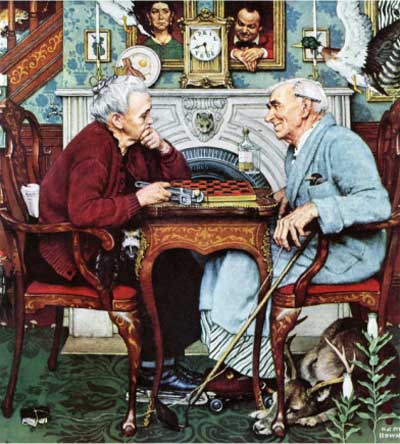
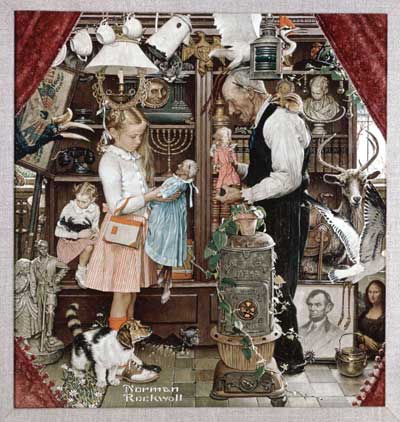
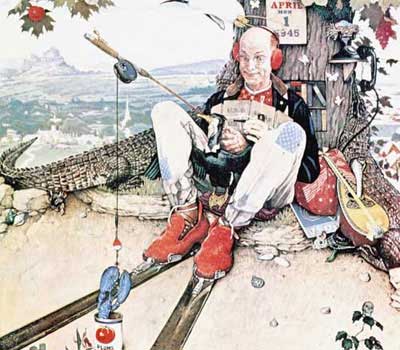
American sensibilities had become more serious with the onset of World War II. Rockwell’s former models – children at play, in a store, at the doctor’s office – had grown into young men and women who were asked to serve their country. Although Rockwell would later return to paintings of children, everyday lives were turned upside-down by this new reality. Small-town simplicity had been traded for the construction of war machines, rations and collected supplies, and various means of an entire nation aiding the war effort.
Seeing the April Fools’ covers from the newsstand, or as they arrived in the mail, provided just as much fun for the viewership as Rockwell had taken in designing the illustrations. People could find each and every absurdity on their own or with a group, pointing out the various April Fools’ Day quirks and gaffes. They worked well as clever talking points to bring individuals, families, communities, and the nation together, coaxing them to pause, to put aside the feelings of seriousness and frustration that consumed the country.
The covers worked so well that by the time the third was published, finding the jokes in Rockwell’s April Fools’ Day art became an exciting game Post readers eagerly awaited. To this day, these three covers mesmerize viewers and bring a quick bout of laughter. See how many April Fools’ jokes you can spot and check your answers in the image below!
See answers to all of Rockwell’s April Fools’ covers here.
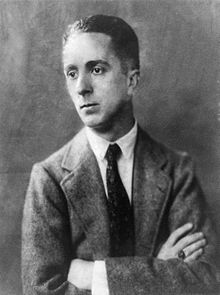
Sotheby’s to Auction Three Norman Rockwell Masterpieces
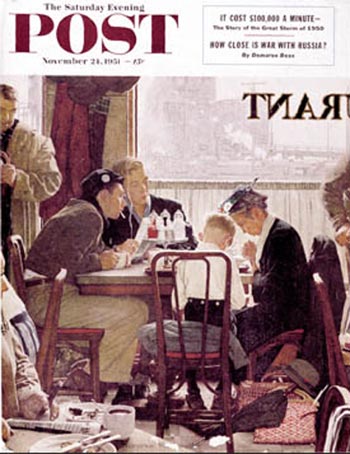
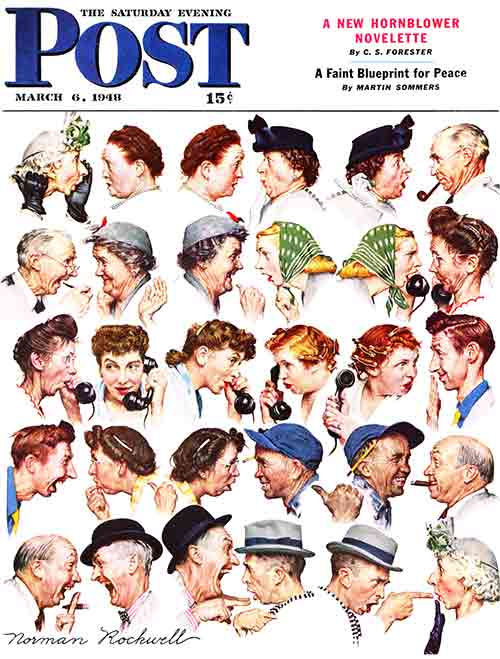
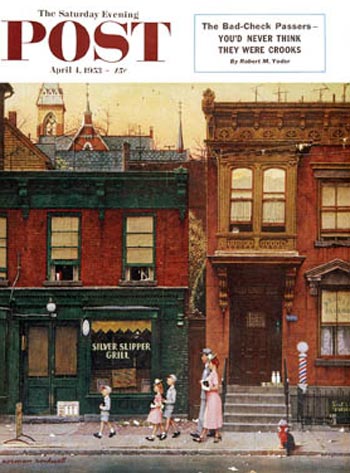
Three paintings by Norman Rockwell, iconic American painter and former cover artist for The Saturday Evening Post are scheduled for auction at Sotheby’s New York. The sale of these paintings: “Saying Grace,” Nov 24, 1915; “The Gossips,” March 6, 1948; “Walking to Church,” April 4, 1953, will, no doubt, raise the price paid for a Rockwell original to a new, unbelievable level.
But look through a list of the 50 most expensive paintings and you won’t find the name of Norman Rockwell. His works can’t hope to bring in the $100 million prices that collectors have paid for works by Picasso and Van Gogh. For decades, art galleries were dominated by modernist, abstract, and experimental painting. There was little appreciation for paintings that were as understandable and affecting as Rockwell’s. It didn’t help his critical reputation that he was enjoyed by millions of Americans who heartily disliked “modern art.”
In time, though, the critics started to re-evaluate Rockwell. They began to appreciate how much work he put into creating his narrative scenes, choosing the right models, acting out the scene for them–sometimes even providing them with their motivation for the role. It was hard to dismiss his draftsmanship, his narrative skill, his genius in capturing expression, his theatrical sense of staging that, well, just plain worked.
While Rockwell’s technique and dramatic sense are exceptional, they aren’t enough to explain why the commercial value of his paintings has risen astronomically in just 60 years.
Consider this: in the early 1950s, Norman Rockwell donated his painting “A Day In The Life of a Boy,” to an auction sponsored by a local charity. It sold for $5.00. In 1975, the Rockwell Museum of Stockbridge, MA, purchased “The Problem We All Live With,” a 1964 work commissioned by Look magazine, for $35,000. In 2006, Sotheby’s auctioned “Breaking Home Ties,” a Post cover painting from 1954. It had originally been purchased for $900 in 1960. Sotheby’s hoped to raise $4-6 million on the sale. It went for $15.4 million.
The reason they have appreciated so sharply has been their still-growing popularity; the public’s familiarity, affection, and esteem for his paintings have driven up their market value, just as they have for works by Van Gogh and Klimt. All this despite the lingering misconception among many Americans that his wholesome and sentimental images of everyday life in small towns reflected how he saw America. In fact, his realism wasn’t intended to be reality. He always maintained that he was painting life as he would like to see it, not as it was or even could be. Today, his paintings are frequently referred to as “iconic.” This would have surprised Rockwell, but it certainly would have gratified him, for he spent his career hungering for just a little appreciation from the art world.
Sotheby’s expects “Saying Grace” will probably sell for $15 million to $20 million. If the past is anything to judge by, the actual selling price will be even higher.
Here are the three Post covers, with their expected bids.
“Saying Grace” ($15 million to $20 million)
Rockwell told fellow Post artist George Hughes that he got so frustrated with the painting he threw it out his studio window. When Hughes asked the theme, Rockwell described it as centering on several rough-looking fellows watching a woman say grace in a diner. Hughes agreed it would never work. That comment was all it took to get Rockwell started again. He retrieved the painting from the snow and completed it for the Post’s 1951 Thanksgiving issue. He took pains to show, by their expressions, that the other diners were looking at the praying grandmother and child not with scorn but with a respectful curiosity.
“The Gossips” ($6 million to $9 million)
The viewer gets the story line, and the humor, of this cover immediately. But the skill with which Rockwell portrays the faces rewards the viewer, who comes back for a later look. Rockwell (who appears in the denouement as the gossiper’s victim) created this narrative gem of just-plain-folks-sharing-a-bit-of-slander in the same spirit of teasing affection that Frank Capra used so effectively in his films. More than one viewer has walked away from this cover wondering just how juicy that gossip could have been to have traveled so far.
“Walking to Church” ($3 million to $5 million)
Appearing in April, this cover was probably intended to show a family on its way to an Easter morning service. The idea came to Rockwell after he had seen a 300-year-old painting by Vermeer, “The Little Street.” Rockwell wasn’t completely happy with this cover; he felt he should have made the family more realistic and less caricature-like. But he gave the neighborhood deft touches of realism: milk bottles and Sunday papers on the doorstep, debris littering the sidewalk, and an upper-floor window hinting at unglamorous rooms beyond. He painted the pigeons in flight, he said, to imply that the church bells were ringing.
For more on the paintings and the impending sale, see the article in The New York Times.
Reader Shares Rockwell Letters from 1977
When the Post featured Rockwell’s Homecoming G.I. in the May/June 2013 issue, it reminded reader Margery Manville of a letter she wrote to the artist in 1977. What prompted the letter was an article in her local paper, The Sunday Plain Dealer, from December of that same year:
Over the years, the critics found Norman Rockwell simplistic, corny, and superficially photographic and refused to admit him to the world of “real art.” The fact that he delighted and touched millions did not bend the membership rules.
He, himself, never claimed to be anything more than an illustrator who made a lot of money. “I paint life as I would like it to be,” he said.
That Rockwell’s art meant so much to so many might not have mattered to art critics, but it meant a great deal to Margery, then an executive secretary. And so, she wrote to the 83-year-old artist, who was in declining health (Rockwell died November 8, 1978). Here is that letter:
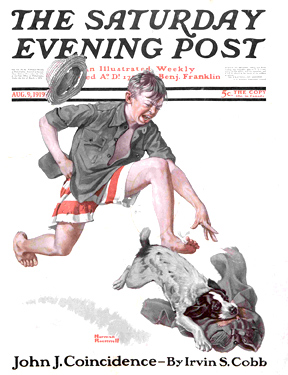
Norman Rockwell
August 9, 1919
© SEPS
Dear Mr. Rockwell:
I sincerely hope that you read this letter. An article in the December 18, 1977, issue of The Sunday Plain Dealer (Cleveland, Ohio) prompted me to write it.
What I wish is to set down in words the very thoughts and feelings that you and your work have produced for me and, without a doubt, most Americans.
The “Old Masters” had their day. However, most of their subjects were titled and/or wealthy persons who did not typify the average people of any country.
Many “Modern” artists create work which must be accompanied by an explanation of what we are supposed to “see” in it.
Your work, to me, is human and real, therefore, it conveys universal feelings. It is also typically American. Our history for two generations usually comes through—as the serviceman returning home. If this is a result of an idealistic attitude so be it. What is so wrong with wishing things were as they should be! It’s a rough road, though, as we all fall short of what we should do and be.
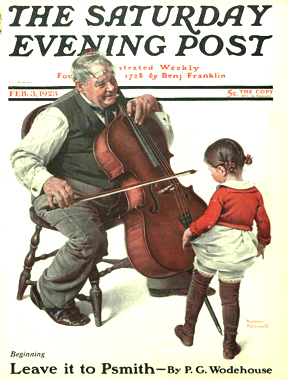
Norman Rockwell
February 3, 1923
© SEPS
You have been given a great gift, Mr. Rockwell. What is even greater is that you shared it with your countrymen, including amateur artists just like myself.
Critics, in my opinion, are just that—each just possessing his own criteria for whatever is at hand. I have never held much with their opinions. We Americans like to make our own decisions!
Personally, your pictures have caused me to smile, laugh, or get a lump in my throat, calling up an old, mellow memory. This, it would seem, is work which lives, and what could be more important.
To me, you are the artist of our day.
Sincerely,
(Miss) Margery A Manville
To Margery’s surprise and delight, she received the following response.
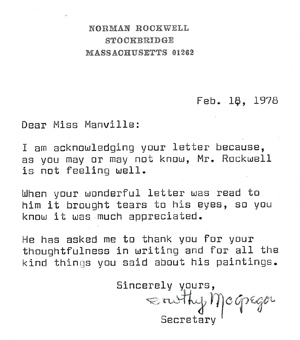
February 18, 1978
Dear Miss Manville:
I am acknowledging your letter because, as you may or may not know, Mr. Rockwell is not feeling well.
When your wonderful letter was read to him, it brought tears to his eyes, so you know it was much appreciated.
He has asked me to thank you for your thoughtfulness in writing it and for all the kind things you said about his paintings.
Sincerely yours,
Dorothy McGregor
Secretary
A special thank you to Miss Manville for sharing her remarkable letter that expresses so well what many of us would have loved to say to Norman Rockwell.
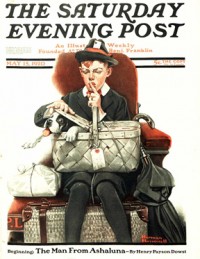
Norman Rockwell
May 15, 1920
© SEPS
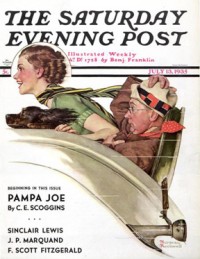
Norman Rockwell
July 13, 1935
© SEPS
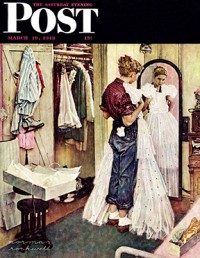
Norman Rockwell
March 19, 1949
© SEPS