Redheads Rule!
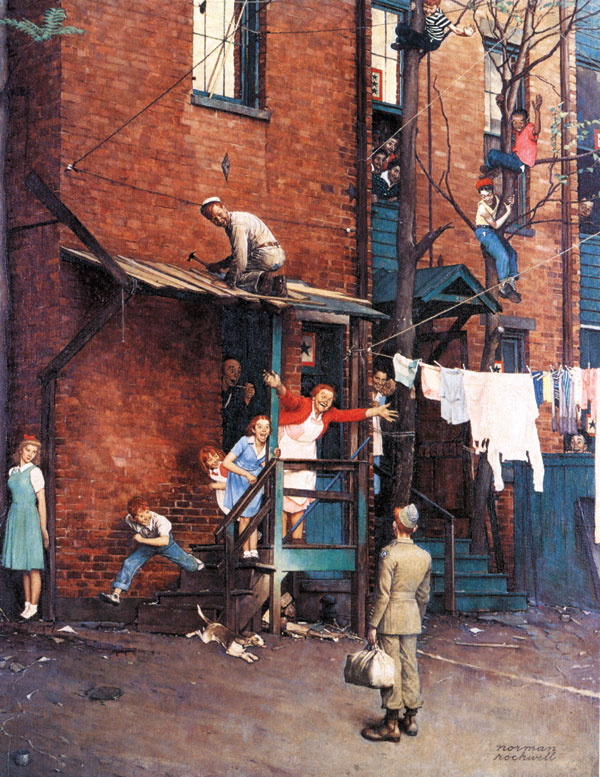
Homecoming G.I. appeared on the May 26, 1945 cover of the Post.
Norman Rockwell © 1945 SEPS/Curtis licensing.
Ardis Edgerton was the typical tomboy; she climbed trees, had skinned knees and torn dresses, and had a huge mass of red hair that was the exasperation of her mother and herself. It was that hair that Norman Rockwell appreciated; especially the bright red color. When Rockwell painted this May 26, 1945, cover, Homecoming G.I., Ardis was at its center, but the painter didn’t stop there. He also turned every one of the central characters into redheads.
Ardis is the girl leaning on the rail (next to the mom with outstretched arms). The little girl behind her, Yvonne Cross, was a blonde in real life, just like her brother John who plays the returning soldier, and her father who is repairing the roof overhead. Even Ardis’ black and white dog Spot is chromatically transformed for the picture.
Rockwell’s inspiration for this scene came from a series of Post articles from 1944 by Sgt. Charles E. “Commando” Kelly in which he describes winning the Medal of Honor in Italy—with a special emphasis on how much he yearned for home.
Rockwell had used a homecoming theme for several covers, but this one was selected as the U.S. Treasury’s official poster for their eighth and final war bond drive. On January 3, 1946, at the end of the war bond campaign, $187.7 billion had been raised, and over half of America’s citizens, more than 85 million people, had bought bonds to support the war. Rockwell and the Post were proud to have been a part of that.
This illustration, one of Rockwell’s better-known covers, can’t fail to evoke a sense memory common to all of us. Who can fail to be moved by a soldier’s homecoming to family, to friends, and possibly to a red-headed girl quietly standing to the side?
Rockwell Painting Inspires Movie
Norman Rockwell
April 29, 1950
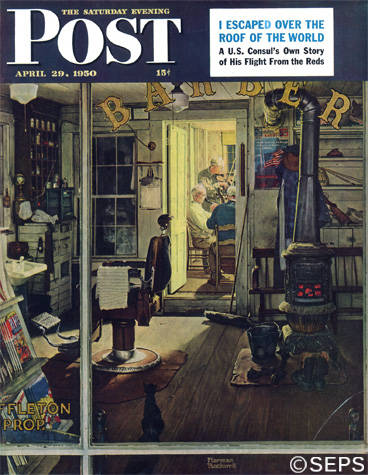
The painting is one of the most intricately detailed works from an illustrator with a mania for minutiae: faithfully reproduced ironwork scrolling on the barber chair and cozy stove, comic books on the rack, and chipped paint on a windowpane molding. The painting “stands as one of the finest displays of Norman Rockwell’s talent as an artist,” says Jeremy Clowe of the Norman Rockwell Museum.
For all the painting’s detail and masterful lighting and composition, it is the after-hours peek into the back room that draws us, as barber trades his scissors and razor for a cello to make music with his friends.
Echoes of Rockwell’s painting appear in the new movie A Way Back Home, a Hallmark Movie Channel original starring four-time Emmy nominee Danny Glover as barber Charlie Shuffleton and Austin Stowell as Trey Cole, a celebrity coming to the realization that he has lost himself along the way.
Trey has severed ties with his past and didn’t even return home when his brother died serving in the military. But now memories are stirring, like that old barbershop and his first haircut in the brown leather chair and how Charlie (Glover) took him under his wing when he was a boy, when his own father was cold and often absent. Returning to the barbershop in one of the film’s opening scenes, Trey notices a trio of musicians playing in a dimly lit back room as in Rockwell’s original painting.
“For his cover illustration for the April 29, 1950, issue of The Saturday Evening Post, Rockwell turned to Rob Shuffleton’s barbershop in East Arlington, Vermont,” said Clowe.
Yes, Shuffleton’s Barbershop was a real place; it was where America’s favorite artist went for a trim. “Similar to how he employed both neighbors and family as subjects for his work, Rockwell also found artistic inspiration from his surroundings,” Clowe explains.
The cello player sitting in the interior room is Rob Shuffleton, whom Rockwell once called “a tonsorial virtuoso who always trims his locks exactly the right length.” Shuffleton’s Barbershop was a place, like the little town of Arlington, Vermont, itself, where a world-famous artist could go and be treated like everyone else—just the way he liked it.
As you watch the movie, which premiered Saturday, June 1, look for ways Rockwell’s painting inspired the feature-length film.
Purchase a print of Norman Rockwell’s Shuffleton’s Barbershop at Art.com.
Readers’ Favorite Rockwells
We want to hear about your favorite covers from The Saturday Evening Post, whether illustrated by Norman Rockwell or another Post artist. This week we’re reviewing Rockwell favorites from readers and our own staff.
The Gift
Norman Rockwell
January 25, 1936
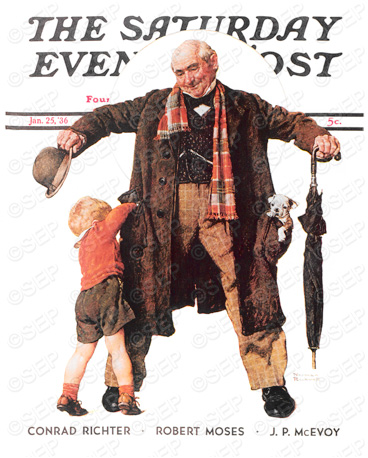
Helen Palmquist of Lincolnshire, Illinois, went right for a fun one: “My favorite is the little boy looking in Grandpa’s overcoat, not realizing a puppy is in the other pocket.” Rockwell had his beloved Uncle Gil in mind when he created this 1936 cover. Uncle Gil was something of a scientist and inventor, Rockwell wrote in My Life as an Illustrator. “But he did have one eccentricity, he got his holidays mixed up. On Christmas day, with snow on the ground and a cold wind in the trees, Uncle Gil would arrive loaded with firecrackers to celebrate the Fourth of July. On Easter he would bring us Christmas gifts.
“He always had a kind of Christmas spirit about him—jovial, warmhearted, shouting, ‘Warm, Norman, warm!’ as I approached a hidden present and ‘Hurrah!’ when I found it. … I don’t think I have ever enjoyed any gifts as much as I used to Uncle Gil’s.”
Saying Grace
Norman Rockwell
November 24, 1951
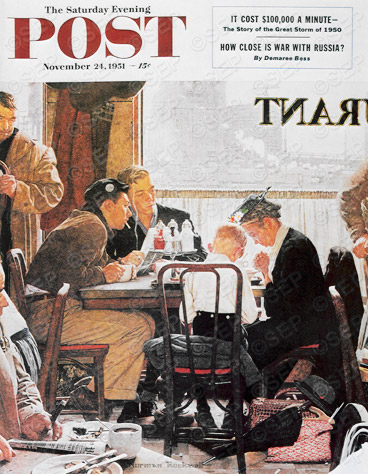
Saying Grace is the favorite of Nicole Beer from our staff in Indianapolis, Indiana. “It reminds me of my grandmother even down to the way Rockwell painted the lady’s hands. I remember being a kid and always praying in public with her before we ate. Everyone would always stare at us and it would make me embarrassed. I hated it as a kid but as an adult, I am so thankful for her and the example she set. I can only hope I am as bold with my faith as she was.”
Saying Grace has an interesting history. Click here to read about which of Rockwell’s sons appears in this illustration and how fellow Post artist George Hughes’ discouragement drove Rockwell to complete this painting.
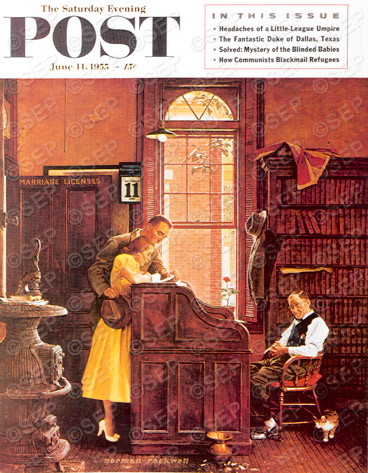
The Marriage License
Norman Rockwell
June 11, 1955
“There is only one that stands head and shoulders above the rest in terms of sheer beauty and deep meaning—The Marriage License,” writes Barbie Thompson of Calgary, Alberta.
“Manning this department, no doubt years before these two lovebirds were even born,” writes Barbie of the elderly clerk, “[he] has seen it all and therefore knows this path all too well—the Good and the Bad, the Happy and Not-So-Happy Endings. The only personal warmth for him now comes from his kitty, those well-smoked cigarettes, and the well-chewed loose tobacco targeted to the spittoon, and the slow-burning, unseen embers from that ancient cast-iron stove.”
Barbie may be more right in that last sentence than she knows. Anne Braman, daughter-in-law of the gentleman who posed as the clerk, wrote in a 1976 Post article that her mother-in law had died the year The Marriage License was painted.
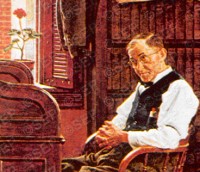
Close-up of elderly clerk.
“Mr. Rockwell—knowing my father-in-law Jason C. Braman—realized how upset he was, and he thought if he could get him to model it would give him something new to think about.”
Rockwell was right about the new activity having a therapeutic effect on the widower, wrote Anne, “As soon as the The Marriage License appeared on the cover of the Post, people recognized him immediately. When his friends commented to him about the cover, he would say, ‘Would you like for me to autograph your copy?’ And he would. When I told Mr. Rockwell about this, he was quite amused.”
[Anne Braman modeled for Rockwell as the schoolteacher in the 1956 cover Happy Birthday Mrs. Jones. Read more about her here.]
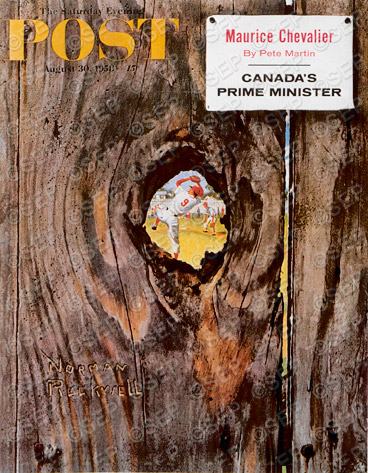
Knothole Baseball
Norman Rockwell
August 30, 2958
“I love all baseball covers, but I find this one particularly interesting,” writes Cris Piquinela one of our Post staffers.
“First off, I don’t think most people looking at this cover would think it is a Rockwell. There are no children or people visible, no characteristic facial expressions. However, what I like about this cover is that it forces me to ‘create’ or imagine the scene in my head. I can’t see the person looking through the hole, but I imagine a freckled, redheaded, barefoot kid. At the same time, I can sense the excitement of the pitch, a great hit by the player at bat, and the entire crowd going crazy. This cover does not tell me what I am looking at … it forces me to imagine it. Plus, I love only having a small piece of the image shown to me.”
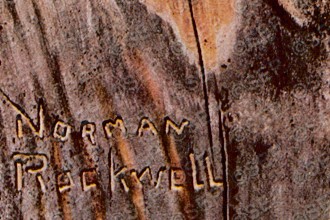
Rockwell’s carved signature.
It is also interesting to note the way Rockwell “carved” his signature in the painting.
A special thank you to readers (and Post staff) for telling us about your favorite Rockwell covers!
Visit our online gallery to review Post covers by your favorite artist.
Coming soon in our Readers’ Favorites series: readers’ favorite covers from Rockwell’s neighbor, friend, and fellow Post artist George Hughes. If you have a favorite George Hughes cover (and there are 115 to choose from) we’ll be glad to feature it.
View covers by George Hughes here, then email us your name, along with the title and date or just a good description of your favorite piece at [email protected].
Rockwell’s Barbershop Quartet
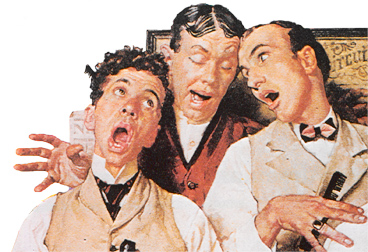
Norman Rockwell did such a remarkable job capturing the singers’ expressions as they hit the perfect note, we wish we could turn up the volume on this 1936 classic. Evoking the turn of the century era, perhaps the Gay ’90s, he is able to indulge his love of costumes and further authenticates the scene with meticulous attention to detail; the shaving brush and mug, straight razor, even a well-used comb that is missing a few teeth (click on images for larger view).
The cover models were all residents of New Rochelle, New York, where Rockwell lived and worked for the first 25 years of his career. The barber on the left was actually a barber by trade. The gentleman in the red vest, to his right, was a member of the town’s fire department. Rockwell’s assistant Carl Johnson made an appearance, too, wearing a bow tie and holding a comb. And on the far right we find customer Walter Beach Humphrey, a friend of Rockwell’s and an illustrator for the Post.
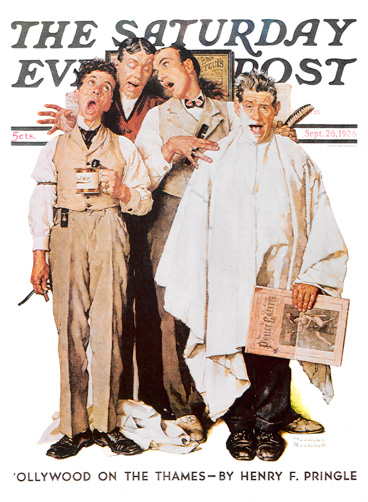
Norman Rockwell
September 26, 1936

The image lives happily on in a larger-than-life mural gracing the side of the landmark building for the Barbershop Harmony Society in Nashville, Tennessee. From the 1890s through the 1930s, the Society states that professional quartets were considered the rock stars of their days. But, barbershop quartets are still alive and very well today—not just for old fogies. Competitions in quartet and chorus categories draw the young in great numbers.
And barbershop singing is not just a world of boater hats and waxed moustaches. The Sweet Adelines is a women’s organization that began in 1945, and today is an international organization with nearly 23,000 members and a schedule of competitions of their own.
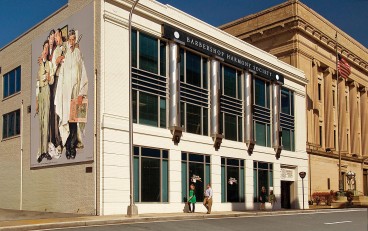
The Society, which celebrates its 75th anniversary this month (April 2013), has also licensed the image for their quartet membership cards. And, Brian Lynch of the organization tells us, “from time to time, you will see a quartet on stage striking this pose in tribute to Rockwell’s great work.”
Lynch continues, “The Society owns a signed, numbered lithograph that Rockwell made from the original sketches, with hand tinting of the tenor’s bow tie performed by the artist. As such, it’s something of a holy relic for barbershoppers.”
To delve into the history of barbershop singing or view videos of harmonizing that would make Norman Rockwell proud, visit the Barbershop Harmony Society website.
From 1918–1950, Rockwell illustrated three other barbershop covers:
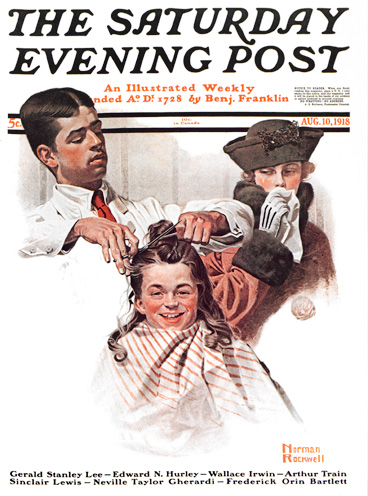
Norman Rockwell
August 10, 1918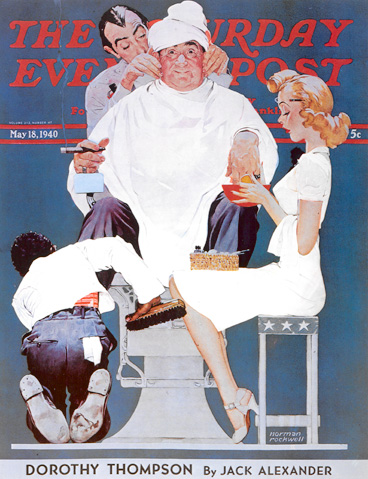
Norman Rockwell
May 18, 1940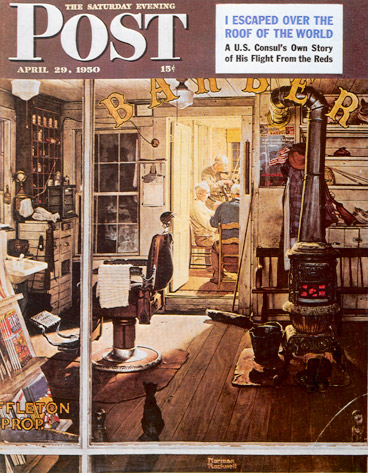
Norman Rockwell
April 29, 1950
Remember to tell us your favorite Post cover for our “Reader Favorites” series. The first “Reader’s Favorite Rockwells” begins next week! Email [email protected] and include your name, along with the title and date or just a good description of your favorite piece.
Rockwells That Don’t Look Like Rockwells
Norman Rockwell painting a “wild woman”? Dabbling with abstract art? And where did that horse come from anyway?
Armor
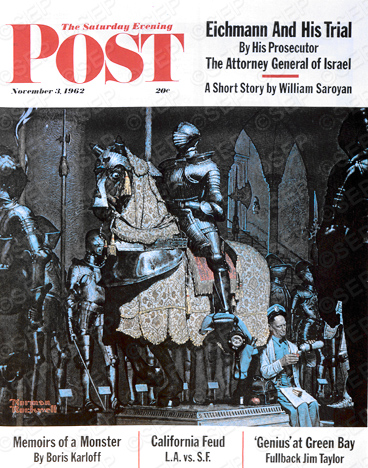
Armor
Norman Rockwell
November 3, 1962
Rockwell visited the Higgins Armory Museum in Worcester, Massachusetts, and came away with an idea for this 1962 Post cover. He recreates the setting with remarkable accuracy, except for two key elements: the guard eating his lunch and the hungry horse eyeballing him were strictly out of Rockwell famous imagination. Proof indeed that an artist’s mind can be a strange place, but it does show Rockwell thinking outside the box (or perhaps, outside the ol’ swimming hole). Additionally, the sumptuous display was an ideal setting for his passion for reproducing intricate details.
The Bridge Game
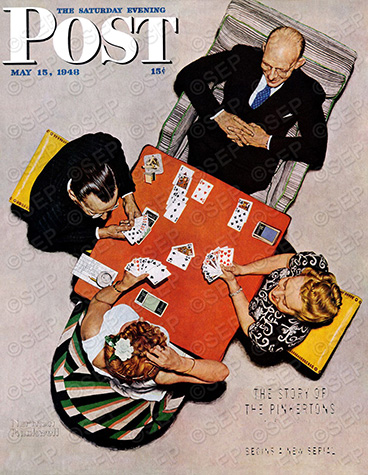
The Bridge Game
Norman Rockwell
May 15, 1948
“I have two radio bridge programs,” wrote a reader from Oregon in 1948, and “ever since the appearance of your May 15th issue, I’ve been swamped with mail asking what I think the redhead with the gardenia should do.” (note: in Letters to Editor July 3, 1948, page 8)
If you think Rockwell was a stickler for details, you should get a bridge player started! Many wrote in to say what the redhead should do, citing percentages and probabilities.
The idea for the painting had been fermenting in the artist’s brain for three years, with Post Art Editor Ken Stuart clipping and sending him bridge cartoons to prod him. Rockwell finally did deal the cards, with the assistance of a bridge expert, and produced this delightful painting done from a most difficult perspective.
Circus Artist
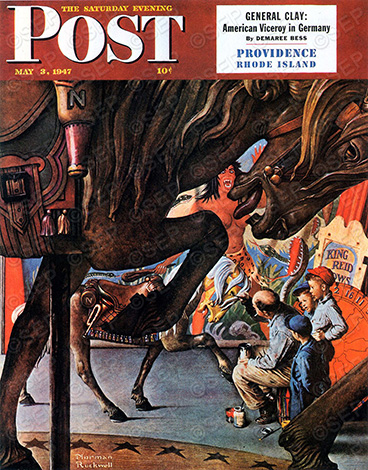
Circus Artist
Norman Rockwell
May 3, 1947
Borrowing the “wild-woman” banner for this carnival scene may not seem a big deal, but having two merry-go-round horses weighing in at 365 pounds each shipped to his Vermont studio was, well, for Rockwell, not that unusual, either. “If a convoy rolled into Arlington, Vermont,” claimed Post editors in this 1947 issue, “bearing a stuffed whale, a cast-iron deer and a grandfather clock,” townsfolk would simply point and say, “Rockwell’s house is up that way.” The artist didn’t let much stop him when it came to props, and indeed, the rest of the world was happy to fall in line. “We came home from church one Sunday and he was closing our front door,” former Rockwell model, Mary Whalen Leonard, recently told us. “He said, ‘Oh, I was hoping you wouldn’t catch me! I was up this morning early and I know I had seen this little picture and I thought it was in your house, so I just wandered around and looked through your cupboards.’” He described it to Mary’s mother who simply said, “Oh no, that’s at Ann Marsh’s.” Rockwell replied, “All right, I’ll go to the Marsh’s,” and bade them good day.
The Connoisseur
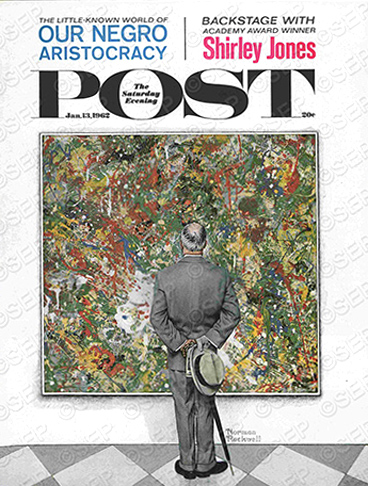
The Connoisseur
Norman Rockwell
January 13, 1962
Forty-six years after his first Post cover, Rockwell embraced modern art. “I attended some classes in modern art techniques. I learned a lot and loved it.”
And he had fun playing Jackson Pollock for this 1962 cover (the scrawled red “JP” in the upper right is a tribute to Pollock). He put the canvas on the floor, dipping into paints and splashing them far and wide. It happened that a worker was painting the windows of his studio, and the artist invited him to help. The man climbed to the top of a ladder and obligingly dumped a can of white paint on the canvas below. One can’t help but wonder whatever happened to the laborer who actually helped Norman Rockwell paint a Post cover! As for whatever happened to the original “Rockwell-Pollock,” it is in the private collection of a gentleman named Steven Spielberg.
The Post has a larger-than-life version of Rockwell’s The Connoisseur in our Indianapolis headquarters. Check it out here.
We would like to feature your favorite Rockwell cover! Drop us an email at [email protected] and include your name, along with the title and date or just a good description of your favorite piece. We’ll pick the five most popular for the upcoming Web feature, “Readers’ Favorite Rockwells.”
Classic Covers: A Hint of Spring
We are over it! We’re through with snow and slush, and we’re seeking hints of spring from our finest cover artists: Rockwell, Leyendecker, Dohanos, Falter, Clymer, and more.
Shoveling Floral Shop Sidewalk
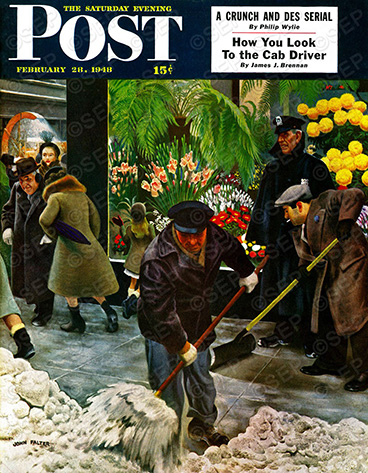
Shoveling Floral Shop Sidewalk
John Falter
February 28, 1948
“It was cold in New York,” Post editors say of this John Falter (1910-1982) cover, “and the cagey artist did most of his investigating behind glass, riding up and down on a Madison Avenue bus.” Painting the scene, Falter figured the frozen-faced workers would get an ironic chuckle from the fact that inside the flower shop window it is spring. Or perhaps not. Editors also had to note that Falter delivered his picture to the Post “just before the first of the winter’s oversize snowstorms hit New York. Then the artist hauled out for Arizona, where you may enjoy scenes like this in comfort.”
Springtime, 1935 Boy with Bunny
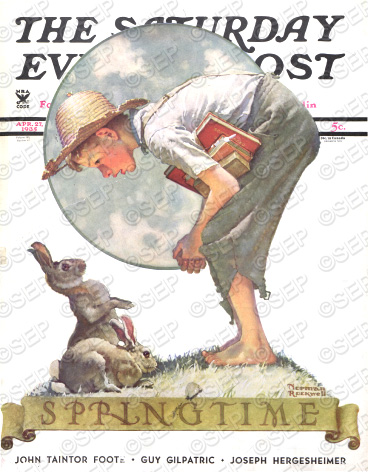
Springtime, 1935 Boy with Bunny
Norman Rockwell
April 27, 1935
“You can’t buy a straw hat and make it look old by rubbing dirt in it,” Norman Rockwell (1894-1978) wrote in My Adventures as an Illustrator. “A hat has to be worn in the sun and sweated in and sat on and rained on. Then it’ll be old. And look it.” In 1935 Rockwell was asked to illustrate Mark Twain’s The Adventures of Tom Sawyer and The Adventures of Huckleberry Finn, and he took the costuming very seriously. Desperately needing the right hat for Huck, he found just the thing in, appropriately, Hannibal, Missouri, Twain’s hometown. He spotted “a man walking along the road wearing a straw hat in a beautiful state of decay” and managed to buy it from him. Before long he ended up with a carload of clothes, “all old and rotten, battered, tattered, and splotched.”
Folks around Hannibal no doubt talked for a long time about that crazy guy who paid good money for their old duds, but the book illustrations were done to everyone’s satisfaction. And, like the boy greeting spring (left) with his worn hat and raggedy pants, some Post covers reflected the “Huck Finn look.”
Reading Among the Blossoms
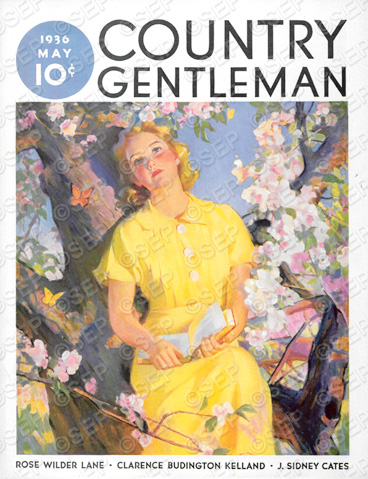
Reading Among the Blossoms
F. Sands Brunner
Country Gentleman
May 1, 1936
Despite the fact that F. Sands Brunner (1886-1954) was very much a rugged outdoorsman who enjoyed camping, canoeing, and mountain climbing, most of his paintings reflect domesticity with adorable children and lovely women. This 1936 work from Post sister publication Country Gentleman is a case in point. The rich color and skillful use of lighting are typical of Brunner’s work. The Boyertown, Pennsylvania, native painted three Country Gentleman and two Post covers.
Appalachian Rhododendrons
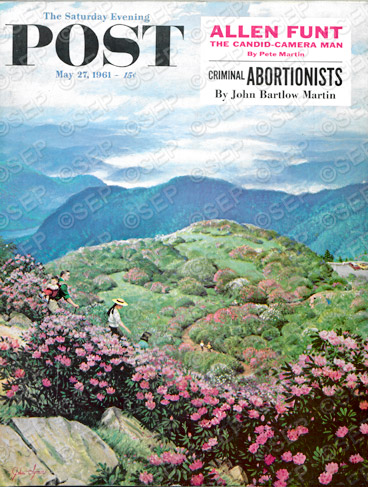
Appalachian Rhododendrons
John Clymer
May 27, 1961
Nature took over on a grand scale in most of John Clymer’s (1907-1989) 80 Post covers, and people were secondary. In fact, the viewer almost has to squint to see the family consisting of Dad with baby on his back, Mom in straw hat, and daughter leading them along the trail to Craggy Pinnacle near Asheville, North Carolina. Clymer told Post editors, “Sections of the trail wind through 10-foot-high rhododendrons, and the ground is carpeted with the rich pink petals of the flowers that have fallen.”
“These floriferous slopes look their best in mid-June,” editors noted in 1961, “as they did when the Catawba and the Cherokee held sway in the Carolinas. But if the scenery of the area has not changed much, the people have. What self-respecting Indian brave would have toted a papoose on his back?”
Hardware Store at Springtime
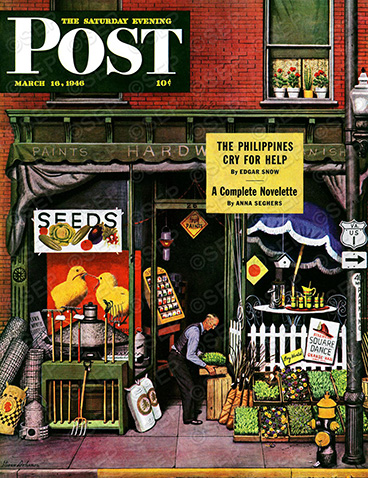
Hardware Store at Springtime
Stevan Dohanos
March 16, 1946
Artist Stevan Dohanos (1907-1994) loved hardware stores, and editors informed us that “the store he has painted affectionately for this week’s cover is a composite of many where Dohanos himself has obeyed the impulse, very strong in the spring, to buy a lot of new garden tools.” They warned, however, “this equipment buying is by all odds the most popular phase of gardening, for on a bland spring day there is nothing like the feel of a good rake or hoe in your hand—in the hardware store.”
Ready to Garden
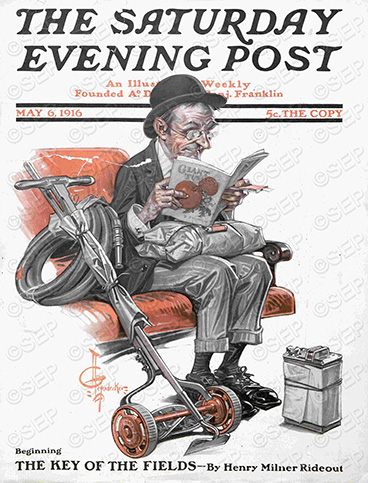
Ready to Garden
J.C. Leyendecker
May 6, 1916
This gentleman has made his trip to the hardware store and is hauling those spring purchases, lawn mower and all, back by public transportation. Perhaps more surprising is that the illustration is by the great J.C. Leyendecker, the man responsible for those chiseled Arrow Collar men who “haunted several generations of less fortunate-mankind,” according to David Rowland in a 1973 issue of the Post. In Leyendecker’s 40-plus years with The Saturday Evening Post, he showed amazing versatility as an illustrator, depicting subjects varying from elegant to comical in more than 300 covers.
Rockwell’s Favorite Model, Part III
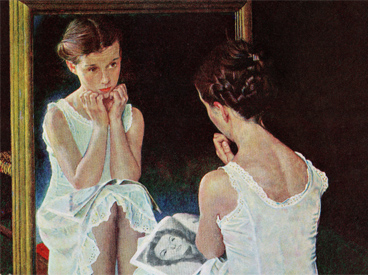
March 6, 1954
“He is a genius with a childlike heart, a man who leaves a lasting imprint on people as well as on canvas,” Mary Whalen Leonard told the Post in 1976. We spoke with her again recently to ask about one of Norman Rockwell’s most respected paintings—and about the artist himself.
Mary’s pose seems “apprehensive, as if she understands that womanhood is upon her and fears that she is not quite ready,” writes art expert Karal Ann Marling in her 1997 book, Norman Rockwell. However, young Mary didn’t have a clue.
“I was only in fifth or in sixth grade, and I wasn’t a kid who was at all interested in growing up. I was just having a good time,” Mary says.
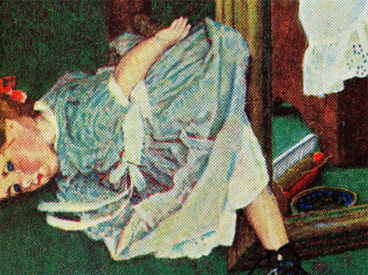
He tried to explain the concept behind the forgotten doll: “You’ve tossed away your doll—you no longer play with dolls.” But Mary, who describes her younger self as a tomboy, says, chuckling, “I was saying to myself, ‘Yeah, I never did that anyway.’”
Rockwell knew that Mary wasn’t grasping the idea, so he tried again, “Now, Mary, don’t you ever stand in front of a mirror and wonder what a beautiful woman you’re going to be? I can remember standing in front of a mirror, combing my hair, wondering how handsome I was going to be.”
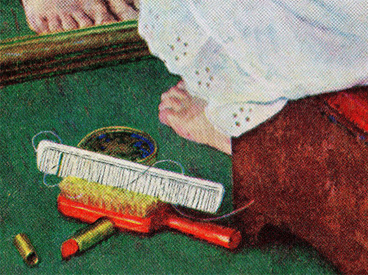
“And quite honestly,” she laughs, “that didn’t make any sense to me because Norman wasn’t handsome! So I didn’t relate to that. I mean I couldn’t get into it. So I think he just told me to think about being a beautiful woman and what I might do with my life. But it did not connect with me.”
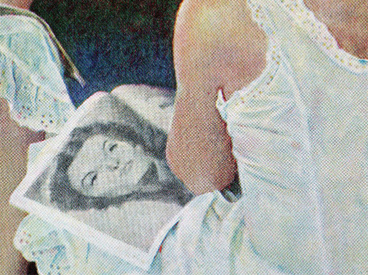
Mary tells us Rockwell felt he had made a mistake including the magazine featuring sexy movie star Jane Russell. “He regretted it deeply. Norman got a lot of criticism—remember this was in the ’50s—that said, ‘Is that all a little girl can dream about is becoming a movie star?’”
“I should not have added the photograph of the movie star,” Rockwell later said in Marling’s book, “the little girl is not wondering if she looks like the star but just trying to estimate her own charms.”
In what would become one of his most respected paintings, Rockwell captured the poignancy and uncertainty of growing up despite the fact that Mary “had no idea what he was talking about.” For decades critics had dismissed Rockwell as simply a popular commercial illustrator. Today, many have concluded that some of his works, however, transcend freckle-faced boys at the ole swimmin’ hole and secure his standing today as a true artist. Girl at the Mirror is such a painting.
Mary, who describes this painting as “very different than most of Rockwell’s covers,” compares the subtle use of color and lighting with another of Rockwell’s finest works. “In The Marriage License,” she explains, “you think you’re going to concentrate on the couple getting their license, but really what you find yourself looking at and being drawn into is the sweet, dear man [the elderly clerk]. Because that’s where the light is, on his face.”
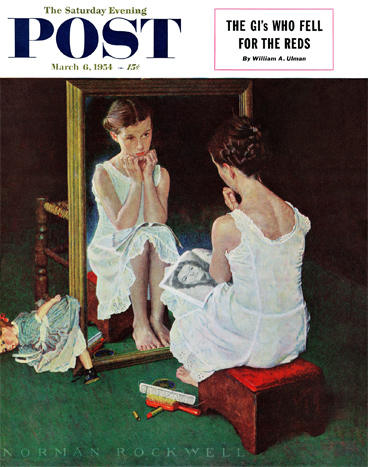
March 6, 1954
By the time Girl at the Mirror was published, Rockwell had moved from Vermont to Stockbridge, Massachusetts. “He wrote me a little note and told me it was going to come out. He sent me a photograph I posed for.”
Mary never knew why Rockwell called her his favorite model, but he had quickly become one of her favorite people. “I kept in touch with him until he died. He always sent me a little note at Christmas time and told me he missed me.”
See Mary today as she talks about the artist in this video, courtesy of the Norman Rockwell Museum.
First Crocus
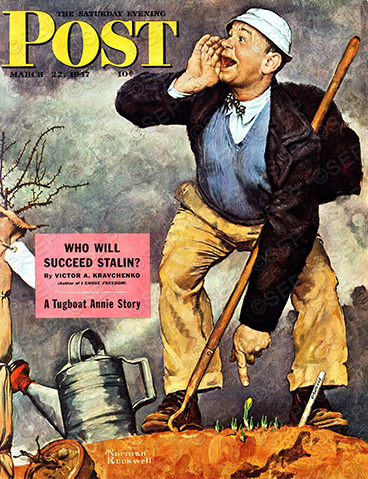
First Flower
Norman Rockwell
March 22, 1947
Author Jim Butcher wrote, “Men plan. Fate laughs.” Everyone can pinpoint a time in their lives when fate stepped in and skewered well-laid strategies. That’s particularly true of Gene Pelham, the model in the cover at right celebrating the arrival of spring. The New York native had moved his family to Arlington, Vermont, in 1938 from New Rochelle, New York. In that former life, he was an artist and photographer and knew (and occasionally modeled for) the great Norman Rockwell. But in Arlington, Pelham was happily ensconced in the country and hoped to try his hand at farming, raising livestock, and, in his own words, “building stuff.”
One crisp fall day in 1938, Pelham was working on his car in the front yard of his new Vermont digs when a stranger pulled into his driveway. The driver rolled down his window and said, “Can you tell me where the West Arlington Bridge is?”
As Pelham’s son Tom relates the story, his dad looked up and was amazed to see none other than Rockwell behind the wheel. “Norman? What are you doing here?” Pelham asked. Rockwell explained he was moving to Arlington.
And so, Pelham not only returned to modeling for the First Flower cover but he later became Rockwell’s assistant. He found and photographed models, scouted locations, and more. Fate certainly had other intentions for this would-be farmer.
Rockwell’s Favorite Model
“She was the best model I ever had,” Norman Rockwell said of Mary Whalen, who appeared on three Saturday Evening Post covers. Meet Mary, now known as Mary Whalen Leonard, who became Norman Rockwell’s favorite model. How did a young girl meet America’s favorite artist?
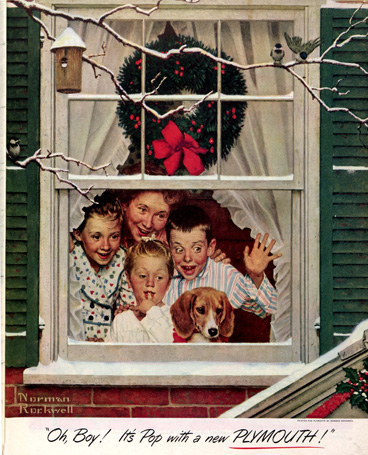
Plymouth Ad
Norman Rockwell
December 22, 1951
Young Mary was thirsty. Seeing neighbors at a local basketball game carrying soft drinks, she asked her father for one. He was trying to explain that refreshments were only served at halftime, and that the concession stand was now closed, when a man seated behind them “came very gallantly to my rescue and said, ‘You can have my Coke.’” She “had no clue” who the man was, but gratefully accepted the drink. The gallant man was Norman Rockwell, who “was just sitting behind us, cheering. His son was on the team.”
Talking after the game with Mary’s father (who was Rockwell’s lawyer), the artist asked Mary if she would like to pose for him some day. “I said, ‘Sure!’ although I didn’t know what that meant,” she tells the Post.
She soon found out, when she (in the polka-dotted bathrobe at left), along with her mother, brother, and a young cousin posed for this 1951 Christmas ad for Plymouth. “There was something about the connection with Norman. Maybe it just came at the right time in my life. I was just kind of intrigued by him as a kid. I think it’s because he disarmed me when I went to the studio for the first time, and he said, ‘Call me Norman. My name is Norman.’ I really trusted him. [At that time] you would never call an adult by his first name!”
For the ad “I had to borrow a bathrobe,” Mary says, “because I didn’t have one.” (She’s still not a bathrobe person.)
It is significant that the Plymouth ad has no image of the product or even details about the car’s features: The excited faces of the family say it all. In addition to Post covers, Rockwell did a great deal of illustration for advertising.
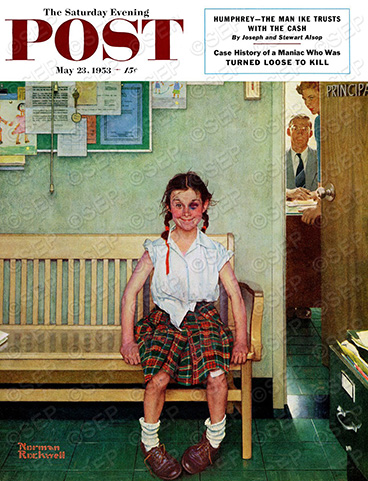
Outside the Principal’s Office
Norman Rockwell
May 23, 1953
When Rockwell decided to use Mary as the model for a cover about a girl with a black eye, he called for her at the local school. Unfortunately, this had the effect of scaring the child. Having never been summoned to the principal’s office, she jumped to the conclusion she was in trouble. “That was really frightening,” Mary tells us today, “I cried! But my sweet brother—he’s my twin brother, so we were in the same class—held my hand, and we walked together.” She was greatly relieved to discover Rockwell there and find out the reason for the command appearance.
Although the scene depicts the principal’s office, her part was done in the artist’s studio. And Mary says she never saw the principal and the secretary in the preliminary sketches. That’s because Rockwell added them later. According to Susan E. Meyer’s book, Norman Rockwell’s People, the artist “wavered back and forth” about including the adults. “He took them out and put them back in. [Fellow cover artist] George Hughes is convinced they were retained because he advised Rockwell to remove them.” (There was a long-running joke that Rockwell would solicit Hughes’ advice, and inevitably do the opposite.)
But Rockwell’s biggest challenge was getting the black eye right. He tried a charcoal mix on his young model, then makeup, but neither looked realistic. He finally advertised for a real black eye in the paper.
He not only got that tricky shiner right, his choice of Mary proved a great one. As a triumphant victor, the model manages the perfect devilish grin, even as the principal and school secretary confer on how to handle the situation.
Part II: Mary gives behind-the-scenes details on how certain poses were done as we review the Rockwell cover A Day in the Life of a Girl.
Classic Art: Rockwell’s Right-hand Man
An artist himself, Gene Pelham was Norman Rockwell’s photographer, prop–man, model wrangler, and much more.
First Flower
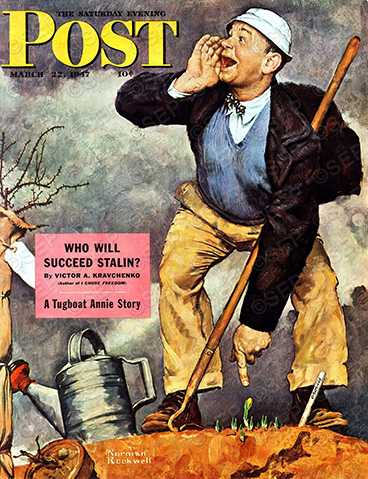
First Flower
Norman Rockwell
March 22, 1947
On a blustery March day a man excitedly spies that first crocus peeking through. The man is Gene Pelham, who as a youth had met Rockwell and occasionally modeled for him while living in New Rochelle, New York.
But in 1938, Marcy Kennedy Knight writes in the March/April 2013 issue of the Post, Pelham moved from New York, filled with visions of a country life. When settled, he dreamed of doing some farming in Arlington, Vermont. But a funny thing happened on the way to his dream. Knight writes that Pelham was in his yard one day when a man seeking directions pulled into his driveway and rolled down his window. Pelham looked up and “was amazed to see none other than Rockwell behind the wheel. ‘Norman? What are you doing here?’ he asked.”
What the artist was doing was moving to Arlington too. “Rockwell was delighted to find Pelham living in Arlington when he and his family arrived, and soon hired him as his studio assistant,” Ron Schick writes in Norman Rockwell: Behind the Camera. Pelham “built props, prepared canvases, wrangled models, and was himself a versatile and expressive model,” continues Schick. “The relationship was mutually beneficial: Pelham grew as an illustrator as he learned from his mentor, and Rockwell gained from Pelham’s considerable range of talents.”
Plumbers
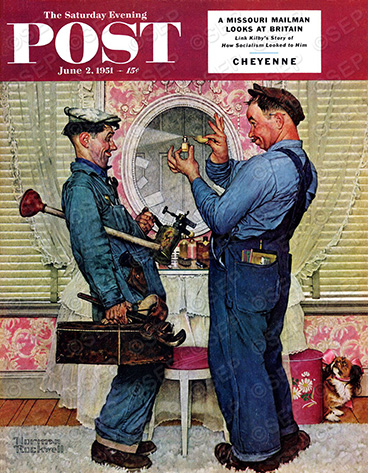
Plumbers
Norman Rockwell
June 21, 1951
Plumbers was one of Rockwell’s most entertaining covers. Pelham (right) and Rockwell’s apprentice Don Winslow are typecast as Laurel and Hardy like characters cutting up in a fancy boudoir, much to the confusion of the Pekingese to the right. Rockwell’s passion for detail works a wonderful contrast between the room with it’s floral wallpaper and frilly vanity and the laborer with their dirty hands and well-used tools. There’s a good chance that Pelham was the one who located the tools. He was key to acquiring props for the artist.
“Dad never threw anything away,” Pelham’s daughter Melinda said in a recent Post interview. “Norman would get these things and say, ‘Here, Gene, take this. I don’t want it.’ I think that’s why he liked my dad so much because my dad could always come up with whatever it was he needed.”
Melinda has had fun over the years, looking at Rockwell’s paintings and recognizing various items. “A lot of the props he would drag from our house. Sometimes I see things in Post covers that are either things I had or someone in my family had.” For example, in Rockwell’s 1943 April Fool cover Melinda recognized the table (“it was my grandmother’s”), the chairs, and the clock that she still owns today.
A more famous prop was Rockwell’s chair, depicted in the cover Blank Canvas. After many years of use, the artist threw the chair out, but Pelham retrieved it and took it home. “Dad used it when he did his own painting,” from then on Melinda told us. And who wouldn’t? After all, America’s favorite illustrator created many iconic images while sitting in that old seat.
New Chair
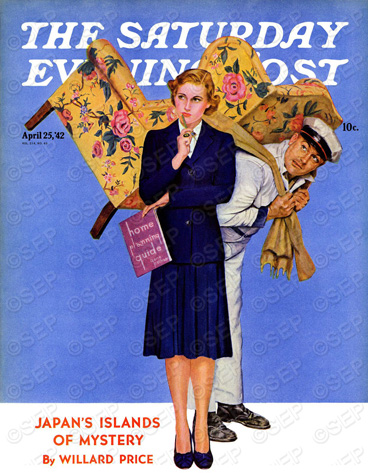
New Chair
Gene Pelham
April 25, 1942
“My father was a landscape painter mostly,” Melinda says. “My mother used to say ‘You should paint more,’ but he didn’t.” Although he did a “few covers for the Post and Collier’s,” it was difficult to make a living at commercial illustration. The competition was great for magazine and advertisement art, and there was certainly no competing with Rockwell, who was at the pinnacle in these venues. Besides, Melinda says, “Norman kept him busy.”
By the time Pelham created this colorful 1942 cover, it was apparent that his move to Vermont’s countryside was the beginning of a trend. That February, the Post noted another of their illustrators, Mead Schaeffer, had “joined Norman Rockwell and Gene Pelham at Arlington, Vermont, in what promises to become a Post art colony.” They were prophetic words, for the tiny town would soon boast fellow cover artists John Atherton and George Hughes. These renowned illustrators socialized and consulted each other on their projects. We can see the influence of Hughes’ humorous everyday situations and Rockwell’s sense of fun in Pelham’s beleaguered moving man.
Classic Art: Growing Up with Rockwell
Melinda Pelham Murphy, a daughter of Norman Rockwell’s photographer Gene Pelham, grew up around Rockwell’s studio. She talks about being a Rockwell model and the artist’s famous chair and offers a fond remembrance of Rockwell’s wife.
The Babysitter
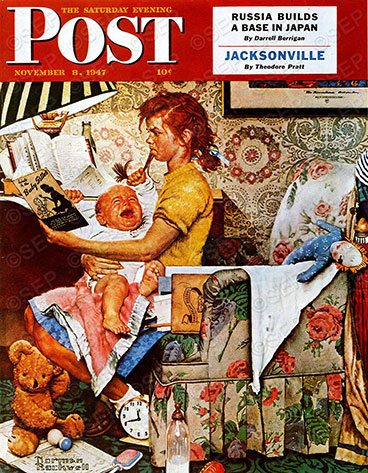
The Babysitter
Norman Rockwell
November 8, 1947
We would like to say that no babies were harmed in the making of this classic Rockwell cover, but the baby may disagree. During Melinda’s first modeling job, as the crying infant in The Babysitter, the artist and photographer couldn’t get her to cry, so someone stuck her foot with a pin. “My mother told me she always felt terrible about that, but it was what it was.”
“Obviously I was too small to remember anything,” she says. “But somewhere I have a photograph of me that Dad took … and I can see my mother’s image. She’s standing and I’m looking at her, and I am sort of looking sad like, ‘Oh, help me!’” Like many illustrators of the period, Rockwell began by painting live models. But around the mid 1930s, he used photography to capture the scene he would sketch out for a painting, calling the model back if necessary.
The Babysitter shows Rockwell’s ability to capture a dizzying array of details, making it one of those paintings where viewers may pick up something new each time they look at it. And still Melinda brought a fresh detail to our attention: “There’s a pin, an actual pin in the painting. The pin is in the diaper that’s hanging over the chair. He put it right through the canvas, he didn’t paint that in there.” It’s a delightful bit of Rockwell whimsy we were unaware of. Melinda has another viewpoint: “When I found out that I was stuck by a pin and I look at that painting, I wonder if that was the pin that did the deed and then he put it in the picture,” she says, laughing.
Despite the prickly offense, Melinda has a good sense of humor about the situation. In fact, she says she (along with the model baby sitter, Lucille Towne Holton) got involved in keeping the painting where the artist wanted it to be. Rockwell gave the original to the sixth graders of Taft Elementary in Burlington, Vermont, in memory of a student who died of leukemia. The school closed in 1978, and the painting was stored in a local bank. In 1995 appraisers determined it would be worth about $300,000. This was welcome news to the cash-strapped school system, which considered an auction. Former classmates protested and were offered an alternative: raise $300,000 and the painting would remain in town. Many townspeople got involved, and Melinda reports, “We raised the funds and it stays forevermore! It’s at the Fleming Museum; and every time my granddaughter goes there, she says, ‘That’s my grandmother!’ She gets a kick out of it.”
Rockwell Ads
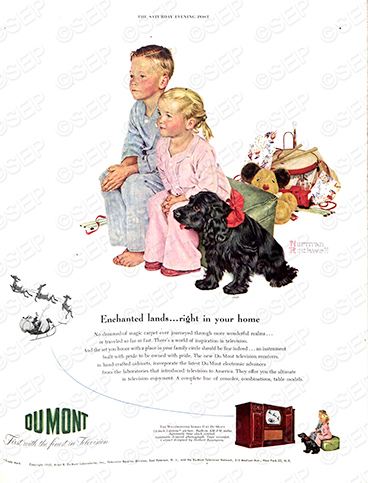
Du Mont TV Ad
Norman Rockwell
December 9, 1950
We first saw Melinda on a recent episode of Antiques Roadshow, where she was having Rockwell artifacts appraised, including a print of this 1950 Du Mont TV ad featuring her at about age 5. The print was accompanied by a note addressed to her father: “…to reimburse your daughter for the long session of posing. Give her my thanks for helping me out. Sincerely, Norman.” We called to ask her about her memories of the artist.
“I do remember him! I remember very well,” Melinda says, although she was only about 5 or 6 when he moved away from her small town in Vermont. “My sister always says to me, ‘I don’t know how you remember all that, I don’t remember these things.’ Maybe I just paid more attention or maybe I just have a different brain. And my sister didn’t pose for him that often.”
What she remembers was a kind man with a fondness for Cokes. This was a treat because soft drinks were limited to “special occasions” at home. But Rockwell had a Coke machine and the models could help themselves on breaks.
Melinda also recalls that Rockwell was particular about the pose he wanted for this ad. “He was very detailed in the way he wanted you to sit,” she says. And sit she did, for 15 hours. The time “would be broken up,” Melinda says, “so he might be working with the boy or the dog, and they didn’t need me” for a while. She remembers the artist’s wife Mary Rockwell who “would take me into the house so I wasn’t just sitting in the studio all that time. She was great about leaping into the breach. I can remember getting a dish of ice cream.”
“It was a long day,” Melinda says, “but Mary took me on a walk. I remember we walked down the back road, and it was a dirt road that ran along the river. And I remember picking ferns with her and then we went back to her garden and got some zinnias.” Melinda’s mother was laid up with an injury at this time, “and I brought her home this bouquet of flowers that Mary had ‘helped’ me put together. She did it all herself, I was very small, but I remember picking the ferns. She was really very sweet. She was a lovely lady. I have very fond memories of being there as a child.”
Blank Canvas
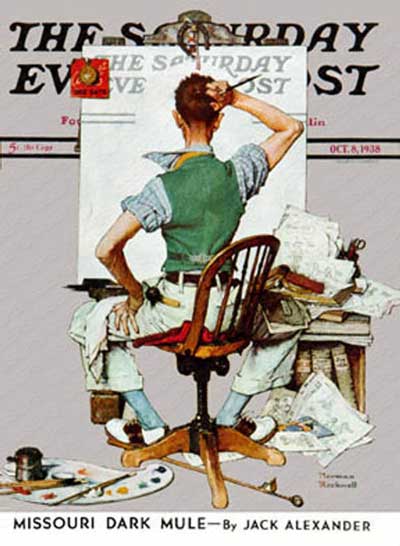
Blank Canvas
Norman Rockwell
October 8, 1938
Painting and drawing appraiser Alasdair Nichol was a bit surprised when Melinda also brought a chair to his table at the Antiques Roadshow, suspecting she had been sent to the wrong area. But when Melinda explained that the chair had belonged to Norman Rockwell and had been depicted in the iconic 1938 cover we see here, he understood. Rockwell’s photographer, Gene Pelham (Melinda’s dad), took the chair after the artist threw it out.
“Dad never threw anything away,” Melinda says. He would salvage discards or “Norman would get these things and say, ‘Here, Gene, take this. I don’t want it.’ Norman was not a hoarder or collector, I don’t think, unless it was something he felt he would need in the long run for paintings—costumes and things.”
But the salvaged chair was special. “To think of the amazing paintings that he did when he was sitting in this chair,” appraiser Nichol said. To see how the cast away chair was evaluated, we have a link to the appraisal, courtesy of the Antiques Roadshow.
Thank you to the Antiques Roadshow for the link to the episode featuring Melinda and to the Norman Rockwell Museum for their assistance in contacting her.