Just Beachy
Celebrate a century of beachgoing with these sun-sational covers. You might have sand in your shoes for a week afterward, but that’s a small price to pay.
For guys and gals alike, sharp style is a must to complement even the most radiant bronzed glow.
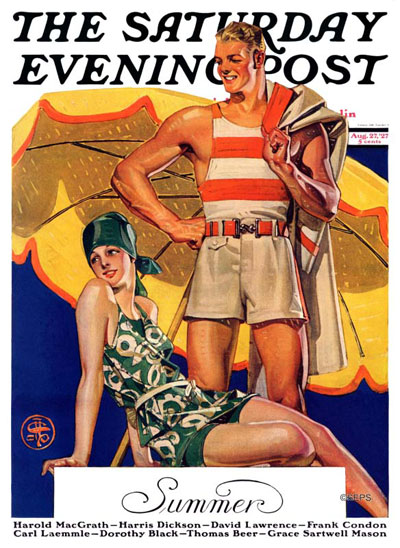
August 27, 1927
Armed with trusty life preserver, the guard holds court over his sun-toasted subjects with all the regality of a king and twice the jawline.
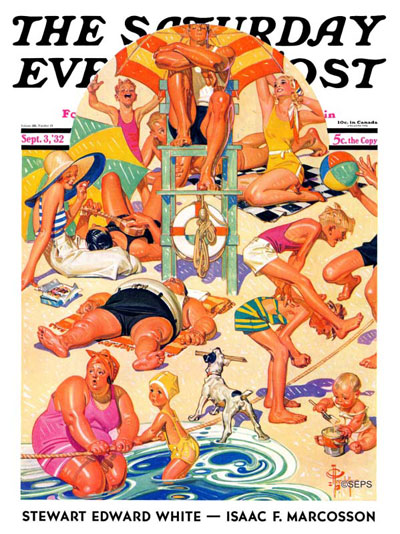
September 3, 1932
Et tu, ice cream? Getting lost in a spiraling forest of umbrellas isn’t especially ideal when you’ve got cool treats on hand rapidly turning to Neapolitan soup.
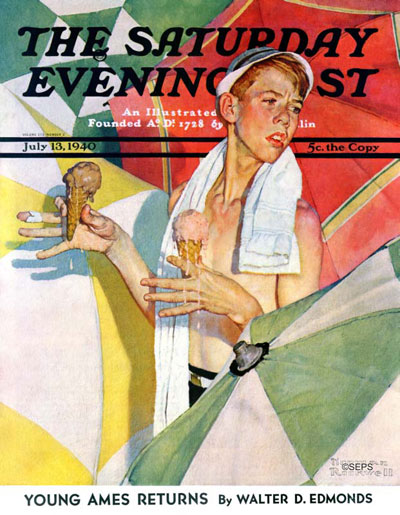
July 13, 1940
A prayer for some cloud cover might be in order if this ghostly couple wants to remain distinguishable from overcooked lobsters by day’s end.
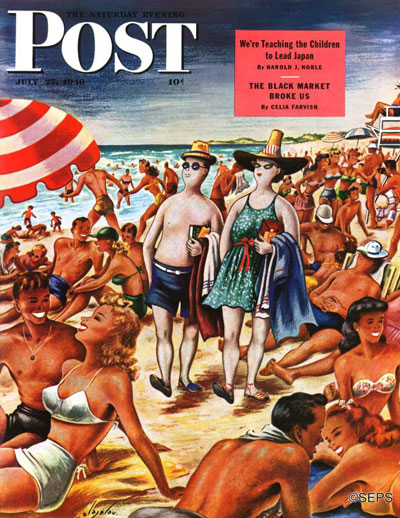
July 27, 1946
The tugboat may capsize when the tide arrives, but for one new to the sights and smells of the seaside, witnessing the frothy waves curl into the sand probably beats just about any plastic trinket.
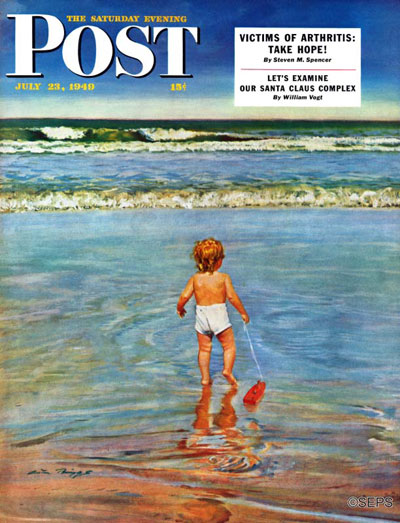
July 23, 1949
With Mom preoccupied, this baby can pick up a few early glamour lessons, though it would appear she hasn’t quite mastered coloring inside the lines.
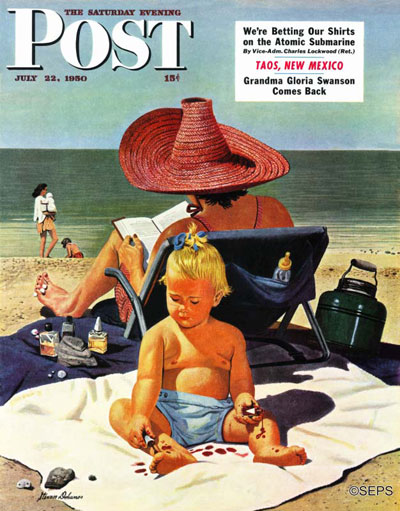
July 22, 1950
So much for fun in the sun. If the obsidian cloudbursts weren’t enough, a few peals of lightning are good reason to send sunbathers and picnickers packing.
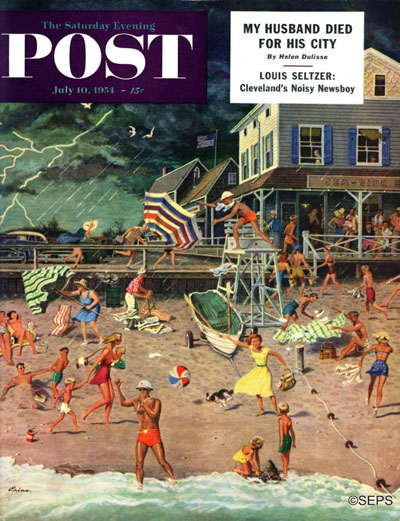
July 10, 1954
Who says you can’t mix work and play? Sipping a soda and rocking a bonnet-clad tot, this babysitter just might perfect the art of multitasking as long as that begrudging chef doesn’t boil the milk.
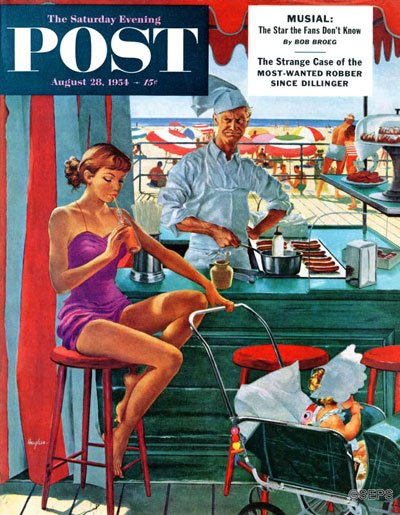
August 28, 1954
There’s plenty of fish in the sea, but the odds of this fellow catching one bigger than a guppy might be doubtful, especially with a snickering chorus of freckled critics present.
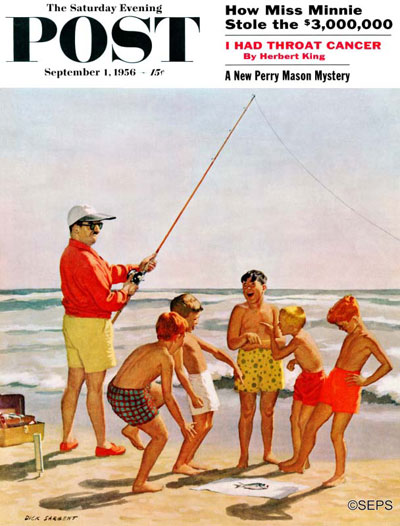
September 1, 1956
Even with enough lotion globbed on to withstand most natural disasters, some are just bound to flake under the harsh afternoon rays. Of course, where some see searing obstacles, others see opportunities to pick up a glorious golden sheen.
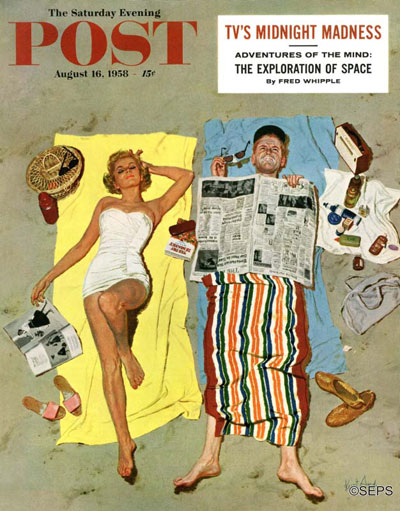
September 16, 1958
Forget frolicking in the surf when there’s romantic comedy of this caliber to be had.
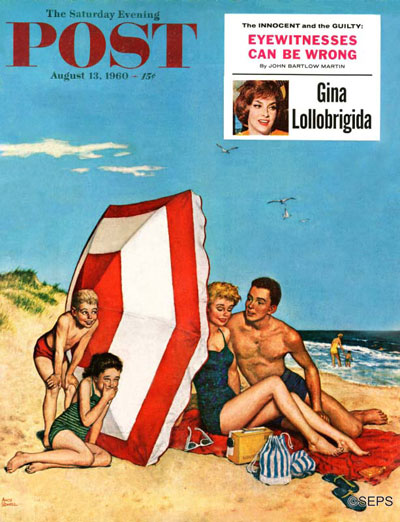
August 13, 1960
Perhaps auditioning for the Polar Bear Club under the disgruntled gaze of that swaddled lifeguard, this brave swimmer can have the entire shore to himself, as long as he doesn’t mind a touch of hypothermia. Like age, temperature is just a number.
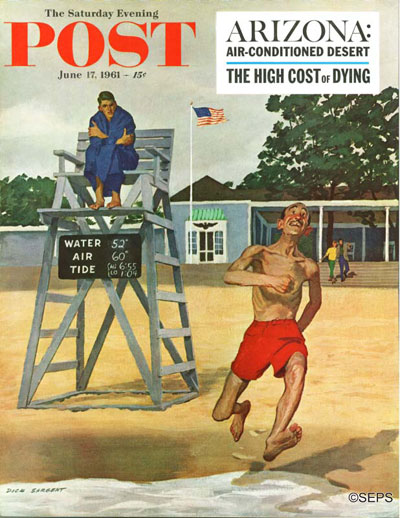
June 17, 1961
Summer Fun
It’s the season of empty classrooms, sleepy afternoons, and mercury rising up the meter. These covers offer a glance at the happy-go-lucky methods of sun-baked escapism for adults and kids alike.
Sliding into Water – Lawrence Toney
Sand between your toes and surf lapping at the shore is fine and good, but the neighborhood waterslide can serve just as well. For some, a pair of trunks and the rush of gravity are more than enough to beat the heat.
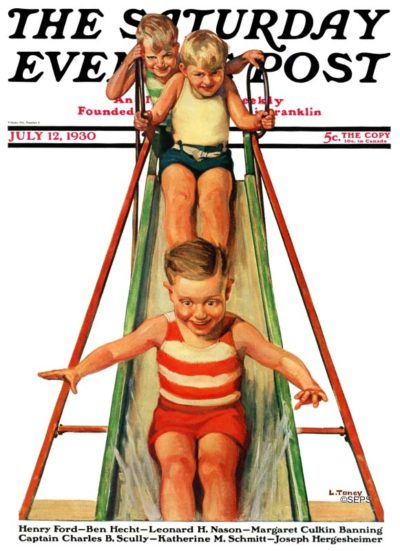
July 12, 1930
Water Fight – Thornton Utz
Providing the water supply holds out, a little mirth and mayhem can turn a suburban lawn into an amphibious battleground. Thorton Utz’s work is a giddy cautionary tale for everyone walking by to hike up their socks.
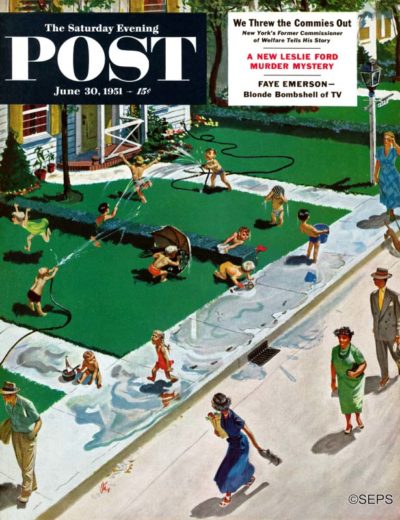
June 30, 1951
Croquet Game – John Falter
The family tournament portrayed in John Falter’s Croquet Game makes for a fitting post-Sunday dinner capper as the sunlight steadily trickles away.
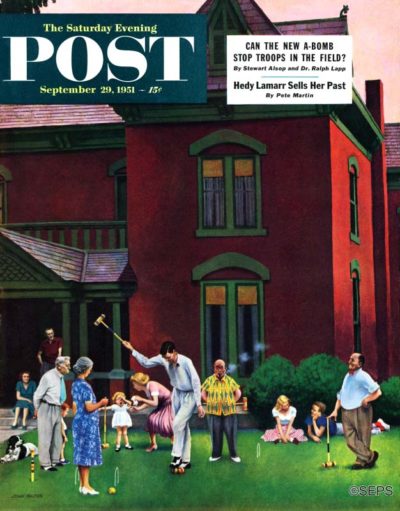
September 29, 1951
No Girls Allowed – Stevan Dohanos
A ramshackle paradise tucked into the trees makes the perfect lazy afternoon retreat for the adolescent crowd still harboring fears of a cootie outbreak. With trumpet, pooch, and crossbones all aloft, they can’t want for much.
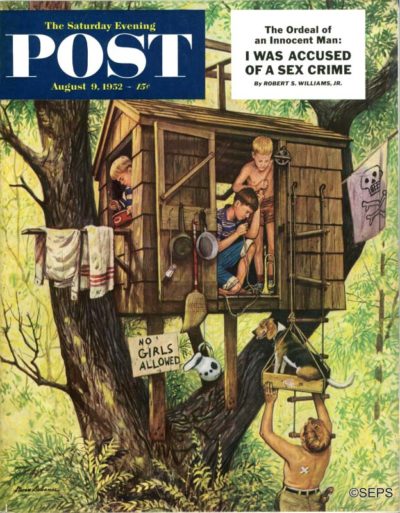
August 9, 1952
Feeding the Elephants – John Clymer
Getting up close and personal with a pair of curious pachyderms may be the thrill of the afternoon, but that motley bouquet of balloons just beyond the elephant habitat is sure to draw some new customers in the immediate future.
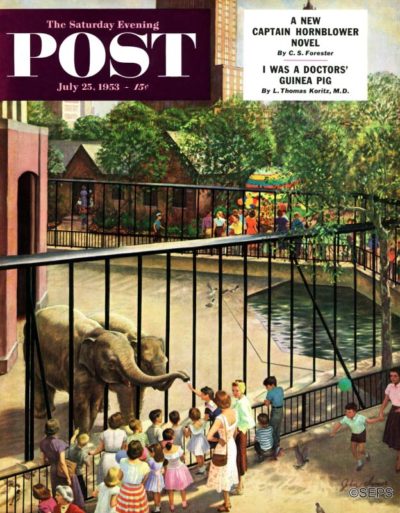
July 25, 1953
Town Green – John Clymer
A tot jamboree, future hall-of-fame hopefuls, and lounging bookworms round out the cast of John Clymer’s sprawling Town Green, where all can bask in the stippled shade around the gazebo.
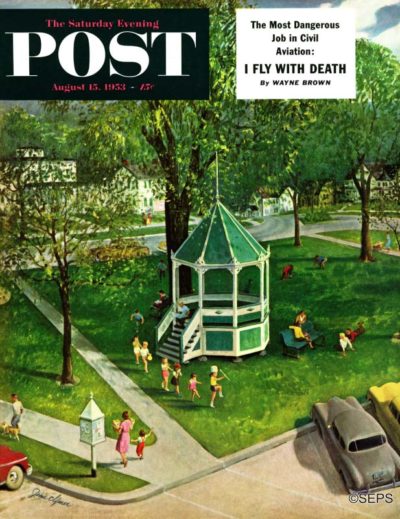
August 15, 1953
Backyard Campers – Amos Sewell
A bump in the night is never welcome when all you have are tent flaps for defense. And a few ghost stories too many can render the most innocuous cicada chirp into a sinister bogey-beast on the prowl.
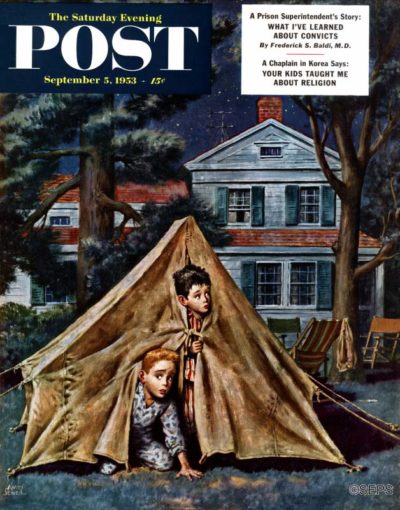
September 5, 1953
Lemonade for the Lawnboy – George Hughes
A shiny quarter would be welcome, but when trimming the lawn in the sticky heat of early summer, payment in icy fresh-squeezed lemonade is just as appreciated.
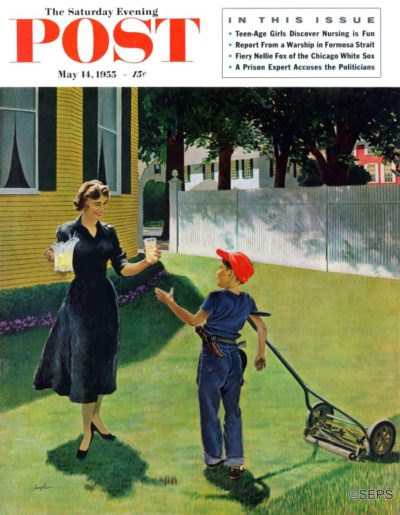
May 14, 1955
Wading Pool – Amos Sewell
Even if one size doesn’t fit all, when the kiddie pool is the only escape from August heat, most are willing to make due. You snooze, you lose.
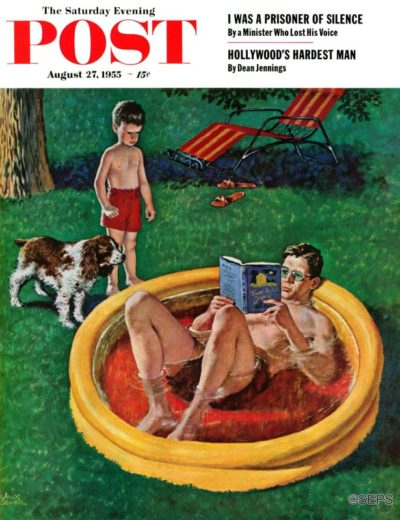
August 27, 1955
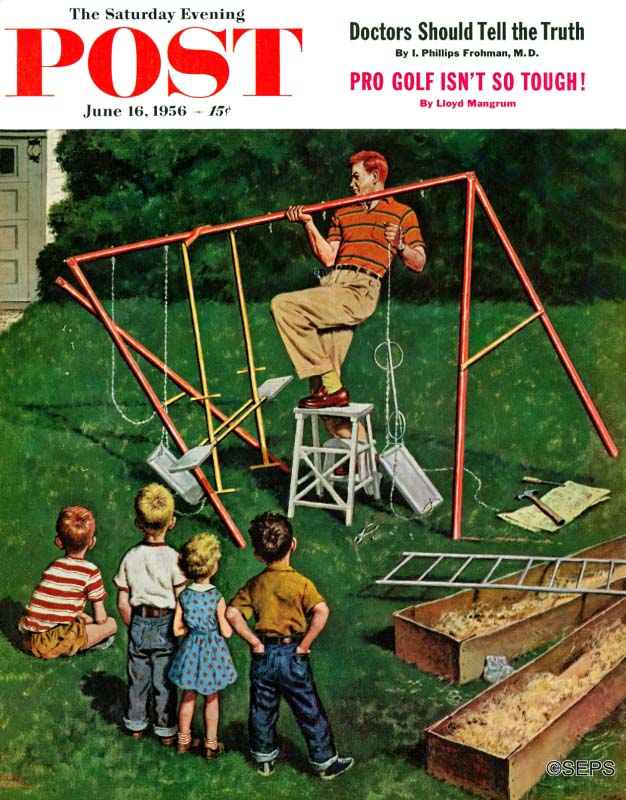
Swing-set – Amos Sewell
With shoddy materials and blueprints more complex than the Manhattan Project’s, dad may end up getting better exercise than the kids. Luckily for his patient audience, this dance more than makes up for the lack of functioning swings.
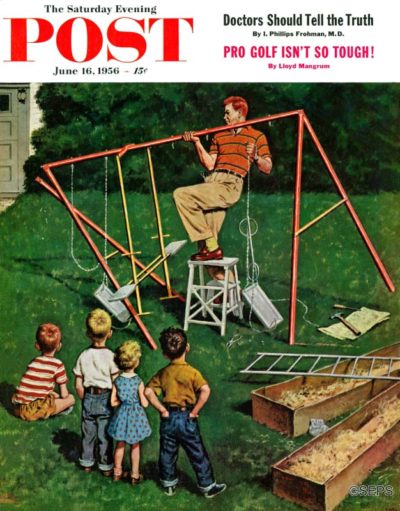
June 16, 1956
Billboard Painters – Stevan Dohanos
In mid-July swelter on the cusp of a scorching third digit, these workingmen are wise to take the advice of their arctic billboard. Unfortunately, no amount of wishful thinking can convince their fictional polar pals to share the snow.
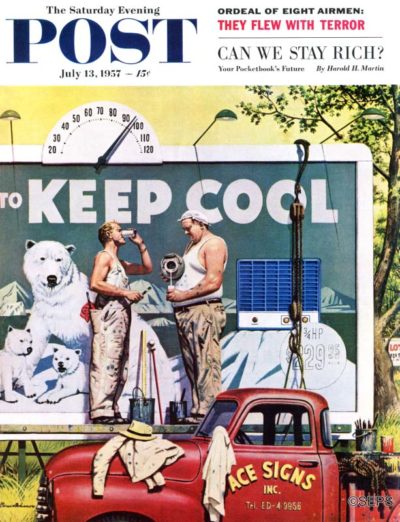
July 13, 1957
Where the Girls Are – Thornton Utz
As shown in Thorton Utz’s Where the Girls Are, the discerning college boy always has one eye open for opportunity, even in excess of the speed limit.
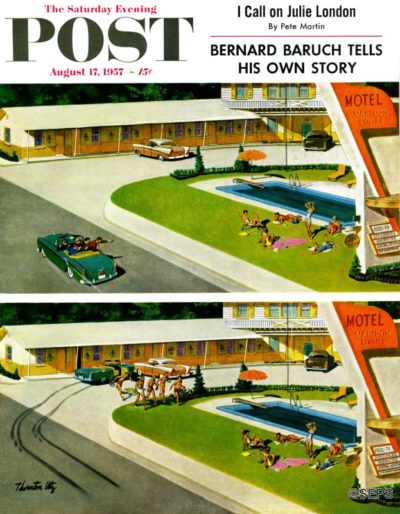
August 17, 1957
The Modern Vacation
Fun for the Whole Family!
The educational road trip leading up to a spectacular vista is not always appreciated by those for whom all that effort was expended. Artist Richard Sargent was also a father and the complex and often hilarious child-parent dynamic was a regular theme.
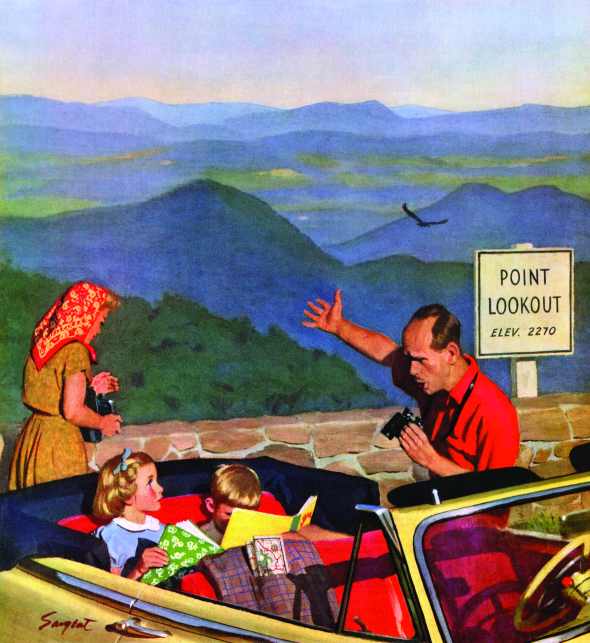
Richard Sargent
The Saturday Evening Post
July 18, 1953
Beached
Retirees in the 1930s may not have known how to dress down for the shore, but they seem to be enjoying the sand just as much as their modern-day equivalents do.
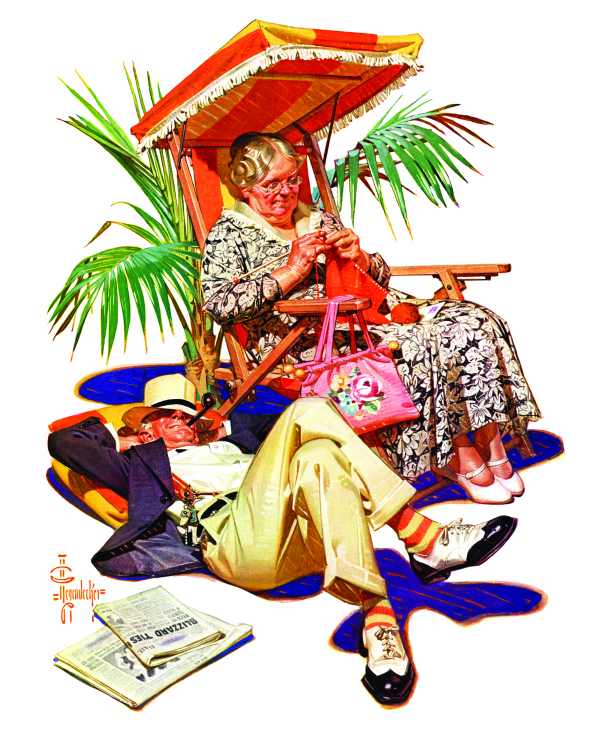
J.C. Leyendecker
The Saturday Evening Post
February 20, 1937
Dedicated vacationers march to the water first thing in the morning, forming an impromptu parade.
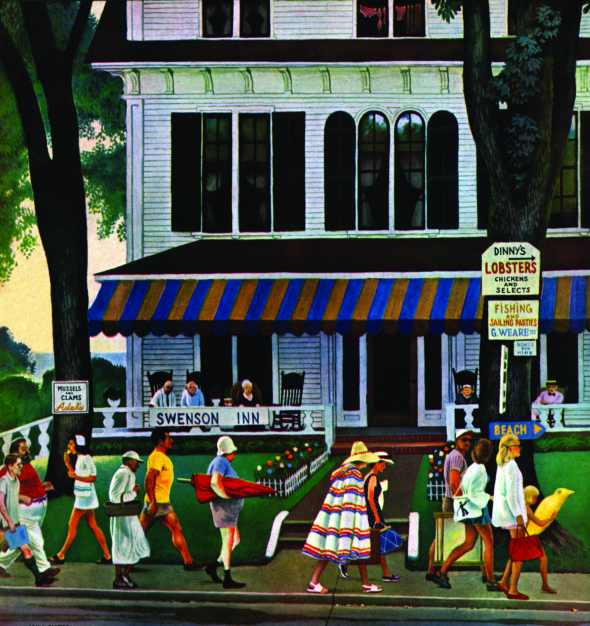
John Falter
The Saturday Evening Post
August 2, 1947
Baggage
Universal Truth No. 1: After a week at the beach, you will accumulate at least twice the baggage that you arrived with.
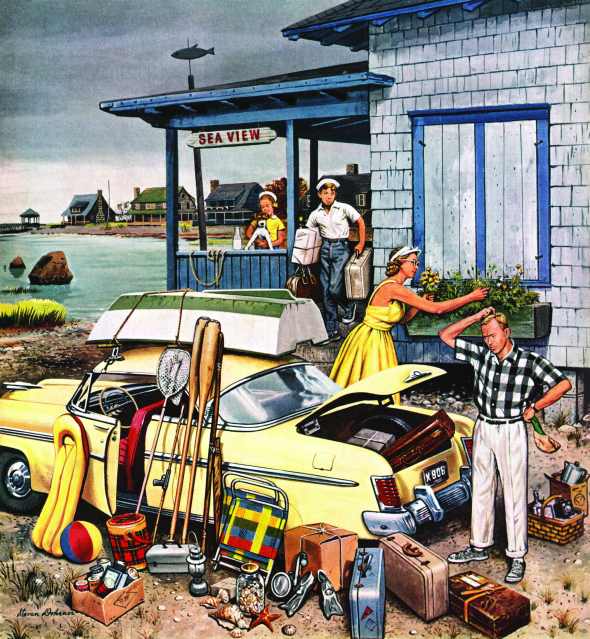
Stevan Dohanos
The Saturday Evening Post
September 8, 1956
Universal Truth No. 2: Vacations are short and much anticipated, which doesn’t leave time for unpacking — at least not in Dad’s view.
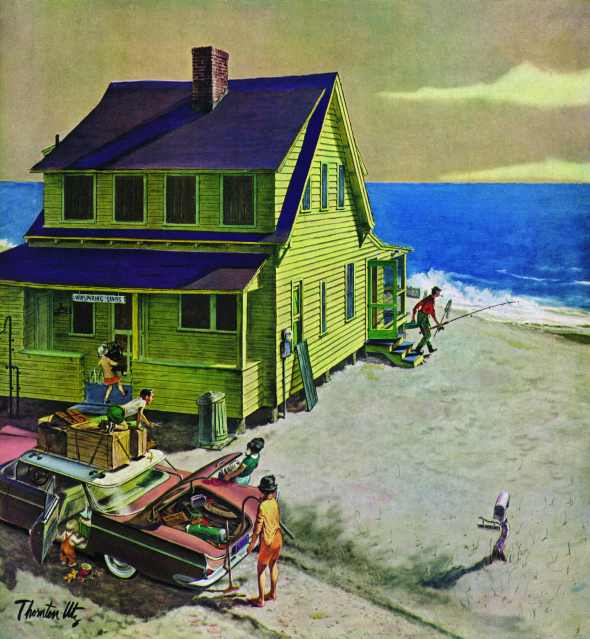
Thornton Utz
The Saturday Evening Post
June 18, 1960
Disappointment
When your job is to help others achieve their dreams as is the case for this travel agent, sometimes you need a quiet moment to dream one up for yourself.
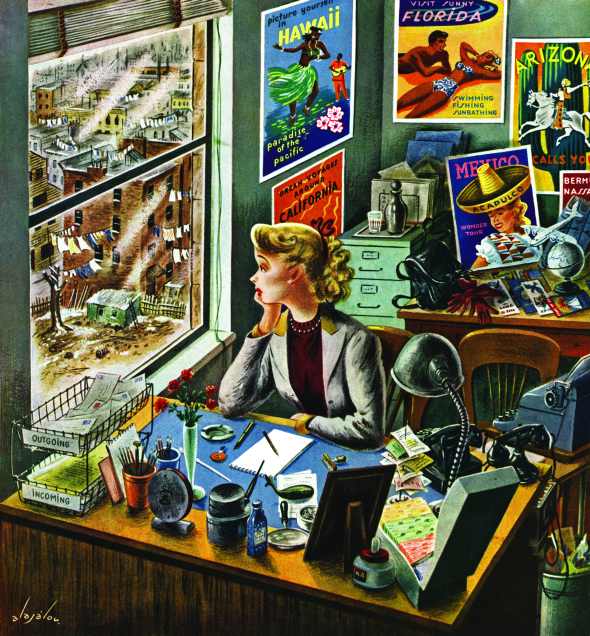
Constantin Alajalov
The Saturday Evening Post
February 12, 1949
You can’t plan the weather for that dream vacation, but this family is determined to get in as much outdoor time as humanly possible.
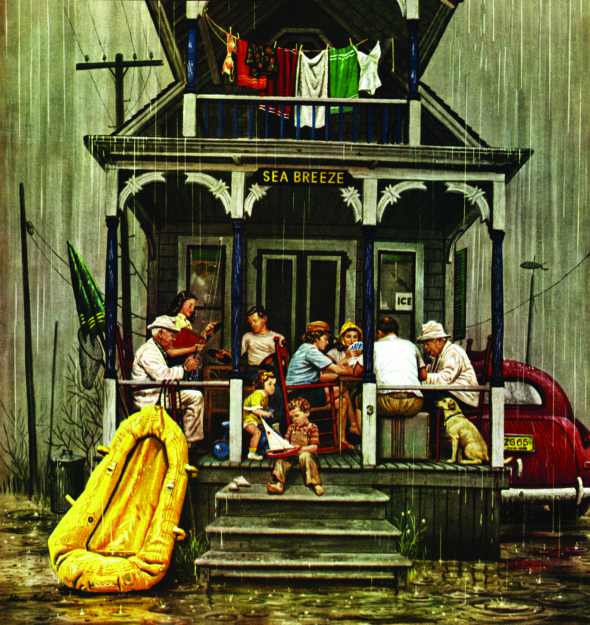
Stevan Dohanos
The Saturday Evening Post
July 31, 1948
Back Again
When you go away for what looks to be about three weeks — judging from the number of newspapers on the lawn, strewn about the front entry by some lout of a paperboy — there’s a lot of cleanup to be done. The weight of this realization is quite evident in the droop of Father’s shoulders.
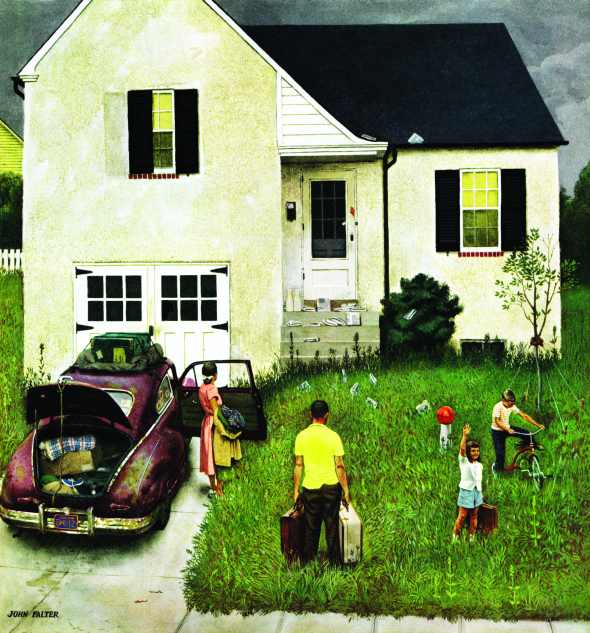
John Falter
The Saturday Evening Post
August 23, 1952
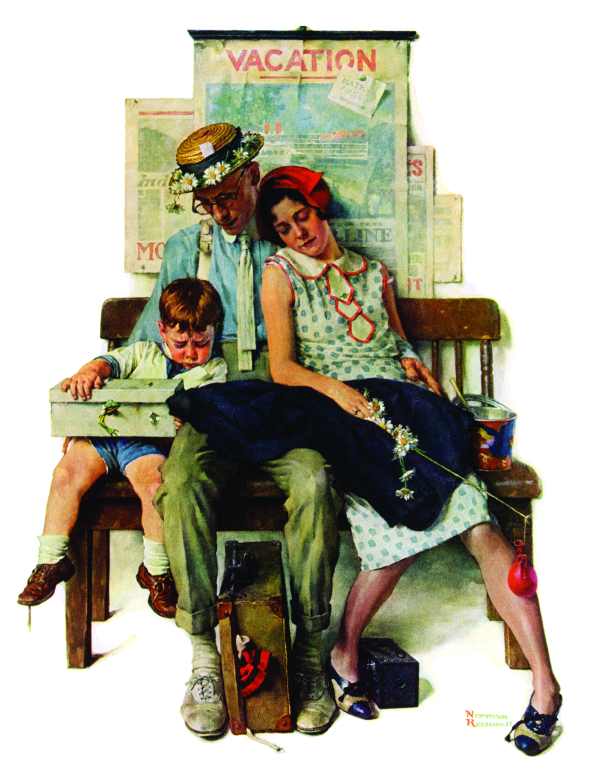
There may be no place like home, but after a long trip, Rockwell’s family requires rest.
Norman Rockwell
The Saturday Evening Post
September 13, 1930
What a Man’s Gotta Do
Fatherhood
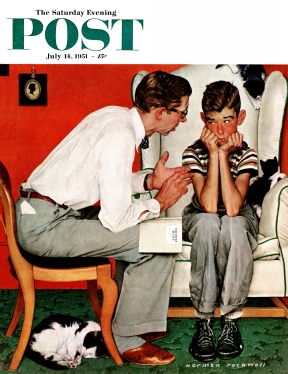
Dad’s role, as depicted in midcentury America, was to be the breadwinner, play the occasional game of catch, and generally set a good example for his boys. And, oh yes, no one else can give the son “the talk,” unpleasant though it clearly is for both of them.
Norman Rockwell
July 14, 1951
Get this framed at Art.com
Nightwatch
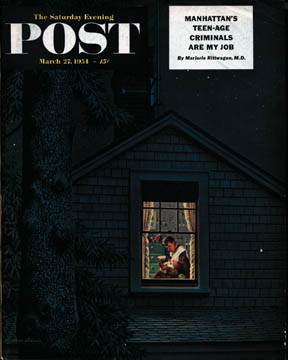
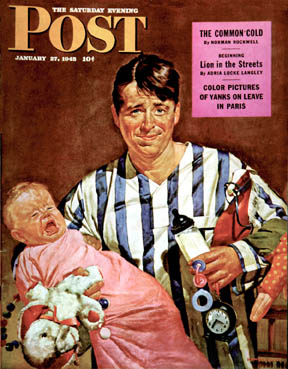
It wasn’t common to see fathers caring for babies in public; but in the privacy of the home, dads had to step up, if not always happily. In 2:00 Feeding (below), our subject appears tiny and trapped, the design emphasizing his isolation from the world outside.
Stevan Dohanos
March 27, 1954
Howard Scott
January 27, 1945
Unhappy Campers
Precise composition supports the narrative in these two amusing paintings of dads oppressed by duty. In Dad, the Fish are Biting (below), notice how contrasting wishes are suggested with shadow, one side dark, the other light.
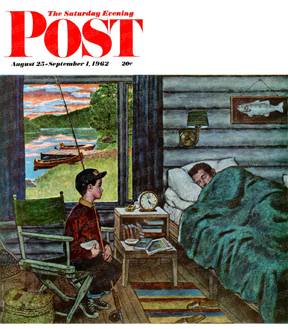
Amos Sewell
August 25, 1962
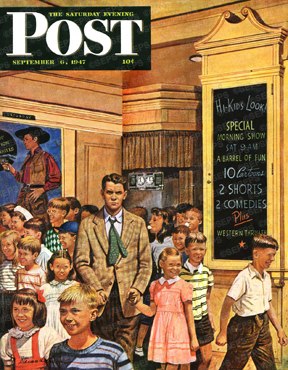
Stevan Dohanos
September 6, 1947
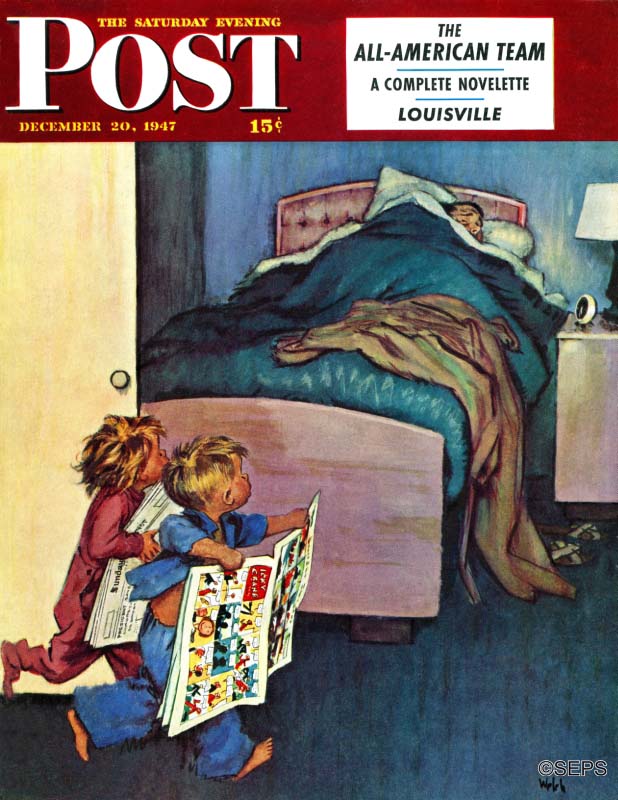
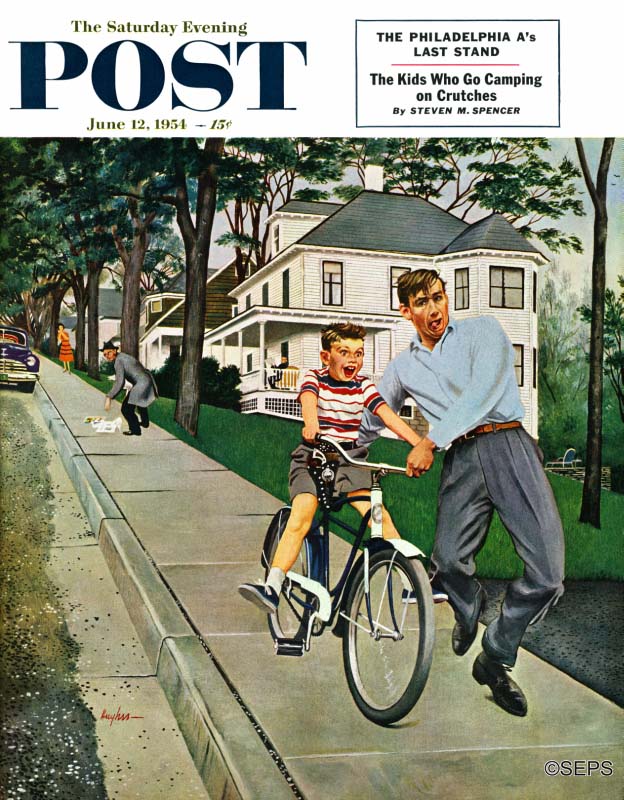
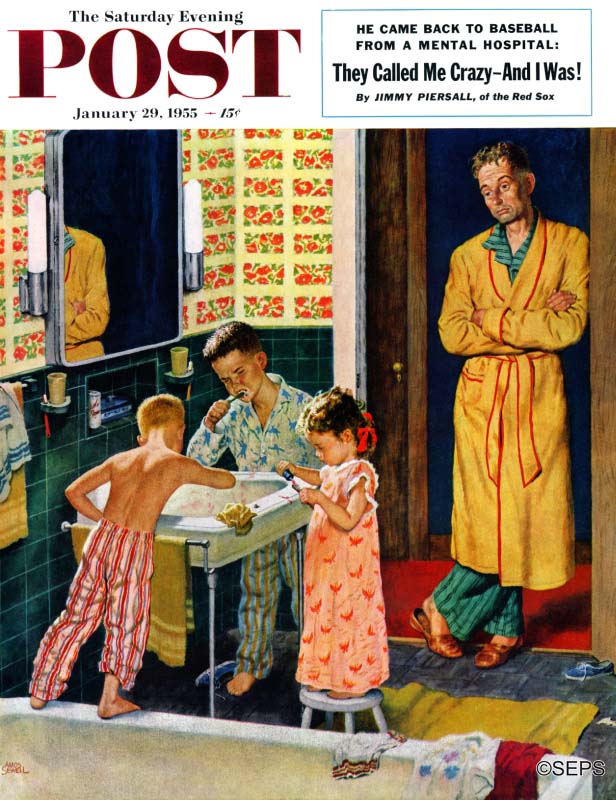
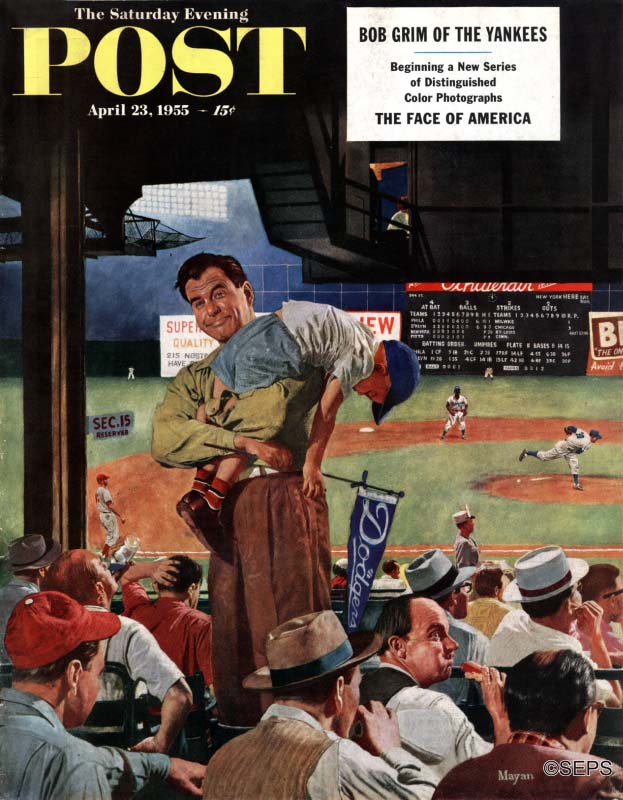
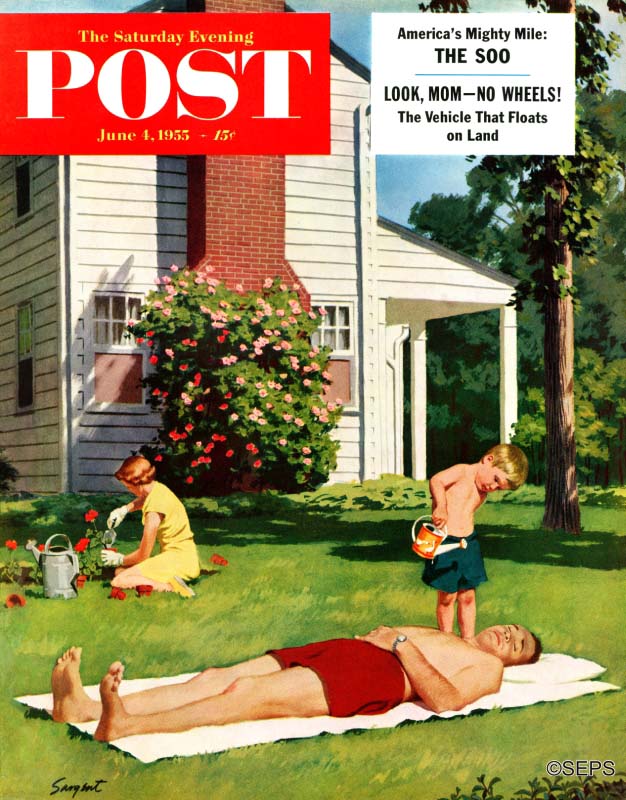
More fathers on the covers of The Saturday Evening Post (click on the covers to see larger image):
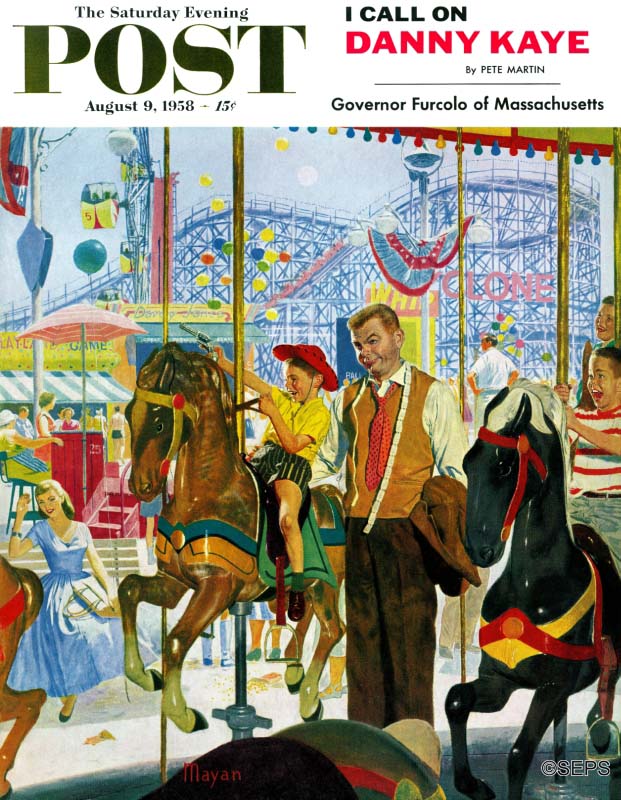
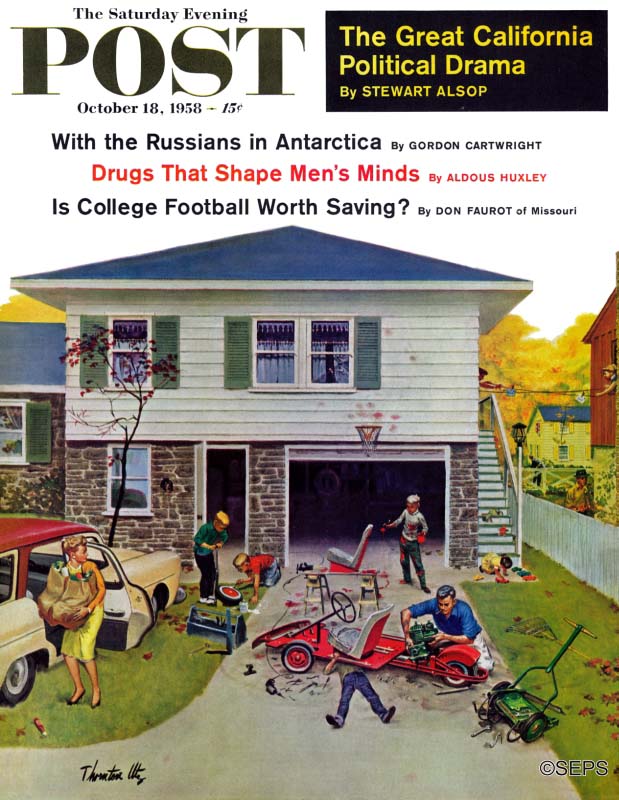
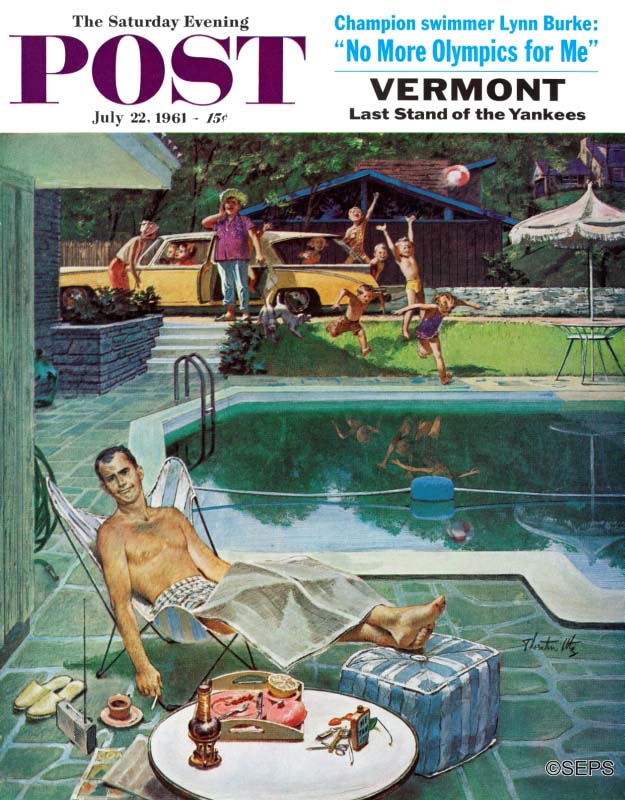
Football, American Style
Kick off this football season with this classic cover collection that spans six decades capturing the spirit of American football, from childhood games to college gridiron to the professional field.
Football, American Style — Click covers to see larger image.
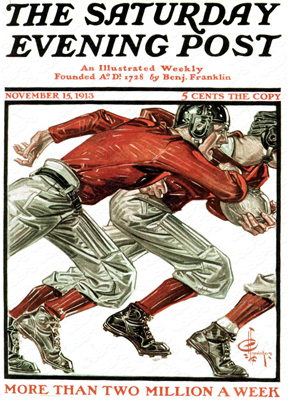
J.C. Leyendecker
November 15, 1913
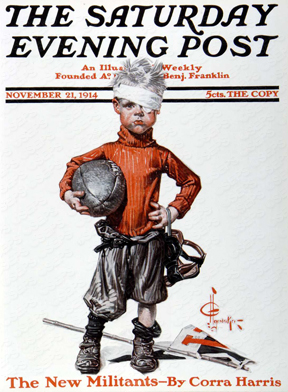
J.C. Leyendecker
November 21, 1914
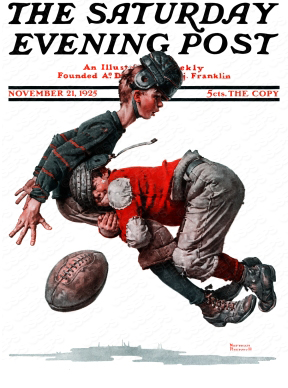
Norman Rockwell
November 21, 1925

Harrison McCreary
October 16, 1926
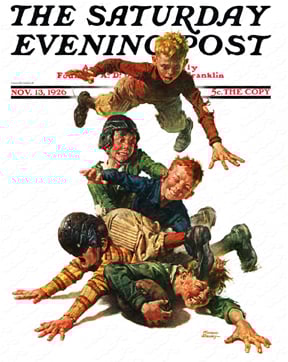
Frederic Stanley
November 13, 1926
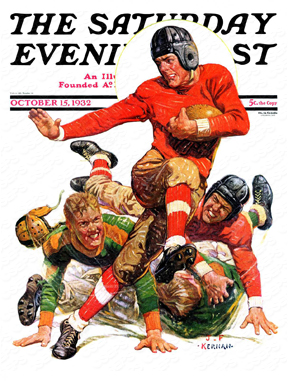
J.F. Kernan
October 15, 1932
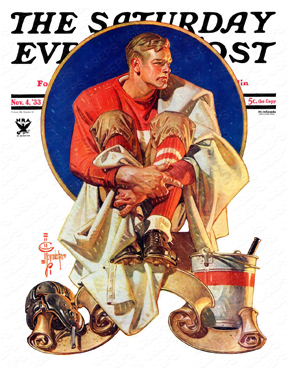
J.C. Leyendecker
November 4, 1933
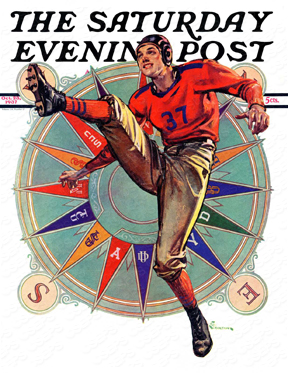
E.M. Jackson
October 23, 1937
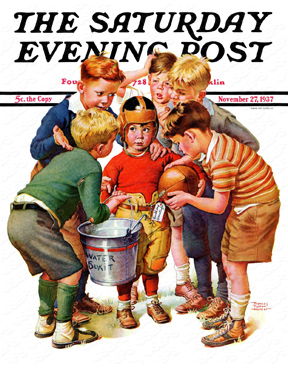
Frances Tipton Hunter
November 27, 1937

Russell Sambrook
October 26, 1940
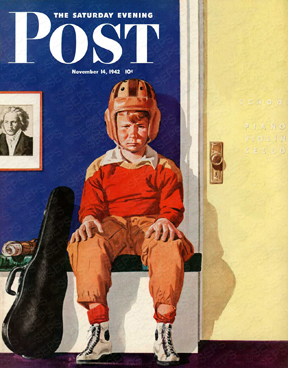
Lonie Bee
November 14, 1942
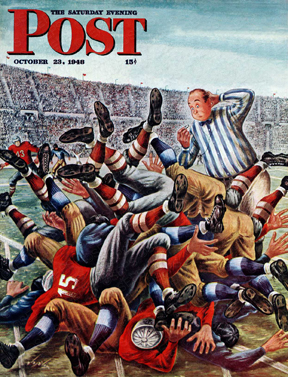
Constantin Alajalov
October 23, 1948
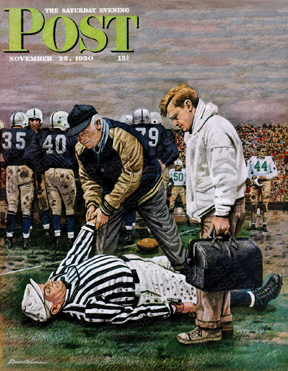
Stevan Dohanos
November 25, 1950
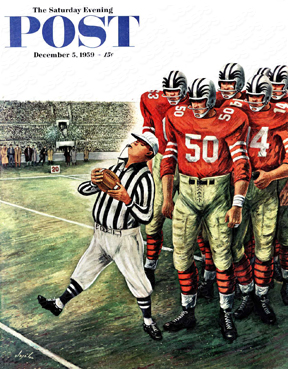
Constantin Alajálov
December 5, 1959
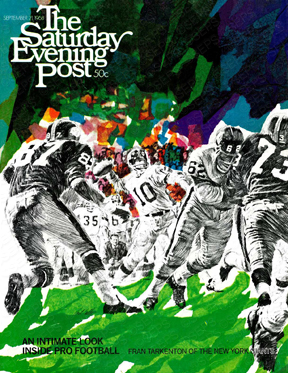
Paul Calle
September 21, 1968
See more cover art from some of the artists featured here:
Constantin Alajálov
Stevan Dohanos
John Falter
Frances Tipton Hunter
J.F. Kernan
J.C. Leyendecker
Norman Rockwell
Stevan Dohanos
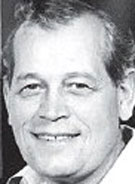
Stevan Dohanos, born May 18, 1907 in Lorain, Ohio, grew up as a great admirer of Norman Rockwell, going so far as to copy his Saturday Evening Post cover illustrations in crayon that he sold to friends, relatives, and co-workers. Little did Stevan know, he would develop a close personal friendship with Rockwell as his own art graced the Post’s cover 123 times over the course of his lifetime.
Dohanos was the third of nine children born to Hungarian immigrants Elizabeth and Andras Dohanos. His upbringing in a midwestern steel town would later influence the cultivation of his artistic style showing the normalcy and realism of American life. While inspired by Rockwell’s talent, Dohanos became an “American Realist” who depicted everyday life as it was. He was most heavily influenced by the work of Edward Hopper, and chose not to idealize American life the way Rockwell did.
Dohanos realized his love of art fairly early in life, selling calendars and illustration copies for $1.00 to $3.00 apiece while he worked in a grocery store and later at an office job. He began his formal education by taking correspondence classes through the International Correspondence School. Soon after, the artist took night classes at the Cleveland School of Art where he received a scholarship to complete his formal art studies.
During and after art school, the young Dohanos worked in a Cleveland advertising firm, then travelled around the country painting wall murals before heading to New York City to work as a commercial artist. He eventually moved to the artist colony of Westport, Connecticut where he found inspiration in the everyday lives of his neighbors.
While working in the city, Dohanos picked up advertising work from clients such as Four Roses Whiskey, Maxwell House Coffee, Pan Am Airlines, Cannon Towels, Olin Industries, and John Hancock Insurance. His work was featured in Esquire, Medical Times, McCall’s, and Colliers prior to his first successful submission to The Saturday Evening Post. In September of 1938, he married his longtime sweetheart, Margit Kovacs, and had two children, Peter and Paul.
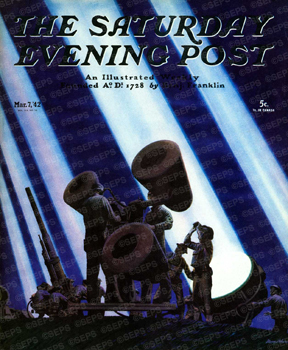
Stevan Dohanos
March 7, 1942
His first Post cover, the March 7, 1942 issue, was a well-received wartime image of air raid searchlights from an artillery battery. Throughout the 1940s and 1950s, the artist’s workload for The Post increased, garnering a contract for roughly a dozen covers a year.
During World War II, Dohanos aided the war effort by painting recruitment posters and wall murals for federal buildings. He also designed stamps for the federal government, starting during the Roosevelt administration, and staying in the profession the rest of his life.
As magazine covers turned toward photography and away from illustration, Dohanos quickly changed careers. He did film art for such classics as White Christmas and was the chairman of the National Stamp Advisory Committee where he oversaw the art design for over 300 stamps. He held the position throughout the administrations of 7 presidents and 9 Postmaster Generals. His depictions include presidential portraits, the now collectible NATO commemorative stamps from 1959, and the 1967 John F. Kennedy commemorative stamp.
Stevan Dohanos found beauty in everyday life, choosing to focus on “the location and trappings of the American dream, not those who populated it.” Elevated to lofty status as a famous Saturday Evening Post illustrator, Dohanos’s works now garner the walls, halls, and galleries of The Cleveland Museum, The New Britain Museum of American Art, The Pennsylvania Academy of the Fine Arts, Dartmouth College, The Whitney Museum of American Art, and various federal post offices across the United States. He died July 4th, 1994 at the age of 87.
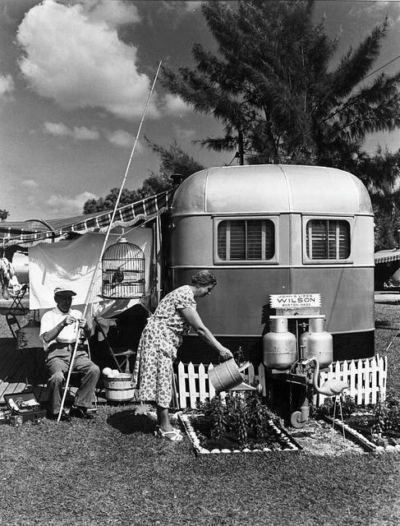
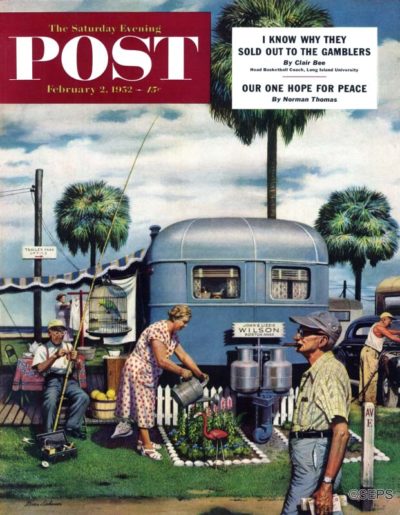
Stevan Dohanos hewed closely to the photo that he used to create this homey Florida scene for our February 2, 1952, cover.
Covers by Stevan Dohanos
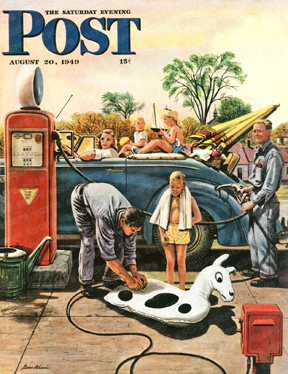
Inflating Beach Toy
Stevan Dohanos
August 20, 1949
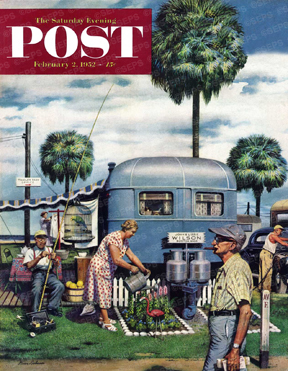
Trailer Park Garden
Stevan Dohanos
February 2, 1952
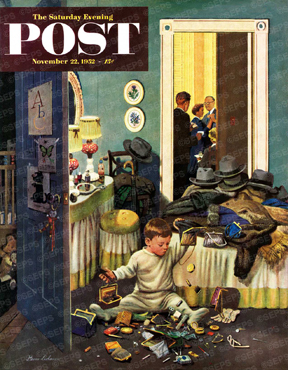
Toddler Empties Purses
Stevan Dohanos
November 22, 1952
Beyond the Canvas: Fireworks, Fanfare, and the 4th of July
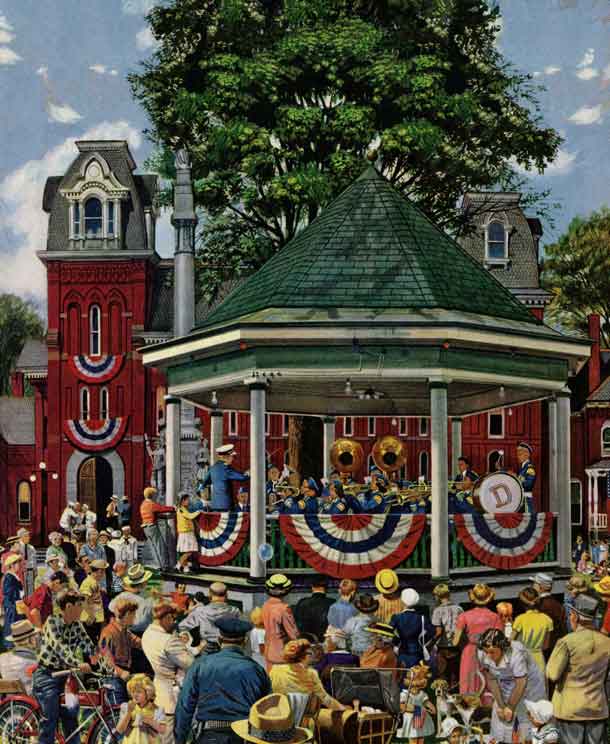
Stevan Dohanos
July 7, 1951 © SEPS
The Saturday Evening Post has celebrated many American Independence Days with beautiful covers that set the country’s mood for the red–white–and–blue doused holiday.
On past covers, our artists chose a variety of ways to show how Americans have gathered for the 4th of July.
The day brings out bands, orchestras, and symphonies to dust off the sheet music and play familiar American tunes.
Stevan Dohanos‘ Patriotic Band Concert from July 7, 1951, shows a community square filled for the day’s brass fanfare.
The lofted gazebo allows attendees a good listening spot from all around the town center. Cities and small towns alike still have parades, ceremonies, concerts, and picnics they offer free of charge.
John Falter
July 5, 1952 © SEPS
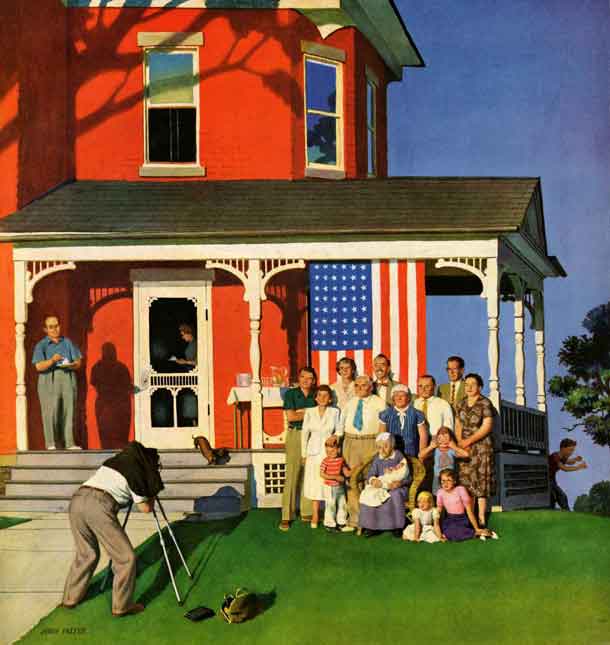
Our July 5, 1952 cover, Family Portrait on the Fourth by John Falter makes a picture of the fourth of July day itself.
He incorporates the house and unremarkable-yet-presumably-American landscape to create a portrait of celebration in the rural, maybe even more ‘traditional’ parts of the country.
The blue sky, red house, and white porch all enhance the colors of the flag in front of which this family gathers to have their picture taken.
And last but not least, what would Independence Day be without the spectacle of independence night? Ben Prins’ Fireworks from July 4, 1953 marks the holiday’s end with celebratory bombs bursting in air, as we pay homage to those who have fought and died for our country.
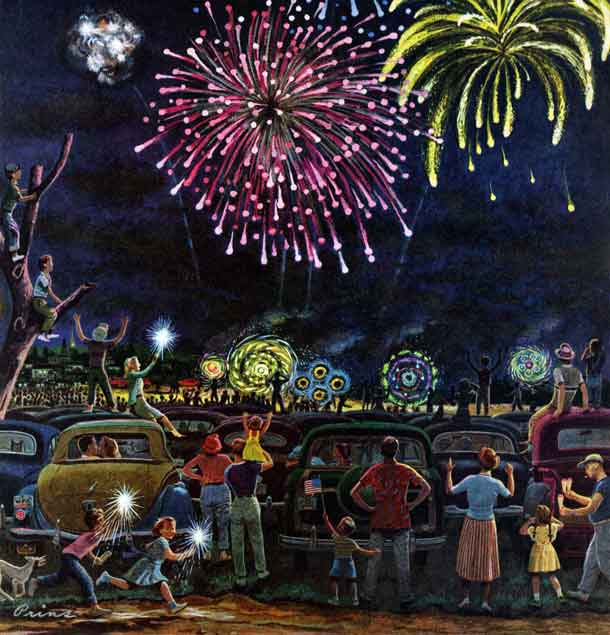
July 4, 1953. © SEPS 2014
If you look closely, you’ll notice that the color scheme of the sparks form a choreographed red, white, and blue flag.
The holiday can be a sticky, humid afternoon of grill smoke and supply errands. But at the end of the gatherings, the family portraits, and the concerts, we settle in for the evening spectacle.
Many families will prepare s’mores over a fire, and await booming fireworks that signal the end of yet another American Independence Day.
Beyond The Canvas: Grandstand Grand Slam
April 22,1950. © SEPS 2014
Click here to license this and other artwork by Stevan Dohanos.
Click here to purchase this and other artwork by Stevan Dohanos from Art.com.
April welcomes the fresh green bloom of spring, as well as Opening Weekend for America’s favorite pastime: baseball.
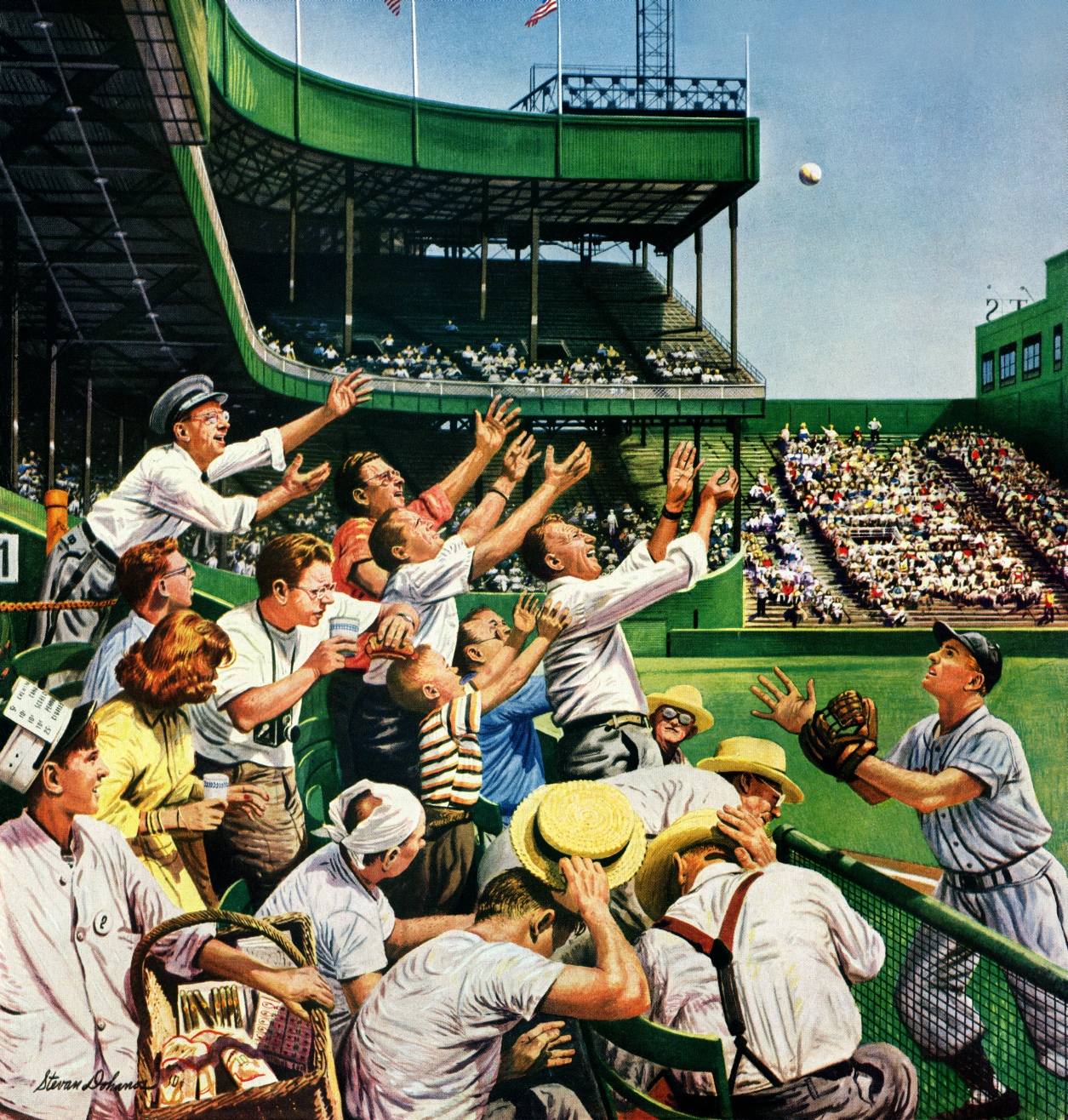
In his April 22, 1950 cover for The Saturday Evening Post , illustrator Stevan Dohanos depicts a wide variety of reactions to an incoming fly ball on a sunny day at the ballpark.
The green upper decks curve around the back end of the stadium and enlarge the grandeur of the atmosphere as they approach the outfielder’s apparently useless attempt to catch a ball among the throngs of an excited crowd.
This game is not a casual affair taking place over a relaxing weekend afternoon. This outing plays host to a devoted baseball following. The scene takes place somewhere between late morning and afternoon. The adults in the stands are playing hooky, and should they catch that prize ball, they would have no one and nowhere to brag to for fear of being discovered out of the office. If you look carefully into the crowd, most of the men are still wearing their work attire. They have rolled up sleeves, but they still wear slacks, ties, button-down shirts, suspenders, and even a bus driver’s hat on the man in the back row.
The illustration shows that love of the game transcends generations. Boys and men all reach to the sky, hopeful for momentary fame, hoping to be “that guy” lucky enough to snatch a professional, maybe even game-ending ball. For the men, there are resurgent childhood dreams of one day playing professionally. The boys in the stands are instilled with those hopes and dreams for the first time.
Structurally, Dohanos composes a triangle across the cover by using the reaching crowd and outfielder as linear markers to draw the viewer’s eye to the falling trajectory of the incoming baseball. The immense stadium and rows of stands are simply background to the scene unfolding at the painting’s foreground.
The color palette blends the semi-yellowed field with the straw hats and yellow dress of the baseball-avoiding bystanders. The bright yellow colors disperse the white-collar chaotic mess in the stands. Some individuals sit back without a care while others hide or turn away. A select few in the section dive for the ball.
Like the viewer, the rest of the stadium watches this freeze-frame scene. The narrative indicates that a fan’s catch would ensure a home run against the outfielder jumping for the fences. We are brought into the scene’s tension, the game, and the stadium’s excited, cheerful atmosphere.
64 years later, America still eagerly awaits the baseball season and its longstanding tradition of spring’s Opening Day. The fields are watered and mowed, the sun is shining, and there’s always a chance it could be any one of us in the stands, ready to catch that home run ball.

Spring Covers: A Perennial Favorite
The spring equinox occurred weeks ago, March 20 to be exact, which means this winter’s tale has (finally!) come to a welcome end.
Here at The Saturday Evening Post, we have historically welcomed each spring with delightful covers from some of our greatest artists and illustrators, each cover offering a different take on varied spring themes. The following three covers show the range of springtime weather, and the ways we take advantage (or don’t) of the change in season.
The most prevalent activity of spring is the tending of of gardens. In Thornton Utz’s, “Spring Yardwork” from May 18, 1957, the viewer sees an entire neighborhood planting, watering, mowing, mulching, raking, and so on and so forth down the straight line of synonymous 1950s homes.
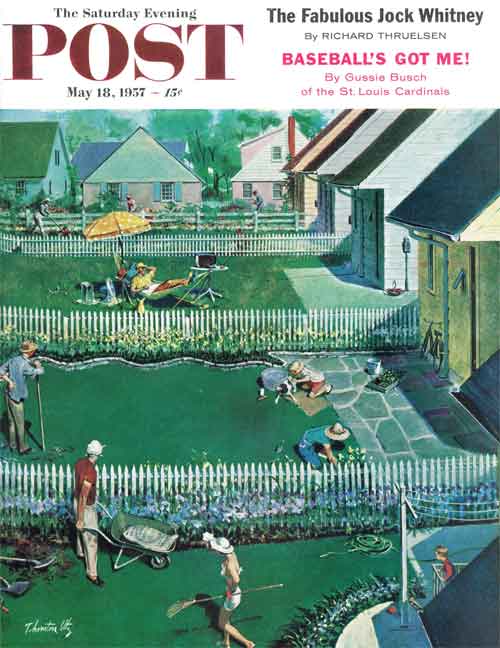
At the far end of the street, we view a man sunbathing in a yard completely lacking any cultivation. There are no perennials, no sprouting annual bulbs planted the previous fall, and he is not planting for the summer harvest. If anything, the old parable of the grasshopper and the ant comes to mind.
The lazy grasshopper homeowner at the far end looks out jealously from his lawn chair and barren yard to see the fruits of his ant neighbors’ labors. It’s not too late for him to make hay while the sun shines, but he looks awfully comfy drink in hand.
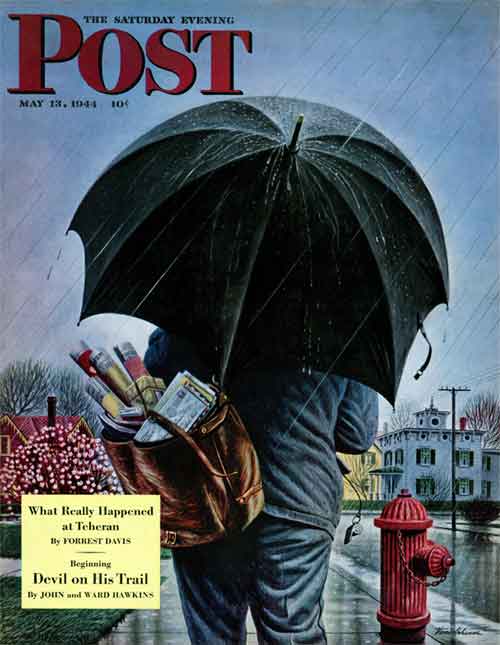
From sunshine to April showers, “Mailman” by Stevan Dohanos, which appeared on the May 13, 1944 issue, shows a devoted neighborhood staple, the rain-or-shine employees of the United Sates Postal Service completing his daily duties in a solemn, light afternoon shower. The mailman is an American ideal of civil service, the difficulty of his responsibilities unknown to those who conveniently find their mail waiting, as if by magic, in their mailboxes.
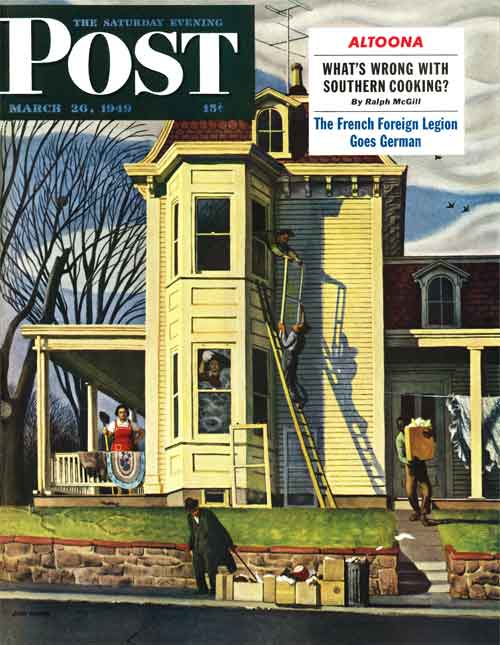
In contrast, “Spring Cleaning” by John Falter, from the March 26, 1949 cover, shows people who, unlike Dohanos’ mailman, have the luxury of finishing their chores on a beautiful, sunny day. Most would rather have fun on a sun-kissed afternoon, but completing a task in good weather is certainly preferable to the rain.
This season has much to offer, so take advantage! It’s time to head outside, to enjoy warmer weather, to plant our gardens, and to take charge of our spring-cleaning procrastinations (or eh, maybe next year). This season of early awakenings only comes once a year, so make sure to take a moment and appreciate this singular spring season.
Classic Covers: Yard Work
From mowing and tree planting to a neighborhood nonconformist, 1950s-style, these timeless covers are just in time to inspire you to tackle that yard.
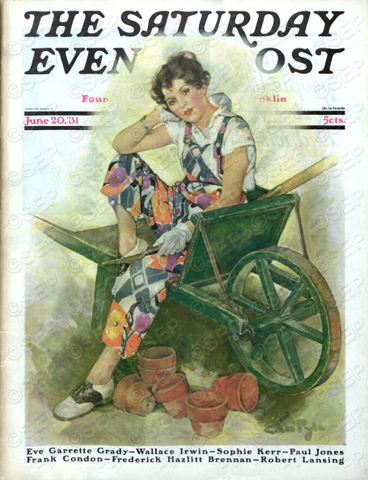
Woman in Wheelbarrow
Ellen Pyle
June 20, 1931
Ellen Pyle (1876-1936) was known for her beautiful use of color. In 1927, she received a note from fellow cover artist Norman Rockwell about how much he liked her Post covers. “They are dandy. So full of color and so broadly painted. Believe me I envy you the latter quality particularly,” he wrote, according to Delaware Art Museum’s Illustrating Her World: Ellen B. T. Pyle.
As in many of her 40 covers for the Post, the model is one of Pyle’s children. In this case, teenage daughter Caroline is taking a wheelbarrow break from gardening duties.
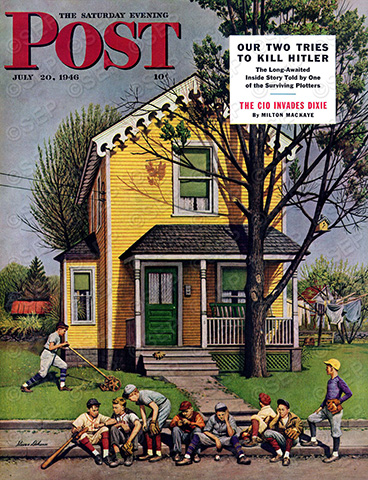
Baseball Player Mowing the Lawn
Stevan Dohanos
July 20, 1946
“When summer rolled around,” wrote Post editors of this 1946 cover, “and the grass in Westport, Connecticut, began to grow as fast as a small boy’s hair, Stevan Dohanos recalled one of the duties of his youth and how mowing the lawn can ball up a man’s more important engagements.”
The frame house, however, was not in Connecticut, but back in artist Dohanos’ (1907-1994) hometown of Lorain, Ohio. Editors noted that he sketched it a couple years before it appeared on the cover. “Obviously it was a good stage, a good setting, but he never had decided just what story to tell against this background. Now he uses it to tell of a common summertime crisis—when the star pitcher has to work,” Post editors wrote.
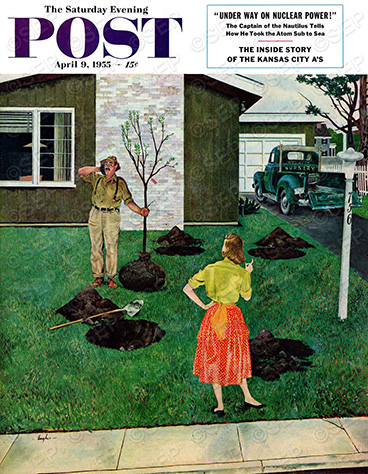
Put the Tree There?
George Hughes
April 9, 1955
Illustrator George Hughes (1907-1990) was an avid outdoorsman, but we’re not sure how he felt about planting trees. He would probably feel the same as the poor guy from the local nursery on this 1955 cover, if he had to deal with an indecisive homeowner.
Hughes painted 115 Post covers, and was especially productive in the 1950s. Typical output for the more popular illustrators was around 40 to 50 covers during a decade. Hughes’ friend Norman Rockwell, for example, did 44 during this period. Hughes did 80 in this timeframe; mostly fun, slice-of-life scenes from midcentury suburban life.
View more in the George Hughes gallery.
Artist Thornton Utz (1914-2000) enjoyed gently bucking the trend and depicting the neighborhood nonconformist. Mr. Leisure in this 1957 cover uses his backyard purely for relaxation, not caring how high the grass gets.
Meanwhile, in nearby yards, neighbors are flummoxed by Mr. Leisure’s indifference—at least those who can spare a second from their suburban chores.
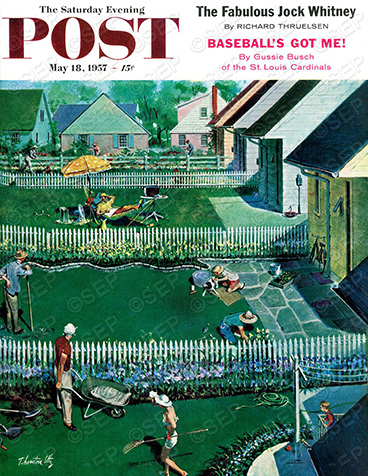
Spring Yard Work
Thornton Utz
May 18, 1957
Even the little girl in the middle yard wastes no time as she tends to her dog’s bath. Post editors mused that the cover might start a debate “about whether people should nourish their backyards or let their backyards nourish them.” We’ll let the reader decide.
Classic Art: George Washington
George Washington was a favorite subject of artists like J.C Leyendecker, N.C. Wyeth, and Stevan Dohanos. In all, the first president of the United States has appeared on the cover of The Saturday Evening Post 10 times.
Washington Crossing the Delaware
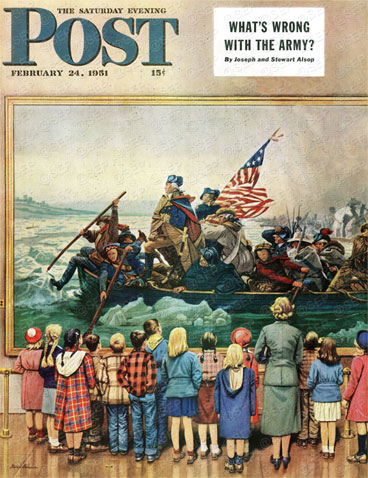
Washington Crossing the Delaware
Stevan Dohanos
February 24, 1951
It is daunting to consider the work realist painter Stevan Dohanos put into this painting. Reproducing images of over a dozen students (and their teacher) with meticulous detail should have been artistic challenge enough, but duplicating Emanuel Leutze’s famous 1850 painting is mind-boggling.
Much has been criticized about Leutze’s Washington Crossing the Delaware: “The crossing was at night (not daytime)”; “That particular version of the flag came later”; and “Washington was only in his 40s and not the elderly man we see here”; to name a few. While the historical inconsistencies are worth noting, the huge 21-by-12-foot painting of that 1776 Christmas night is still a magnificent accomplishment and a tribute to a critical turning point in American history. The painting today is part of the collection of the Metropolitan Museum of Art in New York City.
From 1942 to 1958 Dohanos painted 123 Post covers, which can be viewed in our online gallery or at art.com.
First Farmer of the Land
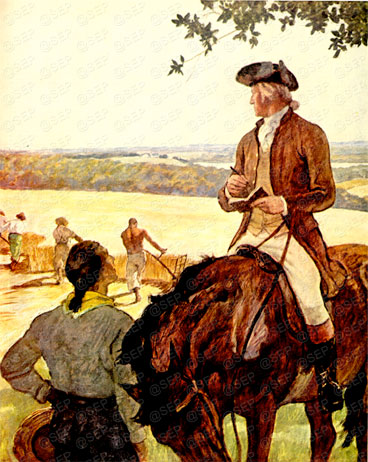
First Farmer of the Land
N.C. Wyeth
Country Gentleman
February 1946
N.C. Wyeth was described in a 2011 Post article by Edgar Allen Beem as “a larger-than-life figure, a swashbuckler of a man whose dramatic illustrations fired the imaginations of generations of readers.” This portrait of Washington was Wyeth’s last work. Country Gentleman editors noted in 1946, “He was working on it at the time of his tragic death at a grade [train] crossing last fall. It is, therefore, an unfinished work. We preferred to have you see it this way than let some lesser artist finish it.”
Wyeth, who had used George Washington as a subject several times, was a natural choice to illustrate the article about the farming habits of the former president. “Mr. Wyeth did exhaustive research on Washington’s farming operations so that this picture might be accurate in every detail,” editors noted. Those details clearly include the depiction of slave labor, a factor not addressed in the article, which concentrates on the minutiae of crops and agriculture. According to the article, Washington was so thorough in his farming procedures that he was determined to find out how many seeds of various cereals were in a pound in order to calculate how many pounds to sew per acre. He carefully counted 8,925 barley seeds per pound; 71,000 seeds of red clover; and 298,000 of timothy (this was before the days of grain estimates.)
George Washington and W.W.I Soldiers
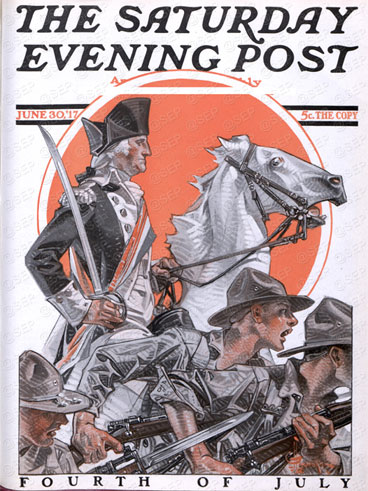
George Washington and W.W.I Soldiers
J.C. Leyendecker
June 30,1917
Five of J.C. Leyendecker’s 322 Post covers were portraits of George Washington. His July 1927 cover (George Washington on Horseback) shows a magnificent Washington on horseback in full command of the Revolutionary forces.
This 1917 cover shows the general astride his horse for a latter-day conflict. The United States was involved in World War I and for the Fourth of July holiday, Leyendecker evoked the spirit of the Revolutionary War hero to guide modern-day soldiers through the latest conflict. It was a stirring patriotic scene at yet another critical time in U.S. history.