The Myth of America’s Decline
Halfway into the last century, America was finished. Or so it seemed. On October 4, 1957, the Soviet Union became the first space power in history, launching its Sputnik (“satellite”) into orbit and striking terror into the American soul.
This was “a shock which hit many people as hard as Pearl Harbor,” recalled a commentator for the Mutual Broadcasting System, then one of the Big Four networks. It was “a frightful blow.” America had grown “soft and complacent,” believing that it was “No. 1 in everything.” Yet now the country had been upstaged by its mortal rival.
Sputnik stopped transmitting after three weeks, tumbling out of the sky two months later. Short-lived as it was, the wobbly contraption–a mere 23 inches across–had a devastating impact on the American psyche. Soul-searching and self-deprecation turned into a national obsession–and into a chronic reflex. The October surprise gave birth to a school of thought that would outlive Sputnik and regularly return to torment the American imagination all the way into the 21st century. Let’s call it “Declinism.”
The basic theme–America as has-been–is recycled about every 10 years. “It’s decline time in America,” the stock drama trumpets, and it is staged anew at the end of each decade–typically, as the sun is about to set on an administration while presidential candidates begin jockeying for position. As in the hand-wringing over Sputnik, the alarm does in fact spring from real trouble, be it economic hardship or military misfortune.
Economically, this first wave of Declinism bears an uncanny resemblance to the last, which rose after the Crash of 2008. In the fall of 1957, the economy shrank by 4 percent; in the spring of 1958, by an appalling 10 percent. The numbers for 2008 and 2009 were minus 5 percent and minus 6 percent. So there is always a rational basis for this kind of angst attack. Just as regularly, though, anxiety expands into visions of foreordained decay. A crisis is not just a crisis but a portent of doom in an almost biblical model: Having gone astray, America will be called to account for the sin of pride or sloth.

As this is a secular saga, punishment will be handed down not by the deity but by other nations. Meaner and leaner, they will dethrone the “last best hope of earth,” to recall Lincoln’s famous words in the worst days of the Civil War. The Soviet Union was first in this tale of woe. It would be followed by Europe, Japan, India, and China. The characters changed, but the drama became part of the American repertoire.
In the Year of the Sputnik, a presidential panel produced a top-secret report, “Deterrence and Survival in the Nuclear Age,” which went down in history as the Gaither Report. Though focusing on the Soviet Union, the language of doom could easily be applied to China today, the most recent challenger touted as more dynamic and disciplined than the United States. The economy of the USSR, warned the panel, is just a bit “more than one-third of that of the United States,” but “it is increasing half again as fast.”
So how long would it take for the Soviet Union to demote the United States? Careening along on its straight-line projection, the report predicted that by 1980 Moscow’s annual military spending “may be double ours,” unless, of course, the United States finally woke up to the deadly threat. Today’s doomsters similarly point to the double-digit annual expansion of Chinese defense spending, and the more strident Cassandras target 2025 as the year when China will leave the United States in the dust economically. Others give the United States until 2050 to drop to second or even third place in the GDP race.
Worse, the Gaither Report claimed, the Soviets had “probably surpassed us in ICBM development”–missiles of intercontinental reach. “Probable” is another word for “don’t know,” but in the annus horribilis of 1957 the report found a grateful reader in the freshman senator from Massachusetts, John F. Kennedy. Eying a presidential run two years later, he began to stoke the national angst. For him, the day of America’s disgrace was practically at hand. By 1960, “the United States will have lost…its superiority in nuclear striking power.” The slothful policies of President Eisenhower and his Republicans would produce “great danger within the next few years,” ran his mantra.
This was the fabled “Missile Gap” that never existed; it would take years before Soviet missiles based at home could effectively hit the continental United States. Whether by number or technology, the United States was far ahead of the USSR. But facts, unfortunately, don’t deliver prophetic punch. So Kennedy painted Armageddon in the most gruesome colors.
The Russians were forging ahead, and the Missile Gap would deliver to them a “new shortcut to world domination.” In the presidential campaign, Kennedy orated like a fully blown Declinist: “That is what we have to overcome…[the sense] that the United States has reached maturity, that maybe our high noon has passed, maybe our brightest days were earlier, and that now we are going into the long, slow afternoon.”
Henry Kissinger, then a young professor at Harvard, concurred: “Only self-delusion can keep us from admitting our decline to ourselves.” He would return to this theme again and again.
Tribute to Our Troops Essay Contest Winners
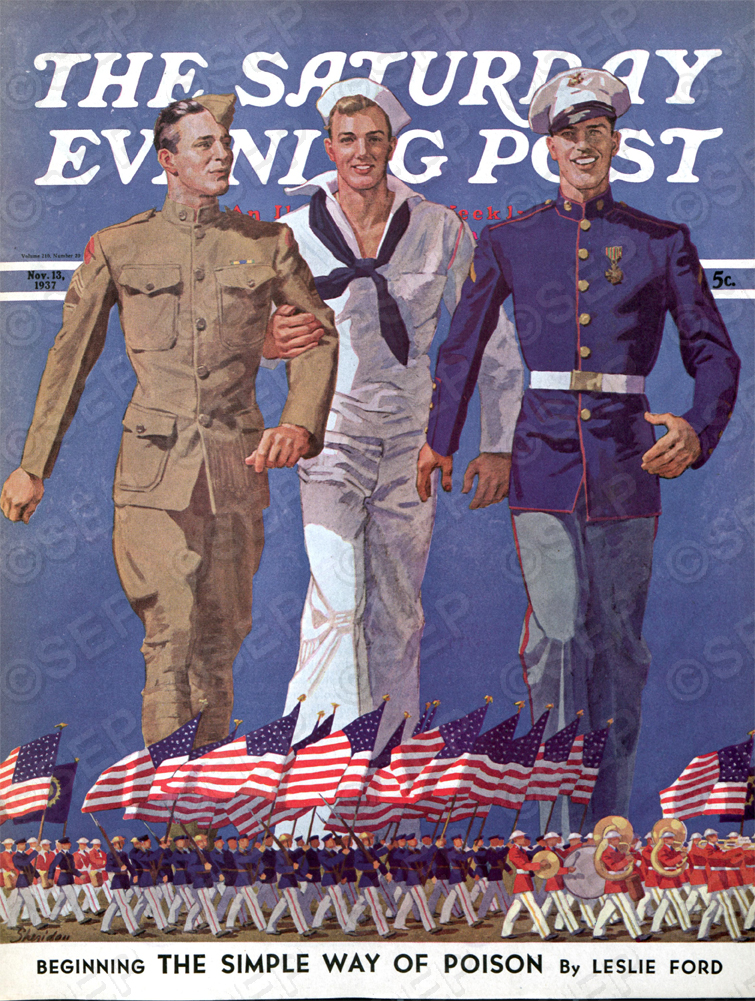
Thank you to all who participated in The Saturday Evening Post’s Tribute to Our Troops essay contest.
“The Saturday Evening Post, for nearly 300 years, has been proud to showcase the American way, and through this contest we honor soldiers past and present who risk their lives every day for our country,” says Steven Slon, editorial director and associate publisher. “We are very excited to present the inspiring tributes from our readers.”
Each of the winners will receive a watch courtesy of our co-sponsor Speidel.
“Speidel is very proud to have been a part of The Saturday Evening Post Tribute to Our Troops essay contest, and we offer our heartfelt thanks and congratulations to each of the winners,” said Lynn-Marie Cerce, co-owner of Speidel. “We would also like to thank all of our loyal customers—many of them Saturday Evening Post readers—who help us provide critically-needed financial support and services to members of the military and their families through our Change A Band, Change A Life™ charitable giving program.”
As part of the program Speidel is donating a portion of all sales proceeds, including purchases made online at speidel.com to Operation Homefront.
The following essays are the top 20 entries selected by the Post editors:
Honor Thy Brother
By Elizabeth Heaney
Walking through the battalion offices, I see a big, broad-shouldered staff sergeant intently focused on a dark blue uniform lying on his desktop. As I watch from the doorway, he leans over and places a narrow silver pin on the uniform’s chest. Before attaching the pin, he checks its placement in all four directions with a measuring device that calculates tiny, perfect millimeters.
After securing the pin, he checks each brass button down the front of the uniform in those same precise millimeters.
He’s wearing delicately thin white gloves on his huge hands, and touches the uniform gently, reverently. I’d seen soldiers prepare their dress uniforms to go up for promotion; this was different.
“Looks nice—you up for promotion?” I say from the doorway.
“No, ma’am. I’m escorting Tompkins’ body back to Iowa.”
Silence stretches between us.
“I’m so sorry you have to do that.” Then I add, “And I’m very grateful you will.”
“I wouldn’t have it any other way, ma’am. He was my soldier.”
Always a Hero
By Anne Linja
Navy Master Chief David Charles Linja—my husband, my hero—was holding my hand as we headed towards his retirement ceremony. There were many emotions and thoughts going through my mind. The most prevalent was “He’s coming home to us, our family. The U.S. may have had his heart, soul, and body for 30 years—and thankfully he stayed safe throughout all those years—but now he’ll be husband, dad, brother, son.”
As we stepped into the elevator, a fellow squid said, “Good morning, Master Chief!”
I responded, “He’s retiring today. It’s his last day.”
The sailor looked at me and respectfully said, “No, ma’am. He’ll always be a master chief.”
My husband suddenly had the biggest grin on his face, full of pride, knowing that he spent the last 30 years doing exactly what he was supposed to do.
Job Well Done
By Kathy Manier
While growing up in Orange County, I was always taught to thank our military for their service but never really had a full grasp of why I was thanking them—except for the obvious reason, fighting for my freedom.
Within the last couple years, I’ve personally come to know many service members, and their stories are humbling to say the least. To them, they are not heroes nor see any need to be thanked. They go to work every day like the rest of us—to do their job as best as they know how—except they don’t always get to come home at the end of the day.
They leave their families for months on end, work through holidays, and take the weight of the world’s problems on their shoulders. They sacrifice their safety, getting shot at, but for them it’s just another day at the office.
So for all the tears before each deployment, the PTSD that becomes the norm, the loved ones that are lost, the weeks of training in the middle of nowhere with no shower or bed, and the endless sacrifices they make on a daily basis, I thank them for their service, for just doing what they consider their “job.”
In the Steps of Our Ancestors
By Debbi Nelson
As a female child born into a lineage of proud males, I was raised on stories of ancestors who fought and died in the great conflicts—dating back to the American Revolution—of these United States. Images of draft cards and photos and the family stories still hold places of honor in my mind. As a youth, I could recite the stories, but, as an adult, I can feel them.
These were gutsy, in-your-face characters that hid their fears and left their families to benefit something bigger than themselves. Some never returned to their mothers or children. Some carried the horrors of war with them for the rest of their lives. But all of them watched with real pride each time the wind was slapped back by the Stars and Stripes. Their lives, and the lives of their comrades, were gifts that will never be forgotten.
Today, in big cities and small towns across this country, the tradition continues. I see young men and women putting their lives on hold in order to put on uniforms. The transportation and technology are different, but the American soldier is still the same, unafraid to defend. May God bless their every step!
No Thank You Required
By Greg Woodburn
After enjoying a wonderful meal on vacation with our two then-young children, we waited for our check.
Ten minutes became 30.
And we finally left without paying, but let me explain: Two businessmen across the room paid our bill, but requested we not be told until after they left. They saw a happy family, the waiter now explained, and simply wanted to do something kind with no thank you required.
Fourteen years passed, and then, last summer when I was leaving a local steak house, a U.S. soldier dressed in camouflage walked in.
“Hi,” I said. ”I want to thank you for all you do.”
“I appreciate that very much, sir,” the authentic American hero humbly replied while shaking my hand.
I wanted to say more, something less trite, but the table for two was ready and the hostess led the strapping soldier and his happy mother away.
I hope they ordered appetizers, wine to celebrate his homecoming, prime rib, plus dessert. And afterwards, I hope they had to wait a good long while, enjoying each other’s company and some laughs—even as they grew a bit impatient wondering where in the world their waiter was with the check.
Stuck in the Internet Slow Lane

A 1999 television commercial encapsulated the telephone industry’s promise of the future along the information superhighway. A grizzled salesman drops his bag in the sparse lobby of Roy’s Motel.
“You got room service?”
“Doughnuts and coffee,” replies the receptionist.
“Got entertainment?”
“All rooms have every movie in every language, anytime, day or night.”
Astonished, the man asks, “How is that possible?” As his words die away in voice-over, the actor Willem Dafoe answers the question. “Could your business use the bandwidth to change everything? Ride the light. Qwest.”
Qwest was just one of the telephone companies that shaped the promise of connecting us to the World Wide Web. To fulfill this promise, telephone companies said they needed money to upgrade the copper wires that had been used since the first commercial telephone call was placed in 1878. The best new technology now was fiber-optic cables. While the biggest copper cables carried 4,000 conversations, AT&T said its fiber-optic cables could handle more than a million calls simultaneously. Experts on telephone economics calculated that this new technology meant the cost of calls would fall by 99 percent or more.
There was just one problem: Who was going to pay for the creation of the new network? The obvious source of revenue was customers, and, in the two decades from 1992 to 2012, Bruce Kushnick, a former telephone industry consultant, estimates that $360 billion moved from the pockets of customers to AT&T, Verizon, and the runt of the Baby Bell family, Qwest, which in 2010 was acquired by CenturyLink.
When you do the long division, Kushnick’s estimate works out to a toll of $3,300 paid by every household in America to access the superfast electronic highway. Although that cash was enough to speed the development of two national cell telephone systems, owned by AT&T and Verizon, the industry now cautions journalists that the term “information superhighway” is best not used anymore. That they want us to regard the term as archaic is not surprising, because its use is a reminder of their unfulfilled promise. The high-speed data lanes in most of America are among the slowest electronic highways in the world; in many places in the United States, the promised highway has yet to materialize at all and, under current policies, never will.
The United States invented the Internet, so it ranked number one when the first file was transferred between distant computers in 1969. Taxpayers financed that project through DARPA, the Defense Advanced Research Projects Agency of the Department of Defense. But by 2011, America’s Internet leadership was strictly historical. Today, South Korea has taken the lead in average Internet speeds. In 2011 its average download rate was 18 megabits per second. Romania came in second at 15 Mbps, Bulgaria was next at 13 Mbps with Lithuania and Latvia tied at 11 Mbps. America has settled well back in the pack—in 29th place. And thanks to government policies that foster the status quo and discourage real competition we’re likely to be stuck in the slow lane for a very long time.
Instead of increased competition between the telephone and cable companies, a new cartel emerged in the first decade of this century. While telephone and cable companies posed in public as rivals, Verizon made a deal to sell its branded services over cable company Comcast’s lines, and vice versa. And Verizon said it anticipates similar deals with other cable providers to sell over their systems. This cross-marketing deal between Verizon and Comcast reinforces the economic interests of telephone and cable companies by not extending lines to rural areas or poor neighborhoods and not wiring apartment buildings where few people could afford the new services.
Cable companies jacked up prices, too. Since 1995, average cable prices have been rising 2.6 times faster than the cost of living, reaching an average of almost $53 a month for basic, no-frills service in 2009, Federal Communications Commission reports show. The strongest evidence that the cable companies exert monopoly power to raise prices comes from a survey of prices for basic service plus the most commonly purchased extra features such as handheld remotes and premium channels like HBO. In 2008, the worst economic year since the Great Depression, when the national economy shrank and millions lost their jobs, cable prices rose.
In the 21st century, economic growth requires the ability to move huge volumes of information instantly. The Internet is to economic growth in the digital age what highways and airports were to economic growth in the 20th century. America prospered in its first two centuries because of massive public investments in the common modes of transportation that business needed to carry its goods. As it proceeds into its third century, the United States suffers from massive overcharging for poor-quality telecommunications services that carry its information.
The average broadband download speed in the United States is just 5 Mbps. That means that a large file someone in Seoul could download in one minute would require closer to four minutes in the United States. For an extra fee, American companies like Time Warner do offer some urban and suburban customers souped-up service with speeds up to 50 Mbps. However, the qualifier “up to” remains a big caveat. When lots of people use the same connection point, speeds can slow to 15 Mbps.
So while the United States falls behind almost 30 other nations in service, we do consistently rank at or near the top in one category: price. The average American consumer pays 60 percent more than a South Korean user. Americans who buy a triple-play package (cable television, Internet, and telephone bundled together) typically pay four times what the French pay. The French get live television from around the world, not just domestic shows. The French Internet is 10 times faster downloading and 20 times faster uploading than what most Americans can buy. For all this the French pay a total of 29.99 euros (about $40) per month.
Millions of Americans pay $160 or more for a triple-play package. Taking into account the much more expansive and faster services the French get, Americans pay six to 10 times as much for triple-play packages. But more important is that in this digital age American jobs, and how well they pay, will be determined in good part by whether America climbs back from 29th place in Internet speed or continues to slip further behind countries with lower wage scales and superior Internet.
The few places in America where local government leaders recognized this years ago are now prospering because they are attracting digital businesses. Places like Chattanooga, Tennessee; Glasgow, Kentucky; Lafayette, Louisianna; and Scottsboro, Alabama, that have built their own municipal systems are attracting new industries and enjoying savings at the same time. But instead of emulating such successes, the cable monopolists seek rules that let them force their captive customers onto the slow digital lanes while charging heavy tolls.
So what has happened to that promise so brilliantly packaged in the Qwest ad from Roy’s Motel? Instead of universal service, we are getting a retrenchment made possible by companies selling the public on one idea and then getting laws written that let them serve only those customers who can afford high prices. Worse yet, the system as constructed is so behind the times that, while highly profitable for the telecommunications monopolists, it retards the growth of the American economy. It operates outside the reach of market forces that could discipline the market and punish companies that abuse customers.
In short, our Internet-telephone-cable cartel has left us with the worst possible outcome. The promise captured in that Qwest commercial of universal, high-speed Internet access has proved to be nothing more than a mirage.
Reprinted by arrangement with Portfolio, Penguin Group (USA) Inc., from The Fine Print © 2012 by David Cay Johnston; Photo: Shutterstock