John Sheridan
American illustrator John “Jack” E. Sheridan(1880-1948) was a Midwesterner born in Tomah, Wisconsin, whose interests in art flourished during his college years at Georgetown University in Washington, D.C. He produced sports posters for the school to pay for his education and even provided posters to the school’s athletics programs after he became a successful artist. The reprints, still popular among Georgetown alums, are sold at the university today and the original prints are part of the Special Collections Department of the school’s main library. As was common at the turn of the century, Sheridan left school before earning a degree when he accepted a job offer in New York City in 1900.
Covers by John Sheridan
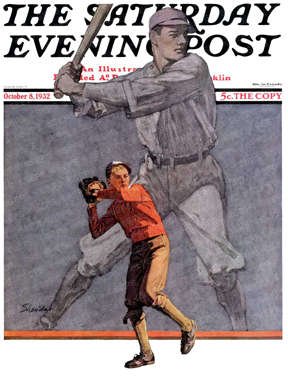
Shadow Batter
John Sheridan
October 8, 1932
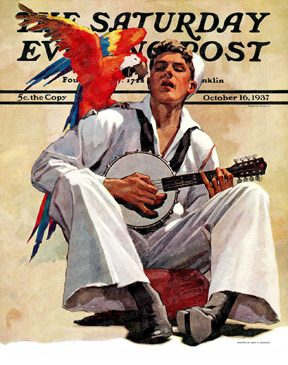
Singing Sailor and Parrot
John Sheridan
October 16, 1937
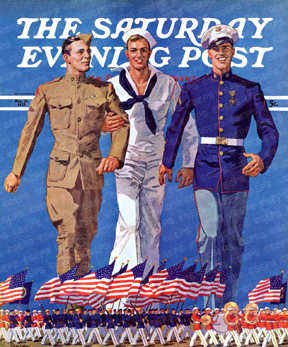
Army, Navy & Marines
John Sheridan
November 13, 1937
Purchase prints of John Sheridan’s work at Art.com.
His natural artistic talents served him well at the Manhattan office of Chicago-based clothier Hart Schaffner & Marx where he created advertisements, posters, and catalogs. He later worked for the Bosch Magneto Company. During this time, Sheridan gained much needed professional work experience before he returned to Washington, D.C., as art director for The Washington Times.
During World War I, Sheridan served on an art committee for the Federal Committee of Public Information. The art committee’s famed chairman, Charles Dana Gibson, recommended Sheridan for the position. Sheridan developed lifelong friendships while creating war posters that advertised recruitment and aid programs. One of their colleagues on the committee was James Flagg, inventor of the iconic Uncle Sam.
After completing his stint at the Times, Sheridan accepted a job editing art on the West Coast and helped produce the Sunday paper layout for The San Francisco Chronicle. While working in California, Sheridan met his future wife, Louise.
When the two married, Sheridan decided to return to academia to improve his artistic composition and technique. The couple moved to Paris, France. They lived the starving artist lifestyle for a year while Sheridan studied at the Académie Colarossi.
Upon his return from Europe, Sheridan opened a studio in Manhattan at 27 West 67th Street. He focused on producing cover art and inside illustrations for popular magazines. His first cover was for Sunset Magazine. His reputation grew. Soon he was providing cover art for The Saturday Evening Post, Collier’s, The American Magazine, and Ladies’ Home Journal.
Sheridan’s 14 covers for The Saturday Evening Post ran from 1918 to 1939. The covers are mostly sports related. The artist chose to focus on the greatness of American institutions such as baseball and the military. He also exhibited his work privately in galleries on the East Coast in New York and Philadelphia.
The artist’s style became less and less popular on the cover as other Post artists gained national recognition. Toward the end of his career, Sheridan accepted a teaching position in New York City at the Cartoonist’s and Illustrator’s School, also known as the School of Visual Arts.
The arts community in New York City adored Sheridan. He was a member of the Society of Illustrators, the Dutch Treat Club, and the Players Club. The Players Club allowed Sheridan the opportunity to act alongside many of his contemporaries including John LaGatta, James Flagg, Jefferson Machamer, and Clarence Kelland.
Today, John Sheridan is remembered for his era-defining portrayals of sports and the U.S. military. Sheridan lived a long and fulfilling life passionately employed in his career. He died on July 3, 1948 at the age of 68.
Joseph Francis Kernan
American illustrator J.F. Kernan (1878–1958) specialized in images of middle-class life for the covers and pages of popular magazines from the 1910s to 1940s. His nostalgic and often humorous illustrations celebrate the simple comforts of home, family, and outdoor recreation.
Born in Brookline, Massachusetts, Kernan studied and taught at the Eric Pape School of Art in Boston before embarking on his career as a professional artist. He became a well-known artist whose works soon graced the covers of nearly every major magazine during the 1920s and 1930s including The Country Gentleman, Outdoor Life, Collier’s Liberty, Capper’s Farmer,The Elks, and the Associated Sunday. His work was also featured on calendars and advertisements of the period. His credits include 26 covers for The Saturday Evening Post between 1924 and 1936.
Covers by J.F. Kernan
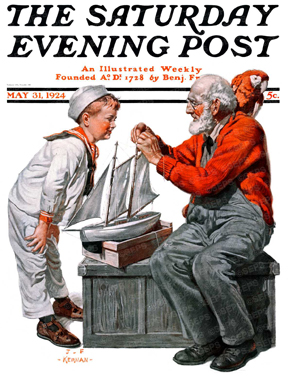
Model Ship
J.F. Kernan
May 31, 1924
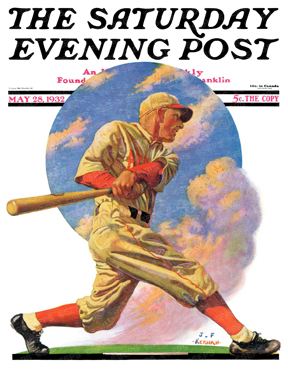
Baseball Batter
J.F. Kernan
May 28, 1932
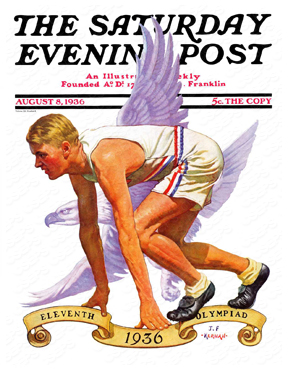
Eleventh Olympiad
J.F. Kernan
August 8, 1936
Purchase prints of J.F. Kernan’s work at Art.com.
Kernan was 45 years old when his first Post cover appeared on newsstands May 31, 1924, depicting an old sailor, with a parrot on his shoulder, working on a model ship while a young sailor looks on. An outdoorsman as well as an athlete (he played professional baseball to help finance his art education), Kernan would frequently incorporate those themes into his work. Hunting and fishing were popular topics. His art captured, as he described it, “the human side of outdoor sports, hunting, fishing and dogs.”
Kernan’s final Post cover, The Sprinter, honored the Olympic Games. It was a fitting finish because so much of his life’s work commemorated sportsman and outdoor life.
Joseph Francis Kernan died in 1958.
Eugene Iverd
The artist born George Melvin Erickson on January 31, 1883, in St. Paul Minnesota to parents John and Matilda Erickson, painted Post covers under the “brush” name Eugene Iverd.
The story goes that George Erickson told his brother, Carl, that he was going to become a famous artist one day, and when this happened he would make the name Eugene Iverd famous. Iverd was Carl’s middle name, which Carl disliked. And to make his brother feel better, George would take Carl’s middle name and add it to another friend’s name, Eugene — another unpopular name according to Carl. George would put them together to create his new alter-ego, Eugene Iverd.
He signed all of his commissioned artwork Eugene Iverd as a kind of pen (or brush) name. But there are several landscape paintings he signed with his own name, George Ericson — he often left out the “k” because he liked the look of that spelling better.
Covers by Eugene Iverd
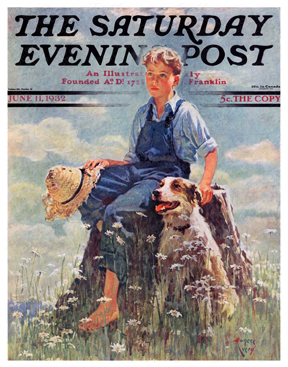
Boy and Dog in Nature
Eugene Iverd
June 11, 1932
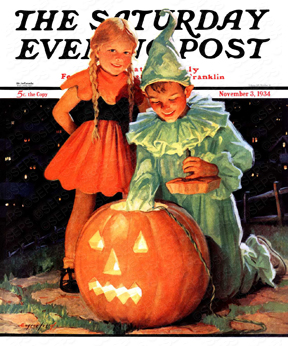
Lighting the Pumpkin
Eugene Iverd
November 3, 1934
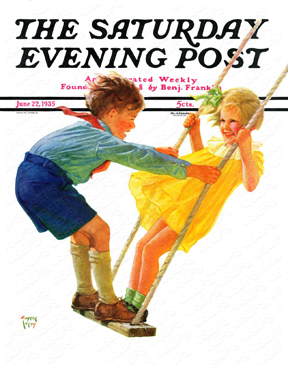
Children on swing
Eugene Iverd
June 22, 1935
Purchase prints of Eugene Iverd’s work at Art.com.
Unlike most prolific magazine illustrators of his time, George Erickson did not live on the East Coast. He grew up in Minnesota, and at an early age he began to show signs of artistic talent. Although not much of an academic, his art could be found on everything from kindling to hymnals.
His mother supported him, but his father felt that art was a frivolous pursuit that would not take him far. George and his brother came up with creative jobs to support his schooling, such as setting up a concession outside of the local movie theatre. This provided him with the capital to complete his art training.
He enlisted in the Army during World War II, later working at Walter Reed Hospital doing art therapy with shell-shocked veterans. After his war service, George married Lillian Remund and moved to Erie, Pennsylvania, where they built their house which included an art studio.
He was a man of immense personal charm and enormous artistic talent and productivity. In 1926, he submitted his first picture to The Saturday Evening Post. The managing editor paid him a personal visit, telling him that Norman Rockwell was growing older and the magazine was in need of new blood. Iverd submitted four pieces and two were immediately accepted. His first artwork was published on March 13, 1926, a young boy daydreaming while playing the accordion. This began his 10-year run as an artist for The Saturday Evening Post. According to his daughter Jean Ericson Sakumura, he produced 55 magazine covers, some 60 advertisements, 15 published lithographs, 25 story illustrations, and hundreds of portraits or landscapes.
George Erickson became one of the best-known painter/illustrators in the country during the 1920s. Campbell’s Soup Company, Monarch Foods, and The Saturday Evening Post were among his high-profile clients.
His sudden death from pneumonia at the age of 43 was a tragedy. He left his widow with three small children in the height of the Depression.
Paul Bransom
Paul Bransom began his career as a talented wildlife artist at a very young age. He was born in Washington, D.C., in 1885 and left school at the age of 13 for an apprenticeship drawing detailed mechanical devices for patents.
Covers by Paul Bransom
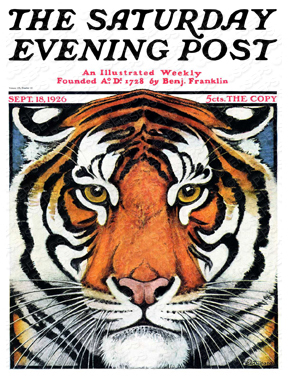
Tiger Head
Paul Bransom
September 18, 1926
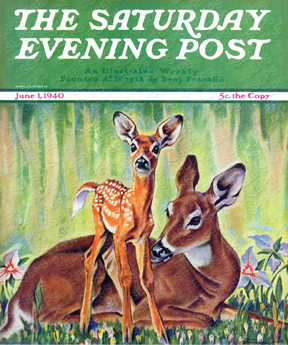
Doe and Fawn in Forest
Paul Bransom
June 1, 1940
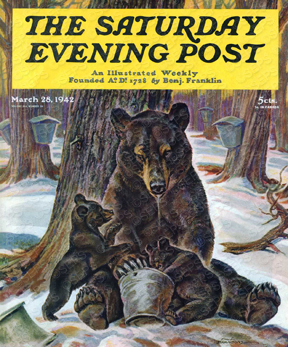
Bears Eating Maple Syrup
Paul Bransom
March 28, 1942
Purchase prints of Paul Bransom’s work at Art.com.
Bransom later traveled to New York City and took a job as a comic strip artist, but spent most of his time at the Bronx Zoo, sketching all the animals. The zookeeper noticed Bransom and allowed him to set up his own private studio in the lion house.
Filled with confidence, drawings tucked under his arms, he met with the editor of The Saturday Evening Post who immediately purchased four covers and several other sketches. His first Post cover appeared on January 5, 1907.
Paul Bransom’s extremely detailed and lively images attracted many admirers and earned him the Benjamin West Clinedinst Memorial Medal which is awarded for the achievement of exceptional artistic merit. Bransom’s love for animals can be seen in each and every one of his paintings. Bransom died in 1979.
McClelland Barclay
McClelland Barclay was born in St. Louis, Missouri, in 1891. He attended grammar school and high school in the area and studied art at Washington University, St. Louis. During those years he was a student of H.C. Ives, George Bridgman, and Thomas Fogarty.
After moving to New York, he began his career as a magazine illustrator in 1912. He quickly became know for using bold colors to paint strikingly beautiful women in rather simple settings. This is best exemplified by a series of paintings he did for General Motors, which carried the slogan “Body by Fisher.” Some of his more noteworthy advertising clients included Lever Brothers Company, Frigidaire, A&P, Elgin Watches, and especially Humming Bird Hosiery.
Covers by McClelland Barclay
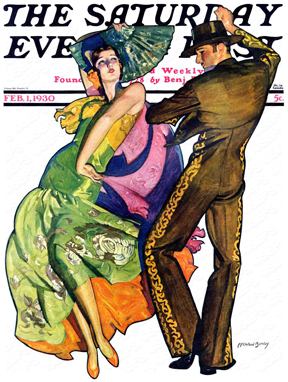
The Flaminco
McClelland Barclay
February 1, 1930
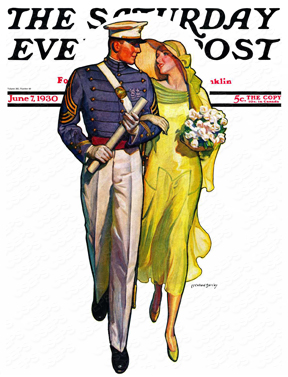
Military Guard and Girl
McClelland Barclay
June 7, 1930
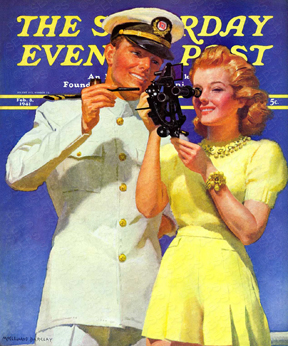
Naval Officer and Redhead
McClelland Barclay
February 8, 1941
Purchase prints of McClelland Barclay’s work at Art.com.
He also illustrated fiction for many of the large circulation magazines. His use of color and his ability to capture the flowing grace of his subjects made his covers for The Saturday Evening Post and The Country Gentleman particularly memorable.
Barclay married Helen Marie Haskin in 1930, and almost immediately after he began to expand into jewelry design, metal sculpture, and utilitarian home decor. Under the name of McClelland Barclay Art Company he manufactured bowls, boxes, pins, bookends, and metal wall hangings. Women in dramatic poses and animal and nature scenes were popular.
Appointed a Lieutenant Commander in the United States Naval Reserve during World War II, Barclay began serving as a combat artist. Much of his work appeared on the cover of Sea Power magazine because of its realistic rendering of action scenes. He was also commissioned to paint officer portraits and to develop propaganda posters to encourage support of the war effort. Barclay was killed in action in 1943 when a Japanese submarine torpedoed his landing craft as it approached New Georgia Island.
The Art Directors Club Metal was awarded to Barclay posthumously for his valor and courage in service to his country and his profession. He was a man of many talents and interests who thrived in dynamic environments and died while doing what he loved most.
Vintage Ads: Dressing Like Heroes in 1922
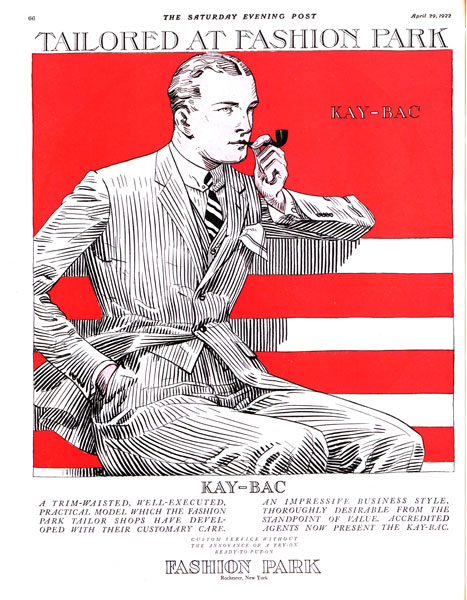
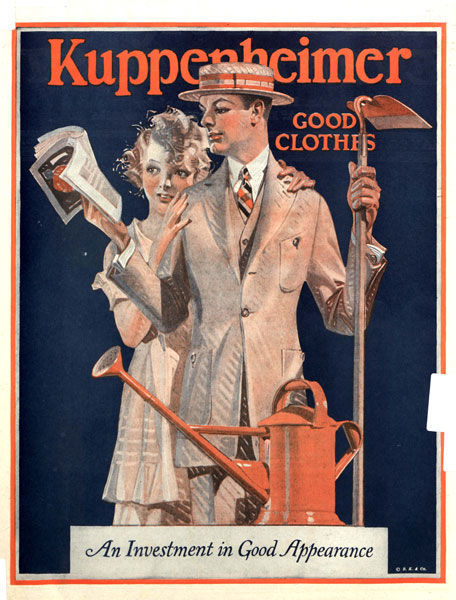
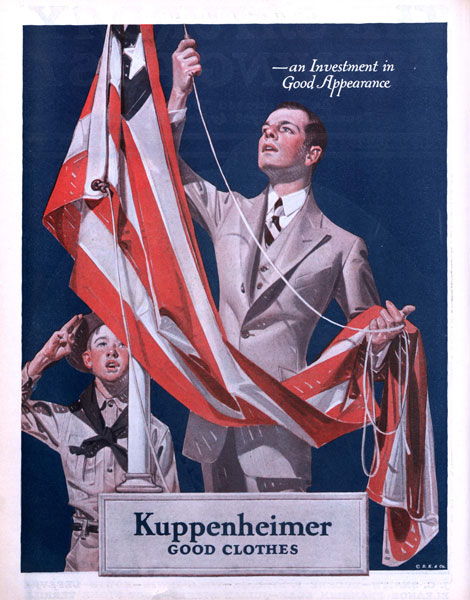
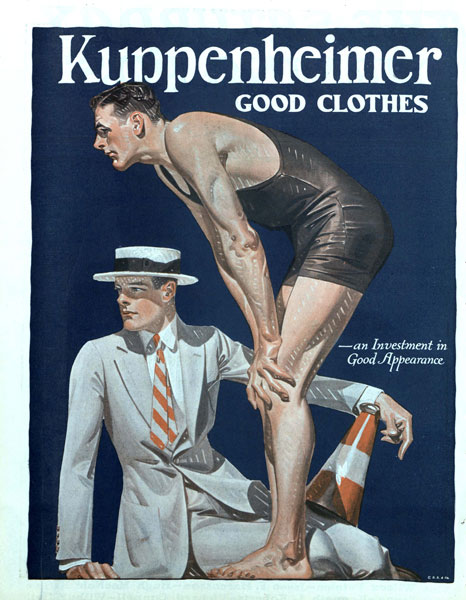
The country was in the market for heroes in the 1920s. The sturdy, young veterans who’d recently fought, and won, the World War, fit the bill perfectly. The media presented the young heroes, the pride of their country, as victorious but modest. They were already becoming what heroes often become unintentionally: fashion trendsetters. America’s clothing manufacturers were now designing suits that, they believed, reflected this vibrant young American male.
The new look came at a time when America was hungry for fresh starts and new ideas. Unfortunately, the 1920s had a bad start. A sharp, post-war recession slowed business growth and consumer spending. But by 1922, the market had revived and the U.S. economy took off.
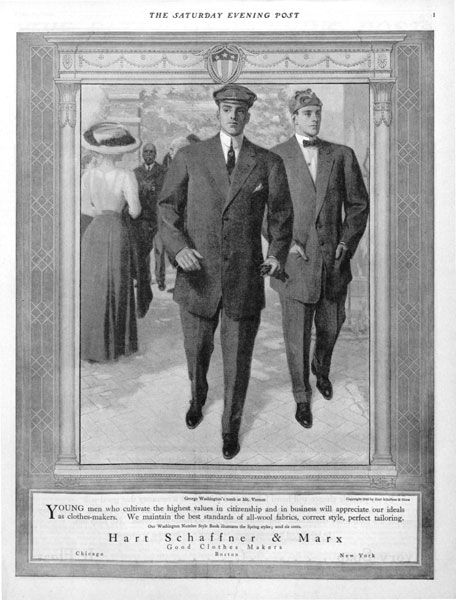
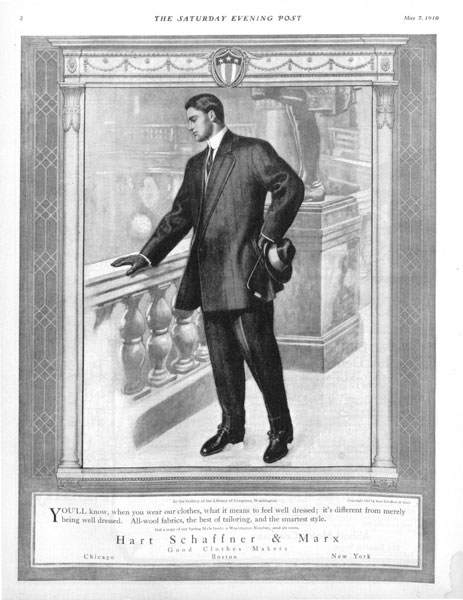
With the return of optimism and the promise of prosperous times, men grew tired of the heavy, bulky suits that filled their wardrobes as shown in these ads below.
Vintage men’s fashion ads from the pages of The Saturday Evening Post of 1910:
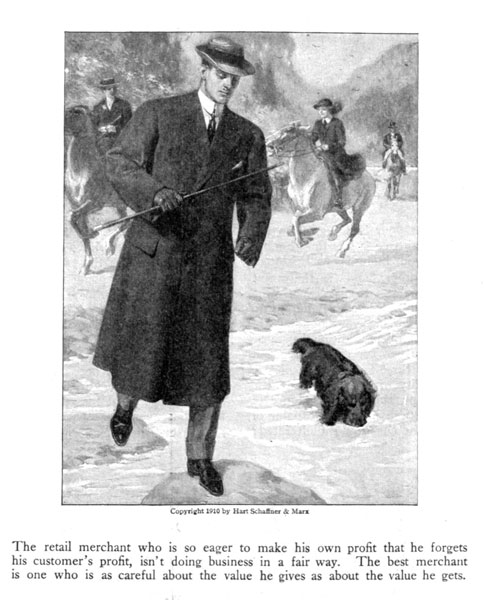
April 2, 1910
April 16, 1910
May 7, 1910
“Men’s dress and masculine identity reflected a national obsession with the youthful warrior,” writes Daniel Delis Hill, in his book American Menswear (Texas Tech University Press, 2011. “The power look of the bulky, over-padded clothing of the Edwardian era was abandoned in favor of the slim silhouette of the lithe young man. Jackets and trousers narrowed significantly for a tight, contouring fit. Natural shoulder lines emphasized a feline agility rather than brawn, and shorter jackets made legs look longer and slimmer.”
They were ready for the trim, new look of America’s youth, which was advertized in the pages of the Post.
For years, American tailors had been copying the traditional styles of the French and British. But in 1922 they began reworking their suits to reflect this young image, making them less formal and more comfortable. The new styles proved so popular, they began influencing styles in Europe. Men in France and Britain began wearing the soft-collared American shirts instead of the hard-as-cardboard versions they had been sporting. And, like their American visitors, they began wearing tuxedos without vests, and ordering suits in lighter, more comfortable materials.
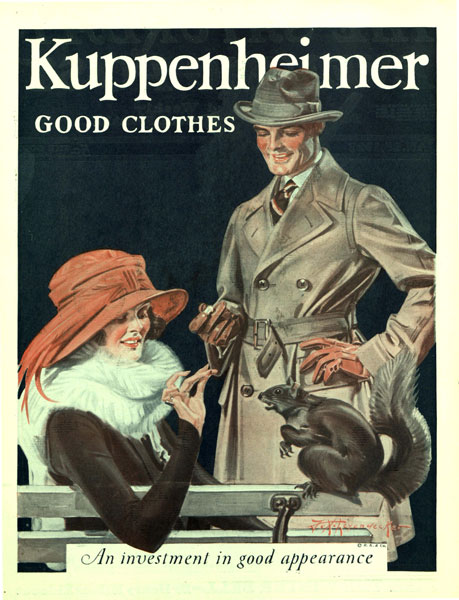
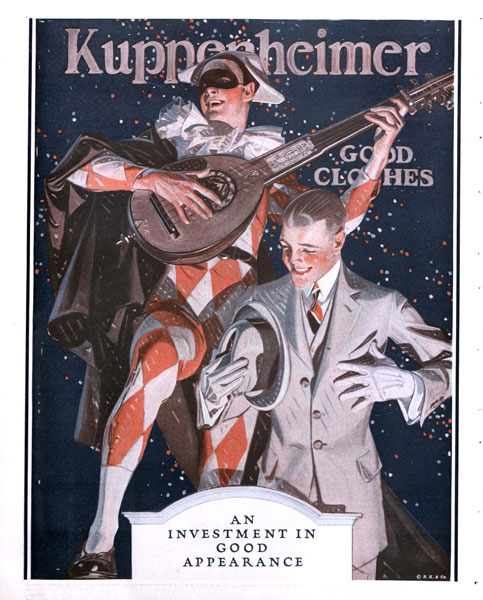
Before the 1920s, clothing advertisements tended to show men at work or in formal settings. Illustrators drew the models as earnest, determined-looking businessmen. Now the men in the ads looked young, relaxed, and rarely at the office or the opera. Instead they were shown lounging with friends, idling, or relaxing at a sporting event.
Sports became an important element of life in the 1920s. Baseball, golf, and boxing gained a new popularity. Men were discovering a new enjoyment of exercise and were willing to take time away from work for athletics. The Interwoven Socks advertisement below, by Normal Rockwell, is a good symbol of the times: a golfer ignores the figures from the stock ticker as he studies his numbers scorecard.
Vintage men’s fashion ads from the pages of The Saturday Evening Post of 1922:
January 28, 1922
February 25, 1922

April 22, 1922
April 29, 1922
May 20, 1922
July 15, 1922
August 12, 1922
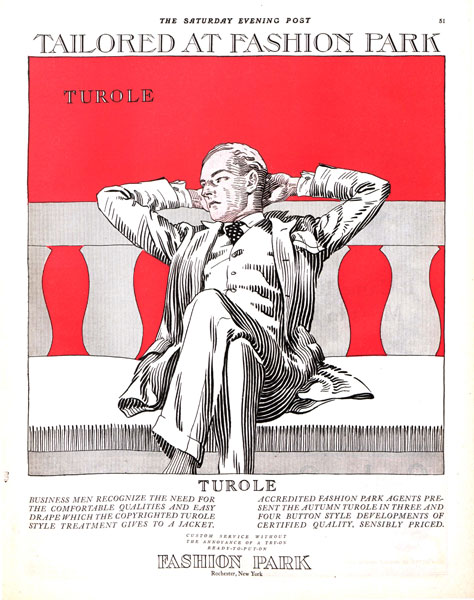
August 19, 1922
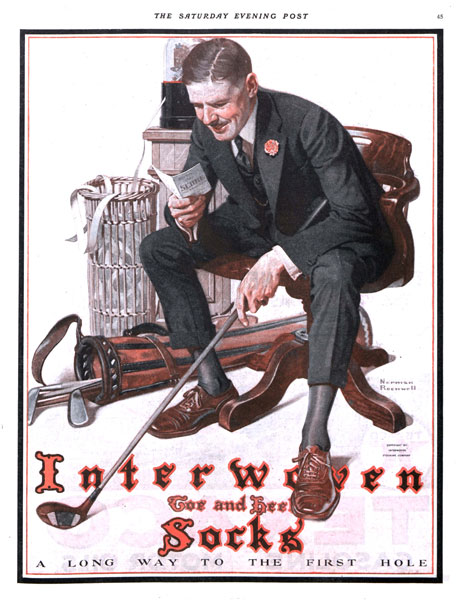
August 26, 1922
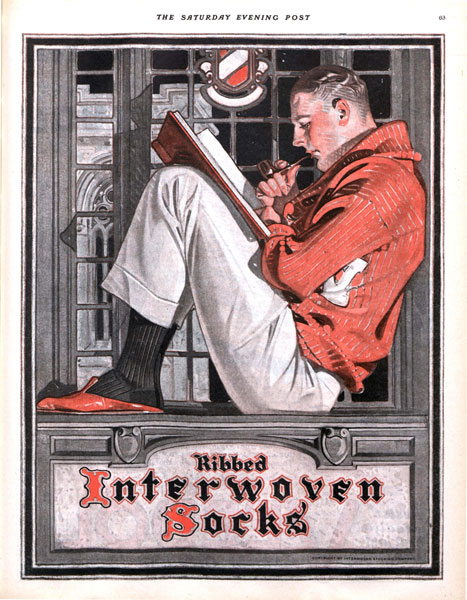
October 21, 1922
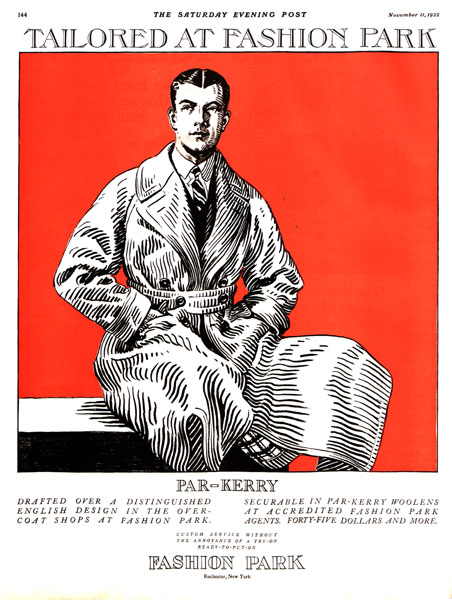
November 11, 1922
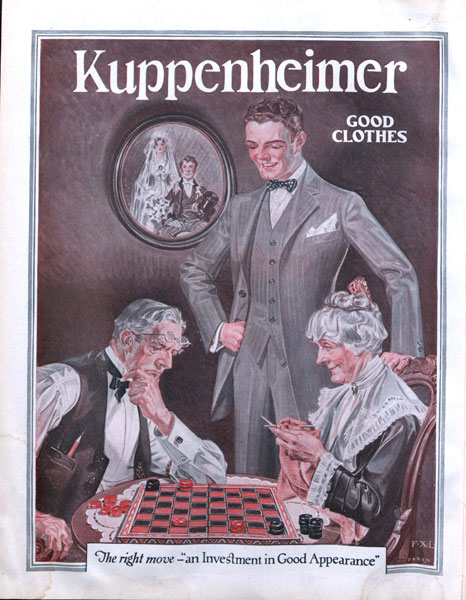
December 30, 1922
You might recognize the work of J.C. Leyendecker in several of the ads above. He was highly regarded by clothing manufacturers in the 1920s because he seemed captured the spirit of vigorous, modern youth like no other illustrator.
The men he drew for Cluett Peabody & Company’s Arrow collars campaign became a symbol of the 1920s. They all looked strong, self-confident, determined, and somewhat heroic. And young.
Anton Otto Fischer
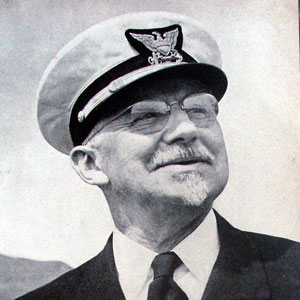
The marine paintings of Anton Otto Fischer (1882-1962) capture the nuances of sea life that only an active participant could recreate. An orphan boy born in Germany, Fischer ran away to sea at the tender age of 16, spending eight years on a variety of sailing ships. Deciding to seek citizenship in the United States, he spent some time in the New York area as part of a hands-on crew racing yachts.
Covers by Anton Otto Fischer
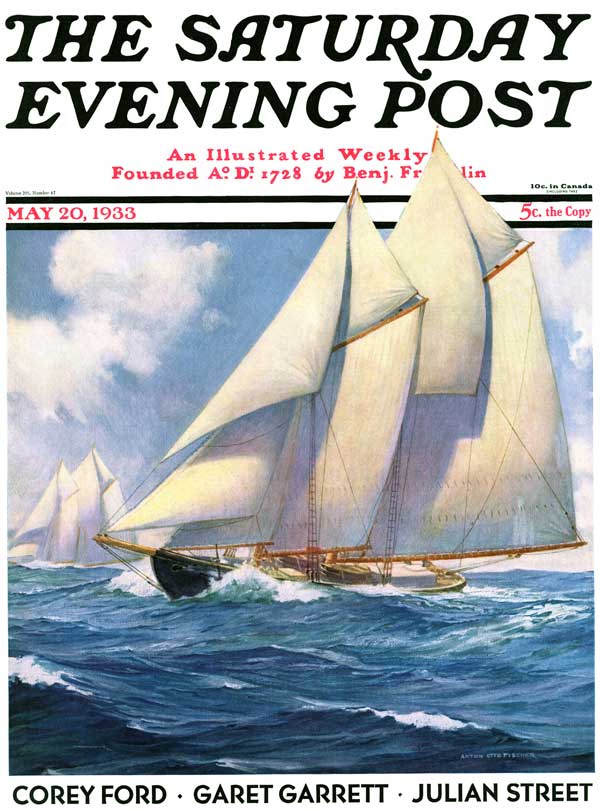
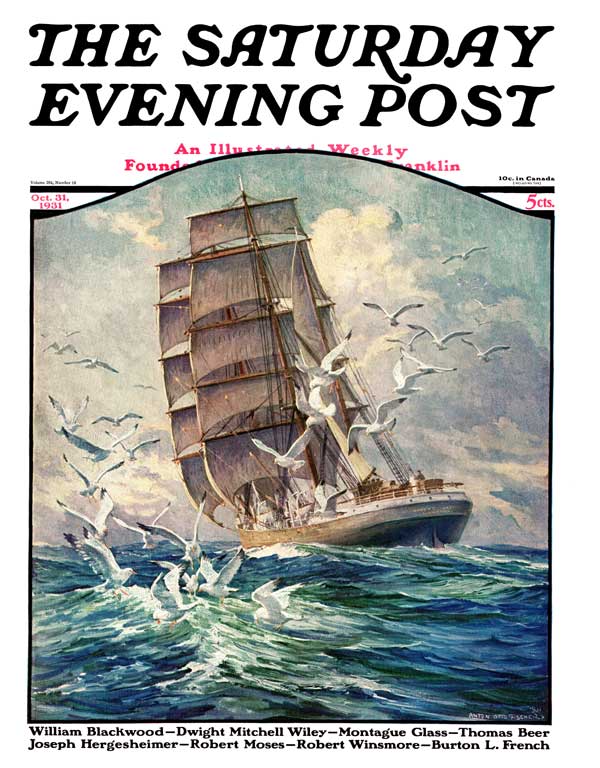
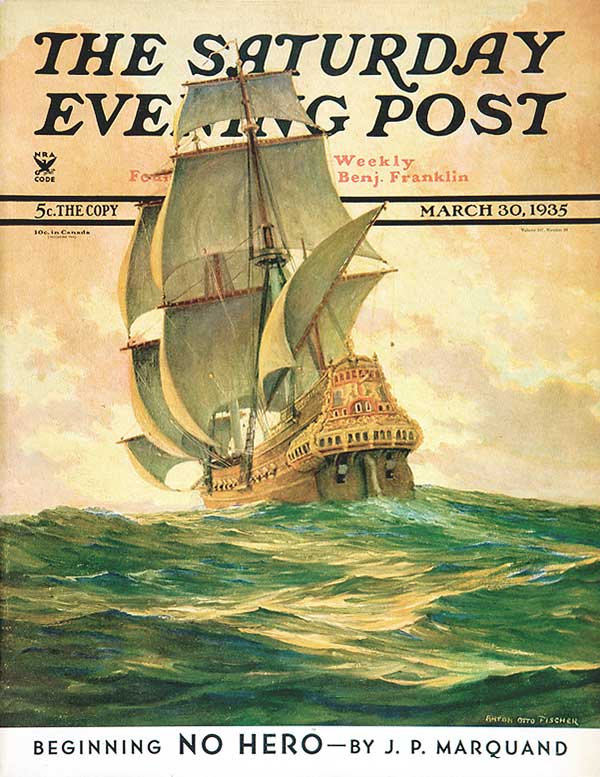
Purchase prints of Anton Otto Fischer’s work at Art.com.
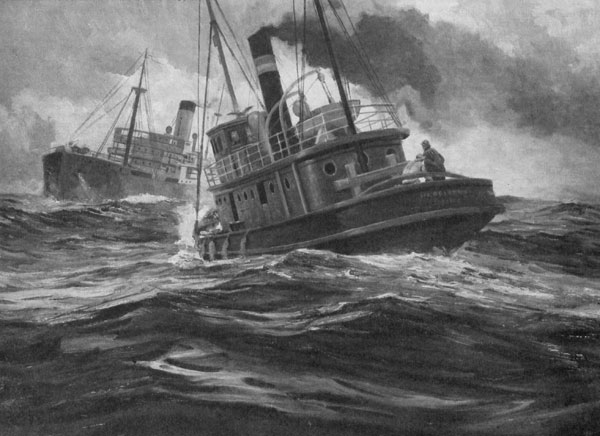
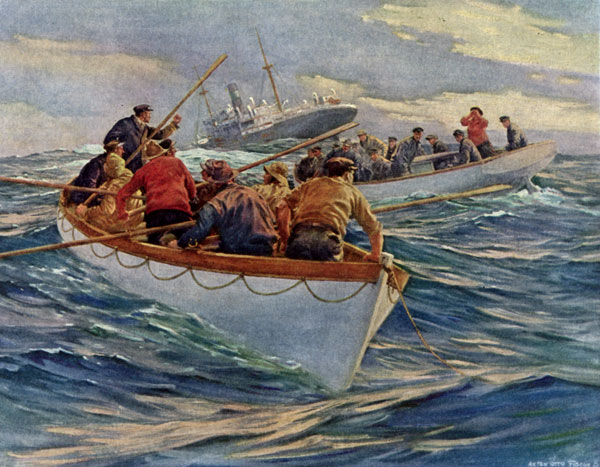
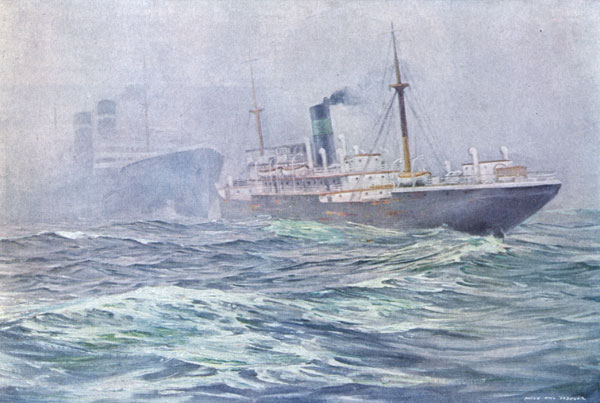
He worked as a model and handyman for the illustrator, A.B. Frost, which sparked Fischer’s interest in a career as an artist. He enrolled in the Académie Julian in Paris under Jean Paul Laurens. Upon returning to the US, he painted pictures based upon his sailing career and was quickly offered an assignment from Harper’s Weekly. From that point forward he was in constant demand with his longest and most fruitful association being with The Saturday Evening Post where he illustrated the “Tugboat Annie” stories by Norman Reilly Raines.
Anton Otto Fischer’s illustrations from “Tugboat Annie” series, by Norman Reilly Raine

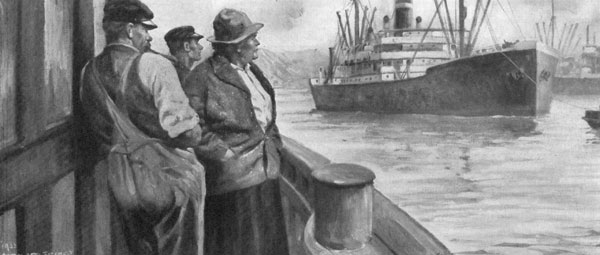
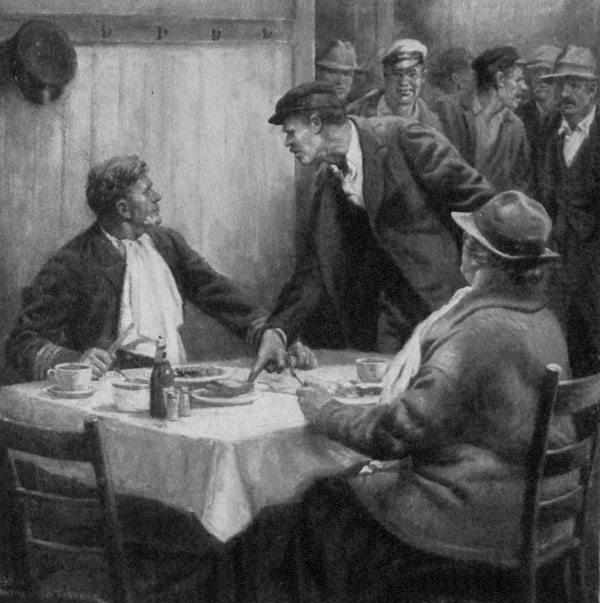
In 1942 he was given the rank of Lieutenant Commander as “Artist Laureate” for the United States Coast Guard. Fischer’s dramatic series of pictures portraying his experience aboard the cutter “Campbell” was published in Life magazine and gained him great notoriety.
Frances Tipton Hunter
Born in Howard, Pennsylvania, in 1896, Frances Tipton Hunter’s early years began in quiet, rural America. At the age of six, she suffered the tragedy of losing a parent, her mother. At this young age, she moved to Williamsport, Pennsylvania, to live with her aunt and uncle. Hunter longed to remember the happiness of her earliest childhood memories, and this remained a constant theme throughout her life’s work.
Hunter began developing her abilities at Williamsport High School. After graduating in 1914, she moved to Philadelphia to further her career in art and illustration. She attended many art schools and institutions, including the Philadelphia Museum of Industrial Discipline, The Pennsylvania Academy of Fine Arts, and the Fleisher Art Memorial, and graduated from each institution with honors. At the end of her studies in Philadelphia, she received an art scholarship that allowed her to move to New York City. There she began her career illustrating fashion for department-store children’s clothing lines.
Covers by Frances Tipton Hunter
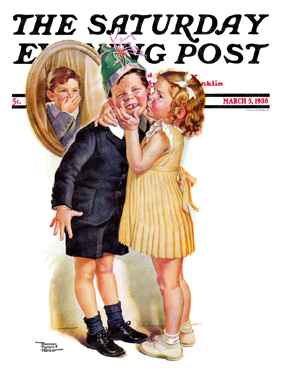
Birthday Kiss
Francis Tipton Hunter
March 5, 1938
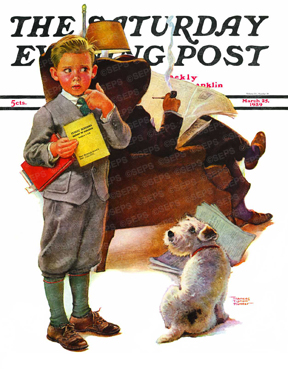
Report Card
Francis Tipton Hunter
March 25, 1939
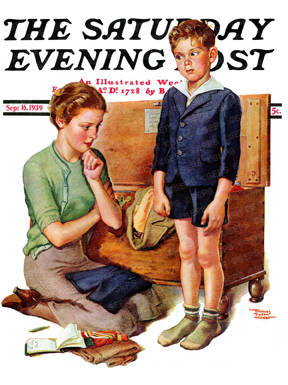
Growing Boy
Francis Tipton Hunter
September 16, 1939
Hunter quickly rose to fame and recognition in the art world, becoming one of the most prominent female illustrators of the 20th century. Her early work captured depictions of children and pets, popular subjects of the 1920s and ’30s. Prior to her first commission for The Saturday Evening Post, Hunter’s work lined the covers and pages of magazines and periodicals such as Women’s Home Companion, Collier’s, Liberty, Good Housekeeping, and Ladies’ Home Journal.
A wide variety of her work was published as advertisements, puzzles, paper dolls, and calendar art. Her paper dolls, featured in Frances Tipton Hunter’s Paper Dolls and The Frances Tipton Hunter Picture Book, grew into a popular series later taken up by the Whitman Publishing Company of Racine, Wisconsin.
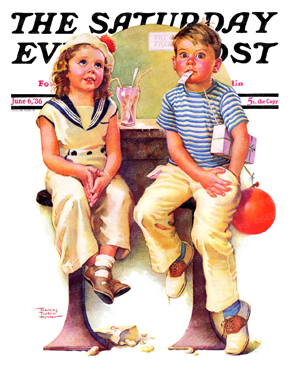
Francis Tipton Hunter
June 6, 1936
Her first Post cover, No Money for Her Soda, published on June 6, 1936, was a phenomenal success. It depicted a toddler couple on a date and out of cash. The image of adult life reflected in an innocent childhood scene secured more commissions for Hunter throughout the following decade.
Much like Norman Rockwell, Hunter preferred depicting an idealized American childhood filled with innocence. Bright eyes, pale skin, and plump, rosy cheeks are typical of her painted children playing games. In all, Hunter completed 18 covers for The Saturday Evening Post from the mid-1930s to the 1940s. As with many artists and illustrators of that era, her work on the cover of the Post brought her national fame.
Coles Phillips
Clarence (C.) Coles Phillips’s hallmark style is one that won’t ever fade away. A mid-westerner born in Springfield, Ohio, Phillips spent the entirety of his childhood in Ohio before moving to New York City. Arriving in the big city, Phillips immediately began defining the era of “The Golden Age of Illustration” with advertisements and magazine illustrations of beautiful women blended into fanciful backgrounds.
Phillips’s interest in art and design began at a very young age; he started drawing at just 6 years old. He attended the liberal arts university Kenyon College from 1902-1904 where he was the head illustrator for the yearbook, The Reveille, while working at the nearby offices of the American Radiator Company.
At Kenyon, Coles was an active member of Alpha Delta Phi fraternity. His fraternity brothers gave him the nickname “Psi”, a name that stuck for the rest of his life. The brothers heavily influenced his decision to drop out of school and move to New York. Many had secured lucrative positions on Wall Street, where the fraternal cohort encouraged Phillips to join them as a roommate. So he did. Phillips left Kenyon in the middle of his junior year; he never completed his college education.
Covers by Coles Phillips
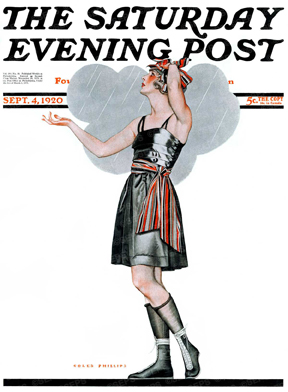
Bathing Beauty and Rain
Coles Phillips
September 4, 1920
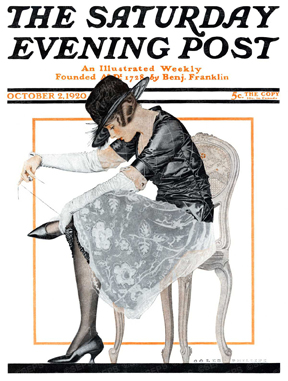
Mending Her Stockings
Coles Phillips
October 2, 1920
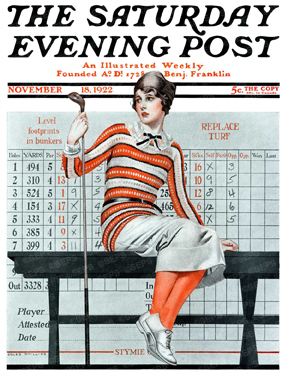
Novice Golfer
Coles Phillips
November 18, 1922
He quickly used his prior contacts at the American Radiator Company to attain a position at the company offices in Manhattan. He enrolled in night courses at the Chase School of Art for a short stint of three months. The classes were Phillips’s only formal art training.
Phillips rose to artistic prominence quickly due to a series of fortunate events. After having finished his art classes, he joined an “assembly-line” advertising firm to gain experience producing commercial content. One artist painted a person’s head, another their clothes, and Phillips the ankles and feet. His depictions of human feet were so meticulous that national companies asked the identity of the man who illustrated them.
Just 2 years into his career as an artist, in 1906, the artist opened his own advertising and design firm called The C. C. Phillips & Co. Agency. He thought the entrepreneurial endeavor would provide him the opportunity to be his own boss, and to choose his clientele. The new company did just that, but at great cost to the artist’s personal happiness.
Business poured in for the new operation, but the shop was so busy Phillips took on a purely managerial role. He held meetings with clients and worked on sketches, completing few illustrations himself. His trusted team of underling artists, including Edward Hopper (who Phillips hired personally), created all the works. The firm produced advertisements for many major American corporations of the time including Holeproof Hosiery, Palmolive, Willy’s Overland Auto & Trucks, Vitralite Paint, Scranton Lace, National Mazda Lamps, Jantzen Swimsuits, Oneida Community Silver, Motor Annual, Maxwell Phillips, Auto-Lite, and Luxite.
Rare is the man whose unhappiness results from building a successful business. Psi Phillips, though, was a passionate artist. He left the business he built to instead return to freelance illustration. In 1907, he rented a studio in Manhattan at 13 West 29th Street. He received his first commission for a black and white centerfold illustration from Life (not to be confused with the famous photography magazine) Magazine for their April 11th, 1907 issue. Life Magazine was in a design predicament as it moved to color printings during the spring of 1908. Phillips introduced Life to his now infamous “Fadeaway” style. The artwork was a hit for both Life and Phillips’s career. Many tried to replicate his style, but advertisers, magazines, and literary agents wanted the real deal.
In 1907, he also met his future wife, Teresa Hyde, who at the time worked as a nurse. The two married three years later in 1910. Over many years, the two built a sizeable family complete with four sons. Seeing as Manhattan’s shoebox apartments were far too small for such a litter, the couple relocated to a home in the artist colony of New Rochelle, Connecticut.
Over the course of the next decade, Phillips’s style ushered in a new era of art, culture, fashion, and design. His work took the United States from the Edwardian Era and brought it into the Roaring Twenties. He produced work for advertisements, books, stamps, magazines, posters, calendars, streetcar signs, prints, and silverware. He created 62 covers for Good Housekeeping, 70 for Life Magazine, and countless others for Vogue, Collier’s, Liberty, McCall’s, Ladies’ Home Journal, Women’s Home Companion, and of course from 1920-1923, The Saturday Evening Post.
His artwork generated vast personal wealth the artist used to enjoy his life in the countryside. Coles once stated that his favorite activities were painting, pigeon farming (raised and sold over 30,000 annually), singing in the University Glee Club of New York with his fraternity brothers, and playing baseball with his boys.
Unfortunately, his life was cut short by tuberculosis of the kidney. Diagnosed in 1924, he spent the next three years searching out European sanitarium treatment options. The family lived in Switzerland and Italy from 1925 to 1926 before returning to New Rochelle in 1927. Phillips spent the day of his death in bed with his wife by his side while friend and colleague J.C. Leyendecker took his four sons to the Charles Lindbergh Parade on 5th Avenue. He died at age 47 of respiratory failure.
Coles Phillips is now recognized as the singular artist of his generation who invented the popular “fade away” style. His models brought an elegant grace to the twentieth century’s rising tide of wealth and parties. As such, The Society of Illustrators inducted Phillips into their Hall of Fame in 1993. Today, many of his original illustrations are on display in the Delaware Museum of Art.
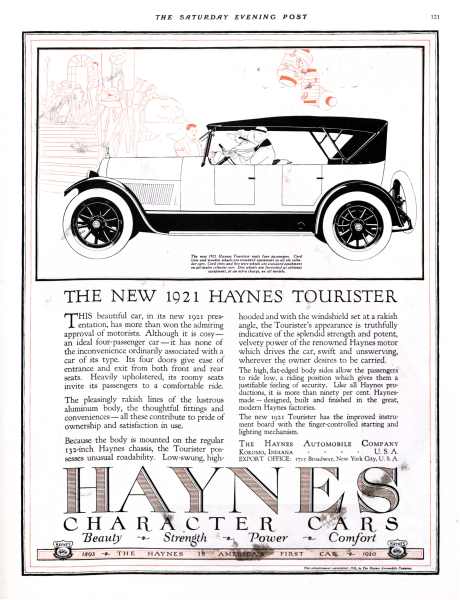
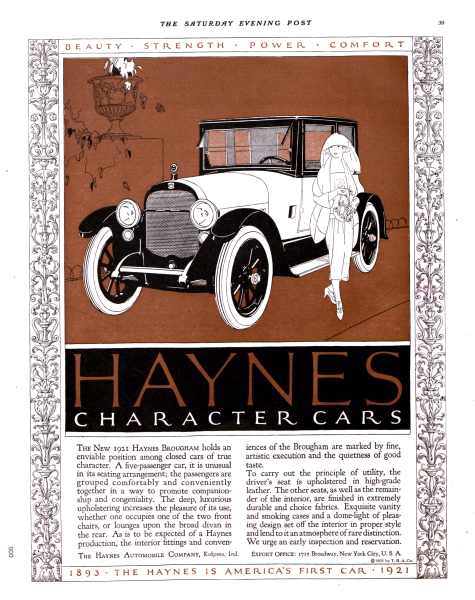
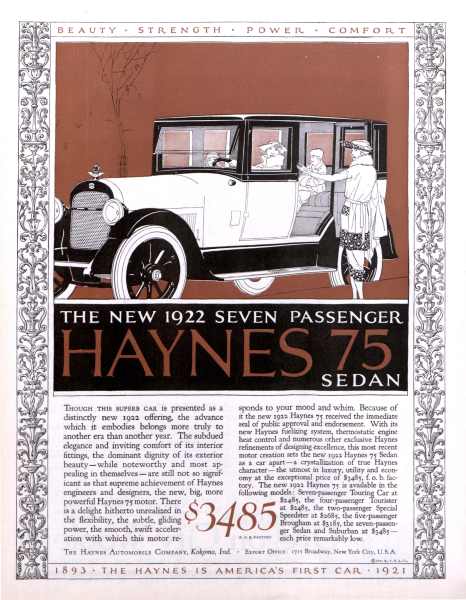
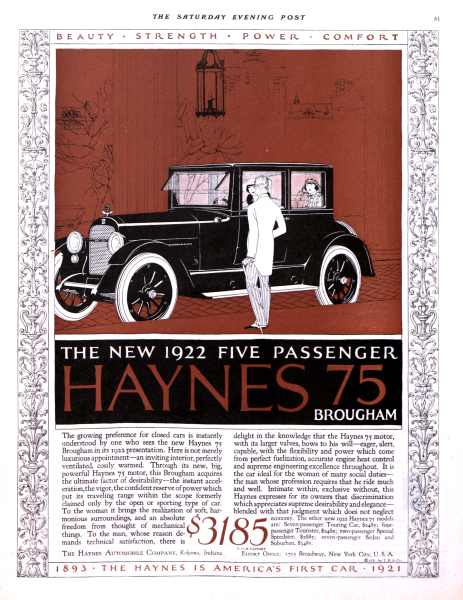
Vintage Automobiles: Remember the Haynes
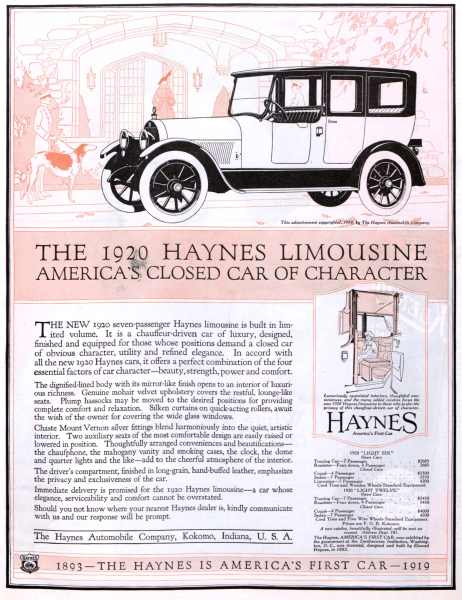
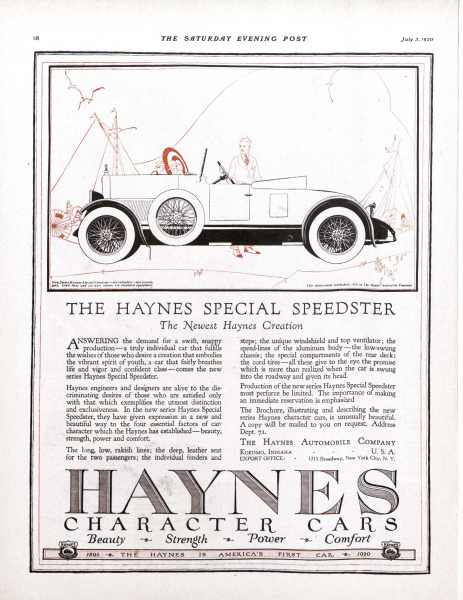
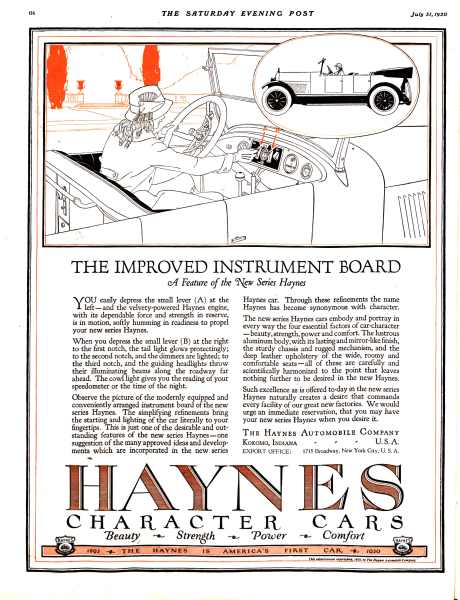
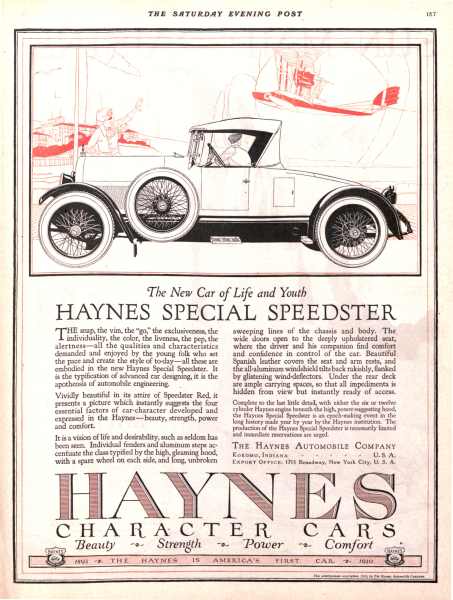
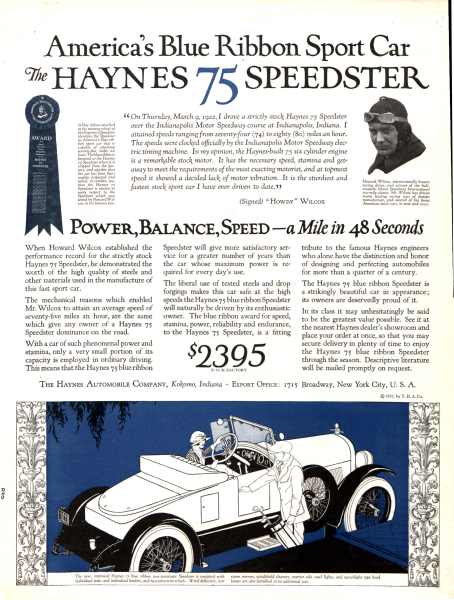
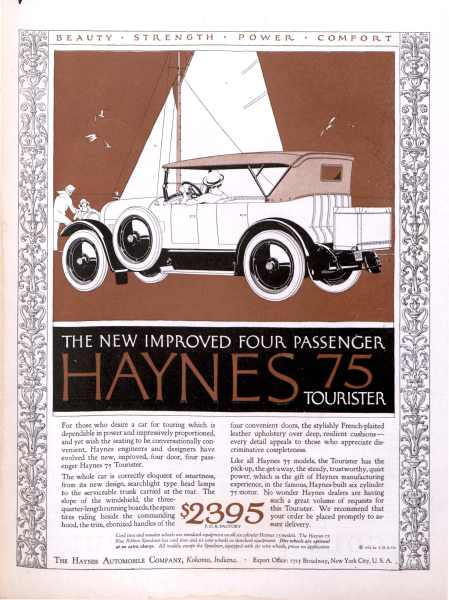
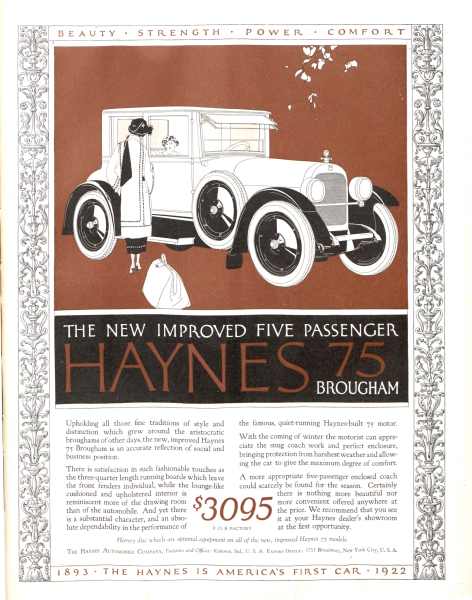
Well over a hundred car companies have advertised in the Post. Many of these companies, like Peerless and Dort, are barely remembered today. Among the obscure makes whose ads appeared in the Post is Haynes, which were built in Kokomo, Indiana. (For more on the auto industry’s early years, check out Post‘s new special collector’s edition, Automobiles in America!)
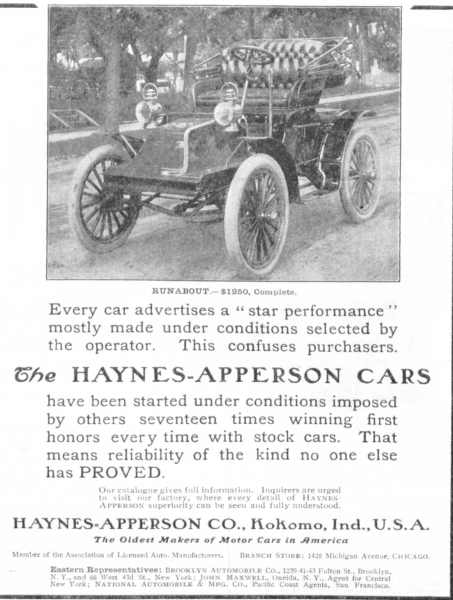
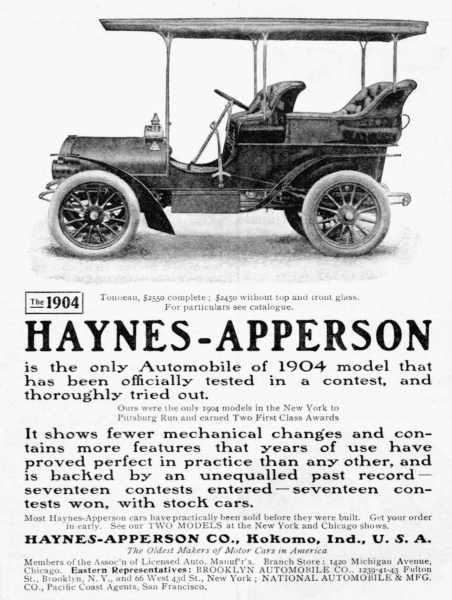
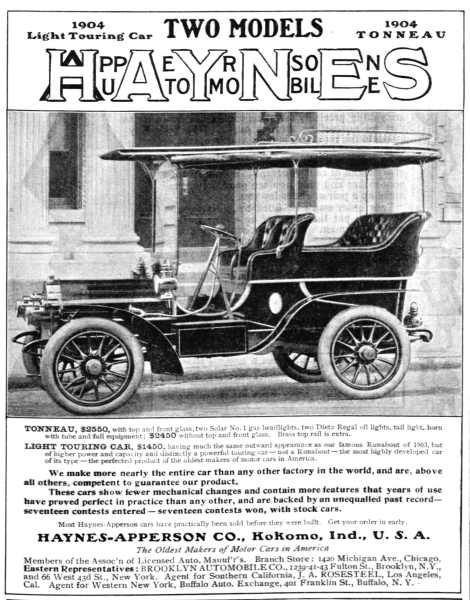
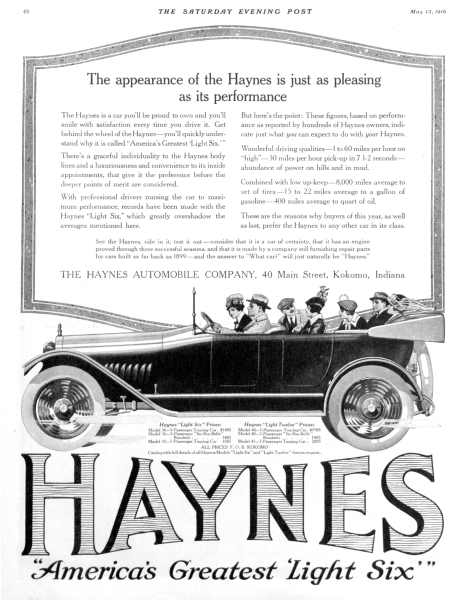
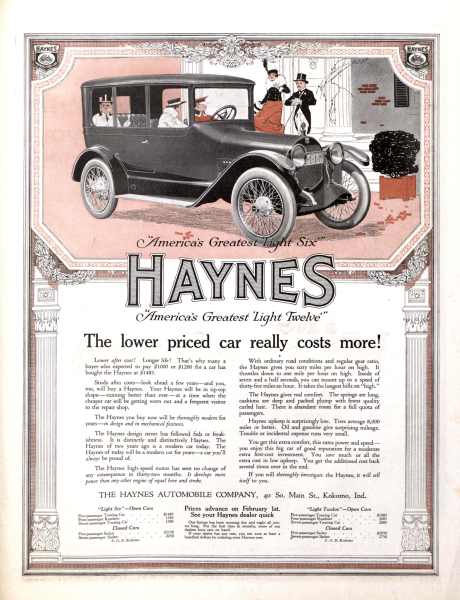
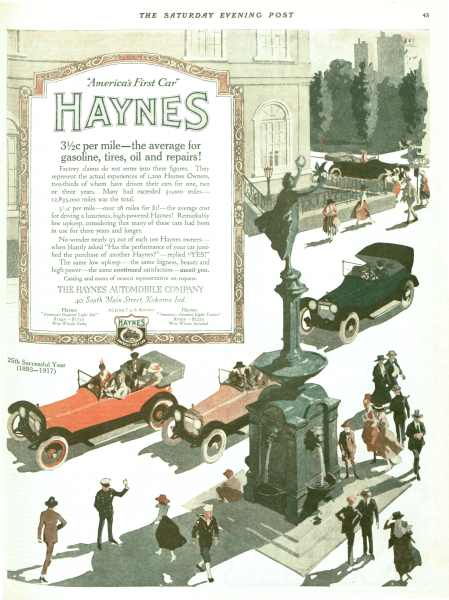
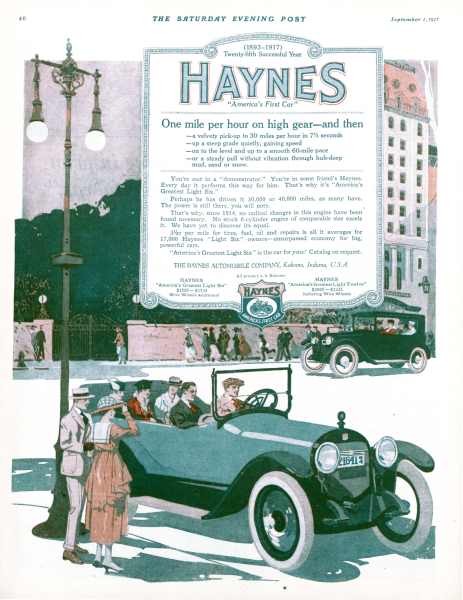
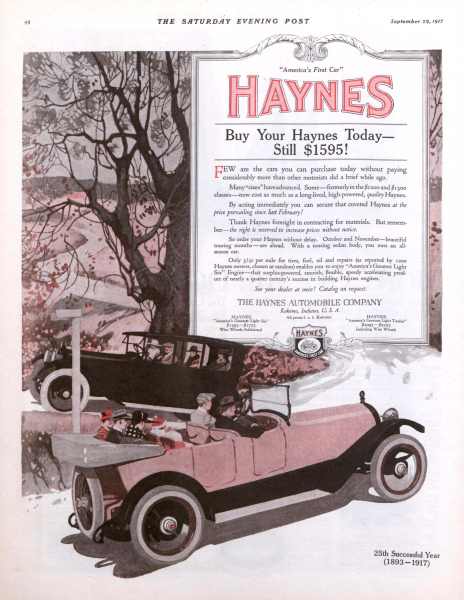
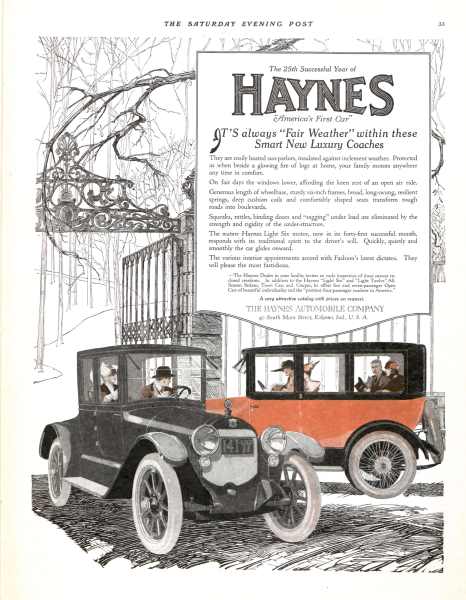
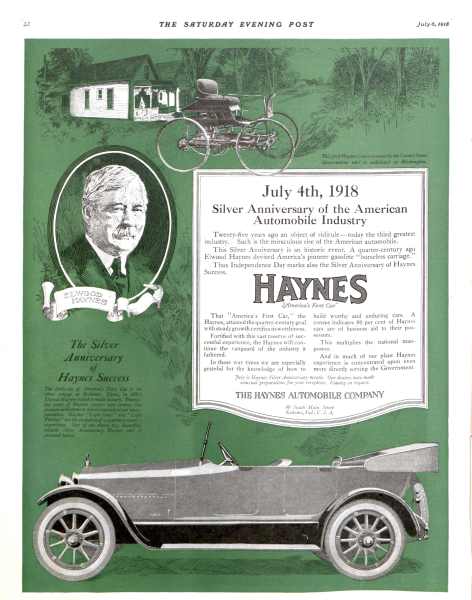
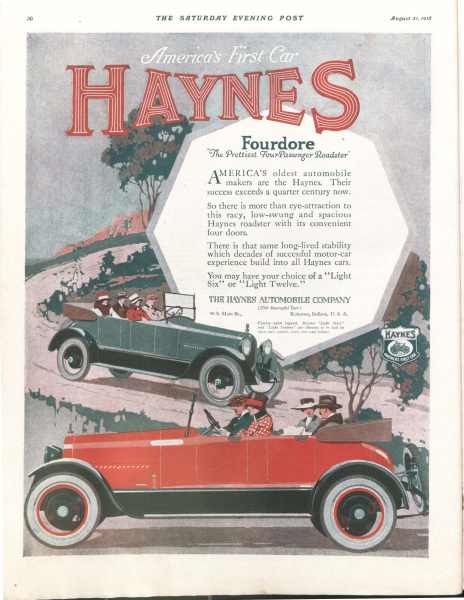
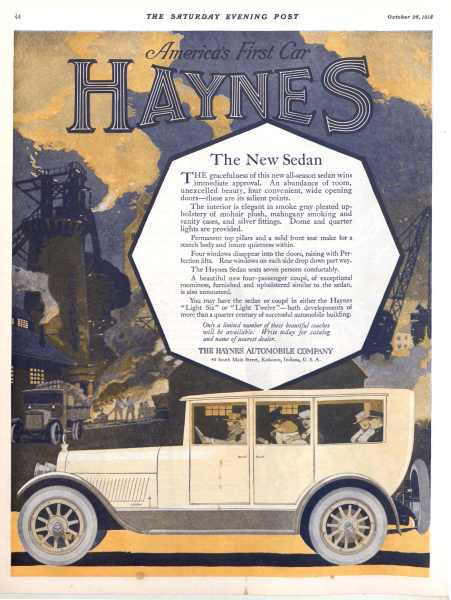
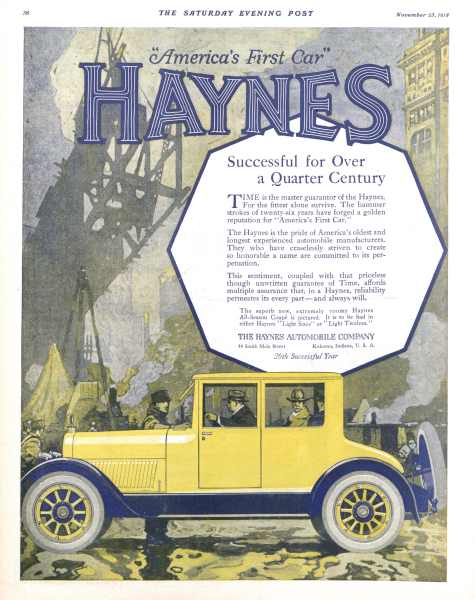
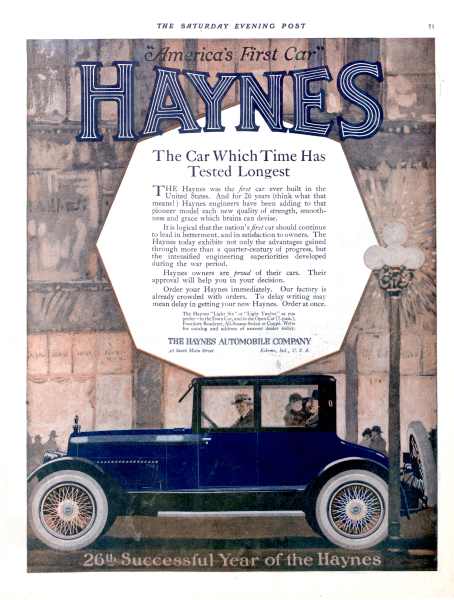
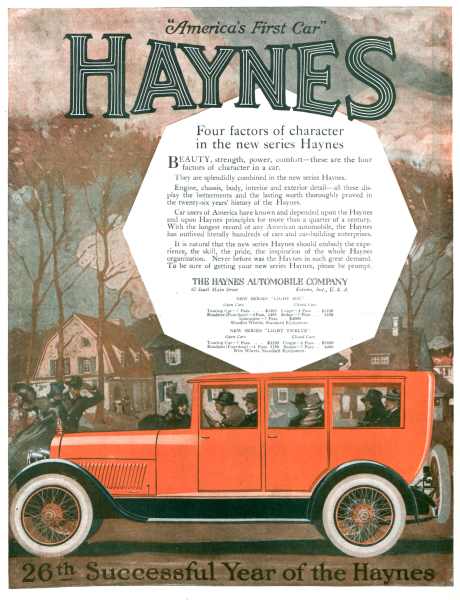
Haynes automobiles deserve to be remembered for their imaginative, distinctive ads, many of which we’ve included below.
But Haynes are remembered for more than just the ads.
The company was started in the earliest days of the auto industry by Elwood Haynes. He claimed his first model, which he built with Elmer and Edgar Apperson in 1894, was “America’s first car” when he donated it to the Smithsonian Institution in 1910. But, even at that time, it was known that other cars, including the Duryea brothers’ invention built in 1893, existed before Haynes’ Pioneer.
Yet the Duryea Motor Wagon Company folded only a few years after. Haynes continued to make cars for another 28 years. He had joined the Appersons to form the Haynes-Apperson Company in 1898, but the alliance lasted only a few years. By 1905, Haynes reorganized as the Haynes Automobile Company.
In 1908, he employed 600 workers in what the Kokomo Dispatch was calling “the oldest automobile factory in the United States.” They were producing 400 cars a year in two models: the five-passenger, 30 horsepower runabout ($2,500) and the seven-passenger, 50 hp touring car ($5,500).
Though Haynes may not have made the first car in America, he deserves the credit for introducing several industry standards. In 1911, his was the first car whose standard equipment included a windshield, headlights, and a speedometer.
It also included the Vulcan Electric Gear Shift. This feature appeared as a number of push buttons on the steering wheel, which shifted gears by electric solenoids instead of mechanical levers. It made the transmission “as easily operated as the electric horn,” according to its manufacturer, ”and makes the big gasoline car as easy to operate as an electric.”
The company chose the wrong time to expand their plant. Haynes built a new factory with a moving assembly line that could produce 60 cars a day. But in 1920, the U.S. economy went into recession. The Haynes Automobile Company was hit hard and never recovered. The plant ceased operations in September 1924.
Vintage Haynes Automobile Ads from the pages of The Saturday Evening Post:



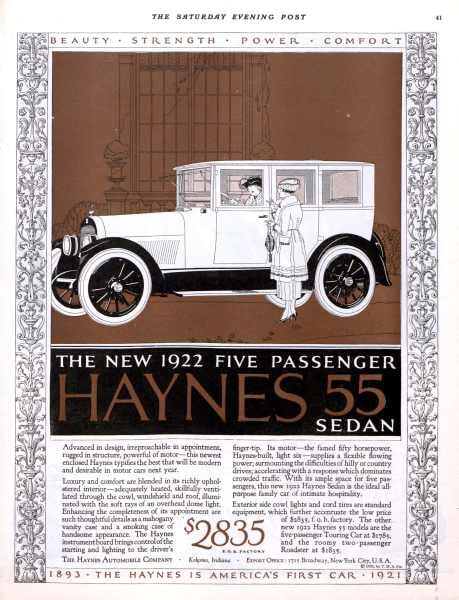
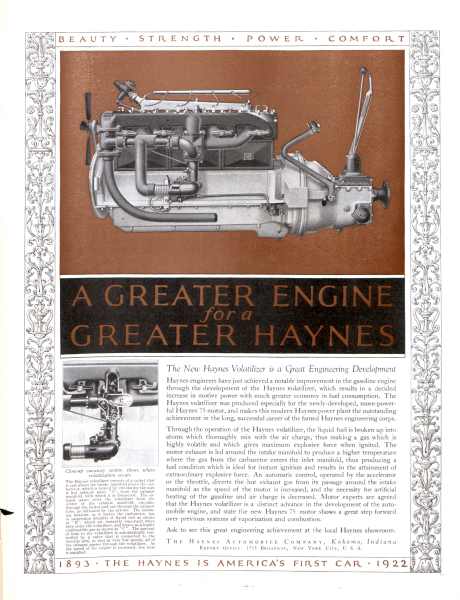
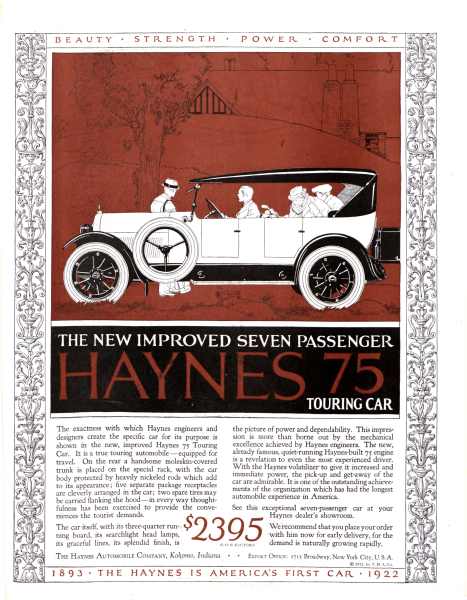
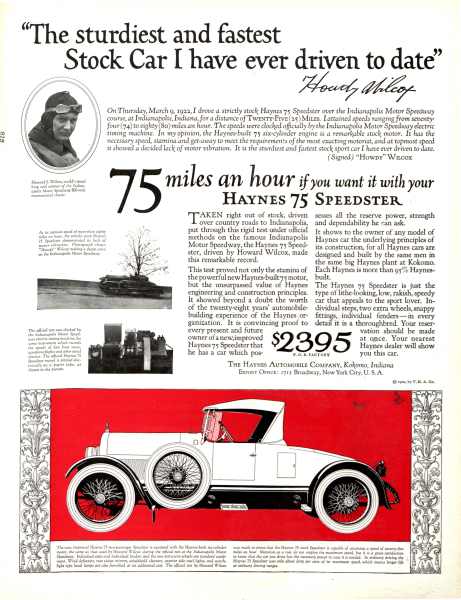
John LaGatta
Born in 1894 in Naples, Italy, John LaGatta was an American immigrant who achieved the American dream by cultivating his passion for art. In creating a unique style of his own, LaGatta reshaped advertising and illustration in the early twentieth century. He used depictions of glamorous, elegant women in a romanticized world of “old Hollywood” to provide an escape from the realities of the Great Depression.
Coming to America with nothing, LaGatta eventually become one of the most sought after illustrators in the country, earning as much as $100,000 a year throughout the 1930s and 40s.
LaGatta’s family arrived in New York City by way of Brazil, originally from Naples, Italy. Living in Manhattan’s Lower East Side, the artist began working in advertising as early as 14 years old in 1908. He began his studies at The New York School of Fine and Applied Art where he studied under famed artists Kenneth Hayes Miller and Frank Alvah Parsons. Even at such a young age, LaGatta was selling sketches to Life magazine to pay for his formal education.
Covers by John LaGatta

Splashed
John LaGatta
May 20, 1939
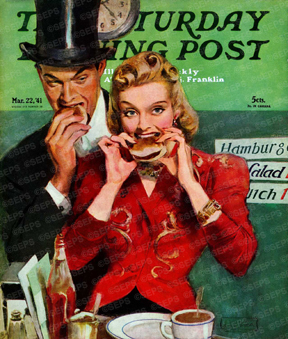
Late Night Snack
John LaGatta
March 22, 1941
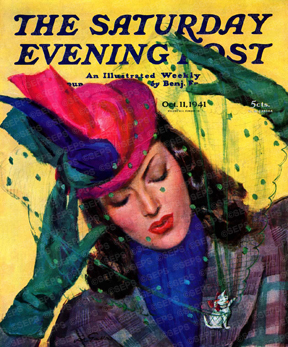
Cat Pin
John LaGatta
October 11, 1941
Buy prints of John LaGatta’s work at Art.com
In 1914, the artist moved to Philadelphia with friend and fellow artist Peter Helck to design film posters for Lubian Film Company. He eventually moved to Cleveland, Ohio to join a burgeoning art studio as an in-house artist. While in Cleveland, LaGatta met his future wife of 58 years, Florence Olds. Together, they had two children, son John Hawley Olds LaGatta, and daughter Jeanne Mehit (ne LaGatta).
Eventually LaGatta moved back to New York to keep up with his growing advertising commissions. He kept a house in Sands Point, Long Island, as well as a studio in Manhattan, a farm in Woodstock, and a forty-five foot yacht between Long Island and Manhattan. When the stock market crash hit in 1929, LaGatta’s assets were well protected since he had invested almost entirely in real estate.
His works depicting beautiful, sultry women are considered to be some of the most desirable artwork of the 1920s, 30s, and 40s, making him a “big money” artist. Over the course of his life, his list of consistent advertising clients included Resinol Soap, International Silver Company, Ajax Rubber Company, Laros Lingerie, Hoover Vacuum Cleaners, Paramount Pictures, Campbell’s, Ivory Soap, Kellogg’s, Johnson and Johnson, Spaulding Swimwear, and Chase and Sanborn Coffee.
His multi-media approach to the creation of illustrations also provided a unique perspective. LaGatta work in chalk, pastel, oils, sometimes mixing them as a style he coined “Chalk-and-wash.”
Though LaGatta had become financially successful from his advertising work, he wanted to be in the spotlight on the covers of magazines. He took a six-month hiatus from his advertising commissions and set out for the big leagues to land a cover of The Saturday Evening Post. From his hiatus onward, LaGatta landed covers on the most popular magazines of the era including Ladies’ Home Journal, Cosmopolitan, Women’s Home Companion, Redbook, McCall’s American Magazine, and Harper’s Bazaar.
By the end of the Great Depression and World War II, LaGatta’s depictions of fanciful parties, extravagance, high-fashion, and an overall idealistic escape to the parties of the 1920s, were no longer in demand.
LaGatta moved his family to Santa Monica, California during World War II where he took up commissions for “potboiler” portraitures and, in 1956, teaching. The artist’s old friend, Tink Adams, invited him to join the faculty of The Art Center School in Los Angeles, an offer the artist enthusiastically accepted. LaGatta taught there for 21 years until his death in 1977.
Benjamin Kimberly Prins
Benjamin Kimberly Prins’ covers for The Saturday Evening Post showed an innocent America, often on the cusp of peril. In opposition to Norman Rockwell’s ideal America, Prins tended to focus on catastrophes, troubles, storms, awkward run-ins, problems, and dilemmas facing Americans of the day.
Born in Leiden, Holland in 1902, Prins’ family had made its way to America by the time the young artist was ready to attend fine arts schools in New York City. Prins devoted himself to his instruction in the arts, completing many academic programs before beginning his career as a working artist.
Prins attended the Pratt Institute’s School of Art and Design, The New York School of Fine Arts, The Art Student’s League, and The Grand Central School of Art. Prins studied carefully under the tutelage of fine arts mentors George Bridgman and Dean Cornwell.
Covers by Benjamin Kimberly Prins
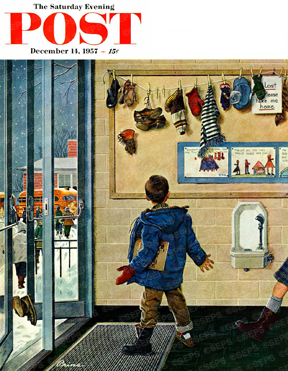
Lost His Mitten
Benjamin Prins
December 14, 1957
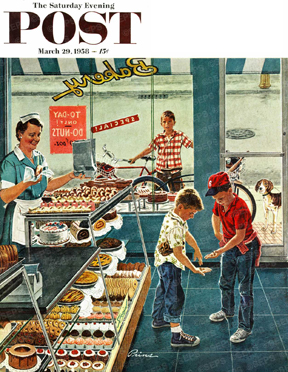
Doughnuts for Loose Change
Benjamin Prins
March 29, 1958
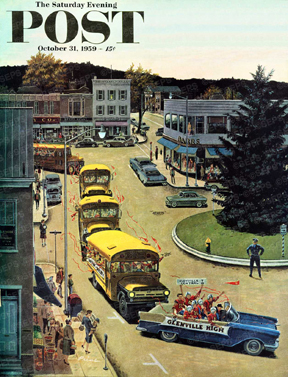
Glenville High Boosters
Benjamin Prins
October 31, 1959
Buy prints of Benjamin Kimberly Prins’ work at Art.com
After having completed his studies and finding work as an artist in New York City advertising, Ben Prins moved to the artists’ community of Wilton, Connecticut. He spent his entire career working and commuting from Wilton, enjoying the countryside outside of the urban sprawl of the city’s five major boroughs.
The artist eventually worked his way up the American corporate advertising ladder to run the art departments of some of America’s greatest advertising firms. From 1939-1945, in the middle years of his long career in corporate advertising, Prins spent 6 years as the Art Director at BBDO (Batton, Barton, Durstine & Osborn) Advertising. Even today, BBDO is one of the most famous and internationally recognized advertising firms based out of New York City with over 15,000 employees at 289 offices in 80 countries.
Prins worked on his private illustrations throughout his career spent in New York City 9:00-5:00 office jobs. His illustrations made the covers of magazines such as McCall’s, Good Housekeeping, Reader’s Digest, and of course, The Saturday Evening Post. The artist completed the majority of his magazine illustrations during the 1950s era of American idealism until the popularity of photography took hold over magazines. Prins completed over 33 cover and inside illustrations for The Saturday Evening Post during this time period.
For his contributions to the art and advertising world, Benjamin Kimberly Prins was inducted into the Society of Illustrators Hall of Fame and granted membership into The Art Director’s Club, both based out of New York City. He passed away at his home in New Canaan, Connecticut in 1980 at the age of 78.
Sarah Stilwell Weber
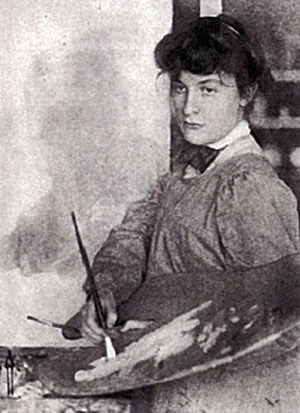
Sarah S. Stilwell was born in Concordville, Pennsylvania in 1878. Little is known about Sarah’s early life but her nieces and nephews describe her fondly. “My Aunt Sarah was a unique person with a great deal of imagination which is quite apparent in her work. She was a self-effacing yet positive woman who loved the innocence of little children.”
Sarah was fortunate to attend the Drexel Institute in Philadelphia in 1897, around the time that Howard Pyle was coming on as a full time teacher. Pyle was a well- known illustrationist in his own right, and was known for the innovations that he brought to the field of illustrating. Pyle’s classes quickly became popular, making it difficult to gain entry without strong credentials and fierce determination. In a letter to his friend Edward Penfield, the art editor of Harper’s Bazaar, Pyle wrote:
“I shall make it a requisite that the pupils whom I choose shall possess—first of all, imagination; secondly, artistic ability; thirdly, color and drawing; and I shall probably not accept any who are deficient in any one of these three requisites.”
In the summer of 1899, Sarah-Stilwell was invited to join an exclusive group of students at Chadd’s Ford on the Brandywine. Drexel Institute had managed to raise a thousand dollars for Pyle to fund this special project, with ten one-hundred-dollar scholarships being awarded to only his most talented students. Sarah joined this exclusive group of the best and the brightest in the freedom from the tyranny of conventional and restrictive methods of teaching. They dined, worked and played together, creating a sense of comradery and openness rather than harsh competition. Sarah’s time in this relaxed atmosphere would remain a theme she would foster in the years to come. At the close of Sarah’s first summer session, Pyle’s report read:
“All the students have shown more advance in two months of summer study than they have in a year of ordinary instruction. This, of course, might have been largely due to the fact of the contact of the students with nature and of their free and wholesome life in the open air. They prepared for work at eight o’clock in the morning and they rarely concluded their labors until five or six in the afternoon.”
What Howard Pyle did for his most prized students was literally to launch their career in the New York marketplace. He not only showed them how to improve and refine their talent but he went a step further by introducing them to the market in which their talent could produce a livelihood. And Sarah Stilwell was one of Pyle’s favorite young artist. At the turn of the century, Sarah was one of the first students to move into his Wilmington, Delaware studio at 1305 Franklin Street. There, along with other fine artists as Ethel Franklin Betts, Dorothy Warren, Frank Schoonover, Stanley Arthurs and others, she worked and shared knowledge. Howard Pyle urged Sarah never to marry, as marriage would interfere with the creative life of the artist.
Covers by Sarah Stilwell Weber
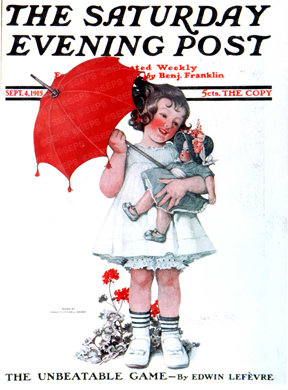
Girl with Parasol and Doll
Sarah Stilwell-Weber
September 4, 1915
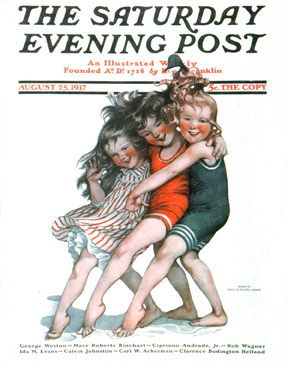
Three Little Girls at Beach by Sarah Stilwell-Weber
Sarah Stilwell-Weber
August 25, 1917
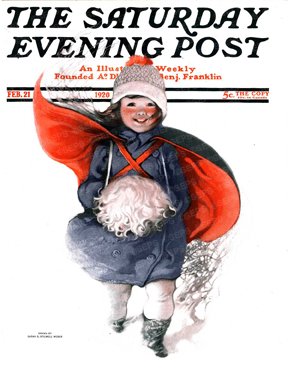
Girl in Snow
Sarah Stilwell-Weber
February 21, 1920
Sarah did the majority of her cover art for The Saturday Evening Post from 1904 through 1921. Not one to work well under pressure, she resisted the offer by George Horace Lorimer to do regularly scheduled pieces. She preferred having the freedom to work at her own pace and submit items at her leisure, feeling that a deadline might compromise her need to work until she felt personally satisfied with the result. Many of the Brandywine School artists had a flair for capturing grace and detail of the Victorian Era yet not letting decoration and detail overwhelm the subject matter. Sarah was particularly adept at creating movement and flow that gave the impression of coming and going. Her work was not merely a snapshot captured at a point in time. You had the distinct impression that the subject would dance off the page in the next moment.
Sarah Stilwell-Weber’s illustrations graced sixty covers of The Saturday Evening Post and five for The Country Gentleman. Her favorite subjects were of young children while at play, taking you back to a time of simple pleasures. Their youthful enthusiasm and all the movement that goes with their exploration are captured in the expressions on their delight filled faces.
One of Sarah Stilwell-Weber’s last publishing ventures was a children’s book entitled The Musical Tree. Her husband, Herbert, wrote the poems and music, Sarah did the illustrations. She died on April 6, 1939 at her home in Philadelphia, Pennsylvania at the age of sixty-one.
Thornton Utz
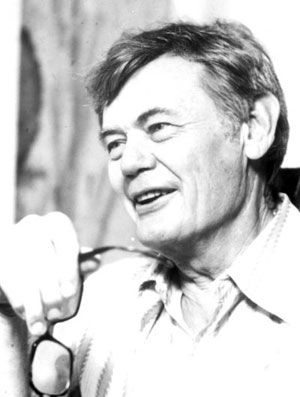
“I do art work for people. I feel like I have to be relating to somebody. That’s important to me to be able to be of use, of value.”
-Thorton Utz
A southerner, Thornton Robyn Utz was born in Memphis, Tennessee in 1914 where his father worked as a craftsman in horse-drawn carriage trimming until he moved over to automobile upholstery. From a very young age, Thornton Utz began drawing and illustrating without any professional training. He made his own comic strips to pass out to schoolmates. By high school, Utz had received encouragement from his teachers to pursue a career in the arts. His passion for art and illustration would build into a defining style that heavily influenced advertising and illustrating throughout the 1950s and 1960s.
Utz’s work was so popular he received steady work before even having graduated from Memphis Technical. Utz was quick to make friends throughout his life. At Memphis Technical, he met a young man by the name of Euclid Shook, who became his artistic partner for several years. The two worked semi-professionally on advertisements and boards for fairs and carnivals across the state. They graduated from high school in 1933 and together enrolled in The Academy of Art in Chicago.
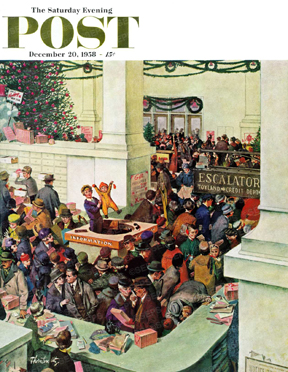
Thornton Utz
December 20, 1958
While studying art in Chicago, Utz shopped his skills around various advertising firms and print shops looking for work. His time in Chicago helped form his defining illustrative style. Looking back, Utz believed the time was wasted, saying, “I don’t think I learned much that year- except that I would never learn art in art school.” Much to the artist’s own chagrin, his style developed most in Chicago because of his schooling and the influence of his relationships. The most important artistic relationships he developed were those of Coby Whitmore and Ben Stahl. They all later became prominent members of The Chicago Gang of illustrators, friends who worked together to build a synonymous style for illustration. In Chicago, Utz met his wife, Louise Prohaska, through Ben Stahl. The two fell in love with one another over the course of a long period, eventually marrying on March 6th, 1940.
Utz received his first major illustration contracts designing color page art for Bell Aircobra, leading to his discovery by The Saturday Evening Post for an illustration and agent signing in 1944. Utz quickly settled his family just outside of New York City in Westport, Connecticut where he could work for large publications and advertising firms from home while helping to raise two daughters and a son. Utz was fascinated by the Americana style and often chose to depict suburban families living their every day lives. Some of his favorite artistic choices involved objects of technology and movement such as buses, trains, and cars. The idea of mass transportation and its commentary on the speed of the times fascinated the southern boy whose father had to shift from working on horse carriages to automobiles.
By the 1950s, Thornton Utz was using the interactions in his life to reach out to the rest of the country through art. His illustrations of American families going to work, cooking, cleaning, mowing the yard, and completing other chores made for a strong connection to the sensibilities of the time. His potrayals of the successes and humors of American stereotypes resonated with the country’s citizens in the post-war boom economy. His work made him one of the most popular illustrators in post-war America, fetching commissions for forty-five Saturday Evening Post covers during the decade.
In the mid-1960s, Utz’s wife Louise fell ill and the artist took time off from his work to take care of her at the house. The family moved to Sarasota, Florida for her health where Utz was able to return to his work as an artist. He founded a cartography business designing maps. He eventually remarried and had more children. He sold his business and became a successful portrait artist, completing works for President Jimmy Carter, his wife, Rosalyn, and his daughter, Amy, and even commissions for the Princess of Monaco. Utz lived a full life as an artist with a successful career spanning many areas of the industry. He died in the year 2000.
Covers by Thornton Utz
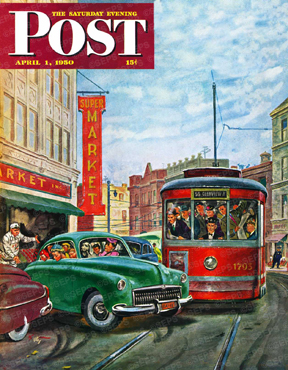
Parallel Parking
Thornton Utz
April 1, 1950
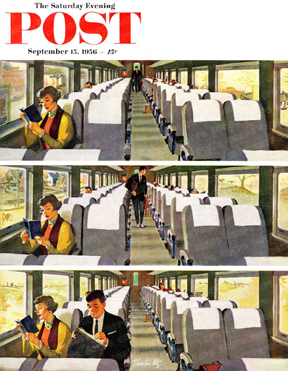
Commuter Pickup
Thornton Utz
September 15, 1956
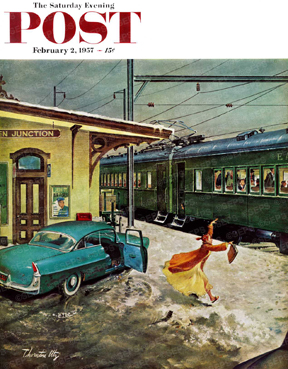
Forgot His Briefcase
Thornton Utz
February 2, 1957
Amos Sewell
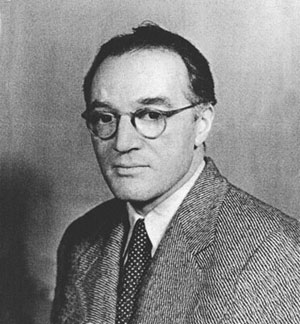
A born Californian from San Francisco, Amos Sewell enjoyed the sun and all the activities warm weather had to offer. In his youth, Sewell was a ranked amateur tennis player (15th in Singles and 9th in Doubles). He was a banker during the day who took art classes for fun. After repeated losses to his champion tennis rival, Donald Budge, he decided to quit the sport. A tennis star throughout the 1920s, Sewell had moved into the world of professional illustration by The Great Depression era of the 1930s.
He began his art education taking eight years worth of night classes at The California School of Fine Arts while working as a banker at Wells Fargo. Sewell worked at the bank from 1916-1930. He always enjoyed art, and often took vacation time to drive up the California coast to paint. It was on one of these trips that Sewell decided to make a career out of his art by moving to New York City.
In 1930, Sewell made the move. To pay his way, he worked a lumber-boat from California to New York down the coast and through the Panama Canal.
Once in New York City, Sewell took more classes at The Art Students League and the Grand Central School of Art. In art school, Amos studied under famed instructors Guy Pene Du Bois and Harvey Dunn. Each of whom became the artist’s entre into the New York City art scene. He also studied privately with Julian Levi at his studio in Easthampton, Long Island after having completed his formal schooling.
In 1932, he married his sweetheart, Ruth Allen. The two never had any children. Though a talented artist, Sewell complained that work was hard to find in the worst years of the Great Depression, specifically 1933 and 1934. He spent his days practicing illustration when there was no work to be done. Soon that period ended, however, and the experience of practice had prepared him to shine as a masterful illustrator.
One of the few financially stable working artists of the early to mid-twentieth century, Sewell kept up his passion for tennis as a hobby. His last documented tournament victory was the 1934 Cup for Westchester County, New York.
Quickly, Sewell began receiving regular work from advertising agencies and magazines around the city. All the incoming work provided a better quality of life. Eventually, he and his wife chose to move from the East Village of Manhattan to the artist’s colony in Westport, Connecticut. During World War II, he won an art award for creating the nation’s best war bond illustrations.
Amos Sewell’s successful career led him to produce covers and illustrations for The Saturday Evening Post, Woman’s Day, Good Housekeeping, Redbook, True, Today’s Woman, Coronet, Liberty, and Country Gentleman. He illustrated for Street & Smith detective “pulp” stories, and a novel, MacKinley Kantor’s “Valedictory.” He was privately contracted to illustrate for large national advertising accounts, but admitted that he had to give those up to focus on his added workload from The Post.
Though Sewell had no children of his own, the artist idealized childhood. He often chose to depict its innocence with empathic images of children playing or unknowingly making mistakes.
Amos and Ruth lived out a quiet life in Westport, Connecticut until Amos’s death in October of 1983 at the age of 82. Today, Sewell is remembered as one of The Saturday Evening Post’s best artist-illustrators.
Covers by Amos Sewell
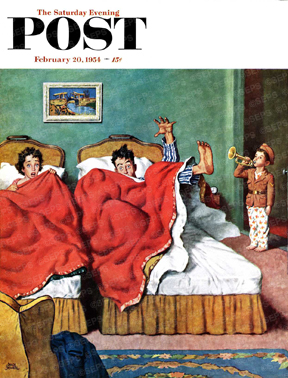
Parents’ Reveille
Amos Sewell
February 20, 1954
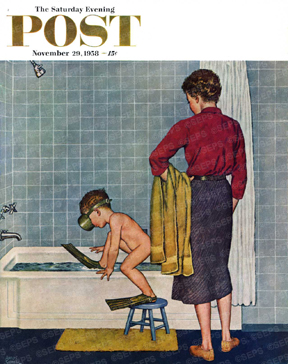
Scuba in the Tub
Amos Sewell
November 29, 1958
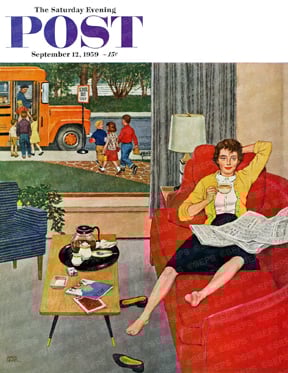
Morning Coffee Break
Amos Sewell
September 12, 1959
Mead Schaeffer
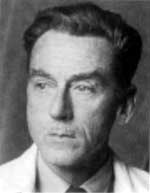
The child who sets out to be a career artist and skips the “starving artist” phase has a rare story indeed. But Mead Schaeffer’s ability was undeniable, his talents easily promoted. Born July 15th, 1898 to Presbyterian pastor Charles and his wife, Minnie, Mead grew up knowing he wanted a career in art. His work brought fame and fortune alongside a lifelong friendship with another American master, Norman Rockwell.
Born in Freedom Plains, New York, the Schaeffer family moved to Springfield, Massachusetts when Mead was a little boy. He graduated high school in 1917, and moved to Brooklyn, New York shortly after to attend the Pratt Institute.
At the Pratt Institute, Schaeffer studied under Harvey Dunn and Charles Chapman. His two mentors had started their own school, the Leonis School of Illustration, in 1915. The school’s philosophy followed that of their own teacher, the famed instructor Howard Pyle. Experiencing various art groups in the city, Schaeffer became acquainted with Dean Cornwell. Mead’s relationship with Cornwell led to Schaeffer’s first jobs producing illustrations for smaller magazines and publications. He graduated at the top of his class, already a working artist, in 1920.
Throughout Mead Schaeffer’s 20s, he worked for Dodd, Mead & Company, a publishing house for classic literature. Schaeffer provided illustrations for sixteen prominent works including The Count of Monte Cristo, Les Miserables, Typee, and Moby Dick.
On September 17th, 1921, Schaeffer married his wife, Elizabeth. They had two daughters, Consolle and Patricia. New York City soon became too cramped for the family. They moved to Rye, NY and then the artists’ colony at New Rochelle, NY where the artist first met Norman Rockwell. He later moved to Arlington, Vermont where he kept a studio in an old barn as Rockwell’s next-door neighbor.
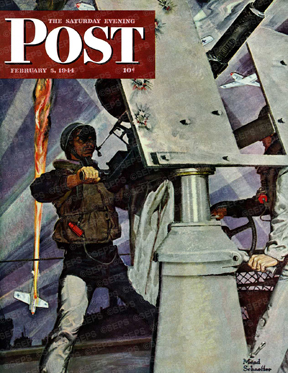
Mead Schaeffer
February 5, 1944
Schaeffer was introduced to Saturday Evening Post editor Ben Hibbs through Rockwell. Schaeffer’s relationship with the Post resulted in a career spanning thirty years and 46 cover illustrations. Schaeffer became most famous for chronicling the military with authenticity.
Rockwell and Schaeffer set out to pitch an idea to the government about ads for war bonds, but they were rejected. Hibbs picked up the idea and sponsored their work through The Saturday Evening Post. Schaeffer spent 1942 to 1944 as a war correspondent. He flew in planes, rode in submarines, and toured with soldiers to get a feel for the soldiers’ experiences in World War II. His collection, including 16 Saturday Evening Post covers, went on a tour to 92 cities in the United States and Canada. The tour’s purpose was to drum up sales for war bonds.
After the war, in the summer and fall of 1947, the Schaeffers and the Rockwells took a two and a half month family vacation to the American West. The families were so close many works by both artists contain the other’s children as models. Schaeffer’s wife often took dozens of photographs from all angles while the artist studied the scene. After the trip, the artist studied his wife’s photographs and incorporated their view into his work. From all of his sketches and studies, the trip provided only six Post covers.
Over the course of a 30-year career, Schaeffer provided 5,000 illustrations to books, magazines, and advertisements. His last cover for the Post was December 26th, 1953. He spent much of his retirement sketching and fly-fishing, often taking trips to Puerto Rico. By the end of his career, Schaeffer had worked for The American, Good Housekeeping, Cosmopolitan, Scribners, Home Companion, Ladie’s Home Journal, Redbook, McCall’s, St. Nichol’s Century Magazine, and of course, The Saturday Evening Post.
He died of a heart attack on November 6th, 1980 while at lunch with his contemporaries at the Society of Illustrators in Manhattan. Today his works are on display at the USAA in San Antonio, Texas.
Covers by Mead Schaeffer
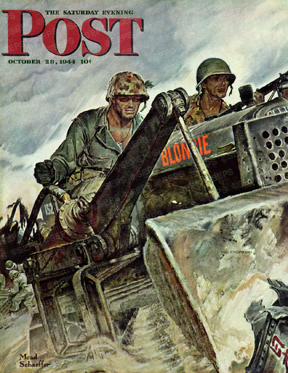
Corp of Engineers
Mead Schaeffer
October 28, 1944
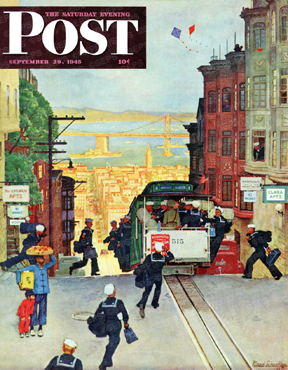
San Francisco Cable Car
Mead Schaeffer
September 29, 1945
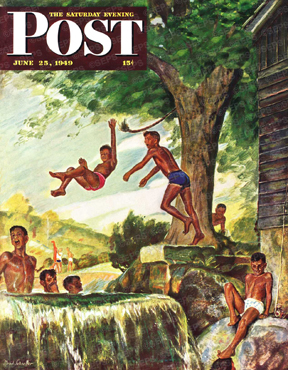
Swimming Hole
Mead Schaeffer
June 25, 1949