White Child, Black Nanny
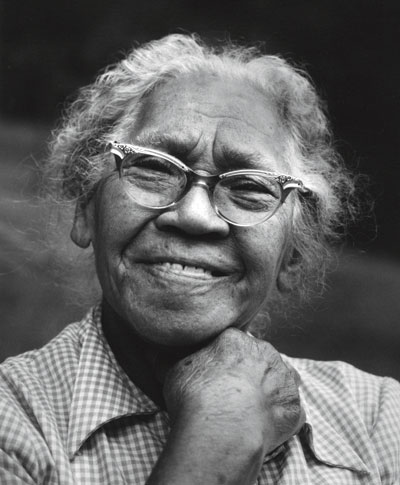
(Photo courtesy Sally Mann)
Down here, in the South, you can’t throw a dead cat without hitting an older, well-off white person raised by a black woman, and every damn one of them will earnestly insist that a reciprocal and equal form of love was exchanged between them. This reflects one side of the fundamental paradox of the South: that a white elite, determined to segregate the two races in public, based their stunningly intimate domestic arrangements on an erasure of that segregation in private. Could the feelings exchanged between two individuals so hypocritically divided ever have been honest, untainted by guilt or resentment?
I think so. Cat-whacked and earnest, I am one of those who insist that such a relationship existed for me. I know that my mother tried to raise me properly, but I made her cross as two sticks, so she turned the day-to-day care of her stroppy, unruly child over to Virginia, known to everyone as Gee-Gee, a name given her by my eldest brother, Bob.
I loved Gee-Gee the way other people love their parents, and no matter how many historical demons stalked that relationship, I know that Gee-Gee loved me back. Gee-Gee’s love was unconditional, a concept I might never have believed in had I not experienced it. When the dogs and I came in panting and filthy from our adventures, Gee-Gee sent the cringing hounds away and made sure I had what I needed: food, a story, or a bath. And when I was teased to tears by my brothers and father, or scared, or hurt, I never wondered if I would be protected or comforted. I always was — by Gee-Gee.
No one ever doubted who really ran the household, and my mother used to joke about her own dispensability. Gee-Gee had long ago mastered what William Carlos Williams called “the customs of necessity,” and to her devolved almost all the intimate aspects of our family life, the cooking, laundry, and sheet changing. After my brothers went away to school, I think she was mostly tasked with raising a lonely child in a household that cared very little for children. In 1958, three days before my seventh birthday, my parents went to France for six weeks to visit friends. It was my first year at school and since Gee-Gee didn’t drive, Clayton Campbell, the local taxi operator, would arrive every morning at 7:30. I would climb into the backseat, where my feet didn’t touch the floorboards, and Mr. Campbell would drive me to the whites-only public school, a tall-windowed, white-columned dump of a place.
Gee-Gee worked for my family until her early 90s. At age 100, with her hands curled into gentle claws, she died on Christmas Day, 1994. She was with us for almost 50 years, but to calculate by any form of numeric reckoning the moment-by-moment care and fidelity she tendered our family would be impossible. Yes, I know that she was paid to care for us, and that the notion of equality and reciprocity in an employer-servant relationship is inherently compromised. And I may get my ass kicked by those who think I am perpetuating the trope of the loyal housekeeper Uncle-Tomming her way to the unmarked grave. But Gee-Gee was not a caricature or a type; she was a very real and emotionally complicated person, who devoted a large amount of her time to raising an ungrateful and impertinent scalawag, the same one who now pauses to examine this relationship. I am reasonably sure Gee-Gee was as enriched, and occasionally appalled, by the experience of participating in our family as the rest of us were. And while our home may have been in some ways a replacement for her own, which was rent by racism and death, we did not take her for granted and we knew, even then, that her love was the real stuff that held our family together.
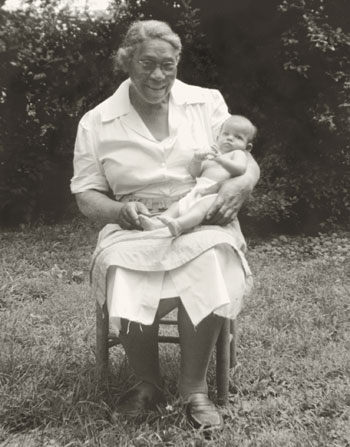
(Photo courtesy Sally Mann)
Gee-Gee had a problem with her feet, with finding shoes that didn’t hurt. I remember standing in the women’s shoe section of Leggett’s department store in Lexington, Virginia, and watching the tiny, hunchbacked saleswoman gaping up at my mother’s gestured descriptions of Gee-Gee’s feet. I’m guessing that my mother was doing this because she thought Gee-Gee might not feel comfortable shopping at Leggett’s, where Colored and White signs on the stairway pointed to bathrooms in opposite directions. I have imprinted in my knavish memory an image of the hunchback kneeling over the barbaric-looking foot measurer clamped to Gee-Gee’s metatarsal expanse, but this wasn’t likely to have actually happened for the reason just mentioned, and also because there was no point in Gee-Gee’s shopping, with her size 13 feet, in a ladies’ shoe department.
So, where did she get her shoes, ill-fitting though they were? Only now am I wondering about these things. What about those uniforms? Who bought them? My mother? Gee-Gee? And from where? Was washing and ironing the uniforms part of her noble washerwomanly chores? When? At night, or on Sunday? And how did she get something as simple as her groceries? She had no car; she worked for us six days a week from 8 in the morning until 8 at night and her house was on top of grocery-less Diamond Hill.
I remember an ancient wooden building on the way down Diamond Hill that had a few shelves of extortionately priced canned goods, but no real grocery store until the upper part of Main Street, almost a mile away. This small store, unironically named the White Front, had excellent meat, gave out S&H Green Stamps, and it also allowed its customers, even black people, to charge food and be billed at the end of the month. I know that Gee-Gee had an account and must have shopped there, but then what? Did she haul all her week’s groceries to the top of that hill in one of those woven metal carts the way I saw so many black women doing? But, wait; were stores even open on Sundays back then?
All these questions. The simplest, most elemental things.
During the day, she wore my father’s discarded shoes, razor-sliced to accommodate the corns on her toes. But she arrived at work with her feet painfully crammed into whatever golden lily shoes she had found, wherever on earth she found them. She yanked them off as soon as things quieted down in the mornings and it was just the two of us. After wiggling her toes to restore the feeling, she would sit down on the stepstool and gratefully sink her feet into my father’s laceless shoes, her stockinged toes protruding from the side slits.
Women wore stockings all the time then, even in the middle of the summer, and Gee-Gee would try to beat the heat by wearing hers rolled down to just above her knees instead of hooked to the dangling ends of a garter belt like my mother’s. She often wore my mother’s old silk stockings, whose gossamer runs enlarged into ladder-rungs as the day went on, the seams wobbling crazily. Stocking seams were a particular misery back then, but more for my mother than for Gee-Gee.
It was important for my mother’s seams to run straight up her legs, two apparently converging lines that had the unintended effect of guiding the eye to their dark vanishing point. When my mother was going to town, she would close the bedroom door and twist her head around to examine her seams in the mirror. Then, a ritual familiar to almost any well-off southern white child of the 1950s would play out: powdered, lavender-scented, as cool and white as Lot’s wife, my mother would emerge from her bedroom, grab up her purse and white gloves, and try to make her getaway.
Apparently both parties knew their roles in this drama, but to my observing eyes it seemed new each time it played out on the asphalt bib next to the black sedan beetled under the pine boughs.
“Mrs. Munger! Mrs. Munger!!” urgently issued from the slid-open kitchen windows.
My mother would stop, her expectant face belying the startled look she would try to put on it.
A beat.
“Mrs. Munger, you cannot go to town with your slip showing like that! And those seams! What would they think of me?”
For Gee-Gee, this was not a rhetorical question. She had reason for concern. Working for a Yankee, albeit one with a Dallas-born husband, was a problem for Gee-Gee, and my parents’ oddball, liberal, atheist, country-club-shunning ways further complicated the picture. Curiously, that my mother insisted on exceeding the normal pay scale for her help, five dollars a week in the ’40s when they first arrived in Lexington, was no comfort for Gee-Gee. The anonymous, threatening letters my mother received as a consequence of this profligacy and the talk around town brought Gee-Gee to the attention of the community, which was not a good thing. Any black person could tell you: the less noticeable you were, the better.
Gee-Gee learned the rules of living in white society early on, though she revealed little to us about her childhood. What we knew was this: She was born to the very young daughter of a former slave in a part of the county where freed slaves had settled, known to this day as Buck Hill. Although Gee-Gee’s mother was black, the man who raped her (or so it is logically presumed by her family) was white. It is likely that her mother died in childbirth because as an infant, Gee-Gee, born Virginia Cornelia Franklin, was brought to Lexington and raised by her mother’s sister, Mary Franklin.
In her late teens, Gee-Gee married Wesley Carter and bore him six children, the youngest of whom was 12 when my mother, new in town and eight months pregnant with her first child, saw her coming down the post office steps. Struck by the image of this powerful, proud, and composed woman, my mother described her to my father in detail at dinner that night. By a twist of fate that to the end of her life still delighted and amazed my mother, the next day she answered a knock at the door to find the unforgettable stranger again. Virginia Carter stood tall and confident on the threshold, wearing a tweed Peck and Peck suit with a velvet collar so worn it appeared to be suede. Her broad cheekbones bespoke some Indian blood, her light eyes and almost straight hair something unspeakable. She asked if my mother needed help and was hired on the spot.
Gee-Gee’s husband, Wesley McDowell Carter, worked as a presser in the laundry room of the nearby Virginia Military Institute. He had problems with alcohol, and more than once Gee-Gee came to work troubled, her face blotchy. One night in the back room of the store on Diamond Street he rose from the card table, headed down the basement stairs, and fell, breaking his neck. Apparently, no one noticed right away, and it was more than a day before Gee-Gee was taken to his body.
Left with six children and a public education system for which she paid taxes but which forbade classes for black children beyond the seventh grade, Gee-Gee managed somehow to send each of them to out-of-state boarding schools and, ultimately, to college.
How did a widowed black woman pay for the housing, the food, the travel, and the tuition to educate six children?
By working 12 hours a day and by taking in linens to iron at night, linens stuffed into white sacks crowding her front door when my father took her home after all day on her feet at our house. What did he think when he saw those bags? What were any of us thinking? Why did we never ask the questions? That’s the mystery of it — our blindness and our silence.
Saturday lunches were important to Gee-Gee, and she went all-out on the menu. With unlikely balletic grace, she lowered the silver serving dishes to our left, two passes at each meal, a third if biscuits were involved, which she always made when we had fried apples and bacon. The apples came from an old orchard above the house and were small, green ones, Pippin or Northern Spy, and difficult to peel. Difficult for me, that is, but not for Gee-Gee. She would sit on the stepstool, the large bowl of apples beside her on the chest freezer, and, with a paring knife, unfurl a spiral of continuous peel, the whitening apple rotating in her pink palm.
When she was done, catching up the loopy tangle of peels in her apron, she would dump them in the compost bucket and carry the apples to the counter by the stove. Sinking a wooden spoon into the bacon grease stored in a sawed-off tin can, she would put the skillet on the burner and start the biscuits. Assuming the warm top step of the stool she had vacated, I would watch her from behind as she rolled out the dough and twisted the rim of a jelly glass into it, trapping the circle of dough in it long enough for her to shake it out onto the cookie sheet.
As far as I could tell, Gee-Gee herself never ate anything, save occasionally when she checked the seasoning from a pot on the stove. Otherwise, the only thing I ever saw pass her lips was ice water from a tin measuring cup that sweated on the counter. Maybe it was a good thing that she never needed to eat, because when we traveled together, as we did for vacations on the Eastern Shore, she could not enter the restaurants. When we stopped to eat at the Howard Johnson’s, gratefully throwing open the doors of the hot car, Gee-Gee stayed behind.
Looking out from the big windows of the air-conditioned dining room, we could see her cooling herself with a First Baptist Church fan, Jesus’ white face serenely waving in the backseat. Emerging from the restaurant with a tin-foil-wrapped cheese sandwich for Gee-Gee, which she would demurely place in her lap, and a Dixie Cup of water, which she would drink, we would resume our trip as if this were perfectly normal.
It’s that obliviousness, the unexamined assumption, that so pains me now: Nothing about it seemed strange, nothing seemed wrong. I never wondered where she peed on the trips to visit my brothers and me at our boarding school in Vermont. Could she hold it until we crossed the Pennsylvania border and the restrooms were integrated? Did any of us, besides her, wonder about that, about what would happen if she just had to go? How could I not have thought it strange that Gee-Gee not only never ate anything but also never had to go, never even got out of the car? How could I not have wondered, not have asked?
My graduation in 1969 was held on a weekend in early June. My parents and Gee-Gee arrived Friday, and I could tell that Gee-Gee was not pleased with what she was seeing. The children of the wealthy were dressed like field hands, with dreadlocked hair and dirt between their toes. Gee-Gee glared at a black kid from my algebra class, and when he flashed the peace sign at her, his arm around a bell-bottom-wearing blond girl, she turned from him with a snort of disgust.
Oh, Gee-Gee, I thought despairingly: This is the future. Up here, we’re all one.
Gee-Gee was having none of it.
On graduation morning I was late getting to the dining hall for breakfast, and all the tables were gone. Benches for the graduates and chairs for the visitors had been arranged at the eastern end of the room, with a processional aisle in the middle. The hall appeared to be empty, but squinting against the sun I saw a lone figure substantially anchoring the first row of the audience seating. Staring straight ahead, white-gloved hands folded in her lap and her back not even touching the back of the chair, sat Gee-Gee, wearing a perfectly pressed linen dress. It was a pale yellow, and centered above her bun was a pillbox hat made of the same fabric. A necklace of white plastic orbs, resembling the South Sea pearls that you now see oppressing the thin collarbones of ladies who lunch, complemented Gee-Gee’s powerfully muscled neck. The skin swelled out above her too-small white pumps and her stockings had compression puckers where the toes were mashed in. No one had stocking seams anymore, but in every other respect she was as elegant and imposing as a dowager queen.
When my parents arrived, my father stood to the side while my mother, in a prim little hat, slipped into the seat next to Gee-Gee. Directly behind them sat Ethel Kennedy, wearing white patent-leather boots, her brood sprawling around her, their shirts unpressed and hanging out of their khakis.
My mother and father leaned toward each other occasionally to exchange some whispered observation, but Gee-Gee remained straight-backed, staring ahead. I knew the warning signs. Her distress, even her occasional anger, was always accompanied by an ineffable and profound sadness: always the pursed lips, the closing of the eyes, perhaps onto visions of injustice and outrage, and the slow, tired shaking of her head, usually accompanied by an “umnh, umnh,” which conveyed wordlessly the extremity of her disgust and sorrow.
Then it started, the eyes closing, the head slowly, almost imperceptibly moving from side to side. As if she could bear it no more, she reached out her immaculate white-gloved hand and with her forefinger tapped my mother on the arm.
The pillboxes came together and Gee-Gee put her lips to my mother’s ear, whispering indignantly: “Mrs. Kennedy is chewing GUM!”
—
From the book Hold Sill by Sally Mann. Copyright © 2015 by Sally Mann, Inc. Reprinted by permission of Little, Brown and Company, New York, NY. All rights reserved. Hold Still is a 2015 National Book Award finalist.
Ellie Krieger’s Pumpkin Bread with Cranberries
Pumpkin Bread with Cranberries
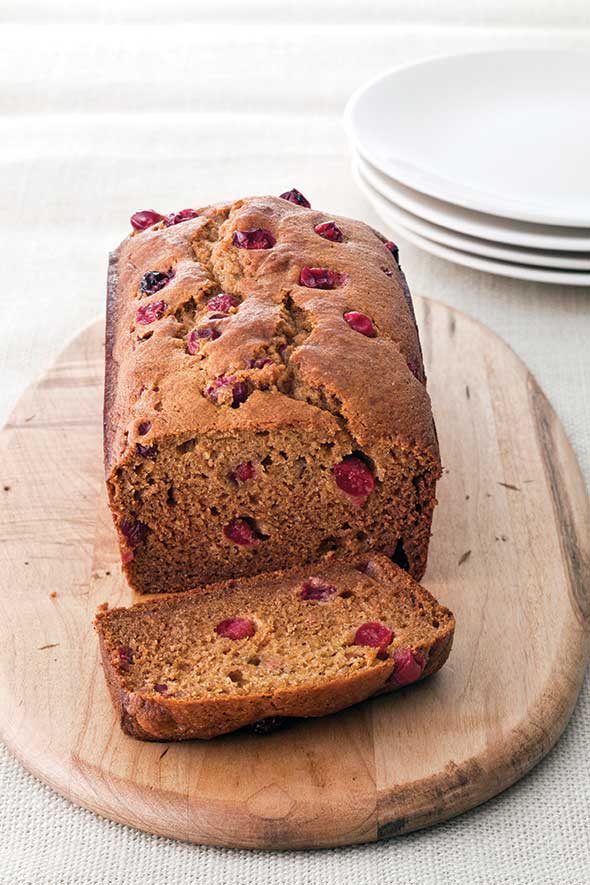
(Makes 8 servings)
- Nonstick cooking spray
- 3/4 cup all-purpose flour
- 3/4 cup whole-wheat pastry flour or whole-wheat flour
- 1 teaspoon baking soda
- 1 teaspoon ground cinnamon
- 1/2 teaspoon baking powder
- 1/2 teaspoon ground nutmeg
- 1/4 teaspoon ground allspice
- 1/4 teaspoon salt
- 1 cup canned pumpkin puree
- 2/3 cup honey
- 1/3 cup canola oil
- 2 large eggs
- 1 large egg white
- 1 cup fresh whole cranberries
Preheat the oven to 350°F. Spray a 9×5-inch loaf pan with cooking spray.
In a large bowl, whisk together the flours, baking soda, cinnamon, baking powder, nutmeg, allspice, and salt. In another large bowl, whisk together the pumpkin, honey, oil, eggs, and egg white until well combined. Stir the dry ingredients into the wet ingredients, mixing just enough to combine evenly. Gently stir in the cranberries.
Pour the batter into the prepared pan. Bake until the top is browned and a wooden skewer inserted into the center comes out clean, 50 to 60 minutes. Allow to cool in the pan for 15 minutes, then transfer the bread to a wire rack to cool completely before slicing.
Nutritional Information Per Serving (1-inch thick slice)
- Calories: 290
- Total Fat: 11 g
- Saturated Fat: 1 g
- Sodium: 290 mg
- Carbohydrate: 45 g
- Fiber: 3 g
- Protein: 5 g
Copyright 2011 Ellie Krieger. All rights reserved
News of the Week: Darth Vader, Distraction, and the Diet of Tom Brady
Star Wars: The Force Awakens
I can’t believe it’s the end of October already. Christmas will be here before you know it. And that’s when the new Star Wars sequel opens, on December 18. Here’s the official trailer:
Fans already have their theories about the trailer. People are examining it more than the Zapruder film. There’s Darth Vader’s helmet! Why is Leia crying? Hey, why does that character have that light saber? The big question is: where’s Luke? He doesn’t seem to be on the poster, and he might not even be in the trailer, though that might be him at 1:40, his repaired hand on R2D2. There must a reason for the secrecy involving the character. Does he look different? Is he in hiding? Has he (gulp) gone over to the dark side and is now the bad guy?
Io9 has a shot-by-shot breakdown of the trailer, which debuted during Monday Night Football, which made some fans unhappy. If you’re the type who likes to argue about things, you can read why some people want you to boycott the film because it’s “anti-white”.
If you plan to see it on opening day, you’re not alone. Believe it or not, fans are already buying tickets. May the Fandango be with them.

The Age of Distraction
Many people are under the impression that because of all of the technological advances we …
I’m sorry, I had to check my e-mail. What was I saying?
Oh yes, distraction. Sure, we’ve always found things to help us kill our attention spans, but not at the level we do now. We’ve been programmed to believe that multi-tasking is actually a good thing, and we can do everything everywhere now because we carry our phones, our mail, our files, our TVs, our music, and our computers around with us in our pockets 24/7. There’s no downtime anymore. We’re always “on” and there’s always something new to distract us.
The new book The World Beyond Your Head by Matthew B. Crawford, argues that, as The Los Angeles Review of Books says, “we are living through an unprecedented crisis of attention.” And as a simple test, see if you can get through that entire review without getting antsy or skimming it or clicking away. A lot of people are having trouble reading anything longform now, because we’ve gotten so used to short social media posts and texts and smartphones and other forms of quick gratification.
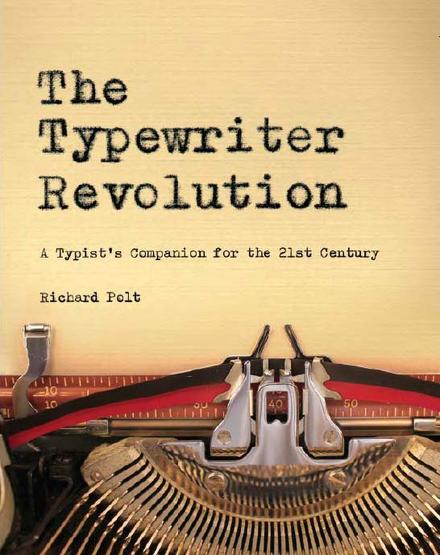
 The Typewriter Revolution by Richard Polt
The Typewriter Revolution
One thing you can do if you find yourself easily distracted is … buy a typewriter! This is a particularly good idea if you’re a writer and you don’t want to be distracted by email and Facebook and the latest news and games and various alerts and just want to concentrate on the words on the page. Sure, you can’t surf the Web on a Smith Corona — and the only “app” you might use is Wite-Out — but that’s kinda the point.
The Typewriter Revolution is a new book by typewriter expert and historian Richard Polt. In it, Polt not only explains how to choose the best typewriter and care for it, but he delves into the history of the machines, the famous people who used them in the past and the people who use them now, from novel writers to people who have typewriter blogs and host Type-In social events.
There’s a typewriter renaissance that’s been happening the past few years. Younger people are starting to love the machines because it’s not another screen they have to look at, and many people are discovering that unlike computers, they don’t get obsolete or break down or become disposable. Also, typewriters are works of art with different personalities.
Maybe we should thank Tom Hanks for the renewed interest in typewriters. He collects them and even created the Hanx Writer iPad app to bring the machines into the 21st century.
The Tom Brady Diet
A great philosopher, I think it was Aristotle, once said, “Don’t trust anyone who eats kale for breakfast.” And I guess that would include New England Patriots quarterback Tom Brady, who has let us know exactly what he eats and doesn’t eat to keep in shape.
What does he like? Kale for breakfast, raw macaroons, and avocado-based ice cream. What does he avoid? Coca-Cola, which he calls “poison,” and Frosted Flakes, which he implies isn’t food (30:07). Let’s hope Coca-Cola and Kellogg’s don’t advertise at Gillette Stadium.
Doesn’t he know Frosted Flakes are grrrrrrrrrrrrrreat?
October 21, 2015
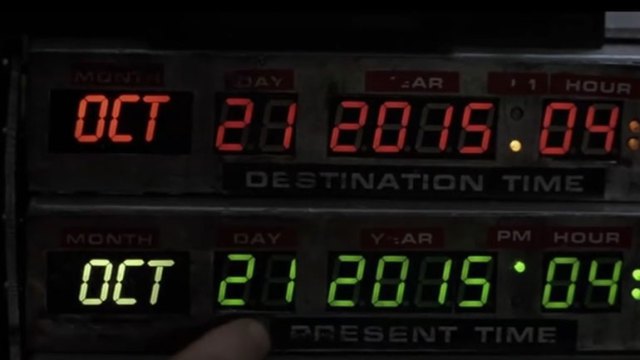
While the Star Wars movies are set in the past (a long time ago…), Back to the Future II was set, at least partly, in the future. October 21, 2015, to be exact. Well, it was the future in the movie. For us, the future is this week.
What did the movie get right in its depiction of 2015 life? Well, we have video-phone calls but still no hoverboards. We have video games that we can play without our hands, like Kinect, but no Jaws 19 (though Universal did create a trailer for it) We have video glasses in the form of Google Glass and virtual reality headsets (though they’re not mainstream yet), but no double neckties (thank God). The Washington Post has a good rundown of what the film got right and got wrong. The movie didn’t predict the Web either, but you can still get a print USA Today.
In the movie, the Chicago Cubs win the 2015 World Series, but … well, sorry, Cubs fans.
If you can’t get enough of all things Back to the Future, there’s a new documentary called Back in Time that includes interviews with the cast and crew and goes behind the scenes of all three movies.
Die Hard 6: An Idea That Should Die Hard
Contrary to popular belief, a movie sequel isn’t always a bad idea. After all, From Russia, With Love was a sequel to Dr. No, and we’ve had several more James Bond sequels since then, and we don’t have a problem with them, right? And everyone loves when there’s a new Avengers or Mission: Impossible, so if they’re well-made, sequels can be really great. Prequels, on the other hand … well, just look at the three Star Wars prequels. Prequels are often bad because they try to act as both prequel and sequel at the same time. If it’s done well, it’s fantastic. If it’s done poorly, then it can put a bad taste in your mouth about the films that came before (after?) it.
But that’s not stopping people from giving us Die Hard 6, which is in the works. What a terrible idea.
The plot? It’s an origin story! We’ll get to see young John McClane (hopefully played by another actor and not Bruce Willis in a bad wig) and the adventures he got into as a young cop in ’70s New York City. Besides the fact the last couple of Die Hard flicks weren’t that great and should have been a sign the series should just go away quietly, the plot goes against what happened in the original. McClane was a Joe Everybody, a non-hero suddenly finding himself in an incredible situation. And now we’re going to go back and see him battling bad guys and saving the day when he was in his 20s? If Willis is in it he might be in scenes in the beginning and end of the film, as an older McClane looking back.
No, no, no, no, no, no, no, no, no, no, no, no, no. Also: no.
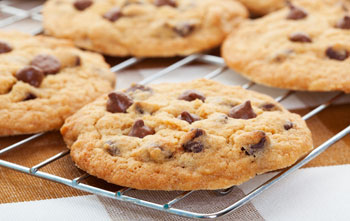
October Is National Cookie Month
In honor of the new Star Wars film, how about some cookie recipes centered around characters from the film? Here’s a how-to video on how to make Darth Vader cookies, and here’s a page that shows you how to make R2D2 and light saber cookies. If you want to be really accurate with your cookies, get the Star Wars cookie cutters. You can make a Back to the Future cookie too.
Sorry, I couldn’t find any recipes for Die Hard cookies. If you do, let me know.
Upcoming Events and Anniversaries
Pablo Picasso born (October 25, 1881)
This site says that when it comes to art, Picasso was “probably the most important person of the 20th century.”
Opening of NYC subway (October 27, 1904)
If you don’t live in New York City, its subway system can seem awfully confusing. NYCSubway.org has a lot of great info to make it a little clearer, along with some great historical photos.
Theodore Roosevelt born (October 27, 1858)
After President McKinley was assassinated, Roosevelt became the 26th president of the United States.
Stock market crash (October 28, 1929)
Known as Black Monday, the dark day led to the Great Depression of the 1930s.
Orson Welles’ War of the Worlds broadcast (October 30, 1938)
Here’s the complete audio of the broadcast that many thought was a real newscast and that we were actually being invaded.
Halloween (October 31)
The once fun day has been hijacked by grown-ups and just isn’t the same.
Feathers
The key was so cold his first instinct was to drop it. He held on, afraid to make a noise. All day, he’d kept to the edges as though watched, as though judgment could be passed.
He studied the key. It was heavy, large and ornate as though it might unlock a pirate’s treasure chest. Why was it under the carpet, not in the kitchen? When he was a child the keys, dangling on the line of brass hooks, held possibilities he’d never dared voice. His grandmother locked everything: her brass and glass; the tea and sugar; even his toys. He’d had to ask permission to play.
Thinking of her, his unease threatened to curdle into fear. His chest constricted. To ward off terror he thought of Danielle. ‘What’s up, love?’ he made her say.
‘I can’t get my breath.’
‘Did you bring your inhaler?’
He shook his head. She tutted and walked away. Ever practical, even in his daydream, she sorted the pile of bedding he’d bunched in a corner of the room. He allowed her to fade, and the empty room returned: floating motes of sparkling dust; a crumpled mess of sheets and a feather duvet.
The constriction of his chest was his old allergy flaring up, that’s all. He couldn’t possibly be afraid of his grandmother after all this time. Besides, she’d never hit him, only locked him in his room until he was itchy with packed-down fear. He’d run away when he was 16. Just like his mother. But he didn’t leave a sickly, asthmatic baby behind to grow in the shadows. Over the years he’d tried to find her. The Internet offered nothing but false leads.
He put the key in his pocket, rolled up the last section of the carpet and stood. Unhooking the nets covering the windows, he saw the grass was thick and spotted with white daisies. With his grandmother dead, the garden had forgotten its place.
Clearing the outbuildings had been a very clear stipulation in the old woman’s will. Once that was done, once the house was sold, he would be free. He was unclear about how his life would be different from the last 30 years, but it would change. Cheered by the thought, he ran downstairs, allowing noise to echo in the hall. He let himself out. A sappy green smell hung heavy in the warm air. He walked towards the brick-built shed at the very end of the garden.
As a child, this place had been out of bounds. At the door he felt his eyes sting, the same itch he’d felt in the bedroom. Feathers. He listened, but there was no sound of birds. He stepped back to look at the roof for a nest, when he noticed the large keyhole. Aha! He fished the key out of his pocket. It fitted the lock. The door swung open. The shed had a scattering of white downy feathers on the floor and a single large chest in the middle. Was it a treasure chest? Could be. The old woman was rumored to be rich but he hadn’t unearthed a single trinket, no stack of unused banknotes beneath her lonely bed.
On top of the chest was an envelope addressed to Tom in his grandmother’s hand. He tore open the envelope but couldn’t read. His eyes were smarting.
‘Be more careful. You’ll have an attack.’ Danielle. Calm, reassuring.
He retreated and sat on the grass. He waited until his chest was less tight and his heart had stopped fluttering. He read the letter.
Tom,
I’m surprised you got this far. I hid the key away from those nurses. They were always stealing, prying, lying. I didn’t have much hope that you would know what the key was for. You are as stupid and sickly as your mother. Open the trunk if you want to know more about her.
Grandmother
This was better than any treasure. Finally there was an answer, a clue. It was stupid to go back in the poisonous shed for too long, but perhaps he could drag the trunk into the clear air.
‘Don’t be silly, Tom,’ said Danielle. ‘Wait. I’ll do it later.’
‘No,’ he said, mouthing the word, surprised to find himself saying it. Even in his imagination he rarely defied Danielle.
‘It’ll wait.’
‘No!’
‘At least until you fetch your inhaler.’
He shook his head to rid her voice. He was alive with urgency. He strode into the shed. His chest constricted but he ignored it, holding his breath. He gripped the handles on the side of the trunk and pulled. It was too heavy.
‘Please stop,’ Danielle said.
His determination was fiercer than thoughts of his wife. What he needed to do was to grab whatever was in the trunk and run. He lifted the lid.
Feathers.
The old witch. She always used his allergy against him. A memory came, clear and sharp, of a single small feather pushed underneath the locked door of his room. Were feathers his punishment now as they had been then? Or was there really something of his mother in here, cradled in soft down?
He took a gasp of poisonous air, pushed Danielle from his mind, and pulled his sleeve as low over his hand as he could. He plunged it into the chest.
Beneath the soft down was something solid and round. He knew what it was before he pulled it out. A skull. In his hand was a skull of a girl. Sixteen. His mother.
‘Leave now!’ said Danielle.
The door, the fresh air, the garden with new life, was only a step away. He didn’t move. He was a little boy again, afraid, gasping. His face burned, eyes smarted. The last 30 years, Danielle, his house and job, were lost as though they’d never been. He stared at the skull. Overlaid across the bone was the sharp image of a single feather, white as death, pushed beneath his bedroom door.
Happy Halloween!
Long before the Great Pumpkin, Scream Queens, or Marvel Universe costumes, The Saturday Evening Post cover artists were entertaining Americans with the spooky, ghoulish, and adorable tricks and treats of Halloween.
Duck and cover, trick-or-treaters. This coven flies with an arsenal of bats and jack-o’-lantern-bearing ghouls.
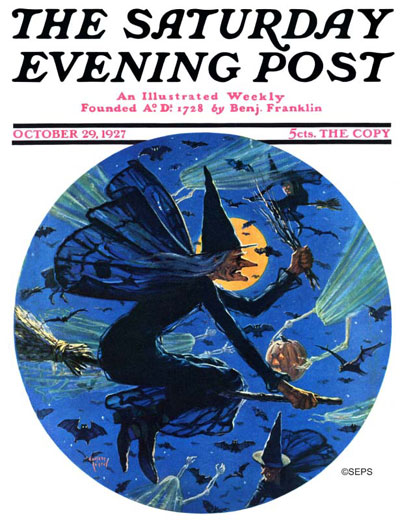
October 29, 1927
This classic cover captures the joy stemming from the first pumpkin lighting. Our only concern? The flammability of his costume.
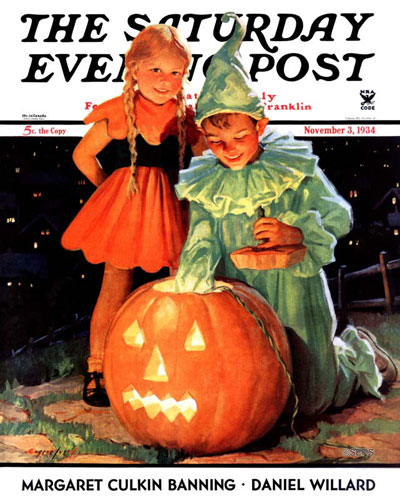
November 3, 1934
“Boo!” No one would ever guess there’s a curly-haired, doe-eyed girl behind the mask.
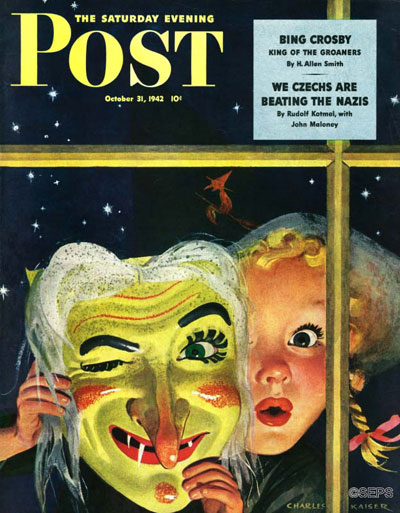
October 31, 1942
No need to fear this warty witch—looks like the chilly October air may put an end to her Halloween plans.
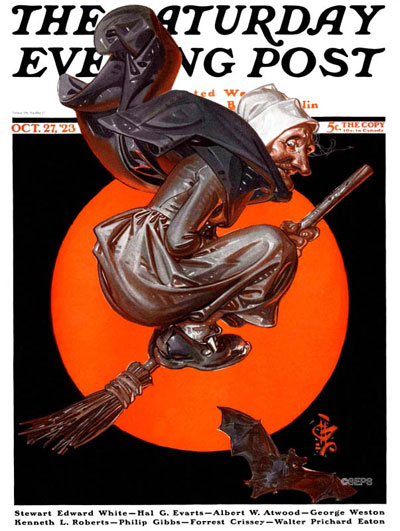
October 27, 1923
A jack-o’-lantern fit for a king—served only on the finest silver platter, of course.
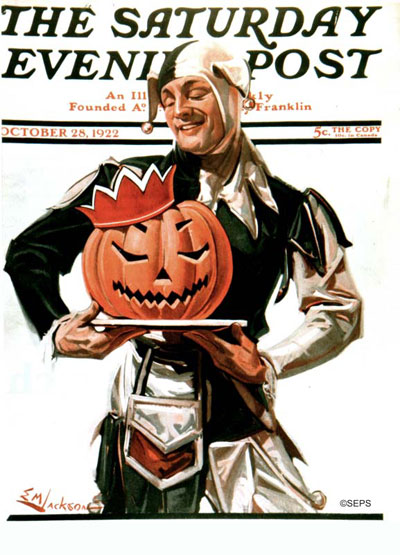
October 28, 1922
Bringing home the biggest pumpkin seems like a good idea, but the work of slugging it home might prove too much for this orange-cheeked young man.
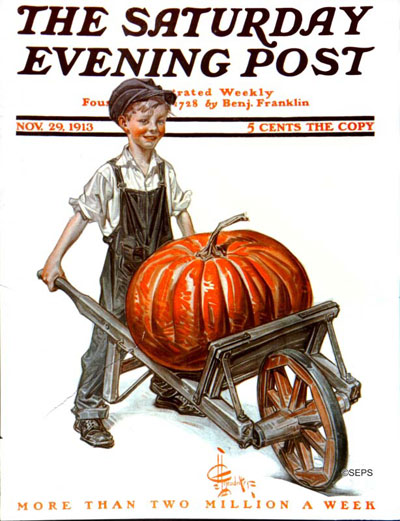
November 29, 1913
The young lady on this Ellen Pyle cover can’t help but wonder why these two are always clownin’ around.
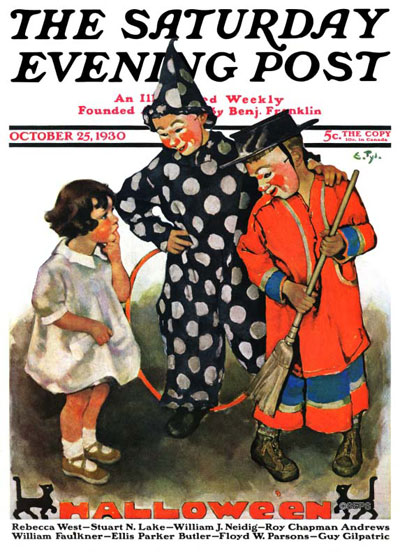
October 25, 1930
There’s always one neighbor who emphasizes the trick in trick-or-treating.
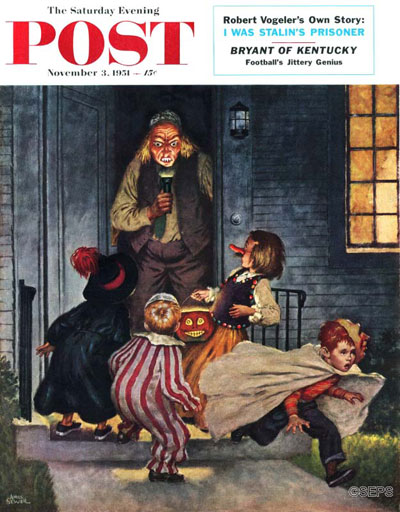
November 3, 1951
Halloween lesson no. 1: A bathrobe, baggy sport coat, or pillowcase is suitable costume wear when coupled with a homemade mask.
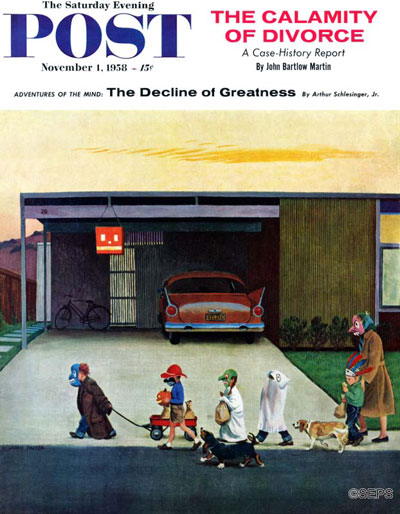
November 1, 1958
News of the Week: Facebook, Fake Phones, and Fantasy Island
Beyond the Like

Sometimes a like just isn’t enough.
Facebook users have been asking for a dislike button for a while now. The company isn’t going to give you that, but they are slowly rolling out several new buttons that might just satisfy your need to comment or everything that your friends post without actually typing anything. According to The Atlantic, the new “reaction” buttons are available in Spain and Ireland and will soon be available in the U.S., though no official date has been announced.
How will the new buttons work? When users click on the like button they’ll have more options to show emotion/reaction: a heart, a sad face, an angry face, and a face with an open mouth which is presumably meant to show shock or awe at something posted. OMG that’s the most amazing dessert I’ve ever seen. Thanks for posting it!
Right now when someone posts sad news, like a death, people often “like” it, which has always struck me as a bit odd. The new sad icon might be seen by many as a way to remedy that, to have an option to show that you’re sad about the negative news posted, but is a little icon with a frowny face a good substitute for, you know, emailing or calling that person?
This is yet another example of how, in 20 years or so, people will no longer communicate with each other using words and phrases. It will all be done by clicking buttons and posting emojis. As Facebook founder Mark Zuckerberg himself said in a Facebook Q&A in June, “One day, I believe we’ll be able to send full, rich thoughts to each other directly using technology. You’ll just be able to think of something and your friends will immediately be able to experience it too if you’d like. This would be the ultimate communication technology.”
Yikes.
ZERO: The Smartphone That Does Nothing

I have a dumb phone. That’s a phone that only makes phone calls or maybe might sends texts too (I don’t even use it, it’s sitting on a table collecting dust). It’s not connected to the Web, its main use is to make phone calls (yes, almost a quaint notion in these texting times). But what if you wanted a phone that didn’t even do that much?
You might like the ZERO, a new product from the people at the appropriately named NoPhone. It’s, well, a rectangular piece of plastic. It’s described as a phone that “allows you to stay connected to the real world.” There are several versions of the phone, including the original NoPhone for $10 and the NoPhone ZERO, which only costs $5 (that doesn’t even have the fake button indentations or a logo). Every phone is guaranteed not to come with any apps, no data overages, and no danger of batteries dying.
Maybe this will catch on. Maybe people will want to use this the way that smokers put candy cigarettes or carrots in their mouths to stop smoking. After all, the original version of the phone raised over $18,000 on Kickstarter last year. This could be the 21st-century version of the Pet Rock.
I’m sure people will still keep these things by their side at the dinner table. You know, just in case they get a text.
And in Still More TV Reboot News …
I know that we’ve had a lot of news about remakes of TV shows lately, and I don’t want to turn this into the All TV News column, but this one is worth mentioning. ABC is bringing back the late ’70s and early ’80s drama Fantasy Island (which they already brought back in 1998 with Malcolm McDowell, though no one wants to remember that). But this time there are twists. There’s no island! Instead, it will be a San Francisco corporation that grants clients’ fantasy-related wishes. Also, there’s no Mr. Roarke. This time the leader will be a “brilliant, dynamic, sexy woman,” according to The Hollywood Reporter .
So in the new version, there’s no island, there’s no Mr. Roarke, and the lead character is a woman, and there probably won’t be a small person playing Tattoo, either. Other than that, the new Fantasy Island will be exactly the same.
Internet Killed the Centerfold Star
Now when guys say “I read Playboy for the articles” they won’t be lying.
Playboy has made the decision to stop having nude women in their print magazine. Cory Jones, an editor at the magazine, ran the idea by Hugh Hefner and the 89-year-old founder agreed. There may not be a centerfold, and if there is she won’t be fully nude. It will be more, as The New York Times describes it, “PG-13 … more like the racier sections of Instagram.” The changes will start with the March 2016 issue, introducing part of a major redesign for the magazine that’s been in production since 1953.
As Donald Trump would say, this news is yuuuuuge. This is like McDonald’s deciding to no longer sell burgers. But when you can log on to a million websites any time of day that feature nude women (or so I’ve heard — I haven’t actually had any experience with this myself) why would you walk to the bookstore or newsstand and go through the embarrassing ritual of buying a magazine with nude women in it?
Now the only place that people will be able to see nude women is, well, everywhere else. But maybe this is a good move by the magazine. After all, they really do have some great articles.
Capital One … Cafes?

I went into my bank the other day and was struck by how barren it is. There used to be five or six tellers working at once, several people at desks in the back, and a lot of customers in line. It was a real, vibrant hub of activity. Now I’m amazed if there are two tellers working and more than one or two people in line, and I don’t see many people at those desks. I guess everyone’s banking online or at ATMs, and it’s actually a little sad.
But what if you could go into a bank and not only make a deposit or get a loan, you could also get a large caffé mocha with extra whipped cream, sit in a big comfy chair, and get free Wi-Fi? That’s the idea behind new Capital One 360 locations. Right now there are cafe/banks in Boston, New York, Chicago, Los Angeles, Philadelphia, San Francisco, and St. Cloud, Minnesota. Expect more if it catches on. Hey, why not? We have bookstores that also have cafes so this is a natural.
It’s probably only a matter of time before you can go to Starbucks for coffee but also do your laundry.
October Is National Chili Month

The temps were in the high 60s earlier this week, but now it looks like the cold weather is going to be locked in for the season, and what better way to celebrate than with a big hearty bowl of chili? You can go with a very simple (but delicious) chili, or maybe one that really gets into the spirit of the season by adding pumpkin and turkey. The New York Times has a special chili section, 25 Great Chili Recipes, including Vegetarian Chili with Winter Vegetables, Texas-Style Chili, and even Chinese Chili.
I want to try this Beer Chocolate Chili recipe because hey, beer and chocolate! If I were on Facebook, a heart icon would go right here.
Upcoming Events and Anniversaries
Thomas Edison dies (October 18, 1931)
The Saturday Evening Post Archives Director Jeff Nilsson reflects on Edison’s solution to copyright theft.
Battle of Yorktown ends (October 19, 1781)
It’s sometimes called the Siege of Yorktown, and it was the last major battle of the American Revolution.
Free Speech Week (October 19–25)
This annual event has a great slogan — Free Speech: The Language of America.
Congress begins investigation into Communists in Hollywood (October 20, 1947)
It’s probably not a coincidence that Free Speech Week coincides with the date this investigation started. And don’t forget Trumbo, a film based on the life of blacklisted writer Dalton Trumbo that opens on November 6.
President John F. Kennedy’s televised speech on Cuban Missile Crisis (October 22, 1962)
The speech came after the U.S. found out the Soviet Union had placed nuclear missiles in Cuba.
Johnny Carson born (October 23, 1925)
Original episodes of The Tonight Show will air again on Antenna TV at 11 p.m. starting on January 1.
Rubble
The night before the house across the street was demolished, my mother claimed to see the ghost of a small boy up on its roof. He was sitting on the ruins of the chimney, she said, and it looked as though he were reading a book. Then he vanished. But the most important detail about the encounter was this: The boy had waved at my mother. She was sure of it. This was so important, she said, because it suggested some sort of cognizance on the ghost child’s part — he’d reacted to her. There were those who argued that ghosts were nothing more than imprints of consciousness stamped into time — a spiritual residue left behind by a life, ridged as a recording — and that these imprints were not necessarily indicative of some ever-after awareness or freewill on the ghost’s part. But the boy on the roof had waved. Did I see the distinction? my mother wanted to know.
“Sure,” I said. “He reacted.”
“Precisely,” she said.
She poured me another half glass of champagne. I was only 12, but tonight she wanted to celebrate. To clink glasses with her son. That abandoned house across Lewiston Street was finally coming down. This was a testament to our persistence, she said. It was a great victory. For as long as I could remember she’d fought to have that place leveled, going to town meetings, handing out little pamphlets I’d helped her design on the computer, etc. The place was an eyesore, she said. And it was dangerous — the rusted nails, the broken glass. Tomorrow morning, all thanks to her and me, the bulldozers would rip it apart. She had won.
I hadn’t seen her like this in months. Earlier that evening we’d shared a pizza from Elvio’s — a rare splurge since she’d quit her job at the bank. She’d made a chocolate cake from scratch. In blue icing she sketched the outline of a house, the word RUBBLE written above the roof. For some reason she couldn’t stop laughing. She kept touching her face with her hands, as though she expected to find the nose and lips and cheeks of someone else. At one point she put on a record and picked up a potted bamboo plant, thrashing at the fronds with her hand as she pretended to strum along on guitar with Stevie Ray Vaughn. I kept waiting for the familiar gloominess to start gnawing at her again. But it didn’t.
“I have an idea,” she said to me now. The two of us were sitting on the kitchen counter, our bare feet thumping the cabinets below, the last crumbles of the cake between us as we picked and prodded with our forks. I took a sip of champagne. I didn’t really understand how alcohol worked, and I was wondering what exactly I should be feeling. “How about we go over to that house and check things out?” my mother said at last. I asked her what she meant. “You know,” she said. “Look for the ghost.”
“Like, break-in?” I said.
She nodded.
“That’s illegal,” I said.
She chimed my champagne glass with her fork. “So’s this, Mr. Capone. Find a flashlight, will you?”
Going to that abandoned house was about the last thing I wanted to do. For one, I was scared — not of the ghost, really, but of neighbors, police, etc. — and two, it just seemed stupid. But my mother was in a rare mood, and I wanted to prolong this mood as long as possible. It might not swing back around for quite some time. I hopped off the counter and went in search of the big Coleman lantern. I wasn’t sure I believed in ghosts, but I was sure my mother believed, and for her sake I hoped they were real.
This was the summer she began peering into the spirit world — her phrase. It was also the summer my father ran off to Boca Raton with the wife of one of his co-workers at the paper mill. For good, this time, though at first I didn’t believe it; leaving was something my father did, sure, but coming back was something he did, too.
In my mother’s mind, my father’s departure and her own newfound connection with the spirit world were linked. “He had this terrible, brutish aura about him, your father,” she told me once, “and I think it must have interfered with my own innate abilities. Like light pollution blotting out the stars.”
In his absence, my mother began encountering apparitions everywhere — the supermarket, the gas station, etc. — and eventually she left her teller job at Outlook Savings in order to devote herself more fully to her gift. For days on end she holed herself up in her bedroom, conducting séances, the rich scent of burning sage seeping beneath the closed door. Sometimes she sat cross-legged on the floor with a pen poised over a notebook as she waited for an entity to guide her via automatic writing. I live on the singed rim of dreams, she’d written on one such occasion, over and over again — filling many pages with her huge, jagged scrawl — and in the weeks that followed I’d often catch her mouthing these words as she struggled to decipher what they might mean.
I found the lantern in the hall closet. The batteries were still good.
“Jesus,” my mother said. “You could guide a ship to port with that thing.”
She wasn’t kidding. The lantern had the illumination thing down pat. It was the lantern my father used when he took me hornpout fishing over at Pearl Lake. Those spring nights he and I’d catch 12, 13, 16 fish. He’d clean them right there in the shine of the lantern. First he’d cut off the whiskers. Then the heads. Then he’d run his blade along the soft, slick-brown bellies, pinching out the intestines like slimy fuses and shaking the fish bloodless beneath the water. Back at home he’d rub the meat with salt and pepper and a little bit of cornmeal and say, “And the crowd goes wild!” as he dropped the filets into a skillet practically screaming with hot oil. That lantern made a mockery of the dark, and reeling those hornpout in, one after the other after the other, my father would howl, “Swim toward the light!” And the fish listened.
My mother took another slug of champagne. “Ready?” she asked.
I said, “We’re really doing this?”
“It’ll be exciting. Don’t you think?”
“Exciting,” I said. For years she’d instructed me to keep away from that house. Now here she was with an open invitation for a grand tour in search of some ghost child she’d seen enthroned on the chimney. I put on my sneakers and followed her outside.
It was almost midnight, and up and down the block the houses were mostly dark save for the pulsing blue light of televisions in windows. I kept the lantern off. I was having visions of my mother being handcuffed — me too, for that matter. The reality of what we were about to do shot adrenaline through me like some wild voltage. Crickets trilled. In the Peterson’s lawn, a forgotten sprinkler spit water in a stuttering hiss.
“I want you to promise me something,” my mother said as we crossed Lewiston Street. “Promise me you’ll remember nights like this. I mean, when I’m old and senile and slurping butterscotch pudding in some nursing home. I was fun too, right?”
I promised I’d remember, though I did not know how it was possible to forget. She raked her fingers through my hair and squeezed a handful. “My boy,” she said. It was a clear, cool August night, the stars thrown against the black sky like pulverized crystal, the moon so sharp I could see its shadowed craters from a quarter-million miles away. In two weeks, I’d start eighth grade. In two years, my mother would marry a kind, loose-faced chiropractor and stop seeing ghosts altogether. In two decades, I’d be a computer engineer in Raleigh with two ex-wives and three kids, and my mother would be dead. But none of this existed as we waded through the tall, brittle grass growing up around the derelict brick ranch, both of us dazed with too much chocolate and cheap champagne.
The rest of our lives were wound around our hearts like a secret thread.
“This way,” she whispered, leading me to the back of the house. She moved with the confidence of an actor following a well-written script. The backdoor opened without issue, and suddenly a strange thought floated to the surface of my mind: She’s been here before. I had no proof, but I felt sure of it.
Inside, she said, “How about a little light?” I shut the door. The lantern revealed the dark, bombed-out remnants of a hallway. The walls were leprous with rot, the spongy floor cobbled with glass and splintered wood and crushed Budweiser cans. The air smelled of mildew and trapped heat. Following my mother from the hall into what must have been the living room, it occurred to me that people once lived here. Real people. This place had contained lives. And my mother and I were the last lives it would ever contain.
“Hello?” she called out into the empty house, her echo chasing itself through the rooms. It was so quiet I could hear the patter of moths as they hurled their powdery selves against the lantern. In the light, their shadows were projected against the ruined walls like monstrous animations.
“I feel a — presence,” my mother said. She kneeled. She ran her fingers over the rubble-strewn floor, as if searching for a pulse. She paced about the room. Knocked on the plywood-boarded windows. I held the lantern up high. Walking through the woods around Pearl Lake, my father used to jog ahead of me with the lantern. He’d turn it off and hide. I was never scared, because I knew he was somewhere close, watching. I’d listen for his breath. For the jangle of the tackle box. But he was always very quiet. And then the lantern would come on again. So bright I couldn’t see him through the glare. Except I knew this for sure: He was there, standing behind the light.
“Feel that?” my mother asked. “That boy’s here somewhere.” She bit her lower lip. The gloominess was creeping back in. I could see it. It came quick. She looked wrung out. Tired and unsure of herself.
“I feel it, too,” I said. I turned off the lantern. The light collapsed into one curl of orange filament, then went out, and the abruptness of the absolute dark made my mother gasp. “I feel it, too,” I said again.
She called out to the ghost. She said she knew he was here. She told him not to be scared. To show himself. To give us some sign of acknowledgement. I held my breath. “Please,” I said. I shivered in the heat. “It’s okay,” I said. It would be such an incredible story, I thought, if the ghost boy appeared before us now. Neither of us would ever forget it.
The boy did not come.
“Let’s go home,” my mother whispered.
But I wasn’t ready. This mood she was in was something I wasn’t about to relinquish. She’s been here before, I thought again, and I imagined her shuffling through these bare, moldering rooms, holding a fistful of flaming herbs up against the dark, stepping through vanishing portals of sweet, sweet smoke.
I live on the singed rim of dreams.
I said, “Did you hear that?”
I could not see her, but her earrings tinkled as she shook her head.
“I didn’t hear a thing,” she said softly.
“Shhh,” I said. “Listen.”
I wondered what my father would have said had he seen us now: me and my mother standing in the total blackness of a condemned house in the middle of the night. Then, carefully and quietly, I reached to the floor and grabbed a handful of debris — twisted screws, crumbs of glass, chunks of disintegrating sheetrock — and pitched it all in the direction of the hall from which we’d just come. It clattered loudly in the dark.
“Jesus,” my mother said. “I heard it. Oh, God. I heard it.”
I turned on the lantern.
“Follow me,” I said, and I grabbed her hand and pulled her toward the sound.
Happy Birthday, Jeeves
This year marks the 100th birthday of one of the greatest creations in Western literature. It was in 1915 that a fictional character uttered those legendary words: “Mrs. Gregson to see you, sir.”
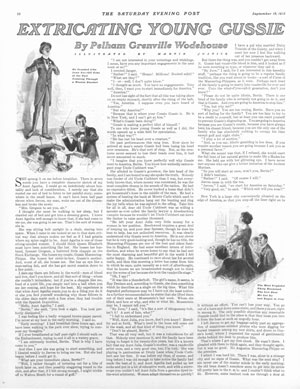
Well, if the words weren’t legendary, the character that spoke them was destined to be. For this was the first sentence uttered by a British valet named Jeeves, first name possibly Reginald.
He was the creation of humorous British storyteller P.G. Wodehouse, born today (October 15) in 1881.
Just as British author Sir Arthur Conan Doyle created the literary duo of Sherlock and Watson, Wodehouse too created a team of perfectly counterweighted characters: the impeccable, always correct, perfectly tactful valet Jeeves. Opposite him, Bertie Wooster, a wealthy and witless young man. In every Jeeves-and-Wooster tale, Bertie gets himself into trouble with friends and family. And Jeeves comes to his rescue, engineering a happy ending with a few well-placed words and judicious actions.
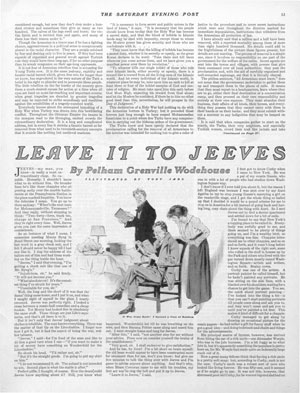
Jeeves first came to America’s attention in September 1915 when the Post published Wodehouse’s “Extricating Young Gussie.” In this tale, Jeeves does little but act the role of a conventional British valet, displaying none of his understated wit or problem-solving genius. But Wodehouse must have recognized the comedic potential because he soon wrote another story that allowed the valet to display his skills; “Leave It to Jeeves” appeared in the Post on February 5, 1916.
Jeeves proved invaluable to Wooster, saving his employer from the consequences of foolishness through some 30 short stories and 11 novels. Jeeves also served Wodehouse particularly well as a reliable character for 59 years. The discreet and all-knowing servant continues to serve as a stock character in books, plays, and movies today. The author of Downton Abbey, for example, split him into two characters: the stiff, propriety-conscious butler Mr. Carson and the deft-with–a-lint-brush–or-word-of-advice valet Mr. Bates.
The best way to appreciate the genius of Jeeves, however, is to read him in action. On the centennial of his first appearance in print (and in illustration), we can’t think of a better choice.
Falling for Autumn
Plunging into leaf piles, playing after-school football, and harvesting pumpkins, these cover scenes embrace the joys of autumn.
Go long! After school lets out, the corner of Sixth Street transforms into a homegrown gridiron. Luckily, an overthrow is an easy feat for the receiver in plaid.
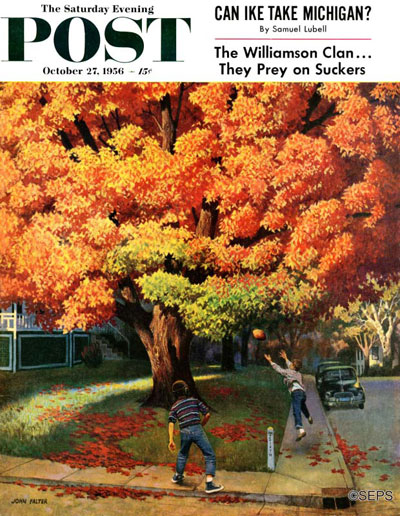
October 27, 1956
She rakes, he dives. Plunging into leaves is the epitome of fall—even the dog seems to agree.
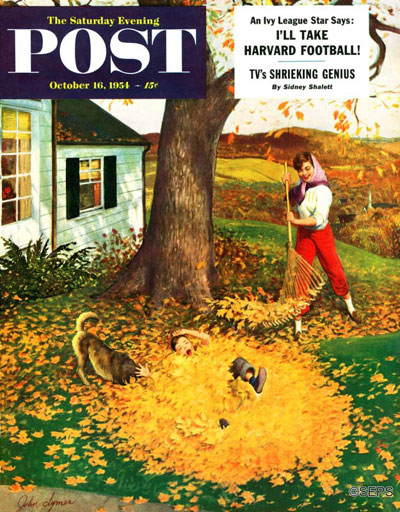
October 16, 1954
Successful day? These boys seem to think so, though Mom might not be impressed with their new pet.
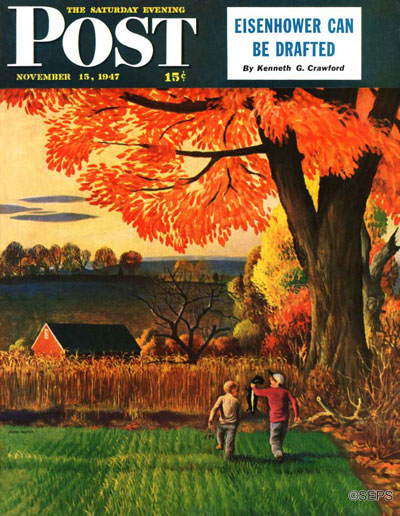
November 15, 1947
With crop season in full swing, the pressure’s on for scarecrows to keep those pesky birds at bay. This one, however, seems to have lost touch with its purpose.
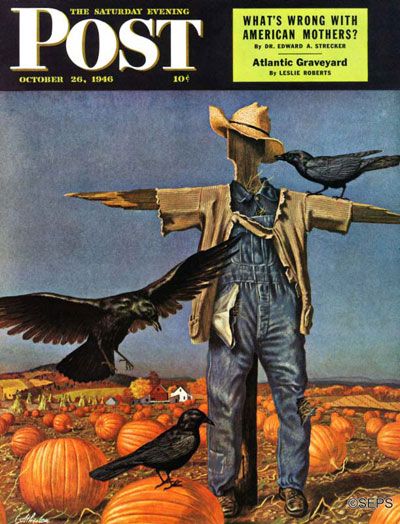
October 26, 1946
Nestling in plain sight might not be the best place for this tom to hide when Thanksgiving is around the corner. Here’s hoping the farmer and his son have other plans for that axe.
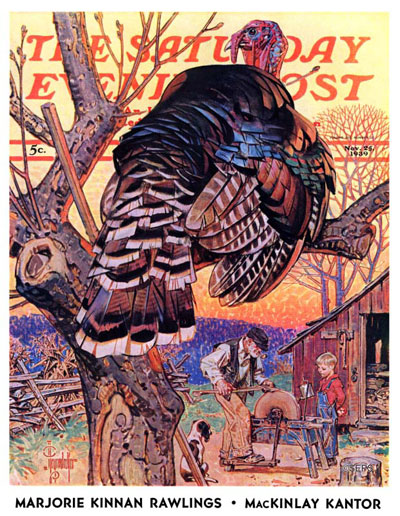
November 25, 1939
“Wait for me!” Best way to ruin a romantic autumn walk? Let your little brother tag along.
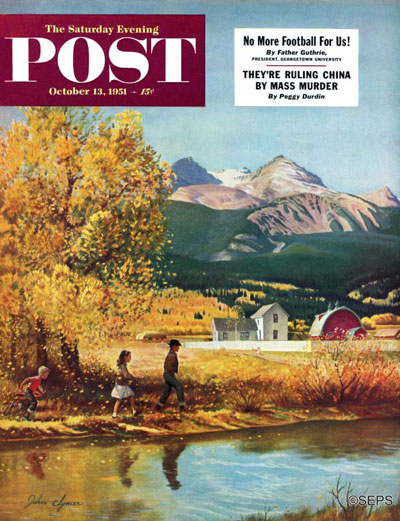
October 13, 1951
People live to gossip, especially when love is in the air. If you have even the tiniest bit of doubt over your new fall fling, we recommend not holding hands in public.
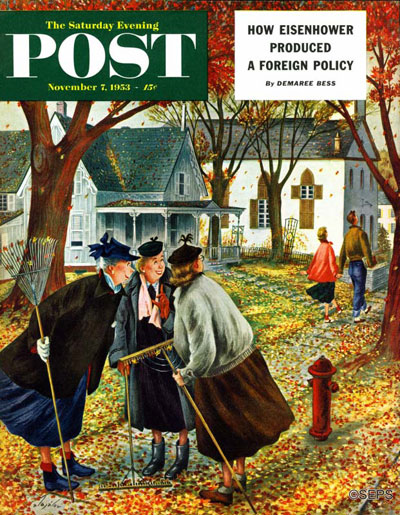
November 7, 1953
Fellas, take note. The odds of getting the girl greatly increase on an intimate horseback ride during the peak of fall. A dream date for sure …
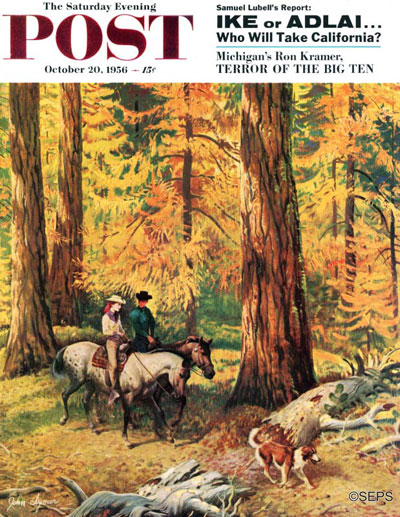
October 20, 1956
… unless she’s afraid of horses. Definitely come up with another plan if her knee-jerk reaction is to hide behind you.
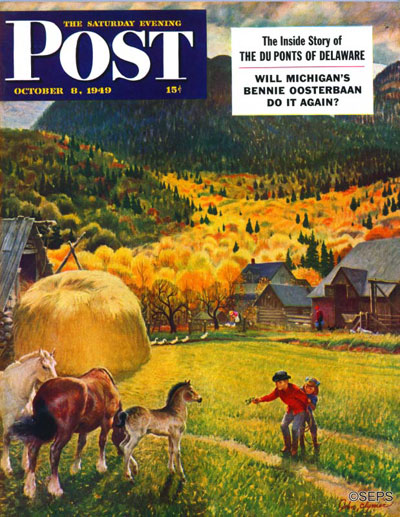
October 8, 1949
Coffee Date
Heather took a deep breath to steady her nerves. Nerves! Her colleagues at work admired the way she kept her head in emergencies, but here she was, as jittery as a teenager.
She twisted the rearview mirror so she could see herself — tousled blond hair cropped short, hardly any makeup, hazel eyes that were steady enough, if a little wary. She ran her fingers through her hair, wiped away a bit of stray lipstick, and sighed. This was as good as it was going to get. She’d showered and changed after her shift, but as usual she’d been rushed. Well, wasn’t that why she was doing this in the first place? Because she could never find the time to do it the “normal” way?
Yes, she’d taken precautions. Her friends had been adamant about that. Meet for coffee first, they’d said. Somewhere indoors and in public, not a park or — God forbid! — his apartment. Tell us where you’ll be and when. Make sure you spend at least a week getting to know him on email before you meet him.
Check, check, check, and check. And now it was 2:55 on a cold, rainy Sunday afternoon in October, and here she was, sitting in her car, parked not right in front of the coffee shop but four doors down and nervous as a kitten.
The wood-trimmed exterior of Mr. Greenbeans looked as inviting as it always did — it was one of her favorite places to sit and read in the evenings, those times she wanted to be alone but not by herself. Today, though, it seemed somehow frightening.
She frowned, and examined herself again in the mirror. Maybe she ought to have put on some eye shadow. She must own some. Well, it was too late now.
She shook her head to clear out the thoughts she couldn’t control and focused instead on the man she was here to meet. He’d been perfectly pleasant in his emails — he could spell, and use apostrophes correctly, and he was polite and not too pushy. He’d balked a bit at her “no photos” and “let’s email for a while before we meet” rules, but she’d given him no choice. They’d traded daily messages for two weeks before she agreed to have coffee with him, and he seemed both interested and interesting, willing to let things develop on her timeline rather than trying to impose his own.
So what was it that was bothering her? Just the idea of meeting a stranger? Or the fact that they’d “met” online and not in the real world? These days, the borderline between online and real grew blurrier every day …
Thinking back over their correspondence, she realized that, when you came right down to it, he’d revealed little about himself. He’d shared a few of his interests — books he’d read, movies he’d enjoyed, restaurants he liked — but he’d stayed almost entirely on the surface, providing little insight into the human being who lived beneath the data points. He’d seemed more interested in finding out about her than in talking about himself. Which, of course, had been flattering.
To be fair, though, had she gone much deeper in her responses than he had? Not really. Her friends had advised her to keep it light and breezy, to convey a sense of what they called girlish enthusiasm. You’re just so — so competent sometimes, Heather, you know? Try to be more, you know, helpless.
Well. She’d find out soon enough. Her watch said 3:03. Don’t be early, they’d warned her. But don’t be late.
She got out of her car and went into Mr. Greenbeans.
The moment she pushed open the heavy glass door, the coffee shop’s busy warmth calmed her down. As always, the big room was crowded, buzzing with a dozen animated conversations, the baristas shouting to be heard over the burr of the espresso machines. Shrugging off her wet coat, Heather looked for a man sitting alone.
Oh, hell, there were three of them! Weren’t real men supposed to be home watching football on Sunday afternoons? She thought back over her two weeks of correspondence with Charles and regretted after all her insistence on their not exchanging pictures. What would the guy who’d written those emails look like?
He’d seemed interested and friendly, maybe not the warmest or fuzziest guy who’d responded to her profile, but there’d been a definite enthusiasm in everything he wrote.
Okay, so look for enthusiasm, she told herself. And what else?
His messages had seemed somehow … precise, that was the word. They’d come across as carefully crafted documents, not the usual rambling stream of consciousness.
Okay, so look for precision.
She scanned the room. She was good at this — drawing sensible conclusions from a quick study of small details — it was a talent that got her noticed at work and made her good at her job.
One of the three sitting-alone guys was absorbed in his cell phone and was way too young for her in a hoodie and unlaced sneakers. She dismissed him without a second glance.
Bachelor #2 was dressed quite well — yes, you could say “precisely” — with close-cut hair and striking light-blue eyes that had looked up only briefly when she walked in. Not interested? Not there to meet someone? Not wanting to appear too eager? Or simply shy?
Heather had no idea. He was the right age, and good-looking to boot. The table in front of him was clean, with cup, saucer, spoon, and napkin arranged — there was no other word for it — precisely. Huh, she thought. Could be. But she found herself strangely intimidated by the thought of approaching him. The clothes were obviously expensive — hell, the man was dressed better than she was!
Bachelor #3 was more rumpled than precise and seemed altogether softer, with his curly brown hair, flannel shirt, and down vest. He was also good looking, but in a more low-key, cuddly sort of way. When he looked up and caught her eye and smiled, a little sugar spilled from his spoon to the wooden surface of his table.
Warm brown eyes. Nice eyes, she thought.
She glanced back at the blue-eyed man, who was fussily arranging the collar of his shirt. The color of the shirt matched his eyes, too precisely to be coincidental. She felt a faint undercurrent of unease at the thought of trying to make conversation with him.
How ironic. She was so completely capable in an emergency, but could be so inept in social situations — especially when men were involved.
She looked back at Mr. Flannel.
Be safe, her friends had told her. Make sure you’re comfortable.
Mr. Flannel felt comfortable.
Hitching her purse a little higher on her shoulder, she walked over to him and said, “Couples.com?” She remembered to smile. He looked up at her, grinned, stood up, and offered his hand. It was warm. Or maybe she was just still chilled from outside.
“It’s great to meet you face to face,” he said. “I’m glad you made it, the rain’s awful. What can I get you? Coffee? Tea?”
Heather hung her wet coat over the back of the chair and sat down. “Would it be too Meg Ryan if I asked for a soy milk hot chocolate?”
“No such thing as too much Meg Ryan,” he smiled. “Just hold off on the tuna salad for a couple of dates.”
She laughed and felt herself blush, flattered and impressed both with his response and with the fact that she’d been made to laugh by a man she’d just met. That didn’t happen much in Heather’s world. He had a nice smile — it reached his eyes, crinkling the skin around them.
“Be right back,” he said, and he went over to the counter. She swiveled to watch him and, as she did so, caught the eye of the well-dressed man. He frowned slightly, as if appraising her and finding her wanting.
Your loss, she thought.
And just as well. For reasons she couldn’t articulate, the guy struck her as kind of creepy.
Charles came back with her hot chocolate and more coffee for himself. Heather wrapped her hands around her mug and studied the heart the barista had made in the foam, trying to think of what she should say. She hated this part of Internet dating, coming up with the right words to offer someone who was, if you were willing to be honest about it, really just a stranger.
Charles came to her rescue. “Why soy milk, if you don’t mind my asking? Are you a vegetarian?”
Thank goodness, she thought. A pitch I can hit.
“No, not really. Caffeine and dairy just don’t agree with me, so I usually stick with decaf tea. It’s such a nasty afternoon, though, I thought I’d go with something a little heartier.” She took a tentative sip. A little too hot. “What about you? Any dietary eccentricities I should know about?”
He nodded at his cup. “I’m a caffeine junkie. And I eat way too many Girl Scout cookies in the spring. If I saw a Girl Scout cookie truck on the street, I’d hijack it.”
She laughed. “You like them that much?”
He made a guilty-as-charged grimace. “Did you know that a Prius can hold exactly 55 cases of Girl Scout cookies?”
Startled, Heather frowned at him. “You have got it bad. Um, if it’s not too personal, you don’t have some kind of eating disorder, do you? Or do you just like hanging out with Girl Scouts?”
“I like hanging out with one Girl Scout,” he smiled. “My daughter, Abby. If I buy enough cookies, I’m a hero, and, hey, somebody’s got to eat them.”
Heather raised an eyebrow. “Your daughter?” He hadn’t mentioned a daughter in his emails. In fact, she realized, he hadn’t said anything that even hinted at his being a dad, and he certainly hadn’t seemed like a man who binged on Girl Scout cookies. “Are you married?” she asked, alarmed. There was a sudden coldness in the pit of her stomach. She wasn’t going to make that mistake again.
A look of surprise crossed Charles’ face, then morphed into chagrin. “I’m sorry,” he said, and reached across the table to touch her arm. “I thought sure I’d told you. I’m divorced — about five years ago. Abby’s 11. She lives with her mom. I see her every other weekend.” He looked concerned. “It was pretty friendly, for a divorce, and it’s all ancient history now. I promise you, I’m not some messed-up loser trying to put his life back together by rebounding straight out of a breakup into a new relationship.”
She sighed out the breath she hadn’t realized she was holding. “That’s a relief! I’ve already met that guy.” She tried her hot chocolate again, and this time it was just right. “So what’s your favorite? Cookie, I mean?”
“Oh, definitely Thin Mints. You have to ask? Please don’t tell me you’re a Do-si-do’er. I don’t think I could handle it.”
“Those are the peanut butter ones, right? I’m not really up on my Girl Scout cookies.” She was lying, a little — the few women she worked with sometimes brought in order sheets for their kids. “And I don’t think I’ve do-si-do’ed since seventh-grade gym class. But mint and chocolate, that’s a definite like. I’ll have to make an effort next spring to track some down.”
“I know where you can get your hands on 55 cases,” Charles said, with another of his melting smiles.
“Maybe just a couple of boxes. I have to watch what I eat.” Heather remembered something from their correspondence. “Didn’t you tell me you do Crossfit? How do Girl Scout cookies fit into that picture?”
He tilted his head quizzically. “Crossfit?”
“You said you …”
She let the sentence trail off, thinking, Uh-oh. “You have no idea what I’m talking about, do you?”
“Not a clue,” he said, realization beginning to dawn in those gentle brown eyes.
At that moment, the young guy in the hoodie jumped up, knocking over his chair and swearing. Heather and Charles watched him right it and storm out into the rain, almost bowling over a woman who was just coming in.
The newcomer paused inside the door and scanned the room, exactly as Heather had. She was a bit on the plump side, soft where Heather was harder and more toned. Medium-length auburn hair curled around a face that wore a lot more makeup than Heather’s ever did. She was petite — practically tiny — and dressed almost entirely in ruffles. After a moment’s hesitation, she made up her mind and marched purposefully to the table where the carefully dressed man was sitting. He looked up, startled, as she spoke to him, then rose and pulled out a chair for her and helped her with her coat.
Smooth, Heather thought, admiringly. Very smooth. Then she remembered the Crossfit that apparently didn’t fit and returned her attention to the man in flannel.
“Your name’s not Charles,” she said. “Is it?”
He shook his head. “Which makes you not Kimberly,” he said sadly.
They sat there in uncomfortable silence.
“But you said the secret password,” he finally said.
“Couples.com?” Heather turned her cup slowly in its saucer. “I’ve been emailing a guy named Charles for the last two weeks. We never exchanged photos, so I have no idea what he looks like. I thought you …”
She felt her face redden.
“And I’ve traded half a dozen emails with Kimberly. That must be her with all the froufrou.”
“I’m such a nitwit,” she said. “I should go over there and — ”
She fumbled for her bag and reached around for her coat.
He put a hand on her arm and stopped her. When she turned back, he was smiling again. “I didn’t swap pictures with Kimberly, either, so I just assumed — who knew there’d be two sets of us meeting in the same place at the same time?” His smile turned into a grin. “I’d love to know what made you pick me. Maybe you can tell me over a tuna salad some time.”
Heather caught the Meg Ryan reference but hesitated. She didn’t want to leave this good-looking, comfortable guy in flannel who made her laugh and had an 11-year-old daughter and a cookie obsession, but her sense of duty nudged her. “That’s a nice thought,” she said. “But I probably ought to clear this up with Charles, let him know there’s been a mistake.” She rubbed a hand over the back of her hair, where it was cut the shortest, the way she did when she was embarrassed.
Mr. Flannel was silent a moment, looking out the plate-glass window at the ragged line of bushes that separated Mr. Greenbeans from the sidewalk. Then he turned back to her and patted her arm. “I don’t know about you,” he said, “but I think I came out ahead on this deal. What if we just pretend we came here to meet each other, after all?”
A man’s hearty chuckle and the bubbling laughter of a woman made them turn and look — Charles and Kimberly had their heads close together, and he was just taking hold of her hand.
“What do you say we start over?” the man in flannel said. “I’m Mark, and I’m very happy to meet you.”
She relaxed. “I’m Heather,” she said. “And I’m happy to meet you.”
Early the next morning in her sunlit kitchen, Heather, dressed for work, took an appreciative sniff of her jasmine tea. Indian summer had arrived overnight, and the warmth felt lazy and peaceful. Picking up the morning paper from the mat outside her front door, she returned to her kitchen and shook it open — and a wintery chill ran through her, almost knocking the mug from her hand.
“Local Woman Brutally Murdered,” read the headline above a professional photograph of Kimberly from the coffee shop. Heather took a closer look, hoping she was wrong, but she knew better than to doubt herself. She recognized the face, the ruffles, the hair. It couldn’t be anyone else.
She set down her mug, her hands suddenly shaky, and read the article. Kimberly Scanlon, 32, local high-school English teacher. A couple of teenagers out for a midnight stroll had spotted her crumpled over the steering wheel of a car on Wiehle Avenue and called the police. She’d been strangled, probably some time between 5 and 10 last night, according to the coroner. There were lacerations and abrasions on her face and upper torso, but no defensive wounds.
Heather recognized the address where the car had been found. It was less than a mile from the coffee shop. “Charles,” she whispered.
There was no time to waste on breakfast. Heather poured out her tea in the sink and buckled on her gun, clipped her badge to her belt, tucked the paper under her arm, and headed for her car.
It was going to be one hell of an interesting day, and she’d have a lot to tell Mark tonight over dinner.
News of the Week: Norman Rockwell, New Network Names, and National Moldy Cheese Day
Norman Rockwell Painting to Be Sold
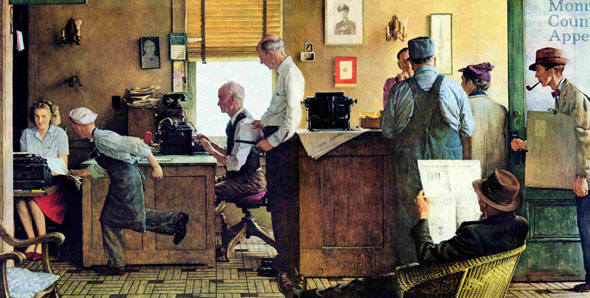
Norman Rockwell
May 25, 1946
What would you do with an extra $10-15 million?
That’s how much the National Press Club expects to get when they sell the Norman Rockwell painting “Norman Rockwell Visits a Country Editor”. Rockwell painted the picture for the May 25, 1946, issue of The Saturday Evening Post. Rockwell gave the original painting to the club in the early ’60s, but the board of directors discovered that the painting’s value had increased so much that it no longer made sense for them to hold on to it, due to insurance and security costs. They want to sell it to pay for various programs they have.
For the past year the painting was on loan to the Norman Rockwell Museum in Stockbridge, Massachusetts. It’s now at Christie’s, where it will be auctioned off on November 19.
ABC Family Is Now … Freeform?
It’s not uncommon for some cable channels to change their name. TV Guide Network became Pop; Discovery Health became OWN (the Oprah Winfrey Network); HDNet became AXS; and SOAPnet became, of all things, Disney Junior. But at least those names made sense. I’m not sure about this one.
ABC Family, which airs shows like The Fosters and Pretty Little Liars, is changing its name to Freeform. But it actually isn’t the first name change for the channel. It started in the late ’70s as CBN (the Christian Broadcasting Network), then it became The Family Channel, then Fox Family Channel, and then ABC Family in 2001. The new name launches in January.
But I’m not really sure what Freeform is even supposed to mean. The channel says they’re doing it to attract younger viewers, because I guess younger people like … free- form jazz? Yup, that’s what I hear all the kids like these days, Snapchat and free-form jazz. They probably could have named it Pickles, and it would have made as much sense. But #Freeform makes for a snappy hashtag.
Tom Hanks Finds Student I.D.
Is there any limit to how nice Tom Hanks can be? (Answer: No.)
The Bridge of Spies star found the I.D. of a Fordham University student in Central Park. Now, a lot of people would have just left it there or given it to someone else to worry about, but Hanks himself tweeted a picture of the I.D. and gave the student, Lauren, a heads up that he had it:
Lauren! I found your Student ID in the park. If you still need it my office will get to you. Hanx. pic.twitter.com/Ee9kK4V4qf
— Tom Hanks (@tomhanks) October 6, 2015
The senior has been talking to many media outlets, including CBS and E! Online and revealed that she doesn’t even have a Twitter account. But one of her teacher’s saw it and showed it to her. According to E!, Lauren has contacted Hanks via his Facebook page but hasn’t heard back yet. She has already spent $20 on a new I.D. but hopes to get her money back when she gets the old one from Hanks (or as he signs his tweets, “Hanx”). Let’s hope she actually gets to meet him and also gets an autograph and picture taken with him.
Everything Old Is New Again

You know you’re getting old when they start remaking TV shows that were on when you were an adult.
We already know that Full House is coming back (as Fuller House on Netflix) and Boy Meets World became Disney’s Girl Meets World and a new X-Files will hit Fox in January, but now we’re going to have a new version of the ’80s action show MacGyver too. The director of the pilot is going to be James Wan, who helmed Furious 7 and was trying to get a big-screen MacGyver made for years. Henry Winkler, who co-produced the original will also be on hand for this one. Since it’s CBS I’m sure it will have to follow a certain formula, so expect MacGyver to be paired with a sexy female partner and they banter back and forth. Also, there will be forensics involved. Let’s hope that Richard Dean Anderson gets at least a cameo in the new series. Maybe he can be the dad to a new MacGyver like John Wesley Shipp plays dad to a new Flash.
If that’s not enough nostalgia for you, 20th Century Fox is doing a reboot of The A-Team; CBS is updating Nancy Drew (this time she’s an NYC cop!); and Fox is doing a series based on Lethal Weapon, which makes sense because, well, every action show on TV seems to be a version of Lethal Weapon. ABC is doing a TV version of the John Candy movie Uncle Buck, which already had a short-lived TV version in 1990 with Kevin Meany. So I guess this is a reboot of a remake (though I’m sure they hope you don’t remember that first TV version).
If they’re taking requests for shows that should come back, may I suggest Sports Night?
Hey, What Happened to the Mary Tyler Moore Statue?
Back in April we told you about the odd Lucille Ball statue that was scaring people because it looked more like a character from The Walking Dead than America’s favorite comedienne. Now comes word that TV Land’s statue for another sitcom icon has been removed.
The statue of Mary Tyler Moore that was standing at the Nicollet Mall in Minneapolis since being created by TV Land back in 2001 is in storage. It shows Mary in her famous “throwing her hat in the air” pose from the opening credits of The Mary Tyler Moore Show. But it has been in storage since construction began at the mall earlier this year, and so far there are no plans to bring it back once construction is completed. TV Land doesn’t want to move it to another location and the network says it’s going to stay in an undisclosed storage facility until the mall is finished in 2017. But the mall is going to have its own design and artwork and there might not be a place for it.
I don’t understand why the city and TV Land can’t find a place for the statue of someone who is probably the most famous citizen to ever live (fictionally) in that city, but if they can’t find a place I’ll happily take it off their hands. It would look great next to my television.
Today Is National Moldy Cheese Day
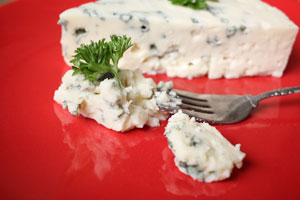
A day to celebrate moldy cheese? Why not National Stale Potato Chips Day or National Stuff You Left in the Back of the Fridge and Now You Don’t Know What It Is Day? Actually, mold is an important part of some cheeses, especially cheese like blue cheese, so it’s not as crazy as it sounds (here are recipes for Stuffed Celery and Festive Fall Salad, both of which include blue cheese).
But the name. The name is what gets me. Couldn’t we just call it National Cheese Day?
No, because that’s June 4. Not to be confused with National Cheese Lovers’ Day, which is January 20. Got all that?
Upcoming Events and Anniversaries
Columbus Day (October 12)
The Pledge of Allegiance was first recited on Columbus Day in 1892. Read about how the pledge has changed, and the story of its author.
Thanksgiving Canada (October 12)
In the U.S. it falls on the fourth Thursday in November (thanks to FDR), but for our neighbors to the north, turkey day is always the second Monday in October.
Nikita Khrushchev’s speech at the U.N. (October 12, 1960)
Read about the 50th anniversary of the Cuban Missile Crisis — includes a link to 1962 article from the Post covering the Cold War as it happened.
President Dwight D. Eisenhower born (October 14, 1890)
You’ve always wanted Eisenhower’s recipe for barbecue sauce, right? Here it is.
Chuck Yeager breaks sound barrier (October 14, 1947)
The retired brigadier general and pilot (nicknamed “the fastest man alive”) is 92 and has an official website.
P.G. Wodehouse born (October 15, 1881)
I’ve always wanted to read more of this celebrated British author. This Random House site dedicated to Wodehouse is a good place to start.
The Radical Author Behind the Pledge of Allegiance
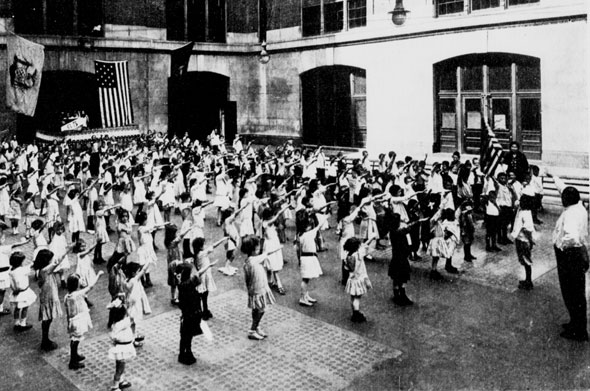
The Pledge of Allegiance has become so familiar to Americans that it’s hard for us to believe it wasn’t written long ago by some Founding Father.
In fact, it’s about 100 years younger than the Constitution. The pledge was first published in a children’s magazine in 1892; has been revised several times since; and its author, Francis Bellamy, was considered a dangerous radical.
The Changing Pledge
It was first recited in public schoolhouses throughout the U.S. on October 12, 1892, as part of Columbus Day celebrations. But the version that children memorized 123 years ago was noticeably different from today’s.
Here’s the original version: “I pledge allegiance to my Flag and the Republic for which it stands, one nation, indivisible, with liberty and justice for all.”
In 1923, something called the National Flag Conference wanted to make sure that immigrants who said the pledge weren’t secretly swearing allegiance to the flag of their original country. They changed the words “my flag” to “the flag of the United States”— the “of America” was tacked on a year later. (This was the version Congress officially recognized in 1942.)
Then, in 1954, a Congressional Act inserted the words “under God” after “one Nation.” The legislators felt the addition would help the country in its ideological war with atheistic communism.
The Radical Author
What would Francis Bellamy think of these changes? He had originally written the pledge at the urging of the editor of The Youth’s Companion with the goal of instilling nationalism in children. He also hoped that, when recited by adult immigrants, the pledge would be a miniature civic lesson that would protect them from foreign ideas of disloyalty or revolution.
We might assume that, as an ordained minister, Bellamy would have approved of introducing God to his pledge. But Bellamy was also a socialist who believed that Christians should support workers’ rights and oppose powerful monopolies. Yet he kept both Christianity and socialism out of his pledge.
Bellamy became so outspoken in his support for Christian socialism that his congregation dismissed him from his post as minister.
Yet the Post found nothing too dangerous in the short items he wrote for their editorial page.
One of these items must surely have challenged Post readers of 1901. “The Wife as Business-Head of the Family,” which appeared in the September 14 issue, challenged the wisdom of husbands always being the chief breadwinner of the family.
Bellamy began with the fact that some husbands simply never succeeded in their careers. When this happened, both husband and wife had to adjust to a life of smaller prospects and fewer hopes.
Yet many wives had a talent for success that their husband lacked. He believed these women should pursue their careers without holding themselves back by pride or fondness for their husbands. If they lived in denial of her husband’s eventual failure, they limited their chance of saving the family by their own industry.
The author of the pledge wrote, “How much simpler it would have been had [the wife] shifted the responsibility of creative work to her own shoulders as soon as there was reason to suspect that she was fitted to bear it the better and more lightly of the two. A certain pride unquestionably would have suffered; but the family might have been a business success; her own place in the world might have been saved; and the children might have had their rightful chance.”
To suggest that a wife should advance her career over her husband’s would have been extremely challenging in 1901. It is still a challenging idea for some couples, 114 years later.
Norman Rockwell and Faith
My grandfather has been called a “nonbeliever.” Nothing could be further from the truth. Norman Rockwell didn’t go to church as an adult because of his early church experiences as a boy, but he was always very respectful of and moved by religion. He had his own quiet faith.
His parents were Episcopalian and deeply religious. My grandfather was forced to go to church and participate as a choirboy at every church the family attended. He and his brother, Jarvis, were forbidden to play with their toys on Sunday — they weren’t even allowed to read the funny papers. If his mother — who was a hypochondriac and a bit of a hysteric — wasn’t feeling well enough to go to church, the family would sing hymns at home. But most of all, it was the “underside of church life” which revealed itself in those formative years and left Pop with lasting impressions that stayed with him and forever affected his relationship to church, faith, and his outlook on life.
As a choirboy, Norman Rockwell was required to sing at four services on Sunday and rehearse four times a week, including a dress rehearsal every Friday night. He remembered each of his choirmasters vividly. One was a tyrant who bullied and threatened the boys to make them sing like “little angels.” He would shoot the hymnbooks off the top of the piano at them with remarkable precision when they sang off pitch or an incorrect melodic phrase. Another choirmaster would come to rehearsals drunk.
Pop recalled the sexton swearing and grunting as he polished the altar cross with a dirty cloth. He remembered having to dress up in Spanish-American War uniforms to participate in holiday parades. As the smallest boy he would have to self-consciously march all by himself carrying a wooden gun at the very end, the little lone caboose — “the high private in the rear rank,” his father used to say. The man in the motorcar behind him would prod him with a “cowcatcher” to keep him in step. As humiliating as this was for Pop, can’t you just see it as one of his paintings?
Once he was trapped in the belfry with some of the other boys when they accidentally were locked in by the sexton. They had been teasing the girls from a nearby wayward home. It was hours before anyone understood that their screams and waves were not playful hellos but cries for help.
On top of everything else, he and his brother had to walk through a slum with rocks in their hands to get to church and were taunted by gangs of boys and the drunks that would sometimes lurch out at them. In Mamaroneck the church paid Pop $1.50 each week, but his mother made him return the money—something that really irked him, even many years later. That seemed very unfair to my grandfather — he felt he had earned it.
You can begin to get an idea of someone’s faith by reading their personal letters and observing what items they surround themselves with. My grandfather would sometimes sign his notes with “God bless us all.” It is interesting to note that Pop placed two Madonnas in their own special niches in his studio. One overlooked where he painted, the other was by the door over the sofa that he would sometimes take naps on. One of those Madonnas is a hand-carved statue from Peru. He also had a Buddha from Siam. He had a phonograph in his studio at one point and would sing along with a recording of hymns at the top of his lungs all by himself.
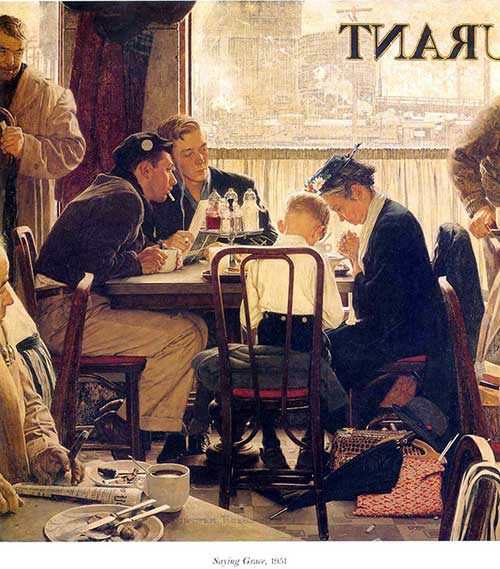
© SEPS
Saying Grace is perhaps my grandfather’s most beloved painting. He painted it in 1951 for the Thanksgiving cover of The Saturday Evening Post. A woman in Philadelphia wrote him about seeing a Mennonite family saying grace in an automat. The image really expresses my grandfather’s attitude — curious, respectful, and accepting but also suggesting that that kind of religion is something of the past. He placed the scene in a shabby railroad restaurant instead of an automat — my grandfather loved the romance of train stations, transition points of many hellos and goodbyes, arrivals and departures, a story in each.
The myriad and clarity of detail in the painting is a wonder and each one is carefully chosen. There is a quiet order in the midst of chaos: the variety of baggage, each person with a different coat and hat — a unique visual identity — the tableware, the cups of coffee. The newspaper in the lower left-hand corner grounds the painting with a sense of time marching forward, just as the background outside the window speaks of the industrial progress that keeps driving forward. Yet the carpetbag beside the old woman speaks of a very different time, the umbrella indicates impending rain explaining the slightly gloomy overcast light that Pop chose. He could have made it a sunny day with a tree and a nice neighborhood outside the window. Instead there is a deeper, silent meaning to this image, which I think can be missed.
The focus of the painting is the boy — a symbol of the innocence and purity of childhood — in the middle of the crushed cigarettes and the debris on the floor, and all the older men who have wised up to life or rather, by their world-weary faces, it seems life has schooled them the way life often does. The boy is the only one with his jacket off. The white shirt draws the viewer’s attention to him. My grandfather understood the beauty and vulnerability of the nape of a child’s neck as any parent certainly does. The old woman is the symbol of a bygone era. Her white scarf ties the two together visually just as their aligned body language does; the boy leans toward her and their faith. Their clothing is out-of-date. Pop bounces light off of the evenly placed fork and knife at the bottom of the picture and that reflection leads the eye once again to the boy and the old woman. The various stares also draw the focus towards them. His cut-off signature playfully mirrors and balances the cut-off “restaurant” sign in the window.
“The people around them were staring, some surprised, some puzzled, some remembering their own lost childhood, but all respectful. If you actually saw such a scene in a railroad station, some of the people staring at the old woman and the boy would have been respectful, some indifferent (probably a majority), some insulting and rude, and perhaps a few would have been angry. But I didn’t see it that way. I just naturally made the people respectful. The picture is not absolutely true to life; it’s not a photograph of an actual scene but the scene as I saw it.” —Norman Rockwell in My Life as an Illustrator
The man posing with the cigarette was Don Winslow, who studied with Pop at the art school my grandfather organized one summer in Vermont. Winslow remained in Vermont afterwards, living in the one-room schoolhouse on the green and acting sometimes as Pop’s assistant. He was talented but troubled. The man next to him is my Uncle Jarvis. Gene Pelham, one of Pop’s photographic assistants, is the man with the paper and cigar.
My grandfather’s favorite poem really says all you need to know about his faith:
Abou Ben Adhem by Leigh Hunt
Abou Ben Adhem (may his tribe increase!)
Awoke one night from a deep dream of peace,
And saw — within the moonlight in his room,
Making it rich, and like a lily in bloom—
An angel writing in a book of gold.
Exceeding peace had made Ben Adhem bold,
And to the presence in the room he said,
‘What writest thou?’ — The vision raised its head,
And with a look made of all sweet accord,
Answered, ‘The names of those who love the Lord.’
‘And is mine one?’ said Abou. ‘Nay, not so,’
Replied the angel. Abou spoke more low,
But cheerly still; and said, ‘I pray thee, then,
Write me as one that loves his fellow men.’
The angel wrote, and vanished. The next night
It came again with a great wakening light,
And showed the names whom love of God had blest,
And lo! Ben Adhem’s name led all the rest.
Perhaps we can all take a cue from my grandfather — it is far more important to respect someone else’s faith than to judge and condemn them for it. Goodwill toward one another is the compass he followed.
Blessings,
Abigail
P.S. It is interesting to note that when the painting was reproduced on the SEP cover, significant portions of the painting were cut off — the faces of the two men on the left and the “U” of the “restaurant” sign in the window in addition to more details on the right were left out. The color was also changed from a sepia-toned theme to a brighter tone with more blue in it. Pop used to complain about this — his work would sometimes be noticeably changed from the original. I believe the fact that his work was seen in reproductions and not in the original form for so many years is one of the main reasons my grandfather’s work was undervalued for so long. The reproductions simply don’t come close to capturing the clarity of detail, technique and color tone.
3 Questions for Blythe Danner
(Shutterstock)
We caught up with Blythe Danner in May, just as the indie film I’ll See You in My Dreams was released. She told us she hadn’t expected to play a role like this — in the movie, she’s a widow quite settled into her solo routine until a handsome stranger (Sam Elliott) shakes things up — but aspects of the part are reflective of her life. Danner herself is a widow of 13 years, and speaks with great love of her late husband, Bruce Paltrow. Later this year, Danner will play Ruth Madoff, wife of Ponzi-schemer Bernie, alongside Richard Dreyfuss in the ABC TV production based on Brian Ross’ The Madoff Chronicles.
The Saturday Evening Post: You seem to have found a very comfortable mix of work and excitement and family life. Would there be room for a guy in all of that?
Blythe Danner: I’m a loner. I’d rather be home and watching TV than out on a blind date. And I can’t imagine being married again. I don’t want to stop the momentum of my life in any area, but romance has just not been a priority. The truth is, being an older woman in New York City and in Los Angeles is very fulfilling. There’s so much culture, so many good friends — not to mention catching up on a lot of books I didn’t read when I was younger. And, I feel really blessed with family. I have children on both coasts and grandchildren, too, so that keeps me very busy. And, though I’m not good about keeping in touch, I’ve got some wonderful friends who are and they forgive that.
SEP: Your daughter, Gwyneth, is an internationally known celebrity. She is constantly in the news, sometimes getting praise and other times hurtful criticism. Is that difficult for you?
BD: Well, it was unexpected, you know? She wanted to be a good actress and that’s all I wanted to be. When we saw her act the first time, my husband and I both said, “This is an extraordinary talent.” But you don’t bargain for all the other stuff that comes along with that. In this business, you’re going to get slings and arrows. Still, one of the qualities I think she inherited from me is a tough skin. I’m proud of the way she carries herself in this world.
SEP: You often refer to yourself as an “older woman” — “a woman of a certain age.” Do you really think of yourself that way?
BD: Only when I look in the mirror. We all feel the same I think — that we’re still young — then we do a double take when we pass the mirror. I feel like Carol, my character in the movie. She’s one of those women who could slide into old age ungracefully, but luckily things invade her life and she has to rise to the occasion. For myself, this movie has put a real skip in my step. One of the things about growing older is that there are no expectations, so when something like this falls from the sky, I think I appreciate it more than I ever would have. I’m just reveling in the moment and the experience.
Life Is Not a Dress Rehearsal
Anna burst through the stage door, out into the chilly night air, the adrenalin of the performance still coursing through her veins. She’d been flawless; not a flubbed line or a misstep, not an instant of breaking the fourth wall or making eye contact with the critic in the front row, despite his feet extending onto the stage and protruding into every scene. She’d saved the vicar from embarrassment when he dropped a critical line that set up a red herring, and she hadn’t even tripped on the stairs during her dramatic exit tonight. She couldn’t help but let her mind flit to the theatre’s annual awards, to the agent she might snag, to the West End, the Oscars, a whole new Anna. It was possible; anything was.
She’d envisioned pushing through an electrified crowd to reach her parents, but instead she found clusters of relatives and friends gathered around their particular actor, heaping praise and flowers. Her parents were nowhere to be seen. Making a note to teach them some basic theatre terms, like explaining that the stage door was generally at the back of the theatre (i.e., near the stage), she set off along the side of the old brick building towards the lobby.
With the cool air on her face, she could feel the pores on her face shrinking, squeezing the heavy mask of makeup and powder into her skin. A light mist had rolled in from the sea and gathered on the tips of her fake eyelashes, loosening the gum that held them in place.
“You were wonderful,” said a woman she didn’t recognize, thrusting a hand towards her.
“Was I really?” Anna started to say, but reminded herself to be gracious, not needy. She smiled at the woman, their momentary connection filling her with an unfamiliar yet comfortable sensation — a feeling of expanding beyond the confines of herself and soaring into a new level of the atmosphere, where the air was sweeter, more life-giving. “Thank you so much for coming,” she said. “I’m glad you enjoyed the show.”
She found her parents in the lobby, their heads leaned in towards the board of headshots, trying to match the faces in the photos to the characters listed in the program. Anna paused inside the door and watched them for a moment. They were good parents, weren’t they? They’d encouraged her through school, and helped her buy her first car, teaching her the value of money, and the pride of owning something earned. They’d celebrated her first summer job with a fancy meal she wasn’t sure they could afford, and now, here they were again for her.
She adjusted the bow on the front of her polka dot dress, straightened the fake pearls at her throat, and strode across the foyer’s red patterned carpet, the rolls of her blonde wig bobbing as she went. She held out her arms to her parents, beaming with expectation.
“Oh,” said her mother, giving her a cursory hug. “You’ve still got your costume on.”
“I thought I’d come out and see you first,” said Anna. “Well, what did you think?”
Anna couldn’t miss the glance her parents exchanged before her mother said, “It was very nice.”
“Very nice,” her father parroted.
“Didn’t you enjoy it?” Anna prodded.
“Yes,” her parents said in the same high-pitched voice that sounded as if it had been forced across their vocal chords.
They hated it, thought Anna. They hated me in it. The balls of her feet were starting to throb in her thin-soled, high-heeled shoes. The shoes were too small, but they were the only pair of ’40s-era peep-toes that matched her dress, and the director had been adamant that Anna’s character would never wear a mismatched outfit, even coming out of five years of war and rationing.
“The vicar was good,” said her father. “We were just looking at his photograph.”
“Headshot,” said Anna.
“Is this the girl who played the maid?” her mother said, tapping Megan’s sultry shot. “Pretty girl, but her accent was a bit uneven, wasn’t it?”
Anna pushed her lips into a brief smile, suddenly feeling defensive of Megan’s almost incomprehensible Cockney twang.
“Still, for an amateur production it was very good, and as long as you had fun, that’s the main thing,” her mother said, folding the program in a rough crease and stuffing it into her purse
“Who took your photograph?” her dad asked.
“Headshot,” muttered Anna. “A professional photographer.”
Her father made a scoffing noise in the back of his throat. “You should have let me take them. I could have taken a nice picture of you. I hope you didn’t spend a lot of money.”
Anna closed her eyes and tried to contain the onslaught of misguided compliments. Her parents didn’t mean to be hurtful; they just didn’t understand this kind of thing. Or maybe they did. Maybe they understood her completely and this was their way of showing disapproval.
“Why don’t you go and change?” her mother chimed in.
I already have, thought Anna. “I thought we could go and get a coffee,” she said. “My treat.”
“I can’t drink coffee at this hour,” her mother said.
“Then have cocoa,” Anna snapped.
Her mother peered at her the way she’d peered at Megan’s headshot, as if trying to match the two disparate personas — the daughter she knew and the daughter that stood before her.
“What’s going on?” her father said, narrowing his already small eyes.
Anna caught a breath and steadied her nerves. She’d been perfect in rehearsals, calmly explaining herself to her parents, predicting their objections, and countering with dignity and coolness. She’d planned to have the conversation over a civilized cup of coffee, but now she felt a new sensation growing inside her, pushing past her neatly scripted announcement and scattering her practiced words. “I don’t want to study business anymore,” she said. “I don’t think I want to be an accountant.”
The silence that followed seemed to drag on towards eternity, as her parents stared at her, the muscles in their faces barely twitching to move their expressions through incomprehension, confusion, and realization, waiting for someone to throw them the right line to say.
Her mother cracked first. “Don’t be ridiculous,” she said. “What on earth do you mean, you don’t want to be an accountant?”
“I thought that’s what I wanted, but I don’t. Not any more.”
“What about all that studying and your internship? You were lucky to get that placement. Why would you throw that away? It’s doubtful you’d get so lucky again.”
“I know,” said Anna, trying to maintain her cool. “But it doesn’t make me happy.”
“It’s work,” said her mother. “It’s not supposed to make you happy. It’s supposed to keep a roof over your head and keep you from worrying about starving to death. Happy things are what you do after work, on the weekends, on holiday. Ask your father about being happy. You don’t think your education was paid for in laughs, do you?” She let out a hiss of breath that whistled through her teeth. “I can’t have this conversation right now. Talk to her, Frank.”
Her father seemed to have curled down into himself, but at the sound of his name, he unfurled to his full height and straightened his neck. His hair was getting thinner, Anna noticed. He looked tired. Maybe he’d always looked tired. Maybe that’s what she was supposed to do, too — work hard, be happy on the weekends, look tired.
“What is it you think will make you happy?” her father said. “This?” He held his palms wide as if lifting the cloud of heavy air that had descended around them.
Anna rolled her lips between her teeth. She could taste the thickness of the sticky red lipstick — Carmine Red, not easy to find — and the slight saltiness of perspiration on her upper lip. She could feel her scalp starting to itch under the heat of the wig, but she stood her ground. “Maybe.” She didn’t know yet. Maybe not this, no, but something, something that made her feel like this.
Her mother let out a hoot that seemed to bounce off the walls of the deserted foyer. “I don’t think I’m hearing this. I am definitely not hearing this,” she said and strode towards the exit.
Anna glanced at her father, but his expression was unreadable. She expected disapproval, but instead he looked sad. Her stomach cinched into a tight knot of guilt. Fuming would have been better. She knew they’d be disappointed in her, and she’d known from the beginning that her mother would fly off the handle, like she always did. But she hadn’t thought through how her father might react and she hadn’t expected this. It was worse than disappointment; it was regret.
“We should go, too,” he said, his voice low, resigned.
Anna nodded and followed behind him, trying to remember what she’d rehearsed and if she had anything that might be the right thing to say now. She came up with nothing.
At the exit, her father pressed his big hands against the glass door, but he didn’t push, and Anna, watching her peeking toes brush across the carpet, almost ran into him.
“I used to play the piano,” he said, his big voice barely a whisper. “Did you know that?”
Anna nodded. She’d seen him play once at a friend’s house. He’d tickled out a tune and ended with an impressive flourish. She remembered laughing at her goofy old dad, but she’d never stopped to think about it more.
“I thought I’d be a brilliant pianist, play the Royal Albert Hall someday. I might have been good enough, I don’t know.”
“So why didn’t you try?” said Anna, her voice catching in her throat. “You’re the one always telling me life’s too short.”
“I did tell you that, didn’t I?” Her father laughed and shook his head. “I got it all wrong, I suppose. Life’s not too short at all; it’s too long. Year after year of it, and too damn long to spend doing something that makes you miserable.”
He pushed open the door, letting in the chilly night air. “Too damn long to not have a coffee with your best girl, too.”
News of the Week: The Red Planet, a Black Burger, and Apple Brown Betty
There’s Water on Mars

Maybe all of the science fiction writers like Ray Bradbury who picked Mars for their stories of life on other worlds were on to something.
The world got excited earlier this week when NASA announced at a press conference that they had found evidence of liquid water on the red planet. John M. Grunsfeld, NASA’s associate administrator for science, says that space agency might send probes to the planet in the 2020s to look for life. This doesn’t mean we’re going to find Vulcans or Ewoks or those aliens from The X-Files any time soon, but the very fact that water is there shows that life could exist beyond our world.
A lot of jokes were made online about this news being great PR for the new Matt Damon movie The Martian, and director Ridley Scott revealed that he actually knew about the water news a few months ago, but it came too late to add it to the movie.
This was a big week for space. We also had the rare confluence of a lunar eclipse and a supermoon, which made for some fantastic photos.
The Truth? Yup, Still Out There
Speaking of The X-Files, Fox released a full trailer for the reboot of the popular ’90s series, which debuts in January. Looks good, with a plot that mixes the old alien storyline (with Cigarette Smoking Man!) with recent concerns about surveillance and privacy.
Burger King’s Black Burger
That’s a slightly misleading title, because it’s actually the bun that’s black.
Burger King has announced a special Halloween Whopper, which bakes A1 Steak Sauce into the bun to make it turn black. Ooooooo, scary! The fast-food chain has already been selling colored burger buns (including red) in Japan for a while. Get it now though. Based on the #HalloweenWhopper hashtag it’s for a limited time only.
Something wicked is coming. The wicked good A.1. #HalloweenWhopper #SuperEclipse https://t.co/HKqMHvJrU7
— Burger King (@BurgerKing) September 27, 2015
You can wash down that burger with another new Burger King creation, the Pumpkin Spice Oreo Shake, which sounds healthy.
The New Daily Show
What happens when you replace a popular comedy news program host who held the job for 16 years and was beloved by fans? Well, not much it turns out.
Trevor Noah took over for Jon Stewart on The Daily Show this week, and except for a handful of people who won’t accept change or are too quick to judge, he was greeted warmly. He’s doing fine. Noah’s a very different host than Stewart but the show is pretty much the same: an anchor giving the news, fake reporters giving their perspective, and then a celebrity interview. Well, they did change the font but I think people will get used to that.
I still miss Craig Kilborn though.
OMG Facebook Was Down!

I happened to be on Twitter when Facebook went down earlier this week (I’m on one of my occasional “let’s see what’s on Twitter” experiments, though I’m trying to stay off it), and it’s funny what happens when the world’s most popular social networks goes down. Everyone goes on Twitter to talk about not being able to go on Facebook. I’d hate to see what would happen if Twitter happens to be down the same time Facebook is down. MY GOD HOW CAN I EXPRESS MYSELF?
This is the third time that Facebook has gone down in the past three weeks. No word on why it has been happening or how many people were affected worldwide, but millions of people were in PANIC MODE for a few hours. How will the world know what I had for dinner? Where will I post pictures of my dog? How will I learn about the crazy political opinions of family and friends I thought I knew? To show how important Facebook has become, the cable networks actually had BREAKING NEWS alerts when the site went down.
I would say that if you actually get upset or irritated or antsy, even just a little, when Facebook goes down, that might be a sign you need to take a break from it.
As for Twitter, they’re thinking about getting rid of their 140-character limit on tweets.
National Apple Betty Day
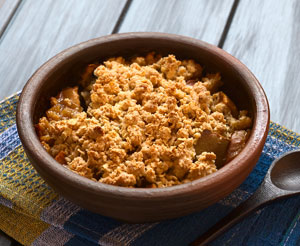
It’s this Monday. Now, I’ve heard of Apple Brown Betty but not Apple Betty. Are they the same thing, an apple dessert similar to a cobbler or a crisp? Whatever you call it, it’s fall and that’s the time for this sort of thing, with the nutmeg and the cinnamon and the apples filling your home with smells that remind you, hey, I really have to start my Christmas shopping soon.
Here’s a recipe from Martha Stewart (with video, because Martha is always thorough), and here’s one from an issue of Better Homes and Gardens from the 1970s that uses orange juice.
Apple Betty was a favorite dessert of the Reagans when they were in the White House. But adding jellybeans to the recipe is not recommended.
Upcoming Events and Anniversaries
World Animal Day (October 4)
The annual celebration is always on October 4, the Feast Day of St. Francis of Assisi, the patron saint of animals.
President Rutherford B. Hayes born (October 4, 1822)
The 19th president banned all alcohol from the White House.
Soviet Union launches Sputnik (October 4, 1957)
The launch of the first artificial satellite freaked out a lot of people and launched the Space Race.
First nationally televised presidential speech (October 5, 1947)
President Harry S. Truman made the speech from the White House, even though there were only some 44,000 TV sets in the U.S. at the time. (President Franklin Roosevelt appeared on TV in 1939 but it was only broadcast at the New York World’s Fair and at Radio City Music Hall.)
The Great Chicago Fire starts (October 8, 1871)
The often-repeated story is that a cow started the fire by knocking over a lantern in a barn, but that actually might not be true.