A Captured General Goes Free
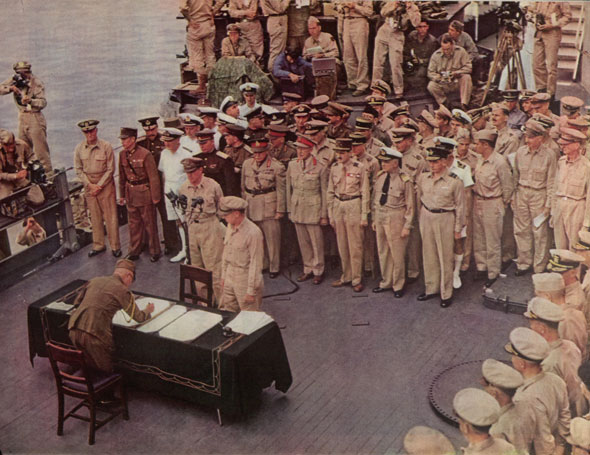
Note the man standing at the far right in this photo. The skinny gentleman wearing the baggy uniform?
His name is Jonathan M. Wainwright. And just 13 days before this picture was taken, he was being held in a Japanese POW camp.
Three years earlier, Wainwright commanded a force on the Philippine island Corregidor. The group included American and Philippine soldiers and American nurses who had fled Bataan after the Allied soldiers there surrendered to the Japanese.
General Wainwright tried to stave off a Japanese siege with an army of 11,000 soldiers who were exhausted, starving, and desperately short of medicine, fuel, and ammunition. On May 6, the Japanese forces finally breached his defenses. Fearing a general slaughter of his troops, Wainwright surrendered his command to the enemy.
Under Japanese warrior code, death was preferable to surrender and the captors regarded their new captives with vicious contempt. The captured were beaten, humiliated, tortured, and sometimes executed at the whims of Japanese soldiers.
Wainwright endured years of imprisonment, abuse, and starvation. But he was also burdened with a sense of remorse. He believed his country considered him a disgrace for ordering the surrender and becoming the highest-ranking prisoner of the enemy.
But then, in August 1945, they were liberated. And Wainright was shocked to hear he’d been promoted to major general; the United States considered him a hero. Flown back within American lines, Wainwright was given medical treatment, cleaned up, and given a fresh uniform. Within days, he found himself among the multinational dignitaries on the deck of the USS Missouri. America wanted to see him among the commanders who accepted the Japanese surrender.
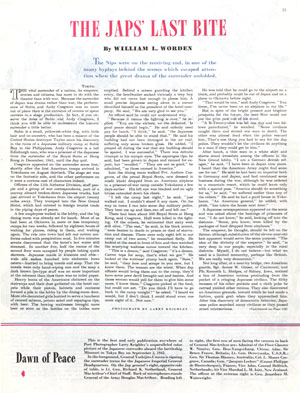
This photo, which appeared in the Post on October 27, 1945, accompanied the story “The Japs’ Last Bite,” a report from newly defeated Japan. The article, by Bill Worden, reads like a Warner Bros. version of life in Yokohama under allied control. The cast includes the self-serving manager of a hotel, the escaped POW, the Jewish refugee from Germany, even a dog that had been liberated from a Japanese camp and, according to Worden, made the final gesture of the war.
There was no mention in this article, or any Post article for a year afterward, of the bombing of Hiroshima and Nagasaki that brought the surrender. The country, and the Post, wasn’t ready to hear that story. They wanted to celebrate the heroes, and savor the moment of payback.
May/June 2015 Limerick Laughs Winner and Runners-Up
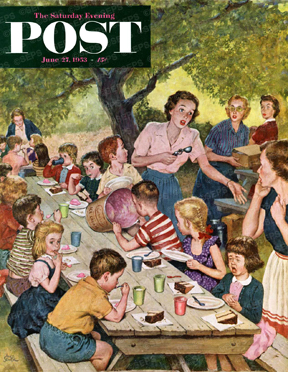
From accounts it was easy to tell,
The party was going quite well.
But amidst all the fun,
When the ice cream was done.
Things wouldn’t be quite so swell.
—Paul Madsen, Columbia Heights, Minnesota
Congratulations to Paul Madsen! For his limerick describing Amos Sewell’s illustration Out of Ice Cream (above), Paul wins $25 — and our gratitude for a job well done. If you’d like to enter the Limerick Laughs Contest for our upcoming issue, submit your limerick via our online entry form.
Of course, Paul’s limerick wasn’t the only one we liked! Here are some of our favorite limericks, from our runners-up, in no particular order:
Where could the ice cream have gone—
The dessert they depended upon?
Because of bad luck it
Fell out of the bucket,
And sweetened the grass on the lawn.—Anna Lee Brendza, New Philadelphia, Ohio
Though she thought she had plenty to spare,
And, if not, that no one would care;
So she didn’t perceive
Just how children would grieve
Over cake without ice cream … not fair!—Larry Mann, Danville, Virginia
Her job was to act as the scooper
Of ice cream. She thought she’d do super.
The ice cream ran short
By less than a quart.
Oh, what a misfortunate blooper!—Neal Levin, Bloomfield Hills, Michigan
Though you may plot or plan or scheme—
There is no worse recurring theme…
Than the demanding ids—
Of too many kids—
And not enough scoops of ice cream!—Harry Zankman, Philadelphia, Pennsylvania
My party was over too soon!
A wonderful birthday in June!
But I just had to cry
When my mother came by.
No ice cream was left for my spoon!—Jolene Feher, Spokane, Washington
That poor little girl did scream,
When mommy ran out of ice cream.
They ran to the store
And brought home some more
Now everyone’s calm and serene.—Donald Johnson, Spanaway, Washington
There once was a tragic mistake
That anyone might possibly make.
It saddened the day
When it turned out that they
Ran out of ice cream before cake!—Joe McMann, Katy, Texas
The Birth of the Bomb
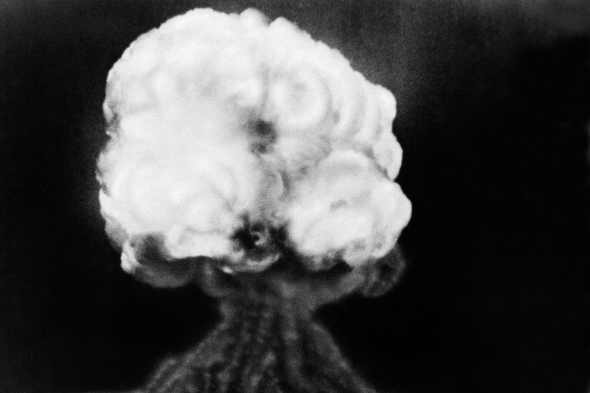
Seventy summers ago on July 16, an apocalyptic nuclear explosion in an empty New Mexico desert valley called Jornado del Muerto — Journey of the Dead — signaled the dawning of the atomic age. That first test was the culmination of three years of rigorous,  exhausting work on the most profound secret of World War II: the development of the world’s first atomic bomb in the town of Los Alamos, a secret outpost located on a high mountain mesa where an extraordinary band of civilian scientists — physicists, chemists, mathematicians among them — accomplished what some had thought, and even hoped, to be impossible. These “longhairs,” as Army General Leslie Groves called the scientists, understood that a nuclear explosion of unimaginable magnitude was theoretically possible; they assumed not only that the Germans were working on such a doomsday weapon, but had a head start.
In one of history’s most chillingly opportune quirks, Hitler in his rage against Jews caused some of the most brilliant European scientists to seek refuge in Great Britain and the U.S. Welcomed with open arms, quite a few turned up at Los Alamos where they became crucial in the race to produce the world’s first nuclear weapon. Italy’s Enrico Fermi, Denmark’s Niels Bohr, and Germany’s Hans Bethe were among those who joined forces with Americans like Richard Tolman, who became vice chair of the National Defense Research Committee and General Groves’ chief scientific advisor, and physicist J. Robert Oppenheimer, who led the effort to design the weapon.
Oppenheimer was a superb theorist, but as director of the Los Alamos site his task in every way Herculean was to orchestrate the work of this amazing coterie of scientists. The town was both an army camp and a village with homes for the scientists and the families they were allowed to bring with them, all of it surrounded by barbed wire. The average age was 26; Oppenheimer celebrated his 39th birthday in 1942, not long after he arrived in Los Alamos with his wife Kitty and their 2-year-old son. All the young families were locked into this isolated mountain retreat for the duration, unable to tell their folks back home where they were or why they were there. In fact, most of the wives had no idea what their husbands were doing in the long days and nights spent in the top secret Technical Area. Security was so high that even those who did know never used the word bomb. It was either “the gadget” or “the device.”
Kitty was Robert’s first and only wife; she was 29 when they married; he became her fourth husband. Being “Kitty’s husband” had to be one of the most exasperating roles he assumed at Los Alamos; she was what a later generation would call “high maintenance.” One of the secretaries called her “a sexy dame,” others were not so kind. Men tended to like her, women did not, in part because Kitty made it clear that she was not going to take on the social role expected of the director’s wife; she preferred the cocktail hour to tea parties, big talk to small talk. Yet she did join many of the young wives in taking advantage of what they called “rural free delivery” in the local hospital. Kitty gave birth to a second child, a girl, while at Los Alamos.
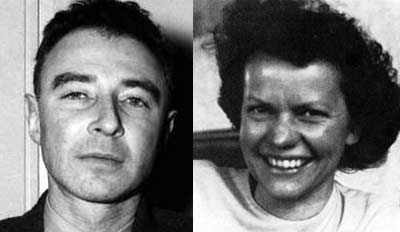
Courtesy of J. Robert Oppenheimer Memorial Committee
There was nothing reticent about Kitty; she insisted on knowing the secret mission of Los Alamos. Another who knew was Richard Tolman’s wife, Ruth, a psychologist. The Tolmans had been close to Robert since he arrived in California in 1928 at age 24; he was a wunderkind in the new field of nuclear physics and would stay in the Tolmans’ Pasadena guesthouse when he was dividing his time between Caltech — the California Institute of Technology — where Richard Tolman was dean of the graduate school, and the University of California at Berkeley. During those years, Ruth Tolman became Robert’s confidant and, over time, best friend. One of Robert’s secretaries reported that he always had one of Ruth’s letters in his pocket. She destroyed the letters he wrote to her, but enough of her letters survive as witness to the depth of their bond. Inevitably, rumors of an affair were floated, but never proved, and were disavowed by those who knew them well.
During the war, Richard was stationed in Washington, D.C., and Ruth followed him there. Her last assignment was with the Office of Strategic Services (OSS), an intelligence agency that was a forerunner of the CIA. The Tolmans’ guest rooms in their Washington home were often occupied by top-ranking visiting scientists, including Robert Oppenheimer. Ruth’s close relationships with two of the men central to the building of the atomic bomb gave her a unique perspective on the moral issues raised by a weapon that would make the world an infinitely more dangerous place. Niels Bohr, the great Danish physicist who represented the conscience of the scientific community, hoped that the shocking magnitude of the weapon would act as a deterrent to war itself.
In the spring of 1945 in Los Alamos, as the scientists worked feverishly to complete and test the bomb, the battle of Berlin raged to its inexorable close. Hitler committed suicide on April 30; on May 8, German Field Marshal Keitel (who, in a bizarre twist of fate, was a distant relative of Kitty’s) signed the documents declaring surrender on the Eastern Front. That day was declared VE Day: Victory in Europe Day. In the U.S. all radio programs were interrupted, a short burst of static and then the voice of President Harry Truman proclaimed, “This is a solemn but glorious hour. … The flags of freedom fly all over Europe.” In Washington, spontaneous celebrations broke out. In England, Prime Minister Winston Churchill intoned, “We may allow ourselves a brief period of rejoicing; but let us not forget for a moment the toil and efforts that lie ahead. Japan with all her treachery and greed, remains unsubdued.”
VE Day at Los Alamos was a mass of colliding emotions. Joy from the majority who did not know the secret of the Technical Area and who assumed that with Hitler defeated and the Allies clearly moving toward victory in the Pacific, they would be going home soon. Others, privy to the secret, were disappointed that they hadn’t produced an atomic bomb in time to shorten the war in Europe. Still, there was relief that the Germans didn’t have the weapon after all, and some questioned why work on the gadget should continue. Caught up in the relentless effort to complete this doomsday weapon, only a few admitted to having qualms about its use. Most notably, Robert Wilson, the young physicist who held a top position as head of research at Los Alamos, objected to the use of the bomb on Japanese civilians. Yet no one stopped working; they were close now, they would wait for the test. The Manhattan Project had cost almost $2 billion, including centers in Washington state and Tennessee. With such an enormous investment, results were expected. The race to develop the bomb shifted to Asia, and beyond to a post-war struggle with the USSR.
Richard Tolman traveled to Los Alamos in May, and would have noted growing tension among the scientists. General Groves pressed for an early test of the gadget before Truman’s scheduled meeting with Stalin in mid-July; Robert hesitated, still wanting to make adjustments to the bomb’s design. But powerful forces were urging the project forward. Americans were sick of war, sick of death, sick of a culture that seemed to prefer death over surrender. Three months earlier, one of Air Force General Curtis LeMay’s B-29 bombing raids on Tokyo unleashed a storm of flames and gases that killed some 100,000 Japanese civilians. On Okinawa that spring, there were just short of 50,000 American military casualties; kamikaze attacks alone killed more than 4,900 Americans. Japanese military and civilian casualties were reported to have been near 200,000. These obscene numbers splattered across the headlines of newspapers and on news programs nationwide. The bomb, those who knew about it wanted to believe, would bring Japan to its knees and put an end to these horrors.
Oppenheimer finally agreed: They would test the device on July 16; he code-named it Trinity. Later he would say he wasn’t certain why he had chosen the name, recalling that it came from a Donne poem: “Batter my heart, three person’d God.” Those who knew him well recognized echoes of Jean Tatlock, Robert’s first important love, who had read poetry with him.
Robert’s younger brother Frank, also a physicist, was at the Oak Ridge, Tennessee, facility where he worked to extract pure U-235 (the uranium isotope that could sustain the fission chain reaction necessary for a bomb). Robert asked that Frank join him for the critical test, and General Groves obliged.
An electric suspense hovered over Los Alamos that summer, an increasing feeling of anticipation, even though most of the 5,000 residents did not know what was about to happen 240 miles to the south at Jornado del Muerto. The wives who did know couldn’t be sure which of the others shared that knowledge; sometimes they seemed to be taking a breath between every syllable.
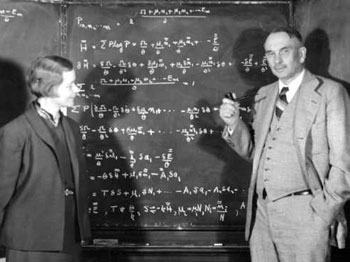
Courtesy of The Archives, California Institute of Technology
On July 15, 1945, the tension at the Trinity site was palpable. Most of the Tech Area scientists had arrived. Generals and VIPs began to fly into a nearby Army airfield. Robert had made a pact with Kitty: If the bomb worked, he would send her a banal message, “You can change the sheets.”
Scorpions and rattlesnakes, field mice and frogs populated the scrubby desert. A tall tower was ready, the gadget was in place for the scheduled 4 a.m. test the next morning. As darkness fell, the winds rose, then great flashes of lightning slashed the night sky and thunder echoed off the surrounding hills. The air seemed filled with portent. Frank would remember the frogs, how they seemed to migrate to a pond and then filled the night with the sounds of wild copulating. He would remember, “The only living things around there [were] coming together.” He joined his brother in the bunker; they would see the thing through together.
In Los Alamos in the first dark hours of that day, Jane Wilson, whose husband Robert, head of the research division, had questioned the morality of the bomb, would remember, “the air seemed empty and bitter cold, although it was July.” The wives who knew about the test kept vigil. Some watched from their porches; a small group gathered on Sawyer’s Hill, near a ski run, where the view to the south was open. The pine trees stood black against a starless sky. Four o’clock came and went. They waited, scanning the sky, silent and afraid for their husbands at the test site. Jane would write: “4:30 a.m. The gray dawn rising in the east, and still no sign that the labor and the struggle of the past three years meant anything at all.” And they continued to wait.
At 5:30 Jane Wilson saw a “blinding light like no other light one had ever seen. The trees, illuminated, leaping out at one. The mountains flashing into life.” And then the slow, monstrous rumble that announced the birth of the atomic age.
The Oppenheimer brothers lay face down in the dugout, 6.2 miles from ground zero, side by side, their eyes closed and arms covering heads. “But the light of the first flash penetrated and came up from the ground through one’s lids,” Frank remembered. Then there was the fireball, and very quickly “this unearthly hovering cloud. It was very bright and very purple and very awesome. … And all the time … the thunder of the blast was bouncing back and forth on the cliffs and hills.” The brothers looked at each other and one said, only, “It worked.” This band of unlikely warriors in their jeans and porkpie hats, the men General Groves had called “the longhairs,” had figured out how to unleash the fury of the universe.
A scientist rushed over to Groves and all but shouted, “The war is over.” The General, solemn, answered: “Yes, after we drop two bombs on Japan.”
Richard Tolman was one of the VIPs at Trinity; that same afternoon he boarded an Army plane bound for the nation’s capital. With him was General Groves and his executive officer Tom Farrell, along with James Conant, Vannevar Bush, and Ernest Lawrence. The scientists, Conant wrote, were “still upset by what they had seen and could talk of little else, to the annoyance of Groves, whose thoughts were already grappling with the details of the ‘upcoming climax’ in Japan.”
When Richard arrived at his Washington home he was weary but excited, overwhelmed by what he had witnessed and eager to talk to Ruth. He would have offered Conant’s description of the event: “A cosmic phenomenon like an eclipse. The whole sky suddenly full of white light like the end of the world.” Or Tom Farrell’s religious incantation of the detonation wave that had followed the flash: a “strong, sustained roar which warned of doomsday and made us feel that we puny things were blasphemous to dare tamper with the forces heretofore reserved to the Almighty.” They understood that these forces were about to be loosed on Japan as the war in the Pacific moved toward a nuclear culmination.
On August 6, the weapon was loaded onto a Boeing B-29 Superfortress named the Enola Gay. Its target was Hiroshima. President Truman broke into the airwaves to announce that the largest bomb ever used in the history of warfare had been dropped on a Japanese city. “It is a harnessing of the basic power of the universe. The force from which the sun draws its power has been loosed against those who brought war to the Far East.” Three days later on August 9, another atomic bomb dropped from the bay of another Superfortress, obliterating Nagasaki. Soon after Japan’s Emperor Hirohito broadcast an announcement to his “good and loyal subjects” that he had ordered his Imperial Forces to surrender. General Groves’ mission had been accomplished.
Physicists Phil Morrison and Robert Serber had been sent to Tinian Island in the Pacific to help prepare the crews for Hiroshima and Nagasaki. In the aftermath, they were sent into the ravaged cities. Stunned, the horror began to seep in; the two returned to Los Alamos where Morrison reported on Hiroshima: “One bomber and one bomb had, in the time it takes a rifle bullet to cross the city, turned a city of 300,000 into a burning pyre.”
Oppenheimer now seemed to express himself only in terms of sorrow and terror. After the Trinity blast, he chose, from the Bhagavad Gita, just this: “Now I am become Death, the destroyer of worlds.” After Hiroshima and Nagasaki, he would speak of scientists having blood on their hands, of knowing sin, of being guilty of a complicated hubris in their creation of a new world. The gods were battering his heart.
Kitty and Robert took off for the Oppenheimer family’s ranch — a two-hour drive from Los Alamos — for a week, his first break in three years. Fall was approaching and the ranch offered the illusion of being removed from the madness. The two took long horseback rides through the woods and into meadows scattered lavishly with penstemon and blue gilia and yarrow, through all the places that had given him pleasure and peace before the war. Now there was neither pleasure nor peace in Robert Oppenheimer’s world.
When they returned to Los Alamos from the ranch, Kitty said that Robert was in such an emotional state that she didn’t know how she (not he) could stand it. Robert left almost immediately for Washington for a two-week trip; he would talk to the Tolmans about the struggle for control of nuclear arms that — as physicist Neils Bohr had predicted — had already begun. Some Los Alamos scientists wanted to outlaw atomic weapons, another group led by Edward Teller was pushing to create thermonuclear or “super” bombs, massively more destructive than those dropped on Japan. A majority of the scientists believed the answer was in international controls and in an open exchange of information with all countries, including the Soviet Union — in effect, giving up any advantage the U.S. monopoly might offer in exchange for a chance to prevent an arms race. Other countries would, the scientists knew, soon clamor to build their own atom bombs.
Suddenly Robert Oppenheimer was catapulted into a new and very public role. The American press was presenting him as a hero, the Father of the Atomic Bomb, just as Robert was telling the American Philosophical Society that “we have made a thing, a most terrible weapon that has altered abruptly and profoundly the nature of the world … an evil thing.” Yet, as he attempted to explain time and again, the angst Robert felt was not for his role in the making of the bomb — Trinity had proved that inevitable. If not he, someone else would have led the effort. He was distressed that the pure science he loved had been perverted to create this “evil thing,” opening a Pandora’s box of horrors. Seventy years later, reasonable people take comfort that nuclear holocaust has been averted, and that the United States continues to lead the efforts to defuse lethal threats wherever they rise.
Article adapted from An Atomic Love Story: The Extraordinary Women in Robert Oppenheimer’s Life by Shirley Streshinsky and Patricia Klaus (Turner 2013).
Stream On
Streaming movies and TV shows is a great alternative to cable. Why pay for hundreds of channels you never watch, when you can pick and choose the services and programs you like most? But while video streaming is good, it often requires a bit of tech know-how to work optimally. Here are some handy tips.
Get Up to Speed
Video demands a lot of bandwidth, so a slow Internet connection won’t cut it. Streaming high-definition programs requires a 5 Mbps (megabits per second) or faster connection, according to Netflix. Hulu Plus and Amazon Prime, two other popular streaming services, recommend a minimum of 3 Mbps or 3.5 Mbps for HD, respectively. To stream 4K or Ultra HD video — four times the resolution of good ol’ HD — you’ll want at least a 25 Mbps connection. If your broadband is too slow, chances are you’ll experience a lot of buffering; the video feed keeps pausing, waiting for more bits to download. The moral? Bargain “broadband” plans are often too poky for video streaming, so be sure to read the fine print when you sign up with an Internet service provider (ISP).
Test Your Internet Connection
So you have plenty of bandwidth for HD video — say, 15 Mbps — but buffering is still a problem? You might not be getting the speed your ISP promised. An easy way to find out is to run broadband speed tests. Visit Speedtest.net and click the Begin Test button to see how fast your download and upload speeds really are. Do they match or surpass the bandwidth you’re paying for? If not, let your ISP know.
To read the entire article from this and other issues, subscribe to The Saturday Evening Post.
For the Love of Pizza
No matter how you slice it, pizza is an American obsession. On any given day, roughly 13 percent of the U.S. population eats some pizza, according to a 2014 USDA report. We love the dish so much we declared October National Pizza Month.
Enter Curtis Stone, who shares time-tested tips on building your own perfect pizza from scratch. His secret? “Never overload pizza with toppings,” Stone says. “Too much stuff on top of the pizza weighs it down and the crust will get soggy and won’t crisp up properly.”
When choosing toppings, think seasonal. “Use fresh, in-season produce — radicchio, arugula, zucchini, leeks,” says the celebrity chef. “One of the biggest threats to healthful pizza eating is its cheesy topping. Take a cue from the Neapolitans — go without cheese once in a while. A beautiful tomato sauce, some olives, and fresh oregano comprise a classic Marinara pizza.”
Good pizza is all about the crust, right? To get that crust pizza-lovers crave, Stone says to “always cook your pizza on a preheated surface — pizza stone or baking sheet.” And to boost nutritional content and enhance texture, Stone suggests adding whole-wheat flour to the dough recipe.
In the Stone household, pizza’s a frequent visitor — served for family and friends. “Homemade pizza is a great way to kick off the weekend. It’s easy and fun to throw a bunch of sauces (white, red, olive oil) and toppings in front of guests and let them build their own ’za.”
To read the entire article from this and other issues, subscribe to The Saturday Evening Post.
Moment of Vengeance
Originally published in the Post on April 21, 1956
At midmorning six riders came down out of the cavernous pine shadows, down the slope swept yellow with arrowroot blossoms, down through the scattered aspen at the north end of the meadow, then across the meadow and into the yard of the one-story adobe house.
Four of the riders dismounted, three of these separating as they moved toward the house; the fourth took his rope and walked off toward the mesquite-pole corral. The horses in the enclosure stood and watched as he opened the gate.
Ivan Kergosen, still mounted, motioned to the open stable shed that was built out from the adobe. The sixth man rode up to it, looked inside, then continued around the corner and was out of sight.
Now Kergosen, tight-jawed and solemn, saw the door of the adobe open. He watched Ellis, his daughter, come out to the edge of the ramada shade, ignoring the three men, who stepped aside to let her pass.
“We’ve been expecting you,” she said. Her voice was calm and her smile, for a moment, seemed genuine, but it faded too quickly. She touched her dark hair, smoothing it as a breeze rose and swept across the yard.
“Where is he?” Kergosen said.
To read the entire article from this and other issues, subscribe to The Saturday Evening Post.
News of the Week: Finales, Flavored Beer, and Fast Food Friends
The Best and Worst Series Finales

We all want to see something different in the series finales of our favorite shows. Some of us want an answer to every single question that has been raised through the series; some people are okay with not everything being wrapped up in a bow, they just want satisfaction; and some people don’t even need any “big” endings, just a good episode.
A GitHub user tried to be more scientific about series finales and created these charts, which, if I’m reading the explanation correctly (and I’m not sure that I am), compares a show’s average episode rating on IMDb to its series finale rating. It’s a complex series of charts to go through, but the gist of it is everyone loved Breaking Bad’s finale and everyone hated Two and a Half Men’s finale. Also: What the heck is Spartacus: War of the Damned?
My opinion? The best series finales were for Newhart, Mad Men, The Mary Tyler Moore Show, Burn Notice, The Fugitive, The West Wing, M*A*S*H, and Cheers. The worst finales included Seinfeld, How I Met Your Mother, Roseanne, and Lost. Oh, I could take up an entire column just talking about the problems I had with those.
It’s easy to forget that from the ’50s to the ’80s, pretty much all shows just simply ended without much fanfare, twists, or surprises, just with regular episodes.
Are You Ready for Cereal Beer?

A couple of years ago I tried blueberry beer. I didn’t think I’d like it (to put it mildly), but turns out it’s actually pretty darn good! The blueberries don’t overwhelm the beer as I feared and instead complement it, sort of like an orange slice goes well with Blue Moon or a lime with Corona. But are we ready for Count Chocula beer?
That’s one of the cereal flavors that General Mills is going to make. First they teamed with Fulton Beer in Minneapolis to make Wheaties beer, and now the cereal company is teaming with Colorado’s Black Bottle Beer to make Count Chocula beer. Black Bottle has also made beer using Reese’s Puffs, Cinnamon Toast Crunch, and Golden Grahams.
If they’re taking requests, I’d like a Quisp beer. Maybe it can be a White Ale-ian.
Kylo Ren Is Not a Sith
That’s a sentence that probably sounds like gibberish to many people. But if you’re a Star Wars fan, it’s big news!
Kylo Ren, the bad guy in the new sequel Star Wars: The Force Awakens, is not part of the Sith order that we saw in the other films (that’s what all the Darths were). That’s the word from director J.J. Abrams. Kylo Ren works for Supreme Leader Snoke, who is one of the important new people in command of the Dark Side of the Force and is played by Andy Serkis via performance-capture, the same way he portrayed Gollum in the Lord of the Rings movies.
We’ll have to wait until the movie’s release on December 18 to see what exactly this all means and how it ties into Luke, Leia, and Han Solo. My prediction? It’s going to be a popular film!
Will the McWhopper Bring World (Fast Food) Peace?
Can Burger King and McDonald’s just get along, even for one day?
Burger King has taken out full-page ads in both The New York Times and The Chicago Tribune asking the other fast-food giant to collaborate on the McWhopper, which would be a mix of McDonald’s Big Mac and Burger King’s Whopper. (Of course, there’s a website: mcwhopper.com). And it’s all for charity. The burger would be sold for one day, September 21, to celebrate Peace Day, the United Nations declared day of ceasefire and nonviolence.
The response from McDonald’s? McDonald’s CEO Steve Easterbrook posted this on Facebook, telling the King “we’ll be in touch.” And that they don’t really want to do this specifically, but maybe they could get together and do something bigger for charity. He also said that next time “a simple phone call will do.”
I think my favorite comment on the Facebook post is the guy who said that McDonald’s screwed up his order the other night.
Let’s All Go to Dismaland!
Am I supposed to hate Disneyland and Disney World? Because I don’t. But there seems to be more and more of a backlash against the theme parks in recent years. All that commercialism! All the gaudiness! All the forced happiness! All the … fun? I’ve never been, but hey, they look like fun places to me.
But famed, mysterious artist Banksy sees a dark side to the parks that is even darker than the one Kylo Ren is on. Take a look at this video for a place called Dismaland, located in Weston-super-Mare. It shows the “bemusement park” and the many sad, almost apocalyptic rides and venues the park has that will horrify your kids. I don’t get the Disney hate but you have to admit it’s a rather elaborate, ambitious piece of art.
Disney seems to be Banksy’s main target, though he also makes a statement in the park about both Sea World and even Sesame Street, as you can clearly see at around 1:06 in the video.
Is Reality TV Part of TV’s Golden Age?
Short answer? No. Long answer? No, no, no, no, no, no, no, no, no. No matter what the president of WE TV Marc Juris says.
Tuesday Is National Gyros Day
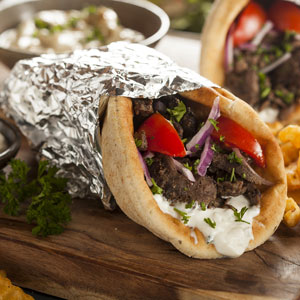
I could point you to a recipe, but I’m more interested in how you read that sentence. Did you say JAI-ros or YEAR-os? Have we figured out what the proper pronunciation is?
I researched this thoroughly (by going to Google), and while there’s still a lot of argument about it, most seem to agree you pronounce it with the “Y” sound. But if you order it the other way, no one’s going to jell at you. (See what I did there?)
In unrelated holiday news, this past Wednesday was National Toilet Paper Day. I don’t even want to know how you celebrated it.
Upcoming Anniversaries and Events
Jack the Ripper’s first victim found (August 31, 1888)
This site has a complete timeline and background information on the murders that happened in Whitechapel district of London in 1888.
V-J Day (September 2, 1945)
Victory over Japan Day is celebrated on August 15 in the U.K. (the day the initial announcement was made) and on September 2 in the U.S. (the day the surrender document was signed).
First ATM opens (September 2, 1969)
The first automatic teller machine was installed at the Chemical Bank in Rockville Centre, New York.
On the Road published (September 5, 1957)
Jack Kerouac typed the original draft of the classic novel on one long roll of paper. He wrote it in three weeks.
A Piece of Driftwood
They, that is to say, each of them — he on his own time, she on hers — had reached that point over the years, when they hadn’t always remembered the anniversary, meaning maybe that it didn’t hurt so much anymore, but then the hurt was replaced by the guilt that came from not remembering.
She
It was the 12th of May. The river had risen to its highest level in 70 years, and it was the first day that we could tell that it had begun to recede. I was snipping spent rose blossoms at the mailbox when I saw him walking back. It was his second trip to the river that morning, to check on the water, he had told me. I could see that he was carrying something. Whatever it was he had, he held it out in front of him. I thought that he was walking faster than usual, comically looking like a prancing dog bringing home a treasure with a definite burial place in mind. When he got closer I could see that it was a piece of driftwood. Another piece of driftwood.
What is that? I said.
A piece of driftwood, he said. He held it up higher for me to see. I said that I could see what it was; I wanted to know why that particular piece of driftwood. He smiled. He said that it resembled someone famous. Maybe one of his best finds ever. He told me that it should be obvious to me. He said that he had noticed it earlier that morning, and he thought he’d better go back to get it, before someone else found it.
Oh, yes, I said, thank heaven that no one else had found it. It didn’t look like anything to me, I thought, as I went back to the roses.
What did I think, he wanted to know. Why don’t you just tell me, I said. Just take a guess, he insisted. Marlene Dietrich, I told him. Well, no, it wasn’t her, he said. How could I have seen that? He told me to guess again. Clark Gable, I told him, definitely Clark Gable. He was losing his smile. Come on, be serious; take a guess, he said.
It’s my guess, I told him, and I was sticking to it. He told me that I wasn’t trying, that I could at least take a second to look, really look at it. Its likeness is uncanny, he said. He stepped back and held it up again, so that I could see it better, and with that he was beginning to irritate me. You’re way over the top on this, I told him. Okay, I said, it’s definitely Jimmy Carter, that was my final guess. That’s what I was saying, and if he didn’t like it, I told him, he could go stick it back in the river which is what he probably should do anyway, so that it might at least have a chance to really look like somebody one day.
You’re closer, he said. Then he told me. Barack Obama. There’s something about it that without question resembles Barack Obama, he said, especially around the mouth and chin. Well, I said, of course it does and why didn’t he take Barack to the backyard and put it next to JFK and General MacArthur, then come back and help me with the roses and he shouldn’t forget the other pruning shears when he comes back.
He
I started walking to the backyard, holding up the piece of driftwood in front of me, moving it this way and that until I could get just the perfect angle on it again. By the time I had reached the garage, I had it. I turned around and held it up to show her, but she was answering her cell phone. She did glance my way and she waved at me, but I don’t think she really saw what I could see.
Inside the garage I took the pruning shears off their hook, then opened the cabinet door to take out my gloves. There before me was the wreath. It was the wreath we had picked out some weeks before, the one we would place on her grave the next time, the 25th year. Searching for the day’s date in my mind, a panic flashed over me, but I couldn’t really be sure. I went inside to the kitchen where we always keep the paper for a day or two, to look, to see what the date really was. It was the 12th. It was the 12th, and I had forgotten. She probably had, too, but I couldn’t be sure. In the early morning, when I had come down after her, there had been no silent hug. She had not mentioned a visit to the cemetery that day.
She
When he returned I had hung up the phone. He took the opposite side of the rosebush to work on, and I noticed that he had forgotten his gloves. I told him, as I’ve told him a thousand times before, that he really should wear his gloves. His hands are like paper.
He wanted to know who was on the phone.
You know, I said, you really should wear your gloves. I don’t want you bleeding all over the place. I told him that I would get them if he would just tell me where they were.
No, he insisted, he would get them. I would only have to hunt for them, he said, and he knew exactly where he had left them. He did. He got them, and he returned to his side of the rosebush, and neither of us said anything until he asked me again.
So, who was on the phone?
Oh, that was Alan.
What about?
About the flooding.
What about the flooding?
He was just worried about us, about the river.
Hadn’t he heard that the river was receding? Hadn’t he watched the news?
He was just concerned, I said. Yes, he had heard that it was receding, he wanted to be sure.
And that’s the only reason he called?
That’s what children do, I told him. They call to check on their parents. That’s why he’d called every day since the flooding had been in the news, I said.
He
She asked me if I was hungry.
Why? It was early yet.
Because you’re getting grouchy, she said.
Ask about who’s on the phone, and I’m accused of being grouchy?
She said that we should go clean up a little and have some lunch. She asked me if I’d like to have lunch on the patio.
I told her that I wasn’t particularly hungry, that I would eat something with her, but that I didn’t care where we ate.
On the patio we ate chicken salad sandwiches and grapes in silence until she asked where I had put my latest piece of driftwood. I pointed out for her the sunny spot, on top of a stone where I had placed it to dry out.
I maybe wouldn’t keep it, though, I told her.
Why? she asked. It did sort of resemble somebody, maybe if you squinted, she told me.
Not really, I said. I told her that I’d studied it some more, and I’d take it back to the river later on.
So how was the river? she asked. When did I think that it had started to recede? She knew very well that I couldn’t answer that, but she asked me anyway.
How could I possibly know for certain, I said. I could only go on what the experts say, besides, hadn’t she asked Alan. He seemed to be on top of all of this.
As a matter of fact, she had asked Alan what he had heard on the news, she said.
And? And he said that they said we should watch for snakes and monsters on the move.
Never mind, I told her.
You’re right, she said. We should try to forget the river. She said that we should have dinner downtown tonight, maybe see a movie and forget about the river. All of this would be over in another few days, and everything would be back to normal.
That’s what I’m afraid of, I said.
And that means what, she wanted to know.
I didn’t have an answer.
Okay, okay, she said, let’s stop this.
I still didn’t say anything, but only looked out toward the latest piece of driftwood.
She stood up and said that Alan had mentioned the river when he called, but the reason he had called was because it was the 12th. He always calls when he remembers, she said.
Why didn’t you just say that in the first place, I said.
I don’t know why, she said. I just didn’t.
You thought that I had forgotten what day it is, I told her, and you wanted to see if I had remembered? Is that it?
No, she said. I don’t know why, she said.
I remember my hands shaking as I gripped the edge of the table to steady them, and she must have thought that I was about to tip it over.
Here, she said, here, let me help you, and she put her hands under the tabletop, and the table and plates and glasses and bowl of grapes hit the flagstone. When she slammed the door behind her, I was frozen in my chair with nothing in front of me but a piece of driftwood, whoever it was, across the way looking back at me.
It wasn’t long before she came back to me. She said, After you clean up that mess, we still have time to go, you know.
They
Later, in the den, on the sofa where they sit every night of their lives, he wondered aloud to her, How could he not have remembered the date their daughter had died. It’s a blessing, she said to him; maybe it was a blessing. Besides, she told him, he hadn’t forgotten. The date had just slipped by. Why, with all the commotion with the flooding and everything, it’s no wonder. That should not have mattered, he said, and it wasn’t the first time, either, that he had forgotten. And did she want to know something else? he asked her. Sometimes he can’t even remember her face, he said. What kind of person was he, what kind of father? And she didn’t say anything, not this time.
And it was on the tip of his tongue to ask her if she had remembered, and she knew it was, but he caught himself.
Then after a while, he said that he thought that he might walk over to the river. She asked him if he would mind if she went along. Of course not, why would he mind? That’s what he had meant, anyway, that they would walk over to the river. She told him that she’d get her sweater, and he said that he’d meet her outside.
When she walked out the front door, he was waiting for her by the mailbox. The piece of driftwood was hanging from his hand. It was going back into the river he told her. He had given it more study, and it definitely wasn’t what he had thought. As a matter of fact, it didn’t look much like anything. Well, she said, maybe he should wait. Under the street lamp she could actually see it more clearly. He shouldn’t rush to judgment about it. She said that there was definitely a resemblance to Fidel Castro, or maybe Churchill, she wasn’t ready to say just yet.
How Tarzan’s Author Did It All Wrong, and Got It Right
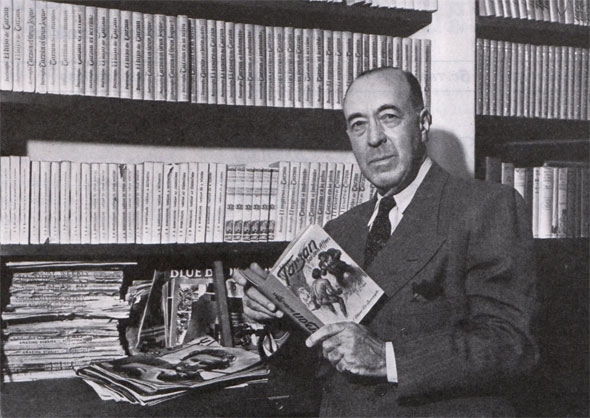
You’re working on the Great American Novel, and following all the best advice to new writers. You read widely from the great books. You study the rules of grammar and effective composition. You write about what you know. You write, revise, and write more. And you’re prepared to endure years of obscurity before your work gets popular.
Of course, you can completely ignore all these rules and still succeed. Edgar Rice Burroughs proved it. Without trying, he broke nearly every conventional rule for achieving literary success. He didn’t study composition or do much practice writing. He didn’t read widely. He didn’t even want to be an author.
Burroughs grew up with dreams of a military career, but when he applied to West Point, he failed the entrance exam. He enlisted in the army but was soon discharged for medical problems. For years, he drifted between jobs, selling cattle, managing an office, running a store, and mining for gold among other unsuccessful endeavors. He only started writing magazine fiction because he was desperate to earn a little money.
In 1911, he submitted an adventure story about life on Mars to All-Story, a pulp magazine. When it was accepted, he turned out two more in the same vein. And then he wrote Tarzan of the Apes.
Rather than writing about what he knew, Burroughs set his adventure-fantasy in Africa, a continent he only knew from a single book he’d read. Yet his ignorance of the country didn’t reduce the story’s appeal when it was published in 1912.
Burroughs soon followed up on his jungle hero with The Return of Tarzan. Before his death in 1950, he published 22 more titles in the Tarzan series. Between these books, he also wrote over 45 other novels, most of them set in outer space or the Wild West. They helped make Burroughs a wealthy man, but they were never as successful as the Tarzan series.
Burroughs began to exploit the public’s enthusiasm for his jungle hero despite the advice of experts. They warned him that he would over-market his character and the public would tire of Tarzan. But Burroughs ignored them and licensed his character for simultaneous use in comic strips, movies, and merchandise. Once again, he proved the experts wrong. Instead of diluting the appeal, mass-marketing Tarzan only made the character even more popular.
We’ve come a long way since Tarzan was the most popular hero of the day. Other characters have arisen to crowd him off the center stage of popular culture. This year, as he turns 113 years old, he probably wouldn’t seem impressive if you stood him in a lineup with today’s superheroes. But don’t let his lack of cape and skin-tight costume fool you. Modern superheroes, and their creators, owe their livelihood to Tarzan. He was a major turning point in popular fiction, and he made a new generation of do-gooders possible.
Before his time, the heroes in adventure novels were drawn from an established cast of chivalrous characters. They might be noble cowboys or soldiers, but just as often they were roguish characters who lived on the edge of society: outlaws, pirates, or detectives. But all heroes, if they existed on planet Earth, had to fight the usual villains with conventional weapons. Adventure stories had to stay within the fictional boundaries that readers knew.
Tarzan changed the rules for heroes just as Burroughs changed the rules for writing bestsellers. His jungle hero wasn’t limited to traditional strength. Raised by apes, Tarzan had developed incredible power. He could fight all manner of dangerous animals, including fantastic creatures and dinosaurs.
His African locale also opened new possibilities for villains. Tarzan fought slave traders (Tarzan Triumphant), mad scientists (Tarzan and the Lion Man), communist plunderers (Tarzan the Invincible), homicidal cult (Tarzan and the Leopard Men), and German soldiers in World War I (Tarzan the Untamed). And in a creative leap that better writers might have advised against, Burroughs dropped him into forgotten colonies of people lost in time, so he could fight medieval knights (Tarzan, Lord of the Jungle) and Roman gladiators (Tarzan and the Lost Empire).
As long as he was rewriting the rules, Burroughs could expand the realm of the possible. He made Tarzan implausibly smart. For example, Tarzan taught himself to read English from a book, even though no one had ever explained what a book was. In fact, he hadn’t even heard human speech when he learned to read. But then, there had never been a hero like Tarzan. And once readers got pulled into the book, they wouldn’t stumble over such impossibilities.
Burroughs’ great hero may have faded into the background of popular characters, but he is never forgotten. The character has appeared in about 100 motion pictures, not counting the several Tarzan television programs. No doubt there’ll be another Tarzan movie in the future. Perhaps it could be another Disney animated feature; the director of the wildly popular Frozen recently declared that Tarzan was the brother of his movie’s main characters.
Modern readers who pick up a Tarzan book for the first time might find Burroughs’ style a little dated. But he may also note the similarity between Burroughs’ hero and another orphan who grew up to wage a solitary, unbound-by-rules war on evil. The resemblance isn’t coincidence: Without Tarzan, there could be no Batman.
Bathing Beauties
With floppy sunhat providing shade and shield from harsh rays, this head-turner is free to luxuriate in the beachside aurora of a salty summer’s day.
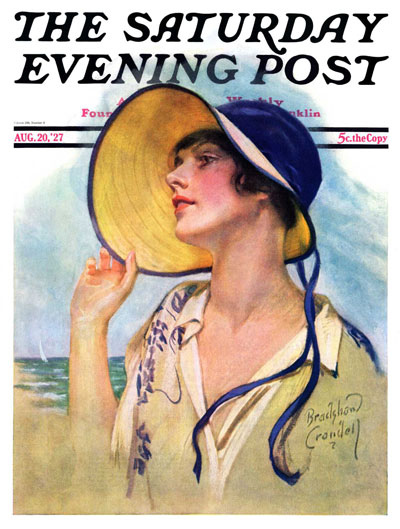
August 20, 1927
No amount of lathering is going to ease a smolder that red. Though this burned beachgoer can take comfort in the fact that her dual-toned skin and swimsuit form a rather patriotic guise.
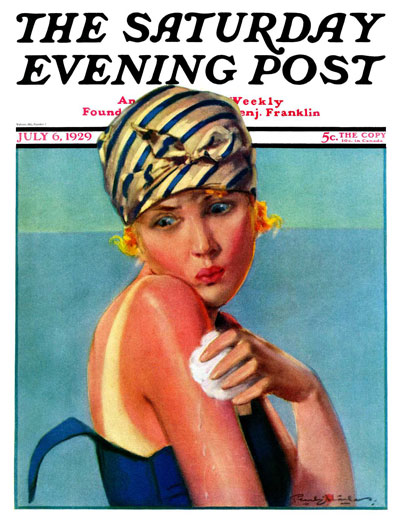
July 6, 1929
Stretched out under the lacy shelter of a parasol, these ladies are prepared to transform the lawn into a first-class pinup photo shoot.
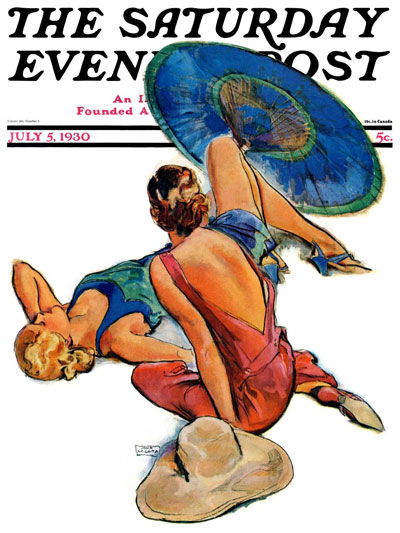
July 5, 1930
Garbed in their complementary aquamarine getups, this trio may just fade into the luster of the ocean blue once they’ve hit the dunes.
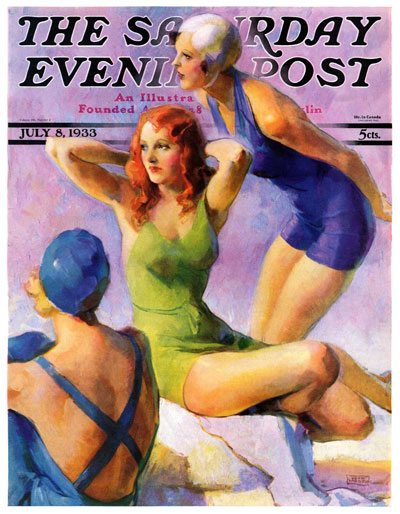
July 8, 1933
For those seaside loungers wishing to hold court over the shimmering surface without dampening their locks, perching on a diving board is a suitable compromise.
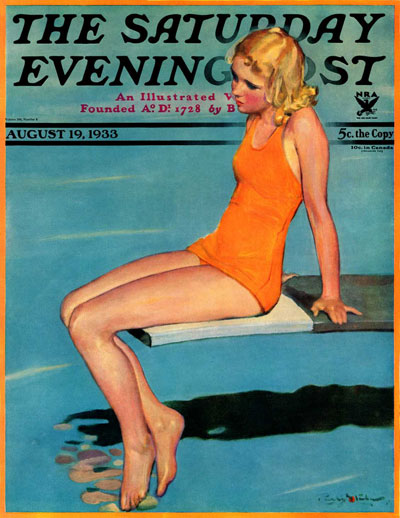
August 19, 1933
Sporting sandals is just an invitation to trek sand about for weeks afterward. But it’s well worth it when the elegantly casual ensemble will draw every eye on the shore.
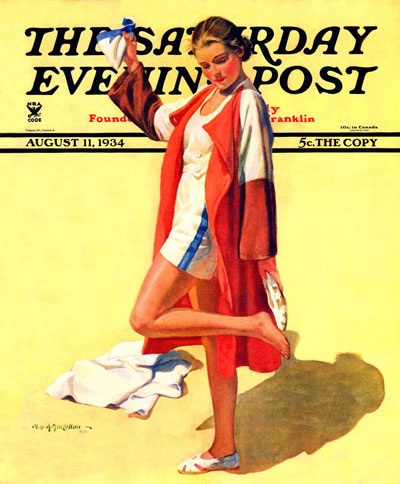
August 11, 1934
It’s surf’s up or more appropriately skis up for this golden couple as they crest another foamy wave. And if they should happen to capsize, that striking crimson of hers will make them easily spotted for pickup.
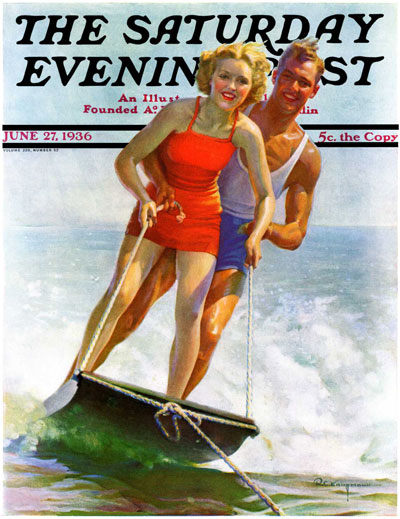
June 27, 1936
Whether perfecting a competitive breaststroke or just dipping toes in the drink, poolside is the place to be in summer’s steamiest weeks.
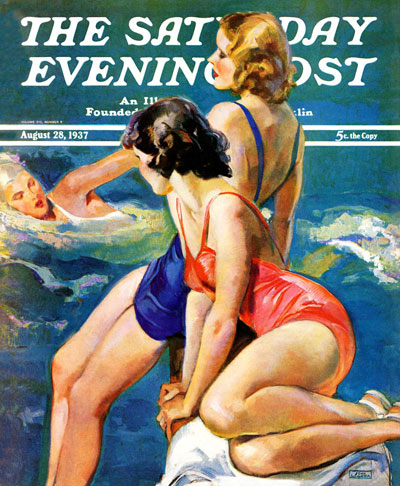
August 28, 1937
A smarting smack to the rear wasn’t exactly on this perturbed stunner’s checklist for beach day. At least she had a sandy landing to cushion the spill.
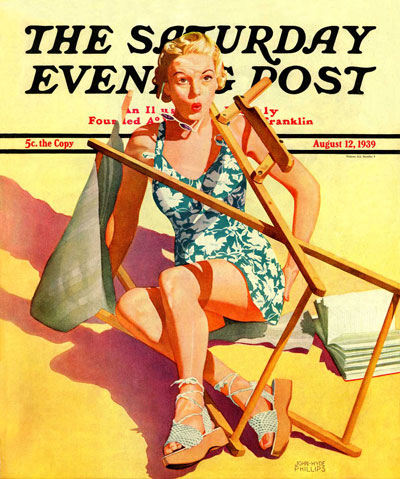
August 12, 1939
Everyone pines for a tropical escape; but in a pinch, an urban rooftop destination will do, and it’s just as toasty. If you can’t reach the beaches, you can always climb a little closer to the sun.
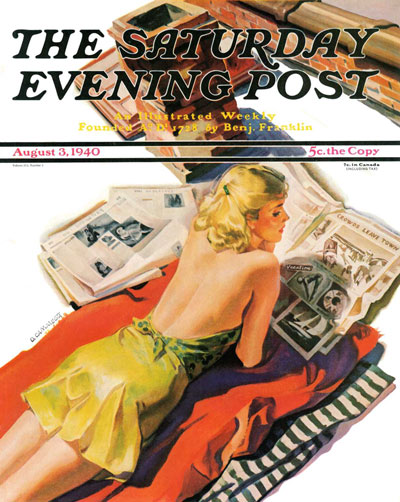
August 3, 1940
X marks the spot for tan-line regret as this socialite discovers her sun-cooked body art isn’t going to pair well with the plunging backline of that pearly frock.
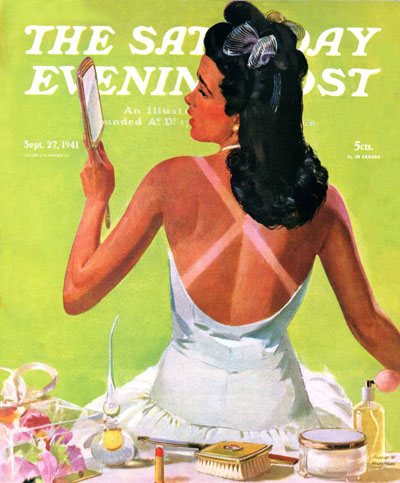
September 27, 1941
When the hours have worn everyone down, a few bubbly sips and a cool-off card game under the umbrella may be just the right pick-me-up before a final splashdown.
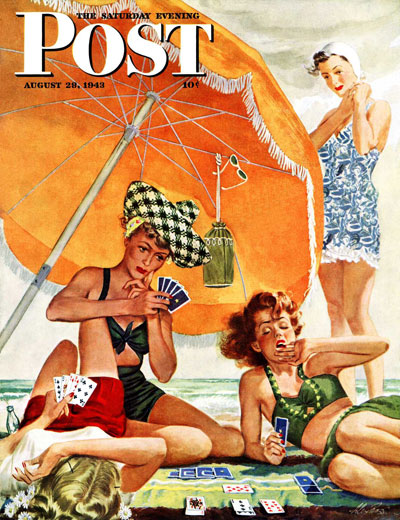
August 28, 1943
Boogie Knight
KC and the Sunshine Band’s parade of chart-busting hits from “Shake Your Booty” to “That’s the Way I Like It” sold hundreds of millions of copies and remain a staple at bar mitzvahs and weddings. Now, the “KC” in the band, Harry Wayne Casey, is leading their comeback with a new album, Feeling You! The Sixties, covering songs by his favorite performers of that decade — from The Righteous Brothers to (surprise!) Bob Dylan.
The Saturday Evening Post: When you started out, did you have any idea that your music would not only last but find new audiences?
KC: When I began we were doing R&B, but then the movie Saturday Night Fever was a hit. We were on the soundtrack with “Boogie Shoes” and suddenly our songs became “disco.” They don’t call it disco anymore, but today dance music is everywhere. I’m excited that our music is still doing it for everyone from babies to grandmas.
SEP: You seem comfortable with fame now, but at an early stage of your career, you surprised a lot of fans by dropping out for several years.
KC: We had a lot of success. But at the height of it, I felt very lonely and isolated. Everywhere we went, there would be thousands and thousands of people standing outside of our hotel cheering. I wanted to be in that crowd so bad. I did a lot of partying and got really heavy into drugs for awhile. Quitting the business for a few years ended up being good because I got a new perspective on life. These days, I’m more relaxed when I go on stage. I even make fun of myself, like how much weight I’ve gained since I quit smoking. But I’m in better voice than I’ve ever been in my entire life.
SEP: Your new album is a departure for you, covering classic songs from the ’60s. What was it about this period that makes it so compelling?
KC: Are you kidding? The ’60s was like a free time.
We had three TV stations that pretty much went off at midnight and not as many radio stations as today. You didn’t have as many choices, but you didn’t have to worry if your front door was locked. You didn’t walk around being preoccupied holding a phone in your hand all the time. So, it’s just an interesting time in life that’s gone forever, you know? One Buddy Miles’ song on the new album, “Dreams,” just takes me back to a certain time and place. I can picture us there, me and my friends, and it’s so amazing. I mean, music gets us through sad times, through falling in love, through breakups — in some ways it’s our personal psychiatrist.
Bird, Mother, Son
Part One: Bird
Inside its cage, the bird nibbled at a piece of porous bone. White dust drifted to the kitchen table, where the cage sat, for now.
Cuttlefish, Marla had said. Parrotlets like cuttlefish, not as friends, but as bones, as bones for beak cleaning. Robert grimaced at the feathered blue spot. He leaned down and whistled to clear the bone dust from the table.
“Why did you take it?” he said, displeased. Marla had not consulted him.
“My student insisted,” she said. She was glad. She had always liked birds.
“Where are you going to keep it?”
Marla looked around.
“I think by the TV. I can hang the cage outside by the fuchsia when it’s warm.”
“You are not keeping that bird by the TV.”
“This bird? Why?”
They stared at the bird. It was three inches high, day blue on the bottom, night blue on the top. It was perched on a twig, hiding inside a cluster of plastic bells. Marla had already been to the bird shop. A parrotlet playground was sitting in the trunk of her car, complete with swing set and slide.
“How long will it live?” The bird nibbled its cage.
“Isn’t he cute? Parrotlets go for $300 on Craigslist.”
“How long?”
“My book said 25 to 40 years.”
“You’re saying that this bird might outlive me?” “It’s possible.”
Robert left the room.
“Hello, Toulouse.” Marla cut a raspberry in half and fed it to the bird, who wrestled the fruit down, spraying red juices around the bars of its cage.
Part Two: Mother
The road to Vista del Sol was not oak-lined or beautiful. It was short, concrete, and matter-of-fact. Robert never drove to Puesta del Sol without picturing the ghosts of the recently deceased—and there were always one or two recently deceased—floating across the lawn.
Robert hated Puesta del Sol. The facility and grounds smelled like earth and sour fluids. But getting into Puesta del Sol was like getting into Harvard for old people, and his mother loved it. There were yoga classes, which she never attended, and a bridge club, which she didn’t join. There were walking groups, whose members far outpaced her, and weekly Bingo games, which she regularly missed. She mostly sat with her neighbor, Betty, or read. She had dinner at 4:30 and was in bed by seven. Asleep by 8. Up at 6. Weakening, worsening. Moving less, breathing harder.
Robert worried about her. He wore his concern like a mask as he stepped out of his car, braving the August heat for 45 hurried seconds as he dashed from car to building. By the time he passed through the automatic glass doors and plunged into the mildew-scented, air conditioned reception area, he was already sweating.
“Hello, Claudia.”
“Good evening, Robert. Florence just finished her dinner. She should be in her apartment.”
“Thank you.”
Up a flight of steps, which his mother couldn’t climb, down a hall to an open-air corridor. Number 15’s porch was decorated with two pots of silk flowers and one plastic shrub. Robert knocked.
He waited.
The door opened.
“Well, hello, Robert.”
“Hi, Ma.”
He barely recognized her anymore. She had been so sturdy, so social.
“Come in.”
She shuffled — another new development.
She sat.
“Claudia said you just finished your dinner.”
“I did.”
“What did you have tonight?”
“We had lobster, would you believe it?”
“That’s great, Ma. They really take care of you here, don’t they?”
“They sure do.”
Robert sat.
“I brought this for you. An early birthday present —”
Robert handed his mother a book — an anthology of stories for children published in 1926, the year she was born. He had purchased it on eBay.
“Oh, I don’t read anymore.”
She set the book down without looking at it.
“You don’t read? Why not?”
“I can’t see the words.”
“Well, we should get you new reading glasses.”
“They’re looking into it.”
“Who’s they?”
“The doctors. I told the nurse downstairs. They’re looking into it.”
“Has this gotten worse? I could go down to the nurse with you right now.”
“They’re looking into it.”
“Does Michael know?”
“Of course Mikey knows. He took me to the doctor.”
“He never told me about it.”
“Why would he?
“I’m the older brother.”
“I don’t think it matters when you’re both in your 60s, Robert.”
“You know, Ma, there’s that really nice place right by my house —”
“I like it fine here.”
“I know —”
“Did Mikey tell you about Andy?”
“The promotion? Yeah, he mentioned it. What a kid.”
“He’s moving into a new apartment soon — something private.”
“He’s a good kid.”
Robert looked at the book.
“So what are we doing for your birthday?”
His mother stood.
“You don’t turn 90 every day, Ma.”
“I’m going to bed now, Robert.”
“Now? It’s only 6:30.”
“Yeah, well.” She shuffled.
“Do you need any help?”
“No, I don’t need help getting ready for bed.”
Robert stood.
“Well, then I guess I’ll go.”
“Goodnight, Robert.”
Goodnight, Ma.
One hour to work, one hour to his mother’s, one hour home — he spent one-eighth of his life in the car, one half of it at the office, one quarter of it sleeping, one eighth of it in the garage.
When he entered his house, the lights were off. Before he climbed the stairs he noticed the ghost-like cage sitting on a pedestal by the television. A navy shawl had been laid over the bars.
Robert walked thief-like across the carpet and lifted the sham. Toulouse was asleep, nestled amongst his bells.
Hello, Toulouse.
Puesta del Sol had been built in the armpit of a mountain, and Robert could not determine whether the facility’s high hedges were meant to provide privacy to the home’s residents, or to shield the rest of the community from the dispiriting sight of senescence.
“Hi, Ma.”
“Well, hello, Robert.”
Come in. Come in. Shuffle.
Sit.
“So what did they give you for dinner tonight?”
“Just chicken.”
“Chicken?”
“Cold chicken.”
She pursed her lips, which looked increasingly pleated, like a flesh kilt.
“Don’t they ever give you steak?”
“Rarely.”
“I could bring you a steak, if you’d like.”
“That would be nice. There’s a Somersteak Grille on Melville.” “I’ll bring one next time I come up.”
“I could do with one now.”
“Now?”
“They only had chicken.”
“Okay, Ma. I’ll be right back.”
Robert ordered a bloody prime rib to-go and sat on a wagon-wheel bench to wait. A young couple arrived after him and was quickly led to a table.
Next, a family of five. This was trickier. The host, freckled and angular, took their name and then disappeared. The husband stood while the wife sat down on the only available bench, a toddler in her arms and a kid to either side — a quiet family. No squirming or whining or crying or biting. Just hushed giggles and library-voice speculations about dinner and dessert and the weekend. Then the mother turned the toddler around in her lap and they rubbed noses. The toddler’s eyes crinkled with delight and he leaned in for another go. Then the other kids took turns rubbing their noses against their younger brother’s, until the game got out of hand — the boy clapping and squealing, the other kids leaning toward their brother at dangerous speeds. The dad stepped in then and distracted them all with a game on his phone. But before the game could get started the host returned with their menus and their table number.
The next moment was so quick that Robert wondered if he only imagined it. As the woman stood up, she whispered something in her little son’s ear:
I love you.
Robert didn’t hear them, but those were the words in the air.
“Robert?”
The freckled host with the too-long limbs was holding out a to-go bag.
“Ma?”
The door was unlocked. “Ma?”
The bedroom light was on. “Ma? Are you here?”
“I’m in here, Robert.”
His mother was in bed, reading. She was not reading Robert’s book.
“Ma, I have your steak.”
“How did they cook it?”
“Rare.”
“Oh, good.”
“Are you going to eat it?”
“Put it in the refrigerator. I’ll have it tomorrow.”
“You’re going to bed? It’s only six o’clock.”
“I had my bath while you were gone.”
Robert paused. The scene from the restaurant was still fresh, still real. “Do you want me to read to you?”
“I have my new glasses.”
“Oh, they came already? How do they work?” “Just fine.”
“Good. Good.”
“See you tomorrow, Robert.”
“Okay. Good night, Ma.”
Marla was sitting on the couch with Toulouse on her shoulder. “Robert, come watch.”
Robert, still carrying his briefcase, approached.
“Look.”
Marla held a finger against Toulouse’s breast. At first the bird nipped at it, but then it climbed. Marla held up another finger, a little higher, and Toulouse ascended. Twelve times the bird hopped from finger to finger before it fluttered hopelessly toward a mirror and, discovering the mirror to be solid, crashed down behind the piano.
“Oh no!”
They fished for the bird with the delicate arm of a birch.
Toulouse emerged, stunned, but uninjured.
“So what are we doing for your mom’s birthday tomorrow?”
“Taking her out to breakfast, I think. Michael has something planned.”
“How’s she doing?”
“She’s really frail. They have her on 12 different medications.”
“For what?”
“Pretty much everything, I think.”
“Geez. I hope they know what they’re doing.”
“They’re doctors.”
“Yeah, well.”
Robert tickled Toulouse’s belly and the bird hopped onto his finger, an unexpected act of trust. Robert couldn’t help it. He raised his voice and said, “Hello, Toulouse.”
“He’s cute isn’t he?” Marla tried not to sound smug.
“Do you think my mom would like him?”
“Toulouse?”
“Yeah.”
“I don’t know, Robert. Your mother —”
“Yeah, I guess you’re right.”
Marla stifled a yawn. “Will you put Toulouse away when you come up?”
“Sure,” Robert said. He looked at Toulouse, who was listening apprehensively.
Marla headed upstairs.
Robert said, “My mother used to have a dress with a bluebird on it. She wore it all the time. I wonder what happened to it.”
Marla looked down the stairs at Robert. “Did you say something?”
Robert looked at Toulouse, who was not a bluebird, but a South American parrotlet. “No, nothing.”
“Okay. Goodnight, Robert.”
Marla disappeared into their room.
Toulouse chirped quietly, eyeing Robert with timorous understanding. Robert returned Toulouse to his cage, draped the navy sham over the bars, and turned out the lights.
Part Three: Son
Robert slept poorly, first in his bed, then on the couch, and finally on the floor by the television, the floor being the most comfortable surface and the one on which he eventually dreamed of the mother, her happy son, and the words that had hung around the quiet family like a veil.
At the first hint of morning, Robert sat back on his heels — a position so uncomfortable that it threatened to break his legs into several wooden pieces — and stared at Toulouse’s shrouded cage. He crawled forward on all fours and tore down the mantle. Toulouse was awake amongst his bells, watching Robert now and seeming ill at ease.
Without uttering so much as a greeting, Robert slid open the white metal gate and approached the bird with one sleep-swollen, timid finger. Toulouse nipped him twice and then hopped up, chirping softly, sensing that this was a secret assembly.
Robert drew Toulouse out of the cage and sat back again onto his heels. He stayed in that agonizing pose for 24 heartbeats before standing and carefully, unalarmingly, walking through his house toward the yard. He slid open the backdoor and stepped out into the graying, pinking, purpling dawn.
Hello, Toulouse.
Chirp.
Robert stretched his arm up, inviting the bird to fly. Toulouse looked toward the cloud-kissed sun and spread his wings. For one breathless moment Robert prepared himself for the misery of the departure, for the anger of his wife. But then Toulouse turned his beak under and began to preen himself, white bits fluttering to the ground like warm snow.
They stayed like that — man and bird — until Toulouse finished grooming. Toulouse moved first, hopping off the finger to the wrist, then up the arm to the elbow, then up the shirted bicep to the shoulder, around the back of the neck to a place that must have seemed to the miniature fowl exactly right.
Chirp.
Inside, Robert guided Toulouse to the parrotlet playground, which was now situated near the kitchen atop a table on which Marla had painted in bright colors the word Toulouse. The bird played there all morning, while Robert and his wife readied themselves for breakfast with Robert’s mother.
Robert’s temper rose like mercury, as predictably as the sun: Marla was slow; their house was a mess; they were late. Everything everything everything was unsatisfactory.
Marla ignored this, like water on feathers.
“Robert, could you put Toulouse back in his cage?” Marla called as she walked down the stairs, her hands busy with earrings.
Robert looked at Toulouse. Toulouse looked at Robert. Robert reached out his finger. The bird boarded.
Robert hid Toulouse in his coat pocket and hurried out the door.
This remained a secret for nearly 30 miles. Then, chirp.
Marla looked at Robert. She already knew.
As they discussed their options, Robert’s fury — he had not spoken since they got on the freeway; he had clenched his jaw and glared at the road, wearing his anger like another mask — gave away to the sheepish truth: He wanted his mother to meet Toulouse. He imagined the bird would please her.
“But we’re going to a restaurant.” Marla did not understand Robert sometimes. “You can’t take Toulouse into a restaurant.”
“I know.”
“But it’s too hot to leave him in the car.”
“I know.”
“Well, what do you plan to do?”
Chirp.
Toulouse seemed happy enough in Robert’s coat pocket, and as they parked their car they concluded that Toulouse would have to accompany them to breakfast.
Michael, his wife, Pamela, and the 90-year-old birthday girl were already seated at a booth near the back of the restaurant. Robert and Marla approached — Marla carrying a flamboyantly wrapped package (a sweater), Robert carrying the warm body of a pensive parrotlet in the darkness of his left pocket.
“Hi, Ma.”
“Hello, Robert.”
“Hi, Florence.”
“Hello, Marla.”
“Happy birthday.”
“Well, thanks.”
“Hi, Michael. Hi, Pamela.”
“How was traffic?”
“Not bad.”
Chirp.
Only Robert and Marla heard. Only Robert and Marla were listening.
Chirp chirp.
Marla smiled.
Michael talked about Andy.
Pamela talked about Andy.
The birthday girl talked about chicken and lobster and her favorite grandson, Andy. She ordered a steak omelet.
Marla smiled.
Robert’s palms began to sweat.
“Are you okay, Robert?”
“Yeah.”
The food came.
“Oh, good,” said Florence, the birthday girl.
Chirp chirp, said Toulouse.
Michael looked over his shoulder. “Did anyone else just hear a bird?”
Nervous laughter.
Pamela, “I thought I heard it, too.”
Marla, “Well, actually—”
Robert, “I think it was on the soundtrack.”
Michael, “That’s funny.”
Chirp chirp.
Robert reached into his pocket.
Toulouse watched a hand the size of the known universe grasp for his quivering body, and this time he did more than nip. He bit.
“Ow!”
“Are you okay, Robert?”
Toulouse stuck his head out of the pocket.
Robert pushed the bird back inside.
Toulouse wriggled free.
“Toulouse!”
Toulouse landed on Robert’s lap and then fluttered to the floor.
“What the—”
“Be careful!”
Toulouse hopped between the toes and heels and crumbs. He emerged on the far side of the table.
Robert lunged, but Toulouse was too fast. He winged his way onto the neighboring table.
A woman screamed. A man swore something holy.
“Could I get a to-go box?” Marla said to a passing busboy.
Fast footfalls and urgent voices.
Robert lunged again.
His mother’s voice: “Robert, what are you doing?”
Toulouse dodged a handbag and landed in a glass of water.
Chirp chirp chirp chirp chirpchirpchirp chirp chirp.
A fast hand grabbed.
“Toulouse!”
Robert nearly fell against the waiter.
“Is this your bird?”
Robert did not feel veiled words and warm noses. Instead, he felt annoyance and disappointment in so many, many eyes.
He nodded.
Chirp chirp.
Hello, Toulouse.
A warm body again in his coat pocket and a short, ushered walk to the door.
The morning could have proceeded in two ways: Robert and his wife and his brother and his brother’s wife and his mother could have laughed about the scene and swiftly changed their plans, relishing the unique story, the change of pace. Or they could have left the restaurant in grim silence, avoiding one another’s eyes, shunning one another’s touch. Every family of every form and function makes this decision every day — whether to love openly or to keep a safe, censorious distance.
Robert and his wife and his bird drove home alone, the present unopened, the breakfast uneaten, the words of forgiveness and humor unspoken, unconsidered, and when they reached their house they, after some solemn pause, laughed and chirped and ate a lunch of sandwiches and raspberries that tasted, to them, as sweet and sharp and full as the mercurial sun.
News of the Week: Tinder, Trumbo, and the Tooth Fairy
The Problem with Tinder

Algorithms. That’s what everything runs on these days, algorithms. It’s why you only see certain posts from your friends on Facebook, why you get the Google search results you get, and why you see the news stories you do on your news page. It’s also why you see the people you see on Tinder.
I’m not on Tinder, and I’m not even going to “try it out” in the name of journalism. It’s where you “swipe” and meet random people, right? But the more you use it the less random it gets. I was watching Today the other morning and they interviewed the CEO of the company. One thing I didn’t know is that the service learns from the way you use it. For example, if you are consistently interested in women who ski, that’s what Tinder will show you a lot of. And this is where technology is changing the way we live our lives, and not in a positive way.
Do people really want to get together only with a partner who has the same exact interests as they do? I hope not, and I don’t think they do. Think of how our parents or grandparents met and maybe even how you met your spouse. Did they fill out a questionnaire to see who was most “compatible”? Did you not want to date people because they weren’t into football or weren’t interested in cars or because they were vegetarian and you like pepperoni on your pizza? Of course not.
That’s where I think technology has messed things up. We only interact with people who have the same interests, and we live in echo chambers politically and socially. Serendipity is gone, but we can fine-tune our news and social pages so precise that they reflect only the stuff we’re interested in (based on what has interested us in the past).
But back to Tinder. The company had a meltdown on Twitter recently that — surprise! — looks to be a planned PR stunt.
Trumbo
Dalton Trumbo was an acclaimed screenwriter and novelist. He was also one of the Hollywood Ten, a group of film industry professionals who had alleged Communist ties and were eventually blacklisted. The ten were sentenced to one-year in jail; Trumbo served between 10 and 11 months. When he got out he couldn’t find any work. So he wrote screenplays under pseudonyms. This November we’ll see a big screen biopic on Trumbo’s life, titled Trumbo. Bryan Cranston plays the writer, and he has a fantastic supporting cast including Diane Lane, Louis CK, Elle Fanning, John Goodman, and Helen Mirren. Here’s the trailer:
And if you’re wondering if Trumbo ever wrote for The Saturday Evening Post … he did! Trumbo wrote several short stories and articles for the Post in the 1930s and ’40s. He also wrote the screenplay for the 1950 film noir Gun Crazy, which was based on the MacKinlay Kantor story published in The Saturday Evening Post story in 1940. Kantor and Millard Kaufman were given credit for the screenplay because Trumbo was blacklisted at the time.
Hopefully the film — which I’m sure will be well-represented come Oscar time — will spark renewed interest in Trumbo and some of his out-of-print books will be released again, particularly Additional Dialogue, a series of letters he wrote between 1942 and 1962.
The Tooth Fairy Has Fallen on Hard Times
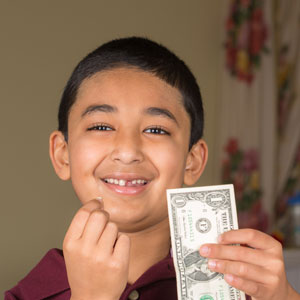
Every year there’s a list of the best and worst careers. I don’t recall “tooth fairy” being on the worst list, but maybe we’ll see that in 2016. For the second year in a row the Tooth Fairy isn’t paying as much as he used to. Kids are only getting an average of $3.19 under their pillows, and that’s 24 cents less than last year.
Wait … $3.19 per tooth? And that’s less than kids used to get? When I was a kid I think I got at the most a dollar.
By the way, this info comes from Visa’s annual Tooth Fairy survey. Yes, really.
Can You Tell Me How to Get, How to Get to HBO?
Here’s another splash of financial cold water to the face: The makers of Sesame Street have struck a deal with HBO to air the classic children’s show on the premium cable network first. It will be shown on PBS too, but kids will have to wait nine months to see new episodes there.
Is this a good move? As Jessica Winter of Slate says, it might be good practically but not symbolically. It’s fine because a lot of kids stream the shows online these days and the money will certainly help. On the other hand, one of the reasons Sesame Street started was to give kids access to education and other information on public television. Seems odd that parents are going to have pay to get HBO for their kids to see it right away, and under the deal, the streaming that kids used to see on Netflix and Amazon will go away too because HBO gets the exclusive (though reruns of the show will still be shown continuously on PBS). The show will also eventually go from 60 minutes to 30 minutes. I guess this is a nod to the attention span of kids these days and video games and entertainment getting shorter shorter, faster faster!
The Web is having fun with the news though. Approximately 27,000 people made this joke, but it’s still funny:
#TrueDetectiveSeason3 pic.twitter.com/6EBe5kxfhU
— Brian Lynch (@BrianLynch) August 13, 2015
The Return of Johnny Carson
Late-night talk show reruns are weird now. Years ago, when The Tonight Show or Late Night with David Letterman had a rerun, they would dip into their vast archives and pick an episode from years earlier. Now if Jimmy Fallon or Conan O’Brien or Jimmy Kimmel runs a repeat, it’s something recent. Often it’s something very recent, like a week or two ago. Seriously, this is what late night repeats are like now. They repeat episodes from just a week or two ago, and if they want to go way back they’ll air something from a month ago. It’s almost as if the shows don’t trust their audiences to understand that an episode might be a couple of years old and the references might be old or the jokes not as timely or a guest might not even be alive anymore.
But there’s hope! Antenna TV has made a deal with Carson Entertainment Group to show whole episodes (not just clips) of Johnny Carson’s Tonight Show. It will be called Johnny Carson (NBC still owns rights to the Tonight Show name), but we’ll know what it is. The shows will air every night at 11 p.m.
This is fantastic news. I’ve always wondered why the broadcast networks don’t air more classic shows. Instead each fall we get new shows we know will only last half a season or shows that are retreads of other popular shows or reality shows. Every year CBS airs I Love Lucy specials, and it gets great ratings. Wouldn’t it be great to see one of the networks air The Dick Van Dyke Show every Thursday night at 8?
It will never happen, and that’s why we have cable channels and DVDs.
The “New” New Colonel Sanders
Did you finally get used to seeing Saturday Night Live’s Darrell Hammond as the new Colonel Sanders in recent ads for KFC? Well, hopefully you didn’t get too used to him because he’s gone already! For some reason, Norm Macdonald, himself an SNL veteran, has taken over for Hammond in the latest ads for the chicken chain.
Howdy, folks. It’s me, the REAL Colonel Sanders, back again, but for real this time. pic.twitter.com/Zj30LPXmXB
— KFC (@kfc) August 17, 2015
Maybe they’re going to do this every few months, replace the person playing Sanders with a different cast member from SNL’s past. I’m looking forward to Kristen Wiig’s interpretation of the advertising icon.
National Back to School Month
When I was a kid — and I find myself starting many sentences with these words since I turned 50 — school always started after Labor Day. It wasn’t until a few years ago that I realized that a big chunk of the U.S. goes back to school in August. How can kids go back to class and lug all that homework home in the hot, humid dog days of summer?
August is National Back to School Month, and it seems cruel to me that they’d make kids go back so early. Or maybe National Back to School Month is supposed to be celebrated more by parents. Sorry kids!
Reminds me of this classic ad from several years ago:
Upcoming Events and Anniversaries
The Wizard of Oz premieres (August 25, 1939)
Did you know that Warner Bros. has an official site for the classic movie?
Paris liberated (August 25, 1944)
Wikipedia has a detailed account of the military battle that lasted from August 19 to August 25.
First televised Major League Baseball game (August 26, 1939)
How James Thurber and The Saturday Evening Post changed baseball.
President Lyndon Johnson born (August 27, 1908)
The White House site has a detailed biography of the 36th President.
Protests at Democratic Convention (August 28, 1968)
SEP Archives Director Jeff Nilsson on 1968, a truly violent year in U.S. history.
Dorothy Parker’s Poetry
The following poems by Dorothy Parker were published in The Saturday Evening Post.
A Triolet
You’ll be returning one day.
(Such premonitions are true ones.)
Treading the dew-spangled way,
You’ll be returning one day.
I’ll have a few things to say—
I’ve learned a whole lot of new ones.
You’ll be returning, one day.
(Such premonitions are true ones.)
Song (3)
When summer used to linger,
Before the daisies died,
You’d but to bend your finger
And I was by your side.
And, oh, my heart was breaking,
And, oh, my life was through;
You had me for the taking;
“Now run along,” said you.
But now the summer’s over,
The birds have flown away,
And all the amorous clover
Has turned to sober hay.
And you’re the one to tarry,
And you’re the one to sigh,
And beg me, will I marry.
“The deuce I will,” say I.
Grandfather Said It
When I was but a little thing of two, or maybe three,
My granddad—on my mother’s side—would lift me on his knee;
He’d take my thumb from out my mouth and say to me: “My dear,
Remember what I tell you when you’re choosing a career:
“Take in laundry work; cart off dust;
Drive a moving van if you must;
Shovel off the pavement when the snow lies white;
But think of your family, and please don’t write.”
When I was two I cannot say his counsel knocked me cold.
But now it all returns—for, darling, I am growing old,
And when I read the writing of the authors of today
I echo all those golden words that grandpa used to say:
“Clean out ferrboats; peddle fish;
Go be chorus men if you wish;
Rob your neighbors’ houses in the dark midnight;
But think of your families, and please don’t write.”
Song of the Conventions
“Song of the Conventions” by Dorothy Parker was originally published in The Saturday Evening Post on February 24, 1923.
We’d dance, with grapes in our wind-tossed hair,
And garments of swirling smoke;
We’d fling wild song to the amorous air,
Till the long-dead gods awoke.
Our quivering bodies, young and white,
Poised light by the brooklet’s brink,
We’d whirl and leap through the moon-mad night—
But what would the neighbors think?
We’d bid the workaday world go hang,
And idle the seasons through;
We’d pay no tribute of thought or pang
To the world that we once knew.
With hearts in ecstasy intertwined,
In languorous, sweet content,
We’d leave all worry and care behind—
But how would we pay the rent?
We’d roam the universe, hand in hand,
Through tropical climes, or cold,
And find each spot was a wonderland,
A country of pearl and gold.
Our hearts as light as the sunlit foam,
We’d voyage the oceans o’er,
With never a thought for those at home—
But wouldn’t our folks be sore?
To a Lady
“To a Lady” by Dorothy Parker was originally published in The Saturday Evening Post on October 14, 1922.
Lady, pretty lady, delicate and sweet,
Timorous as April, frolicsome as May,
Many are the hearts that lie beneath your feet
As they go a-dancing down the sunlit way.
Lady, pretty lady, blithe as trilling birds,
Shy as early sunbeams play your sudden smile.
How you quaintly prattle lilting baby words,
Fluttering your helpless little hands the while!
Lady, pretty lady, bright your eyes and blue,
Who could be a-counting all the hearts they broke?
Not a man you meet that doesn’t fall for you;
Lady, pretty lady, how I hope you choke!