Summer Fun
It’s the season of empty classrooms, sleepy afternoons, and mercury rising up the meter. These covers offer a glance at the happy-go-lucky methods of sun-baked escapism for adults and kids alike.
Sliding into Water – Lawrence Toney
Sand between your toes and surf lapping at the shore is fine and good, but the neighborhood waterslide can serve just as well. For some, a pair of trunks and the rush of gravity are more than enough to beat the heat.
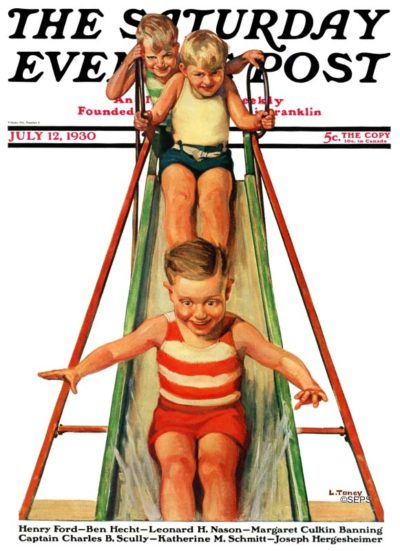
July 12, 1930
Water Fight – Thornton Utz
Providing the water supply holds out, a little mirth and mayhem can turn a suburban lawn into an amphibious battleground. Thorton Utz’s work is a giddy cautionary tale for everyone walking by to hike up their socks.
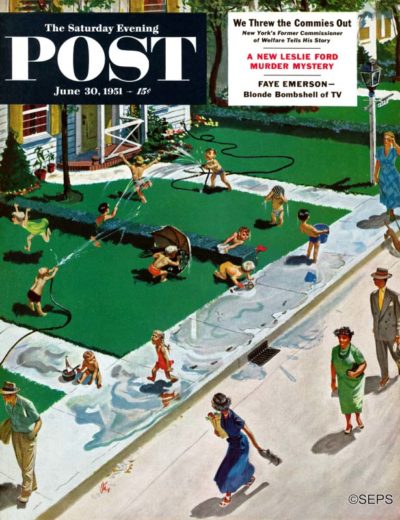
June 30, 1951
Croquet Game – John Falter
The family tournament portrayed in John Falter’s Croquet Game makes for a fitting post-Sunday dinner capper as the sunlight steadily trickles away.
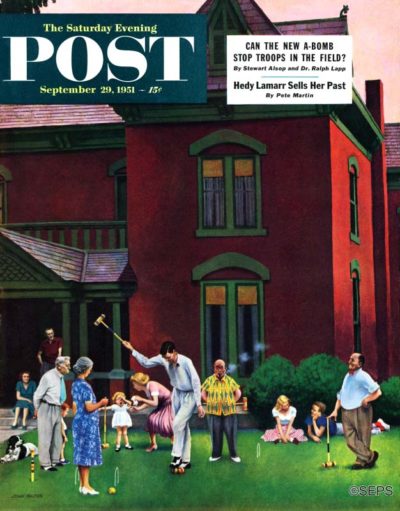
September 29, 1951
No Girls Allowed – Stevan Dohanos
A ramshackle paradise tucked into the trees makes the perfect lazy afternoon retreat for the adolescent crowd still harboring fears of a cootie outbreak. With trumpet, pooch, and crossbones all aloft, they can’t want for much.

August 9, 1952
Feeding the Elephants – John Clymer
Getting up close and personal with a pair of curious pachyderms may be the thrill of the afternoon, but that motley bouquet of balloons just beyond the elephant habitat is sure to draw some new customers in the immediate future.

July 25, 1953
Town Green – John Clymer
A tot jamboree, future hall-of-fame hopefuls, and lounging bookworms round out the cast of John Clymer’s sprawling Town Green, where all can bask in the stippled shade around the gazebo.

August 15, 1953
Backyard Campers – Amos Sewell
A bump in the night is never welcome when all you have are tent flaps for defense. And a few ghost stories too many can render the most innocuous cicada chirp into a sinister bogey-beast on the prowl.
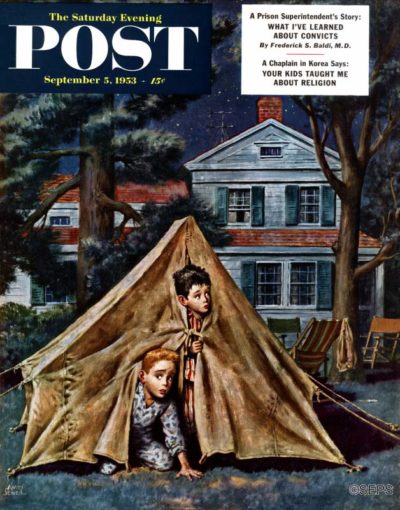
September 5, 1953
Lemonade for the Lawnboy – George Hughes
A shiny quarter would be welcome, but when trimming the lawn in the sticky heat of early summer, payment in icy fresh-squeezed lemonade is just as appreciated.
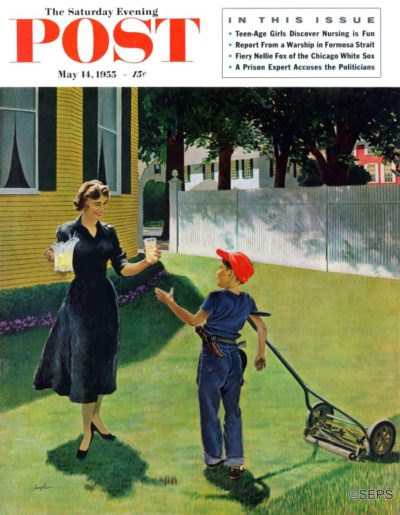
May 14, 1955
Wading Pool – Amos Sewell
Even if one size doesn’t fit all, when the kiddie pool is the only escape from August heat, most are willing to make due. You snooze, you lose.
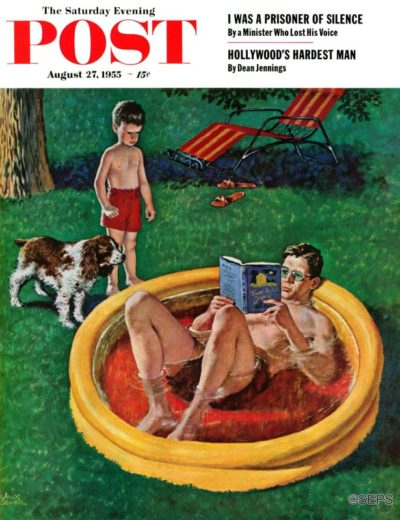
August 27, 1955
Swing-set – Amos Sewell
With shoddy materials and blueprints more complex than the Manhattan Project’s, dad may end up getting better exercise than the kids. Luckily for his patient audience, this dance more than makes up for the lack of functioning swings.
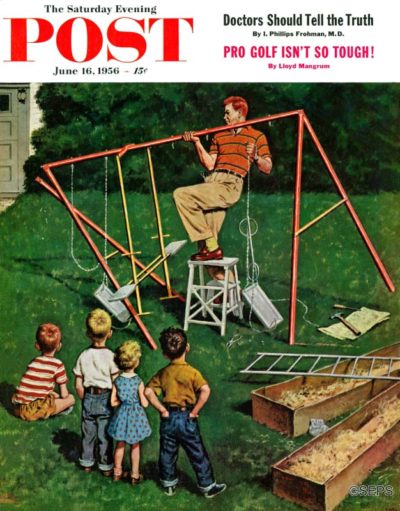
June 16, 1956
Billboard Painters – Stevan Dohanos
In mid-July swelter on the cusp of a scorching third digit, these workingmen are wise to take the advice of their arctic billboard. Unfortunately, no amount of wishful thinking can convince their fictional polar pals to share the snow.
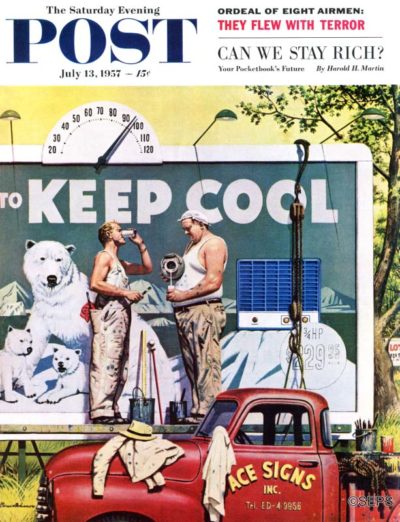
July 13, 1957
Where the Girls Are – Thornton Utz
As shown in Thorton Utz’s Where the Girls Are, the discerning college boy always has one eye open for opportunity, even in excess of the speed limit.
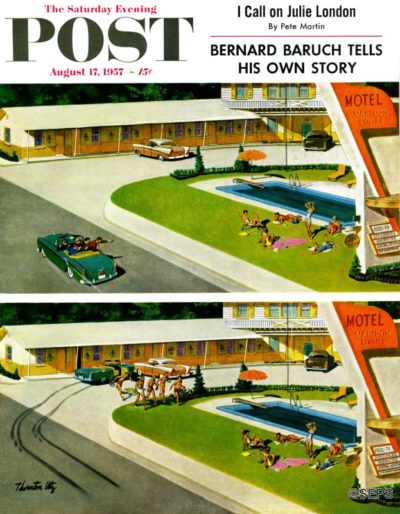
August 17, 1957
The Internet Has Failed Us
Andrew Keen is a British-American tech entrepreneur and CNN commentator. His new book, The Internet Is Not the Answer, acknowledges many benefits of technology but argues that we ignore the darker side of the digital world at our peril.
The Saturday Evening Post: You write that the Internet has failed to live up to its early utopian promise. Since we all have such short attention spans nowadays — in large part thanks to the Internet — can you remind us what exactly that early promise was?
Andrew Keen: The original idea, as described by its many evangelists, was that the Internet would democratize the good and disrupt the bad. It would get rid of the gatekeepers, do away with national boundaries — and all this would radically change society for the better.
SEP: But it hasn’t happened?
AK: No. Rather than promoting economic fairness, it is the central reason for the growing gulf between rich and poor and the hollowing out of the middle class. Rather than making us wealthier, the so-called sharing economy is making us poorer. Rather than creating more jobs, automation is destroying jobs. And rather than increasing competition, it has created immensely powerful new global monopolies like Google
and Facebook.
SEP: But from the perspective of the average consumer, one could argue that the Internet has also given us a lot. My email service is free; Facebook is free; classified ads are free now, thanks to Craigslist. But you’ve made the case that none of this is truly free. Can you explain?
AK: Ethan Zuckerman, director of the MIT Center for Civic Media and one of the early Internet idealists, describes the concept of free services as the Internet’s original sin — in my view, that’s an appropriately biblical reference. The reality is we, the consumers, are the ones doing the manual labor; we’re the ones putting up our photographs; we’re sharing our stories and our personal data. In Silicon Valley, venture capitalists refer to ordinary citizens as “data factories.” So, to put it bluntly, in the Internet economy, we’re the product. It’s exploitative. We’re on the verge of an increasingly ubiquitous data economy. And the business model of collecting all that data and essentially giving us stuff for free, that business model depends on surveillance. That’s the trap. The service is free, but corporations will be observing your every move: what you do, what you say, even what you think. Free is never really free.
SEP: The sharing economy — using the Internet as a tool for matching products and services to consumer needs such as renting out a room in your house through Airbnb or driving a cab for Uber whenever you want — has been promoted as a great benefit to society. Can’t it be argued that the Internet empowers those who’ve struggled financially to now be able to find a way to make a living?
AK: Sure Uber allows anyone to drive a cab, but now there’s a single cab company in the whole world that takes 30-40 percent of every single taxi fare. I don’t want my children to inherit a world where everyone is basically selling their labor on these monopolistic platforms where huge companies are growing fatter off their labor, where they have no security, where what they do is not even treated as a “job.” The sharing economy is systematically destroying the hard-won protections built up since the Industrial Revolution — such as unions, pensions, the minimum wage, laws about child labor. As a result, the working poor have to work harder and harder just to survive. It’s just more work, more struggle, less security — more of a dog-eat-dog kind of economy.
SEP: But isn’t some pain always the price of progress? The Industrial Revolution destroyed several types of jobs, but didn’t it create many more new ones?
AK: Technology has created some new jobs, but it’s destroying far more. In the not-too-distant future, machines will be able to diagnose our diseases, figure out complicated law cases. So, even doctors and lawyers will be unemployed. The reality is that we have an increasing inequality of power and wealth in this world. Every industry is being radically transformed, undermined, restructured by the digital revolution — education, health care, taxicabs, hospitality.
SEP: Is that why you say consumers need to consider their roles as citizens, not just shoppers in the Internet bazaar? You say we mistakenly think of the Internet culture as “one of rights, not responsibilities.” What are our responsibilities?
AK: Let’s use the example of Amazon. You can shop any time. And the pricing is too good to be true. You can buy my book at a bookstore for $25; on Amazon it’s $15. But if you do have a nice local bookstore that you like, where you get service, where the bookseller knows your taste and can recommend titles, maybe it’s worth paying the extra $10 to help keep them in business. People need to make the connection. If you care about your local retail business surviving, then you have a responsibility not to focus only on the immediate cost of an item. You have to consider the longer-range cost to you and your community.
SEP: Another cost of today’s Web-based existence that you describe is its so-called rage, or shaming, culture. Some people feel free to trash others for the slightest provocation or politically incorrect thought. There is a disconnect between how we talk to each other online and how we speak face to face.
AK: That’s true. Minorities, women in particular, are subject to rape threats and threats of violence, just for expressing themselves. The Internet was supposed to have created a civil environment for discussion. Ironically, it has become one of the great engines of intolerance. It’s created an echo chamber culture — a more parochial, narrow, selfie-centric universe. Thanks to the Internet, we live in the perpetual present. We stumble from one outrage to the next. I call this the tyranny of the now. We go from someone saying something stupid to the next person’s sexual scandal to some political scandal, and then, you know, after about an hour, we’ve forgotten what the last one was. All these stories acquire such importance while they’re happening, and disappear once they’re over. It’s like fast food.
SEP: Are there rules or guidelines that might help to curb some of this?
AK: James Madison said, “If men were angels we wouldn’t need government,” which is why the Founding Fathers built checks and balances into the American Constitution. Well, we need the same checks and balances on the Internet. Without them, we’ve opened the door to state-sponsored or corporate-sponsored dishonesty, such as when companies seed Wikipedia with marketing material or trump up information on consumer review networks such as Yelp. We need an accountable, strong government able to stand up to Silicon Valley big data companies. As economist Richard Sennett said, if Theodore Roosevelt were alive today “I believe [he’d] concentrate his [trust-busting] firepower on Google, Microsoft, and Apple. We need modern politicians who will be similarly bold.”
News of the Week: Supermarkets, Stamps, and SPECTRE
A&P Files For Bankruptcy

I’ll be honest: I didn’t even know A&P grocery stores were still around. We had one in my hometown that I visited regularly as a kid, but it closed many years ago. There’s a Walgreen’s in that space now. The chain is actually still around in the Northeast, but this week the Great Atlantic & Pacific Tea Co. (A &P) filed for Chapter 11 bankruptcy for the second time in five years and have 120 of its 296 supermarkets lined up to sell to other supermarket chains, including Acme Markets, which plans to turn 76 of the stores into Acme stores. A&P tried to find a buyer for the entire company in 2013 but couldn’t find one.
In addition to operating stores under the name A&P, the company also runs Waldbaum’s, Pathmark, Superfresh, Best Cellars, Food Basics, and The Food Emporium locations. I swear that I didn’t even know that Waldbaum’s was a real place. I heard it for years on Everybody Loves Raymond and I thought it was just a made-up name for Wal-Mart, the way TV shows often use a name like FacePlace to stand for Facebook.
The history of A&P is actually quite fascinating. If you’re interested in the history of supermarkets, that is.
New Stamps!
The Atlantic asks, “Can Design Help the USPS Make Stamps Popular Again?” I don’t know if lack of good stamp design is the problem the United States Postal Service is facing (there are many), but new cool stamps certainly can’t hurt.
The new stamps are called Summer Harvest and are produce-themed, with pictures of tomatoes and watermelons and cantaloupes. They look like the colorful labels you’d see on old food crates. Stamp collecting has always been one of those things I wanted to get into but I feel like I missed my chance when I was 10 years old. Sure, it’s never too late to start something but starting to collect something that there is so much of now seems rather overwhelming. But these stamps look beautiful.
Oh, and read the comments on The Atlantic article, where you’ll find people who are absolutely flabbergasted that people still use the USPS. Seriously? Even with email and social media and online bill paying, how can people and businesses not use snail mail?
SPECTRE
The full trailer for the next James Bond film, SPECTRE, was released this week:
Looks great, right? The Bond trailers are always well done and the movies are always entertaining. But a suggestion for the next film: Maybe it doesn’t have to be about some painful incident/secret about Bond’s past? Every single Daniel Craig 007 film has followed the same pattern (something happened in Bond’s past, he goes rogue, he’s out for revenge, is he too old, this time it’s personal, etc.). Maybe this could be the end of this particular storyline and we can get to some standalone movies?
SPECTRE premieres in the U.S. on November 6. I’m in line for it right now.
The Problem with Gawker
Five years ago I wrote this about Gawker: “I think we can all agree that Gawker is a terrible web site run by terrible people who write terrible things.” Things haven’t changed at the gossip site since then. If anything, it has gotten worse, and everything sort of imploded this week.
First they put up a story (ordinarily a link would go here but I don’t want to give them any traffic) about a publishing CEO who may have attempted to hire a gay escort, then when the web and social media and Gawker commenters (when even Gawker commenters shake their heads …) freaked out about the sleazy, pointless post, management and Gawker Media head honcho Nick Denton decided to take it down. This, of course, irritated the editorial staff at the site and two of the top editors quit in a huff. How dare the “business side” interfere with the “editorial side”?! What about journalistic ethics?
First, it’s all business side. This is the way publications have always been. Second, maybe the management wouldn’t have to have gotten involved if the editors didn’t approve the post in the first place. Somebody had to be the grown up, though honestly, everyone is acting as if this was “out of bounds” for Gawker when in reality they’ve been publishing stuff like this for years.
Just before resigning, one of the editors not only rang up a $550 lunch bill at expensive NYC restaurant Balthazar, he posted a picture of the receipt on social media. Because his resignation was all about ethics. *Cough.*
Right before Gawker news broke, Tommy Craggs instagrammed a $500+ Balthazar meal he expensed http://t.co/vXVSbalHsw pic.twitter.com/6n9psXI6nC
— Megan Hess (@mhess4) July 20, 2015
The Last Howard Johnson’s
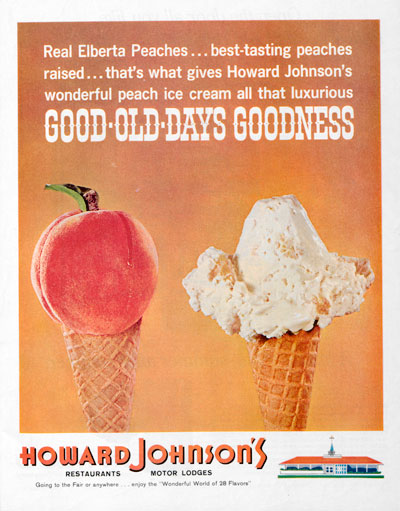
A&P isn’t the only American business institution that might be going away. Did you know that there’s only one Howard Johnson’s left? Now, the fact that there actually is one Howard Johnson’s left is the surprise. I’m sure many thought the chain had gone out of business entirely. In the mid-1960s, Howard Johnson’s generated more sales than McDonald’s and Burger King and Kentucky Fried Chicken combined.
But there’s one orange-roofed restaurant left in the country and it’s in Lake George, New York (there’s another Howard Johnson’s in Bangor, Maine, but it doesn’t have the orange roof and will probably go out of business soon). The New York Times has a feature on the restaurant and CBS Sunday Morning went to the location to interview the owner. Rachael Ray worked there when she was a teen.
Howard Johnson still has a chain of hotels though. It’s part of the Wyndham Hotel Group, which also runs Ramada, Days Inn, and Travelodge.
Upcoming Events and Anniversaries
The debut of Bugs Bunny (July 27, 1940)
The wise-cracking rabbit made his official debut in the Warner Bros./Merrie Melodies cartoon A Wild Hare.
Plane crashes into Empire State Building (July 28, 1945)
A B-25 Mitchell bomber got lost in fog and crashed into the 79th floor of the New York City landmark, killing 3 crew members and 11 people inside the building.
14th Amendment adopted (July 28, 1868)
Here’s a complete history of the 14th Amendment to the Constitution from the Library of Congress.
NASA created (July 29, 1958)
The National Aeronautics and Space Administration was initially called the National Aeronautics and Space Agency when first proposed.
Premiere of Walt Disney’s Steamboat Willie (July 29, 1928)
The short was the official debut of Mickey Mouse and was directed by Walt Disney, who also provided the voice of Mickey.
President Lyndon Johnson signs Medicare bill (July 30, 1965)
You can read The Saturday Evening Post feature “Medicare: Headache or Cure-All?” from 1967, along with other articles on the American healthcare system.
Movements in a Coffeehouse (Theme with Cows)
A
“What are you talking about?” he said, looking as if someone had kicked out his insides.
“I met someone else,” she said, trying not to say too much. If she said more, she’d be crying and he’d be swearing; then he’d be crying and she’d be swearing. She chose a public place because he couldn’t make a scene but his arms were threatening to wave. Three Tables Away was getting an earful. Three Tables Away always got an earful with him.
“Why? What the hell?” he said and he cried. Not just little tears, but big damn tears. Snot and everything.
B
“I met someone else,” she said as they sipped their coffee.
“Oh? Who?” he asked, silently meditating on the bottom of his hands.
“Just a guy.”
“How long?”
“A while.”
Long silent pauses. Comfortable people never had speech problems. They were always talking when they wanted to talk and listening when they wanted to listen. Silence.
A
“I met someone else,” she said and in this scenario he just spilled his coffee on his lap, overturned the table and walked.
Interlude
They came and went — falling into each other with nothing to prepare them for their random life together. Five years ago they started dating. Three months later they began living together. The rest is simple. She moved in with him and then she moved away from him. She left the country. He became a Muslim but then he gave it up. She didn’t talk to him for at least a month and then she did and then she slept with him and his income level rose but not by much, just enough to eat and get fat. Then they started seeing each other again and then they didn’t and then they were sort of attached but not really and he grew a stupid mustache. They weren’t really dating except for the odd sexual incident. They were dire but they weren’t serious. She didn’t have to prepare herself.
D
“I met someone else,” she said in the coffeehouse. The city lights were invading from beyond the windows; the Celtic singer screeched for impossible notes. She repeated it in measured tones.
“I met someone else — he’s younger — he’s nice — he’s funny. He likes poetry; he even reads poetry at that poetry slam where you wouldn’t go because you thought it was stupid. I think I love him and I want you to be happy with it. I don’t want to hurt you.”
She spoke to her coffee cup because it’d look weird if she spoke to the empty chair where he’d be sitting had he been on time. She hated it. She sounded apologetic. She didn’t want to be sorry. It wasn’t her fault. She was breaking up with him. He should have let it go the first time.
The music kept playing; she liked the violin. She played violin in high school before finding better ambitions. She was going to be a great concert violinist but she loved the computer job. Already she had learned Java, Cold Fusion, and even C++. The résumé was getting better. It was a salary job so she could leave work early in order to get to the coffee house 10 minutes early and prepare for the important meeting with her stupid ex-boyfriend who couldn’t bother to show up.
Theme
Fifteen minutes later he arrived. His head was wet as if he’d been running. He greeted her, walked away, bought a small coffee. She wasn’t going to get a chance to speak first. He was in one of those moods. She’d have to start in before he started poetic bubbling over Star Wars. Sitting down he drummed his fingers on the table before he asked her what was wrong. She didn’t think she looked upset; her glasses were old and she was squinting.
“Hi, dear,” he said in a cornball English accent, “how are you?”
“We need to talk.”
“Are you breaking up with me again?”
“Yes, I am. And this isn’t like the other times. This isn’t a cycle. I don’t want us to be a couple. I don’t want …”
“This coffee is putrid.”
“I am breaking up with you.”
“But it’s not April.”
“I’m serious this time.”
“You’re always serious. Did you meet someone else?”
“Yes.”
“You are just doing it for consistency. You’ve tried meeting someone else, and then you tried going solo, and then you tried meeting someone else. The last few times you went solo. You’re due.”
“I don’t love you. I haven’t loved you for some time.”
“Oh,” he said and he stopped fidgeting. She didn’t know if he believed her or if he was waiting for her to change her mind.
She didn’t care.
“I’m sorry,” she said angry for feeling guilt.
“That’s okay.”
“He’s really great.”
He mumbled something about brains and field mice or fields of rain. The espresso machine was drowning out the Celtic violins but not the drums.
“What? What are you talking about?”
“Sorry. I was just thinking about that night.”
“What night?”
“The night when we drove out to that place, it was a dance or something”
“I don’t remember”
“Dick V. Tiller Orchestra Ska funk swing band from Hell. You remember them?”
“I never listened to them.”
“We didn’t make it to the concert.”
“Oh. Then how could I forget?”
“We got lost, we ended up 20 miles out of the way and it was getting later — I was telling you where to go when you refused to listen and we just kept getting more lost.”
“You want me to be happy dumping you? Usually you pull out the good memories.”
“You screamed back. I’d never heard you do that before.”
“Now I remember. You were a jackass.”
“I know but I didn’t expect you to stop and run out of the car. You were just marching away, like it wasn’t your car, and I was trying to follow you but the rain was pelting me. I think there was hail.”
“There was no hail.”
“There was hail.”
“It was raining, but it wasn’t hailing. I wouldn’t have done that if it was hailing.”
“You were running away and you kept screaming at me. That new dress that I bought for you was getting muddy and water was flying from your hair. You were beautiful — primal. Rain and wind just bashed us both, and you were crying and screaming. No, you weren’t crying.”
“I wasn’t? That wasn’t one of the times you made me cry?”
“You always make yourself cry. I just say a few words that you …”
“Is there a point?”
“Yes, because when you were yelling at me and calling me a jerk and telling me that I was the stupidest man in the world and you didn’t want to see any stupid band that has to be out in the country to get gigs; there was this cow. This cow was just staring at us. It looked like a therapist. But you were stomping your feet and screaming and then you started laughing at me. You just kept laughing, but I was trying to apologize. Come to think of it. You always laugh when I apologize.”
“I was laughing because you were looking at the cow. You couldn’t look me in the eye so you told the cow everything. The poor cow didn’t know why you loved it or made it drive in the wrong direction.”
“What about all the other times?”
“You were always trying to look me in the eye; when you couldn’t do it, I kept seeing that poor cow.”
“You’ve been laughing at the cow?” he asked.
“I forgot about that,” she said, and she was smiling. It wasn’t a smile that you could control.
“I fell in love with you that night,” he said and looked at the table. It was one of his cute looks. She hated those cute looks. They made her want to forgive him.
“Are you okay with this?” she asked.
“No. I don’t care. Yes. We had fun. I wanted to marry you.”
“You did not.”
“Yes I did.”
“Too late.”
“It’s been too late for a long time,” he said with a smile not so genuine; then she mentioned Boba Fett which got them talking. They spoke past the last Celtic song and past the canned Madonna music until the guy with the mop kicked them out. Outside they hugged and he groped her “for old time sakes,” but she wasn’t in the mood for old times. She punched him in the gut. He whined as if she killed him. She laughed and forgave him. They went home separately. The night was clear. There were no clouds in the sky and no cows on the trip home.
Are Women More Gullible Than Men?
Is it true, as W. C. Fields once said, that “you can’t cheat an honest man”?
A description of the top 10 con games seems to support the notion that dishonesty makes people vulnerable to con artists. In most of these operations, the victim’s greed, shame, or duplicity seem to make him an accomplice in his own swindling.
But if it’s true con artists can’t cheat honest men, why have they been able to cheat so many honest women? Why, for instance, was Raymond La Raviere so successful?
In the 1940s, La Raviere successfully played confidence games across the country without relying on his victims’ dishonesty. Their only fault, perhaps, was a desire for love and security.
He was arrested at a garage in 1948 when a police detective recognized him as a man wanted on a bigamy charge. Choosing to kill himself rather than face trial, La Raviere swallowed poison. While lying in a hospital, expecting to die, he made a full confession to a police officer. Over the past 10 years, he said, he had married 55 women and stolen $300,000 from them.
Unfortunately, the poison didn’t work. La Raviere was convicted and sentenced to eight years in jail.
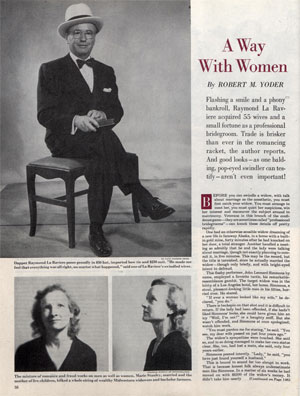
As you’ll read in this article, running a romance scam was hard work. La Raviere had to keep moving from state to state, seeking wealthy single women. And, as you’ll read in the article, he had to stay continually in character, playing a wealthy bachelor from Alaska.
Once he had won a woman’s confidence — which never seemed to take long for him — La Raviere had to keep his latest fiancée from sharing the news with her relatives or friends. He swept his victims off their feet, into marriage, then away to the bank so they could open a joint account with her cash. After securing the money, he’d make a quick exit and was off to find a new mark.
Today, the business of wooing money out of women has become much easier and more profitable, thanks in part to the Internet and the $2 billion online dating industry.
Scam artists no longer need to marry to get at a victim’s money; they don’t even need to meet the victim. Instead, crooks can work in their bathrobe from the comfort of home, or in a cyber café in Malaysia. And they can work several victims at the same time.
Online romance scams have risen dramatically. In fact, the number of complaints doubled between 2013 and 2014, according to the Federal Trade Commission. Just between July and December of 2014, phony online admirers cheated Americans out of some $82 million — and these losses are probably underreported.
Of course, women aren’t the only victims — crime has always been an equal opportunity employer. But judging from stories reported in the media, the majority of the victims have been women.
Which raises the question: Are women, by nature, more easily fooled?
According to researchers at the University of California, Berkeley, and University of Pennsylvania, women aren’t more gullible. But they are more likely to be lied to.
The researchers came to this conclusion while observing MBA students practicing real-estate negotiations. Researchers found both men and women were more likely to lie to a buyer who was female than to a male.
The students told researchers they didn’t think women were more gullible, but they expected men would be more experienced negotiators and better able to spot a lie.
Believing that women had less skill in recognizing lies encouraged students to make false claims, the researchers concluded. “As a result, women are deceived more often than men.”
Which raises a second question. If women are more likely to be deceived, are men more likely to be deceptive? Here the research is less equivocal. Several studies agree that men lie more often than women: 50 percent more according to one British study.
According to these studies, the men don’t lie constantly; they appear to save their falsehoods for what they consider important matters. They are also more likely to justify unethical behavior and ignore the moral consequences of their actions.
While pondering the scope of male mendacity, you might want to know that Raymond La Raviere’s bigamy record was eventually shattered in 1983.
In that year, Giovanni Vigliotto, aka Nikolai Peruskov, aka Fred Jipp, was sentenced to 34 years for fraud and bigamy. In his testimony to the court, he confessed that he’d married and defrauded 105 women.
But given what we’ve been saying about men, should you believe him?
A Way with Women
This article was originally published in The Saturday Evening Post on May 7, 1955.
Flashing a smile and a phony bankroll, Raymond La Raviere acquired 55 wives and a small fortune as a professional bridegroom. Trade is brisker than ever in the romancing racket, the author reports. And good looks — as one balding, pop-eyed swindler can testify — aren’t even important!
Before you can swindle a widow, with talk about marriage as the anesthetic, you must first catch your widow. You must arrange to meet her, you must quiet her suspicions, win her interest and maneuver the subject around to matrimony. Veterans in this branch of the confidence game — they are sometimes called “professional bridegrooms” — can knock these details off pretty rapidly.
One had an otherwise sensible widow dreaming of a new life in faraway Alaska, in a home with a built in gold mine, 40 minutes after he had knocked on her door, a total stranger. Another handled a meeting so adroitly that he and the lady were talking about marriage, though not exactly planning to commit it, in five minutes. This may be the record, but the title is tarnished, since he actually married the widow — though only briefly, and with bright-eyed intent to defraud.
This flashy performer, John Leonard Simmons by name, employed a favorite tactic, his remarkable-resemblance gambit. The target widow was in the lobby of a Los Angeles hotel, her home. Simmons, a stout, pleasant-looking little man in his fifties, hurried over. He stared.
“If ever a woman looked like my wife,” he declared, “you do.”
There is backspin on that shot and it is difficult to return. If the lady had been offended, if she hadn’t liked Simmons’ looks, she could have given him an icy “Well, I’m not!” or a haughty sniff. But she wasn’t offended, and Simmons at once apologized; watch him work.
“You must pardon me for staring,” he said. “You see, my dear wife passed on just four years ago.”
The widow’s sympathies were touched. She said so, and in so doing managed to make her own status clear. She, too, had lost a mate, she said, only four years earlier.
Simmons peered intently. “Lady,” he said, “you have just found yourself a husband.”
This is bound to sound far too abrupt to work. That is because honest folk always underestimate men like Simmons. In a matter of six weeks he had moved on with $6,300 of the widow’s money. It didn’t take him nearly that long to get the money. He tarried because it was December; he seems to have figured that running out could wait until after Christmas.
Simmons could make the remarkable resemblance even greater, as he did in Long Beach, the quarry this time being a widow from Iowa. It was the season of the Rose Bowl. The hotel was packed and the tingle of gala events was in the air. The stout little man hurried toward the widow with a smile that said, “What a wonderful coincidence! Imagine running into you here.”
“Pardon me, madam,” he said happily. “You’re Mrs. Dunlap, aren’t you?”
His tone made it clear that Mrs. Dunlap was a fine woman to be, and the widow must have regretted having to deny it.
“No,” she said, “I’m Mrs. Dunham.”
“The resemblance!” Simmons marveled. “It’s simply amazing. Doctor Dunlap was our family physician, back in Colorado. I always thought highly of the Dunlaps. Why, one winter night, Doctor Dunlap came through a blizzard to save one of our children.”
Touche for Simmons, obviously. Everyone is in favor of doctors’ coming through blizzards to save children. What could Mrs. Dunham say, except “That’s nice,” or “Bully for Doctor Dunlap,” or “Children make a nice family”?
Simmons’ next move was to sit down. The widow sat too. She wasn’t Mrs. Dunlap, of course. Still, the names were close — Dunlap, Dunham. A small thing, but wonderfully effective in combating the word “stranger.” Not much trouble for Simmons either. Simply a matter of learning the lady’s name from the hotel help, and choosing another with a partial overlap.
Now Simmons told the widow all about himself —about his days in the stock market—highly successful— about his five mythical married children, one adopted. In a day or two, Mrs. Dunham was referring to Simmons, archly, as her “ boy friend.” That privilege cost her $1,300. Her niece contributed $5,000, two of the niece’s friends, $1,000 more. All thrust their money on Simmons eagerly, thinking he was letting them in on a big mysterious deal in wheat, with high profits and no risk.
The theory of the romancing racket is that many a widow would like to get married again if something very good came along. The swindler’s object is to woo the widow, win her, and then, when she is slightly dizzy from anticipatory whiffs of orange blossoms and wondering what to wear for a second wedding, to get her money or jewelry.
It might be called the gambling form of courtship, played for money. It is a fast game, one which keeps the swindler skating rapidly over thin ice all the way. Risking a prison term — Simmons is now serving a ten-year sentence—he bets his time and expenses that he can win, and usually he does. Not always. Simmons trailed one widow half across the continent only to find that she wasn’t wealthy at all, the deceitful thing. Fortunately, he had hooks baited for two at once, and the other was more trustworthy.
Men in this line of work have to be right in their estimate of what the victim wants, and they don’t put too much stock in the drawing power of romance, per se. They promise love and devotion, of course. But they also give the lady a peek at a well-stuffed wallet and lead her to expect a cushioned life several cuts above her present circumstances. Blue Heaven with a full-time maid, plenty of charge accounts, and a generous husband.
If the con men are right, a husband can have no more attractive characteristic— or perhaps the implication is that no characteristic is so rare. At any rate, generosity works like a charm, as can be seen from the short but busy career of a schemer named Joseph Levy.
Levy is a bad-check man. For years his favorite swindle involved posing as a prison official. A Baltimore episode is typical. Appearing at the offices of a firm which sold supplies to a prison in New York, Levy identified himself as the prison’s purchasing agent, and was given a warm welcome. He placed a large order, cashed a personal check, shook hands cordially and left. The check, of course, bounced.
Further to annoy the forces of law and order, he liked to pose as the warden of some state penitentiary, as a United States probation officer or as a United States attorney. He was always accepted without question though he had done time for forgery, larceny, the confidence game and theft from the United States mails.
By 1951 he was wanted in half a dozen states and it seemed imperative to change swindles. He shifted to courting widows and was an immediate success, not only with women his own age — again the middle fifties, the prime of life in this racket — but also with younger ones.
In the beginning, at any rate, fleecing widows seemed just right for Levy’s purposes, which were modest. Never greedy, he was simply out to make living expenses— board and room in the best hotels and enough cash to frequent the $50 window at the tracks. Relatively small contributions per widow would do.
His busiest year as a romancer was 1952. In February, in Detroit, he met Widow No. 1. In five days he had her dreaming of domesticity, but not in a little cottage with roses round the door. The swindlers never kid themselves that their charm will do the trick, and the invitation always is to something much better than love in a cottage. The marriage they offer, with a view to arousing a little greed, is clearly advantageous. Home in this instance was to be a handsome house on which the down payment was $18,000. The house would be Levy’s wedding gift to the widow. He gave her a check for $18,000, to make the payment, and asked her to cash a check of his own for $500. The disarming trick of seeming to give the victim far more money than you take was working faultlessly, as it always does. The widow gave Levy the $500, and as suddenly as he had blown into her life, he was gone, never to return. Both checks returned, however, being equally worthless.
Levy headed west, for the Coast. En route, he struck up an acquaintance with his second widow of the ‘52 season. Friends before the train reached Chicago, they were sweethearts by Albuquerque, and engaged on arrival in California. Illusionary husbands like Levy invariably are sweeter than the curmudgeons of real life, and—in a pretty gesture of liberality —Levy promptly opened a joint bank account. The widow contributed $500; Levy put in a manly, though wholly imaginary, $2,000. And so they were wed, but not for long. On Wedding Day plus One, Levy withdrew the widow’s $500 and was on his way.
That way led to Reno, where he spotted a beautiful diamond ring worth $6,000. The woman wearing it had a husband, and the husband was on hand. Courtship was out. Some other approach was indicated. Assuming a woman is all fixed up for love, what else will cause much the same happy confusion? Without hesitance, Levy chose “clothes.”
So Levy became a clothing tycoon from New York. Managing to meet the Lewises — we’ll call them that —he won such an in that when they left for California, Levy was riding with them. On the way, he pointed out how absurd it was for Mrs. Lewis to pay full retail price for clothes when she knew an insider like Levy. He had but to introduce her and she could enjoy the prices reserved for those in the know.
By the time they reached San Francisco, Mrs. Lewis could hardly wait to get to a department store. Levy spoke knowingly to the saleslady. “Show her nothing but the most expensive,” he directed. Mrs. Lewis was presently surrounded by a wonderful muddle of dresses and suits, and while she was, Levy borrowed her ring—to show it off to a store official, he said. Exit Levy, with ring, for keeps.
Levy had switched, briefly, from widows to rings. The logical next step was widow-with-ring, and Levy found one, that same month, aboard a train from Chicago to New York. He gave her a fast whirl in New York, urged her to make him the happiest man in the world, and she consented. As they talked of wedding plans, Levy said, “You’ll want an outfit,” and gave her (a check for) $2,000.
And while visions of sugar plums danced in her eyes, this most thoughtful of soon-to-be-husbands went farther. “You’ll want something better than that ring of yours, too,” said he. It was a good ring, worth $2,000. But if the dear man wanted to squander his money, why deny him? Riding by now on a pink-tulle cloud, the widow gave him the ring and cashed his check for $300. Levy left to get that shabby diamond replaced with something more like. And that is the last she saw of Prince Charming, now known in several states as Prince Charming, That Rat.
Summer found Levy at Tijuana. The world had turned full circle. The horses were betraying him again, and again he needed a widow with, say, $300. Levy has to succeed with skill and guile, not beauty. A man of medium height and build, he has graying brown hair, a big nose, a bald spot. His teeth protrude a bit and he has been unkindly described as popeyed.
So it says something for his craftsmanship that he took aim at a young woman this time, and was as successful as usual. She, too, said she would be his bride, and, more or less to bind the bargain, Levy deposited $2,500 to her bank account, in the form of one of his Yo-yo checks. Then he borrowed $500 from her and drove rapidly out of her young life — in her car.
Swindling widows sounds like a pleasant combination of business and pleasure, yet few make a career of it. Being a suitor day in and out, even for profit, may prove wearying. Levy had talent for it; he was especially good at creating the illusion of marriage-just-ahead, putting the girls in the exciting role of bride-to-be. Yet, after seven successful swindles in a row, he gave it up for something less demanding.
Posing as a big wheel from innermost Washington, he called spurious checks in the manner pioneered by Frederick Emerson Peters, one of the elite of the impostors. This consists of buying expensive gifts and having them sent to prominent citizens, who are presumably the shopper’s intimate friends. He pays by bad check, and the change is his profit.
Levy’s prominent citizens were prominent, all right. He bought perfume to be sent to Mrs. Eisenhower, Scotch for the President, golf clubs to be sent to Vice-President Nixon. With the clubs went a pally note: “Dick: beat the boss.”
It was a nice touch, but just about Levy’s last. Widows were screaming for his throat, shopkeepers were demanding restitution, and what with one thing and another, Levy assembled so many complaints that he was elected to the FBI’s Most Wanted Criminals list. National fame would have been his had he managed to elude arrest one day longer. As it was, FBI agents sighted him at Churchill Downs — at the $50 window, of course—on April 30, 1953. They were carrying descriptive material which was to be released to newspapers on May first, and here was the hero himself.
So the announcement that he had made the Most Wanted never got published. This is a shame, in a way, for the news of his success with women would have been encouraging to all men who are something less than beautiful. “Neither spectacular in performance nor impressive in physical appearance,” said the FBI, “he is appealing, experienced and self-confident. He relies on artful impersonation and finesse to overcome his physical handicaps.” It goes to show that looks aren’t everything, even when this fine old game is played for money.
About twice a year the FBI nails a fugitive and it is announced that he has swindled two, three or four widows, making a career of it. Now living in the Midwest, enjoying his first freedom in some years, is a man to whom a three-or- four-widow career must sound like a two-strawberry shortcake.
Raymond La Raviere is, or rather was, the most remarkable operator ever to enter this field because of his distinctive way of getting the ladies’ money. He didn’t just hint at marriage; he married them. One after another after another. A red notebook which fell into the hands of the law listed 50 women, all of whom he had wedded by age 44. And there was a notation which said, “Forgot five — happened so fast — last names.”
La Raviere’s techniques, which he told a jailer had netted him $300,000, became known largely because of a razzle-dazzle courtship in St. Paul. He had two approaches: the fast one, in which he proposed marriage inside of an hour or so after first meeting; the slow one, in which he waited a day or two. In St. Paul, he used the quick one.
The problem was to meet a likely widow, get her confidence and her money, and be gone. La Raviere managed it handily inside a week. He used a favorite opening gambit. That was a newspaper ad saying that a “refined business gentleman” sought a room with refined surroundings in a private home.”
Among those with a room to spare for a refined business gentleman was a 55-year-old widow who may be called Mrs. Larkin. She answered the ad by letter. At ten the next night the refined gentleman called —a rather short man in the middle forties, well dressed. A little fussy about his living quarters, he said the room was a bit overcrowded, but with certain minor changes, he would take it. He introduced himself. Horner was the name. He was a mining engineer, he said, employed by a mine in Alaska —a gold Mine. He had staked out a claim of 180 acres, built a cabin on it. He didn’t exactly say there was gold on his claim, but the widow felt impelled to remark that she, too, owned property —or had until she recently sold it. Horner said that for all his job and his claim, he wasn’t happy. He was a widower, and had recently lost his only daughter in a tragic fire. The widow said she, too, knew the pangs of loneliness. At that, Horner said firmly that she need never be lonely again. “I will take you back to Alaska with me,” he vowed.
“I suppose you do need a housekeeper,” the widow said.
“Housekeeper!” said Horner. “You shall be my wife.”
And with that, the warm breeze from the frozen north blew back to his hotel. “Meet me with your answer tomorrow night,” he said on leaving.
It left the widow a little goggle-eyed. She had a job, but she stayed home the next day to ponder this strange turn of events, so like something in a book. At the hotel, that evening, Homer asked her to come to his room for a minute. She noted that his possessions were those of a man of means, and to make sure she didn’t miss this point, Horner quoted prices. In the few minutes of her stay, he managed to show her his luggage —$300 the piece— his $600 overcoat, his portable radio with custom-made carrier, at $150. He then took her to an expensive dinner and was masterful with the waiters, sending everything back to the kitchen at least once.
Horner was moving his things to the widow’s spare room that night. In the cab, going out, he pressed for an answer to his proposal, promising that as his wife she should have the best of everything. The widow, overwhelmed, said she would marry him. It was just under 24 hours after their meeting.
Next day Horner exhibited a money belt fat with bills and commanded his bride-to-be to go buy herself a splendid trousseau. At this point the ordinary man would have to transfer some of his cash from money belt to fiancée. Homer skipped that stage. The widow bought, but the widow paid.
State law decreed a five-day wait before marriage. To the impetuous Alaskan, that was intolerable. He took Mrs. Larkin to South Dakota and married her there — four days after he had knocked on her door. Now he wanted a honeymoon in New York. “We’d better put our money in a joint account,” he said. “What’s mine is yours.” The bride had $6,900 in her account. “Don’t withdraw it all,” said Homer. “Just six thousand.”
The bank teller counted out the money for the bride, but Horner’s hand got there first, and he put the bills in his wallet. The bride also cashed in securities worth $3,200. This money he let her keep, temporarily.
On the train to Chicago, first leg of the New York idyll, Horner counted the $6,000. “That teller made a mistake,” he said grumpily. “There’s a thousand-dollar bill here. I asked him to put it in hundreds. I’d better count the money the broker gave you.” He counted the $3,200, declared it was all in order, and put it in his money belt. But he gave his bride $50 just for pin money, as a token of how things were going to be.
In the waiting room in Chicago, Horner excused himself to see about their reservations. He didn’t come back, and there were no reservations. Police took the bewildered Mrs. Horner to the FBI. The competence of Horner’s performance — giving the widow a flash of a money belt, a glimmer of Alaskan gold; being fussy about the room to show he had his small faults — told the FBI men that here was a pro.
So they asked around: did this story strike a chord anywhere? In the state of Washington it did. A man of this description had operated there; his name was Raymond La Raviere. But there was still nothing to indicate the remarkable scope of La Raviere’s romancing, and there might never have been if chance — or a bonehead play — hadn’t brought him back to St. Paul.
With Mrs. Larkin’s money and that of other victims, La Raviere had bought a home in Long Beach, California, intending to retire. He had it coming; he had been getting married four or five times a year for thirteen years. But he couldn’t stand inactivity. In thirty days, traveling in a swanky car with black body, gold top and winecolored upholstery, he hit the road again. He paused in St. Paul to get the splendid car serviced, was spotted by a detective and shortly wound up in jail.
Looking into his background, the FBI turned up first one, then two, then eighteen other marriages. When this news became public, three additional wives sang out; so did four women La Raviere had swindled without marriage. As La Raviere went on trial for swindling Mrs. Larkin, a small army of wives trouped in.
Too much was too much. When court reconvened after lunch, La Raviere pretended to blow his nose and swallowed bichloride-of-mercury tablets concealed in his handkerchief. In the hospital, supposing he was dying, he said the notebook total was right: he had married at least 55, here and abroad. In a day or two, this most devoted of short-term husbands always sent the bride shopping or to a beauty parlor, and was long gone when she came home.
To La Raviere’s chagrin, he failed to die, but by then it was too late to retract his confession. There was nothing to do but plead guilty; the sentence was eight years. In the next few weeks a meticulous fourteen of his wives got annulments.
A way with women is an interesting gift and there seems no doubt that La Raviere had it. But what was it that got his wives? Some spoke of his “distinguished appearance,” his “beautiful white teeth.” One said he seemed to hypnotize her; she thought he used a drug. Perhaps the finest tribute to his salesmanship came from the wife who said, “He made me feel that everything was all right, no matter what happened.”
These descriptions suggest a pretty overwhelming fellow. Actually — or so any man would bet — what did the trick for La Raviere was that he looked vastly sincere, thanks in part to a brow both high and wide. In the movies, he would have been cast as the good brother, the one who pitches hay in the hot sun while the wicked brother chases the neighbor girls.
He was a good product; he looked reliable, upright and not too good to be true; he looked like first-rate husband material. And along with this, the man knew his market and his business. The widows in these cases are by no means nitwits. They are likely to say, “What do I know about this man, anyway?” La Raviere’s description of himself was plausible enough and hard to check, this side of Alaska. It was easier to take him at face value.
The lady might reasonably want to meet his family. He had that stopped too. The family he described consisted of a dear old aunt, in some faraway city, and an equally imaginary brother. A splendid character, the brother; so splendid he was unavailable. A missionary, La Raviere explained, in China.
The fact that La Raviere could meet a widow and marry her four days later doesn’t mean his work was easy. It was a thing which had to be done at racing speed or not at all. Widows have friends, and friends are likely to be suspicious of Alaskan gold-mining engineers who drop out of nowhere. Friends can raise doubt and urge caution, may even do a little investigating.
So the swindler has to cut his victim out of the herd, keep her absolutely isolated, keep her too busy to think, too busy to take advice. She will want to show him off. He tells her that three is a crowd, urges her to keep their plans in romantic secrecy. He can’t let down; he has to be with her every possible minute, not only to show devotion but to keep her from seeing others. One of the few times La Raviere failed was when one of the victim’s friends began asking skeptical questions — and at the last minute too.
The widow who says indignantly, “We are not all such easy marks,” is right, of course, but she underestimates the artistry with which these traps are laid. The swindler is anything the lady wants: owner of a string of race horses, if she is a lively sort; retired plumbing contractor, if she wants something quieter. La Raviere sometimes posed as the owner of a gambling house in Hawaii. John Leonard Simmons was usually a capitalist, but he also did well in the modest role of retired streetcar motorman — cleaning up in goods salvaged from railroad wrecks. And in any role the swindlers will of course be plausible; that’s their business.
Since marriage does not hold quite the same enchantment for men as for women, professional brides, the female equivalent of the Simmonses, Levys and La Ravieres, ought to starve. They don’t. The same mixture of romance and fraud works with men, and it doesn’t take a walking dream, either. Marie Stanley made it pay and, while pretty, Marie was old enough to have a married daughter.
In Illinois, Indiana, Ohio, North Dakota and Minnesota, Marie swindled a whole string of wealthy widowers and bachelor farmers. The theory of her operation was this: A man will not mind lending a girl a large sum of money if (a) he expects to get it back quickly, and (b) it will enable the girl to get a much larger sum of money, which (c) presumably will fall into the lender’s hands, as (d) will the girl herself — as his propertied bride. If the girl is not an outright hag, this is a pretty good deal, or would be if real.
An Ohio episode shows Marie at the top of her form. She drove into the yard of a farm owned by a bachelor who flew a plane; she figured the plane signified money. Marie introduced herself as a magazine writer, out to do a piece on flying farmers. There were several sessions and it wasn’t hard to convince the farmer that life would be much more exciting with Marie around permanently.
But Marie had a business deal she had to conclude before she could settle down to wedded bliss. She owned a dress shop in Detroit — sometimes it was a beauty parlor or hardware store. She was about to sell it for $45,000. The only hitch lay in paying off a $9,000 mortgage. For this, Marie was a little short — by $5,600.
What’s $5,600 to lend a girl who is about to bring you $45,000? The farmer gave Marie a cashier’s check. Marie kissed him good-by and joined her husband, William, the father of her five children, in the family trailer, then in Lima, Ohio. The flying farmer never saw Marie again until he and brother victims met her in Federal court.
Marie’s victims were sensible, hardheaded men who had held their own in many a business deal. Yet an Illinois farmer loaned her $2,500, a widower in Indiana sold his hogs to lend her $2,450, a grain speculator in Sioux Falls was taken for $3,500, a young Minnesota farmer for $5,000.
With so many waiting to testify, things looked dark for Marie when finally she was brought to trial. But she made a valiant try. Swindle? What swindle? She had been a bad girl, she was willing to admit, but not a swindler. These men had given her money, yes. But there had been no talk of business, only of love. The money, she blushed to say, was in return for her favors. She had resisted the gentlemen’s sinful advances every time, but hadn’t won a game all season.
The United States attorney, however, assailed this as make-believe piled on make-believe. The tender moments Marie described never took place, he said; having conned the victims, Marie was now trying to con the jury. Unfortunately for Marie, he could destroy her story in her own words. She had told FBI men that she always made the suckers keep their distance, figuring that to say “No” enhanced her desirability.
Swindling widows in the guise of a dream husband come true entails risks. The swindlers are likely to fall afoul of Federal law and get the FBI on their heels. This happens if they cross a state line with loot worth $5,000 or more, or if they cash, in one state, a worthless check drawn on a bank in another.
Talented performers come to grief. Simmons, Levy and Marie Stanley are now in prison; La Raviere only recently got out. These bearish factors are not expected to put a serious crimp in the racket, however. It’s a swindle that’s bound to flourish, because it is own cousin to the truth.
The plausible strangers tell the widows some fancy lies, of course. But in courtship, a little exaggeration is expected on both sides, and it arouses no very deep suspicion. The number of widows is at an all-time high; the market for devoted and well-heeled, middle-aged husbands never was better. And a widow can’t question a suitor too closely; he might be on the level and resent it.
The trouble is, nobody looks more on the level than a good con man. FBI agents thought they had spotted a fugitive in a Los Angeles cafeteria. They had seen many photographs and read pages of description, but even so, they were not at all certain that this substantial-looking citizen was the man they wanted — until he told them so himself, inadvertently. Strolling along downtown streets after lunch, aimlessly and absently, he came to an office building not visibly different from any other. But suddenly be seemed to remember it, and not favorably. Putting on dark glasses, he cut through a parking lot. At these helpful signs of a guilty conscience, the pursuers closed in. The building he had shunned houses the Los Angeles offices of the FBI.
THE END
Before I Go
In residency, there’s a saying: The days are long, but the years are short. In neurosurgical training, the day usually began a little before 6 a.m., and lasted until the operating was done, which depended, in part, on how quick you were in the operating room.
A resident’s surgical skill is judged by his technique and his speed. You can’t be sloppy and you can’t be slow. From your first wound closure onward, spend too much time being precise and the scrub tech will announce, “Looks like we’ve got a plastic surgeon on our hands!” Or say: “I get your strategy — by the time you finish sewing the top half of the wound, the bottom will have healed on its own. Half the work — smart!” A chief resident will advise a junior: “Learn to be fast now — you can learn to be good later.” Everyone’s eyes are always on the clock. For the patient’s sake: How long has the patient been under anesthesia? During long procedures, nerves can get damaged, muscles can break down, even causing kidney failure. For everyone else’s sake: What time are we getting out of here tonight?
There are two strategies to cutting the time short, like the tortoise and the hare. The hare moves as fast as possible, hands a blur, instruments clattering, falling to the floor; the skin slips open like a curtain, the skull flap is on the tray before the bone dust settles. But the opening might need to be expanded a centimeter here or there because it’s not optimally placed. The tortoise proceeds deliberately, with no wasted movements, measuring twice, cutting once. No step of the operation needs revisiting; everything proceeds in orderly fashion. If the hare makes too many minor missteps and has to keep adjusting, the tortoise wins. If the tortoise spends too much time planning each step, the hare wins.
The funny thing about time in the OR, whether you frenetically race or steadily proceed, is that you have no sense of it passing. If boredom is, as Heidegger argued, the awareness of time passing, this is the opposite: The intense focus makes the arms of the clock seem arbitrarily placed. Two hours can feel like a minute. Once the final stitch is placed and the wound is dressed, normal time suddenly restarts. You can almost hear an audible whoosh. Then you start wondering: How long till the patient wakes up? How long till the next case gets started? How many patients do I need to see before then? What time will I get home tonight?
It’s not until the last case finishes that you feel the length of the day, the drag in your step. Those last few administrative tasks before leaving the hospital, however far post-meridian you stood, felt like anvils. Could they wait till tomorrow? No. A sigh, and Earth continued to rotate back toward the sun.
But the years did, as promised, fly by. Six years passed in a flash, but then, heading into chief residency, I developed a classic constellation of symptoms — weight loss, fevers, night sweats, unremitting back pain, cough — indicating a diagnosis quickly confirmed: metastatic lung cancer. The gears of time ground down. While able to limp through the end of residency on treatment, I relapsed, underwent chemo, and endured a prolonged hospitalization.
I emerged from the hospital weakened, with thin limbs and thinned hair. Now unable to work, I was left at home to convalesce. Getting up from a chair or lifting a glass of water took concentration and effort. If time dilates when one moves at high speeds, does it contract when one moves barely at all? It must: The day shortened considerably. A full day’s activity might be a medical appointment, or a visit from a friend. The rest of the time was rest.
With little to distinguish one day from the next, time began to feel static. In English, we use the word time in different ways, “the time is 2:45” versus “I’m going through a tough time.” Time began to feel less like the ticking clock, and more like the state of being. Languor settled in. Focused in the OR, the position of the clock’s hands might seem arbitrary, but never meaningless. Now the time of day meant nothing, the day of the week scarcely more so.
Verb conjugation became muddled. Which was correct? “I am a neurosurgeon,” “I was a neurosurgeon,” “I had been a neurosurgeon before and will be again”? Graham Greene felt life was lived in the first 20 years and the remainder was just reflection. What tense was I living in? Had I proceeded, like a burned-out Greene character, beyond the present tense and into the past perfect? The future tense seemed vacant and, on others’ lips, jarring. I recently celebrated my 15th college reunion; it seemed rude to respond to parting promises from old friends, “We’ll see you at the 25th!” with “Probably not!”
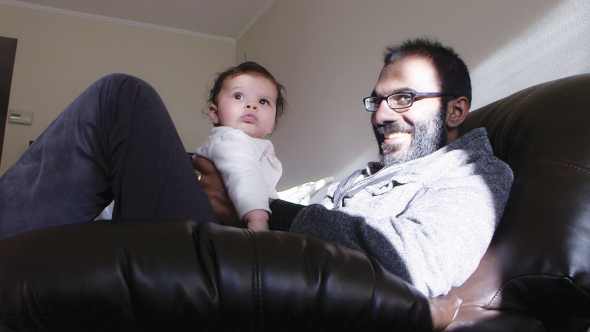
Yet there is dynamism in our house. Our daughter was born days after I was released from the hospital. Week to week, she blossoms: a first grasp, a first smile, a first laugh. Her pediatrician regularly records her growth on charts, tick marks of her progress over time. A brightening newness surrounds her. As she sits in my lap smiling, enthralled by my tuneless singing, an incandescence lights the room.
Time for me is double-edged: Every day brings me further from the low of my last cancer relapse, but every day also brings me closer to the next cancer recurrence — and eventually, death. Perhaps later than I think, but certainly sooner than I desire. There are, I imagine, two responses to that realization. The most obvious might be an impulse to frantic activity: to “live life to its fullest,” to travel, to dine, to achieve a host of neglected ambitions. Part of the cruelty of cancer, though, is not only that it limits your time, it also limits your energy, vastly reducing the amount you can squeeze into a day. It is a tired hare who now races. But even if I had the energy, I prefer a more tortoise-like approach. I plod, I ponder, some days I simply persist.
Everyone succumbs to finitude. I suspect I am not the only one who reaches this pluperfect state. Most ambitions are either achieved or abandoned; either way, they belong to the past. The future, instead of the ladder toward the goals of life, flattens out into a perpetual present. Money, status, all the vanities the preacher of Ecclesiastes described, hold so little interest: a chasing after wind, indeed.
Yet one thing cannot be robbed of her futurity: my daughter, Cady. I hope I’ll live long enough that she has some memory of me. Words have a longevity I do not. I had thought I could leave her a series of letters — but what would they really say? I don’t know what this girl will be like when she is 15; I don’t even know if she’ll take to the nickname we’ve given her. There is perhaps only one thing to say to this infant, who is all future, overlapping briefly with me, whose life, barring the improbable, is all but past.
That message is simple: When you come to one of the many moments in life when you must give an account of yourself, provide a ledger of what you have been, and done, and meant to the world, do not, I pray, discount that you filled a dying man’s days with a sated joy, a joy unknown to me in all my prior years, a joy that does not hunger for more and more, but rests, satisfied. In this time, right now, that is an enormous thing.
Republished with permission from Stanford Medicine magazine (stanmed.stanford.edu/2015spring/before-i-go.html).
Bob Dylan, 1966: Folk Hero Turned Rock Star
In 1965, “Like a Rolling Stone” transformed Bob Dylan from folk hero to rock star.
This year Bob Dylan is the king of rock ’n’ roll, and he is the least likely king popular music has ever seen. With a bony, nervous face covered with skin the color of sour milk, a fright-wig of curly brown hair teased into a bramble of stand-up tangles, and dark-circled hazel eyes usually hidden by large prescription sunglasses, Dylan is less like Elvis or Frankie than like some crippled saint or resurrected Beethoven. … Yet, Bob Dylan, at the age of 25, has a million dollars in the bank and earns an estimated several hundred thousand dollars a year from concerts, recordings, and publishing royalties.
“Like a Rolling Stone” finally put Dylan across as a rock ’n’ roll star. He wrote it in its first form when he came back from England. “It was 10 pages long,” he says. “It wasn’t called anything, just a rhythm thing on paper all about my steady hatred directed at some point that was honest. In the end it wasn’t hatred, it was telling someone something they didn’t know, telling them they were lucky. Revenge, that’s a better word. I had never thought of it as a song, until one day I was at the piano, and on the paper it was singing, ‘How does it feel?’ in a slow motion pace, in the utmost of slow motion following something. I wrote it. I didn’t fail. It was straight.”
“Like a Rolling Stone” climbed rapidly to the top of the charts. … National magazines began writing favorably about both Dylan and rock ’n’ roll, and rock concerts became the social events of the intellectuals’ seasons. Dylan’s reaction is predictably thorny. “The songs are not meant to be great,” he said. “I’m not meant to be great. I don’t think anything I touch is destined for greatness. Genius is a terrible word, a word they think will make me like them. A genius is a very insulting thing to say. Even Einstein wasn’t a genius. He was a foreign mathematician who would have stolen cars.”
Excerpted from “Bob Dylan: ‘Well, What Have We Here?’” by Jules Siegel, The Saturday Evening Post, July 30, 1966
Melodramas for Depressed Persons
I couldn’t get out of bed, so I went for a walk.
There weren’t a lot of people in Emergency. An old lady kept rubbing her breast. A man staggered up to triage and asked the nurse out on a date. She pressed a button and he vanished. I thought, I could use one of those.
“Have you been drinking?” the nurse asked me.
I was having trouble putting the failure of my life into words.
“Take a seat,” she said at last.
I waited two hours, three hours. The room really filled up.
I hadn’t realized I was wearing two different colored socks.
After four hours, I got up.
“What are you doing tonight?” a man asked the triage nurse as I walked out the door.
**
There’s a park across from my apartment. You can walk there and watch the prostitutes. One pretends to talk on the pay phone in the middle of the park. If a man approaches her, she hangs up. I’ve never once walked past when she wasn’t on the phone.
I go to the park when I’m depressed because I don’t care about the danger.
“You wanna buy a knife?” said a voice.
I looked up. A young guy was holding out a hunting knife.
“Okay,” I said.
I pulled out my wallet. The young guy grabbed my wallet and took off.
The prostitute was watching me. I approached her. She hung up the phone.
“Did you see that?” I asked her.
She thought for a long time.
“No,” she said.
She picked the receiver back up.
“I love you too, Mom,” I heard her say, as I walked away.
**
The funny thing about being depressed is that you forget everything that was important to you. Work. Hobbies. Friends. Sex. They all float away from you like helium balloons. For a while, you wonder where they’re going and when they’ll ever come down. Then you just don’t care.
I guess it isn’t that funny.
**
It was a nine-month wait, I found out, to see a psychiatrist. I wondered how I’d survive. Someone recommended a drop-in center where you could talk to volunteers. They weren’t qualified, but they were good listeners.
“There’s no one here right now,” said the lady at the desk. “But if you’d like to watch the video, I can put it on.”
I followed her to the lounge. She put a cassette tape into a VCR. I hadn’t seen a cassette tape or a VCR in years. I almost laughed.
“You think it’s hopeless,” said the woman on the screen. “But our love is brighter than the stars, Gerome.”
“What is this?” I asked.
“It’s therapeutic,” said the woman, on her way out of the lounge.
“I thought about ending it all. Then, Beverly, I remembered your loveliness.”
After a few minutes, I pressed eject. The label on the tape said:
Melodramas for Depressed Persons, Cassette One
I laughed. I felt a bit better.
It was Friday night. The bars were all busy.
Emergency was busy. There was a lineup out the door.
“Hey buddy, can you help a guy out?”
“I’m a writer,” I said.
He kept walking.
It was just after midnight when I got a room. A hairy doctor came in.
“What’s wrong?” he said.
I tried explaining it.
“Do you hear voices?” he said.
“Just yours,” I said.
He shook his head.
“That’s not enough.”
He popped some gum into his mouth. He disappeared.
I thought, I could use some of that.
**
Pills are unpredictable. Cutting your wrists is barbaric.
I jumped off a bridge.
A lot of people jump off the Millennial Bridge. It’s so high that when people hit the water, their spines shatter. They don’t even have to worry about drowning. I thought that was a plus.
I climbed onto the cement column and looked around.
I had a lot of memories. I just couldn’t remember them.
I looked down at the water.
“What’s up?” said the policeman. He didn’t get too close.
“I know things seem bad right now but it’s not as bad as you think.”
“Why don’t you come back down?”
“Don’t do something you’ll regret.”
I smiled. Maybe I’d regret jumping to my death.
“You’ve got a lot to live for, probably.”
“You want to tell me about it?”
“Don’t do something you’ll regret,” he said again.
I laughed.
I jumped.
**
The funny thing is, when I hit the water, I didn’t die. I broke every vertebrae, I think, and my left arm. But I paddled with my right arm long enough for the rescuers to get to me. I just did it automatically, like a cat. I wasn’t thinking.
I was in the hospital for three months. Since I was there anyway they gave me drugs for my depression.
At first I didn’t feel anything, but then I felt amazing. I started to laugh more. When I laughed too much they cut back. “It takes a while to get the right balance,” someone said.
When they felt I was balanced enough, they gave my clothes back. Then they sent me home.
**
“This is the end,” said the woman on the cassette.
“No,” said the man. “This is the beginning—of a glorious new life of love.”
I laughed. It really was therapeutic.
**
I was walking in the park one afternoon. I was feeling a lot better now. I carried a knife for self-defense.
The prostitute was on the phone.
I thought, Maybe I was pessimistic. Maybe it was the depression talking. That girl might really be talking to her mother. And she just loves her that much.
You never know.
“I’ll be fine, Mom,” I hear her say, as I walked on.
News of the Week: The Emmys, Email, and Ernest Hemingway
Emmy Nominations

The Emmy nominations were announced yesterday. Here’s a list of the major categories and who’s up for trophies this year.
Some highlights: Jon Hamm was nominated for Outstanding Actor in a Drama Series for his role in Mad Men, which was also nominated for Outstanding Drama. His costar Elisabeth Moss (Peggy Olson) got a nomination for Outstanding Lead Actress in a Drama Series, as did Christina Hendricks for her supporting role as Joan Harris. That’s fantastic to see. Two Friends alumni got acting nominations: Lisa Kudrow for The Comeback and Matt LeBlanc for Episodes. Netflix got 34 nominations, which would have been an odd sentence to write just a few years ago.
Snubs and surprises? Empire wasn’t nominated for Outstanding Drama (though Taraji P. Henson got a nom for Outstanding Lead Actress in a Drama). Justified wasn’t nominated in the Outstanding Drama or Acting categories. Also, it irritates me that The Middle is always overlooked. It’s the best comedy on TV right now — a beautiful blend of heart and humor — and someone from that cast should get nominated. Honestly, if Modern Family wins again …
And Hamm? If he doesn’t win in this, his last year of eligibility as Don Draper, the Emmys are officially a joke. He should have already won, probably more than once. The 67th Emmy Awards, hosted by Andy Samberg, will be broadcast on Fox on September 20 at 8 p.m.
Is Email Going Away?

No. Next topic!
It seems that every week we hear of something going away, something that isn’t used anymore, even if at one time everyone used it. Facebook? Teens are fleeing and the site is going to be just another MySpace! (Not true.) Television? People watch everything online now! (Plenty of people still watch television.) Voicemail? People hate voicemail and just text/use social media now! Okay, that last one happens to be true, in my experience anyway. I have people who call me on my landline and instead of leaving a voice mail message will just hang up. What, I’m supposed to magically guess that someone called?
Teddy Wayne at The New York Times says that people aren’t writing long emails anymore, and I’m not sure if I agree or not. I mean, the people who like email and use it to write long correspondence with friends and family (or use it as their main online communication mechanism) will continue to do that, right? I know I will. Besides, there’s no way that email can go away, whether it’s long, intimate emails or quick replies to someone. Email is part of our identity now, like phone numbers or social security numbers. It’s how we sign up for things online, and it’s even how we conduct business online. If people really want a paperless world, try signing contracts or paying bills online by just a text or a Twitter status update.
As for longer emails specifically, I think that will continue for the people who are going to do that anyway. I do find it funny that email, which once stoked fears that it would cause all of us to become ADD-afflicted and destroy phone and face-to-face communication, is now seen as “old school,” like handwritten letters, something I suggest everyone return to. It’s not as quick, but you’re more likely to save a letter you get via snail mail. What are you going to do, print out an email or Facebook “Like” and save it?
Pluto on Pluto!

Lots of exciting news for space geeks … um, enthusiasts (and I include myself in that group) this week. After almost a decade in space, NASA’s New Horizons probe finally reached the planet-that-isn’t-really-a-planet-anymore, Pluto, and sent back some stunning photographs.
But for my money, this is the most incredible discovery regarding Pluto on this mission. It’s Pluto … on Pluto!
The Air Conditioner Was Invented Today

I’m sitting here typing this in a pool of sweat.
I’ve lived in this second-floor apartment for over 20 years, and I’ve never had air conditioning (long story). July and August are often brutal. I have to get by with open windows and doors, praying for a cross-breeze, and maybe a fan. Popsicles help a lot too (I’m partial to orange, grape, and root beer).
But let’s celebrate the first electrical air conditioning unit, which was invented by Willis Carrier in Buffalo, New York, and made it’s debut this day in 1902. Of course, it wasn’t in many homes until years later. God, what did people do when you lived on the fifth floor of a New York City apartment building before air conditioning came along?
The history of air conditioning is actually quite fascinating, with tales of inventions and ideas stolen and even a plot by one man in the mid-1800s to get rid of air conditioning because it might interfere with his ice business. There was a backlash against the invention, and it pretty much went away for 50 years.
So if you do have air conditioning, either at home or at work or maybe even both places if you’re lucky, I hope you’re comfortable and happy. But this summer think of me stewing in my own juices, delirious and tired, hallucinating that there is such a thing as magical elves and, oh, I don’t know, National Caviar Day.
Hey, Tomorrow Is National Caviar Day

I can’t think of a food holiday that I would be less likely to celebrate than National Caviar Day (and I bet a lot of you feel the same way). Maybe National Haggis Appreciation Day? Caviar just doesn’t appeal to me, and I certainly wouldn’t want to spend the money on it. But if you do like caviar, there’s an official site for the holiday, so you and your friends can celebrate to your heart’s content.
I’m more interested in National Junk Food Day, which is Tuesday. You can bet your fish eggs I’ll be celebrating that.
As if I don’t already celebrate that every week.
Upcoming Events and Anniversaries
Neil Armstrong walks on the moon (July 20, 1969)
Earlier this year, the widow of the first man to walk on the moon found some moon artifacts in a closet in their home.
Ernest Hemingway born (July 21, 1899)
Did you know that the famed writer modeled his writing after fiction he read in The Saturday Evening Post (even if we did reject him three times)?
John Dillinger killed (July 22, 1934)
SEP contributor Lewis Beale on how mobsters such as Dillinger and Al Capone became sort of folk heroes because of the Depression and through films.
Raymond Chandler born (July 23, 1888)
The acclaimed writer will get a star on the Hollywood Walk of Fame later this year, along with Will Ferrell, Juliana Margulies, and Daniel Radcliffe.
First “test-tube baby” born (July 25, 1978)
Louise Brown, the first baby born through in vitro fertilization, turns 37.
What’s the Matter with College?
You won’t get many people interested in discussing “the problems of higher education” until you bring up the trillion dollars. That’s the amount that America’s students now owe on their college tuition.
It’s hard to comprehend how much money $1,000,000,000,000 is. Consider this: It’s more than twice the amount, adjusted for inflation, that America paid to build its vast interstate highway system.
That’s a lot of money to repay. And with today’s sluggish economy and unemployment, more than one economist is losing sleep over whether we’ll ever clear that debt.
It’s no surprise that higher education is starting to draw the same amount of media attention, and criticism, as other big businesses. Critics are now challenging college’s admission policies, the merit of high-prestige universities, the need for traditional college lecture, and, of course, the cost.
Criticizing higher education is nothing new. Back in 1920, a Post article entitled “What a Man Loses in Going to College,” questioned whether higher education wasn’t a handicap to young men and women. “The average college man [loses] association with older people and that intimate contact with concrete issues which are absolutely essential in making a man out of boy stuff,” wrote E. Davenport.
“Instead of thinking men’s thoughts about a world during his most formative years, [the student] becomes engrossed in student activities, which have about as much connection with the real world as a wart on the end of the nose has with vision; it may obscure but it cannot illuminate.”
The author also claimed that young men, after spending four years among a juvenile cohort, became apathetic, vain, egotistical, argumentative, unreliable, and addicted to slang.
The Post editors also held a low opinion of college training. In a 1923 editorial, editors argued that a four-year degree could be earned in half the time if only students were taught a capacity for drudgery and self-discipline. Instead, colleges bred effete snobs. “We see thousands of young men turned out of college who have never learned how to work, who would scorn to yield to the obligation to do any kind of manual labor other than golf or tennis.”
By 1927, Albert W. Atwood claimed colleges were lowering their standards to admit mediocre and marginally intelligent scholars. He quoted criticism from the Association of University Professors, which sounds as if it could be written today: “When a university numbers its students by the thousands and the tens of thousands, when it admits almost anybody and teaches almost anything, when its classrooms are manned, as is inevitable, by inferior teachers, whenever endowment or appropriation must be sought in a vain effort to keep pace with its numerical growth, when each tries to outstrip its rivals in the externals and trappings of education, then the very character of the university is bound to change for the worse.”
In 1938, Dr. Robert M. Hutchins, the University of Chicago’s president, added his criticism. In “Why Go to College?” he admitted that higher education was often used as a dumping ground for young people. It was where some parent sent their children to get them out of the house for four years, and where young men and women went to avoid adulthood and responsibility.
Twenty years later, a journalism professor at the University of Indiana claimed colleges had become little more than marriage mills and fun factories. In “Are We Making a Playground Out of College?” Jerome Ellison wrote that colleges had developed a “Second Curriculum is that odd mixture of status hunger, voodoo, tradition, lust, stereotyped dissipation, love, solid achievement, and plain good fun sometimes called ‘college life.’ It drives a high proportion of our students through college chronically short of sleep, behind in their work, and uncertain of the exact score in any department of life.”
In 1965, Dr. Hutchins returned to the Post, this time declaring “Colleges Are Obsolete.” Higher education, he wrote, had become an industry concerned with numbers, not values. Colleges were only concerned with helping students amass the right number of semester hours for graduation. They couldn’t help students become more intelligent because they were no longer intellectual communities “thinking together about important things.” Instead, the campus had become just a collection of isolated specialties. “The student is never compelled to put together what the specialists have told him, because he is examined course by course by the teacher who taught the course.”
Hutchins’ article touches on the ultimate question of college: “Do our colleges help their students become more intelligent? The answer is, on the whole, no.”
Americans expect a college education to do something important, valuable, and lasting for a student. It’s difficult to assess whether a student is more intelligent after graduation. Let’s consider the value of college by a more practical measure: How much more can a graduate earn?
By this standard, college is still doing its job. Recent labor statistics from 2013 show that average Americans earned almost twice as much per hour if they had a four-year degree.
However, every college student must still individually solve the following problem: Does this earning advantage, extended over a 20-year career exceed the investment of four years and a pre-interest cash value of $18,000 to $46,000?
The Modern Vacation
Fun for the Whole Family!
The educational road trip leading up to a spectacular vista is not always appreciated by those for whom all that effort was expended. Artist Richard Sargent was also a father and the complex and often hilarious child-parent dynamic was a regular theme.
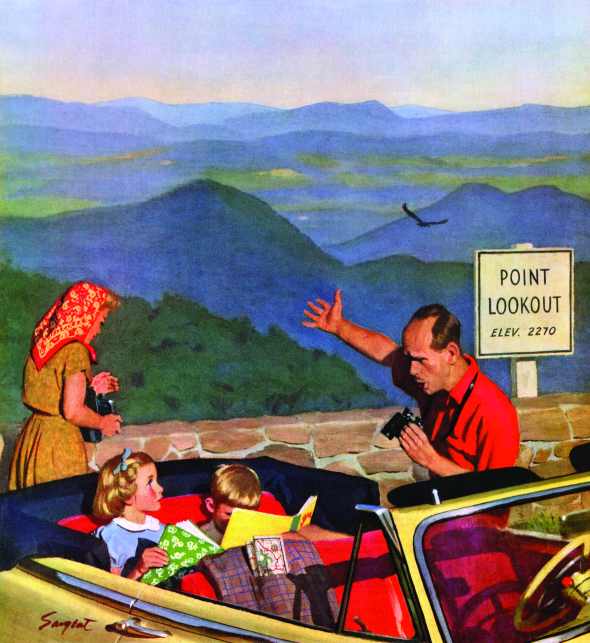
Richard Sargent
The Saturday Evening Post
July 18, 1953
Beached
Retirees in the 1930s may not have known how to dress down for the shore, but they seem to be enjoying the sand just as much as their modern-day equivalents do.

J.C. Leyendecker
The Saturday Evening Post
February 20, 1937
Dedicated vacationers march to the water first thing in the morning, forming an impromptu parade.
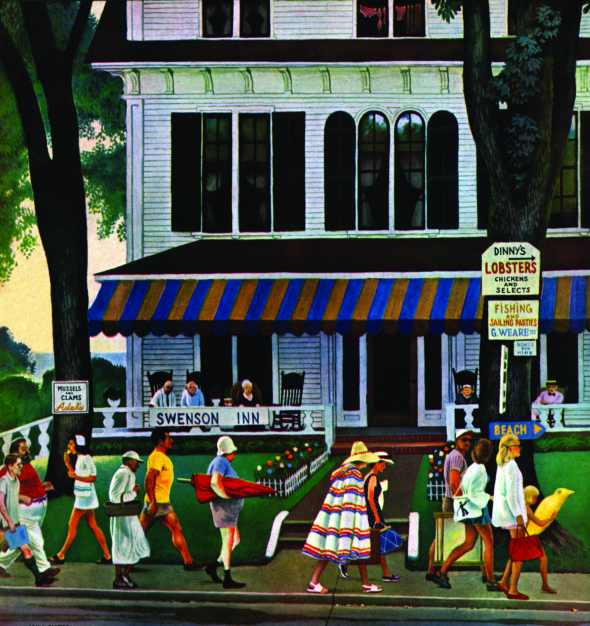
John Falter
The Saturday Evening Post
August 2, 1947
Baggage
Universal Truth No. 1: After a week at the beach, you will accumulate at least twice the baggage that you arrived with.

Stevan Dohanos
The Saturday Evening Post
September 8, 1956
Universal Truth No. 2: Vacations are short and much anticipated, which doesn’t leave time for unpacking — at least not in Dad’s view.
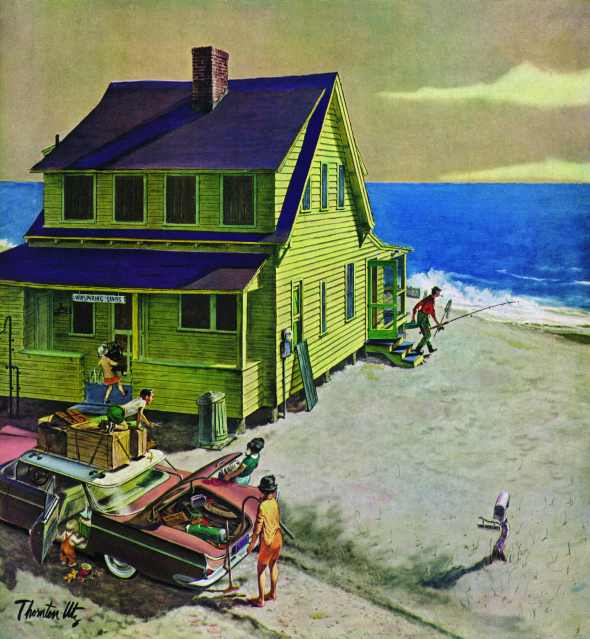
Thornton Utz
The Saturday Evening Post
June 18, 1960
Disappointment
When your job is to help others achieve their dreams as is the case for this travel agent, sometimes you need a quiet moment to dream one up for yourself.
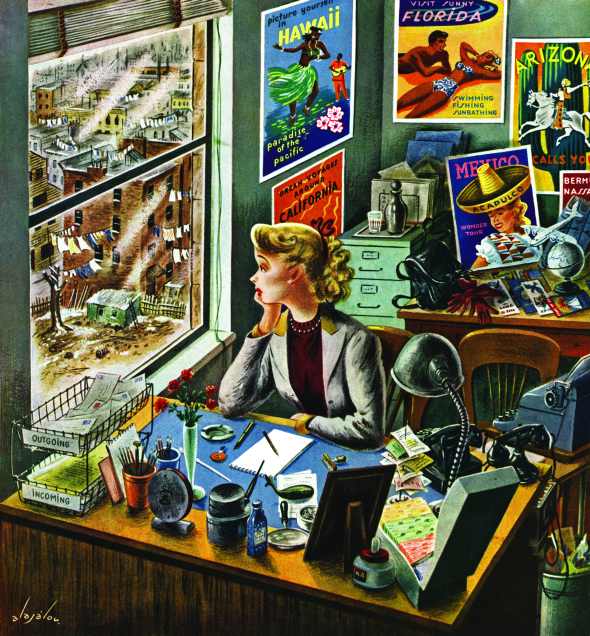
Constantin Alajalov
The Saturday Evening Post
February 12, 1949
You can’t plan the weather for that dream vacation, but this family is determined to get in as much outdoor time as humanly possible.
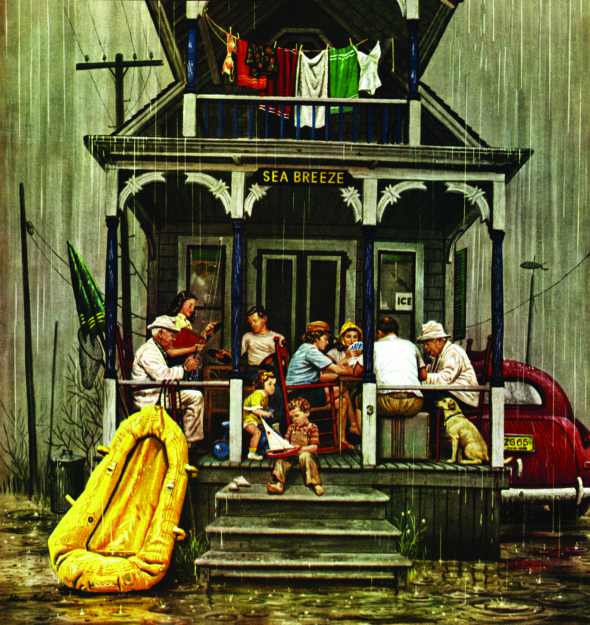
Stevan Dohanos
The Saturday Evening Post
July 31, 1948
Back Again
When you go away for what looks to be about three weeks — judging from the number of newspapers on the lawn, strewn about the front entry by some lout of a paperboy — there’s a lot of cleanup to be done. The weight of this realization is quite evident in the droop of Father’s shoulders.

John Falter
The Saturday Evening Post
August 23, 1952
There may be no place like home, but after a long trip, Rockwell’s family requires rest.
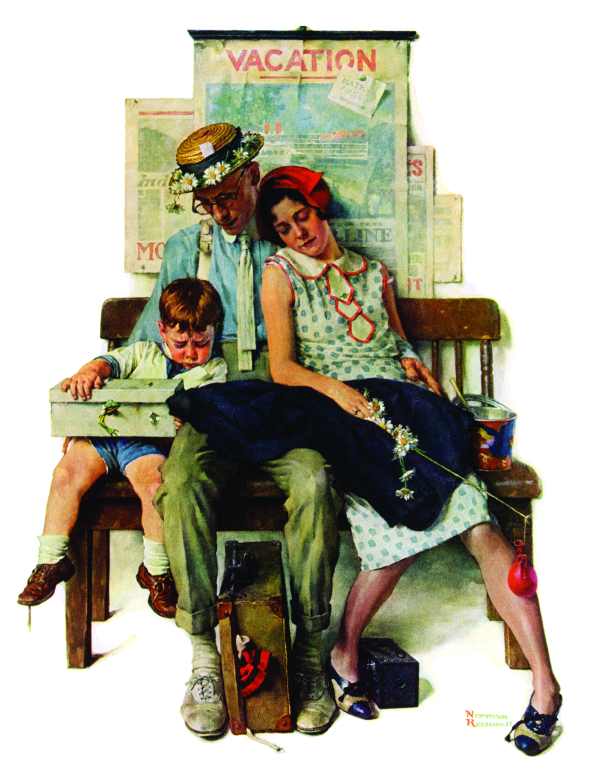
Norman Rockwell
The Saturday Evening Post
September 13, 1930
March/April 2015 Limerick Laughs Winner and Runners-Up
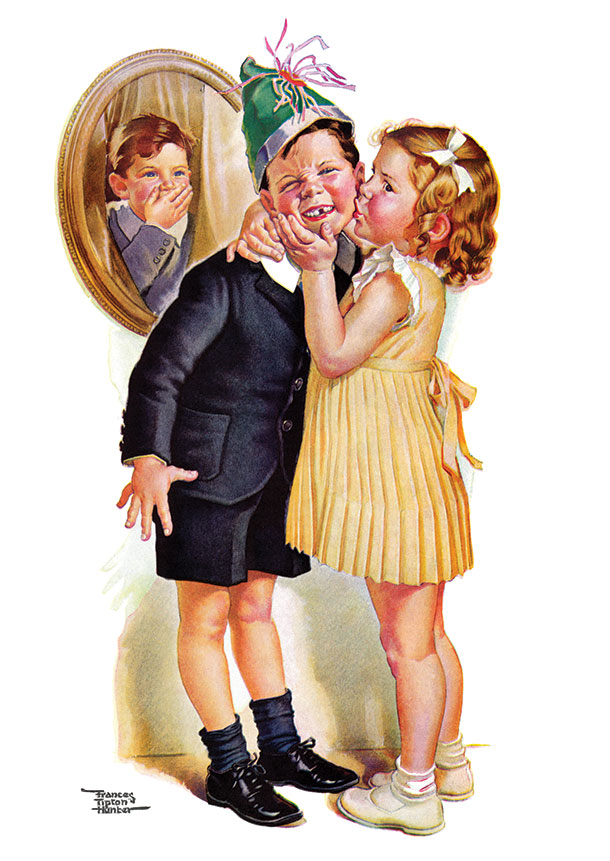
Blow out the candles they say.
I see her coming my way.
A birthday kiss,
She plants without miss.
Ray gasps a muffled, “No WAY!”
—Lisa Radtke, Sussex, Wisconsin
Congratulations to Lisa Radtke! For her limerick describing Francis Tipton Hunter’s illustration Birthday Kiss (above), Lisa wins $25 — and our gratitude for a job well done. If you’d like to enter the Limerick Laughs Contest for our upcoming issue, submit your limerick via our online entry form.
Of course, Lisa’s limerick wasn’t the only one we liked! Here are some of our favorite limericks, from our runners-up, in no particular order:
Little brother was taking a peek
As she kissed Charlie Clark on the cheek;
When he said, “I’ll tell Mum!”
She replied, “Don’t be dumb,
Or I’ll tell her what you did last week!”
—John Bayly, Hawthorn, Victoria, Australia
They’re young now, but wait till they’re older.
That boy will most likely be bolder.
Then the girl might be shy,
But the gleam in her eye
Will tell him she wants him to hold her.She knew she had made a mistake
When she pilfered the last piece of cake —
There was plenty amiss,
But she gave him a kiss
And went home with a big bellyache.—Linda Meacham,Red Wing, Minnesota
When kissing, a basic technique
Is giving a peck on the cheek.
But sometimes a spy
May be lurking nearby
And instead of a peck, gets a peek.
—Neal Levin, Bloomfield Hills, Michigan
It’s no fun when a pal sneaks a peek
At a torturous peck on the cheek.
But a blessing is found:
There’s no iPhone around
For an Instagram Pic of the Week.
—Jeff Foster, San Francisco, California
The party kiss left his head in a whirl,
And his toes were beginning to curl.
But a buddy was peeking,
And off he ran, shrieking,
“Hey, Marty was just smooched — by a GIRL!”
—Glenn Hackney, Fairbanks, Alaska
Now, because of a kiss and a squeeze,
He’s the one all his buddies will tease.
But in a few years or more
With girlfriends by the score,
They’ll all want his secrets to please.His face shows no sign of bliss
At receiving so ardent a kiss,
But just 10 birthdays more
And his heart will soar
When he gets one from some pretty miss.
—Colleen Zethmayr, Valley Center, California
Since she first eyed the boy she was smitten.
Waiting for the right chance — what a kitten.
His birthday seemed right
Soon that very night,
With a sweet kiss, the love bug had bitten.
—Janette Hattis, Gowen, Michigan
At a party a fellow named Willie
Got a kiss from a sweetie named Millie.
It was witnessed by Fred.
Willie cried; Mill went red.
Their passion, I think, turned quite chilly!
—Sonia Schork, Sierra Vista, Arizona
This really pretty young girl
Is ready to give love a twirl.
This boy she will kiss
With never a miss,
But is he ready to give love a whirl?
—Ken Groner, Seven Hills, Ohio
Hey, there are no presents back here,
And why are you standing so near?
Let go of my neck!
I don’t want a peck.
I wish that I could disappear.
—Hannah Holt, Hillsboro, Oregon
Road Trip!
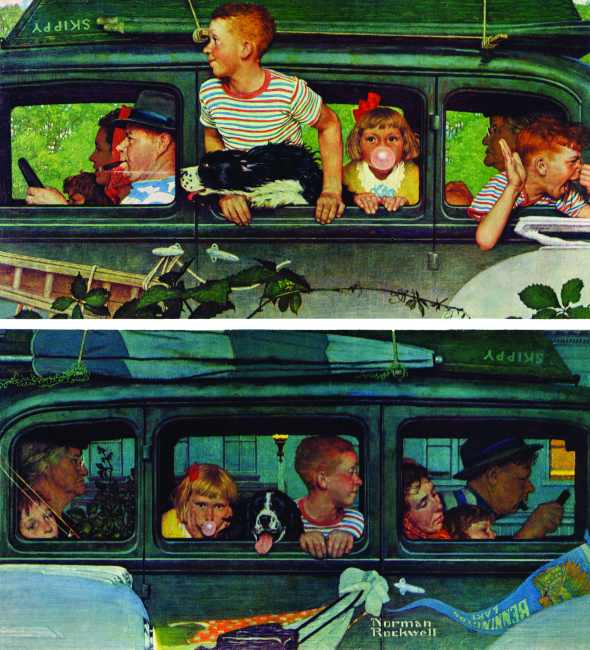
After WWII ended, America was on the move. With an economy on an upswing and higher levels of disposable income, record numbers of families packed up the station wagon, loaded kids in the backseat, and hit the open highway.
Norman Rockwell celebrated the emerging trend in the August 30, 1947, Post cover Going and Coming. While seasonal or topical subjects often inspired Rockwell’s covers, in this two-panel portrait of a family en route to and from a summertime trip we find an example that’s both.
In Going, Dad confidently grips the wheel leading the expedition with Mom at his side cradling the youngest. Anticipation spills into the backseat where big brother and pooch lean into the wind, while little sister blows a bubble about to pop as her brother razzes oncoming cars. Unfazed by it all, Grandma sits stone-faced, staring straight ahead.
In Coming, the excitement has fizzled. Pop struggles to keep his eyes open. Mom, still cradling little sis, drifted off miles ago, while the boys, pooch, even the wide-eyed bubble blower are running out of steam. Unfazed by it all, Grandma sits stone-faced, staring straight ahead — did she even get out of the car?
To help readers unravel the story line, Rockwell provides clues. In the lower panel, to signify nighttime, he shows the tiniest portion of a lighted lamppost through the car window. Another clue: The pennant dangling from the door tells us the outing was to Bennington Lake, where — judging from the fishing pole sticking out the rear window and weathered rowboat lashed to the roof — Dad managed to get in some angling. Rockwell also lets us know Grandma indeed exited the car — if only for a souvenir plant.
There’s a familiar feeling to the entire scene. (We’ve all been on family outings like this.) You can almost hear the eternal refrain, “Are we there yet?”
News of the Week: Harry Shearer, Harper Lee, and a Whole Lotta Hot Dogs
Exxxxxcellent

Well, that didn’t last long. Just a couple of months after leaving The Simpsons, veteran voice artist Harry Shearer reached a deal for two more years and will be returning to the show. Sure, they could have probably found someone new to mimic the voices of Mr. Burns, Smithers, Ned Flanders, Principal Skinner, and Reverend Lovejoy (maybe Ted Cruz?), but it just wouldn’t have sounded quite the same.
We’d know.
‘Go Set a Watchman’
Harper Lee’s sequel to To Kill a Mockingbird will be released on Tuesday, and you can read the first chapter today at The Wall Street Journal. You can also join in a discussion of the books on the WSJ Book Club’s Facebook page.
Lee said at a private luncheon last week that she’s excited about the book’s release and always thought it would be published some day.
Am I Supposed to Like Soccer Now?

Congratulations, blah, blah, blah, women’s soccer, blah, blah, blah, etc., etc.
I don’t mean to be one of those people, but I still don’t like soccer. Hey, it’s great that the U.S. women’s team beat Japan this week for the World Cup, and it’s great that the match got terrific TV ratings, and it’s fitting that they’re getting a ticker-tape parade this morning in New York City but … I still don’t like soccer.
On Twitter I started to feel guilty reading all the tweets congratulating the team, many with more exclamation points than anyone should use when you have a limit of 140 characters. If I didn’t tweet something too, was I being a Debbie Downer? Maybe you feel the same way. I’m happy for the team, and I’m happy that other people are happy for them, but it doesn’t mean that I’m suddenly going to start watching soccer now. Sorry!
The World of Amy Schumer
Is there anyone who’s being talked about more right now than comic Amy Schumer? She was once just another comic but suddenly she’s being treated as a combination of Carol Burnett and Lenny Bruce. She has a popular show on Comedy Central called Inside Amy Schumer; she’s on the cover of Glamour; she’s causing controversy because of some of her sketches and comments; she was asked to be the new host of The Daily Show when Jon Stewart steps down but turned it down; and now she has a new movie with Bill Hader that’s getting good reviews. It’s called Trainwreck. Here’s the trailer.
One note about the movie. One of the cast members is Norman Lloyd. You might know him best as Dr. Auschlander from St. Elsewhere, or maybe as the villain who falls from the Statue of Liberty in the great 1942 Alfred Hitchcock thriller Saboteur. He turns 101 in November.
KO KO’d
We found out this week that ESPN host Keith Olbermann was leaving the sports channel once again. Rumors were swirling the past couple of weeks that Olbermann’s contract negotiations weren’t going well because execs at the network wanted him to “tone down” his commentary during Olbermann. Who knows if that was even true (the network says it wasn’t) or if it’s the reason why he and ESPN are parting ways? The news was first reported by reporter Jim Miller on Twitter:
The second @KeithOlbermann era at @espn has come to a close. There will be no new contract. Current deal which was two years ends 7/31.
— James Andrew Miller (@JimMiller) July 8, 2015
This was "business decision" from @espn pov; want parting with @KeithOlbermann to be amicable.
— James Andrew Miller (@JimMiller) July 8, 2015
So what will Olbermann do now? Let the betting begin. He could easily show up on another sports program, or maybe we might even see him back at MSNBC, which he left in 2011 after hosting the news show Countdown for several years. Hey, stranger things have happened (like Olbermann going back to ESPN after leaving the first time). With MSNBC not doing too well, having Olbermann go back to where he was successful might be a good thing for both. With Olbermann and Brian Williams at the news channel, things could improve ratings-wise.
Introducing Oreo Thins!
“Thin” and “Oreos” aren’t usually words you’d see next to each other, but this week we had the debut of Oreo Thins, which is a healthier (ahem) alternative to the classic cookie we’ve all loved for over 100 years. They’re thinner than regular Oreos, and they’re healthier (ahem) because four of them have 140 calories, compared to the 160 calories of three regular Oreos. So now Oreo has a cookie for everybody: regular, regular cookies with different frosting flavors, different cookie flavors, DoubleStuf, Oreo Minis, and now Thins.
The new cookies are so thin that you can’t do something you can do with the regular ones: Split them open and lick the frosting inside. You can, but they’ll usually break. So since you’re not taking the time to separate the cookies, you’re probably just going to mindlessly gobble the thinner cookies, which means the thinness and lower calorie count won’t even matter. Though I guess you could dunk them in skim milk and feel better about it. Neil Patrick Harris likes them!
Oreo says the new thinner cookies are more “sophisticated.” I know I always feel more grown-up and sophisticated when I have a bunch of chocolate cookie bits all over my teeth.
National Hot Dog Month

This is the time of hot dogs, a food you can probably categorize as “unsophisticated.” Last weekend we saw a big upset at the annual Nathan’s Hot Dog Eating Contest in Coney Island. 23-year-old Matt Stonie ended Joey Chestnut’s 8-year reign by eating 62 hot dogs (with buns!) in 10 minutes. I’m getting kinda gaggy just thinking about that.
It’s also National Hot Dog Month! How can you possibly do something different in the preparation and cooking of hot dogs that hasn’t been done before? So instead of a recipe, how about taking a look at Serious Eats, where they list 13 signature drinks from various regions to pair with hot dogs? You’ve probably heard of drinking tropical drinks at Papaya King and Gray’s Papaya in New York, but in New Jersey and Virginia you could have one with some buttermilk.
I wonder if there is a Joey Hotdog somewhere, and every year he enters a chestnut-eating contest?
Upcoming Events and Anniversaries
Live Aid concerts (July 13, 1985)
This is the 30th anniversary of the two concerts held in London and Philadelphia to aid in the fight to end hunger in Ethiopia.
Bastille Day (July 14)
Officially became a national holiday in 1880 France.
Billy the Kid dies (July 14, 1881)
This site has an exhaustive amount of information on the famous outlaw, including rare photos and letters he wrote.
“Catcher in the Rye” published (July 16, 1951)
J.D. Salinger’s classic comes in at number 72 on The Guardian’s list of the 100 Best Novels of All-Time.
Disneyland opens (July 17, 1955)
SEP Archives Director Jeff Nilsson on the early days of the Disney dynasty.
Erle Stanley Gardner born (July 17, 1889)
The TV show based on Gardner’s famous character Perry Mason was on the air during the supposed “vast wasteland” of programming in 1961.
Auntie Alice’s Funeral
“Bloody hell!” I wheezed standing in front of the full-length mirror in my bedroom. The blasted thing was too large and revealed far too many truths. I had become fat. I’ll admit I was shocked because as ridiculous as it sounds, I never noticed before. I’d spent the last three years living in jeans and baggy shirts. Today I’d had to make an unwelcome change to my daily uniform. Luke, my husband, had lost his Auntie Alice and we were due at her funeral in less than hour. My usual ability to dress in 10 minutes had been brought to an abrupt halt. My black trousers, the smart ones I used to wear to business meetings in those heady days before children, no longer met at my middle and my best black shirt was so tight there were gaping holes where the buttons were straining. The image was not a pretty sight. I didn’t want to be responsible for scaring the rest of Luke’s aging relatives into an early grave.
The sound of small feet charging up the stairs, like a herd of stampeding wildebeest, frightened me into action. I ran for the door and managed to lock it before they could enter. I turned back to the mirror and ignored the insistent hammering.
“I’m hungry and Daddy won’t get me anything to eat,” shrieked a small female voice.
“He’s on the phone,” complained another.
“Eat! Eat!” insisted the youngest.
Three girls aged 6, 4, and 2. Everyone thought we were trying for boys, but I could honestly say we weren’t. I didn’t care and neither did Luke. He loved all the female attention, most of the time. I just wanted three, following me about like a string of ducklings. I looked back at my image, perhaps the third was a mistake.
I pulled in my stomach as far as it would go and turned in profile. It was no good, my bum stuck out a mile, I could see a fold of fat at my back, and then to top it off the button pinged off across my bust.
“Leave Mummy alone!” Luke called up the stairs. “Are you nearly ready, Gail?”
“Won’t be long!” I called back. I turned back to the dreaded mirror and winced.
When I finally emerged I had shrouded myself in a knee-length black mac. I had left the belt undone so the material didn’t pull close to the bulge that was now my stomach.
“Okay, I’m ready.” I was eager to get this over with. “Shall we go?”
The girls were busy devouring yet another round of toast. They were like weeds, the more they were fed the taller they became; I couldn’t help a small sigh of envy.
“Aren’t you going to be a bit hot in that?” Luke asked. The way he looked at me made me irritable. He must have noticed the splurge of flesh, but he’d never said a word.
“Churches are always cold.” I gave a mock shudder and then darted off to ready shoes, bags, and keys. The lot of a working father, Luke never had to organize anyone or anything. At a stretch he was able to prepare a quick snack for starving children, but that was probably only to prevent himself from being consumed by the ravenous hoard. Luke always looked tidy, his clothes wrinkle and food free. He always had time, moving around with that fresh unhassled look. I used to look like that. Now I was overweight, permanently dishevelled, constantly forgetful, and always late. Today was a prime example; as we strapped in the last child and I took my seat in the car I had forgotten to comb my hair and brush my teeth. The children had pristine white teeth, mine must have been fast on their way to falling out of my head.
Luke flashed me a white smile, which made me feel grumpier. I sat low in my seat brooding, aware of how my open trousers had slid halfway down my bum as it swelled across the seat. I would have changed them, but I felt I should wear them as penance.
“All right? You’re very quiet,” Luke said.
“I’m fine, just a bit tired,” I replied.
Whilst I had grown fat, he had remained exactly the same; fit, good-looking, and young. He had that elusive male quality; you never quite know what he’s thinking. He sat quietly watching and absorbing everything, revealing nothing. He must have noticed my changing shape. It had been annoying me for ages that we now had sex with clothes on. Luke always said it was in case one of the children walked in on us, but was it so he didn’t have to look at me? Not that there was much time for sex these days.
The church was dour and cold just like Luke’s family. He was a changeling, planted in their midst. He was sunshine to their rain and a deep jolt of longing surged through me as I watched him towering over his tiny family. He was vital and strong, the father of my children, and I realized for the first time in a long time that I still loved him. Not the comfortable, familiar feeling of shared experiences and the bond of a life lived together, but the gut-wrenching, soul-searing emotion that fills you from the hairs on your head to the tips of your toes. He looked up and met my eyes across his pygmy relations and tilted his head slightly to one side in question. I gave him my best fake smile, all 200 watts of it. The muted ceremony began, and I suddenly felt lucky to be the mother of a demanding and extremely active 2-year-old. I left the church after five minutes with a smug expression. I praised Lilly for the escape she had given me; she picked grass in response and put it on my hair. The churchyard was quiet and whilst Lilly was busy pulling apart flowers and singing softly to herself, I sat and enjoyed the play of breeze across my cheeks and down my neck. I was a little hot, but I’d suffer rather than reveal myself. I tried to pinpoint when the downhill slide began to occur. Becoming a mother was a difficult thing. I had sought solace in food and cheap novels, pretending I didn’t exist. It seemed to be working fine, until today when I discovered that I was real and things had gone to pot in my absence.
The church doors swung open, Marsie and Honour come running out to join us. They sat, my three daughters, and quietly made daisy chains, the tiny little flowers standing out against the sombre black.
“You look pretty, Mummy,” Honour said sweetly from my lap. She had soft blond hair which curled endearingly about her cheeks. She was gentle and quiet, unlike her sisters, as if she understood the unspoken conversations of adults and the mysteries of life and the universe. I smiled at her, appreciative for the small vote of confidence in the midst of my private crisis.
“Thank you, Honour. I think you’re pretty too.”
“I like your fat tummy, but you should do some exercise.” She went back to the little bracelet she had been making and I sat there unhappily acknowledging that things had got to change if my 4-year-old felt she needed to give me health advice.
Later we sat at the local pub, making polite conversation with Luke’s parents whilst the children played happily in the garden. There were platters of chips and small white sandwiches and cakes. I tried not to eat any of it, but I knew I had a problem. I kept staring longingly at the chips and cakes and wishing I were alone so I could happily gorge myself on them until I was so full there wasn’t any room for anything else; not food, nor regret, nor the deep feelings of inadequacy, resentment, and overwhelming responsibility.
I volunteered to drive home so Luke indulged in a couple of glasses of wine. I watched his easy elegance. The girls had it too, well, it was difficult to tell with Lilly who fell over almost all the time. I felt like a sumo wrestler, enormous, larger than life. I tried not to be; I tried to slide into the shadows but there were some things that no one can hide from. One of those was Aunt Grace. I arranged my features into a very reluctant smile, I hoped she could see that, but really she was impervious to anything other than herself, rather like head butting a brick wall, only more painful.
“I hardly recognized you, dear.” She used the “dear” as a lure.
“Yes, it has been a while.”
“I can see that.”
“Well, you look wonderful,” I said through gritted teeth. She created the illusion that she was a sweet old lady then hit you right between the eyes.
“Well, you don’t, dear. You’ve grown so fat. I thought you must be someone else.”
I glowered at her from across the table, but it was a waste of facial movement; she didn’t notice, or chose not to notice. I sat racking my brain for a witty retort but could think of nothing except the fact that she was right.
“Yes, I suppose I have.”
“You should buck up your ideas. You’re not going to keep that fine husband of yours interested looking like that. His eye will wonder if it hasn’t already, and I bet there are plenty of younger women ready to have him.”
I held my breath for five seconds so I wouldn’t say anything I shouldn’t. I couldn’t quite manage a smile any more; it slipped down my face.
“Aunt Grace, it is so lovely to speak with you. I’m just going to check on the children.” The coward’s way out but I didn’t think Luke would thank me for causing a scene.
The girls were playing happily, and Lilly was running full tilt. She was like that; she went at everything with a ferocity of purpose. Tenderness softened the hard lump in my gut as I watched her pause in her game; a game which only she knew she was playing. Something caught her eye in the mud and, with a toddler’s indiscretion, shoved it into her mouth and began to chew thoughtfully. She finished her exploration before I could intervene and was already spitting out something unspeakably mangled and slimy when I arrived. I wiped her chin with a tissue whilst attempting not to gag. Lilly wriggled violently beneath my ministrations determined not to miss a second of play. I sighed watching her trip and then regain her feet. Her determination superseded any pain from the fall as she launched herself into the world and took everything life offered. All of those qualities were within me once, where were they now?
I sat on the grass close to the children and looked around for Luke, Aunt Grace’s warning ringing in my ears. He was standing at the bar chatting with the barmaid, her hair shining like a beacon through the gloom. It was pathetic to feel jealous of a stranger chatting with one’s husband. She clutched his arm and giggled flirtatiously, and I actually groaned out loud. Luke was laughing in response, but even as dense as I was at that moment I could see it was his polite laugh. I brooded over her long red fingernails gripping his sleeve like the claws of a succubus.
“Hi!” Susan had crept up behind me whilst I sat glaring at the barmaid who was totally unaware of the death stares I was sending her. “It’s nice that you came.” Susan was a soft, mousy little thing, with big brown eyes. She was always kind and friendly.
“I’m sorry about Auntie Alice,” I said. She was a great aunt really and ancient. It wasn’t a surprise. Still, saying the proper thing helped to mask my ugly mood.
“Don’t say that to Mum. She’s so relieved.” I snorted in surprise and Susan laughed. “She was demanding, bad tempered, and totally selfish, or so my mother told me at least five times a day.” We sat in silence for a while watching the children.
Susan suddenly turned to me with tears in her eyes. I assumed it was grief and put my arm around her shoulders. She cried harder. She didn’t lean into me and accept the comfort I offered, but remained rigidly self-contained. I looked across the garden to where everyone else was congregated. They were knocking back the drink unaware of anything else. I turned my attention back to Susan. She was dabbing at her eyes, trying to stem the flow of tears mingled with mascara.
She shrugged my arm off.
“It’s good to let it out,” I assured her. “Better that then allowing it to fester.”
“You don’t know what you’re talking about,” she snapped at me. I gaped at her; she had only ever been on good terms with me. I was completely thrown by the savage look she threw my way.
“You’re so pleased with yourself. Yes, we all know you’ve got everything,” she hissed at me. I choked on my own saliva as I sat there open-mouthed and forgot to swallow. “You think you’re so superior because he’s yours. You think you’re so special because you’ve borne his children. Three beautiful girls, they’re no credit to you, they’re all him. Look at you, you’re fat and dull, but he sticks with you because of them.” My mouth gaped open wider, nothing came out. Her attack was so completely unexpected. “I don’t understand it.” She scowled at my massive tent-like coat. I suddenly felt some connection with her.
“I know. I don’t understand it either,” I agreed sadly.
“He’s beautiful.”
“Yes,” I nodded, “yes, he is.”
“If it wasn’t for you, I’d have a chance.” I spluttered in shock.
“But you’re his cousin, that’s practically incest.”
“If this was your funeral, I would be able to comfort him,” she sighed. I sat there bemused by this bizarre conversation.
A movement caught my eye. It was Luke leaving the bar and coming towards us. Susan stared morosely into her drink, snivelling. Luke cocked a questioning brow at me and nodded towards her. I gave him a puzzled shrug. He rolled his eyes with a wry grin and then made a show of sneaking off towards the children. I might have been having doubts today, but there was definitely an intimacy between us which no one else shared. The thought warmed me and gave me a measure of my usual confidence back.
I turned to Susan. She was pathetic really. I rose to my feet, brushing the grass off my clothes.
“I’m sorry for your loss, Susan, but as far as my husband is concerned, he’s mine and you can’t have him.”
I walked over to where Luke was standing, watching all three of our girls going down the slide together in a fit of giggles. He was laughing with them, taking pictures with his phone.
“What’s wrong with Susan?”
“Oh, you know.” I shrugged.
“Should I go and speak to her?” My stomach clenched in reaction.
“Oh, I think she’ll be all right in a minute. She’s a little drunk.” He nodded and turned his attention back to our girls. They were lying in a heap on the wood chips at the bottom of the slide, giggling helplessly.
“They’re so cute,” he said, his eyes tender. He pulled me towards him and brushed his lips softly across mine, making me warm inside. He pulled me closer, squeezing me hard. “I love you,” he whispered in my ear and then pressed his forehead to mine and sighed contently. I was inordinately pleased.
“I’m glad because I was a bit worried,” I whispered back. He leaned his head back so he could see me better.
“Worried about what?” He stood there frowning, and I tried not to feel like I was 15 again.
“Well, I’m not quite the slight young thing you married.” I tried to laugh, pass it off as nothing but my lips trembled giving me away.
“Neither am I.” He gripped me tighter frowning at me.
“Yes, but you haven’t ballooned several dress sizes and become awful and unsightly.” I couldn’t maintain eye contact because I was afraid I would cry.
“Gail, look at me,” he whispered. I slanted my eyes to his. “Give yourself a break. You’ve three children and you’re exhausted. I don’t know how you do it. You’re amazing and they are amazing because of you.” I bit my lip to hold back the tidal wave of emotion. “And you are not awful and unsightly. You’re beautiful.” I grimaced at that not believing him. He moved his hips forward so he was pressing against me. I couldn’t suppress my grin at the undeniable evidence that he still found me attractive. We exchanged another soft-lipped kiss.
“Daddy loves Mummy!” Marsie yelled loudly, so that everyone turned to look at us, standing there clasped together. Luke, never one to disappoint, leaned in and kissed me more deeply leaving my lips tingling and my toes curling with pleasure.
Once we were home I went straight upstairs, threw off that mac and ill-fitting clothes. More comfortably attired, I went to find my family. They were in the kitchen, eating again.
“Honour says I need to do some exercise. Anyone fancy getting the bikes out?”
A cheerful chorus rang out. I grinned as we sorted through the muddle of helmets and safety pads. My life might not be perfect, I might not be perfect, but I was happy, and that was all that really mattered.