Jan/Feb 2015 Limerick Laughs Winner and Runners-Up
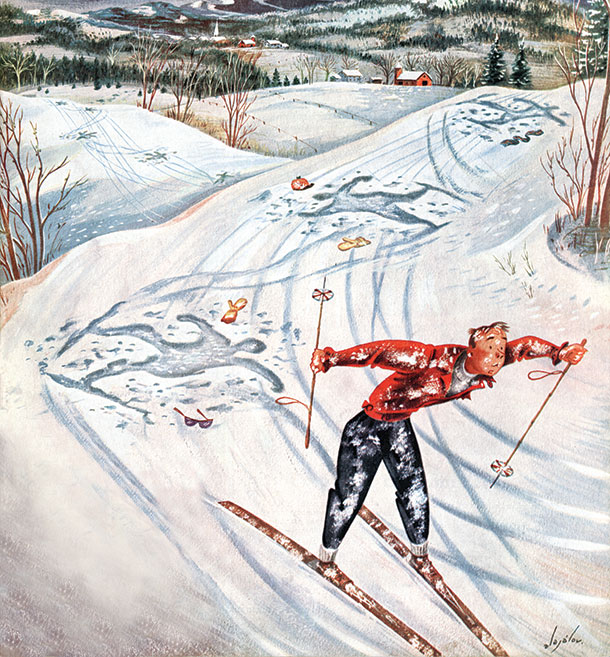
There once was a man on two skis,
Schussing around as he pleased.
The story was told,
That he had a cold,
And fell every time that he sneezed.
—Phillip Belfiori, Bel Air, Maryland
Congratulations to Phillip Belfiori! For his limerick describing Constantin Alajálov’s illustration Snow Skier After the Falls (above), Phillip wins $25 — and our gratitude for a job well done. If you’d like to enter the Limerick Laughs Contest for our upcoming issue, submit your limerick via our online entry form.
Of course, Philip’s limerick wasn’t the only one we liked! Here are some of our favorite limericks from our runners-up, in no particular order:
There was a young athlete named Grier,
Who fancied himself quite the skier.
Well, he could be best
When put to the test —
If only he’d learned how to steer.
—Michelle Gordon, Airway Heights, Washington
On the slopes we were going our fastest
When a good-looking girl came to pass us
My buddy got lost
And paid the cost
Now I’m out a new pair of glasses
—Brite Templeton, Scottsdale, Arizona
If losing your clothes as you go
Makes skiing much faster than slow
How quickly you’ll fly
When the last pole goes by
As bare-skinned you tear through the snow
— Clarissa Jahn, Taylor Ridge, Illinois
He thought it would be such a breeze
To learn how to use his new skis.
Such delusions of youth!
He’s discovered the truth:
It requires some real expertise.
—Neal Levin, Bloomfield Hills, Michigan
This wee bunny hill is a snap
I could run it while taking a nap
You can see this is so
From clear prints in the snow
The facts bear this clearly, Old Chap
—Betty Checkett, St. Louis, Missouri
A terrible skier from Wight
Filled all on lookers with fright;
But each time he fell
He declared, “Oh, well, ”
It’s not easy to be upright!
—Sally Butler, Frostburg, Maryland
I skied down a treacherous slope
Of grace I had clearly no hope!
I lost this and that-
Scarf, mittens and hat
And managed to look like a dope!
—Peggy Proud-Edwards, Aurora, Illinois
To do my personal best
Is today’s daunting test,
I’ll be able to say
I did it my way,
No keeping up with the rest!
—Marilyn Zielke, Bruce, Wisconsin
Kill Your Bucket List
As a travel writer, I was recently invited on a tour of Africa, billed as checking off your bucket list, and we did some really cool things.
Went to Timbuktu — which means for the rest of my life I can casually say, “When I was in Timbuktu …” Went to Victoria Falls, where the waterfall is so powerful, so loud, that even a mile away, when an enraged monkey cornered me and I called out for help, not a single one of the nearby zebras so much as looked up. And we drove into the sand dunes of Namibia at night, where there were a billion stars, but they were Southern Hemisphere stars, so I didn’t recognize any of them. I didn’t recognize any of the shapes in the sky, and I had this weird moment thinking I could be on an entirely different planet, and one of those little blinking lights might be earth, might hold everything I love.
 And in Ghana, our hotel was right on the beach, nothing between us and the ocean, and in the morning, as we loaded onto the plane, I found out not a single person on the tour, not a single one of these people living out their bucket-list travel dreams, had gone down to the water and stood in the Bight of Benin. But I guess that wasn’t written on their buckets.
Somehow, it’s all become about the bucket list. Books you must read, music you must hear, places you must go. Nobody just takes a vacation anymore, they knock the Eiffel Tower, the Great Wall of China, the temples of Angkor off the list. They swim with sharks. They pet pandas. They run from bulls.
Clearly, if you don’t carpe that diem, it’s all a big strike out, because, just like naked teenagers in a horror movie, you are going to die.
But what if, instead of saying you had to do things before you died, you just said you wanted to do them while you were alive? Because they were fun. What if you just went out and played? What if you killed the bucket list?
A common expression of bucket-list chasers is “Live every day like it’s your last.” But when you do that, you’re trying to stop time, lock it in like a snow globe. I much prefer the idea of living every day like you’re alive. Then, you’re in the river of time; you’re a story instead of a list.
The first time I was told I had less than a year to live was more than 15 years ago. And since then, I’ve been told five more times. Once every three years or so, some medical professional tells me I’m doomed.
Yet I’m still here. And the point is not that, against all sense and nature, I’m as immortal as Keith Richards. The point is that I have gotten to consciously live the last year of my life six times. Most people do it once or not at all.
Now, here’s where you expect me to say something uplifting about dying, how it changed my life and made me appreciate the taste of peanut butter and the sound of my dog snoring, or whatever. I envy the people who can do that. But I can’t. Apparently I missed that bus. The truth is, dying really kind of sucks. It’s boring and painful and humiliating and takes up a massive amount of your day. Each morning you wake up and think, What part of me did I lose? How can I still be me?
And even worse, it means you have to see pain in the eyes of the people you love, the pain you can’t save them from, because it’s the pain of them wanting to save you.
Dying is absolutely nothing to base your life on.
Which is why I get so pissed off every time somebody asks me if I’ve done my bucket list yet.
No, I haven’t, and I’m not going to. If I’ve learned anything from all this, it’s that I don’t travel by what I want anymore, I travel by what I wonder. Instead of saying I want to see the Great Wall of China or an elephant morning in Kenya — instead of saying “here’s the thing I want for my list” — I just ask questions and then go someplace to see how that place answers. What does memory smell like? And the perfume fields of France had an answer. How do two people standing side by side see such different things? And I ended up in a haunted house in England, where I saw the ghosts and my companion didn’t.
And for years, I chased what should have been one of the easiest questions of all: What does the quietest place in the world sound like? With no reason for buying plane tickets but that question, I went to the Arctic to listen to the hard click of caribou hooves across the tundra. I went to the boonies of Mongolia, where ice breaking up on a lake sounded like a particularly delicate wind chime. I hiked to the bottom of Haleakala volcano on Maui, which is arguably the most acoustically quiet place on earth. The point being that it didn’t matter precisely where I went; I just went to see what was happening, to see what the place wanted to tell me. In the quiet, to listen.
And doesn’t that always work better than going to a place, list in hand, telling it exactly what you expect of it? A very dear friend and I planned this wonderful, romantic trip to Venice. In the most beautiful city on earth, we took gondola rides and listened to bands play waltzes late into the night and … it was okay. Just okay. We had a nice time, trying to avoid our expectations like dodge balls.
But then after our trip to Venice, my friend and I had a few days of vacation left, so we just asked the hotel concierge where to go. He made a phone call, handed us a map and a train schedule. Here. Which led us to the miraculous little hill town of Asolo, only an hour outside Venice, a world of cobblestone streets and buildings the color of peaches, and trees so full of singing birds there was hardly any room for leaves.
When we went into the local food shop, I asked the guy behind the counter if the jar of honey was from Asolo. Because I don’t speak Italian, I just said “Asolo?” and that got the point across. Enough so that he decided to sell us an Asolo picnic. With the utter joy of a man who loves his home, he grabbed us bread — Asolo — cheese — Asolo — fat olives — Asolo. When I pointed at a different cheese I wanted to try, he just shook his head —
“No! Asolo.”
And yes, of course, it was probably the best lunch of my life, and my friend and I found some of that magic that we had tried to force out of Venice. The day offered us this gift, a moment to hold hands and wonder at how big and full of possibilities the world is.
Your bucket list is only about you. What you want, what you demand of the world. Kill your bucket list, and you make room for much more. You make room to share, you turn your life into a bedtime story, so you can curl up with the people you love and whisper the night away.
I know from personal experience; that last moment, you don’t care that you saw the Eiffel Tower. You care that you were never too much of a coward to say I love you. You care that once you kissed a girl on a park bench, and that you still both carry the weight of that moment. You care that you said thank you more than you said please.
And that’s the thing — a bucket list is a please. Put everything in the bucket and … just let it go with a thank you.
News of the Week: Comets, Comic Holograms, and Coconut Cream Pie
Look, Up in the Sky!

The most famous comet in the universe — probably the only one most people can name — hasn’t been seen around Earth since 1986 and won’t be seen again until 2061, but if you were looking up at the night sky late Tuesday/early Wednesday you could have seen a pretty spectacular meteor shower of the debris left in its wake.
The display actually goes until May 28 but peak visibility for the shower happened a few days ago. This won’t happen again until October with the Orionid meteor shower (expected to peak around October 20), but if you don’t want to wait that long, don’t worry. This is the age of everything online, and Slooh recorded the entire event for us to see (scroll down to the video).
When I was a kid we always thought “Halley’s” rhymed with “dailies.” But it actually rhymes with “alleys.” No matter what Fountains of Wayne said.
Coming Soon: Dead Comics — Live!
Norman Rockwell
February 13, 1954
They’ve done it with dead musicians like Michael Jackson and Tupac Shakur, and now we’ll actually be able to see the dead stand-up comics of yesteryear perform live again!
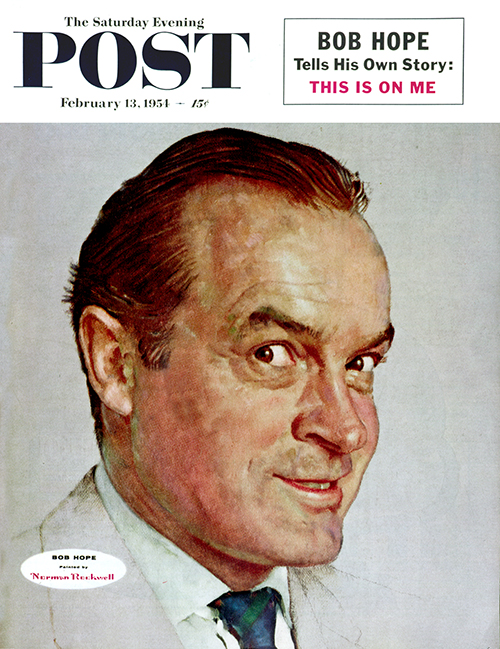
Okay, maybe “live” isn’t the right word to use. The National Comedy Center, a new club that will open next year in Jamestown, New York, will feature hologram performances of stand-up comics and other comedians that have died. So if you have always wanted to see people like Bob Hope and George Carlin and Lenny Bruce but were too young to see them years ago, this will be your chance (pending deals with their estates of course).
There are two questions that this raises: 1) will people be turned off by this because they find it creepy and tasteless? and 2) why didn’t someone come up with this genius idea before? The only question I have is how will this actually work? If it’s a hologram of an actual live performance, that means there was an audience there and they were laughing and the comic had to pause. How will this mesh with the new audience and the new laughter?
The center won’t be too far from where Lucille Ball was born, Celeron, New York, and the owners want to give this a new home. Hopefully it will be fixed by the time the place opens.
Goodbye, MDA Labor Day Telethon

Featureflash / Shutterstock.com
You sort of knew this was coming. When the Muscular Dystrophy Association canned host Jerry Lewis from the show in 2011 after he hosted it for over 60 years, and then cut the show’s length down from 21 1/2 hours to a 2-hour primetime special, you knew it was on its way out. And now it’s official: the MDA is ending the show for good. Why? Because it’s a different world now. The fundraising efforts will now be done mainly online and via other fundraising throughout the year.
It’s actually kind of odd. Sure, on the surface it seems like having a telethon that runs for an entire day is something that’s not needed, something from another time. But isn’t that what made it special and stand out in the first place? There were two things we absolutely knew about Labor Day: We’d soon have to start school again, and Jerry Lewis was going to stay up for a day and raise money for kids.
Here’s what Lewis has to say about the telethon’s end.
The ‘Dad Bod’
Thornton Utz
July 22, 1961
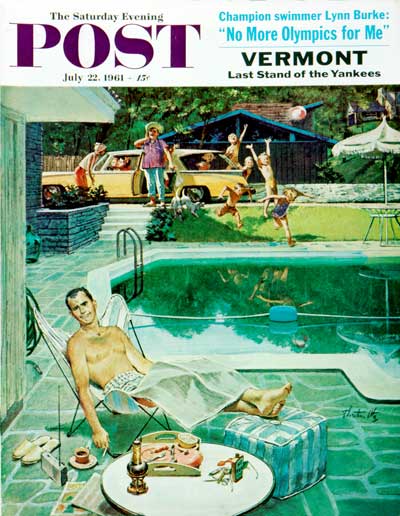
I’m not sure why this is suddenly a “thing” on the Web, but it is. It’s the “dad bod,” the body a male of a certain age has. He’s a little older (but sometimes young) and he’s kind of in shape but also kind of not. Or as this article puts it, “a nice balance between a beer gut and working out.” In other words, the Web is celebrating guys who are completely normal in every way.
I think I have a granddad bod.
Are Reality Shows Good For You?

Nobody can actually be trying to argue that shows like The Bachelor and The Real Housewives of Beverly Hills are actually good for us, can they? Of course they can!
A new brain-imaging study in the journal NeuroImage (one of my favorite neurology journals) says that by watching reality shows where people throw drinks at each other or get into fights or decide to get married after knowing each other for two weeks, we can actually feel empathy. Researchers at the University of Bonn in Germany call it “vicarious embarrassment,” which is the “ability to squirm in empathy for someone else’s social pain or loss.”
Now, I’m pretty sure I can feel empathy for many people but usually not for people who decide to live their lives on reality shows. Also, maybe it’s not empathy people feel. Maybe it’s more of that embarrassment factor. Sort of like the embarrassment they should feel anyway for watching these shows in the first place.
National Coconut Cream Pie Day

Today is the day to celebrate the coconut cream pie, the official dessert of the inhabitants of Gilligan’s Island. I never could understand how Mary Ann could make those delicious pies, stranded on an island. But when you have characters like the Howells who brought a ton of clothes and money with them for a three-hour boat tour and plots where various people come and go on the island but the cast can’t get rescued, I guess the making of coconut cream pies is one of the more realistic things that happened.
Dawn Wells, who played Mary Ann, wrote a cookbook several years ago. Here’s her recipe for coconut cream pie and a few other things inspired by the show.
Upcoming Anniversaries and Events
Mother’s Day (May 10)
Don’t forget to buy something for your mom this Sunday!
Transcontinental Railroad completed (May 10, 1869)
The Saturday Evening Post has a series of articles about trains and their passengers in our archives.
Garry Kasparov loses to IBM supercomputer (May 11, 1977)
Wikipedia has a detailed account of the famous chess battle.
Frank Sinatra dies (May 14, 1998)
The official Sinatra site has tons of terrific stuff, and here’s the New York Times obituary for Ol’ Blue Eyes.
First Academy Awards held (May 16, 1929)
The first ceremony was held in the Blossom Room of the Hollywood Roosevelt Hotel. Here is a list of Oscar winning films inspired by articles in the The Saturday Evening Post.
The Cryptozoologist
Dear Leon,
Let me say it up front: You were right. The Sasquatch is a myth. I know, that’s hardly a surprise to you, and honestly it’s less of a surprise to me than you might suspect.
My guides in my hunt were a pair of second-generation Sasquatch-spotters, a rosy-cheeked husband and wife team, Timothy and Tiffany Ludlow. The Ludlows have spent their entire lives migrating through a circuit of cabins and camps in the wooded northwest, ushered into their lifestyle by their own parents. They were a welcoming pair, self-appointed ambassadors to the Sasquatch-curious, always on the search for potential new initiates. I met them in a camping supply store, where I was selecting the items for my camping kit. They were happy to offer their guidance on essential equipment and reliable brands, with further advice about good spots to camp and places to avoid.
“Is this your first time chasing Sasquatch?” Tiffany asked. I had not volunteered that I was seeking the Bigfoot. I’d said nothing about it at all, only speaking of my intention to go camping, to get away from the world for a while, to seek myself in the woods. The Ludlows weren’t fooled. They were attuned to their own; they saw Sasquatch in my body language, my tone of voice, the little things I didn’t say. I laughed, and made no effort to deny my true intentions. I needed their help after all, so why be anything less than forthright?
They invited me to join them at their camp, which turned out to be a grand enclave of beards and flannel, a dozen part-time cryptozoologists sharing resources, sharing meals, trading stories of their sightings and near misses, weaving in improbable details, unaccountably poor luck. They reminded me of Nica, these spontaneous storytellers, the way they all were so delighted to have an audience in their midst who hadn’t heard their stories before. Do you remember after the hurricane when we were kids, how the power stayed out for days, and Nica wove tales for us by candlelight every night before bed? And then the power came back on, and we went back to watching television and playing our cassette tapes, and after three days of that, the power went out again. It only lasted a few minutes that time, before Dad discovered that all the fuses were gone, stolen, hidden away in Nica’s sock drawer, and Nica extravagantly wondering aloud how they could possibly have gotten there.
These men were the same, in a way. A bald-headed insurance adjuster told of the time he spotted just the Sasquatch’s hand resting on a fallen tree, before withdrawing back into the brush. A portly line cook told of the fresh tracks he found in the mud behind his restaurant, leading from the tree line to the dumpsters and back again. A diminutive shop-class instructor told of the time he and his girlfriend were parked at camp, when they were interrupted by an inhuman cry from the darkness. They all talked of how they would leave their day job someday, just as soon as they had the evidence they needed, the perfect film footage, the complete fossil, the living specimen. One day soon, their faith would prove out, and the world would acknowledge them.
I lived with a rotating cast of these characters for the following six months, each of them taking turns as my guides and companions. They each had their pet strategies, their favorite spotting grounds, some favoring treetop blinds, some spelunking uncharted caves, some preferring to simply walk the trails and count on serendipity to deliver the beast to their path.
Serendipity never delivered. In the six months I spent searching, I never saw the least bit of convincing evidence, much though my companions tried to convince me otherwise. They showed me animal hair and footprints and broken branches, and none of it justified the claims they made, none of it resembled the miracles they imagined finding. Once, while perched in a treetop blind, I observed the Ludlows, hunting separately, approach each other from the woods, close enough to see, but not recognize the other, each mistaking their spouse for something remarkable. That night at camp, they corroborated each others’ stories. They had seen it in the same place, hadn’t they? By the creek, something manlike, lingering in the trees, peering out at them from behind insufficient cover. They each spoke of being watched by something intelligent, they reported the same, furtive, careful posture, timid and curious. They described the same eyes, knowing and generous, and deserving of love. What else could it be but the Sasquatch?
The other cryptozoologists devoured this story, added their own embellishments, how one of them had once found half a footprint in the mud by that same creek, another had picked up the scent of the Sasquatch’s distinctive musk. They congratulated themselves on this great discovery, this great step forward. They opened beers and boxed wines and they celebrated. I said nothing of my observations from my own vantage, of how I had seen them discover nothing but their own selves. I knew I was done then, but I said no goodbyes, reluctant to explain my loss of faith, my exit from the congregation. Disillusionment has never been a gift worth sharing.
That idea probably makes no sense to you, does it, Leon? The truth had been laid bare, the mystery dispelled. That would have satisfied you. More, that would have relieved you. But I was never there for the Sasquatch, Leon. I was there for the mystery itself. That was what drew me. Had I failed to draw a conclusion, I could have stayed happily in those woods for the remainder of my life.
Do you remember that book of riddles we shared as boys? They weren’t difficult to solve, especially for you — you saw the logic of them, plucked solutions from the nuances of phrasing like an angler pulling fish from the sea. But they got harder as we got deeper into the book, took you longer to puzzle out, until eventually they began stumping you entirely. You sat and thought, five minutes, ten minutes, fixated, but quickly giving in to frustration — you snatched the book from me, flipping to the answers at the back, only to find that I’d carefully razored those pages out, tossed them away days earlier. You lost interest instantly, but I continued reading riddles out to you, tormenting you with irresolvable conundrums. I wasn’t interested in the answers, only the questions. The riddles I liked best were the ones we couldn’t solve.
After leaving camp, I hitchhiked to Portland, feeling ready for a few weeks of comfortable living, a hotel bed, a long shower. The hotel was a hotel. The bed was a bed. The water was wet. After four days, I was roaming the streets, looking for signs, omens, miracles. I walked down to the pier to see the ocean, those vast alien fathoms. The depths have always comforted me.
That’s where I met the man who owns a submarine.
Dear Leon, by the time you receive this letter, I will already be gone, down beneath the waves, in the company of submariners. I will write you again, as soon as I can. Until then, I offer you a mystery: How much of our world has been lost to the ocean?
What might still be there?
With love,
Demitri
‘Red Head’ by Norman Rockwell
Every day is Mother’s Day. None of us would be here without them!
For some of us whose mothers are no longer here, it is a wistful time. Yet, they are still with us. She is there in the daffodils and crocuses she planted years ago that rise out of the ground every year to welcome the spring. Your mother is there in the music you shared — perhaps that special song she sang just for you at bedtime. They will always be here, part of the fabric of our beings and lives. Even the mothers who were not able to be present and available to their children because of difficulties — they play a part in forming you, teaching you to seek out what is missing and go on a journey to find it, no matter what.
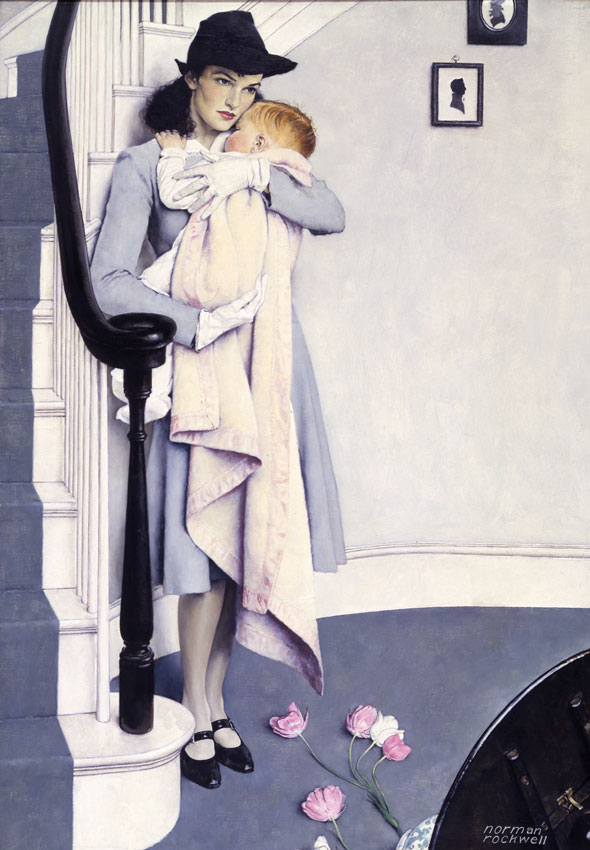
I stumbled upon this striking painting of my grandfather’s a few weeks ago. I chose this image specifically for Mother’s Day because it is not remotely sentimental — something my grandfather is frequently accused of being. It is simply a masterfully executed illustration of maternal care. It’s entitled Red Head — an illustration for a story of the same name by Brooke Hanlon that appeared in American Magazine in November 1940:
“No doubt Linda had meant to hold young Tim gingerly, fearfully, but that sort of holding was never part of young Tim’s plans …”
Story illustration for American Magazine, November 1940.
Oil on canvas, 37 1/8″ x 26″.
National Museum of American Illustration collection.
© Norman Rockwell Family Agency. All rights reserved.
Red Head is a stunning study of black, white, and gray tones — gradations of gray — with the only flashes of color being the bright pink of the tulips on the floor, the delicate red of the boy’s hair, the blush tone of the blanket and the deep rose of her lips. There is a coldness to the palette.
The woman, quite rigid, is softened by the little boy in her arms and the awakening of her innate need to protect and nurture him. The choice of hat is fascinating — a fedora that is almost masculine, yet there’s something elfin in its shape. It reminds me of a hat Garbo once wore in a film. It adds to the guarded quality about her. The profile of the hat reflects the silhouettes of the cameo portraits on the wall. Cameos reveal just so much, only a profile, mirroring her somewhat masked emotional state. The magic of the painting is that it is static but very much alive — this is a turning point in this woman’s life, a softening, a shift. The overturned table and scattered flowers illuminate this. The empty stairs reaching upward with the swirling banister indicate movement, rising above the circumstances below.
Norman Rockwell would try out new techniques throughout his career — to stay current, to try to avoid his paintings registering as outdated. Al Parker, known as the Dean of Illustrators, led a new wave of illustrators in the 1930s, including Coby Whitmore and Jon Whitcomb. My grandfather employed some of the techniques from this school — the stark contrast of colors, the pronounced use of white and pastels — to try to keep up with the young upstarts! I personally love the wedding of opposites in the painting, the starkness married with the awakening tenderness — moving beyond the tumbled past into something with promise and possibility.
Warmest wishes and gratitude to all moms,
Abigail
Mother’s Day
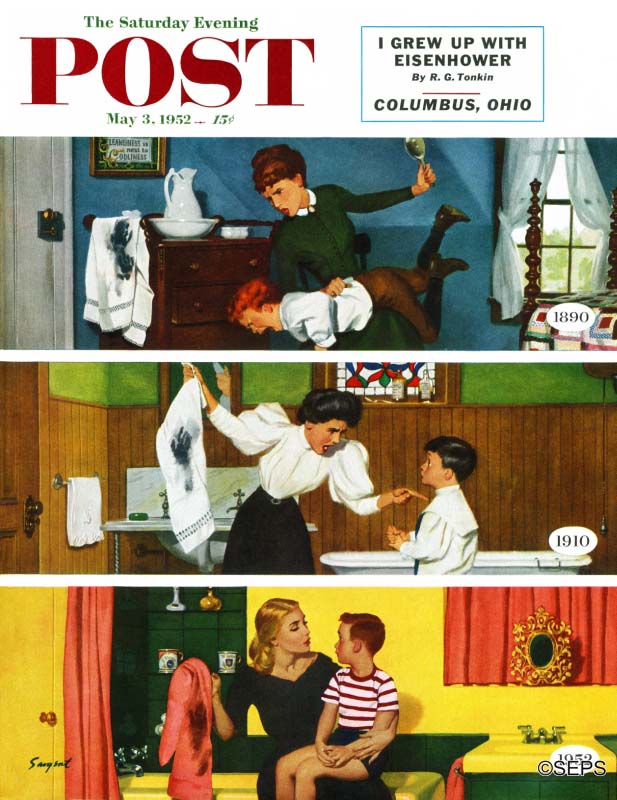
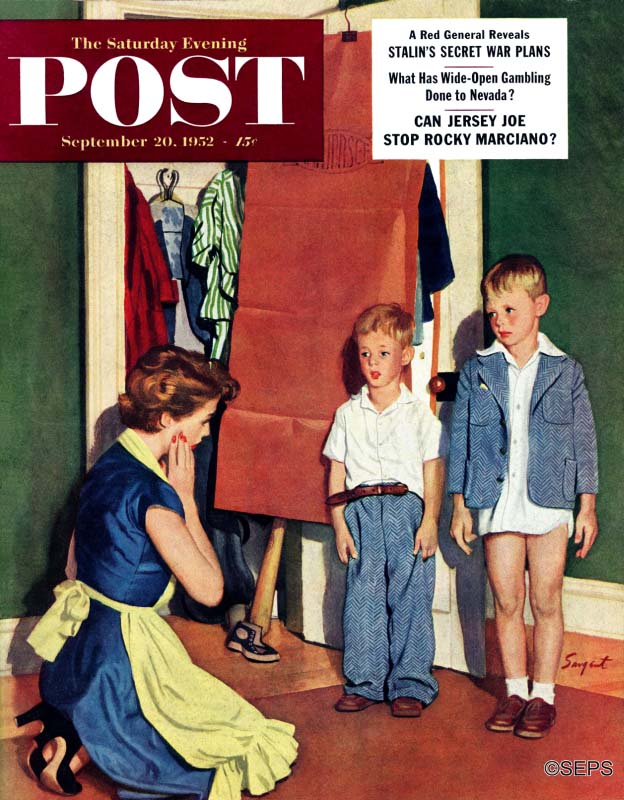
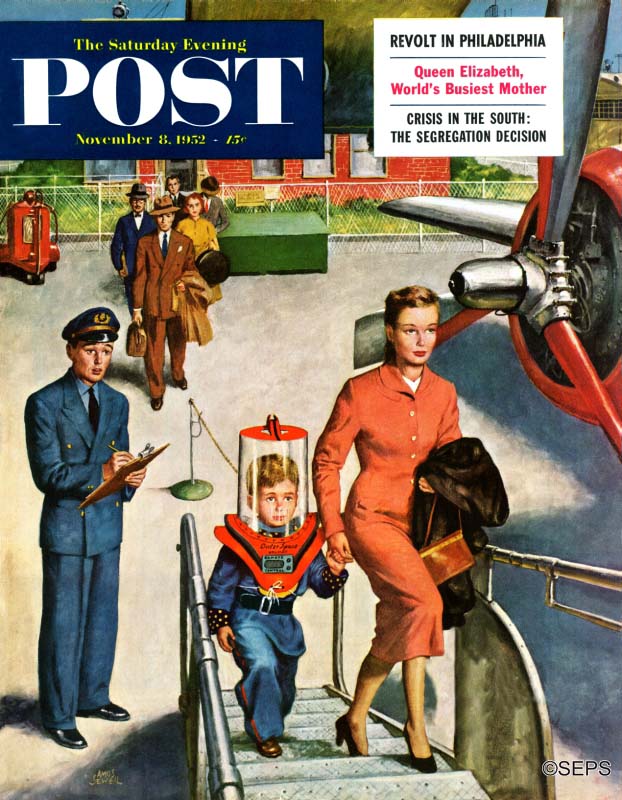
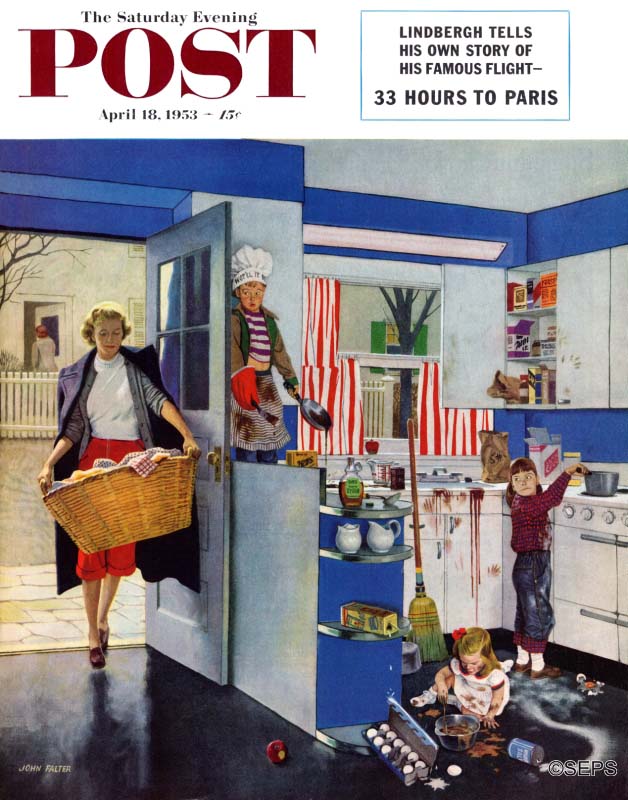
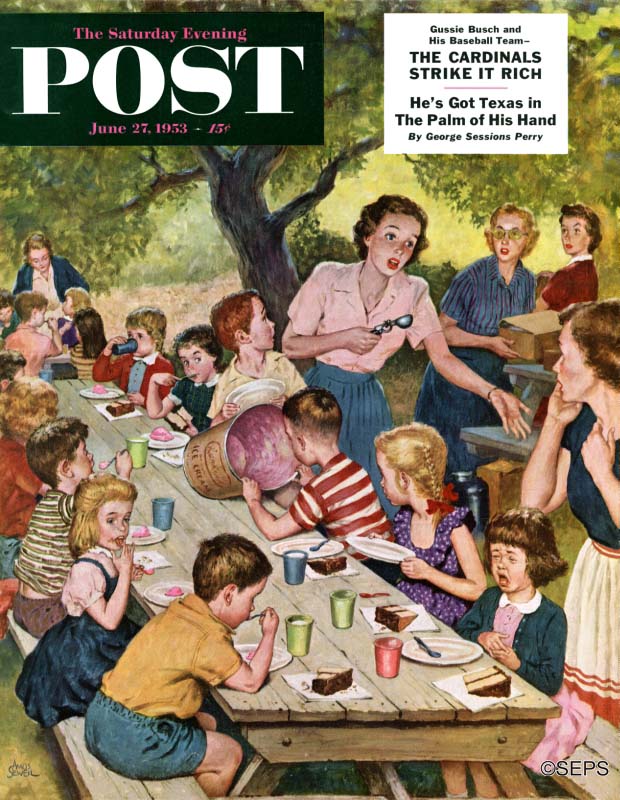
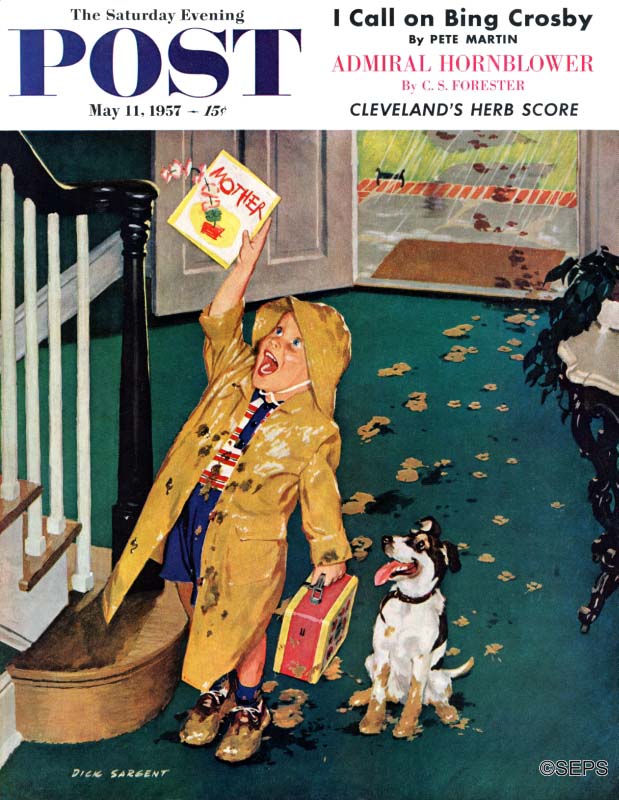
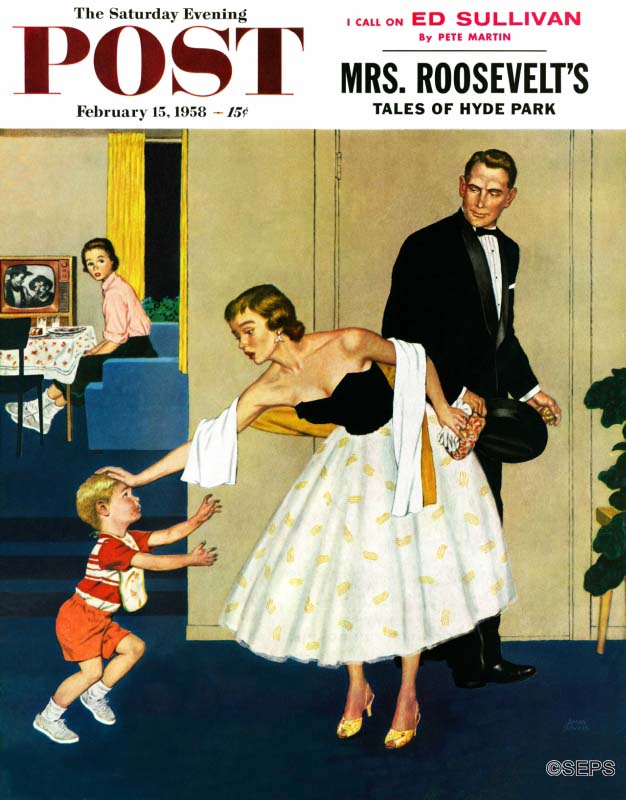
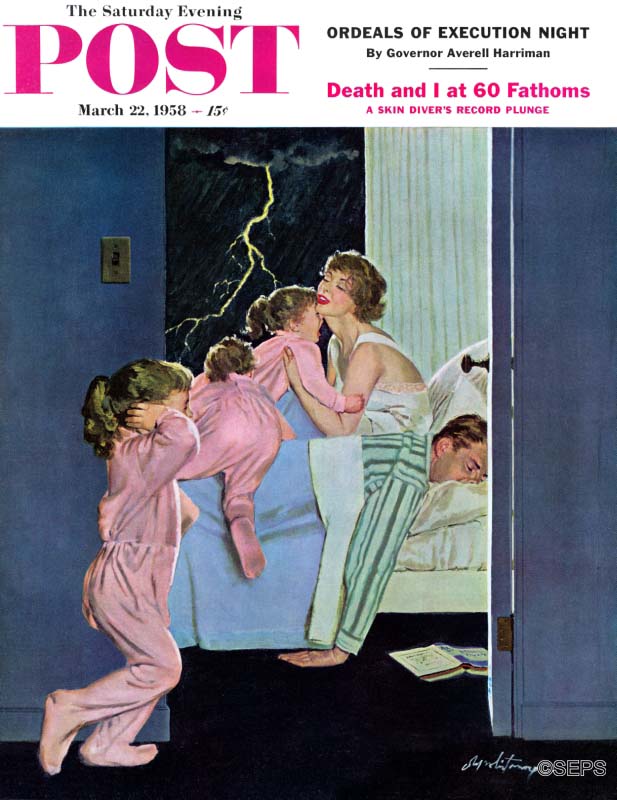
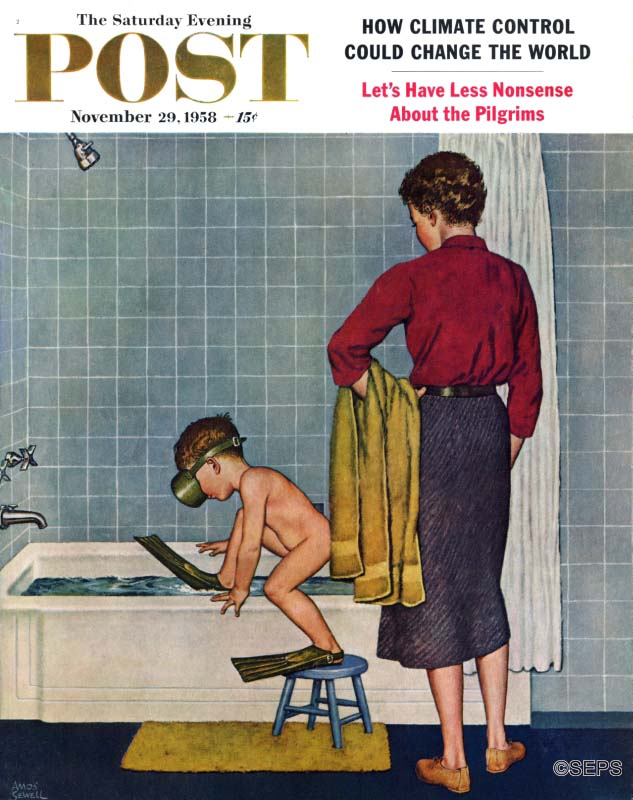
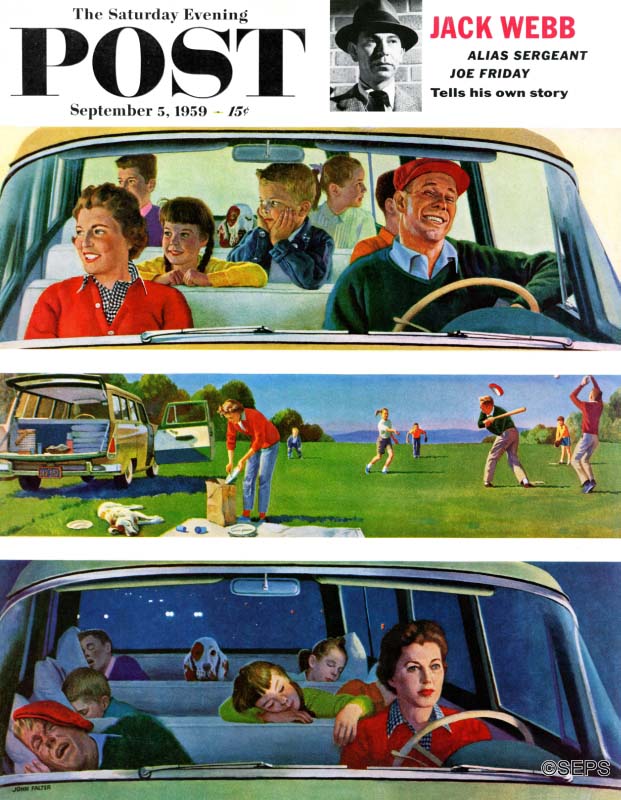
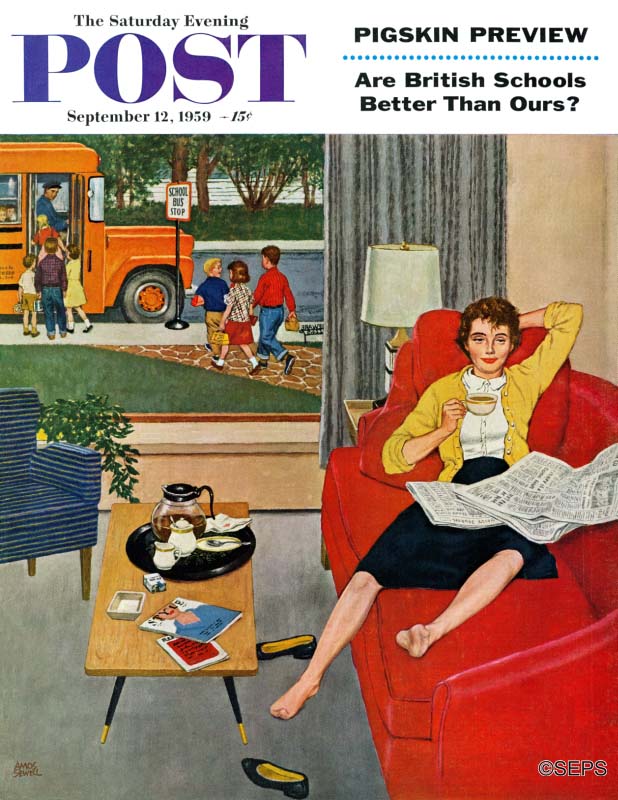
Moments with mom have taken center stage on The Saturday Evening Post cover throughout the 20th century. Norman Rockwell, Richard Sargent, George Hughes, Amos Sewell, and others have shown the special, sometimes challenging, and often humorous roles that moms play. As a salute to mothers everywhere, we present this look at moms on the covers of The Saturday Evening Post.
Celebrating Mom on the covers of The Saturday Evening Post (click on the covers to see larger image):

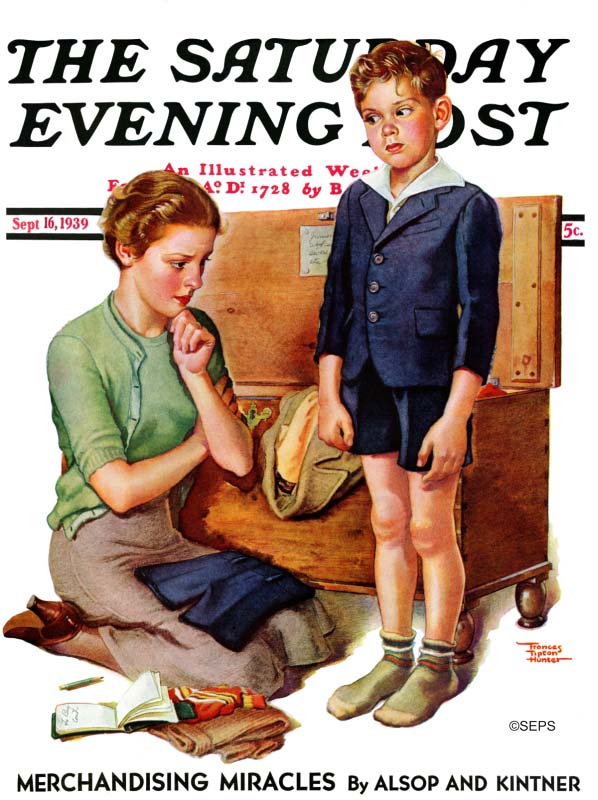
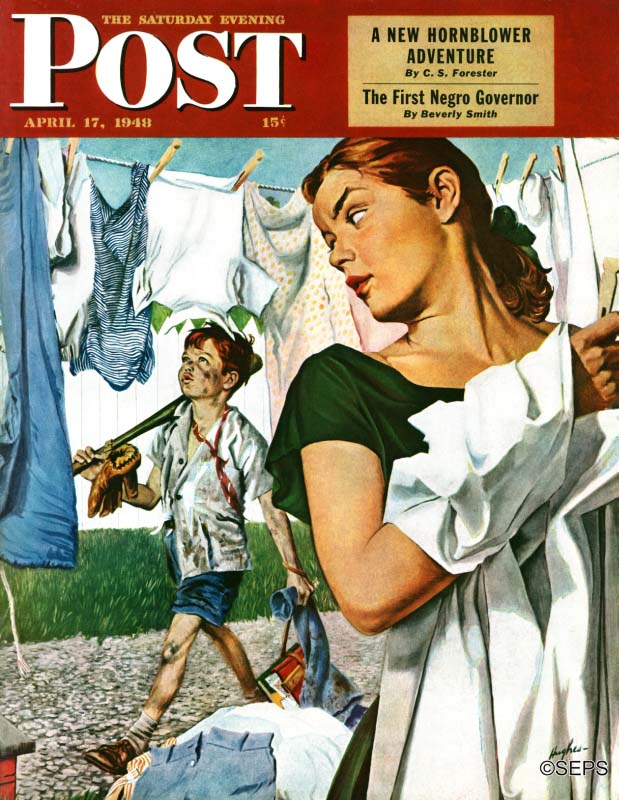
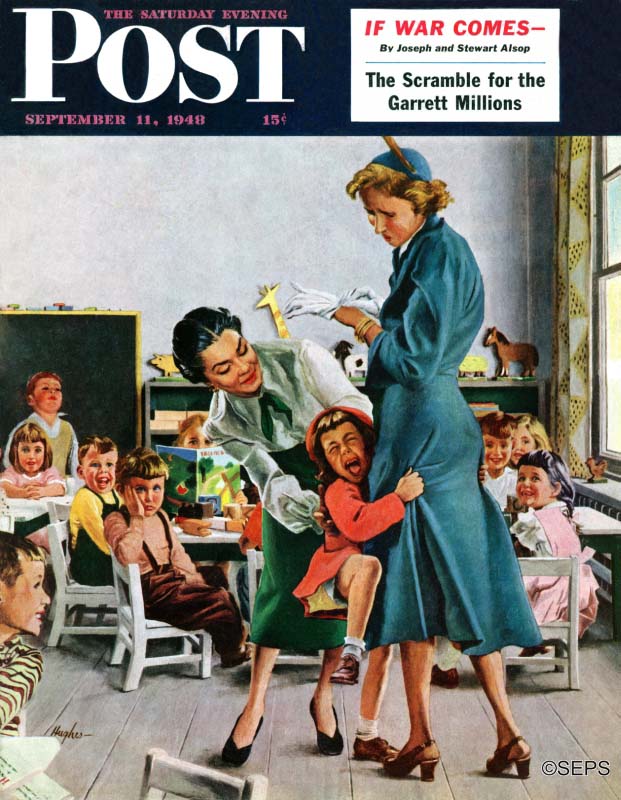
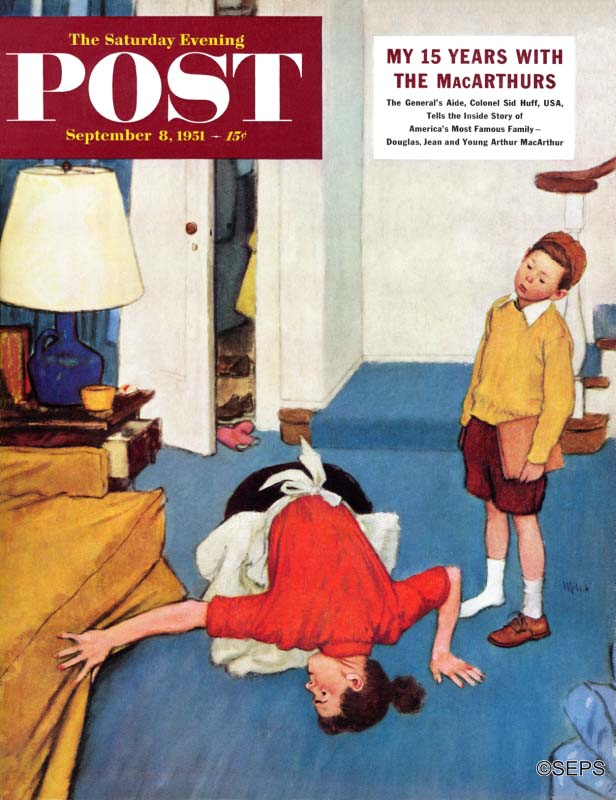


Accidental Pleasures
Things don’t often go as planned. Wait. Scratch that. Things almost never go as planned. But here’s the weird part. Sometimes the least expected experiences are the most satisfying.
Ten years ago, my wife and I were fortunate enough to visit India. Of course, we read a bunch of guide books and made certain that we toured the Taj Mahal. And of course it was breathtakingly beautiful. (We have the pictures to prove it!)
But what I still remember best about that trip were the unplanned moments, such as the time we happened to be in a canoe at dusk in Kerala just as a cloud of enormous fruit bats rose up en-masse from a nearby bird sanctuary and soared over our heads, darkening the sky. (For a moment, we thought they were coming for us like the flying monkeys in The Wizard of Oz.)
It’s this kind of serendipity that veteran travel writer Edward Readicker-Henderson celebrates in “Kill Your Bucket List.” He argues that modern travel has become overly packaged, designed for the pictures you’ll take home rather than the adventure of actually getting involved with the places and people behind those picturesque photos. “Nobody just takes a vacation anymore,” he writes. “They knock the Eiffel Tower, the Great Wall of China, the temples of Angkor off the list.”
Readicker-Henderson is not suggesting you go abroad with no plans at all. But he is pleading that you leave some time free in your schedule to wander around, ask questions, maybe even get lost. You’ll feel great when you actually have a conversation with one of the locals, or when you find your way home — you’ll have a real experience, rather than just checking a box and moving on to the next item on your list.
Note to writers: Sharpen your pencils! The July 1 deadline for our fourth annual Great American Fiction contest is looming. For more info, visit saturdayeveningpost.com/fiction-contest.
Because our fiction contest has been such a success, we had an idea: Why not invite readers to submit true stories about themselves to the Post? If we select your personal essay, not only will you have the honor of being published, but we’ll pay you an honorarium of $50 and throw in a two-year subscription. For guidelines, go to saturdayeveningpost.com/submit-nonfiction. Deadline for entries is September 1.
Finally, if you want to stay abreast of all things Rockwell as well as the goings on at the Post, please follow me on Twitter, @SteveSlon.
Easy Flower Arranging
On Mother’s Day (May 10) impress your mom — and yourself! — by crafting a simple yet sophisticated seasonal arrangement from The Flower Recipe Book (Artisan Books) by Alethea Harampolis and Jill Rizzo of Studio Choo Florists.

Anemone
Photo by Paige Green
Anemones sport cute black (and sometimes green) button centers and frilly petal collars. They can be challenging to use in arrangements when they have really bendy stems, but the right display accentuates their curves.
Anemone with Company
Flowers
- 3 stems of geranium
- 4 stems of agonis
- 7 stems of anemone
- 3 vines of jasmine
Vessel
- Vintage sugar bowl
Directions
- Trim and place stems of geranium and agonis in bowl so that lowest leaves rest at its rim.
- Trim and add five stems of anemone to rest on geranium leaves in center of bowl, and remaining two stems so that they’re a few inches higher on the left and right.
- Trim and tuck jasmine vines so that two drape over edges of bowl and one reaches out to top of arrangement.
- Add only a few inches of water. Anemone stems are hollow and will rot quickly in deep water.
Peony
Photo by Paige Green
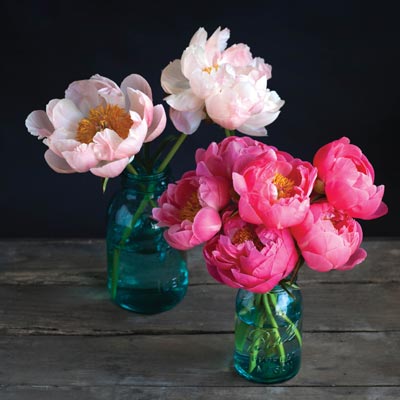
The Coral Charm variety undergoes an amazing transformation, opening from a tight ball to a giant, hot-pink flower that fades to antique cream just before its petals drop. Select buds that are just open enough to show their colors so that you can enjoy them as long as possible.
Peony Recipe
Flowers
- 9 peonies (the same variety at different stages of openness)
Vessels
- 2 blue mason jars
Directions
- Trim and add three stems to the first jar so that the blooms rest 2 inches above the rim.
- Trim and add four stems to the same jar so that the bottoms of the blooms sit just above the first three flowers, creating a tight mass of blooms.
- Trim and add the last two stems to the second jar so that the blooms sit at slightly different heights, a few inches above the rim.

Poppy
Photo by Paige Green
With tissue paper petals and skinny, tendril-like stems, poppies are so ethereal, they seem to practically float on air. Their tight, furry, unopened buds are a striking combination next to the colorful explosion of an open bloom.
Poppy Recipe
Flowers
- 20 poppies
Vessel
- Handmade ceramic vase
Directions
- Attach a flower frog to the bottom of the vase with floral putty.
- Trim and burn the stems* and add the poppies to the base at varying heights so that each stem has its own space within the arrangement, and no blooms are touching.
*Stem Burning. We’ve found that burning the stems of poppies allows them to open and stay intact for quite a while. The technique is simple: Just hold the newly cut end of a poppy’s stem in the flame of a lighter for a few seconds.

Excerpted from The Flower Recipe Book by Alethea Harampolis and Jill Rizzo (Artisan Books). Copyright © 2013.
Dunby and Drenston: A Yorkshire Wager
Dunby lived in a trailer on a hill in the Yorkshire moors, in the north of England. At the time of this story, he was about 70, and his trailer had no electricity or running water. He listened constantly to the BBC on his battery-operated radio. As a result, Dunby could talk informatively about world events and faraway cultures.
Dunby survived by hiring himself and his old Fordson tractor out to local farmers who occasionally needed help hauling or plowing or with any other task on their land. He kept his tractor in perfect running order. He sometimes used it for transportation, especially to and from the village pub, the Robin Goodfellow, so he wouldn’t have to trudge the long uphill mile back home after an evening of swallowing pints of beer.
One autumn night, after discussing at length the Indian caste system with William Drenston — a sheep farmer whom he sometimes worked for — he swayed out of the pub to his tractor, started it, turned on the headlights, and lurched toward home.
It was the constable who found Dunby an hour later, sitting on the side of the lane. Dunby and his tractor had shot through an aged rock wall and down an embankment. Dunby was uninjured, but he’d left a four-foot-wide gap in the wall.
The constable cited Dunby for property damage and “being in charge of a piece of agricultural mechanism while inebriated.”
II
“Looks like you’ve had it, Dunby,” Drenston remarked the next evening in the pub. He’d just read the citation Dunby had slid across the small oaken table to him.
Dunby was pulling at his fluffy gray beard. “Had it? It’s not as though I’m a common criminal!”
Drenston took a swallow of beer and leaned forward. “Word is old Judge Blottleson’s never touched a drop in his life and is none too lenient when it comes to alcoholic offenses. He’ll revoke your operator’s license, that’s for sure. That won’t exactly invigorate your livelihood.”
The farmer reclined and put a hand to his nose. “And I doubt he’ll be impressed with your … lifestyle,” he remarked, scanning Dunby’s earthy presence.
Dunby gave Drenston a sharp look, then daydreamed into the fire for some moments.
Then, as if coming out of a dream, Dunby slowly uttered, “He’ll revoke my license, you say?”
“There’s little doubt in my mind.”
“Care to wager on that possibility, William?”
Drenston laughed. “I don’t want to take your money away.”
“I’ve put a little by over the years,” Dunby reassured him. “What would you say to five pounds?”
Other countrymen were overhearing and began to saunter over in ones and twos. It sounded a sure thing to them, and Dunby was soon surrounded by 15 or 20 men, each wagering five pounds that Dunby’s operator’s license would be withdrawn by Judge Blottleson.
III
The good Dunby’s summons date was 10 days later. He immediately began serving the 30 days which Judge Blottleson sentenced him to in lieu of a fine plus damages, which Dunby was disinclined or unable to pay. But the status of his operator’s license was unknown to the betting men of the Robin Goodfellow until Dunby walked in one chilly evening a month later.
The regulars looked at him curiously as he shut the door. They didn’t recognize him. He was clean-shaven and his straggly gray locks were trimmed and combed. He had on clean corduroy trousers and a wool sweater and a spotless pair of boots — all new, by the looks of them.
He walked over to Drenston’s table and sat down. Drenston stood up. “By God, it’s Dunby!” he cried hoarsely through a haze of cigar smoke.
Everyone was temporarily frozen. Suddenly, all the drinking and betting men carried their pints over and surrounded Dunby and welcomed him back.
“Look at you!” Drenston cried. “You’re ruddy well transformed!”
Dunby smiled. “It’s amazing what a month’s worth of regular bathing and a shave and a trim will do for you.”
The men laughed, and some slapped Dunby on the back. But they were waiting in suspense to hear of Judge Blottleson’s decision against him.
“You were right about the old judge, William,” Dunby said. “He was none too lenient.”
“I should say not, my friend — 30 days in gaol!”
Dunby was still smiling, but said nothing.
Drenston cleared his throat. “I assume,” he went on, “seeing as you had to serve time and all, that the judge did away with your operator’s license.”
The countrymen, gripping their pints, were silent. It seemed they all bent forward a hair. Even the barman, who had been wiping down the counter, paused and waited, cloth in hand. For a moment, the only sound in the pub was the popping of the fire in the antique, hallowed grate.
“Operator’s license?” inquired Dunby. He smoothed down his sweater and trousers and shuffled his feet in his bright boots. “Whoever told you gentlemen I had an operator’s license?” Dunby gazed puzzlingly at the circle of faces surrounding him. “Well? Come along, lads! How do you think I intended to pay for my new outfit?”
News of the Week: Friends, Fonts, and the First American in Space
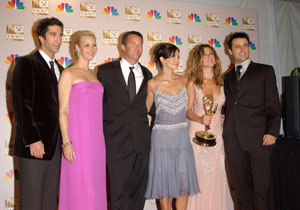
Don’t Hold Your Breath for a “Friends” Reunion
Featureflash / Shutterstock.com
Your mother warned you there’d be days like these, when you really, really want to see the gang from Friends get back together and your hopes are dashed in an instant. That’s right, according to one of the creators of the show, getting Ross, Rachel, Monica, Chandler, Phoebe, and Joey back together ain’t never gonna happen.
Co-creator/producer Marta Kauffman told The Wrap that, unlike recent reboots of other ’90s shows like Full House, The X-Files, and Coach, a new Friends will never happen, not even as a one-time thing. She gives a couple of reasons why. First, the show was about life in your 20s and things change when you get married and have kids. Personally, I think fans would love to see a Friends show about marriage and family, but her second reason is more solid: It just probably wouldn’t be as good as the original, and that would depress fans.
Courteney Cox was asked about a reunion during a Yahoo interview, and she said that there was an 80 percent chance a reunion would take place, but there was one hold out, David Schwimmer.
You know why he doesn’t want to do a reunion? HE IS ON A BREAK!
Looking for a Job? Be Careful of Your Fonts
Have you been looking for a job but haven’t had any luck? Forget your work experience and your degrees and your skills. Maybe it’s the font you’re using.
According to three typography experts interviewed by Bloomberg, the worst fonts you can use are Times New Roman and Comic Sans. The former will make an employee think you haven’t put any thought into your font choice (like “wearing sweatpants,” as one of the experts puts it), while the latter will make everyone think you are 9 years old. The best font according to the experts? Helvetica. Garamond and Proxima Nova are good choices too.
Does anyone really use Comic Sans on a resume? That would be a bigger flag to me than an applicant being fired from every single job they’ve ever had and listing “can chug an entire glass of beer in 10 seconds” in their Skills section.
Why It’s Taking Longer for You to Get Mail

Have you noticed that it’s taking a day or so longer to get your mail? I haven’t noticed this at all, probably because I don’t keep track of when someone sends me a bill or an update to a medical policy or any other type of mail (and I never get letters), but according to The Washington Post it really is taking longer.
The United States Postal Service got rid of overnight delivery of local first-class letters in January, which means it’s taking an extra day to get those pieces of mail (trucks have to drive longer to get and deliver mail). The move has saved money and made things more efficient, though it’s affecting 16 percent of the mail, and I’m sure customers won’t be happy about that if they start noticing the delay.
As someone who does a monthly letter, I not only love sending and receiving snail mail, I think it’s an amazing thing. Imagine: You slap a stamp on a letter or card and for less than 50 cents it’s hand-delivered to someone thousands of miles away in a few days or so. And as for service, I can tell you I’ve had more problems with email and cell phones and other technology than I’ve had with regular mail.
How to Save Twitter

Actually, I don’t know how to “save” Twitter. I’ve been on it for seven years — though I’m mostly just a lurker these days — but it’s not like I have any insight into their business plans or their tech strategy. But I’ve used it enough to give one tip that could help the company attract new users and help users understand what the service is for.
The first is stop calling it a social network. It’s not, and I think that’s confusing to people who are used to Facebook and want to know why they should join Twitter. People look at Twitter as the rival of Facebook and expect a similar experience, but it’s a very different thing. You’re not going to post pics of your grandchildren on Twitter or find out about parties and reunions or any of the other things you can do on Facebook. Sure, you can do those things on Twitter I guess, but if you’re on Facebook already why would you want to? Twitter isn’t the place to interact with family members or close friends. Twitter should start marketing the service as the ultimate news feed, a way to keep track of what’s going on in the world (it’s amazing how fast news breaks on Twitter), find out what your favorite celebrities are up to, hear some great jokes and quotes, etc. It’s like having a nonstop update of what’s going on with the things you’re interested in (though I’d also suggest using Lists if you don’t want to get overwhelmed with that nonstop update).
And if you’d like to tweet about this column, well, I’d appreciate it.
RIP, Sawyer Sweeten and Suzanne Crough Condray
It’s sad when any celebrity we’ve watched over the years passes away, but it’s particularly heartbreaking when it’s a child star. Last week, Sawyer Sweeten, who played Geoffrey Barone on Everybody Loves Raymond, took his own life in Texas. He was only 19 years old. He played one of Ray Romano’s twin sons on the show, with the other being played by Sweeten’s real-life twin brother, Sullivan. Sawyer and Sullivan’s sister, Madylin Sweeten, played their sister Ally on the show.
The entire cast of #EverybodyLovesRaymond is in shock. Prayers for the Sweeten family.
— Patricia Heaton (@PatriciaHeaton) April 24, 2015
And though Suzanne Crough Condray was 52, she’ll always be a child star to us. She played Shirley Jones’ youngest child Tracy on The Partridge Family from 1970 to 1974. She passed away in Nevada earlier this week. The cause of death isn’t known at this time but it’s believed she experienced a “medical episode.” She leaves behind a husband and two daughters — one of whom was going to be married this summer — as well as a granddaughter.
Everyone thought I'd be the first Partridge to go. Sadly it was little Tracy. Suzanne was a wonderful lady & a good mom. She will be missed.
— Danny Bonaduce (@TheDoochMan) April 28, 2015
National Chocolate Mousse Day

True story: several years ago I was at lunch with my boss and several coworkers. When the time for the bill came, the waitress came over and asked us if we wanted anything else. My boss, who was paying for the meal, was about to ask for the check when one of the other people at the table suddenly exclaimed “Chocolate mousse for everyone!” I’m not sure why, but the boss didn’t say anything and we all got chocolate mousse, which probably added another $10-15 to the bill.
Tomorrow is National Chocolate Mousse Day, and if you’re not in a situation where you can get your boss to pay for it, how about making your own? Kraft has an Easy Chocolate Mousse that takes only 10 minutes and Martha Stewart has a good recipe too (hers takes about an hour).
Upcoming Anniversaries and Events
Cinco de Mayo (May 5)
The day celebrates the Mexican victory over French troops at the Battle of Puebla on May 5, 1862.
Alan Shepard: the first American in space (May 5, 1961)
Shepard became the first American in space when Freedom 7 took off from Florida. Shepard was also the first astronaut to play golf on the moon, in 1971!
Napoleon Bonaparte dies (May 5, 1821)
Here’s what The Saturday Evening Post had to say about Bonaparte’s death in 1821.
The Hindenburg disaster occurs (May 6, 1937)
What it was like to witness the horrifying explosion of the airship in Lakehurst, New Jersey.
Sinking of the Lusitania (May 7, 1915)
1119 people died in the sinking of the RMS Lusitania on a trip from New York City to Liverpool, England.
VE Day (May 8, 1945)
The day (which stands for Victory in Europe) celebrated the end of the war in Europe and the surrender of German troops to the Allies. Read some of the World War II reports from the Post here.
Enter the King, Bob Dylan
As Bob Dylan began to play his electric guitar onstage at the Newport Folk Festival, members of the audience began booing. Just three songs later, Dylan walked off stage.
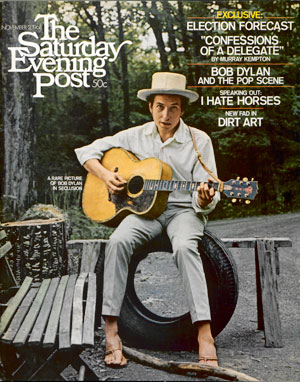
That brief performance 50 years ago is considered a pivotal moment in American music history. Some regard it as the birth of modern rock, the moment that folk music purists turned their backs on the electric, amplified music of the future.
Others who were at the concert assert that no one jeered Dylan for bringing an electric guitar. They claim the booing was in response to the sound system’s poor quality. One of Dylan’s backup musicians claims it was in response to them not being allowed to perform longer.
Whatever the reason, the concert marked one of many turning points in Dylan’s career. The most recent of his surprising turns is his latest album, Shadows in the Night, a recording of standards that date from 1923 to 1964.
“Enter the King, Bob Dylan” by Alfred G. Aronowitz recounts the changes of this continually evolving musician at age 27 just months after Dylan released John Wesley Harding. In the five-plus decades of his career, Dylan has influenced and explored folk, rock ’n’ roll, gospel, and more. The 1967 album, Aronowitz noted, “pulled out the psychedelic plug and pointed the way toward country music.”
The Colorado Experiment

Space Gallery looks like the scene of any art opening in Denver, Colorado. The white-walled warehouse, just south of downtown in the edgy Santa Fe Arts District, is adorned with abstract paintings, and a crowd of mostly 30- and 40-somethings sip local beer and wine while a five-piece brass band crescendos from a classical concerto to an Indiana Jones theme.
Most of the action is on the surrounding patio, where women in cocktail dresses and men in button-downs and blazers gather, between food trucks and Popsicle vendors, and talk politics with the giddy excitement of campaigners at an election party. All in all, it’s an ordinary night in Colorado’s largest city. Except for one noticeable addition — pungent plumes of marijuana smoke that even the plastic-lined fences can’t prevent from wafting out into the warm Denver night. The air is hazy, but no one bats an eye.
These men and women are advocates and entrepreneurs involved in Colorado’s newly legal marijuana industry. They’re here to support an event called Classically Cannabis: The High Note Series. The BYOC (bring your own cannabis) fundraiser for the Colorado Symphony is sponsored by marijuana companies whose merchandise tables are littered with stickers, T-shirts, and glass stash holders emblazoned with names like Gaia, The Farm, and Wellspring Collective.
As joints and vaporizer pens (like e-cigarettes for cannabis) light up, attendees speak of expanding their businesses, lobbying for regulation changes, and worries about Governor John Hickenlooper — “a beer guy.” A young marijuana enthusiast, whose shoulder-length hair grazes the collar on his shirt, says he just moved to Denver from North Carolina to work for the Wellspring Collective dispensary. “It’s so nice not to worry about going to jail for pot,” he says.
Another man in a dark suit is Bob Eschino, the owner of the prominent marijuana-infused chocolate bar company Incredibles. He tells me the cannabis industry is growing faster than any other segment in the U.S. and that millionaires or billionaires are calling every week to try to buy the company. By the end of 2015, he plans to be open in Washington, Oregon, California, Nevada, and New Mexico. “There’s a lot of money to be made all around the cannabis business,” Eschino says.
Six months after Colorado began its social experiment on the legal production, sale, and use of recreational cannabis, a profitable industry was established. Between January and the end of 2014, the state raked in $63.4 million in sales taxes from medical and recreational pot. Grow operations, MIP (marijuana-infused product) kitchens, and cannabis testing labs filled vacant warehouses, and run-down neighborhoods where these operations set up shop have started to gentrify. Nearly 12,000 licenses have been granted for cannabis jobs. That doesn’t include ancillary businesses (the ones that don’t touch the product) such as electrical engineering (for all those indoor growers); marketing agencies like Cannabrand; or the weed marketplace and social network Cannabase — which has already trademarked the term Cannalytics. There are now more than 800 outlets in Colorado where customers can buy pot legally, the majority in Denver. And at least once per month, anyone looking can find a public weed-infused dinner, art class, yoga workshop, or concert (such as the High Note Series) to attend.
The symphony event moves to a second gallery down Santa Fe Drive around midnight for an after-party. The energy and crowd has mellowed to the pace of a late-night lounge, and some people are noticeably retreating into their own heads. I’m about to become one of them, but then I walk into a Marie Claire photo shoot upstairs and get a second wind. Four female cannabis entrepreneurs are posing shoulder-to-shoulder on a love seat wearing brightly colored dresses. It could be a cover image for a Desperate Housewives DVD, if the woman in the center wasn’t puffing on a massive joint. On a nearby table, there are chocolate-covered strawberries and truffles studded with chopped walnuts. Next to them lies a green napkin with the words THESE ARE EDIBLES, underscored and spelled out in capital letters. (Edibles, for the uninitiated, are pot-infused foods, hence the warning.)
This is neither the inner city nor the Fast Times at Ridgemont High pot scene one might imagine. These “ganga-preneurs” are educated, tech savvy, political, and business minded. And all of them are walking the shaky tightrope between state and federal law to be the first of their kind in a, ahem, budding industry. It’s the new Wild West. A state that boomed during the Gold Rush, Colorado is now pioneering the so-called Green Rush, and a new wave of Americans — from youthful pot-fanciers to families looking to treat their epileptic children — are moving in. Industry cowboys are being watched closely by their own government and that of 49 states and Washington, D.C. Big business is watching, too; cannabis companies are now traded on Wall Street, and there are rumors that Marlboro and Monsanto will try to cash in. Judging by the momentum here along with the legalization efforts sweeping the nation — Oregon and Alaska went legal last November; California and four other states are expected to follow in 2016 — the end of cannabis prohibition seems not only probable, but near. Whether or not the public approves, the Rocky Mountain industry is crossing state borders, just like the marijuana smoke evading that plastic-lined fence.

More than half the states as well as the District of Columbia have loosened enforcement of a drug law that originated in 1937. Four years after the repeal of prohibition, the Marijuana Tax Act imposed an excise and tight restrictions on cannabis.
American use of marijuana as medicine began more than 100 years before that, however, and industrial hemp production — growing the woodier, non-psychotropic cannabis varieties for commercial products, namely cord and canvas — was ubiquitous throughout the 19th century. Hemp flourished in Missouri, Illinois, and, most notably, Kentucky, but the industry was on the decline by the time the Marijuana Tax Act dealt its blow.
Many historians believe the law intended to demonize what was then characterized as a dangerous Mexican herb. The anti-marijuana crusade that included the film Reefer Madness ensued, and public opinion as well as criminal enforcement waxed and waned until the War on Drugs, specifically the Controlled Substances Act of 1970, put marijuana in its current place: on the list of Schedule 1 drugs — those with “no medical benefit” and a “high potential for abuse” — alongside heroin and Quaaludes. To put this in perspective, cocaine and methamphetamines are Schedule 2.
The tide started to swing in the direction of cannabis reform when California voters passed Proposition 215, the Compassionate Use Act, in 1996. This law replanted the concept of medical marijuana back into the American psyche and created a cannabis industry, albeit a messy one, that today produces enough pot to supply the nation. Since the Prop 215 campaign famously broadcast marijuana’s appetite-boosting benefits for AIDS and cancer patients, there has been a slew of evidence showing positive health benefits for patients with conditions ranging from post-traumatic stress disorder to multiple sclerosis. There could be social benefits as well. A 2012 Journal of Law and Economics paper by Mark Anderson, Benjamin Hansen, and Daniel Rees finds that the legalization of medical marijuana leads to fewer traffic fatalities involving alcohol, a relationship the authors believe is due to young adults drinking less as cannabis becomes more available.
While a majority of Americans are now in favor of legalization, worries about cannabis remain. Research on the drug in the U.S. has proved challenging given its Schedule 1 status, so there’s still a lot we don’t know. A 2012 study from New Zealand posed that marijuana may have detrimental affects on the developing brain, and there are concerns that alcohol-style legalization will increase consumption, both among youth and the people who are already the heaviest users.
Colorado’s role in the story begins in 2000 when its Amendment 20 (similar to California’s Prop 215) legalized the purchase and possession of limited amounts of medical marijuana by patients and their primary caregivers. In 2009, that law was amended to allow caregivers to work with as many patients as they liked. This caused the demand for medical marijuana to skyrocket, effectively opening the floodgates to dispensaries, retail outlets that allowed patients with a prescription to become member customers. In the following six months, the number of marijuana businesses jumped from 50 to 650. By the end of 2009, there were eight times as many licensed medical marijuana cardholders as the previous year. The regulation scheme that followed ultimately paved the way for Amendment 64 — a constitutional end to marijuana prohibition in Colorado — which 55 percent of state voters and 66 percent of Denverites approved on November 6, 2012. (On the same day Washington state passed its own version of legalization.) The Cole Memo, an intentionally vague decree from the Department of Justice, was announced in August 2013, suggesting that the federal government would not intrude on the rights of these two states to legalize pot. In effect, the memo granted Colorado and Washington a hall pass to begin their jobs as cannabis labs for the nation.
Looking back on the events of the past two years, Denver city councilwoman Mary Beth Susman can still hardly believe legalization passed. A sparky blonde who doesn’t look her age, Susman had never even seen marijuana until she moved from Omaha to Denver to attend Denver University in the 1970s. There, she witnessed anti-war demonstrations — the heady scent of cannabis is ingrained in such memories. “But then we all grew up, became parents and full-time workers, and I didn’t really think about it again until this came true,” she says.
Susman voted against Amendment 64 because she thought putting recreational marijuana into the state constitution sounded silly. But as president of the city council at the time, she had to help regulate it. “The complexity and number of issues we had to solve were amazing. There were times I would start giggling because of the ways in which we had to think about things. When we were trying to figure out how much marijuana a person should be allowed to buy, someone recommended a 16th of an ounce, because if you were going to smuggle it, you would have to go in and out of a store 256 times to get a pound,” Susman laughs.
“And then there were the questions of whether you have to be a Coloradan to buy it. What are we going to do with the borders? Can people use it in public places or only in private? And what distance do shops need to be from schools? The puns abounded. ‘I’d like to highlight this point,’ you know?”
What resulted is a policy that permits adults over 21 with a valid Colorado ID to purchase up to an ounce of marijuana, while visitors are limited to a quarter of an ounce. Neither residents nor tourists are allowed to consume cannabis in public or while driving. Perhaps most challenging, the state had to figure out how to operate as a bright blue island in a sea of red states and navigate the murky waters between state legalization and federal prohibition. Even less obvious aspects of Amendment 64 — the original “vertical integration” mandate that required stores to own 70 percent of production, for example — are questionable under U.S. law. “What we have here is a state of rampant confusion,” says Peter Hutt, a D.C. lawyer who helped write the Controlled Substances Act of 1970. “We’ve got a federal law that makes marijuana a crime. We have state laws that can’t overrule that federal law but nonetheless say it’s lawful. We have the president who undoubtedly smoked marijuana and indicated that prosecution is a waste of time. We have the attorney general turning a blind eye, and we have U.S. attorneys and state attorney generals doing whatever the devil they want. It’s pure chaos.”
A few days after Classically Cannabis, I head to a café called Stella’s in the Old South Pearl district to get a cannabis science lesson from Max Montrose, a marijuana advocate and educator whose rusty beard matches the rims on his rectangular glasses.
When I arrive, he’s sitting under an umbrella on the side patio tapping furiously on his laptop. He says he’s helping to develop a curriculum for the marijuana industries responsible vendor program, which is loosely based on the one for alcohol. The alcohol program covers everything from checking IDs to determining intoxication levels based on number of drinks. “Those are important parts, but for cannabis they don’t matter half as much as a vendor knowing the product they’re serving to people,” Montrose says.
This issue hits close to home since Montrose has a condition called psychomotor agitation (“it’s like ADD on crack”). In extreme cases, his thoughts can intensify and discombobulate to the point of physical tics like standing on his toes or pulling on his fingers without realizing that he’s doing it. He learned the difference between the two main types of cannabis — sativa and indica — when he saw how each affected his study habits in college. When he learned that sativas help him focus, he threw his Adderall and Ritalin in the toilet. “If I can know for sure that this is a sativa then I know I’m going to be able to pay attention,” he says. “If I smoke an indica, I’m going to be drooling in my seat.
“But cannabis is really, really complicated science,” Montrose continues. “Based on your age, your weight, your sex, your metabolism, and the potency of the bud, you’ll have different reactions.”
The underlying reason for differential effects on different people is because cannabis is made up of organic chemical compounds called cannabinoids for which humans, along with many other species, have receptors. This endocannabinoid system regulates everything from sleep, to pain, to immune functioning, which scientists think could explain why cannabis has been helpful in treating such a wide range of ailments. Delta 9-tetrahydrocannabinol — THC — is the most active and famous of marijuana’s 80 some cannabinoids since it has the most psychoactive properties. But other compounds like cannabinol (CBN) and cannabidiol (CBD) have drawn recent attention for offering health benefits to patients without getting them high. CBD has been the subject of many articles as well as Dr. Sanjay Gupta’s 2013 Weed documentary for its use in the treatment of childhood epilepsy. Sativas and indicas contain different ratios of these cannabinoids, and today, they’re crossed and hybridized into infinite strains, each with its own clever — some would say ridiculous — brand name. “The most famous strain right now that all the stoners are looking for is Girl Scout Cookies,” Montrose says. “If you’re working in a dispensary and have a crappy bud that’s not moving and your boss says ‘sell that bud,’ you call it Girl Scout Cookies and it will be gone by the end of the day.”
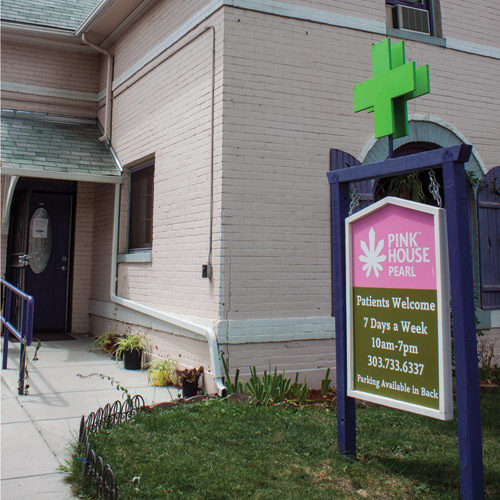
It’s time to see how cannabis businesses are faring, so I walk across Pearl Street to Pink House, an inviting dispensary marked by a green cross — the unofficial emblem of medical marijuana — hovering over the front lawn of an old Victorian building that’s painted pastel pink. Inside, three antique chairs, upholstered in bohemian fabrics, back up to an old staircase; the surrounding walls are coated pink and green. It hardly even smells like weed.
I don’t have a doctor-issued “red card” to purchase medical marijuana here, so I sign up for a visitor’s badge, which the marketing director on duty, Joe Rothberger, says allows me to look but not buy. (Pink House was then in the process of obtaining its license to sell marijuana for recreational use at this location.) At one end of the shop, a semicircle-shaped display cabinet showcases two-dozen glass jars brimming with marijuana buds from strains like Chem OG and Nigerian Nightmare. I scan the labels for Girl Scout Cookies, but alas it’s not on the shelf. Nigerian Nightmare, however, is dark purple and high in CBD, that “miracle cannabinoid” that studies suggest has anti-inflammatory and anti-anxiety properties yet doesn’t get you stoned. Nigerian Nightmare only has 5 percent THC, the psychoactive component that currently goes up to about 35 percent in smokable pot. Prices here are anywhere between $23 and $60 for an eighth of an ounce, depending on membership status and the product.
Like most medical and recreational shops, Pink House also sells paraphernalia and cannabis-infused products from sodas to lollipops. The company has been around since 2009 and is now a household name with six stores, one grow facility, and another grow on the way. (A “grow” is almost always an indoor facility, using broad-spectrum lights that enable year-round production.) Unlike most marijuana businesses, Pink House offers health insurance to its employees and donates money to local charities, says Rothberger.
There’s still a lot of bureaucracy that comes with growing and selling a drug that’s illegal at the federal level, Rothberger adds. There are steep taxes and fees as well as an ever-changing set of regulations from outdoor sign limitations to the state tracking system intended to weed out (sorry) the black market. In Colorado, every plant is tagged with a radio-frequency Marijuana Inventory Tracking Solutions (MITS) device that has its own 24-digit identification number. “Commercially, we’re able to produce almost a metric ton of marijuana every year from one facility, and not one gram goes untracked,” Rothberger says. “It takes an overwhelming number of people to stay compliant.”
But the biggest challenge is still banking, he says. Despite efforts by the state and federal governments to ease hurdles, banks are still dropping marijuana clients every day because of liability. Pink House went through a phase where it lost multiple accounts in a single month, and the owners still face difficulties growing the business when they can’t get a loan or line of credit.
“If you were to go to a bank and say, ‘Hey, I’m trying to build out this 5,000-square-foot facility, and I need a loan to buy 200 lights that each cost $2,000,’ the bank teller would look at you and say, ‘Marijuana business? Get out.’ And it’s not even cordial.”
Jennifer Beck, co-founder of the wholesale marketplace and social network, Cannabase, had a similar experience. Despite the fact that Cannabase is an “ancillary business” that doesn’t touch the product, her company coffers as well as her personal and credit card accounts were closed. “You can’t get a bank account. You can’t get insurance. You try to apply for trademarks, copyrights, and patents, but those are all managed at the federal level,” Beck says.
This self-described “rule-follower” says the industry still feels like a risky underground that’s evolving all the time. What’s worse is the bad apples who hurt the people trying to do things the right way, she adds. One memorable story involved the edibles company At Home Baked extracting ingredients using a dirty washing machine. “Everybody in the industry is playing by their own set of rules; there’s no standardization,” Beck says. “In the one sense, that gives you the freedom to start making some of the rules. And that’s how you can become a really big business. On the other hand,” she pauses, flashing a weary smile, “that’s how you just get really tired.”
As one would expect, the rapid commercialization of cannabis in Colorado has fierce critics. After the passage of Amendment 64, Denver resident and mother of four boys Gina Carbone co-founded Smart Colorado because she was concerned about the impact the industry could have on the community and its youth.
Although the government is responsible for restricting advertising, prosecuting anyone who sells marijuana to individuals under 21, and introducing educational campaigns focused on research showing that marijuana may have negative impacts on developing brains, people are worried, Carbone says. Seventy percent (181 in total) of Colorado municipalities have opted out or have a moratorium on allowing marijuana to be sold in stores.
The legalization campaign sold Colorado voters on decriminalization, not commercialization, according to Carbone. “The [800-plus] figure for marijuana shops in Colorado is ridiculous,” she says. “The industry wants to integrate itself into the fabric of our society, which I find so disturbing. It’s making money while our kids are paying the price as guinea pigs.”
The state of Washington, by contrast, put a cap on the number of shops and production spaces and has been tougher on edibles. The challenges with edibles in Colorado, including a spate of accidental ingestions by children, prompted the state health department to propose scrapping edibles all together last October. “Forget just all the snacks and sodas, they have popcorn, pizza, ice cream, and salad dressing,” Carbone says. “We have absolutely no regulations on what can become an edible.”
Then there are the “vape” pens, e-cigarette–like devices with a battery-powered heating mechanism that vaporizes the active molecules in marijuana oils. Some are disguised as highlighters and asthma inhalers, Carbone says. “They’re doing it right in the classroom. They’re not even going to the bathroom anymore.”
In the bigger picture, the Colorado model doesn’t adequately address drug abuse, says Mark Kleiman, a professor of public policy at the University of California, Los Angeles, who has spent decades studying U.S. drug policy. Lawmakers have expressed concern about substance abuse in minors, but not about substance abuse disorder among adults, he says. By July 2014, heavy users — defined as those who consume marijuana every day — were driving almost 70 percent of demand in Colorado, according to a Department of Revenue report.
The Colorado system is an example of an American ideology that has no room to support temperate policy, Kleiman adds. “Everybody is assuming that we’re stuck with either prohibition or with alcohol-style legalization,” he says. “We’re leaving out state stores. We’re leaving out nonprofits, co-ops, and grow-your-own models.”
But Kleiman, who predicts national legalization will happen “sometime in Hillary’s second term,” worries the damage may already be done. “By the time we’re ready to legalize nationally, cannabis will be legal commercially in so many states that we’re not going to be able to overrun that industry.”
People on all sides of the issue wonder if medical cannabis treatment could be better carried out by doctors at pharmacies rather than “budtenders” at dispensaries. According to Kleiman, medical marijuana laws were a response to the federal government’s refusal to approve cannabis research and develop naturally derived medicines. “The drug warriors managed to suppress the development of genuine medical cannabinoids at the cost of unleashing the medical marijuana demon, which has led to national legalization,” Kleiman says. “A pharmaceutical-based system would actually allow the medical use of cannabinoids, and we could have had the argument about legalization on other grounds.”
Matt Brown is one of the biggest players in the Colorado Green Rush. I had been in touch with Brown in early 2014 when he was still buzzing from those surreal first days of recreational weed. “If you can legalize pot, you can do anything,” he beamed during a Skype call. We made plans to meet during my trip to Denver.
Originally from Missouri, Brown once worked as an analyst for Bloomberg and a sales strategy consultant for Accenture before moving to Colorado and becoming a cannabis entrepreneur. He helped write medical regulations in 2010 and spoke publicly about how marijuana helped his Crohn’s disease. He became the state’s first medical marijuana industry advocate; worked as a consultant to cannabis businesses; helped formulate the base product of the popular Dixie Elixirs sodas and tinctures; obtained the first medical marijuana research license in Canada (where he has dual citizenship); and started SproutHouse, a research incubator for cannabis innovation. Last year, a Connecticut-based agricultural development company called Greenhouse Solutions offered to buy SproutHouse for half its stock value. At the end of 2014, half the value was $34 million. Brown walked away from the deal.
We get together at the headquarters of evolab (spelled with a lowercase e), a company that makes pure cannabis concentrates: potent waxes and oils produced by extracting the various cannabinoids from the cannabis plant. Among the many cannabis-derived nutraceuticals SproutHouse is developing — health-focused oils and serums that don’t get you high — Brown envisions creating a mass-market base product of pure cannabigerol (CBG) that could one day hit the shelves of Walmart. While not studied nearly as much as THC or CBD, CBG is believed to have similar health benefits as CBD while also acting like a stem cell for cannabis — meaning it can transform into other cannabinoids with the right mix of enzymes. Such a product requires a high-tech extraction method like the one used by evolab, scaled-up for bulk production.
When I show up to the warehouse, tucked beside an auto junkyard not far from a refinery and a trucking center, I can’t help but picture scenes from Breaking Bad. Here, Brown and I sit in a shabby meeting space to talk business and hash oil with evolab’s founder Alex Cahoj. “It’s like I’m working five different acquisition deals this week,” Brown says, by way of introduction. “There’s a software company and a hemp producer. I’m talking with another company that’s doing pharmaceutical research.”
Cahoj follows up with the story of how he grew evolab from his basement to this facility near Commerce City. A tattoo-armed outdoor lover, Cahoj once worked in banking and real estate; now he makes cannabis pastes and oils as well as an erotic line and topical ointments designed to relieve pain. “We make a salve right now that we call the Angel Salve,” he says. “It has about 225 milligrams of THC and 40 milligrams CBD in a four-ounce bottle. It helps with arthritis and muscle and joint pain. Customers will buy 10 bottles at a time.”
People have been using or consuming concentrates for at least a decade, but the advent of better extraction methods has resulted in a huge spike in the local demand for hash oil — a sticky, yellow resin made from parts of the cannabis plant that used to be considered waste. Concentrates can reach up to 90 percent THC but usually hover in the 50 to 75 percent range. They’re good for a quick high or fast relief from acute pain.
Concentrates took off in the past few years when people started making them at home by pumping a tube of loose marijuana with butane gas, Brown says. The byproduct is called butane hash oil, BHO, also known locally as honey oil, earwax, and shatter. People generally consume it by dabbing, that is, torching it on a nail or knife and inhaling, though vaporizer pens are a safer alternative. The danger of production — The New York Times reported 32 Colorado home explosions in 2014 — as well as a growing fear about residual solvents like butane has led to better extraction techniques such as those using CO2. Evolab is one of the few companies making clean concentrates from the carbon dioxide that’s naturally released from cannabis during extraction.
Cahoj recently spent $700,000 on pharmacy-grade equipment from a healthcare company called Pic Solution that will double output in one-sixth of the time. It can also isolate compounds so the company can study the effects of individual cannabinoids on customers. “Our goal is to separate the compounds and create custom blends for different applications,” he says.
Evolab has an arrangement with Pic Solution to take the company’s equipment to several other states. “We project expansion into at least 12 markets in the next three years,” Cahoj says.
Whether the country is ready or not, Colorado businesses like Incredibles, Cannabase, and evolab are making their way into other medical-marijuana states as well as Oregon and Alaska, which approved recreational marijuana last November. These entrepreneurs believe federal approval for what could be a $40-billion-a-year American industry cannot be too far off.
Jennifer Beck, who recently launched a beta version of her Cannabase marketplace and map in Oregon and Washington, says the news is no longer about what Colorado is doing, but all the action spreading outward from the Mile High City. “There’s a feeling that we can’t get to every state fast enough,” Beck says. “Not only is this going to happen, it’s happening quickly. That’s where everyone’s mind is at: expansion.”
A November 2014 Pew Research Center poll found that a slim majority of Americans, 52 percent, now favor legalization. Supporters of marijuana for medicine are as diverse as Dr. Sanjay Gupta and Texas Governor Rick Perry. Sixty-nine percent of Americans consider alcohol more harmful to a person’s health than cannabis.
The Brookings Institution notes that the majority of support for legalization is driven mostly by discontent with prohibition’s effectiveness rather than outright approval. The same trajectory led to the collapse of alcohol prohibition in the 1930s.
While legislators and citizens cast their votes, the green economy in Colorado will keep humming. Yes, there are cowboys to wrangle and messes to mop, but industry proponents are quick to point to the state’s growing tax revenues, significant job growth, and the fact that “the sky hasn’t fallen.” In the words of councilwoman Mary Beth Susman: “Denver’s experience has been pretty vanilla.”
The gate is open in Colorado, and Americans are passing through. They are coming from all over the country to medicate, speculate, or find freedom in the Wild West.
Serena Renner writes about culture and the environment for Sierra, Afar, and Renegade Collective magazines. She reported the opening scene of this article right before a banana-coconut chocolate bar “edible” kicked in.
The Weed Reports
By the 19th century, marijuana was an ingredient in many medicinal products and sold openly in public pharmacies, even advertised in mass magazines like the Post. From the late 1800s through the 20th century, the Post published numerous accounts of the marijuana experience, including one by Jack London (see “Hasheesh Land,” below) as well as editorials pro and con.
Our Buzzed Writers
Like a Dream
August 3, 1878 — Taken in moderate doses [hasheesh] produces a kind of intoxication that is very pleasant, highly advantageous for a correct knowledge of intellectual phenomena, and at the same time free from serious consequences. … Hasheeh produces a sort of sleepiness during which external objects assume fantastic forms, and all is like a dream.
—“Sanctum Chat”
A Realm of Ineffable Peace
July 25, 1885 — About 5 o’clock in the afternoon of one of those delicious days with which we are often blessed in early June, I valiantly swallowed a 15-grain dose of the magical Eastern drug, the “insane root,” as Bayard Taylor irreverently calls it.
The scene about and above me was glorious in the calm of its perfect beauty. … The happy moments passed unconsciously away; the sun neared the horizon, lingered as it were, lovingly upon its boundary and then dipped, waned, and at length wholly disappeared. …
It is hard to embody in words the feelings which so powerfully possessed me. The influence of the terrible spell which bound me became rapidly intensified. I attempted to walk across the floor, and, for the first time, one of the most ordinary and universal of hasheesh illusions seized upon
me. … I shrink from attempting a description of the visions — let me rather call them the revelations — that followed. Up through the spaces of a realm of ineffable peace I floated in the stillness of the sunlight that has never known a cloud.
—“Within the Veil” by James E. Mears
Hasheesh Land
April 26, 1913 — In past years I have made two memorable journeys into that far land. My adventures there are seared in sharpest detail on my brain; yet I have tried vainly, with endless words, to describe any tiny particular phase to persons who have not travelled there.
I use all the hyperbole of metaphor, and tell what centuries of time and depths of unthinkable agony and horror can obtain in each interval of all the intervals between the notes of a quick jig played rapidly on the piano. I talk for an hour, elaborating that one phase of Hasheesh Land, and at the end I have told them nothing. … Let me talk with some other traveler in that weird region, however, and at once am I understood. A phrase — a word — conveys instantly to his mind what hours of words and phrases could not convey to the mind of the non-traveler.
—“John Barleycorn” by Jack London
Our Surprising Opinion Pieces
Don’t Jail Addicts — Treat Them!
July 28, 1956 — Many years ago, when I was a stripling, I sat listening to a group of elderly men gossiping in a country store. They were denouncing the evils of cigarette smoking, a vice that was just coming in.
This store had on its shelves a jar of eating opium, and a carton of laudanum vials — 10 percent opium. A respected woman in the neighborhood often came in to buy laudanum. She was a good housekeeper and the mother of two fine sons. Everybody was sorry about her laudanum habit, but no one viewed her as a sinner or a menace to the community. We had not yet heard the word “addict,” with its sinister, modern connotations.
Since those days, public opinion has done a complete about-face. The “sin” of smoking cigarettes, in 50 years’ time, has become a socially acceptable habit, while drug addiction has been promoted by hysterical propaganda to the status of a great national menace.
As an example, one prominent official has said that illegal heroin traffic is more vicious than arson, burglary, kidnapping or rape, and should entail harsher penalties. Last May 31, the United States Senate went even further, in passing the Narcotic Control Act of 1956. In this measure, third-offense trafficking in heroin becomes the moral equivalent of murder and treason; death is the extreme penalty, “If the jury in its discretion shall so direct,” for buyer and seller alike, whether addicted
or not.
In my opinion, the lawmakers completely missed the point. For drug addiction is neither menace nor mortal sin, but a health problem — indeed, a minor health problem when compared with such killers as alcoholism, heart disease and cancer. …
Marijuana has been used as an intoxicant for about 3,000 years that we know of, mostly in Asia and Africa. … In 1938, much talk about the addiction of school children to marijuana, and of crime due to the drug, led the mayor of New York City to ask the New York Academy of Medicine for advice. …
The report showed … no association between marijuana and crimes of violence in New York. Further, the committee reported that there was no organized traffic in marijuana among New York schoolchildren. This valuable scientific paper was severely criticized by “drug-menace” extremists. Yet there have been four other studies in this country and two in Mexico which failed to show a connection between marijuana and crime.
Distorted news has prepared the public to support extreme measures to suppress imagined evils. … What happens under such laws? In one case, a man was given 10 years for possessing three narcotic tablets. Another man was given 10 years or forging three narcotic prescriptions — no sale was involved. And another 10-year sentence was imposed on a man for selling two marijuana cigarettes, which are just about equal in intoxicating effect to two drinks of whisky. Extremists have gone on to demand the death penalty.
…Thomas Jefferson, distressed over the ravages of alcohol, once said that a great many people spent most of their time talking politics, avoiding work, and drinking whisky. One wonders what he would say today if some muddled citizen warned him that opiates were rotting the moral fiber of our people. I suspect that he would advise his informant to take care, in walking down the street, lest he stumble over one of our 4.5 million alcoholics and break a leg.
– “Let’s Stop This Narcotics Hysteria!” by Laurence Kolb, M.D., psychiatrist and chief of the Public Health Service Mental Hygiene Division
Pot on Campus in the ’60s
May 21, 1966 — When so many are certain that the law is wrong, illegal activities become a huge game like the activities many Americans indulged in during prohibition. When you considered liquor harmless and fashionable, the fact that it was illegal seemed laughable. College students today feel that way about marijuana. Pot smokers, to a man, find their vice “enjoyable” and “harmless.” They deny that student users graduate to heroin… By general medical agreement, marijuana is non-addictive. It almost never leaves a hangover. It is less damaging, physically, than alcohol. Some psychiatrists and doctors believe that the drug should be legalized, and eventually will be. They predict that marijuana will someday rival liquor as the prime social intoxicant.
— “Drugs on the Campus”by Richard Goldstein
Maypole Memories

Several years ago, our town built a new elementary school, everything from the old school was hauled to the new, except for the playground maypole, which had been removed after flinging some kid into the next county. The maypole was the centerpiece of May Day, a holiday no longer recognized in our town after people noticed the communists were holding parades that day and deep-sixed it. But Mrs. Conley, my fourth-grade teacher, wasn’t cowed by capitalists or communists, so marched us to the maypole, where we welcomed spring. The most agile boy trailing streamers of ribbon would shinny up the pole, tie them off at the top, then slide back down. We would take the ribbons in hand, extend them straight like spokes on a wheel, and parade in a circle, earths of humanity orbiting our maypole sun. Mrs. Conley would recite from William Wordsworth’s poem “Lines Written in Early Spring”:
The birds around me hopped and played,
Their thoughts I cannot measure:—
But the least motion which they made
It seemed a thrill of pleasure.
By then it was lunch and we would file inside to the cafeteria where Mrs. Sisk had been cooking all morning. In concession to spring, our thrill of pleasure was ice cream for dessert, eaten with flat wooden spoons that left splinters on our tongues. I sat next to Stevie Wright, who was lactose intolerant long before the phrase had been coined. For the sake of his health, I would eat his ice cream, too.
May Day signaled the first day of recess baseball. Mrs. Conley would carry the bats and balls out to the playground, then leave us to divide into teams and play. Today, adults insert themselves into the game to coach and umpire, to keep things on the up-and-up, but Mrs. Conley believed in free-range baseball, in letting us settle matters ourselves, first yelling and screaming, then lowering our voices, giving here, taking there, seeking common ground. Workers of the world uniting, just like the communists.
I was chosen near the end, an obvious burden to any team, so while playing right field would drift unnoticed to the maypole. Other boys would be there, running in circles, lifting off their feet, riding the currents of centrifugal force like the hopping birds of Wordsworth’s poem.
Doris Lee
The Saturday Evening Post
May 4, 1946
Occasionally, a boy would let loose and take flight, landing in a bloody skid on the gravel that covered the playground. Today, playgrounds are covered with shredded rubber to ensure soft landings, but back then we understood the gravel as a metaphor, that high flying eventually resulted in rough landings.
When I was in high school, I dated a girl who lived a block from the school. In the spring of our romance, we met there and swung, side by side, hardly talking. She was shy and I was scared, knowing talk was expected. Instead, we would see how high we could swing, arcing back and forth until the chains were parallel to the earth. The chains would sag and we would feel weightless, descending until the chains caught tight, jerking and twisting us. Now those lines written in early spring are faded, replaced by fresher lines since written.
News of the Week: Monsters, Mac & Cheese, and Direct Messages
Did Google Find the Loch Ness Monster?

Well, probably not. But it’s fun to imagine!
With the help of Loch Ness Monster experts and divers, Google is using its Street View project to help search for the legendary creature. And oh my God (aka OMG), they snapped a photo of something in the water that could totally be the monster! Or it could be a log or some other kind of sea animal.
It’s funny how 99 percent of the hype about the monster was caused by a famous photograph taken in 1934 that turned out to be a fake. But there’s a whole industry based on that photo.
What I don’t get about the obsession with the Loch Ness Monster is this: If he exists, how old is he (if it indeed is a “he,” I don’t want to be sexist)? For decades and decades, people have said that they “saw the Loch Ness Monster.” But how could they be seeing the same monster? How long do these things live? Or maybe it’s a monster family or these are babies of the original?
RIP, Rockwell’s Rosie the Riveter
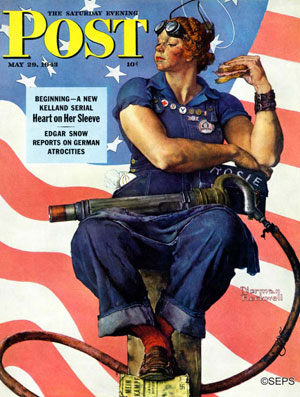
You might not know the name Mary Doyle Keefe, but you know the face. She’s the 19-year-old telephone operator from Arlington, Vermont, asked by Norman Rockwell to pose for one of the most famous Post covers in 1943 — Rosie the Riveter. Keefe passed away on Tuesday in Simsbury, Connecticut, at the age of 92.
The painting isn’t just famous as a Post cover. During World War II, the U.S. government used the portrait to sell war bonds and to show support for the women who were working in the nation’s factories, and it’s been a symbol for independent women ever since. She’s even a popular Halloween costume now.
Now You Can Send Anyone a Direct Message on Twitter

Oh, yes, celebrities and other famous people are just going to love this feature.
Before, the only way you could send a direct message (DM) to someone on Twitter was if they followed you. That’s why you often see people tweeting “hey, can you follow me so I can send you a DM?” But now the social media site has changed things so you can now send a direct message to anyone.
Thankfully, unlike some social media sites (*cough* Facebook *cough*) they have made this feature opt-in instead of opt-out. You have to turn it on yourself — and if you don’t want to, you don’t have to. Note: You probably don’t want to.
Goodbye, Orange Kraft Mac & Cheese

A part of your childhood is about to change color.
Kraft has announced that they are going to stop using artificial dyes in their original Mac & Cheese in January 2016. They already got rid of the dyes in many of their Mac & Cheese products that come in different shapes, such as the Teenage Mutant Ninja Turtles boxes. The U.K. version of the Mac & Cheese — called “Cheesey Pasta” — is already sold dye-less.
We’ll have to see if getting rid of the iconic color will hurt sales. The Kraft name is still pretty powerful, and we’re all used to buying the same products that we’ve always bought. I assume they’ll keep the box design pretty much the same so people know they’re buying the same thing. If you still want that bright color I suppose you could add some dye yourself, or maybe add some finely shredded orange crayons.
National Pretzel Day

In February of last year, a pretzel tried to kill me. I was eating a couple of those small pretzel sticks when one of my front teeth suddenly came loose. Several months and a lot of money later, I have a bridge in my mouth and no longer look like a prize fighter who loses a lot. So I don’t eat pretzels anymore, probably as an act of caution and also maybe a little bit of principle.
But that doesn’t mean you can’t enjoy them! Sunday is National Pretzel Day. Food Network has a recipe to make your own pretzels at home.
And if you’re wondering, yes, the recipe is for soft pretzels. But still be careful, OK?
Upcoming Anniversaries and Events
Chernobyl nuclear accident (April 26, 1986)
Here’s the Nuclear Regulatory Commission’s background on the power plant accident that caused a fire and the release of radiation into the air, leading to several deaths.
President Ulysses Grant born (April 27, 1822)
Biography.com has a history of the 18th President, with several videos.
William Randolph Hearst born (April 29, 1863)
Read The Saturday Evening Post feature on the history of media bias and freedom of speech.
Empire State Building dedicated (May 1, 1931)
Here’s a really detailed history of the New York City landmark.
The Kentucky Derby (May 2)
The 141st running will take place next Saturday at approximately 6:24 p.m. But leave your selfie sticks at home!
Cardinal Directions
Deepak stepped out for his morning jog around the neighborhood. The mild spring morning was sunny; the bright yellow daffodils, in full bloom just a few days ago, were now fading and drooping, their brief time was up. But, the azalea buds looked like they were about to burst into bloom.
Back home, dripping with sweat, he cooled off on his customary chair in the balcony. Indira brought him a glass of orange juice.
“I called Bangalore. My parents asked about you. My mother spoke to our family purohit … said we should buy a house that faces east; it’s auspicious, keeps off negative energy.”
Deepak nodded his head.
Indira said, “Deepak! Are you listening to me? I don’t know what you do with that iPad all the time.”
Deepak looked up. “I’m reading Bollywood news.”
“Yeah, yeah, more like ogling those half-naked women … hmm …”
He smiled. “Actually, Katrina Kaif looks smashing in a bikini, look.” He gave her the iPad.
“Deepak! I don’t have time for this frivolous stuff. You need to grow up. First thing in the morning you indulge in these, these … you should join in my morning puja … instead … hmm … anyway, we need to call the realtor, update her.”
Deepak sighed deeply. “Okay, okay.” He thought that it is futile to argue with his overly pious wife.
**
He remembered the time when she decided their son’s name. When he knew they were going to have a son, Deepak jotted down names such as Rakesh, Satish, Rajesh, which he considered modern and mainstream. For him, a name which ended with “sh” conveyed a sense of distinction and accomplishment. Rakesh Sharma, a distinguished scientist and advisor to the defense minister of India. Satish Dhawan, a renowned aeronautical engineer and the driving force behind the Indian space program. And, of course, Rajesh Khanna, the beloved Bollywood heartthrob. Santosh (Indira’s older brother), in Deepak’s view, was an anomaly; his lack of any accomplishments, either minor or major, didn’t really fit his name.
But unbeknownst to him, Indira consulted her much-revered Bangalore purohit, and named the boy Vasudev.
Deepak said. “What kind of a name is this Vasudev? So old fashioned.”
“Deepak! Shhhh … Don’t talk like that. Vasudev is another name for Lord Vishnu, our family deity. Our purohit consulted the scriptures, he said it’s a very auspicious name.”
**
Thanks to Indira’s directional desire, the number of suitable houses dwindled drastically. The American builders were not up to snuff with Vastu Shastra — the ancient Hindu treatise on architecture.
Before entering each and every house, Indira checked the compass on her iPhone to make sure of the cardinal directions. The realtor joked. “Looks like you don’t trust me, ha?”
In an immaculate house they saw an eye-popping nude painting, reminiscent of a pregnant Demi Moore.
The realtor said. “She’s the lady of the house. I know her. I sold this house to the family, few years back. Now they are moving to the West Coast.”
And in the master bedroom there were several other nude paintings of the same lady. One resembled Goya’s Nude Maja, with her hands behind her head.
After they got into her vehicle, the realtor laughed loudly. “Deepak, how do you like the Demi Moore house?”
“It’s great, well-lit rooms … but I’m not sure the house comes with her.” He sighed dramatically.
Indira remained glum until they were dropped off at their apartment. “How disgusting! Posing nude … and you, ogling like a teenager.”
Deepak laughed. “That’s a well-maintained house, very suitable. They are motivated to sell; we’ll get a good deal.”
“I’ll not live in that house, all those obscene paintings, bad aura.”
**
Finally, a four-bedroom house was found in Apex, half an hour from their apartment in Chapel Hill. Deepak wanted to move in immediately after closing. But the remote control in faraway Bangalore did not approve.
Indira said, “We can’t move in right away. On May 26 we should go to the house at 1 a.m., boil milk, do a puja. It’s an auspicious time set by the purohit … it’s based on our horoscopes.”
Deepak groaned. “Get up in the middle of night… hmmm … what’s with milk and all?”
Indira rolled her eyes. “What? You don’t know that boiling milk at a new house will bring good luck? It’s part of the housewarming ceremony … I’m surprised …”
“My father built a house when he retired from the government … we simply moved in after it was ready, no puja, no nonsense.”
Indira ignored his impolite comment. “And then, the same day we’ll have a grand puja …. invite our friends.”
Deepak said, “For god’s sake it’s an empty house, how can you do a puja? Where will people sit … on the floor, ha?”
Indira smiled. “You don’t have to be so sarcastic. Everything’s in control. The purohit from the Cary temple will guide us, and then he will sprinkle holy water around the house, chant slokas to purify the house. He will be back in the morning to conduct the grand puja in the presence of our friends. Caterers will arrange tables and chairs. Food will come from Udipi restaurant.”
Deepak said, “Okay, okay, let’s move in the day after the puja. Let me call the movers.”
Indira screwed up her face. “No, no, no, not so fast. Starting from May 27 to June 15 there’s not a single auspicious day. You know Jupiter and Saturn are not properly aligned with our horoscopes. So, our purohit suggested that we move in on June 16, a really auspicious day, all the planets will be in proper conjunction.”
“Great! You want us to pay rent here and also the mortgage … it’s a bloody waste of money … for almost two months.”
“Shhh … please don’t yell, we should follow the scriptures, or else bad luck will fall upon us.”
**
Indira wore a brand-new silk sari, imported from Bangalore. The purohit and Deepak wore white dhotis, and Hindu scared thread across their bare chests. With a small fire in a cauldron in the middle of empty living room, the puja was in full swing. The purohit’s chanted hymns, and the aroma of incense and camphor permeated the air.
The serene setting was rudely disturbed by a big thud, thud, thud, and then the front door burst open. Four police officers, with their weapons drawn, rushed inside.
One yelled, “Y’all show your hands!”
The purohit, shocked at this unseemly intrusion, yelled back, “Officer, we are in the middle of a ceremony, please leave.”
Deepak said, “May I know why you broke my door and entered without a warrant?”
The lead cop smirked. “Your door? People living opposite complained about intruders. And this fire here is a fire hazard. If this gets out of control, the whole neighborhood can be engulfed in fire, it’s been so dry these past few months.”
Deepak shouted angrily, “Now you all get out of my house. We can do what we want in our own house.”
The cop took a step toward Deepak. “You need to prove that this is your house. You have disturbed peace, entered a house, and doing all this voodoo.” He pointed at the fire. “You need to come with us.” He motioned to his assistants, and they handcuffed Deepak and the purohit and walked them out of the house.
Indira was distraught. “Officer, this is a big mistake. This is our house, and this … this is a holy ceremony … please leave us alone.” She was in tears, and the kids, already restless and sleepy, started to cry loudly.
The cop said. “Now, lady, you are making me nervous. I suggest you take the kids and leave.”
Deepak yelled just before the cops pushed him into the police vehicle. “Indira, don’t worry; call the realtor, okay? … We will sort it out.”
**
Indira looked relieved. “Thank god I could get hold of the realtor; she was really helpful, talked some sense into those dimwitted cops. Saying that our puja is voodoo, so rude.”
At the end of a long day, they were back in their apartment. Deepak poured himself a generous amount of whiskey. The grand puja, followed by a sumptuous lunch was a great success.
Deepak took a big sip. “Yeah, it could have been worse. Those ignorant cops and the bloody neighbors. I just can’t believe it, calling cops, ha?”
**
On June 16, at the exact auspicious time — this time, luckily, was in the daytime — they moved into their house. Indira, following her purohit’s instructions, brought a few belongings, couple of pots and pans, sleeping bags, and other essential items for one night’s stay at their new home. This time she did a small puja by herself, with an idol of Lord Ganesha on the kitchen counter. And then she started to cook.
Deepak said, “Let’s get a pizza, why cook now?”
“No, no, no. We have to cook, that’s the rule, and then we should sleep here tonight. Afterwards, the movers can bring everything.”
Deepak said, “You know, honey, you gotta put a lid on this, this … I mean your purohit got us into trouble with the cops. Maybe it’s time to, you know, tone it down a bit.”
Indira said, “Deepak, whatever I do, it’s for the good of our family. If we want to be healthy and prosperous, we need to follow the scriptures. If the gods are happy, we’ll be happy too.”
**
Indira said, “We need to place the headboard towards east. Our heads should face east. Otherwise …” She was visibly perturbed.
Deepak was mad. “Bull! You want to place the headboard right in front of the door?” He measured the room. “It’s not safe; we’ll run into it all the time.”
Indira said, “Actually, what I’m telling you is the truth. If you want, talk to the purohit yourself.”
“I’m not talking to that dumb guy … telling you all kinds of crap.”
Indira persisted. “So, you are okay with placing the bed so our heads will face east?”
“I’ll do no such thing. You can keep your head against east or south or north, anyway you like. I’ll sleep normally. The headboard will be against the wall.” He thumped his fist on the dining table.
Indira said, “But my feet will be in your face, that’s not, that’s not …”
Deepak was livid. “I had enough of this religious mumbo jumbo. It’s very aggravating. I almost landed in jail, thanks to your crazy ideas. From now on, I forbid you to talk to your folks about every little thing. I don’t want them to run our life. Puja for this, puja for that. Auspicious time, my foot.”
He went into his den and banged the door shut.
Indira looked at the time; it was six in the morning in Bangalore. She called her mother.
“Mom, did you have your morning coffee?”
Her mother yelled at the top of her voice. “I can’t hear you properly. Hello, hello, are you there, Indira?” The lady modulated her voice depending upon the distance, normal voice when she spoke to her friends in town, a few decibels higher to her son in Delhi, and a crescendo to America, across so many continents.
When Indira told about Deepak’s recalcitrance, her mother said, “Oh! I see … ummm … I think Deepak is going through one those Saturn phases. That’s why he got arrested … hmm … now I see. Yes, it’s definitely the Saturn. Let me speak to our purohit. I’m sure he’ll suggest a remedy, maybe a homam or a yagna to get rid of this Saturn. Don’t worry, baby. We will fix it.”
A Norman Rockwell Myth Debunked
Oh, Pop. My grandfather is 100 percent responsible for this myth — that he couldn’t draw a sexy woman. He said it many times: “I can’t draw a pretty girl, no matter how much I try. I’m afraid that they all look like old men!” One day my father Thomas, his middle son, asked Pop what he meant, and my grandfather explained that he couldn’t draw bodacious, sexy pin-up girls like Vargas and Petty, or even ideally beautiful women like his friend and fellow Post illustrator Coles Phillips, known for his “fadeaway girl.” (Norman Rockwell loved faces with true character in them — either young faces untouched by artifice or guile, or old faces with inerasable histories etched into them; every wrinkle, a story.)
But even a cursory look at Rockwell’s body of work instantly proves my grandfather wrong — he painted pretty, even sexy, women of all ages. Most surprising, I discovered that Pop had a remarkable skill in painting the beauty and allure of women’s legs, particularly the delicate ankles.
One of my favorite examples of Pop’s most seductive females is the woman in this painting (above). Her stance is like a panther about to pounce. We see mostly her back — a psychologically expressive landscape. This is a woman who will do anything to get her way and takes no prisoners. Classic femme fatale. It’s an illustration for the story “Strictly a Sharpshooter,” by D.D. Beauchamp, who later became a Hollywood screenwriter.
The atmosphere and feeling of the painting is very film noir — the gloomy tones, the smoke, the beleaguered boxer, the tough guy in a fedora with a cigar hanging from his mouth. And, of course, the “dame”: “The dame was an ex-stripper in a cheap burlesque, and she was strictly a sharpshooter. She liked fur coats and champagne, and you didn’t buy those things on the kind of dough you made out of club fights.” Pop’s art always stayed close to the details of a story.
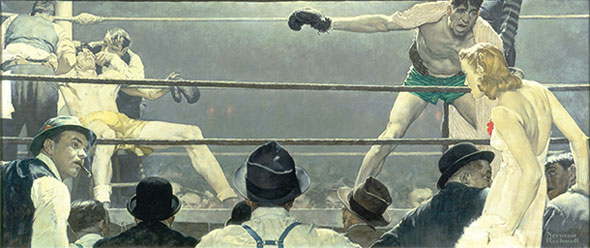
Story illustration for American Magazine, June 1941.
Oil on canvas, 30” x 71”. Norman Rockwell Museum Collections.
© Norman Rockwell Family Agency. All rights reserved.
My grandfather went to a Columbus Circle boxing club to soak up the atmosphere, get a taste and feel for what the ring was really like. He probably used George Bellows’ painting Dempsey and Firpo (1924) as inspiration. Bellows, part of the Ash Can School of artists, was known for his amateur boxing scenes — stark contrast of colors — visceral — muscular — edge and grit. Both Bellows’ and Rockwell’s paintings are done horizontally — the ropes are an important visual that create tension and a sense of imprisonment. Both paintings are dramatically expressive, in the moment. They hint at the light above and play with chiaroscuro, but Bellows’ contrast is more pronounced. Pop’s one error, in my opinion, was comically exaggerating the expression of the boxer. It takes away from the power of the painting. But Rockwell’s also has a marvelous study of fedoras — each one its own character.
Elizabeth (aka Toby) Schaeffer, the wife of one of Pop’s best illustrator friends, Mead Schaeffer, posed as the sexy “sharpshooter.” Gene Pelham, Pop’s photographer in Arlington, Vermont, posed as the tough guy looking at her in disbelief.
When the illustration appeared in American Magazine, June 1941, the bold caption underneath read: “The crowd expected to see a hard-hitting youngster spar with a punch-drunk bum. Instead they saw the battle of the ages — a blue-eyed blonde as the stake.”
So why did my grandfather misstate his skill? My grandfather’s humility was very real, and at times his lack of confidence could be crippling. Perhaps if he sold himself short first, he would beat others to the punch.
Warm wishes as always,
Abigail
———
Strictly a Sharpshooter is part of “American Chronicles: The Art of Norman Rockwell,” currently on view at Tampa Museum of Art, Florida. The painting will return to the Norman Rockwell Museum in the summer.