Big People Day
It was raining. Water occasionally fell from the window awning in sheet-like fragments and a row of holes was forming in the uncovered ground below. The small boy sensed that the rain wasn’t going to stop as he opened the front door and peered outside. The holes were beginning to form a tiny valley paralleling the awning’s edge, and he also noticed that the sky was as flat and gray as the earth below the awning, so he closed the door and turned away from it.
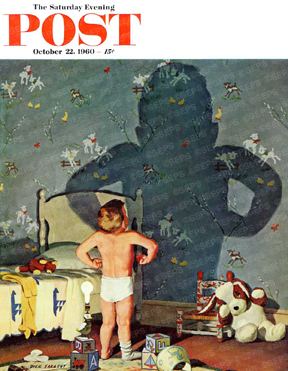
Big Shadow, Little Boy
Richard Sargent
October 22, 1960
The big people, as his parents and the others seemed to him — different as they were by size and the strange distance of years — were going away for the afternoon, and although he was a very small boy, he was convenient enough to be left home alone. Impatience soared, nurtured by the knowledge that they would soon be gone and he alone would be the big people. Carefully, he remained indifferent until car sounds dissolved into rain. He was marvelously alone.
Running across the room, he became Icarus and soared over the coffee table and into a sea of sofa pillows. Kneeling up, pressing his nose against the window screen, he yelled to the rain, “Sumnabits.” Racing about the house, standing on his head on his mother’s bed, twisting the phone’s dial and listening to its electrical gurgles, rummaging through forbidden drawers, he kept punctuating his joy with the “Sumnabits” of the big kids on the next block and now that he was the big people, nobody would wash his mouth out with soap or tan his hide. “Sumnabits.” It was good.
Arriving in the kitchen with its invitingly smooth vinyl floor, he sat down and pulled off his shoes; now running, then sliding, he shot across the room again and again, each time faster, sliding farther, with shouted “Sumnabits” salutes. Suddenly, slip-snapping legs up, butt down, he thumped the floor, hard. It hurt. His face began quivering so he tightly scrunched up his cheeks and pulling himself up, stood and said “Sumnabits” rather reverently and he knew he had said it without it working so he walked out of the kitchen without looking behind or to either side.
He watched the rain for a while until bored, then turned on the TV and stared at soap operas and stock market reports. He wandered around the house for a long while until, finally, exploring his father’s desk, he found a solid block of smooth white paper. There were also scissors and a ballpoint, pencils and an eraser. Selecting the topmost sheets, the scissors and the ballpoint, he ran back to the living room and spread his new possessions on the carpet. Industriously, he cut the paper into long strips that he patiently halved and on each resulting piece drew with the ballpoint pen, distorted with the clumsiness of the child hand, a man or a woman. Some he made tall, some small, some straight, others crooked, a few fat. Bending the bottom of each strip forward and creasing it, he then stood them upright in a long line. “Sumnabits,” he said with glee.
Hurrying back to the kitchen, he opened the oven door and inadvertently glancing in, paused and imagined himself walking in magical microcosm between those immaculate cathedral walls of galvan gray bathed in the brightness of one small, but intense light. Breaking thought, using the oven’s open door for leverage, he clambered atop the polished range. Opening a cabinet, he extracted a cigarette from a pack within. Sticking the cigarette in his mouth, turning around and standing up straight, he surveyed the kitchen and suddenly realized that he was seeing as the big people see while knowing that was how and what he was seeing and knowing. “Sumnabits.”
Back in the living room, the coffee table, cleared of ashtrays and magazines, became his dominion. Given life and motivated by his flicking finger, the paper people flutteringly ran races, had chases, and bobbed about living life in general. An empty shoebox became town hall cross the street from china vase mountain and around the corner form pillow hill. He married the tallest to the smallest. He made the ugliest, one that had been botched in creation, a villain; and the one he had drawn best was the leader, himself. His favorite toy car, a large red cast-metal thing with rubber wheels, became the official leader’s authority; and while his surrogate self was held on top, the toy auto refueled at salt and pepper gas pump shakers, accompanied by yelled “Sumnabitses” splitting the roar of lusty engine riffs.
The paper people of tabletop town followed his commands, but the cigarette between his lips grew wet and bitter brown as his folded legs became laced with sparkling pinpoints of pain. Outside, the rain slowed as if tiredly awaiting the sun. The game had become diluted by time into mere routine, attenuated by apathetic motion. He was standing and rubbing his legs when concept came — an expedition! The forest had been metaphorically cleared, the citizens collected; this society was now a thing unto itself, so — expansion!
“Sumnabits! Sumnabits, forward march,” shouted the leader as his auto advanced across the carpet. One-by-one-leapfrogged the paper people in pursuit. Onward across the nylon-piled prairie, bobbing and weaving in the soft convolutions of plushed texture, official leader constantly sliding from his high position atop the auto; onward past high buttes of plump hassocks and geometrically rugged mountains of stuffed and cushioned chairs, through timbered regions of varnished limbs foliated with flat seat bottoms encircling a table hovering high above as a Gulliverian aerial isle, onward the adventurers traveled.
Moving his entire group unit by unit repeatedly, patiently, past the dining room forest, the leader brought his expedition to the kitchen. Across the glossy vinyl his procession sped to the oven and range. The boy stopped. He listened. The room quietly vibrated with the whirring, susurrant rhythms of the refrigerator mingling with the droning beat of the rain renewing its attack against the roof above. Thunder lowed from a many-directioned distance, a full but soft sound surrounding and isolating the house in which the boy played. Opening the oven door, he hoisted his people and auto up onto its black-speckled, gray-enameled surface. Along one wall of the glistening oven interior they marched, across the back and under the bright light bulb and then along the other wall they marched, returning to the platform of the open oven door.
“Company halt. Sumnabits,” he commanded. One by one, he then placed his people on the range top, placed them in a ring around one of the larger heating elements; himself — the leader, he placed on the small stamped disk in the center of the heating element, in the center of that large coiled circle of flat tungsten so cold and velvet to his touch.
The toy auto was placed to one side, garaged neatly between two of the range’s control knobs. He then carefully climbed up on top of the range and, monarch of all he surveyed, stood tall and straight and as the big people.
“Sumnabits,” he said reverently, and it worked very well.
Turning, his foot tripping lightly against some protrusion of the range top, he reached in the cabinet and pulled another cigarette from the pack. He stuck the cigarette in his mouth, turned and noticed that himself, the leader, had fallen down; the small strip of paper now lay across the heating element and he noticed that one of the range’s control knobs no longer lined up with the others; and as he was noticing this, himself, the leader, curled and blackened and popped silently into flame as he reached and then thrust himself downward toward it as a curling gray wraith of smoke reached up and greeted him now smashing himself against the range top, crashing himself down upon the open oven door, flopping his now inert self still farther downward and into the floor.
Silence was startling by contrast.
He slowly became aware of the soft breathing of the refrigerator mingling with the gentle beat of the rain. He whimpered as he became aware of the kinetically electric hurt in one elbow and the deep ache in a knee. He whimpered again and realized how suddenly the range, the oven, the floor, the earth itself had struck him. He continued to lie on the floor until the solitude of stillness overcame the comfort of inaction.
After wiping his eyes and blowing his nose and carefully testing his hurt leg, he disposed of the remaining paper people and purged the house of all signs of his afternoon activities. He was asleep on the sofa when his parents returned.
“Wake up, wake up,” commanded his mother as she stared at his shoes nestled comfortably against the fabric of her couch.
“Hey, tiger. Up and at ’em,” laughed his father as he hurriedly walked by, his arms packed with grocery sacks.
The boy got up from the sofa and marveled at the house’s transformation, at the hustle-bustle of his parents, and at the sun shining through the now open windows. He followed his mother into the kitchen.
“Mom, what happens to you when you die?”
“Why, darling, you go to heaven and become an angel. You know that.”
She popped open a geometrically clever styrofoam womb and began plucking eggs from it. Opening the refrigerator door, she then placed the eggs, one by one, into a row of perfectly contoured plastic nests.
“Mom, what … but Mom, how do you know that? How do you know? Mom?”
“What perfectly strange questions you ask.” She slid open a compartment and filled it with meat transparently clutched in cardboard trays by plastic membranes. “Mommy’s busy now, so why don’t you go on outside and play.”
“Okay, Mom.” He turned and walked away.
“Don’t go off the block,” shouted his father from another room.
“Sure, Pop.”
He opened the door and ran outside.
News of the Week: Baseball, Bond, and the Brig Bazaar
Leave Baseball Alone!
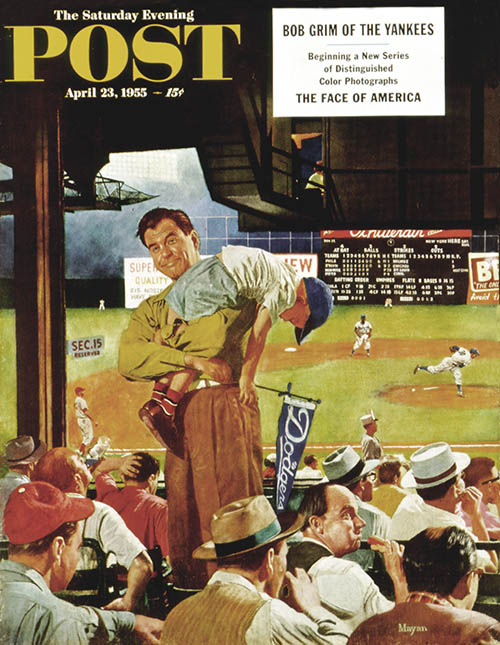
Earl Mayan
April 23, 1955
Several years ago, there was talk about improving baseball and making it enjoyable and accessible to more people. Several ideas were thrown around — some serious, some less so — but I remember two of the suggestions being 1) reduce the number of innings to seven or eight, and 2) have a foul ball count as a third strike. Apparently what is ruining baseball is that it’s just too damn long. Starting this year, baseball is going to institute a new series of rules designed to move the game along, including time limits on how long batters take to get into the batter’s box and on how long pitchers take to throw their last warm-up pitch and their first pitch to the batter, and a new rule that states the batter has to keep one foot in the batter’s box at all times. There’s also a new rule involving the use of instant replay: Managers can now demand replay from the dugout, meaning they no longer have to walk up to an umpire to challenge a play. In the past 10 years, the average time for a baseball game has gone up 20 minutes, lasting around 3 hours. The theory is if you speed baseball up more fans (and younger ones, whom I guess Major League Baseball wants to live-tweet games) will like it.
Mother of Honus Wagner, this is a bad idea. OMG, baseball is 20 minutes longer than it used to be! Yeah, well, baseball is supposed to be long and drawn out. You know why? It’s the same reason they shouldn’t tamper with tennis (another sport where they’re trying to speed things up). It’s a summer sport! Like tennis and golf, baseball is supposed to be slow and long and relaxing. I don’t care if the batters step out of the box or pitchers throw to first base a lot or the relief pitchers get a lot of warm-up throws. Baseball isn’t basketball and it’s not football and it’s not hockey. There are plenty of sports that are faster if you want that sort of thing, and I don’t hear any hardcore baseball fans complaining the sport is too slow. Actually, I think football and basketball move too slow, especially the last couple of minutes of a game when there are a gazillion time-outs, stopped clocks, reviews, and commercial breaks.
You know what makes baseball baseball? There is no clock.
Maybe one idea that could work is simply reducing the number of games played during the baseball season. Not counting the playoffs and the All-Star Game and the World Series, every team plays 162 games. Isn’t that a lot? Maybe it would be better if baseball wasn’t played until late October, when football and basketball and hockey have already started and our kids have already picked out their Halloween costumes.
James Bond Has a New Car
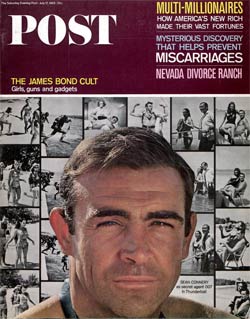
The Saturday Evening Post
July 17, 1965
If you remember the ending of the last James Bond movie, Skyfall, you’ll recall that 007’s classic, beloved Aston Martin DB5 blew up, destroyed in a heap of fire and twisted metal. It was sad, but much like killing off (spoiler alert!) Judi Dench’s M character, it gives the filmmakers the opportunity to start things fresh with the next movie, SPECTRE, which will be in theaters this November 6.
Esquire has photos of Bond’s new car. It’s still an Aston Martin, but it’s a modern Aston Martin. The DB10, a two-door with weird side windows, looks like it goes 300 miles per hour. Actually, it looks like it’s from the future. The car was made especially for the film.
And it’s not the only new car we’ll see. Bond has a car chase with someone in a Jaguar C-X75, one of five prototypes Jaguar made before stopping production a few years ago.
Lost Sherlock Holmes Story Found (or Was It?)
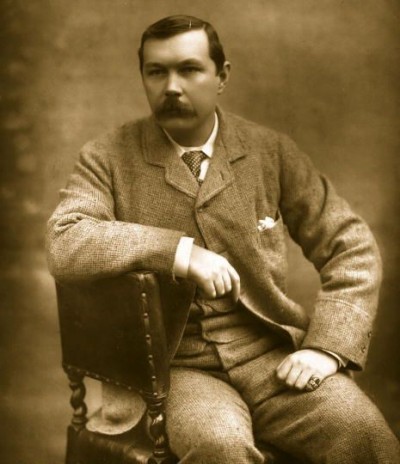
2015 seems to be the Year of Finding Lost Things. First we discovered the long-lost Harper Lee novel, Go Set A Watchman . Then came word that a new Dr. Seuss story, What Pet Should I Get?, had turned up. Now there’s news that a lost Sherlock Holmes story by Sir Arthur Conan Doyle had been discovered in a pile of books. Doyle wrote the story (with the cumbersome name “Sherlock Holmes: Discover the Border Burghs, and, By Deduction, the Brig Bazaar”) for a fundraiser to fix a damaged bridge in Selkirk, Scotland. An 80-year-old historian who lives in the town found the 1,300-word story in an anthology published in December 1903.
But wait! Now comes breaking news that some Sherlock Holmes experts doubt the story was really written by Doyle! Some scholars think the story was actually written by someone else because there is no mention of Doyle in any of the programs of the event or newspaper articles. This sounds like a case for Sherlock Holmes to solve.
Whatever the truth is, you can read the story online for free at The Telegraph .
And The Razzie Goes To…
By now you probably heard who won all the Academy Awards last weekend — and you also know what host Neil Patrick Harris looks like in his underwear — but did you hear who won the night before, during that other awards ceremony? I’m talking about the Razzies, the awards that celebrate, well, the worst in cinema. This year’s big winner (ahem) was … Kirk Cameron! The former Growing Pains star and his film Saving Christmas received four Golden Raspberry Awards, including Worst Picture, Worst Screenplay, Worst Actor, and Worst Screen Combo, an award he shared with “his ego,” as the award explained it.
Other winners include Worst Supporting Actress Megan Fox for Teenage Ninja Mutant Turtles, and Worst Actress Cameron Diaz, who was lucky enough to be singled out for her performance in two different movies, Sex Tape and The Other Woman. And Worst Supporting Actor Kelsey Grammer was called on for four: The Expendables 3, Legends of Oz, Think Like a Man Too, and Transformers 4: Age of Extinction.
There was one award at the ceremony that was actually worth winning. Ben Affleck won the Redeemer Award for going from Gigli to this year’s Gone Girl. He beat out Jennifer Aniston, Mike Myers, Kristen Stewart, and Keanu Reeves. I hope Affleck keeps this award on his mantel, next to his Oscars and Golden Globes and Director’s Guild awards.
National Strawberry Day

It seems odd to celebrate strawberries in February, but I’m sure many people are dreaming of them right now as they shovel out their driveways and knock down giant icicles that have formed on the edges of their roofs.
We have a lot of strawberry recipes, including Frozen Strawberry Pie, Curtis Stone’s Whole-Wheat Buttermilk Pankcakes with Strawberry-Maple Syrup, and even Strawberry Lassi Ice Pops.
And if you’re looking for another way to celebrate National Strawberry Day, well, they’re also great for whitening your teeth.
Upcoming Anniversaries
Lindbergh baby kidnapped (March 1, 1932)
Learn about the man who tracked down the kidnapper.
Dr. Seuss born (March 2, 1904)
Here’s a detailed biography of the acclaimed author Theodor Geisel.
Michelangelo Buonarroti born (March 6, 1475)
The artist, whose full name was Michelangelo di Lodovico Buonarroti Simoni, has his own web site, and yes it’s Michelangelo.com.
Alexander Graham Bell gets patent for telephone (March 7, 1872)
Read why the phone is one of 12 innovations that changed our world.
Egg in a Basket with Smoked Turkey and Asparagus
Here’s your bonus brunch recipe from Ellie Krieger as promised in “Let’s Brunch!” from the March/April 2015 issue. (Click here to subscribe to The Saturday Evening Post.)
Egg in a Basket with Smoked Turkey and Asparagus
(Makes 4 servings)
Ingredients
- 3/4 pound asparagus stalks
(about 3/4 bunch), woody bottoms removed - 4 pieces whole-wheat sandwich bread
- 4 teaspoons butter, melted
- Cooking spray
- 6 ounces sliced smoked turkey, sliced again into thin ribbons
- 1/4 teaspoon freshly ground black pepper
- 4 large eggs
Directions
Place asparagus in steamer basket over pot of boiling water. Cover and steam until crisp-tender, about 3 minutes. Chop asparagus into 1/2-inch pieces. Brush both sides of each slice of bread with melted butter. Using 3-inch cookie cutter, cut hole in center of each slice of bread; reserve cutouts.
Spray large nonstick skillet with cooking spray and set over medium-high heat. Cook turkey slices until browned around edges, about 3 minutes. Add asparagus and cook until it is heated through, about 2 minutes, then season with pepper. Transfer mixture to plate and cover with foil to keep warm.
Place 2 bread slices and cutouts in same skillet and crack one egg into hole of each slice. Cook until egg whites are set and bread is toasted on underside, about 3 minutes. Using spatula, flip bread/egg slices and cutouts and cook additional 1 minute. Transfer bread/egg pieces to individual plates. Repeat with remaining bread slices and cutouts. Top each one with 1/4 of turkey-asparagus mixture. Arrange cutouts on each plate.
Nutritional Information
Per Serving (1 egg in a basket with½ cup asparagus-turkey topping and 1 bread cutout)
- Calories: 270
- Total Fat: 11 g
- Saturated Fat: 5 g
- Sodium: 630 mg
- Carbohydrate: 25 g
- Fiber: 5 g
- Protein: 33 g
- Diabetic Exchanges: 1 starch, 1 lean meat, 1 medium fat meat, 1 vegetable, 1 fat
Gable Feared Failure as Rhett Butler
If this year’s crop of Oscar contenders seemed thin and unappetizing to you, remember that not all growing seasons are alike. Hollywood has had some truly remarkable years.
Take 1939 for example, a year in which the motion picture industry outdid itself. Hollywood released 10 movies that, even today, seem to deserve their Oscar nominations for Best Picture. Dark Victory; Ninotchka; Of Mice and Men; Wuthering Heights; Love Affair; Goodbye, Mr. Chips; Stagecoach; The Wizard of Oz; and Mr. Smith Goes to Washington. Topping the list was 1939’s most anticipated movie — Gone with the Wind, nominated for 13 Oscars.
Many considered Gone with the Wind and Mr. Smith the strongest candidates. Not surprisingly, the leading men of both films were nominated for Best Actor. Jimmy Stewart as the idealistic, young Congressman Jefferson Smith was up against Clark Gable as the dashing Rhett Butler.
More than 75 years after Gone with the Wind was released, Gable’s performance still symbolizes a masculine ideal for some people. The character he played, the cynical but chivalrous Butler, was one of the chief attractions of the novel on which the movie was based.
The book had been released in 1936, and hundreds of thousands of readers were captivated by the turbulent romance between Butler and the headstrong Scarlett O’Hara. In the first six months after its release, a million copies of the book were sold, despite being priced at an exorbitant $3 (equivalent to $50 today) in the middle of the Depression.
After producer David O. Selznik bought the movie rights to the book, the Warner Brothers’ studio launched a broad and well-publicized search for the ideal actress to play O’Hara. Names like Bette Davis, Katherine Hepburn, Jean Harlow, even Lucille Ball were tossed around. But for Rhett Butler, there could only be one actor: Clark Gable.
The only person who didn’t think he should play the part, it seems, was Gable himself. He told the Post’s Pete Martin in 1957, “My thinking about it was this, that novel was one of the all-time best sellers. People didn’t just read it, they lived it. … They had a preconceived idea of the kind of Rhett Butler they were going to see, and suppose I came up empty? … All of them have already played Rhett in their minds. … If they saw one little thing I did that didn’t agree with their remembrance of the book, they’d howl.” (“I Call On Clark Gable” by Pete Martin, The Saturday Evening Post, October 5, 1957)
Even after the movie, he fretted that he hadn’t done justice to the role. He told Martin it wasn’t until he saw the enthusiastic crowds at the Atlanta premier that he admitted, “I guess this movie is in.”
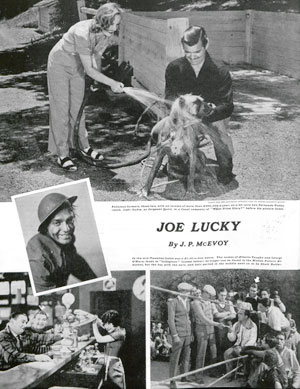
Gable should have worried. Two months after the premier, Gone with the Wind was still showing in 400 theaters and earning $2 million a week ($34 million today). And now Gable was its best-paid actor, reported J.P. McEvoy in his 1940 interview with the star.
Gable’s success with the film only increased the large following he’d gained over the years. His big break, which earned him a Best Actor award, came in the 1934 film It Happened One Night.
Two years after the film’s release, a New York mob had attacked the cab he was riding in, demanding that he come out or they’d overturn the taxi. The police had to break through and drag him to safety. In New Orleans, “a yelling mob of women and girls tore most of his clothes off and made away with all his baggage,” McEvoy wrote. “In Baltimore a thousand women, waiting at the station, mobbed him. One girl hung on his neck as he dashed from the station to a waiting auto. In Santiago, Chile, he lost everything, including his pajamas.”
To a lesser degree, Gable was making a strong impression on American men, too. He was the new role model. Young men were moving away from the sleek, sophisticated look of the 1920s. Now muscular, well-built figures were fashionable, made popular by actors like Spencer Tracy, Jimmy Cagney, Gary Cooper, and, of course, Clark Gable.
American men, wrote McEvoy, “started wearing broad-shouldered coats — reversing the current style trend, still influenced by Valentino — for millions of women were now sighing to share the adventures of this dashing he-man, and millions of men were going to look like he-men, even if they had to pad out their thin, round shoulders to create an illusion of virility.”
Gable’s style even influenced men’s underwear. In a scene from It Happened One Night, wrote McEvoy, “Gable stripped off his shirt and revealed a bare and undeniably healthy torso. A million American men and boys said, ‘What’s good enough for Gable is good enough for us,’ and the undershirt business has never recovered.”
Years later, Gable revealed the reason behind his unintended bold fashion statement to Pete Martin. “That was just the way I lived. I hadn’t worn an undershirt since I’d started to school. They made me feel hemmed in and smothered. I still felt that way when I joined the Air Force in World War II and I had to put on a T-shirt. I felt swathed in fabric, like a mummy.
No one denied Gable made a strong impression on American men and women. But would his performance in Gone with the Wind make a favorable impression on the Academy of Motion Picture Arts and Sciences?
On February 21, 1940, Hollywood gathered at the Coconut Grove in LA’s Ambassador Hotel for the 12th annual awards ceremony. The Best Actor award was given late in the evening. Until then, Bob Hope was busy as a first-time host. (Hope was called back to reprise this role 18 more times.)
Thomas Mitchell won Best Supporting Actor for his performance in Stagecoach, though he’d done good work in Gone with the Wind , too. Another member of that movie’s cast, Hattie McDaniel won Best Supporting Actress for her “mammy” character. She was the first black American to win an Oscar. Vivian Leigh, who played opposite Clark Gable as Gone with the Wind’s Scarlett, beat Bette Davis (Dark Victory) for Best Actress.
But Robert Donat won Best Actor for his performance as an aging English schoolmaster in Goodbye, Mr. Chips.
Not only did Gable not win that year, he never even received an Oscar nomination for any of the 28 films he made throughout the remainder of his career.
And yet, Gable’s Rhett Butler has remained a durable American icon after three-quarters of a century. Which is something else to remember when you think of the Academy Awards. While “winners” like Donat can become answers to movie-trivia questions, we remember “losers” like Jimmy Stewart and Clark Gable.
My Mother Couldn’t Choose Whether to Vaccinate Me for Polio
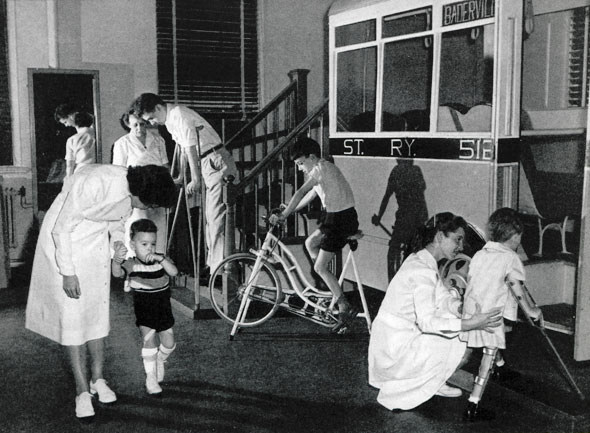
It had been a good year for Lois Mace.
She and her husband, only three years beyond college, had bought their first house. A solid redbrick and clapboard Cape Cod, it sat on a leafy street named for a character out of a Longfellow poem. In its driveway glistened a new sedan, silver-gray with a burgundy roof and whitewalls, a gift from her father, a Ford dealer.
And under its dormers that last day of August 1954 slept her three children: A sunny toddler with platinum-blond hair and a weak stomach sphincter, known around the house, mostly affectionately, as Miss Urp. A 3-year-old bruiser with a devilish twinkle in his eye, whom the neighbor nicknamed Meatball. Then there was the eldest, a lithe towhead with quick feet and an even quicker tongue — him they called Motormouth. He was set in a week’s time to walk the two blocks down the hill and start first grade at Nakoma Elementary School.
Everything was the way she liked it, under control.
(The prior sentence, the careful reader knows, is a signal, the gun hung on the wall in the first act, which must go off in the second. And it will — in the case of my mother’s story, in a way unknown to today’s parents facing decisions about whether to vaccinate their children.)
In the middle of that night, Lois was roused by sounds from the boys’ bedroom. Tucked under the shed roof at the back of the house, the room was stuffy with the heat of late summer. The older boy, who shared a bed with his little brother and a ratty blue bear, lay feverish and whimpering. Her husband carried the boy to the bathroom. He was too weak to stand and use the toilet.
The next day they drove him to the hospital for a spinal tap. The spinal fluid was cloudy. “During the past three or four days almost complete paralysis of both lower extremities and left upper extremity and trunk musculature has developed,” his doctor would write in the medical record on September 4.
Lois Mace Paul, 28, had come very far, very fast from a Depression-era childhood in a small Iowa town — husband, house, kids so well behaved that strangers would stop by the table in restaurants to compliment her. But now she was also the mother of a boy with polio. He lay in an isolation unit, afraid and confused, unable to sit or roll over. She could only stand in the doorway, swathed in a surgical gown and mask, forbidden to hold or comfort him for fear of spreading the virus.
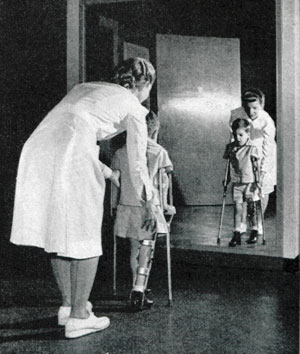
We can safely assume these events counted as life-changing for Lois. After 10 days in isolation, the boy was put on a children’s ward, where he would remain for 130 days, “for institution of hot packs and passive stretching exercises and later institution of active exercises,” according to his medical record. Every afternoon at 2, Lois traveled the three miles to the hospital to sit with the boy. She would read to him as he ate the sandwich — always peanut butter on white bread — that she smuggled past the nurses; her boy wasn’t keen on hospital food. Her husband took the night shift, arriving at 7 to launch Pooh and Christopher Robin on their next “expotition.”
Even judged by the standard of today’s families balancing work and parenthood, the logistical challenges were daunting. Meals to make, clothes to wash and hang, diapers to change. Schedule babysitters for every afternoon. Change clothes and put on makeup — a respectable woman didn’t go downtown in jeans and without a face. Find a way to get back and forth; there was only the one car. Make dinner so her husband could get back to the hospital on time. Bathe and put the little ones to bed on her own. How much time or energy could there have been for coffee or cocktails with friends, or for nights out with her husband?
And it didn’t end there. When the boy was finally sent home, he had to be carried up and down stairs. Over the next decade there would be braces and crutches that he was always expensively outgrowing. And as he grew and his unbalanced muscles twisted his frame, Lois and her husband would sit eight times in a surgical waiting room while Dr. Wixson used chisel, hammer, wire, and staples to straighten the boy’s back and legs. Not until the boy himself waited outside an operating room as his own infant child underwent orthopedic surgery could he imagine how fear had shadowed Lois’ life.
Imagination is about all we have to tell us what those events meant to Lois emotionally. She didn’t talk much about feelings.
The boy’s only hint came one afternoon, about the time of his sixth birthday. A high school running back had injured his neck in a game and had been brought into the ward the night before, his limbs numb. As Lois and the boy looked on, a doctor and nurses, after some probing, helped the player sit, swing his legs off the bed, and, to the delight of staff and parents, stand again. Seeing what pleased adults, the boy turned to Lois. “I’m going to do that soon,” he said. She didn’t reply, but tears streamed down her face.
We know she grieved. Lois shared the bad news in a letter to her best college friend, who had joined the Iowa diaspora to Los Angeles. It read like a funeral notice. “Oh, my beautiful little boy,” she wrote in ending. Lois confided to her favorite aunt that she feared the boy would die.
Why didn’t Lois vaccinate me? Because she had not been given that choice. I had fallen ill 224 days before the announcement, on April 12, 1955, that the field trials of the Salk polio vaccine were a success.
As she lay in bed that night, digesting the news that had been shouted out across the country over radio, television, and public address systems in workplaces and schools, Lois had a choice to make. Because kicking inside her was the boy she had conceived in her grief the previous fall.
Today’s parents make those choices knowing much more than she did about the effectiveness and safety of the vaccines offered to their children. They can rely on decades of experience and scientific research.
Lois faced only scientific uncertainty. The Salk vaccine was new. It had been only 60 to 70 percent effective in the trial but had been deemed safe. Some of the world’s top polio researchers weren’t so sure. They had publicly opposed the trial, thought the vaccine the wrong approach, maybe even dangerous. Their fears materialized within weeks. Cutter Laboratories in Berkeley shipped vaccine contaminated with live virus. More than 200 children and family members were paralyzed, and 11 died. The vaccination campaign was briefly suspended.
But from her own experience, Lois Mace knew things that today’s parents, thanks to vaccines, have never had to learn — need never learn — about pain and grief and loss of control. As soon as she could, she took all her children to get the shots, and went back again after the Cutter fiasco.
She could not be certain it was the best choice for them. She knew, to her very bones, that it was the right choice for her.
Originally published at Zócalo Public Square (zocalopublicsquare.org).
Original article.
News of the Week: Snow, Shih Tzus, and SNL
Winter Wonderland?
by George Hughes
December 29, 1951
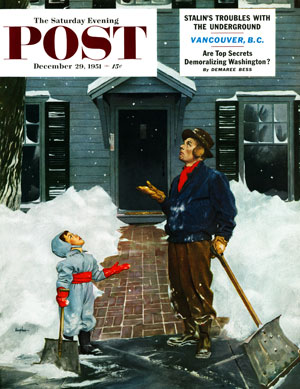
I just looked out my window, and it’s snowing again. Or maybe it’s snowing “still,” I’m really not sure. When you have this much snow in this short a time frame it really doesn’t matter; the days just seem to melt into each other (and that’s the only thing that’s melting right now). The snow is piled 7 feet high on either side of my walkway, and you can’t even see the numbers on the side of the house anymore. Another storm coming this weekend.
This guy has had enough too. He spent a lot of time digging out a parking space for himself and even put a space saver in the spot so others in the neighborhood would know it was already taken, but when he got home from work later that night someone else had parked a car in his space.
Guess what he did.
SNL’s 40th Anniversary
I remember watching the very first episode of Saturday Night Live when I was around 9 years old, so last weekend’s 40th anniversary TV special makes me feel old. The special, which was 3 1/2 hours long and got great ratings, was much like a typical episode of SNL itself: some fantastic stuff, some really lame stuff, and things that just made you scratch your head.
The best? Martin Short’s musical salute with Maya Rudolph (playing Beyoncé); the return of “Celebrity Jeopardy” (and Norm MacDonald’s Burt Reynolds impression); Paul McCartney singing “Maybe I’m Amazed”; Jane Curtin behind the “Weekend Update” anchor desk once again (with Tina Fey and Amy Poehler); Bill Murray singing the theme to Jaws; and just seeing all of the former cast members and guests on stage or in the audience. SNL really is the American pop culture landscape of the last 40 years (and darn it, I don’t care what anyone says, I like “The Californians”).
The worst had to be Eddie Murphy’s awkward appearance. Not only did he not make one joke in the minute he had on stage, the segment ended with Murphy not even knowing how to end it and talking to the crew about what he should do next. I’m also not sure what the whole segment was supposed to be. It’s well-known that Murphy hasn’t really wanted anything to do with SNL for 30-plus years and it almost seems like he wouldn’t come back unless he got a “tribute” segment on the show. Whatever happened, it was one of the oddest things I’ve seen on television in many years.
You can watch the entire special and clips at Hulu.
Alex Rodriguez Apologizes to Fans

(Aspen Photo / Shutterstock)
New York Yankees third baseman Alex Rodriguez has issued an apology to his fans and the world of baseball in general. Of course, the statement doesn’t specifically offer an apology for using performance enhancing drugs, just an acknowledgement that he “served the longest suspension in the history of the league for PED use.” That’s probably the most we’re going to get from him until he retires and sits down with Diane Sawyer for an exclusive interview, though he did apologize to the team privately.
I don’t know if Rodriguez is sincere or not, but kudos to him for doing it via a handwritten letter. That’s a dying art.
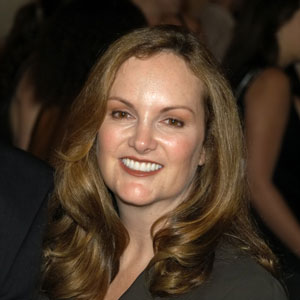
Patty Hearst’s Dog Wins Award at Westminster Dog Show
(Kai Hecker /Shutterstock)
Now there’s a headline that I never thought I’d write. But it’s true. The former kidnapped heiress, who now goes by Patricia Hearst-Shaw, had a dog entered in the Toy Dog category, and the shih tzu actually won. The dog’s name is Rocket, which is a great name for a dog, even if it’s a shih tzu covered in long flowing white hair.
For the record, the Best in Show winner was a beagle named Miss P.
Digital Deodorant, Brought to You by Google

And that’s another headline that doesn’t seem quite right, but it shouldn’t be any surprise, considering Google is also involved in driverless cars, smartphones, and your home thermostat. The tech company has filed a patent for a sensor that you would wear on your body that would detect sweat and body odor. There’s a small fan attached to the sensors that would emit a fragrance when body odor is detected. A GPS would alert you to where other people are so you can avoid them if you aren’t smelling your best.
B.O.? There’s an app for that.
February Is National Return Shopping Carts to the Supermarket Month

There’s a holiday for everything and this just about proves it. This month is National Return Shopping Carts to the Supermarket Month. It was started by a Chicago grocer in 1969 who was irritated by all of the shopping carts vanishing from his store.
I’d like to take this opportunity to talk about a related problem: People who don’t return their shopping carts to the shopping cart corrals. I see this every time I go to the store. Every. Single. Time. People will pack their groceries into their cars and then leave the cart right there in the parking lot, usually taking up a space. Then there are the people who will push the cart as far as the other side of the corral and no further, because they are too lazy to walk another eight steps to actually put it inside the corral.
Honestly, these people are as bad as thieves and people who kick puppies, because it’s such an easy, quick thing to NOT do. It really is the little things that can make our lives so much easier and happier, the little things that can help us get along better in our daily interactions. If I was still on Facebook, I’d start a page just for this.
National Muffin Day

And if you happen to encounter one of those people who won’t return their shopping cart to the corral (or they block an aisle with their cart or they start a conversation with someone right in the middle of an aisle, or one of a half-dozen other irritations we experience at the supermarket), cheer yourself up with a muffin. Today is National Muffin Day. Here’s a recipe for Easy Frittata Muffins, and here’s one for Cranberry-Orange Muffins.
But seriously, return your carts to the corral. Thanks.
Upcoming Anniversaries
First Polio Vaccine Administered to Children (February 23, 1954)
Read The Saturday Evening Post feature about the global war on polio.
President Andrew Johnson Impeached (February 24, 1868)
Read why Johnson was one of our 10 1/2 worst vice presidents.
Poet Henry Wadsworth Longfellow Born (February 27, 1807)
Here’s some of the poetry that Longfellow wrote for The Saturday Evening Post.
A Wedding in Heidelberg
It was midnight, and silent. Mannheim had not known a silent midnight in two years. Skulking in the bushes beyond the ruins of the Rathaus, Renata bid her time. The lights inside the American Military government headquarters were out; the moonless sky was black. Seizing the moment, Renata dashed across the grounds and tore up the flowerbed …
A jeep carrying two GIs roared up in front of the apartment that Chaplain Rabbi Haselkorn had requisitioned for three Polish Jews who had passed on false papers. A young man and two young women; one, still in her teens, had been brought to him six weeks before by a Jewish GI. Foraging for food, the younger girl had been caught in last-minute crossfire. Crouching for cover in the rubble of a gutted home, she had overheard a soldier trying to communicate with a German civilian in a guttural language, which she knew was not German. She waited for the GI to finish speaking. She skirted around the scraps of metal and loose bricks that littered the devastated streets, and ran after him.
“Jude!” She shouted. The soldier bristled “What?”
“Jude!” Renata insisted, pointing at him. The soldier glowered. “Who the hell are you?!”
“Jude! Ich bin Jude,” Renata pleaded, first, in desperation, and then with a resurfacing sense of hope.
“Oh, Jesus!” Finally, light had dawned. “You …?”
“Ja! Jude! Jude! Ich bin Jude!” Renata beamed, fervently shaking her head.
“Oh, Christ!” The Jewish GI gasped in recognition.
“Kommen.” Renata led the overwhelmed soldier to a cylinder along the riverbank in which two people huddled together. Slave laborers were denied access to German bomb shelters. Her friends Cesia and Shimon cowered inside. Renata spoke to them in Polish and gently coaxed them out.
The GI brought the three young people to the American Military government headquarters, to Chaplain Rabbi Haselkorn, who promptly ejected a German couple from a nearby apartment, and bequeathed the space to Cesia, Shimon, and Renata. Now they were standing at the apartment entrance.
“Hi!” The driver winked. “You guys ready?”
Cesia, Shimon, and Renata glanced at each other. Cesia wore a dress, and Shimon, a suit that Renata had “requisitioned” from the closet of the departing German couple. Renata wore a dyed white coat over her own dress, which she had converted from a khaki-colored American army blanket. Designated the group’s spokesman, Renata stepped up and responded, “Och Kay! Ve ready!”
“Well, hop in!” The driver thumbed towards the back of the jeep. Renata turned to her companions, showing off her constantly expanding English vocabulary. “Okie Dokie. Let’s go!”
Carefully, Shimon lifted Cesia into the jeep. She was carrying his child. Renata followed, carrying the bouquet she had assembled from the contents of the flowerbed in front of the old Rathaus.
**
The GIs drove out of the city and onto the autobahn to Heidelberg. Heidelberg had been unharmed on orders from General Eisenhower because he planned to install his headquarters there. Jewish GIs had stumbled upon a tiny synagogue in a narrow lane in Old Heidelberg that, curiously, was still standing. The jeep clattered over the cobblestones of the ancient town, and rode up to it. Inside, a buffet table was heaped with doughnuts and cold cuts and pretzels and jelly beans and Wrigley’s chewing gum and O’Henry chocolate bars, and wine, and beer, and ginger ale and Coca-Cola, and Florida oranges the size of sunsets. The GIs had obtained the food in much the same manner as Renata had obtained the bouquet.
Renata and her companions gaped. They had not seen such a feast in six years. “Take a load off. Relax!” While the soldiers added final touches to the table, Renata and her companions sat on the synagogue steps and waited. An hour later, a canvas truck, flanked by a jeep, rumbled up the road. Chaplain Rabbi Haselkorn, accompanied by a pair of United Nations Relief and Rehabilitation Administration workers, leapt out and pulled the canvas aside. Wraith-like apparitions began to stir. The UNNRA workers stretched out their arms, and skeletal hands latched onto them. Laboriously these specters limped off the truck, their steps tentative, unsteady, like pencils attempting to walk. They’d been liberated from their striped camp uniforms, deloused, scraped clean, and then dressed in an assortment of ill-fitting and mismatched clothes. One by one, the figures filed off the back of the truck. There were 30 of them, all men. They were confronted by a shy, young couple, almost as emaciated as they were, and a grinning teenager cradling a long-stemmed bouquet in her arms. She was robust and rosy cheeked, having already benefited by Seventh Army largesse. Instinctively, the silhouettes knew.
“Amchu?” they whispered, to the couple and the girl.
“Amchu,” the three affirmed.
One of us …
There were still Jews in the world. There were still Jewish women. Their own women had been wrenched from them at the first selection. Was there a wife or a sister who had been spared? Were such miracles possible? How?
Chaplain Rabbi Haselkorn led the congregation into the synagogue. Shimon and Cesia were pronounced man and wife.
**
After the ceremony, the congregation gathered around the buffet table. The bridal couple, the maid of honor, and the guests, in a daze, exchanged tales of survival. Tears, dammed for years, flowed like champagne. The men were Polish Jews from a town called Radom. They had been deported together and had survived, together. Five weeks earlier they had been liberated at Vaihingen by the French. They had been placed in a village near Neuenberg, and were beginning to recover. However, the French commander in charge of the village had received orders to transfer them to a Polish displaced persons camp, and he was concerned about the treatment Jewish survivors were likely to receive there. He had approached Chaplain Rabbi Haselkorn, who approached a Jewish lieutenant from Chicago, who succeeded in having the Radomer Jews transferred to the American zone because his superior looked away.
The Radomer Jews were currently housed in an ancient castle down the road. The lieutenant had evicted squatting Germans, Ukrainians, and Latvians, had the castle cleaned, and the Radomer Jews moved into Schloss Langenzell. Now they were attending a wedding reception. Only those capable of digesting solids, and strong enough to stand, had been invited to the wedding. The flesh of oranges, peeled by trembling fingers, erupted like sunbursts. Doughnuts, sprinkled with real sugar, sparkled like jewels on reverently held paper plates. The men shuffled, with their treasures, to the wooden benches in the center of the room. One of their number, a young man called Kaddish, moved to the front, to where the bimah had once been. Without prompting, without accompaniment, he sang Kol Nidre:
All personal vows we are likely to make, all personal oaths and pledges we are likely to take between this Yom Kippur and the next Yom Kippur, we publicly renounce. Let them all be relinquished and abandoned, null and void, neither firm nor established. Let our personal vows, pledges and oaths be considered neither vows nor pledges nor oaths.
As Kaddish’s clear tenor filled the hall, the gathering grew hushed. Heads were bent in contemplation; shoulders were stooped in sorrow. Kaddish concluded the prayer. Palms plunged into eye sockets as if, by so doing, they could press out memory.
Slowly the congregation rose and moved outside, into the courtyard. The sky was silver. The stones glistened. It was drizzling. A UNNRA worker pulled out a Leica camera. “Okay, gang. One for the album.” The congregation arranged itself into three rows: Shimon and Cesia in the middle, with Chaplain Rabbi Haselkorn standing next to the bride. The front row was kneeling. Renata perched on a soldier’s lap. Kaddish sat on the damp earth, next to her. Renata would meet him again, in Canada, at her own wedding. He would become her brother-in-law. The UNNRA worker aimed the lens. “Come on everybody. SMILE.”
The group gazed into the May mist. Beyond their vision lay a maze of roofs caught between the river and the hills. They stared out from this fairytale town, nestled within a gorge, untouched by horror, atrocity, or even time. The mountains hung on the horizon, and a train chugged along the banks of the Neckar: the trains … the trains …
The group stared into an open future and, bravely, smiled.
Malcolm X in the Post
The cover must have shocked more than one reader. The Saturday Evening Post had become known for its cover art, by Norman Rockwell and others, which showed an idealized America. But on September 12, 1964, the cover showed the face of Malcolm X — the radical leader who promoted black power and armed resistance to the status quo.
He had emerged as an important public figure during that year’s wave of angry politics. Just that summer, race riots had erupted in New York, Philadelphia, Chicago, and Jersey City. And as a spokesman for black discontent Malcolm X was, according to the September issue’s accompanying editorial, partially to blame: “The militant hatred he [Malcolm X] preaches was behind some of the violence of the summer riots.”
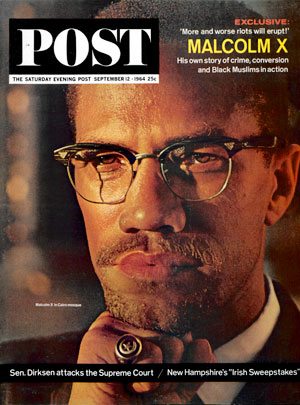
The editorial expressed no high regard for Malcolm X or the Nation of Islam, which had shaped his militant philosophy. Malcolm X might justify his message of violent resistance because he grew up in a violent world, the editors wrote, but it was the same cruel, unjust world that produced non-violent civil rights leader Dr. Martin Luther King Jr.
“America may consider itself lucky,” the editorial continued, “that in a large poll which The New York Times took in Harlem — by coincidence, just before the riots — King had more than 12 times as many followers as Malcolm X. We say lucky, because this fact shows more patience, forbearance, and trust among Negroes than their past treatment has justified.”
But how long could patience endure before more Americans adopted Malcolm X’s attitude? “The persecuted, neglected, mistreated minority … are equally taxed in all respects, [but] still do not get equal representation, politically or otherwise,” the editorial added. “Taxation without representation is still tyranny, and until all Americans join in providing every citizen with the rights of citizenship, we shall be lucky if Malcolm X is not succeeded by even weirder and more virulent extremists.”
The editorial accompanied a shortened version of Malcolm X’s then unpublished autobiography. The excerpt, provocatively titled “I’m Talking to You, White Man,” gave an account of losing a father to violence and a mother to insanity, drifting into crime and drugs, finding faith in prison through the Nation of Islam and its leader Elijah Muhammad, and taking his spiritual journey even farther.
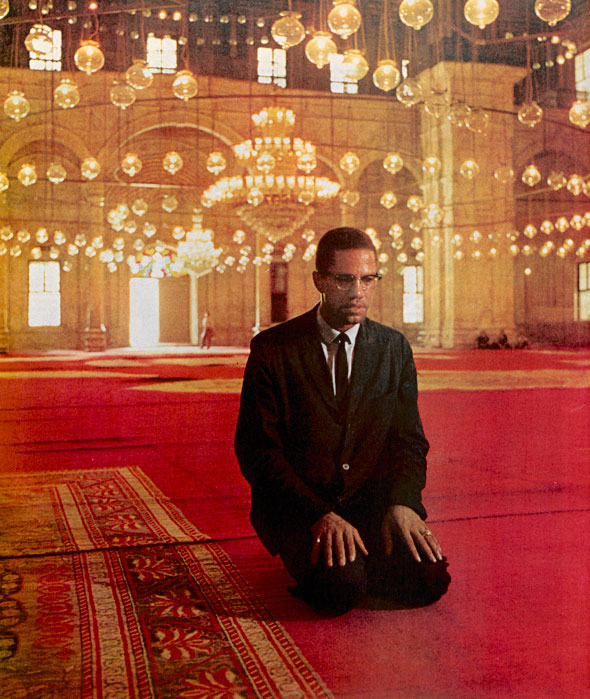
Readers might have been angered to read Malcolm X’s belief that a mad scientist created the white race. And they might have been irritated to read his response to President Kennedy’s assassination, which started his separation from his mentor Muhammad. Malcolm X had called the president’s murder a case of “the chickens coming home to roost.”
“I said that the hate in white men had not stopped with the killing of defenseless black people, but that, allowed to spread unchecked, it had struck this country’s Chief of State.”
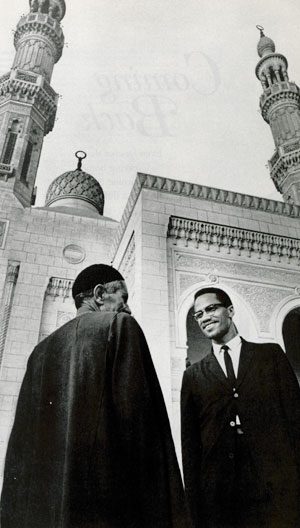
His comment made headlines, of course. Nation of Islam director Muhammad thought the comment was harsh and likely to make life “hard on Muslims in general.” Malcolm agreed to refrain from making any comments for 90 days. But the incident caused a rift in the Nation of Islam community. Soon Malcolm X announced he would open his own mosque in New York City.
However, the excerpt also included another memorable comment, in its conclusion. After returning from a pilgrimage to Mecca, Malcolm X was asked what had most impressed him. He replied, “The brotherhood: The people of all races, colors, from all over the world coming together as one! It has proved to me the power of the One God.”
As a result of what he had seen in the Holy Land, he wrote, “I have turned my direction away from anything that’s racist.” But, in consequence of renouncing racism, “some of the followers of Elijah Muhammad would still consider it a first-rank honor to kill me.”
He had long anticipated a violent death for himself. Earlier in his memoirs, he wrote, “It has always stayed on my mind that I would die by violence. I have done all that I can to be prepared.” And on February 21, 1965, that death came for him. While giving a speech in New York, Malcolm X was gunned down by three members of the Nation of Islam.
At the time of his death, Doubleday & Co. had been preparing to publish the full-length version of his autobiography. His murder caused them to panic. Not knowing whether employees would be at risk after publishing the autobiography, the company pulled the book from production. Grove Press released it later that year. The book has remained in print for 50 years, with millions of copies sold.
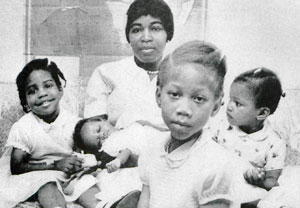
Publishing the memoirs of Malcolm X was a bold move for the Post. It marked how far the Post had departed from its 1950s attitude and contents. But the editors believed the magazine should reflect American society. While they didn’t endorse his solution to the problem, they honored his perception and portrayal of it.
Had he lived, Malcolm X would have turned 90 this coming May — a not impossibly old age. We can only guess how he would have developed as a leader. Had he survived the shooting, though, a long life might have been unlikely for him. Even a leader as conciliatory as Dr. Martin Luther King Jr. didn’t survive those turbulent years. Neither man lived to see his 40th birthday.
Adventures in the Kindle Trade
Six months after Maurice Sendak died in May 2012, The Believer published an interview British journalist Emma Brockes had done with him. She asked him his opinion of e-books. “I hate them,” Sendak responded. “It’s like making believe there’s another kind of sex. There isn’t another kind of sex. … Even as a kid, my sister, who was the eldest, brought books home for me, and I think I spent more time sniffing and touching them than reading. I just remember the joy of the book, the beauty of the binding.” [Read the related article “A War on Writers?” by Steven Slon from the Jan/Feb 2015 issue.]
I know the feeling. I too grew up holding, fondling, and smelling books. When I got older I began collecting them. I’ve spent hundreds, probably thousands, of hours hunting down books of writers I’ve gotten to know. When I began writing books of my own, there was such a thrill to see them in print. I will never forget walking past the Madison Avenue Bookstore in Manhattan the week my Conversations with Capote was published in the winter of 1985. It was my first book. And there it was. It was, to say the least, a very special, very personal moment.
My books — my own, and all the others I’ve collected — mean a great deal to me. But I no longer hold the opinion Mr. Sendak did. I don’t hate e-books. I can’t, because my last seven books have been — I hate to admit — e-books.
When Ann Patchett, best-selling author of Bel Canto and State of Wonder, and the owner of an independent bookstore in Nashville, Tennessee, was asked her opinion of e-books, she said, “I care that you read, not how you read.”
I care too. I care very much. The 11 books I am currently reading weigh 19.5 pounds; in my Kindle they weigh zero — that alone makes a good case for e-reading.
“The recent contractions and consolidations in the publishing business — layoffs, dwindling sales and advances, mergers of houses once thought unassailable — have left a widespread sense of unease about the durability of books,” Giles Harvey wrote in a recent New Yorker article about why failed novelists turn to writing memoirs about their failures. “Reading in bed with his girlfriend, novelist Benjamin Anastas wonders if the rise of e-books ‘will help keep writing alive and well into the digitized future, or if my problems are an early warning that my profession is about to go extinct.’”
I don’t think books will go extinct. More precisely, it’s become a changing art. According to the book research firm Bowker, self-publishing now accounts for more than 458,564 books annually, with Amazon leading the way. E-books cannot be ignored. The new problem is how to separate the good from the bad and the ugly.
In the April 2013 Wired, Evan Hughes wrote, “After centuries in which books and the process of publishing them barely changed, the digital revolution has thrown the entire business up for grabs. It’s a transformation that began with the rise of Amazon as an online bookseller and accelerated with the resulting decline of the physical bookstore. But with the shift to e-books — which now represent upwards of 20 percent of big publishers’ revenue, up from 1 percent in 2008 — every aspect of the existing framework is now open to debate: how much books will cost, how long they’ll be. … The only certainty is that the venerable book business, a settled landscape for so long, is now open territory for anyone to claim.”
Adam Gopnik, writing in The New Yorker, expressed a similar sentiment. “Thanks to the Internet, the disproportion between writerly supply and demand, always tricky, has tipped: Anyone can write, and everyone does, and beginners are expected to be the last pure philanthropists, giving it all away for the naches. It has never been easier to be a writer; and it has never been harder to be a professional writer.”
It has always been hard to be a professional writer. And yes, it’s a lot harder today. When I started writing books, I received an advance from a publisher that allowed me enough time to write the book. It was never a great deal of money — I got $50,000 for the first book, and $215,000 was the most I ever got, but that book (The Hustons) took me three years to write. Thankfully I was able to supplement my income by writing for magazines, until that world began to shrink as well. So the challenge is to continue being a professional writer — i.e., a writer who makes a living from his writing — in an e-book, self-publishing world. That was the quandary for most of the writers I knew. The only way to find out was to jump in. If I wanted to write what I wanted to write — novels, satire, poetry, memoirs — I would have to test the waters by sticking my own feet in them. I made an investment in myself. And a deal with Amazon. Would it turn out to be a deal with the devil? Or with my savior?
I’m not alone. Name writers like Stephen King, Joyce Carol Oates, and David Mamet have all put out e-book originals. But, as Bruce Miller, president of Miller Trade Book Marketing warned, “Celebrity authors may have great luck self-publishing, but most authors are not famous.”
Amazon has added a new twist to this market by hiring an editor, David Blum, who carefully selects Amazon Singles, original works of 5,000 to 30,000 words of both nonfiction and fiction. He gets more than 1,000 submissions a month and has published 345 Singles in the first two years of the program. Approximately one-third of these have sold at least 10,000 copies, at an average of $2 per Single. As the writer gets 70 percent of this, it’s understandable why so many are trying to make the cut.
But the truth is, with every successful e-book writer’s story, there are hundreds of thousands of failures. “There are so many stories out there about people who have made it big self-publishing,” literary publicist Julia Drake told Publishers Weekly Select, a magazine devoted to self-publishing, “and there’s not enough out there about the 99 percent of the authors who’ve self-published a book and it disappears.” The only reality each writer faces is his own.
My first step was to spend $350 to digitize the four books of mine whose rights had been returned to me: Conversations with Capote, The Hustons, Conversations with Michener, Above the Line, and Conversations with Brando. Then I found out about Amazon’s White Glove Program, a program for established writers. If invited in, Amazon will take care of the business of digitizing your books and will work with you to get them ready for self-publication, pending your approval. I was invited to join that program. And then they told me about their Select program, where I would be “allowed” to offer any of my books for free to their readers for up to five days over three months. Why would I do that? I wondered. To raise my profile, I was told. The higher one’s profile, the better chance of gaining new readers. Freebies were designed to create word-of-mouth sales. And since I had more than one book, if a reader took one of my books for free, they might be encouraged to buy the others. Besides the four previously published books, I had seven others I was working on. My Amazon contact thought it would be a smart idea to release them all at the same time. Instead of putting out one book and waiting, I could put out all 11 books, so when someone went to my book page they could see all of them at once. But I was still some distance away from publishing. Before I could digitize them I needed my trusty copy editor to go over each and every paragraph. Once she was done, I needed to place the photos I wanted to include, to get permission to use illustrations and quotes, and to get each book cover designed. Once everything was in order, I gave the books to Amazon. When they said they were ready, I went over each of them and found problems that had to be fixed. That back and forth took a few more months. When it came time to click publish and see these books go public, I next had to think about how to market them. Because so many books go out into the electronic world each day, I was really just getting started. And this was the worst part of the process, because it meant letting all the people I knew, through email, Facebook, LinkedIn, and Twitter, that these books were now available.
This was now my welcome to the real world of social networking. The world where all your friends, and “friends,” and former students send congratulations and encouragement and then go on with their busy lives. In other words, ignoring your pleas to buy your books. That’s when you begin to see the genius in Amazon’s free books idea. If they won’t purchase, then you can give them a taste, select one of the books, and nudge them to buy the others. So, I put up Capote first, and lo and behold, 2,000 people took it the first day. When sales of the other books remained meager, I offered them Brando for free. One thousand took that one. When no one was buying either of the novels, I put one up one month, the other the next. Four hundred people took them. Yoga? No! Shmoga!, my satire on yoga? I could barely give it away. How do I know how many people are buying, borrowing, or taking them for free? Because I can go to my reports on Amazon and check the month-to-date unit sales. Whereas before I had to wait six months to find out how any of my books were selling, now it is instant.
The first month, I earned over $600. The second, around $400. The third, under $200. It’s not exactly what I was selling in print. The Hustons had a 50,000 print run and supposedly sold 80 percent of those; I don’t have the figures of all the other books, but I do know that each of them sold at least in the four or five figures.
Stephen Marche, in Esquire, has pooh-poohed writers who whine about the terrible state of publishing today. He points out that “for writers starting out, there are more options, more means of access to the marketplace, than ever before.” And he quotes two pollsters (Gallup and Pew) who claim that the number of books the average American reads per year is 17. He says we’re in “the golden age for writers and writing.”
I agree that there are more options for writers today, but what Marche neglects to address is how many of these options allow a writer to actually earn a living from his writing. He points to how J.K. Rowling is richer than the queen of England and that Tom Wolfe got $7 million for his last novel, but there will always be writers who hit the literary lottery. It’s all the others in the game that Marche dismisses by saying “Everyone seems to understand and accept this golden age except the writers themselves.” Well, yes, the writers in the trenches. They don’t quite understand and accept. As for the average American reading 17 books a year? You’ve got to be kidding me. I know a lot of educated people. Very few of them read 17 books a year. Most people I know just read occasionally and watch a lot of TV. They can reference Mad Men, Game of Thrones, Seinfeld episodes, and Downton Abbey. But ask them what they thought of The Gravedigger’s Daughter or The Emperor of All Maladies and see if their eyes cross.
“It does seem a bit high,” said Joyce Carol Oates when I asked her what she thought about it. Oates is the only writer I know who can write 17 books a year. “Maybe these are self-help books and cookbooks,” she mulled.
Having taught gifted English majors at UCLA for 10 years, I’m pretty convinced that even they didn’t read much more than what they were assigned. It may be far easier for all of them, and for anyone else, to self-publish these days, but getting people to actually read these things? That’s a whole other story.
News of the Week: Anchors Away
Bob Simon: 1941-2015
When the week started we thought the big media news would be what is happening with Brian Williams, but then word came Wednesday night that veteran CBS reporter and 60 Minutes correspondent Bob Simon had died in a car accident in Manhattan. Simon was in a Lincoln Town Car going home from work when it rear-ended a car that was stopped at a stoplight. Police are still investigating the accident.
In his almost 50-year career, Simon won 27 Emmy Awards and several Peabody Awards and covered almost every story imaginable. Beginning as a reporter for CBS in 1967, he covered college campuses and political conventions. As a foreign correspondent, he covered the Vietnam War and political unrest in places like Northern Ireland, Somalia, and Haiti. He became CBS’s chief Middle East correspondent in the late ’80s and during the Gulf War he was captured and tortured by Iraqi forces. He was held prisoner for 40 days. Simon was 73 and is survived by his wife, Francoise; daughter, Tanya, who is a producer at 60 Minutes and often worked with him on stories; and grandson, Jack.
Brian Williams Benched For Six Months
(Shutterstock)
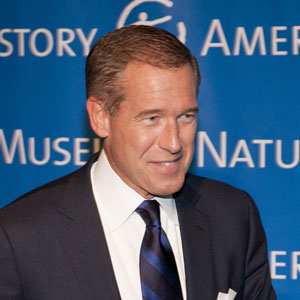
Though the investigation is still ongoing, NBC has decided to suspend NBC Nightly News anchor and managing editor Brian Williams for six months without pay for not being completely truthful about a 2003 incident in Iraq. Williams said that the chopper he was riding in was hit by enemy fire. But as we all now know it wasn’t Williams’ chopper that got hit. A different chopper was hit and went down, then Williams’ chopper arrived on the scene 30 to 60 minutes later. Call it a lie, call it “misremembering”; either way, Lester Holt is going to be his replacement until the summer.
What makes this a not-so-cut-and-dried decision is that Williams actually did tell the truth about the incident the first handful of times he talked about it on air. Add in that he’s a well-liked guy and gets good ratings and those are probably the reasons why NBC seems to be saying that he’ll be back at the anchor desk.
But the damage might be too much for Williams and NBC to fix.
I wonder if we’ll see a plot twist in six months, a scenario where Williams isn’t “fired” but supposedly leaves on his own to do another show on another network. And I don’t mean The Daily Show. Sure, Williams would be great on it (he’s an extremely funny guy) but I don’t think he wants to give up his real news career just yet, and it would seem like he was trivializing all of the serious work he did for years and almost admitting he wasn’t a “real” news person and that’s why he’s now doing a fake-news show.
Jon Stewart Leaving The Daily Show
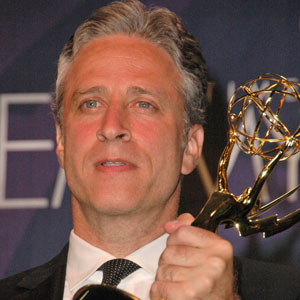
(s_bukley / Shutterstock)
The day after the Williams news we learned that Jon Stewart will be leaving his show too, after more than 16 years. After he took over for original host Craig Kilborn, Stewart made the show into must-see TV for young viewers, pundits, and media people in general. Actually anyone who liked to see the media and politicians skewered on a nightly basis. No word yet on who will replace him when he leaves, which will be later this year. Comedy Central has been losing a lot of people lately (John Oliver to HBO, then Stephen Colbert to CBS, and now Stewart) but they also have a deep bench. Or maybe they’ll be pick someone completely out of left field, like CBS did when they hired James Corden for The Late Late Show.
I was a Kilborn fan. Maybe we can start a letter-writing campaign for Comedy Central to bring him back for a whole new generation, along with Five Questions and maybe even Yambo too. Bring back Yambo!
The Monopoly Game Controversy
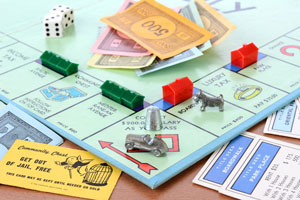
So what’s the true story about the origins of the classic board game Monopoly? Supposedly it will soon celebrate its 80th anniversary because for years we’ve been told it was invented during the Depression by a man named Charles Darrow. The story says he created it as something for his family to play during hard times. But according to a new book, that might not be the case. In The Monopolists, Mary Pilon says that the game was actually based on another game created by a feminist activist named Lizze Magie, who was a fan of anti-monopoly economist Henry George and wanted to honor him in some way. Hers was called The Landlord Game and she patented it in 1903. It grew in popularity throughout the 1920s and 30s.
So how did Darrow come into the picture? Read the synopsis of Pilon’s book at The Daily Beast and find out for yourself. Or better yet buy the book. I can picture it as a movie actually. Pilon’s book, not the game itself, which is already a movie that plans to start filming this summer. Originally it was going to be a satire of the financial and real estate world directed by Ridley Scott but now it’s going for more of a Goonies feel.
RIP, RadioShack

I guess I’m one of the reasons why RadioShack has been in trouble that past several years. Sorry! I can’t remember the last time I went into one. It must have been over a decade ago. I think I needed some sort of special connector or something. But I never really had a reason to go into one. I wouldn’t buy a phone or a computer there, and they’re not the only place that sells batteries.
The 95-year-old chain has filed for Chapter 11 bankruptcy and will be closing between 1,600 and 2,500 stores. They’re also going to team up with Sprint for the remaining locations, which will sell Sprint products and services but still be co-branded with RadioShack in some way (Sprint/RadioShack? SprintShack?). The Harvard Business Review has a piece on why the two companies are joining forces. Or as the clever title puts it, “shacking up.”
Please Be Careful What You Say Around Your TV

All this talk about privacy issues on social media sites and a new “credit card information being hacked” story on the news every week has made us forget another form of danger: our televisions! Seems that some Samsung smart TVs (every piece of tech is now called “smart” if they do things we don’t want them to do) not only have a feature where you can control the TVs by using your voice, the sets are actually recording what goes on in the room and can send the info to third parties (but don’t worry – they have your best interest at heart). Luckily there’s a way to turn it off, but shouldn’t it be off in the first place and then we can turn it on if we choose to do so? I think we all know why it’s not set up that way.
This is all rather horrifying to me. I have this nightmarish vision of a future world where our appliances tell us how to run our lives. Our TVs will say, “You don’t really want to watch another episode of The Bachelor, do you ?” and my toaster will chastise me for putting too much butter on my bread.
If that wasn’t enough, Samsung TVs are also inserting Pepsi ads into movies and TV shows as you watch them. All that stuff we read about in science fiction like The Minority Report is actually coming true.
RIP, Lizabeth Scott
Just last week I was watching the 1947 Humphrey Bogart noir Dead Reckoning and couldn’t believe that his co-star Lizabeth Scott was still alive. But Scott passed away on January 31 in Los Angeles at the age of 92. Her death was just announced this week.
She was one of the great femme fatales of film noir in the ’40s and ’50s. Besides Dead Reckoning, she appeared in The Strange Loves of Martha Ivers, Dark City, Pitfall, Too Late For Tears, and I Walk Alone. She also appeared in the Dean Martin/Jerry Lewis comedy Scared Stiff and in several TV shows before retiring in the early ’60s.
Friday the 13th
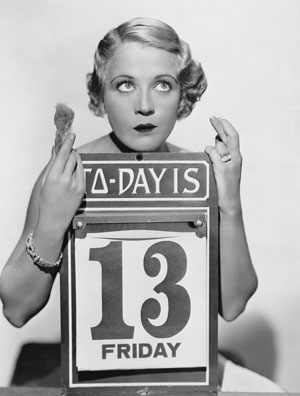
If you’re the superstitious sort you’re probably FREAKING OUT today because it’s Friday the 13th. Don’t walk under ladders! Don’t get near a black cat! Don’t eat cheddar cheese while wearing denim! OK, I made up that last one but it seems to make as much sense as the others. I’m not sure if people agree on how fear of the day got started, but Wikipedia has a fairly detailed explanation.
It’s funny how now we can’t think of Friday the 13th without also thinking of the horror film franchise.
Valentine’s Day
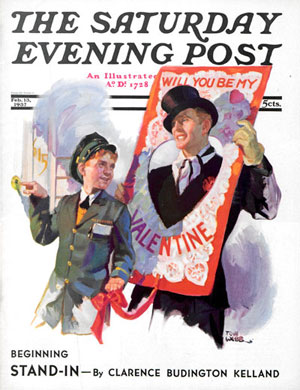
Tomorrow is the big day! For women, that is. The big day for men is probably Super Bowl Sunday or the day a new video game is released or a day we don’t have to shave (did I get all of the male clichés in there?). But if you’re the type of couple that celebrates on the 14th, here are some great ideas for Valentine’s Day dinner from Food Network and several more from Food & Wine.
Either that or just get some pizza delivered. You know your significant other better than I do. But definitely put the video games away for the night (and check out some classic Valentine’s Day covers from the Post.
Upcoming Anniversaries
Susan B. Anthony’s Birthday (February 15, 1820)
Here’s everything you need to know about Anthony at the official site for the Susan B. Anthony Museum & House.
Thomas Jefferson Elected President (February 17, 1801)
Read what Jefferson and other great American thinkers had to say about free speech.
The Adventures of Huckleberry Finn Published (February 18, 1885)
Read The Saturday Evening Post Archive Director Jeff Nilsson’s piece about the next Mark Twain (and Twain’s connection to the Post).
Pluto Discovered (February 18, 1930)
Is Pluto a planet or not? Here’s the official NASA viewpoint.
Astronaut John Glenn Becomes First American to Orbit the Earth (February 20, 1962)
Two Boats
Barkley’s Girl wallowed in the backwater of Harmony Bay, tied to a pier. Barnacles and seaweed clung to her red-bottomed hull. Sea lions often slept on her open deck, and pelicans sunned themselves on her wheelhouse. She’d never been pretty, fast, or built to motor beyond the harbor’s mouth. But all the other boats in the bay needed her, although they never let her know it.
On sunny days when the wind blew from the north, the captains of the sailboats depended on Barkley’s Girl to ferry them supplies and passengers from onshore. She’d haul away their trash, and help them navigate the channel. Her exhaust stack belched black smoke from an old diesel engine. She could barely make eight knots. Barkley had been her captain for 20 years. She’d watched him change from a laughing young sailor to a quiet man who didn’t talk much, except to himself and to her.
One moonless night, a two-masted schooner sailed into the bay. With running lights blinking, Barkley’s Girl guided the ship to an open mooring. The schooner followed silently through the quiet water, her sails furled neatly against their booms. She was bigger than any of the other boats, at least a hundred feet from bow to stern, and had a crew of seven.
“Now there’s a real ship,” Barkley said. “Listen to those engines purr. She could make Cabo without raising a sail.”
Her name was Johanna from Sydney, Australia. She’d come out of the west, on a fast run from Hawaii, dodging storms, her sheets full to the wind. But her crew needed to rest. For the following week, Barkley’s Girl tended to the sleek beauty as she readied for her northern passage to Anchorage, chasing the humpback whales on their spring migration. She admired the schooner’s graceful lines and dreamed of exploring the open sea with waves breaking across her deck. For a time, Harmony Bay felt like a little pond that she longed to break free from.
“Johanna can sail anywhere,” Barkley said. “But the Pacific is dangerous. During a blow, I’d rather be right here, tied to our sturdy pier.”
Yet Barkley’s Girl could sense her captain’s dream, and it became her dream too — to venture into the waves, to feel the roll of the sea, and to take a chance.
One morning, an hour after dawn, Johanna set sail for Anchorage. A squall came up, and the wind whistled through her rigging. Barkley had just come aboard his boat when he saw the schooner slip her mooring.
“She should have waited for us,” he said. “The harbor mouth will be tricky in this wind. We’d better follow her just in case.”
He hurried to start her engine and throw off the lines. Barkley’s Girl groaned as she entered the channel, the storm surge pushing against her hull. With her throttle wide open, they chased after Johanna. The big ship sliced through the waves while Barkley’s Girl crashed through them, throwing her captain around the wheelhouse. Slowly, they gained on the schooner.
A long breakwater, made of gigantic boulders stacked in a line, protected the harbor’s entrance from the ocean’s waves. But in the squall, mountainous combers broke over the barrier.
“She’s sailing too close,” Barkley yelled.
The pull of the breakwater drew Johanna toward the rocks. A towering wave rose above the boulders and thundered down onto the schooner. She rolled onto her side, throwing two sailors into the water. They swam toward Barkley’s Girl, trying to get clear of their stricken ship. Johanna righted herself, but another wave crashed onto her deck, spinning the boat. Her rudder smashed into the rocks.
Barkley’s Girl pushed forward, then slowed to a stop. Barkley ran to the rail and pulled the sodden sailors from the sea. They huddled at the stern. One favored an arm. He tossed them blankets before returning to the wheel. A new set of waves pounded Johanna, threatening to break her apart. Barkley steered close to the schooner’s bow where a crew member clung to a safety line. He threw the sailor a rope and the woman tied it to a deck cleat. Barkley’s Girl reversed her engine and towed Johanna off the rocks and beyond the reach of the thundering breakers.
The two boats crept into the harbor, to the mooring that Johanna had just left. One of the crewmen who had tumbled overboard had fractured his arm and was taken ashore to the hospital. The storm broke up quickly. In a few minutes rays of sunlight made the bay sparkle like diamonds.
It took weeks to repair Johanna’s mangled stern. Barkley’s Girl brought carpenters and engineers from shore and supplies for the schooner’s crew. As spring gave way to summer, the seas calmed. One morning Barkley came aboard with another man that she recognized as the injured sailor. He wore a cast on his left arm.
“She’s all yours,” Barkley said. “She’s an old boat, but dependable … never let me down.”
“I’ll take good care of her while you’re gone,” the sailor said.
“You know, I might never come back,” Barkley said.
“Yeah, you will. But take your time. Enjoy the sea. You deserve it.”
They started her engine and motored across the bay to Johanna. Barkley climbed aboard and disappeared below deck. Within the hour, the schooner set sail for Alaska.
Months passed, then years. The sailor named Walter scraped, caulked, and repainted her hull and wheelhouse, and rebuilt her old engine. He installed a colorful sunshade over her deck to protect the sightseers he took on guided tours of Harmony Bay. But he never changed her name. Barkley’s Girl enjoyed her safe life inside the harbor. But on winter nights she’d dream of her old captain, out there somewhere on the open ocean, pulling sail on Johanna, and slicing through the waves. In her own way, she traveled with him.
Brian Williams Isn’t the Only Self-Aggrandizing Journalist
Back in my newspaper reporter days we had a name for reporters who exaggerated details in a story: We called them “pipe artists,” and the stories they produced were “pipeski.” I think the phrase was derived from pipe dreams, which in turn is a reference to opium-induced fantasies. Whatever its origin, I discovered when I moved on to TV, no one used — or even knew — the expression.
Too bad: Broadcasting really needs a term for Brian Williams and his Choppergate misadventure. Who knew he was a pipe artist? And now that we know he invented a story about being in a helicopter that took enemy fire in Iraq, we must all wonder how much of his work over the years has been infected with pipeski. And beyond that, why was there pressure for him to embellish in the first place?
The answer to that may lie in the nature of the medium. A network half-hour newscast contains only 22 minutes of content — the other eight minutes are filled with commercials. Thus, competition among reporters for those precious minutes is fierce. There are more stories than there are minutes to accommodate them, so correspondents need to advocate for their stories. Part of a producer’s job is to separate the salesmanship from the journalism, discard the former and go with the latter.
But producers are only human and they tend to cut star reporters — especially those being groomed for the anchor slot — more than a little slack. In fact, the presence of a star reporter, in the minds of many producers, makes a story more important and thus more worthy of airtime.
When I was executive producer of Good Morning America, the network assigned us a correspondent who had been a star reporter at a local ABC station. He was our “on the go” guy, but I had a problem with him because I knew him to be a pipe artist. He had faked a combat incident in one of Israel’s many wars with its Arab neighbors (although he fooled his bosses at the local station) and so I accepted him on the show with great reluctance.
He sold stories to me with vigor. Every story he covered was the most important story of the day, if not the decade. And if I responded with a dubious lifted eyebrow, the details of the story got more and more dramatic. It was a constant struggle to keep his reports within the bounds of journalistic ethics. The audience, by the way, loved him.
Which brings us to Brian Williams, a smooth, self-assured anchor with a ready wit. He seemed to combine Peter Jennings’ panache with Walter Cronkite’s gravitas, spiced with a hint of David Brinkley’s humor. But now his mistake reveals a fabulist with a self-aggrandizing streak, an anchorman who brought the sensibilities of barroom bragging to his newscast.
No one contests that Williams — when he was a correspondent for, but not yet anchor of NBC’s Nightly News — flew in a U.S. military helicopter in Iraq in 2003. But it was another helicopter, in another formation, that was sufficiently damaged by an RPG — a rocket-propelled grenade — to force it into an emergency landing at a tiny U.S. enclave in the desert known as Rams Base. In the news report that aired shortly afterward — the first time he told the story — Williams acknowledged the downed Chinook helicopter was a different vehicle. But there was some exaggeration even then: Williams’ report gave the mistaken impression that his Chinook was in the same formation and was flying the same mission as the RPG-damaged chopper, and that the one he was in had taken ground fire. Pilots later said it hadn’t.
A few years ago, Williams went on the Late Show with David Letterman and retold the helicopter story, only this time he was a passenger in the RPG-struck aircraft. And then last week, on his own show the version of the story that had him in the RPGed Chinook was repeated. The helicopter’s crew took to Facebook to vent their anger about the misrepresentation. Stars and Stripes, the military newspaper, picked up the story and found other crew members who criticized Williams’ account.
Faced with the facts, Williams went on the air and apologized. Apparently, he said, he had conflated being a passenger in a helicopter that had taken fire with being in a helicopter so badly damaged it was forced down. The fog of war and a dozen-year-old memory were his excuses.
That doesn’t wash. You conflate the restaurant you ate in last month with the one you ate in two months ago; you don’t conflate a life-threatening situation with a weather-related aborted helicopter ride. The original 2003 news report was only slightly factually wrong, but Williams had expanded on that inaccurate tale. And now witnesses are coming forward claiming that he injected fabulist elements into his award-winning coverage of Hurricane Katrina’s aftermath. Among other things, he reported flooding in the French Quarter — where he was staying, although it was one of the neighborhoods in the crescent city that was spared flood damage. He also gave shifting accounts of whether he heard about or witnessed a suicide in the Superdome.
Why would a news correspondent jeopardize his career by exaggerating a story? What was wrong with “After we were forced down by a sand storm, we met the crew of a similar helicopter that had been shot down?” And why jeopardize a multi-million dollar anchor chair by adding more fictional elements to the story?
If you ever belly up to the bar with correspondents who have been to war, they will tell stories. And sometimes these encounters wind up as “can you top this” contests where facts may get gilded with light fiction. But the ethical ones leave that stuff in the barroom, even when they are selling their stories to editors and producer. And they certainly keep it out of the newspaper and off the air.
But even if a good journalist is supposed to check his ego — and his fictions — at the door to the newsroom, TV strokes egos like no other medium. And no ego gets stroked as much as an anchor’s. Perhaps Williams, feeling diminished because he wasn’t in a Chinook that took enemy fire, just put himself there.
Or maybe he was trying to live up to the impossible-to-match tradition of Edward R. Murrow, who flew a very dangerous mission over Berlin during World War II in an RAF bomber named D-Dog. Read Murrow’s amazing 19-minute report. Even better, hear Murrow deliver it.
Murrow didn’t report D-Dog to aggrandize himself — it was very clear to him the high price that could be exacted for we-were-there reports. In the next-to-the last paragraph of his story, he tells his audience: “There were four reporters on this operation. Two of them didn’t come back. Two friends of mine, Norman Stockton of Australian Associated Newspapers, and Lowell Bennett, an American representing International News Service. There is something of a tradition amongst reporters, that those who are prevented by circumstances from filing their stories will be covered by their colleagues. This has been my effort to do so.”
Murrow’s D-Dog sets a high bar for war reporting. But there is a much lower bar that is the very least this profession asks for — truth and accuracy. The pipe artist wiggles under that low bar. The highly motivated but ethical journalist will clear the bar. Pipe artists and ethical journalists share a trait: They are ambitious. If they weren’t they wouldn’t be in the profession. But ethical journalists understand that facts are what distinguish, not the sheen they try to put on them.
Originally published at Zócalo Public Square (zocalopublicsquare.org).
Is World War I Relevant?
“Is anything about World War I even relevant today?”
I’ve often been asked that question since I began this blog last fall. I’ve asked it myself. Is there anything we can learn from 100-year-old wartime experiences?
After reading “War and Hallucinations,” by Corra Harris, I can now answer with an assured yes. Because Harris, though writing 100 years ago, describes the challenge we still face in coming to terms with war and terror.
Back in 1915, American newspapers continued to publish atrocity stories from Europe. The German army was accused of mass executions, rape, and slaughtering children. Journalists couldn’t confirm or deny the reports coming out of Europe, but that didn’t prevent American newspapers from repeating the stories.
Harris didn’t believe the horror stories. Rather than recount them again, she gave her opinion of where they came from, and why so many people believed them. The war, she wrote, had caused the people of Belgium, France, and England to lose some of their sanity:
From the day I entered the war zone till this one upon which I take my departure from it I have been aware of a certain psychic condition, difficult to describe yet so powerful that no one can escape its influence … as if all thought had lost its shape, and reason was no longer reasonable. As if all men and all women were somnambulists walking in a black dream.
They speak with calmness of things so horrible that one is amazed that they do not shriek and wring their hands. And one is still more amazed at having the power to listen with calmness. We see terrible sights, we hear of them, we think of nothing else, and yet we do not go mad. For where everybody is mad no one is.
The French newspapers had carried the news of thousands being killed at the front, and an unstoppable German army was marching on Paris. Fear overpowered reason. The citizens’ anxieties were fed by the terrifying stories — “hallucinations” Harris called them — from refugees arriving in the cities.
Harris described Lille refugees traveling for days, defenseless and hungry, with artillery fire from both sides exploding around them. They knew the Germans were right behind them, and they weren’t permitted to stop in towns along the way. They might collapse in exhaustion in a ditch for a few hours’ sleep, but they’d awake at a strange sound or a suspicious form in the darkness. And as they resumed their march, they picked up bits of conversation from other refugees to weave them into their own fearful imaginings.
When they finally came upon relief workers, they recounted their journeys with a vividness that reflected their terror more than their reality. “The awful thing about war for the helpless,” she wrote, was that war “is what they fear, intensified by the horrible things they have heard.”
It wasn’t just refugees. Harris remembered soldiers claiming to have seen 10,000 men killed every day in one battle. The rivers near Calais, they said, were clogged with the bodies of dead Germans. Calmer observers coming on the scene after the fighting found nothing to justify these claims. These “hallucinations” were the attempts of Frenchmen, who had led routine, peaceful lives before the war, to describe the spectacular horrors of what they’d seen.
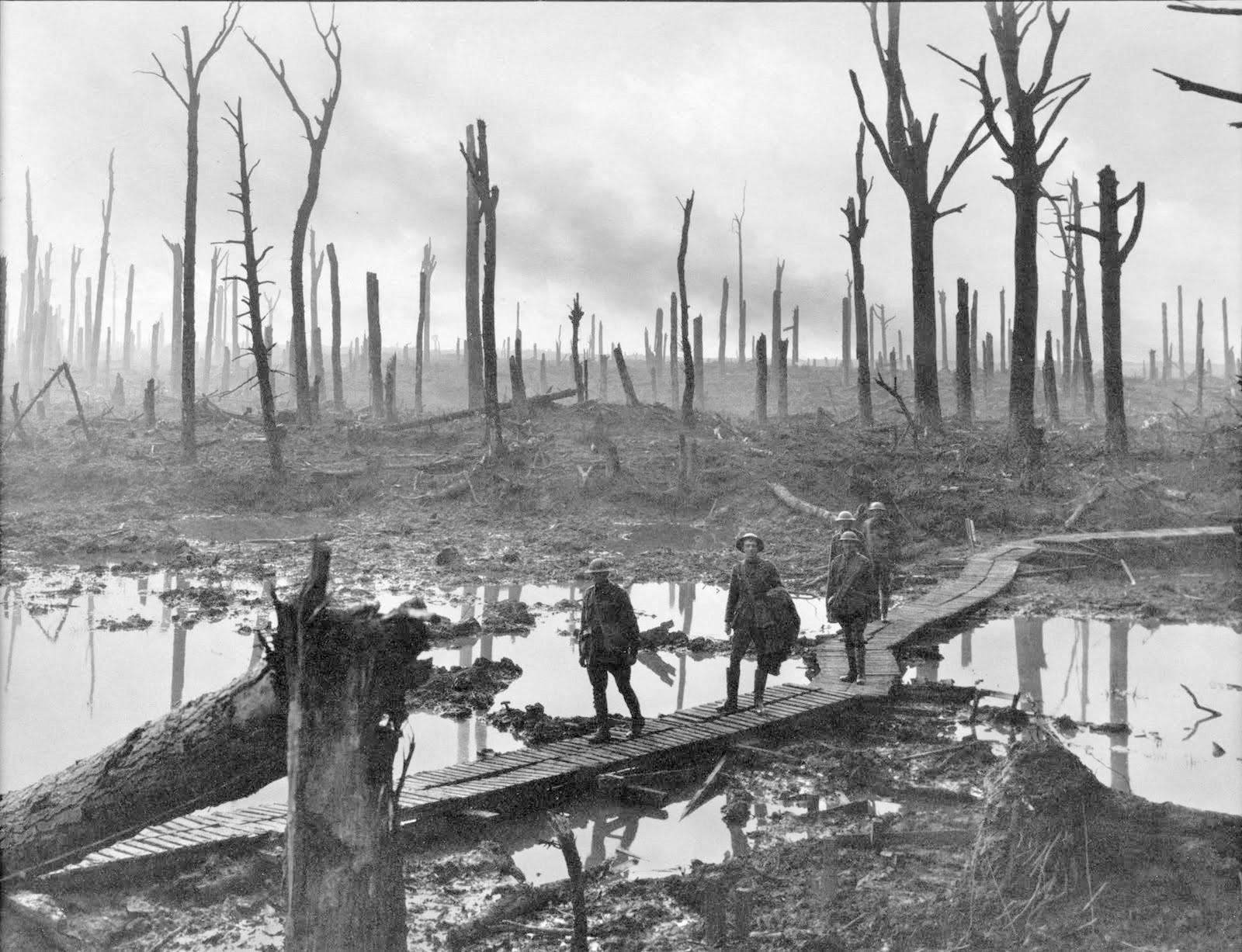
(Wikimedia Commons)
“When 70,000 Indian troops landed at Marseilles it was incredible,” Harris added. “The sight fired the imagination, so we heard that a force of 800,000 Japanese were already on their way to join the Allied Armies. Only 800,000! You get the contagion for using big numbers from reading the papers and from listening to the average man talk. Figures, which in normal times are supposed not to lie, have become the medium of fiction in this war.”
This exaggerated language was another sign of the derangement from war, Harris wrote. “Language is … designed to convey the commonplace meanings of life.” But the Europeans were experiencing such atrocities that their minds were “completely divorced from reality, because reality itself surpasses the power of even imagination to conceive.” And language became “the war currency of a bankrupt nation. It has no value. All the lies that words can frame are floating in this atmosphere. The truth itself is the greatest fabrication of all, because it belies all we have called truth.”
Today, it’s difficult to keep a sense of proportion when we think of 9/11, the Boston Marathon bombing, or the grisly murders of captives in the Middle East. We calmly discuss these events, and even try joking about them, as if to laugh off our worries. But the uncertainty and anxiety remain because the limits of the-worst-that-could-happen have been pushed far back. Faceless enemies and random attacks have eroded our sense of what to expect, or whom to trust. When reason can’t make sense of our world, dread and fear can take over.
As Harris noted in 1915, “Every ideal by which men aspired and lived is changed. Nothing is familiar and no man is sane — because imagination rules.”
Step into 1915 with a peek at these pages from The Saturday Evening Post February 13, 1915 issue.

3 Questions for Kathy Ireland
When Kathy Ireland donned a teeny-weeny yellow bikini and flashed a sultry smile for the cover of the 25th Anniversary Sports Illustrated Swimsuit Issue in 1989, she was catapulted to overnight fame and a high-octane career as a supermodel. She scored two more SI covers and put her buff, tan body on display in practically any fashion magazine you can name. Twenty-five years later the beautiful mother of three has long since traded the runway for the boardroom. Starting with a line of socks, Ireland created a multi-billion dollar empire of licensed products — furniture, lighting, glassware, sportswear and more — based on her company’s motto, “Finding solutions for families, especially busy moms.”
Ireland uses her success to support causes she cares about, from promoting Christian education to supporting HIV/AIDS research and care. Ireland is also committed to fair treatment of workers in the factories around the world that manufacture her products. As successful as she is — Kathy Ireland Worldwide does $2 billion in sales per year and her own net worth has been estimated at $350 million — her infectious sense of humor and commitment to family helps her keep perspective. She still considers the home she shares with her husband, Dr. Greg Olsen, and children, Erik, Lily, and Chloe, the important center of all she does.
Jeanne Wolf: One could say you got your education dressed in a swimsuit. What did you learn on the runway that translated into all this business success?
Kathy Ireland: One of the greatest lessons from that long-ago career was all of the rejection. I hated it at the time, but I feel badly for people who don’t experience being turned down. When we started our brand with socks, I was an aging, pregnant model, and people slammed doors on me, literally laughing in my face, and it didn’t destroy me.
JW: Do members of your family weigh in with opinions about your company’s products?
KI: Our house is a very busy, active lab. My family, my kids, see my failures; they see the messes I make. I’m like, “C’mon guys, let’s see how sturdy this is.” Since they were very little, we would get disgusting things out of the refrigerator and throw them on something like a broadloom sample to make sure it would hold up. I’ve had them jumping on the furniture to see if it was durable. I remember when Erik, my first, had a play date at a friend’s house, I was mortified because he began jumping all over their white sofa. I was like, “No, honey, you can only do that at home.”
JW: You’ve become an important spokesperson for your designs and for causes and issues you feel need a voice. How did you gain the confidence to speak out?
KI: The truth is I do not feel qualified or adequate. I’m completely uncomfortable. By nature, I’m a very shy person. I couldn’t string a sentence together when I was younger and worked as a model. As a kid, I couldn’t make eye contact with an adult. But when you see the need and the opportunity, you recognize that your comfort is absolutely irrelevant. My best advice today is all that you give is all that you get, so give it all you’ve got. Another important lesson: Get over yourself.
Happy Valentine’s Day, Folks!
Norman Rockwell
Ladies’ Home Journal
April 1928
Yes, I know it isn’t Valentine’s yet. That’s the point.
Why do we sometimes wait until that one day to fully express our love? It is the everyday gestures that really matter. A note you leave in your husband’s suitcase before he leaves on a work trip, so he finds it once he unpacks. Your girlfriend bringing you your coffee just the way you like it — a touch of cream and just under a teaspoon of sugar — without you even having to ask. A bubble bath with candles waiting for you after a long day of shuttling the kids around.
Diving into this investigation of my grandfather’s life — there have been so many unexpected discoveries. Finding the charming little notes he used to leave for my grandmother Mary and his third wife, Molly. Handwritten small notes like, “Welcome home!! To my beloved wife.” … “Happy birthday to my dear wife Molly from her loving, sleepy husband, Norman”. Pop even painted a “hidden” love note to Molly in the Ruby Bridges painting, The Problem We All Live With. If you look carefully, under one of the marshal’s hands is a small roughly drawn heart on the wall with MP + NR. It’s easy to miss it. NR must have wanted something loving on the wall to counterbalance the painful racial epithets that are also displayed there.
It is through small daily gestures that we feel truly loved. Do we really need a special meal and flowers on February 14th, when everything is double-priced and there is so much pressure on everyone to “perform” their love?
I recently came upon this painting of my grandfather’s that really touched me. Another one that I hadn’t seen before. It’s an April 1928 cover for Ladies’ Home Journal called On Top of the World (Young Couple Seated on Globe). The blue water encompassing the globe is reflected in the expansive blue sky surrounding the two young lovers. Her attitude seems slightly guarded, yet submissive. He, too, is cautious, but quietly beseeching with earnest affection.
The world is open to them. His stance is mirrored in the angle of the wispy, unthreatening clouds. She tilts toward him; her axis is pointed his way. The playful, slightly cheeky arrow points north up her stocking. Is he her North? Their romance is safe, protected and promising. His hand folds over hers, gently sheltering it. Just as the continents below them are connected, so are the two young lovers.
Celebrate your love every day. Even in the midst of a fight — remember, take a moment to acknowledge your Beloved.
Warmest wishes,
Abigail
Will Uber Share the Jitney’s Fate?
You’ve read the story before: A transportation startup staffed by a fleet of independent car owners challenges established public transit, and controversy begins.
The story concerns ride-sharing service apps like Uber that allow independent drivers to find their next fare and offer travelers an alternative to traditional taxis. Launched in 2009, Uber Technologies Inc. has grown into a $40 billion international business. And understandably, traditional cab companies, whose workers are still required to pay fees and meet licensing requirements that Uber drivers avoid, resent the billion-dollar corporation. In response to the outcry, some cities and even countries have banned Uber from their streets.
A similar story was published 100 years ago in the Post, regarding the rise of the jitney business.
In a 1915 article “The Jitney Juggernaut,” author Will Payne claimed the nationwide phenomenon was started by L.R. Draper, a car salesman. For weeks, Draper noted a growing number of people waiting for the First Street trolley car. So, one July morning in 1914, he put a sign in the window of his car declaring his intention to take passengers to Boyle Heights, three miles away, for a “jitney” — that is, a nickel.
Later that month, “two or three other enterprising persons, having leisure and a low-priced automobile, hung signs on the latter and followed in Mr. Draper’s footsteps, covering the same route,” Payne wrote. By August, at least four additional drivers were taking passengers from First Street to Boyle Heights. Some started taking passengers along other routes in the city. By October, there were about 30 jitneys in LA.
Then the business really took off.
LA unemployment was high that year, and secondhand Model Ts were available on easy terms. Operating a jitney must have looked like a profitable venture because by mid-November, Payne noted that “well toward a thousand 5-cent autos were plying the streets.”
He estimated that jitneys were taking in over $1 million a year (about $23 million today). Around 75 percent of that was income lost by the streetcar company, which complained that the jitneys were unfair competition. The “trolley people,” as Payne called them, claimed they couldn’t adjust their operating costs to make up for the lost riders. They would need to sell off rails, electric cables, and cars to balance their losses; the jitney owners had only invested their cars.
The trolley people also pointed out that jitneys were seriously adding to the city’s traffic problem, particularly when they gathered around at the street corners where trolley cars stopped.
But commuters found jitneys a cheap alternative to crowded cars and long waits. Every day, Payne estimated, over 60,000 people chose to take a jitney to work instead of the trolley. The jitneys were faster, could slip through traffic, and didn’t stop at every street corner for more passengers. They were so affordable that businessmen were taking rides home for lunch instead of dining at restaurants close to the office.
“The jitney’s defense and justification,” Payne wrote, was “that people want it; that it gives them a better article for their money than they got before.”
Commenting on the crowded cars, the editors of the St. Louis Post Dispatch hoped their ridership would continue to fall until the streetcars would “find themselves able to provide a seat for each passenger who buys one. The jitneys may even achieve the miracle of making traction magnates understand there is a limit to the patience of the American people.”
Naturally the sudden growth of jitney transit sparked controversy. The jitney wars, Payne wrote, “produced estrangement between friends and icy looks across bank counters. It would no doubt have divided brother from brother if two brothers had taken opposite views of it. … On the one hand is the new industry, struggling to live, and on the other hand are powerful opponents who want it to die. A man’s standing in the community can almost be determined according to whether he is pro-jitney or anti-jitney.”
The streetcar company was understandably opposed to jitneys. But so were many people Payne met who disapproved of carpenters, plumbers, salesmen, and others who’d started their own jitney businesses. They felt it was “simply monstrous for a lot of fellows to bob up and put a dent into a $25 million street railroad.”
Hearing the trolley people’s complaints, the LA City Council passed an ordinance that would regulate, and probably discourage, the new transit providers. The ordinance required drivers to procure a license, buy insurance, pass an exam and driving test, equip their rear wheels with nonskid tires or chains in rainy weather, and unload their passengers 50 feet from street corners when traffic was heavy. Each jitney had to display a conspicuous sign announcing its route, and no other advertising. Drivers could not stray more than three blocks off their routes.
Two more conditions are of particular interest. The first required “no passenger shall be refused on account of race or color.” The second condition was that every jitney should have a light above the backseat, “lest sentimental passengers take advantage of the dusk to spoon, spooning being a crime unknown on the Coast before the advent of jitneys.”
The mayor vetoed the ordinance because “it did not go far enough in the way of regulating jitney traffic.”
Surprisingly, the jitney owners supported many of the regulations the City Council proposed. However, they wanted a cheaper license fee, no insurance requirement, and — it is significant to note — they opposed being compelled to carry any passenger, regardless of race.
The trolley car company might have been losing thousands every day, but the jitney drivers weren’t getting rich. Payne doubted that a driver made more than $3 a day ($70 today). These “moderate wages,” as he called them, discouraged hundreds of drivers out of the business. But 800 drivers were still holding on.
What began as an LA phenomenon spread to San Francisco and San Diego, and across the nation. Within a year, over 62,000 jitneys were operating in 175 cities.
All contemporary accounts anticipated that jitney transit would become a significant new business. But the bubble soon burst, in part because of increased regulations. City governments grew concerned that the jitneys would bankrupt their mass transit systems, as had happened in Atlantic City. The city took action to ensure that streetcars survived and continued serving areas of the city that weren’t profitable for jitney business. Also, they wanted to protect their revenues from transit companies.
Cities began imposing restrictions like those Los Angeles considered: licenses, insurance, strict regulation of routes. Some cities prohibited jitneys from using the same streets as trolley cars. Or they prohibited drivers’ deviating from a single, approved route. Some cities required the jitney drivers to remain on duty for 12 to 16 hours each day. And some city governments began subsidizing mass transit to help it compete.
Consequently, within three years, 90 percent of American jitneys had gone back to being the family car.
It’s still too soon to tell if Uber will escape the fate of the jitneys. Uber enjoys the advantage of being a highly capitalized corporation. The jitneys never had an organization to fight city hall. Uber can also claim it is creating jobs. Passengers like its ease and economy as much as they hate the prospect of hailing cabs that seem inexplicably scarce.
It seems unlikely, in today’s political atmosphere, that government regulation has much chance of reigning in a booming business. However, it’s not impossible that a state or city ordinance could impose restrictions and fees on Uber drivers that would make using their personal vehicles less profitable. There’s a possibility that a significant rise in employment —however unlikely that might be—would lure Uber’s independent drivers toward more lucrative jobs. Likewise, passengers may come to dislike being rated by their drivers, or the practice of surge pricing, which boosts fares during busy hours.
Given the momentum Uber has, it is unlikely the company will follow the jitneys into obscurity. But then, the jitneys appeared unstoppable 100 years ago.