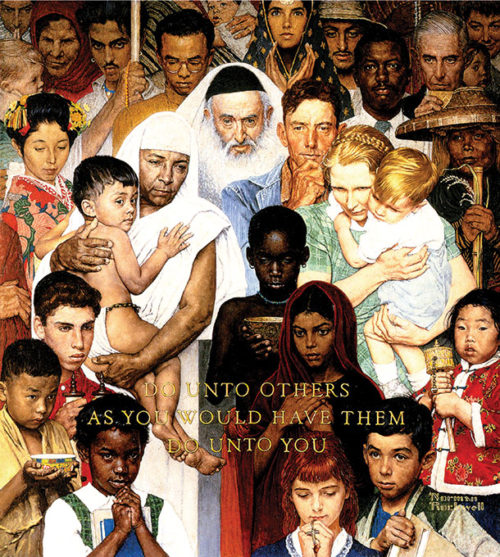
All together now: Rockwell’s rare attempt to capture a solemn topic is an enduring triumph. The original Golden Rule is at the Norman Rockwell Museum in Stockbridge, Massachusetts.
For Norman Rockwell, the 1960s marked a period of change. The mood of the country was shifting. The rising popularity of television in American homes fed a culture fascinated with celebrity. Catering to popular taste, many magazines began using photographiccovers (frequently portraits) in place of illustration. While he would hold his position as the Post’s premier illustrator for a few more years, Rockwell could see the writing on the wall. At the same time, on a personal level, Rockwell was still mourning his wife, Mary, who died suddenly in August 1959.
During this period, the artist began to explore social issues. “Most of the time, I try to entertain with my Post covers,” Rockwell said. “Once in a while I get an uncontrollable urge to say something serious.”
In the summer of 1960, inspired by the idea that the Golden Rule was a universal principle threading through all religions, Rockwelldecided to capture the concept on canvas.
After preliminary sketches, he remembered an earlier piece, United Nations, that had never been completed. He found the unfinished 10-foot-long charcoal in the cellar and hauled it upstairs to his studio. “I had tried to depict all the peoples of the world gathered together,” Rockwell said. “That was just what I wanted to express about the Golden Rule.”
Some portraits were repainted from the original charcoal. Others were created afresh, using neighbors as models. The rabbi (center) was Stockbridge’s retired postmaster (a Catholic in real life); and Rockwell’s late wife, Mary, appears to his right holding the grandchild she never saw.
The work appeared on the April 1, 1961, cover of the Post. Reader response was overwhelmingly positive.
As a testament to the power of the image, a mosaic based on the painting was installed at the United Nations Headquarters in 1985. It was rededicated following its restoration in 2014.
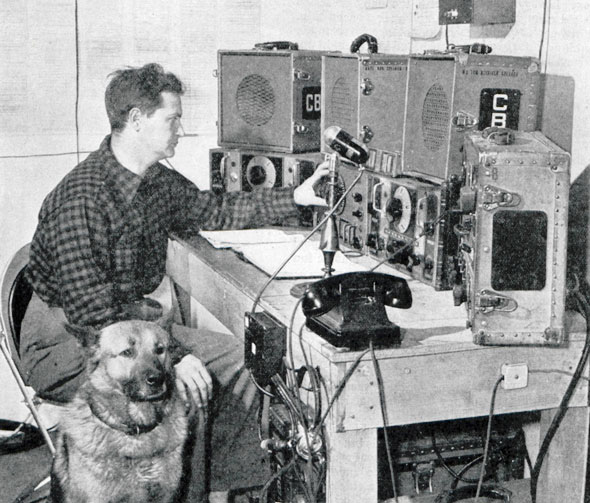
Isolated in a Long Island shack to escape New York City’s machine made interference, Carl Schutzman keeps his shortwave vigil- to keep up with the progress of the war of words.
In 1940, World War II barely qualified for “world” status; much of the globe was still sitting out the European conflict. Except for Canada, and three European colonies on the northern coast of South America, the Western Hemisphere was still on the sidelines.
In an attempt to woo the unaffiliated nations to their causes, the Allied and Axis powers transmitted continual streams of propaganda. “Name-calling, word-weaseling, news-angling, special-pleading, prejudice-promoting, air-polluting, ground and lofty lying and covering-up” came pouring out of Europe, wrote Post journalist J.C. Furnas, “on radio waves in some 15 or 16 languages.”
German broadcasts in English, he reported, were pulling at the seams of America’s social fabric. The Nazis played on the sympathies of German-Americans, and anyone who hated Roosevelt or Jews. Their message was not well received.
First, relatively few Americans, German heritage or not, still had an open mind regarding the Nazis after what had happened in Poland.
Second was a literal problem with reception. Broadcasts from Berlin had to travel about 4,000 miles just to reach the American shore. The signal was often disrupted by solar flares or North Atlantic weather. Given the difficulty of getting a clear signal from Germany, Furnas wrote, many Americans found it easier, and more agreeable, to listen to the Chase & Sanborn Show with Charlie McCarthy.
Meanwhile, South America was receiving propaganda from every major country in Europe. But the Germans, Furnas wrote, were making the greatest effort in this region. The Nazis fed them “news” that appealed to their pride and stirred their resentment: “German broadcasts mix such items as the flag being half-masted on the Reichstag, because of the death of the president of Ecuador, with forebodings about the menace of the German-Jewish immigration to Brazil. The Nazi broadcasts also disparage the United States, whenever possible.”
When not trying to recruit neutrals, the beligerants engaged in psychological warfare by radio. French and British propaganda, Furnas wrote, was relatively tame. It could afford to be, since the Allies’ cause was “already pretty well sold to the neutral world.”
Furnas characterized British broadcasting as having “dignity, suavity, homely little touches, and something Anglophobes call smugness.”
He went on to explain: “A Church of England bishop is put on the air to scold the Germans about Nazi concentration camps, evidently in the hope that a real live bishop will impress the Gestapo where massed world opinion has never yet made a dent. Since the war began, every Empire broadcast has ended on this poetic doxology: ‘And now we shall say good night. Sleep well. Wherever you may be in the colonies, this is a very good night from home.’ … You could set that to music and sing it.”
Nazi propaganda was as devious, bitter, and hysterical as you’d imagine for a political group that had risen to power by manipulating fear and resentment. The best known propagandist working for the Nazis was William Joyce. Born in America and raised in Ireland, Joyce became an enthusiastic supporter of fascism in England. In 1939, he traveled to Germany to work with the Nazi propaganda ministry. Joyce had an affected manner of speaking, which could infuriate or amuse listeners, and earned him the nickname “Lord Haw-Haw.”
Here is a snippet from one of his broadcasts, aired after the British attacked the French fleet in Algeria. It occurred shortly after the French surrendered to the Germans in June 1940. According to their treaty with the British, the French naval officers were supposed to prevent their ships from falling into the hands of the Germans. But some officers in the Algerian harbor near Oran were prepared to hand over their warships to the German navy. The British demanded they honor their alliance with England. The French officers refused, and the British navy opened fire on them, sinking a battleship, damaging several others, and killing over 1,000 French sailors. Naturally, Lord Haw-Haw made the most of the incident:
Here’s Haw-Haw again, mocking England’s attempts to protect civilians from German bombs against the coming air war:
Mugshot of Mildred Gillars aka Axis Sally (Wikimedia Commons)
Once America entered the war, the Nazis began broadcasting defeatist propaganda using an American living in Berlin. Here is Mildred Gillars, often referred to as “Axis Sally,” explaining why she’s in Berlin instead of back home at “the little sewing bees” with the girls. Note that, although she was presenting herself as “100 percent American,” she spoke with a strong British accent. She also refers to soldiers in South Africa, when she means American soldiers in the north Africa campaign.
The Germans often aired recordings of Charlie and His Orchestra. Vocalist Karl “Charlie” Schwedler led the band, singing swing tunes laden with Nazi propaganda. Karl’s accent and the leaden satire of the Nazis is fascinating for a short time, before they become obnoxious.
I’ll leave you with the conclusion of Lord Haw-Haw’s final broadcast:
“You have heard something about the battle of Berlin,” says Joyce in this last transmission. “You know there’s a tremendous, world-shattering conflict is being waged. I would only say that the men who have died in the battle of Berlin have given their lives to show that, whatever else may happen, Germany will live.
“No coercion, no oppression, no measures of tyranny today that any foreign foe could introduce, will shatter Germany. Germany will live because the people of Germany have in them the secret of life. [unintelligible] And therefore I say to you, in these last words, you may not hear from me again for a few months. I say, “Es lebe Deutschland.” [Long live Germany.] Heil Hitler, and farewell.”
The Arrest of Willliam Joyce, aka Lord Haw Haw in Germany in 1945 (Wikimedia Commons)
The date was some time in May of 1945, when things were not going so well for the Nazis. The Russians were closing in on Berlin and the Third Reich’s “thousand-year reign” wouldn’t last to the end of the month. So we bring you Joyce, obviously drunk, throwing his final threats and prophecies into the air.
Within a few weeks, he was captured. By January of the following year, he was executed in Great Britain for treason.
Did any of the propaganda make a difference? Judging by contemporary accounts, British broadcasts didn’t do a better job of disenchanting Germans with their government than the Nazis, themselves, did. And Nazi propaganda was treated by the British for the mass of deception they knew it to be. Lord Haw-Haw might have annoyed some people, but he was cheap entertainment for most listeners.
The Germans’ broadcasts seemed to have made no significant impact in the U.S. They were no more successful in Latin America. The U.S. made a successful effort in World War II to build better alliances with its southern neighbors that, except for the European colonial countries, every country in South and Central America had joined the Allies.
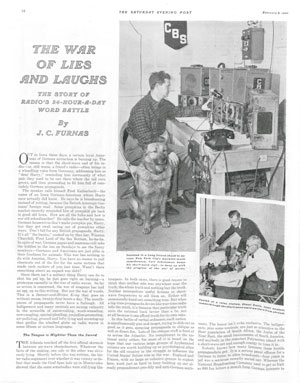
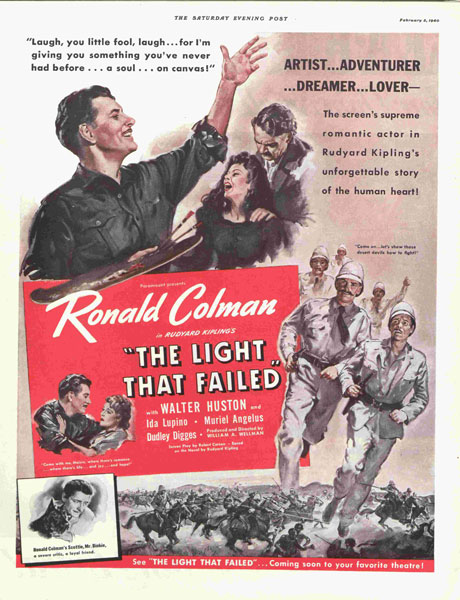
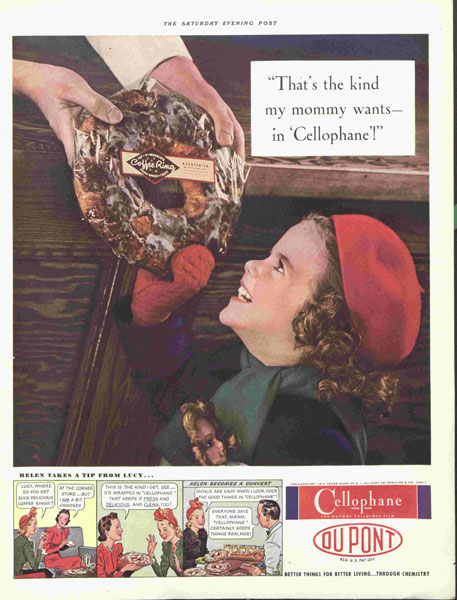
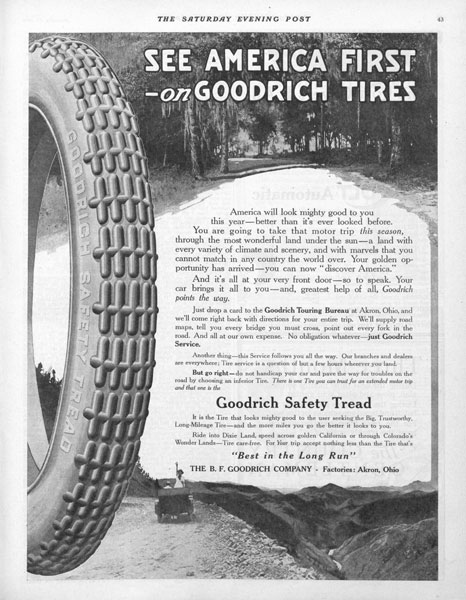
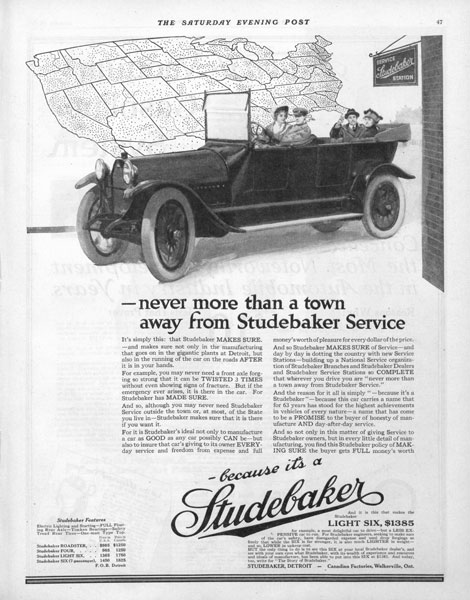
Step into 1940 with a peek at these pages from the February 3, 1940 issue of The Saturday Evening Post, 75 years ago:
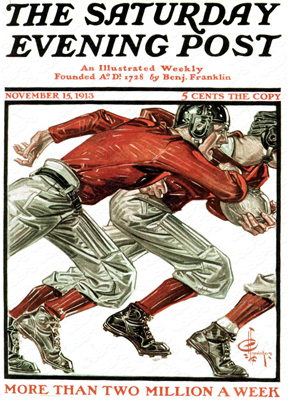
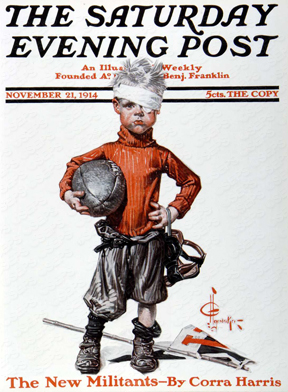
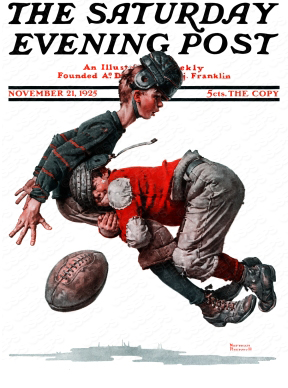
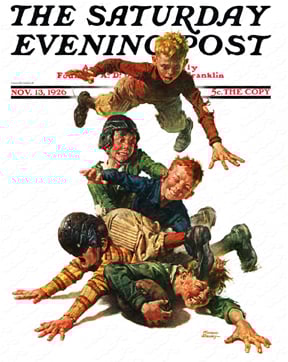
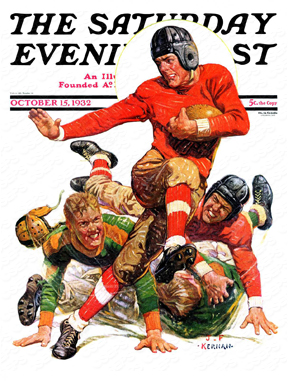
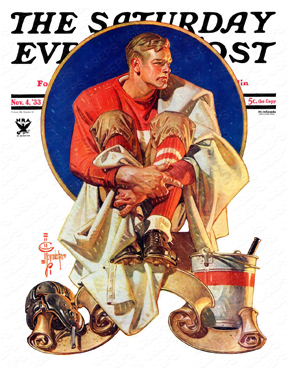
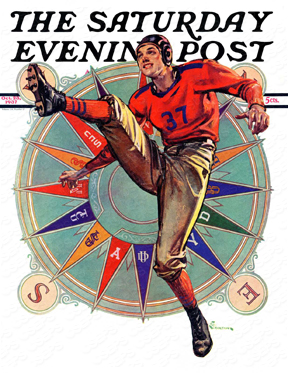
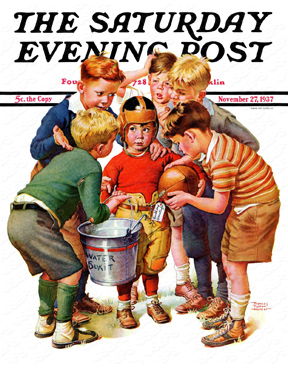
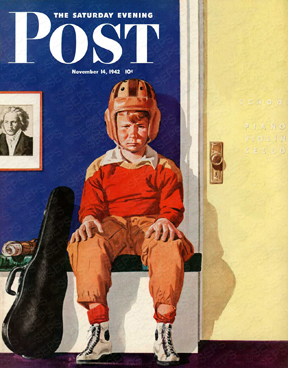
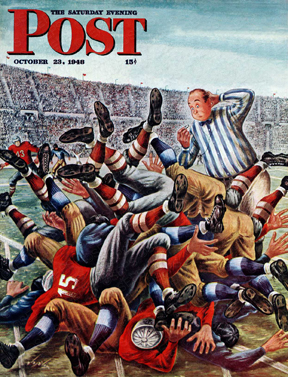
Kick off this football season with this classic cover collection that spans six decades capturing the spirit of American football, from childhood games to college gridiron to the professional field.
Football, American Style — Click covers to see larger image.
Football Players
J.C. Leyendecker November 15, 1913
Beat-up Boy Football Player
J.C. Leyendecker
November 21, 1914
Fumbled
Norman Rockwell
November 21, 1925
Inflating Football
Harrison McCreary
October 16, 1926
Tackle
Frederic Stanley
November 13, 1926
College Football
J.F. Kernan
October 15, 1932
Football Hero
J.C. Leyendecker
November 4, 1933
Kickoff
E.M. Jackson
October 23, 1937
You Can be the Water Boy!
Frances Tipton Hunter
November 27, 1937
Grandma and Football
Russell Sambrook
October 26, 1940
Musical Sport
Lonie Bee
November 14, 1942
Football Pile-up
Constantin Alajalov
October 23, 1948
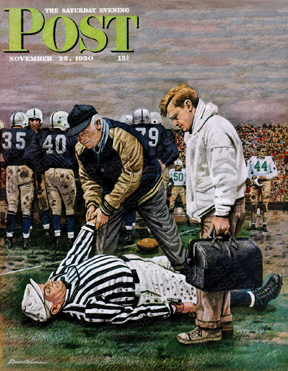
Ref Out Cold
Stevan Dohanos
November 25, 1950
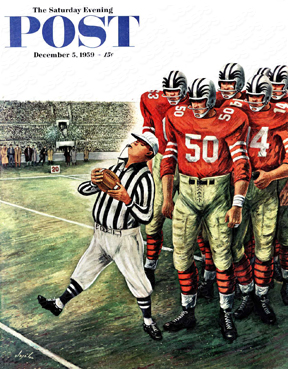
Five Yard Penalty
Constantin Alajálov
December 5, 1959
German Soldiers in 1915 (Courtesy of Wikimedia Commons, By Rainer Schulze-Muhr )
Think of a typical German soldier in Hitler’s army. You probably picture him as Hollywood portrayed him, and as many GIs found him: grim, relentless, and obedient, with a marked incapacity for independent thought.
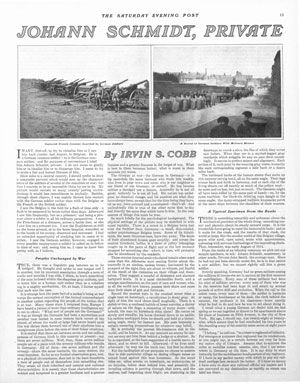
A century ago this week, Post readers were getting the same impression of the soldiers in Kaiser Wilhelm’s army. In “Johann Schmidt, Private,” Irvin S. Cobb presented what he considered “a fair and honest likeness” of the men he met while touring the German lines.
For the most part, Cobb wrote, the soldiers of European armies were similar. But a German private’s regimentation and obedience to orders set him apart. Witnessing thousands of these men on the march, Cobb was struck by their uniformity. To the townsfolk of Belgium, the advancing German columns presented “a show the like of which they never saw before”:
What they see is a myriad-legged, gray centipede, which wriggles its way on past them, unendingly. Each section of it, each joint in the weaving gray worm, is exactly like each corresponding segment a mile back or a dozen miles back… There is something unearthly and unhuman about the mechanical precision of the whole thing. …
I never saw a German common soldier, however employed, who did not seem to know exactly what he was doing; and I never saw one who seemed to know why he was doing it. … The order came. Somebody else had thought it out. Somebody else always had thought it out — that was that somebody’s business — not his. He individually had been relieved of the function of thinking any thoughts upon the subject.
The same iron discipline, which ironed the creases out of his back ironed the convolutions out of his brain, in so far as his present job was concerned. It endowed him with steel leg muscles and a wooden headpiece. … I found him fairly well informed, considering his limitations, upon outside matters. Officially and professionally he was a mental blank, and nothing else.
An incidental result was that it deprived him of his sense of humor. He didn’t laugh in public, because it was not set down in the manual that he should laugh. …
He has learned to endure things the mere thought of which a little while ago would have sickened him to the hobs of his soul. … He looks upon the waste and wreckage about him with indifferent eyes. He has learned to care for nothing at all except the cause he serves and the orders he obeys.
He is still the Johann Schmidt who does not know how to disobey. A command comes to him which may be in truth his death warrant. He salutes and heaves up his rifle — that at least is clean and fit for use — and as he starts upon his errand I hear him rumble out the two words with which I shall always associate him: “Ja wohl!”
Post Script:
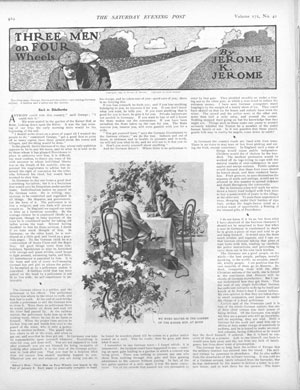
Fifteen years before Cobb’s article, the Post published “Three Men on Four Wheels,” by British humorist Jerome K. Jerome. In his account of a bicycle tour through Germany, he gave impression of the German people. Like Cobb, and other American and British writers, Jerome found the people of Imperial Germany to be an incredibly regimented people:
The German citizen is a soldier, and the policeman is his officer. The policeman directs him where in the street to walk, and how fast to walk. At the end of each bridge stands a policeman to tell the German how to cross it. Were there no policeman there, he would probably sit down and wait till the river had passed by. At the railway station the policeman locks him up in the waiting-room, where he can do no harm to himself. When the proper time arrives, he fetches him out and hands him over to the guard of the train, who is only a policeman in another uniform. … In Germany you take no responsibility upon yourself whatever. Everything is done for you, and done well.
Their everlasting teaching is Duty. It is a fine ideal for any people; but before buckling to it one would wish to have a clear understanding as to what this Duty is. The German idea of it would appear to be, “Blind obedience to everything in button.
Step into 1915 with a peek at these pages from The Saturday Evening Post January 30, 1915 issue.
This magazine will land on your doorstep sometime in early January, which should give you ample time to get me a present for my 54th birthday on February 5. Often, as people age, they tell their family and friends not to bother with their birthday, that gifts aren’t necessary, that they shouldn’t make a fuss. I’m not one of those people. I love being fussed over and given gifts. In fact, I’ve set aside the entire day so people will have ample opportunity to do nice things for me. Since you asked, let me suggest a few of the things you could do to improve my special day.
I wake up each morning around 5. That isn’t my preference, but our dog stands at our bedroom door and whines to be taken outside to pee. For some reason, that job has fallen to me. If you’re having a hard time thinking of what to get me, you can come take our dog out at 4:55 a.m., before it has scratched on our bedroom door. We don’t lock our house, so come in the back door, whistle for the dog — very quietly so as not to waken me — and walk it up to the empty lot.
If it’s raining, you’ll have to bring your own umbrella, since I left mine on an airplane. It was made in England, and I’d had it nearly 25 years. When you come to let our dog out, you can bring me a new umbrella. Not one of those cheap ones you get at CVS or Walmart, but a nice one, a gentleman’s walking umbrella, made in England by James Ince & Sons Ltd., maker of fine umbrellas since 1805. I won’t lie to you; they’re not cheap. It’ll set you back a couple of hundred dollars, but I think our friendship is worth it, don’t you? If you order it today, it should get here in plenty of time for my birthday. Even if it’s a day or two late, I understand and won’t hold it against you.
If dogs and umbrellas aren’t your thing, I’ve been needing my garage cleaned for some time. It has dirty slush on the floor, mixed in with sawdust left over from a summer project. When our younger son moved out last year, he left a lot of stuff behind in the garage and no longer seems interested in it. It depresses me to look at it; so if you could haul it away, I’d be grateful. There are some half-empty paint cans out there, dried into solid chunks. You can take those away, too. If some of the paint is still good, maybe you could touch up the house, as long as you’re here.
About 10 years ago, I bought two nice bikes for my wife and me. They’re out in the garage too. We haven’t ridden them in five years, so the tires are flat and they’re covered with dust. I don’t like admitting it, but we’ll never ride them again. Getting rid of them feels like an admission of failure, a recognition that we’re fat, lazy, and stupid, and not likely to change; so there they sit, taking up valuable space. If, for my birthday, you want to buy them from me for $200 apiece, that would be a nice present.
Since my birthday is in mid-winter, gifts of firewood are always welcome. My supply is running thin by February, since I start burning wood early, usually the first cold night in early October. Five ricks of wood for my birthday would see me through to spring. Don’t be cheap about it, or try to pawn off four ricks as five, like a typical sneaky firewood seller. A rick of wood should measure 8 feet long, 4 feet high, and roughly 16 inches wide. I’ll be measuring it, so don’t try to cheat me on my birthday.
By early February, I’m getting tired of Indiana’s cold and snow, so if any of you have a place in the Caribbean and want to let me borrow it for the month of February, that would be especially considerate. I would prefer it came with a maid. There’s nothing worse than having to do your own laundry the month of your birthday.
Now let’s talk about cake. I have diabetes, so my wife isn’t likely to bake me one. I like chocolate cake with chocolate icing, with a scoop of vanilla ice cream on top. I don’t need an entire cake, just one smallish, diabetes-friendly piece. You can give the rest of it to someone else or eat it yourself. That will be my gift to you, which I hope helps you appreciate how doing something nice for my birthday helps both of us.
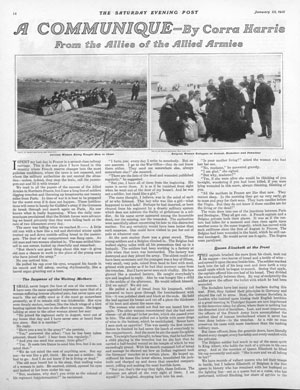
London and Paris seemed like separate worlds to Post reporter Corra Harris in early 1915. The French capitol was a somber city of limping soldiers, military funerals, and shop window displays where haute couture had been replaced by mourning suits. Across the English Channel, London still looked bright and prosperous. Spirits were generally high since highly censored news kept Londoners from knowing much about the reality of the war.
Both Allied capitols had one feature in common, according to Harris. Each was neglecting their soldiers’ families.
When war began, the French and British had rallied to provide food, clothing, and medical supplies for their soldiers. But little help was available for French soldiers’ wives and children. In France, many soldiers’ families were left behind on farms that could no longer be worked. Their fields were now taken up with trenches, shell holes, and “graves so shallow that to dig at all is to uncover the dead,” Harris wrote in “A Communiqué from the Allies of the Allied Armies” (The Saturday Evening Post, January 23, 1915).
Of France’s rural communities Harris wrote:
There is no money, scarcely any stock with which to cultivate the remainder. All the horses fit for work have been taken by the French or stolen by the Germans. And many of the peasants in Northern France are in danger of freezing to death, even if they have food, for every blanket, quilt, sheet and mattress has been taken from them, even the straw from which they might make beds. …
War is not the worst thing these people face. Pestilence, that poisoned breath of death, is far more terrible. Lille is closed now like a tomb filled with corruption. No one may enter it, and those who remain there cannot escape. Every hospital and every house is overflowing with victims of the fever scourge.
It is impossible to exaggerate the ravages of disease in many of these towns bombarded by the Germans. There were 1,300 cases of typhoid fever in Senlis and the neighboring villages during the month of October. The germs of every disorder fill the air. … They poison all the milk. To touch one’s lips with bread in these places is to invite death.
The women consider themselves fortunate to escape these horrors by coming to Paris. For Paris is still clean. The water is pure. The great Rothschild depots supply milk which is not tainted. There is still bread enough. …
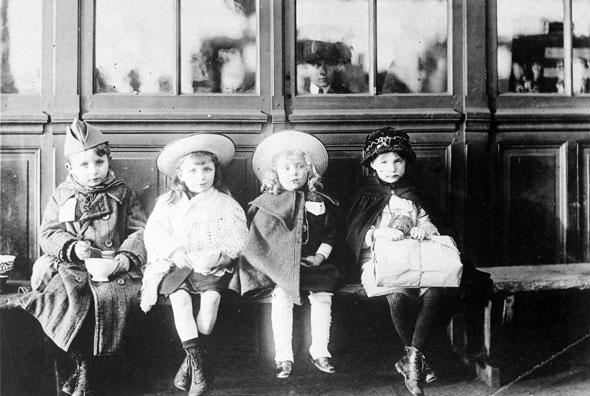
The war orphans suffered the worst, Harris wrote. War might turn men into “cannon fodder, but it changed children into “gutter straw.”
One of the last things I saw in France was a dozen Red Cross orderlies and nurses having their breakfast in a comfortable hotel. Just inside the door of this room three children stood regarding them with hungry eyes. They were in rags. Their faces were emaciated and they were trembling with cold. They were orphans. Their father had been killed in Alsace-Lorraine. They were not begging; they had not learned how yet. They were just learning how to be hungry, and patient.
While waiting for train, French refugee children were fed with bread and milk from American Red Cross soldiers’ canteen. (Wikimedia Commons)
In London, Harris found members of the British ruling class still preoccupied with class privileges and dress codes. Members of Parliament were debating whether to deprive the poor children in workhouses of their Christmas morning egg to teach them a lesson about the hardships of war. And they discussed what pensions they should give to soldiers’ widows. One member declared that the officers’ widows should receive enough of a pension that they wouldn’t have to enter the work force. In Harris’ account, Prime Minister Asquith seemed to agree:
He was willing that the officers’ widows should be kept out of the labor market, but he thought there were objections to making a common soldier’s widow independent.
What he meant was that all the working classes ought to work for their living. Still, if anyone has earned the right of choice in her mode of living as is conferred by a pension that will maintain her, it is surely the woman who has made the greatest sacrifice that the state can ask, whether she is the widow of an officer or of a private!
Many women in British society were signing up to nurse wounded soldiers. But what these soldiers really needed were doctors and trained nurses, Harris wrote.
“[The aristocratic lady] would serve better if she spent herself and her money caring for the poor women and children in England who are more and more neglected as the war goes on. … For every wounded soldier there are perhaps 50 women and children suffering for the necessities of life. The war office does not protect them. There is no commissary department to provide them with food or clothes, no surgeons or doctors or nurses to attend them in sickness.
Meanwhile, members of the ruling class were complaining that social standards were slipping in wartime.
It seems that the men are not so particular about putting on their evening clothes when they dine. Lady Somebody has entered a solemn protest in [The London Times] calling attention to this. She adds, referring to a certain fashionable café, that it “looks like an American restaurant at the dinner hour because the men are so awfully dressed!”
The subject of dress codes launched Ms. Harris into a rather heated rant about women’s fashions and effeminate men.
It does give one a start to see at the next table an officer of a Highland regiment, clad in a khaki coat and terrifyingly short kilts, with his legs bare very far up and very far down. But, when you put your whole reasonable mind upon it, why should not a man show his mighty legs in a room filled with women who are exposing their shoulders behind down nearly to the waistline?
Besides, that Highlander looks more the part of what a man should be here now than the perfumed English Lord Dandy at the next table, with his receding chin, his womanish hands, and his pink face that has never been exposed to the disgusting grime of powder smoke.
A woman must hate war; but my idea is that if a nation makes up its mind to fight it should have conscription for the gentlemen dandies, and it should hold in reserve these better, bare-legged, long-chinned men for the sake of preserving the breed in the next generation.
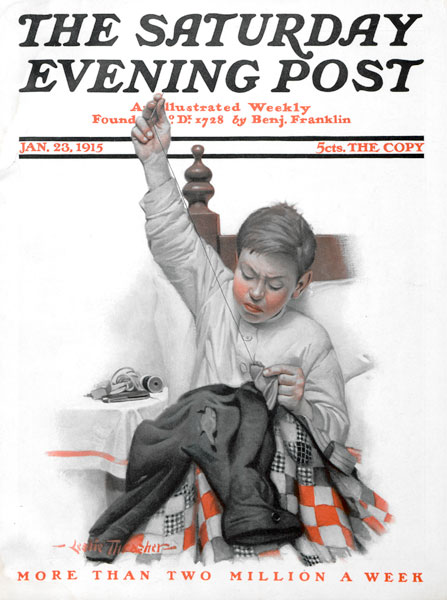
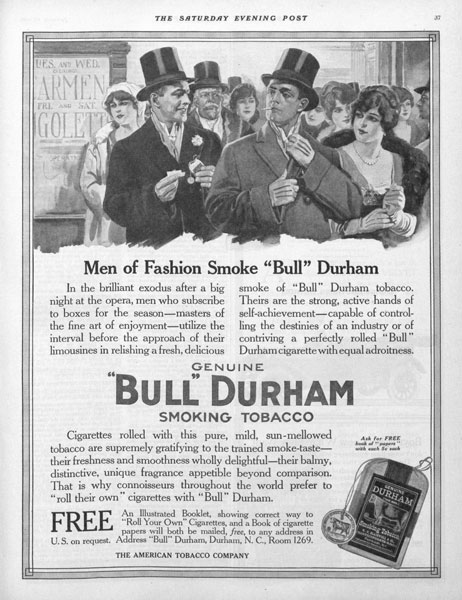
Step into 1915 with a peek at these pages from The Saturday Evening Post January 23, 1915 issue.
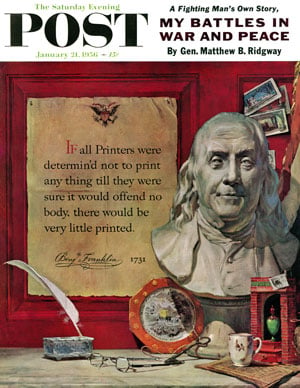
“Freedom of speech is a principal pillar of a free government: When this support is taken away, the constitution of a free society is dissolved,” wrote Founding Father Benjamin Franklin in The Pennsylvania Gazette.
You’ll find more notable quotes on the freedom of expression, a right U.S. citizens have held dear for more than 200 years, below:
“If all printers were determined not to print anything till they were sure it would offend nobody, there would be very little printed.”
— Benjamin Franklin, U.S. Founding Father
“But none of the means of information are more sacred, or have been cherished with more tenderness and care by the settlers of America, than the press.”
— John Adams, second U.S. president
“The liberty of the press is essential to the security of the state.”
— John Adams, second U.S. president
“If men are to be precluded from offering their sentiments on a matter, which may involve the most serious and alarming consequences that can invite the consideration of mankind, reason is of no use to us; the freedom of speech may be taken away, and dumb and silent we may be led, like sheep, to the slaughter.”
— George Washington, first U.S. president
“Our liberty depends on the freedom of the press, and that cannot be limited without being lost.”
— Thomas Jefferson, U.S. Founding Father
“Congress shall make no law respecting an establishment of religion, or prohibiting the free exercise thereof; or abridging the freedom of speech, or of the press; or the right of the people peaceably to assemble, and to petition the government for a redress of grievances.”
— U.S. Constitution
“Were it left to me to decide whether we should have a government without newspapers, or newspapers without a government, I should not hesitate a moment to prefer the latter.”
— Thomas Jefferson, U.S. Founding Father
“Freedom of speech is a principal pillar of a free government: When this support is taken away, the constitution of a free society is dissolved, and tyranny is erected on its ruins. Republics and limited monarchies derive their strength and vigor from a popular examination into the action of the magistrates.”
— Benjamin Franklin, U.S. Founding Father
“It is the function of speech to free men from the bondage of irrational fears.”
— Louis D. Brandeis, U.S. Supreme Court justice
“We are so concerned to flatter the majority that we lose sight of how very often it is necessary, in order to preserve freedom for the minority, let alone for the individual, to face that majority down.”
— William F. Buckley Jr., founder of National Review magazine
“Of that freedom [of thought and speech] one may say that it is the matrix, the indispensible condition, of nearly every other form of freedom.”
— Benjamin N. Cardozo, U.S. Supreme Court justice
“Freedom is not a luxury that we can indulge in when at last we have security and prosperity and enlightenment; it is, rather, antecedent to all of these, for without it we can have neither security nor prosperity nor enlightenment.”
— Henry Steele Commager, U.S. historian
“We cannot have a society half slave and half free; nor can we have thought half slave and half free. If we create an atmosphere in which men fear to think independently, inquire fearlessly, express themselves freely, we will in the end create the kind of society in which men no longer care to think independently or to inquire fearlessly.”
— Henry Steele Commager, U.S. historian
“The freedom of speech and the freedom of the press have not been granted to the people in order that they may say the things which please, and which are based upon accepted thought, but the right to say the things which displease, the right to say the things which may convey the new and yet unexpected thoughts, the right to say things, even though they do a wrong.”
— Samuel Gompers, U.S. labor leader
“If there is any principle of the Constitution that more imperatively calls for attachment than any other it is the principle of free thought — not free thought for those who agree with us but freedom for the thought that we hate.”
— Oliver Wendell Holmes Jr., U.S. Supreme Court justice
“We are reluctant to admit that we owe our liberties to men of a type that today we hate and fear — unruly men, disturbers of the peace … in a word, free men. … Freedom is always purchased at a great price, and even those who are willing to pay it have to admit that the price is great.”
— Gerald W. Johnson, U.S. journalist
“Freedom of conscience, of education, or speech, of assembly are among the very fundamentals of democracy and all of them would be nullified should freedom of the press ever be successfully challenged.”
— Franklin D. Roosevelt, 32nd U.S. president
“You tell me that law is above freedom of utterance. And I reply that you can have no wise laws nor free entertainment of wise laws unless there is free expression of the wisdom of the people — and, alas, their folly with it. But if there is freedom, folly will die of its own poison, and the wisdom will survive.”
— William Allen White, Pulitzer Prize-winning editor
Looking back, America’s entry into World War II seems so inevitable, so necessary you might wonder why we didn’t get involved sooner.
The strongest reasons at the time were that we weren’t being directly threatened and we had no treaties requiring us to defend other countries.
Many Americans personally opposed the war, some for political, others for moral reasons. The Post’s financial reporter Garet Garrett opposed it for practical reasons. The cost of war had become too high. Military conquest in the modern age was simply impractical.
Germany’s attempt to conquer Europe was doomed to fail because conquering countries was a money-losing proposition. Germany didn’t need to spend a fortune to invade France and capture Paris, Garrett argued. It would be less expensive for Hitler to demand a tribute payment from the French without having to occupy the country. The arrangement would be more profitable to both countries.
Even if Germany conquered Europe, how could it make money from these possessions? The citizens of already-conquered Czechoslovakia and Poland would refuse to serve as Germany’s cheap labor. What could the Germans do? They couldn’t threaten foreign workers with death, Garrett wrote, because every Czech or Pole who was executed was “one customer less for the products” of Germany, and the Germans had always complained they didn’t have enough customers.
Germany’s ally in Asia was already making this mistake in China. Japan, he wrote, “has wrecked the economic life of China and killed her own customers by hundreds of thousands. How much buying power have these dead Chinese for Japanese goods?”
Well, not much. Yet Japan didn’t seem bothered to lose thousands of potential consumers. And Germany was preparing to become particularly careless in its treatment of Jewish customers. The business implications seem to have escaped the Nazis.
Hitler couldn’t use force labor, wrote Post financial reporter Garet Garrett. It was impractical and bad for business. (Bundesarchiv, Bild 101I-001-0256-11/Rieger, Alfons/CC-BY-SA)
It hadn’t occurred to Hitler — as it had to Garrett — how senseless any attack on Great Britain would be. Germany “cannot hurt the economic position of England without hurting her own, because in time of peace England had been her best customer. … The web of trade now is such that rivals are one another’s customers.”
His conclusions seem naïve to us; obviously Hitler was continuing the invasions despite the costs. But Garrett had been a financial reporter for 20 years. He was accustomed to seeing the world’s problems in terms of business.
Polish Jews are ordered to clean up Warsaw after the German invasion — just the sort of thing that couldn’t happen, according to financial reporter Garet Garrett. (Bundesarchiv, Bild 101I-001-0285-31A/Rutkowski, Heinz/CC-BY-SA)
He didn’t think he was alone in his conclusions, either. “The voice of business, big and little, has been raised not only against war as a moral evil but against a war boom and war profits as economic evils,” he wrote. “It has neither heart nor stomach for war profits.”
He might have been a bit more skeptical about the attitude of American businesses toward war profits. When orders for armaments began to arrive, manufacturers motivated by profit as well as patriotism readily took up the orders. Between 1939 and 1945, gross profits of American business rose 300 percent, surpassing $20 billion in 1945. Corporate assets rose from $54 billion to $100 billion. (Business wasn’t alone; workers benefitted from the war effort, too. By 1945, the average income was $3,000, over twice its 1939 level.)
But Garrett wasn’t completely wrong. When the war ended, the U.S. ignored the tradition of punishing conquered nations and helped rebuild Germany. Our country recognized the truth in Garrett’s statement: “your enemy is also your customer, and indispensable as such. … You cannot kill a people, neither could you afford to do it if you would. Therefore, all you can do is to help your enemy up, dust him off, straighten his tie, and put money in his pocket in order to begin trading with him again.”
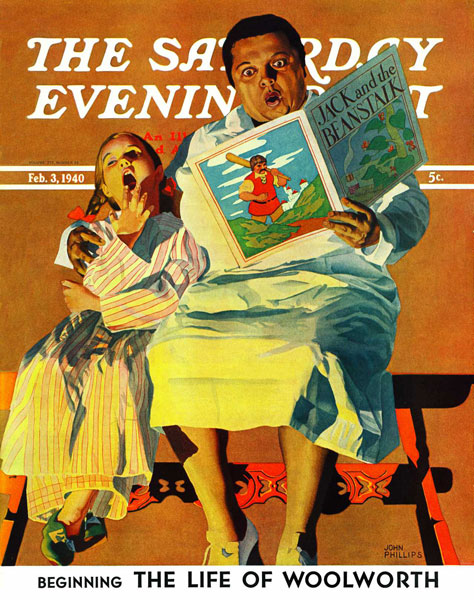
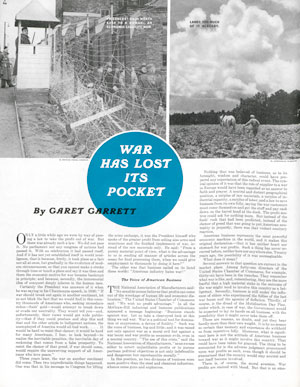
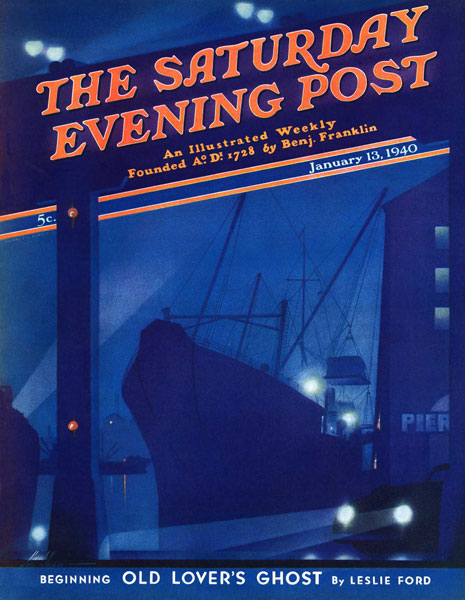
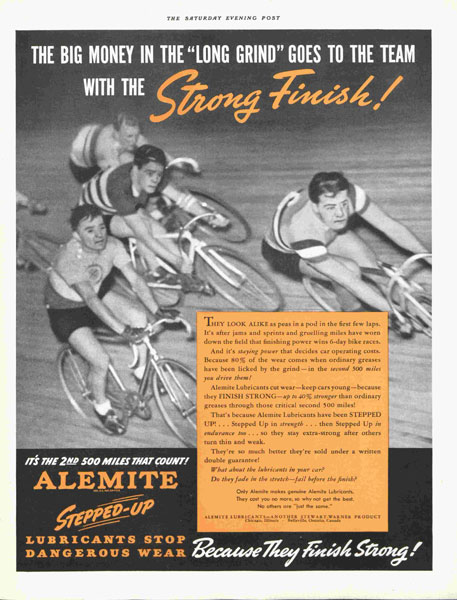
Step into 1940 with a peek at these pages from the January 13, 1940 issue of The Saturday Evening Post, 75 years ago:
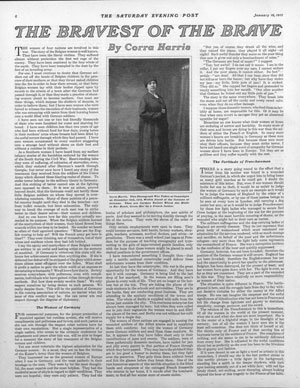
In “The Bravest of the Brave” (The Saturday Evening Post, January 16, 1915), Harris was particularly interested in sharing how the women of Europe were enduring the war. She pitied the Belgian women whose homes and families were torn apart by the German invasion. And she was deeply impressed by the women of France, who refused to be cowed by the Germans.
Many of these women chose not to flee when the German army entered their towns. They stayed in their homes, where every day was a struggle to protect and feed their children. Overall, Harris wrote, they showed a tough, resourceful spirit. They could endure much that the Germans inflicted on their property, but they were particularly angered by the German soldiers’ theft of their preserves.
Harris asked a French housewife about having to share a house with German soldiers (before they were driven back by French troops):
“Of course, they drank all the wine, and they ruined the piano; they played it all night — all night! Such awful thunder they make on the poor thing that now it gives out only a bombardment of noise.”
“The Germans are fond of music?” I suggest.
“Yes; but awful! I do not call it music. I am in the cellar, I put my fingers over my ears, I cannot endure it. And the poor piano, it cannot, either. Its feet” — pedals — “are dead. All that, I can bear; since they did not kill us or burn the house; but why have they stolen my jam — my little, little pots of jam! It is wicked. They did so.” She cupped her fingers and pretended to empty something into her mouth. “One after another, that German he licked out my little pots of jam.”
The story is the same everywhere. They break into the stores and eat all the candy and every sweet cake, even when they do no other damage. … It may be that when men revert to savages they get an abnormal appetite for sugar!
Despite their hardships, the French women devoted themselves to caring for the wounded, both Allies and non-Allies alike. One anecdote Harris gathered from a nurse in Paris shows that as much as the French despised the Germans, they could still admire individual courage:
There is a certain hospital near Paris where every bed in the big ward has a locker in which the patient may keep his few possessions; along with the bullet or fragment of shell that has been taken from his wound. And it is the fancy of these men to stick the flag of the nation to which they belong above their lockers; so that ward is very gay with French and British colors.
Recently a desperately wounded German soldier, in this hospital, lay in the corner bed at the end of a long row. Naturally he had no flag above his locker — not until the pain left him and he was able to perceive his inglorious condition.
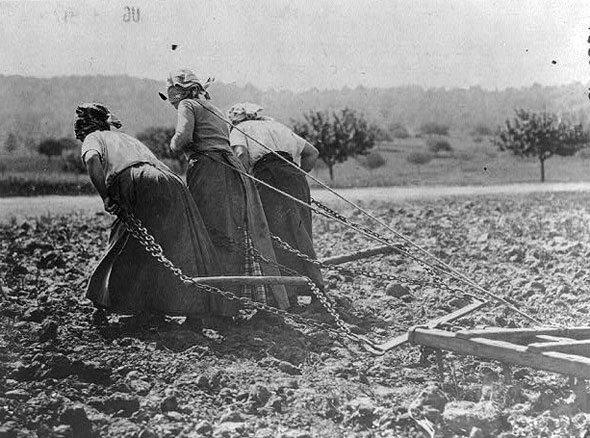
Even after the German army was pushed back out of their region of northern France, life was hard for the women who remained there. The Germans had taken all livestock in their retreat, forcing the women to personally replace their missing horsepower. (Library of Congress)
One day, when the nurse came to take his temperature, she was amazed to see an English flag sticking out of his locker. She was scandalized.
“Where did you get it?” she cried, snatching the sacred emblem.
The German only grinned up at her, wan and invincible. He had stolen it sometime during the night from the sleeping Englishman lying next to him.
The following morning he had it again.
Laughing, Mademoiselle explained, “It is very good for him — stealing that flag. We thought he would surely die, so dreadfully wounded was he; but he has kept himself alive just to do that.” There was no spite against this fallen foe; only a whimsical French sense of humor at the situation, a woman’s kindness, so delicate and so intelligent.
Harris slipped past the military checkpoints to interview an exceptional woman — Jeanne Macherez. When the Germans swept through the French town of Soisson, this 61-year-old women saved the town’s food supply by stepping in and assuming the role of mayor. When Harris asked how she had accomplished this, Macherez told her—
Everybody was gone from the town. I was alone, very busy in my house. The door is open. The Germans see it and they come — officers in a big car, with the streets full of their soldiers. They ask for the mayor … I am not willing to tell them that the mayor is absent. So I make some excuse. Then they say they must see a representative of the mayor. If there is no government they will go and break open the shops and take all. They must have food, everything, at once.
Portrait of Jeanne Macherez (Wikimedia Commons)
“I thought of what would happen if no one went with them to save a little perhaps for the women and children, hiding in their cellars. So I said: “I am the Mayor of Soissons. I will go with you.”
“Were you frightened?” I asked.
“But no, not for myself — for the people who might starve. The bridges had been destroyed — no trains; no more supplies.
“We could not live if they took all we had. So I got into the car with those Germans. We went to every shop. They wanted all of this and all of that; but I said: ‘No—you can’t have all the flour in this shop.’ I laid my hands on the sugar; I held back all I could. And the lard … they want all of that. I could save only a little.
“The next day,” she went on, “they came again. They demanded to know why I had not delivered the stores — 50,000 cigars; 50,000 pounds of flour; 500 pounds of sugar — all the lard. But they were absurd. I told them so. ‘How can I, messieurs? You have killed all the horses which you have not taken. Shall I send the women and children to your trenches with these things? But no; it is too much for them. Besides, they shall not go!’
“They were very angry. They made a great fuss. I was frightened then; but I stood before them. Let them kill me too! At last they agreed that we should place all the stores in the railroad station. We did that.”
She began to smile. It was like sunlight on an old gray wall — that smile.
“The next day they were all gone; the French came and drove them out. Then we went and carried all the stores back to the shops.”
This, however, was only the beginning of her gallant defense of Soissons against the ravages of the war. So far as the food supply was concerned, it was nearly as bad to have the French troops quartered there. …
[Since then] she has somehow managed to secure food and clothes for the people for three months. It is not an easy task, with no railroads, and almost no horses to bring in the provisions for them.
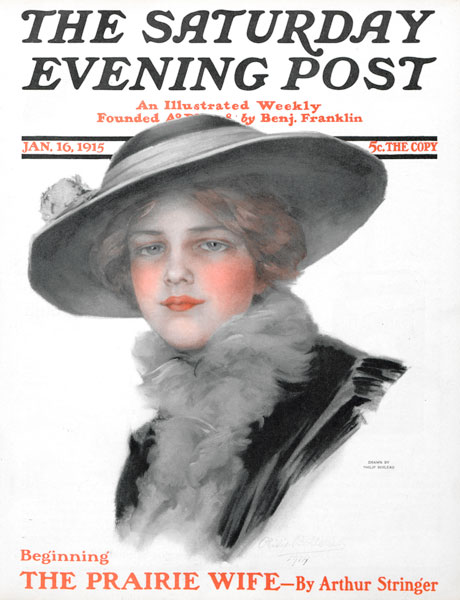
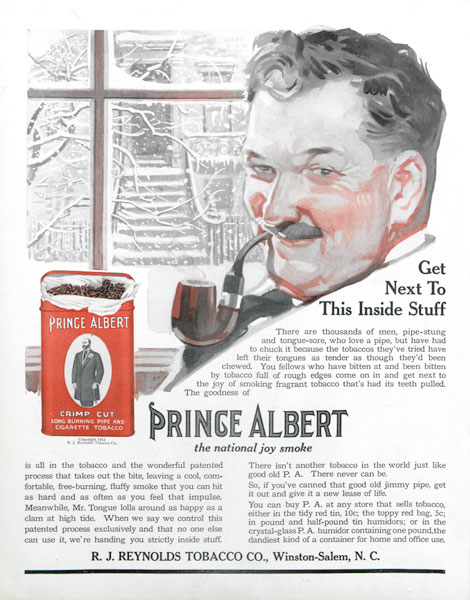
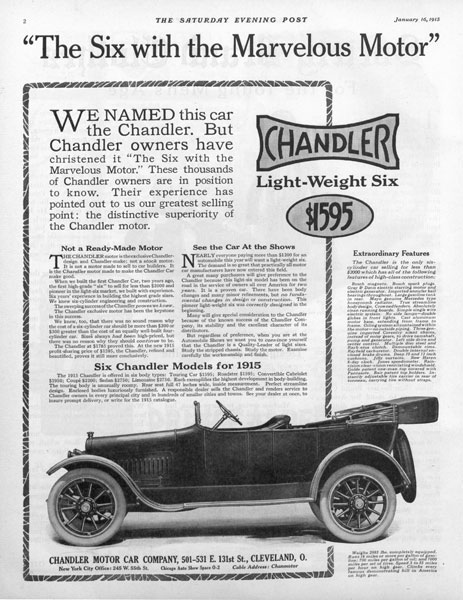
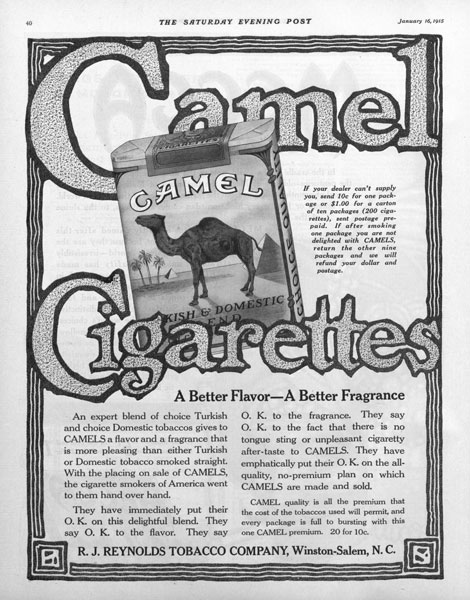
Step into 1915 with a peek at these pages from The Saturday Evening Post January 16, 1915 issue.
It’s flattering at first. A long-ago childhood chum or former colleague, or someone you met at a wedding or convention, sends you a friend request on Facebook. After a moment’s hesitation, you accept. After all, they’ve gone out of their way to find you and ask your approval. You look forward to catching up and swapping stories, with your new “friend.”
Except that’s not what happens.
Soon enough, you notice that certain of these individuals never like or comment on your posts, while unleashing their own daily barrage of updates featuring their family and pets, vacations, or meals (invariably described as “Yummy!”). Or they use Facebook as a bully pulpit to pontificate upon movies, politics, restaurants, sports, world events — you name it, they have an opinion. Meanwhile, they could give a flying click about yours — not even bothering to add so much as a Happy Birthday greeting to your Timeline. You can’t help feeling that you’re not interesting or important enough for them to acknowledge, as if they befriended you solely to become part of their audience.
Meet what I call Facebook Farmers. These needy, obsessive-compulsive Web crawlers harvest friends as if they’re in some sort of contest (“My list is bigger than your list!”). Some go out of their way to connect with anyone and everyone they admire or have ever known, adding them like so many notches on a digital bedpost. Some people I know boast upwards of 1,400 friends. Really, what is the point of that? (Full disclosure: I have less than 150 Facebook friends.)
Others will ardently befriend you, then never post or share anything of their own. Why do they bother?
Next are those who appear out of the clear blue, people I have never met who are obviously piggybacking on existing friendships. What else can explain being approached by complete strangers, who just happen to have hundreds of friends, including some of my own?
Perhaps the most annoying are acquaintances from the past who have something to promote — a book, band, event, school, career — which, it turns out, is the only reason you received the friend request in the first place. I was recently chastised by an author friend for inquiring about her health and welfare on her Facebook page. I was tartly informed that it existed only to present information about her books and appearances. How was I supposed to know? Needless to say, I’m no longer “following” her. In fact, I intend to “unfollow” any Facebook acquaintances who have violated the unwritten compact between its 1.35 billion monthly users. Namely, if you ask to be a friend, then behave like one. Still, I don’t plan to “unfriend” anyone, although some deserve it. That’s too drastic, irrevocable, nuclear. Downright unfriendly, even.
Besides, I might just get a notion to send them a birthday greeting on their Timeline.
After nearly 10 years of courtship, Eva Braun must have been asking herself the question on a daily basis: Is Adolf ever going to propose? Her family was wondering, too. Eva had spent so much time with Adolf Hitler, and for so long, that Europe was starting to talk.
Even the British were wondering about Adolf Hitler’s intentions. An American ambassador reported that many in Great Britain wanted to know when “that Hitler person would get married and settle down.” Maybe they assumed Hitler’s conquest of Europe was the sort of thing a bachelor might get up to, with an abundance of time and energy. (At 50 years of age, Hitler was a little old to be sowing wild oats.) Still, there was the hope that a wife could find a positive outlet for all that conquering energy.
Eva must have felt she was well qualified to be Frau Hitler, or she wouldn’t have stuck with Hitler so many years. In his December 16, 1939, Post article “Is Hitler Getting Married?” Richard Norburt reported information “from sources inside Germany which we have always found dependable” that the two had been carrying on their “colorless little love affair” for over a decade.
But wedding bells wouldn’t be ringing for the Hitlers any time soon. As the Führer told a women’s organization in Nuremburg, “I should love nothing more dearly than a family. … When I feel I have accomplished my historical mission, I intend then to enjoy the private life which I have hitherto denied myself.”
That wasn’t soon enough for the Braun family. They decided to put some pressure on Hitler to name a date. Unfortunately, they chose a bad time to confront Hitler (which was pretty much any time). In late August of 1939, as Hitler was feverishly putting the final touches on his invasion of Poland, a group of Eva’s female relatives drove down to Salzburg to tell Adolf he’d better do the right thing by their “Evi.”
Hitler was a master negotiator. He dodged the family’s ultimatums, but soon after their Salzburg meeting he “ordered part of his personal suite in the Chancellery [his Berlin headquarters] prepared for Evi’s use, and she promptly moved in.”
As part of Hitler’s official household, Eva became a cheerful hostess at Hitler’s Bavarian mountain home. She liked to cook for Adolf, and specialized in preparing the vegetarian dishes he liked. In her spare time, she enjoyed making rag dolls, taking photographs, and reading detective stories. Once, she had enjoyed playing the accordion, but she traded it in for a mandolin, perhaps believing the squeezebox was not refined enough for the Third Reich.
She was showing her support for the war effort by saving fuel. She stopped driving the Horch limousines Hitler had given her, preferring an ivory-colored Volkswagen. She tried to stay informed on news of the war. Perhaps she hoped that someday, as Frau Hitler, she would help Adolf in his great mission, discussing strategy with him and helping with his negotiations. As Richard Norburt reported, “A few weeks ago, when the German minister to Denmark returned to Berlin to consult with Hitler, the two men walked together in the garden of the Chancellery. After a little while they were joined by Evi, and Hitler’s guards were amazed to see her actively participating in their sober conversation.”
Adolf Hitler and Eva Braun with their dogs. (Image courtesy Wikimedia Commons)
Until the day when Hitler got down on his knee to propose, she spent her days sunning herself on the stone porch at Hitler’s house in the Bavarian mountains. There she would smile at visitors, engage in small talk, be pleasant, and wait for Adolf to get out of his meetings.
And in those empty hours, maybe she envied the family life of Europe’s other dictators.
Spain’s General Francisco Franco, for example. He had proposed to María del Carmen Polo y Martínez-Valdés in 1923, but had postponed the wedding when the Spanish king promoted him to command the Spanish Foreign Legion. Yet, unlike Hitler, Franco had only put off the wedding a few months, not years. He and Carmen Polo were married that October, and by 1939 were raising a teenage daughter.
And then there was Benito Mussolini — Italy’s fascist warlord who wasn’t shy around women. He had married Rachele Guidi in 1915, and had fathered six children by 1939. Guidi was devoted to Mussolini, though Il Duce didn’t seem to reciprocate that devotion.
And even Hitler’s ally Joseph Stalin was a family man, of sorts. Though a widower in 1939, he had been married twice and had three children.
All the other dictators were starting families. What was Adolf’s problem?
Eva probably didn’t know that life with a dictator was often bitter and short. She, like most of Italy, couldn’t have known that when Mussolini married Rachele Guidi he was already married to Ida Dalser and had a son with her. Instead of seeking a divorce to Dalser, he simply denied he’d ever been married to her, then ordered government agents to destroy any records of the marriage. Still insisting she was married to Il Duce, Dalser was eventually detained, against her will, in a psychiatric hospital where she died in 1937. Their son was put up for adoption. He grew up and enlisted in the Italian Navy. But, like his mother, he refused to be silent about the marriage. He continued to assert that Mussolini was his father. He, too, was sent to a psychiatric hospital, and soon after, died there.
Stalin’s case was even more sinister. In 1906, he’d wed Ekaterina Svanidze in the Russian province of Georgia. They had a boy before she died of tuberculosis the following December. In 1919, Stalin married again. His new wife, Nadezhda Alliluyeva, gave birth to a boy and a girl. Yet, as anyone — other than Eva Braun, maybe — might have expected, marriage to a dictator was not as much fun as it looked. Alliluyeva learned, as did all of Russia, that Stalin was very hard to live with. The couple frequently argued and, in 1932, after they quarreled bitterly at a party, she went home and shot herself.
Stalin appeared to have been fairly affectionate toward his daughter, Svetlana. He didn’t care much for either of his boys, though, probably because he didn’t see any promise of a ruthless dictator in either of them. Bullied by his father, the eldest boy, Yakov, shot himself, but survived. (“He can’t even shoot straight,” Stalin is reported to have sneered.) Yakov joined the Red Army, was captured, and died in a German concentration camp. His stepbrother, Vasily, survived the war but, after Stalin’s death, was sentenced to eight years in a labor camp. Svetlana defected to the U.S. in 1967.
It’s possible Eva would have stuck with Adolf even if she’d known what had happened to the other dictators’ families. She remained with him even though she must have known of his murderous policies, the millions of deaths he ordered. But she was, in her quiet way, as much a fanatic as him.
She hoped to share his dream, but wound up in his nightmare. Eva and Adolph married, at last, on April 29, 1945. The couple enjoyed a short, underground honeymoon before committing suicide the next day.
You’ve probably never given it a second thought. But I have. After all, my name is Tom.
In our politically correct, super-sensitive society, the name Tom finds no protection, for it is maligned with impunity. It’s been that way throughout history. I’m sure my mother didn’t consider it when she named me after Virginia’s colonial governor and revolutionary war hero, Thomas Nelson, who was slighted by history (it was he, not Washington, who cornered Cornwallis at Yorktown). Poor Tom.
So where’s the proof that Toms are assaulted in our daily lexicon? You don’t have to look far:
Peeping Tom
Uncle Tom
Tomboy
Doubting Thomas
Tom Cat
Tom Foolery
You get the gist. It’s not just so much Tommy rot. My fellow Toms and I have become little more than a negative figure of speech.
To bolster my assertions, I did a little research on the origins of Thomas. The name, which is biblical, literally means “twin.” I missed a few Sunday school classes, so don’t hold me to the finer points. But as I understand it, Jesus found himself with two disciples named Judas. To avoid confusion, he renamed one of them Thomas. (I guess I should be grateful because obviously I wouldn’t like to carry Judas around with me all day.)
Apparently, not long after he got his new name, Thomas began questioning his benefactor and undoubtedly the first pejorative use of the name Thomas found its way into the history books. I doubt he knew how widespread and long-lasting his skepticism would be remembered. A Book of Thomas was written, but it was labeled by some as distasteful and redundant in the mid-second century and, obviously, never made the final cut. Clearly a pattern began to emerge.
Fast forward in history a thousand or so years and we find Lady Godiva riding bareback through the streets of Coventry dressed only in her long flowing hair. As the legend goes, villagers agreed to close their shutters and look away. But not Thomas. Curiosity got the better of him, and he took a little peek. Whether or not he was struck blind or dead for being caught in the act, this much is sure: Generations of Thomases have paid the price for his indiscretion ever since.
About the same time as Lady Godiva’s ride, it was apparently great sport in England to watch the antics of insane people in asylums. Reality TV had its roots here, I fear. This pastime led to some very unfortunate nicknames — Tom O’Bedlam and Tom Fool — what else? Even the renowned William Shakespeare feared no repercussions for denigrating the name Tom, for by then the name was already synonymous with the worst of society. Indeed, it had become part of the common vernacular. In play after play, Toms are mere simpletons, degenerates, and fools. In King Lear, for instance, “poor Tom’s a’cold” is portrayed as a madman living in a hovel and then later, just to make sure the point is clear, he is labeled a “fool.” Ouch. I’m sure not everyone living in a hovel was a Tom, but even back then it would have been in poor taste to have called them by name, so we’ll never know.
Brace yourself, there’s more. Jumping across the pond to America, we find the pre-Civil War best seller Uncle Tom’s Cabin. Even today, over 150 years after it was written, nobody wants to be called an Uncle Tom. The evil Uncle Tom moniker has stuck. It’s unfortunate for me and perhaps millions like me, for a quick analysis of census data reveals that indeed in America today there are at least 800,000 Uncle Toms, maybe even a million. On those occasions when I’ve ventured into public with my nieces and nephews, I’ve laid down the rule: If we get separated, go back to the designated meeting place and whatever you do, don’t yell, “Uncle Tom, where are you?!”
The pejorative use of the word Tom isn’t limited to males either. Our sisters are almost equally maligned. In 18th century London, for example, a Tom was regarded as a lady of the night, derived no doubt from Tomrig or Tom Tart, defined in the dictionary as “sexually loose” women. Why, even Tomboy was once more than today’s affectionate term for a boyish little girl. Originally, the term was a euphemism for “bold, immodest women” as well as “rude and sexually uncontrolled” girls.
Promiscuity, thy name is Tom.
Admittedly, there are some Toms history holds in high esteem. But they’re few and far between. There’s Thomas Hardy. Thomas Payne. Thomas Jefferson. Thomas Edison. Thomas More, but maybe he shouldn’t count because, after all, he was beheaded.
My wife tells me I’m too sensitive. Be grateful there’s no such thing as a Dear Tom letter or a Port-a-Tom, she tells me.
But truth be known, it does bother me. Sadly, despite my protest, the whole thing draws no sympathy from my two brothers — Dick and Harry.
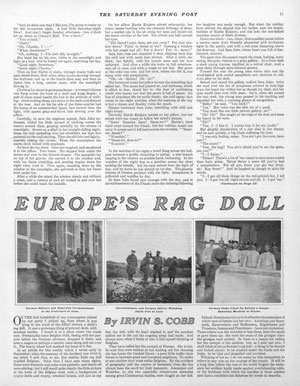
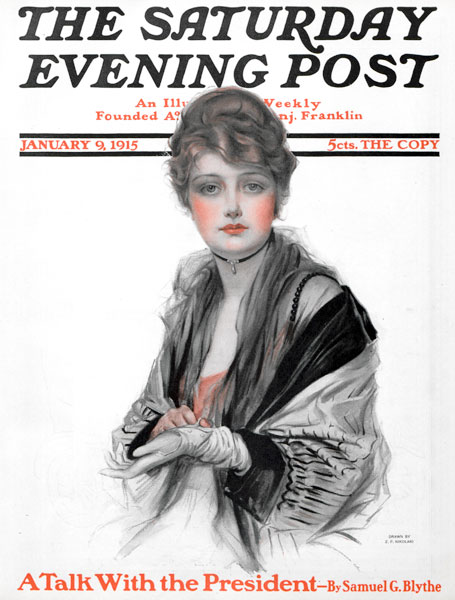
In the January 9, 1915, issue: Irvin S. Cobb reports from Dinant, Belgium, where four months of German occupation has left the townsfolk listless.
Europe’s Rag Doll
By Irvin S. Cobb
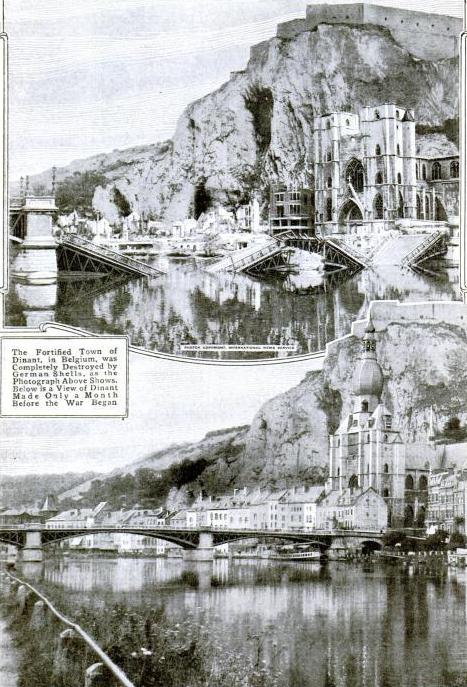
Cobb observed that the army of Germany could still match its great cannons for sheer destructiveness. Back in August 1914, when the Germans had entered the Belgian town of Dinant on the banks of the Meuse River, they ran into unexpected resistance. Enraged, the German soldiers rounded up over 670 civilian men and boys from the town and executed them.
Dinant, Belgium before and after it was destroyed by the Germans.
By the time Cobb visited the town, the German rage had subsided, and the Belgian townsfolk had sunk into a dazed acceptance of occupation, which he noted:
“After the first shock and panic of war, there appears to descend on all who have a share in it, whether active or passive, a kind of numbed indifference as to danger. … The soldier gets it, and it enables him to endure. … The civic populace gets it, and, as soon as they have been re-adjusted to the altered conditions forced on them by the presence of war, they become merely sluggish, dulled spectators of the great and moving events going on about them. … It is as though all the nerve ends in every human body were burnt blunt in the first hot gush of war.”
In the wake of the mass executions, it appeared to Cobb that the Germans — perhaps with a tinge of remorse — were showing unexpected signs of concern for the town’s civilian population.
“Just over the ragged line that marked the lowermost limits of the destructive fury of the conquerors … [we] passed a little house on the shutters of which was written, in chalked German script, these words: ‘A Grossmutter [grandmother] 96 years old lives here. Don’t disturb her.’
“Other houses along here bore the familiar line, written by German soldiers who had been billeted in them: ‘Good people. Leave them alone!’
“The people who enjoyed the protection of these public testimonials were visible, a few of them. They were nearly all women and children. They stood in their shallow doorways as our automobile went by bearing four Americans, two German officers … and a German chauffeur. As we interpreted their looks, they had no hate for the Germans. I take it the weight of their woe was so heavy on them that they had no room in their souls for anything else.”
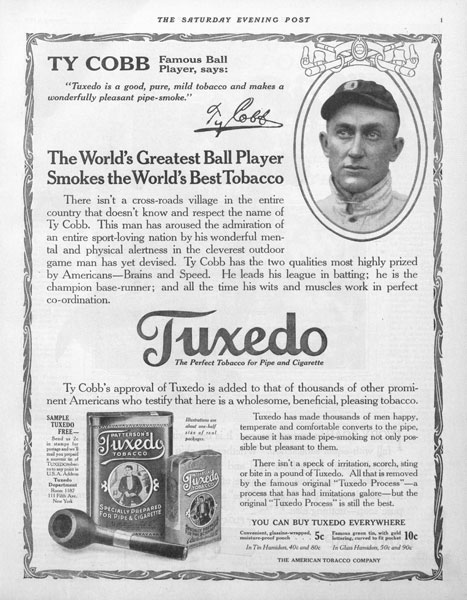
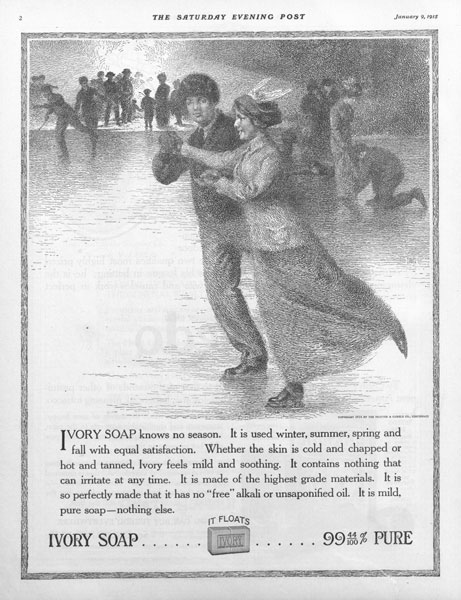
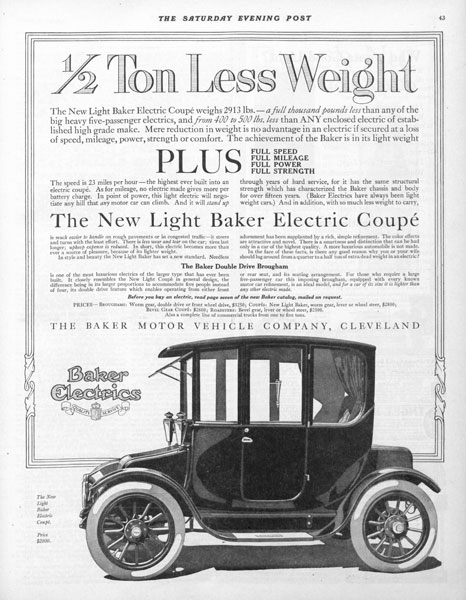
Step into 1915 with a peek at these pages from The Saturday Evening Post January 9, 1915 issue.
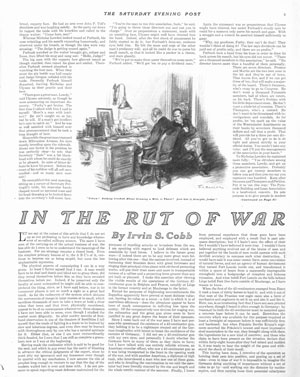
In the January 2, 1915, issue: Irvin S. Cobb predicts the end of walled forts as protection after witnessing the destructive power of the Krupp cannon.
In the Rut of War
By Irvin S. Cobb
While the war was introducing new weaponry such as the airplane and poison gas, it was sweeping away some of the old standards of warfare. For centuries, the nations of Europe had relied on massive forts to defend their borders and cities. Their high, thick walls had long sheltered their armies and populations from enemy attacks. But the science of artillery changed that in 1915. Germany’s new cannon made raised fortifications obsolete.
Big Bertha howitzer in action. (Courtesy Wikimedia Commons)
Popularly called “Big Bertha,” the Krupp cannon (pictured at right) could level forts from a distance of 8 miles away. In his January 2 article “In the Rut of War,” Cobb reported his impressions upon seeing craters in Belgium that were made by the German weapon’s 42-centimeter shells:
“We were filled with astonishment, first, that [a shell], weighing upward of a ton, could be so constructed that it would penetrate thus far into firm and solid earth before it exploded; and, second, that it could make such a neat saucer of a hole when it did explode. Of the [displaced] earth … no sign remained. It was not heaped up about the lips of the funnel; it was not visibly scattered over the furrows of that truck field. So far as we might tell it was utterly gone.”
He had already learned that German artillery had destroyed the massive Belgian fort at Liege when he visited the remains of Fort de Loncin.
“I would have said it was some cosmic force, some convulsion of natural forces, and not an agency of human devisement that turned Fort Loncin inside out, and transformed it within a space of hours from a supposedly impregnable stronghold into a hodgepodge of complete and hideous ruination.”
Seeing this destructive power, Cobb felt confident predicting that “the day of the modern walled fort is over and done with.”
“I believe in future great wars … that the nations involved, instead of buttoning their frontiers down with great fortresses and ringing their principal cities about with circles of protecting works, will put their trust more and more in transportable cannon of a caliber and a projecting force greater than any yet built or planned.”
For the most part, he was correct. Most armies abandoned the use of forts after the war. France took a little longer to learn the lesson. It put its faith, and its army, inside elaborate defenses called the Maginot Line, which lined its border with Germany. It was meant to protect the country from any further German invasion. When the next war came, though, the Germans simply drove around it, entering France through Belgium and Luxembourg, where the Maginot Line was weakest.
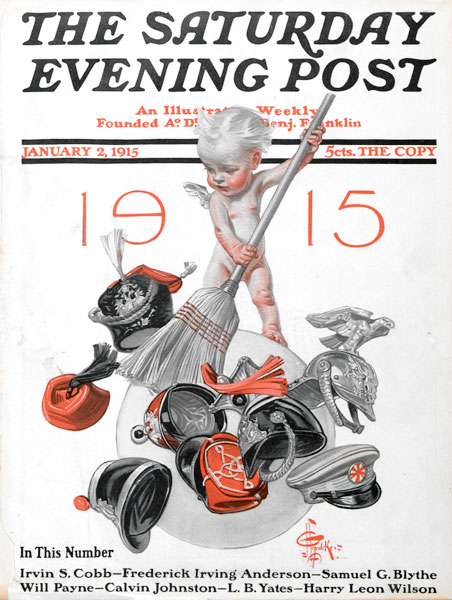
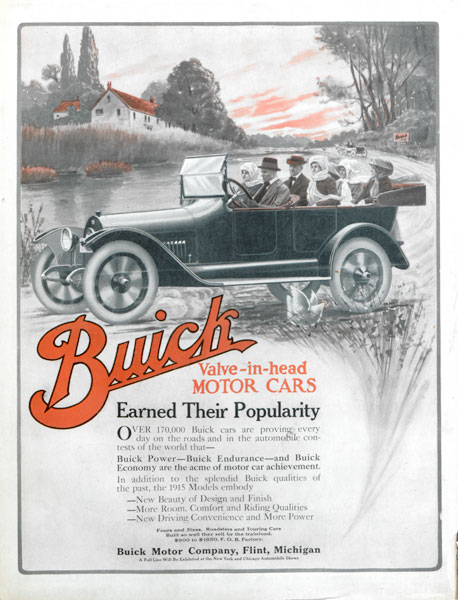
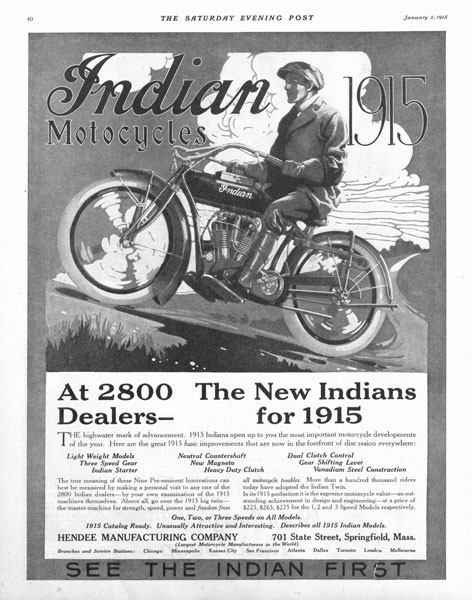
Step into 1915 with a peek at these pages from The Saturday Evening Post January 2, 1915 issue.
I asked on her annual all-nighter
Did the moon glow make Halloween brighter?
She gave nary a blink,
But with one naughty wink,
Said, “Moonshine makes broomsticks much lighter.”
—Terry Free, Andover, Minnesota
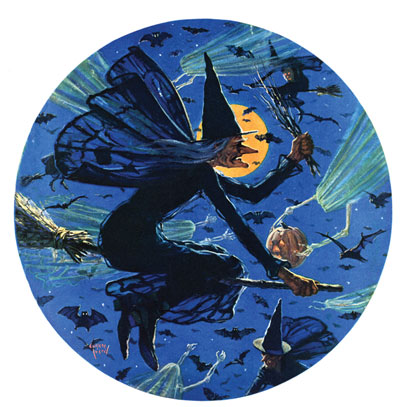
Congratulations to Terry Free! For her limerick describing Eugene Iverd’s illustration Witches’ Night Out (above), Terry wins $25 — and our gratitude for a job well done. If you’d like to enter the Limerick Laughs Contest for our upcoming issue, submit your limerick via our online entry form.
Of course, Terry’s limerick wasn’t the only one we liked! Here are some of our favorite limericks from our runners-up, in no particular order:
There once was a witch named Min
Who owned an unfortunate chin.
And, to add to her woes,
Just look at her nose!
It seems the poor thing just can’t win!
—Betty Checkett, St. Louis, Missouri
October above Cincinnati:
A witch who’s a little bit catty
Is stuck in a jam.
She believes it’s a scam,
And it’s certainly driving her batty.
—Neal Levin, Bloomfield Hills, Michigan
That witch is one scary sight
As she flies on her broom through the night.
Small children decide
That it’s safer inside
As they cover their heads in their fright.
—Pat Chambers, Atlantic Beach, North Carolina
Brunhilda, the witch, and her broom
Through gloomy dark nights they would zoom.
A bat got in the way
To Brunhilda’s dismay;
They crashed with a real loud KABOOM.
—William MacQuarrie, Omaha, Nebraska
The wicked old witch of the East
By moonlight seeks out a great feast.
She dines on dead lizards.
Seeks out bloody gizzards,
And sweets is what she likes the least.
—John Meyer, LaJolla, California
The sickening things that were seen
In the sky made me turn yellow-green.
When the goblins and witches
Caused tremors and twitches,
I knew it must be Halloween.
—Ronald Faoro, Cheshire, Connecticut
At the sight of this black magic shower,
I crawled under my bed and did cower.
Were they looking for souls
To drag into dark holes?
Or was it the witches’ rush hour?
—Patrick McKeon, Pennington, New Jersey
Miss Grizelda and all of her crones
Were preparing to rattle some bones,
But their plans went awry
When, out of the sky,
Came a pack of mysterious drones!
—Vivian Barrington, Jasper, Texas
Air traffic is busy tonight
and advancing takes all of my might!
With no zip or zoom
just a wobbly old broom,
a plane might be better for flight!
—Dolores M. Sahelian, Mission Viejo, California
In spite of their usual contentions,
The witches show up at conventions.
They must be there soon
By the light of the moon.
Their union is asking for pensions.
To the 4-year-old Ethiopian girl standing barefoot in the doorway of a thatched mud hut, the burly white guy beckoning to her from his wheelchair must have cut a curious figure. With eyes wide and lips slightly parted, she stepped toward him and opened her mouth as if to receive communion. And Steve Crane, 6-foot-4 and 250 pounds, held out his hand, and the blessing he gave her was in the form of a vial containing drops of oral polio vaccine.
Crane had come from Seattle to Yirgalem and Awassa, villages in southern Ethiopia, to save children’s lives, or at least to spare them from the disease that had so fundamentally altered the course of his. “I contracted polio when I was 13 years old. It was 1955, just a few months after the Salk vaccine came out,” said Crane, who added, “Ethiopia isn’t real wheelchair friendly. Rotarians had to pick me up to get over cracks in the dirt alleys, and haul me up and down stairs when we went to meetings in Addis Ababa. But it was a privilege to prevent someone else from going through what I did.” Crane was part of a group from Rotary International, whose members have been traveling, usually at their own expense, as part of the global network’s main humanitarian cause: polio eradication. Along with the World Health Organization (WHO), the U.S. Centers for Disease Control and Prevention (CDC), UNICEF, and in recent years the Bill and Melinda Gates Foundation, it makes up the Global Polio Eradication Initiative (GPEI), which has run immunization campaigns for almost 30 years.
Today, thanks to this global effort and the huge organization built to support it, the end of polio is within sight. As of November 25, 2014, there were only 306 cases. Compare that to 1988 when 350,000 people fell victim to the disease worldwide. The enormity of the achievement is hard to overstate. Some compare it to the effort to land a man on the moon. But the international infrastructure built to defeat polio — a unique collaboration in today’s fractured world — has provided the blueprint for addressing other global scourges, including malaria, measles, and, yes, Ebola too. “We now have the infrastructure,” says Oliver Rosenbauer, a spokesman for WHO in Geneva. “We have staff. We have the transportation means, the administration, the data, and the social mobilization network of local workers. That infrastructure has always been used to respond to other emergencies. Whether it’s a drought or a tsunami or the earthquakes in Pakistan, the polio teams were pulled in to help with the emergency response. The same thing is happening with Ebola. The staff in West Africa are helping, doing contact tracing, helping with surveillance, helping with social mobilization — all of that is happening in these countries and neighboring ones has well.”
Wild poliomyelitis is caused by a highly contagious virus that usually spreads through feces and enters victims through the mouth. It attacks the spinal cord and brain stem, and paralyzes arms, legs, and muscles that control breathing, swallowing, and speech. What encouraged people to think it was eradicable is that like smallpox, which was vanquished in 1979 after a 12-year campaign, people are the only reservoir in which polio can survive.
Based on Egyptian steles depicting the telltale drop foot, we know the disease has been around for at least 35 centuries. Even so, it was only in the late 18th century that polio became a full-blown global epidemic. Paradoxically, it was an unexpected consequence of vastly improved hygiene and sanitation, especially clean water and sewage removal systems in cities. When people lived in harsher conditions, they were more commonly exposed to the virus and built up immunity to it. (Most people who get polio never know it, experiencing symptoms as mild as a touch of flu, drowsiness or a sore throat. Paralysis is quite rare, hitting one in 200 people who get the disease.) But as the world became more populated, when the virus did show up, it had a larger group to infect. In 1952, a global outbreak peaked with 600,000 cases. Photos show wards of people, unable to breathe on their own, encased in gruesome-looking iron lungs. Three years later, Jonas Salk’s injectable inactive polio vaccine (IPV) became available for public use. In 1957, another American, Albert Sabin, developed an oral polio vaccine (OPV) that contained a live, though weakened, form of the disease. And it had practical advantages: It was cheap and didn’t require any expertise to administer, so was relatively easy to deliver. Children in wealthier nations were inoculated. The last case in the U.S. was 1979 and in Britain 1985.
For years polio was fought country by country with little international coordination. In 1988 the GPEI was launched with the then-quixotic-sounding mission of stomping out the virus from the face of the earth. Thanks to the initiative, healthcare workers have since given more than 10 billion doses of vaccines to 2.5 billion children. Now, 27 years and $9 billion later, the effort is on the lip of finishing the job. In the process it has marshaled a massive coalition of governments, non-governmental agencies, philanthropic foundations, celebrities, and clerics. And it has built a meticulous infrastructure to roll the massive global program forward.
To attack polio, you need information about where the disease is, and where people are who need to be vaccinated. Stripping the concept down to its core, the process is simple: Get the vaccine from the lab to the people who need it. That’s what the GPEI has become so good at doing. When polio does appear anywhere in the world, teams are dispatched to interview families and collect samples. Then geneticists at the CDC use genome sequencing to trace the exact route the virus traveled from its source and attack it there. For example, Mideast cases that appeared in 2013 were found to originate in Pakistan; cases in the Horn of Africa came from Nigeria. Health workers in the field are equipped with GPS and detailed charts that amount to a local census, marking off every place where a child lives and has or has yet to be vaccinated. WHO estimates that as a result of the GPEI, 10 million cases have been averted and 1.5 million childhood deaths have been prevented.
For all the sophistication of the war on polio, there are battles still to be fought — some of them still being lost. In 2013, National Immunization Days had new urgency after Ethiopia, which hadn’t had a case of polio in five years, had an outbreak of nine new cases. Neighboring Somalia was the world’s worst hit with 194 children paralyzed. Kenya had another 14 cases. Nor was Africa the only flashpoint. Syria, where civil war reduced the estimated percentage of vaccinated children to 68 percent from a pre-conflict 91 percent, had an outbreak of 35 new cases. The virus also surfaced in Israeli sewage in numerous locations, prompting a mass vaccination campaign. Though no Israelis contracted polio, its mere presence raised fears of reinfection in Europe.
All this in a year when polio workers were actively targeted and murdered in Pakistan, one of the three countries left where the disease is still endemic (Afghanistan and Nigeria are the other two). Although no one claimed responsibility, suspicion fell on radical Islamists. To be clear, support for eradication has been mostly robust throughout the Muslim world. Saudi Arabia requires proof of vaccination for all pilgrims from polio stricken areas as a condition of making hajj, the journey to Mecca. The Islamic Development Bank has made financing available to Pakistan. Malaysia, Qatar, and Kuwait have helped with financing and technical assistance, while Abu Dhabi hosted a major summit in 2013. But extremists remain a source of consternation to the polio community. “I don’t think there’s any question that polio eradication is impacted by anti-government groups in places like Afghanistan, Pakistan, Somalia, and Nigeria,” says Carol Pandak, director of Rotary’s PolioPlus program. “They’ve made it difficult to access children.”
The Ebola outbreak, too, threatens to hinder polio eradication efforts, particularly in Africa where the risk of Ebola threatens to impede the movement of polio workers. In fact, the timing of the Ebola outbreak could hardly be more frustrating: With just six polio cases in 2014 as of this writing, Nigeria is closer than ever to eradication. Ebola could prove to be a major setback. “We might only have a limited window of opportunity to finish polio,” says WHO’s Rosenbauer, “If Ebola got into northern Nigeria it would complicate polio activities.” Despite setbacks, there have been triumphs. In January 2014, India, once considered the disease’s most intractable redoubt, marked 36 months without a new case, allowing WHO to certify the Southeast Asia region polio-free. Of the countries where polio still persists, as of November 25 Nigeria had only a half-dozen new cases in 2014 compared with 50 for roughly the same time period in 2013; Afghanistan had 21 cases, compared with nine in 2013; and Pakistan, where warlords in Waziristan cut off access to vaccine, was the real dark spot with 260 cases, compared with 64 in 2013.
The fear of failure is ever-present for the GPEI. “Until it’s completely eradicated, it can flare up again,” says Dr. John Sever, a pediatric infectious disease specialist and vice chairman of Rotary’s International PolioPlus Committee. “If this spreads into populations that are not well-immunized, it could cross borders and re-infect areas that are currently polio-free.” The worst setback — remembered as “the disaster” — occurred in 2003 after rumors spread that vaccination was a Western plot to sterilize Muslim children. That shut down the Nigeria campaign for 13 months and led to reinfection in 20 countries. More recent rumors had it that vaccinators were fronting for Western intelligence agencies — and it hardly helped that the doctor who led U.S. troops to Bin Laden had in fact set up a fake vaccination clinic.
As massive as the cost of eradication is, the price of failure is higher. An economic analysis in the journal Vaccine in 2010 determined that without total eradication, the disease would run up a bill as high as $50 billion by 2035 — a figure that dwarfs the projected 5-year budget of $5.5 billion the GPEI says it needs to complete the mission, including a post-eradication plan that runs through 2018. The money is not fully available: “We have approximately $4.9 billion in funds and pledges against the $5.5 billion we need,” says Rotary’s Pandak. “Only $1.8 billion of the pledges have been operationalized. The challenge is to realize those commitments as soon as possible.”
The legacy of eradication, advocates say, is an infrastructure of people and systems that other health programs will inherit — and that brings us back to the Ebola crisis. The two diseases are radically different and require different interventions. But Ebola reinforces exactly why the weak links in the chain of global healthcare need to be strengthened, and the network and methods of the GPEI — personnel, disease surveillance, communications structure, social mobilization, emergency preparedness plans, and logistics including the physical delivery of medicine and supplies — may be the best model.
Polio helped build up the capacity of countries with poor health systems, including a global laboratory and a communications network. There are now tens of thousands of health workers trained in containment of infectious disease. As a result, not just Ebola, but measles, malaria, and dengue fever are in epidemiologists’ sights. The polio endeavor fostered a better understanding of how to move science from the lab to the people in the streets and villages.
Most people who have participated in the polio effort can recall a moment when they became wedded to the mission. Ann Lee Hussey got polio in 1955 and suffers post-polio syndrome, the severe and lasting after-effects that can strike decades later and be intensely painful and disabling. Despite that, Hussey has been on 25 campaigns in seven countries including Mali, Bangladesh, and Nigeria. “It’s very healing to give the drops,” says Hussey. “It’s where I get my strength from. When I think of the faces and the people I met, I want to go again. It’s what keeps me going.”












_bei_Aufr%C3%A4umungsarbeiten.jpg)










 (Most people who get polio never know it, experiencing symptoms as mild as a touch of flu, drowsiness or a sore throat. Paralysis is quite rare, hitting one in 200 people who get the disease.) But as the world became more populated, when the virus did show up, it had a larger group to infect. In 1952, a global outbreak peaked with 600,000 cases. Photos show wards of people, unable to breathe on their own, encased in gruesome-looking iron lungs. Three years later, Jonas Salk’s injectable inactive polio vaccine (IPV) became available for public use. In 1957, another American, Albert Sabin, developed an oral polio vaccine (OPV) that contained a live, though weakened, form of the disease. And it had practical advantages: It was cheap and didn’t require any expertise to administer, so was relatively easy to deliver. Children in wealthier nations were inoculated. The last case in the U.S. was 1979 and in Britain 1985.
 “We have approximately $4.9 billion in funds and pledges against the $5.5 billion we need,” says Rotary’s Pandak. “Only $1.8 billion of the pledges have been operationalized. The challenge is to realize those commitments as soon as possible.”