A Brief, Human Moment in Wartime
By 1914, modern machinery enabled men to conduct non-stop, highly lethal warfare. The human side of war, which had never been very large or very human, was diminishing. Killing seemed to go on day and night in the trenches on a scale no army had seen before.
Then, on Christmas Eve, German and Allied soldiers on the Western Front made one of the last gestures of chivalry in a major war. Without permission from their officers — which they never could have obtained anyway — they laid down their guns for a day. Men came out of their trenches, shook hands, exchanged their rationed goods, gave each other haircuts, played soccer, and generally conducted themselves as if they were back in their villages on Christmas Day.
The military commands on both sides were horrified by this insubordination. They feared it would render their soldiers incapable of shooting the men with whom they’d celebrated the peaceful holiday.
But the truce didn’t outlast the holiday. They shooting began shortly afterward.
When Christmas returned in 1915, 1916, and 1917, soldiers on either side showed no interest in a truce; they didn’t want to prolong the war a single day more by a ceasefire.
To honor the 100th anniversary of this extraordinary moment of peace in wartime, Audible Studios has produced Christmas Eve 1914, a full-cast dramatization following one company of British officers as they rotate forward to spend their Christmas on the front lines, written by Emmy Award winner Charles Olivier:
The entire program Christmas Eve 1914 is free for a limited time at audible.com/1914.
Sainsbury’s, An English grocery store, has also created the following commercial dramatizing events of the Christmas truce that has received more than 15 million views so far.
In Anticipation of the Big Dump
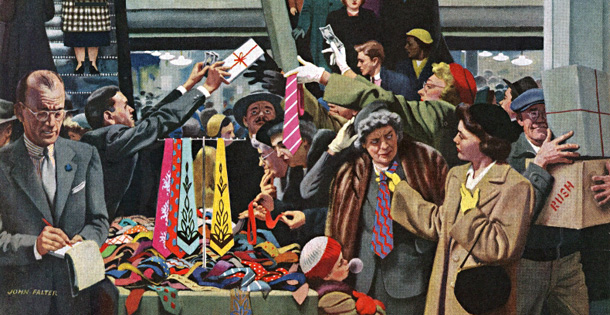
Combine the 75 percent off after Christmas store sales with the imminent 12-inch snowstorm, and folks in our town sprinted to the stores and malls ready to load up on crap and toilet paper. On the third day of the new year, highways were bumper-to-bumper, parking lots overflowing, and tempers the only short thing around.
My students had presented me with a department-store gift card, and I was ready to spend some of my hard-earned cash. I tugged on my fur-topped waterproof boots to trudge to the car through the remaining slop from the last snow. My husband and I joined the throng of shoppers. As usual, he headed to the electronics department, and I sought out the bargain clothing aisle. Why, I don’t know. This department store notoriously caters to the under-30 crowd, and what used to fit me when I was 30, wouldn’t even come close now. But the gift card had my name all over it. Fully aware that there was nothing in the Juniors’ Department that I could insert a body part into, I located the Women’s Department. I was well aware that the sizes in this store don’t compare to the One-Size-Almost-Fits-All store where I normally shop. Still, I was hopeful, and selected a pair of stretchy black slacks. When I held up those pants with an elastic band, I realized right away that I’d need a different letter on the tag than I normally wear. In my preschool classroom the letters are alphabetized, but here, the next size after “M” wasn’t “N.” I sort of squeaked when I held up the “L” pants and noticed they were too tiny for my thunder thighs no matter how much Lycra they contained. I silently swore at myself for devouring the doughnuts, capitulating to the Christmas cookies, and gorging on the Godiva. Double digits on a clothing tag is one thing, but double letters would do me in. I wasn’t going to do it.
Leaving the carpeted area and plodding along the tile floor, I passed the teeny-tiny lingerie. I could have bought a set for my granddaughter’s fashion dolls. I turned to walk away and swore some more at my hippo hips and ba-da-boom boobs. I’d look horrible in a swimsuit if I didn’t start right away to amend my ways. I’d walk some of the calories off, I decided. I’d kick it into high gear, really walk up and down every aisle at a good clip. Imagining floating in the turquoise ocean I allowed myself to daydream as I hotfooted it and high-stepped through the crowd. I had visions of sandy beaches in my mind when I actually heard the sound of summer at my feet. Slap-slap-slap, the loud noise of flip-flops. What was it? I stopped. The noise stopped. I walked, and there it was again. Step-slap, step-slap. The flat heel on my left boot had dislodged and was flapping like a flag in a snowstorm. I came to an abrupt stop. Each time I walked people looked at me curiously. I gazed at the floor in search of a rubber band. I considered ripping off a hunk of duct tape, but I knew hidden cameras would capture my antics. Whenever a shopper approached, I stopped in my tracks and feigned interest in Ho-Ho-Ho holiday boxers or whatever hoopla was on end caps.
Shuffle-slide, don’t lift your foot and you’ll be able to make it to the door. I dragged my leg like a lame duck. I scooted to the card aisle and stopped to rest my cramped leg muscle. I perused several greeting cards, opened another one, and jumped when the dang thing blared an old-time rock and roll song at me. A singing card! Now I could say I’d heard everything. I shoved that $5 whiz bang back onto the shelf and shuffled off. I got as far as the office supply area. I looked for an open bag of rubber bands. No such luck. Then I spied the answer to my problem. A hot glue gun in a beautiful shade of ocean blue! I knew exactly what to do. I am notorious for using hot glue in my classroom to mount everything from cardboard to wooden shelves. I reasoned with myself. Head to the bathroom, find an electrical outlet and plug it in. Then, glue your heel back onto your boot. It’s not like you’re stealing. If security personnel follow you inside, tell them you will purchase the opened product at the checkout with your gift card. Flash it in their face. Be cool, don’t be obvious, or arouse suspicion, just reach for the glue gun and go. Now. Do it!
Glue gun in hand, I pivoted to the left, took two steps, and my entire sole dislodged. That rotten hunk of rubber suction-cupped itself to the floor like the no-spill plate on a toddler’s high chair.
I’ve walked out of my shoes before, but never off of them. Too embarrassed to follow through with my plan, I hung up my gun, certain that at any minute I would be apprehended for suspicion of shoplifting, certainly not shopping. I scanned the area. I waited for the grandma in the motorized “hot wheelchair” to speed by, and when the mom, with four demanding kids, screamed past, I refused to yield to traffic and joined right in. I limped along to the front of the store. I hoisted myself on a high stool and parked myself by the aromatic popcorn popper, tempted to spend my hard-earned card one way or the other. I resisted. Instead, I dangled my legs and watched shoppers come and go. My husband finally showed up. When he saw my expression he asked with concern, “What’s wrong?”
I grimaced, “We have to get out of here. Now!” I ducked my head and said, “I just lost my sole.”
He looked stricken. His eyes widened, and he said, “What the heck did you DO that was so bad in Target?”
Chili: America’s Super Bowl

America is a nation of chili heads. It’s a long-standing and storied love affair. When working on a film in Italy, chili-craving Elizabeth Taylor ordered 20 quarts of her favorite recipe from LA’s legendary Chasen’s restaurant flown to her in Rome — at $100 a bowl. After moving to Washington, D.C., Lyndon Johnson couldn’t find good chili, so he filled his kitchen shelves with canned Texas chili to survive the chili drought. Humorist Will Rogers once said he judged a town by the chili it served.
So passionate are chili lovers that they began putting recipes to the taste test in chili cook-offs across the nation. One of the oldest, the Chili Appreciation Society International Championship Contest still holds its annual cook-off in the tiny town of Terlingua, Texas, drawing thousands of visitors each year.
Seems everyone has a favorite, including Emeril Lagasse. We invited the longtime football fan to share his Kickin’ Chili recipe and pre-game strategy for throwing a stress-free party.
“At my house, game day is an open invitation for my friends and family,” Emeril says. “The key to entertaining at home is prior planning, so everything goes smoothly. Cook and prep what you can in advance. On game day, heat up the chili, serve with a spread of toppings, and let guests build their own bowls.” Game on!
Emeril’s Kickin’ Chili
Recipe courtesy of Emeril’s Homebase

(Makes 4 quarts or about 16 servings)
Ingredients
- 2 tablespoons vegetable oil
- 4 pounds ground beef
- 4 cups chopped yellow onions
- 3 tablespoons chili powder
- 1 tablespoon ground cumin
- 2 teaspoons Southwest Essence
- 2 teaspoons cayenne pepper
- 1/2 teaspoon ground cinnamon
- 1/4 teaspoon crushed red pepper
- 1 bay leaf
- 2 tablespoons minced garlic
- 4 (12-ounce) bottles dark beer
- 2 (28-ounce) cans whole tomatoes, crushed
- 2 tablespoons tomato paste
- 1 tablespoon salt
- 1 tablespoon plus 1 teaspoon dark brown sugar
- 1 ounce (1 square) unsweetened chocolate
- 6 cups cooked red kidney beans (see note) or 4 (15-ounce) cans, drained and rinsed
Garnishes:
- 1 cup grated low-fat cheddar cheese
- 1 cup finely chopped green onions
- Minced red onion
- 1/2 cup chopped fresh cilantro
- Grated Monterey Jack–cheddar cheese blend
Directions
Heat oil in large heavy pot over high heat. Add beef and brown well, about 10 minutes. Add onions, chili powder, cumin, Southwest Essence, cayenne, cinnamon, crushed red pepper, and bay leaf and cook, stirring often, until onions soften, about 8 minutes.
Add garlic and cook until fragrant, about 30 seconds. Add beer and cook until foam subsides, about 1 minute. Add tomatoes, tomato paste, salt, brown sugar, and chocolate to pot. Stir well and bring to boil. Reduce to simmer and cook until slightly thickened, about 1 hour, stirring occasionally to prevent chili from sticking to bottom of pot. Skim off as much fat as possible. Add beans, return to simmer, cover, and cook until thickened, about 1 ½ hours longer. Serve with cheese if desired, green onions, and cilantro alongside as garnish.
Note: To make 6 cups cooked red kidney beans, soak 1 pound dried beans for 6 hours or overnight. Drain beans and place in large saucepan. Add water to cover by 2 inches and bring to boil. Reduce heat to simmer and cook until just tender, 30 to 45 minutes. Drain and set aside to cool.
Per Serving
-
Calories: 390
Total Fat: 14 g
Saturated Fat: 5 g
Sodium: 871 mg
Carbohydrate: 27 g
Fiber: 7 g
Protein: 33 g
Diabetic Exchanges: 1/2 vegetable, 1/2 starch, 3 protein, 2 fat
Emeril Lagasse’s Navy Bean and Chicken Chili
Recipe courtesy of Emeril’s Homebase

(Makes 6 servings)
Ingredients
- 2 pounds boneless, skinless chicken breasts
- 1 tablespoon plus 1 1/2 teaspoons kosher salt
- 3 1/2 teaspoons ground cumin
- 2 teaspoons chili powder
- 3 tablespoons olive oil
- 2 yellow onions, minced (3 cups)
- 3 poblano chiles, stemmed, seeded, and minced (1 1/2 cups)
- 2 serrano chiles, stemmed, seeded, and minced
- 1/2 large bunch or 1 small bunch cilantro, stems and leaves reserved separately and finely chopped
- 1 canned chipotle chile in adobo sauce, stem removed, minced
- 1/4 cup minced garlic (8 to 10 cloves)
- 1 teaspoon dried Mexican oregano or regular oregano, crushed with fingers
- 1 pound navy beans, soaked overnight and drained
- 5 1/2 cups homemade chicken stock or packaged low-sodium chicken broth
- 1 (4-ounce) can chopped green chiles, with juices
- 1 tablespoon plus 1 teaspoon yellow cornmeal
Garnishes:
- Sour cream
- Lime wedges
- Minced red onion
- Finely minced jalapeños
- Grated Monterey Jack–cheddar cheese blend
Directions
Season chicken with 1 1/2 teaspoons of salt, 1 teaspoon of cumin, and 1 teaspoon of chili powder. Set a pressure cooker to t “browning” program and heat olive oil. When it is hot, add chicken breasts (in batches if necessary) and cook until they are golden on both sides and just cooked through, 8 to 10 minutes. Transfer chicken to plate, tent it with foil or plastic wrap, and set aside.
Add onions, poblano and serrano chiles, cilantro stems, chipotle chile, garlic, oregano, remaining 2 1/2 teaspoons cumin, and remaining 1 teaspoon chili powder to pressure cooker. Cook, stirring occasionally, until vegetables are soft, 5 to 6 minutes. Add beans, chicken stock, and canned chiles. Close and lock lid, and set to “high pressure” for 15 minutes.
While beans are cooking, shred cooled chicken into bite-size pieces and set it aside.
Open pressure release valve and allow the steam to escape. Unlock and carefully open the lid. Add the remaining 1 tablespoon salt and the cornmeal, and stir to combine. Close and lock lid, and reset to “high pressure” for 8 minutes.
Release pressure, unlock, and carefully open lid. Beans should be tender; if not, continue to cook them under pressure for 1 to 2 minutes longer.
Set pressure cooker to “simmer” program. Stir in chicken and cook, uncovered, until chicken is heated through, about 10 minutes.
Serve chili in bowls, garnished with sour cream, lime wedges, minced red onion, minced jalapeños, grated cheese, and cilantro leaves.
Per Serving
-
Calories: 454
Total Fat: 11 g
Saturated Fat: 2 g
Sodium: 1,658 mg
Carbohydrate: 50 g
Fiber: 17 g
Protein: 34 g
Diabetic Exchanges: 1/4 vegetable, 1 starch, 3 protein, 2 fat
Emeril’s Chuck Wagon Chili for Slow Cooker
Recipe courtesy of Emeril’s Homebase

(Makes 12 cups)
Ingredients
- 1/4 cup chili powder
- 2 tablespoons whole cumin seeds
- 1 teaspoon cayenne
- 3/4 teaspoon ground cinnamon
- 2 teaspoons dried Mexican or regular oregano, crumbled between your fingers
- 3 bay leaves
- 2 teaspoons light or dark brown sugar
- 4 pounds boneless beef chuck, trimmed and cut into 1 1/2- to 2-inch cubes
- 1 teaspoon freshly ground black pepper
- 2 1/2 tablespoons kosher salt
- 3 tablespoons vegetable oil
- 3 medium onions, coarsely chopped (about 4 cups)
- 1 1/2 cups chopped celery, including leaves
- 6 cloves garlic, roughly chopped
- 2 jalapeño chiles, roughly chopped
- 1 (2-ounce) bottle dark Mexican beer, such as Negro Modelo
- 2 tablespoons tomato paste
- 1 (28-ounce) can crushed tomatoes
- 1 ounce semisweet chocolate, coarsely chopped
- 3 tablespoons masa harina (corn flour, not cornstarch)
- 1/2 cup chopped fresh cilantro leaves
- 1/2 cup chopped fresh parsley leaves
Garnishes:
- Grated low-fat cheddar cheese
- Chopped green onion
- Sour cream (optional)
Directions
Combine chili powder, cumin seeds, cayenne, cinnamon, oregano, bay leaves, and brown sugar in small bowl; set spice mixture aside.
Add beef to medium bowl and season with pepper and 1 tablespoon of the kosher salt.
Heat 2 tablespoons of vegetable oil in 12-inch or larger skillet over high heat. Add enough beef to fill pan and cook until nicely browned on one side, about 2 minutes. Turn pieces over and cook for another 2 minutes. Transfer browned beef to crock of a 6-quart slow cooker. Repeat with remaining beef, adding remaining vegetable oil between batches as necessary.
Add onions, celery, and 1 tablespoon of remaining salt to skillet and cook, stirring, until vegetables begin to soften, about 2 minutes. Add garlic, jalapeños, and spice mixture and cook for 1 minute longer. Pour in beer, tomato paste, and crushed tomatoes and simmer for 3 minutes. Stir in chocolate, masa harina, and remaining 1 1/2 teaspoons salt and cook for 1 minute longer. Transfer this mixture to slow cooker. Cover and cook chili on high, undisturbed or stirring only once during cooking, for 6 hours, or until beef is very tender. Remove bay leaves and stir in cilantro and parsley. Serve the chili hot in bowls, topped — if desired — with grated cheddar, chopped green onion, and sour cream (optional).
Note: Optional sour cream and cheddar cheese not included in final calculation below.
Per Serving
-
Calories: 580
Total Fat: 34 g
Saturated Fat: 12 g
Sodium: 1700 mg
Carbohydrate: 17 g
Fiber: 4 g
Protein: 48 g
Diabetic Exchanges: 1/2 veg, 5 protein, 4 fat
A ‘Two-Spicy’ Chili by 48th Annual Terlingua International Chili Champion Jason Goins

Ingredients
- 2 pounds of chili grind
- 1 can beef broth, more if desired
- 1 can tomato sauce
1st Spice Mix:
- 1 tablespoon Mild Bill’s Mexene Chili Powder
- 1 tablespoon Mild Bill’s San Antonio Original Chili Powder
- 1 tablespoon Mild Bill’s Dixon Med Hot Chili Powder
- 1 tablespoon Mild Bill’s Onion Granules
- 1 tablespoon Mild Bill’s Garlic Granules
- 1 tablespoon beef granules
- 1 tablespoon chicken granules
- 1 teaspoon Mild Bill’s Cumin
- 1/4 teaspoon Mild Bill’s Hungarian Paprika
- 1/8 teaspoon salt
- 1/4 teaspoon Mild Bill’s Hot Stuff
2nd Spice Mix:
- 1 teaspoon Mild Bill’s Mexene Chili Powder
- 1 tablespoon Mild Bill’s San Antonio Original
- 1 teaspoon Mild Bill’s Cowtown Lite
- 1 teaspoon Mild Bill’s San Antonio Red
- 1 teaspoon Mild Bill’s Cumin
- 2 dashes Louisiana Hot Sauce
- 1/8 teaspoon Mild Bill’s Hot Stuff
- 1 pack Sazon’ Goya
Directions
Brown chili grind, drain off grease. Add beef broth, tomato sauce, and 1st spice mix.
Bring mixture to a boil, then reduce to simmer for 50 minutes, then add 2nd spice mix and simmer for 30 minutes.
During this time if liquid is needed you may use more beef broth, also salt and heat can be adjusted to your liking by adding table salt and cayenne powder.
The Cuban Conundrum
On Sunday, March 20, 2016, in a major step toward easing political tensions and restoring full diplomatic relations between America and Cuba, President Obama became the first sitting U.S. president to set foot on Cuban soil since 1928.
These articles from our archive give a historical perspective on the interesting and often contentious U.S.-Cuban relations, beginning with America’s entrance into the Spanish-American War and ending during the tense days of the Cuban Missile Crisis:
Cuba as It Is Today — March 26, 1898
Author Fanny B. Ward visits Spanish-held Havana, visits the site of the USS Maine, and meets with American Red Cross founder Clara Barton.
Cuba’s Grievances — January 27, 1934
“Our financial interest in Cuba is much greater than the average American realizes,” Edwin LeFevre warns in 1934 as America was considering stepping out of Cuba’s affairs.
Havana — March 31, 1951
Leigh White reports from pre-Castro Cuba: “Cynical and sinful is lovely Havana, where riots occur on Brotherhood Square, streetcars don’t stop for passengers and the atom bomb’s a joke. She’s the New World’s tropical version of wicked old Pompeii.”
To Cuba with Cal — February 1, 1958
Beverly Smith Jr.’s recollections of his time in Cuba, when he accompanied ex-President Coolidge, the last U.S. president to visit the island. In Smith’s report of a “simpler and more carefree era,” he recalls Will Rogers’ summation of America’s policy in the Caribbean, where Uncle Sam was “shaking with one hand and shooting with the other.”

Can Castro Save Cuba? — August 1, 1959
“For nearly seven years, in prison, in exile, and as a hunted rebel … Castro was obsessed with one thought — the overthrow of President Fulgencio Batista, whom Castro and a majority of Cubans looked upon as a thief and a tyrant,” writes Harold H. Martin, whose tone is still hopeful. At the time the article appeared in the Post, Castro had not yet nationalized American businesses in Cuba or earned the long-lasting enmity of Washington.

Cuba: State of Confusion — March 26, 1960
Harold H. Martin reports on the chaotic conditions in Cuba as Castro’s lieutenants, including National Bank director Ernesto “Che” Guevara, improvise a government.
Cuba Under Communist Rule — October 13, 1962
“Nobody can tell with any accuracy how many Cubans are for or against Castro,” writes Ruth Sheldon Knowles from Cuba in this 1962 article. “But I am convinced that he also has much popular support among farmers, workers, students, many of whom have benefited from his regime “I was surprised by the number of Cubans who spoke against the government. … But they accept it … and they see no alternative, unless there is another invasion. I was asked several times, and I was never sure whether the question was put jokingly or not, ‘When is the next Yankee invasion coming, por favor?'”

Chaos in Castro’s Cuba — June 8, 1963
In 1963, Edward Behr went looking for signs of hope in Cuba but found none. Instead of food and the promised prosperity, there was propaganda, inefficiency, and falling standards in factories and schools.
Worth
I could never get warm enough in the winter. Not with the fireplace going, not keeping the heat at the 68 degrees recommended by Georgia Power, and especially not since I had turned it down to 64 figuring that we could save that extra bit of money. The cold wouldn’t bother my husband, Steven, though; his body ran hotter than mine. And though I didn’t like the cold, I’d had long practice putting up with it, with making do. Momma said that as long as we didn’t freeze, cranking up the heat any higher than necessary was just a waste.
I pushed the needle into the quilt on my lap with my middle finger; the steel thimble caged my finger, imprinting the skin with its tiny circles. My gray-sock-covered toes stuck out before me on the La-Z-Boy recliner. The socks were a contrast against the bright scrap quilt of neon rectangles separated by four patches of black and white that covered my legs. I’d backed this quilt with hot pink fleece instead of the traditional 100 percent cotton. Fleece was more trouble, but warmer.
The garage door lurching up rumbled through the house over the droll Will and Grace rerun on television that was keeping me company.
I took a quick look at my gold Timex watch with fake diamonds outlining the face. Steven wasn’t due home for another hour at least. His boss had said he had three months before the office closed down, but promises meant nothing. Georgia was an at-will state. Hire at will. Fire at will. At any time they could tell him that today would be his last day.
And that would be that.
Cold air thrust into the house as the back door leading to the garage opened. I pushed the footrest of the recliner down and stood up. The wood crackling in the fireplace hampered the cold seeping in.
White plastic bags with red bull’s-eye designs hung from Steven’s beige fingertips. I crushed the quilt in my hand, the creases where I had sewn the seams digging into my fingers. The silver needle hanging from the white thread swayed in the breeze from the open door.
He stood there smiling in his army-green trench coat and black fingerless driving gloves lined with fake fur that stuck out from the holes near his wrists. At least he had worn them; he normally went without gloves.
He was short for a man — just a couple of inches taller than me — light-skinned and still thin, even after these seven years with me and eating every concoction that I tried to bake up. The smile on his face was the first one I had seen there in ages, at least since the notice had come down about his job.
He raised an eyebrow and swung the packages onto the kitchen table, which was currently covered with a green and red quilt topper. He was careful not to knock over the Christmas centerpiece — a small votive vanilla candle surrounded by fake greenery spotted with red holly berries.
As he headed toward me, down the long hallway, I turned the quilt so that the needle was away from him.
“Hey, babe,” he said, the sweetness of his breath reaching out to me. Had he been drinking? It usually cost, what? Seven or 10 bucks for a drink? I hadn’t been out in so long I didn’t know. But this wasn’t the time for drinks, and there was never a time for drinking and driving. We should be scrimping now not wasting money and taking stupid risks.
He took my hand in his. Even though his hand was thinner than mine, he had long fingers. It was the first thing I’d noticed when we met in college in a beginning piano class. We were the only non-music majors in the class. We shared a rented key to the rehearsal room to practice at the same time. Three years later, we’d gotten married — with a groom’s cake that looked like a piano — and started our life together.
He sat down in the recliner and pulled me onto his lap.
I pulled away from him, clutching the cold lapels of his coat. “What’s going on?”
“We’re going to win the holiday decorating contest.”
“What contest?” I narrowed my eyes. “Has this got anything to do with the homeowners association meeting last night?”
“No, I’ve been thinking about it for a while. You know, as a way that we can, you know, join in the holiday spirit.”
“We already have lights. White ones. We put them up Thanksgiving night after we got home.” The same white lights that we had for years. The ones that were acceptable. The ones that were paid for.
“That’s what the bags are for. We’ll have more.”
“Steven,” I said, and then slipped off his lap, setting the quilt on the floor. “Let me hang up your coat, and we can talk.”
He’d just bought the lights. He must still have the receipt. We could just take them back.
He shrugged out of his coat. He wore a suit underneath, with a white shirt, pressed and starched and so white that I joked it glowed in the dark, and the red power tie with dark-blue triangle accents. His Blackberry was clipped to his belt, like a black tumor growing on his hip.
The Blackberry doesn’t matter, I thought, hanging up the coat with a clink in the barely used front-hall closet. It’s what the Blackberry represents. Only three weeks to when he’ll be laid-off, downsized, whatever you call it, and they still want his blood. At least it didn’t ring — it just vibrated — but that little buzzing noise was a warning of the impending job loss in a tough economy, no matter what the papers said about the supposed recovery.
But then, he’s happy, right? When was the last time that I saw him with a smile on his face?
Yeah, came the other side of my thoughts, but at what cost? Because there was always a cost.
I took a deep breath, breathing in the stale closet air, looking down at the tiny piece of dark hardwood flooring inside the closet, the only hardwood flooring that I liked. Pushing the door slowly across the carpet, I remembered taking care of hardwood floors as a child. They looked beautiful, but I was not into that much work for so little payoff.
Steven had gone to the kitchen table and begun sorting through what looked like Christmas lights.
I padded down the hall on the soft carpet. The carpet was the one thing I had insisted we upgrade, with extra foam padding, since I’d said no to hardwood floors. The kitchen was still the white that was popular at the time we had our house built. We hadn’t upgraded to the stainless steel appliances and the granite countertops that were popular these days. I saw no reason to do it even though I could tell that Steven wanted them.
It was a miracle that we’d gotten together at all. My parents had been on the same side when it came to money, even if they were from opposite sides of the tracks. But Steven loved to spend money; he had this wide-eyed, hungry look to him, always wanting to have, do, and be everything that popped into his mind.
I’d loved that energy about him when we first got married, but had found myself tempering it ever since.
In the kitchen, he’d laid strings of red, orange, and green bulbs across the quilt-covered table. They were shaped like the clear candle bulbs above the table in the chandelier, about the only fancy thing that we owned, and that was because it came with the house as part of the basic plan. I had wanted everything exactly like the model home. We weren’t going to live here long, right? It was meant to be just a starter home.
He picked up one string. “Isn’t this great?”
I grabbed the back of one of the wooden chairs that I’d picked because their spoked, high backs and rounded seats reminded me of the chairs in the house I grew up in. “What is that?”
“We’re going to decorate for Christmas.”
“We’ve already decorated for Christmas.”
I wanted to ask the question. I needed to ask it. I dreaded asking it. “How much did all of this cost?”
“You’ve got to live some.”
He hadn’t answered the question.
“We are.” I bit my lip hard enough to make sure that my words were careful. The kitchen was still cold from when he had blown in. “We just have the thing coming up.” I didn’t like actually naming the impending layoff. Naming something, putting it out in the world, gave it power. “You know that we have to be careful about expenses.”
“And it’s Christmas. We should enjoy it.” He yanked off his gloves then rummaged around the brightly colored bulbs until he found the plug. The swirled lights glowed on the table. “They’re going to look great outside.”
“We have the white lights. They’re classic. They were what we’ve used since we bought the house.”
“We can use them and these.”
“That’ll clash, Steven,” I bent down and unplugged them. The glow died.
Most places had a good return policy. He had been just a little crazy because of the time, because of the season. I picked up the plastic bag, the crinkling sounds punctuated by laughter floating in from the television in the other room. There had to be a receipt … My hand fell on a slip of paper huddled in the bottom of the bag, hiding. Bingo. I pulled it out.
“Dee,” Steven said. “They weren’t that much. We can keep them.”
“Where is this coming from? We’ve always put up white lights. They’re clear. They’re elegant. And the HOA … I really don’t want to hear their big mouths when they see these,” I said, holding up the big, floppy lights. “I think there was something in the guidelines about only clear lights being allowed.”
“Don’t these look familiar?”
I looked at them. They did; they were the lights people used to string up … back, when? Twenty years ago? Before homeowners associations that dictated garage door colors — which in our case had to be white, not even an ivory or classic cream. Homeowners associations made up of henpecked husbands and retirees who had no problem whatsoever levying fines that we could not afford.
The smell of the burning wood in the living-room fireplace tickled my nose and a memory. “They, um,” I said, “they remind me of the Christmas lights we had when I was a kid.”
Thanksgiving evening back then was for putting up the Christmas tree; getting out the decorations from the attic and attaching the branches of the artificial tree, matching the color-coordinated edge of each branch to its place on the base of the tree. We’d change the house over, and Dad would drag out the ladder and hang the Christmas lights. We’d play the exact same record every year: classic carols with a choir and a full orchestra. Then Momma and I would bake oatmeal raisin cookies.
I grinned. The lights were ridiculous. I didn’t even think they still made the fat, gaudy things anymore.
He clapped. “There it is,” he said. “There’s the smile that I missed. It’s gonna be all right, you know, babe? We’re gonna be fine.”
“Yeah, I’ve gotten all the numbers worked out and …” And I kept my eyes on the brightly colored, gaudy Christmas lights. What if there is a bag with a blow-up snowman complete with generator in the car?
His scent, a cologne I’d bought him earlier this year because I thought it smelled like something an anchorman would wear, filled my nostrils. He came up behind me, enveloping me, his arms around my waist. “As long as we’re OK, everything else will be OK.” He planted a sloppy kiss on my cheek and nuzzled my neck “Urphhhh. Everything else we can get again, ’K? We got it once, and we’ll be able to get it again.” He stepped away from me and plucked the receipt from my hand. “But we’ll never have this time again.”
Keeping a brave face, pretending everything was all right, keeping up appearances. What would I really remember 10 years from now when I thought about this Christmas? What was really important?
I picked up the gaudy lights. There was that evergreen hedge in front of the house. Had the kids in the neighborhood ever even seen lights like these? Bright and silly?
My hand skimmed over one of the bulbs, from the round end, that circle of ridges in brass, to the point of the fake flame. “Are you sure that these are safe for outdoor use?” I asked, looking up. “We won’t start a fire or anything if we put them on those hedges?”
“I checked. It will be fine. So,” he said, “we get to keep the lights?”
I sighed. “Would it be Christmas without crazy lights and a possible citation?”
“But think,” he said, “by the time we receive the citation, it’ll probably be after Christmas. If not, we’ll just run the clock for the 30 days they give you to correct ‘the matter.’”
“You checked?”
“I know you, Boo.” He rocked me from side to side in his arms. “Of course I checked.”
“Well, we might as well put them up now.”
“I’ve got it.” He stopped rocking me and stepped back. “You can get back to your quilting.”
The quilting would always be there. We could get another house. Steven could get another job. But this moment? This was something that I could not get again. “It can wait,” I said. “It’ll keep.”
I reached down and plugged in the lights. They glowed in all their gaudy glory across the Christmas setting on the kitchen table.
I leaned back into his warm arms, my hands over my stomach. He covered my cold hands with his warm ones, letting his warmth seep into me.
He leaned down and kissed me on the cheek. This one wasn’t sloppy. “Hey,” he said, “isn’t it cold in here for you?”
“No,” I said. “It feels just right.”
Bombing America
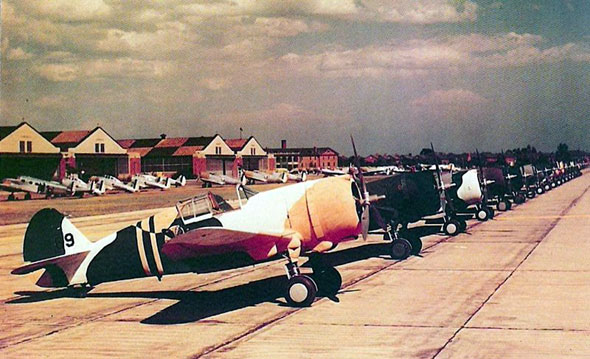
It’s hardly new anymore. An anonymous group angered by the release of a satirical movie, now joins the line of organizations threatening death and destruction in America.
Every day, the world feels a little more like the Wild West, with every cocky, militant group wanting to make its reputation by challenging the sheriff to a gunfight. We’re growing accustomed, if such a thing is possible, to feeling threatened with death at home, in schools, and at work.
There was a time — and not long ago — when we enjoyed a rare moment of security. Between 1989’s collapse of the Soviet empire and the end of the Cold War and 2001’s assault by religious fanatics, we enjoyed 12 years when we didn’t have to worry about atomic weapons or suicide bombers.
We might have enjoyed it more if we knew such days were limited. Or if we were more aware of how long Americans have been living in the shadow of sudden, surprise attacks. As far back as 1939, Americans were fretting that one of the Axis nations might launch a bombing raid into the United States.
In 1939, Fletcher Pratt considered America’s vulnerability to a deadly foreign attack in “Can They Bomb Us?”
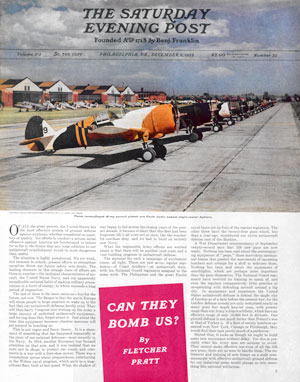
As you probably know, the continental states were never bombed in World War II. You might think we were safe because we lay beyond the reach of German and Japanese airplanes. But commercial airlines were flying passengers across both oceans before the war. (Pan Am’s China Clipper in 1936, and the Yankee Clipper in 1939.)
These planes, Pratt wrote, were as different from bombers as Great Danes and greyhounds. Bombers were designed to fly as fast and as high as possible. Clipper planes needed to carry heavy loads for long distances. “Comparing the recent German Dornier or Heinkel bombers with the transatlantic Clippers, we find the military machines nearly 100 miles an hour faster, but with nearly 1000 miles shorter range. It would be physically possible to fit bomb racks to a Clipper and load her with death instead of passengers. But her utmost full-throttle speed of 200 miles an hour would render her virtually a stationary object to the attacks of fighters traveling at 350 miles an hour. Her climbing ability, perfectly adequate for commercial craft, is insufficient even to carry her above the range of 37-millimeter guns, the small change of antiaircraft defense … she would be about as useful in military operations as a truck in a tank battle.”
While the German bombers flew about 100 miles an hour faster than the Clippers, they fell about 1,000 miles short of the Clippers’ range. The flight radius of a World War II bomber, Pratt noted, was 750 miles. If it flew any farther, it wouldn’t have enough fuel to get home.
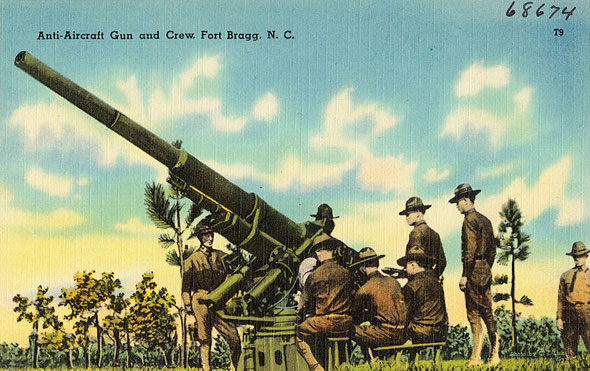
Yes, he admitted, a suicide squad could launch from an enemy aircraft carrier stationed along the U.S. coast. The bomber could travel far inland and inflict considerable damage on a major military site. But this was highly unlikely, he concluded. No air force would trade “a half-million-dollar airplane and a highly trained crew for the amount of damage the machine could do on a single flight … bombing airplanes do not carry enough explosives to do half a million dollars’ worth of damage, except by the most extraordinary good luck.”
Even if a general ordered suicide missions, Pratt reflected, men wouldn’t fly them. “There is a psychological factor ruling the whole business of such desperation raids. Men simply will not sacrifice their lives for the doubtful glory of having done some damage to the enemy. It has been proved time and again.” It was unlikely, he argued,“ that there will be any more suicidal spirits in the future than in the past. … The men who really would carry such a thing through bear a mark on their foreheads by which they can be recognized.” Pratt is referring to the Biblical mark of Cain, and implying that such suicide warriors are easily recognized as murderers and are, presumably, shunned by society.
It was a reasonable conclusion to draw in 1939, but the tide of fanaticism was rising. As the war progressed, Axis leaders began pushing their soldiers to greater acts of desperation. By 1944, Japanese aviators were flying explosive-laden planes into American naval vessels, disproving Pratt’s notions of the suicidal spirit.
Seventy years later, the fanaticism that glorifies mass murder is on the rise. Today, Americans take in the news about the latest death threats, then pick up their lunches, check for their cell phones, and head out the door to another day at work.
What I Want for Christmas

When I was in my mid-20s, I asked Santa for a house, but got a shirt instead. Apparently, Santa didn’t care what I wanted, so I stopped believing in him. I’ve become so cynical these past few years I’m starting to have doubts about the Easter Bunny, too.
So far the only one who’s delivered the goods is Old Man Winter. Last year, I asked him for lots of snow and the geezer came through. Our town got 55 inches of snow, instead of our usual 25. Of course, there’s no pleasing some people. You’d be amazed how upset some folks were, bellyaching about having to shovel a little snow. Like my wife, for instance, even though I had given her a new shovel for Christmas.
This year, I’m giving Santa the chance to redeem himself so have asked him for a white Christmas. There’s nothing worse than waking up on Christmas morning and seeing dead brown grass instead of snow. Well, maybe cancer is worse, but just barely. It depends on the kind of cancer. I had skin cancer last year and not having snow for Christmas was definitely worse than my skin cancer, which the doctor fixed in five minutes. Yes, I’m a cancer survivor, but I prefer not to talk about it. No sense getting people all depressed.
Where was I? Oh, yes, snow for Christmas. Twelve inches, please. I’m a pastor and have to work on Christmas Eve, so if the snow could start falling in the late afternoon of the 24th and get me a day off work, that would be even better. Then I’d apologize to Santa Claus for ever doubting him. Twelve inches of snow, then a cold snap so it won’t melt for at least two months. Thirty, maybe 40 below zero, so it would be too cold for school and my wife could stay home and carry in firewood for our woodstove. Thanks to me, she’s in tremendous shape for a woman in her 50s.
As wonderful as snow is, it’s odd that it leads to the worst thing ever, which is slush. Slush is even worse than dead brown grass at Christmas. Dead brown grass doesn’t spill over the tops of your shoes and soak your socks.
The best thing about snow is the stillness. I guess what I’m really asking Santa for is peace and quiet. When it snows people stay home, except for our town’s snowplow driver, Ray Whitaker, who passes by in the moon hours, his amber strobe casting shadows across our bedroom wall. We live on the north edge of town, the Welcome to Danville sign is in our side yard. Ray plows the street up to the sign, then puts his truck in reverse. I can hear the beeper on his truck as he backs up a half block, turns around, and heads into town.
For the 14 years my dad served on the town board, he took doughnuts to Ray the morning after every snowfall, but would always bring one home to me. Whenever it snows, I think of doughnuts. Dad no longer drives, so now I’m the doughnut man. Ray has the streets clear by 6 a.m., so I drive to Kroger, buy a box of doughnuts, and take them to Ray, who is at the town garage, brushing the snow off his truck before pulling it into the bay. If it snows on Christmas Eve this year, Ray will have to do without doughnuts since Kroger is closed on Christmas morning. My wife will make him blueberry coffee cake instead.
Ray complains whenever it snows, but it’s all a show. Like most men, he loves an adventure, and there are few things as exciting as being out in a heavy snow. Sometimes I’ll even take Ray doughnuts before the streets are cleared, just for the thrill of it. There are three hills between our house and town, so I have to get a good head of steam up before hitting each hill. Even so, my tires spin, as does my mind, to silent winters past.
The Great War: December 19, 1914
In the December 19, 1914, issue: French refugees return to their village and learn what happened to their homes during the German occupation.
When the Germans Came
By Corra Harris
Journalists in France begged, bargained, and demanded permission to travel toward the war. Some even obtained passes from high-ranking military officers in Paris. But they could travel only a few miles toward the fighting before they were detained at a military checkpoint.
But Post correspondent Corra Harris found a way to bypass the roadblocks. She had heard trains were leaving Paris every day, carrying villagers back to their homes. Early one morning, before sunrise, she joined a large crowd of women at the Gare du Nord train station and climbed aboard a local train for the town of Senlis. No one stopped her, or even asked to see her papers.
The train moved slowly out of the city and ambled across the countryside, never reaching a speed faster than a trotting horse. After two and a half hours it had traveled only 30 miles. But it reached its destination, at last.
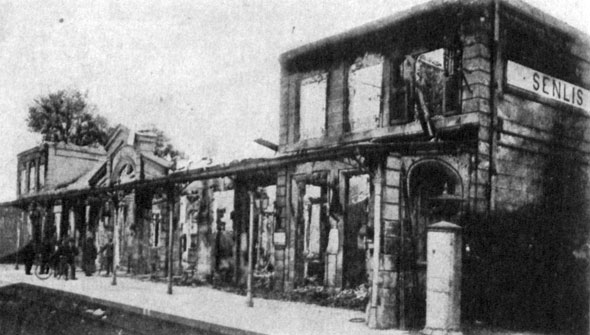
“I should not have known that we were in Senlis if I had not heard the name called, and had not seen women coming down out of the coaches and looking about them with tears streaming down their faces. These were some of the refugees of Senlis who had fled when the Germans came. They were just returning home. They all wore black clothes, and many of them carried homely little things in their hands, which they had snatched at the last moment two months ago. One old woman had a pot with a lily growing in it. Another had a basket with a set of yellow cracked china cups and saucers rattling as she walked.
“That silent crowd of 50 women filed through the ruins of the railway station. The walls of it alone remained. The roof and all the partitions lay a mass of molten metal, stones, and powdered mortar within. On the other side of the station, there were three cabs waiting, but these people were too poor to ride. The cabs went away empty, drawn by horses that looked as if they were merely some of the bones of the general desolation.
“The principal street of the town … was a street no longer, only a long, narrow pile of ruins between the fallen walls of houses as far as sight could reach. The women looked about them. They were confused. They did not know even where they had lived. You cannot recognize your home by blackened walls in the midst of a hundred other walls like them any more than you can recognize a man by his skeleton.
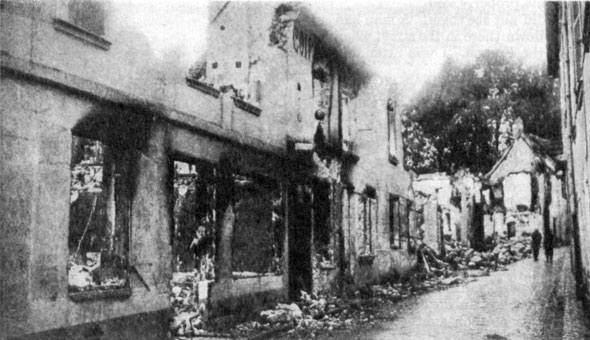
“As we made our way over the stones and rubbish, a woman near me caught sight of a torn lace curtain flapping in and out of a window socket in one of the walls still standing. She gave a cry. She had recognized her home by that scorched rag of tattered lace. Nothing else remained of it now but that and the dead vine still clinging to the casement. The roof was gone, all the inner partitions, all the dear things she had cherished. I left her staring at the ghastly curtain as if she had seen a ghost.”
Not all the villagers had left Senlis. One woman who had remained behind told Harris of how she and her family miraculously escaped being burned to death.
“In the café where I had lunch the little apple-faced waitress was very communicative: ‘When the Germans came we ran down into the cellar. They soaked the house in oil and then set fire to it. And we were in the cellar.’
“‘How many of you?’ I asked.
“‘So many,’ she exclaimed, counting on her fingers. ‘Twenty-eight of them children. We were very still. We could not get out. Suddenly we saw a Prussian’s head thrust through the airhole. He was listening, but we made not a sound. No, the children did not cry. They were so frightened that they went to sleep.’
“‘With the house burning over your heads?’ I exclaimed.
“‘But no; the Blessed Virgin would not let it burn. That oil, it was changed to water.’
“‘How long did you stay there?’
“‘From 2 o’clock in the afternoon until 5 the next morning. It was very hot, and we had no water, no food, but the children did not cry. The next day the Germans came back and set fire to the house again; but we had escaped, so it burned,’ she added simply.
“This girl’s father was a farmer. They lost everything they had. Yet she was not sad. She was sustained by a miracle. The Blessed Virgin had remembered them, the least of these, in the terrible conflagration. So they were safe. No evil could befall them.”
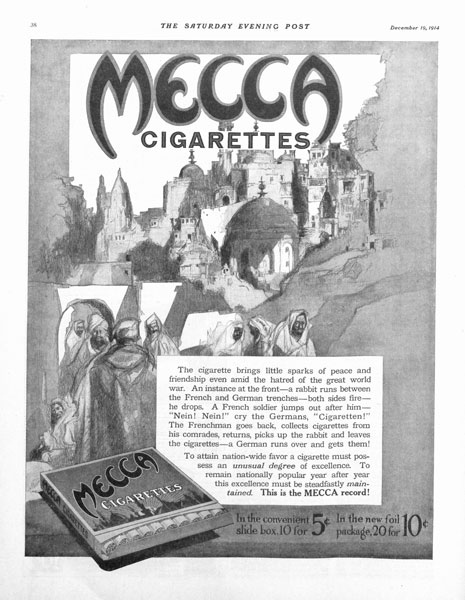
Step into 1914 with a peek at these pages from The Saturday Evening Post December 19, 1914 issue.




Assistant Manager of the Universe
I have no vest, no name tag, but I’ve realized I am the assistant manager of the universe. Apparently I have the permanent, nondescript visage of a jaded employee, one who can solve unimportant problems but really just wants to take a quick lunch break. There’s no paycheck with this position, just endless pestering, a stream of questions from lost souls who think I know what I’m doing, wherever I happen to be.
“Where’s the bathroom in this restaurant?”
“What aisle is the fat-free nondairy creamer in?”
“Can I take this fat-free, nondairy creamer into the bathroom?”
I’ve learned many things from the deluge of questions wherever I go, but the main thing is this: People are weird and they’re always looking for a bathroom. Even the Laundromat isn’t a safe place; I’m often asked about the best detergent and full fold-and-fluff services or, more often, “How do you work this thing?”
In my younger days, I chalked it all up to the fact that I worked at the information desk in a small-town chamber of commerce. Our little town is charming and colorful with steep hills topped by Victorian homes. It’s also eccentric enough that meds should be pumped directly into the water; perhaps a delightful Prozac/fluoride combo that would mellow out the locals, yet still give them great smiles. Mix that with a bustling tourist trade, and I have answered some very bizarre questions over the years, including how stretchy the laws are about first cousins marrying and if that giant statue on the edge of town is natural or manmade (also, is there a restaurant in the head?).
Just like fast-food employees reek of that French fry smell, I theorized that I gave off powerful information fumes when I left the job at the end of the day. I would walk into a grocery store past a couple studying an area map, and my all-knowing scent would waft into their nostrils and they would chase me down the potato chip aisle for directions to a country music show. Occasionally I would be backed up against a wall with an odd rant about parking, to which I would reply, “The bathroom is right over there,” and make my exit while they looked at me with the same stunned look as a grizzly bear finding a salmon singing “The Sun Will Come out Tomorrow.”
For the really tough cases, I would jingle keys in my pocket, look thoughtful, then point out some random person wearing a tie and say, “Oh, there’s the manager, you should talk to him.”
Once my young Info Desk days were done, and I settled into the snarky, comfortable life and sedentary body of a writer, I believed my days as an assistant manager at large were done. Alas, this was not the case. Back then I was young and cute and thought I knew everything, but now I’m middle-aged, wrinkled, and scowl enough that people suspect I must know everything, otherwise, why would I be so cranky?
But, as always, I end up helping them, just like I do when I’m still asked how to use the triple-load washers in the Laundromat, or how to find the embarrassing ointment aisle in Walmart. With each encounter, my patience gets a workout. Perhaps maybe I should just focus on job satisfaction.
When two fresh-faced yuppies stop their hybrid car to ask me about vegan restaurants while I’m speed-walking and dripping in fat-lady sweat, I should realize that these people trust me enough to involve me in their day. They’re saying, “Hey, you don’t look like a serial killer,” which should be taken as a compliment considering the state of the country today. I usually do know where all the bathrooms are located in any place at any given time, because I’m at the age where restroom proximity is need-to-know stuff. So I guess I can accept my status as the “ask her, she looks like she works here” woman. I’ll continue to answer questions about where you can return that hideous blouse or when the restaurant closes. It’s not a bad gig.
But I’m not touching that cleanup in aisle nine.
Marley’s Ghost — Again
Christmas Eve 1962, my older brother Artie told me Santa wasn’t real and christened me Scrooge. We were in back of our Cleveland split-level. He flew down the ice-glazed slide attached to our swing set, readied the plastic soles of his shoes to hit the icy run at the bottom, then found himself sprawled on the snow.
I laughed.
He said, “Very funny,” the way a kid says it when he really means he needs a moment to figure a way to get you back. “And by the way, punk,” he sneered, “there ain’t no Santie.”
“Santa,” I said, pretending I’d outgrown the endearing term I routinely used for the Jolly Old Elf, when I really hadn’t.
“Right,” he laughed. “There ain’t no Santa.”
“There is so!” I shouted, but knew it was in vain. Artie may have been a jerk, but he was a sincere jerk, so said my reflection in his studious horn-rimmed spectacles flecked with snow powder. I hauled him to his feet. I knew he might be right. So it was my turn to exact revenge, the way a kid does when he doesn’t want to believe something and changes the subject.
“I want my Realtone Six back!” I said.
“Fat chance of that, Scrooge!” he said.
Later that afternoon, Artie shoved me along a hallway to Mom and Dad’s bedroom and revealed the apocalypse — scads of wrapped presents stuffed just above Mom’s hatboxes, some tagged with the most damning evidence of all, tiny stickers saying “From: Santa,” one showing little kids caroling, mouths in little ‘o’ shapes; another, a shot of the North Pole with Santa’s mailbox stuck atop a gigantic candy cane; and most heinous of all, what had always been my favorite, Rudolph smiling with his red nose aglow. That red nose! Now, it lit up like a lie detector!
I suppose Artie thought if he provided proof positive that Santa did not exist, I’d forget about the Realtone transistor radio I’d loaned him. But I hadn’t. I turned on one heel and sped down the hall to the bedroom we shared. Artie pursued. He lunged and tackled me at the knees. As I crumpled to the carpet, I let out the war cry every younger brother knows.
“Mom!” I shrieked as I came to rest under Artie, who tossed his horn-rims aside, took me by the wrists, and started slapping me with my own hands.
“Why are you calling Mom, huh? ’Cause you’re hitting yourself? You gonna tell Mom why you’re hitting yourself, spaz?”
Mom came upstairs, hands ghostly white with flour, and pulled Artie off me. She shoved me toward my bedroom and said, “Go!”
Artie got up and started after me, but she took him by the head and somehow wrangled him by his ears into the kitchen.
I used the temporary armistice to gather my things, not all, just those I knew Artie would miss, stuff he was always borrowing — my Realtone Six, my tackle box, my Atomic Cape Canaveral Missile Base Set, a massive box that barely fit into Dad’s musty old Navy duffle bag. I also loaded my books, though Artie’d never asked to borrow them. Considering where I was going, I figured I’d need something other than my Realtone to keep me from going nuts. I packed Treasure Island when I remembered how Robert Louis Stevenson had been bedridden as a child and wrote his adventure to take his mind beyond the walls of his room. I took London’s Call of the Wild because I was feeling just that. I tossed in Dickens’ A Christmas Carol; I suppose since it was the season, and I hadn’t read it.
I marched with the duffle downstairs and through the kitchen, where Artie swiped at me despite Mom’s vigilance. I dragged the duffle to the stairs leading to the half-basement, then lugged it downward, step by step, into the bowels of our house, a place Dad had been measuring, nailing, and spackling for what seemed ages to make it into a family room.
Behind, I heard Mom ask, “Where you going?”
“I’m living down there from now on, away from him.” I heard her laugh a little. “And I’m taking all my stuff!”
“Mom?” I heard Artie say, then add, “You see? He’s a twerpy little Scrooge!”
I settled into my new home. Despite cobwebs festooning the rafters above, splotches of spackling resembling large leering faces suspended in snow squalls, cold floor tiles, and drab cinderblocks, it was far preferable to ever sharing anything with Artie. I set my things around me, lay down on the tile floor, bunched-up the duffle, and slid it under my head.
My back was nearly numb from cold by the time I heard Dad come in from his job at NASA’s Lewis Research Center. We didn’t know what he did over there. He said it was for the best in case Soviet spies kidnapped us and made us talk, which wasn’t that far-fetched since the missile crisis in Cuba had just ended. We hoped.
I expected Dad to come in and, like Artie, nudge his own horn-rims up his nose. He’d point with one arm stiffly skyward to signal my inevitable return to bunk upstairs with Artie. But then I heard Dad dragging my box spring down the stairs, its hard corners clunking on the steps, one by one. He dropped the box spring in front of me, smiled, and went to get my mattress. When he returned, he set my bed up in one corner.
In a little while, Mom came down and left a box of Cracker Jacks and a Coke. She made my bed with a bedspread embroidered with an image of Roy Rogers, King of the Cowboys. Roy was kneeling over a maverick calf on its back, four feet roped together, waiting for Roy to pick up the delinquent beast, fling it over Trigger the Wonder Horse’s saddle, and take it back to the herd. Was Mom slyly hinting that soon I’d find myself similarly roped and saddled? I studied her face, but found no hint of deceit. My dread subsided. To a kid, the half-basement was perfect — I had shelter, a place to sleep, my Realtone connection to the outer world, great literature, and now food stores. I had everything, all to myself.
That night, winter whipped up a snowstorm. The howling wind drifted as high in my mind as it did along roadsides, like white barriers against Artie, Santa, everything. I didn’t need anyone. As I stood at the window, I felt far removed from the warmly lit interiors of the other homes I could see. I didn’t need such things. I didn’t need Santa, his stupid reindeer. I was in a snug, peaceful state of self-exile, far from any human habitation.
To pass the time in my new home, I opened A Christmas Carol and started reading. Having been accused of being Scrooge, I was intrigued by the character. After a while, Artie interrupted. He stood at the door, mouth open, pretending he was seeing the half-finished basement for the first time. I put my face behind my book.
“This place suits you, twerp,” he said, then reluctantly added, his voice a little higher over the sharp pitch of the wind whining against the siding. “Dad wants to know if you’re coming to look at Christmas lights.”
We did it every Christmas Eve — piled into Dad’s underpowered, unsafe-at-any-speed Corvair and circled neighborhoods endlessly in search of the chromatic glow of goodness strung about the eaves and trees of the snowbound homes.
When I grumbled “humbug,” Artie immediately ran upstairs and called, “Dad!”
After Artie’s exclamatory Dad! I fully expected to be shanghaied for the trip to see lights. But Dad merely stuck his head a little way into to the doorway and said, “We won’t be gone long. If anything happens, you can call the Breedings next door. Number’s by the phone.”
This time, I peered out from an edge my book. Of course, Dad’s worrying could easily have been twofold. He was concerned for my being alone, but also for the fate of the Corvair. Last winter when he was late home from work, Mom called the cops, who found the Corvair — and Dad — stuffed into a snowbank like a blue Popsicle.
“OK,” I said, and cavalierly turned a page of the Dickens classic.
He closed the basement door and I soon heard the shush of wool-blend coats as Mom, Dad, and Artie suited up for their trip to look at lights. I heard the wind take the back storm door and whip it open, its chain squealing against the frame. Then Dad slammed it shut. The Corvair sputtered to life.
I sat up, put my back to the cinderblock wall, and tucked the covers over my legs. I liked how my book felt in my hands, its fake pebbled leather and cheap binding, the scent of new printer’s ink. More and more I believed I belonged in my new cinderblock quarters, buried in snow, my imagination spreading beyond its walls in the pages of a novel. In a world devoid of Santa, of the magic of Christmas, I believed this was as good as it got. Soon I began to read the part in A Christmas Carol when Scrooge first hears Marley’s ghost wail, his clamorous chains on wooden stairs, ascending, higher, closer, all while my spine numbing against the cinderblock wall. I supposed Dickens was trying to scare me. But I was wise to him. No Santa meant no spirits. No Marley. No ghost. There was only me and my precious, dingy room … But how I wished it were truly so! After a time, I heard a second chorus of clanking chains coming from outside our house! Not believing my ears, I read on — hearing Marley’s shackles rattling inside and outside of my head, mixed with the moaning snowbound wind outside my room. I pressed an ear to a cinderblock.
The sound was unmistakable.
Horrors! Chains!
I shivered. I was too paralyzed to run upstairs for the phone. I threw the book aside and buried myself in my King of the Cowboys bedspread!
The chains continued to clank when I heard our back door open, Dad’s Corvair puttering, Artie stomping upstairs, running water in the sink. When Dad and Mom came inside, I heard him tell her, “Snow’s getting deep out there. I saw Breeding next door putting chains on his tires. Guess I better get ours on the Corvair pretty soon.”
I slipped my head outside the covers. I lay there a long time staring up at the cobwebbed floorboards. I should have been relieved. I tried to convince myself that Marley’s ghost was humbug. Santa was humbug. I told myself I was safe in the half-basement. Why not? If the missiles launched from Cuba, the fireball would surely burn the house above to the floorboards leaving only the cinderblocks — and me, alone, but alive. I should have been fine, but I wasn’t fine, the way a kid isn’t fine when one scare turns out to be nothing, but then that scare gets him thinking about some bigger scare. Who would take care of me if everyone on Earth were suddenly gone?
Despite my harrowing encounter with Marley’s ghost and Breeding’s tire chains, I held out in my downstairs fortress the rest of that night. I never shared a room with Artie again. Over the next year, Dad finished the half-basement. But I’ve never forgotten Marley’s warning, “I wear the chains I forged in life.” Nor have I forgotten Artie’s yearly taunting, “Hey there, Scrooge!” Perhaps I am that Scrooge of 1962, yet I am he after Marley’s visit. Christmas mornings, and so many more to come, despite my disillusionment with Santa, despite the world’s trembling in fear of destruction, through the floorboards above my little room, I still hear the reassuring voices of my family, the wrapping coming off their gifts to one another, one special night of the year peeling my willpower away, sending me upstairs to be with them, unlocking my frightened heart, link by link.
Romancing the Robber
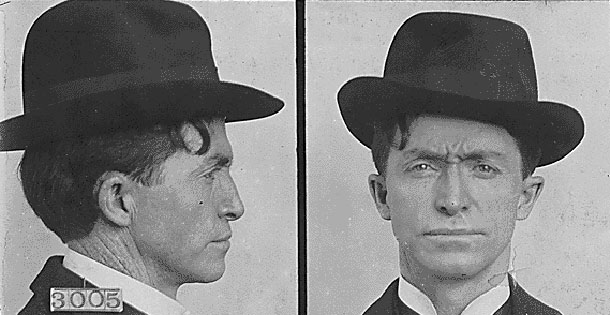
“Jiminy!” wrote Al Jennings. “It’s the hottest, fastest gun I ever saw.”
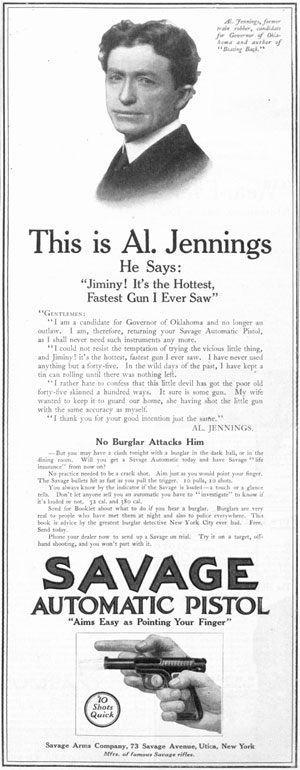
The gun was a pistol made by the Savage Arms Company. Jennings, the man singing its praises in a 1914 ad, was a former cowboy and lawyer who’d recently entered politics. What made his opinion about guns valuable was the fact that he had also been a train robber. In the 1890s, he’d led a gang that committed several robberies in the West. Captured and sent to Ohio State Penitentiary, he spent three years in prison before being pardoned.
At the time the Savage ad appeared in the Post, Al Jennings a strong contender for the Democratic nomination in Oklahoma’s election for governor. His campaign made no secret of his past. In fact, it helped distinguish him from the other Democratic nominees. It also won him the support of male voters (women couldn’t vote for another six years) who still viewed outlaws as champions of personal freedom.
The myth of the noble robber was firmly established in America’s popular culture by 1914, supported by hundreds of dime novels and theatrical melodramas. Criminals were often depicted as romantic heroes: independent, courageous, and gallant. Certainly that’s how Jennings presented himself in his memoirs, Beating Back.
And that’s how he was viewed by Will Irwin, a seasoned journalist and frequent contributor to the Post.
Irwin had met Jennings by chance at a New York drama club and been intrigued by the man’s story. He helped Jennings write his autobiography, then took it to the Post, where it was serialized over seven issues.
Jennings’ story had all the qualities of popular melodrama. A proud young man turns outlaw after his brother is killed and the law does nothing to bring the killer to justice. He becomes a fearless train robber, but remains chivalrous and fair-minded. Eventually he is betrayed, shot, captured, and tried. Sentenced to life imprisonment, he refuses to be intimidated by other prisoners or prison officials. His fearlessness and quick wit earn him the reputation of a man who can be trusted. Then a high-ranking politician befriends him and helps him obtain a pardon. Returning to the West he starts life over, and runs for office—the bad boy who makes very good.
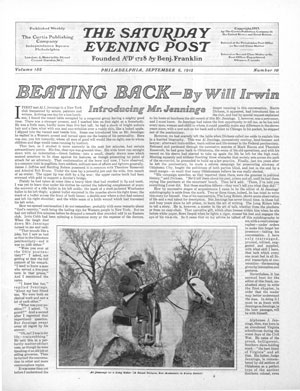
Now, Will Irwin was no kid. He should have known the difference between the dime-novel hero and a plain old crook. A graduate of Stanford University, Irwin had written for several newspapers and national magazines before meeting Jennings. I would expect him to have listened to Jennings’ tales with a hard, professional skepticism. Yet he seems to have swallowed Jennings’ tale and even made excuses for his crimes.
“In his infancy he had found a hostile world arrayed against him and had learned to battle for his rights,” Irwin wrote in the first Beating Back installment. “Such a complex nature as his cannot be expressed by any formula. … But one factor does something to explain it — his aristocratic Southern blood.”
As Irwin portrays him, Jennings is a member of the proud class of Southerners who clung to their code of honor after the Civil War: “Burning with the chagrin of defeat, convinced of the justice in their lost cause, stripped of their slaves and property, born or reared among the hideous disorders of a devastating war, they brought West not only their courage but also their belief in the duello as a corrective against the transition from a feudal state to an industrial state. To this type Al Jennings had bred true.”
Perhaps Irwin got those notions about chivalrous Southern nature from Jennings, who told him, “That high, proud, overbearing blood has a lot to do with the way I acted. When such people are picked on, they believe in their bones that it’s right to tear up the whole earth to get even.”
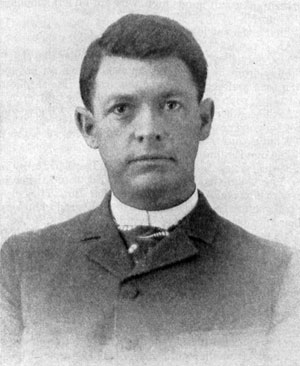
Jennings’ memoirs offer details about his gang and how they held up trains, yet he leaves several important points unexplained. For example, how and why was his brother killed? Why did he run from the law after his brother’s death? Why, exactly, did he become a robber? If his fame as a train robber was so great, why is his name almost unknown today?
Jennings didn’t address these questions, but a modern-day crime writer has. Jay Robert Nash has published dozens of books about crime and criminals. In his Encyclopedia of Western Lawmen & Outlaws (De Capo Press, 1992), he offers an interesting counter-history to Jennings’ memoirs. (Unfortunately, his account doesn’t offer any documentation, so we only have his word to weigh against Jennings’.)
Nash even gives a different account of the reason Jennings took up crime. It begins with two of Jennings’ brothers, Ed and John, who were lawyers. In 1895, Ed and John were in court, defending some men accused of theft. The prosecutor was Temple Lea Houston, son of Texas’ Sam Houston. During the trial, the Jennings brothers exchanged angry words with Houston.
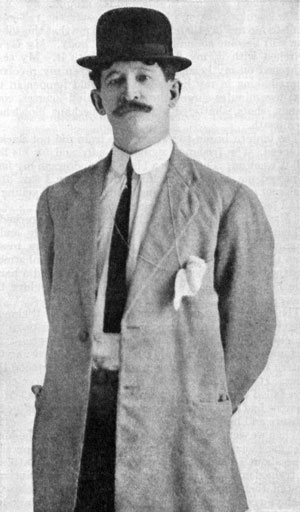
That evening, Ed and John — who’d been drinking heavily — confronted Houston in a saloon. They challenged him to a gunfight and started to draw their guns. Houston shot John in the arm. John’s shot struck and killed brother Ed.
On the day Ed was buried, Al was frantic to exact revenge on Houston, even though Houston hadn’t killed his brother. Jennings’ father, a respected judge, warned him against such foolishness. Furious at being checked by his father, the young man packed his belongings and rode away. Shortly afterward, he held up a grocery story, thus launching his criminal career.
In Beating Back, Al Jennings tells how he built a gang of like-minded cowboys with brother Frank. Soon, he claims, their fame spread throughout Oklahoma. The Jennings gang became “notorious … every robbery of every kind was attributed to us.”
But in Nash’s account, Jennings was a disgrace to the train-robbing profession.
In one robbery, Al stood frantically waving a red lantern over his head in the middle of the railroad tracks, intending to halt and rob a train. But, writes Nash, the locomotive’s engineer didn’t even slow down. Jennings jumped back just in time to avoid being hit.
On another robbery, he used so much dynamite to blow up a mail-car safe that he reduced the safe, its contents, and the entire railway car to splinters. In a third robbery, he and his brother Frank galloped alongside a train ordering the engineer to stop. The engineer, Nash writes, “waved a friendly hello, and kept going. The Jennings brothers, their horses exhausted, fell behind and then came to a panting stop.”
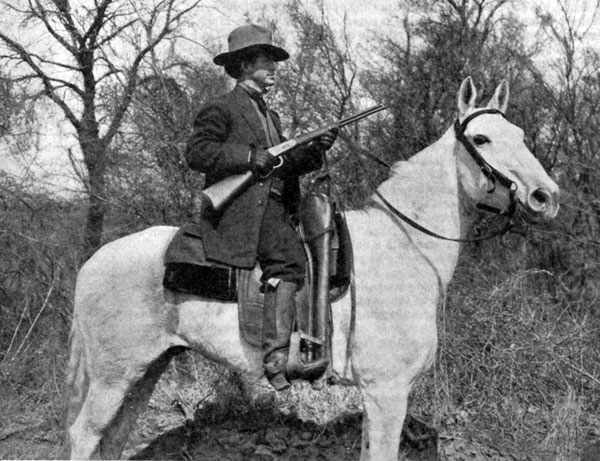
In Al Jennings’ book, he gives three reason for his capture: (1) he was suffering from a gunshot wound; (2) he was betrayed by a friend; and (3) he and Frank were surrounded by a dozen armed lawmen. According to Nash, Jennings was captured when an Oklahoma marshal found him and Frank hiding under a pile of blankets in the back of a wagon. “The boys meekly surrendered,” Nash writes.
Jennings becomes even less believable in his account of his time in prison. He wrote that he arrived at the federal penitentiary in Ohio to find his reputation had preceded him. Everyone — prisoners, guards, and officials — seemed to know and respect him. Occasionally, a warden or trustee tried to bully him, but he always fought back and won. And the few men he didn’t frighten were won over by his intelligence, courage, and integrity. Eventually, he was befriended by the penitentiary warden, who called Jennings his “trusted advisor.”
In 1914, a movie company produced a film version of Beating Back, which was released just prior to the Democratic primary election in Oklahoma. Al and his brother Frank starred in the production. And the film probably won more votes for Jennings, but not enough to win the nomination. He came in third place.
The experience seemed to have taught Jennings that his future lay far beyond Oklahoma City. He soon moved to Hollywood to continue acting and to become a technical advisor for Western movies. His expertise might have rested on nothing more than his imagination, but it was just what Hollywood wanted.
Maybe Al Jennings did none of the things he claimed. Maybe he was incapable of planning and executing a successful train robbery. But we should recognize one skill Al Jennings certainly had. He could charm people. He was able to make people like him and, even more impressive, believe him. He had the ability to convince strangers that he was that romantic fantasy: a fearless criminal with morals and a heart of gold.
The Great War: December 12, 1914
In the December 12, 1914, issue: Irvin S. Cobb describes an airborne weapon introduced to the war.
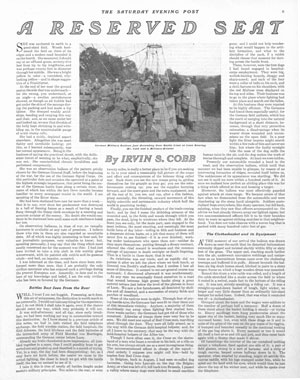
A Reserved Seat
By Irvin S. Cobb
War had become a romantic business in the century of peace that followed Napoleon’s defeat. Generations of young men grew up hearing tales of bravery and military glory. Many yearned for an opportunity to distinguish themselves in battle, earning the fame, the promotion, and the adoration of women that was given to soldiers in the stories they’d heard. But when war came in 1914, it quickly re-educated the youth of Europe about the brutal realities of combat. And now, with new weaponry, killing became even more efficient and more brutal.
Airplanes, for example, had originally been intended only for reconnaissance. But soon the pilots began shooting at other planes or dropping small bombs on enemy lines. In this week’s dispatch from the German lines, Irvin S. Cobb reports a crude device that French pilots were dropping on German troops.
Warning: The following excerpt contains a graphic depiction of death that some readers may find disturbing.
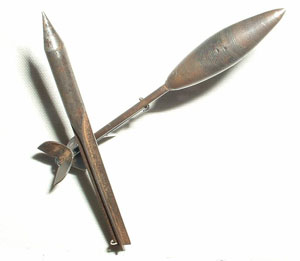
“Soon after we left the stand of 10-centimeter guns, a civilian Red Cross man halted our machines to show us a new device for killing men. It was a steel dart, of the length and thickness of a fountain pen, and of much the same aspect. It was pointed like a needle at one end, and at the other was fashioned into a tidy rudder arrangement, the purpose of this being to hold it upright — point downward — as it descended. It was an innocent-looking device — that dart; but it was deadlier than it seemed.
“‘That flyer at whom our guns were firing a while ago dropped this,’ explained the civilian. ‘He pitched out a bomb that must have contained hundreds of these darts; and the bomb was timed to explode a thousand or more feet above the earth and scatter the darts. Some of them fell into a cavalry troop on the road leading to La Fere.
“‘Hurt anyone? Ach, but yes! Hurt many and killed several — both men and horses. One dart hit a trooper on top of his head. It went through his helmet, through his skull, his brain, his neck, his body, his leg — all the way through him lengthwise it went. It came out of his leg, split open his horse’s flank, and stuck in the hard road.
“‘I myself saw the man afterward. He died so quickly that his hand still held his bridle rein after he fell from the saddle; and the horse dragged him — his corpse, rather — many feet before the fingers relaxed.’
The officers who were with us were tremendously interested — not interested, mind you, in the death of that trooper, spitted from the heavens by a steel pencil, but interested in the thing that had done the work. It was the first dart they had seen. Indeed, I think until then this weapon had not been used against the Germans in this particular area of the western theater of war. These officers passed it about, fingering it in turn, and commenting on the design of it and the possibilities of its use.
“‘Typically French,’ the senior of them said at length, handing it back to its owner, the Red Cross man — ‘a very clever idea too; but it might be bettered, I think.’ He pondered a moment, then added, with the racial complacence that belongs to a German military man when he considers military matters: ‘No doubt we shall adopt the notion; but we’ll improve on the pattern and the method of discharging it. The French usually lead the way in aerial inventions, but the Germans invariably perfect them.’”
The new weaponry of war was increasing the ability to cause greater destruction from a greater distance. But they soon learned that, as distance increased, accuracy declined. The collateral damage — to civilians and their cities — was rising sharply. The generals began deflecting criticism by blaming the enemy.
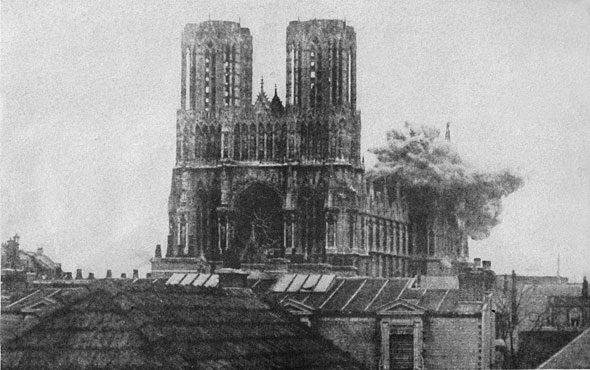
“We could, with the aid of our glasses, make out the buildings in Rheims, some of which were then on fire — particularly the great cathedral. Viewed from that distance it did not appear to be badly damaged.
“Already during that week, from many sources, we had heard the Germans’ version of the shelling of Rheims Cathedral, their claim being that they purposely spared the pile from the bombardment until they found the defenders had signal men in the towers; that twice they sent officers, under flags of truce, to urge the French to withdraw their signalers; and only fired on the building when both these warnings had been disregarded, ceasing to fire as soon as they had driven the enemy from the towers.
“I do not vouch for this story; but we heard it very frequently. Now, from one of the young officers who had escorted us into the trench, we were hearing it all over again, with elaborations. …
“We were noncombatants and nowise concerned in the existing controversy; but we remembered the plaintive words of the Chinese minister at Brussels when he called on [the U.S. minister in Belgium] — Brand Whitlock — to ascertain what Whitlock would advise doing in case the advancing Germans fired on the city. Whitlock suggested to his Oriental brother that he retire to his official residence and hoist the flag of his country over it, thereby making it neutral and protected territory.
“‘But, Mister Whitlock,’ murmured the puzzled Chinaman, ‘the cannon — he has no eyes!’”
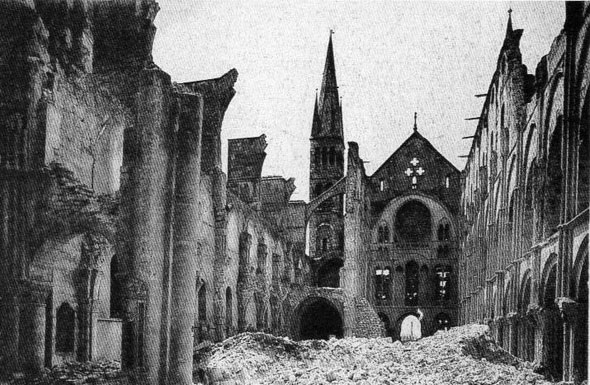
Step into 1914 with a peek at these pages from The Saturday Evening Post December 12, 1914 issue.

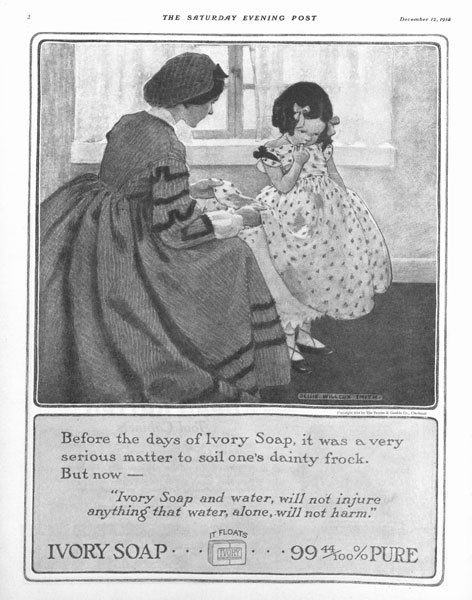
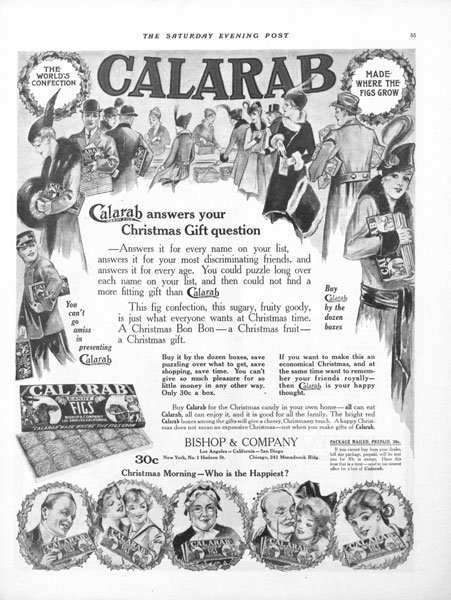
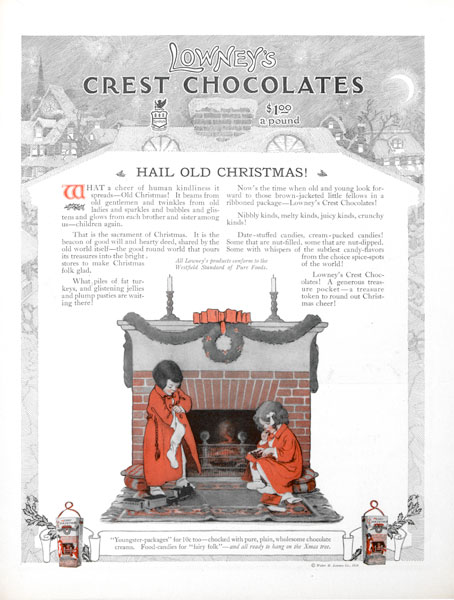

Merry Christmas and Happy Holidays to All!
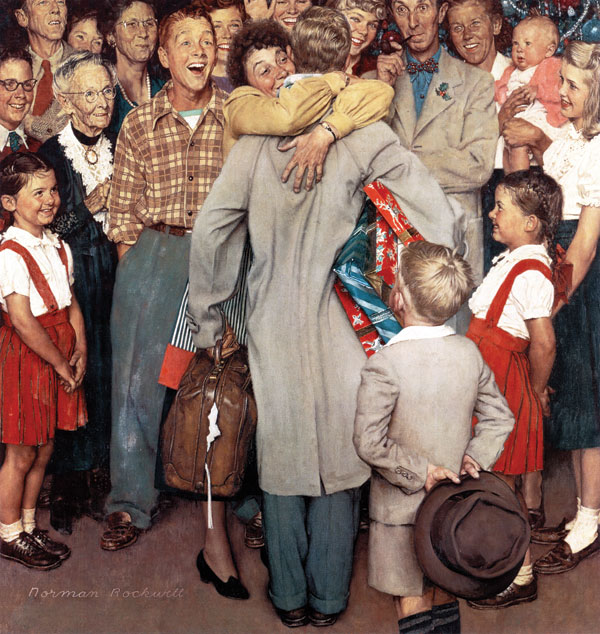
Norman Rockwell
The Saturday Evening Post
December 25, 1948
My family spent every Thanksgiving and Christmas at Pop and Molly’s. Those are magical memories for me — my experience of those times was something straight out of one of my grandfather Norman Rockwell’s paintings. We would take the snowy drive up the Taconic to Stockbridge. Pop’s house, especially around the holidays, was its own universe, a place where I felt totally safe and taken care of. The grandchildren had full run of the house, and we would hide in the closets among the musty coats or stage plays in the main hall, explore the attic, have our Canada Dry Ginger Ale and the exotic macadamia nuts that someone sent my grandfather every year from Hawaii … The adults would have their cocktails in the library. And there would be Pop — in his comfortable red chair by the living room fireplace and the twinkling Christmas tree, the wonderful aroma of his pipe filling the air, a bourbon sour in his hand. The cook would call us into dinner at six as the grandfather clock in the front hallway chimed. And we would be greeted by fresh, warm sticky buns (Pop’s favorite) and a wonderful turkey with all the trimmings or a roast beef with Yorkshire pudding (my favorite!).
I have heard people speak of the unrealistic, unattainable, idealistic picture of life in my grandfather’s paintings — “It’s not always as perfect as a Norman Rockwell painting …” Pop’s work isn’t about manifesting some sort of unachievable perfection. His work is about believing in the goodness of people. It’s about looking for that goodness in ourselves and others in the moments we spend with one another.
Instead of being haunted by the idea of perfection, why don’t we instead allow ourselves to be inspired by it — reveling in the possibility of it? It is that possibility that helps to propel us to evolve and grow — and to deepen and expand our vision of what can be.
It’s important to remember that even Norman Rockwell did not have a Norman Rockwell life — he had much the same troubles that we all do as we journey through this life. But he always, no matter what, affirmed life and upheld his vision of how he wanted it to be. And that’s a good template for us all.
Many blessings for a special holiday for each and every one of you and your families — even if your family is you and your dog, or you and a friend! It is the love that makes a family.
Warmly,
Abigail
Japan Turns Against the U.S.
When Japan crossed the Manchurian border to invade China in 1937, it expected an easy conquest. But two year later, its army had fallen far behind schedule, and success was nowhere in sight.
“Japan has thrown her full military strength into China and has not been able to clinch a victory,” Hallett Abend reported. (“Japan Picks On Uncle Sam,” November 25, 1939) “Nor has she been able to make any profit from the venture. The expenditure of manpower and of money goes on and on, and seems destined to continue indefinitely. Japan cannot accept blame for this failure — some other power must be made a villain for the piece.”
The imperial Japanese government needed foreign enemies to remain in power Since the 1920s, it had become increasingly totalitarian, dedicated to growing its empire through military conquest. But its plans for conquest required a firm hold on power at home. By asserting that foreign governments were planning to conquer Japan, the government could keep the state in a permanent state of readiness. Foreign threats also justified suppressing democratic opponents in the government and forcing more of the population into military service.
Russia had been an attractive enemy. (The two countries had remained at odds since Japan had emerged as the surprise victor in the 1905 Russo-Japanese war.) The Soviet army in Siberia presented a constant threat to Japan’s armies just across the border in Manchuria. In 1938, the two countries had fought a battle over this border. When they clashed again in 1939, the Russians soundly defeated the Japanese who now kept a safe distance from the Soviet army.
Great Britain, the dominant colonial power in Asia, was a natural enemy. And now British interests in China were complicating Japan’s attempt to sweep across the country. And in the Pacific, the British fleet was a serious threat to Japan’s navy.
In 1939, the Japanese identified a new enemy. That year, the U.S. had revoked its 1911 trade agreement with Japan, hoping it could pressure Japan to end its China venture and scrap its New Order program for East Asia. “The abrogation of the trade treaty has scared and angered Japan,” Abend wrote. “She fears being cut off from her main sources for essential war supplies, and is dumfounded at the threat of having to lose her best market for her major export, silk.”
The war in Europe had already hurt Japan’s export market. With European nations busily arming themselves, Japan found it difficult to purchase weapons for its China venture. Meanwhile credit from European sources was drying up, which left the U.S. as its last source for resource. Japan’s reliance on American oil was a point of particular vulnerability. So the Tokyo government decided to push back at the U.S.
The Japanese press, which was strictly controlled by the Imperial government, began running stories about American aggression against Japan, hinting that the U.S. was planning to attack the islands.
“Uncle Sam is now regarded by the Japanese public as the big bad man of the world,” wrote Abend. “No mention is made of the two years of American official patience and forbearance, during which there were more than 600 flagrant violations of American rights and properties in China. The Japanese public has no knowledge of the fact that more than 600 American protests are on file in Tokyo, and that few of these cases have been adjusted. The list grows longer every week.”
Despite its anger at the rape of China, America continued trading with Japan. The U.S. had “overwhelming sympathy” for China, Abend wrote, but it remained committed to neutrality. And American businesses continued selling steel and oil to Japan’s forces.
Abend’s article concludes with an observation I’ve often found in articles of this time, all of which anticipate the climax of Japan’s opposition to the American presence in the Pacific. “only one thing … would drive America to a reluctant abandonment of that neutral attitude. This would be deliberate and intolerable provocation on the part of Japan herself. Common sense should lead Japan to reverse her anti-American campaign.”
As long as Japan could keep buying oil, it wouldn’t want common sense.
The Great War: December 5, 1914
In December 5, 1914, issue: A senior British army officer predicts the war will last much longer than is anticipated, and a German officer shares the horrors of war.
An Interview with Lord Kitchener
By Irvin S. Cobb

Looking at the massive death toll of the First World War, it’s easy to believe the armies were led by incompetent, out-of-touch officers. In the British army, two officers have been picked out for heavy criticism: Field Marshal Douglas Haig and the man who preceded him, Horatio Herbert Kitchener. When historians speak of the British army of WWI as “lions led by donkeys,” they usually have Haig and Kitchener in mind. (You might recognize Kitchener’s face from “Your County Needs You.”)
In October of 1914, the Post correspondent became the first newspaperman to land a wartime interview with Britain’s top officer. Kitchener, as described by Cobb, comes across as both intelligent and farsighted, though Cobb comes across as more than a little dazzled by the field marshall. “From the dull-metal buttons to the arm-seam,” he wrote, “across the left breast of the coat, ran narrow twin lines of ribbon decorations … so numerous that it was of no use to try to count them. I know, because I tried.”
Kitchener began the interview by firing questions at Cobb, who had recently toured the German forces. Asked how the Germans justified their invasion of Belgium, Cobb told Kitchener the Germans initially regretted violating Belgian neutrality; later they began claiming Belgium was secretly allied to France. “In other words, Kitchener replied, “the Germans prepared their alibi after the act was committed — which weakens the alibi without excusing the act. It is a poor defense that must be changed in the middle of the trial.”
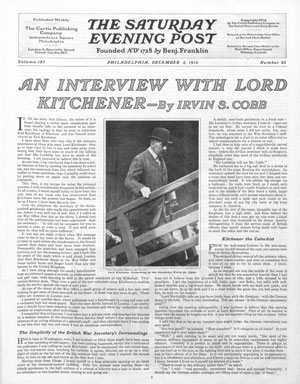
Kitchener has been faulted for several shortcomings: an inability to delegate, a lack of political savvy to hold his own in the British cabinet, his approval of Winston Churchill’s disastrous Gallipoli campaign. But Kitchener was smart and could be perceptive. He readily admitted the nature of war was changing. He also recognized, and planned for, a much longer war than many government officials expected. When Cobb asked how long the war would last, Kitchener replied, “Not less than three years. … It might last longer.”
“He said three years!” Cobb declared. “And at the time of speaking the war was a few days less than three months old. “Three months — the seas already empty of commerce and the lands of half the world shaking to the tread of marching millions who produce nothing and devour everything! … A year means half of Europe underground and the other half on crutches! Two years means a continent turned into a charnel house and a hemisphere ruined for a generation to come! … And the supreme head of the British forces had just said there would be three years of it, and perhaps more than three years of it!”
Four years, to be precise. Four years and four months.
War de Luxe
By Irvin S. Cobb
In his next report from the German lines, Cobb noted how the automobile and communication technology was changing the way soldiers fought wars:
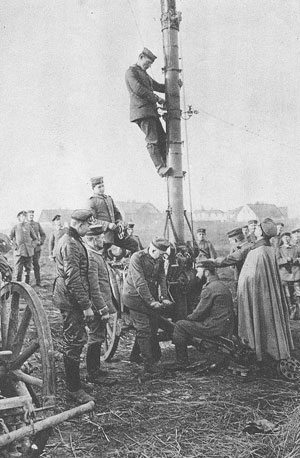
“The day is done of the courier who rode horseback with orders in his belt. … And the day of the secret messenger who tried to creep through the hostile picket lines with cipher dispatches in his shoe, and was captured and ordered shot at sunrise, is gone too, except in Civil War melodramas. Modern military science has wiped them out along with most of the other picturesque fol-de-rols of the old game of war. Bands no longer play the forces into the fight — indeed I have seen no more bands afield with the lead-colored columns of the Germans than I might count on the fingers of my two hands; and flags, except on rare show-off occasions, do not float above the heads of the columns; and officers dress as nearly as possible like common soldiers; and the courier’s work is done with much less glamour but with infinitely greater dispatch and greater certainty by the telephone, and by the aeroplane man, and most of all by the air currents of the wireless equipment. We missed the gallant courier, but then the wireless was worth seeing too.
“Among the frowzy turnip tops two big dull-gray automobiles were stranded, like large hulks in a small green sea. Alongside them a devil’s darning-needle of a wireless mast stuck up, one hundred and odd feet, toward the sky. … From its needle-pointed tip, the messages caught out of the ether came down by wire conductors to the interior of one of the stalled automobiles and there were noted down. … The spitty snarl of the apparatus filled the air. … It made you think of a million gritty slate pencils squeaking over a million slates all together. We were permitted to take up the receivers and listen to a faint scratching sound that must have come from a long way off. Indeed the officer told us that it was a message from the enemy that we heard.”
One thing about war hadn’t changed though — the smell of the dead:
“A puff of wind, blowing to us … from across the battlefront, brought to our noses a certain smell which we all knew full well.
“‘You get it, I see,’ said the German officer who stood alongside me. ‘It comes from three miles off, but you can get it five miles distant when the wind is strong. That’ — and he waved his left arm toward it as though the stench had been a visible thing — ‘that explains why tobacco is so scarce with us among the staff back yonder in Laon. All the tobacco which can be spared is sent to the men in the front trenches. As long as they smoke and keep on smoking they can stand — that!’
“‘You see,’ he went on painstakingly, ‘the situation out there at Cerny is like this … the English held the ground first. We drove them back and they lost very heavily. In places their trenches were actually full of dead and dying men when we took those trenches. You could have buried them merely by filling up the trenches with earth.
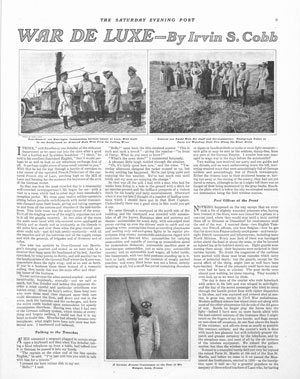
“‘At once they rallied and forced us back, and now it was our turn to lose heavily. That was nearly three weeks ago, and since then the ground over which we fought has been debatable ground, lying between our lines and the enemy’s lines … literally carpeted with bodies of dead men. They weren’t all dead at first. For two days and nights our men in the earthworks heard the cries of those who still lived, and the sound of them almost drove them mad. There was no reaching the wounded, though, either from our lines or from the Allies’ lines. Those who tried to reach them were themselves killed. Now there are only dead out there — thousands of dead, I think. And they have been there 20 days. Once in a while a shell … falls into one of those trenches. Then — well, then, it is worse for those who serve in the front lines.’
“‘But in the name of God, man,’ I said, ‘why don’t they call a truce — both sides — and put that horror underground?’
“He shrugged his shoulders. ‘War is different now,’ he said. ‘Truces are not the fashion.’”
Step into 1914 with a peek at these pages from The Saturday Evening Post December 5, 1914 issue.
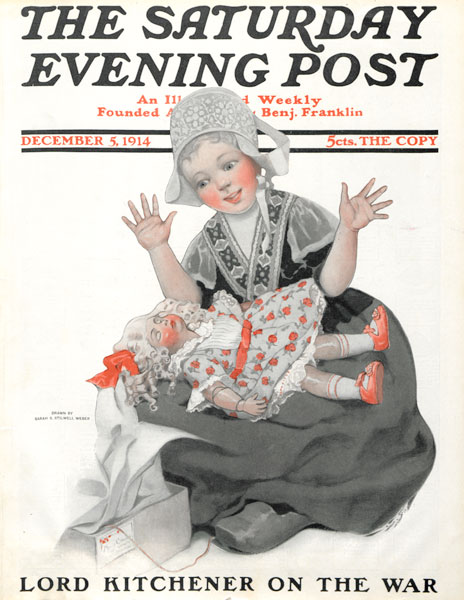
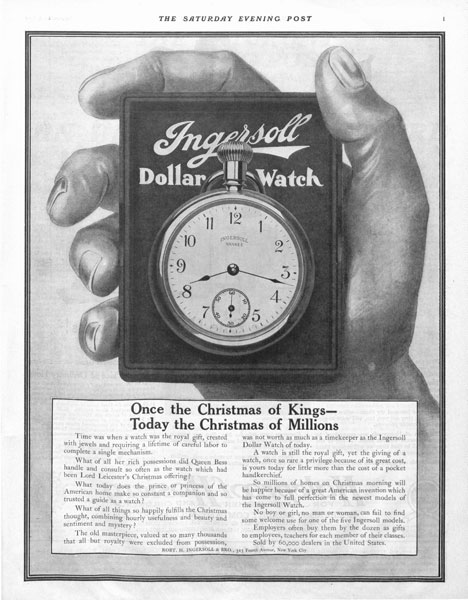
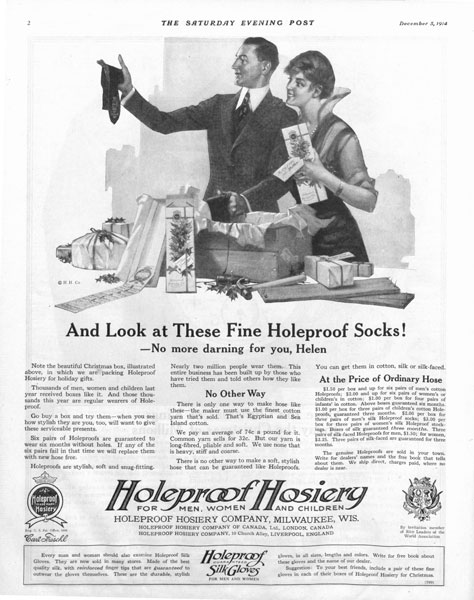
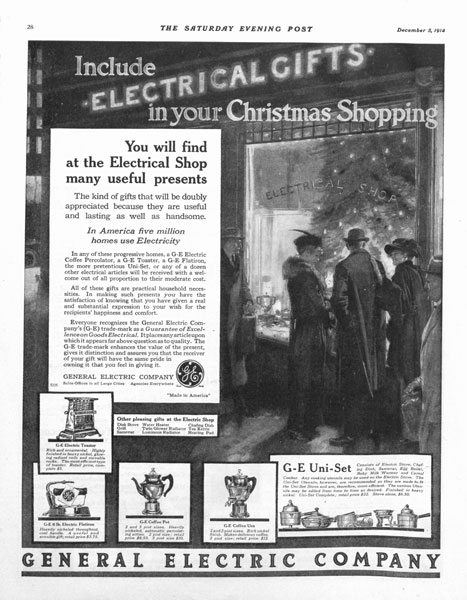


Operation Round Orange
It’s day 11 of Operation Round Orange. I fear I’m driving Father mad, but I must not allow sentimentality to sway me. The stakes are too high.
Today our battle of wills brings us to the kitchen. Father sits on a chair in front of me, and I sit on my white plastic training potty with my big-boy pants around my ankles. The Elmo clones on my undergarments stare at me with their dead, accusing eyes.
“Come on, Joey, just go,” says Father.
“No,” I say.
“Don’t you have to go?”
“No, Mama.”
“Dada, I’m Dada.”
“Mama,” I say.
I smile as I see Father’s temples start to throb. He rises and turns the kitchen faucet on to a trickle.
“How about now, Joey?” asks Father. “Have to go?”
The sound of water spattering in the sink brings my bladder to near bursting, but I refuse to be betrayed by my own body.
“No, Mama. Orange?”
Father glances at a pile of oranges and bananas sitting in a fruit bowl. “Sure buddy. I’ll peel you an orange as soon as you go potty.”
I shake my head and point to a high kitchen cabinet, well out of reach. “Round orange.”
Father offers a nervous laugh. “You know that’s not where we keep the oranges, buddy.”
We lock stares. Beads of sweat threaten to erupt from my skin, but it is Father who breaks first.
“Fine, Joey. We’ll try again later.”
“Okay, Mama.” I stand, pulling up my undergarments.
Father reaches for the phone, and I stroll from the kitchen with as much dignity as my swollen bladder will allow. Out of sight, I charge down the hall.
The cat occupies her litter box but has long since finished her business, and we both know it.
“Move, kitty!” I say.
The cat stares at me, then looks away without moving.
I know her game, but we have an agreement, and I’m in no mood to renegotiate.
“Move, kitty!” I repeat. I drop my big-boy pants and the cat steps from the box just as my stream hits the floral-scented sand. Relief washes through me. When I’m finished, the cat offers me a sulky glare then moves to cover the evidence.
I pad back to the kitchen where I hear Father speaking on the phone.
“It’s been like two weeks, dude,” he says to the person on the other end. “No pee or poo at all. I’m freaking out!” He pauses, then blanches and shakes his head. “She’ll kill me if I have to take Joey to the ER.” He pauses again. “Yeah, she’s due back from the conference tomorrow.”
“Orange,” I say, pointing to the cabinet.
“What?” Father looks at me, bewildered, then hands me an orange from the bowl. “Just my kid asking for some fruit,” he says. “No, he seems fine.”
Sighing, I drop the fruit to the floor and pad to the living room. A pang in my bowels alerts me that my bladder was not the only part of my body in need of relief.
My baby sister and the dog are waiting on the couch. On the television an insipid purple dinosaur sings of love.
Seeing me, my sister flashes her fingers in a series of signs.
Slower, I sign back. I can’t understand you.
She flashes more signs, frustration evident on her face.
Yes, I know you hate the dinosaur, I say, but one thing at a time. Be patient.
She waggles her fingers too quickly for me to follow.
Slower, you idiot! I told you you’re going too fast!
My sister put special emphasis on the next set of signs.
Oh, real nice, I say. You kiss your mother with that mouth?
She extends her middle finger.
The growing pressure in my bowels reminds me of my more immediate concerns.
I know you can count to one, I sign to my sister. Can you make it to 10, like we discussed?
She nods.
“Dog,” I say — the animal’s ears perk. “Go.”
The dog scurries from the room, barking.
Following the animal to the kitchen, I find the dog pawing at the sliding glass window leading to the backyard. Father, still on the phone, slides the door open and the dog scrambles outside. An instant later my sister begins to squall in the living room.
“Crap, gotta go, dude,” says Father, replacing the phone in the cradle. He sprints from the kitchen, leaving the sliding door ajar.
I rush outside, joining the dog in a blissful squat. I smile as the sun bathes my face with warmth and the grass tickles my bare bottom. There’s something very primal about taking a dump with one’s best friend. I cherish these moments, but alas, all good things must come to an end.
Turning, I wave at my two neighbors sitting on lawn chairs in the adjacent yard. They stare at me and the dog.
The gray-haired man says to the gray-haired woman, “See, I told you he lets his kid shit in the yard.”
The gray-haired woman returns my wave.
***
It’s day 12 of Operation Round Orange and time is growing short. I find myself again on my plastic potty, and Father in his familiar chair.
“Round orange, Mama,” I say, pointing to the high cabinet.
Father sighs. “Just as soon as you do your business, buddy, I’ll get you that orange.”
“No.” I point again at the cabinet.
“Look, Joey, I don’t know what —” Father’s stops mid-sentence at the sound of the front door opening.
The dog barks happily in the living room. My sister gives an excited squeal.
“Oh, my baby, I missed you so much,” comes Mother’s voice.
Father’s shoulders slump in resignation. He rises to meet Mother, but I stay where I am. Now is the time for the pièce de résistance.
When Father and Mother return to the kitchen, my sister in Mother’s arms, I stand smiling next to my training potty.
“Look, Mama.” I point to the toilet. “Dada showed me.”
Mother peers down and beams. “Number one and number two,” she says. “I’m so proud of my big boy!”
Father stares at me, his mouth agape.
“Orange,” I say.
“Of course, Joey,” says Mother. “You deserve a prize.” She reaches for an orange in the fruit bowl and winks at Father. “Dad will get his prize later.”
Father grins, his face flushed. When Mother turns away, Father and I lock eyes.
“Round orange,” I say to him, pointing to the high cabinet.
Father stares at me one moment more, then nods.
Mission accomplished.
***
It’s day one of Operation Fighting Robots.
Father, the cat, the dog, and my sister and I sit in the living room. A jumbo-sized canister of cheeseballs once hidden in the kitchen cabinet lies open on the floor, half empty. The cat’s whiskers and dog’s muzzle are coated in neon orange.
The purple dinosaur is on the television again. My sister looks at me expectantly and makes a single sign. With orange-dusted fingers, I respond in the affirmative.
Pointing to the television, I say, “Robots, Dada.”
Wiping neon powder from his face, Father nods. “Way ahead of you, buddy.” He reaches for the remote.