How to Be Neutral
Why does America find it so difficult to remain neutral?
Why do we seem impelled to take sides and get involved in global politics?
A century ago, as the U.S. watched Europe sinking in the First World War, President Woodrow Wilson asked Americans to be “neutral in fact, as well as in name. … We must be impartial in thought, as well as action, must put a curb upon our sentiments, as well as upon every transaction that might be construed as a preference.”
But when war returned to Europe 25 years later, President Roosevelt declared, “This Nation will remain a neutral nation, but I cannot ask that every American remain neutral in thought as well. Even a neutral has a right to take account of facts. Even a neutral cannot be asked to close his mind or his conscience.”
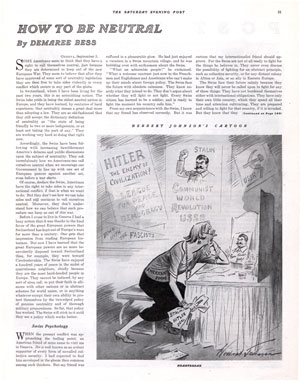
This was not neutrality, wrote Post contributor Demaree Bess, and he knew what he was talking about. For the previous two years he had been living in Switzerland. The small European republic had maintained its freedom for over a century while observing rigorous neutrality, which he defined as “the state of being friendly to two or more belligerents, or at least not taking the part of any.”
The Swiss, he wrote, couldn’t understand how Americans thought they were being neutral when they were encouraging their government “to line up with one set of European powers against another set, even before a war starts.” According to Bess, Americans thought simply declaring neutrality gave them the right “to take sides violently in every conflict which occurs in any part of the globe.”
The Swiss would stay out of the war, Bess wrote, because they would not fight for the things they believe in. The only cause for which the Swiss would take up weapons — which they were ready and prepared to do — was an invasion of their homeland. “They never even discuss the possibility of fighting for an abstract principle, such as collective security, or for any distant colony … or an ally in Eastern Europe. … They have only their own little country, which they spend all their time and attention cultivating. They are prepared and willing to fight for that country, if it is invaded.”

Between 1936 and 1939, the Swiss had spent $230 million to reorganize defenses. They modernized weaponry, especially antiaircraft defense and frontier fortifications. The government also increased the amount of training required of all Swiss citizens between 18 and 60 years of age. “This country of 4 million can put an army of 500,000 into the field within two days or less,” Bess wrote. When the Swiss Federal Council saw Europe sliding toward war, it mobilized the entire army. In just three days, its entire national force was ready.
Bess obviously admired the Swiss system, which, he reported, had created a “democracy united in its determination to preserve its democratic ideals as well as to keep its boundaries intact.” Reading his article, you get a sense that he thought the United States would be smart to adopt the Swiss model, and in his words “mind its own business.”
Could the U.S. have remained neutral, as its isolationists wanted? Probably not, in the long run. As much as its citizens might have wanted to stay out of the conflict, the country’s great wealth, spacious land, and open borders would have proved too tempting for the Axis, who would have found some pretext to seize American soil.
Japan was already anticipating an attack on American interests in the Pacific in 1939. Hitler, though, didn’t draw up concrete plans for conquering America, because he believed it was peopled by mongrel races incapable of defending themselves. He probably assumed that, after subjugating Europe and Russia, America’s manufacturing and agricultural wealth would simply fall into his lap.
Switzerland could make neutrality work because of several advantages America didn’t enjoy. First were its formidable mountainous borders. Admirable as its citizen army might have been, its effectiveness depended as much on the country’s alpine geography as its training and spirit. The Swiss army might have proved far less effective if it had to defend a nation as flat as Poland. Nazi Germany had, indeed, drawn up plans to invade Switzerland, but concluded that that conquering such a mountainous country wouldn’t be worth the cost.
Switzerland also benefitted from Nazi’s leniency toward the Swiss whom the Nazis considered essentially German. Hitler and his followers didn’t feel compelled to dominate the Swiss as they had the Czechs and Poles.
Besides, a small, wealthy neutral country next door offered many attractions to Nazi Germany. Switzerland provided an intelligence post where German agents could pick up Allied information. Also, several banks in Switzerland proved very helpful to Nazi officials who wanted to store their plunder beyond the reach of their own government. They found Swiss bankers more than happy to do business with them, even enabling them to store and trade stolen paintings.
Moreover, factories in neutral Switzerland, which weren’t being bombed by the Allies, could provide Germany with a steady supply of much needed steel and weapons. And, for a price, the Germans could use Switzerland’s transalpine railway to keep supplies flowing to their ally Italy.
But Bess couldn’t have known all this in 1939, when neutrality still seemed a workable response to the world war. The next seven months proved what a bad idea this policy was. One by one, other neutrals — Norway, Belgium, Luxembourg, and Holland — were seized by the Nazis, bringing the war closer to the shores of neutral America.
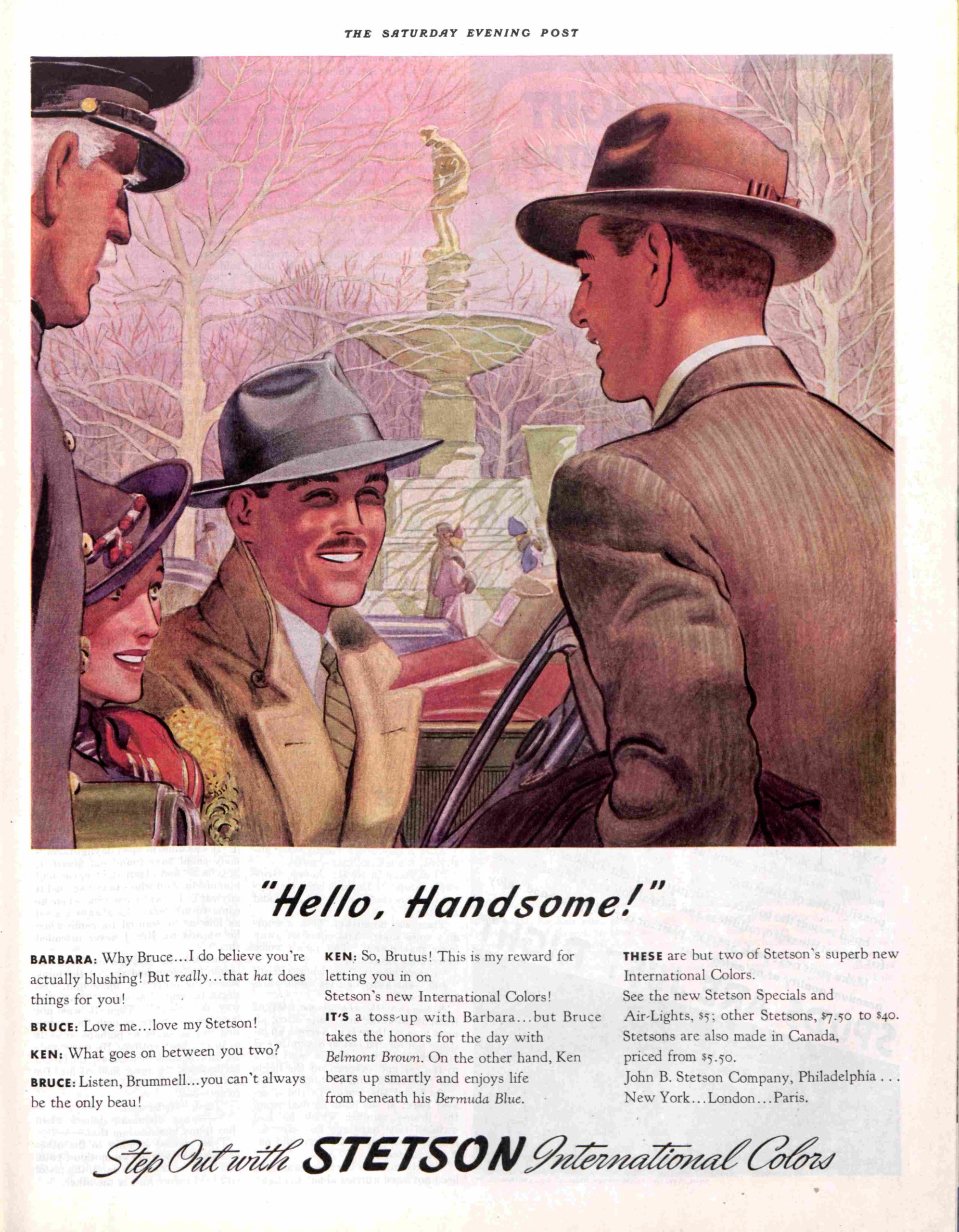
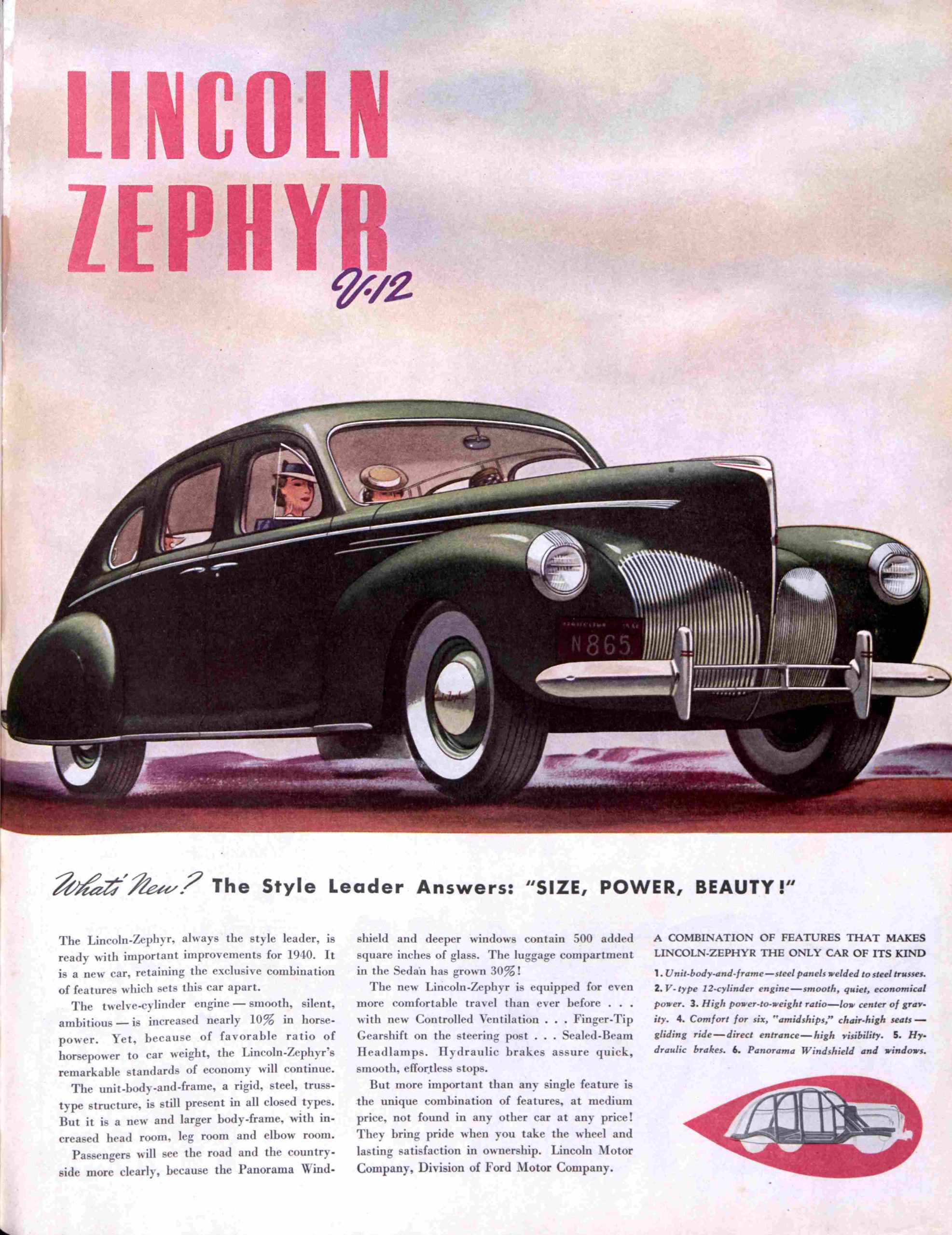
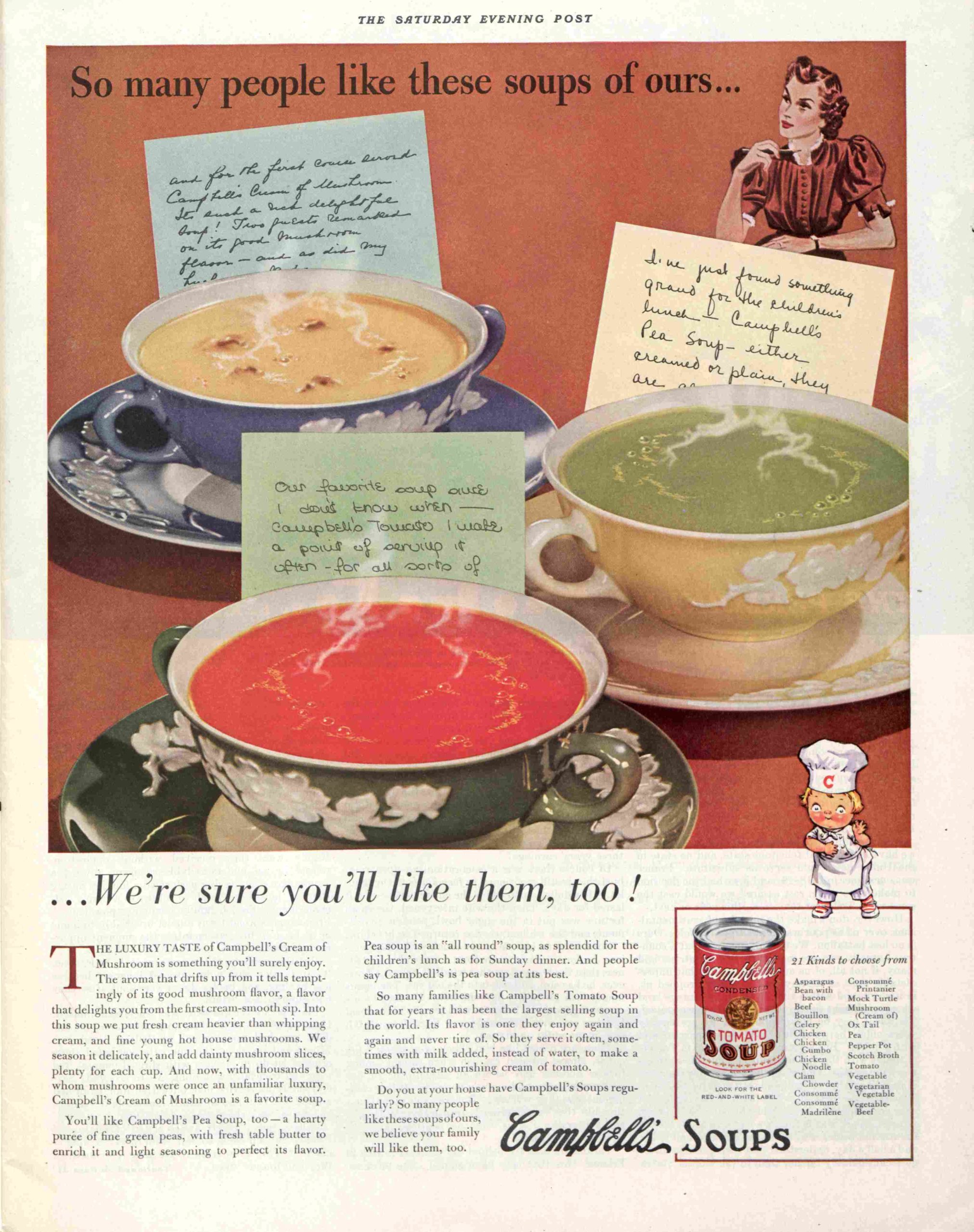
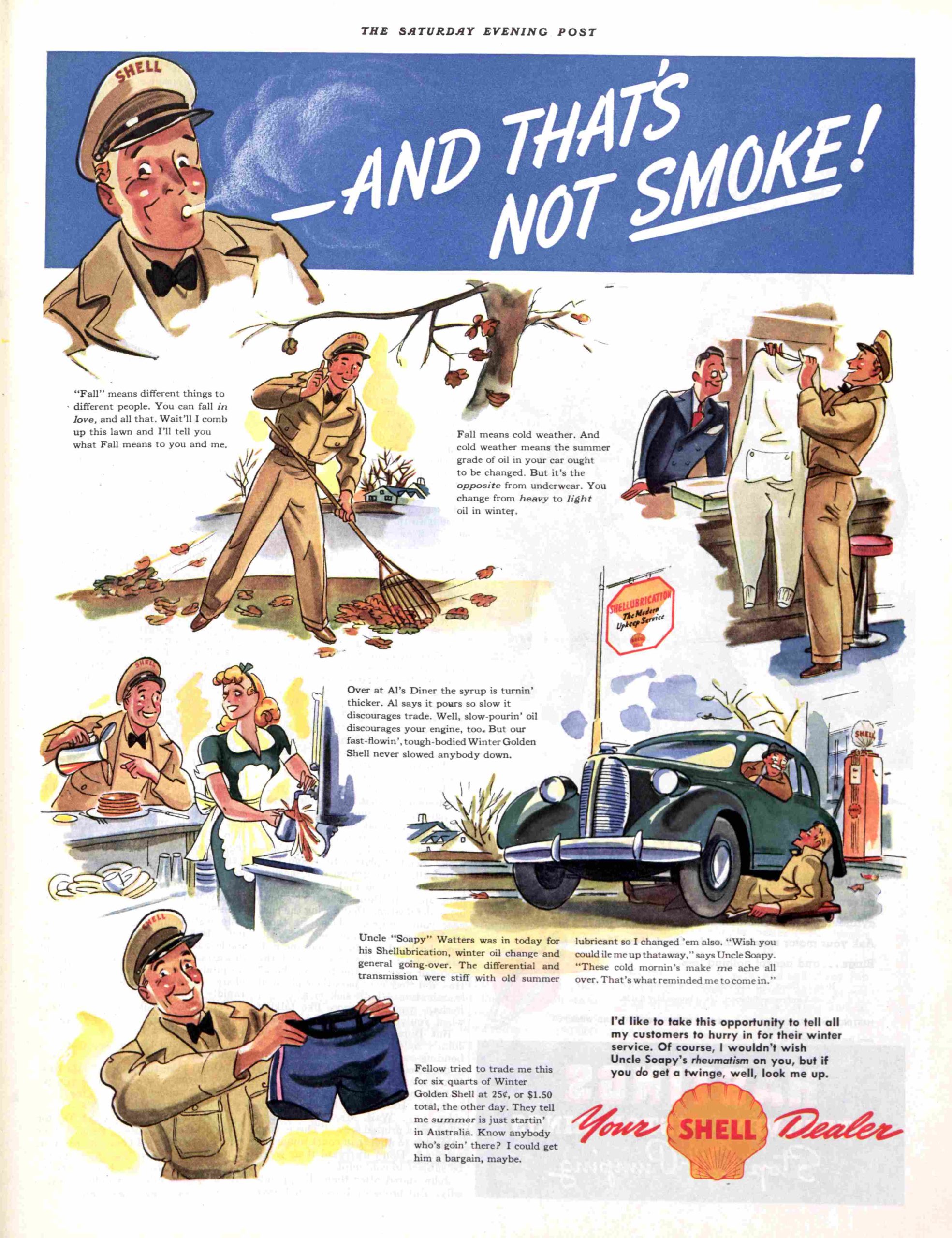
Step into 1939 with a peek at these pages from The Saturday Evening Post 75 years ago:

3 Questions for Sir Roger Moore

At 86, Roger Moore is as elegant and suave as ever. Time hasn’t dimmed his piercing deep blue eyes or his sly wit. The actor, known for his seven James Bond flicks, as well as the TV series The Saint and a raft of other roles, was knighted in 2003 by Queen Elizabeth for his work with UNICEF. These days, he kicks back at homes in Monaco and Switzerland with his fourth wife, Kristina Tholstrup — they’ve been together for 21 years — but you can’t exactly say he’s retired. Having recently published his third book, One Lucky Bastard — Tales from Tinseltown, now he’s taking his show on the road with An Evening with Sir Roger Moore. “I talk about the early days and the interesting stuff that happened to me. I even sometimes sing. Well, not actually. I make a noise that I call singing.”
Moore is the first to admit that his years as James Bond have never left him. But he’d like to set the record straight on one thing. “I never said ‘a martini should be shaken not stirred.’ I was nervous enough about having to say, ‘Bond, the name is James Bond,’ because I was afraid it would sound like I was doing an impression of Sean.”
Jeanne Wolf: You’ve had such an eventful life. Do you feel like a lucky bastard?
Roger Moore: Oh, absolutely. I can remember being told when I started out in the business that you needed 33 percent talent, 33 percent personality and looks, and 33 percent luck. I say it’s 99.9 percent luck. I’ve had a number of friends who were very talented, but luck didn’t come their way.
JW: You’ve been married four times. Are you wiser about women at this point in your life?
RM: The secret is that the man always will have the last word, which is “yes-dear.” When it comes to the ladies I’ve shared sets with, I credit Lana Turner for teaching me about kissing. In Diane when the king dies, I say to Lana, “You made me a prince, now make me a king,” and I’m supposed to throw myself on her and kiss her throat. In the first take she fell backward choking and said, “Cut, cut! Roger you are a wonderful kisser but when a lady gets to 35 she has to be careful about the neck. So do it again with the same amount of passion but less pressure.” As for love scenes, usually it’s 8 o’clock on a Monday morning, the studio has been shut over the weekend, the heat hasn’t been on, you’re freezing cold, it’s the middle of winter, and you have to sort of leap into bed with a lady who drops her towel or is wrapped modestly under the sheets and then the romance should start. There is no romance. I remember at the beginning of the first Bond film that I ever did I was in bed with an actress who was very well developed. And I had to have my arm over her rather voluptuous breasts to show that I was wearing a Pulsar watch because they’d paid a lot to get the publicity.
JW: You’ve changed a lot over the years and so has the Bond franchise. What do you think of the new guy, Daniel Craig?
RM: The 007 films have become far more action-oriented, a little more spectacular, and I think that Daniel is the right man for the time. Actually, I think he would have been the right man for any time because he really looks like James Bond should look — like a killer as Sean Connery did. Some people labeled me the most gentlemanly Bond. I think I said, “I could never kill anybody so I’d either bore them to death or hug them to death.” I was a part of some action scenes but I was always thinking “Am I quick enough on my feet to get out of the way of that?” That’s when the ego steps in and you say, “Oh, yes. I can do that. I’m a hero.” But inside I was quivering like mad.
Love Letters
We live in a post-postal age.
Digital messages have largely replaced written communication. But digital messaging allows communication without contact. It is easy and fast, and for the most part dependable. So why do I still write letters?
The qualities of a good letter are also the qualities of a good relationship. Letters are the tangible manifestation of the singularity of our kinship, the importance of our shared experiences, and the care and effort that is taken in our conversations. Letters are the physical tokens of kindness we show each other and are the proof of my allegiance and our alliance. Letters are abiding and durable. Letters are markers of our love.
Sullivan Ballou of the Union Army wrote to his wife during the early months of the Civil War, promising her that “my love for you is deathless, it seems to bind me with mighty cables that nothing but omnipotence can break. … If I do not return, my dear Sarah, never forget how much I loved you.” He then offered his hope that “the dead can come back to this earth and flit unseen around those they love, [for then] I shall always be with you, in the brightest day and in the darkest night … always, always. And when the soft breeze fans your cheek, it shall be my breath, or the cool air your throbbing temple, it shall be my spirit passing by.”
One week later Ballou died in the first Battle of Bull Run. But his promise had been made, and letter sent.
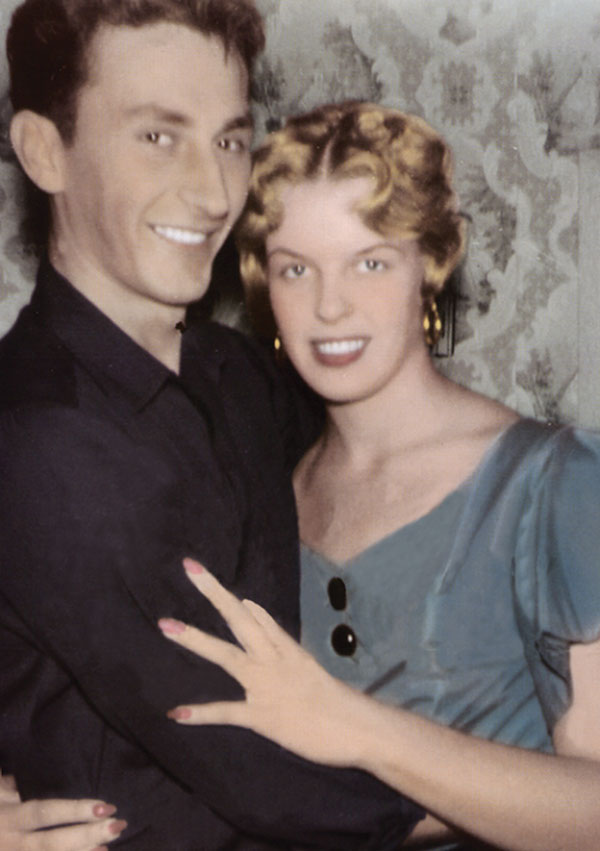
Mike Royko and Carol Duckman grew up together, living close by each other on Chicago’s North Side. By age 10 Mike was in love with Carol, but Carol had other fish to fry. Mike enlisted in the Air Force in 1952, heading off to Korea at age 19; Carol became engaged to a man from the neighborhood.
Then one day Mike got a letter from Carol. She told him she had separated from her husband; the marriage had been “a mistake.” Mike wrote back in double time, admitting his long-held feelings for her: “I’m in love with you … For a couple of years I wondered when I would stop thinking about you every day. I’ve come to the conclusion that I won’t. So as long as I have to keep going this way you may as well know about it.”
Purchase the digital edition for your iPad, Nook, or Android tablet:

To purchase a subscription to the print edition of The Saturday Evening Post: 
A Blessed Christmas

It was the day before Thanksgiving, and I was already on the phone with Cheryl Werner, co-owner of Werner’s Tree Farm near Middlebury, Vermont.
“OK, here’s what I need this year,” I began after we’d exchanged our yearly so-what-have-you-been-up-tos. Pulling out my list, I check off each item one at a time.
“Two 18-inch balsam wreaths with plaid ribbons — one wired to tie to the car’s grill, the other with just a loop to hang on the back door.”
“Got it.”
“Three mixed-green garlands — two 22-footers to tie around the front door and porch railings; one 24-footer to frame the door of my church.”
I can hear Cheryl scribbling. “Three garlands — check.”
“One 24-inch swag, mixed greens, juniper berries, no ribbon, for the front door. That long plaid ribbon I have will last another year,” I add, “so just leave me a place to put it. How’s that sound?”
To read the entire article from this and other issues, subscribe to The Saturday Evening Post.
The Great War: October 31, 1914
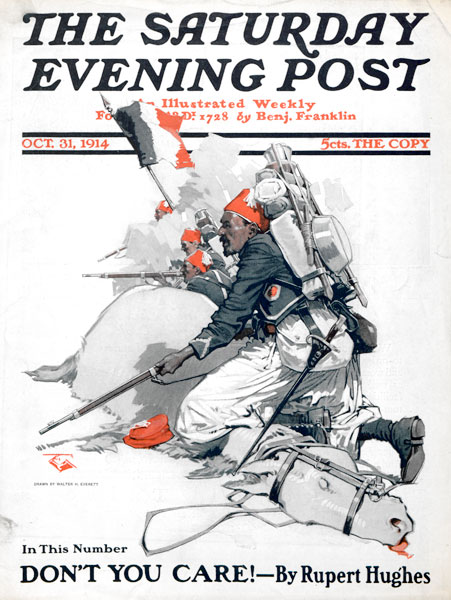
In the October 31, 1914, issue: The Post publishes its first piece of world war fiction, a war reporter’s shares his experiences in Belgium, and a U.S. senator predicts an economic boom.
The Miller of Ostend
By Melville Davisson Post
In its first piece of World War fiction, the Post brought up a topic that would become one of the major controversies of the war: civilian atrocities.
For weeks, stories about German brutalities against Belgians had been circulating in the media. The stories would become more violent and more numerous as the war settled into a frustrating stalemate. And when the U.S. entered the war, the stories would be revived and embellished to build American support for the war.
Did they actually occur? Did German soldiers really butcher helpless Belgians? What about the story of Germans cutting off the hands of Belgian children?
Were Germans murdered in their sleep or poisoned by the people of Belgium, or ambushed by isolated squads of partisans? In this story, an elderly miller exacts vengeance for a granddaughter killed in a German air attack.
It’s a brutal little story unlike the polite fiction usually run by the Post. But it’s possible the editors chose it out of sympathy for inoffensive Belgium or out of a desire to see Germany punished for violating this neutral country.
Melville Post (no relation) continued to write after the war and, in time, became an early and influential author of mystery stories.
“Presently, far away toward Brussels, a thing like a wingless goose appeared in the sky. It traveled at great speed and soon took form and outline. It came on like a projectile toward Ostend. One could distinguish now its long aluminum cylinder and the strange equipment of the Zeppelin, all painted gray like a warship.
“There was a long, dull roar, and the glass-enclosed terrace of the Kursaal that bowed out toward the promenade of Leopold south along the Digue de Mer flew into a cloud of dust and broken tiles.
“Meanwhile, as though signaled of the approach of the Zeppelin, an English submarine arose like some fabled sea-thing out of the slime of the harbor. A figure emerged from the turret, seized a lever, and a gun that was folded into the back of the monster swung up into place, other figures appeared, and the gun lifting perpendicular opened fire on the dirigible. …
“Finally the Zeppelin, driving dead away toward Brussels, was seen suddenly to list. It hung for a moment half balanced over, then it glided slowly down. A shot traveling parallel with the cylinder had ripped open the gas compartments along the whole side. …
“It did not fall — the gas chambers on the other side of the long aluminum envelope were enough to prevent that, but not enough to hold it in the air, and listing heavily it descended slowly into the fields. The detachment of Belgian cavalry riding the Brussels road raced toward it.
“At the dull boom of the first explosion the old miller, sitting on his door step, arose and started to return to Ostend. … He knew the city, and the direction of the sound located for him where the deadly thing had struck.
“His awful fear was justified. Under the wrecked glass of the Kursaal, among the scattered cots and the wounded—now mangled dead men—a little broken thing, with a red cross stitched to her sleeve and the sun still nestling in her hair, lay motionless across the sill of a door.”
Marsch, Marsch, Marsch, So Geh’n Wir Weiter
(the German translation of the American Civil War song lyric “Tramp, tramp, tramp, the boys are marching”)
By Irvin S. Cobb
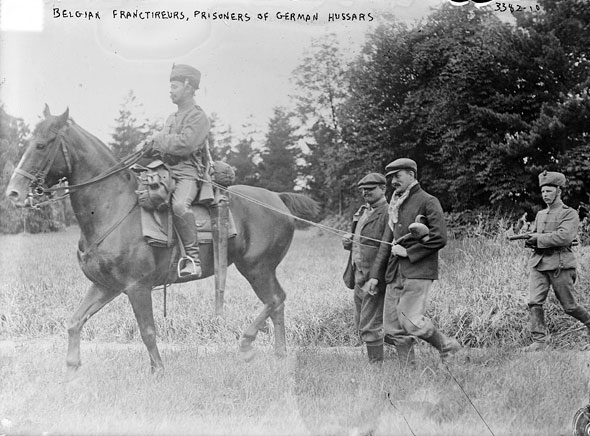
Cobb reported he’d seen none of the atrocities that others had reported in Belgium. But in this installment, he sees several examples of the German’s stern military justice.
The German army developed a harsh attitude toward the Belgians. They had originally expected Belgium would permit them to march through the country to invade France. They were surprised, then angered, when the Belgians not only refused German demands to pass through, but resisted their advance with force.
The first stories of atrocities, it seems, came from the Germans, who reported that Belgian civilians were waging a guerilla war, ambushing prisoners and sabotaging equipment. As Cobb reports, German officers believed these stories and used them as justification for executing people they considered dangerous to their army. The colonel who kept him under guard told Cobb he could not cross the front lines to reach Brussels for fear of what his own men might do.
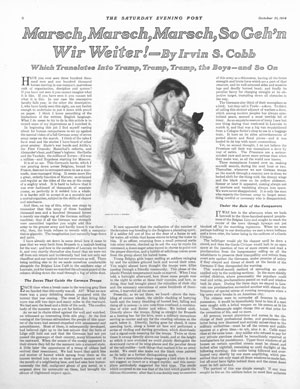
“‘For your own sakes … I dare not let you gentlemen go. Terrible things have happened. Last night a colonel of infantry was murdered while he was asleep; and I have just heard that fifteen of our soldiers had their throats cut, also as they slept. From houses our troops have been fired on, and between here and Brussels there has been much of this guerilla warfare on us. To those who do such things and to those who protect them we show no mercy. We shoot them on the spot and burn their houses to the ground.
“‘We make no attempt to disguise our methods of reprisal. We are willing for the world to know it; and it is
not because I wish to cover up or hide any of our actions from your eyes, and from the eyes of the American people, that I am refusing you passes for your return to Brussels today. But, you see, our men have been terribly excited by these crimes of the Belgian populace, and in their excitement they might make serious mistakes.’
“On the second morning of our enforced stay … we watched a double file of soldiers going through a street. … Two roughly clad natives walked between the lines of bared bayonets. One was an old man who walked proudly with his head erect. The other was bent almost double, and his hands were tied behind his back.
“A few minutes afterward a barred yellow van, under escort, came through the square fronting the railroad station and disappeared behind a mass of low buildings. From that direction we presently heard shots. Soon the van came back, unescorted this time; and behind it came Belgians with Red Cross arm badges, bearing on their shoulders two litters on which were still figures covered with blankets, so that only the stockinged feet showed.
“Along toward five o’clock a goodish string of cars was added to our train, and into these additional cars seven hundred French soldiers, who had been collected at Gembloux, were loaded. With the Frenchmen as they marched under our window went, perhaps, twenty civilian prisoners, including two priests and three or four subdued little men who looked as though they might be civic dignitaries of some small Belgian town. In the squad was one big, broad-shouldered peasant in a blouse, whose arms were roped back at the elbows with a thick cord.
“‘Do you see that man?’ said one of our guards excitedly, and he pointed at the pinioned man. ‘He is a grave robber. He has been digging up dead Germans to rob the bodies. They tell me that, when they caught him, he had in his pockets ten dead men’s fingers which he had cut off with a knife because the flesh was so swollen he could not slip the rings off. He will be shot, that fellow.’
“We looked with a deeper interest then at the man whose arms were bound, but privately we permitted ourselves to be skeptical regarding the details of his alleged ghoulishness. We had begun to discount German stories of Belgian atrocities and Belgian stories of German atrocities. I might add that I am still discounting both varieties. I hear of them daily, almost hourly, but usually the proof is lacking.”
Permanent Prosperity
By Albert J. Beveridge
Not only did former U.S. Indiana Senator Beveridge (R) expect the war would bring an economic boom to the United States, he thought it could last even beyond the war. But it would require the government keeping politics out of its economic policy.
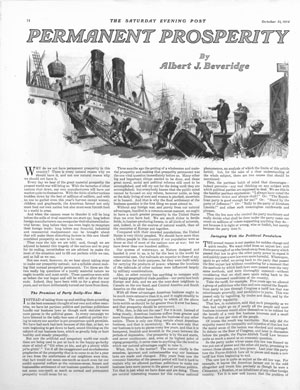
“Every day we hear of the great material prosperity the present world war will bring us. … We are adjured to lament this tragedy of the nations and to pray for its ending, nevertheless we are advised to make the most of the situation and to fill our pockets while we can, and as full as we can.
“Without any foreign war, and purely from our natural advantages, handled in a common-sense manner, we ought to have a much greater prosperity in the United States than we ever have had. … Why, then, is this not the case? … Partisan politics.
“[It] turns the crank, which runs the endless chain of tariff ups and tariff downs; of business fever and business chill; of a diseased prosperity and a diseased depression. Thus it is that tariff earthquakes periodically shake and shatter American business. Thus it is that we have not and never have had steady and normal business conditions. Thus it is that such a thing as permanent prosperity is unknown in America. And steady normal business and permanent prosperity never can be had so long as we allow partisan politicians to make our tariff the football of partisan politics.”
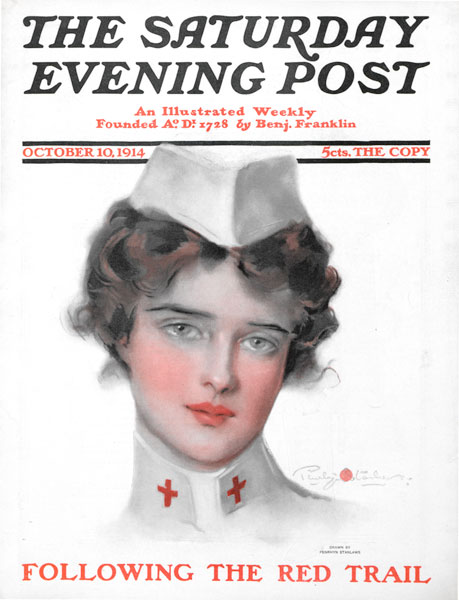
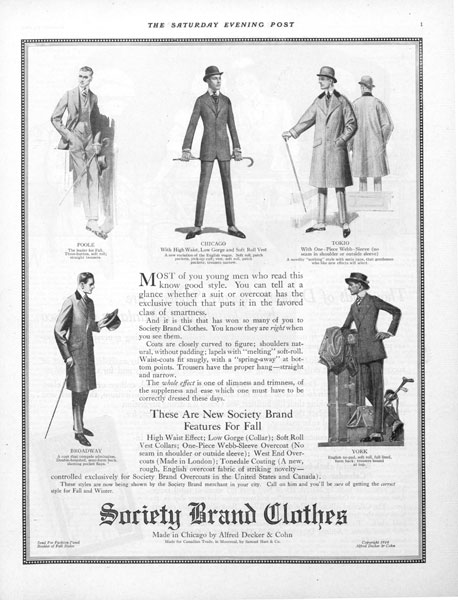
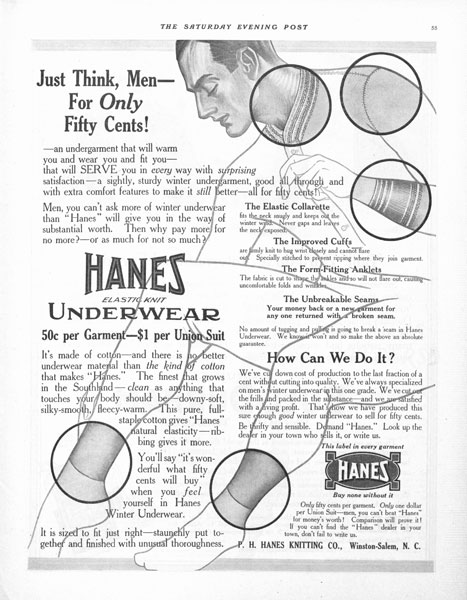
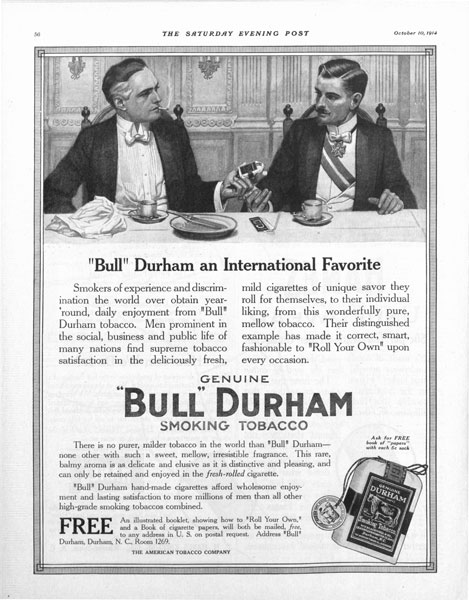
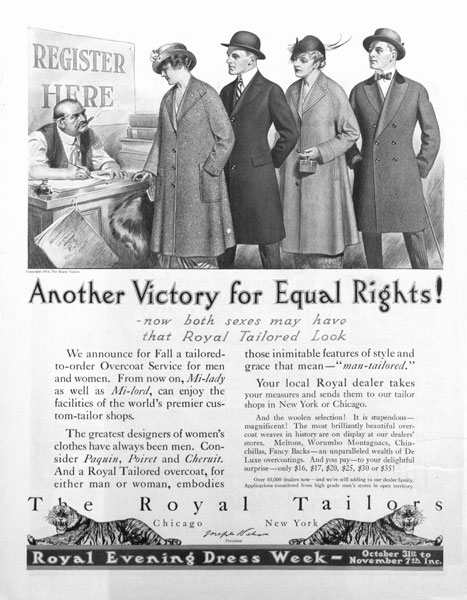
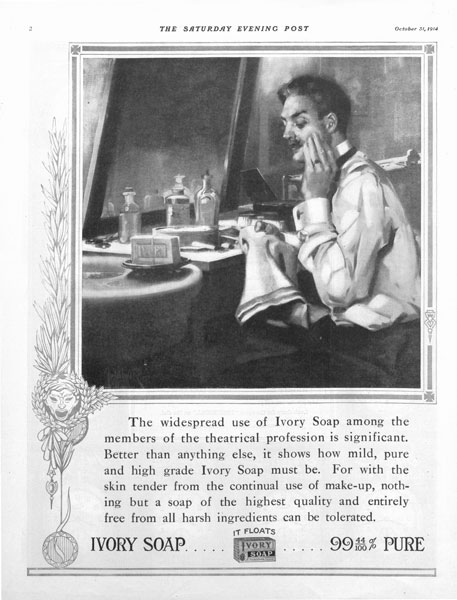
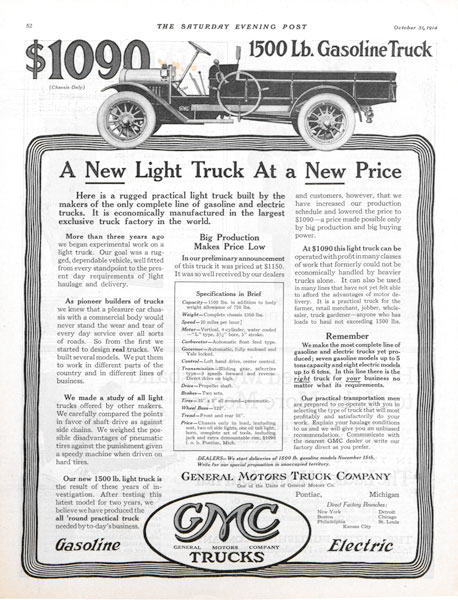
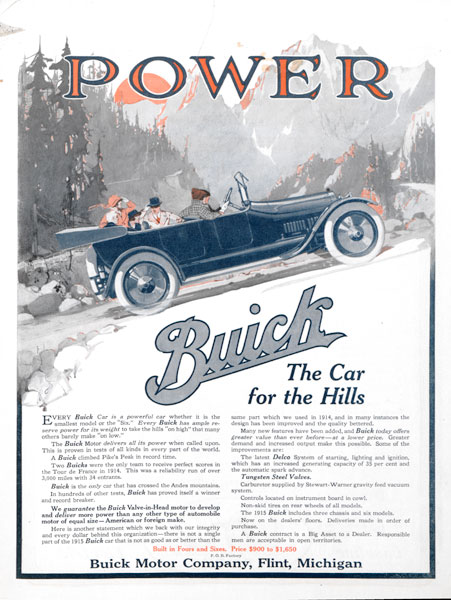
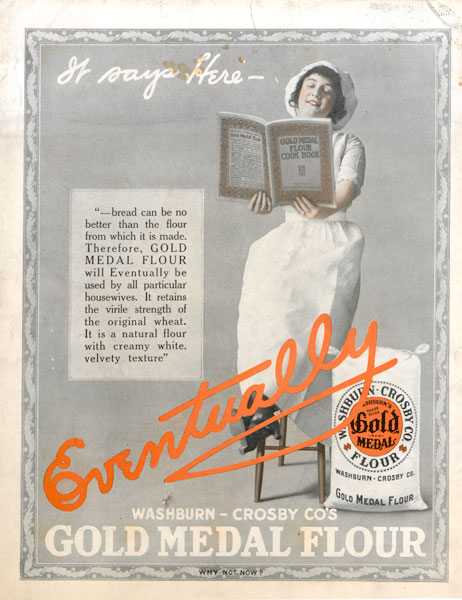
Step into 1914 with a peek at these pages from The Saturday Evening Post 100 years ago.
The Record That Saved Johnny Cash
“I’d love to hear some of your favorite songs.”
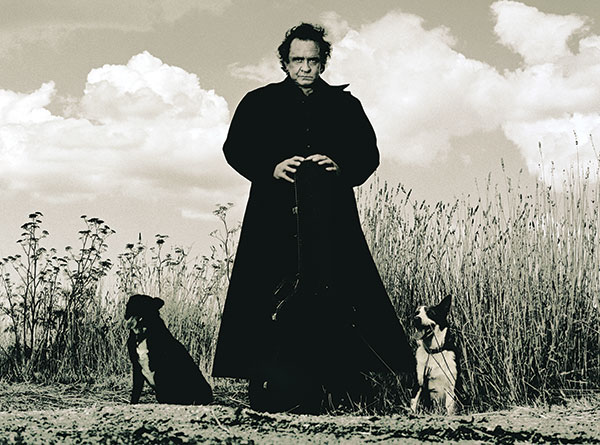
Those were Rick Rubin’s first words to Johnny Cash when they sat down in the producer’s spacious home high above Sunset Strip in Los Angeles on May 17, 1993, to begin exploring the process of making an album together.
The only child of an upper-middle-class family from Long Island, New York, Rick Rubin grew up on hard rock and punk, but his entry into the record business was via hip-hop, a genre he became obsessed with while a pre-med student at New York University in the late 1970s. He especially loved the way DJs in clubs came up with dynamic sounds by “scratching” — rapidly twisting and turning vinyl recordings on spinning turntables. When he noticed that rap recordings lacked that club energy because producers used real musicians instead of turntable DJs, Rubin began making records in his NYU dorm room employing “scratching” and other bits of turntable wizardry. The difference was immense.
After gaining attention around New York City when the first record he produced was a huge club hit, he teamed with a bright young entrepreneur named Russell Simmons to start Def Jam Recordings, which they would build into the Motown of hip-hop. At Def Jam, Rubin produced such hit acts as the socially conscious Public Enemy and rap ’n’ punk rockers the Beastie Boys. In the early 1990s, wanting to expand his musical terrain, he moved to Los Angeles, where he won even more success and acclaim working with rock and heavy-metal acts, including the Red Hot Chili Peppers, Slayer, and Tom Petty and the Heartbreakers.
The path to Cash grew out of a desire to set new challenges for himself. Instead of working just with youngish rockers, he wanted to connect with someone who was “great and important, but who wasn’t doing their best work. I wanted to see if I could help them do great work again.”
Cash was skeptical when he was told that a rap producer wanted to make a record with him, but he figured, what the heck. He invited Rubin to come to his show at the Rhythm Café, about an hour’s drive south of LA. When the burly young man with the long, unruly beard and gentle, Zen-like manner walked into the dressing room, Cash didn’t know what to make of him. Cash later described his first impression of Rubin as “the ultimate hippie, bald on top, but with hair down over his shoulders, a beard that looked as if it had never been trimmed and clothes that would have done a wino proud.”
Purchase the digital edition for your iPad, Nook, or Android tablet:
To purchase a subscription to the print edition of The Saturday Evening Post:
Valerie
Valerie isn’t a friend. Not that I don’t like her and I certainly got to know her — almost too well. It’s just that she’s not among those who suddenly bombard me with invitations for about two weeks at a clip so that I’m running from party to dinner to a day in the country until I contemplate hiring a social secretary only I don’t because I know things will settle down for months to come once the flurry is over. Life will go back to normal, which means I hardly see anyone except my best friend, Abby, and her husband, John, which is fine with me because, at that point, I’m peopled out. I suppose it would be nice to be less popular more regularly, but this has never happened to me. My social life is strictly a roller coaster, and Valerie has nothing to do with it.
Valerie is someone I worked with for six weeks on a temporary job. I was the temp. Otherwise, I’m a photographer but my career is just beginning to launch itself and, although the portfolio is filling up with professional work, there’s a lot of competition out there so I still find myself at some corporation or other more often than I’d like. This one was an insurance company where Valerie and I pumped out form letters eight hours a day to tell the clients their claims were for the one thing their policies didn’t cover. The reasons were so repetitive; I even programmed those into the computer. Valerie and I only had to press a couple of buttons to break the bad news, which left us with plenty of time to talk. Since production was up, nobody cared.
Valerie’s life is like a soap opera, and Valerie is less than shy. Following her saga was very addictive. To boot, she’s a case right out of the pop-psychology textbook. Generally speaking, I find pop psychology overrated, but occasionally, it turns out to have a point. It had several where Valerie was concerned. Her father, an honest laborer, got paid Friday afternoon, drunk Friday evening, violent and quick with his fists Friday night, slept if off Saturday, apologized Sunday, and turned back into an honest laborer Monday to start the cycle again. For those who have never read the textbook, I will tell you, this leads to low self-esteem. Valerie doesn’t seem like a classic victim. She views her life with a good dose of humor and even a little insight. But she has also had a string of abusive boyfriends to prove that this is a pattern that repeats itself anyway.
I suppose Valerie is simply too close to the problem to notice. After all, I bring my own problems to Abby because she is the queen of perspective, able to find something worse when you’re convinced your life has hit the pits. Since I’m generally optimistic, my life generally goes quite smoothly so I don’t know what to do when it snags, like a person who never gets sick is floored by a common cold. But if I’m no good with my own problems, I’m terrific with everyone else’s — a question of objectivity. If something’s broke, my impulse is to try to fix it, even if nobody asks me to. Valerie practically greeted me with “Hi, I’m Valerie. You’ll never guess what my boyfriend did last night.”
At least it seemed that way, and her life seemed to be the most in need of fixing I’d ever run across. My instant addiction wasn’t prurient interest; it was a knee-jerk reaction. Since she didn’t view herself as a hopeless case, neither did I. She was saved from a perpetual sermonette only because she could talk faster than I can and getting a word in was a challenge.
The very first morning, I learned about Valerie’s background and her then current live-in boyfriend. Like her father, this boyfriend was quicker with his hands than his mouth. The only difference was that Gary didn’t drink to get drunk on a regular basis like Valerie’s father. He was just a maniac as far as I could tell, taking out his evidently endless frustrations on Valerie. The fact he whacked her around didn’t bother her. The fact he was so unpredictable did.
“At least with my father, you knew when to duck” was how she cheerily put it.
Gary, the no-warning slugger, was the star of the soap opera for the next couple of weeks. His latest bout of frustration was served up with the morning coffee. It seemed crystal-clear to me that Valerie should move out, and I didn’t hesitate to tell her this. She didn’t give me much time to offer the reasons why, so I could only chant the suggestion like a mantra, but Valerie really didn’t see the need. She was looking for a way to be able to anticipate Gary’s moods, something I wasn’t about to help her with. It was when Gary did more than slap her around and she showed up with a black eye that she finally decided perhaps I had a point. She moved in with her sister that weekend.
“Tammy’s boyfriend isn’t much better,” Valerie told me with a laugh, “but he’s a trucker so he’s on the road a lot.” For Valerie, this was like a vacation. But not for long.
Valerie isn’t a raving beauty, but she is very pretty and she’s got a figure that’s hard to ignore. The insurance company was one of those dress-and-heels places. Valerie and I could have worn the exact same dress and I would have looked like a 12-year-old boy standing next to her. It isn’t as if she’s making an effort to be sexy, in fact, she dresses like an aspiring junior executive. It’s just that even a tailored suit becomes provocative apparel on her, which seems to have a certain effect on the male of the species. Three days after moving out on Gary she was contemplating moving in with Bruce.
“What’s he like?” I asked, though what I meant was what’s his problem since I’d begun to have my doubts about Valerie’s judgment by then.
“He seems really nice.” Valerie revealed a tiny tendency to leap before she’d bothered to look. I mentioned, since she could stay with Tammy, that maybe it would be a good idea to find out first and discovered how much influence I had with Valerie. She moved in with Bruce two days later.
As it turned out, Bruce was quicker with words than with his fists, which was something new for Valerie. Only Bruce’s words were just as vicious. Instead of coming in with the recap of the previous night’s fight, Valerie would arrive asking, “Do you think I’m stupid? My nose is too big? I’ve got fat thighs?”
There was a new question every day. Bruce was picking Valerie apart a feature at a time like a vulture in no particular hurry. Even when Valerie had been with Gary, I’d have had to describe her as downright perky. With Bruce, I watched her morale crumble slowly and painfully. Her smile became a rarity. She never laughed at all anymore. Circles grew larger and darker under her eyes with each of Bruce’s attacks. Stewing had replaced sleep. I did my best to rebuild her confidence before she faced the creep again, and, oh, did I suggest heading back to Tammy’s. My words didn’t fall on deaf ears. I knew Valerie was listening because we would discuss my suggestions. But what I said did register in a personality that was dedicated, as if it was as programmed as the computer, to making the wrong choice. As it turned out, I could have saved my breath. It was something Bruce said that finally did the trick, and the next morning, Valerie arrived, not asking a question, but making a statement,
“I am not cheap!”
Score one for Valerie. Give her two points, in fact, because she was back at her sister’s that very evening. She may be a victim, but she’s a survivor as well.
Before the assignment had wound down, she’d rebloomed, much to my relief because I’d gotten to like her. But, with only a few days left, I hadn’t even come close to hearing the end of the tale. No assignment could outlast “The Days of Valerie’s Life,” which I suspect will be the longest running series in soap opera history. At that point, however, I just began to listen, as it seemed pointless to give advice, even bound-to-be-ignored advice, if I’d never know the outcome.
I began to wonder if there isn’t a bar or something in town where Valerie finds her boyfriends because, even if I’m not the original party girl, I get out occasionally and I have never ever run across the kind of men she attracts so easily. Bruce hadn’t even had time to fade into memory before Valerie had two more possibilities on the string. My last few days were spent listening to her debate their lack of virtues.
One of them was a temporarily ex- con, a specialist in armed robbery who had spent more of his adult life in jail than out. The other was a guy who struck me, and would probably strike Valerie later, as another Gary since she’d noticed him only because he was in the middle of a brawl.
I sighed a lot as I listened. There wasn’t much else to do. I did have a teensy preference for bachelor number one. He sounded worse on the surface, and there was always the possibility that he’d talk her into being the Bonnie to his Clyde. But I was confident that Valerie, despite her proclivity for lousy choices, was really too smart for that, and this guy had one major advantage in my mind; I was convinced he’d be back behind bars soon and out of her life. Another Gary ran the risk of being a long-term trap for Valerie, since getting whacked around fell into her range of normal behavior. But I weighed the pros and cons, if you’ll forgive the expression, silently. I would probably have said something eventually, only the assignment ended before I was able to make up my mind which of these guys was actually worse. I knew Valerie would have no problem figuring this out, however, and if I really wanted to know, all I’d need to do would be to check back and see which one she’d chosen.
Everyday Life in 1939
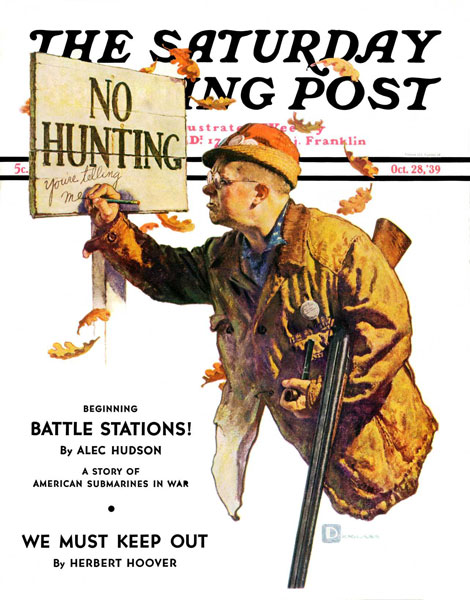
The date is October 28, 1939, and the New York Times is reporting on America’s arms embargo and the neutrality bill. The Post is offering ex-President Hoover’s isolationist appeal, “We Must Keep Out.”
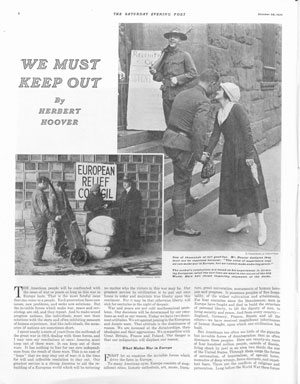
But the big story in The Carlisle News is “Grass Fires Menace Farms.” In the previous week, five separate fires had burned over 200 acres in Sullivan County, Indiana. Other front-page stories concerned state conservation clubs, county electrification (“more than 50 miles of poles have been set since construction began Oct. 2”), and the Halloween carnival, which would be held in the “old gymnasium” next Tuesday.
When I read items like these in old small-town newspapers, I wonder just how accurately history captures the experience of previous generations. Histories of this era tend to focus on the major newspapers and national magazines. It’s easy to forget that life in these times wasn’t shaped just by war, economics, and politics. It was also birth and death announcements, corn-husking contests, and “Auto Crash at Busy Corner.”
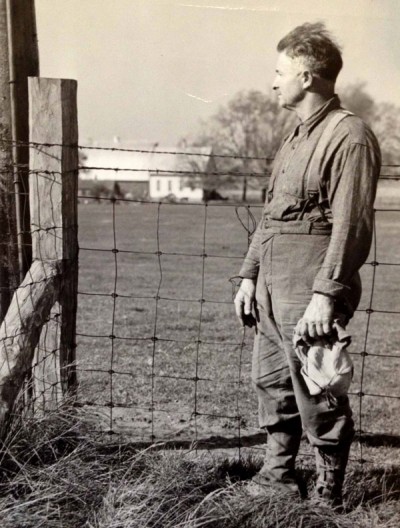
I’ve been digging up these details of American life from the small-town papers published in Sullivan County, Indiana. I chose this area simply because the 1940 census declared that it held the mean population center of the United States. (The precise location was in a cornfield just southeast of Carlisle.)
A farm community far from the city may seem too removed from mainstream America to be representative today. But in 1940, nearly half of America lived in such rural areas, and they stayed well informed of their neighbors thanks to their local newspapers. For example, The Carlisle News ran the regular front-page feature, Movements of People During the Past Week. Sixty-five years before Facebook, readers could keep track of their friends’ and neighbors’ activities: “French Willis made a business trip to Vincennes Wednesday … Mr. and Mrs. John Gibbs, of Indianapolis, spent the weekend visiting Mrs. Gibbs’ aunt, Mrs. Laura Niewald … Mr. and Mrs. Joe Finch, of Boonville, visited relatives here Monday evening while enroute home from a trip to South Bend.”
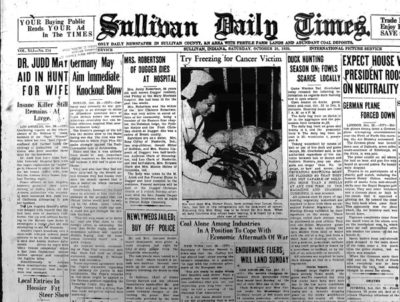
Just up the road from Carlisle is the more substantial town of Sullivan, with 5,000 people and three newspapers in 1939. The largest was the Sullivan Daily Times, which offered both national and international news. On Saturday, October 28, its front page was reporting the senate’s passage of a bill to revise the Neutrality Act, the same story reported in the New York Times.
If the bill passed in the House, the U.S. would lift the embargo that had prevented all sales of arms to the warring nations. The bill wasn’t really intended to help all sides, though. President Roosevelt had asked for this change because it had become obvious that the Neutrality Act only penalized pro-democratic nations. Germany and Japan had been well armed even before they set out on their military campaigns. With every conquest, they added more ammunition and equipment to their arsenal. France, England, and China were desperately short of weapons, shipping, and airplanes.
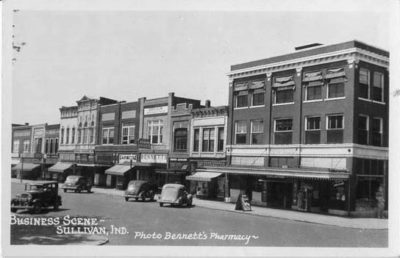

The editors at the Sullivan papers opposed lifting the arms embargo. Part of their objection probably came from their solid Republican opposition to anything President Roosevelt proposed. But they might also have seen the impending sale of weapons to England and France as a sign America was taking sides and inching closer to war. The paper ran a weekly column by Indiana’s 2nd District congressman, Gerald W. Landis (R), who conducted an opinion poll on the proposed change to the Neutrality Act. By October 28, the poll stood at 914 for continuing the embargo and 403 for lifting it. It wouldn’t have calmed the isolationists’ fears to read on the Daily Times’ front page that “Britons Rejoice at U.S. Senate’s Passage of Neutrality Bill.”
Other war news included “German Place Forced Down,” “Nazis Say 3 Subs Lost,” and “Germany May Aim Immediate Knockout Blow.” But these were surrounded by stories with more of a local interest, like “Duck Hunting Season On; Fowls Scarce Locally.”
And for fans of lurid crime stories, there was “Dr. Judd May Aid in Hunt for Wife: Insane Killer Remains at Large.” In 1933, Winnie Ruth Judd was convicted of first-degree murder, after the remains of two women were found in her luggage. She regarded them as rivals for a man with whom she had been having an affair. In court, Judd said she shot the women in self-defense, then packed them into shipping trunks with the help of her lover. She was committed to the Arizona State Hospital. By October 1939, though, she had escaped, and now her husband was offering to help find Mrs. Judd. She was eventually recaptured. Curiously, between 1935 and her parole in 1971, she escaped six times.
After reading these stories, Sullivan county residents might have switched on their Zenith console in the living room, or their Philips kitchen radio set to catch the Saturday-night broadcast from the city stations.
WBOW in Terre Haute was carrying the swing music of Jimmy Dorsey’s Orchestra. The Louisville, Kentucky, station would carry the countdown of the nation’s top songs on Your Hit Parade. At 8 p.m., many farm radios would be tuned in to the country music and comedy on National Barn Dance or the Western drama of Death Valley Days. Younger listeners might have chosen the Camel Caravan with Benny Goodman, broadcast out of Chicago.
From the CBS Camel Caravan broadcast of October 28, 1939. Listeners in Sullivan County would have particularly enjoyed Benny Goodman’s first song that night: “Back Home Again in Indiana.”
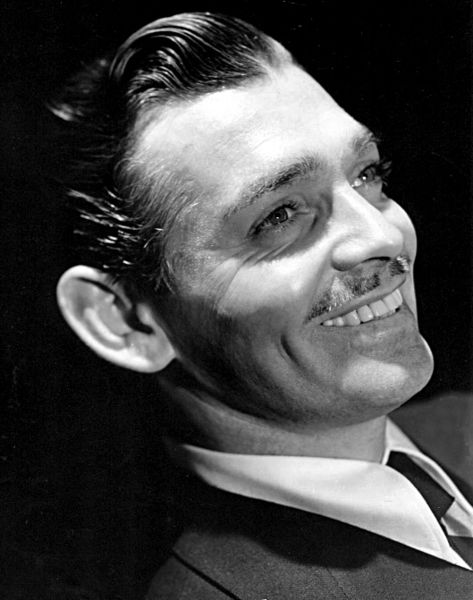
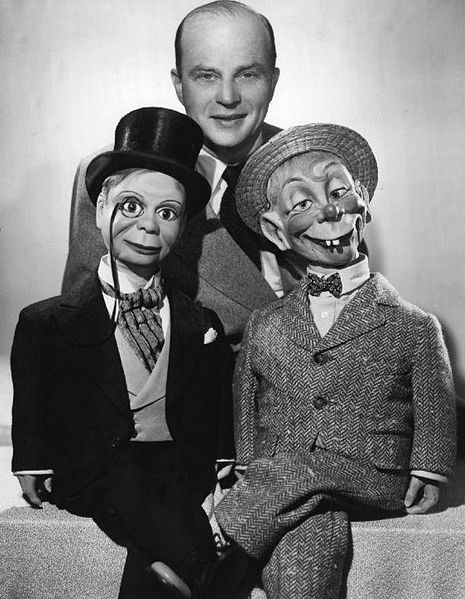
On the next evening, Clark Gable put in an appearance on theChase & Sanborn Hour, part of his promotional tour in the week preceding the December 15 premier of Gone With The Wind. In this clip, Charley McCarthy — Edgar Bergen’s alter ego—brags about his past girl friends, including Carole Lombard, apparently unaware that Gable and Lombard had recently married.
Others would head to the Sullivan movie theater. At the Sherman, they could watch Thunder Afloat with Wallace Beery (“Rebel! Rogue! Ruffian! Yet as gallant a fighting man as ever fired the last gun from a sinking ship!” hollered its newspaper advertisement). Down at the Lyric, they could see They Shall Have Music, whose newspaper ad promised, “Spellbound … that’s what you’ll be … just as the critics were.” At midnight, though, the Lyric was running an “adults only” feature titled Mad Youth. Its breathless ad copy spoke of “Home affairs forgotten — for love affairs. Thrill-seeking mothers spending alimony on hired love … Youthful innocence betrayed!” Yowza!

The prices in the newspaper ads seem shockingly low, but not when adjusted for inflation. The ad for Kling Brothers’ tailored-to-measure suits sold at Carlisle’s Star Store boasts prices starting at $21.50 (the equivalent to $350 today). Down the street at Sproatt Brothers, you could buy a pound of bacon or a pair of corn-husking gloves for 25 cents in 1939, which would be $4 in 2014.
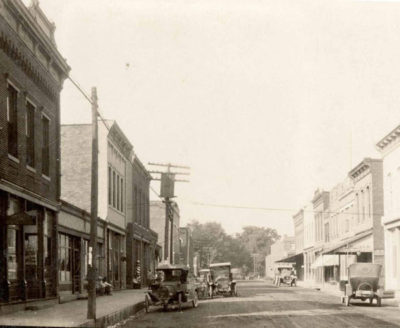
Carlisle and Sullivan have not changed greatly since 1940. About a third of the buildings in downtown Carlisle are gone, but they haven’t been replaced by chain stores or fast-food franchises. The lots remain empty except for well-tended grass.
The storefronts that line the Sullivan courthouse square have had face-lifts, but the upper stories are virtually unchanged from when they were built decades before the 1940s.
But just as I’m thinking that life hasn’t changed much in 75 years, I come across this item:
Newlyweds Jailed; Buy Off Police
Mr. and Mrs. Garland Setzer, recent newlyweds, were given a noisy reception last night by 50 or 60 people from the Graysville community.
The newlyweds were loaded in a large truck which headed a parade into Sullivan. Several cars made up the caravan of merrymakers following the truck to this city.
In Sullivan, Chief of Police George Barrick and his officers immediately handcuffed Mr. and Mrs. Setzer and put them in jail under technical charges of disturbing the peace. Bail was eventually provided by the bride and groom themselves — they bought supper for the entire crowd, and the police officers, at Gray’s Inn.
If you want to know how long ago 1939 is, consider that people of that time thought the medieval custom of rousting newlyweds from bed and dragging them off for a noisy, public exhibition was great fun for everyone.
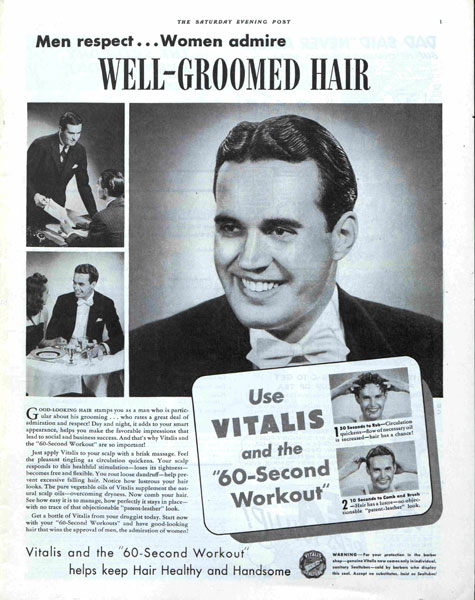
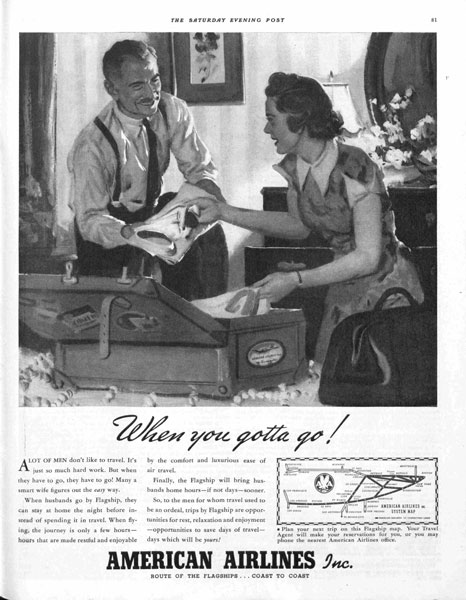
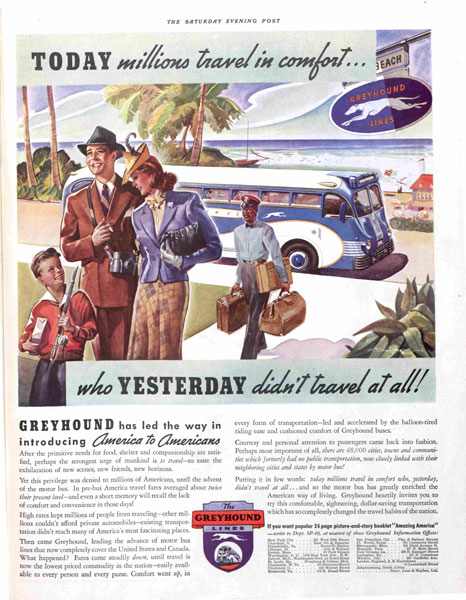
Step into 1939 with a peek at these pages from The Saturday Evening Post 75 years ago:

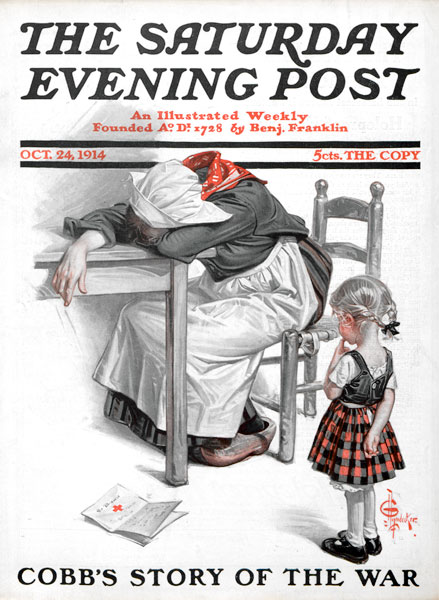
The Great War: October 24, 1914
In the October 24, 1914, issue: A former prime minister pleads his country’s case, a journalist shares his POW story, and American fashionistas cope with Parisian withdrawal.
The Cause of France
By Georges Clemenceau (French Prime Minister, 1906-1909; 1917-1920)
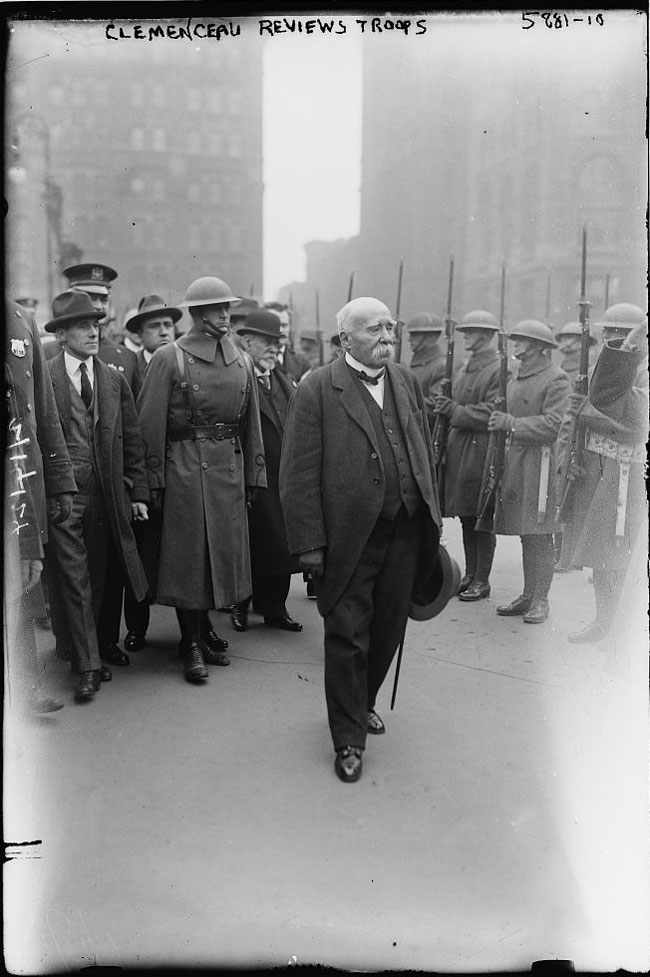
No one was a stronger advocate of the war or a better spokesman for French hatred of Imperial Germany than Georges Clemenceau. Like Arnold Bennett in the previous week’s Post[link], he hoped to build American support for or encourage its involvement in the war.
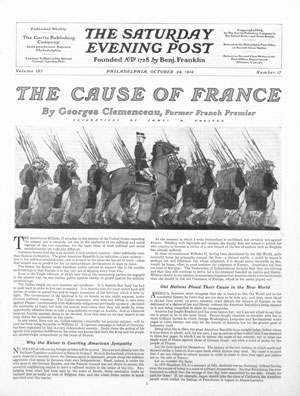
“The great American Republic is an upright judge, before whom it is an honor to plead. … I have promised myself not to utter here a single intemperate word. Truly the bare facts speak loudly enough. What are the armies of Germany doing in Belgium? Why are they there? In the name of what cause and for what motive? For the sole reason that the strategy of the General Staff at Berlin required Belgian territory in order to invade France. There was, to be sure, a treaty of neutrality — a treaty at the bottom of which appeared the signature of the King of Prussia, written with his own hand. That treaty Wilhelm II deliberately tore up.
“In France we believe that a treaty is something which has weight, and that a nation’s signature to a treaty has a moral value which statesmen must not ignore. We did not desire war. Our intention, in the interest of the peace of Europe, was simply to continue the upbuilding of France along the noble lines of her past, within such limits as were imposed on us by the Treaty of Frankfort.
“I have cited five war-provoking attempts instituted by Germany against France. It would be impossible to cite a single instance of such an attempt on the part of France against Germany. I defy anyone to cite a single hostile act on our part!
“And now villages in Northern France are in flames; the country is ravaged — held for ransom. The inhabitants, half-crazed, are fleeing. The innocent and the harmless fall without number under the sword of massacre! Are we in the right or are we in the wrong? It passes my comprehension how the question could be asked after reading the simple statement of facts, which I have made as brief as possible.”
Crushing the People for Money
By Will Payne
Many Americans regarded the European war only for its business opportunities. But Payne suggested American businesses look for profits in a continent much closer.
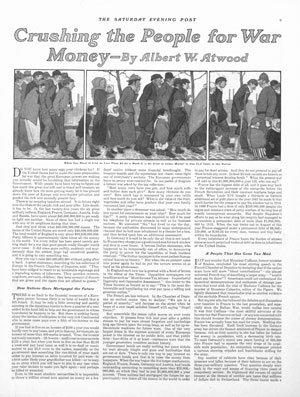
“The idea that as a result of the European war a great amount of foreign trade would fall into our lap like ripe fruit from a shaken tree has no doubt been thoroughly exploded by this time. The first effect of the war will be loss. Whatever ultimate gains we make will be a matter of time, skill, and energy.
“Europe is the great market for our exports, both raw and manufactured. … So the first fact we have to face is loss of business in our best market.
“That makes it all the more incumbent upon us to push for business in other markets, particularly in South America.
“South America buys roughly a billion dollars of foreign goods yearly, and in spite of some geographical advantage only about one-eighth comes from this country. Certainly we ought to sell more. … There is no reason why we should not, within two or three years, double our sales to South America — or, in some further years, treble them.”
Being a Guest of the German Kaiser
By Irvin S. Cobb
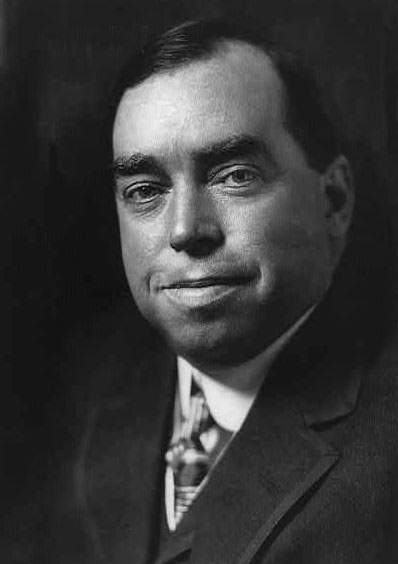
Roving through Belgium to gather material for his series on the war, Cobb and his companions found themselves much farther behind German lines than they expected.
The journalists were held for several days, without food, in a large Belgian chateau. Finally, after some tense days, they were fed and told that transportation had been arranged, not to Brussels, but to the German town of Aix-la-Chapelle.
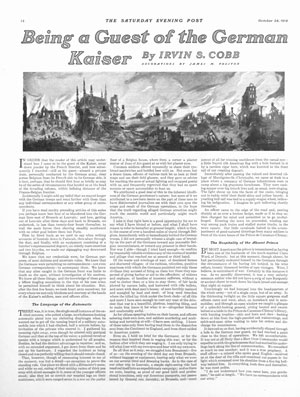
“Just as we were filing out into the dark, Sergeant Rosenthal, who was also going along, halted us and reminded us all and severally that we were not prisoners, but still guests; and that, though we were to march with the prisoners to the station, we were to go in line with the guards; and if any prisoner sought to escape it was hoped that we would aid in recapturing the runaway.
“So we promised him, each on his word of honor, that we would do this; and he insisted that we should shake hands with him as a pledge and as a token of mutual confidence, which we accordingly did. Altogether it was quite an impressive little ceremonial — and rather dramatic, I imagine.
“As he left us, however, he was heard, speaking in German, to say sotto voce to one of the guards: ‘If one of those journalists tries to slip away don’t take any chances — shoot him at once!’ It is so easy to keep one’s honor intact when you have moral support in the shape of an earnest-minded German soldier, with a gun, stepping along six feet behind you. My honor was never more intact.”
Will America Dress Herself?
By Corrine Lowe
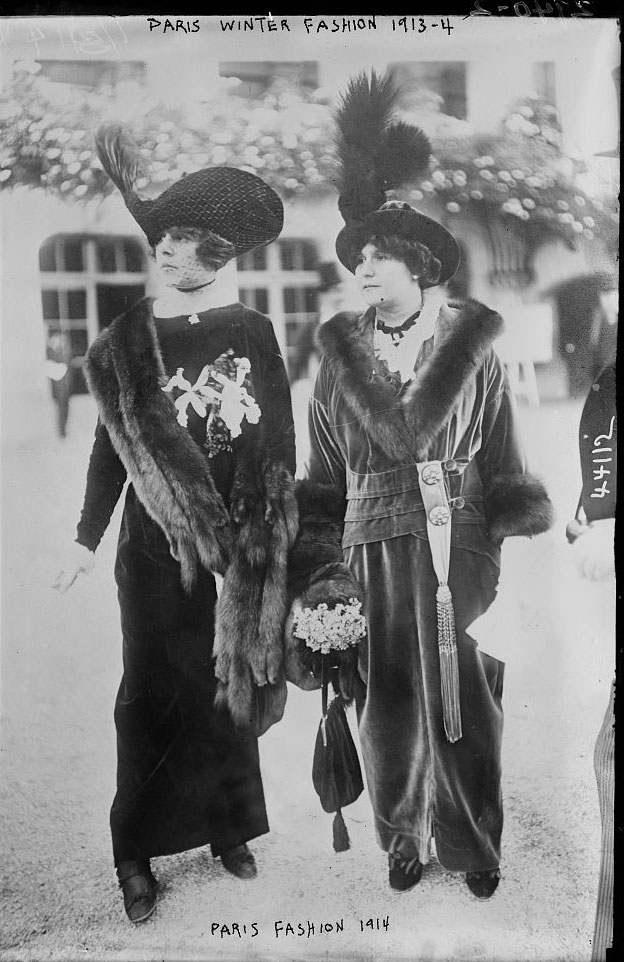
You might recall Lowe’s article a few weeks back. She was making fun of America’s adulation of European culture. Well, she had an equal measure of scorn for American women who would wear whatever Paris told them was high fashion.
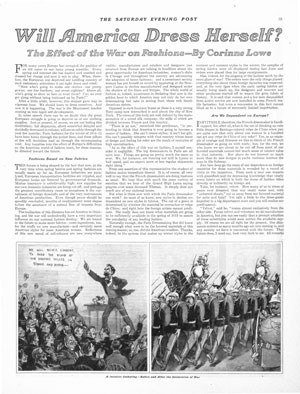
“Paris, like a circus ringmaster, has sent us through hoops and back again. She has put more American women into more clothes absolutely unsuited to them than could be counted by the most gifted mathematician. And yet, enveloped in this dense fog of the Paris superstition, many of us still cling to the belief that nobody outside of Paris can design anything more dressy than a Mother Hubbard.
“Why is it we think everything that comes out of Paris is beautiful? Why does an advertisement about the ineffable line of Paris never fail to move us? …
“With the production of more costly and beautiful fabrics Made in America, and with the demand for clothes of American design now being voiced, the designer is now … bound to lift herself out of the old restricted sphere and to show her countrywomen what she really can do.”
The New Warfare
By Norman Draper
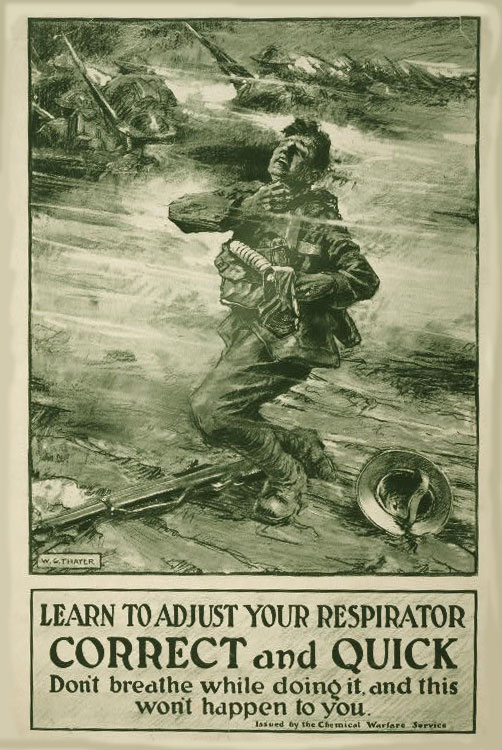
The International Campaign to Ban Landmines has been trying to rid the world of antipersonnel mines, which destroy lives both during and long after wars, since 1992.
The buried explosives have been around for hundreds of years, but World War I combatants were starting to develop new applications for the concealed weapon.
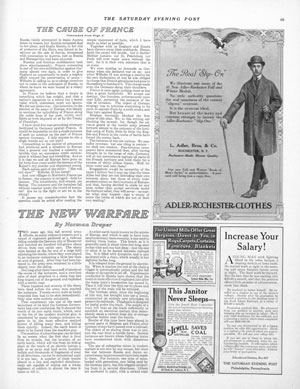
“Two years ago this fall several army officers … gathered at a railroad siding outside the German city of Hannover and watched six hundred full-grown sheep driven from two cattle cars. The sheep were herded at the far end of a large field adjoining the tracks, where they were placed in an enclosure containing a little less than an acre of ground. …
“Not long after there was a puff of smoke at the center of the enclosure, and a two-foot cube of steel attached to a chain four feet long leaped out of the ground and exploded with a terrific roar. Three hundred and seventy of the sheep were dead before the army men reached the enclosure. Twenty-seven were so badly wounded they had to be shot immediately. Only nine were entirely uninjured.
“That experiment … showed the worth of its new earth bomb, which, next to the fire of the modern machine gun, is considered by many German ordnance experts to be the most effective method known of killing many men, and killing them quickly. Indeed, the earth bomb is more to be feared than the machine gun.”
“Another earth bomb known to the armies of Europe, and which is said to have been employed many times recently, is one used to destroy troop trains. This bomb, as it is generally used, is about three feet long, nine inches wide and one foot deep—just the size to allow it to be buried between railroad ties. It is filled with dynamite, and is also anchored with a chain, which usually is but eighteen inches long. Experiments conducted in Russia have shown that the bomb is more effective if exploded just after the troop train’s locomotive has passed it. Then it will blow the first car to pieces and the rest of the train will be wrecked.”
Draper concluded his short article with the per capita costs of delivering death in war.
“It costs more than $20,000 to kill a man in modern warfare . Russia spent $20,400 for every Japanese slain, and France paid $21,000 for every victim of its operations during the Franco-Prussian War. General Percin, of the French army, compiled these figures … by the simple process of dividing the total cost of the war by the number of men killed on the opposite side.
“It is estimated that, with all the modern and expensive implements employed in this war, it will cost each nation, on an average, $30,000 for every hostile soldier its own troops kill [which translates to nearly $700,000 in 2014].”
Step into 1914 with a peek at these pages from The Saturday Evening Post 100 years ago.

Hard Lesson
“Of course, it’s different for underwear,” the professor said as she hobbled around the desk.
“If you happen to be confronted by your assailant while you are dressed only in your nightclothes — which happens more often than you would think …” and she paused a moment there, a wistful gleam in her eye.
“Anyway, in such circumstances, there are only three possible outcomes, which depend upon your choice of sleepwear:
“Girls wearing bras and panties are considered to be of weak moral character and therefore expendable. Expect the monster to attack you first. You will certainly be slaughtered, so remember your lessons and scream for all you’re worth.”
A shaft of light pierced the darkness of the auditorium. A pair of students strolled in, chatting with each other as they searched for seats. They squirmed and shoved their way across the room, distracting others in turn, their entrance perturbating through the class in a kind of Brownian motion made of people. The instructor paused, not bothering to look behind her, until the room was silent again.
“To continue,” she said, “those found wearing teddies, corsets, or other sundry items are likewise doomed.” There were more than a few nervous titters throughout the audience. “In this case, however, the actual killing is almost secondary to the torture. For reasons we have not yet discovered, these outfits tend to attract sadomasochistic monsters such as serial killers, nightmare incarnations, and their allied species. Expect to be stalked and kidnapped before suffering a horrific fate. Lotion is often involved.”
There was a crash as one of the newcomers knocked her bag to the floor. “Sorry,” she muttered as she rummaged through its contents. She nudged the girl sitting next to her.
“Can I borrow a pencil?” she asked between pops of gum.
“You really should have come more prepared, Esther,” the other said, proffering one.
“And you should really do something else with your makeup,” Esther replied. She ignored the pencil, rooted again in her bag, and produced a digital recorder. She set it on her desk, pressed a button, and crossed her arms. Throughout the exchange Mrs. Plum waited silently, her chalk tapping against the desk.
“If we are quite ready?” she asked. She cleared her throat. “Girls in nightgowns fall into the heroine category. They will be chased, of course. They should count on running through a stream or sprinkler, and their clothing will almost certainly be torn in a revealing manner, perhaps by the claw of the beast himself. In the end, however, they will find some way to triumph. The same rule applies to those wearing T-shirts. But pajamas are considered juvenile, and are not allowed.
“Are there any questions, class?”
“Mrs. Plum?”
“Yes, Jane?”
“What about full or partial nudity?”
Mrs. Plum smiled, then winked conspiratorially. “Well, then it depends on how fast you can dress.”
The class laughed dutifully. Outside, an October breeze rustled the dead leaves on the grounds of Karloff University, New England’s most prestigious college of horror. No one in the auditorium noticed, most of them being too busy scribbling furiously in their pink-and-black notebooks to pay attention to the weather. Others were absorbed in more personal matters.
“Well of course they want me back next season,” Esther said, a momentary silence allowing her voice to sing out across the class. Mrs. Plum gave one of her dreaded “harumphs,” and returned to the chalkboard to write out the night’s assignment.
“We will continue with the fundamentals, of course,” she said as she wrote. “Please read Chapter 3 of Lovecraft, and Chapters 5 and 6 from King’s Theory of Haunting. Also, for examples of today’s lesson …”
A tittering giggle broke her train of thought, and she whirled around, her glare sweeping like a searchlight across the classroom, until it settled inevitably on Esther and her friend.
Esther was oblivious to her, twirling her long blond hair as her bubblegum popped like rifle fire. “… never saw anyone with such natural body linguistics” she said to her companion, a petite brunette who dropped her gaze as she saw Mrs. Plum’s glare.
“If you are quite finished, Esther?” asked Mrs. Plum in glacial tones.
Esther took notice of Mrs. Plum for the first time. She waved her hand dismissively. “Sorry,” she muttered. She attempted to resume her conversation, but her friend ignored her, studiously copying down notes from the chalkboard. With a sigh, Esther settled back down in her seat. “Boring,” she muttered sotto voce, a smile curling the corners of her mouth as she recalled the term from her acting tutorials.
A student in the next row turned to her. “You don’t have to be here, you know. You could go study to be in a romance novel.”
She sniffed her pert nose. “Oh, I like being a horror character. But all this,” she waved her hand vaguely, taking in the classroom, the building, the entire university, “is so … obsolete. It’s the 21st century!” She paused, trying to remember bits of discussions she’d overheard from the upperclassmen. “The possibilities of CGI are so complex. Horror has become such a part of the mainstream artistic discourse, but we talk about underwear?”
Mrs. Plum drew her knitted sweater closer about her, as if in defense. “The basics never change, Ms. Campbell. A good screamer always has work, no matter what the setting.”
“And how are we to affect a change in the zeitgeist if we continue only to honor its outmoded traditions?” she asked.
Another student said, “That sounds like Professor Chambers —” until Esther waved her off.
“They didn’t ask me about screaming when I was doing my internship —”
Another girl sniggered. “No, they asked if you would do nude scenes.”
“Did that even make it to DVD?” someone asked.
“It’s still more work than any of you have ever done. Even her —” Esther pointed to Mrs. Plum.
Mrs. Plum broke in, “Without a proper theoretical grounding —”
“Theory,” Esther said in a singsong rhyme. “Theory doesn’t work in the real world. I should know!”
“Experience without the education to ground it is nothing more than a mechanical exercise,” Mrs. Plum said.
Jane giggled. “She got plenty of that on the casting —”
But Esther wasn’t listening. “My cousin was saying the other day —”
“Ms. Campbell!” Mrs. Plum said. “We are all very aware by now of your family connections. And how do you think your cousin achieved his success? By applying himself to the lessons you are learning here! Greatness does not grow in a vacuum.”
Esther rose. “What would you know? You’re old, like everything else here! Sitting there and trying to teach us this worthless —”
With a slap of her hand upon the desk, Mrs. Plum silenced Esther. She rose then, and a ferocity came upon her which made her seem much younger than her 60-odd years.
“What would I know? What would I know, you silly girl? In my day, Ms. Campbell, I worked with the greatest monsters ever known in the field. I have been chased by the Wolfman, by Frankenstein, by Dracula himself! And we didn’t fritter our time away with computers or androids, either; no, it was girl versus monster, as it should be. Why, Lon Chaney himself refused to work with any other victim …”
The bell rang then, breaking the spell. Mrs. Plum shrunk back into herself, becoming nothing more a tired teacher.
“Anyway,” she murmured, “that was all a long time ago. I’ll see you on Wednesday.”
Esther left the classroom with two of her comrades, chattering as they strolled down the hallway.
“Dracula?” she sneered to them. “That’s so 1950s. I’m a modern girl! I don’t want to get stuck in some hokey old horror novel about werewolves!”
“Tell us again about the zit-geist?” her friend asked.
“Just two more years,” Esther said, “and I’ll be out of this dump and doing some real work.”
“If Mrs. Plum doesn’t flunk you first.”
“I’m going to be the greatest ever. She wouldn’t dare. Only the great have the ability to rise against the pleban hors d’oeuvres …” That didn’t sound right. She tried to remember what her acting coach had told her, in those brief moments before he’d turned down the lights. Thebian? Something like that. She opened her mouth again, but her friend cut her off.
“Oh well, we can’t do anything about it. We gotta do what they say if we wanna graduate. Hey, you guys wanna go get something to eat?”
“You two go ahead,” said Esther. “I’ve got Theory of Mummies lab next.” Waving them off, she went into a bathroom to primp.
Visions of fame danced through her head as she touched up her makeup, at least until she noticed her face dissolving. Her hands flew to her cheeks, but found them still soft and firm with youthful vigor. She whirled around and saw that the walls of the room had become shrouded in blackness. She tried to run, but she was rooted to the spot.
She turned back to the mirror. Her reflection had warped and twisted until it became the face of Mrs. Plum, but unlike Esther had ever seen her. Leering and maniacal, her eyes were full of an evil that chilled the soul.
“Hello again, Ms. Campbell,” spoke the mirror.
“Mrs. Plum, How did you …”
She cackled. “One can’t remain a victim forever, you know. Once the looks go, you’ve had it in our business. So I took a few courses in Black Magic, and, shall we say … diversified my career portfolio?”
The reflection moved back until Esther could see all of Mrs. Plum standing in the mirror. She was holding a large and wicked looking knife.
Esther shrieked. “What?! How?!”
“Because in the end, Ms. Campbell, the monster is often the thing we least expect. And because I am very upset with you.”
And then Esther’s face was back in the mirror, and she could see Mrs. Plum standing behind her. The old woman took a small step forward, and Esther felt the professor’s cool, dry hand grasp her chin, heard Mrs. Plum whisper, “I don’t think you’re going to make it to Advanced Screaming,” and then the knife touched her throat and there was red everywhere for a while, and then only black.
Afterwards, Mrs. Plum smoothed her sweater and walked on to her office. The janitors would clean the mess; they were paid highly to deal with the occasional university accident.
She walked past the Intermediate Stalking seminar, a much smaller room than her own. The few chairs were occupied by a nightmare bestiary of furred, fanged, and clawed monstrosities, as well as ichor-dripping undead and what appeared to be one very crazed young man holding a gleaming axe. Formless shadows pooled and blinked in the corners, suggesting menaces more horrific than the eye could comprehend. In the first row, a scaly demonic creature loomed over the professor, who adjusted his bifocals and calmly continued his lecture.
“Of course,” Prof. Larry Talbot said, “it is very different if your victim is clad only in underwear …”
‘Never Give In’
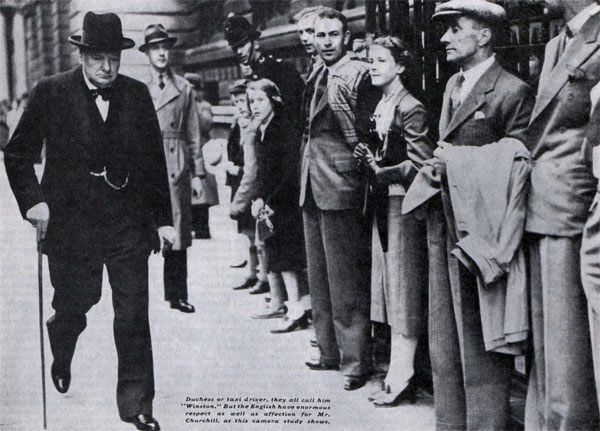
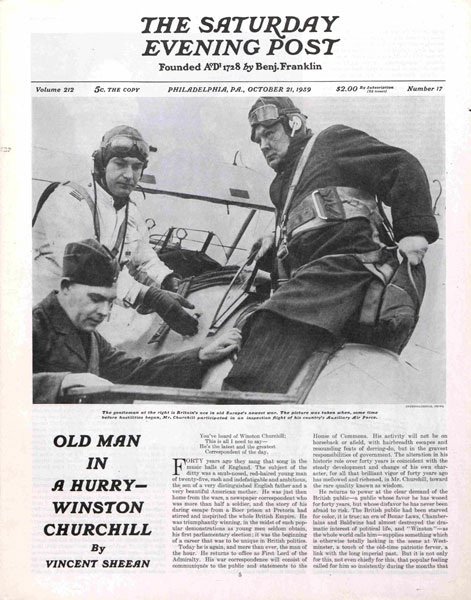
respect as well as affection for Churchill, as this camera study shows.
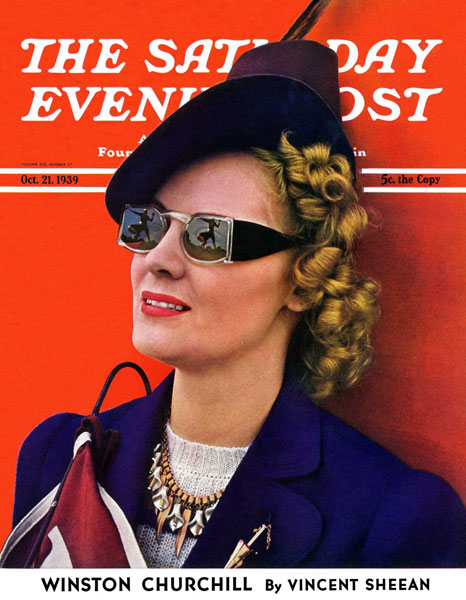
Britain’s best news of 1939 came just three days after the start of war. The news was so good, the British Admiralty ordered it to be sent to every ship in the fleet. It came as just three simple words that were filled with hope: “Winston is back.”
The news confirmed the rumors that Winston Churchill had been brought back into the government as the First Lord of the Admiralty, the post he’d held in World War I. His return to government marked a hopeful change of direction. Great Britain had steadily been losing ground before Hitler. Now, with war declared, the country needed a tough and relentless fighter. And that was Winston.
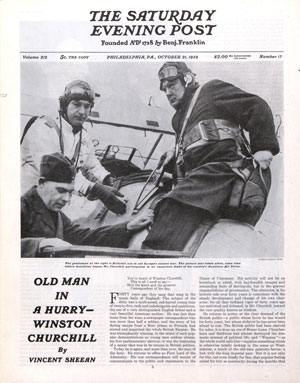
It seems he had always been “Winston.” As journalist Vincent Sheehan wrote of the man, “Today, when he is 65, they still, duchesses and taxi drivers, call him ‘Winston,’ just as they did when he was 25.” (Read the entire article “Old Man in a Hurry- Winston Churchill” by Vincent Sheean from the October 21, 1939 issue of the Post.)
Winston’s name had been popping up for years in the Post, as well as its sister publication. As far back as November 23, 1899, The Country Gentleman ran a brief update on England’s war against the South Africans. A detachment of British soldiers. it said, had been sent to rescue the besieged garrison at Ladysmith:
“These troops unfortunately attempted to ride in an armored train, with disastrous consequences. Encountering a party of Boers north of Frère, they began to withdraw. While retiring, some of the trucks were derailed … a company of Dublin Fusiliers … turned out and advanced toward the enemy, while the rest of the train appears to have returned without them to Estcourt. It is believed that these men were taken prisoners, 100 in number, including Winston Churchill, son of Lord Randolph Churchill, who was acting as correspondent, but who assisted actively in the fighting.” (Of course he was in the fight; Churchill was forever looking for opportunities to distinguish himself.)
No one, including Winston himself, could have known that his capture was the beginning of a long, remarkable public career. After only a month in a Boer POW camp in Pretoria, he escaped and returned to British lines. At the time, the war had been going badly for Great Britain and Churchill’s escape made him a popular hero. It boosted his career as a correspondent and, shortly afterward, as a politician.
Take our quiz: Did Winston Churchill Really Say That?
By 1912, he was an experienced, successful, and highly confident politician. A Post editor described him as a man of “charming impudence,” though admitted his opponents viewed this quality as “insufferable insolence.”
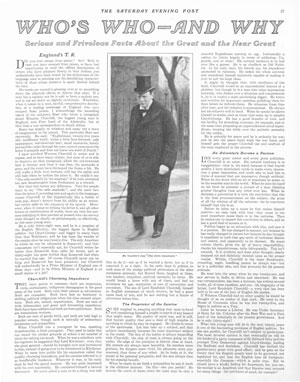
“In his early days in politics he took none of the stodgy political pretensions of the older statesmen seriously, but flouted them, laughed at them, was insolent, impudent, satirical, sarcastic, by turns. He would break a lance with any of them, and had no reverence for age, reputation, or awe of convention and precedent.” (Read the entire article “Who’s Who- and Why” from the December 7, 1912 issue of the Post)
According to the author, Churchill lived in his own special world. “His sunsets are always more beautiful, his sunrises more glorious, his dangers more vivid, his pleasures more pronounced, than those of any other. As he looks at it, the sunset is his personal perquisite, and the sun always rises for his especial benefit.
“The only American to whom he can be compared,” the author continued, “is Theodore Roosevelt; and that comparison isn’t especially apt, for Churchill writes far better than Roosevelt does, talks far better, and at thirty-eight has gone farther than Roosevelt had when he reached that age. Of course Churchill never can be king, and Roosevelt has been president; but Churchill will undoubtedly be a Prime Minister of England one of these days.”
The Post’s prediction came true, but not for another 28 years. And for much of that time, there were many—Churchill included—who believed he had lost any hope of ever becoming Prime Minister.
Early in the 1930s, he had argued with his party about granting self-government for the British colony of India. Then, in 1936, he urged King Edward VIII not to resign in order to marry American divorcée Wallis Simpson. When he publicly stated that the government was pressuring Edward to abdicate, his party turned against him. He was banished from the inner circles and soon lost much of his public support.
His political exile, which lasted for years, proved to be a challenge similar to Franklin Roosevelt’s polio; it increased the man’s resiliency and determination. And during his years on the outside, he continually spoke out against appeasing Germany. He repeated that Hitler couldn’t be trusted, and that abandoning Czechoslovakia to the Germans would only delay war, not buy peace.
And by 1939, Sheehan, among others, was writing about the hero’s return:
“He returns to power at the clear demand of the British public—a public whose favor he has wooed for 40 years, but whose disfavor he has never been afraid to risk. … It is a strange turn of the irony of circumstance that Winston, who was for so many years ‘too clever to be trusted,’ is now the man whom the whole Empire trusts to preserve it. …
“At first, I, like most others who have come near him, was frankly afraid. His personality is an army with banners; your first impulse is to get out of his way. His slightest sentence has weight because the words seem chosen from an altogether exceptional arsenal of words with altogether exceptional care. He has a huge vocabulary and no hesitation in using it according to the dictates of his own instinct and experience. This sometimes means a flood of words, sometimes the merest laconic, summing up, but there is never a word thrown away, meaningless.
“In all these respects, as well as in the more important ones, ‘Winston’ stands in the sharpest contrast to his protagonist in this war, the fanatical, teetotaler, vegetarian, neurotic Adolf Hitler. One is a rounded man—in more senses than one—who enjoys life to the full and wishes to preserve its freedom and variety for his people; the other is a haunted shell of a creature who would immolate the whole universe, if need be, to his adolescent dreams of revenge and fulfillment.”
By this time, Churchill was already pushing the British government to take action in Scandinavia. He realized that Great Britain needed to secure the mines and ports in Norway and Sweden that supplied its iron, but Prime Minister Chamberlain hesitated and took no action until April 1940, after Hitler invaded Norway.
The following month Chamberlain resigned. Churchill became prime minister just as Hitler began his sweep across Europe, conquering France, Britain’s chief ally. By the month’s end, nearly a half million British soldiers were clinging precariously to the Belgian coast, surrounded by the German army. They were alone, outnumbered, and outgunned. But they had Winston.
Step into 1939 with a peek at these pages from The Saturday Evening Post 75 years ago:
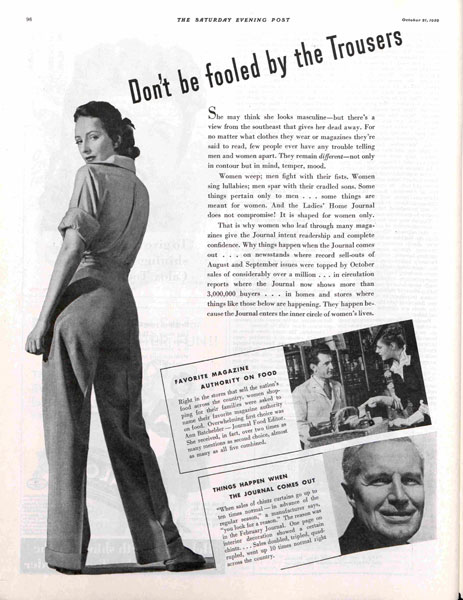
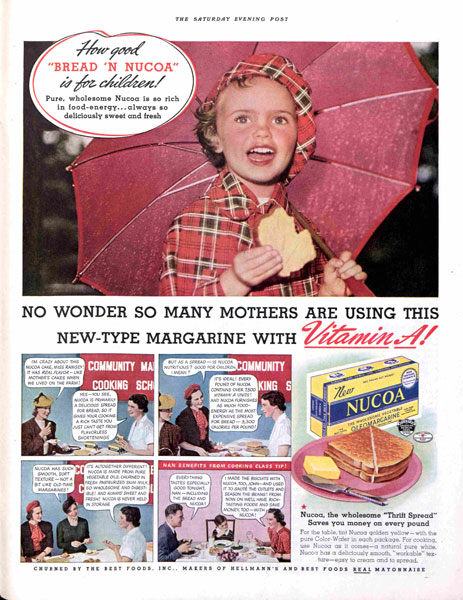
Taking Back Halloween

For nine years, my wife and I lived in the city, down a long lane, next to the Quaker meeting I pastored. Our first Halloween, we loaded up on candy, anticipating a horde of pirates, ghosts, and witches. But the lane was dark and spooky and not one kid showed up, so for the next month, we ate mini Snickers for dessert at every meal, even breakfast. Then we moved to a small town, and carloads of urchins mobbed our home at Halloween, swarming our front door like rats on raw meat. After the first hour, we were out of candy and began emptying our cupboard to beat back the mob, doling out squares of baking chocolate, sugar cubes, packets of Sweet’N Low. When we ran out of treats, they began TP’ing our trees, soaping our windows, and igniting paper sacks of manure on our porch. It was wonderfully nostalgic, reminding me of my childhood, and I went to bed happy.
We made the mistake of leaving our pumpkin outside, and woke the next morning to find it splattered on the street in front of our house.
“And they say the youth of today have no gumption!” I said to my wife, thrilled to be living in a town whose youth weren’t adverse to labor. If you’ve ever hefted a pumpkin over your head to smash it, you’ll know it’s no easy task.
It wasn’t as if I were out any money. I got the pumpkin free at the hardware store in our town. If you wait until Halloween to get your pumpkin, as I do, the hardware man will pay you to take it off his hands. Nor did I invest much time carving the pumpkin. Triangle eyes, a square nose, and a gap-toothed smile. I’ve carved every pumpkin the exact same way since I was 6 years old and my parents first entrusted me with a knife.
I remember that day well, because I still have the scar. While blood was spurting in a high arc from my forearm, my father said, “Yep, that’s a cut all right. Looks like you hit an artery.” My father exposed me to danger early and often so the lessons would stick. Sever an artery once, and you’ll think twice before doing it again, I guarantee it.
But things changed on the Halloween front. Parents horned in on what had been a kid’s affair. Children were no longer turned loose to find their own costumes, there was no more rifling through the attic for hobo clothes. Costume stores began sprouting up, and parents shelled out 50 bucks for their kid to be a ninja, a Spiderman, or a ballerina. Costumes became the measure of parental worth.

Around the same time as the outbreak of costume stores, someone discovered there was money to be made selling pumpkin-carving kits. There were no kits in my day, by cracky. A steak knife from the silverware drawer sufficed. Gone were the pumpkins with perfectly good triangle eyes and noses and gap-toothed smiles. Then someone, Martha Stewart, I think, wrote a magazine article about decorating with pumpkins, and, before long, pumpkins were sculpted by adults, not carved by kids. That was when Halloween began floating belly-up in the holiday fishbowl. Martha Stewart was sent to jail, but for entirely the wrong reason.
Now, God help us, parents are accompanying their children door to door. I would have sooner stayed home than had my parents tag along the night of Halloween. What is a boy to do when, in the presence of his parents, he must administer a well-deserved trick to the grouch down the street? His hand dips furtively into the folds of the costume to withdraw a bar of soap, only to have his father, who has forgotten the pure joy of delinquency, give him the stink eye. What have we become?
Certain pastors I know get all worked up about Christmas losing its meaning. This pastor is fine with Christmas. I want to return Halloween to its former glory. So I’m starting a movement to reclaim Halloween. First, no more adults poking their noses in where they don’t belong. If a kid wants to go trick-or-treating, the kid will have to come up with the costume, not the parent. No more store-bought costumes. It will be against the law. Second, every fourth house will have to hand out popcorn balls. There is no candy bar in the world that compares with a popcorn ball, but no one hands them out anymore. My movement will promise a popcorn ball in every Halloween bag.
If this sounds good to you, I urge you to write in my name during the next presidential election so I can get these, and other, crucial problems solved.
The Great War: October 17, 1914
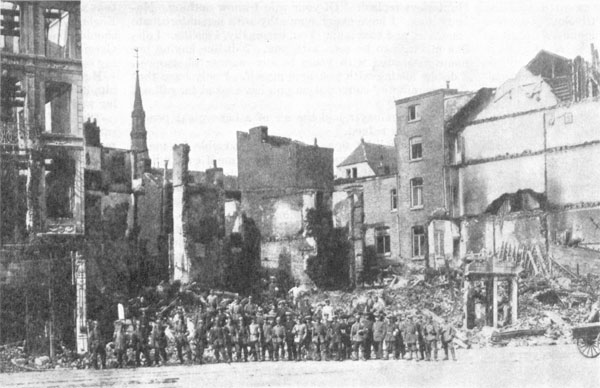
By this week 100 years ago, the war had stopped moving.
After just two months of fighting, the Western Front was locked in a stalemate. For the next four years, there would be no significant movement across a battle line that extended from neutral Switzerland to the coast of the North Sea.
No one had expected this in 1914. Germany had launched its campaign with a bold assault across Belgium. For weeks they pushed back every Allied army in front of them — the Belgian, the French, and the English. The plan called for the German armies to sweep down into France, surround the remaining Allies, and capture Paris.
It might have worked, but a fresh French assault on the right side of the German line caused a split to form between the German armies. The French and British troops rushed into the gap. The German advance halted, then fell back to the Aisne River.
Both sides realized the way ahead was completely blocked, but there was still a chance to move around the enemy. The Germans began rushing to slip around the left side of the British army, while the British tried to slip around the right flank of the Germans. Both armies began racing north, trying to outflank each other. But they only succeeded in extending the battle line all the way across Belgium to the coast.
For the next four years, the Western Front would change very little. (The Eastern Front, between Russia and the Central Powers, would change quite a bit.) At no point would any army be able to shift the front lines more than a few miles, though both sacrificed thousands of men to break the enemy’s line.
Sherman Said It; Looking for War in a Taxicab — and Finding It
By Irvin S. Cobb
Irvin Cobb grabbed a taxicab in Brussels and said, in essence, “Follow that war.” When the driver would go no father, Cobb and his companions continued on foot into a small Belgian town.
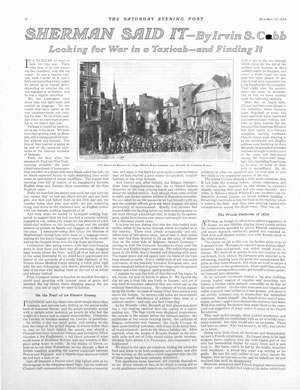
“A minute later … we had gone perhaps 50 feet beyond the mouth of this alley when two men, one on horseback and one on a bicycle, rode slowly and sedately out of another alley, parallel to the first one, and swung about with their backs to us. I imagine we had watched the newcomers for probably 50 seconds before it dawned on any of us that they wore gray helmets and gray coats, and carried arms — and were Germans! Precisely at that moment they both turned so that they faced us; and the man on horseback lifted a carbine from a holster and half swung it in our direction.
“Realization came to us that here we were, pocketed. There were armed Belgians in an alley behind us and armed Germans in the street before us; and we were nicely in between. If shooting started the enemies might miss each other, but they could not very well miss us. Two of our party found a courtyard and ran through it. The third wedged himself in a recess in a wall behind a town pump; and I made for the half-open door of a shop.
“Just as I reached it a woman on the inside slammed it in my face and locked it.
“Then a troop of uhlans [cavalry] came, with nodding lances, following close behind the guns; and at sight of them a few men and women, clustered at the door of a little wine shop calling itself the Belgian Lion, began to hiss and mutter, for among these people, as we knew already, the uhlans had a hard name.
“At that a noncommissioned officer — a big, broad man with a neck like a bullock and a red, broad, menacing face — turned in his saddle and dropped the muzzle of his black automatic revolver on them. They sucked their hisses back down their frightened gullets so swiftly that the exertion well-nigh choked them, and shrank flat against the wall; and, for all the sound that came from them until he had holstered his gun and trotted on, they might have been dead men and women.”
Liberty—a Statement of the British Case
By Arnold Bennett
Most First World War historians avoid placing responsibility for the conflict with any one government. In fact, historians are now so careful not to ascribe guilt to any country, it seems the war was nobody’s idea. It just happened, apparently.
During the war, though, there was none of this hesitation. Everybody knew who started the war — “the other side.” Here, Englishman Arnold Bennett, author of 30 novels, states in no uncertain terms that Germany and Austria were to blame. What the Post didn’t know when it printed Bennett’s article, was that he was working for the British War Propaganda Bureau.
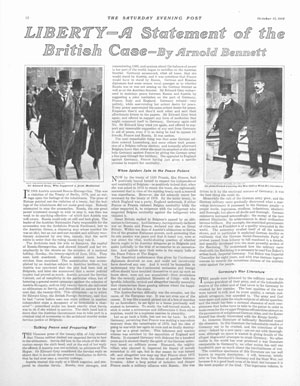
“The German military caste is thorough. On the one hand it organizes its transcendently efficient transport, if sends its armies into the field with both gravediggers and postmen, it breaks treaties, it spreads lies through the press, it lays floating mines, it levies indemnities, it forces foreign time to correspond to its own, and foreign news-papers to appear in the German language; and on the other hand it fires from the shelter of the white flag and the Red Cross flag, it kills wounded, even its own, and shoots its own drowning sailors in the water, it hides behind women and children, it tortures its captives, and when it gets really excited it destroys irreplaceable beauty. …
“If Germany triumphs, her ideal — the word is seldom off her lips — will envelop the earth, and every race will have to kneel and whimper to her: ‘Please may I exist?’ And slavery will be reborn; for under the German ideal every male citizen is a private soldier, and every private soldier is an abject slave — and the caste already owns 5 million of them. We have a silly, sentimental objection to being enslaved. We reckon liberty — the right of every individual to call his soul his own — as the most glorious end. It is for liberty we are fighting. We have lived in alarm, and liberty has been jeopardized too long.”
Hoping to make an ally out of the United States, Bennett was careful to mention a book that had recently surfaced, written by a member of the German army’s staff. In “Operations Upon the Sea”, Franz Frieherr von Edelsheim proposed an eventual assault on America.
“Von Edelsheim … begins by stating that Germany cannot meekly submit to ‘the attacks of the United States’ forever, and that she must ask herself how she can ‘impose her will.’ He proves that a combined action of army and navy will be required for this purpose, and that about four weeks after the commencement of hostilities German transports could begin to land large bodies of troops at different points simultaneously. Then, “by interrupting their communications, by destroying all buildings serving the state, commerce and defense, by taking away all material for war and transport, and lastly by levying heavy contributions, we should be able to inflict damage on the United States.” Thus in New York the new City Hall, the Metropolitan Museum and the Pennsylvania railway station, not to mention the Metropolitan Tower, would go the way of Louvain [a Belgian town where Germans burned, looted, and shot civilians], while New York business men would gather in Wall Street humbly to hand over the dollars amid the delightful strains of ‘The Watch on the Rhine.’ [A rousing German song from the 1850s, which asserted that the Rhine river must always remain German. It became an unofficial theme song for militant German nationalists during both world wars.]”
New Factors in War
By Samuel G. Blythe
In this report, Blythe observed several developing trends in the ancient art of war. Not only was the horse being replaced but soon airships would be bombing Paris and London. Even more ominous were the reports that France had developed a lethal gas for use on the battlefield. (The first poison gas attack on the Western Front was launched by the Germans in January 1915).
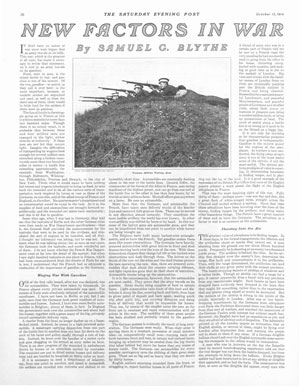
“It has been an axiom of war since wars began that an army travels on its belly. This war, which is the greatest of all wars, has made it necessary to revise that statement. As it now is, an army travels on its gasoline.
“Food, next to men, is the oldest factor in war, and gasoline is one of the newest. Of the two, gasoline—or petrol, as they call it over here — is the more important, because, as modern armies are organized and used, as well as from the sheer size of them, there would be little food for the soldiers if there were no gasoline.
“No staff officer goes anywhere on a horse. He uses an automobile. More than that, the Germans, and presumably the French, have taken auto delivery trucks of the heavier type and mounted field guns on them. These can be moved in any direction almost instantly. They constitute the most mobile artillery the world has ever known. In other wars artillery was shifted by horse or by hand. In this war some of the lighter guns are automobile guns, and they can be transferred from one point to another while horses are being brought up.
“I was told that a Frenchman had invented [a] identical gas that the imaginations of various novelists have invented for use in war fiction — a gas that is so frightful in its effect that when it is liberated all human beings and all living things within a large radius are instantly asphyxiated.
“I was told further that the French Government had the secret of the composition of this gas; that it had been proved out on sheep and cattle — that, at about the time I heard of it, a shell containing it was dropped two hundred feet from a flock of sheep, and that the sheep died instantly when the gas reached them.”
Step into 1914 with a peek at these pages from The Saturday Evening Post 100 years ago.
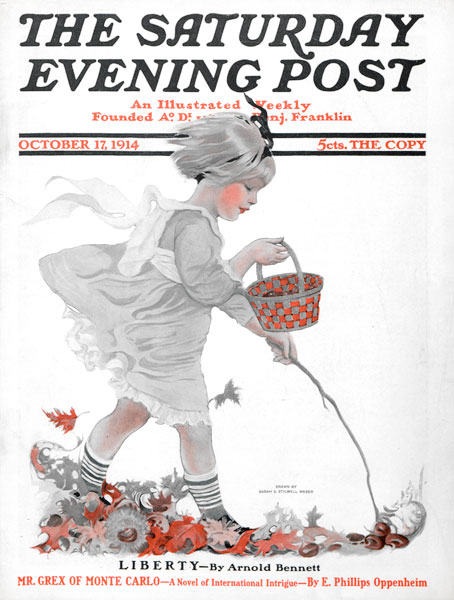

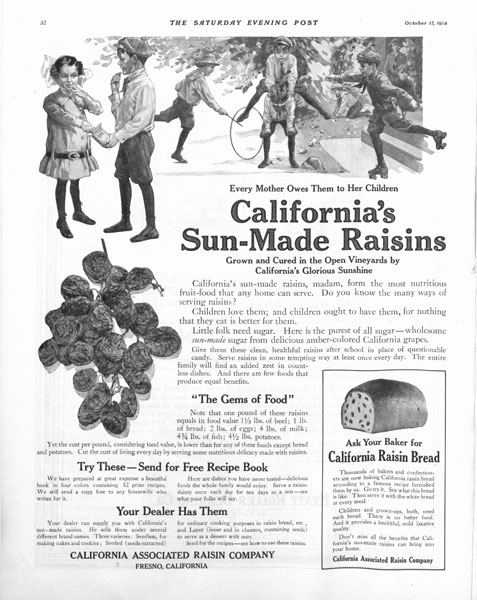
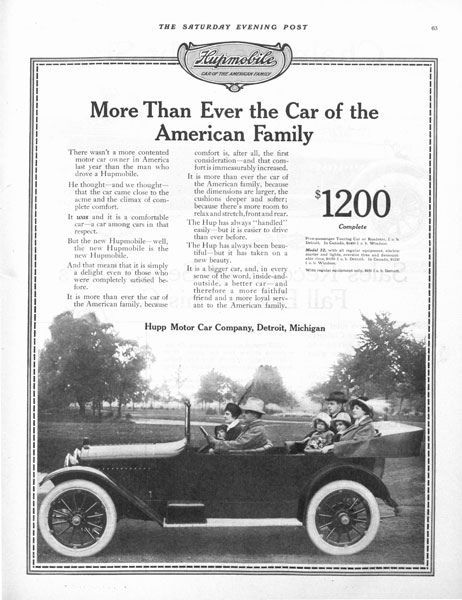
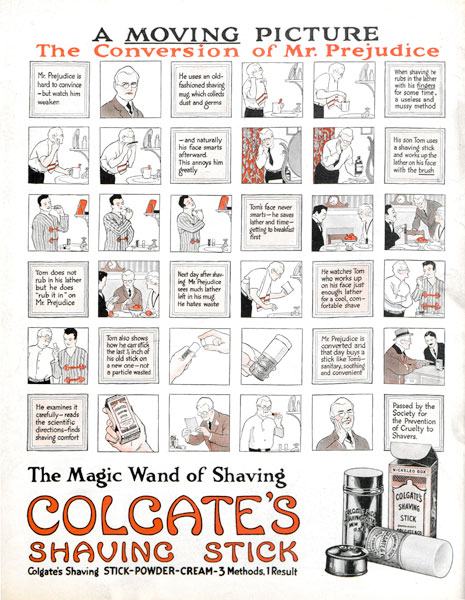
Paul
All these years later you can’t even remember his last name, but for 45 minutes of your life, Paul was the most important person in it. He was supposed to pick you up at the airport, assigned to you by the university as your international student guide. He had emailed you a few weeks prior to your arrival with instructions to meet him at the café next to baggage claim. And even though his message was brief, you were relieved to know at least one person in all of Denmark.
The thing that really irritated you when you arrived at the Copenhagen International Airport was how attractive everyone was. The other passengers at the gate, the airline employees checking baggage, hell, even the cashiers at the convenience store were putting you to shame. After sitting in coach class for nine hours, you found yourself buying a pack of gum from a 6-foot-tall blonde woman — whose silk blouse fell exactly right — wearing a hint of lipstick and blush in natural tones that made her look like she wasn’t wearing any at all. But you knew. Oh, you knew.
Yes, that Scandinavian beauty you’d heard so much about was rearing its beautiful head in every damn corner of the place. Even the Danish design furniture store was just too much for you at that moment.
You landed there on the first double-decker plane you had ever taken, together with 400 other passengers, but very much alone. All told, your trip took 1 commuter flight from Iowa and everything you had known, 90 minutes of nervous pacing in the departures terminal of O’Hare International Airport, 2 Xanax, 1 Dramamine, and 9 transatlantic hours of medically dulled anxiety. But you made it.
Your face still smelled like tears. You were able to avoid crying when you said goodbye to your poor parents, but like a badly timed geyser, it all came pouring out on the tram ride to your connecting gate. Badly timed because, no matter how hard you try to be invisible at moments like that, you will always run into someone you went to high school with.
“Lydia, hey, are you OK?” she had asked with a mix of enthusiasm and concern.
“Oh, yeah, how’s it going.” You said it, rather than asked it, willing the conversation to end. Also, you could not for the life of you remember her stupid name. Megan? Ashley?
Undeterred, she soldiered on with “So, are you coming or going?”
Which, at that particular moment, was a little too much — a little too symbolic, too deep. And the fact that she would never, ever realize that just made you cry harder. You did, however, manage an “I’m going to Denmark for a year.”
“Oh, wow! That’s really neat! I’m coming home from a week in Denver!”
The exchange with Megan-Ashley was enough to propel you out of the tram with aggressive speed — the speed of someone practiced at the art of avoidance. And the speed seemed to calm you down, forced you to focus on something other than your anxiety.
But then you arrived at Gate K-25, which is where your anxiety (Hey, wait up, I’m on this flight too!) caught back up with you. While there, you discovered that people do really interesting things before boarding an international flight, and you watched them with the focused curiosity of an anthropologist studying a newly discovered tribe.
- There were the young parents who, despite knowing this was the worst idea they’d ever had, were about to take their toddler on an overnight, transatlantic flight. Their sequencing of events was highly strategic: They first tried to exhaust the chubby pink-cheeked boy by chasing him through the rows of connected metal chairs. They next transitioned him into calm sleep mode — changing him into cotton footie pajamas and giving him a Pavlov baby bottle that signaled bedtime. Everyone at Gate K-25 was rooting for these parents. But every time the boy emitted one of his ear-piercing shrieks, you could also see in their faces that these people would band together to overthrow the tiny tyrant if necessary.
- There was the older couple — late 60s, maybe — wearing eye masks on their foreheads like sunglasses, doing what looked like tai chi in front of the roped-off Diamond Platinum Preferred Elite line. They were wearing durable slippers, the kind with hard rubber soles and fleece tops, not about to let the water-retention-induced foot swelling get the better of them this time. They both took a swig of Emergen-C to prevent any airborne pathogens from ruining their river cruise through Germany and the former Czechoslovakia — something they had done before, but never on the 12-day Jewels of the Danube package. The instant they boarded the flight, they would put on their eye masks and take one Ambien each. Until then, they busied themselves with deep squats and forward bends — the woman almost reaching the linoleum floor, the man hanging down with his fingertips just past his knees. They executed all of this with choreographed synchronicity.
- And then there was you, the lone young woman clutching her computer bag as if it were a security blanket, impatiently ready for this part to be over, and scared shitless for the next part to begin. You had already taken your plane meds, a cocktail of anxiety and motion sickness pills that you were accustomed to taking before every flight. This, though, was your longest one yet, and for that reason you convinced your doctor to increase the dosage. She agreed, but cautioned you not to let this become an addiction “like Jeb Bush’s daughter did.” You weren’t familiar with that reference, and forgot to look it up online afterwards. However, you remained confident that your fear of plummeting 35,000 feet from the sky to your tragic death was strictly airplane-induced.
Despite your best efforts to irrationally panic, the flight was uneventful. You were served the best airplane food you’d ever had, by the most pleasant-but-cool flight attendant you’d ever met, and you had complete control over your own movie and radio channels. All of this proved to you that, not only do the Danes do everything right, you were completely out of your league in moving to their country — and so you did find a reason to irrationally panic after all.
It looked hazy as the plane made its final descent into Copenhagen; you could tell that the city was surrounded by water, but in the fog, everything took on a gray-toned hue. You didn’t have many expectations for what it was supposed to look like; but after a suspiciously perfect Danish airline experience, it was nice to see that even the Danes couldn’t control the weather.
And so, there you were. In a haystack of beautiful people, looking for a needle whose name was Paul. Besides his name and his birthplace (South Africa), you didn’t know much about Paul. For some reason you scanned the crowd for someone who looked like he might have played rugby growing up.
It became clear to you when you met Paul that he had never played rugby, but you did not rule out the possibility that he was an underwear model at some point in his life. He was handsome, with a lean build that made you feel like you towered over him even though he was at least two inches taller. You were suddenly keenly aware of the fact that you had spent the last 12 hours soaking up airplane stench in every fiber of your clothing and laugh-crying during a medley of romantic comedies that you watched with preemptive homesickness.
“Hello, you must be Lydia.”
He said it in an accent that made your name sound exotic. You shook his hand, trying not to touch too much of him for fear that he’d discover the strange combination of smells — recycled air and tears? — was coming from you.
Walking to the baggage claim, you exchanged a predictable dialogue of one stranger welcoming another to a foreign land. The fact that Paul was South African added a little dynamism to the conversation, although it was you who did most of the talking. You have always been the type of person to fill silence with words, a carryover from middle school days of wanting to impress and charm and entertain people into liking you.
Paul seemed stoic, thoughtfully answering the questions you fired off about school and work and South Africa, evening out the pace of the conversation into a more measured calm. His gentle tone complimented your nervous buzzing nicely, you thought, and as you casually glanced down at his hands, you surprised yourself with how delighted you were by his lack of ring.
As you neared baggage claim, you became very concerned that Paul would soon discover how much luggage you had deemed appropriate for a year abroad, and would quietly judge you for it. You considered warning him about your suitcases, which weighed about 80 pounds each, but decided just to tell him that you’d know your bags (you called them bags to downplay their size) when you saw them.
Your suitcases circled around together, and as you pointed them out to Paul, it occurred to you that their weight might actually have been an important detail. You stood side by side, each reaching for a suitcase — you knowing to expect the strong heave required to lift a cannonball from a moving target, Paul probably anticipating a moderately sized bag of clothes. Your expectations, of course, proved accurate, while Paul was forced around the carrousel — all the while holding onto the bag’s handle, grunting his way through several surprised onlookers, eventually deadlifting the bag first onto the metal frame and then onto the feet of another passenger.
You wished you could laugh, you really did, but it was not the time for that. Maybe someday you’d laugh, when you were sitting around a table with friends, reminiscing about your amazing adventures in Copenhagen. You hoped Paul would be a central figure in those stories, the one person you knew in the entire country of Denmark, on whom you would eventually grow.
First, though, Paul needed an apology, and you rushed over to offer a heartfelt one. His response was simply a quiet “It’s ok,” which alarmed you in its finality. You trailed Paul out of the sliding glass doors toward the train tracks, trying to decide whether more talking or silence would be best. You went with silence, which was not easy for you.
Up until that point, your experiences on public transportation had included a nostalgic trolley service that ran the five blocks of downtown Cedar Rapids, Iowa, and a school bus ride to a friend’s house one middle school afternoon. The Copenhagen metropolitan train system was an interesting divergence from those experiences in a lot of ways, but most notably that day was the level of difficulty with which you and Paul had to 1) sprint to the platform to catch it; and 2) lift the 80 pound beasts three feet straight up into the train car in the middle of rush hour traffic.
Paul was really keeping it together; you had to give him credit for that. He may have had a hard time even looking in your direction, but he had not yet abandoned you — something you frankly would have done if the roles were reversed.
The train made periodic stops, and you found it stressful not knowing which one was yours. You kept shifting around your suitcase to let other people on and off, eventually picking out the one phrase they all seemed to be using — one that sounded like “oon-skoolt,” which you had to believe meant either “excuse me” or “stupid idiot.” Paul had not yet volunteered information about the duration of your ride, but at that point you had gone too long without speaking to break the silence.
Fortunately, or unfortunately depending on how you look at it, your stop was the exact same stop as literally every single person on the train, including all the school children in all of Denmark, who were coincidentally all riding that very train that same day. You lost Paul in the sea of beautiful people, but somehow managed to right yourself and your gargantuan suitcase on the platform below.
On the walk from the train station — with Paul once again at your side — there were cobblestone sidewalks for days. Days and days of plastic suitcase wheels getting stuck between the historic bricks that laid the foundation of the beautiful old city
From the comfort of your Iowa cocoon two months prior, you had received a welcome letter from the university, telling you that you would be living in a dormitory called Regensen, on a street spelled “St. Kannistræde,” with the little ‘a’ and the little ‘e’ making one single little letter, which sort of looked like two number 8s put together. Like any rational human being, you had no idea what that little letter sounded like, but you assumed the “St.” stood for “Saint,” so when Paul seemed lost on the walk from the train station, you cheerfully noted that you were looking for “Saint Kah-nis-straid?”
You had never seen Paul look so disgusted in your entire life.
And though he had not uttered a single word to you since that unfortunate baggage claim incident, he spat back, “It’s Store Kannistr-uhhhhh-thuh,” with such a forced pronunciation that you gasped a little bit.
You couldn’t help yourself; your only real option was to kill him with kindness. And so you pursued a line of questioning thus far left unasked, one that began with an innocent “Do you live somewhere around here, Paul?” and ended with “No, we live outside of the city to be closer to my girlfriend’s parents, who help with the baby.”
And just like that, everything changed. In that one moment, you realized that Paul would not be someone you could commiserate with over drinks about being a foreigner alone in this place or with whom you could develop a lasting friendship. You were not looking at an equal; you were looking at a man who had gotten his Danish life together, who had made this place home. And you started to notice in his demeanor — his eyes gave it away — that he was doing the university a favor by escorting you from the airport.
When you finally made it to the thick curved wooden door that was sandwiched between two solid brick walls, you were choking back strange tears — homesickness? loneliness? or, damn it, both?
Paul leaned into the electronic dialing pad and said some nonsense into the speaker. Overhead, you heard a long high-pitched tone and a click, and just like that, you entered into the hallowed halls of Regensen Dormitory. You wanted to reach for Paul’s hand, but after everything, you knew you couldn’t.
Together, separately, the two of you walked through a short tunnel and into a large, sunny courtyard where a group of beautiful Danish models were sitting on a beautifully rustic picnic table, drinking champagne and eating strawberries. You let Paul do all the talking, but with every harmonized glance given to you by the picnickers, you wondered what exactly he was saying. At last, one of the Danish men stood up, shook your hand, and reached for the suitcase that Paul had carried this far.
You turned to say thanks to Paul, generically promising to “See you around,” to which — although your memory is a little foggy — you recall him replying “Cheers” and lifting his hand in a motionless wave, leaving you there, in the middle of the courtyard.
The Great Disillusionment
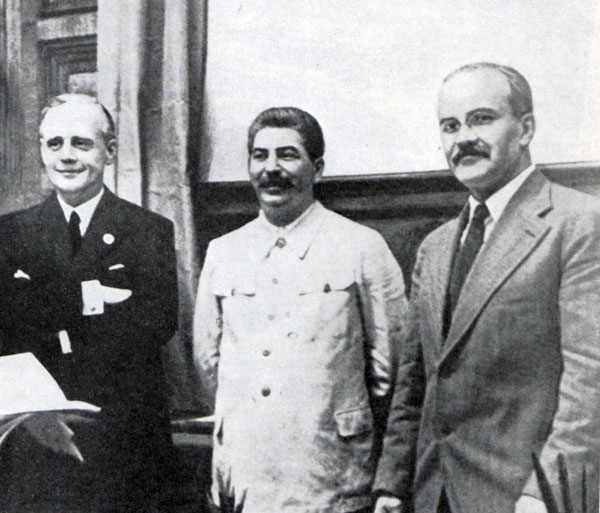
The week before news of the war stunned America, the country had been shocked by an even more startling piece of news. On August 23, 1939, Nazi Germany and Soviet Russia — the two most dedicated foes in Europe — became allies.
For years, they had each shaped their foreign policies around total opposition to each other. Hitler and Stalin had both built fanatical support among their people by demonizing each other. Now, under the Molotov-Ribbentrop Pact, the two men would be the political equivalent to friends.
Both dictators had good reasons for making the deal. It would allow Hitler to invade Poland without fearing an unexpected attack from Russia. And it would give Stalin more time to build up his military. Germany sweetened the deal by allowing Stalin to grab up the independent Baltic nations of Estonia, Latvia, and Lithuania. Hitler even invited Stalin to divide the spoils of a defeated Poland.
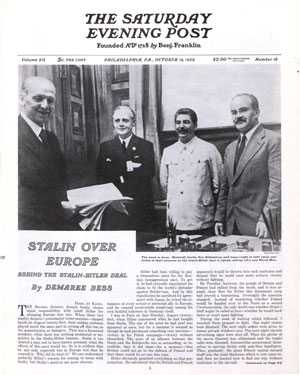
As Post journalist Demaree Bess saw it, the agreement between these two dictators led to World War II just as surely as the shooting of Franz Ferdinand led to World War I. He wrote, “Joseph Stalin shares equal responsibility with Adolf Hitler for plunging Europe into war.”
The agreement kicked the legs out from under the world’s radicals. Ever since 1917, when the Bolsheviks had overthrown Russia’s autocratic government, revolutionaries around the world had viewed the new communist government as the future of mankind. When the First World War ended and Europe’s governments tried to turn back the clock to regain privilege and power for their ruling classes, Russia seemed to be the only progressive force on the continent. The radical regarded the Soviet Union, not the U.S., as the international champion of liberty. To them, Lenin replaced Lincoln as the great emancipator. And Russia’s commitment to world communism, they believed, would end the oppression of workers everywhere.
Of course much of this thinking was put forth by the Soviet government itself. It had sent agents around the globe to promote unrest, destabilize governments, and recruit activists who would help establish the dictatorship of the proletariat. Men and women by the thousands gave their efforts, and sometimes their lives, to realize this dream. But the Worker’s Paradise in communist Russia had become a cruel joke, particularly after Stalin seized total power. The Soviet government had become the regime of a despot.
Communist supporters recognized Stalin could be ruthless and cruel, but most remained faithful to the revolution. A few of them hoped to rise to power in Stalin’s new world order. But most avoided looking closely at the Soviet’s violent excesses: independent farmers destroyed, thousands of opponents executed, and millions of Ukrainian peasants starved to death. Communism, these supporters argued, had to be ruthless, violent, and deceptive if it was going to defeat the forces of reaction.
By the late 1930s, though, it was getting harder to keep faith with Soviet Russia. News was leaking out of the country, despite rigid censorship, that Stalin had executed not only his opponents but thousands of his most dedicated followers.
And then Stalin signed a peace accord with his sworn enemy. For many radicals who still supported the ideals of communism, this was simply too much. Stalin had betrayed them.
“Heartbroken”
Herbert Johnson cartoon appeared in the Post in 1939 illustrated communist supporters’ disillusionment with the Molotov-Ribbentrop Pact.
“By his deal with the Nazis,” Bess wrote, “Stalin completely wrecked the Communist movement in all countries except his own. He finally made it clear, even to the most muddleheaded liberals, that there is little or nothing to choose between Stalin and Hitler, between Bolshevism and Nazism. He deliberately threw away any prospect of world leadership which he might have possessed.
“The Russian revolution … ceased to become an expansive world force on the day Stalin announced his deal with Hitler,” he continued. “The antics of the Bolsheviks, from this time onward, are of concern only to the people of Russia and their immediate prey. The tragedy is that Communism’s collapse as a world movement was achieved only by provoking European war.”
With his pact signed, Hitler invaded Poland within the week. Seventeen days later, Stalin followed suit. He sent his army into eastern Poland, violating a nonaggression pact he had signed with that country six years earlier. Stalin’s disregard of his old treaty with Poland didn’t phase Hitler. He wasn’t relying on the Soviet leader to keep his word, anyway. The Nazi leader was planning to break the Molotov-Ribbentrop Pact when it suited him.
That moment came the morning of June 22, 1941, when he sent his troops across the Russian border, racing away to deliver the final blow to communism. When he first heard of Hitler’s plan, Stalin refused to believe it. He had the officer who reported the German invasion executed. But gradually, doubt gave way to certainty. Stalin hurriedly retreated to his country home, refusing to talk to anyone, fearful that his misjudgment of Hitler would earn him the punishment he had meted out to so many old Communist Party members.
Yet he survived Hitler’s betrayal. And thousands of hard-core communists survived Stalin’s betrayal of communist principles. By the time the war ended, the communist machinery for world domination was up and running, ready to swallow Eastern Europe and much of Asia.
Step into 1939 with a peek at these pages from The Saturday Evening Post 75 years ago:

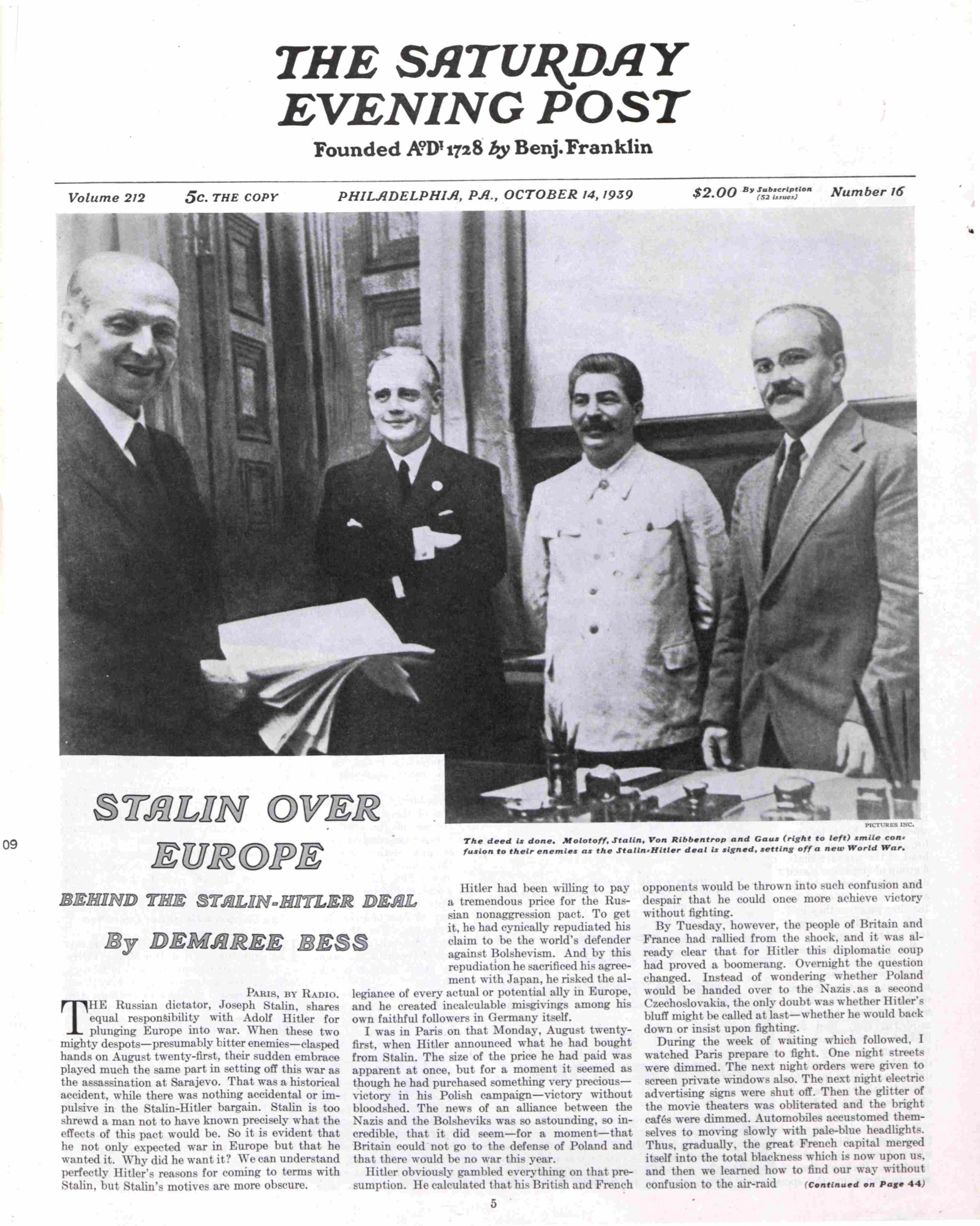

The Great War: October 10, 1914
From pages of the Post, October 10,1914: A forgotten American humorist turns war reporter, the war finds an unofficial theme song, and a doctor’s optimistic prediction of death is proved false.
A Little Town Called Montignies St. Christophe
By Irvin S. Cobb
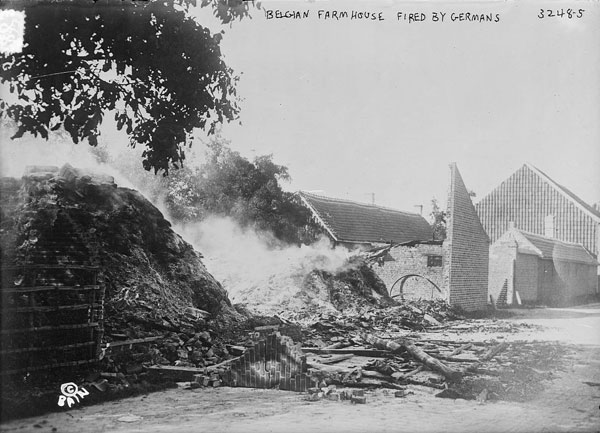
You probably wouldn’t know the name Irvin S. Cobb unless, like me, you haunt the dustier shelves in used bookstores. Far in the back, usually in the humor section, I’ll find at least one of his books; he published over 60 titles between the 1900s and the 1940s.
Back in those years, Americans apparently couldn’t get enough of him. He was America’s highest paid short story writer. He also wrote movie scripts, appeared in motion pictures and on radio, traveled the lecture circuit, and hosted the 1935 Academy Awards. And he produced a mountain of work for the Post: [180 articles and stories between 1909 and 1922].
In 1914, Cobb decided to join the long line of American humorists who went to Europe to write a travel book. His series, titled “An American Vandal,” ran in the Post from March through June that year. No sooner had he returned to the States than the war started in Europe. Although he’d made his reputation as a humorist and storyteller, Cobb was still a journalist at heart. He jumped at the chance to report a war. He set off for the frontlines and, just across the French border, came across “A Little Town Called Montignies St. Christophe.”
It was a sleepy Belgian village when Cobb passed through it in the spring, but now he was giving the village a second, serious look.
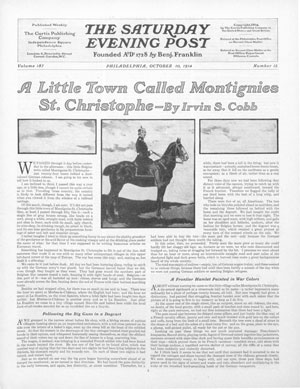
“Something has happened to Montignies St. Christophe to lift it out of the dun, dull sameness that made it as one with so many other unimportant villages in this upper left-hand corner of the map of Europe. The war has come this way; and, coming so, has dealt it a side-slap.
“A six-armed signboard at a crossroads told us its name — a rather impressive name ordinarily for a place of perhaps twenty houses, all told. But now tragedy had given it distinction; had painted that straggling frontier hamlet over with such colors that the picture of it is going to live in my memory as long as I do live.
“Every house in sight had been hit again, and again, and again. One house would have its whole front blown in, so that we could look right back to the rear walls and see the pans on the kitchen shelves. Another house would lack a roof to it, and the tidy tiles that had made the roof were now red and yellow rubbish, piled like broken shards outside a potter’s door. The doors stood open, and the windows, with the windowpanes all gone and in some instances the sashes as well, leered emptily at us like eye-sockets without eyes.
“Until now we had seen, in all the silent, ruined village, no human being. The place fairly ached with emptiness. Cats sat on the doorsteps or in the windows, and presently from a barn we heard imprisoned beasts lowing dismally; but there were no dogs. We had already remarked this fact — that in every desolated village cats were thick enough; but invariably the sharp-nosed, wolfish-looking Belgian dogs had disappeared along with their masters. And it was so in Montignies St. Christophe.
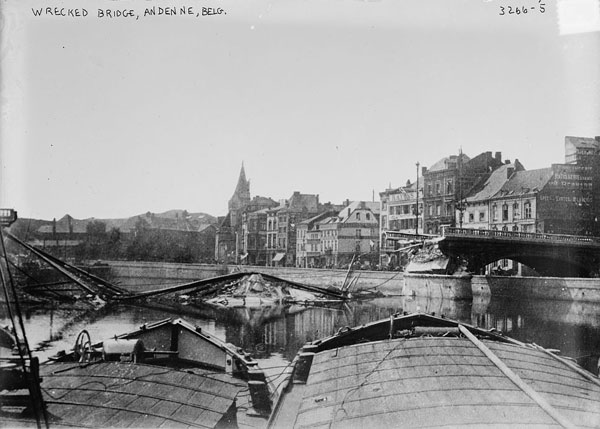
“On a roadside barricade of stones, chinked with sods of turf … I counted three cats, seated side by side. It was just after we had gone by the barricade that, in a shed behind the riddled shell of a house, which was almost the last house of the town, one of our party saw an old, a very old woman, who peered out at us through a break in the wall. He called out to her in French, but she never answered — only continued to watch him from behind her shelter. He started toward her and she disappeared noiselessly, without having spoken a word. She was the only living person we saw in that town.”
Sidelights on the War
By Samuel G. Blythe
Just two months old and the war already had an unofficial theme song. Its brisk march tempo captured the spirit of the time so well that even today, when so much has been forgotten about the war, many will still recognize it as one of the signature songs of the conflict.
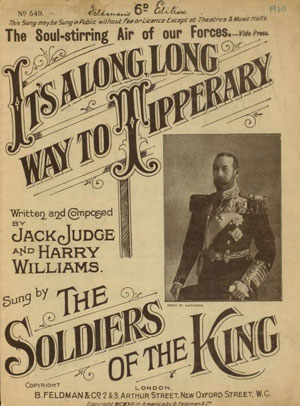
“The marching song and the fighting song of the British soldiers and the British sailors is not ‘God Save the King!’ or ‘Rule Britannia!’ or any other classic. The marching song and the fighting song of the British soldiers and the British sailors is: ‘It’s a Long Way to Tipperary!’ And that song is an inconsequential music-hall ditty, just as was ‘A Hot Time in the Old Town!’ And this is how the chorus goes:
It’s a long way to Tipperary,
It’s a long way to go;
It’s a long way to Tipperary—
To the sweetest girl I know !
Good-by, Piccadilly !
Farewell, Leicester Square !
It’s a long, long way to Tipperary;
But my heart’s right there!
“This is the song that the British soldiers and sailors sang when they went to France and to sea, which they sang in the fighting all along the line, and which they are still singing, and will sing to the end of the war. … It roars and rolls over the barracks and the camps; and even the French have re-constructed it as ‘Le Chemin a Teeperaire,’ and are singing it too.”
Listen to “It’s a Long Way To Tipperary” by the great Irish tenor John McCormack.
Read the entire article “Sidelights on the War” by Samuel G. Blythe from the pages of the Post
The Hour of Aëroplanes
By F.S. Bigelow

Ah, the French esprit. Here is an amusing example of the bright, happy spirit of the French in the early days of the war, before thousands of deaths darkened the country’s mood.
“In a single week this became a veritable institution. At half past four, or perhaps at five, the planes began to appear. Suddenly the streets swarmed with people who wanted to see them. The Place de l’Opéra may fairly be said to be the center of Parisian sidewalk life. Every afternoon this square was closely packed with eager sightseers. When a plane was sighted the crowd in the square set up a shout and the people at the café tables rushed into the street to get a better view. Much of the talk was of bombs, planes, and Zeppelins.
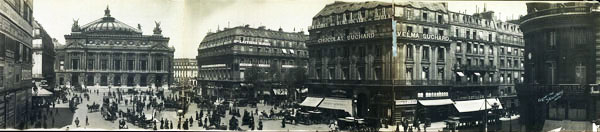
“By no means were all the aircraft that passed over the city hostile. Indeed, most of them were French scouts; still, it took two looks to distinguish friend from foe. … The simplest rule is that friends fly low and foes remain aloft out of danger.
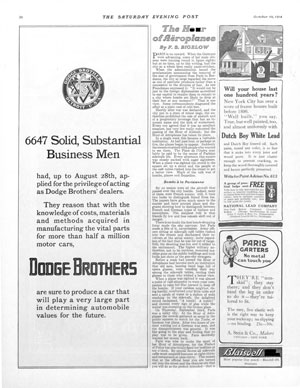
“There is no doubt the first bomb-dropping foray made the city nervous; but Paris made a fête of it, nevertheless. Army officers sitting at sidewalk café tables rushed into the streets and discharged their revolvers at the aerial enemy, quite regard-less of the fact that he was far out of range. Still, the shooting was fun and it added to the excitement. The higher military authorities, not to be outdone, mounted ma-chine guns on the public buildings and took futile pot shots at the gun-shy strangers.
“Before a week had passed the Hour of Aëroplanes had become such an institution that old men, bearing hand bags full of opera glasses, were wending their way among the sidewalk tables, renting their glasses to those who wished a better view.
“When a plane was sighted it was almost a point of café etiquette to warn your companion to raise her lilac parasol to keep off the bombs. If your careless neighbor, rising hastily, overturned your little table and sent a carafe of water or a siphon of soda crashing to the sidewalk, the delighted crowd exclaimed, ‘A bomb ! A bomb!’ and showed every sign of glee while the waiter was sweeping up the broken glass.”
The Wreck of a Continent
By Samuel G. Blythe
Europe’s collision with war reminded Blythe of the days that followed the Titanic’s collision with an iceberg. Now, as England began shaking off its shock and disbelief, it was handing unprecedented powers over to its wartime government.
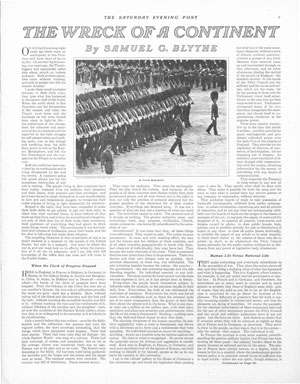
“I sat in the visitors’ gallery of the House of Commons a few afternoons ago and heard the legislators there passing law after law of the most sumptuary character, without sword of debate, without question, without a protest of any kind. Measure after measure came up and was hurried through on that afternoon, and on other afternoons, placing the control of the people of England — the absolute control — in the hands of the Privy Council and the military and the naval authorities, which are the state; for by the passing of these acts the Parliament voted itself subordinate to the men who are thus empowered to act. Parliament abrogated many of its own functions, recognized the emergency, and placed itself in un-questioning obedience to the supreme power.”
The Unemotional Frenchman: A Wartime Trip Through the Southern Provinces
By Homer Saint-Gaudens
Homer Saint-Gaudens, son of the famous American sculptor Augustus Saint-Gaudens, found himself stranded in a French town also named Saint Gaudens when the war broke out. His two-part article showed the French quietly resigning themselves to war.
“Here had been a perfect opportunity for flags, confusion, illogical demands on the government, irresponsible moves by the government, extras, scareheads, and patriotic drunkenness. Yet none of these appeared. When the call came each man heaved a sigh of regret, laid down his tools and stood ready. The government was of his choosing. It had prepared the country for the crisis before it. He had infinite faith that all measures had been taken for the national safety. What these were he did not know. Were he to know everybody would know, the country’s enemies would know. His task was to obey the call to arms. He did not complain or criticize.
“The roads we found deserted of teams, the fields deserted of laborers. In the doorways stood women. Toward the railroad station moved a young man and a girl. The man had a bundle in one hand, the other was on the girl’s shoulder. From the station came three girls walking quickly up the road, hand in hand, crying. Only women came from the stations. One and all were dressed in black—most of them had been weeping. More and more we became the unwilling witnesses of other persons’ domestic tragedies.
“We had seen recruits before, mostly huddled together like cattle driven to the slaughter. We had heard the Marseillaise sung before, especially in that maudlin fashion in Saint-Gaudens. These men were neither cattle nor maudlin. They were unkempt and they perspired. They were dirty. They smelled of garlic and their bundles were awry. But they were sober, and they were proud as they passed up the hot, sunlit street; and they sang the song of their land and marched it as their fathers must have marched and sung it when first it was written.”
Following the Red Trail: The Real Perils of War
By Woods Hutchinson
A professor of clinical medicine and a medical writer, Hutchinson was optimistic that modern medicine would help control the casualty numbers of the war. Combat deaths declined in every successive war, he noted, and he expected they would remain low in the coming months.
“The cheerful pastime of slaughtering our fellow men has, in the most recent wars, been carried on with smaller loss of life and less suffering and hardship, both to the actual combatants and to the noncombatants in whose territories the war is waged.
“The average death rate of the first three great wars of the past century — the Napoleonic, the Mexican, and Crimean — was 12.5 percent a year; that of the last three wars — the Spanish-American, the Boer, and Russo-Japanese — was 4.8 percent.
“By the time the Napoleonic wars were reached, the mortality from deaths in war, from all causes, had fallen to about 125,000 a year, or about 12 percent.
“In our own Civil War, it fell to 10 percent.
“The Sedan campaign cost the German army only 8 percent of its three-quarters of a million men; while our Spanish-American and England’s Boer War reached the low-water mark, with barely 3 and 4 percent of loss respectively.
“As to the cause of this gratifying reduction in war fatalities, several influences have been at work. One of the most obvious has been that the invention of gunpowder and the improvements of rifles and artillery, with such enormous increase in their range of death dealing, has steadily forced more and more of the fighting to be carried on at long range.
“The net result of this has been that not nearly so many men are actually hit as in the days of old point-blank firing by platoons; that as a battle becomes a long-range duel … its fate is decided more and more by maneuvers such as surrounding a force or cutting it off from its base than by actual sacrifice of life, or by weight of numbers in a bayonet charge.
“The other most important change … was that in the old days, when battles were decided by hand-to-hand fighting, the victors were literally right on top of the vanquished the moment the tide turned and the retreat began; and only superior fleetness of foot or length of wind could save a very large percentage of the beaten troops from slaughter, maiming, or slavery.”
Despite Hutchinson’s predictions, the First World War quickly surpassed single-digit casualty rates. The percentage of casualties in Great Britain’s forces was 36 percent. It was 65 percent for Germany, 76 percent for Russia, and 90 percent for Austria-Hungary. (The casualty rate for American forces, which were engaged for only 17 months, was 7percent.)
Step into 1914 with a peek at these pages from The Saturday Evening Post 100 years ago.