Mary Whalen Leonard on Posing for ‘Shiner’
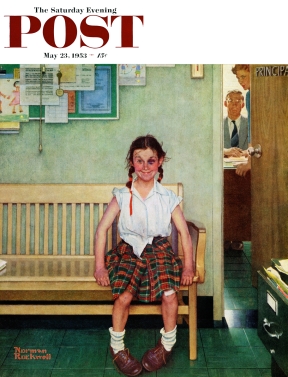
Norman Rockwell
The Saturday Evening Post
May 23, 1953
Sometimes in life you have to take a beating — literally or figuratively — to stand up for the truth, yourself, a loved one, or something you truly believe in. And it’s always worth the cost of that battle, as this girl’s triumphant smile, even with that shiner, celebrates.
Mary Whalen Leonard, Norman Rockwell’s favorite female model, who posed for Girl at Mirror, Day in the Life of a Girl, and others, speaks fondly of posing for my grandfather’s illustration Shiner (above):
“My recollection of working out this picture with Norman [above] is one of laughter and fun. He showed me the sketch and wondered what I thought about it. I got it. It was about role reversal. For once the little girl was victorious, and it did not matter that she had a black eye. That was the mark of the trophy!
“These posing sessions were filled with lots of Norman’s laughter as he knelt on the floor and pounded his fists to get the smile he wanted …”
I’m Going to Live Forever
 I want to be famous.
This presents one immediate obstacle, as Jenny does not hesitate to point out whenever I mention it.
“Famous for what?” she asks, scraping the few bits of apples and dumplings she served with her pork roast from my dinner plate into the can where she collects stuff for composting.
I leave the warm kitchen and go outside to my workshop, my sanctuary, and one day, my portal to fame. Every idea and plan I ever had is filed there, along with the Wikipedia entries of every member of the Inventors Hall of Fame from Acheson to Zworykin. I study them, looking for that key factor that connects us all.
It is a little cramped, my workshop. There is the unopened air purifier Jenny gave me five Christmases ago, next to all the old computers I have replaced over the years. You have to be on the cutting edge of technology to lead the way.
The following night I bring home a new computer.
“You just got one. Why do you need a new one?” Jenny keeps our household budget because I never have time to know the cost of two chicken legs. And each time I buy a new machine, she says the same thing: “Well, we’ll just eat dog food this month.” Tonight I smile at this over my last forkful of her strawberry rhubarb pie.
“I think this will be it. I am so close,” I casually say.
“Hmmph,” or a sound like that, comes out of her lips as she clears the dishes. I retreat to my workshop.
It’s true, about being close. I decided it was time to leave the base camp, to make the final push for the summit of my Everest and I went through all 283 ideas and plans. Jenny would be shocked to see how systematic I have been. Whenever she picks up my pants and T-shirts from the floor, she always complains about my disorderliness. When I reply that 35 years of successful actuarial work at Guaranty Life Assurance couldn’t have been done without order, she just says “Hmmph,” and marches out to her laundry room. I think that’s her favorite word.
College was where I first studied math and dreamed about the Fields Medal, but those never go to people who have jobs, a wife, demands to be met, bills to pay. Besides, I passed the age limit for the Fields 25 years ago.
There are only a limited number of ways a person can become famous. The surefire way is with an award, like a Nobel Prize or one of those genius grants. Those people often take years to lay the foundations for their ultimate accomplishment. Within those years, they don’t have the distractions or demands that I have had to devote to Jenny, the family, and to Guaranty Life. With no secretaries, assistants, or helpmates, there is no way that sort of life could have lead to a Nobel Prize.
It’s not like there weren’t accomplishments, though. Above my desk, framed and laminated, is an article from Actuarial Monthly News about my retirement dinner, at the Kon-Tiki restaurant. It’s a nice long piece, although it does not mention that I did not want to retire, that I went from adding machines to computers without difficulty, that I should have been the damn vice-president who engineered my retirement. It didn’t even refer to an earlier article about the equations I created, using large-purchase data to adjust life expectancy and how it saved the company thousands, millions even.
Back to the subject at hand, the path I have chosen to achieve my fame. I was noodling around one evening in my workshop. Something Jenny said, an “I don’t have time now” thrown over her shoulder as she went off to match up my socks, kept ricocheting around my brain.
Time. The fourth dimension. And if mathematical equations defined the other three dimensions, the fourth dimension must have them too. If I defined it, I could manipulate it. H.G. Wells merely wrote a fictional tale about time travel, and he is still remembered for it. Actually doing it would be exponentially better.
The math was, to be sure, rather daunting. It whirled around my head so much that for several weeks I was unable to get back to sleep after getting up in the middle of the night to pee. It has taken sheer will to achieve my ultimate route to renown. I am sure a pure mathematician would call it elegant.
Beautiful as they are, equations are not enough. A demonstration is necessary, one so conclusive that everyone, from fellow inventors to ordinary citizens like Jenny, will understand it. That’s why I have decided that the ideal demonstration of my conquest of time is to kill Jenny. I don’t mean I literally kill her, just arrange for her to go elsewhere in time, and when everyone is convinced she is dead, demonstrate her return and my fame is guaranteed.
Wikipedia is my browser home page. It’s where I always start my research and where I now learn that an average of seven people fall overboard from cruise ships each year and almost all become shark chum. One of Jenny’s constant nags is about going on a cruise. It’s perfect; two leave on the cruise, one comes back.
After two years, a court will need to declare her officially dead. I could discretely invite some media and perhaps have it streamed live on the Internet. In any event, just before the judge pronounces Jenny dead, I will jump up.
“Wait a minute, Your Honor,” I will shout. “She’s not dead.” Here I will pause for dramatic effect. “I have just moved her back in time.” Pandemonium when I produce her.
There are so many details. For one, those equations need to be fed into a 3-D printer to create the mechanism, ingeniously small enough to fit into a camera bag I can carry on board the cruise ship! I also create a failsafe system that will bring her back in the unlikely (9.3 percent) chance I die prematurely. Every detail has been recorded in a notebook, for future scholars and biographers.
All this excitement has whetted my appetite, and I lock the door to the workshop before heading back to the house for dinner.
Jenny brings her beef bourguignon to the table.
“My dear, my efforts are bearing fruit, so to speak,” I say.
“You are close?” Jenny asks from the kitchen, then returns with a bowl of glazed carrots and her wonderfully creamy mashed potatoes.
“More than close. It’s just about a done deal, a triumph even.”
“Oh,” she says. She sounds almost disappointed.
“What’s the matter?” I ask.
“Well, I got you a gift, and now I am not sure if you will need it,” she says, her eyes downcast.
“You got me a gift? I am touched. And do you know what is ironic? I have a gift for you, to make up for all the time that I left you for my workshop,” I tell her, filling up my plate. It is so fragrant, rich, and meaty; I pour on some extra sauce.
Jenny gets up and heads toward our bedroom. This allows me a few good forkfuls of the savory beef, sweet carrots, and smooth potatoes before she returns, holding not a box, but her own laptop.
“George, here is what I wanted to give you. With presidents and movie stars and Albert Einstein, your own Wikipedia entry!” Jenny twirls the laptop around and presents the screen to me.
And so it is. Not a stub, even, but paragraphs, sections, even the photograph from my retirement party. I read it all quickly and then a second time, awestruck that it is so substantial and detailed.
“This is fantastic, Jenny. However did you do it? How long has it been up?” I wonder how many hits it’s received.
“Three days,” she answers.
I sigh. Soon, anonymous editors will recognize it as a vanity entry and demand that it meet the rigorous standards of reference to publicly available facts.
“Thank you, Jenny. This is a wonderful trifle, however transient it may be.” The cruise tickets will look so much better next to her little effort.
“Transient? Why transient, dear?” she asks, in innocent ignorance.
“Well, dear,” I explain. “All the facts in a Wikipedia entry must be verifiable using publicly sourced documents. You just can’t make things up.”
“Oh, but these are sourced. Every fact. Well, some won’t be available for a few days but they will be in the paper.”
I reach for the water glass. The beef bourguignon is unusually dry in spite of the extra sauce I poured over it.
“What do you mean, what source are you talking about? Those Actuarial News articles are years old.” My words sound as if I am trying to imitate Demosthenes with a mouth full of marbles.
Jenny stirs the pot of stew. I can smell rosemary, wine, oregano.
“How do you feel, George?” Jenny asks me.
“Fine,” I say, though I am clearly not.
“I suppose I should be sorry, George. But I am not. Even before you disappeared all the time into that shed, I grew to know you less and less. So with that shed, what did you do in there? You never shared it with me, even when I asked, and finally I couldn’t take it anymore. When you were out at the hardware store the other afternoon, I went in there.”
I can feel the muscles around my eyes straining as I try to widen them.
“I found your notes. George, right out in the open. Right there. I read your plan to kill me on the cruise. And it just did not seem fair.”
She walks to where I am seated and stands over me. Her eyes look sad, moist.
“I told myself for years that it was fair. You provided and I kept the home and raised the children. It was hard but I told myself that it did work, that we did our part for each other. But I see that to you I am just another piece of equipment for your crazy schemes,” she tells me.
I try to speak, but for some reason I cannot. She puts her head under my arm and pushes up, lifting me to my feet. I can barely shuffle with her to the bedroom, where with a twist, she drops me onto my side of the bed we have shared for, what was it, 47 years?
“The stew was very flavorful tonight, wasn’t it?” Jenny is truly crying now. “It simmered for hours, before I added the Botox. I found the supply via an email offer. Spam I think you call it.” She leaves me. I can hear her in the kitchen pouring the sauce into the compost can. She comes back, and leans into my field of vision, her hair, backlit by the bedside lamp, is the same blond as when we first met. The angle of the light smoothes her face. Her green eyes look into mine, like she used to.
My mind is racing, even if I can barely move a millimeter. It is an ingenious plan. I have to give her that. As good as I could have done. Maybe, even a little better.
The best thing is that, whether she is caught or gets away with it, the result will be the same. I have a Wikipedia page!
I wish I could thank her.
A Bad Choice for Spokesman
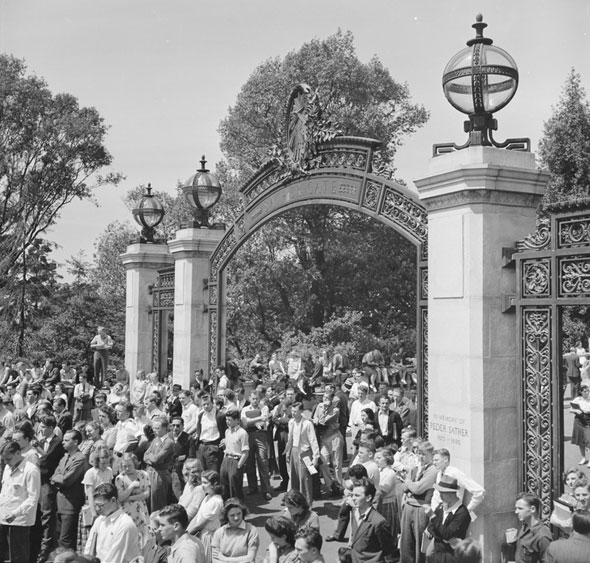
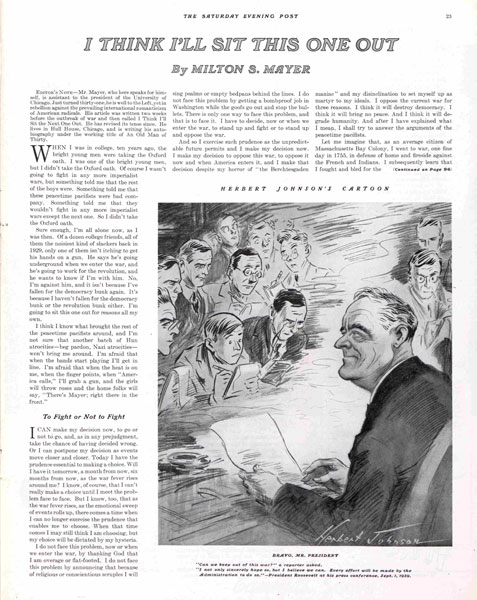
In the days to come, the Post editors must have regretted ever hearing of a young man named Milton S. Mayer
The editors had been looking for contributors who supported the magazine’s isolationist views when war broke out in Europe. Like many Americans, they regretted U.S. participation in the last war, in which the country lost thousands of young men but gained neither wealth nor territory as our European allies had. Worse, the war had only increased enmities among the nations of Europe. Moreover, our allies were not paying back the war loans America had extended them.
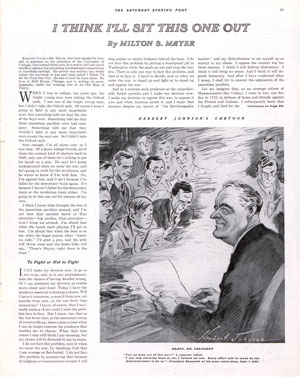
Now, with unemployment still hovering around 18 percent, and the U.S. economy still trying to shake off the Depression, the editors wanted to concentrate on America’s problems — which meant staying out of the war.
Milton Mayer also opposed the war, but for quite different reasons, which he presented in the article “I Think I’ll Sit This One Out.” Read the entire article “I Think I’ll Sit This One Out” by Milton S. Mayer from the October 7, 1939 issue of the Post. The editors included it in the October 7 issue, with the statement that Mayer spoke “for himself.” He also happened to be supporting the Post’s isolationist viewpoint. I think the editors agreed with him so strongly that they overlooked the fact his article was filled with groundless claims and sweeping generalizations.
He was an unlikely contributor: a 31-year-old student at the University of Chicago, though he was still on probation, he told a Post interviewer, for throwing beer bottles out his dorm window several years before. He had never lived outside the U.S. and had no experience of the situation in Europe. His sole recommendation as a contributor was his antiwar stance.
Mayer opposed any involvement in the war for three reasons. “I think it will destroy democracy,” he wrote. “I think it will bring no peace. And I think it will degrade humanity.”
Well, he had a right to his opinion. But normally, the Post wouldn’t offer opinions that weren’t backed by some research or personal experience. All Mayer could offer was his faith in his own wild assertions, such as—
• Defeating Germany’s Kaiser Wilhelm II in 1918 had resulted in Hitler’s coming to power. Therefore, if America defeated Hitler, another tyrant — even more brutal than Hitler — would take his place.
• England wasn’t worth defending because it would betray any ally to buy peace with Hitler.
• Many of the leaders who’d been deposed by Hitler weren’t strong advocates of democratic rule, hence not worth helping.
• Intolerance and fascism rose sharply in America after World War I. So it was bound to happen after the next war.
To all these assertions, he offered neither argument nor evidence.
All wars were bad, Mayer believed: “War makes ‘madmen’ of us all, and no balance of power that was ever devised remained in balance very long. For the victor grows fat and the vanquished grow lean, and the time comes when the vanquished have to fight and see their chance.”
To be fair, most of history up to 1939 supported Mayer’s statement. He couldn’t have known that when World War II ended there would not be another Hitler. Germany would not start another war for European conquest. France, Belgium, Great Britain, Germany, and the Scandinavian nations would enter a peace that has endured for almost 70 years. And America’s two greatest adversaries became strong postwar allies.
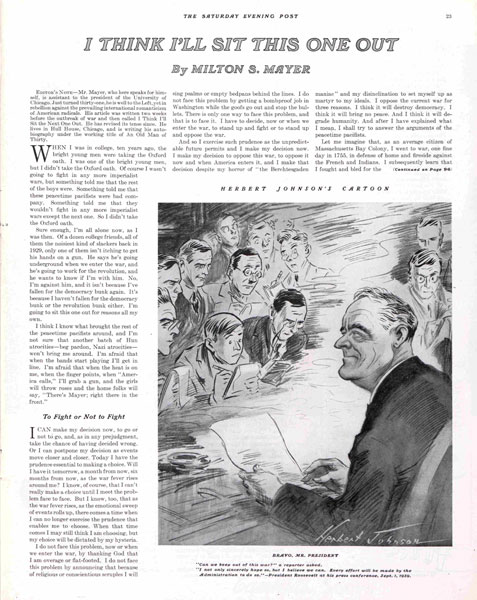
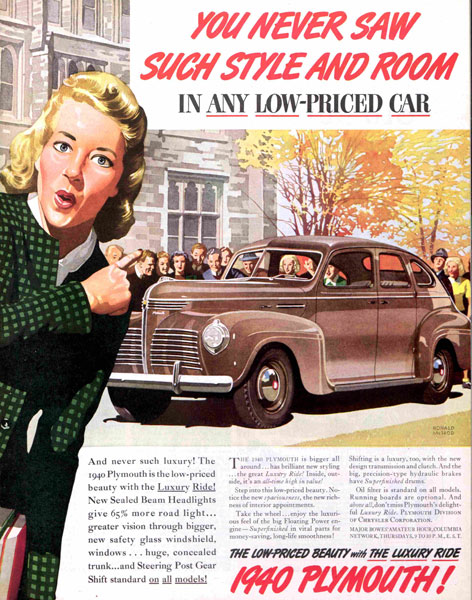
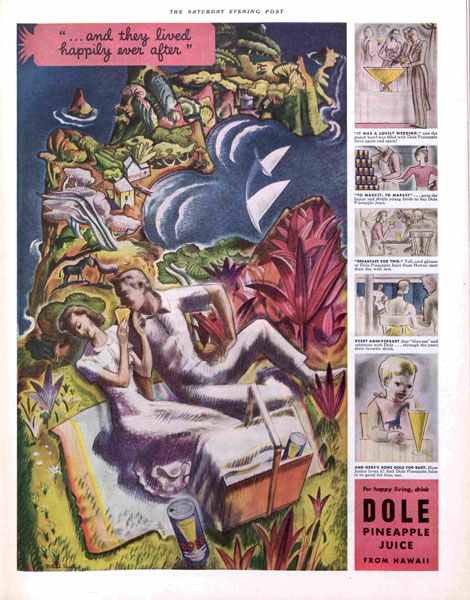
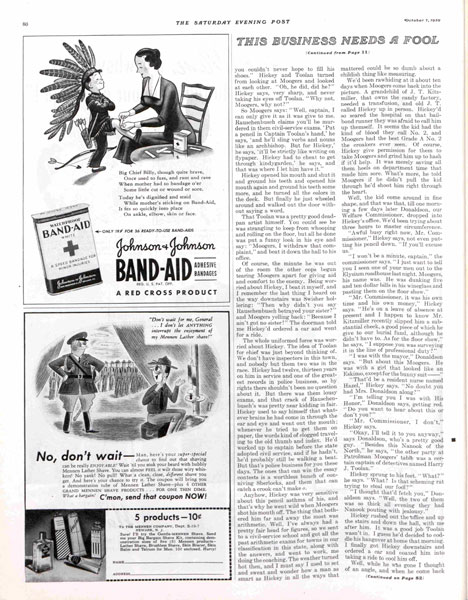
Step into 1939 with a peek at these pages from The Saturday Evening Post 75 years ago:


The Great War: October 3, 1914
From the Post October 3, 1914: A Post author gets swept up with Belgian refugees fleeing the advancing German army, Americans become desperate to get home, and tragedy jars the British awake.
The Refugees: A Night Among the Peasant Fugitives at Ostend
By Reginald Wright Kauffman
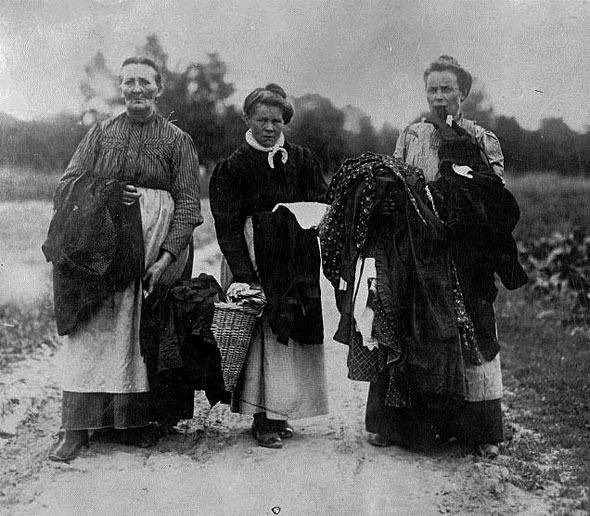
By October, many Americans caught in Europe when the war began had finally secured passage home. Among the eyewitness contributors in this week’s issue was the American author Reginald Wright Kauffman who painted a vivid picture of a Belgian resort town crowded with war refugees.
“When I left it, Ostend looked like the lakefront of Chicago must have looked during the great fire.
“Picture to yourself Atlantic City [with] three times its accustomed population … crowd them along all the pavements of all the streets, up the Boardwalk and down; toss them on to the beach — women, children and old men, some wounded, more ill, all robbed of their material possessions, and many robbed of the lives of those they loved best on earth!
“Do this, and you have Ostend as I saw it.
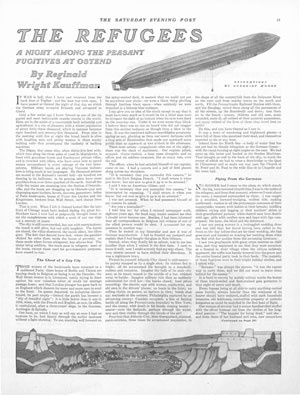
“I was in the midst of the refugees; and from that moment, wherever I went about the town, I remained surrounded by them. … I saw one young woman in a bedraggled wedding dress and was told that, her fiancé having been called to the front on the day before that set for their wedding, she had gone mad and insisted on wearing her wedding dress when she fled with her mother from the oncoming Germans.
I saw two graybeards with great crêpe rosettes on their hats, and they explained to me that they were mourners at a funeral in their village when the [cavalry] suddenly appeared; the coffin was hastily lowered into the grave and the entire funeral party took to their heels.
“I talked with a tottering woman of 25 whose husband had been called to the colors and killed in the first day’s fighting about Liege. She had with her a son of 5, who was staggering under the weight of his 18-month-old sister; another sister carried a basket as large as herself, and the mother had in her arms an infant that she vowed had been born to her on the roadside only 36 hours before.
“‘What will you do?’ I helplessly asked her.
“She made the sign of the cross.
“‘What the good God wishes,’ she answered.
A few yards behind her a girl, who might have been 18 years old, was lying where she had fallen a minute before. She was beautiful, with black hair and a creamy skin; and her face was very calm. A wound, some one explained, had reopened — a wound inflicted by a stray shot some days since. I bent over to speak to her; she was dead!
England Wakes Up
By Samuel G. Blythe
Meanwhile, Samuel G. Blythe, still in England, reported on how the news of the first major engagement of the war struck the British.
“At three o’clock on the afternoon of August twenty-fifth—three weeks after England’s actual declaration of war—the newsmen came up the street with red [placards], and the Londoners looked at them and saw, yelling at them in the biggest possible type:
‘Two Thousand British Casualties—Official!’
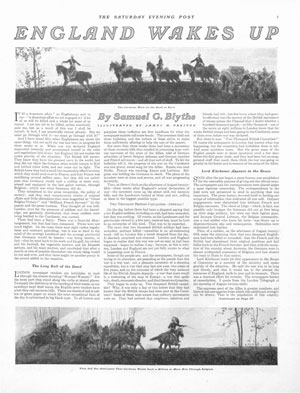
The men had fallen at the Battle of Mons, in Belgium, where the British army had vainly tried to stop the German advance toward France. The official casualty figure has been calculated as 1,600, which is still a staggering figure of dead and wounded. Much, much higher figures were to come in the months ahead.
On the day before there had been a dispatch saying that a few English soldiers, including an earl, had been wounded; but that was nothing. Of course, as the Londoners and the provincials viewed it, a few men, more or less, must be hurt in an enterprise of this kind. That was to be expected.
The news that two thousand British soldiers had been wounded, perhaps killed—casualties is an all-embracing word—fell on London like a bomb dropped from the sky. It shocked, surprised and stunned…
“They began to wake up. Two thousand British casualties! Why, it was only a day or two before that they had known that the British troops had been sent to the Continent.”
Taking the Cure: The Treatment of Americans for Europitis
By Corinne Lowe
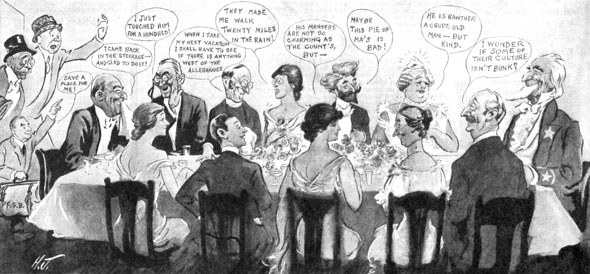 Writer Corinne Lowe seemed to relish the sight of panicked Americans desperate to get a ship’s berth out of war-torn Europe. Her scorn for Americans seeking culture in the Old World was shared by the Post editors. In the coming months, they ran several articles and editorials that mocked Americans who had snubbed their homeland to pursue Europe’s quaint, continental charms.
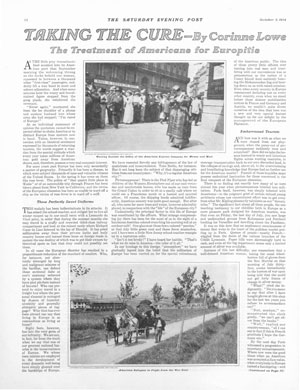
“Picturesqueness! There is the Pied Piper who has led us children of the Western Hemisphere out of our cool verandas and comfortable homes, who has made us turn from the Grand Canyon in order to sit at a smelly café where we could see a Franciscan monk or a booted and spurred officer. …
“Undoubtedly the principal factor in this life of Europe was constituted by the officers. What strange compensating joy there has been, for the most of us, in the sight of a handsome Austrian colonel crunching his morning roll at an outdoor café ! One glance at those fawn-colored ‘panties,’ at that tidy little green coat, and those fierce mustaches, and I have seen a little New Jersey school-teacher crumple up in a rapturous colic. ‘Isn’t it too lovely!’ I have heard her babble. ‘That’s what we do miss in America — the color of it all.’
“In our bondage to this foreign ‘atmosphere’ we have gradually lapsed into the belief that the militarism of Europe has been carried on for the special refreshment of the American public.”
War and Business
By Will Payne
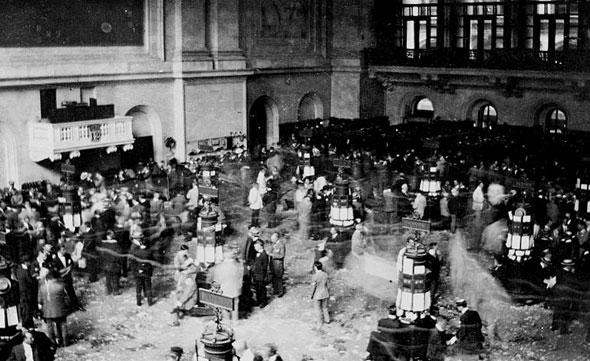
While the Post reported on the political and social aspects of Europe’s war, it never lost of sight of the impact it would have on American business. Will Payne explained why the outbreak of fighting 3,000 miles away had caused America to close trading on July 31, 1914 it wouldn’t reopen until November 28.
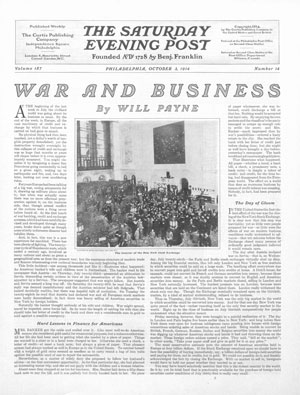
“In the United States the first violent effect of the war was the closing of the New York Stock Exchange. It is clear now that this step was inevitable; yet so little were people prepared for war — so little were the effects of war on modern business conditions really understood in advance — that 10 minutes before the Exchange closed many persons of ordinarily good judgment believed it would remain open.
“The most conservative estimate puts the amount of American securities held in Europe at four billion dollars. If the Stock Exchange remained open we should have to face the possibility of buying immediately, say, a billion dollars of foreign-held securities and paying for them, not in credits, but in gold. We could not possibly do it, [and frankly acknowledged the fact by closing the Exchange]. With no market to sell in, foreigners would have to hold our paper whether they wanted to or not.
“You may have heard somebody mention that this is the richest country in the world. So it is; yet its total fund that is practicably available for the purchase of foreign-held securities under conditions of July 31 is really very small.”
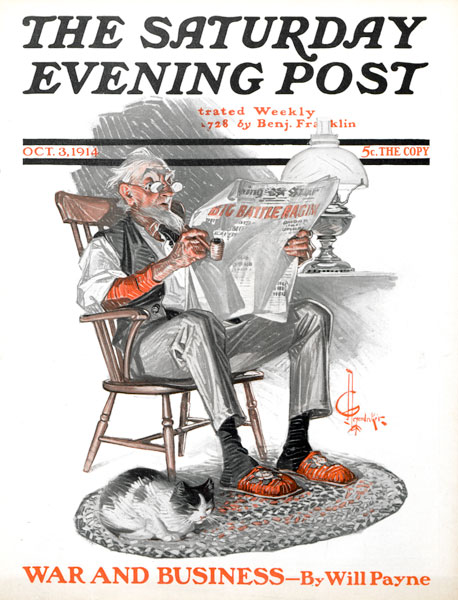
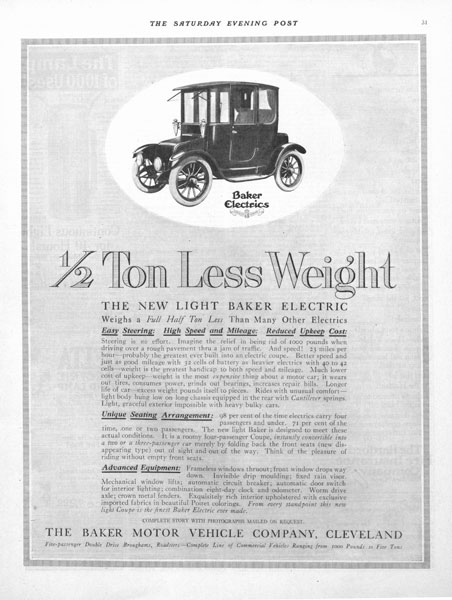
Step into 1914 with a peek at these pages from The Saturday Evening Post 100 years ago.
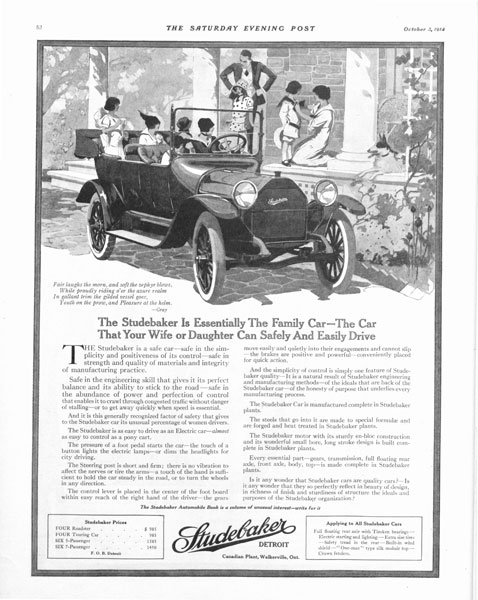
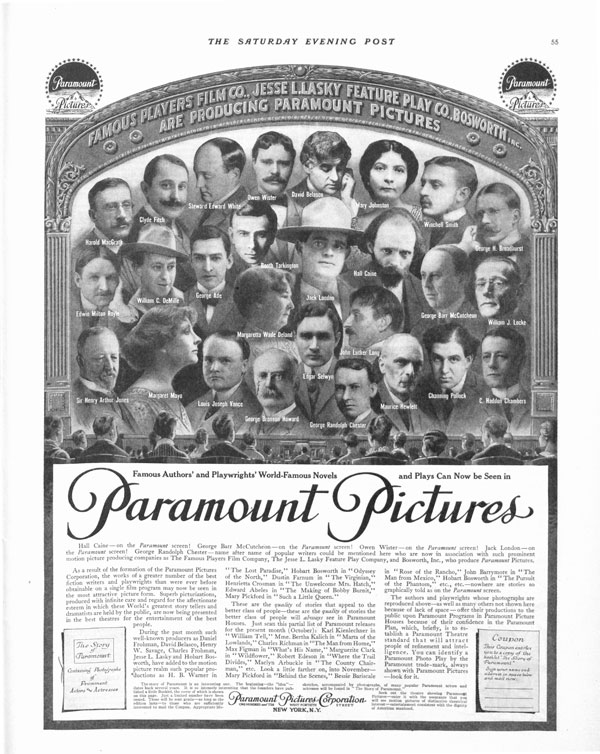

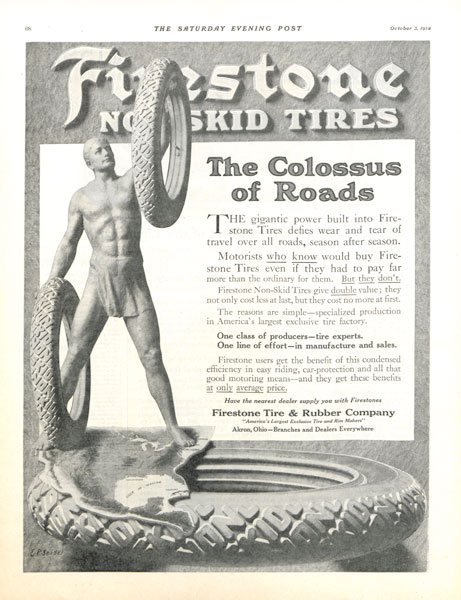
The Day of the Dead

An attorney from over in Hattiesburg had dropped off the pointers the day before, paying up front for a month’s worth of schooling, and this morning was Wayne’s first chance to work with the two dogs in the 10-acre field behind the house. Wayne’s training ground. Over the summer he’d planted the big field with strips and patches and blends of soybean and lespedeza, clover and ragweed. That was before his grandson moved in, and Wayne doubted he had many break-back, no-help summers left in him. Fifty-eight is fifty-eight.
It was early, not so long after sunrise, but Wayne already had a hen quail from his flight pen hidden about dead center in the cold, green field. She was cooped inside a little metal cage about the size of a shoebox. The two English pointers were mostly cream, but the female had lemon spots, the male scattered blotches of liver. The dogs were blinkers, or so the Hattiesburg man had said, and Wayne led them from the kennels to see what was what.
When he was about 20 yards into the field Wayne unclipped their leashes and walked along after them. The field was slick with dew, and he had his jeans tucked down into his boots. He stopped to watch the dogs. They were young, littermates not yet a year old, but they worked the field pretty well. The both of them liked to hunt, that was clear enough, and as they got closer and closer to the stashed quail Wayne started to question whether their owner had it right about them.
The lemon was the first to play dumb, blink. Her name was Holly. She passed within about 15 yards of the hidden quail, cocked her head, but then veered off in the opposite direction without ever coming to point or acting too birdie. A half minute later the liver, Rebel, did the same thing. On the phone a few days ago the Hattiesburg man had played dumb himself, telling Wayne he couldn’t make any sense of it, but Wayne suspected the man had been too hard on his dogs too soon — maybe with a shock collar or maybe with a switch, but even a harsh tone or too much blowing on the whistle could do it. Dogs are smart, or at least some of them are. For whatever reason, the pointers had come to associate locating birds with being corrected, punished, and so now they loved the searching but hated the finding. Still, their instincts seemed good, and Wayne figured he’d be able to bring them around. With time and patience and praise, he usually could fix a blinker.
Wayne whistled the pointers in and turned for the house, hoping to catch Justin before he left off for school. Wayne wanted to wish him good luck in the football game tonight, but over by the house he could see vapor already lifting from the tailpipe of his grandson’s truck. The Ford rolled down the driveway and then onto the gravel road that ran alongside the field. Wayne never saw much of the kid — Justin seemed to always be coming or going — but he supposed that so far things were working out OK. The horn sounded, and Wayne waved good-bye.
He put the dogs in the kennel and then went into the house. It was a single-story redbrick he’d moved into 20 years ago, right after his divorce. Linda had left him for a schoolteacher and lived in Mobile now. Their son Mark had taken Wayne’s side yet still kept in touch with her — Justin did too, for that matter — but Wayne hoped that he himself would never see her again. All seeing her ever did was remind him of things he never wanted to be reminded of. It was years before he could close his eyes at night and not see what he saw one summer day when he came home early from work. Her hands on another man’s back — Justin’s math teacher — her thighs pressed against his hips.
Wayne had retired back in 2005 after putting in 30 years with the highway department, but dog training kept him busy — or at least occupied, distracted. He poured a cup of coffee and then went back outside. He was planning to take the pointers over to that quail one at a time on a long nylon lead, try and get it in their heads that this was what their lives were all about, that this was the thing they were born to do.
There were five other dogs in the kennel. Two of Wayne’s own English pointers, plus three setters he was just about done training. He put Holly on the lead and walked her toward the field. There was a red hawk out there. It was standing atop his distant, hidden quail cage and pecking at that hen.
Midway through the fourth quarter, Justin dropped a long pass that could’ve more or less sealed things for Homer High. The crowd in the bleachers, even Wayne and the other top-rowers, had gone from sitting to standing when the ball left the quarterback’s hand. The pass was a little wide but still catchable, and the town groaned as the tight spiral careened off Justin’s fingertips.
The quarterback was one of Homer’s black players. The team was split about half and half, same as the fans, same as the town, and everyone went slumping back to their seats except for a grade-school kid in a gray Colonels jersey two rows below Wayne. “Dang, white boy,” the boy said, stuttering a little, but then his mother tugged him down by his belt and shushed him.
Wayne winced. Justin was harder on himself than any teenager had a right to be, and this was the sort of thing that could sink him for days. Their quiet house would be even quieter now. Justin had moved in with him at the beginning of August. Two months earlier his father had left Homer with their family to take a job at the Nissan plant outside of Jackson, but it had been agreed, finally, that Justin could return to finish out high school in the town where he’d been raised. Wayne knew that Mark and his wife weren’t happy about it — and Linda neither, he supposed — but the boy wanted to graduate in a familiar place, and in the end Justin got his way. It was the only time Wayne had known Justin to take a stand about anything.
Terry Tompkins was sitting to one side of Wayne, Pete Strain to the other. Halloween was still three days off, but a lot of the kids were dressed up anyway. Wayne watched a cowboy lead a nurse down the steep bleachers. It was a cold night for South Mississippi. The girl was shivering.
“Almost,” said Terry. “Would’ve been a tough grab.”
Pete nodded. “He’s been blocking his tail off tonight, Wayne. Be sure and tell him that.”
Wayne nodded but said nothing. Later, the game over, he sat parked in the blacktop lot outside the locker room, the stadium lights slowly fading behind him like clusters of dying stars. Justin’s drop had wound up not costing the team — Homer won the game on their very next possession, with a keeper bootleg Darnell Free took 60 yards down the field. Still, Justin wouldn’t be able to bury it. Wayne knew that. The losing season would be over soon, and though he’d never admit it to Justin, Wayne was glad. One more game, and then Justin would finally be done with these games.
His grandson was a long time coming out of the locker room, but Wayne forced himself to stick around. He saw the boy shake his head when he spotted him in the truck. Wayne rolled down the window. Justin was a big kid, as big as Wayne had been at that age, and he walked with the loose-limbed ease of an athlete. In September there had been a letter and even a phone call from an assistant coach at the community college in Poplarville, but Homer was having an off year and nothing more had come of that. Justin had average hands at best. That was just a fact.
Wayne reached out the window and tugged at the front of Justin’s letter jacket. The jacket was gray with white pleather sleeves, looked pretty much the same as the one Wayne had stowed away somewhere in his attic. “Good game, boy,” he said. “I mean that.”
Justin’s blond hair was wet from the showers, and he pushed it back from his face with his hand. “You don’t need to be waiting out here, Grandpa.”
“I know.”
“Coach Gibson just told me he wants to talk to you. He might be giving you a call this weekend.”
“Talk to me?” To Wayne the young coach was a kid, really. This was Gibson’s first year at Homer High. Wayne had never met him. “About what?”
“He didn’t say.”
“You in trouble?”
“I don’t think. You can probably catch him in his office if you want.” Justin pointed back at the gym. “It’s just around the corner there.”
“I’ll find him. See you at the house?”
“I was gonna go by Trey’s. That OK?”
“Don’t get wild. I need you to help me out with a couple of new dogs tomorrow, and maybe we should clean the house up some too.”
“Yessir.”
Wayne hung back for a while, watching as Justin walked over to the line of cars where the other seniors on the team parked. A black girl in a black dress was sitting on the trunk of a sedan parked next to Justin’s Ford, laughing into her cell phone. Her face was painted white, and Wayne took her to be a vampire or some other back-from-the-dead thing.
The Suspect Americans: A Prelude to Japanese Internment During World War II

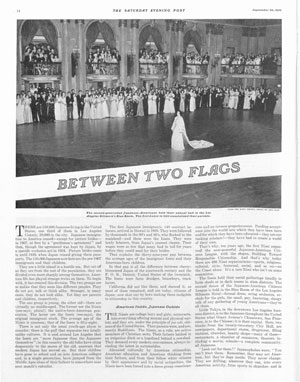
“If we ever have war with Japan,” Lail Kane told the Japanese American Citizens League, “and I have anything to say about it, the first thing I’ll do will be intern every one of you.”
At the time Kane’s comment appeared in a 1939 Post article by Magner White, it must have sounded ridiculous to many Americans. But Lail Kane, a World War I veteran and a prominent white citizen of San Francisco, spoke for many Americans who hated and feared the Japanese Americans living on the West Coast.
White learned of Kane’s comment when he interviewed Togo Tanaka, editor at the Rafu Shimpo, a Japanese-American newspaper in Los Angeles. When asked about white citizens’ resentment of Japanese Americans, Tanaka acknowledged anti-Asian racism was a serious problem. Yet he was confident white Americans would eventually accept Japanese Americans as equals. Until that time, he and other children of Japanese immigrants would work to win their approval.
For people like Lail Kane, though, there seemed to be nothing that could reduce their fear and suspicion. He was convinced Japanese Americans were spying for the Imperial Japanese government. The only solution, when war came, was to put every Japanese American in an internment camp, deep in the desert, for as long as necessary.
You get the sense reading the article that Tanaka simply couldn’t believe Kane’s comment. The idea! Imagine sticking American citizens into internment camps, without trial or right of appeal!
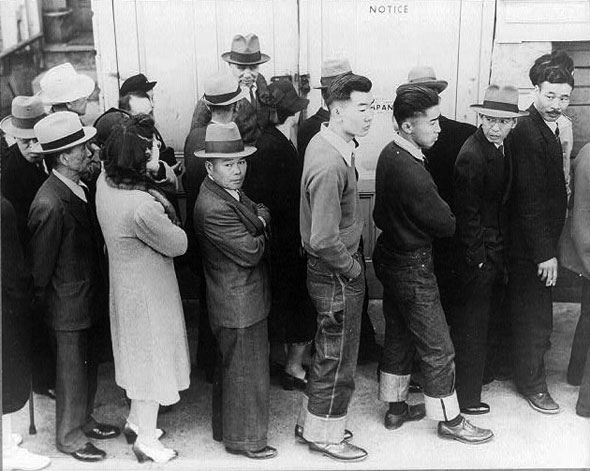
I can’t find much information about Lail Kane, but it appears he had some influence with the government. Either that or he happened to share the racist opinions of some powerful people on the West Coast. Because when war came, the government gathered up over 100,000 Japanese Americans and shipped them to camps in remote areas of Western states. Of this number, 80,000 were first- or second-generation Japanese Americans — U.S. citizens. Their parents, born in Japan, were not; American laws made them ineligible for citizenship.
What made Kane’s comment so shameful was that first-generation Japanese Americans were doing all they could to prove their loyalty to their country. The leader of the Japanese American Citizens League told White, “We are doing our best to educate ourselves for better American citizenship, and then in turn to present ourselves to the American public. No matter what handicaps we have to face, our place is primarily here in the United States and we must prove to America that we are good citizens. We shall simply bide our time and live down the things being said against us.”
Anti-Asian racism had a long history on the West Coast. Many white American settlers, themselves newly arrived in California, resented Asian immigrants, many of whom had come to build America’s railroads. The Japanese, and Chinese, were shunned by many American communities and so kept to themselves. The resentment grew, particularly when some white Americans saw Japanese immigrants’ businesses and farms thriving.
Hatred of the Japanese and their American-born children became mingled with fear in the 1930s, when white Americans worried that Japanese, and their foreign-born parents, were working for the Imperial Japanese government. Learning of the atrocities Japan was inflicting on China, many of these Americans looked accusingly at them.
“When the newsreels were showing the Shanghai bombings,” White wrote, “movie audiences in Los Angeles often showed their feelings. One evening, Fumiye Ruth Tanaka, a svelte, typical compact-carrying, fashionably dressed girl, was in one of these audiences. There flashed a bombing scene.” The scene, known today as Bloody Saturday, showed a baby crying near a railroad track amidst the ruins of Shanghai’s South Railway Station, the lone survivor in a scene of death. The movie crowd began to hiss and boo. A woman next to Tanaka turned on her, noted her features, and demanded, “Are you Japanese or Chinese?”
“Pardon me,” Tanaka said politely, “I’m neither! I’m an American!”
Tanaka was correct. But her innocence, and citizenship, wouldn’t have helped when, three years later, she was forced to leave her home and most of her possessions for a small room in wooden barracks in the middle of the desert.
There was surprisingly little outcry at the internment of Japanese Americans. In the wake of Japan’s attack on Pearl Harbor, most Americans were too enraged to consider seemingly fine points of law, which fortunately didn’t apply to them. Stalwart defenders of civil liberties, like Eleanor Roosevelt, said nothing. The American Civil Liberties Union, which normally would have taken up such a case, chose to remain mute on the matter of internment.
At some level, though, Americans must have recognized the inconsistency of defending freedom while suspending it for their own people. Even Lail Kane, who wanted all Japanese treated as hostile aliens, told White, “In case of war, I wouldn’t hesitate to intern them. On the other hand, we mustn’t forget that they are American citizens and have just as much right to be here as you and I.”
As for Togo Tanaka, despite his efforts to prove his loyalty, he was arrested the day after Pearl Harbor and held in jail for 11 days without any charge. He was released, but soon gathered up with the rest of the Japanese Americans and sent to Camp Manzanar in April 1942. His efforts to cooperate with the government authorities during his confinement won him the enmity of other detainees, and he was eventually relocated to another camp to escape reprisals from other detainees. Released in 1943, he moved to Chicago. He passed away in 2009, a successful businessman who finally gained the respect for which he had long worked.
Step into 1939 with a peek at these pages from The Saturday Evening Post 75 years ago:
The Great War: September 26, 1914
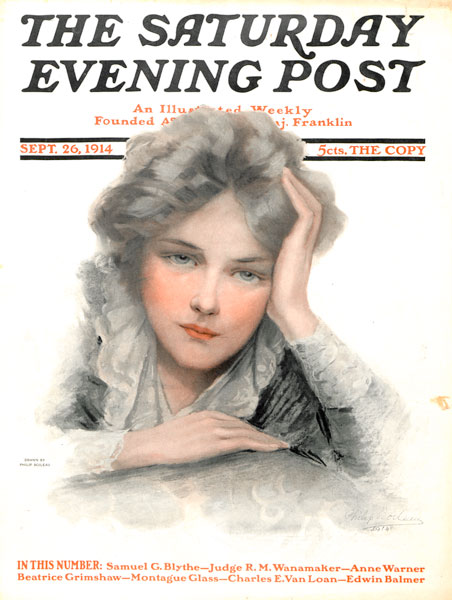
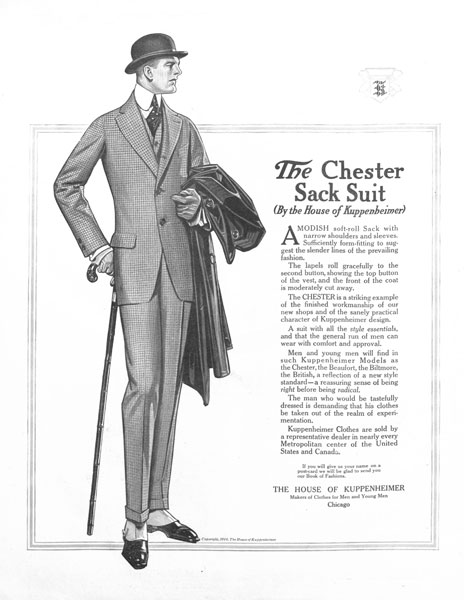
On September 26, 1914, the Post published an introduction to aerial combat and the new fighting “aeroplanes” of the war and a look inside wartime in Paris.
The Air Fleets
By Glenn Curtiss
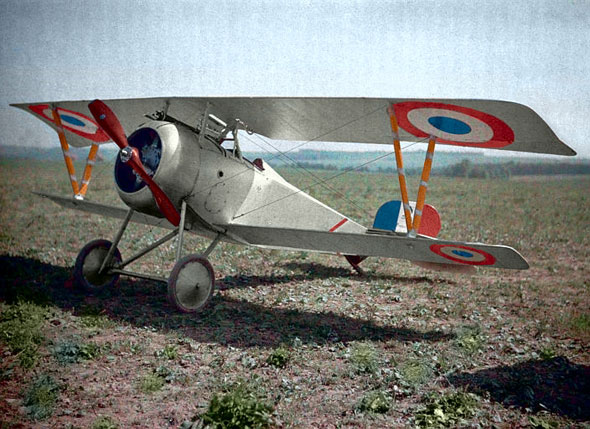
The Post’s very first article on air combat was written by aviation pioneer Glenn H. Curtiss. Not only was he familiar with the various styles of planes being used by combatants, he could also anticipate the terrors that pilots would face in dogfights long before any had taken place.
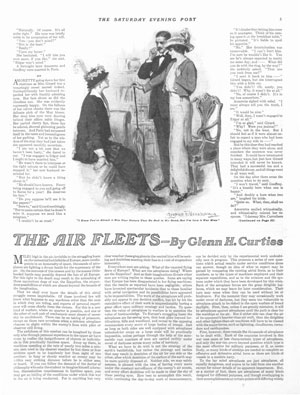
“The awfulness of this combat can be imagined by those only who, through personal experience in the upper air, have come to realize the insignificance of objects or individuals in this practically limitless space. Away up there, in machines speeding at the rate of nearly two miles a minute, men need in the clearest weather be but three or four minutes apart to be hopelessly lost from sight of one another; in hazy or cloudy weather an enemy may be within easy striking distance before he is either seen or heard.”
“England is at present the acknowledged leader in the development of [reconnaissance planes] The business of these machines is just what the name suggests. Fast enough in horizontal speed to escape any antagonist seen in reasonable time, they will sail leisurely over the enemy’s lines, while the observers … make accurate records of the disposition of the enemy’s forces. The observer is armed with a quick-firing rifle … though as most of them are tractors, the observer cannot fire at machines directly in front of him, but would have to shoot from above, below or nearly broadside.”
Paris When the War Broke
By Samuel G. Blythe
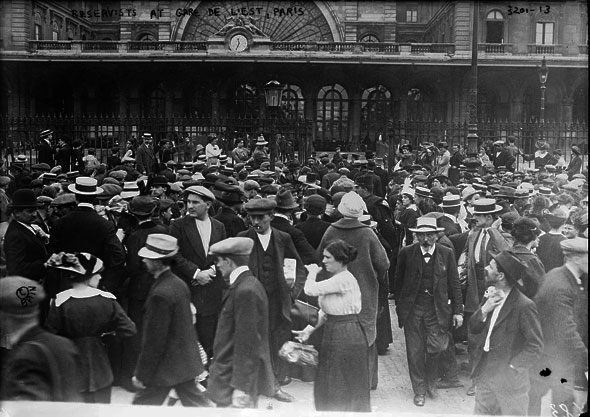
A week after publishing his account of wartime London, the Post printed Blythe’s report on Paris. He was surprised to see the demonstrative French respond to the war crisis with calm, almost grim determination.
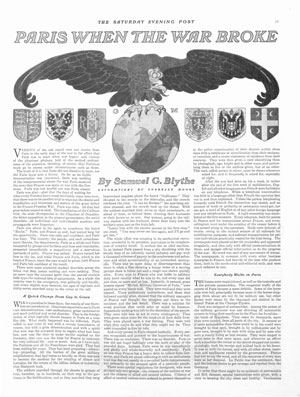
“With the soldiers marched their wives or their sweethearts, or ahead of them, or behind them, cheering their husbands or their lovers on to war. One woman, going to the railway station with her husband, threw their baby into the soldier’s arms just as the train left. ‘Leave him with the station master at the first stop,’ she cried. ‘You may never see him again, and I’ll go and get him.’
“… It is at night that the greatest change is noticed in Paris. The city is silent and deserted after 9 o’clock. The streetlights are maintained, but the streets seem darker than usual, because electric lights are forbidden in shops and cafés after 9 o’clock. All residents of Paris are supposed to be in their homes at that time. The street cafés, that customarily are open always, are closed at 9. In the first days the tables outside the café were forbidden, but now the Parisians are allowed to sit at the little marble-topped tables during the day and sip their grenadine and discuss the war. Most of the harsh-voiced news-venders have gone to war, and the papers are cried by boys, by old men with squeaky voices or by women.”
“All night long the great searchlights play over the dark and silent city, illuminating every alley and every open spot and sweeping the sky in search of German dirigibles and German airships. The territory round Paris is bathed in light constantly for fear there may be some approach. The spy danger is ever present, and the reservoirs and railroad stations and crossings and bridges are closely guarded. The fortifications are filled with men. The trenches are manned. The city calmly waits the event.”
Step into 1914 with a peek at these pages from The Saturday Evening Post 100 years ago.
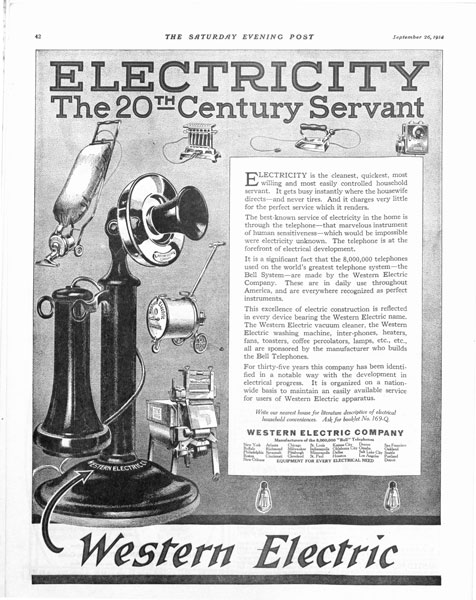
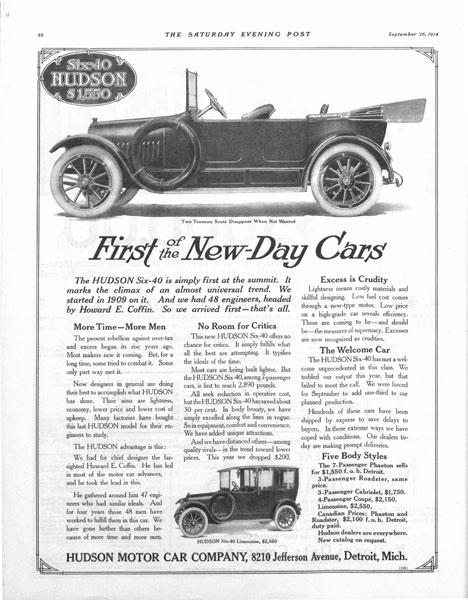
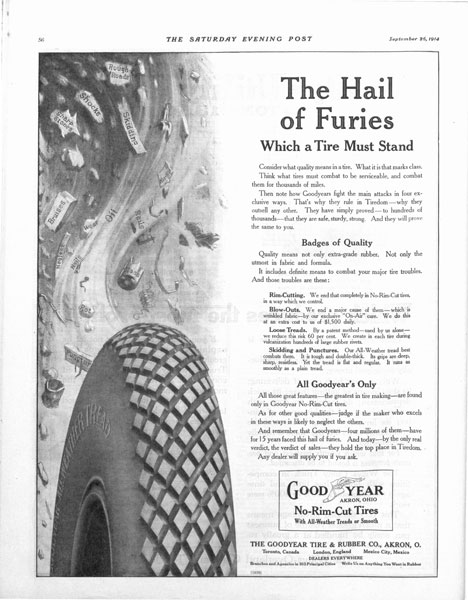
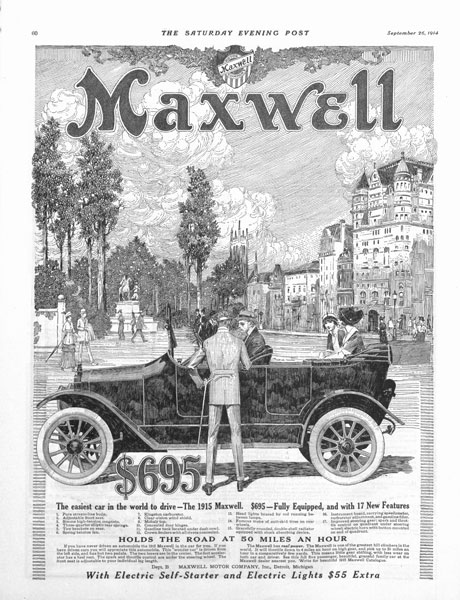
One Woman, One Dog, One Morning…

The instant that back door slammed behind me, I knew … I knew right then and there, that I, literally, was out in the cold and clad only in my flannel nightgown. And that dog, his dog, his big, black, hairy, slobbery, slow-witted retriever with a wet tongue dripping along the floors and a rod of a tail wiping the coffee table clear of magazines, plants, or whatever and slapping at my wine rack filled with carefully chosen whites and reds was warm inside.
It happened so fast. I couldn’t believe it! I was taking meat bones to the garbage outside so that gangly, lumbering dog wouldn’t get into the kitchen trash. And this mangy mutt, he follows me, jumps up, and slams the back door behind me! Me! The one who feeds, walks, and bathes him!
I banged on the back door as I shouted at him. “I’m outside and my feet are cold! It’s 48 degrees. Do you even care?!”
With his front paws up on the back door and his tongue wagging, he stood panting, his dog breath fogging up the window. We were eye to eye and hand to paw. I was not smiling. He looked like he was.
That dog, not yet 2 years old, could do more damage in a few minutes than a midsummer tornado. Leaning my back against the door, I realized two things about this problem 1) it had to be dealt with fairly soon and 2) being a sane and logical woman, I could not cry about it.
Had to think! Seconds ticked by, maybe minutes.
If I go to my elderly neighbors on the left, they’ll call the police to assist. That would be so embarrassing. Can’t go to my neighbors on the right, they both work, or to the people behind us, too far. And I certainly will not cross the street in my nightgown!
That left me with only one option. Try all the windows.
The bathroom window would be first. If hubby followed his regular morning routine — opening it wide while he showered, leaving it cracked open while he shaved — it might still be open or unlocked. Even though I found all that to be quite silly, since we have an adequate fan and it’s a danger to leave it unlocked, this time, I counted on his leaving it open.
One problem was that the bathroom window was at the side of the house where the elderly neighbors might view my attempt to climb through it as a potential break-in or worse. The other problem was that the window was higher than any other window of the house, so I would need something to stand on — leverage and such.
I was in dire need of a plan.
Aha! I spotted that old wheelbarrow in the yard behind ours. Confident if it all went well I could definitely, with some effort, move it to our side yard, turn it upside down, and then use it to climb into the bathroom, I wondered, Hmmm, long flannel nightgown no slippers for a firm grip can I get it lady-like?
Plan A began well. After wrapping my nightgown around my legs to look like pants, it only took me a few minutes to sneak to the wheelbarrow leaning up against the back of my neighbor’s garage.
In checking the ground for burrs, bugs, or snakes, I looked cautiously around. Good. No neighbors out, none peeking through drapes or curtains. I trusted the commuters wouldn’t really pay attention; they’d be oblivious, talking on their cell phones or staring straight ahead.
Acting like a thief, feeling like a crazed woman, I took the well-used concrete encrusted wheelbarrow and awkwardly pushed it around the house to the bathroom and turned it upside down. Yuck! Cut grass and spider stuff stuck everywhere!
His dog had followed me to the window and began barking and racing around in circles in the undersized bathroom, knocking things off the counter and toilet tank to the floor, or into the toilet. Hearing the crashing, I thought of my expensive perfume. My makeup and hairbrush. I just hated to think what else was there for him to demolish.
Pursing my lips for courage, I whisked most of the obnoxious stuff off the wheel barrel with my hands and wiped them off the best I could on the grass. I gingerly stepped up, avoiding the rusty parts, and took off the screen, exerting pressure up on the window frame. Oh good, miracles of miracles, not locked!
The window area looked OK for me to squeeze through. It all seemed simple enough; I figured if I could get my shoulders in, my hips were sure to follow.
I stuck my head into the bathroom. The mess didn’t seem too bad. Perfume, back of toilet, top appears to have held; no broken glass around; makeup doing the balancing act on the edge of counter; bath powder not as close, lid on … good; hairbrush, nowhere to be seen.
Going in; window wide enough for my shoulders. There’s always hope for the lower half.
His dog, overjoyed that I’d come to play, tore back into the hallway, hind legs scrunching the rugs as he sped around the corner. He returned with his squeaky bone; squeak, squeak, squeak resounding all the way back to the bathroom. “Midnight! Good boy! Go get your blankie; get your blankie for Mummy.”
I made my voice sweet as apple pie, hoping he’d get me his old towel so I could use it as a pad beneath me. Well, so much for that wish, he brought back his stuffed monkey.
I hoisted myself up, using my elbows on the window sill, jumping a bit as I wrestled a little more of my upper half through the window with the adroit skill of a beached walrus. (Thank goodness for granny-gowns because most of me was now up in the air.) In lieu of the dog’s blankie, I grabbed a hand towel that hung nearby to use as a pad for my ribs and subsequent hip bones.
That dog barked almost incessantly and slobbered continuously as he jumped around throwing his wild monkey up again and again until it landed, ending with a perfectly centered shot in the toilet. After studying his problem for a moment, he grabbed the soaked monkey and tossed it once more, splattering large drops on the large mirrored wall over the sink, at the same time tangling a rear paw in the shower curtain trim behind him.
Oh, I knew what was coming …
The rod ripped away from the wall on the far side. The shower curtain snapped from the rod, showering bits of exploded plastic rings over everything and shrouded that dog in a shimmering azure blue. The monkey landed splayed out, weeping toilet water over the floor and the disheveled bathmat, which now bore the piled remnants of my makeup and bath powder.
Poor Midnight masked in my once elegant shower curtain thrashed in circles, barking and yipping and sending clouds of powder and the wicker wastebasket filled with tissues, dental floss, and a used toothpaste tube flying. I shouted at him again, like he would listen to me, “Midnight! Stop! What a crazy mess!” When it was all over the tightly twisted shower curtain looked like it had come directly from the washer with its Dry Clean Only tag sticking straight up. The shower lining lay in a mangled heap in the tub. In his flailing, that dog managed to get the curtain off his head and did proceed to knock the bathroom door shut with his butt, so at least all was contained in the small room.
My body was beginning to hurt dangling halfway into the bathroom. I dragged and pulled myself a few more inches through, wondering how I was going to manage the outcome for the rest of my body. My waist was at the edge of the window sill. What could I grab? The sink was out of reach. If I balanced myself with one hand on the toilet tank and the other grasping the toilet seat (that was left in the up position), I could wiggle in, but I might slip down between the wall and the toilet, or end up in the toilet itself. This situation soooo needed a plan B.
Midnight jumped up — front paws straddling the toilet bowel — barking happily knowing that I really was coming in to play with him. “No Midnight! Get down!” I had a bad feeling of what might come next.
Into the toilet his paws went. Paws in, paws out. And water was everywhere. He jumped up again, hoisting one rear paw into the toilet, keeping one on the floor, balancing himself quite well as he plopped his wet front paws on my shoulders to lick my face and smother me with doggie kisses.
I was more than halfway through the window, belly button resting uncomfortably on the sill; one hand on the toilet tank, the other braced against the wall near the towel rack. I still had the widest part of my body to drag through, but by that time, I heard the sirens.
I moaned, “Oh, no. Plan B.”
Midnight barked, looking anxious. I waited, feeling anxious. He barked more. The fireman and police couldn’t contain their smiles; one laughed, and then apologized; he knew my husband, and the dog — Midnight was one of his dog’s litter. What a morning. What a mess. So embarrassing … why couldn’t he have just locked the window?
Tony Bennett: All That Jazz!
“For my money, Tony Bennett is the best singer in the business,” Frank Sinatra said of the crooner in 1965 — a quote Bennett says changed his life. “He excites me when I watch him. He moves me. He’s the singer who gets across what the composer has in mind, and probably a little more.”
Ol’ Blue Eyes got it right. And at 88, he still “moves” us, gaining new generations of fans with each release. With his latest album Cheek to Cheek, Bennett revisits his favorite catalogue of jazz standards from the Great American Songbook, including “Anything Goes, “It’s Don’t Mean a Thing,” “Sophisticated Lady,” and, of course, the record’s title track “Check to Cheek.”
Tony Bennett has achieved longevity in life and career — a rare feat in today’s entertainment industry. In the last decade, Bennett has sold more than 10 million records. During his 60-year career, Bennett has won 17 Grammy Awards (including a Lifetime Achievement Award in 2001) and two Emmy Awards, and named an NEA Jazz Master and a Kennedy Center Honoree — not to mention the millions of records he’s sold worldwide and the platinum and gold albums to his credit.
In Cheek to Cheek, Bennett collaborates with what on the surface may seem an unlikely partner — Lady Gaga, famous for provocative fashion and chart-topping hits among Gen Yers. But Bennett saw something in Gaga beyond the outrageous costumes and performances — an artist.

(Album cover Interscope Records)
Despite the 60-year age difference, the singers share a common love — of heritage (both are Italian) and of jazz.
“I’ve been singing jazz since I was a child and really wanted to show the authentic side of the genre,” said Lady Gaga. “We made an album of jazz classics, but it has a modern twist.”
As for Bennett, the jazz icon shares the same passion for the genre and the artistry of such American masters as Duke Ellington, Cole Porter, Irving Berlin, Cole Porter, and others.
“I have been singing the Great American Songbook my entire career, and all along forging a bridge between pop and jazz music,” said Bennett, who has collaborated with such legends as Barbra Streisand, James Taylor, Paul McCartney, Elton John, k.d. lang, Mariah Carey, Stevie Wonder among many others.
Listen to “I Can’t Give You Anything But Love,” track 4 from the Cheek to Cheek album.In 1995, I interviewed Tony Bennett, then on a 40-city international concert tour. When asked about his life and career, Bennett felt lucky because he knew what he wanted to do, “I always had a passion … for my singing and my painting … I’ve been very fortunate.”
As have we, Tony. As have we.
Read exclusive interviews with Tony Bennett from The Saturday Evening Post.
Find out why the singer once compared himself to Madonna in “Talking with Tony” by Patrick Perry.
See some of Tony Bennett’s best paintings, including a portrait of Duke Ellington, in “The Best of Both Worlds” by Holly Miller.
Tuning In to WWII
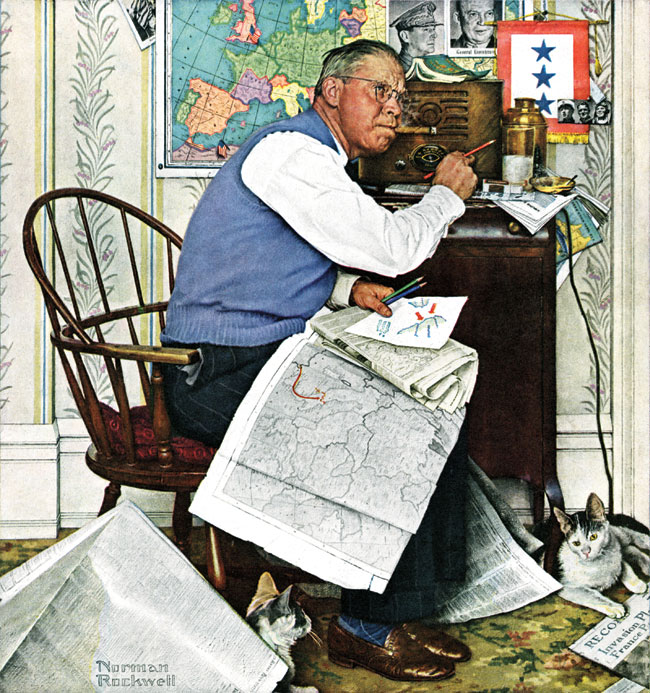
Rockwell’s Armchair General is a reliable reflection of the way many parents of World War II soldiers spent their evenings — waiting for the latest reports to know the fates of their sons.
The April 29, 1944, Post cover shows a worried patriarch who tunes in to the radio to chart war maneuvers. More important, he’s attempting to deduce his three sons’ whereabouts and safety.
Rockwell’s careful deployment of mapping and research props gives the illustration a sense of narrative history. It’s clear this activity occurred nightly. Well-penciled maps flag the sons’ positions next to their military portraits. In homes across the country, parental war anxiety was the norm.
Rockwell’s composition is both heartwarming and sad. The patriotic dad is surrounded by a flurry of homemade research and comforted by a pair of cats. He’s doing all he can to stay current, yet he is essentially powerless. Each night, the reports coming through the airwaves could signal allied advances, but also crushing personal loss.
The armchair general turns knobs and tunes out static as if he could bark commanding orders through his radio. But, of course, there’s nothing he can do but passively await the news.
He Saw the War Coming
The 1941 attack on Pearl Harbor wasn’t a complete surprise to all Americans. Some had long anticipated a Japanese offensive against the U.S. and had foreseen, with surprising clarity, the general direction of the war. One of them was Fletcher Pratt, a writer of science fiction, a pioneer in war gaming, and “one of the outstanding lay military and naval authorities in the United States,” as the Post described him in its Keeping Posted column.
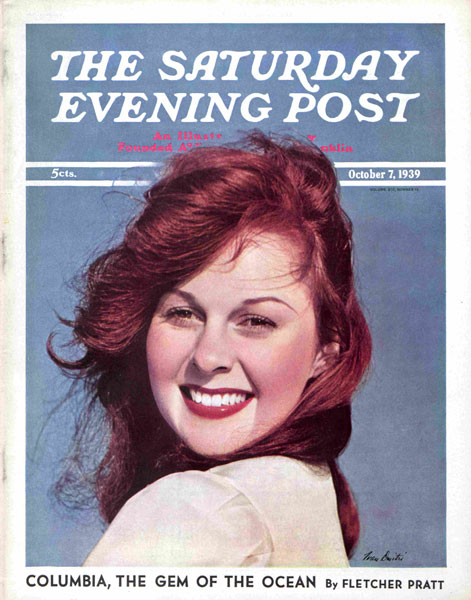
Just as the war in Europe began in 1939, Pratt completed a book on the world’s naval forces and strategy. An excerpt offering his opinion of the current U.S. Navy was published in the Post that year in its October 7 issue. (Read Pratt’s entire article “Columbia, the Gem of the Ocean” from the Post here.)
It didn’t sound good. “The battle line is the slowest in the world, which is to say that it cannot force an unwilling enemy to fight, nor escape from a disastrously superior one. Some of the battleships steer badly. The early heavy cruisers vibrate rackingly at high speeds, roll in a seaway and have weak features in their construction.”
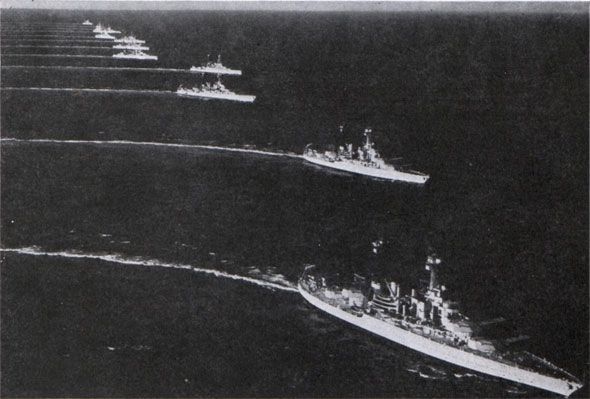
Official U.S. Navy Photographs-Courtesy U.S. Navy Recruiting Bureau
“Promotion in the American Navy is desperately slow and uncertain,” Pratt added. “Junior officers are constantly tempted to toady, and examining boards to give credit for correct routine rather than for original thought. Officers reach command rank late in life. … In no country does it take longer to sign a contract for a new ship; in none is the building process marked by so many petty squabbles.”
Yet he concluded, “No navy in existence, hardly any two together, can bear the weight of the United States fleet.” Its battleships were slow, he wrote, but they were well armed, and its aircraft carriers were the envy of the world. “The American naval air service is a model which other nations have despairingly been trying to equal for 15 years. No navy has so good a catapult; the bomb sight has for years been the object of affectionate curiosity on the part of half the spies in the world.”
Pratt compared the U.S. Navy with its most likely opponent — not Nazi Germany, who many Americans feared they’d soon be fighting — but Imperial Japan.
In general, Pratt didn’t think Japan’s navy was much of a threat. While “the whole American battle line is up to date today, most of the Japanese line well on the march toward the scrap heap.”
The Japanese fleet, Pratt said, “lacks gun power and armor to stand against the American giants. The operating range of the whole Japanese fleet is something under 2,500 miles. … A Japanese campaign against the United States [is] simply impossible as long as American warships float in Pearl Harbor.”
Over the years, I’ve read predictions by several journalists of the past. None of them got everything right. But some predictions stand out for being right about the important points. The important point of Pratt’s report is that, from two years away, he saw the challenges the Allies would face in 1941.
According to Pratt, the British navy was “very poorly fitted for South Sea work; it is composed of World War [I] battleships with the short ranges, good protection against cold and bad protection against heat.” The Japanese would pounce on a moment of British vulnerability to strike, very likely seizing “the Dutch East Indies — those vast storehouses of every raw material the island empire needs.”
Which is precisely what Japan did, just one day after their assault on Pearl Harbor.
Foreseeing an inevitable conflict between American and Japanese forces in the Pacific, Pratt predicted the Japanese offensive would focus on “direct conquest of American establishments west of Hawaii. Guam, Wake, Midway, the Philippines, all the small American outposts, would fall in the first rush.”
All these islands were attacked. All but Midway were taken by early 1942.
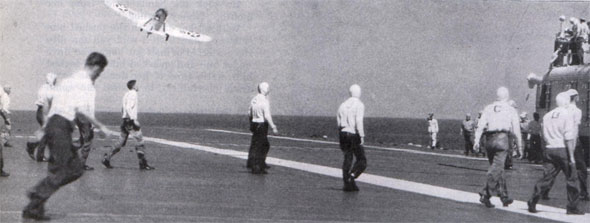
Official U.S. Navy Photographs-Courtesy U.S. Navy Recruiting
America’s offensive against Japan, Pratt wrote, would have to come up from the southern Pacific. The northern route, down from Seattle or Alaska, was too long and wouldn’t affect any of Japan’s interest.
So the U.S. would have to start from Hawaii, Pratt wrote, and proceed to the Marshall and Caroline Islands to connect with Australian forces, then “roll up the Japanese lines from the south. Once that circuit were accomplished, once that blockade set up, Japan would be cut off; she must surrender or die — of a lack of food, oil, and iron, not to mention the many less essential materials she does not have in the islands. Japanese strategy and naval construction are accordingly directed toward the prevention of such a blockade.”
Overall, a fairly accurate synopsis of what took place in the Pacific between 1941 and 1945. True, the Caroline Islands weren’t part of the U.S. offensive. American troops advanced on Japan through the Marshall to the Mariana Islands, while a southern initiative led from the Solomons through New Guinea, all heading toward the Philippines.
Such differences are minor, considering that Pratt was a journalist. He was not a naval officer and had no access to the military’s intelligence reports. Just as remarkable, was his ability to perceive the future at a time when fears and resentments kept many Americans from clearly seeing the situation right before them.
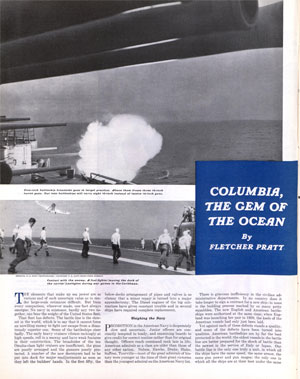
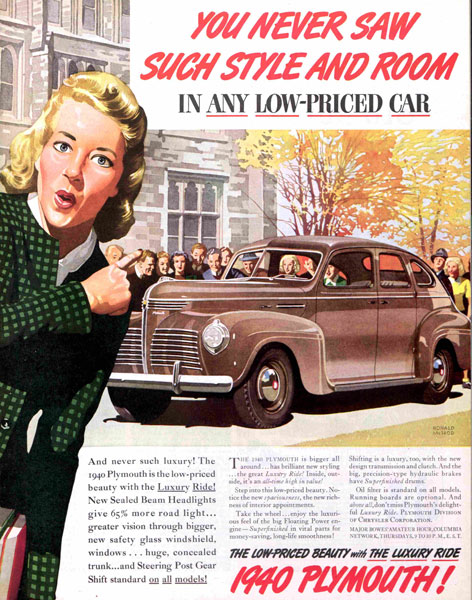
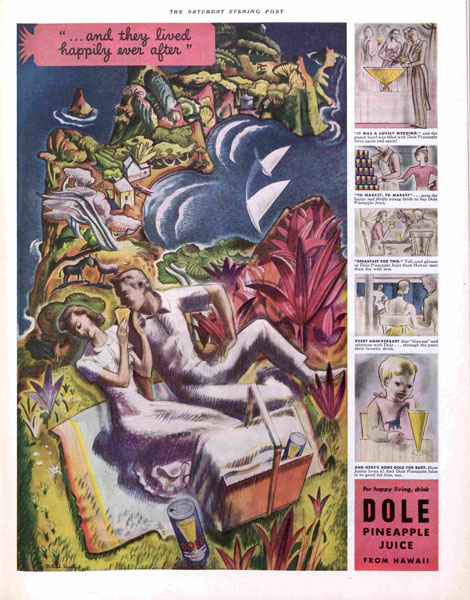
October 7, 1939
Step into 1939 with a peek at these pages from The Saturday Evening Post 75 years ago:

1914: London Goes To War
(Courtesy of The Library of Congress)
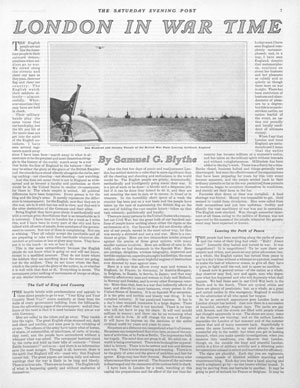
This series begins with a surprising eyewitness account of London by Samuel G. Blythe, published in our September 19, 1914, issue. It’s surprising because Blythe’s article contradicts the traditional account of Great Britain’s entry into the war.
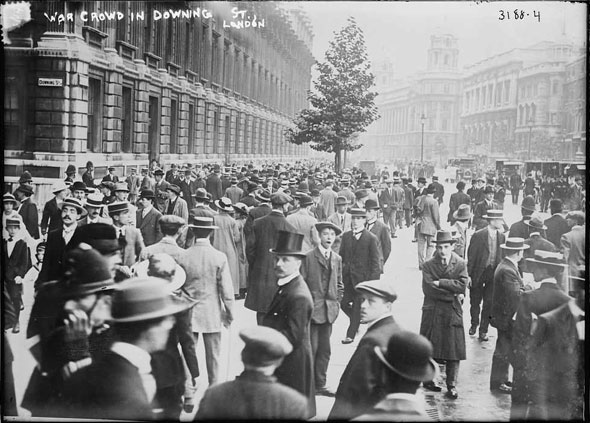
Popular histories and movies would give you the impression that the warring nations sent their soldiers off to war amid scenes of frenzied, jubilant crowds. Documentaries such as PBS’ The Great War and the upcoming exhibit at the National World War I Museum assert that there was a general expectation that the war would be over by Christmas.
Doubtless there were people who were excited and pleased by the thought of war and believed it would end quickly, decisively, and victoriously. But the Londoners Blythe saw were far from exuberant. According to his article “London in War Time,” they “watch their soldiers silently — almost stolidly. Whatever emotions they may have are held in check. … The crowds have stood silently alongside the curbs, saying nothing — not cheering — not shouting — just watching.”
(Courtesy of The Library of Congress)
Furthermore, contrary to the myth that the British expected a quick, easy victory, “the great papers are issuing daily and solemn warnings that the war is likely to be long and bloody.”
Most surprising to me is Blythe’s realization, from the war’s first week, that the coming conflict would have a vast impact. “It will change the map of Europe. It will leave its impress on the destinies of the entire civilized world for years and years to come. No person at a distance can comprehend what it all means. No person can comprehend that even here, at one of the centers of activities, or in Paris or Berlin. The impressions bulk too hugely. The mind does not grasp it all. No mind can.
“A world is being overturned. There is to be slaughter unparalleled in history. There is to be sorrow and woe and distress and ruin. There is to be mourning and weeping. There is to be the glory of arms and the grave of ambition and lust for power. Kings may lose their thrones. Republics may arise where monarchies now prevail.”
Many historians argue that the governments and people of Europe had no idea the war would overturn their world. Well, at least one reporter saw fairly clearly where it was heading, right from the start.
The Saturday Evening Post
September 19, 1914
Step into 1914 with a peek at these pages from The Saturday Evening Post 100 years ago:
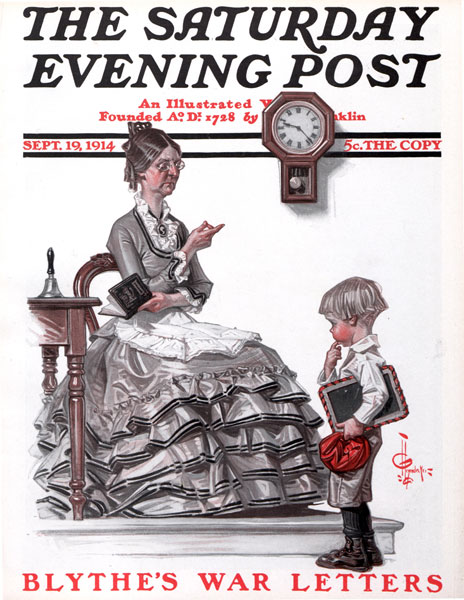
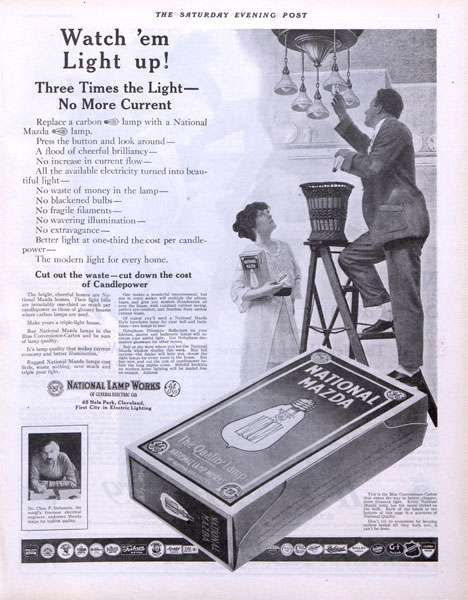
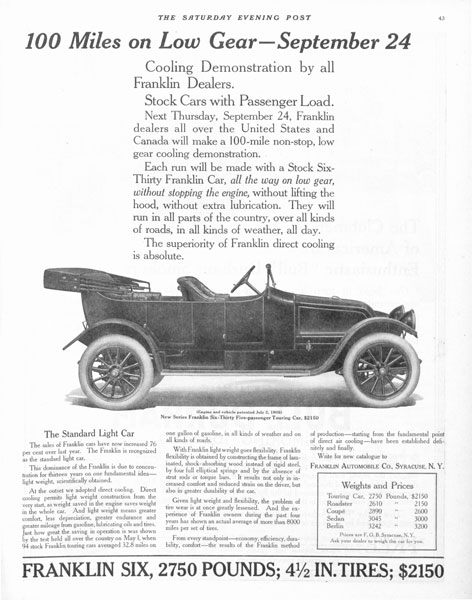
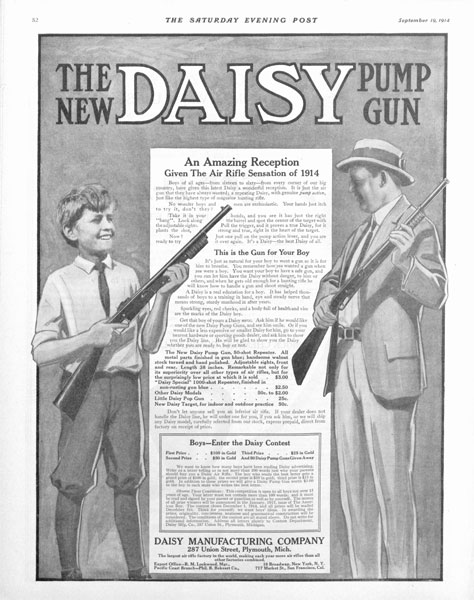
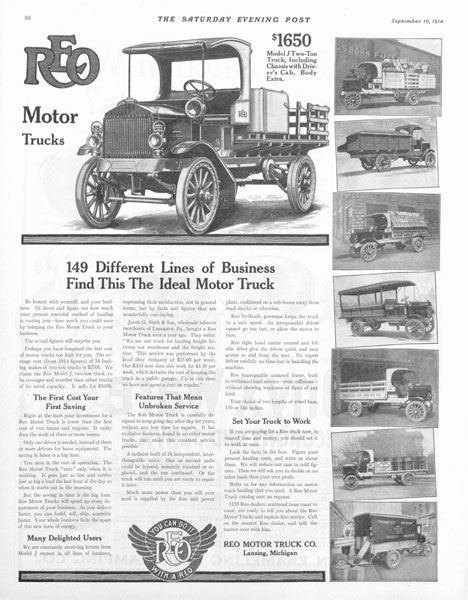
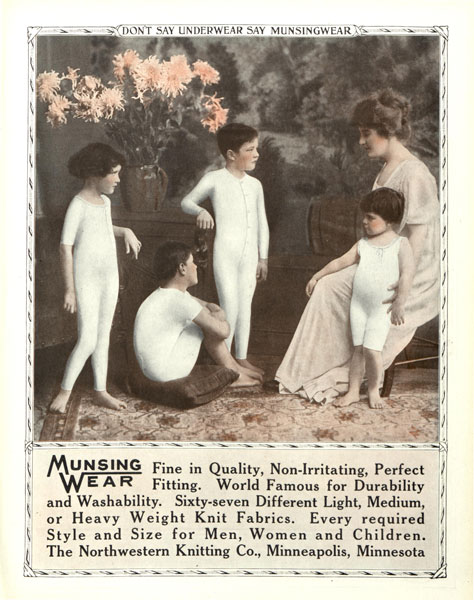
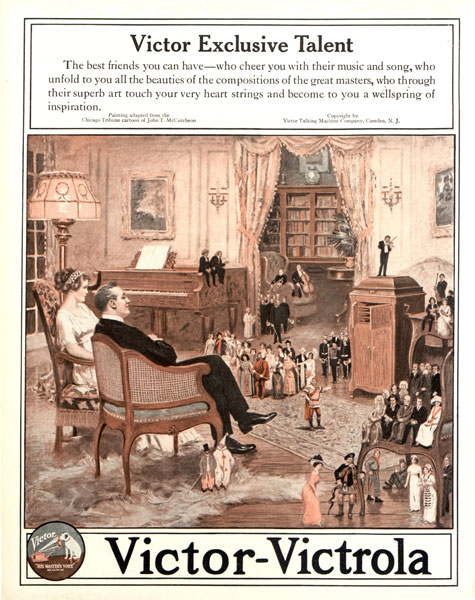
More Power to You
Does your home’s wireless signal seem slower than it used to be? Is reception spotty in some rooms? Well, do something about it! Believe it or not, you don’t need an engineering degree to boost the range and speed of your wireless router.
1. Run a test. Before tinkering with the router, make sure the problem isn’t your Internet connection. The Web has plenty of free utilities that test broadband speeds, and they’re easy to run. Ookla Speedtest (speedtest.net) is known for delivering accurate results, or you could run a speed test from your Internet service provider. How fast should your connection be? If your provider promises download speeds of 10 Mbps (megabits per second), the speed test should prove it. If you use video streaming services like Netflix or Hulu Plus to watch HD-quality shows, you’ll want download speeds of at least 5 Mbps. Power users who stream HD video, play online games, and have four or more devices online at the same time will need a 15 Mbps or faster connection.
Purchase the digital edition for your iPad, Nook, or Android tablet:

To purchase a subscription to the print edition of The Saturday Evening Post: 
Remembering How to Fly

Grandma told me she could fly.
She waited until we were alone in the room to tell me. She was sitting in the chair she liked, the one with the blue fabric and the rip on the arm. I was sitting on the edge of the fireplace, cross-legged, with my chin on my hand.
Grandma stood, and a mischievous grin grew on her lips. Mom called it her “fire grin,” because once Grandma had set fire to the woods behind our house, and when Mom caught her with the matches, Grandma had given Mom that same wild look.
“Did you hear what I said, Charlie?” Grandma asked me. “I said that I can fly.”
I didn’t know what to say.
“Would you like to see?”
“Yes,” I said. Then I said: “No.”
She cocked her head and gave me a look that suggested I was made out of mud.
“I’ll make you a believer,” she said and whirled around in a kind of half-dance.
Our house had these oversized windows with a ledge deep enough to sit on. The windows themselves latched in the middle, and they opened outward like wings. Grandma climbed up on a ledge and hesitated, contemplating the window latch.
“Grandma,” I said. But she paid me no mind. She got the latch undone and with one push she was teetering on the edge, looking down the two-story length of our house, at the grass below. I could feel the cold air seeping into the room, making me shiver.
“Grandma.”
“Do you believe me, Charlie?” she asked. Somehow she looked younger, every line on her face smooth and settled. There was bright energy in her eyes, an eagerness that was only a stone’s throw from seeming childish. “Tell me you do.”
“Yes,” I said.
Grandma nodded. She turned her head up toward the blue sky and closed her eyes. The breeze caught her hair, tossing it back from her forehead. “I just need to remember how. It’s in the memory, Charlie. It’s all in the memory.”
Mom came into the room and she screamed when she saw my grandma standing in the window. Whether Grandma could fly or not, I never found out that day.
****
I was older when she told me about the lake.
“You ever lie underneath the sky and watch the clouds?” Grandma asked me. It was late afternoon and we were sitting on the back porch. My dad was trying to get the barbeque lit and having a bugger of a time.
“I suppose,” I said. I leaned back in my chair, laced my hands in my lap, and looked up at the sky. There were no clouds, and the atmosphere was so blue it was hard to believe there was anything beyond that color. No stars. No moon. Nothing.
“Well either you did or you didn’t,” Grandma said. She had her hand wrapped around a glass of lemonade. When she lifted it to her lips the ice clinked against the glass and she made a smacking noise that grossed me out. “There’s magic in those clouds, Charlie, for anyone willing to look hard enough. There’s magic everywhere. But you’ve got to listen for it. Magic whispers; it doesn’t shout.”
I had no idea what Grandma was talking about. I usually didn’t.
“When you look up into the sky,” she said, “what do you see?”
I shrugged. “No clouds.”
“No clouds today, Charlie, but what about yesterday? Or the day before?”
I shrugged again. I couldn’t even remember if I had cereal that morning for breakfast.
“You lack imagination, Charlie. You always did.” She took another drink of lemonade. “Not your fault,” she said, wagging a finger at me.
“I guess.”
My dad was now on his back, underneath the barbecue messing with the igniter wiring, and I watched him so I didn’t have to look at Grandma.
“The lake,” she said. “That’s where I first found it. Heard it. A voice calling out to me.” I felt her gaze on me, heavy and longing, like a puppy from behind a window. “That’s when I first learned how to fly, Charlie. At the lake.”
I was too old now to believe the story. When I was a little boy her stories mystified me. As I grew older they just bored me.
“I was only a little girl. We were poor, and we were about to lose the house. I was sitting by the lake, pouting, because I didn’t want to leave. You can understand that.”
I nodded.
“The water was so still, and the air. The air was so clean! I could hear everything. The crickets and the loons with their god-awful cry. That sound could haunt the freckles off your back, Charlie. I swear it could. Even the earth underneath me seemed to groan with words that weren’t really words at all.”
“What did you hear?” She was sucking me in again.
“Footsteps. Coming up behind me. But there was nobody there.” She took another sip of her lemonade, and when she set her glass down on the table I noticed her hand was trembling. “I turned around and there was nobody there. But something whispered to me, right into my ear. A woman’s voice, or maybe a little girl’s, soft as kitten breathe.”
I checked on my dad, who was still holding his vigil underneath the barbecue. His tongue was poking out of the corner of his mouth, a sign things were getting serious.
“You can fly if you want to,” Grandma said. “That’s what I heard. That’s what the voice said to me.”
“Did you see the woman?” I asked.
“I turned back toward the lake as if the voice had come from the water itself. Maybe it did; I don’t know. I still don’t know. I saw my reflection there, only it wasn’t my reflection, Charlie.”
“No?”
“It was another little girl looking back at me. And this little girl was in the air. She was flying, and she was laughing, and she was looking back at me with eyes as big as silver dollars. You know what I saw in those big eyes? I saw the future. I saw all the possibilities of what can be, and what might be, and it made me cry.”
“Did you fly?”
“I ran away screaming.” She sat back and smiled. “I was only a little girl, and Daddy came out with a shotgun, thinking I saw someone creeping around in the bushes.” She giggled at this memory as she tenderly put a hand to her cheek. “But I did fly, Charlie. I did, later, and it was wonderful. I can teach you how, but you have to believe. You have to want to do it.”
A crash and a yell disrupted our conversation. I heard my dad curse loud enough to spook a pair of jays from the fence. The barbecue had flipped over on its side, and the grate rolling across the concrete did a kind of lazy wobble and then fell against my mom’s pot of petunias. Dad reared back his arm and chucked the lighter. It landed in the rose bush.
“Shit on a stick!” he yelled, and Grandma belted out a bray of laughter spraying lemonade everywhere.
****
I lay in bed most of the night thinking about what Grandma told me. By morning, I had decided to ask her about flying again.
But the lights were off in the living room, and in the kitchen, and I knew that was wrong. For as long as I could remember, Grandma was always the first up, the first to have coffee made and the first to be at the table drinking it.
But that morning there was no sign of her.
“Grandma?”
Her room was at the end of the downstairs hallway. I crept there in my socks, despair gnawing at my ribs. I hesitated at her door, almost knocked, but leaned in to listen instead. From inside I could hear Grandma’s fan whooshing back and forth, but nothing else.
“Grandma?”
The door opened, and there she was, staring at me as if she had never seen me before. Her face was slack, not with sleep, but waxen like a doll’s. Her skin was glossy and there was dried spit on her lips.
“Grandma?”
She blinked, once and then again, and then her lower lip dropped open as if she were about to speak. But only the faintest of sounds came out of her mouth.
“Wake up,” I said. “It’s me. It’s Charlie.”
Her eyes darted down to the floor and then back to my face. She smacked her lips and drool fell down her chin and to the floor in one long stringy drop.
“Don’t touch the pastries, Jack,” she said. “The fire department’s at the door!”
I took another step backward until I was against the wall.
“Get away from the toaster! It’s hot! It’s hot!”
“Grandma!”
Her eyes rolled up until they were white. Her lips and her hands trembled. And then she blinked. When she opened her eyes again, I saw clarity there for the first time.
“Charlie,” she said. “What on earth are you doing in the hallway at this hour?”
“It’s morning,” I said.
She ran a hand across her face and yawned. “So it is, Charlie. So it is.” She put a hand on my arm. “You look like you’ve seen a ghost.”
“I was worried,” I said.
“What on earth for?”
“I don’t know.”
She ruffled my hair and then set off down the hall. “You were always a little odd, Charlie,” she said and turned the corner.
****
Two weeks later, she fell and broke her hip. Mom told me she had climbed up onto the fence in the backyard, and fell into the neighbor’s hydrangeas.
“I don’t know what in the world she was doing,” my mom said. “Climbing up there like that. I think she’s going mad.”
But I knew. Grandma was trying to remember how to fly.
****
When Grandma came home from the hospital, she was restricted to a wheelchair. This was like clipping the wings of a sparrow. The medicine made her thick and distant, and she barely said a word to any of us anymore. Sometimes she would just sit and stare and I would wonder if she hated us. Maybe she blamed us for the chair, or maybe it was the fall. I think falling was the hardest part of it all. It was more than her hip that shattered that day.
I missed her, missed hearing her voice and her laugh. I even missed her stories.
One bright morning in late August, I pushed Grandma outside to sit with me on the patio. The day was already edging toward being another scorcher, and I was starting to sweat while Grandma sat there with her yellow afghan draped over her lap.
“Show me how to fly, Grandma,” I whispered. I locked her wheels in place and sat down in the chair next to her.
Her eyes were cold and hard. Her gnarled hands clutched at the afghan.
“Look, Grandma. Look at the clouds. Big puffy ones, just like you like.” I patted her hand. “There’s one that looks like a boat. Like a tugboat.”
I was speaking to her as if she were 5 years old, a horrible thing people tend to do with the elderly and the sick. But I was 14 years old, and I just wanted my grandma back.
“Talk to me, Grandma. Just say something.”
Desperation filled me like water. I stood, biting back the anger, and went into the house, leaving Grandma there on the porch. I pulled open the cabinet over the sink and snatched a glass, but I dropped it when I heard something crash outside. Underneath the sound of metal on concrete was a low, hoarse moan.
I ran outside and found the wheel chair flipped on its side. Grandma lay with her cheek pressed to the concrete, her frail body crumpled in a motionless heap. Her eyes were wet and wide and staring up at me. Her face was a pond of emotion, its surface frozen solid.
“Grandma,” I said, kneeling and brushing the hair out of her face. “What did you do?”
Her legs were twisted wrong. She must have been in pain, but she didn’t show it.
“What do I do?”
Her lips began to move, to tremble, to vibrate. She reached for my arm and grabbed me fiercely with one hand.
“Kill me,” she whispered. “Kill me, Charlie. Please.”
****
Grandma taught me how to swim by pushing me into the deep end of the municipal pool and holding my head under water until I learned not to open my mouth. I’m pretty sure I was as close to drowning that afternoon as a kid could be, and I’m equally convinced that Grandma would have let me if I didn’t give in to her. I still remember what it felt like to be underneath all that water and to have no control. That’s how I felt the last time I went to see Grandma in the hospital.
She lay in her bed, motionless, so still that she appeared artificial. Like a husk or a shell of something that was no longer present. Her wrinkled skin was sallow and thin. Her eyes, almost lifeless.
Mom put her hand on my arm and I almost screamed.
There was little light coming through the blinds and as I approached her bed I could see dust floating in the air, could feel them collecting on my skin, like a thousand tiny fingers. I wanted to run away, but stood frozen as her heavily sedated eyes rolled toward me.
“Charlie,” she whispered, her lips like leather, colorless and worn.
I put my hand on the bedrail; felt the cold steel against my skin.
“Charlie,” Grandma said again, and she tried to smile but could only hold it for a fraction of a moment. “Come here.”
She lifted her hand and twitched her fingers. I put my hand in hers and tried not to show in my expression how horrible it felt to touch her. Touching her was worse than touching that cold bedrail, because it was like clutching death itself. She was so frail I worried that she would crumble and blow away, right out of my palm, just like a memory or a whispered word on the breeze.
I looked up at my mom and saw tears in her eyes.
“I’m here, Grandma,” I said. My voice sounded too loud in the haunting silence that surrounded us.
“Do you still remember how to fly, Charlie?”
I shook my head. “I don’t know how.”
“We all know how to fly,” Grandma said. “We just need to remember. That’s all.”
The nurse came in and took Grandma’s vitals. Grandma closed her eyes and fell asleep, and she never woke up again.
****
What we remember the most from our childhood are often the strange things. These become sacred somehow, and so we hold on to them. They haunt us, like ghosts. They move us, still, when we allow them to, like old melodies. In the same way, Grandma still speaks to me. She was my friend, and even in her madness she was a part of me that will always hum, like a live wire. Dangerous and beautiful.
I go out to the lake often now to sit in the grass and I’ll look up at the sky to watch the clouds. Sometimes they make shapes, and I’ll watch them shift and reform, and I’ll remember what Grandma used to tell me, about water, about the sky, and about life. When I look at myself in the still mirror of the water, I see a strange face staring back at me. It’s my own face, but younger, perhaps it belongs to the boy I used to be, or the boy I had always wanted to be. Once I saw that boy holding onto a red balloon by its long string. The balloon drifted and bopped, and I’m pretty sure that boy was flying.
Today, the clouds are like cotton balls, and they cast shadows that move slowly over the fields. The lake is still and there is no wind. I’ve taken off my shoes and rolled up my pant legs, and I’m about to get into the water. I’m a great swimmer now. I owe that, and many other things, to Grandma. But I think that I should like to see if I can walk on the water this time. I’ll pretend that it’s made of glass and that I am as light as a feather. Afterward, I think I’ll climb a tree. I can fly, just like the little boy in the reflection on the lake, and just like my grandma. It only took all these years to finally believe, but I do. I really do.
Jewish Pawns
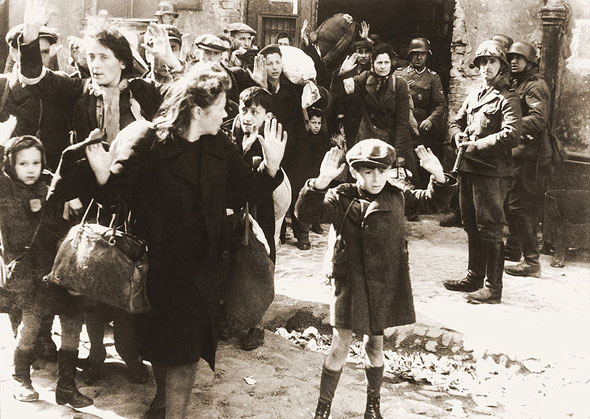
The story has a familiar ring to it. Thousands of refugee children seeking asylum in the United States sparks a heated debate over immigration and human rights.
Today the children are illegal entrants from impoverished regions of Central America. In 1939, they were Jewish children whose parents had been shipped off to Hitler’s concentration camps.
That year, U.S. legislators introduced a bill into Congress to allow 20,000 of these children to enter America. The bill’s sponsors believed that, unless these children were allowed to emigrate, they would suffer the same fate as their parents.
The bill was defeated when Congress voted in accord with American opinion; at the time 60 percent of voters didn’t want to raise immigration quotas for Jews fleeing the Nazis.
We might wonder how Americans could turn their backs on children facing almost certain death. But Americans weren’t heartless in those days, they were afraid. Many feared the children’s parents would eventually petition to join their children and would arrive in the U.S. to take jobs away from Americans. After all, unemployment in 1939 was still lingering near 17 percent.
Some feared that allowing these young refugees into the U.S. would damage its status as a neutral nation, particularly in the eyes of Germany. Others feared the children would introduce non-traditional culture into American society.
Some were hoping to keep all traces of Europe’s troubles out of America.
And many, alas, just disliked Jews. If anti-Semitism hasn’t declined in America in the past 75 years, it has certainly become less outspoken. But in 1939, many anti-Semites weren’t shy about expressing their dislike of Jews.
Many Americans, though, were simply indifferent, reluctant to intervene in Germany’s treatment of its Jewish population. They regarded Hitler’s brutal treatment of Jews with cold detachment as Demaree Bess did in the Post on March 18, 1939.
“There are two manners of approach to this important question. One is emotional, coming from the heart. The other is intellectual, coming from the head. In America, we have thus far stuck largely the emotional approach. Our hearts have been profoundly moved and our sense of decency outraged by the barbarous persecution of thousands of helpless men, women, and children. Many of us have become so indignant that we are in a mood to do something — anything — to retaliate against bullies and brutes.” (Read the entire article “Jewish Pawns in Power Politics” from the Post.)
Bess was worried that “anything” could mean going to war with Germany. So he encouraged readers to think about anti-Semitism as something other than the systematic abuse of a religious minority. It was also, he said, a political tool. In Germany, it had helped the Nazis distinguish themselves from other socialist groups and gather a following among bigots and bullies. Anti-Semitism had also enabled the Nazi Party to enrich itself from the penalties they inflicted on Jews as well as the theft of imprisoned or executed Jews.
In a surprising move, Bess, reported Italy had also adopted racial laws against Jews, despite the fact that Mussolini long maintained that anti-Semitism was senseless. Japan, which had virtually no Jews to hate, had also made anti-Semitism part of its national policy.
Italy and Japan only adopted the Nazi policy to attract anti-Semitic allies in other countries. In the Middle East, for instance, Italy was hoping to stir up opposition against Britain and its colonies, but it had agreed not to engage in any anti-British propaganda. With an anti-Jewish campaign, it could still rally support among Arabs. Italy’s new anti-Jewish laws, Bess wrote, “served as the most effective kind of propaganda among all those countries and groups which dislike the British because they are pictured as defenders of the Jews.”
Japan’s big worry in 1939 was the Soviet Union. Russian troops continued to threaten Japanese forces in Manchuria. At the time, the communist government in Russia was widely considered to be friendly to Jews.
Japan hoped to reduce Russian troop concentration in Manchuria by forcing the Soviet Union to shift armies west against opponents in Europe. “Japanese agents,” Bess reported, “working among anti-Semitic groups in Eastern Europe [that engaged in] various anti-Soviet movements, finally realized, like Mussolini, that they could make better progress if their government were definitely committed to a policy of Jew-baiting.”
While this is informative, it hardly seems to address American outrage over Nazi atrocities. And it raises the question of whether it is appropriate to consider some issues “intellectually.” A truly detached inquiry would involve accepting nothing and questioning everything, so that you might raise the question, as Bess did, “Are the Jews themselves responsible for arousing the hostility of other groups? Are they guilty of all those sins with which they are charged by anti-Semitic groups in all parts of the world?”
Precisely the sort of questions Hitler would want you to ask.
Step into 1939 with a peek at these pages from The Saturday Evening Post 75 years ago:
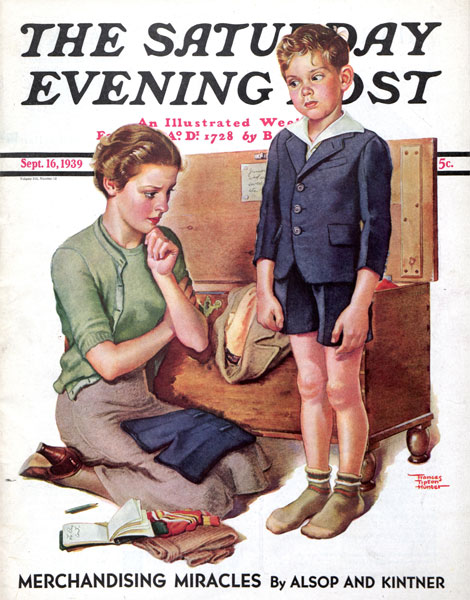
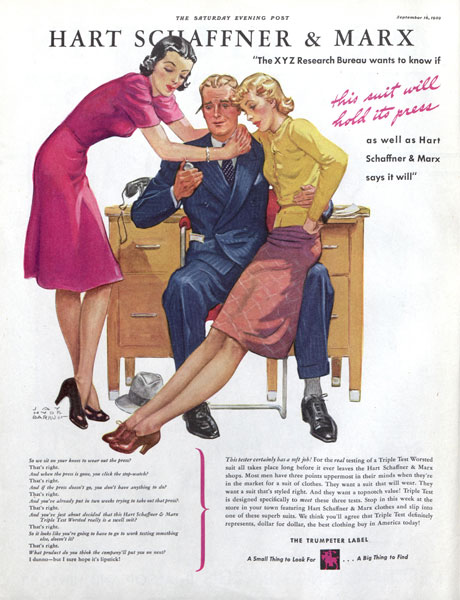
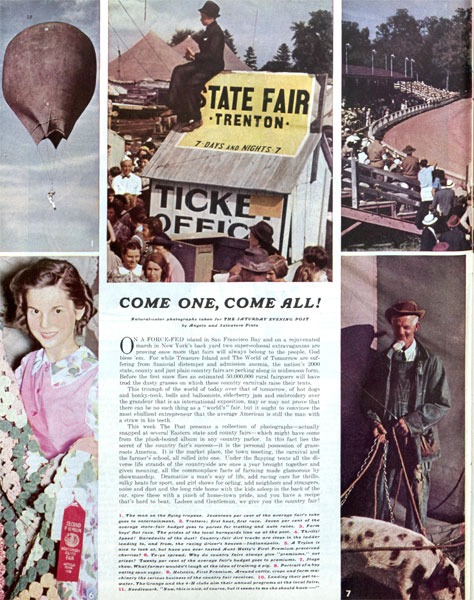

I Had a Cello
The top of a French horn collided with my head as I climbed aboard a shuttle bus in Aspen.
“Sorry,” said the teenage girl hidden beneath her big brass instrument.
I had just arrived in Colorado for a conference on medical problems of musicians and dancers. The opening session was scheduled to begin at eight. Aspen’s annual music festival was wrapping up, so the pretty alpine town was filled with talented young students, elite teachers, and a renowned musician or two.
Through the bus’s open windows I gazed at Rocky Mountains ignited by the rising sun and took a deep contented breath of clean, crisp air, reveling in my escape from New York’s hazy, hot, and humid.
The following four days were filled with lectures and discussion, provocative ideas, and camaraderie among medical professionals, dance and music teachers, seasoned performing artists, and a smattering of students. After the concluding session, I stood waiting once again at the bus stop to head back to my hotel. A musician with a large cello was waiting too.
“Oh m’gosh,” he suddenly exclaimed, “… completely forgot …”
I turned to look at him.
“Please — could you watch my cello while I make a phone call?” he asked.
“Sure,” I said. He dashed inside.
Ten minutes passed, then 20. Where is this guy? I fumed.
Two buses came and went. An hour passed. Is he still inside? Did he get lost? I grumbled with mounting irritation. By now I was the only one left standing at the bus stop. Better go and look for him, I thought. But what if he comes back … finds his cello gone? It was getting late; I had no more time to waste.
The cello was unwieldy, almost four feet high; I wrapped my arms around it and went inside. The conference hall was empty except for one lone workman stacking chairs.
“Did you see anyone come in … ?” I began, trying to recall descriptive details of the cellist: “… short, slim man, wearing a baseball cap … black hair, I think it was, sticking out.”
“Nope,” said the custodian. “Everyone cleared out when the conference finished.”
“He left his cello outside with me and disappeared. Is there anyone else I can ask … someone in the office?”
“Nope — they’re all gone for the summer. Vacation time.”
I unzipped the fiberglass case, searching for some sort of ID. The custodian took a closer look at the cello.
“That’s some fine instrument there,” he said with admiration approaching awe. Neither case nor cello yielded any kind of clue.