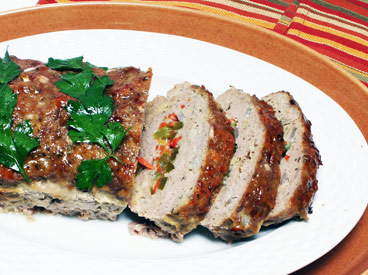
Vegetable Stuffed Turkey Meatloaf
For a decidedly Mediterranean twist on this classic dish, combine ground turkey with onion, Italian seasoning, garlic, and Parmesan. Add colorful vegetables and the result is tasty, stunningly attractive, and healthy. Best of all, you can use almost any fresh vegetables that are available from your early fall garden, farmers market, or grocer. Experiment with what you have on hand to create a great seasonal dish.
Although the turkey loaf alone is a hearty offering, you can make a complete meal by adding a tomato basil salad. Cut a few fresh tomato wedges, chop up some fresh basil leaves, add finely sliced garlic, and drizzle on a little olive oil with fresh squeezed lemon juice or wine vinegar, and toss. You might also add a side of lightly steamed green beans.
Vegetable Stuffed Turkey Meatloaf
(Makes 8 servings)
Ingredients
-
- 1 large carrot, shredded
- 1 medium red bell pepper, diced
- 1 medium green bell pepper, diced
- 1 cup chopped broccoli
- 1 large egg, beaten well
- ½ cup fine whole-wheat bread crumbs (any whole-grain bread crumbs can be substituted)
- ½ cup chopped onion
- ¼ cup plain soy milk (low-fat regular milk can be substituted)
- 1 teaspoon Italian seasoning, crushed fine
- ½ teaspoon garlic powder
- 3 tablespoons grated Parmesan cheese
- Salt and freshly ground black pepper to taste
- 1½ pounds ground turkey*
- 3 tablespoons tart berry jelly (currant works well)
- 1 tablespoon water
- Fresh parsley leaves, to garnish
*Dark turkey meat will yield a more succulent dish, but for those who desire the minimum amount of fat, breast meat works well too.
Directions
- Preheat oven to 350˚F.
- In medium saucepan over medium-high heat, steam carrot, peppers and broccoli with small amount of water until tender-crisp, about 4-5 minutes. Drain and set aside.
- In large bowl mix egg, bread crumbs, onion, milk, Italian seasoning, garlic powder, cheese, salt and pepper. Whisk to combine well. Add turkey and mix well.
- Lay sheet of wax paper on clean counter. Place turkey mix on paper and pat into 7″ x 11″ rectangle. Arrange vegetables over turkey 1 inch from edge.
- Starting with short width, use wax paper to gently lift turkey mixture edge. Proceed to tightly roll turkey mixture into a loaf, peeling away the paper as you roll. Gently place loaf in greased baking dish.
- Bake for about 1¼ hours until internal temperature is 170˚F. Carefully transfer loaf to serving platter.
- In small saucepan over medium heat, combine jelly with 1 tablespoon water and warm until melted, mashing currants or berries while stirring. Brush top with melted jelly and garnish with parsley, laying leaves flat in 6 diagonal rows. Slice and serve.
Nutrition Facts
Per serving
Calories: 249
Total fat: 12 g
Saturated fat: 3 g
Carbohydrate: 12 g
Fiber: 3 g
Protein: 24 g
Sodium: 183 mg
Class Inaction
SLUG: Lighter Side
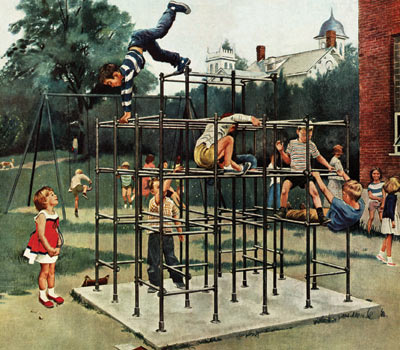
My younger son recently graduated from high school and has expressed an interest in becoming a teacher. My mother was a teacher and enjoyed it, but that was before politicians took over a perfectly fine system of public education and ruined it. Today’s teachers spend most of their time teaching children how to take tests most of the politicians looking over their shoulders couldn’t pass.
When I was a kid, politicians kept their noses out of education. This was a fine arrangement, and worked well for all concerned, especially the children, who, like all living things, grow best in the loosened soil of relaxed oversight. With the government came experts on children, and with them came the smothering compaction that turned learning from a natural joy to the forced and anxious march it is today.
Nowhere is the difference between yesterday and today drawn so sharply as in my memory of fourth grade when, during recess, I was pushed to the ground by Ricky Smith. Ricky wasn’t a bully. I had pushed him down the day before, so this was a matter of simple justice. I landed on my chin and suffered a deep cut. Mrs. Conley took me to the school nurse, Mrs. Widener, who handed me a towel so I wouldn’t drip blood on the floor. This pre-dated the current era of child worship, and her chief concern was for the janitor, a priority I accepted without question.
“Let’s go see Doc Kirtley,” she said, taking me by the hand and walking me the four blocks to his office. We sat in the waiting room, Mrs. Widener skimming The Saturday Evening Post and I, the Highlights magazine, while leaking blood. After a time, Dr. Kirtley called us back to the examination room, studied my chin, threaded a needle, and closed my wound with six snug stitches. He topped it off with a Curad bandage, let me pick out a toy from the top drawer of his desk, and sent us on our way. No forms were filled out, no money exchanged, no report filed.
On the way back to school, it being lunchtime, Mrs. Widener and I stopped at the Coffee Cup restaurant on the south side of the town square, and had hamburgers, French fries, and a Coke. I thought of my classmates back at school eating spinach and lima beans and made a mental note to thank Ricky Smith, whose passion for righteousness had made this blessing possible. I returned to Mrs. Conley’s room a conquering hero, a wounded veteran back from the trenches. That evening my mother noticed the bandage on my chin and asked what had happened.
I had not yet learned to stretch out a good story, so my report was succinct. “Ricky Smith pushed me and I cut my chin, so Mrs. Widener took me to the doctor’s and I got six stitches.”
“You and Ricky be more careful,” she advised, and the matter was closed. No call was made to the principal. No lawyer was consulted. No threats to sue issued. My injury was accepted for what it was–the natural consequence of youthful exuberance. We knew no better then. I recall this event not because of the stitches. I suffered many accidents as a child and was often sewn back together. No, I remember it for the unhurried stroll to the doctor’s office, the hamburger at the Coffee Cup, and the casual manner with which my injury was tended. I have stayed in close contact with education–my wife is a school librarian–and know the tumult that would result were such a thing to happen today. Parents would be phoned, an officer and ambulance summoned, depositions demanded, and fault assigned. Ricky Smith would be suspended from school and made to undergo counseling. I would become a poster child for dangerous schools, one more example to tug the heartstrings and purse strings of an anxious public.
“Now go back to class and try to learn something,” Mrs. Widener told me, after snipping free the stitches. I think of her still, that bewildered, backward woman, failing to grasp the complexities of modern life.
The Post Reports: Reconstructing Kennedy
Fifty years have passed since the assassination of John F. Kennedy, but the memory of that day has barely dimmed for most baby boomers. In conjunction with the Post’s reprinting of the Kennedy memorial issue published December 14, 1963, we present the following series of articles illustrating John F. Kennedy as he was seen in his time, before a half century of re-evaluation, criticism, and second-guessing.
These articles touch on key points of his time in office: his victories and blunders over Cuba, his Cold War strategy, and his late but crucial action for Civil Rights, and includes Post original material by Pulitzer-prize-winning journalist Ralph McGill, ex-president Dwight Eisenhower, Jimmy Breslin, Kennedy aide Arthur M. Schlesinger, Jr., and others.

The Unanswerable Question
Even before the Warren Commission met for the first time, the majority of Americans no longer believed a lone shooter was responsible for President Kennedy’s murder. Read more »
Why Kennedy Still Matters
The 35th president completed only three years of his term and left behind a pile of unfinished projects and unraveling plans. Yet Americans consistently rank him among our greatest presidents. Archivist Jeff Nilsson explains why we still love JFK. Read more »
Falling for Jackie Kennedy
Many Americans only got their first look at Jackie during the inaugural ceremonies, but her fashion sense and unflappable poise soon made her one of the country’s most admired first ladies. Read more »
How the Early 1960s Looked to Americans
The 1960s began with the election of a young, optimistic president who spoke of new opportunities. “Change is the law of life,” John F. Kennedy said, and in his inaugural address, he talked about “a new generation,” “a new alliance for progress,” “a new endeavor,” and “a new world of law.” Read more »
A Surprisingly Popular Presidency
Despite political opposition–and a few arguable failures in policy and tactic–John F. Kennedy remained a popular, well-regarded president throughout his short term in office. Archivist Jeff Nilsson explains why. Read more »
Rethinking Kennedy’s Camelot
In the years following President Kennedy’s death, many people often spoke of his presidency as an idyllic time, dubbing those pre-assassination days as “Camelot,” a noble, idyllic but ultimately doomed kingdom. In truth, America was already in the midst of troubling times that little resembled the idyllic innocence of Camelot. Read more »

Kennedy on the Campaign Trail
Doubts about then-Senator Kennedy’s religious affiliation, family ties, and youth made the viability of his campaign questionable. Yet when Post reporter Beverly Smith followed Kennedy on the campaign trail, she said it was “the most exciting presidential contest within [her] fairly extensive experience.” Read more »
A Very Eligible Politician
The first time the Post took notice of John F. Kennedy, he was still a very junior senator from Massachusetts. It was unusual for the magazine to run a feature article on a senator, particularly one as young and inexperienced as Kennedy. Read more »
Christy’s Cooked Greens


West End Farmers Market is located in northwest St. Louis in an area with limited access to fresh produce. The International Institute, offering comprehensive adjustment services for refugees and immigrants in the community, has two farms for food-growing. There, recent refugees from a variety of countries including Burundi, Bhutan, Burma, Ethiopia, Morocco, Nepal, Democratic Republic of Congo, Tanzania, Kenya, and Somalia grow produce, which is in turn sold at the market. Market sales benefit the farmers and the refugees who have resettled in the community where the market is located, and increase access to fresh fruits and vegetables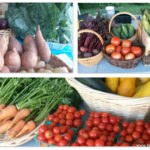 for the community at large.
Christy, a patron of the market who is excited about the affordable foods available in her neighborhood, shares one of her culinary adventures with seasonal produce: a versatile recipe for cooked greens. You can add smoked turkey, bacon, or tofu. Serve them over quinoa, corn bread, whole wheat pasta, or brown rice. Or, add cooked greens to tacos with black beans, cheese, and salsa.
Christy’s Greens
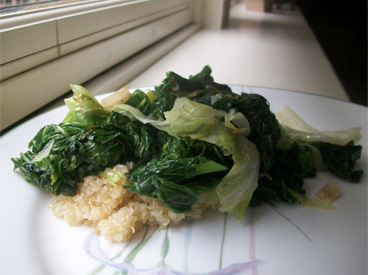
Serve Christy’s Greens over quinoa for a flavor-filled lunch.
Ingredients
- 1 head mustard greens
- 2 cups kale
- 1 cup fresh spinach
- ½ head iceberg lettuce
- 1 turnip
- 4 medium cloves garlic
- 2 Tablespoons olive oil
- ½ teaspoon salt
- ½ teaspoon ground black pepper
Directions
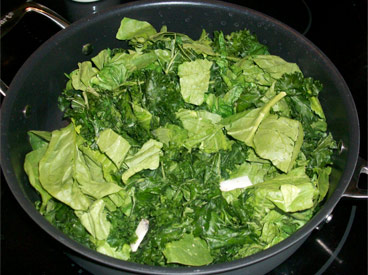
- Remove hard stems from kale and mustard greens (leave stems if desired).
- Stack leaves on top of each other. Use knife to slice mustard greens, spinach, and kale into ¼-inch strips. Slice iceberg lettuce, but keep separate from other greens.
- In large bowl filled with cold water, add cut greens. Allow dirt to settle to bottom of bowl. Lift greens out of bowl. Shake off excess water. Repeat step with lettuce.
- Peel and mince garlic. Peel and slice turnip. Set aside.
- In a large skillet over medium-high heat, heat oil.
- Add mustard greens, spinach, and kale.
- Stir greens until wilted, about 1-2 minutes.
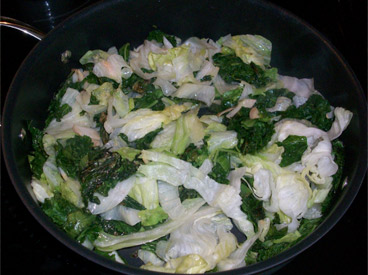
- Reduce heat to medium. Add garlic and turnip. Cook until greens are soft and excess water is gone, about 5-7 minutes. Add iceberg lettuce, cook for 1-2 minutes.
- Season with salt and pepper. Serve immediately.
3 Questions for Barbara Corcoran

Nobody gets eaten alive on the hit show Shark Tank on ABC, but there are plenty of emotional wounds as budding entrepreneurs pitch products and concepts to top business moguls. Holding her own in the lively exchanges is Barbara Corcoran, whose rags-to-riches story serves as powerful inspiration to the contestants.
Had Corcoran pitched her idea for a Manhattan real estate company to the Sharks when she set out on her journey to the top 40 years ago, they might well have delivered the show’s signature “thumbs down.” She was working as a waitress, but with a borrowed thousand dollars, she formed the Corcoran Group, and boldly built her little company into a New York City powerhouse. In 2001, she sold her company for $66 million.
Today, Corcoran is a familiar face with her weekly appearances to talk about real estate trends on theToday Show as well as Shark Tank where she has a reputation for sympathy and charm as well as toughness.
Question: How do viewers feel about you as the first female shark?
Barbara Corcoran: They all say, “We love how you give it to those guys.” What surprises me, though, is how much they ask about my own personal struggle to find success. I grew up poor in a tiny house with 10 children. We got one new dress at the start of the school year. It was a struggle, but when I look back, I think about what fun we had. I give all the credit to my mother for nurturing each of our talents. I was dyslexic. I wasn’t a good student. I hated bringing my report card home. But instead of criticizing, my mother kept saying, “You have a great imagination.”
Q: Now that you have money, do you like to buy things?
BC: When I go to shop for clothes I don’t even look at the price tag. But I understand being poor, so I know I have a responsibility to help others. When I sold my company, someone gave me the idea to establish an education trust. We’ve had 27 people go to college with that fund.
Q: What do you think fueled your ambition?
BC: I never was chasing the gold. That wasn’t valued in our family. It was all about the competition. I’m so hungry now for the next step, whatever that might be. I want to get the most out of my great life.
Berry Nutty Breakfast Parfait
Of all the meals we serve in our homes, breakfast can be the one that gets us most in a rut—think cold cereal, pancakes, and eggs, over and over. So this dish is something to break the monotony. Plus, it tastes like a sweet, creamy dessert.
Berry Nutty Breakfast Parfait
(Makes 4 servings)
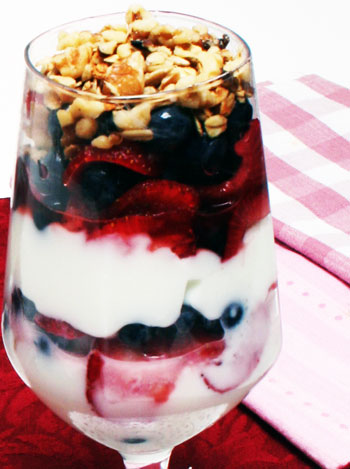
Ingredients
-
- 2 cups blueberries
- 2 cups sliced strawberries
- 1 tablespoon honey, softened by placing the jar in a pan of water over low heat
- 2 cups low-fat plain yogurt
- ½ cup low-fat granola*
- 4 tablespoons chopped walnuts (pecans or almonds can be substituted)
*Note: Many commercial granola cereals have too much added sugar or honey. This breakfast recipe uses granola without dried fruit to show off the fresh berries, but you can use granola with dried fruit too. Either way, choose a granola with little added sugar and fat.
Directions
- Place berries in mixing bowl. Drizzle with softened honey and toss gently to coat.
- Spoon ¼ cup yogurt into four parfait glasses (tall, narrow wine glasses will do) and top with layer of berry mixture. Repeat layers with remaining yogurt and berry mix.
- Top with granola and nuts. Serve.
Nutrition Facts
Per serving
Calories: 257
Total fat: 8 g
Saturated fat: 2 g
Carbohydrate: 41 g
Fiber: 5 g
Protein: 10 g
Sodium: 118 mg
50 Years Ago: Racial Violence Explodes in Birmingham
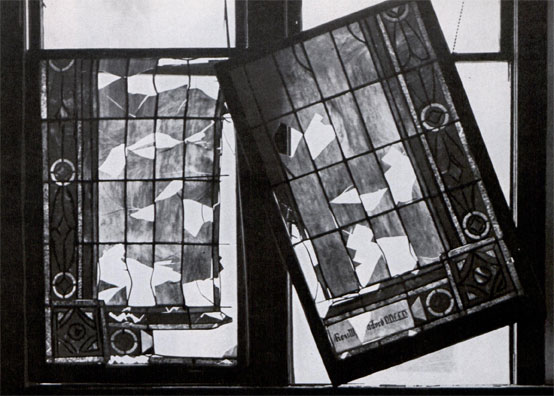
1964 © SEPS
On March 2, 1963, the Post ran an article on racial tension in Birmingham, Alabama, entitled “A City In Fear.” The editors couldn’t know how prophetic it was.
The story appeared as part of a series focusing on the progress of civil rights in the South. Post articles reported Georgia and South Carolina were taking early steps toward integration, but Alabama was stubbornly resisting any change.
The nation had already heard of Freedom Riders—activists traveling through the South to help register black voters—being viciously attacked in Birmingham. And newspapers had carried shocking photos of Birmingham police using fire hoses and police dogs to break up demonstrations by black activists.
In his report from Alabama, journalist Joe David Brown said he was discouraged by the racial violence he found in his old hometown of Birmingham. “The people were as charming as ever, but their hardened attitude, their fear of desegregation saddened me.”
Birmingham, he wrote, was the largest American city that was taking no steps to address its racial problems. The city refused to establish any official communication between its white and black communities. “If [the city] had hired experts and set out to do it deliberately, it probably could not have been so successful in creating a bad national reputation,” Brown wrote.
Politicians were capitalizing on fears in the white community by talking up resistance to integration. The president of the city commission had recently closed the city’s entire park system because a federal court had ordered the city to integrate its facilities.
The forces of segregation had been encouraged by the recent election of George Wallace to the governor’s office. He had gathered support by preaching unyielding resistance to federal orders to integrate the state’s schools, claiming that he would go to prison before allowing black students to enter in the state’s university. In his inaugural address, he made a characteristic appeal to the pride and fear of the state’s segregationists. “In the name of the greatest people that have ever trod this earth, I draw the line in the dust and toss the gauntlet before the feet of tyranny, and I say segregation now, segregation tomorrow, segregation forever.”
All this demagoguery had set back the cause of civil rights, as a prominent Birmingham minister told Brown, “For more than eight years the mightiest and most influential people in this town have told us to fight, to resist, not to give in at any cost. … After whipping these people into a fighting mood … it simply is not possible to tell them that the rules have been changed.”
The absence of progressive leadership further encouraged a small number of racists who had begun a campaign of terror in the community. Just three months earlier, “a crude dynamite bomb ripped apart the front of a church in which a group of small Negro children were rehearsing a Nativity play. It was the 17th bombing in and around Birmingham since 1957, all of them directed against Negro churches and the homes of civil-rights leaders.”
The segregationists of Birmingham had long maintained control by suppressing any opposition from the black community. Now they were beginning to smother opposition among Birmingham’s white residents. Their threats prompted newspapermen to keep loaded shotguns by their front doors. They silenced business leaders by threatening attacks on their spouses. They dumped garbage on the property of citizens who endorsed integration or, in some cases, burned crosses on their lawns. In the previous five years, more than 50 crosses had been burned in the city.
Despite these threats and legal actions from the city, integration still proceeded. On September 10, 1963, classes were held in Birmingham’s first integrated classrooms.
The following Sunday, at 10:22 a.m., a bomb exploded under the stairway of Birmingham’s 16th Street Baptist Church. Four young black girls within the church were killed, and 22 people were injured by flying rubble.
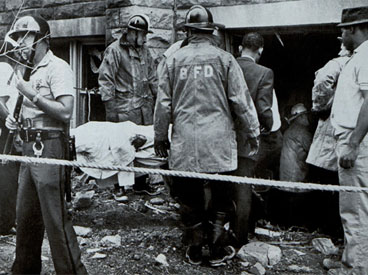
In his 1964 article on the “The Birmingham Church Bomber,” author George McMillan wrote, “As nothing else had done—or perhaps could do—it epitomized the ugliness of racial conflict.”
Immediately after the bombing, the FBI entered the case, announcing it was launching “the biggest manhunt since the Dillinger case.” But the big manhunt was interrupted a few weeks later when the Alabama State Police arrested three men for the bombing: Robert Chambliss, Charles Cagle, and John W. Hall. State prosecutors were only able to charge the men with illegal possession of dynamite. Convicted, the men were fined $100 and sentenced to 180 days in jail. They appealed and, at the time of the article, were free on bail.
The FBI later admitted that the state police had made their arrests before federal investigators could gather the evidence necessary to convict the men for murder.
Two years after the bombing, the FBI focused on Chambliss and two associates: Thomas E. Blanton Jr. and Bobby Frank Cherry. But the FBI’s surveillance evidence was inadmissible in court, and witnesses refused to testify against any of the suspects.
It would be 14 years before Chambliss was indicted for the murder of the girls. He was eventually convicted of one murder and died while serving a life sentence. Blanton avoided punishment for 38 years before he was finally convicted in 2001 and sentenced to life in prison. The next year, Cherry was convicted and died in prison two years later.
The church bombing, and the shooting of two other children that day, represents the worst of racial violence in the city. But the violence shown by Birmingham’s police, and anonymous bombers, introduced a new level of bitterness to the national campaign for civil rights.
Zion Canyon Lavender Pound Cake
The Zion Canyon Farmers Market is in its eighth glorious year and located just outside of Zion National Park. Although we are quite small, we have some of the most spectacular produce and goodies in the area! Our market is held just under The West Temple on the lawn of a wonderfully supportive local restaurant called The Bit and Spur.
Every week we’re asked to bake for our Farmers Market Bake Sale Fundraiser. And since lavender is in season right now, I decided to make my locally famous Lavender Pound Cake and proceeded to use as many locally produced products as possible.
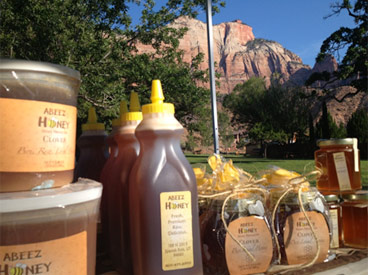
An important note about this recipe: It has been designed for a very dry climate (high desert) at a relatively high altitude—4,000 feet. Not only do I add a bit of extra baking soda and baking powder—anywhere from ¼ to ½ teaspoon—but I also add a bit more liquid. Hence the addition of vodka, which adds moisture but will evaporate faster and cleaner than water or additional milk. And I cook my baked goods 25 degrees higher than what most recipes call for, in this case 375°F instead of 350°F. (The recipe does include measurements for those who live in lower altitudes as well.)
Zion Canyon Lavender Pound Cake
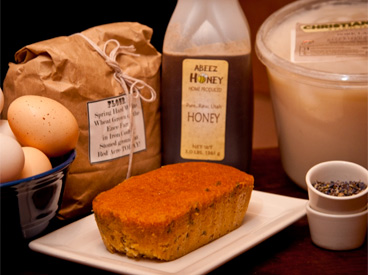
Ingredients
- ½ pound unsalted butter, softened
- ½ cup lard
- 2 cups brown sugar
- 6 eggs
- ½ teaspoon fine salt
- ¾ teaspoon baking powder (½ teaspoon if making at lower altitude)
- ½ teaspoon baking soda (½ teaspoon if making at lower altitude)
- 2 teaspoons cayenne (if desired)
- ½ cup local milk
- ½ cup honey yogurt
- ¼ cup vodka (add this ingredient only if making recipe at high altitude)
- 1 cup raw, lavender-infused honey, prepared several days ahead (See how to make it below)
- 1 teaspoon vanilla extract
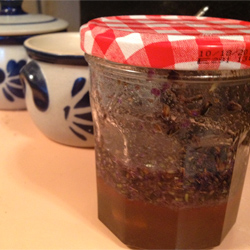
How to Make Lavender-Infused Honey
- Place ¼–½ cup dried lavender blossoms in a clean quart jar.
- Fill jar with 1 to 1 ½ cups local honey.
- Seal tightly and set aside, occasionally mixing/stirring before resealing.
- Let sit for several days.
Note: You can strain the honey—but holy cow is that a messy, time-consuming process! So I keep the blossoms in the infused honey. And the little bit of lavender looks quite lovely in the cake.
Pound Cake Directions
- Preheat oven to 375°F (adjust to 350°F if at lower altitude).
- Grease and flour tube pan.
- In large bowl, with electric mixer on medium speed, mix butter and lard until creamy (about 2 minutes).
- With mixer on medium-low speed, add brown sugar a half cup at a time. Once all brown sugar is added, turn mixer on medium to medium-high speed to fully incorporate sugar (4-5 minutes).
- With mixer on low speed, add eggs one by one. Gently beat mixture after each addition.
- In a separate bowl, combine flour, baking soda, baking powder, salt, and cayenne.
- In another bowl, briefly whisk milk, yogurt, and vodka (if using).
- In mixing bowl, with mixer on low, alternate adding flour-mixture and milk-mixture until all ingredients are combined. Then add vanilla.
- Once ingredients are fully incorporated, gently fold lavender-infused honey into mixture.
- Pour into prepared pan, and bake for 1 to 1 ½ hours, or until golden brown. (A toothpick inserted in center of cake should come out clean, and cake should spring back if pressed with finger.)
JFK: The Most Eligible and Least Justifiable Bachelor
Long before his presidency, the Post was covering the political career of John F. Kennedy. In this 1953 article, the magazine introduced him to a national audience as “The Senate’s Gay Young Bachelor.” The following quotes show early stirrings of what would be come an infatuation with the young senator and his family. Sample some of these quotes and then check out the story in its entirety.
Kennedy [appears] to be a walking fountain of youth,” wrote Paul F. Healy. “He is six feet tall, with a lean, straight, hard physique, and the innocently respectful face of an altar boy at High Mass. Senators less generously endowed were especially taken with his trade-mark —a bumper crop of lightly combed brown hair that shoots over his right eyebrow and always makes him look as though he had just stepped out of the shower.Six years ago, when he started his first of three terms in the House of Representatives, Kennedy looked so young that he was mistaken by several other congressmen for a House page.
Kennedy wears an air of imperturbable informality; he often seems to be at once preoccupied, disorganized and utterly casual—alarmingly so, for example, when he solemnly addressed the House with his shirttail out and clearly visible from the galleries.
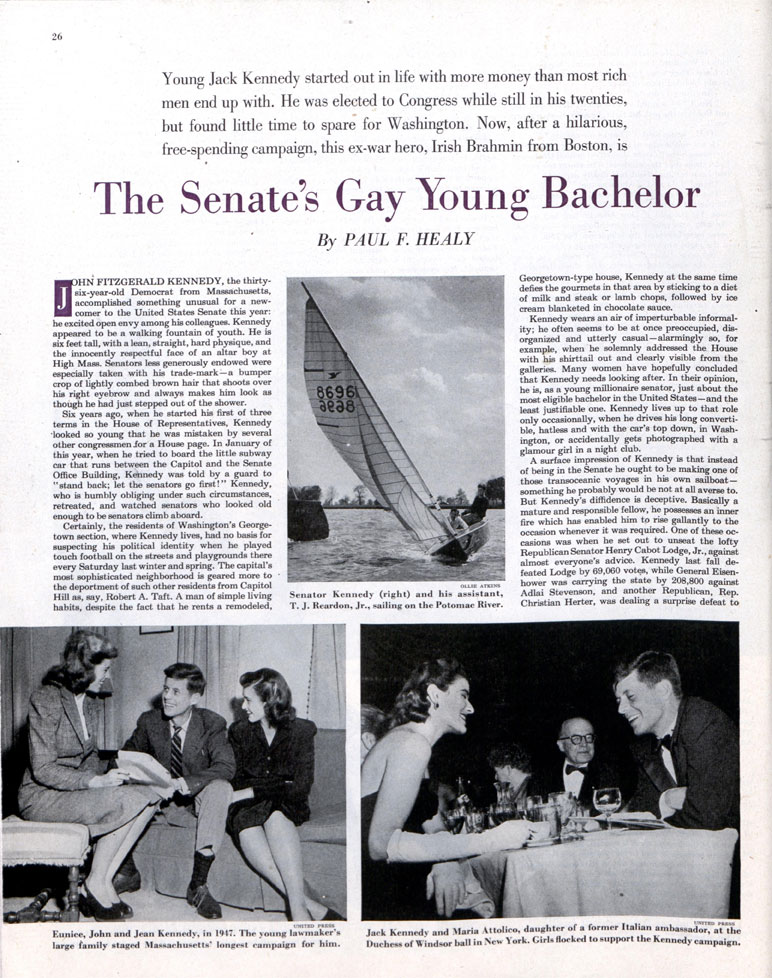
Many women have hopefully concluded that Kennedy needs looking after. In their opinion, he is, as a young millionaire senator, just about the most eligible bachelor in the United States—and the least justifiable one. Kennedy lives up to that role only occasionally, when he drives his long convertible, hatless and with the car’s top down, in Washington, or accidentally gets photographed with a glamour girl in a night club,” Healy wrote, but added that he was “basically a mature and responsible fellow.
At the time the story appeared, Kennedy’s bachelor days were already over. He and Jacqueline Bouvier decided to postpone announcing their engagement, which might have caused the Post to pull the “Bachelor” article. They announced their engagement 12 days later and were married on this day 60 years ago.
The article is also interesting for its description of the way Kennedy’s family helped him get elected.
Kennedy was reinforced by a task force from his large and fabulous family. His comely mother and three attractive, long-legged sisters took the stump, while his younger brother, Robert, acted as campaign manager.
There was nothing haphazard about the way the Kennedy women pitched in to help brother Jack. First they pounded the pavements to help collect a record total of 262,324 signatures on his nominating petition—though only 2500 were required by law.
Read the full story, “The Senate’s Gay Young Bachelor,” here.
July/August 2013 Limerick Laughs Contest Winner and Runners-Up
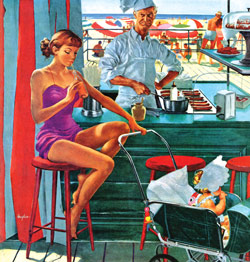
Just heat up the milk in some water—
The least you can do for her daughter.
She’s gracing your scene
With a figure serene.
You’re gonna make more than you oughta.
—Joan Kelley, Tucson, Arizona
Congratulations to Joan Kelley! For her limerick describing George Hughes’ illustration (left), Joan wins $25—and our gratitude for a job well done. If you’d like to enter the Limerick Laughs Contest for our upcoming issue, submit your limerick via our online entry form.
Of course, Joan’s limerick wasn’t the only one we liked! Here are some of our favorite limericks from our runners-up, in no particular order:
Henry, the short order cook,
Liked doing things by the book.
So warming a bottle
For Mrs. McCottle
Would certainly get her the look.—Philip Lindal, Yale, Michigan
The day at the beach was fun,
But it soon got hot in the sun.
The baby rode
While I pushed the load—
An hour and I was done.—Audrey Jordan, Hope, Indiana
His face was filled with chagrin,
Noting the spot he was in.
She sat so demur,
But of this he was sure,
Heating bottles did not make him grin.—Robert Webster, Port Charlotte, Florida
I’m warming this bottle for you,
Cute baby with eyes of true blue.
Your mom’s smokin’ hot,
Wedding ring she has not,
How I wish I was still 22!—Lori Rucker, Brentwood, Tennessee
The man, while he looks with distain
At the woman who he thinks is vain,
Heats in his pot,
The milk, till its hot.
Will she order some food? She abstains.—John Reuscher, Novato, California
The baby will have to be fed.
The vendor plays nursemaid instead
Of selling his wares;
He just stands and stares
And frowns as the lady turns red.—Lillian Holmes, Troy, Ohio
A cook grilling franks, and a beauty,
Attended, each one, to their duty.
Though each job had a name,
The result was the same.
They both kept an eye on a cutie.—Patrick McKeon, Pennington, New Jersey
The chef at the beach hot-dog stand
Did not relish giving a hand.
A coke she did buy,
But he gave a mean eye
Cause the milk bottle was underhand.—Antoinette DeAngelis, Sharpsville, Pennsylvania
Warming a bottle, not food,
May seem an odd way to intrude.
But if the intrusion
Is a pretty illusion,
Consider a new attitude.—Richard Arnold, West Hartford, Connecticut
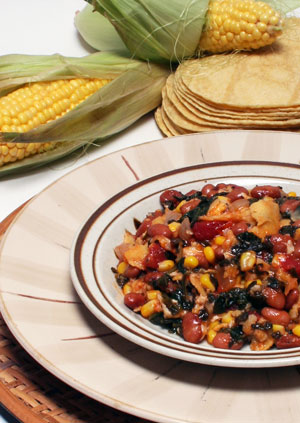
Baked Chilaquiles with Beans and Corn
One might call chilaquiles Mexican French toast. Just as stale bread becomes French toast by soaking and then frying it, Mexican cooks use up their stale tortillas by making chilaquiles. They simply reverse the order, first frying the tortillas until crisp and then combining them with a sauce or salsa.
While chilaquiles are traditionally a skillet dish served as a light bite or topped with eggs for breakfast, I prefer making them as a casserole, eliminating the frying step. You will often find shredded chicken, shrimp, or beans in chilaquiles. For my version, which is meatless, I have combined creamy pinto beans with chopped spinach and corn. Leftovers keep for a couple of days when wrapped in foil. Tossing them into the oven for reheating is a cinch and so good that you may want to plan for extra servings.
Baked Chilaquiles with Beans and Corn
(Makes 6 servings)
Ingredients
- Cooking spray
- 1 large ear fresh corn or 1 ½ cups frozen corn, defrosted
- 1 tablespoon canola oil
- ¾ cup chopped red onion
- 1 (10 ounce) package frozen spinach, defrosted, squeezed dry
- 1 (15 ounce) can no-salt added pinto beans, drained
- 1 teaspoon ground cumin
- 1 (14 ½ ounce) can no-salt added, diced tomatoes, partially drained
- 6 yellow corn tortillas
- 1 (15 ounce) can mild or medium red enchilada sauce, divided
- 1 cup shredded, reduced-fat Mexican cheese blend, divided
Directions
- Preheat oven to 400°F. Coat 11″ x 7″ baking dish with cooking spray and set aside.
- If using fresh corn, cut kernels from cob; there should be 1-1 ½ cups. Set aside.
- In medium skillet, heat oil over medium-high heat. Add onion and cook until translucent, 4 minutes. Add spinach, pulling it apart. Add beans and cumin and cook until cumin is fragrant, stirring often. Add tomatoes and corn and cook until mixture is heated through, 5 minutes. Set vegetable and bean filling aside.
- Arrange 2 tortillas on bottom of prepared pan. Cut 2 other tortillas in half and add 2 halves to cover bottom of pan. Spoon half the filling over tortillas. Pour on ¾ cup enchilada sauce. Sprinkle on half the cheese. Repeat, using remaining tortillas, filling, sauce and cheese. Cover pan with foil.
- Bake chilaquiles for 15 minutes. Uncover and bake until cheese melts and casserole is bubbly around edges, 10 minutes. Let stand 10 minutes before serving.
Nutrition Facts
Per serving
Calories: 216
Total fat: 5.7 g
Saturated fat: 1 g
Carbohydrate: 34 g
Fiber: 6 g
Protein: 10 g
Sodium: 496 mg
How to Fix the ‘Soap Opera Effect’

Today’s HDTVs can do a lot more than TVs of yesteryear. That picture? Gorgeous! The option of streaming movies from the Internet? Amazing! Making long distance calls (for free!) with video? Cool. But, like many smart technical objects, it can be tricky to use. Here are some great ways to tweak your flat screen to get the most out of it.
1. Turn off the “soap opera effect.” You may have noticed that sports on your flat screen are spectacular. So crisp! So clear! But when you watch a favorite movie, the picture looks, well, weird. The soft, grainy quality you expect in a film is gone. Instead it looks like video—cheap and cheesy—sort of like an episode of All My Children.
Without getting too technical, here’s what’s going on and how to fix it. We’re used to watching movies at 24-frames-per-second, the industry standard for film. Many HDTVs have a feature called “motion interpolation” or “motion smoothing.” Your TV may have a different name for it—LG TruMotion or Sony MotionFlow—but the results are essentially the same. Motion smoothing artificially adds extra frames-per-second to make images less blurry. This is why sports programming looks so great. But, the effect can ruin the lush look of film.
Here’s the good news: You can turn off motion smoothing for movies. To zap the soap opera effect, you’ll need to delve into the scary world of TV settings. But don’t worry, we’ll walk you through it! In one Samsung model, for example, press the “Menu” button on the TV remote (not the cable remote), and choose “Picture Options.” Turn off the feature called “Auto Motion Plus.” The process varies by TV. Try menu/picture on your TV, and see if you can find it. If the solution is not readily available, crack open the user manual. Be assured: There is a way. Don’t leave this function off all the time, because you’ll want it on for sporting events!
2. Tweak for optimum viewing. Now that we’ve gotten you to the menu, look at other settings. If willing to adjust them a bit, you’ll see a prettier picture optimized for your room. Vizio TV owners can choose between several modes, including Standard (best overall choice for most environments); Movie (good for movie-watching in dark rooms); Vivid (more vibrant picture); and so on. If you want to get fancy, purchase a calibration disc (Blu-ray or DVD), which includes test patterns and scenes that let you match your TV’s color, contrast, and other settings precisely to broadcast industry standards. Several are available, but the disc from Digital Video Essentials (about $40, new) has gotten favorable reviews.
3. Turn your smartphone or tablet into a remote control. Face it, TV remotes stink: Too many tiny, cryptic buttons. Luckily, there’s a better way. Many TV manufacturers, including LG, Samsung, and Sony, offer free TV apps that let you use your smartphone and tablet as remotes. If you’re a pay TV subscriber, your cable or satellite provider may offer a free remote app too. The Xfinity TV Remote from Comcast Interactive Media, for instance, lets you change channels, browse TV listings, schedule DVR recordings, and watch shows on your tablet or smartphone. It works with most Comcast set-top boxes, as well as Apple (iOS) and Android devices too.
4. Use your TV for video chat. Some new HDTV features seem gimmicky. When changing the channel or lowering the volume, are voice commands or hand gestures really that much easier than a slick mobile app? Perhaps it’s too early to pass judgment, but one smart TV app really does have long-term potential: video calling. More TVs are adding built-in cameras with video chat. Skype is available on select TVs from major manufacturers—LG, Panasonic, Samsung, Sharp, Sony, and Toshiba. If your TV isn’t on the list, an add-on device is an option. Microsoft’s Xbox One entertainment console ($500), slated to ship in November, will include an HD camera and Skype software. And since Skype-to-Skype calls are free, you won’t get stuck with a big video chat bill.
Here are more ways to get the most out of your TV and other devices!
-
Stream On
How to get the most out of Netlifx, Amazon Prime, and Hulu Plus. More.
-
More Power to You
7 ways you can boost your Wi-Fi reception at home. More.
-
5 Secret Uses for Tablets
How your versatile tablet can go beyond Web browsing, Facebooking, and binge-watching Netflix. More.
Flamin’ Broccs
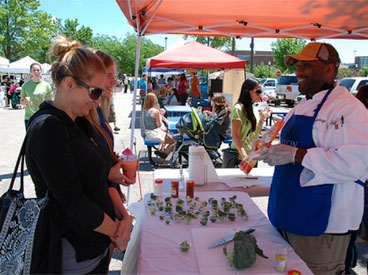
All photos by Samantha Quill.
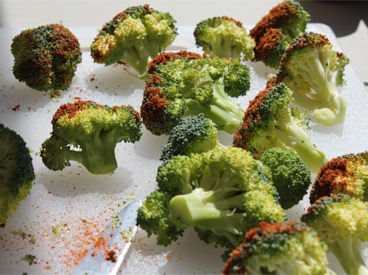
The inspiration for this healthy snack came from a Downtown Elgin Harvest Market intern who read an article in the Chicago Tribune about the negative effects of Flamin’ Hot Cheetos. So chef Quincy Owens, Brianne Durfey, and Kelly Drought decided to find a healthy alternative to the popular processed snack. In their Flamin’ Broccs recipe, the raw broccoli florets have the crunch and the Tex-Mex spice adds enough flavor to make it a tasty, healthy substitute.
Flamin’ Broccs
Ingredients
- 1 head of broccoli
- Water
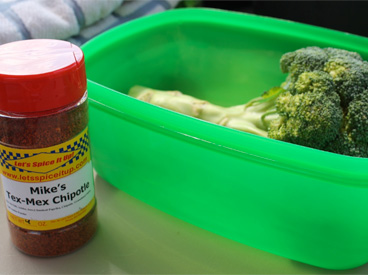
- 2 tablespoons Tex-Mex seasoning (We used Mike’s Tex-Mex Chipotle Seasoning by Let’s Spice It Up. The mixture includes sea salt, adobo, sweet smoked paprika, chipotle, granulated onion, and chile ancho powder.)
Directions
-
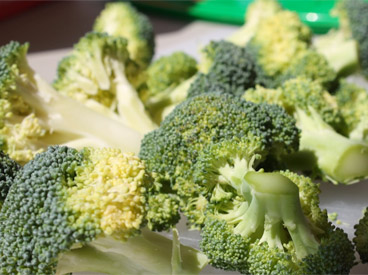
- Thoroughly clean head of broccoli by soaking and rinsing with water.
- Cut broccoli into bite size florets.
-
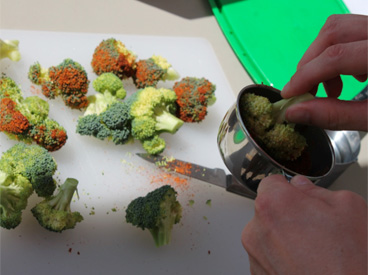
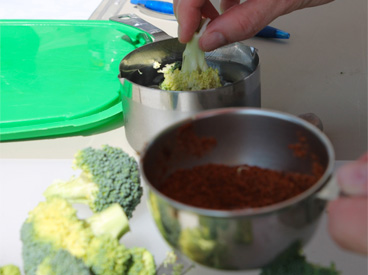
- Put seasoning into small bowl, and pour 1 cup water into another small bowl. Dip floret into water, then directly into bowl of seasoning.
-
- Eat and enjoy your Flamin’ Broccs!
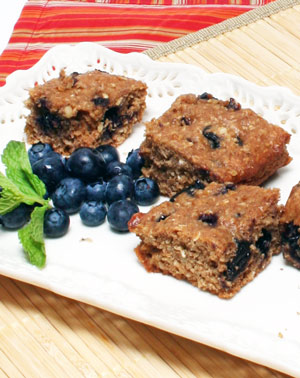
Granola Fruit Squares
The ingredients in these granola squares pack a powerful nutritional punch. As a wonderful source of energy, the oats will help keep you going during your busy day. Plus, they are high in cancer-preventing fiber and contain essential minerals and vitamins. Flaxseed provides alpha-linolenic acid, an essential omega-3 fatty acid, and fiber.
Granola Fruit Squares
(Makes 16 squares)
Ingredients
- 1 cup old-fashioned oats or quick oats, uncooked (not instant)
- ¼ cup almonds
- ¼ cup walnuts
- 1 tablespoon flaxseed
- ½ cup whole-wheat flour
- 1 teaspoon ground cinnamon
- ½ teaspoon baking powder
- ¼ teaspoon salt
- ¼ cup canola oil
- ¼ cup honey, softened by placing the jar in a pan of water over low heat
- ¼ cup brown sugar
- ½ teaspoon vanilla
- 2 eggs
- ½ cup fresh blueberries
- ½ cup combination raisins, dried cranberries and dried cherries
- Cooking spray
Directions
- Preheat oven to 350°F.
- Line 9-inch square baking dish with aluminum foil and leave 2-inches of foil hanging over edges.
- In large nonstick skillet over medium heat stir oats, nuts, and seeds and toast for 6-8 minutes. Set aside to cool. When cool, in food processor, pulse mixture until coarse. Avoid making the mixture too fine.
- In mixing bowl combine flour, cinnamon, baking powder, and salt. Whisk until blended. Set aside.
- In another mixing bowl combine oil, honey, sugar, vanilla, and eggs and mix well. Stir in flour mixture until just combined. Gently add oat mixture, fresh blueberries, and dried fruit.
- Lightly coat baking dish with cooking spray. Pour granola batter into dish and spread evenly. Bake until mixture is set, about 25 to 28 minutes.
- Remove from oven and allow to completely cool. Use overhanging foil to lift granola slab from baking dish to cutting board. Cut into desired size bars.
Nutrition Facts
Per serving (1 square)
Calories: 198
Total fat: 10 g
Saturated fat: 1 g
Carbohydrate: 25 g
Fiber: 3 g
Protein: 5 g
Sodium: 77 mg
Vegetable Stir-Fry
West End Farmers Market is located in northwest St. Louis in an area with limited access to fresh produce. The International Institute, offering comprehensive adjustment services for refugees and immigrants in the community, has two farms for food-growing. There, recent refugees from a variety of countries including Burundi, Bhutan, Burma, Ethiopia, Morocco, Nepal, Democratic Republic of Congo, Tanzania, Kenya, and Somalia grow produce, which is in turn sold at the market. Market sales benefit the farmers and the refugees resettled in the community where the market is located, and increase access to fresh fruits and vegetables for the community at large.
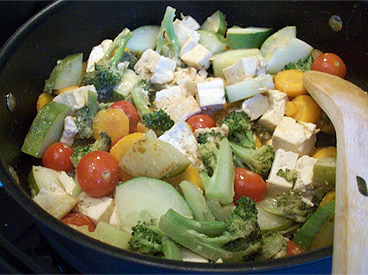
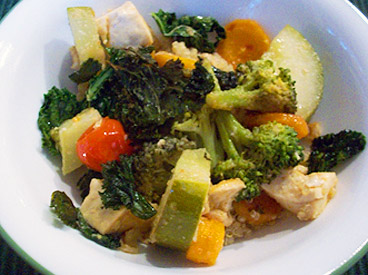
The vegetable stir-fry recipe was inspired by the abundance of fresh vegetables available during the summer. To make it a meal, serve the stir-fry over brown rice, couscous, or quinoa. For variation, try adding chicken or extra firm tofu.
Vegetable Stir-Fry
(Makes 4 servings)
Ingredients
- 1 medium cucumber
- 1 head broccoli
- 1 medium carrot
- 1 small hot pepper or Sriracha sauce (Thai hot chili sauce) to taste
- 1 clove garlic
- 1 pint cherry tomatoes
- 1 bunch kale
- 1 tablespoon tahini paste
- 1 tablespoon brown sugar
- 3 tablespoons olive oil, divided
- ½ teaspoon ground ginger
Directions
- Rinse and chop cucumber and broccoli. Peel, rinse, and chop carrot. Rinse and mince hot pepper. Peel and finely chop garlic. Rinse cherry tomatoes.
- Remove hard stems from kale and stack leaves on top of each other. Use knife to slice kale leaves into ¼-inch strips.
- In large bowl filled with cold water, add cut kale. Allow dirt to settle to bottom of bowl. Lift kale out of bowl. Shake off excess water.
- In small bowl, mix together tahini, brown sugar, and 1 tablespoon olive oil. Add 1 teaspoon minced hot pepper (add more to taste). Mix.
- In medium skillet over medium-high heat, heat remaining 2 tablespoons olive oil. Add ground ginger and stir. Add chopped cucumber, broccoli, carrots, garlic, and. Stir frequently. Cook until veggies are tender, about 6-7 minutes. Add tomatoes last.
- Add tahini mixture. Bring to a boil. Reduce heat. Simmer about 2 minutes.
May/June 2013 Limerick Laughs Contest Winner and Runners-Up

That girl in the pretty red dress
Is stuck in a terrible mess
Some nasty old boy
Has stolen her toy
No wonder she’s under such stress
—Neal Levin, Bloomfield Hills, Michigan
Congratulations to Neal Levin! For his poem describing the illustration at left by J.C. Leyendecker, Neal wins $25—and our gratitude for a job well done. If you’d like to enter the Limerick Laughs Contest for our upcoming issue, you can submit your limerick via the entry form here.
Of course, Neal’s limerick wasn’t the only one we liked! Here are some of our favorite runners-up, in no particular order:
Bobby’s swinging my dolly so high.
I’m afraid she might fall from the sky.
He offered me first,
But I feared the worst,
So I told him my dolly’s not shy.—Rollin Keller, Lakewood, California
Jack does not impress me at all
By snatching my favorite doll.
His daredevil fling
Proves only one thing—
He’s just an obnoxious goofball.—Lynnda Cruz, Las Vegas, Nevada
My brother—how daring is he?
I just can’t believe what I see!
My favorite doll—
I hope she won’t fall.
But I wish (how I wish) it was me …—Doug Harris, Stockton-on-Tees, England
I once had a brother named Paul,
Who suddenly grabbed my best doll.
He swung her around
Barely missing the ground,
And I just couldn’t watch this at all.—Maggie Govanucci, Monroeville, Pennsylvania
Big brother was such a great tease
When taunting Samantha with ease.
Little sis couldn’t look
When her dolly he took
A ride on the backyard trapeze.—Jean Roeth, Springfield, Ohio
No matter how hard he tries,
My brother tells little white lies.
He said it would please her
If he could “trapeze” her.
I just hope my baby survives!—Sheldon R. Mielke, Fort Atkinson, Wisconsin
I’m the kid on the flying trapeze.
Dolly rides as I swing by my knees.
Sis peeks through her fingers,
And though her fear lingers,
She knows I just do it to tease.—Joy Smith, Burlington, Wisconsin
From nowhere he suddenly came,
A boy playing some kind of game.
He snatched up my dolly,
My favorite sweet Molly,
He still seems to suffer no shame.—Marie Kreft, Arlington, Minnesota
She peeked through her fingers with hope
That her brother would stay on the rope.
For if he slipped from his seat,
To the floor he would leap,
And her doll would need more than just soap.—Warren S. Patrick, Townshend, Vermont