The Saturday Evening Post History Minute: The Man Who Saved Andrew Johnson’s Presidency
On May 16, 1868, Andrew Johnson avoided being removed from the presidency by the vote of one senator, Edmund Ross. Was Ross a constitutional hero or a shameless opportunist?
See more History Minute videos.
Smart Tips for Buying Drugs Online
Here’s how to sidestep rogue pharmacy sites (and there are thousands) that can put your health and personal information at risk:
Do shop at sites that require a provider’s prescription.
Don’t if prescriptions are filled by completing a questionnaire only.
Do shop at sites recommended by your insurance company or ending in .pharmacy. Only law-abiding pharmacies can use that domain.
Don’t if there is no phone number or physical street address listed.
Do shop at sites with licensed pharmacists available for consultation.
Don’t if on the “Not Recommended” list compiled by pharmacists. Go to nabp.pharmacy and click on Pharmacy Verified Websites Program.
Tom Wolfe’s Contempt of Trends
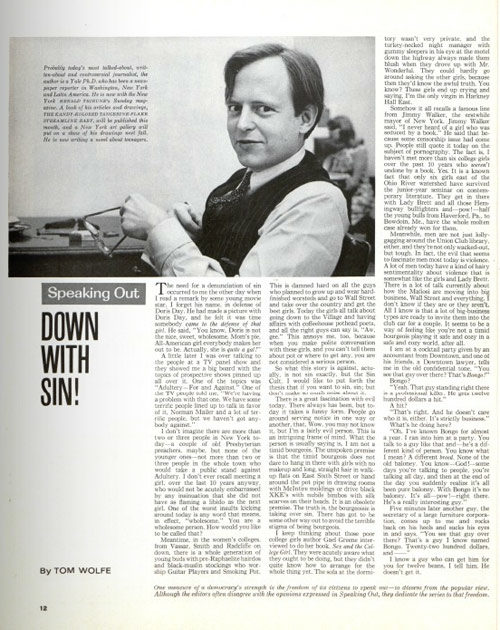
Tom Wolfe has passed away at 88 years old. Before the decorated “New Journalist” wrote about Ken Kesey’s acid cult or the Project Mercury astronauts, he wrote for The Saturday Evening Post.
Wolfe penned a scathing editorial against the trend of sinning (“Down With Sin!”) in June 1965. Along with a sexual revolution and an inevitable loosening of morals, Wolfe thought the new normal was turning into a chic taste for lying, cheating, and stealing. Thieves and hitmen were becoming the new guests of honor at cocktail parties, and Ivy League and Wall Street types couldn’t get a romantic leg up on the pot-smoking beatniks.
Wolfe wasn’t necessarily on the political left or right, he was just a colorful writer calling for authenticity in place of groupthink: “Well, anyway, what is needed is some kind of suicidal Castro to raise the banner and come out against the Sin Fad,” he wrote. “If it will help at all, I am willing to do that. It is a shocking position, but I will come out now, flatly, against Sin. Right Now!”
Wolfe’s thick, startling prose suited the technicolor times, and — as it turned out — the rest of the century too. His novels and nonfiction, like The Bonfire of the Vanities and The Right Stuff, continued to cement Wolfe’s place in the American literature tradition.
Maurice Chevalier on Love and Aging After Gigi
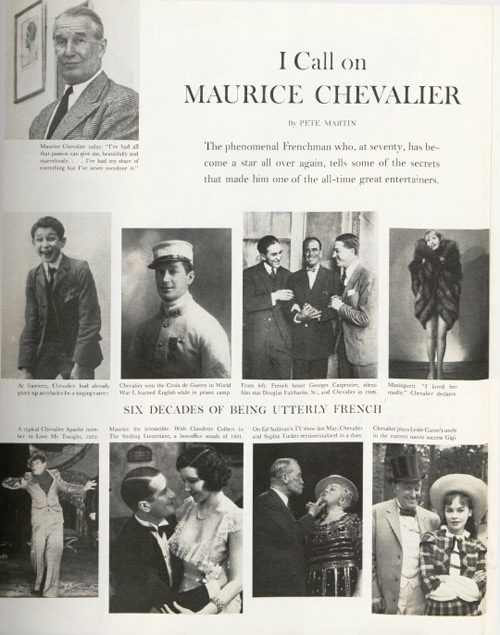
Sixty years ago today, the premiere of the movie musical Gigi starred an aging Maurice Chevalier singing “I’m Glad I’m Not Young Anymore.” The sentiment was real, according to Pete Martin’s interview with Chevalier a few months later.
In “I Call on Maurice Chevalier,” the writer met the legendary performer on a tour of sorts in Seattle to talk about life, love, and cocktail parties. Pushing 70 years old, Chevalier was perfectly happy to play the role of uncle or grandfather in a musical instead of romantic lead. In fact, he thought it sad, perhaps embarrassing, to continue chasing after “lover” roles in advanced age. When Martin asked Chevalier whether it was in bad taste for an older man to chase after young girls, the French performer’s answer was enlightened, and likely different than the reporter was expecting to hear:
I think it’s not good for any man, even a young man, to chase any girl. Love is the same as success: one should meet it halfway. When it happens, you should clasp it to yourself in the middle of the road, if that’s where you find it. It should be like the coming together of the negative and positive poles of a magnet. When you are going to fall in love with somebody, most of the time she has shown you already that she likes you. If you just fall madly in love with a person who does not even look at you — who, in fact, is high-hatting you — you are falling in love with the wrong person. To me, love is only good if it is gladly shared. That is when it becomes something deliciously and irresistibly important.
Chevalier’s prolific performing career spanned Europe and the United States. He preferred an intimate bottle of wine to a crowded cocktail party, and — unlike his American counterparts — he always employed a subtle compliment over a brutish pickup line.
The People Machine: A History of Elections and Algorithms
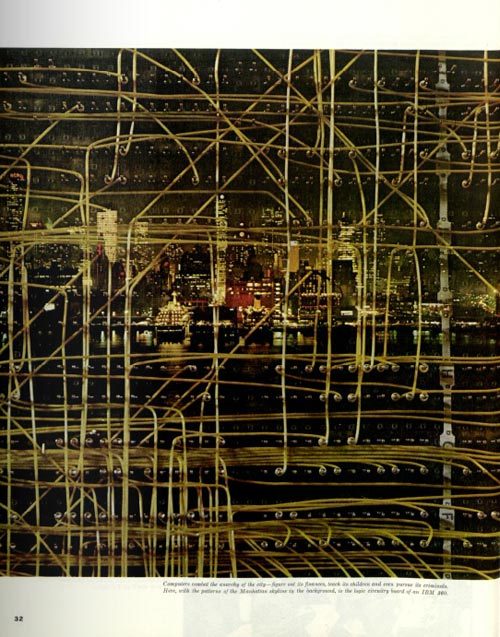
John Kobler, while writing “The Flip-Flop Machines” for the Post in 1968, observed computers that could teach English, play chess, simulate warfare, and write poetry. All of those tasks are readily available on any smart phone now, but his principal reflection on technology remains woefully unexamined: “Machines can’t make a better world without better people, a truism applicable to every material discovery from the wheel to nuclear power.”
In other words, computers are only as good — or as evil — as the intentions of the people behind the keyboard. The recent scandal involving Facebook and Cambridge Analytica shows how vulnerable we are to manipulation. But the phenomenon, while strikingly much more sophisticated than it used to be, isn’t completely new. Ever since computers were developed to process information, it seems, they’ve been used to analyze — and possibly influence — voters.
In the spring of 1960, John F. Kennedy’s campaign was aided by Simulmatics, a computer firm that simulated the election results of various campaign strategies. The “people machine,” developed by social scientists from M.I.T., Columbia, and Yale, used surveys from over 100,000 voters to create 480 “voter types.” The big question posed by the Kennedy campaign, according to Kobler, was whether his Catholicism was a problem. “The net worst has been done,” Simulmatics told them. “Bitter anti-Catholicism would bring about a reaction against prejudice and for Kennedy from Catholics and others who would resent overt prejudice. Under these circumstances, it makes no sense to brush the religious issue under the rug.”
Eugene Burdick expressed prescient concern for Kennedy’s use of Simulmatics in his 1964 novel The 480. The book warns of a powerful new kind of political influencer in the age of computer technology:
“The new underworld is made up of innocent and well-intentioned people who work with slide rules and calculating machines and computers which can retain an almost infinite number of bits of information as well as sort, categorize, and reproduce this information at the press of a button… They may, however, radically reconstruct the American political system, build a new politics, and even modify revered and venerable American institutions.”
The revelation that British firm Cambridge Analytica mined extensive data on more than 80 million Facebook users for Donald Trump’s election campaign was a wake-up call for anyone who still thought social media was a wholly innocuous trend. The company’s powerful algorithms and incredibly substantial field of data allowed it to perform unprecedented research on American voters. The breach violated Facebook’s terms of use, but more than a year after the election that fact seemed immaterial. Many wondered how Mark Zuckerberg, Facebook’s CEO, could have allowed it to happen, but perhaps Stephen Marche put it best in The New Yorker when he wrote, “We blame Mark Zuckerberg because we can’t stand to blame ourselves.”
Zuckerberg has shown public concern for the damage inflicted on his platform. “For most of our existence, we focused on all the good that connecting people can bring,” he said in his official statement to the U.S. Senate, “it’s clear now that we didn’t do enough to prevent these tools from being used for harm as well.” It should also be clear now that we will likely hear a version of that statement again and again in the future, if not from Zuckerberg, then from another Silicon Valley CEO who shares his mantra, “Move fast, and break things.”
Although both operations aimed to distill the American voter down to a demographic, there are major differences in depth and scope between the operations of Simulmatics and Cambridge Analytica. According to Chris Wylie, the whistleblower data analyst of Cambridge Analytica, the company created in-depth psychological profiles of millions of people that allowed it to target disinformation tailored to one’s susceptibility. That seems to be more intensely deceptive than an algorithm used to determine whether the public thinks Catholicism is okay, but ethical boundaries can be fuzzy with each new technological innovation taking the public by storm. Wylie compares the difference to a campaign that delivers a message in the public square as opposed to one that whispers in each voter’s ear.
The current reality of touchscreens, and facial recognition, and extensive social networks would have been difficult for Kobler — or Kennedy — to envision. When Kobler wrote “The Flip-Flop Machines,” powerful computers were still resigned to government use. Yet, the scope of how this impending technology would bring about sweeping ethical dilemmas and problematic artificial intelligence was roundly acknowledged. After all, just a month before the feature was published in this magazine, 2001: A Space Odyssey hit American theaters with its foreboding message on the pitfalls of all-encompassing technology: the killer computer’s power was derived from the crew’s complete reliance on it for everyday tasks.
Our pervasive dependence on vast technological systems might seem as though it sprung up out of nowhere, but it’s been a long time coming, and the warning signs were always there. Kobler notes an anecdote among computer scientists about a supercolossal computer built to answer the question, “Is there a God?”
“Yes,” it said at length. “There is a God — now.”
“Unto Caesar” by Dornford Yates
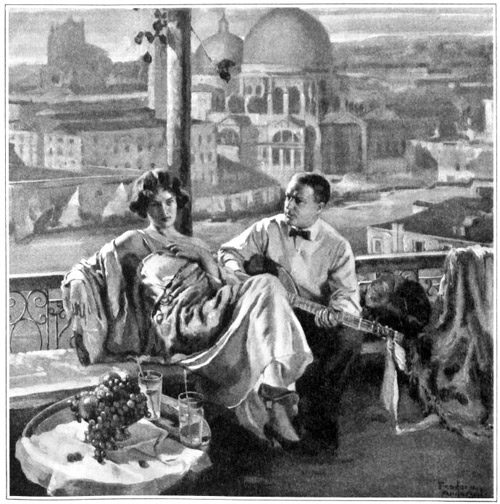
English author Dornford Yates wrote humorous and romantic works for magazines throughout the early 20th century using a pen name that derived from the surnames of each of his grandmothers. Yates’s fiction revolves around the class rifts of the Edwardian Era.
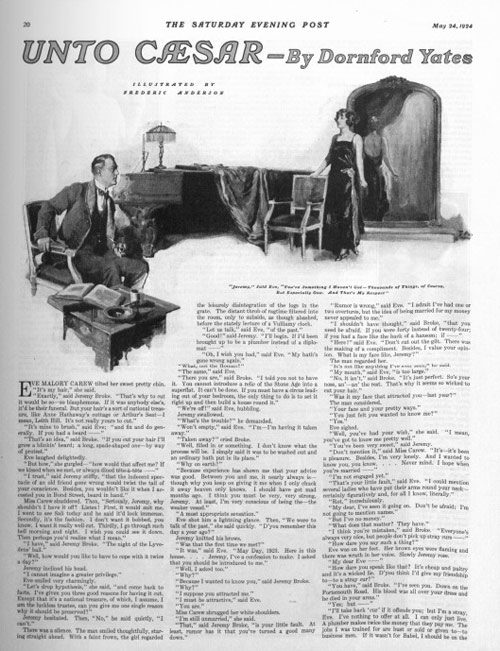
Eve Malory Carew tilted her sweet pretty chin.
“It’s my hair,” she said.
“Exactly,” said Jeremy Broke. “That’s why to cut it would be so — so blasphemous. If it was anybody else’s, it’d be their funeral. But your hair’s a sort of national treasure, like Anne Hathaway’s cottage or Arthur’s Seat — I mean, Leith Hill. It’s not really yours to cut.”
“It’s mine to brush,” said Eve; “and fix and do generally. If you had a beard — “
“That’s an idea,” said Broke. “If you cut your hair I’ll grow a blinkin’ beard; a long, spade-shaped one — by way of protest.”
Eve laughed delightedly.
“But how,” she gurgled — “how would that affect me? If we kissed when we met, or always dined tete-a-tete “
“I trust,” said Jeremy stiffly, “that the indecent spectacle of an old friend gone wrong would twist the tail of your conscience. Besides, you wouldn’t like it when I accosted you in Bond Street, beard in hand.”
Miss Carew shuddered. Then, “Seriously, Jeremy, why shouldn’t I have it off? Listen! First, it would suit me. I went to see Sali today and he said it’d look immense. Secondly, it’s the fashion. I don’t want it bobbed, you know. I want it really well cut. Thirdly, I go through such hell morning and night. I wish you could see it down. Then perhaps you’d realize what I mean.”
“I have,” said Jeremy Broke. “The night of the Lyvedens’ ball.”
“Well, how would you like to have to cope with it twice a day?”
Jeremy inclined his head.
“I cannot imagine a greater privilege.”
Eve smiled very charmingly.
“Let’s drop hypothesis,” she said, “and come back to facts. I’ve given you three good reasons for having it cut. Except that it’s a national treasure, of which, I assume, I am the luckless trustee, can you give me one single reason why it should be preserved?”
Jeremy hesitated. Then, “No,” he said quietly, “I can’t.”
There was a silence. The man smiled thoughtfully, staring straight ahead. With a faint frown, the girl regarded the leisurely disintegration of the logs in the grate. The distant throb of ragtime filtered into the room, only to subside, as though abashed, before the stately lecture of a Vulliamy clock.
“Let us talk,” said Eve, “of the past.”
“Good!” said Jeremy. “I’ll begin. If I’d been brought up to be a plumber instead of a diplomat — ”
“Oh, I wish you had,” said Eve. “My bath’s gone wrong again.”
“What, not the Roman?”
“The same,” said Eve.
“There you are,” said Broke. “I told you not to have it. You cannot introduce a relic of the Stone Age into a superflat. It can’t be done. If you must have a circus leading out of your bedroom, the only thing to do is to set it right up and then build a house round it.”
“We’re off!” said Eve, bubbling.
Jeremy swallowed.
“What’s the trouble?” he demanded.
“Won’t empty,” said Eve. “I’m — I’m having it taken away.”
“Taken away?” cried Broke.
“Well, filled in or something. I don’t know what the process will be. I simply said it was to be washed out and an ordinary bath put in its place.”
“Why on earth?”
“Because experience has shown me that your advice was good. Between you and me, it nearly always is — though why you keep on giving it me when I only chuck it away heaven only knows. I should have got mad months ago. I think you must be very, very strong, Jeremy. At least, I’m very conscious of being the — the weaker vessel.”
“A most appropriate sensation.”
Eve shot him a lightning glance. Then, “We were to talk of the past,” she said quickly. “ D’you remember this day a year ago?”
Jeremy knitted his brows.
“Was that the first time we met?”
“It was,” said Eve. “May Day, 1923. Here in this house. . . . Jeremy, I’ve a confession to make. I asked that you should be introduced to me.”
“Well, I asked too.”
“Why?”
“Because I wanted to know you,” said Jeremy Broke.
“Why?”
“I suppose you attracted me.”
“I must be attractive,” said Eve.
“You are.”
Miss Carew shrugged her white shoulders.
“I’m still unmarried,” she said. “That,” said Jeremy Broke, “is your little fault. At least, rumor has it that you’ve turned a good many down.”
“Rumor is wrong,” said Eve. “I admit I’ve had one or two overtures, but the idea of being married for my money never appealed to me.”
“I shouldn’t have thought,” said Broke, “that you need be afraid. If you were forty instead of twenty-four; if you had a face like the back of a hansom; if — ”
“Here!” said Eve. “Don’t cut out the gilt. There was the making of a compliment. Besides, I value your opinion. What is my face like, Jeremy?”
The man regarded her.
“It’s not like anything I’ve ever seen,” he said.
“My mouth,” said Eve, “is too large.”
“No, it isn’t,” said Broke. “It’s just perfect. So’s your nose, an’ — an’ the rest. That’s why it seems so wicked to cut your hair.”
“Was it my face that attracted you — last year?”
The man considered. “Your face and your pretty ways.”
“You just felt you wanted to know me?”
“Yes.”
Eve sighed.
“Well, you’ve had your wish,” she said. “I mean, you’ve got to know me pretty well.”
“You’ve been very sweet,” said Jeremy.
“Don’t mention it,” said Miss Carew. “It’s — it’s been a pleasure. Besides, I’m very lonely. And I wanted to know you, you know. . . . Never mind. I hope when you’re married — ”
“I’m not engaged yet.”
“That’s your little fault,” said Eve. “I could mention several ladies who have put their arms round your neck — certainly figuratively and, for all I know, literally.”
“Rot,” incredulously.
“My dear, I’ve seen it going on. Don’t be afraid; I’m not going to mention names.”
“But I’ve no money.”
“What does that matter? They have.”
“I think you’re mistaken.” said Broke. “Everyone’s always very nice, but people don’t pick up stray curs — ”
“How dare you say such a thing?”
Eve was on her feet. Her brown eyes were flaming and there was wrath in her voice. Slowly Jeremy rose.
“My dear Eve — ”
“How dare you speak like that? It’s cheap and paltry and it’s a wicked lie. D’you think I’d give my friendship to — to a stray cur?”
“You have,” said Broke. “I’ve seen you. Down on the Portsmouth Road. His blood was all over your dress and he died in your arms.”
“Yes; but — ”
“I’ll take back ‘cur’ if it offends you; but I’m a stray, Eve. I’ve nothing to offer at all. I can only just live. A plumber makes twice the money that they pay me. The jobs I was trained for are bust or sold or given to — to business men. If it wasn’t for Babel, I should be on the streets, and — Oh, Eve, my lady, for God’s sake don’t cry! I didn’t mean — ”
Instinctively he put out his arms and the girl slipped into them. He held her gently enough, comforting her, patting her shoulder, talking in steady tones of bygone days and gilding the future with a laughing tongue. After a little, Eve had herself in hand.
As he released her, “Let’s — sit — down,” she said jerkily.
They sat down together and she slid an arm through his.
“Listen!” she whispered. “I can’t talk loud, because I shall cry if I do. Listen to me! I’ll tell you the name of one woman who’s put her arms round your neck. She’s done it for nearly a year — not very glaringly until tonight. Her name’s Eve — Eve Malory Carew.” His fists clenched. Jeremy sat like a rock. The girl continued tremulously: “I’ve given you opening after opening. I’ve put the very words into your mouth. I’ve given myself away. I’ve asked and pleaded and begged. I’ve done what I’ve never done in all my life, what I never dreamed I should do — sunk pride, vanity, self-respect — to — make — you — speak. I’m not good at the arts, but I’ve used them all tonight. I gave you my profile, stared, tried to get my soul into my voice. I didn’t cry to make you take me in your arms — that was a piece of sheer luck. But I did everything else. . . . Well, there you are. I’ve failed. And now I want to know one thing. There’s only one answer you can give me; but from the way you give it I shall be able to tell if you’re speaking the truth. Do you love me, Jeremy?”
The man laughed. “You know I’ve been mad about you for just one year.”
Eve sighed very happily. “And I’m quite silly about you,” she said. “I started dreaming about you months ago. But I think up to now I’ve behaved all right, haven’t I?”
“Perfectly,” said Broke.
Eve squeezed his arm.
“I’m glad of that. And now suppose you kissed me. Or d’you think I ought to kiss you?”
Suddenly she was in his arms, blushing and breathless.
“You witch!” breathed the man.
“You exquisite, glorious witch! I’ve steeled myself and fought a thousand times. And tonight I swore I’d see you — and kiss the rod. Rod? Sword! It’s been like a sword in my side to wait upon you. Tonight was laden with memories, but I swore to come through. I swore I’d recall them and bow-and come away — walk through the wet streets triumphant, because I’d flirted with fire and not been burned. And now — I’ve failed.”
He lifted up his eyes with the look of one who is looking into heaven.
“I shan’t walk home, Eve. By rights I should slink, because I’ve broken my oath. But — I shan’t — slink. I think I shall dance, Eve — dance, leap, run; give silver to the beggars I meet; shout, because you love me — because of the stars in your eyes and the flower they call your mouth.” Eve flung back her beautiful head and closed her eyes. The smile on her parted lips was not of this world. “You ask if I love you. I love the lisp of your footfalls and the print of your tiny feet. I love the rustle of your gown and the silence your laughter breaks. All that you do I love — because you do it — you — Eve — my princess.”
He kissed her lips.
“I’m very happy,” said Eve. “I hope you are.”
Broke picked her up in his arms.
“You wicked child!” he said.
“Witch, princess, child,” said Eve, with an arm round his neck. “Which will you marry?”
“The child,” said Jeremy Broke.
“That’s right,” said Eve. “The others have served their turn. The stick to persuade you to jump; the scepter to dazzle your vision.” She fell to stroking his hair. “I’m really more of an artist than I thought. Looking back, I wonder I had the courage to be so indecent. Of course I was desperate. Still — “
“It is the prerogative of royalty.”
Eve made a maddening mouth.
“Diplomat!” she said. Then, “As a matter of fact, stacks of us do it all the time, darling. But I never thought I should.”
The two were married one brilliant June morning full of the airs and graces of a belated spring. Broke received twelve presents, Miss Carew six hundred and four — such is the power of money. The former had already resigned his ghost of a job and was earning much less than a living by plying his pen. From this Eve sought to dissuade him, but the man was resolute.
Jeremy Broke was thirty and of a cheerful countenance. His gray eyes were set well apart and his forehead was broad. His nostrils were sensitive, his mouth firm and shapely, his thick brown hair well-ordered, his head carried high. He was tall and his shoulders were square. He had good hands, and cared for them as a man should. His manners were above reproach, his style that of a gentleman. So were his instincts.
He brought his wife no debts. He sold his great-grandfather’s chronometer to pay such expenses of the wedding as are usually met by the groom; and, once married, that the money they spent was not his he made most evident. Friends, acquaintances, strangers, servants — none must credit him with Eve’s wealth. He did not insist upon the truth — go about shouting “It’s hers!” but the things that were Caesar’s unto Caesar he scrupulously rendered. Most of all was he careful in private to assume no whit of that authority which riches give. He never stooped; but he never sat in her seat. It was impossible not to revere feeling so fine. His wife found it worshipful — with tears in her eyes.
Eve Malory Broke was a very striking example of the Creator’s art. Her features were beautiful and she was perfectly made. The curves of her neck and shoulders, her slender white wrists, her slim silk stockings and the shining arches of her feet — these and other points lifted her straight into the champion class. She was lithe of body and light as air in the dance. The grace of her form and movement were such as Praxiteles rejoiced to turn to stone. You would have said that only an etching needle could catch her very delicate dignity but for one thing. That was her coloring. Her great brown eyes and the red-gold splendor of her amazing hair, the warm rose of her cheeks and the cream of her exquisite skin — never was leaping vitality more brilliantly declared. Old masters would have gone mad about her. Adam would have eaten out of her hand. In a word, she became her name.
A warm, impulsive nature, rich in high qualities and puny faults, made her a wife to be very proud of, to love to distraction and occasionally to oppose.
After doing their best to spoil each other for nearly ten months, Eve and Jeremy had their first pitched battle in Rome one tearful April morning.
“In other words,” said the former silkily, “I can’t carry my liquor.”
“I never said or suggested such a thing. For all I know, you could drink me under the table.”
“Then what’s the point of your protest?”
Short-skirted, perched upright on a table, her knees crossed, one admirable leg slowly swinging, her beautiful fingers drumming deliberately upon the table’s edge, Eve was superb. If her wonderful hair had been about her shoulders, she might have sat to a Greuze and furnished gaping posterity with a new ideal.
Jeremy swallowed.
“I think it’s a pity,” he said, “deliberately to put off what so very few women have.”
“What’s that? “
“Your ladyship.”
Eve raised her brown eyes to heaven.
“Because I drink two cocktails instead of one — ”
“It’s tough,” said Jeremy. “It’s a tough thing to do. A woman’s supposed to drink, not because she likes it but because it’s the fashion or because she needs bucking up. Very well, it’s the fashion to drink a cocktail before your dinner. To that fashion women subscribe — many, perhaps, cheerfully — but that’s their business. If they make a meal of it — ask for a second helping — the assumption or fiction that they’re following a fashion is gone and they’re merely advertising an appetite which isn’t particularly becoming to a man, but actually degrades a woman, whoever she is.”
“I’m much obliged,” said Eve. “Tough and degraded. I am a topper, am I not? I suppose you realize that this is 1924.”
“If you mean I’m old-fashioned, I admit it. I don’t like to see a girl drink. But that’s beside the point. I mayn’t like the fashion, but I don’t shout about it. You can’t curse anyone for toeing the line. But I think it’s a thousand pities to overstep it.”
Eve smote upon the table with the flat of her pretty hand.
“You don’t seem able to see,” she cried, “that you’re blowing a whole gale about nothing at all — nothing! Because there’s a cocktail going spare and I’m fool enough to give it a home, d’you seriously suggest that I shall be branded as a sot? One swallow doesn’t make a drunkard.”
“That’s better,” said Jeremy, smiling. “That’s the way to talk. And of course I don’t, sweetheart. I’m not such a fool. But — you are so attractive, Eve, so — so dazzling; you set such a very high standard of sweetness that when you do something that brings us down to earth we’ve got such a long way to fall. A taste for liquor seems so much worse in you — “
“But I haven’t a taste for liquor. I hate it. I don’t care whether I drink a cocktail or not. Yes, I do; I’d much rather think water.”
“I know you would,” cried Broke; “but no one else would. And when, to put it plainly, you have a couple, then — “
“Everyone knows I don’t drink.”
“But you do — you are — you’re inviting attention to the fact. Thoughtlessly, idly, of course. You don’t care a damn about liquor; but by having a second cocktail you’re declaring your liking for drink.”
“I don’t agree,” said Eve; “but supposing I am. Why shouldn’t I like my liquor?”
“I’ve tried to point out,” said Jeremy wearily, “that a taste for liquor doesn’t become you. But I think in your heart you know that. What you won’t see is that to drink two cocktails is tough.”
“I confess that I can’t,” said Eve. “What’s more, I propose to drink two more tonight.”
“Look here!” said Broke, deliberately ignoring the glove. “A little while ago it was the fashion to wear short skirts, wasn’t it? Very well. You subscribed to the fashion and wore them too. Well, you wouldn’t have exaggerated that fashion — turned out in a frock that only got as far as your knees, would you?”
“What d’you think?” said his wife.
“Well, some girls did.”
“Some.”
“Exactly,” cried Broke.
“And because they went beyond the dictates of fashion, they were properly judged to be tough.”
“That didn’t make them tough. They were tough already or they wouldn’t ‘ve done it.”
Jeremy spread out his hands.
“Out of your own mouth,” he said. “Only tough people do tough things; or, in other words, tough things are only done by tough people.”
There was a moment’s silence. Then, “Right-o!” said Eve. “ I’m tough. And just to leave no doubt upon the subject, I’m going to drink two and probably three cocktails tonight. If as a result I get tight, it’ll be your privilege to escort me upstairs and apply the usual restoratives. Really,” she added, raising her delicate arms and stretching luxuriously, “it’s a great thought that if I like to exceed I shall be properly cared for. A minute ago I was wondering why I’d married you, but at least a tame missioner has his points. Even if you do choke him off, it’s his job to return good for evil.”
Jeremy turned to the window.
“Are you trying,” he said, “to get a rise?”
“No,” said Eve calmly. “I never attempt to accomplish a fait accompli.”
“Why d’you call me a missioner and talk about choking me off? You know it’s unfair and uncivil.”
“I don’t consider it unfair, and whether it’s civil or not doesn’t concern me.”
“Then it should,” said Broke shortly. “And in future I’ll be glad if it does. I’m not rude to you and I see no reason why you should be rude to me.”
Eve laughed musically.
“You have been most offensive,” she said. “Familiarity breeds contempt, I know. Still, one likes it to be veiled. At least I do. You might make a note of that. And next time you feel impelled to review my manners — “
“Eve, Eve, why do you speak like this?”
“In the hope that you’ll understand. If we’re to continue to live together, I advise you to pull up your socks. Because it amuses me to let you hold the reins — ”
Jeremy turned.
“You’re determined to force my hand,” he said quietly. “I beg that in future you will take only one cocktail before a meal.” Eve raised her eyebrows and sighed.
“Your request is refused,” she said.
“Must I make it an order?”
Mrs. Broke stared.
“An order?” she said, rising.
“An order — which I shall enforce.”
Jeremy watched the blood mount to the glorious temples, the exquisite lips tighten, the red glow of anger steal into the great brown eyes.
He continued evenly, “I am determined that my wife shall not cheapen herself. I’ve entreated in vain; I’ve used argument and it’s failed; and so I must use power.”
“Power?” breathed the girl. “Power? When you make enough money to pay your washing bills — ”
Jeremy stiffened suddenly and went very pale. With a hammering heart his wife stood still as death. For a moment he spoke no word. Then, “I’m going out,” he said shortly. “Don’t wait for lunch. I shan’t be back till seven. I shall come back then — this time. But if ever you say such a thing again, or anything like it, I shall walk right out for good.”
He picked up his hat and coat and passed out of the room.
Rome has much to offer. She offered much to Broke that April morning. But all he took was the aged Appian Way, tramping this steadily with an empty pipe between his teeth and the thin rain playing on his face. He had no eyes for his flank guards, no thoughts for the pomp of traffic that had swept or stalked or stumbled over his present path to build a world. He was aware only of a proud, passionate face, angry, yet exquisite in anger — the face of a spoiled child.
Sixteen miles he covered before he returned to the hotel, hungry and healthily tired, but with a clear brain and steadfast heart.
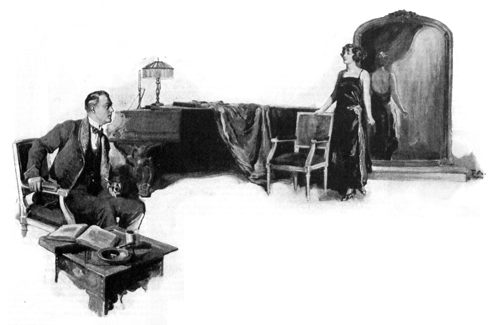
He had been checking and weighing many things. He had reviewed his married life, faced the mistakes he had made and steeled himself to pay for every one of them. He had found himself wanting in patience, slow to make due allowance, visiting Eve with ills which his own shortcomings had begotten. More. The bill his heart had run up was truly formidable. To do his darling pleasure he had let everything rip for month after flashing month. He had smiled at this extravagance, abetted that whim, encouraged that vanity. They had drifted — gone as they pleased. The trivial round had been bought off, the common task compounded with. Discipline had become a dead letter; indulgence, lord of misrule — And it was his fault. She was a child and — she had great possessions; so life and love had become two excellent games, effortless, fruitful. Indubitably, it was his fault. He should have pointed the child, steadied her, used .his experience. His failure was inexcusable, because he had been through the mill, seen that life at any rate was no game; a stroll or a struggle, perhaps, according as fate laid down, but not a game. The pity was they might have strolled so pleasantly.
Jeremy had also reviewed the recent affray. He had decided that he had been clumsy, quick to anger and blunt. But he was perfectly certain, first that his contention had been sound, and second that his withdrawal was wholly justified. Moreover, cost what it might, if ever again Eve laid such a whip across his shoulders he would have to go. Had he been less punctilious, had he ever given his wife the slightest cause, it would have been different. As it was, to condone such usage would be fatal. Her respect for him, his respect for himself, would rapidly bleed to death, and happiness would shrivel like a fallen leaf. There would in fact be nothing at all to stay for — unless one cared for love with his tongue in his cheek.
That she had drawn such a whip had opened Broke’s eyes. He had been hurt — naturally; but he was far more concerned. Ten months ago Jeremy blamed himself very much indeed. He was, of course, most deeply in love with his wife and she with him.
When he came in that evening she flung her arms round his neck and burst into tears.
“What do you think of me?” she wailed. “I must have been mad. You are so wonderful, Jeremy, so wonderfully sweet about it all; and then I take up your sweetness and slash you across the face. Jeremy boy, you’ve got a cad for a wife.”
Jeremy kissed her hair. “My lady,” he said. “My darling.”
Eve shook her glorious head.
“No,” she said. “No lady. Don’t call me that again. I’ve done the unspeakable thing. I know it. If you’d given me cause, it would’ve been the grossest form. But as things are “She drew away and passed a hand over her eyes. “I think I must be possessed, Jeremy. Of course I hadn’t a leg — about the drinks, I mean. You were perfectly right. But I can mend that. I’ll never touch a cocktail again as long as I live. But I can’t mend the other.”
“It’s mended,” said Jeremy, taking her hands in his. “I made you mad as a hornet. I didn’t mean to, dear; but I’m clumsy, you know. Well, when you’re mad, you just pick up the first brick. You don’t care what it’s made of or what it is. The point is it’s something to heave.”
Eve looked him in the face.
“There was a label on that brick — Not to be Thrown,” she said. “We’ve all got two or three bricks labeled like that — Do Not Touch — Dangerous. I think from what you said, that brick is marked Dangerous too.”
Jeremy bowed his head.
“Yes.”
“Jeremy,” said Eve, “you’ve something I haven’t got — thousands of things, of course, but especially one. And that’s my respect.”
Her husband smiled. Then he extended his arms and brought her face to his chin.
“You’ve got mine anyway,” he said.
“Rot!”
Jeremy nodded solemnly.
“To tell you the truth,” he said, “you never lost it. If you could have seen yourself — ”
“A sulky child,” said Eve.
“No,” said Broke. “A — a princess.”
“That’s not what you married.”
“I know. But that was your fault. You went and gave me my choice.”
A mischievous look stole into the big brown eyes.
“What a fool I was!” said Eve, and put up her mouth.
If the Brokes had slid back for ten Months, for the next six they went steadily forward, hand in hand. It was the strangest progress. Luxury, idleness, ease certainly came behind, but dutifully, as servants should.
A jovial discipline jogged by their side. Respect and self-respect marched solemnly ahead.
Jeremy did admirably. Eve was twenty-six. She was worth twenty thousand pounds year. Finally, she was American. With Infinite patience, with gentleness, firmly her husband went to work — helping his ‘fife, helping himself, helping his wife to “OP him and always giving her the glory. Eve gave it back always, with a look in her eyes that money cannot buy.
The vanities of a wicked world were against her, but her love and respect for Jeremy beat them back. She began to see the smile on Discipline’s face, look for his cheerful wink, glow before his bluff praise.
One November morning Jeremy woke to find her fully dressed. This was unusual. That one’s fast should be broken in bed was one of the articles of Mrs. Broke’s faith. So soon as her husband could speak he asked what was wrong. After a little, a child told him her tale.
“You remember that poor man yesterday I gave half a crown to? Well, what’s half a crown to me? It wasn’t giving him anything, really. I mean I wasn’t missing anything. It wasn’t hurting me. So I thought if this morning I got up at seven o’clock — It sounds silly, because it hasn’t done him any good. But he did have his half crown, and I — well, I’m glad I’m up now, but I do hope it was a deserving ease, Jeremy.”
Her husband slid out of bed and picked up her hand.
“I take my hat off,” he said uncertainly. And as is so often the way, two days later the pretty pilgrims’ progress came to a violent end.
It was a bleak afternoon, with a sky of concrete and a wind that cut like a lash. Eve, who had been to the dressmaker’s, was sitting before the fire, reflecting comfortably that in ten days’ time she and Jeremy would be in the South of France. Her husband entered quickly.
“Sorry I’m late, my darling, but when he’d finished with me he said he was going south and I was fool enough to offer to drive him down. You know what these artists are. Five and twenty minutes he kept me waiting.” He stooped and kissed her. “And — and I’ve a confession to make.”
“Go on,” said Eve, smiling.
“I’ve done it again, Eve.”
“What?”
Jeremy stepped to the fire.
“Got stopped in the park.”
“Jeremy!”
“I’m awfully sorry, dear. It’s a kind of disease with me.”
“But you gave me your word — ”
“I know. I’m frightfully sorry. I wasn’t thinking about speed. As a matter of fact, I was talking to Hudibras. And then, just as I was going to switch out of Clarence Gate, they pulled me up. Perfectly ridiculous, of course. The road was clear.”
“That’s hardly the point,” said Eve coldly.
“I know, I know.” He paused. Then, “Of course you’ll think I’m mad; but, Eve, ten minutes later I did it again.”
His wife sat up.
“Again?”
Jeremy swallowed.
“Again,” he said uncomfortably. “Down Constitution Hill. I tell you, Eve, I could hardly believe my eyes.’ Just as I got to the Palace, out they stepped. Thirty-three miles an hour. They’re perfectly right.”
“And you promised to keep to twenty!”
“I know. I’m frightfully sorry. It just shows — “
Eve laughed. “It shows you don’t care. I’ve begged and prayed you just for my sake to go slow. You know why. Because I’m worried to death when you’re out alone. You know it over and over again you’ve given your word.”
Jeremy stared at the floor.
“I’ll give up driving,” he said.
“I don’t care what you do. The damage is done. I begged, you swore, and now you’ve broken your word. If the police hadn’t stopped you I should never have known. The obvious inference is that you’re breaking it all the time.”
“I haven’t really, Eve. I’ve crawled about. But today I got talking and — ”
“Why,” said Eve, “should I believe you? What does it matter whether I do or not? Day in, day out I try to do what you want. I’m sick and tired of trying to do your will. Yet I keep on because it amuses you — amuses you to see me cramp my style. God knows why. It’s a funny form of love. But that’s by the way. I try. I sweat and grunt and slave — for peace in our time. And you stand over me and keep my nose to the stone. I’m not like that. It wouldn’t amuse me to put you through the hoop. Only one wretched favor I’ve ever asked; and that I asked because I loved you.”
“I know,” said Broke. “I’m sorry. I’ve no excuse. But don’t lay on so hard, Eve. You know it doesn’t amuse me to — ”
“Then why do you do it?” said Eve. “Don’t say ‘Out of love,’ or I shall burst.”
“I do what I do,” said Broke, “because I want you to get the most out of life.”
“Oh, let us pray!”
Jeremy bit his lip.
“You do it,” continued his wife, „“to assert your authority. If the money was yours and not mine, you’d have the whip hand. As it isn’t, you play the priest, trade on my better feelings, take advantage of my love. I didn’t marry you for that, you know.”
“You will please,” said Jeremy, “take that back at once.”
His wife stared. “You’re out for trouble,” she said. “Well, here it is — hot and strong. I said I didn’t marry you for that. Well, I don’t pay you for that either.”
Without a word Jeremy left the room. Ten minutes later he passed out of the house.
For month after halting month Eve carried on. The girl hoped desperately that Jeremy would return. If he did he should find her soul swept and garnished. She dressed soberly, spent so much and no more, rose always at eight. She kept the same state, but entertained the less fortunate, was always lending her cars. When she saw some object she fancied she asked the price and gave the amount to charity. Herein she was scrupulous. A chinchilla coat attracted her very much. Still, her sables were perfect. Besides — After careful reflection she decided that but for Jeremy’s teaching she would have bought the fur — and wrote a check for the sick for four hundred pounds.
She made no search for her husband — not because she was proud, but because she felt that it was vain. If he was coming he would come. If he was not — Had she stumbled across him she would have begged and prayed. But look she would not. She had no doubt at all that she was up against fate, and Jeremy had always said that fate didn’t like you to try to force its hand. “So sure as you do, my lady, you lose your labor.”
She often wondered why she had lost her head that bitter afternoon. After all, to exceed a limit was not a grave offense. He was careful in traffic, no doubt; and then, slipping into the park he hurried along. Besides, he was only hastening back to her, and he had been so humble.
Eve decided that she had been possessed. Some malignant devil had entered into her soul, distorting truth, ranting of motes and beams, raising a false resentment of a fictitious injury.
To say that she missed him is to call leviathan a fish. Only the fetish that she must do his will saved her alive. The night of his going she lifted up her head, shook the tears from her eyes and answered two letters that she had left too long.
And now four months had gone by.
Sitting before the fire Eve thought of the past with blank, see-nothing eyes. For the millionth time she wondered where Jeremy was, how he was faring, what he was doing to live. Never had riches seemed so empty, luxury so drear as they had seemed since she had been alone. The thought that as like as not he was going hungry tore at her heart.
She picked up the paper to try to distract her thoughts.
Staring straight at her was the advertisement of the St. James’ Review. This was announcing the contents of the current issue. Third on the list was:
BABEL: Jeremy Broke A child fell upon the telephone. A subeditor or someone was speaking:
“I’m afraid we’re not at liberty to give his address, but if you write him a letter care of this office it will be sent on at once.”
“All right,” said Eve. “Thank you.”
A child’s letter went off by messenger within half an hour:
My Darling Jeremy: I would like to come to you if you will tell me where you are. I have tried very hard to do what you would have liked ever since you went, and if you had been here I should have been very happy. Please let me come, because if you don’t I don’t think I shall be able to go on. I would try, of course, but I think I should break. I’ve tried to write calmly, darling, but I shall be very glad to hear as soon as you can. Oh, Jeremy, my precious, I suppose you couldn’t wire.
Your very loving,
EVE.
No sooner had the letter been dispatched than a terror that it would miscarry flung into Eve’s heart. She saw it being mislaid, forgotten, let to join the faded habitues of some dusty mantelpiece. Of course she should have marked it Important, enclosed it in a note to the editor saying how serious it was, asking for it to be expressed or sent by hand. Then, at least, he would have taken action. Besides, it was serious — desperately so; and urgent — most urgent. Yet she had done nothing to accelerate a reply — nothing. What a fool she was! She had certainly asked him to wire, but why not to telephone? If the letter had gone to him by hand and he were to have telephoned —
The tide of apprehensive impatience rose to an intolerable height. Eve rose to her feet and stood twisting her fingers. After a moment, trembling a little, she stepped to the telephone.
“Oh, I rang up a little while ago and asked for Mr. Broke’s address — Mr. Jeremy Broke. And you said — I think I spoke to you — you said that if I sent a letter — ”
“Yes, I remember.”
“Well, I’ve just sent you a letter by hand, but I ought to have marked it Important, and — and — well, I really should have enclosed it in a note to you because it’s very urgent and I would like it sent on by messenger boy if you could do it. At once — tonight, I mean. You see — ”
“I don’t think he’s in London. Wait a minute.” The voice became almost inaudible. Frantically Eve strained her ears. “Broke. Jeremy Broke — fellow that wrote Babel. . Messenger boy. . . . Rome, isn’t it.? Poste Restante, Rome.” The voice returned to the mouthpiece. “No, I’m afraid Hullo! Are you there? Hullo! Hullo — “
After a moment or two the speaker replaced his receiver with a sigh.
“Cut off,” he said wearily. “Never mind. She’ll ring up again.” He was quite wrong.
He had had his last conversation with Mrs. Broke. The latter was already preparing to leave for Italy. Two days later the lady had reached Rome and was being rapidly driven to the Ritz Hotel. Purposely she avoided the Grand, where she and Jeremy had stayed — centuries ago.
She passed into the hall and up to the polished bureau. The reception clerk was busy, speaking into the telephone:
“Oui, madame. . . . Parfaitement. . . . Jusqu’d samedi prochain les deux, et apres samedi les trois avec un salon en suite. . . . C’ est entendu, madame. . . . Merci.”
He left the instrument, stooped to make an entry and turned with an apology to Eve.
“Hullo, Jeremy,” said his wife.
At half past eight that evening Jeremy Broke, gentleman, entered the Grand Hotel and sent up his name. His head was aching and he felt rather tired. He wondered dully what this dinner with Eve would bring forth. The great gulf fixed between them seemed exceeding wide; everything was insisting upon its width. Not since the day on which he had left her house had he been used as a gentleman; now he was treated with respect — which her wealth had induced. A page she would presently tip was dancing attendance; here was the pomp of a salon which she had purchased; there was champagne waiting for which she would pay.
As the door closed behind him, another was opened and Eve in a plain black frock came into the room.
“Oh, Jeremy!” He went to her quickly and kissed her hands and lips. The big brown eyes searched his steadily. He smiled back. “What is it, Jeremy? Why are you playing up?”
Jeremy dropped her fingers and turned away.
“The burnt child,” he said slowly, “ dreads the fire.”
“Are you sorry I came?”
“Oh, Eve!”
He drew in his breath sharply, hesitated and fell to playing with his mustache.
Dinner was served. The meal did much for both of them, as meals can. Jeremy’s headache passed and Eve was refreshed. The flesh being fortified, the spirit lifted up its head. By the time the servants had withdrawn they were exchanging news with zest.
“So, really,” concluded Jeremy, settling himself in a chair, “I’ve — I’ve done very well. It’s a most entertaining job — smoothing down the indignant, humoring the whimsical, bluffing the undesirable, assisting the helpless, shepherding the vague. I never had the faintest idea how many remarkable people are floating around. We had a fellow one day who stayed for six weeks. He went to bed when he arrived and he never got up. For six solid weeks he stayed in his bed. Nothing the matter with him. No suggestion of ill health. It was just his way of life. He did it wherever he went. Chauffeur and valet kicking their heels all day. He wouldn’t have the valet in his room except to shave him. Said he didn’t like his face. Then one day he got up and left for Naples.
“I got off once — with an old English lady. She had a courier and two maids and traveled with her own bath. She used to be ringing me up the whole day long and she never went out or came in without speaking to me. It was most embarrassing. She gave me a check when she left for a hundred pounds. I tore it up, of course.”
“You would,” said Eve.
“Well, I couldn’t take money like that.”
“Plenty of people do.”
“Yes, but — ”
Eve leaned forward.
“She wanted you to have it, Jeremy. She was rich and it gave her pleasure to spend her money like that. Your conscience was clear.”
Jeremy shifted in his chair.
“It wouldn’t ‘ve been,” he said, “if I’d frozen onto it.”
“Why not?”
“Because I didn’t deserve it.”
“Wasn’t that a matter for her?”
The man hesitated. Then, “ I just couldn’t take it,” he said.
“Because it was a tip?”
“Oh, no. If it had been a fiver — well, I suppose I’d been attentive, and I’ve no false pride.”
“Then why,” said Eve, “why did you turn it down?”
Jeremy laughed.
“I’m damned if I know,” he said. “But it couldn’t be done.”
Eve lay back in her chair and crossed her legs.
“Shall I tell you?” she said. “Because you’re a gentleman. You thought she’d lost her head — she probably had — and you weren’t going to take advantage of a runaway heart. That hundred pounds was Caesar’s; you rendered it whence it came.”
Broke got upon his feet and turned to the mantelpiece. Presently he took out a pipe and a well-worn pouch.
“I suppose you’re right,” he said slowly.
After a long look Eve lowered her eyes to the floor.
“You got off once before, Jeremy — nearly three years ago now.”
“Yes,” said Jeremy, pressing tobacco home.
“Did you think I’d lost my head?”
“No.”
“Or that to take my money would be taking advantage of my heart?”
“No.”
“Yet you rendered it to Caesar — every cent.” She leaped to her feet and caught the lapels of his coat. “Every rotten cent that the good God had given us to make us happy you rendered unto Caesar as though it were Caesar’s. And it wasn’t Caesar’s, Jeremy. It was ours — yours and mine.” Her voice broke and the tears came into her eyes. “I was so happy, dear, to think I was rich, because I felt I’d got something worth sharing — which you would share. I was so proud and happy. And then — you wouldn’t — share — it. Well, at first I was dismayed, as children are. You married a child, you know. . . . I tell you, I was ready to cry for disappointment. And then suddenly I saw something very magnificent — unearthly handsome, Jeremy, in your refusal. It was something so bright and shining that I couldn’t think of anything else. I found you were paying me a compliment for all the world to see such as no woman with money had ever been paid before. Well, I’m vain; and the childish impulse to burst into tears was swallowed up in pride to think that I had for my husband so fine a gentleman. I found it so flattering, Jeremy; I was just drunk with vanity. And so I became a princess — you made me one, dear; and the child that you married disappeared, and with the child disappeared the idea of sharing — a princess doesn’t share. That it was our money never occurred to me again. I had no eyes for such an idea. Every hour of every day you showed me that it was mine, and I came to prize its possession because it had brought me this superb allegiance. I sank to be a queen, Jeremy, and dragged you down to be the keeper of my purse — you. And then a day came when the queen became imperious, high with her faithful servant, thought him presumptuous, rose in the dignity he’d given her and asked who paid him to keep the privy purse.” There was a long silence. Presently Eve went on: “And then a strange thing happened. You went, of course. But so did the queen, Jeremy. So did the pride and vanity and all the false position you had built up. And if you could have seen what was left, you’d ‘ve seen a child crying — because it had no playmate to share its pretty toys.
“I say the false position you had built up. Jeremy lad, it’s true. I let you build it, of course. I gave you the bricks. If I hadn’t been so vain — so hellishly vain — I’d ‘ve caught your arm at the beginning and stopped the rot. You built so faithfully, Jeremy, with the cleanest, honestest heart. And I watched you and let you build and thought how wonderful it was. And all the time you were rendering our happiness to Caesar. He’s had a year of it already — a long, matchless year out of our little treasure. Oh, Jeremy, Jeremy, you’re not going to give him anymore?”
Jeremy caught her to him and held her close.
“My eloquent darling,” he said, with his cheek against hers. “But you’ve forgotten my sex. A man — ”
You’d ‘ve married me if I’d been poor?”
“You know I would.”
“It was because I was rich that you wouldn’t speak?”
“Yes.”
“It was the child you wanted to play with — not her toys?”
“Yes.”
“Why, then your honor is clean, and it’ll always be clean so long as you’d play with the child if she had no toys. You wouldn’t want me to throw my toys away; I’ve always had them to play with. Yet how d’you think I feel when the child I’ve picked to be my playfellow won’t share my pretty toys?”
“I wonder,” said Jeremy slowly — “I wonder whether you’re right. ‘Unto Caesar.’ You mean I’ve been paying conscience money — which I never owed?”
Eve nodded. The man put her gently aside and began to pace the room.
Slight fingers to mouth, Eve watched him as one watches the flow of a crisis which one is powerless to treat. Her face was calm and she stood like statuary; only the rise and fall of her breast betrayed her hammering heart. Her brain was straining frantically to perceive the line she would have to take. She had moved him — shaken him plainly. Everything in the world was depending on how she handled the next move Jeremy made.
Suddenly he swung round.
“Eve, if I come back my livelihood’s gone. And I mayn’t be quite so lucky — another time.”
His wife stood up.
“You go too fast, Jeremy. I’ve suffered, you know — most terribly. And I can’t go through it again.” She hesitated. “Before you come back, you must promise — to play with my toys.”
For a long minute Jeremy stood regarding his wife. Then suddenly he smiled — the smile of a man who has suddenly come upon the truth. He stepped to Eve and put his arms about her.
“What a fool I’ve been!” he said. “What a blinking, blear-eyed fool! Of course, it’s partly your fault. You gave me my choice when you had no choice to give.”
“What do you mean, Jeremy?”
“You asked me which I would marry — the child or the witch or the princess. Well, I couldn’t pick and choose. I had to marry the three — or none at all.”
“But — “
“Listen! When you’re a child, I’ll play with your pretty toys; when you’re a witch, play with your beautiful hair; and when you’re a princess — ”
“Yes, yes?” eagerly.
“Why, then,” said Jeremy proudly, “I’ll play the prince.”
A glorious smile swept into his darling’s face.
“And they lived happily,” she breathed.
Jeremy nodded.
“Ever after,” he whispered.
Your Weekly Checkup: Diseases from Ticks, Mosquitoes, and Fleas Are on the Rise
“Your Weekly Checkup” is our online column by Dr. Douglas Zipes, an internationally acclaimed cardiologist, professor, author, inventor, and authority on pacing and electrophysiology. Dr. Zipes is also a contributor to The Saturday Evening Post print magazine. Subscribe to receive thoughtful articles, new fiction, health and wellness advice, and gems from our archive.
Order Dr. Zipes’ new book, Damn the Naysayers: A Doctor’s Memoir.
The Centers for Disease Control and Prevention issued a new report stating that illnesses caused by the bite of an infected mosquito, tick or flea (vector-borne diseases) have more than tripled in the United States from 2004 to 2016. Warmer weather has permitted widespread proliferation of ticks, which transmit Lyme disease, Rocky Mountain spotted fever, and tularemia; and mosquitoes, which transmit West Nile virus, Zika, dengue, and chikungunya. Warmer temperatures also tend to make mosquitoes get infected faster and become more infectious, so when they bite, they deposit a larger viral load, increasing the chances of infection. An increase in the deer population infected with deer ticks has helped skyrocket the incidence of Lyme disease, while decreases in predators, such as foxes that keep the rodent population under control, also play a role. More people moving into wooded areas increases human exposure to the vectors.
These diseases have wide geographical distribution and can be difficult to control. Overseas commercial and vacation travel facilitate rapid transmission. Of the diseases found in the U.S., only yellow fever has a vaccine to prevent infection.
Tick-borne diseases make up more than 75 percent of U.S. infection reports (mostly Lyme disease) and tend to concentrate in the eastern parts of the U.S. and along the Pacific Coast. Mosquito-borne illnesses like dengue fever, chikungunya and Zika are found in Puerto Rico, the Caribbean Islands, and some parts of the United States. West Nile virus is widespread across the continental U. S., where it is the major mosquito-borne disease. Plague, the most common flea-borne disease, is found mostly in rural southwestern U.S., and there are less than 17 cases a year.
The new report identified 16 different vector-borne diseases, including Lyme disease, anaplasmosis/ehrlichiosis, spotted fever rickettsiosis, babesiosis, tularemia, Powassan virus, dengue viruses, Zika virus, West Nile virus, malaria, chikungunya virus, California serogroup viruses, St. Louis encephalitis virus, Eastern equine encephalitis virus, yellow fever virus, and plague. New pathogens have been found, such as the tick-borne Heartland and Bourbon viruses from the Midwest.
What Can You Do to Prevent Infection?
When outside
- Cover all exposed skin with clothing (tuck pants legs into your socks)
- Use insect repellents like DEET, picaridin, and IR3535 on areas not covered;
- Spray closed shoes and clothes with permethrin to repel ticks and mosquitoes
- Avoid tall grassy fields, bushes, and sitting on dead logs that are especially attractive to ticks
- Check your clothes and body (scalp, folds of skin, private parts, behind ears and knees, back) and dog or cat for ticks after a hike.
Around your house
- Rid your yard and deck of empty flower pots, bird baths or bowls where water can accumulate to breed mosquitoes.
- Fence out deer, prune trees, keep the grass cut short, clear leaves, remove overgrowth, and consider spraying.
If you find a tick
- If you find an embedded tick, grasp it with tweezers, and gently pull it out. Save the carcass for later analysis if necessary.
These transmitted diseases are much more than warm weather nuisances. Some of them can kill or produce severe, long lasting illness. Rocky Mountain spotted fever isn’t limited to the Rocky Mountains, and Lyme disease can be a chameleon lingering painfully for months. Forewarned is forearmed.
Creating a “Support System” for Homeless Women
I want a red lacy bra,” said Crystal. She stood in the back room of a Washington, D.C., homeless shelter, her thick clothes encasing her like a shell. Crystal wore a man’s black overcoat, which covered another coat, which covered a sweater, which covered a sweatshirt. Her head was concealed by a cotton cap covered by a black hood. Two long scarves encircled her neck.
Dana Marlowe knew why she wanted a bra. Crystal had worn the same few bras for eight years. Old bras typically provide less support, which can cause back and shoulder pain. The underwire can also poke through, chafing the skin and potentially causing bleeding and infections. But Marlowe — the founder of I Support the Girls, which provides bras and feminine hygiene products to homeless women — was surprised that Crystal wanted a brassiere that was so … frilly.
“I’ve been homeless for a long time,” Crystal explained. “I see those big ads on the sides of bus stops, those attractive women posing in lacy bras and matching underwear. For once in my life, I want to feel good about myself. I want to feel sexy. And I can’t do that. I’m always at risk of someone harming me.”
That’s why she dresses in so many layers, she told Marlowe. To avoid attention. To prevent her body from becoming a target.
“Nobody else needs to know I’m wearing it,” she said. “But I’ll know because I can feel it. And it’ll make me smile.”
Marlowe, who had just donated 2,000 bras to the shelter, found a red lacy bra for Crystal. It’s a service she’s performed for hundreds of homeless women; women who not only need food and shelter but crave dignity, comfort, and self-respect. Since 2015, I Support the Girls has distributed 350,000 bras and 1.1 million feminine hygiene products to 350 shelters and organizations worldwide, from the United Nations High Commissioner for Refugees to the Salvation Army. And it all happened for an unlikely reason: In 2015, Marlowe lost 35 pounds.

“My clothes and my bras became baggy,” she says. “I’m a fashion train wreck. I really don’t care about my wardrobe. But one morning my husband said, ‘Look — I know you’re not going shopping for clothes, but please cancel your meetings today and go buy new bras.’ And I thought, ‘Oh gosh — this must be bad.’”
—Crystal, a homeless woman
While getting fitted, she asked the sales clerk if old bras could be resized if they were still in good shape. The woman laughed at her but said four words that changed her life: “Homeless women need bras.”
Marlowe contacted a local shelter and discovered a serious need for brassieres. Shelters frequently receive clothing donations, but they rarely receive socks, underwear, or bras (Marlowe recently met a homeless woman who hadn’t received a new bra in 30 years).
“They said yes so quickly,” she says of her donation offer. “It was a turning point. I didn’t know that homeless women needed bras, which made me think: What else don’t I know?”
Shelters are also desperate for feminine hygiene products, she learned, so she asked friends on Facebook not only to donate unused bras, but packages of tampons and maxi pads. The response was overwhelming. Friends enthusiastically donated. Local businesses started collection efforts. Word even spread to organizations such as the Marriott Corporation and the U.S. State Department, where employees collected donations. Marlowe eventually provided more than 1,000 bras and 7,000 feminine hygiene products to a local shelter.
The generosity ignited more generosity. When The Washington Post told her story, things went “completely bonkers,” she says. She was inundated with requests from not-for-profits that work with homeless women and victims of domestic violence. Bra donations arrived from widowers, breast cancer survivors, and men and women whose mothers had passed away — and from as far away as Hong Kong, the U.K., and France. I Support the Girls transformed from a Facebook plea to a one-woman not-for-profit with more than 50 affiliates in North America, all run by local volunteers. Eager humanitarians have also launched operations in Australia, Pakistan, Thailand, and New Zealand.
“A woman’s period in Australia is the same as in Thailand,” says Marlowe. “You can’t turn it off just because you’re homeless, so women are forced to use substitutes — like paper towels and cardboard. It’s about dignity, no matter where you live. The same is true with bras. It doesn’t have to be the most expensive, fanciest bra, but having a bra that supports you, you stand up straighter. You feel better about yourself.”
Bras have other practical purposes too. When Crystal met Marlowe, she also asked for a sports bra, because it doubles as a protective pouch. She places her ID and money and family photos in plastic bags and hides them beneath the sports bra’s thick fabric. “It’s the least likely spot that’s going to be robbed,” Crystal told Marlowe. “If I’m sleeping in a shelter and someone takes my bag, they can’t get to my most treasured items.”
For Marlowe, talking with these women, and learning about their lives, is the best part of her work. She never asks how they became homeless and never passes judgment. “A lot of people who are homeless have jobs,” she says. “A lot of homeless people live in their car at night and park in the corner of a shopping center to sleep.”
The work can be tiring, Marlowe admits. In addition to running I Support the Girls, she is the founder and executive director of Accessibility Partners, LLC, which helps companies and organizations make their technology more accessible for people with disabilities. Juggling a full-time job with a full-time passion can be challenging, but Marlowe is “a powerhouse,” says Greg Rockwell, community relations manager for Thrive DC, a nonprofit that provides resources to homeless people.
“She is the epitome of the phrase, ‘If you want something done, give it to someone who’s already busy,’” he says. “She goes a mile a minute, and not just the extra mile, but two or three extra miles for causes she cares about.”
Marlowe and her husband are also raising two boys, ages 6 and 9. Because of their mom’s work, they’re more socially aware than most grade-schoolers: They help her sort supplies, and when they come home from school, their backpacks are frequently filled with donations.
“You don’t usually hear a 9-year-old boy say, ‘I’ll be late for the birthday party because I’m going with mom to donate maxi pads and bras for homeless women,’” she says. “It rolls off his tongue — he doesn’t know any different. But they both know it’s important to give back and volunteer.”
Marlowe may be an accidental activist, but she’s always lived a life of urgent purpose, a lesson she received at age 12, when her father died from brain cancer. “I learned pretty quickly to make every moment count,” she says. Our short lives, she believes, are defined by the actions we take. “Sometimes it’s just about doing something,” she says. “I’m just a woman with a mountain of bras in her basement. But if we each do something, even if it’s small, it can impact the world.”
Ken Budd has written for The New York Times, Smithsonian, McSweeney’s, and National Geographic, and is the author of The Voluntourist. For more, visit thevoluntouristbook.com.
This article is featured in the May/June 2018 issue of The Saturday Evening Post. Subscribe to the magazine for more art, inspiring stories, fiction, humor, and features from our archives.
8 of History’s Most Destructive Lies
These days lying is in the news — practically every day.
Lie was a word that, not so long ago, politicians and the media rarely spoke outright. But under the current administration, the president and the press have repeatedly accused each other of dishonesty. Many of these fabrications are ignored or quickly forgotten by a public that is no longer surprised by mendacity.
But all lies are not equal. And in the media’s frenzy of fact-checking, that’s one fact that’s too often overlooked. Some memorable lies have been spectacularly false but wrought relatively little harm. For example, think of President Nixon’s assertion that “no one in the White House staff … was involved” in the Watergate break-in (August 29, 1972), or President Clinton’s “I did not have sexual relations with that woman” (Jan 26, 1998). They probably changed no one’s mind, and did little to delay the ultimate consequences for those presidents.
But other lies in history not only were whoppers, but also caused untold damage. It’s important that we do not forget these terrible deliberate deceits — lies that were responsible for unspeakable suffering and, in some cases, millions of deaths.
Here are eight lies that had serious, large-scale, long-term consequences. No doubt there are very many more evil fabrications we have overlooked. We welcome your input. It’s important that we never forget how easily and how often mankind has been played for suckers, with disastrous results.
1. “In today’s regulatory environment, it’s virtually impossible to violate rules.”
That’s what Bernie Madoff said in 2007, addressing a conference on illegal practices in Wall Street. Even as he spoke, he was operating the largest Ponzi scheme in history. When it came crashing down the following year, the investment advisor had bilked 4,800 clients of $18 billion.
Result: After confessing that his firm’s asset management was “one big lie,” he was arrested, tried, and sentenced to 150 years in prison. (To date, $11 billion of the lost $18 billion have been recovered and restored to Madoff’s victims.)
2. “There is no doubt that Saddam Hussein now has weapons of mass destruction.”
In the aftermath of 9/11, the United States immediately struck back at the terrorist masterminds in Afghanistan. But many people in the Bush administration were convinced that the dictatorship of Saddam Hussein in Iraq was not only conspiring with Al Qaeda but was stockpiling weapons of mass destruction to use against the United States (illustrated in the above quote from Dick Cheney).
Despite there being no credible evidence that this was true — most intelligence and on-the-ground inspections revealed no WMDs — the Bush administration chose to pin its reasons for going to war on information from an Iraqi informant nicknamed “Curveball,” as well as on documents that showed Iraq had obtained a large quantity of uranium for the purpose of making a nuclear bomb. The informant was soon discredited, and the uranium documents were discovered to be obvious fakes, but the wheels were already in motion. In 2002, President Bush told the country that Saddam not only had stockpiled deadly chemical and biological agents, but that he had also been building nuclear bombs. In 2003 the United States launched war against Iraq. It’s not clear who knew the evidence for WMDs was false, or when they knew it. Regardless, the financial and human cost was devastating.
Result: Thousands of Americans and hundreds of thousands, if not more, of Iraqis have died in a war that lasted eight years and cost $2.4 trillion. General Colin Powell, who led the U.S. defeat of Iraq in the 1991 Gulf War, would later bitterly denounce his own speech in 2003 as U.N. Ambassador defending the Bush invasion. America and the world are still living with the war’s consequences.
3. “Cigarette smoking is no more ‘addictive’ than coffee, tea, or Twinkies.”
For years, the tobacco industry assured customers that cigarettes were neither unhealthy nor addictive. The makers of Old Gold cigarettes claimed “Not a cough in a carload.” And in 1994, James W. Johnston, CEO of R.J. Reynolds, told a congressional committee, “Cigarette smoking is no more ‘addictive’ than coffee, tea, or Twinkies.”
The reality, of course, is quite different. The Centers for Disease Control and Prevention estimates that 480,000 Americans die every year from cigarettes.
Result: In 1998, the four largest tobacco companies reached a settlement with 46 states to pay $206 billion over 25 years to help cover the medical costs of smoking-related illnesses.
4. “We are not about to send American boys nine or ten thousand miles away from home to do what Asian boys ought to be doing for themselves.”
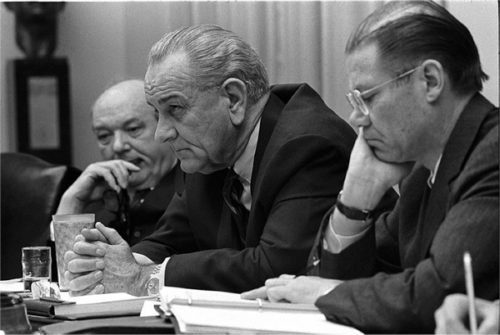
In 1964, Americans were concerned about the country’s growing involvement in the Vietnam War. On October 21, 1964, President Johnson assured the country, as he was running for president, that they had nothing to worry about. Despite his words, the following March, he began shipping Americans by the tens of thousands to Vietnam.
Johnson’s statement began a long campaign by our government to lie to the American people about the fact that almost everyone who knew the facts — from the soldiers to the bureaucrats to the president himself — knew that the war was unwinnable. After Johnson left the White House, President Nixon continued the pretense, even secretly expanding the war into Cambodia.
Americans were furious when, in 1971, defense analyst Daniel Ellsberg released military intelligence — known as the Pentagon Papers — that showed the extent of the deception. They realized they’d been lied to about the conflict because neither Johnson nor Nixon wanted to take responsibility for losing an unwinnable war that we never should have undertaken in the first place.
Result: In addition to the 58,000 American lives it claimed, the war produced a chronic mistrust of the government that, for many, continues to this day.
5. “There is no famine or actual starvation, nor is there likely to be.”
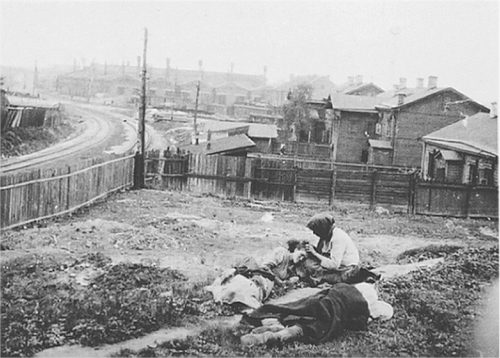
In the 1930s, Joseph Stalin was determined to wipe out private farms in Ukraine and put the population into Soviet controlled communes. He instituted a policy that began starving this region. Ultimately, between two and four million people starved to death. As could be expected, the Soviet government denied any problems. What is surprising is that many western reporters repeated Moscow’s interpretation of what was happening in the region.
Walter Duranty, a reporter for the New York Times, wrote repeatedly that was no famine (those are his words, above). He wasn’t the only reporter who parroted the Soviet’s line, but he was at a prestigious paper and had actually won a Pulitzer Prize for his coverage of Stalinist Russia. Duranty also justified the brutality of Stalin’s gulag system as a necessary measure that would ultimately benefit the Russian people.
Result: Duranty’s assertions that there was no actual starvation assured western leaders there was no reason to press for famine relief. His reporting helped the world turn away from the deaths and imprisonment of millions.
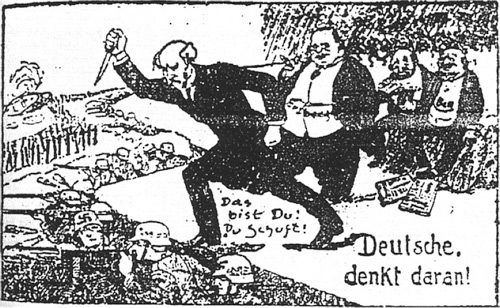
6. “The German Army was stabbed in the back.”
In 1919, General Paul von Hindenburg told the German people why they lost World War I. He said Germany hadn’t been beaten honorably on the battlefield by the enemy, but by radicals and other undesirables back home who’d overthrown the Kaiser’s monarchy and replaced it with a republic. The real reason for the defeat, Hindenburg said, was “The German army was stabbed in the back.”
In fact, the German army had thrown everything it had into one last, desperate chance for victory. By June, they had simply run out of steam. Moreover, the revolution had begun not by civilians but by members of the German military.
But the lie was swallowed by Germans who were convinced that if only the troublemakers could be silenced, Germany would regain its greatness.
Result: The lie fueled the rise of the Nazi party.
7. “The Jewish Peril: The Protocols of the Learned Elders of Zion”

In 1905, Russian writer and mystic priest Sergei Nilus claimed that he had proof of a Jewish plan to achieve global domination by corrupting the morals of Gentiles and controlling the world’s media and money. The Jews were also plotting, he claimed, to slaughter Christian children, spread plague, and commit other atrocities.
Despite the fact that the Protocols were shown to be a malicious fabrication, many people stubbornly believed its vile slanders. Henry Ford thought it so important he paid to publish half a million copies. And the Nazis later cited it to justify their slaughter of eight million Jews.
Result: The Protocols continue to be used to fuel anti-Semitic hatred.
8. “We know Dreyfus is guilty of treason because he ‘made everything disappear.’”
In 1894, French military intelligence officers learned the Germans were receiving secret information about new French artillery. After reviewing possible suspects on the French General Staff, they accused Lt. Col. Alfred Dreyfus. His chief qualification for being suspect was his Jewish faith. He was tried by a military court, found guilty, stripped of his rank, and sent to permanent exile on Devil’s Island off the South American coast.
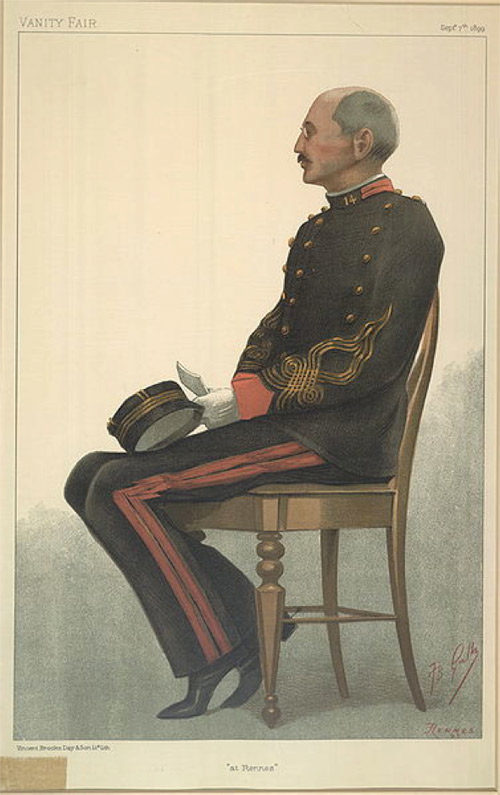
High-ranking military officials had been determined to pin the blame on Dreyfus. They had secretly supplied the judges with wholly invented evidence. And the fact that there was absolutely nothing that implicated him was actually used against him. The proof of guilt, an officer said, was that “Dreyfus made everything disappear.”
In 1896, new evidence indicated the traitor was actually another officer who was allowed to flee the country. For years, the military ignored the public outcry against Dreyfus’s conviction. Ultimately it yielded to pressure and tried Dreyfus again, and convicted him again.
Result: The lie did more than convict an innocent man. It split the country between social classes, age groups, and political parties. Even after Dreyfus accepted a pardon in 1906 rather than return to Devil’s Island, the case continued to divide the country, and this lack of unity seriously weakened its ability to defend itself in both world wars. (The French military finally proclaimed Dreyfus innocent in 1995.)
Featured image: Shutterstock
Healthy Weight, Healthy Mind: Avoid “All or Nothing” Thinking
We are pleased to bring you this regular column by Dr. David Creel, a licensed psychologist, certified clinical exercise physiologist and registered dietitian. He is also credentialed as a certified diabetes educator and the author of A Size That Fits: Lose Weight and Keep it off, One Thought at a Time (NorLightsPress, 2017).
Do you have a weight loss question for Dr. Creel? Email him at [email protected]. He may answer your question in a future column.
For just a moment, think about the first Monday of January. This is the day when people return to work and school after the holidays. Those who vowed to get in shape this year set their alarms early to nudge their bodies onto the treadmill or to the nearest gym. For many, this is the first day of their “diet.” Radio, TV, and the Internet are flooded with advertisements for weight loss programs and products. Many people who went to bed as late-night snacking slugs hope to awaken in the morning as die-hard dedicated dieters and fitness fanatics.
This type of all-or-nothing behavior is great for the $60 billion per year weight-loss industry because, in addition to first time customers, companies depend on restarts. The restarts are the people who join another program, buy an additional piece of exercise equipment, join a different gym, purchase another book, or hire a personal trainer. Often these consumers are declaring their “all in” mentality. This is the year they will change — just like last year, and the year before that.
Motivation, drive, and excitement can be instrumental in helping us accomplish important goals such as losing weight. But when we look at things in a polarized way, we end up repeating cycles of weight loss and regain. Whether related to health or other aspects of our lives, this all-or-nothing thinking can be frustrating, inefficient, and even catastrophic. Can you imagine what life would be like if people took the all-or-nothing approach to driving? Some days, people would drive under the speed limit, stop at red lights, and yield to pedestrians, but on other days they’d ignore all traffic laws — sort of like downtown Boston.
In reality, most of our behavior is on a continuum, even if our thinking isn’t. For example, if you think someone is a terrible person, that thought can easily become a belief that will impact how you respond to him or her. Although you probably won’t behave in an all-or-nothing way (hugging versus physically harming), your all-or-nothing thoughts (great person versus terrible person) have a significant effect on interactions. You certainly won’t go out of your way to know this person better.
When we think, “I’m either on a diet or out of control,” our behavior is likely to drift in that direction as well. Here’s an example of three all-or-nothing thoughts that might impact your eating and physical activity.
- If I don’t stay under my calorie goal I have failed.
- If I can’t get my heart rate up for 30 minutes, then exercise does me no good.
- I have no self-control when it comes to sweets; once I get started I can’t stop.
Let’s look at these thoughts. What happens if we believe the first example? Does that mean if you’re one calorie over the goal you have totally failed? Do you get discouraged at this point and perhaps overeat even more?
If you believe exercise is only useful if it’s intense for 30 minutes, how often will you miss the opportunity for a 10-minute walk that will reduce stress? How often will you ignore the benefits of exercising during TV commercials?
Is it really true that once you get started on sweets you can’t stop? Does this happen in all situations, no matter what?
Sherry’s problem was salty, crunchy, fatty foods. She told me potato chips were the worst, or best, depending on how you look at it.
“If I have one, I eat until they’re all gone,” she told me. “That happens every time?” I asked.
She shrugged. “Pretty much.”
Coincidentally, our weight management center was conducting research on preferences for regular versus baked potato chips during this time, so we had a stockpile of both kinds in the office.
“Hang on a minute, I want to test your theory,” I told Sherry.
I went to the back and filled a Styrofoam bowl with the regular, full-fat chips. I placed the bowl of chips in front of Sherry and said, “I want to try something with you.”
With a here-comes-a-magic-trick expression on her face, she agreed.
“I want you to eat a chip,” I said.
Sherry smiled, selected the largest chip, and willingly crunched, chewed and swallowed. Then I waited. I looked at Sherry in anticipation of her next move. Finally, she got a little uncomfortable.
“What?”
“Aren’t you going to eat the rest of them?” I asked.
“No.”
“Why not?”
With an uncomfortable laugh, she said, “Because you’re here!”
“If I leave the room, will you eat the rest of them?”
“Nooo.”
“What about on your way home? Will you stop and buy more?” I asked.
“No, I don’t think so,” Sherry said smiling.
“So it really isn’t true that once you eat one chip you can’t stop?”
“Well, I usually eat chips at home in front of the TV. I take the whole bag to the couch and before I know it, they’re all gone.”
“So when you eat chips in that sort of environment it’s hard to control yourself?”
“Exactly.”
Sherry’s belief that she couldn’t stop eating chips once she started wasn’t true. In fact, she could practice a lot of restraint in certain settings. She had options with potato chips. She didn’t need to accept the idea that they controlled her. Instead, if she wanted to eat chips in moderation, she could set up her environment to increase the likelihood for success. Maybe she could buy a vending machine size bag, or pre-portion her chips into smaller containers. She could commit to only eating chips at the kitchen table where she could truly pay attention to the pleasure from one serving. Or, she could only eat chips when she came to her weight management appointments. Lastly, Sherry might decide that keeping chips in the house was just too much work and the chips weren’t worth it. Whatever she decided, the crucial element was believing she could control herself — and we proved that during our session with the chips.
Countless other all-or-nothing thoughts can impact eating, such as:
- I totally blew it by oversleeping, missing my workout, and then skipping breakfast. No use trying to get back on track today.
- My presentation was a total disaster.
- Yesterday was great, but today has been the worst.
- I either avoid carbs altogether or I’m eating chips and cookies.
- Nobody cares anything about me unless they’re getting something from me.
- My husband always ignores my needs; it’s all about him, never about me.
- It’s either organic vegetables or no vegetables at all.
Whether the thought is about the weight loss process itself or another area of your life, it can impact your health behavior. If you’re so distraught by your worst day ever at your job that you can’t stomach the idea of going home, preparing dinner, and cleaning up the mess, you may end up ordering a pizza. If you feel nobody cares about you and your life is without purpose, why bother taking care of yourself?
This all-or-nothing thinking is one of many thought patterns that can get in our way, and we’re going to look at options to combat it. But before we do that, in the next articles we’ll examine other categories of thinking that derail us.
News of the Week: Saving Bookstores, Star Wars, and Some Guy Ate 30,000 Big Macs
Barnes & Noble

I’ve mentioned here before that if You’ve Got Mail were made today, The Shop Around the Corner would team up with the Fox Books superstore and go up against Amazon (I smell sequel!).
I thought of that after reading this New York Times op-ed by David Leonhardt on how we need to save Barnes & Noble. It seems like only yesterday when B&N (and other big chain bookstores) were seen as the bad guy. Now, with Amazon taking over everything, and the major chains going away, we’re getting nostalgic for the big chains. And well we should be. I want brick-and-mortar stores to survive, even if I love Amazon at the same time. (It’s interesting how the number of indie bookstores is increasing in this age of online book sales.)
The only problem I have with Leonhardt’s piece is a paragraph near the end, where he mentions that “publishers are focusing on big name writers” and “the number of professional authors has declined.” Publishers have always put their money and energies behind the bigger name authors, and I think there are probably more writers right now than ever; they’re just doing more on their own.
Now, a Story about a Family That Wants to Rule the Galaxy
Solo, the new Star Wars movie directed by Ron Howard, comes out on May 25. It was announced this week that the fifth season of Arrested Development launches on Netflix on May 29. Since Howard is the narrator of Arrested Development, it makes sense that there would be a way to combine the two. And here it is.
In other Star Wars news, a set of twins born on May 4 (aka “Star Wars Day”) was given the names of characters from the series to celebrate the day they were born. They were named Jabba the Hutt and Chewbacca (just kidding — they were given the middle names Luke and Leia).
Come, Let’s Mix Where Rockefellers Walk with Sticks
How much would you pay for an original Matisse? How about $80 million? That’s just one of the sales in this week’s auction of the David and Peggy Rockefeller art collection at Christie’s in New York City.
The three-day auction wasn’t even finished yet when they broke the record for the most money brought in from an art collection. On the first day, the total was at $650 million.
A lot of the winners were anonymous bidders. I can promise you I wasn’t one of them, though I did once own an album that had Edward Hopper’s Nighthawks on the cover.
And the No. 1 Rock Artist of All Time Is …
You wouldn’t think that someone would take the time to rank all 214 members of the Rock and Roll Hall of Fame from best to worst, but you’d be wrong. Bill Wyman did it for Vulture.
It’s a massive undertaking, so kudos to Wyman for even attempting it. He even gives his list of the artists that aren’t in the HoF but should be. Now, all lists are subjective, but this one is especially so, and I’m sure it will lead to a lot of arguments. Wyman says a lot of things about certain artists that fans of those artists are going to hate, and in some cases, his arguments are inconsistent. I mean, picking Chuck Berry over the Beatles? The Ramones over Buddy Holly? Jeff Beck and Hall & Oates should be higher on the list, and I know Bon Jovi fans aren’t going to be happy at all (though I think they should be number 215 in this list of 214). Let me know in the comments below what you think of the list.
You Want Fries with That?
I once stopped at a Burger King and was informed that I couldn’t have a cheeseburger because they were all out of buns. I was rather stunned. A burger place that runs out of buns? That’s like Dunkin’ Donuts running out of coffee.
Don Gorske broke a record recently for eating burgers, not at Burger King, but at McDonald’s. He finished his 30,000th Big Mac last Friday at the same Fond du Lac, Wisconsin, location where he ate his first one in 1972. I guess this answers the eternal question, “How many years does it take to eat 30,000 Big Macs?”
With all of the publicity that Gorske’s eating has garnered, McDonald’s should give him free meals for life.
And if you’re wondering what it has done to him, note that Gorske has run marathons and probably has better cholesterol than you or I.
IMHO, This Controversy Is Ridiculous
I had no idea there was a debate going on about what that the abbreviation IMHO stands for. Many people think it stands for “In My Honest Opinion.” It actually stands for “In My Humble Opinion,” as this piece from The Atlantic explains.
BuzzFeed is conducting a poll to find out what readers think is right, and like most of the things that BuzzFeed does, the results are wrong. As I type these words, “In My Honest Opinion” has 57 percent of the vote, and “In My Humble Opinion” has 43 percent. Either BuzzFeed readers don’t know what they’re talking about, or they’re just clicking the wrong choice on purpose to mess with the results. The latter would be funny, but I sense it’s the former.
For the record, “LOL” stands for “laugh out loud,” “BRB” is “be right back,” and “tl;dr” stands for “this article is too long so I didn’t read it but I have an opinion on it anyway.”
RIP Art Paul, George Deukmejian, Anne V. Coates, Dick Williams, and Gayle Shepherd
Art Paul was the first art director for Playboy and created the famous bunny logo. He died last Saturday at the age of 93.
George Deukmejian was the governor of California for two terms, from 1983 to 1991. He died Tuesday at the age of 89.
Anne V. Coates edited many classic movies, including Lawrence of Arabia, The Elephant Man, Murder on the Orient Express, and Out of Sight. She received several Oscar nominations and was given an honorary award in 2016. She died Tuesday at the age of 92.
Dick Williams was a singer in the Williams Brothers singing quartet, which included his brothers Bob, Don, and Andy, who later went on to solo success. He died Saturday at the age of 91.
Gayle Shepherd was a member of another famous sibling group, the Shepherd Sisters, best known for their hit song “Alone (Why Must I Be Alone).” She died Monday at the age of 81.
Quote of the Week
“Movie reviews, they’re not even movie reviews anymore, they’re just ‘how come you made the movie you made and not the one I would have made?’”
—Bill Maher, ranting about how everyone seems to get so easily offended these days (warning, some salty language!)
This Week in History
Alan Shepard Becomes First American in Space (May 5, 1961)
Shepard went into space aboard the Mercury spacecraft Freedom. He made a second trip into space in 1971 as part of Apollo 14, along with astronauts Stuart Roosa and Edgar Mitchell.
Three Stooges Debut (May 5, 1934)
The very first Three Stooges short was titled Woman Haters, and the entire thing is done in rhyme and song. It’s one of the few Stooge shorts where they don’t use the names Moe, Larry, and Curly. Their names here are Tom, Jim, and Jackie.
Look for Walter Brennan as a train conductor. Co-star Marjorie White, who plays Larry’s bride, was killed in an auto accident just a year after Woman Haters was released.
This Week in Saturday Evening Post History: Father’s Homework (May 7, 1960)
John Falter
May 7, 1960
Have you ever had that dream where you’re back in school and you have a big test, and if you don’t pass it you won’t graduate? I haven’t had a dream like that in many years, but I did have it throughout my 20s and 30s, and it disturbed me each time. During the dream, I could actually feel the dread of being stuck back in school. I’d wake up relieved that I wasn’t actually back in school but worried about going back to sleep, because I didn’t want the dream to continue. I guess I assumed my “waking up” was like a commercial break in the story.
Anyway, here’s a cover by John Falter depicting two dads trying to help their sons with algebra homework. I had to repeat algebra.
How to Make a Big Mac at Home
Did you know that there are several websites and books dedicated to the art of replicating restaurant food at home? One of the most famous is Top Secret Recipes. Here’s their attempt at copying the recipe for a McDonald’s Big Mac. Besides ground beef and a seeded bun, you’ll need dill pickles, iceberg lettuce, and their copycat recipe for the Big Mac special sauce.
And after you eat it, just think: only 29,999 more to go!
Next Week’s Holidays and Events
Mother’s Day (May 13)
Here’s a Post article on Anna Jarvis, known as “the woman behind Mother’s Day.” Make sure you get something nice for your mom this Sunday. And by “nice,” I don’t mean something you find at the last minute at the CVS checkout counter.
But when you do buy her something, remember: Mother’s no mechanic!
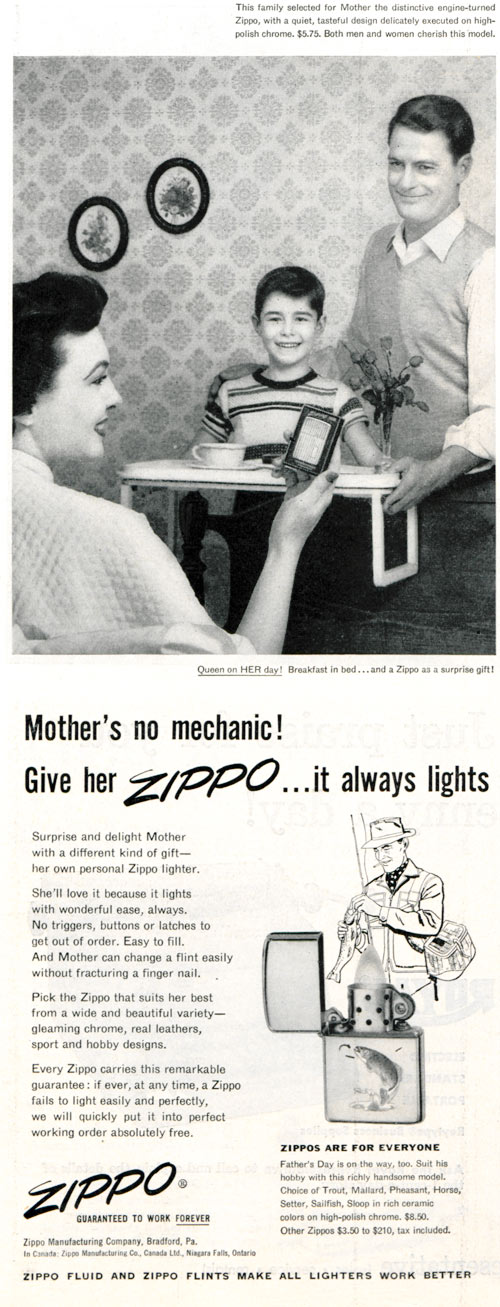
The Art of 1950s Party Planning
Author and chef Sara Hervey shares the essentials of a laid-back party, circa 1950: Benny Goodman swing; artfully sculpted coleslaw; and at least one hot dish.
—
Come and Get It
Originally published in The Country Gentleman, May 1, 1950
“Best party of the year.” That’s what the whole crowd will be saying about this informal “cook-your-own” supper.
Get set for a good time at this informal gathering of the gang, whether you’re giving the party or you are a guest. For any way you look at it, this means fun, with everyone getting into the act.
A self-appointed disk jockey will fill your requests for Benny Goodman swing, Calypso, or Dixieland jazz. You may be challenged to a game of darts or a fast set of table tennis. You’ll want to be ready with some bright ideas for charades or “20 questions.” And when it comes time to clear the decks for action from the kitchen, you’ll have a chance to help out with the food production.
For easy, informal entertaining the cook-your-own and serve-yourself plan works out well. It means less preparation beforehand for the hostess and good fun for the guests.
The “makings” for sandwiches can be arranged on a large platter so that each person can assemble his own, tailor-made to fit his own appetite. A tray of assorted breads gives guests a choice.
If an electric table grill or sandwich maker is available, hamburgers, frankfurters, luncheon meats, and cheese sandwiches can be grilled right on the spot. All the “trimmings” — slices of tomato, green pepper, and big sweet onions — can be arranged attractively on beds of lettuce on another large platter. And, of course, pickle relish, mustard, catsup, and seasonings should be on hand for those who want them.
One hot dish is always welcome. This might be the spicily seasoned Spanish Lima-Bean Casserole or it might be our Savory Potato Casserole, New England-style baked beans, baked macaroni and cheese, corn pudding, or Spanish rice. To be sure the food stays hot, an electric table casserole or a chafing dish is an asset.
A salad tray isn’t a must, but it’ll be appreciated by the more energetic members of the crowd. Mustard Cole Slaw [can be] packed in a ring mold for attractive buffet service.
Soda pop is kept well chilled in a tub of ice cubes or crushed ice. The brightly colored plastic mugs and the plastic-coated paper plates make housekeeping easy.
“Make-your-own” sundaes are bound to be a hit for dessert. A 2-quart or gallon carton of ice cream can be kept firm, when packed in a bucket of ice. A trayful of different sundae toppings, including whipped cream, cherries, and nuts, gives each person a chance to step up and order his choice of flavors.
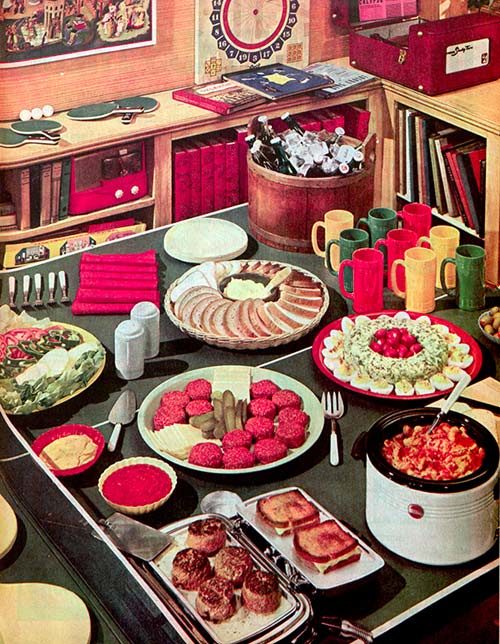
Spanish Lima-Bean Casserole
- 1 1/4 cups dried limas
- 5 cups water
- 1 large onion
- 2 tablespoons bacon fat
- 1 6-ounce can tomato paste
- 3/4 cup chili sauce
- 1/8 teaspoon red pepper
- 3/4 cup grated cheese
Soak Limas in water overnight. Salt the water and bring to a boil. Simmer until beans are tender, 21/2 to 3 hours Add more water, if necessary. Chop onion and saute in bacon fat. Add tomato paste diluted with 1 can of water. Blend in the chili sauce, red pepper and 1/2 cup of the grated cheese. Combine with the drained Limas, and pour into a greased casserole. Sprinkle the remaining cheese on top. Bake in a moderately hot oven (375° F.) 30 to 40 minutes, or until thickened. Makes 6 servings.
Savory Potato Casserole
- 6 medium potatoes
- 1 green pepper, chopped
- 1 large onion, chopped
- 1 cup grated sharp cheese
- 1 tablespoon flour
- 1 1/4 teaspoons salt
- 1/4 teaspoon chili powder
- 1 cup top milk
- 1/4 cup buttered bread crumbs
Cook potatoes in boiling salted water until almost tender. Cool. Slice thin. Combine with chopped green pepper, chopped onion, grated sharp cheese, flour, salt and chili powder. Turn into a shallow greased casserole. Heat milk and pour over potatoes. Sprinkle the top with but- tered crumbs. Bake in a moderate oven (350° F.) 30 to 40 minutes, or until thickened and browned on top. Serves 6 to 8.
Mustard Cole Slaw
- 3 1/2 cups finely chopped cabbage
- 1 small green pepper, chopped
- 1/4 cup chopped parsley
- 1/4 cup chopped celery
- 1 medium onion, chopped
- 1/2 teaspoon celery seed
- 3 tablespoons salad oil
- 3 tablespoons lemon juice
- 1 1/2 tablespoons prepared mustard
- 1 tablespoon sugar
- 1 teaspoon salt
Combine cabbage, green pepper, parsley, celery, onion, and celery seed. Mix salad oil, lemon juice, mustard, sugar, and salt together thoroughly. Pour dressing over chopped veg- etables. Toss until vegetables are well coated with dressing. If desired, pack salad in a ring mold and chill. The above recipe will serve from 8 to 10 persons.
Peanut Butter Sundae Sauce
- 1 cup sugar
- 1/2 cup water
- 2/3 cup light corn syrup
- 1/2 teaspoon salt
- 1/4 cup peanut butter
Combine sugar, water, corn syrup, and salt in a heavy pan. Bring to a boil and cook over low heat for 2 minutes, or until a small amount of syrup dropped into cold water forms a very soft ball (220° F). Remove from heat. Cool without stirring until syrup has reached room temperature. Add peanut butter and blend until smooth. This sauce keeps well when stored in a covered jar in the refrigerator. Makes about 1 1/2 cups sauce.
Marshmallow Cream Sundae Sauce
- 1 cup light corn syrup
- 1 egg white, stiffly beaten
- 1 teaspoon plain gelatin
- 2 tablespoons cold water
- 1 teaspoon vanilla
Bring corn syrup to a boil in a small saucepan, and cook over low heat until a small amount of the syrup dropped into cold. water forms a firm ball (246–248° F). Pour the hot syrup slowly over the beaten egg white in a bowl, beating constantly. Mix gelatin and cold water. Add to the hot mixture. Add the vanilla and beat until light. This sauce keeps well when stored in a covered jar in the refrigerator. Makes 1 3/4 to 2 cups of sauce.
Coffee-Butterscotch Sundae Sauce
- 2 tablespoons powdered soluble coffee
- 1/2 cup brown sugar, firmly packed
- 1/2 cup water
- 1 cup light corn syrup
- 1/4 cup butter or margarine
- 1/8 teaspoon salt
- 1/3 cup evaporated milk
- 1/2 teaspoon vanilla
Combine soluble coffee, brown sugar, water, corn syrup, butter, and salt. Bring mixture to a boil and cook slowly over low heat until a small amount of syrup dropped into cold water forms a soft ball (236° F). Remove from heat and cool the syrup slightly. Then add evaporated milk and vanilla. Serve hot or cold. This sauce keeps well when stored in a covered jar in the refrigerator. The above recipe will make about 1 3/4 cups sauce.
Favorite Chocolate Sundae Sauce
- 2 squares chocolate
- 1/2 cup water
- 1 1/2 cup dark corn syrup
- 1/8 teaspoon salt
- 1 teaspoon vanilla
Melt chocolate in water. Add corn syrup and salt, and simmer 10 minutes, stirring constantly until thickened. Add vanilla. This sauce may be served either hot or cold. This recipe makes about 1 1/2 cups sauce.
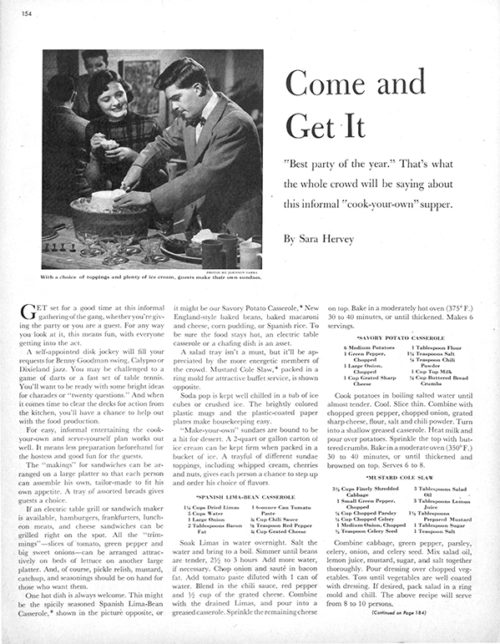
Among the Missing
My mother’s sister had 10 children, and that was one reason that I felt there were too many relatives to keep straight. Plus, of course, my father had siblings and they produced cousins, and everyone had family friends, some of whom were referred to as aunts and uncles, out of respect. If I complained about having to remember all these uncles and aunts, the ones who were blood or the ones who married in, my mother would shrug and say, “On any given day, how many people really matter to you? You’ll figure out who they are eventually — or they’ll go away.”
Her mouth got tight when she said, “or they’ll go away.” I knew she’d lost a baby. That lost baby was always there, in the background, lying quietly in her crib or sitting silently in a corner. I was very small when it happened, but I remember it in a kind of sideways way. At any rate, I filled the space of that lost baby; I had personality enough for two.
Not everyone is important all the time.
But everyone is important some of the time.
I made a little story about it.
I wrote it after my Uncle Reynard left his wife and their 10 children.
Once upon a time a man looked around and saw that he had too many children. He couldn’t keep them all straight and in fact he didn’t care to. His wife came from a family that didn’t divorce; as a consequence, he spent as much time away as he could, only coming home to sleep and, of course, beget another child. He had once had dreams, joys, aspirations, hopes. He no longer did. He clumped off to his job as a machinist, washed his hands with hard soap at the end of his shift, asked his coworkers who was doing anything that night and went with them. He handed over most of his pay, which never kept pace with the number of children, and kept just a small amount for himself.
His friends and coworkers knew he was the kind of man who could nurse a beer for the whole night; who ate only the cheapest things, whose feet got wet when it rained because his shoes were worn and holey.
Some of his children shrugged their shoulders and ignored him. These were the teenagers.
Some of his children climbed all over him on his day off. These were the young ones.
He left early and came home late. He showed up for family parties and grinned with his brother and sister, clutching a drink, happy to be with the adults he had known since he was a child. This was his true world.
Once upon a time, everything was in place for a bright and happy future. He had believed in marriage, he looked forward to it, he did his best with it, but in truth, he was not a man who loved children.
He hadn’t known that. He could have managed with one or two. He had 10.
One day, which was a day no different from any other day in terms of weather and commitments and getting dressed and drinking coffee — one day he just left. He went to work and nodded to his friends and took his paycheck (which he had worked for all his life and always given to his wife) and he left.
His wife wailed, and the children cried, but he was on a bus going out of town and he never heard them. For the first time in a long time, he smiled.
Post Travels: How to Have a Luxury Cruise Experience on a Budget
Cruising naturally takes many complications out of traveling. You unpack once, go to bed, and wake up in a new destination. Repeat the cycle over and over again, and you can cover a lot of ground, even on sailings that only last a week. And for savvy travelers, cruising is also a great way to travel on a budget.
Wallet-Friendly Travel
Eva Jenner, Vice President of Sales for Holland America Line, notes a cruise’s built-in advantage: “Cruising is a more affordable way of seeing a country or region than a land holiday. Take for example that countries such as Norway and Japan are fairly costly to travel in. Traveling by a cruise ship offers a way to make these more expensive destinations affordable.”
Food and lodging, two of the largest expenses associated with travel, are typically included in cruise fares. And if you do your homework and have flexibility with your travel dates, there are deals on sailings to be found. For instance, “Fall is a great time in terms of value,” according to Jamie Dee, Cruise Director on Carnival Paradise.
Included Eats
Luxury means different things to different travelers. While some might seek spa experiences and fancy linens, to others, daily breakfast in bed does the trick. A free room service menu is a perk available on a number of cruise lines, including both Holland America and Carnival.
It’s also common for cruise lines to offer optional specialty dining venues aboard its ships. High-end menus including steak, seafood and specialty cuisine often come with an additional fee. Though typically cheaper than what dining out might cost at home, if it’s not in your budget, you won’t feel deprived at sea.
Main dining rooms offer multi-course meals at breakfast, lunch and dinner. Can’t decide which dessert or appetizer to try? Order more than one. It doesn’t matter how little or how much you eat; it’s all included in your cruise fare. Though it’s never a good idea to waste food, having no restrictions often encourages travelers to step outside their comfort zone and try new things.
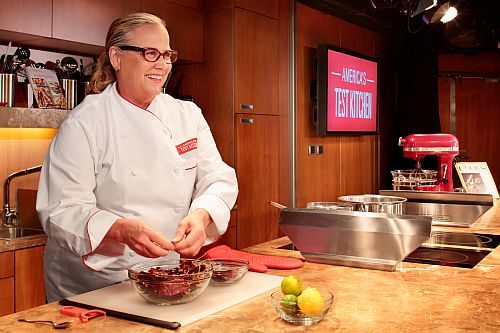
On sea days, Holland America serves formal afternoon tea, in addition to simpler dining options like burgers and tacos. Its Lido buffet serves up options ranging from sushi and gingerbread waffles to a salad bar with seared tuna. Carnival has built a name for the included food offerings they’ve added for cruisers over the years. Along with Mexican eatery BlueIguana Cantina, the line’s partnership with Food Network star Guy Fieri means travelers can now nosh on gourmet burgers and barbeque for no additional charge. Royal Caribbean offers a fun food truck concept with the Dog House, as well as a fun selection of international fare at Windjammer.
Drink Deals
Whether a drink package is a deal or not varies from one person to the next. If you’re more of a lightweight, happy hours and drink specials might be all you need. Some folks simply like the idea of the expense being prepaid and not having to think about it. Drink packages come in all sorts of varieties, covering everything from alcoholic beverages to soft drinks and bottled water. While some cruise lines allow passengers to bring one bottle of wine per person on board, most alcohol will be confiscated and returned at the end of the cruise. However, many lines do allow guests to bring non-alcoholic beverages like sparkling water, juices and sodas aboard. Norwegian Cruise Lines offers a free open bar option with many of its sailings.
Take Advantage of Free On-Board Activities
“All entertainment and onboard programming is part of the overall cruise experience. Guests have an array of onboard activities to choose from as well as multiple music venues and Broadway style shows – all included in the cruise price,” says Holland America’s Jenner.
Taking advantage of free offerings is key to keeping a cruise budget intact. A list of free activities and those that require a fee is printed in the cruise bulletin that is typically left in staterooms every evening by housekeeping staff. Some cruise lines’ schedules can also be accessed on-line or via cell phone apps for no additional cost.

Getting more for less is especially important for traveling families. Carrying 800,000 kids a year, Carnival ships offer plenty to keep young ones busy. “Entertainment options such as Lip Sync Battle, Hasbro, The Game Show, Playlist Productions, massive WaterWorks aqua parks and the Seuss-a-palooza Parade and Story Time – all are offered at no charge,” said Dee.

Royal Caribbean’s Oasis-class ships are packed with activities for kids, including rock climbing walls, ice skating rinks, zip lines, and surf simulators.
Though families are welcome aboard Holland America sailings, entertainment options focus more on live performances typically preferred by adult cruisers. Unique partnerships mean guests can enjoy an eight-piece band in the B.B. King’s Blues Club, or live chamber music performances at Lincoln Center Stage. America’s Test Kitchen boasts live cooking demonstrations, and the Microsoft Digital Workshop offers computer and technology classes.
Free activities are obviously popular. If you’re looking to ditch the crowds, pay particular attention to options offered on days when your ship is in port. You don’t necessarily have to skip going ashore; lingering onboard a little longer, or heading back a touch earlier is sometimes all it takes to have some of your favorite offerings all to yourself.
Booking Cruise Excursions Onboard Versus Independently
It’s often a better deal to book tours and excursions on your own, but there are risks involved with the cheaper price tag. Cruise ships aren’t known for waiting for straggling passengers, so on those rare occurrences when something goes awry, stress levels can intensify. Excursions booked on board come with the peace of mind that you’ll never be left behind. Plan accordingly, giving yourself plenty of extra time if you venture out on your own. If you’re the type that tends to worry, acknowledge it and act accordingly. You won’t have any fun out exploring if you’re constantly worried about getting back to the ship. And no one should have to worry when on vacation.
Mother’s Day: A Tribute in Classic Illustrations
An old Jewish proverb says that God couldn’t be everywhere, so He created mothers. And mothers do have certain godlike qualities. Not only do they give us life, but they are our counselors, confidantes, protectors, disciplinarians, and teachers. But for all their love and sacrifice, moms seldom get the recognition they deserve. In this gallery, the Post commemorates the fun — and just as frequently the frustration — that motherhood entails.
Never a Dull Moment
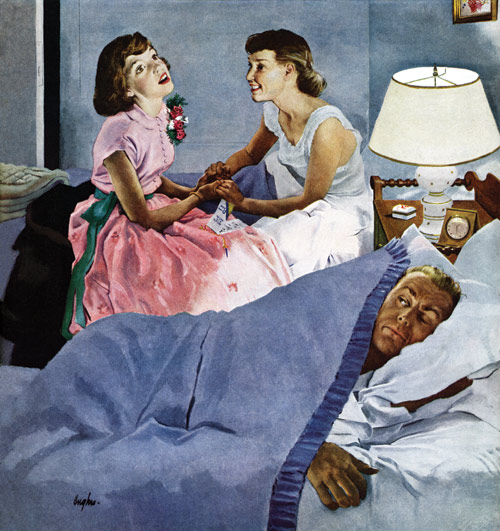
George Hughes
January 24, 1953
First date. An awkward and exhilarating rite of passage in a teen’s — and mother’s — life. Time stands still for the starry-eyed daughter (above) who can’t wait till dawn to riff about her big night out. Time also seems to come to a halt in the run-up to the big Gold and Green Dance (below). Can a boy survive his mom’s ministrations?
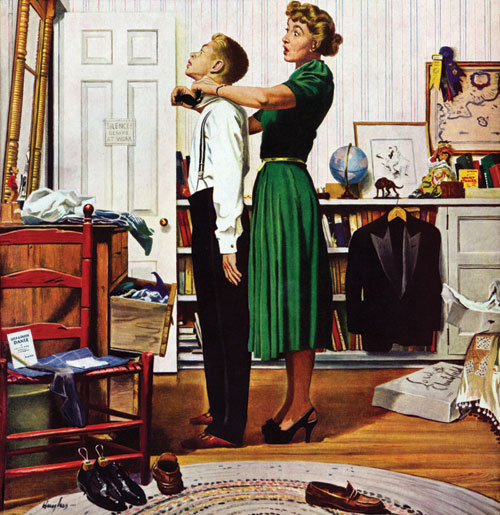
George Hughes
October 16, 1948
Stevan Dohanos
September 3, 1955

The doctor will see you now. A waiting room full of distractions keeps anxiety in check for some young patients and their moms, but clearly not for all.
Behind the Scenes
John Falter
April 18, 1953
Cooking up something sweet. A special surprise lurks behind the kitchen door courtesy of a culinary crew only a mom could love.
Amos Sewell
September 12, 1959
Morning glory. With the brood now safely off to school, this mom finally gets to kick back for some well-deserved “me time.”
It’s the Thought That Counts
Constantin Alajálov
May 10, 1947
What to buy? 1940s-era stereotypes about the limits of a mother’s desires seem to have narrowed a daughter’s options.
Richard Sargent
May 11, 1957
Good news, bad news. Wet, muddy, and full of enthusiasm, a boy and his dog announce a “special delivery”.
Ideas for an Old-Fashioned Mother’s Day Brunch
Fifty years ago, Sara Hervey boiled breakfast down to its essence: Fruit. Main dish. Bread and/or cereal. Beverage.
Below you’ll find four takes on Hervey’s “hearty breakfast pattern,” as well as a few hidden gems: dishes for “party breakfasts” (aka brunch), the art of egg scrambling, and a how-to on “extra-fluffy French toast.” Enjoy!
—
Top of the Morning
Originally published in Country Gentleman, January 1, 1948
What a pity it is that so many folks feel they must grab breakfast on the run — a glass of fruit juice (if they’re lucky), a slim piece of toast, and a gulp of coffee. Breakfast is my favorite meal of the day, and please give me plenty of time to enjoy it leisurely. There have been a lot of rules made about what makes up a good breakfast, but if it’s hot and hearty you’ll probably have passed the test with both your family and the nutrition authorities. We had a lot of fun preparing these four traditional breakfasts from different parts of the country. Comments from the photographic crew varied from “Boy, is that a whopper!” to “Oh, I eat that much every morning.”
That brought up the question, “Just how big is a good breakfast?” There’s no hard-and-fast rule, but if you serve from one-fourth to one-third of the day’s food at breakfast, you’re apt to end up the day with a pretty good score nutrition-wise.
By following this hearty-breakfast pattern, you can keep the morning meal as varied and full of interest as any of the succeeding meals:
Hearty Breakfast Pattern
- fruit starter
- main dish
- cereal and/or bread
- beverage
Traditional Menus
Southern
- broiled ham slice with orange
- hominy grits
- ham gravy
- hot biscuits
- honey
- coffee
 New England
- New England baked apples
- codfish cakes
- baked beans
- broiled bacon
- toasted Boston brown bread
- coffee



Pennsylvania Dutch
- oatmeal with stewed apricots
- scrapple
- broiled tomatoes
- scrambled eggs
- Dutch coffee cake
- coffee
All American
- broiled grapefruit with jelly
- fried eggs
- country-fried potatoes
- griddlecakes
- pork sausage
- toast
- coffee
Fruit Starter
The day always seems a little more friendly to me after I’ve put away a glass of orange juice or a half grapefruit. I love the stuff. And if you really want to feel smug about the whole thing, you can always think of the large share of vitamin C you’re getting. Don’t strain citrus juice if you would get the most vitamins and minerals from it. There are other juices, too, which will add zest to the breakfast meal. Include cranberry, apricot, prune, plum, grape, and tomato juice occasionally for variety.
Spiced, baked winter pears, prepared the day ahead and served cold with cream, make a delightful breakfast treat. Make a sirup of 1/2 cup of brown sugar, 1/2 cup of granulated sugar, 2 cups of water, 6 cloves, and 2 sticks of cinnamon, cooking until the sugars are dissolved. Place 6 pears upright in a baking dish and pour the sirup over. Bake in a slow oven (325° F) 1 1/2 hours.
Baked apples, New England style, are filled with sparkling red cranberry sauce. Wash and core the apples. Pare the skin 1/3 of the way down. For 6 to 8 apples, boil together 1 cup of sugar and 1 cup of water for 5 minutes. Pour the sirup over the apples in a baking dish, and bake uncovered in a moderate oven (375° F) 25 to 30 minutes, basting frequently. Remove from the oven and fill centers with cranberry sauce. Place under the broiler and continue to baste with sirup until the apples are well glazed.
Main Dish
The big attraction of your breakfast meal may be any good protein food, such as meat, eggs or fish. The Pennsylvania Dutch favor scrapple fried crisp and brown and served with sirup, a tart jelly, or fluffy scrambled eggs. You can make a very excellent scrapple by mixing pork sausage with cornmeal mush. To 4 cups of rapidly boiling salted water, slowly add 1 cup of cornmeal, stirring and cooking until the mush is thick, about 15 minutes. Mix in 1 pound of pork-sausage meat. Pack into a loaf pan and chill. To prepare for serving, slice into 1/2-inch slices and pan-fry until well browned.
When it comes to egg cookery, take it slow and easy. Very slow cookery is the first rule for successful cooking of eggs, and all types of protein foods, for that matter. Scrambled eggs, for my money, should be served hot and light and fluffy.
Either cook the beaten eggs in a heavy fry pan over low heat or over boiling water, stirring lightly until just set. And for a slightly different taste treat, try adding a dash of Worcestershire sauce, a little sliced pimiento, and a little finely chopped chives, along with the salt and pepper.
In addition to the popular breakfast meats — bacon, Canadian bacon, pork sausage, and ham — occasionally vary your menu with shredded dried beef, frizzled in butter until crisp. Or perk up family appetites with thin slices of well-browned liver along with the breakfast bacon. For Sunday morning or party breakfasts, pan-broiled thin lamb or pork chops, or cube beef steaks, give the meal a festive air.
One of our favorite party breakfasts includes Canadian bacon served Hawaiian style. Pan-broil thin slices of the bacon until well browned. Place 3 slices on a round of toast, and surround with cubed, canned pineapple which has been browned in butter. Melt a small glass of currant or mint jelly in the pan used for the bacon, and pour about 2 tablespoons over each serving.
Cereal and/or Bread
It’s fun to serve the cereal in a big colorful soup tureen. Let the family help themselves, and provide toppings of fruit, chopped nuts, jelly, or butter.
And here’s a hint for making extra-fluffy French toast … Separate the egg yolks from the whites; beat the egg yolks well, add seasonings and milk; then fold in stiffly beaten whites. Dip the bread in this mixture and fry as usual.
Beverage
If you like your breakfast coffee as well as I, there’s little to say except to remind you to make it fresh, serve it hot, and have plenty. Hot chocolate or milk for the children — and the grown-ups, too, if they like.
