3 Questions for Nick Nolte
Three questions for Nick Nolte? His mind just doesn’t work that way; when you ask him just one question, you get a thousand answers! Nolte plays by his own rules, but he’s much more together than his unconventional reputation suggests, and he readily confesses that sometimes he just “makes things up” about himself. The three-time Academy Award nominee probably comes closest to the truth in his autobiography, My Life Outside the Lines.
Nolte reveals that he’s been extremely shy since he was a kid and never feels comfortable as part of a group. Growing up, he stood out because he was a good football player who dressed and spoke outrageously. When it comes to his enduring career as a famously intense and unpredictable actor, there are legendary tales about his on-set obsessions and how far he’ll go to portray a character. (People still talk about him sleeping on the streets and eating dog food for Down and Out in Beverly Hills.) He fascinated audiences in a wide range of films, from The Deep to 48 Hours to The Prince of Tides and Affliction.
Now, Nolte is working on the film Honey in the Head, playing a grandfather with Alzheimer’s. His co-star happens to be his own 10-year-old daughter.
Jeanne Wolf: In spite of all your great work on the screen, you took lots of chances and sometimes messed up very publicly. A lot of fans think you’re wild and crazy or at least untamed. True?
Nick Nolte: Well, I don’t have a drug problem. I’ve been relatively clean outside of prescription stuff for years. The only time I got hooked was with alcohol. I was in my 40s and I realized that I gotta stop drinking. I just didn’t know how to do it. I got into AA and learned that you can stop, but you need some help.
I encouraged my reputation. Never want to be boring. I knew right at the beginning when I started doing things that were attracting attention that it was better to be naughty than nice. What are you going to say when they talk to you about a film? “We all worked very hard on this; we all love each other”? I would enter the interview with my beer and I would tell them about my third wife and how I met her in the circus, the highwire act. Then, of course, I’d say, “I lie.”
I still tell lies, so some of it will be true and some of it won’t. I’m really not good at real life — to sit around and do nothing is really not something I tolerate at all. I get too anxious. I need to be goal-oriented. I’m not considering retirement. I’m going to work if there are good stories. I’m going to work until I can’t.
JW: Now you’re going to play a man suffering from Alzheimer’s in Honey in the Head. Do you find that a little unsettling?
NN: I admit that, at first, I was leery to get too near to it. It gets scary because as you age, you do forget things. I saw it in my family. My mother would call my grandmother “charmingly vague.” We knew about dementia, but Alzheimer’s wasn’t really discovered yet. By the end of the movie, my character forgets everything. I wanted to go observe in a home but I didn’t want to intrude. There are a lot of videos online with people showing their relatives, and I’ve learned that way.
It’s great that my daughter, Sophie, will be playing my granddaughter. The director of the film saw the way we interact and he asked me if she could do the part. Soph right away said, “Yeah. I wanna do it. We’ll have a lot of fun hanging out together.” She is kinda like this little grown-up. Sometimes she calls me Grandpa instead of Daddy because all of her friends’ fathers are young. I’m pushing 80. My son Brawley is in his 30s. He did some acting, but that’s not what he wanted. He’s studying to be a doctor.
JW: How would you describe yourself as a father?
NN: I’m real tolerant. Probably not the best thing in the world, but I bond heavily with my children. Being a parent is my most important responsibility. I do get in trouble with their mothers. My mother and father allowed me freedom. They allowed me to fail. They allowed me to get bruised. They didn’t hold onto me so tight. By failing, you get a chance to learn.
You grow into your own individualism. It takes a while to find it. I think in general, in this culture, you go to high school, you go to college, you get married, you have a baby. Wow. That’s a recipe for disaster.
As for being old, I don’t regret it at all. I’m not having much difficulty with age. I’m really kind of comfortable with it, knowing that there’s one more big adventure to do. It’s kind of spooky, but I accept it. You fight like hell right up until the last. I think you just have to keep moving and keep doing it.
An abridged version of this interview appears in the May/June 2018 issue of The Saturday Evening Post. Subscribe to the magazine for more art, inspiring stories, fiction, humor, and features from our archives.
—Jeanne Wolf is the Post’s West Coast editor
Preserving America’s World War II POW Camps
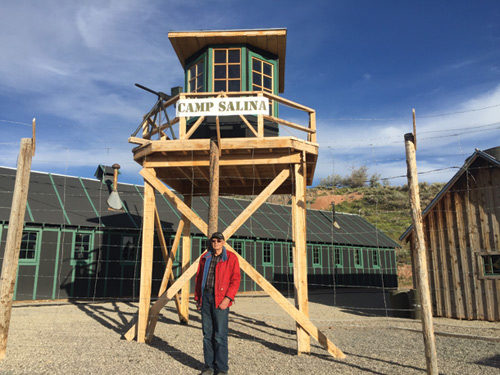
Tami Olsen had never noticed two dilapidated buildings in her small town of Salina, Utah, until the mayor asked her father to restore them. “Dad was like, ‘Okay, awesome, we have a project,’” Tami recalls. “And he just said ‘we.’” Suddenly Tami and Dee Olsen, an octogenarian retired engineer, were deep into a two-year project restoring a World War II prisoner of war camp that once housed 250 German prisoners. Now Camp Salina is open as a museum reviving this mostly forgotten piece of American history. Local families donated artifacts from the camp’s POW days, including artwork and letters from prisoners who kept in touch long after armistice. One of the museum’s prized possessions is a jewelry box a prisoner made from matchsticks and Popsicle sticks.
Letters? Gifts? Visitors are often surprised by the friendships struck up between locals and POWs. But this wasn’t unique to Salina. All over the country, in more than 550 camps holding 425,000 enemy combatants, Americans and their prisoners forged bonds.
“Prisoners brought to this country were treated quite well,” says Arnold Krammer, history professor and author of Nazi Prisoners of War in America. “They weren’t put in concentration camps. Camps were dictated by the Geneva Conventions.” It helped that many Americans had German roots. “So many Americans are of German heritage. They were so much like us racially, and our languages are quite similar.” In contrast, Japanese prisoners were generally isolated.
Since healthy young American men were away at war, prisoners were vital for harvesting crops and doing other hard physical work. Farm labor proved easier than fighting, and the food was much better. Karl Heinz Oehlmann wrote home to his family from Camp Opelika, Alabama, in 1943, practically gushing about the food: “We have cake almost daily, all kinds of fruit, Kellogg’s flakes with milk, roasts, salads, real coffee, crackers, etc. I often think how all of you would rejoice, and how urgently the children need it all. Today we have 3 large, fat pancakes and an omelet just as a side dish.”

Prisoners felt guilty about eating so well. “It’s hard to believe, but while people were starving back in Germany, we were using flour to line our soccer fields,” Josef Krumbachner, a POW at Camp Como in Mississippi, said in an oral history interview.
Why was our enemy treated with such kindness? The U.S. military was concerned about its 94,000 American prisoners in Germany, Krammer says. “We felt erroneously that as well as we take care of their prisoners, they’ll take care of ours.” He paints a surprisingly pleasant picture of the life of a German POW in an American camp, including garden clubs, dances with local girls, educational programs, lunches with farm families, even permission to drink alcohol.
This is an excerpt of an article featured in the May/June 2018 issue of The Saturday Evening Post. Subscribe to the magazine for more art, inspiring stories, fiction, humor, and features from our archives.
Teresa Bergen is a Portland-based writer who specializes in travel. She’s the author of the book Easy Portland Outdoors (Reedy Press, 2018).
North Country Girl: Chapter 48 — The Accidental Model
For more about Gay Haubner’s life in the North Country, read the other chapters in her serialized memoir.
James and I were on our way back to Mexico, driving his El Dorado from Chicago to Acapulco, probably the only time a Cadillac has been used as economy transport. After escaping from the police in Dallas, it was a relief to finally see the signs telling us the Mexican border was near — no more Texas! At the border crossing we were greeted with no more than the usual stares at the sight of a forty-three-year-old man and a twenty-one-year-old blonde in a new El Dorado covered in a layer of Texas dust; border patrol officials on both sides spent more time looking at us than at our passports.

As soon as we crossed the border, James, who had driven though most of Texas, pulled to the side of the road, slumped over, and mumbled that he had to get some sleep. We switched seats, I took over the wheel, and I drove into bedlam. Gone were the smooth, well-maintained US highways. I had to swerve into the other lane or the shoulder to avoid potholes that would have swallowed up the Caddy. There were also: long stretches of road that no one had gotten around to paving, men on horseback, kids leading burros, cows, pick up trucks carrying gigantic, loosely tethered cargo, buses with people riding on the top, flatbed trucks with 60-foot logs rattling away, more cows, dead dogs covered with frightening black clouds of vultures, and barefoot vendors with peeled oranges, bags of soft drinks, tamales, back scratchers, and loose cigarettes, all standing way too close to oncoming traffic, and sometimes even in the middle of the road. All of these nightmares were shrouded in a smog of exhaust and dust particles that hovered a constant three feet off the ground.
I had a death clutch on the steering wheel, but managed to pry my right hand loose, reach over, and switch off Linda Ronstadt. Music was too much of a distraction, and how many times had I heard “Blue Bayou” on this trip already? It was just as hard to tear my eyes from the hellish road; when it finally seemed safe, a quick glance showed me a James dead to the world, snoring slightly, mouth dangling open, looking quite a bit older than forty-three. My eyes and hands and mind fixed to the task at hand.
I drove for hours, deep into the Sonoran desert, where the traffic and the villages thinned out and I realized I had been clenching my jaw and my sphincter way too tight. The sun was setting to my right, a golden yolk dropping behind distant hills, setting the desert on fire. For a few minutes, everything was lit like a J.M. Turner painting, only a lot more arid. But here was night, drawing across the sky like a dark blue blanket, and then everything went black. I turned on the headlights and quickly switched to high beams, which flickered weakly through the still settling dust.

I noticed that the El Dorado seemed to be the only car going in either direction that had a working pair of headlights. Most drivers felt that the light of the moon was all the illumination they needed, while some cars had a single, dim headlight; I had to guess if it was the right or left one. It was like an awful game of chicken in some black and white teen movie. I crept along as far to the right of the road as possible, hoping no one was out for a stroll along the highway at seven at night, till I saw the flickering of a Vacantes motel sign. I didn’t care about cleanliness, price, nothing. I wanted out of the car.
After a night spent in an iron bedstead and a breakfast of tortillas and beans washed down with Nescafé, I said to James, “I am never driving in Mexico, day or night, again.” James teased me as a coward, and did the day’s drive, which was uncannily identical to the one the day before, with as much aplomb as if he had been toodling down Chicago’s Lakeside Drive. But that evening, when James got to experience the odd penchant Mexicans have for driving through the pitch dark countryside with their headlights off, he surprised me by pulling into a motel after only eleven hours behind the wheel.
By late afternoon of our third day in Mexico, we were winding up the mountains behind Acapulco, chasing the last rays of sun vanishing off in the west. We crested the top, and there, slipping in and out of sight as we made the hairpin turns downward, was Acapulco Bay, just visible as a silvery gleam separate from the velvet sky, where a thousand lights sparkled. James sighed, smiled, and reached over to take my hand. We were back.

It only took a few hours for James to find a place for us. Our home for the next few months was not oceanfront; it was even farther up the hill than the apartment I had shared with the three French Canadian girls. The building looked like a motel. Three blocky two-bedroom units shared a single umbrella table, four lounge chairs, and a shallow little pool that did have an eye-popping view of Acapulco. The other two units stood strangely empty the entire time we lived there. Our rent included daily maid service. A tiny, silent woman came in every morning, made us coffee, cleaned the apartment, took away our dirty laundry, and always asked if we would like lunch. James couldn’t or wouldn’t think ahead to meals, but once she left us a plate of chicken sandwiches that was one of the most delicious things I have ever eaten.
James and I fell back into last winter’s languid pleasure-seeking days, with only a few modifications. His budget did not allow for a season’s membership at a private beach club or for daily water-skiing. James shrugged off these deprivations without losing too much of his self-esteem. “Next year,” he told me.
When I had first met James he could go days without checking his portfolio, confident that his stock picking acumen meant that there was nowhere to go but up. Now every morning we drove down to the Sheraton’s newsstand, where James bought yesterday’s New York Times, lit a cigarette, and nervously tore through the papers to the stock market quotes.

James’s mood depended on that day-old news. If his stocks were down, he was furious with frustration: he had no way of contacting his broker other than waiting in line for hours at the sweltering office of the inept Mexican telephone company to make a long distance call. On those bad days I could look forward to hours of James taking on all comers at backgammon at the Villa Vera. He believed he could recoup some of his stock market losses by gambling, and he was desperate to prove to himself that he was a winner. He did win a lot, having the sharpie’s eye for novice players who were easily scalped, or blowhards who James taunted into making stupid moves and accepting hopeless doubles. His obsession left no time for meals. I spent those days at the Villa Vera swim-up bar, trying to fill up on bullshots (vodka and beef consommé), and wondering what our Mexican maid would have served for lunch.
The blessed days his stock posted a bit higher, the old preening, confident James reappeared. On one of those mornings James looked up from the business section with his vulpine grin and said, “Let’s have breakfast.” He took the paper and me to one of the Sheraton’s palm-shaded beachside tables, where I devoured a cheese omelet and everything in the bread basket, just in case. James was scribbling on the stock quotes and I was licking the last delicious buttery crumbs off my fingers, when a good-looking man, American by haircut, demeanor, and madras shorts, walked up to the table and introduced himself.
He was the director of a commercial promoting Mexican tourism and the model they were supposed to be filming that day hadn’t shown up. The director asked me, “Would you like to be in the commercial? I can pay you a hundred dollars. All you have to do is run back and forth on the beach for an hour.”
James piped up, “Yes, she’d love to!” while I felt a sharp pang of regret about the four buttered rolls I had just eaten. I was wearing nothing but my cute bronze bikini, a shade darker than my skin, held together in strategic places by golden rings.
I followed the director down to where the waves frothed on the shore. It was the perfect Acapulco day, so gloriously sunny and balmy that it would inspire any snowbound Midwesterner to immediately start packing his bags.
The director pointed up and down the beach, in case I didn’t know where it was, said “Okay, start running,” and then yelled something at the cameraman. I ran, hopped, skipped, splashed, smiled, waved, and jumped around like an idiot, followed by the cameraman and the director, who kept yelling “Happier! Look happier!”
James stayed back at the Sheraton, stretched out on a lounge chair, admiring his handiwork each time I ran by. When it was over the director handed me a hundred dollar bill and promised to send me a copy of the commercial. At least I got the money. I saw the commercial once on TV, and only recognized it because my first thought was, “Hey, I have that same bikini.”

My sudden and accidental elevation into a professional model was a bigger boost to James’ ego then it was to mine. At the Villa Vera, he called me up from my swim-up bar stool to introduce me to yet another backgammon pigeon, saying, “This is my girlfriend, she’s a model.” James beamed as if he had sculpted me himself, a wolfish Pygmalion, and stroked my butt for good luck. Look, he was signaling his opponent, look at me, lucky and successful, a winner with a sexy young girlfriend. And now I’m going to beat the pants off you. Most of the time, he did. I was rewarded for my supporting role with thin gold chains for my wrist and neck, bijoux de plage, the sales lady said, simple and elegant. I still thought the uncut emeralds would look just fine on the beach.
For a few weeks, as his stocks kept ticking upwards, James gleefully slaughtered all comers at backgammon, and we were back in the Acapulco groove, as if no time or money had been lost, back to waterskiing in the morning, afternoons at Le Club (our entry into this private, posh oasis bought by James with a folded bill discretely palmed to the maitre d’), Carlos ’N Charlie’s for drinks and dinner if James was eating that evening, then always, always dancing at Armando’s.
It was the last good time.
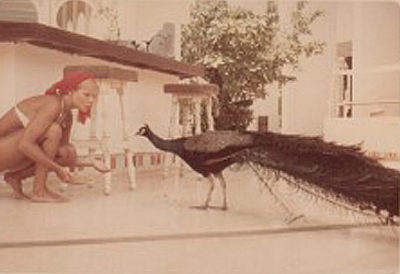
One morning, James opened the New York Times to the stock pages and a black cloud covered his face and mood. This cloud did not blow away, but grew heavier and more ominous each day. There was nothing I could say, nothing I could do, except that hope tomorrow’s news would be better. It wasn’t, and neither was the next day’s. There was nothing James could do either, except watch his fortune evaporate. There was no more waterskiing, no more afternoons watching the peacocks strut around Le Club’s enormous pool. James got up in the morning, threw back his coffee, and headed straight for the Villa Vera. In their shadowy backgammon room James challenged his opponents to higher and higher stakes and became aggressively reckless with the doubling cue. It didn’t matter if he was winning or losing, I couldn’t bear to watch. I was grateful whenever James forgot to call for his lucky charm before facing a new opponent.
It didn’t seem possible, but meals became even more irregular. I looked in the mirror: I was model-skinny. James went from thin to cadaverous. Even though the sun shone every day, we carried our own bad weather with us. The fun, the glamour, were gone. We didn’t dance any more; James showed up nightly at Armando’s because that was what a happening guy in Acapulco did. He watched the happy couples on the dance floor and threw back vodka and sodas. I held my hands over my flip-flopping empty stomach and tried to figure out what would happen next.
It did not surprise me when James turned outlaw. There was always something felonious about him, a suspicion that there was a crime in his past or in his future.
Enough of winter had passed that it was safe for James to go back to Chicago without loss of face. He began planning our drive north, a plan that now included drug smuggling.
The World’s First Bad Acid Trip
The world’s first bad acid trip happened 75 years ago in northern Switzerland.
In 1938, chemist Albert Hofmann was working with alkaloids of ergot, a rye fungus responsible for several epidemic-like poisoning events throughout European history, when he synthesized lysergic acid diethylamide (LSD-25). Hofmann was trying to create new obstetrics medicines, and his LSD-25 seemed to have little scientific use. Nevertheless, on a whim, Hofmann synthesized it again five years later. How the substance was first absorbed into his bloodstream remains a mystery, but it set off a psychedelic revolution that would eventually transform pop culture and technological innovation forever.
Upon returning home from his lab on April 16, 1943, Hofmann lay on his couch and closed his eyes to experience an “uninterrupted stream of fantastic pictures, extraordinary shapes with intense, kaleidoscopic play of colors,” according to his 1979 memoir LSD: My Problem Child. The curious intoxication so intrigued Hofmann that he planned a series of secret, intentional experiments with the drug.
The first of these experiments took place three days later. Hofmann was riding a bicycle home from his laboratory —accompanied by his assistant — when he began to feel the hallucinatory effects. They had cycled because of wartime restrictions on automobiles, and Hofmann’s trippy ride is still commemorated by psychedelic enthusiasts who celebrate “Bicycle Day” on April 19th (a concert this year in San Francisco will feature an electronic band called Shpongle). Returning home, Hofmann requested milk from his neighbor who, in his state, appeared to him “a malevolent, insidious witch with a colored mask.” The comforting familiarity of his living room had given way to a nightmarish scene of threatening forms, and, as Hofmann noted, “Even worse than these demonic transformations of the outer world, were the alterations that I perceived in myself, in my inner being.”
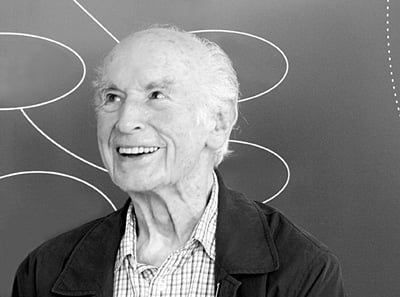
Hofmann believed he was going insane or, perhaps, dying. His assistant called on the family doctor, who arrived after the worst of his freak-out had subsided (and after Hofmann had drunk more than two liters of milk). His doctor pronounced him to be perfectly fine. Hofmann slowly regained his sense of reality and, the next day, reported a renewed clarity and enjoyment of life. His most earnest insight from tripping was learning that “what one commonly takes as ‘the reality,’ including the reality of one’s own individual person, by no means signifies something fixed, but rather something that is ambiguous — that there is not only one, but that there are many realities, each comprising also a different consciousness of the ego.” He was fascinated with the drug’s ability to change its user’s state of consciousness without disrupting the ability to record and retain information. Hofmann had an out-of-body experience, and he remembered it all.
The most astonishing characteristic of LSD, according to Hofmann and his colleagues at the time, was that it could deliver such profound psychological effects at such a low dose (fractions of a milligram). Hofmann’s results were “replicated” in the scientific community, and 20 years later Timothy Leary was passing the stuff out like candy at Harvard.
Hofmann was wary, however, of the widespread, uncontrolled use of powerful psychedelics. When he met Leary, in 1971, he expressed regret that the publicity of the former Harvard professor’s LSD proselytism among American youth had ruined the possibility of psychedelics’ having a role in academia in the states. Hofmann held hope that acid could aid in psychiatry, and indeed save the world, up until the end of his 102 years. But he never deluded himself with regard to his creation’s darker potential. After all, he had experienced it firsthand.
A result of psychedelia that perhaps no one could have predicted was the tech boom. At least, that’s a connection that John Markoff makes in his book What the Dormouse Said: How the Sixties Counterculture Shaped the Personal Computer Industry. According to Markoff, most of the Bay Area engineers and programmers behind computer development and research in the ’60s were no strangers to LSD. Douglas Engelbart, who first conceptualized the mouse, took part in acid tests with the International Foundation for Advanced Study along with early pioneers of virtual reality and Cisco developers. Even Steve Jobs, the famous Apple founder, regarded tripping as one of the most important experiences of his life.
The year before he died, Hofmann wrote a letter to Jobs imploring the tech giant to “support Swiss psychiatrist Dr. Peter Gasser’s proposed study of LSD-assisted psychotherapy in subjects with anxiety associated with life-threatening illness.” Hofmann had read about Jobs’ formative LSD encounters. “I hope you will help in the transformation of my problem child into a wonder child,” he wrote. Though Jobs responded to the inquiry, he never donated to the cause.
Though LSD may only seem to be a cultural symbol frozen in time for many, the aforementioned Dr. Peter Gasser’s study has commenced. It has found that LSD therapy helped reduce anxiety by about 20 percent in a group of terminally-ill patients. A new era could yet be in store for the peculiar wonder drug, while, for some, it never went away. From the original Bicycle Day to Burning Man, acid has established itself firmly in the culture — and consciousness — of the Western world in its 75 years of existence, for better or worse.
Remembering Barbara Bush
The Saturday Evening Post was saddened to learn of the passing of First Lady Barbara Bush, wife to President George H.W. Bush and mother to George W. Bush.
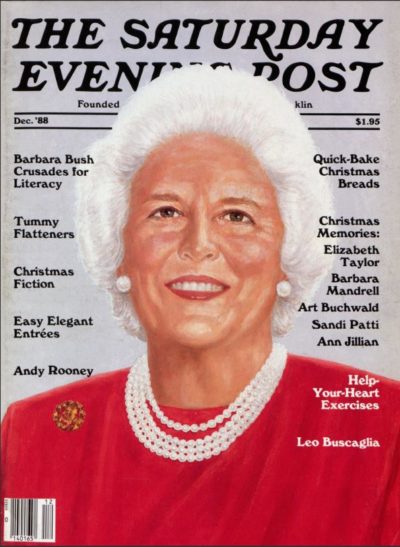
An illustration of Mrs. Bush graced our December 1988 cover. Inside, we featured a story of her tireless efforts to fight illiteracy. She became involved with literacy when her husband became vice president in 1980, and her efforts and influence grew from there. She endorsed and supported the Project Literacy U.S. campaign, served on the board of Reading Is Fundamental, and convinced the McGraw-Hill CEO to devote his retirement years to literacy. Shortly after this article was published, she launched The Barbara Bush Foundation for Family Literacy.
The story also illustrates many of the qualities that Mrs. Bush was known for: “Warm and unpretentious, she is skilled at putting people at ease, not in a calculating way, but because it is natural for her. She is moved by people and their hopes and fears and joys and problems. Most of all, she is moved by new learners, by their courage and determination.”
Your Weekly Checkup: New Recommendations on Drinking Alcohol
“Your Weekly Checkup” is our online column by Dr. Douglas Zipes, an internationally acclaimed cardiologist, professor, author, inventor, and authority on pacing and electrophysiology. Dr. Zipes is also a contributor to The Saturday Evening Post print magazine. Subscribe to receive thoughtful articles, new fiction, health and wellness advice, and gems from our archive.
Order Dr. Zipes’ new book, Damn the Naysayers: A Doctor’s Memoir.
Two months ago, in my column about red wine, I noted that the American Heart Association endorsed a safe alcohol consumption of no more than one to two drinks per day for men and one drink per day for women, while the Canadian Center for Addiction and Mental Health considered low-risk alcohol consumption to be up to three drinks per day for men and two for women.
Because of these inconsistencies about the effects of alcohol, I recommended erring on the low side. A recent study supports that view and halves the suggested safe amounts to less than one drink a day for men and women. The investigators analyzed information from almost 600,000 participants and found that those who had one drink a day or less had the lowest risk of dying. Those who drank more one drink a day had reduced life expectancy with increased risk of stroke, coronary disease (excluding heart attacks), heart failure, and fatal hypertensive disease. Alcohol consumption was also associated with higher risks of cancers of the digestive tract and breast. The authors estimated that men who reduced long-term alcohol consumption from two drinks a day, recommended in US guidelines, to one drink a day or less enjoyed one to two years of longer life expectancy at age 40 years.
This study, though quite robust, shares the limitations of any observational study, including outside influences that change the effect and conclusions, unreliable reporting of actual alcohol consumption, reverse causality (for example, those at risk of dying maybe drank more alcohol) and other factors. I find it curious that alcohol consumption was associated with a lower risk of nonfatal heart attacks (perhaps by elevating the “good” cholesterol) but a higher risk of stroke, coronary disease and mortality, and that there was no difference between men and women.
The impact of alcohol on health can be quite variable from one individual to another because of many factors such as body weight and sex, medications, overall health, and rate and types of alcohol consumption. Finding a magic number applicable for everyone is impossible. I ended the previous column with the same advice I will repeat here: err on the low side, but, as Oscar Wilde said years ago, “Everything in moderation, including moderation.” Pundits often reflect that it’s not how long you live but how you live long that’s important.
“The Wasted Headline” by Irvin S. Cobb
Veterans of the newspaper game whose memories of active affairs in print shops run back for so far as two decades should have no trouble in fixing chronologically the period when there befell the thing of which I mean to tell. For the time of it was the time when yellow journalism, having passed its pumpkin-colored apogee, was by slow gradations fading to a saffronish aspect. Mind you, I’m not claiming that it yet was not very yellow in spots, for in spots it was — and to a somewhat lesser degree still is — but generally speaking the severity of the visitation had abated, as though a patient, having been afflicted for a spell with acute jaundice, might now be said to be suffering merely from biliousness.
It still, though, was in the day of the signed statement; the day of the studhorse headline; the day when the more private a man’s affairs might be the more public they were made; the day when today’s exclusive expose would he tomorrow’s libel suit and day after tomorrow’s compromise out of court.
Oldsters of the craft will remember how the plague started, and how as a sort of journalistic liver complaint it spread through the country so that newspapers both great and small caught it and broke out with red ink, like a malignant rash, and with weird displays of pictures and type, like a madness. There were certain papers in certain cities which remained immune, for the owners of these papers being conservative men or having conservative clienteles — which came to the same thing — took steps to quarantine against it, so to speak, and thus escaped catching the disease. But The Daily Beam did not have to catch it; it was horn with it, the lusty child of a craze for sensation and a plague for freakishness. And Jason Q. Wendover, its owner, was its Allah; and Ben Ali Crisp, its city editor, was his prophet.
Behind his back his staff called him Ben Alibi; to his face they called him Chief. Ask any man who broke into big-town newspaper work along about the time, say, of the Spanish-American War if he recalls Chief Crisp; and then sit back and prepare to hear tales of journalistic audacity, of journalistic enterprise and of journalistic canniness, all of them smeared and drippy with the very essence of yellowness. If he knew how to suck eggs and spew the yolks abroad he likewise knew how to hide the shells afterward, a gift which made him all the more valuable to The Daily Beam and to its proprietor, as shall develop.
There was the time when the exposures about the treatment of the prisoners confined in the State Home for Wayward Girls at Wilfordshire first came out. Other papers were content to print page long accounts of the testimony offered before the commission of legislative investigators to whom the inmates one after another described how they had been triced up to their cell gratings with their arms drawn tautly above their heads and their feet barely touching the floor; and how for lesser breaches of discipline they had been balled and chained or ducked in ice-water baths or locked up for solitary confinement in sound-proof cubicles. It made good reading. Charges of cruelty in reformatory institutions always have made and always will make good reading. But the inspiration of Ben Ali Crisp carried him beyond the mere publishing of the testimony and the mere interviewing of the superintendent and the accused keepers. Any city editor worth his salt knew enough to send good reporters to the hearing and with spread and layout to play up what copy the reporters sent back from the town of Wilfordshire. What did Crisp do?
Here’s what: One morning he had Lily Simmons report to him at eight o’clock instead of nine, which was her regular hour for coming on duty. To quote the sporting desk, Lily Simmons was his one best bet as a woman special writer. She weighed about ninety pounds, was a stringy little budget of nerves and nerviness, and she drew down ninety dollars a week for the work she did, and in three years’ time wrecked her health doing it. Under the pen name of Nita Dare she wrote heart-interest specials about murderers and visiting royalties and socially prominent divorcees and other popular idols of the hour. Under the guidance of the seemingly slack but none the less rigid discipline of the trade she followed she went down in submarines and up in balloons and came back to the shop and wrote adjective laden accounts of her sensations and her emotions. To prove the perils of working girls in a great city she once had stood on a certain corner after dark and kept tally — for subsequent publication — of the number of men who accosted her between eight-thirty and eleven p.m. And by common consent she was the most gifted sob sister of her hectic journalistic generation.
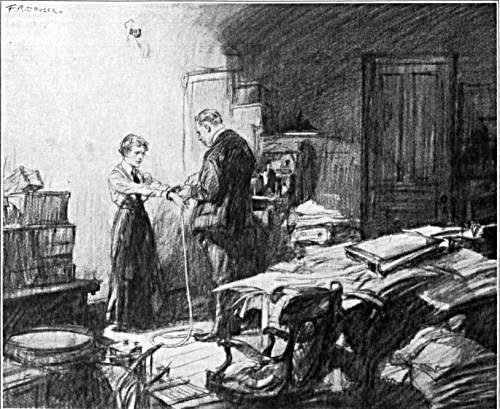
At eight o’clock this day, pursuant to orders, she came. Crisp was waiting for her. He took her into a disused cuddy room back of the art department, where old drawings, photographers’ supplies and such like things were stored. Out of one coat pocket he hauled a pair of handcuffs and out of the other a clothesline. On Lily’s bony little wrists he locked the cuffs, ran the rope through the middle link of the chain connecting them, passed the rope over a stout hook set high in the wall and drew her up until her arms were stretched straight above her head and her heels cleared the floor. Then he made the rope fast against slipping and went out and locked the door behind him, leaving her there on tiptoe with her face against the plastering. He left her there until four o’clock in the afternoon. When he let her down she was in a dead faint, but came to in ample time to do six columns of regular Edgar Allan Poeish agony stuff, which under the screaming six-column caption “How it Feels to be Strung Up for Eight Hours at Wilfordshire, by Nita Dare,” ran in next day’s editions of the Beam and made the town sit up and take notice for a week.
Then — so the reminiscent veteran will probably tell you — there was the famous headline which Crisp wrote once upon a time. Only a headline it was, but it started a laugh which laughed a distinguished young profligate right out of the United States. Long after Mr. Chauncey Chilvers had hidden his diminished head in Paris, then the favorite refuge of the discredited wealthy American waster, and long after the girl he had expected to marry had married somebody else and divorced that somebody else and married again, folks still were grinning over what Crisp did on the day when one of his reporters brought in the tale. It had to do with a gorgeous reception at the home of the fiancée’s parents in Park Avenue, with the appearance of the prospective bridegroom in a condition which might charitably be described as confused; with his attempts, under the guidance of a shocked but sympathetic second man, to ascend a flight of steps to the gentlemen’s cloakroom on the second floor; with his abrupt somersaulting descent from the top step back down again to the main hallway of the mansion at the very moment when the young woman and her father had issued from the drawing room to welcome certain guests of the utmost social and financial importance; and with the final upshot, which was the summary expulsion of the disheveled and incoherent offender into outer darkness.
The yarn, as written, was exactly the sort of grist which suited the Beam’s news hoppers. So Crisp put it in wide measure on the front page and over it he ran in inch-deep Italics the top caption: How to Lose a Rich Bride.
And immediately below this he framed a sort of combination of headline, decoration and illustration which was copied from coast to coast, becoming in time a headlining classic. It was like this:
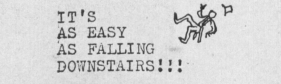
The heavy black types supplied part of the picture; the tumbling manikin did the rest.
Then there was the time when the Beam was pushing its campaign against alleged inefficiency in the police department, taking text for its most vehement preachments from the failure of the force to capture the notorious “Doctor” Sidney Magrue, proved murderer and fugitive, going at large with a fat price on his head and his photograph and printed description stuck up in every station house. Crisp hired a stock actor to make himself up as this badly wanted person. Thus disguised, the actor spent a whole day strolling about populous parts of town, occasionally inquiring a direction from a patrolman on post and actually winding up at dusk by walking into headquarters and making inquiry at the Lost Property Bureau touching on a fictitious missing hand bag. The tale of the experience being printed in full in next day’s Beam resulted in three things — enhanced reputation for the Beam, a raise in salary for Crisp and the loss of a lifelong job for Inspector Malachi Prendergast, head of the detective bureau.
There is a sequel to the tale of this coup which sometime will bear telling, but not here; it’s too long.
Crisp was like that. He saw the news and he raised it. If a rival paper saw the raise, matching enterprise against audacity, he went the other fellow one better. There were risks to be taken of course — risks of damage actions, risks of personal reprisal on the part of some hot-headed citizen who figured that in the Beam’s desire to print not necessarily what was true but what was interesting he had sustained an injustice which only might be alleviated by the blackening of eyes and the bloodying up of noses. But for such contingencies Crisp, like a wise general who never plans an offensive but he shapes along with it his defensive, was usually prepared. It was to this forearming instinct that he owed the play upon his middle name — the lengthening of Ali into Alibi — which the men in the city room employed in speaking of him when he was safely out of their hearing.
For example:
One day a solid-looking individual with the air about him of nursing a grievance almost as large as he was walked into the Beam building and asked that he might see the city editor. He was told to go up to the third floor and inquire for Mr. Crisp. Aboard a creaky elevator he ascended to the third floor, and having traversed a corridor that was heavy with the distinctive smell of every newspaper shop — a perfume compounded of old paper smells, fresh ink smells, stale paste smells and photography chemical smells of any age at all — he came at the far end of the corridor to an anteroom where a square-jawed attendant took down his name and inquired what his business might be.
Now had this gentleman — Gillespie was the name he gave — been one of several common enough types that came to the Beam; had he been a crank seeking publicity for the exploitation of his pet fad, or an unfaithful servant desirous of peddling unsavory details of his master’s or his mistress’ private life for a price, or one of those unattached mercenaries of the newspaper game known as a tipster, he would have been bidden to take a seat upon a hard and uncomfortable bench and wait his turn. But Mr. Gillespie, it seemed, had come to demand redress and correction of a gross error deeply affecting him personally, which had appeared in the columns of yesterday’s Beam, and for such as he there was a standing rule designed by the owners with a view to proving how zealous was the Beam to render fairness to all. Hesitating only long enough to make up his own mind that the caller was the sort not apt to turn physically violent, the attendant summoned an office boy from within and promptly the gentleman was escorted through the city room, on past the copy desk and the battery of desks of the rewrite men, to where on a raised platform like a schoolmaster’s dais and behind a wide flat-topped desk that was bristly with steel spindles sat a prematurely grizzled man of forty or thereabouts.
At the stranger’s approach this man rose in greeting.
“Are you the man in charge?” demanded Mr. Gillespie, mounting the rostrum.
“Well,” said the other, “I imagine I’m the man you wish to see. I’m the city editor — Crisp is my name. And your name is — “
“Gillespie — James G. Gillespie, of Gillespie & Swope, wholesale carpets. Here’s my card.”
“Sit down, Mr. Gillespie, please.” Crisp waved to a chair which his personal office boy had shoved forward. “Now then, how can I serve you?” His manner was cordial but businesslike, in contrast to Mr. Gillespie’s, which was businesslike enough but stiff to the point of hostility.
“Well,” stated Gillespie, “you can begin by correcting this outrageous misstatement of facts which appeared in the last edition of your sheet yesterday afternoon.” And he laid on the desk before Mr. Crisp a crumpled clipping. “My partner says I ought to sue you people for libel. My wife, who is ill in bed as a result of this thing, says I ought to horsewhip somebody for it. But I decided that before I took any steps I’d come here to you and personally insist on an immediate retraction of this infamous error.”
“Quite right, Mr. Gillespie. You did the right thing. I’m glad you did come, though I’m sorry that such an errand should bring you. Pardon me one moment.” He glanced briefly at the clipping. “Now then,” he went on, “suppose you tell me the real circumstances in this affair? It says here — but suppose you tell me your side first?”
Mr. Gillespie told him at length and with heat. By his way of telling it there had been an incredible perversion of the truth. He had been put in an entirely false light; he had been held up to ridicule; he had been wounded in his general reputation; he had been embarrassed, humiliated, chagrined — and so on and so forth for five minutes.
When he had done Mr. Crisp spoke, and in his tones, his look and his bearing was a real distress hardly repressed.
“Mr. Gillespie,” he said, “first and foremost and before everything else we have two great aims in getting out this paper — to fight the battles of the people and to tell the truth. The truth hurts people sometimes — we can’t help that! We have our duty before us. But when meaning to do the right thing, as we always aim to do, we print something which turns out to be untrue it hurts us as a newspaper and it hurts me — personally — more than it possibly can hurt anyone else. I want you to believe me when I tell you this. And right here and now, before your eyes, I intend to make proper amends for unintentionally wounding you.”
 “How are you going to go about doing that?”
“Just one moment, please, and I’ll show you.” He hailed the head copy reader. “Flynn, look through yesterday’s schedule and see what reporter turned in the story that ran in the final under the heading Rich Merchant Figures Strangely in Raid on Gay Road House.”
Flynn ran practiced fingers through a sheaf of scribbled sheets. Then, “Overton wrote that story, Mr. Crisp,” he answered.
“Overton, eh?” Mr. Crisp’s accent was ominous. “Boy, tell Mr. Overton to come here.”
The boy vanished behind a rack of lockers at the opposite side of the big room. Immediately from some recess back of the lockers there appeared a small shabby man with white hair and a bleak, pale face. He was in his shirt sleeves. He wore a frayed collar of an old-fashioned cut, a little rusty black tie and on his lower arms calico sleeve protectors. His stubby fingers were stained with ink marks. Everything about him — his pigeon-toed, embarrassed step as he approached his superior, his uneasy light blue eye, the fumbling hand that he lifted to a stubby white mustache — seemed to advertise that here was a typical example of the well-meaning but unsuccessful underling. He offered a striking contrast to the smart appearing younger men scattered about the city room, who raised their heads from what they were doing to follow him with their eyes as he crossed the floor.
“You wanted me, Mr. Crisp?” said he, halting on the farther side of the city editor’s desk.
“Yes, I wanted you.” Mr. Crisp’s voice was grim, with an undertone of menace in it. He shoved the clipping in his hand almost into Overton’s face. “You wrote this — this thing?”
“Yes, sir, I wrote it, but — “
“Never mind the buts. Never mind offering any explanations or any excuses. You admit you wrote it — that’s sufficient. Well then, do you know what you’ve done? You’ve done this gentleman here a great injustice — he’s convinced me of it. You’ve injured one of the most prominent and respected citizens in this whole city. You’ve made his family unhappy. And in injuring him you’ve injured the Beam. Well then, you know the rule on this paper about this sort of thing.”
“Yes, but Mr. Crisp,” pleaded the stricken offender, “you know how hard I try to be careful about details. You know I’ve never made a slip before. And I thought I got my information from reliable sources.”
“You thought? What business had you thinking? How often have you heard me say that the Beam wants proof behind every statement it prints — cold, hard proof; not what somebody thinks. Overton, you’re done here. I’m sorry for you — but as I said just now you know the rule about carelessness. You can’t stay in this shop another hour. Here” — he scribbled a line on a scrap of paper — “hand this to the cashier on your way out. It’s an order for what salary is coming to you. And now please get your hat and coat and leave here and don’t you ever come back.”
There was final judgment in the way he said it. He had been judge, jury and accuser before; now his mien was that of the executioner performing a disagreeable but necessary task conscientiously — and relentlessly. The condemned one bowed his abashed head as though realizing the futility of any appeal, any plea in extenuation or any plea for pardon. Without another word he turned away, a pitiable shrunken little figure of failure and regret and humiliation, and went back to the corner whence he had emerged. Half a minute later, with his hat on his head and his coat on his back, he reappeared and with his eyes fixed on the floor in front of him passed out solitary and aloof in his disgrace.
Mr. Crisp turned to Mr. Gillespie.
“Well, sir,” he said, “that job is done — and to your satisfaction, too, I trust.”
Mr. Gillespie was a kindly enough man. In his own business he was not given to maintaining discipline so mercilessly as this. The thing he had just seen gave him almost a guilty feeling. In a sudden rush of compassion he forgot the principal object that had brought him hither.
“I’ve got to go — just remember an important engagement,” he said. “I’ll probably be back later in the day.”
And out he hurried to overtake this man Overton — or whatever the little fellow’s name might be. He caught up with him at the elevator. Together in an awkward little silence they descended to the street floor.
“Say, listen here,” blurted out Mr. Gillespie when they had stepped out of the car — “say now, that was pretty rough on you. I realize that you didn’t know me — that you had no malicious desire to hurt me in what you wrote — that you merely got the thing twisted round the wrong way. Really I suppose it’s the sort of thing that might happen any time. Newspapers have to fill up their columns somehow. I’m sorry about this — really I am. Don’t you suppose that if you waited here and I went back and had another talk with your city editor and told him that I wished he’d take you back that maybe — well, damn it, man, I’m supposed to be the aggrieved party to this transaction anyhow and he ought to listen to me if I put in a word for you!”
The discharged man shook his head.
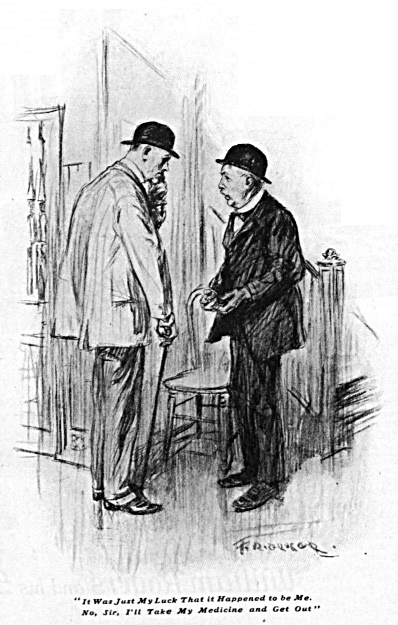
“I’m much obliged to you, sir,” he answered miserably, “and I’m sure it’s very kind of you to volunteer to help me, especially under the circumstances, but really, sir, it’s no use. I’ve broken the strictest rule in this whole place and I’ve got to take the consequences. One slip-up, and out a man goes. It was just my luck that it happened to be me. No, sir, I’ll take my medicine and get out.”
“But say now,” pressed Mr. Gillespie, “you’re not exactly a young man. It might be sort of hard for you to get another job. If you should need help now to sort of tide you over while you’re looking round for something else to do — “
“Thank you for that too, sir,” said Overton. “But please don’t concern yourself about me. I’ll get along, I guess — I always have. And I don’t need any help, sir — honestly I don’t. Good day, sir.”
He shambled away toward the rear, heading presumably for the cashier’s department, and Mr. Gillespie, after watching his retreating figure for a moment, passed out into the street, filled with a sense of vague indefinable regret for things in general.
As for Overton, he bided where he had stopped in an elbow of the wall until Mr. Gillespie was safely gone. Then without visiting the cashier’s office he took a walk round the block, came back to the Beam building, rode upstairs to the third floor, silently and unobtrusively reinserted himself into the busy city room, passed behind the locker cabinets to a sort of alcove within hearing but out of sight of the others, and there hung his hat and coat on pegs and sat down at a cluttered desk and went to work as though nothing out of the ordinary had happened.
As a matter of fact, so far as Overton was concerned, nothing out of the ordinary had happened. Being fired by Crisp — publicly and ignominiously fired before all the city room and before irate complainants — was the principal part of his job. He was used to it. It happened to him at least once a fortnight, once a week sometimes, occasionally as often as twice a week. In the organism of The Daily Beam machine he was a humble but a useful cog, for he was the scapegoat, the vicarious sacrifice, the official whipping boy for the sins of others. A whipping boy at fifty — that was what Overton was.
Once upon a time he had been a reporter of indifferent sorts; but that had been so many years before that Overton hated to think back to the time of it. When his legs began to wear out — and his imagination — he had been put on the exchange desk reading papers for reprint stuff; odd times he compiled clippings for the “morgue,” where the published doings and sayings of notables were kept in envelopes filed and indexed, and once in a while he subbed for the frowsy ex-copy reader who under the pen name of Beth Blair wrote the column called Balm to the Lovelorn. When Wendover bought the old and moribund Evening Star and renamed it the Beam and gave it a new and a yellow life Overton came as a legacy from the old ownership along with the hacked and battered office equipment and the green shades on the dangling electric globes and the rest of the fixtures.
It was Crisp who saw in Overton possibilities for the role of scapegoat and developed him in the part. The little man had a sort of cheap histrionic talent. Cast in another mold of environment he might have made a fair actor. Crisp discerned this and worked to bring it out in him — and succeeded amply well. Physically Overton was qualified from the beginning; he looked — well, so hang-doggish. With mighty little prompting he learned to simulate to the very life the guilty aspect of a self-confessed, yet well-intentioned incompetent; and he learned to take his cues from Crisp, as Crisp in turn took his from those indignant persons who came to protest against this or that published thing. So well did he learn that his play-acting very often served a double purpose. Primarily it was designed to give Crisp a chance to prove the seeming determination of the Beam to be strictly accurate and to punish by instant and ignominious dismissal any member of the staff who might unintentionally break the rule. Secondarily Overton’s very mien of sorrowful resignation to his make-believe fate, his dumb and stricken acceptance of dire consequences more often than not so quickened the sympathies of the injured party that the latter — as witness the case of the forgiving Mr. Gillespie — forgot or forewent his original intention of suing the paper for damages.
Considering all things, it might be said that Overton earned his salary, which was thirty dollars a week; just what it had been for long years. He sat at the exchange desk using shears and paste pot and a leaky fountain pen, and on the pay roll was carried as exchange editor, but really, as has been stated, his job was to be fired as frequently as Crisp’s system of office policy dictated that somebody should be fired before witnesses. To Overton it made no difference who had turned in the offending story or who had telephoned it in or who had rewritten it. His task was to assume sponsorship for the slip-up, to be dismissed with harsh words, to get his hat and coat, to leave the office, to walk round the block — and come back again. The city room had its nickname for him. With a sort of half-pitying contempt, it called him The Worm.
He had, no friends in the office, unless Flynn, head of the copy desk, might be called his friend. So far as anyone knew he had no friends outside the office; nor any kith or kin. It was vaguely understood that he lived in a lodging house somewhere up on Third Avenue and that he took his meals in mean restaurants – places where scrap meat masqueraded as Irish stew and chopped-up gristle as Hungarian goulash. If he drank, he drank alone; certainly no one had ever seen him buy a drink for another or accept a drink which another bought. If he had ever had a romance in his life, or a sweetheart or a wife or a child or a tragedy, nobody knew about it and nobody cared. Anyhow he did not look to be the sort of person who would have a romance, but only the sort who would have loneliness and hopelessness for a portion through all the days of this life. From eight in the morning until four in the afternoon he sat at his desk in the alcove behind the lockers, at noontime eating his luncheon out of a paper parcel and emerging only on those occasions when Crisp summoned him forth to play his appointed character. At four he went away; at eight the next morning, he returned; that, so far as the staff of the Beam kenned it, was the sum total of his existence. Once in a great while, when the tides of copy moved slackly, Flynn would invade his refuge to sit for a few minutes on the edge of Overton’s cluttered desk and exchange commonplaces with the little man. It always was commonplaces that they exchanged; never confidences. Even so, Flynn saw more of him than any other man in the shop. He was not a mystery, because to be a mystery a man must rouse the interest or the curiosity of his fellows; must awaken on their part a desire to understand the reasons underlying his aloofness or his isolation, as the case may be. This colorless, solitary creature had not even the elements within him or about him to quicken interest. The office accepted him for what he was — its official scapegoat — and called him by that singularly cruel and singularly appropriate title of The Worm.
As for Crisp, it was characteristic of the man that he never saw in Overton a figure to rouse one’s sympathy or one’s compassion, which is the next of kin to sympathy. It probably never occurred to him that the role he had drilled Overton to play so excellently well was a role calculated to undermine a man’s sense of self-respect. Or if it did occur to him ever he gave the thought no consideration. For Crisp, with all his flair for sensationalism, was a good city editor, which is another way of saying he worshipped the great brazen god Results. He was all for action; subsequent reactions concerned him not a whit. He rarely pressed a reporter to reveal how the reporter had got a difficult story. He was too deeply gratified if only the reporter had got it to inquire regarding the deceit, the evasion, the twisting about of facts or the subterfuge that might have been practiced. This did not imply delicacy on Crisp’s part, nor was it indifference to details. It was in the day’s work, that was all. To him journalistic ends amply justified journalistic means.
Outside the shop Crisp may have been a reasonably human and a reasonably kindly being — probably he was. Inside he was a bloodhound; the picked leader of a trained and greedy pack. Chronicles of misery or misfortune or disgrace were things to be caught at and elaborated and spread-eagled in print. Privately the victims might have his personal condolences; professionally they constituted merely so much good live copy, and as such were to be exploited. Loss of life in a steamship disaster or a tenement-house fire or a railroad wreck was to be desired; the greater the loss of life the bigger the story. After he locked his desk and went away he might have such thought for the dead and the maimed as any average man would have. But before that his solicitude was all aimed at gathering up and weaving into the printed tale every morbid charnel-house detail of horror and suffering which would twist at the heartstrings of the reader and make the reader buy later editions.
Crisp may never have heard of the editor who said he was not too good to print anything which the Almighty permitted to happen, but just the same that was his creed. City editors — some of them–get to be like that; just as reporters, trained to read hidden motives and secret causes under the vanities and the pretensions and the seeming disinterestedness of those with whom in the discharge of their duty they have daily to deal, become in time the most cynical, the most suspicious, the most skeptical of modern breeds. There’s a nigger in every woodpile — find said nigger! That briefly is your average seasoned reporter’s viewpoint of the affairs of life as they relate to the news.
Crisp had another characteristic common among his kind, but in his case developed to a degree which would have made him a marked man any place except in a newspaper shop — the one place where the type is somewhat prevalent. He thought in headlines and he frequently spoke in headlines. Tell him a man’s name and promptly — and mechanically — his fingers began checking off the letters of that man’s name as he counted up and balanced off to see whether the name would fit into the top deck of a headline built of this size type or that size type. For obvious reasons he was drawn instinctively to individuals with short names and instinctively disliked individuals with long names. To him a suicide agreement between two or more persons was a Pact always, just as an official investigation was a Probe and a country-wide search for someone was a Dragnet and an anarchist was a Red and a child of a few years was either a Tiny Tot or a plain Tot, depending upon the caption he mentally set about constructing in the same instant that the subject was mentioned in his hearing. One of the headquarters men would get him on the telephone to report, let us say., that a six-year-old tenement dweller crossing a street had been killed by a trolley car under particularly distressing circumstances.
“Forbes,” he would call out to a rewrite man, “take this story from Doheny, will you? Tiny Tot With Penny Clutched in Chubby Hand Dies ‘Neath Tram Before Mother’s Eyes! Write about six sticks of it.” You see, before ever the tale of the tragedy had been detailed by the outside leg man to the inside desk man Crisp would have framed in his mind a suitable heading.
Similarly, if you stated to him that a young woman defendant was on the witness stand up at the Criminal Courts Building undergoing a searching cross-examination at the hands of the prosecutor, and thanks be to the latter’s persistent proddings making significant admissions, he simultaneously would be translating the intelligence inside his brain to something after this fashion: Accused Girl, on Rack, Bares All. Probably in his sleep he dreamed headlines; certainly he lived with them by day.
This in some share was due to his training. He had been a copy reader before he had become a city editor; but more it was due to the fact that he sucked up and absorbed and made part and parcel of himself whatsoever pertained to the trade he followed. To the job he held, the work he did and the paper he served he gave a wholesouled, single-purposed devotion, which in a more lucrative field than this might have made a rich man of him. The Beam was at once his child and his father. Its twisted ideals, its dubious moralities, its shrieking fakeries, its hysterical crusadings, its frequent service in the public good, its blatant assumption of pure motives, its uncoverings of secret corruptions, its deliberate misrepresentations of causes and individuals, its vain boastings and its actual worthy performances might offer to others a paradoxical mixture of commingled great faults and great virtues, but to old Ben Alibi, sitting there coining imaginary headlines in his head and shaping the news to suit his mood, they were all virtues.
Why not? He had been a main factor in modeling the Beam into what it was, and mortal man rarely quarrels with his own pet creations. In his service to this mudfooted, brass-mouthed idol of his he spared neither himself nor any other. Wherefore it was quite natural that Crisp should take no heed of little Overton’s private feelings touching on the sorry contribution which Overton made to the Beam’s well-being. To Crisp, Overton merely was a cog in the machine and to be treated as a cog.
Accepting such treatment, Overton cogged along, at intervals coming forth from his hiding place like a timorous mouse from behind a wainscoting to be scolded for another’s fault and fired for another’s transgression and then to take his regular walk round the block and return to potter over exchanges while waiting the occasion of his next public appearance. The staff lost count of the number of times its members had witnessed the byplay at Crisp’s desk.
No doubt Overton lost count — if indeed he ever tried to keep one — of the number of times he went through it.
But there is an old saying to the effect that the worm will turn. Probably in the instance of the original worm the turning thereof occasioned all the more surprise among the other worms present because of its very unexpectedness; probably if the truth were known the impulse for revolt had been stirring and stewing in that wormly soul all unsuspected for a long time before it was made manifest in the astounding fact of acrobatism. No doubt it is hard enough to fathom the phenomena of these reactions in worms; and in humans even harder by reason of a human’s superior facilities for concealing the secretly working inner emotions.
As regards Overton, it already has been stated that he had somewhat of the acting instinct, which means the instinct for dissembling. Just precisely when his submerged sense of self-respect, his half-drowned, half-dead manhood began to grow sick of the hateful thing he did to earn his daily bread is past knowing and past guessing at even. It must have been through months, possibly it was through years, that the spirit of rebellion was quickening within him, never by word or deed or look from him betraying itself, yet constantly strengthening and fortifying itself upon the bitter mental food it fed on, against the coming of the hour when the worm, turning, would cease forever thereafter to be a worm and would rise to another plane — a plane as far remote from its former estate and estimation as John Hancock is from Judas Iscariot.
One blistering hot day about midday there came to the Beam office a fluttered young woman with a grievance. Having been brought to Crisp, she stated it. It seemed she was a professional entertainer; she did turns at Sigmund Goldflap’s all night place uptown. Her name — or anyhow the name she gave Crisp — was Lotta Desmond. Two nights before one of the other girls in Sig Goldflap’s troupe had killed herself after a quarrel with one now referred to by this Lotta Desmond as the other girl’s “jump man friend.” And the Beam had printed a picture of Lotta Desmond with the other girl’s name under it, whereat Lotta had suffered deep humiliation. She couldn’t understand why this awful mistake had been made. She’d always liked to read the Beam — it was her favorite evening paper. She had never been mixed up in any scandals herself. She was a lady all over, if she did say it herself. She felt as if she could not hold up her head again. People who knew her, seeing her picture in the paper, would naturally think she was the one who had killed herself. And somethin’ would have to be done right away to put her right with people. Stating her case, she raised her voice shrilly as persons in her walk of life are apt to do under stress of emotion. She repeated the main points of her indictment over and over again, each time using the same words, as might also have been expected of her, considering what — plainly — Lotta Desmond was. Before she was through she was weeping noisily and — one might say — vulgarly.
The city room listened to the vehement outburst, grinning collectively to itself. The city room felt it knew good and well what had happened. It had happened before. To dress up the story of the suicide Crisp had demanded a photograph. Accordingly the reporter assigned to the job had brought in a photograph. There had been difficulties in the way of fulfillment of Crisp’s order, and the reporter had taken a chance — so the city room, harkening, figured the thing out. Possibly the reporter had abstracted a photograph from a grouped presentment of Goldflap’s talent. In such case one might assume he — being naturally hurried — had selected a likeness of the wrong girl. Possibly he had induced a Tenderloin photographer to let him have a photograph, in which event the photographer might have made the mistake with the coincidental result, that a picture of this Lotta Desmond had been bestowed instead of the picture of her dead sister performer. Anyhow the main point with the reporter had been to get a photograph — some photograph, somehow. Dealing with individuals of no social or financial importance the Beam quite often made these little mistakes.
As he sat hearing Lotta Desmond’s indignant recital Crisp had been studying her. It was easy to appraise her. It was easy to assign her her proper niche in the scheme of existence. She had a young body and an old face. You might call her a youthful hag. Her hair was a straw yellow — darker, though, at the roots where the dye had been carelessly laid on. Her frock was a monstrosity of cheap gaudiness. It combined certain of the primary tints — green, blue, brick-dust red; it might have borrowed its color scheme from a map in an atlas. The jewelry she wore would have been worth thousands if it had been genuine. She had about the mentality of a guinea pig — just about. She should be easy — the customary artifice should amply suffice to cajole her out of any idea she might have lurking in that two-cent brain of hers touching on a claim for cash damages for injury to reputation and peace of mind. So he worked the office trick — he questioned Flynn, as per the regular routine, and he sent a boy to summon Overton before him.
Up to a certain point the game of subterfuge was played through as it had been played many a time before. Overton, faithful and letter-perfect in his part of the penitent criminal, took cue from Crisp’s snapped questions and made — or rather began to make — the expected answers. It was not in the book for him to be allowed ever to complete a sentence; he must be caught up sharply with his admissions half framed and incomplete. It was the effect of the confessed delinquent’s demeanor that Crisp desired to produce rather than any definite statements which might be remembered and used afterward in the event of punitive proceedings legally forwarded.
In the midst of the dialogue Overton raised his whitish head and looked full into the face of her for whom the scene had been devised. If he had read compassion for his seeming plight in her shallow pale eyes it was more than any other person there read in them. To the rest she seemed still what she had been from the moment of her appearance — a fit subject for Crisp’s favorite scheme of deception; a young person indignant, yet somewhat pleased at her elevation into prominence before so many strange men; rather embarrassed, and sure before many ticks of time had passed to be suitably placated by the prospect that on her account a man had been discharged from service and sent adrift. It is not probable either that she reminded him of anybody that he had ever known — of anybody, say, that he might have cared for once upon a time. Past doubt what happened was that regardless of contributory causes or the lack of them this hour chanced merely to be the particular hour of Overton’s declaration of independence. It was the hour ordained for his private honor to come forth and walk abroad among men, and since a private honor was a thing which none there had ever credited him with owning, what followed now was all the more unexpected by the audience:
“Stop it, Crisp!” broke in Overton in a voice none there had ever heard him use. “Stop this damn mummery!”
The strangest part was that Crisp did stop — stopped with his eyes goggling in amazement and his lower jaw ajar on a half-finished sentence. He had such a look on his face as a bulldog might have in the event of a sudden counterattack by a bunny rabbit. Overton spoke to the girl.
“Young lady,” he said, “this whole thing was got up and staged to fool you — but it ends right here. I never heard of you before and I never heard of your photograph before and I had nothing to do with the printing of it either. But if I’m any judge of such things — and God knows I should be, considering what I know about this shop — you’ve got a claim for damages against this newspaper and I advise you to get out of here as quickly as you can and go find yourself a lawyer and put your case in his hands. You heard this man fire me just now. Well, he’s fired me fifty times before now, but it didn’t take because it wasn’t meant to. But now it does take, because I’m firing myself here and now.”
He swung back on Crisp.
“Listen!” he ordered, and his words came from him straight and hard like bullets from a machine gun. “They call me The Worm round this shop. And that’s what I have been and that’s what I am — a worm. But you’ve heard, I guess, that a worm will turn, and that’s what I’ve done — I’ve turned. And if you open your mouth to me again I’ll smash you in it — you white livered yellow cur dog!” He set his back to Crisp and the girl and walked away. He nodded a farewell to Flynn as he passed the copy desk, went behind the lockers, came out again with his hat on his head and his coat on his arm; and in the shocked hush which possessed the room he walked out, head erect and shoulders up, for once in his life a figure of force and dignity. The girl followed — a new-formed resolution plainly quickening her to a brisk gait. The city room watched her until her skimpy skirts flipped out the door, then with one accord all present looked toward Crisp.
“The worm turns, eh?” he said casually, half to himself, half to those within hearing. “Well, Flynn, I guess we’ll have to find a likely candidate somewhere for the vacancy that’s just occurred and break him in.”
He checked off sundry letters on the fingers of one hand, repeating the letters aloud as he did so: “W-o-r-m T-u-r-n-s.”
And the city room knew that its chief was translating an experience into a headline — a headline which must go to waste.
Healthy Weight, Healthy Mind: How Our Environment Affects Our Weight Loss Efforts
We are pleased to bring you this regular column by Dr. David Creel, a licensed psychologist, certified clinical exercise physiologist and registered dietitian. He is also credentialed as a certified diabetes educator and the author of A Size That Fits: Lose Weight and Keep it off, One Thought at a Time (NorLightsPress, 2017).
Do you have a weight loss question for Dr. Creel? Email him at [email protected]. He may answer your question in a future column.
After having twin boys, Ted and Linda hoped to become pregnant again. Neither of them hid their desire for a little girl. After five years of trying, they accepted that another child wasn’t in the cards for them. Once they reached their 40s, Ted and Linda were enjoying their teenage boys and had long given up on trying to increase the size of their family. Then they received amazing news — Linda was pregnant — and they were having a girl! They named her Emily, a name they picked out ten years earlier.
For the first five years of her life Emily lived in a fast-paced home, often eating on the run and snacking on junk food like her brothers. She accompanied her parents as they traveled out of town to watch the boys play tennis and baseball. During these trips everyone ate fast food and consumed not-so-healthy snacks. Soon after Emily’s sixth birthday her brothers moved away to college. Emily and her family no longer traveled to sporting events, and their home life became much calmer. In essence, Emily suddenly became an only child.
I met Emily four years after her brothers moved out of the house, when she was ten and the family no longer needed to eat on the run. Although the always-starving teenage boys hadn’t lived there for years, Emily and her parents still ate out frequently and kept the same types of food in the pantry. As a result, Emily had become quite overweight.
Her concerned parents and pediatrician enrolled Emily in our children’s weight management program. Although Emily’s mom came to the initial consultation, her work schedule and frequent travel made it difficult for her to attend regular sessions. Since her father Ted did the shopping, meal planning, and cooking as a stay-at-home dad, our staff worked with him in our efforts to help Emily lose weight. We soon realized Dad’s habits and perspective were a big part of Emily’s struggle with her weight. For instance, he regularly purchased large bags of tortilla chips, mainly for his personal late-night snacking. Because Dad wanted to keep snack foods in the house for himself, the conversation turned to Emily’s motivation and self-discipline. Emily respectfully listened to her father and tried to explain she wanted to do well in the program. After her father continued suggesting she could avoid the chips or only have a small serving for her after- school snack, she uncharacteristically snapped at him, “Dad, I have willpower, but I also have arms!”
We can all relate to Emily’s sentiment. The environment in which we live can make or break weight loss efforts. While Emily’s father wanted her to practice restraint and use willpower, Emily knew the environment was more than she could handle. Focusing on a ten-year-old’s willpower seemed a little silly when a more reasonable solution was to modify the food in the pantry. Doing so would also show support for Emily’s struggle.
loss efforts
On the other hand, Emily’s father couldn’t create a perfect environment, nor can you. At some point we all have to stop blaming the environment and using it to excuse our actions — at least according to a client named Marty.
In a discussion group of 12 people, Marty and I were the only men. One evening, as we discussed the challenges of weight management, ten ladies did a nice job of describing how their home environments, workplaces, and fast-paced lifestyles got in the way. Marty sat quietly for the first half hour, but toward the end of our time he began squirming in his chair. Finally, he sat up straight and sighed loudly to let everyone know he had something on his mind. We all looked at the 40-something chemist who’d gained 50 pounds since beginning work at a pharmaceutical company six years earlier. We already knew his long work hours and the addition of two children to his family created a lifestyle conducive to weight gain. We also knew Marty was irritated with himself for gaining weight and even more frustrated that he had to join a weight management group for help. In a previous session he had told us that obesity treatment seemed “stupid” because the solution was simple — eat less and move more. Now we all eagerly awaited his opinion on why weight management was so difficult. He took another deep breath, probably to swallow the four-letter words on the tip of his tongue.
Marty’s frustration showed in his furrowed brow and restless fingers that curled into a fist. “I hear what you’re all saying. But never, not once, has someone tackled me, pinned my arms to the floor and shoved food down my throat. Never! No person or situation makes us do anything — we’re doing this to ourselves.”
Marty had a valid point. Despite our food-centric society, we all have freedom to make choices. Although I’ve heard more than a few troubling stories from my patients about being forced to eat as children, most adults are entirely free to refuse food or eat in whatever quantities they want. Although the environment can limit our options or make certain behavior difficult to carry out, it does not force us to do anything. If we intentionally pay attention to hunger, fullness, our calorie needs, and the nutritional quality of our food, we can maintain a healthy diet despite the availability and ease of obtaining highly pleasurable, unhealthy foods.
But we live in a fast-paced world where it’s difficult to always self-monitor every food decision; to constantly be on alert regarding our calorie budgets and how well we’re sticking to them. Instead of being proactive, we easily get distracted and just react to our surroundings. In most industrialized nations the surroundings are obesogenic — teeming with food and conveniences that promote obesity.
In the United States, two-thirds of adults are overweight or obese, at least partly because of the environment we created. Consistent with human instincts, we tend to make choices based on what’s available, convenient, pleasurable, and socially acceptable. It’s no stretch to say that unhealthy foods are easier to find than healthier alternatives —think restaurants, gas stations, vending machines, sporting events, and the check-out lines of grocery stores.
Adding to the problem, modern technology has engineered physical activity out of our lives. Many of us drive to work and then sit at desks most of the day. We drive home, push the garage door opener, and walk a short distance to the mailbox. Exhausted from our busy-but-inactive day, we spend another few hours relaxing in front of the TV. To change the channel, we push a button the remote control. We even have robotic vacuum cleaners to clean our floors and entertain the cat. We take escalators and moving walkways to get through airports, perhaps to conserve energy for putting our tray tables in the upright position.
Sometimes our environment promotes unhealthy eating and inactivity at the same time. The Indiana State Fair, and most other state fairs, offer excellent examples. In Indianapolis, a long trolley pulled by an enormous John Deere tractor gives free rides around the fairgrounds. This is a helpful service for people with disabilities, but healthy people also jump at the opportunity to save a few steps. The remarkable part of this is that many people go to the fair primarily to sample the food. So a trolley provides transportation to the corn dog hut only to pick you up and take you to another area where you can have an elephant ear, a fried Snickers bar, deep fried macaroni and cheese, or a funnel cake. If you get too hot waiting for the trolley you can purchase a giant cup of lemonade filled with a little fresh squeezed lemon and a fourth cup of sugar. Bottled water is always an option, but it costs almost as much as the lemonade, and besides, it is the State Fair.
This all seems normal, even to those of us in the health field. When I attend large obesity or fitness conferences I like to observe the behavior of attendees. People leave a presentation with many good ideas after hearing a talk on the benefits of decreasing sedentary behavior and increasing patients’ motivation for physical activity. After they leave the room to go to another part of the conference hall, where they will again sit through a 90-minute symposium, they need to go up or down to another floor. When these attendees reach the escalator with a spacious carpeted set of stairs beside it, almost everyone stops walking and rides the escalator. This shows me how persuasive the environment is, even among people who are highly educated on the benefits of healthy behavior.
Before “Weird Al” Yankovic, There Was Spike Jones
Every now and then, someone stumbles across one of Spike Jones’ recordings, and they’re amazed. Newcomers to the music of his City Slickers band find it manic, loud, imaginative, vulgar, and fascinatingly strange.
The first musician to build a serious legacy around novelty music, Lindley Armstrong “Spike” Jones started his career as a serious drummer. He even performed on Bing Crosby’s recording of “White Christmas.” But playing the same arrangements night after night bored him, so he found musicians who enjoyed playing satirical versions of popular songs. Spike Jones and His City Slickers began making recordings and, in 1942, had a big hit with “Der Fuhrer’s Face,” a sarcastic tribute to Hitler interspersed with flatulent notes.
The public loved it, especially when the song was incorporated into a wartime Disney cartoon starring Donald Duck.
The following year, the Post ran an article on Jones, “He Plays Louder Than Anybody,” which described his work at the frontiers of musical chaos. At the time, he was trying to find a goat that could bleat in the key of A, which would be a natural addition to his augmented collection of “instruments.” His percussion section already included brake drums, washboards, anvils, bird calls, foghorns, and set of cowbells that clanged across 10 different pitches.
Spike’s recordings are remarkable for the layers of sound effects — musicians hiccupping or gargling in time to the music, the maestro firing pistols to emphasize the beat — as well as the musical skill required to hold it all together. They’re even more remarkable when you realize they were all recorded live; recording tape and layering were years in the future.
Jones’ appeal was more than simply auditory. He delighted in satirizing the polished appearance of big-band leaders. At the time he was recording, band music was becoming smooth and mellow and was often performed by musicians in matching suits, with a sophisticated-looking bandleader dressed in an elegant tuxedo.
In contrast, Jones’ wardrobe clashed as much as his music. He wore thunderously loud suits in checks or garish stripes. Sometimes he’d slip into his leopard-skin morning coat.
By the early 1960s, though, music was changing. The big bands were losing popularity to rock ’n’ roll, which Jones didn’t know how to satirize. “My business is lousing up music. But how can you slaughter a tune that already is a mess?” he said.
Jones passed away in 1965, and the world of novelty songs has been more sedate ever since.
Featured image: Schuyler Crail, SEPS
Almost Heaven
“Watch out!” I yelled, slamming the Land Rover’s brake pedal to the floor. Sam’s earlier caution flashed through my mind; the brakes hadn’t worked in years. He assured me the old wreck never went fast enough to need them. Sam forgot to mention the small hill I was now careening down, careening down backwards.
Yes, backwards. That hadn’t seemed so odd earlier when reverse was the only gear I could slip the ancient car into. Sam also neglected to share that the steering box was stripped, making frantic spins of the steering wheel pointless, and the vehicle was headed straight for Sophie’s Fruit and Vegetable stand.
“Move it!” I screamed as startled shoppers dove aside.
I saw the wood post just before the Rover destroyed it.
Ka-Pow!
The post was obliterated. Maddy, Sam’s affectionate term for this wayward machine, continued on as calamity exploded behind, or should I say in front of, it. Car and driver, the latter admittedly a gracious label for my role in this disaster, stopped abruptly when confronted by a wall of unyielding cacti, slamming my head against the useless steering wheel.
Coughing twice, the engine died. Steam seeped out from under the dented hood. Dazed, I struggled for consciousness.
“You alive, son?”
One eye slowly opened, squinting in the dazzling light. I saw a white-bearded head bobbing in front of my face.
“Boy, you okay?”
Of course not, you old fart, I heard my mind say, quickly losing all respect for Saint Peter. Then another thought: Shut up fool, that other guy could be welcoming you.
Kind hands gently shook me.
Damn, I thought, recognizing Sam. Now I had a lot of explaining to do.
Ka-Boom!
I jerked round to source the noise. Behind me, a cloud of dust rose sleepily into blue sky.
The scene below was anything but peaceful. It seemed a tornado had torn through the stand. Mangled fruit and vegetables and broken souvenirs were strewn throughout a pile of bent sheet metal and fallen wood. What had once been a thriving business was now a roadside garbage dump.
Only one thing still stood vertical. The sign, Sophie’s Stand, had one end planted in the debris. Smiling at me sideways between the two words, Sophie’s face gave a death shutter, and the sign slowly surrendered to gravity, crashing to earth.
“Jeez!” I wailed, wondering how I could have done all that by merely knocking down one post. “So sorry,” I whimpered, “so sorry.”
“It’s nothing, boy,” said Sam.
Nothing! I thought. Nothing?! I’d just destroyed what had been Aunt Sophie’s life for over 40 years. I pushed my face into the steering wheel and sobbed.
An arm comforted my shoulder, “Here, try this.”
I looked up. There she was again, Sophie’s face, those big brown eyes, the bright smile on a bottle labelled Sophie’s Best. The best, indeed. From what I’d heard, folks were known to drive hours to get this prized homemade hooch, said to cure everything from infertility to constipation.
I grabbed the bottle and gulped. What the hell, I needed to drown my sins. I hadn’t visited my aunt in over 10 years, missed her funeral, and now demolished the pride of her life.
With another swig, the dark cloud of guilt began to evaporate. I gulped more of Sophie’s Best. Not bad, I thought, as I was guided to the shade of a palm tree and plopped into a plastic chair.
Self-pity dissolved into drunken stupor, and I found myself staring at an empty bottle. Raising it up, I toasted Sophie: “Damn fine hooch, Auntie!”
Sam pulled another bent chair beside me, grunting as he sank down. He lifted a full bottle skyward and saluted. “Sophie!” Then proceeded to drain half the contents before passing the bottle.
In front of us, a silent army of zombies emerged from nowhere to paw through the wreckage for anything of value.
Sam spoke slowly, “Maybe it’s for the best. Sophie always wanted to give everything away.”
“Maybe so,” I added, drinking more hooch to quiet my pained conscience.
“Sophie liked you,” he said as I returned the bottle. “You’re the only city folk ever came to visit.”
“That’s nice,” I answered, trying to convince myself that seeing her once in 10 years merited my absolution for the day’s disaster.
“We had a good life, me and Sophie,” reflected Sam, as we watched hands picking through the carnage.
I remembered the visit, years ago, when I’d first met Sam and Sophie, drawn by some unknown urge to know family — not to mention the need to escape town and an irate girlfriend who’d just thrown me out of her apartment. I took another drink and recalled looking up as that angry woman, screaming abuse, emphatically hurled a stuffed walrus down on my puzzled head. Perhaps, the spark was gone and it was time to move on.
Several buses and many miles later, I was dropped on an empty road in front of Sophie’s stand. A young girl arranging fruit looked over at me.
“Sophie?” I’d asked.
She’d pointed up the hill. I started walking, suddenly aware of the bright sounds and colors of birds flying about me. I gasped in wonder as my lungs inhaled the pungent tropical air. Turning left, I entered a tunnel of vibrant green foliage pierced by shafts of streaming gold sunlight. In the distance, I spied a small cottage.
A cloud of butterflies descended on me, floating, fluttering, circling, then drifting away as I entered a clearing. Passing through an orchard, trees laden with fruit, I saw two rocking chairs sitting in the deep shade of the cottage porch, looking out on the nearby garden.
Birds flew past from all directions. The buzz of life was electric. Ahead, tending rows of vibrant plants, a stout woman in a calico dress was singing, filling a basket with the joys of harvest.
“Aunt Sophie!” I cried out hopefully.
The singing stopped and she turned around. A smile burst upon her face.
“Lordy!” she blurted, dropping her bounty and rushing to embrace me.
I’d never felt so loved.
She’d introduced me to her man, Sam. I didn’t know if they were married in the eyes of anyone but themselves, and it didn’t seem to matter. What I did know, was they were partners, friends, and playmates. You got high just being around them and their zeal for life.
Yes, I thought, taking another belt of Sophie’s Best, that was a great time, then passed the bottle to the old man sitting silently beside me.
“Well Sam, what you going to do?”
A cluster of men had gathered behind us. They seemed to be waiting in expectation. Sam turned, smiled, and handed his bottle to the closest man. As the hooch was passed from mouth to mouth, I found myself slightly miffed. I was really enjoying Sophie’s Best and wasn’t in the mood to share. However, being the cause of the mess before us, I said nothing.
“Well,” Sam sighed, “this was Sophie’s place, her way to serve the world. Now she’s gone. Seems it’s the stand’s time to go too.”
There were anxious looks between the men, throats cleared and feet shuffled in the dust.
After a long, awkward silence Sam realized the real issue at hand. He looked up and laughed.
“You all afraid I’m gonna stop making Sophie’s Best? Well, I reckon I’ll keep that going until I join Sophie at the pearly gates.”
Sam paused, then vented, “But no way I’m rebuilding that stand alone!”
Eager hands shot up and voices called out. “No way Sambo!”
“We’ve got it brother!
“No worry man!”
“Vamos hombres!”
I watched in amazement as a transformation occurred. The sad-faced group of apologetic men and the mob of pilferers became a focused army of workers. They sorted re-useable materials from the fallen hut. Squashed produce was tossed back in the bushes to rot into oneness. Before noon, what had been Sophie’s Stand was loaded onto a flatbed truck and, gears grinding, the load lurched forward.
Finishing our third bottle of Sophie’s Best, Sam and I threw our chairs on the truck, and staggered, arm-in-arm, after the community parade.
Earlier, after some discussion, Sam had decided to relocate Sophie’s stand on a nearby rise. Arriving at this spot, the convoy patiently awaited his approval. He circled once, swaying slightly, stopped, then shared, “Nice view. It’ll do.”
The crowd cheered as Sam crossed himself, then anointed the sacred ground with splashes of Sophie’s best.
More applause. Then, the work began.
Placing our chairs in the shade of a towering coolabah tree, Sam and I resumed drinking. The stage in front of us was a hive of activity.
While it can be justly said that most of the world’s problems have been caused by misguided males, I must admit that when guys get their act together, they can do a helluva lot of work in short order.
Everyone seemed to know what they had to do. Children passed wood and metal to men who began putting the building back together. Women showed up with food, pausing to hug Sam and keep his plate full. There was laughter and singing, and people seemed genuinely happy. It was community in ways I’d never felt in the city.
By late afternoon, what had been piles of reclaimed materials had become the newly arisen Sophie’s Stand. Fresh produce was being put on shelves, and two men rehung the sign under the tin roof.
Sam spoke to a young man who climbed a ladder with a brush and can of paint. Carefully, the artist added a word to the sign above Sophie’s smiling face.
“Sophie’s Last Stand” the sign announced. Sam grinned and the people clapped in approval.
“Sambo!”
I turned to see a small boy dropping a signpost at Sam’s feet. The sign board read, “Almost Heaven: Population 2.”
I remembered the story. Sophie had told it to me as we sat on those rocking chairs watching the evening sky melt into shades of orange and red.
She and Sam had been rocking, drinking in the peace of their little world. She’d said, “Honey, this is as close to heaven as I’m gonna get. I’m almost there.”
“Amen, momma,” he’d agreed.
The next day, the sign had appeared in front of Sophie’s Stand.
As all watched, Sam stooped and touched the sign reverently. Then he and the boy raised it in front of the resurrected stand. Two men quickly dug a hole and planted the post.
Sam whispered into the young artist’s ear. The painter was about to alter the number “2” when I heard my voice cry out.
“Wait!”
Almost Heaven had a new resident.
It was time for me to take a stand of my own. Raising Sam’s arm with mine, I shouted, “Almost Heaven, population 2!”
Applause erupted and hats flew in the air. Sam and I took another celebratory drink. Cars began pulling up, and life returned to normal. People came to Sophie’s Last Stand seeking fresh fruit and vegetables, great hooch, and a friendly smile.
And they’re still coming, searching for almost heaven.
America’s Evolving Opinions of Ayn Rand
Seventy-five years after the publication of The Fountainhead, Ayn Rand’s books continue to sell, and many of her ideas have now changed the way America pays its taxes.
For years, many journalists and academics dismissed her as a crank, and most critics judged her books as tedious and shallow. But many readers disagreed, and The Fountainhead and her next novel, Atlas Shrugged, became huge bestsellers that never went out of print. In 1991, Atlas Shrugged was named as the second most influential book among respondents in a Book of the Month Club survey, just below the Bible. Today, hundreds of thousands of her books are bought each year.
Although Rand considered herself primarily a philosopher, it was the sweeping plots and characters of her novels that inspired many readers to follow her “philosophy” of objectivism, which celebrates individualism and rejects big government. As Rand herself put it, objectivism is “the concept of man as a heroic being, with his own happiness as the moral purpose of his life, with productive achievement as his noblest activity, and reason as his only absolute.” One of her early followers was Alan Greenspan, who became the powerful chairman of the federal reserve bank in many administrations. Her ideas influenced many other right-wing leaders in the Republican party, including Speaker of the House Paul Ryan, as well as many of the GOP Tea Party congressmen. A founder of the Libertarian party has said his group wouldn’t have existed without her.
Back in 1961, though, the author of The Saturday Evening Post article “The Curious Cult of Ayn Rand” was scathingly critical of her. Writer John Kobler was put off by her rejection of altruism and her pursuit of self-interest. He mocked her egotism (she claimed she was “the most creative thinker alive”), and Kobler observed that she was intent on “nothing less than the repudiation of the entire moral and spiritual tradition underlying western civilizations.” Kobler called out the paranoia in her “with-us-or-against-us” attitude and her belief that critics were possibly “part of a Communist conspiracy to discredit the movement,” prompting him to refer to Rand and her followers as a cult.
Many Post readers would have likely agreed with Kobler in 1961. Having lived through the Great Depression, Americans had suffered because of others’ reckless stock-market investing. Many others had made significant personal sacrifices during World War II, supporting America’s efforts to destroy tyranny, liberate the oppressed, and rebuild a war-ravaged Europe.
Yet Rand was declaring selfishness a virtue. “Man should neither sacrifice himself to others, nor others to himself.”
But today, despite her atheist, pro-choice views, Rand’s philosophy is still powerfully attractive to some of the most influential conservative politicians — and last year’s tax reform bill, which overhauled the way Americans pay taxes, reflects much of that philosophy of laissez-faire capitalism and individualism. Ayn Rand wasn’t noted for her sense of humor — she sported jewelry in the shape of the dollar sign, her favorite symbol. But 75 years after The Fountainhead, and despite being dismissed by so many influential publications, including The Saturday Evening Post, she is probably having the last laugh.

Featured image: Ayn Rand, from the November 11, 1961, issue of The Saturday Evening Post.
10 Savory Herbs to Add to Your Garden This Spring
Tips from 1943 for growing 10 fresh herbs — and how to use them.
—
10 Savory Herbs Grow in My Garden
Originally published in The Country Gentleman, March 1, 1943
Cooking would be less of an adventure without my “yarb patch” and its 10 savory herbs I’ve found most satisfactory. Your own choice, after experiment, may not coincide exactly with mine, but you’ll find herbs are not hard to raise. They thrive on average to poor soil; many are drought-resistant and most of them are pest and disease resistant. They will need at least six hours of sun a day and many do best in full sun. Many can be grown from seed, but all may be purchased as started plants from reliable nurseries.
From one to three plants of any herb will be enough for the average family, except perhaps dill and caraway.
PARSLEY, of course, comes first. It’s a biennial, but since it is not a hardy one in my climate — Iowa — I sow fresh seed every year. In the fall I transfer a plant or two to 6-inch pots in a sandy soil mixture and cut them back rather severely. They prefer a sunny south window in a cool room and, watered well, supply all the fresh parsley our family can use.

Good hashed brown potatoes are even better with 1/2 cup of chopped parsley for 6 servings. It adds color and flavor to buttered whole carrots and may be used generously in stews and vegetable soup. Sprinkled on top of potato or bean soup, it’s good to look at and better to taste.
CHIVES may be started from seed, but bunches or pots of chives are not expensive and can be divided into many little plants. Three or four bulblets should be set together, the groups spaced 7 or 8 inches apart. The plants mingle well with other perennials in the flowerbed where their fluffy lavender blooms are interesting in spring and the slender leaves make a green clump until frost.
The chopped-up leaves lend a whisper of onion flavor that blends well with other seasonings. Men will like chives even better than parsley with buttered new potatoes. Chives give a lift to fried potatoes, cottage cheese, vegetable salads, scrambled eggs, and omelettes. Chive butter is made and used the same way as parsley butter.
SAGE is a pretty perennial, growing three or four feet high, with gray-green pebbled leaves which remain fresh until a hard frost. Each plant needs about 2 square feet of space. Sage is almost a must for pork sausage and poultry stuffing. I use 1/2 teaspoon of dried leaves for 1 pound of ground pork and 1 teaspoon for 2 cups of soft bread crumbs. Also, my family likes sage tea made by mixing1/4 teaspoon of sage with hot milk.

THYME is a dainty-leaved little perennial growing 8 to 10 inches high. It seems to have an affinity for meats and meat dishes, so we sprinkle a little — say a tablespoon — of fresh leaves or a teaspoon of dried leaves over a 4- or 5-pound pork roast. Or we roll “pencils” of salt pork in dried thyme, salt and pepper and insert them, with a little onion, in slashes made every 2 to 3 inches in veal or pot roast. Creamed chicken is special with 1/4 teaspoon of dried thyme added to 6 servings. The same amount improves creamed chipped beef. A pound of ground beef with 1/4 teaspoon of dried thyme makes delicious hamburgers. Grape jelly flavored with thyme is a pleasing accompaniment for any kind of meat.
SWEET MARJORAM is really a perennial but not very hardy in cold climates, so I raise it in the garden in the summer and bring some of the small plants which have not yet bloomed into the house for my winter herb garden. It grows about 12 to 15 inches high and needs about that much space between plants.
Marjoram, like thyme, is an important addition to meat loaf and hamburgers, using 1/2 teaspoon of the dried herb or 1 tablespoon of fresh for 2 pounds of meat. Try a roast of lamb with a dozen whole cloves stuck in the top of the raw meat and a mixture of 3 tablespoons of brown sugar and 1 tablespoon of sweet marjoram sprinkled over the top. Bake at 300° F. One finely snipped marjoram leaf to each egg makes a new scrambled-egg dish and 1/4 teaspoon of minced marjoram may be added to a quart of vegetable soup with delightful results.

BASIL is an annual growing 12 to 15 inches high. It has many uses in soups, stews, and salads, but I like it best with tomatoes. One leaf or a part of one, according to your tastes, added to a quart of freshly stewed tomatoes or a combination of half tomatoes and half okra makes a dish fit for a king. Dried basil adds an important touch to many herb mixtures to be used as bouquets in little bags or mixed directly with the food during the cooking process. Basil has such a pleasant, spicy odor that I grow some in a box on the back porch so I can take a sniff every time I step out.
MINT is a whole family — spearmint, peppermint, apple mint, and orange mint; all are perennial, growing about 18 inches high. The mint leaf floating on a glass of lemonade and the mint sauce or jelly companion for lamb are well known, but did you ever eat minted peas or carrots or potatoes? Chop the fresh leaves very fine and sprinkle as little or as much as you like on the buttered vegetable. Candied mint leaves, glistening and sweet smelling, are a delightful confection. Wash and dry fresh mint leaves. Hold the stem in one hand while “painting” on both sides with egg white mixed with a little water; use a small, pencil-sized brush. Using a shaker, sprinkle with granulated sugar on both sides and lay on wax paper to dry.
DILL is fairly common in many gardens, where it generously produces seed to add zest to a wide variety of cucumber pickles. It’s a pity if you’ve never tasted sweet dills. This is the way I make them: Pack in an earthen jar alternate layers of washed grape and cherry leaves, heads of dill, and medium-sized cucumbers. Cover well with a brine made with 1 cup of salt to 5 quarts of water. Let stand two weeks and drain. Cut cucumbers in 1-inch pieces and pack in jars. For each quart make a sirup with 1 cup of vinegar, 2 cups of sugar, and 2 tablespoons of whole allspice. Pour boiling hot over cucumbers, and seal.
Dill seeds, about 1/2 teaspoon to 6 servings, are a nice addition to Harvard beets, and some folks sprinkle 10 or a dozen dill seeds over the apples in a pie. One tablespoon of fresh new dill leaves chopped very fine does something definite for a quart of potato salad, and 1 teaspoon of dill seeds to a quart of sauerkraut makes a “special” for our family.

Dill is a self-sowing annual growing about 3 feet tall. It dies after the seeds are ripe, so it is best planted at the back of the garden where it can be cut down.
SUMMER SAVORY is another herb used more often in combination with other herbs than alone. It is especially good with beans, either fresh or dried. One half teaspoon of dried summer savory — or 1 tablespoon of fresh — added to 1 quart of fresh or canned string beans is a nice change from plain beans. The same amount adds a new flavor to a quart of lima beans or to our good old friend, bean soup.
Summer savory is a slender, graceful annual about 15 inches high. Plants should be 6 inches apart.
CARAWAY is the last of my list of kitchen herbs and I grow it for its flavorsome seeds. If you have never eaten caraway cookies, it is time you did. Just add 2 or 3 teaspoons of caraway seeds to your favorite lemon-flavored sugar-cooky dough and there you are! Braised cabbage, particularly red cabbage, with caraway seed is really good. For 1 pound of shredded cabbage, melt 2 tablespoons of butter, add 1/4 cup of brown sugar, 1/3 cup of vinegar, 1/2 teaspoon of caraway seed and finally the cabbage. Cook about 20 minutes, stirring often. Caraway seeds are sometimes added to rye bread and sauerkraut and they are not bad as a “munch” after meals. Beets are unusual and good if they have stood 1 hour in a hot marinade of 1 cup of vinegar, 1/3 cup of water, and 1 teaspoon of caraway seed.
Caraway is a biennial, so blooms and produces seeds the second year. Like dill, it self-sows, so after the first planting there will always be caraway plants in the garden. It grows about 2 feet high and plants should be pinched out so they stand about 12 inches apart.

Garnishes and Combos
If we had used all the possibilities in the herb garden for garnishes, that clever, if not flattering, poem about “parsley, parsley everywhere” would never have been written! Chives, thyme, marjoram, basil, mint, dill, and caraway all have pretty foliage and make most attractive garnishes.
Each herb has many uses as an individual, but combinations of several herbs, especially the dried ones, add very intriguing and elusive flavors to many foods.
For Hamburger, Meatloaf, or Meatballs
- 1 tablespoon each of dried basil, celery, parsley, savory, sweet marjoram, and thyme
Mix well and store in an airtight container. Use 1/2 teaspoon of the mixture for each pound of ground beef for hamburgers; 1 teaspoon for each pound of meat for meat loaf containing bread crumbs or other “meat stretcher.”
For Tomato Soup or Juice
- 3 teaspoons basil
- 1 teaspoon each of celery leaves, parsley, thyme, and crumbled bay leaf
Mix thoroughly and make into soup bags by putting 1 heaping teaspoon of this mixture and a whole clove in the center of a 4-inch square of cheesecloth, gathering up the corners and tying with a white string. One bag will perk up about 2 quarts of tomatoes. Soup bags must be kept in an airtight container to retain their full flavor, and should not be used more than once.
Drying Herbs
Drying herbs in the air is easy and pleasant if certain precautions are observed. The right time for harvesting herbs for drying is just when the buds open into full flower. Then the leaves contain the largest amount of essential oils on which both flavor and fragrance depend. This period will be in August in most sections of the country.
Gather herbs for drying on a dry, clear morning as soon as the dew is gone. Discard any undesirable leaves and rinse off any dirt or sand. The leafy stems of the plants may be tied together and the bunches hung from cords stretched across a dry, fairly dark room with good cross ventilation.
Instead of drying in bunches, the fresh leaves may be stripped from the stems and spread in a thin layer on a drying frame made from a window screen covered with cheesecloth. This frame is propped up on the backs of chairs in the same dry, fairly dark room mentioned above. A warm attic is perfect.
In about a week the leaves should be crackly dry. Those dried on the stems should be stripped off and all rubbed through a coarse sieve and stored in airtight containers.
Be careful to keep each herb separate from the others and carefully labeled throughout the whole process because many of them look surprisingly, and dismayingly, alike when they are dried! And be sure the leaves are thoroughly dry before they are stored or they will mold. If the jars in which they are stored show signs of moisture on the inside, spread the contents out and allow to dry a few days longer.
Most herbs are dried in the air but you can dry parsley and celery leaves very satisfactorily in the oven. This is the way I do it: Pick leaves from the stems, wash, shake well, and drop into boiling salted water. Leave about half a minute until wilted, then lift the leaves out onto a fine wire screen (a piece of window screen), place on a flat pan such as a cooky sheet, and dry in a moderate oven with the door open for 10 to 20 minutes. A tightly packed quart of leaves will make about 1/3 cup of the dried product and you use it as any other dried herb — about 1/2 teaspoon for every tablespoon of fresh leaves.
7 General Guidelines for Cooking with Herbs
And now, may I give you a little general advice about using herbs in cookery?
- Be cautious, be very Start with small amounts, about half the amount suggested in the recipe.
- Be clever. Try herbs first in ground meat mixtures or in bags in soups or tomato juice so there will be no tell-tale bits to give you away.
- Be careful. Remember that 1/4 teaspoon of powdered herb equals 1/2 teaspoon of dried herb or 1 tablespoon of fresh herb. Recipes usually mean dried herbs unless they specify powdered, and fresh herbs are usually minced or chopped. Fresh herbs are always preferable.
- Be quiet. Don’t ask the family if they like herbs. They are sure to say “no,” families being what they are!
- Be discreet. Don’t serve herbs too often. Never more than 2 herb-flavored foods at one meal and those meals only occasionally unless you have a really adventurous family.
- Be patient. Little by little any family can be won over to the cheering section for herbs, at least a few herbs.
- Be happy. Enjoy growing herbs even if you don’t use them often in food. Walk among your herbs in the sunshine or after a rain or at twilight to enjoy their delectable fragrances, their lovely colors, and the unusual textures of their foliages, just as men and women have been doing for centuries.
Movies for the Rest of Us with Bill Newcott: Beirut
Movie critic Bill Newcott reviews Beirut starring Jon Hamm and Rosamund Pike and the sports pic Borg vs. McEnroe. He also takes a look at the latest home movie releases Phantom Thread, The Greatest Showman, Humor Me, The Awful Truth starring Cary Grant, and the Rock Hudson/Doris Day films Lover Come Back and Send Me No Flowers.
See all of Bill’s movie reviews.
News of the Week: Facebook’s Future, Han Solo’s Past, and a Bunch of Flowers You Can Eat
Zuckerberg!
We all go through a lot of painful times in our lives. We endure broken bones and root canals and tax audits and maybe even some particularly bad paper cuts. When I was a kid, I had such a bad earache one night that I had to go to the emergency room. (Oddly, the pain went away while I was sitting in the waiting room.)
But there are very few things in life as painful as watching people of a certain age who know nothing about technology talk about technology. That was the case this week when several senators and representatives questioned Mark Zuckerberg about the latest privacy scandal involving Facebook.
I’m not a fan of social media (you may have read about that in this column 2, 3, or 5,000 times), but it would have been better to get some questions from people who actually knew something about, well, social media. Sure, some of the questions were clever, some incisive, and some even focused on Facebook’s power, but too many questions showcased a lack of understanding of not only how Facebook works but how internet advertising works in general, especially if you love chocolate. Some of the people asking questions actually thought that FaceMash — a joke version of Facebook from when Zuckerberg was still in college — was still in business.
It’s not that a lot of the officials asking questions didn’t know how algorithms work or how cookies are stored on a browser. A lot of people don’t get that stuff. But if you’re holding two days of hearings questioning the CEO of a company that shared the data of 87 million of its customers, you would hope those people would know that when you “reboot,” it doesn’t mean you put your boots on again.
https://twitter.com/robbysoave/status/983787717153710080
It was almost enough to make me feel bad for a multi-billionaire. Almost.
Solo!
I have a problem with the Star Wars movies. I haven’t yet seen the most recent film, The Last Jedi, but I did see all of the films before it and something really bothers me.
(This is where I put a space and give you plenty of notice that SPOILERS FOLLOW.)
Han Solo dies in The Force Awakens. Now, this in itself isn’t a big deal, since heroes die in movies all the time, but it makes it hard to watch the first three in the series (A New Hope, The Empire Strikes Back, and Return of the Jedi). If you go back and watch them now, you see that when they succeed in their mission and Han and Princess Leia have a family, it doesn’t lead to peace and happiness in the universe. It leads to the birth of their son, who grows up to kill a bunch of people, lead a new war, and eventually kill his father Han Solo. That’s really an odd thing to have in the back of your mind as you watch everyone smiling and Ewoks dancing at the end of Return of the Jedi.
Anyway, here’s the trailer for Solo: A Star Wars Story, the prequel that depicts the early adventures of Han (played by Alden Ehrenreich). It’s directed by Ron Howard and opens on May 25.
111?!
The world’s oldest military veteran (and probably the oldest person in the U.S.) just took a ride on a private jet.
Richard Overton of Texas served in the Army during World War II, and he recently received a free trip to visit the National Museum of African-American History and Culture in Washington, D.C. He still lives in Austin, Texas, in the same home he built 70 years ago.
It’s really amazing to think that Overton was born in 1906. That’s the year of the great San Francisco earthquake, six years before the Titanic sank, and eight years before the start of World War I. Teddy Roosevelt was president.
Herman Wouk Deserves a Medal
It’s not 111, but 102 years old is pretty good, too. That’s the age of writer Herman Wouk, famous for the novels The Caine Mutiny, The Winds of War, and War and Remembrance. He even wrote for comedian Fred Allen in the 1930s and ’40s! There’s a petition on the White House website to honor Wouk with a Presidential Medal of Freedom.
Wouk turns 103 next month, so let’s get that medal for him now. He needs 100,000 signatures before the White House will consider it.
Friday the 13th
If you’re the superstitious type, you’re probably spending today avoiding black cats, ladders, and mirrors (you don’t want to chance breaking one). Maybe you’re so paranoid that you don’t even want to take any risks and you’re reading this on your laptop while curled up in bed.
You’ve probably wondered how Friday the 13th became Friday the 13th. If you’re really young, you might think it has to do with the gory film franchise (it doesn’t). Instead, it involves the Knights Templar, Judas Iscariot, and/or the number 13 itself.
If you do fear the day, you’ll be happy to know there’s a name for your fear: friggatriskaidekaphobia. That’s something you can tell people today. You can explain that you’re not crazy, because there’s actually a name for it.
RIP Susan Anspach, Cecil Taylor, Soon-Tek Oh, Chuck McCann, and Mitzi Shore
Susan Anspach was an actress who appeared in movies like Five Easy Pieces and Play It Again, Sam and TV shows like The Slap Maxwell Story and The Yellow Rose. She died last Monday at the age of 75.
Cecil Taylor was an acclaimed jazz pianist known for his innovative style. He died last Thursday at the age of 89.
Soon-Tek Oh appeared in a million TV shows and movies over the years. Too many to list here. He died last Wednesday at the age of 85.
Chuck McCann was a veteran comic and actor who had a really varied career, from roles in movies (The Heart Is a Lonely Hunter) and TV shows to classic, long-running TV commercials. He even originated the voice of Sonny, the “Cuckoo for Cocoa-Puffs” bird. He died Sunday at the age of 83.
Mitzi Shore was the owner of The Comedy Store in Los Angeles, where many comics, including Robin Williams, David Letterman, Jay Leno, Billy Crystal, and Roseanne Barr, got their start. She was the mother of Pauly Shore. She died Wednesday at the age of 87.
Quote of the Week
“We had to decide, do we go back into the lobby or into the elevator? Those are terrible options when what you’re looking for is a hospital.”
—Late Night host Seth Meyers, whose wife went into labor in the lobby of their apartment building last weekend
This Week in History
The Great Gatsby Published (April 10, 1925)
The F. Scott Fitzgerald novel is on most “best novels of all time” lists. You can read it for free at the Internet Archive.
Apollo 13 Launched (April 11, 1970)
The seventh manned Apollo mission almost ended in tragedy when an accident occurred around hour 56. It was the basis for the 1995 Tom Hanks movie Apollo 13 and the source of a famous quote that a lot of people get wrong.
This Week in Saturday Evening Post History: Men Working (April 12, 1947)
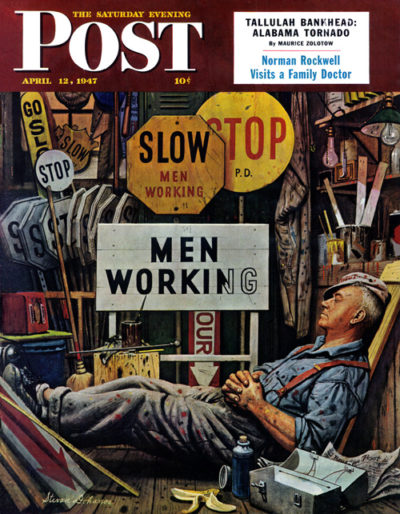
Stevan Dohanos
April 12, 1947
My favorite detail of this Stevan Dohanos cover is that the guy hasn’t even finished painting the “Men Working” sign.
Spring Recipes
To me, spring food = boring food. In the winter we have enticing, filling comfort foods like pasta and chili and steak and soups. Spring means … salad?
But if we’re going to eat during the warmer months of the year — and the latest medical evidence suggests we should — let’s make sure they’re the best salads we can eat. Here’s a recipe for a classic Cobb Salad, which seems to have everything in it but chocolate and potato chips. Here’s a Grilled Chicken Caesar Salad, and our own Curtis Stone has a recipe for an Apple Salad. And here’s a list of edible flowers (yes, flowers) you can throw into your favorite salad. Dandelions are okay, but stay away from those azaleas.
Supposedly, if you eat a lot of salads, they’ll help you live longer. Maybe to 102 or even 111.
Next Week’s Holidays and Events
Taxes Due (April 17)
Spring is also tax time! You get two extra days to file this year because the 15th is a Sunday and the 16th is Emancipation Day in Washington, D.C.
National High Five Day (April 19)
Maybe you can give yourself one when you finish doing your taxes.
Rockwell Video Minute: The Rookie
Hoping to help them improve their 1957 season, Norman Rockwell painted “The Rookie” for the Boston Red Sox.
See all of the videos in our Rockwell Video Minute series at www.saturdayeveningpost/rockwell-video.
Post Travels: Edible Art on the High Seas
When it comes to displaying their work, most artists rely on museums and galleries. Not Endang Supriatna. He takes his creations to sea. A culinary artist aboard Carnival Splendor, he turns fruits and vegetables into works of art. He sees potential in the kitchen on a daily basis, and when not carving radishes and eggplants, he can be found on deck creating glistening sculptures out of huge blocks of ice. His craft is amazing to watch, but consider yourself warned. After watching him at work, don’t be surprised if you find yourself dreaming about a cruise vacation.