The Saturday Evening Post History Minute: The Suffrage March Riot of 1913
In 1913, a group of suffragists decided to march on Washington, in what would become one of the most violent and chaotic episodes in the fight for women’s right to vote.
For more history videos, visit SaturdayEveningPost.com/history-minute.
Cover Collection: March Winds
Whether it’s warm and balmy or frigid and sleeting, the March winds do blow! Here are a few covers showing that this month definitely comes in like a lion.
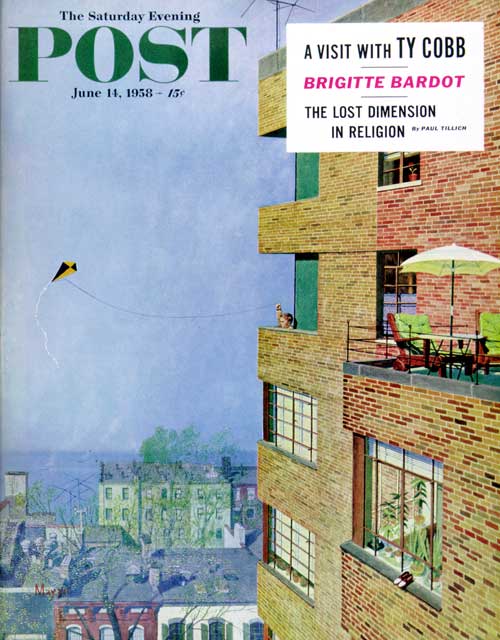
Earl Mayan
June 14, 1958
Post cover artists loved initiative, and who shows that better than the youngster in this 1958 cover? Lacking a green field to run in, the boy flies a kite from his hi-rise balcony. He might envy the kids with room to run, but those kids could envy a heck of a launching pad.
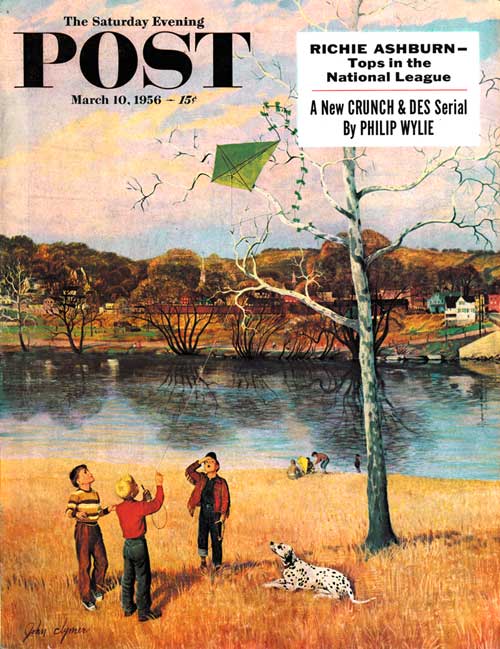
John Clymer
March 10, 1956
Having less luck kiting are the boys from this March 1956 cover. Now this is a pickle. How are those boys going to get the kite out of the tree? Does this remind anyone of Charlie Brown and his “kite-eating tree”?
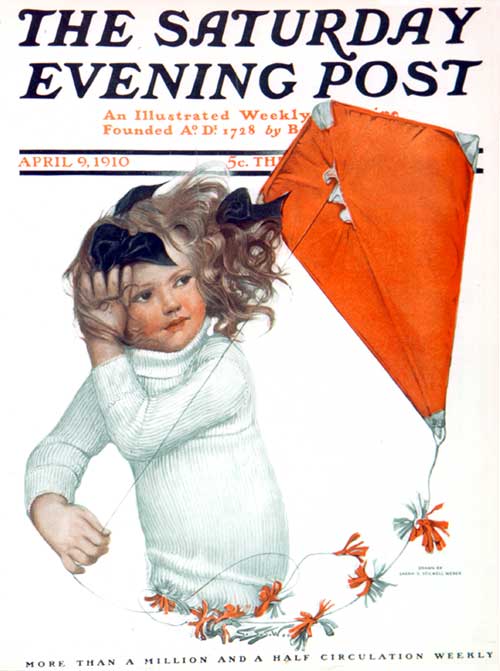
Sarah Stilwell-Weber
April 9, 1910
This pretty lass may be having a bad hair day but a great Kite Day! This is one of the many beautiful Post covers by Sarah Stilwell-Weber that depicted charming children doing everyday things.
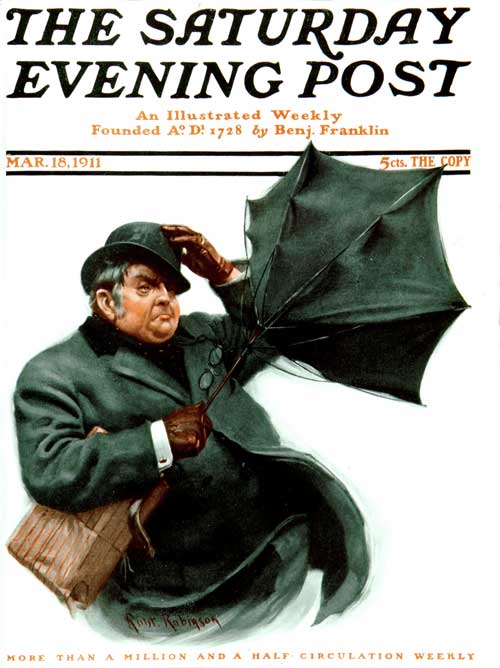
Robert Robinson
March 18, 1911
Holding on to your hat and umbrella at the same time is tricky in high winds. Everyone has had the “inside-out” umbrella experience at one time or another, and this gent from a 1911 cover shows us how frustrating it can be. Do you know what’s really frustrating? That the danged umbrellas still do this!
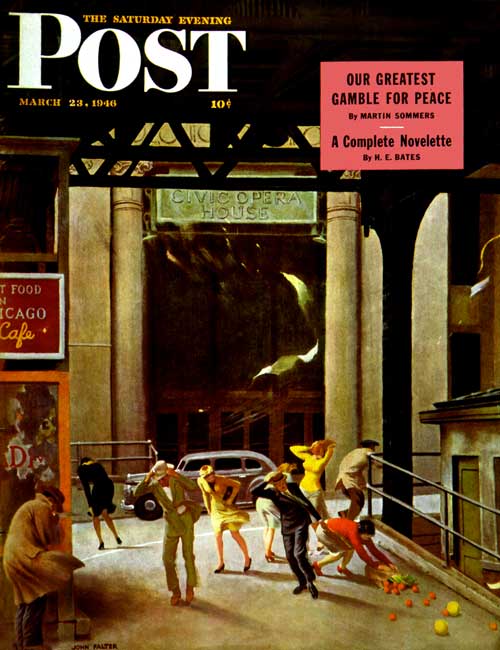
John Falter
March 23, 1946
They don’t call it the “Windy City” for nothing. In this March 1946 cover, the wind is howling down the Chicago River and creating a wind tunnel in front of the Civic Opera House. Hats and skirts are in serious danger, not to mention the poor lady trying to hold on to a bag of groceries. Talk about a bad hair day.
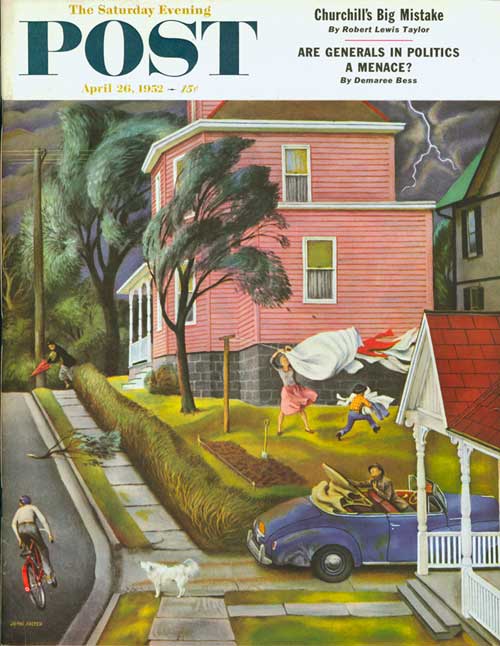
John Falter
April 26, 1952
The March winds blow! Artist John Falter went to a small town in the Midwest for this 1952 cover of big storm brewing. The trees are practically bending over, a woman and child are rushing to get the laundry off the line, and a man is putting up the top on his car (quickly!). The panic even seized the white dog in the foreground, who just rears his head back and howls.
Rockwell Video Minute: First Sign of Spring
Norman Rockwell was a master at capturing that first moment of spring. This gardener discovering his first crocus is one of our favorites.
See all of the videos in our Rockwell Video Minute series at www.saturdayeveningpost/rockwell-video.
North Country Girl: Chapter 44 — A Narrow, Naked Escape
For more about Gay Haubner’s life in the North Country, read the other chapters in her serialized memoir.
I was tucked up in my old boyfriend Steve’s apartment, drifting along in a haze of pot smoke as the summer slipped by. I roused myself to waitress a few shifts each week at Pracna while Steve’s drug business took off. My roll of ones in the shoebox under the bed grew modestly; when I peeked into Steve’s Folgers can resting on the TV, it was filled to the brim with his unlawful earnings. He had new customers arriving daily and became even more loathe to leave the apartment.
I was reduced to enjoying the great outdoors on Steve’s tiny balcony, no one around except the Land O’Lakes maiden on her billboard. I’d remember another patio, the one in Acapulco, with the blue Pacific to the horizon and the cloudless sky above, broken occasionally by a terrified parasailer. I wondered if I’d ever go back.
The robbers came during one of those twilight Minnesota evenings when the sky is streaks of pink and orange, and the sun hangs out on the horizon as if reluctant to leave the party.
Steve and I were in bed, stoned on very good Thai stick, trying to decide if we should get something to eat or just have another beer. There was a sharp rap at the living room door; the ground floor entrance to the duplex didn’t lock, but opened up to the downstairs neighbors and the stairs to our second floor apartment. Steve got up and pulled on his jeans; we both assumed it was a customer. “Coming?” Steve asked me and I shook my head no. I wrapped the sheet around myself and went to close the bedroom door behind him, when I saw the front door slam open, knocking Steve over as he undid the chain. Two men with guns pushed their way in and stood over Steve.
The guns were huge. As they swung around the living room, the gaping muzzles became the black holes I had learned about in astronomy, an emptiness that could make everything disappear. From the way the guns looked, I realized I was in a badly altered state: my pot buzz was shot through with a sickening bolt of adrenaline that left me rooted to the floor, one eye peering out of the half-inch of cracked door, all my senses reeling. The scene in the living room looked wavy and distorted, as if caught in the fun house mirror at Excelsior Amusement Park.
 I knew that behind the two cannon-sized guns were men, but they were indistinct, insignificant forms; the guns were in charge, dragging the men around the room. My stoned brain, weaned on Warner Bros., dredged up a cartoon memory of Yosemite Sam holding a big six-shooter that popped and unfurled a tiny flag with BANG! scrawled in comic sans. I mentally pushed that image aside, it was not helping. But there was nothing I could do to help Steve, who was cowering by the front door, skinny and shirtless and the color of cigarette ash.
There was yelling; I couldn’t make out what the men were saying. It was if their voices came from far away, like someone shouting down a well. Then I clearly heard “Your stash, asshole! Where’s your stash?”
Steve sat up and made a croaking sound and the guns swung towards him. He was pointing at the glass-top table in front of the couch, the table where Steve’s wares were always on display. “Bullshit!” yelled one of the guns, and swung upward to crack Steve’s forehead. Why wasn’t he bleeding? Steve slowly raised his hand to his head and not till then did red seep through his fingers. He crumpled to the floor while the other gun swept the table drugs into what looked like but surely could not be a Marimekko orange and yellow flowered pillowcase.
My mind finally snapped to attention and my thoughts raced forward. I closed the door softly, but I couldn’t shut out the voices of the men yelling at Steve for drugs and money. The drugs were in the freezer and the money was…in the bedroom with me, in the coffee can perched on top of the TV. The guns knew where there were drugs there was money, and Steve, for all his rugged outdoorsman skills and feigned urban swagger, was about to send them into his bedroom, where I crouched naked behind the door.
I dropped the sheet and dashed out to the patio, which was littered with beer bottles and cigarette butts. I threw one leg and then the other over the balcony rail and dangled over the side, the metal edge cutting into my fingers, my feet scrabbling in the air. It was a pretty big drop from the second floor and I was nude, but the surface twelve feet below me was grass, the scraggly untended lawn that surrounded the duplex. I looked over my right shoulder at the Land o’ Lakes Indian maid, who looked back, as inscrutable as the Mona Lisa, and I let myself drop

I hit hard then clambered to my feet. I ran around to the front entrance and banged on the door of the downstairs neighbors. The young couple who lived there cracked the door, took one look, and hustled me into their front hall where they threw a coat over me. I was scraped up, splotched with grass and dirt, naked and crying and hyperventilating, but they heard me sob “Men and guns and Steve is up there” and the husband picked up the phone to call the police.
Footsteps crashed down the stairs and we all froze. A car started up and sped away. I ran upstairs and found Steve black-eyed and bloodied on the floor. I told him the police were on the way and he began screaming at me then threw himself down the stairs shouting, “Don’t call the police! Don’t call the police!”
The downstairs people were newlywed high school sweethearts from a town down by the Iowa border. He was a serious but dopey-looking med student, she young and pretty with some kind of daytime job that required blouses and skirts and panty hose. We had passed a few words going in and out, introducing ourselves and exchanging pleasantries on the summer weather.
They were always quiet and polite and never mentioned the suspicious characters showing up at Steve’s apartment at all hours or the constant pot smoke in the stairway, nice Minnesotans who minded their own business and didn’t complain, even when their bloodied, roughed-up neighbor was cursing and yelling and his girlfriend was cowering naked underneath the husband’s raincoat.
Somehow Steve and I convinced them not to call the police. Maybe they had had enough excitement for one August night already.
In my version of the break-in, I cast myself as both the damsel in distress and the plucky heroine. In Steve’s version I was the idiot who had almost cost him his Outward Bound scholarship by getting the police involved. I expected Steve to comfort and console me — that could have been me with the black eye! — and then admire my courageous getaway. But Steve was pissed at being robbed and as pissed at me as if it were all my fault. I slammed the bedroom door, kicked the empty Folgers coffee can, and quietly bent down to look under the bed. My shoebox of dollar bills was safely where I had hidden it.
Along with Steve’s stash, the robbers stole away our rekindled romance. Steve was done as a dealer; I guess there was no lesson plan on “Re-Building Your Business After Your Money and Your Drugs Have Been Jacked.” Steve descended into drinking and meanness. He stopped driving me to work, and I started sleeping on the sofa and tried to plan an escape.
Steve and I were slumped together in mutual dislike one night, watching TV, when the phone rang. Steve sighed, braced to disappoint another customer, then handed me the phone. When I hung up, I took a malicious delight in telling Steve, “That was a rich guy I met in Acapulco. He’s flying me down to Chicago for the weekend.” My ticket was paid for, all I had to do was pack my cutest clothes and call a cab to take me to the airport, away from sulking, penniless Steve.
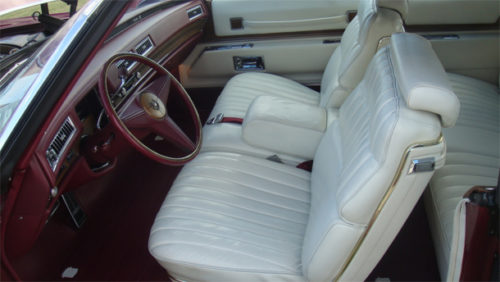
James was waiting at the gate as I stepped off the plane; he swooped me up in an R-rated kiss that scandalized the passengers trying to get around us, then took me out to his gigantic brand new blue and white Cadillac El Dorado that he had just driven off the car lot, priced a few bucks above cost and paid for in cash. I snuggled down into the sweet-smelling, glove-soft white leather seat, but I missed the rented red jeep. This was the biggest damn car I had ever seen; the Cadillac medallion proudly mounted on the hood looked to be about three blocks away. It was like riding around in an ocean liner.
It was a quick drive from O’Hare to James’s place in Des Plaines, a low-rise red brick building that looked an awfully lot like an old U of M dorm. James knew that living in the pokey, middle class suburb of Des Plaines did not go with his man of the world image. He made a point of telling me that the only reason he was there because it was close to the Cadillac dealership where he used to work, but now he was planning to move to downtown Chicago, where the action was.
After the celebratory reunion sex, James asked, “Are you hungry? Do you like deli?” Once I got over the astonishment of James bringing up the subject of food, I said, “I don’t know. What’s a deli?” This delighted James, who couldn’t wait to introduce me to the world of salty, cured meats. We drove to a small bright restaurant filled with older couples eating at formica tables. I was not impressed and I couldn’t identify a thing on the menu outside of the turkey sandwich. James gave his Mephistophelian chuckle and ordered for both of us. That day I became a convert: I slurped tangy beet red borscht, thick with chunks of beef, followed by a plate of salami and eggs with a toasted bagel that I sullied with strawberry jam.

As I washed everything down with my first Cel-Ray tickling my nose like champagne, I spotted Mr. Des Plaines, my old admirer from the Acapulco condo, sitting at a table of alte kakers smoking stogies. He didn’t seem to recognize me with my clothes on. I went back to shoveling it in, emptying the breadbasket of rye slices and Kaiser rolls, and plucking the last cherry pepper from the pickle tray. Knowing James and his eating habits, this might be my only meal for the next twenty-four hours.
James had a whole seductive weekend plan. He had bought a baggie of pot for me, and for himself some coke and Quaaludes, which made for a fun afternoon. James also had dinner reservations for us, which was a shock. In the weeks we had been together in Acapulco, we never had meals that were less than twelve hours apart.
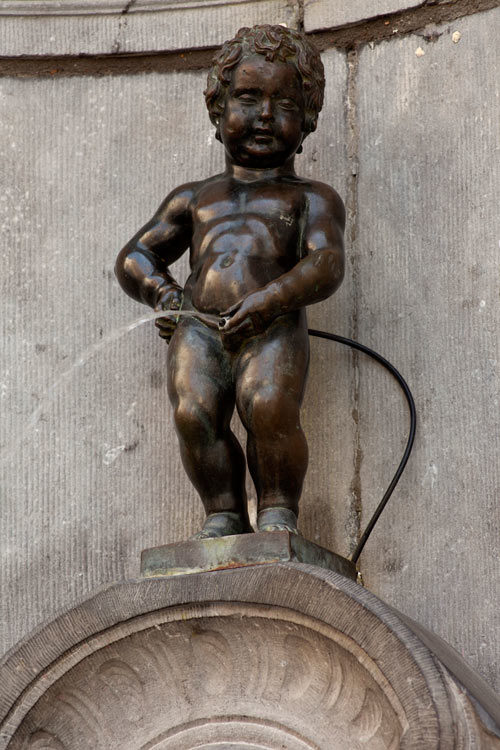
The restaurant, Des Plaines’s finest, wasn’t jet set Acapulco, but anyone from Duluth, Minnesota would have thought it the height of elegance: there were huge brocade covered slabs of menus bound with gilded, tasseled twine (no prices on my menu of course), a fountain with a replica of Brussels’ Manneken Pis tinkling away in the center of the room, and red and white flocked wallpaper which I had not yet realized was more floozy than fancy. The evening wasn’t quite spoiled when the maitre d’ mistook us for father and daughter; we were in Des Plaines, Middle America, after all.
James said, “I want to recreate our first night,” and I felt a little romantic flutter. Once again the steak Diane was set on fire and the Mouton Cadet uncorked. A weird difference crept into our conversation; it turned serious, like a conversation two grown-ups might have.
“I never got to go to college,” James said, leaving unspoken his belief as a self-taught man, he had the best teacher possible. “Tell me about what classes you enjoy the most, how you picked your major.”
My inner nerd stirred from the grave I had buried her in and I launched into why I believed the accepted date for when wandering Asiatic hunters first crossed the Bering Strait to settle the Americas was much too recent, and why a crossing in 10,000 BC was more likely, a topic no one but me and my old girl crush Professor Pearson gave two shits about. James’ eyes glazed over but he managed to look interested for a generous three minutes before launching into his own crackpot ideas on the biological imperative that made men want to screw and women want to breed and how it affected stock prices, that old chestnut about the market rising and falling with skirt lengths. He boasted that his insights into the intersection of sex and economics made him a genius at picking stocks.
I knew that James didn’t go to college because he had been too busy running away from the girl he had impregnated (talk about your biological imperative!). He prided himself on being a self-made man and he had done a hell of a job, making a bundle selling Cadillacs, which he invested in the market, where that money had made even more money.
The wine was finished, James made a trip to the men’s with his vial of coke, came back bright-eyed to order coffee and cognac, and manically jumped into politics and the dastardly deeds of Richard Nixon. We talked and talked, James listening semi-respectfully to my opinions and lecturing me on subjects he thought he was an expert in, until the dirty looks from the busboys became impossible to ignore.
The evening had been romantic, exciting, and unsettling — who was this guy? — and I was ridiculously flattered that James actually wanted to talk to me. Most guys I had been with regarded the first sign of a serious conversation as a cue to stand up and go look for a beer. My tropical romance with James had been flighty, gossamer, a six-week one-night stand; our conversations had been about waterskiing, backgammon, whether James looked fat, the crowd at the Villa Vera, and the latest adventures of the French Canadian girls. I hadn’t had a semi-deep discussion like this since the drug-fueled all nighters in my freshman dorm. But that was with a bunch of still pimply, geeky 18-year-olds, huddled on the floor amid piles of dirty boy laundry. This was in a fancy restaurant with a handsome, sophisticated older man, a man who seemed to be as interested in my mind and my ideas as he was in my young blondness. It felt like a step into adulthood.
Signs of Spring in a Small Town
Every year, I circle the vernal equinox on our refrigerator calendar so the first day of spring won’t slip by unnoticed. I’m not sure why I depend upon the calendar to announce spring’s arrival, since it has so little bearing on the matter. Spring comes when it’s good and ready; sometimes well before March 21, sometimes well after.
For years, spring in our town was heralded by Leon and Jo Martin, who owned the Dairy Queen. Every year, after their winter sojourn to Florida, they would post the words “Now Hiring” on their sign. I would walk past, see the sign, see Leon and Jo readying for their spring opening, and feel winter’s icy veil lift from around me. It was as accurate an indication of spring as any calendar, and when they died and their children sold the Dairy Queen to an out-of-town outfit who kept it open year-round, it threw off our town’s circadian rhythms something terrible. We’re still not sure when spring begins.
Well, that’s not entirely accurate. When the implement store on the west edge of town, where Johnston’s IGA used to be, stops selling snow plows and starts selling lawn mowers, that’s a pretty good sign winter’s grip has loosened. If they should drop the ball, Frank Gladden is sure to stand at our Quaker meeting and announce that volunteers are needed for our spring fish fry. Frank’s announcement is as reliable as any clock, and invariably tinged with worry and regret that this might be the last year of the fish fry if volunteers aren’t forthcoming.
“We’re not getting any younger,” he announces to the congregation. Frank is 80 years old, but he’s been saying that since 1961, so we Quakers aren’t alarmed. The Fairfield Friends Fish Fry is as constant as sunrise. If Jesus were to return on the clouds the day before the fish fry, the men would soldier on, undeterred.
When the implement store on the west edge of town stops selling snow plows and starts selling lawn mowers, that’s a pretty good sign winter’s grip has loosened.
But let us suppose both the implement store and Frank Gladden neglect their duties and we are cast adrift, oblivious to spring’s arrival. We would then have to look and see whether Bill Eddy, our town’s plumber, was wearing a coat. When the first leaf withers and falls to the ground in autumn, Bill pulls on his tan Carhartt coat and doesn’t remove it until spring. I’ve known Bill since we were in first grade together, so am well-acquainted with his habits. He wears the coat inside and outside, and if he takes a week off in February to take his wife on a cruise, you can bet he’ll still be wearing his coat while floating around the Caribbean. No matter where he is, his internal thermostat is set for Indiana.
There are other signs of spring if one is watchful. The deer lighten in color, the dog sheds, the buds swell, the snow melts on the south hillside, and the bloodroot in our woodlot pushes out its petals. The calf appears, tethered to its mother by bonds of hunger. The farmer casts the manure upon the field, thoughtfully provided by the aforementioned calf and mother. Who needs a calendar when a calf is nearby?
Nothing seems impossible in spring — a cure for cancer, wisdom in Washington, weight loss. Anything can happen, and often does. I proposed to my wife a dozen times in the winter and was denied each time, so I waited until spring and popped the question a 13th time, an unlucky number, but even superstition takes a backseat to the glories of spring, and she consented. Engaged one spring, married the next. Between that and the Dairy Queen, what more could one want?
Philip Gulley is a Quaker pastor and the author of 22 books, including the Harmony and Hope series featuring Sam Gardner.
This article appears in the March/April 2018 issue of The Saturday Evening Post. Subscribe to the magazine for more art, inspiring stories, fiction, humor, and features from our archives.
The Architecture People Love to Hate and then Just Love
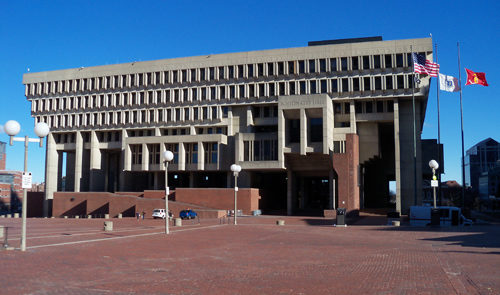
On a guided tour of Boston, one might approach the city hall to hear the warning, “Here it is, ladies and gentlemen, the ugliest building in the world!” Boston City Hall — an imposing structure of concrete slabs and gaping space — was completed almost 50 years ago, and its reception has never not been complicated.
In 1962, the mayor of Boston had put forth a competition challenging architects to submit design ideas for a new city government building. The contest came after years of a stagnant economy, white flight, and rampant corruption in the city. The architects Gerhard Kallmann and Michael McKinnell, two Columbia University professors, submitted their design amongst 255 other entries to be judged by a jury of professionals and entrepreneurs. A design competition for a public building was an anomaly in the U.S., the last one having been around the turn of the century.
When Kallmann and McKinnell’s ambitious winning model was revealed from under a white sheet at the Museum of Fine Arts in May of 1962, someone in the crowd reportedly uttered, “What the hell is that?”
A conundrum to many, the city hall was a modernist vision in the vein of the “brutalist” architecture of Europeans like Peter and Alison Smithson and Le Corbusier. Although the term, out of context, may evoke violence, brutalism is descended from a host of linguistic lineages including the French béton brut (raw concrete). Modern concrete architecture had ethical implications since many of the European incarnations of the movement had come in the form of low-cost or public housing. In a similar spirit, Boston City Hall aimed to embody civic transparency and urban renewal, according to Chris Grimley, co-author of Heroic: Concrete Architecture and the New Boston. This contrasted sharply with the glass, capitalist towers of Madison Avenue in New York.
So why did everyone hate the concrete city hall?
Well, not everyone: there was a clear dichotomy in public reaction. Architecture enthusiasts and academics praised the boldness and authenticity of the building, while a 1970s survey of regular Bostonians found “cold,” “overbearing,” and “monstrous” to be the most common reactions. In 2006, Boston mayor Tom Menino proposed selling or demolishing the city hall, citing the “wasted space” of the surrounding 11-acre plaza and the aesthetic of the edifice that’s more akin to a bunker or, possibly, a handball court.
Menino’s pitch didn’t come to pass, however. Despite the widespread hatred of Boston City Hall, the overarching opinion seemed to be that it possessed a historical significance that should be preserved. This could be a self-fulfilling prophecy. Chris Grimley says, “The longer a building is up, the better chance it has to go through the process of, first, being considered an eyesore, then to enter into an age of new appreciation.” Grimley believes we should look at concrete architecture with a more measured sensibility.
Brutalism might be back in vogue after all. Several factors could be contributing to concrete architecture’s newfound popularity: first, the threat of demolition. Nothing rallies supporters like the permanency of art extinction. Grimley says members of Generation X have grown up around these buildings, and they’ve, perhaps, developed more complex sentiments toward the style than their parents.
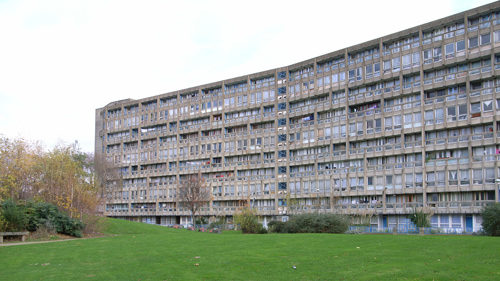
The Robin Hood Gardens in London was demolished last year despite an effort by high-profile architects like Zaha Hadid and Richard Rogers to conserve the housing complex. The campaign SOS Brutalism has tasked itself with compiling a database of vulnerable concrete “monsters” all over the world. Since most examples of the architectural style were built in the ’50s and ’60s, most brutalist structures are confronting middle age — and the need for upkeep. Contrary to turn-of-the-century notions, concrete is not indestructible.

How to go about preserving the tough architecture is another issue. Washington D.C. Metro found itself triggering outrage from architecture enthusiasts when they started painting over the iconic concrete arches in Union Station with white paint last March. The local chapter of the American Institute of Architects requested that the paint job cease immediately.
Another appealing aspect of brutalism is the photogenic quality of the work. With its sharp lines and defined shadows, concrete architecture photographs well. Instagram accounts like @brutopolis and @brutal_architecture and a blog called F*ck Yeah Brutalism curate concrete photography for the social media age.
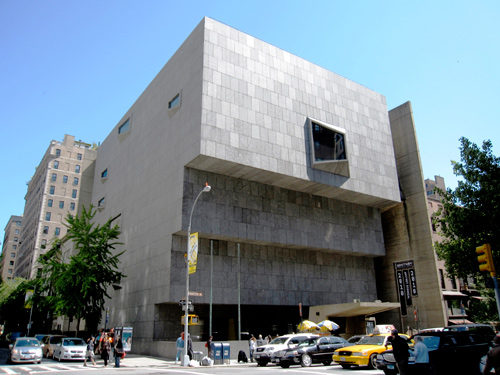
But will the aesthetic appreciation for brutalism hold up? Architect Michael Kubo predicted last year that it would, in the way that “you might not want to wear your parents’ clothing, but your grandparents’ clothing is suddenly cool again.” In 2016, the Metropolitan Museum of Art opened the Met Breuer at the former — quite brutalist — site of the Whitney Museum on the Upper East Side. The same year, a film adaptation of J.G. Ballard’s novel High Rise was released, setting the dystopian thriller in a concrete skyscraper. With so many critical and cultural treatments of brutalism, everyone from The Guardian (“Why Brutalist Architecture is Back in Style”) to The New York Times (“Brutalism is Back”) predicted a revival of the postwar style. Even McSweeney’s Internet Tendency hopped on the trend with a satirical imagining of HGTV’s “Fixer Upper.”
Chris Grimley and Michael Kubo’s book, Heroic: Concrete Architecture and the New Boston, calls for a reinterpretation of brutalism. In fact, they would rather the style be called “heroic.” Grimley says, “The hero is a flawed figure. We acknowledge that, in the radicalness of the moment, mistakes and errors were made, but we want to take a more nuanced look at the work.” Still, the pair, along with their co-writer Mark Pasnik, maintains that postwar concrete architecture was civically-minded and instigated, and that the larger story of the work is about urban reinvention.
Whether concrete has staying power — this time around — remains to be seen. Does anyone want to live and work in these structures, or do they only convey a freakish allure? In the case of Boston City Hall, mayor Martin Walsh chose to liven up the difficult design with a pretty simple fix: LED lights. In 2016, Walsh unveiled the new lighting project that he hoped would rejuvenate the public space for a new generation, and perhaps showcase the versatility of concrete. Now, the “ugliest building in the world” shines in the hue du jour, and it will escape demolition for the time being.
“The Jazz Baby” by Julian Street
Had a stranger seen Elsa Merriam sitting at the piano in her drawing-room at dusk on this spring evening, with the lamplight falling on her cheek and her golden hair, he might have guessed her ten years younger than her actual age; but had he told her of his guess she would not have thought him sincere, for it was a part of Elsa’s charm that when people spoke admiringly of her girlish figure, the fine texture of her skin, the delicacy of her coloring, or when on meeting her with the stupendous Lindsay they voiced amazement that she could be his mother, she saw in their utterances only efforts to be tactful.
Her fingers touched the keys softly; she was listening not so much to her playing as for the sound of the front door, for the Easter holidays were here, and Lindsay was coming home this afternoon from college, bringing a friend with him.
“Chet Pollard’s family’s in Europe or some place,” her son had written, “so he can’t go home this vacation. He’s a good egg, terribly smooth and talented musically.
“When presently from the hall below came the dull sound of the front door closing, she stopped playing and rose from the piano, but on hearing a sedate tread upon the stairs sat down again. The step was not Lindsay’s, but her husband’s.
“Hello, dear,” he said on reaching the doorway. “Lindsay not home yet?”
“No, but I’ve sent the car to the station.”
Her husband came in, kissed her on the cheek, and having performed this customary rite, turned to leave the room.
“Been playing?” he asked casually over his shoulder as he moved away.
“Yes, I’ve found a Grieg sonata with a nice cello part for Lindsay, and I’ve been brushing up on some of our old Beethoven duets.”
“H’m, he likes Grieg and Beethoven, does he?” he inquired vaguely, heading for the stairs.
She was smiling as she resumed her playing. It seemed impossible that Hobart Merriam should not know that his son liked Grieg and Beethoven.
Again the sound of the front door, but this time a distinct concussion followed by a tumult of voices, boyish laughter, the noise of something scraping the banisters, then as she was halfway across the room, Lindsay in the doorway, wearing the shy affectionate grin with which he always greeted her. He let his suitcase fall with a thud to the floor, but with a second piece of baggage was more careful, depositing it gently upon the carpet; then taking his mother by the shoulders he leaned far down and kissed her, while she marveled, as she always did when he reappeared after an absence, that this gigantic college creature was identical with the helpless infant of a few years ago.
“Mother,” he said as he straightened up again, “I want you to meet — I mean, this is my friend Mr. Pollard.”
Mr. Pollard was a handsome youth almost as tall as Lindsay, with brilliant dark eyes and a complexion like a dairymaid’s. Why, Elsa wondered, were the young people of this generation so much taller? Certainly in her girlhood, boys of this height were exceptions.
As she welcomed her son’s classmate his manner was that of one overtaken by mirthful recollections.
“Huh-huh! I’m sure it was very kind of you — huhhuh — to invite me here for the vacation, Mrs. Merriam.”
Lindsay also began, to laugh in the same nervous manner; the two stood chuckling together as if at a secret jest. Desiring to help them regain their composure she spoke gravely of practical affairs. Had their train been on time? Had the chauffeur found them without difficulty? But though Lindsay became calmer his friend continued to laugh his replies. Trying to pacify him was like trying to haul down a captive balloon in a high wind.
“Lindsay tells me you’re fond of music,” she said.
The young man chuckled that he was, and she turned to her son.
“I didn’t have time to write about it,” she told him, “but there’s a splendid symphony concert tonight with Lazlof playing the cello part of a Grieg sonata I’ve just bought for us to do. I got three tickets on the chance that you and Mr. Pollard would be able to go with me.”
Abruptly the laughter ceased; a profound solemnity overtook the two boys; they stared at each other, evidently exchanging wireless messages which resulted in the nomination of Lindsay to be spokesman.
“Look, mother,” he began, “it certainly was good of you. We certainly appreciate it and everything. But now look — Chet thought — at least there’s a girl — I mean a couple of girls — they were down at the prom — and this girl’s mother is a friend of Chet’s mother, and she wanted him to be nice to her when he came to New York, so we kind of arranged to take them to the theater tonight — only we haven’t called up yet, so of course they might not be able to go, and —”
Here Pollard seemed to think best to break in.
“Oh, they’ll be able to go all right,” he said with the air of one sure of his women.
Mrs. Merriam was quick to help them out of their embarrassment.
“I thought it likely you’d have an engagement,” she said, “but I got tickets on the off chance. I’ll probably be able to get Cousin Ellen and Aunt Fannie to go with me.”
“Gosh!” said Lindsay sympathetically.
“I admit I wish Dorothy Hallock were at home,” said his mother.
“We went to lots of concerts last year. I always have a fine time with Dorothy, she’s such a sweet girl.”
“Yes,” her son replied, “sweet’s the word; sweet means dopeless.”
“Indeed? And what does dopeless mean?”
“Just what Dorothy is — unsophisticated.”
“I should hope so!” she said with a little baffled sigh. “Well, dear, hadn’t you better be seeing about your theater seats?”
“I’ll call up Bea and Midge,” Pollard said, and Lindsay forthwith led him to the telephone closet in the hall.
Mrs. Merriam was at the piano when her son returned alone to the room.
“Here’s that Grieg sonata,” she said. “Bring your cello and we’ll run through it before dinner.”
“Look, mother,” he answered uneasily, “I didn’t bring my cello this time. You see, the vacation’s so short, and it’s such a job lugging it around.”
It was the first time he had failed to bring his cello home, and she was keenly disappointed; perhaps he read her disappointment in her face, for he went on: “I would of brought it, mother, but it’s so darn bulky and I had two other things to carry.”
“I suppose you couldn’t, then,” she said.
From early childhood Lindsay had loved good music and she prized the taste as his most valuable inheritance from her. As a girl she had dreamed of becoming a professional pianist; at fifteen she was sufficiently advanced to study under a great master; two years later, however, her mother had died, and just then, when she felt so alone, she had met Hobart Merriam and married him. At the time there was some talk of a resumption of her studies, but it was prevented first by Hobart’s complete indifference to music, then by the birth of Lindsay. Lindsay more than made up to her for the loss of her career; he was worth a thousand girlish dreams; deep down in her heart she acknowledged to herself that, good and kind though Hobart was, her real companion was her son.
Early she had begun to give him rudimentary musical instruction; at seven he had a little cello, and within a few years he had so far progressed that she began to harbor visions in which her early ambitions for herself came to fruition in him; visions in which she saw him seated with his cello on a stage, playing to a hushed audience.
Because of the boy’s talent she would have preferred to keep him at school in New York, where he could continue his musical education under the best teachers, but his father had other plans for him. His own parents had been poor, and he was determined to give Lindsay the advantages of boarding school and college, which he had been denied. Elsa fought off the selection of a school as long as she could, and when compelled to decide, chose one in which the head master was musical. Occasionally she would go up and hear the school orchestra, in which Lindsay played, and all through the school year she looked forward to the summer vacation at Westfield, in the Berkshire Hills, where they had time to play together a great deal, working up difficult duets, and also trios — for Dorothy Hallock often joined them with her violin.
Summer residents were wont to speak of Westfield as unspoiled, by which they meant that the same families occupied the same houses every season, that the country club was simple, and that there was no flamboyant hotel to attract social gypsies. The automobile, of course, did tend to bring to the country-club dances young people from the smarter settlements nearby, giving Westfield occasional glimpses of the genus flapper, but such glimpses served only to heighten local conservatism.
The Hallocks were typical of the place; old New Yorkers whose residences in the city and the country dated from an era of architectural ugliness; but they were spacious homelike houses, and their owner and his wife were old-fashioned enough to be attached to them, and moreover to have a family large enough to keep them comfortably filled. With her music and her quick intelligence, Dorothy, the youngest of the Hallock children, seemed to Elsa the most attractive girl in Westfield, and it flattered her that despite the difference in their ages Dorothy so evidently enjoyed being with her. It was nearly a year now since Dorothy had gone to school in Paris, and the elder woman had genuinely missed her.
Lindsay, too, had missed Dorothy, Elsa thought; for during the summer of her absence he spoke often of their need of a violin, and showed a restlessness she had never seen in him before. Until that summer he had always been satisfied to stay in Westfield, but he now began to take nocturnal motor trips to dances at neighboring resorts. Of course, though, he was at the restless age.
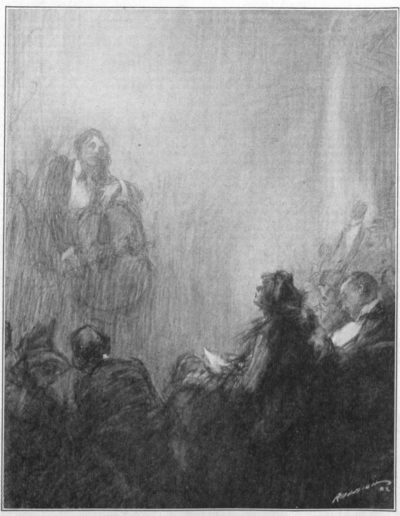
Often when they were playing she spoke of Dorothy.
“Sure I miss her,” he once told her. “She’s an awfully nice kid, but I wish they’d get some new girls in this place.”
“Why, Dorothy isn’t a kid. She’s only a year younger than you are.”
“Nearly two years,” he corrected. “She’s sixteen.”
“She’ll be seventeen this summer.”
“Well, anyhow,” he said, “I couldn’t get interested in her; we know each other too well. Look, mother, can I have the motor tonight? There’s a dance over at Arlington. And I need twenty-five dollars.”
A little after that he left for college, and she was overjoyed when presently he wrote that he had made the college orchestra. During his Christmas holidays they played but little, most of his time having been given to social activities. She supposed it was only natural that a college boy should want a lively vacation, and she prized the more such odd moments as he spent with her.
And now, after what seemed a trifling interval, the Easter holidays were here. Time went faster and faster. After another little interval it would be summer and they would go again to Westfield. Before long he would be out of college; then presently he would marry and she would lose him. She must make the most of the few remaining years. Ah, how she wished that he had brought his cello home!
Chet Pollard was still at the telephone when Mr. Merriam came downstairs.
“Well, Lindsay,” was his greeting to his son, and the two shook hands, Lindsay giving a jerky little half bow. He always seemed a trifle ill at ease when he greeted his father; Elsa believed it was because both were conscious of the fact that two or three years ago they would have kissed.
“I believe you’re taller than ever,” Mr. Merriam said.
“No, I’ve stopped growing but I’m putting on some weight. If I can put on about twelve pounds I’ve got a chance for the crew.”
The father made no comment upon this, but remarked: “Your mother and I were pleased that you passed your uniform tests.”
“Believe me, I was pleased!” said Lindsay, grinning. “I was half expecting to get on pro. Spanish and French saved me; they’re gut courses.”
“They’re what?” his mother asked.
“Gut — soft — easy,” he elucidated.
“H’m,” said his father. “Better have your bags taken upstairs. I tripped over one of them in the hall.”
“You did?” Lindsay looked agitated. “You didn’t trip over that long black one, did you? Gosh! I wouldn’t have anybody trip over that!”
“It might be a good idea, then, not to leave it in the center of the hall.”
“Gosh! Did I leave it there? Well, I’ll take it up to my room right now!”
He started for the door, but his mother interposed.
“Just ring for Wilkes,” she said. “He’ll take them up.”
“Not on your life!” Lindsay answered with great earnestness, as he picked up the suitcase and the long black box. “Not this thing. I’ll carry this myself.”
“What you got in it you’re so particular about?” his father asked.
“Well,” replied the boy obscurely as he started for the stairs, “it’s something I can’t afford to have broken.”
“But look here,” persisted his father, “why are you so careful about that box? What you got that’s so breakable?”
Lindsay, who was now halfway up the stairs, stopped, and looking over the balustrade laughed down at the anxious upturned faces of his parents.
“Oh, it’s not hooch — if that’s what you mean. No, dad, nothing like that. It’s just something — something that I — well, I wanted to ease it to mother, but I guess I might as well show it to you now.”
He descended, let the leather bag plump to the floor again, and carried the mysterious black case to the drawing-room, where he placed it carefully upon a couch. Then without moving to open it he turned and earnestly addressed his parents.
“Now look,” he said, “in the first place I want you to realize I got this thing at a wonderful bargain. Probably you could go from one end of this country to the other and you’d never see a bargain like it again. Probably there aren’t five others like this one I’ve got here, in the whole country. I want you to realize, mother, what a perfectly unprecedented —”
“You haven’t told us what it is, yet,” his father broke in.
“I was just going to tell you,” the boy returned, “but first I want to make absolutely sure you understand what a wonderful bargain I’ve got.”
“It seems to me,” remarked his father dryly, “that you have succeeded in impressing that point upon us. What is it?”
“But first,” continued Lindsay —” first you must realize that it’s quadruple gold plate over triple silver plate. If you understood about these — these things, why, you’d know they don’t make ’em that way — not except when they get a special order. And even then you’d have to wait weeks and weeks before you’d —”
“What you got?” demanded his father in the tone of one whose patience is being worn thin.
“That’s what I’m trying to tell you,” answered the youth, going to the box and undoing a catch at one end.
But instead of releasing the other catches and opening the box he turned and with all the impressiveness he could command delivered a final word.
“It cost two hundred and seventy-five new,” he declared, “and what do you think I paid for it? Only one hundred and fifty dollars! That’s all! Yes, sir, only one hundred and fifty! Why, if I hadn’t of bought it, it would of been a crime! Nothing less than a crime! I want you to keep that fact in mind, dad, because —”
“For heaven’s sake!” cried Mr. Merriam, “what — you — got — in that — box?”
Dramatically Lindsay threw back the lid, revealing in a velvet recess a shining, tubular, twisted, bell-mouthed something, scaffolded with metal bars and disks.
“Oh, Lindsay!” cried his mother in an anguished voice.
“Quadruple gold plate over triple silver plate!” her son reiterated.
“You haven’t mentioned what it is — not even yet!” commented Mr. Merriam with abysmal cynicism. “Is it a fire extinguisher, or a home-brew outfit?”
“No — home blew,” replied his son.
Seizing the gilded instrument and holding it as if to play, he began to shuffle, undulating his body in a negroid manner and singing:
“When I blow those home-brew blues
On my sexy saxophone,
I can get any gal I choose —
Come, ma baby, youse ma own!
Briny yo’ bottle, baby dear;
Fill it full of gin or beer;
Come and lap the home-made booze,
While I blow those home-brew —
Hear me blow those home-brew —
Blues!”
Having finished his song he blew upon the instrument, evoking from its golden throat sounds resembling ribald laughter, ending on a dissonant note.
“Oh, Lindsay!” cried Mrs. Merriam again.
“That’s a nice refined song!” said his father caustically. “I suppose that’s what they teach you in college.”
At this juncture Chet Pollard came from the telephone closet.
“I had an awful time getting ’em,” he said. “They had to page ’em all over the hotel. It’s a darn nuisance!”
“Can they go?” Lindsay demanded.
“Naturally,” replied Pollard.
Lindsay introduced him to his father; then: “We want to get theater seats for tonight, dad,” he said. “I was wondering if you’d work your drag at the club.”
“It would be nice if you could get seats for the new Shaw play,” said Mrs. Merriam.
Again she sensed an exchange of wireless messages between the two young men.
“But look, mother —”
Pollard, however, cut Lindsay short.
“That’s so, Mrs. Merriam,” he declared. “I understand the Shaw play is very — very clever. In my opinion Shaw is one of the cleverest playwrights there is; but you see, these girls we’re going to take are musical — uh — they’re very musical, and uh — they thought they’d like to go to something — uh — something musical this time.”
“There’s a lovely little operetta called Mignonette,” the mother suggested. “Quite the daintiest thing I’ve seen in years. If you — “
“But look, mother,” Lindsay broke in, “we were planning — “
Here, however, the more adroit Pollard again took matters into his own hands.
“Yes, indeed, Mrs. Merriam,” said he, “I hear Mignonette’s awfully dainty. But I guess these girls must of — uh — must of seen it, or something. Anyway they were speaking of another musical show they hadn’t seen, and —”
“So we thought —” began Lindsay.
“What’s the name of it?” Mrs. Merriam asked.
“It’s at the Apollo,” answered the guest.
“I don’t remember what’s at the Apollo,” she said, and turning to her husband, who had begun to read the evening paper, asked him to look it up.
At that, however, Pollard spoke up quickly.
“Oh, yes,” he said, as if the name had just come to him. “It’s called Jazbo.”
Mr. Merriam now became interested. “Jazbo?” he repeated. “Isn’t that the name of the show the police were — “
“It’s quite all right now, though,” his son interposed hastily.
“Who says so?”
“I was reading in the paper where they made those girls put on different costumes.”
“Costumes?” said his father. “Was there trouble about costumes too? I understood it was the dancing of this woman, What’s-her-name, that — “
“Khiva,” said Pollard. “But they say her manager paid the police to make a row, Mr. Merriam.”
“Yes, just an advertising dodge,” quickly supplemented Lindsay.
“The advertising dodge seems to have worked so far as you two boys are concerned,” his father commented.
But this elicited immediate protests.
“No, sir, that’s not it!” declared Pollard righteously.
“No, I should say not!” Lindsay added. “Why, dad, the music in this show’s a knock-out. Three big fox-trot hits in one show: My Raggedy Rose, Sweet Cookie and You Gorilla-Man. And besides, if you invite a lady to go to the theater, and she expresses a desire to see some particular show, and you — “
“And they have Joe Eckstein and his Saxophone Six,” urged Pollard.
At this Mr. Merriam became still more interested.
“Oh, those fellows?” he said. “They must be the ones I heard last year. They’re very good.” He smiled at the memory; then looking with dawning curiosity at his son’s new treasure lying in the open case he asked: “Is that the same sort of thing they play?”
“Sure,” replied the collegian; “a saxophone — but this one’s quadruple gold plate over triple silver plate.”
“Let’s hear you play it, then.”
Lindsay took it up, put the mouthpiece to his lips and blew a stream of bubbling bursting notes.
“Can’t you play us a tune?”
But the saxophonist shook his head.
“Needs other instruments — a piano anyhow,” he answered.
“There’s your mother — she’ll play for you.”
But Lindsay shook his head again. “Oh, mother can’t play jazz,” he said.
“Your mother can’t?” exclaimed Mr. Merriam. “I guess your mother can play anything anybody else can!” He looked questioningly at his wife, but she remained silent.
“No,” said Lindsay, “jazz isn’t like other music. It’s a trick by itself. Maybe, if you’d like, we can get somebody in to play before vacation ends. Chet, here, has got his clarinet with him, and he’s great on it.”
Having won his father over to his instrument he now exhibited it in detail, showing how the stops worked.
“Gosh, I was lucky to get this one!” he said. “I never would have got it if Len Spinney hadn’t been dropped out of college. You remember Len, mother?”
She nodded. “You say he’s been dropped? That’s too bad.”
“Yes, and he didn’t need to be. But he kept going to New York to see a girl, and he took too many cuts. He didn’t mind much, though. He’d been thinking of marrying her anyway, so when he got dropped he decided to do it; but he hadn’t any money and that’s how I came to get it so cheap. He had to have a hundred and fifty dollars.”
“A classmate of yours — married?” cried his mother.
“On a hundred and fifty dollars?” demanded Mr. Merriam.
“Uh-huh,” replied Lindsay with a nonchalance that both his parents found ghastly. “That was all he really needed right away. His wife couldn’t go on a wedding trip. She has to stay in town because she’s in the Follies.”
Mrs. Merriam stared at her son, thunderstruck, but the father was vocal for them both.
“My God!” he exclaimed.
“Well,” said Lindsay, “she’s knock-out for looks and a wonderful dancer, and a fellow has to marry sometime, doesn’t he? By the way, dad, I need twenty-five dollars and — Oh, I tell you who we could have in to jazz up the piano — Bea Morris — eh, Chet?”
“None better,” said the other youth.
“Who’s Bea Morris?” Mrs. Merriam inquired.
“Girl ‘t’s going to the theater with us tonight. Say, dad, would you mind phoning for those seats?”
“How many?” asked his father, moving toward the door.
“Four.”
“Aren’t these girls to have a chaperon?” Mrs. Merriam asked.
An expression of pain came over the boy’s face. “Gosh, mother!” he sighed. “Where you been all this time? If a girl’s so dopeless she has to have a chaperon she doesn’t get asked — that’s all.”
“Well, I’m thankful we haven’t a daughter to bring up, the way things are,” she said.
“Oh, I don’t know,” returned her son. “Just because there’s no chaperon it doesn’t necessarily mean necking.”
“That’s a comfort,” Mr. Merriam said. “Then it’s four, is it?”
“But really, Hobart,” pursued his wife, “do you think it’s proper for these boys to take young ladies to see a musical comedy the police were going to close?”
Again the look of pain swept over her son’s face.
“Oh, mother!” he protested. “Don’t be a flat tire! You’d call the Hallocks proper enough, wouldn’t you?”
“Certainly.”
“Well, Mrs. Hallock took Bobby and a lot of young people to see Jazbo — a big theater party, and a lot of subdebs at that.”
“I could telephone and ask her what she thought of it.”
“Mother! What kind of a position would that put me in? Asking people what shows I’d ought to see or not! You seem to forget I’m practically twenty.”
“It can’t hurt to ask her what sort of show it is,” his mother contended, “if I don’t tell her — “
“Well,” he said, still protesting, “I don’t say she’d exactly recommend this show. Maybe she didn’t know about the police and everything, but she took ’em, all the same. One of the girls came down to the prom, and she told me. She said she was kind of disappointed in the show, herself, after so much talk; said it wasn’t so very rancid — just a little sour in spots.”
“I’m not worrying about you,” said his mother, “but about where you take these young girls.”
But Pollard hastened to reassure her. “Oh, don’t worry about that, Mrs. Merriam,” said he. “They’re not young. Both of them are over twenty.”
“But what will their mothers think if I — “
“As far as that goes,” he told her, “their mothers won’t know anything about it. Midge hasn’t got any mother, and Bea’s mother is in White Sulphur or some place. And anyhow, Mrs. Merriam, she’s a very broad-minded woman — she lets Bea do just whatever she pleases.”
“What do you think, Hobart?” the mother asked.
“Oh,” said her husband, “I’d let ’em go. These girls aren’t our daughters, and from what I hear, it’s the way all of ’em are now.” And as she interposed no further objections he went to telephone for the theater seats.
Immediately after dinner the two boys, slim and clean-looking in their tucs, rushed away in a taxi, and a little later Mrs. Merriam, having been unable to find anyone to accept her belated invitation, left her husband reading in his library and departed alone in her limousine for the concert.
But tonight the music, whirling in great somber currents through the auditorium, made only a background for her thoughts. Her mind was full of Lindsay. She was troubled about him; he had not only left his cello at college but had brought home what an instrument instead! A saxophone! And it had belonged to a boy who had been dropped from college and had married a chorus girl.
Who were these girls Lindsay was with? What had come over her son that he wished to take them to a tawdry show? She thought of her incessant efforts to develop in him a fastidiousness not only in music but in other things which should be his esthetic and moral safeguard. And was this to be the outcome? During the intermission she found friends to talk with; then the orchestra reassembled and she was left alone again. Lazlof, the great cellist, entered at one side, carrying his instrument, and amid applause made his way to a chair at the center of the stage; the choir of stringed instruments softly played the prelude, Lazlof lifted his slender bow, and the miracle began.
The sound of the cello added poignancy to her thoughts of her son. How often she had secretly visioned him playing to just such a hushed audience as this! But alas, that dream, like so many others, must be relinquished.
“Did you hear those boys come in this morning?” her husband asked at breakfast.
“Yes.”
“Did you notice the time?”
“Yes; I didn’t sleep very well.”
“Nearly seven!” he said, and she had a wanly humorous sense of his looking at her accusingly, as though the lateness of their home-coming were in some way her fault.
“I went into Lindsay’s room before I came down,” he continued gloomily. “I could have set off a bomb in there for all they’d have known! Room in horrible disorder — clothes all over the place. I stepped on a watch — don’t know which of them it belongs to. What condition do you suppose they came home in?”
“Lindsay has always thrown his things around,” she said.
“What could they have been doing?” he went on. “Do nice girls stay out with boys all night?”
“I don’t know,” she answered. “I don’t believe I understand these young people.”
“Well, I’ve been reading a book about them,” he declared, “a novel some young fellow’s written. If they’re what he says they are they’re a pretty queer lot.”
“What’s the name of the book?”
“I don’t remember. If you want to look at it you’ll find it on the table by my bed; it’s got a red cover. Do you know anything about these two girls?”
“No.”
“I wouldn’t be surprised if they were chorus girls,” said he.
“Oh, no!” It was as much a prayer as a denial.
“Why not? Didn’t Lindsay say a classmate of theirs married a chorus girl? Didn’t he seem to approve of it?”
“Oh, I can’t believe he was thinking of that side of it,” said she. “I think he was just glad to get the boy’s saxophone.”
“Well,” he said in a sinister tone as he left the room, “you just read that book!”
Having the morning to herself she did read some of it and skimmed the rest. The publisher’s announcement on the paper jacket proclaimed it A Passionate Tale of Youth in Revolt, and described the author as A Fearless Young Iconoclast, Impatient of Literary Shackles. Except one drunken middle-aged woman, there were in the world with which the story dealt no grown-up people. It was a world of flappers, gin and familiarities.
When about noon the boys came down to breakfast she looked apprehensively for signs of dissipation, and was infinitely relieved to find them clear-eyed and in high spirits. Lindsay, kissing her, did not smell of gin, but of the sticky oily stuff that made his hair so shiny.
“Did you have a good time?” she asked as she poured their coffee.
“Did we! Do you know what time we got in? It was darn near seven.”
“How was Jazbo?”
“Pretty peppy, and great music. We just naturally had to go around to the Prowlers’ Club afterwards, and dance all night.”
“A club?”
“Not a real club; just a restaurant — the joint where they have the best music in town. Gosh, I can hear Sinzy yet, whanging out that You Gorilla-Man!” He began to hum, bouncing in his chair.
“Sinzy?”
“Yes,” said her son; and as she looked blank he continued: “Mean to say you’ve never heard of Sinzy? Why, he’s one of the greatest characters in this town. He’s got a face like bad news from home, but I guess he’s the best jazz piano player in the world.”
“And the young ladies didn’t get tired?”
Lindsay laughed.
“If they had their way we wouldn’t be home yet, would we, Chet?”
“No,” and he explained: “You see, Mrs. Merriam, these girls are a couple of the busiest little pep artists this side of Cayenne.”
“They both dance well?”
“A girl’s got to dance well to make the grade these days,” her son informed her. “She’s got to be practically as good as a professional.”
“Then these girls aren’t professionals?” she asked quickly.
“For heaven sakes!” returned her son. “What would we be doing with professional dancers?”
“Professionals look good on the floor,” said Pollard, “but they try to lead you too much. But you take Midge “— he was speaking now to Lindsay —” did you ever dance with anybody as light as she is?”
“I sure did!” the other answered almost indignantly. “Bea’s every bit as light as Midge — except maybe above the ears.”
“Oh,” retorted his friend, “you think so ’cause Bea falls for you harder! She sure was handing you a heavy line last night.”
“Aw, what you talking about! She was not!”
“Sure she was! Didn’t I hear her saying how you were so cynical and everything.”
“I guess you’re sore because she didn’t shoot you a line,” Lindsay returned. “Next thing, I s’pose, you’ll say she’s got a wooden leg or something. Why don’t you say that too? Why don’t you say she can’t bang the box?”
“No, I wouldn’t say that,” conceded Pollard. “I got to admit she’s some jazz baby.”
“You just ought to hear her, mother!” Lindsay said.
“I should like to. Do you expect to see her again this vacation?”
“Do we? We’re going to see ’em this afternoon.”
“And again tonight,” Pollard added.
“And that reminds me, mother — I’d like the car if you’re not going to use it; and I need twenty-five dollars.”
“What’s on tonight?” she asked.
“Dance.”
“But this is Good Friday, dear!”
“Oh, we won’t begin dancing till after midnight. We can start kind of late, and eat along, and go to a movie or something.”
She saw her opportunity and seized it.
“Why not ask them here to dinner? We can have some jazz afterwards.”
Again the wireless went to work between the boys.
“Why, I think that would be fine,” Pollard said in answer to his friend’s unspoken question.
“Yes, if we could get ’em,” Lindsay said, “but they might have a date for dinner or something. You know, mother, they’re about two of the most popular girls in New York.”
“Oh, we’ll get ’em all right,” declared Pollard.
“Hadn’t you better telephone and ask them?” suggested Mrs. Merriam.
“Way I look at it,” said Chet, “if I was doing it I wouldn’t ask ’em anything. Keep calling a girl up and you don’t have her guessing. These dopeless birds keep calling their girls up, ‘Can you do this?’ Can you do that?’ and so forth; so that girl isn’t guessing, ’cause she sees the bird’s dopeless. But my way would be, I’d wait till I saw ’em this afternoon, and then I’d tell ’em. I’d just say, ‘You’re coming to dinner, woman.”
“All right,” said Lindsay, impressed; “you handle it.”
“Well, I’ll expect them at eight,” Mrs. Merriam said. “If they can’t come telephone me.”
Without having definite knowledge of their plans she had supposed that the boys would return in time to dress for dinner, but when at eight they had not appeared she concluded that they would arrive with the young ladies.
In a few minutes, however, they came in alone, paused breathless in the drawing room door to tell her that the girls would be along presently, and rushed upstairs to dress; but when at half past eight that came down the guests had not arrived.
“Where’s dad?” asked Lindsay.
“He had to stay downtown on business. Where are the young ladies?”
“Oh, they’ll breeze in pretty soon,” said Pollard with the insouciance of one accustomed to hotel service.
“You asked them for eight?”
“Yes, but it was after eight when we broke away.”
It was nearly nine when the girls arrived. Though much of the slang she heard the boys use seemed meaningless, the term “breeze in” struck Elsa Merriam as describing very accurately the manner of Miss Bea Morris and Miss Midge Ayres. Their appearance fascinated her. Their figures were slight and supple, their necks and arms round and white like young birch trees, and their filmy little evening gowns, continually agitated as they flirted their bodies about, called to mind the cloudlike texture of springtime tree tops whipped by erratic April winds. She could hardly tell them apart. Their faces had a look of unreality, suggesting carved masks, very pretty and almost human in expression; eyebrows plucked to a narrow line, cheeks frankly tinted, lips like scarlet poppy petals, hair like a shock of yellow uncurled ostrich plumes. Shaking hands with them she heard a little clatter of gold boxes knocking against each other as they dangled from short chains attached to their wrists.
“Oh, Mrs. Merriam!” panted Bea, hardly waiting for Lindsay to introduce her, “we’ve had a perfectly fantastic time getting here!” She clutched her chest like an emotional actress.
“Simply revolting!” cried Midge.
Whereafter they ran on together in gasping broken sentences, noisily exclamatory, recounting the misadventures of the preceding hour. Mrs. Merriam gathered that they might, by implication, be apologizing for the tardiness of their arrival; at all events it was the nearest thing to an apology that she received. Stripped of dramatics, their story was a simple one. They seemed to wish her to understand that there had been difficulties with the shoulder straps of the new frock Bea was wearing, and that the chauffeur had driven them to a wrong address.
“These old shoulder straps! And just when I was trying to hurry! And that fantastic chauffeur! I told him West Forty-eighth as plain as could be, didn’t I, Midge? But he drove —”
“You don’t mean West Forty-eighth!” shrilled the other. “You mean East Forty-eighth. You told him — “
“Yes, that’s what I mean — East Forty-eighth! East Forty-eighth, I told him, as plain as could be! But he drove us to West Forty-eighth. Poor creature must be feeble-minded!”
“And he stopped in front of a tailor shop!” cried the other.
“Yes, fancy! A tailor shop!”
So they ran on, their arms, shoulders and fluffy bobbed locks continually in motion, while Elsa, bewildered, listened and watched.
Catching sight of her reflection in a mirror Bea turned suddenly and crossed the room, revealing that the back of her dress consisted, above the waist, of very little more than the shoulder straps, which were flesh-colored ribbon. Before the mirror she took from her hair a comb, with which she fluffed up her outstanding yellow mane. Midge followed suit; then the two flopped down together on a couch, crossing their knees, exhibiting the tops of rolled down stockings. Elsa had hardly convinced herself that she saw aright when the entrance of Wilkes, with the announcement that dinner was served, caused the girls to open the little gold boxes hanging from their wrists, and gazing into the mirrored covers, freshen the color on their already tinted lips.
“Did I tell you,” cried Bea to the boys as she took her chair at the dinner table, “that I’m going up to the prom at New Haven? I’m so thrilled I’m almost insane!”
“Huh — New Haven!” commented Chet; while Lindsay asked, “Who you going with?”
“Freddie Spencer.” And in response to a contemptuous snort from her host, she added, “Why, what you got against Freddie?”
“Sofa specialist,” said he.
“Oh, indeed! Well, a New Haven boy told me he was a wonderful athlete.”
“Cozy-corner athlete,” the boy muttered.
“Look, Bea,” put in Chet in a fatherly tone, “I wouldn’t advise any woman I cared about to go to a lot of proms.”
“Well, I like that!” she exclaimed. “Why, the prom at Princeton was the first one I ever went to in my whole life.”
“New Haven’s a very different matter,” Pollard declared.
“Oh, is it?”
“I’m only advising you f’ your own good,” Pollard went on. “A woman doesn’t want to get herself known as a prom trotter.”
“Specially with a bird like Freddie,” Lindsay put in quickly.
“Prom trotter!” she repeated pettishly. “Don’t be fantastic!” And to Lindsay: “I certainly wish I’d known you didn’t like Freddie, though, ’cause if I had I wouldn’t have invited him around.”
“Around here?” he repeated, surprised. “When?”
“Tonight, of course.”
“What you do that for?”
“We need somebody to drum, don’t we? Freddie drums like an angel.”
“Oh, we could of got along without drums.”
“Well anyway,” said Bea, “he wasn’t certain he could come. He was just starting out from the hotel when we met him — going to some putrid party — but he said he’d get away if he could.”
“He’s a knock-out dancer,” Midge put in.
“Yes,” said Bea, “and of course you’ve noticed how wonderfully his hair grows. I’ve never seen a boy with such divine hair.”
Whereat Pollard, who had been gazing at her, shook his head, exclaiming as if with reluctant admiration: “Oh, you woman! You woman, you!”
As Wilkes failed to pass cigarettes to the young ladies with the coffee, they produced them from their own cases, which, together with their make-up boxes, they had laid beside their plates on reaching the table; and the butler, thus prompted, hastily brought matches.
“I’ll have a cigar,” said Chet, and when Lindsay remarked at this deviation from custom he explained, “I’m off cigarettes — they’re too effeminate.”
“Listen,” said Bea, “if we’re going to play let’s go to it,” and though the hostess had not finished her coffee the two girls rose from the table.
“Hold on,” said her son. “Mother hasn’t finished.”
“Oh, don’t wait for me,” she said, whereupon the four young people left the room.
Nor was she greatly surprised at this, for with the exception of Lindsay, who had tried to include her in the conversation, they had ignored her throughout the meal.
When a little later she followed her guests to the drawing-room she saw no sign that her entrance was observed. Midge and the boys were standing at the piano watching Bea, who was beating out a syncopated tune with a rhythm that reminded Elsa of a mechanical piano. She sat down in a chair across the room and watched. A cigarette was dangling from the girl’s lower lip and as it burned shorter she threw her head back to keep the smoke out of her eyes.
“Give us an ash tray, somebody,” she said, blinking and addressing the room.
The boys began to look about for ash trays, but they were on a table near Elsa, so she carried one over and placed it on the shelf at the side of the music rack, receiving by way of acknowledgment a little nod from the girl.
Presently the music was interrupted by the arrival of the sleek Freddie Spencer with his two drum cases.
“Yay boy Freddie!” was Bea’s greeting. “Glad you made the grade.”
“Got in wrong doing it,” he said.
“Why, was she snooty to you?”
“Yop.”
“She’s that way. She was snooty to me once too,” Bea told him. “I never get invited there anymore. I should lie awake nights!”
While Freddie adjusted his drums Lindsay ran upstairs for the saxophone and clarinet, and when he returned the little orchestra assembled around the piano.
“We’ll play Sweet Cookie,” announced Bea. “Everybody ready? Altogether now — let’s go!”
And with a crash they began; the piano, drums and cymbal beating out the rhythm, the saxophone belching the melody, the clarinet garnishing the composition with squealing arabesques. The music, moreover, was accompanied by physical activities. Bea at the piano and Freddie at the drums were dancing — if people sitting down may be said to dance; Chet, his body undulating, maneuvered in short steps upon the rug, while Lindsay swayed in what appeared to his mother to be a sort of negroid ecstasy, swinging his instrument about as he played, and occasionally throwing his head back like one drinking from a bottle.
With a feeling that Midge was temporarily left out, Elsa moved over and joined her on a couch where she was seated, but Midge had no intention of remaining in the background. As they finished Sweet Cookie she leaped to her feet shrieking a demand for You Gorilla-Man, and upon their complying, began to shuffle loose jointedly, her whole body shaking as if with palsy; and upon their reaching the refrain she added to the tumult by singing loudly through her nose:
Oh, you Gorilla-Man, I’m so in love with you!
Come catch me if you can! It won’t be hard to do!
Oh, swing me through the trees, beneath the moon serene.
You’re my Gorilla-Man, and I’m your Jungle Queen!
“But she doesn’t know what the words mean,” Mrs. Merriam reflected in extenuation; and as an afterthought she added: “Neither do I.”
Overwhelmed at first by the mere volume of barbaric sound she found herself after a time trying to analyze jazz. It seemed to her to be musical Bolshevism — a revolt against law and order in music. Apparently, too, the jazz Bolsheviks were looters, pillaging the treasure houses of music’s aristocracy. One piece was based upon a Chopin waltz, another was a distortion of an aria from Tosca, another had been filched from Strauss’ Rosenkavalier. Had something gone wrong with the mind of the world? Was there a connection between the various disturbing elements — free verse, futuristic painting, radicalism, crime waves, obstreperous youth, jazz music, jazz dancing, jazz thinking? She rose, crossed the room, and standing behind Bea, watched her hands upon the keyboard.
“How do you do that bass?” she asked the girl in an interval between pieces. “You seem to hit a lot of black notes with the flat of your hand.”
“That’s what a crash bass is,” said Bea over her shoulder.
“How did you learn it?”
“Just picked it up. But there are lots of basses I can do that are more difficult than that; take the Honky-tonk, for instance, or the Hoochy.” Nonchalantly she exhibited several of her left-handed accomplishments. “It’s a gift,” she explained. “One of the best jazz players I know can’t read a note — picked it up from listening to records and watching the keys go down on a mechanical piano. And they say Sinzy himself can’t read very well. Anyway, people that play classical music can’t play jazz; they ruin it trying to put expression in it.”
“Then,” said Elsa, “the idea of jazz is to —”
But she was cut short by Pollard, who had been wandering restlessly about, and who now, unable longer to control himself remarked, “It’s getting late. We’ve got to ease along pretty soon. Let’s play Tag, You’re It!”
“No, I can’t play anymore,” said Bea. “This fantastic shoulder strap’s cutting the arm off me.” She pulled the ribbon aside, exhibiting a red mark upon her flesh.
“If you’ll come up to my room,” invited Elsa, “I’ll try to fix it.”
“All right,” said the girl, and they went upstairs.
“I’ll have to take off my dress,” she said on reaching the bedroom. “Guess you better give me something to get into.”
Mrs. Merriam brought a peignoir; then she undid the few catches holding the dress together in the back, and Bea stepped out of it.
Hastily Mrs. Merriam looked away, holding the peignoir toward her.
“And he’s going to dance all night with this girl!” she thought.
During the three remaining days of the vacation Elsa saw Lindsay hardly at all. After their noontime breakfasts the boys would dash away, returning at nightfall to change into their tucs and disappear again.
On Monday night as he and Chet were leaving the house Lindsay said goodbye to her. “We’re going to take our bags to the station now,” he told her, “and dance till train time.”
“When does your train go?”
“Six.”
“You’re going out on a morning train in evening clothes?”
“Sure,” he returned debonairly; “and to an eight-o’clock class.”
“Then,” she said, too wise to let him see how the picture shocked her, “I hope it’s a gut course.”
As she kissed him goodbye at the front door she seemed to remember something.
“What’s the name of that jazz piano player at the Prowlers’ Club?”
“Sinzy.”
“I thought that was it, but it’s not in the telephone book.”
He smiled, saying, “It’s short for Sinzenheimer.”
Restlessness was apparent in the first few letters Elsa Merriam received from Lindsay after his return to college, and she observed with concern that as the term progressed he frequently came to New York for weekends. Shortly before the beginning of the summer vacation he wrote:
Why do we always have to spend our summers in the same old place? I’m sick and tired of Westfield. Why can’t we take a house at Southampton, where there’s something doing? If we’ve got to go to Westfield I want to visit around. Bea’s invited Chet and me to spend a couple of weeks at their place in Southampton.
In her reply she suggested that instead of his going to Southampton, Bea and Chet come up to Westfield immediately after college closed. In her letter she said:
Westfield’s going to be quite gay in June and July. There’s the golf tournament, and I’ve already heard of several house parties. Dorothy Hallock will be coming back pretty soon, and they’re planning to have the amateur vaudeville at the country club soon after we get up there. You’ll be glad to know that I’ve engaged Sinzy’s orchestra to play for the dance afterwards.
She had barely finished writing when Wilkes announced the arrival of the instructor, an acknowledged leader in his special branch of the musical art, who since the Easter holidays had been giving her three lessons a week at a fabulous fee.
She found him in the drawing-room, a slight, dark, foreign-looking man, dressed in a black-and-white-striped suit, much cut in at the waist. His buttoned shoes had gray cloth tops and his haberdashery was obviously expensive, but his face, which was all nose and mouth, looked, as Elsa remembered hearing someone say, like bad news from home.
“Well,” he said genially as she entered, “how’s d’ little woman t’day?”
“Fine,” she answered, and congratulated herself on having made the appropriate reply.
“All right,” he said. “Go to it!” And she sat down and played The Spinning Mouse.
“Swell!” said her professor when she finished. “Take it from me, you won’t find nobody can play that piece like you can. They’re scared of it — it shows ’em up. All you gotta do now is keep on — agitate the ivories.”
She did keep on, in New York, and later in Westfield, until Lindsay came home, though after his arrival she was not able to practice when he was in the house. But he was not often in the house — particularly after Bea and Chet arrived from Southampton in Bea’s yellow roadster.
In the week that followed she found herself somewhat in the position of a roadhouse keeper, supplying meals to transient motorists who might arrive at any hour or might not arrive at all.
On the night of the vaudeville and dance she sent the three young people over to the country club for dinner, saying that she would dine quietly at home with Mr. Merriam, who had arrived from New York that afternoon.
“One thing’s sure,” Lindsay told her proudly before leaving, “Bea’s jazz is going to be a knock-out at the vaudeville. I told ’em they better put her at the end of the program, ’cause if she played early she’d kill the other acts.”
Outside the open door the yellow roadster was purring, and Bea in the driver’s seat was impatient.
“Snap it up!” she called in to Lindsay, whereupon he hastened out, and his mother went upstairs to dress.
Tonight it took her a long time. When she came down her husband was waiting, and from his expression she was immediately aware that her costume interested him.
“My goodness!” he chuckled. “Why, I’d hardly have known you. You look about eighteen. How did you get your hair like that?”
“It’s a wig.” She spun around, making the fluffy mass stand out.
“My goodness!” he exclaimed again.
When they reached the club she said, “You go out and sit in the audience. I’m going in the back way.”
As Mr. Merriam entered, the vaudeville was about to begin; the footlights were turned on the lights in the assembly room were dimmed, and those who had dined at the club were hastening to find seats.
In the half darkness Lindsay caught sight of his father.
“Where’s mother?” he asked.
“Oh, I guess she’s around some place,” answered Mr. Merriam, his eyes twinkling.
“Here’s three places!” Chet called, and Lindsay hastened on.
As he made his way between the rows of chairs, followed by Bea and Chet, he perceived that the Hallocks were seated in the same row, and that a young lady, evidently their guest, was in the chair next to his. She was talking to Bobby Hancock, and her face was turned away from him, but he liked the way her dark hair was piled up on her head, and it struck him that her gown had, somehow, a very fashionable look.
As usual there were no printed programs; the names of the performers were displayed successively on large cards placed at either side of the proscenium. The first card announced George M. Cohan, the second Uncle Remus, and the third Signora Wilsoni, who was additionally billed as The Sweet Singer of Hillside Road. But the members of the Westfield Country Club were much too astute to be deceived by the names upon the cards or the disguises worn by the performers. They recognized Ellen Niles, dressed in her brother’s clothes, which were much too large for her, flourishing a cane and singing nasally from the corner of her mouth; Bud Smith in blackface, feigning to hoe the stage while he gossiped humorously in negro dialect about various members of the club; and young Mrs. Templeton Wilson, singing ballads in a demure blue frock.
The cards for the fourth number announced The Painted Jazzabel, but when the curtains were drawn back the stage was empty, save for a grand piano and a bench. Almost at once, however, The Painted Jazzabel strolled on, and the manner in which she did so might accurately have been described as breezing in. Her figure was slight and supple, her neck and arms round and white like a birch tree, and her filmy little evening gown, continually agitated as she flirted her body about, might have made an onlooker think of the cloudlike texture of springtime tree tops whipped by erratic April winds. Her face had a look of unreality, suggesting a carved mask, very pretty and almost human in expression; eyebrows penciled to a narrow line, cheeks frankly tinted, lips like scarlet poppy petals, hair like a shock of yellow uncurled ostrich plumes.
“Gosh!” gasped Lindsay. “It’s mother!”
The note of burlesque in the costume was accentuated by two large tin boxes dangling at the end of dog chains wrapped around the wrist of The Painted Jazzabel. At the center of the stage she stopped, faced the audience, opened one of the tin boxes, took from it a large stick of crimson grease paint, and gazing into the mirrored interior of the lid, touched up her cheeks and lips. Then, closing the make-up box, she took from the other a cigarette, lighted it, and let it dangle from her lower lip as, with a gait suggesting a surcharge of vitality, she proceeded to the piano, her arms, shoulders and fluffy bobbed locks continually in motion.
As, after a moment, Elsa was generally recognized, there was amused whispering throughout the room; then laughter and applause — in which, however, her son did not participate.
“Gosh!” he muttered again when, in taking her seat at the piano, she momentarily revealed the fact that her stockings were rolled down.
“How perfectly fantastic!” Bea exclaimed. “What’s she going to do?”
“Darned if I know — in that get-up! She usually plays Chopin.”
But this time she did not play Chopin. Detaching the dog chains from her wrist she flung the two tin boxes with a clatter to the bench beside her, and with her cigarette still dangling, began in an extremely efficient manner to agitate the ivories, playing a composition which, despite embellishments, was instantly recognized by those familiar with the music of the moment as Booful Baboon Babe. The music, moreover, was accompanied by physical activities. Elsa was dancing — if a person sitting down may be said to dance.
Her final burst of pyrotechnics was met by a roar of applause, but she seemed unconscious of it. Putting down her cigarette she opened the tin make-up box, took out a comb, and gazing into the mirrored cover, fluffed up her bobbed locks, amid increasing laughter. Then after adjusting her shoulder straps and pulling up her stockings she played the eccentric fox trot Stub Your Toe, and modulated from that into The Spinning Mouse. This performance drew a comment from Bea, for The Spinning Mouse was notoriously difficult, and was seldom attempted by pianists because, to quote the words of an authority, “They’re scared of it — it shows ’em up.”
“Why, I didn’t know your mother could rag!” she said, during the tumult that followed.
“Neither did I, but she certainly can! I think she’s got Sinzy trimmed, don’t you?”
Bea did not answer his question, but remarked: “Well, I never could see that Spinning Mouse.”
Lindsay had his own views as to his mother’s appearance, and was planning to express them to her at the earliest possible moment; but for this new accomplishment of hers he had only admiration, and the criticism implied in Bea’s remark annoyed him.
“Do you mean you couldn’t see it, or you couldn’t play it?” he demanded.
“I mean,” she replied stiffly, “that it’s just a stunt to show off with.”
“Anybody that can play like my mother can,” he said, looking her pugnaciously in the eye, “has got a darn good right to show off.” And he added: “I don’t remember as I ever saw you showing off that way!”
She looked at him angrily, then turned away and spoke to Chet.
“It’s awfully stuffy in this place,” she said. “It’s given me a headache. Come on, let’s get the roadster.”
She rose and Chet followed.
“But look, Bea,” protested Lindsay; “you can’t go like that! They’re expecting you to play.”
“Then they’re going to get fooled,” she said scornfully. “They’ve got too much piano playing on their program. This whole place makes me sick abed anyway! Come on, Chet.”
And the two moved away.
Lindsay watched them to the door. All right, then! If Bea wanted to go like that, let her! He was pretty well fed up on Bea anyway — and Chet, too, for that matter! It was one thing to go out to dances with them, but quite another to have them visiting for days and days in your own house. What did he care whether Bea played tonight or not? It made no difference to him. All he’d have to do was notify the committee that she’d changed her mind — a simple enough matter, since Mrs. Hallock, the chairman, sat but a few seats away from him.
During the intermission he rose and informed her of Bea’s departure; whereupon the young lady beside whom he had been sitting smiled up at him and ventured a remark:
“I’m not surprised that your friend doesn’t want to play,” she said. “Your mother’s a perfect marvel.”
Lindsay’s eyes grew large as he looked back at her.
“Why, Dorothy,” he cried. “For heaven sakes! And I’ve been sitting right next you all this time!” He seized both her hands.
“I’ve been wondering how long it was going to take you to speak to me, she said.
“Believe me,” he answered, gazing at her appreciatively, “I wouldn’t have waited long if I’d recognized you; but how could’ I, in that grown-up dress, and with your hair done that way?”
“Do I look so much older? You know short skirts and bobbed hair aren’t considered smart any more. They’re vieux jeu.”
In Paris, you mean?” he asked her eagerly. “Are they? Well, I’m mighty glad to hear it! I’m fed up with flappers, with their short skirts and their stockings at half-mast. I like a woman to be dignified, and her hair done up.” He sank down in the chair beside her and continued: “You know, Dorothy, as a matter of fact, I don’t think much of modern girls. What can they do? Nothing but dance. Or if they play it’s only jazz. Their manners leave much to be desired and they haven’t got anything above the ears. In my opinion your father did a mighty good job to send you to a nice conservative place like Paris. I tell you, if I had a daughter —” But at this juncture, catching sight of his mother, still in that outrageous flapper make-up, he broke off. “Excuse me,” he said. “I’ve got to see about something. I’ll be back.”
As he paused on the margin of the group surrounding his mother one of the older men spoke to him.
“Well, Lindsay,” he said, “I didn’t know your mother was such a siren.”
“She isn’t!” he returned shortly, and began to elbow his way toward her.
The young men were around her too; they were congratulating her and she was handing them a line. He was beginning to feel a contempt for his own sex. You might think they were hoping she was going to keep on like this! Dumb-bells!
As he was about to speak to her he found himself cut off by a small, dark individual wearing a tight-waisted tue.
“Well, little woman,” Lindsay heard him say as he patted her on the arm, “you sure did put it across. I’ll tell the world you’re some jazz baby!”
Lindsay crowded in and put his arm roughly around her.
“Look, mother,” he said in a low, determined voice, “you come out of here!” And without regard for the maestro or the others he drew her toward the porch.
“What do you want, dear?”
“What do I want? I want you to go home and get some clothes on!”
“But I have to stay for the rest of the show, and the dance. I promised young Mr. Curtiss —”
Still with his arm around her he was propelling her down the porch toward the door of the ladies’ dressing room.
“Look here,” he said, “you don’t dance with young Mr. Curtiss, or young Mr. Anybody Else, till you get some more clothes on! The idea of your coming to a public place like that!”
“What you so snooty about?” she demanded.
“Mother!”
“Well, don’t you want me to be up-to date? I haven’t had so much attention in years.”
“Up-to-date!” he repeated with vast superiority. “If you kept really up-to-date you’d be aware that short skirts and bobbed hair aren’t considered smart any more. They’re vieux jeu — that’s what they are!”
He thrust her through the door, planted himself outside, and waited until she reappeared in her light cloak; then taking her by the elbow he hurried her down the gravel drive and into the car, and drove her home. As they neared home they saw, disappearing down the road, the tail light of another car which had just left the house, and Lindsay thought he knew what car it was.
“Did Miss Morris and Mr. Pollard just drive away?” he asked Wilkes, who let them in.
“Yes, Mr. Lindsay. They came home and packed in a hurry — got Sarah and me to help them — and from what they said I don’t think they’re coming back.”
“Didn’t they leave any word?” asked Mrs. Merriam.
“No, madam; but they were saying how they would make Southampton in time for breakfast tomorrow morning.”
“Yes,” said Lindsay to his mother, “and they’ll stage a snappy entrance at Southampton — breezing in to breakfast in evening dress, and thinking they’re the hit of the piece. If you want to know what I think, I think that kind of a performance is pretty juvenile.”
“But they can’t have gone without leaving a message,” she said, incredulous. “That would be so rude.”
“They think it’s the thing to be rude,” he told her, “and there are lots more like ’em. Park in people’s houses, order their servants around, treat their hostess like a hotel keeper, and get up and go when they feel like it, without so much as saying thank you. There’s modern young people for you! Nothing above the ears. I tell you, mother, if I had a daughter you bet I’d get her out of all this kind of thing. I’d send her over to Paris, where it’s conservative.”
He had walked upstairs with her and they were standing at her bedroom door.
“Paris? Conservative?” she repeated, mystified.
“Yes. Now hurry, mother, will you, so we can get over to the club by the time the dancing begins? I told Dorothy I’d be back.”
“Ah!” she said to herself as she shut the door.
While she was dressing he paced the hall outside, occasionally shouting to her.
“Didn’t you think she looked wonderful?” he demanded at the top of his lungs.
“Who?” she called back, laughing silently.
“Why, Dorothy.”
“Of course,” she shouted. “Dorothy always looks well.” Then, with an amused sense of experimenting with words, she added: “And she’s such a sweet girl.”
This time he did not correct her, but heartily agreed, whereupon she asked: “You wouldn’t call her dopeless, would you?”
“I should say not! Not since Paris. She’s a very sophisticated woman. Look, mother, let’s get her over for some real music tomorrow afternoon.”
“All right!” Elsa called back happily.
When a little later she emerged from her room he surveyed her critically.
“That’s more like it,” he said.
They descended and got into the car, but after he had started the motor he thought of something and, setting the brake, jumped out again.
“Wait a second,” he said. “I want to get my saxophone to show to one of Sinzy’s men. I bet he’s never seen one that’s quadruple gold plate over triple silver plate. I think maybe I can sell it to him.”
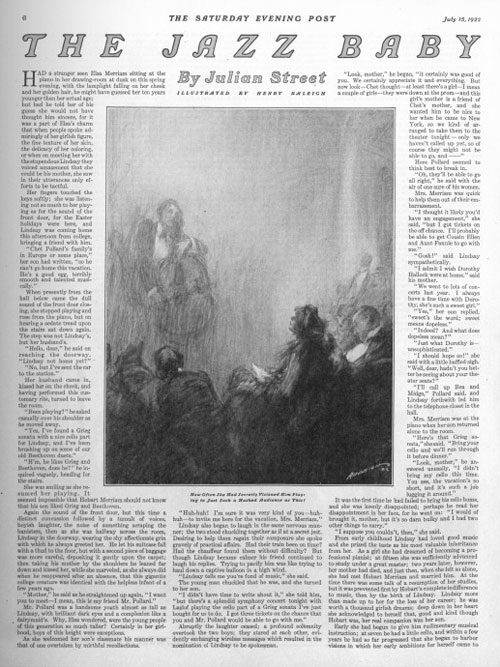
Your Weekly Checkup: Should You Take Vitamin and Mineral Supplements?
“Your Weekly Checkup” is our online column by Dr. Douglas Zipes, an internationally acclaimed cardiologist, professor, author, inventor, and authority on pacing and electrophysiology. Dr. Zipes is also a contributor to The Saturday Evening Post print magazine. Subscribe to receive thoughtful articles, new fiction, health and wellness advice, and gems from our archive.
Order Dr. Zipes’ new book, Damn the Naysayers: A Doctor’s Memoir.
For many years I began each day ingesting fish oil, adding my contribution to the $30 billion industry of dietary supplementation. I stopped when the available evidence did not support its benefits for people not at high risk for cardiovascular disease. (Fish oil supplements may be reasonable for some people after a heart attack.)
Half of American adults consume at least one dietary supplement daily, 48% swallowing vitamins and 39% ingesting minerals, hoping to maintain health and ward off disease. Many do so because their daily pressures prevent them from eating a healthful and balanced diet, and they rationalize that the supplements will provide nutrition absent from their fast food regimen.
But is that true? Most randomized clinical trials of vitamin and mineral supplements have not demonstrated clear benefits in preventing chronic diseases unrelated to nutritional deficiency. In fact, ingesting vitamins and minerals in amounts exceeding the recommended daily allowance may actually be harmful, increasing mortality, cancer, and strokes. Some supplements can counteract the beneficial action of specific medications. In most cases, dietary supplements provide little if any benefit beyond that obtained in a nutritious diet.
Also, the nutrients in food usually are better absorbed by the body, are associated with fewer potential adverse effects, and provide optimal and balanced amounts as opposed to ingesting isolated compounds in highly concentrated form. Positive health outcomes are more strongly related to dietary patterns and foods than to individual supplements.
It’s also important to remember that the Food and Drug Administration does not review dietary supplements for safety and efficacy and, while manufacturers must adhere to Good Manufacturing Practice regulations, compliance monitoring may be less than optimal. A good practice is to choose a supplement certified by an independent tester who verifies that the supplement contains the labeled doses and is not contaminated with microbes, heavy metals or other toxins. Check the website of the Office of Dietary Supplements of the National Institutes of Health for accurate information.
While routine supplementation is not recommended for the general public, diet alone may not provide the necessary nutritional requirements in some groups. Pregnant women need higher amounts of folic acid and prenatal vitamins, and some mid-life and older adults require supplemental vitamin B12 and vitamin D. Calcium is best obtained by calcium-rich foods, with calcium supplements used only if the daily goal is not met. A recent analysis of multiple randomized trials found that supplements that included calcium, vitamin D, or both compared with placebo or no treatment was not associated with a lower risk of fractures among community-dwelling older adults. I have often joked that the urine of many Americans has the highest concentration of vitamins found anywhere, since multivitamin/multimineral supplementation is not recommended for generally healthy adults and the excess is just excreted.
A final word: be sure to tell your doctor about any dietary supplement you are taking to be certain it is compatible with your other medications and overall medical condition.
She Does Rosie the Riveter Proud!


In this 1943 editorial, an African-American woman describes her struggle to help America’s war effort.
A nurses’ aide in one of the Philadelphia hospitals tells us about one of her patients. The patient is a Negro woman, mother of several children. She is in the hospital recovering from terrible injuries received in an automobile accident on her way to work at a shipyard 20 miles away. She told the nurses’ aide how she got the job at the shipyard, as a welder.
“The foreman didn’t want me. He said I couldn’t learn it anyway. I told him, ‘I’m not after this job to take away any man’s work. I’m trying to work here because you can’t get men. You don’t want women in here, and I would rather do a lot of other things better. But you need people here and I can learn this welding.’ I did learn it too. Before I was hurt I could even read blueprints and follow ’em. Why, that foreman who didn’t want me to work for him came in yesterday to see how I am getting along!”
The nurses’ aide tells us that everybody in the ward hopes this particular welder will recover rapidly, because her one fear is that she will not be out of the hospital in time to see her ship launched. That ship represents an instrument of victory which she helped build after a struggle to get a job, a lot of hard study learning how to do it, and plenty of hard work at the welding itself. Her right arm is so twisted and deformed as a result of the accident that the hospital staff are not so sure this spirited and patriotic Negro woman will do any more welding. But they are going to do their best to see to it that she gets to the water front to see “her” ship go down the ways.
Sometimes we wonder whether expressions like manpower, absenteeism, incentives and essential workers do not get in the way. After all, there are a lot of “rugged individualists” around, pushing their way into war jobs, learning how to do new kinds of work, exhibiting that fine but intangible affection which the true worker feels for the fruits of his labor. This colored woman’s story reminds us that there are phases of the great uprising by American democracy.
—“Some People Defy Statistics,” Editorial, March 20, 1943
This article appears in the March/April 2018 issue of The Saturday Evening Post. Subscribe to the magazine for more art, inspiring stories, fiction, humor, and features from our archives.
When Actors Become Politicians
Today, actor Cynthia Nixon declared that she was running for governor of the state of New York. Celebrities running for – and winning – public office has become practically commonplace. We’ve seen Arnold Schwarzenegger, Al Franken, Jesse Ventura, Clint Eastwood, Sonny Bono, and Donald Trump all win political races.

The best known actor-turned-politician was undoubtedly Ronald Reagan. In 1966, he was making his first run for office, as governor of California. The Saturday Evening Post ran a cover story on the handsome and charismatic actor when he was facing off against George Christopher in the Republican primary.
Reagan certainly had his detractors. One former officeholder commented, “He has done nothing but demean the processes of government, without a day of experience.” Three Republican legislators wrote an open letter, begging Reagan to drop out the primary because a win there would surely mean a loss in the general election. Another politician was disdainful of Reagan’s ability to draw crowds, snorting, “So would Jayne Mansfield.”
The primary turned out pretty well for Reagan, as did a few other subsequent elections.
And for those who find the ex-Sex and the City star’s chances for the governorship unlikely, keep in mind Reagan’s response to a reporter who asked him how an actor could run for president: “How can a president not be an actor?”
Healthy Weight, Healthy Mind: Why You Should Track Your Physical Activity
We are pleased to bring you this regular column by Dr. David Creel, a licensed psychologist, certified clinical exercise physiologist and registered dietitian. He is also credentialed as a certified diabetes educator and the author of A Size That Fits: Lose Weight and Keep it off, One Thought at a Time (NorLightsPress, 2017). See all of Dr. Creel’s columns here.
Do you have a weight loss question for Dr. Creel? Email him at [email protected]. He may answer your question in a future column.
You’re busy, but are you physically active? This may be a tough question. Perhaps you have a sedentary, yet high-paced job that leaves you feeling drained at the end of the day. This tired feeling can fool us into thinking we’re more physically active than we really are. If you exercise regularly, you probably have a good idea of how much time you spend being active, but how does all of that add up when you consider what you do the other 15 hours of the day when you’re awake? A fitness tracking device can help answer these questions. Wearables include wrist worn devices, pedometers that can be attached to a belt, bra or shoe, and activity trackers built into your smartphone.
Of course you can be active without using devices, and having one doesn’t guarantee you’ll be more dynamic. But paying attention to the numbers does make you more aware of physical activity patterns. Just as a food journal helps you become more mindful of eating, a wearable fitness device such as those made by Fitbit, Jawbone, Misfit, Garmin (and three other companies that have likely emerged since I started writing this sentence) can provide feedback on your physical activity and help you set objective goals.
I was leading a weight management class on the topic of physical activity. We compared the pros and cons of exercise, and I asked the group why people (and especially overweight folks) often avoid exercise. Karen, who had been quiet and seemingly uninterested in the topic up to that point, chimed in.
“It’s torture.”
I had turned to write some of the responses on the whiteboard, and I wasn’t sure if I heard her correctly. “What was that, Karen?”
“It’s torture,” she said without a smile.
She actually seemed sort of angry. It was as if people had been telling her to exercise for years but they just didn’t understand how terrible it felt for her. Karen was a generally pleasant 40-something lady, about 150 pounds overweight.
“Exercise is exhausting, boring, and it hurts my knees,” she said.
As she freely expressed her disdain for exercise, I noticed a bright pink fitness device on her wrist.
“Karen, I notice you have a Fitbit,” I said. “Do you like wearing it?”
“I love my Fitbit. It tells me how many steps I’ve accumulated, and I try to reach at least 5,000 per day. I know you’re supposed to get 10,000 steps per day, but I really can’t do that yet. Reaching 5,000 is really an improvement for me. I started taking the stairs down at work, and I look for ways to walk around more at home in the evenings. Sometimes if I’m getting close to my step goal, I’ll walk my little dog for five or ten minutes in the evening. This thing even tells me how much I move in my sleep.”
After hearing her say exercise was torture, I didn’t expect her to sing the praises of a wearable fitness device. After a bit more interaction, it became clear that Karen viewed “exercise” as long bouts of intense physical activity at a gym. This didn’t appeal to her. On the other hand, she enjoyed accumulating physical activity throughout the day with feedback from her Fitbit. Would it be wonderful if Karen had a change of heart and began a structured exercise program? Sure. But tracking her fitness made her more aware of physical activity, and she was setting progressive goals in the right direction.
If you aren’t into gadgets or don’t want to shell out the money for one, simple fitness tracking techniques can be helpful. Setting a goal to exercise 20 minutes during 20 out of 30 days a month can easily be tracked on a calendar. Each “X” is one step closer to your goal. Other people have set distance goals, planning to walk the equivalent of 500 miles in a year. Every day they mark down their mileage, knowing that ten miles per week keeps them on target. Some of our patients have even placed thumbtacks on a map to show how far they’ve gone toward their planned destination.
“Going with the flow” of society’s eating and exercise habits probably won’t lead to long-term weight loss. Instead, we must be intentional about changing our habits. One of the first steps in this process is to pay closer attention to eating and physical activity. When we track our weight, diet, and movement, we heighten our awareness so that progress is clear. This self-monitoring forces us to decide between the short-term pleasures of food and inactivity, and the long-term benefits of restraint and self-discipline.
Come back each week for more healthy weight loss advice from Dr. David Creel.
The Other St. Patrick’s Day: The Surprising History of St. Patrick’s Wife
The day after Saint Patrick’s Day is sure to be filled with headaches and nausea for those — Irish or not — who choose to celebrate. But it doesn’t have to be! The party can continue on through March 18th if you’re inclined to observe Sheelah’s Day, the other Saint Patrick’s Day.
The obscure holiday honors Sheelah, Saint Patrick’s wife. That’s right, the fifth-century bishop had a missus. Maybe.
Shane Lehane, of the Department of Folklore and Ethnology at University College Cork in Ireland, has researched the matter thoroughly, and he uncovered documents from the 18th and 19th centuries that depict a widespread belief in Saint Patrick’s significant other as well as a day to honor her.
One such account is John Carr’s 1806 book, A Stranger in Ireland: “From a spirit of gallantry, these merry devotees continue drunk the greater part of the next day, viz., the 18th of March, all in honour of Sheelagh, St. Patrick’s wife.” References to Sheelah’s Day can also be found in issues of the Freeman’s Journal from 1785, 1811, and 1841.
“What I think is very interesting is that people in Ireland in the past had no problem whatsoever accepting that Patrick had a wife,” Lehane said. “Sheelah and Patrick, at one time, came to represent the ubiquitous Irish couple. Paddy and Sheelah became a byword for all Irish people. Sheelah has largely been forgotten altogether except in

Newfoundland, Canada and Australia. Irish people headed over to Newfoundland from the late 1600s. And they brought over with them this tradition of Sheelah and Sheelah’s Day. There is a sense that the women were more involved in the celebrations on the 18th.”
Newfoundlanders, and other Atlantic Canadians, even have a term for a snowfall after Saint Patrick’s Day: Sheelah’s Brush.
Sheelah was never mentioned in Saint Patrick’s Confessio, however. Her legacy may instead stem from Sheela-na-gig, a common female image found in Ireland’s medieval churches and castles. Sheela-na-gigs remain a source of mystery. The crude carvings feature women presenting oversized genitalia. Academics have speculated that they could have originated in the Stone Age as a goddess of fertility, possibly integrated into Catholic iconography to ease the conversion for pagans. On the other hand, the Sheela-na-gig could represent an evil temptress from a puritanical time.
The precise origin of Sheelah’s Day is likely lost to history. All we know is that people have celebrated it in Ireland and elsewhere. Given the recent focus on gender inequality, it seems a fitting time to revive the celebration. After all, the inaccuracies of Irish history have never dulled the festivities of St. Patrick’s Day.
A Taste of Ireland: Guinness© Chocolate Cupcakes and Smoked Irish Salmon
Ireland is known throughout the world for its warm, friendly welcome, magnificent landscapes, and vibrant towns and villages with music filled pubs. But there is another lure. There has been a culinary renaissance in Ireland. Without doubt, Ireland today is a food-lover’s choice. Artisan food-producers and chefs concentrate on fresh, local, seasonal produce offering an enticing contemporary taste.
—Ruth Moran, Irish Tourism
From the Foreword to The New Irish Table: Recipes from Top Irish Chefs.
Guinness® Chocolate Cupcakes
By Catherine Fulvio
“Strange as it may sound, Guinness and chocolate are a perfect combination. It’s a rich smoothness that I hope you’ll all love.”
— Chef Catherine Fulvio, Ballyknocken House and Cookery School in County Wicklow
For the cupcakes
- 6 fl oz (180ml) Guinness
- ¾ cup (180 g) butter
- 1/3 cup (75 g) cocoa powder, sifted
- 1 cup (225 g) superfine sugar
- 2 eggs
- 1 tsp vanilla extract
- ¼ cup (60 ml) milk
- 2 ¼ cups (285 g) flour
- 2 tsp baking powder
For the icing
- 10 tbsp soft butter
- 1 tsp vanilla extract
- Generous 2 ½ cups (350 g) sifted confectioners’ sugar
- Chocolate shavings to decorate
Preheat oven to 350° F (180°C).
Arrange cupcake liners in a muffin baking tray.
Cupcakes

Pour the Guinness into a medium size saucepan, add the butter, and heat gently until melted. Remove from the heat. Stir in the cocoa powder and sugar.
In a bowl whisk together the eggs, vanilla extract, and milk.
Fold the flour and baking powder into the Guinness chocolate mix. Then add the egg, vanilla, and milk mixture to form a thick cake batter. Pour the batter into the cupcake liners in the cupcake pan, and put the tin into the preheated oven for 15 minutes until risen and cooked. Insert a skewer (or toothpick) into the middle of the cake and if it comes out clean the cake is done. Leave to cool completely before decorating.
Icing
Whisk together the butter and vanilla extract using an electric beater, and slowly add the confectioners’ sugar to form a fluffy icing. Spoon into a piping bag and pipe over the top of the cupcakes. Decorate with chocolate curls, if you wish.
Makes 12, depending on the size.
Smoked Irish Salmon, Cream Cheese, and Traditional Boxty
By Noel McMeel
“Boxty is a traditional Irish potato pancake that contains a mixture of mashed and grated potatoes, resulting in a unique texture. While suitable for an Irish breakfast or supper table, boxty pairs well with many cuisines for a meal at any time of day.”
— Noel McMeel, Lough Erne Resort in Count Fermanagh, Northern Ireland.
For the Boxty
- ¾ cup (125 g) raw peeled potato (a floury variety such as Russet)
- ¾ (125 g) mashed potato, made from 7 oz (200 g) floury potatoes, peeled, cooked, and mashed
- Scant 1 ¼ (125 g) plain flour, plus extra for dusting
- ½ tsp baking powder
- ½ tsp salt
- Large knob salted butter, melted and cooled [about 1 ½ – 2 tablespoons]
- A little milk, if necessary
- Oil, for frying
- Juice of 1 lemon
- ¼ cup (50 g) olive oil
- Fresh herb salad greens
- ½ cup (100 g) cream cheese
- 4 oz (110 g) thinly sliced smoked salmon (4 slices)

To make the boxty pancakes, grate the raw potato into a bowl. Turn out onto a cloth and wring over a bowl, catching the liquid. This will separate into a clear fluid with starch at the bottom. Pour off and discard the fluid, then scrape out the starch and mix it with the grated and mashed potatoes.
Sift the flour, baking powder, and salt and mix into the potatoes with the melted butter, adding a little milk if necessary to make a pliable dough. Knead lightly on a floured surface. Cut into ¼ (50 g) portions and flatten like a pancake. Heat the pan with some olive oil and pan fry until light brown on each side.
Make a dressing for the salad greens with the olive oil and lemon juice.
Place the warm boxty in the center of a plate, add a spoon of cream cheese, and place the smoked salmon on top with some lightly dressed fresh herb salad greens.
Serves 4.
 From The New Irish Table: Recipes from Ireland’s Top Chefs, conceived and edited by Leslie Conron Carola. Copyright © 2017 Arena Books Associates, LLC. All rights reserved. Published by Charlesbridge Publishing.
Master of Modern Irish Cuisine
To learn more about the transformation in the culinary landscape of Ireland, the Post posed a few questions to Noel McMeel, executive chef at Lough Erne Resort. McMeel has cooked for presidents and celebrities and has earned critical acclaim for his use of carefully sourced ingredients and his modern Irish cooking style. He is one of the 10 masters of modern Irish cuisine featured in The New Irish Table.
Q: Despite the sizeable Irish-American population in the United States, some still perceive Ireland as the land of corned beef and cabbage. What would you like people to know about today’s culinary scene in Ireland?
A: Corned beef and cabbage was a standby for a long time in Ireland. But now simplicity reigns. The culinary scene today is one of fresh, local, seasonal foods, simply prepared. We understand that the food itself speaks volumes, and that food must be treated carefully. Today’s Irish chefs connect with the environment and work closely with artisan producers. But if you are looking for corned beef and cabbage, Ireland is still the place to find the very best!
Q: What do you see as the biggest mistake home chefs make in preparing simple, fresh foods?
A: Overcooking. And cooking without knowledge. Overcooked food demonstrates a lack of respect for the food, stripping it of its nutritional value.
Q: Any message you would like to share with the American audience?
A: Think of the fresh, natural food from the earth as a gift, a gift of life. And treat it appropriately. Cooking is fun: be creative and use your imagination when selecting herbs to enhance your dishes.
News of the Week: Amelia Earhart, the Laughing Alexas, and 100 Years of Mickey Spillane
Mystery Solved! (Again. Probably. Maybe.)
I did some extensive investigation — I used the search box at the top of the site — and I noticed that I do stories on Amelia Earhart’s disappearance almost every year. Someone finds some clue, some item, a mysterious photograph, and then they proclaim that they know what really happened to the aviator and her navigator Fred Noonan. Of course, when those new findings come out, there are just as many people who don’t believe the conclusions and can “prove” those findings are inaccurate.
The latest investigation involves human bones that were found on the island of Nikumaroro in 1940, three years after Earhart and Noonan vanished during their flight. University of Tennessee anthropology professor Richard Jantz says he’s “99 percent” sure that the bones are Earhart’s.
It’s worth noting that the professor didn’t examine the actual bones. Those were lost decades ago. His findings are instead based on the measurements of the bones recorded when they were found in 1940. Back then they were said not to be Earhart’s because others who examined them believed the bones came from a man. But the professor examined pictures of Earhart, and those photos, combined with the dimensions of the bones, convince him they belong to Earhart.
Please come back here next year around this time to hear the latest new findings on Earhart. Actually, you should be coming back here every week, so forget I said that.
The Laughing Alexas
Picture the scene: You’re at home alone, maybe eating dinner (it’s a Lean Cuisine night), the TV is off, and you’re just reading the paper as you eat. Everything is calm and quiet, when all of a sudden, your Amazon Echo starts laughing. You didn’t ask Alexa to laugh, you didn’t tell her a joke, and you didn’t say “Alexa, what is the opposite of crying?” She just randomly LOL’d.
Wouldn’t that make you just a bit uncomfortable?
That’s what’s happening in some homes. Amazon says they’ve figured out why it’s happening, but their explanation — the device thinks you’re telling it “Alexa, laugh,” even if you’ve said no such thing — doesn’t really make any sense. They’ve created a solution, which is to make Alexa reply only if you ask “Alexa, can you laugh?” and the laugh she responds with will be preceded by “Yes, I can laugh.” Of course, this solution doesn’t make much sense to me either, since it was laughing without anything at all being said to her. Maybe Alexa will simply decide to do what she wants. If she doesn’t like you for some reason, she’ll instantly order 25 cases of Funyuns for you and ship it overnight.
It’s not something I’m going to worry about though, since I don’t plan on buying an Echo. I don’t need more women laughing at me.
By the way, feel free to use the Laughing Alexas as the name for your band.
50 Years Ago
1968 was a tumultuous year for many reasons, including the presidential election. In this report from CBS Sunday Morning, John Dickerson looks back at the New Hampshire primary, where Democratic Senator Eugene McCarthy of Minnesota took on another Democrat, President Lyndon Johnson:
100 Years of Mickey Spillane
Mickey Spillane was always a controversial writer. Critics will say his novels include an overabundance of sex and violence, but … well, actually they do. But he was master of what he did: tough, two-fisted pulp novels that are a kick to read. He always said that he wrote for readers, not critics. “What I want to read is the royalty check,” he once said. “I write when I need the money.”
This week marked Spillane’s 100th birthday, and Hard Case Crime has published the last novel that Spillane ever wrote, appropriately titled The Last Stand. And here’s Post Archive Director Jeff Nilsson on Spillane’s career and legacy.
Even fans of detective, noir, and action novels are divided when it comes to Spillane. Is it because he’s not “literary” enough? Is it because he once wrote a novel in two weeks because he needed the money to buy something? Is it because he has sold over 200 million books?
Bill Norris has a good piece at The Daily Beast on why we should reconsider the work of Spillane. I’m more of a Raymond Chandler fan, but I appreciate what Spillane did, and I love his “I’m a writer, not an author” attitude.
Lake Chargoggagoggmanchauggagoggchaubunagungamaugg
I know that looks like I fell asleep on my computer keyboard, but it’s actually the name of a lake in Webster, Massachusetts. It’s also known as Webster Lake, but that’s not as fun to say as Lake Chargoggagoggmanchauggagoggchaubunagungamaugg. Here’s a report from WBZ in Boston on the lake and the history of the town, which is named after Daniel Webster and is the birthplace of Clara Barton, founder of the American Red Cross:
The best part of doing this story is that it forces my editor to have to check the spelling of Chargoggagoggmanchauggagoggchaubunagungamaugg several times.
RIP Stephen Hawking and Hubert de Givenchy
Stephen Hawking was an acclaimed physicist known for his work on black holes, relativity, and quantum mechanics. He was also the author of many books, including A Brief History of Time and The Grand Design, as well as the subject of the 2014 Oscar-winning movie The Theory of Everything. Hawking died Wednesday at the age of 76.
Since the early 1950s, Hubert de Givenchy designed clothing for some of the most famous women in the world, including Audrey Hepburn, Jacqueline Kennedy Onassis, Grace Kelly, and the Duchess of Windsor. He died Saturday at the age of 91.
Quote of the Week
“Your son’s debt to thank each individual guest is independent of how many stamps you will need to purchase — or how much time it will take him to pen the notes.”
—Miss Manners, to a mother wondering if her son, who has messy handwriting, can type his thank-you notes instead
This Week in History
Frankenstein Published (March 11, 1818)
You can read Mary Shelley’s classic horror novel for free at Project Gutenberg, and here’s an interview with the most famous film portrayer of Dr. Frankenstein’s monster, Boris Karloff, from the November 3, 1962, issue of the Post.
Albert Einstein Born (March 14, 1879)
It’s fitting, in a way, that Stephen Hawking died on Einstein’s birthday. Here’s a 1929 Post interview with Einstein, in which he talks about why he thinks nationalism is the “measles of mankind,” what he would have done if he hadn’t gone into physics, and why imagination is more important than knowledge.
This Week in Saturday Evening Post History: Commuter Card Game (March 15, 1947)
Commuter Card Game
Constantin Alajalov
March 15, 1947
I used to commute to work on a train every single day. It was somewhat tedious — an hour trip into the city and then an hour back — but in some ways I enjoyed it. I got to read, maybe sleep a little, and talk to the other commuters I saw every day. A card game never broke out, though, as in this Constantin Alájalov cover. The conductor looks enthralled, too. I hope they don’t miss their stops.
Saint Patrick’s Day Recipes
Tomorrow is the day everyone celebrates the patron saint of Ireland, and those celebrations will undoubtedly involve food (and, well, liquid refreshment). Here’s a recipe for a traditional Irish Beef Stew, and here’s one for Irish Guinness Oatmeal Cake. And if you’ve never eaten Spotted Dog, here’s a recipe for that.
If you’re in doubt on what a St. Patrick’s Day food is, just color it green. That makes all food a St. Patrick’s Day food.
Next Week’s Holidays and Events
Spring begins (March 20)
I had to shovel the sidewalk seven times three days ago, but spring supposedly begins on Tuesday.
National Agriculture Day (March 20)
All the cool kids call it Ag Day.
The Stars in Hoshi’s Eyes
She has stars in her eyes, and I don’t mean a figurative glimmer, I mean when I looked into her eyes I saw tiny pricks of light shining forth from her dark irises and pupils. The same sweeping pattern from both eyes as if she were on the highest of mountains on the darkest of nights, her face pointed up to the Milky Way and the light somehow getting trapped in there.
“Thank you for coming in, Miss Nicole, we see you next week?” Hoshi asked, a smile on her round, wrinkled face. She had been doing my nails for years, but I had never seen stars in her eyes before. She was handing me back my credit card, but I just stood there, wanting to soak the feeling of those stars in, the feeling of peace and expansiveness, and the vast depth of time.
And today of all days I needed it. My parents, in their 80s now, were struggling to do everyday things, like taking care of bills, cooking food, keeping the house clean. I was struggling to help them as they struggled to let me help them.
I nodded dumbly. She asked me every time if I would be in next week, she had for the last six years. I didn’t come in every week, I couldn’t afford it. Every four weeks for me, three if I was treating myself. I stood there blinking, not believing it, staring at her. No one had eyes like that. This wasn’t just flecks of gold in brown eyes, this wasn’t something that was starlike, this was stars, this was the Milky Way.
After she left to deal with her next customer, I wandered out and stood in the hot Phoenix sun, still dazed. You don’t see many stars in the Valley of the Sun; the light pollution and the air pollution make it so you only see a few of the bright ones, except after a big storm if the clouds had cleared. Then you can see the stars, but not like they were in Hoshi’s eyes. Maybe up in Flagstaff in the cold of the winter, but never in Phoenix.
When the spring heat became too much and it felt like the sun was burning my skin, I roused myself and stumbled down the strip mall to the grocery store. Saturdays were busy, I had so much to do, I didn’t have time to think about an old Korean woman and the stars in her eyes.
My eyes don’t have stars in them. I checked in the grocery store bathroom before I started loading my cart. No stars, just brown, blood-shot eyes in a too-round face framed by chestnut hair — which looks nice, but it’s dyed to hide the grey. I don’t like my face. I don’t like how I look.
My eyes are nice enough, walnut brown and dark, although not as dark as Hoshi’s eyes. My ex-husband used to like them, told me that my “gorgeous almond eyes” are what trapped him. But that only lasted a year, and since … well, I got married late and I’m over 40 now and not many men come calling.
I sighed and I would have stayed longer, but a woman came in with a crying baby and that meant it was time to stop staring at myself in the mirror. Time to get back to the endurance act that my life had become.
I get up early every day and go to the gym, trying vainly to lose a few pounds, then go to work as an office manager for a small dental practice. Then home to Rocket, my little Pomeranian, drink some wine, watch some Netflix, and go to bed. Saturday afternoons I go see Mom and Dad and help them sort through their mail and their bills. My big brother died a few years ago — a traffic accident — and I am all they have left. On Sundays, I shop for them and am over there all day cooking their meals for the week. They are getting old and need more and more help. A few months ago, I brought by some pamphlets for senior communities, but that just ended in a terrible argument.
Saturday mornings before going over to see the folks are for me. Nails, if I can afford it, and shopping, maybe a trip to the mall.
That Saturday, I found myself looking people in the eye as I went about my day, wondering if there were more that have stars in there. Wondering what it meant. Wanting the peace I had felt looking in Hoshi’s starry eyes. I looked everyone in the eye, the checkout girl at the grocery store, the people pushing their carts down the aisle with me, the bald-headed man at the liquor store who stocked my favorite brand of cheap chardonnay.
They looked at me strangely as if deep eye contact were violation of the social contract. And I guess it was. You don’t go up to strangers looking into their eyes like you would a good friend or a lover. Not that I have enough time for my friends and haven’t been on a date in far too long.
All week, I looked into everyone’s eyes and no one has stars in them like Hoshi does.
“Miss Nicole, one week, you here!” Hoshi said, a smile on her wrinkled face. “Come, come, I have time for you now.” She had her usual Korean music playing, two drums, a flute, and some kind of stringed instrument. Relaxing and haunting, it made me feel like I was far away from my daily life.
I hadn’t come in to get my nails done, just to get a glimpse at those eyes. All week I had been searching for that feeling, that broad expansive feeling of looking at the stars in Hoshi’s eyes. When I saw them, it felt as if the universe just let out a big sigh and everything was going to be okay. She took my hand and I let her take me to her station. I had a credit card — this is what they’re for, right?
She began stripping off the lavender polish from last week, the strong scent of the nail polish remover filling my nose. She was chattering on, as she does, about her grandkids and her husband, but I wasn’t really listening. Her head was down and I couldn’t see those eyes and I wanted to.
“You, o-kay?” she asked, noticing my silence, those dark eyes looking right into mine. And there they were, two identical Milky Ways, one in each eye. I felt lighter knowing that the universe was so large and I was so small and my problems were nothing on the scale of a galaxy, much less a universe.
I wanted to tell her that I was fine, that seeing the stars in her eyes was enough, but today it wasn’t. It had been a bad week. My mother had slipped getting out of the shower and fallen, her head slamming into the sink, the left side of her face an ugly, purple bruise. I had rushed from work and met them at the ER and we had “the talk” while we waited endlessly for the doctors to release her. The talk where I tell them they need a different living circumstance for their own good and they tell me that I’m not the daughter they raised and if I don’t want to help anymore I should just say it and that they don’t need my help and that I shouldn’t come around this weekend.
And I could tell Hoshi all of that, she was a very good listener, often giving me really good advice, but I didn’t. “What … Why …” I stammered, getting lost in those dark, star-filled eyes. “Why are there stars in your eyes?”
A flash of surprise passed over her face, for only a moment, and she looked back down at my nails and started telling me how her eldest grandson was doing in his PhD program studying computer science.
She wouldn’t talk of it again. After shopping for myself I went home to Rocket and didn’t leave the house for the rest of the weekend. Didn’t call my parents. Didn’t look at my phone. Felt guilty for every single minute of it.
I started getting my nails done every week. I asked Hoshi about the stars in her eyes every time. She shook her head, looked away, changed the subject, but never told me anything.
After a month, I was desperate. I had seen my parents only once, their eyes not meeting mine, their looks distrusting.
Before I had started helping Dad do the bills their electricity had been shut off two times and they had been eating junk for dinner, crap they could get at the dollar store. Even though they had enough money for decent food, they were afraid to spend it. I knew it was only a matter of time until something horrible happened. I had seen a lawyer on my lunch break the day before and it would cost thousands of dollars for me to declare them incompetent, money I didn’t have. A few years ago, I had tried to get them to sign powers of attorney so I could manage things for them, but they had refused and shut me out of their lives for three months.
I told all of this to Hoshi, letting the words pour out while the tears ran down my face. People were looking at me and I hated that, but I was past my limit.
“Hoshi, the only thing that keeps me going right now is seeing those stars in your eyes. Can’t you please, just please tell me how it happened? How I can …” I couldn’t continue, I couldn’t tell her that I wanted to have stars in my eyes so that when I looked in the mirror, my day and my trouble would seem small compared to that vast universe.
She stopped painting the thick red polish on my thumb and looked up, her dark, star-filled eyes sad, her face slack. “No one see them but me, not even my husband. What I want to know is how you see.”
I nodded, sniffing and dabbing my eyes with my sleeve. “How did you get them, Hoshi? How?”
She shrugged her shoulders and tears filled her eyes. She didn’t know.
Hoshi Weon was born with stars in her eyes like some people are born with a birthmark. When she was a little girl of about five, she asked her mother why her eyes were different than everyone else’s. She told her mother of the stars she could see in her eyes, but her mother couldn’t see them or her father. So Hoshi never brought it up again. She saw the stars in the mirror, but never in the eyes of others or even in pictures of herself. It became her secret and her shame. She didn’t tell anyone for fear that they would think her foolish or insane.
She told me this in the back room of the nail salon on that Saturday evening. She had invited me to come back at the end of the day. Served me tea. Talked to me like a friend. She was so happy I could see them and had me explain, in depth, what I saw, that dense sweep of stars across her pupils and irises. She got so excited she wept and took my hand in her shaking hands.
“They real, the stars real,” she said. All these years she hadn’t believed that they actually were.
I nodded and smiled, happy it wasn’t just my imagination.
“You have the universe in your eyes, Hoshi,” I said, and she clapped her hands together and smiled like a little girl.
We talked then, about everything, and I told her more about the troubles with my parents.
“Letting go,” she said, “never easy. But when old we must let go of independence, of who we were. Terrible.” Hoshi seemed so capable, and while her face was wrinkled, her hair was still black, and I wasn’t sure how old she was. In her 60s? 70s? It made me wonder what she had already given up and what she would have to give up soon.
“I just wish they understood how hard this is for me,” I said.
She took my hand, squeezed it, and I got lost in those stars. “You parent now, they the children. Kids never understand the burden of the parent.”
Before I left, she said that I must come every week, that I must be her last client on Saturdays and she would give me a very good price if I helped her clean up. That we could drink tea and talk of stars and families, of life and grief, of happiness and sadness.
I left crying but with a smile on my face knowing I would get to see the stars in Hoshi’s eyes every week now. Maybe it would be enough to get through this.
A few months later during my Saturday evening with Hoshi, I showed her the app my nephew was programing for me. It’s called StarryU, and Hoshi had taken a picture of me on my smartphone with the app and she was staring at the picture, her jaw wide.
“How?” she asked. “Stars. You have stars in your eyes.” She then held the phone up to me and looked from the phone to me and back again. “But only on picture.”
I smiled and nodded my head. “That’s what the app does. It adds stars to your eyes, so we can all feel like you do when you look in the mirror, Hoshi.”
Her eyes widened in wonder. I went and sat next to her and showed her how you could zoom in on the picture, how the stars got clearer, and if you zoomed all the way up to an eye, all you could see were stars. And if you kept zooming in there were more stars, on and on. Forever.
Spending time with Hoshi every week, seeing the universe in her eyes, had given me strength. Not just to try to create something, but to help my parents. I found an angel of a woman who ran a small non-profit that helped with eldercare issues. We got Meals on Wheels set up for my parents, she got me in contact with an eldercare law firm and was helping me talk with my parents about creating the best experience possible for them in this phase of their life.
Hoshi hugged me particularly hard before I left. She told me that she loved my app, that she loved me. I told her I loved her too and walked out into the heavy heat of a Phoenix evening feeling happy.
Maybe my little app was just a novelty, maybe no one would understand. But for me it had helped to see this little old Korean woman as having the universe inside her eyes. Maybe, sometimes, we all could use a little perspective like that.
Movies for the Rest of Us with Bill Newcott: A Wrinkle in Time
Movie critic Bill Newcott reviews A Wrinkle in Time, Final Portrait starring Geoffrey Rush, Keep the Change, including a conversation with director Rachel Israel, and The Leisure Seeker. He also looks at the arrival of LED screens in movie theaters. Finally, find out which big award winners are coming to the home screen.