How to Cook a Muskrat and Other Wild Dishes from 1938
Squirrel potpie? Old news according to 1938 Country Gentleman author Jim Emmett, who was on the hunt for more unusual home-cooked fare. Stuffed raccoon, parboiled porcupine, and opossum roasting over an open fire were just a few of his tasty finds. Plus, a tip for foraged edibles: Fried or drizzled, wild greens go down best with butter.
A note to the 21st-century chef: Take these dishes with a grain of salt. Food safety has changed some in the 80 years since these recipes were published. To know what’s safe to eat — and, more importantly, what isn’t — in your area, seek out local wildlife and foraging experts.
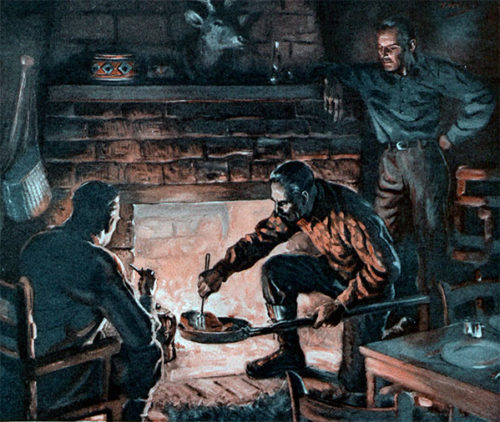
Savory Dishes from the Wild
Originally published in The Country Gentleman, March 1938
Your ancestors, or mine, may not have endured Plymouth winters, trekked Midwest plains, or even been born in this country; still, there is a good bit of the pioneer in the make-up of most Americans. A joint of venison sent to the house is eagerly enthused over, we cook precious wild ducks and upland game birds with fear in our hearts that they may be spoiled in the oven, and even prepare potpies of squirrel or rabbit more carefully than we do expensive cuts of meat.
The eating of only certain wild animals is a habit passed down from days not so far back when a farmer stepped outside his door to shoot a deer nibbling apples from the tree he cared for so carefully. Naturally, with game so plentiful nothing but the best graced his table. Fat bear and young deer not only butchered quickly but yielded a large supply of good meat at the expense of a single charge of expensive powder and precious ball. Canvasbacks and mallards were preferred when the waters of every inland pond blackened at dusk with southbound birds, and trout from the pasture brook which appeared on the breakfast table then would be entered in fish contests now.
This preference for certain wild game seems also to be a matter of location. For instance, in the North, muskrat haunches are considered a delicacy by most French-Canadian families, and in the South, opossum is enthused over on the plantation owner’s table. Frog legs are preferred to chicken drumsticks in the Adirondacks, while on many a Tidewater-Maryland farm eels are a greater favorite than the oysters, crabs, and fish lying off the wharf for the taking.
How to Pluck a Possum
The possum is more than an animal in the South; he is a distinctly American institution, and there the term opossum is considered an affectation. Many Northerners think of the possum as being eaten only by the plantation help. But those fortunate enough to sample the famed hospitality of the South, as it flourishes in rural regions, find that possum and sweet potatoes is also big-house fare. The chief difference is that the white folk bake theirs in an oven, while rural African Americans so often cook on the hearth with an open fire, suspending the possum on a wet string before a high bed of hickory coals. The twisting and untwisting string rotates the meat which is basted with a sauce of red pepper, salt, and vinegar. After having eaten possum cooked both ways, I prefer the open-fire method.
There are two golden rules to possum cooking: First, he is good only in freezing weather; secondly, do not serve without sweet potatoes. Preparation is not difficult, but like all wild things must fit the particular animal. Stick the possum and hang overnight to bleed. Next morning fill a tub with hot water, not quite scalding, and drop the possum in, holding tight to his tail for a short time so the hair will strip. It is then an easy matter to lay him on a plank and pull out all the hairs somewhat as one would pluck a chicken. After drawing, he should be hung up to freeze for two or three nights.
As a preliminary to cooking, place him in a five-gallon kettle of cold water into which has been thrown a couple of red-pepper pods, if you have them, otherwise a quantity of ground pepper. Remove after an hour of parboiling in this pepper water, throw water out, and refill kettle with fresh water, in which he should be boiled another hour.
While all this is going on, the sweet potatoes should be sliced and steamed. Take the possum out of the water, place in a large covered baking pan, sprinkle with black pepper, salt, and sage, and pack the sweet potatoes lovingly about him. Pour a pint of water in the pan, put the cover on, and bake slowly until brown and crisp. Serve hot, with plenty of brown gravy.
Haunch of Muskrat with Watercress
Muskrat haunches, usually with watercress, grace the French-Canadian farmer’s table often enough to guarantee their value as a worthwhile game dish.
Muskrats must be skinned carefully in order not to rupture the musk or gall sacks; those offered for sale on city markets are a trapper’s byproduct; often indifferent skinning spoils them for cooking. French-Canadians use only the hind legs or saddle, four animals for two servings. After a careful washing, they are placed in a pot with some water, a little julienne or fresh vegetables, some pepper and salt, and possibly a few slices of bacon or pork. After simmering slowly until half done, they are removed to a covered baking pan, the water from the pot is put in with them and baking continued with frequent basting until done.
In Maryland and Virginia, the muskrat is known as marsh rabbit and valued highly as a game dish. Cooks there use the entire animal, soaking it in water a day and night before cooking. Then follows 15 minutes’ parboiling, after which the animal is cut up and the water changed. An onion is added, with red pepper and salt to taste, and a small quantity of fat meat. Just enough water is used to keep from burning, thickening added to make gravy, and cooking continued until very tender.
Trade Thanksgiving Turkey for Roasted and Stuffed Raccoon
Coon is excellent eating if caught in cold weather. In skinning, be careful to remove the kernels or scent glands, not only under each front leg but also on either side of the spine in the small of the back. All fat should be stripped off. Wash in cold water, then parboil in one or two waters; the latter if age warrants. Roasting should continue to a delicate brown. Serve fried sweet potatoes with the meat. The coon, with its reputation of washing even its vegetable diet before eating, is one of our cleanest animals; he will not fail you as a cold-weather game dish if you observe the skinning precaution.
Parboiled Porcupine
In the North Woods the porcupine is a lost hunter’s stand-by, his emergency food supply. But unlike most emergency rations this inoffensive little animal is excellent eating, especially if young, when his flesh is as juicy and as fine flavored as spring lamb. The secret of skinning is to commence at the belly, which is free of quills; start the skin there and it pulls off as easily as that of a rabbit. Parboil for 30 minutes, after which roast to a rich brown or quarter for frying or stewing.
Fowl Cooking
The lower grades of ducks are acceptable eating if correctly prepared for cooking. All waterfowl, even the better ducks, have two large oil glands in their tail, put there by Nature to dress the bird’s feathers; these should always be removed before cooking.
The breasts of coot, rail, and young bittern are always worth serving. Cut slits in the removed breasts and in these stick slices of fat salt pork, then cook in a dripping pan in a hot oven. The rank taste of even fish ducks can be neutralized, unless very strong, by baking an onion inside and using plenty of pepper inside and out.
The meat fibers of all game birds and animals are fine grained, containing very little fat, even though the muscles themselves may be encased in it. For this reason most game recipes mention larding. This consists of laying strips of fat pork or bacon not only on top of the meat, but inserting them in slits cut in the flesh itself to prevent dryness. As a rule, dark-meated game should be cooked rare, so red juices, not blood, flow in carving. White-meated game should be thoroughly cooked. Animals and birds, tough or old, should be parboiled first; such meats are better stewed.
The Way with Turtles
Aquatic turtles are good eating at any time, old guides claiming their flesh has medicinal value. The common snapper is excellent, and preparing is not difficult. Aside from any humanitarian feeling, I do not like the method of dropping the live turtle into a tub of scalding hot water; I prefer to get that wicked head off as quickly as possible. One must carry the brute by its stocky tail well away from flapping trousers. Another man with an ax in one hand and a stick in the other extends the stick atop a convenient log. Hold the turtle near and snap go its jaws over the stick with a grip which never fails to make one realize what it would do to a foot or hand. With its neck extended, down comes the ax. One need have no qualms of pity when dealing with this enemy to wildlife.
After letting the turtle bleed, drop in scalding water, when the outside of the shell will drop right off and the skin can be easily removed. Then cut the supports of the flat undershell and remove it entirely, so the turtle can be easily cleaned. To save cutting the meat out, boil in its cleaned shell a short time, when the meat will drop off. Cut up, boil slowly three hours with chopped onion, or stew with diced salt pork and vegetables.
Freshwater Finds: Catfish, Carp, Eels, and Frogs
Proper preparation makes even our so-called coarse fish good eating. To skin bullheads or catfish, cut off the ends of sharp spines, split the skin behind and around the head, and from this point along back to the tail, cutting around back fin. Then peel two corners of the skin well down, cut backbone and hold skin in one hand while the other pulls the body free.
Carp should be carefully skinned rather than scalded. There is a layer of fat or mud between two skins and only with this removed will the fish be found good eating. Many people condemn catfish and carp as being soft fleshed; which they are if taken from too warm water. But every fish is better caught out of cold water.
Eels can be easily skinned by nailing through the tail at a convenient height. Cut the skin around the body, just forward of the tail, work edges loose, then pull down to strip off the entire skin. To broil, clean well with salt to remove slime, slit down back and take out bone, then cut in 2-inch pieces. Rub these with egg, roll in cracker crumbs or corn meal, season with salt and pepper and broil to a nice brown. To stew, cut in pieces after removing the bone, cover with water in a stewpan, and add a teaspoon of vinegar. Cover the pan and boil half an hour, then remove, pour off water and drain, add fresh water and vinegar as before and stew until tender. Finally drain again, add cream for a stew, season with salt and pepper only, and boil a few minutes to serve hot.
Smothered catfish is beloved [in the South], utilize this ugly but sweet-fleshed fish to advantage. Place a large skinned catfish in the baking pan and slice onions to put on top along with strips of bacon. Sift flour lightly over all, salt and pepper, and place in a heated oven 15 minutes.
Frog’s legs are a delicacy from the first spring days until freeze-up time. The northwoods hunting-camp cook soaks the hind legs an hour in cold water, to which vinegar has been added, as a preliminary to cooking. He then drains, wipes dry, and places them in a skillet of bubbling hot cooking oil. Some Southern tidewater shooting-camp cooks use the entire frog, other than the head; others grill the legs only. A preparation is made of three tablespoons of melted butter, half a teaspoon of salt, and a pinch of pepper. The body or the legs are dipped in this, rolled in crumbs and broiled three minutes each side.
Foraging Plants from Field and Woods
Not to be outdone, our early spring pastures and fields offer many edible greens free for the gathering. Dandelion greens, with a piece of bacon, are still regarded by many as a sure sign of spring. Milkweed shoots, wild mustard, dandelions, dock, and sorrel should be dried immediately after washing, then boiled with salt pork, bacon, or other meat. If on the old side, parboil first in water to which a little soda has been added, then drain before boiling again in plain salted water.
Perhaps you have cooked these wild things and not been satisfied with the results. Try chopping the boiled greens fine, then putting in a hot frying pan with butter, pepper, and salt, and stirring until thoroughly heated.
The tender stems of young brake or bracken [fern], cooked same as asparagus, are equally as good as that much-sought-after vegetable. The plants should not be over 4 inches high when they will show but a few tufts of leaves at the top; if much older they are unwholesome. Wash the stalks, scrape, and lay in cold water for an hour. Then tie loosely in bundles and put in a kettle of boiling water to boil three quarters of an hour, when they should be tender. Drained, laid on buttered toast, dusted with pepper and salt, and covered with melted butter they are as good as asparagus, some claim even better.
Wilted dandelion greens call for a peck of fresh tops and half a dozen strips of bacon. Fry the bacon until crisp, then crack into small pieces and pour with drippings over the washed leaves.
Botanists tell us over a hundred edible plants grow wild in our fields and woods. While we may find it easier to raise cultivated vegetables than to gather wild things, it is good to know we live where Nature offers this wholesome fare.
Last in Flight
Jasper Collins walked up another flight of stairs, his movements slowing with each new step. His breathing was now ragged and felt like shards of glass as it rushed in and out of his raw throat. He stopped at the next landing, as he had done at every landing since the 43rd floor, and leaned against the rusty handrail.
“I’m going to die before I even get there,” he gasped to the empty stairwell. He no longer even thought of it as talking to himself. The city — the entire world as far as he could tell — had been empty of everyone but him for almost seven years now. There was no one else to talk to, and a man had to talk to someone. So he talked.
“If you’re going to die today, you’re doing it from up there,” Jasper said, looking up. “Not here in a dusty stairwell full of trash.” His breathing had slowed again, and he felt as though he might make it to the next landing before leaving the world completely without humans. “Seventy more to go,” he said as he took the first step. “You can make it, old man.”
Jasper made it all the way to the 75th floor before he had to stop again. Instead of leaning against the railing, he sat down on the floor of the landing and let his feet dangle over the ledge. He leaned his head over the lowest rail and looked down the central shaft of the stairwell. His small headlamp pierced only a few feet into the vast darkness below, so the shaft looked like a bottomless pit. He tried to spit into the endless expanse, but his mouth was too dry from the climb.
“Damn. Even too old for that,” he said.
Jasper looked down at the fanny pack strapped around his waist. “As good a time as any,” he said, fumbling with the zipper. At last he got the pack open and rifled through its contents: a small plastic pouch, a candle molded into the shape of the number 60, and a lighter whose blue plastic body had been worn dull from use.
He held the pouch up close to his face, then backed it away to arm’s length. “Marbled Pound Cake,” he read, squinting. “Compliments of the United States armed forces. Thanks, fellas — you shouldn’t have.”
Jasper tore open the tan pouch, removed the flat piece of cake that had hidden within for longer than he cared to imagine, and placed the cake on the floor atop the discarded pouch. He set the candle on top of the cake and pressed down to ensure it would remain upright. He picked up the lighter, but the sheen of sweat on his palms caused it to almost slip away — toward the endless, dark stairwell shaft. With a gasp, he caught the small device with both hands. After a deep breath and a shake of his head, he struck the lighter. Aside from sparks, nothing happened.
“Oh, you son of a bitch,” Jasper called to the darkness. “It’s my birthday. You have to work at least one more time.”
He flicked the lighter’s metal wheel, directing every ounce of his will toward the plastic-and-metal contraption. A small sputtering flame jumped up, wavering in the meager currents that moved through the stairwell. With the care of a heart surgeon, Jasper cupped his free hand around the small flame and lowered the lighter toward the floor. He held his breath and touched the flame to the candle’s wick.
Just as the lighter’s flame was withering to nothingness, a matching flame sputtered to life on the wick and grew to its full height. “Thank you,” Jasper whispered, clinching his eyes shut for a moment.
He stared at the small flame. “Unless there’s a forest fire out there somewhere, you might be the only flame on this earth, little guy,” Jasper said. “I guess that sort of makes us kindred spirits.”
He took a sip of water from his bottle. “Gotta wet my whistle first,” he said to the flame. “May be the last time I sing it, so it has to be good.” Jasper opened his mouth, threw his head back, and sang the “Happy Birthday” song as loudly as he could. His voice echoed off concrete and steel, returning from every direction in the close darkness of the stairwell.
When he finished, he looked back down at the flame. Small tears had escaped his eyes as he sang. One of these ran down his face, perched for a moment on the tip of his nose, and then fell. Jasper watched the tiny drop plummet, as though in slow motion, toward the candle. With a sputtering hiss and a small puff of white smoke, the flame — perhaps the only of its kind — ceased to exist.
“Damnit,” Jasper said to the smoking wick. “Well, I was about to have to murder you anyway. A man has to eat his own birthday cake, after all.”
He set the candle aside and picked up the small dry piece of pound cake. After a quick inspection of its surface, he took a bite and began to chew.
“I don’t know if I have enough water to choke this crap down,” he said with a mouth full of dry cake.
After several sips of water and a few minutes of focused chewing, the cake was gone. “Well,” Jasper said, brushing his hands together to clean off the crumbs, “These stairs won’t climb themselves, will they?”
He zipped up his fanny pack and used the highest handrail to lift himself back to his feet. After a moment, he let go of the rail and began to walk. He’d learned a long time ago not to get up and immediately start moving. That was a good way for a man his age to end up right back on the floor. And in a world bereft of luxuries such as ambulance services, going humpty-dumpty was a bad idea.
Whether driven by the calories in the cake or the knowledge that he was almost at his destination, Jasper completed the remainder of the building’s 125 floors without needing another rest. With shaking legs and ragged breath, he grabbed the bar on the door at the top of the stairwell and pushed. At first it remained shut. He was afraid it was either locked or rusted shut. After more pushing and more than a few curse words, however, the door began to swing open with a scream of long-rusted hinges.
Blinding sunlight filled Jasper’s eyes as he stepped onto the asphalt rooftop. He stood there for a while, blinking and waiting for his vision to adjust from the complete darkness of the stairwell to the brilliant light of the midday sun.
Once his eyes had adjusted, Jasper walked nearly to the edge of the roof and looked out over the cityscape. He had climbed the stairwells of many buildings during scavenging trips, but never all the way to the top of a building so high. Food was scarce, which meant energy was a valuable commodity. Climbing that high for no good reason had been out of the question.
The view was heaven — almost enough to make him forget the derelict cars and trash littering the streets.
“You really going to put yourself through this, old man?” Jasper said, scanning the streets far below. “What will people think?” After a moment he threw his head back and laughed.
Jasper hooked his thumbs under the straps of his scavenged parachute and made sure they were still snug. “Well, I don’t guess I came all this way just to look.” He craned his neck around so he could see the bulge at the back of the contraption.
“For all I know you won’t work after lying around for however long it’s been since they packed you. But for all I know you will. Either way, I’m going to fly on my birthday. How I stick the landing is kind of on you, my friend.”
Jasper opened his fanny pack and pulled out a folded piece of paper, followed by a stubby pencil. He unfolded the paper, which bore the heading “Bucket List” up at the top. Below that, a number of activities were listed in a column. He smiled as he scanned them. Most of the items, such as “sip really expensive scotch” and “drive a stolen supercar” had been checked off. There were a couple of items, such as “BASE jump from tall building,” that remained unchecked. At the very bottom of the list was written, “Die.”
Jasper touched the pencil lead to his tongue and placed a check beside “BASE jump from a tall building.” After a moment of thought, he placed a question mark beside the word “Die” at the bottom of the list.
“Well,” he said, placing the paper and pencil back in his fanny pack, “I guess we’ll just see, won’t we?”
He walked over to the edge and looked down, making sure there was an unobstructed path all the way to the street below. Aside from a tattered awning above the first floor, it seemed clear.
Jasper turned toward the center of the building and walked several steps before turning around to face the ledge again. He was the last man on earth — arguably the most important person in the world — and he was about to fling himself from the top of a skyscraper.
“Happy birthday,” Jasper said to himself. He smiled and began running toward the ledge. With a scream, he leaped into open air and pulled on the parachute’s cord with all his might.
News of the Week: More Snow, Cloned Dogs, and the Wild, Exciting World of Celery
Winter’s Not Done Yet
I just looked out my window and it’s a wet, gray, early March day. I didn’t mean for that to rhyme; I just wanted to describe what it looks like outside my window.
I’m actually now in “spring mode,” ready to wear lighter clothing and put the shovels away, but winter isn’t finished with us quite yet. We just had a nor’easter that gave us a ton of rain and winds and damage to coastal homes, and tonight and tomorrow we’re supposed to get hit with another storm. This time more snow will be involved, anywhere between 1 and 12 inches, depending on where you live.
This is what I find funny about weather forecasts now: they have so much information that, in a way, they’re less accurate. A typical snowstorm forecast will go something like this:
“The European computer model says we’re going to get hammered by this storm, with over a foot of snow. The American model says we’re going to get only an inch or two. Then this third model says that we’re going to be somewhere in the middle, maybe four to six inches. We’re still collecting data, but that’s our best guess right now. Back to you, Ed.”
That’s a great forecast. I could have told you the same thing sitting on my couch in my sweatpants. But they used the word computer and showed a lot of Doppler radar images, so I guess we better pay attention to it.
People … People Who Need Cloned Dogs
I love dogs more than I love some people I know, but I’m not sure I could ever do this. Barbra Streisand cloned her dog. She wrote about it for The New York Times.
Streisand had her dog Samantha for 14 years, and just before the dog died, the vet scraped the inside of her cheek to get her DNA. The singer has a friend who did the same thing with his dog, and she wanted to try it to see if it would work. And it certainly did. It produced five puppies, three of which she kept and two she gave away.
It’s a little too sci-fi for me. I have this vision of an army of cloned little dogs taking over the planet. But I’m happy that Streisand is happy.
By the way, for the title of this section, I almost went with “Send in the Clones.”
Chiweenie
Every year I like to point out new words that are added to the various print and online dictionaries, even if sometimes they aren’t words at all. The Merriam-Webster Dictionary is my favorite. I just bought a brand new one because my old one vanished somehow, and it’s perfect timing, because this past week they announced some words that were added to the classic tome. And when I say “some” words, I mean 850.
Some of the new words and phrases include wordie (a lover of words), chiweenie (a cross between a Chihuahua and a dachshund, even if they’re not cloned), hate-watch (where you watch a movie or TV show even though you know it’s bad), and dumpster fire (which is defined as “a disastrous event,” though I’ve seen it used to mean a series of disastrous events, or just an overall definition of how things are going).
They’re also now including mansplain, but to be honest, I’m a little afraid to tell you what that is.
Mister Rogers’ Neighborhood at 50
To celebrate the 50th anniversary of Mister Rogers’ Neighborhood, PBS is airing a special this week titled It’s You I Like. It focuses on what Fred Rogers and the show meant to various people, including John Lithgow, Whoopi Goldberg, and Yo-Yo Ma. It’s hosted by Michael Keaton, who got his start in pictures as a crew member on the show. Here’s a preview:
The Razzies
Everyone knew who was going to win the Best This and That at the Oscars this year — the results were fairly predictable — but who won the awards for the Worst of the Year? The Golden Raspberry Awards, or Razzies, are held the day before the Oscars every year, and this year’s list of “winners” includes Tom Cruise for Worst Actor (The Mummy) and Tyler Perry for Worst Actress (Boo 2! A Madea Halloween), and The Emoji Movie was named The Worst Movie of the Year. Other people who won Razzies include Mel Gibson and Kim Basinger.
Oddly, the winners didn’t show up to accept their awards.
RIP Roger Bannister and David Ogden Stiers
Roger Bannister was the first person to break the four-minute mile, which he did on May 6, 1954. He later had a career as a neurologist. He died Saturday at the age of 88.
David Ogden Stiers was an actor best known for his role as Major Charles Emerson Winchester on M*A*S*H and for voice work in many animated films. He died Saturday at the age of 75.
Quote of the Week
“Now there are so many young people, and all my old friends are dead. They have either drunk themselves to death or they have naturally popped off the vine.”
—actor Christopher Plummer, on how the Oscars have changed
The Best and the Worst
Best: I’m cheating a little because this isn’t from this week, but I didn’t see it until this week, so it still counts, right? It’s a letter that New Yorker writer Alexander Woollcott sent to Ira Gershwin, and is now posted at Argosy Books in New York City. My favorite part is where he manages to tell Gershwin that he hopes he fries in hell, but still signs it “affectionately.”
Letter from Alexander Woollcott to Ira Gershwin, on display outside the Argosy Bookstore, New York. pic.twitter.com/wmtC2LGeP9
— southpaw (@nycsouthpaw) February 20, 2018
Worst: Just one last thing about the Oscars. Every year they have an “In Memoriam” segment, aka the “What People Are They Going to Leave Out This Year?” segment. Sure, it’s hard to pare down hundreds of people into a few dozen, but they’re making a decision about who to include and who not to include. This year they left out John Mahoney, Tobe Hooper, Powers Boothe, Dorothy Malone (who actually won an Oscar!), Adam West, John Gavin, Dina Merrill, Michael Parks, Jean Porter, Richard Anderson, Anne Jeffreys, and Michael Nyqvist, among many others — but they included people like a hairstylist and a public relations guy. I’m sure they were lovely people, but don’t tell me you don’t have time to include Rose Marie, a woman who was in the movies and television for 90 years, if you are going to include people movie fans have never heard of before.
This Week in History
Alexander Graham Bell Born (March 3, 1847)
The man who invented the telephone in 1876 would often greet people with a “Whoo-hoo!” when talking to them on the phone. Today, he’d probably just text an emoji. Here’s a Post piece from 1900 on how to use the telephone, and here’s Ron Carlson’s essay on why he wants the landline to stick around forever.
Barbie Introduced (March 9, 1959)
Next year will mark the 60th anniversary of everyone’s favorite doll. This month, Mattel is releasing new dolls to honor Amelia Earhart, Frida Kahlo, and other inspiring women.
This Week in Saturday Evening Post History: Freedom from Want (March 6, 1943)
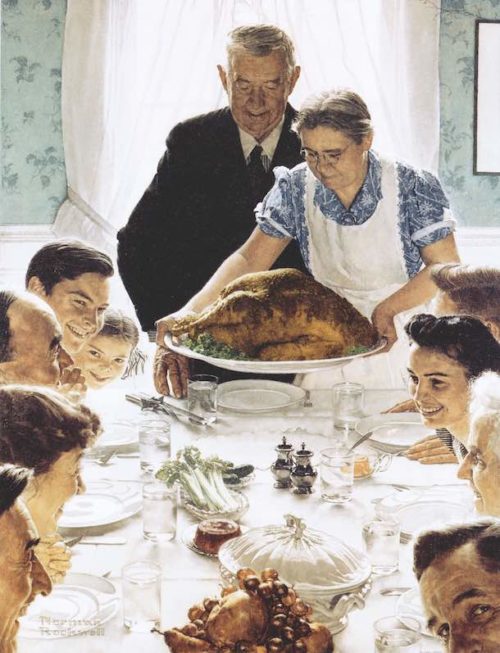
The Post asked four writers to craft essays to accompany Norman Rockwell’s Four Freedoms paintings. Poet Carlos Bulosan contributed the essay for Freedom from Want.
The painting has to be one of the most parodied in history, with everyone from The Simpsons, superheroes, and the cast of Modern Family replacing the original family.
March Is National Celery Month
I think we can all agree there isn’t a more exciting food than celery! It’s light green! It’s mostly water! It doesn’t have a lot of flavor! Did I mention it’s mostly water?!
Okay, no matter how many exclamation points I use, I can’t get you pumped up for celery, but I happen to really love it (and not just with peanut butter spread on it). Here’s a recipe for Easy Homemade Chicken Salad from Genius Kitchen, which sounds good, though I think they might be overdoing it with the mustard, green peppers, and hard-boiled eggs. Here’s a simpler recipe from the same site.
I’ve noticed a lot of recipes include water chestnuts, but I wouldn’t go that route either. I do like white pepper in mine and maybe even some grapes. Yes, grapes.
Next Week’s Holidays and Events
Daylight Saving Time begins (March 11)
I hear there are people who like it when it stays light until 8 or 9 p.m. I’m not one of those people, but I know they exist. Set your clocks an hour ahead before you go to bed.
National Girl Scout Day (March 12)
How can you celebrate the day if you’re not a Girl Scout yourself? By purchasing some cookies, of course. I like the Samoas, which apparently are now called Caramel deLites.
7 Heirloom Vegetables Saved from Extinction (That You Can Plant in Your Garden)
Thomas Jefferson said, “The greatest service which can be rendered any country is to add a useful plant to its culture.” Jefferson was a steward of many heirloom crops — like lettuces, peas, and beans — on his farm at Monticello. Heirlooms differ from many industrial crops in that they are open-pollinated and produce seeds that can be planted the next season. Heirloom seeds have been passed down in family gardens for generations, sometimes for centuries.
“They’re germplasm, but they’re also part of our identity,” says Lee Buttala, Executive Director of Seed Savers Exchange. The Iowa non-profit, started in 1975, tasks itself with keeping these useful plants in our culture by saving and distributing heirlooms to growers around the world. “The work that we do goes across political spectrums,” Buttala says. Besides being crucial for biodiversity in agriculture, he believes these seeds and the stories behind them make up a fascinating part of our collective mythology surrounding our food.
Sometimes, heirloom varieties are lost for good, due to a bad growing season or some other mishap. Recently, Buttala visited the Svalbard Global Seed Vault, a seed bank on an arctic island of Norway, to deposit some seeds alongside a host of international visitors. One variety Buttala took along was the Norwegian pencil bean, a crop the organization recently obtained after several generations of a family had grown them in Washington state via Minnesota. While he deposited them for safe-keeping, a Norwegian ambassador recognized the variety from his childhood. Buttala gave him a handful of Norwegian pencil beans to grow, since the ambassador had had some years ago that wouldn’t germinate. “As far as he knew, it had stopped existing in the world,” Buttala said.
It’s easy to participate in conserving these varieties: you just grow them. Often, the flavor and color of heirloom fruits and vegetables is striking compared to those you can buy at the store. And when you garden with them, you’re involved in conserving heritage as well. In our country’s long history of immigration and transfers, heirloom varieties have made their way into the land and through generations by carefully conducted traditions. Each seed comes with a story that may or may not be an exaggerated tale, but — myth or not — these varieties could one day save the planet.

Aunt Mae’s Bibb Lettuce
You might have received these lettuce seeds if you visited the right barber shop in Boalsburg, Pennsylvania in the early ’50s. Nestor Keene handed out packets of his aunt’s lettuce seeds at Keene’s Barber Shop for years. He had grown it since 1937. Aunt Mae Smith is said to have acquired the butterhead variety from a family named Zimmerman in Brush Valley, Pennsylvania. Keene’s closed in 2016, but Aunt Mae’s bibb lettuce lives on. Buy seeds on Seedsavers.org
Chelsea Watermelon
Chelsea, Iowa’s population of 261 people is half of what it was 100 years ago. In those days, farmers took advantage of Chelsea’s sandy hills by covering the land with watermelon patches. They filled their triple box wagons with Chelsea watermelons and sold them in town. The delicate melons weren’t suitable for shipping, but that didn’t stop growers like George “Water Melon” Smith and others from carting their harvest to nearby towns. Melon-growing has declined in Chelsea, but there are still remnants of the roadside “melon shanties” that sold this sweet heirloom. Buy seeds on Seedsavers.org

Fish Pepper
From the gardens of slaves in 19th-century Chesapeake Bay came the Fish pepper, a light-green (or bright red) hot pepper used in fish and shellfish dishes. The heirloom is thought to have originated from the Caribbean. The Fish pepper disappeared from Maryland kitchens in the 20th century, but in 1995 food historian William Woys Weaver offered seeds he received from his grandfather in the Seed Savers Exchange Yearbook. Buy seeds on Rareseeds.com
Collier Cucumber
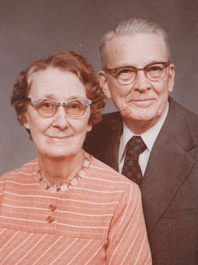
In Nashville, in the 1950s, Graham and Margaret Collier used all of their family’s heirloom cucumber seeds for their summer garden. Margaret’s parents had obtained this special variety from a migrant community in Southern Indiana in 1910, and she continued growing the cucumbers into adulthood. The only problem was that none of the plants came up that summer. The Collier’s worried the heirloom was lost forever. “However,” wrote their daughter, May, “miracle of miracles, next year a volunteer plant came up!” Graham tended carefully to the lone survivor, and the Collier cucumber line was saved. Buy seeds on Seedsavers.org
Nebraska Wedding Tomato
Betty Englert of Sandpoint, Idaho claimed her pioneer ancestors brought this orange tomato to western Nebraska in covered wagons in the 1800s. She grew the variety from 1934 until the 1980s. It is thought that the tradition of giving seeds as wedding gifts derived from this heirloom. Buy seeds on Superseeds.com

Radiator Charlie’s Mortgage Lifter Tomato
After beginning work in the cotton fields of North Carolina at age 4, Marshall Cletus “Radiator Charlie” Byles owned an auto repair shop at the bottom of a mountain. During the Great Depression, Charlie was in need of another source of income. He hatched a plan to cross-pollinate tomatoes to create one super plant, and he spent six years doing just that. He sold the tomato plants for one dollar each, and paid off his mortgage with the profits of his popular seedlings. The Mortgage Lifter tomato is no lemon, either. The fruits range from one to two pounds, have few seeds, and are disease-resistant. Buy seeds on Sowtrueseed.com
Swenson Swedish Pea
The Swenson pea came to Minnesota all the way from Småland in southern Sweden in 1876. Charles Swenson offered the cultivar, saying his grandfather, Carl Johan Swenson, brought the peas when he emigrated to Clinton, Minnesota. Charles remembered his aunts and uncles growing the peas in long rows on fences in their gardens, and the early harvest was creamed into a traditional Scandinavian dish. Buy seeds on Seedsavers.org
Cover Collection: What Keeps Us Up at Night
Whether it’s work, weltschmerz, or worm farming woes, we all experience insomnia about something at some point in our lives. Here are some of our favorite covers of the things that keep us up at night.
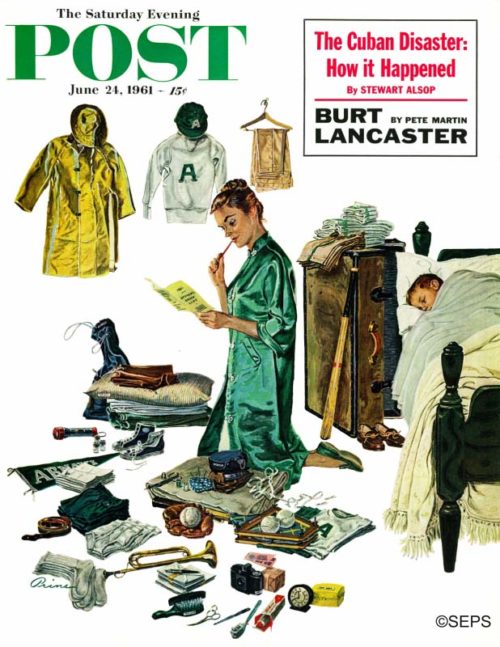
Ben Kimberly Prins
June 24, 1961
While our young camper dreams of fires and “bug juice” (that favorite beverage of camp mess halls), mom is willing to forego a few hours of sleep in exchange for four weeks of boylessness. Tomorrow morning mom will be informed by her son that, while most of the paraphernalia assembled here by artist Ben Prins is okay, a camper has not more use for washcloths and a pincushion than he was for silk pajamas and an arithmetic book. Why, with the space they occupy her could make room for important stuff such as candy bars, a whittling knife, and, for a little fun after lights-out, his rubber snake and a package or two of sneezing powder.
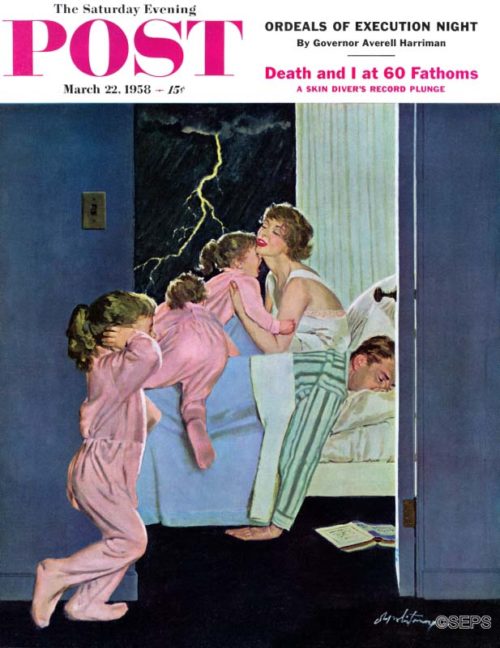
M. Coburn Whitmore
March 22, 1958
Of course, the children haven’t been frightened by Papa’s snoring, but by the awful sounds of Nature on an electrical rampage. So mother will gather them in her arms and love away their fear. Coby Whitmore’s man of the house, buried there in the bed. must be the deepest sleeper this side of the proverbial log. How does she get him up mornings—rap on his head with the book?
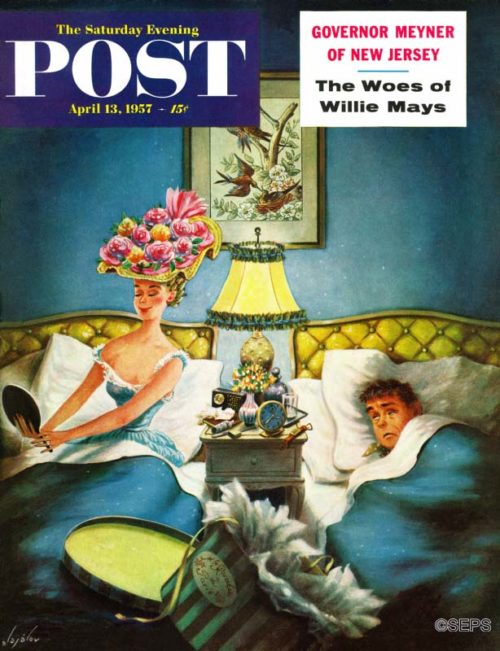
Constantin Alajalov
April 13, 1957
We see by the cover that Mlle. Rosalie de Paris has unloaded on madam a chapeau avec beaucoup de flower garden topside. It is darling, madam is fully convinced. And if you think it is a malformed nightmare whose logical repository is the ash-can, you must be just a puritanical old fogy, for it is also regarded as a masterpiece by that great American designer, Monsieur Alajalov de New York. As for the character in the other bed, for once in his life he is noticing that his wife has a new hat.
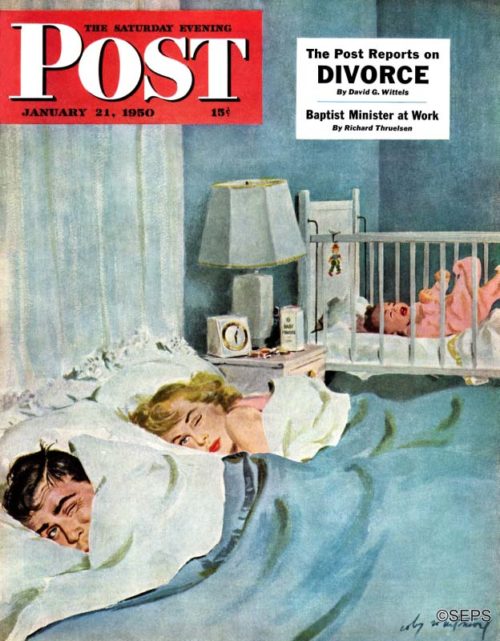
M. Coburn Whitmore
January 21, 1950
Who’s going to get up and give the baby her bottle and a new deal in underwear? Mom and dad dearly love their little alarm clock, but they do wish that babies came equipped with a lever by which they could be set, the night before, to ring at 7:30 a.m. instead of at one of the more unholy hours. Mom and dad will battle it out for a few more howling minutes to see which one will totter out of bed and do the honors.
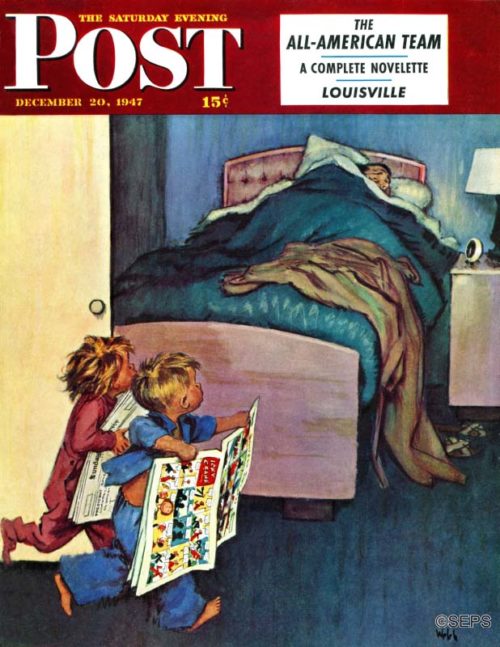
Jack Welch
December 20, 1947
Some years ago, Frank Kilker, an associate art editor, heard artists complaining about a fellow named Jack Welch, of Valhalla, New York, who worked for an advertising agency. Welch did sketches of proposed illustrations, for the guidance of the artists who would do the finished job. But the rough sketches were so good that it was tough for the artists to better them. Kilker looked Welch up, and Welch started doing illustrations for the Post, including this one—his first cover. In painting his picture of a father’s Sunday reveille, Welch was drawing on experience with his two daughters.
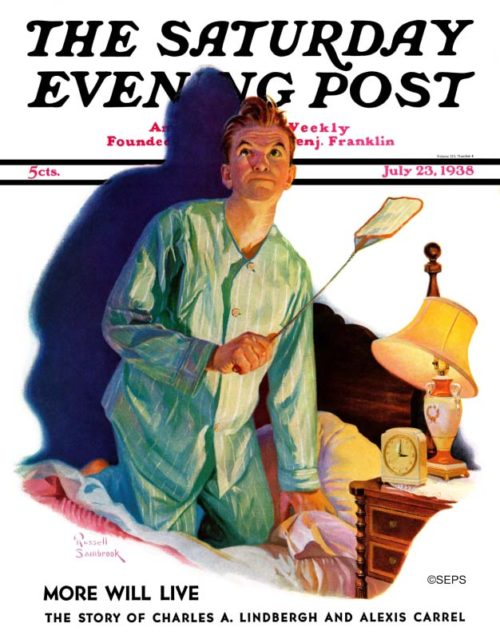
Russell Sambrook
July 23, 1938
We’ve all been there at 3 a.m. when a fly dive bombs your head or that invisible mosquito whines in your ear. Much has changed since 1938, but two things haven’t: that fly swatter and the fact that this guy isn’t going back to bed anytime soon.
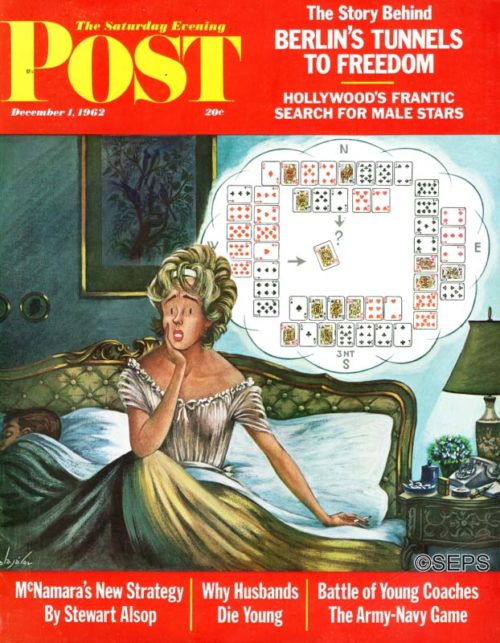
Madam is remorseful about her own greed,” commented famed contract-bridge authority Charles H. Goren about the dilemma of the sleepless bridge player depicted by artist Constantin Alajalov. “It has dawned on her that withholding her ace of diamonds on the first trick, because she would have had to waste her singleton king, may have been penny-wise and pound-foolish,” said Goren. “If she had been satisfied with two diamond tricks instead of three, she could easily have made her game at three no-trump, by playing the ace from the dummy. She would then have been in position to take the important club finesse. But when she all too frugally won with the king in her own hand, she had no way to reach dummy without letting East in, and that character rudely led back the queen of hearts, so that Madam lost five tricks.”
North Country Girl: Chapter 42 — The Trophy Girlfriend
For more about Gay Haubner’s life in the North Country, read the other chapters in her serialized memoir.
Within a week James had shanghaied me out of the Canadian girls’ place and into his. I had left more roommates in the lurch, but at least I had already given them 30 dollars, my share of the month’s rent.
Was I in love with James? No, but I was enthralled. James scooped me up at a time when I was the most malleable, when I had wandered into this glittering new world and desperately needed a guide. I fell under James’ spell, bedeviled by his advanced age, his sophistication, his dark eyes, and his bottomless pockets, seduced by the red Jeep and James’ fancy beachfront condo, which he rented for the whole season.
His eighth-floor apartment was sleekly modern, simply furnished, and huge. A dark curtained bedroom lurked in the back. In the living room, where we never sat, floor to ceiling windows on three sides looked out over the bay. Across the front of the apartment, facing the sea, stretched a wide, deep balcony with no neighboring buildings to interrupt the view. I loved to sunbathe nude out there, tanning my few remaining white bits. James watched me and I watched the parasailers, who occasionally soared by close enough for a look themselves. The parasail took off and landed right on the beach, towed by a small powerboat whose driver had a Corona in his hand at all times. Once I saw a guy coming in for a landing get slammed against the side of a hotel; more often, the poor tourists would get face planted on the sand and pinwheeled off their feet while the boat sped on, steered by a drunken captain who never looked back.

If I leaned way over the balcony railing, I could see the pool below, anemic blue and always totally empty, even though every lounge chair and umbrella table was occupied from morning till sunset. James refused to set foot in this pool. I realized years later during a trip to Florida that the residents in James’ building could have been swapped with those of any condo in Boca Raton. Even in glamorous Acapulco, that pool was where old guys drank and played cards while their wives boasted about the grandkids and complained about the help.
These retiree snowbirds living in his building acted on James like garlic on Dracula; every time we rode the elevator with one of them, James backed himself as far away as possible, doing everything short of throwing up his arms across his face in horror. James had an irrational fear of growing old; he wanted to look young, feel young, and hang out with people half his age. James didn’t have a wife who would call him away from his gin game because she couldn’t remember if little Aaron was eight or nine. He didn’t even play cards—that was for old men!—he preferred backgammon (which I had never seen before). James taught me my first Yiddish word: alte kaker, an old shitter. He did not want to hang around with the alte kakers, and forbade me from ever swimming in that pool. He acted as though old age were a contagious disease he was determined not to catch.

There was one alte kaker in the building who James could not avoid, as they were from the same town (although James always claimed he was from Chicago, he actually lived in Des Plaines), and James had once sold him a Cadillac. One day when I was sunbathing on the balcony, I heard the front door open and close and looked up to see James, accompanied by a pop-eyed Mr. Des Plaines, unfortunately wearing his usual Speedo, which was not quite covered up enough by his sagging gut. I grabbed a towel, James burst out laughing, and Mr. Des Plaines turned and ran out the door without a word.
I glared at James, who didn’t apologize but said, “Ever since I told him that you sit out here naked he’s been begging to come up. I hope he doesn’t have a heart attack. Now they’ll have something to talk about besides those damn grandkids.” I had yet to hear the word trophy used to describe a person, but that was what I was, clearly on display.

My time with James was an indulgent hedonistic dream, days that were not counted out by the teaspoons of Spring Break but seemed to stretch out forever. We spent the mornings water-skiing at the Pie de la Cuesta, a quiet lagoon north of Acapulco, that seemed another country away from throbbing discos and Arabian Nights beach clubs. Hammocks hung between palms, and fishermen grilled their catches over driftwood. There were no pushy beach vendors, no ragged kids selling Chiclets, and only a few tourists and Mexicans enjoying the calm, reportedly shark-free water. James loved giving me instruction in anything, from backgammon to tipping; under his tutelage I went from desperately hanging on to the triangle handle of the taut towrope, steeling myself for a head-first plunge off my skis and into the water, to being able to clumsily drop one ski and slalom, while still clinging to the rope like death. James, of course, was an elegant water-skier; he probably could have smoked a cigarette while effortlessly curving back and forth behind the boat.
In the afternoons we would head to Le Club or the Villa Vera. The Villa Vera, hidden away in the hills, was a once famous spot that had steadily been losing ground to the modern beachfront hotels. But it managed to hold on to its ’50s glamour, with small but luxurious villas and never-ending, high-stakes backgammon games. One of the main appeals of the Villa Vera for James was playing backgammon with two minor celebrities who had set up there for the winter. James preened as he introduced us; he got to show

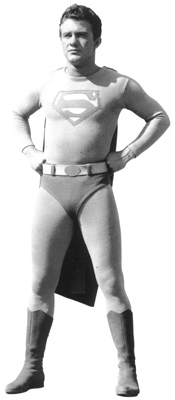
off both his blonde 20-year-old girlfriend and his famous friends. Don Adams, Agent Smart from Get Smart!, was a complete jerk, always leering at me and anything else in a bikini, always rude to the staff, and always on the prowl for unaccompanied women who might be impressed by his minor stardom. James’ other backgammon opponent was the actor who played Superboy in the TV show The Adventures of Superboy, a claim to fame that he always had to repeat at least twice: “No, I wasn’t Superman…no, not the movie, no not Superman the TV show, it was a different show…” Of course I have forgotten his name. (But I looked it up! He was Johnny Rockwell, who went on to marry the heiress to the Mexico City Coca-Cola franchise.)
The Villa Vera also had a pool with that most brilliant of inventions, the swim up bar. I loved that bar, where I spent many hours with my butt perched on an underwater cement stool drinking bullshots while James took on all comers in backgammon.
A bullshot is vodka and beef consommé. It’s like a bloody Mary minus the tomatoes but with a lot more Worcestershire. I learned to drink bullshots at the Villa Vera because James did not believe in regular meals. He was as obsessed with getting fat as he was of getting old. He put off eating as long as possible, a whole day if he could. He had no problem having drinks from noon on though, without ever showing the least sign of drunkenness. A bullshot was as much a cup of soup as a cocktail, and for James, a couple of bullshots was a meal.
I, on the other hand, was always hungry.
At 20, I did not have enough confidence in myself to tell James I was going to order a club sandwich. I was so aware of the revulsion James felt for fat people that I constantly worried about my own weight. Minnesotans back then always carried a layer of extra fat, in case winter got so bad we had to go into hibernation. James worriedly pulled and prodded at his own taut stomach; if he believed he saw a centimeter of pudge he announced he was fasting that day. I surreptitiously pinched my own belly and compared myself to the endless array of perfect, bikini-clad bodies that constantly surrounded us.
When James, after several viewings of himself in the mirror, front, sides and back, did decide that it was safe for him to eat a meal, we always ate very well.
Sometimes James woke up hungry after a day of fasting, and we went to breakfast at the majestic Sheraton, one of the original Acapulco hotels and the only place where you could buy American papers (papers that had been published the day before). James studied the financial pages, lecturing me on PE ratios, margins, short sales, and many other topics, which unfortunately did not stick in my brain. I was too busy washing down my cheese omelet and bollitos (tiny fresh rolls, brown and toasty on the outside, fluffy and white on the inside, that begged to be smeared with butter and jam) with fresh squeezed orange juice and strong coffee that was constantly refilled by a waiter standing ready with a silver coffee pot and a small pitcher of warmed milk.
If James decided to break his fast at lunchtime, we went down to Paradise, a beachside restaurant, and had whole fried snapper and Coronas while we watched the parade of vendors haranguing the pale or sun burned tourists, tourists who then staggered off the beach over-burdened with silver jewelry, piñatas, marionettes, gaudily embroidered shirts, glittery sombreros, and ridiculously often, an entire onyx chess set.
Fortunately, even if James insisted that we skip breakfast and lunch, there was usually dinner, as like the rest of the beau monde of Acapulco, James had to make regular appearances at Carlos‘N Charlie’s, to see and be seen. Fito and I had perfected our ability to ignore each other, although Jorge smiled and waved as if he had forgiven me for everything; once he plaintively asked me if Mindy was coming back to Acapulco too.
James never took me back to the fancy spot with the towering arches; I guess that was a first date place. Instead we drove up into the hills to a funky little Mexican restaurant that had almost as good of a view, where every meal started with sangritas, a shot of tequila with a chaser of hot sauce cut with tomato and orange juices.
But my favorite place to eat was the bowling alley hidden away on a back street of rundown, downtown Acapulco, where we were the only non-Mexicans devouring blackened spit-roasted chicken and homemade tortillas. I don’t think I had ever before had a chicken that actually tasted like something; this was chicken-y chicken, juicy and smoky and crisp-skinned. We sat at one of the four oilcloth topped tables and tore the chicken apart with our hands, wrapped the meat in tortillas, and laced every other bite with a spoonful of spicy homemade pico de gallo.
Whether we had eaten breakfast, lunch or dinner, or none of the above, our days were well punctuated with cocktails and beers. And every single night you would find us at Armando’s, drinking and dancing and drinking. I don’t know how I wasn’t drunk all the time. James did not seem affected by alcohol. He liked Quaaludes, which he bought legally at a regular old farmacia, thanks to a prescription from his Mexican doctor. James also liked pot and coke but not in Mexico. He had seen a Mexican jail first hand, visiting a friend who had been arrested for marijuana. The Acapulco jail did not provide food for the inmates so James brought him ribs from Carlos‘N Charlie’s. From the way James described the jail, I would have been surprised if his friend had gotten to eat a single rib before being shanked for his meal, by a prisoner or a guard. After that experience James determined to never risk doing anything that had a chance of landing him in the Mexican casa grande. He stuck with vodka and ludes. Despite my fondness for most drugs, I could not see the appeal of Quaaludes nor could I handle them. After a few incidents of me falling asleep with my head on the table at Armando’s, James stopped offering me pills.
I would like to say that James and shared our life stories, but mine was barely 20 years of mostly wholesome living in Minnesota. That took about five minutes to cover. James was 42. He had been coming to Acapulco for years, staying from December till May (he was very vain about his year round tan). He was originally from Winnipeg (finally, we had something in common: we both came from small cold towns) but had moved to Chicago twenty-two years earlier escaping a shotgun wedding and the responsibilities of a family. (Wait, let me do the math.) He took as much pride in staying single as if he had escaped barehanded from a lion’s den.
James did not want to be the father of a 20-year-old girl, he wanted to go to bed with 20-year-olds. He had made such a successful getaway from Winnipeg and marriage that he had never heard from his abandoned daughter or her jilted mother. He had never even met his daughter. You would think that having a deadbeat dad myself that this tidbit would have curdled our relationship, but I was young and callow and about as introspective as a rock. He shrugged off his lost family, so I did too. Marriage, kids—who wanted those when there was disco and drugs, backgammon and beach?
“Sunday Is a Narrow Place” by Morton Fineman
Knowing, living, and coping with Sol Pitack had turned his wife Ida into a hard-nosed strategist around the house. That, he believed, was why, back in the cold of January, she had said — without ifs, ands, or buts — that she absolutely wouldn’t put up with another summer of hearing practically every kid in the neighborhood screaming on the monkey bars, swings, and slides in the playground across the street. Sol’s own best friend, Wolfe Goldberg, who didn’t even live on the playground street, but around the corner, had air-conditioned three years ago, while Ida was still going out of her mind with the screaming, and damp at every pore. To bring silence to Ida’s summers, Sol finally took twelve months’ financing with ten percent down on whole-house air-conditioning, which even at the lowest estimate would break your back, he told Wolfe, because you had to figure all new duct work on account of the house had oil heat with radiators.
Long before Sol had actually signed on to keep Ida happy, her mother had observed with eloquent variations throughout the courtship: “No matter what he ever does, this kid Sol will remain a basic nothing because his idea of the big time is playing games. A man his age should concentrate on his profession or his business. Because if he is not playing for money, like those baseball players who get such fabulous salaries, then it’s something strictly for children. Is that for you, honey? Drop him like a hot potato because some day, in your heart of hearts, you will rue your emotions. I’m only asking you to give up strictly a shlepper.”
The morning after Sol had capitulated on whole house air-conditioning, he went to the wardrobe closet in the front hall. There, like a lord magistrate robed and bewigged for court, ruminating upon innocence and guilt, he considered a sweat stained warm-up jacket, the elastic cuffs frayed and raveling. Then, ruling for himself as defendant, he slung it over his shoulder and walked to the door for the morning drive to Redi-Lunch Systems, Inc., where he was in charge of the box-lunch division. Before he reached the door, Sol heard his son’s voice. In the early, iron-gray February daylight, Barry’s head and naked shoulders (he was a pajama-bottom sleeper) emerged over the banister.
“Where you going with the warm-up jacket?” Barry asked, following the words down with a slightly twisted smile.
“The office,” Sol answered. “Where else would an idiot father of a big high-school football star be going at quarter to seven on Friday morning? If you’ve got some big point to make, make it in plain language.” As Barry retreated, Sol started up the stairway, which was covered in dusty-rose carpeting financed two years ago because Ida didn’t want to die with Majorca blue underfoot. “Once in a while give me the courtesy of an answer,” he said into the silence that filled the house.
Sol flung open the door of Barry’s room. “Listen, it cost me better than fifteen hundred dollars so your mother could make a big deal out of a simple bar mitzvah. You stood up in front of everybody and said you would honor and respect your parents. I’ll settle with you for one minute’s worth of genuine respect. Say whatever you like. I’ll sit and listen until you’re finished.”
“I’m sorry I mentioned it,” Barry said.
“That’s not the kind of answer that encourages discussion,” Sol said. “The next time you ask me a snotty question, stop and remember that this particular morning I gave you every chance to outline your position.”
Later that day, Wolfe Goldberg entered Sol’s first-floor office. During the renovation of the building the year before, the box-lunch division had not been moved up to the second floor with all the other executive offices that now opened onto a wide, carpeted hallway. Wolfe strolled over to the gray metal coatrack, with the deliberate, measured sneer of an old-fashioned burlesque comedian, and lifted the warm-up jacket from the hanger and let it hang from his index finger in front of Sol. Around Redi-Lunch, Wolfe was considered the boss’s pride and joy, a great ball of speed when it came to shooting out office memos. No piece of correspondence passed his desk, even when it was just for information (De Pinna, the boss, was a devout advocate of keeping the executive team informed; he expected every man to read for Redi-Lunch) without multitudinous notes with lots of exclamation marks red-penciled in the margins — management cautions, warnings, imprecations, and recommendations for management action. Wolfe, according to De Pinna, was a man you could depend on to look at things overall-picturewise and to handcuff anybody who came in with some parochial crap. Like De Pinna himself, Wolfe worked, acted, and dressed like a man always ready to be photographed, interviewed, and consulted. More and more these days, De Pinna gave things to Wolfe for a little double check, overall-picturewise.
“Who are you supposed to be right now?” Sol asked, lighting a cigar. “Kirk Douglas?”
“Answer me one question, buddy. What’re you trying to do? Become a loser?” Wolfe said, swinging the jacket from his index finger. “Just yesterday, right in this office, didn’t I tell you confidentially that De Pinna is considering you as a guy who could move up to the home-catering division slot? Didn’t I make it absolutely clear, as friend to friend, and ask you to be guided accordingly? So you come up with wearing this crazy thing around here.” Wolfe slammed the warm-up jacket across a chair. “I don’t see any logic, and I can’t figure what kind of gag you’re supposed to be pulling. Look, I grant you it’s a little thing — from one point of view. Only in your case, you get a certain reputation for being the type of wise guy you can’t pin down, but everybody feels it. In the final analysis, which is the way you have to look at it, that lousy warm-up jacket could help kill you around here. De Pinna himself told me after he saw you out there on the loading platform, ‘Wolfe, he does a tremendous job for us in box lunches, no denying it. Only I’m disappointed he can’t figure out that management doesn’t go around in a warm-up jacket, like one of our drivers.’ The man confides in me, and I don’t mind telling you I’m flattered when a man who cuts your bread and butters it has got enough regard to offer a few words in confidence. Now, I’m confiding in you for the last time. I mean it, Sol. We’ll be the best of friends outside the office — God knows I wouldn’t want that to change — but around here there’s got to be a certain level of mutual acceptance and regard for circumstances. You know what that means?”
“Nah,” Sol said, leaning back and cocking his head to one side as he appraised Wolfe. “It’s vintage Tony Curtis, not Kirk Douglas.”
Impassioned with good sense, voice ablaze, Wolfe cried, “This is basic, factual! Don’t smile at me like a friendly neighborhood swami and make little cracks. Throw away that warm-up jacket. You know what else De Pinna said to me? ‘I won’t deny Sol has got certain boy scout virtues which I admire, because nobody in his right mind would go around knocking boy scouts. But I have to ask myself whether that’s enough for a management man.’ And I said to him, as true as I’m standing here, ‘He’s the kind of guy you have to tap deep and he’ll turn out to be a dynamo.’ And then he finds you pals and buddies with the drivers in a crummy warm-up jacket. I’m giving it to you straight, kiddo. That man De Pinna is like a wonderful grandfather. He wants to approve of you. Help him, for God’s sake. Try life at the fifty dollar window. I guarantee you it’s great. This is the last time I discuss any subject of this type with you.”
“Nah,” Sol said, smiling at Wolfe, “you’ll take advantage of another opportunity, kid. Where else could a keyed-up executive like you find this kind of enjoyment?”
“Screwball,” Wolfe said affectionately. “Dig into me with your crazy sense of humor. Go ahead. I’m used to it. I could ask myself a hundred times why I still like you, and not get an answer. But I don’t care.” He slapped Sol on the shoulder with a nail-bitten hand. “What else I stopped in to tell you is we’ll pick up you and Ida tomorrow at seven-thirty sharp, so don’t make any other plans for Saturday night. I called Sylvia and told her. ‘It’s your birthday, kid, and we’re going to make a Saturday night of it with Sol and Ida.’ We’ll all hop into town and catch Camelot, which Sylvia’s been bugging me about because she wants to compare it with the play. Then we’ll slip over to El Capitaine in Jersey and catch the midnight show.”
Then Wolfe’s face became somber, his tone earnest again. “I want to leave you with one very serious thought for your consideration, no matter how you crack wise, buddy. I want you to realize that box lunches are now definitely a minor part of sales around here. Because today, when you come to the fringe-benefit department in collective bargaining with the unions, you start out talking air conditioned cafeterias supported by the companies — if they don’t already have them. With the union situation today and the way they’re grabbing off fringe benefits, where do you figure you’ll stand down here in box lunches? Don’t you think at all, Sol? One of these days De Pinna is going to make up his mind that box lunches are dead.”
“The trouble with De Pinna,” Sol said pleasantly, “is he believes all those things he doesn’t even read in the Harvard Business Review.”
“What the hell am I going to do with this boy!” Wolfe cried, shaking his head vigorously.
“Keep ordering imported only, kid,” Sol said.
Confronted by a new powder-blue Buick Skylark at the curb, Ida, burning with jealousy, said to Sylvia: “Did you ever imagine it would be a birthday present like that, kid? It’s so gorgeous I could cry. Listen, before we leave, we must have one drink. Except Barry here. You have a Coke with us, doll.” Speaking her son’s name slowed and softened her voice with pride. Barry would open the West for her, tame the frontier, and she would live to see the day.
From his observation post in the living room, Sol gazed at Barry, a wraith who passed through the house on obscure missions, suffering his parents; enigmatic and inaccessible behind walls of self-importance. Whenever Barry was trapped by his mother’s demanding effusiveness, as now, he watched some distant shore point like George Washington in the painting, crossing the Delaware. Ida never noticed the George Washington look. Sol, mindless of the talk around him, studied his son and tried to remember, but could not, when he had first noticed Barry’s George Washington look.
“I’m definitely for a drink.” Wolfe said gaily. “How do you like the car, Barry boy? Considering the fact that you’re probably a TR4 man when it comes to wheels, you still got to admit that’s some little sweetheart out there.”
Barry stood with an attitude of captivity, his wraith smile on high beam. “Stick shift?” he asked.
Wolfe laughed and lunged forward to slap Barry on the shoulder. “That kid never blows his cool,” he said to Sol. “Four on the floor, Barry boy. You named it.”
“For God’s sake, Sol,” Ida said. “Don’t stand there. Make Manhattans.”
Wolfe tightened his arm around Barry’s shoulder. “I love this kid. Honest to God. I couldn’t be prouder of him if he was my own Jeffrey. Going into his junior year and already all public-high halfback with straight A’s. Name somebody who can top that. Sol, how come you’re not up on the goddamned rooftop every day broadcasting to the whole world about this kid?” Then, with outstretched arms, Wolfe advanced with little dancing steps toward Ida, saying, “Mm, you lovely dish. While Sol’s making Manhattans, I’ll take romance.”
With shining eyes. Ida allowed herself to be hugged and kissed. “Jeffrey does all right. Wolfe. He’s got your head.”
“He’s no Barry. I’m being frank. This son of a gun goes on a football field and kills them with that crazy, tricky, pigeon-toed, knee-pumping run. If half the squad breaks a leg, Jeff will make a letter. But I’m not complaining. All I want to see in him is that hustle, that fight. I’ll tell you one thing, Barry, and I mean it sincerely, kid. Stay with the math. Today everything is figures, especially when you consider the way science is already in business. It’s all cost analysis. I mean it. Those computer kids come in with the serious little faces and the dark suits and the horn-rimmed glasses, and you figure they’re not yet dry behind the ears; but after a couple of weeks you’ve got to admit that, in all honesty, they can practically tell you how to run your business. No matter where you turn today, Barry, it’s all math.”
Sol nodded to himself, knowing how the Saturday night would end many hours later when he was back home with the private Ida. It turned out as he had expected it would. She complained to Barry about still being up with the Late Late Show on television, and then she advanced on Sol in the bedroom.
“Well, did you enjoy yourself?” she asked, with voice and eyes of granite. “Did you notice it was Chateaubriand for four? And when he wanted champagne, the waiter suggested only imported.”
“It costs more.” Sol said, wiggling his toes, unhampered now by shoes.
“It costs more,” Ida said. “That’s all you see. You don’t see he’s the kind they expect to want imported because they realize when he opens his mouth they are not dealing with some kind of shlepper acting like a big shot for one night out of the year. Listen, don’t start trying to ignore me or something, because there’s another little item I want to talk to you about. Wolfe told me what De Pinna said about you. You know what’ll happen to you? You’ll die in box lunches. I was looking at Wolfe tonight in El Capitaine and I thought, My God, he was a nothing, a nobody, and now he’s already got two promotions, and you’re still in box lunches. Give me one good reason why you had to drag a warm-up jacket to the office and then be crazy enough to wear it where De Pinna, who is probably the world’s biggest clothes nut for a man, could see you. Can’t anybody put a simple idea in your head? All De Pinna wants is what you yourself should already have the good sense to do anyway. He’s not asking you to cut both wrists and bleed into a bucket for him.”
“You’re standing in front of my bureau, Ida,” Sol said. “I can’t get my pajamas.”
He was six-two in bare feet. a plunging high-school fullback of yesteryear, scaled in today at a lavish two-forty, but still fairly quick of foot; easily visible at dusk as husband, father, and neighborhood landmark. So, he inquired of himself, how could he be so completely hidden in this house?
Ida stepped aside, her face rigid with scorn and incomprehension. For her, his boundaries were marked off; he was assessed, taxed, handicapped by limitations, adrift, and mortal, accustomed to solitary breakfasts at daybreak. With eyes like open wounds, Ida moved, not entirely believing that all he wanted at a time like this was his pajamas.
“Ida,” he said, buttoning the pajama top. “you’ve got every reason to sing Bluebird of Happiness.”
“You are Brand X,” Ida said.
“The nomenclature is incorrect. Try `Pitack, Sol,’ as they used to say in the Army.” Gazing down at her, he said in a lonely, tender, intoning voice. “Go to sleep. Ida. For once, dream of meadows and wild flowers instead of the boutique at Lord & Taylor, and cabanas at Miami Beach.”
“I swear to God you are acting as if you just stepped out of a flying saucer from who knows where,” Ida said.
In the hallway, outside Barry’s room, Sol paused like a footsore pilgrim, then walked in. Barry swung his head away from the television screen, presenting his George Washington look as soon as he saw his father. “What’s the big deal about now?” he asked guardedly.
“For the first time in history, a warm-up jacket has become an impediment to true happiness,” Sol said.
“Oh.” Barry hunched down in the chair to watch television again.
“Well, am I allowed in this little sanctuary?” Sol asked.
“Look, if you’re sore at her, you don’t have to come in and start bugging me,” Barry said. “If you want to watch. sit down and watch.”
As tenderly as he had spoken of dreams to Ida. Sol said to Barry, “All right, enjoy yourself with John Garfield.”
“I’ve got a feeling you are crocked.” Barry said.
“Your father is sober and clearheaded,” Sol said. “Tonight, I could tell you what it is like to be a father and a husband around here.”
“Please,” Barry said, “will you get off my back and let me enjoy the movie?”
“Good night, Barry,” Sol said. “Tomorrow, tell me how Garfield made out with the crime syndicate.” Sol went into the den on the first floor and lay down on the studio couch. The mattress buttons dug into his back. My God, he thought, laughing softly at the idea, practically a bed of nails.
Sol, waking late on Sunday, discovered that he was in full possession of the house, with its showroom-bright kitchen, and Sunday papers read and stacked on the marble French-provincial coffee table. There were no farewell notes, no tracks, no spoor, no clues in any of the rooms adorned with the artifacts of his labors and financing. Sol scrambled eggs and boiled water for instant coffee. While he was buttering a piece of Kaiser roll, Wolfe Goldberg, with his dachshund on a leash, rang the front bell. When Sol opened the door, Wolfe marched right in, leading the dog.
“I’m glad I caught you.” Wolfe said in his sharp, terrier-quick voice. “What are you doing?”
“Eating breakfast,” Sol said with mock haste because Wolfe asked questions as if he defied you not to carry out your sacred obligation to answer fully and immediately. Wolfe had a way of snorting lightly through his nose as he waited for the answer.
In the kitchen, Wolfe sat opposite Sol, picked up the buttered piece of Kaiser roll, and broke off small pieces to feed to the dachshund.
“Wolfey, that’s a pretty dapper little outfit you’re sporting today,” Sol said. Wolfe wore a light blue ascot, a gray pull-over, a navy-blue Cheviot tweed sport coat with hacking pockets, gray slacks, and cordovan loafers with tassels. “You look like a stand-in for Rex Harrison, kid,” Sol said, buttering what was left of the roll for himself.
Wolfe crossed his legs, grimacing, his lips curled downward at the corners in his standard Sol-Pitack-worn-out-joke position. “Can you get serious and cut out the wisecracks for just a couple of minutes, for crying out loud? You know what I’m going to do?” he said. “I’m going to the limit of my credit with you, and I’m going to violate my own philosophy that a friend shouldn’t butt into another friend’s marriage. Because this is the exception when it is absolutely wrong to keep your mouth shut.”
“When did Ida call you?” Sol asked, watching Wolfe feed bits of the buttered roll to the dachshund.
“This morning,” Wolfe said. “She didn’t just call. She came over. She pleaded. It’s Sunday, and I’m entitled to relax, but do you think I can relax when she pleads with me because you’re turning out to be a first-class kook? Sol, you are absolutely breaking that kid’s heart.” Wolfe leaned down and rubbed the dachshund’s ear. “Listen, you got another roll?”
“In the refrigerator,” Sol said.
“Schatzy here is crazy about a Kaiser with butter. Maybe you think I’m out of my mind,” Wolfe said proudly, “but I swear this little bummer can tell the difference between a Kaiser and some other kind of roll.”
“Get me another roll out, too,” Sol said.
“Hey,” Wolfe said, peering into the refrigerator, “you got some terrific looking Danish in here. I think I’ll break down.” Wolfe selected a strawberry twist, and bit into it as he walked back to the table and sat down. “Honest to God,” he said, chewing appreciatively on the Danish, “it’s a crime and a shame the way you aggravate that kid when all she wants is nothing but the best for you.”
“Before you get all worked up, enjoy the Danish,” Sol said.
When he finished the Danish, Wolfe wiped his fingers delicately with Sol’s unused paper napkin, and said, “All right, now tell me just what the hell’s the matter. I guarantee you I’ll listen. Look, are you frustrated or something? — because if you are, just remember, that’s for kids and nuts that have to spend twenty-five bucks a throw to tell their troubles to some doctor who’s probably as big a nut as they are. Listen — remember back in the old days? — you wanted to be a big football or basketball coach, and I wanted to be a dentist. So we both ended up in the food-service racket. My own personal philosophy is: No matter what you end up doing, you got to keep hustling and go for the top. What am I going to do — bleed from the ears because I didn’t become a dentist?”
“Wolfe,” Sol said with a faint, sad smile, “I also wanted to be a forest ranger, a scoutmaster, a pilot, a criminal investigator, the world’s champion weight lifter, plus a dozen other things. For a while I even wanted to be Jimmy Cagney.”
“No kidding,” Wolfe said. “Listen, I’ll make a little personal confession. For a while there I wanted to be Bogart. I used to practice smoking a cigarette the way he did, in front of the mirror.” Wolfe sighed heavily, and his mouth twisted as if he were struggling against the devastating appeal of nostalgia. “So what’s it prove? You got to grow up.” he said almost angrily. “Ida’s a gorgeous doll. Barry’s a terrific kid. And you could have everything going for you with De Pinna. I mean, what right have you got to do what you’re doing?” he asked, as if that somehow summed up everything, staring at Sol in exasperated triumph.
“What am I doing?” Sol asked.
“You don’t appreciate what you’ve got, that’s what.” Wolfe cried. “I told you a couple of things in the office on Friday. and I meant them. Ida’s right.” Wolfe whispered now. “I mean, you’re sitting here practically telling me you don’t care if you screw everything up.” Wolfe shook his head in despair. “Listen, naturally in Ida’s eyes she wants you to think like me because that’s the way they are — women — they gotta special kind of jealousy, with a special language to go with it, and they all know it without going to Berlitz. I mean, you take a dame from anywhere in the world, and I don’t care what language she speaks, and you put her in with Ida and Sylvia, and before you can snap your fingers they’ll be understanding each other. I mean, you think for one second Sylvia would act any different in Ida’s shoes? I guarantee you she’d probably be worse. Listen, now she’s got her eye on a house in Wynnewood. Sixty-five grand. And I’m telling you, deep down, in here” — Wolfe clasped both hands over his heart — “I know I need it like a hole in the head. But as sure as I’m sitting here. I know I’m powerless. I think of a mortgage on that kind of property and I get a goddamned migraine. But that’s only for openers. Because it’ll mean the whole place has got to be new — which, no matter how you figure, figure ten grand minimum. Sol, I’m telling you from the bottom of my heart, if I ever let it, pretty soon it would be a situation where I’d beg for a nice little cardiac, because that would be the least of my worries. . . . Look, I’ll give you another little example, because I don’t like the idea of you feeling so extra special — because, buddy, you got company. Just a simple little thing. When I come home at night you know I’m bushed, because even you’ll admit that Wolfe Goldberg is right in there producing. So my big boy, Jeffrey, all of a sudden lately he’s developed that holy-smoke-look-who’s-here look.” Wolfe nodded his head. “But you have to face it. They grow up, and instead of some cute little kid who used to break your back with having to run around picking up his toys, you got a full-sized, A-number-one, fully guaranteed wise guy on your hands. But I’m not complaining, because I realize it’s all part of me. And if you want high-class philosophy, I’ll give you some Shakespeare, not Wolfe Goldberg, because next to the Bible you can’t get more high class than Shakespeare. What you got to do is do what Shakespeare said in one of those plays: ‘To thine own self be true.’ Show me one place in anybody’s philosophy, I don’t care what kind, where they tell you to be a kook.”
Wolfe stared at Sol again, then said hoarsely, “Aah, I can see I’m not getting through. Dig your own grave. Listen. Schatzy here wants to go out again. I’ll take him over to the playground.”
“I’ll walk over with you,” Sol said. “The only thing is, I don’t have one of those ascots.”
Wolfe bared his teeth in a ferocious grin and slammed Sol playfully on the shoulder. “What the hell do you need one for? All you’re going to do is shoot a few baskets with Jeff and Barry. I saw them horsing around over there when I was walking Schatzy.”
Then, as if he had conceded far too much, Wolfe cried, “I know one thing. You didn’t find any kind of goddamn magic secret, because there is no such thing in this world. All you’re doing is getting yourself bollixed up over some crazy warm-up jacket.” He smiled again, almost apologetically, for his outburst and took a cigar from Sol’s shirt pocket. He lit it, then snapped the leash on the dachshund’s collar. “Well, I’m due a few points for trying with you.”
Sol looked at Wolfe gently, as if he did not want to frighten him; especially not laugh out of understanding, because here was Wolfe standing like a man whose sealed bid has been returned mysteriously unopened. As if Sol had vowed silently henceforth to choose only words that would not frighten Wolfe, he said. “Sometimes a Sunday, even when you wake up late with nothing special to do, is a narrow place. And all of a sudden nothing is dustproof, stain-resistant. noninflammable, or certified for minimum shrinkage. Sunday is a very dangerous day, Wolfe, unless the night before you dream of meadows and wild flowers. But only a few lucky people ever dream like that.”
“Don’t even try to explain that crummy idea,” Wolfe said. “Let’s take Schatzy out. I also got an idea some fresh air’ll do something for you, too.”
Sol and Wolfe stopped just inside the wire fence of the playground, watching Jeff and Barry work a basketball back and forth across the concrete court in elaborate pass variations. “Look at the way those kids handle themselves,” Sol said. “Like a couple of ballet dancers. Did you ever notice the way once they’re out of the house they’re different kids? In the house, Barry’s always got his Washington-crossing-the-Delaware look when you talk to him. He looks straight at you but he sees something a block away.”
“Hey, you just reminded me!” Wolfe said, slapping Sol on the back. “You remember in high school they used to have that big picture in the hall right outside the principal’s office? It was about four or five yards long, with a big gold frame. You remember we used to look at George standing up in that rowboat, and you said. ‘What’s the big deal on the other side? It’s only New Jersey.’ And you remember that art teacher that always looked like a crooked accountant-that Mr. Kaplan, who used to drag us around the halls on that art-appreciation jazz? And that day he was telling us about that George Washington picture and you asked right out of the clear blue sky, ‘Mr. Kaplan, do you think George Washington could take Buck Rogers in a fair fight?’ Why don’t you say things like that anymore, instead of that crazy stuff you’re always handing out these days?”
Wolfe unleashed the dachshund, who ran out to the grass of the baseball field. “Hey. Jeff.” Wolfe shouted to his son. “the big fat boy here’s looking for a piece of the action.”
Sol caught the pass from Jeffrey, faked a shot, then a pass; he pivoted to elude a defensive player and went for the basket with an overhand shot. The cigar jutted from his lips as he wheeled to the right, gauging instinctively the correct angle for a fast retrieval. As it came off the backboard, he leaped and caught the ball, with an immense rise and fall of flesh around his middle and a ballooning of his jacket and corduroy trousers. He was like a clown in those baggy clothes, which floated back into place about him, and it was easy to miss his innate, residual grace. He descended lightly, a trifle breathless, chomping firmly on the cigar as he executed the quick faking motions of an offensive player with the ball, searching for a pass target. Then he whipped the ball overhand to Barry and grinned exuberantly.
“Jerk,” Wolfe called to him genially through hands shaped like a megaphone around his lips, “at your age you better stick to shooting fouls instead of the fancy footwork.” Wolfe leaned back on the playground bench, every inch a spectator of the foolishness you had to accept along with Sol. Watching Sol in his beloved habitat restored Wolfe’s capacity to feel legitimate concern for his friend’s idiocies and his own compassionate sense of superiority. The disturbing confessional moments alone with Sol in the kitchen were scratched out like names deleted from a lineup. Meadows and wild flowers, Wolfe thought pityingly. The poor guy would be a candidate for a funny farm if he kept that up.
“That’s pretty good for an old man, Sol.” Jeffrey said.
Slapping Jeffrey on the rump, coach-style, as he went past, Sol ran with vestigial, blubbery grace to a shooting position near the key for the return pass from Barry. Jeffrey, in a defensive role, advanced on Barry, who remained unexpectedly motionless, the ball clasped tightly in both hands against his stomach.
Sol yelled, “Come on, Barry.” Jeffrey, defensively cautious now at the sight of Barry’s immobility, slowed his advance. Finally, Jeffrey stopped altogether, confused by the angry, stony look on Barry’s face and his refusal to move. Regarding each other in silence, they appeared friezelike and oddly similar in the clear winter light, both in tight-fitting sweatshirts and dirty chinos and sneakers.
“What is it?” Wolfe called from the bench, like a fan belaboring an umpire. “A big time out over there?”
Barry let the ball drop. It bounced erratically and rolled away. As Sol picked it up. Barry said to Jeffrey, “Do I call your old man by his first name?”
“Come on, Barry,” Jeffrey said, still puzzled by Barry’s icy, combative manner. “Everybody calls him Sol.”
“What’s the big discussion?” Sol asked as he approached them, carrying the basketball.
Barry stared at his father with bleak, angry eyes. Shaking his head uncertainly. Jeffrey explained, “All of a sudden he’s bugged because I called you Sol.”
Sol smiled at his son and said, “Okay, I’ll give him permission.”
“Why don’t you get yourself an ascot and a dachshund?” Barry said to his father. “Then you could sit on the bench over there and be a big mouth.”
“Barry,” Jeffrey said quietly, “cut it out.”
“Everybody’s got your permission,” Barry said to Sol. “The big fat man in the cruddy warm-up jacket who gives everybody permission to do anything. Why the hell don’t you at least stay home instead of coming around here?”
“I’m glad to see you’ve got something to say at last,” Sol said. “Even if it’s only to tell me you’re ashamed of me. I’m too fat. I like to horse around in the playground, and I let Jeff call me Sol. What do you want for an old man? A Lord Chesterfield? Or didn’t they ever tell you about him in school?”
Wolfe sauntered over with jovial innocence and curiosity. “What’s the big rhubarb?”
“Stay out of it. for God’s sake. Dad.” Jeffrey said nervously.
“Stay out of what?” Wolfe said. “Barry boy, what’re you looking so sore about?”
“Dad, will you please shut up?” Jeffrey said. “If you don’t want to sit on the bench, at least shut up for once in your life.”
“Hoo!” Wolfe cried darkly. A pinkish tint appeared through his sun-lamp tan, and his eyes turned cold under the thick brows. “How would you like a belt across the mouth, as big as you are?” He came up close to Jeffrey, who was nearly half a head taller. “I’m willing to put up with a lot, but don’t you ever tell your own father to shut up. One thing I insist on out of you is a polite mouth, buster.”
“Wolfe,” Sol said in a reasonable, intermediary’s voice. “Do me a favor. Take Jeff’s advice this time.”
“Dad, please listen to Sol,” Jeffrey said.
Barry leaped forward without warning from his motionless stance and shoved Jeffrey backward. Then they were all locked in a narrow corral of violence. Wolfe’s glower of paternal indignation became a disfiguring clot of visible anger as he exhorted his son to fight back. Jeffrey, driven to his knees as if he were supplicating Barry, took the wild, ineffectual blows on his upraised hands and wrists. Together, they looked like a pair of crazy gladiators rehearsing in street clothes. Sol, towering above them, pulled Barry out of range, and Jeffrey stood up, shaking his head and massaging his reddened, aching hands. Sol suppressed his own laughter, but the joy he felt danced in his eyes. It wasn’t every day that he faced the comforting possibility that Barry had learned something about him and so might give up hiding turtlestyle chairs when he was asked a fair question by his father. Then Barry said to Jeffrey. “Your nose is bleeding. Do you want a Kleenex?”
“I’ve got one,” Jeffrey said. He bunched up the tissue against his nose. “You really hammered some wild ones at me. I’m sorry, Bar’.”
“What do you mean, you’re sorry!” Wolfe shouted, still hopping around like an Indian medicine man who did not yet know that the sacrificial fire was out, the prayer received, the blessing offered, the magic accepted. “He pounds on you like a set of bongo drums and you’re sorry!”
“Dad, will you please shut the hell up, because you don’t understand anything about it,” Jeffrey said.
“I don’t have to understand. I saw it!” Wolfe cried. “And I told you once about your mouth.” He slapped Jeffrey across the face, openhanded.
“Wolfe,” Sol said, “it wasn’t a fight, for crying out loud. I mean, it just looked like a fight. Maybe even for a second it was. But it wasn’t what you think it was. Leave them alone now.”
“You don’t understand,” Jeffrey yelled back at his father.
“But this kook in a warm-up jacket understands, is that the idea? His own son is ashamed of him for running around in a crummy warm-up jacket and acting like he’s still on a basketball squad. His own wife has to beg me to put a little common sense into his head. But this certified screwball understands!” Wolfe cried incredulously.
Barry and Jeffrey looked at Sol as if they were entreating him to shield them from Wolfe. Then Barry said. “I’m not ashamed of him.”
Still smiling, Sol moved between the boys and put his arms about each of them. “The name is Sol,” he said to both of them.
“Sol,” Barry said to his father as if it were a final and complete identification.
“How about shooting a few baskets?” Sol asked Barry. He looked over at Wolfe as Barry picked up the ball. Wolfe, with trembling fingers, was fastening the leash to the dachshund’s collar. Sol wanted to tell Wolfe to stay. But he remained silent because he knew that Wolfe, indentured forever by terms he dared not concede were exorbitant, could only return to where nothing was ever given freely. Sol caught the ball thrown by Barry and held it, watching Wolfe walk toward the gate and the crowded camp where Ida and De Pinna waited for news. He wanted to call out to Wolfe “They are not taking anything from you: they are only giving me something.” Instead, he crouched, aimed, and shot a basket.
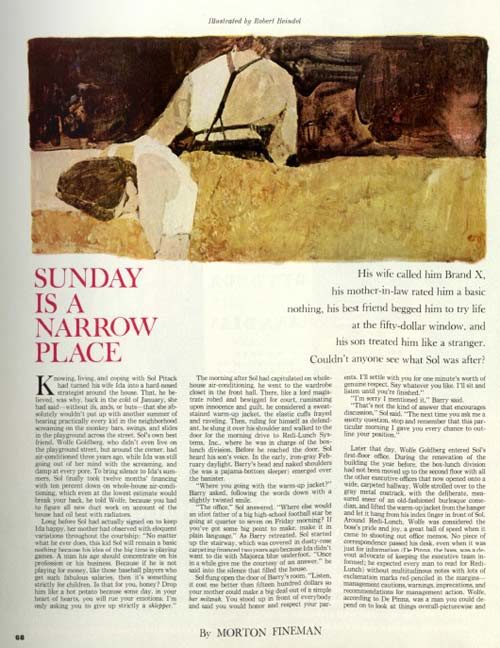
Your Weekly Checkup: Artificially Sweetened Beverages and the Risks of Stroke and Dementia
“Your Weekly Checkup” is our online column by Dr. Douglas Zipes, an internationally acclaimed cardiologist, professor, author, inventor, and authority on pacing and electrophysiology. Dr. Zipes is also a contributor to The Saturday Evening Post print magazine. Subscribe to receive thoughtful articles, new fiction, health and wellness advice, and gems from our archive.
Order Dr. Zipes’ new book, Damn the Naysayers: A Doctor’s Memoir.
Being 10 pounds overweight and a coffee drinker, I try to avoid additional calories by using artificial sweeteners instead of sugar in my coffee. A recent publication has made me question the soundness of that choice.
In the journal Stroke, investigators of the Framingham Heart Study Offspring cohort studied 2,888 participants for new onset stroke and 1,484 participants for new onset dementia. They found that higher consumption of artificially sweetened soft drinks was associated with an almost three-fold increased ten-year risk of stroke, particularly ischemic stroke, and Alzheimer’s dementia. Consumption of sugary beverages or sugar-sweetened soft drinks were not associated with the risks of stroke or dementia. However, before concluding that sugary drinks are okay, consider the Nurses’ Health Study and Health Professionals Follow-Up Study. They reported that greater consumption of sugar- and artificially sweetened soft drinks was each independently associated with a higher risk of stroke. Also, too much sugar can be associated with diabetes, obesity, and metabolic dysfunction.
You should accept conclusions from these reports with some caution because they are observational studies, which prevents drawing definitive causal links between sugary and artificially sweetened beverage consumption and the risks of stroke and dementia. Also, in the first study, participants with diabetes—who would be more likely to develop stroke and dementia—consumed more artificially sweetened beverages, which could impact the conclusions.
Nevertheless, it would be wise to cut back on sugary and artificially sweetened beverages. While the non-caloric artificial sweeteners are so sweet they can be used in small amounts with little added caloric value and are thought to be excreted unchanged and therefore metabolically inert, there is increasing controversy whether that is true and whether they can alter the microflora in the GI tract and thus promote metabolic derangements in some people. Artificial sweeteners might even affect wildlife since they can pass non-degraded through wastewater treatment systems and are subsequently discharged to groundwater and surface waters.
There is a lot we can learn from nature. Consider the quote by Joan Dye Gussow, who wrote, “As for butter versus margarine, I trust cows more than chemists.” Whole, natural foods like chicken and fish, fresh salads, and nuts with a dash of red wine are to be preferred over processed foods that have been altered by food industry chemists. That includes artificially sweetened soft drinks and foods.
Putting the Mouth Back in the Body
In the 17th century, a barber surgeon ministered to the dental needs of the Plymouth Colony. In the 18th century, goldsmith and ivory turner Paul Revere, a hero of the American Revolution, constructed false teeth in Boston. Tooth decay and toothaches were seen as inevitable parts of life, and care of the teeth was widely considered a mechanical concern.
By the turn of the 19th century, science and specialization were transforming many aspects of Western medicine. A growing emphasis upon clinical observation and an increasing array of instruments — stethoscopes, bronchoscopes, laryngoscopes, endoscopes — brought a sharper and narrower focus to the study of disease. Physicians and surgeons, increasingly working together, developed new approaches to treating specific ailments of the heart, the lungs, the larynx, the stomach, the bowel.
They left teeth to the tradesmen.
But Chapin Harris, who began his career as an itinerant dental practitioner, led the effort to elevate his trade to a profession. Within the span of a year, between 1839 and 1840, Harris worked with a small group of others, including Horace Hayden, a Baltimore colleague, to establish
dentistry’s first scientific journal, a national dental organization, and the world’s first college of dentistry.
Dental students learned the mechanics of drilling and filling teeth and constructing dentures. They learned to perform extractions. Then they went out to practice in the villages, towns, and cities of a growing nation.
In 1880, Ohio dentist Willoughby D. Miller traveled to Germany to work in the laboratory of physician and scientist Robert Koch. Koch had traced the cause of anthrax to a specific bacterium. In two more years, he would present his discovery of the microbe responsible for tuberculosis, a killer of millions. Koch helped transform the study of disease.
Willoughby Miller studied oral bacteria on a microscopic level and began to see the mouth as the vector for all manner of human suffering. Bacteria invaded the bodies of people and animals by way of their mouths, causing deadly epidemics such as cholera and anthrax. But the mouth was not just a passive portal for illness. Miller saw it as an active reservoir for disease, a dark, wet incubator where virulent pathogens were able to multiply.
Leading American and British physicians concurred: The human mouth was a veritable cesspool. Aching teeth and inflamed tonsils were teeming with newly discovered germs. Physicians ordered dental extractions, tonsillectomies, and the removal of other suspect organs for the treatment of disorders ranging from hiccups to madness — for arthritis, angina, cancer, endocarditis, pancreatitis, melancholia, phobias, insomnia, hypertension, Hodgkin’s disease, polio, ulcers, dementia, and flu.
Vaccines were sometimes concocted and administered in concert with dental extractions in the belief that they would counter the effect of the germs that were released from the roots of the teeth. The English writer Virginia Woolf was preparing for such an ordeal in May 1922 when she wrote to her friend Janet Case. “The dr. now thinks that my influenza germs may have collected at the roots of 3 teeth. So I’m having them out, and preparing for the escape of microbes by having 65 million dead ones injected into my arm daily. It sounds to me to be too vague to be very hopeful — but one must, I suppose, do what they say,” she wrote.
In the United States, the physician Charles Mayo, of the Mayo Foundation in Rochester, Minnesota, acknowledged that some of his patients had complained about being left toothless. But he was convinced that the oral cavity was the seat of most illness. “In children the tonsils and mouth probably carry 80 percent of the infective diseases that cause so much trouble in later life,” he noted.
“Total clearance,” the removal of all the teeth, remained widely recommended.
In the face of the mass extractions, dentist and dental x‑ray innovator C. Edmund Kells stood up for tooth preservation. In an address in 1920 before a national dental meeting held in his hometown, New Orleans, Kells denounced the sacrifice of teeth “on the altar of ignorance.” He demonstrated the usefulness of his x-ray machine in examining teeth and the power it gave dentists to offer second opinions and to resist the orders of physicians to extract teeth needlessly. Kells urged “exodontists” to “refuse to operate upon physicians’ instructions.” And he contended “that the time has come when each medical college should have a regular graduate dentist upon its staff to teach its medical students what they should know about the oral cavity.”
But it could be difficult for dentists to defy physicians. The two professions not only distrusted each other — they inhabited separate worlds. The tensions and lack of communication hurt patients, concluded the respected biological chemist William J. Gies in his major 1926 report on dental education in the United States and Canada for the Carnegie Foundation. Gies was troubled by the entrenched disdain for dentistry he found among medical professionals. “Even research in dental fields is regarded, in important schools of medicine, as something inferior,” wrote Gies, who himself had been deeply immersed in the study of oral disease at Columbia University.
Gies firmly believed that dentistry should be considered an essential part of the healthcare system. He called for the reform of dental education, for closer ties between dental and medical schools and between the two professions.
“Dentists and physicians should be able to cooperate intimately and effectively — they should stand on a plane of intellectual equality,” Gies noted in a speech to the American Dental Association. “Dentistry can no longer be accepted as mere tooth technology.”
The mass extractions and surgeries continued through the 1930s. As microbiology advanced, however, the research underlying them was held up for closer scrutiny. Untold millions of teeth had been extracted, and the diseases the extractions were intended to cure persisted.
The growing availability of antibiotics in the 1940s offered new tools for fighting infections. But Gies’ calls for closer ties between dental schools and medical schools met with resistance. Many dentists rejected the idea. In 1945, an effort to integrate the faculties of the dental and medical schools at Gies’ own institution, Columbia University, was strongly opposed by the dental faculty. The dentists’ act of defiance was applauded by the editors of the Journal of the American Dental Association. “The views of the majority of dentists in the country cannot be misunderstood on the question of autonomy. The profession has fought for, secured, and maintained its autonomy in education and practice for too many decades to submit now to arbitrary domination and imperialism by any group,” they wrote.
Today, nearly all American dental and medical schools remain separate.
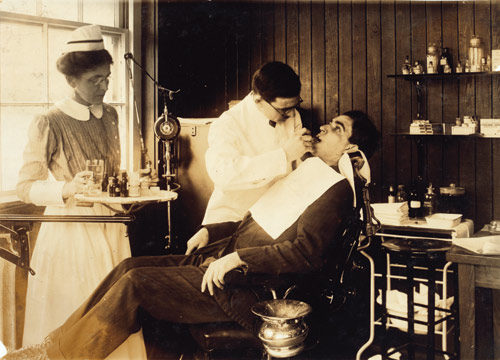
In addition, cooperation has also been complicated by another disjoint between the two professions: the fact that dentistry has historically lacked a commonly accepted system of diagnostic terms. Treatment codes have long been used in dentistry for billing purposes and for keeping patient records, but the long absence of a standardized diagnostic coding system for dental conditions has inhibited the understanding of the workings of oral disease, some researchers have said.
A uniform, commonly accepted diagnostic coding system would represent a major shift of emphasis in dentistry, “a move from treatment-centric to diagnostic-centric” care, said UCSF dentist Elsbeth Kalenderian, who spearheaded a dental coding initiative as a professor at Harvard. Efforts are now underway to put such a system into place. The integration of medical and dental records will become increasingly important as researchers such as Robert Genco, from the University of Buffalo, continue with their work. Over the past three decades, Genco has focused upon periodontal disease and its relationships with wider health conditions.
Years of study have led Genco and his team to a sense that obesity, periodontal disease, and diabetes are all “syndemically” bound by inflammation. Other researchers are more conservative in their assessments. The diseases are deeply complex. But the clues of biology will eventually bring oral health into the larger understanding of health, and dental care into the wider healthcare system, Genco has predicted. The gap between oral healthcare providers and medical care providers will need to be bridged, he said in an interview. “We all have the same common basic sciences. We all train in a similar fashion. But still the professions are separate. We dentists don’t look too much at the rest of the body, and the physicians don’t look at the mouth.”
Science has become a leading force in integration, Genco explained. “It’s getting us to look together at the patient as a whole. It’s a two-way street. Physicians and dentists really have to integrate in their management of the patient. So it is bringing the professions together. Putting the mouth into the body.”
This article appears in the March/April 2018 issue of The Saturday Evening Post. Subscribe to the magazine for more art, inspiring stories, fiction, humor, and features from our archives.

Copyright © 2017 by Mary Otto. This excerpt originally appeared in Teeth: The Story of Beauty, Inequality, and the Struggle for Oral Health in America, published by The New Press Reprinted here with permission.
Heroes of Vietnam: Three Who Came Home
 This article and other features about America in Vietnam can be found in the Post’s Special Collector’s Edition, The Heroes of Vietnam. This edition can be ordered here.
—Originally published February 8, 1969—
One way or another they all come home. After a year if they are lucky; sooner if they are not. They come by troop plane, jubilant, crying, exhausted, unable to believe it is over and they are safe. Or by hospital plane, with the litters stacked three high on either side and the nurses moving softly through the pain. Or by cargo plane, in a closed aluminum box. Nearly half a million men came home from Vietnam last year. Thirty thousand of these came back wounded; thirteen thousand came back dead. This is the story of three. It is also a story of the nation that sent them.
Editor’s note: “Three Who Came Home” is a true story. However, the names of Jerry Spitzer and some other persons in this vignette are not real, and some biographical and geographical details have been changed. Nothing has been changed concerning the people or places in the other two parts of the story.
Part One: Jerry Spitzer
There here were eight NO SMOKING signs on the walls. Then there was a sign that said: “GOOD LUCK. Gentlemen, you can be proud of your honest and faithful service to your country. Rest assured that your service has been recognized and is appreciated by your fellow Americans … Good-bye, and good luck.”
Jerry Spitzer finished filling out his forms: DD Form 214, DD Form 1407, DD Form 1580, DA Form 2376 …
“… Now if you will move through the doorway to your left and across the hall, and form a single line at the pay window …”
The hallway smelled of mothballs. Jerry Spitzer, of Marion, New Castle, Shelbyville, Seymour, and Richmond, Indiana, was home from Vietnam and almost out of the Army. He stood in line and after a few minutes he could not smell the mothballs.
Jerry Spitzer was lucky. He had come back standing up.
In Vietnam, his job had been to ride in boats that went down narrow rivers. When the boat stopped, he would jump off and run into the jungle, looking for Viet Cong to kill. For three months he did not find any.
Still, he did not like his job; it scared him. He mentioned this to his company commander and he was transferred to a barge. The barge carried mortars. It was pushed down the rivers by a boat and left to spend the day. The men on the barge would fire the mortars into the jungle. At the end of the day, the boat would return and tow the barge back to camp. This was better than running into the jungle, but still it was not so good. For instance, when the Viet Cong attacked, there was no place to hide, and some of the men jumped into the river. Jerry Spitzer could not remember anyone who had jumped into the river and not drowned.
He spent seven months on the barge. He became a corporal. He wrote letters home: “I don’t know, Ma, me and President Johnson, we just don’t think alike, I guess.”
Comedian Mort Sahl was not going to be at the hungry i that night, as had been announced, but Jerry Spitzer did not care. He had never heard of Mort Sahl. He had never heard of the hungry i either, but when he had gotten into the cab, late that cloudy afternoon, after finally having escaped from the out-processing center at Oakland, Jerry Spitzer had asked the driver for a good place to kill five hours waiting for a plane. The driver, who was without imagination, took him to the hungry i.
And there Jerry Spitzer was sitting, as summer twilight came to San Francisco, at an empty bar in a dim, red room, with album covers on the walls and a girl who drew caricatures ($3 black and white; $6 color) sitting at a table in the back, filing her nails.
“Almost didn’t come home,” Jerry Spitzer was saying.
“Why not?”
“Almost got married.” He grinned beneath an unsuccessful moustache. “To a Vietnamese girl.” He reached for his wallet. The picture, of the two of them, had been taken from a distance and was not very clear.
“What’s her name?”
“Nga.”
He was going to marry her. “The only foreign girl I never touched.” But when he asked the Army if he could stay in Vietnam long enough to do it, they told him it was too late. He would have to go home as scheduled. “When did you ask them?”
“The day before I was supposed to come home.”
So Jerry Spitzer, 20 years old, thin, with a face that still had pimples on the chin, spent his final hours in Vietnam searching for a Vietnamese-English dictionary that would enable him to write to Nga and explain why they could not get married. He did not find one.
“Say, what’s that lady doin’? Is she drawin’ one a them characters?”
She was; for a banker in a gray suit and his date. The banker was in his late 40s. The date was younger, tall, and had good legs.
“I’d kind a like one. You know, kind a somethin’ to bring home.”
The woman was finished with the banker and his date. She showed them what she had done. They laughed, the banker paid her, and they went back to the bar. Jerry Spitzer lit a cigarette, coughed deep and hard, the way he had been coughing all afternoon, straightened the jacket of his uniform, and walked to the back of the room.
“Ma’am, I’d like you to draw me one a those.”
She motioned him into the chair.
“Have you just come back from Vietnam?”
“Last night. And I got out this afternoon. I’m not in the Army no more.”
“I see.”
She worked quickly, with big sweeping strokes of a charcoal pencil. She drew a profile, making his nose enormous. Then she drew lines to indicate that his head was spinning to the right, and in the right corner she drew a cartoon blonde. At the top she wrote a caption: “I knew there was something to come home for.”
She tore it off the pad and gave it to him. He handed her three dollars and stared at the picture. The way she had drawn his uniform and the way she had his head spinning made him look like a waiter slipping on a grease spot in a cheap restaurant.
“What’s your position on the war?”
“Pardon, ma’am?”
“Do you think we have any right to be there?”
“I don’t know, ma’am.”
“Oh, don’t tell me you don’t know. You’ve just been there. You must feel something about it. “
“I don’t know, ma’am, but all I know is I don’t see no point in gettin’ killed over a bunch a gooks.”
“Yet you went there and fought. You killed Vietnamese people who —”
“Wait a minute.” The banker in the gray suit was up from the bar.
He looked at the picture she had drawn. “This man didn’t start the war. He was sent there by his country, and he went and he did what he was told to do. And now he’s come home. Do you know what that means?”
“No.”
“Well, I want you to think about what it means. And then I want you to draw a new picture of this man, getting in there what he is and what he’s done and what it means that he’s come home. Go on. I’ll pay you for it. But draw something decent this time.”
She looked across the table at Jerry Spitzer.
“Would you mind posing a few more minutes?”
“No, ma’am.”
“All right.” She bent to her pencils and chalks. She made a stroke on the paper. She made another one in a different place. Then she reached up and tore the page off the pad and crumpled it on the floor.
She stared at the fresh paper a long time. Then she made a slow, tentative stroke.
It took 20 minutes to do the drawing. It was a three-quarters head and shoulders, with deep shadows in the face and strong lines and a power and sadness in the eyes. It was the finest Jerry Spitzer would ever look in his life.
“Just one more minute,” she said.
Jerry Spitzer nodded. He had been sitting perfectly still through it all, not even smoking, for the first time all day.
Karen LeVine began to write across the bottom of the picture: “Fortunate indeed is the hero home from this war — alive.” Then she took the picture from the pad very gently.
He stared at it and his head began to move up and down and he did not say anything.
“Beautiful,” the banker’s date said.
“That’s it,” the banker said. “That’s just what I meant.”
“Thank you, ma’am,” Spitzer said, “it’s a nice drawin’.”
The banker took a $10 bill from his wallet and put it on the table. “Thanks again.” He took the picture and handed it to Jerry Spitzer. “Here. Take this one home to your mother. This is one you can hang on your wall.”
How he met Artie and Danny and Carol was unclear. But there he was, talking to them, at a table in the back of the hungry i, and the three of them, Artie with gray hair and sideburns; Danny, with the big black moustache; and Carol, who was Artie’s girl, listening to Jerry Spitzer talk on and on about Indiana.
And Artie, who was getting a doctorate at Berkeley, and Danny, who was getting a doctorate at Columbia and was on vacation, and Carol, who taught school in New Haven, Connecticut, all fell in love with Jerry Spitzer.
“Listen,” Artie said, two hours later. “Stay here tonight. We can go over to Berkeley and go out for a while over there and then you can sleep at my place.”
Jerry Spitzer had a midnight plane. But the beer was working in him now and he thought about what there was at home: Betty, the girl he had tried to break up with by mail; the plant, where maybe he could get a job; the long, flat, thin roads of mid-America; the little jukebox bars and the hot summers and the winters when nothing moved, and the men who wore T-shirts in the factories, and his mother whose heart was weak — and he thought briefly about where he had been three days before. He looked across the table at crazy Artie with the sideburns and how come his hair was getting gray already, and Danny with that goddamn moustache, and Carol whom he couldn’t figure out because she didn’t look like a hippie but if he ever caught Betty in one of those skirts he’d kill her.
“Okay.”
So Jerry Spitzer, still in his new green uniform, with his caricatures under his arm, climbed into the back of Artie’s MG, with Danny huddled next to him, and Carol in the front, and Artie drove up the high hills and down them.
At intersections, when Artie would have to slow down, people would turn and stare. Jerry was standing straight up, saluting. Danny was playing a kazoo that had come from the pocket of his peacoat. It was Jerry’s motorcade and he was proud. Welcome home, Jerry, welcome home. Jerry waved to the people. Danny blew hard on the kazoo. Up the hills and down them. Home from Vietnam. Home to his grateful nation. Artie drove across the cold bridge into Berkeley.
Artie lived on the side of a hill near the football stadium. There were long flights of steps outdoors and then more inside to the third floor where Artie had a room. Artie opened a drawer in his desk and took out a pouch and began to roll cigarettes in brown paper.
“This is good stuff, Jerry, better than what you got over there.”
“I hope so, because over there that stuff didn’t do nothin’ for me.”
Then Artie took out a jug of red California wine. Sweet smoke filled the room. And music. Jerry Spitzer took off his new green uniform and folded it neatly over the edge of a chair. He put on khaki pants and a sweatshirt. He sat on the edge of a bed. The music was loud. Artie rolled more cigarettes. The jug was passed. Danny was in a corner, playing bongo drums.
Carol was staring out a window. She had stopped talking too. The lights of San Francisco were out there.
Artie sat backward in a chair, staring at the floor. The music got louder. Jerry Spitzer sucked the smoke deep into his lungs. Three days before, he had been in the jungle. He was smiling. He drank wine from the half-empty jug and smoked until the cigarette burned his lips.
“All right. This is all right.”
It went on for an hour. The music. Loud. Loud. Artie rolled another cigarette and passed it. Jerry Spitzer, who had gone in boats down narrow rivers, weaved back and forth.
“Are you high?” Carol asked him.
Her voice was very far away. Very small and soft. Jerry Spitzer looked at her. He giggled. He should have. It was a wonderfully funny remark. Like hello, or good morning. Wonderfully funny. The room was filled with giggles. And music. Carol stood up and took Artie by the hand and they left. Danny went, too. Jerry Spitzer fell back on the bed, his eyes closed, his hands moving with the music that he would never hear again. And after a while his hands stopped moving, and he slept.
Richmond, Indiana, was a sooty lump in the flat green land. Jerry Spitzer did not like it. He said it was too big. Population 47,500.
“What I want,” Jerry Spitzer was saying, “is a place way out on a farm somewhere where if I want to chop down a tree I can chop down a tree, and if my kids want a horse they can have a horse, and nobody bothers you about nothing.”
The plane landed at 4:30 in the afternoon. Indiana summer. Dark heavy clouds blowing across the sky. Lots of sweat. The air feeling thick like the air in a laundry.
There were people waiting for the plane, but none was looking for Jerry Spitzer. He had been expected at nine o’clock in the morning. Jerry Spitzer got in a cab and gave his address. The driver started into town.
“First thing I gotta do is I gotta go over to Anderson and see Betty. I known her since I was 18, but see, when I was over there I wrote her about this Vietnamese girl and I asked her to please send me my rings back but she wouldn’t. So I wrote her again and I said, ‘Look Betty, I ain’t kiddin’. I want them rings back.’ So this time she didn’t write back at all, but her sister does, Sharon, and she writes this real nasty letter and that kinda got me, you know. Somebody buttin’ in like that where they ought to be mindin’ their own affairs. And especially Sharon, boy, she was no one to talk. Hell, she got pregnant and had to get married. So I wrote back to her and said yes, Sharon, you are damn right, it is none of your business, but since you are going to butt in anyway let me just say that at least I didn’t get Betty pregnant.”
“So what happened?”
“Well, that shut Sharon up all right, but I never did get the goddamn rings back.”
The cab drove slowly into Richmond.
“See, my dad was a construction worker and we moved around a lot on account a that and then he was always havin’ problems about money. My brother Joey, he’s 14 now, but he’s had ulcers since he was 9 years old because he always used to hear my ma and my dad fightin’ all the time about money.”
Jerry Spitzer looked out the window of the cab. He was less than a mile from home.
“I guess my ma was finally goin’ to leave my dad except then he died. It was just before I went into the Army. The damn doctor kept sayin’ it was just indigestion and stuff like that and then my dad died and he said, ‘Oh, it must of been his heart.’ That really gets me mad, you know? Those damn doctors.”
There were two white houses next to one another.
“Now slow down, I can’t remember which one it is.”
“You can’t remember where you live, man?”
“Hell, I was only there once. A year ago. My ma just moved there when she started goin’ with this guy, Roger.”
Jerry Spitzer squinted out the window of the cab.
“Wait, I think it’s the first one.”
Jerry Spitzer was home from the war. There was an auto body shop down the street. Behind the house there were railroad tracks and freight trains that moved slowly, steadily past.
The fare was $4.75. Jerry Spitzer gave the driver a five-dollar bill.
Then his mother was out the door. A trim, faded woman of 42. And Joey, and Roger’s little girl, Beth, who was 8.
“Where have you been? Where have you been? I was expecting you at nine o’clock this morning.”
“You ain’t gonna believe this, Ma, but last night we met some hippies. Artie and Danny and what was that girl’s name, Carol. We stayed with them in San Francisco.”
“Oh, San Francisco. When you called I thought you said St. Louis and I told Roger you were in St. Louis and he told me I was crazy that you couldn’t have been in St. Louis because nobody gets out of the Army in St. Louis, and if you were in St. Louis anyway you would of come right on home. I guess he was right, huh?” She laughed.
“They were really cool people, Ma. They believe in make love not war and all that stuff. And in just sayin’ what you feel like sayin’ and doin’ what you want to. I think I might be a hippie. That’s what I might do.”
“Oh, Jerry,” his mother said, and she laughed again, and, with their arms around each other, they walked into the house.
Maybe with most people there is a big fuss when they get home from the war. Maybe they run into the bedroom they knew as a boy and call old friends on the phone and go to parties all week long. Jerry Spitzer turned on the television. The Flintstones. A freight went by and the picture fluttered. He sat, shirtless, in a chair and stared at the screen. He had someone to call. Someone he had met in Vietnam who had married a girl from Muncie. The name was Meyers, or something like that. The guy had said give me a call when you get back and come on over and we’ll go out for a few beers. But Jerry Spitzer had not written down the name and address and now he could not find it in the phone book. “Meyers. I could a sworn he said Meyers.”
Next year, anyway, there would be a big reunion with his buddies from New York. Now New York, that was a place. He would have to go there in 1969 and see his buddies. One lived on Second Avenue, one lived in Brooklyn, and one lived on Long Island.
“If I like it,” he was saying to his mother, “I might even get me a job and live there for a while. Live on the beach in New York.”
His mother nodded. It was almost time for dinner.
“What I thought we might do, Jerry, was, just to keep it simple, was send out to Kentucky Fried Chicken. And then afterward we wouldn’t have any dishes or anything and we could call Roger at the tavern and he could pick us up and we could all go down there for a while.”
Jerry Spitzer did not say anything.
“Jerry? Is that all right?”
“Yeah, sure, Ma. Anything you want to do.”
And so: the homecoming dinner. Kentucky Fried Chicken. The biggest bucket they had. And no dishes afterward. Roger was already at the tavern. The White Horse, in Chester, three miles away. Roger spent a lot of time there, going in after work, after a day at the plant, all hot and sweaty and tired. It was a nice place to go and sit around.
They called and Roger drove down to the house and picked them up. Then they all drove back to the White Horse. Dottie, whose hair was white, brought draft beer to the table. And Cokes for the boy and girl. And a Salty Dog for Roger, who was very friendly. Very glad to see Jerry, very glad that he was home. He gave Jerry a lot of good advice right away. About where to buy a car. About down payments and cosigning. And about the plant. About how the plant was the best place to work because they had the best benefits.
And Jerry said Richmond was too big and he did not want to live there, but maybe he could find a small town and work in a factory there.
“Well, you could do that. Yeah, you could do that,” Roger said.
And then Jerry told him about Artie and Danny and Carol and what nice people they were and how he was thinking maybe of going back out to see them.
And Roger snorted and said, “Jesus Cuh-rist,” and he laughed. Hippies. Ha-ha-ha.
And another lull when Joey talked about this great new movie: The Green Berets.
Then Jerry stood up and said he was going next door to a discount store, just to look around. Joey and Beth went with him.
“Well, it sure is good to have Jerry home,” Roger said.
His mother nodded. “But he sure is edgy.”
“Well, hell, look where he’s been. Look where he’s been. You can’t expect him to come back from someplace like that and be all relaxed right away.”
“I wonder how bad it was.”
“Hell, all you got to do is look at the television to see how bad it was. You know that.”
“Yes, but I wonder how bad it was for him. I could never ask him, of course. That’s just something I could never ask him.”
“Well, all I know is it’s good he didn’t marry that Vietnamese girl like he was going to.”
“Yes, that’s one good thing. But she was probably a very nice girl.”
“Ooh, no doubt, no doubt. But it’s just that she wouldn’t have gotten by out here. You know how people are. There would have been remarks and things. And she wouldn’t have had any friends, and how can she make any if she can’t even speak the language?”
Jerry Spitzer came back and asked for the keys to the car.
Beth, the 8-year-old, came running in. “You should see what Jerry got. He got a whole set of weights.”
Joey came in and sat down. “Yeah, he told me I’d be goin’ in the Army in a few years so I’d better start buildin’ myself up right now. He said I was too skinny for Vietnam.”
It was dark when they left the White Horse. The night was warm. There were mosquitoes behind the house. Jerry Spitzer carried the box of weights inside and down to the cellar. He sat on the floor and opened the box of weights and began to put the set together and explained to his brother Joey how the thing to do was to start out with only a little and then gradually use more and more.
And his mother and Roger stood around and said yes, that was right, that was sure the way to do it.
Part Two: Mark Guzevich
The trip home, for Mark Guzevich, started in green and brown rice-paddy slop. He was lying on his back in this slop, looking up at the sky, and it was funny how the sky had been so clear and blue all day and now it suddenly was fuzzy and gray. And there was a rushing, ringing noise in his head, and behind it he could hear the sound of a gun being fired. That was funny, too. There was one gun, he knew, being fired from right next to his ear. Yet it sounded so far away. Behind all the rushing and ringing. Every once in a while, he would put his hand up to his head. His head felt wet and messy.
Mark Guzevich figured he was dying. It was simple. He had been shot in the head, and people who were shot in the head died. He knew that. The only thing he could think of to do was pray, so, to pass the time, he prayed.
There were two other Marines also lying in the slop. That left only three from the six-man patrol to fire back into the woods where the shots were coming from.
Finally, a platoon of Marines came across the rice paddy and the firing stopped coming from the woods, and then they called for a helicopter to take Mark Guzevich and the other two men away.
In Đa Năng, they operated immediately. Later, a military neurosurgeon would explain it: “The bullet, as it passed through the scalp, depressed a portion of the skull, causing laceration to brain tissue underneath. The surgeons cut through the skull to remove any bone fragments and whatever bullet fragments may have penetrated the brain, and also to cut away that portion of brain tissue that was destroyed. This would be a part of the brain called the frontal lobe. They removed a portion of the frontal lobe.”
But when Mark Guzevich woke up he could think, he could talk, and he could move all the parts of his body. He was very lucky, the doctors at Đa Năng said. A very lucky young man, to lose a piece of his brain like that and still be able to wiggle his toes.
It was raining in Washington. A dirty, late-afternoon, big-city September rain that did not stop. The big plane without windows landed at Andrews Air Force Base at 3:30. A covered ramp was wheeled to the rear of the plane, and a blue bus with racks for stretchers was backed up to the ramp, and men began to go on the plane and carry stretchers off and put them on the racks on the bus.
Mark Guzevich, who was 19 years old, had left Yokohama, Japan, 18 hours earlier. Now he was carried to the blue bus and put on one of the racks. The bus moved slowly through the rain. Mark Guzevich was smiling. “Where exactly is this?” he wanted to know.
The way they did it in other wars was different. Then they would send the badly wounded to a hospital behind the front, and the man would stay there for months.
In this war, it is different. Vietnam: The Jet-Set War. Whoosh, they fly you into battle. Whoosh, they fly you out.
For a while they did it right away — 24 hours from battlefield to backyard. But too many died on the way. So hospitals were built in the Philippines and in Japan and now you go there first. Until your condition has “stabilized.” This means until they are sure you will not die on the airplane. The condition of Mark Guzevich had “stabilized” 17 days after he was shot.
The bus at Andrews Air Force Base took him to a place that is called The Ponderosa. It used to be the base hospital, built in 1941 and looking it. Now it is used only as a resting place for the men who come back from the war. The average stay, according to the Air Force, which is very good at computing such figures, is 16 ½ hours. There are five wards, 130 beds, in The Ponderosa. Mark Guzevich got one with a card at the end that said GULCEVICK.
The doctor came around. “How are you feeling?”
“Fine. Fine. I feel good.”
“How about your right ear?”
“I still can’t hear in it.”
“All right … You’re still receiving medication for the dizziness?”
“Yes.”
The doctor had taken the bandage off Mark Guzevich’s head. “How long have you had those sutures in?”
“A couple of weeks, I guess. Since the operation.”
“All right. I’d like to leave that bandage off tonight, let some air get at the incision. You don’t mind, do you? The bandage is really just for appearance’s sake. We’ll put a new one on in the morning before you leave.”
The doctor moved on. “He’s a very lucky young man,” the doctor said.
Then there were the Red Cross ladies. No parades for the wounded. No kisses or confetti. But Red Cross ladies with wire baskets.
“Would you like some toothpaste?”
“I have some, thank you.”
“How about some cigarettes?”
“I don’t smoke.”
“Well, here, at least have a bottle of soda … and how about some aftershave? It’ll make you smell pretty in the morning. And let’s see, how about a comb?”
Mark Guzevich looked at the Red Cross lady.
She looked back at him.
“Oh, no, I don’t suppose you need a comb,” she said.
It was dark outside now. Mark Guzevich had eaten dinner and made his free three-minute phone call home. His family, crying and excited, had talked more than he had. They had known he was coming back — he had told them in a letter from Japan — but they had not known when and they had not known how he would be. All they had heard was “head injury, critical condition,” and they had been afraid.
“My dad was telling me, I guess they’re really making me out to be some kind of a big hero at home. It was in the paper about me being hit again and they said this time it was in the head and it was critical and down at the courthouse in Elizabeth — my dad’s a court attendant — I guess all the judges and lawyers and people like that found out and there’s really been a big fuss. Boy, I’d like to be there tomorrow when he starts telling people I’m home.”
Mark Guzevich had been shot in the hand in June. The bullet had torn some tendons. He was sent to Guam to do exercises with his hand. He had been back in action just two weeks when the bullet hit him in the head. He was a private 1st class in the Marines. A year out of high school in Kenilworth, New Jersey. He had been a fullback. Guzevich: Number 44.
Now the bandage was off his head so the air could get at the incision, and there was part of his brain missing and he could not hear in his right ear and they told him no drinking for a year because there was danger of seizure, and he still had nine more months to serve in Vietnam.
“How can they send you back? You’ve been shot twice. Shot in the head.”
“That doesn’t matter to the Marines. All the Marines do is co
unt. The Vietnam tour is 13 months. I’ve served four. I’ve got nine to go.”
“Yeah, but with an injury like this …”
“I don’t know. Maybe you’re right. Maybe they won’t send me back.”
“Do you want to go back?”
“Are you kidding? Want to go back? I never want to see that place again or hear about it as long as I live.”
They put him on a plane to Floyd Bennett Field in Brooklyn, and the plane landed in the sun, and there was a good saltwater breeze. They put him on a blue hospital bus; on a rack, in the back.
“I joined the Marines — well, I’ll tell you — I guess just because I was 18 years old and all gung-ho. I thought the Marines were the best. It’s no secret that their training is tougher than anybody else’s, and I figured it would be good; you know, make a man out of me.” He put his fingers to his head and laughed. “Maybe they did,” he said.
“I’m the only guy from my class who’s been to Vietnam. I think I must appreciate things a little more now because of it. Over there, for instance, getting cleaned up once a week really made you feel good. Or if you could stay dry for a whole day, that was a big thing. That was wonderful. Or just staying alive for one more day. You were thankful at the end of every day. I mean you really thought about it. And look, in high school who thinks about staying alive? You take it for granted. Everybody stays alive except old people and you don’t hardly know any of them. Then you get over to Nam and — well, like I said — I’m 19 years old and maybe that’s not old but I feel old. I saw a lot of war. And I saw a lot of guys, I mean, hell, hundreds of guys get messed up.”
A man in a white suit came back to ask him how he was feeling. He told the man he was feeling fine. The bus ride was much bouncier than the plane had been. The rack he was lying on kept jerking up and down.
“That first time I got shot,” he was saying, “we were out on patrol and I was second, right behind the point man. We got ambushed and right away the point man got killed. Then, in the afternoon, after we laid low for a while, we had to come down the side of the hill and cut our own path through the vines and all that, and let me tell you it wasn’t easy. It took us six hours to get back to camp, and we had to carry the point man’s body all the way.
“I might as well tell you, I guess. I’m more of a hawk than a dove,” Mark Guzevich said. “I mean I got no love for the gooks or any of that stuff, but we have a commitment and we can’t just come crawling home with our tail between our legs. At least that’s the way I feel. I think we have to stay until we get a just and honorable peace.”
“What does that mean?”
“I think it means until we make sure that they’ve got a government that’s strong enough to stand up. It doesn’t have to be just like ours, but it ought to be some kind of a democracy.”
“Do you think that will ever happen?”
“I don’t know. I think they’re getting better. Look, what I’m telling you is just my opinion. If these hippies and people like that feel different — well, that’s fine. I can understand that. And if they want to demonstrate, that’s fine, too. As long as they don’t come around and say, ‘Ha-ha, we’re glad you got shot because you didn’t belong there anyway.’ I wouldn’t like that too much.”
He was quiet for a while, thinking. And looking up at the roof of the bus. The hospital was not far away.
“I know it’s not the same as when my father fought. He was in the Marines in World War II and that was to save our country, and I couldn’t say that this is the same kind of thing.”
“Does that make it harder to risk your life?”
“I guess it would if you thought about it. Sure, I guess it would. But you don’t have time to think over there; you just try to get through day to day.
“Now — now I will have time to think. And like I say, I don’t want to go back.”
At St. Albans Naval Hospital there was a sign: “Appropriate attire for female visitors does not include micro-mini skirts, short shorts or bare mid-riffs.”
There are 1,400 patients at St. Albans, including 450 to 500 Marines, most of them wounded in Vietnam. Mark Guzevich was put in Ward C-3, neurosurgical, where men hurt worse than he was, men who had lost more than a portion of a frontal lobe, were lying in beds, staring and moaning and babbling. Others were reading movie magazines or comic books.
“This is a very lucky young man,” said the doctor in charge. “Now I wouldn’t say there’s absolutely no damage. I wouldn’t say quite that. But there does not appear to be any damage that will affect him. Let’s put it this way. If Ted Williams were to lose a portion of a frontal lobe, he’d still be Ted Williams and he could walk and talk and still probably play baseball, but maybe he would not be able to hit quite the same way. Maybe on that level there would be just that shade of difference. But when you’re talking about that boy in there, it’s different. Again, I would not say there is no damage, I would not say that at all. But once his hair grows back nobody will be able to tell him from you or from me.”
Mark Guzevich was looking out the window. Đa Năng was the other side of the world, another world.
“My parents are really happy,” Mark Guzevich was saying. “They’re coming over tomorrow. They don’t believe I’m really okay. I had to keep telling them. They were worried about brain damage and all. Boy, this sure is decent. You know, bringing you back to a hospital so close to home.”
In the bed across from him, two attendants were trying to feed a peanut butter and jelly sandwich to a man who weighed less than 100 pounds. The man could not talk or sit up. He lay for hours at a time on his side with his eyes open until someone came to change his linen.
“Come on, just try to take a small bite.”
The man made a noise. His skin was saggy, like an elephant’s, and the bones showed through.
“Come on, try to sit up by yourself.”
“He’s much better now than he was when he came in,” a Marine sergeant said.
And Mark Guzevich picked up the copy of Time magazine he had been given and started to read about Denny McLain, the baseball player on the cover. Once his hair grows back, nobody will be able to tell him from you or from me.
Part Three: James Waller
The bodies come to Saigon in rubber bags. Men in green smocks are waiting in the room, which has pale green walls. When the bodies come, the men open the bags and slide the bodies onto steel platforms that rise to waist level from the floor. Then the men try to find out who the bodies used to be.
Sometimes it is hard to tell about the bodies right away. Sometimes the men cannot tell for hours, even days. When this happens, or simply when the embalming room is full, the bodies are put in a refrigerator. There are actually three refrigerators, walk-ins with heavy doors and handles that click, like those in the back of a butcher shop.
The bodies lie here on racks until someone finds out who they were or until there is a table open in the room where they will be embalmed.
The smell is always here because there are so many bodies, whether the big doors are open or closed, but the men who work with it are used to it and do not mind. Occasionally a new man comes in who cannot take it. He is transferred quickly, without disgrace. The major understands.
Basic embalming: “The fine points of cosmetology we leave to the mortician back home,” the major says. “But we send, oh, I’d say 70 to 75 percent home viewable, and we think that’s something to be proud of.”
When the embalming is done, the bodies lie and wait through the night. Eight hours, at least, for tissue to be preserved. Then it is morning and time for packing to begin.
The first body is carried into the packing room and set down next to a table. There is a thin plastic bag waiting there. A man in a sleeveless green smock, sweat already rolling down the sides of his chest, turns down the front of the bag: a ship steward turning down the bed. Strips of cotton are laid inside the bag. Then a powder which hardens at the touch of moisture. Just in case there is a leak.
Then the first one — cotton over the eyes and crotch — is put inside the plastic bag, and they wheel the table to the vacuumer. The vacuumer reaches into the plastic bag with the hose in his hand and sucks out all the air. His machine whirs and the plastic crinkles as it collapses around the body.
Then masking tape around the top of the bag so no air can creep back in and undo the embalmer’s work during the long flight home.
And the body moves down the line. A sheet is wrapped around the plastic and more men with masking tape move in. They, too, work quickly, wrapping the tape in thick, sticky brown strips around the sheet.
In the front room there is a chart:
AVERAGE PROCESSING TIME PER REMAINS
Receipt and Verification of Identity — 30 min.
Embalming Operations* — 4 hrs. 15 min.
Preservation of Body Tissues — 8 hrs.
Packing — 10 min.
Out Processing — 30 min.
Total — 13 hrs. 25 min.
* Severely mangled, charred or badly decomposed remains can require from 10 minutes to six hours depending on the condition.
On Saturday, August 24, James Waller’s mother got a letter.
Dear Madam: This is in answer to your letter concerning your son James Waller US 52 814 303.
I have spoken with James and he is doing fine. His job assignment, as you know, is as a rifleman in his company. His company commander and first sergeant have both stated that his performance has been outstanding and that he is highly respected and admired by his leaders and the personnel assigned to his company. I want to thank you again for your letter addressed to me concerning your son James, and again state that if you have any additional questions, please feel free to write to me. FOR THE COMMANDER: Robert M. Thomas, Captain.
On Monday, Mrs. Waller received another letter. This one was from James. He said he would be needing his good pair of eyeglasses in four months because he would be getting five days off and going to Honolulu. He also said he was trying to read his Bible like she had told him to, but it kept getting wet. He enclosed a picture of himself and two friends, grinning, dressed in fatigues.
A man in a uniform came to the Wallers’ house that night. He told them James had been killed. He said it had happened in an attack on the base camp in the middle of the night. He said a telegram would follow. And there would be a Capt. Woolley calling soon to help with the funeral arrangements.
The Wallers got a telegram:
THE SECRETARY OF THE ARMY HAS ASKED ME TO EXPRESS HIS DEEP REGRET THAT YOUR SON PRIVATE FIRST CLASS JAMES WALLER DIED IN VIETNAM ON 24 AUGUST 1968 AS A RESULT OF A WOUND RECEIVED WHILE IN BASE CAMP WHEN ENGAGED HOSTILE FORCE IN FIREFIGHT. PLEASE ACCEPT MY DEEPEST SYMPATHY. THIS CONFIRMS PERSONAL NOTIFICATION MADE BY A REPRESENTATIVE OF THE SECRETARY OF THE ARMY.
KENNETH G. WICKHAM
MAJOR GENERAL USA
The newspapers called and put stories on page 3: “N. Phila. Soldier Dies in Vietnam Firefight.” One of them used a picture. Mrs. Waller told the papers that she did not know where in Vietnam her son had been stationed and that, no, he had not commented on the war in his letters. He had always been cheerful and generous, she said, but the papers did not print that.
Then she got a longer telegram:
THIS CONCERNS YOUR SON PFC. JAMES WALLER. THE ARMY WILL RETURN YOUR LOVED ONE TO A PORT IN THE UNITED STATES BY FIRST AVAILABLE MILITARY AIRLIFT. AT THE PORT REMAINS WILL BE PLACED IN A METAL CASKET AND DELIVERED (ACCOMPANIED BY A MILITARY ESCORT) BY MOST EXPEDITIOUS MEANS TO ANY FUNERAL DIRECTOR DESIGNATED BY THE NEXT OF KIN OR TO ANY NATIONAL CEMETERY IN WHICH THERE IS AVAILABLE GRAVE SPACE. YOU WILL BE ADVISED BY THE UNITED STATES PORT CONCERNING THE MOVEMENT AND ARRIVAL TIME AT DESTINATION. FORMS ON WHICH TO CLAIM AUTHORIZED INTERMENT ALLOWANCE WILL ACCOMPANY REMAINS. THIS ALLOWANCE MAY NOT EXCEED $75 IF CONSIGNMENT IS MADE DIRECTLY TO THE SUPERINTENDENT OF A NATIONAL CEMETERY. WHEN CONSIGNMENT IS MADE TO A FUNERAL DIRECTOR PRIOR TO INTERMENT IN A NATIONAL CEMETERY, THE MAXIMUM ALLOWANCE IS $250; IF BURIAL TAKES PLACE IN A CIVILIAN CEMETERY, THE MAXIMUM ALLOWANCE IS $500. REQUEST NEXT OF KIN ADVISE BY COLLECT TELEGRAM ADDRESS: DISPOSITION BRANCH, MEMORIAL DIVISION, DEPARTMENT OF THE ARMY, WUX MB, WASHINGTON, D.C. NAME AND ADDRESS OF FUNERAL DIRECTOR OR NAME OF NATIONAL CEMETERY SELECTED. IF ADDITIONAL INFORMATION CONCERNING RETURN OF REMAINS IS DESIRED, YOU MAY INCLUDE YOUR INQUIRY IN THE REPLY TO THIS MESSAGE. PLEASE DO NOT SET DATE OF FUNERAL UNTIL PORT AUTHORITIES NOTIFY YOU DATE AND SCHEDULED TIME OF ARRIVAL DESTINATION.
The body of James Waller arrived at the Air Force base in Dover, Delaware, on Tuesday, September 3. It went immediately to the base mortuary, where the man in charge noted the recommendation that had been attached to it in Saigon: Non-viewable.
That meant that James Waller would skip a step in the process. He would not have to be cosmeticized. Only the rough work, only the basic essential health procedures are taken in Saigon. The fancy stuff, the detail work, that is all done in Dover.
Then the escort detail was notified and Sgt. Ollie Dyson, of Chicago, was told to report at 9 a.m. Wednesday to accompany the body to the Ray Funeral Home, 1525-27 West Dauphin Street, Philadelphia.
James Waller was removed from the aluminum carrying case and placed in a metal casket, which was sealed. The carrying case was washed and stacked with the others to await return to Saigon.
The Ray Funeral Home in Philadelphia was not expecting James Waller’s body Wednesday morning. Mrs. Deso Ray, the wife of the owner, said no telegram of notification had come. It was 11 o’clock and hot. Ollie Dyson and the hearse driver and a helper of Mr. Ray’s, named William, carried the casket up the steps. Mr. Ray was not there. The casket was placed in a shaded room in the rear of the funeral home; the gray metal was covered by a bright American flag.
When Mr. Ray returned, Ollie Dyson handed him a letter:
To: Receiving Funeral Director:
1. These remains have been shipped to your funeral home consistent with the desires of the family.
2. We are sorry that the circumstances of the deceased’s death precluded restoring the remains to a viewable state.
3. Before shipment, the remains and casket were inspected by Air Force representatives and found to be in satisfactory condition.
4. We would appreciate your cooperation in explaining this matter to the family should they question the reason for a sealed casket.
Sincerely,
DAVID J. AFFHOLDER, Captain
USAF Mortuary Office
Mrs. Waller could not understand about the casket.
“Don’t worry about it,” her husband told her. “It doesn’t make any difference.”
“But how do I know it’s him?”
“It’s him.”
“But why can’t we see him?”
“Don’t worry about it. What you want to see him for anyway? He’s dead.”
“If I could just see him one more time.”
“Stop talking about it.”
There was to be no wake, they decided. The funeral would be Monday night and burial Tuesday morning. They got a letter from Gen. Westmoreland:
Please know that the thoughts of many are with you at this time. The passing of your son, Private First Class James Waller, on 24 August, in Vietnam, is a great loss not only for his fellow soldiers but for his country as well.
I know that words can do little to relieve your grief just now but I hope that you will find comfort in the knowledge that through your son’s sacrifice he will live in the hearts of all who desire peace and freedom.
As our Nation strives … human dignity which we hold dear … most distressing thing … through their devoted service … remain strong and our purpose steadfast. …
At 4:30 Wednesday afternoon, five and a half hours after the body had arrived, the final telegram came:
REMAINS PFC JAMES WALLER ARRIVE PHILA. PA. APPROX 1030 AM 4 SEPT VIA HEARSE RAY FUNERAL HOME NOTIFIED.
Mrs. Waller was sitting at her dining-room table. She was very tired. Her husband was with her. He was a janitor at the Boyles Galvanizing and Plating Company. He wore a medal with a picture of Martin Luther King. James had been their second son. Sidney was one year older. There were also two younger daughters.
“The insurance man was by today, and he said I ought to frame that letter,” Mrs. Waller said to her husband.
He was staring at the floor.
“Did you hear me? The insurance man says we ought to frame this letter from the chief of staff.”
“Yes, I hear you.”
“Well?”
“Well, well — well, what? Fine. Frame it.”
Mrs. Waller put the letter down and picked up the picture that James had sent her from Vietnam.
“Poor James,” she said. “He only just got there in June. He didn’t know what it was all about. I told the papers he didn’t have any comments about the war. Well, he did have one. He wrote and said, ‘Mom, this whole thing is crazy. I don’t understand it.’”
“Who does understand it?” John Waller said.
Mrs. Waller did not answer.
“If they had only given him a chance,” the father said. “They come up on him in the middle of the night and he was probably sleeping and never even saw them. He was out there in the front row for two months and then he goes back for a rest and they sneak up on him in the middle of the night.” John Waller shook his head.
“He could have gone to jail,” Mrs. Waller said. “He could have been one of those boys who goes to jail because they don’t want to be in the war.”
“He’s not that type.”
“No, but if he had done that he’d of been alive.”
“He’s not that type. To go to jail. That wasn’t how James was.”
“No, that’s right. James always did what he was told.”
The father nodded.
“He never went anywhere that he didn’t come back with a piece of paper that said how good he was,” Mrs. Waller said. “He got one, look here, from Dobbins, where he went to high school, and one from the R.W. Brown Boys Club, and here, one from the American Legion.”
“And then they sneak up on him in the middle of the night.”
“James never want to do no killing anyway.”
“No, that’s right. He told the Army he wanted to be a clerk.”
“But they told him he couldn’t because he didn’t have experience.”
“He didn’t have experience killing either.”
“That’s right, he didn’t have no experience with guns.”
“But that didn’t matter, did it?”
“No, they didn’t care about experience with the guns.”
“What I don’t understand,” John Waller said, “is if they could teach him how to kill why couldn’t they teach him how to type?”
They came down the steps with the casket very slowly. There were only three of them to carry it, which made it heavy. It was six o’clock Monday night. The sun was still warm, the air heavy and hot, as the American flag and the box underneath it were put into the back of the Cadillac hearse.
When they got to the Thankful Baptist Church, 10 minutes away, George Ray asked about flowers.
“There’s not very many,” a church custodian said. “I put what there is up front.”
There were two wreaths that said THE FAMILY, one that said THE NEIGHBORS, and one that said THE GANG.
George Ray placed them symmetrically around the casket.
“I’ll be back about a quarter to eight with the family,” he said.
It was cool inside the church. There was green carpeting on the floor and the pews were light brown, well-waxed. James Waller’s casket was in the front, near the altar, where it was very still. The funeral began with an organist playing “America the Beautiful” in a thin and quiet way. Then there were hymns and readings from the Bible and then a kid named Glenn Kennedy, a kid who had been a friend of James Waller, got up to read all the cards and telegrams that had been received.
There were telegrams from the governor and the cardinal and Senator Clark, who was running for re-election, and Representative Schweiker, who was running against him, and from many other people who did not know what it smells like in North Philadelphia along Dauphin Street where James Waller grew up, or what it smells like in the mortuary in Saigon.
Then a man who had taught James Waller plumbing at the Murrell Dobbins school got up and said what a hero the boy had been, dying for his country, and how much more representative he was than these hippies, and wasn’t it a shame that the good ones had to go, and maybe someday soon the country would all pull together and unite behind the war and then the “other forces would see the futility of continuing the struggle.”
Then a kid named Edward Marks, a friend in an Army uniform, who had just come back from Vietnam, stood up. He tried to talk but it was too hard and he sobbed, and Mrs. Waller, in her seat, gave out a little cry and lurched forward and began to cry, and Edward Marks just said, quickly, “He was a wonderful kid,” and hurried away from the altar.
Then later, at the end, after an hour and a half, Mrs. Waller suddenly stood up and stepped out of her pew and walked to the casket and before anybody really noticed her, she screamed and threw herself on the casket and began pulling at the flag.
The screams came from somewhere very deep and they filled the church and this big woman whose son had died had the flag off the casket and was pressing her face into the bare gray metal when they got to her.
She fought them and she kept on screaming, and in the pew the teenage daughter began to cry, “Jesus … Jesus … Oh, Jesus …” and there were four men around James Waller’s mother, and they were holding her with a very tight grip.
When they got her back to the pew, George Ray came over to Ollie Dyson and whispered, and Ollie Dyson walked to the casket and put the flag back on and straightened it.
The next day was quick. There were clouds and one of the first winds of autumn was blowing brown leaves from the trees. Philadelphia National Cemetery was small and neat, with the rows and rows of identical white tombstones sweeping across the grass. There was a four-man firing squad down from Fort Dix, and a six-man honor guard as pallbearers, and a bugler who stood alone under a big oak tree by a fence. There were only four chairs for the family by the grave, and Sidney, the brother, had to stand. He was 21 years old and he was all stooped over like his father.
At the end, everyone walked by and put a flower on the casket. The flag had been taken off and folded in that tense ceremony that the military always has with the flag, and then it had been given to Mr. Waller. The people came by and put their flowers on the gray metal, maybe 50 of them all together, and then Sidney Waller put his flower there, and the two sisters, and Mr. Waller, and finally James Waller’s mother, who did it very quickly and quietly and moved away with her husband’s arm around her.
They walked back to their cars in the driveway in the middle of the cemetery and the sun was out now and it was still summer. A man in a red T-shirt drove a power mower to James Waller’s grave and began to fold the metal chairs.
Another man, in a green shirt and green pants, swept all the flowers off the casket with his arm. Then the two men got down on their knees and they were joined by a third man in green pants and there was another man in a suit who was holding a clipboard, and the three of them began to work while the man with the clipboard stood there, and in the driveway 50 yards away the family of James Waller sat in the car.
The casket had rested on two green planks above the open grave. Now the men pulled the planks away and the casket was on two canvas straps that were wound around a set of silver poles that could be turned when the screws were loosened.
The men loosened the screws and the poles began to turn as the weight of the casket strained against the straps and the casket lurched a bit and one end slid down a foot and then the other end was lowered to make it even.
In the car in the driveway, Mr. and Mrs. John Waller watched the gray metal disappear and Mr. Waller held the American flag in his lap.
Epilogue
Mark Guzevich did not go back to Vietnam. He was kept in St. Albans Naval Hospital until the second week of November and then sent to a Veterans Hospital in New Jersey, which allows him to go home on weekends. “I feel pretty good,” he says, “but the doctors still don’t know about the ear. They say the hearing might come back and it might not.”
He will soon be out of the Marines. A medical discharge. But he has nowhere to go, at least until the spring. “They’ve decided to put a plate in my head, but they’re not going to operate until February or March. For now I guess I’ll just be staying at the hospital. They’re giving me aptitude tests, and when they’re through with those I’ll start thinking about the future. I’d like to go to school, but with this operation coming up I guess there’s really not too much of a rush.”
Five weeks after he came home, Jerry Spitzer and Betty were married. “It was kind of quick,” he said, “but she pretty well nailed me down.” They live in Anderson, about 40 miles from Richmond, and Jerry works in a factory. He often thinks of Vietnam. He has even thought about returning. “I kind of feel sorry for those people over there,” he says. “Of course, I don’t think I actually would go back.”
He has not heard from the men he fought with. No plans have been made for the reunion in New York; it is not likely they will be. His days move quickly, and “except for all these taxes they got out here,” he is content.
—“Vietnam: Three Who Came Home,” February 8, 1969
Healthy Weight, Healthy Mind: Which Exercises Are Best for Reducing Belly Fat?
We are pleased to bring you this regular column by David Creel, PhD, RD, who is a weight management specialist and the author of A Size That Fits: Lose Weight and Keep it off, One Thought at a Time (NorLightsPress, 2017). See all of David Creel’s articles here.
This week’s column is based on a question from a reader. Do you have a weight loss question for Dr. Creel? Email him at [email protected]. He may answer your question in a future column.
Reader Question: which exercises are best for reducing belly fat?
This is a great question! If you want the short answer skip to the last paragraph.
Despite the promises of late-night infomercials, most exercise physiologists will tell you that spot reduction isn’t possible. Studies have shown that doing crunches won’t cause you to preferentially remove the layer of fat covering your six-pack (those crunches will give you a stronger core, which can help prevent or treat low back pain). Despite research showing we cannot target our fat loss, a few other studies give people a glimmer of hope that perhaps we can.
Scientists from Denmark have shown that we increase blood flow to subcutaneous fat (the soft stuff just under the skin) and stimulate lipolysis (fat breakdown) in tissue that is adjacent to a working muscle. But again, most researchers conducting well-controlled studies have concluded that crunches, bicep curls, and leg exercises won’t cause targeted fat loss in those areas.
Just to confuse things a bit, a recent small study compared two 12-week exercise interventions to see if spot reduction was possible when strength training was followed by cardiovascular exercise. Three times per week one group of women performed high-velocity upper body resistance training followed by 30 minutes of cycling. The other group did rapid lower body weight training exercises followed by using an arm ergometer for 30 minutes (sort of like pedaling a stationary bike with their arms). In this study, participants lost more fat in their upper body limbs if they did upper body strength-training exercises. Likewise, those who performed lower body strength exercises lost more fat in their lower body. The investigators found no difference in the amount of belly fat lost between the two groups. In short, this study suggests that we might be able to target fat loss by doing explosive strength training followed by cardiovascular exercise. These are interesting results that certainly need to be confirmed with larger studies.
My opinion: If you want to lose belly fat, focus on changes in diet and engage in regular exercise. Ideally, include cardiovascular exercise and strength training. For the most part, our genetics will determine where we lose weight as we burn more calories than consumed. The muscles we target will become stronger, but don’t expect crunches alone to flatten the belly or triceps exercises to cause the wiggly tissue on the back of the arm to dramatically disappear.
Logophile Language Puzzlers: A Birthday Bash and a Laconic CEO
Is it biannual, biennial, or semiannual? And how does a laconic person respond to a question? Test your language knowledge with the March/April 2018 Logophile quiz.
1. Marvin only celebrates his even-numbered birthdays, but he makes his ______ birthday parties twice as lavish.
- biannual
- biennial
- semiannual
2. When asked if he had misused company funds, the laconic CEO
- quoted seven different definitions of misused.
- told an involved joke about a man trying to sell a used yacht.
- simply said “no.”
3. Otto likes hotshots but not braggarts, intestines but not viscera, and a teammate but not a coworker. What does Otto like?
Answers and Explanations
1. b. biennial
If Marvin celebrates only his even-numbered birthdays, that means he throws a lavish party every two years. Having a hard time deciding whether that makes them biannual or biennial? It’s a common problem — the bi- prefix can indicate both “every two” and “twice.”
The English language has settled on biennial to mean either “every two years” or “lasting for two years.” Biannual has been used to mean both “twice a year” and “every two years” so often that it will always cause confusion, so you should general avoid using it. (And it gets even more confusing in words like biweekly and bimonthly.)
Semi- means “half” (as in semicircle), so a semiannual party would occur every half-year — or twice a year. So it is with semiweekly (twice a week) and semimonthly (twice a month).
2. c. simply said “no.”
Laconic is an adjective that means “using the least number of words, often to the point of seeming rude or mysterious,” so a laconic CEO might simply say “no” to a direct question.
A CEO who quotes seven definitions of misused or who launches into an unrelated joke about a man selling a yacht might be, depending on his motives, disputatious (“provoking or inclined to debate”), dissembling (“hiding one’s true motives or feelings”), bloviating (“speaking verbosely or windily”), or equivocating (“avoiding committing oneself to a specific answer”).
3. Otto likes words in which each letter appears exactly twice.
Other words that fall under this category include arraigning, concisions, and scintillescent (“twinkling faintly”), as well as reduplicative words like beriberi, mahi-mahi, and mama.
News of the Week: Money for Happiness, Booze for Seniors, and Sandwiches for Everyone
Cha-Ching
Someone — it was either Sophie Tucker or Mae West, depending on which dubious internet source you use — once said, “I’ve been rich and I’ve been poor — believe me, rich is better.” I understand that. While I’ve never been what one would consider rich — just ask my creditors — there have been many times in my life where my bank account has been nearly empty, I needed to cut back on everything but the essentials, and there has been nothing in my wallet except my license and a supermarket discount card.
So I would agree that having a lot of money is better than not having a lot of money, and I bet you would too. Now there’s research to back up that common-sense wisdom. Happiness researchers — yes, there are happiness researchers — at Purdue University and the University of Virginia have concluded that people who make $120,000 or $200,00 are likely to be more satisfied with their lives than someone who makes $40,000. But the same researchers discovered that the person making $200,000 is no happier than the one making $120,000. There seems to be a magical annual income, $105,000, and if you make anything over that amount, it doesn’t affect how happy you are. There’s even some data to suggest that if you make a lot more than $105,000, your happiness level actually goes down.
I don’t mean to be difficult about this, but I wonder why it even matters. It’s not particularly surprising that there’s no difference in happiness levels between people who make $120,000 and those who make $200,000. The latter is not a life-altering increase in money if you’re already making $120,000. I think the real takeaway from this story is that it’s great if you make $105,000 a year, and even though it might not make you incredibly happier, you should try to make a lot more.
I’d like to see a comparison between people who make $23,000 a year and Oprah Winfrey.
Over 90? Drink More, Exercise Less
Hey, here’s great news if you were born before 1929: You can drink more alcohol!
Researchers (this is a very researcher-heavy week) have discovered that people over the age of 90 who drink a couple of glasses of beer or wine a day are 18 percent less likely to die a premature death, while those who exercise 15 to 45 minutes a day are 11 percent less likely to die a premature death. The same researchers also discovered that if you’re over 90, it’s better to be a little overweight than to be really skinny. It also helps if you have a hobby and drink a couple cups of coffee a day.
I guess this is an interesting story to people who haven’t reached 90 yet, but not to people who have already reached that age. If you’ve already made it that far, you’re going to do what you damn well please anyway.
Now Standing Is Bad for Us
Here’s more health advice, even if you’re not over 90. For the past few years, we’ve heard that sitting is bad. We’ve been told we have to stand up more, to use those standing desks that are advertised on television, and some experts have even said that “sitting is the new smoking.” Well, here’s some breaking news for you: Experts now say that standing is bad for us. In fact, it’s not only physically bad for us, a strain on your backs and limbs, but it might be bad for our brains too. If sitting is the new smoking, standing is the new junk food.
So if we can’t stand up or sit down for long periods of time, I suggest either lying on your back or kneeling. Basically we’re running out of body positions.
Are You Living in the Best State?
The annual “10 Best States in America” list is out from U.S. News & World Report. They look at a variety of factors to figure out which state you should live in, including education, economy, healthcare, infrastructure, crime, and overall quality of life. Colorado comes in at No. 10, while Minnesota is No. 2. What’s number one? Well, you need to click that link to find out. Hint: Johnny Carson was born there.
Massachusetts comes in at No. 8 this year. Last year it was No. 1. I don’t know what I did to make it drop seven spots, but I’m sorry.
RIP Nanette Fabray and Lewis Gilbert
Nanette Fabray was an acclaimed stage and screen actress who won a Best Actress Tony Award in 1949 for her role in Love Life and three Emmys for her work on the ’50s TV series Caesar’s Hour. She also had roles on One Day at a Time and The Mary Tyler Moore Show, and had her own series, The Nanette Fabray Show. She died last week at the age of 97.
Lewis Gilbert directed three James Bond movies (You Only Live Twice, The Spy Who Loved Me, and Moonraker) as well as Alfie, Sink the Bismarck, and many other films. He died earlier this week, also at the age of 97.
Quote of the Week
“Nice is not a common label for comedians, but it is for Canadians.”
—Martin Short, in this terrific interview at Vulture
The Best and the Worst
Best: This is a fascinating video from The New Yorker about a bomber who terrorized Manhattan in the 1940s and ’50s, a case that led to the creation of criminal profiling. I don’t know why this story is not more well known. It’s the topic of the book Incendiary: The Psychiatrist, The Mad Bomber, and the Invention of Criminal Profiling by Michael Cannell and would make for a great TV series.
Worst: Would you spend $590 for a plastic bag? Probably not, because you don’t have $590 to spend on a plastic bag and even if you did you wouldn’t spend $590 on a plastic bag.
But what if I told you it was a designer plastic bag?
Well, if you’re wondering what to blow your tax return on, get this new plastic bag from Céline. Please note that it’s not encrusted with jewels and it’s not from the estate of a famous celebrity. It’s just a plastic bag. You can put things in it.
I have a bunch of plastic bags here at my apartment. They’re from the Ziploc Collection, and I’ll sell you 25 of them for $400.
This Week in History
Henry Wadsworth Longfellow Born (February 27, 1807)
The poet wrote several poems for the Post, including “The Arrow and the Song,” which includes the lines, “I shot the arrow in the air/It fell to Earth, I knew not where,” which I first heard in a Three Stooges short. Their version ended with “I get my arrows wholesale!”
“The Family Circus” Comic Strip Debuts (February 29, 1960)
The year before Bil Keane’s classic comic made its debut, the Post published several of his “Pun-Abridged Dictionary” cartoons.
This Week in Saturday Evening Post History: Cover Girl (March 1, 1941)

March 3, 1941
This issue, with a clever Norman Rockwell painting, features a cover price of 5 cents. Or to be more precise, “5c. the Copy,” which I’ve always found a really the weird way to put it.
Saturday Is National Cold Cuts Day
I don’t eat sandwiches in the winter. Is that weird? Don’t answer that.
But it’s now March, and that gives me permission to celebrate sandwiches in general and National Cold Cuts Day specifically. And you can too. Here are six different cold cut-centric sandwiches you can make, including a Fried Bologna Sandwich, a Kentucky Hot Brown from Bobby Flay, and a Croque Madame from our own Curtis Stone. A Croque Madame is basically a grilled ham and cheese with an egg on top.
So to summarize this week: if you want to have a better life, drink more alcohol, sit down, stand up, eat more cold cuts, and move to the state where Johnny Carson was born.
Next Week’s Holidays and Events
The Academy Awards (March 4)
The 90th annual ceremony airs on ABC starting at 8 p.m. (or 1 p.m on E! if you want to watch seven hours of previews and red carpet arrivals). Here’s a handy scorecard if you want to make your own predictions at home, and you can test your knowledge of Best Picture nominees in this fun quiz.
Maybe you can celebrate National Cold Cuts Day at the same time by eating a sandwich while watching the show. That’s what film critic Rex Reed does.
Casimir Pulaski Day (March 5)
Come on, be honest: You’ve never heard of him either.
4 Farm Recipes for Home-Cured Ham from 1950
Find out what it takes to preserve the meat that stars in croque monsieur, chicken cordon bleu, and Easter dinner. These four recipes represent “the pooled know-how of men who consistently produce the best in Georgia, Kentucky, and Missouri, where country-cured ham is supreme.”
Originally published in The Country Gentleman, November 1, 1950
Dry Cure by W.H. Gardner, Boone County, Missouri
For 100 pounds of meat:
- 8 pounds of salt
- 3 pounds of brown sugar
- 5 ounces of black pepper
- 2 ounces of saltpeter
Rub half the mixture thoroughly on the pieces and pack. At the end of five days, rub on the remainder of the cure. Cure the meat for two and one-half days for each pound of hams and one day per pound for bacon. Remove from cure and brush and smoke.
Variation
For each ham or shoulder from a 250-pound hog:
- 1 pint of good salt (decrease salt one-fourth or more for bacon pieces)
- 4 tablespoons brown sugar
- 1 tablespoon black pepper
- 1 scant teaspoon cayenne pepper
The ingredients should be mixed and warmed in a skillet, as warming helps the mixture to adhere to the meat. Spread on a table a piece of heavy glazed wrapping paper of sufficient size to wrap each piece of meat. Place the meat skin-side down on the paper and cover each piece with the hot mixture, being careful to press it into the joints and crevices of the meat surface. The meat is wrapped in the paper and each piece placed in a heavy muslin sack, being careful not to shake the mixture from the meat.
The pieces should be laid flesh side up on a table and allowed to remain a few days before hanging. Do not stack the meat. Care must be taken to have the meat thoroughly cooled but not frozen when the mixture is applied nor allowed to freeze if possible after the mixture is applied until curing is complete. After that time it should be hung in a cool, well-ventilated place and should be in good condition a year later. This method eliminates smoking, and if meat is smoked it is almost necessary under farm conditions to wrap it in paper and place in muslin bags to avoid losses from insects.
Light-on-the-Salt Cure by J. Alex Barber, Washington County, Kentucky
I use a very simple, mild cure. The reason for this is that I remember too well how salty and hard our hams used to be after we had left them in salt for six weeks. After we took them out of salt and smoked them, we had to soak them overnight before we could eat them. Even then, much of the outside lean was dry and unpalatable, practically inedible. …
Each ham is thoroughly rubbed with salt, and the surface covered with a light layer. Plenty of salt should be pushed into the shank around the hock joint. All joints should be regarded as critical points where spoilage may occur when the salt fails to get in its work there.
After three weeks in salt, hams are removed and the salt brushed off. Then they are dipped in boiling water and laid on a table. I follow this with an application of about two tablespoons of hot sorghum molasses to each ham. All of this will be absorbed by the following day. A light dusting of black pepper over the surface of the ham completes the curing routine.
Either hickory wood or corncobs produce a satisfactory smoke. I smoke for about four half-day intervals, during damp, muggy weather, if possible. Hams take the smoke better under these conditions. I keep close watch of the fire when I’m smoking, and try hard to keep down blazing. Hams are hung some four to five feet away from the fire. When smoked properly, the surface of the hams should be a nice amber color.
Immediately after smoking, I store each ham in a heavy paper bag. As I close the opening of the bag, I tie in some borax to keep out skippers, which are a problem in keeping hams. This method of keeping them out works well for me.
I age my hams for almost a year. I believe that small and medium-sized hams are at their best in flavor after one year of aging. Large hams may be improved some by additional aging. Flavor is about at peak when white spots appear. Mold on the surface of a ham does no harm to the flavor. In fact, I like to see mold on a ham.
If you want the full-blown savor of an old ham, slice and fry, or broil it. Serve with two fresh eggs alongside, and … you’ll be a man, my son!
Tried-and-True Cure by Thurman T. Scott, Thomasville, Georgia
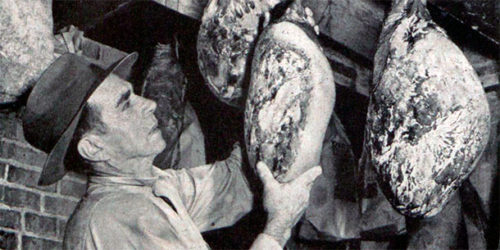
Ten years to learn how to cure a good country ham sounds like a long time. Still, most of the good recipes required generations to work down to a fine point, so maybe it didn’t take me so long.
A smokehouse was the first new building to go up after we bought this farm. The very first fall, with high hopes and certain anticipation, I put up a big batch of hams. They were a total loss. Undaunted, the next fall I tried again and missed just as badly, though in a different way. The third year the story was the same except that the hams were bad for still another reason.
Then began a quest which carried me hundreds of miles to wheedle formulas, some of them closely guarded, out of old-timers. I wrote to experts the country over. Several years of sifting and studying and testing were required, strangely, before I realized the obvious fact that while each formula sounded sure-fire, there were elements of chance in every single one of them.
All of which was exactly what I didn’t want. I wanted a precise, exact system which would uniformly produce country-cured hams that I would know were just right before they were cut or baked; I wanted a formula which I could use year after year with full confidence.
I got it. For four years now, every ham I have put up has been just right, never a suggestion of taint or sour-bone, never the least bit over-salty, no parboiling or soaking required. And while there is some work to the method, it is so simple that a moron could do it, as I have demonstrated.
The basis of the curing mix is
- 6 pounds of salt
- 2 pounds of sugar
- 2 ounces of saltpeter
- pepper could be added for seasoning, if desired
Each ham is weighed and cured separately, 1.3 ounces of the mix for each pound of the ham being applied. (Example: a 20-pound ham gets 26 ounces of the curing mix.) The ham is placed on a large sheet of brown wrapping paper, some of its mix rubbed in thoroughly and the balance packed on, mostly on the meat or cut side.
Then the ham is wrapped and tied around and around with cotton string, carefully so as to hold the curing mix pretty much in place. I prefer to hang the hams, in clean cotton feed sacks, with the bone end down while curing, but the practice is not essential. It is highly essential, however, that the hams remain in a temperature of between 32° and 40°F, until completely cured. Minimum time for a ham to remain in cure is 2 days for each pound of the ham but never under 25 days, regardless of how small the ham. With this formula there is no danger of leaving the ham in cure too long, as the amount of salt prescribed is the exact quantity required, no more and no less.
After the curing the ham may be removed, washed and smoked if desired, or else left in the wrapping for its aging. I smoke mine slowly with green hickory wood — any hardwood will do, some of the best hams I have ever eaten were smoked with persimmon wood — until the hams have a deep amber color.
Much is heard about “sugar-cured” hams, but sugar doesn’t cure. Salt does the curing; some sugar is added to the curing mix to counteract the salt taste which would otherwise be left in the meat. Saltpeter is included to hasten the chemical action of the salt on the meat and to improve the color of the meat. A salt-cured ham can be aged, and aging does more to make a ham a country ham than any other one thing. Under six months a ham is still pork, the meat pale and pink, but after that a ham starts to become a ham with full flavor and red meat. When you get right down to cases, the only reason for salt-curing a ham is so that it can be aged.
Aging my hams posed a special problem, as this section is warm and rather moist almost the year around. I cured them in the cool room of the local ice plant but found, if aged there, the hams acquired a slight off-flavor. If I aged them in a non-refrigerated room or building they were beset with flies, worms, and bugs as well as an undesirable wet mold, wrap or coat them as I might. Hams cannot be sealed up airtight, because a certain amount of gas, which must be allowed to escape, is released during the curing process.
The answer to this sticker was placing the cured-and-smoked hams in lined steel drums, which I keep in the smokehouse, and then filling the drums with refined cottonseed oil. A good, sweet grade of crude cottonseed oil would do. Lids cover the drums, but not airtight. Thus covered with oil, the hams are not molested by insects or mold and, importantly, there is little or no dehydration. They do not shrink and get hard but stay as soft and tender as when they were put in the oil. Then my only problem is to refrain from eating the hams until they’ve acquired a year’s aging.
Hogs should be starved for about 24 hours before slaughter, carcasses thoroughly chilled before dressing. Hams should be placed in the cure immediately — and watch that temperature! It is important. From then on only the cool temperature will permit the salt to penetrate the fat and the lean and the skin and the bone before spoilage bacteria get the upper hand.
Whenever you get a good country ham, regardless of what method was used to cure and age it, you’ve really got something.
Crack Shot
Don’t know why they dug the pit next to the railroad tracks. Don’t know anybody who does. It was just there on the short end of an alkali flat, all sagebrush and salts. The pit is always filled with water deep blue and high smelling, just like the mud there.
The pit has its share of junk. Couple of eons from now, some archaeologist will dig into it and ponder the significance of bed springs rusting away in one end and the fender of an old Model T Ford in the middle.
Kids figured it a God-given gift. Parents might have disagreed, if anyone had told them about it. Polio was still going around the country then, crippling and killing. Polio lurked in standing water. They just didn’t know why.
Parents were kind of touchy about pools of water, so we didn’t talk about the pit much. Didn’t want our mother to worry about it. Mom had enough to worry about when it came to water. One of her brothers had drowned in a well, and she blamed herself for that, although she had no reason to. That colored her thoughts when it came to her own kids and water. Dad was a little touchy, too. He was a deputy sheriff, and he’d had the unpleasant duty of pulling people from the Yellowstone a day or two into their deaths. Fact is that we wouldn’t have gone swimming in that pit. If we were going to swim, we were more likely to go to the river where the water was clean and deep and fast. We didn’t want them worrying about that, though, so we never talked much about it.
But we all knew the pit wasn’t for swimming, more for hunting treasure.
We launched great expeditions on that pit, riding our imaginations and rafts cobbled together from flotsam and jetsam. The rafts were always an inch away from discombobulating but sturdy enough to carry us to new worlds.
What treasures we found. Dragonflies winked red as rubies, green as emeralds, and blue as sapphires from cattails along the shore. Anaconda snakes, babies they were and dressed in their best striped suits, fled the expeditions to hide in the cattails. Sometimes they dived and swam underwater, rippling all the colors of the rainbow.
Skippers and water boatmen plied those waters, and from a raft it was easy to see the constant war waged among these creatures, easy to feel the sting of a boatman’s bite until we learned to leave them alone. We peered down into those waters, watching mosquito larva attempt to squirm away from dragonfly larva. We rooted for the dragonflies.
Dragonflies taught us what iridescence means, and patience, too. They poised on cattails, awaiting the next mosquito and their lunch. Still they were, so still that cattails blossomed into strange, beautiful flowers. If a boy had as much patience as a dragonfly, and just a little bit more, he could move his hands behind the insect so slowly that it didn’t seem to move at all. And if the vagaries of wind and mosquitoes didn’t interfere, a boy could catch the insects by their wings and look at them eye to eye. Dragonflies teach little boys not to blink.
This was my 11th year, the last summer of my childhood. My younger brother and I worked that summer and the one before in the Beartooth Mountains with my father, learning how to operate a chainsaw and drive a truck and trim branches from lodgepole pine with a double-bitted ax. I “snaked” the pine out of the hills with Nancy, a bay horse that knew more about her job than I did, but she humored me.
Those were great times, up in the mountains with the scent of pine so sharp it made me dizzy. Dad ruled over that mountain school, teaching us what Archimedes meant when he said that if he had a lever long enough and a fulcrum strong enough he could move the world. We used levers to move Dad’s wickiup from the pickup to the ground, and later to lever it back on the truck. Dad always called it the wickiup, but it looked more like a sheep wagon without wheels. It was cozy, too cozy sometimes, but it was warm and dry. We were in that the day of the big shake-up in Yellowstone Park. Things were jiggling outside the wickiup; we figured it was just a bear.
Dad taught us, too, that 11-year-olds could load fence posts and corral poles on the backs of trucks as well as anyone — maybe better because the years hadn’t bent our backs yet.
We learned, too, to make do. We always ran short of food, falling back on whatever raspberries we could pick — and pancakes. No butter. No syrup. No sugar. Nothing but pancakes for breakfast, lunch, and dinner. Couldn’t see why the hell people liked pancakes.
Then there was the day that the chainsaw slipped and fell on Dad’s knee. We watched him take a curved needle and heavy black thread to his knee. We didn’t miss any work that day, except for the time it took Dad to sew up his knee. Dad taught us how to make do.
Still, in my 11th year I was child enough to spend days at the pit, watching all the dragonflies and the mosquitoes fight for life in that dark blue water.
I didn’t know it then, but I was in the last of my free summers. The next summer I had my first paying job. I was old enough then for a Social Security card, so I worked 60 hours a week in a grocery store for $27. I was cutting tall cotton that summer, but I couldn’t go to the pit anymore, or the mountains.
I didn’t know that day that it would be special. I just knew that it was hot, maybe as hot as the hell that Dad talked about sometimes. The sun was beating the color from the dragonflies and the day. Everything bleached out in the heat, cattails, snakes, frogs, and boys. We pushed the raft to the shore with all the resolve of Humphrey Bogart pulling the African Queen through the leech-infested swamp.
No words were spoken. None needed to be. We just set off for the river and relief, imagining that we were crossing the Sahara, seeking an oasis. That image pulled us along until the killdeer put on a show for us.
Killdeer are beautiful birds, decked out in whites and grays. They move soft on the land. Bars across their necks and chests give them a formal air, as though they await an invitation to this bird ball or that.
Killdeer talk to people, singing kee-dee, or kee. I always thought they were telling me who they were, kee-dee, which I translated into killdeer. I was no expert in their language, but I figured I could understand that much. I did talk to the birds sometimes, trying to mimic their calls. I still try sometimes, but my whistler has gone soft.
Killdeer nest out in the open, laying almost invisible pebble-colored eggs. Still, rampaging skunks or raccoons or coyotes or boys might find them, except that when predators approach a killdeer nest, the adults are suddenly stricken with a disabling disease. Their wings hang to the ground, broken and useless. They stagger, fair game for any hunter. They suffer so that predators, or passing humans, forget the nests and pursue the stricken birds.
Always the birds find, at the last second, just enough energy to evade their pursuer and move farther and farther and farther from their nests. When a safe distance is reached and their eggs are safe, the birds make a miraculous recovery and fly away.
What a remarkable thing that is to watch, and we were watching when we heard the call from my older cousin. He was of an age when blue-mud pits and killdeer lose their interest. Raging hormones were upon him.
Humans aren’t much different from other animals. Both go willy-nilly in the breeding season. It’s a terrible thing to watch. Pimples sprout; hands that might better be used to catch frogs roam over faces, seeking pustules that will end the inflicted’s fantasies forever if they pop up in front of Mary or Sue or Lilly.
The victims of this affliction issue pheromones of Old Spice and English Leather. Hormones set them to strutting, banging heads together. Puberty is a terrible thing to suffer.
My cousin was in a state of high dudgeon. He had to have five dollars. One of his friends was taking him to Billings. There were promises and possibilities. He had to have five dollars. Would I buy his Stevens Crack Shot 26 single-shot .22-caliber rifle? The rifle was old then, with a falling block action that went out of mode a half-century before. Would I buy that rifle for five dollars?
A rifle? Would I buy a .22-caliber rifle with the five dollars I had been saving since who knows when? Would I give him five dollars for a rifle with which I could hunt rabbits and cougars and maybe bears? Would I pay five dollars for adulthood?
No. Definitely not.
My father hadn’t raised any fools. He told me that a 10 percent discount comes with cash. Would I pay five dollars? No. But I might pay four dollars and fifty cents.
Incredulity crawled across my cousin’s forehead. Promises had been made. Possibilities were just 40 miles down the road in Billings, Montana. Five dollars was all he wanted for a Stevens Crack Shot 26 falling-block .22-caliber rifle. Just five dollars for promises and possibilities.
He blinked.
I remembered another rule.
I hadn’t spent those fall nights watching my father clean his rifle before hunting season for nothing. The smell of banana oil was as strong in my nose as any kid’s. Our livelihood was as dependent on venison as anyone’s.
Even a five-dollar rifle wasn’t a good buy even after taking 10 percent off for cash if it couldn’t shoot straight.
Did that Stevens Crack Shot .22-caliber falling-block rifle shoot straight? I would have to know that the rifle shot straight before I would spend $4.50 for it. Did he have any cartridges so that I might test the accuracy of that rifle, refinished stock and all?
He blinked, showing me how to pull down the lever that drew down the block and firing pin and cocked the rifle. He slipped a .22-caliber bullet into the chamber and pulled up the lever, leaving the rifle cocked.
One more thing my father had told me. Anyone selling a rifle should throw in some shells. Did my cousin have some shells that he would throw in with this $4.50 Stevens Crack Shot 26 rifle?
Yes, he did, he said, handing me a box of Winchester copper-plated .22 long rifle cartridges.
The final test. How accurate was this rifle? I looked around for a target. A killdeer was standing about 60 yards away. We weren’t close enough to the bird’s nest to bother her. Kee-dee, she sang. Kee-dee-kee.
I centered the tip of the front sight into the notch of the rear sight, just as my father had taught me. I centered the post of the front sight on the killdeer and squeezed the trigger. I expected the rifle to kick. I had been told that rifles kicked the shoulders of their shooters in protest. This rifle didn’t kick. This rifle cracked, and the killdeer fell over. I ran to the bird, the rifle forgotten in my hand. She lay, soft gray and white against the earth with dark bands across her chest and throat and eyes as though she were dressed to go to some bird ball.
There was a drop of blood in her bill, bright red as a ruby, bright red as dragonflies winking from cattails along the pit.
My childhood died that day. It haunts me still, the scent of pine and the iridescence of dragonflies in a blue-mud pond. I see those things in the eyes of my mind, but I hear only the killdeer calling a haunting sound. Kee-dee. Kee-dee-kee.
Post fiction advisor Gary Svee won the 1990 Western Writers of America SPUR Award for Sanctuary. His short story “Henry’s Christmas” appeared in the Nov/Dec 2009 issue. For a list of his books, visit bit.ly/GarySvee.
This article is featured in the March/April 2018 issue of The Saturday Evening Post. Subscribe to the magazine for more art, inspiring stories, fiction, humor, and features from our archives.
Oscar Trivia: Take Our ‘Best Picture’ Quiz
Before we find out which of the 10 movies nominated for Best Picture will win the Oscar, test your knowledge about past Best Picture nominees and winners with this 10-question quiz — and get some great movie trivia for your Oscar party, too.
Answers and explanations are at the end.
1. Pretty Good Year
The year 1939 was a good one for movies. Which of these Best Picture nominees, all classics of the Silver Screen, actually won the Oscar?
- Gone with the Wind
- Goodbye, Mr. Chips
- Mr. Smith Goes to Washington
- The Wizard of Oz
2. It’s Hard for the Bard
There have been countless film renditions of Shakespeare’s plays, but only one has received the Best Picture Oscar. Which is it?
- Hamlet (1948) with Laurence Olivier and Jean Simmons
- Romeo + Juliet (1996) with Leonardo DiCaprio and Claire Danes
- The Taming of the Shrew (1967) with Elizabeth Taylor and Richard Burton
- Titus [Andronicus] (1999) with Anthony Hopkins and Jessica Lange
3. It’s a Zoo Out There!
Which of these animal-titled movies did NOT win the Oscar for Best Picture?
- Dances With Wolves (1990)
- The Deer Hunter (1978)
- The Lion in Winter (1968)
- Silence of the Lambs (1991)
4. All Dressed Up but No Oscar
Four costume flicks were nominated for Best Picture of 1956. Who won?
- The King and I
- Friendly Persuasion
- The Ten Commandments
- Around the World in 80 Days
5. The Rainbow Connection
What was the first full-color movie to win the Best Picture Oscar?
- Ben-Hur
- Bridge on the River Kwai
- Gone With the Wind
- Lawrence of Arabia
6. What’s in a Name?
Most Best Picture winners become classics with instant name recognition; others, not so much. Three of these four movies won for Best Picture — which one didn’t?
- The Apartment (1960)
- The Conversation (1974)
- The Lost Weekend (1945)
- Ordinary People (1980)
7. Naughty Nominees
Only two X- or NC17-rated movies have ever been nominated for the Best Picture Oscar, and one of them won. Which was it?
- A Clockwork Orange (1971)
- The Damned (1969)
- Midnight Cowboy (1969)
- Requiem for a Dream (2000)
8. One Oscar to Rule Them All
All three Lord of the Rings movies were nominated for Best Picture, but only one won. Which was it?
- The Fellowship of the Ring (2001)
- The Two Towers (2002)
- The Return of the King (2003)
9. But Who’s Counting?
Which of these actors has appeared in the most Best Picture-nominated films?
- Robert De Niro
- Jack Nicholson
- Spencer Tracy
- Gary Cooper
10. Underachiever
Three of these Best Pictures each brought in 11 Oscars total. Which one is the underachiever?
- All About Eve (1950)
- Ben-Hur (1959)
- Lord of the Rings: The Return of the King (2003)
- Titanic (1997)
Answers
1. a) Gone with the Wind
Also at the 12th Academy Awards, Gone with the Wind’s Hattie McDaniel became the first African American to win an Oscar, for Best Supporting Actress for her role as Mammy.
2. a) Hamlet (1948)
Though Olivier’s Hamlet is the only Best Picture winner to stick with the Bard’s original words, it isn’t Shakespeare’s only appearance in the list of Best Picture winners: West Side Story, which won Best Picture in 1961, is a modern musical retelling of Romeo and Juliet; and 1998’s Shakespeare in Love took home seven Oscars, including Best Picture.
3. c) The Lion in Winter
The Lion in Winter was nominated for Best Picture of 1968 but was beaten by the musical Oliver!
4. d) Around the World in 80 Days
The King and I was nominated for nine Academy Awards and won Best Actor, Best Art Direction, Best Costume Design, Best Music, and Best Sound Recording. Friendly Persuasion was nominated for Best Picture, Best Supporting Actor, Best Director, Best Adaptation, and Best Sound, but won none. The Ten Commandments had seven nominations — Best Picture, Costume Design, Cinematography, Film Editing, Sound Mixing, Production Design, and Visual Effects — but won only in the last category.
5. c) Gone with the Wind
After 1939’s full-color Gone with the Wind took home the statue, 11 years passed before another full-color movie won the Best Picture Oscar — 1950’s An American in Paris, starring Gene Kelly.
6. b) The Conversation
Written, produced, and directed by Francis Ford Coppola, The Conversation stars Gene Hackman as privacy-obsessed surveillance expert Harry Caul. It was nominated for Best Picture of 1974 but lost to The Godfather Part II.
7. c) Midnight Cowboy
A Clockwork Orange was nominated for Best Picture in spite of the fact that the MPAA had given it an X rating, but it lost to The French Connection. The X-rated Italian-German drama The Damned was nominated for Best Screenplay, not Best Picture, but lost to Butch Cassidy and the Sundance Kid. Though Requiem for a Dream, which the MPAA rated NC17, was not nominated for Best Picture, Ellen Burstyn was nominated for Best Actress for her role. To date, Midnight Cowboy, featuring Dustin Hoffman and Jon Voight, is the only X-rated movie to win the Best Picture Oscar; after it won, the MPAA downgraded its rating to R.
8. c) The Return of the King
The Fellowship of the Ring lost to A Beautiful Mind, and The Two Towers lost to Chicago. The three Lord of the Rings movies combined garnered 30 Oscar nominations and 17 wins.
9. b) Jack Nicholson
Jack Nicholson has appeared in 10 Best Picture-nominated films: Five Easy Pieces (1970), Chinatown (1974), One Flew Over the Cuckoo’s Nest (winner, 1975), Reds (1981), Terms of Endearment (winner, 1983), Prizzi’s Honor (1985), Broadcast News (1987), A Few Good Men (1992), As Good As It Gets (1997), and The Departed (winner, 2006). De Niro, Tracy, and Cooper each appeared in nine Best Picture-nominated films.
The record, though, goes to Bess Flowers, known as “The Queen of Hollywood Extras,” who appeared (uncredited) in 23 Best Picture nominees between 1938 and 1961.
10. a) All About Eve
All About Eve was nominated for Oscars in 14 categories (the same as Titanic, and more than the other two) and won 6: Best Picture, Director, Supporting Actor, Screen Adaptation, Sound Recording, and Costume Design. Of the 33 Oscars awarded to Ben-Hur, Lord of the Rings: The Return of the King, and Titanic, only two were for acting — and both went to Ben-Hur.