Movies for the Rest of Us with Bill Newcott: Fun and Games for Grownups
Movie critic Bill Newcott reviews an uproarious Game Night, an adoring portrait of communist Karl Marx, the Israeli film Foxtrot, and the movie tribute to George Harrison, The Concert for George. On the home movie front, Bill reviews Darkest Hour, The Florida Project, and The Girl without Hands.
Persistence of Vision
“Have you seen your father lately?” My mother asked as she poured pecans on a chocolate cheesecake. I resisted the urge to snap Why would I want to see him? The man was an utter fool. He’d never been able to see the truth. Always too busy watching the flowers in public parks. The way bergamot floated in a glass teapot. The quality of textiles in period costumes at the theater. Colorful things mesmerized him while daily life and all its mundane responsibilities failed to hold his attention.
The spring he met Iris, and whereupon divulged himself of his family responsibilities once and for all, I was only 12 years old. Every other weekend we drove to London from our village, Port Stanley, to spend the afternoon at the Grand Theatre followed by a late lunch. On that April afternoon Dad was up before anyone else. He took a long time getting ready. He tied his graying hair in a ponytail, trimmed his beard and polished his round wire glasses. When Mom rose, she parted her brown hair in the middle, carefully combed her thick hair flat, and knotted the rest in a low bun. She was raised as a Mennonite, and maintained a certain sense of modesty in the way she dressed. She put me in a white linen dress, combed out my wispy caramel-colored hair, and strapped white patent leather shoes to my feet.
Dad whistled as he shepherded my cat, Persia, in the basement. My precious diminutive Persia, gray as a shellfish, eyes as blue as the ink inside a ball-point pen, knew we were leaving and hated waiting for us at home all day by herself. She made the most horrible noises, mewing and pawing at the basement door, in the hopes of getting out and coming with us.
The drive from our bungalow, on a private beach on the shore of Lake Erie, toward London, wasn’t too long. I thought of nothing but Persia. Dad listened to the CBC radio, and Mom, nervous in the car, hung on to her armrest. The city scared her. She hated urban sprawl. She complained about how the skyline devoured the landscape. She always felt that city people would swallow her whole. Oddly enough, she was surprised when Iris did.
Once in the city we visited Victoria Park. Underneath a monochromatic sky, with clouds that swathed the horizon, Dad, the landscape architect, pointed out the flowers in the park and told me their Latin names. Mom reclined on the grass, picked blades from her beige tunic, and watched us contentedly.
After a play at the Grand Theatre we went to a café nearby. Dad ordered lavender tea and shortbread cookies. On that particular weekend, when we met Iris, she was serving tea. She wore a white slip dress and chunky black heels. Her frizzy blonde hair was golden and wild, piled on top of her head like a beehive. A gold necklace with a moon charm dangled between her breasts as she bent to set the table.
“You’ve got paint on your hands,” Dad said. His eyes twinkled above the rim of his porcelain tea cup.
“I’ve been up all night. And I wasn’t having fun,” she said and winked.
“What were you up to?” he asked.
“Working on my latest painting.”
She said she was looking for a beautiful garden filled with lady’s slipper. She loved that flower. She wanted to paint them and set up a camera and record the other flowers as they bloomed. He offered her the use of our backyard.
She was around so much it felt like she was part of the family; I couldn’t call her Auntie Iris though, like she’d asked me to. I didn’t have much to say to her. I was too busy silently resenting my father. He only had eyes for her when she was in the room. Mom and I were invisible. He glared at Mom when she offered tea, accepted her cookies wordlessly, and sat with Iris and talked about art and culture. Iris was coy. She crossed and uncrossed her long legs, and a sunflower charm above her ankle glimmered in the sunlight. She rested her chin on the backside of her hand; listened attentively, as my father, hands tumbling over themselves, spoke excitedly. His cheeks pink as the coral bells beside him.
“You’ve captured the peonies marvelously,” he said as he watched her paint during her last visit to the garden.
While he admired her painting, I walked around the garden. Persia chased bees that were bumbling from one flower to the other. I pulled mint leaves from their terra cotta pots and inhaled the scent on my fingertips. I shook the stems of the bluebells and pretended they were ringing. I was following Persia around a patch of leopard’s bane when I saw Iris seated in a wicker chair. My father stood behind her. He put his hand on her neck. She turned and met his lips. He pushed the strap off her slip dress and clamped his hand over her breast.
I turned and ran toward the house. Mom was at the desk in the corner, doing the books for Dad’s business, a slice of steaming apple strudel beside her. She looked at my flushed face. I told her what I’d just seen. I was devastated. I felt a tear roll down my cheek. She pulled her glasses off and hung her head. She waved her stubby fingers at me from beneath the sleeve of her slack cotton dress, and told me to go find Persia. She sat slouched over the books. The weight of her chest so heavy on the pencil lead it snapped.
Mom spun the cake around and inspected it from all angles. “It’s perfect, isn’t it?”
I nodded.
“He’s going to marry her,” Mom said.
“When?”
“Labor Day weekend.”
I stepped over Persia, fat and asleep on the floor, and walked out the kitchen door to the backyard. The garden was beautiful this spring, filled with spring adonis, anemone, and basket of gold. He’s done an impeccable job. It’s no wonder Iris came buzzing around. Mom stayed in the kitchen by herself the summer he left and found comfort making sweet cakes. She was preoccupied with perfecting baklava. I found honey smudged all over the utensils. Remnants left on the stove’s elements. The smell of it burning woke me up the morning she’d found the note.
“He’s not coming home,” she said. A bag of chopped nuts fallen on the floor at her feet.
He went to London to live with her. They’d converted a store front to an art gallery. She displayed her paintings, landscapes mainly, of my father’s gardens. After he left, he took me to her exhibit called Persistence of Vision. Her artist’s note said, optical illusions work because the brain wants to complete things, it has to, movies look like moving pictures to us, when in fact they are just a series of completely still images, this phenomenon is called Persistence of Vision.
It was then that I decided I wanted to be an optometrist. I was just a kid, but I wanted to make sure he saw clearly. I thought I could bring some sort of completion to the illusions he saw. Help fix it all. Make him come home.
A few days before their wedding, Iris asked me out for lunch. We had pizza near her gallery in London and then went back to her office. She wanted to show me her wedding dress.
“Don’t you love the colors?” Iris asked, holding the burgundy velvet ball-gown in front of her chest. It had a violet, blue, and green leaf appliqué wrapped around the bodice. I nodded glumly. She placed the dress on a chair gently when her cell, a medley of tropical bird chirps, rang. She turned the ringer off and uncorked a bottle of champagne, sunlight sparkling on the flute, and poured us each a glass.
“We’ve been together for so long. Are you surprised we are getting married now?”
“Surprised you are willing to support him.”
I took a deep breath as I prepared to lie. I told myself I was simply creating an illusion. I was being creative: talking their language.
“He’s losing his vision. He’ll have total vision loss within the year. It sounds rough, but there are many sighted guide training opportunities for you. You can learn to lead him. You’ll have to change a few things around the house, install sensors in his teacup. Those things are great. I’ve seen those at the Canadian National Institute for the Blind fundraisers I’ve volunteered for. It’s nothing you can’t manage.”
“He’s losing his vision?”
“Don’t tell him I told you, he’s probably waiting for the chance to tell you himself.”
Her eyebrows shot up.
“He has a degenerative eye disease called retinitis pigmentosa.”
“Are you sure it’s not just myopia?”
“No, that’s all about refraction, measurement and light, perspective. This is a disease.”
“Oh.”
“He won’t be too much work. You may have to hire part-time help though.”
She sank into her leather chair and crushed the wedding dress.
On Labor Day weekend, when he was supposed to marry Iris, the pier in Port Stanley reopened. I don’t remember a time when it was in use. Mom told me they closed it when I was three. As a child I simply remember it as a crumbling crust of rock that slithered into the harbor straight from the base of the grain elevator. No one was allowed to walk on it. It was like a gray stone cavity, an open sore, bisecting the clear water, in all its dilapidated, lonely grandeur. There were heaps of people on the pier and the public section of the beach today. I walked down to the beach from our house, through Dad’s lovely gardens, and got in the water. I was alone, except for the boats anchored 20 feet from shore. I was floating on my back when I felt a slight flutter, a tickle, at my neck. I turned around and saw the brilliant orange and black-velvet patterns on the wings of a monarch butterfly. Its wings had collapsed. Its black antennae were twitching, and its hands and feet were tumbling over themselves, in a mad doggie paddle. I picked it up and let it go in the air. It fell back to the water’s surface, stuck like a magnet to the syrup-thick water. I picked it up once again, shook the water from its wings. It heaved until it caught its breath. When I threw it up this time, it flew like the tiny insect it was, spiraling itself back to shore, too weary to migrate across Lake Erie to Mexico, too frightened, perhaps, at the prospect of such a long haul. But if it stayed here it would surely die. I pictured it, bitten by the first frost, antennae crisp, glazed by ice, wings stiff and candied, clinging to late-season coneflowers, and I felt a sorrow I couldn’t quite understand, the sorrow of loss, akin to what happens in autumn. Resistance to change I suppose and the prospect of the ever-shortening dark days.
My father emerged from the garden, goat’s beard brushing at his ankles, dragging an Adirondack chair from the fire pit down toward the lake. The engorged shoreline pulsed at his feet. I knew I’d find him here. Where else would he go to find consolation? He’d been coming back once a week since she left. Mom couldn’t deny him access to the garden. He’d built the garden himself so he knew what every flower needed. It saved her time and money, she’d said. I’m not sure if it hurt her to see him so often, or if she looked forward to it. Did she feel as comforted by his presence as he felt simply by being in the garden? She seemed happier since the wedding had been canceled. Did she expect him back?
I got out of the water and sat beside him gently. His arms were full of bearded irises he’d just torn from the garden. A tangle of roots and dirt spiraled down his legs. His eyes were red-rimmed.
I took his limp hand and brushed the smashed purple petals from his fingers.
“Damn invasive flowers—”
“They were beautiful at first—”
“How could I let irises in the garden? They dominate and choke out every other flower.”
I squeezed his hand.
Mom sang out from the back porch, “Tea’s ready.”
Dad followed me up to the house.
“I was an utter fool to give this up,” he said. “I’ve been contracted to landscape the new park that’s opening up by the pier when they tear down the grain elevator. I can stay at the Kettle Creek Inn, but do you think Mom would let me stay?”
He walked up the stairs, smiling hopefully at her.
She stood in the doorway, her belly poked out through her turquoise linen tunic. There were deep creases in her cheeks, like the cracks in overbaked cheesecake, and underneath the tough dry skin, her flesh wobbled.
“Hello,” he said.
I walked in and raised my eyebrows.
She simply closed the door in his face.
Later that night after three pots of Earl Grey tea and eight shortbread cookies I felt sad again. I’d done him wrong. He was alone now. I felt no satisfaction in hurting him. Getting rid of her hadn’t done any good. It hadn’t brought him home. It hadn’t restored our family.
“You’ll see him again soon,” Mom said and brought the plates to the sink.
I suppose I wanted him back, even more than her.
She’d left the Mennonite faith for him. He lived in London when they met. He’d drive out to Aylmer to buy soil rich with horse manure from the Mennonite farmers. She told me he’d tasted one of her butter tarts she’d made to sell at the farmer’s market and his eyes lit up and he flirted with her outrageously. “He saw sparks,” she said, “I saw the possibility of an electric stand mixer.”
It took her a while to get used to life outside her faith. She told me that the Mennonite families she grew up with wore humble dress, didn’t use electricity, and rode horse and buggy. Despite attempts at a simplistic existence her girlfriends were anything but. They smoked cigarettes, drank bourbon, and shortened their skirts. All Mom wanted was an oven that didn’t use logs, spirt sparks, or make the house smell like smoke.
I wanted his focus to be on us. Back where it belonged. And the painful lurch in my heart, a dull axe whacking away at wood it couldn’t manage to cut, reminded me of just how much I missed him.
Since he’d been gone she started wearing her prayer cap again, and dropped her skirts a few inches. She looked like a plump rose, in petal pink, pink shawl over the same shade of pink cotton top. The hemline draped over voluminous no-nonsense slashes in the skirt that served as pockets. She didn’t, and wouldn’t, go so far as to cut the electricity. That would plunge her into despair, to be cut off from her baking like that. It would also allow her to focus on the loss, blindsighted as she would be, in the dark with nothing to see.
Why Was Jaqueline Susann’s Valley of the Dolls So Wildly Successful?
 In February of 1966, Jaqueline Susann published her first novel, Valley of the Dolls. Despite negative reviews, the story of three women trying to make it in show business became the best-selling novel of 1966. At one point, it was selling 100,000 copies every 24 hours. A year later, it was made into a movie, which was a box office smash. To date, her novel has sold more than 31 million copies, making it one of the top sellers of all time (more than either Gone with the Wind or The Purpose Driven Life). Sadly, her life was cut short by cancer; she died in 1974 at age 56. Her last words to her husband were, “Hey doll, let’s get out of here.”
In 1968, at the height of Jacqueline Susann’s success, Ken W. Purdy interviewed her for The Saturday Evening Post as the publication of her second novel neared. The cheery interview covered her career as an actress and her earlier writing efforts (a biography about her poodle, Josephine).
Purdy marveled at Susann’s incredible drive. While critics (including a withering Gloria Steinem) disparaged her writing, no one could criticize her work ethic. Susann recounted her work day:
When I’m writing, I’m not doing anything else. I get up. I have coffee. then I take Josephine out for a walk. I come back and go into the den—the torture chamber, I call it—and I’m there until five. Then I take Josie out again, come back, work until eight. Maybe Irving has a show that keeps him at the studio, he asks me if I want to dress for dinner, I say, do you mind if we just go around the corner to the Chinese place, and then maybe I come back and do another couple of hours. I don’t have lunch dates, I don’t have dinner dates, almost never, unless something comes along that’s important to Irving, a business thing, then I go because as his wife I owe him that. Otherwise I work. I sit there, whether my back hurts or not, whether it’s a great day for golf or not. I sit there.
Her hard work was also evident in her promotion efforts. Susann became one of the first “celebrity” authors, essentially inventing the modern book tour. Purdy wrote, “Miss Susann’s promotion techniques are probably unique in the practice of literature. She goes where the action is: bookshops.” If book store clerks hadn’t read her book, she would buy them a copy (plus autograph). She understood that promoting success begat more success, taking out full-page ads in the New York Times at the book’s peak. Valley of the Dolls was so popular, she declared even men were buying it, “if it’s only to find out why their wives sat up with it all night.”
Susann called writing her addiction, and claimed she never did it for the money. She said, “Some of the best professional opinion in New York assured me that a book about show business and Hollywood and people taking pills couldn’t make a dime.”
Shows you what the experts know.
5 Tutti-Frutti Retro Pie Recipes from the Thrifty ’50s
Two years before Dorothy LaBostrie and Little Richard gave us the song, “Tutti Frutti” was just a humble pie filling published to help shoo away readers’ winter blues.
Today, we’re adding a level of time travel to the mix. Bake any of these 1950s pie fillings in a 21st-century pie crust while dancing to versions of “Tutti Frutti” released in the decades between recipes: Elvis Presley (1956), The Jesters (1960), Marc Bolan, Elton John & Ringo Starr (1972), Queen (1986), Alvin and the Chipmunks (1991), Little Richard (Little Richard film, 2000), and Buckwheat Zydeco (2013).
Sunshine Fillings for Winter Pies
Originally published in The Country Gentleman, January 1, 1953
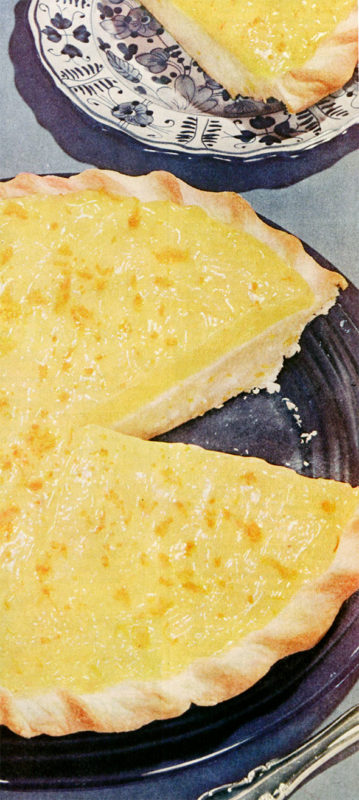
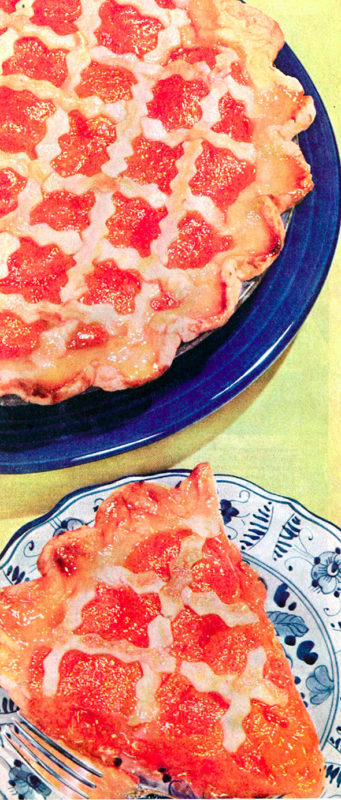
Take your pick from the luscious pies pictured here. Lemon, orange, or grapefruit makes each one a fresh flavor treat.
Double Lemon Pie
- 2/3 cup sugar
- 2 tablespoons flour
- 1/2 teaspoon salt
- 1 egg yolk
- 1 cup scalded cream
- 1 package unflavored gelatin (2 1/2 teaspoons)
- 1/4 cup cold water
- 1/2 cup lemon juice
- grated rind of 1 lemon
- 1/2 teaspoon vanilla
- 1 baked 9-inch pastry shell
Combine sugar, flour, salt, and egg yolk. Add to scalded cream in top of double boiler. Cook until thick, stirring well. Dissolve gelatin in cold water. Add to hot mixture. Cool. When mixture jells, add lemon juice, rind, and vanilla. Beat egg whites until stiff. Fold into filling. Pile into pastry shell. Chill.
- 3/4 cup sugar
- 3 1/2 tablespoons cornstarch
- 1/4 teaspoon salt
- 3/4 cup water
- juice of 1 lemon
- grated rind of 1 lemon
- 1 egg yolk
- 2 tablespoons butter
Combine all ingredients except egg and butter. Cook and stir until thick. Pour a little over beaten egg yolk. Return to hot mixture. Cook 5 minutes. Add butter. Cool and spread over filling.
Apricot-Orange Marmalade Pie
- 3 cups cooked, unsweetened dried apricots (or canned apricots)
- 1 cup orange marmalade
- 1/4 cup apricot juice
- 1 tablespoon quick-cooking tapioca
- 1/8 tablespoon salt
- pastry for 9-inch pie
Drain apricots. Combine marmalade, juice, tapioca and salt. Pour over apricots and mix. Pour into unbaked pie shell. Top with lattice. Bake in hot oven (425° F) 10 minutes. Reduce heat to 350° F and bake 30 minutes.
Orange-Raisin Pie
- 2 cups seedless raisins
- 3 tablespoons lemon juice
- 3/4 cup sugar
- 1/2 cup water
- 2 tablespoons butter
- 3 tablespoons flour
- 1/4 teaspoon salt
- 1 1/2 cups orange sections
- pastry for 2-crust pie
Mix raisins, lemon juice, sugar, and water in a saucepan. Simmer slowly for 15 minutes, or until raisins are plump. Melt butter. Add flour and salt, beating until smooth. Gradually add some of the hot juice from the raisin mixture to the flour, stirring until smooth. Pour into raisin mixture, and cook until thickened. Add orange sections. Pour into pastry-lined 9-inch pie pan. Top with pastry and brush with milk. Bake in a hot oven (425°F) 10 minutes. Reduce temperature to 350° F and bake 25 to 30 minutes.
Orange-Cake Pie
- 1/3 cup butter
- 3/4 cup sugar
- 1 1/2 tablespoons grated orange rind
- 3 eggs, separated
- 1/3 cup orange juice
- 3 tablespoons lemon juice
- 3/4 cup sifted flour
- 1/4 teaspoon soda
- 1/2 teaspoon salt
- 1/2 cup light cream
- 1/4 teaspoon cream of tartar
- 1 lightly baked 9-inch pie shell
Cream butter and sugar together. Add orange rind and egg yolks, beating well. Add orange and lemon juice, flour, soda, and salt, beating until smooth. Add cream, mixing thoroughly. Beat egg whites and cream of tartar together until stiff peaks are formed. Carefully fold egg whites into flour mixture. Pour into pie shell. Bake in a slow oven (325° F) 40 minutes, or until firm.
Tutti-Frutti Pie
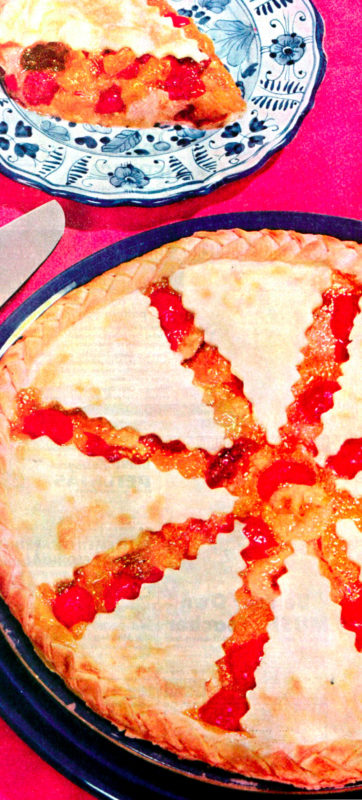
- 1 cup grapefruit sections
- 1 1/2 cups orange sections
- 1/2 cup crushed pineapple
- 1 medium banana, sliced
- 1/2 cup maraschino cherries, halved
- 2/3 cup sugar
- 3 tablespoons quick-cooking tapioca
- 1/4 teaspoon salt
- pastry for 9-inch pie
Combine all ingredients except pastry and butter. Pour into unbaked pie shell. Dot with butter. Top with pastry. Bake in hot oven (425° F) 10 minutes. Reduce heat to 350° F. Bake 40 minutes.
We Said It Here First: The Full Impact of Pollution
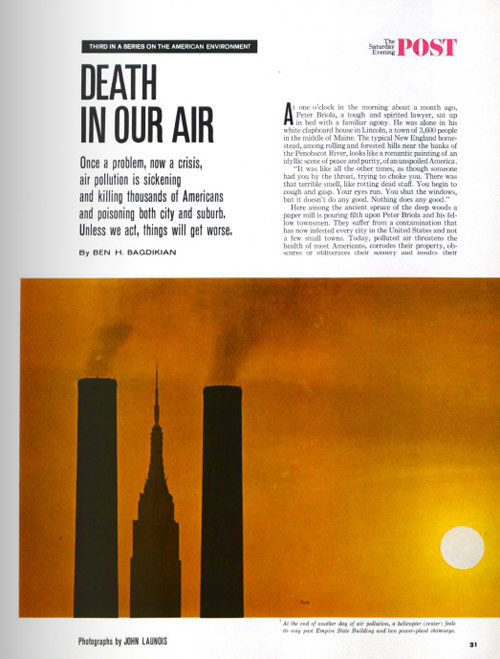
—“Death in Our Air” by Ben Bagdikian originally appeared in the October 8, 1966, issue of the Post.
Today, polluted air threatens the health of most Americans, corrodes their property, obscures or obliterates their scene, and insults their peace of mind. Unclean air is no longer rare in American cities. It is the rule.
Three years ago, when open fires, incinerators, chimneys, smokestacks, and tail pipes were putting 125 million tons of chemical junk into the American air, the threat was already serious. But the burden has risen relentlessly until this year it is 145 million tons and headed still higher. Clean air begins and ends with politics. Unless there is solid support for pollution control and no political finagling with enforcement, the system quickly breaks down. In Los Angeles, as in most places, the initial response of polluters told to clean up was as predictable as religious ritual:
1. It is technically impossible.
2. It is economically ruinous.
3. If you bother me, I’ll move my factory.
This article is featured in the January/February 2018 issue of The Saturday Evening Post. Subscribe to the magazine for more art, inspiring stories, fiction, humor, and features from our archives.
Top 10 Reads for Early Spring
Every month, Amazon staffers sift through hundreds of new books searching for gems. Here’s what they chose especially for Post readers this winter.
Fiction

The Italian Teacher
by Tom Rachman
Told through the eyes of the son of a great painter, and full of humor and humanity, Rachman’s novel illustrates a life lived in the shadow of greatness.
Viking

Tangerine
by Christine Mangan
Set against the backdrop of Tangier, Morocco, two former college roommates are reconnected in a debut novel that will remind readers of Paul Bowles’ masterpiece The Sheltering Sky.
Ecco

You Think It, I’ll Say It
by Curtis Sittenfeld
An incisive collection of short stories from the beloved and bestselling author of Prep, American Wife, and Eligible.
Random House

The Only Story
by Julian Barnes
A man recounts his first true love—when he was 19 and his lover 48. This novel, set in London, is an exploration of devotion, time, and the human heart by a Man Booker Prize–winning author.
Knopf

Varina
by Charles Frazier
Frazier returns to the setting of his breakout Cold Mountain in this epic tale of a woman who marries Jefferson Davis only to flee as the Confederacy and her marriage turn to tatters.
Ecco
Nonfiction

Enlightenment Now
by Steven Pinker
Following up on his best-seller The Better Angels of Our Nature, Pinker illustrates how the architecture of the Enlightenment is making the world a better place, even as we worry it’s all falling apart.
Viking

God Save Texas
by Lawrence Wright
A famed historian and long-time Texas resident, Wright explores the history, culture, and politics of Texas while holding all the stereotypes up to a lens.
Knopf

Rocket Men
by Robert Kurson
Having written a best-seller set under the ocean (Shadow Divers), Kurson moves into space in an intimate, deeply researched study of Apollo 8 and man’s first trip to the moon.
Random House
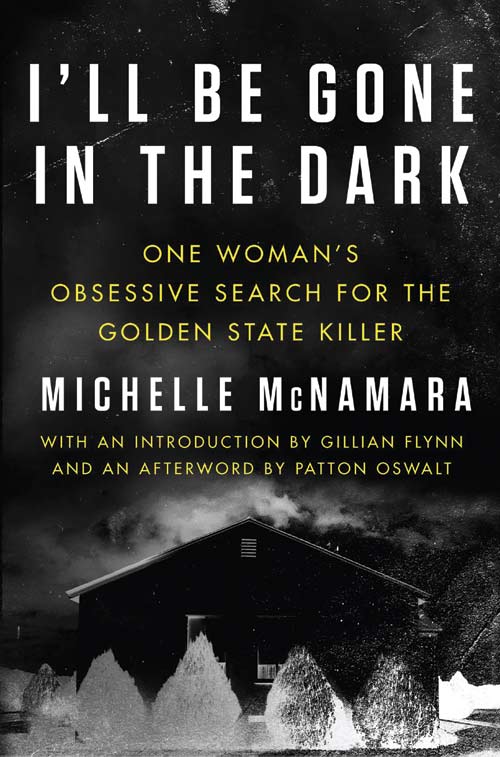
I’ll Be Gone in the Dark
by Michelle McNamara
McNamara was a gifted journalist who died tragically while investigating the Golden State Killer. This true-crime book will likely escape its genre and find itself in the mainstream.
Harper

The Best Cook in the World
by Rick Bragg
The beloved author of All Over but the Shoutin’ has written a food-based memoir — a loving tribute to his mother, the South, stories, tradition, and a disappearing way of life.
Knopf
The Saturday Evening Post Swimsuit Issue
Other magazines are hitting the stands with their annual swimsuit issue, so we thought we’d offer our own take on it with these bathing costumes dating back to 1910.
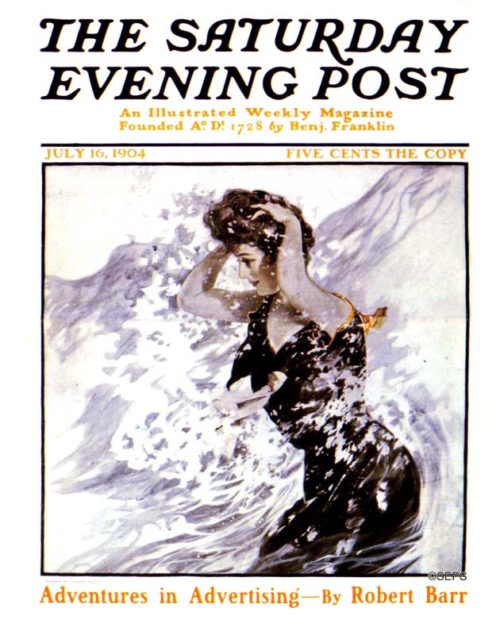
Henry Hutt
July 16, 1904
The model for this cover illustration was likely Edna Hutt, Henry’s wife and his favorite model, whom he considered the most beautiful woman in the world. Unfortunately, their union was an unhappy one, with accusations of abuse on both sides, including “use of ‘strong liquors,’ intimacy with other women, and cruelty.”

J.C. Leyendecker
August 9, 1924
Artist J.C. Leyendecker was well known for his illustrations of strapping, strong-jawed men, starting with the Arrow Collar Man and continuing throughout his long relationship with The Saturday Evening Post, where he illustrated more covers than any other artist, including Norman Rockwell. The model for this illustration appears to be Leyendecker’s partner, Charles Beach.
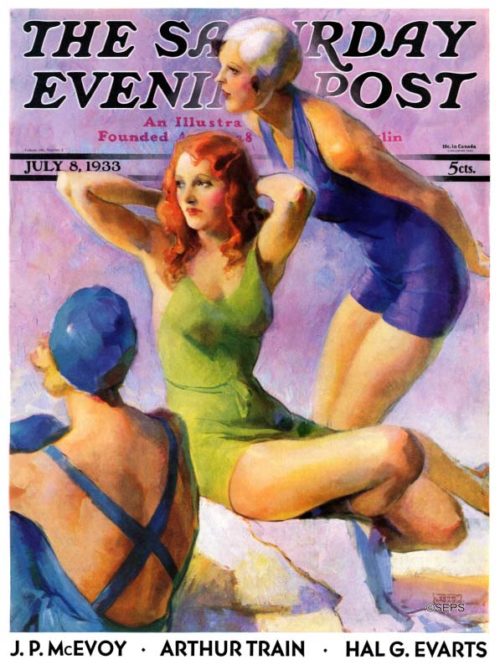
John LaGatta
July 8, 1933
John LaGatta’s illustrations depicting beautiful, sultry women were considered to be some of the most desirable artworks of the 1920s, ’30s, and ’40s. His style was a favorite of advertisers, including Campbell’s, Ivory Soap, Kellogg’s, Johnson and Johnson, and—not surprisingly—Laros Lingerie and Spaulding Swimwear.
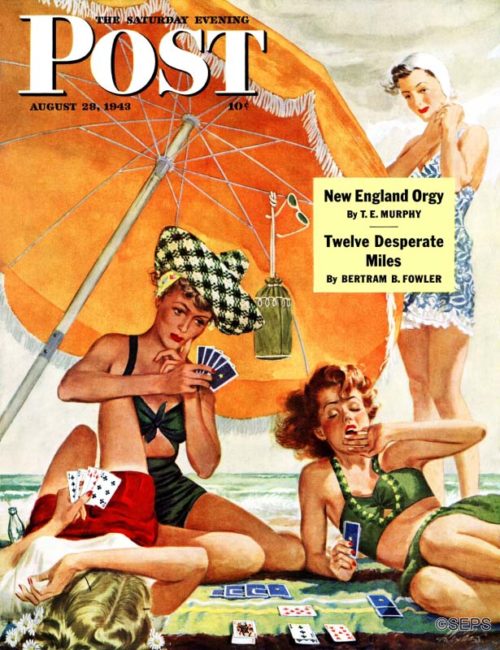
Alex Ross
August 28, 1943
This is one of six covers that Alex Ross painted for The Saturday Evening Post. All of his covers featured beautiful women, but this beach scene is the only one that doesn’t focus on a single person. Anyone who has spent time at the beach knows that a successfully completed game of cards is highly unlikely (unless the cards are made of lead).
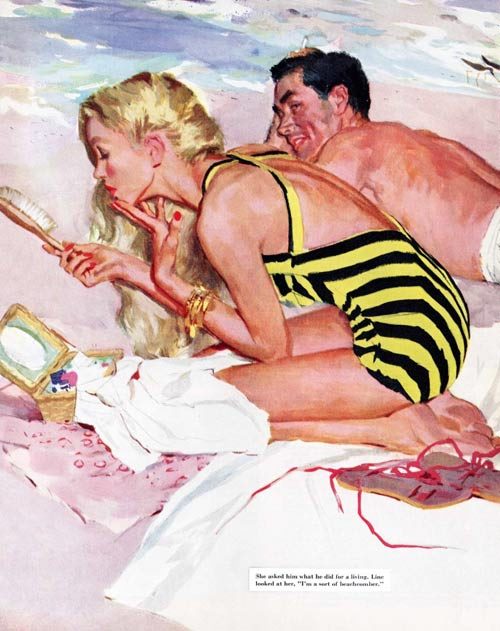
February 7, 1953
Joe De Mers
De Mers illustrated this short story by Steve McNeil, which posed the question, “He’d quit his job to escape the pressure and confusion of city life. Should he go back now, to please a girl?” From the look on his face, you already know what the answer is.

Wesley Snyder
June 4, 1955
Snyder illustrated this short story by M.G. Chute called “The Trouble with Love,” where we learn than “No man liked a sloppy, forgetful date who came without a bathing cap or didn’t have enough bobby pins along.”

Robert Jones
April 18, 1959
“Jimmy braced himself for the shock. She was wearing a chartreuse-and-black swimming suit. She was sleek and gently tanned and showed more curves than Warren Spahn. She put on her bathing cap and looked at Jimmy enigmatically.…Clinically, he had to admit that Jill Foley, in a bathing suit, was as tasty as ice-cold watermelon.”
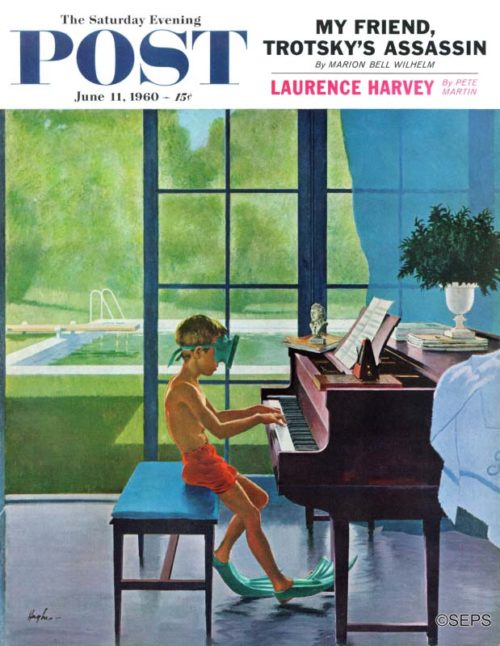
George Hughes
June 11, 1960
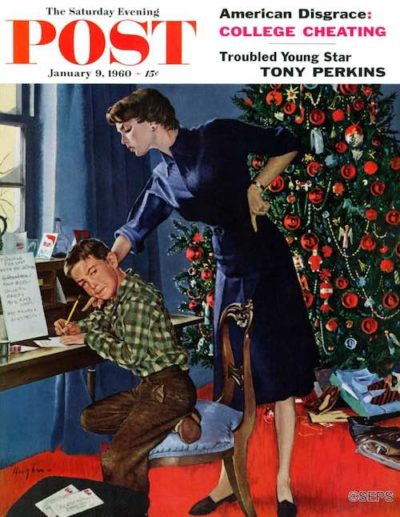
Wolfgang Amadeus Mozart, whose likeness is sitting on our young virtuoso’s volume of finger exercises, was playing minuets on the family harpsichord at age four— but could he have done so if he had been obliged to play with flippers on both feet and a swimming pool staring him in the face? We wonder. The model used by artist George Hughes is the same youngster who appeared on our January 9, 1960, cover. His mother was standing over him on that occasion, letting him know that he had stalled long enough and that he was not to go outside until he had written a Christmas thank-you note to Uncle Vic.
Dick Sargent
June 17, 1961
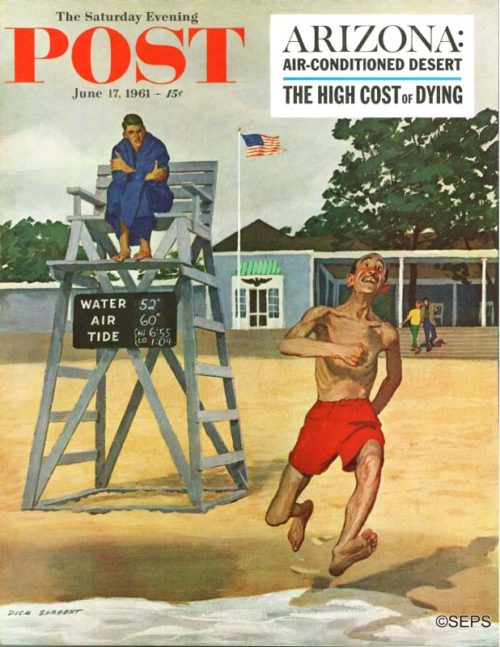
Most of us have seen swimmers of this ilk before. He was the kid around the corner who spent his vacation periods counting the days until he could return to school. He was the character in your platoon who used to volunteer for guard duty. Dick Sargent’s likeness is a realistic one. See that gap between the upper front teeth? Comes from gnawing on tree trunks. You can spot an eager beaver every time.
9 Cultural Trends that Are Definitely Happening
They say no one can predict the cultural trends of the future, but that’s nonsense. Anyone with half a brain saw yo-yos and fidget spinners coming from a mile away. (Hint: the next big toy combines slime, spinning action, and EpiPens.) Here are some more predictions you can hang your tiny fedora on.
- The Rules Diet
Most are familiar with the strict guidelines of the Paleolithic and Whole30 diets, but did you know dieting is going to get so much worse? Ever-changing — and seemingly arbitrary — rules will be the defining characteristic of the Rules Diet. Get used to no-salt Sundays and an entire week of barley cakes. Plus, extremely exotic recipes like the Laotian grilled bat will soon be making their way into your meal planning.
- Clutter
Prepare to Jackson Pollock your living room with junk and kitsch! It was fun to pretend we all liked the off-white walls and succulent décor of minimalism, but the maximalism to come will bring into vogue what everyone craves: lots of stuff. Remember Hummels, foil wallpaper, and towering stacks of old newspapers around the home? It’s all coming back, baby! And then some.
- LithgowCurrency
Cryptocurrency is so 2017, but never fear, affluent elites: Lithgowcurrency is the next big thing. This will be a virtual currency that exists only in the mind of acclaimed actor John Lithgow. The value of each LithCoin will be as stable as the enduring popularity of the 1987 hit comedy Harry and the Hendersons, and LithCoins will soon be as universal as Lithgow’s English accent is convincing.
- Poison Ivy Wrestling
Kids these days will do anything for YouTube views, and the next trendy stunt will be grappling in toxic flora for 15 minutes of fame and 9 days of skin rash. Sure, it’s unpleasant, but a lack of foresight is the defining feature of YouTube “vloggers,” and the winner can opt out of the next online challenge: quiet pursuit of a noble goal.
- Filtered, Treated Water
Raw water had its day, but the new fad will be avoiding giardiasis and other parasitic complications that come along with drinking “natural spring water.” It’s a simple process, and we’ve been doing it for decades: filtration and fluoride treatment. The best part? It’s much cheaper than 60 dollars per jug and probably isn’t carrying E. coli or Hepatitis A.
- Bustles
Future fashion trends are nearly impossible to predict, but bustles are definitely coming back in a big way. This time for men. Soon enough, you won’t be able to find a romper or a tracksuit without this Victorian-era frame on the derrière. The hottest stars will be flaunting bustles with their most dramatic pageboy haircuts.
- Communal Tax Filing
Sharing space for life and work is a special feature of Millennial culture. That’s why young people will be lining up for a hip hangout to itemize their deductions and calculate alternative minimums. Of course, there will be gewürztraminer flowing — it will be the new rosé.
- 2D-printed Memos
Once you ride in your self-driving car to your wooden skyscraper office during your “tech hiatus,” internal communication will be transformed. Just imagine receiving the information you need on a paper-thin, organic screen delivered straight to your squatting desk. I’ve seen the future, and it’s faintly familiar.
- Thoughtful Satire
Of all the future trends, no one saw this coming: internet satire devoid of needless snark. The next crop of humorists will be charitable and discerning in their amusing observations. Cynics beware! Irony may be dead, but benevolence is going to have a major moment. A brief, beautiful moment.
Read “Can Anyone Really Predict Pop Culture Hits?” by Cable Neuhaus for more on trendspotters.
A Vivid Portrait of the Famous Revivalist Billy Graham
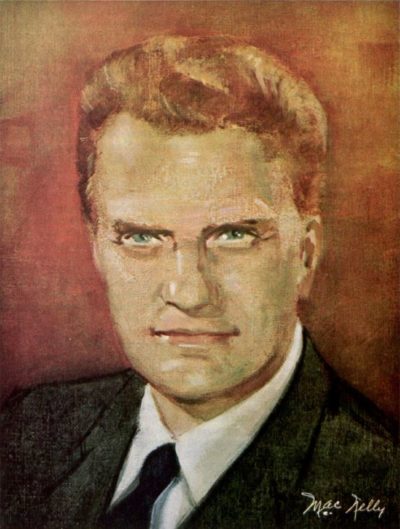
Evangelist Billy Graham passed away today at age 99. With good reason, Graham can be credited with shaping American society.
When he came to national attention in the 1950s, he was the new face of Christian evangelism. Graham was undeniably charismatic, but without the emphasis on hellfire and theatrics that Americans usually associated with evangelical preachers. He was young, handsome, approachable, strongly moral, and had much to say that many Americans agreed with.
He addressed concerns of living a good life in the shadow of the Cold War. Americans often felt overwhelmed in the post-war world, with its threat of sudden nuclear annihilation. They were looking for answers, and Graham had them.
He offered hope, reassurance, and a scripturally based faith that addressed the way they lived. And he attacked communism relentlessly. He saw communism and Christianity as mutually exclusive; one or the other would eventually pass away. Graham built an unyielding resistance to the Soviet Union, uniting patriotism with Christianity.
Graham quickly rose from obscurity in 1949, when a revival he was hosting in Los Angeles received highly favorable media coverage. His fame continued to grow nationally through the decade, and a successful 1954 revival in England brought him international renown.
The Billy Graham Evangelistic Association spread the word through radio, then television, becoming a multi-media enterprise that other evangelical ministries have followed. Graham made no apologies for the effectiveness of his outreach: “We are selling the greatest product on earth,” he said. “Why shouldn’t we promote it as effectively as we promote a bar of soap?”
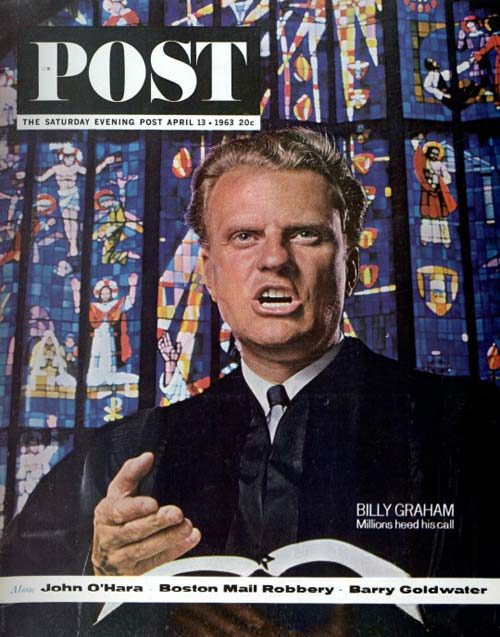
When Harold H. Martin profiled him in a 1963 cover story in The Saturday Evening Post, Graham was a powerful force in American religious life and politics. Martin wrote, “Many who propound [the gospel] are more eloquent preachers than Mr. Graham, and many are deeper theologians. None, however, has carried the message to more people in more lands, nor presented it with more power and authority, nor stirred a deeper response in his hearers.”
Throughout his career, Graham was attacked by both conservative and liberal theologians. Fundamentalist Bob Jones Sr. of Bob Jones University said of Graham, “”Billy Graham has done more harm to the cause of Christ than any man in history.” Progressive clergy found his message too simplistic for the “complex tasks of justice in the community.”
But many Americans found his message of redemption uplifting, and admired his integrity and humility. He told Martin, “What good my ministry has done I’ll never know until I get to heaven.”
The Art of the Post: Was Norman Rockwell Secretly a French Impressionist?
The great French painter Claude Monet was mesmerized by the effects of sunlight. He noticed that his subjects looked very different depending on whether he captured them in the morning light, at noon, or in the evening, so he painted the same subject again and again at different hours. The art movement we call “impressionism” was named after one of Monet’s paintings of a sunrise.
Here are a few of Monet’s famous “haystack” paintings:
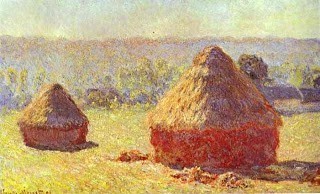
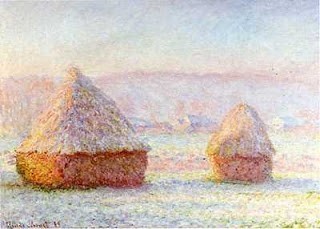
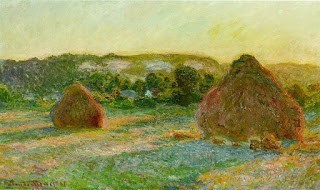
But Monet wasn’t the only great painter who was inspired by the changing sunlight.
In 1952, Norman Rockwell painted a cover for The Saturday Evening Post entitled “A Day in The Life of a Girl.”

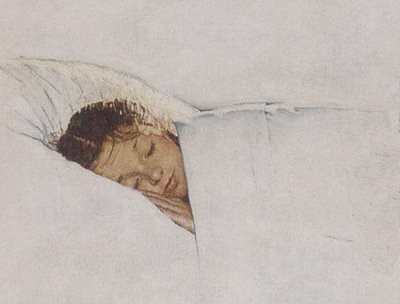
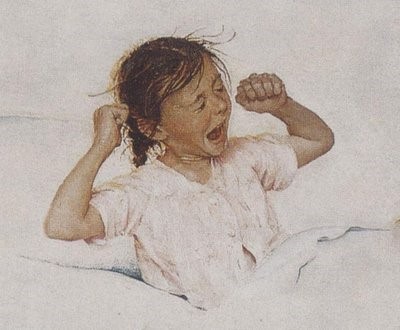
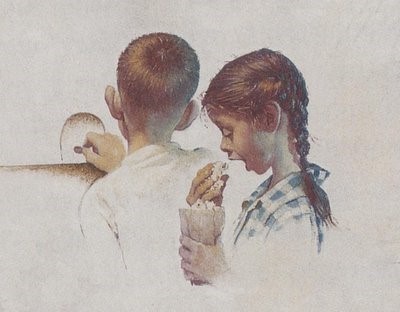
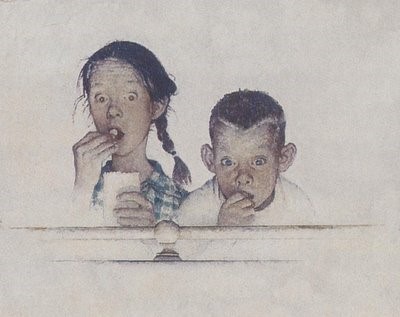
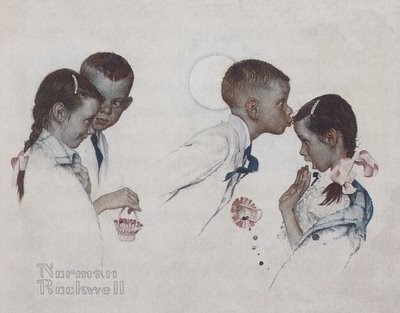
Rockwell divided his painting into 22 separate vignettes, starting at dawn and ending after nightfall. Each vignette contains a funny or touching anecdote about the little girl, but look past the anecdotes and you’ll see so much more: each vignette is also a brilliant study of the light at that particular time of day.
The opening vignette is gilded with a brilliant yellow white color.
After painting the girl and her friend swimming in the midday sun, Rockwell depicts the children in the cooler glow from the light of a theater marquee.
Next he shows them illuminated by the very different light of the silver screen:
Outside again, the children’s skin takes on a completely different color in the moonlight (just like Monet’s haystacks):
Contrast the cool light of that moonlit walk with the warm glow of the bedside lamp as the girl fills out her diary:
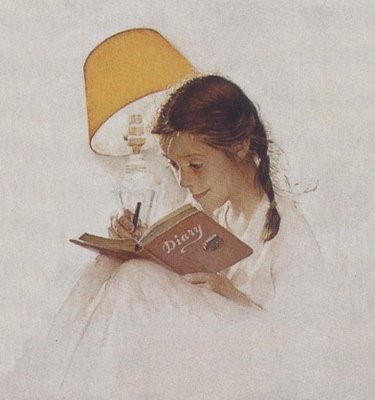
Back in bed: compare the ending colors of the girl asleep at night with the beginning colors of her asleep in that that same bed in the morning. You’ll find that Rockwell employs a totally different palette.
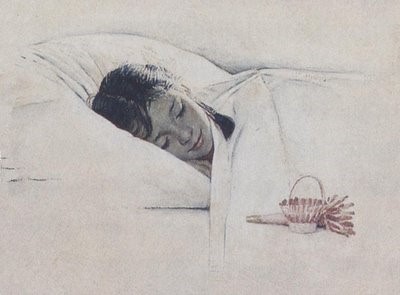
It was a challenge for Rockwell to capture all those different figures and expressions properly, but it was a far greater challenge for him to distinguish the morning sunlight from the reflected light of a swimming pool, or the neon light outside a theatre, or the warm glow of a bedside lamp. Fundamentally, the real subject of Rockwell’s painting— just like Monet’s haystacks—is the effect of changing light.
It’s not hard to argue that Rockwell’s painting does a better job of describing changing light conditions than Monet’s. Rockwell describes more variations in natural and artificial light, working in a smaller, humbler space. (Monet was able to tip us off about the time of day by painting the sky light or dark in the background. Rockwell did not have that advantage; he was working with an all-white background so his only tools for persuading us were the subtle hues of the children’s skin and hair, and a few stray props.)
A less talented artist might have been tempted to paint the same skin tones and hair color on the children throughout the painting. After all, the anecdotes would be the same, and this cover was already complex enough with all those small vignettes. Consistent colors would help glue together the composition and provide welcome continuity. But Rockwell set his goals much higher than that. His extraordinary powers of observation were exceeded only by his work ethic.
It would be stretching things to suggest that Rockwell was a French impressionist at heart, but in this painting he clearly takes up the impressionist challenge and triumphs. Don’t stop with Rockwell’s anecdotes; he poured his talent into an extraordinary job of understanding and appreciating changing light conditions, and the result is just as museum-worthy as Monet.
North Country Girl: Chapter 40 — Return to Mexico
For more about Gay Haubner’s life in the North Country, read the other chapters in her serialized memoir.
Mindy and I had our last day by the lovely El Presidente pool, drank our last coco loco cocktails, and our Spring Break was over. It was our final night in Acapulco. Part of me just wanted to spend it in our hotel room, reading one of the ponderous textbooks that I had stupidly brought along till I fell asleep in a bed by myself. I had been given a week straight out of a cheap romance novel, a Spring Break that would have taken the gold in the Spring Break Olympics; I could rest on my laurels.
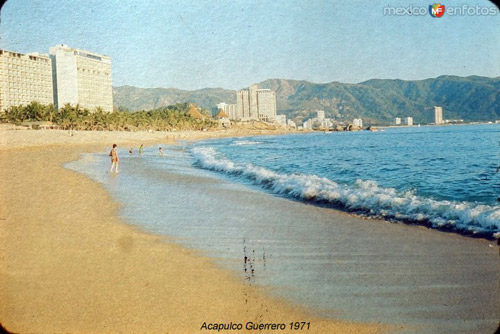
But it was Mindy’s last night too, and she had been such a good sport and good friend. If I had to go down in flames, getting dumped in public by my Acapulco boyfriend, at least we could eat spareribs and drink margaritas at Carlos’N Charlie’s one last time. I happily agreed to skip Fito’s lounge act. I don’t know if even the most devoted groupie could have endured hearing him sing “Little Red Riding Hood” one more time. And one way or the other, our fling, our romance, was over.
Mindy and I put on our cutest outfits, the ones we had been saving for our last night, and headed out. Thanks to our day on Baldy’s swimming platform, I had achieved as perfect a tan as a Minnesota girl could. My skin had browned to the exact shade of a Parker House roll and my hair had sun-kissed highlights no beauty shop or bottle of Sun-In could replicate.
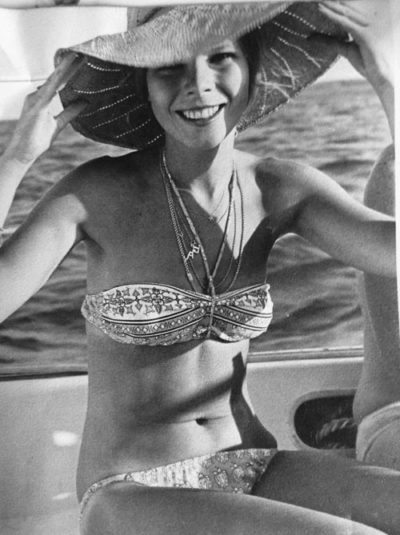
No longer rubes, Mindy and I presented ourselves at the door of Carlos’N Charlie’s and were whisked inside, ignoring the glowers from the tourists waiting in line. The bartenders and waiters smiled and waved as Mindy and I were led to a balcony table that had a full view of the dining room and bar, and more importantly, where everyone in the restaurant could see us. I assumed that our VIP treatment meant that Fito was not canoodling with another blonde at the bar, but I carefully scanned the room anyway.
Fito was not there, but looking deeply and directly at me was another gorgeous, perfectly tanned Latin male in a blindingly white shirt, a man who made Fito look like a mutt. Years later, when I first saw Andy Garcia in a movie, I was convinced for a moment that he was the guy from the bar, the guy who had me in his sights and was smiling a very sexy half smile.
The next second, he was at our table. “Hello gorgeous ladies. May I buy you a drink?” Once again, Mindy got thrown under the bus, as Javier, as he introduced himself, was flying solo and was there for the blonde. My prayers had been answered.
Javier had shiny black hair, combed straight back from a widow’s peak, that gave him a touch of the mysterious. He had those deep-set eyes I cannot resist, eyes that were hooded under thick brows and thicker lashes, and perfect white teeth that out-gleamed his shirt. And he had a certain something special about him that even Fito the Fabulous lacked; I later realized that Javier’s shimmering aura came from being the heir to a large Mexican fortune.
This will work, I was thinking, here’s my out. I can’t be dumped by Fito if I am with another guy.
“Where are you from?” I twinkled. Javier lived in California and was a ski instructor. People skied in California? I had never heard of Mammoth. In Minnesota, a fancy ski area was one with a chairlift, and the only instructors were ski team girls teaching little kids the snowplow. I tried to make skiing small talk while imagining how Javier would look on a ski slope, but the idea that kept popping up in my mind was how you can make candy by dribbling hot maple syrup on freshly fallen snow.
Javier was speaking lower and lower, his face getting closer and closer to mine. Mindy spotted Jorge at the bar and grabbed her drink to go say goodbye. Javier exhaled in my ear, “Where are you going after dinner?”
I told him I didn’t know and confessed that it was my last night in Acapulco, which spurred Javier to move in for the kill. I let him kiss me, slitted my eyes, and watched Fito walk into the restaurant. As Javier pressed me back against the booth, Fito looked my way and buckled in astonishment. He turned and headed towards Jorge and Mindy at the bar.
I had won at this game, even though I would have been hard pressed to explain the rules, and I wasn’t sure what the prize was, outside of not ending up like Miss Sweden, brushed away like a piece of lint.
Mindy spent her last night of Spring Break at Armando’s, listening to Jorge make his final pitch to get her to sleep with him and watching Fito sulk. I spent my last night with the skiing Andy Garcia. We ended up in his room at—where else—the El Presidente hotel.
A few minutes after we had slipped into his bed, with very unfortunate timing there was a pounding on the door, a pounding that did not cease despite Javier yelling “Vete!” followed by what had to have been some extreme Spanish curse words. Then we heard a key turn in the lock and the door opened. It was the El Presidente’s house detective, who accused me of being a hooker and threatened to have Javier kicked out if I didn’t leave immediately. The detective stepped out of the room and lit a cigarette, my cue for how long I had to get out of there. I dressed and kissed Javier goodbye forever.
“Don’t you come back,” hissed the house dick and grabbed my elbow in a way that showed me he meant business and left a bruise for a week. I was escorted out of the El Presidente to do the midnight walk of shame back to my own crap hotel where I packed my pink Samsonite, making sure to shake all the roaches out of my bikinis and gauzy dresses and miniskirts. The next morning Mindy and I were on a plane home to Minneapolis.
After a week of sunshine, poolside lounging, and swanky, glittering discos, coming back to snowy, sleety Minneapolis in March was like waking from a wonderful dream. No place like home my foot. If I were Dorothy I would have been banging my head against the wall trying to get back to the Emerald City of Oz.
Always the good little hamster, I climbed back on my treadmill, going to school, going to my waitressing job. The grey days melded into each other. I dutifully trudged through the chest-high snowdrifts to my spring semester classes, where I tried to concentrate, to banish the Technicolor memories of—could it only have been the week before?
After classes, I waited in the cold for a bus to take me to work, the pale sun setting behind the Mississippi River, shivering and sniffling and hoping I wouldn’t be too late. I leapt off the bus at my stop, ran down the steep, slippery, snow-packed hill, and threw open the back door of Pracna that led to the staff room. Amid the fug of cigarette smoke and Jovan’s Musk, I stripped off my fifty layers of winter wear, put on my green apron and my most charming, obliging smile, and went out to greet my first table and run my feet off for the next six hours.
I was not alone in my unhappiness. Patti’s week in Florida with Eduardo’s family had not gone well: la familia was too busy fussing over their darling hijo to even pretend to notice the red-haired gringa he brought along. No one had said two words to Patti, not even Eduardo as his mother continuously spooned his favorite Cuban food into his mouth as if he were a very large toddler. When the maid showed Patti to the pool house, where she would be sleeping alone for the week, Eduardo just shrugged and went back to his pernil.
At work Patti slammed around the paper plates, cursed at the cooks, and chain smoked in the staff room. She radiated anger. She wasn’t speaking to Eduardo, waiting for him to apologize or even better, propose. Since Eduardo and his car were no longer around to ferry us home, Patti, Mindy and I shared cabs in uncomfortable silence after work. And without Eduardo’s warm, inviting, pot-filled apartment to go to, every night I ended up back in my own place, where the thermostat struggled to hit sixty degrees. My friendship with my roommate Liz had already turned frosty; I had been too caught up with work and my new friends. I was tired, lonely, and cold.
Just when the rest of the civilized world was welcoming the first robin and crocus, Minneapolis was hit with a furious blizzard and temperatures in the single digits. In those days in Minnesota, there were no weather-related closings. Even elementary schools sent out their snow-tired yellow buses to pick up frozen, ice-covered lumps waiting on corners. Crossing the campus to my eight o’clock class, I felt like Robert Scott at the South Pole. It seemed that no matter what direction I walked, I was heading into the wind, a wind that threw sharp-edged, blinding sleet into my eyes and the bridge of my nose, the only parts of my body that were exposed to the elements. The gales blasted snow down the tops of my boots, where it melted into ice water. By the time I got to Pracna, I had to take a few minutes to rub life back into my pink and numb feet before gingerly easing them into my work shoes—minutes that were clocked under the stink eye of my manager.
In the restaurant I was greeted by a shocking sight: the dining room held only a handful of couples, thawing out with bourbon or rye. When I went to the bar to fetch drinks, a row of empty bar stools stretched out before me. The hostess slumped over her stand, waiting for someone to show up. The jukebox blared out “Crocodile Rock” to an empty room.

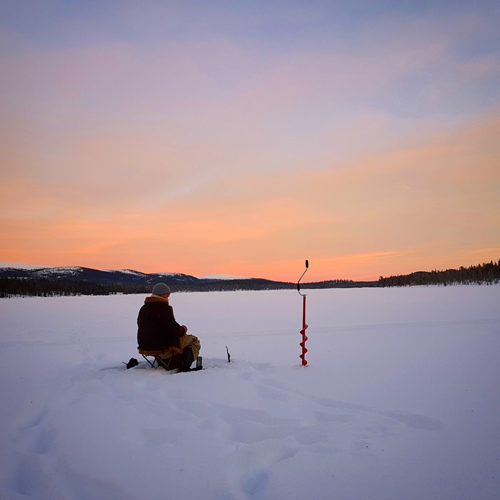
That blizzard was the last straw for normally hardy, weather-resistant Minnesotans, people who enjoy tobogganing and skiing in white-out conditions, who sit for hours on frozen lakes ice fishing. But now everyone in Minneapolis looked out the window, checked the thermometer, said, “Hell with it. I’m done with winter,” and hunkered down in front of the TV.
For most of our shift, Mindy, Patti and I huddled around the end of the bar, eating maraschino cherries and beer nuts and not talking. The bartenders stopped cutting limes and started smoking. It was as if we had all gone into hibernation.
The blizzard did not let up. I was no longer coming home with my pockets full of dollar bills. I sat in class, my mind bouncing from grey worries about money and how late the bus to work would be, to glorious snapshot memories of Mexico, memories so sharp and clear that I could almost feel the warmth of the sun on my face, smell the Coppertone, hear the echoing throb of “Push Push in the Bush.” I snapped to only when the other students got up to leave and looked down at my notebook, as blank as when I opened it an hour before, the pencil resting forlornly across the page.
I had glimpsed what life outside Minnesota could be like and wanted more of that, away from this endless winter. That night I slipped under the eighty blankets piled on my bed, and right before I shivered myself to sleep, I remembered what the smitten Jorge had said to Mindy: that if she wanted to stay in Acapulco, he could get her a job.
I made one last freezing, sleeting walk across campus to the bursar’s office where I officially dropped out of college and got my full tuition of $222 back. I had more than enough money to fly to Acapulco. I quit my job at Pracna and said goodbye to Mindy and Patti. With so few customers, everyone could use extra shifts, so no one minded my leaving on short—actually no—notice. Mindy hugged me and wished me luck and didn’t act as if I had lost my mind. If anyone understood the scrambled desires running through my brain, she did.
Liz was not so understanding about me leaving, and with good reason. She now had to either pay all the rent herself or find a new roommate for one semester, a semester that had already started. I was a jerk to leave her like that. I was out of my mind, worn out by winter and work and bedazzled with visions of discos and hot sunshine and handsome Latin men. I packed my pink Samsonite and flew out of the snow and cold, headed south again.

“The Call of the Road” by Maude Radford Warren
Although they have little enough, the Irish at heart are a grateful and devout race, and that was one reason why Michael Dwyer never opened the door of his little hut without offering thanks for the weather.
“Ah, ’tis a grand day, thank God!” he would say if the sun were shining; or if the rain were pouring he would remark:
“Ah, a bit of mist, thank God! That’ll be fine for the crops.”
Yet another reason why Michael Dwyer loved the weather and the sky was that he had spent most of his life with them, for, until his marriage, he had been the most successful matchmaker in the south of Ireland. Up and down and across would he go, from barony to barony, bearing the parents of marriageable girl’s news of likely young men looking for wives, and to the young men stories of the property and beauty of the girls. At the wedding his fee of a pig or a calf would be given him; but it was not for this reward Michael Dwyer cared. His heart had been in his work for its own sake; but now all that was ended.
Two years since he had made a grand match for himself, who had a scant three acres of land near the Wexford seacoast, by marrying tall, red-haired Aileen Murphy, with her six cows and two calves. The red hair he did not regret, for he liked a woman with a bit of temper of her own, but the cattle he had more than once wished grazing at the bottom of the sea.
“God help us!” he thought indignantly as he leaned across his doorway; “thim six cows have changed into six curses lighting heavy on my heart, they have so.”
Though Michael was past 40 he had the ruddy face of a boy, with rippling black hair, and wide blue eyes that rippled into twinkles to match the hair. Discontent sat now in his eyes as he thought of the days since his marriage. At first he and Aileen had rented the six cows to neighbors, and had taken the open road together with their tinker’s cart and the little ass Jenny, and Michael had pursued his profession. But perhaps Aileen had disliked to hear him praising other girls to their possible suitors; or, what was more likely, all her latent domesticity had blossomed with the possession of a husband. She wanted to sit by her own hearth instead of wayfaring at the house of some acquaintance. She wanted to rent three more acres. She wanted to sell the milk and the butter from her own six cows. She had developed an unsuspected capacity for making and keeping money. Many a time when he had asked her to go for a stroll as far as the ruined church of Bannow, or only the short length of the road to Scar Castle, she had refused. Sorra a foot would she go, with the chance to get a penny more a pound for her butter if she took it and the little ass to market at the Wexford bull-ring.
He sighed impatiently as he thought of the blue yarn stocking half full of shillings and crowns that she had in a hiding-hole over the fireplace. Ah, well; it was his days of peace she had coined there. What an omadhaun he had been to promise not to go matchmaking without leave.
“Musha, if it was not an insult,” he muttered, “I’d say she was more like a Scotchwoman nor an Irishwoman.”
Aileen, he knew, had taken the cattle down the road to graze them at the expense of the Government, thus saving her own bit of grass. Ah, but the road called him, too! It called like the tune of the Good Little People — that longing to be off down the long lanes of Wexford, past Taghmun, the Flame of God, past the blue hills of Oulard and Sculloughgap to the long, shaded way that leads to Glendalough.
He should have been at work in the garden, and Aileen had propped the hoe against the door of the but as a reminder. Sighing, he took it up; then, as he saw a figure coming down Wilson’s Lane, he paused.
“’Tis the new neighbor, Mogue Sullivan,” he said. “‘Twould be indacent not to give him the good-day. Well! What at all can be the matther wid him? Has the pig died on him, I dinnaw?”
Young Mogue had the figure and lines for liveliness, but now his great length was lax, his broad face was spiritless, and his blue eyes were fixed in an unseeing gaze beyond Michael.
“God save you this good day!” called Michael. “I hope no misfortune has crossed you.”
Mogue leaned on the sunken fence and shook his head.
“Some bad luck is betther nor others,” said Michael comfortingly. “It might be worse nor the loss of a pig — “
“What talk is this of pigs? “said Mogue moodily. “’Tis natural enough, though, that you, a man of property, wid six full cows, should have your head running on riches.”
“’Tis only that you looked so heart-scorched,” said Michael placatingly, “and ’tis little enough store I set by the cows, and that’s the truth.”
Mogue felt some obscure surge of sympathy, and so he burst brokenly into a confidence.
“Ah, well; I might have seen from Ireland’s histhory that no man in her could iver have luck be daring a bit in his own affairs. I am off to the priest’s this morning; I am to tell him that ’tis not he need call my banns next Sundah. The thirrd time, too! That iver I saw this day!”
“Man alive! Is she dead?” cried Michael. “Little Oonah Canavan that I saw christhened!”
“Worse! worse!” said Mogue. “Now, I will tell you the truth, Michael Dwyer. As you know, up at Glendalough she lives, where you coorted your own wife, and what you don’t know is her father had a bit money dhropped to him this month, and he’s looking high for Oonah now. I was the great match last month wid me three acres and the pig, but now I’m not good enough. Well, when ould Canavan turrned me off, down here I came, rented the bit land next you and had the banns published widout even telling Oonah.”
“Man alive! But you’re the bowld wan! “said Michael admiringly.
“Will ye wait till I tell the full of my tale?” cried Mogue. “You’ve seen Andrew Saunders, the Scotch clerk of the hotel at Rathdrum? Fifty if he’s a day, and he the sly fox! All these years the man’s been saving money and dhriving bargains like a — like a Scotchman, and now he’s got almost enough money to buy out the owner of the hotel. In two years he expects to get it.”
“Ah, sorra on him!” mourned Michael; “ould man Canavan would niver turrn him away.”
“Not him. I had a write of hand from Oonah this very morning. This week Andrew Saunders begins his coorting, it being an off-season, and their banns will be called next Sundah.”
The young fellow dropped his head on his arms and groaned. Michael was moved by conflicting feelings. His old matchmaking precepts told him that money should go with money, and his own experience advised him that, if Aileen had been as gearless as himself, their own ways might have gone more smoothly; or, if he had had six cows, he might have been as keen on coin as she was. But when he thought of Aileen’s dear hazel eyes and her smile for him when she had the time and heart to smile, then he felt that love and not money ought to make the match.
“Well, there was the Widdy McCarthy you worked for in Macmines,” he said irritably; “why wouldn’t you have thought of marrying her? She had plenty.”
“Did I say she wanted me or I wanted her?” asked Mogue, lifting his face indignantly.
Michael divined that Mogue could have married the widow, but would not say so, and smiled.
“Well, me lad,” he said warmly, “now, I’d like to help you, I would that. As you know, I’ve left the road; I do no more matchmaking, but I will see what Aileen says. Do you say nothing to the priest. I’ll see can I go to Rathdrum and Glendalough and make terms.”
Mogue looked at him with dawning hope.
“Maybe you’d be willing to help Aileen wid the garden a bit while I am gone,” said Michael in a far-away tone. “She was counting on my work this week.”
Mogue seized the hoe eagerly.
“I will that, if she will let you go.”
Michael drew himself up.
“It’s not a question of her letting me,” he said. “I am masther yet, I belave, in me own house.”
“Of coourse; I meant you’d be by way of consulting her,” said Mogue.
“Well, I will show you where to worrk in the garden,” said Michael.
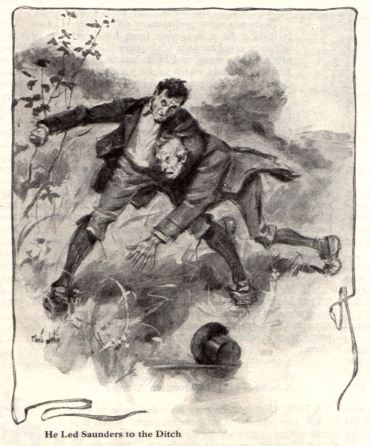
He led the way and made a stroke or two himself with the hoe before he handed it to Mogue. Then he hastened down Wilson’s Lane after Aileen and the cows. The call of the road was louder than ever in his ears. What was his hut or a few bit turnips in the garden? What were the cows? What — the Saints forgive him — what even was Aileen to that happy walk with his stick and his dreams past the blue hill of Oulard, and the softvoiced River Slaney, and Croghan Mountain, and deep Sculloughgap?
Aileen was sitting on a hummock of grass, knitting swiftly at a blue sock, casting a glance, now and then, at the cows, but never a look at the soft blue hills did she cast. Never a deep taste did she take of the salty air. The sun struck across her red hair, her quick fingers flew with the needles, and there she sat out of tune with the beauty about her, thinking only of money.
Michael hailed her with a smiling forgiveness of the sharp words they had had that morning because he would not get up to work before the sun rose.
“I’ve the bit news for you,” he said. “There’s an awful scarcity of butter at the hotel in Rathdrum, and two excursions down from Dublin this week.”
She looked at him suspiciously as he seated himself beside her.
“I was thinking you might like a chance to go; I could take care of the cows while you went up,” he suggested.
“Yes, and find the butter dropped a penny when I got there,” said Aileen. “I’ve me safe market at home here. Why aren’t you at worrk in the field?”
“I did work a while, and then I left Mogue Sullivan in my place,” said Michael. “He’s doing it for nothing.”
He chewed a spear of grass reflectively, and then told her of the trouble of Oonah Canavan and Mogue Sullivan.
“Ah, well,” said Aileen. “‘Tis too bad, ’tis so; but sure when neither of thim have anything what’s the use at all?”
Michael said nothing.
“If even wan of thim had a little,” she allowed. Michael pressed her hand, and then, relinquishing it, said briefly:
“Well, now, it occurred to me I could make something out of this and do a kindness, too. It would be far more fitting if the Widdy McCarthy and Andrew Saunders married. Then he could buy the hotel at once. She might give me that new churn you are needing, and Andrew would give a calf, maybe. Besides, I could take the little ass and the cart and sell your butter in Rathdrum.” His voice trailed into silence under her accusing gaze.
“And who’d do your worrk while you’re gone?”
“Young Mogue Sullivan says — “
“Ah, ’tis little enough love you’ve left for me!” said Aileen bitterly. “‘Tis like pulling teeth to get a stroke of work out of you, and me worrking so harrd over me six cows.”
Michael rose angrily: “Thim six cows! ‘Tis all I iver have to come home to — not a real wife, only a money machine! No wife nor child; only six cows! If you throw thim cows in my teeth agin I will go,” he said, “and I’ll niver come back till I’ve six to match thim, or am dead on a stretcher.”
“One’s like as the other,” she jeered. “Go your ways!”
Michael stared at her in amazement. A sharp word passed between them, now and then, it is true, but never such words as these. He looked down on her steadily.
“There’s times I wish I was a cow, and then you’d have your old love for me,” he said. “I’ll go now. Will you give me a good luck, gurrl?”
She turned her face away from him, and he did not guess that her shoulders were shaking with sobs, for it was not like Aileen to cry.
“Goodbye, then,” he said, “and a curse on thim cows and the stocking that’s come betune us!”
He strode back to his cottage with the feeling that the blue and gold of the day had suddenly grown dim. He presented a calm face to Mogue. Then he packed himself a lunch, found his old blackthorn stick and set off down the Wexford Road.
At first he was sure the day was spoiled for him, but, after a time, a whistle rose to his lips and he swung his stick lightly enough. The young leaves danced in the spring winds, and he was on the road again. The road seemed to race under him, for, here and there, he was given a lift in a wagon, so that it was still afternoon when he reached Macmines and found the small house of the Widow McCarthy. He hesitated, surprised at its dismantled appearance, but she put her head out of the door and welcomed him.
“Come in, Michael Dwyer; God save you!” she called. “There’s a chair and a bite and a bed for me friends yet, if I am going to move.”
She was a snappy-eyed, hearty woman of his own age, with a ready smile and a quick tongue.
“Well, and the sight of you’s good for sore eyes,” he said when they were seated over the tea-table; “and why are you moving at all?”
She told him a tale of bad luck and robbery by which she had failed in her farming, and said she had never had a taste for such life anyway, and was going to take what money there was left and keep boarders and lodgers after she had looked about a bit. While she chattered of her affairs a slow, roguish smile rippled back and forth over Michael’s face.
“Well,” he said gravely when she had finished, “why don’t you thry a place in Rathdrum? There’s a hotel to be sure, but it’s expensive. If you stharted a nice boardingplace with a tea-house attached — “
She mused: “Well, now, it’s not such a bad plan, and Rathdrum not so far from here but I could get a sight of my ould neighbors at times.”
“I wish you were a marrying woman,” he said.
“Who said I wasn’t?” she snapped.
“Well, there’s Andrew Saunders, the Scotchman. He’s going to buy the hotel out in a year or so. Now, if you were married to him he could buy that hotel at once and soon you’d be the richest woman in Rathdrum. My, but I’d like to see you crowing it over the neighbors all dressed up in black silk of a Sundah, sitting in the best pew!”
She preened herself over the picture.
“Of course, though, it’s a dream,” he sighed. “I’ve heard it said that Andrew was thinking of marrying Oonah Canavan. Of course, she’s not got your own property or your good looks. You’d not care to cut her out wid Andrew, though they do say she’s in love wid a young felly.”
“I’d cut no wan out,” said Mrs. McCarthy warmly; “but if marrying a man of property would bring two young hearrts together, does it not point me my duty, Michael? “
“Sure, it can be looked at that way,” agreed Michael, “and you ought to be married for a man’s happiness. Do you consent, thin?”
“I do,” said the widow piously.
“What comes to me, thin?” asked Michael.
They bargained long, Michael at last winning the promise of the coveted churn and two young hens. Then, after they had clinched the bargain with a fresh brew of tea, Michael obtained from the shrewd Mrs. McCarthy a statement of the property by which he was to sing her charms to Andrew Saunders.
“Musha, woman; I’d no idea you were that rich!” he cried admiringly. “No Scotchman could resist you; though an Irishman,” he added, “would be glad to take you for the sake of your own charrms.”
“Ah, then,” she said dryly, “Andrew Saunders will see thim charrms through a mist of goold.”
Next morning Michael set off early with a gay heart. He looked back at Vinegar Hill, sacred to him for its association with his ancestor, Michael Dwyer of ’98, and then the road called him; and he whistled and sang as he walked, trailing his stick along the shaded road that led to Sculloughgap. It was high noon when he reached Rathdrum. He knew that Andrew Saunders would offer him a bite and sup but grudgingly, so he ate the lunch with which Mrs. McCarthy had provided him and relinquished the thought of a cup of tea. With an assumption of fine heartiness he strode into the hotel office where Andrew sat.
“Well, and how are you?” he cried. “Man! but you look fine!”
Andrew Saunders was thin and freckled and reddish, with a sharp, suspicious face and reserved voice.
“Have you had dinner?” he asked reluctantly as he let Michael take his limp hand.
“Sure I have; ’tis slow you are. I’ll sit by you while you ate yours and then I’ll not waste your time, for I know the busy man you are, Andrew.”
Saunders led the way to a corner of the empty dining room and ate sparingly, while Michael talked of crops and friends and the good luck of the world in general. When he had cast a thoroughly optimistic atmosphere about them he said slyly:
“What’s this I hear of your marrying wan of these days?”
“I’m thinking on’t,” admitted Saunders sheepishly.
“Well, who is the big, sthrapping gurrl you’ll get? Molly Murphy, belike?”
“It’s Oonah Canavan,” said Saunders shortly.
Michael emitted a long whistle.
“Ye seem surprised,” said Saunders, offended. “Are ye thinking I’m too old for the lass?”
“Musha! No; you’re young yet, Andrew; it’s just she’s such a shmall, delicate gurrl, and with no head for management whatever. But then it’s not as if she had to worrk harrd — you’ll just keep her boarding; she’ll have nothing to do.”
Saunders looked at him sharply. “Her father said she was strong,” he remarked.
“And why wouldn’t he?” asked Michael — “if he had a good chance to marry her off to a well to-do man like you? Her wid not a tack to her name.”
Saunders ruminated. Evidently Michael had not heard of the bit property that had been left to the Canavans.
“I’m delicate-looking myself,” said Saunders, “but a hard worker.”
“Well, maybe when she’s fed up by you, Oonah will do fine,” said Michael cheerfully. “For myself, a harrd-worrking, energetic woman isn’t to my taste. They are sure to be too saving and pinching.”
“I wouldn’t call that a fault in a woman,” said Saunders.
“No? Well, we look at things different. I’ve just come from a woman that got me full wore out wid the amount of worrk she done wid my two eyes on her. Begorra, you may meet her; she’s thinking of settling here.”
“Is she? Would she be wanting to board in the hotel, or would she be taking a place of her own?” asked Saunders with interest.
Michael laughed. “Man alive, if she comes there’ll be no hotel here. She’ll have all the customers. She’s thinking of starting a boarding and tea house. My, but she’s the smarrt woman, and that attractive! Let a tourist get his eye on her and he’d have to folly her!”
“There isn’t room here fora hotel and boardinghouse, too,” said Saunders.
“Sure, she counts on that; but maybe she won’t come — not if I put through a match for her I’m thinking of. She’s a widda well left.”
“Well left? “murmured Saunders.
“Sure, she dinned in my ears what she had,” Michael said. “My idea was that, if I could match her wid some likely man with money of his own, the two of thim might buy a hotel in Dublin or somewhere. She’s a great idea for business, but I mustn’t be throubling you wid my tales of the Widda McCarthy. Tell me more about little Oonah Canavan.”
The thought of her passed through Saunders’ mind, with her shy eyes and soft, misty hair; then he gulped and said:
“What property has Mistress McCarthy got?”
“Musha! Why should I tell you?” said Michael with indignant emphasis. “The list was given to me to present to the man I’m going to make the match wid.”
“Have you got him in your mind?” asked Saunders.
“I have that,” said Michael.
There was a short pause. Saunders saw again Oonah’s little fair face and her thirty pounds dowry, but that was only a tenth part of what he still needed to buy the hotel at once, and the proprietor had that day offered it to him at a decided bargain.
“Just tell me this,” he asked huskily, “has the Widow McCarthy as much as three hundred pounds?”
“If I am violating a confidence I hope to be forgiven,” said Michael with dignity. “She have.”
“Then,” said Saunders with a rusty sigh as he relinquished the vision of Oonah, “is this man in your mind a greater match than I am?”
“I would call him the same,” said Michael gravely. “But I warn you, Andrew, I want something for myself when I make this match.”
“Well, then, you’ll do something for auld lang syne,” said Andrew. “What has Mistress McCarthy got, lad?”
Then followed a long afternoon of bargaining that Michael Dwyer often said was the hardest work he ever did. They sat in the hotel office, and Andrew whimpered and begged, ever and anon going off to serve a customer, and then coming back with fresh force to the belittling of Michael’s fee. It was only when Michael had set off for the fifth time down the road to Glendalough that Andrew ran after him, half-weeping, and said:
“Well, then, here it is in your hand. I have given you my written word to let you have a calf on the wedding day.”
Michael scrutinized the paper closely, and then said:
“So it is settled. Do you send a scrape to the widdy yourself to say when you will be down to coort her; and remember, you promised to post a scrape to the Canavan’s to-night saying the match wid thim is all off. Good-day to you.”
When Andrew was out of sight Michael slapped his knees and laughed with a glad heart for Oonah, and Mogue, and the widow, and even Saunders, for that he had done them all a good turn he had no doubt. He thought with a softened heart of Aileen. She had told him to go his ways, and he had threatened not to come back without six cows; but, sure, a churn and a calf were the next thing to six cows, and Aileen would want him home again, he hoped. He thought of the greed for money that divided them with a special sorrow, for it was upon this shaded road to Glendalough that he had discovered that he loved Aileen. Three miles more and then would appear the hill that opened its heart to send out a gush of fairy water, and here it was that they had clasped hands and said the word that made them each other’s. He could see her again as she had looked that day, with the sun on her red hair and her full lips quivering with hurt pride, for he had been slow to the wooing. If poor Aileen could have but known it, they were nearer together at that moment than they had been since the first months of their marriage.
On he walked, up hills and down, with the great trees on each side, about whose trunks climbed ivy with sharply-defined, sparsely-growing leaves, until he came in sight of the ruined church of old Saint Kevin. He stopped for a moment under the great Celtic cross which some say is over Saint Kevin’s own bones, and there he said a prayer for Aileen and himself, and then he went around the lower lake till he reached the little whitewashed cottage of the Canavans’. Out the Canavans came to welcome him — old Terence and Mrs. Canavan, slim-waisted Oonah, who always reminded him of an apple-tree in blossom, and half a dozen children. When the parents greeted him with warmth Michael felt like a traitor as he thought of the grand match he had spoiled for them, but when he turned to Oonah and saw how her cheek had paled and how sad her eyes were, he felt that there were few men who would take so much trouble for friends as he had.
The next morning Mrs. Canavan bade poor, pale Oonah put on her Sunday dress, and Michael knew that that meant Andrew Saunders was expected to come courting. When he saw the girl’s look he could not resist whispering a word of hope in her ear. She was discreet, so she asked no questions, but she sang a bit at her embroidery, and Mrs. Canavan thanked the saints her child was beginning to see her good luck at last.
They were at the noon meal when half a dozen of the young Canavans came up from the post-office with a letter, an unheard-of event for the household. Michael praised himself, for he knew this must be Saunders’ communication. Oonah, as the scholar of the family, read it, first to herself, then, after the children had been put out of the house, to her elders. Mrs. Canavan threw her apron over her head with a wild keen. Old Canavan tramped up and down the kitchen, clenching his fists and swearing. Oonah shrank back in her corner with eyes half-frightened, half-happy. When Mr. and Mrs. Canavan had somewhat exhausted their emotions Michael took a hand.
“What talk is this, Mrs. Canavan? You’d put the curse of Cromwell on any wan’d jilt any wan else, from all I gather. Yet you were making Oonah here jilt Mogue Sullivan.”
“That’s different,” said Mrs. Canavan.
“Troth, there’d be some difficulty showing the differ to Mogue,” suggested Michael.
“Oh, wirra! — and the disgrace brought on us when the neighbors hear,” mourned Mrs. Canavan. “Not a head of us can we howld up again.”
“Now, have conduct, woman,” begged Michael. “We’ll turrn the tables on Saunders; turrn them we will.”
He told them of how Mogue Sullivan had put up the banns of himself and Oonah in the Bannow Parish at Wexford, and when he had paused long enough for their indignant protests to spend themselves, he said:
“Ah, you’d thry the patience of Saint Patrick himself. Don’t you see how we can be using this? We’ll have Oonah elope.”
“What’s elope?” asked Mrs. Canavan suspiciously.
“It’s quite respectable; it’s what the gentry does,” said Michael impatiently. “A very fashionable and illigent proceeding, entirely, that poor people don’t often have the chance at. Now, I’ll tell you; the third reading of the banns’ll be to-morra. Today Oonah’ll elope down to my place and Aileen’ll take care of her the night, and she and Mogue can be married after mass to-morra.”
The parents glanced at Oonah, shy and breathless.
“Ah, she was always too good for Saunders,” said her father. “It wasn’t me pressed the match, anyway.”
“Heaven knows I always favored Mogue,” began Mrs. Canavan.
“Ah, sure, we all know ’twas Oonah that wanted Saunders,” mocked Michael. “Well, now, do you say the worrd. Let Oonah go today and both yous go tomorra. ‘Tis most romantic and unusual for parents to attend an elopement. It will be talked of for years to come, and, man alive! — think of the sour mouth of Saunders when the neighbors do be saying ’twas Oonah jilted him!”
His roar of laughter was infectious, and Oonah obeyed his nod and made herself ready for her journey southward. She got his ear and begged him to stay the day with her parents lest their minds should change and they should try to win back Saunders. Michael agreed. He had the good craftsman’s wish to see his work well done. Besides, it was pleasant enough to linger among the rums of the seven churches. Many a time had he and Aileen read the worn stones in the churchyard and wondered about the slow, quiet lives they recorded, and thought still more of the hundreds of unrecorded dead buried on this same ground for fourteen long centuries. There was not a path by the upper and lower lake that he and Aileen had not trod. He retraced them and thought of her so tenderly that he well-nigh forgot the six cows.
It was in a very softened mood that he bade good-by to the Canavans and left Glendalough to go home to Aileen. The late afternoon was as lambent as his thoughts of her. The road called him now, and he liked the taste of it under his feet as he swung his blackthorn stick and sang his songs, which were all of wistful love.
He intended to stop for the night at Rathdrum with Andrew Saunders, who would no doubt be glad to offer him supper and a lodging, considering the grand favor he had done him, but when he went into the hotel office Andrew was not there, and the proprietor told him, with many winks and digs, that Andrew had got lovesick of a sudden. The night before he had gone down to Macmines to court his lady. That very morning he had taken her up to Dublin to get married by special license.
“Begorra,” thought Michael, “so much the sooner do I get united to Saunders’ calf.”
The train from Dublin was almost due, and he started down the main street to the station to meet the bridal couple. Only Andrew got off the train, a transfigured Andrew, wild-eyed and wicked-faced, who ran up the road to Michael, beat at him with a knotty fist and called him a “thief “and a “liar.”
An Irishman strikes first and thinks afterward, but, even when Saunders, half stunned and bleeding from Michael’s assault, had had him arrested, even then Michael would not have given up the joy of his first retaliatory blows. But memories are not all-sustaining, and it was a shamed man enough that sat in the little police station, a prisoner, with the fear in his heart that Aileen could never forgive him for the disgrace he had brought on her.
Dreary enough were the hours poor Michael passed in the station. He was a stranger in Rathdrum; there was not a soul to talk to but the constabulary, whom, as they were Irish and yet in the pay of the Government, Michael considered as no better than traitors. On Sunday afternoon the hotel-keeper came to see him and explained the reason of Saunders’ wrath. Mrs. McCarthy had used her imagination in describing her possessions. A scant fifty pounds would cover them, and here was poor Saunders out thirty pounds for a special license. Mrs. McCarthy, or Mrs. Saunders, had gone to Macmines to move up her belongings. She had communicated with the hotel-keeper, and he was going to let them have the hotel if they gave a mortgage on it. He spoke of her as a fine, capable woman who would do Saunders good. Saunders himself was not in Rathdrum. He had gone, the hotel-keeper thought, to Macmines, but would probably appear against Michael in the morning when court would be held.
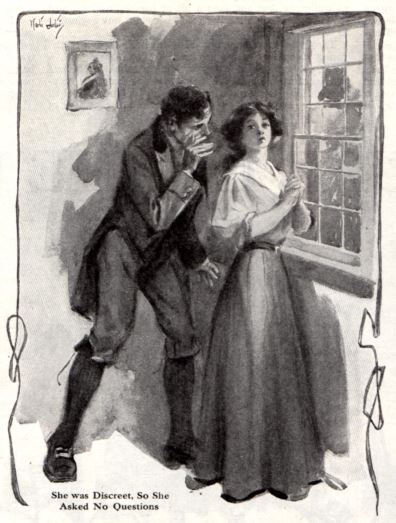
Though Michael’s curiosity was satisfied he had small cheer from the visit. To think the Widow McCarthy should have played him such a trick! Well, he would have the churn out of her anyway, and Saunders’ calf, if he had to steal it. To think that here he was shut up and this very day Mogue Sullivan and Oonah getting married through his kindness and Aileen looking on, wondering where he was!
Monday morning brought back his luck. Saunders did not appear against him, and as he had no money a kindly justice of the peace, for whose former cook he had made a good match, forgave him the costs of the case. He walked out of court a free man. He went to the hotel, and, showing the proprietor Andrew’s written promise that he should have a calf on the wedding day, he got the animal and set off with it down the long Wexford road. Aileen might not forgive him, but she would be glad to get the calf, anyway. A kindly farmer gave him a lift, and he reached Macmines before noon. He tethered his calf behind a friendly hedge and went to the house of the late Widow McCarthy. He pounded on her door with powerful fist. If Saunders was within he would leave his mark on him for every hour he had spent in that police court. But it was Mrs. Saunders who met him, in her arms a churn.
“Well, and I’ve been expecting you to call for this ever since me wedding, Saturday,” she said innocently. “Why didn’t you come?”
Michael glared at her. “You know right well, and if ever you want to make another match for yourself, it’s not to me you need come. You draw the long bow too harrd for my conscience.”
“Don’t forget your two hens,” she said;
“they’re tied to a post in the backyard; and Michael, avic, there’s a young cock along wid them, and the churn’s packed wid eggs, and give my love to Aileen.”
His scowl grew a shade lighter, and she pushed him into the house with a good natured laugh.
“Sure, it’ll be all the same a hundred years hence,” she said. “Come and have your dinner, lad, and then off wid you, for I’m a busy woman.”
She said no word of Saunders, nor did he ask any questions. He hurried through his dinner, and then shouldered his churn and the hens. He found his calf and set off once more to Aileen. The heavier his burdens were the surer he felt of her welcome.
The road called him, but only faintly. It was just the music by which he would be able to get himself home. The hot sun poured on him, the calf walked at cross purposes with him, the hens squawked and pecked at his shoulders, and he feared the eggs were breaking in the churn. Every step was a weariness, but he did not venture to rest till he was well past Enniscorthy.
Then, as he sat fanning himself with his hat, a man’s figure came into sight, walking northward. Michael watched it grow larger and larger as it moved rapidly toward him. Then he rose wonderingly to his feet. It was Mogue Sullivan.
“Mogue Sullivan,” he shouted. “Don’t tell me you’re afther deserting your wife like Saunders! What’s wrong at all?”
Mogue wiped his beaded face.
“Troth, it’s glad I am to see you,” he said. “I’ve been walking and walking to you since the hour of my wedding, and poor Oonah left alone.”
“What is it at all? “asked Michael.
“Just this,” said Mogue. “There was no hair nor hide of you and your wife at our wedding, and afterward we walked down from the church to your place to see was anything wrong, and there was herself white and sick on the bed.”
“Aileen sick?” cried Michael.
“Wait now, till I tell you. It was long enough before I could get anything out of her, and half of it was guesswork, and from what I saw aftherward. It seems Andrew Saunders came down to see her and told her you were arrested for half-murthering him and another man, and he’d set you free again if Aileen’d pay the piper.”
“The Hoosian!” cried Michael.
“Who did I see on the road,” went on Mogue, “but our fine Saunders a-driving of your six cows! The thief of the worrld!”
“She gave up thim six cows for me?” Murmured Michael. “God bless her!”
“And so Oonah and I talked it over and she said she’d not be afraid to stay alone, and I footed it here to meet you, for it seemed to me you’d want to get than cows back from Saunders, and clout him on the head wan besides, and so I — “
“And she gave up thim six cows for me!” murmured Michael.
Mogue stared at him resentfully. “I thought you’d be dancing wid rage like a hen on a hot gridiron,” he said angrily, “and me coming all this way and spending me honeymoon alone to tell you. Well, Saunders is back three or four miles now a-driving the cows. I cut along on the inside of the hedge past him, and a fine crick in my back I got for my pains, and little thanks that I see — “
“Six cows! And she consaves me to outweight thim,” said Michael softly.
Mogue said never a word. He got up, clenched his fists, shook his head and went back the way he had come. Michael sat dreaming in happy reverie, till, far down the road, he saw a number of dots approaching, They galvanized him into activity. He lifted his calf and the churn and the hens over the hedge, and hid till Saunders and the cows were almost abreast of him.
Then he leaped out into the road, his fists doubled, his eyes raging. He danced back and forth in front of Saunders. The Scotchman looked up and down. It was a lonely place and no one was in sight.
“I bought the cows,” he yelled.
Michael’s fists came closer.
“It was only fair when you cheated me about Mistress McCarthy’s property,” Saunders whined.
“Ah, well, Saunders,” said Michael grimly. “You’re too much of a rogue to be treated as a man. I’ll skelp you as if you were a naughty child.”
He led Saunders to the ditch and punished him vigorously, while Aileen’s cows grazed placidly and the calf lowed mournfully from behind the hedge.
“Now, you lie on your face in the ditch till I’m out of sight,” commanded Michael.
“What’s this falling out of your clothes?”
It was Aileen’s blue stocking half-full of shillings and crowns.
“She valleys me more than the cows and the stocking,” Michael murmured, and he knelt in a loving daze for several minutes over the prostrate body of Saunders.
Then he rose, turned the cows southward, got his reluctant calf, the churn and the hens, and set off for home.
If the road was calling him he did not hear. All he heard were the old songs he and Aileen used to sing when they were first married, and the old , Celtic stories they used to tell of the ancient Irishmen and saints who did not care for gold, but only for love and their souls.
“I told her I’d come back either on a stretcher or wid six cows,” he said complacently, “and I’m as good as my worrd; thim cows is mine.”
It was far past teatime when he reached the ruined church of Bannow. His heart was thankful, and he stepped inside to say a prayer. An old statue of the Virgin with her Babe in her arms stood in a mouldering niche; and there at the feet of the Mother of all mothers knelt Aileen.
He was only an Irish peasant, was Michael, but he had the mystic heart of the Celt, and he divined why she knelt to the Mother of the Child. He knelt softly beside her and whispered:
“Never again will I lave you or yours.”
She clung to him sobbing, and then they said a prayer together. When they rose to go she looked almost indifferently at the cows; her praise of the churn was perfunctory, and she hardly noticed the hens.
“Ah, what matther since I have you agin,” she said, and she would have passed by the blue stocking without seeing it. But Michael stored it in his bosom.
“Ah, but we’ll need this and more — for him,” he whispered.
November/December 2017 Limerick Laughs Winner and Runners-Up

It looks like the dogs won’t be quiet.
They’re causing a terrible riot.
They have their own plan
For disturbing this man
Who’s attempting to balance his diet.
Congratulations to Neal Levin of Bloomfield Hills, Michigan! For his limerick, Neal wins $25 and our gratitude for his witty and entertaining poem describing Begging for Turkey, J.C. Leyendecker’s cover from December 2, 1933.
If you’d like to enter the Limerick Laughs Contest for our next issue of The Saturday Evening Post, submit your limerick through our online entry form.
Our readers sent us a lot of great, funny limericks. Here are some more of our favorites, in no particular order:
To the dining hall Patterson slogs,
As the ambushers nip at his clogs.
He lowers the platter
And says of the matter,
“Thanksgiving can go to the dogs.”
—Jeff Foster, San Francisco, California
The plate can go sailing and shatter,
Dogs can grab all the goodies and scatter,
But it’s Thanksgiving time,
And that is why I’m
Giving thanks it’s not me on the platter.
—Peggy Rodebaugh, Arlington, Texas
The gargantuan turkey was trussed.
At the hounds, he was angry and fussed.
Since the butler turned blue,
His attorney will sue,
For his client was bit and concussed.
—Ryan Tilley, Altamonte Springs, Florida
Our butler avoids danger zones.
Though his life has been fraught with unknowns.
But will he be able
To get to the table
With more than a plateful of bones?
—Robert Bateman, New Carlisle, Ohio
Walking barefoot on coals? That’s a breeze.
Scaling Everest? Really? Oh, please.
Just try serving feasts
With ravenous beasts
Begging treats while they nip at your knees.
—Rebekah Hoeft, Redford, Michigan
Those hounds are filled with such moxie,
They thought, “Why chase some poor, little foxy?
When here is a meal
That’s quite easy to steal.”
They know when opportunity knocks, see?
—Brenda Thompson, Bristol, Pennsylvania
He thought he was set for this feast
And a raise in his paycheck at least.
But because of three friends
His fantasy ends
And a migraine is all that increased.
—Chet Cutshall, Willowick, Ohio
Once the servant walks out of that door,
We should hound him and jump him galore.
If we make his tray fall,
Then it’s our Butterball,
Since those humans won’t eat off the floor.
—Jennifer Klein, Jericho, New York
Some worry of holiday pounds;
Others, family making their rounds.
Neither cause me to fret.
I’ve a more certain bet:
One is far more concerned with the hounds!
—Will Davis, Tuscaloosa, Alabama
How Life Got Better When I Stopped Hiding My Cancer Diagnosis
No one was yukking it up in the lung ward except me. The anesthesia was wearing off and, while still in the twilight zone, I didn’t believe I was really in a hospital. I knew people pretending to be nurses weren’t nurses at all. They were actors. One of them in uniform took my blood pressure. “Who are you?” I asked.
“Do you know where you are?”
I looked around. “This is a stage set and you’re an actress.”
“I’m a nurse,” she insisted. “You’re in Memorial Sloan Kettering Cancer Center; you’ve just had an operation. Look.” She pointed to her badge. “Do you see what that says?”
“Anyone can have a phony badge,” I replied. I tried to move, but there was a tube attached to me. Then I realized I really was in a hospital, and they’d just removed the lower right lobe of my lung. Normally they would have cut out a small slice, but the lousy little cancer cell was in an impossible spot, so they had to take out an entire lobe.
Three years ago, doctors found an errant cell in my pancreas, so they did what they call a Whipple, which I thought was what nuns wore on their heads. Wrong. It was a 6-hour operation in which they cut off the head of my pancreas and rewired six other organs. Two years ago, they found another cancer cell, so they removed my pancreas, turning me into a type 1 diabetic. I felt shame — me, the athlete who did mixed martial arts and ran triathlons, was suddenly sticking herself with needles, barely able to get out of bed.
I’m a freelance journalist, and I thought if I told my editors, they’d stop giving me work, afraid I might die before completing a deadline. My hair didn’t fall out from chemo, so no one had to know. When I canceled appointments, I claimed flu. Still, I was sure people were whispering behind my back, “She has cancer.” It was humiliating because I was less than perfect. But after six months of long walks, I was back to spin classes and martial arts.
After that, every scan was perfect. I thought I was home free until, a year later, they discovered an abnormal cell in my lung. Lung cancer? My mother had a double mastectomy, then the cancer spread to her bones. She stayed alive. Soon after it spread to her lungs, she went into a coma and died. I expected the same, so I wrote up instructions in the event I didn’t make it. Still, I told no one.
I’d divorced my husband after the pancreatectomy (nothing to do with the operation) and told only my sister about the lung. Until then, she had refused to listen to me play blues harmonica or come to my weekly jams. Now she had no choice. When she took me to the hospital, before the nurses came to get me, I whipped out my harmonica and played “Amazing Grace.” She cried. I cried. We both thought it was the last song I’d ever play. I was 73, had traveled to 134 countries (and won awards for writing about them), and had good friends. I accepted the fact that my life might be over.
But I didn’t die. I woke up, and in spite of being in a thoracic ward where everyone was either coughing or crying, I was alive. My side ached because of the chest tube, but I could breathe. I started walking laps around the hallway. And more laps. And more. Not just to heal, but because my roommate’s large family yakked all day. I took my harmonica to the patient lounge to see if I could still blow a note. When I finished the song, I opened my eyes and the music therapist was standing there with his guitar. “Want to jam?” he asked. We played a slow blues shuffle. I wasn’t great, but considering the circumstances, I was Stevie Wonder. Doctors and nurses stood in the doorway applauding.
Six months later, I’m back to jamming on the harmonica regularly. My blues harmonica teacher says I’ve never played better because I’m playing softer. Having a lung removed, I can no longer blow hard. I’m back to my martial arts and spin classes, and while I can’t yet run fast, I can jog. Big deal that they took out a lobe of my lung. I’m still here kicking butt.
Margie Goldsmith has published articles in Travel + Leisure, Robb Report, American Way, and Business Jet Traveler, among others. For more, visit margiegoldsmith.com.
This article is featured in the March/April 2018 issue of The Saturday Evening Post. Subscribe to the magazine for more art, inspiring stories, fiction, humor, and features from our archives.
Can Anyone Really Predict Pop Culture Hits?
When it comes to predicting pop culture hits, don’t count on me. Prime example: As a teen in a pip-squeak of a New Jersey town, I had a neighbor who was a schoolteacher and sometime songwriter. Sweet guy. Word got around that he was working on a musical — intended for Broadway, no less — about the founding of our nation. Ha!, I thought to my simpleton self. A song-and-dance extravaganza about John Adams and the gang? Ain’t gonna happen.
You know where this is going, right? 1776, my neighbor’s creation, scored as Best Musical at the Tony Awards and enjoyed an epic run on the Great White Way. Lesson learned: When it comes to what’s gonna be hot, ya never know. (What are the odds Taco Bell’s brand-new clothing line will survive more than a season?) Except that there are those who insist they do know. Let’s just say I’m skeptical.
In his recent book, Hit Makers, Derek Thompson (see “A Brief History of Teenagers“) observed that popcult successes are “intrinsic freaks, outliers, and exceptions. There is no complete and perfect formula for building a popular product.” Agreed. Thompson is merely emphasizing what many have said before. It’s not that no one knows anything; some folks do seemingly have an aptitude for sniffing out what will sell. But you can’t bottle that stuff.
Little surprise, then, that picks by the professional trendspotting and forecasting communities are famously unreliable. Yet seldom do any news outlets follow up to shine a light on their misses. (Hemp attire was gonna be huge!)
As for these self-described trendspotters, too many are vain enough to believe that their pumped-up press releases are inherently newsworthy. Having determined to feed off our popular and consumer cultures, these parasites (okay, some, not everyone) have successfully grown their own cottage industry.
The fact of the matter is that labeling yourself a professional trendspotter or forecaster requires a particularly robust strain of chutzpah. Also, it demands — or should — the ability to analyze actual cultural intelligence. Too often it’s more about the former than the latter. Thing is, there is no exact science here. You actually believe you can identify the exotic fruit Americans will be craving in 2019?
I am especially intrigued by those annual predictions about what colors will be “in” in the months ahead. So much hype surrounds the new palettes for fashion, paint, and cars.
One forecasting outfit recently reported that “We see nature’s [growing] influence … the colors of stone and marble, driftwood, mushrooms, and natural linen conjure serenity.”
As it happens, Behr Paint recently “revealed” its 2018 Color of the Year. “In the Moment,” the company calls it. A “restorative blue-green hue.” All right, that too represents “serenity.” So, we have ourselves a bona fide trend? Not so fast. Pantone, a company best known for its color-matching system, has a totally contrasting point of view. It’s predicted 2018 will favor “intense” colors. Think Minions, Pantone said. Decidedly not soothing.
It’s all rather confusing and contradictory. You’ve got to ask yourself, “Are these trendspotters taking a stab at what will be popular — or are they hoping to influence our purchasing habits?”
As a Forbes writer said not long ago, “what bothers me most are the trendspotters (and trend departments) that simply gather more and more flotsam for the data spillway” without regard to context or meaning. I’m definitely with her. But as I said earlier, you can’t always bet on me — or anyone else — in these matters.
Read “9 Cultural Trends that Are Definitely Happening”
In the last issue, Neuhaus wrote about modern-day journals.
This article is featured in the January/February 2018 issue of The Saturday Evening Post. Subscribe to the magazine for more art, inspiring stories, fiction, humor, and features from our archives.
Your Weekly Checkup: Can Gum Disease Lead to Heart Attacks or Cancer?
“Your Weekly Checkup” is our online column by Dr. Douglas Zipes, an internationally acclaimed cardiologist, professor, author, inventor, and authority on pacing and electrophysiology. Dr. Zipes is also a contributor to The Saturday Evening Post print magazine. Subscribe to receive thoughtful articles, new fiction, health and wellness advice, and gems from our archive.
Order Dr. Zipes’ new book, Damn the Naysayers: A Doctor’s Memoir.
As a youngster growing up without fluoride in the water, I had a gazillion cavities in my teeth. Now, as a senior citizen, I’ve paid the price with root canals, caps, and transplants. Through it all, however, I’ve tried to maintain the best dental hygiene possible to avoid losing more teeth, getting more cavities, and having bad breath. That turns out to be a simplistic notion because we now need to also think about the risks of cardiovascular disease and cancer.
Periodontal disease is a chronic inflammatory process caused by bacteria affecting the soft and hard structures holding the teeth in place. Being male, current cigarette smoking, and diabetes mellitus are important risk factors for developing periodontal disease. The disease appears to be pervasive, affecting up to 90% of the population worldwide. Half of Americans aged 30 or older have periodontitis, and the inflammation, which can affect the entire body (be systemic), can be associated with heart attacks and strokes. Recent studies suggest a rise in the incidence of stroke worldwide and have reported an association between periodontal disease and stroke. These reports suggest that stroke has a stronger association with periodontal disease than coronary artery disease.
Preventing and treating inflammation is an important component for maintaining good cardiovascular health. For example, the ARIC (Atherosclerosis Risk in Communities) sub study assessed dental hygiene and stroke rates. They found that all categories of periodontal disease were associated with higher rates of stroke when compared with the perfectly normal group without periodontal disease or inflammation. Those in the worst periodontal disease category had more than twice the risk for stroke. Importantly, the ARIC study found that patients who received regular dental care had a 23% less risk of stroke compared with those patients receiving episodic care. The important message is that regular dental care can reduce the stroke risk. An increase in tooth brushing frequency decreases the concentrations of systemic inflammatory markers in the blood.
In addition, a paper published in the Journal of the National Cancer Institute indicated that individuals with severe gum disease may be at greater risk for developing multiple types of cancer compared to those with no or mild gum disease. Dental exams were performed on more than 7,400 people. Researchers found that after 15 years, individuals with severe gum disease had a 24 percent higher risk of developing any kind of cancer. The risk for lung cancer was more than doubled for those with severe gum disease compared to those with no or mild gum disease. The risk of developing colorectal cancer was increased as well, especially in the group of nonsmokers who had severe gum disease.
The message is clear. As a part of staying healthy, see your dentist regularly, floss and brush your teeth frequently.