Healthy Weight, Healthy Mind: Creating Weight Loss Habits and a New Identity
We are pleased to bring you this regular column on weight loss by Dr. David Creel, a licensed psychologist, certified clinical exercise physiologist and registered dietitian. He is also credentialed as a certified diabetes educator and the author of A Size That Fits: Lose Weight and Keep it off, One Thought at a Time (NorLightsPress, 2017). See all of David Creel’s articles here.
Do you have a weight loss question for Dr. Creel? Email him at [email protected]. He may answer your question in a future column.
Researchers Rena Wing and James Hill asked, “What do people who succeed at losing weight and keeping it off have in common?” To answer this question, they invited people who’d lost at least 30 pounds and kept if off for a year or more to join the National Weight Control Registry. Over the last 20 years, along with their colleagues and students, they’ve published studies to help us learn from those who succeed. One of those studies is related to a mindset that may help us succeed with long-term weight management.
In that study, Dr. Mary L. Klem provided questionnaires to over 900 people in the registry and assessed how they viewed the effort, attention, and pleasure associated with maintaining a lower weight. On average, the participants kept off about a 60-pound weight loss for almost seven years. They reported it became easier to keep their weight steady as time passed, requiring less effort and attention. And, they said the pleasure of maintaining weight loss did not diminish. Less work and continued satisfaction—who wouldn’t like that result?
This study shows how commitment can lead to habits that make it easier for us to maintain new behavior. These new, healthier behaviors usually require less motivation and attention because, well, they’re habits!
Why Should You Develop New Habits?
When you develop habits with intention (that is, on purpose), and merge these behaviors with the most important aspects of your life, they become part of your identity. Imagine you begin riding a bike to work or walking an extra mile every day. Imagine taking the stairs instead of the elevator, which is too crowded anyway. Visualize having a fresh, colorful salad for lunch on most days. Imagine having an occasional half-cup scoop of your favorite sherbet for dessert instead of a nightly bowl of ice cream with hot fudge sauce. Imagine having your favorite decadent food as a special treat, but not eating it in excess.
Once you and others begin to see these behaviors as part of who you are and what you do, these habits become part of your identity. Just as you might describe yourself as a non-smoker or pet lover, you also describe yourself as a healthy eater or a regular exerciser. Once this happens you begin to forget old unhealthy behavior patterns and the “new you” eventually becomes the “old you.” The new way of viewing yourself becomes part of who you are.
I can’t promise this is always easy. Many overweight people find it hard to see themselves as an exerciser or healthy eater because they don’t look fit. Buying extra-large clothing or looking at yourself in a full-length mirror can trigger negative thinking. Women compare themselves to size 4 fashion models, while guys sometimes look at their favorite athletes and tell themselves, “I’ll never get there. No use trying.” This attitude stands in the way of creating a new identity, and it definitely influences behavior. In fact, it becomes a vicious, self-fulfilling prophecy.
How Do We Define Our Identity? A Story
One of my clients told me about an encounter that shows how appearance, background, and conditions need not define our health identity.
Rob has been overweight for years. He’s a guy who loves football, beer, and a casual lifestyle. He’s single and works with a group of other men who don’t cook or even consider what they eat. As a result, Rob consumes a lot of fast food. In his mind, that’s what guys do, and so it became part of his identity. Other parts of his identity, less obvious to his friends, are his diabetes, which requires more insulin with each pound he gains, and his recent diagnosis of high blood pressure. Rob also has a heart for helping others, whether it’s taking care of a sick family member, building housing in Haiti, or helping a friend move. In a recent visit to my office he told me about an incident that made an impact on his weight loss efforts.
Doc, you won’t believe what happened to me this week. There’s this homeless guy I see almost every day close to my work. He’s maybe 50 or so—heck we’re probably about the same age. Anyway, he has dirty long dreads and he pushes around a shopping cart with some of his personal items. As far as I know he never really panhandles, but for some reason I just feel bad for him. So the other day I saw him on my way to lunch and decided to pick up something for him to eat, too. I was at Hardee’s and after I finished eating, I ordered him a cheeseburger, fries and a Coke. I thought I was doing something nice for the guy, you know? So I drove over to where he hangs out and I rolled down my window and said ‘Hey man, come here, I got you some lunch.’
He walked over to my car and I handed the sack through the window. But instead of taking the food and saying thanks, he just looked at the sack and said, ‘What’d you buy me?’
I said, ‘It’s just a burger and fries. Go ahead, take it.’
Then this guy says, ‘Man, I don’t eat that kind of stuff.’
I was like, ‘You mean, you don’t want it?’
Then he said, ‘Nah man, I got diabetes and my doctor told me that sort of food will kill me. If you want to get me something to eat, go over to McDonald’s and get me a salad.’
So here I was sitting in my car, with a homeless guy refusing the food I bought him because it wasn’t healthy enough. I couldn’t believe it!
Rob went on to tell me this incident made him think about his own behavior. If a homeless person can make good food choices, surely he could too. It also demonstrated that physical appearance and our surroundings don’t need to dictate identity. Rob assumed this man’s dirty clothes and unkempt appearance meant he wasn’t worried about what he ate.
Similarly, overweight people often find it difficult to view themselves as healthy because of their weight or appearance. Remember, a healthy weight results from healthy behaviors. In most cases it won’t lead you to a size four or ripped abs. Healthy people come in different shapes and sizes and I encourage you to let go of “ideal weights.” Although weight is related to health, it doesn’t define it.
Your Identity Is More Than Your Weight
It’s also crucial to accept that our size is only one component of appearance, and appearance is only one small part of who we are. Our intellect, personality, interests, abilities, purpose and pursuits need not be overshadowed by weight. Instead, if our drive for a healthier weight is integrated into other meaningful aspects of our lives, our weight management efforts won’t feel like a project disconnected from who we are. If I view managing my weight as part of becoming a better parent because I can go bike riding with my child, then managing weight takes on new meaning. If faith is a driving force in your life that encourages you to help others, your weight and health choices can either help or hinder your efforts.
Finding time to exercise doesn’t need to take away from what we give to our careers and the people we love. On the contrary, it will help us think more clearly, work more efficiently, manage stress better and probably increase our productivity.
Come back each week for more healthy weight loss advice from Dr. David Creel. Other recent columns:
- The Difference Between Motivation and Desperation
- How Important Is Exercise for Weight Loss?
- Tips for Eating Smart, Part 2
Featured image credit: Shutterstock
Leaf Viewing—from Sea to Shining Sea!
“Think ‘fall foliage’ and everyone flips the atlas to New England,” says Betsa Marsh, President Elect of the Society of American Travel Writers in our September print issue. But choices abound for viewing autumn’s woodland fireworks in hometowns across the country. “Huge swatches of the Midwest blaze with crimson maples, amber hickories, and purple oaks,” Marsh notes.
Western states also offer spectacular leaf viewing. Peak color, of course, varies by location. Wherever you go, map out your getaway by contacting the U.S. Forest Service Fall Color Hotline (1-800-354-4595, www.fs.fed.us/news/fallcolors/), or search online for state-specific fall color reports, train rides (traintraveling.com), and other popular activities. Here are 7 of our favorite leaf-viewing destinations. Tell us yours!
1. New Mexico (newmexico.org). Quaking aspens turn a brilliant gold in the mountains, but the season is brief. To catch the best show, stay flexible about travel plans, and head for the region in peak color during your visit. Peak color is in September.
2. Minnesota (exploreminnesota.com). Bright red and orange maples mix with lemon yellow Tamaracks (one of few evergreens that turns color) in the North Shore region of Lake Superior. Peak color is September to mid-October.
3. Vermont (vermontvacation.com). Vermont, of course, is the Big Kahuna of leaf watching. Scarlet red maples and warm orange sugar maples mix with splashes of sunny yellow aspens and bronze oaks, first in the Green Mountains and then into the Champlain and Connecticut River Valleys. Peak color is mid-September to mid-October.
4. Ohio (discoverohio.com, 1-800-282-5393). Buckeye trees (which provide the state’s nickname) and maples flaunt yellows and reds, white ash trees show deep red and purple, and green ashes trees turn vibrant yellow throughout the state for five to six weeks. Peak color is mid-September through October.
5. West Virginia (wvcommerce.org, 1-800-225-5982). Hemlocks provide a dark-green counterpoint to blazing sumacs and maples along The Highland Scenic Byway that runs through the Monongahela National Forest. Peak color is late September through October.
6. California (parks.ca.gov). For one, McArthur-Burney Falls Memorial State Park (530-335-2777) is home to bright yellow Big Leaf maples and White Alders, orange-to-brown Black Oaks, and vivid red Pacific Dogwoods. Peak color is mid-October through November.
7. Alabama (alabama.travel, 800-252-2262). The Circle of Colors driving tour begins near Birmingham and features yellow poplars, scarlet dogwoods, orange maples, and golden hickories in a dozen locations. Peak color is late October through early November.
Fall Planting Ideas: Bulbs and Peas
5 Brightest Bulbs!
Do your passionate fall plantings show up as anemic spring displays—or not at all? We asked the experts to find beautiful (and dependable) bulbs to brighten your yard at the first hints of spring. Here are five spectacular picks from sustainable gardener and flower-grower Yolanda Vanveen.
1. Glory of the Snow: Bright blue, star-shaped flowers do best in cold climates.
2. Allium Purple Sensation: Gorgeous reddish-violet balls burst atop 20-inch stems.
3. Tulip Princess Irene: Brilliant orange and purple flowers sport short, sturdy stems ideal for windy areas.
4. Daffodil Sir Winston Churchill: Fragrant white blooms adorn one of the best flower bulbs for the Deep South.
5. Checkered Lily: Fun flower with nodding bell-shaped blossoms on silvery-green foliage is deer resistant.
It’s a Snap!
No bugs, no weeds, no sweat—fall is the perfect season for sowing a cool-weather crop of nutritious snap peas for snacks, salads, or stir-fries.
Step 1: About six weeks before time runs out to grow plants outdoors (check local frost dates at almanac.com), get a round or square planter—the bigger, the better—and place it in a spot that gets at least six hours of sun each day. Fill it with commercial potting soil, leaving room for another inch of dirt.
Step 2: Purchase a packet or two of sugar snap pea seeds and four 4-ft stakes. Sprinkle peas over soil and cover with additional inch of potting soil.
Step 3: Tie stakes together with twine to form a teepee, and insert into soil to support climbing plants. Keep moist, then enjoy your cool-weather crop.
Hundred-Year-Old Recipes for Cold Winter Days
Back in 1917, The Country Gentleman — a sister publication of the Post — paired two warm winter meals with a frozen pineapple pudding. The dessert chef promises “although it is rich and takes some time for its concoction, it pays!” But if frozen treats sound like a bad follow-up to a warm winter meal, don’t worry. The editors also threw in a hot option for dessert: a yummy squash pie.
Recipes to Use on Cold Winter Days
Originally published in The Country Gentleman, January 6, 1917
Perfection Halibut
- 3 pounds halibut, thick slice
- 4 or 5 slices of onion
- ½ bay leaf
- 4 or 5 thin slices of salt pork
- cracker crumbs
- minced parsley, for garnish
For sauce
- butter
- flour
- milk or cream
- salt, pepper, cayenne
Put the fish in a baking pan with two or three tablespoonfuls of water. Put the pork, and the onion chopped fine, the half bay leaf, and a few cracker crumbs on the fish. Bake for three-quarters of an hour.
Make a white sauce of one heaping tablespoon of butter and the same amount of flour melted together, and one large cupful of hot milk or cream; stir until it bubbles, season with salt, pepper, and a bit of cayenne.
After the fish is cooked, push the flavorings off into the pan. Put the fish on a hot platter. Add one hot cupful of water to the contents of the pan, stir all together and let boil up; strain into the white sauce and pour round the fish. Sprinkle finely with minced parsley all over.
Meat Loaf
- 2 pounds of lean beef
- ½ pound of pork
- 1 tablespoonful of chopped parsley
- ½ cupful of bread crumbs
- ½ cupful of strained tomato
- 2 teaspoonfuls of salt
- ½ teaspoonful of onion
- ½ teaspoonful of pepper
- butter
- tomato sauce
Grind the meat very fine. Add the other ingredients and press into a firm roll. Bake 30 minutes. Have a hot oven to sear the surface, then cook more slowly. Baste with a liquid of one tablespoonful butter and half a cupful of hot water. Serve with tomato sauce.
Squash Pie
- 1 ½ cupfuls of squash, steamed or boiled soft
- 1 pint of milk
- 1 cupful of sugar
- 2 egg yolks
- grated rind of half a lemon
- 2 level tablespoonfuls of cornstarch, moistened with milk
- 1 cupful of shredded coconut
This recipe is sufficient for two pies. The crusts should be baked separately, first pricking them with a fork to prevent puffing. Mash the squash smooth; add the milk, hot; stir in the sugar, grated lemon rind, cornstarch and yolks of eggs, and boil 4 minutes, stirring slowly. When nearly cool, fill the baked crusts and sprinkle with shredded coconut.
A Family Favorite: Mrs. Wood’s Frozen Pudding
- 2 cupfuls of sugar
- 1 cupful of chopped pineapple
- 1 cupful of Sultana raisins or mixed candied fruit, chopped
- 1 pint of cream, whipped
- 1 pint of milk
- yolks of 8 eggs
Mix all but the fruit, and freeze [i.e., chill]; then open and stir the fruit in carefully; let it stand an hour, and then pack in molds if wished. This rule makes enough for a 2-quart freezer. The whites of the eggs may be used in angel cake; or use half the number of whole eggs, made with the milk and sugar into a custard.
I have used this recipe for frozen pudding ever since it was given to me by a notable housekeeper when I was just beginning to keep house. I serve it on most company occasions and for family festivities. Although it is rich and takes some time for its concoction, it pays! —Florence Spring

The Rise and Fall of the Greatest Luxury Liner of the Twentieth Century
The SS Normandie was the most luxurious ocean liner of its day. Sadly, that didn’t prevent her from meeting a cruel fate.

The ship represented the best of French design as well as engineering — it featured innovative turbo-electric engines and a revolutionary hull design. Its elaborate dining halls, lounges, and swimming pool were designed and built on a scale never before seen. Photos of its rooms hint at some of the lost glamour of this ultra-luxury liner.
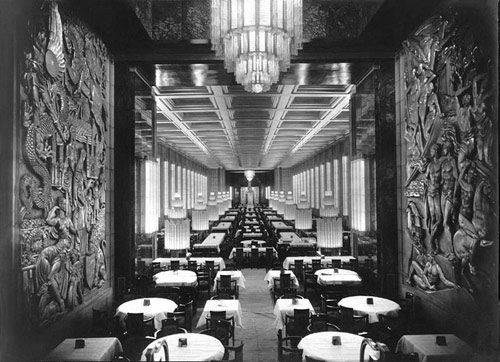

Click to Enlarge.
But like that other great luxury liner, the RMS Titanic, the Normandie was fated to meet repeatedly with bad luck and a short life.
The ship was launched in 1935, in the middle of a global depression, and never achieved the financial success its owners planned on. (The Normandie was really built for first-class passengers. With scant second- and third-class accommodations, the ship lost many passengers to its competitor, the RMS Queen Mary.)

When World War II began, the Normandie was docked in New York harbor. The owners decided to leave it there rather than let it be sunk by German submarines.
It was still there on May 16, 1941, when France was overrun by the Germans and the U.S. put the Normandie into protective custody.
It was still sitting in a New York dock when the U.S. entered the war. German-occupied France was now technically an enemy of the America. The Normandie was seized by the U.S. government, which proceeded to turn the world’s greatest luxury liner into a troop transport, renaming it the USS Lafayette.
The following February, a workman’s blowtorch started a fire onboard. The boat’s fire extinguishing system had been switched off and New York’s firefighters couldn’t get their equipment to work with the French system onboard. Standing on the dock, fire fighters sprayed the ship with water, which soon froze in the cold February air. The ice accumulated, making the Normandie top-heavy and eventually tipping it on its side.


On August 7, 1943, the ship was turned right-side-up again. But after sitting in water for a year and a half, the Normandie had deteriorated too far to make refitting worthwhile.
In 1946, after eleven years of unprofitable, interrupted service, the world’s greatest luxury liner was cut up for scrap metal.
Video of the SS Normandie, including her sea voyages, fire, and aftermath.
When the Post published “Resurrection of a Lady” in 1943, the Navy was still confident it would right the ship and return it to service. And while the Normandie never sailed again, the 1943 resurrection of 68,000 ton, 12-story, thousand-foot-long ship was a masterpiece of nautical engineering.

Post Puzzlers: February 1, 1873
Each week, we’ll bring you a series of puzzles from our archives. This set is from our February 1, 1873, issue.
Note that the puzzles and their answers reflect the spellings and culture of the era.
RIDDLER.
SCRIPTURAL ENIGMA.
WRITTEN FOR THE SATURDAY EVENING POST.
I am composed of 43 letters.
My 3, 36, 29, 16, 43, 31, is a book of the New Testament.
My 1, 8, 15, 25, 31, is a person often mentioned in the New Testament.
My 40, 12, 35, 37, 42, 28, is the name of the angel who appeared unto Zacharias at the altar.
My 24, 34, 3, 22, 18, was a king of Judea.
My 26, 15, 39, 17, 2, 31, is a prophet spoken of in Mark.
My 4, 5, 37, 14, 6, 27, is a word used in the fifth verse of the sixth chapter of Matthew.
My 33, 28, 32, 11, 6, 34, 24, 5, 29, is the place spoken of in the New Testament where a noted character was born.
My 1, 2, 21, 10, 11, 41, 20, was the son of Eleazer.
My 13, 17, 29, 36, 23, 11, 26, 30, 81, was the person sent to the Thessalonians to comfort them in their faith.
My 9, 27, 3, 39, 7, 38, 19, 31, is the one whose school the disciple were daily disputing in.
Millerstown, O.J. LOUDENBACK.
CHARADE.
On a fine starry night with the moon shining bright,
And the birds are all gone to rest,
When by the brook walking, true lovers are talking,
And cooing like doves in a nest;
And the sheen in their eyes cause them no more surprise
Than my first, tho’ so far away.
You will guess’t, I’ve no fear, for I’ve mentioned it here,
Unless they have nothing to say.
Then the light of her eyes very sweetly doth rise
To his own before they do part.
If you study these lines several times.
My second to you they’ll impart.
As they still linger near to each other so dear
And renew their fond vows of love,
I know they’d be willing, their love notes are trilling,
In my whole forever to rove.
WORD SQUARES.
WRITTEN FOR THE SATURDAY EVENING POST.
I.
A vegetable.
A snakelike fish.
A malt liquor.
II.
A useful liquid.
A metal.
A game.
To understand.
Schenectady, N. Y. J. D. G.
WORD SQUARES.
WRITTEN FOR THE SATURDAY EVENING POST.
III.
A title of nobility.
A girdle.
Soon.
A fissure.
IV.
A noise.
A sly look.
A tree.
Vapor, steam.
J.C.
CHARADE.
Oft in my second my first does dwell.
My whole’s a Welsh town—my name now tell?
ALGEBRAICAL PROBLEM.
WRITTEN FOR THE SATURDAY EVENING POST.
There is a certain number composed of two digits from which if the square of the left hand digit be taken the order of its digits will be reversed, and the cube root of the sum of the digits is equal to the square root of their difference. Required the number.
Erie, Erie Co., Pa. ARTEMAS MARTIN.
CONUNDRUMS.
Why is a hen roosting like a weapon? Because it is a fowl-in peace.
Why is a person afflicted with the lumbago like a man smoking a penny cigar? Because his back is bad (bacoy’s bad.)
When is the soup likely to run out of the saucepan? When there is a leak in it.
What protection has a street car from being struck by lightning? It has a conductor.
When is the weather most like a crockery shop? When it is muggy.
Why is a lovely young lady like a hinge? Because she is something to a-dore.
When is a lover like a tailor? When he presses his suit.
Why is a blunt knife, partially ground, like a young pickpocket? He is a little sharper.
ANSWERS.
SCRIPTURAL ENIGMA. — Marvel not that I said unto thee, ye must be born again.
CHARADE. — Moon, light. (“Moonlight”)
WORD SQUARES. —
I.
PEA
EEL
ALE
II.
MILK
IRON
LOTO
KNOW
III.
CZAR
ZONE
ANON
RENT
IV.
ROAR
OGLE
ALOE
REEK
CHARADE. — Swansea.
ALGEBRAICAL PROBLEM. — 62.
News of the Week: Crock-Pots, Doomsday Clocks, and Where “Dilly Dilly” Came From (Maybe)
This Is Us?

We live in a time when a kitchen appliance company has to join social media because a TV drama featured their product starting a fake fire. (By the way, This Is Us spoilers ahead.)
On a recent episode of the hit NBC drama, a kitchen towel caught fire because of a broken Crock-Pot, setting the home of beloved character Jack (Milo Ventimiglia) ablaze. As fans of the show know, Jack dies at some point (though no one knows how yet), and now not only are they upset by that, but they actually think their Crock-Pots are dangerous, so they’re throwing them away.
Let me repeat this: Because of a fictional fire on a TV show, people in real life are throwing away their Crock-Pots. Apparently, this is us now.
The company that makes Crock-Pots had to join Twitter (they weren’t on it until this happened) to tell people that the show is fictional and so was the fire. Dan Fogelman, the show’s creator, had to go on social media to say that not only is the show fictional, but the Crock-Pot in question was really old and broken.
There’s an old saying that any publicity is good publicity, though I don’t think Crock-Pot would agree in this case.
Two Minutes to Midnight
I know that sounds like the title of the latest straight-to-DVD action-thriller, but it’s actually a sign we’re closer to doomsday (Closer to Doomsday could be the sequel).
The atomic scientists in charge of the Doomsday Clock, which isn’t a real clock and is apparently capitalized, have moved it to two minutes from midnight. The scientists take into account a lot of factors when deciding whether to move the hands farther away from (that’s good) or closer to (that’s bad) midnight, such as the current president’s decisions when it comes to dealing with other countries, the U.S. standing as a leader in the world, how the president and other world leaders deal with nuclear war and climate change, and how viewers react to a fictional fire on a TV show.
This is the closest the clock has been to midnight since 1953, when President Truman announced the U.S. had developed the hydrogen bomb in the middle of the Cold War.
Nuts for Nutella
The French love Jerry Lewis, film noir, and … Nutella, apparently. For the past couple of weeks, the citizens of France have been rioting at supermarkets because Nutella has been on sale for up to 70 percent off. I don’t really get it, but here’s the footage.
It’s like Black Friday here in the U.S., only instead of people fighting over TVs and toasters, it’s hazelnut spread.
Where Did “Dilly Dilly” Come From?
I’m sure you’ve seen some of the current TV commercials for Bud Light that take place in an ancient kingdom of kings, queens, and magicians. The phrase from the ads — “Dilly Dilly!” — has become popular. It’s the “Where’s the Beef?” of the early 21st century. I’m pretty sure I’ve said it a couple of times this week. But where did it come from? Is it a real thing, or did the ad creators make it up?
The people at Anheuser-Busch say the phrase has no meaning; it’s just “nonsense and fun,” though the translation seems to be “go for it,” and it can be used as either a salute or a rallying cry.
However, the phrase sounded really familiar to me, and then I remembered the song “Lavender Blue.” I know the version by the band Marillion in the 1980s, but it has also been sung by people like Burl Ives, Dinah Shore, and Sammy Turner, and it was featured in the 2015 Cinderella movie.
Pay close attention to the lyrics.
RIP Mort Walker, Warren Miller, Marlene VerPlanck, Robert Dowdell, John Morris, and Louie Elias
Did you know that Mort Walker’s comic strip Beetle Bailey got its start in the Post in November 1948? The title character was originally named Spider, a slacker college student who thought about going into the Army. Walker died Saturday at the age of 94.
Warren Miller was a filmmaker best known for his films on skiing and other outdoor sports. He died last week at the age of 93.
Marlene VerPlanck was an acclaimed jazz singer who performed with many famous bands and musicians, including Frank Sinatra, Perry Como, and Mel Torme. Her voice could also be heard in thousands of TV commercials over the years for companies such as Michelob (“Weekends were made for Michelob”), Nationwide (“Nationwide is on your side”) and Campbell’s Soup. She died January 14 at the age of 84.
Robert Dowdell was an actor best known for his role as Chip Morton on Voyage to the Bottom of the Sea. He died last week at the age of 85.
John Morris was a composer who did the music for many Mel Brooks movies and The Elephant Man. He also composed the theme to Julia Child’s series The French Chef. He died last week at the age of 91.
Louie Elias was a stuntman and actor who appeared in many films and shows, but is probably best remembered as the guy who jumped from the guard tower on F Troop. He died December 13 at the age of 84.
This Week in History
Fire Kills Three at Cape Kennedy (January 27, 1967)
Three NASA astronauts — Gus Grissom, Ed White, and Roger Chaffee — were to be the crew for Apollo 1, the first of many missions that would eventually land a man on the moon. They were killed by a fire on the launch pad, which started due to an electrical problem. Due to pressure in the cabin, they could not escape.
“We Are the World” Recorded (January 28, 1985)
Many of the top singers and musicians of the ’80s (and, for some reason, Dan Aykroyd) got together after the American Music Awards, left their egos at the door, and recorded the song to help fight the famine in Africa.
This Week in Saturday Evening Post History: Forgot His Briefcase (February 2, 1957)

Thornton Utz
February 2, 1957
I should showcase Thornton Utz more often. He’s one of my favorite Post artists and has some great train/bus/car-centric covers, including this one in which a robe-clad wife rushes to get her husband’s briefcase to him before the train pulls away from the station.
New England vs. Philadelphia (Food, That Is)
Has there ever been a more American Super Bowl game than the Patriots vs. the Eagles? Maybe a Patriots/Cowboys matchup would be a close second. The Pats and Eagles met once before, in 2005, so this Sunday’s game is the rematch.
The game is also about food (beyond chips and dip, that is), and there’s always a battle between the two cities in that department, too. For New England fans, here are recipes for American Chop Suey, Clam Chowder, and the classic Boston Cream Pie. If you’re an Eagles fan, how about this authentic Philly Cheese Steak (yes, made with Cheez Whiz), some scrapple, and these Marble Brownies made with Philadelphia Cream Cheese.
The game starts just after 6 p.m. ET, but NBC’s pre-game starts, believe it or not, at noon. If you don’t like football, watch it for the commercials. If neither of those options strikes your fancy, there’s always the Puppy Bowl on Animal Planet.
Next Week’s Holidays and Events
National Boy Scouts Day (February 8)
Chicago publisher William Dickson Boyce started the organization in the United States on this day in 1910. A few months ago, the Boy Scouts announced that they will allow girls into the Cub Scouts.
The Winter Olympics (February 8-25)
Bob Costas won’t be the host of NBC’s coverage this year, but Katie Couric is back at the network and taking his place. She’ll be joined by Mike Tirico for 27,000 hours of skiing, ice skating, luge, and other events. Okay, that time might be an exaggeration, but not by much.
By the way, even if you don’t go to the Olympics, you still have to watch out for scams.
Movies for the Rest of Us with Bill Newcott: 33 Kickin’ Football Movies
Can you guess all 33 football films in this montage? (Answers at the end!)
A Landing Called Compromise
Missouri 1937
The winter of ’37 was the worst folks living in the boot heel had ever seen. Most days brought an ominous mix of rain, snow, and sleet. On Friday, February 24, rain skated down in silvered sheets, painting watery tails on the tall windows of the one-room schoolhouse where Martha Blalock had taught for 20 years.
She eyed the class, making certain all her children were properly seated, hands folded on their desks. She ran a tight ship, yet the students loved her.
“Mrs. Blalock?” Gloria Hendry twisted the end of one braid, the color of butter-and-sugar corn.
Martha pushed her new plastic glasses up her nose. She’d self-prescribed by trying on various pairs at the department store up in Caruthersville, saving the expense of a $3 visit to the eye doctor. Everything still seemed slightly out of focus. “Yes, dear, what is it?” she asked.
“We’re s’posed to go to church after school,” Gloria said, “and I don’t like this rain.”
Other heads bobbed up and down: Hollins Carter, Betty James, Ronald Hinote, more.
“All of you going to the church then?” Martha asked.
More nods.
“What on earth for?” A flush warmed her cheeks. Heaven forbid the children think she didn’t want them going to church. She’d been a loyal member of the New Madrid Baptist Church since childhood and felt suddenly ashamed she’d let a nuisance like the weather keep her from services the past week.
Gloria waved her hand in the air. “For the Good News Club,” she burst out.
“The Good News Club?” Martha repeated. She looked beyond Gloria’s head, toward the colorful pictures of Bible stories torn from old issues of the Concordia lining the back wall. There was Jesus the Shepherd Carrying a Lamb, Peter Denying His Savior, and Our Savior Beginning His Suffering. Martha had bought the leaflets when her son, Gene, was 3 and shown them to him so often the pages were worn almost translucent. Looking at them now reminded her of those long-ago days when Gene was a little boy, and she and Carl so blessedly young themselves.
“Yes, ma’am,” Ronny Fulton said. “We’re s’posed to go to church now every Wednesday. Mrs. Blix will be mad if we aren’t there.”
Martha’s ears pounded, and her vision clouded even more. Reverend Prescott must have announced this new club on Sunday, in her absence. “Mrs. Zula Blix?” she asked.
“Yes, ma’am.” Ronny wrapped a leather strap around his books and threw it over his shoulder. When Martha didn’t reprimand him, the room grew noisy as the other children also gathered up their pencils, books, and canvas lunch totes.
“I will drive those of you going to the church myself,” Martha said, raising her voice over a drumbeat of thunder.
Somehow, all eight children fit into the Ford woody wagon, and they made their way through bucketing rain to the church. She drove at a snail’s pace on the dirt roads, ever mindful of how quickly accidents can happen.
“You will not believe who they asked to teach my students Bible stories after school,” Martha said that night as she lay in bed with Carl. Without waiting for an answer, she said, “Zula Blix.”
Carl cleared his throat and then wrapped his hairy arms around her. “Now, Martha,” he began.
“You know what that family is like. Not a one of them should be teaching this town’s children the Word of the Lord. ’Specially not Zula.” Martha sighed loudly.
She had already decided to speak to Reverend Prescott about replacing Zula Blix as head of whatever this new child evangelism program was as soon as possible. It would take some doing, maybe even airing of dirty laundry about the Blix family’s long history of flouting at least three of the Lord’s Ten Commandments, but it had to be done. The children of New Madrid deserved no less.
“Why, she’s not even from Missouri!” Martha’s bad eye had started twitching, and she turned to face her husband. “Carl,” she whispered loudly. “I can’t stand to see Zula contaminating the minds of my children.”
Carl looked uncomfortable but patted her shoulder. He had reassured her multiple times that there had never been a spit of anything between him and Zula after her rich husband died last year. But Martha had seen the widow flirt with every man in the congregation of the New Madrid Baptist Church, on both sides of the aisle.
The church rose high on a hill inside the oxbow curve of the Mississippi River, right on the state line at a landing called Compromise. New Madrid County, Missouri, sat on one side, and Fulton County, Kentucky, on the other. Half the pews were in one state and half in the other, enabling the families to walk up the aisle on their side of the church and attend services without stepping into the other state. Come Sundays, folks would file in, lean their guns against the wall, and sit down in the pews on their side of the church. Everyone would kneel for prayer except a man who stood guard at the end of each aisle in case any member on the opposite side decided to start trouble. No one had for ages, but the guns were still kept at the ready. Families from the two counties had been feuding since the Civil War, when a flag officer from Fulton County turned traitor and helped a Union gunboat attack Island Number 10.
Martha Blalock’s kin lived in New Madrid County. Zula Blix and her folks lived in Fulton County. But even beyond the historic feud, Martha had harbored an extra helping of hate toward Zula and her kin. To her husband and to her cousin Beulah, Martha badmouthed Zula something awful. Still, no matter how much Carl and Beulah agreed that, yes, Zula came from a suspiciously wealthy, drinking, firearm-toting Kentucky family, and her oldest boy, Ralph, had caused a heap of trouble, Martha’s insides still sometimes ached whenever she thought of that woman.
Next to her in bed, Carl groaned. But Martha wasn’t done. “I’ll start making phone calls in the morning. Get the ladies from church on my side before I approach the Reverend. I’ll have them for coffee.”
“You hate having folks here,” he said, expertly reaching through the moonlit dark to touch the lid of her right eye, closing it because that sometimes stopped the twitch.
She looked toward the cane stick she’d propped against the wall, wondering if she should get up now and thumb through her cookbook for a recipe. “Zula’s always having folks over for fancy teas. Even folks from our side of the river. If you can imagine! So I’ve got to make it clear mighty fast that I’d do a much better job getting the Lord’s Word into the ears of our children before it’s too late.”
Carl patted her bony shoulder. “Time for shut-eye, Martha May.”
She turned away from him, careful not to put any weight on her bad hip. At least her eye had stopped its spasms. They’d been worse this week, and Martha feared it might be the new glasses.
He spoke softly over her shoulder, “You’d be a fine teacher at the church.”
Carl got weather reports and most of his news from the ham radio he’d built last year from a kit offered by the Wholesale Radio Company. He and Martha had sat in ladderback chairs next to each other, listening to President Roosevelt on the day of his second inauguration just last week. Martha liked picturing this important scene taking place, and she liked the excitement in the announcer’s voice as he described the abnormally terrible weather there in Washington. A half inch of rain drenched the floor of the president’s open car! This winter was definitely the wettest and coldest Martha had ever lived through, and yesterday a radio operator had reported the rising river had nearly reached the door of the Piggly Wiggly over in Paycock.
Rain still fell the day after Martha decided to oust Zula Blix from the Good News Club. As soon as she’d fed Carl breakfast, she lifted the mouthpiece on the wall phone and called her cousin Beulah.
“I want to invite some ladies over for coffee. So we can discuss Zula Blix.”
“Hush!” Beulah shouted. Her dog Oleo stopped barking in the background. Then, more directly to Martha, “What’s she done now?”
Martha cleared her throat. “Seems the Reverend started a Good News Club the one week I wasn’t at church. And put Zula in charge.” She paused. “We have to get rid of that she-devil.”
“You know I don’t like Miss High-and-Mighty any more than you do.”
“I just think things might get dirty between Zula and me. I don’t plan to hold back.” The words were spitting out of her too quickly. “Good News indeed! I bet she’ll let the boys in that club run outside ’stead of memorizing Bible verses like they ought to!”
Martha reached for her clutch purse on the counter and rummaged through it, looking for her memo book with the hollyhocks cover. She’d remembered she needed to add lard to her grocery list. Her boy Gene was due home for a short leave Monday, and he’d want lemon meringue pie. She found her handkerchief, the picture of Jesus on gold foil, and finally the memo book. She took a deep breath to calm herself. “You go to prayer meeting Tuesday night?” she asked.
“Mmm-hhhm,” Beulah said. “Zula was there in all her finery. Fancy plaid rain slicker, matching hat and umbrella. I swear that woman ought to spend more time on living the Word of the Lord than on her wardrobe.”
“Amen,” Martha sighed.
“I’m glad our boys got through their religious education long a’fore she was in charge,” Beulah said.
Both Gene and Beulah’s boy, Willie, had been so sweet with their thick blond curls. They’d spent hours together down at the Landing, fishing, jumping off the pier in their dungarees, bare-chested and tan. Unfortunately, Gene and Willie had also taken a liking to Zula Blix’s boy Ralph. Martha tried to put an end to it, but somehow the boys kept in touch and she knew that even now as young men they still went into town to shoot a game of pool whenever Gene was home on leave. Ralph Blix had been the fool who suggested they all jump off the pier at low tide that long-ago summer, but neither Gene nor cousin Willie held a grudge, a fact Martha could not wrap her head around. These days, Gene always insisted on taking Willie along whenever he went into town, pushing his cousin in his wheelchair, sometimes standing on the back riding down the short hill at the top of Main Street, both boys, now grown men, whooping and hollering like they was 10. In Gene’s last letter home, he’d already said he planned to take Willie out to find some pretty girls. And he’d reminded his mother to make his favorite foods, including that lemon meringue pie.
Beulah coughed. “You go down to see the river yesterday?” she asked, bringing Martha back to their call.
“Nope. Didn’t step outside.” Martha tucked the memo pad with her grocery list back into her purse. Gene would be home for a week this time. She’d have to tell him to steer clear of Ralph Blix. Just until this issue with the Good News Club was resolved. She couldn’t have her own kin act disloyal.
Oleo barked again in the background. “Hush, you mutt!” Beulah said without a trace of anger.
Martha pictured her cousin bending over to soothe the old dog. “What about the river?”
“It’s bad, worst I’ve ever seen it,” Beulah said. “Heard the levee over at Clear Creek went out.”
“I swear I don’t remember a January this bad.” Martha ran her finger around the mouthpiece of the phone. “Remember when we were kids, Grandpa told us the river ran backwards one year?”
“Sure do. During the earthquakes. In ’11 or ’12. He claimed his boat went upstream for nearly a mile. Never knew whether to believe him or not.”
Martha sighed. It had been so much easier when she and Beulah were girls. She wasn’t sure she liked being a grown-up much, all the responsibility that now fell on her shoulders to make sure the world ran the way she wanted it to run.
“Amen,” she said again for no reason, then, “I gotta finish my grocery list, Beulah. Though Heaven knows when I’ll get out to fill it. Talk tomorrow.”
But the next morning, phone lines were down in New Madrid. Scores of trees had fallen into the river, and temperatures had dropped 25 degrees overnight. Outside, sleet came down hard. Some of it stuck to the windowpanes, freezing on contact.
By Friday, water came up to the edge of their yard. Carl went out to move their two cows to a small barn up on higher ground. He’d had to lead the animals carefully over the ice around the flooded areas.
Electricity was out, but Carl’s ham radio still worked. The news was nonstop now, the voices on the ham radio increasingly frantic as Martha and Carl sat listening after dinner. At dusk, the door swung open, and their son blew in with a gust of icy wind. Gene, taller than his father now, was bundled in a hooded black rubber raincoat. Bits of ice clung to his dark blond beard.
“You’re comin’ with me,” he said. “Everybody’s meeting up at the church.”
“I’m not leaving this radio, son,” Carl said, standing with a smile. “Your mother and I’ll be fine long as we stay indoors. Come give your old Pa a hug, then pull up a chair.”
Martha had stood quickly, too, her heart beating fast at the sight of her beautiful boy. Hobbling quickly without her cane, she leaned into him for a hug and wouldn’t let go.
“Ma! I’m all wet! You’re soaked now,” Gene said and held her away from him, smiling at the sight of her water-stained dress.
Carl brought her the cane, which she took without breaking eye contact with Gene. “Get out of those wet clothes,” she said quietly. “I’ll get dinner ready.”
“Nope,” Gene said. She hardly recognized her son’s voice, that of a man now. “You have to come with me. Fella’s got a radio set up at church.” He grabbed coats and hats from hooks near the door. “You’ve got food, Ma?”
His eyes had caught sight of the pie Martha had baked that afternoon. He strode in quickly, dipped his finger into the browned meringue the way he had as a boy. His eyes sparkled when he turned to grin at her in that old way of his.
But his face grew serious quickly, the way it had when he told her how Willie’s pup Blackie had swum around in circles that day they all jumped off the pier and Willie didn’t come up when they expected him to. “That dog was trying to tell me something. I wouldn’t have known Willie was hurt if the pup hadn’t done that.” It was Gene who’d dived down and dragged his unconscious cousin back to shore. The thought of the lifelong damage Ralph Blix had caused her family made Martha shudder.
“Let’s pack this up,” Gene said. “I’ve got folks waitin’ in the wagon outside.”
Martha hobbled into the kitchen and covered the Pyrex pie plate with its ruby red lid, then let Gene help her into her coat. Carl kept asking questions, but Gene wouldn’t answer, and Martha just followed her two men silently to the door and out into the dark night.
It was sleeting so hard she could barely make out the open-bed wagon sitting there. Gene helped her into a seat on the side and put the pie plate on her lap. She grasped it hard with both hands as she sat crunched between two fellows talking about a young woman with a newborn baby who’d been found frozen on the roof of a house just across the county line. Martha’s eye started twitching like mad.
“Roosevelt’s sending in the WPA as well as the Coast Guard,” one of the men said.
She looked down at the ruby red lid on her lap, slick with sleet, and bent protectively to cover it. When lightning flashed, she caught a glimpse of the land covered in splotches of water, houses abandoned with no lights showing through their windows, farm tools and what she realized with a start must be small, dead livestock littering the fields.
The scene at the church was also grim, the sanctuary packed with refugees from the flood. Ronnie Hinote’s mother was wrapping a blanket around her wildly shivering son while another woman sat with one baby on her lap and two little ones at her feet, all of them crying. They must have been from Fulton County because they didn’t go to Martha’s school.
Gloria sat with her parents in a back corner, fiddling as always with her braids, and another young boy Martha didn’t recognize held a rag to his forehead; when he removed it, it was soaked in blood. For the first time she could remember, the church wasn’t cut in half down the middle of the center aisle. The pews had been pushed back willy-nilly.
Martha grimaced when she looked up at the garish Jesus recently installed behind the altar. His eyes bulged like he had gout. The monstrous gift had been donated by the Blix family. Martha’s eye was spasming uncontrollably.
Gene and Carl stood on either side of her. She needed them to stay close. But Gene motioned his Pa to walk with him toward the back, where a group of men huddled. She could hear the familiar static from someone’s radio but couldn’t make out any words.
“Wait,” she said. “Don’t leave me.”
Carl turned and raised his hand in that usually reassuring way of his, meaning “Calm down now, I’ve got this.” But it didn’t help this time, and still holding her pie plate in one hand and the cane in the other, she took a step back to brace herself against the paneled wall and get her bearings.
Reverend Alfred Prescott stood by an urn of coffee set up near the pulpit, arms akimbo. She couldn’t stand the man: overly attentive, sprinkling too many over-the-top adjectives into his speech and sermons. And yet she went regularly, reminding herself that the real wisdom of the Lord came from inside.
She looked around the room lit only by candles and kerosene lamps that cast both light and shadows. A long table had been pushed against the far wall and covered with plates of sandwiches and cakes, even a sliced ham. And there was Zula Blix, in some silly emerald green suit, standing at the end of the table, telling people where to put their contributions.
Martha took three deep breaths and then, still holding her cane and the pie, made her way carefully to the other end of the table, where she put the plate down in front of the ham. When the lid was lifted, most of the meringue still stood in stiff glossy peaks.
A carefully manicured index finger, painted in tangerine polish, appeared and pushed Martha’s Pyrex dish back behind the ham.
“Desserts are kept in the back,” whoever belonged to the finger said dismissively. Then Martha caught sight of the small hand’s middle finger, with its large pearl and onyx ring.
“Zula Blix, take your hands off my pie!” she shouted, louder than she’d intended. Reverend Prescott looked toward the two women, eyebrows raised, but Zula waved to him reassuringly, as if to say “Nothing I can’t handle.”
Martha pinched her lips together.
“How are you, Martha?” Zula’s voice oozed fake interest. “Isn’t this an awful night?” She gave one more tap with that orange-polished nail, sliding the pie another quarter inch toward the wall. “Ralph’s already been out helping to find those left behind, the elderly and infirm and such.” She nodded toward Willie in the back. Gene was bent over, whispering into his cousin’s ear, both hands on the arms of the wheelchair. “Your boy going to get out there too, or is the rain comin’ down too hard now?”
Martha wanted to punch her. But Beulah appeared suddenly at her elbow. “Come on, Martha, let’s go back to the menfolk.”
Martha put both hands on the knob of her walking stick to hide their shaking. Zula Blix had no right to such holier-than-thou talk.
But her cousin was right. Now wasn’t the time to take on Zula. Far from it. When she looked up to give Zula one last evil eye, the woman had wandered back to her side of the church.
Just then, the Reverend yelled, “We’ve got another one!”
Martha turned to see two men rush through the door she’d come through minutes earlier. They carried a body between them.
“Oh my Lord!” Beulah cried out.
Martha refused to give in to tears but felt far too shaky to make her way back to her husband and son. “Get Carl up here,” she whispered. “And Gene, Beulah. Please. I fear I’m going to faint.”
Beulah grabbed a chair from the end of the food table and slid it behind Martha, nearly pushing her down into it.
A third man, tall and barrel-chested, burst into the sanctuary. Martha recognized his Coast Guard coat, double-breasted brown with a sheepskin storm collar. “We need 10 men,” the man shouted. “Twenty if you’ve got ’em. We’re heading out to the levee to pile more sandbags.”
Gene shot up from where he’d been half-kneeling in front of the radio and hurried toward the man, squeezing his arm in familiar greeting. From across the room, pale-faced Ralph Blix joined them, though Zula had grabbed his elbow to try to keep him with her.
A dozen men now circled the newcomer.
“How we going to get there?” Martha heard Gene ask, his voice so much deeper now than when he’d sung in this very room in the Sunday school choir so many years ago. Even then, the choir had divided straight down the middle — Fulton County children on one side, New Madrid County on the other.
“We’ve got a barge we’ll take over. Big one.” The man was panting. “Lots of cutters out there already. Patrol boats, you name it. But we need more manpower.”
Martha turned to look for Carl and found him still back near the radio. She was thankful he was too old to go out with these young men and thankful that he knew it. Ronnie Hinote was staring at her. The poor boy looked so scared. She leaned her head back on the chair, squeezed her eyes shut so he wouldn’t know that she was scared too.
Then before she knew it, Gene and Ralph and the tall stranger and other young men had disappeared. The church felt suddenly empty, as though all the life and energy had been sucked out of it. Carl was walking toward her, eyes locked on hers. Martha tightened her grip on her cane and bit her lip to keep from crying out to her son to come back.
Those left behind — the women and children and old and infirm, like Beulah’s boy Willie — stayed all night in the sanctuary while the rain pounded on the tin roof. Beyond the darkened windows the rain slashed in angled sheets. Wind howled down the chimney, an invisible intruder intent on chilling their bones. All Martha could think about was her sweet boy, out there in all that bitter freeze and blackness and all that water. She realized too late that in the rush of leaving home she’d left her purse. No Jesus on gold tinfoil to hold between her fingers. So she forced herself to look up at the ugly painted crucifix behind the altar, the one with its garish paint and wide-open eyes on Jesus, praying hard and silent and deep.
The news didn’t reach them till the next afternoon.
They’d finished all the ham and sandwiches and cookies and cakes. On the long table, Martha’s ruby red pie plate was empty except for a lolling dollop of meringue.
Reverend Prescott was leading them in singing “Peace in the Valley,” his alto booming loud over the half-empty room. Across the way, Zula Blix stood in a cluster of Fulton County women. Amazing, Martha thought, how they’d managed to be well-dressed even in the middle of the storm.
When the tall man in the double-breasted jacket once again appeared in the doorway, the singing abruptly stopped.
He stood in the open doorway, crossing his arms over his chest. Martha looked over at Carl, snoozing in a chair beside her, and reached for his hand.
“The barge overturned,” the man said quietly. “Sometime during the night. A hundred and twenty men are dead or missing. Rescue efforts are under way.”
He’d brought lists with him, he continued, waving sheets of white paper in front of him. Names of the men still missing. Men whose bodies had been recovered. Men who were safe and being cared for.
When no one spoke, the man let the hand holding the lists fall to his side, then walked slowly over to the table. Someone stood to push aside empty platters, including the pie plate, and the man laid three long sheets of paper down on the table.
“Reverend?” someone asked. It was an old man Martha didn’t recognize from the other side of the church, dressed in worn overalls, with a tobacco stain dripping from one corner of his mouth. Those damn Fulton County ne’er-do-wells, she thought. That man probably hated my Daddy, and my Daddy hated him.
The Reverend ignored him, pushing his way to the table, spreading his arms as though sharing a feast.
“The names you are looking for are here,” he said in that stage-y voice Martha hated. As though it were any of his doing, she thought bitterly. When the people in the room realized no further explanation of this horrible tragedy would be forthcoming, those who could rushed to the table, pushing the Reverend and the tall man aside.
Carl’s hand escaped hers, and he hurried over to the table along with the others. But when Martha rose from her chair, she hobbled directly toward the door where the man in the storm collar had stood. She knew Beulah would come after her, but she had to get to the river, because that’s where Gene had set out for, and she had to find her boy.
Outside, the sky still gray, spotted with dark clouds. Her cane sank into the wet ground as she made her way forward as quickly as she could. Her shoes were soon muddied, but she kept on, stepping down the stone-lined path, down the long hill.
When she reached the riverbank, the muddy water rushed by faster than she could have imagined. She closed her bad eye, not even giving it a chance to start its crazy dance. Her glasses had fogged, but she could see two half-drowned houses with water up to a foot or two below their eaves, their chimneys stained dark with water. There were the tops of two gnarled trees, leafless, their branches looking like an old lady’s — like her own — arthritic fingers. Roiling clouds arched above them, black, blacker the higher you looked.
She wondered what it would feel like to step into the river rushing past her. Just three steps forward. Then lift a foot over the low row of sandbags. Lift the other foot, using the cane for balance. Then, once the hem of her skirt was soaked, and she could feel the way the water grabbed at her ankles and skirt and the way she wanted to sit down in it, she could unclench her hand from the cane. It would float past her downstream, buffeted and rocked. There was only so much support one could count on.
She remembered her grandfather’s tale. She tried to picture the river running backward and time with it, bringing her Gene back to her, or even bringing back the boy he’d been, the young woman she’d been before Jesus had gouty eyes and women flirted with her husband, before things got so complicated she couldn’t figure out who were the good guys and who were the bad.
She felt a hand on her shoulder and turned to see Beulah. “Come on now, cousin Martha, let’s get you back inside.”
Back in the church, Martha saw that the tall man in the Coast Guard jacket now sat near the pulpit. Someone had wrapped him in brown wool blankets. A cup of coffee sat steaming beside him.
Martha moved toward Carl, who still stood in the crowd at the long table, bent over the list to the far right, his finger scrolling down the long rows of names. She’d been so foolish to not go to an eye doctor; she couldn’t see well at all with these cheap things. “Which list is that?” she asked when she came up behind him, heart pounding. He didn’t answer.
She stood hip-to-hip with him now, holding her breath as he moved his finger down more names. She took her new glasses off, wiped them, and glanced across the way where she saw, as though at a long distance that had suddenly shortened, Zula Blix, standing across the way in her fine emerald suit. Martha didn’t know if she’d had a chance to read the list to find Ralph’s name or not. Or what their sons’ fates might be. But she caught Zula’s eye squarely, nodding curtly in recognition of all they both had to lose.
The Art of the Post: Painting the Human Circus
Few illustrators could paint the human circus the way Albert Dorne did.

Click to Enlarge.

Click to Enlarge.
His illustrations were famous for their parades of colorful and scruffy people—geezers, yokels, oddballs, street urchins, con men, jilted lovers, and lowlifes.

Click to Enlarge.
His sharp eyes noticed and captured a wealth of details—wrinkles, lumps, warts, patches, and folds.

Click to Enlarge.
He was a keen observer of human nature and entertained readers with a front row view of humanity that few had seen before.
How did he understand this world so intimately?
Dorne was born in 1904 in the slums of New York City. His father abandoned the family, leaving Dorne’s mother alone to feed Albert and his three siblings. Dorne’s childhood was wracked with the diseases of dire poverty and despair: anemia, malnutrition, heart ailments, and tuberculosis. More than once, city health officials intervened to remove Dorne from his home and place him in a city sanatorium. By the time he turned nine, the boy realized that he needed to take desperate measures if he was going to escape the slums. Public school seemed like a dead end, but he thought he might have a chance to bring in a little money by selling art.
Dorne began sneaking away from school and spending time in New York’s free museums where he could learn about making pictures. By age ten, Dorne was skipping school two or three days a week. He was frightened to death that the truant officer would find him and took elaborate steps to avoid being caught. His favorite hiding place was the Metropolitan Museum of Art; he later claimed to have taught himself by copying every piece of art in the museum (including the armor and the sculptures). Museum guards took a liking to their small visitor, and soon he became the youngest person ever to receive a permit to draw and paint in the galleries.
In the seventh grade, Dorne stopped going to classes altogether. He felt that as the eldest son, it was his responsibility to support his family. It later turned out that Dorne didn’t even need to hide from the truant officer. His teachers had caught on to what he was up to and agreed among themselves not to turn him in. They admired his pluck and believed his chances for a decent life were better at the museum than they were at school.
Dorne first found a job selling newspapers on street corners. Most paper boys picked corners with the heaviest traffic, but Dorne shrewdly calculated that if he sold papers in front of a fancy restaurant, he might have fewer customers, but he could still make more money because customers who just enjoyed a fine meal were more likely to be big tippers. His plan worked. Before he turned 12, he had staked out four other strategic locations and hired his friends to staff them.
While he worked as a newsboy, Dorne continued to look for more work. He sometimes held three jobs at once. He became a milkman’s helper, an office boy for a chain of movie theaters, a shipping clerk, a salesman, and a loading dock worker. He painted faces on porcelain dolls on a factory assembly line and when he turned sixteen he even became a prizefighter. (After all, Dorne reasoned, he had been involved in street fights with gangs while growing up in the ghetto and had done pretty well.) As a boxer, he won ten consecutive matches before he was knocked out cold by a tough professional fighter. Dorne quickly decided to give up boxing. But the characters he met during his struggle to the top would all come back as material for his illustrations.

Click to Enlarge.
Having taught himself to draw, he found a job illustrating sheet music. He was paid a total of four dollars for his first picture, but he continued to improve and soon he was earning $90 per week as a letterer. He took a full time job in a commercial art studio, drawing low-budget ads for an array of small time clients. This was a high volume business in the melting pot of New York City learning to satisfy clients whose language he often did not speak and whose culture he often did not understand. Dorne called this “hack work of every description,” but it sharpened his business instincts and taught him more about human nature. He worked around the clock doing as many as ten illustrations per day, which taught him to work quickly. He often slept on the floor in the studio.
Even after he became successful, he never stopped hustling for new business. Eventually, Dorne became the wealthiest illustrator in America, the president of the Society of Illustrators, and the founder of the international Famous Artists School. He drove a custom made Mercedes with a burled walnut dashboard and a pull-out bar. His steering wheel featured a silver plaque with Dorne’s initials and a large star sapphire.
When Dorne died in 1965, a friend remarked, “he painted pictures as if the truant officer were chasing him, and he never stopped.”
Post Travels: Winter in Napa Valley Wine Country
We are pleased to bring you this new column by writer Dana Rebmann, filled with travel tips, fun destinations, and beautiful videos and photo galleries of places you’ll be longing to visit!
There’s something to love about every season in wine country. Thanks to the harvest frenzy, fall may be the most popular time to visit, but the winter season has its perks. Crowds thin, and cool, clear days still often require sunglasses. Grapevines and the people who tend tirelessly to them, take a much-needed rest. Life slows down, wine makers can be found behind the bar pouring, rates at luxury hotspots drop, and sought-after reservations at Michelin starred restaurants can be easier to come by.
After October’s devastating firestorm, there were whispers it was best to stay away, but that couldn’t be farther from the truth. Wine country is open for business and welcoming visitors with open arms and smiles like never before. There’s no denying the damage was severe; residential areas, particularly in Sonoma County, were hit hard. But areas popular with visitors were virtually untouched. And as snippets from a recent hot air balloon flight with Napa Valley Balloons shows, wine country is stunning as ever, even in winter.
Extreme Tips for Surviving a Mild Winter
The long slog toward brighter, warmer days is underway. Now that you’ve binge-watched every Hallmark Channel original movie and catalogued all 150 shades of gray in your local landscape, it may seem that the worst of winter is yet to come. That could, indeed, be the case: not a blustery, historic blizzard, but a sluggish march through a season so long that Punxatawny Phil himself would be incredulous. You might want to prepare for a dreaded mild winter.
Some people use electronics to feel better during the colder months, believe it or not. When you’re especially craving that sweet sunshine, you can plug in a happy lamp and soak up some non-UV rays. It can’t be just any old light, though. Light therapy usually requires a source of about 10,000 lux, otherwise you’ve wasted your money and you’re still sad.
If Seasonal Affective Disorder doesn’t get you, this year’s particularly vicious flu season might. Of course, a flu shot is the best short-term defense against contracting influenza, but it never hurt to fortify your immune system with some Scoville power. That’s right, hot peppers. Chili peppers are high in antioxidants like Vitamin C, and they support heart health and weight loss. Plus, if you add some habaneros to your favorite batch of chili, you’ll get a satisfying sinus blowout that lets you know what your money pays for.
Speaking of money, the Canada Goose brand of feather-filled outerwear has come into vogue across the country. Whether you’re trekking to the North Pole or Navy Pier, the company’s parkas are an excellent way to spend north of $1,600, and everyone in Chicago seems to sport one. Like any luxury brand, the coats have become a target for counterfeiters that use raccoon fur in place of the soft coyote pelt lining the hood. One way to discern the fakes is to inspect the iconic patch on the garment’s sleeve. While the authentic logo features intricately stitched maple leaves, phonies have circulated with stitching that more closely resembles overweight dragonflies. Don’t be fooled.
The on-again, off-again wintry mixes might be eliciting weather whiplash, but do you know what’s worse than driving on snowy, icy roads? The knowing that soon enough you’ll covet that slick journey over the pothole hellscape to come. In order to avoid the losing battle of seeking reimbursement from your locality after hurtling through a ravine in the road, it would be wise to practice the art of creative swerving. Of course, there are city and state hotlines for reporting particularly treacherous potholes if you have that kind of time and determination.
The winter blues sometimes strike hard, and the American Psychological Association has said the best cure can be… hibernating? A doctor at the Biological Rhythms Research Laboratory said, “Now, if people want to sleep a lot and do nothing in the winter, society condemns it — which in my view may lead to guilt and depression.” Perhaps the most extreme winter coping mechanism is lazing about shamelessly, just as we were born to do.
Stench Warfare: When Is It Okay to Take Off Your Shoes?
Shortly after takeoff, on a seven-hour flight from Zurich to D.C., the passenger to my left removed his shoes. He sat in an aisle seat, reading his book, unconcerned by the stale scent of his gold-toe socks. For those of us near his seat (and his feet), escape was impossible. The plane was packed. The air circulation was poor. No heroic flight attendant opened a window, sudden decompression be damned. No brave air marshal whipped out his badge, or his pistol, or a can of Dr. Scholl’s.
Unpleasant as it was, this foot faux pas was not an isolated incident. Over the past few months, I’ve seen people slip off their shoes on a train, in a waiting room, in an office, at a hair salon, in a library, even in a restaurant — as though every public place is now our own personal living room for wiggling our toxic toes.
How did this happen? When did public shoe removal become socially acceptable? It’s not like the rules of foot physics suddenly changed, or that shoe scientists developed eau de toe-lette for feet. What has changed is our desire for constant comfort. We now believe we’re entitled to certain modern inalienable rights: life, liberty, and the pursuit of sock feet. But in an increasingly casual society, where sweatpants are acceptable attire for every occasion except job interviews and funerals, it’s possible that we’ve all become a bit too comfortable in public. The problem isn’t limited to the selfish passenger who removes his Rockports during a crowded flight. It’s the folks who hog two seats on a subway train when others are standing (and who huff with annoyance when someone asks to sit). Or the inconsiderate talkers who bellow like wrestling announcers into their phones in a quiet place. Or — ugh — the people who believe public spaces are suitable spots for plucking, shaving, or clipping various sharp and stubbly portions of their bodies.
With each public pluck, and each discarded shoe, our thoughtless individualism surpasses our respect for others. And yet one thing hasn’t changed: We’re still self-righteously annoyed by other people’s annoying behavior (because our own annoying behavior isn’t nearly as annoying as someone else’s annoying behavior, right?).
Back to that passenger who removed his shoes on my seven-hour flight: Sitting behind him was a loud child playing a video game. The shoeless man repeatedly turned his head to frown at the child’s mom, trying to convey his displeasure. But the mom was wearing headphones, nibbling on pretzels, watching a movie. Like so many of us, including the shoeless, clueless, sock-footed passenger, she was locked in her own reality — unaware, unconcerned, and, yes, unwilling to put herself in the other person’s shoes.
—Ken Budd
*“Contrariwise,” continued Tweedledee, “if it was so, it might be; and if it were so, it would be; but as it isn’t, it ain’t. That’s logic.”
This article is featured in the January/February 2018 issue of The Saturday Evening Post. Subscribe to the magazine for more art, inspiring stories, fiction, humor, and features from our archives.
Con Watch: 6 Winter Olympics Scams
Steve Weisman is a lawyer, college professor, author, and one of the country’s leading experts in cybersecurity, identity theft, and scams. See Steve’s other Con Watch articles.
Although the 2018 Winter Olympics in PyeongChang, South Korea, are still more than a week away, criminals are already using this popular event to cheat people around the world. Once the games actually begin, the scams will only increase. Here are some Olympics-related scams you should be aware of:
1. Championship Check Cheaters. An email that appears to come from the United States Olympic Committee offers to pay you $350 a week to wrap your car with advertising for the Olympic Games and drive around town as usual.
Unsuspecting victims who respond to the email are sent a check for more than the amount to be paid. They are instructed to deposit the check into their bank account and wire the rest back to the company. Unfortunately, the check that the scammer sent was counterfeit. The money that was wired back to the scammer came right out of the victim’s bank account.
A check sent to you that is more than the amount you are owed and comes with a request for you to send back the overpayment amount is always a scam.
2. Gold-Medal Malware. Once the games are underway, many people will receive emails and text messages purporting to contain updates, photos, and videos of Olympic events. Unfortunately, if you click on links or download attachments sent by scammers, you will end up downloading either ransomware or malware that will steal information from your computer, laptop, tablet, or smartphone and use that information to steal your identity.
Trust me, you can’t trust anyone. Never click on any link or download any attachment unless you are absolutely sure it is legitimate. Even if the address of the sender appears legitimate, the address may have been “spoofed” to appear genuine. You are better off going directly on your own to sources that you know you can trust, such as www.espn.com or NBCOlympics.com, for up-to-date information, photos, and videos.
3. The Sponsor Spoof. It’s difficult to win any lottery, but it’s impossible to win one that you haven’t even entered. Emails that appear to be from Coca-Cola, McDonalds, or any of the other sponsors of the PyeongChang Winter Olympic Games tell the intended victims that they have just won a huge Olympics-related lottery. All the victim has to do to claim the multi-million-dollar prize is pay some administrative fees or income taxes. This scam is particularly insidious because, while it is true that lottery winnings are subject to income tax, no legitimate lottery collects income taxes on behalf of the IRS. They either deduct the taxes before awarding the prize, or they pay the entire prize to the winner who is then personally responsible for paying the taxes due on the winnings. And no legitimate lottery requires a winner to pay administrative fees.
4. Skating Away with Your Money. Olympics-related merchandise — particularly apparel — is extremely popular. Unfortunately, many websites are selling counterfeit and poor-quality Olympics apparel and other Olympics merchandise.
If you are interested in Team USA merchandise, go to the official Team USA website, where you can shop safely and securely. As always, whenever you shop online, you should use your credit card rather than your debit card because credit cards give you much greater consumer protection if your information is stolen.
5. Malware Slalom. Many people will be turning to apps for all manner of useful information about the Winter Olympics, and there are many legitimate apps available, including the official PyeongChang 2018 app, which is available at the Google Play Store and the iOS App Store. Unfortunately, many other Olympics-related apps appear genuine but are loaded with malware, including keystroke logging malware and ransomware. Many of these tainted apps are found on third-party websites. When downloading apps, stay with authorized stores such as the Google Play Store and the iOS App Store that try to screen for apps containing malware.
6. Social Media Snow Job. Scammers are also turning to social media such as Facebook to send out what purport to be links to photos and videos of amazing Olympic moments, but in truth download malware when the links are clicked. Again, the best course of action is to never click on a link unless you have verified that it is legitimate.
North Country Girl: Chapter 37 — Latin Lovers
For more about Gay Haubner’s life in the North Country, read the other chapters in her serialized memoir.
After the fall semester finals, where I managed to squeak out a 78 in vile organic chemistry, I flew to Colorado Springs. I had hoped to do nothing but lie on the couch in my mom’s tiny apartment reading the dumbest romance novels I could find. But my Winter Break was spent prepping my anxiety-ridden mom for her upcoming Real Estate Agent exam (she was still waiting on that second marriage proposal), listening to one sister, Heidi, sob about how much she hated her school and every girl in it, and watching the other, Lani, pack her bags. She was moving back to Duluth to live with our dad. My mother mourned the loss of child support, but she would have gladly sent Lani to the moon to keep her away from her 21-year-old boyfriend. (Within six months, my dad signed some papers and Lani became a bride at sixteen.)
After two weeks of exhausting family drama, I flew back to waitressing, college, and full-on Minnesota winter, which meant no more riding my bike to and from work. I took the city bus to my job waitressing at Pracna, but the buses stopped running at midnight, forcing me to peel off my hard-earned ones for cab fare home, a cab that was always half an hour late; at one-thirty in the morning in Minneapolis there were probably all of three cabs on call.


Click to Enlarge
The January days ended at 4 o’clock, when the dim grey light of winter leached away. Most twilights found me hopping from one frozen foot to the other on the icy sidewalk waiting for the bus and feeling sorry for myself.
I was ignored by my roommate Liz, since I wasn’t fun anymore. Steve, my bad boy boyfriend, stopped calling, probably busy seducing freshman girls and selling bad pills to freshman boys. I looked at my roll of ones, shrunk down to almost nothing after buying plane tickets, paying for my winter tuition, and not working for the two weeks of Christmas break, and I wallowed in self-pity.

One night as I had my face pressed up against the foggy front window of Pracna, peering into the snowy frozen dark in search of my cab, I was rescued by a tap on the shoulder and a voice: “Hey you need a ride to campus?” It was Mindy, one of my favorite sister waitresses, who hustled me out to a car idling in front. Inside that toasty warm car were another Pracna waitress, Patti, and Patti’s very handsome Cuban boyfriend Eduardo, who was driving. Eduardo was at the bar almost every night, waiting for Patti and eyeing the asses of all the waitresses as we swerved around the tables. Mindy was smart, funny, and curvy, with dark, thick-lashed eyes and patent leather black hair. Her best friend Patti was a pretty, pale, flame-haired skinny girl, Lucy to Eduardo’s Ricky Ricardo.
Accepting the ride was not the bad decision. The bad decision was saying “Yeah, I guess so, for a minute” when asked if I wanted to hang out with them at Eduardo’s apartment. It was only a few blocks from my own underheated, creaky dump, where I had to let myself in on tiptoe so as to not wake either my roommate Liz or the crabby landlady beneath us. If I went home now, Mindy and Patti might think I was ungrateful or stuck-up, and I wanted them to like me.
A fancy new apartment building had popped up that fall near campus, in Dinkytown, a neighborhood known for cheap, code-violating housing. It towered like a supermodel over the crumbling duplexes and exhausted garden apartments the rest of us students lived in. I had heard that it was full of rich kids, but had never been inside.

This was where Eduardo lived. His apartment, which he had all to himself, was roomy and new, with shiny kitchen appliances, only slightly stained beige shag carpet, and plenty of heat. In the living room a ratty couch faced a littered coffee table; across the room sitting on shelves made of boards and bricks was the biggest, most complicated stereo system I had ever seen, and hundreds of vinyl records. I drooled a little.
Bob Marley crooned sweetly from out of the chest-high speakers, beers were cracked, joints were lit, and I felt a physical loosening in my chest and shoulders, which reminded me I needed to review the names of the bones in the human body for my physical anthropology class the next morning. One beer and I would go home. Maybe two.
Eduardo sat unnecessarily close to me, our hips touching, and in his charming accent said, “I apologize for my poor furnishings.” His father gave him a generous monthly allowance, which he preferred to spend on beer and pot and albums, rather than bookshelves (or books: I didn’t see a single one).
Eduardo’s family had managed to flee from Castro with quite a bit of their money. Although not nearly enough of it according to Eduardo, who held me captive for several more beers that night with his fascinating if slightly biased history of the Cuban Revolution as seen through the eyes of the very people who inspired Castro and Che to reach for their revolvers. Mindy and Patti, who had heard this tale countless times before, indulged in Pracna gossip till they passed out. Way too late, I finally thanked Eduardo and stumbled home through three-foot snowdrifts, thinking, well that was fun, I needed that, all work and no play and who wants to be dull? I promised myself once was enough, I wouldn’t make it a habit.

I ended up at Eduardo’s apartment the next night and the one after that.
Mindy, Patti, and Eduardo should have been a cautionary tale for me. All three of them were on academic probation after spending most of the fall semester listening to Bob Marley and smoking weed. Mindy was the only one who seemed concerned, but the textbooks she lugged to work and then to Eduardo’s and then back home remained uncracked. At least she bought books. Eduardo had better things to do with his money, keeping the four of us in Grain Belt beers and pot.
Eduardo wasn’t worried about being on probation. His family had just parked him at the University of Minnesota until he was old enough to join their mysterious business. If he flunked out, they would find a place for him at a college in Mexico or Spain, one that didn’t care about a transcript. Patti had decided that as the future Señora Eduardo, she didn’t need a college education either and rarely went to any of the three classes she had registered for.
Somehow I managed to keep my grades above water while doing what most 20-year-old college kids did then and still do: get shit-faced every single night. I just didn’t sleep much. I’d make it back to my dingy apartment and my disapproving roommate Liz in the morning in time to shower and change before trudging through the snow to my eight o’clock class. I told myself that as long as I never missed a class, I was fine. And I wasn’t spending my hard-earned money at an after hours club; I was just hanging out, in a warm place with very attractive people, while three little birds assured me that everything was going to be all right.
Eduardo was delighted to add a blonde to his collection; he was always stroking my hair, resting his hand on my thigh, holding a joint to my lips. I didn’t take it seriously, as Eduardo flirted with Mindy and all the other Pracna waitresses. Then one night, when my brain had punched out for the evening and Patti and Mindy had fallen asleep on the couch to the lullaby of “No Woman No Cry,” the handsome Eduardo took me by the hand and led me into his bedroom. The sex, even in my stoned and drunken state, was unremarkable, and I regretted it well before Eduardo rolled off of me and started snoring.
I have no excuse for my awful behavior outside of callow, stupid youth. I had broken the girlfriend code. I confessed to Patti the next day, as we were changing into our uniforms at work. I steeled myself for tears and yelling and the mass disapproval of the entire Pracna waitstaff, which thrived on gossip. What if I had to quit my job? Guilt and dread gripped my head and stomach in a vise but Patti shrugged it off as if I had done nothing worse than help myself to a beer from Eduardo’s fridge. She had absorbed enough of the Latin male mindset to know not to make a fuss about such a thing; she had her eye on the prize. Patti did ask me not to tell her best friend Mindy, and made sure that I never had another opportunity to be alone with Eduardo.
I was relieved and grateful that I had not been banished from Eduardo’s. I had grown to hate my charmless, chilly duplex. Liz and I lived directly above our witchy, man-hating landlady, who thundered up the stairs with her own key the moment she heard anything “suspicious,” threatening that if a boy as much as set foot on our front stoop Liz and I would be tossed out on the street where we belonged.
A brand new apartment with a cute shiny alcove kitchen in an elevator building with plenty of heat was all I needed of luxury, even though there was barely a stick of furniture besides the rumpled couch suffering from cigarette burns and many spilled drinks and that massive stereo system; in the bedroom a double mattress rested on the floor, with sheets that looked like they had never been changed, even after my escapade with Eduardo.
My drunken, stoned nights at Eduardo’s lifted me off the treadmill of work and school and the awfulness of trudging to both through the sleet, snow, and freezing temperatures of a Minnesota winter, a winter that set records in how high the drifts were and how low the thermometer plunged. Those three little birds had obviously never been through February in Minnesota.
I had thrown myself back into my hectic work schedule, taking as many shifts at Pracna as I could, closing up Saturday nights and ten hours later cheerfully serving Bloody Marys to people who worshiped at a bar. The church people arrived at one, still dressed in their Sunday best and ready for the weekend’s last bender.
Winter drives Minnesotans to drink, to search out the warmth of bars and other people, and Pracna, with the golden glow of its oak bar, polished by generations of elbows, profusion of fake Tiffany lamps bestowing flattering spots of color, and attractive and professionally friendly waitresses, was constantly packed. My shoebox stash was replenished and continued to grow, as fast as if the one dollar bills in there were mating and reproducing.
One snowy sub-zero day I was counting up my money like Scrooge McDuck and remembering that a year ago I was living on off-brand fish sticks and instant ice tea to scrape together the cash for a one-way plane ticket so I could spend six days in an old folks home in Daytona Beach.
Now my junior year Spring Break was coming up, and I was awash in dollar bills. I could go on a vacation that did not involve rooming houses or hitchhiking. My pal Liz had not mentioned any Spring Break plans of her own; we had gone our separate ways, passing at odd hours through our shared apartment, occasionally backing out of the already occupied bathroom, or silently sipping instant coffee in the morning. Patti was going to Florida with Eduardo to meet la familia. That left Mindy, who was dying to get away for a week somewhere your snot didn’t freeze the second you stepped outside, where you could wear sandals and a bikini, drink piña coladas, and meet boys. That sounded good to me too.
Mindy brought me brochures from a student travel company that offered Spring Break trips to Montego Bay or Acapulco, $299 for airfare and hotel. I voted for Jamaica. I had spent months listening to Bob Marley while smoking weed at Eduardo’s; I looked at the photo of a white sand beach and calm turquoise sea and pictured myself right there with a big blunt and a handsome Rastaman. But another Pracna waitress told Mindy that the beaches in Jamaica were overrun with packs of ferocious, tourist-eating dogs. Mindy was terrified of dogs; even my mother’s miniature poodle Shay-Shay would have sent her scrambling up a palm tree. So instead we flew off to Mexico on a chartered flight, packed with students who couldn’t wait to start drinking to wretched excess. Mindy and I navigated the flight and the bus to the hotel with only minor pawing and mauling from male Spring Breakers.

The bus disgorged us under a torn awning attached to a three-story, mildewy green building. Mindy and I stood on the sidewalk in the noon Acapulco heat, looked at the hotel and looked at each other. In no way did this hotel resemble the one in the brochure except for the name, which was La Casa Cheapo, or something similar. The sullen, non-English-speaking guy at the front desk glanced at our reservations and tossed us a big metal key attached to a heavy weight etched with our room number. The elevator doors opened to release a toxic combination of stinks and a pack of boys too hung over to even leer at the new meat. Our room did not overlook the famous Acapulco beach, but the busy, noisy Avenida Costera. The air conditioner, thick with dust, refused to work; when we opened the one tiny window clouds of car exhaust were sucked into our room. There was a urinal cake perched on top of the toilet. After emptying the drawers of roaches, we unpacked, put on our cute bikinis, and headed down to the pool, which looked like pea soup: a clot of vomit floated in one corner and two broken patio chairs in another. Mindy was about to cry. I was mentally comparing this dump to the luxury hotel my family had stayed at during a dental convention, and I snapped to a decision: “We’re going to the El Presidente.”
We rushed down the Avenida Costera to the El Presidente pool, which was exactly as I had remembered it from that trip, eight years before, the scene of so many drunken dental hijinks. Shiny sea blue tiles surrounded a huge, sparkling pool, with that eighth wonder of the world, a swim up bar. On all four sides of the pool area Tiki huts were serving oversized margaritas, frosty Sol beers, and drinks in coconuts. Rows and rows of lounge chairs held dozens of college students, boys and girls in various shades of Spring Break, from the just-arrived paper whites, to the should-have-gotten-out-of-the-sun crimsons, with a few lucky souls who can get a tan in seven days scattered about. Prominently displayed above this wonderland was a sign FOR GUESTS OF THE EL PRESIDENTE ONLY.
Mindy said, “If I have to go back to that hotel, I’m going home.” We agreed to live dangerously; if we had to, we could just spend the day getting thrown out of different hotel pools. We found two free lounge chairs and tried to look as if we belonged there.
Mindy and I were busy rubbing Coppertone on each other when two shadows fell over us. I looked up to see what was keeping the sun from bestowing some kind of glow to my pasty Nordic skin. There stood two Mexican guys, fully dressed in billowing shirts and tight pants. One looked like a younger, pudgier Cantinflas, smiley and slightly goofy. The other could have Eduardo’s taller, better-looking, older brother. He had dark brown, shoulder-length wavy hair and eyelashes longer and thicker than any offered by Maybelline; his gleaming white shirt gaped open to reveal a deeply tanned, muscular chest adorned with a thick gold chain and dangling charms: a small clenched fist in ivory, a blue eye, a half-dollar sized gold medallion. The guys asked if we wanted a drink (“Why yes, thank you!”) and introduced themselves. The tall one was Fito Giron—didn’t we recognize the famous singer? We had to have seen Fito’s poster in the hotel lobby! Fito was the star of the show at the El Presidente lounge; the other guy, the one who was doing all the talking, was Jorge, Fito’s full-time gofer and friend.
Rum and coconut drinks magically appeared and Fito scribbled on the bill offered by a fawning waiter. Mindy and I thanked Fito for our cocktails and apologized to Jorge for our ignorance. No, we hadn’t seen Fito’s act, we had only gotten to town that day. While Fito posed, hands on hips, chin cocked, hair tilted into the wind, Jorge insisted that we had to go that night to hear Fito. He, Jorge, would put us on the guest list. What were our names and room numbers?
Ten minutes trespassing and we were busted. We confessed that we weren’t staying at El Presidente but down the Avenida at the no-star hotel des estudiantes. This was shrugged off by Fito. “No importa,” he said as he looked down and locked eyes with me. Jorge was quick to jump in. “Don’t worry, your names will be on the list, you see Fito’s show and then we all go dancing!” Jorge wrote down our names, and Fito swooped down on me like a hawk to plant a kiss on both cheeks, then turned and left with a backward wave.
I was bewildered and amazed and giddy at what had just happened. We had landed dates in our first hour of Spring Break, we had free drinks in our hands, and we had successfully snuck into the El Presidente pool. To be sure that we were not at risk of getting the bum’s rush, we called over the waiter for more coconut rum drinks; he scurried over like a Mexican Groucho Marx, took our order, and let us know that everything was on Fito’s bill.
“The Poison Pen” by Thomas Beer
Jordan Bace, Second, was dreaming of strawberry shortcake piled with fine sugar and dripping redly when the afternoon mail reached Gale’s Ferry. It brought him a letter from his father, the envelope stamped with the arms of his native city, where Mr. Bace was mayor. Jordan wondered why his parent should write on two days in succession, and tore the envelope, worried.
June fifteenth.
Dear Sec: ‘Sorry to say that the freshman-crew race will not be witnessed by any of your affectionate family. Just recieved a wire from California that Edwin Joyce has died in Pasadena. The body is to be sent here and, of course, I am to be a pallbearer. The funeral is the day of your race. This is too bad, and we are all mighty sorry to miss seeing you perform, but please remember that Mr. Joyce was your grandfather’s partner and a great friend of mine. Doris is mad as a hornet. She has quite a collection of clothes she was going to air in New London, and I expect she thinks the Yale-Harvard regatta will not be the same without het shining presence, especially as quite a herd of young women seem to be leaving here to see the show. Well, good luck to you, and please don’t strain your heart unnecessarily.
Your affectionate father.
P.S. I notice that I have misspelled “receive” above, and I think I have made a mess of “unnecessarily,” though it may be right. Hot weather always affects my spelling. They never did teach me to spell “receive” at the little old red schoolhouse.
Jordan chuckled. The little old red schoolhouse of his father’s infancy was a family joke. Mr. Bane had been reared in England, while Jordan’s grandfather managed the branch of a New York bank in London. But he could spell nothing accurately. The fact had been used against him in his campaign for the mayor’s office.
“What are you laughing at?” the freshman coxswain sniffed crossly, rubbing cold cream on a blistered neck.
“My people can’t come to the races,” said Jordan.
“What’s funny about that?”
“Just the way father puts it. Have you any sisters?”
“Four,” the coxswain sighed.
“You poor pup!” Jordan said, and went off to bathe.
He could figure the wrath of Doris exactly. She hated funerals, and she had been looking forward to a week of New London. Inevitably several of her dearest friends would come to the regatta; and she had spent some days of early May shopping in New York, with an afternoon at New Haven added. He reflected that her interest in the Yale-Harvard races was not solely based on his position in the freshman boat. The reflection rose again when she met him at the station the evening he arrived.
“You were lucky to be away for the Joyce funeral, Sec. It was simply frightful. There were quantities of old women from that orphanage, or whatever you call it, that Mr. Joyce built, and they all sniffled and it was horribly hot. And there wasn’t the slightest reason why mother and I shouldn’t have gone to New London. No one would have known whether we were there or not, you know. And it’s too bad your boat was beaten.”
“But it wasn’t,” said Jordan.
“Why, it was, Sec! It was in the papers.”
“The freshman four got licked,” he corrected her — “we didn’t.”
“Oh, I’m so glad,” said Doris, straightening her hat. “But really father’s so silly about things. I do wish you’d talk to him, Sec. And poor mother always gives in like a — like a baby.”
“I didn’t know that babies gave in,” Jordan grinned, “and where did you get that hat? It’s awful.”
The hat was covered with reddish flowers in the character of violets, and it concealed a corner of her forehead. Jordan thought it somehow out of keeping. His twin had pale-yellow hair, and the rosy glitter above gave her an air of the theater, not quite desirable. As usual, she did not answer his objection, but smiled amiably and went on.
“Anyhow, mother and I motored down to Columbus for Kitty Fleming’s wedding, and that wasn’t bad fun. Quite a lot of people from Philadelphia. She’s married a man from Philadelphia — Rotherhythe Kemp. Did you get cards?”
“Yes, I did. And if he’s anything like his brother in my class she’s going to have an awfully nice time before she gets divorced,” Jordan grunted.
“Oh, don’t get Middle Western,” said Doris, haughtily bowing to their former governess, who was wheeling a perambulator along the sidewalk under the horse chestnuts.
“I can’t help being Middle Western any more than you can,” Jordan snapped; “and Eddie Kemp’s as big a rotter as —”
“Some of the ushers,” said his twin, “were quite all right.”
She gave him a slow and meditative smile, suggesting that some of the ushers had been well investigated. Jordan thought heavily of the freshman cox swain. Really four sisters seemed excessive. However, Doris was pretty and not nineteen. Girlish vanity had to be excused in some measure.
“There’s a dance at the Bulkelys’ at nine,” she said, “and I suppose they wouldn’t mind if you came. It wasn’t supposed to be a children’s party, though.”
“Go to — Tophet,” Jordan ordered.
“But you aren’t awfully old, Sec,” she said more pleasantly, and patted his knee.
“I hate dancing in hot weather,” he told her, “and this is my first night at home.”
The Bace house stood on a small crest of the residence district, and air from the lake blew genially through the dining room. Also Mrs. Bace had commanded a strawberry shortcake of the proper breed. His parents seemed enchanted by Jordan’s ravages in this dish.
“I should think you’d explode,” Doris drawled.
“You haven’t been in training for years,” said Jordan.
His lesser brother, George, took up the defense of Jordan’s appetite. He alleged that he had seen Doris eat three slices of shortcake. Doris smiled at the small boy calmly.
“Children are always pigs,” she murmured, and her eyes seemed to view afar off that remote age when she had eaten three slices of strawberry shortcake. She tapped her fingers on the edge of the table and lapsed into some secret, amused contemplation. Young George after a moment rolled up his napkin and hurled it at her shining head. It missed.
“Oh, Geordie!” said Mrs. Bace.
“Bad shot even for a southpaw,” Mr. Bace commented.
Doris stroked her hair.
“You might try a saltcellar,” she said, and rose, the sleeves of her negligee wavering like moth wings in the candlelight, roamed off to dress, humming the love song from Louise.
“I’ll kill her sometime,” George muttered.
“Oh, Geordie!” said Mrs. Bace, helpless and shocked.
“I wouldn’t kill her,” Mr. Bace observed, “unless you’ve got the pocket money for a good lawyer. It’s always hard to explain things like that to juries, son. They’re so prejudiced.”
“Oh, Dan!” said Mrs. Bace.
“Give Sec some more cake, Molly,” the mayor yawned, “and let us be cheerful while the higher criticism’s putting her clothes on.”
“I think I’ve had enough,” Jordan said regretfully, and lit a cigarette.
“Oh, Sec,” his mother stammered, “are you sure those are good for you?”
“I guess from his looks that they won’t ruin him,” Mr. Bace remarked. “He’s in pretty good condition, I take it. Go on about the race, Sec. We’ve had it interspersed with sections of the latest fashions, and really I’d like to know just what happened. Give Sec some coffee, Molly.”
It struck Jordan that his father was speaking with a strained sharpness instead of the familiar level note, gently English, that sounded always agreeable in any room — and there were some gray additions above his ears. His sleepy eyes had a fresh patch of wrinkles at the corner.
“You’ve been working too hard,” Jordan accused him.
“Hot weather, Sec. Go on about the race.”
Doris came in to say good night to her relatives, and Jordan pondered on the strings of vermilion beads sustaining her frock. He hoped, they were strung on some solid substance. But it was a charming gown. She looked like an inverted peony, and her small feet were shod appropriately in gold.
“I had it made to wear at New London,” she said, “and Nancy Guest says the party at the Griswold—”
“Oh, Doris,” Mrs. Bace broke in suddenly, “let’s not talk about New London any more, please.”
This outbreak had all the value of a high-explosive shell. Jordan stared at his mother. It truly sounded as though Doris had been talking too much of the missed race. It must be that. His twin was considering Mrs. Bace with a pained bewilderment.
“Oh, very well, dear. Any signs of Johnny?”
“His visibility is still low,” said Mr. Bace through his cigar smoke, “and that is a mighty pretty dress — frock. You look like the late Lola Montez a good deal.”
“Oh, Dan!” Mrs. Bace gasped, and pink touches appeared in her cheeks.
“Sure, I don’t know who Lola was,” said Doris kindly, “but it sounds like a slam. There’s Johnny. He always takes a bit off the rose bed. Good night.”
Jordan wondered if the best breeding permitted a young man to sound his horn outside the doors of a gentleman’s house summoning his daughter forth. He strolled over to the window and watched Doris flutter into the motor, where Johnny Rhodes was sprawled gracefully.
He had a natural admiration for young Rhodes, a great figure in white flannel, with a curly dark head that showed fully as the motor slipped under the lights of the dining room outflung on the gravel.
“If Doris marries that mucker,” said George, “I’m goin’ to run off.”
“Oh, Geordie!” Mrs. Bace moaned.
“That’ll do, son,” said Mr. Bace, and rose. “Well, I’ve got to go down to the club and blackball some men. Be back in an hour, Sec.”
When the family car had carried him off Jordan asked questions, having planted George over a volume of Gale’s Ferry snapshots. Mrs. Bace was never expansive.
“There’s been a lot of trouble with the police force, Sec, and it’s been dreadfully hot. It would have been such a rest for him to go East. It was too bad poor Mr. Joyce had to die just then and” — she flushed “and — really — Doris wasn’t very — very nice about missing the races. I suppose we should have found a chaperon for her and let her go. And there’s been some trouble at the bank with one of the tellers. And of course, dear, your father isn’t young.”
“I suppose Doris just simply raised hell.”
“Oh, Sec!”
“I’m sorry, mother. Look here, is she going to marry Johnny Rhodes?”
“I hope not,” said Mrs. Bace with more firmness than she usually mustered. “I’m sure I hope not, Sec.”
“Of course,” Jordan mused, “there’s his D. S. C. and all that, but — I hope she doesn’t. I don’t mind his being divorced, but —”
Jordan played golf considerably, and Johnny Rhodes had a clear, carrying voice in the country-club dressing rooms. His theories on matrimony and finance were memorable. Still he was jolly and handsome, and there was the medal. Jordan frowned.
“You and dad can put your feet down —”
“Oh, Sec, Doris is so old for eighteen!”
Jordan grinned and went off to talk to George. His brother illuminated the matter of Mr. Joyce’s funeral when they had gone to bed. He sat on Jordan’s floor and barked with the note of one long oppressed but now sure of a hearing.
“Sounded like a baseball game when everybody’s jumpin’ the umpire. She said dad was old-fashioned and stuffy and mid-Victorian and —”
“Oh, she’s got that mid-Victorian thing? Go on.”
George continued at some length, including his own grievances in the business of having his Navajo Indian headdress borrowed for the country-club masquerade in April and so lost.
“But Sid Conway says he’ll get his cousin in Arizona to get me another. Sid’s a peach, I think. He’s got a lot of sense too. He don’t hang round Doris the way he did.”
“That’s too bad,” said Jordan drowsily.
“It is not! Why, gee, you wouldn’t want a nice fellow to go and marry a thing like her? But how much does a coxswain have to weigh, huh?”
Jordan stirred somewhat when a motor rattled in the drive toward dawn, but he was deeply asleep when George shook him at ten.
“Get up, Sec! Say, something’s happened!”
“Dad isn’t sick?”
“No. He’s mad, though, and mamma’s cryin’, and — it’s some kind of something. Get up!”
George was inarticulate and clearly a little frightened. Jordan hauled on a dressing gown and trotted downstairs through the shuttered coolness of the wide house to the dining room. His sister’s voice detained him outside the door.
“Nonsense! I shan’t let you do anything of the sort. I’m not going to have a lot of cheap detectives and things mixed up in this. I —”
“I’m not going to have my daughter insulted through the —”
Doris laughed, not merrily.
“Of course, father, if you like publicity —”
“Oh, Doris!”
His mother’s open anguish brought Jordan into the room on the run. Mrs. Bace was still crying wearily. His father stood on the hearth slashing at the white flowers in the grate with a napkin. Doris was trying to tidy her hair with fingers that shook. “Some low hound has been writing your sister anonymous letters,” said Mr. Bace. “That’s what’s the matter, Sec. Look at it!”
“It’s a woman of course,” Doris alleged — “not a man. Do keep still, father.”
The letter was typed on a sheet of plain paper. Jordan read it hastily, wishing that his mother would stop crying.
Dear Doris: Really you are getting too much for a civilized community. That red hat you were wearing yesterday has given me a headache, and I am not quite well yet. No wonder your brother looked ashamed of you when you were bringing him up from the station. And when wearing red do remember that face powder should be used sparingly — if at all. The contrast is too marked. You had the effect of a rather ignorant chorus girl trying to look like a second-rate French actress.
As to the horrible thing you were wearing at the Bulkely dance last night, words fail me. Please understand that I have no objection to your going about half naked. It is being done, and the gown was no worse than some others there. But that cheap swagger of yours would be tolerable only in a raving beauty. If your idiotic father has not the sense to check you up it is time someone else did. Au revoir.
“I’m going to ring up the police head —”
“You’ll do nothing of the sort,” said Doris, cutting Mr. Race’s sentence neatly. “You told us yourself that things like that always leak out of the police office. And there’ll be reporters at the Conway tea. I’m not going to have them telling people some woman —”
“How d’you know it’s a woman?” Jordan asked.
“Oh, really, Sec, a man wouldn’t bother about clothes! And it’s all about clothes. Of course it’s a woman!”
“But the hat isn’t really red, darling,” said Mrs. Bace. “It’s a cerise — and do try to drink some coffee, dear. You mustn’t wear yourself out.”
“I’m not!”
Jordan looked at the torn envelope. It was postmarked from the city-hall station, and dated from yesterday of course. He found himself mastering a grin. But he effaced this, as his father was staring at him, and it would not do to smile over a letter in which Mr. Bace was called idiotic. “It’s a dirty trick,” he said, “and can’t the police —”
“Oh, don’t be childish!” cried his sister, and walked out of the room.
“It’s a damned outrage,” said the mayor, chewing his lip.
“Oh, Dan,” wailed Mrs. Bace, “do be calm! I mean — you can’t be calm, dear — but do eat something.”
Mr. Bace refused food and set off for his office. Jordan puzzled, drinking coffee.
“I didn’t like that hat an awful lot,” he said. “It’s rather loud. And that dress isn’t what you’d call quiet, mother. Of course girls wear things like that, but —”
And the facts did not at all excuse this piece of blackguardism. Jordan worked himself into a fair measure of wrath as the day progressed. His sister was his sister. He might find cause to criticize her privately, but no stranger should be allowed to. This must be some jealous woman of course. He seldom went to such dances as his years permitted. He prided himself on a disdain for gossip. He had never even fancied himself in love. Perhaps it was a duty to squire Doris about and note her rivals.
“I’ll come to this tea at the Conways’ if you want, mother.”
“Oh, you’re not asked, Sec. It’s for some English author — Sir John — who is it, darling?”
“Sir John Pelton, the one who wrote all those novels about Scotland. It’s a very grown-up tea, Sec,” Doris mentioned, wandering about the veranda.
“Read any of his novels?” growled Jordan.
“One or two.”
“I’ll bet against it,” said Jordan. “They aren’t fluffy stuff.”
“Oh, Sec!”
“What you need,” said Doris, “is a course in manners. You aren’t the only person in the family who reads, you know. I’ve got to dress.”
Mrs. Bace looked after her unhappily, and turned her pale face to Jordan when the click of heels had ceased.
“Doris does read, Sec.”
“Not enough to hurt her any,” he smiled.
“She’s very young, dear.”
“Hour older than me, isn’t she?”
“But you’re a boy,” said Mrs. Bace, settling the question. She patted him and went on: “And really girls don’t read as much as they did, or they read such odd things — Freud —”
“I see Doris wading into Freud,” Jordan choked.
His father did not go to the Conway tea, and came home wilted, late for dinner. Mrs. Bace fussed over him with suggestions of iced coffee and spoke almost sharply to the butler about the misguided electric fan. She was, Jordan thought, in an anguish of solicitudes.
Dinner embraced all the things Doris liked best, and George had been privately warned to keep his mouth shut. But Doris was cheerful.
“Sir John’s quite nice,” she said, “and not stiff at all. And his son got the Victoria Cross. I really like middle-aged Englishmen better than the young ones. They don’t seem to want to talk about themselves so much. Of course young men all do.”
“He did talk to you quite a long time,” Mrs. Bace nodded.
“What did he say about the Irish question?” Mr. Bace inquired.
“I didn’t ask him. Does he know anything about it?”
“He’s supposed to be something of an authority. He’s written three books on it, and so on.”
“Great Scott,” said Doris, “what a bore! Englishmen always seem to like politics. He asked me about some senator or other.”
“He must have learned a lot from you,” Jordan reflected.
Doris ate an almond and looked at her twin for a moment.
“I suppose you’ll grow up — if you ever do — to be a college professor or something. Why should a man want to learn anything when he’s talking to a girl?”
“Speech sometimes does imply an exchange of ideas, daughter,” said Mr. Bace mildly.
“Oh, Dan!”
“Thanks so much,” said Doris.
In the morning George appeared at Jordan’s bedside with news of more misery. But Mr. Bace had left before the morning mail arrived, and Doris was alone with her second letter.
“There weren’t more than fifty people at the Conways’ yesterday, and a lot of them were men. But this is worse. So silly too.”
She hummed while Jordan read the note she had received:
“Doris Darling: I am glad to note that the red hat was not on view yesterday. Still that orange suit was not all it should be. All right for a tennis tea and that sort of thing.
“You are clever about your ears too. I know how big they are, and the arrangement of the hair hides them very well indeed. The emerald ring was striking, but out of place.
“A reception for a literary celebrity, my girl, is not the same as a bride’s luncheon, you must remember.
“But what I principally complain of is that you monopolized Sir John for twenty minutes when there were many people three times your age and with twenty times your brain power waiting to talk to him. Moreover, it was rotten bad taste to ask if his son had been decorated. A glance at the headlines of yesterday’s paper would have informed you that his son was also killed in action.
“That fatheaded lunatic, your father, should make you read the papers. I suppose he is too busy grafting to pay any attention to you.
“God forbid that I should say a word against your mother. You have bullied her from the day of your birth, of course, and she is probably so cowed by this time that she does not dare lift her voice. I suppose, too, that she lets you dress like a cannibal queen because she had to dress on nothing a year as a girl. Clergymen’s daughters don’t get big allowances, do they?
“But she shouldn’t let you knock about with swine like Johnny Rhodes, dear. Yes, I know he’s fond of you. You probably remind him of Tottie Toothbrush, or whatever the name of that red-stocking blonde was that he married in 1912. Your mentality must make the same strong appeal to him. More later. I am sorry for your family, because the reaction to these little jabs at your self-conceit must affect them unpleasantly. I suppose you take it out on the servants too. So long.”
Doris hummed a moment when he had finished, and stared at him steadily.
“Mother’s gone down to talk to father. Really I didn’t think Sid Conway could be such a cad!”
“What on earth has Sid Conway got to do with this?”
“He was sitting on the window seat while I was talking to Sir John. That’s the only way — and we had a row in April. And, of course, he hates Johnny Rhodes.”
“I don’t think so. He’s always spoken mighty well of him, and they were in the same regiment. You’re wrong anyhow. Sid’s a gentleman.”
“He keeps giving me long lectures on — all sorts of things, and he’s just as stuffy and old school as father. It is Sid.”
“Junk!” said Jordan. “Sid wouldn’t say a word against dad anyhow, and he wouldn’t mention mother. It’s someone else. And did you talk to this Englishman twenty minutes? That’s where you let yourself in for it, sis. Who else was listening?”
“It is Sid — and if Sir John didn’t want to talk to me he could have left me. I want you to go and —”
Jordan flashed up into a queer anger. He was fond of Sid Conway, and no amount of evidence would make him swallow the accusation.
“Sid’s thirty nearly, and he’s known us all our lives. If he wanted to tell you what he thought of you he’d have done it out like a man. I shan’t go see him. Go see him yourself.”
“That’s pretty!”
Jordan was ashamed of himself promptly. Doris never wept. Now her eyes filled, and she looked at him across the breakfast flowers with a sort of fright. He pulled at the cord of his dressing gown.
“All right,” he mumbled, “I’ll go see him. But you’re all wrong.”
“You really like Sid, don’t you?”
“Of course I do.”
“Why is it men stick together so?”
“They have to. There are too many women loose round. We’ve got to protect ourselves.”
“You don’t talk so badly as you used to,” said Doris. She sat silent for a second, then flushed. “And I don’t take Johnny Rhodes seriously. That’s why this is so silly. It’s — it’s uncalled for, Sec. Give me the paper.”
Sidmuth Conway was a burly young man, who had taught Jordan how to use an air rifle ten years before, and still gave him good advice from time to time. He was amateur middleweight of the city. Jordan thought of this as he motored into the hot heart of town. The silly errand seemed likely to get him a lesson in boxing for which he had no wish or use. Sid, though, was patently glad to see him, and his expression was not guilty when he spoke of Doris.
“I was wondering if she’d be home tonight. No, there’s the Wallace wedding. Going?”
“I hate weddings,” said Jordan. “If you’d been a page as often as I wag! Are you going?”
“Not for love or money. Too hot. But I want to see Doris.”
Sid hesitated, rapping his pipe on his desk and blinking at the fan that wagged its revolutions from side to side.
“Fact is, Sec, I’m worried about Doris.”
“Are you?”
“Yes — like this: A girl can make an awful fool of herself without knowing it or meaning to — and she did yesterday. And, of course, she didn’t realize it — naturally.”
“I suppose no one does,” said Jordan.
“Of course not. Well, Sir John saw her and asked to be introduced. She was looking awfully pretty, and she started talking to him. They were sitting on the window seat, and a lot of people rather hung round, looking at the great man and all that. And, you know, her voice carries.”
“Like a freight car,” Jordan agreed.
“Anyhow, she said some things — it was rather funny, one way of looking at it — only it wasn’t. And after the party I motored him down to the club, and there were a lot of fools talking in the smoke room. Anyhow, it made me sore — and your father walked in to get some cigars. I’m afraid he heard some of it. But what I want you to — to think about telling her is that —”
“She shouldn’t make a fool of herself?”
“Oh, not so strong as that! But I don’t like hearing her get herself criticized any more than I would you, Sec.”
“Come and tell her so,” Jordan offered.

“Well,” Sid said, moving-in his chair, “we aren’t getting along very well just now; and you’re her brother — and I was thinking of writing her. Only that’s so idiotic, seeing that I live across the street, and all that.”
He waved his pipe to indicate assembled reasons. Jordan wiped his, forehead and beamed at Sidmuth.
“Do you write your letters or type them?” he asked with skillful yawns to suggest that the subject bored him.
“Type? I don’t know how. I’m like your dad. I’ve tried to learn and can’t. Fingers too stiff or something. But about Doris —”
With intricate guile Jordan discovered that Sid liked the peony dress and the cerise hat.
There wasn’t any flavor of dissimulation in the statements. Sid was plainly worried. The city was full of rank outsiders who envied the old families, and Mr. Bace was mayor on the reform ticket. Well, it was too bad that anyone should lift the smirk of criticism against Doris.
“And she jumps down your throat if you tell her her hat isn’t on straight,” Jordan nodded.
“It wasn’t her hat,” said Sid. “It was her paint at that fool masquerade after Easter. There was too much on her chin. Made her look as though she’d been eating raspberries and hadn’t wiped her mouth. Perhaps I didn’t put it right. I’m not much of a diplomat. But I’m a lot older than she is!”
“I don’t think it’s much of a game, being diplomatic with Doris,” Jordan told him. “Try a brick.”
“Rot! You’ve got to consider a girl’s feelings. I hadn’t any business to say all this to you, anyhow.”
“It’s just as well you did,” Jordan said darkly, and withdrew.
Sidmuth Conway, he felt, was guiltless; and any guilt attached to these letters was balanced somewhat by their tone of raillery. Doris let herself in for it. It was about time, he thought, that something was done to Doris. She did bully their mother. Her clothes alarmed him often, and her conceit was flourishing.
“You’re wrong about Sid,” he said curtly, “and I told you so.”
Doris was cutting the leaves of a novel. She looked at her twin sulkily.
“I suppose you went and said, ‘Hi, have you been writing Doris anonymous letters?’ And he said no, and that was all there was to it.”
“I didn’t do anything of the kind! And he likes that rotten dress too.”
“He would,” said Doris. “I hate the rag. It’s the wrong color. It’s what one gets for buying evening things by daylight.”
“You liked yourself pretty well in it the other night,” Jordan pointed out.
“Oh, stop talking like Geordie!” Doris cried, and threw the novel into a corner. She went on breathlessly to state that Jordan had no right to discuss her with Sid in any case, and finished with a thorough condemnation of the city from the street cleaning department to the architecture of the church they attended. “And, of course, father had to go and make us conspicuous by getting himself elected mayor.”
“You didn’t mind that when he was elected.”
“Do you think I’d be getting these beastly letters if he wasn’t mayor?”
“I think if you dressed like a human being, and didn’t try to hog all the men in town, you wouldn’t be getting anything but bills,” Jordan said hotly; “and don’t ask me to go snooping round to any more people asking fool questions either. No one ever named me Holmes.”
“I shan’t ask you to do anything else in a hurry, dear,” Doris hissed. “You’re as bad as father.”
“That’ll be all of that, please,” he retorted. “I notice that all you’re worried about in these letters is what this person says about you. Doesn’t seem to bother you having him — or her — call dad a fatheaded idiot and a grafter.”
“But that’s —”
“If you say that’s so I’ll just naturally kill you!” Jordan shouted.
“I wasn’t going to say anything of the sort. I was going to say that’s just as silly as the rest of it. And I don’t suppose you would care if I was killed,” she said with a waver of the voice that prophesied tears.
“I would though. I hate wearing black.”
“Ah,” she declared, “that’s the masculine sense of humor!”
Jordan began to reproach himself in an hour and came to terms. The girl was restless and pale. Mrs. Bace murmured over her all afternoon and the mayor brought home a box of the best chocolates to console her. But Doris was not in the mood for chocolates, and it took the whole female staff of the house to dress her for the Wallace wedding.
“Poor kid,” said Mr. Bace, “it’s very hard on her, Sec. She’s young, and she likes gay clothes and all that. It’s a cowardly sort of trick. Of course the police can’t do anything under the state laws unless the letters get scandalous.”
“I think calling you a grafter is pretty scandalous!”
Mr. Bace arranged his white tie and shook his head.
“Calling a mayor a grafter’s just ordinary repartee, Sec. See if you can trim this nail down for me, will you?”
The finger nail was broken a little from the edge, and the crack was blackened as if with coal dust.
“How did you do that, dad?”
“Blessed if I know. Run and order the car. It’s almost time to start.”
Jordan was proud of the family, setting off for the wedding. Doris looked well in white and silver. Mr. Bace carried evening dress splendidly, and of his mother Jordan was in no way critical. He wandered over to play dominoes with Sid Conway and spend the evening coolly. By his sister’s attitude, when she came home, he fancied a successful party. The next day was calm. The mail contained nothing odious and peace seemed planted in the house again. But Friday morning George — as scout — reported more trouble.
“Mother’s awfully mad this time,” he announced, “and father says he’s going straight to the police. Better hurry.”
“Oh, Sec,” said Mrs. Bace, “don’t get excited!”
“I want you to go down and stay in the post office all afternoon,” the mayor scowled. “I won’t have this sort of thing.”
“I think it’s really r-rather funny,” Doris said in a reduced tone, as though she spoke through veils. Jordan took the letter and his baked apple to the dining room window seat.
“Well, Doris, you are doing better. That white gown was all right, though the beauty spot on the right shoulder blade merely accented the fact of your skinniness and added nothing to your charms. And it was pleasant to see you shake hands with Mrs. Wallace as though you did not feel her far beneath you.
“Still you should not have told Mr. Wallace that Sec is too young for evening parties. Mr. Wallace has the bad taste to be fond of Sec, and is well aware that you are Sec’s twin. Sec, though an ass in some respects, is not all bad for a Bace. I don’t think he would have tried to talk about André Gide to that fat woman from New York without some idea as to whether Monsieur Gide is a dressmaker or a butcher.
“For your information I may tell you that the fat woman is writing a book on American education, and you will probably figure in it to your discredit. Beware of discussing foreign letters without reading them. It betrays a lack of common sense.
“And why apologize for your father’s job as mayor? True, he is no good at it, but that is characteristic of mayors. And as he has the misfortune to be your father, he is probably too worried by that responsibility to attend to his duties at the city hall very thoroughly. I suppose most of the missing funds for the new orphanage are on your back. It’s amazing that your mother’s hair hasn’t turned, and it is a pity that you will never be what she was. See you in church Sunday. Bye-bye.”
“He’s strong for you, mother,” said Jordan; “that’s one thing for him. What new orphan asylum is he talking about, dad?”
“I’m blessed if I knew there’d been any trouble with the fund. I’ll have to get hold of the charity commissioner and see.”
“And I do know who André Gide is,” said Doris. “I read some of that book about — about trees, or whatever it is. But you shan’t turn this over to the police, father. It — it isn’t very serious. It’s just some — some person with a poor sense of humor. And we’re going to Watch Hill next week anyhow.”
“He doesn’t seem to have an eye on Geordie,” Jordan chuckled.
“Oh, Sec,” said Mrs. Bace, “don’t — don’t speak of such a thing!”
After the morning bombshell Friday went peacefully. Doris decided to work in the rose garden, and after lunch Jordan saw her taking over an armful of blossoms to Mrs. Conway, whose flowers had suffered from some pest. This thoughtfulness was uncommon, and Jordan was touched. He pondered while driving George down to the dentist. Really this dose of critical advice was doing the girl some good. He somehow wished that the critic would supply him with notes on his own behavior. If he was in some respects an ass it would be quite as well to know them. The observer had hit his twin’s defects clearly.
He sat in the motor outside the office waiting for George and watched the people on the sidewalk about the Postal Building. Why, any one of them might be the traducer of his father! He shifted, frowning. Queer that the writer found nothing kind to say of Mr. Bace. Everyone liked him. Queer that his father didn’t resent it more keenly. A truly patient man, his father was — and Doris must be a fearful expense. Jordan rubbed his nose. Things were expensive. His own bill for haberdashery at New Haven was not small. Children cost a good deal, and Doris was never so grateful as she should be. She took things for granted. Jordan’s conscience wriggled uncomfortably. Well, at least he always said thanks, and his father seemed contented with him.
“Let’s go over and see if dad’s ready to go home,” George suggested, scrambling into the car.
The mayor’s outer office was empty except for the secretary.
“There isn’t anyone with him,” she said to the boys, “but he said he didn’t want to be disturbed. He had some mail to look through. Shall I go see if —”
Mr. Bace came .out of the inner office, hat in hand, as she spoke, and pinched George’s ear.
“I’ll be ready in a minute. I’ve got to run across the street for a second. Hang round. Don’t fool with the city property, Geordie.”
George began a conversation with the secretary, and Jordan strolled into the private office, a horrible place, decorated with oil portraits of earlier mayors and photographs of more recent sufferers in the cause of government. The furniture was built of high-polished redwood and carved with griffins and pine cones. Even the little typewriter stand had its sheathing of dusty gilt scrollwork. Jordan gave the municipal taste a shiver and walked to the window.
His father was plodding over the dull brick street in the simmer of heat toward the Postal Building. He was not long inside its brightly gleaming glass doors, but on the return a shabby man buttonholed him at the curb, and Jordan watched what must be the beginning of a long argument. Finally, he moved back to the typewriter table for a match and stood contemplating the machine. He had tried to use the one at the house occasionally, and now yawning with the delay he rolled a fragment of paper clumsily into the apparatus and pressed down a key. The businesslike click amused him. He wrote a line of random letters, then a key stuck and he patted it briskly with a finger. The nail snapped.
“Oh, the devil!” said Jordan, and reached for his pocket knife.
Afterward he thought that the key must be rather soiled. The crack had a thread of black along it. He was looking at this uneven edge in his bathroom before dinner, when it seemed that he had seen a nail broken so not long since. Where and on whom?
As he walked down to dinner he began to grin and had to stop outside the dining room door to adjust his face.
“Where’s Doris?” he asked.
“She’s stopped at the Conways’ for dinner,” said Mrs. Bace so cheerfully that Jordan laughed.
“The weather doesn’t affect you, Sec,” his father smiled.
“I’m all right. Are you coming on to Watch Hill with us, sir?”
“Not for a week or two.”
“I’d better stay here and keep you company.”
“Nonsense! Run along and keep cool, Sec.”
“I’d really like to stay here, sir. I could come down and be office boy.”
“I wouldn’t have you at the office for a million a day,” said Bace. “But you can stay if you want to, son. But do you want to?”
“Of course I do,” Jordan insisted honestly, “and that’ll get me out of helping straighten the cottage up. Doris’ll have to work.”
“Oh, Sec!”
“I’d like to see Doris workin’,” said George.
“You’re too ambitious,” Mr. Bace observed.
“Oh, Dan!” said Mrs. Bace.
Sunday church was hot, dull and restless. George wiggled aimlessly, and Doris glared at him across her father. Jordan looked about the scant congregation warily. There might be some noting eye upon them, and his father appeared to be asleep.
“That beast said he’d see me in church,” said Doris as they walked home, “and Sid wasn’t there. Of course I was wrong about Sid, anyhow — and I suppose I was horrid to you the other day, Sec.”
“Oh, that’s all right. And whoever it is can’t say anything about your clothes this trip.”
“Oh, yes he can,” she said miserably.
Under her veil her chin shook faintly, and Jordan hoped the next letter would be less acid. But on Monday morning she whirled into his bedroom while he was thinking of getting up and threw him a letter.
“I can’t stand that sort of thing, Sec. I don’t mind the rest of it, and — and I suppose some of my things are too — too but — oh, Sec, there isn’t a word of that true!”
She thrashed up and down the room, her rosy skirts fluttering and her hands clenched. Jordan rubbed his eyes and read.
“Doris, your Sunday get-up was perfect — just gaudy enough to show off your good points and not at all theatrical. The absence of powder was also pleasing. In time and with practice you may learn to go along unassisted by these little hints. Your inattention to the sermon was justified by its dullness. As to your attitude toward your kid brother, I thought it unnecessarily rude. Remember that George is only twelve, and therefore naturally wrigglesome.
“I wonder what you were thinking of most of the time? The extreme coolness with which you received Johnny Rhodes’ bow justifies me in the conclusion that you are bored with him.
“What does a young woman of your sort think about anyhow? Clothes and men and bank accounts, I fancy. I was wondering what would happen to you if your witless father happened to lose all he has stolen here and there and then drop dead. Probably you would expect Jordan to turn in and work for you. I can’t imagine you doing anything for yourself. You might make a competent housemaid with a little practice.
“After all, though, you are pretty safe. It must be satisfying to you to know that your father’s investments are solid and his life is insured for a pretty large sum. He looks worth about five or six years more if he does not land in state’s prison, and after that you will be very well fixed.
“They tell me you are off to the seashore soon. Heaven help your poor mother! I suppose she will have to sit about and watch you play the fool all summer. Well, dear, au revoir. We will meet soon again.”
“Pretty stiff,” said Jordan, discreetly scratching his chin.
“Look here, Sec, I can’t stand it! I don’t mind what they say about me. I don’t care, but I can’t stand it. I’ve never thought about father dying! I don’t care how much money he has! He’s always been so — so awfully kind to me — I —”
Her sobs began to hurt him. Jordan jumped out of bed and went to pat her back awkwardly.
“It isn’t fair,” he said. “It’s too bad.”
“And he isn’t well. I was thinking of that in church. He does look tired. It’s been a bad winter, and — I suppose there were too many parties. But I can’t stand this! Go and get Sid. He’s a lawyer. He knows all about things like detectives. I won’t have father called a thief! Some of the things about me are funny. But that isn’t, and I won’t stand it. I’ve got some birthday money left. Go get Sid, and — and if we can find who this is I — I want you to horsewhip him.”
“Good kid,” said Jordan.
“And don’t dare tell father about this — this thing!” She ripped the paper in her fingers. “I’d die if he thought anyone thought that I thought — oh, you know what I mean!”
Jordan gentled her up the hall into her own room, then went to his father’s quarters, where Mr. Bace was shaving.
“Doris wants me to get Sid Conway to hire detectives and all that.”
“’Nother letter?” said Mr. Bace sideways through his lather.
“Yes. This one’s perfectly rotten, and not a word of it true. It’s beastly. Doris,” Jordan muttered, “is an awful fool some ways, sir, but she isn’t — well, as bad as this letter makes her out, and she’s all busted up. She says if she can find the — the person that wrote it she wants me to horsewhip him.”
“Go ahead and retain Sid,” said his father. “Sid’s a good lawyer. All busted up, is she?”
“Into chunks, sir.”
“Poor old girl,” said Mr. Bace, and sighed.
Sid Conway and Doris had many consultations on the veranda before Mrs. Bace took her off to Watch Hill, and Jordan was left with his father in the empty house, where a flight of post cards from the departed daughter began to drift in on every mail.
“She writes a vile hand,” Mr. Bace said, studying one.
“She ought to learn the typewriter, sir.”
“Pretty hard, Sec.”
“Yes,” said Jordan, “and awfully hard on your nails.”
“Is it, son?”
“Awfully.”
Mr. Bace lit a cigarette and went on studying the last post card.
“She can’t write, but she spells decently, Sec.”
“I wonder,” said Jordan, “if she can spell things like ‘receive’ and ‘unnecessarily’ and all that?”
“Sure your allowance is big enough, Sec?”
“Of course, dad. Shoot you a game of pool?”