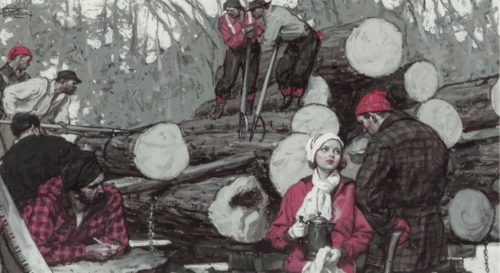
“The Second Generation” by Stephen Crane
Caspar Cadogan resolved to go to the tropic wars and do something. The air was blue and gold with the pomp of soldiering, and in every ear rang the music of military glory. Caspar’s father was a United States Senator from the great State of Skowmulligan, where the war fever ran very high. Chill is the blood of many of the sons of millionaires, but Caspar took the fever and posted to Washington. His father had never denied him anything, and this time all that Caspar wanted was a little Captaincy in the Army — just a simple little Captaincy.
The old man had been entertaining a delegation of respectable bunco-steerers from Skowmulligan who had come to him on a matter which is none of the public’s business.
Bottles of whiskey and boxes of cigars were still on the table in the sumptuous private parlor. The Senator had said: “Well, gentlemen, I’ll do what I can for you.” By this sentence he meant whatever he meant.
Then he turned to his eager son. “Well, Caspar?” The youth poured out his modest desires. It was not altogether his fault. Life had taught him a generous faith in his own abilities. If anyone had told him that he was simply an ordinary fool he would have opened his eyes wide at the person’s lack of judgment. All his life people had admired him.
The Skowmulligan war horse looked with quick disapproval into the eyes of his son. “Well, Caspar,” he said slowly, “I am of the opinion that they’ve got all the golf experts and tennis champions and cotillon leaders and piano tuners and billiard markers that they really need as officers. Now, if you were a soldier — ”
“I know,” said the young man with a gesture, “but I’m not exactly a fool, I hope, and I think if I get a chance I can do something. I’d like to try. I would, indeed.”
The Senator lit a cigar. He assumed an attitude of ponderous reflection. “Y — yes, but this country is full of young men who are not fools. Full of ‘em.”
Caspar fidgeted in the desire to answer that, though he admitted the profusion of young men who were not fools, he felt that he himself possessed interesting and peculiar qualifications which would allow him to make his mark in any field of effort which he seriously challenged. But he did not make this graceful statement, for he sometimes detected something ironic in his father’s temperament. The Skowmulligan war-, horse had not thought of expressing an opinion of his own ability since the year 1865, when he was young, like Caspar.
“Well, well,” said the Senator finally, “I’ll see about it. I’ll see about it.” The young man was obliged to await the end of his father’s characteristic method of thought. The war horse never gave a quick answer, and if people tried to hurry him they seemed able to arouse only a feeling of irritation against making a decision at all. His mind moved like the wind, but practice had placed a Mexican bit in the mouth of his judgment. This old man of light, quick thought had taught himself to move like an ox cart. Caspar said “Yes, sir.” He withdrew to his club, where, to the affectionate inquiries of some envious friends, he replied: “The old man is letting the idea soak.”
The mind of the war horse was decided far sooner than Caspar expected. In Washington a large number of well-bred, handsome young men were receiving appointments as Lieutenants, as Captains, and occasionally as Majors. They were a strong, healthy, clean-eyed, educated collection. They were a prime lot. A German Field-Marshal would have beamed with joy if he could have had them — to send to school. Anywhere in the world they would have made a grand show as material, but, intrinsically, they were not Lieutenants, Captains and Majors. They were fine men, though manhood is only an essential part of a Lieutenant, a Captain or a Major. But at any rate, this arrangement had all the logic of going to sea in a bathing-machine.
The Senator found himself reasoning that Caspar was as good as any of them, and better than many. Presently he was bleating here and there that his boy should have a chance. “The boy’s all right, I tell you, Henry. He’s wild to go, and I don’t see why they shouldn’t give him a show. He’s got plenty of nerve, and he’s keen as a whip-lash. I’m going to get him an appointment, and if you can do anything to help it along I wish you would.”
Then he betook himself to the White House and the War Department and made a stir. People think that Administrations are always slavishly, abominably anxious to please the Machine. They are not; they wish the Machine sunk in red fire, for by the power of ten thousand past words, looks, gestures, writings, the Machine comes along and takes the Administration by the nose and twists it, and the Administration dare not even yell. The huge force which carries an election to success looks reproachfully at the Administration and says: “Give me a bun.” That is a very small thing with which to reward a Colossus.
The Skowmulligan war horse got his bun and took it to his hotel where Caspar was moodily reading war rumors. “Well, my boy, here you are.” Caspar was a Captain and Commissary on the staff of Brigadier-General Reilly, commander of the Second Brigade of the First Division of the Thirtieth Army Corps.
“I had to work for it,” said the Senator grimly. “They talked to me as if they thought you were some sort of emptyheaded idiot. None of ‘em seemed to know you personally. They just sort of took it for granted. Finally I got pretty hot in the collar.” He paused a moment; his heavy, grooved face set hard; his blue eyes shone. He clapped a hand down upon the handle of his chair.
“Caspar, I’ve got you into this thing, and I believe you’ll do all right, and I’m not saying this because I distrust either your sense or your grit. But I want you to understand you’ve got to make a go of it. I’m not going to talk any twaddle about your country and your country’s flag. You understand all about that. But now you’re a soldier, and there’ll be this to do and that to do, and fighting to do, and you’ve got to do every d — d one of ‘em right up to the handle. I don’t know how much of a shindy this thing is going to be, but any shindy is enough to show how much there is in a man. You’ve got your appointment, and that’s all I can do for you, but I’ll thrash you with my own hands if when the Army gets back the other fellows say my son is ‘nothing but a good-looking dude.’”
He ceased, breathing heavily. Caspar looked bravely and frankly at his father, and answered in a voice which was not very tremulous: “I’ll do my best. This is my chance.”
The Senator had a marvelous ability of transition from one manner to another. Suddenly he seemed very kind. “Well, that’s all right, then. I guess you’ll get along all right with Reilly. I know him well, and he’ll see you through. I helped him along once. And now about this commissary business. As I understand it, a Commissary is a sort of caterer in a big way — that is, he looks out for a good many more things than a caterer has to bother his head about. Reilly’s brigade has probably from two to three thousand men in it, and in regard to certain things you’ve got to look out for every matt of ‘em every day. I know perfectly well you couldn’t successfully run a boarding-house in Ocean Grove. How are you going to manage for all these soldiers, hey? Thought about it?”
“No,” said Caspar, injured. “I didn’t want to be a Commissary. I wanted to be a Captain in the line.”
“They wouldn’t hear of it. They said you would have to take a staff appointment where people could look after you.”
“Well, let ‘em look after me,” cried Caspar resentfully; “but when there’s any fighting to be done I guess I won’t necessarily be the last man.”
“That’s it,” responded the Senator. “That’s the spirit.” They both thought that the problem of war would eliminate to an equation of actual battle.
Ultimately Caspar departed into the South to an encampment in salty grass under pine trees. Here lay an Army corps twenty thousand strong. Caspar passed into the dusty sunshine of it, and for many weeks he was lost to view.
Second Chapter
“Of course I don’t know a blamed thing about it,” said Caspar frankly and modestly to a circle of his fellow staff officers. He was referring to the duties of his office.
Their faces became expressionless; they looked at him with eyes in which he could fathom nothing. After a pause one politely said: “Don’t you?” It was the inevitable two words of convention.
“Why,” cried Caspar, “I didn’t know what a Commissary officer was until I was one. My old Guv’nor told me. He’d looked it up in a book, I suppose; but I didn’t know.”
“Didn’t you?”
The young man’s face glowed with sudden humor. “Do you know, the word was intimately associated in my mind with camels. Funny, eh? I think it came from reading that rhyme of Kipling’s about the commissariat camel.”
“Did it?”
“Yes. Funny, isn’t it? Camels!”
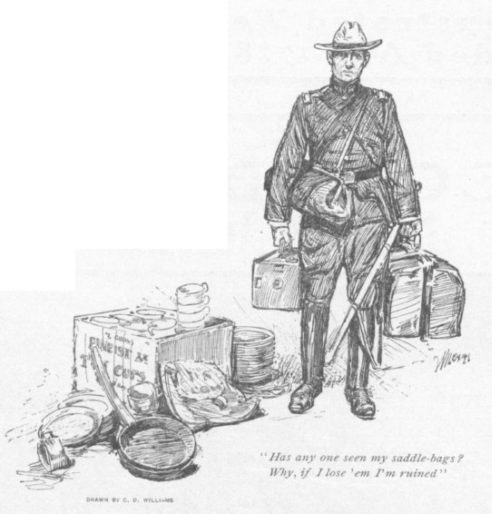
The brigade was ultimately landed at Siboney as part of an army to attack Santiago. The scene at the landing sometimes resembled the inspiriting daily drama at the approach to the Brooklyn Bridge. There was a great bustle, during which the wise man kept his property gripped in his hands lest it might march off into the wilderness in the pocket of one of the striding regiments. Truthfully, Caspar should have had frantic occupation, but men saw him wandering footlessly here and there crying: “Has any one seen my saddle-bags? Why, if I lose ‘em I’m ruined. I’ve got everything packed away in ‘em. Everything!”
They looked at him gloomily and without attention. “No,” they said. It was to intimate that they would not give a rip if he had lost his nose, his teeth and his self-respect. Reilly’s brigade collected itself from the boats and went off, each regiment’s soul burning with anger because some other regiment was in advance of it. Moving along through the scrub and under the palms, men talked mostly of things that did not pertain to the business in hand.
General Reilly finally planted his headquarters in some tall grass under a mango tree. “Where’s Cadogan?” he said suddenly, as he took off his hat and smoothed the wet, gray hair from his brow. Nobody knew. “I saw him looking for his saddle-bags down at the landing,” said an officer dubiously. “Bother him,” said the General contemptuously. “Let him stay there.”
Three venerable regimental commanders came, saluted stiffly and sat in the grass. There was a pow-wow, during which Reilly explained much that the Division Commander had told him. The venerable Colonels nodded; they understood. Everything was smooth and clear to their minds. But still, the Colonel of the 44th Regular Infantry murmured about the commissariat. His men — and then he launched forth in a sentiment concerning the privations of his men in which you were confronted with his feeling that his men — his men were the only creatures of importance in the universe; which feeling was entirely correct for him. Reilly grunted. He did what most commanders did. He set the competent line to doing the work of the incompetent part of the staff.
In time Caspar came trudging along the road merrily swinging his saddle-bags. “Well, General,” he cried as he saluted, “I found ‘em.”
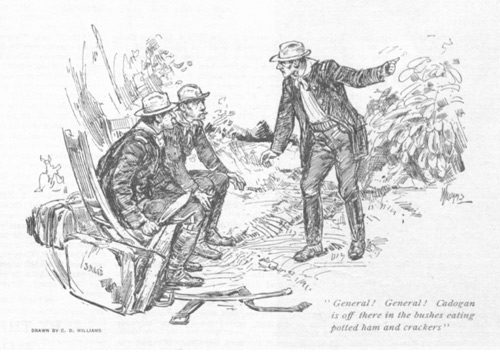
“Did you?” said Reilly. Later an officer rushed to him tragically: “General, Cadogan is off there in the bushes eating potted ham and crackers all by himself.” The officer was sent back into the bushes for Caspar, and the General sent Caspar with an order. Then Reilly and the three venerable Colonels, grinning, partook of potted ham and crackers. “Tashe a’ right,” said Reilly, with his mouth full. “Dorsey, see if ‘e got some’n else.”
“Mush be selfish young pig,” said one of the Colonels, with his mouth full. “Who’s he, General?” “Son — Sen’tor Cad’gan — ol’ frien’ mine — dash ‘im.” Caspar wrote a letter:
“Dear Father: I am sitting under a tree using the flattest part of my canteen for a desk. Even as I write the division ahead of us is moving forward and we don’t know what moment the storm of battle may break out. I don’t know what the plans are. General Reilly knows, but he is so good as to give me very little of his confidence. In fact, I might be part of a forlorn hope from all to the contrary I’ve heard from him. I understood you to say in Washington that you at one time had been of some service to him, but if that is true I can assure you he has completely forgotten it. At times his manner to me is little short of being offensive, but of course I understand that it is only the way of a crusty old soldier who has been made boorish and bearish by a long life among the Indians. I dare say I shall manage it all right without a row.
“When you hear that we have captured Santiago, please send me by first steamer a box of provisions and clothing, particularly sardines, pickles, and light-weight underwear. The other men on the staff are nice, quiet chaps, but they seem a bit crude. There has been no fighting yet save the skirmish by Young’s brigade. Reilly was furious because we couldn’t get in it. I met General Peel yesterday. He was very nice. He said he knew you well when he was in Congress. Young Jack May is on Peel’s staff. I knew him well in college. We spent an hour talking over old times. Give my love to all at home.”
The march was leisurely. Reilly and his staff strolled out to the head of the long, sinuous column and entered the sultry gloom of the forest. Some less fortunate regiments had to wait among the trees at the side of the trail, and as Reilly’s brigade passed them, officer called to officer, classmate to classmate, and in these greetings rang a note of everything, from West Point to Alaska. They were going into an action in which they, the officers, would lose over a hundred in killed and wounded — officers alone — and these greetings, in which many nicknames occurred, were in many cases farewells such as one pictures being given with ostentation, solemnity, fervor. “There goes Gory Widgeon! Hello, Gory! Where you starting for? Hey, Gory!”
Caspar communed with himself and decided that he was not frightened. He was eager and alert; he thought that now his obligation to his country, or himself, was to be faced, and he was mad to prove to old Reilly and the others that after all he was a very capable soldier. tug
Third Chapter
Old Reilly was stumping along the line of his brigade and mumbling like a man with a mouthful of grass. The fire from the enemy’s position was incredible in its swift fury, and Reilly’s brigade was getting its share of a very bad ordeal. The old man’s face was of the color of a tomato, and in his rage he mouthed and sputtered strangely. As he pranced along his thin line, scornfully erect, voices arose from the grass beseeching him to take care of himself. At his heels scrambled a bugler with pallid skin and clenched teeth, a chalky, trembling youth, who kept his eye on old Reilly’s back and followed it.
The old gentleman was quite mad. Apparently he thought the whole thing a dreadful mess, but now that his brigade was irrevocably in it he was full-tilting here and everywhere to establish some irreproachable, immaculate kind of behavior on the part of every man Jack in his brigade. The intentions of the three venerable Colonels were the same. They stood behind their lines, quiet, stern, courteous old fellows, admonishing their regiments to be very pretty in the face of such a hail of magazine-rifle and machine-gun fire as has never in this world been confronted, save by beardless savages when the white man has found occasion to take his burden to some new place.
And the regiments were pretty. The men lay on their little stomachs and got peppered according to the law, and said nothing as the good blood pumped out into the grass; and even if a solitary rookie tried to get a decent reason to move to some haven of rational men, the cold voice of an officer made him look criminal with a shame that was a credit to his regimental education. Behind Reilly’s command was a bullet-torn jungle through which it could not move as a brigade; ahead of it were Spanish trenches on hills. Reilly considered that he was in a fix, no doubt, but he said this only to himself. Suddenly he saw on the right a little point of blue-shirted men already half-way up the hill. It was some pathetic fragment of the Sixth United States Infantry. Chagrined, horrified, Reilly bellowed to his bugler and the chalked-faced youth sounded the charge by rushes.
The men formed hastily and grimly, and rushed. Apparently there awaited them only the fate of respectable soldiers. But they went because — of the opinions of others, perhaps. They went because — no loud-mouthed lot of jailbirds such as the Twenty-seventh Infantry could do anything that they could not do better. They went because Reilly ordered it. They went because they went.
And yet not a man of them to this day has made a public speech explaining precisely how he did the whole thing and detailing with what initiative and ability he comprehended and defeated a situation which he did not comprehend at all.
Reilly never saw the top of the hill. He was heroically striving to keep up with his men when a bullet ripped quietly through his left lung and he fell back into the arms of the bugler, who received him as he would have received a Christmas present. The three venerable Colonels inherited the brigade in swift succession. The senior commanded for about fifty seconds, at the end of which he was mortally shot. Before they could get the news to the next in rank he, too, was shot. The junior Colonel ultimately arrived with a lean and puffing little brigade at the top of the hill. The men lay down and fired volleys at whatever was practicable.
In and out of the ditchlike trenches lay the Spanish dead-lemon-faced corpses dressed in shabby blue and white ticking. Some were huddled down comfortably like sleeping children; one had died in the attitude of a man flung back in a dentist’s chair; one sat in the trench with its chin sunk despondently to its breast; few preserved a record of the agitation of battle. With the greater number it was as if death had touched them so gently, so lightly, that they had not known of it. Death had come to them rather in the form of an opiate than of a bloody blow.
But the arrived men in the blue shirts had no thought of the sallow corpses. They were eagerly. exchanging a hail of shots with the Spanish second line, whose ash-colored entrenchments barred the way to a city white amid trees. In the pauses the men talked.
“We done the best. Old E Company got there. Why, one time the hull of B Company was behind us.”
“Jones, he was the first man up. I saw ‘im.”
“Which Jones?”
“Did you see ol’ Two-bars runnin’ like a land-crab? Made good time, too. He hit only in the high places.”
“The Lootenant is all right, too. He was a good ten yards ahead of the best of us. I hated him at the post, but for this here active service there’s none of ‘em can touch him.”
“This is mighty different from being at the post.”
“Well, we done it, an’ it wasn’t because I thought it could be done. When we started, I ses to m’self: Well, here goes a lot of blanked fools.’”
“‘Tain’t over yet.”
“Oh, they’ll never git us back from here. If they start to chase us back from here we’ll pile ‘em up so high the last ones can’t climb over. We’ve come this far, an’ we’ll stay here. I ain’t done pantin’.”
“Anything is better than packin’ through that jungle an’ gettin’ blistered from front, rear, an’ both flanks. I’d rather tackle another hill than go trailin’ in them woods, so thick you can’t tell whether you are one man or a division of cav’lry.”
“Where’s that young kitchen-soldier, Cadogan, or whatever his name is? Ain’t seen him to-day.”
“Well, I seen him. He was right in with it. He got shot, too, about half up the hill, in the leg. I seen it. He’s all right. Don’t worry about him. He’s all right.”
“I seen him, too. He done his stunt. As soon as I can git this piece of barbed-wire entanglement out of me throat I’ll give him a cheer.”
“He ain’t shot at all, because there he stands, there. See him?”
Rearward, the grassy slope was populous with little groups of men searching for the wounded. Reilly’s brigade began to dig with its bayonets and shovel with its meat-ration cans.
Fourth Chapter
Senator Cadogan paced to and fro in his private parlor and smoked small, brown, weak cigars. These little wisps seemed utterly inadequate to console such a ponderous satrap.
It was the evening of the first of July, 1898, and the Senator was immensely excited, as could be seen from the superlatively calm way in which he called out to his private secretary, who was in an adjoining room. The voice was serene, gentle, affectionate, low.
“Baker, I wish you’d go over again to the War Department and see if they’ve heard anything about Caspar.”
A very bright-eyed, hatchet-faced young man appeared in a doorway, pen still in hand. He was hiding a nettle-like irritation behind all the finished audacity of a smirk, sharp, lying, trustworthy young politician. “I’ve just got back from there, sir,” he suggested.
The Skowmulligan war horse lifted his eyes and looked for a short second into the eyes of his private secretary. It was not a glare or an eagle glance; it was something beyond the practice of an actor; it was simply meaning. The clever private secretary grabbed his hat and was at once enthusiastically away. “All right, sir,” he cried. “I’ll find out.”
The War Department was ablaze with light, and messengers were running. With the assurance of a retainer of an old house, Baker made his way through much small-calibre vociferation. There was rumor of a big victory; there was rumor of a big defeat. In the corridors various watchdogs arose from their armchairs and asked him of his business in tones of uncertainty which in no wise compared with their previous habitual deference to the private secretary of the war horse of Skowmulligan.
Ultimately Baker arrived in a room where some kind of a head clerk sat writing feverishly at a roll-top desk. Baker asked a question and the head clerk mumbled profanely without lifting his head. Apparently he said: “How in the blankety-blank blazes do I know?”
The private secretary let his jaw fall. Surely some new spirit had come suddenly upon the heart of Washington — a spirit which Baker understood to be almost defiantly indifferent to the wishes of Senator Cadogan, a spirit which was not even courteously oily. What could it mean? Baker’s foxlike mind sprang wildly to a conception of overturned factions, changed friends, new combinations. The assurance which had come from experience of a broad political situation suddenly left him, and he would not have been amazed if someone had told him that Senator Cadogan now controlled only six votes in the State of Skowmulligan. “Well,” he stammered, “well — there isn’t any news of the old man’s son, hey?” Again the head clerk replied blasphemously.
Eventually Baker retreated in disorder from the presence of this head clerk, having learned that the latter did not give a — — if Caspar Cadogan were sailing through Hades on an ice yacht.
Baker stormed other and more formidable officials. In fact, he struck as high as he dared. They one and all flung him short, hard words, even as men pelt an annoying cur with pebbles. He emerged from the brilliant light, from the groups of men with anxious, puzzled faces, and as he walked back to the hotel he did not know if his name were Baker or Cholmondeley.
However, as he walked up the stairs to the Senator’s rooms he contrived to concentrate his intellect upon a manner of speaking.
The war horse was still pacing his parlor and smoking. He paused at Baker’s entrance. “Well?”
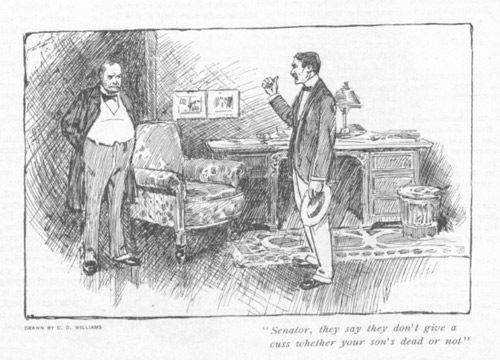
“Mr. Cadogan,” said the private secretary coolly, “they told me at the Department that they did not give a cuss whether your son was alive or dead.”
The Senator looked at Baker and smiled gently., “What’s that, my boy?” he asked in a soft and considerate voice.
“They said — ” gulped Baker, with a certain tenacity. “They said that they didn’t give a cuss whether your son was alive or dead.”
There was a silence for the space of three seconds. Baker stood like an image; he had no machinery for balancing the issues of this kind of a situation, and he seemed to feel that if he stood as still as a stone frog he would escape the ravages of a terrible Senatorial wrath which was about to break forth in a hurricane speech, which would snap off trees and sweep away barns.
“Well,” drawled the Senator lazily, “who did you see, Baker?”
The private secretary resumed a certain usual manner of breathing. He told the names of the men whom he had seen.
“Ye — e — es,” remarked the Senator. He took another little brown cigar and held it with a thumb and first finger, staring at it with the calm and steady scrutiny of a scientist investigating a new thing. “So they don’t care whether Caspar is alive or dead, eh? Well, . . . maybe they don’t. . . . That’s all right. . . . However, . . . I think I’ll just look in on ‘em and state my views.”
When the Senator had gone, the private secretary ran to the window and leaned afar out. Pennsylvania Avenue was gleaming silver blue in the light of many arc-lamps; the cable trains groaned along to the clangor of gongs; from the window, the walks presented a hardly diversified aspect of shirt-waists and straw hats. Sometimes a newsboy screeched.
Baker watched the tall, heavy figure of the Senator moving out to intercept a cable train. “Great Scott!” cried the private secretary to himself, “there’ll be three distinct kinds of grand, plain, practical fireworks. The old man is going for ‘em. I wouldn’t be in Lascum’s boots. Ye gods, what a row there’ll be!”
In due time the Senator was closeted with some kind of deputy third-assistant battery-horse in the offices of the War Department. The official obviously had been told off to make a supreme effort to pacify Cadogan, and he certainly was acting according to his instructions. He was almost in tears; he spread out his hands in supplication, and his voice whined and wheedled.
“Why, really, you know, Senator, we can only beg you to look at the circumstances. Two scant divisions at the top of whether we are a-foot or a-horseback. Everything is in the air. We don’t know whether we have won a glorious victory or simply got ourselves in a deuce of a fix.”
The Senator coughed. “I suppose my boy is with the two divisions at the top of that hill? He’s with Reilly.”
“Yes; Reilly’s brigade is up there.”
“And when do you suppose the War Department can tell me if he is all right? I want to know.”
“My dear Senator, frankly, I don’t know. Again I beg you to think of our position. The Army is in a muddle; it’s a General thinking that he must fall back, and yet not sure that he can fall back without losing the Army. Why, we’re worrying about the lives of sixteen thousand men and the self-respect of the nation, Senator.”
“I see,” observed the Senator, nodding his head slowly. “And naturally the welfare of one man’s son doesn’t — how do they say it? — doesn’t cut any ice.”
Fifth Chapter
And in Cuba it rained. In a few days Reilly’s brigade discovered that by their successful charge they had gained the inestimable privilege of sitting in a wet trench and slowly but surely starving to death. Men’s tempers crumbled like dry bread. The soldiers who so cheerfully, quietly and decently had captured positions which the foreign experts had said were impregnable, now in turn underwent an attack which was furious as well as insidious. The heat of the sun alternated with rains which boomed and roared in their falling like mountain cataracts. It seemed as if men took the fever through sheer lack of other occupation. During the days of battle none had had time to get even a tropic headache, but no sooner was that brisk period over than men began to shiver and shudder by squads and platoons. Rations were scarce enough to make a little fat strip of bacon seem of the size of a corner lot, and coffee grains were pearls. There would have been godless quarreling over fragments if it were not that with these fevers came a great listlessness, so that men were almost content to die, if death required no exertion.
It was an occasion which distinctly separated the sheep from the goats. The goats were few enough, but their qualities glared out like crimson spots.
One morning Jameson and Ripley, two Captains in the Forty-fourth Foot, lay under a flimsy shelter of sticks and palm branches. Their dreamy, dull eyes contemplated the men in the trench which went to left and right. To them came Caspar Cadogan, moaning. “By Jove,” he said, as he flung himself wearily on the ground, “I can’t stand much more of this, you know. It’s killing me.” A bristly beard sprouted through the grime on his face; his eyelids were crimson; an indescribably dirty shirt fell away from his roughened neck; and at the same time various lines of evil and greed were deepened on his face, until he practically stood forth as a revelation, a confession. “I can’t stand it. By Jove, I can’t.”
Stanford, a Lieutenant under Jameson, came stumbling along toward them. He was a lad of the class of ‘98 at West Point. It could be seen that he was flaming with fever. He rolled a calm eye at them. “Have, you any water, sir?” he said to his Captain. Jameson got upon his feet and helped Stanford to lay his shaking length under the shelter. “No, boy,” he answered gloomily. “Not a drop. You got any, Rip?”
“No,” answered Ripley, looking with anxiety upon the young officer. “Not a drop.”
“You, Cadogan?”
Here Caspar hesitated oddly for a second, and then in a tone of deep regret made answer, “No, Captain; not a mouthful.”
Jameson moved off weakly. “You lay quietly, Stanford, and I’ll see what I can rustle.”
Presently Caspar felt that Ripley was steadily regarding him. He returned the look with one of half-guilty questioning.
“God forgive you, Cadogan,” said Ripley, “but you are a beast. Your canteen is full of water.”
Even then the apathy in their veins prevented the scene from becoming as sharp as the words sounded. Caspar sputtered like a child, and at length merely said: “No, it isn’t.” Stanford lifted his head to shoot a keen, proud glance at Caspar, and then turned away.
“You lie,” said Ripley. “I can tell the sound of a full canteen as far as I can hear it.”
“Well, if it is, I — I must have forgotten it.”
“You lie; no man in this Army just now forgets whether his canteen is full or empty. Hand it over.”
Fever is the physical counterpart of shame, and when a man has had the one he accepts the other with an ease which would revolt his healthy self. However, Caspar made a desperate struggle to preserve the forms. He arose and, taking the string from his shoulder, passed the canteen to Ripley. But after all there was a whine in his voice, and the assumption of dignity was really a farce. “I think I would better go, Captain. You can have the water if you want it, I’m sure. But — but I fail to see — I fail to see what reason you have for insulting me.”
“Do you?” said Ripley stolidly. “That’s all right.”
Caspar stood for a terrible moment. He simply did not have the strength to turn his back on this — this affair. It seemed to him that he must stand forever and face it. But when he found the audacity to look again at Ripley he saw the latter was not at all concerned with the situation. Ripley, too, had the fever. The fever changes all laws of proportion. Caspar went away.
“Here, youngster; here’s your drink.”
Stanford made a weak gesture. “I wouldn’t touch a drop from his blamed canteen if it was the last water in the world,” he murmured in his high, boyish voice.
“Don’t you be a young jackass,” quoth Ripley tenderly.
The boy stole a glance at the canteen. He felt the propriety of arising and hurling it after Caspar, but — he, too, had the fever.
“Don’t you be a young jackass,” said Ripley again.
Sixth Chapter
Senator Cadogan was happy. His son had returned from Cuba, and the 8:30 train that evening would bring him to the station nearest to the stone and red shingle villa which the Senator and his family occupied on the shores of Long Island Sound. The Senator’s steam yacht lay some hundred yards from the beach. She had just returned from a trip to Montauk Point, where the Senator had made a gallant attempt to gain his son from the transport on which he was coming from Cuba. He had fought a brave sea-fight with sundry petty little doctors and ship’s officers, who had raked him with broad- sides describing the laws of quarantine and had used inelegant speech to a United States Senator as he stood on the bridge of his own steam yacht. These men had grimly asked him to tell exactly how much better was Caspar than any other returning soldier.
But the Senator had not given them a long fight. In fact, the truth came to him quickly, and with almost a blush he had ordered the yacht back to her anchorage off the villa. As a matter of fact, the trip to Montauk Point had been undertaken largely from impulse. Long ago the Senator had decided that when his boy returned the greeting should have something Spartan in it. He would make a welcome such as most soldiers get. There should be no flowers and carriages when the other poor fellows got none. He would consider Caspar as a soldier. That was the way to treat a man. But, in the end, a sharp acid of anxiety had worked upon the iron old man, until he had ordered the yacht to take him out and make a fool of him. The result filled him with a chagrin which caused him to delegate to the mother and sisters the entire business of succoring Caspar at Montauk Point Camp. He had remained at home, conducting the huge correspondence of an active national politician and waiting for this son whom he so loved and whom he so wished to be a man of a certain strong, taciturn, shrewd ideal. The recent yacht voyage he now looked upon as a kind of confession of his weakness, and he was resolved that no more signs should escape him.
But yet his boy had been down there against the enemy and among the fevers. There had been grave perils, and his boy must have faced them. And he could not prevent himself from dreaming through the poetry of fine actions, in which visions his son’s face shone out manly and generous. During these periods the people about him, accustomed as they were to his silence and calm in time of stress, considered that affairs in Skowmulligan might be most critical. In no other way could they account for this exaggerated phlegm.
On the night of Caspar’s return he did not go to dinner, but had a tray sent to his library, where he remained writing. At last he heard the spin of the dog-cart wheels on the gravel of the drive, and a moment later there penetrated to him the sound of joyful feminine cries. He lit another cigar; he knew that it was now his part to bide with dignity the moment when his son should shake off that other welcome and come to him. He could still hear them; in their exuberance they seemed to be capering like school children. He was impatient, but this impatience took the form of a polar stolidity.
Presently there were quick steps and a jubilant knock at his door. ‘Come in,” he said.
In came Caspar, thin, yellow and in soiled khaki. “They almost tore me to pieces,” he cried, laughing. “They danced around like wild things.” Then as they shook hands he dutifully said, “How are you, sir?”
“How are you, my boy?” answered the Senator casually but kindly.
“Better than I might expect, sir,” cried Caspar cheer- fully. “We had a pretty hard time, you know.”
“You look as if they’d given you a hard run,” observed the father in a tone of slight interest.
Caspar was eager to tell. “Yes, sir,” he said rapidly. “We did, indeed. Why, it was awful. We — any of us — were lucky to get out of it alive. It wasn’t so much the Spaniards, you know. The Army took care of them all right. It was the fever and the — you know, we couldn’t get anything to eat. And the mismanagement. Why, it was frightful.”
“Yes, I’ve heard,” said the Senator. A certain wistful look came into his eyes, but he did not allow it to become prominent. Indeed, he suppressed it. “And you, Caspar? I suppose you did your duty?”
Caspar answered with becoming modesty. “Well, I didn’t do more than anybody else, I don’t suppose, but — well, I got along all right, I guess.”
“And this great charge up San Juan Hill?” asked the father slowly. “Were you in that?”
“Well — yes; I was in it,” replied the son.
The Senator brightened a trifle. “You were, eh? In the front of it? or just sort of going along?”
“Well — I don’t know. I couldn’t tell exactly. Sometimes I was in front of a lot of them, and sometimes I was — just sort of going along.”
This time the Senator emphatically brightened. “That’s all right, then. And of course — of course you performed your Commissary duties correctly?”
The question seemed to make Caspar uncommunicative and sulky. “I did when there was anything to do,” he answered. “But the whole thing was on the most unbusinesslike basis you can imagine. And they wouldn’t tell you anything. Nobody would take time to instruct you in your duties, and, of course, if you didn’t know a thing your superior officer would swoop down on you and ask you why in the deuce such and such a thing wasn’t done in such and such a way. Of course I did the best I could.”
The Senator’s countenance had again become sombrely indifferent. “I see. But you weren’t directly rebuked for incapacity, were you? No; of course you weren’t. But — I mean — did any of your superior officers suggest that you were no good,’ or anything of that sort? I mean — did you come off with a clean slate?”
Caspar took a small time to digest his father’s meaning. “Oh, yes, sir,” he cried at the end of his reflection. “The Commissary was in such a hopeless mess anyhow that nobody thought of doing anything but curse Washington.”
“Of course,” rejoined the Senator harshly. “But supposing that you had been a competent and well-trained Commissary officer? What then?”
Again the son took time for consideration, and in the end deliberately replied: “Well, if I had been a competent and well-trained Commissary I would have sat there and eaten up my heart and cursed Washington.”
“Well, then, that’s all right. And now about this charge up San Juan? Did any of the Generals speak to you after- ward and say that you had done well? Didn’t any of them see you?”
“Why, n — n — no, I don’t suppose they did . . . any more than I did them. You see, this charge was a big thing and covered lots of ground, and I hardly saw anybody excepting a lot of the men.”
“Well, but didn’t any of the men see you? Weren’t you ahead some of the time, leading them on and waving your sword?”
Caspar burst into laughter. “Why, no. I had all I could do to scramble along and try to keep up. And I didn’t want to go up at all.”
“Why?” demanded the Senator.
“Because — because the Spaniards were shooting so much. And you could see men falling, and the bullets rushed around you in — by the bushel. And then at last it seemed that if we once drove them away from the top of the hill there would be less danger. So we all went up.”
The Senator chuckled over this description. “And you didn’t flinch at all?”
“Well,” rejoined Caspar humorously, “I won’t say I wasn’t frightened.”
“No, of course not. But then you did not let anybody know it?”
“Of course not.”
“You understand, naturally, that I am bothering you with all these questions because I desire to hear how my only son behaved in the crisis. I don’t want to worry you with it. But if you went through the San Juan charge with credit I’ll have you made a Major.”
“Well,” said Caspar, “I wouldn’t say I went through that charge with credit. I went through it all good enough, but the enlisted men around went through in the same way.”
“But weren’t you encouraging them and leading them on by your example?”
Caspar smirked. He began to see a point. “Well, sir,” he said with a charming hesitation. “Aw — er — I — well, I dare say I was doing my share of it.”
The perfect form of the reply delighted the father. He could not endure blatancy; his admiration was to be won only by a bashful hero. Now he beat his hand impulsively down upon the table. “That’s what I wanted to know. That’s it exactly. I’ll have you made a Major next week. You’ve found your proper field at last. You stick to the Army, Caspar, and I’ll back you up. That’s the thing. In a few years it will be a great career. The United States is pretty sure to have an Army of about a hundred and fifty thousand men. And starting in when you did and with me to back you up — why, we’ll make you a General in seven or eight years. That’s the ticket. You stay in the Army.” The Senator’s cheek was flushed with enthusiasm and he looked eagerly and confidently at his son.
But Caspar had pulled a long face. “The Army?” he said. “Stay in the Army?”
The Senator continued to outline quite rapturously his idea of the future, “The Army, evidently, is just the place for you. You know as well as I do that you have not been a howling success, exactly, in anything else which you have tried. But now the Army just suits you. It is the kind of career which especially suits you. Well, then, go in, and go at it hard. Go in to win. Go at it.”
“But — ” began Caspar.
The Senator interrupted swiftly. “Oh, don’t worry about that part of it. I’ll take care of all that. You won’t get jailed in some Arizona adobe for the rest of your natural life. There won’t be much more of that, anyhow; and besides, as I say, I’ll look after all that end of it. The chance is splendid. A young, healthy and intelligent man, with the start you’ve already got, and with my backing, can do anything — anything! There will be a lot of active service — oh, yes, I’m sure of it — and everybody who — ”
“But,” said Caspar, wan, desperate, heroic, “father, I don’t care to stay in the Army.”
The Senator lifted his eyes and darkened. “What?” he said. “What’s that?” He looked at Caspar.
The son became tightened and wizened like an old miser trying to withhold gold. He replied with a sort of idiot obstinacy, “I don’t care to stay in the Army.”
The Senator’s jaw clinched down and he was dangerous. But, after all, there was something mournful somewhere. “Why, what do you mean?” he asked gruffly.
“Why, I couldn’t get along, you know. The — the — ”
“The what?” demanded the father, suddenly uplifted with thunderous anger. “The what?”
Caspar’s pain found a sort of outlet in mere irresponsible talk. “Well, you know — the other men, you know. I couldn’t get along with them, you know. They’re peculiar, somehow; odd; I didn’t understand them, and they didn’t understand me. We — we didn’t hitch, somehow. They’re a queer lot. They’ve got funny ideas. I don’t know how to explain it exactly, but — somehow — I don’t like ‘em. That’s all there is to it. They’re good fellows enough, I know, but — ”
“Oh, well, Caspar,” interrupted the Senator, then he seemed to weigh a great fact in his mind, “I guess — ” He paused again in profound consideration, “I guess — ” he lit a small, brown cigar, “I guess you are no — good.”
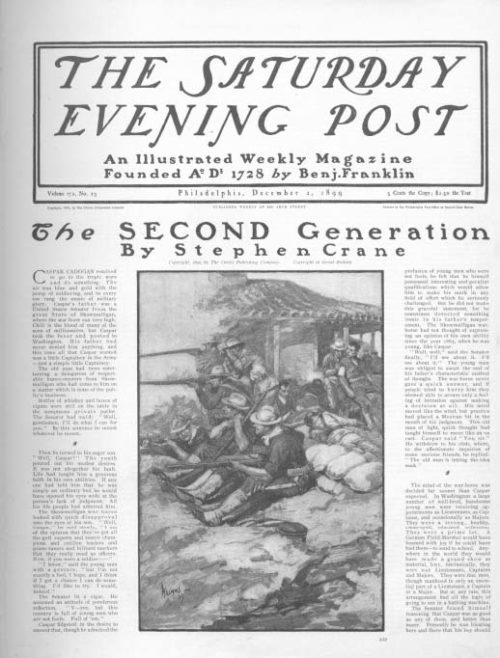
Mourning the Death of Cursive
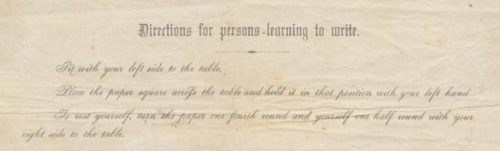
I learned cursive handwriting in the second grade — concurrently with learning that Santa Claus was a hoax. The first word I learned to write in the august script was “Christmas.” Like a streaming ribbon across the page, the word was beautifully connected, seemingly designed to be written in one epic, fluent stroke. I scrawled a cursive “Christmas” on everything — notepads, used envelopes, a toy magnetic drawing board — like it was my own signature.
This was in the late ’90s, when the D’Nealian method of handwriting offered a smooth transition to cursive learning by way of small “tails” at the ends of t’s and i’s that would, supposedly, nudge students toward polished, fluid script. I took these tails to their elaborate limits, forming an ostentatious descender from my name’s “N” that wrapped around the word to form the tittle above the “i,” sometimes as a flower or an exploding firework. My indulgence in an ornate signature throughout grade school was an imitation of my mother’s own dramatic autograph.
I imagine such a personal connection with cursive handwriting must be prevalent among other adults who remember a time before touch screens. Cursive seems to be linked, for many, to intellectual competence, identity, and even morality in the age of its decline. We can’t imagine a functional future that doesn’t include pretty writing. But, more importantly: how could our children be deprived of the exact grueling tradition of penmanship education through which we all had to suffer?
Our attachment to attached letters is rooted in our national identity. Cursive handwriting has a long, rich history in the U.S., from the copperplate lettering of the Declaration of Independence to the Spencerian script of the Coca-Cola logo. Author Anne Trubek has documented this, most notably in The History and Uncertain Future of Handwriting. The 19th century cursive school of Platt Rogers Spencer was flowery and elegant, based on the natural forms of trees and leaves, while the 20th century gave way to A.N. Palmer’s industrial age style, characterized by more rugged, efficient strokes. In a Pacific Standard article, Trubek writes, “Handwriting slowly became a form of self-expression when it ceased to be the primary mode of written communication. When a new writing technology develops, we tend to romanticize the older one. The supplanted technology is vaunted as more authentic because it is no longer ubiquitous or official.”
In 2010, the Common Core standards — detailed educational objectives encouraged by the U.S. Department of Education — omitted cursive writing from its curricula, declaring instead that students in kindergarten and first grade should learn to write in print proficiently before swiftly moving on to the keyboard. This has resulted in a years-long, nationwide debate over the usefulness of cursive script. In Indiana — one of eight states to opt out of Common Core standards — the fight for cursive is renewed each year by State Senator Jean Leising, who regularly puts forth a bill to require cursive in Indiana elementary schools. Leising notes the popularity of mandatory cursive, citing an Indiana Department of Education survey of 4,000 educators that showed 70 percent support, and rejects skeptical claims that cursive script is not a 21st-century skill. As the Indianapolis Star pointed out, Indiana Governor Eric Holcomb writes his own signature in print.
The backlash against cursive’s obsolescence has taken both melancholic and wrathful tones. In 2015, a Facebook post showed a teacher’s reprimand of a supposed 7-year-old’s cursive signature on a homework assignment: “Stop writing your name in cursive. You have had several warnings.” The post was shared over a million times and drew comments from many claiming it was a clear indicator of everything wrong with education and, perhaps, society in general. We’ve all seen mournful accounts of graduate students who can’t read historic documents or a parent’s lament that letters sent to their child’s summer camp were unappreciated. And they are in good company with the army of capitalized Facebook comments declaring cursive’s extinction “RIDICULOUS !!!” But is it?
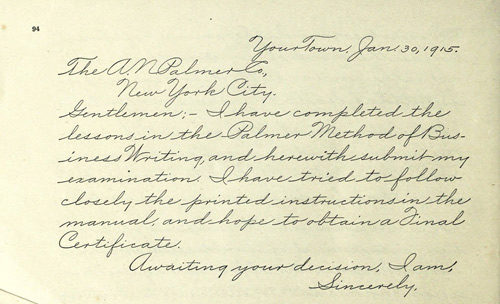
Opinions on the usefulness of cursive sometimes focus on aspects of security: children “should, at the very least, learn their signature” or else they could be vulnerable to forgery. Marvin Sumner, a professor emeritus of Developmental Psychology at Western University, says forgery is indeed more difficult with cursive because there is “a more complicated series of motor movements involved than with block letters.” That said, the argument might be ignoring the reality of signatures in the 21st century in the first place. The familiar index-finger scribbles on coffee shop iPads hardly resemble a Spencerian autograph, and many important tasks, like filing taxes or “signing” a lease, no longer require a handwritten signature at all.
The motor movements involved in handwriting are at the heart of its benefit, whether the writing is cursive or print. Simner notes that devoting attention span to learning the construction of letters adds the motor component to visual and aural learning of language. In the Times, Maria Konnikova writes, “children not only learn to read more quickly when they first learn to write by hand, but they also remain better able to generate ideas and retain information.” Since cursive is thought to be faster, its adherents probably experience swifter and more coherent thought processes than printers, right?
The only problem is that cursive isn’t faster. In “Cursive Handwriting and Other Educational Myths,” Nautilus points to a 2013 study comparing the writing speeds of cursive French students and their printing Canadian peers. It found that, overall, cursive was slower than block print, “but fastest of all was a personalized mixture of cursive and manuscript developed spontaneously by pupils around the fourth to fifth grade.” If it isn’t more efficient, why are we perpetually trying to revive the corpse of cursive, anyway?
Could it be that the fine motor skills and neural pathways created during our taxing repetitions of loops and letterforms were accompanied by a sort of chirographic Stockholm syndrome? That we can only purge our obsessive devotion to curlicues and connected letters by passing it on to our young? With so many cursive enthusiasts in this country, you would think calligraphy was a much more universal hobby.
Like the Canadian students in the 2013 study, my own writing became a combination of print and cursive at some point in junior high. In my own signature, I traded the stylized “monkey’s tail” of a cursive “N” for a printed one with a final ascender that leaps off the page as if to say “block print can be exciting too!” When I am in the checkout line at the grocery store, however, I scratch in a sordid squiggle like everyone else.
Your Weekly Checkup: Should You Get a Flu Shot?
“Your Weekly Checkup” is our online column by Dr. Douglas Zipes, an internationally acclaimed cardiologist, professor, author, inventor, and authority on pacing and electrophysiology. Dr. Zipes is also a contributor to The Saturday Evening Post print magazine. Subscribe to receive thoughtful articles, new fiction, health and wellness advice, and gems from our archive.
“Did you get your flu shot?” should be the first question your doctor, nurse or pharmacist asks during your visit over the next few months. Your answer should be a resounding, “Yes!” I got mine in October, but it took me until a few weeks ago to convince my wife to get hers. Do not rely on last year’s shot since it will not be effective for this year’s flu epidemic, which is the worst in a decade.
According to a recent New York Times article, every state except Hawaii has experienced widespread flu activity, closely paralleling the flu season several years ago with the same H3N2 flu strain dominant. The Centers for Disease Control reports that 6.3 percent of all Americans seeking medical care now have flu symptoms characterized by fever, chills, cough, sore throat, and muscle aches. The H3N2 virus, which killed about 1 million people worldwide when it emerged in 1968, is part of every flu shot so that some immunity results, even though the virus has changed a bit. This is important because if you have gotten your flu shot and still contract the flu—the vaccine is only 20-30% effective against three or four different viral strains—your chances for a milder case are increased.
The CDC estimates that 9 million to 36 million people become ill with the flu each year in the United States and that 140,000 to 710,000 require hospitalization. The Influenza Division of the National Center for Immunization and Respiratory Diseases “warned this flu season is very active and was ‘probably peaking’ last week” when the CDC counted 30 pediatric flu-related deaths. Even in a mild year, the flu kills 12,000 Americans (56,000 in a bad year), mostly very young or older folks. Middle-aged people who also have other health problems such as heart or lung disease, compromised immune systems, diabetes, or obesity are at increased risk. They should definitely get the vaccine, as should pregnant females, particularly since the vaccine also provides six months of protection to the newborn. Importantly, recent information indicates that the flu also increases the risk of having a heart attack six-fold. A high-dose flu vaccine containing four times the dose of the standard vaccine appears to provide better protection for older adults. If you do get the flu despite immunization, immediate treatment with antiviral medications such as Tamiflu, Relenza and Rapivab can be effective.
Are there downsides to getting the vaccine? Mild side effects include soreness, redness or swelling at the injection site, low-grade fever and aches. More serious side effects can occur but are very unusual.
The flu season is upon us in full force, probably lasting well into April and May. If you have not yet gotten your flu shot, do so today!
Heroes of Vietnam: Bob Hope—The GI’s Best Friend
 This article and other features about America in Vietnam can be found in the Post’s Special Collector’s Edition, The Heroes of Vietnam. This edition can be ordered here.
—Originally published March 12, 1966
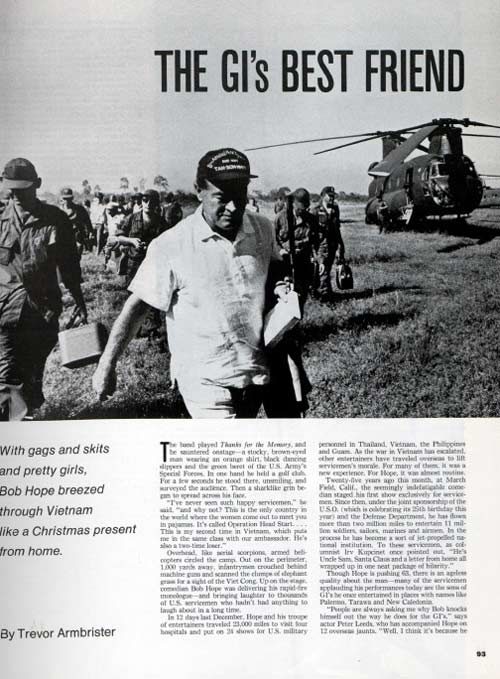
The band played “Thanks for the Memory,” and he sauntered onstage — a stocky, brown-eyed man wearing an orange shirt, black dancing slippers, and the green beret of the U.S. Army’s Special Forces. In one hand he held a golf club. For a few seconds he stood there, unsmiling, and surveyed the audience. Then a shark-like grin began to spread across his face.
“I’ve never seen such happy servicemen,” he said, “and why not? This is the only country in the world where the women come out to meet you in pajamas.”
Overhead, like aerial scorpions, armed helicopters circled the camp. Out on the perimeter, 1,000 yards away, infantrymen crouched behind machine guns and scanned the clumps of elephant grass for a sight of the Viet Cong. Up on the stage, comedian Bob Hope was delivering his rapid-fire monologue — and bringing laughter to thousands of U.S. servicemen who hadn’t had anything to laugh about in a long time.
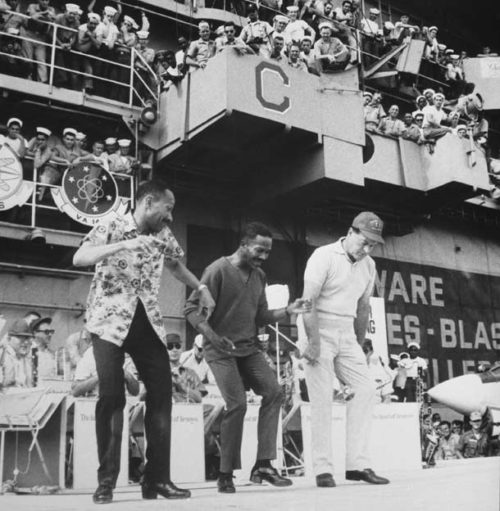
In 12 days last December, Hope and his troupe of entertainers traveled 23,000 miles to visit four hospitals and put on 24 shows for U.S. military personnel in Thailand, Vietnam, the Philippines, and Guam. As the war in Vietnam has escalated, other entertainers have traveled overseas to lift servicemen’s morale. For many of them, it was a new experience. For Hope, it was almost routine.
Twenty-five years ago this month, at March Field, California, the seemingly indefatigable comedian staged his first show exclusively for servicemen. Since then, under the joint sponsorship of the USO (which was celebrating its 25th birthday that year) and the Defense Department, he has flown more than 2 million miles to entertain 11 million soldiers, sailors, marines, and airmen. In the process he has become a sort of jet-propelled national institution. To these servicemen, as columnist Irv Kupcinet once pointed out, “He’s Uncle Sam, Santa Claus, and a letter from home all wrapped up in one neat package of hilarity.”
Though Hope is pushing 63, there is an ageless quality about the man — many of the servicemen applauding his performances today are the sons of GIs he once entertained in places with names like Palermo, Tarawa, and New Caledonia.
One morning, just before Christmas last year, I joined the troupe in the cabin of a U.S. Air Force C-141 as it streaked at 27,000 feet toward Saigon. In the past four days, the comedian had staged five full-length shows for U.S., Thai, and Australian servicemen at airbases in Thailand. But now, as the plane began its descent into Saigon, he seemed apprehensive. “This is where the trip really starts,” he said to singer Jack Jones. “If you want to be nervous, now is the time.”
Landing at Tân So’n Nhu’t Airport, the giant jet taxied to a halt, and the door was opened. Clutching a golf club, Hope stepped off the plane first, followed by a retinue of performers, including Anita Bryant, Diana Lynn Batts (Miss USA), Joey Heatherton, and Les Brown and 14 members of his “Band of Renown.”
“What’s the golf club for?” a reporter asked.
Hope grinned. “Well,” he said, “that’s just to keep my grip in shape until I get back, and also for a little protection.”
“From whom, Bob?”
“From both sides.”
“They blew up the Brink Hotel (an officers’ billet in Saigon) the last time you were here,” another newsman said. “Are you scared this time?”
“Not at all,” Hope replied. “In fact, I may even sleep on top of the bed.”
Like a master conductor leading an orchestra, Hope dominated the press conference. For more than 20 minutes, he parried questions with gags, not only because he seemed to believe that this was what the newsmen expected of him, but also because he seemed genuinely wary about expressing personal opinions.
“Bob doesn’t like to talk about his health, politics, religion, or his adopted children,” explained Jan King, a bubbly woman who serves as his “secretary for movies.” Nor does he like to talk about himself. Questioned on personal matters, he becomes fidgety and either changes the subject abruptly or turns and walks away.
Inside his dressing room behind a knock-down stage at Tân So’n Nhu’t Airport that afternoon, Hope put on his own makeup, then turned to review his cue cards. For the past few weeks, his seven writers had been concentrating on gags for this tour, and here — stacked on the floor of the dressing room — were the results of their efforts: 800 large, rectangular cards, each containing one or more jokes. The gags were broken down into such loose-knit categories as “traveling with pretty girls,” “remote bases,” “bad food,” and “excessive security.” As his chief cue-card assistant, an affable Irishman named Barney McNulty, flipped the boards, Hope decided that he would emphasize the security theme on this show. Up onstage, Les Brown’s musicians were playing “Fly Me to the Moon.” Hope was due to go on next. Grabbing his golf club, he waited in the wings to be introduced, and then strolled out to the microphone amid a burst of applause from 12,000 servicemen.
“I want to thank the provost marshal for the wonderful protection we’ve been getting,” the comedian declared. “They have 25 men with machine guns guarding the girls, and for the fellows, they have a midget with a slingshot. … No, security here is really sensational. I’ve been frisked so many times, I’m even beginning to like it.”
At every punch line he lowered his jaw, and his face took on an expression of feigned anguish. The mannerism never failed to provoke laughter.
The show continued for more than two hours, and Hope was onstage constantly — both as a performer and as master of ceremonies. The crowd roared when Hope brought Carroll Baker onstage.
“That’s a nice gown you’ve got,” the comedian began. “Is it a Schiaparelli?”
“Oh, I’m sorry, Bob,” Miss Baker replied. “I’ve forgotten where I bought it.”
“Well, can I check the label?” With a knowing wink at the audience, Hope stepped behind her and pretended to examine the manufacturer’s tag. “What does it say, Bob?”
“Off limits,” Hope replied.
He kept up the comedy routine for another 10 minutes, danced a soft-shoe number called “Will You Still Be Mine?” with Miss Baker, and then took a break as actor Peter Leeds stepped forward to tell a few gags about U.S. television commercials. But soon Hope returned to the microphone to introduce Joey Heatherton, a 21-year-old blonde who burst onstage wearing a black-sequined leotard and waving a feathery white boa. A grin spread across his face as he sat in the wings and watched her stomp through a wild Watusi with volunteers from the audience. “What a kid!” he said. “Isn’t she great?”
Ten minutes later, Hope was back onstage for a final production number with the entire cast, and then, as the show closed, he asked Anita Bryant to sing “Silent Night.” It was Christmas Eve, and many of the servicemen had tears in their eyes.
After the finale, Gen. W.C. Westmoreland, chief of the U.S. Military Assistance Command in Vietnam, presented a plaque to each member of the troupe and called Hope “the best friend the serviceman ever had.” He went on to quote the comedian as having said, “I’ll stop going overseas only when they stop having Christmas.” The audience applauded resoundingly, and Hope seemed embarrassed. But now a limousine was waiting to speed him to a nearby military hospital. Followed by the rest of his troupe, Hope moved through the wards at a brisk pace. He asked each man how he got hurt and how he was feeling. He told a few jokes and signed autographs. But he never expressed any sympathy.
“That’s the last thing these guys want,” he says. “If you give them sympathy, they’ll turn away. You gotta be clinical about it and talk to ’em on an honest basis. All these guys in traction, I say, ‘Don’t get up, fellas,’ or ‘Okay, somebody get the dice and let’s get started.’ In the old days, [Jerry] Colonna and I would even get in bed with the patients.”
“You have to show them that you’re really happy to see them,” Colonna says, “and in some cases, it’s really tough. You know how they feel and they know how they feel. I choke up and get a lump in my throat and I have to walk away. But Bob — he’s learned how to hold back his emotions.”
He hasn’t always succeeded. Once, on the island of Espiritu Santo in 1944, Hope stopped by the bedside of a severely wounded soldier who was receiving blood transfusions. “I see where they’re giving you a little pick-me-up,” the comedian declared. “It’s only raspberry soda,” the boy replied, “but it feels pretty good.” Two hours later, Hope was told that the boy was dead. “I thought about how in his last moments he’d grinned and tried to say something light,” Hope recalls, “and I couldn’t stand it. I had to go outside and pull myself together.”
At nine o’clock next morning, three Chinook helicopters lifted the troupe from Tân So’n Nhu’t Airport to the First Infantry Division’s base at Di-An. It was very warm and the sky was clear, and because it was Christmas Day, a truce was in effect. Yet most of the 3,200 men in the audience were carrying weapons. Only a few hours ago, four GIs had been killed when their Jeep struck a mine just north of the base, and now an escort officer was saying that extensive security precautions had to be taken because the Viet Cong were known to be less than a mile away.
The temperature at the airbase that afternoon was a blistering 98 degrees, but the 7,000 servicemen in the audience didn’t seem to notice the heat. They roared their approval as Hope ridiculed the peace demonstrators on U.S. college campuses: “Our government’s got a new policy about burning draft cards,” he announced. “Now they say, ‘If he’s old enough to play with matches, draft him.’ … You’ve seen some of these guys with the shoulder-length hair. I guess they’d rather switch than fight.”
At 1:45 next afternoon, Hope was onstage again — this time at Cam Ranh Bay, a sandy supply depot on the Vietnamese coast 200 miles northeast of Saigon. “What is this,” he asked, “a rest-and-recreation area for camels? A supply depot for the Sahara?” The servicemen whistled and applauded.
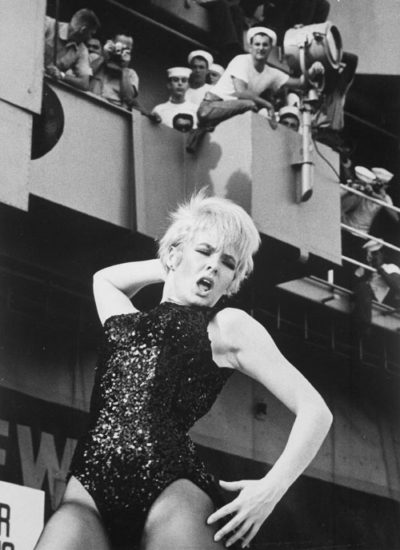
A few minutes later helicopters whisked the troupe to the U.S.S. Ticonderoga five miles offshore. Hope had never put on a show from the deck of a carrier engaged in combat operations, and the prospect clearly excited him. After dinner with Admiral Ralph Cousins, he climbed up to the bridge to watch a squadron of F-8 Crusaders return from a mission over enemy territory.
By 2 p.m. the next day, all air operations had ceased and carpenters were driving the last nails into a makeshift stage on the flight deck. As the show began, Hope took a practice swing with his ever-present golf club. “I’ve played water holes before,” he began, “but this is ridiculous. … And it’s amazing what you can rent from Hertz these days. What a raft this is — it looks like Jackie Gleason’s surfboard.”
That same afternoon, the troupe flew to its second show of the day in Nha Trang. For security reasons, the Marines had not been told in advance when Hope would arrive. As he walked on the stage, a mammoth cheer erupted from the audience. Hope didn’t disappoint them.
“This is the most secret base I’ve ever visited. Everything’s strictly hush-hush. At dawn, the bugler just thinks reveille.”
As he left the stage, a sergeant cracked, “You look tired. Why don’t you send for the troops next Christmas?” Hope grinned, but when the show was over, he lay down on a wooden bench in the dressing room and, within two minutes, was fast asleep. But he didn’t have long to rest. There was another show to do that afternoon.
Click to Enlarge
50 Years Ago: Capote Writes for the Post
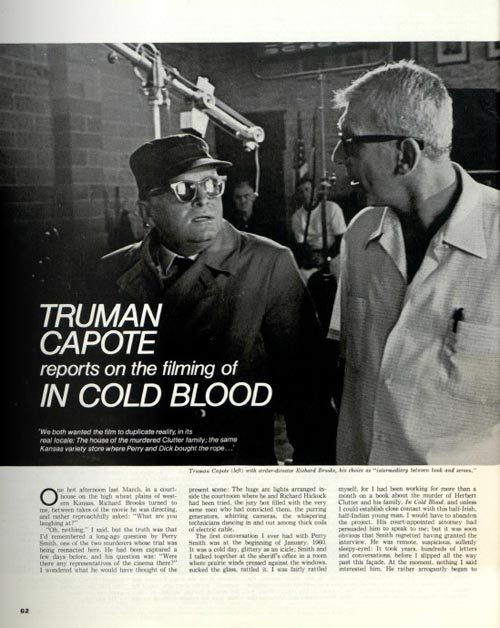
 Truman Capote’s only story in The Saturday Evening Post appeared 50 years ago. After the success of his true crime novel, In Cold Blood, Capote had visited Holcomb, Kansas once more for the production of the film adaptation.
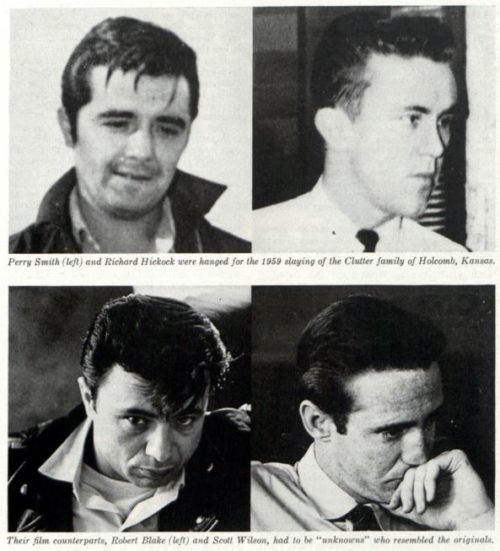
His account of the gruesome murders of the Clutter family in the “high wheat plains of western Kansas” shocked the country as the story was serialized in The New Yorker in 1965. Richard Brooks directed the movie, and its adherence to authenticity was striking to the prominent author. Capote recounts meeting the actors set to portray Perry Smith and Richard Hickock, the then-executed killers he had spent years interviewing: “Meeting them, having to be around them, was not an experience I care to repeat. This has nothing to do with my reaction to them as private individuals: They both are sensitive, seriously gifted men. It’s simply that, despite the clear physical resemblance to the original pair, their photographs had not prepared me for the mesmerizing reality.” The actors, Robert Blake and Scott Wilson, were uncanny lookalikes of the Clutters’ killers, but perhaps more unsettling was the film’s obedience to real-life locations in its depiction of the events.
It was at Capote’s own insistence, as he claims in his write-up, that the film was shot, truly, on-location. The Finney County Courthouse was the site of the trial, and a Kansas convenient store where the killers had purchased tape and rope appeared in the film as well. Even the Clutter farmhouse, the scene of the quadruple murders, became a movie set. The family’s original furniture and décor was used, as Capote reports: “Yet eight years have passed, the Clutter family are gone, and Dick is dead, but the Venetian blinds still exist, still hang at the same windows. Thus reality, via an object, extends itself into art; and that is what is original and disturbing about this film: Reality and art are intertwined to the point that there is no identifiable area of demarcation.”
Capote’s book, and the subsequent film, launched the true crime genre into the American consciousness. The trailer for In Cold Blood claimed it to be “a terrifyingly true story of our generation, a generation both repelled and attracted by violence,” but the momentum of true crime since the film’s release in 1967 hints at a much more universal appeal. Helter Skelter, Summer of Sam, and Monster have followed the format for taking on real-life murderers as subjects, and — since TV is king these days — FX’s aptly-named American Crime Story tells a new chillingly true story each season. American audiences’ obsession with a narrative “based on real events” lends credence to Capote’s suspicions that “reflected reality is the essence of reality, the truer truth.”
Healthy Weight, Healthy Mind: How Important Is Exercise for Weight Loss?
We are pleased to bring you this regular column by Dr. David Creel, a licensed psychologist, certified clinical exercise physiologist and registered dietitian. He is also credentialed as a certified diabetes educator and the author of A Size That Fits: Lose Weight and Keep it off, One Thought at a Time (NorLightsPress, 2017). See all of David Creel’s articles here.
Here’s a story I’ve heard many times.
I hired a trainer I saw once a week for two months. I endured grueling workouts and was pretty faithful about working out on my own several times per week. I felt great, my endurance improved, and I could hold a plank for two minutes. But I only lost two pounds. Six-hundred dollars for two pounds! It doesn’t seem fair, nor does it make sense.
I agree this doesn’t seem fair. After all, when we work hard we want results. However, if we think about it logically, the results do make sense. Compared to making dietary changes, the short-term weight loss we experience from moderate exercise is modest at best.
Shantell is a good example. She reluctantly told me she drank approximately 12 regular sodas per day. Not counting french fries, she hadn’t consumed a vegetable in weeks. She and her kids ate fast food almost every day, and the meals she prepared at home included bologna sandwiches, hot dogs, or fish sticks. She would round out her meals with macaroni and cheese, potato chips, or tortilla chips. Although she didn’t eat a large volume of food, her diet needed a major overhaul.
Instead of trying to change everything at once, we focused on simply decreasing her soda consumption.
To my amazement, after our meeting she totally stopped drinking the ten-teaspoons-of-sugar-per-can stuff. When she returned a month later, she had lost 16 pounds. She didn’t make other changes in her eating, just the soda. If we assume Shantell consumed the same number of calories she was burning at the time we first met (her weight was stable), any calorie reduction would lead to weight loss. Table 2 illustrates how decreasing her consumption of soda (a total of 1800 calories per day) could lead to almost 16 pounds of weight loss in a month. Remember, burning 3500 calories more than we absorb equates to one pound of weight loss. So the math makes sense. Although Shantell’s diet still needed a lot of work, she was able to lose significant weight with only one change in her diet.
Now let’s look at how much exercise Shantell would need to do in order to lose a similar amount of weight. She weighed about 350 pounds, so walking burned more calories for her than for someone who weighed less and walked at the same speed. Think of it this way: The more someone weighs, the more work they do when moving that weight a given distance. For example, walking a mile with a 40-pound backpack requires more calories than walking a mile without it. In addition, because of her excess weight, Shantell’s resting metabolism was higher than an average-weight woman. I estimated she burned about two calories per minute simply sitting still. Table 3 shows Shantell would burn approximately 140 net calories per mile and would need to walk about 13 miles per day to burn the same number of calories she saved by not drinking 12 cans of soda. At two miles per hour, that would be almost 6½ hours of walking each day!
If you don’t drink 12 sodas per day, this example may seem a little extreme. But even if your extra 500 calories come from late night grazing, you’ll find it hard to “undo” those dietary indiscretions with physical activity. The point of these math gymnastics is to demonstrate that burning calories through exercise is generally more difficult than saving calories by eating differently.
This is especially true for people who can only exercise at low intensity. An elite runner can burn a lot of calories during an hour of exercise, whereas someone taking a slow walk burns far fewer calories. The runner may cover ten miles during that hour, while the overweight person walks two miles an hour. Many studies back up this principle of diet-versus-exercise for weight loss. We know that, in the short run, exercise doesn’t directly cause much weight loss. When we look at the long run, it’s an entirely different story.
| Diet Induced Weight Loss | |||
|---|---|---|---|
| Diet Change | Calorie Savings per Day | Calorie Savings per Month | 30-Day Weight Loss |
| Stopped drinking 12 sodas/day | 12 sodas x 150 calories each = 1800 calories | 1800 calories x 30 days = 54,000 | 54,000 cals/3500 = 15.5 pounds |
| Walking Time Required to Lose 15.5 pounds in One Month | ||
|---|---|---|
| Extra Calories Burned/Mile | Miles of Walking to = 1800 Calories | Time required to walk 12.8 miles at 2 mph |
| 200 calories per mile – 60 calories burned at rest = 140 net calories | 1800 calories/140 calories per mile = 12.8 miles | 12.8 miles @ 2mph = 6.4 hours |
In order to understand long-term weight loss success, researchers study people who are good at it. Many studies show that people who lose weight and keep it off are
physically active. Data from the National Weight Control Registry and many studies conducted by Dr. John Jakicic at the University of Pittsburgh tell us that exercise is a crucial component in keeping lost weight from reappearing. Although studies vary on exactly how much exercise is necessary to keep weight off, most experts agree that engaging in 250 to 300 minutes of exercise each week will greatly increase your chances for success.
You may wonder why short-term weight loss from exercise tends to be modest, yet exercise is almost a requirement if you want to prevent weight regain. Researchers have not yet conclusively demonstrated why exercise is related to long-term success in weight loss. Although exercise, especially resistance training, may help prevent muscle loss and a lowering of metabolic rate that accompanies weight loss, not all studies support this idea. But when we look at the many other benefits of physical activity, we can draw logical conclusions about the long-term benefits of exercise.
- The longer we stick with an exercise routine, the more fit we become. As we become more fit we’re able to increase our exercise intensity for longer periods of time. The more we can do, the more calories we burn. When we’re feeling fit we gravitate toward physically challenging things that burn more calories.
- Exercise improves mood. If we feel less depressed and anxious we’re less likely to eat emotionally or be distracted from personal health goals.
- While exercising, we are not sitting in front of the TV. If we aren’t sitting in front of the TV, we can’t be eating in front of the TV.
- If we invest in our bodies by taking time to do good things for them, we probably don’t want to abuse the body with unhealthy eating. That would be like intentionally driving through the mud after a car wash.
- For those who enjoy physical competitions with themselves or others, eating is fuel for those endeavors. If high octane (healthy food) is available, we use it.
- Feeling accomplished about physical activity can improve confidence in other areas, including wise choices in what and how much we eat.
Come back each week for more healthy weight loss advice from Dr. David Creel.
Rockwell Files: Coming Home
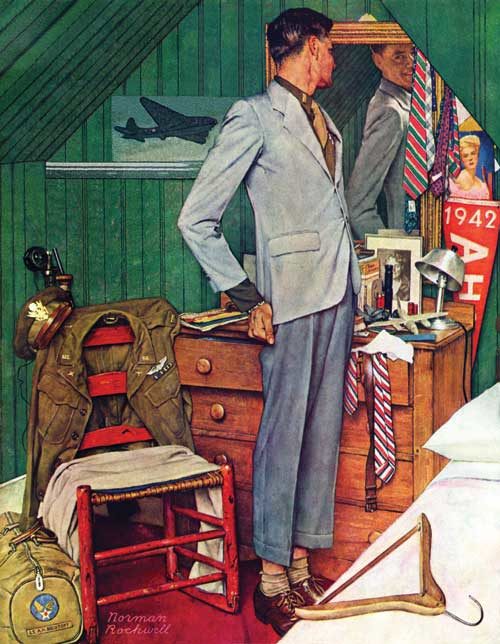
Millions of veterans would have smiled in recognition at the Post’s December 15, 1945, cover, having recognized one of those humorous incidents faced when trying to resume civilian life.
Rockwell chose to depict a veteran of the Army Air Corps, as indicated by insignia on the jacket and cap. Back in 1942, this young man would still have been attending Arlington [Vermont] High School (note the AHS pennant). Now, after three life-altering years, he finds he has outgrown his old suit. He’s also outgrown his attic bedroom and will soon be hitting his head on those sloped ceilings.
Rockwell took his penchant for realism one step further on this cover. For his model, he used a real pilot, Lt. Arthur H. Becktoft Jr., who’d flown with the 349th Bomber Squadron. In October 1943, while piloting his B-17 “War Eagle” on a raid over Hamburg, Germany, he was shot down. Becktoft and his crew parachuted and were soon captured. They spent the next 20 months in a German POW camp. For this cover, Becktoft had reason to smile.
This article is featured in the January/February 2018 issue of The Saturday Evening Post. Subscribe to the magazine for more art, inspiring stories, fiction, humor, and features from our archives.
News of the Week: Teens Are Stupid, Pencils Are Cool, and Everybody Loves Jiffy Pop
I’ll Take “Things You Shouldn’t Put in Your Mouth” for $200, Alex

Kids and teens often do dumb things. I know I did, but looking back, I don’t think I ever ate poison.
Have you seen the new hip craze that’s sweeping the online nation? It’s called the “Tide Pod Challenge.” Teens are filming themselves putting Tide laundry detergent pods in their mouths. Now, the kids aren’t actually swallowing the detergent, but let me repeat, kids are putting Tide laundry detergent in their mouths.
How do these things start, and why do kids go along with them? I’m longing for the days when teens just ate live goldfish or cinnamon.
Please kids, don’t eat Tide Pods. Tide Pods are for cleaning your clothes. There are many great rules to live your life by, and one of the best is this: Never eat something used to clean your laundry. If you won’t listen to me, listen to Gronk!
What’s next, the Liquid-Plumr Challenge? Teens eating books? Old alarm clocks? Pencils?
Write On

Don’t eat pencils. Instead, write with them!
I bought pencils not too long ago, for the first time in many years. I still use pens every single day (the Uni-ball 207, if you’re curious) because I simply refuse to go “all-digital,” but pencils are something I gave up when I left school. However, I came across a pencil community online (yes, there are online pencil communities), and it inspired me to buy a box of the Palomino Blackwing Pearls, which are some of the nicest pencils you can buy — firmer than the standard Blackwing but softer than the Blackwing 602.
If your eyes haven’t glazed over yet and you’re actually interested in pencils, The New York Times Magazine has a terrific look at one of the last pencil factories in the United States. Not only does the article tell you more about pencils than you ever thought you’d be interested in, but the photographs are quite beautiful.
Once you’re done with that look at how one everyday item is made, take a look at this piece about another one, the common drinking straw, which some people want to abolish forever.
Mystery Oreos
I have a terrible track record when it comes to food contests. I don’t mean cooking contests; I mean contests where you suggest new versions of current food products. I keep entering those competitions where you think of new flavors for potato chips or candy or oatmeal and I never, ever win. And the flavors that do win? Some are okay, but others are … gah. I know mine would taste better!
But I think I’ve uncovered the secret of Mystery Oreos, the new contest Nabisco has launched where you have to guess the flavor of the filling. I know I’m going to win that $50,000! I’m spending the money already!
Never mind, the contest is over. Oh well. The new flavor? Here’s the answer. I don’t know if this is going to be a regular flavor of Oreos from now on, but if not, you still have 97 other flavors to choose from. I still like the original.
And Now, a Cartoon
This is from the January/February 1980 issue of the Post. I just find the phrase “snow wino” to be really funny for some reason. We’ve got more winter cartoons here.
RIP Keith Jackson, Dolores O’Riordan, and Doreen Tracey
Keith Jackson was a veteran sportscaster best known for calling college basketball games on ABC. Over his 40-year career at the network, he also did play-by-play on Wide World of Sports and Monday Night Football, as well as various World Series and Olympics telecasts. He died last Friday at the age of 89.
Dolores O’Riordan was the lead singer of the Cranberries, known for such songs as “Dreams” (which has been played in hundreds of TV shows and movies), “Linger,” and “Zombie.” She died Monday at the age of 46.
Doreen Tracey was one of the original Mouseketeers on the 1955–59 kids show The Mickey Mouse Club. She later went on to work in music for people like Frank Zappa and the Doobie Brothers. She died last week at the age of 74.
The Best and the Worst

The Best: Twitter is good for one thing and one thing only: dog pictures and videos. In this one, a dog keeps himself very busy and very happy by sliding down a hill on a sled and then dragging the sled up the hill and doing it all over again. (And here are some great Post covers that feature dogs and sleds.)
The Worst: On the other hand, while we love dogs and often treat them as members of the family, we might not want to know what they’re thinking, which is something we could find out in 10 years if this translator that can help dogs speak human becomes a reality.
This sounds like the first stage of a sci-fi movie, where dogs eventually take over the planet and put all of us on leashes. TV would show endless repeats of Lassie, and there would be dog food vending machines everywhere.
This Week in History
Today Show Premieres (January 14, 1952)
Dave Garroway was the first host of the long-running NBC morning show. Here are the first 13 minutes. I’d love to see those stomach microphones make a comeback.
Edgar Allan Poe Born (January 19, 1809)
The master of the psychological horror story and inventor of the modern detective story was born in Boston but moved to Richmond, Virginia, at the age of 3 after both of his parents died. He later moved to Baltimore and inspired a football team.
This Week in Saturday Evening Post History: Mr. Fix-It (January 14, 1956)
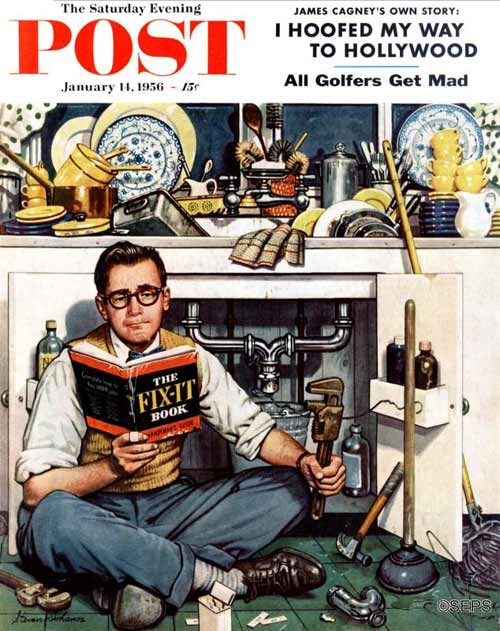
Stevan Dohanos
January 14, 1956
Sure, the husband (for some reason I’m assuming he’s a husband even though there’s no real proof of that — funny what an image can do) in this Stevan Dohanos cover is reading a book on how to fix his kitchen sink, but you know he’s not going to be successful. I identify with him. If your sink isn’t working or you need help changing the oil in your car, please don’t call me. But if you have an emergency and you need to figure out the difference between a noun and a verb or need to know who played the title role on a ’60s TV series, I’m your guy.
National Popcorn Day
When I was a kid, the only popcorn that would make was Jiffy Pop. There was just something about that moment when the kernels began to pop and the silver foil began to rise. It’s still around and is a lot more fun to make than just throwing a packet in a microwave or opening a bag. Though I don’t remember it being this much fun.
Next Week’s Holidays and Events
National Hugging Day (January 21)
It would be great to hug someone this day, but the way things are now, you might want to ask first.
Australia Day (January 26)
This is a national holiday in Australia. It celebrates the arrival of the First Fleet of British ships at New South Wales in 1788. In unrelated Australia news, the Australian Open is currently going on in Melbourne.
12 Mouthwatering Vintage Soup Recipes
In 1913, our cooks were talking variety in vegetable soups. Fifty years earlier, we were all about stewed meat: shin of beef, knuckle of veal, slice of ham, old fowl, and eye of newt. Okay, we’re kidding about that last one. But here are some delectable and curious soup recipes from our archive:
Variety in Vegetable Soups
By Dora B. Haines
Originally published in The Country Gentleman, May 17, 1913
It has been said that the essence of economy is a good soup. We Americans waste a good deal of material that might be converted into most palatable and nourishing soups. The recipes which follow are given because the materials used are nearly always at hand in practically every household. With a little skill ordinary material may be converted into a most delicious soup.
Soup #1 Vegetable Soup
To make a vegetable soup, the bone and scraps of meat left from a steak may be used for the stock or a 10-cent soup bone may be provided. This should be put on in a quart of cold water to which has been added a level teaspoonful of salt and cooked slowly for an hour and a half. Pare two or three good-sized potatoes and slice in the chopping bowl. Scrape one good-sized carrot and slice two medium-sized onions and a quarter of a small head of cabbage. Chop these all together until quite fine. Put these in the kettle with the meat and broth from it and cook, covered, over a very low flame at least an hour. Have soaked for three or four hours half a cupful of pearl barley. Add this to the kettle at the same time you do the vegetables. It will be necessary to add at least a pint of water, and possibly more, according peppercorns placed in the kettle with the meat give the soup a very distinct flavor. Some people use a bay leaf and a clove. The problem of seasoning is altogether a matter of individual taste.
Soup #2 Ham and Pea
Puree of pea soup is a very delicious and hearty soup, and the ease with which it may be made should be a recommendation for its more general use. Carefully look over and wash two cupfuls of dried peas. Soak overnight and in the morning place over a slow flame in a covered kettle. Cook until the peas are soft enough to put through a sieve. I always save the liquor in which a ham is boiled and always plan to have a pea soup at that time. To the puree I add three cupfuls of the ham liquor and cook very gently. You will need to add for seasoning a little pepper, half a teaspoonful of scraped onion and a teaspoonful of chopped parsley just before the soup is to be taken from the stove.
Soup #3 Kidney Bean
Beans make one of the heartiest soups. Soak two cupfuls of red kidney beans overnight and put them on to cook in the morning with an onion and a carrot and a bit of parsley. Cook slowly in a covered pot until the beans are tender enough to put through a sieve. To this puree add two cupfuls of soup stock and one cupful of boiling water. Season with salt, pepper, and half a teaspoonful of scraped onion and serve. This is especially good for luncheon where there are children. Two tablespoonfuls of tomato ketchup or chili sauce added to the beans give a flavor which adds real distinction to what might otherwise be an ordinary dish, if it were served often.
Soup #4 Creamy Potato and Bacon
Potato soup is another very hearty soup which I think will be welcomed generally by the children. To make it, cut up in small pieces three thin slices of bacon; slice very fine one medium-sized onion and cook in the bacon fat. Do not let it brown very much. Pare and cut up into dice four or five medium-sized potatoes, and place the bacon with the onion and fat together with the potatoes, in a kettle and add one quart of boiling water. Let this cook very gently until the potato is thoroughly done. Add a pint of milk. Cream together two level tablespoonfuls of butter and two level tablespoonfuls of flour and add to the kettle of soup. This will just make the contents of the kettle creamy, not thick. Toasted bread is an excellent accompaniment for this soup. Just to dress it up anew, I occasionally chop fine some of the tender yellow leaves from a stalk of celery and sprinkle these over each dish.
Soup #5 Creamed Onion
We do not often eat a creamed onion soup but it is most delicious, and because onions make so desirable a food we should use more of them in every possible way. This soup would lend variety. To make it chop finely four medium-sized onions and put them over the fire with three cupfuls of cold water and very little salt. Cook them until they are sufficiently tender to put through a sieve. Add the pulp and liquor left from the onion to one pint of cream sauce. Stir very carefully together and heat slowly for five or ten minutes. Then remove from the fire and just before the soup is taken to the table sprinkle a little chopped parsley over each plate.
Soup #6 Creamy Corn
This creams of corn soup is very delicately flavored. To make it take a can of corn and cook with a cupful of water for fifteen or twenty minutes over a very slow fire. Put the corn through a sieve and add the pulp to a pint of thin cream sauce. Season this with salt, a bit of paprika and add the chopped parsley before it is taken to the table. A dash of celery salt is advisable too. Toasted wafers are the best to serve with this soup.
Soup #7 Cream of Celery
Celery soup is one of those delectable dishes that may be made from what might otherwise be thrown away. I use for this the outer stalks and leaves that I cut from a bunch of celery in preparing for the table. I carefully wash it all, cut it up rather fine and put it in a kettle with three cupfuls of cold water. I add two peppercorns and half a bay leaf. These are cooked until the celery is tender and then the water is drained off. To a cupful of this juice I add one pint of cream sauce and heat thoroughly, seasoning with salt to taste.
The cream sauces should be rather thin for this. I whip half a cupful of cream and when each plate is ready for the table I put a spoonful of whipped cream on top, sprinkling over it a dash of paprika and a very little of the tender yellow leaves of the celery chopped very fine. A wafer just heated sufficiently to make it crisp is the best to serve with this soup. This is one of many cases in which a delicious dish may be prepared from those parts of a vegetable which are too often thrown into the garbage pail.
Soup #8 Tomato Soup
Another tomato soup which I serve very often is made by cooking an entire canful of tomatoes with a small onion cut up fine, two stalks of parsley, a little celery, and one green sweet pepper from which the seeds and white pulp have been removed, a bay leaf and two peppercorns. This should be cooked in a covered pot over a very slow fire for at least half an hour. Then put the entire contents of the pot through a sieve and add a cupful and a half or two cupfuls of boiling water, according to the amount of evaporation that has taken place. Soup stock may be used instead of the boiling water. If the tomatoes are very acidic that condition may be neutralized by adding a pinch of soda and a very tiny bit of sugar, perhaps a quarter of a teaspoonful.
Soup #9 Lima Bean with Sweet Pepper and Cheese Garnish
A cream soup of Lima beans is very delicious and very easily made. Soak a cupful of Lima beans overnight, put them on in cold water and cook until tender over a slow fire. When they are thoroughly cooked put through a sieve. Add the purée of beans to a pint of thin cream sauce, seasoning with salt and a dash of paprika.
When this is ready to take to the table I have chopped very fine a sweet pepper from which the seeds and white pulp have been removed. This I serve sprinkled over the top, together with a teaspoonful to each plate of dry cheese finely grated.
Soup #10 Mock Bisque
Mock bisque or cream tomato soup is probably more generally liked than any other soup made. My recipe for this is to stew half a canful of tomatoes for five minutes and then put them through the sieve, adding a level teaspoonful of salt, an eighth of a teaspoonful of paprika, half a teaspoonful of sugar and a pinch of soda. I make a pint of cream sauce and stir this tomato puree into it while both are hot. This soup should always have served with it croutons, which are small toasted squares of bread.
Tip: To make the cream sauce used in soups above (#8 and #9), place two level tablespoonfuls of butter in a stew pan and bring to the boiling point, but be very careful not to brown it ever so little. Stir into this two level tablespoonfuls of flour and half a teaspoonful of salt. Cook the flour until it bubbles and then slowly add one pint of milk and stir very carefully until all is of the consistency of thick cream and free from lumps. If any of the butter stays on top of the cream sauce it is not cooked sufficiently and should be left on the stove a little longer.

Click to Enlarge
Bonus Recipes from 1868
Originally published in The Saturday Evening Post, October 24, 1868
#11 Gravy Soup
Nothing is better than shin of beef for this soup, though pieces of the rump and other parts are used; the shin should be sawed in several places, and the marrow extracted; this, if laid in the bottom of the saucepan, will take the place of butter; if marrow is not forthcoming, butter must be employed; take a fourth of the quantity of ham, stew gently until the gravy is extracted, care being taken it does not burn; a little water may be employed by the inexperienced, but not much; when it has nearly dried up again, put in herbs, a couple of carrots cut very small, pepper ground, salt a little white sugar (this can be omitted, but it materally adds to the flavor;) add boiling water in requisite quantity, and stew gently for five hours; when cold, remove the fat, and warm up as wanted.
#12 White Soup
General directions for white stock have been given, but to prevent mistake, take a knuckle of veal, separated into three or four pieces, a slice of ham as lean as possible, a few onions, thyme, cloves, and mace, stew twelve or fourteen hours, until the stock is as rich as the ingredients can make it; an old fowl will make it much richer, if added. This soup must be made the day before it is required; when removed from the fire, after sufficiently stewed, let it cool, and then remove the fat, add to it four ounces of pounded blanched almonds, let it boil slowly, thicken it with half a pint of cream and an egg; it should boil slowly for half an hour.

Click to Enlarge
Post Puzzlers: January 18, 1873
Each week, we’ll bring you a series of puzzles from our archives. This set is from our January 18, 1873, issue.
Note that the puzzles and their answers reflect the spellings and culture of the era.
RIDDLER
ANAGRAMS.
WRITTEN FOR THE SATURDAY EVENING POST
CITIES IN THE UNITED STATES
- Hull; Vine St.
- Mol bent.
- To tell Rick.
- Veer, star.
- See, all song.
- Take Sall.
- Ill-fed chit.
- Sore grub.
- Men, go try Mo.
- Rest, Copt.
- I very small.
- Queer Matt.
Fort Totten, D. T., GAHMEW.
METAGRAM.
WRITTEN FOR THE SATURDAY EVENING POST
I am composed of four letters, and am a division of the earth.
Change my first, I signify a modified sound.
Change it again, I am a synonym of solitary.
Change it again, I am used for sharpening edged tools.
Change it again, I signify departed.
Change it again, I am a solid body shaped as a sugar-loaf.
Seaboard, N. C., EUGENE.
WORD SQUARES.
WRITTEN FOR THE SATURDAY EVENING POST
I.
An Isthmus.
To ruin.
Name of a garden.
Circumference.
II.
Recent.
An animal.
To marry.
T. J. McD.
PROBLEM.
WRITTEN FOR THE SATURDAY EVENING POST
A certain triangular tract of land contains in area 113 acres and 64 perches; and the three sides thereof are in proportion to each other as 13 is to 20 and to 21. What is the true length of each of its three respective sides?
PERCIVAL JEWETT.
ANSWERS
ANAGRAMS.
1. Huntsville. 2. Belmont. 3. Little Rock. 4. Traverse. 5. Los Angeles. 6. Salt Lake 7. Litchfield. 8. Roseburg. i). Montgomery. 10. Prescott. 11. Marysville. 12. Marquett.
METAGRAM.
Zone, tone, lone, hone, gone, cone.
WORD SQUARES.
I.
SUEZ
UNDO
EDEN
ZONE
II.
NEW
EWE
WED
PROBLEM.
156, 240 and 252 perches.
Shackled
The day we met as freshmen in college, our room was invaded by girls telling us of parties taking place that day and the next. I went to two with Rachel and some of our dorm mates, and two were enough for me. Rachel rocked on with periodic stops back at our room, and on her first appearance to change outfits, we agreed to seek a roommate rearrangement, a frank and quick conversation. On her way out, she glanced at the book in my hands.
“I’ve read all of Jane Austen’s works,” she said, flipping back a mane of red hair. “I’d like to discuss some with you.” She left, her stilettos clicking down the hall, and I tried to imagine the party girl in them reading Austen. On her second appearance, she replaced the stilettos with green sandals, brushed her teeth, and refreshed her makeup, all the while imitating the speech of students from various regions of the United States. I couldn’t help but admire her facility. Both nights she made curfew, wasn’t boozed out, and gave me a wealth of inside information about campus and professors. Before sleeping the second night, we discussed Jane Austen’s Sense and Sensibility, contemporized Austen’s dress and lifestyle, laughed at and praised our ingenuity in so doing, and decided we would balance out well as roommates, after all. Nine years later, in 1966, we would be roommates again in southern Turkey, a place that would disrupt my world, placidly academic as it had been.
Rachel now lived in Adana, Turkey, a city about 20 miles from the Mediterranean. She and her roommate Ellen taught for the American Department of Defense on nearby Incirlik Air Base. I lived 500 miles north in Istanbul doing research on the evolvement of Turkish women following Mustafa Kemal Atatürk’s modernization of the country. The groundwork Atatürk laid in the 1920s had upgraded the lives of many Turkish women by 1966, and, for six months, I interviewed educated women, those being educated and not a few who were ambitious for more freedoms. With three months left of my sabbatical, it was time to address how those same 46 years had affected the lives of Turkish rural women. Their history would be far different and interviews difficult to arrange. I needed a versatile translator familiar with southern rural areas, someone who could open doors for me and provide insights I would otherwise not have, and Rachel told me about Aba, who sounded perfect. With Ellen’s approval, she also invited me to live in their apartment. Everything fell into place.
I drove the long distance south to Adana from Istanbul, stopping twice for a glass of çay, the Turkish sweet tea I enjoyed, but backed off of a third stop when I saw the coffeehouse had only men on the terrace, some sipping çay and playing board games, some puffing hookahs. It would not be accepted for an unescorted woman to sit amongst them, not in southern Turkey. Parking under a nearby tree, I drank water from a thermos and ate pistachios before returning to the highway and the remaining short drive to Adana. As I drove, I tried to remember what Rachel had written me about Incirlik Air Base — a strategic base shared by Turkish and American forces — rotations of American F-100 fighter squadrons — a “normal” woman’s paradise — the qualification for my benefit. I was not interested in anything military, hated that we were in Vietnam, and, grateful as I was for the present opportunity, dreaded the air base atmosphere that Rachel and Ellen so enjoyed, recent divorcées that they were.
The map Rachel drew was precise and took me without difficulty to their building. It fronted a vacant lot crossed by a well-trod path to Atatürk Boulevard where a base bus picked up and deposited those going to and coming from Incirlik. The pink-stuccoed building was attractive even with metal grates rising halfway up the downstairs windows, but the yard, like the vacant lot, had no grass or other greenery, except for two beautiful rosebushes, one on each side of the concrete steps leading to the door. Their large red flowers produced a scent that reached me on exiting the car and the perfume deepened as I climbed the walkway toward the steps.
At my knock, Ellen opened the door and I thought at first it was Rachel, so alike were they with their red hair, greenish eyes, freckled noses, and petite frames. Rachel quickly appeared snapping her fingers and gyrating, gave me a big hug, and pushed me back to arms’ length.
“Let’s look at Kelly. Hey! Libraries and classrooms haven’t yet sapped those bright brown eyes … slim as ever but still wears that damned ponytail. Your hair needs lightening, old friend. It’s turning brown.” She picked up one of my bags, Ellen another, led me to my room, and told me to look around the apartment. “We have to take showers, and then you can take one. Towels are on your bed.”
They were on the first level, and the Turkish doctor who owned the building lived on the upper one with his family. The apartment felt familiar, so accurately had Rachel depicted it in letters. The three bedrooms, large living room, and kitchen all had terraces. One bathroom was fitted out to accommodate Americans, the other typically Turkish — a hole in the floor with depressions for feet on either side — but Rachel and Ellen had turned it into a closet by blocking the hole with newspapers overlaid with plastic and topped with a rug. The floors were a mottled gray-white stone with areas covered by Turkish rugs being accumulated by Rachel and Ellen to sell in America at great profit. I could see the place lent itself to dancing and parties and knew the two redheads took good advantage.
“Okay if I shower now?” I asked at Rachel’s door. “I’d like to take one before I start unpacking.”
“Unpacking?” Rachel said, throwing open her door. “Go shower, Kelly, but be quick and put on makeup. We need to get to base. We don’t want to miss any of Happy Hour.”
“Not me. It’s been a long day.”
“Ellen, you hear this?” Ellen came out of her room and stood in the hallway with us, brushing her hair. “This is exactly what she did the first day I met her. Everyone going out and Kelly stayed in to read — a freshman in college who didn’t know anyone and she stayed in to read. We are not taking the bus. You’re going to drive us to base and back, Kelly. Take a book and a flashlight and stay in the car and read, but you’re going.” Taking my shoulders, she pushed me toward the bathroom.
I took a quick shower and dressed. Before we left, Rachel and Ellen dashed about the front windows, gingerly pulled back shades and peered about. “Always check for the bear, Kelly,” Rachel said. “This guy comes around with a big bear and makes him dance, then holds out a bucket for money.”
As we descended the steps, a man carrying a hose came from the corner of the building. He wore a snagged green pullover and ill-fitting brown pants. His thick black hair was neatly cut. With unwavering dark eyes, he looked at me and smiled broadly revealing a large gold tooth.
“This is Osman,” Rachel said. “He is why the rosebushes are so beautiful.” We acknowledged each other before he quickly bent to place the hose at the base of a rosebush and just as quickly stood to watch us descend to the car.
I was informed that Osman oversaw the outside of the apartment building, dealt with vendors, and handled a variety of other duties, and that Fatma, their masseuse, did not like him.
“Fatma said if he feels demeaned he will make lives miserable,” Rachel said, “and she warned us that Americans living in the sector sometimes had flat tires and undelivered messages. During Kurban Bayram, the feast of sacrifice, he had a male sheep slaughtered right in front of our living room terrace while we were having a party. Out of respect, we stayed on the terrace until the sheep was carved up and placed on large metal platters to deliver to the poor.” I made a note to periodically compliment the roses and Osman’s gold tooth, as Rachel and Ellen advised.
The redheads bounced from one subject to another on the drive to Incirlik Air Base. “Wait until Fatma gives you a massage,” Ellen said. “She’s great, and if you let hair grow on your legs for awhile, she’ll take it off and it will stay off for weeks. She mixes honey —”
“Not honey,” Rachel said. “It’s lemon and sugar and water. It’s like taffy, and she slaps it on your legs and rips it off. Hair stays off — hurts though … Changing the subject, are you and Tim ever going to seal the deal?”
Tim was a university colleague I’d been dating for a year when my sabbatical came through. “Not in the foreseeable future. We agreed it wasn’t reasonable to be committed until I return to the university.”
“Oh, my God. See what I mean, Ellen? Reasonable! And, oh, Ellen, she was once engaged to a geologist and they broke up over oil slicks.”
“Rachel, you know that isn’t —”
“It certainly is. That’s what it came down to when Ron dumped academia and took his Ph.D. to Exxon … I can just hear you and Tim, ‘Let’s postpone any commitment until the sabbatical ends. It’s the reasonable thing to do,’ she said.
“By the way, what did you and Tim do when he came to visit you in Istanbul — go on archaeological digs? Did you leave time for any sex? Have you ever even had sex, Kelly?”
I looked in the rearview mirror at Ellen who had her lips pressed together. “It’s okay, Ellen. Go ahead and laugh. Rachel and I go back a long time.”
We showed identification at the gate, and then went directly to the Officers’ Club.
“They’re here,” Ellen said, showing me all the fighter pilots’ red bicycles parked in front of the OC. “That’s how they get around base — so irresistible in their green flight suits pedaling their red bicycles.”
“Now, Kelly, you’d better play along and not spoil our fun. Remember, we’re your landlords and can unhouse you. And fighter pilots are the best good time ever,” Rachel said, “for normal women.”
“I already feel like a misfit.”
“You are a misfit,” Rachel said, giving me a playful nudge.
It was Friday. The OC was packed, and a group of pilots in their olive-green flight suits with name and rank patched on were just sitting down at a table. When we approached they hopped back up, pulling up another table to theirs, rearranging dinnerware, grabbing chairs — a lightning display that quickly had all of us seated and ordering drinks. Their banter momentarily stopped while I was introduced, then erupted again, fighter-pilot-lexicon banter that engaged Rachel and Ellen and the pilots themselves and that I found overdone but amusing. As soon as the drinks arrived, the pilot Allan on my left, with whom I had exchanged some inanities, was replaced by Lt. Brian Gannon, and when I glanced at him and his patch with surprise, he grinned. Music and dancing began after dinner, and even though exhausted, I was stimulated by an environment completely foreign to me. Rachel and Ellen introduced me to Red Cross workers, contractors, engineers, teachers — a spectrum of Americans attached to Incirlik Air Base who enjoyed the right to socialize and eat at the Officers’ Club.
I had just sat down from dancing with the pilot Allan when the grinning blond aviator on my left who had stolen Allan’s seat said, “Are you related to Kate Tippett?”
“I don’t know who that is.”
“Well, then you’re not related to her, but your eyes are just like hers, brows, too. Excuse me.” He took the drink from my hand and set it on the table. “Let me just …” With an index finger not quite touching my brows, he traced them. “Yeah … the same, a little lift and straight out again, and let me see …” He brought his face close to mine, and looked into my eyes, “no mistake, same eyes — wide set, dark, dark irises, white, white surrounds. Just like Kate Tippett’s. Could also be Jacqueline Kennedy’s. You do know her? Oh, by the way, Brian Gannon.” He pointed to the patch with his name.
The usurped pilot Allan asked me to dance again and when I returned to the table, my drink had been replaced with a fresh one and so had the grinning Lt. Gannon’s. “Heads or tails?” he said, repeatedly flipping a coin. “Heads,” I said. The coin shot up and back to his hand, and turned tails on the table. “Sorry, you lose, so you owe me a dance.” He stood and held out his hand. Taking it and rising, I said, “And who is Kate Tippett?”
“Never heard of her,” he said.
He led me to the dance floor, gently pulled me to him and didn’t speak throughout the dance. I don’t remember that song we first danced to, only the nearness of Lt. Brian Gannon and the way his arms held me.
Rachel had arranged for me to meet Aba the next day on base. She was striking. Her eyes were a turquoise blue, like the Mediterranean and appeared lined with black, but she wore no makeup. Her lips had an apricot sheen, and her black hair was gathered and anchored with large silver hairpins to the back of her head. She was not wearing a headscarf, but I soon learned she put one on the moment she left base, even though Atatürk had banned them decades before. In southern Turkey, covering was not uncommon, but Aba did it only because her father required it of his daughters. Aba’s English was fluent and she was intelligent, but had little formal education. She was a translator and interpreter for Turks and Americans at Incirlik and also did work for the American Consulate in Adana. We had an immediate rapport, and Aba proved to be indispensable in arranging interviews through people she knew who knew other people and on down the line, all of which gave me quick access to women in rural villages. We cut through our shared reserve and different cultures and talked at length on car trips about our families, our backgrounds, our countries, and, of course, women.
“I have a brother at the University of Istanbul. I envy him, but I am proud of him.”
“Why can’t you go, Aba? I interviewed many women there.”
“My father will not permit it for me and my sister,” Aba said. “Kelly, when you meet my father, I must ask you please to … I don’t know how to say … to let him decide the questions, the conversation.”
“Of course, I fully understand, Aba,” and I did, but I immediately resented the man.
She told me her father considered Americans “unholy” but let her work for them until he found a suitable husband for her because Americans paid her well. I could not accept that Aba would go along with her father choosing her husband, not someone with Aba’s abilities, not in the Turkey of 1966. Her smile indicated a naiveté on my part.
“Decades of reforms cannot overcome centuries of traditions, Kelly. This you know.” She told me she feared that those who would “turn the face of Turkey to the past” were emerging. “I have hope,” Aba said, patting her heart. “I have hope for all Turkish women of the future, but for me and my sister, it is still our father who decides.”
Lt. Brian Gannon was from Denver, Colorado. He had an engineering degree, would eventually be a commercial airline pilot and return to Denver to live near the Rockies. He had a lean frame and straight features, marred by two creases between his brown eyebrows that made him look older than his 29 years. His smile flashed when bantering but unfolded warmly when he was in sincere mode. He read a variety of literature, at present Capote’s recently published In Cold Blood, liked to watch football, and liked to ski. He enjoyed “looking at me.” I had a “steady gaze” and “wonderful smile.” He thought my hair should be “set free.” He had little tolerance for fawning women and machismo pilots. His mischievous blue eyes had a demeanor to go with them but into our fourth week of seeing each other, I knew those eyes could instantly turn steely and by the sixth week had no doubt that beneath it all lay a no-nonsense person. I also knew that I had never felt about another man the way I felt about Lt. Brian Gannon.
The only time we had alone was when we drove to the coast for dinner, and, even then, we would run into someone from base. My apartment was always occupied with one or both roommates and their dates or friends or being used for a party, but one weekend Rachel and Ellen took a trip to Aleppo, Syria. In 1966, Americans living in Turkey frequently traveled to Syria, Iraq, and Iran to take in ancient sites and buy rugs and other niceties at prices unheard of in the U.S. The redheads left early Saturday morning, and I left right after them to go to the market to shop for dinner. In my excitement, I forgot to check for the bear.
I locked the apartment door and turned to descend the steps, and there he was. Trying to appear rushed, I ran down the steps, but the keeper moved in front of me, holding a chain that went to a metal collar around the bear’s neck. “See … see the bear dance,” he said and put a stick under the animal’s belly. The bear rose, the keeper giving more slack to the chain.
I looked into the creature’s eyes and twisted up inside. They were the vacant eyes of some of the women I had seen in southern Turkey, women whose lives and bodies were controlled, who moved in another’s sphere at another’s will, women who had no recourse. The bear turned around, awkwardly moving in a small circle, his large paws stirring the grassless yard, causing eddies of dirt and dust to rise like smoke leaking from his feet. The keeper poked him to move him faster, and I grabbed some Turkish lira from my purse, slammed it, not in his out-held bucket, but on a concrete step and dashed to my car.
“Teşekkür ederim,” the keeper hollered to my back to thank me. As I drove away, I glanced toward the building and saw Osman in his green top and brown pants standing next to the bear and his keeper, his gold tooth beaming in the sun.
It seemed strange to have dinner alone with Brian in an apartment. I grilled shish kebabs and drank wine on the kitchen terrace, and he stood by with a glass of Scotch, quietly watching me. He seemed preoccupied, and I sensed he felt the strangeness, too. Over dinner, he asked about my book and future career plans, and I felt a sudden and terrible loneliness talking about them. Afterward, I served coffee and Fatma’s fried cookies, their centers filled with pine honey, a delicacy from the port town of Marmaris, and then we went into the living room and had a cognac and coffee. We sat on a red sofa placed on one of Rachel’s large Turkish rugs, and to fill the silence between us, I told him about some of the women and girls I had seen making such rugs and how sorry I felt for them. He swirled his cognac and said nothing. Then I told him about the bear, its empty eyes, the empty eyes of some of the rural women. I told him about the fate awaiting Aba and said there must be some way she could escape it. He looked up at me with hard blue eyes.
“Can you do anything about it? Can you change the lives of the women or Aba or the bear?”
I don’t know what I expected him to say, but I felt dismissed, and I flared.
“Can you fighter pilots change lives … you change them for sure … but I mean change them for the better … with what you do?
“What brought that on? What’s your idea of what we do?”
“You know … Vietnam … bombing of —”
“I know the script. Any other idea about what we do? … Look, all I meant, Kelly, is that it’s better to put unpleasant things out of your mind if you can’t do a thing about them. You can’t help the bear. You can’t help the rural women. You can’t help Aba. This is not America.”
“Don’t talk down to me, Brian.”
He drank off the cognac and said he’d better catch the next bus to base. He had to fly early Sunday morning. I said I’d drive him, but he didn’t want me to drive back alone at night.
“I do it often.”
“Not tonight.”
At the door, he slipped the tie-back off my ponytail. “I still like looking at you, Kelly.” He kissed me briefly and left without saying anything about Sunday evening. It was the first time we had not spoken of seeing each other the next day. As I lay in bed, I thought of Tim and how we talked of emotions causing people to lose focus in their lives … to derail. We agreed that emotions could and should be controlled. Yet I had been full of emotions for almost two months — fierce, disrupting emotions, and, except for appointments with Aba, had even manipulated my work to suit Brian’s schedule … me … derailed. It was not who I was, and with that realization, I finally found sleep.
The next morning, I picked up Aba and we headed for an area near Gaziantep for several interviews. These would be my last except for one with Aba herself. Neither one of us was inclined to talk, unusual for us, but to take my mind off Brian, I told her about the bear. I did not mention that his eyes were like those of women I had seen in the area, for that morning Aba’s own beautiful eyes seemed glazed, sad. I talked about the unkempt creature and his metal collar and his pitiful dance.
“I know him,” Aba said, “… the shackled bear.”
“I should have ignored them and walked away. I shouldn’t have left any money at all,” I said.
“If you did not, it would not help the bear, and the man would have no lira until he found another American. Some Americans like to see the bear dance. Do you not go to … the chir, the cirshus —”
“Circus. No, I don’t. I understand your meaning. But there’s oversight of the animals. It doesn’t make a circus right, but animals are better cared for, they …”
Aba sat staring out at the road. “Is something wrong, Aba?” She held up her finger for me to wait. She put her head down and then raised it to the road again. “I am betrothed. My father informed me last night.”
Over the course of our ride, she told me about Ahmet, often stopping to take a deep breath. I wanted to stop and hug her but knew she would not want that. I knew of Ahmet. Americans often ate at the restaurant where he worked in Adana. He was in charge of the staff and well paid by Turkish standards, and Americans tipped him to arrange special dinners or to see to other requests. Ahmet also owned land and was ambitious to own more. His wife had been dead six months leaving him with a 6-year-old that his sister presently cared for, and he was anxious to remarry. I asked, already knowing the answer, “Will you be able to continue working?”
“What do you think?” Aba said, “And, … there is a thing more.” She took a staggering breath. “He has … a hump.” She reached over her shoulder and outlined an area with her finger.
I could only mutter that it was a slight one and felt foolish as I said it.
“I am … shackled,” Aba said.
It was a hard day with one difficult interview and two cancelled because husbands refused to let their wives see us, in spite of their previous approval. On the drive back, we made no attempt to talk, but as we neared her home, Aba said, “I believe the life beyond will not have shackled bears. All will be free to follow their heart.”
“Do you, Aba?”
“I must.”
When I returned to the apartment, Rachel and Ellen were back from Aleppo.
“Have you heard, Kelly?”
“What?”
“Brian’s squadron is rotating out next week. They just found out officially today.”
I sat down. I had made up my mind to tell him our situation would not work. He might even have been ready to tell me the same thing last night — his silence, the strangeness of the evening … but rotating out — so suddenly. I became aware of breathing rapidly.
“I thought Brian might have hinted at it last night,” Rachel said. “They usually have a clue.”
“No, he didn’t, but it’s for the best.”
“For the best! Does everyone but you know you love this man? Is this the oil-slick mindset again? You’ve gone with your heart here, Kelly, maybe because you’ve felt protected here from all those intellectuals who would point fingers at this relationship. Don’t be a fool and mess it up.”
Pointedly ignoring her effort to engage me, I told her about Aba’s betrothal and her reference to the shackled bear, and I urged Rachel to help me think of some way Aba could convince Ahmet to let her continue with her work. Rachel knew Ahmet and, ever able, suggested an approach that would set him thinking. “He admires Americans and hungers for recognition,” Rachel said. “I think it will work. The thought of Aba being shut down sickens me, too.”
“After interviewing her tomorrow morning, I’ll present it to her. Then I’m done here. … I’m going to bed. I’m exhausted.”
I went to my room and shut the door and soon heard a soft rapping. Rachel came in drinking a cognac and sat on the edge of my bed. “Kelly, old roomie, you are tied into a culture — I’d say an ideology — and it’s confining you more each year. It has been beautiful to see you break through it with Brian. Make room for love, Kelly. Otherwise, you’re as shackled as Aba and the bear.” She reached over and gave me a hug. “Good-night.”
After my morning interview with Aba, I took her to the Officers’ Club for lunch and told her there might be a way Ahmet would let her continue working. She would be, after all, very difficult to replace and her position brought status to her and her family. I told her she had to convince Ahmet he was a superior man, a man with foresight, a modern Turk who needed a modern, respected wife, a wife like some of the northern men had. “And, Aba, Rachel will see that images are created in Ahmet’s head of the status such a wife would bring him and his ambitions. Trust Rachel. He will never know she’s doing it.”
“And the child? And more children?”
“Together you and Ahmet will have more money than you ever dreamed of. With money, you have the freedom to arrange things, and Ahmet will revel in status and money, and, Aba, you know your father secretly enjoys your status. Please try. Just try, Aba.”
“Yes, … maybe … teşekkür ederim, Kelly.”
After lunch with Aba, I went to the base commissary for some wine before driving back to the apartment. The sun was blinding, my mind was in turmoil, and I felt physically ill. As I took my purse and commissary bag from the car, I picked up the scent of the roses that welcomed me to the apartment all those weeks ago. Now, the perfume stirred painful emotions. I kept my head down from the sun as I climbed the path and hoped I would not run into Osman, but a glance toward the steps revealed a hint of green wavering in the sunlight. I would tell him I had to hurry to get things to the refrigerator and add that his roses were more beautiful each day before rushing in to lie down.
I adjusted the shoulder strap of my purse and looked up, prepared to confront Osman when a green flight suit unfolded from the steps and Lt. Brian Gannon stood before me. He took my commissary bag and my hand. In silence, we mounted the steps.
Rockwell Video Minute: Golden Rule
In 1961, Norman Rockwell created a painting that reminded us to do unto others as you would have them do unto you.
See all of the videos in our Rockwell Video Minute series at www.saturdayeveningpost/rockwell-video.
Representative Attacks Congress with Thesaurus
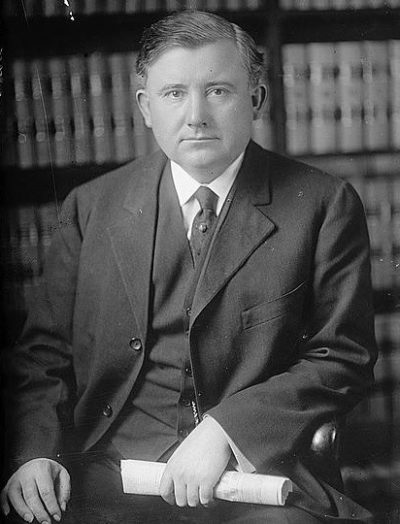
You might think that a freshman representative would be a little unsure of himself when he gave his first speech before Congress, that he might just take it easy in the beginning until he was more comfortable. Or, if you were Rep. Martin Littleton of New York, your first Congressional speech could be a 3-hour-and-40-minute-long disquisition full of linguistic gymnastics that shine a light in the deepest, darkest corners of the thesaurus.
Martin Littleton’s name isn’t widely known today, but at the beginning of the 20th century, he was a rising star in government and law. Born in Tennessee and raised in Texas, the largely self-taught lawyer moved to The Big Apple in 1896 and soon found himself embroiled in a number of high-profile — and highly lucrative — legal cases. He would eventually become one of the richest lawyers in the world.
Littleton was known for his oratory skills and was said to have a voice like a cello. In 1904, he was tapped to present the Democratic National Convention speech that introduced Alton B. Parker, the party’s eventual presidential nominee who would lose to Theodore Roosevelt. The experience gave him a taste of government life, and a taste wasn’t enough.
After holding a number of positions in local government and in the DNC, in 1910 he won the open congressional seat in New York’s First District despite the fact that the district was home to Theodore Roosevelt and was considered a Republican stronghold. Late in his term, he ran for a seat in the Senate but lost; thus he was a one-term congressman.
But that was all in the future when Littleton delivered his mammoth first speech during a debate about Arizona’s statehood. It caught the ear and imagination of the Post’s editors. In the following “Who’s Who” article about the man’s grandiloquence and badinage, the line between sarcasm and honest praise can be difficult to discern.
Need some help with Rep. Littleton’s multisyllabic lexicon? After the excerpt is a short glossary listing common synonyms for the more elaborate terms.
Who’s Who — And Why: Mellifluous Martin
Originally published July 1, 1911
Martin Littleton put on a show up at the House of Representatives the other afternoon that played to standing room only. He brought into the arena and exhibited it so all could see his unrivaled collection of trained adjectives and awe-inspiring nouns, sending them through various intricate evolutions — driving them single, double, in fours, sixes and tandem; forcing them to eat from his hand; combining them in picturesque pyramids and other palpitating postures; making them do death-defying flipflaps from one gigantic sentence to another, and proving conclusively the remarkable power of the observant mind and the tenacious memory over the wild denizens of the dictionary and the thesaurus.
“Well, well, good people,” said Martin, “here we are again, with our unparalleled aggregation of sibilant synonyms, antonomastic antonyms, contumelious caconyms and tuneful tropes. Nowhere else on earth can be found such a collection of apposite adjectives, adjutory adverbs, novitious nouns, and vorticular verbs. After years of patient exploration in the jeopardous jungles of Webster, the arenaceous acres of Funk-and-Wagnalls, and the refreshing rosetum of Roget, I shall exhibit before you this afternoon the fruits of my toil.”
And he marched them in, two by two, the antithesis and the hullabaloo, the hyperbole and the sweet goo-goo, the metaphor and the rhapsodoo; and everybody said there had been nothing like it since Morris Sheppard chortled for three hours and forty minutes in blank verse about equal rights for all and special privileges for none — which is deuced odd; for Sheppard comes from Texas — and so does Martin Littleton.
Nowhere else on earth can be found such a collection of apposite adjectives, adjutory adverbs, novitious nouns, and vorticular verbs.However, Texas is an extremely large state — an Empire in Herself, as all Texas orators say — and we needn’t worry about that phase of the subject; for though Texas is producing prose poets, she is also producing steers and onions and cotton and oil and other utilitarian stuff, and maintaining the balance of trade.
To get back to Martin and his show: It seems that Arizona, along about last year, received some three hundred thousand copies of Jonathan Bourne’s speech on representative government, which shows that Jonathan is a liberal young thing when it comes to sending out speeches — a regular speech-thrift — for there are only two hundred and four thousand people in the territory, or thereabout. Influenced, no doubt, by this generosity, the gentlemen who came to be engaged in the construction of a constitution for the state-to-be hastily stuck in the initiative, the referendum, and the recall, which, in turn, caused much debate when said constitution reached Congress.
Right here is where Martin bulged in. He had remained silent during the discussion of those various matters that had occupied the attention of the Democratic House until this moment; but when he saw the judiciary tottering to its fall, because of the recall provision in that constitution, he rushed to the defense of the ermine and brought his flock of apt and ardent — not to say alliterative — adjectives with him.
It was hard to do; but, after we disassociated the libretto of Martin’s argument from the music, we discovered that he feels deeply on the subject of the recall of judges, and is “agin” it to his guying dasp — no! — not that! — his dying gasp!
Alliterative Assistants
Martin’s speech contained a few other words than adjectives and nouns and adverbs, but they were comparatively unimportant. “They cut no signify,” as Charley Potter used to say. Eliminating them, this is the way Martin handled his rhetorical assistants:
“— misguided and malignant passions — recklessly accuse — stainless judge — lying litigant — mendacious effort — fabricated cause — unscrupulous hand — ruthless weapon — culpable confederates of the convicted criminal — irresponsible faction — corporate bandit — incorruptible court — agrarian agitator — substance and symbols of order — crooked creed — venal volunteers — pretentious program — empire of intrigue — deft and secret sign — swarms of satraps — daring demagogue — superficial sentiment — impugned, impeached, outraged and dishonored — shattered fame — foreclosed honor — spineless seeker — idle invertebrate — irresolute timeserver — sibilant hiss — merciless Mob!”
Of course there were many more, especially after Martin, who craftily withheld the effort for revision for several days, had had time to think adjectitiously; but herewith are enough to show what sort of an oratorical hairpin Martin is. I betray no confidence when I tell you Morris Sheppard rushed tumultuously from the hall and was seen throwing fits of jealousy beneath the statue of John J. Ingalls; and that Ollie James, although he appeared calm, was bitterly envious and furtively laughed a poisoned laugh of scorn that showed him to be hard-hit in his most vulnerable point — the vocal cords.
They crowded around Littleton and congratulated him, as well they might; for, since Charley Murphy refused to let New York send Bourke Cockran back to Congress, we have been worrying along with some mighty mediocre word trainers and exhibitors, and Martin seems to fill a longfelt want. And there is no doubt he will get better as he goes along, for he is only 40, or thereabout, and has years and years ahead of him to devote to the collection and exhibition of peerless and passionate phrases. A lot of galoots spend their time mourning because oratory is a lost art — but they needn’t worry. If oratory ever was lost — which every Southern statesman seeks to prove is untrue — Martin Littleton found it and has it safely tucked away in his jeans. Be calm! Martin is the Oratorical Kid.
A most engaging chap, too, is Martin, who has touched a good many high places in a short time and is sure to touch a good many more; for he has a lot of ability, an attractive personality, and is clean, courageous and not without the requisite confidence in himself. He is ambitious, too, and you never can tell where an ambitious man, backed by brains and an individuality, will land. He has a good reputation as a lawyer and as a worker, is an excellent campaigner, and not unversed in politics.
He was born in Tennessee, moved to Texas when he was 11 years old, and went to work. He was a sturdy young chap and did anything that came his way, from plowing to working as a brakeman on a railroad, getting such schooling as he could and studying law as opportunity offered. He was admitted to practice law when he was 19 and stayed in Texas until he was 24. Then he decided they needed him in New York and he went there. He discovered, during the first few years of his New York experience, that if they needed him they were very successful in concealing the fact — but he held on; and, presently, after injecting himself skillfully into local politics, was elected president of the Borough of Brooklyn, which position he held during the years 1904 and 1905.
He had done a considerable amount of plain and fancy orating in New York, but his first national chance was when they put him up to nominate Alton B. Parker for President — in St. Louis in 1904. The nominating part of it was all right, for Littleton made a big speech; but the election part of it was a sad affair. However, that wasn’t Littleton’s fault; and he kept on growing in public estimation in New York, devoting himself to the law, with politics as a side line. Last fall he was nominated for Congress in the First New York District, which is inhabited by Colonel Theodore Roosevelt and was represented by W. W. Cocks. Littleton defeated Cocks by some 6,000 votes and just ripped things up in Oyster Bay, where the Colonel lives and votes.
During the course of the senatorial deadlock in New York State he offered himself as a solution of the problem, but they didn’t solve it that way, and he came to Congress, where they put him on the Committee on Judiciary and the Committee on Patents — and where, as related here, he recently took occasion to make a few remarks concerning the recall of judges.
His debut was a success, and from time to time we may expect him to appear in the arena and make the welkin ring. So far as that first speech is concerned, all will freely admit it was a corker; but it seems to us he slipped just one cog. He referred to the “corporate bandit.” Nix, Martin! You can do better than that. Why not “corporate corsair” or “business bandit”? A rising young orator never should cramp his style with any such harsh combination as “corporate bandit.” Apt alliteration’s artful aid amplifies argument and augments appeal. Giddap! Dobbin, giddap! We must away to town.
Glossary of Synonyms
Adjectitiously: additively, with an eye toward expansion
Adjutory: helpful
Antonomastic: titular, epithetical [Antonomasia is the use of the name of an office in place of a person’s actual name, such as referring to a judge as “your honor”]
Apposite: pertinent, appropriate
Ardent: passionate
Arenaceous: sandy
Badinage: wordplay, repartee
Caconym: (of a word) objectionable
Contumelious: abusive, humiliating
Corker: conclusive argument
Demagogue: disingenuous politician, one who attains power through false promises and manipulation of popular prejudices
Denizen: resident, inhabitant
Dobbin: workhorse
Ermine: the office or dignity of a judge (from the idea that, at least in England, state robes were ornamented with the fur of the ermine, a type of weasel)
Galoot: codger, miser
Grandiloquence: bluster, bravado
Impugn: opposed, attacked verbally
Jeopardous: perilous
Lexicon: vocabulary
Libretto: lyrics, the words of an opera
Mellifluous: sweet, especially of a voice or melody
Mendacious: false, dishonest
Novitious: new, invented
Rosetum: rose garden
Satrap: petty despot
Sibilant: hissing, abundant in s and z sounds
Tumultuously: agitatedly, noisily
Unscrupulous: unethical
Vorticular: whirling (like a vortex)
Welkin: the sky, the dome of heaven
Bridging the Divide: The Role of Free Speech on College Campuses
This article is the first in a series representing a collaboration between The Saturday Evening Post and AllSides. The purpose of the series is to take a divisive issue and explore not only the differences but also the commonalities on both sides of the debate.
Clashes over free speech have dogged the country for the past several years, whether at Google or on the football field. But perhaps no part of society has been more plagued by dissension than the university setting, where the arrival of a conservative speaker sometimes incites violent protests.
UC Berkeley’s September 2017 attempt at a “Free Speech Week” was an odd conclusion to a year full of conflict over the First Amendment. After a great deal of buildup and media hubbub, the event, which publicized several right-wing pundits, ultimately unraveled in front of the entire nation. While the school cited a lack of student preparation, the organizers said that a laundry list of bureaucratic hurdles doomed any success from the start. Regardless of the reason, its demise is emblematic of a larger issue — the debate over the parameters of free speech.
Like most political issues these days, the conversation has rapidly devolved into a showdown across the aisle: right vs. left, with little room for gray. But amidst the disagreement, is there any common ground?
The Progressive Student

Serena Witherspoon is a UC Berkeley student who identifies as progressive. The roster of speakers slated for Free Speech Week raised many eyebrows (Witherspoon’s included), with guests like Ann Coulter and Milo Yiannopoulos who are as known for their inflammatory approach as they are for their right-leaning political views.
“I found the list of speakers intentionally offensive to the communities on campus,” Witherspoon said. “I looked up videos of each of these people speaking to get a better idea of who exactly was being invited. I was particularly struck by the anti-trans, anti-gay, anti-undocumented messages that were openly expressed.
“As a campus that is home to many trans, gay, and undocumented students, inviting these speakers is inviting hate to be openly expressed against our own campus community,” she said.
The Conservative Organizer

It’s an argument that Mike Wright, who spearheaded the attempted Free Speech Week, has often heard during his tenure at school. “This is something that a lot of people don’t really, I think, understand. The idea is that if you want to hear from someone you must endorse everything that they say,” he said. But Wright, who is former editor-in-chief of the school’s conservative Berkeley Patriot, argues that’s not true. “We just want to hear from a range of perspectives that we don’t often hear from on this campus.”
Much like Witherspoon, Wright doesn’t see eye to eye with many of the speakers who were invited to the Free Speech Week. He’s a conservative, but a self-avowed “middle-of-the-road” variety, who is as interested in hearing ideas he disagrees with as ones he accepts as truth. “Being surrounded by things that make you uncomfortable makes you stronger, makes you better able to articulate what you believe and understand why you believe it,” he said. For Wright, this diversity of thought is of utmost importance.
The Radical Professor

Dr. Alison Reed, a Professor of English at Old Dominion University, is a recent graduate of UC Berkeley’s SoCal sister school, UC Santa Barbara. Over the last few years, she watched with nervous attention as Milo Yiannopoulos worked the University of California circuit — first at UCSB in 2016, and then eventually on to UC Berkeley the following year.
When it comes to Reed’s politics, she jokes that she’s likely on the watch list of “so-called, ‘dangerous liberal professors.’” Reed self-identifies as “radical,” and her partisan preferences clearly differ from Wright’s, but she shares his appreciation for diversity, which is all the more meaningful to her after transitioning from student to instructor. But it’s for this same reason that she opposed Yiannopoulos’ speeches, as she views his incendiary nature as antithetical to that mission.
“I really don’t think that any institution that proclaims diversity, multiculturalism, and inclusivity can use institutional monies to support hateful speakers,” says Reed. She firmly believes that offensive rhetoric leads to tangible violence against the marginalized, citing the white nationalist protests in Charlottesville, Va. that resulted in the death of Heather Heyer.
“If you invite speakers to campus who openly advocate for hate and genocide, you’re saying that as an institution you do not truly care about dialogue or diversity,” she says.
The Libertarian Journalist

Enter Robby Soave, a libertarian journalist and Associate Editor at Reason magazine. Much like Wright, he’s a free speech advocate and an unapologetic critic of censorship. But, like Witherspoon and Reed, he finds the contentious list of speakers unproductive, at best.
“[Conservative student organizers] want to bring someone who isn’t really a conservative or a spokesperson for their group, but will make headlines because they’ll generate this over-the-top, shut-down event,” he says. Referencing Yiannopoulos as the quintessential prototype, Soave says these pundits “don’t have a deep reservoir of conservative knowledge, who really their purpose is to be shut down by this cabal of students who oblige, time after time.”
“It’s a serious blow to actual intellectual engagement and discussion on campus,” he says.
Civil Discourse or Hate Speech?
As division continues to mount on college campuses, all four people see the need for respectful dialogue. But their differences probe at a central question: Can civil discourse really be “civil” when the subject matter is hateful?
Although Mike Wright compiled the scandalous list of guests for Berkeley’s Free Speech Week, he says the overall approach to discussion matters to him most of all. “I really support the idea of us sitting down and having reasoned discussion that hears from all sides in a very civil and polite manner.”
Civility is important to Witherspoon in her progressive politics, as well. The Berkeley sociology major works for Living Room Conversations, an organization that hosts group discussions on hot-button issues with people across the political spectrum. They provide a step-by-step model for civil discourse to combat polarization.
With her work at LRC, her opposition to Berkeley’s Free Speech Week boils down to her desire to assuage partisan division. “The intent seemed to be to shock and offend the larger populace of the school. I am willing to engage with ideas different from my own, but I did not agree to the terms set forth by the free speech week organizers, nor was I asked,” says Witherspoon. “I feel that the ‘Free Speech’ organizers are more concerned with making a statement than the outcomes that statement has for those around them.”
However, Wright saw his Free Speech Week as an opportunity to alleviate polarization — not inflame it.
“I think that the ability for people to hear from the other side could be helpful [in curbing partisan rancor],” he says. In a sense, he hoped he could bridge two divides — on a smaller scale, between the conservative speakers and the UC Berkeley faculty that “fundamentally distrusted each other,” and on a loftier scale, between peers with conflicting political beliefs.
Dr. Reed sides squarely with Witherspoon here. While some worry that limitations on free speech unfairly silence certain ideas, she argues that the real casualties are minority students who are defenseless against a set of beliefs that imperil their safety.
“Hate speech is not free. Its price is paid in human lives,” says Reed.
Reason’s Soave takes issue with labeling anything as “too hateful” for a public forum, and he’s quick to point out that, while reporting on the issue, he’s seen people who inevitably disagree on just what, exactly, crosses the line. What’s more, he asserts that a government with a conservative bent would be more inclined to block speech from the left — not the right.
“Hate speech would invariably be enforced not against people like Milo, but against leftist activists,” he says. However, that doesn’t mean he wants to engage with every right-wing speaker making the rounds.
“I think at this point the best thing is to not go to Milo events, and certainly not to Spencer events,” he says, referring to Yiannopoulos and the notorious white supremacist, Richard Spencer. “Even if you wanted to go to protest him, the strongest protest that can be sent to these people are empty auditorium seats,” says Soave.
A Rejection of White Nationalism
This repudiation of the white nationalist mantra is also something the four agree on completely, with Wright stating that he did not want to invite anyone to Berkeley’s Free Speech Event who would espouse such views.
As a student of color, this is particularly personal for Witherspoon. “I appreciate the term anti-fascist and I think that we should all oppose fascism and the alt-right and white supremacy,” she says. “I think that accepting hate speech does lead to a more fascist tolerant society and creates a toxic environment where people of color do not feel able to live at a full capacity.”
Although all four are in the same camp — insomuch that white supremacist, fascist views are worthy of full rejection — the two sides split on how to combat them. Should the ideas themselves be outlawed? Or should students simply stop carrying out heated protests, which inevitably push white nationalists into the media spotlight?
A Long History of Conflict
It’s a debate that likely won’t end soon, and it’s one that started long ago. In the 1960s, members of the New Left fought to openly express their then-provocative ideas on campus, protesting participation in the Vietnam War and giving voice to women, gays, and people of color. Republicans opposed this freedom of expression.
UC Berkeley was the original setting.
The paradox isn’t lost on Soave, who has watched the tables turn over the last ten years. “For so long before that it was always, even on colleges, religious conservatives [who wanted to censor liberal ideas],” he says.
While it’s a rapid role reversal, perhaps it speaks to a fine line between two entrenched political parties. Although Democrats and Republicans may be in ultimate agreement on the end-game — a commitment to civil discourse, a desire to abate political polarization, and a stark opposition to fascism and white supremacy — they decidedly diverge on how to move forward.
Editor’s note: Dr. Reed considers herself a radical, not a liberal. The article was edited accordingly.
America in 1968: An Overview in 17 Quotes
Few Americans could have expected the year lay ahead of them in 1968. In this tumultuous year, half a century ago, they would see events that would challenge their faith in America’s government and people. Their country would appear to grow more violent and more divided. In spite — or maybe because of — the turmoil, it was also a rich creative period in art, music, and pop culture.
Here are 17 quotes that reveal the year that was 1968.
“No one really knows why they are alive until they know what they’d die for.”
—Martin Luther King Jr., speaking with unwitting prophecy. His own death came on April 4 at the hands of an assassin.

“Let us dedicate ourselves to what the Greeks wrote so many years ago: to tame the savageness of man and make gentle the life of this world.”
—Robert Kennedy, while announcing the death of King to a crowd of supporters on the night of April 4. Two months later, he was also assassinated.
“I shouted out ‘Who killed Kennedy?’”
—The original line in the Rolling Stones’ song “Sympathy for the Devil.” When it was recorded just days after Robert Kennedy’s death, Mick Jagger changed the line to ‘Who killed the Kennedys?’
“The policeman isn’t there to create disorder; the policeman is there to preserve disorder.”
—Chicago Mayo Richard J. Daley’s unfortunate slip of the tongue when commenting on his police department’s actions on August 24. On that night, thousands of law officers clashed with thousands of anti-war protestors resulting in a general melee, 200 injuries, and 600 arrests.
“I covered up the ‘USA’ on my chest with a black t-shirt to reflect the shame I felt that my country was traveling at a snail’s pace toward something that should be obvious to all people of good will.”
—John Carlos, recalling the moment when he and fellow athlete Tommie Smith raised their fists in a black power salute when the national anthem was played during an Olympic award ceremony.
“Take a sad song, and make it better.”
—A verse from the Beatles song, “Hey Jude.”
“A meal disguised as a sandwich.”
—Tagline in a McDonald’s ad introducing America to the Big Mac.
“Sock it to me.”
—Richard Nixon, Republican candidate for the presidency, on the TV show, “Rowan and Martin’s Laugh In.” The line had become a running gag on the irreverent, unconventional comedy program. Nixon’s five-second video announcement was all the funnier given his reputation for being stuffy and humorless.
“The destiny of the entire human race depends on what is going on in America today. This is a staggering reality to the rest of the world; they must feel like passengers in a supersonic jetliner who are forced to watch helplessly while a passel of drunks, hypes, freaks, and madmen fight for the controls and the pilot’s seat.”
—Soul on Ice by Eldridge Cleaver
“You have made my life a wreck…err, complete”
—Elvis Presley pretending to get the lyrics to “Love Me Tender” wrong as he sang to his wife, Priscilla. The moment came during a 1968 televised concert that launched a big comeback for the legendary singer.
“Hello, gorgeous.”
—Barbra Streisand in Funny Girl
“Get your stinking paws off me, you damned dirty ape!”
—Charlton Heston in Planet of the Apes
“Book ’em, Dano.”
—Jack Lord in Hawaii 5-0
“Open the pod bay doors, HAL.”
—Keir Dullea in 2001: A Space Odyssey
“You’ve come a long way, baby.”
—The advertising slogan for Virginia Slims cigarettes, which were marketed to women. The campaign celebrated women’s accomplishments, including winning the right to smoke.
“We act insane, because if we didn’t, we would most surely become insane.”
—Hawkeye Pierce in MASH: A Novel About Three Army Doctors by Richard Hooker
“You’re going to get a concept that maybe this really is one world and why the hell can’t we learn to live together like decent people.”
—Astronaut Frank Borman’s thoughts on seeing the entire earth from outer space as he and the crew of the Apollo 8 returned from orbiting the moon.

The Art of the Post: The Illustration That Saved a Life
Saul Tepper was a leading illustrator for The Saturday Evening Post in the 1920s and 30s. He won a strong following for his dramatic and romantic illustrations.
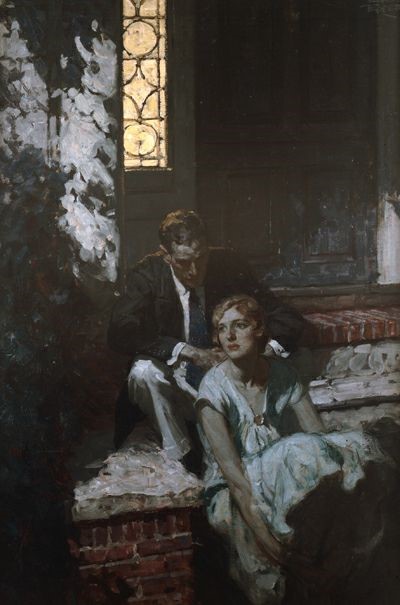
Tepper worked from a large studio in New York City, which sometimes made it difficult to find suitable models for his historical and international subjects.
Tepper’s search for just the right model took him to unusual places. For an illustration in the February 21, 1948, issue of the Post, he had to find a pretty Cuban woman. Tepper recalled that he could not find such a woman from the New York modeling agencies, “So I was forced to spend several evenings in New York City nightspots searching out a model for myself. I made the rounds of clubs popular with the Latins and one night I saw the right girl.” After locating the right girl, he needed his full diplomatic skills to persuade her to model. As recounted in the book, Illustrating for the Saturday Evening Post, “Not wishing to test Latin jealousy, Tepper waited until the girl departed. Then he approached a young man he had seen talking with her and explained his wishes. With Latin facility, an appointment was arranged.”
One day the Post assigned Tepper to illustrate a story about lumberjacks, but there were very few lumberjack types walking the streets of Manhattan. As his deadline loomed, Tepper was sitting in a small café near Carnegie Hall when he noticed a man who looked exactly like a lumberjack, sitting alone drinking coffee.
Illustration art expert Fred Taraba interviewed Tepper’s apprentice who described what happened next:
Saul approached the man. “I’m an artist and I wonder if you would be interested in modeling for me as a lumberjack for a Post illustration. I’m for real. I’ll pay you. This is all legit—here is my card. If you’re interested be at my studio at 10 AM sharp.” The man took the card without conversation. At 10:00 AM there was a knock on Saul’s door.
Tepper invited the man in and gave him a lumberjack outfit from Tepper’s collection of props. Once the man was dressed properly, Tepper instructed him on how to pose. The man held the position and Tepper started to work. Soon he was satisfied that he had painted an authentic looking lumberjack.
After he was paid, the man asked when the illustration would appear. Tepper told him it would be in two weeks.
Three weeks later the man came to Tepper’s door and was ushered in. He told Saul that as he was drinking coffee in the small café, he had made up his mind it would be his last cup. He’d picked a nearby alley…. He had one swig left. He then would leave the café, go to the alley, put the .38 caliber revolver he carried to his head and end it all.
He had been fired from a job in his hometown upstate—had been drinking—and left his wife and children. But then entered Tepper.
The man said everyone in his hometown that saw the illustration realized it was him. His job was offered back. He was reunited with his family and was a celebrity in town.
Tepper touched many people’s lives.
Post illustrations were hugely influential, but that is the only time I’m aware of where the illustration actually saved a human life.