9 Mispronunciations That Could Cost You on Jeopardy!
The popular TV game show Jeopardy! began 2017 with a bit of controversy. For the category “Music and Literature Before and After,” host Alex Trebek offered the answer, “A song by Coolio from Dangerous Minds goes back in time to become a 1667 John Milton classic.” Contestant Nick Spicher was on the right track when he rang in and gave the question, “What is Gangster’s Paradise Lost.”
“Yes,” said Trebek, which added $1,600 to Spicher’s score.
But a few moments later, competition paused and Trebek announced that Jeopardy!’s judges had ruled Spicher’s response incorrect. It should have been “Gangsta’s Paradise Lost.” Spicher’s score dropped $3,200.
Part of the judges’ justification for the ruling was that the Oxford English Dictionary lists separate definitions for gangster and gangsta. And to be fair, that’s how Coolio both spells and pronounces the word in the song. Regardless, Spicher was still triumphant after Final Jeopardy and returned for the next episode.
This isn’t the first time Jeopardy! judges’ pronunciation expectations have cost players chunks of change. In 2015, Rob Russell was ruled incorrect for pronouncing foliage as “foilage.” And just last October, Austin Rogers lost out when he pronounced sherbet as “sherbert,” a pronunciation that is all too common here in the Midwest — and apparently in Rogers’ home state of New York.
If you’re trying to get on the quiz show yourself, the following Jeopardy!-style clues can serve as good practice. Finding the right questions is only the first part — you have to pronounce them correctly, too. (The clues get more difficult as you go along.)
Category: Rock Around the Clock
Except in Arizona and Hawaii, this eight-month-long period will begin on March 11, 2018
What is daylight saving time?
A common mispronunciation is “daylight savings time,” with an unnecessary s. Some even hyphenate the phrase daylight-saving time to make it clearer.
Category: Royal Weddings
Prince William refused to sign this type of legal document to protect his assets in case of divorce before marrying Kate Middleton
What is a prenuptial agreement?
It’s an all-too-common mistake to pronounce nuptial [\NUP-shuhl\ or \NUP-chuhl\] as if it were spelled nuptual — perhaps because a prenuptial agreement is a contractual agreement? Regardless, prenuptial contains only three syllables, though Jeopardy! judges might let you get away with the common two-syllable abbreviation pre-nup.
Category: Trademarks
Anyone can sell a house, but to call yourself this, you must be a member of the N.A.R.
What is a Realtor?
Realtor [\REEL-tuhr\] is a two-syllable word that sometimes gets a superfluous vowel jammed into its pronunciation [incorrect: \REEL-uh-tuhr\]. Likewise, real estate is also known as realty [\REEL-tee\, not \REEL-uh-tee\]. And FYI: The NAR is the National Association of Realtors.
Category: Life Sciences
It’s the branch of biology concerned with the classification, properties, and vital phenomena of animals
What is zoology?
The first syllable of zoology [\zoh-AHL-uh-jee\] is similar in pronunciation to the first syllable of coordinate and cooperate. Don’t pronounce that first syllable like zoo, which is a more recent coinage — an abbreviation of zoological [\zoh-uh-LOJ-ih-kuhl\] garden.
Category: The Winter Olympics
This two-part Olympic competition has its roots in survival skills from snow-covered Scandinavia
Was it the biathlon?
Remember that biathlon [\bahy-ATH-lon\] — the name of the shooting-and-skiing competition — is a three-syllable word. Some people insert an extra vowel sound in there, as if it were spelled biathalon. That extraneous vowel can slip in for a number of athletic terms, including triathlon, decathlon, athlete, and athletic, so watch your tongue.
Category: Operettas
This Franz von Suppé operetta, today known primarily for its overture, is named for a group of horse-riding soldiers
What is The Light Cavalry?
A slip of the tongue can quickly turn the word cavalry [\KAV-uhl-ree\] into Calvary [\KAL-vuh-ree\], a very different word. The former is a group of mobile soldiers — originally on horseback, but in modern times behind the wheel or in helicopters — and the latter is, in Christian doctrine, the site where Jesus was crucified.
Category: Four Consecutive Consonants
Presidents Lincoln, Garfield, and Cleveland all lost children to this disease also known as “malignant croup”
What is diphtheria?
There should be no P sound when you pronounce this word. The ph in diphtheria [\dif-THEER-ee-uh\] makes an F sound instead. Likewise diphthong [\DIF-thong\].
Category: Cutting Epithets
In the TV Western Maverick, the title character is often accused of being this because he so rarely loses a poker game
What is a cardsharp?
The 1980s-era game show Card Sharks certainly didn’t help people remember that the 19th-century expression for a person who habitually cheats at cards is actually cardsharp, but you can be sure that the Jeopardy! judges know the truth.
Category: HBO Series
The theme song for this comedy about California tech entrepreneurs is called “Stretch Your Face”
What is Silicon Valley?
What a difference an E makes! Silicon [\SIH-lih-kuhn\ or \SIH-luh-kon\] is a common chemical element that is used extensively in computers and electronics; that connection to computers is how the tech hub Silicon Valley got its name. Silicone [sih-lih-KOHN], on the other hand, is a water-resistant polymer used in everything from hydraulic oils to cosmetics to, yes, breast implants.
“JEOPARDY!” is a registered trademark of Jeopardy Productions, Inc.
“I Want to Smoke Pot” by John Skow
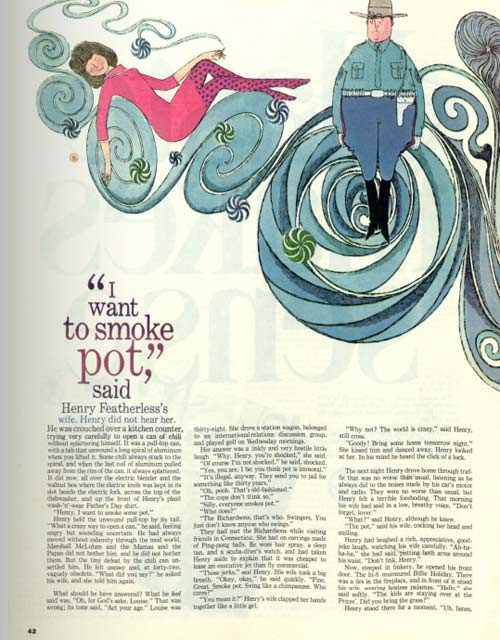
“I want to smoke pot,” said Henry Featherless’s wife. Henry did not hear her. He was crouched over a kitchen counter, trying very carefully to open a can of chili without splattering himself. It was a pull-top can. with a tab that unwound a long spiral of aluminum when you lifted it. Some chili always stuck to the spiral, and when the last coil of aluminum pulled away from the rim of the can. it always splattered. It did now, all over the electric blender and the walnut box where the electric knife was kept in its slot beside the electric fork, across the top of the dishwasher, and up the front of Henry’s plaid wash ’n’ wear Father’s Day shirt.
“Henry, I want to smoke some pot.”
Henry held the unwound pull-top by its tail. “What a crazy way to open a can,” he said, feeling angry but sounding uncertain. He had always moved without calamity through the mod world. Marshall McLuhan and the Mamas and the Papas did not bother him, and he did not bother them. But the tiny defeat by the chili can unsettled him. He felt uneasy and, at 42, vaguely obsolete. “What did you say?” he asked his wife, and she told him again.
What should he have answered? What he had said was, “Oh, for God’s sake. Louise.” That was wrong; its tone said, “Act your age.” Louise was thirty-eight. She drove a station wagon, belonged to an international-relations discussion group, and played golf on Wednesday mornings.
Her answer was a tinkly and very hostile little laugh. “Why. Henry, you’re shocked,” she said.
“Of course I’m not shocked,” he said, shocked.
“Yes, you are. I bet you think pot is immoral.”
“It’s illegal, anyway. They send you to jail for something like thirty years.”
“Oh, pooh. That’s old-fashioned.”
“The cops don’t think so.”
“Silly, everyone smokes pot.”
“Who does?”
“The Richardsons, that’s who. Swingers. You just don’t know anyone who swings.”
They had met the Richardsons while visiting friends in Connecticut. She had on earrings made of Ping-pong balls. He wore hair spray, a deep tan, and a scuba-diver’s watch, and had taken Henry aside to explain that it was cheaper to lease an executive jet than fly commercial.
“Those jerks.” said Henry. His wife took a big breath. “Okay, okay,” he said quickly. “Fine. Great. Smoke pot. Swing like a chimpanzee. Who cares?”
“You mean it?” Henry’s wife clapped her hands together like a little girl.
“Why not? The world is crazy,” said Henry, still cross.
“Goody! Bring some home tomorrow night.” She kissed him and danced away. Henry looked at her. In his mind he heard the click of a lock.
The next night Henry drove home through traffic that was no worse than usual, listening as he always did to the noises made by his car’s motor and radio. They were no worse than usual, but Henry felt a terrible foreboding. That morning his wife had said in a low, breathy voice, “Don’t forget, lover.”
“What?” said Henry, although he knew.
“The pot.” said his wife, cocking her head and smiling.
Henry had laughed a rich, appreciative, good-joke laugh. watching his wife carefully. “Ah-haha-ha.” she had said. putting both arms around his waist. “Don’t fink. Henry.”
Now, steeped in finkery, he opened his front door. The hi-fi murmured Billie Holiday. There was a fire in the fireplace, and in front of it stood his wife, wearing hostess pajamas. “Hello,” she said softly. “The kids are staying over at the Prices’. Did you bring the grass?”
Henry stood there for a moment. “Uh, listen, Louise,” he began, not knowing how he would end the sentence. Then a sickening string of words skidded into his mind and out of his mouth. Keeping his face stiff and half-shutting his eyes, he said, astonishing himself, “The connection’s going to take a little time.”
Later, when the chances for a long jail sentence had begun to seem not only good but attractive, Henry wondered what else he could have said. He could have told the truth, of course, but each time he replayed the scene it came out the same way:
HENRY: Listen, Louise, this is silly as hell. I don’t know where to get any pot. The Yellow Pages haven’t got it listed. I don’t know any flower children, and except for Charlie’s fourth-grade teacher I don’t even know anyone under thirty-two. I could wear blue jeans and hang around the college, but they’d think I was a cop. Let’s drop it and get up a sky-diving group.
LOUISE: Ah-ha-ha-ha! (The tinkly laugh, showing great amusement.) Henry, you’re priceless! All you have to do is call Dirk Richardson.
HENRY: I wouldn’t call that phony charmball if I —
LOUISE: (Interrupting her husband’s search for an appropriate figure of speech.) Pooh to you. I’ll call him myself.
There the scene always faded out, leaving Henry where he had started: potless. He had stalled, not knowing what else to do, and for the first day or so it was easy. “Things are tense; there’s fuzz everywhere. The city’s up tight,” he told his wife as they drove to dinner at the Prices’ a couple of nights after the pot affair started. Louise had been impressed. “Henry’s going to get some grass, but the heat’s on,” she told Ethel Price. Ethel said, “I think it’s wonderful how you keep up with things.”
For the rest of the evening Henry accepted the situation and, he thought, underplayed nicely the role of a man who knows when the heat is on. Later, full of brandy and self-regard, he drove the baby-sitter home. Were things pretty wild at the high school, he asked — a lot of kids freaking out on pot, blowing their minds, that sort of thing?
“Hah?” At sixteen, Mary Lou was not a flower child. She was taking a preoral-hygiene course, because you could make “a hunderd-sixty, hunderd-eighty a week, and it’s steady; people always have bad enamel.” She chewed sugarless gum, and it cracked now as she worked her jaws.
But she was the only teenager Henry knew, and so he went on, “Oh, nothing. It’s just, you know, you hear there’s a lot of kids these days smoking pot.” Henry waited for a moment. “Uh, marijuana.” Mary Lou did not say anything. He went on, craftily, “I imagine it’s just talk. I wouldn’t even know how to find marijuana if I wanted it, would you, Mary Lou?”
“You’re talking funny, Mr. Featherless. I have to tell my father if anyone talks funny. Well, good night.” She got out of the car and her shoes scraped, slop-slop, as she walked across the driveway to her front door.
Henry Featherless worked for Omnicorp, a firm that, as the result of mergers, made spark plugs, women’s shoes, and foreign language textbooks. He was assistant personnel director, and although the job was not a simple one, there were stretches of his day which consisted mainly of repeating two sentences. These were, “Now, Mr. Jones, why do you want to work for Omnicorp?” and, “Suppose you tell me something about yourself.”
Ordinarily, after he had spoken one or the other of his sentences, Henry would fill in the time, as the job seeker answered, by writing letters to the editor of The New York Times in his head, or trying to remember the Vice Presidents of the United States in chronological order. Now he could think of nothing but his terrible enslavement to marijuana. “Well, now, Mr. Jones,” he had caught himself on the point of saying, “suppose you tell me where I can get some pot for my wife.”
Late one afternoon, after a day of brooding, Henry realized that the man across from him had stopped talking, and he said in an encouraging tone, “Suppose you tell me something about yourself.” The man looked at him in surprise and mumbled, “Yes, uh, well, as I said . . .” and Henry realized that they had already gone through the something-about-yourself part of the interview. As soon as he could he telephoned his wife. “Louise,” he said, “I’ll be tied up for a while. Don’t hold dinner.” With the efficiency of which a man under great stress is sometimes capable, he grabbed his coat on the run, found a bar, and ordered a drink.
Louise had been understanding on the telephone. “Is it the you-know-what?” she had whispered very loudly.
No, he had said, he just had to work late.
“It’s okay. I know you have to be careful what you say. Make Art give you the good stuff. And Henry,” she said in a voice that now sounded very small and brave, “don’t let anything happen.”
Henry had invented Art two days before, an imaginary connection, hard to find, suspicious. Art would be a good stall, he had thought at the time, until Louise gave up the nonsense about pot.
It had not worked out that way. Art’s deviousness and unreliability had made Louise angry. “Stand up to him,” she had told Henry the night before, quite sharply. “Tell your friend to make Art do what he promised.” An unnamed friend was supposed to be arranging for Art to sell pot to Henry. Louise had doubts about him, too. “I don’t trust either one of them. I don’t think they’re honest,” she had said.
Oddly enough, Louise did trust Henry. He had never had any experience with elaborate lying, and had always supposed, without thinking much about it, that a liar inevitably becomes trapped as complications are followed by inconsistencies, pursued in turn by panic, public exposure, shame, and swift expulsion from the society of man. Apparently this was not so. His own feeble lie had grown like a baby pterodactyl into a great, flapping falsehood that fed equally well on inconsistencies, good intentions, and young green shoots of cowardice. It was real; Henry himself felt queasily unreal. “I’ll have another,” he told the bartender, “and one for my problem here.” The bartender looked at him carefully, like a man deciding something, and poured one drink.
Later, or earlier, that night a small, sharp-faced man sitting next to Henry at the bar turned and said, “I suppose you have heard that the New York City sewer system has alligators in it?” Henry had not heard that, but the man had spoken quite loudly, and so Henry said yes.
“Well, it’s not true,” the small man said severely. “The animals are caymans, not alligators.” Without giving Henry a chance to comment, he went on, “Did you know that in the last six months the Kennedys have bought up every skywriting plane in the U.S.?”
“No,” said Henry.
“Of course you didn’t,” the small man said, nodding his head in a satisfied way. He slammed his hand flat on the bar, making an astonishing noise. “When you order scallops in a restaurant, what do they bring you?”
“I don’t know,” said Henry, picking up his change and edging off his stool.
“Halibut!” the man yelled, his face red. “They got a guy in the kitchen making scallops out of halibut with a cookie cutter! Want to arm-wrestle?” As Henry left, the small man was juggling ashtrays.
Henry found an all-night restaurant and ordered coffee. He noticed scallops on the menu. Halibut? Probably not, but it would be hard to tell. Why should anyone be suspicious? Halfway through his coffee Henry realized that his pot problem might be solved. He took out his address book, and under “P” he wrote, very carefully, “Halibut?” Then he drove home, playing the radio as loudly as it would go.
The next morning at breakfast he told Louise, who was not smiling, that he had missed Art again. Taking a slight risk, because he felt good, he added, “His kid was in a school play. and of course he had to be there.” His wife did not say anything. “Anyway, today’s the day. Art left word, and we should have some pot this evening.”
On his way to work Henry bought a pack of cigarettes, a folder of cigarette paper, some Worcestershire sauce, a half-ounce bottle of men’s perfume called Chainsaw, and a sun lamp. In his office he broke open four of the cigarettes, added a few pencil shavings to the tobacco, soaked the mixture with Chainsaw and Worcestershire sauce, and plugged in the sun lamp to dry the mess. He sat back, pleased. For the first time in several days he had his life firmly by the collar.
The Featherless house was raided two weeks later. “Your friend Carl drove by earlier,” Henry’s wife told him when he got home that evening.
“Carl who?”
“Carl — I forget — the state trooper. You used to go bowling with him. It’s funny, he came by in his police car a couple of times, hardly moving at all. I thought he was going to stop, but he didn’t.”
A few minutes later the door chimes rang. “Hey, here he is now,” said Henry’s wife. “Come on in, Carl.”
“Carl, sit down, have a beer,” Henry said as the policeman came into the room.
“Sorry, Mr. Featherless, this is official. I’ll have to ask you to come with me.”
The trouble was, of course, that things had gone too well. With some trouble Henry had hand-rolled his fake pot into four lumpy cigarettes. “Five bucks’ worth,” he told his wife that night as he passed them to her. “I’ll shut the curtains.”
He had watched as she lit up. He wouldn’t smoke, he had told her; someone had to stay at ground level to keep an eye on things. She nodded, looking scared. “Art said to start with a good. deep drag,” Henry said. When her coughing fit was over he asked how she felt.
“I’m not sure,” she said, looking sick. “I think I’ll smoke the rest of this later.”
Henry slept well. But the next evening things began to fall apart. “Henry,” his wife said to him shyly. “could we afford to get some more, uh, stuff, from Art?”
“You mean you smoked that junk?”
“Well, no. I have almost a whole one left. But Ethel Price is dying to come over and try some. She can pay for half.”
“Louise, listen. Wasn’t that pot awfully strong?”
“Boy, you know it,” she said, giggling. “They ought to have training wheels for beginners.”
“But it did make you feel high?”
“Well, I think it did. My eyes are still watering. Wow!” She gave Henry a hug. “Promise to see Art?”
The next day Henry got the sun lamp, the perfume, and the Worcestershire sauce out of his desk drawer again. “You did that the other day,” his secretary said, looking distrustful. Henry said something about helping his ten-year-old son with an experiment. It did not sound convincing.
As far as he could make out later, Louise and Ethel spent the entire next day aloft. They smoked four halibuts each, and during the evening, after Ethel had gone home, Louise wandered around the house giggling and saying “zonk.” Henry cooked dinner.
After his wife had gone to bed he tried some of his own pot. Was it possible that he had stumbled on a mixture that actually did have a psychedelic effect? The answer turned out to be an unpleasant no. His eyes watered and his head ached slightly, but that was all. The information did not help much. If Louise were really aviating on nothing but imagination, a full confession was the only thing that would bring her down. And she would land, of course, on Henry.
He tried to cool things the next day by saying that the heat was on again. “It’s a ghost town. Art’s visiting his mother in Buffalo.”
“That’s okay,” said Louise, untroubled. “I was going to phone Dirk Richardson anyway. He gets his from a freighter captain.” That night Henry came home with four more Worcestershire cigarettes. “Make these last,” he said, looking tired.
“I will, but I hope the heat’s off by Thursday,” said his wife. “My international-relations group is studying the drug traffic, and they all want to try pot.”
Henry did not sleep that night; his pterodactyl was now full-grown. and it swooped about his bed threatening to carry him off. “You look terrible. What’s wrong?” asked his wife the next morning, kissing him on the nose.
That night the police made their raid.
Carl Schuller pulled his cruiser up behind the station. “That do it, you think?” he said, turning to Henry.
“It should. Carl.”
“If you want I could have a couple of guys pull a search.”
“That might be pushing things, Carl. I think this ought to take care of it. You made it look like a real pinch. Thanks a lot.”
“What thanks? I pick you up on my way off duty, we go bowling. You want to get some Italian food first?”
Very late that night Henry came home. Louise was waiting, sad and small. He looked at her, holding his face stiff and his eyes half shut. “Henry! Are you all right?” she said.
He gave a little laugh. “I’ll live.”
“What did they do to you?”
“They wanted to know about pot. I told them, ‘You’re detectives, you find out.’”
“I’m sorry, Henry.”
“It’s okay, baby. Just fix me some chili.”
Some weeks later Henry’s wife looked at him thoughtfully and said, “Whatever happened to Art?”
“Art who?”
“Art, you know.”
“Oh, sure — Art,” said Henry, thinking. “Didn’t I ever tell you?”
“I don’t think so.”
“Well, you wouldn’t believe it. He got called down to the White House. He’s an adviser on urban blight. That Art,” he said, shaking his head. “A connection with connections.”
Your Weekly Checkup: Managing Atrial Fibrillation
“Your Weekly Checkup” is our online column by Dr. Douglas Zipes, an internationally acclaimed cardiologist, professor, author, inventor, and authority on pacing and electrophysiology. Dr. Zipes is also a contributor to The Saturday Evening Post print magazine. Subscribe to receive thoughtful articles, new fiction, health and wellness advice, and gems from our archive.
Your heart has four chambers: two on top called the atria, and two on the bottom called the ventricles. Fibrillation, a disorganized, rapid (400+/minute) heart rhythm, can occur in the atria (atrial fibrillation, AF) or the ventricles (ventricular fibrillation, VF). Since fibrillation prevents the heart from contracting and propelling blood forward, it is lethal when it occurs in the ventricles unless stopped by a shock within seconds to a few minutes. Ventricular fibrillation is responsible for a significant number of the 300,000 sudden deaths annually in the U.S.
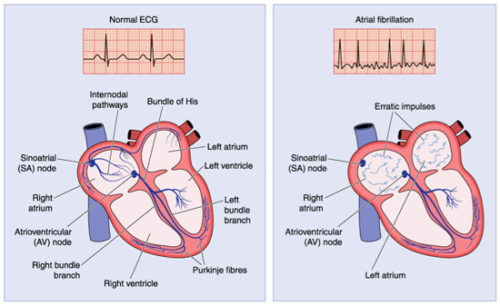
Atrial fibrillation, on the other hand, is the most common sustained heart rhythm disorder, affecting over 5 million Americans, and expected to increase to more than 12 million by 2030. Though considered a fairly benign arrhythmia (abnormal heart rhythm) for many years, we now realize that AF can also be dangerous, although nowhere as lethal as VF. The incidence of AF increases with age and is associated with an increase of heart failure, sudden death, total mortality, and strokes. A recent study estimated that the lifetime risk for atrial fibrillation is approximately 37% after age 55 years.
Many environmental factors help explain why the incidence of this arrhythmia is approaching near epidemic proportions. Risk factors for developing AF include hypertension, obesity, heart attacks, excessive alcohol consumption, excessive physical training, smoking, stress, diabetes, heart failure, elevated LDL cholesterol, and (perhaps) sleep apnea. Appropriate lifestyle changes that address these risk factors can help reduce AF’s incidence.
Three clinical aspects of the arrhythmia require treatment:
- eliminating the AF and restoring a normal heart rhythm when possible
- controlling the heart rate of the lower chamber (ventricles) if AF persists
- providing anticoagulation to reduce the risk of stroke
Because of these challenging therapeutic decisions in treating AF patients, as well as the complexity of the arrhythmia, treatment may be best handled by a cardiologist in an urban setting. A recent study published in the Canadian Journal of Cardiology concluded that AF patients lived longer when cared for by cardiologists, while another study found that the chance of dying from AF was greater when patients were treated in rural compared with urban hospitals.
The take home message is that AF is frequent, particularly in older folks, and that treatment by skilled medical professionals can either eliminate it or treat it to make it quite compatible with a fairly normal life.
The Right Way to Fall
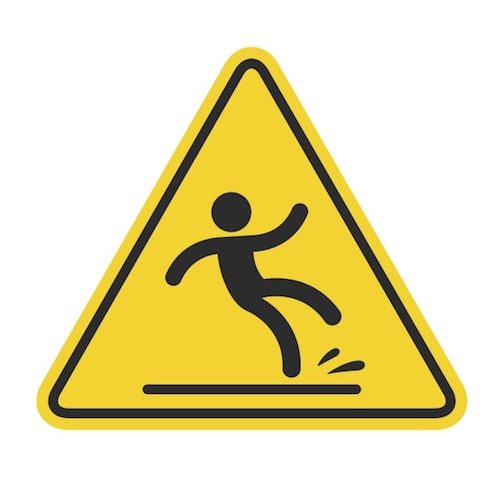
Falls are one of life’s great overlooked perils. We fear terror attacks, shark bites, Ebola outbreaks, and other minutely remote dangers, yet over 646,000 people die worldwide each year after falling. Falls are the second leading cause of death by injury, after car accidents. In the United States, falls cause 32,000 fatalities a year (more than four times the number caused by drowning and fires combined). Nearly three times as many people die in the U.S. after falling as are murdered by firearms.
Falls are even more significant as a cause of injury. More patients go to emergency rooms in the U.S. after falling than from any other form of mishap, according to the Centers for Disease Control and Prevention (CDC), more than twice the number injured by car accidents. The cost is enormous. As well as taking up more than a third of ER budgets, fall-related injuries often lead to expensive personal injury claims. In one case in an Irish supermarket, a woman was awarded 1.4 million euros [approximately $1.6 million] compensation when she slipped on grapes inside the store.
It makes sense that falls dwarf most other hazards. To be shot or get in a car accident, you first need to be in the vicinity of a gun or a car. But falls can happen anywhere at any time to anyone.
The most dangerous spots for falls are not rooftops or cliffs, but the low-level interior settings of everyday life: shower stalls, supermarket aisles, and stairways. Any fall, even a tumble out of bed, can change life profoundly, taking someone from robust health to grave disability in less than one second.
Falling can cause bone fractures and, occasionally, injuries to internal organs, the brain, and the spinal cord. “Anybody can fall,” says Elliot J. Roth, co-medical director of the patient recovery unit at the Shirley Ryan AbilityLab in Chicago. “And most of the traumatic brain injury patients and spinal cord injury patients we see had no previous disability.”
There is no Journal of Falls, though research into falling, gait, and balance has increased tremendously over the past two decades. Advances in technology improve our understanding of how and why people fall, offer possibilities to mitigate the severity of falls, and improve medicine’s ability to treat those who have hurt themselves falling.
Scientists are now encouraging people to learn how to fall to minimize injury — to view falling not so much as an unexpected hazard to be avoided but as an inevitability to be prepared for.
You can trip or slip when walking, but someone standing stock still can fall too — because of a loss of consciousness, vertigo, or something supposedly solid giving way. However it happens, gravity takes hold and a brief violent drama begins. And like any drama, every fall has a beginning, middle, and end.
“We can think of falls as having three stages: initiation, descent, and impact,” says Stephen Robinovitch, a professor in the School of Engineering Science and the Department of Biomedical Physiology and Kinesiology at Simon Fraser University in British Columbia, Canada. “Most research in the area of falls relates to ‘balance maintenance’ — how we perform activities such as stand- ing, walking, and transferring without losing balance.”
By transferring, he means changing from one state to another: from walking to stopping, from lying in a bed to standing, or from standing to sitting in a chair. “We have found that falls among older adults in long-term care are just as likely to occur during standing and transferring as during walking,” says Robinovitch, who installed cameras in a pair of Canadian nursing homes and closely analyzed 227 falls over three years.
Only 3 percent were due to slips and 21 percent due to trips, compared to 41 percent caused by incorrect weight shifting — excessive sway during standing or missteps during walking. For instance, an elderly woman with a walker turns her upper body, and it moves forward while her feet remain planted. She topples over due to “freezing,” a common symptom of Parkinson’s experienced regularly by about half of those with the disease.
In general, elderly people are particularly prone to falls because they are more likely to have illnesses that affect their cognition, coordination, agility, and strength. “Almost anything that goes wrong with your brain or your muscles or joints is going to affect your balance,” says Fay Horak, professor of neurology at Oregon Health & Science University.
Fall injuries are the leading cause of death by injury in people over 60, Horak says. Every year, about 30 percent of those 65 and older living in senior residences have a fall, and when they get older than 80, that number rises to 50 percent. A third of those falls lead to injury, according to the CDC, with 5 percent resulting in serious injury. It gets expensive. In 2012, the average hospitalization cost after a fall was $34,000.
How you prepare for the possibility of falling, what you do when falling, what you hit after falling — all determine whether and how severely you are hurt. And what condition you are in is key. A Yale School of Medicine study of 754 over-70s, published in the Journal of the American Medical Association in 2013, found that the more serious a disability you have beforehand, the more likely you will be severely hurt by a fall. Even what you eat is a factor: A study of more than 12,000 elderly French people in 2015 found a connection between poor nutrition and falling or being hurt in falls.
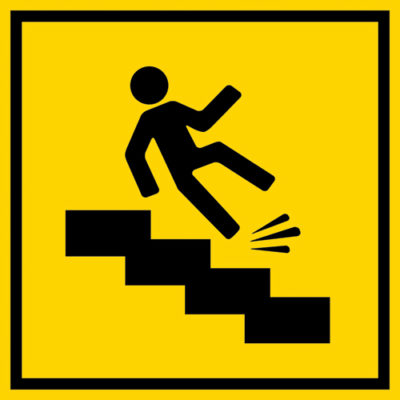
“Over one-half of older adults who fall are unable to rise independently, and are at risk for a ‘long lie’ after a fall, especially if they live alone, which can greatly increase the clinical consequences of the falls,” Robinovitch says. He and his colleagues are working to develop wearable sensor systems that detect falls with high accuracy, as well as providing information on their causes, and on near-falls.
Not that a device needs to be high-tech to mitigate falls. Wrestlers use mats because they expect to fall; running backs wear pads. Given that a person over 70 is three times as likely to experience a fatal fall as someone younger, why don’t elderly people generally use either?
The potential benefit of cushioning is certainly there. e CDC estimates that $31 billion a year is spent on medical care for over-65s injured in falls — $10 billion for hip fractures alone (90 percent of which are due to falls). Studies show that such pads reduce the harmful effects of falling.
But older people have all the vanity, inhibition, forget fulness, wishful thinking, and lack of caution that younger people have, and won’t wear pads. More are carrying canes and using walkers than before, but many more who could benefit shun them because, to them, canes and walkers imply infirmity. This sets up another vicious cycle related to falling: Fearing the appearance of disability, some elderly people refuse to use canes, thereby increasing their chances of falling and becoming disabled.
One unexpected piece of anti-fall technology is the hearing aid. While the inner ear’s vestibular system is maintaining balance, sound itself also seems to have a role.
“We definitely found that individuals with hearing loss had more dificulty with balance and gait and showed significant improvement when they had a hearing aid,” says Linda Thibodeau, a professor at the University of Texas at Dallas’s Advanced Hearing Research Center, summarizing a recent pilot study. “Most people don’t know about this.”
Thibodeau says one reason it’s important to establish this link is that insurance companies don’t typically cover hearing aids, because they are seen as improving lifestyle more than sustaining basic health. Hearing aids can be expensive — up to $4,000 each — but a broken hip, which insurance companies do cover, can cost 5 or 10 times that figure or more and lead to profound disability or death.
Nearly half of people in their 70s have hearing loss but typically wait 10 to 20 years beyond the time when they could first benefit before they seek treatment. If the connection to balance and falls were better known, that delay might be reduced.
Given the tremendous cost of falls to individuals and society, and the increasing knowledge of how and why falls occur, what can you do to prevent them? And can you do anything to lessen harm in the split second after you start to fall?
1. Prepare Your Environment
Secure loose rugs or get rid of them. Make sure the tops and bottoms of stairs are lit. Clean up spills immediately. Install safety bars in showers and put down traction strips, and treat slick surfaces such as smooth marble floors with anti-slip coatings. If there’s ice outside your home, clear it and put down salt.
2. Fall-Proof Your Routine
Watch where you are going. Don’t walk while reading or using your phone. Always hold handrails — most people using stairways do not. Don’t have your hands in your pockets, as this reduces your ability to regain your balance when you stumble. Remember that your balance can be thrown off by a heavy suitcase, backpack, or bag.
Roth asks most of his patients who have fallen to describe in detail what happened. “Sometimes people are not paying attention. Multitasking is a myth, and people should try very hard to avoid multitasking. No texting while walking.”
3. Improve Your Gear
Wear good shoes with treads. On ice, wear cleats — you can buy inexpensive soles with metal studs that slip over your shoes. Do not wear high heels, or at least have a second pair of flat shoes for walking between locations. Get a hearing aid if you need one. Wear a helmet when bicycling, skiing, and skateboarding. Use a cane or walker if required. Hike with a walking stick.
4. Prepare Your Body
Lower body strength is important for recovering from slips, upper body strength for surviving falls. Martial arts training can help you learn how to fall. Drugs and alcohol are obviously a factor in falls — more than half of adult falls are associated with alcohol use — as is sleep apnea. Get a balanced diet to support bone density and muscle strength. If you feel light-headed or faint, sit down immediately. Don’t worry about the social graces; you can get back up once you’ve established you are not going to lose consciousness.
Understandably, some elderly people fear falling so much that they don’t even want to contemplate it. “People should know they could improve their balance with practice, even if they have a neurological problem,” Horak says.
5. Fall the Right Way
What happens once you are falling? Scientists studying falling are developing “safe landing responses” to help limit the damage from falls. If you are falling, first protect your head — 37 percent of falls by elderly people in a study by Robinovitch and colleagues involved hitting their heads, particularly during falls forward. Fight trainers and parachute jump coaches encourage people to try not to fall straight forward or backward. The key is to roll, and try to let the fleshy side parts of your body absorb the impact.
“You want to reach back for the floor with your hands,” says Chuck Coyl, a theatrical fight director out of Chicago, describing how he tells actors to fall on stage. “Distribute the weight on the calf, thigh, into the glutes, rolling on the outside of your leg as opposed to falling straight back.”
Young people break their wrists because they shoot their hands out quickly when falling. Older people break their hips because they don’t get their hands out quickly enough. You’d much rather break a wrist than a hip.
Neil Steinberg is a columnist on staff at the Chicago Sun-Times. He has written for Esquire, Rolling Stone, Forbes, The Washington Post, and many other publications.
This article is featured in the January/February 2018 issue of The Saturday Evening Post. Subscribe to the magazine for more art, inspiring stories, fiction, humor, and features from our archives.
Adapted from the original article first published by Wellcome on Mosaic and is republished here under a Creative Commons license.
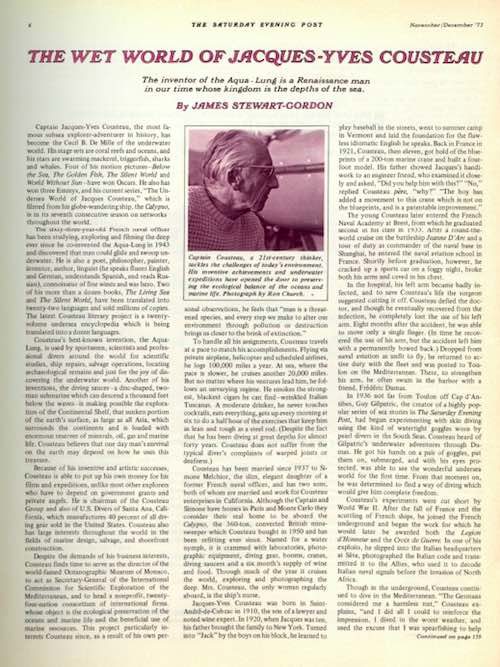
The Early Environmentalism of Jacques Cousteau
“The Calypso crew and I will be undertaking a series of voyages of exploration and discovery in all the seas of the world,” began Jacques-Yves Cousteau, “we have few rules and no uniforms, only the right cap.” Cousteau was referring to the iconic red knit cap worn by himself and his crew members throughout the television series The Undersea World of Jacques Cousteau. The first episode aired 50 years ago today.
Throughout the 8-year-long ABC series, the Calypso crew explored marine life using techniques and inventions pioneered by “Captain Cousteau.” The premiere episode, directed by Cousteau’s son Philippe, sees the crew studying sharks in various spots around the Indian Ocean. Like Cousteau’s Palme d’Or-winning 1956 feature film, The Silent World, his television series documented ocean life in color and brought the mysteries of the deep to viewers the world over.
The Post’s 1973 profile of the Renaissance man, “The Wet World of Jacques-Yves Cousteau,” discusses the legacy of the “poet, philosopher, painter, inventor, author, linguist, connoisseur of fine wines, and war hero.” The author, James Stewart Gordon, visited Cousteau at the Oceanographic Museum of Monaco and noted, “He talked about his adventures and his fear that present-day industrial wastes pouring into the oceans might destroy all future marine life.”
Amongst Jacques Cousteau’s varied accolades and accomplishments was a nascent environmentalism before such a concern was common. In 1960, Cousteau led a resistance against the French government’s plan to dispose of nuclear waste in the Mediterranean Sea. He worried that humankind had come to view the ocean as an infinitely vast resource instead of a delicate ecosystem that could be overwhelmed by pollution and overfishing. In 1971, Cousteau wrote an article in The New York Times called “Our Oceans Are Dying,” warning about the world’s diminishing coral reefs and claiming “there is only one pollution because every chemical in the air or on land will end up in the ocean.”
Today, Cousteau’s sons, Jean-Michel Cousteau and Pierre-Yves Cousteau, are involved in marine conservation with the Ocean Futures Society and International Union for Conservation of Nature, respectively. They continue the exploratory, educational, and environmental work of their father in the oceans he called “sometimes serene, sometimes savage, and always beautiful.”
Did the Post Kill the Annual Alabama-Georgia Matchup?
There’s a lot of history in the Alabama Crimson Tide-Georgia Bulldogs rivalry. It dates back to 1895 when the two teams first met (and Georgia won 30-6).
For decades, the annual Alabama-Georgia game was a highly anticipated event. But in 1965, despite its popularity, the yearly tradition ended. In the 53 years since then, the two teams have faced each other only 17 times.
A former Georgia coach, quoted in an article by David Paschall of the Chattanooga Times Free Press, said the two schools decided it was best not to continue as natural rivals after a lawsuit against The Saturday Evening Post.
There’s a curious story behind that lawsuit. It involves both schools, the Supreme Court, $3 million in damages, and a controversy that continues to this day.
Healthy Weight, Healthy Mind: Tips for Eating Smart, Part 1
We are pleased to bring you this regular column by Dr. David Creel, a licensed psychologist, certified clinical exercise physiologist and registered dietitian. He is also credentialed as a certified diabetes educator and the author of A Size That Fits: Lose Weight and Keep it off, One Thought at a Time (NorLightsPress, 2017). See all of David Creel’s articles here.
Although people who lose weight in a healthy way and keep it off don’t eat exactly the same way, we know that eating within a certain framework will promote health and increase your likelihood of success. The following recommendations are consistent with The Dietary Guidelines for Healthy Americans. You can safely follow these guidelines to lose weight and keep it off in a healthy manner. Of course, if you have a medical condition that requires a special diet, you should consult a registered dietitian.
1. Eat Foods from Each Food Group
Over the past 60 years The United States Department of Agriculture has promoted healthy eating through The Basic Four Food Groups, The Food Guide Pyramid, MyPyramid and MyPlate. Even though the recommendations change slightly over time, research continues to support the importance of eating a variety of foods from different food groups. In order to avoid malnutrition, people either have to eat this way or take supplements. Although supplements can play a role in our health, especially for people who have malabsorption issues, food allergies, or intolerances, relying on supplements for health and nutrition isn’t ideal.
Scientists are still discovering compounds in foods that may help prevent diseases such as cancer and heart disease. Since we still don’t know how all of this works, we can’t simply pull out all the beneficial compounds in foods and put them into a pill. For instance, fruits and vegetables contain many phytochemicals (plant chemicals) that play a role in preventing cell damage or assist in health-promoting enzymatic reactions. A typical multivitamin doesn’t contain these phytochemicals. Frozen pizza, chicken nuggets, and a handful of supplements are not equal to a diet rich in vegetables, fruit, lean protein sources, whole grains, and low-fat dairy. When we eat selections from all the food groups we naturally maintain a reasonable balance between protein, carbohydrate and fat, and we’re likely to consume adequate amounts of vitamins and minerals. People who undergo bariatric surgery are an exception and require vitamin/mineral supplementation.
2. Eat Different Kinds of Vegetables, and Lots of Them
Eating a variety of vegetables is not only good for you; it also makes weight management easier. Vegetables, especially the non-starchy ones, are mostly water. Chewing these water-filled nutrition giants will help you feel satisfied on fewer calories. Suppose you’re having a turkey sandwich for lunch and decided to have a two-ounce bag of potato chips along with it. The chips contain about 300 calories and 20 grams of fat. If instead you chose to eat raw cauliflower, you could eat two small heads, or about 100 florets, for 300 calories. Of course you’d end up eating much less than that, and therefore consume fewer calories.
3. Ditch the Sugar-Sweetened Beverages
This is easier said than done for many people. I’m not generally one to promote absolutes when it comes to diet. In fact, I often try to help patients eat problem foods in moderation rather than avoid them altogether. But for the person who drinks multiple regular sodas every day and describes it as an addiction, abstinence is probably the best goal. Why the different approaches with food versus drinks? The healthfulness and allure of most sugar-containing foods vary a great deal. For instance, if someone tells me he’s “addicted to sweets,” I don’t really know what that means. Anything with sugar, like canned corn and pickled beets? Is a graham cracker a sweet, or how about a macaroon? You get the point. With drinks, the categories are easier. Either it’s a regular soda or it’s not.
People who regularly drink sugar-sweetened beverages often follow patterns like people with addictions, such as smoking. A smoker may always smoke at certain times of day, and soda drinkers often have similar patterns they find hard to break. Studies suggest that regularly consuming sugar-sweetened beverages probably doesn’t impact everyone’s weight in the same way. The people most likely to gain weight are those with a genetic predisposition for obesity. If you have certain obesity promoting genes (many different genes influence body weight), it’s a bad idea to regularly drink sugary beverages. You’re like a person with a genetic tendency for asthma who lives in a polluted city. Just as it may be best for that person to find a better place to live, you may want to consider avoiding sugar-sweetened drinks. Although water is probably the best replacement, drinking liquids with artificial sweeteners will greatly reduce calories and can help you lose weight.
4. Eat Your Fruit, Don’t Drink It
Fruit is also relatively low in calories and packed with nutrients. Many well-intentioned people drink fruit juice rather than other sugar-sweetened beverages in an attempt to be healthier. Although fruit juice is more nutritious than soda, the calories are about the same. In addition, research is clear that chewing food makes us feel more satiated than drinking those same calories. Let’s say you typically feel satisfied after eating a breakfast including two eggs, two slices of toast, and a twelve-ounce glass of orange juice. If you substituted water for orange juice and ate a clementine instead, you could save calories. In fact, you would need to eat five clementines to equal the calories in twelve ounces of orange juice.
Next week, I’ll share a few more tips to help you devise a healthy eating plan.
Come back each week for more healthy weight loss advice from Dr. David Creel.
“A Plan to Abolish the Kitchen”
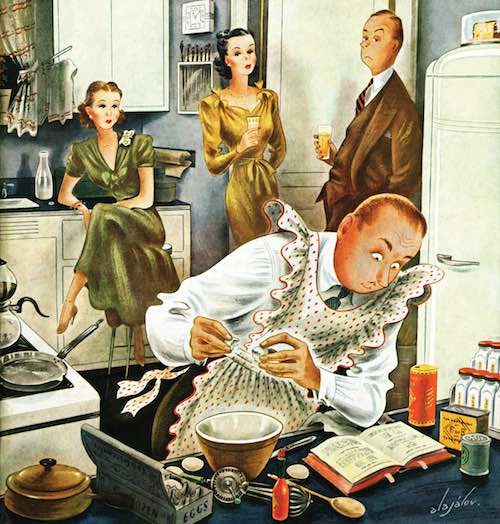
Cooking Is a Man’s Job: Women, said the editors, had no place in the modern kitchen.
Science has busied itself with converting the ordinary substances of our food into food at once palatable and wholesome. And science is not likely to do much for us so long as the matter is in the hands of women cooks, who naturally look at the problem from the personal side, seeking to please our palates much more than is good for our stomachs.
When a great undertaking in cookery is on hand, as for an army, or a palace, or a big hotel, nobody thinks of calling upon a woman to do it. A man is always taken. For one woman who has made a name for cooking there have been 10 men. It is only because we have not given the subject thought that we think of cook as a feminine noun.

This article is featured in the January/February 2018 issue of The Saturday Evening Post. Subscribe to the magazine for more art, inspiring stories, fiction, humor, and features from our archives.
News of the Week: Everything’s Frozen, Fieri’s Is Closing, and Hydrox Cookies Are Still Around
Walking in a Winter Wonderland
Oh boy is it cold. It’s North Pole cold. It’s Swanson-TV-dinner-that’s-been-in-the-back-of-your-freezer-for-a-year cold. It’s cold like you read about in Cold Illustrated, the magazine for people who like when it’s cold. As I type these words, it’s 19 degrees in the Boston area, which is actually balmy, considering we’ve been dealing with single-digit temps and incredible wind chills the past couple of weeks. When you read this, we’ll probably be under a foot of snow, thanks to something called a “bombogenesis” or “bomb cyclone”, the entire region encrusted in layers of white and ice.
That’s how Niagara Falls looks right now, as these stunning pictures show. Erie, Pennsylvania has been buried in snow for days, breaking a record, and more is on the way. And the brutal cold in Minneapolis is making driving and walking really difficult.
This is the part where I make a contrast with the snow and tell you what it’s like in places like Florida and Georgia, but sorry, it’s snowing there too.
Flavortown Closes
If you watch the Food Network at all, you’ll notice that Guy Fieri is everywhere. He’s trying to beat Bobby Flay for the number of shows hosted. That number currently hovers around 47. But one place Fieri will no longer be seen is New York City’s Times Square.
Guy’s American Kitchen & Bar in Times Square closed for good after New Year’s Eve. The place opened in 2012 and was quite popular with tourists.
No word from Fieri on why he’s closing the restaurant. The devastating zero-star review from Pete Wells at The New York Times, where Wells asked Fieri a series of questions about the food and the service, probably didn’t help, but I can’t imagine that it’s the reason the place has closed. That was five years ago.
Fieri still has several other restaurants around the world.
Rockwell’s Door Opens
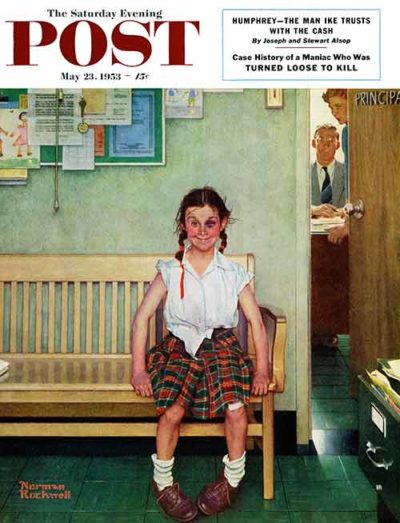
Norman Rockwell
From May 23, 1953
The door seen in the iconic Norman Rockwell Post cover Triumph in Defeat (some might know it as the Shiner or Girl with the Black Eye painting) is being preserved.
The Cambridge, New York, school that served as the setting for the painting is being renovated, and teacher Steve Butz wanted to make sure the principal’s office door seen in the painting would survive. It’s now part of a special exhibit, housed in glass near the school’s library.
By the way, the girl in the painting, the 11-year-old daughter of Rockwell’s lawyer, didn’t really have a black eye. Rockwell had to duplicate what a black eye looked like but was having trouble with the color. So he put out a call for someone who had a black eye, and a Massachusetts boy named Tommy just happened to have two of them. His dad drove him to the school so Rockwell could see what the eyes looked like.
The moral to this story is clear: Kids should get into fights so they can be part of American history.
How Do You Say “2018”?
Maybe my memory is wrong, but I remember when everyone used to pronounce a year like 2018 as “two thousand eighteen.” I don’t remember anyone saying “twenty-oh-four”; it was “two thousand four” (or maybe “two thousand and four”). But I’ve noticed that it’s now more common to hear “twenty eighteen,” and it’s something I don’t quite get. While you could make the logical argument that this pronunciation keeps it consistent with decades past (“nineteen seventy-two,” “nineteen ninety-nine,” etc.), I still refuse to do it. I’m not going to say “twenty eighteen.”
After all, what’s the title of that Stanley Kubrick movie about space?
Gone Away Is the Blue Bird
The Library of Congress has announced that it will no longer keep an archive of every single public tweet that is posted on Twitter. What, you didn’t know that the Library of Congress was keeping an archive of every tweet?
On January 1, the LOC began preserving tweets on a selective basis — only the ones they think are worth keeping as a historical record of the online service. But don’t worry, the picture you posted of that really great ham sandwich you had in the summer of 2013 will still be in the Library of Congress for future scholars to study.
People We Lost in 2017
A lot of publications and news shows do a year-end roundup of all of the famous people who died during the year, but no one does it better than CBS Sunday Morning.
As an addendum to that extensive list, I would add Maura Jacobson, who created crossword puzzles for places like New York magazine and The New York Times for more than 30 years. She died Christmas Day at the age of 91. And Peggy Cummins, the actress best known for her role in the classic crime film Gun Crazy — which was based on a MacKinlay Kantor short story published in the February 3, 1940, issue of the Post — who died last Friday at the age of 92.
The Best and the Worst
Best: I know we’re well into two thousand eighteen, but how about one more look back at last year? Dave Barry’s Year in Review is always a great, funny way to end the year.
Worst: I mentioned CBS Sunday Morning earlier, and former host Charles Osgood announced this week that he is retiring from his four-times-a-day radio show The Osgood Files. In this interview with Alex Silverman at WCBS, Osgood says that he’s not only dealing with two types of cancer, but his family has noticed he has slowed down a bit. He says he’ll still do a podcast now and then, but he’s no longer going to do a regular show. Osgood has been at WCBS for 50 years.
In the interview, Osgood mentions how great a country America is, and here’s a piece he wrote for the Post in 2009 that expands on that.
This Week in History
Hydrox Cookies Debut (January 1, 1910)
Did you know that Hydrox cookies are still around? I haven’t noticed them on my local store shelves in years — I would have bought them to refresh my memory on how they compare to Oreos — but you can still buy them in stores and online, thanks to a clever businessman who scooped up the Hydrox trademark for his company Leaf Brands when it became available a few years ago.
President George Washington Delivers First State of the Union (January 4, 1790)
It was originally called a Message to a Joint Session of Congress, and Washington made it from Federal Hall in New York City.
This Week in Saturday Evening Post History: Hot Pursuit Turns Cold (January 3, 1959)
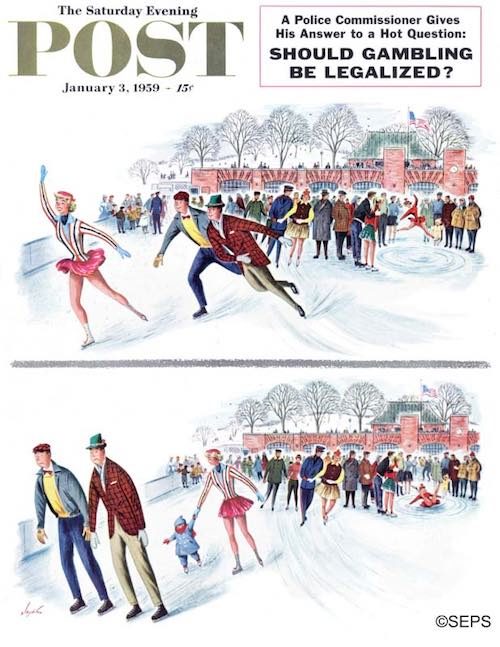
Constantin Alajalov
January 3, 1959
Hot Pursuit Turns Cold
Constantin Alajalov
January 3, 1959
I usually understand magazine covers, but this one has me baffled. It’s from Constantin Alajálov and depicts a winter skating scene. I get that the two men are trying to pursue the attractive female on skates in the first panel, but in the second panel, she’s behind the men and suddenly has a child. It’s almost as if there’s a panel of the painting missing. Or does the female skater have magical powers a la Samantha Stephens on Bewitched? Or maybe I’m just a dolt who doesn’t understand it? (Note: Me being a dolt is a distinct possibility.)
Later On, We’ll Conspire … As We Dream by the Fire
I had a post all set to celebrate National Whipped Cream Day, which is today. But then I thought, who the heck wants to think about frozen desserts when half the country feels like a frozen dessert? This is a time for cozy fires and comfort foods, so I decided to help you out by celebrating something I’ve talked about in past years: National Soup Month.
Chicken noodle soup is the ultimate winter soup, and here’s Curtis Stone’s recipe. How about something from Melissa d’Arabian, who isn’t on half as many Food Network shows as Guy Fieri? Here’s her recipe for Rich Roasted Tomato Soup. My mom used to love split pea soup, and here’s a recipe for a classic onion soup from Rachael Ray, with a good amount of golden cheese melted on the top of crusty bread.
Stay warm!
Next Week’s Holidays and Events
Epiphany (January 6)
The Christian holiday “celebrates the revelation of God incarnate as Jesus Christ” 12 days after Christmas. Don’t be surprised if you awaken to the sound of drummers drumming this Saturday, because recognition of Epiphany is the source of that incessant carol “The Twelve Day of Christmas.” It’s also the day that many families consider the official end of the Christmas season and take down their trees.
Letter Writing Week (January 7–13)
I’ve mentioned many times in this column how much I think everyone should get off social media and start writing letters again, so this is the perfect week to start doing just that. And if you need some reasons why you should keep writing letters, read Nicholas Gilmore’s excellent piece.
Post Puzzlers: January 4, 1873
Each week, we’ll bring you a series of puzzles from our archives. This set is from our January 4, 1873, issue.
Note that the puzzles and their answers reflect the spellings and culture of the era.
RIDDLER
MISCELLANEOUS ENIGMA
WRITTEN FOR THE SATURDAY EVENING POST
I am composed of 49 letters.
My 21, 12, 44, 32, 5, 17, was the name of the Spaniard who first discovered that America was not a portion of the Eastern Continent.
My 25, 14, 18, 11, 46, 25, 49, 45, is the name of a planet.
My 4, 28, 41, 47, 8, was the birthplace of Columbus.
My 48, 22, 10, 6, 24, 36, 48, 16, 27, 20, is the name of a city in the United States.
My 25, 40, 13, 17, 34, 31, 39, 7, 12, 29, 28, 38, was the name of a celebrated American general during the Revolutionary War.
My 11, 26, 25, 16, 19, 49, 37, 17, is the name of a high, rocky island noted as the place of exile and death of Napoleon Bonaparte.
My 34, 23, 45, 19, 33, 38, 25, 40, 11, 6, 43, 44, 31, 23, 38, was the name of a Roman king.
My 38, 29, 3, 12, 42, 27, 14, 10, 46, 16, is the name of a river in North America.
My 48, 17, 15, 9, 38, 47, 10, was the name of a President of the United States.
My 2, 23, 46, 30, 49, 34, 35, 33, 11, was the name of a celebrated Roman poet.
My whole is quite a true maxim.
Seaboard, N. C., EUGENE.
ANAGRAMS
WRITTEN FOR THE SATURDAY EVENING POST
NAMES OF AMERICAN CITIES
South America.
- See, a boy’s run.
- Move on tide.
- Gay Laura.
- Race Lad.
- Spare pilot.
North America.
- Hill had a pipe.
- We met Sir Ned.
- Worn key.
- Labor time.
- Try to sew.
- No more.
Seaboard, N. C., EUGENE.
CHARADE
WRITTEN FOR THE SATURDAY EVENING POST
My first is often found in my second;
My whole a beautiful plant is reckon’d.
Fort Totten, D. T. GAHMEW.
WORD SQUARE
WRITTEN FOR THE SATURDAY EVENING POST
- Part of a vessel.
- A tree.
- A female name.
- Used for music.
Fort Totten, D. T., GAHMEW.
CHARADES
WRITTEN FOR THE SATURDAY EVENING POST
I.
My 1st is an instrument of punishment.
My 2d is one-third of an ell.
My 3d is often seen in newly-mown meadows.
My 4th is one of the blessings of the night.
My whole is one of Scott’s characters.
II.
My 1st is a personal pronoun.
My 2d is part of the human frame.
My 3d is a product of farms.
My whole, an improving study.
III.
My 1st is a title of respect.
My 2d is part of the verb to be.
My 3d is what we do when taking our tea.
My 4th is a popular dish.
My whole is a State in the Union.
IV.
My 1st is man, expressed in a foreign tongue.
My 2d is the author of many crimes.
My 3d is something we all have but have never seen.
My 4th is a common article.
My whole is the birthplace of many great men.
PROBLEM
WRITTEN FOR THE SATURDAY EVENING POST
If the sides of a triangle be bisected, and perpendiculars be drawn from the points of bisection to the circumference of the circumscribed circle, they will measure 10, 34 and 98 rods, respectively. Required—the diameter of the ciroumseribed and inscribed circles, and the sides of the triangle.
An answer is requested.
E. P. NORTON, Allen, Hillsdale, Co., Mich.
ANSWERS
MISCELLANEOUS ENIGMA—Ill got gains are dearly bought, retribution soon will come.
ANAGRAMS—1. Buenos Ayres; 2. Montevideo; 3. La Guayra; 4, Caldera; 5. Petrapolis; 6. Philadelphia; 7. West Meriden; 8. New York; 9. Baltimore; 10. West Troy; 11. Monroe.
CHARADE—Shad-dock.
WORD SQUARES—
SPAR
PINE
ANNE
REED
CHARADES—1. Roderick Dhu. 1. History. 3. Mississippi. 4. Virginia.
PROBLEM—170 rods the diameter of the circumscribed circle—56 rods the diameter of the inscribed circle—90, 186 and 168 rods the sides of the triangle.
Into Each Life
My father believed individuality was best forged in violence: He taught me to swim by throwing me off a silo near Hales Bar Dam, to keep my mitt up by throwing the baseball at my nose (he broke it — I made All Stars that year), and to conquer my fear of snakes by thrusting my hand into a bucket of mostly harmless snakes and pulling one out. I guess at bottom, life came down to belief with my father, and that’s why he bought a horse for my mother. He purchased the filly from a man in Cherokee, North Carolina, for the price of two run-down four-wheelers, but he didn’t have a truck or trailer to haul her back to Jasper, Tennessee, our hometown, so he sold my mother’s wedding dress, and paid my cousin to pick her up for him. My mother watched from behind the screen door as the filly was led out of the trailer — she had fallen from a horse a couple years back and developed seizures and anorexia, naturally she was scared. We didn’t have any stables, we weren’t that kind of family, so they tied the filly to a tetherball pole. The horse seemed huge to me then, and in my mind was taller than our roof, with hooves that beat silence into an onlooker. My father gave me the honor of naming her. I had just finished reading The Great Illustrated Classics: Moby-Dick Dolly Parton sent to our house, so I christened her with the great whale’s name.
My bedroom window faced the tetherball pole. For the first two nights, I watched her underneath the orange glow of the streetlight. She hardly moved at all; she stood with a powerful resignation. It was almost as if her powers were stripped from her in these new surroundings. I was mesmerized by her stillness, and I longed to set her free, longed to ride her through a mountain pass, along a ravine, and out onto a sandy beach. But I was not allowed to go near her for fear she’d trample me. So what I did was, I’d quietly hook the lock on my door, it was forbidden to do so, and I’d stuff bathroom towels around the door’s bottom and sides to prevent light and noise from escaping. Then I’d tiptoe to the little window above my bed and pull the cord slowly, revealing the outside world in fragments. It was almost like watching a movie. And there Moby- Dick stood with her face set in the night, a wild dark eye searching for God knows what. Her maple-brown fur and sable mane, bathed in orange light, cast about her a radiance that beckoned her to be stolen and ridden to an enchanted forest, so otherworldly was Moby-Dick, in her haunches were etched veins that bulged and circumnavigated her body like rivers etch the earth. Her long snout had a white oval stripe printed between her eyes. I wondered how lonely she was.
The next night I read to Moby-Dick, or rather I pressed pictures of different books up against the windowpane in hopes she paid attention. I tried to narrate facts to her, telepathically or under my breath, this animal I’d known less than a couple of days.
I even flashed something like Morse code by turning the blinds up and down. She didn’t seem to pay much attention to me, but I felt I was making a difference in her life. This night the valley was seeped in cloud, fog wrapped around everything. I was reminded of a poem about yellow fog rubbing its back against the windowpane as I opened up my window and climbed down through the itchy bush. Moby-Dick saw me, and held her breath. I drew a finger up to my lips and looked back toward the house. I crawled a short ways to her, then realized there was really no point in crawling and walked up to her. I put out my hand and she lowered her elegant neck to my palm, nuzzling me underneath my armpit. My knees trembled at the enormity of her shoulders, and her black eye observed me without blinking. I saw the rope tied loosely to the tetherball pole and felt sorrow for Moby-Dick. I loosened the rope with trembling hands, but to my surprise she didn’t move. She scooped me up, I don’t know how to explain it, but suddenly I was astride her. Her body’s movements flowed between my thighs. I grabbed a tuft of her mane and flattened my chest on her neck. I whispered, “It’s you and me, darling. You and me and the valley.” And just like that she began to trot. I was afraid I’d be kicked off, but her back arched into me in effort to keep me above her. We rode out across the farm fields, up through the woods toward Tracy City, down the rocky crags and swing bridges near Foster Falls, and ended up back in the holler near Sequatchie.
The wet Tennessee summer enveloped us; out of doors was a steam bath. The bees ceased their traveling and settled inside metal poles and underneath piles of boxes, stingers ready. Tomatoes on the vine ripened, and my mamaw diced them into salsa before storing the mason jars in her basement. I played with a sharpened stick and ran through the forest setting up traps with fishing line and bent branches. Sometimes my father would press his thumb into the mouth of the water hose and spray high into the air, and I’d run underneath shirtless and barefoot while he sat on the porch steps. But my favorite thing to do was lie on the trampoline at night and look up through the hanging branches high overhead and think about all the people the stars had seen.
My father had a lot of work that summer, air conditioners were running non-stop, and it is tempting to dwell on the good times, the salvageable interludes memory cordons off, and in some way alter the past with the narrative one needs.
My mother smoked marijuana most evenings. She never smoked in front of me, and she carefully hid her bowl and lighter in the corner of their dark bedroom underneath a shag carpet that covered yet another shag carpet. She came out of the bedroom with a hornless unicorn statue — that was where she placed the incense cone, smelling of patchouli and nag champa, and of course the dank sweetness of bud on her tongue.
One Friday evening my father came home late, as was often the case — he had a big heart and when someone’s air conditioner quit he went out, even in the middle of the night, and fixed what he could. He and I were standing in the kitchen. Their bedroom door was shut. He knocked on the door.
He said, “Alberta, it’s me. Open up, sweetie.”
He looked back at me and I pretended to do math homework at the kitchen table. I could tell by the crinkles on the back of his neck he only had a couple minutes patience left. After a pause we heard the sound of creaking boards. My mother opened the door slightly, so that my father had to slide sideways through the opening.
They whisper-fought in their strange way. I listened for discernible words, phrases. The only thing I made out was the common complaint that after crawling in attics for 12 hours a day he’d appreciate it, it would mean the world to him, if his wife, who did not work, could cook some dinner. And was that unreasonable? Was that maybe unfair? After all she could put down her toy and face her life. Then my mother snickered, a high-flat release that rolled into a snort. And my father left the room and took his Air Force flask filled with Wild Turkey 101 from beneath his shoeshine box in the living room and walked outside and smoke and drank. I watched him from the kitchen window walk up to Moby-Dick, and I knew he was talking to Moby-Dick. I’d seen him before, from a distance, blubbering and leaning on Moby-Dick.
I wanted to comfort my father, but there was nothing to say. I sat at the kitchen table for a time and decided to knock on my mother’s door, although I figured she wouldn’t answer. I said, “Alberta, it’s me. Open up, sweetie.” She unlocked the door and cracked it, her concoction of secret and cover-up, bud and patchouli, burst in my face like the opening of Pharaoh’s tomb. Then she walked back to her bed and sat on the edge. I walked in.
The bowl and lighter rested on a glass blue tray beside her. Cans of hairspray and mousse, layers of dust packed in their nozzles, cluttered the floor. I had not been allowed to come into my parent’s room, and in many ways it was like stepping into a part of my mother’s mind. The walls were a different material than the rest of the house, wood-paneled, and the carpet brown. The room was a long, dark corridor. At one end was the bed and at the other end a dresser, that was about it, besides maybe a couple of stock photos on the wall, a sunset with palm trees, a dog playing with a cat. The two windows were small, like portholes, and covered on the outside by a labyrinth of spider web and dead insects.
She said, “What is it, little man?”
My mother was a slight woman by anyone’s standards, and her clothes were like huge sacks; she always looked like an old child. Her hands were fine and her fingers long; they brought her modeling success in her late teenage years. She wore autumn tinted glasses with blue eye shadow and never came out of her room without makeup on. She had been raised to believe a woman ought to take care of her family and herself, and after many years of switching between medications, only flashes of who she wanted to be showed in her forehead wrinkles, her cruel mouth, so that she no longer knew who she was, who she had been, or who she wanted to become. But she kept a packaged porcelain doll tacked on the kitchen wall. On the front of the box was a plastic oval by which you saw the doll dressed in old-timey clothes inside. Above the oval was printed the name Alberta. Her mother bought her the doll, the story goes, and I guess she never wanted to mar its perfection, so she never opened it.
I said, “I showed Moby-Dick pictures from my Moby-Dick book.”
She said, “Did you now?”
After a long pause, without looking at me, Mother said, “We ain’t meant for this
life.”
As suddenly as she said it, she was quiet. I stood there for a while to hear a commentary or explanation, but she just sat there staring at the wall. I could tell she wanted to smoke from her bowl and so I left.
We ain’t meant for this life. It wasn’t an imperative, a summons, or a call to action. Instead it settled inside me like a riddle to be puzzled over, something a graybeard knitted his brows over or the maid considered silently while making the bed. The rest of my summer was taken over by the utterance. I sat on the banks of the Tennessee with my fist on my chin, like any good Romantic, any future depressive, and thought about it.
We ain’t meant for this life.
The chimneys jutting from the river were like white flags. The rusting bridge over Nickajack, a testament to decay. The moon, a witness, blushed white and silent. Squirrels doomed to the hunter’s rifle or the housecat’s reserved violence; possum, the worn tread of a farm truck; the daisy, pillaged by the bee. Surely these things, were they able to speak with me, would cry out “we ain’t meant for this life,” or their cry would be more dignified, a quiet “No!” like the tree trunk in a tempest and time’s whispers from lapping rivers and blooming gardens, only understood in space, in a moment, in action, and then nothing. But above all these considerations, that is, the central nexus of my young, rambling mind, was Moby-Dick.
Each morning I woke early and walked to our neighbor’s stable. It was an old barn, the wood long since grayed, and the roof beams high overhead. The floor was covered in straw, and the sunlight, as the morning passed to noon, filtered through cracks and shingles like splayed, golden fingers. Cedar and horse dung and sweat woke in the warm light. Saws were nailed to the barn walls and ropes hung from beams. I’d fill a bucket of feed, place the brush and a shovel underneath my armpit, and carry them back to where Moby-Dick stood tethered. I’d grab the wood-handled shovel from the yard with my garden-gloved hands and scoop Moby-Dick’s shit into the designated hole, and then I’d feed her. Sometimes I’d step in it and stumble in the half-light, but I loved my chore. It was mine, my task, my responsibility. If I did nothing, Moby-Dick walked in a circle with a growling stomach and shit-studded hooves. When I brushed her I always used long, light strokes. I only wanted to stimulate the skin, not the muscle, as one might in a person. I sometimes tapped my fingers, using both my hands, on both her sides and between her eyes. Always I spoke to her, and though I can’t remember what it was about, one never remembers the particulars of situations, I felt comforted.
One such morning, after chores and checking whether my parents or neighbors would see me, I put her grazing muzzle on, untied her, and led her onto the foggy fields. It was a gray day, and the leaves were wet and colored emerald green. The misty morning hugged us when we stepped outside her normal, sad path. She offered no resistance.
When I stopped, she stopped. I’d turn to her and look her in the eye, and she wouldn’t look away. My arm was practically above my shoulder; she could have easily yanked her neck upwards and ripped my shoulder out of its socket. But she wanted to be with me. We walked silently, observing our surroundings. We went along a familiar path that led around a copse of trees and across a different stretch of the creek. At times I’d stop and let go of the strap, and she’d take a few steps and bend her neck down. I fantasized about riding her again, but this morning seemed different. She seemed disinterested, subdued by some instinct, or what have you. I didn’t want to unload on her like I’d seen my father do, tell her about all my problems and what I was concerned about. I think now I was hoping she would intuit what I couldn’t express, what no one can express.
We walked and suffered the fog; it became thicker as we journeyed on, until it was difficult to see where we were going, or where we had come from. Presently, two fuzzy, hovering orange lights were in the distance. When one orange light moved across the fields, the other orange light followed closely behind. I turned back to Moby-Dick and whispered “Shhh.” Although it was imperative these orange lights didn’t see us, I guided Moby-Dick on toward them, my hand out in front waving fog aside. I noticed the orange lights had rifles, and were men. The fog around us seemed more like smoke, and we were lumps of burned-out ash in a bowl, the orange embers floating in the distance. I remember feeling my pulse quicken and freeze in an instant, my knees trembled and were light. Moby-Dick could die at any moment, it was certain. A stray bullet could hit the sparrows passing overhead, fog speared on their beaks, and ricochet into Moby-Dick’s heart. Or they could shoot her on purpose. I tried to steer Moby-Dick back toward the stables, but I didn’t know which way to go. Suddenly, a shot rang out and a bird tumbled through the fog and bounced on the ground a few feet away. A merry-tailed dog barked and bounded through the grass onto the bird. He saw us, growled, picked up the bird, and ran back to his owners.
Moby-Dick was the one who guided us back to the tetherball pole, and I headed off to school.
At high noon on a particularly hot summer day, I caught my mother spraying Moby-Dick with a water hose. Moby-Dick stood dumbly at the far edge of her leash, her head jutting out toward freedom. I leaned against the vinyl siding and watched. Mother didn’t seem to be enjoying herself. She stood in her old duck boots with a yellow paisley box dress, her shoulders rounded forward from years of sitting, her head craning her neck toward her bird’s chest, one hand on the water hose with elbow bent at 90 degrees and the other arm straight down her hip. With the minutest movements, almost like a sprinkler, she sprayed Moby-Dick’s haunches to mid-neck, and back again. The hose’s stream traveled slowly, like meditation slow, like mother knew the exact amount of hose water needed to adequately saturate a patch of Moby- Dick’s hair. Probably she was stoned out of her mind; this is the sole memory I have of my mother doing anything.
I watched her for some time before I heard the gravel behind me, the familiar tread of my father’s work van turning down the driveway. I stiffened and jumped across the driveway and into the creek.
I heard him shut the door, and I peeked over the bank.
He watched her from beside his van. Mother didn’t move. She just kept up her slow, oscillating spray. After a minute, I walked over to my father and stood beside him. That’s when I noticed my mother was mumbling. She was talking to Moby-Dick. I only caught fragments. She sounded childish, like she was speaking to a baby.
“Well, ain’t you just the cutest thing.”
“You’re just the biggest, most gentlest baby around. Ain’t you, baby?”
“Now, he did tell me you weren’t supposed to do it.”
“I ain’t never heard nothing about that.”
And other like phrases. My father breathed in a deep breath, through his nostrils, looked down at me and nodded. He said, “Hey, son.” I nodded back.
Then he walked inside the back door and slammed it shut.
The summer passed and the leaves covered yards, fence posts, and doghouses. I spent my mornings feeding Moby-Dick and my evenings reading. It was the season of pancakes and cider, cinnamon brooms and flannel. Peyton Manning was throwing touchdowns to Peerless Price.
One afternoon I was walking home from the bus stop and I sensed something in the air. My parents sat on the porch in two green metal rocking chairs. I waved and they waved back, but my father just sat there smoking his churchwarden and looking toward the ground. My mother had her usual calm, happy face about her, her hangdog brow and excited lips. As I walked by my father said, “It’s looking like it’ll rain soon, son. Why don’t you go on and check Moby-Dick before you start your homework.”
I said, “What’s wrong?”
“Just go on and see to her.”
My father puffed his pipe and looked away from me. Mother said nothing. I ran around the house, my boots rubbing my ankles.
The tetherball pole was empty, and the metal latch clinked against it. I inspected the latch. There was no sign of force; either it was never locked or human hands unlocked it. But I hadn’t moved Moby-Dick in several days. I ran back to the porch. My father crossed his legs when I came up.
He asked, without looking at me, “How is she?”
My mother said, “She’s a beautiful beast.”
I said, “She’s fine.”
My father held his pipe on his lap and looked at me.
He said, “You hear that Alberta, Moby-Dick is doing just fine. You don’t have to worry about her. Isn’t that what you’re saying, son? There’s no reason to worry anymore?”
My mother smiled, “I don’t know now.” Her face turned gloomy. “I hear her at night sometimes. I’ve watched her from the window a time or two.”
I said, “I just remembered something. I’ll be right back.” And I ran out of the front yard as fast as I could. To this day I remember my father shouting something after me, but I can’t remember what he said. It’s probably just my memory wanting him to shout after me, to admit he needed comfort, but instead he punished me with the burden of finding what he lost, what he let go.
Behind our house, past the neighbor’s stables, is a wide stretch of fields. It is one of the things that make the Sequatchie Valley so beautiful, wide-open fields, and mountains like interlocked shoulders of giants. I ran across these fields until my thighs were heavy. I saw rabbits hopping alongside squirrels, deer and cows rushing to shelter. The gray clouds knitted above us like a great blanket, and the wind ushered them down.
Suddenly, I saw her. The sun was blinking over Jasper Mountain as she looked back at me. I called to her and she looked forward. She walked ahead at a decent trot. I followed her to the river, a wide spot that flows through Nickajack Lake, over by Hale’s Bar Dam. Although my lungs were bursting from exhaustion, I managed to catch up. I stood between the trees just off the bank, the leaves shaking their music above me. Moby-Dick slowly, deliberately waded into the river until her underside was just below the surface. My hands trembled, my fingernails dug into the bark. I’d dive, yes, I’d dive into the river and mount her and ride her back. I’d done it before, hadn’t I? I walked forward, and she pushed off into the river.
I ran across the loose gravel and sand. “Wait! Wait!” My ankles beat against the river. I slipped in the loose sediment, and I dove. Underwater I opened my eyes to the dark and quiet and I neither heard nor saw her. Afraid she’d kick me while swimming away, I resurfaced. She was out in front of me, to the right. In the distance was the highway bridge. I swam the sidestroke; my legs cut the water. With every breath I stole an eye at Moby-Dick. I panicked so far from shore, I was never a good swimmer, and I took in mouthfuls of water. It was darkening now, under the surface was not much different than above. I looked to the mountains around us and pressed on. It was sometime, perhaps a lifetime in minutes, when I gave up. And there in the river, between the falling drops of rain, I watched her swim out with the last blinking orange dusk light until she vanished completely.
Sometime later my parents took me to the Marion County Fair. It was a warm autumn evening and the smell of cattle, funnel cakes, and the sense of time on the horizon permeated the ground in dead leaves underfoot. There was a Ferris wheel and several spin-as-fast-as-you-can rides. Everybody in the county came, and it was one of the few times a year when I got to see certain family members.
At one venue my uncle Dixon, an accomplished fiddle player, was playing with a band on a stage adorned with hanging Edison bulbs. People were dancing and clapping and kicking up dust. I remember watching Katherine Lofan, a girl about my age, dance with some older boys —and I longed to dance with her. But around the time I’d gathered the courage I caught sight of my mother and father, holding hands, walking out on the dance floor. My mother had on a pretty evening dress, her hair curled, her cold blue contacts in. Her face blushed a little when my father pulled her to the center of the floor. And when Uncle Dixon struck up the next song, my mother sprang to life in my father’s hands; he framed her so beautifully. They twirled and laughed, heels clicking and partners changing. An older woman tapped me on the shoulder and asked me to dance with her and I felt safe and loved and said yes. And we all danced and laughed that night and were happy.
There is still one more thing to tell. It was well into autumn when there aren’t many leaves left to fall and the fog above the river is cold, the time when crawdads hide.
I still had told no one about my ride with Moby-Dick, if that’s what it really was. My father tied a tetherball in Moby-Dick’s place, and no one ever touched it. No one asked me how I felt about anything.
My father came into my room, and he handed me a small wrapped box. It was wrapped with brown packing paper and tied together with kitchen twine. On this box was a handwritten note that read: “For my son with whom I am well pleased.” I looked to my father and he kept his eye on the box, nodded to it. I opened the box and inside was a metal packing tool, a glad baggy of mixed tobacco, a box of kitchen matches, and a corncob pipe. My father put his hand on my shoulder, and I started to cry.
I couldn’t stop crying, holding that box. I knew my father loved me and I knew something of his despair — something of the need for habit in the face of irretrievable loss.
My father held me to him for a moment, then he knelt down with his hand on my shoulder. I didn’t look him in the eye.
He said, “What’s a matter, little man?”
I kept crying. I was weeping, breathing and talking between shudders.
I said, “I rode Moby-Dick out, out in the valley.”
He said, “That’s good, buddy.”
He pulled me a little closer, like you do when you’re afraid something might suddenly disappear.
I said, “I read to her, Daddy. She heard me.”
He said, “That’s good, buddy.”
I said, “She swam away, Daddy. I can dance too.”
Rockwell’s Four Freedoms
“We look forward to a world founded upon four essential human freedoms. The first is freedom of speech and expression. The second is freedom of every person to worship God in his own way — everywhere in the world. The third is freedom from want … everywhere in the world. The fourth is freedom from fear … anywhere in the world.”
—President Franklin D. Roosevelt, Message to Congress, January 6, 1941
Inspired by Franklin D. Roosevelt’s famous “Four Freedoms” speech to Congress on January 6, 1941, on the eve of World War II, Norman Rockwell wanted to contribute to the war effort by creating paintings that depicted each one.
The artist struggled with how best to visualize the abstract concepts. “I juggled the ‘Four Freedoms’ around in my mind, reading a sentence here, a sentence there, trying to find a picture,” he later recalled. “But it was so high-blown. Somehow I just couldn’t get my mind around it.”
One night in bed, Rockwell was mulling over the proclamation, getting more discouraged as hours ticked by. “I suddenly remembered how [neighbor] Jim Edgerton had stood up in a town meeting and said something that everybody else disagreed with,” Rockwell said. “They had let him have his say. No one had shouted him down. I thought — that’s it. Freedom of Speech — a New England town meeting. Freedom from Want — a Thanksgiving dinner. I’ll express the ideas in simple, everyday scenes … in terms everybody can understand.”
Excited and confident, Rockwell rolled up his sketches and boarded a train for Washington, D.C., to visit the government’s propaganda department, the Office of War Information, proposing that the illustrations be made into patriotic posters that could be sold to raise funds for the war effort. “I showed the Four Freedoms to the man in charge of posters,” Rockwell said, “but he wasn’t even interested.” On his way back to Vermont, the discouraged artist stopped in Philadelphia to discuss future projects with Post editor Ben Hibbs. In passing, Rockwell mentioned his Washington trip, explained what the series was about, and then showed him the sketches. Hibbs loved the idea, telling the artist, “Norman, you’ve got to do them for us. … Drop everything else, just do the Four Freedoms.”
Rockwell spent seven months painting the Four Freedoms, which were published in four consecutive issues of the Post, starting on February 20, 1943, accompanied by essays by four distinguished writers — Booth Tarkington, Will Durant, Carlos Bulosan, and Stephen Vincent Benet. The paintings were a phenomenal success, with the Post receiving 25,000 reprint requests. A few months later, the government changed its tune, and in May 1943, the Post and the U.S. Treasury Department launched a joint fundraising campaign, sending the paintings on a 16-city national tour. More than one million people attended the exhibition that raised an astounding $132 million.
Now hanging in the Norman Rockwell Museum, the iconic paintings capture the freedoms we enjoy as Americans and the cherished ideals that unite us — timeless reminders of what we have and what we have to lose.
Freedom of Speech: Rockwell started the first painting in the series at least four times. He initially depicted an entire town meeting full of people, with one man standing up in the center of the crowd talking, but later felt “there were too many people in the picture.” He altered the composition significantly, tightening the focus on the speaker, now positioned in front of a blackboard, as townspeople listened respectfully to the speaker’s words.
Freedom of Worship: The original painting was set in a barbershop, with patrons of various races and religions patiently waiting their turns. “I wanted it to make the statement that no man should be discriminated against regardless of his race or religion,” Rockwell said. Ultimately, Rockwell rejected that scene as ambiguous. Instead, his finished composition groups faces and hands — a mélange of different cultures — in prayerful contemplation, bearing the legend, “Each according to the dictates of his own conscience.”
Freedom from Want: One of Rockwell’s most famous and beloved works, Freedom from Want became an iconic representation of America’s quintessential national holiday, Thanksgiving. To create the scene, he grouped members of his own family and friends around a dinner table for a holiday meal. After two difficult paintings (Speech and Worship), this one came easy: “Mrs. Wheaton, our cook (and the woman holding the turkey), cooked it, I painted it, and we ate it.”
Freedom from Fear: The last in the series depicts children, oblivious to the mounting conflict in the world, resting safely in bed as their parents look on. The serenity of the scene is belied by the newspaper’s bold headline, “Bombing” — a reference the 1940–1941 blitz in London. Rockwell said the idea he hoped to convey was this: “Thank God we can put our children to bed with a feeling of security, knowing they will not be killed in the night.”
Rockwell’s Lasting Legacy
by Abigail Rockwell
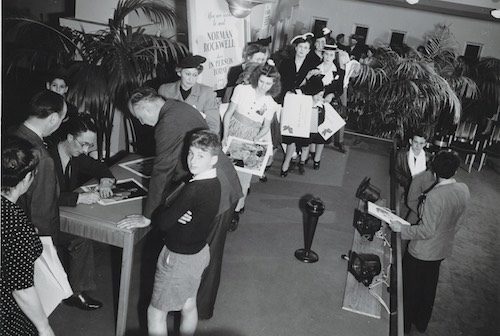
We are living in chaotic and even alarming times, but here’s the tremendous gift: We are compelled to go within — so much outside of ourselves is beyond our control — to discover what our true values are — what is really important to us, for our families and our lives. Everything becomes clear in times of crisis. All of us are now urged to revisit the Four Freedoms and what they mean to us. Freedom of Speech (and the Press) is more relevant and vital than ever before; Freedom from Want — the polarity of the haves and the have-nots is starkly apparent and pressing; Freedom of Worship as everyone’s faith is being tested, judged, and at times viciously condemned; and Freedom from Fear haunts all of us as we attempt to gather greater strength, courage, and renewed purpose in the face of escalating troubles around the world.
The process of painting the Four Freedoms ushered in a new phase in my grandfather’s work; a greater sense of purpose, refined technique, and heightened storytelling began to inform his art from then on.
The great studio fire that occurred shortly after he completed Four Freedoms — a blaze that destroyed his entire studio and its contents, including the collection of his own work — forced him to immediately let go of the past and start all over again in the harsh light of an inestimable artistic and personal loss. But he embraced it, moved to a less isolated home on the West Arlington town green, and became very close with his neighbors — the Edgertons and the entire community in Vermont — which also greatly benefited his work and life.
Without his seven-month struggle in painting the Four Freedoms and the subsequent studio fire, the period of Norman Rockwell’s masterpieces in the late ’40s to mid-’50s simply would not have occurred.
To read the complete Four Freedoms essays, visit saturdayeveningpost.com/fourfreedoms.
This article is featured in the January/February 2018 issue of The Saturday Evening Post. Subscribe to the magazine for more art, inspiring stories, fiction, humor, and features from our archives.
Rockwell Video Minute: Was Rockwell’s Mermaid Cover Obscene?
See all of the videos in our Rockwell Video Minute series at www.saturdayeveningpost/rockwell-video.
Weight Loss Advice from the 1930s: Eat Less, Exercise More
Topping most of our resolutions this year is a repeat from the past: weight loss. But who’s to blame for this obsessive desire to trim and slim our figure? Automation? Hollywood? Feminism? France? Here’s a 1934 doctor’s take on America’s ongoing weight-loss craze:
—
Pounding Away
Originally published in The Saturday Evening Post, September 22, 1934
Before the establishing our modern knowledge of diet, it was taken for granted that the shape anyone might have had been conferred upon him by providence, and the best one could do would be to make the most of it. There was little to be done in making the least of it. Nature creates human beings and animals in all sorts of forms and sizes. A Great Dane takes many a roll in the dust, but never achieves the slimness of a greyhound; a draft horse of the Percheron type travels many a mile pulling heavy loads, but never gets small enough to be a baby’s pony. Nevertheless, the basic framework can be modified as to the amount of upholstery. Every woman knows that she can, by suitable modification of her diet and by the use of proper exercise, cause the pounds to pass away.
No one has determined certainly the cause of the recent craze for reduction. Perhaps it was the outgrowth of criticism of the female figure that was popular in the late ’90s. The textbooks of the ’90s had much to say about corset livers and hourglass shapes. The preference for the boyish form may have been the result of the gradual change in the amount of clothing worn by women. The multiple petticoats and the heavy underclothing of the late ’90s began to give way to single garments in what was called the empire style. The styles have tended toward the slim figure, covered by less and less clothing. Perhaps the change was the result of the coming of the automobile; that, too, has been a most significant factor in the change of our body weight.
A Matter of Form
Walking, up to 1900, was the accepted mode of transport for the human body in the vast majority of circumstances. Then came the motor car. Today there is in this country one motor car for each five persons, and walking is gradually becoming a lost art. Walking used to be the form of exercise primarily responsible for burning up the excess intake of food. With the gradual elimination of walking and with the coming of the machine in industry, there has been less and less demand for energy in food consumption and more and more tendency toward maintaining a slim figure by a reduction in the consumption of food. The person who takes no exercise and who eats the diet that was prevalent from 1900 to 1905 will put on weight like an Iowa hog in training for a state fair.
The suggestion has even been made that feminism was responsible for increasing the popularity of women like men. Within the last quarter century more and more women have come out of the home and into various clerical, manufacturing, promotional, industrial, and statesmanlike occupations. No doubt, the bobbing of the hair and the binding and suppression of the breasts, as well as the thinning of the figure and simplification of the costume, were women’s response to the necessity for greater ease of movement and less encumbrance while engaged in such work. A fat girl gets lots of bumps from office furniture in modern designs.
Then came the war, and with it there was intensification of all these motivations; the war made serious demands on women. The slightly suppressed desires for freedom merged into strong impulses and urges that suddenly seized every feminine mind. What had been merely a somewhat languid interest suddenly became a dominating craving. Reducing became the topic of the hour, and the craze for reduction was upon us.
It has been urged by some that the final stimulus for slenderness was a sudden change in fashions promoted by the modistes of France. Be that as it may, the French women themselves never succumbed to the craze for emaciation as did their American sisters.
The French are far too sound a race from the point of view of feminine psychology to urge the cultivation of manly traits in their women. No doubt, the French fashions did incline toward women of somewhat thinner type, but the modistes did not, like our designers of costumes, adopt an all-or-nothing policy. Individualization in form and costume has more often been the mark of France, whereas standartization and uniformity have dominated the American scene.
American manufacturers of ready-made clothing, with the beginning of the 1920s, began to produce models for slim women, hipless and bustless. As the women went into the department stores to purchase, they found it difficult to obtain anything that would fit. They came out wringing their hands and crying that most famous of all feminine laments, “I can’t get a thing to fit me.” And when a woman cannot get a thing that will fit, she is ready to fix herself to fit what she can get. There were promptly plenty of experts ready to help her through the fixing process.
To Make the Person Personable
Advertisements began to appear of nostrums to speed the activity of the body and to lessen its absorption of food. Phonograph records were sold, giving explicit instructions regarding exercise and diets. The radio poured forth systematic calisthenics and played tunes for the performance of these motions in a rhythmical manner. Plaster fell from many a living-room ceiling while women of copious avoirdupois rolled heavily on the bedroom floor. The springs and frames of many a bed groaned wearily beneath the somersaults of some damsel of 170 pounds. Pugilists who had been smacked into insensibility on the rosined floors of the squared rings became heavily priced consultants for ladies of fashion and of leisure who embarked on programs of weightlifting: Department stores offered, in the sections devoted to cosmetics, strangely distorted rolling pins with which it was claimed fat might be better distributed about the person. Shakers, vibrators, thumpers, bumpers, and rubbers manipulated electrically, by water power, or even by gas, were offered to those who cared to try them.
Out of this turmoil came a demand for a scientific study of overweight, its effects on the human body, its relationship to economics, sociology, psychology, happy marriage, the maintenance of the home, and physical and mental health. In response to this demand, research organizations in many medical institutions began to study the factors responsible for obesity and the most suitable methods for overcoming the condition without injuring the general health. Whereas, in scientific medical indexes of a previous decade, an occasional article only might be devoted to this subject, the indexes of recent years show scores of records and reports in this field.
The Do-or-Diet Spirit
The first response to the craze for reduction, as I have said, was the development of extraordinary systems of exercise, with the idea that a woman could keep right on eating the same amount of food that she formerly took and that she could get rid of the effects of this food by excessive muscular activity. Quite soon the women found out the error of this notion.
Walking 5 miles, playing 18 holes of golf, or even 6 active sets of tennis does not use up enough energy to take off any considerable amount of weight. Even the playing of an excessively severe football game removes from the body relatively little tissue. A football player, it has been reported, may be found to weigh from 5 to 10 pounds less after a football game than he weighed before, but most of this loss of weight is merely due to removal of water from the body, which is promptly restored by the drinking of water after the contest is over. Actually, the terrific strain of one hour of football burns up not more than one-third of a pound of body tissue.
Thus reduction of weight is for most people simply a matter of mathematics, calculating the amount of food taken in against the amount used up. Reduction is a matter of months and years, not of days. The investigators have shown that it is dangerous for the vast majority of people to lose more than two pounds a week. A greater loss than this places such a strain on the organs of elimination and on tissue repair that its effects on the human body may be serious and lasting.
When women found that weight could not be permanently removed to any considerable extent by excess exercise, they began to try extraordinary diets. The diets first adopted were selections of single elements. They have been characterized as perpendicular rather than horizontal reductions. The phrase refers to the nature of the diet rather than to the effect on the human form. In a perpendicular diet, the partaker eliminates everything except one or two food substances and limits himself exclusively to these. In a horizontal diet, one continues to eat a wide variety of substances, but eats only one-half or one-third as much of each. Perpendicular diets are dangerous because they do not provide essential proteins, vitamins, and mineral salts. These will be found in a properly chosen diet which includes many different foods, but smaller amounts of each. So women began eating a veal chop alone, pineapple alone, hard-boiled eggs alone, or lettuce alone. The phrase “let us alone” best expresses the proper attitude to assume toward a woman on a perpendicular diet. The constant craving for food and the associated irritability make the woman on such a diet a suitable companion only for herself, and sometimes not even for that. Certainly, she is no pleasure around a home. Among the first of the books of advice to be published on diet was one concerned only with the calories. No doubt, successful reduction of weight was easily accomplished by the caloric method, but the associated weakness, illness, and craving for food soon brought realization that there was more to scientific diet than merely lowering the calories.
The next extraordinary manifestation was the 18-day diet from Hollywood. The exact origin of this combination does not appear to be known. Perhaps it appeared first in print in the columns of criticism of motion pictures of a well-known Hollywood writer. In her statements on the subject, it was said that the diet was the result of five years of study by French and American physicians, and that the diet would be perfectly harmless for those in normal health. If the French and American doctors spent five years working out the 18-day diet, they wasted a lot of time. Any good American dietitian could have figured out an equally good combination, and probably a much better one, in an afternoon. The vogue of the 18-day diet was phenomenal. Restaurants and hotels featured it in their announcements. Hostesses, anxious to please their dinner guests, called each of them by telephone to know which day of the 18-day diet they had reached and served each guest with the material scheduled for that particular meal. It was said that a Chicago butcher bragged that he had eaten the first nine days for breakfast.
The 18-Day Sentence
The 18-day diet had peculiar psychologic appeal. For the first few days it consisted primarily of grapefruit, orange, egg, and Melba toast. Melba toast, be it said, is a piece of white bread reduced to its smallest possible proportions; then dried and toasted so as to be developed into something that can be chewed. By the second or third day, when the participant had reached the point of acute starvation, she was allowed to gaze briefly on a small piece of steak or a lamb chop from which the fat had been trimmed. Then two or three days of the restricted program followed, and again, when the desire for food reached the breaking point, a small piece of fish, chicken, or steak could be tried. Thus the addict passed the 18 days, during which she lost some 18 pounds. Then, pleased with her svelte lines, she began to eat; three weeks later she could be found at the point from which she had first departed.
For years it has been recognized that human beings need magical stimuli in the form of amulets, powders, or charms to aid in the concentration necessary for success in love, religion, health, or business. The human mind needs some single object to which it may pin its hopes, its faiths, and its aspirations. Moreover, there was the psychological appeal of mob action. There was the desire to be doing what everybody else was doing at the same time. Then there was the thrill of competition. One could hear the addicts of the Hollywood diet asking one another, “What day are you on?” And the answer came back, “I’m on the tenth day and I’ve lost eight pounds.”
With the mystic appeal of Hollywood, land of mystery, with the psychological understanding of human appetite, with the introduction of the Melba toast, the Hollywood diet swept the nation.
The Calorie Gauge
The one thing necessary to reduce weight successfully in the majority of cases is to realize just how many calories are necessary to sustain the life of the person concerned and what the essential substances are that need to be associated with those calories. Most of us enjoy our food. We eat food because we like it, and we eat without thinking what the food will do in the way of depositing fat. The researches in the scientific laboratories that have been made in the past 10 years indicate that we eat more food than we need, particularly at a time when energy consumption is far less than energy production. It has been generally assumed that the weight of the body is definitely related to health. There are standard tables of height and weight at different ages for all of us from birth to death. It must be remembered, however, that these are just averages and that any variation within 10 pounds or even 15 pounds of these averages is not incompatible with the best of health in a person who inclines to be either heavy or light in weight as a result of his constitution and heredity.
There are two types of overweight: One … in which the glands of internal secretion fail to function properly; the other … due to overeating and insufficient exercise. The glands of the body, including particularly the thyroid, the pituitary, and the sex glands, are related to the disposal of sugars and of fat in the body. In cases in which the action of these glands is deficient, a determination of the basal metabolic rate of the body will yield important information. This determination is a relatively simple matter. One merely goes without breakfast to the office of a physician who has a basal-metabolic machine, or to a hospital, all of which nowadays have these devices. One rests for approximately one hour, then breathes for a few minutes into a tube while the nose is stopped by a pinching device, so that all the air breathed out can be measured. By appropriate calculations, the physician or his technician reaches a figure which represents the rate of chemical action going on in the body. A rate of anywhere from –7 to +7 is considered to be a normal metabolic rate. A rate of anywhere from –12 to +12 may be within the range of the normal for many people. If no other special disturbance is found, the physician is not likely to be concerned about the metabolic rate within such limitations. Rates well beyond these two figures, however, are considered to be an indication of failure in the chemical activities of the body — namely, either too rapid or too slow — and measures should be taken promptly to overcome the difficulty. If the basal metabolic rate is –20, –25 or –30, the physician will prescribe suitable amounts of efficient glandular substances to hasten the activity. Moreover, he will at this time arrange to repeat his study of the metabolic rate at regular intervals. He will watch the pulse rate and the nervous reaction of the person to make certain that the effects of the glandular products that are administered are kept within reasonable limitations. If, on the other hand, the basal metabolic rate is found to be +20, +25, or +30, he will make a study of the thyroid gland and will provide suitable rest, mental hygiene, and possibly drugs to diminish this excess action. Rarely, indeed, is a person with a metabolic rate of +25 fat; in most instances, such people are thin, sometimes to the point of emaciation. There are periods in life when the human body tends to put on fat. As women reach maturity, as they have children, as they approach the period at the end of middle age, there is a special tendency to gain in weight. Men are likely to spend more time in the open air, eat more proteins and less sugar than do women, and therefore are less likely to gain weight early. The common period for the beginning of overweight is between 20 and 40 years of age; in women the average being usually around 30. Among men, the onset of overweight is likely to come on eight to ten years later.
A man doing hard muscular work requires 4,150 calories a day; a moderate worker, 3,400; a desk worker, 2,700, and a person of leisure, 2,400 calories. A child under one year of age requires about 45 calories per pound of body weight, about 900 calories a day. The number is reduced from the age of six to 13 to about 35 calories per pound, or 2,700 a day; from 18 to 25 years, about 25 calories per pound of body weight may be necessary, or 3,800 a day. Thus, a person 30 years old, weighing about 150 pounds, may have 2,700 calories; a person 40 years of age, weighing 150 pounds, may have 2,500 calories; a person 60 years of age, weighing 150 pounds, may have 2,300 calories. A calorie is merely a unit for measuring energy values. In the accompanying table examples are given of the number of calories in various well-established portions of food.
Slim Picking
The overweight child at any age is quite a problem for the doctor. Most times it is the result of a family that tends to eat too much. Children of fat people are likely to be fat because they live under the same conditions as do their parents. If the adults of the family eat too much, the children can hardly be blamed for doing likewise. Investigators at the University. of Michigan say that the normal person has a mechanism which notifies him that he has eaten enough. Obese people require stronger notification before they feel satisfied, and many disregard the warning signal because they get so much pleasure out of eating. “Pigs would live a lot longer if they didn’t make hogs of themselves,” said a Hoosier philosopher.
If a physician has determined that excess weight in any person is not due to any deficiency in activity of the glands, but primarily to overeating, it is safe to take a diet that contains a little more than 1,000 calories a day, and that provides all the important ingredients necessary to sustain life and health. A menu like the following, outlined by Miss Geraghty, provides about 1,000 calories as well as suitable proteins, carbohydrates, fats, mineral salts and vitamins:

For those who want to reduce intelligently, here is another menu that includes all the important ingredients:

If you simply must have afternoon tea, add in 150 calories that the sugar and accompanying wafers will contain.
Every woman who has heard of these diets insists that they provide about twice as much food as she usually eats. This merely means that she is talking at random rather than mathematically. These diets do contain a wide variety of ingredients, but they are chosen with exact knowledge of what they provide in the way of calories and important food attributes. Quite likely, the women who protest eat a smaller number of food substances, but it is likely, also, that they eat so much of each of these substances that their calories are far beyond the total. Furthermore, they probably fail to keep account of the occasional malted milks, cookies, chocolates, or ice cream that they have taken on the side.
From the accompanying table of caloric values, it is possible to select a widely varied meal that will provide any number of calories deemed to be necessary; and if the meal is selected to include a considerable number of substances, it will have all the important ingredients.


In taking any diet, it is well to remember that calories are not the only measuring stick for food. A pint of milk taken daily provides many important ingredients. If bread, potatoes, butter, cream, sugar, jams, nuts, and various starchy foods are kept at a minimum, weight reduction will be helped greatly.
Over the radio and in a few periodicals that do not censor their advertising as carefully as they might, there continue to appear claims for all sorts of quack reducing methods. If only most people had some understanding of the elementary facts of digestion and nutrition, the promotion of such methods would yield far fewer shekels to the promoters. It is a simple matter to get rid of excess poundage and, in general, it is quite desirable. One merely finds out first how many calories per day constitute the normal intake, and tries to get some idea of the number necessary to meet the demands of the body for energy. One selects a diet which provides the essential substances and which permits some 500 to 1,000 calories less per day than the amount required.
Under such a regimen, steadily persisted in, the fat will depart from many of the places where it has been deposited, but not always from the places where it is most unsightly. For this purpose, special exercises, massage, and similar routines may be helpful. But persistence more than anything else is required. It is just a matter of pounding away.
The Fallibility of Memory
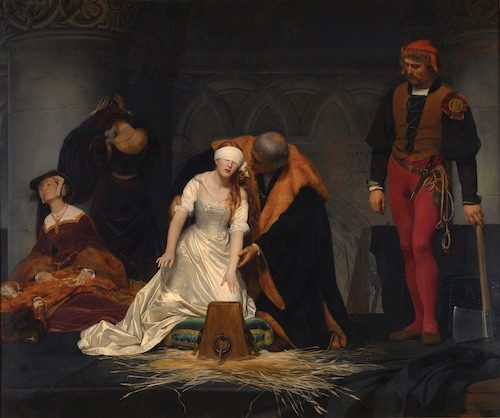
In the past several years, I’ve read a number of articles and books about the unreliability of eyewitness testimony. Many of the examples of people who swore they had seen something, only to be confronted with a truth that was vastly different, were amusing, shocking, and even horrifying (in those cases where the death penalty was involved). Since I’m personally not good at remembering faces, I’ve always been relieved I’ve never had to be such a witness myself.
But I just learned how fallible and tricky even a very vivid conviction can be, even when it’s something that doesn’t involve any kind of felony or misdemeanor — even when it’s just a painting in a museum.
A few weeks ago, a friend mentioned seeing a movie about Lady Jane Grey, the unfortunate 16-year-old girl who was queen of England for nine days before being deposed by Mary Tudor and later beheaded. I told him there was a dramatic and very moving large painting of the execution on display at the Metropolitan Museum — the beautiful blindfolded girl trying to find the block on which to rest her head, the hooded executioner burying his face in his hands at the horrible act he was about to commit. “It’s an extraordinary picture,” I said. “Probably even more heart-rending than the movie.” I looked online to show it to him, but there was nothing on the museum’s website.
Last week, when I was at the museum, I went to the gallery where I knew the painting was displayed. It wasn’t there. I asked a couple of guards and museum personnel if they knew what had happened to it — and one them said he thought he remembered it, but it might have been removed for cleaning.
I wrote to the museum asking if anyone could help. In a very short time, I got an email in reply: “Is the attached image the one you remember? If so, it had been here for an exhibition called Crossing the Channel: British and French Painting in the Age of Romanticism in 2003-2004. The artist’s name is Paul Delaroche.”
So the painting that I would have sworn I had seen just a few months ago hadn’t been in the museum for over 12 years! And I had obviously created a whole scenario for the wretched executioner that wasn’t in the picture at all. I will try to keep this in mind the next time I’m talking about something that I’m positive I saw or that I absolutely knew happened. I’ll try to be more humble about things I’m sure I know. I’ll try to remember this lesson — but I’ll probably forget.
This article is featured in the January/February 2018 issue of The Saturday Evening Post. Subscribe to the magazine for more art, inspiring stories, fiction, humor, and features from our archives.
11 Common Items That Are Disappearing from Our Everyday Lives
As another year fades into the past, we thought it was a good time to look at a few things that are also becoming history. Some of these familiar items are almost gone, while others are just starting to vanish.
Neighborhood Mail Boxes
As mail volume is dropping, the U.S. Postal Service is adjusting their operations, and part of that move means taking out local drop boxes. Over 12,000 have been removed in the past five years.

Incandescent Lightbulbs
The move to fluorescent and LED bulbs was accelerated in 2014, when the manufacture of energy-inefficient incandescent bulbs was phased out. New LED bulbs last so much longer that General Electric, the company that introduced incandescents to the nation, has decided to leave the light bulb business. When first introduced, LEDs were pricey, but their price has dropped 90% since 2008, all but assuring the death of the incandescent for home use.
Cable TV
In its peak year, 2000, cable television had 68 million subscribers. According to The Atlantic, That number has now dropped to 49 million as more consumers cut the cord and turn to streaming video services like Netflix and Hulu (or old fashioned rabbit ears) for their entertainment.
Bank Branches
Mobile banking has meant convenience for customers, but empty lobbies for banks. The top three national banks, Bank of America, J.P. Morgan Chase, and Wells Fargo, now have over 20 million depositors using mobile banking on their home computers or smart phones. In response, these banks have closed nearly 300 bank branches in the past year. More than 10,000 branches in total have shuttered since the financial crisis, according to The Economist.
Textbooks

Traditional college textbooks can cost more than $200 apiece. To cut costs, students are buying cheaper ebooks, professors are compiling their own course notes electronically, and publishers are offering online courseware. The trend is creeping down the educational chain, as educators replace textbooks in grade and high schools with online media.
DVDs and CDs
It’s significant that computer manufacturers, the people who made CDs and DVDs popular, are now backing away from the technology. Both Mac and PC computers are building units without optical disc drives. Since Windows 8, Microsoft’s operating system no longer is programed to operate an internal DVD player. Consumers are moving their music and movies to cloud storage and relying more on streaming media companies for everything else. For better or worse, the corner video store is already a thing of the past.
Department Stores

Only two major department stores have shown growth over the past ten years: Kohl’s and Nordstrom. Almost all the others are suffering. In the past ten years, J.C. Penney’s revenues have dropped from $20 billion to $12 billion. Sears’ revenues in the same period have dropped from $30 billion to $15 billion. In general, brick-and-mortar retailers are facing hard times. In 2016, 2,400 retail stores announced their closing. In 2017, the number was 5,000. It is expected to hit 7,000 in 2018.
Keys
In the future, you won’t open your front door with a key but with your Bluetooth-enabled smart phone. Two of the biggest lock makers, Kwikset and Yale, are already working on keyless security systems. Auto manufacturers are also developing secure systems for your phone that will unlock and start your car.
Landline Telephones
Today, more than half of American households rely on cellphones instead of landlines. But don’t expect hard-wired phones to disappear too quickly. Businesses that have millions of dollars invested in their phone systems will keep landlines around until they can afford to go cellular.
Restaurant Servers

With Americans happy to order anything online, restaurant owners are starting to replace workers at their front counters with self-service kiosks. Panera Bread is already replacing cashiers with these devices. Some McDonalds have installed touch-screen technology to let customers order their meal or custom-build their burger. Wendy’s is planning to go in the same direction. Olive Garden now has tabletop tablets that allow diners to order and pay at their table without waiting for a server.
Blockbuster Video

With hundreds of their former stores standing empty across the country, Blockbuster Video is considered one of the country’s most noticeable business deaths. Yet the Blockbuster name hasn’t completely vanished. There are 10 operated Blockbuster stores in America; seven are in Alaska.
Featured image: Shutterstock