The Art of the Post: The Day Geoffrey Biggs Tried to Put Nudity in the Post
The artist Geoffrey Biggs (1908-1971) took pride in getting the story right. He painted with clarity and precision and researched his subjects thoroughly. When he illustrated stories for The Saturday Evening Post and other magazines, he read each story carefully to make sure his pictures matched the author’s words. But he met his Waterloo on the fateful day he tried to paint the naked truth.
Illustrators for the Post were often required to correct errors in their paintings. If the editors didn’t catch mistakes, vigilant readers were always quick to write in and point out even minor flaws in costumes or backgrounds. It became a game with readers, who, in days prior to television, would study the illustrations carefully and compare them against the text of the story.
Biggs was one of the more careful illustrators, but it wasn’t easy to get all the details in a story right — especially because he illustrated a wide variety of challenging subjects. Some required him to learn about complex war machines:

Click to Enlarge
Other stories required him to portray foreign lands accurately:

Click to Enlarge
He painted authentic pictures of hot rods on city streets:

Click to Enlarge
And if he was called upon to paint a civil war scene, you can bet he got the details of the uniforms and rifles just right:

Click to Enlarge
Then one day in 1948, the Post assigned Biggs to illustrate a story by Donald Hamilton titled “The Steel Mirror.” Biggs studied the text and chose to paint the scene where a woman angrily takes off her dress and throws it at a man:
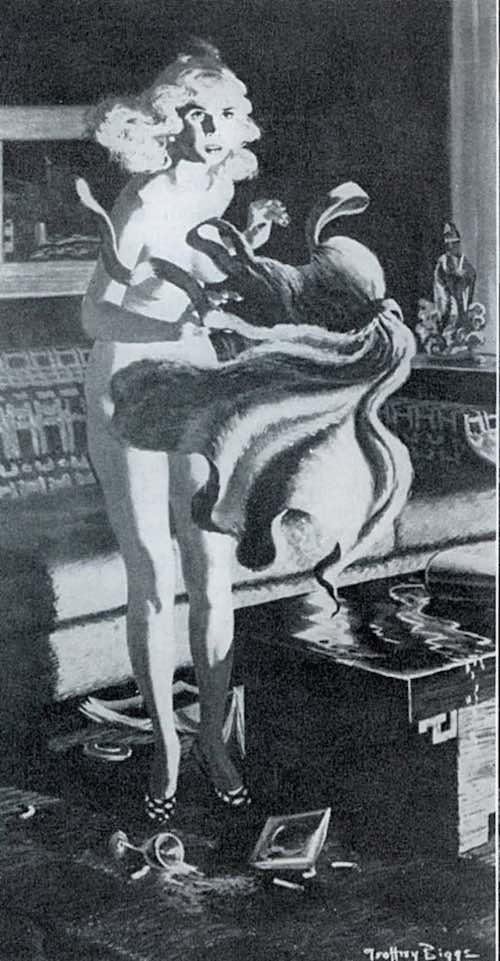
When he proudly presented his finished picture to the Post, the art editors gasped. They couldn’t possibly print such a picture. But Biggs didn’t make mistakes; he showed his editors the passage in the story describing how the woman took off her dress, leaving her naked. The editors were not impressed when Biggs pointed out how he had strategically positioned the dress so that not too much was revealed.
What could they do? Biggs had accurately painted the story they had assigned him.
The editors retreated to confer. A few days later, they called Biggs and notified him that he would have to change his picture because it did not conform to the text. They’d gone back to the author and instructed him to rewrite the story to say that the woman remained dressed in her underwear. They showed Biggs the new text: “she stood there in her underthings…” Biggs knew when he was beaten. He modified his painting to add underwear so that it once again reflected the text accurately:
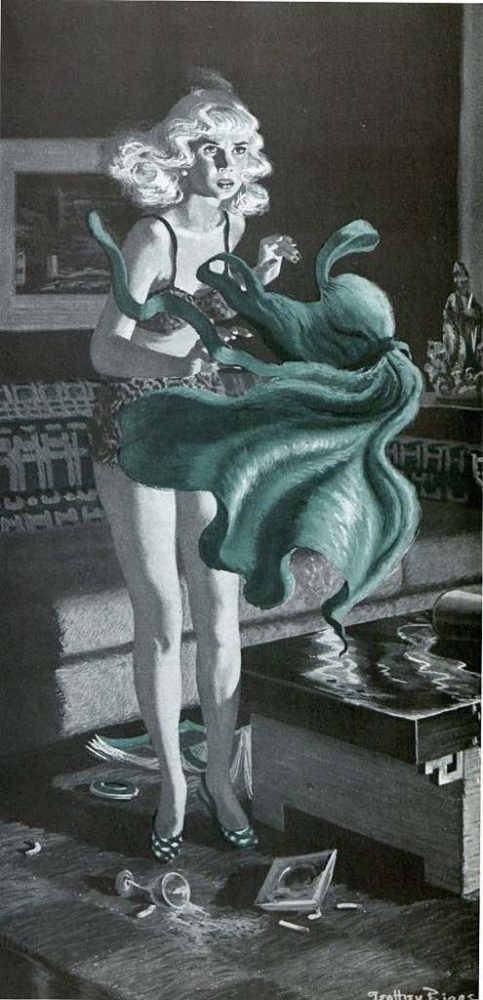
That was the day that illustrator Geoffrey Biggs learned the valuable lesson that “accuracy” can be a subjective thing.
P.T. Barnum’s Story of Success by Excess
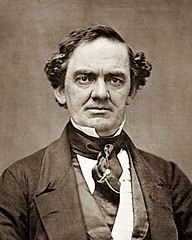
In 1835, Phineas Taylor Barnum was down on his luck and anxious to find an “amusement” that would attract paying customers. One lucky day a stranger came into the shop where Barnum worked and told him that he possessed half-ownership of a “curiosity”: a woman named Joice Heth who, the stranger claimed, was the 161-year-old slave who raised George Washington.
Barnum examined Heth and the stranger’s “proofs” about her age and provenance and, convinced of her seeming veracity, bought Heth from the stranger. Barnum, being “a student of human nature” as well as a natural showman, “spared no reasonable efforts” in drawing a crowd to see Joice Heth’s performances, in which Heth recounted tales of George Washington’s childhood. Barnum explained that he was “aware of the great power of the public press” and used it in any way he could, including flooding the city “with ‘posters’ setting forth the peculiar attraction which ‘the nurse of Washington’ presented,” and paying off editors to write up the story of Joice Heth in the most dramatic way possible.
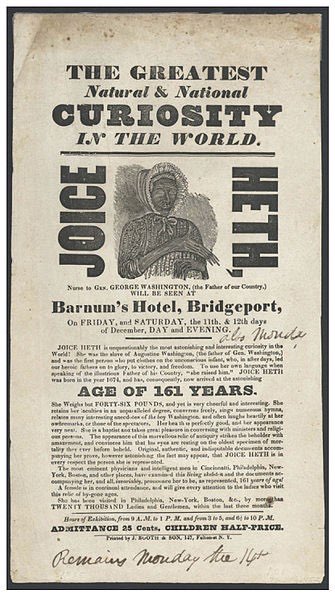
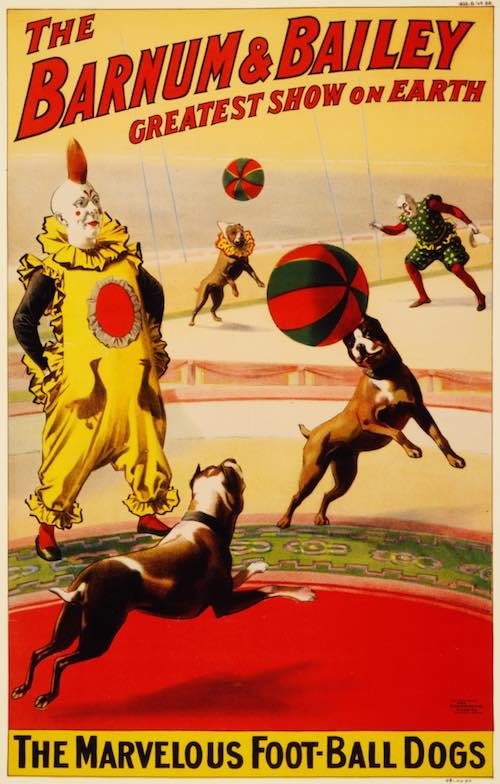
Barnum’s advertising strategy depended on “getting people to think, and talk, and become curious and excited over and about the ‘rare spectacle.’” His advertisements had one goal above all others: They were “calculated to extort attention.” His tool was hyperbole. While P.T. Barnum is often remembered as the founder of the Barnum and Bailey Circus — “The Greatest Show on Earth” — Barnum’s story is more broadly about America’s fascination with hyperbole and humbug.
Hyperbole is the rhetorical term for “excess” (Greek hyper “beyond” + bole “to throw,” to overthrow or throw beyond). Aristotle thought of hyperbole as a kind of metaphor, a comparison between a known thing and an unknown thing. In comparing something that is unknown to something that is already well understood, audiences would make sense of new information by using associational logic (a key form of Greek thought). Yet Aristotle thought that because hyperbole relied on excessive exaggeration, it was a special kind of metaphor that took advantage of associational logic to distort reality. Therefore, those who used hyperbole abused the power of metaphor and demonstrated a “vehemence of character.”
In the 18th century, Joseph Priestley also saw hyperbole as a kind of metaphoric comparison that “exceeds the truth.” Priestley thought that hyperbole was justly used as part of the sublime, as an attempt to use words to describe the ineffable when “no expressions literally true sufficiently answer his purpose.” However, he thought that there were only a very few circumstances in which hyperbole could be used “with propriety.” Mostly, Priestley thought that hyperbole was unjustly used to appeal to “persons of little reading” who were particularly attracted to the “very extravagant” or the “marvelous and supernatural.” Hyperbole drew attention to itself, for the sake of merely drawing attention. For Priestley, hyperbole was like candy: It appealed to the very young, but it was too sweet for older people with more refined taste.
According to these accounts, hyperbole could only be used justly when an accurate description was beyond the power of human speech. All other incidences of hyperbole were an attempt to take advantage of the uninformed by misrepresenting what was not well understood.
But Barnum relished hyperbole precisely because it was the best way to reach the masses.
For a time, Barnum writes in his 1855 Autobiography, ticket sales for the Heth show were great and business was good and he was happy. He was sure to keep up “a constant succession of novel advertisements and unique notices in the newspapers,” which kept “old Joice fresh in the minds of the public, and served to sharpen the curiosity of the people.” However, disaster soon stuck.
As Barnum tells the story: “A Visitor” wrote to one of the local papers and claimed that Joice Heth was not actually the 161-year-old former slave of George Washington as had been claimed, but was actually what the hip school kids of the 1750s had started to call a humbug. Joice Heth, “A Visitor” claimed, was a hoax.
Specifically, “A Visitor” believed that Heth was “not a human being,” but was “simply a curiously constructed automaton, made up of whalebone, India-rubber, and numberless springs, ingeniously put together, and made to move at the slightest touch, according to the will of the operator.” Barnum, “A Visitor” charged, was nothing more than a ventriloquist, and all of the conversations that audiences had had with Heth about George Washington were “purely imaginary” and “merely the ventriloquial voice of the exhibitor.”
The attack on Heth didn’t hurt Barnum’s show; it made it bigger. Barnum would recall that “hundreds who had not visited Joice Heth were now anxious to see the curious automaton; while many who had seen her were equally desirous of a second look, in order to determine whether or not they had been deceived.” Barnum claimed that the automaton controversy led to even greater curiosity and even greater ticket sales.
Joice Heth passed away in early 1836, ending Barnum’s show but not the nation’s curiosity over Heth. Barnum took advantage of that interest, arranging another Heth show: 1,500 audience members paid 50 cents each — double what audiences had paid to see her alive — to watch as Dr. David L. Rogers conducted an autopsy on her body. According to the February 25, 1836, edition of The New York Sun, Dr. Rogers concluded that Heth’s “wonderful old age was a wonderful humbug.” While she was, in fact, a real person, she was nearer to 80 than to 160 years old.
But Barnum had the last word. He planted a story with The Sun’s competitor, The New York Herald, on February 27, 1836, which claimed that the Heth humbug story was itself humbug. In fact, reported The Herald on “good authority,” Heth was not dead at all, but alive and well in Connecticut.
To be clear: 1) The story about Joice Heth was a humbug, she was neither 161 years old nor the former slave of the Washington family; 2) the story about Heth being an automaton was a humbug; and 3) the story refuting Heth’s autopsy results was yet another humbug. Barnum’s story of Joice Heth was at least three layers of humbug deep.
By 1855, when Barnum published his Autobiography, he was world famous as an entertainment promoter: His American Museum, and shows featuring Heth, Tom Thumb, Feejee Mermaid, and the Swedish opera singer Jenny Lind, all had made Barnum famous and rich. Barnum’s “celebrity was his life’s work and his prize possession. He bragged about it, sued people over it, threatened to kill it, but most of all, he reinvented it,” according to one account of Barnum’s influence on American life. His Autobiography was his self-promotion vehicle; he constantly embellished, revised, and expanded it. Barnum’s goal in his Autobiography was to portray himself as the world’s most tricky and entertaining fellow.
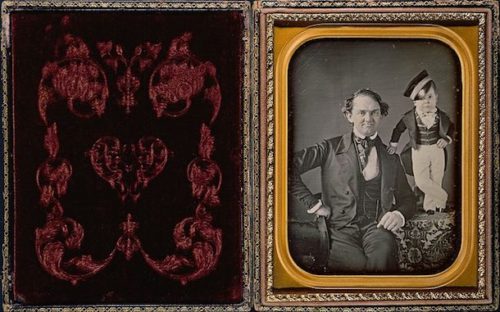
Historians can’t seem to find primary-source evidence to support Barnum’s recollection of the exposé of Heth-as-automaton newspaper story, but the rest of this seemingly tall tale of American curiosity and humbug checks out. As Barnum explained in his 1866 book The Humbugs of the World (which did not include his Joice Heth humbug), a humbug was a legerdemain, a slight of hand.
Why did Barnum’s hyperbole and humbug excite American audiences in the 19th century? For the same reason that it excites Americans today: We love to be amused and we love excess, and so we reward showmen with our attention. Some have said that we’re “amusing ourselves to death” and that we live in the “society of the spectacle.”
We’re especially attracted to hyperbole during times of great transition, when things are confusing and reality can be more easily distorted. Barnum knew this too: His “A Visitor” exposé/humbug relied upon the nation’s curiosity about the emerging technology of machinery, new commercial uses for India rubber, and new Northern concerns over the abolition of slavery.
Today is another time of great transition, and America’s showmen-leaders know it. During an election interview with NBC in 2016, Donald Trump said he had enjoyed being compared to P.T. Barnum. “We need P.T. Barnum, a little bit, because we have to build up the image of our country,” he said.
Ask yourself: Was Barnum and Bailey’s circus literally the “greatest show on Earth”? Of course not. That’s nonsensical hyperbole — “the greatest” can’t be proven or quantified. But in a supposedly classless society like ours, confident appeals to American greatness via hyperbole attract audiences. Americans are much more likely to describe their hamburger or pizza as absolutely “the world’s greatest” rather than as “probably” the best. Such exaggeration is a humbug, of course, but it’s also hyperbole: It compares the known (American hamburgers or pizza) to the unknown (the other hamburgers and pizzas of the world) and tells naive Americans that theirs is best.
And we shouldn’t forget that “there’s a sucker born every minute.” Barnum has been credited with that phrase, but probably never said that. Of course, there’s a humbug that says he did.
Originally published on Zócalo Public Square.
This article will appear in our March/April 2017 issue of the Post.
North Country Girl: Chapter 31 — Goodbye Father, Hello Mr. Chips
For more about Gay Haubner’s life in the North Country, read the other chapters in her serialized memoir. The Post will publish a new segment each week.
That day skiing those pristine slopes was magic. But even when real magic touches us, it is as ephemeral as a snowflake. The clock strikes midnight, the three wishes are gone, the genie put back in the lamp, the heroine awakes from what was only a dream.
Before the four o’clock winter violet had darkened the Lutsen ski slopes, Nancy and I were on the bus headed back home to Duluth. As soon as the door slammed behind me, my mother herded me into the breakfast nook, where Heidi and Lani were waiting. She seemed strangely calm, dead-eyed, like a pod person of herself.
“Your dad called. He’s coming by tomorrow to pick up some things and then he’s moving out to a place of his own.” My parents were breaking up. Lani ran off howling, “I hate you I hate you!” and locked herself in her room for three days. Heidi, who was six, shrugged this off as impossible, a silly story, and went back to watching television. Heedless of everyone else’s feelings, I pondered what this meant for me.
Back then, grown-ups and kids led such separate lives that I had no idea this was coming. My father had always been a shadowy presence, making himself known only when something unpleasant was required, forcing me to go to Sunday mass, mow the lawn, or eat those disgusting Brussels sprouts. I only noticed that my father had lately been absent for a good many evenings because Kentucky Fried Chicken and take-out London Inn cheeseburgers appeared regularly on the menu, when for years they had been a rare, delectable treat.
Encased in my own adolescent self-centeredness, I had given no weight to my mother’s sudden interest in going back to college. I assumed she was bored with delivering toothbrushes to rural schools with the Women’s Dental Auxiliary, cooking that damn meat, potato, and two veg dinner every night, and removing sharp objects from my sister’s hand.
It occurred to me that with one parent gone and the other replaced by her pod person, I would have even less supervision than I already enjoyed. I could stay out later, come home drunker or higher.
By the time I returned from school the next day my dad had come and gone. I don’t know exactly what he took from our house besides clothes and cufflinks; nothing at all was missing. It was as if he had never inhabited that big fancy house.
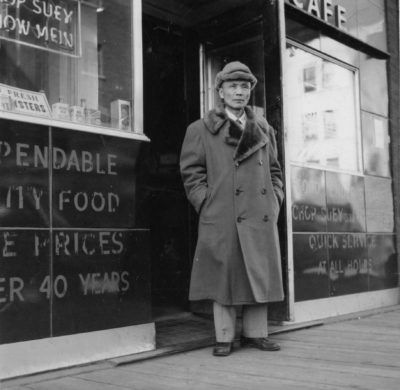
My dad moved into a crappy, barely furnished apartment in a shoddy building erected practically on top of busy London Avenue. It looked like the kind of place you went to score drugs. My one and only dinner there was punctuated with honking horns and screeching wheels and perfumed with car exhaust. We perched on wobbly folding chairs, eating take-out Chinese from Joe Huie’s off of paper plates. Through the doorway I saw an unmade bed, close enough to toss an egg roll on. I noticed there was no TV and wondered what my dad did when he wasn’t filling teeth.
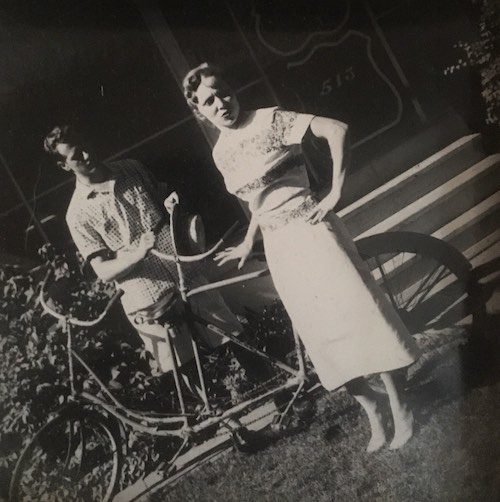
After the “How’s school?” “Fine,” we ate in silence for a few minutes. Then my father began talking, and for once he wasn’t giving me an order. When he was sixteen, the same age I was, he and a buddy had traveled by freighter to Europe, where they spent most of their money on two bicycles, then headed off to explore, sleeping rough, drinking wine, eating at cheap cafes, and having adventures. “I thought my whole life would be like that, traveling, seeing the world,” he sighed. I shoveled in my fried rice, thinking, that does sound great. I felt a new type of longing, wanderlust, which made my feet prickle and my imagination soar: I pictured myself in a miniskirt in London, a beret in Paris, a toga in Athens.
My dad was still talking, interrupting my daydream.
“But first there was college and then my dad insisted I go to dental school. That’s where I met your mom.”
Somehow I knew that already, as I knew about the unplanned and unwanted — but back in 1953, the un-abortable — pregnancy that resulted in me. My birth had derailed my mom’s college education and crushed my dad’s dreams of exotic journeys. For the past sixteen years, the most exciting events in his life were madcap dental conventions and family car trips undertaken with no hotel reservations.
After years and years of being stuck in Duluth, staring down people’s mouths, my dad in true 1960s style, was going to drop out. He would cross the Pacific on a schooner, hike the Alps, go spear fishing in the Keys, eat strange spicy food at questionable restaurants in dusty Central American towns.
He had me mesmerized; I too was dying to get out of our tiny insular town and run off to Haight-Ashbury or a commune full of sex and drugs. Maybe, I thought, maybe dad will take me with him to Europe or back to Mexico. My imagination now pictured me in a Parisian beret, dad next to me in a big glittery sombrero.
When my mom came to pick me up, he gave me a fatherly pat on the back, as affectionate as a Minnesotan gets, and for a ridiculous moment I felt everything was going to be fine.
I don’t know whether my dad was lying to me or to himself. The next week my mother took me aside to confide they were definitely getting a divorce, as my father had impregnated his fat nineteen-year-old assistant, Donna. Either even adults were too embarrassed to buy rubbers or Donna was too stupid or too wily to go on the pill.
My dad was not going island-hopping in the Caribbean; he had sentenced himself to more years of diapers, tantrums, and runny noses.
I was still unsure of my filial feelings — did I feel sorry for my dad? Was I mad at him? — when we had an unexpected visitor. My paternal grandfather, who never left Carlton except to shoot an animal or catch a fish, appeared in our living room and asked my younger sisters to leave. “I think you’re old enough to hear this, Gay,” he said. He puffed himself up like a toad as he put on the mantel of patriarchy and laid down the law to my mom: “You cannot divorce Jack.”
My ultra-Catholic grandmother, a regular at daily mass, was so distraught by the idea of her son getting a divorce that she was unable to get out of bed. My grandfather shook his finger at my mother and scolded, “She even missed her bridge game.”
He said he knew about my dad’s girlfriend, and wandered into some claptrap about wild oats, men’s little peccadilloes, chickens coming home to roost, that left my mother looking as bewildered as I felt. He urged her to be patient, patted both our knees, and sat back, satisfied with his work. My mother said, “So you know Donna’s having Jack’s baby?” My grandfather did not know, and rendered speechless, he picked up his homburg and rushed out of the house.
My grandfather’s weird tirade, my parents’ divorce, the looming baby: I wrote all this off as proof of the insanity of the adult world. They were the straights, the squares, responsible for Vietnam, racism, and everything bad. The future was Woodstock, the Age of Aquarius, Haight-Ashbury, the Fillmore East, tune in, turn on, drop out. To hell with them. I had my own world of sex, drugs, friends, and school.
As befogged with love and LSD as my brain would be on Saturday nights with Michael, by Monday I was again the sharp-eyed, clear-headed, serious scholar. I couldn’t smoke a cigarette, I was a terrible dancer and a middling skier, but I could ace a test and write an essay that always came back with a bright red A+ scrawled on the top.
My favorite teacher, everyone’s favorite teacher, was Mr. Burrows, a Hollywood-ready character who had somehow, up in the Northern woods of Duluth, acquired not just an English accent, but a whole British persona. He had the proper squire’s paunch, not quite hidden by his baggy tweed suit. He lectured without notes, hundreds of years of history and literature nestled inside his head, as he almost danced about on his tiny feet, scribbling dates and names on the blackboard.
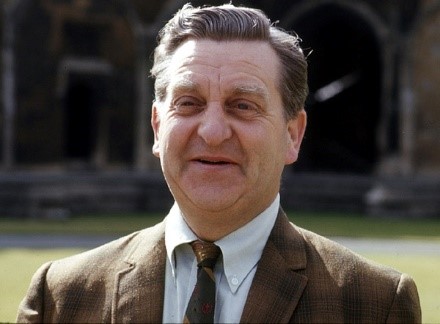
We smart kids were handed over to Mr. Burrows as sophomores, where we started with the Sumerians. We lucky few memorized many, many facts — ask any former student of Mr. Burrows when Menes united the Upper and Lower Kingdoms of Egypt and we will automatically spit out: “3400 B.C.” We learned big chunks of the Iliad and the Canterbury Tales by heart, and wrote many, many papers: on the Fertile Crescent, the birth of democracy in Greece, the fall of Rome. In his deep plummy voice, Mr. Burrows acted out his favorite scenes from history, which in his mind ended in 1900.
As juniors we spent two hours each day with Mr. Burrows, as he insisted that American history and American literature must be taught together. Nancy Erman and I sat with three other girls, surrounded by boys, as it seemed to be an ironclad rule that the ratio of smart boys to girls was 5:1. Michael Vlasdic and Needle sat together at the back of the class; in front of them the quartet of smart jocks sprawled loose-limbed at their desks, in all their nonchalant square-jawed handsomeness; awkward nerds in checked shirts and too-short pants made up the rest of the class.
Along with hours of reading a night, thrice weekly papers, and monthly quizzes leading up to a two day final, Mr. Burrows demanded that we retype the works of American authors from Jonathan Edwards’ sermon “Sinners in the Hands of an Angry God,” to Emily Dickinson’s poems (“I heard a fly buzz when I died,” “There is no frigate like a book,” “A bird came down the walk” — all nice and short), ending with Mark Twain and a chapter from A Connecticut Yankee in King Arthur’s Court. Mr. Burrows believed that retyping all this deathless prose would help us grasp each writer’s style and salient points. By the end of the year, I had an eight-inch pile of paper, American Literature’s Great Hits, interspersed with my essays, all marked with that red A. I took all those typed pages to a print shop where they were bound in fake leather into a pair of two hundred-page books, my name gilded along the spine.
I adored Mr. Burrows even though he was the squarest of the square, the epitome of the conservative old fogey. A devout Christian, he even sang in the Congregationalist church choir, probably the only basso in the bunch. He was untouched by time. The tumultuous arrival of the ‘60s in Duluth did not faze him a bit. He had thirty years of teaching behind him, and behind that, three thousand years of history, which had taught him that this, too, shall pass. He ignored the “Make Love not War” and peace sign buttons Needle, Michael, and I wore, and the five girls wearing minis that barely covered their asses did not perturb him the least. (A decade later, I realized that Mr. Burrows had been the world’s most closeted homosexual.) What offended him was ignorance, stupidity, and ugliness, which was pretty much the entire twentieth century.
When as seniors we finally moved into Modern History, as required by the Duluth School Board, Mr. Burrows’ lectures became less spellbinding; unlike the Crusades or the American Revolution, the horrors of World Wars I and II were still too close to be romanticized. It may have been that Mr. Burrows didn’t care for the subject, or it may have been a brilliant teaching tactic: he actually passed a lot of the instruction over to us. Each student took turns researching a topic in current or recent affairs and presenting to the class. Youth in revolt, I chose the most leftist subjects I could find: the Cuban revolution, the rise of Ho Chi Minh, the election of Salvador Allende. While I spouted my idiotic admiration for these Reds, Mr. Burrows, the most hidebound of Tories, silently sat and stroked his ponderous lower lip.
Mr. Burrows was also the editor of The Open Mind, our high school’s “literary” magazine, filled with the pretentious and god-awful poetry and prose of disaffected, snotty teenagers like me. Supposedly all students at East could submit their work; in reality we never published anything by anyone who was not one of the elites in Mr. Burrows’ class.
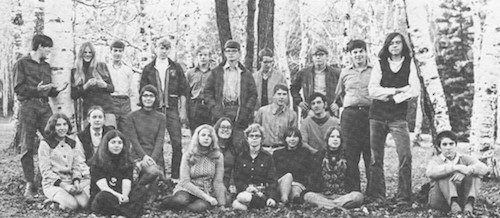
The staff of The Open Mind met over tea and cookies at Mr. Burrows’ home, a two-story brick nearly as big as my family’s, which he had inherited from his parents (those were the days). His huge, old-fashioned living room, with scratchy horsehair furniture and ottomans, was clean and neat as a pin except for the books. The walls were lined with floor to ceiling bookcases, yet stacks of books covered every flat surface. We had to remove books from chairs before sitting, and re-pile books on other tables or the floor to make room for Mr. Burrows’ sterling silver tea service. We would pass around the pages that had been submitted that week to The Open Mind drop-box outside Mr. Burrow’s room and pass judgment. The bravest of us read their poems aloud, which we listeners inwardly despised and outwardly praised. Mr. Burrows used these meetings as an opportunity to further mold our impressionable young minds by playing his favorite opera records.
The Metropolitan Opera had long since crossed hick Duluth off its touring company’s itinerary, so once a year Mr. Burrows organized bus trips to Minneapolis to expose his lemming-like pupils to high culture. On Saturday, the Met performed two different operas. We made the three-hour road trip to Minneapolis, arriving at the immense Northrop Auditorium on the U of M campus in time for the matinee. As soon as the curtain rang down, Michael and I dashed over to the wonders of the Electric Fetus record store and head shop. Hookahs and chillums! Lava lamps! Books by Aldous Huxley and Carlos Castaneda! Black light posters! Michael bought strawberry flavored rolling papers and we went to eat.

Between operas I finally achieved my dream date of dinner at a real restaurant, sitting across from Michael at a white clothed table, wearing a pretty, opera-appropriate dress, even if I did have to pick up the tab for both of us. It was a quick date; we had less than an hour to enjoy our meal at Murray’s The Home of the Silver Butter Knife Steak before running back to Northrup for the evening performance. After the tragic death of Tosca or Mimi or Carmen we piled back in the bus and fell sound asleep, waking at three in the morning in the parking lot of East High, groggy and stiff from spending six hours in a bus seat and a day and night at the opera.
Ho-Ho-Haute Cuisine, 14th Street, New York, 1959
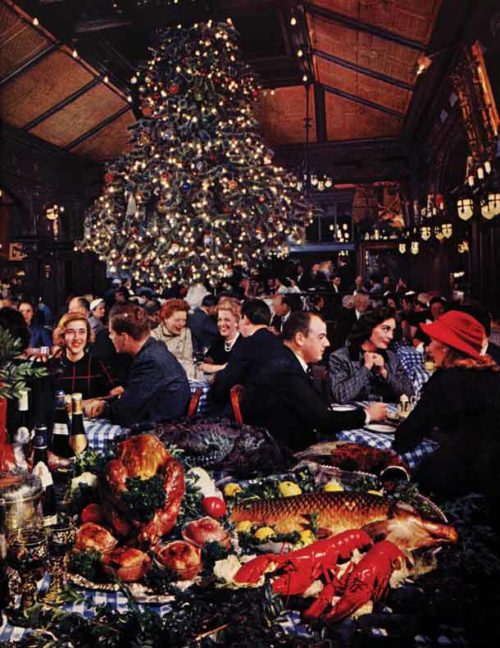
Arnold Newman, © SEPS
The cheerful diners you see here are celebrating Christmastide in the Teutonic way — with heroic feats of Epicureanism. The scene is not Germany, however, but 14th Street in New York City, a cosmopolis where one may be served meals in the native style of almost any country on Earth. This particular eating place was founded by August Lüchow, a rotund Hanoverian with a huge, beer-straining mustache, who has long since gone to Valhalla. His dining hall is now operated by Jan Mitchell, a Swede, who feeds about 2,500 guests daily and offers them a choice of 65 separate dishes. For the Christmas season, he puts up a tree which he asserts is the city’s largest (indoor division), and the customers, in an atmosphere of Gemütlichkeit and sentiment, may gorge on roast goose while listening to Lüchow’s string orchestra playing Silent Night.
—Face of America, December 19, 1959
Your Weekly Checkup: The Four-Legged Prescription to Combat Loneliness
We are pleased to bring you “Your Weekly Checkup,” a regular online column by Dr. Douglas Zipes, an internationally acclaimed cardiologist, professor, author, inventor, and authority on pacing and electrophysiology. Dr. Zipes is also a contributor to The Saturday Evening Post print magazine. Subscribe to receive thoughtful articles, new fiction, health and wellness advice, and gems from our archive.
You might think living in a time of widespread social media such as Facebook, Twitter, Instagram, and LinkedIn would dispel feelings of loneliness and relegate isolation to a thing of the past. Not so, particularly in the elderly. In Britain and the United States, about one third of people older than 65 live alone, and in the United States, half of those older than 85 live alone. Studies in both countries show that 10 to 46 percent of people older than 60 are lonely. England offers a telephone hot line, The Silver Line Helpline, that receives about 10,000 calls weekly from older folks seeking contact with other people. The Brits view loneliness as a serious public health issue deserving national attention.
Why is loneliness important? Loneliness is an aversive signal much like thirst, hunger or pain. In fact, it can now be quantified and studied on a cellular level. Neuroscientists at the Massachusetts Institute of Technology identified a region of the brain called the dorsal raphe nucleus that they believe generates feelings of loneliness, and is also associated with depression. Increasing evidence links loneliness to physical illness, functional and cognitive decline and is a risk factor for early death.
What can lonely folks do to combat these feelings? Pets, especially dogs, provide companionship that reduces loneliness, anxiety, and feelings of depression. Owning a dog can foster interaction with other people, stimulate activity (e.g., walking the dog), and lead to improved mental and physical health. Almost half of American households own at least one dog. Dog owners are more likely to exercise, have a better cholesterol profile, have lower blood pressure, be less vulnerable to the physical effects of stress, and be more likely to survive a heart attack. Pet owners, especially single person households, reduce their chances of dying from heart disease by as much as 30 percent. Just owning a dog is no substitute for regular physical activity, eating a heart-healthy diet, stopping smoking, and getting regular medical care. That said, dogs seem to be good for your heart in many ways.
Frankie, my 8 ½-year-old Doberman, named after the female protagonist in my first novel, The Black Widows, recently passed away, but brought me much joy. She and I walked many happy miles together. It’s now time for me to find her replacement. For those of you who are alone and lonely, I encourage you to do the same. Select a breed that fits your needs. Your dog may not only become your best friend, but also save your life.
Regis on Heart Health
A fixture on American television for decades, Regis Philbin holds the Guinness World Record for Most Hours on U.S. Television — 16,746.5 and counting. The legendary talk show host first learned he had heart disease nearly 30 years ago, and he credits regular exercise and a statin drug for sustained good health. For personal reasons, he and his wife, Joy, are championing the health campaign Take Cholesterol to Heart, launched by the American Academy of Family Physicians Foundation and Kowa Pharmaceuticals America. Post Executive Editor Patrick Perry recently interviewed the duo about the vital importance of controlling cholesterol.
The Saturday Evening Post: How did you first discover you had heart disease?
Regis Philbin: It all started in 1992 — I was in pretty good shape until then — when I was in Florida doing a commercial for a cruise line. Kathie Lee Gifford was on deck rehearsing when I said, “I’m having chest pain.” We went to a hospital in Miami, and I had an angioplasty to open clogged arteries.
Joy Philbin: We had no idea that his cholesterol had shot up dangerously high. His doctor put him on a statin, and he’s been on one ever since.
SEP: After the angioplasty, what steps did you take to guard against future issues?
Regis: I’ve always liked to exercise, and I’ve kept that up. But I had never been on medicine. Taking a statin has now been part of my lifestyle for the past 25 years.
Joy: Fortunately, we live right next door to a gym, and we go three or four times a week. We still play tennis, just not together because we can’t get along! It’s important to keep in shape. That’s why he looks and feels good.
SEP: What do you want Post readers to know about taking a statin?
Joy: It concerns us that 50 percent of people who start a statin stop taking it within one year. Regis had some muscle aches and hip pain after a few months — a side effect of the statin — but we didn’t see any reason to stop taking it because I thought his life depended on it.
SEP: Were you at first a little confused and concerned about the muscle pain?
Joy: You (to Regis) mentioned it during a regular checkup, saying, “I’m having a lot of aches and pain in my hip and when I walk.” The doctor suggested switching to another statin, and it has been very successful. I had no idea there were so many different ones.
SEP: Why are you stepping forward to share your story and champion the Take Cholesterol to Heart campaign?
Regis: The statin keeps me going, and I’m glad I’ve been on one all these years. I wouldn’t know what to do without it.
Joy: Knowing that he is on a statin gives me peace of mind because I know that we’re controlling his cholesterol. His personal story and tips about managing cholesterol are on the takecholesteroltoheart.com website. We hope to convince people to check out the information, especially if they are considering starting or stopping a statin.
SEP: Are you often asked to repeat Who Wants to Be a Millionaire catchphrase, “Is that your final answer?”
Regis: They ask me all the time. Every now and then I say it to myself!
This article is featured in the January/February 2018 issue of The Saturday Evening Post. Subscribe to the magazine for more art, inspiring stories, fiction, humor, and features from our archives.
Rockwell Video Minute: Christmas Homecoming
Nothing lights up a holiday home better than the presence of family and friends. Join us as we explore the details of Norman Rockwell’s heartwarming Christmas homecoming.
See all of the videos in our Rockwell Video Minute series at www.saturdayeveningpost/rockwell-video.
105-Year-Old Fruitcake Recipes
Equally loved and loathed, the fruit-and-nut loaf come Christmas is as ubiquitous as hand-knitted Rudolph sweaters covered in jingle bells and puff paint. Here are two vintage recipes, circa 1912, sure to please the fruit cake lovers (and maybe turn the hearts of the haters) at the ugly Christmas sweater party this year.
Holiday tip: Along with your cake, offer your host a copy of Nora Ephron’s Christmas comedy Mixed Nuts — with Madeline Kahn, Steve Martin, and a fruit cake disaster that leads to romance.
—
The Christmas Fruit Cake:Two Well-Tried Recipes That Are Sure to Give Good Results
Originally published in The Country Gentleman, December 14, 1912
As soon as December “blows in” the good housekeeper begins her Christmas cookery. The sooner the fruit cake is made the better, so plan your work that you may make this great cake as early as possible. One of the best recipes that I have yet found and one that I have used with great success is as follows:
- 1 pound of butter
- 1 pound of sugar — light brown
- 10 large eggs
- 1 pound of flour
- 1 teaspoonful of salt
- 1 teaspoonful of mace
- 1 teaspoonful of nutmeg
- 1 teaspoonful of allspice
- 1 teaspoonful of cinnamon
- 1/2 teaspoonful of cloves
- 1 pound of candied cherries
- 1 pound of sultana raisins
- 1 pound of seeded raisins
- 2 pounds of currants
- 1 pound of blanched sliced almonds
- 1 pound of citron
- 1 pound of candied pineapple
- 2 tablespoonfuls of molasses
- Grated rind and juice of 1 orange and 1 lemon>
- 1 cupful of grape juice
First prepare the fruit, cutting the citron and pineapple into small pieces. Leave the cherries whole. Wash and dry the raisins and currants. Do this several days before the cake is to be made so that they will be thoroughly dry. Blanch and slice the almonds. Prepare the seeded raisins by pouring boiling water over them and allowing them to drain. Tear into small pieces or cut with scissors. Clean the currants by placing them in a colander and shaking flour over them and rubbing it in carefully. Put the colander into a pan of cold water and rinse them until the water comes off clear. Pick off the stones, dry them in a very cool oven or in the sun. You will be surprised to see how dirty the currants are.
The sultana raisins are the tiny white raisins and are a great addition to the cake if you can procure them. If your grocer doesn’t carry them in stock perhaps you can persuade him to send away for them. Prepare them the same as the other raisins. Sift the flour twice; add the soda, salt, spices, grated fruit rind, nuts, and fruit, stirring well in order to distribute the flour.
Cream the butter until very light, using either a wooden spoon or the hand for the process. Some object to the hand, on the ground that it is not sanitary, but if mother’s hand stirs the Christmas cake that always makes it better. The hand also blends the ingredients better and the slight warmth of the hand creams the butter more quickly than a spoon. Add the sugar gradually, beating constantly. Beat the eggs, whites and yolks together until very light. Add them a little at a time to the creamed butter and sugar. If the mixture shows a tendency to curdle, as it sometimes does, add a little of the flour, but do not add more flour than is really necessary at this time. Next add the molasses, flour, salt, soda, spices and fruit, beating thoroughly. Stir in the fruit juices.
Line a cake pan with three thicknesses of paper, cut to fit bottom and sides. Grease the paper with unsalted fat, preferably oil, as butter has a tendency to make things stick, owing to the salt in it. Let stand 24 hours to ripen before baking. This cake is better if it is steamed before it is baked, a regular steamer or a fireless cooker being used. Have the water boiling when the cake pans are put in and be very sure that the water cannot come over the tops of the pans.
If the cake is made in one large cake, it should be steamed five hours, then baked in a moderate oven for one hour to dry it a little. If two or more pans are used, shorten the time accordingly. The cake is sufficiently baked when it goes back into place when pressed with the finger. After the baking is completed, remove the cake from the pan by loosening it round the edges with a knife and slipping it out on a wire cake rack. If you haven’t one use the oven rack, supporting it on some dish, so as to allow a current of air to pass round the cake until it is cold.
When the cake is cold cover it with an icing made of powdered sugar and milk, using from two to four tablespoonfuls of milk to one cupful of powdered sugar. The icing should be of such a consistency as not to run when spread. In a day or two, cover again with royal icing.
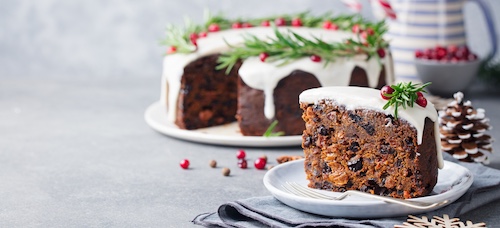
Royal Icing
- 1 egg white [If the idea of eating raw egg makes you queasy, sub 2 teaspoons meringue powder and 2 tablespoons water for egg.]
- 1 cupful of powdered sugar
- 1 tablespoonful of lemon juice
Put the unbeaten white of an egg in a bowl, add the sugar slowly, beating constantly with a spoon, then the lemon juice. Put evenly over the cake and smooth with a knife dipped in hot water. Decorate with some of the icing squeezed through a tube made of white paper.
This is a very rich cake, but one desires rich things at Christmastime. The cake will keep for months and it may be served at functions later in the season.
If one desires a plainer fruit cake this is a good recipe:
- 3/4 pound of butter
- 1 pound of brown sugar 6 eggs 1 pound of currants 1 pound of raisins
- 1/2 pound of citron
- 1 cupful of molasses
- 1 teaspoonful of cinnamon
- 1/2 teaspoonful of allspice
- 1/2 teaspoonful of cloves
- 1/2 teaspoonful of nutmeg
- 1/2 teaspoonful of mace
- 2 teaspoonfuls of baking powder
- 1 teaspoonful of salt
- 1 cupful of grape juice
- Flour for stiff batter
Prepare everything as for the other fruit cake. Either steam and bake or bake four hours without the steaming. Have the oven only moderately hot for the baking.

The Shaky Promise of the First Atomic Power Plant
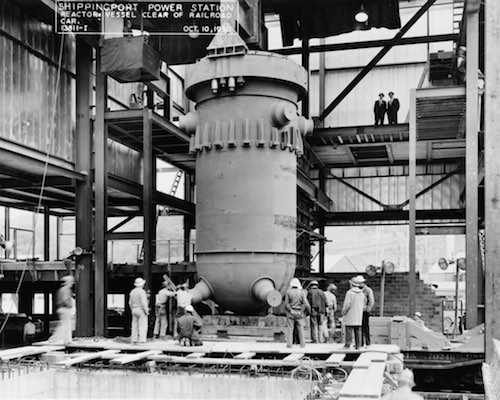
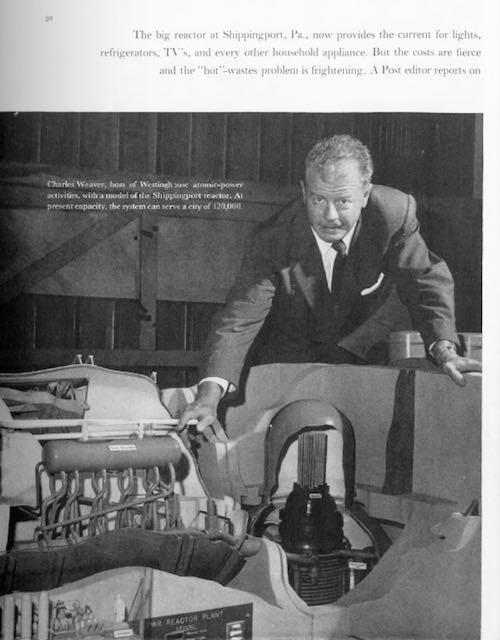
Nuclear energy seemed to have a bright future in 1957. In just 12 years, scientists had transformed the reaction that destroyed Hiroshima and Nagasaki into heat and light for in the Pittsburgh area, home to the world’s first full-scale atomic power plant built for civilian purposes.
But in a 1958 Post article about this first nuclear energy plant, there were also reports of misgivings and concerns over this new form of power.
Some were easily disproved, like the complaint that power generated at nuclear plants made electric lights change colors, or that energy travelling through power lines would “atomize” people in their homes.
Other concerns couldn’t be so easily dismissed, particularly the worries about safety and cost. The experience from a handful of nuclear-energy plants was causing “a lot of hard reappraising… and a certain amount of disillusionment,” according to author Steven M. Spencer.
Of the hundreds of companies which had reserved expensive tickets to the bright and promising atomic future, a number have been discouraged by unanticipated technical hurdles and soaring costs — 50 to 100 per cent or more in two years — and have canceled their reservations.
The greatest technical hurdles involved safety: avoiding a meltdown of the reactor core and safely disposing of radioactive materials. Spencer carefully delineates the many safety features of the reactor, including some that today sound alarming: the steel container that houses the reactor is checked for leaks using soap bubbles, as one would for a deflated tire. Despite the many precautions, one engineer observed, “Some fool can and usually does prove that nothing can be made foolproof.”
As the world has confronted nuclear plant disasters from Three Mile Island to Chernobyl to Fukushima, safety remains the biggest hurdle, although no longer the only one. Nuclear power now has to compete with more plentiful sources like natural gas, and increasingly affordable options such as wind and solar.
But until those alternatives grow even less expensive and easier to use, nuclear energy remains too powerful to abandon. Technology is still advancing that make nuclear plants increasingly safe. As an April 2017 Forbes article notes, “next-generation reactors (expected to be deployed between 2020-2030) represent advancements in sustainability, economics, safety, reliability and proliferation resistance.” The world has come a long way in 75 years, when Enrico Fermi constructed the first nuclear reactor.
5 Vintage (and Delicious) Chestnut Recipes
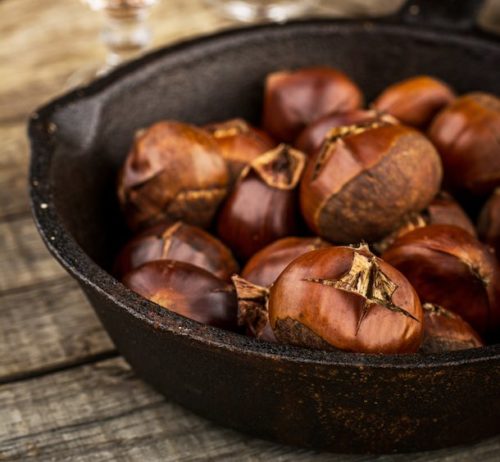
Thirty-four years before “Old King Cole” lent his velvety voice to a hoary old chestnut, a chef in 1912 wrote on the economy of the Castanea and presented five vegetarian dishes, offering the neglected nut a starring role at the American table.
The Chestnut in the Recipe: A Rich and Delicious Vegetable Substitute
Originally published in The Country Gentleman, November 8, 1912
The American people are far behind the European peasantry in the use of nuts in the daily menu. In Southern Europe and Western Asia the chestnut forms a large part of the food of the poor. It is used fresh, roasted, boiled, and so forth, and the dried nuts are ground into meal or flour and made into very nutritious bread and other articles of food.
Donate to or volunteer with the American Chestnut Foundation, committed to restoring the American chestnut tree in the Appalachian hardwood forest.
Unlike most nuts, the chestnut contains a large percentage of starch, and in a raw state is somewhat difficult of digestion, but cooked chestnuts are easily assimilated. They are the least oily of the nuts and may be used in many ways on the table. Chestnuts are the “macrons” of the French, who use them in a variety of ways. The European chestnut, variously called French, Spanish, or Italian, is larger than the American sweet chestnut and therefore easily prepared, but it is not so finely flavored.
Chestnut (Spanish) Soup
Allow about a pound of unshelled nuts to a quart of soup. Boil the nuts for five minutes, drain, and remove the shells and skins. To three-fourths of a pound of the meats, add one quart of water and let boil for about three-quarters of an hour, or until they are soft. Rub through a sieve and return to the fire in the water in which they were stewed, season to taste with salt, mace and cayenne, and add half a cupful of sweet cream.
Boiled Chestnuts
These are a delicious substitute for potatoes. Wash the nuts well, make an incision in the shell of each, boil in salted water until quite soft, then drain and peel, removing the inner skin, and serve hot.
Chestnut Roast
Boil one pound of chestnuts until tender, remove the shells, add one teaspoonful of salt, a pinch of thyme, and mix thoroughly. Boil together one large turnip, one carrot, two large potatoes, two stalks of celery, three peppercorns and two cloves. When the vegetables are tender, drain, add the chestnuts, and mash all together, adding two tablespoonfuls each of butter and cream. Salt to taste, put in a well- buttered mold in a hot oven and heat thoroughly. Serve on a platter, garnishing with slices of lemon and sprigs of parsley.

Mashed Chestnuts
Take forty or fifty of the large French chestnuts, shell them, pour boiling water over and let stand for ten minutes, then remove the brown skin. Cover with salted boiling water and cook until soft enough to mash. Season with a tablespoonful of butter, salt and pepper to taste, mash and mix well, adding a little cream to moisten. Then press through a potato-ricer in a light, feathery heap on a hot plate and serve at once. Or they may be mashed smooth and then beaten until light, and piled lightly on the plate from which they are to be served.
Deviled Chestnuts
Roast chestnuts until tender, remove the shells and skin, sauté in hot butter, sprinkling with salt and paprika or a dash of red pepper. Serve at once, with cheese.
[21st-century tip: To roast chestnuts, preheat oven to 425°F. Rinse nuts. Make an X-shaped incision across each husk (just grazing the meat) — this allows steam to escape while the chestnut cooks. Place nuts into a rimmed baking dish and heat in the oven for about 15 minutes, or until the husk begins to curl away from meat. Cool and peel.]
Movies for the Rest of Us with Bill Newcott: The Last Jedi and Somali Pirates
Join our movie review video podcast, Movies for the Rest of Us with Bill Newcott. This week, Bill reviews Star Wars: The Last Jedi and The Pirates of Somalia starring Barkhad Abdi and Evan Peters. Bill also shares his holiday quick hits on The Disaster Artist, The Post, and Downsizing.
News of the Week: Words of the Year, Why We Say ‘Um,’ and (Literally) Half-Off Christmas Trees
And the Word of the Year Is…
This week Merriam-Webster announced their “Word of the Year,” and it’s pickles. I know, I’m stunned too!
Okay, the word is actually feminism. I don’t have to explain why that is the biggest word of 2017, but you can read more about it at Merriam-Webster’s site. And it’s not the only important word chosen by the venerable language company. Other words of the year include complicit, recuse, empathy, dotard, and … gyro? I don’t remember that being a big word this year; apparently Jimmy Fallon did a gyro-based comedy sketch with country singer Luke Bryan and suddenly everyone was talking about gyros, I guess.
Part of the reason the words were chosen is because they’re the words people searched for the most during the year after hearing them in the news, online, and in pop culture.
I still think pickles will be big in 2018. You can put them in a gyro.
As Judge Judy Says, Um Is Not an Answer
We have, um, a lot of verbal tics that we often say. They’re, um, a way of thinking of what we want to say, sort of a verbal, um, placeholder. A lot of people think that it’s, um, better than stopping for a second and saying, um, nothing.
Isn’t it annoying when the ums we say are written out like that? Of course! I often wonder why people don’t fight harder to stop using the word (if we can even call it a word). I’ve done it myself in the past, though it’s really a bad habit we should try to break. But why do people do it? This article at The Atlantic attempts to explain it. Writer Julie Beck talks to N.J. Enfield, a professor and author of the book How We Talk. He actually sees some use in um. He calls it a “hesitation marker,” and it can be useful in conversation.
I guess it could be worse. I was once in a coffee shop and overheard a job interview at the next table. The interviewee must have said “like” 100 times in the span of five minutes.
To the Moon (and Mars), Alice!
First off, I hope you got that reference.
Second, as someone who has been a space geek since he was a kid, I think this is exciting news. President Trump signed a directive this week that will “refocus America’s space program on human exploration and discovery.” With former astronaut Harrison Schmitt at his side, the president announced new projects to send humans back to the moon and eventually to Mars. It’s called “Space Policy Directive – 1,” which isn’t the most romantic name, but it does have a certain Star Trek feel about it.
Facebook Is Bad, Say People Who Helped Create Facebook

A billion people use Facebook, but a lot of them are getting tired of it. Some have cut down on the number of times they post or even check it, and some have deleted their accounts altogether. It’s probably always going to be popular, but you’re starting to hear more and more people fighting against its influence and pull.
But you rarely hear those things from people who actually had a hand in it becoming the online force that it is. The past couple of weeks, we’ve heard from two different former Facebook honchos who say that maybe Facebook (and social media in general) isn’t worth it. Former Facebook President Sean Parker says, “I don’t know if I really understood the consequences of what I was saying, because of the unintended consequences of a network when it grows to a billion or two billion people and it literally changes your relationship with society, with each other … God only knows what it’s doing to our children’s brains.”
Former Vice President of User Growth Chamath Palihapitiya was even more blunt, saying, “I think we have created tools that are ripping apart the social fabric of how society works.” He says he feels “tremendous guilt” about what he has done. Facebook has actually responded to the criticism.
Maybe you should deactivate your Facebook account and see how it goes? Make it a New Year’s resolution. Who knows, you might even like not being connected to everyone and everything all the time.
But wait a couple of weeks before you do it, because I want you to head over to our Facebook page and share this column with your friends.
O Christmas Half-Tree, O Christmas Half-Tree

Last week I brought up the “real vs. artificial Christmas tree” debate, and from what I heard from readers, a lot of people like real and a lot of people like artificial, with maybe a slight edge to the real tree crowd. The other day, a supermarket cashier went on and on to me about the virtues of a real tree. I didn’t feel like getting into a discussion with her about why I like artificial trees (plus my ice cream was melting).
But what if real or fake isn’t the problem you face? Maybe it’s space. That’s where this Christmas half-tree comes in. It’s a tree that’s sliced down the middle, so it lies flush with the wall. It’s artificial, and stores in Britain are selling it for around $130.
If you really have no room, you can put your Christmas tree directly on the wall.
The Best and the Worst
Best: A new holiday tune from Dick Van Dyke and Jane Lynch, “We’re Going Caroling.” Van Dyke turned 92 on Wednesday, and he’s twice as active as I am.
Worst: This Slate article that dumps on Hallmark Channel Christmas movies. Now, feel free to critique the movies for how they’re made or the plots or the dialogue or the fact that it seems like 400 new ones are pumped out every year (I find them oddly comforting), but the author of the piece makes the whole discussion political and sour, as if we need any more of that.
This Week in History
Frank Sinatra Born (December 12, 1915)
Ol’ Blue Eyes would have turned 102 this week. There’s a new Sinatra holiday album titled Ultimate Christmas, and it includes this song, written in 1954 by Sammy Cahn and Jule Styne. According to Sinatra’s daughter Nancy, Frank wanted a new Christmas song that would be his, and Cahn and Styne came up with “The Christmas Waltz.” It was the B-side to “White Christmas.”
Bill of Rights Ratified (December 15, 1791)
The first ten amendments to the Constitution were created in 1789 and ratified two years later. President Roosevelt declared December 15 Bill of Rights Day in 1941.
This Week in Saturday Evening Post History: Christmas Train Set (December 15, 1956)
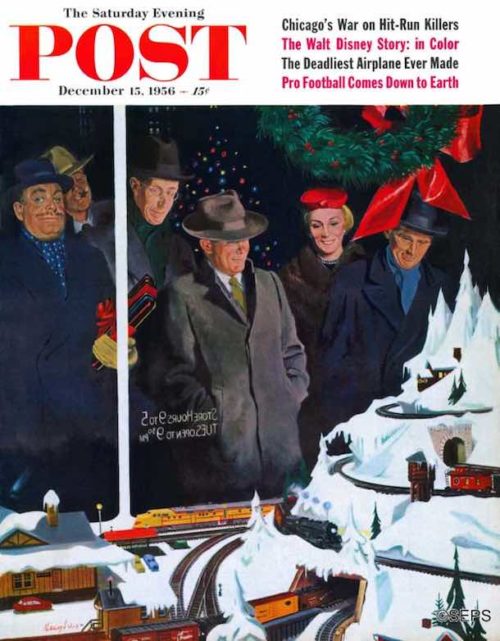
December 15, 1956
George Hughes
Do kids still get train sets for Christmas, or is there now an app for that? I don’t know, but my favorite thing about this cover by George Hughes is the guy on the left. He seems to be looking directly at the artist and thinking, “Yeah, draw me, whatever.”
Today Is National Cupcake Day

Remember three or four years ago when cupcakes were the hottest thing? Cupcake shops popped up everywhere, and it seemed like every food show on television revolved around cupcakes. Then they just faded away, replaced by kale and fidget spinners and HQ Trivia.
Good Housekeeping has 28 Christmas-oriented cupcakes you can make for National Cupcake Day, including ones that look like snowballs, reindeer, Christmas trees, Santa hats, and even Ebenezer Scrooge. If you’re feeling like the actual Ebenezer Scrooge and don’t want cupcakes that remind you of Christmas, try these Oreo Cupcakes.
Hey, you know what you should do on Christmas morning? Fill your kids’ stockings with kale. The joy on their faces will be priceless, and you can post the pictures to Facebook.
Next Week’s Holidays and Events
Winter Begins (December 21)
The Winter Solstice for the Northern Hemisphere begins at 11:28 a.m. EST. There’s also something called a “Meteorological Winter” and that began December 1, but that’s just confusing, so forget I even mentioned it.
Crossword Puzzle Day (December 21)
This marks the day in 1913 that the first official crossword puzzle was published. You can try to solve it at the American Crossword Puzzle Tournament site. I couldn’t finish it.
Cemetery Christmas
I come this close to giving the cemetery a miss. But at the last minute I cut the wheel, turn in, skidding as I brake. It’s all right. This should be a little dangerous. The icy wind is blowing gale force. The last, fast, winter remnant of dreary light has left the sky, leaving the night to just the dead and me. My sister will be tapping her red talons on the table, fretting over what on earth’s become of me. No matter, for after I have arrived with my full complement of Christmas presents and excuses, she will lose all interest in my irksome existence. I have just driven 11 hours in a storm to be ignored.
I crest the rise and park the car and get out, and I grab my coat. This won’t take long, although it should. My parents lie attentive here, prepared to listen if it takes all night. I could devote an hour each to all their sins, and neither one would interrupt. But I’ve no heart for the recitation. All I feel is free and cold, relieved if anything.
I walk over and pat the frozen stone with my cold hand. Tit for tat. And then I hear a woman’s voice, not 10 yards away. At first I think she’s crying, but no, she’s talking on a cellphone. I never tumble the first time. I am forever poised to approach chattering strangers, to ask, “Is everything all right?” only at the last minute spying the miniature telephone, then nodding oddly.
I hurry back toward the car. My bones are ice. The woman’s voice is too.
“I want you to know just what you’ve done,” I hear her say, and then she’s sobbing, loud jagged cries. I turn and stand a minute, then walk slowly between the stones toward her. She is kneeling by a grave, her back shaking, and I walk over and put my bare hand on her shoulder. She shudders but goes on weeping for the longest time. When finally she stands and turns toward me, I take her in my arms. It’s far too cold, it is too dark, to stand here separately.
“She was my little girl,” she intersperses words with gasps for air. “She was my only daughter. I miss her so.”
“I know,” I say. “I know.” I do know. I miss every single daughter that I never had.
“She was beautiful. She didn’t think she was.”
“What color was her hair?” Her story asks for details.
“Brown. It fell down to her waist. She was so pretty. I have a picture in the truck if you want to see it.” And it strikes me we should show each other pictures more often. And we should want to see them. We turn from the gravestone surrounded by a tiny white stone cross, a wreath, a crystal Christmas tree, a plastic snowman on a spike, and walk into the blackness.
“Get in,” she says. “It’s warmer in the truck.” I climb in, and it is.
“I’m sorry to be keeping you,” she says. “You have places you need to be.” She hands me a small plastic photo album with a picture of a woman with a little girl. She points to the woman. “That’s my Jessie.”
“Who’s that?” I point at the little girl.
“That’s Jessie’s daughter Kara, my granddaughter. She’s 18 next month.
“Jessie was a nurse.” The mother turns the page, pointing to a photo of a sheet cake with Jessica spelled with a couple s’s and Cum Laude spelled the way you would expect. “She was second in her class.” She starts to cry again.
“What happened?” I say.
“Car crash,” she says. “She was 32. I’m sorry I’m holding you up here.”
“No, it’s fine. I was just visiting my parents’ grave.”
“You’re so kind,” she says. I’m really not, I don’t say in reply.
“They’re all sitting in the kitchen having themselves a merry Christmas. I know. I drive by. I see them.”
“Who is?” I ask, but I am pretty sure I know.
“The ones that did it, the ones that killed my little girl. They weren’t even drunk. They didn’t even have that for an excuse. They were just out cattin’ around. Just driving like crazy people.”
“They could have been drunk,” I say. For some reason, I want that to be the case.
“Nope. Not a trace of blood alcohol. Two brothers sober as a judge, out killing people on a Tuesday night. November 24th, two days before Thanksgiving. I want to drive over there tonight. I want to tell them Kara ran away the day we buried Jessie. I haven’t heard from her in two years. I want to go sit down in their living room and show them a picture of who they killed that night. I call them on the phone. I have them on my speed dial. They won’t even change their number. They won’t even do that. I call and yell into the phone, and whoever picks up says they’re sorry, they’re so sorry. I’m sick of them. I’m sick to death of the whole lot of them.”
“Did you ever go there?” I say. “To see them.”
“Why?” she says. “Would you want to see them?”
“No,” I say. I don’t know what I want except I am entirely certain I do not want to go to my sister’s house tonight.
“Well, I would go over there if you go along,” she says. “But I know you’re busy.”
“No, it’s not that. I’m just not sure just what we would accomplish.”
“Well, we could find out what happened.”
“But didn’t you find out in court?”
“What court? There wasn’t any court. No booze, no court. They don’t live that far from here. It wouldn’t take us half an hour to go over there and talk and get you back here.”
“It is Christmas Eve. People are busy.”
“I’m not,” she says.
Me neither.
She starts the truck and puts the thing in gear.
We drive along in silence, the kind snow makes on a winter’s night. Without warning, her truck lurches to a stop in front of a brick ranch house with enormous picture windows. The lights are on. They’ve got a Christmas tree. Does it show a want of feeling?
“You knock on the door,” she says. “I’ll stand behind you.”
I hear myself regaling my sister’s in-laws with the saga of this evening over Christmas dinner tomorrow. My sister sighing, “That is so like you.” My sister not knowing me at all. It is as though I play to the image they have of me, as though the places I go, the things I do are to fulfill an image they’ve created. Unless I am precisely as they imagine me to be.
We’re standing at the door. The woman rings the bell and then jumps behind me as the door opens.
“Hello,” I say.
“Can I help?” A searchlight porch light flicks on. “Margaret? Margaret Laman? Is that you? I can’t believe it.” This pudgy stranger speaks my name and his profound amazement. “What are you doing here? Boy, this is one big surprise, I’ll tell you that.”
I would swear under oath I never saw this man before. “Well. What the dickens are you doing here? I know your mum died last spring, and they said you couldn’t get here for the funeral ’cause you was off in China or someplace like that, and now you’re here. I can’t believe it. I cannot believe it. Where are my manners? Come on in, come on in. Why, I bet I haven’t laid eyes on you since the 12th grade. Boy, I had the worst crush on you, I’ll tell you that.”
Crush on me. Crush on me? Nobody ever had a crush on me. I had crushes. Mad crushes. Not the other way around.
I feel a sharp nudge from behind and nearly stumble as I cross the threshold into the house of this stranger.
“Who’s this?” he says.
The man has spied my companion, and when the light falls on her face, his own face falls in on itself; he ages before my eyes, his body slackens and drops into a chair.
“You didn’t say that you were friends,” Jessie’s mother turns on me.
“Margaret,” the man says. “I don’t understand.”
That makes it an even three of us. As if responding to some invitation, the woman and I sit too, each on separate straight-back chairs.
And it hits me. Just like that. This is Bobby. Bobby Reasinger. He was a Catholic. He took shop. He lived in a little house down the alley from my grandmother’s. He had two cats and a mother who rode a bicycle in public, in daylight, all over town. She wore a housedress, like all our mothers did, but she rode a bike around. And now here he sits tonight, his two sons the killers of a young nurse, pretty in the photographs.
I want to say to Bobby, Whatever happened to your mother? thinking that the thought of her might be a pleasant thing. Or I might tease him, say, So, you say you had a crush on me? Or murmur, Why did your two sons kill this woman’s child?
“They say it’s going to be a really snowy winter,” I say instead.
“I heard that,” Bobby says.
“My Jessie loved the winter,” her mother says. The no-talk talk won’t work on Christmas Eve. The Savior won’t be born till morning. A deep night silence falls now, and we sit here like we are in some play. And oddly, eerily, there is something like a comfort in the room. The father of the killing boys, the mother of the killed one, and I, who have no business here or anywhere, sit, as though we have decided, we three, that the world will be silent from now on.
Silent as softness. Silent as prayer. Silent as no thinking ever is.
I have no expectation that we will ever leave this place. Trail’s end. The Christmas tree has all blue lights, the door on a small wood stove stands ajar just enough to show a sliver of red-yellow heat, a thin voice in the kitchen rises above the radio, singing: “’Round yon virgin, mother and child, holy infant, so tender and mild, sleep in heavenly peace…”
The singer, who must be Bobby’s wife, comes in from the kitchen with a plate of cookies.
“Patty,” Bobby says. “This here’s Margaret Laman.”
“I know,” she says instead of hello. We three pretend Jessie’s mother isn’t in the room. It seems a kindness.
“He used to have a crush on me,” I say. Cocktail party talk.
“I remember,” she says. “Fall of 11th grade, till we graduated.” Bobby frowns and blushes. I wonder if he wishes he could disappear, go back home to his mom and dad, three blocks and 40 years away. Back home, start over.
But good grief. This woman said we graduated. Does that mean that I am expected to resurrect some memory of who she was in that first incarnation? Tonight she looks a lot like my sister, standing here with her plate of careful cookies in her Santa-reindeer-candy-cane-manger-shepherd sweater. What’s up? I don’t have anything against her. I don’t even know her.
It’s my sister I have something against. My sister who is no doubt standing in her boughs-of-holly family room tsk-hissing, sighing at my reliable lack of all consideration. “She’s probably stopped to do her Christmas shopping,” I can hear her saying to her husband. She doesn’t know me at all. I Christmas-shopped last night.
“My sister lives here in Johnsonburg,” I say.
“I know,” Patty says.
And do you know, I want to say, that this same sister hates me? And for no reason. That when I’m in their house, I feel like I’m their good deed for the week. Like everything I say and am is odd, and they will raise their eyebrows at each other, purse censorious lips, every time I leave the room, at which point I cease to be.
Strong, loud voices sound outside. A car door slams. Then yelps and laughing. The front door is pushed open and a snowball sails over Bobby’s head, smashing against the far wall, sending muddy, slushy ice bits everywhere, slivers glinting on the fake snow underneath the Christmas tree.
Jessie’s mother turns to me. “See?” she says. She turns to Bobby. “See?”
The two men — for they are no longer living in boys’ bodies — walk into the funeral parlor that the room has just become, into the execution chamber. They will be offered no last meal. They’ll see no priest before they die.
“Sit down,” their father says. Bodies stiffened, the two men sit down, side by side on a love seat. Love seat. Love. Seat.
Jessie’s mother’s cellphone rings. There is a God after all. I don’t have a cellphone myself because if I did my sister would call me every Christmas Eve and say, “Where are you?” But I’m happy this sad mother has one. I’m happy for its ring.
We all are. Grateful, no matter if it is the DNC, the NRA, or a wrong number. We’ll pass the phone around and each one talk a long time with whoever’s calling.
Jessie’s mother says, “Where are you? … Yes, I’ll come. … Of course I want to come. … Stay there. … Don’t leave. … Are you warm enough? … Two hours. … An hour and a half. … Don’t leave.”
She clicks the phone off. “I love you.”
A hundred tons of tension have left the room, melted like the dirty snow, drying into little patches of salt and sand on the wood floor.
We all look at her, afraid to ask.
“It’s Kara. Jessie’s little girl. She wants to come back home. It’s been two years. Two years. She’s out by Stroudsburg. At a rest stop. On route 80. I’m going to pick her up.” She stands, but her knees buckle, and she sits again.
“The roads are terrible,” one of the boy-men says. “It’s all ice out there.”
“I don’t care,” she says. This time she rises, pulls her coat around her tightly, and without a word crosses to the door, and she is gone. We five sit, stunned I think, relieved somehow but not yet able to move on to whatever might be next.
One of the sons looks over, seeming to notice me for the first time. It’s clear he wants to ask somebody who I am.
“I’m nobody,” I say, then add, “I grew up here.”
“She’s your dad’s old girlfriend, don’t he wish,” Patty says. “He just about thought the world would end if he didn’t have her.” She turns toward the Christmas tree. “And then the world did end, but not because of her.”
Jessie’s mother opens the front door. “My truck won’t start,” she says. “It’s dead. It’s not going to start.”
“We’ll go,” one of the brothers says. “We’ll drive you. We got four-wheel drive and chains.”
She looks at them and tightens up her lips. She looks like a little girl.
“Let them take you,” their father says, his voice like stone.
“And what if they have another wreck?” she says.
“What if they don’t?” I say. “They’ll take you to Kara.”
I wouldn’t be at all averse to this life-risky drive tonight myself, but this is their drive.
This is their night. I’m not even in this story.
“I don’t have any Christmas to bring Kara back to,” the mother says suddenly. “I’m living in a studio apartment. I don’t even have a Christmas tree.” I think of the small tree I saw on Jessie’s grave.
“Come to my sister’s,” I say. “She’d love to have you. She has a big house. Lots of turkey. Lots of pies.”
“Bring her here,” Patty says. “She should come here.” Jessie’s mother turns to her.
“This is the only house in all the world where people think about Kara’s mother every day.” She sets the plate of cookies on the table. Lay your burden down. “The only place where every single person, if they had only one wish in all the world, would wish the exact same thing as Kara. Bring her here.”
The two men move toward the door. “I’ll warm the car,” one says.
The mother looks at me. I nod my head. “There is no other way to bring Kara home tonight,” I say. “It’s Christmas Eve. She’s waiting for you.”
“Come over tomorrow when you’re ready,” Patty says. “The girl will need to sleep. We don’t eat till four.”
“I can’t bring her here,” she says.
“You have to,” Bobby says. “We’ve already stuffed the bird. It’s 20 pounds.”
“Kara always liked the dark meat. Jessie only liked the white.”
“This bird’s got two legs, a pound of dark meat on each one.”
“This is crazy,” she repeats.
“Of course it is,” I say. “So what.” Jessie’s mother walks over to the door and buttons up her coat.
“Take these.” Patty hands her two heavy afghans. “For the girl.”
“Do you want to come tomorrow too?” Patty asks me in a sing-song, weary way, once the other three have gone out into the night, out to turn the world upside down, to rearrange the planets.
“Oh. Thanks. No,” I say.
I must be there tomorrow to go a few rounds with my sister. I must eat her turkey. I must drink her wine. And I wonder if I might interest her in a little story about life. About how people kill each other by accident, and how they forgive each other sometimes too. For the killing, at least, and sometimes maybe for other things too. And if they can’t forgive, well, they give each other rides in snowstorms when there’s nothing else to do.
When we were little girls we would wrestle with all our might. Fight like boys. Rolling on the ground. Like sisters do only in spirit when they are grown and married and no longer live in the same town, in the same universe. Tomorrow, we must wrestle one more time, fight with all our might, contend and pin each other to the ground till shouts of Uncle! fill the skies.
I stand up and move toward the door. “Oh, I just remembered. My car is at the cemetery.”
“Bobby will drive you. He’s been waiting 40 years for that.”
As it happens, Bobby’s car won’t start either. I call a taxi. I don’t even attempt explaining why I don’t call my sister. We all stand, waiting for it, in the silence.
The cab is warm and steamy. It smells like meatloaf. I slide into the backseat. “Where to?” the man says.
“Rumbarger Cemetery.”
He adjusts the radio. The taxi skids to a stop at the light. He looks both ways, drives through.
“So. Aren’t you going to ask me why I’m going to the cemetery Christmas Eve,” I say.
“Nope,” he says. “I just figured you must have seen the star.”
He’s got me. Dead to rights. Who else but me would follow the star of Bethlehem in a taxi. We drive on in a silence as black and as deep as the night. I think the world has died.
Then just before we turn onto the boulevard, he begins to sing:
We three kings of Orient are…
Softly at first, then more loudly, singing verses I have never heard:
Myrrh is mine, its bitter perfume
Breathes a life of gathering gloom;
Sorrowing, sighing, bleeding, dying,
Sealed in the stone cold tomb.
And I find myself joining in on the refrain, in my skinny, bold soprano:
Oh-Oh, star of wonder, star of light,
Star with royal beauty bright,
Westward leading, still proceeding,
Guide us to thy perfect light.
We skid to a stop and the taxi makes the turn into the cemetery.
“There’s my car,” I say. “Right there.” I give him a handful of bills and open up the door.
And then I see it. Another car parked on the far side of mine. No lights on, but the exhaust is blowing breath, warm breath, steadily, into the cold, dark air. And there is just enough starlight on this nascent morning to let me see my sister, sitting in the car, waiting there for me.
Linda McCullough Moore is the author of the novel The Distance Between, the two story collections The Road Will Take Us Closer to the Moon and An Episode of Grace, and an essay collection, The Book of Not So Common Prayer. For more, visit lindamcculloughmoore.com.
10 Most Peculiar Small Town Names
A community’s moniker can be a source of pride and a manifestation of its heritage, but sometimes it’s just a fluke. These American towns stand out on the map due to their unusual names, and behind each one is a story.
1. Nothing, Arizona
It should come as no surprise that Nothing, Arizona is a ghost town. In 1977, Nothing was founded in the form of a convenience store for motorists travelling from Phoenix to Las Vegas on U.S. Route 93. The site was abandoned in 2005, but other entrepreneurs have taken interest in the desert property. In 2016, Century 21 launched a campaign to lease out the property as a Father’s Day gift for — you guessed it — free, so that sons and daughters could give the gift of “Nothing” to their wise-cracking dads.
2. Experiment, Georgia
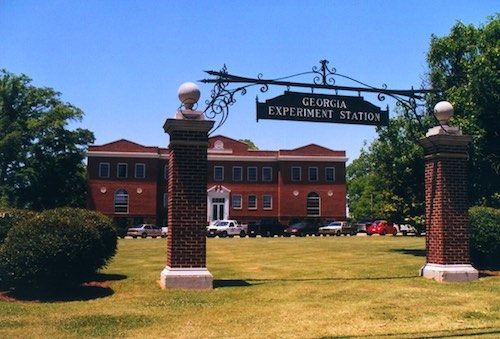
The small Spalding County town of Experiment, Georgia was named after the Georgia Experiment Station, a state agricultural project launched in 1888 for testing crop varieties and growing practices. The lab pioneered methods for growing oats and cotton, feeding livestock, and controlling pests in the warm Georgia climate. The University of Georgia now runs the experiment station, studying agriculture as well as water quality and genetics.
3. Rough and Ready, California
The small gold mining town was named after President Zachary “Rough and Ready” Taylor when it was founded in 1849. Ironically, the next year, Rough and Ready, California voted to secede from the Union to become “The Great Republic of Rough and Ready” because of taxes on gold mining. The town reportedly rescinded its decision after three months when nearby towns refused to sell the “foreigners” liquor.
4. What Cheer, Iowa
 The unique town of What Cheer, Iowa was originally called Petersburg. The town post office rejected the hasty, derivative name, however, and in 1879 a new one was needed for the bustling coal community. The old English greeting “What cheer with you?” was most likely the basis of the new name, put forth by a local businessman. Another theory is that a miner exclaimed “What cheer!” when discovering coal in the area. What Cheer’s population has shrunk significantly since the decline of coal mines in the area at the turn of the century, but its historic opera house remains.
5. Monkey’s Eyebrow, Kentucky
Monkeys aren’t native to Kentucky, but someone looked down on this rural area of western Kentucky and thought the Ohio River carved it into a topographical depiction of a monkey’s profile. Monkey’s Eyebrow, unsurprisingly, sits where that feature would be. Citizens of Paducah should consider themselves lucky to have dodged the name “Monkey’s Hunch.”
6. Accident, Maryland
Right before the American Revolution, two surveyors were working in western Maryland under the direction of Lord Baltimore to measure tracts of land. When they found themselves surveying the same area, they heartily agreed to call it the “Accident Tract.” Since land was plentiful, it wasn’t worth fighting over, and the land wasn’t used anyway until after the war. The “Accident Tract” later became the town of Accident, now home to about 300 people.
7. Embarrass, Minnesota
French fur traders settled the region of present-day Embarrass, and they found the Rivière d’Embarras (River of Obstacles) to be a difficult one for canoes. The Finnish immigrants who came along at the turn of the century named a town after the river with little regard to the language implications, and the community of Embarrass was born. There is certainly no shame in calling Embarrass, Minnesota home, since one would have to brave the 50 degrees-below-Fahrenheit temperatures to do so.
8. Truth or Consequences, New Mexico
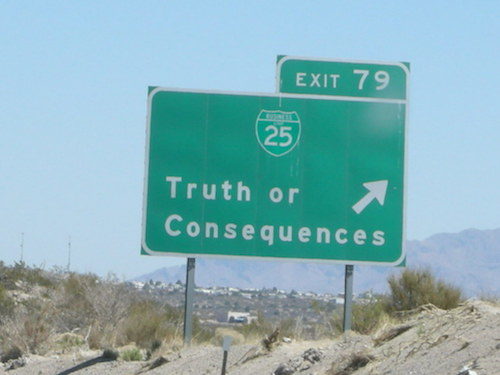
The town of Hot Springs, New Mexico wanted a catchier title to attract tourists to its bath houses and hot mineral springs. It received its chance when Ralph Edwards, the producer of the radio quiz show Truth or Consequences, set out on a publicity stunt to find a town that would change its name in honor of the program. After the citizens of Hot Springs voted 1,294 to 295 in favor of the new name in 1950, Edwards and the crew travelled to the newly-dubbed Truth or Consequences, New Mexico to tape an episode the very next day.
9. Intercourse, Pennsylvania
Despite its seemingly suggestive name, Intercourse, Pennsylvania is a quiet Amish hamlet. They take advantage of their sexy handle to attract tourists, but no one is sure about the origin of the name. It could have come from “Entercourse,” the entrance to an old racetrack nearby, or the named might have stemmed from the “intersection” of Old Kings Highway and the Wilmington-Erie route. Another possibility is the use of “intercourse” to refer to fellowship and community. Whatever the reasoning might have been, the town found a mate in 1840 in Intercourse, Alabama.
10. Cut and Shoot, Texas
It doesn’t take a Texan to figure out that Cut and Shoot probably wasn’t named after moviemaking. In 1912 the tiny community was divided over whether or not to let Apostolics use their Baptist- and Methodist-built community center. The dispute came to a head one day, and, amidst knife-wielding and gun-toting members of both sides, a young boy cried out, “I’m scared! I’m going to cut around the corner and shoot through the bushes in a minute!” Despite the high tensions, the violence was avoided by a compromise: the Apostolics preached outside on the lawn.
Dad’s Favorite Caramel Pecan Clusters
Perfect for the holiday hustle and bustle, these crowd-pleasing candies are easy to make and can be prepared well in advance, says Amanda Perry of Indianapolis-based Mandi’s Candies. Makes about 12.
- 1 pound pecan halves
- 1 pound prepared firm caramel (if in wrappers, remove)
- 1 pound milk or dark chocolate confectionary coating
Preheat oven to 200° F.
Cover bottom of rimmed cookie sheet with parchment paper. Place pecan halves about an inch apart on prepared cookie sheet.
Cut caramel into 1 ½-inch pieces and place on top of pecans. Cook for approximately 5 minutes, or until caramel just begins to spread. Remove from oven, cool slightly, and transfer clusters from cookie sheet onto another parchment-covered sheet.
Put chocolate coating in medium bowl and microwave at 40 percent power for very short increments of time until just melted. Dip each candy cluster in chocolate and return to parchment-covered sheet. After candies have set up, place in tins and store at room temperature for up to a month. (But good luck with that!)
8 Most Surprising Election Upsets
In American politics, there are no sure things. Candidates who seem to be the inevitable winners in contests can lose popular support — and elections — overnight. Here are our picks for the eight most surprising upsets in American elections.
1. John Quincy Adams vs. Andrew Jackson

Because neither John Quincy Adams nor Andrew Jackson had the majority of electoral votes in the 1824 election, the House of Representatives would decide the winner. Speaker of the House Henry Clay despised Andrew Jackson. He went among the congressmen, drumming up support for Adams, who won the House vote and thus the presidency. Jackson was furious when Adams turned around and appointed Clay Secretary of State. Vengeance was his, though, when he beat Adams for the presidency four years later in what was considered to be one of the dirtiest campaigns ever.
2. John Polk vs. Henry Clay
In 1844, the divided Democratic party settled on a compromise presidential candidate, James Polk of Tennessee. His opponent was the serial candidate, Henry Clay, in his fourth bid for the White House. Clay was a dynamic speaker, politically well connected, experienced, and extremely popular. On the other hand, the Democratic convention worked its way through nine ballots before finally nominating Polk, a man most people had never heard of. Yet Polk won because he campaigned on annexing western land to the union. Clay tried to walk a fine line between opposing the annexation of slave-holding Texas (which lost him support in the South) and being a slave owner himself (which lost him support in the North). Polk beat Clay by less than 40,000 votes.
3. Abraham Lincoln vs. William Seward
In 1860, the Republicans expected to win the presidency with their strong candidate, William H. Seward, a polished, influential former governor and senator from New York. His only serious rival for the party’s nomination was Abraham Lincoln, a politician from the back-woods state of Illinois who was little known in the powerful eastern states. But Lincoln proved the better politician. As a native son, he secured all the votes from the Illinois delegates. His campaign workers made sure to seat Lincoln supporters close to critical delegations. They printed counterfeit admission tickets to the convention to pack the hall with Lincoln backers and leave little room for Seward’s supporters. Through these tactics and back-room bargaining, Lincoln gained the nomination. In November he won the presidency because the anti-Republican votes were divided between three pro-slavery candidates.
4. Harry Truman vs. Thomas Dewey
Well into election night, it appeared that Republican Thomas Dewey would take the presidency away from incumbent president Harry Truman. By late summer, Dewey’s 49% lead among likely voters overshadowed Truman’s 36%. But Truman campaigned vigorously, and by October that gap had narrowed to 50% to 45%. On election night, Truman gained an early lead that he never lost. The Chicago Tribune had backed Dewey and was so confident of his win that, before the polls closed, they printed that infamous front page with Dewey’s win as their headline.
5. Ronald Reagan vs. Jimmy Carter
Ronald Reagan won the 1980 election in a definitive and unprecedented landslide: 489 electoral votes to Carter’s 49. But a week earlier, Reagan’s victory was anything but assured. With just one week to go before the 1980 election, incumbent president Jimmy Carter had a slim but definite lead, despite America’s concerns about the economy and the Iran hostage crisis. But Reagan turned things around with his polished performance in the campaign’s one televised debate, which had one of the highest TV ratings of any show in the previous decade. The debate is remembered for Reagan’s quips, “There you go again,” and “Are you better off now than you were four years ago?”
6. Paul Wellstone vs. Rudy Boschwitz
Paul Wellstone was as under an underdog as has been seen in American politics. He was a virtual unknown in Minnesota where he was running for senator in 1990. He was a college professor with no prior experience in government, and his underfunded campaign was outspent 7-to-1 by his opponent. But he used his disadvantages to his strength, campaigning in a beat-up school bus wearing a work shirt and jeans, and running low-budget, humorous ads. He was helped when his opponents sent out a mud-slinging letter close to election day. He remained in office until his death in a plane crash in 2002.
7. Lisa Murkowski vs. Joe Miller
In 2010, incumbent Lisa Murkowski lost the Republican primary for Alaska’s senate seat to Tea Party favorite Joe Miller. Undaunted, she asked voters to write in her name on their ballots. 101,091 Alaskans did so, and Murkowski beat her opponent by several thousand votes. After months of legal wrangling over name misspellings, Murkowski was finally declared the winner in late December. She was the first senator in 50 years to win a write-in campaign — since Strom Thurmond in 1954.
8. Donald Trump vs. Hillary Clinton
Donald Trump was a surprise winner both of the Republican nomination and the presidency in 2016. Early in the campaign, some dismissed him as a novelty candidate. But straight talking alpha-male celebrities have successfully appealed to populist sentiment before. Consider ex-wrestler/Minnesota governor Jesse Ventura and action star/California governor Arnold Schwarzenegger.
Hillary Clinton’s loss to Trump must have felt all too familiar. She had been considered the natural choice in 2008 as well, but lost the Democratic primary to another outsider, Illinois junior senator Barack Obama.
Featured image: Shutterstock