North Country Girl: Chapter 30 — Winter Tales
For more about Gay Haubner’s life in the North Country, read the other chapters in her serialized memoir. The Post will publish a new segment each week.
The next night, snuggled in bed with Michael, I poured out my first drug experience, trying and failing to explain what made it so awesome, how I felt like Alice falling down the rabbit hole. Michael pushed himself away from me and looked unhappy. “I thought we were going to trip together the first time.” The problem with having a sensitive boyfriend is that they have feelings, which are always getting hurt.
I told Michael I would make it up to him; I would ask Stan Lewis if I could buy mescaline off him, or find out whom he got it from. Michael perked up, his dimples re-appeared, and we went back to seeing how close we could smush our young bodies together.
I braced Stan in the East High halls that Monday to see if he had any more mescaline. “I ate the rest of them,” he reported, then grinned like his face would crack in two. He was getting more drugs that weekend and he would count me in. Then at the London Inn I ran into Mary Ann Stuart’s old boyfriend John Bean who had blotter acid, and Wendi’s boyfriend gave her some purple haze, and everyone said there was a guy who hung out at the pool hall who had windowpane, and the floodgates were opened. Duluth had entered the psychedelic era; we were awash in drugs.
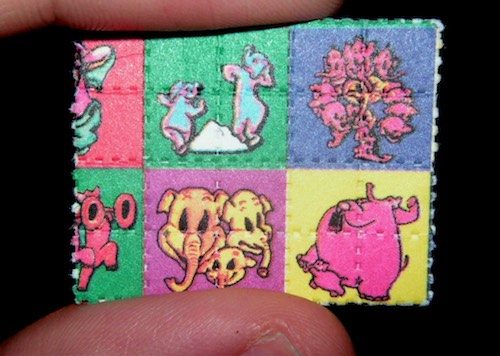
A psychic monkey wrench had been thrown into the collective brain of Duluth’s teens. Drugs were so new that drug education had not yet been invented. A parent might tentatively ask, “You don’t know anyone who takes drugs, do you?” as if there were black capsules with DRUGS printed on the side being passed around like Good n Plentys. We all soberly shook our heads no, even if we were high as a kite at the time.
Even the straightest-seeming jocks and cheerleaders were trying weed, “just to see what all the fuss was about.” Most went back to their Royal Crown Cola and Seagram’s or Grain Belt beer. But not all; at parties there would always be a couple of hulking football or hockey players huddled around the stoners, passing joints.
Mark Carroway was one of the first to go full-tilt druggie, famous for coming to school on acid every single day. Wendi Carlson sat in front of him in English and reported that when they were given pop quizzes, Mark scribbled “Mickey Mouse” illustrated with a pair of round black ears as the answer to “Who is the antagonist in Ethan Frome? What is the theme of The Scarlet Letter?” and every other question.
The going rate for a hit of acid or mescaline or whatever the seller claimed it to be was between $3 and $5. I bought that blotter acid from John Bean, using a ten-dollar bill that had arrived in a birthday card from my South Dakota Nana and then cruelly made Michael Vlasdic wait till Saturday night to trip together.
It’s probably not a good idea to give two sixteen-year-olds who already believe they are madly in love some very good LSD. If acid had been available to Romeo and Juliet, they would have said to hell with the straight world of Verona and headed off to Capri, to trip balls while splashing around the Blue Grotto.
Just like sex, that first trip sparked a hunger in both of us for more. Taking drugs became as important to Michael and me as making love. Every time we tripped we were in perfect communion. I could read Michael’s thoughts and feel what he was feeling. It was totally weird and, at the same time, exactly what I had expected to happen.
Michael and I had a limited amount of money. He had a regular weekly allowance; I got paid on those rare occasions my father happened to be around, since my mother never had any cash, relying on her charge accounts at Pletz’s Grocery and the Glass Block. I wailed, “I have to have money to chip in for gas!” My parents grasped that a broke daughter not paying her share reflected badly on them. My mother glared at my dad, who reluctantly handed over a ten or sometimes, when he wanted to play the big spender, a twenty.
A buck went to help fill the tank of the White Delight every Friday night, another went towards my share of a bottle of Boone’s Farm. The rest I spent on drugs.
If Mrs. Vlasdic selfishly planned a quiet Saturday night at home listening to Wagner, Michael and I headed out in the dazzling snow banks, down to the frozen lake, bundled up like toddlers. We’d return hours later, red-faced and ravenous, eyes whirling like pinwheels, laughing hysterically while Mrs. Vlasdic served tea and buttery pastries and chattered away in her weird accent. She had to have known what was going on.
LSD was kerosene thrown on the fire of our teenage love. Most of those wintery nights Michael was too high to walk me home, but it didn’t matter; I floated through the dark streets, with green streaks of the aurora borealis flickering above me, the world’s greatest light show. I could hear the snowflakes drifting through air so frigid it was almost liquid. I was drunk on love and tripping my brains out. I never felt the cold.

That winter was especially snowy, even for Duluth. Everyone stuck fuzzy neon orange balls on their cars’ radio antennae so something would be visible above the six-foot snow banks. One of my dad’s patients paid off his dental bill by plowing our driveway, but I was sent out every afternoon to shovel the fresh drifts off our front walk. And the snow kept falling.
Nancy Erman, an expert skier and always our leader, hatched a plan. We girls would take a bus up to Lutsen ski resort on a Friday, stay overnight, and be the first out on the trails Saturday morning. Girls who didn’t even know how to ski signed on, as this was going to be the best gang sleepover ever.
As the big Friday approached, the snow began to come down faster and thicker, until by the end of the week we were in a full-scale Minnesota blizzard. One by one, my friends’ parents put their feet down — you are not going in this weather — until Nancy, whose parents pretty much let her do anything she wanted, and I were the only ones headed to Lutsen. My mother was too intimidated by Nancy’s dad, the judge, to forbid me to go. If he thought it was okay for his daughter to travel in white-out conditions, it must be perfectly safe.
There was one snag. This whole escapade — the bus tickets, hotel, ski lift, food — ran to the astounding sum of $40. We never had that kind of money in the house, and while my dad had given me permission to go on this trip (he was a little scared of the judge himself), he had yet to produce the ready cash. He had also vanished.
And now it was late Friday afternoon and all the money I could put my hands on were the quarters we could salvage from the back of the sofa and coat pockets and a $5 bill I had put aside for drugs. No one was answering the phone at my dad’s office. There were no cell phones, no ATM’s, no way I was going. I was miserable and not just for myself: I hated letting Nancy Erman down. Being teenagers, the idea that we could just postpone the trip to the next weekend was inconceivable.
Somehow my misery touched my mother’s one last sympathetic nerve. I watched, huddled on an uncomfortable wrought iron chair, head thrown down in sorrow on the glass top table, as my mother picked up the kitchen phone and dialed one of the numbers scribbled on a pad on the wall, a number I knew by heart.
“Hello, Mrs. Erman?” My mother’s face cringed in embarrassment. I didn’t say a word. “I am so sorry, I know how much our daughters are looking forward to this ski trip. But Dr. Haubner has an emergency at his office, and, well, I somehow don’t seem to have any money, you know how that happens, can’t stay out of the shops! So…by any chance could Gay” — she gave me a pointed look, a look that meant “You owe me big time, sister” — “could you and the judge possible lend us the $40 so the girls can go skiing?” Judge and Mrs. Erman could, they handed Nancy two $20 bills, and she drove the White Delight to my house.
At least somebody — it must have been a parent, as we teenage girls were sure we were immortal — had the sense to make us take the bus from Duluth to Lutsen. I heard the familiar beep of the White Delight, grabbed my skis, and dashed out. The honking was coming from somewhere in a thick, impenetrable mist. Nancy kept honking till I found the car and we inched our way to the bus station. The White Delight was almost invisible in that blizzard; so much snow was falling that when we returned the next day, her car was covered in more than foot of powder, an unidentifiable knoll in the parking lot.
Nancy Erman and I stowed our skis in the bottom of the bus and climbed aboard. The bus was empty. The driver beckoned us in, said “Sit where you like,” levered the door closed, and we took off into the snow-filled night.
At first it was an adventure. We were the only passengers on that bus, a bus traveling blindly through the storm, the windshield wipers waging a war against the thickly swirling flakes. It was like being in a Twilight Zone episode. That thrill vanished when an hour later I looked out the window as we drove under a streetlight and recognized the Lester River bridge. “Nancy, we’re still in Duluth,” I whispered, as if it were a secret.
What should have been a two-hour trip stretched into five, but we were content, tucked together in the back of the bus, in a friendship as comfortable as old shoes. We gossiped and re-traded secrets and found new things to like about each other. The bus hummed monotonously and gently rocked back and forth as it made its stately crawl north. I was just about to say, “Remember when we used to play with those hideous troll dolls?” when I sunk into a coma, and I guess Nancy did too, coming back to life when the bus conductor shook my shoulder and said, “Lutsen. Wake up, girls.”
At the Lutsen Lodge desk a young man had managed to fall asleep standing up, his upper body splayed on the counter. We woke him and he yawned “Judge Erman’s daughter, right? He said to call him when you get here,” and handed Nancy the phone and me the key to our room. I unpacked the quart of Tango Orange Flavored Vodka and gave it pride of place on the night stand between the two single beds. When Nancy came into the room, she looked at the bottle, said “Good night Tango. Good night Gay,” and we went to bed. It was still the best sleepover ever.
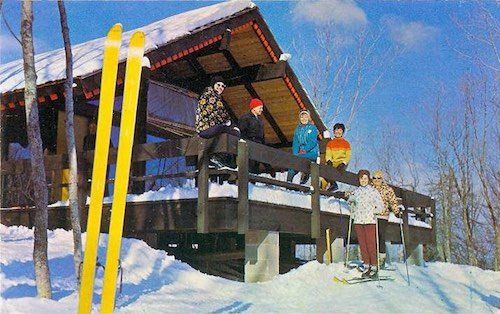
We woke to the thrill of bright sunlight, which would warm the ski slopes by a degree or two, illuminating what can only be embarrassingly described as a winter wonderland. From our window we gazed out at Lutsen’s towering ski hill, covered in the most pristine blanket of snow, a stationary chair lift etching a black line against that solid white backdrop. I heard a familiar low rumbling and a snowmobile pulled up below, driven by a figure so swaddled in layers it could have been a man or a woman or a yeti in a parka and snowpants. The boy from the desk knocked on our door and announced, “The cook just got here. Breakfast is in ten minutes.”
Nancy and I were as alone in the Lutsen Lodge dining room as we had been on the bus. We threw down our food, grabbed our skis, and crossed the silent highway to where the chairlift was shuddering into its first ascent. The only person around was another bundled-up figure who briefly held the chair lift so Nancy and I could hop in. This was a maneuver that frightened the bejesus out of me as I had more than once been pitched head first into the snow, popping off at least one ski, and forcing the operator to stop the lift, stranding people in mid-air, while someone manhandled me out of the way.
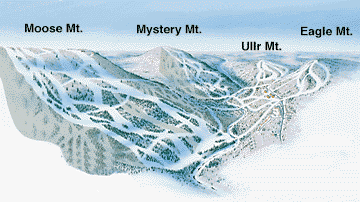
This, however, was magic time, a singularity when the world is perfect. I dropped almost gracefully into the chair lift, and we were swooping into the winter sky, a sky bluer than 10,000 lakes. I juggled the ski poles and Nancy’s mittens so she could light her first Tareyton of the day. She generously offered to split it with me; I accepted just to warm up my face, and actually held a lungful of smoke in for a second.
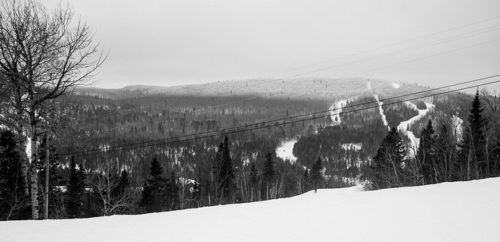
Then we were over the crest; we threw the safety bar back and glided away, giddy with our luck at having an untouched mountain before us. All morning it was just Nancy and me and miles of powdery snow that glittered like a carpet of crystals. We skied, we laughed, we fell into deep drifts that were softer than a pillow. For once, I didn’t insist on stopping for a mid-morning cocoa, usually my favorite part of skiing. We stayed on the slopes till our grumbling stomachs forced us into the chalet, where Nancy and I sat all alone in the Nordic A-frame, sipping delightfully scalding vegetable soup out of white china mugs. We took a remarkably quick pee, being experts at removing multiple layers of cold weather clothing, and headed back to the empty slopes.

It was a day that I have folded up and put into my mind’s pocket. Heaven could be that day. I would be happy to spend eternity in a winterscape of white and blue, silent but for the hiss of our skis and the occasional soft thump of snow plopping off a fir branch, an eternity shared with a friend who is good and true. I can see Nancy now, rosy face lit up with a smile as big as the Ritz, snow dusting her eyelashes, her long wavy brown hair loose under a knit ski cap topped with a pompom. One hand is mittenless; she is holding a cigarette up to my lips.
How Frank Sinatra Went from Skinny Kid to Pop Idol
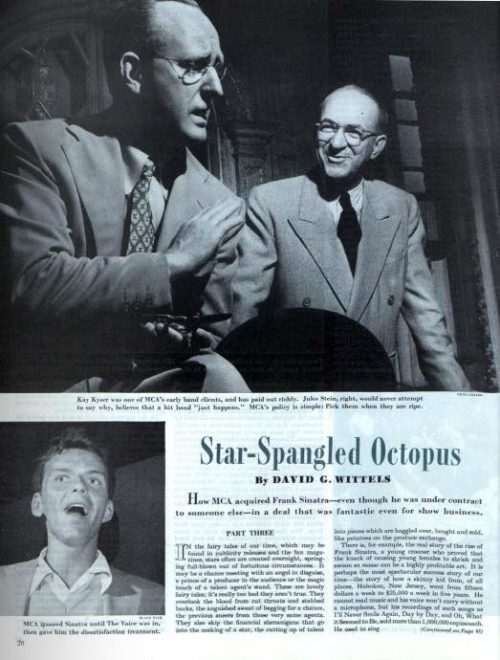
Early talent spotters dismissed Frank Sinatra as a “skinny, funny looking guy,” not noticing how he always made the girls in the audience swoon. As David G. Wittels points out in his 1946 article in the Post, “The smart boys apparently chalked him off as one of those freaks, riding briefly on the popularity of a band.”
Slowly, however, they started to catch on. Wittels writes:
Emanuel (Manny) Sacks, vice-president in charge of talent for the Columbia Recording Corporation…heard Sinatra in California in 1940 and then watched the reaction of the audience when Sinatra sang with Dorsey’s band in the Earle Theater in Philadelphia in 1941. Sacks somewhat resembles Sinatra, and on that day he was wearing a bow tie. When he left the theater, scores of young girls, screaming, ” Frankie! Frankie! ” almost literally tore his clothes off.
Wittels’ story details how the music giant MCA missed The Voice the first time around, but didn’t make that same mistake twice, using hardball tactics to lure him from another agency.
Sinatra, who had been making $150 a week, was soon making $1 million a year.
Cover Collection: Kids and Doctors
These classic Saturday Evening Post covers show what happens when you mix kids and doctors. Results may vary!
Norman Rockwell
December 24, 1938
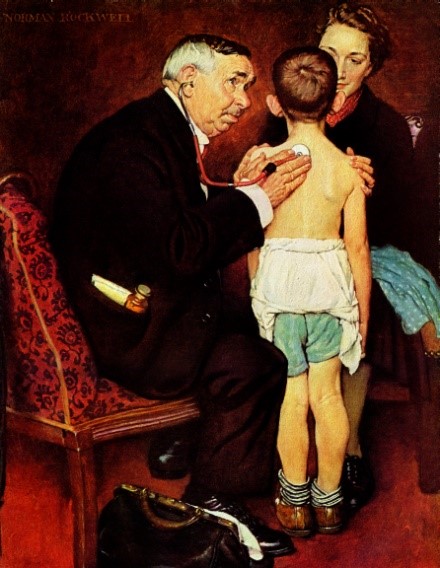
This image by Norman Rockwell accompanied a Stephen Vincent Benét story, “Doc Mellhorn at the Pearly Gates.” The image beautifully captures the relationship between doctor and patient. Shortly after its appearance, Upjohn commissioned Rockwell to create a series of advertisements for them.
Richard Sargent
March 3, 1962
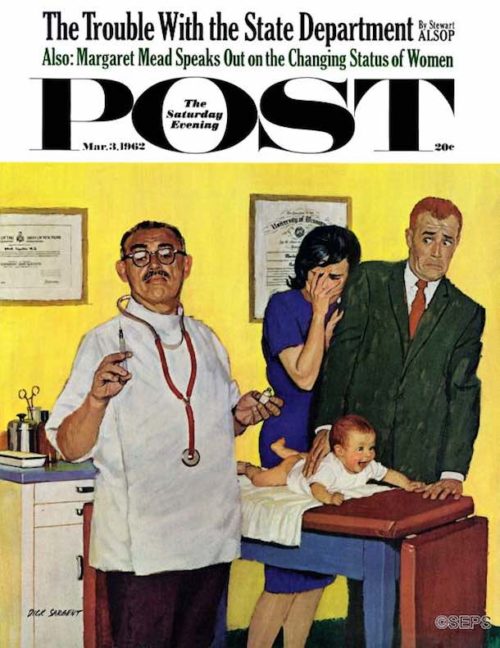
This scene will surely touch a responsive chord in every parent. The idea was suggested to artist Dick Sargent by Post readers Walter and Barbara Jackowski of Danville, Illinois, shortly after they had taken their baby, Stanley, for his first shot. Small Stanley put his parents to shame too, for he continued to gurgle and smile throughout the Terrible Ordeal. Sargent tells us that hundreds of readers have sent him suggestions for covers, but this was the first one he was able to use.
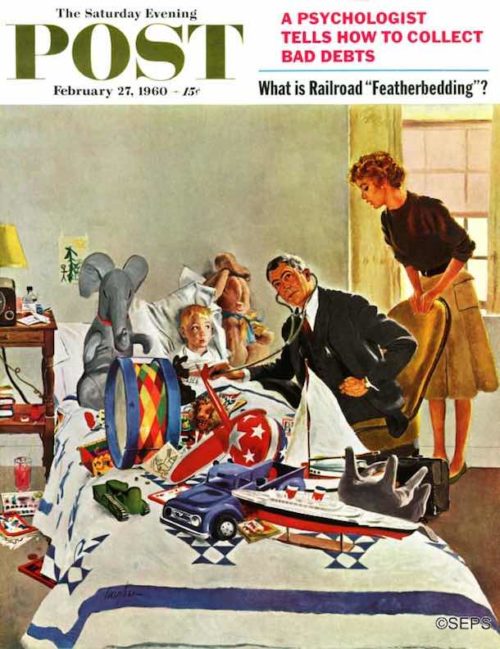
George Hughes
February 27, 1960
Small children, when committed to sickbeds, demand the comfort of a few favorite toys, and it’s the doctor’s job to find a patient amid the clutter. This boy recently squandered his life’s savings on two ice cream sodas and four candy bars, which proved to be at least one soda and three candy bars too many. Now he’s wondering if the doctor can learn the awful truth by tuning in on his stomach rumblings. Perhaps this doctor will inspire our young patient to be a physcian when he grows up — and his stomach settles down.
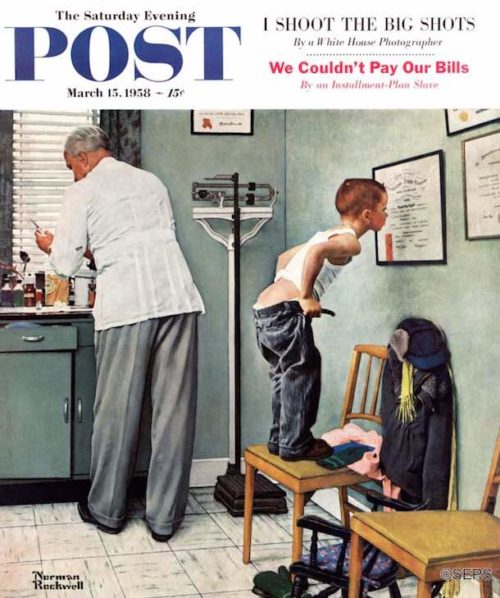
Norman Rockwell
March 15, 1958
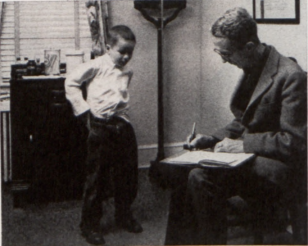
The young model for this painting was Edward F. Locke of Stockbridge, MA. The photo below shows Norman Rockwell writing him a check. The doctor was the actual town physician in Stockbridge — Dr. Donald E. Campbell. “He’s a fine, dedicated doctor,” said Rockwell, “who seldom sleeps.” Incidentally, Edward didn’t really get a shot from the doctor, only from a camera.
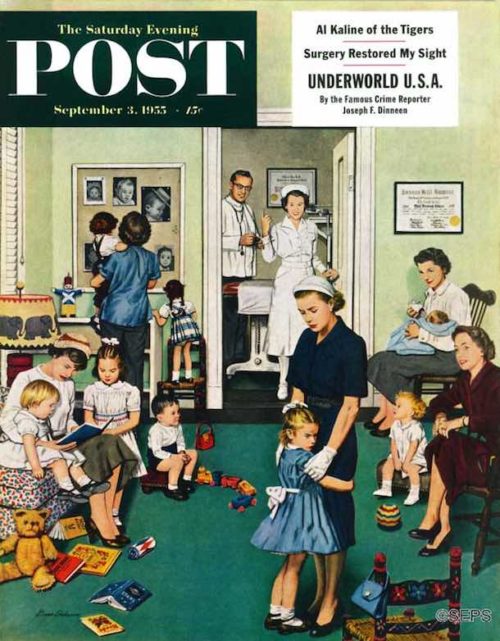
Stevan Dohanos
September 3, 1955
All of the children seem completely delighted to be at this doctor’s office, except for the one little girl whose name was just called. No amount of books, toys, and playmates can fool her; she knows what’s next.
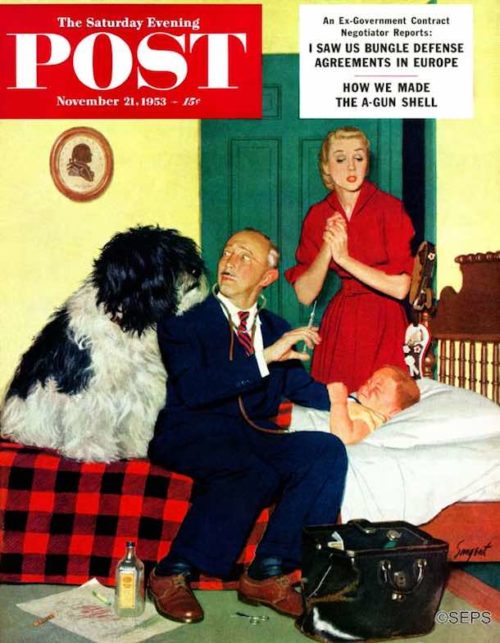
Richard Sargent
November 21, 1953
Our furry friend is planning to either bite the doctor for causing pain to his little master or lick his mustache; there’s no way of knowing which way it will go. Old-fashioned, pre-needle doctors were the smart ones; they prescribed a treatment and departed forthwith, leaving mother holding the spoon, the dog, and the kicking patient.
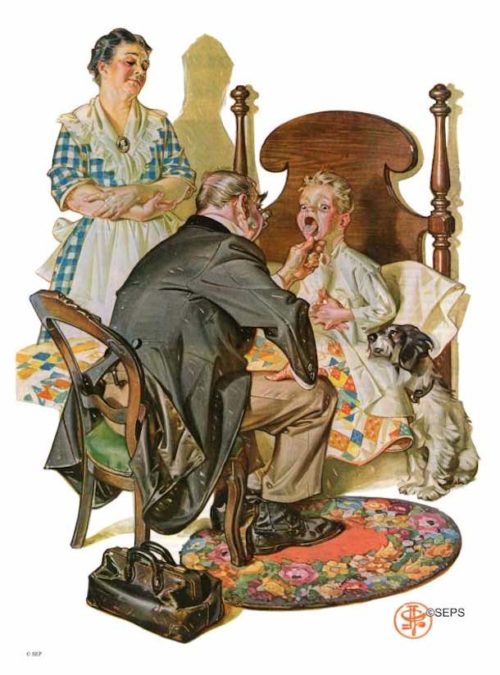
J.C. Leyendecker
November 22, 1930
Everyone seems concerned in this situation, the dog most so. Let’s hope it’s nothing too serious. While penicillin was discovered in 1920, it wasn’t used widely until 1942.
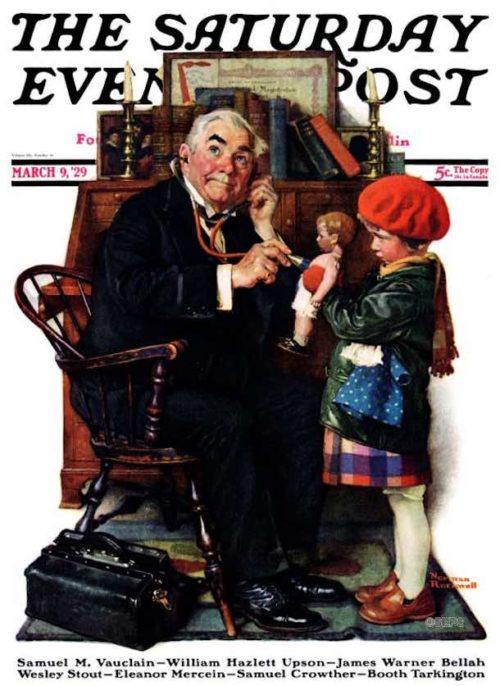
Norman Rockwell
March 9, 1929
This 1929 cover is one of the most beloved of all time. If you’ve ever had to wait in a doctor’s office, you’ve probably had time to study this scene. The “doctor” was model Pop Fredericks, who had ambitions of becoming an actor, a dream that never quite panned out. But Pop was immortalized on Post covers if not the stage. Rockwell used him as a model time after time. He appeared on the canvasses of the great artist as a cellist, a tourist, a politician, Ben Franklin, Santa Claus, and, of course, one of America’s most beloved doctors.

April 12, 1947
Norman Rockwell
Click to Enlarge
This was one in a series of paintings Rockwell completed in the 1940s, including “Norman Rockwell Visits a Country Editor” and “Norman Rockwell Visits a Country School.” For this painting, Rockwell portrayed his home town’s family physician, George A. Russell. In this room he heard a quarter century of troubles, and delighted Rockwell by an occasional shrewd bull’s-eye diagnosis. “The only trouble with you,” he told one woman during the cool Arlington summer, “is that you have too damn many guests.”
Your Weekly Checkup: The Benefits of Eating Nuts
We are pleased to bring you “Your Weekly Checkup,” a regular online column by Dr. Douglas Zipes, an internationally acclaimed cardiologist, professor, author, inventor, and authority on pacing and electrophysiology. Dr. Zipes is also a contributor to The Saturday Evening Post print magazine. Subscribe to receive thoughtful articles, new fiction, health and wellness advice, and gems from our archive.
Diet is important for general health, and in particular, cardiovascular health. The Mediterranean diet — which has been shown to reduce adverse cardiovascular events — emphasizes eating primarily plant-based foods such as fruits and vegetables, whole grains, legumes (like peas and beans), nuts, olive and canola oil, fish and poultry, and (some) red wine. A recent study showed that only around ten percent of Americans eat enough fruits (1.5–2.0 cup equivalents) and vegetables (2.0–3.0 cups) per day. Women and people in higher socioeconomic classes appeared to eat more than the rest of the population.
Several studies have shown that eating nuts reduces cardiovascular risk, in particular by lessening coronary heart disease. In one study, a Mediterranean diet supplemented with hazelnuts, almonds and walnuts resulted in almost a 30 percent reduction in the incidence of major adverse cardiovascular events after five years of follow up. Three large prospective trials showed that a higher consumption of total and specific types of nuts was inversely associated with total cardiovascular disease and coronary heart disease.
This means that the more nuts you eat, the lower your mortality. Tree nuts like almonds, pecans, and walnuts are especially beneficial, because they are loaded with vitamins, minerals, and unsaturated fats.
But even peanuts and peanut butter are beneficial. Technically, peanuts aren’t nuts but are actually legumes, more closely related to soybeans and lentils than to almonds and walnuts. Nevertheless, the evidence shows eating peanuts and peanut butter is still beneficial. I guess all those peanut butter and jelly sandwiches I ate as a kid had some benefit — at least the peanut butter did!
What’s so great about nuts? They contain lots of protein, unsaturated fatty acids like omega-3 (found in fish oil), fiber, minerals, and vitamins. They improve blood lipids (lower “bad” cholesterol), reduce inflammation, generate better blood vessel wall function and reduce insulin resistance. Not bad for something that also tastes good.
What are the downsides? Eighty percent of a nut is fat, albeit healthy fat, but it still carries a lot of calories. So be careful not to overindulge and start gaining weight. That would defeat the benefits. I find that a handful of almonds reduces my appetite way out of proportion to the amount I ingest.
What type of nuts should you eat? Some, like walnuts, have more heart-healthy nutrients such as omega-3 fatty acids, but it probably doesn’t matter that much since most nuts appear to be generally healthy. The American Heart Association recommends eating about four servings of unsalted nuts a week. Choose raw or dry-roasted nuts rather than those cooked in oil, and avoid those covered with chocolate, sugar or salt. If you choose the kind you like, you’re more apt to include them as a regular part of your daily diet.
So, nuts to you! Enjoy!
Two Views of Rome

We dropped into Rome for a quick visit with our son, daughter-in-law and 3-year-old granddaughter who live there. We booked an AirBnB apartment for the last five days of the visit. But for the first two days, a splurge: we’d taken a room at the extraordinary Rome Cavalieri, a Waldorf Astoria property perched atop Monte Mario, one of the highest hills that ring the city. It’s outrageously beautiful, with luxe rooms (each one with its own balcony), a museum’s worth of art, and 15 acres of meticulously maintained park, pools, tennis courts and walking paths.

This is the perfect place to recover from jetlag, floating on the finest mattress and one’s head on a pillow that feels like a cloud. It’s the kind of place you would choose if you wanted to plunge into Rome’s high-energy center during the day, but wished to have total peace and tranquility at night. (The hotel provides regular complimentary shuttle service to the city center.)
Stunning views of the city –I highly recommend requesting rooms that overlook Rome—the experience is priceless. There is a fine spa and fitness facility, and, for a capper, La Pergola restaurant, Italy’s only Michelin rated three-star restaurant.

We didn’t get to La Pergola, as we had a much more important mission: to hang out with our beautiful granddaughter Sofia. Since at her age she’s not into the European custom of late dinners (Romans start around 8:30 at the earliest) we asked her to join us at Eataly, the international shopping center and food emporium, for a six pm meal.

Eataly is kind of like a food truck experience, but in a renovated air terminal building instead of on the street. Over here is a seafood counter with raw oysters and lightly battered fish that you select, raw, on a bed of ice, to be cooked in front of you; over there is a roasting station. There are also hamburgers, pizza (there’s always pizza wherever you go), a beer bar, a wine bar, and, when we were there, a Cacio e pepe festival going on – this is a traditional Roman comfort food, pasta tossed with olive oil, butter, black pepper, and grated Pecorino Romano cheese.
(It’s worth noting that you can also experience Eataly in New York, Chicago, and Boston as well as other US locations.)
On our second and last day at the Cavalieri, Estelle got a text message that our AirBnB reservation had been cancelled. Something about a problem with the electricity. AirBnB’s office, apologizing for the trouble, offering four alternative locations in the same neighborhood and vaguely promising a “partial” refund if we choose a pricier alternative to the cancelled property.

But with help from our son, who has lived in Rome for the past five years and is fluent in Italian, we found a place that a block from his family’s apartment, looked sunny and open and (for the record) did cost a bit more than the apartment we’d originally selected. (Within a few minutes of it being booked, AirBnB did come through with a credit, although not a refund, for the difference in price.)
So, in the course of a week, we spanned two worlds—one of glamor and service that caters to your every wish and the more mundane, but comfortable existence of managing by yourself. The luxury weekend was spectacular. The AirBnB experience in Rome was, well, it was just fine. If booking AirBnB, you need to know that what’s considered very comfortable in Rome is small by American standards. The elevator is a squeeze for more than two people; the kitchen is packed into a corner; and the bathrooms barely offer the space to turn around. On the other hand, the price is right. Comfortable, clean AirBnB rentals outside of the city center, but a short subway or bus ride to downtown, run about $70-$120/night.
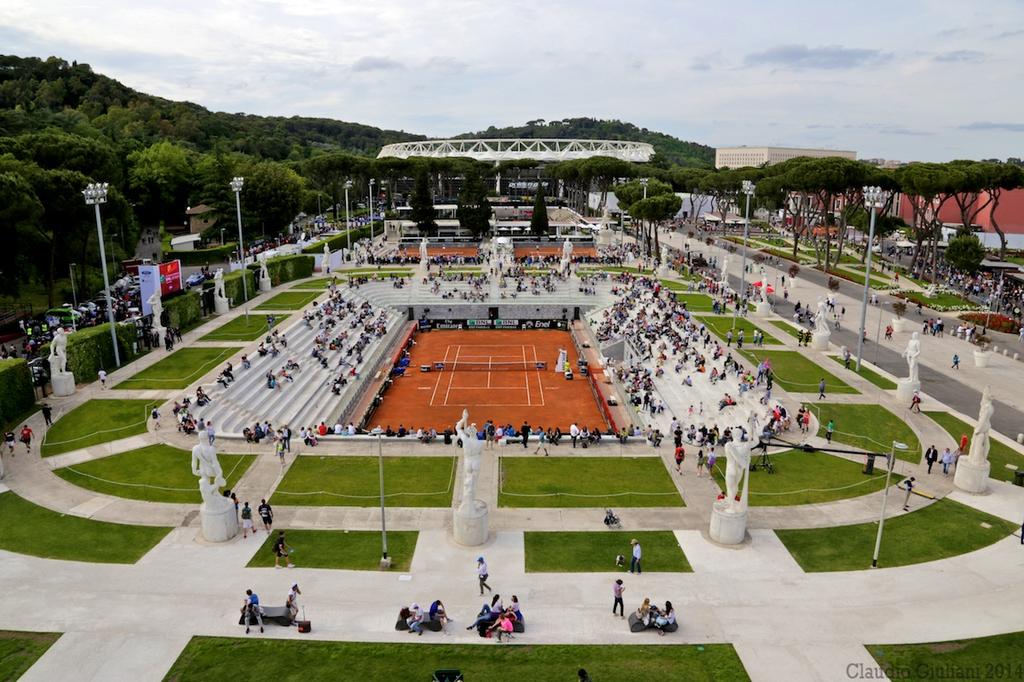
With our family we visited Foro Italico, a spectacular park and also the site of the Rome Tennis Open. It’s a beautiful place for a walk. Flat-topped stone pine trees flanked by pointy cypress trees. That extraordinary sunken tennis court lined with marble statues of the gods. It happens there’s a health fair going on this day, drawing a good crowd. Why do Romans, with their free health care, flock to a health fair to get blood tests, mammograms, and various other free screenings? Because it may take months to get an appointment. Here, you merely stand in line for 20 minutes or so.
(Speaking of health, during our week in Rome my wife paid a visit to a local pharmacy to fill several prescriptions at a fraction of the U.S. price. The pharmacist laughed out loud when we told him what these medications cost in America.)
Back in our digs that evening, we get take-out dinner from a delicious neighborhood Middle-eastern restaurant, Meze, where we put the owner’s limited English to the test.

On another day, we picked up some cold cuts at a local deli where the briny odor of cured ham filled the air. There were at least six varieties of prosciutto, plus numerous sausages and other delights. An elderly woman in front of us on line, a regular we later learn, engaged the checkout clerk in a lengthy conversation. No one seemed rushed. It’s Rome.
The grown-up highlight of the trip (for me) was a late dinner at Osteria Monte Verde. I would describe the food as a hipster twist on classic Italian cooking. You can order Cacio e pepe there, for example, and have it prepared in the traditional way, but we opted for the tasting menu (42 Euro), which consisted of seven small plates (plus two desserts and coffee). We had a raw oyster in a tangy soy broth for starters, followed by a lightly seared piece of tuna, a gnocci, pork belly, stewed lamb, beef carpaccio with raw egg and several others, the dishes just coming and coming — way more than seven, it seemed —leaving us a bit delirious. For dessert, a sorbet and just when we were expecting coffee, a substantial portion of tiramisu made from scratch with fresh whipped cream.
That extraordinary dinner enhanced a truly wonderful week. We skipped all the “official” tourist wonders of Rome this time, but enjoying the coffee, the food, the blend of fast-paced and laid-back culture–always surrounded by the spectacular architecture and antiquities of this ancient city—transformed a lovely family visit into a unique and special adventure.
15 Ways to Give Experiences as Gifts
The holiday shopping season is underway, and some are finding that the perfect gift can be elusive. Some people seem to have everything, and the latest tech gadget could be obsolete by President’s Day. According to Professor Thomas Gilovich, of Cornell University, the gifts that elicit the most happiness aren’t material items at all, but experiences. Gilovich’s studies over the past several years have found that people derive more satisfaction from the anticipation of an experience than from a tangible gift. Kitchen appliances break, sweaters fade, and candles melt, but you can brag about these experiential gifts for an eternity.
1. Ziplining in the Mountains

For thrill-seekers, ziplining is an exciting way to get stellar views of the country’s most breathtaking sights. The Blue Ridge Mountains are an iconic Appalachian locale, and at Navitat Canopy Adventures, in Barnardsville, North Carolina, you can see the Smokies while soaring more than 60 miles per hour. ($100)
2. Blacksmith Class
In the “extreme DIY” category, smithing is something anyone can learn at Bridgetown Forge in Portland, Oregon. Artisans-in-training can take a knife-forging class in which they will forge a Japanese-style steel knife stamped with their own initials. ($460)
3. Dog Sledding

How often do you get the opportunity to ride behind a team of Alaskan Huskies through the mountainous forests of Maine? Adventurous dog-lovers will never forget the Ultimate Dog Sledding Experience in Oxford, Maine. ($200)
4. Cooking Class
Give the gift of kitchen competency with a cooking class. Specialized courses in different cuisines and skills are easy to find at the demonstration kitchen nearest to you. At the famous Stonewall Kitchen near Boston, every day of the week is a new lesson in braising, chopping, and pairing with accomplished chefs like Lukas Volger and Gesine Bullock-Prado. ($50)
5. Dinner and a Movie
Austin-based Alamo Drafthouse Cinema has expanded into locations all around the country. The theater chain offers dinner, drinks, and a movie all in one place, and it prides itself on a moviegoing experience tailored to cinephiles and beer enthusiasts alike. ($12)
6. National Park Membership
The outdoors-type in your life can access more than 2,000 national recreation sites with the America the Beautiful Pass. From Denali National Park to the Grand Canyon, a national park membership is the ultimate in experiential giving. ($80)
7. Traditional Afternoon Tea
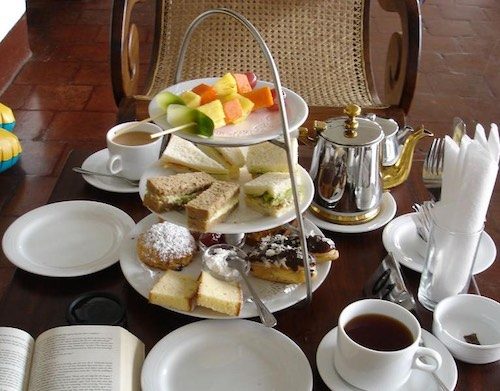
The British tradition of afternoon tea with pastries and sandwiches can be a fun midday treat for Anglophile yankees. The Rittenhouse in Philadelphia gives the full experience of teas, scones, and canapés in its Mary Cassatt Tea Room. Try the caviar service for extra indulgence. ($60)
8. Paint and Sip
Boozy art classes have soared in popularity in recent years. Pinot’s Palette gives the opportunity to sip wine and create a masterpiece at locations all over the country. Each night at a paint and sip studio a teacher guides patrons in painting a different image. The trend has caught on with amateur artists who want to relax with a canvas and glass of Cabernet. ($39)
9. Baking Class
Momofuku Milk Bar offers baking classes at its Williamsburg, Brooklyn location where you can make some recipes from the wildly popular cake chain. The hands-on tutorial can be helpful for anyone with a baking curse. The Milk Bar is famous for its tall, layered “naked cakes” and crack pie. ($95)
10. Horseback Riding
The true Western riding experience can be had at Moab Horses in Moab, Utah. The ranch sits in Professor Valley, a common filming location for cowboy movies for its vistas and red rock formations. ($80)
11. Spa Treatment
The stressed in your life would be supremely grateful for the chance to relax and rejuvenate at their favorite spa. The Spafinder card is a popular gift to ensure they can use their balance at the facility of their choice.
12. Cocktails
The art of the cocktail has undergone a transformation, and places like The Aviary in Chicago (and now New York) celebrate inventiveness and flavor in their concoctions. With their three-course cocktail progression, you’ll get smoking, boiling, infused libations served like a carefully-tailored dinner. ($65)
13. Trip to the Museum

There are plenty of weird and wonderful museums in this country, but none quite like St. Louis’s City Museum. The institution is made up of installations of found objects from the city, and it calls itself “an eclectic mixture of children’s playground, funhouse, surrealistic pavilion, and architectural marvel.” ($12)
14. Subscription Boxes
While subscription boxes are technically material goods, they elicit the experience of anticipation by being the gifts that keep on giving. Foodydirect offers subscriptions for cheesecake-, smoked salmon-, and ice cream-of-the-month clubs in addition to a vast amount of shippable treats. Myriad other subscription boxes offer monthly packages of beauty products, wine, dog treats, and anything else you could imagine.
15. Sports Car Racing
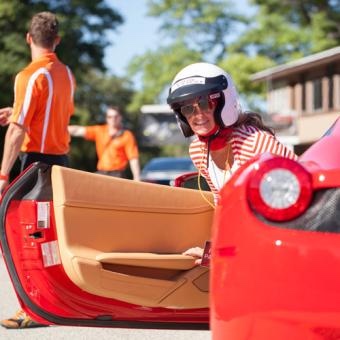
Cloud 9 Living has made experiential gift-giving its raison d’être. With an offering of tours, lessons, and thrill experiences in every major U.S. city, the company is on a mission to make helicopter flights and kayaking trips the new hot gift items. Cloud 9 is popular for their racecar and sports car experiences: patrons can race Lamborghinis, Porsches, and Indy Cars around a road course. ($388)
Jane Addams: America’s Radical Pragmatist
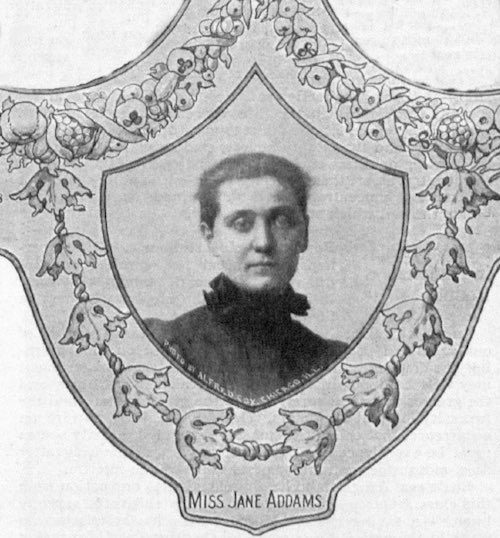
December 10 is Jane Addams Day, the day we celebrate a woman known as the “mother” of social work and the first American woman to be awarded the Nobel Peace Prize. While her achievements were impressive, her efforts started modestly.
Addams was 39 years old in 1889 and still trying to find a direction in her life when she and former classmate Ellen Starr opened Hull House, a settlement house in the slums of Chicago. Settlement houses were residences for reformers and volunteers who provided aid to underprivileged families, including recently arrived immigrants.
At first, Addams and Starr offered readings from books and slide shows of paintings, but quickly learned there was a greater need for a place where mothers could bring their young children. So the two started a kindergarten and set aside a room where mothers could socialize. Within weeks the kindergarten was filled, and 70 more children were on a waiting list.
A day-care center and nursery soon followed, then a club for teenage boys, the area’s first library, and employment bureau. By its second year, Hull House was providing services to two thousand people a week.
Addams invited America’s leading lecturers, reformers and union organizers to speak and meet at Hull House.
She founded the Immigrants Protective League in 1909 and led investigations into drug abuse, milk contamination, and other public health issues. She was instrumental in getting Congress to pass legislation to limit child labor as well as getting women the right to vote. An ardent feminist, she said, “I do not believe that women are better than men. We have not wrecked railroads, nor corrupted legislature, nor done many unholy things that men have done; but then we must remember that we have not had the chance.”
Her heartfelt pacifism, which led to her opposition to World War I, made her controversial, but it also led to her being awarded the Nobel Peace Prize in 1931.
She died in 1935.
This short piece from the August 4, 1900, issue of The Saturday Evening Post provides an interesting look at the young reformer and how she was enhancing America’s international reputation.
Settlement Worker Wins the French
Miss Jane Addams, the young philanthropist of Chicago, was made the recipient of much attention from prominent people in France, and when she appeared and made a short address on one of the special days of the [Paris] Exposition—one of the women’s days— it was conceded that she was among the most worthily notable of all the Americans who had this year crossed the Atlantic.
It is on account of her social and economic studies that Miss Addams is famous, for she is a leader in what is known as ” settlement ” work, and it was she whose influence was the most operative in the founding of Hull House, in Chicago.
She is a typical Western girl. She was born in Illinois, where her father attained some prominence as a political leader. She was given a good education, and then, with a young woman friend, a fellow-graduate, traveled through Europe for the sake of further study, and to see the world before deciding upon the question of a career. There is a breezy Westernness about all this that is very attractive and characteristic.
In the cities of Europe it chanced that the minds of the two friends were turned especially toward the poor and their environment, and so deeply impressed were they by what they saw and by the possibilities that opened before them, that they decided that slum work in Chicago should be their life work and mission.
It was a little more than ten years ago that Hull House was founded, and it is now doing a wonderful work. It carries on a striking variety of classes, its system of clubs is working out great results, while in its care for the sick, the poor, the hopeless and the wretched it is of vast benefit.
An intense earnestness, combined with a magnetic personality have enabled Miss Addams to achieve her success. Her face is full of character, and there is a fine quality about it that at once attracts. Withal, there is a sadness, as if the depth of sorrow of which she has had to learn in her mission has left its indelible mark upon her.
Besides making an address at the Exposition, Miss Addams met many of the most noted French students of sociological matters, and discussed with them the varied phases of the problems of the ” submerged tenth.” [the hypothetical tenth of a country’s population that lives in permanent poverty]
The Frenchmen, enthusiastic when an attractive woman is concerned, unanimously agreed as to her magnetic charm, and vied with each other in expressing admiration for the woman herself and for the earnestness with which she presented her views on the lives and conditions of the poor, and the possibilities of close and sympathetic touch in ameliorating those conditions. Miss Addams believes that ” settlement” work is only one manifestation of a wide and deep humanitarian movement that, throughout Christendom, is working for the betterment of the unhappy and almost neglected classes of society, and striving to lift them higher.
Featured image: Library of Congress
News of the Week: Fake Trees, Dumb Cats, and the Invasion of the Xennials
A Christmas Controversy
There are many great debates in this world: Coke vs. Pepsi, Mac vs. PC, first Darrin vs. second Darrin on Bewitched. Another one is real Christmas trees vs. fake Christmas trees. Wars have been started over less.
I could probably write a lot of controversial sentences in this column about politics or religion or current events, but I bet none will be as controversial as this one: I like artificial Christmas trees. Sorry!
It’s not like I particularly dislike real Christmas trees. They smell great and … well, actually, I can’t think of anything else beyond that. They shed their needles all over the place, you have to make sure they’re watered, and some of them can be awfully expensive. Artificial trees can be expensive too, but you can use the same one for 20–30 years. They also come in various shapes and colors, and there’s a rich history behind them. I still remember the one we had in a box in our basement when I was a kid. I think we got it at Sears. It lasted for years, and there were as many memories attached to the tree itself as the ornaments on it and the gifts underneath. And the artificial trees they make now are even more well-made and realistic-looking.
You want that real tree smell? That’s why they make air fresheners, candles, and Scentsicles.
Dogs 1, Cats 0

Another great debate is dogs vs. cats. Relationships have been broken up by people who can compromise on every other issue except when it comes to the family pet.
Researchers at Vanderbilt University have finally figured out which species is smarter, and cat people aren’t going to like the results. It comes down to how many neurons they have. Dogs have a lot more than cats do. The researchers say that the size of an animal’s brain doesn’t necessarily mean a particular animal is smart, but dog people will be happy.
I’m a dog person all the way. Will a cat fetch your paper? Will a cat save you from drowning? Does a dog do his business right in your house, like a cat? I rest my case.
More Holiday Reads
In our current issue, Amazon staffers tell us what books will make for great gifts this Christmas, including books by Jennifer Egan, Walter Isaacson, and Jeffrey Eugenides. Here are three more to add to your list:
- Hail to the Chin: Further Confessions of a B Movie Actor, by Bruce Campbell. This is the third in a series of memoirs/behind-the-scenes tales from the star of the Evil Dead movies and the TV shows The Adventures of Brisco County Jr. and Burn Notice. He’s always a groovy read.
- Artemis, by Andy Weir. This is the new mystery-on-the-moon novel from the author of the acclaimed The Martian, which was made into a film a couple years ago starring Matt Damon.
- Kirk and Anne: Letters of Love, Laughter, and a Lifetime in Hollywood, by Kirk and Anne Douglas. The movie star and his wife have published many of the letters they wrote to each other over their 63 years of marriage. It’s not just a story of their relationship; there’s a lot about other Hollywood stars in there as well.
Too Many Toys
And where can you buy those books I mentioned above? A bookstore!
Barnes & Noble has decided they want to concentrate on books once again and not on the other things they currently sell, like journals, toys, and microwave ovens. Chief Executive Demos Parneros, dealing with seven straight quarters of sales declines, also wants to make the stores smaller. They’re not getting rid of the non-book items completely, but they want to narrow the number and brands they sell.
I can understand that. The Barnes & Noble where I shop is gigantic. Half of the store seems to be made of journals and toys and games and a cafe, even if they do have a huge selection of books as well. Yeah, the store does seem a little big. But I hope they don’t get rid of the cafes. If anything, make the cafes bigger and better designed, with larger tables and more comfortable chairs. If you want inspiration, look at what Border’s used to do with their cafes. Do that and I will shop at your place all the time and spend all day in the cafe drinking expensive chai.
By the way, they don’t really sell microwave ovens.
RIP John Anderson, Johnny Hallyday, and Tommy Keene
John Anderson was the Illinois congressman who ran for president as an independent against Ronald Reagan and Jimmy Carter in 1980. He died Sunday at the age of 95.
Johnny Hallyday was a huge rock star, nicknamed the “French Elvis.” He died last week at the age of 74.
Tommy Keene was a king of the alternative music world, and one of my personal favorites. He died the day before Thanksgiving at the age of 59, and his brother has written a wonderful tribute at Keene’s official site.
The Best and Worst of the Week
Best: Back in the mid-’60s, CBS ran a Christmas commercial by R.O. Blechman that many people of a certain age remember and love. It was very subtle, calming, and over a minute long, which would probably make people antsy today.
Last week the network started running a series of new holiday commercials that remind me of that ad. They’re not as long, but they have that same nice, almost Christmas-card vibe. Vimeo has all the ads in one video.
Worst: This is the recognition of a word we didn’t know existed and I’m not sure we even need: Xennials. It’s not a cholesterol medication or the name of the new Marvel movie villains; it’s the word for people sandwiched between Generation X and Millennials.
I’m sorry, but I’m never, ever using that word. It’s hard enough to remember all the terms to describe groups of people or eras, and we don’t need new ones to fill in any gaps.
This Week in History
Rudolph the Red-Nosed Reindeer Premieres (December 6, 1964)
This remains a Christmas favorite that you just have to watch every year, even if Santa is kind of a jerk in it.
Pearl Harbor Bombed (December 7, 1941)
A hero on that horrible day in Hawaii, Chief Boatswain’s Mate Joseph L. George has finally been recognized by U.S. officials, and CBS had a terrific story about him this week.
This Week in Saturday Evening Post History: Tree in Town Square (December 4, 1948)
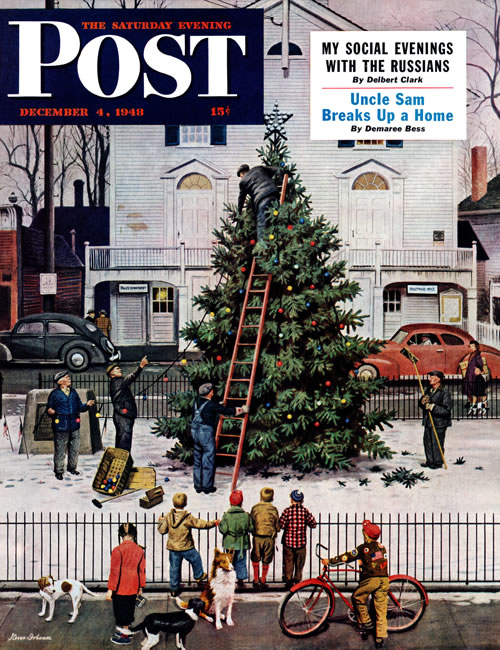
Steven Dohanos
December 4, 1948
This isn’t just one of my favorite Post covers of all time; it’s one of my favorites of any magazine ever. Stevan Dohanos not only captures the Christmas season perfectly, he captures friendly, helpful, small-town life perfectly too.
Today Is National Brownie Day
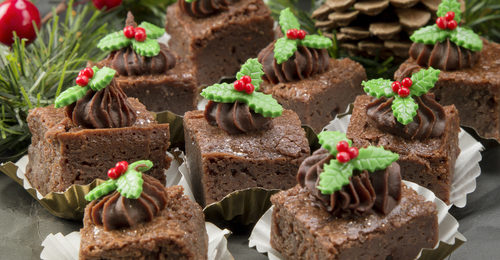
Though we’ve settled the real vs. fake Christmas tree question, we have another debate at our family celebration: fudge-like brownies or cake-like brownies? My sister makes them every year; some of us like the former and some the latter. I’m in the fudge-like camp, but both are great because, hey, brownies!
For a Christmas-ish brownie, here’s a recipe from The Comfort Kitchen for Peppermint Candy Cane Brownies. And here’s a recipe for Eggnog Brownies from Back for Seconds.
Next Week’s Holidays and Events
Miracle on 34th Street Marathon (December 10)
A couple of weeks ago, I linked to a site that has a roundup of all the Christmas movies, specials, and TV episodes we’ll see through New Year’s Day. At first it looked like Miracle on 34th Street wasn’t going to be shown at all, but there’s actually going to be a marathon of the 1947 classic on Sundance TV this Sunday starting at 3 p.m. That might not be a station you usually watch, but I bet you have it.
Hanukkah Begins (December 12)
The Jewish holiday starts on Tuesday and goes until the night of December 20.
The Keystone of the Family
The All Natural Birthing Center, a low cement building with every shade pulled down, squats in the center of Main Street pushing out babies proud as could be. My wife and I wanted the kids to use a real hospital, but they wouldn’t hear of it, and, as it turns out, our fears were unwarranted. Outside the whitewashed building, I try to force myself through the doors, pungent roses in my arms, but I decide to have another cigarette instead.
In my day, back in Costa Rica, fathers and grandfathers didn’t involve themselves in the birthing process. Childbirth was strictly the domain of women. My wife wanted me with her when she delivered both our boys, but I refused, and I still think I made the right decision.
I should be gracious, forgiving. Luke’s young, just 25. At least he stood by her, but his refusal to do the right thing grabbed my guts and twisted them. I raised him to be a better man. Where I come from, fathers teach their sons by example. Hadn’t I married their mother when I found myself in a similar situation? Of course, I did. There should have been no discussion necessary.
I was gentler with my sons than my father had been with me and my five siblings. He’d ruled the house with a velvet-gloved iron fist. We didn’t question his decisions, and we obeyed. We looked to him for reassurance and signs of approval, but Luke couldn’t care less if I approved of his decision not to marry the girl.
When I was a kid, my father would arrive home twice a day, at noon and at seven. He’d hang his black fedora on the hook by the door, amble into the kitchen, lean over and kiss my mother on the cheek. She’d cluck and fill a plate for him, a generous one with rice and beans, chicken and salad for lunch and a lighter meal for dinner. We always ate in silence. The simple kitchen, with its scarred wooden table and malodorous kerosene heater, changed simply by his presence, and, once he’d eaten and exited, this palpable change permeated the room like a perfume that lingers on a well-used bed.
One time — I might have been 9 — Papi had missed the evening meal, but my mother had leftovers covered for him in the icebox. Though she’d said nothing, my mother’s thin, pursed lips and deep concentration on her darning spoke volumes. Finally, we heard his step at the door, and she shooed us up the stairs. I hung back, hidden in the shadows of the stairwell.
Papi bounded through the front door like a young man, with vigor and something strongly resembling jubilation. I couldn’t tear my eyes away, so odd was his entrance. He held his hat high in the air and danced his way to my mother, taking her in his arms and swinging her about. He slowed the dancing, gazed down at her smiling face and then, without hesitation, planted a kiss on her mouth, a long, open-mouthed kiss that shocked me. I leaned out farther to behold this strangeness, but he spied me, broke the embrace and clapped his hands like a thunderbolt, sending me racing up the stairs. He’d won the local lotto.
But that show of affection was the exception. Normally, my father’s love was like tarnished brass, constant and strong yet cold and faded. I was the youngest, but we all knew he loved my eldest brother, Marco, the best. He’d confide in Marco, grabbing his shoulder and walking him around the garden away from us younger ones to tell him of big news in the town or plans he had. Of course, he tousled my hair, and even as an old man, would greet us with a strong handshake, but there was a distance between us. The only time he let down his guard was when he spoke of his own father.
Napoleon had arrived in Costa Rica straight off the boat from Napoli, a tall man with broad shoulders and a handsome countenance. In his stories, Papi always added that Abuelo, till the day he died, had a full head of black hair, just like I have today. The ladies found him irresistible, and he obliged them as much as possible, to my grandmother’s ire and frustration.
Abuelo died right before my seventh birthday, but I remember him well. My warmest memory is of him carrying me home on his shoulders from the annual festival in San David. Every January the family spent one entire day, staying well into the night, at the festival, dancing to live music, eating tamales and chifrijo, drinking naturales and watching the horse parade, which was the highlight. We children raced about to keep from having to stay put, and by the time the blanket of stars had covered the sky, we’d be exhausted. Abuelo would always lift me up, placing me on his shoulders as we walked to the car. I’d tower above the crowds, and loved the feeling of power it gave me. Eduardo, my closest brother, complained that Abuelo showed special favor to me, but Abuelo would laugh and slap my legs which hung down over his chest.
“He’s the baby!” Abuelo bellowed. “Of course, he’s special!”
Abuelo would then take off with his long stride ahead of everyone, pointing out constellations to me and making up stories about the stars. Abuelo talked on any subject, but his favorite stories to tell and my favorite to hear were about the old country. He filled my head with castles and volcanos and the bay that still called to him. I could smell the sea and feel the hard shake of his father’s hand as he bade his son goodbye, never to see each other again. We marched down the darkened road, and I felt the quake of the ship as I rocked from side to side astride his shoulders. I imagined his shoemaker father with his bushy white mustache, and even glimpsed his father’s father — a shoemaker himself — and I felt comforted by the tales of his family, my family. Comforted and safe.
With my own sons, I never gave raising them any thought. You don’t turn boys into men; they just grow into them like slick tadpoles grow into capable frogs. Besides, child-rearing wasn’t my job. My job was to bring in a paycheck. Janet and I had been surprised by the pregnancy and rushed to marry, and life suddenly became a whirling tornado of exhilaration one moment and torture the next. I have no regrets, don’t misunderstand. I loved my wife, still love my wife, but a man, a young man, is not meant to be so settled, so tied to one woman. I often felt I’d failed her. I was only human after all and tended to favor my grandfather in certain pursuits more than I did my father.
I enjoyed my sons, but they came so quickly, one right after the other, that soon my wife and I did not act like lovers, just partners. Her domain was the house, mine the outside world. She was American.
I could no more stay in Costa Rica than I could plant my feet in the ground and grow banana leaves. Like my grandfather Napoleon, I had to explore, see new places, and I answered a friend’s dare to go to the United States. We were to go together, but as fate would have it, he stayed in Alajuela, backing out at the last minute. I traveled through all of Central America, spending a night in each capitol as the borders closed at sunset. I explored Tikal and Chichen Itza, Puebla, and Mexico City. Finally, I made my way to the U.S. border and crossed, running with a pack of others, there must have been 30 of us. I saw three caught by la migra, but they didn’t come close to nabbing me. Ironically, within a year, I was married and nabbed, instead, by love and responsibility.
Janet, my wife, was my first woman in the States. Blond, with wide hips and a quick smile. We laughed our way through the language barrier. Words were not necessary when you felt the way we felt for each other. We made love incessantly. Five years later, with two children and a recent miscarriage, we rarely found time to smile at each other.
“I’m having my tubes tied,” she told me after one particularly nasty day with the boys. I’d already learned that a particular tone meant it was useless to argue.
I rolled the news over in my head, nevertheless, and watched her washing dishes at the kitchen sink. I said nothing.
“I mean, God forbid you should get a vasectomy.”
I felt kicked in the gut. That tone. That insinuation that I should lose my manhood simply because my wife told me to, but I checked my anger. She was tired. She didn’t want more kids. I understood. I thought to rise and wrap my arms around her, but she looked so cold, so distant, that I hesitated. I went to her anyway, and, as expected, she did not respond to my touch. I kissed her cheek then left the room. We never spoke of it again. And we had no further children.
The boys grew fast and strong. I worked construction but tried to save time for their baseball games. I could see their talent, their intelligence, but they were like night and day. Luke was brooding and passionate about all things political while Jesse, the younger, was a quick-witted jester who kept the boys in stitches and the girls in love.
I taught them soccer, and they taught me Frisbee, but we didn’t talk much. I was more affectionate to my children than my father had been with us, but the boys began to balk at my attempts to rub their backs or give them a quick hug, shoving me away if they thought I’d touch them in public. I stopped trying with Luke, but Jesse didn’t seem to mind my affection, though he always seemed to hug his mother more than me.
Last winter, Janet and I picked up Luke to drive him to Christmas dinner at my wife’s sister’s house. He informed us that he didn’t approve of our gas guzzler, and, by the way, he was going to be a father. He and Ashley were expecting. I said nothing because Luke was hardly ready to handle a child. Janet filled the silence, asking about specific dates and if he had any plans. His reply? June and none.
“But you’re out of college,” my wife said. “You have a good job. Don’t you love her?”
“Of course, I love her.”
“So marry her,” I said. “You need to marry her.”
“No, I don’t. We don’t believe in that.”
I couldn’t believe my ears. I scowled at him in the rearview mirror. “Of course, you’re going to marry her. You do the right thing!”
My wife put a hand on my arm, and I shut up, but I was furious. What kind of man puts a woman into that situation and leaves her hanging? We rode in silence till we reached the house, awash in white Christmas lights. By the time I placed the car in park, Janet had made a decision. She turned to Luke.
“Don’t say anything tonight, honey. Give us some time to digest this, okay?”
We piled out of the car and marched up the winding walkway as if going to a funeral, but once the door opened and happy faces greeted us, Luke made his own decision, giving everyone the good news as soon as he greeted them. His mother and I were mortified.
So here I stand, six months later, in front of the All Natural Birthing Center, roses in my hand. To my relief, I see Jesse approaching, juggling a massive stuffed panda bear almost as big as himself. He grins from ear to ear.
“It’s a gift Salvador can grow into. What are you doing out here?”
I take another drag on my cigarette. Jesse waits for a response.
“You go in,” I say. “Go ahead. You want to take these?” I hold the roses out to him. “I’ll see the baby later.”
He grabs my arm. “You’re going in.”
The strength of his grip surprises me, pisses me off. I don’t have a problem seeing the baby, but Luke had defied us, refused to marry this girl he professed to love. I hadn’t spoken to him since Christmas, and a wall had grown between us.
I yank my arm free and turn away. “When I’m ready.”
“Hold it right there, pardner.” Jesse grabs my shoulders and turns me back toward the building. “This is your first grandchild, and you are going to welcome him with all the love and cariño a grandfather is supposed to show.”
I glare at him. This is not about the baby.
“Who will show Salvador the way? You have to know where you come from to know where you’re going? Isn’t that what you always said?”
I stare at Jesse. That was my grandfather’s line.
“Who’ll teach him about the old country and the Festival of San David? Napoleon and Napoli and that night you caught your dad kissing your mom? Nobody else can do it.”
I want to say that no one ever listened to those old stories anyway and that Salvador would be a 21st century kid, through and through, but all I can do is mumble something about not being too good with babies.
“Papi, you have to welcome this baby into the family.”
“I will. In my time. Besides, your mother’s in there.”
“You have to do it.”
“There are plenty of people welcoming him already. Why me?”
“Because you’re the oldest! You’re special.” His eyes twinkle at his joke. As the baby of the family, the “youngest” line had always been Jesse’s favorite line of my Napoleon story.
“Papi, your reach stretches five generations.” He holds his arms out letting the panda drop as if of no consequence. “To your left, live the memories of your father and grandfather. To your right, live the dreams of your sons and your grandson. And you stand in the middle, the keystone of the family. The crux.”
A lump forms in my throat. I try to cough it away.
Jesse draws me close and hugs me hard.
“He needs to marry that girl,” I say into Jesse’s shoulder.
“That’s a discussion for a different day.” He pulls away, rubs my shoulders and guides me into the center.
We stop at the information desk, Jesse flashing his award-winning smile at the clerk. She smiles back and points down the hall. “Congratulations!” she calls out. I hardly hear her.
Ashley’s door is open and cries go up when Jesse enters, his arms full of the oversized panda. “Oh my God, Jesse,” I hear my wife say.
Then I enter carrying my roses and everyone looks at me. Then the moment passes. They come back to life.
My wife rushes over. “Oh, isn’t that sweet!” She rubs my back, pecks my cheek, and takes the flowers before I know what’s happening.
Ashley is in bed, holding the baby. All I can see is a shock of black hair. Both my boys had been born with thick hair like that.
Luke is on me before I’ve gotten my bearings. He holds out his hand to shake, which I take, but he draws me in, and we end with a hug. I exhale, my heart still thumping.
“Come meet your grandson,” Luke says, taking my elbow.
Ashley holds the child out to Luke who takes him, then turns to me with the baby in his outstretched arms.
I back up, shake my head. “No, no. That’s okay.”
My wife is beside me, her hand on my back, pushing me forward. I stare at the baby who has a face like a cranberry. Luke puts Salvador in my arms. He weighs the same as a blanketed bundle of feathers. I peer into the dark deepness of his eyes, and he stares back without reaction. And there it was, something that clicked between us just as something had always clicked between my grandfather and me.
I look up to find everyone smiling at me.
“He has your hair,” my wife says.
That had been one of the first things she mentioned when the boys were born.
“And that same blank stare,” Jesse said, making everyone crack up.
I smile back. I don’t know what to say. And I really don’t. I’m filled with so much love for this little one, my mind racing with thoughts of who he will be, and filled with a need to protect and guide this youngest member of our family.
“He’s beautiful,” I murmur.
I glance up at Luke and catch him and Ashley in a stolen kiss, him rubbing the top of her head, while everyone is looking at me. Luke sees me and straightens. He claps his hands for no reason, and I wonder if he remembers the story of my dad winning the lotto. He grins widely.
I smile back.
And the wall I’d felt between us for the past six months vanishes. In its place was this little baby, this Salvador. The youngest of the family.
7 Reasons to Keep Writing Letters
You don’t need a tablet, Bluetooth, or a new app for this activity — just a sheet of paper and a trusty pen. Keeping correspondence via snail mail is an especially fulfilling way to stay in touch with friends and family. Stripped of the immediacy and — sometimes — rashness of instant messaging, letter writing is expressive and therapeutic. The (almost) lost art deserves a reprise. Here are seven reasons you should write more letters.
1. Letters are personal. A handwritten note shows the recipient how much they mean to you. The journalist Phyllis Theroux wrote, “To send a letter is a good way to go somewhere without moving anything but your heart.” Regardless of the words on the page, the effort behind written correspondence sends a message in itself.
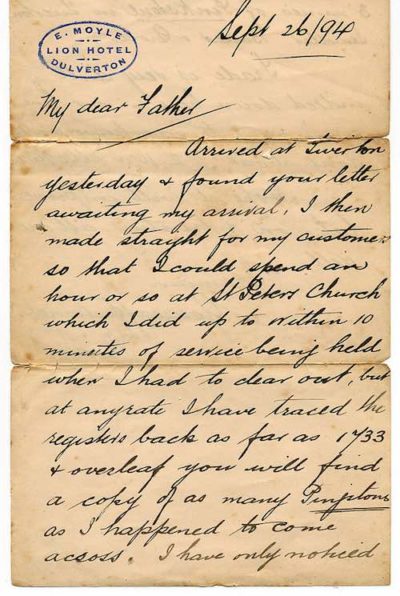 2. You can practice your handwriting. Or show off your handwriting. There are too few opportunities to do either these days. You don’t have to write in cursive, but it would augment the aesthetic if you did.
3. You can keep your own history. Letters are responsible for a great deal of what we know about history. Saved letters tell a story, unlike deleted text messages and emails. In August, a stash of letters from WWII codebreaker Alan Turing was found at the University of Manchester. The discovery was unexpected but welcomed, as his letters focused largely on his work in computer science and early artificial intelligence. You might not have such consequential correspondence, but the details and personality in a hoard of letters can be treasured for generations.
4. You can add personalized art. Writing for snail mail allows you to personalize a note with hand-drawn artwork. The Smithsonian Institution’s exhibition, “More Than Words: Illustrated Letters…,” shows creative correspondence from artists and authors spanning from the late-1800s to the 1980s. The ink, watercolor, and pencil drawings in the collection show how graphics can enhance a personalized note.
5. The message will be more meaningful. Writing out your thoughts to someone will give you more clarity on what exactly you want to say. The opportunity to develop your message and voice over the course of a letter affords your recipient a richer experience. Spiritual teacher and author Barb Schmidt offers advice on writing letters, saying, “Place all of your attention on your letter’s recipient. What stands out about that person? Good memories? Shared accomplishments? Commonalities?” and “Thoughtfully reflect upon what you want to share with that person about yourself. What feelings do you wish to elicit? Love, support, humor, etc.?”
6. Letters are tangible. Correspondence you can see, touch, smell, and keep is a rarity anymore. A letter travels — sometimes — thousands of miles to arrive in someone’s hands. The entire experience encompasses the senses, and it doesn’t have to be lost to technology. The Post’s recent story, “The Digital Deluge,” tells of the pitfalls of a solely digital history record in a fast-paced world. The power and potential of technology can be staggering, but a lot is lost in the shuffle. Handheld keepsakes can be a simple and secure form of memory.
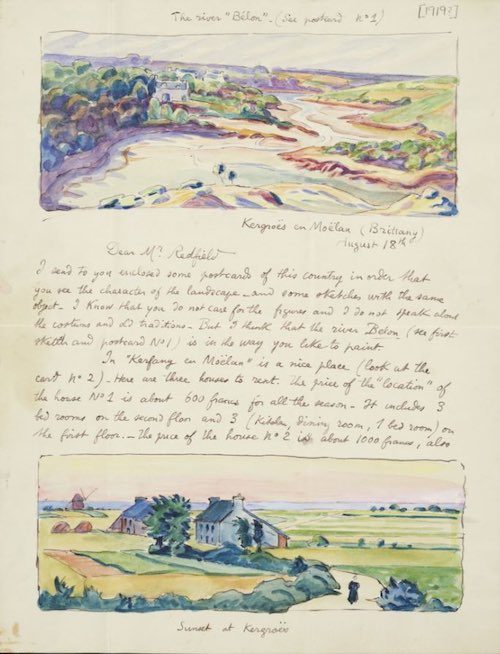
7. The recipient will thank you. There are few happy surprises tantamount to arriving home from a rough day and discovering a letter from a friend. If you give someone this joy, they will almost certainly return the favor. U.S. soldiers abroad often express gratitude for receiving mail from civilians, as in the case of Bianca Snow and Larry Nance, Jr. Snow was stationed in the Middle East when Nance began sending her letters in a pen pal program 14 years ago. They met for the first time this year at an LA Laker’s game; Larry Nance, Jr. was on the team. “Those letters got me thru,” Snow said online of their correspondence.
Read The Multimedia Journal: More Than Just a Notebook
Apps for Better Baking
Party Cupcake Recipes 1000+ (free, iOS only). Make and decorate sweet treats for every occasion.
Bread Baking Basics ($1.99, iOS only). Channel your inner bread baker with easy-to-follow techniques and recipes.
Mary Berry: In Mary We Trust ($1.99–$2.99). No judgment, just delicious bakes from Mary Berry of the popular Great British Bake Off TV series.
Cupcake Maker Salon (free). Keep your kitchen clean and the kids happy with virtual cupcake making.
The Man Behind America’s First Heart Transplant
Fifty years ago, on December 6, 1967, Dr. Adrian Kantrowitz performed the first human heart transplant in the U.S. The surgeon experimented with transplantation and prosthetics at Maimonides hospital in Brooklyn throughout the 1960s and ’70s. Two days before Kantrowitz’s heart transplant between two infants, the world’s first successful human heart transplant was performed by Christiaan Barnard in Cape Town, South Africa.
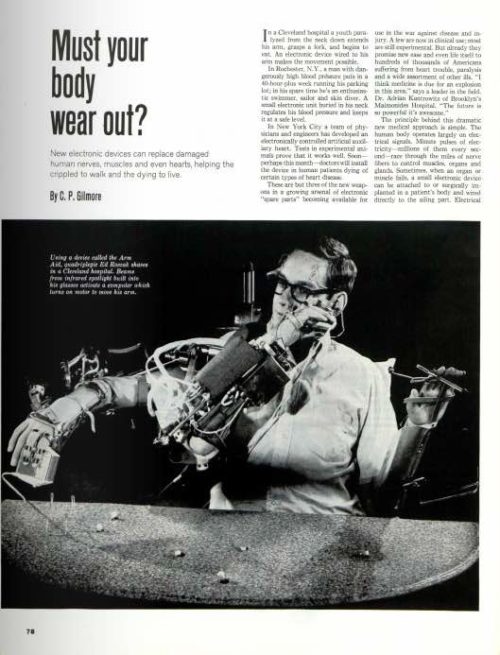
Kantrowitz had been working to set the record for years, transplanting hearts in 411 dogs before moving on to human subjects. In 1965, the Post covered Kantrowitz’s work in experimental medical technology — particularly early pacemakers and prosthetics. Most of these innovations were cumbersome and impractical, and most of the first heart transplants succeeded only for hours. Kantrowitz’s work, however, was crucial in the development of transplantation and cardiac devices used today.
North Country Girl: Chapter 29 — A Teenager in Love
For more about Gay Haubner’s life in the North Country, read the other chapters in her serialized memoir. The Post will publish a new segment each week.
My first date with Michael Vlasdic had a few glitches. Duluth teen culture was car culture. With your friends a car was a party on wheels. With a boy a car was a bubble of privacy, a place to make out, WEBC on low, heater on high, the windows opaque with steam. I, however, had only a learner’s permit; to get that required just a multiple-choice test on road rules, the kind of test I aced every time. I had barely squeaked through drivers’ ed, the instructor constantly taking over control and slamming on his brakes because I was unable to gauge distances between the car I was driving and everything else, other cars, pedestrians, curbs. I also had difficulties telling the brake pedal from the gas pedal. My sweating, pale instructor assured me that all I needed was more practice, but every time my mother let me take the wheel it ended quickly in shouts and tears. I was idiotically optimistic that when I took the road test in December, when I turned sixteen, I would magically pass, but for now taking the family car was verboten.
Michael Vlasdic lacked both a car and a father. His mother was originally from Latvia

(a country I knew only from volume L of my old World Book encyclopedia, which identified it as one of the Soviet Socialist Republics) and had moved to Duluth to teach German at the university. She was stately and Old World polite, with a solid-looking helmet of dark hair, and always in a boxy wooly suit, thick beige nylons, and sensible shoes. The missing deadbeat dad was in Mitchell, South Dakota; Michael once proudly showed me a postcard of a large yellow structure that proclaimed Greetings from the Corn Palace! that his dad had sent him. In lieu of money, I guess.
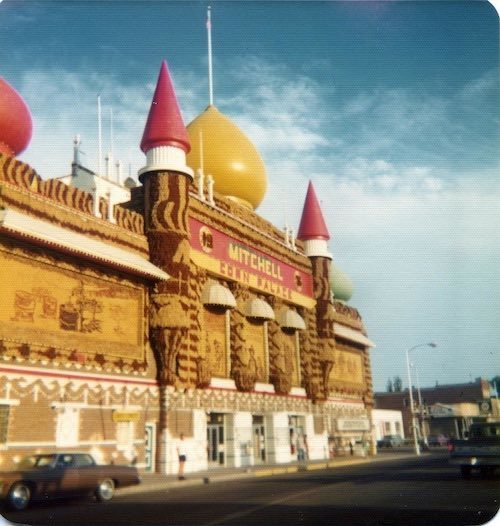
I had met a few kids without fathers, but a family without a car? Where could Michael and I go on our first date? You could not enter the London Inn parking lot on foot. You’d be a laughingstock.
On the phone Michael said, “Why don’t you come over here and we’ll listen to records?” I did not have a better idea, so that Saturday I walked the twenty minutes over to Michael’s house. His mother was out for the night. His mother was out a lot.
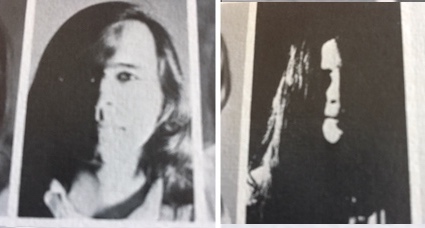
Michael and his mother lived in a small up-and-down duplex filled with books and cracked oil paintings in gilded frames, dark heavy furniture, more books, jewel-toned oriental rugs, potted plants, and more books. There was also the standard big cabinet hi-fi in the living room. Since there was no parent in the house, Michael and I went to his room to listen to music and so Michael could smoke a joint, which he did leaning precariously out the window. He offered me a hit, but I was afraid if I had my usual pot-induced coughing fit while straddling the windowsill I would plummet to the ground and that would be a hell of a first date.
We started talking, about music (we liked the same bands! Of course in 1969 every kid was devoted to Steppenwolf, Cream, Jimi Hendrix) then books (Michael had read The Lord of the Rings three times to my twice). A current of tingly magnetism drew us closer and closer together, and then there was a lot of kissing. Seated kissing, with our arms propped straight as crutches on Michael’s narrow, neatly-made bed, then lying down kissing, with arms wrapped around each other, bodies close enough together that I could feel him harden. Michael reddened with embarrassment, got up to take off his glasses, and we kissed some more.
Time played its elastic tricks: it stopped while we were kissing, then hurried forward, the clock rushing to eleven, my curfew, and I had to leave, with still the twenty minutes to walk home. Michael and I untangled, he found his glasses, but it was impossible for us to part. He walked me back to my house, through the still and silent streets, a thousand stars on a moonless Minnesota night twinkling down at the new lovers. Michael was bookish and shy, a proto-hippie like me, and charmingly unaware of how good-looking he was. On that walk we shared what secrets and history sixteen- and fifteen-year-olds could have accumulated. We marveled that the universe had contrived to bring us together, two pieces fitting into place in the cosmic jigsaw.
We kissed as long as possible in front of my house; I was just beginning to put the horrors of July 21st behind me. If my mother should have appeared in the doorway and started yelling, I felt I would die. I pushed Michael away, slipped into my sleeping house and floated up the stairs. In bed, I wrapped my arms around myself, imagining it was Michael who held me, I thought of the dirty books hidden away underneath me; the pages I had carefully dog-eared didn’t begin to describe the sweet ache I felt, a longing I knew Michael felt too. I wondered how long it would take us to go all the way.
It took a week. The following Saturday, up in his room, his mother attending another university faculty beanfest, our clothes half off and “Whole Lotta Love” urging us on, Michael told me he loved me. “I love you too,” I said, and it turned out those really were magic words, words that made it imperative that we get rid of the rest of our clothing immediately. It was Michael’s first time and I wished it were mine too. “Making love” and “having sex,” are such awful phrases for what we did. We were two young animals, playful, tender, funny, considerate, with wildly responsive teen-age bodies we smashed together as closely as possible. It was as if the two of us had invented sex, sex that was as transcendent and addictive as any drug.\

Adorable, innocent Michael did not have a condom, since he was even more unwilling than I was to go into a drugstore and ask for a package of rubbers, which in those days were kept locked up on a high shelf in the back of the storage room to extend the embarrassment of the foot-shuffling, eye-averting teenage boy waiting at the counter. (One particular wisenheimer druggist liked to yell out, “What size, buddy?”)
After our first time, I called an emergency sex consultation with my girlfriends, held in Linda Laurence’s basement. While taking sips from Linda’s parents’ collection of Bols after-dinner drinks (crème de menthe, crème de cocao, peach brandy, cherry kirsch, and other stomach-churning flavors) and everyone but me smoking cigarettes, we discussed how I could have as much sex as possible without getting pregnant. Alternative methods were suggested and met with peals of laughter, some real, some forced; these ideas were quickly discarded. Some of my gang did have boyfriends who braved the druggist’s stink-eye and the wait of shame at the Tru-Value Pharmacy, but you don’t ask your boyfriend if he can spare a rubber so some other guy can get laid.
We pooled our collective knowledge and misinformation about the female reproductive system. Linda plucked a calendar off the wall and we huddled over it, guessing at those days that might be safe and days I should definitely keep my panties on.
Pregnancy was the dark looming cloud that hung over rapturous teenage sex: everyone knew of the senior girl who had been sent off to a home for unwed mothers, returning after six months thin and wan and without a baby or a boyfriend. But despite regular scares, no one in our gang got pregnant or had any tragedy befall us. While we had scrapes and accidents, heartaches and breakups, for the three years of high school we lived in a teen fairyland, where we could have sex and not get pregnant, drive drunk in cars with no seatbelts without going through the windshield, and hop on and off moving freight trains without losing a leg.
Besides being considerate enough to go out almost every Saturday night, Mrs. Vlasdic thoughtfully taught class two afternoons a week. If it were the right day of the month Michael and I would dash from school to his house for the world’s quickest quickie. When Mrs. Vlasdic walked through the door at four o’clock, she’d find Michael and me at the dining table, fully clothed, surrounded by homework, and drinking tea. She had to have known what was going on.
My own parents had briefly met Michael and felt no reason to be alarmed: his mother was a university professor and Michael seemed too painfully shy and nerdish to be any threat to my already sullied honor. And at that point, my family was spinning apart.
After buying the big, impressive Hawthorne Road house, my dad spent less and less time there. My mom was taking a full-course load at the university, her youthful dreams of being an actress whittled down to a prospective career as a speech therapist. My younger sisters Heidi and Lani would have been latchkey kids, except we never locked our doors in Duluth; after school they walked the three blocks home together, let themselves in, and headed straight for the TV.
But even at its emptiest, my house was firmly off-limits for sex. I was haunted by the horrifying memory of Doug Figge trying to cover his balls with his hands, like Adam suddenly aware and ashamed of his nakedness. I wouldn’t feel safe having sex in my own home if both my parents were in Idaho.
On the Saturday nights Mrs. Vlasdic selfishly stayed home, we hopped in a car driven by Roger or Needle, Michael and I clutched together smooching in the back seat. We’d drive around Duluth for hours, the guys smoking pot or searching for someone to sell them pot.
I luxuriated in my membership in two high school groups: my gang of loyal, funny, raucous girlfriends, and the druggies of East High, whose numbers increased daily. We proclaimed our allegiance to the counterculture with long hair, fringed jackets, wire-rimmed glasses, beads, and bellbottoms. My pal Wendi Carlson became a fervent pot smoker and made it her life’s mission to teach me to inhale. She was even more disappointed than I was that I was still unable to draw the tiniest puff inside my lungs.
A member of the druggies was cute Stan Lewis, a year behind me, who showed up at all the parties with weed. Stan and I would find each other at these parties and swap what little we knew about psychedelics. Could you really get high from morning glory seeds or nutmeg? What was the difference between LSD, mescaline, and psilocybin? When you’re tripping, do you need someone straight around in case you freak out? How much did these drugs cost and where could we get them? I thought of Joe Sloan, who would soon be back in Duluth for Christmas, which reminded me of Doug Figge and the astronaut, so I lied and told Stan I didn’t know anyone who had those kind of drugs.
Stan, a determined guy, went out and found someone who did, and for my sixteenth birthday he gave me a small blue pill that he said was mescaline, supposedly not as mind-blowing as LSD. He handed it to me in the parking lot of the London Inn. I immediately popped that pill in my mouth, washed it down with watery Coke, and thanked Stan with a friendly kiss on the cheek, which I now suspect was not what he was hoping for. I jumped into the White Delight on to Wendi Carlson’s lap and whispered in her ear what I had just done.
There were no empty houses that night so my sixteenth birthday celebration was a three-hour auto tour of residential Duluth with six of my best friends. It was early December, pre-broomball season, but there were frequent stops for peeing in the snow and return visits to the London Inn to see if any cute boys were around. Wendi kept pinching me hard and asking, “Are you tripping yet? How about now?” and I kept shaking my head no.
I was somewhere around Hawthorne Road, on the edge of my front lawn, when the drugs began to take hold. I was sober as Judge Erman when I climbed out of the White Delight and headed into my house; I had not a single drink on my birthday, waiting for the mescaline to kick in and transport my mind to Peter Max world.

Just as I was thinking that poor Stan had been swindled, I opened the door to my house and was blinded by the hot-as-the-sun kitchen lights. I stumbled and braced myself up on the wall, which was wildly tilting, while a galaxy of neon geometric shapes swirled around me. It took me a minute to realize that the low frequency rumble I was hearing was my mother asking me how my birthday was. I slid into the living room doorway and made small talk to the elongated monster with snakes for hands that was sitting on the TV couch. I finally escaped and made my way up to my room and tripped for hours, staring out into the night, where twinkling snowflakes and yellow streetlights and the deep blue of winter created a hypnotic tapestry. I twirled the dial of my melting bedside radio, WEBC having signed off for the night, searching for music and unfortunately hit on a horrible station out of Chicago that chose to play “D.O.A.” by Bloodrock at 2 a.m. I listened to the whole thing, perched on the edge of madness, switched the radio off, and hid under my blanket until I stopped hallucinating horrible, bloody car wrecks and finally fell asleep.
I couldn’t wait to trip again.
“The Home Run” by Fannie Hurst
Fannie Hurst’s writing career began in the pages of The Saturday Evening Post. The all-but-forgotten author was one of the highest paid writers in the United States after World War I. Of Hurst, it was said that “no other living American woman has gone so far in fiction in so short a time.” Her novels Back Street and Imitation of Life were best-sellers of their day, but now her work is mostly out of print.
The Four-Leaf Clover Club met on Saturday night — a night particularly favored by those who set their alarm clocks for six-thirty six days out of the week, and whose monthly checks are written in four figures, with a decimal point after the second.
It is true enough that Mrs. S. Stuyvesant Trowbridge, in whose world the only cabbages are Brussels sprouts, and whose sunken gardens and blue pear-shaped diamonds have helped inaugurate a thriving American institution known as the Sunday Supplement, recently gave her famous love and beauty party on Saturday; and that same night has of late become so popular at the Opera that numerous boxes are filled before the close of the second act.
There is a piquancy about The Cotter’s Saturday Night, however, that makes Mrs. Trowbridge’s weekend seem as utterly without thrills as a grab-bag where the packages are all prizes.
It is doubtful whether Mrs. S. Stuyvesant Trowbridge, when she inspected the mirror-lined swimming pool the Saturday night of her famous love and beauty function, and directed the spreading of the carpet of Jacqueminot roses over the triple terraces, experienced the genuine thrill up and down her spine or the pleasant palpitation of heart that disturbed Miss Freda Stutz when she gave the final touch and daub to her highly magnetized red-plush parlor, lowered the shades to shut out Eighth Avenue three stories beneath, and lighted the four arms of the center chandelier.
A bisque angel with dimpled legs and arms and upright wings depended in a first swimming-lesson position from that chandelier; it swung lightly on a bit of red ribbon as Miss Freda passed beneath it — she paused to steady it with careful hand. Then she dragged the piano stool — an oak one, with feet in the form of brass claws clutching at crystal balls — to an inviting angle from the piano, set the flexible neck of a brown-stuff dog on the mantelpiece awag, and swept past the red portieres through a bedroom into the kitchen beyond.
A drift of smoke hung like the after-haze of an exploded flashlight powder over the upper portion of the room and wafted slowly toward the window, open two inches from the top.
Mrs. Stutz bent low over the oven of the stove and ran a wisp of broom straw into the fluffy heart of a new-raised cake — it came out sleek.
Mrs. Stutz’ smile and face and figure were opulent; she ran the edge of a knife carefully between the cake and the sides of the tin, reversed the pan swiftly and removed it from the upside-down cake with the same breathless expectancy that a bride removes the lid of her ring box.
“Say!” she cried. “I wish you’d look at that for a two-egg cake!”
“Swell!” cried her daughter, touching the top lightly with her forefinger. “Charley and Paw won’t do a thing to it!”
 Mrs. Stutz struggled to her feet and raised the lid from a spluttering skillet on the stovetop; the sparks snapped in her face and she cocked her head out of their range.
“Ain’t Jimmie home yet?” Mrs. Stutz inquired.
“No. Say, Maw, I guess I’ll put a damp napkin over the sandwiches — I ain’t goin’ to serve ‘em until half past ten, and it’ll keep ‘em fresh.”
Mrs. Stutz turned the chops in the skillet and the spluttering began afresh. “Take one of them old napkins in the table drawer there.”
“Say, Maw, do you know what?”
“No — what?”
“I was goin’ to bring home some swell Boston cheese from the store today — Charley had it on display — but I forgot it. There ain’t a chance that Paw’d have any down in the shop — is there?”
“You ought to know better than to ask a thing like that! We ain’t runnin’ none of your swell downtown groceries that looks more like a drug store than a respectable place to buy butter ‘n’ eggs — we’re still runnin’ the same little Eighth Avenue grocery you was raised over, with sawdust on the floor instead of marble tilin’, and a pickle barrel near the cashier’s window instead of an icebox made out of lookin’-glasses.”
“When Mayme had the Club she served them Boston cheese sandwiches, and they were great!”
Mrs. Stutz placed the back of one hand on her hip, dillydallied her fork up and down and regarded her daughter through the sapid mist. “When I was a girl the boys in the store where I worked was glad if they could get houseroom, let alone a banquet — I didn’t have to feed them to get them to come; and if I do say it, I had plenty of beaus too —”
Aw, Maw, don’t begin that; you ought to see what the other girls serve. Didn’t Angie have green ice cream and green-icing cakes, and —”
“Ain’t you havin’ two kinds of sandwiches and gingersnaps and rootbeer — what more could you want?”
“I ain’t kickin’, am I?”
“That’s what I always say about Charley; there ain’t a plainer and more unassuming boy. Mrs. Blutenbach was telling me as how she’s got the first cross word to hear out of him. I’ll bet you can go there any time and not hear him carin’ if old man Blutenbach takes off his shoes when he comes home from a hard day’s work, or carin’ if there’s a red tablecloth on when there’s company for supper.”
“Aw, Maw, what’s the use talkin’ about Charley? Paw ain’t makin’ no effort to sell out and I ain’t goin’ to marry no sausage clerk. Charley and Paw could get that Amsterdam Avenue store as easy as nothin’ if they was smart. I says to Paw, I says, `Sell at eighteen hundred if you have to,’ but he stands for two thousand, like two hundred dollars was a million!”
“Paw’s right; I say two thousand too! Paw and Charley are doin’ all they can — ain’t they advertised the store for two Sundays? I’m willin’ that Paw and Charley should go in together. I’m sick of this old stand; and I always did say, for a young man to have saved up nine hundred dollars like Charley has —”
“I ain’t goin’ to let Charley put his money in this hole. If Paw wants to go in with Charley, let him sell before the fifteenth and get the Amsterdam Avenue store; a place like the Amsterdam, with a separate entrance to the flat and no green goods and uptown prices, is what I say Paw and Charley should get together on—but all they do is talk!”
“Didn’t him and Charley have them two men that offered the eighteen hundred lookin’ at the books? But it’s just like Charley said — there ain’t no use losin’ two hundred dollars till we know the reason why — Jimmie, is that you? Jim-mie!”
Mrs. Stutz’ voice rose like an up-scale.
“Yes’m!”
“Don’t you go in the parlor with your muddy shoes — Freda’s havin’ her party tonight.”
Jimmie slouched down the narrow dark hall and entered the kitchen, slamming the door behind him. He printed a large and slightly soiled kiss on the rear of his mother’s neck.
“What’s doin’ tonight — some of them pewees from the store comin’ up?”
Miss Stutz was immediately on the defensive; she paused with a plate of sandwiches covered with a snowy napkin held aloft on one hand, and turned her dark, bright eyes upon her brother.
“You just start with me, Jimmie Stutz!”
“Take it from me, little beauty, if your friends from the fancy soaps and the granulated sugar ain’t out of here by eleven, it’s me for me downy davenport just the same — I’m a busy man and me noives need rest.”
“This is my party, Jimmie Stutz; and if you or Paw begin anything I’m goin’ — I’m goin’ to — Maw, make Jimmie quit cuttin’ up! If he comes in while I got the crowd here and starts makin’ eyes at the davenport like he did the night I had George Schmale up here, I’ll tell Paw about his losin’ his job at the telegraph office and you havin’ to go down and beg it back — I will!”
Mrs. Stutz impaled a chop upon a fork and turned awful eyes upon her son.
“I just dare you!” she threatened. “I just dare you to go actin’ smart round your sister’s party! If I hear a word from you, young man — if I don’t tell your Paw you lost your job for sassin’ a lady you was deliverin’ a telegram to! And your poor mother had to go down and beg you in again — if I don’t tell your Paw!”
“Aw, I never said nothin’, did I? Ain’t a fellow got a right to get sleepy when he comes home from work at night?”
“He don’t get sleepy when it’s picture shows and runnin’ around in the streets, Maw.”
“If you wanta sleep you can bring Paw’s patent rockin’- chair out here in the kitchen and catch a nap till they go. Ain’t you got no respect for your sister and her lady and genelmen friends?”
“Say,” cried Jimmie, subdued but scornful, “you call them ladies and gents! I seen you, Missy, passin’ up Charley and walking up Broadway with that yellow haired window dresser! I seen you showin’ him the store, and braggin’ and makin’ eyes at him like a widow at her old beau’s wife’s funeral.”
There was a pause — a too red flush dyed Miss Stutz’ cheeks; she turned burning eyes upon her brother.
“Jimmie! If —”
“You owe me a quarter, too, Missy. You thought I’d forget — didn’t you?”
“Jimmie, go down in the store and tell your Paw supper is ready; and tell him to bring up a bar of lye soap and some lard if the new tub’s come in yet.”
There were two wrinkles between Mrs. Stutz’ eyes and her lips quirked downward at the corners.
The quirk was not lost upon her son. He indulged in a parting shot.
“You know what he looks like to me — that yellow headed window dresser — you know what he looks like to me? He looks like the hole in a bad penny — and if he comes round here much I’ll give him a run for his money.”
“Maw, make —”
The junior Stutz fled down the long hall, however, slapping his hands along the walls.
“Jimmie,” called Mrs. Stutz in a voice of warning, “keep your hands off that wall paper!”
A door slammed, cutting in two Jimmie’s retreating whistle.
Mrs. Stutz’ eyes slanted upward in a squint and her forehead fell into fine wrinkles — a Pallas Athens brow would have suffered by that squint; it gave Mrs. Stutz’ comely, warm-blooded face a fleeting semblance to the inscrutable mask of a mandarin.
“So!” she said. “So!”
“So what?” repeated Miss Stutz semi defiantly.
“If I was a genteel girl and was keepin’ steady like you, and keepin’ steady with a fine young man like Charley, there wouldn’t be another man livin’ who could have my likin’! When me and your Paw was —”
“Don’t begin that, Maw. Mr. Koolaage is a new man down at the store and a fine young fellow; he ain’t like Charley — he wants to get in a business of his own. He ain’t goin’ to be nothin’ but a trimmer all his life; he’s got more money saved up than Charley, and he’s goin’ into a business of his own — he ain’t slow!”
“A good steady young man like Charley ain’t goin’ to let Paw sell at a loss. Charley ain’t like you; he’s got his eyes open and thinks of something besides himself — he wants Paw to sell for the best. When a boy’s on the marry he can’t be too careful.”
“Can’t you quit fussin’, Maw?”
“I ain’t fussin’ — I’m just tellin’ you.”
“Say, Maw, can’t you make Paw keep his coat on tonight? It’s so mortifying the way he does; and he never gets jolly and cuttin’ up with the crowd, neither, like Angie’s father. Can’t you tell him without lettin’ him know you are tellin’ him?”
“If your old Paw and his ways ain’t good enough fer your crowd, coat or no coat, you’d better give your parties down there at that swell Broadway store that’s putting these ideas into your head! I never wanted Charley to get you that job down there, nohow; you was better off downstairs in the store. If your Paw’s shirtsleeves ain’t good enough for them snippy girls and boys, they don’t need to burn our gas and use up our houseroom.”
“You know what I mean, Maw. Mr. Koolaage’s a new member, and he ain’t like Charley and the rest of the boys; he’s had a business of his own — the Red-Front Delicatessen up on Ninth Avenue — and he’s just at this till he gets another opening. There’s something real stylish about him.”
“Huh?” said Mrs. Stutz.
“Just the same, Gertie let Angie see the books, and he’s gettin’ twenty-two a week. I guess that’s not bad ‘longside of Charley’s fifteen!”
“No,” agreed Mrs. Stutz, placing a bowl of steaming brown-jacketed potatoes on a small laid-for-four table at one end of the kitchen — “twenty-two dollars a week ain’t bad money.”
Miss Stutz was quick to catch the shift from minor to treble.
“No, it ain’t, Maw,” she pursued; “an’ nobody can say there’s anything slow about Mr. Koolaage. He says he wouldn’t work steady for a salary for nobody; and honest, Maw — not that I care —but he ain’t looked at another girl in the place but me. I wish you’d see Stella, in the soaps, actin’ up to him; but he ain’t stuck on nobody down at the store.”
“Cut some bread and put your father’s big coffee cup on the table.”
“Yesterday he was arrangin’ a fruit display in the Broadway window and I just watched him for fun — all the chorus girls passin’ and all; and, if I do say it, the only time he looked up at all was to look over at the cashier’s cage — real admirin’ like too.”
“That don’t get you nowheres; a real refined, genteel girl is too modest and too busy mindin’ her work to see such things.”
“Well, just the same, you can tell he stands pretty well or the crowd wouldn’t want him in the Four-Leafs. Take Stella, in the soaps — she’s been wantin’ to get in too; but we won’t take none except the best.”
“Here, put the soup on the table and give Paw the big plate.”
“He ain’t commonlike a bit, Maw. Now take Charley — there ain’t nothin’ wrong about Charley, but it does get on my nerves to see him and Paw runnin’ a race in the sword-swallowin’ act.”
“That’s because you’re gettin’ shiftless, good-for-nothin’ ideas in your head. Your Paw and Charley may do the sword-swallowin’ act, all righty, but it’s only themselves they turn their knives against. Lots of times these swells that only use their knives for cuttin’, and drink coffee with their little fingers stickin’ away from the cup, will turn the edge of their knives against you instead of themselves — I’m a plain woman, I am, and I got plain ideas.”
“Aw, Maw, that preachin’ talk don’t get anywheres.”
“Don’t give me none of your sass and back talk, Freda; you ain’t got any reason to be ashamed of your old parents.”
“I ain’t ashamed, Maw; but is there anything wrong in wantin’ Jimmie to keep quiet about things and not get show-offish? It ain’t nobody’s business that we got our new table off of tradin’ stamps. Paw ought to have more manners than to slide out of his coat and shoes when there’s company.”
“I dare either of ‘em to let me catch ‘em at those tricks!” said Mrs. Stutz with a sudden veer of sentiment.
“And, Maw, when I introduce you to Mr. Koolaage I’ll say:
“Mr. Koolaage, I wanta introduce you to my mother!’ Don’t just mumble, but say it out like: ‘Pleased to meet you, Mr. Koolaage. Won’t you sit down?’“
“I knew manners before you was born; there never was a girl with prettier ways than I had in my days. You can’t learn me nothin’ — and I can say the same for your Paw; a more refined and genteel man never went courtin’!”
“There’s Paw comin’ in now. Lemme help you with that, Maw.”
“Paw! — Jimmie, don’t come through the parlor; Freda’s havin’ her party tonight — soup’s on the table.”
Mr. Stutz entered, peeling off his coat; his shirtsleeves were caught in above the elbow with red elastic bands and the black-ribbed silk back of his waistcoat was split evenly up the center.
“Here’s that lye soap and a head of cabbage that was wiltin’ in the box — it’ll be a happy day when we give up the green goods.”
“I’ll make slaw tomorrow,” said Mrs. Stutz.
Miss Freda was a tender offshoot of the father — his crinkles were her dimples; his hair, short and stubbly like a thistle when you look down at it, grew with a little V-shaped indenture off his forehead — Miss Freda’s, smooth and full of lights, sprang back with that same V-shaped indenture; her face was rounded out and soft as a plum — her father’s was of that same plum family, but dried like a prune. He washed his hands at the sink, removed his glasses, fitted them into a leather case with a snap top and slid them into an upper vest pocket.
“Where’s my old specs, Maw?”
“Under the clock. Jimmie, give Paw his specs.”
Mr. Stutz adjusted his silver-rimmed spectacles and, rubbing three dry fingers of one hand together, regarded his daughter dubiously over their tops.
“Party! — such nonsense like a party I got no time for! I play pinochle with Charley.”
Mr. Stutz drew up at his end of the table and tucked two ends of his napkin in his collar beneath his ears, so that it fell straight down, like a bib.
“Aw, Maw, I knew Paw would spoil my party — how’ll it look for him and Charley to come sneakin’ off to the kitchen to play cards? Other girls’ fathers come in, and —”
“Such nonsense I ain’t got no time for — in my own house I’m goin’ to do what I want.”
“I got your black suit and clean shirt laid out for you, Paw.”
“My what?”
“I got the Club tonight and you gotta dress up— all the other girls’ fathers do. Angie’s father never misses puttin’ on his black suit and comin’ in.”
“Oh, no!” said Mr. Stutz, breathing in his soup. “For funerals and lodges and Sundays I wear my black suit, but for such a crowd of young ones that ain’t got their second teeth yet I wear no stiff shirt.”
Miss Freda turned agonized eyes upon her mother — there were tears in her voice.
“Maw, you’re goin’ to wear your silk and your cameo pin — ain’t you? Maw’s goin’ to dress up, Paw; you —”
“Yes, and your Paw’s goin’ to wear his black suit. Don’t you start nothin’ with me, Gus Stutz! I got it in for you, anyway — any man that’ll lie about the lodge the way you did last week! If you ain’t got no regard for your daughter and her company I’ll see that you get some. Tonight’s one night you keep your shoes and coat on!”
Jimmy cut vigorously at his meat; he held his black handled fork upright, with his fingers clutched about it as if he were aiming a dagger at his heart; his elbows worked at sharp angles from his sides like the flapping of duck wings.
“Go to it, Paw! Don’t let ‘em put the blacks on you!”
“Jimmie” — there was a to-be-reckoned-with note in Mrs. Stutz’ voice —”another word out of you and if I don’t tell your Paw — if I don’t tell your Paw!”
“I didn’t say nothin’ — did I?”
“Keep your galoshes on, Bertha! Your old man ain’t much on the black-suit society, but he’s your best friend, all right—ain’t it, Bertha? Ain’t he your best friend?”
“It’s always been that way, Freda — your Paw ain’t never done the right thing by me. I never had a chance to take it like a lady because he ain’t got no manners and never did have. When he was keepin’ company with me it was the same way — he never did have manners.”
Mr. Stutz stabbed, one at a time, a generous forkful of large peas. “Maw’s after me tonight — ain’t she, Jimmie?”
“It’s the same way with manners at the table — there ain’t nothin’ shows up a man meaner than eatin’ with his knife or blowing his coffee cold! I always say I can tell a genelman by the way he uses his knife and folds his napkin in his ring.”
“Easy there, old lady! Keep your galoshes on!”
“Any man that’ll tell his wife he is goin’ to lodge, and then —”
“Say, old lady, I came as near as shavings to sellin’ the store today.”
Miss Stutz leaned forward in her chair.
“Honest, Paw?”
“Yes. Charley sent a fellow up to look things over; if I’d ‘a’ knocked off the two hundred I’d ‘a’ got him sure.”
“Whatta you want to sell for, anyway, Paw — just ‘cause Freda’s got a hunch that she and Charley gotta have the whole family taggin’ on?” said Jimmie.
“You keep out of this, Jimmie — you don’t know anything; you don’t care how the neighborhood is running down or how hard the green goods are on Paw. I guess you wouldn’t like a good corner up on Amsterdam, with a separate entrance and an uptown apartment-house trade, yourself?” said Freda.
“Freda’s right,” said Mr. Stutz.
“Jimmie, go in and put on your brown suit and get your father’s shaving mug — it’s in Freda’s room on the table.”
“Watch out for my party dress, Jimmie — it’s spread out on the bed.”
“Say, I wouldn’t muss your dress if I was runnin’ the manglin’ machine in a laundry.”
“Maw, make him watch out for my dress. I pressed it last night.”
“Jimmie!” said Mrs. Stutz.
The family scraped back from their little circle, the table was cleared, spread with a fringe-edged blue-and-red worsted cover and pushed back into its corner. A pregnant quiet fell over the little flat, relieved a bit by Jimmie’s whistling in the bedroom as he tugged with his collar.
Mr. Stutz, in a carpet-upholstered rocker beside the stove, perused his newspaper over the tops of his glasses. When Mr. Stutz read his lips moved silently, and he was fond of following the printed line with his spatulate finger.
A line of drying clothes, stretched across the narrow ledge of the rear porch, snapped and slapped in a sharp early April wind, and a limp white sleeve batted against the windowpane.
“If it wasn’t for this party,” observed Mrs. Stutz, “I’d ‘a’ got to the ironin’ today.”
Jimmie, shiny-haired and tall-collared, emerged from the business of ablutions. His cheeks were the rubbed-red of the show apples on a vender’s cart, and the hair that grew on his head like stubble was plentifully watered.
“Fix my tie, Maw.”
Mrs. Stutz dried her moist, pink hands and jerked her son’s chin sharply upward.
“Hold still!” she said.
“Ouch!” complained Jimmie suddenly; “you make my collar pinch in the middle!”
Mrs. Stutz patted the bow into place and turned toward her husband; there was an undercurrent of challenge in her voice.
“Gus, I got your buttons in your shirt. Come on!”
Mr. Stutz rattled his newspaper, opened his mouth to speak, pushed his glasses up on his nose and again opened his mouth to speak.
“Bertha,” he began, “ I— I —”
Then on second thought he ambled out of his chair, refolded his glasses and disappeared in the direction of the bedroom.
“Your mug’s on the table,” called Mrs. Stutz.
“Gimme one of them collars with a soft edge,” said Mr. Stutz with a rasp in his voice.
At eight o’clock Miss Stutz’ guests began to arrive; she met them at the door, animated with smiles and dimples, and full of the gracious responsibility of the hostess.
“Come right in! Ain’t them steps the limit of a climb! Hello yourself, Heine! Angie, go right in the other room and lay your things on the bed; Maw’ll help you. Here, you boys! Aw, Otto, quit your kiddin’! Here, boys, just put your hats and overcoats out here on this chair — are you acquainted with my father? Heine, this is Paw.”
Mr. Stutz came forward without enthusiasm.
“Sit down,” he said.
Jimmie hedged about, jangling keys and coins in his pockets.
“Who won today, Otto?”
“White Sox!” replied Mr. Tobin, straddling the piano stool and plucking out a tune with one finger.
Mr. Tobin was short and his feet dangled; he wound them about the legs of the stool and fumbled vainly for a harmonious descent from middle C sharp.
More guests; the blather of voices and laughter rose. Young ladies with their heads wrapped in gay-colored scarves disappeared between the red portieres, placed their wraps across the bed and preened before the bureau.
Mrs. Stutz hovered in amiable expectancy.
“There’s powder in that glass dish, girls, and pins on the cushion. Make yourselfs right at home. My, don’t you girls look sweet, though! Right there’s the comb, Lulu. Angie, my Freda’s always tellin’ me what a trim little figure you got! It’s just like Charley was sayin’ the other night after him and Freda came home from the picture-show party — it’s hard to find a prettier set of girls than work at Mark & Silver’s.”
“Oh, Mrs. Stutz!” Miss Angie Weincoop posed before the mirror and perked at her blouse. “I ain’t got such a swell figure now — you ought to seen me last year when I was in the canned goods — up and down the ladder kept me as thin as a straw. I didn’t have a sign of hips.”
“I always say to Freda I like to see the girls with a little flesh on their bones. Why, when I was a girl I was real plump and healthy lookin’; and, if I do say it, Mr. Stutz knew what good looks were.”
Miss Weincoop powdered carefully at the sides of her nose and ran a careful forefinger along each eyebrow.
“All the new styles are hipless,” she said.
“Let me fix that for you, Lulu. My, ain’t that a sweet waist, though! My boy Jimmie had a dress trimmed in that kind of lace when he was a baby. I got it saved along with a little pair of red shoes and Freda’s rattle. Now just make yourselfs at home, girls. Yes, Freda, I’m comin’!”
In the front room the young men were grouped about in various postures and degrees of ease. Mr. Charley Blutenbach, with the freedom that his close family intimacy warranted, was amusing the group by setting the head of the brown-stuff dog wagging and by barking in ventriloquial fashion under his breath.
“That’s the way Old Man Mark barks when the sales go down!” he cried.
Miss Freda admonished him gently.
“Aw, Charley, quit your foolin’! Ain’t he the silly one! Mr. Koolaage, you ain’t met Maw, have you? I want to make you acquainted. Mr. Koolaage’s the new window dresser and a new member of the FourLeafs I been tellin’ you about, Maw.”
Mr. Koolaage rose from the chair; he was pink-cheeked and blond — the sort of Viking who inhabits Third Avenue between the forties.
His hay-colored mustache was clipped so short it resembled in texture a close-nap doormat, and his eyes were bluer than haytime skies.
“I’ve heard Miss Freda talk about her mamma a great deal.”
“You don’t say so!”
“Won’t you sit down here on the sofa, Mrs. Stutz?”
“Much obliged!” Mrs. Stutz sat down stiffly; her silk dress rose about her like a balloon in process of inflation.
Mr. Koolaage seated himself beside her and tugged at his trouser knees until he revealed the delicate cream of his hose above the tan shoes; the V of his waistcoat, displaying a striped shirt and a knit cravat, was piped with a tiny edge of white silk braid, after the fashion of floorwalkers and gentlemen who sit in club-windows overlooking the Avenue. “Great weather, ain’t it?” said Mr. Koolaage, hitching at his trouser knees again until the up-and-down ribbing of the cream-colored hose showed.
“It is that,” agreed Mrs. Stutz.
The young people buzzed about them. Charley and Mr. Stutz, in close-headed discussion, sought out two chairs just beyond the red portieres; young ladies were scattered about the bright-lighted parlor in witching attitudes. Miss Freda, the white lace yoke of her dark red dress fluffy about her soft neck, twined her arms about the trim waist of Miss Angie Weincoop, and the two of them laughed and twittered with Mr. Otto Tobin.
“Miss Freda is certainly one nice girl,” said Mr. Koolaage by way of conversation — his eyes wandered in the direction of the small figure perched on the red-plush arm of a chair.
“Freda is a good girl, if I do say so myself,” agreed Mrs. Stutz, smoothing the silk lap. “She ain’t never give us a minute’s worry. I can say the same for my boy Jimmie too. I’ve seen worse children than mine.”
“She sure is some little cashier!”
“You know it is just born in that girl to work. I don’t want to brag on my children; but there ain’t no reason for Freda to work — a grand, steady boy like Charley waitin’ for her and all!” Mrs. Stutz shot a glance at Mr. Koolaage out of the tail of her eye. “A grand, steady boy like Charley waitin’ for her!” she repeated. “But, even before her and Charley got to keepin’ steady, it’s just like I always used to think — we got a little grocery downstairs that’s payin’ good; and I always say to Freda, I’d say: ‘You don’t have to work — you can stay at home and help with the house, and if you want to you can go in the store mornings while Paw’s at market; but you don’t have to work downtown.”
“I got a friend like that — she likes to work and work.”
“Yes, and Freda up and says: ‘Maw, it ain’t like I gotta work; but the pinmoney comes in real handy.’ And so she worried at Charley till he got her this place down at the store — it’s a real fine place for her to be in, and such nice girls and boys; but I always say I get real mixed up wonderin’ if I’m in a drug store or a grocery.”
“It’s a great institution,” said Mr. Koolaage. “I was with ‘em five years ago before I went into the delicatessen business. I’m just back doin’ window dressin’ temporary, since I sold out — just for the time bein’, you know.”
“Well, well; but I guess there’s big money in window dressin’ at that — ain’t there?”
Mr. Koolaage waved a deprecatory hand.
“There ain’t never big money in a salary, Mrs. Stutz. I’m the kind that believes in havin’ his own stand — if it’s only a news-stand!”
“That’s just what Paw always used to say — he was workin’ in a shippin’ room before we got enough saved for our start; but, like you say, we didn’t mind it after we got into our little business, even if it was a pull uphill.”
“Sure, you didn’t; that’s how I always feel — window trimmin’ is all right for the other fellow, but not for me. I just sold out the Red Front ‘cause a good chance came along — but Mark & Silver’s a pretty nice place to work; there’s where you catch the swell trade.”
“I don’t get down that way much; but I love to pass Mark & Silver’s window, with the cologne and hairbrushes, and prunes as big as your hand, in one window, and fancy wrapped soap and sponges in the other.”
“This Club is a fine little idea — ain’t it?” said Mr. Koolaage.
“It is that,” agreed Mrs. Stutz. “Charley and Freda got it up themselves. I always say it keeps the boys and girls from dances and things like that. I tell my boy Jimmie there ain’t nothin’ so degeneratin’ in my mind as girls and boys goin’ round to these pay dances. Freda always says she’d rather have the crowd and refreshments at home, even if there ain’t no room for dancin’.”
“This is a nice little flat you got up here, Mrs. Stutz. I always did think Eighth Avenue was good for retail, and this certainly is a real nice flat; you’re like a friend of mine — you like bright-colored wall paper.”
“I’ve seen better and I’ve seen worse. Freda don’t like it because it’s all stores round here and ain’t got electric light and them fancy things — but I’ve raised two children right here, and it’s a good, steady little stand; and I always say what’s good enough for me has got to be good enough for them. But Freda’s got the idea that she wants to go farther uptown, and I ain’t sayin’ what might happen — that girl can just wrap her Paw round her little finger!”
“It ain’t always the nickel-plated, fancy stores that make the most money, Mrs. Stutz.”
“That’s what I always say — right here we’re gettin’ more and more book trade; and nothin’ counts in the grocery business in my mind like book trade. Let a woman come in with her book instead of her pocketbook, and she won’t argue for six bars for a quarter and she’ll buy butter where she had only thought of lard.”
“I’m comin’ over some night and give you a swell soap window that’s a favorite of mine if you’ll want it — just plain stock soaps and red tissue will do it. I’ll be real pleased to fix it for you.”
“Ain’t you kind-hearted, Mr. Koolaage! But we couldn’t ask your time; we ain’t much on the window except for canned goods, and then Freda does it odd evenings — she’s real tasty.”
“A good window never hurts any business,” said Mr. Koolaage epigrammatically.
Miss Freda, airy as a fairy, drifted toward the divan.
“What you two tellin’ secrets about? Ain’t it awful the way Paw and Charley go sneakin’ off! Can’t you make ‘em come in and be sociable, Maw? I’ll sit here with Mr. Koolaage. And there’s another, pair of sneaking ones! Oh, Angie, ain’t you and Heine ashamed! I see you sittin’ out there in the hall. Come in and give us all a chance.”
Loud laughter, and the guilty pair in the hall peeked in red faces and disappeared into the gloom.
“Say, Angie,” called Otto Tobin, “why don’t you come in and give us a song?”
This suggestion was greeted with enthusiasm, and the reluctant Angie was dragged into the room and crowded down upon the piano stool.
“Say,” she protested, “I can’t play a thing without my music — and I got an awful sore throat.”
Heine hovered over her.
“Play Ain’t it Fun to be in Love!” he urged.
“Heine, behave!” she admonished, coloring and striking a random chord.
“Go wan an’ play it!” he urged.
“I ain’t played that for months,” she flipped at him.
“Well, go on an’ play something!” urged Jimmie.
After preliminaries, swinging the stool now higher, now lower, spreading of skirts and trilling little scales up toward the top of the piano, Miss Angie began.
The company sat about the room pleasantly attentive; Jimmie’s eyes were shining and his lips pursed in a whistle as she played Oh You Great Big Beautiful Doll.
“Gee!” he said. “You ought to hear one of the operators down at our office whistle that! She sure is some little whistler!”
Mr. Koolaage placed a hand on each knee and sat staring as if inspired at the wings of the bisque angel; the low drone of Mr. Stutz and Charley penetrated through the portieres.
Miss Freda gesticulated frantically to her brother.
“Tell Paw and Charley to hush!”
Jimmie thrust his head through the portieres.
“Sh-h-h-h-h!” he hissed.
The drone continued.
Miss Angie sang with fervor. Heine draped himself over the lower end of the piano and followed the rapid, twinkling fingers with sentimental eyes — the song was greeted with applause.
“Now play Rings on Her Fingers and Bells on Her Toes!” cried Jimmie. “Gee! I love that! Go on an’ play it, Angie.”
The little company crowded about the piano and joined in the chorus with whistles and tra-la-las — only Mr. Koolaage and Freda remained aloof on the divan.
“I love music — don’t you?” said Miss Freda.
“I sure do!” said Mr. Koolaage, not taking his eyes from her face.
“Charley can play the flute like anything,” remarked Miss Stutz. “I hope he brought it along. He used to play a lot at our sodality meetings.”
“I was tellin’ your Maw I’m comin’ over some night and dress you a soap window, and I’ll bring my jew’s-harp along. Lizzie says it sounds like real music.”
“That’ll be swell!” agreed Miss Stutz.
Mr. Koolaage drew apart the lace curtains and stared into the street below, at the rows of bright-lighted small shops across the street and the surge of pedestrians.
“This is a busy part of town — ain’t it, Miss Freda?”
“Busy! Mr. Koolaage, it may not be swell, but for good steady little stands it can’t be beat. Paw always says, even if he quits this for a larger store in a sweller part, he ain’t sure he’ll do as well as he can right here.”
“There ain’t another greengrocery on the block, neither — that’s a good thing.”
“I always say, Mr. Koolaage, it’s the only block in New York that can boast of haven’ only one grocery and two delicatessens. They been tryin’ to get in Schlage’s hardware store next door for two years, but old man Schlage won’t think of sellin’.”
“There ain’t many girls got thinkin’ heads on ‘em like you, Miss Freda.”
He regarded her with intent, interested eyes. A tint of excitement, faint as the first pink of dawn, crept into Miss Freda’s face; the string of large pearl beads at her throat rose and fell.
“Paw always says I got a man’s head for business,” she admitted.
They receded farther into the recesses of the divan; half of the lace curtain draped itself over Miss Freda’s head and shoulders, screening her from the room; their conversation was low and intimate.
The group at the piano sang fortissimo and with verve; every street musical hit of the hour had its moment. Mrs. Stutz sat on the right of the piano beside Miss Lulu Ruttermann, a young woman slightly past her first flush, and regarded the young people with a smile on her lips.
“Paw,” she called during a short interval between songs, “you and Charley quit talkin’ business — Charley ain’t here for that; he’s here to have a good time. Charley, you brought your flute along; bring it in and play for the boys and girls.”
Charley, carrying his small black leather case with the nickel-plated mountings, was greeted with acclaim. When he played his cheeks swelled outward until they were as tight as the vellum on a snare-drum.
“Oh, Charley, that was fine! Now play the Flower Song,” urged Miss Angie, who had once recited the Rosary to music. “I could just cry when I hear that! Play the Flower Song, Charley.”
“All right,” he agreed, smiling with every feature. “Where’s Freda? She can accompany me swell on that.”
“Oh, you Freda!” sang Heine. “Come out from behind the curtain there and give us a tune.”
Freda and Mr. Koolaage were well back in the window embrasure now, however, the lace curtain draping them like an ephod of mystery.
“Freda!” called Charley, with that intangible quality of voice that runs like a silver thread in the tones of those who love. “Come on and play for me. I ain’t set eyes on you tonight!”
Miss Freda peeped bright eyes round the edge of the curtain.
“Can’t you leave me alone for a minute, Charley? Let Angie play — I’m busy!”
The curtain fell and Miss Freda receded into her corner.
Charley blinked his eyes rapidly; his wide, smiling face was frankly stunned into stolidity — the mere physical smile remained, with the essence gone from it.
From the kitchen came the prophetic clattering of dishes, the querulous drone of Mrs. Stutz and the defensive retorts of her husband; a snicker came from behind the lace curtain.
Miss Angie struck a lower chord.
“Come on, Charley, let’s play the Polka Glide.” The company laughed a pitch too high; Charley fitted the shining mouthpiece to his lips with too much red-faced alacrity, and they started off in two distinctly different keys.
“Oh, gee!” cried Miss Angie. “I just love to accompany you, Charley—you play with so much feeling!”
“I ain’t got much feeling outside my fingertips,” said Charley by way of repartee, but his tones were flat, like the ring of a bell with the clapper muffled.
The clatter and rattle from the kitchen grew; Jimmie wound his way in and out among the chairs and guests, distributing three-cornered fringed napkins into each lap. Next appeared Mrs. Stutz, carrying aloft a round tray of tumblers filled with a dark red liquid, which swayed in the glasses and in some cases slopped over the sides on to the white tray cover. Three young men sprang to her assistance and Miss Freda emerged from her corner.
“Aw, Maw,” she said, “the evening slipped round so I didn’t know it was time for refreshments. Why didn’t you let me help you? Jimmie, pass Mr. Koolaage some of them ham and cheese sandwiches. Lulu, you’d better taste that rootbeer — Maw made it herself.” The guests spread themselves in a circle, fringed napkins open on their laps and plates carefully poised thereon. “Now, girls and boys, don’t be bashful — there’s plenty more sandwiches in the kitchen. Jimmie, you go out and get some more; and Charley — you’re at home here — you pass Otto and Gertie some gingersnaps.”
Heine poised a sandwich in each hand and ate alternately at them.
“Say!” he cried. “If I don’t report down at the store Monday on time you can tell old Mark it was Freda’s sandwiches did it.”
From his place on the divan Mr. Koolaage laughed and took a drink of the red liquid.
“Monday’s my window day too — if I take much more of Mrs. Stutz’ delicious rootbeer there won’t be no flag window.”
“Oh, Mr. Koolaage,” spoke up Miss Gertrude, a young woman whose timidity forbade her venturing into conversational wilds, “your windows are so elegant lookin’ — that California fruit window last week was just lovely!”
“I think so too,” amended Miss Stutz. A dove might have cooed to its mate in that same tone.
Mr. Stutz remained in the kitchen with a plate of sandwiches and his newspaper. Mrs. Stutz nudged her son:
“Jimmie, tell Paw to come in here and sit down.”
“Aw, you lemme alone!” complained Jimmie.
“Let’s play a game,” cried Miss Stutz, assuming the initiative of the hostess. “ I got two prizes — a first and a booby. Somebody choose a game.”
“What’s the matter with Post-Office?” volunteered Heine, beaming across at Angie.
“Nix on Post-Office,” said Miss Angie, challenging Heine with a glance. “Post-Office ain’t no fun anymore.” “I know a new game,” volunteered Mr. Otto Tobin. “Whoever makes the worst face gets a prize.”
Miss Angie nodded her yellow curls and set them all a-bobbing.
“Oh,” she said, “I bet I get the booty!”
The circle drew their chairs closer, Mr. Koolaage and Miss Stutz pushing their divan in unison.
“When I count six everybody make a face!” cried Mr. Tobin, assuming direction. “Me and Mrs. Stutz’ll be the judges.”
He began with a well-timed pause between each count: The company attempted various facial contortions calculated to inspire supremacy, the young women assuming gyration and distortion of features, only to destroy the combination by breaking into irrepressible giggles. Miss Freda gracefully conceded the field of competition to her guests and withdrew from the ranks with a slight grimace. Charley eyed Miss Stutz and Mr. Koolaage with drooping lips and sagging chin — hurt and bewilderment were written across his face.
“Four — five — six!” counted Otto. The faces held their gargoyle expressions for a moment and the judges conferred quickly together.
“Charley gets the prize!” announced Mr. Tobin. A shout went round and Charley glanced up amazed.
“Make the face again, Charley — we didn’t see it,” urged the company.
“Make what?” inquired the bewildered Charley.
“Aw, make the face again, Charley — there won’t be no fun if we can’t see it.”
“What face?”
“The game, silly — the game.”
“What’s the joke?” inquired Charley in some disgust. “I didn’t know you was playin’ a game. What game?”
Miss Freda handed him a small package.
“You get the prize, Charley!” she said.
Charley, after his first bewilderment at receiving the prize, ripped open the paper. “Gee!” he cried. “I guess they ain’t swell — a pair of red silk socks!”
The guests crowded about him with polite Ohs! and Ahs!
“They’re swell, Freda; and I sure do like red. I seen some just like these in Rudd’s, on Broadway.”
“Aw, cut it out!” sang Jimmie from the piano, where he picked at a tune. “I was with her when she bought ‘em — forty-nine per at Tracy’s, mercerized and guaranteed to look like silk.”
“Maw, call Jimmie!”
“Oh, look!” trilled Miss Angie. “I got the booby — ain’t it a cute little bottle! I never was one to make ugly faces. I just love Little Fairy Cologne! Here, smell! Quit that, Heine!”
“These are sure swell reds, Freda,” said Charley.
“I’m glad you like ‘em,” said Miss Freda with indifference. She resumed her place beside Mr. Koolaage.
The evening waned, the voices became softer and the sing of the four bright burning gas-jets louder. Mrs. Stutz and Charley found chairs side by side.
“Ain’t it awful, Charley — Paw out there in the kitchen!”
“Let him sleep; he ain’t got no use for this society business.”
“Paw was sayin’ that he could have sold today fer eighteen hundred — easy time, Charley.”
“Yes,” said Charley, his gaze wandering.
“I guess you’re right, though, wantin’ to hold out fer two thousand; but Freda she gets kind of impatient like — a lively girl like her wants everything done at once.”
“Maybe we’re tryin’ to sell for nothin’. What if, after we find a buyer and I quit my job and we land the uptown store, Freda ain’t goin’ to want me?”
“Stuff!” said Mrs. Stutz, a shade of uneasiness in her voice. “She’s a good, steady girl. A woman’s a woman and likes to play up sometimes. When I was a girl there was many a time I had Paw where he didn’t know where he was at — but I was only playin’ with him all the time.”
“I’m so strong for Freda I guess it don’t take much to make me sore; but, gee! a fellow can’t stand for everything!” said Charley, the tail of his eye on the divan.
“Me and Paw put a lot of store by you, Charley. I always tell Freda she’s a lucky girl to be gettin’ a fine, steady boy like you — a boy that’s got respect for us, and ain’t too wild to stay at home and play pinochle with Paw of an evening.”
“Gee!” said Charley stoutly. “There ain’t nothin’ I like better’n a game with the old man, even if he does cheat.”
“Now, Charley,” said Mrs. Stutz with playful voice and gentle eyes, “ain’t I seen you playin’ cards to please Paw when you couldn’t keep your eyes off Freda sittin’ at the piano? You’re the greatest boy for bein’ good-hearted!”
“Paw ain’t such a bad penny!” said Charley. “You’ve just gotta know him — that’s all.”
“No,” said Mrs. Stutz, a tentacle of wrath flashing in her eyes; “but ain’t his manners shameful? Ain’t him and Freda acted shameful this evenin’? — Freda at her own party too!”
“Well, Heine,” said Miss Angie, arching her neck and tilting her small chin, “if there’s goin’ to be any gelatine sold Monday it looks to me like I got to be gettin’ in my beauty sleep.”
“Oh, any time you need beauty sleep!”
“Heine, if you don’t quit your jollyin’ —” Miss Angie left unsaid the extent of her threat.
“I guess I’d better be goin’ too,” said Miss Gertie, rising from her chair and gazing timidly at her escort.
“What’s your hurry?” protested Miss Freda.
Miss Angie rose and the guests with her.
“It’s high time we was goin’.”
The girls filed into the bedroom.
“You don’t need to bother comin’ with us, Mrs. Stutz — we can find our things,” remonstrated Miss Gertrude.
“Oh, I’ll come along,” said Mrs. Stutz by way of raillery — “I’m afraid you girls might take something!”
They passed through the portieres in smiling file and reappeared in scarves and cloaks.
“We’ve had a grand time, Freda, and thanks for the booby. Good night, dearie — I’ll see you at the store Monday,” said Angie.
The various guests expressed various appreciations.
Good night, Freda,” Mr. Otto Tobin extended a hand and as Miss Freda was about to take it withdrew it sharply. “Give it to Koolaage — he’s savin’ handshakes!” said Mr. Tobin.
The group shouted with laughter.
“Oh, Otto, ain’t you always the life of the crowd though!” gasped Miss Lulu. “You sure have been the cut-up tonight!”
“Good night, Mrs. Stutz.”
“Good n’ght, Gertie. Give my love to your mamma.”
Charley wriggled into his coat and crammed the tissue-paper-wrapped package into a deep side-pocket.
“Good night, Freda! Ain’t you goin’ with me tomorrow to—”
“Good night, Charley! Mr. Koolaage, if you’ll wait a minute after the others I’ll finish what I was tellin’ you about,” said Freda.
“Sure!” said Mr. Koolaage.
The group gathered on the dim-lit landing, repeated their adieus and clattered down three flights of stairs — only Mr. Koolaage and Freda remained at the top.
Looking back from the lower hall, Charley could see their faces outlined by the bead of gaslight; their heads were bright and surrounded with light like Scripture pictures; and on their faces an expression that sent Charley to bed with a sensation as if a boulder attached to a string were anchored to his heart.
For fifteen minutes Miss Freda and Mr. Koolaage remained on the landing in low-voiced conversation; the door to the Stutz apartment opened and closed significantly, and twice Mr. Koolaage made a feint to leave. When he finally departed he held Miss Freda’s lingeringly.
“See you Monday, Miss Freda.”
“Monday, Mr. Koolaage,” she repeated so softly that her voice was muffled in a whisper.
In the Stutz parlor but one of the four gas-jets remained burning; the chairs were set back in place and Mrs. Stutz was engaged in making up her son’s davenport bed.
“I was just gettin’ ready to call you in, Missy. In my day a girl didn’t take on like that when she was keepin’ steady. You ought to be ashamed — the way you acted tonight!”
Miss Freda jerked open her dress halfway down the back.
“Don’t begin, Maw. You always do spoil things for me by beginnin’! I didn’t do nothin’ I wouldn’t do again.”
“You didn’t, didn’t you? You didn’t hurt Charley’s feelin’s and humiliate him by carryin’ on with that window dresser — you didn’t hurt the feelin’s of a boy that would jump into the harbor for you!” Mrs. Stutz patted a pillow into place and turned a warm, indignant face toward her daughter. “There ain’t no good ever comes from actin’ like that.”
Jimmie without coat or collar entered from the kitchen.
“Aw! I seen you, Missy!” pointing a finger of scorn at his sister. “I seen you, Missy!”
“Maw, make Jimmie quit buttin’ in! I wish you could have seen him cuttin’ up tonight — he was squinting at Mr. Koolaage and me; and I was so mortified I nearly died, him doin’ that and Paw goin’ to bed while they was here.”
“There ain’t a finer boy than Charley, and he’ll be your friend when a dandy like this Koolaage’s gone and forgotten. It ain’t always the looks and the money that comes out first.”
That was a snide-lookin’ dress that Angie wore tonight, wasn’t it? That’s the kind I was tellin’ you I seen at Bloom’s fer three-ninety-eight,” said Freda.
“I always say girls ain’t like they used to be. Girls are so empty-headed nowadays — all that gets ‘em is flashy dressin’ and big talk.”
“Aw, Maw, lemme alone! I guess I know what I’m doin’! I didn’t do nothin’ to Charley.”
“Don’t you gimme none of your back talk, Freda! I’ll talk the way I want to. Jimmie, take your feet off that chair!”
Jimmie waggled his head and made a queer noise in his throat.
“I told you she was strong for the window dresser — didn’t I, Maw? I can read her as easy as I can read a telegram through the envelope. Gee! — strong for a fellow that shoots his handkerchief up his cuff and don’t know the difference between the White Sox and the Red Sox!”
“Maw, make Jimmie quit!”
“Jimmie, we’re goin’ out of here; and you go to bed, and don’t let me have to call you twice in the mornin’ or I’ll sure tell Paw how you sassed a lady! Come on out, Freda; we’ll do the dishes.”
“Maw, it’s after twelve — let’s let ‘em go and let’s get up early.”
“I never have left dishes overnight and I’m not goin’ to begin now. It ain’t too late for you to stand out in the hall and give the neighbors something to talk about, is it? It may be the style with you and your stylish friends to leave the dishes stand over night, but I ain’t one of them. I’m a plain woman that’s had to work hard all her life — I am! Give me that cup towel.”
“Here, I’ll dry those glasses,” said Freda.
“If I see any more of your cuttin’ up I’ll tell Paw, sure! Here’s him and Charley tryin’ to sell, all to satisfy you, and you —”
“Shall I save these cakes?” “Yes; put ‘em in the cupboard and dry these plates.”
“I think my red dress looked real good tonight — don’t you?”
“I always say it ain’t the looks that count — Charley ain’t what I’d call right handsome, but a better boy never drew breath.”
“Everything’s away now, ain’t it? Good night, Maw!” Miss Freda bent and kissed her mother lightly on the cheek. “Good night, Maw!”
Mrs. Stutz placed her arm timidly up about her daughter’s neck.
“You’ve been a good girl, Freda. Don’t go getting ideas in your head that can’t bring no good!”
“Good night, Maw.”
“Good night, Freda.”
Miss Freda sought out her little corner of a room. In her coarse white night robe, her firm white shoulders half bare and her neck with the soft curves of her throat rising and falling, she sat on the edge of the bed, braiding a whorl of shining brown hair over one shoulder and staring round-eyed before her.
There were various modest necessities on her dresser — a hairbrush with a yellow wood back, a shoe buttoner with a corresponding yellow wood handle, and a gold-and-blue-and-white china powder dish on a lace mat. A small bunch of artificial cherries was impaled by a pin in one corner of the mirror, and in an opposite corner a flashlight photograph of Charley, taken indoors, showed him white-eyed against a lace-curtain background.
Freda regarded that corner of the mirror with soft, unseeing eyes; then she turned out the gas and crept into bed, with her heart thumping unevenly and little thuds of excitement skipping up and down her spine.
Mark & Silver, fancy grocers, fruiterers, importers, occupied sixty-nine by sixty-nine of the most expensive feet on Broadway.
Mark & Silver’s store was faced in plate glass — the expensive, heavy, beveled kind, which reflected a high-class interior and the tilt of ladies’ bonnets as they passed.
Within this shining emporium, Miss Freda Stutz, in a brass-barred cage between the crystallized fruits and the fancy soaps, and directly opposite the imported sausages, clicked her cash register and distributed smiles and change.
A tropical or musical-comedy queen might have envied her the setting. When she turned her head ever so slightly a shining wall of fruits, carefully polished and matched, ran two-thirds of the width of the store in a brilliant phalanx and banked up in solid tiers of Mark & Silver’s carefully selected. For uniform excellence and quality, Mark & Silver might have contracted with Ceres for her choicest delicacies, except that the long rows of violent-cheeked apples, sleek pomegranates, limes, fresh figs, alligator pears, strawberries born out of time, and opaque hothouse grapes bore the label of various territories lying between Ohio and California.
From across the aisle a bouquet of odors made up of lily-of-the-valley perfume and complexion soaps mingled with deep, aromatic whiffs of Mocha and Java. To the immediate right of the entrance Miss Angie Weincoop, in a perky black alpaca apron and black alpaca sleevelets, presided at a small table behind fanciful mounds of pink, green, yellow and topaz gelatine — her voice, ingratiating as a beggar’s who pleads in the name of Allah, invited the passing public to her gelatinous lair:
“Something new in gelatine today, madam? A delightful and inexpensive dessert — fifteen cents a small package; twenty-five cents the large size. Directions within. Add a cup of boiling water to each teaspoonful; sweeten to taste; add fruit; place molds on ice and serve — delicious and simple dessert!”
Behind the pale de foie gras, imported cervelat and Berlin Bockwurst Mr. Charley Blutenbach, in a coat as white and stiff and immaculate as a dentist’s or a Pullman car porter’s, sharpened his gleaming knives and arranged them in a row. His weighing scale of polished brass, with a porcelain plate and an indicator that faced the purchaser, hovered round the two-pound mark. Charley, a slab of spiced sausage held aloft, added it lightly to the delicate bits on the porcelain dish, and the indicator settled comfortably at two. Next he removed the glass dome from a mound of Brie cheese, cut out a neat section the shape of an arc of pie, wrapped it in oiled tissue paper and tossed it, along with the spiced sausage, into a large wicker delivery basket.
Charley’s special pride was his cheese display — his Camembert was always at the ripe and ready stage when it oozed soft, creamy rivulets; his Swiss cheese sweated tiny beads of oil; and his yellow American cheese, with a hard white rind, was so firm that when he cut it he was obliged to bring the pressure of one hand to bear on the handle of his knife and the other on the heavy blade near the point.
If Epicurus had strolled through Mark & Silver’s, it is probable he would have lingered longest at the delicatessen counter and before the tiers of shining fruit. It is also probable he might have paused for a moment before the brassbound cashier cage, wherein Miss Stutz perched on her obelisk stool like a perky little hummingbird that knows the doors of its cage are not barred.
Miss Stutz smiled across at the sausages, jangled two bracelets back off her wrist, and flashed up a sign on the front of her cash register for one dollar and ninety cents.
“I thought that dame was buying out the canned goods — them dollar-ninety orders always make a noise like they was buyin’ for Mrs. Waldorf Astoria.”
“Ain’t it so?” agreed Miss Angie. “And look at the walk of her, would you? Maybe if she’d lend me and you her ninety horsepower she’d lose that limousine limp and catch up with us on the subway gait.”
“Don’t that coffee machine get on your nerves, Angie? Paw’s old thing up at the store that you turn by hand has got that electric rumbler beat. Imported wines second floor, madam — elevator to the right. Gee, ain’t I tired!”
Miss Angie turned sharply about, setting the various mounds of gelatine aquiver.
“You think you got it hard! Wait till you been at the demonstrations a year! You just try and convince a dame that she can make a pink-and-green, heart-shaped mold, with Maraschino cherries showing through — and have her come back next day with a sample that looks like a jellyfish and want her money back! Try that for a week and see what a cinch you’ve got jangling change! Say, I guess that ain’t some window Koolaage’s fixin’!”
“Ain’t it, though! Look at the brandied peaches, will you!” agreed Miss Stutz, her eyes following the figure of Mr. Koolaage moving cautiously about the Broadway display window.
“Who’d ‘a’ thought of putting glace fruit and Tunis figs and cultivated mushrooms in the same window! It’s like I was tellin’ him up at your house last night — it’s all in the knowing how. Hello, Charley, when did you get your stand-in with old Mark that you can leave your counter to entertain your friends?” said Angie.
“Hello, there!” said Charley; but his eyes were for Miss Freda, who was intent on polishing the nails of one hand on the palm of the other. “Thought you might like to try some of this spiced sausage that came in this mornin’, Freda — it’s fine!” Charley slid a small package wrapped in tissue paper through the brass bars and his face was pleasantly eager. “Try it, Freda — it’s fine!”
Freda opened the package and regarded three exquisitely shaved paper-thin disks of the dark red delicacy.
“No — thanks, Charley — I never eat sausages in the mornin’. Try it on Angie.”
Charley smiled at her, his lips tilting conscientiously upward at the corners.”
“That’s all right, Freda — keep it and maybe you’ll feel like eatin’ it after a while.”
“Oh, very well,” replied Miss Stutz. She placed the package in one corner of her desk and ran her forefinger along the top line of her collar. “Watch out, Charley — you’re blocking the lady’s way.”
Ten minutes later Mr. Koolaage peeped through the brass bars.
“What time you leavin’ tonight, Miss Freda? Shall we walk up to Fifty-third Street — like we did the other night?”
“Don’t mind if we do,” simpered Miss Stutz; the simper grew into a smile and the smile finally spread all over her face — high up round her eyes; and her teeth flashed.
“Ain’t you comin’ up to supper tonight, Mr. Koolaage? I was hopin’ you was. Maw and Paw and all of us up at the house took such a fancy to you.”
Mr. Koolaage regarded her for a moment between the glinting bars.
“Honest now?”
“You’ll have to take pot luck; but we always got room for one more.”
“Are you sure I won’t be any trouble, Miss Stutz?”
“S-u-r-e you won’t!”
“Course I kinda aim to devote my evenings to —”
“Aw, ain’t you mean, now! — with my heart set on havin’ you.”
Mr. Koolaage laughed in a girlish, naïve fashion and colored a violent ox-blood red clear up into his yellow hair.
“It’s an old sayin’ — ‘He who hesitates is lost!’” he said.
She leaned forward on her tall stool, an escaped curl fell over her warm cheek, and the eyes that peeped through the lowered lids were soft as mist.
“Of course it ain’t everybody I’d invite up — if you don’t wanna come, that’s different.”
“Sure! I wanna come,” laughed Mr. Koolaage. “You don’t need to ask me twice neither; but I won’t have time to go home and put on a clean collar.”
“There ain’t goin’ to be nobody there but Charley; he comes up Monday nights to play pinochle with Paw; but he won’t be in our way — Charley ain’t nothin’ for style.”
“Except when it comes to red socks!” laughed Mr. Koolaage.
Freda laughed after him — a laugh as delicious as the fast burble of spring water.
“But, gee!” said Mr. Koolaage, the slightest shade in his voice, “I don’t wanna get him sore!”
“Any old time,” said Miss Freda, nibbling at the delicate sliver of imported sausage. “Wanna bite?” she said, arching her head and holding her hand aloft.
“Sure!” said Mr. Koolaage.
She held the bite up to his lips and he bent close over her fingers.
“Gee, that’s good!” he said with a double insinuation.
Across the aisle Mr. Blutenbach sharpened his knives one against the other, and his steel blades flashed and crashed — Perseus, ready to slay Medusa, must have clashed his swords so. lie ripped open the canvas covering of a tube of sausage, tilted the pink heart of a boiled ham upright on to a platter, and fell to sharpening his knives again — they glinted and rang.
“Well,” observed Mr. Koolaage, “if I wanta be leavin’ with you I must be goin’ back and get busy on that window. How do you like that jar of alcohol peaches there in the middle? It was a hard job workin’ old Silver for that — he wanted me to use them old fake candy boxes.”
“It’s swell, Mr. Koolaage — a fellow that can do that well ought to be doin’ something besides window dressin’.”
“Leave it to me — I ain’t goin’ to stick to this,” said Mr. Koolaage.
“Shall we meet at the side door tonight?”
“At the side door,” he agreed.
They walked home through the nippy evening air of early spring; the red and white and green lights of Broadway began to bloom against the taupe-colored sky, and home-going New York trudged past them on foot, flashed past in caparisoned automobiles, or rumbled by in street cars that rattled their aisle-swaying humanity like dice in a box.
Miss Freda wore a warm brown knit scarf at her neck with an end falling jauntily backward over one shoulder; her hands were buried in the spacious pockets of her rough brown coat. Her eight-dollar and-eighty-nine-cent cloak fitted her with that intangible swagger which has made the American shop girl and How Does She Do it on Six Dollars a Week? the substance of many columns of statistics, sociological and economic pamphlets, and subjects for white-handed, Vandyke-bearded scholars who address Ladies’ Uplift Societies at one hundred and twenty-five dollars per Society.
Beneath the whip of an unnatural April, Miss Freda’s cheeks took on a firm red that spread to her ear tips, and her breath came from her mouth in white, cloudlike billows.
“Ain’t it a grand evenin’ for walkin’ home?” she cried.
“Ain’t it, though!” agreed Mr. Koolaage, helping her through a maze of traffic.
They turned into a quiet cross-town street, their paces nicely matched and the low drone of their conversation lost in the sharp click-clack of their heels on the cold, dry asphalt.
They lingered a moment before the store, which was already closed for the day. A solitary gas-jet burned in the rear. Mr. Koolaage expressed polite interest.
“You got good window space there,” he said.
“Yes,” said Miss Stutz; “but Paw will have these benches out here in front piled up with green goods during the day — without ‘em, it’s a real good front.”
They climbed the three flights up to the flat; at each landing they paused with little gasps of pleasure and exertion and smiled breathlessly at one another. At their approach Mrs. Stutz opened the door and peered into the dim hallway.
“We’re waitin’ for you and Paw — Jimmie’s been home five minutes.”
“Paw ain’t in the store, Maw.”
“I guess he went down to get them hinges.”
“Maw, I brought Mr. Koolaage home to supper.”
“Oh!” cried Mrs. Stutz, drawing her apron up round her ample waist. “ I thought you was Charley with Freda. Howdy-do, Mr. Koolaage? Walk right in.”
“I hope I ain’t buttin’ in,” said Mr. Koolaage.
“Not at all!” cried Mrs. Stutz, whisking off her apron; but her daughter caught the tail-end of a glance that was less assuring.
“Sit right down and make yourself right at home, Mr. Koolaage. It won’t take me and Freda long to dish up. Please excuse the looks of me; but I wasn’t expectin’ company tonight.”
“That’s all right — ain’t it, Mr. Koolaage?” cried Freda with an artificial lightness of voice. “I tole you it would be pot luck — didn’t I?”
“Just don’t you worry about me,” said Mr. Koolaage — “anything’s better’n my boarding house.”
Miss Freda dived beneath the center table and brought up a large picture album, with a velours and painted celluloid cover.
“If you’re anything like me, Mr. Koolaage, you like to look at photos.” She flopped open a large, stiff page. “Don’t look at them silly tintypes of me; but that’s Jimmie when he was three. There’s Maw, taken when she was sixteen, and there’s a picture of the store with Paw there — behind that barrel. There’s Maw’s first cousin, who lives out in Oklahoma — and there’s his wife; and there’s Maw’s sister’s little girl, who —”
“Freda!”
“Yes’m; I’m comin’.”
Miss Stutz hurried to the rear of the apartment. Out in the kitchen Mrs. Stutz was vigorously cutting additional slices of bread.
“Jimmie, quit whittlin’ that wood all over the floor, and run down and bring up a head of lettuce and a can of peaches from the store — your sister brought home company.”
Jimmie slouched toward the hall.
“Gee-whiz! When a fellow’s been workin’ all day can’t he get a minute’s rest? I got two more messages to deliver tonight. Who is that in there? Koolaage! Didn’t I tell you she was sweet on him? I’d bet on it as soon as I would on the Red Sox.”
Mrs. Stutz flopped a skillet on the stove and it rang angrily.
“Where’s Charley?” she inquired of her daughter.
Miss Stutz busied herself about the kitchen with a side-stepping movement.
“I don’t know; he was coverin’ up his stock when I left. He says to tell Paw maybe he can’t get here until after supper.”
Mr. Stutz ambled into the kitchen.
“Well, old lady, is supper ready?”
“Paw” — there were tight lines about Mrs. Stutz’ mouth — “let Freda tell you what’s up.”
“What’s the matter, Freda?”
“Nothin’, Paw.”
“If you don ‘t tell him I will — there ain’t no sense in this thing goin’ on any longer!”
“Mind your mother, Freda,” said Mr. Stutz, anxious to dismiss an impending controversy. “A girl should mind her mother and do the right thing. How’d them cabbages cook up, Bertha?”
“Freda, tell your Paw the way you’re actin’ to Charley, and tell him who you got sittin’ out there in the front parlor in his place.”
Freda regarded her mother in an agony of apprehension.
“Sh-h-h-h, Maw; he’ll hear you!” She closed the door softly and stood with her back against it looking at her father like an animal at bay. “It ain’t nothin’, Paw, except that Charley couldn’t come up for supper and I brought Mr. Koolaage. Maw’s always lookin’ for somethin’ to find fault with.”
“Ask her what about Charley, Paw. Ask her about the way she treated him at her party and the way she’s gallivantin’ round with somebody we don’t know nothin’ about. Ask her.”
“What d’yer mean? You ain’t scrappin’ with Charley, are you, Freda? You just keep your galoshes on, Bertha; they’ll fight it out — young ones are young ones, you know.”
“What if I tell you she’s runnin’ round with that new yellow-headed window dresser they got down there at the store, and treatin’ Charley like nothin’? They ain’t had no scrap — she’s just treatin’ him like nothin’ so she can keep company with him that’s sitting in the parlor.”
“Maw,” cried Freda, tears welling up in her eyes, “he’ll hear you!”
Her father’s eyes were suddenly the cold of steel.
“So!” he cried. “So that’s what we got yet! Don’t you try no such business — if I have to go tell him myself. I’ll go myself — “
Miss Stutz held her vantage at the door, barring her father’s way.
“Maw,” she cried, “make him quit! I’ll tell Koolaage after supper. Make him quit, Maw! I’ll tell him after supper, Paw.”
Miss Freda was trembling and her face was the drab of dust.
“You hear what she says, Gus — let it go this once. Tonight when Charley comes see how she acts — just let things go and see what comes.”
“No more such nonsense in my house!” warned Mr. Stutz, waggling a finger at his daughter. “You get him out tonight — you hear?”
“Yes, Paw. Maw, put a clean tablecloth on, and I’ll call Jimmie to hurry with the peaches.”
Miss Stutz’ voice jerked in her throat.
The meal passed off in gloom. Mrs. Stutz made a pretense at conversation, but her husband indulged in frank silence. Miss Stutz, the red rims carefully powdered out of her eyes, was as alluring as she dared be; and Mr. Koolaage, all unsuspecting, partook with vim and relish.
“Thanks; I will have a second helping of that succotash — when a fellow ain’t used to home cooking this is great! But I expect to be gettin’ home cookin’ for a regular diet before long,” he insinuated with an indirect glance at Miss Stutz.
“Won’t you have some more slaw, Mr. Koolaage?”
Mr. Stutz and Jimmie scraped back from the table with no excuses.
“S’long!” said Jimmie.
“If Charley comes,” said Mr. Stutz, “tell him I’ll be right back. I’m goin’ back to get them hinges.”
“Charley’ll come, all right — won’t he, Freda?” said Mrs. Stutz with a knowing look in her daughter’s direction. “Charley sure is a devoted boy to that girl!”
“Yes’m,” said Mr. Koolaage.
“What’s the score? Who won today? Do you know, Koolaage?” inquired Jimmie.
“No,” said Mr. Koolaage. “I ain’t up on baseball.”
“Ain’t you?” said Jimmie in a tone as dry as wood.
“Freda, what are you and Charley going to do this evening?” asked Mrs. Stutz. “I guess you two’ll just go off together like you always do. It’s terrible the way you two are — just so wrapped up in each other!”
“I don’t know, Maw,” said Miss Freda, gulping hard.
When Charley arrived they all sat in a stiff little circle about the parlor. There were tired lines in Charley’s face and he ran his hand through his hair very frequently, with the nervous gesture of a first speaker of the evening who is being introduced to the audience by the president of the Society, or of a man whose copper stocks have just gone down twenty points.
“Paw’ll be back soon, Charley; he had to go down to Schmidt’s again about them hinges. You and Freda go along like you always do; you don’t need to mind me and Mr. Koolaage — we’ll entertain each other.”
For answer Miss Freda rose lightly to her feet.
“Maw, me and Mr. Koolaage are going to take a little walk. My! ain’t you clumsy, though, Mr. Koolaage, falling over that little chair! That’s a little rocker I used to have when I was only five. We’ll be back soon, Maw.”
“See you later, Mrs. Stutz,” said Mr. Koolaage. He wriggled into his coat and they passed out, their laughter filtering backward.
“Why!” gasped Mrs. Stutz. “Why, Charley, I — “
“It’s all right, Maw — it ain’t no use. I’ve been hanging round long enough now. Freda’s old enough to know what she wants.”
Large tears welled up and fell in wide, meandering paths down Mrs. Stutz’ cheeks.
“Charley,” she cried, “you’ve been a son to us as much as our own Jimmie! There ain’t a boy — if he was made of gold — could take your place with me and Paw and Jimmie! Freda ain’t settled down yet. Give her a chance! Give —”
“I ain’t blamin’ Freda. Koolaage ain’t a bad kind, Maw; he’s got two thousand from a delicatessen stand he had before he sold out. He ain’t a bad kind, Maw — I — he ain’t, Maw!”
“Oh, my Gawd!” cried Mrs. Stutz, laying one arm round Charley’s neck. “If he had ten thousand he couldn’t take your place! There ain’t nothin’ goin’ to come of this other. Give her a little time, Charley, she ain’t —”
“I gotta quit, Maw; a fellow’s got to have some backbone. Freda ain’t wantin’ me anymore and I ain’t the kind to hang round where there ain’t no show.”
“She was wild after you, Charley, before this Koolaage came along — she was wild after you. Take my word for it.”
“I know it,” replied Charley, rubbing the back of his hand across his eyes. “I think she can’t get over it that me and Paw couldn’t sell before the fifteenth and get a show at that Amsterdam place. Koolaage cut me out square, Maw. I ain’t got a chance there anymore.”
They sat staring past one another; at intervals Mrs. Stutz sniffed and brushed her eyes with her apron.
“It’s a sad thing to raise children!” she whimpered. “There’s no tellin’ how they’ll turn out.”
“Don’t carry on so bad, Maw; you ain’t got no kick comin’ on Freda. They all tell me Koolaage is a good, honest fellow, and — well, I was just countin’ too strong on her, I guess. I — Oh, what’s the use talkin’!”
Charley rose abruptly to his feet and walked over to the window, standing with his back to the room and gazing moodily into the street below.
Mrs. Stutz rocked herself to and fro in a straight chair and uttered little inarticulate moans from time to time.
“How I’ve been countin’ on the new store and the new flat, and you and Freda! Paw was sayin’ only the other night things was comin’ out grand, us all bein’ together in the new flat and — and everything.”
“Aw, Maw! Aw, Maw!” Charley placed his hand heavily upon her shoulder.
The duet of Miss Freda’s and Mr. Koolaage’s laughter drifted in from the outer hall; they entered with the smiles still carved on their lips.
“Gee! What are you so quiet about?” sang Miss Stutz. “Where’s Paw? Ain’t he back yet?”
“No,” replied Charley, smiling at them; “he ain’t back yet.”
“Ain’t that provokin’? Won’t you sit down and wait, Mr. Koolaage?”
“I hate to be in a hurry; but if he ain’t back soon I’ll have to come back in the mornin’ — I just want to see him a few minutes.”
“Oh,” said Mrs. Stutz stiffly, “there ain’t no tellin’ when Paw’ll get back.”
The sharp tick-tack of a clock penetrated from the bedroom.
“Lemme take your coat, Mr. Koolaage,” said Freda.
“Thanks.”
“Yes, Maw; Mr. Koolaage wants to see Paw — and you.”
“Paw ain’t here, I said,” replied Mrs. Stutz scantly.
Charley inserted three fingers inside his collar.
“Well,” he said, “I guess I’d better be goin’.”
“Don’t go, Charley.” Miss Freda placed her hand on his arm and he drew it away. “You don’t need to be afraid to talk out before Charley, Mr. Koolaage.”
Mr. Koolaage cleared his throat.
“The fact is, Mrs. Stutz — the fact is — “
“The fact is, Maw, me and Mr. Koolaage have made a deal on the store. I’ve been holdin’ out fer twenty-two hundred, ‘cause it’s givin’ it away at that; but I told him if you and Paw was willin’ to knock off two hundred and let it go at two thousand, I wasn’t goin’ to be the one to say no, even if it was givin’ it away.”
“Oh!” said Mrs. Stutz.
“I thought maybe the cash deal might make a difference with you and Paw; so I told Mr. Koolaage I’d put his offer up to you.”
“Oh!” said Mrs. Stutz. “I was thinkin’, Maw, if you’d go down and run over the books with Mr. Koolaage till Paw gets back, it might help some. Mr. Koolaage is in a hurry — he’s got to get away out to Newark tonight yet.”
“It’s like Freda says, Mrs. Stutz. I don’t want to hurry you, but I’m goin’ out to Newark tonight and I’d like to know a little more definite before I go; so I — well, so I can take some news along.”
“Mr. Koolaage’s in a hurry, Maw. If he makes the deal he wants to fix it so they can come in on the fifteenth — that’s — that’s — “ Freda looked at Mr. Koolaage with a pretty appeal in her eyes.
“That’s my lady friend’s birthday, Mrs. Stutz; and we’d get married and do it up in a hurry! I brought Lizzie in from Newark Sunday to look at the outside, and she liked it.”
“Oh! Wait, Mr. Koolaage, till I get the keys. Certainly I’ll be glad to go down with you. Freda, ain’t you ashamed! Why don’t you give Mr. Koolaage that big chair? Mr. Stutz’ll be back any minute now — just you wait here a minute till I get the keys.”
“Miss Freda’s gone over everything pretty well with me, but she’s afraid she ain’t been accurate enough; so I’m just humoring her.”
“Come right this way, Mr. Koolaage — be careful of the steps! It just makes me sick to think of movin’ out of here, Mr. Koolaage! Now that I know a bride and groom are comin’ in, I’m goin’ to leave that horseshoe over the door.”
“Ain’t this room papered bright!” observed Mr. Koolaage. “Lizzie loves bright wall paper. I always tell her she’s so fond of workin’ that, if she didn’t have nothin’ else to do, she’d shine the flowers on the wall paper!”
“That’s the way with me. I — “ Their voices drifted down the rear stairs.
In the bright-lit parlor Miss Freda let her head drop heavily on Charley’s shoulder.
“I’m awfully tired, Charley.”
“My little Freda! Gee! Why didn’t you tell us, honey?”
“Yes — and have you all come in and spoil things!”
She let her hand rest caressingly on his cheek.
“Oh, it’s good to be back home again!” She nestled against him and dragged his head down to kiss his forehead where the hair sprang back. “Sellin’ ain’t near so easy as buyin’!”
“My little girl! My little pussy! Say, didn’t you put one over on us!” said Charley, his eyes shining with the softness of spring rain.
Their faces were close.
Jimmie entered, slamming the door behind him, and scurried down the narrow hall toward the dark kitchen.
“That you in there, Charley?” he called.
“Yes.”
“I heard some fellows sayin’ Welch was goin’ to pitch today. Who won?”
“The Red Sox!” replied Charley.
Your Weekly Checkup: How Much Water Should I Drink?
We are pleased to bring you “Your Weekly Checkup,” a regular online column by Dr. Douglas Zipes, an internationally acclaimed cardiologist, professor, author, inventor, and authority on pacing and electrophysiology. Dr. Zipes is also a contributor to The Saturday Evening Post print magazine. Subscribe to receive thoughtful articles, new fiction, health and wellness advice, and gems from our archive.
We’ve all heard the admonition, “Drink eight 8-ounce glasses of water each day for optimal health,” with a further warning that it must be water — not coffee, carbonated beverages, or other fluid sources. That amount equals two quarts or half a gallon of water daily. It’s hard to trace the source of the advice, or to find credible scientific evidence to support it. How are we even to know to whom this caveat applies — sedentary older folks or normally active people working in offices and exercising several hours each week? Young or old? People living in temperate or hot climates? Healthy or sick individuals? Athletes or couch potatoes? Nevertheless, it is common to see people in every category lugging around bottles of water, sipping and slurping throughout the day as they engage in their normal activities.
That’s a lot of liquid. For what reason? Because our bodies are about 60% water, supporters claim a wide range of health benefits from drinking such large quantities of water: reductions in cancer, heart disease, constipation, fatigue, arthritis, angina, migraine, hypertension, asthma, dry cough, dry skin, acne, nosebleed, and depression; improved mental alertness and weight loss. But solid proof is lacking for most of these.
Can there be harm from drinking so much water? Probably not, except for infrequent cases of causing a low sodium concentration in the blood, ingesting pollutants in the water, or maybe a guilty conscience for non-achievers.
So, how much water is enough? It depends…
Some situations require additional fluid intake:
- athletics
- illnesses causing fever, vomiting or diarrhea
- living in a hot, dry environment
- high altitudes
- long plane flights
- kidney stones
- pregnancy or breast feeding
For the rest of us, if you rarely feel thirsty, and your urine color is normally pale yellow, you’re probably getting enough fluid. The fluid can come in any form: tap or bottled water, coffee, tea, soft drinks, milk, juices, beer (in moderation), and even in foods such as watermelon and spinach.
What advice is reasonable for healthy adults living in a temperate climate, performing mild exercise? Listen to your body! If you’re thirsty, drink. Advocates like to advance the dire threat that feeling thirsty means you’re already dehydrated. However, that alarm lacks credibility since feeling thirsty precedes actual dehydration, so there’s time to prevent it. If you’re not thirsty, there’s no need to drink, unless you fit one of the special categories mentioned above. We have enough worries in life without adding one more!
The Multimedia Journal: More Than Just a Notebook
Diaries used to be a really big deal, particularly among girls who every night confessed their most intimate secrets in them. Not so much anymore. Dedicated diarists are scarce these days. They’ve pretty much been replaced by a bunch that enthusiastically “journals.” Journaling is a lot more serious, essentially gender-neutral, and definitely a more demanding exercise. Plus, it has more (as grown-ups might say) purpose. Presumably, that’s why many so-called life coaches love it.
I’m not here to talk dirt about diaries or journals (or even the silliness of life coaches), which have their fans, but rather to advocate for a hybrid model that’s grown increasingly popular. Adults who journal — that is, who regularly keep handwritten records, observations, lists, reminders, and ideas in a single bound book — are often thought to be more centered and highly organized. I’ll go with that.
But the hybrid journals that intrigue me most are produced by folks who don’t much care about being centered. They are centered-averse. Their journals are 3-D, multimedia affairs that sometimes look to be the leavings of brain-addled artists. (Not that there’s anything wrong with that.)
Such journals are wondrous to behold: part day planner, part sketchbook, part notebook, part scrapbook, part file cabinet. Each page is a mash-up, a veritable freeform festival of infobits.
I first set eyes on a handful of “creative journals” (my name for them; you may call them whatever you please) years ago when I was interviewing the Pulitzer Prize–winning author Annie Dillard (Pilgrim at Tinker Creek). We were in her writing shed on Cape Cod, Massachusetts. Without my even asking, she volunteered to show off a few of her journals, which were crammed to the margins with teensy-tiny notes going in all directions, Scotch-taped clippings from local newspapers, favorite phrases and recipes from things she’d read, even stapled patches of fabric.
Not long after that, I encountered a couple of artisans pitching merchandise on a New York City sidewalk. Their prize product: journals in which finely detailed pencil sketches (ever see Leonardo da Vinci’s amazing notebooks? — well, something like that) shared several pages with miscellaneous scribbling done in beautiful calligraphy. Pre-journaled journals! (For the record, I didn’t bite.)
One of the companies best positioned to take advantage of this trend is Utah-based American Crafts. It designs and markets a line of formatted journals targeted at women. These provide users with cues as to what goes where. Less freeform and so, I’d say, not cool. But for many people, it’s a starting point toward more creative journaling.
American Crafts’ marketing director, Jessica Roberts, told me that, yes, “messy, mixed-media” journals are indeed “much more acceptable” nowadays. In essence, it’s okay to draw outside the lines. Journals are a hot category, Roberts said. “It’s not a hobby. It’s a lifestyle. This is not like your grandma’s diary.”
Selecting exactly the right paper, pen, and ink is an important part of keeping a journal that accurately reflects who you are and how you perceive … everything. There are now entire magazines devoted to better journaling. And smartphone apps, too. The apps’ intent is to circumvent bound journals altogether, but that totally misses the point of maintaining a great physical journal.
The art of constantly stuffing your disorganized life into a little bound book is a challenge, surely. But if done with pizzazz, imagination, and acceptance of imperfections throughout, it can serve each and every day as a focusing experience. The exercise might be messy, but also highly liberating.
In the last issue, Neuhaus wrote about the demise of print encyclopedias.
This article is featured in the November/December 2017 issue of The Saturday Evening Post. Subscribe to the magazine for more art, inspiring stories, fiction, humor, and features from our archives.