July/August 2017 Limerick Laughs Winners and Runners-Up
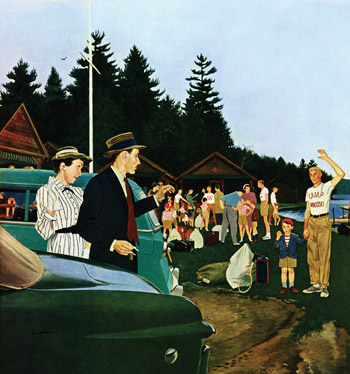
Have a good time at camp, and goodbye.
We will pick you up come mid-July.
While you fight off mosquitos,
We’ll sip on mojitos
And blast the ol’ A/C on high.
Congratulations to Jennifer Klein of Tel Aviv, Israel! For her limerick, Jennifer wins $25 and our gratitude for her witty and entertaining poem describing First Day at Camp, George Hughes’ cover from July 3, 1954.
If you’d like to enter the Limerick Laughs Contest for our next issue of The Saturday Evening Post, submit your limerick through our online entry form.
We received a lot of great limericks. Here are some of the other ones that made us smile, in no particular order:
As much as I want to enjoy it,
An issue exists that might spoil it.
Not the missing TV
Or my teddy, you see,
But the lack of a working flush toilet.—Paul Desjardins, West Kelowna, British Columbia, Canada
To his parents it’s perfectly clear:
Their boy does not want to be here.
All morning he’d fussed,
But he soon will adjust,
And be begging to come back next year.—Joyce Petrichek, Finleyville, Pennsylvania
We’ll see you the first of September.
You’re mad at us now, but remember:
If Mom gets her way,
By April or May
We’ll have a new family member.—Roger Harris, New York City, New York
The mother, she looks apprehensive.
The boy looks a little bit pensive.
And as for the dad,
I suppose that he’s mad
That this summer camp’s so darn expensive.—Neal Levin, Bloomfield Hills, Michigan
Daddy says camping is cool —
No homework, no lessons, no school.
Now I will have fun
But they will have none,
Just drinking their wine by the pool.—Bonnie Draje, Solon Springs, Wisconsin
Just think of the fun you’ll discover
At camp, while I’m home with your mother.
And if all goes to plan
We will increase our clan,
And you will come home a big brother!—Michelle Gordon, Airway Heights, Washington
Our look says, “We love you, dear one.”
We know that this camp will be fun.
Yet, while you’re away,
We grown-ups will play,
And we’ll miss you — a little — dear son.—Joan O’Kelley, Hoschton, Georgia
A boy tries his best not to cry
As his mom and his dad wave goodbye.
I don’t mean to annoy,
But which one’s their boy?
The artist does not specify.—Sam Beeson, American Fork, Utah
This seemingly heartbroken scamp
Is secretly eager for camp.
It gives him a while
To practice a style
His parents would otherwise cramp.—Jeff Foster, San Francisco, California
Branches
We climb the old maple tree and sit, legs swinging, as our parents push cautious hands together and file inside, their faces flushed with the guilt of secretly saying things they know we already know. She climbs a branch higher than me and perches there, like a white-faced bird about to fly away. I sit low. Closer to the ground. Solid and heavy and breathless with fear.
It’s August. I can feel the spiders of sweat down my back, her blue bangs stick like warm plastic to her forehead. She wipes her hand across her eyes. Eyeshadow smears, a gory effect on her pale skin.
The universe is not for us this summer. I am back in the thick black clothes I said I threw away, safety pins in my ears, a hood over my head, hiding behind the dark and the strange. She’s started drawing on her hands for the first time since her grandma died, swoops of ink curving off her nails, striping her fingers, dangling loose-ended over her wrists. Looking at us, an uninformed stranger would shake his head. Mutter rude remarks. Might even go so far as to call us ungrateful teenagers, emo for no reason. No one could tell that the skinny girl with fake tattoos is dying from the inside out.
She talks too fast, telling me what has happened since we were last together. We don’t see each other much anymore. I have always known that happens, that the people you are friends with as a kid will move and marry and make families so big there is no room for you left in their hearts. I never thought of dying, but I’m sure that is included.
Looking at her and the smeary eyeshadow war paint, the staticy strands of hair, the way you can see her heartbeat in her neck, I feel a sudden ache, like a gap in my chest is filling too fast with water. I can’t lose her.
I don’t have a choice.
Last year, when she told me everything, I climbed to the top of the maple and tried to make myself fall. Tried to pretend that my death was unavoidable, that I had to live every moment knowing it was soon to come. It was no use. I am a coward. My hands knotted around the tree. My feet were stubborn. Climbing down, I knew for a certainty that I am selfish; selfish for my inability to jump, selfish for my health, selfish because every inch of me is glad that I am not her.
“What if we fall?” I ask her. My voice is a sudden rasp in the quiet. It almost frightens me.
She looks from her inky hands to the ground to my white knuckles around the branches. I can’t meet her stare. Instead, I squint, counting rocks on the earth below. In the corner of my eye, I see her smile, reach to her head. Her blue wig drops past my sneakered toe and lands sprawled and crooked on the ground. She laughs like she’s crying, bitter and hard.
“We won’t.”
Winter comes. One night I go to sleep with an angry wind outside my window, the next morning the old maple is twisted and cracked and fallen.
She comes over to wish it well before it gets hauled away. We go and stand over what was the highest spot. I don’t know about her, but I am picturing the tree upright again, us still in the top, two stars caught in the branches.
She’s traded in her blue wig for one of those baby-blanket-pink cancer caps she swore she’d never wear. Her hands are gray, like she washed them but never redrew the lines. I wonder when was the last time she traced over the spikes and spirals, the elaborate curves that meant nothing and everything.
It has been two entire months since I’ve seen her. The thought of that makes me feel hollow. What did she do in those two months? What far away members of her family came and stroked her hair and said Sorry? How many times did she have to go to the hospital? Did she ever think of me and our big old tree, the way we thought of her?
I would ask her, but her lips part, and she speaks before I can.
“So,” she says.
“So?” I repeat. Please God, don’t let that be all we can say today.
She shakes her head. Her cheekbones are as sharp as the tree’s broken branches.
“I need to ask you.” She says it as a complete sentence. Her lips draw in against her teeth like she’s chewing lemons.
“Anything.”
She pulls her coat closer around her. Her eyes are a faraway gray. I reach out, close my hand around hers.
“Who will be your friend?” She blurts. “After I …”
Looking at her eyes, I see a miniature glassy me. I am pulling away. I am crying. I am shaking my head. I don’t feel anything, but I am saying “no no no.”
“You will,” she says. “You will.”
I shake my head again, pressing my folded arms against my body. Her eyes gloss over and she looks away.
“You better,” she says. “Someone needs to take care of you.”
She hugs me, and again, all I can think of is how much she reminds me of a bird. Her skinny arms wrap around me, and I could swear her bones are hollow.
“My poor friend,” she laugh-cries into my shoulder. “Everything will be okay.”
And now we’re hugging and laughing, and neither of us will say it: Everything will be okay.
But only for me.
Then it’s just us talking again, and then her mom is pulling up, and then it’s too cold for you out here sweetie, and then she’s gone.
I see her one more time. It’s March now, and winter is already fading into a thought. Mud squishes against my boots as I walk into the funeral parlor, and I feel a flush spread over my face, thinking of the footprints I must be leaving.
She looks pretty. I’d forgotten that, the prettiness of her face. They put a blond wig on her, curly and long the way her hair used to be, and her eyebrows are drawn in dark the way she liked them. It doesn’t look like the her she has been, but I can forgive them that.
It’s something else.
Her hands. They are bone white, blank, every inch of them wiped clean from every place where she drew and redrew her soul. I feel a wave of vomit lurch up my throat, and I clap my hands over my mouth.
I need to leave. I need home. I need the old maple to cradle me. But my parents are crying with her’s, and so I don’t know how to get home, and the tree is gone anyway. Same as her. Both to be carted away and burned and gone, leaving me alone. Nothing left.
I wish I could have drawn those lines back on her, for her parents. I would have, if they had asked me to. I saw them so many times, they were a part of me too. I think it’s impossible to love something that fiercely without it becoming part of you, growing off you, smaller than your original self, but there. Splitting apart, simultaneously new and old. Like branches.
I dig in my purse. Pull out a pen. Uncap it.
Then I press the tip to my skin and close my eyes.
Everything will be okay.
News of the Week: Neiman Marcus, the Mark Twain Prize, and Halloween Food and Films
Have You Started Your Christmas Shopping?
If my local supermarket and TV commercials are any indication, it’s never too early to think about Christmas, even if Halloween is still a few days away. But my sister asked me back in August what I wanted for Christmas this year (I didn’t have an answer but should have said “cold weather”), so people do think about what to buy weeks, even months, in advance. Many of us are still shopping on December 23.
But if you’re Christmas shopping now, you can peruse the new Neiman-Marcus Christmas catalogue for ideas. This year’s list of gifts include limited-edition Rolls Royce cars for $439,625 (blue) and $445,750 (orange), a fancy handbag and a vacation in Paris for $45,000, and a private New Year’s Eve party for you and 300 of your friends (Facebook or real-life) at the Knickerbocker Hotel in New York City for $1.6 million.
Honestly, I don’t want anything that extravagant. I don’t need much. Just put $1,000 in an envelope with a card and I’ll be happy.
And the Mark Twain Prize for American Humor Goes to…
David Letterman has been in the news a lot the past few weeks. First came the announcement that he had signed to do a new talk show on Netflix, and then last week he was a guest on Jimmy Kimmel Live, along with Paul Shaffer. This week Letterman received the Mark Twain Prize for American Humor at the Kennedy Center. On hand to honor Letterman were Kimmel, Bill Murray, Steve Martin, Martin Short, Amy Schumer, and Pearl Jam’s Eddie Vedder.
PBS will televise the event on November 20 at 9 p.m.
There’s a New Magnum, P.I. Coming

.jpg)
Last September I told you about a reboot of Magnum, P.I. that ABC had in the works. I don’t know the status of it now, but it was going to be a reboot, not a remake, with Magnum’s daughter living in Hawaii and solving cases. Since Tom Selleck wasn’t going to star in the show, this was a means to do things in an updated way while letting Selleck and the rest of the original cast make guest appearances. I was so happy ABC wasn’t going to try a straight remake.
Guess what? CBS is doing a straight remake.
The network has announced that the team behind shows like the new Hawaii Five-0 and MacGyver remakes are working on a new, updated version of Magnum, P.I. There will be a new, younger Thomas Magnum, and this time the character of Jonathan Higgins will be a woman, Juliet Higgins. That last bit of news makes me cringe a bit, but I’ll hold my opinion until it premieres. I’m more worried about the fact that the show is going to be done by the people behind the Hawaii Five-0 and MacGyver reboots, two shows that, well, just aren’t that good. I have this feeling they’re going to try to fit the show into the CBS template you see on Scorpion and NCIS, focusing more on the “team” aspect and not the lead character. Part of what made the original so great is that it wasn’t just a dumb ’80s action show with car chases and girls in bikinis. It had depth and drama, and you really cared about the characters.
I hope they can somehow re-create the tone of the original. Otherwise, this could turn out to be nothing more than Magnum, P.U. (Thank you, ladies and gentlemen! Don’t forget to tip your waiter.)
Scared to Death

People often throw around the phrase “scared to death” in a casual way. When something minor and mild happens, they’ll say, “I was scared to death!” They don’t mean it literally (if that were true, they couldn’t actually speak those words), but can a person actually be scared to death?
Katie Heaney at The Atlantic wondered the same thing after watching the movie It, so she contacted several experts to find out if someone can actually be so frightened that they die. She hoped the experts would tell her she had nothing to worry about, but they actually told her “any heightened emotional state … can kill you.” Even watching the Super Bowl can kill you by inducing heart attacks.
In related news, Justin Timberlake is going to be the halftime act at the next Super Bowl in February. If Janet Jackson shows up, that might give NBC executives a heart attack, though maybe it’s time for a reunion.
What’s Your Favorite Scary Movie?
If there’s a movie that could scare you to death, it just might be Trilogy of Terror, the 1975 TV movie with Karen Black playing several roles in three different stories. The last story, where a little devil doll chases Black around her apartment, completely freaked me out when I watched it alone at the age of 9. In all honesty, it still freaks me out when I think about it as an adult.
Turner Classic Movies is having a horror movie marathon all day on the 31st, with such hallmarks as Poltergeist, 13 Ghosts, and House on Haunted Hill. Here’s the full schedule.
Besides Trilogy of Terror, other scary films I like that are actually scary are Horror of Dracula, Psycho, Evil Dead 2, and of course the original Halloween. What’s your favorite movie to watch in the dark? Let us know in the comments below.
RIP Fats Domino, Robert Guillaume, Walter Lassally, Brent Briscoe, Paul Weitz, Ben Bates, and Warren Burton
Fats Domino was one of the iconic, influential stars in the early days of rock ’n’ roll, with such hits as “Blueberry Hill,” “Ain’t That a Shame,” and “I’m Walkin’.” He died Tuesday at the age of 89.
Robert Guillaume was probably best known for his role as butler Benson on the sitcom Soap and the spinoff show Benson, though he was also a fantastic stage actor and equally good in the short-lived Aaron Sorkin show Sports Night. Guillaume also died Tuesday, also at the age of 89.
Walter Lassally was a cinematographer who won an Oscar for his work on Zorba the Greek. He also worked on such films as Tom Jones, The Loneliness of the Long Distance Runner, Stone Pillow, and many documentaries and shorts. He died Monday at the age of 90.
Brent Briscoe was an actor who appeared in such films as Sling Blade, Mulholland Drive, A Simple Plan, and The Majestic, as well as TV shows like ER, Parks and Recreation (where he played JJ, the diner owner), and the recent Twin Peaks season. He died last Wednesday at the age of 56.
Paul Weitz was an astronaut and the commander of the space shuttle Challenger on its maiden flight in 1982. He was also a member of the first Skylab crew in 1973. He died Monday at the age of 85.
Ben Bates was a stuntman and actor who doubled for James Arness on Gunsmoke and appeared in many other TV shows and films over the years. He died on October 4 at the age of 84.
Warren Burton appeared on many soap operas over the years, including All My Children, Guiding Light, Another World, and Santa Barbara. He also appeared in films such as Gettysburg and Green Lantern. Burton died October 2 at the age of 72.
This Week in History
Walt Disney Testifies to HUAC (October 24, 1947)
HUAC stood for House Un-American Activities Committee, the group organized in the late 1930s to investigate whether U.S. citizens, government employees, or companies had any communist ties. Even Walt Disney had to testify during the hearings.
Harry Houdini’s Last Performance (October 24, 1926)
The great magician and escape artist was known for being able to take a punch to the stomach. But he wasn’t ready for the punch from a college student just before a show in Montreal. Even though he was injured, he refused to go to a hospital and spent the next week doing shows. He died in Detroit a week later — on Halloween — of peritonitis and a ruptured appendix, though some aren’t sure if the stomach blows led to his death.
Some groups actually hold séances on Halloween night to contact the spirit of Houdini, which is funny, considering he devoted much of his life to debunking such things.
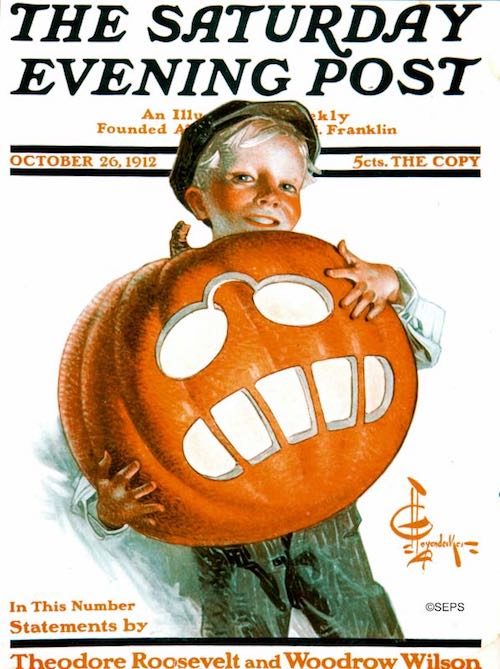
This Week in Saturday Evening Post History: “Teddy the Pumpkin” (October 26, 1912)
J.C. Leyendecker
October 26, 1912
This cover by J.C. Leyendecker depicts the face of Theodore Roosevelt, who ran for president against former friend William Howard Taft in 1912, even though Roosevelt had already held the office from 1901 to 1909. Neither won the election, and Roosevelt died seven years later.
If Roosevelt’s face isn’t immediately recognizable to you, I think David Letterman kinda works too.
Halloween Recipes
I’ve never understood the adult fascination with Halloween. I can understand kids getting excited by dressing up and getting five pounds of free candy, but I don’t get why October 31 is such a popular holiday with adults. I know people who spend more on Halloween than they do on Christmas. The night has changed a lot since I dressed up as Batman, and I think we should give it back to the kids.
But that doesn’t mean adults can’t enjoy the food of Halloween. How about this pumpkin-is-vomiting Guacamole Dip from Food Network’s The Kitchen? Or how about, from the same show, a Halloween Party Cake that looks like a graveyard, complete with headstones and dirt? Kids might like these Mummy Cookie Pops from Recipe Girl, and if you’re over 21 and fancy a cocktail, HGTV has a great list, including a Morgue-A-Rita and a Mr. Hyde Potion.
And if you find yourself at certain Taco Bell locations in Wisconsin (oh, if I had a dollar for every time I found myself at a Taco Bell in Wisconsin), you can try their new Chocoladilla, which is melted Kit Kat or Twix bars inside a grilled tortilla.
Next Week’s Holidays and Events
The David S. Pumpkins Halloween Special (October 28)
Last year, Saturday Night Live had a really goofy but undeniably funny sketch involving Tom Hanks as “David S. Pumpkins,” part of a “Haunted Elevator” Halloween ride. Now comes an all-new animated Halloween special, which airs Saturday at 11:30 p.m. on NBC, just before an SNL Halloween “best of” episode. Any questions?
Mischief Night (October 30)
We never knew about Mischief Night when I was a kid. If you wanted to decorate a home with toilet paper or a car with fresh eggs, you did it on Halloween night. You mean to tell me we could have done it two nights in a row?
Movember Begins (November 1)
“Movember” is the official name of the month devoted to men’s health. It’s also the month that the guys on Today, including Matt Lauer and Al Roker, stop shaving to support the effort and look like hoboes for 30 days.
Movies for the Rest of Us with Bill Newcott: God’s Not Dead
Award-winning film critic and writer Bill Newcott has been covering Hollywood for more than 40 years. He is the creator of AARP’s Movies For Grownups franchise and the movie critic for The Saturday Evening Post.
Rockwell Video Minute: Happy Halloween
Jack-o-Lanterns have made many appearances on the Post’s fall covers. It’s no surprise that Norman Rockwell’s earliest Halloween cover displays his own unique style.
See all of the videos in our Rockwell Video Minute series at www.saturdayeveningpost.com/rockwell-video.
How to Get a Good Night’s Sleep
The U.S. is in the middle of a “catastrophic sleep-loss epidemic,” according to Matthew Walker, director of the Centre for Human Sleep Science at the University of California, Berkeley. This lack of sleep affects all aspects of our health and may lead to obesity, mental health issues, and heart disease. Many place the blame on our modern way of life, with always-on devices, stressful jobs, and a wearying news cycle.
While sleeplessness may be on the rise, insomnia has plagued our nation from the start. Saturday Evening Post founder Ben Franklin was an acknowledged insomniac. He would wake up in the middle of the night and wile away a few hours reading in a chair (preferably naked).
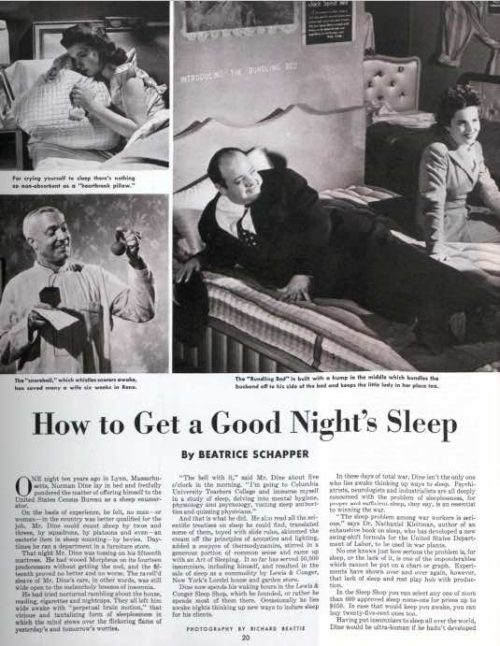
In 1942, Americans’ sleep troubles were made worse by the country’s entry into World War II. In this light-hearted article from October 24 of that year, author Beatrice Schapper highlights the efforts of one man and his “Sleep Shop” to improve the slumber of stressed Americans. The devices could be comical — snore balls, bundling beds and smoking tubes are all featured — but the basic advice has never changed: find yourself a relaxing bed, a relaxing environment, relaxing devices, and a pleasant awakening.
If all else fails, the article leaves you with this cheery thought: “Don’t be afraid of insomnia. It won’t kill you not to sleep.”
Why Steinbeck Almost Didn’t Win the Nobel Prize
After the release of The Winter of Our Discontent in 1961, it occurred to the Swedish Academy that — after a drought of important fiction — perhaps John Steinbeck might still have a glorious summer ahead of him as a major candidate for the Nobel Prize in Literature. Steinbeck was announced as the Nobel laureate in 1962 — on this day — after what was later discovered to be an unenviable contention: The Swedish Academy didn’t consider any of its literature candidates worthy of the prize.
This inside knowledge wasn’t available at the time, of course. The Academy keeps its records of candidates and discussion private for 50 years. In 2012, the documents from 1962 were made public, and they revealed that Steinbeck was actually chosen out of necessity for a winner rather than enthusiastic acclaim from the committee. The Swedish Academy announced, on October 25, 1962, that it was awarding the prize to Steinbeck “for his realistic and imaginative writings, combining as they do sympathetic humour and keen social perception.” But, according to Svenska Dagbladet, committee member Henry Olssen had written of the choices, “There aren’t any obvious candidates for the Nobel Prize, and the prize committee is in an unenviable situation.” British authors Lawrence Durrell and Robert Graves were among the other candidates.
Despite accusations that Steinbeck’s work amounts to “tenth-rate philosophizing,” his novels and essays are still read widely in American classrooms. Sprawling novels such as The Grapes of Wrath and East of Eden and shorter studies of humanity like Of Mice and Men occupy the American consciousness with authentic tropes of our past.
Though Steinbeck never wrote fiction for The Saturday Evening Post, his last published piece, a 1966 essay called “America and the Americans,” was a cultural indictment as well as a unique celebration of the American people that appeared in the pages of the Post. The editor’s foreword to the piece warned: “The Grapes of Wrath roused a storm of controversy because of its strongly proletarian sympathies,” but the essay that followed was less in Steinbeck’s leftist tradition than it was in his tradition of “keen social perception.”
Steinbeck’s essay reads, even in 2017, as an apt analysis of America’s issues with affluence, racial tensions, and a new search for meaning. “America and the Americans” delivers Steinbeck’s ability to dissect family and culture across generations to diagnose 20th — and maybe 21st — century problems. “Even in our so-called virtues we are intemperate,” he writes, “…We are able to believe that our Government is weak, stupid, overbearing, dishonest, and inefficient, and at the same time we are deeply convinced that it is the best Government in the world, and we would like to impose it upon everyone else.”
His critique of uniquely American attitudes and paradoxes seems to support the Academy’s reasons for awarding him the highest honor in literature, even if the Swedish committee was initially apprehensive at their choice.
Steinbeck delivered an acceptance speech for his award in 1962, giving his take on “the nature and direction of literature” and offering his signature view of humanity’s needs and threats. He died in 1968, two years after “America and the Americans.”
Ironically, after leaving the world with a scathing critique of consumerism and excess, his heirs continue to wage multimillion-dollar lawsuits against one another to profit from his estate. Of course, endless litigation is as American now as migrant farming was during the Great Depression. Steinbeck’s legacy was one of a historian as well as an admonisher, out to save us from ourselves: “Could it be that below the level of thought, our people sense the danger of the swarming, crowding invasion of America by Americans?”
Cover Collection: The Striking Art of Guernsey Moore
Guernsey Moore (1874-1925) was instrumental in changing the look of The Saturday Evening Post in the early 1900s. In the 1800s, the Post looked like a standard tabloid newspaper; Moore and artist J.J. Gould redesigned it to be the illustration-heavy magazine that still exists today.
Moore was one of the most prolific artists for the Post, painting 62 covers over the course of his career. His work was immediately recognizable for its heavy black outlines, poster-style compositions, and somber models. Below is a selection of some of our favorite covers.
June 30, 1900
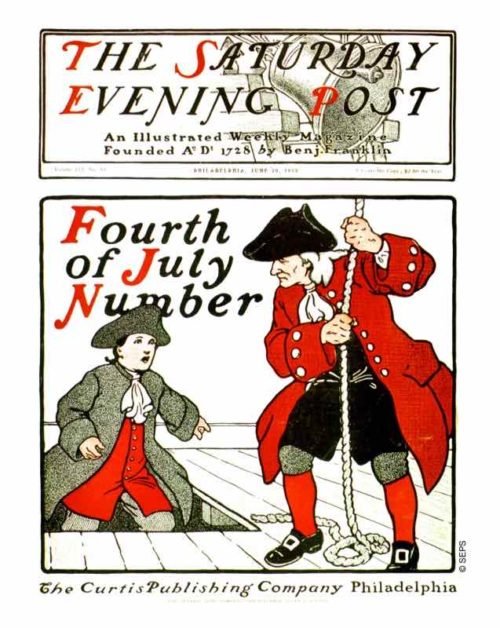
This cover from June 30, 1900, was the Post’s first Fourth of July cover, as well as Moore’s first cover for the magazine. Here we see patriots ringing the Liberty Bell. Using colonials as representatives of the Fourth was popular before the days of fireworks and parades. Note that Moore also illustrated the new lettering for the Post’s masthead.
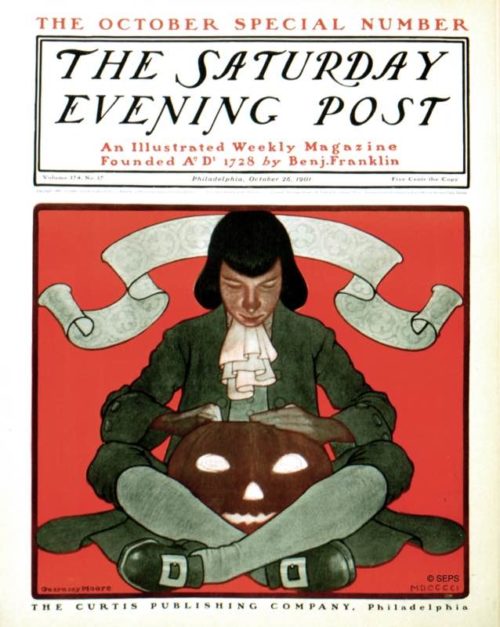
October 26, 1901
Moore’s Halloween cover shows that Jack-o-lanterns have been popular for quite some time. In fact, they date back to nineteenth century Ireland, where turnips were carved into grotesque faces in order to ward off evil spirits.
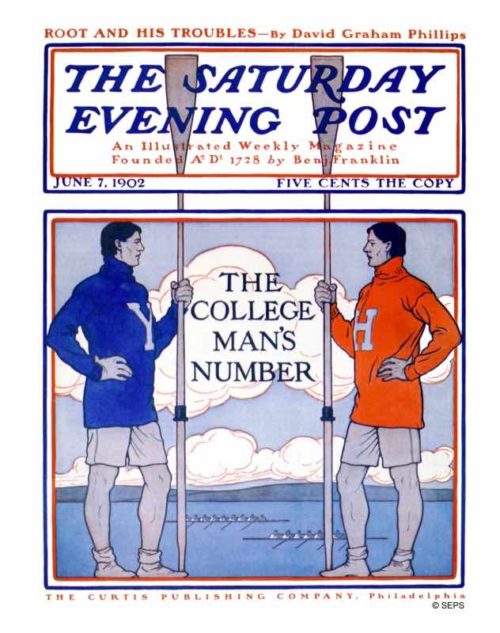
June 7, 1902
Throughout the nineteen-aughts, the Post featured at least one “College Man’s Number” a year, highlighting the benefits that these (mostly Ivy League) schools could impart to virile, dapper, and fun-loving young men. According to Daniel A. Clark in his book, Creating the College Man: American Mass Magazines and Middle-Class Manhood, “In no uncertain terms, the transformation of the college man was intertwined with a broad shift in masculine ideals that occurred in the late nineteenth and early twentieth centuries.” As one of America’s most popular magazines, the Post played a significant role in facilitating that shift.
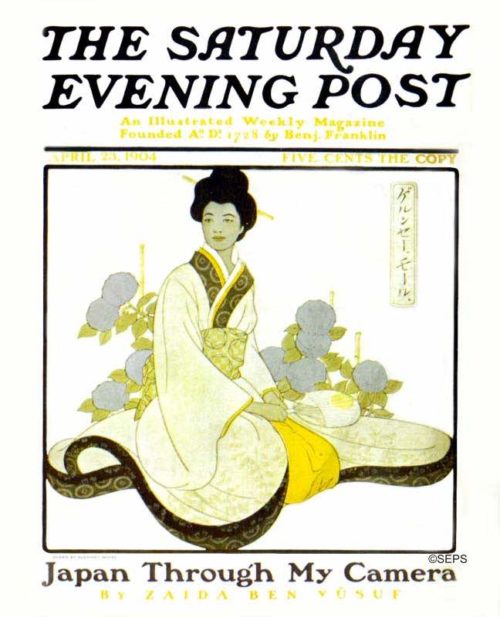
April 23, 1904
America’s interest in Asian culture grew in the 1920s, showing up in Western fashion, furniture, and textiles. This interest in the Far East was also reflected in many Saturday Evening Post covers of the era, including Moore’s depiction of a Japanese woman.
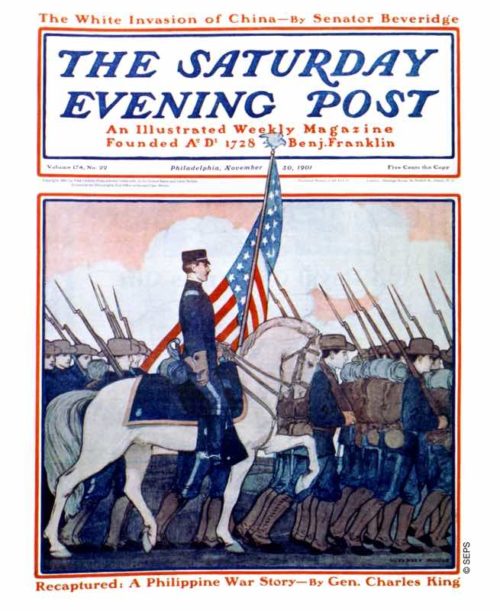
November 30, 1901
This illustration captures a scene from the little remembered Philippine-American War, 1899-1902. The conflict was sparked when the U.S. took possession of the Philippines from Spain at the conclusion of the Spanish-American War.
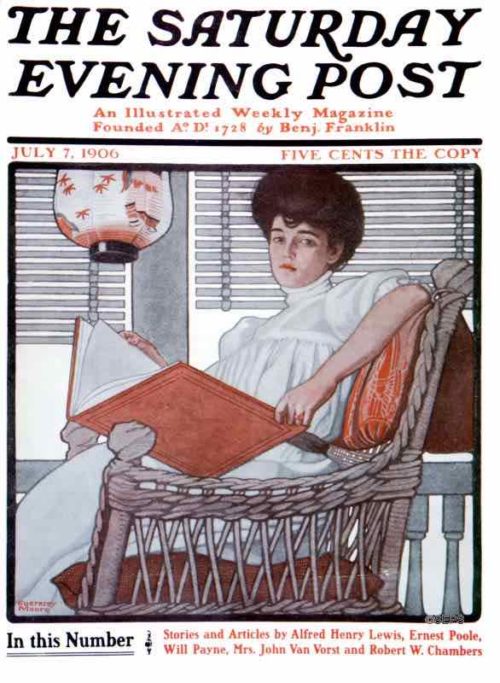
July 7, 1906
This seated woman is typical of the way Moore painted all of his models; in the midst of some enjoyable activity, but with a somber gaze. Whether they were gardening, baking, or receiving a valentine, they rarely looked happy about it. Note the Asian décor represented by the paper lantern.
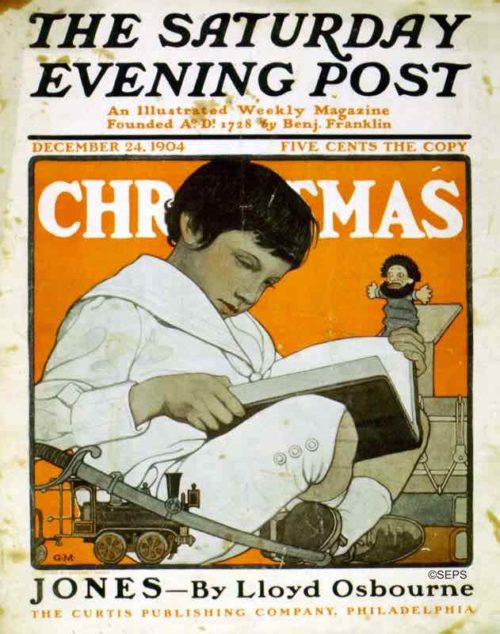
December 24, 1904
The Saturday Evening Post loved its Christmas covers, and Moore painted several. This was one of his few covers featuring a child. Despite being surrounded by many new toys, the boy’s subdued expression is quinetessential Moore.
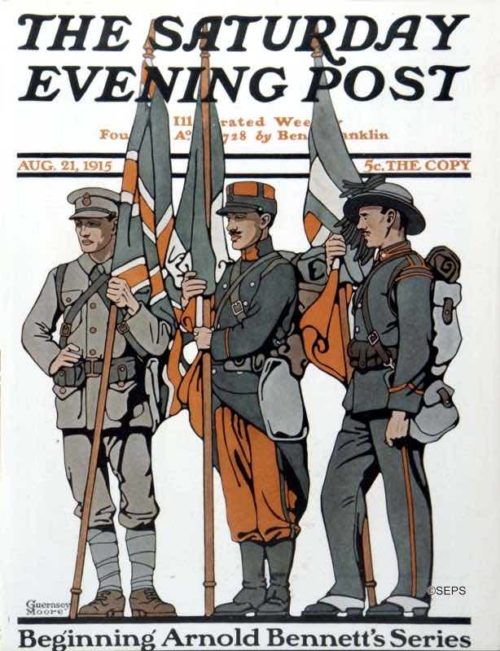
August 21, 1915
Moore depicted British, French, and Italian, soldiers, representing the three leading allied nations in Europe. Although the United States would not join World War I until 1917, the Great War was obviously on the minds of many Americans.
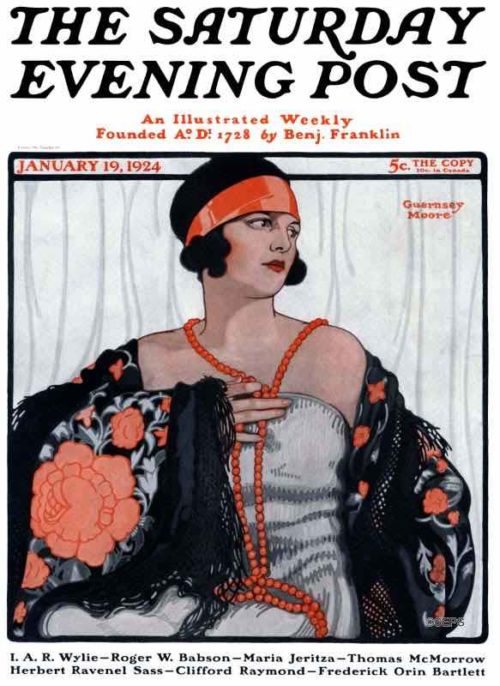
January 19, 1924
This is the last cover that Guernsey Moore painted for the Post. The cover is representative of his heavily outlined Arts and Crafts style. The large, brightly-colored flowers borrow motifs of the Far East.
North Country Girl: Chapter 23 — A Global Citizen Goes to the Deeps
For more about Gay Haubner’s life in the North Country, read the other chapters in her serialized memoir. The Post will publish a new segment each week.

If there was anything my mother hated, it was a mopey girl lounging on the couch with a magazine or book, sighing and pointedly not helping with housework. So she signed me up for a four-hour summer class at Woodland Junior High on Global Citizenship. The class was led by two serious young men who spent a lot of time boasting that they regarded us not as students and teachers but as equals; we were all partners in this amazing learning experience. They were do-gooders: they encouraged us to spend the afternoons with them as they canvassed for Fair Housing, knocking on doors and trying to explain to puzzled housewives that they should display the blue and white Fair Housing sticker on their front door to show that they would happily rent to black people. No one in our neighborhood rented out rooms in their home, and there was a dearth of black people to rent to. Our teachers gave us all Fair Housing stickers for our own doors; my mother immediately tossed it in the trash, muttering something about uppity Negros.
What were we supposed to learn in this summer class? To this day I have no idea.
From eight to ten, we played a weird model UN game. We were broken up into countries by lot. Each country had a round table with a small flag stuck in the middle and six to eight kids sitting around it, squabbling about who got to be President and who Minister of War. I was Ambassador to the UN and made regular trips to the big square table at the front of the room that proudly displayed a large blue and white flag that stood for unity and peaceful intentions.
Each country started with the same population and resources, it was up to us to decide whether we wanted to grow wheat, mine coal, trade with other countries, build cities, raise taxes, hold elections, or invade a neighboring country. The first few weeks of this were mildly entertaining; there were kids from other junior highs so there were new boys to yearn for. The rules were extremely complicated and required continuous hashing out and interventions by the teachers to resolve. Every day at ten we had to fill out mimeographed forms indicating what we as a nation had accomplished. The teachers took these forms and spent hours correlating them with the help of an overstuffed binder filled with the different formulae and outcomes for this very weird role-playing game. Each morning at eight, there were typed sheets waiting for us on our table, telling us if our country was deep in debt, had an unhappy populace, raised enough wheat to trade for iron, or had captured a foreign capital. This game, meant to teach us peaceful co-existence, was like Esperanto, well-intentioned but impossible to learn and pretty boring.
We soon figured out that the most fun we could have was declaring war on each other. Speeches were made, bombs were dropped, ploughshares hammered into swords. Funny insults were traded between countries, under the disapproving eyes of the two young teachers. The next day the papers on our tables told the sad tale that we had destroyed the earth. We got a short, head-shaking lecture on how we were not following the spirit of the game, striving for world peace and a better life for our people, and were a disappointment to both teachers. Thankfully, this was not real life, the world would be resurrected, and the game could start over again. The second round, we wasted no time in even glancing at our agricultural outputs, called up the atomic bombs immediately, and ended the world in a matter of days. At that point, one of the teachers broke down completely, tore the papers up, and announced that the class was over.

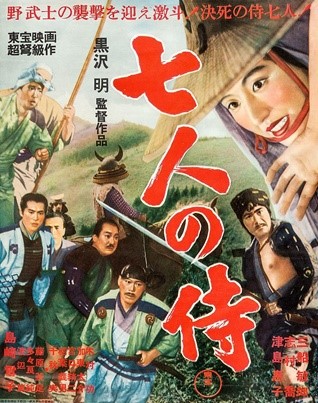
I wasn’t sad about the end of the stupid game, but by blowing up the earth twice, we had also killed off the second part of the class. From ten to twelve, the teachers huddled together over the binder and each country’s scrawled mimeographed sheet while we kids sat in a darkened classroom and watched movies, movies I had never heard of, that had definitely never made it to the Norshor or Granada theaters. Whoever selected the movies did a hell of a job. We saw Japanese movies: Yojimbo and The Seven Samurai. Italian movies: Juliet of the Spirits, Woman in the Dunes, Rocco and his Brothers. We saw The Seventh Seal, Nothing But a Man, and for some reason, The Good Earth, I guess as a nod to China. The movies were shown in a darkened classroom, one of the teachers appearing half way through to change the reel. At noon (or later, if it was a Kurosawa film) I would emerge blinking into the bright summer sunshine, more determined than ever to find a way out of Duluth and into the world. I felt as if I were stranded on an island, craning my neck and squinting over at another land close enough for me to almost make out its wonders, but impossible to swim to.
While my mornings were filled with world destruction and foreign films, my afternoons were gloriously unstructured. Cindy and I were still close, though she was spending more and more time practicing cheerleading, determined to make the East High junior varsity squad. She wanted me to try out with her, but I was too proud of my proto-hippie identity and too aware of my physical shortcomings to even consider a future as an East High Greyhound cheerleader.
At this point my father showed an unprecedented interest in my social life. “You should be friends with Mary Ann Stuart” he ruled, and drove me over to Northland Country Club himself to spend time with Mary Ann, the golf pro’s daughter. My dad must have owed him money. Mary Ann had been another shadowy figure in my life, appearing for a week or two in the summer around the Northland pool from her home in Clearwater, Florida, where she lived with her mother. But this summer she was to spend the entire time with her father, in a small rustic cabin on the country club grounds. Summer days are long in Duluth, and Mary Ann’s dad was out on the golf course from seven in the morning to seven at night. Mary Ann and I had the unheard of luxury of an entire house to ourselves. Put two 14-year-old girls in an empty house and they will have a single goal. The first thing Mary Ann said to me was, “Let’s go find some boys.” Mary Ann threw a cotton button-up shirt on over her bikini top and cut-off jean shorts, a look I copied every day that summer.
This was the official girl’s outfit at the Deeps, the best place to find boys, boys who were swimming and tanning and showing off. On a sunny day in Duluth, when the thermometer hit 75, the Deeps at Lester River were a teen wonderland, boys and girls, half-naked, checking each other out, arranged by the dozens on both banks, or waiting to make one of the Deeps’ death-defying leaps.

Despite everyone knowing someone’s second cousin who had cracked his head open on a discarded refrigerator lurking at the bottom of the Deeps, teenage boys ventured higher and higher dives, clinging one-handed to birch saplings before flinging themselves off the jutting cliffs. I was scared of the refrigerator, a white ghost just visible beneath the tannin-dark water, and stuck to the lower jumps well away from the Frigidaire. But one time in a desperate effort to get a boy to notice me, I worked up the nerve to launch myself off the 40-foot-high railway bridge spanning the Lester River downstream from the Deeps. My courage sprang from my near-sightedness; Mary Ann held my glasses so I couldn’t see how far below the river was. The impact tore my sandals apart and I had to walk back to Mary Ann’s shaking and barefoot.
Besides death from misadventure, the Deeps was also famous for smoking, beer drinking, necking, and even petting. Good girls from nice families, Cotillion girls, did not go to the Deeps; I knew better than to ever let slip to my parents that I spent almost every day there. And if I had not been in the company of Mary Ann Stuart, I would never have been brave enough to venture to the Deeps. Cindy was horrified at my daring.
But Mary Ann knew how to talk to boys, who talked back to her large breasts. I had heard Northland Country Club pool mothers cluck about Mary Ann’s “early development,” and she continued to develop. I learned from Mary Ann what you really needed to get a boyfriend and it was not a winning personality or a cute dress or Yardley lip gloss. My breasts were barely big enough to justify wearing a bikini top, but I benefited from the halo effect given off by Mary Ann’s Playmate-worthy chest.
Boys would wave and call out “Mary Ann!” before they made their terrifying leaps into the river. Boys would offer Mary Ann Tareyton or Old Gold cigarettes and Mary Ann would smoke them. Boys would ask Mary Ann about life in exotic Florida. I would stand to the side and try to look interesting.
Sometimes Mary Ann would pretend to be mad at one of her suitors, and I at least got to talk to a boy, even if all he wanted was to know was how to get Mary Ann to pay attention to him again. Mary Ann would spot us whispering together and say later, “I think he likes you,” and I would sigh, wishing it were so.
Mary Ann finally made her selection from the worthy contenders: Dave Arsenault, tall for his age, a Cathedral High football and hockey player, and a famous Deeps diver. By the beginning of July he had achieved a nut brown tan, which set off his dreamy white-toothed smile and his thatch of dark hair, just long enough to be cool, and soon to be cut down to a crew cut by his football coach.
As the sun dropped between the trees on the other side of the river, Mary Ann said, “Dave, you want to come over to my house?” Dave did, and he and Mary Ann vanished into her room, while I lounged on the creaky, dusty couch, paging through old golfing magazines before giving up and going home.
And just like that, Mary Ann and Dave were boyfriend and girlfriend, and I was the third wheel. This was an unacceptable situation to Mary Ann; she ordered Dave to find a boy for me. She was a real friend.
I ended up with Steve LaFlamme, another Cathedral High hockey player and a knock-off version of Dave Arsenault, but still way too cute for a girl of my middling looks, a girl with smaller than average breasts who wore weird glasses. Steve just ambled back to Mary Ann’s house one afternoon with us; when Mary Ann and Dave disappeared into her bedroom, Steve sat down next to me on that saggy, scratchy sofa. I watched, terrified, as his head loomed in closer and closer to mine, until our faces were smashed together. Oh my god I’m being kissed, what is he doing with his tongue, it feels huge, I can’t wait to tell Cindy, where is my own tongue suppose to go? I disentangled myself to take off my glasses, which were digging into the side of my head, and thinking that now Steve would get to admire my true beauty. Steve took one look, screwed his eyes shut, and went back in for the kill.
By the time Dave emerged from Mary Ann’s bedroom, collected Steve, and waved goodbye, my lower face was achy and sore. I didn’t care. My first kiss and was what we did necking or making out? Did this mean he was my boyfriend? I guess I liked him, even though he never actually talked to me, outside of asking, “You’re going to East?” I wasn’t sure he knew my last name so how was he going to call me? Dave called Mary Ann every evening.
That night I mentally kicked Napoleon Solo, Mick Jagger, and Robert Plant out of bed and fell asleep imagining Steve telling me how much he liked me, Steve kissing me, Steve reaching over the table at Somebody’s House to hold my hand, Steve kissing me, Steve and I frolicking in the pools at the Deeps, Steve kissing me…
9 Frightful Fungi That Will Freak You Out
Toadstools can make for a spooky sighting. These eldritch fungi are nature’s Halloween decorations. (Warning: pictures of stomach-turning fungus ahead.)
- 1. Bleeding Tooth (Hydnellum peckii)

Photo by H. Krisp The “Bleeding Tooth” mushroom is a niche nightmare for dental hygienists. The early stages of the fruiting bodies, or the mushroom caps, ooze a red liquid. They are found among conifer needles in North America and Europe. Resist the urge to pop this one into your mouth; though it isn’t toxic, the Hydnellum peckii is not a sweet tooth.
2. Devil’s Fingers (Clathrus archeri)

Photo by Bernard Spragg Resembling an evil octopus rising from the underworld to claim a victim, the “Devil’s Fingers” mushroom spawns from a sort of gelatinous egg and produces a rotting smell. Its fruiting body fans out like tentacles with maturity.
3. Jew’s Ear (Auricularia auricula)

Photo by Svdmolen When a tree falls in a forest, it does make a sound, because this mushroom hears it. The “Wood Ear” or “Jew’s Ear” fungus grows on the elder tree. Apart from its striking resemblance to the human ear, the mushroom was named after Judas Iscariot, who was said to have hung himself from an elder. The aural fungus was thought to be a manifestation of Judas’ spirit.
4. Ophiocordyceps

Photo by Steve Axford at Mushroom Observer This genus of “zombie fungi” are parasites of insects, infecting a host bug and controlling its behavior to benefit the mushroom. The Ophiocordyceps release a chemical into the insect’s brain that hijacks its nervous system, causing it to move with unusual, jerky movements. The fungus directs the bug upwards and bids it to bite into some sort of stem. From there, a fruiting body will emerge from the insect to release more spores for its zombie army.
5. Lattice Stinkhorn (Clathrus ruber)
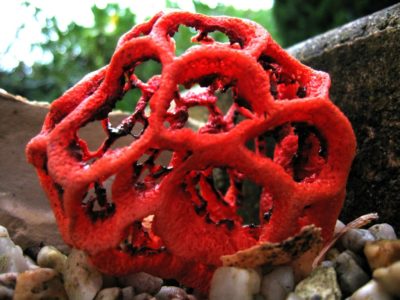
Photo by Biusch Much like its monstrous cousin, Devil’s Fingers, the Lattice Stinkhorn mushroom grows from an egglike sac. The “eggs” have been cooked and eaten in some cultures, although the mature mushroom reportedly causes sickness when ingested.
6. Rhodotus
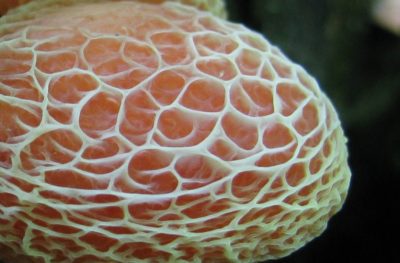
Photo by Dan Molter The netted, veiny appearance of Rhodotus fungi is appalling or winsome, depending upon one’s tolerance for fleshlike mushrooms. In any case, the genus is considered endangered or extinct in several European countries. Hungary even enforces fines for destroying these extraterrestrial toadstools.
7. Ascocoryne sarcoides

Photo by Daryl Thompson at Mushroom Observer No, those aren’t entrails; it’s just a cluster of Ascocoryne sarcoides, or Jelly Drop mushrooms. Studies have suggested a Jelly Drop presence in boreal forests of North America and Europe coincide with fewer harmful fungal infections, specifically in the black spruce.
8. Podostroma cornu-damae

Photo by Kouchan The appearance of this Japanese mushroom is playful and, perhaps, inviting, but the Podostroma cornu-damae is a highly toxic species that causes brutal and idiosyncratic symptoms. Patients who ingest this mushroom — often mistaking it for another — mostly perish within a few days from complications involving skin tissue, bone marrow, and blood toxicity. Best to leave this coral-looking fungus alone.
9. Dead Man’s Fingers (Xylaria polymorpha)

- These boney digits will grab your ankles if you stray too far into the woods. Probably not, in actuality, but the aptly named “Dead Man’s Fingers” appear to be a dusty zombie defying the grave. They are the fruiting bodies of Xylaria polymorpha, a saprobic fungus that only grows on dead trees and roots. Incidentally, young specimens are reportedly edible if you desire a secret ingredient for your next witch’s brew.
“At Geisenheimer’s” by P.G. Wodehouse
He came breezing up to me with Hicks Corners written all over him.
“Why, Miss Roxborough!”
“Why not?” I said.
“Don’t you remember me?”
I didn’t.
“My name is Ferris.”
He was probably right, but still the glad light of recognition kept out of my eyes. The name meant nothing in my young life.
“I was introduced to you last time I came here. We danced together.”
This seemed to bear the stamp of truth. If he was introduced to me, he probably danced with me. It’s what I’m at Geisenheimer’s for.
“When was that?” I asked.
“A year ago last April,” he said.
You’ve got to hand it to these rural charmers. They think that New York is folded up and put away in camphor when they leave, and not taken out again till they pay their next visit. The notion that anything could possibly have happened since he was last in our midst, to blur the memory of that happy evening, had not occurred to Mr. Ferris.
I suppose he was so accustomed to dating things from “when I was in New York” that he thought everybody else must do the same.
“Why, sure I remember you,” I said. “Algernon Clarence, isn’t it? ”
“Not Algernon Clarence. My name’s Charlie.”
“My mistake. And what’s the big idea? Do you want to dance with me again?”
He did. So we went to it. Mine not to reason why, mine but to do and die, as the poem says. If an elephant had blown into Geisenheimer’s and asked me to dance, I’d have had to do it. And I’m not saying that Mr. Ferris wasn’t the next thing to it. He was one of those earnest, persevering dancers — the kind that have taken twelve correspondence lessons.
I guess I was about due that night to meet someone from the country. There still come days in the spring when the country seems to get a strangle-hold on me and to start in pulling. I got up in the morning and looked out of the window, and the breeze just wrapped me round and began whispering about pigs and chickens. And when I went out on the Avenue, there seemed to be flowers everywhere. I headed for the Park, and there was the grass all green and the trees coming out, and a sort of something in the air. Why, if there hadn’t been a big cop keeping an eye on me I’d have flung myself down and bitten chunks out of the turf.
And the first tune they played when I got to Geisenheimer’s was the one that runs something like this:
I want to go back, I want to go back
To the place where I was born,
Far away from harm
With a milk-pail on my arm.
Why, Charlie from Squeedunk’s entrance couldn’t have been better worked up if he’d been a star in a Broadway show. The stage was just waiting for him.
But somebody’s always taking the joy out of life. I ought to have remembered that the most metropolitan thing in the metropolis is a rube who’s putting in a week there. We weren’t thinking on the same plane, Charlie and me. I wanted to talk about last season’s crops — the subject he fancied was this season’s chorus girls. I wanted to hear what the village patriarch said to the local constable about the hens — he wanted to hear what Georgie Cohan said to Willie Collier about the Lambs. Our souls didn’t touch by a mile and a half. Not that he cared.
“This is the life!” he said.
There’s always a point where this sort of man says that.
“I suppose you come here quite a lot.”
“Pretty often,” I said.
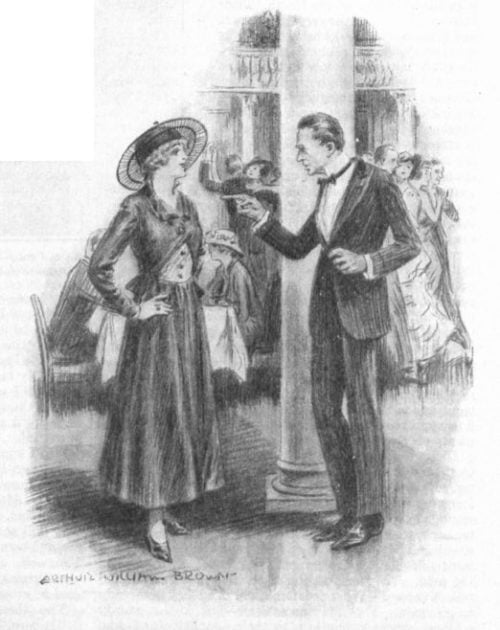
I didn’t tell him that I came there every night, and that I came because I was paid for it. If you’re a professional dancer at Geisenheimer’s you aren’t supposed to advertise the fact. The management has an idea that, if you did, it might send the public away thinking too hard when they had seen you win the Great Contest for the Lovely Silver Cup, which they offer later in the evening. And I guess they’re right, at that. That lovely silver cup’s a joke. I win it on Mondays, Wednesdays and Fridays; and Mabel Francis wins it on Tuesdays, Thursdays and Saturdays. It’s all perfectly fair and square, of course. It’s purely a matter of merit who wins the lovely cup. Anybody could walk right into Geisenheimer’s and get it. Only somehow they don’t. And the coincidence that Mabel and I always happen to gather it in has kind of got on the management’s nerves, and they don’t like us to tell people we’re employed at the restaurant. They prefer us to blush unseen.
“It’s a great place,” said Mr. Ferris, “and New York’s a great place. I’d like to live all the time in New York.”
“The loss is ours. Why don’t you?”
“Some city! But dad’s dead now, and I’ve got the drug store, you know.”
He spoke as if I ought to remember reading about it in the papers.
“And I’m making good with it, what’s more. I’ve got push and ideas. I’m doing fine. Say, I got married since I saw you last.”
“You did, did you!” I said. “Then what are you doing, may I ask, cutting up on Broadway like a gay bachelor? I suppose you have left Friend Wife at Bodville Center, singing ‘Where is my wandering boy tonight?”‘
“Not Bodville Center; Ashley, Maine. That’s where I live. My wife comes from Rodney. Pardon me, I’m afraid I stepped on your foot.”
“My fault. I lost step. Well, aren’t you ashamed even to think of your wife, when you’ve left her all alone out there, while you come whooping it up in New York? Haven’t you any conscience?”
“But I haven’t left her. She’s here.”
“In New York?”
“In this restaurant. She’s up there.”
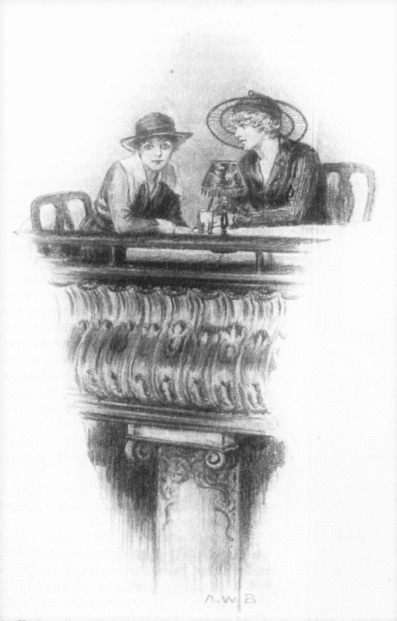
I looked up at the balcony. There was a face hanging over the red-plush rail. I had noticed it before when we were dancing round. I had wondered why she was looking so sorry for herself. Now I began to see.
“Why aren’t you dancing with her and giving her a good time, then?” I said.
“Oh, she’s having a good time.”
“She doesn’t look it. She looks as if she would like to be down here dancing.”
“She doesn’t dance much.”
“Don’t you have dances at Ashley?”
“It’s different at home. She dances well enough for Ashley, but — well, this isn’t Ashley.”
“I see. But you’re not like that.”
He gave a kind of smirk.
“Oh, I’ve been in New York before.”
I could have slapped his wrist, the sawed off little rube! He made me mad. He was ashamed to dance in public with his wife, didn’t think her good enough for him. So he had dumped her in a chair, fed her a lemonade, and then sashayed off to give himself a tall time. They could have had me pinched for what I was thinking just then.
The band started again.
“This is the life,” said Mr. Ferris. “Come along!”
“Let somebody else do it,” I said. “I’m tired. I’ll introduce you to some friends of mine.”
So I took him off, and wished him on to some girls I knew at one of the tables.
“Shake hands with my friend Vernon Castle,” I said. “He wants to show you the latest steps. He does most of them on your feet.”
“This is the life!” said Charlie.
And I left him and headed for the balcony.
She was leaning with her elbows on the red plush, looking down at the dancing-floor. They had just started another tune, and hubby was moving round with one of the girls I’d introduced him to.
She didn’t have to prove to me that she came from the country. I knew it. She was a little bit of a thing, old-fashioned looking. She was dressed in gray, with white muslin collar and cuffs, and her hair done simple under a black hat.
I kind of hovered for a while. As a general thing I’m more or less there with the nerve, but somehow I sort of hesitated to butt in. I guess it was because she looked so sorry for herself. Then I took a brace on myself and made for the vacant chair.
“I’ll sit here, if you don’t mind,” I said.
I could see she was wondering who I was and what right I had horning in, but wasn’t certain whether it might not be Broadway etiquette for strangers to come and sit down and start chatting.
“I’ve just been dancing with your husband,” I said to ease things along.
“I saw you.”
She gave me a look with her big brown eyes, and it was only the thought that the management might not like it that prevented me picking up something large and heavy and dropping it over the rail on to hubby. That was how I felt about Mr. Ferris just then. The poor kid was doing everything with those eyes except cry, and it didn’t look as if she could keep off that for long. She looked like a dog that’s been kicked and can’t understand why.
She looked away and began to fiddle with the string of the electric light. There was a hatpin on the table. She picked it up and dug at the red plush.
“Ah, come on, sis,” I said, “tell me all about it.”
“I don’t know what you mean.”
“Quit your kidding. You can’t fool me. Tell me your troubles.”
“I don’t know you.”
“You don’t have to know a person to tell her your troubles. I sometimes tell mine to the cat that camps out on the wall opposite my room. What did you want to leave the country for, with the summer just coming on?”
She didn’t answer, but I could see it coming, so I sat still and waited. And presently she seemed to make up her mind that, even if it was no business of mine, it would be a relief to talk about it.
“We’re on our honeymoon. Charlie wanted to come to New York. I didn’t want to, but he was set on it. He has been here before.”
“So he told me.”
“He’s crazy about New York.”
“But you’re not?”
“I hate it.”
“What’s your kick?”
She dug away at the red plush with the hatpin, picking out little bits and dropping them over the edge. I could see she was bracing herself to put me wise to the whole trouble. There’s a time comes, when things aren’t going right and you’ve had all you can stand, when you’ve got to tell somebody about it, no matter who it is.
“I hate New York,” she said, getting it out with a rush at last. “I’m scared of it. It — it isn’t fair, Charlie bringing me here. I didn’t want to come. I knew what would happen. I felt it all along.”
“What do you reckon will happen, then?”
She must have picked away an inch of the red plush before she answered. It was lucky that Jimmy, the balcony waiter, didn’t see her. It would have broken his heart. He’s as proud of that red plush as if he had paid for it himself.
“When I first went to Rodney,” she said, “two years ago — we moved there from Illinois—and began to get to know people, I found there was a man there named Tyson, Jack Tyson, who lived all alone and didn’t seem to want to know anybody. I couldn’t understand it, till someone told me all about him. I can understand it now. Jack Tyson married a Rodney girl, and they came to the city for their honeymoon, just like us. And when they got there I guess she got to comparing him with the fellows she saw and comparing the city with Rodney, and when she got home she just couldn’t settle down.”
“Well?”
“After they had been back in Rodney for a little while she ran away — back to the city, I guess.”
“And he got a divorce, I suppose?”
“No.”
“He didn’t?”
“He still thinks she may come back to him.”
“Still thinks she may come back? After three years?”
“Yes. He keeps her things just the same as she left them — everything the same as when she went away.”
“But isn’t he sore at her for what she did? If I was a man and a girl treated me that way I’d be apt to swing on her, if she tried to show up again.”
“He wouldn’t. Nor would I, if — if anything like that happened to me. I’d wait and wait, and go on hoping all the time. And I’d go down to the depot every afternoon to meet the train, just like Jack Tyson.”
Something splashed on the tablecloth. It made me jump.
“For the love of Mike!” I said. “What’s the trouble? Brace up! I know it’s a sad story, but it’s not your funeral.”
“It is. It is. The same thing’s going to happen to me.”
“Take a hold on yourself. Don’t cry like that!”
“I can’t help it. Oh, I knew it would happen. It’s happening right now. Look — look at him!”
I glanced over the rail, and I saw what she meant. There was her Charlie, cutting up all over the floor as if he had just discovered that he hadn’t lived till then. I saw him say something to the girl he was dancing with. I wasn’t near enough to hear him, but I bet it was “This is the life!” If I had been his wife and in the same position as this kid, I guess I’d have felt as bad as she did, for if ever a man exhibited all the symptoms of incurable Newyorkitis, it was this Charlie Ferris.
“I’m not like these New York girls,” she choked. “I’m not smart. I don’t want to be. I just want to live at home and be quiet and happy. I knew it would happen if we came to the city. He looks down on me. He doesn’t think me good enough for him.”
“Stop it! Pull yourself together!”
“And I do love him so.”
Goodness knows what I should have said if I could have thought of anything to say. Seeing someone really up against it simply makes a dummy of me, as if somebody had turned off my ideas with a tap. But just then the music stopped, and somebody on the floor below began to speak.
“Ladeez ‘n’ gemmen! There will now take place our great num-bah contest. This gen-u-ine sporting contest…”
It was Izzy Baermann, doing his nightly spiel, introducing the lovely silver cup; and it meant that, for me, duty called. From where I was sitting I could see Izzy looking anxiously about the room, and I knew that he was looking for me. It’s the management’s nightmare that one of these evenings Mabel or I won’t show up and some stranger will get away with the lovely cup. It doesn’t cost above ten dollars, that cup, but they would hate to have it go out of the family.
“Sorry I’ve got to go,” I said. “I have to be in this.”
And then suddenly I had the great idea. It came to me like a flash. I looked at her, and I looked over the rail at Charlie, the Debonair Pride of Ashley, and I knew that this was where I got a cinch on my place in the Hall of Fame, along with the great thinkers of the age.
I took her by the shoulder and shook her — shook her good.
“Come on!” I said. “Stop crying and powder your nose, and get a move on. You’re going to dance this.”
She looked up at me as if I had suggested that she should jump off the Brooklyn Bridge.
“But I couldn’t!”
“You’re going to!”
“But Charlie doesn’t want to dance with me.”
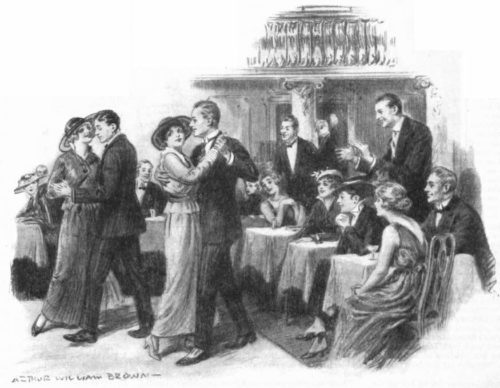
“It may have escaped your notice, but your Charlie is not the only man here. I’m going to dance with Charlie myself, and I’ll introduce you to someone who can go through the movements. Listen!”
“The lady of each competing couple” — this was Izzy, getting it off his diaphragm — “will receive a ticket containing a num-bah. The dance will then proceed, and the num-bahs will be eliminated one by one, those called out by the judge kindly returning to their seats as their numbah is called. The num-bah finally remaining is the winning num-bah. This contest is a genuine sporting contest decided purely by the skill of the holders of the various num-bahs, as judged upon by the competent judge appointed by the management.” Izzy stopped blushing at the age of six. “Will ladies now kindly step forward and receive their num-bahs? The winner, the holder of the num-bah left on the floor when the other num-bahs have been eliminated” — I could see Izzy getting more and more uneasy, wondering where on earth I’d got to — “will receive this love-r-ly silver cup, presented by the management. Ladies will now kindly step forward and receive their num-bahs!”
I turned to the kid.
“There,” I said, “wouldn’t you like to win a love-r-ly silver cup?”
“But I couldn’t.”
“You never know your luck.”
“But it isn’t luck. Didn’t you hear him say? It’s a contest decided purely by skill.”
“Well, try your skill then. For the love of Mike,” I said, “show a little pep. Exhibit some ginger. You aren’t a quitter, are you? Aren’t you ready to stir a finger to keep your Charlie? I thought you had more sand. Suppose you win, think what it will mean. He will look up to you for the rest of your life. When he starts yawping about New York all you will have to say is ‘New York? Ah, yes, that was the town where I won the love-r-ly silver cup, was it not?’ And he’ll drop as if you had hit him behind the ear with a sand-bag. Can’t you see that this is your chance to get the ball and chain on him for the term of his natural life? Pull yourself together and try!”
Well, the girl had sand, after all. I saw those brown eyes of hers flash.
“I’ll try,” she said after a second.
“Good for you! Now get those tears dried off and fix yourself up, and I’ll go down and get the tickets.”
Izzy was mighty relieved when I bore down on him. “Gee!” he said. “You got my goat! I thought you was sick or something. Here’s your ticket!”
“I want two, Izzy. One’s for a friend of mine. And say, Izzy, I’d take it as a personal favor if you could square the competent judge appointed by the management to let her stop on the floor as one of the last two couples. There’s a reason. She’s a kid from the country, and she wants to make a hit.”
“Sure,” said Izzy, “that’ll be all right. Here are the tickets.” He lowered his voice. “Yours is thirty-six, hers is ten. Don’t forget and go mixing them up!”
I went back to the balcony. On the way I got hold of Charlie.
“We’re dancing this together,” I said.
He grinned all across his face. I could hear him saying to himself: “Am I a hit? I guess not!”
I found Mrs. Charlie looking as if she had never shed a tear in her life. She certainly had pluck, that kid. Her eyes were shining, and she was bursting to get action.
“Come along!” I said. “Stick to your ticket like glue and watch your step!”
I guess you have seen these sporting contests at Geisenheimer’s. Or, if you haven’t seen them at Geisenheimer’s, you’ve probably seen them someplace else. They’re all the same.
When we began, the floor was crowded so that there was hardly standing room. Don’t tell me there aren’t any optimists nowadays! Why, everyone was looking as if they were the guys who had put the trot in fox-trot and was wondering whether to have the cup in the parlor or the bedroom. You never saw such a happy, hopeful crowd in your life.
Presently Izzy gave tongue. The management expects him to pull some comedy stuff on these occasions, so he did his best.
“Num-bahs seven, eleven, and twenty-one will kindly rejoin their sorrowing friends.”
That gave us a little more elbowroom, and the band started again.
I want to go back, I want to go back,
I want to go back to the farm,
Far away from harm,
With a milk-pail on my arm.
I miss the rooster,
The one that useter
Wake me up at four a. m.
I think your great big city’s
Very pretty,
But nevertheless I want to be there. . ..
“Num-bahs thirteen, sixteen and seventeen, goodbye!” Off we went again.
I was born in Michigan,
And I wish and wish again
That I was back
In the town where I was born. . .
“Num-bah twelve, we hate to part with you, but — back to your table!”
A plump dame in a red hat, who had been dancing with a kind smile as if she were doing it to amuse the children, left the floor.
“Num-bahs six, fifteen and twenty, thumbs down!”
And pretty soon the only couples left were Charlie and me, Mrs. Charlie and the fellow I’d introduced her to, and a bald- headed man and a girl in a white hat. He was one of your stick-at-it performers. He had been dancing all the evening. I had noticed him from the balcony. From up there he looked like a hard-boiled egg.
He was a trier all right, that guy, and had things been otherwise than what they were, so to speak, I’d have been glad to see him win. But it was not to be. Ah, no!
“Num-bah nineteen, you’re getting all flushed. Take a rest!”
So there it was, a straight sporting contest between me and Charlie, and Mrs. Charlie and her man. Every nerve in my system was trembling with excitement, was it not? It was not.
Charlie hadn’t a suspicion of the state of the drama. As I’ve already hinted, he wasn’t a dancer who took much of his attention off his feet while in. action. He was there to do his durnedest, not to inspect objects of interest by the wayside. The correspondence college he had graduated from doesn’t guarantee to teach you to do two things at once when it mails you your diploma.
He was breathing heavily down my neck, with eyes glued to the floor. All he knew was that the sporting contest had thinned out some, and the honor of Ashley, Maine, was in his hands.
You know how the public begins to sit up and take notice when these dance contests have been narrowed down to two couples. There are evenings when I quite forget myself, when I’m one of the last two left in, and get all excited.
There’s a sort of hum in the air, and as you go round the room people at the tables start applauding. Why, if you weren’t wise to the inner workings of the thing you’d be all of a twitter.
It didn’t take my practiced ear long to get next to the fact that it wasn’t me and Charlie that the great public was rooting for. We would go round the floor without getting a hand, and every time Mrs. Charlie and her guy got to a corner there was a noise like election night.
I took a look at her across the floor, and I didn’t wonder that she was making a hit. Say, she was a different kid. I never saw anyone look so happy and pleased with herself. Her eyes were like lamps, and her cheeks all pink, and she was going to it like a champion. I knew what had made the hit with the people. It was the look of her. She made you think of fresh milk and new- laid eggs and birds singing. Just to take a slant at her was like getting away to the country in August. It’s funny about guys who live all the time in the city. They chuck out their chests, and talk about little old New York being good enough for them, and there’s a street in heaven they call Broadway, and all the rest of it, but it seems to me that what they really live for is the three weeks in the summer when they get away into the country. I knew exactly why they were rooting so hard for Mrs. Charlie. She made them think of their vacation which was coming along, when they would go and board at the farm, and drink out of the old oaken bucket, and call the cows by their first names.
Gee! I felt like that myself. All day the country had been tugging at me, and now it tugged worse than ever.
I could have smelled the new-mown hay if it hadn’t been that when you’re at Geisenheimer’s you have to smell Geisenheimer’s and nothing else, because it leaves no chance for competition.
“‘At-a-boy!” I breathed into Charlie’s ear. ” Keep-a-working. It looks to me as if we were going back in the betting.”
“Uh-huh!” he grunted, too busy to blink.
“Pull some of those fancy steps of yours. We need them in our business.”
And the way that boy worked — it was a sin!
Out of the corner of my eye I could see Izzy Baermann, and he wasn’t looking happy. He was nerving himself for one of those quick referee’s decisions — the sort you make and then duck under the ropes and run five miles to avoid the incensed populace. It was this sort of thing happening now and again that prevented Izzy’s job, otherwise one of the world’s softest, from being the perfect cinch. Mabel Francis told me that one night, when Izzy declared her the winner of the great sporting contest, it was such raw work that she thought there’d hp.ve been a riot. It looked pretty much as if he was afraid the same thing was going to happen now. There wasn’t a doubt which of us two couples were the one the customers wanted to see pull down that love-r-ly silver cup. It was a walk-over for Mrs. Charlie, and Charlie and I were simply among those present.
But Izzy had his duty to do, and drew a pay envelope for doing it, so he moistened his lips, looked round to see that his strategic railroads weren’t blocked, swallowed twice, pulled at his collar, and said in a husky voice:
“Num-bah ten, please re-tiah!”
I stopped at once.
“Come along,” I said to Charlie. “That’s our exit cue.”
And we walked off the floor, amidst applause.
“Well,” says Charlie, taking out his handkerchief and attending to his brow, which was like the village blacksmith’s, “we didn’t do so bad, did we? We didn’t do so bad, I guess! We —”
And he looks up at the balcony, expecting to see the dear little wife draped over it with that worshiping look in her eyes, adoring him. And just as his eye is moving up, it gets caught by the sight of her a whole heap lower down than he had expected — on the floor, in fact, behaving like Mrs. Castle and the Dolly Sisters rolled into one.
She wasn’t doing much in the worshiping line just then. She was too busy.
It was a regular triumphal procession for the kid. She couldn’t have felt much more popular if she had been Queen of Coney at the Mardi Gras. She and her partner were doing one or two rounds now for exhibition purposes, like the winning couple always does at Geisenheimer’s, and the room was fairly rising at them. You’d have thought from the way they clapped that they had been betting all their spare cash on her.
Charlie gets her well-focused, then he lets his jaw drop till it pretty near bumped against the floor.
“But — but — but —” he began.
“I know,” I said. “It begins to look as if she could dance well enough for the city after all. It begins to look as if she had sort of put one over on somebody, don’t it! It begins to look as if it were a pity you didn’t think of dancing with her yourself.”
“I — I — I —” “You come along and have a nice cold drink,” I said, “and you’ll soon pick up.”
He tottered after me to a table, looking as if he had been hit by a street car. He had got his.
I was so busy looking after Charlie, flapping the towel and working on him with the oxygen, that, if you’ll believe me, it wasn’t for quite a time that I thought of glancing round and finding out how the thing had struck Izzy Baermann.
If you can imagine a fond and trusting father whose only son has swung on him with a brick, jumped on his stomach, and then gone South with all his money, you have a pretty good notion of how poor Izzy looked. He was staring at me across the room and talking to himself and jerking his hands about. Whether he thought he was talking to me or whether he was rehearsing the scene where he broke it to the boss that a mere stranger had got away with his love-r-ly silver cup, I don’t know. Whichever it was, he was being mighty eloquent.
I gave him a nod, as much as to say that it would all come right in the future, and then I turned to Charlie again. He was beginning to pick up.
“She won the cup!” he said in a dazed voice, looking at me as if he expected me to do something about it.
“You bet she did!”
“But — but — well, what do you know about that!”
I saw the moment had come to put it straight to him.
“I’ll tell you what I know about it,” I said. “If you take my advice you’ll hustle that kid straight back to Ashley, or wherever it is that you poison the natives by making up the wrong prescriptions, before she gets New York into her system so deep that you can’t get it out. Otherwise you’re in for trouble. When I was talking to her upstairs she was telling me about a fellow in her village who got it in the neck just the same as you’re apt to do.”
He started.
“She was telling you about Jack Tyson?”
“That was his name. It seems he lost his wife by letting her have too much Broadway. Say, don’t you think it’s funny she should have mentioned him, if she hadn’t had some notion that she might act the same way his wife did?”
He turned quite green.
“You don’t think she would do that!”
“Well, if you had heard her! She couldn’t talk of anything except this Tyson and what his wife did to him. She spoke of it sort of sad, kind of regretful, as if she was sorry but felt that it had to be. I could see she had been thinking about it a whole lot.”
Charlie stiffened in his seat, and then began to melt with pure fright. He held up his empty glass with a shaking hand and took a long drink out of it. It didn’t take much observation to see that he had had the jolt he wanted and was going to be quite a lot less jaunty and metropolitan from now on. In fact, the way he looked, I suspected that he was through with metropolitan jauntiness for the rest of his life.
“I’ll take her home tomorrow,” he said. “But — will she come?”
“That’s up to you. If you get real smooth and persuasive, maybe… Here she is now. I should get busy at once.”
Mrs. Charlie, carrying the cup, came to the table. I was wondering what would be the first thing she would say. If it had been Charlie in the same position, of course he would have said “This is the life!” but I looked for something snappier from her. If I had been in her place there were at least ten things I could have thought of to say, each nastier than the other.
She sat down and put the cup on the table. Then she gave the cup a long look. Then she drew a deep breath. Then she looked at Charlie.
“Oh, Charlie dear,” she said, “I do wish I had been dancing with you!”
Well, I’m not sure, but I guess that that must have stung about as much as any of the things I would have said.
Charlie got right off the mark. After what I had told him he wasn’t wasting any time.
“Darling,” he said humbly, “you’re a wonder. What will they say about this at home!”
He did pause here for a moment, for it took nerve to say it; but then he went right on.
“Mary, how would it be if we went home right away — first train tomorrow — and showed the folks the cup?”
“Oh, Charlie!” she said.
His face lit up as if someone had pulled a switch.
“You will? You don’t want to stop on? You aren’t crazy about New York?”
“If there was a train I’d start tonight. But I thought you loved the city so, Charlie?”
He gave a sort of shiver.
“I never want to see it again in my life!” he said.
“You’ll excuse me,” I said, getting up. “I think there’s a friend of mine wants to speak to me.”
And I crossed the room to where Izzy had been standing for the last five minutes, making signals to me with his eyebrows.
You couldn’t have called Izzy coherent at first. He certainly had trouble with his vocal cords, poor fellow! There was one of those African explorer men used to come to Geisenheimer’s a lot when he was home from roaming the trackless desert, and he used to tell me about tribes he’d met, who didn’t use real words at all but talked to one another in clicks and gurgles. He pulled some of their chatter one night to amuse me and, believe me, Izzy Baermann was talking the same language now. Only he wasn’t doing it to amuse me.
He was like one of those talking machines when it’s getting into its stride.
“Be calm, Isadore,” I said. “Something is troubling you. Tell me all about it!”
He clicked some more, and then he got it out.
“Are you crazy?”
“I’m not. Why do you ask?”
“What did you do it for? Didn’t I tell you as plain as I could, didn’t I tell you twenty times, when you came for the tickets, that yours was thirty-six?”
“Didn’t you say my friend’s was thirty-six?”
“Are you deaf? I said hers was ten.”
“Then,” I said handsomely, “say no more. The mistake was mine. It begins to look as if I must have got them mixed.”
He did a few Swedish exercises.
“Say no more? That’s good! That’s great! That’s the best I’ve heard! You’ve got the nerve! I will say that.”
“It was a lucky mistake of mine, Izzy. It saved your life. These guys would have lynched you if you had given me the cup instead of her. They were solid for her all right.”
“Never mind about that. What’s the boss going to say when I tell him?”
“Forget the boss! Haven’t you any romance in your system, Izzy? Look at those two, sitting there with their heads together. Isn’t it worth a silver cup to have made them happy for life? They are on their honeymoon, Izzy. Tell the boss exactly what happened, and say that I thought it was up to Geisenheimer’s to give them a wedding present.”
He clicked for a spell.
“Ah!” he said. “Ah! Now you’ve said it! Now you’ve given yourself away! You did it on purpose. You meant to mix those tickets. I thought as much. Say, who do you think you are, getting fresh that way? Don’t you know that professional dancers are three for ten cents? I could go right out now and whistle and get a dozen girls for your job. Just one minute after I tell the boss what you’ve done you’ll find yourself fired.”
“No, I shan’t, Izzy, because I’m going to resign.”
“You’d better!”
“That’s what I think. I’m sick of this joint, Izzy. I’m sick of dancing. I’m sick of Broadway. I’m sick of everything. I’m going back to the country while the going is good. I thought I had got gingham and sunbonnets clear out of my system, but I hadn’t. You can write this out and stick it up over your shaving mirror, Izzy, because it’s true: Once a rube, always a rube. I’ve suspected it for a long, long time, and tonight I know it. Tell the boss that I’m sorry, but it had to be done. And if he wants to talk back, he’ll have to do it by mail. Mrs. John Tyson, General Delivery, Rodney, Maine, is the address.”
Coping with Estranged Adult Children
Mia was always my favorite. Oh, I know parents aren’t supposed to have favorites, but here’s a flash — they do. They can’t help it. I love her brother and sister more than my own life, but I always loved her just a smidgen more. Cut her a bit more slack. And in return, she was the model child. Where her brother and sister were often spirited and rebellious — demanding so much of my time, patience, and energy — Mia never seemed to give me any trouble.
She was a happy kid who did well in school and had lots of friends. When I would arrive home after work each evening, she would be the first one to run and greet me, just bubbling over with stories about her day.
But in Mia’s late teens, she started to pull away. She’d argue with me about doing her chores, she became sullen, and she even ditched a couple days of school in her senior year — all things that were completely out of character for her. And the day after she graduated at 18, she moved out of our house. She had taken her savings and rented a small apartment without even telling me. A couple years after that, she moved out of state.
Our relationship continued to deteriorate. It didn’t happen all at once. It was a process almost too slow to monitor until it hit me one day that she was now not only geographically but emotionally distant. It’s not just that she didn’t regularly contact me; she didn’t contact me at all. If I hadn’t reached out, I wonder if we ever would have communicated. And when we did, she was always remote, monosyllabic, closed.
I travel to visit her at least once a year. I go to her; she never comes to me. She doesn’t exactly make me feel unwelcome, but there’s a palpable awkwardness between us when we are together that I just don’t understand. I want to hug her, hold her, feel the presence of that sweet little girl I once knew. She’s my child, my baby. Why is this happening? Just because she’s a 40-something adult shouldn’t change this bond.
I have asked her dozens of times why our relationship is so strained. She has no answer. If only she would tell me, I could explain or ask forgiveness. Was it the fact that I maintained a career during the years she was growing up? She always said that she wished I was the kind of mom who was home more, waiting for her after school with hot chocolate and homemade cookies. It was a running joke between us. But now I wonder if it really was a joke. Was it because I divorced her father? I’ve tortured myself about these big things and even a multitude of minor incidents that took place during her childhood. Did I handle them correctly? Was I too tough? Too lax?
Mia’s semi-estrangement is something I don’t readily discuss. When acquaintances ask me how she is, I always tell them she’s doing great. I hide our situation as I would an ugly sore beneath a Band-Aid. I try to ignore it, not think about it too much, but it continues to hurt. Sometimes in the wee hours of the morning when sleep eludes me and my worries attack me, there it is. It makes me so sad.
The only consolation, if you can call it that, is that I’m not alone. On a whim one sleepless night, I Googled “adult children estranged from their parents.” Thousands of hits came up, including a multitude of blogs, self-help websites, and the titles of dozens of books and other publications exploring every facet of this subject. “It’s a silent epidemic,” writes psychologist Joshua Coleman in his book When Parents Hurt: Compassionate Strategies When You and Your Grown Child Don’t Get Along. “It’s sadly very common.” Other experts on the subject agree.
Just within the circle of my own friends there are many stories. Mary and I have been best friends for almost 40 years. She and her daughter had always had a loving albeit prickly relationship. After her daughter graduated from college, married, and moved out of the country — “as far away from me as she could,” bemoans Mary — their bond continued to deteriorate, especially after her daughter had a baby.
Stan, who is married to my friend Ellen, has been estranged from his son since shortly after he and his first wife divorced more than 40 years ago. “I tried to visit him early on,” he says, “but it was just too hard. My ex-wife just wanted to get on with her life and she didn’t want me involved in any aspect of it. Neither did my son.”
Coleman writes that divorce is often the cause of parent-child estrangement. I sometimes think that my own divorce from Mia’s dad might be at the root of my Mia problem. She was only 15 when my husband and I went through an especially difficult breakup. There were several separations followed by reconciliations that didn’t last. The emotional yo-yoing went on for a couple of years, and it took a terrible toll on our whole family. During a visit to see Mia on her 40th birthday, I asked her about it. She told me, yes, the divorce was especially hard on her. Not so much because her dad moved out but more because I was, as she put it, “just so out of it.” I told her how sorry I was and tried to explain that the breakup of my 25-year marriage was the most devastating event of my life. I figured, now that she was a married adult herself, she would understand. But if the truth be told, having that discussion didn’t seem to melt the ice between us.
Divorce, however, isn’t the only common denominator for these familial rifts. My neighbor Judy’s son cut off contact with her just when she was most vulnerable, after the death of her husband of 45 years. It left Judy bewildered and even more broken because she had no idea her son had been hiding these feelings for so long. “He told me I never treated his father with the respect he deserved,” Judy says. “I still don’t understand.”
In an appropriately titled book, Walking on Eggshells: Navigating the Delicate Relationship Between Adult Children and Parents, author Jane Isay writes that one of the reasons for this plague of estrangements is that adult children become progressively more focused on their own lives as they get older, a natural development that some mothers and fathers have a hard time accepting. “Parents can adapt themselves to no longer being the center of their children’s lives,” she explains. For most parents that’s easier said than done. It certainly was for me since almost from the moment my children were conceived, my life was centered around their well-being. Then, all of a sudden, they were grown, on their own, and I was expected to just step off to the side.
About six months ago, I sent Mia a chatty email that included a question about some remodel work I was having done on my house. Her husband used to own a construction company. She took an especially long time to respond. After I conveyed my impatience to her, she let me know quite bluntly that she was very busy with her job and life and friends and I shouldn’t expect her to drop everything to immediately respond unless it was an emergency. I felt dismissed, disrespected, and angry.
That was when I finally decided that if I wasn’t able to change her attitude toward me, I was going to have to change my attitude toward her. It was a liberating moment, one that Sheri McGregor talks about in her book, Done with the Crying: Help and Healing for Mothers of Estranged Adult Children. I read about the emotional suffering she went through because of her estranged son. Like me, she spent years feeling guilty and trying to figure out why it had happened. Eventually she came to the realization that, after all her failed efforts to change the situation, it was time for her to get on with her life and let her son get on with his. That’s exactly what I had to do.
In an email (I didn’t trust myself to verbally relay this message), I let Mia know for the first time how her behavior had affected me all these years, how unfair I felt it was for her to be so aloof and uncommunicative. I told her that I loved her but that I was done feeling guilty and tiptoeing around her feelings. I explained that when and if she wanted to have a relationship, I would be here. If she didn’t, I would accept her decision.
Almost immediately I felt like a weight had been lifted from my heart. Mia now knew exactly how I felt. This baring of my soul was hard, and it involved a lot of soul-searching. I came to the realization that perhaps I was the problem all along because I expected Mia to continue acting like the adoring little girl she used to be, something she wasn’t able to do. If that were the case, we both now would be free of the emotional ties that had caused us so much angst.
It’s been several months since I sent that email. Since then I’ve only heard from Mia once — on my birthday. It was a short and cordial phone conversation. And, surprising to me, I was just fine with that. My life is, well, less clouded by my trouble with Mia. I still worry about her, but every time I do I remind myself that she is a very capable adult who has a right to decide how she wants to relate to me and the rest of her family. Then I go about my own business.
Karen Westerberg Reyes’ last article for the Post was “Don’t Patronize Me!” in the November/December 2016 issue.
This article is featured in the September/October 2017 issue of The Saturday Evening Post. Subscribe to the magazine for more art, inspiring stories, fiction, humor, and features from our archives.
Debbie Reynolds and the Divorce of the Century
Originally published March 26, 1960.
In the 1950s, Debbie Reynolds and Eddie Fisher were one of Hollywood’s hottest couples — until Fisher had an affair with Elizabeth Taylor. In this article from March 26, 1960, Reynolds talked about how her highly publicized divorce affected her personally and professionally.
From its beginning, the courtship and marriage of Debbie Reynolds and Eddie Fisher was proclaimed “The Sweetest Love Story Ever Told.” So it was only natural that the shattering of the Fisher-Reynolds spun-sugar dream castle was as screamingly publicized.
The fact that the darling little couple had become a triangle was regarded in certain circles as the biggest domestic tragedy since Douglas Fairbanks Sr. parted from America’s Sweetheart, Mary Pickford. The Fisher-Reynolds split reached its climax when Debbie agreed—after a year of hesitation—to a quick divorce so her husband could embark upon his second marital venture, this time with Elizabeth Taylor. Even then, however, the triangle refused to go away. In terms of cold, hard cash, the ordeal made the two ladies involved far more valuable at the box office. The price tag of the discarded wife leaped to $125,000 a picture, then to $250,000. The sum demanded for the services of the new Mrs. Fisher zoomed from $500,000 to $750,000—then to $1,000,000. Miss Reynolds soon signed a similar contract, earning $1,000, 000 for three television appearances.
Eddie Fisher on the other hand, has temporarily fallen from the high estate of having his own TV show, to playing the night-club circuit and doing a role in M-G-M’s Butterfield 8, a vehicle which also stars Miss Taylor, while talks are being held about a new TV show for him.
During the time when Debbie and Eddie, once the nation’s most publicized newlyweds, were engaged in becoming the nation’s most highly publicized divorcees, Fisher and Miss Taylor did most of the talking. I’d read various statements attributed to Debbie, but it was my thought that if I could get her to give me some of her ideas about the a air at first hand, it would still be newsworthy.
I remembered a photograph of her taken a few days after the news broke that she and Eddie were having difficulties. I mentioned that photo to her now. I said, “You looked like a teen-ager someone had just kicked in the stomach.”
“I know the picture you mean,” she said. “I remember it very well. It was taken after I had my children out for an airing, and when I came home there were a lot of strangers in my house— reporters and photographers. I didn’t even know what had happened. Then they told me that my marriage seemed to be definitely on the rocks, but I still didn’t get it. I remember saying, ‘It’s unbelievable that you can live happily with a man and not know he doesn’t love you.” When they took that photo, I had just finished changing my babies. I wasn’t thinking about how I looked. My mind was completely on another subject. When I saw that picture, I was surprised to see a couple of diaper pins still attached to my blouse.”
“How old were you when you and Eddie were married?” I asked.
“Twenty-three.” she said. “I had lived at home with my mother until then, so I was extremely inexperienced. I had to grow up very fast. Too fast. I don’t think that’s the best way to grow up. I think it’s the hardest way. But you certainly can learn that way, and it’s very thorough.”
What she said next sounded like something she had said to herself many, many times—and that she would say it many limes more. “As long as you can accept your experiences and digest them and not let them make you bitter or cynical or assume that life is always going to be that way, you’ll be all right. But if you allow them to make you cynical and bitter…” Her voice trailed off.
Strength of Character
I said I thought it would have been easy for her to become bitter. “I wouldn’t
let me be,” she said. “All my life I’ve hated people who complain about their knee-aches or their backaches. All they had to do was look around them to see people having it more difficult than they. If you consider the road a lot of other people travel, you can say to yourself, “Mine isn’t that rough!’”
I said to her, “In spite of all the stress, your statements to the press always seemed sound and sensible.” I thought of one statement of hers in particular. She had just finished shooting It Started With a Kiss in Spain, and on her way home friends in California reached her on the long-distance phone and repeated to her some of the remarks made during an impromptu press conference held in Eddie Fisher’s dressing room in a Las Vegas hold.
Some of Elizabeth Taylor’s remarks &mash; she was also present — were reported to Debbie as follows: “Eddie and I intend to travel and see as much of the world as we can, and we would like to travel as man and wife… We respect public opinion, but you can’t live by it. If we lived by it, Eddie and I would have been terribly unhappy through all this. But I can shamelessly say that we have been terribly happy… I am literally rising above it.”
When questioned about the possibility that Debbie might refuse a divorce, Elizabeth Taylor had answered, “At first Debbie was very much hurt, but I think now the hurt has left and she will consent to Eddie getting a divorce here.”
“When I came home from Europe, people kept asking me, ‘Will you give Eddie a divorce or won’t you?’ said Debbie. “It wasn’t a new question. Eddie had asked me before, and I had said no. But when I was coming home on that plane and I knew there would be people waiting for me at the airport. I prepared a last statement on the subject. It was this: ‘The position in which I am placed makes it necessary for me to give my consent, but they would have gotten married anyway.’”
She stopped for a moment. “Seems like all I did last year was prepare last statements. It was a very pressured year for me. In that one year I had enough emotions to wear me out.”
“You came through all right,” I said.
“If I did, maybe it was because I never told an untruth,” she said. “Whatever I said about my emotions was honest. What I felt must have been obvious: I can’t hide what I feel, I’d be better off if I could. For that matter, I’d be better if I didn’t feel so much.
“I tried to do everything and think of everything as I will five or ten years from now. If I had talked or acted as I felt at the moment, I might have said and done wrong things. Unfortunately our situation became public property. If it hadn’t, I think the three of us could have dealt with it in a mannerly way, I would probably have said no to a divorce, and perhaps it all would have worked out differently. But because it was dumped in the public’s lap by the other people involved, I had no choice.”
I said, “Some of those who have watched you whirling around of late with an ‘I-don’t-care’ air have told me, ‘Debbie seems to be having herself a ball. She must be having a great time being a bachelor girl again.’”
She said, “Whether what happens to you is for the best or the worst depends on what you make of it. You can be miserable or you can be happy, I think I’m having a great time now, and I think I’ll keep right on doing that, because I have so much to be happy about. Before I was married,
I wanted children. Now I have two children. They are all anybody could ever want. I have a lovely home; my professional career is looking up, I can travel everywhere, and I have very dear friends. So inside I’m happy. I really am, but it has taken time to acquire that philosophy.”
This article and other features about the stars of Tinseltown can be found in the Post’s Special Collector’s Edition, The Golden Age of Hollywood. This edition can be ordered here.
Luke Rising
Lily Jordan can’t see the toes of her bright yellow wading boots over her pregnant belly. She sees swirls of orange fly line on the graveled beach, and tree shadows slanting down from the forest. She hears her 6-year-old son, Luke, tossing rocks into the lake.
“Don’t, Luke, you’ll spook the fish.”
“I don’t care.” And another rock shatters the smooth blue-green surface. His hazel eyes challenge hers, his mouth a tight line.
“What’s wrong, Luke?” She feels her womb tightening as if the fetus she carries recoils from her 6-year-old’s negative energy. She is determined not to lose this baby and hopes that today will reveal what turned Luke from a fun-loving talkative child to a silent, anxious one.
She wonders if her fears are catching. She hates to feel angry.
Lily’s gaze drops to Luke’s sodden sneakers, the spot of grease on his “work” pants. He won’t let her wash out the spot for it’s a badge he earns helping his father repair the broken items of their weekly life.
“Do you want me to teach you how to fly cast?”
“No, I want Daddy to teach me.”
“Daddy doesn’t fish.” Lily rests her hand on her belly. She has almost reached term after five miscarriages. But as her belly bump balloons, Luke’s moods swell. He hardly eats, nightmares break his sleep, and he acts out in school. His pediatrician suggests a psychotherapist, but Luke’s father does not want a therapist toying with his son’s brain.
“It’s a stage,” Luke’s father, David, insists.
Lily believes it is too intense to be a stage. She doesn’t know what has set his tantrums off but believes that good therapists expand the mind instead of shrinking it. Her husband tells her to chill and points out that when their pediatrician tried talking to Luke they wound up playing a video game. She is angry with her husband.
Poised at the edge of the lake, she watches Luke spoon sand into a small silver pail he confiscated from one of her plants. Actually, she had been successful at resuscitating the wilted plant — a badge showing she still has her green thumb, so she’s at the point where she wants to scream, but doesn’t because she must protect the baby with healthy energy.
Grateful to see cracker crumbs dusting Luke’s lips, Lily quietly exhales. “If you learn how to fly cast, we’ll go to the river. The trout jump really high there, Luke, like you do on your trampoline.”
“No, Mom. I said I want Daddy to teach me.”
“I know he’d want to, but he works extra hard now that we’re going to be a bigger family. We can take the baby camping and fishing when he’s older. You can teach your little brother how to fly cast.”
Luke glances at her belly, looks away.
A sailboat glides by, Lily noticing its red and white sails fluttering in a breeze that carries the scent of ripe watermelon she associates with the lake.
A chain saw blasts the air.
Another tree falling. Lily’s gaze sweeps the shrinking forest where she grew up, and where now, patches of bright sunlight pool on the pine-needled floor, replacing the oak and maple and ash trees she loves.
Luke’s sneaker stomps the sand. He raises his sneaker while his eyes duel with Lily’s.
“Ants have a right to live,” Lily says.
“They’re just bugs.”
“Please tell me what’s wrong.”
He ignores her.
The weight of failure hovers, but Lily ignores it.
A cloud of mayflies rises over the water. Lily points them out to Luke and gains his attention when a lake trout rises for a mouthful of the tiny winged insects.
A voice echoes up from her past, as gentle as the ripples on the surface of the lake. She was 7 and felt like the sun disappeared when her mother went into the hospital to give birth to her sister. She would not be the center of attention any longer, so her nature-loving Grandma Rebecca drove her down to the river and showed her that she could be part of something bigger.
Insects feed the fish and birds, Lily. They keep the lakes and rivers healthy. Mayflies are the most beautiful insects. And they’re all different. Like you and me and everyone on earth.
Lily repeats her nature-loving grandmother’s words to Luke hoping to engage him.
“Do bugs keep the lake healthy like you keep me healthy?” Luke responds.
She leans her fly rod against a tree, walks over to Luke, and tousles his blond hair. Perhaps it will loosen the humor they once shared. “How about I keep you healthy with a bug omelet? It’s got plenty of protein.”
“Yuck, I’m not a fish or a bird.” He pushes curls off his forehead. “Do fish eat ants, too? And caterpillars? My teacher’s bringing cocoons to class. We’re going to watch caterpillars turn into butterflies.”
“Fish eat the ants that fall into the water, so it’s up to us to let them carry on with their business. Not stomp them. Okay?”
“They carry on business? That’s funny, Mom.” Luke bends over and dribbles spit on a trail of ants.
Lily steps back.
“Mom, the ants go to work like Daddy goes to work. Now they can spit shine their shoes like Daddy does before work.”
Lily smiles. “I bet your little brother will think you’re clever.” She hopes she isn’t pushing the issue, but she wants her happy 6-year-old back. Lily remembers what Grandma Rebecca did after stopping her tears about sharing her parents with a new sister.
“Do you want to see something special, Luke?” She walks down to the lake where the mayflies hatched. She lifts a small rock and turns it over.
Luke stands at her side.
Scraping mud off the rock’s surface, Lily shows Luke the brown multi-legged mayfly nymph clinging to its surface and offers him her grandmother’s wisdom:
“Inside this nymph is a mayfly waiting to be born.”
“How did it get in there?”
“One day a mother mayfly dropped her eggs in the lake. They sank to the bottom and a nymph hatched out. It rose to the surface and crawled under this rock.” Lily remembers how awed she felt about her grandmother’s knowledge of nature — how she felt part of its life cycles when her grandmother said, Lily, your mother’s fertilized egg turned into an embryo and then a fetus like in the book I brought you. There are similarities when a nymph hatches into a mayfly.
She says this to Luke.
Luke peers at the nymph. “It’s not moving.”
“It’s waiting to break open so a beautiful mayfly can emerge.”
Luke’s eyes widen. “It breaks open? Does it hurt the nymph, Mom? If the baby can’t come out can you break open? Can you die?”
A trout leaps out of the water. This aha moment, after Luke expresses his feelings, has Lily feeling like the trout hit her on the head. She wonders how much her miscarriages frightened Luke: the bleeding, the ambulances, the surgeries, and her depressions after each miscarriage. She and David tried to shield him, but the losses happened so fast.
A fluttery feeling inside her belly is not the baby moving. It’s her 6-year-old’s distress.
She searches for the right words. “Nothing bad happened to me, only good things. You were born my beautiful son.” She studies his troubled face and wishes she could go back in time and be more present. “Every creature has a special way of getting born.”
His voice hitches. “Why do you need a baby? You have me.”
Lily’s heart lurches.
“Are you angry?” Luke says.
“No, of course not. I want you to tell me what bothers you.” She remembers to breathe. “Daddy and I want a baby because we love you so much. Love grows when you share it. We want you to have the gift of a baby brother, but most of all, we want to give your baby brother the gift of you because you are special!”
“Will you love the baby more?”
Lily holds Luke’s gaze. “Not a chance. I promise.” She reminds herself that he has been an only child for six years, owning their attention. How could she have been so blind? “Luke, your little brother’s going to think you’re the coolest dude in the world. You know how you look up to Daddy.”
A smile tickles the corner of his mouth. “What’s the baby’s name?”
Lily realizes they didn’t include Luke in that decision either. “We’re not sure yet. Maybe you can think of some names.”
“Okay.” He shifts on his feet. “I’ve got a stomachache, Mom.”
It’s a lot for a 6-year-old to digest, Lily thinks, holding Luke close, observing the white birch trees arcing over the lake, the insects dropping off the leaves of trees rippling the surface. So many currents — the vertical currents of mayfly eggs sinking to the lake bottom — nymphs rising to the top.
Luke removes the rock from her hand and strides over to its place of origin, fitting it into an indentation in the sand. It rests like a period at the end of a sentence. “Look, Mom, now a mayfly will get born.”
The baby shifts inside Lily’s womb. Taking a chance, she places Luke’s hand where the baby kicks. His mouth opens.
“Your little brother knows you’re here.”
“He does?”
“I love you, Luke.”
“I love you, too, and you can teach me to fly cast if you still want to.”
“How about tomorrow, when Daddy’s home? Do you think he could learn, too?”
“I hope so, but we’ll have to cover the couch with all the cushions in the house so he can’t lay down.”
Picturing Luke’s father dozing under a mountain of cushions makes Lily smile.
A robin hops out of the woods, pecking at the ground, scattering gravel. Its reddish belly swells with eggs. “Where do you think that the robin should build its nest, Luke?”
Luke gives it his full attention. “In the tallest tree, where big birds can’t get at it.”
“Where its eggs can safely hatch.”
“Like mayflies, but in their own way.” Luke shoves his hands into the pockets of his work pants. “I can teach my little brother lots of things. Like how to fly cast, and …” His eyes light up. “There’s a boy in my class named Robin. He’s my best friend. He’s really cool, Mom. Can we name the baby Robin? Like the bird?”
Lily thinks the name is perfect because of the memories it will bring. She pictures her husband asking what they did today, and she felt the words rise: “Luke named his baby brother Robin.”
News of the Week: Rich Americans, Retro Hotels, and the Right Way to Take a Shower
Did You Make the Forbes List?

Ah, it’s that special time of year, when the leaves start to change, thoughts turn to the upcoming holiday season, and you find out how much more money people make than you do. Yes, it’s the annual Forbes list of the 400 richest Americans.
Spoiler alert! You didn’t make the list.
Coming in at number one yet again is Microsoft founder Bill Gates, with $89 billion. At number two is Amazon’s Jeff Bezos with $81.5 billion, and investor Warren Buffett is number three with $78 billion. But really, with that much money, aren’t they all pretty much number one? Is there a difference between $89 billion and $78 billion?
President Donald Trump dropped several spots on the list because his worth is now only $3.1 billion, down $600 million from last year. The woman highest on the list is Alice Walton, of the family that owns Wal-Mart, with $38.2 billion.
In related news, I just got a refund on something I bought because I paid too much. It’s almost three dollars!
Tonight We’re Gonna Party Like It’s 1962


They’re building a new hotel in New York. That’s not big news; hotels open in New York all the time. But this one is pretty darn special.
The TWA Hotel will be built in the old TWA terminal at Kennedy Airport. It will have 505 rooms, an observation deck, and even a rooftop pool. But the best part is that the hotel will be designed in a jet-age, mid-century modern style, complete with Eames furniture, original TWA stewardess uniforms, and other features that will make it seem like you’re in an episode of Mad Men.
They’re even going to revive the TWA Flight Center, which will become the hotel’s lobby. The hotel opens in early 2019, and if you want to stay there, the prices start at $250 a night.
Stay there? I want to live there!
To Ban a Mockingbird
We’re living in a time when everything has to be examined closely, nobody can hear an opinion they don’t agree with, and “we should err on the side of caution!” is overriding common sense. That’s not a political stance, just an observation. Every week we hear about a college campus speech being canceled or a TV show being protested or a celebrity being pummeled so much for a tweet that they immediately have to apologize. It’s all very exhausting.
Last week came a new one, as a Mississippi school district pulled Harper Lee’s To Kill a Mockingbird from the 8th-grade curriculum. School officials in Biloxi say the book’s language “makes people uncomfortable.” To translate that, the school district got a handful of complaints, and because of the book’s racial theme, it was deemed too “hot” and was pulled. I would also say that if some of the language makes people uncomfortable, maybe the book is doing its job.
All I keep thinking is, if they’re going to pull To Kill a Mockingbird, one of the classic novels (and also a terrific film) that handles the subjects of race and equality in a thoughtful way, just imagine what other novels wouldn’t be allowed.
The Oldest Hardware Store in America Is Closing
It’s weird to think about, but the Elwood Adams Hardware Store in Worcester, Massachusetts, has been open since 1782. To put it in perspective, that’s 39 years before the first issue of The Saturday Evening Post was published and seven years before George Washington became president. The store is about to close, and CBS Sunday Morning did a story about it this week.
Are You Taking Showers Correctly?
This may seem like an odd question to ask, because how can someone take a shower “incorrectly”? By not turning on the water? Showering with their clothes on? Standing on their head?
The Today show did a poll last week, asking viewers (and the Today staff) which way they face when taking a shower. Twelve percent of respondents say they face the showerhead, 44 percent say they face away from the showerhead, and 45 percent say they rotate. I’m terrible at math, but I think that amounts to 101 percent?
A serious question: Isn’t “rotate” the only normal answer here? How do you take a complete shower if you only face the nozzle or only face away from it the whole time? Do people just wash and rinse one side of their body? I’ve never thought about it before, but after this poll I realize that, like most normal people, I rotate.
One away-nozzler (which I’m going to call them from now on), confused by the people who face the nozzle, asked how they breathe. Oh come on, it’s not like people who face the shower head stand in the stream the whole time with their mouths open.
Let us know in the comments below which way you stand (and I promise this is the last time I’ll ask you what you do without clothes on).
RIP Roy Dotrice, Richard Wilbur, Gord Downie, and Arthur Cinader
Roy Dotrice appeared in many movies and TV shows over the past seven decades. You may know him as Mozart’s father in Amadeus or as Jacob on the ’80s series Beauty and the Beast. His most recent role was on Game of Thrones. Dotrice died Monday at the age of 94.
Richard Wilbur won two Pulitzer Prizes for his poetry and served as the U.S. poet laureate in 1987-88. He died Saturday at the age of 96.
Gord Downie was the lead singer of The Tragically Hip, a band whose songs include “New Orleans Is Sinking,” “Ahead by a Century,” and “Highway Girl.” He died Tuesday at the age of 53.
Arthur Cinader founded J. Crew in 1983 and changed the way Americans dressed. He died last Wednesday at the age of 90.
This Week in History
P.G. Wodehouse Born (October 15, 1881)
I don’t know why I never knew that the P.G. stood for Pelham Granville, but you learn a lot reading the magazine you write for. That’s the name he used for his first story in The Saturday Evening Post in 1915, the first of many over the next 20 years.
I Love Lucy Premieres (October 15, 1951)
Did you know that the show opening we all know, the one with the big heart and the show/cast names in the middle, wasn’t the original opening? That was done later for daytime reruns. Here’s the opening from the very first episode.
This Week in Saturday Evening Post History: Picking Poindexter (October 17, 1959)
Richard Sargent
October 17, 1959
This Richard Sargent cover depicts the totally realistic scene of two beautiful college coeds swooning over the nerdy guy reading a book instead of the hunky football player.
Ten seconds after this scene was painted, the football player beat up the other guy.
October Is National Caramel Month

Though the warm weather that I’ve been complaining about in this column continues in the northeast, I do want to start highlighting some cold weather-ish recipes. Since we’re in apple season and it’s National Caramel Month, it seems fitting to make caramel apples. I went with the Kraft recipe because that’s the one I remember from my childhood.
If you’re not a caramel apple type of person, how about this Pear-Caramel Pie, or this Salted Caramel Banana Pudding?
Maybe I shouldn’t ask this until we figure out the answer to the shower question, but do you say “car-a-mel” or “car-mel”? I think I just started another controversy.
Next Week’s Holidays and Events
United Nations Day (October 24)
As the official site says, U.N. Day marks the anniversary of the entry into force in 1945 of the U.N. Charter.
World Series Starts (October 24)
The team that will face the Los Angeles Dodgers hasn’t been established as I write this, so I’m just going to assume the Boston Red Sox found a way to turn back time, erase their losses, and make it in. First game airs on Fox at 8 p.m.
Strangling Instead of Shooting: Waging War by Embargo
If you’re old enough to remember 1973, you might recall those long lines of cars that began forming at gas stations that fall.
These lines were the result of the oil embargo — 44 years ago this month — against the United States, the United Kingdom, Canada, Japan, and the Netherlands, imposed by the Middle East nations of the Organization of Petroleum Exporting Nations (OPEC), who were angered by the Western nations’ support for Israel during the Yom Kippur War.
So in October 1973, OPEC cut oil production by 25 percent and reduced their exports to NATO members in Europe. They cut off all oil exports to the U.S. The embargo would be lifted, they said, when Western nations pressured Israel to return land it had captured during the war and a process to restore peace in the Middle East had begun.
The embargo’s effects were immediate. Oil rose to $5.11 a barrel, an increase of 70 percent. By the following June, it reached nearly $12 a barrel.
America still produced most of its own oil, but even the 15 percent loss of its Middle East fuel was felt across the country. Pump prices rose from 38.5¢ to 55.1¢ a gallon. The drop in supply meant gas stations frequently ran out of fuel, leading to long lines of cars and their panicked drivers.
Although OPEC dropped the embargo in April 1974, after President Nixon pressured Israel to withdraw from some of its conquered territory, Americans realized firsthand what a powerful tool embargoes could be. In 1975, The Saturday Evening Post suggested in “Our Option of Economic Warfare” how the U.S. could apply its own economic leverage to resolve international issues.
The idea was tried out when America placed a grain embargo on the Soviet Union in response to its 1979 invasion of Afghanistan. Unfortunately, the U.S. was then acting alone. Russia readily obtained the grain it needed from other countries, while American farmers suffered a drop in prices.
The U.S. was more successful with later embargoes. By limiting exports, restricting business and economic aid, or freezing assets, it has pressed reforms on countries that sponsor terrorism, violate human rights, or develop nuclear weapons.
These economic pressures led to Iran agreeing to curtail its nuclear weapon program. They have also created hardships for North Korea, though at this date, it’s uncertain that embargoes will successfully yield change.