Movies for the Rest of Us with Bill Newcott: Blade Runner, Breathe, and Bad Beatles
Award-winning film critic and writer Bill Newcott has been covering Hollywood for more than 40 years. He is the creator of AARP’s Movies For Grownups franchise and the movie critic for The Saturday Evening Post.
Join our movie review video podcast, Movies for the Rest of Us with Bill Newcott. This week, Bill reviews Blade Runner 2049; Robert Redford’s narration of the gorgeous nature film, Earth: One Amazing Day; Breathe starring Andrew Garfield and Claire Foy; Loving Vincent, which animates Vincent Van Gogh’s paintings to stunning effect; a documentary on Ernie Kovacs and his prime time game show, Take a Good Look; and the Blu-ray release of Sgt. Pepper’s Lonely Hearts Club Band.
Contrariwise*: Why Does Craft Beer Taste So Awful?
I’m really struggling with this craft beer thing. I love the idea, don’t get me wrong. You never find the best furniture, musical instruments, or wine at the end of a mass production line. And I’m all about the taking-on-Goliath thing. (David is literally my middle name!)
But why does craft beer have to taste so awful?
For the past year, I’ve lived in San Diego, home to 120 microbreweries. Here, craft beer drinking means as much to fitting in as mountain biking and being friendly for no reason. There are meetups, apps, and podcasts dedicated to obsessing over craft beer. People are judged by their favorite. It says certain things about you, things I don’t necessarily want Miller Lite saying about me.
So I enlisted a craft beer enthusiast to beer-Yoda me. He’s a millennial hipster dude who has a beard and even his own craft beer podcast, and he asked me not to reveal his name after figuring out my sacrilegious angle. (Let’s call him Atticus. I hate that name.)
“I’m going to get you to stop drinking the crap that you’re drinking,” Atticus condescended as he ordered the first of three beer “flights” (trays of a number of four-ounce samples) at a snobby gastropub. “A beer like Miller Lite is scientifically done well, but it’s lacking flavor.”
There are a number of reasons Atticus argues that craft beer is superior, including that “no two batches taste the same because the ingredients and brewing conditions differ.”
This is a good thing? The reason I order a Miller Lite is not because I want it to suddenly taste skunky so I can discuss it with my friends. It’s because I want the exact taste of a Miller Lite in my mouth!
Technically, “craft” isn’t a beer type. It just means it was made by an independent brewer producing 6 million barrels or fewer a year. The same dozens of beer types exist in craft as in what Atticus likes to call “big beer.” Miller Lite is a pilsner, the least-respected craft beer type (obviously because commoners like me prefer it).
Most craft beers sold in the U.S. are India Pale Ales (IPAs). Heavy with bitter hops, IPAs taste like what happens when you accidentally bite into a Tylenol gel cap. I would rather finish an IPA than pull all my toenails out, but it’s a closer call than you might think.
My problem, according to Atticus, is an unrefined palate. The flavors of an IPA will start resembling degrees of cheddar cheese sharpness as soon as I learn to stop being such a loser. “You can live your life drinking Miller Lite, just like you can live your life eating McDonald’s,” Atticus said.
throat enough times, and your brain will probably find that taste enjoyable, too.
Despite his efforts, however, nothing in our three beer flights topped an ice-cold Miller Lite to me. There were three pilsners, but one tasted like lemon, one like air freshener, and one like mildew. I only declared an oatmeal stout the winner because it was tolerable and I didn’t have a designated driver.
“You’ll come around someday,” Atticus said.
My palate isn’t unrefined. It likes Brussels sprouts, seaweed salad, and 200,000-Scoville peppers. Force Krazy Glue down your throat enough times, and your brain will probably find that taste enjoyable, too.
Look, if I could easily find a craft beer that tasted like a better Miller Lite, I wouldn’t complain. But I don’t think anyone’s making a beer like that for a person like me. And some craft bars don’t even list their beer types on their digital menu screens, which are so crammed with fancy-schmancy names, they continue on the next screen like departures at LaGuardia.
Like I said, I’m not against the idea of craft beer. It just has to be willing to stop with the snob appeal and the awful taste. Is that really too much to ask?
This article is featured in the November/December 2017 issue of The Saturday Evening Post. Subscribe to the magazine for more art, inspiring stories, fiction, humor, and features from our archives.
*“Contrariwise,” continued Tweedledee, “if it was so, it might be; and if it were so, it would be; but as it isn’t, it ain’t. That’s logic.”
The Art of the Post: Mead Schaeffer Paints America

Back before Google Maps gave us satellite images of every corner of America, there was Mead Schaeffer.
Schaeffer (1898–1980), whose cover illustrations appeared from 1942 to 1953, was one of the most highly regarded cover artists for The Saturday Evening Post. During World War II, he became famous for his war covers, but as the war ended, he needed to find a new theme. Soldiers were returning home to small villages and hamlets across the country, and the nation’s focus was returning once again to domestic life. Schaeffer’s wife, Elizabeth, who also served as his business manager and photographer, suggested that he paint a series of “regional covers” focusing on daily life in post-war America.
The Post jumped at the idea, and soon the Schaeffers were on the road, looking for scenes to feature on the cover of the magazine. His first cover in the series, published in November 1944, was a rural barn dance.
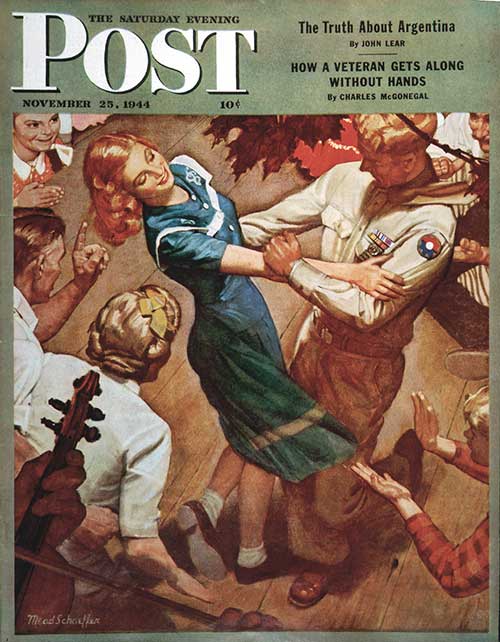
November 25, 1944
This was followed in February by a winter scene of Vermont citizens making maple syrup.
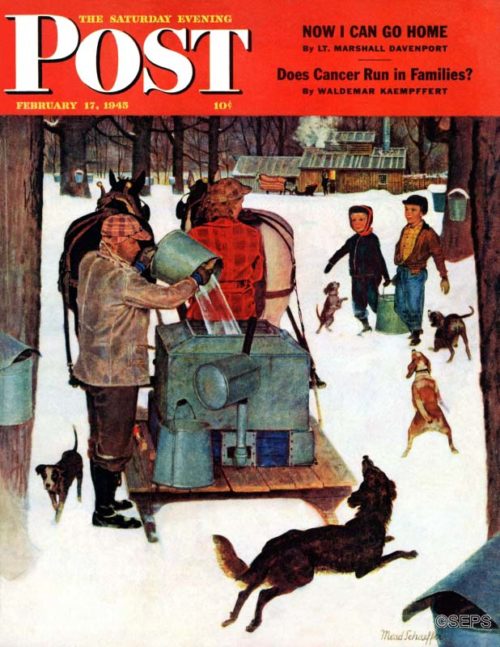
February 17, 1945
Next, he painted a sailor returning to his family ranch in Lone Pine, California.

August 25, 1945
And in quick succession, he depicted a Maine lobsterman, a chuckwagon cook in Texas, moss pickers in Louisiana, and shrimpers in Mississippi.
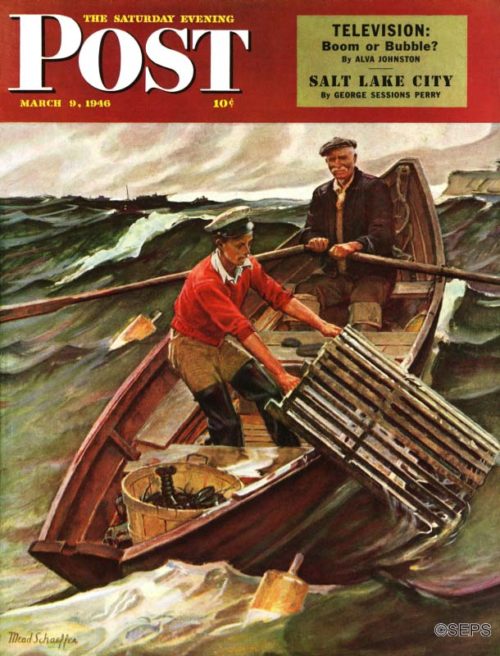
March 9, 1946
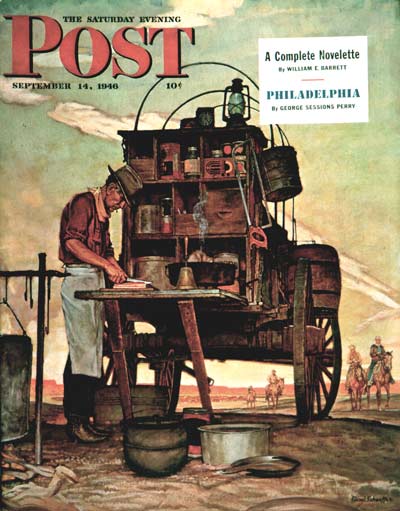
September 14, 1946″
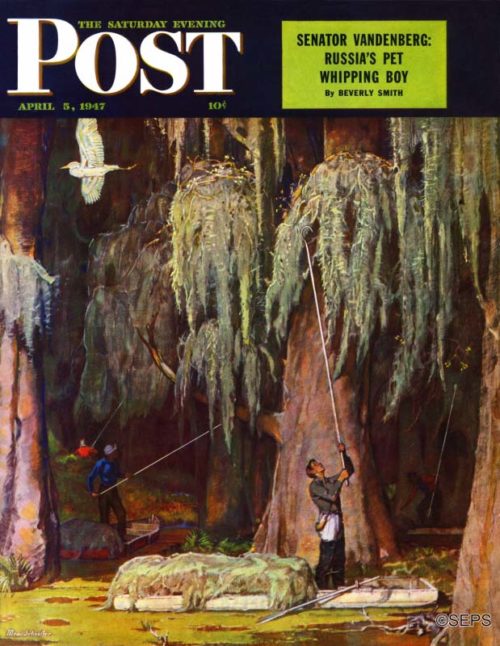
April 5, 1947
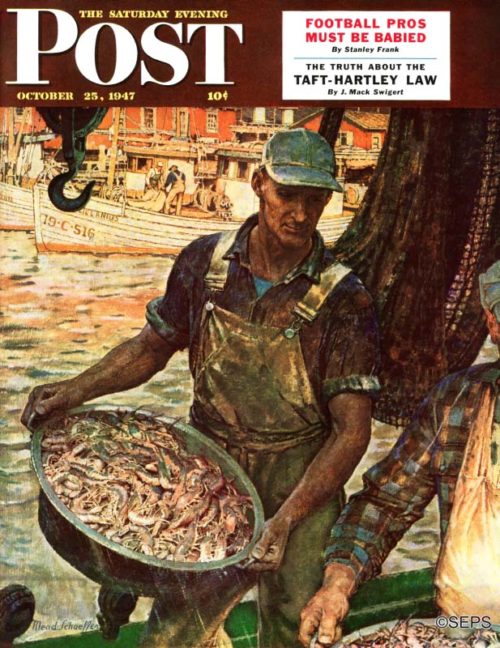
October 25, 1947
The Post called these covers “our family album of American regions.” Illustration expert Fred Taraba wrote in Masters of American Illustration that this series was designed to give viewers “a sense of the overall grandeur and diversity of the U.S.”
The regional covers became so popular that they created unexpected complications for Schaeffer: Communities began competing for his attention. When Schaeffer and his wife flew to Oklahoma City to paint workers on an oil rig, they were intercepted at the airport by a police motorcade, which gave them a tour of the city to show off possible sites for paintings. Local officials then escorted the couple to a plush hotel, where the mayor informed him the city would pay for all his expenses and transportation. The mayor next tried to set up a series of public appearances, but Schaeffer fended them off and spent a week painting on a grimy oil rig.

November 9, 1946
When he arrived in North Dakota to paint the Little Muddy River, Schaeffer was ushered into the capitol to meet the governor, who wanted to make sure his state would be well represented on the cover of the Post.
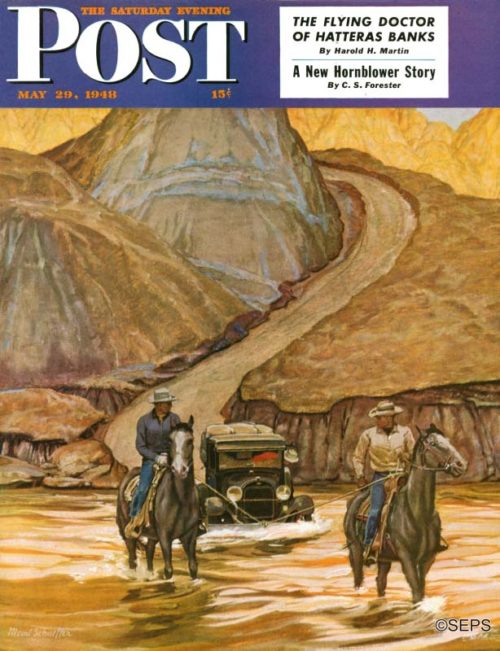
May 29, 1948
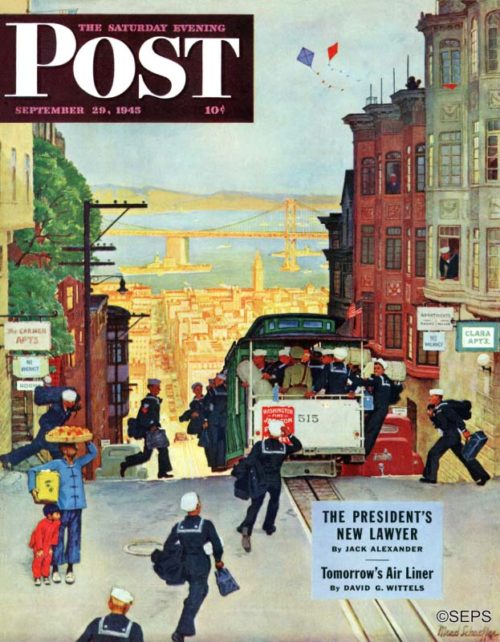
September 29, 1945
Schaeffer’s regional covers introduced a national audience to parts of the country they’d never seen before. TV only offered grainy black-and-white images, and there was no internet in those days, but Schaeffer’s sharp, realistic paintings gave the nation images to preserve in their memories. Most of all, delighted readers who lived in the region selected for the cover would go over every detail and write to the Post commenting on accuracy or making suggestions. They rarely found mistakes, thanks to Schaeffer’s passion for “getting it right.”
The Post was one of America’s most popular “general appeal” magazines, designed to be read by the country as a whole. And its weekly efforts to identify the largest common core of the country might have helped homogenize the nation. In later years, there was some concern that even the Post was becoming more eastern and elitist in its focus. That’s one reason why the magazine welcomed Schaeffer’s regional series. It was perceived as way of rejuvenating the Post’s nationwide outlook. Communities from all around America felt legitimized and important when they appeared in Schaeffer’s paintings on the cover of the Post.
Learn more about artist Mead Schaeffer.
See more of David Apatoff’s art columns.
An Interview with Hans Zimmer, Hollywood’s Hottest Composer

Hans Zimmer is one of Hollywood’s most successful and innovative composers, with soundtracks for over 150 films ranging from Driving Miss Daisy to Gladiator to the current Oscar frontrunner, Dunkirk. Zimmer’s original score for The Lion King earned him an Academy Award; he’s been nominated for eight more.
The celebrated musician fought past his life-long stage fright to give a show-stopping performance on last year’s Grammy Awards, providing guitar riffs for Pharrell Williams. That inspired a world tour, giving enthusiastic audiences live performances of the powerful musical moments they first experienced in a dark theater. He was a surprise hit at Coachella alongside mega-stars like Kendrick Lamar and Lady Gaga.
Since he was a kid, Zimmer just wanted to make music. “My father died when I was really young, so growing up, music was a refuge for me,” he remembers.
“Then when you become a teenager, it turns into a completely different thing. It becomes — how am I going to say this politely? – when it comes to girls, it’s better than talking to them.”
Jeanne Wolf: Now that your live show is a hit, can I finally call you a rock star?
Hans Zimmer: I don’t think I’m a rock star but it is exciting to go out there and play in front of people instead of hiding behind a movie screen. I have a feeling that it might have made me a better composer, because I was actually able to feel the audience in real time rather than what we do making movies, where we’re basically guessing. We’re hoping that the soundtrack we’re creating is going to resonate and add to the experience for people in a theater. As soon as I finish a movie, I forget everything that I’ve written. I have to forget, because otherwise you don’t make room for the new ideas. So when we are playing the old soundtracks every night on tour, we are reinventing and sort of improving them. That’s a luxury you don’t have when you’re making a film.

JW: There has been a remarkable reaction to your compositions for the movie Dunkirk. The suspense-driving track is so unique that it’s hard to describe. Where did that come from?
HZ: Usually I start out by writing a tune, but there’s no melody in the Dunkirk soundtrack. The whole idea was how do we keep the tension going? How do we play with the concept that time is running out? Everything had to live up to that. For months I would go to sleep, and I would start dreaming the scenes, and then I would wake up and go back to the studio. I never had any reprieve from it. When I actually went on the Dunkirk location, the weather had turned really nasty. I was on that beach, and it was unbearably cold. Sand was blowing at you from every direction, the poor actors were standing there in the freezing wind, and there’s [director] Chris Nolan charging down the beach. So when I was composing, I felt Chris’ hand on my hand like he was pressing the keys down with me. I really tried as much as possible to make it his score.
JW: With all you’ve done, I always love your enthusiasm.
HZ: The operative word in music is play. The thing that we really carry over from our childhood is that sense of playfulness. I think all that happens is we try to get very serious about being very playful. The hours we keep are absurd. I’m forever begging forgiveness of my children for not being around, but on the other hand, they love being in my studio. I think what my kids have seen through their whole childhood watching me work is people being passionate about what they’re doing and having fun, having a sense of humor about a catastrophe (which isn’t really a catastrophe). Making movies, there’s never enough time, never enough money, it’s raining on the day you need sunshine, and it’s sunny on the day you’re trying to shoot a rain scene. I sort of make it my job in a funny way to remind the filmmakers what the original dream was and enhance it. I think about what made every body try to do the impossible.

JW: I have interviewed a lot of rock stars, and they talk about that high when you connect with the audience. Did you experience that kind of connection?
HZ: Constantly, constantly. Yes, absolutely. I mean, I really felt that the audience was hungry to have a different experience, and we managed to give them that. They had a sort of idea what it would be like, but to be honest, no one has ever done it this way, so the element of surprise was really nice, and the element of surprise for me was really nice. Just how open they were and how welcoming they were. I asked everybody for advice before this, and people kept saying that the attention span of young people is really bad these days, and you have to play short pieces. I don’t know. “Pirates” is 14 minutes long. “The Dark Knight” thing is 22 minutes long. These aren’t short pieces, and the audience really stuck with it. The audience loved that we would take them on a journey and take them back into the world.
JW: How great was that? You are still so excited about what you do. I love your participation. Could you describe what drives you now?
HZ: Yes. Actually what was interesting for this tour was going back. Obviously, I had to go back in time and look at all of the pieces that I’ve written. The tour was playing the old soundtracks again, and every night we were reinventing and sort of improving them. All of the stuff that you can’t do because you have time restrictions. A movie needs to be finished.
JW: And you have to fit to the scene.
HZ: Exactly. So what drives me is basically that I know I can write a better piece of music. I know I’m still learning and figuring it out. Dunkirk was such a learning curve because we really reached through every rule book. It wasn’t even about “Let’s invent a new way of doing this.” It was “Let’s invent and then we actually have to learn how to do it.” Every day was a day of having no idea of how to get around the next corner.
JW: Listening is a big part of your art. Do you think you’re a good listener with the people close to you? Because it’s hard to be nowadays.
HZ: I think I try to be a good listener. My children keep telling me that — so that’s the greatest compliment that I can get.
JW: That is a great compliment. It means you’re hearing me and you understand me.
HZ: Yes, exactly. I suppose you know, partly the reason I have the career I’ve had is that I listen to my directors. I don’t listen when they tell me what to do. I listen to the subtext. I listen to what the —. Look, every movie starts with the same thing. Somebody phones you up and says, “I want to tell you a story,” which is already a great start. What a great life — these people telling me stories.
JW: Has there been a director — there must be more than one — whom you butt heads with or think you’ll never be able to please?
HZ: Oh totally. Often. Those are the directors that I’ve worked with more than once. Gore Verbinsky and I would go at each other pretty badly. Terry Malick once said to me, “The way we speak to each other, only brothers can speak to one another that way.” I remember I was doing Hannibal, working with Ridley Scott. It was about 11 o’clock on a Sunday night. They had just gotten back from shooting, and we were in the cutting room looking at a shot of Julianne Moore’s face with a tear running down her cheek, and I say, “Oh yeah, she’s crying because she’s in love with him.” And Ridley goes, “No. It’s a tear of disgust.” Then we start arguing about this and it got sort of feisty, and suddenly we’re on our feet and we’re in each other’s faces and I just stepped back and I thought, Wow. This is amazing. It’s Sunday night at 11 o’clock and grown men are passionately arguing about what a tear running down a woman’s cheek means.
JW: Have you figured out where you got your courage?
HZ: Well, I think from the people who were kind and took me on when I had no career. Stanley Myers, the great film composer who wrote The Deer Hunter, he took me under his wing. One of the first people I ever got to work with. I also learned a lot from George Martin.
JW: Oh! The Beatles man.
HZ: I remember the first time I ever got paid for doing music was for George Martin. Weirdly, I remember the check more than the sessions. It was astonishing after struggling. I can’t tell you how many tins of baked beans I ate because it was the only thing I could afford. Somebody was actually paying me to make music.
JW: Wow. How many tins of baked beans did it take to be here?
HZ: Years.
JW: The people don’t understand that the memory of that gives you courage, too.
HZ: My daughter asked me once, “Dad, what was it like being a poor artist?” I realized that I’d never thought about it. It never occurred to me that I was a poor artist because everybody around me was in the same boat. That just seemed to be life, and we were making music all day long. I still have really bad eating habits. I usually don’t have lunch because I’m in the middle of writing something. Do I live a normal life? No. Look, I’m coming up to my 60th birthday, and I think it has worked out so far.
JW: Yes. Oh, boy, has it. We want a full life, but do we really want what someone else defines as a normal life? No. Not somebody who goes to play Coachella.
HZ: No, and the world is shifting tremendously with technology and stuff like this. So many things which we took for granted that came from the Industrial Revolution — like job security — are just disappearing, and I think at the end of the day the one thing that isn’t disappearing is to be an artist. To write poetry, to paint a painting, to write music.
JW: Could you have dreamed that you would be as excited, as turned on, as buzzed about what you do now as you were in the beginning — or more!
HZ: Yes. I don’t know why. Well actually, I have to say, and every director knows this about me, I do a little thing where I ask myself when I get up, “What if I was to go to the studio today to make music, and the answer is ‘No, we need to find somebody else.’” But it hasn’t happened yet. Literally, the last four weeks of the tour we were so tired, but all I was doing was planning the next piece of music and the next adventure. That’s just how I’m built, and everybody around me is sort of built that way as well.
An abridged version of this article is featured in the November/December 2017 issue of The Saturday Evening Post. Subscribe to the magazine for more art, inspiring stories, fiction, humor, and features from our archives.
An Esteemed Historian Takes on Love, Sex, and Marriage in the 1960s

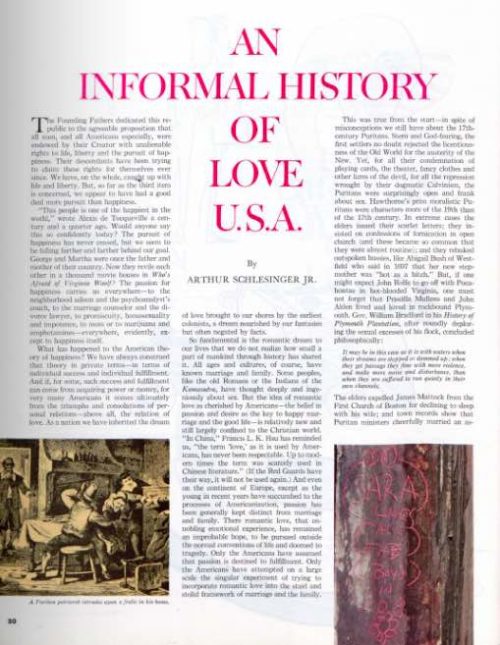
Born 100 years ago this week, Arthur M. Schlesinger, Jr. is known for his prize-winning books and his role as advisor and historian of the Kennedy administration. In the December 31, 1966, issue of the Post he offers “An Informal History of Love U.S.A.,” and concludes that our national pursuit of happiness has not led us to “an age of fulfillment.”
Schlesinger’s wide-ranging article shows how, despite stereotypes, our Puritan ancestors actually saw sex as natural and joyous. But by the mid twentieth century the pursuit of romance had become a chase after sensation, weakening the family structure.
Schlesinger’s insights were prophetic. When this article appeared, right before the “summer of love,” America’s divorce rate was about 10 percent. In the next decade, that would double.
Cover Collection: Farmers of the 1940s
In honor of National Farmer’s Day, we share some of our favorite illustrations of the people who worked the farms of America in the 1940s.

Arthur C. Radebaugh
October 3, 1942
In a year when many of the Post covers featured war-related images, this glowing, pastoral scene must have been a soothing one to readers. This painting reflects the regionalist style that was popularized by artists such as Thomas Hart Benton and Grant Wood. However, most of Radebaugh’s paintings were more futuristic; he created numerous illustrations for the airline and automotive industries.

Ray Prohaska
August 14, 1943
Although he painted several interior illustrations for the Post, this was Ray Prohaska’s only cover. The woman atop the wagon with her straw hat, polka-dot hair ribbons, and plaid shirt is the quintessential farm girl. As with the previous cover, this happy scene gave readers a respite from the war.

John Atherton
September 25, 1943
John Atherton painted 40 covers for the Post. Many were bold, architectural compositions of industry — steel mills, grain elevators, ore mines, and lumber yards. Atherton painted a number of more pastoral scenes, such as this farmer with his cornucopia of fruits, vegetables, and grains.

Steven Dohanos
October 21, 1944
Stevan Dohanos, inspired by Norman Rockwell’s talent, depicted everyday life in the 123 covers he created for the Post. Dohanos was also busy aiding the war effort by painting recruitment posters and wall murals for federal buildings. He also designed stamps for the federal government, starting during the Roosevelt administration, and staying in the profession the rest of his life.
Stevan Dohanos
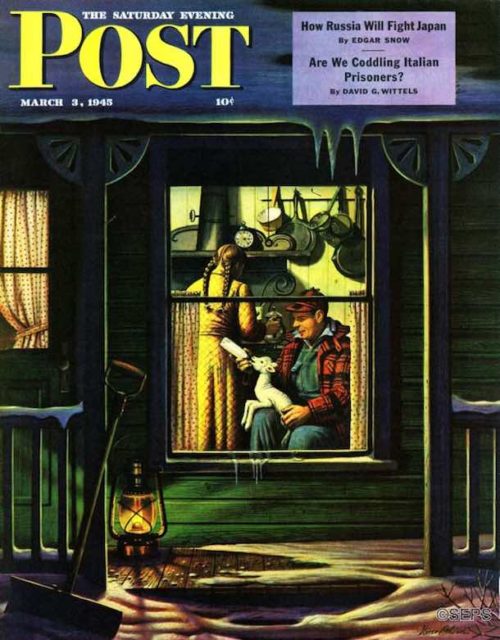
March 3, 1945
Stevan Dohanos made pencil studies of the lamb in this painting early in December on the farm of Raymond Platt, in Redding, Connecticut. Before he found his cover subject, however, he made a number of sketches in a drafty shed where lambs and ewes of all ages were quartered. “They stepped on my sketches and equipment; they pushed me all over the shed,” says Mr. Dohanos. “In fact, they acted just like people.”

Mead Schaeffer
October 9, 1948
This Mead Schaeffer cover shows corn being picked by the “bang-board” method, which allowed a man to throw ears into the wagon without looking, because they would bang against a high board at the far side of the wagon and drop in. By 1948, most big farms used mechanical corn pickers, including the Lawton, Iowa, farm of Louis Peterson, the setting of this picture. The mechanical picker had already been used on much of the field, as the rows of stubble indicate, but the day Schaeffer was there, the machine was busy elsewhere. Farmer Peterson needed a little corn for his hogs. He got it the bang-board way—and Schaeffer got this cover.
John Atherton
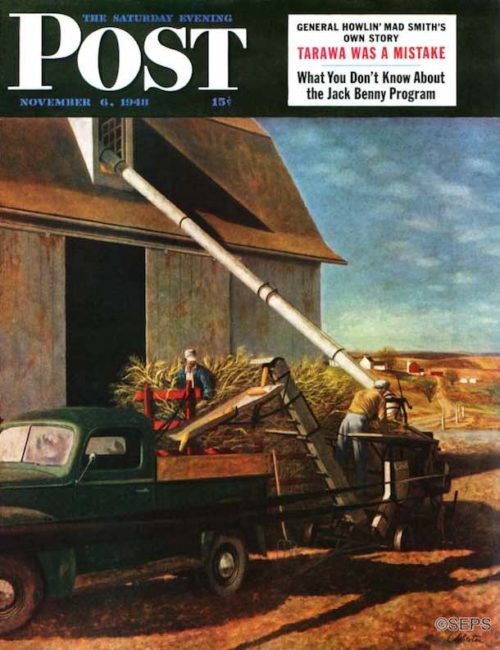
November 6, 1948
John Atherton’s cover painting depicts life on a farm near Madison, Wisconsin. The machine is a husker and shredder, which sends the husked ears of corn into the waiting truck, chops the stalk and blows the choppings into the mow, like hay. The power comes from a tractor offstage to the left.
Stevan Dohanos
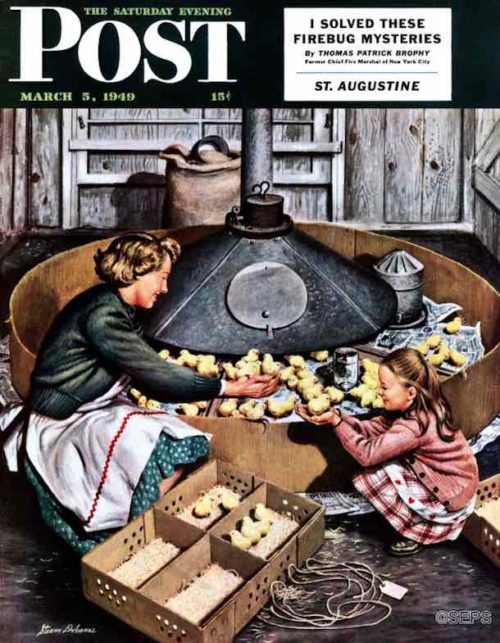
March 5, 1949
Stevan Dohanos felt apologetic about the request he made in a hatchery in Wallingford, Connecticut. “What I’d like to paint,” he said, “is baby chicks of one particular color. It’s a color people like to see on a bleak March day—a kind of pale lemon yellow.” It didn’t faze the hatchery men. “We’ve got about any shade you like,” they said, and began showing stock. The ones Dohanos chose—he thinks—were White Leghorns. The artist ended up pretty proud of his new knowledge. “That’s a coal-stove brooder,” he said professionally, “and technically correct. It has to be round. If it were square, you see, the chicks would get into the corners and crush themselves.”

Mead Schaeffer
August 12, 1950
This cover is meant to coincide with the wheat harvest in the famous North Dakota-Minnesota Red River Valley. Artist Schaeffer, conditioned to small patches of Eastern wheat, was amazed by the endless golden seas of Midwestern grain. One day, in the fields, Schaeffer wondered where everybody’s lunch was coming from, and an airplane appeared, bringing same.
North Country Girl: Chapter 21 — Youth in Revolt
For more about Gay Haubner’s life in the North Country, read the other chapters in her serialized memoir. The Post will publish a new segment each week.
The day after I saw The Who, I took the bus downtown to Musicland and bought my first record, The Who Sell Out; the album cover was a photo of Roger Daltrey bathing in Heinz Baked Beans. My mother shook her head at what she saw as a waste of $2.99. “You can listen to that music on the radio for free.” That was my cue, Youth in Revolt, to go back to Musicland and buy the new Rolling Stones album, Between the Buttons. I spent hours in my room listening to these two records, song after song, till the needle hit the sizzling rain drop song that indicated the end of that side, then flipping the record over, searching for clues to that other world like a radio astronomer listening for signs of life from distant stars.
I had no one who shared my new obsessions: rock and roll, drugs, sit-ins, protest marches, love-ins, be-ins, boys with long hair and romantic lacy shirts. Wendy’s mom’s two-year gig as dorm mother was up and they moved back to International Falls before the start of school. We promised to stay in touch, but phone calls would have been the dreaded Long Distance, so frowned on by my dad that my mom limited her calls to Aberdeen to two a year, one at Christmas and the other to let them know when we would be arriving for our summer visit. Wendy and I wrote, but letters didn’t capture the immediacy and high drama of the day-to-day junior high experience.
Despite my best friend’s departure, I wasn’t quite as lonely as a cloud when ninth grade started. I had a few girlfriends I sat with at lunch: Kathy O’Dell, Karen Ringwald, and Cindy Moreland, another newcomer to Duluth who had been taken in by our little group. But where were my fellow Youths in Revolt? Where were the readers of John Barth and John Updike, the fans of op art and experimental theatre, the anti-war protesters? Most importantly, where were kids who could get drugs? They were not at Woodland.
Kathy was a dreamy poet and painter, with long, blonde Michelle Phillips hair and perfect skin. She was waiting to be teleported to a garret in Paris, a black beret magically appearing on her head. Karen and I shared a reputation, guaranteed to impress no one, as the smartest girls in ninth grade, Karen slightly edging me out in math and routing me in Spanish. She was a 14-year-old cynic, dismissive of popular opinion, who regarded ninth grade boys as lower life forms. She vanished the next year, supposedly to some boarding school for super-smarties; this would have been the fodder of pregnancy rumors if it were any other girl besides Karen who disappeared.
Cindy Moreland was cute, perky, and as boy-crazy as I was, so the two of us eventually gravitated towards each other. We were far from soulmates; if I went to her house I had to listen to Gary Puckett’s “Young Girl” and “Girl You’ll be a Woman Soon” on repeat while we went through a box of Bugles and bottles of Coke and fretted over how to get boys to like us. At my house, I forced her to listen to The Who and The Rolling Stones, while we guzzled ginger ale (which was supposed to be for cocktails, not kids) and continued the discussion.
My mother, who generally ignored all kid goings-on, overheard us bemoaning our lack of success with boys. She was a former beauty queen, rising from Miss Aberdeen S.D. to Miss Upper Midwest, who had boyfriends coming out of her ears. Her advice was, along with always wearing cute clothes, to go up to a boy we like, say “Hi!” and start a conversation. This was the equivalent in my mind of suggesting I climb Everest.
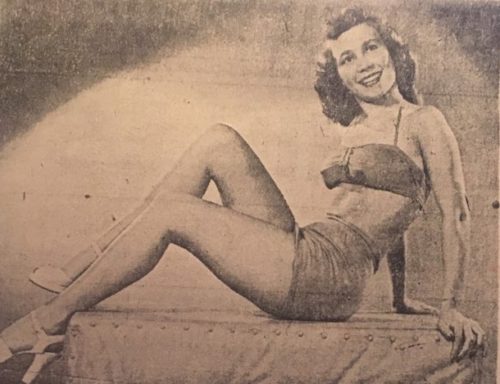
Cindy was an optimist. Her taste ran strictly to jocks and she had a plan to reel one in: cheerleading. Football players and cheerleaders were as natural a combination as peanut butter and jelly. No actual gymnastic ability was required to be a Woodland Junior High cheerleader: all you had to do for the eight or so home games was yell and shake your pom poms. Since there is no justice in junior high, cute, peppy Cindy Moreland did not make the cheerleading squad; only the already gilded popular girls were chosen. Cindy was heartbroken and spent the rest of the year practicing splits and hand springs, determined to win a spot next fall on the East High School cheerleading squad.
The very idea of cheerleading made me want to puke, but I had enough Minnesota nice left that I did not make fun of Cindy’s goal. My own aspirations to become a war-protesting, civil-rights-marching, free-love-practicing pot smoker were much more ridiculous.
I devoured every bit of information on the counter culture that I could get my hands on. My sources were laughable. I pored over The Saturday Evening Post’s coverage of Haight-Ashbury and tried to figure out how to get there on the twenty-eight dollars I had in the Pioneer National bank.

Time magazine covered the anti-war protests, but with a maiden aunt’s tut tut of disapproval. But in the back pages of Time I found a tiny ad for a new magazine, Avant Garde, which promised to cover every subject needed by Youth in Revolt. I snipped out the ad, filled in my name and address and begged my mom for a five-dollar bill (special introductory price), and handed the envelope off to our mailman. A few months later, after I had forgotten all about it, I received a plain brown wrapper that enclosed a fat, glossy magazine. Avant Garde was all I desired and more: anti-war articles! Photos of stoned, unwashed hippies in squalid New York City apartments! Drawings from the Kama Sutra (what the hell were they doing?)! A whole article on the f-word, which I had never seen in print before! I had found my peephole into the 60s.
Unfortunately, the editors of Avant Garde must have believed that printing schedules were for squares, man; months would go by between issues. Even more unfortunately, my dad came across an issue I had thoughtlessly left on the living room couch. He had to look at only a few pages to know that his eldest daughter was in danger of being ruined by a magazine and thundered into my room, shaking the offending publication, and roaring that whoever wrote crap like this deserved to be horsewhipped. I was careful to hide all my issues after that.
Most unfortunate of all, Avant Garde kept taking my money, but stopped sending magazines. I sadly replaced it with the leftie Saturday Review, a magazine with all of the pretention of Avant Garde but with none of the panache.
***
Stuck up in Duluth, I could only glimpse the revolution I knew was going on, a revolution I desperately wanted to be a part of but had no idea how to join. No one in Duluth marched against the Vietnam War.
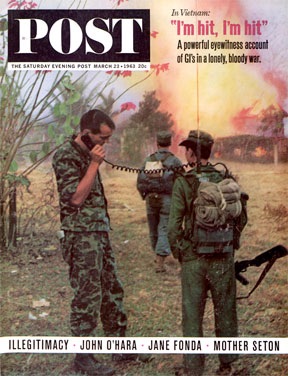
The war was something on the TV news, or below the fold on the front page of the Duluth Tribune. I announced myself as anti-war at every opportunity, even though everyone I knew at that point, kids included, believed in the domino theory, that we needed to stop communism in Southeast Asia or we’d all be wearing Mao suits. My own parents didn’t give two sh*ts about the war; the biggest response I could get out of them when I spouted my revolutionary rhetoric was the eye roll. They did forbid me from letting slip any of my wacky new-found opinions in front of my commie-hating grandpa Haubner, lest I give the old man a heart attack.

Civil rights were also a non-starter in almost all-white Duluth. The only black person I had seen in Duluth in my ten years of living there was the elevator operator at Oreck’s department store. When she was five, my sister Lani had stared at the slight, well-dressed woman perched on her stool for a full minute before announcing “I don’t like your black face.” The elevator operator snapped back, “And I don’t like your little white face,” and my mother hustled us out of the elevator and we took the stairs up to Better Dresses.
I got my first chance to stick it to the man thanks to the Woodland Junior High dress code, which stipulated that girls’ skirts must be knee-length. It was the height of the miniskirt craze, and my mother, the slave to fashion, made sure that all my skirts for ninth grade were stylishly short.
My revolt would have sputtered out if it hadn’t been for my English teacher, Mr. Koch. No one else at Woodland cared about the length of the skirt worn by a boring, nerdy honor student with stumpy legs. The dress code ruled that when you got down on your knees, the hem of the skirt had to touch the floor. (No one acknowledged how demeaning it was to have to kneel down in public on the grubby linoleum school floor.)
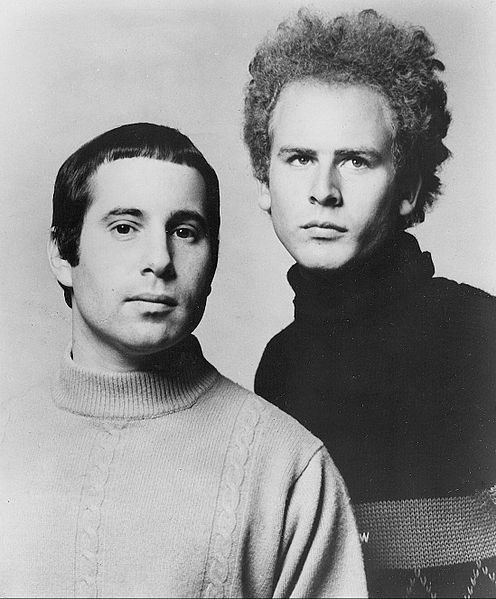
Mr. Koch, short and stubby, had turned his small black eyes on me from the beginning of the year. He wore a peevish look whenever I started in on my anti-war rhetoric. He grumbled when I chose the lyrics to Simon and Garfunkel’s “I am a Rock” for my poetry paper, threatened to make me redo it, and then awarded me a grudging B-.
Showing up in a shiny red pleather miniskirt was a serious transgression. Mr. Koch ordered me up to the front of the room, made me kneel, eyeballed the few inches between skirt and floor, inches occupied by my bony kneecaps, and sent me to the principal’s office. When the bored school secretary reached my mother and told her she needed to bring me a change of clothes, mom said the hell with that and that they better send me back to class or else. After all, she herself had plucked the skirt from the sales rack in Dayton’s Junior Miss department.

I had single-handedly put an end to the Woodland Dress Code. When I returned triumphant to Mr. Koch’s room, my classmates lined up to sign my pleather skirt in indelible black or blue Bic pen. My mother, horrified that I would ruin my clothes like that, threw it out.
My first successful act of rebellion put me directly in Mr. Koch’s sights. I pulled the trigger myself when during a class discussion I piped up to say that I couldn’t wait to try LSD, which sent Mr. Koch into a red-faced paroxysm. When he could speak again, it was to give me a series of mandatory extra assignments. Assignments that for some reason had to be completed in his apartment over several Saturdays. This situation was made even creepier by the flitting about of Mr. Koch’s all too cheerful wife, while I read Romeo and Juliet aloud at their kitchen table and Mr. Koch stared at me.
Logophile Language Puzzlers: Idioms, Animals, and Capitals
Put your knowledge of idioms, animals, and state capitals to the test with these questions from the Logophile that appeared in the September/October 2017 issue of The Saturday Evening Post. Answers and explanations are below.
1. Aunt Jenny’s doctor said not only that she had a clean bill of health, but that she was
- hale and hearty.
- hale and hardy.
- hail and hearty.
- hail and hardy.
2. A young mother named her triplet sons after the animals they resembled at birth. The first was born roaring like a lion, so she named him Leonine. The second had a prominent nose and piercing eyes, like an eagle, so she named him Aquiline. The third brother had big feet, skinny legs, and a long neck, like an ostrich. What did she name him?
- Corvine
- Pavonine
- Struthionine
3. What is the only state capital whose name shares no letters with its state’s name?
Answers and Explanations
1. a. hale and hearty
Getting this idiom correct requires detangling two pairs of homophones. We’ll take them one by one:
The word hail has many different uses in English. It’s a salutation (“Hail, good sir!”), an acclamation (hail to the chief), a summoning or calling out (“Hail the starship.”), one’s hearing distance (staying within hail), and, of course, a downpour of car-dinging ice balls. But none of these senses has anything to do with one’s health.
Hale, on the other hand, does. It is etymologically related to the word whole and means “free from defect” or “retaining exceptional health and vigor.” Noticing that hale is an anagram of heal may help you remember that it is the homophone related to health.
Hearty can mean both “vehement, unrestrained” and “exhibiting vigorous good health.”
Hardy, as you might guess, is related to hard. It means “tenacious, inured to hardship” — like hardy mums, for example.
While being hardy — having the ability to withstand hardship without damage — is a good outlook for one’s health, the idiom for being in overall excellent health is “hale and hearty.”
2. c. struthionine
The English lexicon includes a veritable zoo of words that mean “of or relating to” a particular animal. A few of them we use all the time, such as canine, feline, and bovine. Others are less well-known but rather transparent, as with hippopotamine, falconine, and serpentine. Others are not so obvious.
Like many of these “animal words,” struthionine derives from Latin: struthio means “ostrich.” Struthionine (or, alternatively, struthious) not only describes something that physically looks like or is related to an ostrich but can also refer to the figurative sense of “burying one’s head in the sand” that has long been attributed to ostriches — though the characterization is scientifically inaccurate.
Here are just some of the adjectives available and the animals they indicate:
- aquiline: eagle
- corvine: crow or raven
- formicine (also myrmecoid): ant
- hirundine: swallow
- ovine: sheep
- pavonine: peacock
- porcine: pig
- ursine: bear
3. Pierre, South Dakota
Coming up with this answer is simply a matter of remembering your state capitals and comparing letters.
While you’re thinking of state capitals, try this bonus question: The names of four state capitals begin with the same letter as the name of their state. How quickly can you name them?
This article is featured in the September/October 2017 issue of The Saturday Evening Post. Subscribe to the magazine for more art, inspiring stories, fiction, humor, and features from our archives.
“The American Husband” by Alice Duer Miller
The Saturday Evening Post published Alice Duer Miller’s fiction story “The American Husband” in 1922. Miller published various poems and stories throughout her career, and she was an avid participant in the suffrage movement. Her feminist writings impacted many, and a few pieces of her work later became films. One of her poems, “The White Cliffs,” encouraged US entry into World War II.
“The American Husband” shows royalty turning to America for a better chance at work, and the importance of judging character for oneself. Miller allows this unique story to paint a picture many readers don’t expect.
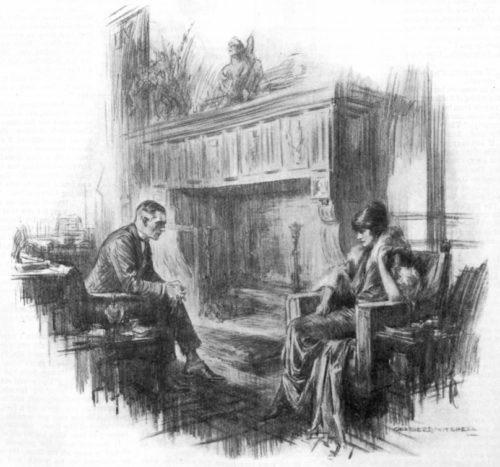
Princesses are usually practical people, but we Americans, whose ideas of princesses are founded rather on fairy tales than on history, allow ourselves to be shocked and surprised when we discover this trait in them.
The Princess di Sangatano was practical; she was noble, dignified, unselfish, patient, subtle, still extremely handsome at thirty-nine, and — or but — practical. She had just married her young daughter excellently. She had not done this, however, by sitting still and being dignified and noble. She had done it by going pleasantly to the houses of women whom she disliked; by flattering men in whom even her subtlety found few subjects for flattery; by indorsing the policy of a cardinal, of whose policy as a matter of fact she disapproved. Nor did she feel that her conduct in this respect was open to criticism. On the contrary, there was nothing which the princess viewed with a more satisfactory sense of duty done than the marriage of her daughter.
And now she was beginning to recognize that her son must be launched by similar methods. The launching of Raimundo was something of a problem. He had much to recommend him; he was good-looking, gay and sweet-tempered; he loved his mother, and was not naughtier than other boys of his age; but he lacked the determined industry likely to make him successful. It was impossible to consider a learned profession for him. and even for diplomacy, in which the princess could easily have found him a place, Raimundo was a little too impulsive. And so his mother, working it out, came to the conclusion that a business — a business that would like to own a young prince and would need Raimundo’s knowledge of Italians and Italy — would be the best chance; and so, of course, she thought of America — her native land. Yes, though few people remembered the fact, the princess had been born in the United States. She had left it as a small child, her mother having remarried — an Italian — and she had been brought up in Italy thenceforth. By circumstance and environment, by marriage and religion and choice, she had become utterly an Italian. She betrayed this by her belief that America — commercial America — would respect and desire a prince. And hardly had she reached this conclusion when she met Charlotte Haines.
They met quite by accident. The princess during a short stay in Venice was visiting her mother’s old friend, the Contessa Carini Bon. The Carini-Bon palace, as all good sightseers know, is not on the Grand Canal, but tucked away at the junction of two of the smaller canals. It is a late Renaissance palace, built of the white granite that turns blackest, and it is decorated with Turks’ heads over the arches of the windows, and contains the most beautiful tapestries in Italy. The princess, who since the war did not commit the extravagance of having her own gondola in Venice, had walked to the palace, through many narrow streets over tiny bridges, and under porticos, and having arrived at the side door was standing a minute in conversation with the concierge — also an old friend — discussing his son who had been wounded on the Piave, and the curse of motor boats on the Grand Canal, and the peculiar habits of the forestieri, and other universal topics, when she saw, across the empty courtyard, that a gondola had appeared at the steps.
It was a magnificent gondola; the two men were in white with blue sashes edged with gold fringe; blue ribbons fluttered from their broad-brimmed hats; their oars were striped blue and white; and the gondola itself shone with fresh black paint relieved here and there by heavy gold. In the front there was a small bouquet of roses and daisies in the little brass stand that carried the lamp by night. Out of this, hardly touching the proffered arm of the gondolier, stepped a pretty woman, her whit draperies and pearls contrasting with her smooth dark hair and alert brown eyes. She asked in execrable Italian whether it were possible to “visitare” the palazzo. The concierge, in ess. that liquid beautiful voice which so many Italians of all classes possess, replied that it was utterly impossible — that occasionally, when the contessa was not in Venice, certain people bringing letters were permitted, but at present the contessa was at home. The lady did not understand all of this, and was not at her best when crossed in her pursuit of ideal beauty and without a language in which to argue the point. She kept repeating “Non a possible?” and “Perche?” and never appearing to understand the answer, until in despair the concierge looked pathetically at the princess. Following his glance Charlotte, bursting with a sense that she was somehow being done out of the rights of an American connoisseur, broke into fluent French. Was it, she asked, really impossible to see the tapestries? How could such things be? She was told they were the best tapestries in all Italy; tapestries were her specialty. She knew herself in tapestries.
The princess courteously repeated the concierge’s explanation; and so these two women, born not two hundred miles away from each other in the state of Ohio, stood for a few minutes and conversed in Venice in the language of the boulevards. Perhaps it was some latent sense of kinship that made the princess feel sorry for Charlotte. She told her to wait a moment, and went on up to see the contessa.
When the first greetings were over she explained that there was a very pretty young American woman downstairs who was bitterly disappointed at not being able to see the tapestries.
“Good,” said the contessa. “I’m delighted to hear it.” She was very old and wrinkled and bright-eyed, and she had a habit of flicking the end of her nose with her forefinger. “These Americans — I hear their terrible voices all day long in the canals. They have all the money in the world and most of the energy, but they cannot have everything. They cannot see my tapestries.”
“And that is a pleasure to you?”
The contessa nodded. “Certainly. One of the few I have left.” The princess sighed. “I am more of an American than I supposed,” she said.
The contessa hastened to reassure her: “My dear Lisa! You! There is nothing of it about you.”
The princess was too remote from her native land to resent this reassurance.
She continued thoughtfully: “There must be. I am a little bit kind. Americans are, you know. If anyone runs for the doctor in the middle of the night at a Continental hotel it always turns out to be an American. The English think they are officious and we Italians think they are too stupid to know when they are imposed upon, but it isn’t either. It’s kindness. The English are just, and the French are clear-sighted, but Americans are kind. You know I can’t bear to think of that young creature loving tapestries and not being able ever to see yours.”
“My dear child, if you feel like that!” The contessa touched the bell, and when in due time Luigi appeared, she gave orders that the lady waiting below was to be allowed to see the tapestries in the dining room and the galas. “But not in here, Luigi; no matter how much she gives you — not in here — and let her know that these are much the best ones. So, like that we are all satisfied.”
An evening or so after this the two women met again; this time at a musicale given by a lady as international as the socialist party. Charlotte, still in spotless white and pearls, came quickly across the room to thank the princess, whom she recognized immediately. She said quite the right things about the tapestries, about Venice, about Italy; and the princess, who was susceptible to praise of the country which had become her own, was pleased with Charlotte.
“One is so starved for beauty in America,” Mrs. Haines complained. “I’m like a greedy child for it when I come here; you can form no idea how terrible New York is.” The princess dimly remembered rows of chocolate-colored houses — the New York of the early ‘90’s. She was ready to sympathize with Charlotte.
“Why don’t you come here and live — such beautiful old palaces to be had for nothing — for what Americans consider nothing,” she suggested.
Charlotte rolled her large brown eyes. “If only I could; but my husband wouldn’t hear of it. He actually likes America. Italy means nothing to him.”
Lisa was destined to hear more of Charlotte’s husband before she took in the fact that he was the president of the Haines Heating Corporations. It made a difference. It wasn’t that she didn’t really like Charlotte — Lisa would never have been nice to her if she hadn’t really liked her; but neither would she have been so extremely nice to her if Haines had not been at the head of such a hopeful company. It was a wonderfully lucky combination of circumstances.
And to no one did it appear more lucky than to Charlotte, to whom the princess seemed so well-bred, so civilized, so expert and so wise — the living embodiment of all that Charlotte herself wished to become.
And then she knew Venice so wonderfully; she was better than any guidebook. She knew of gardens and palaces that no one else had heard of. She knew of old wellheads and courtyards. A few people went to see the Giorgione in the Seminario, but only the princess insisted on Charlotte’s seeing the library, with its row of windows on the Canal, and its beautiful old books going up to the ceiling, and the painted panel that looked like books until, sliding it, you found it was the stairway to the gallery — all these delights Charlotte owed to her new friend. And as the moon grew larger — on the evenings when Charlotte wasn’t dining with Americans at the Lido or at that delightful new restaurant on the other side of the Canal, where you sat in the open air and ate at bare tables in such a primitive way — the two women would go out in Charlotte’s gondola — sometimes through the labyrinth of the little canals, but more often the other way — past some tall, empty, ocean-going steamer anchored off the steps of the church of the Redentore — out to the Giudecca, where they could see the lighthouse at the entrance to the port, past a huge dredge which looked in the misty moonlight, as Charlotte said, like a dragon with its mouth open; on and on with their two gondoliers, to where everything was marsh and moonlight. The princess had often noticed that Americans in Europe explained themselves a good deal. Perhaps citizens of a republic must explain themselves socially; after all, a princess does not need explanation. Charlotte on these evenings explained herself. Even as a child, she said, she had been reaching out for beauty — a less sophisticated person would have called it culture — when she had married she had thought only of the romance of it — she had been very much in love with her husband, ten years older than she, already successful; a dominating nature, she had not thought then that they were out of sympathy about the impersonal aspects of life — art, beauty. It was natural for Charlotte to slip into the discussion of her own problem — the problem of the American husband — so kind, so virtuous, so successful, but alas, so indifferent to the finer arts of living.
“What are we to do, we American women?” Charlotte wailed. “We grow up, we educate ourselves to know the good from the bad, the ugly from the beautiful — and then we fall in love and marry some man to whom it is all a closed book; who is sometimes jealous of interests he cannot share. Sometimes it seems as if we should crush all that is best in us in order to be good wives to our husbands. You Europeans are so lucky — you and your men have the same tastes and the same interests.”
“At least,” said the princess politely, “your men are very generous in allowing you to come abroad without them. Ours wouldn’t have that for a minute.”
Charlotte laughed. “Our men would rather we came alone than asked them to go with us. You can’t imagine how bored my husband is in Europe. He speaks no language but his own, and instead of meeting interesting people he goes to his nearest office and entirely reorganizes it.”
The princess had always wanted to know whether these deserted American husbands had other love affairs; or, rather, not so much whether they had them as whether they were permitted to have them. Here was an excellent opportunity for finding out. She put her question, as she felt, delicately, but Charlotte was obviously a little shocked.
“Oh, no!” she said quickly. “At least Dan doesn’t. Dan isn’t a bit horrid in ways like that.”
Lisa felt inclined to disagree with the adjective. Human, she would have called it. At the same time she felt extremely sympathetic with Charlotte’s situation. She knew how she herself would have suffered if she had married a competent business man who lived in a brownstone front with a long drawing-room like a tunnel, and talked nothing but business at dinner. She inquired whether Mr. Haines was in Wall Street, and heard that he was the head of the Haines Heating Corporations. Then making more extended inquiries in her practical Latin way, she saw that she had found the right opening for Raimundo.
Before Charlotte left Venice she invited the princess and her son to pay her a visit in New York that winter; she urged it warmly. For to be honest Charlotte was in somewhat the same position in regard to the princess that the princess was in regard to Charlotte. The fact that she was a princess warmed the younger woman’s liking.
Lisa did not jump at the invitation. It was her duty to accept it, but she was not eager.
“I haven’t crossed the Atlantic since I was eight years old,” she said. “Besides, how would Mr. Haines feel about us? If Italy bores him, wouldn’t two resident Italians bore him more?”
“You would start with the handicap of being my friends,” Charlotte answered, “but he’d be perfectly civil, and in the end he would learn to appreciate you. He’s not a fool, Dan. He’s wise about people, if he can only get over his prejudices. But he’d be away most of the time. He always goes to California in January to look after his oil wells or something.”
It was not quite the princess’ idea that Dan Haines should be away all the time. He must see Raimundo, and be charmed by his youth and gayety, while she, the princess, would provide a background of solidity and Old World standards. She talked the matter over with her son — a thin, eagle-nosed boy of twenty. He was enthusiastic at the prospect, but more, his mother feared, because he had fallen in love with Charlotte’s niece, whom he had met at the Lido, than because he took his future in the Haines Heating Corporations seriously. Nevertheless she accepted Charlotte’s invitation.
Yet many times before January came she woke up in the night, cold with horror at the idea of this journey to an unknown land. She had hardly been out of Italy for twenty years. And even after she had actually sailed, walking the inclosed deck at night, while Raimundo was playing bridge, she shrank from the undertaking. She was very lonely, the poor princess. She and the prince had had their own troubles and disagreements, but these had gradually passed, and she had come to look forward to his companionship for her old age — a quiet prospect of settling their children and bringing up grandchildren, and making two ends meet at the dilapidated Sangatano villa. And then he had failed her; he had died during the war; and the princess had found that all her little world died about the same time. The old circle in Rome was gone, ruined, embittered, changed and scattered. The pleasant clever friendly educated group of her friends were a group no longer. And she was changed too. The war — or, rather, the aftermath of war — had brought out in her something different from her beloved country of adoption. She was not willing to sit down and lament the passing of her own order. She could not weep because the peasants no longer rose as you passed their houses. She had even a suspicion that the new order was not so terrible, and this put her old friends out of sympathy with her. They remembered that she was, after all, an American. Perhaps it was as well she was going away that winter, for she was very lonely at home.
Her steamer chair was next that of an American gentleman, a short, fat, round-faced man, who bore out her theory that Americans were kind, by the most careful and unobtrusive attention. The name of Haines was introduced into the conversation, and evidently inspired the fat man’s interest. She asked if he knew Mr. Haines. No, not really. She saw that he would like to have been able to say that he did. He knew a great deal about Haines,.which he was more than ready to tell. Haines was a man whom many people thought dangerously liberal in his ideas of handling his labor, and yet ultraconservative in his investments. His ideas worked out, though — a brilliant man — creative — and then the usual story of having begun life on nothing.
“Really?” murmured the princess, not at all surprised, because she supposed all rich Americans began life with nothing.
Still, she was glad of this increase in her knowledge of her host. He was evidently one of these tremendous commercial powers. Charlotte’s account had hardly prepared her for this, but then, she supposed Charlotte lived so surrounded by these vigorous fortune-makers that she had lost her sense of proportion about them. The possibility pleased the princess. After all, there were other heads of large industries besides Haines.
She conveyed her extended hopes to Raimundo when about noon he appeared on deck, having had already a game of squash, a swim, and a turn on deck with a very pretty opera singer.
“This is a great opportunity, Raimundo,” she said, “if you take it in the right way.” “Oh, I shall take it right,” said the boy, sitting down beside her and studying his long, slim foot in profile. “I shall, of course, make love to the beautiful Charlotte.”
“You will do nothing of the kind.”
“For what are we crossing the ocean?” replied her son. “Oh, I have read transatlantic fiction. American men do not mind your making love to their wives — because it saves them the time it would take to do it themselves; and then also it confirms their belief that they have acquired a valuable article.”
“You must not talk like this, even to me,” said his mother. “You are quite wrong. Charlotte, like most of the American women I have met, is extremely cool and virtuous.”
“Of course,” said Raimundo, “you offer them only a dumb doglike devotion.” And looking into her face he sketched a look of dumb doglike devotion at which she could not help laughing.
Charlotte was at the wharf to welcome them, accompanied by a competent manservant to do the work of the customs. Mr. Haines, it appeared, was in California. The princess expressed polite regret at hearing this.
“Oh, he’ll be back,” answered his wife, and if she did not add “quite soon enough” her tone conveyed it, and Raimundo darted a quick impish glance at his mother.
As they waited while the princess’ maid put back the trays of the trunks Lisa tried to convey her admiration of the harbor. Of course a great deal has been written about the approach to New York by sea, but as the princess, like most Europeans, had never read anything about America, it all came as a great surprise to her. It seemed to come as a surprise to Charlotte too.
“Beautiful?” she said incredulously. “After Venice? “
“Different,” answered the princess. “I should say it was different,” said Charlotte.
“There — I think those horrible men have finished mauling your trunks, and we can go.”
It was on the tip of Lisa’s tongue to say that she found the American customs officials perfectly civil, and that her experiences on European frontiers had been much more disagreeable, but as she began to speak she was suddenly conscious that Charlotte did not really want to think well of her native land, and she stopped.
“Oh, I say,” cried the little prince as they came out of the cavelike shadow of the pier into the cloudless light of the winter day, “what a jolly day! I shan’t be responsible for anything I do if you have many days like this.”
“Oh, we have lots of these,” returned Charlotte, signaling to her footman. “ We have nothing else — no half lights, no mists, no mystery.” And they got into her little French town car and started on their way uptown.
The princess stared out of her window in silence, noting the disappearance of the chocolate-colored houses, the beauty of the shops — and yes, even of the shoppers. But her son was not gifted with reticence. If his impressions had been disagreeable he might have been silent, but as they were flattering he saw no reason for suppressing them. He thought Fifth Avenue wonderful.
“And, my eye,” he kept saying — an expression he had learned early in life from an English groom — “what a lot of pretty girls, and what a lot of cars! I did not know there were so many motor cars in the world.”
Charlotte smiled as if she knew he meant to be kind, and suddenly laying her hand on the princess’ knee, she said, “Oh, I’m so afraid you’re going to hate it all, but you don’t know what it means to me to have you here.”
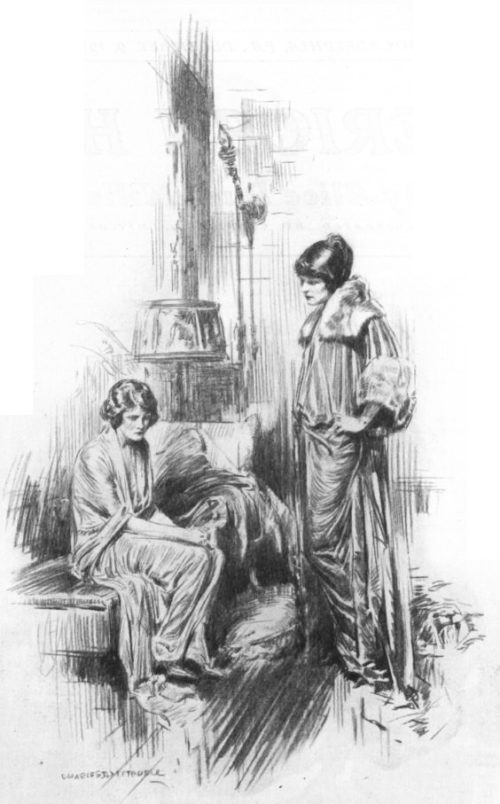
The princess was touched. Yet it must be owned that Lisa found the next few weeks confusing — confusing, that is, if Charlotte were to be regarded as the starved prisoner of an alien culture. They were agreeable weeks; Raimundo was in the seventh heaven. He dined, danced, lunched, and danced again. He went into the country and tobogganed, and learned to walk on snowshoes. When asked how he was enjoying America he always made the same answer: “I shall never go home. My eye! What girls!”
His mother enjoyed herself more mildly, and with certain reservations. Erudite gentlemen were put next to her at dinner — a Frenchman who was a specialist on Chinese porcelains; a painter of Spanish birth; and several English novelists and poets who were either just beginning or just completing successful lecture tours of the United States; interesting men, in one way or another, and yet — and yet — the princess asked herself if she had crossed the wide Atlantic simply to see this pale replica of a civilization she already knew.
And something else puzzled and distressed her. Her friend Charlotte seemed to her the freest of created beings — freer than any woman the princess had ever known, to make of her life anything she wanted to make of it. But Charlotte’s life seemed to lack purpose and dignity. Charlotte liked to feel that learned men came to her house, but her state of nerves did not always allow her to listen to what they said. Serious books were on her table, and sometimes in her hands, and yet her life lacked those long safe hours of leisure in which such books are read.
There was no doubt that a realer, more vital Charlotte appeared buying a new hat or playing a game of bridge or asking someone to dinner, than the Charlotte who lamented the lost beauty of an old world. And yet she wasn’t just a fraud.
She was not an early riser, and if toward eleven o’clock the princess penetrated to Charlotte’s bedroom, overlooking the park, she would find her still in bed — a priceless Italian bed — said to have been made for Bianca Capello — propped by lace pillows, and reading a fashion paper. And something else worried the princess — the house, the way it was managed. It was comfortable, well heated — too well; there was always delicious food and too much of it, but Charlotte lived in her house as in a hotel. If butchers overcharged or footmen stole, Charlotte’s only feeling was that they were tiresome dishonest people with whom she wished to have nothing to do. Abroad, she said, one’s servants did not do such things.
The princess disagreed. They did not have the same opportunities, she said; the mistresses were more vigilant. The extravagance of the Haines household actually hurt her, coming as she did from a group where extravagance had ceased to be possible. But Charlotte would not admit that she had any responsibility.
“Really, dear Lisa,” she said almost crossly, “I have better things to think about than housekeeping.”
Well, the princess wondered what they were.
As the days went by and as small party succeeded small party, Lisa noted that she met no American men — or hardly any — at Charlotte’s house, and she asked finally why this was.
“Do they work so hard they can’t dine out?”
“No — or, rather, yes, they work hard; but that’s not why I don’t ask them. They’re so uninteresting — you would be bored to death by them.”
“I’d rather like to try,” said the princess mildly.
Charlotte contracted her straight eyebrows in thought. “I’ll try to think of some not too awful,” she said.
And a few evenings afterward the princess found herself next to a nice little chattering gentleman who spoke Italian better than she did, and made lace with his own hands. On the other side was a former ambassador — a charming person, but of no nation or age. She had known him in Paris for years. She sighed gently. She wanted to meet a financial colossus. She liked men — real ones.
Needless to say that in the Haines house she had her own sitting room — a delightful little room hung in old crimson velvet, with a wood fire always blazing on the hearth. The first day when Charlotte brought her into it she apologized for a picture over the mantelpiece.
“The things one puts in the spare room!” she said. “My husband bought that picture at an auction once, because it reminded him of the farm he was brought up on. I didn’t dare give it away, but there’s no reason why you should be inflicted with it.” And she raised her arm to take it down.
“No! Leave it; I like it,” said the princess. “It’s delightful — that blue sky and clouds.”
She was quite sincere in saying she liked it. She did. Often she would look up from her book and let her eyes fall with pleasure on the small green and blue and white canvas, and wonder in what farming district Mr. Haines had been brought up — and in what capacity.
The New York climate affected the princess’ ability to sleep. She read often late into the night. One night — or rather morning — for it must have been three o’clock — she was interrupted by a visit from her son. He often dropped in on his way to bed to sketch for her the strange but in his opinion agreeable habits of the American girl. But this evening he did not burst out into his usual narrative. He entered silently, and stood for some seconds silent.
Then he said “Our host has returned.”
“Oh,” said the princess with pleasure, for, after all, this was the purpose of the long excursion.
“How unexpected!”
Her son gave a short laugh. “I believe you,” he said. “Unexpected is just the word. It sometimes seems as if, in spite of all that has been written on the subject, husbands would never learn the tactlessness of the unexpected return.”
“Raimundo, what do you mean?” asked his mother with a sinking heart.
The boy hesitated. “The lovely Charlotte,” he said, “is all that you told me she was — cool and virtuous — so much so that it never occurs to her that others may be different. Tonight I brought her home from a dull party. We got talking; we sat down in the drawing-room. The back of a lovely white neck bent over a table was so near my lips — and the husband enters.”
“Was there a scene?”
“Oh, no. It was worse. We chatted a trois for a time.”
The princess drew a long breath. “Perhaps he did not see; but really, Raimundo — ”
“Oh, he saw,” said the prince. “He maneuvered the suspicious Charlotte off to bed, and then he suggested without a trace of anger or criticism that I should leave the house in the morning; and really, my dear mother, I’m afraid I shall have to do it. I’m so sorry, I know you’ll feel annoyed with me, but it is hard to remember that no woman means anything here. I just manage to remember it with the girls; but the married women — well, one can’t always be so sure; not so sure, at least as one is with Charlotte. There was no excuse for me — with her — none.”
“You’re an awkward, ungrateful boy,” said his mother, with an absence of temper that made her pronouncement more severe. “I think I shall go downstairs now myself and have a talk with Mr. Haines.”
“You’ll do the talking,” answered her son. “He isn’t exactly a chatty man.”
But the princess was not discouraged. She could not see that she could do any harm to Raimundo’s prospects, since evidently all was now lost, and she felt she owed it to Charlotte to repair, if she could, any damage the boy’s folly had occasioned.
The lights on the stairs and corridors were all going; they were controlled by switches working, to the princess’ continual surprise, from all sorts of unexpected places. She had no difficulty in finding her way to the drawing-room, on the second story, where Raimundo told her the interview had taken place.
As she opened the door she saw that a tall thin man in gray morning clothes was standing alone in the middle of the room, with his hands in his pockets and a cigar stuck in the corner of his mouth, quite in the American manner. He was pale, pale as his blond smooth hair, now beginning to be gray, and everything about him was long — his hands, his jaw, his legs like a cavalryman’s. He was turned three-quarters toward the door, and he moved nothing but his eyes as the princess entered.
There was always something neat and finished about the way Lisa moved, and the way she held herself, the way she put her small steady feet on the ground; and this was particularly evident now in the way she opened the door, moved the train of her long tea gown out of the way and shut the door again. She did all this in silence, for it was her theory to let the other person speak first. It was a theory that she had had no difficulty in putting into practice during her stay in America, but it was now forced upon her attention that Haines had the same theory, for he remained perfectly silent, and something told her that he was likely to continue so. The fate of interviews is often decided thus in the first few seconds.
She spoke first. “I am the Princess di Sangatano,” she said.
He nodded.
“My son has just told me about the incident of this evening.”
He nodded again, and then he said, “You want to discuss it?”
His voice was low and not without a nasal drawl, but the baffling thing about it was the entire absence of any added suggestion of tone or emphasis. There were the bare words themselves and nothing more — no hint as to whether he himself wished or didn’t wish to discuss it — approved or didn’t approve of her intention.
“Yes, I do,” she replied.
“Better sit down then.”
The princess did sit down, folding her hands in her lap, drawing her elbows to her side, and sitting very erect. She did not say to herself, like Cleopatra: “Hath he seen majesty?” but some such thought was not far from her.
For twenty years she had been acknowledged to be an important person, and this had left its trace upon her manner. She knew it had.
“Are you very angry at this silly boy of mine?” she said.
Haines shook his head — that is to say, he wagged it twice from side to side.
“Not at Charlotte, I hope?”
Another shake of the head.
The princess felt a little annoyed. “Then what in heaven’s name do you feel, if anything?” she said.
“I feel kinda bored,” he answered; and as Lisa gave an exclamation that expressed irritation and lack of comprehension he added, again without any added color in his voice: “How did you expect me to feel?”
“Oh, either more or less,” answered Lisa. “Either you should be furious, and shake Charlotte until her teeth rattled, and fling my boy into the street, or else you should be wise enough to see it doesn’t make the least difference — and be human — and sensible — and — and — “
“ — and give your son a job,” said Haines quietly.
The princess was startled. She drew herself up still more. “I have not asked you to give my son a job,” she said.
He took his cigar out of his mouth, and she noticed that his strange long pale hands were rather handsome.
“Look here,” he said, “answer this honestly: Didn’t you have some such idea in your head when you decided to come here? Look at me.”
She did look at him, at first rather expecting to look him down, and then so much interested in what she saw — something intense and real and fearless — that she forgot everything else — forgot everything except that she was thirty-nine years old, and had lived a great deal in the world and yet had not met very many real people, and now — Then she remembered that she must answer him.
“Oh, yes,” she said; “I had it in mind.”
“Well,” said Haines, “that’s what bores me.” He began to walk up and down the room, somewhat, Lisa thought, as if he were dictating a letter. “Poor Charlotte! She’s always making these wonderful discoveries — and they always turn out the same way — they always want something. You — why she’s been talking about you — and writing about you. You were the most noble, the most disinterested, the most aristocratic — She would hardly speak to me because I asked her why you were making this long journey. For love of her society, she thought. She thinks I’m a perfect bear, but, my God, how can a man sit round and see his wife exploited by everyone she comes in contact with — from the dealer who sells her fake antiques to the grandee who offers her fake friendship? ‘
“I can’t let you say that,” said the princess, too much interested to be as angry as she felt she ought to be. “I have never offered anyone fake friendship.”
“I didn’t say you had.”
“Pooh!” said she. “That’s beneath you. You should at least be honest, as you ask other people to be.”
This speech seemed to please him — to please him as a child might please him. He came and sat down opposite to her, looked at her for a moment and then smiled at her. His smile was sweet and as intimate as a caress.
“Come,” he said, “I believe you’re all right.
“I am,” she answered. “Even a little bit more than that.”
He sat there smoking and frankly studying her. “And yet,” he said after a moment, “they’re mostly not — you know — Charlotte’s discoveries. They’re mostly about as wrong as they can be.”
“And they kinda bore you?” said the princess, to whom the phrase seemed amusing. He nodded, and she went on: “A good many things do, I imagine.”
“Almost everything but my business. You don’t,” he added after a second; and there was something so simple and imperial in his manner that she did not think him insolent; in fact, to tell the truth, she was flattered. “You might tell me something about yourself,” he added.
The princess was too human not to be delighted to obey this suggestion, and too well-bred to take an unfair advantage of it. She talked a long time about herself, and then about the Haines Heating Corporations.
And then they talked about him. In fact they talked all the rest of the night — as continuously as schoolgirls, as honestly as old friends, as ecstatically as lovers; and yet, of course, they were not schoolgirls or old friends, and even less lovers. They were two middle-aged people, so real and so fastidious in their different ways that they had not found many people whom they liked; and they had suddenly and utterly unexpectedly found each other.
They were interrupted by the entrance of a housemaid with a broom and a duster. She gave a smothered exclamation and withdrew. Haines looked at his watch. It was half past seven.
He got up and pulled the curtains back. A pale clear pink-and-green winter morning was just beginning to shine upon the park, glittering in snow and ice.
“At home,” said Lisa, “I should consider what we have just done as rather irregular.”
“In this country,” he answered, “you can do anything if you have sufficient integrity to do it.”
“How can I tell whether I have or not?” she asked.
He smiled again. “I have enough for both,” he answered. “Luckily or unluckily “ — and he sighed as he repeated it — “ luckily or unluckily.”
“Oh, luckily; luckily, of course,” said Lisa, though there was just a trace of annoyance in her voice that, this was so clear. She held out her hand.
“Goodbye,” she said.
He took her hand, and then from his great height he did something that no one had ever done to the princess before — he patted her on the head. “You’re all right,” he said, and sighed and turned away — as it were, dismissing her.
She went upstairs to her own room — which seemed altered, as backgrounds do alter with changes in ourselves. It was no longer a room in Charlotte’s house but in Haines’; and she was leaving it, leaving it in a few hours. She did not debate that at all. She was going with her son, but there was something that must be done before she went — something that she must do for this new friend of hers whom she would never, probably, see again.
She did not have much time to think it over, for when her breakfast tray came in, as usual, at nine, Charlotte came with it — striking just the note the princess hoped she wouldn’t strike — apology. “
I suppose your son told you what happened last night. So silly. I’m so ashamed.”
“Ashamed?” said the princess, and she noted that her tone had something of the neutrality of Haines’ own. She had copied him.
“Ashamed of Dan,” answered Charlotte. “That’s so like him — not to understand — just to take the crude view of it. I haven’t seen him since, but I know so well how he would take a thing like that. As a matter of fact, I must tell you, Lisa — though I promised that I wouldn’t — Raimundo was asking my help. He wants to marry the little Haines girl; he wants me to bring you round. He knows you hate everything American — “
“I don’t hate everything American,” said the princess, and again her voice sounded in her ears like Haines’.
“This girl, you know, is Dan’s niece, and exactly like him. And now I’m afraid that will do for her, as far as you’re concerned. Of course you must hate Dan — the idea of him — and if you saw him — well, you will see him at dinner tonight.”
The moment had come. The princess shook her head.
“No,” she said, “I shan’t be at dinner tonight.”
Charlotte looked at her and then broke out into protest: “No, no, you mustn’t go. Let Raimundo go, if he must, but not you. Don’t desert me, Lisa, because I have the misfortune to be married to a man who does not understand. Oh, to think that anything should have happened in my house that has hurt your feelings! I shall never forgive Dan — never! But don’t go — for my sake, Lisa.”
“It’s for your sake I’m going, my dear.”
“I don’t understand.”
“I know you don’t, and it is going to be so difficult to explain.” The princess rose and, going to the looking-glass, stared at herself, pushed back her hair from her forehead, and then turned suddenly back to her friend. “I suppose I seem to you a terribly worn-out old creature.”
“My dear!” cried Charlotte. “You seem to me the most elegant, the most mysterious, the most charming person I ever knew.”
Lisa could not help smiling at this spontaneous outburst. “Then,” she said, “let me tell you that the most charming person you ever knew has fallen in love with your husband.” Charlotte’s jaw literally dropped, and the princess went on: “Yes, last night when Raimundo came and told me what had happened, I went downstairs. I wanted to do what I could to protect you from his thoughtlessness. I went down expecting to see the kind of man you have painted your husband. Oh, Charlotte, what a terrible goose you are!”
Even then Charlotte did not immediately understand. She continued to stare. At last she said, “You mean you liked Dan?”
“I did much more than that. I thought him the most vital, the most exciting, the most romantic figure I had ever seen.”
“Dan?”
The princess nodded. “The power of the world in his hands — and so alone. I said just now I had fallen in love with him. Well, I suppose at my age one doesn’t fall in love, even if one talks to a man all night — “
“You and he talked all night?”
“All night long — all night long.”
Charlotte looked quickly at her friend, blinked her eyes, looked away and looked back again. It was not for nothing that her black eyebrows almost met — a sign, the physiognomists tell us, of a jealous nature.
The whole process of her thought was on her face. She had never been jealous of her husband in all her life before — but then, she had never before brought him face to face with perfection. She summed it up in her first sentence.
“Dan is no fool,” she said. “He felt as you did?”
The princess smiled. “Ah, Charlotte!” she said. “An Italian woman would not have asked that. You must find that out for yourself.”
There was a short silence, and then Charlotte got up and walked toward the door.
It was evident that she was going to find out at once. But the princess had one more salutary blow for her. She was standing now with her elbow on the mantelpiece and her eyes fixed on the little spare-room picture, and just as Charlotte reached the door Lisa spoke.
“Oh!” she said. “One other thing. Don’t despise this little picture that your husband bought. It’s the best thing you have.”
This was a little too much. “Not better than my Guardis,” Charlotte wailed, for she would never think of disputing the princess’ judgment.
“The Guardis are like you, Charlotte,” said the princess; “they are excellent copies. But this little picture is original — it’s American — it’s the real thing.”
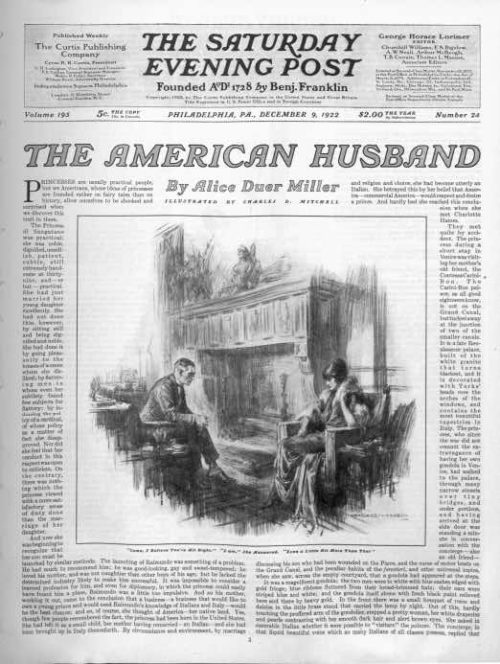
Thelonious Monk: High Priest of Jazz
On what would have been his 100th birthday, we remember the unconventional and brilliant jazz musician Thelonious Monk.
In this April 11, 1964, profile of Monk for The Saturday Evening Post, Lewis Lapham writes: “Monk may be the dominant jazz musician of his time. His conception of rhythm and harmony has influenced the playing of such dissimilar musicians as Dizzy Gillespie, Dave Brubeck, Miles Davis, John Coltrane and Sonny Rollins. … His use of dissonance is analyzed in composition courses at the Juilliard School of Music. Recently published articles assign him a niche in the development of jazz comparable to those of Jelly Roll Morton, Louis Armstrong and Duke Ellington.”
Lapham portrayed Monk as a modest but self-possessed man, often quiet but refusing to be intimidated: “The only cats worth anything are the cats who take chances,” he said. “Sometimes I play things I never heard myself.”
Monk died in 1982, but his innovative spirit lives on at the Thelonious Monk Institute of Jazz, which encourages music appreciation in children and offers promising young jazz musicians training from jazz masters.
Waterfall Wonders
Even putting aside iconic Niagara Falls, America abounds with some of the world’s most captivating cascades, many just steps from parking. Now’s a perfect time for a road trip, as autumn leaves approach full color. Here are a few to consider:
Michigan
Named for a local native tribe, the 30-foot overfalls called Potawatomi Falls is considered one of the most picturesque along the National Black River Scenic Byway. Nearby Gorge Falls furrows through a narrow conglomerate canyon before briskly dropping 34 feet.
A thrilling display of wild twisting and churning, The Black River’s Rainbow Falls, named for the abundance of prismatic rainbows in its rising mist, is the final plunge before the river empties into Lake Superior.
Porcupine Mountain’s Presque Isle River drops through Nawadaha Falls and Manido Falls and then rushes into an expanse of churning whitewater before hitting Manabezho Falls, a myriad of chutes charging 20 feet down a craggy dark boulder.
Deep within the Ottawa National Forest, a boardwalk provides routes to six scenic viewing locations overlooking Bond Falls’ series of short drops, ultimately converging into a 100-foot-wide cascade flowing over 40 feet of volcanic rock.
Located within the Munising city limits, along the Pictured Rocks National Lakeshore, a paved 800-foot trail guides visitors into a shaded sandstone canyon at the base of Munising Falls’ 50-foot drop, where tannins and moss tint the swirling water amber and hazel. The powerful water force that feeds into 50-foot Miners Falls funnels inside a crevice of converging rocks, allowing close-up glimpses from the upper platform without encountering too much spray. Sable Falls cascades 75 feet over three tiers of sandstone cliffs before spilling into Lake Superior.
Buried deep within a 50,000-acre state park bearing its name, amber-tinged Tahquamenon Falls encompasses two sets of falls; its upper falls span 200 feet across with a 50-foot drop, dumping about 50,000 gallons of water per second at peak. The equally spectacular lower falls comprise five smaller cascades surrounding a small island.

Oregon
The first of the falls along the Columbia River Scenic Highway, two-tiered Latourell Falls, is most renowned for its lower falls — an uncurving 249-foot linear stream gushing from a basalt cliff outcrop.
Shepperd’s Dell Falls is a 92-foot, two-tiered waterfall washing through a bucolic canyon. From the top, the water drops 42 feet and then roars down a 50-foot plunge into Youngs Creek before streaming into the Columbia River.
Touted as the most scenic waterfalls along the highway, the multi-tiered, 242-foot Wahkeena Falls (meaning “most beautiful” in Yakama) is acclaimed for its alluvial fan formation, patterning various veins of a raging river cascading over the ridge.
Dropping 176 feet into a pool along the roadside, Horsetail Falls forms the shape of an equine tail.
At 635 feet, Multnomah Falls is Oregon’s tallest waterfall. Rapids here plunge from two tiers measuring 542 feet and 69 feet, with a small downhill rapids in between.

North Carolina
The area around the Blue Ridge Parkway near Asheville, North Carolina, offers a large number of cascades to take in.
The 60-foot-tall Looking Glass Falls is the gushing gem of the Pisgah National Forest. Its easy roadside access welcomes early-bird revelers who arrive to marvel at the sunrise over the falls, illuminating the surrounding autumn hues.
Residing upon the sacred grounds of the Cherokee Nation, Soco Falls flows from a series of smaller falls at the confluence of two creeks splashing 50 feet down onto moss-covered rocks below.
Only viewable from an adjacent mountain ridge, Glassmine Falls flows only after a heavy rain, plunging from a remote and inaccessible cliff top within Ashville’s watershed.
You’ll catch a glimpse of Toxaway Falls in Gorges State Park from above while driving across a scenic highway viaduct. Park and follow the ridgetop walkway for views of the water splashing over multiple tiers of intensely hued bedrock from its namesake lake above.
Bridal Veil Falls, the first of four waterfalls on Little River, was featured in the movies The Hunger Games and The Last of the Mohicans. Visitors can walk or drive beneath a ledge of the first cascade.
A short trail leads behind Dry Falls’ powerful plummets, providing visitors misty views of the surrounding autumn hues while remaining dry.

A short trail leads behind Dry Falls’ powerful plummets, providing visitors misty views of the surrounding autumn hues while remaining dry.
An abridged version of this article is featured in the September/October 2017 issue of The Saturday Evening Post. Subscribe to the magazine for more art, inspiring stories, fiction, humor, and features from our archives.
Greta Garbo, Revealed
Originally published March 26, 1932.
Greta Garbo was one of Hollywood’s most talented and beautiful actresses — and one of its most reclusive stars. This 1932 article offered a peek behind the veil.

The West coast Pastime of trying to step up to Garbo becomes more fascinating day by day, and the strong, monastic veil that surrounds the heroine of cuLver city has no weak spots or peek holes. Movie fans all over America spend considerable time wondering what she is like in the quiet surroundings of the home, and so do the residents of Hollywood, who, so to speak, live next door.
In her own studio, where the pay checks come from, she is as much a mystery as anywhere, and when she walks down a studio sidewalk, the employees stand in groups and say, “Here comes Garbo.” It is an event, a break in the daily monotony. If you happened to be an actor working for the corporation, you could not stroll casually into her dressing room with a blithe “Good morning, Miss Garbo. How’s everything?” She doesn’t care much about the human race, and like Percy Heath’s horse that ran into the freight train, she just doesn’t give a damn.
There are those who explain how the Garbo legend of remoteness and inaccessibility began in a small way and kept on growing, until now it is a national matter, like Prohibition. They say the splendid isolation of Garbo is partly the result of accident and partly because she is a shy, retiring, unsocial person who would rather hit a tennis ball up against a wall than at another player. In the years gone by, when the name “Garbo” meant nothing in America, and not much anywhere else, there was a motion-picture director in Sweden, named Mauritz Stiller, who made such notable pictures on his native heath that the M-G-M studio heard of him.
He was invited to visit California, and in the negotiations Stiller said he would leave home if he could take along this young star, Greta Garbo, or Gustafsson, who had appeared in several of his homeland dramas. The M-G-M officials said it would do no harm to bring the lady along and that they could probably find something for her. Stiller came to California, and likewise Garbo, and now Stiller has passed on to his reward and Garbo is considered by many the world’s leading moving-picture actress, all in a short span of years, while you might be wearing out one good automobile.
In those silent days of the cinema Miss Garbo was not the slim, sinuous creature of mystery she is today but, on the contrary, inclined to plumpness. She knew very little about decorating the female human form divine, and cared less than two pins, and when the studio folks had a long look at her, they decreed certain changes.
First of all, some studio expert informed the newcomer that if she started on lettuce leaves and orange juice, she would eventually become spiritual and thin, so she began dieting in a mild way. Her eyebrows were reduced by the official studio eyebrow reducer, while the studio dresser undertook the job of garbing the stranger with ensembles suited to her type, working an instantaneous miracle. This same M-G-M dresser is regarded as a raiment wizard, and from that day to this he has devised the costumes worn by Garbo in the movies. He says, concerning her, that she can wear anything except ruffles and that the only other stage or screen luminary about whom this can be said is Lynn Fontanne.
Creation of A Legend
Mauritz Stiller, a genius in his own country, discovered that California would not understand him, and his directorial career was not happy; but the wide-eyed Garbo was given a part and began building the reputation that now stands them up in the rear of the theater and runs the waiting line down to the water plug on the corner. Even then, when she was a stranger in the studio, the hired hands paused on the set to stare and wonder. Passersby are not permitted on the Garbo sets today, but they were then, and they seemed to recognize that in the young Swedish actress, the studio had a find.
Newspaper interviewers and ladies from the fan magazines betrayed a mild interest in Garbo and asked her questions in these early times — though you cannot do so now — and Miss Garbo, having a free mind and a Continental frankness, discussed this and that without reserve. In other words, she spoke freely, and when the little items came out, the studio perceived that Greta was a person who paid no attention whatever to editing her conversation.
“It would be better if this stranger in our midst didn’t do any more talking for a while,” they said, and Miss Garbo was asked if she would kindly not say anything to anybody with a lead pencil, to which she consented with great cheerfulness, as she never cared about talking to press persons and regarded interviews as a necessary nuisance connected with life in America. Thus began the great Garbo silence that has since enfolded the world and now piques the press.
After a while, when investigators found that they couldn’t interview a strange girl from Sweden, they yearned to do so, as is human nature, and the more they couldn’t approach Garbo, the more they yearned and yearned, and now the situation has become a national calamity. Wherefore, the silence that began by chance has become a settled policy of the studio, a situation that coincides perfectly with the Garbo desires and inclinations.
Everyone wonders what she is like around the house, and not many know, so everyone speculates. A popular belief is that she walks in melancholy, a dreary figure in her own sitting room, leaning against a window in permanent dejection, wishing it would rain. This, her manager says, is a portrait far from the truth. She is neither sad nor wistful at breakfast. She is certainly no gloomy Gustafsson but is to be thought of as a very lively young woman who bounces about the house, cracking an occasional joke and even bursting into song on rare days, if you can imagine that.
Garbo’s dresser at the studio is the man who knows more about her than any other, and is he pestered to death with questions? He is, but he answers none of them. They say she thinks Polly Moran is a scream and would rather look at a film showing Polly at her capers than contemplate the noble film stories of high-minded directors and heavy stars. She has a manager who realizes that as long as 300 correspondents in Hollywood yearn to interview Garbo, all will be well, especially if the 300 are not permitted to do so. The feeling now is that if someone wrote a brilliant play for her, or even an ordinary play, Garbo could leave town and pack every theater in the United States, selling out in advance and collecting either $1 or $2 million dollars. As long as this potential million lies in the hollow of the hand, the yearning 300 will continue to find the Garbo wall high and rough and thick, and the eager public will have to be content with such minor bits as that she likes vanilla ice cream, has a few unimportant moles, rides on roller coasters, owns a parrot, likes cats, dislikes stockings, eats bread crusts, wonders what Amos ‘n’ Andy are talking about, weighs 122 pounds, avoids strangers, puts on her left shoe first, sits cross-legged, sees better with the right eye, loathes parties and takes a sun bath daily, with an inquiring eye on the hedge.
This article and other features about the stars of Tinseltown can be found in the Post’s Special Collector’s Edition, The Golden Age of Hollywood. This edition can be ordered here.
Where Cool Went to School: James Dean’s Hoosier Hometown
Every star once had a stomping ground. For diehard fans, a celebrity’s hometown can serve as a cultural mecca: John Wayne’s Winterset, Iowa; Jimmy Stewart’s Indiana, Pennsylvania; Jack Nicholson’s Neptune City, New Jersey. Instead of vacationing to tropical beaches or national parks, some opt for celebrity tourism, hoping to gain a deeper understanding of the places that shaped their favorite stars.
A small town in central Indiana was the birthplace of the late method actor and cultural icon James Dean. He was a homegrown Hoosier, and the folks in Fairmount, Indiana aren’t forgetting him any time soon.

Fairmount is a town of about 3,000 people and one stoplight. It is surrounded by fields of corn extending for miles in every direction. James Dean grew up just outside town in a farmhouse with his aunt and uncle. “Where Cool Went to School” banners line the town’s main drag, but the school Dean attended is no more. The old Fairmount High School was torn down a few years ago and now sits as a pile of rubble in the middle of town. The stage on which a teenage Dean performed in plays like Goon With the Wind was saved by the Fairmount Lions Club to be turned into a community performance space.
Although Fairmount is decidedly remote, it lays claim to an inordinate number of creative types, including Garfield-creator Jim Davis, author Mary Jane Ward, and painter Olive Rush. Most of the celebrity tourism is on account of James Dean, though. Starting at the James Dean Gallery on Main Street, a visitor can get a rundown of the whole James Dean trail: the bronze bust in the center of town, Carter’s motorcycle shop, the Winslow farm, and Park Cemetery. The whole town, it seems, exists as a kind of shrine to the short life of its unruly son.
Every September, Fairmount attracts “Deaners” from around the world for the James Dean Festival. This year, 30,000-50,000 of them gathered in the Indiana community for film screenings, car shows, and a James Dean look-alike contest. According to one of Dean’s biggest fans, the winner of the contest “had blond hair like Jimmy, and he adopted some of his mannerisms. But there’s only one James Dean.”
Pam Crawford, of Little Rock, Arkansas, is the president of the James Dean Remembered Fan Club. She travels to Fairmount at least once a year for the festival. She was only 7 when Dean was killed in a car accident near Salinas, California, in 1955, but Crawford said she was familiar with the actor because her older cousin had wallpapered her room in Dean pictures. For Crawford, “It was over before it began.”
After Dean’s death, there were rumors that he was actually still alive, driving across the country. Crawford said she and her friend were determined to catch him on his way through Little Rock, so they stood by the highway after school with a sign that said, “JAMES DEAN STOP.” Before seeing East of Eden or Rebel Without a Cause, Crawford had already fallen in love with the brooding blond.
Other Deaners, like Phil Zeigler, have purchased houses in Fairmount after visiting. They find the small-town charm of Fairmount to be authentic and almost frozen in time — descriptions that also fit the man who brought them together.
The James Dean Gallery is the home base of all things Dean in Fairmount. The small museum houses memorabilia from Dean’s childhood and acting career. There are old pages of homework, letter jackets, yearbooks, and the young artist’s watercolor paintings on display with ‘50s radio hits like “Shake, Rattle, and Roll” playing overhead. Further into the gallery, the scope of Dean’s work and fame comes into focus, with posters of Øst for Paradis (East of Eden) and Gigante (Giant), shelves of Dean cologne and soap, and a portion of the white picket fence from Rebel Without a Cause.
Sitting just north of town is the Winslow farm, Dean’s childhood home after his mother’s death. The property is now occupied by Marcus Winslow, Jr., James Dean’s cousin, who was 12 years old when Dean died. The farm is still in operation, with cows roaming the rolling hills adjacent to several giant, clean white barns. Inside there are tractors as well as shiny vintage automobiles. A 1949 Ford in the collection was used by Dean on trips back to the farm from New York or Hollywood, according to Winslow. Winslow remembers a teenage Dean, and he recalls his transition to acting, from a Pepsi commercial to Hill Number One, an Easter television special, to Giant, the epic Texas drama directed by George Stevens. “He could kind of pull people’s feelings right into him. He spoke for them,” Winslow says.

Back Creek Friends Church, near the farm, is an old Quaker church where Dean’s funeral took place. Since 1980, Deaners have gathered there every year on September 30 for a memorial service. They read poems, letters, and sing original songs inspired by their love of James Dean. Phil Zeigler has long been in charge of the service, and he recalls celebrity appearances from Martin Sheen, Liz Sheridan, and Maxwell Caulfield. Anyone is allowed to speak at the yearly service, but there are three rules, according to Zeigler: “No politics, no advertisements, and no religion.”
A former attendee became a sort of celebrity to the Deaners: Nicky Bazooka. Before his death in 2014, the mysterious Nicky Bazooka arrived each year to the Dean memorial service on a motorcycle, leading the procession from the church to Dean’s grave at Park Cemetery. Afterwards, he rode off on his motorcycle and disappeared for another year.
Nicky Bazooka died in 2014, but another motorcyclist, Ivan Ivans, continues his tradition. He leads the Deaners with a strand of 1,000 colorful paper cranes folded by a Japanese Dean fan.
Russell Aaronson has lived in Dean’s old New York apartment (19 West 68th Street) for more than 45 years. He speaks to his fellow Deaners about the soul of James Dean as timeless and ever-present. “There is a little of James Dean in all of us,” he says. It is a popular sentiment. Most of the Deaners believe Dean’s style and appeal is evergreen, and it is true that many of the memorial service’s attendees are too young to have existed during his life.

Regardless of how anyone becomes a serious James Dean fan, the overarching Deaner opinion is that a visit to Fairmount enriches the adoration. Fairmount exudes the quiet, nostalgic feel of small towns that many in this country believe is disappearing. Unlike other cities and towns around it (Anderson, Marion, Muncie), Fairmount doesn’t seem
to have taken an economic nosedive with the slow deindustrialization of the last half-century. The brick roads and boutique shops reflect a town that Dean once walked through. Now it’s a place for his admirers to have a community of their own.
“The first time I came here, I told my dad ‘I’ve got to go to Fairmount, Indiana to pay homage to Jimmy’s grave,’” says Pam Crawford, “He looked at me and said, ‘You’re 30 years old, and you’re still sitting on the side of the road waiting for James Dean!’”
Deaners might often receive reactions like this from people who don’t understand the lasting hype surrounding their Jimmy, but there is at least one town where everyone gets it.
News of the Week: Dr. Seuss, Defending Megyn Kelly, and a Day for Fluffernutter
Oh, the Books You’ll Refuse!
What librarian would refuse a donation of Dr. Seuss books? One in Cambridge, Massachusetts, apparently.
In an open letter published in The Horn Book, librarian Liz Phipps Soeiro says that she’s refusing the donation of the books (sent to one school in each state) by First Lady Melania Trump, for a couple of reasons. One, she says that her school and community already have enough book resources. Oh, and second, Dr. Seuss is “a bit of a cliché,” a “tired and worn ambassador for children’s literature,” and that many of his books have “racist propaganda, caricatures, and harmful stereotypes.”
Insert painful sigh here.
While it’s an honest, upfront letter, it’s also a snarky riff against Mrs. Trump’s husband and Secretary of Education Betsy DeVos. Imagine being so political, wanting to make a point so much, that you drag down the creator of How the Grinch Stole Christmas and The Cat in the Hat. And to think, just a couple of years ago, she loved Dr. Seuss.
I don’t have kids, but when and if I do, I will happily buy them all of the Dr. Seuss books and read them at bedtime. I will not throw them in the trash, I will not sell them for hard cash. I will not hate them here and there, I will not hate them anywhere.
In Defense of Megyn Kelly
Since I’m in the mood to defend people, how about Megyn Kelly?
Oh, I’m not going to completely defend comments she has made in the past or her new morning show, one of the 17 hours of Today programming on NBC every day. Last week’s launch was, well, awkward, from the Jane Fonda interview to the over-the-top congrats from the NBC staff and the “getting to know Megyn” segments that tried way too hard to convince us that she’s a normal human being with feelings and everything (as if anyone doubted that?). It’s early, but she still isn’t a great fit for morning television. The show is a mix of the usual Today fare, Oprah, and The Talk, and Kelly really has to stop it with the weird voices she’s using and the hand gestures (at several points it looked like she was pulling down an invisible curtain).
But I will defend her regarding the most recent controversy. Earlier this week, she had Tom Brokaw on to talk about the shooting in Las Vegas. Brokaw was speaking, and it looked like Kelly cut him off quickly, and some think it might be because he was talking about the National Rifle Association. I watched it live and didn’t think that at all. It just looked like Kelly was out of time and had to wrap up the segment to get to a commercial. But everything now is a conspiracy or negative, and social media went crazy about how “rude” Kelly was and how she cut him off because of where the conversation was going. Several articles were even written about it, including this dumb one at Jezebel and this equally dumb one at The AV Club.
As Brokaw himself explains, the cutoff seemed awkward because he didn’t have an earpiece in his ear and couldn’t hear what Kelly was saying. But I guess the more controversial explanation, the quick “hot take,” is one many people prefer believing.
This Could Be a Dan Brown Novel

J.C. Leyendecker
December 26, 1925
This may seem like an odd story. I mean, how can there be a grave for someone who never existed?
But Santa Claus actually did exist. Oh, maybe not the way we know him now, drawn by Thomas Nast and Norman Rockwell, the ho-ho-ho-ing jolly man at the mall holding up cans of Coke. But Saint Nicholas was a real person, and they may have found his remains in an undamaged grave at the Saint Nicholas Church in Turkey. They found the tomb after surveying the church and noticing gaps underneath it.
So now when your kids ask if Santa Claus is real, you can tell them, “Yes, yes he is! But now he’s dead.”
The 100 Greatest Screenwriters of All-Time
Another day, another internet list we can argue about.
This one is from Vulture, and it gathers several current screenwriters and asks them to pick the greatest screenwriters of all time. The results are, predictably, a mixture of “That’s a great pick!” and “How the heck could you leave ______ out?!?”
No one is going to disagree with people like Billy Wilder (Double Indemnity, Sunset Boulevard, The Apartment), William Goldman (All The President’s Men, Butch Cassidy and the Sundance Kid), Ernest Lehman (North By Northwest, Sweet Smell of Success), or Preston Sturges (Sullivan’s Travels, The Lady Eve). But I will happily argue about the inclusion of George Lucas, Adam McKay, and Jordan Peele.
I think some of the picks are an attempt to look contemporary (Peele has written two full-length screenplays, for movies that came out in the past year or so), to seem well rounded, to nod to nostalgia, or maybe even to acknowledge to friends. This is what happens to these lists. They’re never based on pure merit.
I’m glad to see Scott Frank and Leigh Brackett on the list. But where are Ben Hecht, Jay Dratler, Robert Riskin, Jules Furthman, and George Axelrod?
RIP Tom Petty, Monty Hall, Anne Jeffreys, Si Newhouse, Richard Pyle, and Jan Triska
Tom Petty had such a string of classic songs it’s hard to list them all, though “Free Fallin” and “American Girl” are good places to start. Petty died Monday at the age of 66.
Monty Hall was one of the great game show hosts of all time, leading Let’s Make a Deal for several decades. He was also a producer on the current CBS version. Hall died Saturday at the age of 96.
Hall was also in one of the best episodes of The Odd Couple:
Anne Jeffreys was a screen and stage actress best known for her work on TV shows like Topper and General Hospital, as well as in movies like Step Lively, Dillinger, and the Dick Tracy films of the 1940s. She died last Wednesday at the age of 94.
For 40 years, Si Newhouse was the Chairman of Condé Nast Publications, which includes magazines like The New Yorker, Vanity Fair, and Vogue. He died Sunday at the age of 89.
Richard Pyle was an acclaimed journalist and war correspondent who worked for the Associated Press and was there for many of the big stories over the past several decades. He died last Thursday at the age of 83.
Jan Triska was an actor who appeared in such films as Ragtime, The People vs. Larry Flynt, Ronin, and Apt Pupil, as well as many others. He died Monday at the age of 80.
This Week in History
The Andy Griffith Show Premieres (October 3, 1960)
The show’s Mayberry setting was so realistic that many viewers thought the show was actually filmed in North Carolina, but it was filmed on a Hollywood back lot. The opening where Andy and Opie go fishing? That was filmed near a manmade reservoir in Franklin Canyon Park in Los Angeles. This father and son re-created the opening (Griffith sings the theme song, and yes, it had lyrics):
President Rutherford B. Hayes Born (October 4, 1822)
I wonder how the 1876 presidential election would have been covered by today’s media. It was plagued by accusations of intimidation and cheating. On election night, Republican candidate Rutherford B. Hayes and Democrat Samuel Tilden both went to bed thinking they had won, and the election was ultimately decided by a bipartisan commission set up by the House Judiciary Committee. If all that happened today the cable news channels would cover it nonstop, the streets would be filled with protestors on each side, and social media would implode.
This Week in Saturday Evening Post History: Tipping the Scales (October 3, 1936)
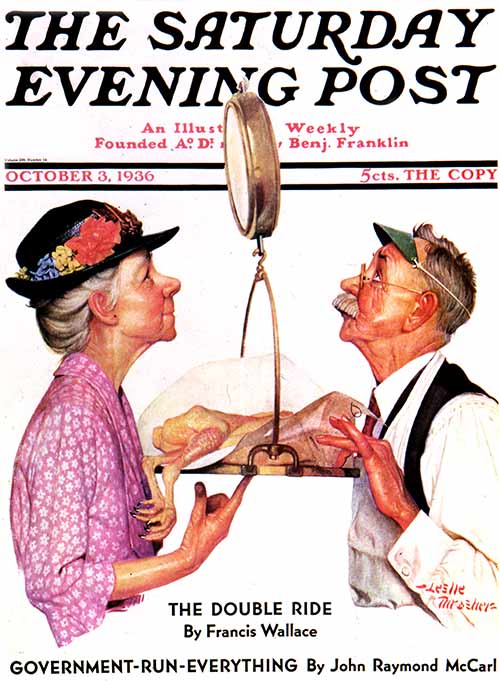
October 3, 1936
This is one of the most famous covers by artist Leslie Thrasher, who is often compared to Norman Rockwell in his style. There’s a sad back-story to this painting. Two months after the issue came out, a fire at Thrasher’s home destroyed most of his work. Thrasher suffered severe smoke inhalation and eventually died from pneumonia on December 2.
Sunday Is National Fluffernutter Day

The Fluffernutter is a New England thing, but I think it’s also made its way to other parts of the country too. Marshmallow Fluff is celebrating its 100th anniversary this year. It was invented in 1917 by a Somerville, Massachusetts, man with the fantastic name Archibald Query. He sold it door to door for a while before selling the recipe to the Durkee Mower candy company. The company came up with the “Fluffernutter” name in 1958 (even if the sandwich itself had already been created by another Massachusetts company in 1918).
It’s pretty simple to make. You take two slices of white bread and spread peanut butter on one side and Marshmallow Fluff on the other. Whether you use creamy or crunchy peanut butter is up to you, though I think creamy is the norm.
I have to admit that even though I’m from New England and still live there, I’ve only had a Fluffernutter once or twice in my life. I never loved it enough to have it more than that. I did often eat white bread covered in sugar though. That was one of my favorite snacks.
Don’t judge me.
Next Week’s Holidays and Events
Columbus Day (October 9)
Did Christopher Columbus really discover the Americas? While a lot of people credit the Italian explorer — and we have a special day set aside for him — a lot of people credit someone else.
Leif Erikson Day (October 9)
And that other person is Leif Erikson, who did it in the 11th century. So he gets a day too, and that day just happens to be on the same day we celebrate Columbus. That must really irritate both of them.
Of course, there’s a third option, too.
Indigenous Peoples Day (October 9)
When Leif Erikson and Christopher Columbus arrived in the Americas, it wasn’t empty — millions of people were already living here — so discover doesn’t really describe what either of these men did. Because of this, four states and a growing number of cities have replaced Columbus Day with Indigenous Peoples Day.
The King of Dauphin Island
Marcus Weems was the sixth-richest man in the state of Alabama, but he lost his wife to cancer like everybody else. Of course he brought the full leverage of his affluence to bear on her condition — Sloan Kettering, Johns Hopkins, M.D. Anderson, names of hospitals like the board of directors for some conglomerate of suffering — but the diagnosis had come too late, all the treatments and the clinical trials for naught, and Suzette Weems died at home with her family at her bedside, the day’s last light outside her windows reflected on Mobile Bay.
In addition to her devoted husband, Suzette Weems was survived by two daughters: Meredith, 29, wife of Harris Stokes and mother of infant James; and Emily, 21, treasurer of Kappa Kappa Gamma sorority at the University of Alabama. They were capable and well-adjusted girls, achingly dear to Marcus. After the funeral, Emily requested incompletes in her fall classes and resumed permanent occupancy of her room, perfuming the house with the lavender and praline bouquet of her shampoo. At least three nights a week, with infant James in tow, Meredith abandoned her husband to sleep over as well, regularly enough that she stocked the empty bureau of her youth with diapers and onesies and nursing bras. Marcus thought he understood. They believed that their presence would provide a bulwark against his loss. They loved him and he loved them back and he was willing to humor them for a while. Together, they strolled the Point Clear boardwalk, gulls wheeling, infant James strapped to one of them by a contraption that put Marcus in mind of a papoose. They played backgammon in the evenings, and Marcus let them win, as he had when they were children. The holidays passed in a haze of dirty dishes and wads of wrapping paper and strained good cheer. Marcus was 68 years old. He’d started late on marriage, fatherhood. He’d wanted to be certain that he was prepared to do it right. And he had. Just look at his magnificent daughters. But now, at night, when everyone was asleep, he found himself creeping from room to room in the dark, picking up letter openers and coffee table books and putting them down again like he’d forgotten what they were for.
In January, he nudged Emily back to school and convinced Meredith that her husband required her attention. They went reluctantly, but they went, casting worried glances through the rear windshields of their cars. Marcus had, in the course of his career, parlayed a modest inheritance into a fortune in commercial real estate. His holdings included a condominium complex on Dauphin Island, a barrier island off the coast. Without informing his daughters, he put his house on the market — a pocket listing, priced to move — let the condo manager know he was coming, and drove alone across the bridge over the Sound. The Admiral’s Quarters rose up from the sand where the beach was at its widest. Marcus claimed a corner unit on the fourth and highest floor. Two bedrooms. One bath. Combined kitchen and living area. Every accoutrement tastefully bland. Among real estate professionals, it is a widely held belief that beach rentals, especially condominiums, are rarely haunted by anything more than the detritus of previous guests — those battered paperbacks, that bottle of hot sauce, those loose pennies in a drawer. From his balcony, Marcus could see an old public pier jutting like a ruin over the dunes, the shore tugged out by tides in such a way that the pier no longer reached the waves.
His daughters were predictably stunned by this turn of events, not to mention wounded, furious, concerned, and a number of additional sentiments, which they expressed in weepy monologues over the phone. Marcus could hear the wind whining around the building as they spoke, and the distant hissing of the surf, sounds indistinguishable from his tinnitus, a cocoon of white noise that made it difficult to focus on his daughters. Didn’t he realize, Emily wanted to know, that they had lost their mother, too? Shouldn’t he have at least consulted them, Meredith demanded, before listing the house? They had a talent for phrasing questions in such a way that the answers were implied. And they were right. His behavior was selfish and impulsive and thoroughly out of character. Daddy, they called him. Still. Like little girls.
He bought a bike, secondhand, from a rental shop down the road, a lady’s bike, though Marcus didn’t mind, a lipstick-red Schwinn Hollywood Roadster, handlebars outfitted with a bell and basket, everything but the basket freckled with rust. Dauphin Island is bisected lengthwise by Bienville Boulevard, 12 miles of sandy pavement paralleled by sidewalk. Down this sidewalk rode Marcus Weems. Exploring. Acclimating. As if the island were a scale model of his life without Suzette, or of the space left inside him by her absence and he wanted to plot its boundaries. Mornings, he rode to Lighthouse Bakery for a cup of coffee and a bear claw. He rode to Pirate’s Booty Bait and Dry Goods in the afternoon to stock up on peanut butter and white bread. The west end of the island had been stripped of all but the most obdurate shrubbery by careless development and countless storms, nothing down there anymore but vacation homes on stilts and a ribbon of beach visible only at low tide. One day, Marcus counted 26 for-sale signs. The day after that, he counted 29. Most of the year-round residents were hunkered down on the east end, tucked in along the Sound or on the leeward side of the dunes. Marcus coasted past their houses, pulled lazy U-turns in their cul-de-sacs. He rode past Dauphin Elementary, the only school on the island, and past Cadillac Park, live oaks dripping beards of Spanish moss, and past the bird sanctuary where so many weary species, headed north for warmer months, first caught sight of land. He kept on riding until he ran out of boulevard, all the way to Fort Gaines, best remembered by history for its failure to prevent the Yankee fleet from breaching Mobile Bay.
Here, Marcus dropped the kickstand and dismounted. Like the long-gone captains of the Confederacy, he stood watch at the edge of Dauphin Island, his old life just out of sight across the water. What he felt in those moments, pelicans skimming the chop, tankers lugging cargo to ports unknown, was not loneliness or loss, as you might expect, not the weight of tragedy but its opposite, pure lightness, the hole left inside him by Suzette’s death as big and hollow as a zeppelin and just as buoyant, as if the shape of her absence might lift him up and carry him away.

Near the end of his first week on the island, after a particularly exhausting call from Meredith, Marcus crossed Bienville Boulevard on foot to Dauphin Bar and Grill, one of three yellow A-frames huddled in a gravel parking lot. The other two housed Island Ice and Slice, a snow cone and pizza joint, and Massacre Island Surf Shop, so named because in 1699 the explorer Pierre Le Moyne dropped anchor long enough to misinterpret the nature of a mound of human bones — most likely the burial site of some forgotten tribe — and leave the island with that short-lived but gruesome designation. These three establishments, Marcus would soon discover, were owned and operated by three brothers: Alton, Ike, and Homer Tenpenny. Homer doubled as the mayor of Dauphin Island.
He found the Tenpennys posted up at the bar, along with half a dozen local drunks, the walls adorned with Crimson Tide football paraphernalia and faded photographs of men with fish. Marcus helped himself to a table by the window and eavesdropped while they griped. For 15 minutes, no one acknowledged his arrival. Finally, Homer interrupted the discussion long enough to take Marcus’ order — burger, well-done — and pass it through to the kitchen before returning to his place behind the taps and picking up the conversation where he’d left off. Favorite subjects included liberals, immigrants, and tourism revenue in steep decline, each topic a different route to the same conclusion: Every single thing was going to hell. If the Tenpennys could be believed, the population of Dauphin Island was down at least 200 souls the last few years, the island itself shrinking all the time, erosion caused by dredging in the ship channel.
“By the time I’m gone,” Homer said, “won’t be nothing left.”
Marcus appreciated the resignation in their anger. He took a curious sort of pleasure in the redundancy of their complaints. These men — or men like them — had been having this conversation — or one like it — forever and would go on having it until their dire prognostications came true at last. Marcus added a memorable tip to his bill and retired to his condo for a nightcap on the balcony, natural gas wells burning way out in the Gulf like the first glimmers of an inkling, like the signal fires of his grief.
In the morning, he showered and shaved and hiked along Bienville Boulevard to the local real estate office. The adjacent storefronts — a former video game parlor and a former gift shop and a former kayak rental place — were all defunct. Marcus ducked inside behind the tinkling of a bell. The realtor, Norma Bird according to the nameplate on her desk, flinched at the sound, one hand going to her chest, her glasses slipping down her nose. She had been feeding papers into a shredder.
“I’d like to inquire about some property,” he said.
By Marcus’ standards, real estate on Dauphin Island was remarkably inexpensive. He’d have to move some funds around, divest himself of some investments, but by the time he’d left the office, proceedings had been initiated on the purchase of the 29 available houses on the west end, along with an out-of-business barbecue restaurant called the Salty Pig, a 12-unit motel on the Sound, 14 additional houses on the east end, and all three available storefronts in the strip mall. As Marcus was signing the last of the paperwork, Norma Bird reached out and gently poked her index finger into his ear and he started like she’d given him a pinch.
“I’m sorry.” She barked out a laugh and covered her mouth as if shocked by what she’d done. “That was totally inappropriate. Totally, totally, totally. This is just so unreal.”
Marcus supposed it wasn’t very often that the sixth-richest man in the state strolled into her office and offered to buy every listing on the island. A measure of shock could be expected and forgiven. He spent the remainder of the afternoon on the phone with lawyers and moneymen, the hair in his ear retaining a faint, residual tickle from her touch. He was in his kitchen, later, pouring bourbon over ice and boiling hot dogs and listening to Mozart’s Concerto No. 4 in E-flat Major on CD when the doorbell chimed. He drifted in that direction, sipping the drink, his second of the evening, his mind swimming with whiskey and music and the vaguest beginnings of a plan. There were state and federal permits to sort out, and he’d have to sell off a shopping mall to foot the bill, but Marcus had plenty of industry and government connections, and as he pressed his eye to the peephole, it all seemed possible, whatever it was. There in the hall, distorted by the lens, stood the Tenpenny brothers. Ike smoothed a palm over his hair. Alton straightened the lapels of a madras blazer. Homer pressed his eye against the peephole on his side, blotting out the view.
“You’re the big tipper,” he said, when Marcus opened the door.
Marcus invited them in, set everybody up with a drink. He offered to throw a few more hot dogs in the pot but they declined. They sat at a table on the balcony in unseasonable warmth, and Marcus waited for the Tenpennys to get down to business. There were no sunset beachcombers leaving footprints in the sand.
“Norma Bird came by,” Homer said. “I guess we’re here because we’d like to know your intentions.”
His brothers nodded. Alton’s neck was spotted with razor burn, and Marcus wondered if he’d spruced himself up for this meeting.
“I want to buy the island.”
“Uh-huh. I see. And what do you mean to do with it?”
“I’m not sure about that,” Marcus said.
Homer pursed his lips and stared for a moment into his drink.
“This is a community,” he said, raising his eyes.
“It’s dying,” Marcus said. “It’s nearly dead.”
The Tenpenny brothers were quiet. They had no rebuttal. Marcus went back inside the condo, leaving them with their thoughts. He found a pen and jotted a figure on the back of a takeout menu from a seafood restaurant that had gone belly up years ago. He refilled his drink, returned to the balcony, and slid the menu across the table. Ike retrieved a pair of bifocals from his breast pocket so he could read it.
“That’s how much I’ll give you for the A-frames,” Marcus said.
Ike held the menu close to his glasses, then backed it away as if trying to bring an optical illusion into focus.
Marcus told them he would understand if they needed time to consider his offer. He explained that he had experience with loss. In the end, they polished off their drinks and shook his hand to seal the deal.
Massacre Island was eventually renamed for the great-grandson of Louis XIV, the 22nd Dauphin, a frivolous and empty-headed prince who would become a dreadful king. Because of its deep-water harbor, the island served as a port for the territory of French Louisiana, but even then, even 300 years ago, shifting sands were conspiring to fill in the harbor. The settlement was burned to the ground by Jamaican privateers in 1717, leveled twice more that century by hurricanes. After the Civil War, the history of the island, like its present, is unmemorable, marked primarily by personal tragedies and low-budget vacations and a gradual but inevitable wearing away.
Marcus wheeled the Schwinn up and down Bienville Boulevard seeing not scruffy houses clinging like barnacles to the fringe of a vanishing beach but the empty, windswept shores of his imagination. Demolition costs would be exorbitant but not, he didn’t think, out of reach. He’d have to unload an office park or two, maybe borrow against some undeveloped land. One of his lawyers had turned up a Corps of Engineers proposal to truck 100 million tons of sand onto the island as backfill against the past and buffer against the future. The state would never fund such an extravagant conservation scheme, but Marcus could. He pictured houses tearing themselves down and hauling their parts away, the wind and tides giving back the beach, Dauphin Island rising unblemished from the Gulf like time-lapse film run in reverse.
In this new light, the light of evening and recollection and caprice, the island looked newly beautiful to Marcus, that useless old pier a monument as profound as the Parthenon, the tufts of seagrass sprouting from the dunes a reminder not of the futility of life but its tenacity.
He saw no benefit to telling his daughters about his plan. He knew what they would have said. They were good girls. They would have tried to reason with him. They might have loved him half to death. So he deleted their emails and let their messages pile up in his voicemail. Sometimes, at night, alone in his condo, he could almost hear their trapped voices straining to reach him through the line, and though a part of him longed to hear his daughters speak, he was afraid that if he let himself listen to even one message, the rest would come flooding out behind it and he would drown in their good sense. His youngest daughter became so frustrated that she wrote him a letter, the first he had received from her since summer camp. He couldn’t resist slipping a thumbnail under the flap. The letter was penned in a familiar looping script on official Kappa Kappa Gamma stationery, Emily’s name third from the top in the chapter masthead. In its pages, she added confused and abandoned to the list of feelings she had expressed over the phone. She worried that Marcus had become unhinged by grief, a poetic phrase out of character for such a practical young woman, the treasurer of a sorority. He pictured her laboring over the line at her little desk in her little room at the Kappa Kappa Gamma house, early drafts wadded in the trash can by the door. She didn’t know the half of it, Marcus thought.
Norma Bird had started the paperwork on 52 more houses, the marina, the service station, the bakery, the seafood market, a nine-hole golf course, and all 11 churches on the island, each new purchase pouring a little more substance back into Marcus, filling him up again. Technically, the public beaches and the parks and the bird sanctuary were not for sale, but an exploratory conference call with the governor left the impression that the state of Alabama, which had enough financial woes without sweating the overhead on Dauphin Island, was open to creative fiduciary arrangements. There were a handful of holdouts among the locals, but Marcus was sure they’d come around. You will be hard-pressed to find a real estate operator savvier than Marcus Weems. He had learned over time that three things were necessary in any delicate transaction. First, you had to offer a fair price, one that benefited buyer and seller equally. Next, you had to convince the seller that his position was untenable, as in his many negotiations with struggling farmers and sons of struggling farmers reluctant to forsake the family land. Last — and this was Marcus’ true specialty, the reason he succeeded where others failed — it was incumbent upon the buyer to make the seller believe that the transaction would leave a legacy he could be proud of.
Marcus bought round after round of drinks at Dauphin Bar and Grill, the place crowded every night now and not only because someone else was picking up the tab. He spun for his audience a vision of the island returned to its right and natural state. On cocktail napkins, Norma Bird kept track of the tipsy offers Marcus was prone to make on these occasions. When he’d had a few too many, he tended to go on about his wife, how beautiful she had been, how wise, how all his money failed to save her.
“I proposed four times before she said yes. Once I chased her all the way to San Francisco. Her sister lives out there. I showed up at the door with a string quartet and a diamond big as your fist, but still she turned me down. That was the third time. She said I only wanted what I couldn’t have. You believe that? Me standing in the middle of Lombard Street, 2,000 miles from home.”
Homer Tenpenny patted him on the back.
“Time to settle up,” he said.
The next day, it began to rain and did not stop for a full week, a misty, spitting rain interspersed with downpour that rendered the Gulf invisible from Marcus’ balcony. His view reached no farther than the end of the old pier. He swam his slow Australian crawl in the indoor pool and wondered what to do with the Admiral’s Quarters. The complex would be a blemish once the island was restored, but if he tore it down, where would he live? In the sauna, sweat running in his chest hair, he entertained fantasies of living in a teepee or digging some sort of bunker, but he recognized these idylls for what they were and blamed them on the heat. At dinnertime, he popped his umbrella and hustled over to Dauphin Bar and Grill. The rain had chased the crowds away, but Norma Bird was nursing a beer two stools down from one of the holdouts, a ship’s captain who owned a saltbox with crooked shutters on the Sound. Peebles something? Something Peebles? Marcus recognized the locals by their property but had trouble recalling their names. This man was close to Marcus’ age but had no wife, no children, no reason to stay except inertia and lack of imagination.
“I’ve been here a long time,” he said.
“But it won’t be here,” Marcus replied, “once everybody else is gone.”
Peebles something shrugged and thanked Marcus for the beer and Marcus proceeded to drink himself into such a stupor that Norma Bird insisted on walking him home. Their hips bumped under his umbrella, her arm around his waist, rain beating on the pavement all around them. Halfway across the street, she stopped and turned to face him. She palmed his cheek. “You’d never know it to look at you,” she said, and though he didn’t understand exactly what she meant, he understood that a great deal more was implied. Her very nearness startled him, sobered him. His breath misted her glasses. For a long few seconds, Marcus covered her hand with his own. Then he left her standing under his umbrella in the rain.
He was on his way back from Norma Bird’s office one afternoon when he noticed Emily’s Land Rover, the car he’d bought as a high school graduation present, idling in front of the Admiral’s Quarters.
Emily spotted him on his bike.
“Daddy, is that you? I see you. Daddy, you get over here right now.”
He rolled up beside her car, ringing the bell on his handlebars in greeting.
“You’re in big trouble,” Emily said.
Despite the angry words, she let him kiss her cheek. Meredith was in the backseat with infant James.
“You’d better let us in,” she said. “I need somewhere to nurse the baby.”
Marcus thumbed the code on the keypad and pedaled through the security gate into the parking garage, Emily’s Land Rover at his heels. Once inside the condo, Meredith fished a newspaper clipping from her purse. The headline: “Mysterious Land Grab by Local Real Estate Tycoon.” The article included a photograph of Marcus. He remembered when it was taken. Maybe 10, 12 years ago. Before Suzette’s diagnosis. Their house had been featured in a lifestyle magazine. In the photograph, he looked awkward but game. The newspaper had cropped Suzette out of the shot.
“What on Earth?” Emily said.
“I’m sorry you had to hear this way. I really am.”
Infant James was at her breast. Marcus had never felt comfortable in the presence of a woman nursing a baby, especially not his daughter. He directed his gaze out the sliding glass doors to the balcony, an evasion that made him look guilty, though that was not the way he felt.
For an hour, Marcus listened while his daughters pleaded their case, first Meredith, then Emily, sometimes both at once, their voices twining in his ears, his eyes focused on the breakers rolling ceaselessly up onto the beach. Theirs was not, he understood, an unreasonable position. They addressed him as respectfully as he could have hoped, given the circumstances. He refused to believe that he could lose them over this. Finally, Meredith tucked her breast back into her blouse and Emily concluded their remarks. “This is not what Mother would have wanted.”
Marcus hesitated. Such sensible girls.
“I was thinking I would have your mother reinterred. There’s a beautiful little cemetery on the Sound.”
Emily burst into tears. She covered her face with both hands and made a noise like a squeaky wheel. Meredith stared at her father, perplexed, infant James already sleeping in the crook of her arm.
“There’s plenty of money,” Marcus said. “You don’t have to worry.”
Emily dropped her hands into her lap. At the same time, she raised her heels and stomped them down, a gesture that called to mind the outbursts of her adolescence. “Oh, Daddy, how could you be so dumb?”
“Once everything is settled on the island, you’ll be welcome to visit. We’ll have it all to ourselves.”
Meredith put a hand on Emily’s shoulder. “We should go. We’re sorry to bother you, Daddy.” She stood slowly, her eyes never leaving his, as if in the presence of a skittish horse. Pregnancy had filled his oldest daughter out — her hips, her calves. She looked complete to Marcus, grown at last.
“Could I hold the baby?” he said. “Just for a second before you leave.”
Meredith balked at offering her child up to her father, but she relented. Marcus bounced his sleeping grandson in his arms, breathed him in, the smell of him sweet and plain. Sunlight sifted across his face. Infant James twitched and scrunched his cheeks. His cheeks were smooth and pale, round as Christmas baubles. Marcus wondered, not for the first time, what infants dreamed.
Then came the lawyers and the injunctions and all pending transactions put on hold until matters could be settled by the court. His daughters wanted Marcus declared non compos mentis. The documents arrived by UPS. Marcus read the pages carefully, tapped the edges together, and filed them in a kitchen drawer with Emily’s letter and his car keys.
He biked down to Fort Gaines, locals waving as he passed, honking their horns. He parked his Schwinn in the shadow of the fort and gazed out across Mobile Bay in the direction of his old house. Even now, perhaps, a buyer was wandering the quiet rooms, footsteps echoing on the hardwood. That house had been designed by the architect Fritz Belmont Jr., a beautiful setting for what had been a beautiful life by any standard, a place so big and rambling that sometimes Marcus could hear his daughters calling and not know where to find them. Picture him sitting there with Suzette, exchanging a smile, a touch, light streaming in through the windows, Marcus rising from the couch or the kitchen table and following the sound of their voices along the hall or up the stairs, pushing open doors, peeking around corners, knowing, as he moved toward them, that anything they desired, be it comfort or praise or some silly, pretty thing, anything in the world was his to give.
Back at the condo, still smarting with reminiscence, he spotted a trio of fishermen set up on the beach in front of the old pier, rod handles jammed into the sand. Used to be you could fish from the rail. Marcus had seen the photographs on the wall at Dauphin Bar and Grill. In one of these, the young Tenpenny brothers are posed with a five-foot bull shark, a crowd of gawkers behind them, the bull shark sprawled damply across the planks. Marcus had heard them tell the story, how they’d taken turns on the reel. Even at high tide, they would have had to haul the shark 10 feet through nothing but air to wrangle it onto the pier. A miracle the line didn’t break. Marcus imagined the shark hovering up and up and up, Tenpennys and gawkers cheering it on. Now these fishermen whipped their lines out past the surf, the pier looming at their backs. They waited and Marcus, on his balcony, waited with them. He felt like he was watching for a sign. He willed a fish to strike but nothing was biting. Marcus went back inside to fix a drink. To their credit, he thought, his daughters had managed to hold off for this long, to give him this much rope. In the morning, he got his legal team on the phone.
The hearing took place in Mobile, the county seat. Marcus’ lawyers wore the finer suits — sleek grays, deepwater blues. They battered the opposition’s expert witnesses, Meredith and Emily watching from the plaintiff’s table with tissues crumpled in their fists. Marcus did not love them any less. If anything, he loved them more, loved their certainty and their grave faces, each manifesting a different aspect of their mother — Emily her upturned nose, Meredith her ears, perfectly shaped, like the ears from a drawing in a textbook. Both of them had Suzette’s pragmatic eyes. And he felt, quite suddenly, during a particularly contentious back and forth regarding the house on Mobile Bay, the rush and tug of some tremendous force dragging at him like an undertow. He could not be sure if this sensation was born of the hearing itself or the presence of his wife in the features of his daughters or the realization that the bounty of this life is not greater than its disappointments, but he clutched the arms of his chair as if to keep from going down. The courtroom was windowless, drop-ceilinged, lit by rows of fluorescent bulbs. Beneath the table, anxious litigants had worn the carpet to its backing. The stenographer was missing a button on her blouse. But look — despite everything, his daughters shimmered. They understood nothing. They were trying to save him from himself. They might never forgive him if they failed.
During the lunch recess, Marcus instructed his lawyers to surrender. But he was winning, they assured him. Precedent was clearly on his side. Buying Dauphin Island was definitely eccentric and arguably irresponsible but in no way unlawful or provably deranged. Marcus waved away their protests. “Whatever they want,” he said. A few hours later, with visible regret, the judge read the settlement into the record. Control of Marcus’ assets was granted to his daughters, his acquisitions on Dauphin Island rendered null and void.
In the ensuing weeks, Meredith and Emily secured a spot for Marcus at a retirement community for active seniors. He would have his own private cottage, a view of Mobile Bay, access to the therapy he needed. There were grief counselors on staff. Support groups. Amazing how many residents had, in so many different ways, lost someone they loved.
Marcus went along with their plans with quiet dignity. He was younger than his new neighbors but not by much. He played bingo, attended movie night. He took lessons in conversational Spanish and watercolor painting and ballroom dancing. He was popular among the widows, all the more so for his lack of interest. He was not a prisoner. He had his car, but Marcus stayed close to the grounds, riding his bike on miles of paths, looping through his memory beneath the pines.
The azaleas bloomed in April. Meredith visited every Tuesday and every Thursday, and Marcus was careful to look presentable for her. He had been so busy for so long buying up other people’s property, other people’s lives, that he took an unexpected comfort in remaking himself to suit his daughters.
Infant James was crawling now.
“He looks like you,” Meredith said. “He has your chin.”
“He looks like his grandmother,” Marcus said.
In May, Meredith and her husband picked Marcus up and they made the pilgrimage to Tuscaloosa for Emily’s graduation. Because she’d asked for so many incompletes, the actual diploma would be blank, but the university had agreed to let her process with the rest of her class. Marcus took pictures like a proper father and posed for more pictures with his children. He held his grandson in his lap. The sky was clear. The clouds were white. The air reeked of old bricks and cut grass and nostalgia.
Everything as it should be.
Occasionally that summer, a family from Birmingham or Atlanta would rent a house on the west end of Dauphin Island or a condo at the Admiral’s Quarters. For a day or two, they would be charmed by the rustic quality of the place, the sense that nothing ever changed, but the children would grow bored and that rustic quality would begin to look more down-at-heel. They almost always left feeling sad but relieved, as if headed home from a wake. Fort Gaines was placed on a list of America’s Most Endangered Historic Places. Apparently, its walls were sturdy enough to withstand the blasts from Yankee cannons but not budgetary shortfalls and salt air. Alton Tenpenny suffered a fatal heart attack in August. Ike filed for bankruptcy and moved in with his son, a high school baseball coach in Selma. Homer carried on alone. Of all the residents of Dauphin Island, Norma Bird was the most sorry to bid farewell to Marcus Weems, the most disappointed that his vision was never realized. Yes, those commissions would have made her rich, but she’d also been inspired by his belief that the island could be restored. Those hot blue days, she played solitaire on her computer, the office so quiet she kept imagining the jaunty ring of a bicycle bell outside. Then, in September, that in-between month, no longer summer, not yet fall, Hurricane Raphael blew in, smashing houses and ripping trees up by the roots and dragging countless tons of sand back out to sea.
Michael Knight is the author of the novels The Typist and Divining Rod; the three short-story collections Dogfight and Other Stories, Goodnight, Nobody and Eveningland (in which “The King of Dauphin Island” appears); and a book of novellas, The Holiday Season. He teaches creative writing at the University of Tennessee.
Leave it to Beaver Turns 60
The television show that has become synonymous with idyllic American life first aired 60 years ago today. Leave it to Beaver started with an episode titled “Beaver Gets Spelled,” in which the young mumbler spins a web of fibs to avoid giving his mother a note from his new teacher.
For six seasons the wholesome sitcom followed the antics of Beaver and Wally while June Cleaver did all of her chores in high heels and pearls. The portrayal of domestic life in Leave it to Beaver has become a sort of joke regarding a brand of suburban bliss that probably never existed.
The show wasn’t what one would call groundbreaking, but it was the first television program to show a toilet onscreen — or, a toilet tank, rather. In “Captain Jack,” the boys send off $2.50 for a Florida alligator, and it wasn’t logical for them to hide it anywhere else in the bathroom. “Captain Jack” was supposed to be the first episode of the program, but CBS’s Standards and Practices took issue with showing a toilet on television. The episode was bumped until it was negotiated to show only the toilet tank onscreen.
The child actor who played Beaver, Jerry Mathers, was quite the star in his day, making many appearances in children’s magazines, including Children’s Playmate, which was published by the Saturday Evening Post. Jerry wasn’t exactly teen heartthrob material, but his innocent persona was surely attractive to the parents who bought the magazine.