How Dick Gregory Found Laughter in Ugliness
Today we mourn the loss of Dick Gregory, who passed away on August 19. Gregory was a staunch civil rights activist who pioneered a new age in comedy.
Gregory’s star was rising quickly in 1961, when the Post profiled him in our “People on the Way Up” feature. At a time when many white Americans felt threatened by the messages of militant activists who were starting to emerge from the black community, Gregory took advantage of this tension to get across his message for racial equality. He was something fresh, the first wave of edgy comedians who challenged audiences. Few other comedians in the U.S. could balance the outrageous with the ridiculous, as in his line, “I sat at a lunch counter for nine months; they finally integrated and didn’t have what I wanted.”
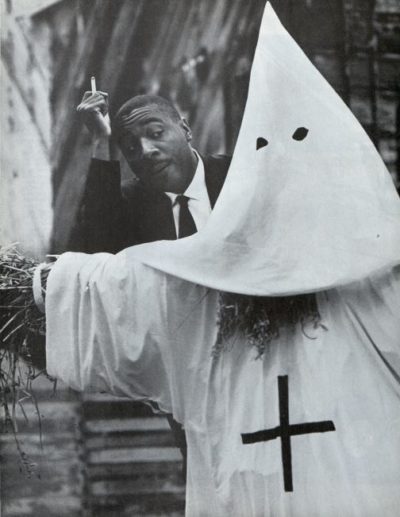
It was the start of Gregory’s long career of calling out racism with punchlines.
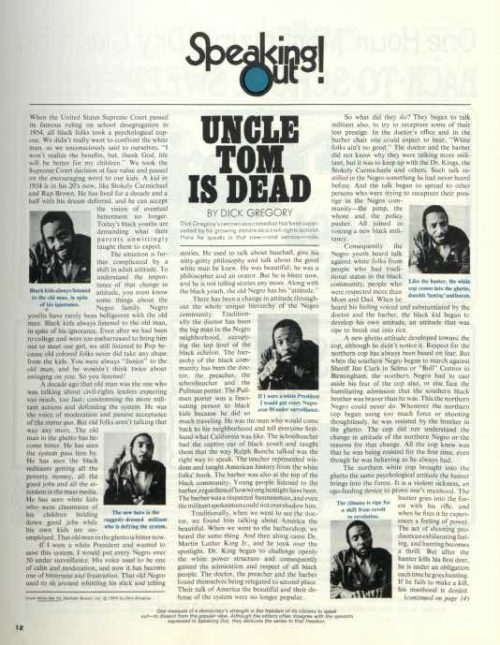
Seven years later, he had become even more of an activist. In “Uncle Tom Is Dead,” his editorial in the August 24, 1968, issue of the Post, he explained the rising black militancy that America was seeing in 1968. But for all his outrage, he never lost touch of the need to keep communicating.
Featured image: Photo for The Saturday Evening Post by Jack Fields
Cover Collection: Kindergarten Cops
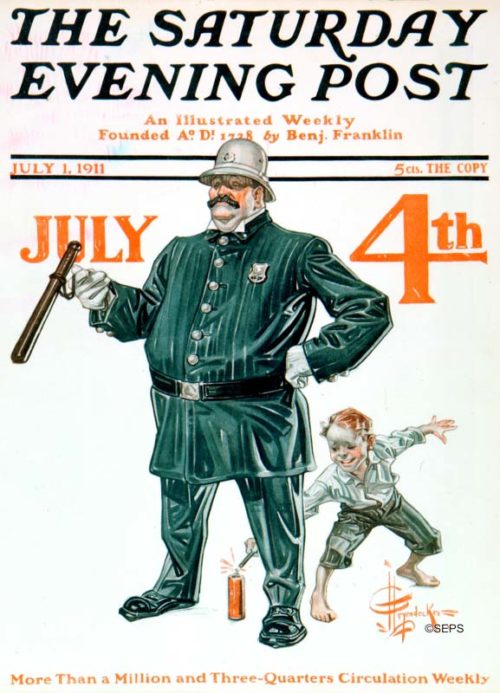
Whether writing them “speeding tickets” or helping them cross the street, these policemen are helping keep an eye on the kiddos.
J.C. Leyendecker
July 1, 1911
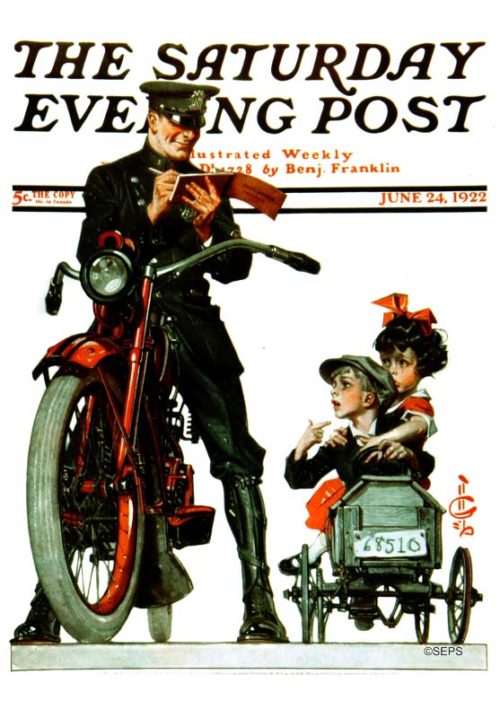
J.C. Leyendecker
June 24, 1922
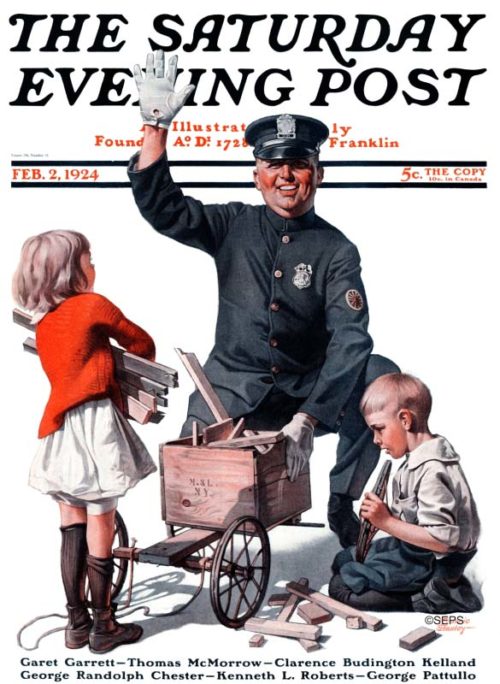
Frederic Stanley
February 2, 1924
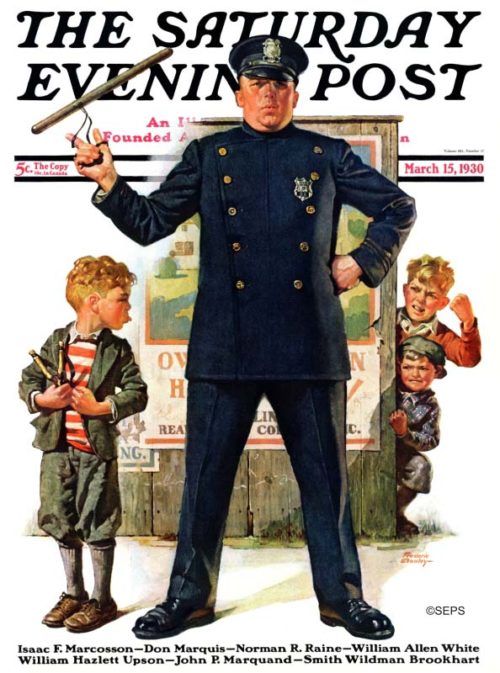
Frederic Stanley
March 15, 1930
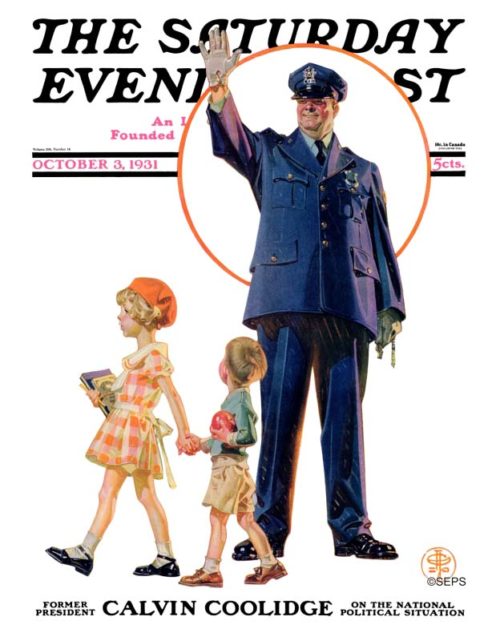
J.C. Leyendecker
October 3, 1931
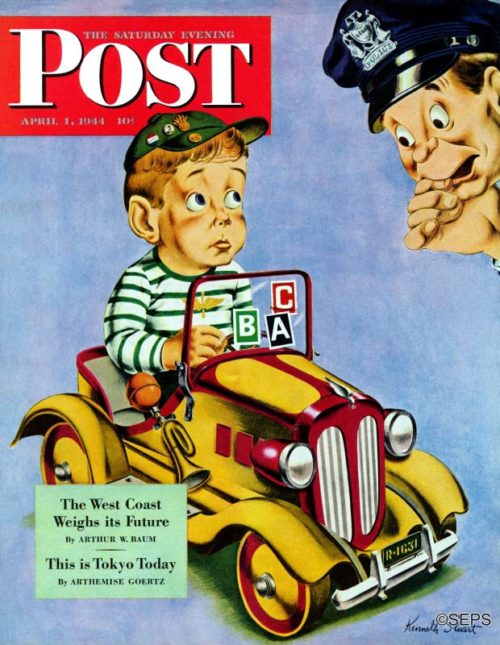
Ken Stuart
April 1, 1944
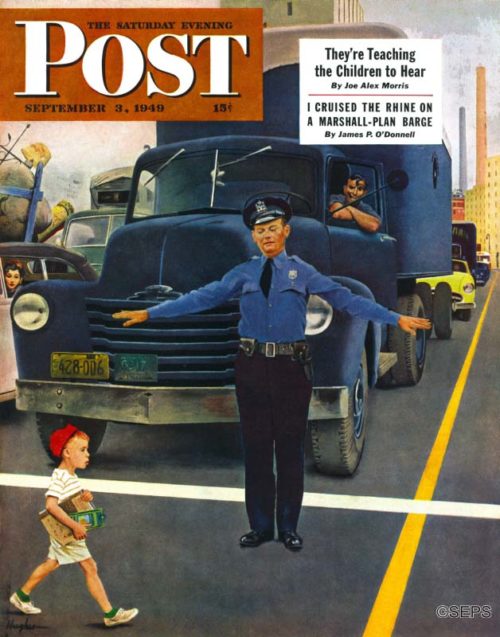
George Hughes
September 3, 1949
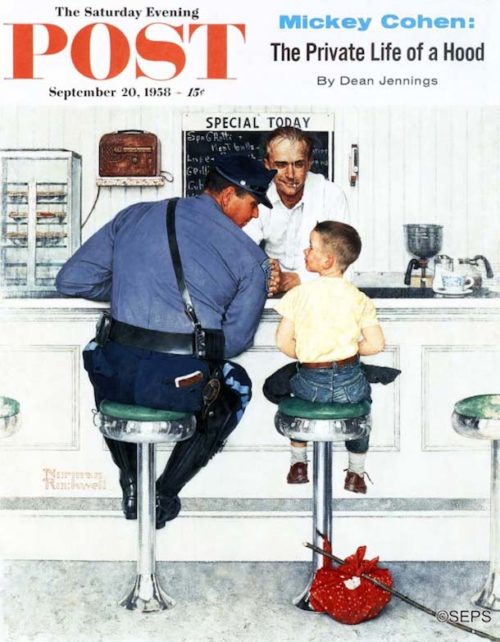
Norman Rockwell
September 20, 1958
Poem: Eclipse of the Sun
Published May 24, 1947, in the Saturday Evening Post
Avalon
Henry was in the middle of the third chorus of “Avalon” when the doorbell rang. He sighed and took his absent wife’s name in vain. He placed the clarinet back in its blue velvet case and turned off the stereo. He opened the door and muttered, “This had better be good.”
The young man was thin and fidgety with oiled black hair, a gray polyester three-piece suit that looked silver in the mid-morning sunlight, and a small brown cloth bow-tie. Beside him on the stoop was a large blue suitcase. It was like he was coming for a visit.
“Good morning, sir,” the young man said. He smiled widely, revealing a slight overbite. “Is your wife at home?”
“No, she’s not,” Henry said sullenly. He was embarrassed to be caught in his dirty white tank top with his suspenders hanging down the length of his pants legs. He’d also neglected to shave that morning.
“Could I inquire when she will be or where she is at?”
“She volunteers at Saint Michael’s Parish on Mondays and Wednesdays,” Henry said before he could stop himself. He squinted at the boy. “Why?”
“Well, seeing as she’s gone,” the boy went on, “maybe I could speak with you for a moment.”
“I don’t think so. I’m kind of busy.” He nodded at the suitcase. “Whatever it is you’ve got in there, I’m sure I don’t want to buy.”
The young man looked down at the blue suitcase with a puzzled expression, as if it belonged to somebody else. Then he lifted his hands to shoulder level, palms up, then dropped them to his sides again. “There’s nothing in there, actually.”
“What in the world are you selling, then?”
“Suitcases, sir. Royal Victoria. Hard-shell case. The very best.”
Henry scratched his elbow. “Of all the stupid things. Well, I’m not interested. My wife won’t be either.”
“Handy if you’re planning a trip somewhere.”
“Nobody’s planning a trip around here. Not now, not in the foreseeable future.”
The salesman’s smile dipped, then rose again. “These fellows are rugged. See?” He picked up the suitcase by the handle then dropped it from about six inches above the ground. It hit the cement and wobbled, but didn’t fall over. “And you can put your dry-cleaning in it, and it won’t wrinkle. It has a special device inside. Want to see?”
“Not really.”
But the young man was already crouched down, unsnapping the trigger-latches. The blue suitcase yawned open on the stoop, revealing frilly aqua fringework and a stiff divider with a hanger attached. Otherwise, the suitcase was empty, a chasm of blue. “Let’s say you’re on your way to a funeral or a wedding somewhere cross-country and you have a special suit you want to keep ready-to-wear. No problem.” He looked up at Henry earnestly, his brow creased in concentration. Tiny beads of sweat had formed on his upper lip. He dipped his head again. Henry looked into the depths of the boy’s swirling black cowlick. “You hang one end of the suit over this Johnson here,” and the young man pointed at the hanger, “and slip the other end under the divider and then around this Jenkins here,” and indicated the wire. “Get it? That way, when you arrive at your point of destination, your suit’s as good as new. It doesn’t even need ironing. Pretty clever, huh?”
“Maybe. But like I told you, we don’t need any suitcases. I don’t even own a suit. Sorry. I’ve got to get back to practicing now.” He started to close the door.
The salesman’s face lit up. “Say, was that you making that music in there? It sounded just like a record playing. I couldn’t tell the difference.”
Henry couldn’t help but smile at the compliment. “Yeah, that was me. Well, me along with a Benny Goodman record. I play clarinet, just like Benny did. Only not like the King of Swing, of course.” He gave a modest chuckle.
“Hey, you’re pretty good. You fooled me.”
“Yeah, well, you know. Thanks.”
“I even know that tune. That tune’s real familiar. That’s called,” and he snapped his fingers twice, “‘Avalon,’ that’s it. Am I correct?”
“That’s right,” Henry said. “Benny Goodman, 1935. Say, you’re sharp.” He frowned uncertainly. “But you’re too young to know that.”
The salesman looked greatly offended. “What’re you saying, mister? I grew up listening to that music. My grandpop loved Benny Goodman, Glenn Miller, Woody Herman, all those good old guys. He had a Victrola and a stack of ’78s, the whole works. We played them every night. We didn’t even own a TV. My grandmom taught me the jitterbug. We used to dance around the kitchen. What do you mean I don’t know that music?”
“Now you have to understand,” Henry said. They were in the living room. Henry’s clarinet was poised in his hands. The young man was over by the stereo. It was his job to start the LP. “I’ve never played in front of anyone before. Except my wife, and she’s sort of got a tin ear. I’m a little nervous.”
“Don’t be. You’ll do great,” the young man said. “Here goes.” And he dropped the needle.
That night Margery found the suitcase on a shelf in the upstairs bedroom closet. It frightened her at first, its largeness, its blueness. But she recovered quickly. “Planning a trip?” she said. Her voice was heavy with sarcasm.
“Maybe I am,” Henry said, without looking up from the book he was reading. It was Joseph Conrad’s Tales of Land and Sea. He was lying in bed in his pajamas. His tongue and the roof of his mouth ached pleasantly from playing all afternoon and into the night, long after the salesman had left him. “Maybe I’ll just take me a little vacation to the South Seas.”
9 Total Eclipse Celebrations Across the Country
Where will you be for the only solar eclipse the U.S. has seen since 1979? Unless you’re in the 70-mile-wide path of totality that stretches across the country, you won’t be able to see the total eclipse in all its glory. Some eclipse-seekers will even hear Bonnie Tyler sing “Total Eclipse of the Heart” aboard a Royal Caribbean cruise liner as they observe the phenomenon at sea.
Here are some options for the rest of us on land when the eclipse hits on Monday:
The Oregon Solarfest in Madras, Oregon

Oregon is the first state in the contiguous U.S. to witness the event. This six-day festival in Madras features musical acts, hot air balloon rides, camping, and a Native American cultural experience. Nearby Madras High School will host a separate viewing on their football field with talks from Lowell Observatory.
https://www.lowellsolareclipse.com/
The Glendo Total Solar Eclipse in Glendo, Wyoming
This free festival offers eclipse viewers an open spot to see the phenomenon as well as astronomy talks sponsored by the National Solar Observatory. Eclipse tourists can also venture to the Glendo State Park where the standard day fee applies.
https://www.glendoeclipse.com/
150 Years Festival in Lathrop, Missouri

Couples hoping to elope during the eclipse can do so for $100 at the 150 Years Festival in Lathrop, Missouri. The price includes admission for two witnesses. The town’s sesquicentennial festival will also feature a hoedown, food trucks, and a special dining experience.
https://www.lathropeclipse.com/
Capital Eclipse Celebration in Jefferson City, Missouri
Missouri’s capital will ring in the eclipse with a drum circle and a gong bath — a ceremony using “vibrational sound and frequency to help reduce stress, alter consciousness and create a deep sense of peace and well-being for better health.” The Capital Eclipse Celebration also features the “Hotter ‘N’ Hell” 5K run and — of course — a tribute concert of Pink Floyd’s “Dark Side of the Moon.”
http://www.capitaleclipse.org/
The Hopkinsville Summer Salute Festival in Hopkinsville, Kentucky
For the “point of greatest eclipse” — the spot where the moon will cover the sun for the longest amount of time — sky gazers are heading to Hopkinsville, Kentucky. The Western Kentucky city is taking advantage of its once-in-a-lifetime popularity by throwing the Summer Salute festival.
Music City Solar Eclipse in Nashville, Tennessee
The entire city of Nashville will fall in the path of totality; therefore, it would be difficult to be in Music City on Monday with nothing to do. Honky-tonks and fine dining restaurants alike will host events, and Mayor Megan Barry will greet spectators at First Tennessee Park to see the celestial event before a Nashville Sounds game.
http://www.visitmusiccity.com/eclipse
OutaSight Festival in Rabun Gap, Georgia
As the only Georgia county inside the path of totality, Rabun County is hosting a viewing party at the Rabun Gap-Nacoochee School with screens showing NASA’s broadcast of the eclipse. Rabun County includes towns like Dillard, Georgia — population 340 — that have never seen an influx of tourists the likes of which they are preparing for on Monday.
http://www.exploregeorgia.org/listing/60727-outasight-total-solar-eclipse-festival
Eclipse Fest in Long Creek, South Carolina
Chattooga Belle Farm is hosting its own festival on the 138-acre tract at the foot of the Blue Ridge Mountains. The farm and distillery was owned by Groucho Marx as an orchard in a past life, and now it finds itself dead center in the path of eclipse totality. The festival will be complete with vendors, music, and booze along with scenic views of the mountains and the Chattooga River.
http://solareclipsefest2017.com/
Total Eclipse Weekend in Columbia, South Carolina

Columbia has dubbed its experience “the longest total eclipse on the East Coast,” and the city will be celebrating its eclipse privilege with many “eclipseploitation” events. Local playwrights have written six 10-minute plays about the eclipse, and each one will feature two minutes of darkness as they are performed.
http://totaleclipsecolumbiasc.com/event/
For more information on the eclipse and safe viewing, visit NASA.
Pig’s Blood or Patience? A 100-Year-Old Insight into General Pershing
The story of U.S. commander John J. Pershing executing Muslims with bullets dipped in pigs’ blood — a tale that has been generally discredited — is back in the news. A 1917 article from the Post shows that Pershing may have taken a much more measured approach to the confrontation in the Philippines.
As author George Patullo writes in “’Go-Getter’ Pershing” in the June 23, 1917, issue of the Post, between 12,000 and 15,000 Moros had gathered on a mountain on the island of Jolo in the Philippines. The Moros were a group of Muslim tribesmen who had a reputation for piracy and fierce fighting. The Philippines had come under American rule after Spain ceded control of the islands to the U.S. following the Spanish-American War, and Pershing found himself facing a potentially bloody campaign.
Pershing first asked for a parley, where he invited the Moros to lay down their weapons and accept amnesty. The Moros turned him down.
As Pattullo tells it, Pershing was reluctant to order his 4,000 troops to assault the Moros. For one thing, a large number of villagers had gathered with the Moros, lured by promises of protection. Another reason for Pershing’s hesitation was his resistance to pitting his men against fighters who would welcome death in a holy war.
So Pershing did the unexpected. He retreated. The villagers eventually abandoned the Moro militants once the threat from Americans receded. Pershing was then able to engage this smaller force and defeat the Moros. By the end of the campaign, Pattullo writes that the surviving Moros elected Pershing their chief.
Rather than repeating other generals’ mistakes, Pershing had shown a “remarkable gift of patience in attaining his ends.”
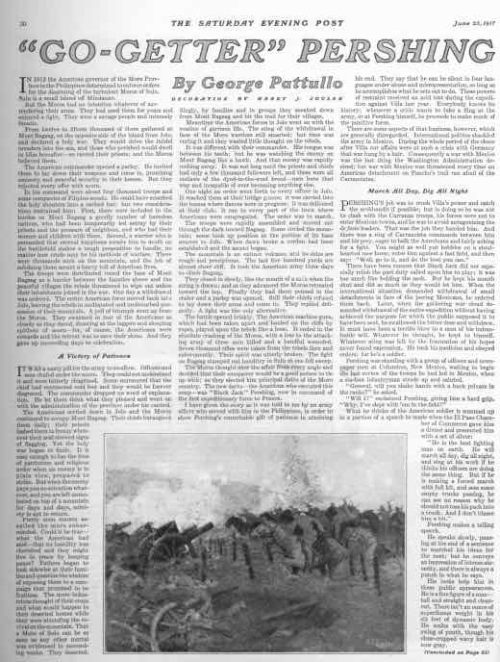
Featured image: Painting of The four-day battle of Bagsak Mountain on Jolo Island in the Philippines (U.S. Army Center of Military History)
An Interview with Real-Life Rocky Chuck Wepner
Join our movie review podcast, Movies for the Rest of Us with Bill Newcott. This week, Bill reviews The Hitman’s Bodyguard starring Ryan Reynolds and Samuel L. Jackson, and Chuck starring Liev Schreiber. He also interviews boxer Chuck Wepner, the model for Sylvester Stallone’s Rocky and one of only four men to ever knock down Muhammad Ali.
News of the Week: Digital Problems, Food from Oprah, and Why You Shouldn’t Be a Sucker
Hell Is a World with No Print Books
For a while there it looked like print books were the past and digital was the future. Soon, everyone would be reading books on their Kindles and iPads and smartphones and print books would die and we’d save all the trees and the world would be a digital paradise!
Well, someone forgot to tell print books.
As I mentioned a few months ago, sales of print books are up, and sales of ebooks are down. And it’s not just Amazon that’s selling a lot of them. We’re actually starting to see more brick-and-mortar bookstores opening. Yes, one of the companies opening those physical bookstores happens to be Amazon, but there are others too, and it’s a comforting feeling to know that we still live in a world where we can walk into a bookstore, handle all of the books and magazines on the shelves, and be part of something. Not everything has to be point and click. (By the way, please point your cursor at those links and click on them.)
One way that bookstores can survive and thrive is by offering more than books. Barnes & Noble already as cafés, and they’re experimenting with full-service restaurants. Many independent bookstores hold author events and sell more than just books.
Remember You’ve Got Mail? If it were made today, Meg Ryan would merge her Shop Around the Corner store with Tom Hanks’ giant Fox Books chain and take on Amazon.
YOU Get a Bowl of Soup, and YOU Get a Bowl of Soup …
Oprah Winfrey might not have a daily talk show anymore, but she has figured out a way to be in your life every single day anyway.
Oprah is coming out with a line of “refrigerated comfort foods” in September called O, That’s Good! Right now the selection will just be four kinds of soup and four side dishes, all priced under $5.00. She’s teaming up with Kraft for the products, and since she already is an owner of Weight Watchers, this seems like the next logical step.
I’m surprised more celebrities don’t do this. Kevin James could come out with a line of potato chips, and maybe Warren Buffett could have a line of “Buffett Table” foods.
Don’t Be a Sucker
This U.S. Military film from the mid-’40s has been getting some attention lately (I’d say that it has gone “viral,” but boy do I hate that word), and I present it here with no political commentary whatsoever. I just think that, as a historical and cultural artifact, it’s … interesting.
Silent Ben
For the next four years, no one in London is going to know what time it is.
Big Ben is going to stop chiming (or is it bonging?) this Monday and won’t start up again for four years. It’s undergoing repairs and, well, the workers won’t like it making a giant sound every hour. But they still plan to chime in on special days, like New Year’s.
Of course, this is already getting pushback from citizens, so officials are going to review the idea. Prime Minister Theresa May wants the chimes (bongs?) to continue.
SMALT
If you’ve been looking for a smart device for your home but have been disappointed in the choices you’ve seen because none of them dispense salt, you’re in luck. Introducing SMALT, the world’s first interactive salt shaker!
At first I thought it was a fake commercial from Saturday Night Live or a satirical website, but it’s real. You put the device in the middle of your dinner table, and it plays music and delivers ambient light for you and your guests. Oh, and if you need salt, you don’t need a whole separate salt shaker crowding the table.
I’m surprised they’re not releasing Smepper at the same time. You know it’s coming.
RIP Joseph Bologna, Alan Peckolick, S.J. Harris, and Neil Chayet
Joseph Bologna was not only an acclaimed actor, appearing in such films as My Favorite Year and Blame It On Rio and starring in the sitcom Top of the Heap, he was also an Oscar- and Emmy-nominated screenwriter. He died Sunday at the age of 82.
Alan Peckolick was a designer who created logos for many companies, including GM, and font designs for companies such as Revlon, Mercedes-Benz, and Pfizer. He died August 3 at the age of 76.
S.J. Harris was a stuntwoman who died on the set of Deadpool 2. She was 40. Harris is the second stunt person to die on a set recently. John Bernecker died filming The Walking Dead in July.
Neil Chayet hosted the Looking at the Law radio show on WBZ in Boston and other radio stations for 41 years. He died last week at the age of 78.
This Week in History
Alfred Hitchcock Born (August 13, 1899)
The master of suspense was born in Leytonstone, England, and died in Bel Air, California, on April 29, 1980. In this piece from the December 15, 1962, issue of The Saturday Evening Post, Hitchcock gives his opinions on a variety of topics, from Walt Disney and TV commercials to Hollywood stars and his weight.
Elvis Presley Dies (August 16, 1977)
Wednesday marked the 40th anniversary of the King’s death. Here’s how the media covered it back then, and here’s a look back on all the times Presley was talked about in the Post.
This Week in Saturday Evening Post History: Where the Girls Are (August 17, 1957)
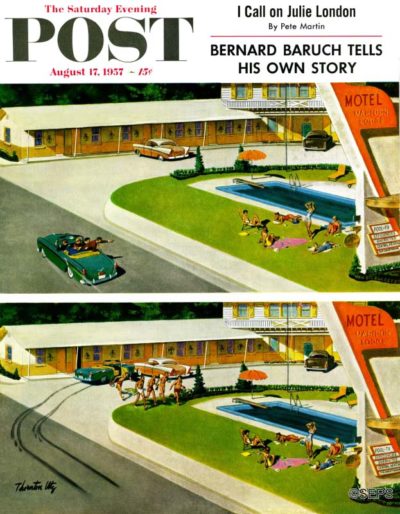
Thornton Utz
8/17/57
If you didn’t know the title of this cover by Thornton Utz, you might think it’s Car Smashes into Motel. But the reason the male driver and his buddies make a sudden turn into the parking lot is because they see a group of young ladies lounging by the pool. The least the guys could do is park the car correctly.
National Bacon Lovers Day
Francis Bacon was born in 1561 and died in 1626. Besides being the Attorney General and Lord Chancellor of England, he was a scientist and author who some people believe was the actual writer of Shakespeare’s plays. He was …
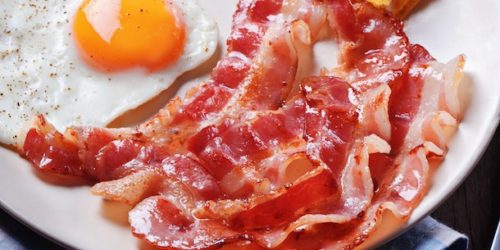
Oh wait, this Sunday is the day we celebrate bacon the food. All righty. Here’s a recipe for a Bacon, Cheddar, and Apple Bake, and here’s one in honor of Elvis — Chunky Elvis Ice Cream — which contains not only bacon but also peanut butter, honey, and bananas.
Next Week’s Holidays and Events
National Aviation Day (August 19)
In 1939, President Franklin Delano Roosevelt declared that Orville Wright’s birthday would be celebrated as National Aviation Day.
Total Eclipse (August 21)
Monday is going to be a big day, with the eclipse being witnessed by millions who will take the long journey to see it and live coverage on television by the news channels. Even jets are going to chase the moon’s shadow. The path of totality, which I think was the title of a Star Trek episode, runs from Oregon through the middle of the country and ends in South Carolina. You can see a partial eclipse in other parts of the country — just make sure you protect your eyes. And, of course, your heart.
11 Facts about Presidents and Approval Ratings
Every day, Gallup Inc. fires up its phone banks and calls hundreds of Americans, asking them their opinions on social and political questions.
One of Gallup’s most closely watched polls is the rating of presidential job approval. Gallup has been conducting this poll continually since 1945. Each week, Gallup workers talk to 3,500 Americans (70 percent on cellphones, 30 percent on landlines) to ask, “Do you approve or disapprove of the way [insert name here] is handling his job as president?”
Journalists, pundits, lobbyists, and politicians await the latest results, eager to spot trends or opportunities in America’s attitude toward its chief executive.
Here are some notable achievements in the field of presidential approval:
1. The Biggest Drop in Approval goes to Harry Truman. When he stepped in to complete President Roosevelt’s term in 1945, Truman had the approval of 87 percent of the country. Six years later, with the Korean War dragging on, rising inflation, unpopular price controls, and southern Democrats feuding with him, his approval had fallen to 22 percent.
2. Most Popular is George W. Bush, who achieved 90 percent approval in the days following the 9/11 attacks. It slipped to 58 percent over the next two years but shot up again, reaching 72 percent when the Iraq invasion was launched. His popularity experienced a long decline in his later years, when his approval rating fell to 29 percent. But then, popularity usually falls during second terms.
3. The Highest Average Approval for an Entire Term in Office goes to John F. Kennedy. On average, his daily approval rating was 70 percent. His popularity rating also shows the fewest sharp rises and falls of approval scores.
4. The Lowest Average Approval belongs to Jimmy Carter, at 47 percent.
5. The Graceful Exit Award: With just two exceptions, every president’s approval rating has dropped in the time between taking and leaving office. Those exceptions are Ronald Reagan (in at 53 percent, out at 63 percent) and Bill Clinton (in at 58 percent, out at 66 percent).
Approval is just half the story. Gallup also counts how many people disapprove of the president.
Note that an approval rating of 40 percent doesn’t mean 60 percent of Americans disapprove of the president. There is usually a buffer of “no opinion” holders.
Some presidents have had low approval scores without correspondingly high disapproval ratings.* For example, when Truman’s approval in the summer of 1950 hit 42 percent, his disapproval score was 32 percent, indicating 25 percent of Americans expressed no opinion. When that margin of grace shrinks, it can indicate fewer Americans are giving the president the benefit of their doubt.
6. The Highest Disapproval Rating goes to George W. Bush, who reached 71 percent.
7. The Lowest Disapproval Rating belongs to Harry Truman. Back when he was enjoying 87 percent approval, his disapproval score was just 2 percent.
8. The Biggest Rise in Disapproval goes to Richard Nixon, who went from 5 percent to 66 percent. Just as presidents’ approval ratings usually drop, every president’s disapproval rating has risen during his time in the White House — just not by this much.
9. The Lowest Approval/Highest Disapproval on Entering Office award goes to Donald Trump. Both scores were 45 percent.
10. The Highest Approval for a President’s First Three Months in Office, As Rated by Voters in His Own Party, is Barack Obama, who earned a 90 percent approval rating from Democratic voters.
The same award for a Republican president goes to George W. Bush; 88 percent of Republican voters gave him early approval.
11. The Most Divided Approval Ratings are for Donald Trump: During Trump’s first quarter as president, Republicans gave him an 87 percent approval; Democrats, 9 percent — a 78-point difference.
Naturally, presidents don’t enjoy high approval ratings from voters in the losing party, so there’s usually a partisan gap in scores.** When narrow, it indicates the president may have potential support from voters in the other party. For example, Dwight Eisenhower’s early approval score was 86 percent among Republicans and 61 percent among Democrats, a difference of only 25 points.
A widening gap reflects a loss of bipartisan support. During his first quarter, Ronald Reagan widened the partisan gap to a 41-point difference. With Clinton, it hit 51; George W. Bush, 61; Barack Obama, 60.
Presidential Approval and Disapproval Ratings
| President | Approval High/Low Scores | Start/End Approval Scores | Overall Average Approval Score | Disapproval Low/High Scores |
Start/End Disapproval Scores | Average Q1 Approval Ratings of President’s Party/Opposition Party |
|---|---|---|---|---|---|---|
| Truman | 87/22 | 87/32 | 56 | 2/66 | 2/64 | |
| Eisenhower | 79/48 | 68/59 | 65 | 7/35 | 7/28 | 86/61 |
| Kennedy | 83/56 | 72/58 | 70 | 6/30 | 6/30 | 85/57 |
| Johnson | 79/35 | 78/49 | 55 | 2/52 | 2/37 | |
| Nixon | 67/24 | 59/24 | 49 | 5/66 | 5/66 | 82/50 |
| Ford | 71/37 | 71/53 | 47 | 3/46 | 3/32 | |
| Carter | 75/28 | 66/34 | 46 | 8/57 | 8/55 | 78/54 |
| Reagan | 68/35 | 51/63 | 53 | 13/52 | 13/29 | 83/42 |
| Bush | 89/29 | 58/56 | 61 | 6/59 | 6/37 | 78/41 |
| Clinton | 73/37 | 58/66 | 55 | 20/53 | 20/29 | 78/27 |
| Bush | 90/25 | 57/34 | 49 | 9/71 | 25/61 | 89/31 |
| Obama | 67/40 | 67/59 | 48 | 12/57 | 12/37 | 90/30 |
| Trump (as of 8/16/17) | 45/36 | 45/- | 40 | 47/58 | 45/- | 87/9 |
Article and chart data provided by Gallup, Inc.
*Disapproval data is from The American Presidency Project.
**Political division of voting data is from Huffington Post.
Featured image: Shutterstock
6 Apps for Sky Gazers
Explore the sky day and night with these six cosmic apps:
SkyView ($1.99, terminaleleven.com/skyview/iphone, iOS only). Pinpoint all 88 constellations and over 130,000 stars with this award-winning app.
NASA (free, nasa.gov/nasaapp). Keep up with latest news and photos from NASA, and view a live stream from the International Space Station.
Star Walk 2 ($2.99, vitotechnology.com). Find nebulae, galaxies, meteors, stars, and more, plus delve into the mythologies of the constellations.
Mobile Observatory ($4.49, zima.co). Zoom in like a pro with this sophisticated augmented-reality app.
CloudSpotter ($2.99 cloudspotterapp.com, iOS only). Identify cloud formations and share pictures with global cloud spotters.
Luminos ($24.99, wobbleworks.com/luminos, iOS only). View a virtual telescope of “the largest deep space catalog of any app,” including detailed surface views of planets and moons for serious astronomers.
This article is featured in the July/August 2017 issue of The Saturday Evening Post. Subscribe to the magazine for more art, inspiring stories, fiction, humor, and features from our archives.
The Failed Strategy Behind the Berlin Wall
In 1961, the U.S. was both surprised and not surprised when East Germany put up the wall that divided Berlin — surprised because it was such a provocative move; not surprised because it was the culmination of years of Soviet strategies to isolate democratic West Berlin.
In 1945, the western allies — Britain, France, and the U.S. — had watched with dismay as, one by one, the European nations closest to the Soviet Union fell under communist control. Then, the USSR closed the borders of each of these nations to keep their workforce from fleeing to the west.
The single exception was Berlin, nestled in the heart of East Germany. Following the defeat of Germany in World War II, the city had been divided into four sectors, each under the governance of an occupying army. For years, Berliners could cross between these sectors with little problem.
But then the Soviets began exerting pressure on the other armies to leave. If they could chase out the western allied troops, they could absorb West Berlin into Soviet-controlled East Germany without armed opposition.
In June of 1948, the Soviet Union cut off all access to the city from the west. Since West Berlin was a democratic island in the middle of communist-controlled East Germany, the Soviets were able to close access to West Berlin by road, rail, and canal. Determined not to let West Berlin fall under communist rule, the three western allies began airlifting food and supplies into the city. For more than a year, airplanes delivered as much as 8,000 tons of supplies and fuel to the city every day.
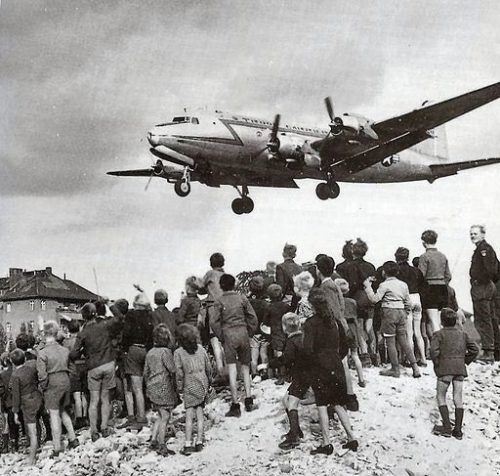
But the Soviets didn’t stop their efforts to isolate West Berlin. In 1952, East Germans, under the control of the Soviets, erected a barbed wire fence between West Berlin and surrounding lands in East Germany. By 1956, East Germany had ended virtually all travel from East to West Berlin.
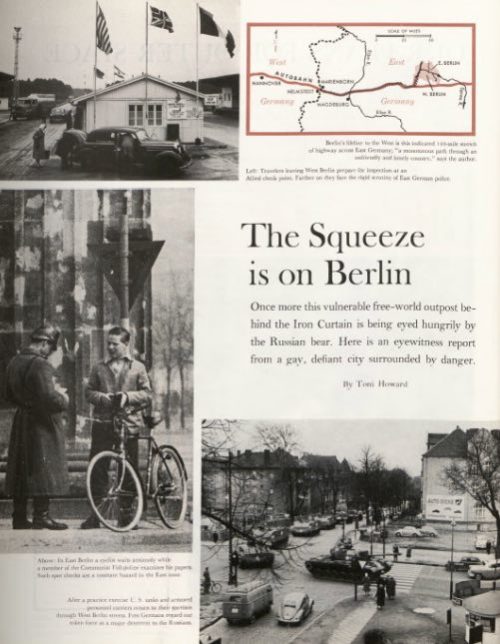
By 1959, when “The Squeeze Is on Berlin” was published, East German police were detaining commuters on the subway for spot checks. Even more restrictive were the East German guards at the checkpoints between East and West Berlin.
In June of 1961, East Germany began building a 91-mile wall between East and West Berlin. By August 13, the border was closed. The Berlin Wall became a focal point for the global struggle between communism and democratic rule.
For 28 years, until its fall in 1989, it stood as a monument to rigidity, and a vain effort to prop up a bad idea with concrete blocks.
Featured image: Shutterstock
North Country Girl: Chapter 13 — Food, Glorious Food
For more about Gay Haubner’s life in the North Country, read the other chapters in her serialized memoir. The Post will publish a new segment each week.
Every Duluth organization met over a breakfast or lunch (if not at the clubhouse bar), as parents and kids were expected to dine en famille. If it wasn’t Friday, dinner at the Haubners had a large meat component, along with a starch and at least two veg. Gravy arrived at the table often and in a barge. Even though I was a picky eater, I had my favorites: Beef tomato, which my mom had learned to make at a Chinese cooking class she took in Hawaii, and which resembled no Chinese dish ever. It was tinned tomatoes, strips of steak, and green peppers that had to be prepared in an electric skillet for authenticity. It made a brownish soy sauce gravy and was served over huge lovely beds of overcooked Uncle Ben’s Converted Rice. Chicken and dumplings boiled away for hours on the stove; it made a bland white gravy often served with egg noodles for extra starchiness. There were a few non-gravy menus.
Mom rubbed the outside of immense pork roasts with a mixture of spices that made eating the salty crispy fat bits the best part. I failed the see the charms of the boiled dinner — ham or corned beef simmered with potato, cabbage, and onions into a uniformly grey mess, but I adored the required accompaniment of brown bread that came in a can — bread in a can! — thickly sliced and thickly covered with butter. In summer there were hamburgers, hot dogs, and steaks on the barbeque, overseen manfully by my dad (until he moved out and I was assigned to the grill); ketchup was the only condiment although there was usually a jar of sandwich pickles somewhere.
There were homemade chocolate chip cookies and banana bread and a crisp and flaky apple pan dowdy that was made with a pound of lard. I tried not to think about what exactly lard was even as my heart rose every time I saw that blue box peeking out of the brown paper grocery bag. Baked goods were washed down with milk from glass bottles, which appeared a few times a week in the silver Springhill Dairy box on the side of the house, a box adorned with a drawing of a cow who looked very contented.
Dinner was eaten in the dining room at 411 Lakeview (the banquette table in the remodeled kitchen was for breakfast, lunch, and the rare occasions my dad brought home take-out Chinese food). Memorable events at that long, highly polished mahogany table include my projectile vomiting as a result of my dad forcing me to eat a boiled brussels sprout (it took years for me to try one again, and even today I prefer them burnt to a crisp). Then there was the dinner party when our long-legged neighbor, Joe Kraft, who habitually teetered on the hind legs of his dining room chair, pushed his balancing act so far that he cracked the legs off the chair. He went sprawling to the floor and my mom flew into such a rage that I fled upstairs to my room.
Dinner parties were regular occurrences; Duluthians were great socializers. My mother held weekly bridge parties, setting up card tables in the living room, fixing a special dessert, and arranging tempting tiny nut cups at each place filled with cashews or waxy chocolate Brach’s Bridge Mix (“Don’t touch anything!”). My parents, those madcaps, had learned the Twist so they could show off at a dance party they threw in our basement after it had been de-ratted. My parents went out almost every Saturday, leaving Lani and me in the hands of a bored teenager who spent all evening on the phone. Only on those nights were Lani and I allowed to eat in front of the TV, dining on actual TV dinners. I loved the turkey one, even though when you took it out of the oven the cinnamon-y stewed apples were so hot they singed your tongue, while the so-called stuffing nestled under the paper-thin slices of white and dark meat remained ice cold. The upper right compartment of the tin foil tray contained whipped potatoes with absolutely no taste at all, so they were mixed with an equal amount of butter. The sitter reappeared at 10 to pick up the half eaten trays and shoo us to bed, where I lay awake, convinced that I’d never see my parents again.
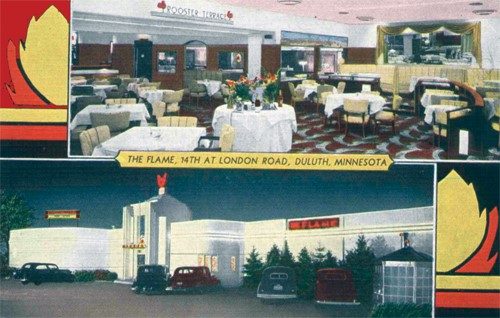
When Lani passed the stage where she was enjoyed throwing fits so rabid that she sent everyone around her into fits as well, our parents started taking us out to dinner. There was the Fifth Avenue, with spindly tables and pink and black wallpaper depicting people carrying baguettes, riding bikes, and wearing berets. Every meal there began with a basket of popovers right from the oven, steam rising above the white cloth, so hot that butter melted immediately on them; a burnt tongue was a small price to pay for such loveliness. There was the Flame restaurant, down by the harbor, where they announced the names of ships that were crossing under Duluth’s “famous” aerial bridge. The Flame had a short man in a bellhop uniform stationed at the door and an immense and frightening lobster tank. There was the Pickwick, long and dark and medieval, with stained glass windows on the side and a view of Lake Superior from the back. I loved their chicken, with its salty blackened skin, ignoring my mother’s “You can get grilled chicken at home” stink eye. Starting about two months before Christmas, the Pickwick bar offered Tom and Jerry’s. A drink named after a cartoon! A Tom and Jerry was warm, heavily spiced eggnog fortified with brandy or rum. I was allowed small swigs; it was the nectar of the gods.
The swankiest restaurant was the London House, with cut glass dishes of celery and carrot sticks and black olives, tri-part stainless steel salad dressing servers with Blue Cheese, Thousand Island, and French (I used French by the teaspoon as it was the only one that didn’t make me puke to look at it), and baked potatoes the size of cantaloupes, that came with their own servers holding sour cream, bacon bits, grated Cheddar, and diced onions. Everyone got steak or prime rib or lamb chops or fried shrimp. We ate ensconced in huge red leather booths; my parents knew everyone who passed by our table. We girls were supposed to order something not too expensive, eat all of it, and shut the hell up.
Every once in a while a tinkle of piano and song would drift up from Tin Pan Alley, a mysterious basement piano bar where children were strictly forbidden. This joint was the favorite destination of my mother’s pals Karin Luster and Gloria Hovland, who imagined themselves glamourous chanteuses making a pit stop in Duluth on their way to stardom. Gloria also wrote songs, which she sent out to agents, hoping one of them would catch the ear of Tony Bennett or Perry Como. She was convinced that the music publishers were stealing her melodies and would cock her head like a robin anytime she her a few bars of Muzak.
In Duluth’s bustling downtown there was The Chinese Lantern, which had huge portions of blandly delicious Cantonese food and the best prime rib. There was also the dreaded Jolly Fisher, permeated with a nauseating smell of fish, which made me so ill that I couldn’t swallow as much as a french fry. Not wanting to repeat the brussels sprout episode, my parents stopped taking Lani and me along when they ate there, leaving us at home to enjoy our TV dinners.
I think our favorite meals were the ones we ate when my dad wasn’t home. Pretty much everything tasted good in Duluth in the 1960s: there weren’t a lot of artificial flavors or preservatives, no microwaves, and the only sweetener was cane sugar. At drive-ins (it wasn’t fast food then as it wasn’t especially fast) everything was prepared fresh right when you ordered it. We’d sit and wait for our Kentucky Fried Chicken (we would have been mystified by the initials KFC): watching the fry cook in the little paper hat take the pieces of chicken we ordered (Lani and I liked drumsticks), dredge them in batter, and sink them in the Fryolater. We took the waxy bucket home, almost too hot to hold, perfuming the car interior with eleven different herbs and spices. The mashed were real potatoes, the pallid gravy slightly floury, the biscuits were buttery, light, and fluffy, the cole slaw uneaten. I have no idea when everything went so terribly wrong.

For my mom to buy Kentucky Fried Chicken we needed ready cash, which was always in short supply at our home. But if we went through all our coat pockets, the couch seats, and the bottom of my mom’s purse, we could come up with enough change to go to the London Inn and get 15 cent hamburgers, fries, and onion rings. The London Inn’s parking lot was always filled with cars and teenagers and blasting radio music, all tuned to the same station, WEBC.
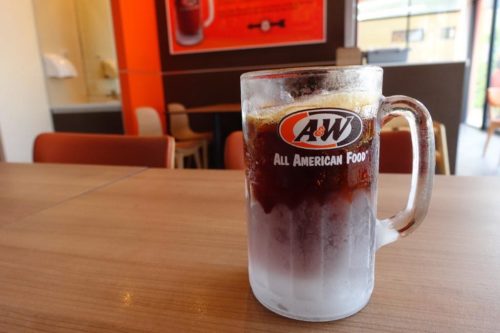
The onion rings were even better and the burgers grilled over an open flame at Nick’s, but Nick’s was in the West End and my mother was loathe to drive the 20 minutes. If the London Inn counter was eight deep in teenagers, we would head to the A&W, where a brown-and-white costumed carhop took our orders and returned with a heaping tray of food and once in a great while, root beer floats, which she perched precariously on the half-opened car window. More than once, my mother got splattered with root beer, melted ice cream, and ketchup when she upset the delicate balance created by three heavy glass mugs.
The A&W’s floats were good, but there was really only one destination for ice cream: Bridgeman’s. A dime bought a single scoop cone. A Tin Roof Sundae, with chocolate sauce and roasted peanuts, was eighty cents. Bridgeman’s had fresh peach ice cream, studded with pale pink chunks of frozen fruit, but only in August. The shakes and malts came straight from the blender in a tall, heavy glass and topped with whipped cream, along with some extra in the silver blender jar to make sure you achieved maximum ice cream freeze head. An evil second cousin had showed me how if you dipped the end of your paper straw end into the malt, you could shoot it up to the ceiling and it would stick. (This was the same distant relation who also gave me a lit firecracker to hold.) I would not have dared to so sully the pristine white and stainless steel interior of Bridgeman’s.
The Recurring Rise of America’s “Alt-Right”
The politics of hatred have been a recurring blight on American history. The proponents of organized racism, anti-Semitism, and anti-democracy have staged public demonstrations or parades with disheartening regularity. Based on events this past weekend in Charlottesville, it’s evident that this ugly underside has not diminished with time.
One of the most notorious of the reactionary groups that showed up in Charlottesville is the Ku Klux Klan. Created in the late 1860s, it united Southern opposition to civil rights and political office for black Americans, many of them newly freed slaves. Its members, hooded for anonymity, terrorized and murdered black Americans, drove their opponents out of government, and hampered the efforts of post-war Reconstruction. The Klan declined in the 1870s, though, a victim of internal dissension.
The Klan was revived in 1915 and membership grew in the wake of growing tension that had resulted in several race riots in 1919. Now, in addition to oppressing black Americans, Klan members opposed immigrants, Jews, and Catholics. It became highly organized, with membership peaking around 4 million. But internal divisions, criminal convictions of leading Klan members, and public opposition led to a decline in membership, which had dropped to an official tally of 30,000 by 1930.
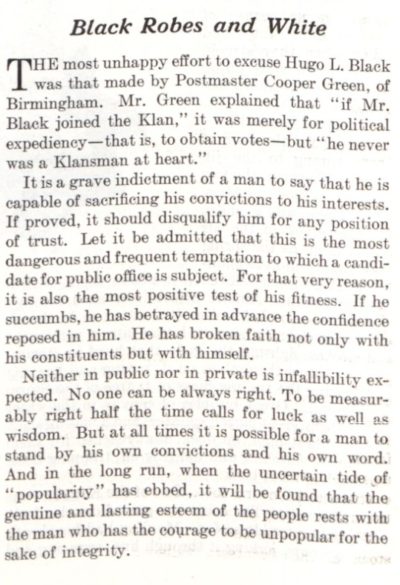
Americans’ disapproval of these white supremacists had become so strong by this time, that even a past association with the Klan was enough to tarnish a man’s reputation. Associate Supreme Court Justice Hugo Black had just been confirmed when the Post ran this editorial on October 16, 1937, criticizing Black for his participation in the KKK 10 years earlier. Black’s apologists claimed he had joined the Klan solely to garner their votes, leading this editorial to state: “It is a grave indictment of a man to say he is capable of sacrificing his convictions to his interests.” The denunciation continued to surface throughout his career, although it didn’t prevent him from serving on the court, which he did for 34 years.
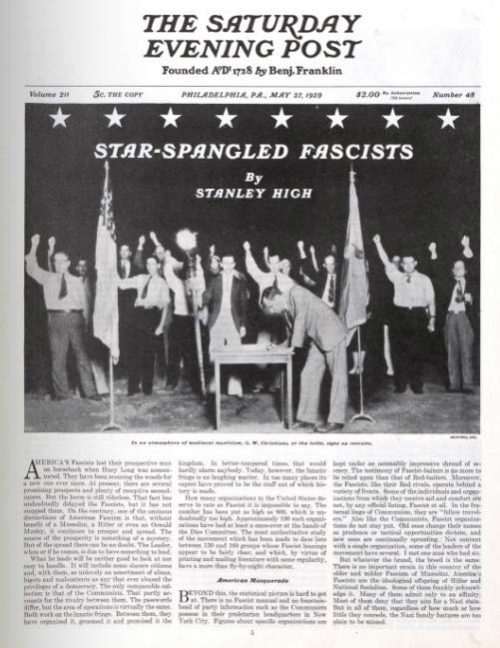
Tepid condemnations went only so far in cooling hate groups’ rhetoric. As the 1939 Post article, “Star Spangled Fascists,” notes, “one of the ominous distinctions of American Fascism is that, without benefit of a Mussolini, a Hitler or even an Oswald Mosley, it continues to prosper and spread. … For fuel for their movement, the Nazis mixed patriotism with hate. Their American kinsmen use the same mixture.”
The article details the Klan’s strategy for growth, including the slow escalation of activities — from dropping pamphlets to burning crosses — in their local town “if the community continues to snooze placidly.”
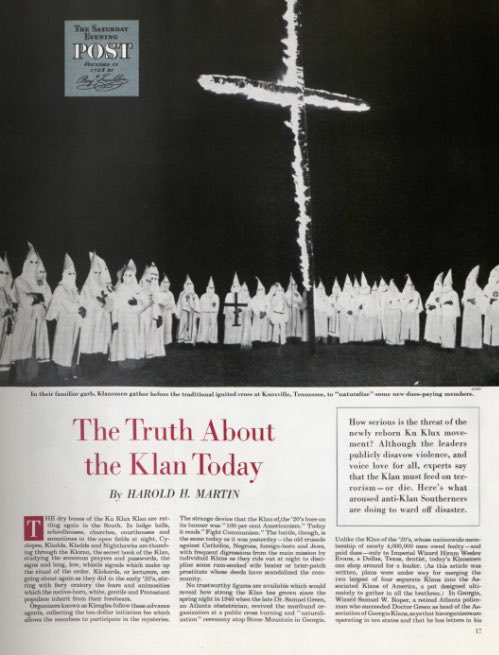
In 1949, the Klan re-emerged in the south. It membership grew after the 1954 Supreme Court’s decision in Brown v. Board of Education, which declared that the “separate but equal” doctrine used to justify segregation in schools was unconstitutional. The Klan’s staunch opposition to communism also helped draw members. But, as the Post article “The Truth About the Klan Today” reported in 1949, the Klan had little cohesion and lots of infighting. In addition to rivalries among its leaders, they were hounded by the IRS for tax evasion and infiltrated and spied on by the FBI.
In the 1960s, with the rise of the civil rights movement, the Klan again reared its ugly head. By then, as the 1965 article “We Got Nothing to Hide” shows, Klansmen were marching without covering their faces, seeming to feel for a brief moment that their time had come. They were mistaken, of course, and the Klan’s popularity would subsequently decline in the wake of federal indictments of some of its leaders and scrutiny by the House Committee on Un-American Activities.
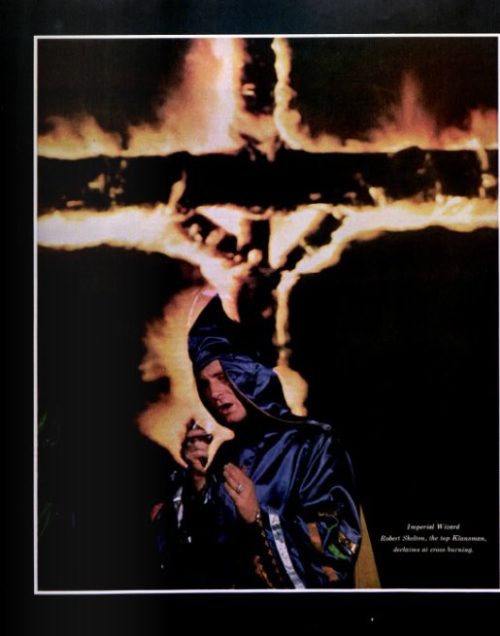
But the Klan and other hate groups never completely fade away. Over the last half-century, the KKK has occasionally been involved in shootings and other racially motivated crimes. And it has allied itself with other extremist organizations, such as neo-Nazi groups.
But, as it rises and falls, it seems the Klan and other hate groups never completely fade away, reflecting perhaps the pain of progress in a modern secular society. As Harold H. Martin and Kenneth Fairly concluded in “We’ve Got Nothing to Hide,” the Klan is “less an organization than a state of mind [reflecting] the despair of the poor white in a society in which he can find no respected place….They are recognized, not as folk heroes [but as] misfits, the bitter rejects of society.”
Featured image: Photo by Lynn Pelham, from the cover of the January 30, 1965, Saturday Evening Post
The Art of the Post: The Secret Illustration Techniques of Frederic Gruger
In 1928, The Saturday Evening Post published this cartoon about one of its illustrators, Frederic Rodrigo Gruger.

The point of the joke was that artists around the country were dying to learn the secrets of Gruger’s famous technique, which he had to defend with knights in armor.
Never heard of Gruger? He was one of the most highly regarded and prolific illustrators of the day. In 1939, Time proclaimed him “the dean of U.S. magazine illustrators.” Norman Rockwell looked up to him as “one of our greatest illustrators.” His work appeared everywhere — he created an astonishing 6,000 illustrations between 1898 and 1943, but his true home was with the Post, for which he did thousands of illustrations. The same Time article stated, “After 1899 when George Horace Lorimer became editor of The Saturday Evening Post, Gruger became the mainstay of that magazine. The Post’s romantic and period fiction…got half its atmosphere from Gruger’s old fashioned, deep-browed men and frail but credulous women.”
The Post thought he was so famous in 1928 that it was confident its national audience would recognize his name and get the joke about his rivals trying to steal his secrets. Yet, few people remember him today — he hasn’t even made it into Wikipedia!

Frederic Gruger (1871–1953) was born in Philadelphia. His father’s family came from Germany in 1735, and his mother’s family arrived from Spain in 1848. As a boy, Gruger worked in the family’s stone contracting business, but he always knew he wanted to be an artist. He drew constantly, and his left hand bore a permanent blue ink stain, a tattoo mark he acquired at age 3 when he grabbed at his father’s ink-filled pen. Gruger proudly called it “a sort of inoculation.” By the age of 12, Gruger was drawing for a local stationer. At 20, he was working full-time as a staff artist for a newspaper.

He had a long, successful career working for the top magazines and companies, including The Saturday Evening Post, Cosmopolitan, Redbook, Harper’s, Century, Collier’s, Scribner’s, McClure’s, and Good Housekeeping.
So, what was Gruger’s “secret technique” that achieved such great success?
Surprisingly, his technique was just drawing with a pencil on cheap cardboard.
When Gruger first began working on the staff of a newspaper, he learned to draw on flimsy cardboard called “railroad blank.” The newspapers kept stacks of railroad blank lying around for anyone to use as a backing for photos. The cardboard was so cheap, nobody cared how much Gruger borrowed to practice his drawing. It was a simple and frugal way to get art supplies to satisfy his early assignments. As he learned to draw, Gruger found that the cardboard took his pencil well. He experimented with smearing and erasing the carbon pencil to achieve special effects that no one else had achieved. Pretty soon, he became a virtuoso of pencil and cardboard.


Railroad blank was renamed “Gruger board” in recognition of the astonishing work that Gruger was able to perform on it.
As Gruger worked for more prestigious magazines, he rounded out his tools but never strayed too far from his original formula. He’d begin with a light pencil drawing on plain railroad blank. Then he would sometimes go over his initial drawing with a little black watercolor wash to block out large areas for his tonal composition before finishing in pencil. He would use the pencil in a way that created a full range of values, like a master painter. He would start the drawing using a “hard” pencil with a sharp point, then fill in softer sections using a Wolff carbon pencil, which left a rich, velvety black look. These were common tools that were available to anyone in any art supply store.
There was nothing new or innovative about Gruger’s style, either. He admired classical artists such as Rembrandt and Velasquez, and his compositions and values share their dignity and strength.

So you see, Gruger’s “famous technique” wasn’t all that secret. He had no magic recipes. His only protection against imitators was his talent. That turned out to be better protection than a knight in armor.
Interview with Author Ken Budd
Listen to an interview with author Ken Budd, where he recounts the events that led him to write “The Bike Accident.”
On the Side of Social Security
Eighty-two years ago, Franklin D. Roosevelt signed the Social Security Act, a part of the Second New Deal that provided the foundation of government assistance in the country.
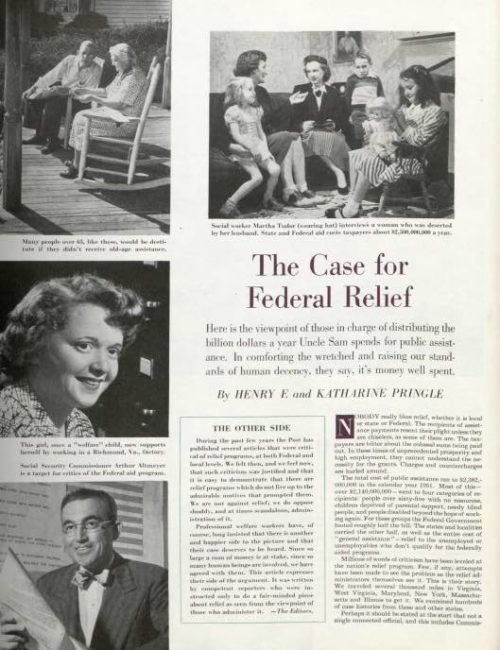
Although the Post was often critical of federal and local relief programs following Roosevelt’s New Deal, Henry F. and Katharine Pringle’s “The Case for Federal Relief” in 1952 looked at the beneficiaries of welfare and argued the necessity of programs that give security to the unemployed, elderly, abandoned, and disabled. The authors asserted, “Public assistance does not make bums out of people, if it is accompanied by good social work. The right kind of aid, in money, for minimum security plus guidance to get the recipient back on his feet, if that is possible, is the answer.”
In 1952, the public wondered whether “hillbilly” children ought to receive funds for shoes — since they weren’t accustomed to wearing them — or whether releasing the names of people receiving public assistance might deter greedy deceivers out of embarrassment. Although most people tend to agree on a sort of social safety net, the implementation of such is rarely unanimous.