Let’s End the Civil War

This article and other stories of the Civil War can be found in the Post’s Special Collector’s Edition, The Saturday Evening Post: Untold Stories of the Civil War.
—This account appeared in the August 11, 1962, issue of The Saturday Evening Post.
There were more Confederate flags sold during the first year of the Civil War Centennial (1961) than were sold throughout the South during the war itself (1861-1865). One hesitates to estimate the number of Confederate flags that will be sold during the next three years, but the prospects are that the total will be more than all the flags sold in all the wars the nation has fought.
Yet the Civil War Centennial is hardly a promotion dreamed up by flag manufacturers. Nor is the centennial merely a project of the enthusiastic city booster to lure the tourist dollar to his hometown. No city booster anywhere in the south or in the north has any intention of proposing a celebration of other conflicts like World War I or World War II or the Korean War.
We celebrate no other war because essentially we believe those wars are over, their outcomes final, the course of history decided. But there are centennial committees throughout the south which would have us think the Civil War is not completely done with, that it ought to be refought. These fellows grow beards, wave flags, and charge over the few meadows the housing developers have left — hoping somehow by this exertion to sustain the illusion that the South may yet snatch victory from defeat. They do everything to re-create the Old South except save Confederate money.
The war started again in July 1961 with the grand reenactment of the Battle of First Manassas (Bull Run), which the South, not surprisingly, won again. Twenty-three states on both sides sent participants, although a large number of soldiers came from the ranks of the North-South Skirmish Association, an organization founded in 1950 by devotees of the muzzle-loading rifle, whose purpose is to hold shooting contests from time to time. For the First Manassas reenactments the participants wore authentic uniforms and carried old muskets whose blank cartridges often bruised the shoulder, blacked the face, and seared the eyes of the unwary.
The son of a friend of mine, a “corporal” in the Guilford Greys (Greensboro, North Carolina), has been “killed” three times since First Manassas and is perfectly willing to give his life in a fourth reenacted battle. It is nice , indeed, to have more than one life to give to one’s country, although the plane fare to the different battlefields is considerable.
The centennial engenders nothing if not sacrifice. The late Bill Polk, editor of the Greensboro Daily News, once showed me a letter from a North Carolina high-school boy which read, in part: “I wish I had been born before the Civil War and had died at Gettysburg.” These mock recruits, I suspect, secretly hope one day the batteries will load real projectiles in the cannons, and the bayonets will be cold steel, not rubber. And this time they will take Washington, D.C.
On To Washington! On To Yesterday!
Certain centennialists seem to believe that once they take the capital, they can force upon the Supreme Court the decisions that will restore the old plantations, the crinolines, the dueling pistols, the house on the hill with smoke coming out the chimney at twilight, and little Sambo rolling in laughter under the magnolia. Ah, what a glorious dream!
Yet it is not entirely an idle dream. The Civil War centennialists have some vague idea that, if they can mount a sufficient show of force, they may not have to deal with the more aggravating and immediate problems of Southern life — the problems that press upon an urban, industrial area that is leaving behind the old, easy agrarian values.
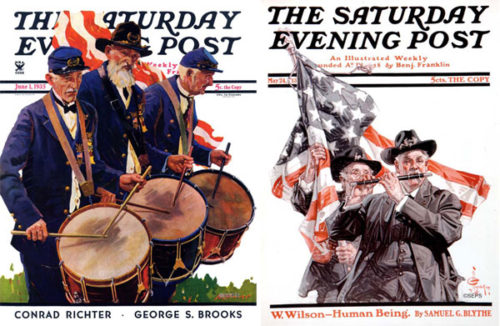
Thus the centennial has turned into a party rather than a pageant. I have even seen a few automobiles decorated with the Stars and Bars, filled with black students, each of the occupants therein wearing the butternut-gray dinks of Confederate soldiers. No centennial committeeman, no matter how skillfully he ties his bowstring, is completely unaware of what is going on in the business district of his hometown. He doesn’t even have to work behind a store counter to know that, in the states of the old Confederacy, at least one-third of all the purchasing power and one-half of all the credit buying comes from the pockets of grandchildren and great-grandchildren of the black slaves.
That realization is why the centennial is something less than a huge success in the big Southern cities. The plan for my own home, Charlotte, North Carolina, by far the largest city of the two Carolinas, was to commemorate the fact that it was the site of the Confederate Navy Yard. It seems that, after the war broke out, the naval stores at Portsmouth, Virginia, were seized and transported inland to Charlotte. The long boardwalk is still called “the wharf.” But except for the members of the committee itself, few people are even aware of the centennial, let alone a Confederate Navy Yard.
Was the “Old South” A Myth?
The chamber-of-commerce fellows are selling the ideals of the modern industrial world because the ideals of the Old South were only make-believe currency. There were Southerners before 1800, but there was no “Old South.” One of our Southern writers, Wilbur J. Cash, in his book The Mind of the South, recalled that boys who cleared out the Indians in the Carolina backwoods lived to command brigades at Bull Run, which means that the Old South could not have been more than two generations old.
The fact is that the Old South was nothing more than a myth and a poem and, as Jimmy Street, another Southern writer, put it, a malady for which there fortunately is a vaccine — the industrial payroll.
The Civil War started with the Negro in slave cabins. But all of the blanks and muskets and beards will not disguise the truth that Negroes serve today on the Republican and Democratic national committees. The real Confederates found cover behind occasional tar-paper shacks. In their place today, the re-created regiments and brigades have to charge around factories where the skilled workmen inside knock off a few minutes to cheer them on.
The time has come to end the Civil War because we are one country with one economy. We cannot take time out from industrial and urban problems of unemployment, housing, schooling, and civil rights to indulge ourselves in silly excess, celebrating a time that no longer is — and never was. The truth is that, at best, the centennial provides but a minor amusement.
“Lets End the Civil War,” August 11, 1962
When Freedom of Speech Hit an All-Time Low
First-amendment rights hit an all-time low between 1917 and 1919.
As the federal government raced to unite the country behind the war effort, it cracked down on any opposition or criticism. Congress passed the Espionage Act, which prohibited any action that would disrupt the country’s military or aid the enemy. Then it passed the Sedition Act, which outlawed any speech or writing that put the government’s war program in a negative light.
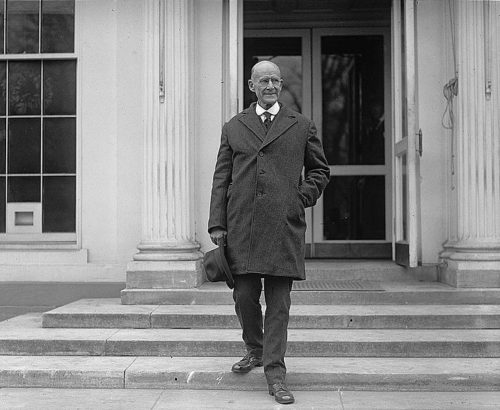
Over the next few years, more than 2,000 people would be charged with violating the new limits on free speech. One of the most famous of these was Eugene V. Debs, a union organizer and socialist.
In 1893, Debs had been president of the American Railway Union when it went on strike after the Pullman Company, maker of railway cars, cut its workers’ wages by 28%. Union members refused to handle Pullman cars or any cars attached to them. The federal government issued an injunction requiring striking workers back on the job, but Debs refused to comply. Ultimately the army was sent in to break the strike. Thirty strikers were killed and Debs was imprisoned for 30 days.
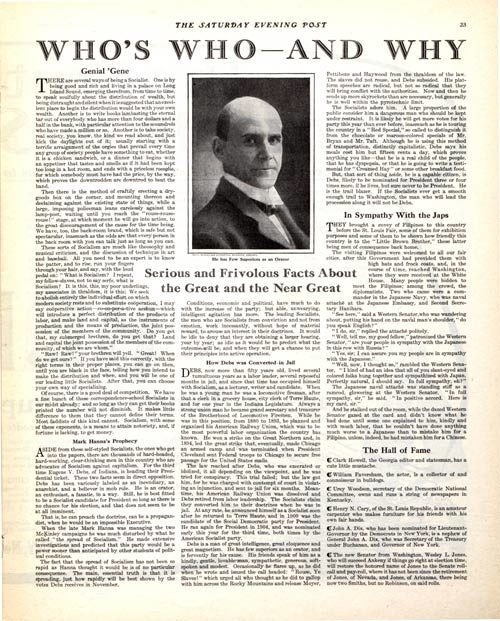
While in prison, Debs came to believe he could do more good as a socialist than a union administrator. Starting in 1900, he campaigned as the socialist candidate in five presidential elections. He never came close to winning, but he raised awareness of the disparity between rich and poor in America and earned some grudging respect from his opponents (as seen in this Post profile from 1908.)
On June 16, 1918, Debs had delivered a speech in Canton, Ohio, that caused him to be arrested and convicted under the Espionage Act. Debs appealed to the Supreme Court, but the court upheld his conviction. It believed Debs was guilty not for what he said in his Canton speech but because of a document he had previously written, “Anti-War Proclamation and Program,” as well as other comments. These showed Debs’ intention was to disrupt military preparations.
A long-time pacifist, Debs had been aware of the Espionage Act and had toned down his speech to avoid making statements that directly opposed the war effort. But Justice Oliver Wendell Holmes, who wrote the court’s unanimous opinion, noted that Debs had previously said things like “the master class has always declared the war and the subject class has always fought the battles… the subject class has had nothing to gain and all to lose, including their lives; that the working class, who furnish the corpses, have never yet had a voice in declaring war and never yet had a voice in declaring peace.”
At this point in his career, Holmes had little tolerance for opposition to the government. He believed Debs represented a serious threat to democratic government and the rights of property. And urging others to disrupt the draft was no different from disrupting it themselves. He believed speech, as much as action, had the power to disrupt public order. It was in this opinion that Holmes gave his famous analogy of unfettered speech: “The most stringent protection of free speech would not protect a man shouting fire in a theater and causing panic.”
Justifying the right to abridge the first amendment, Holmes wrote that a statement fell outside of free-speech protection if there was “a clear and present danger” it would bring about a harm that Congress has the right to prevent.
On April 13, 1919, Eugene Debs began his ten-year prison sentence. Far from being a lone, angry radical, he entered the federal prison in Oregon a sympathetic figure, jailed for objecting to a war that was now five months in the past.
In 1920, he announced his fifth run for the U.S. presidency from his jail cell and that November managed to win nearly a million votes.
Had Debs’ trial come before the Supreme Court after 1918, Justice Holmes might have argued for his acquittal. In the months following his Debs decision, he had changed his mind about the limits of free speech. He presented his ideas in his opinion on Abrams v. U.S. The case involved Russian sympathizers who urged workers to impede the manufacture of weapons for the American troops stationed in Russia. The Court upheld the Espionage Act, but Holmes dissented.
This case didn’t involve a clear a present danger, Holmes wrote. America was not officially at war. Moreover, a conviction required proof of specific intent to commit a crime — a reversal of his interpretation of Debs’ intentions.
Holmes went even further, claiming that Abrams’ ten-year sentence followed by deportation indicated he was being prosecuted not for his speech but for his beliefs.
It was here that Holmes recorded another of his memorable concepts. Free speech was essential and should be protected, he wrote, because the “marketplace of ideas” produces better thinking. Good ideas will challenge, and overturn more limited concept. Free speech leads us toward the truth.
Debs’ health began to fail in prison. In 1921, President Harding extended clemency to Debs, but did not issue a pardon. The administration still regarded him as dangerous. In a White House statement, Debs was described as “a man of much personal charm and impressive personality, which qualifications make him a dangerous man calculated to mislead the unthinking and affording excuse for those with criminal intent.”
Yet Debs was personally invited to the White House the day after his release from jail. He was greeted cordially by President Harding, who said, “Well, I’ve heard so damned much about you, Mr. Debs, that I am now glad to meet you personally.”
Though Holmes distanced himself from the “clear and present danger” doctrine, the Supreme Court used it as a precedent until 1969. In that year, the court raised its protection of free speech in its Brandenburg v. Ohio decision. The government, it ruled, can only limit speech intending to produce “imminent lawless action.”
Featured image: Debs and Hanford campaign poster from 1904 (Socialist Party of America)

The 14th Amendment Settled, and Started, Citizenship Battles 150 Years Ago
Amending the United States Constitution remains a monumental act, even if such modifications were always intended from the moment that the document was designed. While every amendment has faced challenge and debate, few groups have inspired as much controversy and litigation as the so-called Reconstruction Amendments. Amendments 13, 14, and 15 came in the aftermath of the Civil War, and their implications and legacy have reached further than many expected. The ratification of the 14th Amendment, covering citizenship, due process and much more, and its certification were proclaimed by Secretary of State William H. Seward 150 years ago on July 28th.
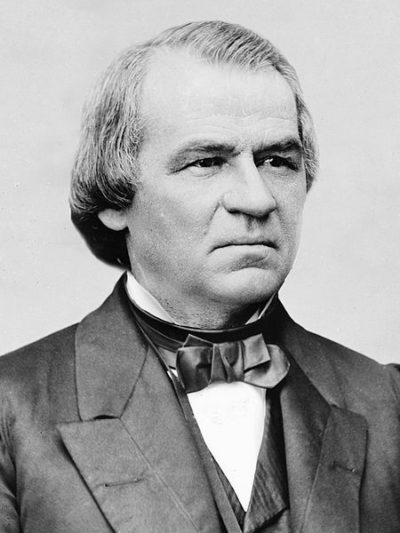
The birth of the 14th Amendment came out of a complicated dance of conflicting political priorities. The sudden influx of “new” citizens created by the 13th Amendment (which ended slavery) threatened to upend the power balance in the south in the House of Representatives because a larger population requires more representatives. The Civil Rights Act of 1866 passed Congress, guaranteeing citizenship to every person born in the United States regardless of race, color or “prior condition of servitude.” Andrew Johnson would veto the bill twice, but Congress overrode him, turning it into law. However, not everyone in Congress was satisfied that this solution should lie outside the Constitution.
More than 70 proposals for a new amendment to address citizenship were written. Ultimately, after much debate and a number of counter-proposals, modifications, and compromises, the text of the 14th Amendment was codified and passed. Many in Congress were disappointed that the bill didn’t go so far as to address voting rights for former slaves; fortunately, that would be covered less than two years later with the ratification of the 15th Amendment.
The Amendment contains five sections, and they cover an incredible amount of legal ground. Section 1 covers birthright citizenship, the right to due process, and equal protection for citizens under the law. Section 2 acknowledges that everyone (well, males at any rate) was a “whole person” rather than the three-fifths allotted to black Americans previously; it also establishes some voting protections. The third section works to prevent previous rebels (see: military and elected officials of the Confederacy) from holding office, military rank, or civil service jobs unless they would receive a 2/3 vote of Congress giving them approval. Section 4 more or less tells the South that they’re stuck with their debts in the wake of the war; if they accrued debt from borrowing to fund the unsuccessful rebellion or losses from having their slaves freed, that was, legally speaking, too bad. The final section simply affirms the authority of Congress to enforce the Amendment with legislation.
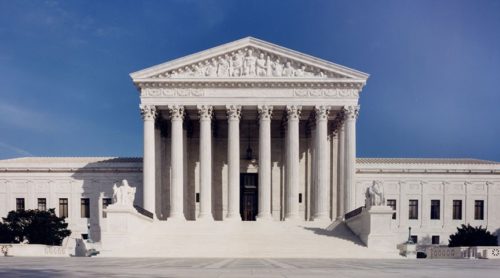
Since its ratification, the Amendment has figured into elements of at least 90 Supreme Court cases, due in part to the large ground in covers. Some of the cases rank among the most important in U.S. history. The Amendment played a part in the school segregation breakthrough of Brown v. Board of Education in 1954 due to the Equal Protection clause; that same clause was involved in the election-deciding Bush v. Gore in 2000. Issues of Substantive Due Process were raised by Roe v. Wade in 1973 when the court ruled in part that the right to privacy included a woman’s decision to have an abortion. Obergefell v. Hodges in 2015 also invoked both Substantive Due Process and Equal Protection on the way to a decision that legalized same-sex marriage.
Today, the issues surrounding the 14th Amendment continue to fuel considerable public and legal debate. As recently as July 19th, Johns Hopkins University historian and author of Birthright Citizens: A History of Race and Rights in Antebellum America Martha S. Jones spoke to The New York Times on how the protections of the Amendment figure into the current controversy surrounding immigration. In response to a question about whether or not the lessons of history can solve current problems, Jones says, “I don’t think history is a blueprint. It can’t be. There’s too much that’s particular to our own time and place. But I do think the debate about birthright citizenship is here, and you can’t be well equipped for it unless you are familiar with where it begins.”
News of the Week: Summer Vacation, Comic-Con, and How to Get Free Fries for the Rest of the Year
Dog Days
While the annoying commercials tell me at least 20 times a day that “it’s gonna be a Subaru summer” — I swear one of them just came on as I was typing that sentence — it’s also time to buy school supplies again.
That’s right, kids: Only three weeks after the Fourth of July and you already have to start thinking about math and social studies (is that still a thing?). I’ve started to see back-to-school commercials and store advertisements already. It seems rather cruel to expose kids to these things when it’s still 89 degrees and they’re in shorts. Can’t they at least wait until August to run these things? We’re still in the dog days of summer!
I always thought that the dog days of summer referred only to the month of August, but it’s actually a period that runs from July 3 until August 11. I also always thought it had to do with dogs not liking the summer heat, spending the day laying around the house panting and sleeping. But it actually has to do with Sirius, “the Dog Star,” which rises during the above dates.
But don’t worry, kids, there’s still plenty of vacation time left. Don’t let anyone tell you different. You can go to the beach and to the movies and to the mall and to your jobs to make spending money. Wait until mid- or late August to make your Staples run for notebooks and pens and anything else you’ll need for the new school year. You need to just listen to the car company. It’s gonna be a Subaru summer, and you might as well enjoy it while it lasts.
SHAZAM!
I won’t go into detail about what happened at the Comic-Con convention in San Diego, where fans gather to celebrate their favorite sci-fi/superhero/fantasy films and TV shows — io9 has a good summary of the good and the bad at this year’s show — but I do want to post one trailer that made its debut.
SHAZAM! (and yes, it has to be written all in caps and with an exclamation point) looks like it could be fun. It’s based on the DC comics character — he was also known as Captain Marvel — and it stars Chuck’s Zachary Levi. It looks like a mix of a superhero movie and the Tom Hanks movie Big.
Here’s the Story, of a House for Sale
I never missed The Brady Bunch when I was a kid — it was a Friday night staple, along with The Partridge Family — so I’d like to buy the house used as the exterior on the show. Unfortunately, I don’t have $1.8 million.
But if you have that much and need a second home (and you’re a fan of classic television), you can now buy it. It’s in North Hollywood, California, and looks quite different than it looked in 1970.
The inside, of course, looks nothing like it did on the TV show. Unlike the Brady house, the bathrooms have toilets.
Why Didn’t Somebody Tell Me There Was a New Philip Marlowe Novel?
Raymond Chandler is one of my favorite writers, so I get a little antsy when someone writes a novel based on his most famous character, detective Philip Marlowe. But I’ve been pretty happy with the Marlowe novels written by others, whether it was Robert B. Parker’s Poodle Springs or Benjamin Black’s The Black-Eyed Blonde. They’re not exactly Chandler, but they’re good facsimiles.
I didn’t realize that there was a new Marlowe book released recently. It’s titled Only to Sleep, and it was written by Lawrence Osborne. And here’s a twist: It’s set in 1988 and features an older, retired Marlowe.
Though Chandler once complained to his agent that “slick” magazines like the Post would never publish him, he actually did have a story published in our pages. It’s called “I’ll Be Waiting,” and it appeared in the October 1939 issue.
Free French Fries? There’s an App for That
National French Fries Day was a couple weeks ago, but even if you missed it, you still have time to celebrate. McDonald’s is giving away free medium fries every Friday for the rest of the year! You have to make at least a $1 purchase and download their app, but that’s a pretty good deal.
It might be one of the last times you order from an actual human being at McDonald’s. By 2020, the company wants to put self-ordering kiosks in all of their U.S. restaurants.
RIP Adrian Cronauer, Shinobu Hashimoto, Jonathan Gold, Anne Olivier Bell, Elmarie Wendel, and Gary Beach
Adrian Cronauer was the real-life disc jockey played by Robin Williams in the movie Good Morning, Vietnam. He died last week at the age of 79.
Shinobu Hashimoto wrote several screenplays, including the classic Akira Kurosawa films Rashomon and The Seven Samurai. He died last week at the age of 100.
Jonathan Gold was the longtime food critic for the Los Angeles Times. The Pulitzer Prize winner died Saturday at the age of 57.
Anne Olivier Bell not only edited the diaries of Virginia Wolff, she was one of the members of the Monuments Men, the group that got together to find and protect stolen artwork during World War II. (The story was made into a 2014 George Clooney film.) She died last week at the age of 102.
Elmarie Wendel was best known as landlady Mrs. Dubcek on 3rd Rock from the Sun. She also had roles on The George Lopez Show, NYPD Blue, and many other shows. She died last week at the age of 89.
Gary Beach won a Tony for his role in the Broadway musical The Producers. He also had roles in Beauty and the Beast, La Cage aux Folles, and many TV shows. He died last week at the age of 70.
This Week in History
Ernest Hemingway Born (July 21, 1899)
It may be hard to believe, but the Post rejected all of the stories the writer submitted. But we did publish a story from his grandson John.
Debut of Bugs Bunny (July 24, 1940)
While a Bugs Bunny-ish character made an appearance in Porky’s Hare Hunt, he made his official debut in the Warner Brothers/Merrie Melodies animated short A Wild Hare.
http://www.dailymotion.com/embed/video/x4053d
This Week in Saturday Evening Post History: Palefaces at the Beach (July 27, 1946)
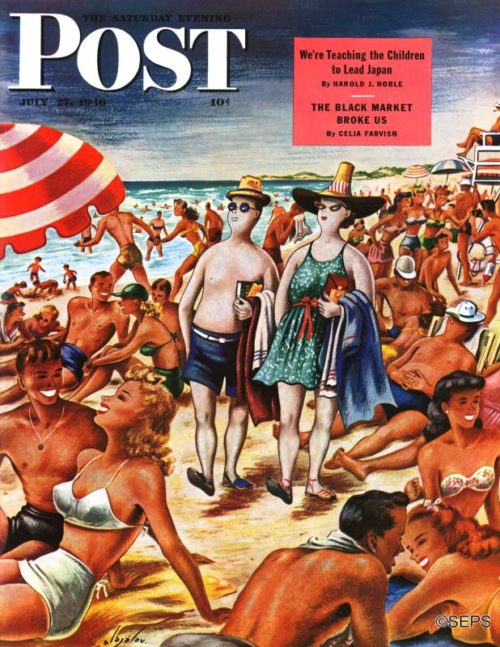
Constantin Alajalov
July 27, 1946
I wonder if today this Constantin Alajálov cover would have to have a different title?
Sunday Is National Cheese Sacrifice Purchase Day
I talk about many different kinds of food holidays here, and I always thought the oddest-sounding holiday I’ve come across was National Sneak Some Zucchini onto Your Neighbor’s Porch Day. But now I think we have a new contender in that category: National Cheese Sacrifice Purchase Day.
No, it’s not some bizarre ritual where you sacrifice cheese to some god. It actually has to do with getting rid of mice in your home by sacrificing some cheese to a mousetrap. I’ve had mice, and I find that peanut butter actually works a lot better.
Come to think of it, Sneak Some Zucchini onto Your Neighbor’s Porch Day is still the oddest food holiday.
Next Week’s Holidays and Events
National Day of the Cowboy (July 28)
This is the 14th annual celebration of cowboy culture and pioneer heritage.
International Beer Day (August 3)
If you celebrate the day a little too much, please note that August 4 is International Hangover Day.
Movies for the Rest of Us with Bill Newcott: Don’t Miss Mission Impossible and Sorry to Bother You
Is the new Mission Impossible film the greatest action movie ever made? Bill Newcott talks about Tom Cruise’s latest. He also takes a look at Sorry to Bother You, the hilarious, thoughtful, and totally whacked out comedy that picks up where Get Out left off. Bill also reviews the latest home movie releases: Ready Player One, Final Portrait, and A Matter of Life and Death.
Leaves
Every Sunday, Jason and his parents, Scott and Shirley, have steak dinner. The vegetable sidekicks change, but the main performer is always the iron-filled, bloody chunk of filet.
This particular Sunday came with a chill lingering in the air. Whenever Keith was invited to steak dinner, this chill came with him — a tension-lathered gaze steaming from Scott’s eyes, like a fire on the horizon when a sunset was expected.
Scott’s normal Sunday was a grunt here, a mumble there, minimal eye contact, and this night, Shirley and Keith were exceptionally chatty.
Over the years, Scott has tried to see Keith like Shirley and Jason do, but efforts passed unsuccessfully. To Scott, Keith is invisible. To Jason, Keith is his best friend, his forever sidekick. To Shirley, Keith is the love she’s never had before.
“God, that is so ingenious, Keith. Where did you come up with that?” Shirley says.
Scott doesn’t listen. Grunt. Mumble. Repeat.
“Did you hear that, Scott?” Shirley turns to Scott.
“No. No. I didn’t,” Scott returns. He can’t hear him, either. Scott believes that Jason made up Keith when he was four years old, and he thinks that Shirley, with the good heart she hordes, simply cannot admit to Jason that she, too, doesn’t see Keith.
Jason chimes in, “He was talking about dreams.”
Scott shoves an entire radish in his mouth. “Yeah? What about ’em?”
Shirley continues, putting her hand on Keith’s hand while she vocalizes his words. Of course, to Scott, Shirley is putting her hand on a napkin next to an empty plate. “He said he thinks dreams are part of the human subconscious, or,” She looks up at Jason. “I’m going to butcher it. It was so beautiful. What did he say?”
Jason finishes for her. “He said that the human subconscious, or figments of our subconscious, like dreams — that they’re another world where other humans live. That humans enter another human’s dream when they die. That none of it was really real, but it felt so real. That our life is a dream, even if it feels like a nightmare sometimes.”
“Oh, that was it. So interesting,” Shirley says.
“Sounds dumb to me.” Scott huffs.
Naturally, they all collectively feel awkward, looking down at their plates as if they were trying to tell them something. Scott guzzles his Scotch.
Shirley defensively comes to Keith’s aid. “I thought it was pretty.”
Scott grunts. Mumbles. Repeats. Adds in another guzzle.
Scott picks up his knife, looks at Jason, and stabs his filet. Blood spatters up to his cheek and trickles down towards his lips. Scott sticks his tongue out of his mouth and slurps the blood off his cheek.
Shirley’s cheeks look like someone took the beets off her plate and rammed them repeatedly on her face, leaving a permanent mark. Shirley has maintained a PTA middle-aged mom haircut for nearly all of her marriage to Scott. Shirley didn’t care for the way it shaped her face, but it was the one thing she seemed to know for certain that Scott liked about her, so she kept it. The new blond highlights she collected went unnoticed by Scott, but she thought it made her look younger.
She could tell that this moment was the time to sit Scott down and have the tough conversation. Every time Shirley attempted this controversy in the past, Scott didn’t truly hear her. That was clear.
“Scott,” Shirley says, “Can we talk a minute?” She hesitates, per usual.
“Jason, go upstairs,” Scott says, barely looking up to acknowledge Jason’s presence.
Jason goes upstairs. “C’mon, Keith,” he says as they run up the stairs.
Shirley has a nervous twitch that she has perfected around Scott. She twiddles her thumb and first fingers of each hand, making an infinity symbol. “We should talk about this Keith situation.”
“He’s crazy,” Scott says.
She can’t find her voice for a few moments but squeezes it out of her vocal chords like a bulbous item out of a vacuum cleaner, temporarily clogging it. “He’s … not …crazy. He’s just young. Keith is…” She unravels her words like an old-time scroll being read to someone unimportant.
“This isn’t about Keith. This is about Jason. He’s crazy. He thinks Keith is sitting right in front of us, having dinner. We have to buy the imaginary kid a steak, Shirley.”
“You … you still don’t see him?” She finger-infinities again. Shirley has come to recognize Scott’s hostility towards Keith — and Scott’s subsequent perception that Jason is crazy — as repression. Scott doesn’t want to see Keith, so he doesn’t.
“No. And you don’t either. But Jason does. This is a problem, Shirley. You need to cut the act. Doing this little performance with Jason, acting like you see Keith, too, it’s only enabling him — making it worse. We need to take him to be evaluated again.” He speaks with conviction. “We should do it tonight. We can’t wait any longer. He’s going to grow up to be a serial killer. And you’re not helping.”
“It’s too late for the doctor’s.” Her voice trickles out like a waterfall in the distance of a Costa Rican village.
“Jason!” Scott screams.
“Don’t get mad at him,” Shirley mumbles.
Jason descends from the staircase. With Keith. “What’s up, Dad? Keith and I were just about to watch Die Hard.”
“Jason, you’re not going to school tomorrow. We’re going to take a little field trip.”
“Scott — he has to go to school.”
“Keith and I have a biology test tomorrow.”
“I’ll write you a note. It’s final. Be up at eight.”
Jason gets up at eight o’clock for his mysterious field trip. Except, due to experience, Jason knows the plan. Like clockwork, every few months, Scott has this same fit.
His dad is positioned at the kitchen table with eggs and coffee in front of him. Another plate mirror-images his meal across from Scott.
“Sit. Eat. Eggs are brain food. Coffee to wake you up.” Scott’s forehead gains wrinkles daily. His constant downward concocting of his head made his double-chin pronounced. His furrowed-brow made frequent appearances in pictures on the Georges’ mantel over the fireplace.
There is one picture hanging on the wall near the staircase where Scott looks happy. He’s young. He has a single-chin. His wrinkles on his forehead were in hiding then. It was autumn in Alaska. Jason, who was four at the time, is wrapping one arm around Scott’s head, and Shirley stands above them. Leaves drown out the light blue sky in the background. Scott’s eyes match the color of the leaves, and there’s something about the crisp autumn air that is visible in the picture.
“Thanks.” Jason sits down. “What’s Keith going to eat?”
“Keith’s staying home today. Got it?”
Jason turns to the staircase, in which Keith’s elbow is wrapped around the wooden hand rail. “Sorry, Keith.”
Jason walks out of the evaluation room, smiling, as is the doctor. Scott sits in the most isolated chair of the waiting room, ticking his big toes noticeably in his shoes. When he sees Jason exiting the “Are You Crazy?” room, he shoots up as if he sat on a trampoline.
“How’d it go?” he asks the doctor. Jason lingers with them, and Scott pulls the doctor into the room, telling Jason to wait outside. He closes the door.
“My evaluation of Jason is the same as Doctor Mulnay’s preliminary findings. Jason is mentally healthy and right on track.”
“You’re pulling my leg.” Scott laughs as if he has heard that joke about the fungus walking into a bar that makes him chuckle every time.
The doctor repositions the envelope in his hands. “Based on my discussion with Jason, he simply requires more attention—”
Scott cuts the doctor off. “So you’re saying that he’s imagining someone, because I don’t pay enough attention to him. Perfect. The problem is me.”
“No, Mr. George. It is not your fault. Jason is psychologically healthy, and that should be cause for celebration. Excuse me, I have another appointment in a few minutes.” The doctor positions his hands toward the door, opening it and allowing Scott to exit in front of him.
“Jason!” Scott yells. “Let’s go.”
Shirley is home from work when Scott drops Jason off. She sees the headlights in the driveway and watches as Scott backs up and speeds down the street.
“Nice of your father to come in and say hi to me before rushing off,” she says sarcastically.
“Keith wants to know how your big meeting went,” Jason says in return.
She looks at Keith as she answers. “How nice of him to remember. It was stressful. My heart was,” she put her hand on her heart to show a thumping movement. “But, I knew the material, and that showed, so I think it went well.” She turns to Jason. “How’d the…?” She doesn’t finish her question, rather she moves her wrist in a circular motion toward the door.
Jason knew what she meant. “Doc cleared me … again.”
“You know your father … he tries to be thorough.” She moves to the kitchen, knocking on cabinets, dissecting pots and pans from their homes, getting dinner ready.
“He’s the crazy one,” Jason mumbles under his breath.
Keith shakes his head. “It’s not his fault, dude.”
“Jason!” Shirley yells from the kitchen. “Do you and Keith want to play basketball while dinner’s in the oven?”
Scott gets home from work, disgruntled, parking his car on the street while Keith, Shirley, and Jason play basketball.
“Who’s winning?” He asks, trying his best to engage. To Scott, the only ball in sight is the one in Shirley’s hand.
“Keith,” Jason answers.
Scott grunts, sarcastically shaking his head. He starts walking into the house but turns back. “Where is Keith?” he asks.
“Taking a shot at the foul line…” Shirley says. “You should have heard him a minute ago. He was talking about concrete.”
“Concrete, huh?” Scott says. “Sounds invigorating.”
“No, it was really rad, Dad.” He turns to his mother. “Rad, Dad. It rhymes.”
Scott snorts out a laugh as if he is trying to imitate how loud someone was snoring in a bed next to him at a European hostel. “Funny,” he says.
“Anyway, Dad,” Jason calls out to him as Scott tries walking in the house through the garage. He stops. “Don’t you want to hear what Keith said?”
Scott pulls in his lips, clenching his jaw overtop of his closed-mouth. He nods his head up and down.
“Well I asked him for advice about Marley.”
“She’s still seeing you?” Scott asks.
“She is, but I kind of messed up. I don’t need to share all the details, but I made a mistake. And I asked Keith for advice, and he — Keith has this way of relating everything to something else, ya know, like he said that nothing is concrete. Even actual concrete, he said, has a period of time when you can still jump into the molding and leave your imprint.”
Shirley slightly bobbed her head, as if she was listening to The Who’s “Behind Blue Eyes.” “It’s a really great perspective, Keith.” She looks directly at the foul line, where Keith stands holding the basketball. Even though it is night, the Alaskan sky carries light blue trickles of the day with it. Keith’s blue eyes match the cold air — the visibility into his aura through his pupils more powerfully clear and beautiful, to Shirley, than the Northern Lights ever could be.
“I don’t get it,” Scott mutters. Angry and uncomfortable at his wife’s ogling an empty space, Scott turns his body towards the garage door. He opens the door, enters it, and pauses in the house to hear the slam.
Jason sits outside on the porch, seemingly rather upset.
Scott parks on the street, a rusty, dark-blue Giant cruiser bike sprawled out like Bambi on the path to the garage.
“You look sad,” Scott says, walking behind him, rumbling his keys.
“No!” Jason shoots up. “Dad. You can’t go in there.”
He turns around. “Why not?”
“Mom. She’s not feeling good. She’s sick.”
“She was fine this morning,” he says, positioning his key in the lock.
Jason takes the key out of the lock and walks to the front lawn.
“Jason. Come back here with my keys. Now.” Scott is pissed.
“You can’t go in, Dad.”
“Tell me the real reason why, right now.”
Jason hesitates. “She has a surprise for your birthday.” He spits it out like too-chewed gum. “Just give her a little more time, please.” His dad’s pinkish, heated face subsides to his skin’s natural color.
“A surprise for my birthday?” Scott smiles for what seems to Jason like the first time in years. For a fleeting moment, he looks to Jason like the picture on the wall. It’s like 10 years were shaved off in just seconds.
Scott thinks of how they haven’t celebrated his birthday with a party in over a decade. After minutes float into half an hour and darkness engulfs the night, Scott breaks their silence. “Can you go check on her? I have to pee. And it’s freezing out here. I left my good coat at home this morning, thinking I’d have access to a heated house after work.”
Jason gets up and uses the confiscated keys in his pocket. Moments later, he walks back out. “They need a few more minutes. They’re almost finished.”
“They?” Scott asks.
“Oh … a party planner … friend. There’s no car here, because … they live down the street.”
“Oh … is that who’s bike is in the driveway?” Scott asks.
Jason and Scott sit on the porch, close enough that their knees’ body heat is almost felt by the other. “Have you ever thought that maybe life is hell or heaven?”
“What?” Jason asks.
“I was thinking about that today for some reason. I think I heard it somewhere. Or maybe I made it up. What do you think?”
“I think I’ve heard it before, too.” Jason tries to think about movies they’ve watched together recently, and then he remembers that they haven’t sat down to a movie since his childhood. “Where’d we hear that?”
“I don’t know. Wherever it was, it’s genius. Sometimes…” Scott looks up, remembering his audience. “Well, sometimes, it feels like life is a test. That’s all.”
“I know what you mean.” Jason thinks of his psych evaluations. He stands up, looking down at his father.
Scott jolts his head upward to Jason who looks at Scott’s graying hairs on the top of his head. He looks at his eyebrows that are furrowing in a commiserating way, instead of their normal disdainful way.
The porch window reflects Jason’s similarities to his dad — their slightly curly hair, only at the ends; their oval egg-shaped eyes; the barely noticeable curvature of their nose; and their lopsided ear lobes. Jason stares at himself in the window for a few elongated seconds. He shifts his feet away from Scott, still facing him, leaning against the railing of the staircase. They stare in each other’s irises until Scott looks down at his hands. “Son…”
“I’m gonna go check on Mom.”
Jason enters the house, locking the door behind him.
“Mom!” he yells.
He hears movement upstairs. Shirley comes down, pulling her robe tied. Her hair looks disheveled, like she used Bed Head Hairspray.
Keith runs passed him, “Later, dude.”
“Wait.” Jason stops him. “Use the back door. My dad’s on the front porch.”
“Your dad’s here?” Shirley asks. Keith kisses the side of her head. They wave silently as Keith walks out of the back.
“Mom?”
“Yeah?” she asks, her cheeks reddening.
“We have to throw Dad a surprise party for his birthday.”
They stand in their positions in the house as if their shoes are glued, silent, their breathing audible.
They take turns looking at Scott’s smiling picture on the wall — both of their faces pure and joyous. They were a family in that moment. The leaves were falling, and they were a family.
“Isn’t that the day we met Keith?” Jason asks.
“Yeah, he was in the park, playing in the leaves.” Shirley approaches the photograph, standing on the second stair. She touches the picture as if the leaves had texture. “That’s his shoe.”
Summer Road Trips: Midwestern Wine Trails
The call of the open road is as booming as ever. As far as domestic leisure travel is concerned, more Americans are opting to go by way of the automobile. Whether it’s due to the flexibility of packing heavy and stopping at will along the way or the nostalgia of highway getaways, road trips are back! The Summer Road Trips series offers destinations for the perfect American road trip.
The popularity of artisan beverages has led to an explosion of wineries across the country in recent years. While California is still the king of wine production here in the States, there are plenty of wine trails in the Midwest that can give you the Sonoma experience in the Heartland.
Lake Erie Trail (Ohio)
The moderating lake effect has made the region from Toledo to Buffalo a prime wine-growing spot since the 19th century. Visitors can enjoy a covered bridge driving tour across northern Ohio while stopping in at a variety of wineries, from the giant Debonné Vineyards to the quaint yet acclaimed Markko Vineyard.

Door County Trail (Wisconsin)
In Wisconsin’s Lake Michigan peninsula, eight wineries make up the Door County Wine Trail that takes visitors through the “Cape Cod of the Midwest.” Boasting the same latitudinal planes as the wine regions of Burgundy and Bordeaux, Door County’s established wine scene offers traditional varietals as well as sweet fruit wines to accommodate every palate. Visitors can be sure to stay active and entertained given the peninsula’s reputation for hospitality.

Uplands Trail (Indiana)
Since the 1960s, winemaking on the plateau of south central Indiana has taken off. The Uplands Trail, stretching from Brown County to Bloomington to French Lick, features the nationally ranked Oliver Winery and Vineyards, a destination for fruit wines like Apple Pie, Cherry Cobbler, and Blueberry Moscato. The historic West Baden Springs and the Hoosier National Forest provide sundry excursions for this route.

Shawnee Hills Trail (Illinois)
Eleven wineries sit in the Shawnee Hills of southern Illinois, where limestone and sandstone formations tower over the rolling hills of a burgeoning wine industry. In 25 miles, the trail passes through small towns and the Shawnee National Forest, boasting quaint B&Bs, fall color, and — of course — wine. Blue Sky Vineyard offers a Tuscan setting and estate-grown vino, and Von Jakob houses a brewery as well as a winery.

Hermann Trail (Missouri)
Along the Missouri River, six family-owned wineries make up the Hermann Trail near the German town of Hermann. The Adam Puchta Winery bills itself as the oldest continuously-owned family winery in the country; the current owner is a seventh generation winemaker. Two miles north of Hermann is the Katy Trail, the nation’s longest rails-to-trails project at 240 miles.

Glacial Hills Trail (Kansas)
Outside of Topeka and Lawrence, four family-owned wineries take advantage of the rich prairie soil created by receding glaciers in the area. A quiet Kansas getaway can include an affordable stay at the Crescent Moon Winery or Jefferson Hill Vineyards, and a day boating or hiking at nearby Perry Lake.

Loess Hills Trail (Iowa)
The silty hills of western Iowa were formed by sand-blown deposits toward the end of the last ice age. While loess soil is common in North America, nowhere is it deeper than in this special grape-growing region. All nine of the trail’s participating wineries commit to sustainable practices for producing wine from the delicate soils of the region. The Loess Hills Scenic Byway twists up through the unique landscape and past the wine destinations.

(Minnesota)
Viking lore is at the heart of the Skål Crawl in lake-rich central Minnesota. The short trail includes a winery, a brewery, and a whiskey distillery near historic Alexandria. Small groups can imbibe Minnesotan beverages and visit Big Ole, the tallest Viking statue in North America, and the Runestone Museum, a tribute to the mythological Scandinavian history of Minnesota.

8 Things You Should Know About Emmy Noether, Einstein’s Equal
Emmy Noether spent a lifetime overcoming obstacles. She broke barriers to earn her education, shattered glass ceilings to be able to teach, and lost her job due to the rise of the Third Reich. Along the way, she made immortal contributions to algebra and physics, impacted the theories of Einstein and others, and managed to make it to America to continue her work. On the 100th anniversary of one of her biggest triumphs — a theorem that shaped modern physics — here are eight things you should know about her.
1. Math Was in Her Blood: Amalie Emmy Noether was born on March 23, 1882, in Germany. Her father, Max Noether, had a prodigious reputation as a mathematician, notably in algebraic geometry. Her mother, Ida Amalia Kaufmann, was a merchant’s daughter. Emmy was the oldest of four children, and they were raised in the Jewish faith.
2. Getting Educated Was a Challenge: Noether did well in school and got a high score on the teacher’s exam that would have allowed her to teach in girls’ schools. However, she rattled convention by choosing to attend the Friedrich-Alexander University Erlangen-Nürnberg where her father taught. One of only two women allowed to attend a school of nearly 1,000 men, she was forced to get approval from each professor before taking a class. Nevertheless, she persisted; in 1903, she passed her graduation exam.
3. Teaching Was a Thankless (and Payless) Job: Noether taught at Erlangen for seven years (without pay!). She was invited to teach at the University of Göttingen by David Hilbert, who at that time was working with Einstein on relativity. The invitation caused a schism between educators and departments when some faculty objected to the idea of having a woman teach. Hilbert was incensed at the opposition to Noether, and told an opposing colleague, “Meine Herren, I do not see that the sex of the candidate is an argument against her admission as a Privatdozent. After all, the Senate is not a bathhouse.” Noether got the job, but went without pay again for the first year.
4. Noether’s (first) Theorem Was “One of the Most Important in Modern Physics”: In 1915, Noether proved that “that every differentiable symmetry of the action of a physical system has a corresponding conservation law.” Her paper on the topic was delivered on July 26th, 1918 and offered insight into how behavior in systems is constant, and it opens doors in math and higher levels of physics. The Science Asylum’s video, below, offers a deeper, but easy to follow, explanation. In their 2004 book, Symmetry and the Beautiful Universe, physicists Leon M. Lederman and Christopher T. Hill say that the theorem is “certainly one of the most important mathematical theorems ever proved in guiding the development of modern physics, possibly on a par with the Pythagorean theorem.”
The Science Asylum explains Noether’s (first) Theorem
5. Noether Created an Amazing Body of Work: Noether continued to teach as she produced papers and theories at a staggering pace. She developed a reputation as a fast talker, a stern critic, and a devoted teacher. The Dutch mathematician L. van der Waerden, a colleague of Noether’s who later credited her in his book Moderne Algebra I, called her original thinking “absolutely beyond comparison” and described her as “completely unegotistical and free of vanity, she never claimed anything for herself, but promoted the works of her students above all.” During this period, Noether also spent time teaching at Moscow State University. In 1932, Noether was a co-recipient of the Alfred Ackermann-Teubner Memorial Award for the Promotion of Mathematical Sciences for her contributions to math. Later that year, she delivered an address to the International Congress of Mathematicians in Zurich, a high honor for her field.
6. Nazis Ruin Everything: In 1933, Adolph Hitler became the German chancellor. Hitler’s “Law for the Restoration of the Professional Civil Service” removed Jewish citizens from a number of jobs, including university professors. Noether and many others found themselves shoved out of their positions.
7. She Found an American Escape Route: Before the situation in Germany completely deteriorated, Noether and many of her colleagues were able to exit to America as universities offered jobs and a chance to get out of the country. Einstein, for example, went to Princeton, and Noether went to Bryn Mawr, the women’s college in Pennsylvania, on a grant from the Rockefeller Foundation in 1933. Unfortunately, Noether wouldn’t live much longer; she was diagnosed with cancer in 1935 and died only a few days later.
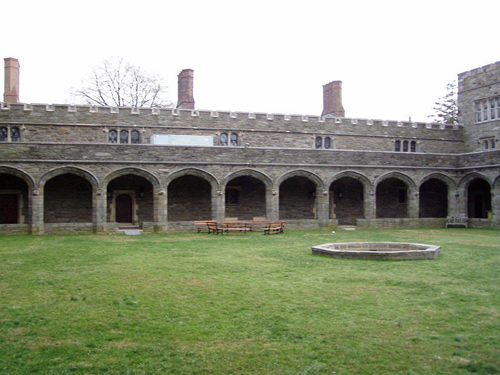
8. Her Impact Was Inestimable: On May 4, 1935, Einstein wrote an appreciation of Noether for the New York Times. He minced no words, saying, “In the judgment of the most competent living mathematicians, Fräulein Noether was the most significant creative mathematical genius thus far produced since the higher education of women began.” At the 1964 World’s Fair, which was themed for Modern Mathematicians, Noether was the only woman to be recognized. Minor planet 7001 Noether, which orbits within the Asteroid Belt, was named in honor of her after its discovery in 1955.
Considering History: The Cold War, the Korean War, and the Development of NATO
This column by American studies professor Ben Railton explores the connections between America’s past and present.

The North Atlantic Treaty Organization (NATO) was formed in the aftermath of World War II, as an attempt to establish collective defenses against emerging Cold War threats from the Soviet Union and its allies. Five Northern European nations (Belgium, France, the Netherlands, Luxembourg, and the UK) began the process with the March 1948 Treaty of Brussels, and then brought their alliance to the United States and its Secretary of State George C. Marshall. With Marshall’s guidance those six nations, joined by Canada, Portugal, Italy, Norway, Denmark, and Iceland, signed the April 1949 North Atlantic Treaty, officially forming NATO.
Yet the Cold War of course extended far beyond the North Atlantic worlds, and NATO likewise was not limited to that sphere of influence. Indeed, it was in response to a Southeast Asian military conflict that began the following year, the Korean War, that NATO truly began to develop its international military forces and strategies, reflecting interconnections between these regions and issues that remain vital to this day.
While the Korean War’s background and origins were as complex and multi-faceted as any military conflict’s, the war began in earnest with North Korea’s June 25th, 1950 crossing of the 38th Parallel and invasion of South Korea. The United Nations Security Council unanimously condemned the invasion on the same day, and two days later President Truman ordered U.S. air and sea support for South Korean forces. By July 5th U.S. armed forces were on the ground and taking part in the Battle of Osan alongside South Korean troops, a military alliance that would continue for the remaining three years of the war.
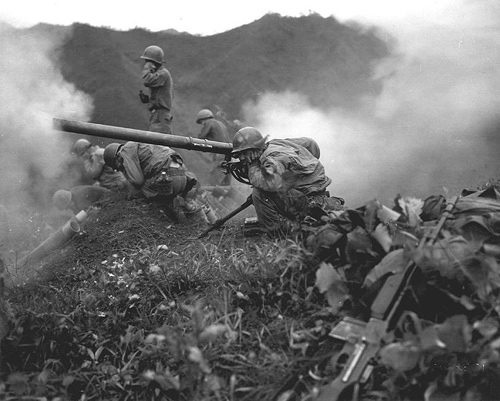
While Truman and new Secretary of State Dean Acheson focused their initial public statements on the specific need to defend South Korea from the North’s aggressions, Truman very much believed that the war was part of larger Cold War conflicts as well. As he later argued in his memoir, Years of Trial and Hope (1956), “Communism was acting in Korea, just as Hitler, Mussolini and the Japanese had ten, fifteen, and twenty years earlier. I felt certain that if South Korea was allowed to fall, Communist leaders would be emboldened to override nations closer to our own shores. If the Communists were permitted to force their way into the Republic of Korea without opposition from the free world, no small nation would have the courage to resist threat and aggression by stronger Communist neighbors.”

NATO saw the Korean conflict and its ramifications in the same way, and responded accordingly. In September 1950 the NATO Military Committee called for a buildup of military forces to counter potential Soviet and allied aggressions around the world, and shortly thereafter the organization formed the Supreme Headquarters Allied Powers Europe (SHAPE), appointing Supreme Allied Commander Dwight D. Eisenhower as its first leader. These efforts culminated in the February 1952 North Atlantic Council meeting in Lisbon, at which a number of key steps were taken: the creation of a Long-Term Defence Plan; the proposed expansion of combat-ready forces to 96 divisions (reduced to 35 the following year, which was still a significant increase); and the creation of a new Secretary General position, with the UK’s Lord Ismay appointed as the first NATO Secretary General.
NATO followed these efforts by undertaking its first major maritime exercise, Exercise Mainbrace, in September 1952. Although Eisenhower had by then resigned his position to run for the presidency, two American military officers and NATO leaders coordinated the exercise: General Matthew B. Ridgway, who had succeeded Eisenhower as Supreme Allied Commander Europe after commanding all U.S. and United Nations troops in Korea from 1951 to 1952; and Admiral Lynde D. McCormick, the Supreme Allied Commander Atlantic and himself a veteran of World War II’s Pacific Theater. Under their lead, more than 200 ships and 80,000 men participated in twelve days of military exercises, what New York Times reporter Hanson Baldwin called “the largest and most powerful fleet that has cruised in the North Sea since World War I.”
The headline of Baldwin’s article linked the exercises to NATO’s “Important Role in Defense of Europe.” Yet the exercise’s timing, along with Ridgway’s Korean War experiences and other overt links, made clear just how much the ongoing conflict in Korea served as a vital context and inspiration for these early 1950s NATO buildups and plans. By the July 1953 final armistice that ended the Korean War, NATO had largely become the sizeable, vital international military and diplomatic organization it would remain for the Cold War’s subsequent decades, one that, while centered in the North Atlantic, reflects a world in which Russia, Southeast Asia, and every region and nation are interconnected in the era’s issues and conflicts.
North Country Girl: Chapter 62 — Diamonds are a Secretary’s Best Friend
For more about Gay Haubner’s life in the North Country, read the other chapters in her serialized memoir.
My role as a replacement for Shonna Lynne, April’s Pet of the Month, at a Penthouse-sponsored race in upstate New York, was not my shining hour. Cy Preston, the Pet wrangler and an honest PR guy, was as good as his word; Miss Keeton never found out that I was a complete failure as a fake Pet, looking more like a drowned rat. But by Monday, the day after the race, the office rumor mill was already in motion.
“You posed as a Pet?” Debby Dichter took time out from her daily melt-downs over late copy and art and ads to interrogate me at my desk, while I compulsively scratched the hives on my neck; I had spent my day at the races inside the Penthouse hospitality tent, seeing how many shrimp I could eat. “I can’t believe it,” she chided.
I could see any hope for a promotion to the editorial staff evaporating. Every Viva editor was a feminist of some ilk, from Stephanie Coombs, who had bravely outed the sexual predator and former managing editor, Bernie Exeter, and moved up the editorial masthead; all the way to the fierce Martha Lorini, the fiction editor who smuggled stories by Gail Godwin, Doris Lessing, Renata Adler, and other fire-breathing authors into Viva. All of them clung firmly to their feminist credentials, despite the fact that their salaries were paid by a blatant exploiter of women. The Viva editors were a coven of tough, intelligent women I admired and longed to be part of, a group who dismissed me as a lightweight.
I managed to keep Debby as a friend and supporter after I took her out for a drink after work and told her the whole sad, soggy tale. She commiserated for thirty seconds before launching into her usual complaints about the impossibility of ever getting Viva to the printers on deadline.
“Even if the editorial is all in, even if the ad saleswomen finally give up hope that General Mills is going to take out a full-page ad for Cheerios, everything comes to a screeching halt at the art department. Effing Rowan.”
Rowan Johnson, the always drunken or drugged up (it was impossible to tell the difference, so deeply did he plunge into altered states) and preternaturally talented Viva art director, was, like Kathy Keeton, from South Africa. They had bonded over their shared homeland back in the London offices of Penthouse, even though they differed on apartheid. Kathy was completely for it: there was not a single black employee at Viva or Penthouse, and when Bishop Desmond Tutu won the Nobel Peace Prize, Kathy dispatched reporters to South Africa to “dig up the dirt on that Kaffir.”
Rowan also saved the day when Kathy, reviewing the layouts of an already insanely late issue of Viva, discovered that Eartha Kitt, who was profiled in that issue, was black. The shriek that Kathy Keeton let out when she saw the full-page photo of Miss Kitt (who insisted on the “Miss” honorific for herself every bit as much as Miss Keeton did) sent most of the editorial staff off to hide in the ladies’ room. Rowan was summoned to explain to Kathy how this horrid thing had happened and to make it go away. Thankfully this occurred early enough in the day that Rowan was able to string a few words together coherently and he managed to talk Kathy down. He had done some of his best work on Eartha Kitt’s photos and the layout and didn’t want to have to create something entirely new two weeks after the issue was due at the printer.
Despite Rowan’s belief in equal rights, Kathy adored him. She herself had brought him over from London to work at Viva.
I use the word “work” with reservations, as Rowan usually got to the office at eleven, went to lunch at one, and came back at four completely incapacitated. It had been whispered that Rowan came into work one weekend a month with a goodly supply of cocaine and laid out an entire issue of Viva in two days.
The biggest responsibilities of my secretarial days were 1) to immediately notify Kathy when the phone rang and a nasal voice said, “I have Mr. Guccione for Miss Keeton,” and 2) to keep track of Rowan. Kathy Keeton would be bored or lonely, or she decided that she hated a photo or illustration and it had to be redone immediately, or she’d want Rowan to help her pick out a new piece of jewelry, or she would have heard from Debby Dichter that it was now costing a thousand dollars a day to hold the printing presses past Viva’s absolute last deadline.
“Gay, get me Rowan,” she ordered. A phone call to the art department did not work; anyone who answered automatically said, “Rowan’s not here” and hung up. I had to hunt him down like a big game trapper after a wily creature. If I was very unlucky, he would be in his office with the door locked. I’d slip a note under the door, knocking and yelling, “Rowan! Miss Keeton wants you!” (never a response), beg the art staff to tell Rowan to stop ingesting or injecting whatever and come down to the other end of the office, and was then forced to dawdle about the halls, not wanting to face the wrath of Kathy by coming back empty-handed.
Between one and four, I knew where to find Rowan: across the street at P.J. Clarke’s, a single-story speakeasy left over from the 1920s that stubbornly hunkered among Third Avenue’s glass and steel skyscrapers. It had bare bones décor, a famous hamburger, strong drinks, and red-nosed, craggy faced bartenders who did buy backs every third cocktail. I’d walk into the bar, which reeked of spilled beer, cigarette smoke, and charred beef, and find Rowan wobbling on a stool, drinking his lunch. The task of removing Rowan from that barstool was made even harder because I felt so sorry for myself: I had no work friends to have a Clarke’s burger and Bloody Mary with. My only pal, Debby Dichter, chowed down a sandwich at her desk so she could get back to haranguing the Viva staff.
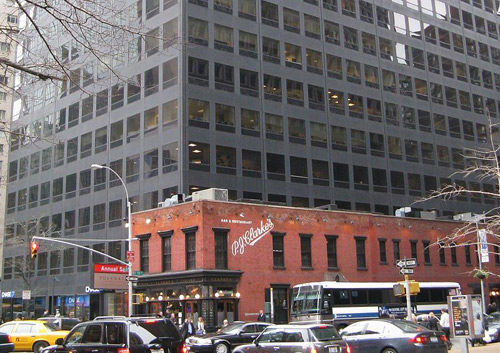
If I was very lucky, I would find Rowan mooning after Anna Wintour, the fashion editor. She too spent a lot of time behind her locked door; Rowan would linger outside her office, hoping for a glimpse or a word with his idol. Anna, however, looked at him as she did everyone around her: as if he were something on the bottom of her Charles Jourdan shoes. Even Kathy, whose own looks could curdle milk, was intimidated by Anna. It was all I could do to not tug on my forelock when Anna sauntered past me and into Kathy’s office, never waiting for an invitation, to demand more money to hire pricey photographers and ship them and half a dozen models (as well as Anna and her long-suffering assistant) to an exotic locale half way around the world. Kathy always gave in, forcing Viva even deeper into the red, in the forlorn and ludicrous belief that the Vogue and Harper’s Bazaar advertisers, Revlon and Dior and Blackglama, or even the humble L’Eggs panty hose, might be fooled into buying ads in the former penis magazine.

When not hunting down Kathy or Rowan, I sat in my fishbowl and willed the phone not to ring. The idiot at the switchboard refused to screen incoming calls or even ask the caller’s name or business. I would answer the phone “Miss Keeton”s office,” and there would be the heavy breathing noises of a weirdo or some guy with an urgent message for a Pet. I have no idea why I wasn’t allowed hang up; so what if Penthouse lost a reader, there were still 4,999,999 men plopping down their $1.50 for the magazine each month.
Along with her official titles of Viva Publisher and Penthouse Associate Publisher, Kathy also served as the Pet Closer. Every month or so, a shy, scared girl with enormous breasts and a pretty face would show up: “Um, ah, um, I have an appointment? With Miss Keeton?” I escorted the new meat into Kathy’s presence; she was no longer Ice Queen; she was now Benevolent Older Sister.
“Gay, we’d like some tea,” she ordered, not bothering to remember the girl’s name as she patted the cushion of the love seat, encouraging the terrified girl to sit next to her. I steeped and poured and set out sugar cubes and fetched milk from the dorm fridge that shared my fishbowl and eavesdropped on Kathy’s spiel.
These were the only times Kathy alluded to her own humble beginnings at Penthouse, in photos of her wearing nothing but ballet toe shoes. No one else was allowed to mention this and all copies of the issue of British Penthouse Kathy appeared in had mysteriously vanished.
Kathy’s job was to convince this 19-or 20-year old rube that the best thing she could do for her modeling/acting career was to spread her legs as far apart as possible for Bob Guccione’s camera. Pimps at the Port Authority Bus Station could have learned persuasive techniques at Kathy’s knee.
“Look at me,” Kathy confided, leaning in a bit closer to her victim. “I was a poor, struggling ballet student. I never dreamed of having a mansion, a limo, all of this” — indicating her gilded boudoir of an office with a heavily jeweled hand. Despite the fact that Marilyn Monroe was the last actress to launch her career through porn, way back in 1953, Kathy convinced these poor girls that showing off their gynecological goodies was the first step on the road to Hollywood stardom.
In the end, the girls fumbled around with their dainty china teacup, thanked Miss Keeton, and dutifully headed over to the House to be photographed by Bob Guccione.
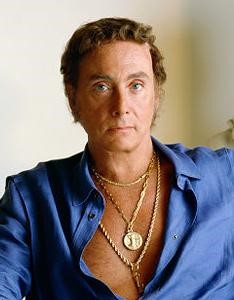
It was hard not to be impressed with Miss Keeton’s gold and gems; I learned that the rings and bracelets and earrings she sported could be categorized by Sotheby’s auction house as “Important Jewels.” These pieces might have been tasteful if worn individually; Kathy piled them on and glittered like a disco ball.
Miss Keeton did not patronize Sotheby’s or Tiffany or Bulgari. Her jeweler came to her. He was an elderly small gentleman in a worn black suit, burdened with an oversized attaché case, Old World gracious and soft-spoken. Behind his Coke-bottle-thick rimless glasses his watery blue eyes still flashed the occasional glint, like the star in a sapphire.
I lingered over the tea-making and paper-gathering to ogle at what was in the jeweler’s case. After bowing to Kathy, the jeweler spread a jet black swath of velvet on top of the French Provincial coffee table. He intoned “24 karat,” “platinum setting,” “rare South Sea pearls,” “Burmese rubies,” like the words of a prayer, and gently set down each jewel as if he were placing gaudy constellations in a night sky: lion head door knocker earrings, the lions’ eyes round-cut emeralds; a gem-encrusted medallion with a heavy gold chain that would inspire envy in Kanye; a tennis bracelet, a string of chickpea-sized diamonds that would have blinded an opponent on the other side of the net; and rings with such gargantuan center stones they could double as knuckledusters. Kathy’s office was transformed into Aladdin’s cave.
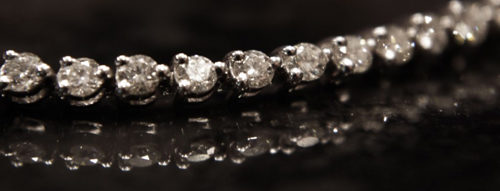
Kathy dismissed me with a wave of her hand, but through her open office door I watched her try each piece on, while the jeweler murmured his approval. She took most of them, although no money or jewelry changed hands, usually adding an order for another gold chain for Bob or for one of the Rhodesian Ridgebacks.
The jeweler packed up his case, kissed Kathy’s hand, and came out to thank me with a handshake as soft as a cat’s paw. Kathy left an hour later without a word to me; I knew my duties. I turned on the forbidden overhead lights in Kathy’s office to ensure that when I was done everything was pristine for her start the next morning: no loose paper, no forgotten tea cup, making sure that her Mont Blanc pen, Virginia Slims, and a sparkling clean crystal ashtray were the only things on her desk. Under the glaring fluorescent lights, I saw a twinkling in the white shag carpet.
It was the tennis bracelet. This was a new concept to me — sports jewelry! — and I was enamored. I draped the bracelet over my left arm and grappled with the clasp, which was beyond my uncoordinated fingers. It was a bracelet a lover should put on you, finishing with a kiss on the pulse of your wrist.
I have a larcenous soul. I had boosted my sophomore year wardrobe from the clothing store I worked at, as did every other salesclerk (and probably the mail man and the meter maid); stealing seemed to be employee policy. And even unclasped, the bracelet looked so pretty on me.
But like so many mysteries from that time, I don’t know why it never occurred to me to keep the tennis bracelet. I took it back to my cubicle, dropped it in the top drawer, next to my pencils and paper clips and staple remover. I found the jeweler’s phone number in my Rolodex and called.
“Hello, this is Miss Keeton’s office. Could you please tell Mr. Jacobs that he left something here?”
Thirty minutes later, the little man showed up, breathless and red and looking as if he were about to have a heart attack. I sat him down on my chair, put the bracelet in his hand, and rushed to get him a glass of water. When I returned he was mopping his brow with a large handkerchief and slipping the bracelet into his jacket pocket, which did not seem to me the safest place for a just recovered $50,000 piece of jewelry.
It occurred to me later that I was due a small thank you piece of jewelry, maybe half carat diamond studs? I did receive a very nice thank you card from Mr. Jacobs. And that old mensch did me a solid: he called Kathy and told her that I had found and returned a Very Important Piece of Jewelry, especially important as it was one of the items she purchased.
Because of that, in Kathy’s eyes I was now almost a person.
Your Weekly Checkup: The Proven Health Benefits of the Mediterranean Diet
“Your Weekly Checkup” is our online column by Dr. Douglas Zipes, an internationally acclaimed cardiologist, professor, author, inventor, and authority on pacing and electrophysiology. Dr. Zipes is also a contributor to The Saturday Evening Post print magazine. Subscribe to receive thoughtful articles, new fiction, health and wellness advice, and gems from our archive.
Order Dr. Zipes’ new book, Damn the Naysayers: A Doctor’s Memoir.
In multiple columns I have emphasized the importance of eating a healthy diet. You know the mantra: fish, chicken, nuts, low saturated fats, and so on.
But should you take my word for it, or are there data providing evidence of what is best to eat, particularly if you are at risk for having a heart attack or stroke? Various claims have been made about one special diet or another, but rarely if ever are the claims backed by actual evidence.
Recently, an important study was published that provides scientific verification supporting the ingredients of a healthy diet in a population at risk for developing cardiovascular disease. A group of Spanish investigators studied almost 7500 elderly (55 to 80 years) participants who had type II diabetes or three or more of the following major risk factors: smoking, hypertension, abnormal cholesterol, overweight/obesity, or a family history of premature coronary heart disease.
Participants were randomized to three arms: a Mediterranean diet supplemented with extra-virgin olive oil, a Mediterranean diet supplemented with mixed nuts, or a control diet of reduced dietary fat. The Mediterranean diet consisted of at least 2 to 4 weekly servings of olive oil for cooking, fresh fruits and vegetables, fish/seafood, legumes (peas/beans), sauce made of tomato, onion, garlic and olive oil, white meat, and, for habitual drinkers, 7 or more glasses (per week) of wine with meals.
After almost five years, participants eating the Mediterranean diet supplemented with nuts or with olive oil each had about a 30 percent reduction in heart attack, stroke, or death from cardiovascular disease compared to those eating the reduced fat diet. Benefits were greater in those who adhered more closely to the Mediterranean diet. These results support a beneficial effect of the Mediterranean diet for primary prevention of heart attacks, strokes, or death from CV disease. I am unaware of any other diet exhibiting such dramatic results.
The Mediterranean diet also benefits frail individuals, defined as those having unintentional weight loss of about 10 pounds in the past year, exhaustion, weakness, slow walking speed, and low physical activity. The frailty phenotype makes one prone to falls, worsening mobility, hospitalization, and death. In one study, frail participants who adhered closest to a Mediterranean diet had a 56% reduced risk of frailty compared to those with the lowest adherence.
The specific nutrients beneficial in the Mediterranean diet are still being unraveled but may relate to foods that exhibit antioxidant and anti-inflammatory properties. Whatever “magic” nourishments the Mediterranean diet contains now has scientific credibility to back up the claims.
It’s important to remember, however, that the Mediterranean diet is a part of a way of life in which cooking and eating with family and friends is a fun, relaxing way to socialize and form a sense of community. That sense of belonging might be as beneficial as a grilled salmon!
Civil War Memory: “I Saw Lee Surrender”
This article and other stories of the Civil War can be found in the Post’s Special Collector’s Edition, The Saturday Evening Post: Untold Stories of the Civil War.
—This account appeared in the April 6, 1940 issue of The Saturday Evening Post.
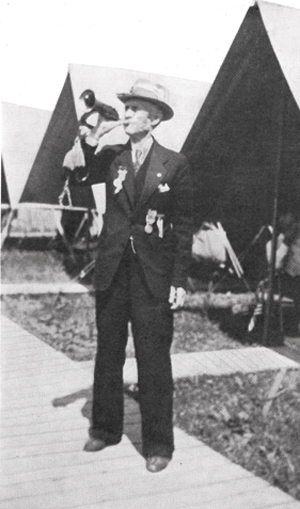
When Robert E. Lee surrendered to Ulysses S. Grant at Appomattox Court House 75 years ago on the 9th of April, I was there. As far as I know, I am the last survivor. Running away from home, I had enlisted in Company H, 5th U.S. Cavalry, in June 1862. I gave my name as Charles M. Seaver, and my age as 18, knowing that the Army shared my family’s opinion that a 15-year-old was too young for war. Sixteen months of stiff campaigning incapacitated me as a fighting private, so I transferred to Company F as a bugler, a change that ultimately brought me to Appomattox.
In the spring of ‘64, my company, was assigned as escort to Lt. Gen. Grant. We found that the es- cort was for work, not show; we carried dispatches, guarded headquarters, had charge of the staff officers’ supply wagons and commissary, erected and struck tents, and performed any miscellaneous tasks assigned. Fanfare was not Gen. Grant’s idea of soldiering; he was a matter-of-fact soldier who never worried how he looked or what others thought of it.
Under his direction, the forward movement of the Army of the Potomac, begun on May 4, 1864, ended a little more than 11 months later. The battles of The Wilderness, Spotsylvania, and Cold Harbor were behind us; the siege of Petersburg was over, ended by the battle of Five Forks, when Lee’s thin, stubborn lines were finally broken. Evacuating Richmond and Petersburg, Lee tried desperately to lead his hungry, decimated columns west, but we pressed him too hard. We caught up with them at Appomattox and the end was in sight. On that day there was an exchange of messages between the Federal and Confederate commanders.
On the morning of the 9th, the major part of the escort was left behind to guard the headquarters’ wagon train, and the rest of us started out with the general and his staff along the rear of the main army. We had gone several miles when a horseman at top speed was seen coming from our frontlines; as he drew near, I recognized him as a young lieutenant of Gen. Meade’s staff. We knew that a decision from Lee was expected on a proposed conference with Grant, and we jumped to the natural conclusion that it had finally come.
We crowded about the general in an effort to learn the answer; all of us, without doubt, believing that Grant held in his hand the decision whether it was to be peace or continued warfare. He read the message, then handed the paper to a staff officer, who hurriedly scanned the words, and, in a voice surcharged with excitement, read aloud to his associates the fateful response of Gen. Lee.
I got just the drift of the reading, which indicated that the Confederate leader had agreed to meet Gen. Grant, but evidently the staff officers construed this to be assurance of surrender, for every last man of them burst into cheers, which we joined heartily. The only one who took no part in the impromptu celebration was Gen. Grant, who merely looked on with bland amusement.
Grant wrote a reply and handed it to Lt. Col. Orville E. Babcock, with orders to take a few members of the escort, headed by Capt. Mason, and ride on in advance of the rest of the party to locate the Confederate commander. It happened that I was the only bugler present, and so I went along, much to my satisfaction, for I was eager to see the great leader of the Southern cause.
Babcock, carrying a white flag, took his place beside Mason and me, and off we went toward the enemy’s lines. Whether Lee was sparring for time was a matter of conjecture. We were, therefore, prepared for any eventuality; and, at a word from Captain Mason, I carried my bugle in one hand to sound the call to arms if we found that the Johnnies were trying to escape. That call would have been echoed all along our lines, and it would have been suicidal for them if they had attempted a getaway, for the Federal troops had them bottled up and outnumbered five to one.
Eventually, we saw a little party of gray-clad figures, and several horses by the roadside. One of the men was sitting under a small tree. A companion stood nearby, while a third man — evidently an orderly — was holding the bridle reins of two of the three horses. At a gesture from Col. Babcock, Mason ordered a halt, and the staff officer, his white flag conspicuously displayed, rode on toward the gray-clad horsemen, accompanied by a trooper of the escort.
“I’ll wager that’s Gen. Lee,” said the captain, with a glance at me. “Let us hope things turn out all right.”
I took a firmer grip on my bugle, to be ready for any possible emergency, my eyes glued to the scene before me. As the two Federals neared the spot, the man beneath the tree arose and Babcock and he exchanged salutes. The latter was tall, erect, and of fine physique. For a few moments they carried on what appeared to be a friendly conversation; and then the entire group started down the road toward us.
It was not difficult to recognize the famous commander of the Army of Northern Virginia. I had seen his picture, and I could make no mistake as to his identity. He measured up fully to my expectations — and those expectations were rather elaborate, I assure you. Though I was a lad of only 18, I had been in 15 or 16 battles during three years, and had come to have a wholesome esteem for the Johnny Rebs and their leader. In my active imagination, he had become a sort of legendary figure. It had been his remarkable generalship that had prolonged the war far beyond its expected limits, and he loomed big and menacing as an opponent.
There he was in person, he and Traveler; he was riding to meet his conqueror to negotiate terms of surrender. His companion, needless to add, was Col. Marshall, of his staff.
And what a brave pair of thoroughbreds Lee and Traveler were! That horse would have attracted attention anywhere. He was a sturdy gelding, deep of chest, with small head and feet, and his color was appropriately Confederate gray, with the exception of mane and tail, which were black; a combination that made him a very striking and hand- some animal. And when his master was in the saddle, take it from an old Federal trooper, it was a picture that was worth seeing.
Gen. Lee’s uniform was immaculate and he presented a superb martial figure. But it was the face beneath the gray felt hat and hair that made the deepest impression on me. I have been trying to find a single word that describes it, and I have concluded that “benign” is the adjective I am after; because that means kindly, gracious; and despite its sternness on that day of long ago, I would still call his expression benign. And yet, I remember well that there was something else about him that aroused my deep pity that so great a warrior should be acknowledging defeat.
We joined the little party and rode back to the settlement. Appomattox Court House was a pretentious name for what then was a row of six or seven houses, and now is less. As we passed the first house, we overtook a man, a Mr. McLean, who was walking along the street, and Col. Marshall reined up beside him and told him that Gen. Lee desired a room where he could hold a conference with Grant. Mr. McLean stared at the Confederate commander for a moment, and looked over the Union contingent, as if in search of his famous adversary. Then he pointed to the nearest house, went to the door and knocked.
A woman answered the summons, and, after a brief talk with her neighbor, she invited the two Southerners to enter; but evidently the interior was unsatisfactory, for Lee and his companion quickly came out, and Marshall requested McLean to direct them elsewhere. We rode slowly on until our guide stopped before a substantial brick house and informed us that he lived there and would be happy to offer its use.
It was an old-fashioned structure with chimneys at the gable ends; and, running along the front, a piazza painted white, with six wooden pillars supporting it. Broad steps, about 8 yards wide and seven or eight in number, led up to the platform; and there was a generous yard, partly enclosed by a picket fence, with several large trees standing sentinel-like about it.
Gen. Lee and the colonel dismounted and, preceded by McLean, went into the house, leaving their horses in charge of the orderly; and we Yanks returned to the roadway to await the coming of Grant and his party.
It was perhaps 10 minutes later — it may have been only 5 — when the Federal commander rode up with a few staff officers, the other members of the escort and several Union generals, among whom were Phil Sheridan, George Custer, Wesley Merritt, and Edward Ord.
There were three members of that little group who would probably attract attention anywhere; two of them for their noteworthy personal appearance and the third both for his appearance and reputation. The first of these was Custer, the “dandy cavalier” of the Federal cavalry. A low-cut, generous collar, a red necktie that begged for notice, buckskin breeches and a velvet jacket were usually his dress-up uniform; and topping this elaborate array was a patrician face with mustache and small goatee, and a head of luxuriant yellow hair that fell halfway to his shoulders. Effeminate, you might say, but there was nothing feminine about Custer. He was a daredevil on horseback, who feared nothing, dared anything, and defied death with reckless abandon. It was this utter disdain of caution that lured him and his command to tragic massacre in 1876.
And there was Ely S. Parker, of the staff, an aide and military secretary to Grant, a man of superb physique and titan strength, a full-blooded Seneca Indian, a descendant of Red Jacket, famous Indian chieftain. He had the copper hue of his race, their long black hair and dark brown eyes. Grant had no one in his official household more devoted to him than the stoical Parker. He was a man of education and culture, a willing worker, and always courteous to the lads of the escort. It was he who, in his excellent handwriting, copied the terms of surrender from the rough draft prepared by the Federal commander.
Phil Sheridan — “Little Phil” — the dynamic leader of the cavalry of the Army of the Potomac, was the third of the trio; and he was a general who always had my respect and enthusiastic admiration. He was a pint-sized little fellow out of the saddle, a youngster of 34 years, about 5-feet-4 in height and 130 pounds in weight, but he had a strong Irish face. Put him on his horse, the splendid black charger, Rienzi, and he at once became a warrior of heroic proportions. And how that horse could travel, and how that lad could ride!
Grant looked an old and battered campaigner as he rode into the yard. His single-breasted blouse of blue flannel was unbuttoned at the throat and underneath it could be seen his shirt or undershirt; his top boots were spattered with mud, and splotches of mud were on his trousers. Unlike Lee, he wore neither sword nor sash, and the only marks of his rank were his shoulder straps.
Col. Babcock informed his superior that Gen. Lee was awaiting him in the house, and without more ado Grant climbed the steps, Babcock alone accompanying him.
A few minutes later, however, the staff officer came to the doorway and beckoned to the other officers, inviting them inside.
It was now about two o’clock, and we fellows who were on the outside were in for a long and anxious session of waiting. They say that the watched pot never boils, and it is certainly true that anxious waiting for the verdict seemed to prolong the outcome indefinitely. The day was very warm for early April, and the sun, which of late had been blotted out by heavy rain clouds, was brightly shining in a very clear sky. Spring was with us at last, and the trees were putting on a tinge of green, the buds showing plentifully on the branches. It was good to be alive on April 9, 1865, and it would be better still if this was the end of four years’ war. It was Sunday and the Sabbath stillness brooded over the land, a welcome relief from the din and hustle and carnage of recent fighting.
There we were, a group of eager troopers in blue, and a lone orderly in gray. When three o’clock came and went, I began to wonder if our enthusiasm had exploded too quickly. It did not seem necessary to take all that time in deciding whether Lee should surrender or not. With the thoughtless- ness of youth, I assumed that such a decision would be the matter of but a half hour at the most.
Four o’clock — and the door opened. Out came Gen. Lee and Col. Marshall, with somber faces. The conference was ended, but with what results?
Before the war began, and for some time before, Lee had been lieutenant colonel of the Second Cavalry, stationed in Texas. Several members of our escort, Lt. Churchill, Sgt. Brown, and Cpl. Sam Howe, had served in the Second under Lt. Col. Lee, and none had lost any of his high regard for his former commander.
Now, as Gen. Lee came from the house, his soldierly fig- ure erect, even in defeat, these three chaps stiffened up and gave him a salute, and the man in gray courteously returned it. I thought at the time that it was a fine thing for them and him to do. At the moment his soul must have been heavy with sorrow — the years of desperate struggle fruitless — and yet he could return the salute of Yankee troopers.
I heard Sgt. Brown say, after the departure of Lee and Marshall, that the former had called him by name as he recognized him; and several of the old boys remarked that it was a noteworthy circumstance that members of his former Texas command should be the first to meet him after the surrender of his army.
We quickly learned the happy news, and it spread like wildfire. Cheers could be heard all along our lines.
That night was one of the happiest I have ever known, and I will wager that the same statement goes for every man on the Union side. A gun salute in celebration had been started by enthusiasts in the late afternoon, but Grant had put a stop to it, presumably out of consideration for the feelings of the other fellows. But, before darkness fell and afterward, there was music — patriotic selections played by the regimental bands — and a general jubilation. When I sounded taps, that sweetest of all bugle calls, the notes had scarcely died away when from the distance — it must have been from Gen. Lee’s headquarters — came, silvery clear, the same call; and, despite the sadness of the hour to the boys on the other side, I have a notion that they, like the Yanks, welcomed the end of hostilities and the coming of peace.
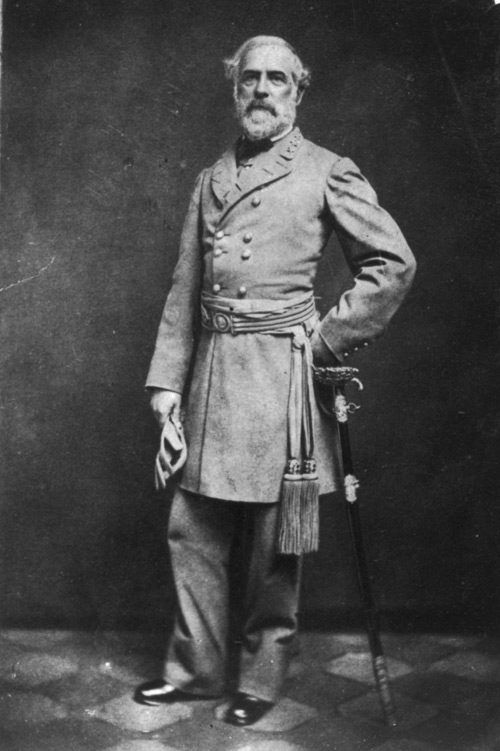
Perhaps I should end my story right here, but I want to add my bit to what has been published concerning the powwow of Union and Confederate generals at the McLean house on the day following the surrender. The reader may recall that Gen. Grant, several of the Federal generals, and members of his staff and escort rode out to the Confederate lines for a further conference; after which Grant went back to headquarters, while some of our officers and men remained behind to chat with acquaintances in Lee’s army. Lt. Churchill, Brown, and Howe were among these fortunates, they having received permission to enter the camp of the Confederates. Later on, Sam told me that he had enjoyed a brief talk with Gen. Lee, and was he proud of it!
I was one of the group that returned with Gen. Grant, and I was a most interested observer of everything that occurred on and about that friendly piazza. Grant sat down and lighted a cigar. Three or four of his staff brought out chairs and the little party relaxed into lively conversation. Grant was the picture of contentment as he puffed away, listening to the comment of his subordinates, and occasionally offering a remark of his own in his matter-of-fact way. Things had turned out as he had wished and planned.
We were soon to witness a remarkable get-together party on that old front porch and in that spacious yard. I doubt that anywhere in history can we find a similar gathering. The absentees had returned, and they had brought with them several of their late antagonists, riders in gray, but a few hours before foes of the Union; not as prisoners, not even as enemies, but as old friends and comrades. I remember how amazed I was as I saw that strange company; and when I learned that among them were Longstreet, Pickett, and Gordon — well, it certainly seemed impossible.
Perhaps you can imagine my reaction to the spectacle, after three years of desperate fighting, to see three of the most famous Southern leaders, within 24 hours of Lee’s surrender, shaking hands with Grant and chatting like long- absent neighbors with him and other Federal generals.
Naturally, I made a careful inspection of that formidable trio: Longstreet, rightly called “Lee’s war horse,” a stockily built, well-bearded fellow, who looked as if he could handle himself anywhere and make it decidedly interesting for any opponent, in either argument or fight; Pickett, the leader of that heroic charge at Gettysburg, whose handsome face made him a composite of soldier and poet; and Gordon, the hard- hitting John B., who, when he was wearing civilian clothes, would be taken for a judge or a doctor — a thinker, at any rate — and who had every earmark of a man who would go through hell and high water, if ordered to do so by his superior, and never ask the reason why.
And how Abe Lincoln would have enjoyed that con- fab! Like Grant, he would have grasped the hands of those soldiers in Confederate gray and welcomed them home. Had he been spared, there would have been no Reconstruction.
Soldiers don’t carry hatred; they leave that to the stay-at-homes. We learned that in the next 20 years.
“I Saw Lee Surrender,” April 6, 1940
Visit The Surrender Site
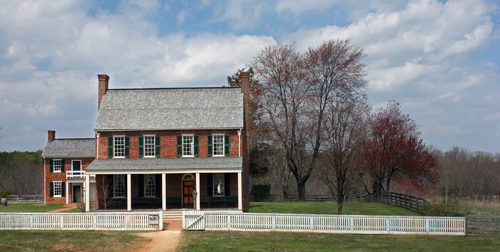
How the famous McLean house was first demolished and later restored for posterity
By Harold Bradley Say
— Originally published April 22, 1950 —
on Palm Sunday of 1865, under a single roof, little Lula McLean lost a rag doll, Gen. Lee lost a war, and the nation gained a new historic site. On this site at Appomattox Court House, Virginia, the National Park service has just completed the restoration of the house in which Lee surrendered to Grant.
Today, the McLean House looks much as it did when the Civil War officially ended. Lula’s doll and Lee’s war are lost beyond recovery. So is much of the original McLean house. Its very bricks, together with the doll and other contents, were carted away by souvenir hunters, but now the re-created structure stands as it was.
Wilmer McLean, who owned the house during its moment of historic glory, was perhaps the only man who ever had the first major pitched battle of a war fought in his front yard and
the surrender signed in his parlor. At the start, McLean, a wholesale grocer turned gentleman farmer, was living beside a small stream called Bull Run. A shell came bounding into his fireplace and he moved to Appomattox to get away from the war. Four years later, it caught up with him with its dying gasp.
The war’s end brought no personal peace to McLean. Nearly broke, he tried for a time to sell engravings of the surrender site, but McLean didn’t sell enough of them to recover his initial investment before his death in 1882.
Nine years later, a tourist-minded man from Niagara falls bought the McLean House and made elaborate plans to move it to Washington, D.C., as a museum. C.W. Hancock and sons, who undertook to do the job for $10,000, carefully dismantled the house. But the promoter abandoned the project.
The federal government acquired the 970-acre site, including the surrounding battlefield, in 1940. After interruption by another war, the contract for restoring the house at a cost of approximately $50,000 was let in 1947 to the same contracting firm that tore down the original fifty-six years earlier. Park service historians studied all available photographs and checked old records to make the restoration authentic. flooring and paneling from other old houses were used to make the interior look its age. Ultimately, it is hoped, many items taken from the house in 1865 may be returned. The table at which Grant sat is in the Smithsonian Institution. The table used by Lee is in the Chicago Historical society Museum. Where Lula’s rag doll is, nobody knows.
“The Civil War Ended here, ” April 22, 1950
“Gigolo” by George Sumner Albee
Summer is for steamy romance. Our new series of classic fiction from the 1940s and ’50s features sexy intrigue from the archives for all of your beach reading needs. Read “Gigolo,” from 1958, in which Hank, a young girl from Texas, is visiting France with her parents when she meets Charlie, a generous local who might not be telling the whole truth.
So narrow was the ancient street on the Left Bank, so tinctured with shadow were its tilted buildings even at midday, that Hank slipped her thousand-dollar camera back into its alligator case. Five feet seven and a half inches of blond, gorgeous, appallingly healthy ranch girl, she glowed in the shadow like one of the roses her fellow Texans hymned. She turned to her plump, short mother, who wore a white ostrich hat.
“See something, doll?” she asked.
To their left was a butcher shop which, to judge from the gilded horse’s head over its door, did not sell beef. Mrs. Nesbitt, however, was not studying horse chops. She was gazing into a cobwebbed window that bore no inscription, no name at all.
“Hank,” she murmured weakly, “French Provincial. Tons of it. Simply tons!”
“Mother, that’s impossible,” said Hank.
“I tell you it is. Wait here, dear.”
A woman in a dream, floating, Mrs. Nesbitt entered the shop, or warehouse, or whatever it was. Careless of her embroidered glove, she dragged a thumb across the dusty top of a carved chest. Rosewood gleamed at her like amber with the sun shining through it.
“Is this furniture for sale?” she inquired.
“Oui,” replied a great-grandfather in a denim apron and felt slippers. “But it is for country inns and cafés, madame.”
Mrs. Nesbitt, veteran auction goer, fought down her impulse to snatch out her letter of credit and her traveler’s checks. There were mirrors in ropetwist frames, inlaid writing desks, walnut bedsteads with pineapple finíais. Against a whitewashed wall stood a refectory table that virtually yelled the headlines from the sixteenth century.
“You see,” said Mrs. Nesbitt craftily, “my house in America is a big old farmhouse. I can always use a few extra pieces. They don’t have to be new.”
While the bargaining went on inside, Hank watched a tall, thin young man in paint-spattered jeans, wearing a trim beard and a beret, mount a white motor scooter. The young Frenchman observed her observing him.
“What a magnificent body you have,” he addressed her in perfect English. “Will you pose for me without your clothes?”
“You go jump in a fountain,” replied Hank tersely.
Her admirer snapped his fingers. “I beg your pardon. I neglected to explain that I’m a painter.”
“I was right sure you weren’t a diplomat,” said Hank caustically.
Nonetheless they fell into a somewhat uneasy conversation, warm on one side and cool on the other, like a waffle in a large family. It was still going on when Mrs. Nesbitt, reeling in triumph, joined them on the narrow sidewalk.
“Henrietta,” she murmured, “I have just bought thirty or forty thousand dollars’ worth of French Provincial for six thousand dollars. I’m a little faint. I think I’ll go back to the hotel and lie down. . . . Who is this devastatingly handsome young man?”
“Charles George Surmont,” the young man introduced himself with alacrity, “Charlie to my friends. I’m fairly well known as a painter. At least I thought I was. But your daughter not only has not heard of me, she doesn’t believe a word I say, so I have invited her to come with me to Dueppel’s, the gallery that handles my work.”
“And so tall too,” mused Mrs. Nesbitt. . . .
“Taller than you are, Hank. Isn’t that lovely? . . . Good-by, children. Have a good time.”
“Mother, have you gone mad?” demanded Hank, scandalized.
“If I’d been lucky enough to get to Paris at your age,” said Mrs. Nesbitt, “I would have got onto a scooter and gone to Dueppel’s. I can tell you that!” She waved her furled plaid umbrella. “Taxi, taxi!”
Charlie took Hank to his dealer’s, where, to her astonishment, he was treated not only with affection but with the deepest respect.
“I’m afraid you’ll laugh at these,” he said, setting up canvases for her. “You see, we younger painters don’t try for realism. What we try to do is capture feelings, impressions. We use design and color to —-“
“We have colleges in Texas, believe it or not,” replied Hank. “I had two years of art appreciation.”
“Then you like these?”
“I won’t go that far,” said Hank, “but I know enough to know they’re good.”
Charlie regarded her with intense admiration. “Tell me,” he asked, “do you also appreciate food, you wonderful, beautiful thing?”
Nothing catastrophic could happen to her in a restaurant, decided Hank. They went for lunch to a place on the little island in the Seine that is Paris’s very heart, where the tablecloths were sheets of wrapping paper and everybody kept his napkin — for somewhat too long a time, perhaps — in a numbered wooden ring.
“Taxi chauffeurs eat here,” said Charlie, busy shaking hands with taxi chauffeurs. “That’s always a sign of good food.”
“At home we say it’s truck drivers,” said Hank.
After lunch, astride the scooter, they went sight-seeing. They viewed the Grands Boulevards, the Champs tlysees under chestnut parasols, the Bois with lovers sprawled on the grass. Hank’s legs were well received. It seemed only mannerly for her to ask Charlie, little as she trusted him, to dine with her parents.
He arrived at the Ritz in a dinner jacket — no doubt a rented one. Hank said to herself, though his bamboo-thin figure gave it a certain splendor. In the lapel was a small, puckered green ribbon.
“What the dickens is that?” boomed Hank’s gigantic, hearty father, spying the decoration. “You’re too young to have been in the war, boy.”
“It’s an agricultural prize for raising cabbages without damage from the harlequin bug,” answered Charlie. “My family have a little farm in the Midi. In France we take agriculture very seriously.”
“We take it seriously in Texas.-‘ said Mr. Nesbitt. “I’m a grapefruit farmer, myself. Our pest is the Mexican fruit fly.”
It was clear that Charlie and Mr. Nesbitt were going to get along like lodge brothers. Hank was not sure that she approved of it.
In a fifteenth-century hot a mile up the Seine they ate an excellent dinner. Charlie then pointed out that Paris contained, along with its own private river and forest, its own private mountain, Montmartre. He conducted them on a tour of it. from simple taverns in which they sat on trestle benches and sang old songs to garish smoky clubs, all spotlights and rhinestones, in which the chorus girls followed the fashions not of Paris but of Bali. No matter how varied the night spots were, however, all of them had one thing in common. All of them knew Charlie. Headwaiters embraced him. Orchestras played tangos for him while he instructed Mrs. Nesbitt and her daughter in the most elegant of dances.
“Charlie, my boy,” boomed Mr. Nesbitt at three a.m., “I just latched onto an idea. The girls and I are going to hire a car and tour France, but we need somebody to show us the sights. Come on along, why don’t you?”
“I’d like nothing better,” said Charlie, gazing at Hank in a way that made her question the wisdom of the necklines on French evening dresses. “Nothing!”
“Now,” continued Hank’s father, “I’m a businessman and I believe in plain speaking. Your inflation is worse than ours, prices are high, and you’re a young fellow just starting out. I want to pay you a salary. How about a hundred bucks a week?”
“You call it plain speaking, do you?” asked Charlie. “I call it kindheartedness and tact. Certainement. I can use the money: I accept with pleasure.”
At the Ritz, late though it was. Hank gave an imitation of a tornado.
“Can’t you see he’s spotted us for some tourists he can take?” she stormed. “He’s playing us for suckers! Why, it’s as plain as the nose on your face!”
“Pooh,” scoffed Mr. Nesbitt, removing his dress tie. “He isn’t the type, Hank.”
“Why, he’s a darling!” exclaimed Mrs. Nesbitt. “He’s absolutely charming!”
“There are men who make a profession of it,” Said Hank, “in case you haven’t heard.”
“Matter of fact,” said her father, “he’s the one who’s doing us a favor. Now we’ve got an English-speaking guide to show us around for not much more than I’d pay a driver. Relax.”
“And there’s something else you haven’t thought of, Henrietta,” said Mrs. Nesbitt. “Travel with a twenty-one-year old girl can be a bit difficult. Now you have a regular date. Can that boy mambo!”
“I’ll choose my own dates!” Hank’s voice approached full volume. “What if he drives us off on a side road somewhere and holds us up? What if he sneaks into my room at night in some lonely country hotel and — and assaults me?”
“When he assaults you,” suggested Mr. Nesbitt, “scream good and loud, like you’re doing now. . . . Good night, chicks. Wake me at noon.”
In Hank’s room at the other end of the suite she discovered a package, delivered apparently by a bellboy. Across it was written: “For Hank, because she knows enough to know it’s good.” Inside was one of the paintings Charlie had shown her at his dealer’s — product of weeks, possibly months of work. Bah, said Hank to herself, sniffing, he probably dashes them off in five minutes and gives them to every girl he picks up. He’s not fooling me for an instant.
Their route south would have driven a map maker in an automobile club to a psychoanalyst’s couch. Charlie, who believed with all Latins that eighty was a safe and comfortable speed, drove not from town to town but from cheese to cheese, from local wine to local wine, from truite farcie au porto to volaille de Bresse a la creme. The hours they gained on the highway they spent — for “wasted” was not the word — at table. Luncheons, in the remote but triple-starred restaurants to which Charlie piloted them, began at noon and concluded at three. Dinners began at eight and ended at eleven later, if the brandy was exceptional, and the brandy was always exceptional.
“At this rate,” said Hank, following a considered policy of refrigeration, “I estimate we’ll take twenty years to get to the Riviera. We may all die along the road somewhere and nobody will find us.”
“Anyhow, we sure won’t die of starvation,” remarked her father with something between a rumble and a sigh. . . . “Mother, did you get the recipe for that duck with truffles?”
In the Midi, the central plain of France, the wheatfields flared just as Van Gogh had painted them — as if the planet were still a molten ball; in every incandescent field carmine poppies. The Nesbitts and their knowledgeable, personable tour leader slept under canopies of wisteria in tumbledown inns without baths. They slept in turreted châteaux with baths of green marble that had black onyx tubs with gold angels for faucets. But in inns and castles alike toothless old kitchenmaids and pouch-eyed proprietors in white aprons came running out to the rented Daimler with cries of “Ah, Charlie! Charlie, my dear!”
They explored a vineyard where the men and women working in the tender green vines removed their broad straw hats as Charlie greeted them by name. And at the end of the week, when Hank and Mrs. Nesbitt were having trouble getting their dresses over their hips, they visited an orphan asylum. The orphans, in worn blue smocks, sang Frère Jacques for them. Afterward, carrying small wooden bowls, they marched in their wooden shoes into a tiled cloister for their big meal of the day — cabbage soup, served them by nuns whose caps were white swans against the blue sky.
That evening in Nîmes, when Charlie changed out of his rope-soled sandals and the blue-and-white-striped sailor’s undergarment he wore as a T shirt, Hank did not plead fatigue when he asked her if she would care to take a stroll. She was up to her ears in eulogies of Charlie’s exquisite courtesy, Charlie’s astonishing education, Charlie’s gay spontaneity, Charlie’s wholesome modesty, Charlie’s lovely disposition. If she could not make her position clear to her lovesick parents, she was determined to make it clear once and for all to the fair-haired boy himself. . . . The two of them walked at random in the dusk, past old men bowling on vacant lots, past families chattering on café terraces, past shops with necklaces of tinware and sponges hanging outside the door, until an iron fence brought them up short. Beyond the fence lay a small, columned, perfectly preserved Roman temple.
“This was Diana’s,” said Charlie, “goddess of the moon, virgins and hunting. A curious mixture, don’t you think?”
“Very,” replied Hank. “Ominous, in fact.”
“You don’t like me at all, not even the least little bit, do you?” asked Charlie.
“Everybody else does. Everybody in France, as far as I can make out,” replied Hank. “You don’t need me in the bundle. I’m just a lone dissenter from the Lone Star State.”
“But what if I do need you?” asked Charlie. “Suppose — just suppose, Hank — I’m honest when I say that.” He pronounced her nickname as “Honk.” “Don’t you think you owe it to me to tell me why I’m — how do you say? — poison to you?”
It was the opportunity Hank wanted. “All right, I’ll tell you,” she said, with spirit. “I like my mysteries in paperbacks, Charlie, or in the movies. Explain a few things. Why were you so well known wherever we went in Paris?”
“Because, even in a city as large as Paris, people with the same interests, or maybe I should say the same view of life, come to know each other.”
“Interests, for example,” said Hank, “like steering tourists to night spots and collecting a percentage of the check. This is rude of me, I know, but you asked for it. How about these places we’ve stopped at along the road? They all know you too. More commissions?”
“France is a small country,” said Charlie. “It’s possible to have friends all over it, especially when you’ve been a traveling salesman as I have. Next question. …”
“Why did those peasants at the vineyard snatch off their hats? Are you a duke or something? Are you just having fun with a laughable little group of three American barbarians?”
“A graduate of a great Texas university ought to know there aren’t any titles in France — not valid ones, anyhow,” said Charlie. “But, yes, my grandfather did have one he used sometimes with snobs he disliked, and since we come from the Midi, these people know us. What do you want me to do — hurt their feelings by telling them to put their silly hats back on their heads?”
The new moon was a drawn bow of silver. It waited in the darkening sky as if it were reluctant to leave Diana’s chaste little temple.
“Permit me,” said Charlie. “I shall be as blunt now as you have been. Either you are younger than any European girl of your age would be or you have not inherited your parents’ wisdom about people. Your father knows there are two kinds of people, the hunters” — he gestured toward the temple — “and those who give what they can, whether it’s paintings or friendliness or a beautiful voice or grapefruit. Do you know your papa wrote a check that will keep that orphanage going for a year?”
“I have a pretty good idea you took us there so he would.”
“I did,” said Charlie. “And he knows it, and he’s grateful to me. That’s what you don’t understand. Alors, I dislike you every bit as much as you dislike me, Hank, and it disturbs me deeply, because I have had the bad luck to fall in love with you. I do not, you see, wish a wife so filled with suspicion that she cannot believe in the existence of good deeds.”
“Really!” said Hank. “There’s not the least danger I’ll ever lie your wife, believe me.”
“I wish I could,” said Charlie, “but you’re in love with me too. A virgin does not always know.” He bowed toward the temple. “Guide her, Diana. She is one of yours.”
The Riviera, the Coast of Azure, was much as Hank had imagined it would be. A boulevard festive with palms and pennants curved alongside a radiant Mediterranean, with huge hotels built wall to wall — hundreds of them, a solid white palisade against the cactus-spiked slopes of the southern Alps.
“How depressing,” said Mrs. Nesbitt. “Luxury hotels are the same from Acapulco to Miami Beach. I hate to end up in one of these when we’ve been having so much fun.”
“Me too. Best time I’ve had since I was a kid tramping the fruit,” agreed Mr. Nesbitt. “Charlie, don’t you know some place that isn’t so fancypants?”
“Sure,” replied Charlie, waving at a traffic cop in a cape, who waved his white baton in return, “but the food is ordinary, the rooms are hot and the servants are fresh — they’re young artists earning their summer vacations. It costs fifty dollars a day apiece too. Not for me, because I stay there free, but that’s what it’ll cost you.”
“What’s good about it?” asked Hank. “If anything.”
“Only the people. The same guests come year after year because they like each other so much.”
“I’ve got to lose five pounds,” said Mrs. Nesbitt. “Let’s try it.”
The Auberge Matelot, its shingle walls faded by salt air, looked like a run-down boardinghouse on Cape Cod. In the lounge the chintz covers on the wicker furniture dated from 1930. Every inch of the walls inside was covered by new, unframed paintings, evidently put up for sale by the talented help. The proprietor greeted them in a frock coat worn over bathing trunks.
“I’m afraid you’ve been misdirected,” he said courteously to Mr. Nesbitt. “This is a private club, and our rooms are booked through 1960. I am so sorry——”
At this point Charlie, helping two bearded boys in white sailor suits with the luggage, came in from the car.
“Charlie!” cried the proprietor, grasping him by the ears and kissing him soundly on both cheeks. “The Princess was saying just yesterday she wished you were here. She wanted you to rub away one of her headaches.__ Let’s see, what do I have for your friends? How about two rooms with a sitting room?”
The gardens of the Auberge Matelot were a tangle of mimosa, bougainvillaea, roses and neglected lemon and orange trees that made Mr. Nesbitt groan. Tables were hidden away in the bushes like birds’ nests. Each table had its lateluncheon or early-cocktail party — it was hard to say which — with women in simple little three-hundred-dollar cottons pouring for other women in shabby beach robes and towel turbans, for men in ragged tennis shoes. Up a path, pursued by a nursemaid, sped a sun-tanned little Spanish girl of five or six, naked except for a diamond necklace.
“Hoo-hoo!” somebody called.
“Isn’t that Elsa Maxwell?” asked Mrs. Nesbitt.
“Where?” inquired Charlie, looking in the other direction.
“It is, and she’s calling you.”
“Hank doesn’t like me to know so many people. Now here,” said Charlie as they reached the bottom of the garden, “is what I want to show you.” The shrubbery came to an end on an outcrop of pale gray granite. Steps, each of them a hundred feet long, were cut into the stone. They led straight down into the waveless sea. “No one knows who made these,” continued Charlie. “Perhaps the Romans, for a landing place for their royal galleys. But look, you can walk down into blue water fifty feet deep. I’ve seen pictures of the California beaches and the Greek islands, but this must be the most beautiful place to swim in all the world.”
Down the coast, possibly a quarter of a mile away, they could see a small fishing village, with brown nets drying in the sun and boats moored at a stone quay.
A tall, thin man — tall and thin as Charlie himself — came up out of the water. He wore faded red trunks with mothholes.
“Ca va ?” he asked.
“Hello, Arch,” replied Charlie. “Have you got a dinner jacket I can wear?”
“Who’d you give yours to?”
“A barber in Avignon. He needs it to get married in.”
“Sure. I’ll be in my room, the broom closet over the kitchen,” said the lean man in the red trunks, and trotted up the path.
“Come on, Charlie,” said Mr. Nesbitt, chuckling over the plight of his women, who appeared to have been stricken with palsy. “Even I can recognize that one. That was Cary Grant.”
“I guess so,” admitted Charlie in a reluctant murmur.
Mrs. Nesbitt recovered her voice. “What is this place?” she demanded.
“I told you,” said Charlie. “They’re very friendly people.”
Charlie was to eat his dinner that evening with the proprietor and his wife, M. and Mme. Auby. He urged the Nesbitts to drive into Nice if they wanted a respectable meal, but even Hank was tired after the two-day drive that had taken two weeks. Her mother and father went early to their shaky old brass beds. Thus at ten o’clock Hank found herself alone in the deserted lounge. Everybody, she told herself, was out having a gay time; everybody but Henrietta Nesbitt.
Down the staircase came an elderly gentleman whose eyebrows were as black as his silk suit — black, bushy and turned up at the ends, like Satan’s. Spying Hank, he addressed her in weird English, tacking a breathy whistle onto his words so that it sounded as if he were accompanying himself on a flute. “But, my-ee dear,” he exclaimed, “youth-ee is not-ee to be wasted like this-ee ! Come, we will make-ee a party, you-ee and I-ee!”
“Oh, no, thank you,” answered Hank, shrinking on her chair.
“Ecco ! I-ee will call-ee a cab. We will go-ee to Monte Carlo! We will drink wine-ee, we will dance-ee——”
Hands outstretched, eyes glittering, he advanced upon her. With a small scream, Hank leaped from her chair, a white satin rocket. The nearest door let her into the cobbled lane to the fishing village. She ran as fast as her plastic slippers with their slim aluminum heels permitted, until she was in the public square with its plane trees and benches. The square was empty and dark. There was only one spot of light, where a workman on a stepladder was painting a sign for a restaurant under a bare electric bulb hanging from a wire.
Each of them asked the same question: “What are you doing here?”
“I,” said Charlie from the stepladder, “am creating a masterpiece. Voilà!” He gestured. Over the doorway of the restaurant, a scroll read C hez Je a n. A panel to the left of the door displayed a basket containing a bouquet of fish. A second panel, on the right side, bore a half-finished crawfish in bright scarlet. “Jean cannot afford a professional sign painter.” “Oh, you’ve shaved off your beard!”
“The climate. You,” said Charlie, “have been running.”
“A nasty old man at the hotel tried to make me go out with him. He had eyebrows like the Devil.”
“That’s Orsini from Rome, the authority on early Christian plain song. He’s the gentlest and kindest of men. Also he’s seventy-five.” Thoughtful, Charlie capped his tube of scarlet and descended a few steps on the ladder. “I begin to understand,” he said. “An extremely feminine girl, probably afraid of mice and lightning, in a foreign country for the first time. How could I have been so unperceptive, so stupid? Naturally you suspect me, suspect Orsini, suspect everything. You’re scared. I have misjudged you seriously. Hank, I’m sorry.”
Hank looked at the crawfish, painted with artists’ colors that cost more than a sign painter earned in a week. She remembered the dinner jacket given to a barber. She remembered the orphans. She remembered the dozens upon dozens of people who loved Charlie because he was Charlie.
“I wish you’d slapped me when I said those horrible things to you,” she said sincerely. “Slap me now. Good and hard.”
Charlie climbed down, cleansed his hands of scarlet, and deposited his box of colors and brushes in the restaurant. Side by side, through soft night perfumed with mimosa and turpentine, they walked back to the hotel and down the gravel path to the great stone steps. The horizon was a backdrop of stars — some of which, redder than the rest, rocked slowly back and forth: lanterns in the boats of the fishermen.
“I assume,” said Charlie, “you have been kissed.”
“Not too often,” replied Hank.
“Do you like it?”
“It’s all right. Friendly, as you say.”
“There are friendly kisses that have something more than friendliness,” said Charlie. “Nobody knows exactly what the something is, but when it’s there it’s pretty good proof that two people love each other.”
Hank felt his mouth on hers. For a moment that was all she felt. Not that it was not enough. But then a number of curious things happened. A procession of little men twirling Fourth-of-July sparklers marched along her upper lip. Other little men, inhabiting her lower lip, built bright bonfires and leaped over them. Someone marched along with a bass drum, coming closer and closer. Yet the to-do, strangely enough, was relaxing. Hank’s eyelids fell. Her teeth parted. She reclined on velvet cushions in a gondola on a canal in Venice. Now five hundred Roman candles blasted off, followed by a salvo of skyrockets, and suddenly the Venetian canal became a Northwest Passage walled with ice, and she shivered from head to toe.
Afterward, neither of them spoke. Charlie left her at the foot of the staircase in the empty lounge, laying a forefinger for a moment against her hot cheek, and Hank stumbled upstairs to her room.
Charlie rapped on the door of the suite at ten in the morning as the Nesbitts, after a breakfast of crescent rolls, fresh farm butter, honey that tasted of grapes, and bowls of café au laii, were getting into swimsuits for a morning in the sun. Charlie wore M. Auby’s frock coat with a carnation in the lapel, striped gray trousers and an Ascot tie. He carried gloves. Clearly, his was a formal call. Either that or he was on his way to a funeral.
“Sir,” he said to Mr. Nesbitt, who jumped, “I don’t know the Texan customs, so you must forgive me if I blunder. I request your permission to ask your daughter, Miss Henrietta, to be my wife.” Mr. Nesbitt, in trunks, looked not unlike a hippopotamus photographed in jolly mood at a picnic. “Sure,” he replied. “Want some coffee?”
“For goodness’ sake, sit down,” added Mrs. Nesbitt.
“This is too solemn an occasion for sitting,” Charlie gently rebuked her. Turning, he bowed to Hank. “Henrietta, it is clear to both of us, I hope, that we cannot live happily without each other,” he said. “Will you do me the honor of becoming Mrs. Charles George Surmont?”
Hank, surprising herself, burst into tears suddenly and violently, as if somebody had stepped on her big toe. It was all she could do to answer yes.
“How perfectly sweet,” said Mrs. Nesbitt. “Now you will have some coffee, won’t you, Charlie dear? I’m sure you didn’t eat a bite of breakfast.”
Charlie seated himself at random. “I am somewhat dazed,” he remarked to the room at large.
“Son,” said Mr. Nesbitt, “I don’t know when I’ve met a young fellow I like as much as I do you. Mother feels the same way: if you don’t come home with us I’m afraid mother won’t come either. But I’m a businessman and I believe in plain speaking. There’s one thing we’d better clear up, I guess.”
Charlie turned pale. “Your pal Mongsoor Auby likes to show off his English,” continued Hank’s father, “so he and I had a nice long gabfest. He says you give away five paintings for every one you sell. He says that ribbon you wear isn’t for raising cabbages, it’s awarded to French citizens called Benefactors of the Republic. At that orphanage, while I was writing a check, the Mother Superior had a hundred-buck bill in her hand. I figured it had to come from you; it was your first week’s salary I’d just given you. But Mongsoor Auby says you have another orphanage on your string. He says you raise dough for a home for old actors too. Charlie, I’m all for it. I try to do what I can, myself. But I’m a millionaire, and you aren’t. Maybe you’re a nut. If I take you home to manage Cielo Verde, the ranch I deeded to Hank on her twenty-first birthday, are you going to give the darned place away tree by tree?”
“But it should be obvious to you,” said Charlie, “that I can’t support orphanages on what I earn painting. I, too, have a business.”
“Well, that’s more like it,” said Mr. Nesbitt.
“But I don’t want to tell you about it,” said Charlie sadly. “Because, you see, I am what Hank thought I was. I am a swindler.”
“I don’t believe it,” cried Hank.
From the striped trousers, which were much too short for him, Charlie drew his wallet, and from the wallet an envelope. He handed the envelope to Mrs. Nesbitt. “Open it, please,” he requested her, “and read the letter.”
Mrs. Nesbitt obeyed. “Why, it’s about the antiques I bought in Paris,” she said, perplexed. “The shop has returned my check!”
“I told them to,” said Charlie. “The pieces are forgeries.”
“Charlie, I know antiques,” protested Mrs. Nesbitt. “The wood was old; I tested it with my thumbnail. There were wormholes. The broken leg on the refectory table was mended with a handwrought iron nail.”
“The wood is aged in pits and hardened with carbamide,” said Charlie. “The nail was genuine, but the leg was broken on purpose so it could be mended with the nail. I am sure of my facts, you see, because I own the factory. All of the authentic Provincial furniture in France, like our period furniture, was bought long ago by collectors. So today when somebody opens a country inn or a restaurant he must buy copies from me — good copies, made by hand, giving employment to old craftsmen who badly need the work, but copies just the same.”
“That doesn’t make you a swindler,” interposed Hank loyally.
“My dearest Hank, you are wrong,” said Charlie, “because now and then a tourist stumbles on our warehouse, like your mamma. ‘Are these antiques?’ she asks. ‘No,’ says old Papa Pierre, my caretaker. But the lady never believes him. She thinks he is an ignorant dodderer. She buys. She insists on buying.”
Mr. Nesbitt laughed until he coughed through his cigar and blew sparks. “You mean the tourists try to take advantage of you.”
“It is morally reprehensible on both sides.”
“Some of them are just plain trying to gyp you. They get what they deserve, and you get money for your orphans and your old actors and cabinetmakers,” said Mr. Nesbitt. Still chuckling, he took up the telephone. Several seconds passed before anybody answered it, since all of the servants were out in the garden painting. “Service de rooms?” said Mr. Nesbitt into the phone. “Say, we’re having a little celebration up here. Send up a bottle o f—-“He paused, frowned in consternation and turned to Charlie. “Son,” he asked, “how the heck do you say champagne in French?”
Stormy Weather Rolled into Theaters 75 Years Ago
Lena Horne’s voice. The frenetic band-leading of Cab Calloway. The superbly athletic dancing of the Nicholas Brothers. These elements, and many more, make up the engine that powers the 1943 musical Stormy Monday. Seventy-five years ago this week, this film with an African-American cast and a surplus of talent arrived in theaters and made history.
The year 1943 had already seen one successful African-American-led musical in Cabin in the Sky. Produced by MGM and based on a Broadway musical from 1940, Cabin featured Ethel Waters and Rex Ingram (from the original show). Among the other stars were Louis Armstrong, Duke Ellington, and yes, Lena Horne. The film would earn one Academy Award nomination, for Best Original Song for “Happiness Is a Thing Called Joe.” In a move unusual for the time, producer Arthur Freed and director Vincente Minnelli consulted prominent black leaders and the NAACP before filming out of concern for their representation of the cast and their desire to avoid stereotyping.

Horne received good notices for her portrayal of Georgia Brown in Cabin, but she would get a much larger role in 20th Century Fox’s Stormy Weather. The movie is based on the life of Bill “Bojangles” Robinson, and Horne plays Selina Rogers, a character invented for the film. Although it was Horne’s second big musical in a year, it was still notably unusual at the time for a studio picture to feature an African-American cast.
Other huge stars appeared with Robinson and Horne. In addition to Calloway and the Nicholas Brothers, the film featured singer Ada Brown, dancer Katherine Dunham, and the legendary Fats Waller. To take full advantage of the cast, the film includes 20 musical numbers, despite a brisk running time of 77 minutes. Waller plays his own “Ain’t Misbehavin’,” Calloway conducts and sings “Jumpin’ Jive” (which he co-wrote), and the Nicholas Brothers do a dynamic dance along with the tune. In fact, the Nicholas Brothers’ dance remains one of the most famous scenes from the film; Fred Astaire himself declared it “the greatest musical number that he had ever seen.”
Cab Calloway, his orchestra, and the Nicholas Brothers do “Jumpin’ Jive.”
Another memorable scene — perhaps the most well known and well loved — is Horne’s rendition of the title song. Her smooth delivery received accompaniment by an expressive dance routine from Dunham. As recently as 2004, Horne’s rendition placed at No. 30 on the American Film Institute’s “100 Years . . . 100 Songs” list of the greatest songs in film.
Lena Horne performs “Stormy Weather.”
Over time, the reputations of Horne and the film continued to grow. Horne would remain a huge star for the rest of her life, appearing on stage and screen, recording music, and working as a civil rights activist until her death at 92 in 2010. And although Stormy Weather didn’t get a proper DVD release until 2005, it was selected to the United States National Film Registry by the Library of Congress in 2001. Selected films are deemed to be “culturally, historically, or aesthetically significant.”
In a piece for Turner Classic Movies, film critic Stephanie Zackarek illustrated the impact of the film: “It sets a place for African Americans at the nation’s table, and the tableware is solid sterling, gleaming, intrinsically valuable, and impossible to ignore. The movie is a shout, defiant and exuberant, that can be summed up in two words: We belong.”
Healthy Weight, Healthy Mind: Challenging Our Core Beliefs
We are pleased to bring you this regular column by Dr. David Creel, a licensed psychologist, certified clinical exercise physiologist and registered dietitian. He is also credentialed as a certified diabetes educator and the author of A Size That Fits: Lose Weight and Keep it off, One Thought at a Time (NorLightsPress, 2017).
Do you have a weight loss question for Dr. Creel? Email him at [email protected]. He may answer your question in a future column.
The lemon bar and job loss examples from the last two posts illustrate how our thoughts can impact our immediate emotional reactions to situations. Challenging our thoughts as we would when we talk to a close friend goes a long way toward helping us better manage life and our weight. But some of us have entrenched beliefs that influence our perspectives on many life situations. We may be sensitive to certain conditions that trigger these beliefs. Such thoughts and assumptions are typically about others, ourselves, or the world around us. I’ve alluded to some of these global beliefs throughout the last several chapters. They may include such ideas as:
- People only care about themselves.
- I have to please everyone all of the time or I’m inadequate.
- When people make mistakes they always deserve to be punished.
- Those who care about me won’t ever mistreat me.
The difficult part of each of the above examples is that they’re partly true. People can be selfish, but that doesn’t mean they only care about themselves. It’s also admirable to try to help others and get along with them, but this isn’t always possible. Justice is something we long for, but what about mercy and forgiveness? And isn’t it true that sometimes we can be unkind to those we love? When we hold tightly to the rigid beliefs above, there’s little room to forgive others or accept their help. We hold grudges or perhaps feel lonely as we drown in a sea of self-blame. We are highly sensitive to other people’s selfishness and easily dismiss their acts of kindness. We demand justice and feel perpetually frustrated when our demands aren’t met. We can become people pleasers and expect the same from others.
So how do we handle these or other entrenched core beliefs that cause us distress and impact our physical activity or eating habits? As discussed above, I encourage you to have an internal dialogue with yourself. Be respectful, as though you’re discussing an issue with a friend. Also be direct and include facts rather than feelings. What is the evidence that people only care about themselves? What evidence refutes this belief? How about the idea that people who care about you won’t ever mistreat you? Have you talked to any couples who’ve been married a long time? Have you interviewed people who have great relationships with their adult kids? They would most certainly tell you they have mistreated, or been mistreated, at times by the people they love most. Isn’t there a place for grace and mercy just as there’s a place for working hard to earn something and suffering the consequences when we mess up?
Tackling these emotion-provoking core beliefs can be a challenge. At some point you accepted them as true. But with work, we can change false assumptions and the cascade of thoughts and behavior that emanates from them.
The good news is — altering core beliefs ever so slightly can make a huge difference in how we respond to situations. After some thought and internal conversation, you may come up with alternative core beliefs. The following perspectives are more reality-based and may help you deal with stressful events:
- Most people care about others but still act selfish at times.
- I want to make others happy, but in the end, happiness is a choice.
- Everyone makes mistakes. The timing and severity of consequences aren’t always up to me.
- I won’t be anyone’s doormat, but even people who care deeply about me will occasionally be insensitive to my needs.
Working on your own, you can come up with alternative beliefs the same way we challenged thoughts about eating lemon bars and being laid off.
First, examine an activating event (A) that triggered deep-seated beliefs (B) and your emotions and behavior (C). Perhaps you realize you need to dispute certain core beliefs and make adjustments. Because these beliefs are global and affect large areas of your life, think of them as personal mission statements or proverbs. Continue to evaluate (E) the wisdom of these beliefs as you apply them to hardships and life transitions.
Iron Butterfly Brings Metal to the Charts
The origins of heavy metal music remain shrouded in mystery, like the fog-wrapped hills of Middle-earth. Okay, maybe not that mysterious, but it sounds more metal that way, doesn’t it? No matter when you place the beginnings of that loudest of rock subgenres, there’s no argument that 1968 was a monumental year for the artform. Steppenwolf invoked the phrase “heavy metal” in “Born to Be Wild.” Black Sabbath, Led Zeppelin, and Deep Purple each came together. And in the United States, the first so-called metal song entered the charts on July 20 at the hands of San Diego band Iron Butterfly.
Filmmaker Sam Dunn, a Canadian documentarian and metalhead, broke metal down into 26 subgenres for his 2005 feature Metal: A Headbanger’s Journey and subsequent 12-part series Metal Evolution. On his so-called “Family Tree,” he places Iron Butterfly in the Early Metal U.S. division alongside contemporaries like Steppenwolf and Vanilla Fudge. This is important to note as many of the early metal bands simply considered themselves rock bands or “blues-inspired” without consideration to a new label.
As for what makes metal METAL, it seems like every musician, critic, and fan has their own theory. Many scholars point to the down-tuning (a technique which can produce a deeper or heavier sound) used by the likes of Tony Iommi of Black Sabbath, or the prevalent overdrive guitar sound, or the “big bottom” of a pounding rhythm section as typified by Led Zeppelin. Others discuss lyrical content, which runs the gamut from women and parties to occult mysticism to deep dives into fantasy and fringe literature.
Steve Janiak, vocalist and guitarist of Indianapolis-based heavy metal band Devil to Pay, admits that it can be hard for him to define even after having recorded five albums in the genre. “Man, I don’t even know,” he says with a laugh, before noting “volume” and “general overall heaviness” as defining attributes. He also acknowledges the attractive power of that dark side, indicating that he was first drawn to metal because “it was vaguely dangerous or menacing. Something that Mom wouldn’t like.”
Iron Butterfly began their metal journey in San Diego in 1966. The original line-up consisted of Doug Ingle (vocals and organ), drummer Jack Pinney, guitarist Danny Weis, and bassist Greg Willis, though the band would be marked through its tenure by near-constant personnel changes. The band’s first album, Heavy, dropped in early ’68. By the time they recorded their second album that year, the band had become Ingle, Lee Dorman (bass guitar), Ron Bushy (drums), and Erik Brann (guitar and vocals). That second album would be named after a lengthy track called “In-A-Gadda-Da-Vida.”
The unique title comes from, well, drunkenness. As described in the liner notes for Iron Butterfly: Live at the Galaxy 1967, after having a bit too much, Ingle tried to play a song he was writing called “In the Garden of Eden.” Ingle played the organ and sang as drummer Ron Bushy wrote down the lyrics. In his inebriation, Ingle’s slurred pronunciation prompted Bushy to attempt a phonetic spelling, and it stuck. As originally recorded, “In-A-Gadda-Da-Vida” ran 17 minutes; it was edited down to just under 3 minutes and released as a single on June 14, 1968. By July 20, it cracked the U.S. singles charts at No. 117; the tune would reach as high as No. 30, fall off the charts, and then re-enter the Top 100 again in 1969. The strength of the song powered the sales of the album to over 500,000 copies by the end of 1968.
Iron Butterfly performing the tune in 1968.
Listening to the song today, you can easily identify the elements that Janiak and others discuss. There’s that vague mysticism. There are lower tunings and heavy drums (the unedited version features a lengthy drum solo). Ingle’s Hammond organ, a common sound of the era, adds atmosphere, and the guitars convey blues inflections underneath the distortion. It is, simply, metal.

While a version of Iron Butterfly still tours today with drummer Ron Bushy, the band never again matched the success of “In-A-Gadda-Da-Vida.” The album, however, still ranks as one of the best-selling albums in the world, with more than 30 million copies sold. The band helped usher in an acceptance of the sound that paved the way for other acts, like their one-time opener Led Zeppelin.
Metal had a major ascendance and chart dominance in the U.S. during the 1980s. Though it began fading at the hands of the alternative explosion and the proliferation of hip-hop in the early ’90s, metal continues to thrive. Metal bands still tour constantly and sell well. “Family Tree” members Black Sabbath, Led Zeppelin, Deep Purple, Metallica, Kiss, Guns ’N’ Roses, Bon Jovi, Alice Cooper, The Stooges, Van Halen, AC/DC, and Aerosmith have been inducted into the Rock and Roll Hall of Fame, while Steppenwolf’s “Born to Be Wild” was enshrined in the Hall of Fame Singles category in 2018. Metal royalty Slayer embarked on a sold-out retirement tour this year after 37 years of performing. And in June, the theatrical Swedish metal band Ghost saw their fourth album, Prequelle, debut on the U.S. album charts at No. 3.
Fifty years in, metal remains too heavy to push aside.