News of the Week: Roger Moore, the Revenge of Print, and the Return of the Bride of Frankenstein
RIP Roger Moore, Dina Merrill, Anne R. Dick, and Marsh McCall
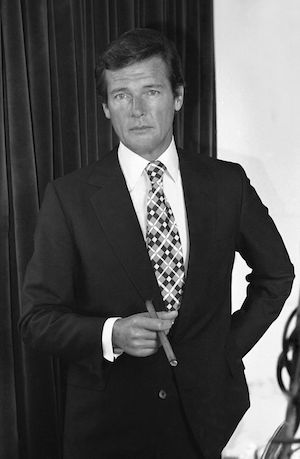
Here’s a great story from a fan that illustrates the type of person Moore was.
Dina Merrill was an actress and philanthropist (she was the daughter of E.F. Hutton and Post cereal heiress Marjorie Merriweather Post), appearing in such movies as Desk Set, Operation Petticoat, BUtterfield 8, and The Player, as well as TV shows like To Tell the Truth, Murder, She Wrote, and Batman. She passed away Monday at the age of 93.
Anne R. Dick was a jewelry-maker, publisher, and writer who was also a major inspiration in the writings of her husband, Philip K. Dick, author of Do Androids Dream of Electric Sheep? (which was turned into the movie Blade Runner), The Man in the High Castle, and many other books and stories. She wrote a memoir of their time together, The Search for Philip K. Dick, and was about to publish her first novel. She died in April at the age of 90.
Marsh McCall started his TV career as a writer on Late Night with Conan O’Brien and went on to write for such shows as Just Shoot Me! and The Naked Truth. He was also a producer on Tim Allen’s Last Man Standing and the Full House reboot, Fuller House, and co-created My Big Fat Greek Life. He died Sunday at the age of 52.
Print Books Are Back!
I prefer print books over e-books. It’s not that I’m a Luddite and don’t want to get involved with electronic versions of books — hey, I have the Kindle app! — it’s just that I prefer the look, the feel, the history, even the smell of the printed page. Honestly, I spend so much time in front of screens already. I’m always looking for a way to get away from them, and print lets me do that.
It seems a lot of other people like them too, as this piece at The Guardian explains. E-book sales reached a high in 2014 but ever since then have seen their sales drop. In fact, last year, sales dropped 17 percent. It’s also interesting to see that while many big bookstore chains have failed or aren’t doing too well, independent bookstores are doing better.
I don’t think e-books are going away, leaving us in a world where just print books exist — digital is still where we’re headed — but I think there’s a real future for print that goes beyond just being a niche product that only collectors are still interested in. Print books and bookstores are here to stay.
The American Writers Museum
Many of the books you’ll find in those bookstores (boy, that’s a tortured segue) were written by classic American writers, and now you can go to one place that celebrates their work. The American Writers Museum in Chicago opened recently and showcases the work of such writers as Mark Twain, Herman Melville, F. Scott Fitzgerald, Jack London, Shirley Jackson, John Updike, Kurt Vonnegut, David Foster Wallace, and even I Love Lucy writer Madelyn Pugh Davis (who, by the way, went to the same high school as both Kurt Vonnegut and former Saturday Evening Post owner Beurt SerVaas).
It won’t surprise you that, yes, many of those writers wrote for the Post, including Fitzgerald, London, Jackson, and Vonnegut.
Journalists Aren’t Normal, Study Shows
No, this isn’t another story about so-called fake news. It’s about a scientific study that shows journalists’ brains aren’t the same as everyone else’s.
Neuroscientist Tara Swart, in association with the London Press Club, interviewed and tested 40 journalists from various newspapers, magazines, and websites and found out that not only do their brains show a lower-than-average level of functioning than the average population, they’re also more prone to dehydration, to not getting enough exercise, to an inability to “silence the mind,” and to self-medicate with caffeine, sugary foods, and alcohol.
Every single writer and journalist will tell you that those findings are absolutely true.
The study wasn’t all bad news. It also showed that journalists did very well with things like “abstraction” (the ability to deal with ideas rather than events) and “value tagging” (the ability to figure out what’s important or what has meaning). It just so happens that, to many journalists, those important things are caffeine, sugary foods, and alcohol.
Frankenstein and The Mummy and The Creature, Oh My!
Universal Studios wants to make a monster movie universe, a series of connected movies, much like all the Marvel movies are connected and part of the same universe. And they’re going back to their roots to create that universe.
With the launch of The Mummy (with Tom Cruise) on June 9, the studio is well on its way to forming what is being called a “Dark Universe.” Other movies in the series will include The Invisible Man (with Johnny Depp), Van Helsing, and new versions of Frankenstein (with Javier Bardem) and The Bride of Frankenstein.
I hope they don’t ruin these movies with too many special effects when it comes to the actual monsters. They have to be guys in suits, right? That’s the only way these movies will work. Part of the charm of the original Creature from the Black Lagoon was that we knew it was a guy in a creature suit swimming around. I don’t want to see a CGI Creature or Frankenstein.
Finally, You Can Drink a Latte out of an Avocado
I didn’t realize that drinking something out of a food was a thing, but then again, I’m just getting caught up on fidget spinners and Harry Styles.
The Truman Cafe in Melbourne, Australia, is currently serving the Avolatte, which combines two Australia favorites, lattes and avocados. It started as a joke, but now it has taken off and everyone is talking about it.
It probably won’t catch on, and soon we’ll be on to the next fad. Maybe my invention will become popular: drinking Diet Pepsi out of a hollowed-out tomato. I call it The Tomepsi.
This Week in History
Arthur Conan Doyle Born (May 22, 1859)
The creator of Sherlock Holmes contributed several articles to The Saturday Evening Post, including “The End of Devil Hawker,” a nonfiction piece about the wrongful conviction of a half-English, half-Indian man, George Edalji.
Dunkirk Evacuation Begins (May 26, 1940)
Also known as Operation Dynamo, the evacuation of Allied troops from Dunkirk’s beaches and harbor on the French coast took place between May 26 and June 4.
Director Christopher Nolan’s new movie about the event, Dunkirk, opens on July 21. Here’s the trailer:
This Week in Saturday Evening Post History: First Cake Cover (May 21, 1955)
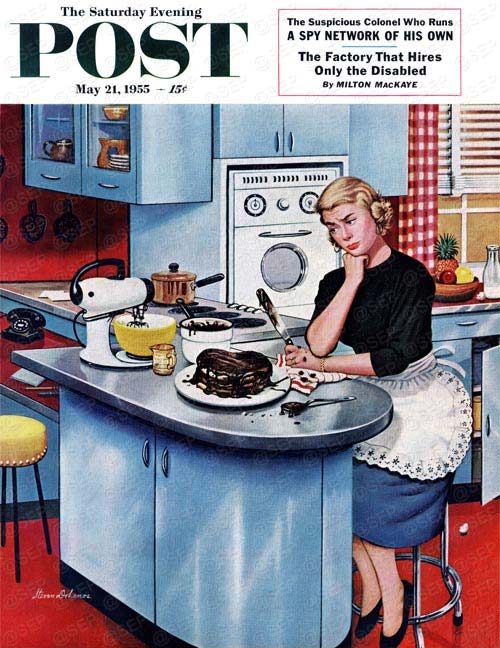
I love that kitchen. I want to live in a time and place where that kitchen exists. This cover is by the great Stevan Dohanos, and it’s so well done you don’t even have to see the date on the cover to know it’s from the 1950s. But it proves you can have all of the most modern appliances in your kitchen and they still won’t guarantee you’ll make a great cake. Even the oven looks shocked at how it turned out.
National Cherry Dessert Day
Today is the day when you can officially eat cherry-inspired desserts, such as these Cherry Oatmeal Cookies or this Cherry Dream Cake. You can also make Mary’s Royal Cherry Trifle. “Mary” is Mary Berry, the tough but fair British food writer and co-host of The Great British Bake Off and The Great American Baking Show.
If you want to pour a latte into one of these desserts, well, I guess I can’t stop you. I don’t think Mary would be too happy about it, though.
Next Week’s Holidays and Events
Memorial Day (May 29)
This Monday isn’t just the unofficial kickoff to summer, the day to fire up the grill and get out the patio furniture and bug spray; it’s also a day to honor our heroes.
National Doughnut Day (June 1)
There are actually two National Doughnut Days (the other is on November 5), but most people consider this day the official day, as this Mental Floss piece explains. But feel free to celebrate both if you really like doughnuts.
Top 10 Late Spring Reads
Every month, Amazon staffers sift through hundreds of new books searching for gems. Here’s what Amazon editor Chris Schluep chose especially for Post readers this spring.
Fiction
Into the Water
by Paula Hawkins
The author of the mega-hit The Girl on the Train is back with more psychological suspense in this new novel about a town and a river that hold forgotten secrets — plus a few discarded bodies.
Riverhead Books
Camino Island
by John Grisham
Taking time off from publishing legal thrillers, Grisham has written a cat-and-mouse beachside caper about stolen F. Scott Fitzgerald manuscripts. This is a great read by a master of his craft.
Doubleday
 Since We Fell
by Dennis Lehane
The Shutter Island author’s latest is the story of a life and a marriage unraveling as a woman is drawn into a conspiracy that she didn’t go looking for and might not have the strength to escape.
Ecco
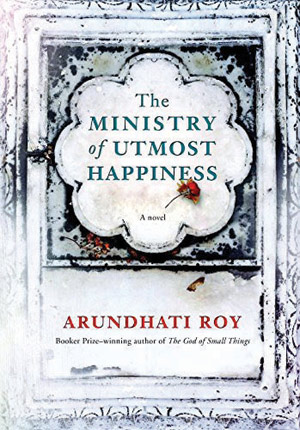 The Ministry of Utmost Happiness
by Arundhati Roy
From the Booker Award-winning author of The God of Small Things comes a tale of intertwined characters in search of meaning, love, and safety against the backdrop of the Indian subcontinent.
Knopf
 The Identicals
by Elin Hilderbrand
Old grudges bubble to the surface as identical twins struggle to confront a family crisis. The twins are so alike and yet so different, and they must decide which distinction matters more.
Little, Brown and Co.
Nonfiction
 Astrophysics for People in a Hurry
by Neil deGrasse Tyson
Even if you’ve never hoped you could understand the nature of space and time, Neil deGrasse Tyson answers the questions of the cosmos in a witty and easily digestible style that keeps you turning pages.
W.W. Norton
 How to Be a Stoic
by Massimo Pigliucci
Stoicism is hot right now, and in this book, Pigliucci argues that the ancient philosophy that has long been associated with suffering is really about learning how to differentiate what you can, and can’t, control in your life.
Basic Books
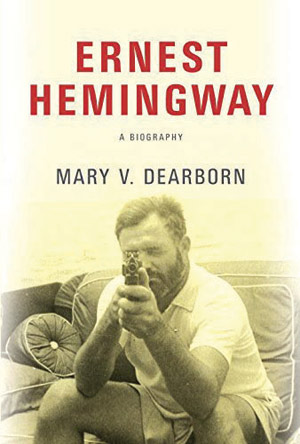

by Mary V. Dearborn
This is the first biography of Hemingway in 15 years — and the first written by a woman. It draws on new material to give the richest and most nuanced portrait yet of one of America’s greatest writers.
Knopf
 Theft by Finding
by David Sedaris
Drawn from decades of diary entries, Sedaris’ latest collection reveals a unique view of the world from a man who turned a grim start as a drug-abusing dropout into a funny, generous, and uncomfortable career as one of our greatest modern observers.
Little, Brown and Co.
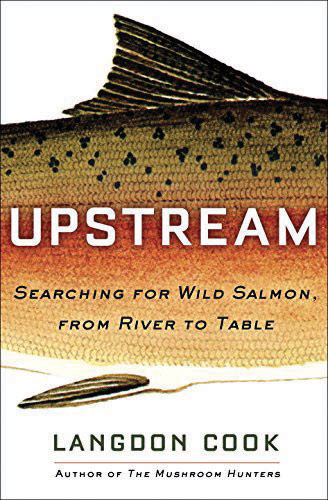 Upstream
by Langdon Cook
Through an exploration of the natural history of his subjects, Cook sets readers at the essential intersection of man, food, and nature in a portrait of the all-important salmon and the places where and people to whom salmon matter most.
Ballantine Books
Ice Out
From the three-second mark on the tape cassette:
“For the record, my name is Brook Tyler, and I’m a detective sergeant with the New Hampshire State Police Major Crimes Unit. Today’s date is Monday, March 27, and the time is 9:05 a.m. With me in this meeting room at the State Police offices on Hazen Drive in Concord is Detective Laura Gadsen and Miriam Wilson, resident of Montcalm, New Hampshire.”
[[Pause as papers are shuffled and the microphone is moved.]]
Q. Miss Wilson, are you prepared to answer my questions?
A. Please, call me Miriam.
Q. All right, Miriam. You’ve been read your Miranda rights, you’ve reviewed them on a handout, and you’ve check-marked and signed each paragraph, and the bottom of the page. So you are fully aware of your rights under the law, correct?
A. Yes.
Q. And you know that at any point, you can halt this questioning, and ask for a lawyer?
A. Interrogation.
Q. Excuse me?
A. Detective Sergeant Tyler, let’s not fool around or play games. This is an interrogation, that’s all, and yet I’m still prepared to answer your questions. So let’s not play around, shall we?
[[Pause]]
Q. Miss — I mean, Miriam, how long have you resided in Montcalm?
A. More than 20 years.
Q. And prior to that?
A. Alexandria, Virginia. I worked for a number of years as a transitional office employee for the government, and I was offered an early retirement, and I took it. However, I was born in Montcalm before I started my career. I really looked forward to coming back home and took the opportunity when I could.
Q. And you ran a business in Montcalm?
A. Correction, I still do run a business … even with the, ah, unfortunate circumstances I find myself in.
Q. And what kind of business is it?
A. You know exactly what kind of business it is.
Q. Please, Miriam, could you just answer the question?
A. No need to get snippy, Detective Sergeant … Anyway, my business is Miriam’s Web. It’s a knitting supply shop. The only one within an hour’s drive in that part of the state.
Q. And in addition to owning this store, you were also president of the Lake Montcalm Chamber of Commerce.
A. You are correct.
Q. And what is the function of the Lake Montcalm Chamber of Commerce?
A. For real?
Q. Miriam, please.
A. Oh, for heaven’s sake, three minutes on the internet and you can see everything we do on our website … but to answer your question, we help promote the businesses around Lake Montcalm and in the village, advertise in various tourist publications, and fund a scholarship for both a male and female student from Montcalm Regional High School.
Q. And how long have you been president of the Chamber of Commerce?
A. Four years.
Q. I see … now, if I can change the subject for a moment … are you aware of a gentleman named Cornelius Pope?
A. No.
[[Pause as voices are raised and there’s crosstalk]]
Q. Miriam …
A. I’m telling the truth. I don’t know of a gentleman named Cornelius Pope. However, I did know of a true jerk named Cornelius Pope. I can tell you that.
[[Pause]]
Q. Go on, Miriam. Please tell us how you came to know Mister Pope.
A. Do you want the long story or the short story?
[[Pause]]
Q. The true story.
[[Laughter]]
A. I’ll tell you the short story, otherwise we’ll be here a week. Pope was a retired professor from UNH. One of those granola-munching types, you know? Ready to protest at the drop of a hat, or announce a boycott of chicken or veal or something silly like that. He opened up a bookstore and café down by the town docks. He called it the Half Moon Café, but we all called it the Communist Café. I mean, we all knew that a bunch of his customers would sneak out back and smoke —
Q. That’s enough, thank you. And wasn’t there a time when Mister Pope became active in the Chamber of Commerce?
A. He did.
Q. And is it fair to say that the two of you had a … contentious relationship?
A. A what?
Q. A contentious relationship. That you didn’t get along.
A. Oh, we certainly didn’t get along, but it wasn’t my fault. I wanted to be friends, but Pope … he had another agenda. He wanted to … make a difference, bless his heart. But I wouldn’t say we were that contentious.
[[Pause]]
Q. Miriam, we’ve reviewed two years’ worth of minutes from the Chamber of Commerce. There were a lot of arguments, name calling, and so forth.
A. Really? Well, if it’s in the minutes, it must be true.
Q. And there were a number of letters he wrote to the Montcalm Gazette, criticizing your leadership of the Chamber of Commerce.
A. That was his right, of course, to publicize what a moron he was.
Q. Miriam, if I may skip ahead —
A. Oh, please do. After all, you’re in charge here.
Q. Thank you. Miriam, I’d like to talk now about the Ice Out Festival.
A. Go right ahead.
Q. Could you explain what the Ice Out Festival is about?
A. Certainly. After all, it was my idea … and I ran it successfully for a number of years before Professor Pope showed up with all his new ideas. You see, by the time spring comes, a lot of us around here are ready for more daylight, warm weather. We have a serious case of cabin fever. So I thought a little festival marking when the ice officially breaks up on Lake Montcalm — that’s called “ice out” — would be a fun way to mark the end of winter. It was quite the success.
Q. Mister Pope didn’t think so.
A. Pope was from away. I didn’t care for his opinion.
Q. But his opinion was that the Chamber and the town could do more. More publicity, advertising, contests, food carts … make it a real festival.
A. A real circus, you mean.
Q. But from the minutes and from reviewing the local newspapers, it seems Mister Pope won the day. Plans were put into place to expand the festival. And you were opposed.
A. I was. It didn’t fit the town, didn’t fit our history. Like I said … it was a circus.
Q. And you resented that?
A. Wouldn’t you?
Q. Miriam, please answer the question.
A. Of course I resented it. I resented it very much. He was from away, he was very bossy, and he didn’t want to fit in. He wanted to run things.
[[Pause]]
Q. All right. Miriam, could you explain how ice out was noted?
A. Noted?
Q. How people knew when the ice had officially broken up for the spring.
A. Oh, I see. You should have been clearer in your questions. Well, what we’ve done for years past, is that we go into the center of Lake Montcalm and secure a buoy that’s eventually frozen in place when the lake starts to freeze. Then, one of those … highway flares is attached to the buoy, and is also attached to the ice. When the ice starts breaking up around the buoy, the flare is lit off, and then you have ice out.
Q. But isn’t that something hard to predict? I mean, you could schedule the festival and ice out wouldn’t occur at the same time.
A. That’s what I said! But Pope said, so what. What difference would it make? And I said it would make a hell of a difference, that the good people coming to the lake, if they didn’t see the flare going off, they would think they got cheated. And Pope said, well, they had a chance to get drunk and have fun, so there you go.
Q. And you also resented that?
A. I certainly did.
[[Pause]]
Q. Miriam?
A. Still here.
Q. Miriam, isn’t it true that Cornelius Pope went missing last fall?
A. I suppose he did.
Q. And did that concern you?
A. Not at all.
Q. And he remained missing all this past winter, correct?
A. Yes.
Q. In fact, he remained missing right until your town’s Ice Out Festival last week, correct? Where by chance, the flare lit off the Sunday morning of the festival?
A. Funny how that happened. I guess Pope might have been right all along.
Q. And something else happened later that day, am I right?
A. Of course you’re right. Or why else would I be here?
[[Pause]]
Q. Miriam, when a reporter from the Montcalm Gazette motored through the broken ice to get a close-up photo of the buoy and discharged flare, something else was there, wasn’t it?
A. That’s what the papers said.
Q. Yes. What were there were the remains of Cornelius Pope. Apparently, he had been dead all that winter, fastened to the buoy.
[[Pause]]
Q. Miriam, do you have any idea of how Mister Pope’s body ended up attached to the buoy?
A. I do.
[[Pause]]
Q. You do?
A. Of course. I put him there.
[[Pause]]
Q. Miriam …
A. Still here.
Q. How in the name … how did he end up there?
A. I motored him out at night … a very clear night, nice full moon, I could see everything though it was damn cold, you knew ice would start forming in a few days … and I got to the buoy, I fastened him to the buoy’s chain with another chain, and with three cement blocks, I tossed him overboard. And I motored back. And then we got a cold front move in and the ice started forming …
[[Pause]]
Q. Didn’t he put up a fight?
A. Excuse me?
Q. Didn’t he put up a fight when you tossed him into the water?
A. Dear me, no.
[[Pause]]
Q. Was he unconscious?
A. Oh, no, he was dead. Quite dead, in fact.
[[Pause]]
Q. Did you murder him, Miriam?
A. No, I did not.
Q. Then how …
[[Pause]]
A. Oh, didn’t I make it clear? Pope committed suicide.
[[Pause]]
Q. Say again?
A. Pope killed himself.
Q. He … did?
A. Yes, he did. Right in my kitchen.
Q. How … I mean … when … I …
A. Shall I tell you the whole story?
Q. Please do.
[[Pause]]
A. Well, he came to me out of the blue that night, wanting to make apologies. He said things had gotten out of hand and wanted to make amends. He… he could be charming, I do admit that. So I reheated a nice tuna casserole and we talked and both had a glass of wine, and then… he got weepy. He said that he and his wife were getting a divorce, he had cheated on her plenty of times with the co-eds, and that the bookstore and café was failing. That he was a failure at everything he did.. and then… well, I couldn’t believe it. He had this little tube and emptied it into his wineglass, swallowed it, and then he just slid to the floor. Dead.
[[Pause]]
Q. And you didn’t call the fire department? Or EMTs?
A. Why? He was dead.
[[Pause]]
Q. And the police? You didn’t call the police?
[[Pause]]
A. A dead man in my kitchen? For real? I didn’t want the scandal.
[[Pause]]
Q. And you thought it would be best to motor out in the middle of the night, fasten his body to the buoy chain, and not tell anyone?
A. That’s right.
Q. But you knew his remains would be found eventually, come spring and Ice Out.
A. Right again, Detective Sergeant.
Q. But… why?
A. Isn’t it obvious?
[[Pause]]
Q. Not really.
A. Oh. You see, Pope, this whole extended festival was his idea. He wanted to make it splashy. Wanted it widely known. And I thought… well, finding his body on the ice-out buoy would certainly do that. I did it in a way of honoring him and his idea.
[[Pause]]
[[Cross-talk]]
Q. Now, wait a minute, wait a minute here…
A. I’m sorry. Who are you?
Q. You know exactly who I am.
A. I’m very sorry, but the older I get, the worse I get with names…
Q. I’m State Police Detective Laura Gadsen, Miss Wilson.
A. Nice to meet you, Detective Gadsen. And you may call me Miriam.
Q. Miss Wilson —
A. Miriam
Q. Please don’t interrupt, Miss Wilson. I was the detective in charge of executing the search warrant at your home and your place of business. And what we found was very interesting.
[[Pause]]
Q. What we found there were hundreds of books, true crime books, mystery fiction. Some with interesting titles, like how to get away with murder.
A. Sorry, I’ve never been one to read those romance novels. I find them dull.
Q. And another thing. Your past work history… you’ve spent time with the FBI, the Secret Service, the Treasury Department… I’m sure you were exposed to many, many interesting examples of crime investigations and forensics. Years worth.
A. Well, I did meet some very interesting people.
Q. I’m sure.
[[Pause]]
Q. All right, Miss Wilson. You’ve told us this… tale of a remorseful Cornelius Pope committing suicide in your kitchen, and of you taking his body out to the lake, to chain it to a buoy and let it rot over the winter… all for announcing his death during the Ice Out Festival. For publicity. To honor his memory. That’s one hell of a story.
A. You know, I do have to agree with you there.
[[Pause]]
Q. Yes, one hell of a story. But let’s look at a simpler story, shall we? A story where for some reason, Cornelius Pope comes to your house. The two of you are alone. A perfect situation for you. Based on your reading, research and work experience, I’m sure you’re aware of a number of poisons that are hard to trace in a victim’s body. Combined that with the fact his remains were immersed in water for several months, it would be nearly impossible to come up with a certain cause of death. It would seem to be the perfect crime, don’t you think?
A. Not really, Detective Gadsen.
[[Pause]]
Q. Miss Wilson, here’s the deal. There’s no way Cornelius Pope came to your house, intent on committing suicide. You got him there on some sort of pretext, poisoned him, and then transported his body out to the ice buoy. You could have dumped in the woods or dumped him in the lake but, no, you wanted a final humiliation, a final revenge. That’s what you did. That’s what really happened. There was no suicide. There was a murder. And you committed it.
[[Pause]]
Q. Miss Wilson, you committed murder, didn’t you?
[[Pause]]
A. Prove it.
End of recording.
Have Americans Ruined Memorial Day?
Memorial Day has always had a problem.
Originally called Decoration Day, it started after the Civil War as a day set aside for Americans to place floral tributes on the graves of soldiers who had died serving their country. May was chosen because it was the month when many flowers were in bloom.
Decoration Day was always observed on May 30, which often fell on a weekday. Many had to take time out of their work schedules to visit a cemetery and pay tribute to America’s heroes.
But in 1968, with the name officially changed to Memorial Day, it was moved to the last Monday in May. It became one of five national holidays that, for the sake of convenience, was tacked onto a weekend.
Had Memorial Day been set in another, cooler month or had it not created a three-day weekend, its purpose might be better remembered. But it occurs just as Americans are ready to start celebrating summer. It is the return of the “outdoor season” and is strongly associated with picnics and barbecues. For the young, its meaning can get lost in the euphoria of the end of school.
The concern that the true purpose of Memorial Day has been lost is not a new one. Americans have been complaining for over a century that the day barely honors the fallen.
In 1872, Eliza Connor, a regular contributor to the Post who wrote under the pseudonym “Zig,” observed that Americans were using Decoration Day like a second Fourth of July. Though the Civil War was just a few years in the past, the purpose of the day was already being obscured by parades, brass bands, fireworks, and, worst of all, politics.
Decoration Day
Zig’s Letters
June 29, 1872Decoration Day, May 30, … ought to be a day sacred to all the holy, gentle feelings of mortal nature, sacred to sweet memories and sweeter hopes. A day when strife, malice, envy, and all evil are banished utterly from our hearts, when, for one day, good should fill men’s breasts wholly. I think that is what those who are gone would wish.
But I fear there isn’t very much reverence for the sacred, gentle emotions in us Americans. There isn’t in us very much reverence for anything, I think, or else we should never turn a day set apart for visiting the graves of our dead friends into a Fourth of July. There is that which is absolutely shocking about the way Decoration Day is coming to be observed. I don’t know how it is elsewhere, but here among us such an infernal hullabaloo was kept up all day that you couldn’t hear your own ears. [Zig wrote from Indianapolis, Indiana.]
At break of day the demonish din began. With the very first peep of light, aye, before it, we were affrighted from our slumbers by a thundering shot-gun cannonade right under our very windows. We bolted out of bed as if we ourselves had been shot, wondering in our scared bewilderment, if a New York mob wasn’t coming, or indeed whether Old Nick himself wasn’t after us.
The shot-gun cannonading increased as the morning wore on, every minute being nearer, clearer, deadlier than before. What on earth could it mean? And it was not for two full hours that I remembered, with a blush for my fellow countrymen, that it was the thirtieth of May — a day sacred to the memory of the blessed dead. Later on in the day, they had processions of policemen, secret societies, and brass bands of music, and processions of citizens in carriages, and ladies and citizens on foot, and the Mayor and Council, and wagon loads of young ones, and that sort of thing, for all the world like a Fourth of July. I don’t particularly remember to have heard any popping of torpedoes or explosions of shooting crackers, but I haven’t a doubt that next year they will go off lively, and I dare say fireworks will be added in the evening, and they will have special Decoration Day plays at the theatre, with dead soldiers in the show. It will be very nice, and just like the progressive spirit of Young America.
But the most sacrilegious feature, the most abominably disgusting feature about Decoration Day is that the office-seekers have turned it into a day for electioneering and the firing-off of their accursed political popgunnery. Some despicable ward politician —and there never was a ward politician who wasn’t despicable — invariably gets hoist of the occasion, and spouts his small buncombe at folks till they are sick. It is simply outrageous. The man who played cards on his grandmother’s coffin was guilty of no greater desecration.
I wonder how the dead soldiers like it.
Every year thousands and thousands of dollars are spent on Decoration Day. It is a day for pomp and vanity and show. Foolish people vie with each other in the number and variety of costly flowers which they purchase, much the same as horse-fanciers seek to out-do each other in the matter of fast trotters.
There has been money enough spent in this foolish rivalry to feed, clothe, and educate every destitute soldier’s orphan in the land. And if departed souls ever can behold the scenes of this life again, I know that many and many a brave man who laid down his life for his country, looks sorrowfully upon the roses which garland his grave on Decoration Day. Because his fellow countrymen and women cover his senseless clay with flowers, and leave the children whom he loved to become outcasts and street Arabs. It is really pitiful to remember how much some of the soldier’s children have lost. And if the money which is thrown away every year on useless pomp and show, were spent to educate the orphan children, to train them to noble, virtuous lives, then our beloved soldiers’ graves would be decked with immortal flowers, and Decoration Day would be crowned with garlands which would grow greener with each succeeding year. Again, I think that is what those who are gone would wish.
ZIG.
On this Memorial Day, some Americans will forget to honor the men and women who died in the country’s service. Others will remember but be unable to decorate a military grave. They can still honor the fallen by keeping a sense of gratitude for what the price our soldiers paid to protect our priceless legacy: life, liberty, and the pursuit of happiness.
Featured image: Decoration Day, 1917. (Library of Congress)
Cover Gallery: American Bridges
From San Francisco to Louisville to Pennsylvania, the beauty and grandeur of America’s bridges is on full display in these gorgeous covers.
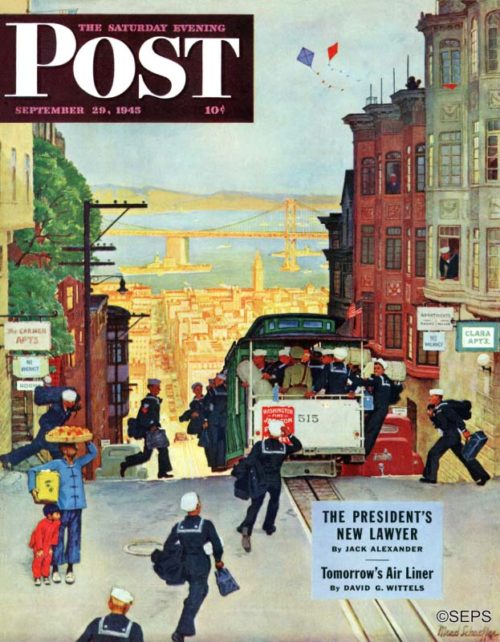
Mead Schaeffer
September 29, 1945
In August of 1945, the city of San Francisco announced plans to dismantle its famous cable car system. The Post was in the thick of the uproar that followed. Mead Schaeffer’s September 29 cover helped “touch off an explosive burst of civic pride” that ultimately saved the cars, as writer Elmont Waite recounts in this article published five months later.
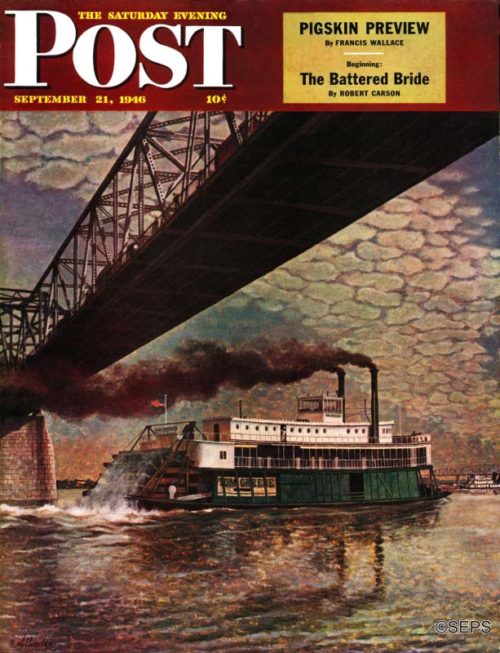
John Atherton
September 21, 1946
John Atherton painted his picture of the stern-wheeler at Louisville, Kentucky, where the Ohio rolls along on its way to join the Mississippi. Atherton enjoyed his stay in Louisville, but lost one of his illusions. A Vermonter, the artist went to Kentucky prepared to find that people there take things pretty easy. He had no sooner taken a preliminary squint at the river boat than a bustling Kentuckian took him in hand and arranged for the artist to work from a barge, which afforded a much better view. While relaxing at lunch, Atherton remarked that the job would take some little time, as he had to do a good deal of wandering up and down the river, in search of the proper site. A second energetic Kentuckian immediately put a car and driver at Atherton’s disposal, so the artist could cover more territory in less time. The motorized painter came back convinced that Kentucky is full of expediters.
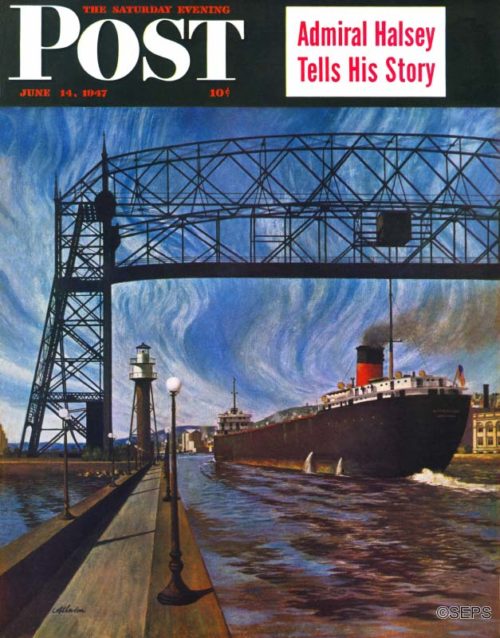
John Atherton
June 14, 1947
John Atherton’s cover painting is a continuation of our family album of American regions. This time he moved north, to the Paul Bunyan country, and thousands will not need to be told that the cover is a view of the husky city of Duluth. This is the ship canal, through which ore boats move out to begin their travels in the Great Lakes. The ore, of course, comes from the great Mesabi Range. Atherton chose a moment when the bridge had lifted to let one of the ore boats pass below. The trip to Duluth is one the artist had hoped for many years to make; he remembered being there as a boy of six, when he was deeply impressed. Not by Duluth’s Bunyanesque role in American industry, however, but with its excellent facilities for sledding.
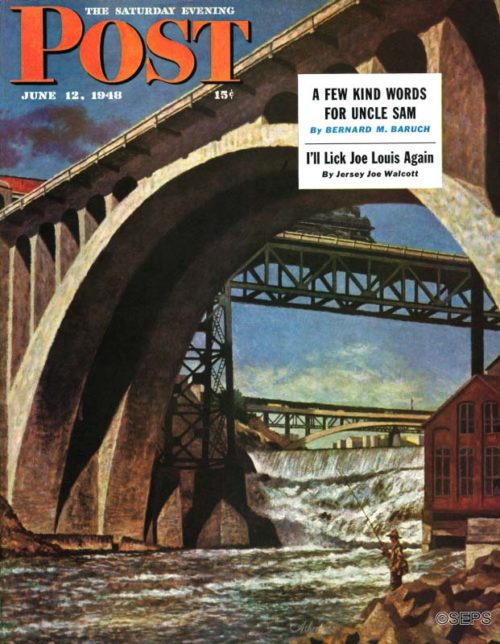
John Atherton
June 12, 1948
John Atherton’s cover painting is another page in our album of American localities; this time the scene is Spokane, and you are looking at the Monroe Street bridge, which is crossed overhead by a railroad bridge. Atherton lived in Spokane in his high-school days, and used to fish at the foot of these falls. In fact, when he needed a model for the fisherman, he dug out a photograph of himself at eighteen. It was the start of a lifelong devotion to fishing, not because Atherton himself had great luck in this river, but because he watched others haul out beautiful fish there—one rainbow trout that weighed nearly ten pounds. Atherton’s grandfather was an early settler and built a flour mill at the falls—the first in that region, Atherton believes.
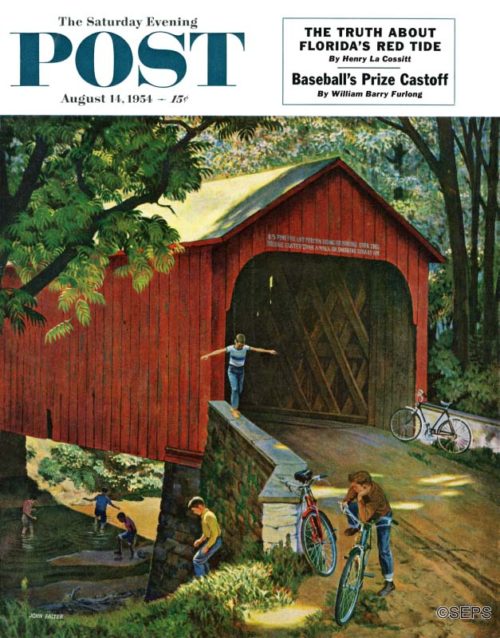
John Falter
August 14, 1954
A lazy summer day, a covered bridge, a crick or creek to play with, and a snake—how can one better define bliss? John Falter painted that bridge from life; its warning of “$5 fine for… smoking segars on” is an old rural Pennsylvaniaism, not a sample of the way the artist himself organizes words.
John Falter
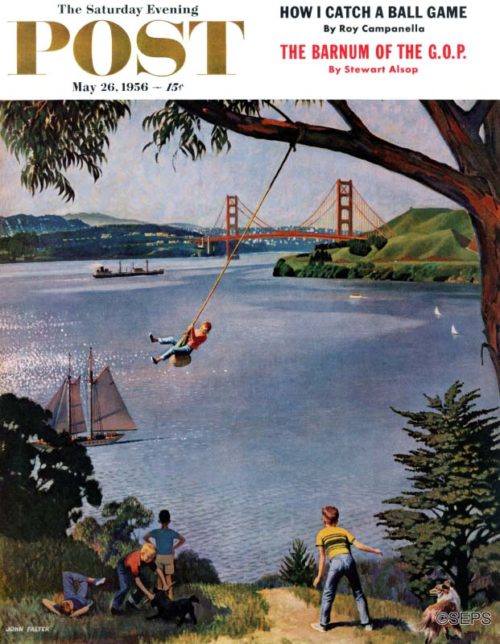
May 26, 1956
When John Falter was strolling along Belvedere Island, admiring the grace of Golden Gate Bridge across the azure bay, he happily discovered that kids still relaxed in the mellow old hair-raising way. Falter’s cliffside home was two blocks to the right of his painting.
Ben Prins
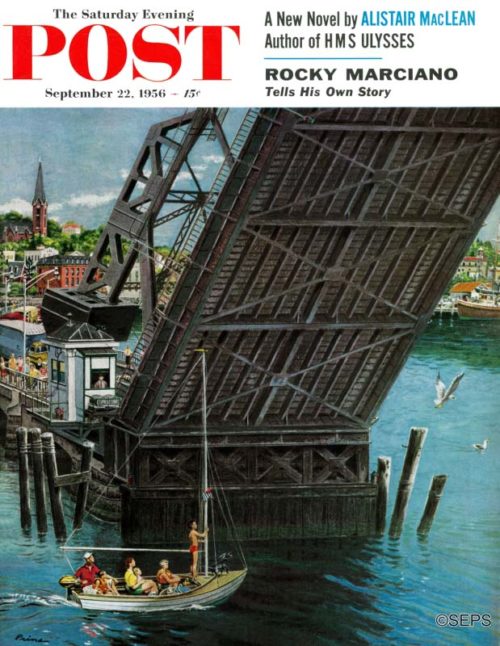
September 22, 1956
Illustrator Ben Prins sat beside a drawbridge for three hours to watch it move, and it never moved a muscle, nothing wanting to go through but a gull. Finally, the kindly bridge tender, saying he’d better test the thing for shimmies anyway, waited till auto traffic was light and flapped it up and down for art’s sake. As no boats were visible, the motorists must have feared the man had gone on a bender.
John Falter
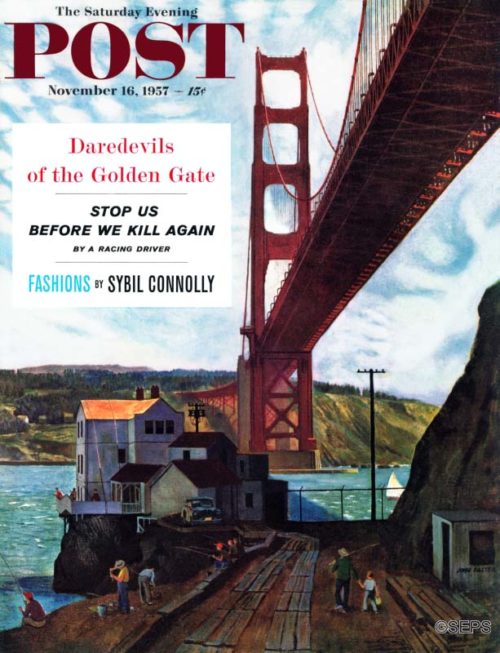
November 16, 1957
To the left across the water: San Francisco, plus the New York Giants. The house is a lighthouse and the cables keep it from taking off for a sail someday. John Falter, who said he was something less than a superb sailor, had helped crew sailboats out through the Gate a few times, and usually had been delighted to regain dry land.
North Country Girl: Chapter 1 — Duluth
For more about Gay Haubner’s life in the North Country, read the other chapters in her serialized memoir. The Post will publish a new segment each week.
In Duluth, a tiny dot on the western tip of that great lake Superior, where I had the good fortune to grow up, each season had its own smell. Spring was definitely here when the purple and white lilacs burst forth, their pervasive old lady fragrance signaling that there would be no more snow and it was time to switch out our house’s storm windows for screens, a twice-yearly job my father dreaded. I held the ladder beneath him, trembling as the “Goddamits!” and “This is horseshits!” rained down.
Summer was the sharp green nose-tickle of new-cut grass, which I loved until I was at an age where the lawn-mowing duty fell on me. I was scared to death of the power mower and its whirling blades, as if it were some kind of wild beast that could wrench itself away and roll over my feet or go after my sisters playing on the other side of the house. In the tidy, upper middle class neighborhoods of Duluth, the lawn had to be mowed weekly to create a perfect carpet of grass. In summer, that grassy scent was always in the air, as dads who were busy playing golf during the weekend would be pushing their lawn mowers back and forth in the long summer twilight after work. A neglected yard meant something inside the house was not right.
Fall was burning leaves, which was done as often as possible purely for the joy of it. Starting in September, stolid Duluthians turned into pagans celebrating the autumn equinox. Every yard up and down Lakeview Avenue was heavily treed and leaves started falling on Labor Day, with the last ones letting go around Halloween. Great piles of dead leaves were amassed in the curbs every fall weekend and we kids would bury each other in them; that dead leaf smell was dry and papery and mingled nicely with the rich, tobacco-y smoke from the piles already burning. Raking the yard was a family project: everyone big enough to hold a rake was given one. Raking was about as permissive parenting as I ever saw growing up. If a little kid did nothing but scatter the leaves further around the yard, a bigger person would patiently follow behind and rake them up again. Once the leaves were configured into huge piles in the streets, we were allowed to jump in, strew them about, and have them cheerfully re-raked again for additional jumping. When the autumnal shadows lengthened east, the last leaves were given a final pile-up and set ablaze. The leaves vanished into smoke and it was time for dinner.
Winter was the bracing iciness of falling snow and cold, a scent that almost wasn’t one, a scent that would freeze your nose hairs together every time you inhaled. This was a wonderful smell if I were ice skating or playing broomball or tobogganing, a miserable one if I was sent out to shovel ten-foot drifts of snow from off our front sidewalk.
***
I was five, too young for yard work when we moved into our first Duluth house, in the Woodland neighborhood. It was a tiny yellow ranch, identical to the neighbors’ on either side except for color. The house was set on a small, almost treeless lot, so there were no piles of autumn leaves to jump in. The smell I remember from that house was sheep shit, which our left side neighbor slathered over his lawn as fertilizer all spring and summer.
The previous owner of our house had planted raspberry canes in the back yard, which had grown into a massive thicket that inflicted a scratch for every berry picked. Down the street was the Woodland Drug Store, with a small soda fountain along the side. My dad took our one car to work, so when I got bored of hanging around our empty yard, and started ordering my little sister Lani to search for raspberries, my mother frog marched Lani and me there for a fountain Coke, a rare treat, as my dentist father did not allow pop at home. As much as I enjoyed the cherry cokes, I loved even more twirling myself around and around on a chrome and red stool till the drug store become a blur and my head swam and my eyes crossed. That combination of sugar and dizziness was my first high.
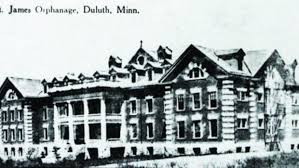
To get to the drugstore, we had to pass by the St. James Orphanage, which looked as formidable as it sounds. I was terrified of that building and the luckless children who lived there. It was as frightening as if it were the St. James Home for Retired Ogres. Up till then, I had thought that orphans were fairy tale creatures, like elves and witches; the idea of losing not one but both parents was scary enough to send me running to the bathroom to pee the second we got to the drug store.
The St. James Orphanage may have inspired my conviction, every time my parents went out at night, that something dreadful would happen and I would never see them again. Or it may have been that I was a morbidly sensitive child. I had a book of Hans Christian Andersen’s fairy tales that was missing both “The Little Match Girl” and “The Little Mermaid.” The orphaned, window-peeking Match Girl watches a happy family gathered round their Christmas tree, uses her last match to try to keep warm, and then freezes to death on the street. The Little Mermaid, after months of feeling as if she were walking on knives on her new feet, bestowed by the sea witch in exchanged for her voice, sees her beloved Prince marry somebody else, dies, and is turned into a bit of foam because she doesn’t have a human soul and so cannot go to heaven. I couldn’t read either story without bursting into inconsolable sobs so my mother’s expedient solution was to tear the gloomy pages out of the book.
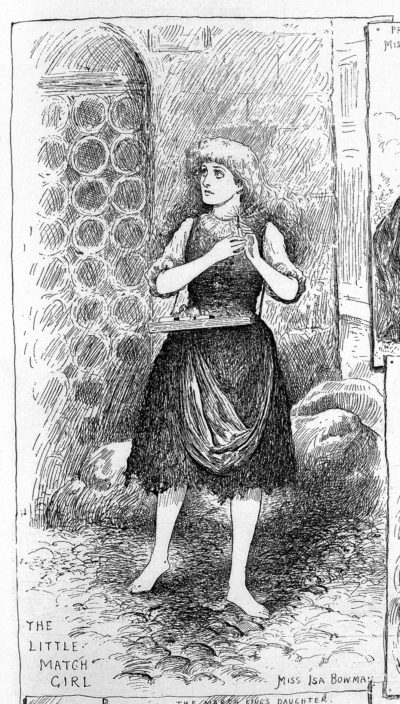
My sister, the feral child Lani, did not move into the Woodland house at the same time as the rest of us. She had been dispatched months before to our maternal grandparents in Aberdeen, South Dakota, while my parents looked for a place to live. Lani had been born in Hawaii, where my dad had spent two years in the army, pulling teeth out of soldiers on Schofield Barracks in Honolulu. Now we were all back in Minnesota (except for the exiled child), and he was ready to start his adult civilian life, in his own practice, and needed to find a home for his cute blonde wife and daughters.
My dad, mom, and I were camped at the other grandparents in Carlton, a town of 400 people half an hour outside of Duluth. My South Dakota grandmother, Nana, loved children, the younger the better, and had unending patience and tolerance for noise and mess. Grandma Marie, my dad’s mother, was only interested in clothes, her golf game, bridge, and daily Mass. While my dad was at work, and my mother stuck driving around with real estate agents looking at houses, I could be safely parked on the sofa with a book, or let out to explore the acres of woodland and plum orchard that surrounded my grandparents’ house. The lovely orchard would later be sacrificed by my grandfather to build a bomb shelter big enough for the entire town of Carlton to wait out a nuclear attack.
My frantic, difficult one-year-old sister was another story. An early and avid walker, she was Houdini-like in her ability to escape adult custody, and would have raced across the wide front lawn in seconds to get to the busy two-lane county road, a road that claimed a dog a year from my grandparents. Lani also cried non-stop and was an even pickier eater than I was. My grandma Marie was not about to give up mass, golf, or bridge to babysit such a creature. Lani was sent off to join the gaggle of grandchildren in Aberdeen, retrieved several months after we had moved into the Woodland house.
7 Presidential Visits That Changed History
Foreign travel has become so integral to the job of the U.S. president that it’s hard to believe the first 25 presidents never left the country while in office.
The first president to do so was Theodore Roosevelt. In November 1906, Roosevelt traveled to Panama to bring attention to the massive construction project the U.S. had undertaken to build the canal. And he didn’t mind grabbing a little press attention for himself.
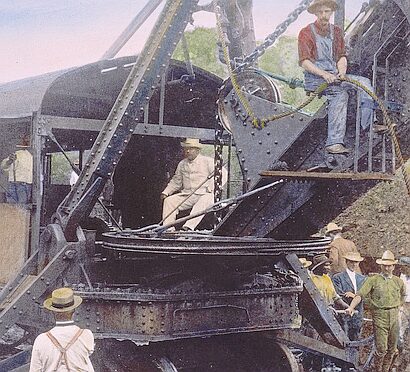

After Roosevelt, every president found a reason for at least one trip abroad. President Franklin Roosevelt made the most trips. His 21 visits to foreign countries, while impressive, were spread over his 12 years as president. In just eight years, President Eisenhower took 17 trips, including one to Korea to see for himself how the war was progressing.
Scores of presidential trips have been taken and forgotten. Here are seven that made a lasting impression on history.
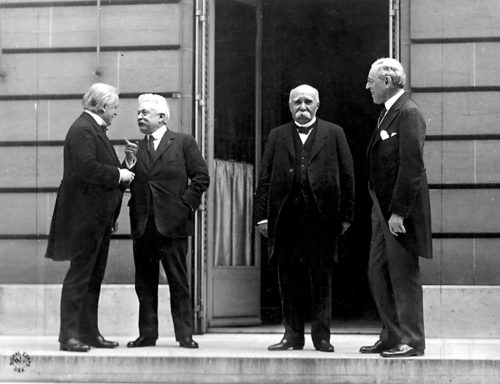
1. Woodrow Wilson — Paris and other European Capitals
December 14–February 24, 1919 and March 14 –June 18, 1919
President Wilson spent half a year abroad, immersed in the politics of Europe. He arrived in Paris intent on building a lasting peace out of the Allied victory in the First World War and brought Fourteen Points he thought would establish lasting, peaceful relations between nations — an effort that led to his winning the 1919 Nobel Peace Prize. But he was outmatched in negotiation by the cynical policies of France and Britain. Contrary to Wilson’s wishes, they dropped crushing reparation fines on Germany, which led to the next world war. And when Wilson finally returned to the States to push for Congress to accept entry into the League of Nations, Congress voted him down, beginning a new period of American isolationism.

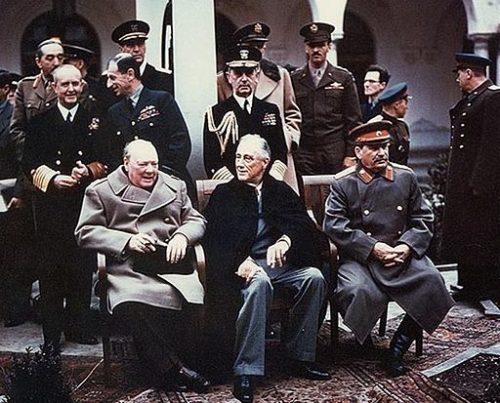
2. Franklin D. Roosevelt — Yalta
February 3–12, 1945
Roosevelt had been the principal coordinator of Allied efforts in previous wartime conferences, but he wasn’t the star in this one. Soviet premier Joseph Stalin managed to walk away with an agreement that would put all of Eastern Europe under Soviet influence. Roosevelt and Winston Churchill expected Joseph Stalin to hold free postwar elections in the countries in this region as a prelude to Russian withdrawal, but Stalin had no intention of leaving. He also managed to enter the war with Japan in exchange for control over several areas within China. From these areas, he was able to ship arms to the communist army in China, helping ensure that they wrested leadership of the country from the Chinese Nationalists.

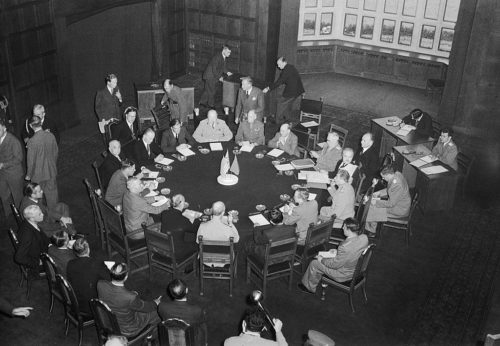
3. Harry Truman — Potsdam
July 16–August 2, 1945
Stepping into the role of America’s negotiator when President Roosevelt suddenly died, Truman worked with Churchill and Stalin to decide the fate of postwar Germany. The country would be divided into four zones of Allied occupation (France was the fourth occupying power). The three leaders also agreed to return refugees to their countries of origin and defined the terms the Allies would demand of Japan before accepting its surrender.

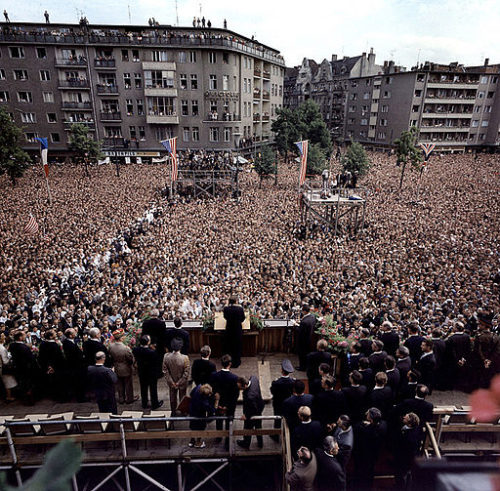
4. John F. Kennedy —Berlin
June 26, 1963
At war’s end, Berlin was divided into four zones, each controlled by a different ally. It soon became obvious that the Russians in East Berlin were only waiting for the other allies to leave before seizing the rest of the city. The fact that West Berlin was a democratic island deep in Russian-occupied East Germany left West Berliners apprehensive of being abandoned. Americans had shown their support of West Berlin by flying in tons of vital supplies when Russia blockaded the city. Yet Berliners wondered how strong America’s commitment to the city was. Then President Kennedy arrived to reassure them of continuing U.S. support, uttering the memorable lines, “All free men, wherever they may live, are citizens of Berlin, and therefore, as a free man, I take pride in the words ‘Ich bin ein Berliner!’”

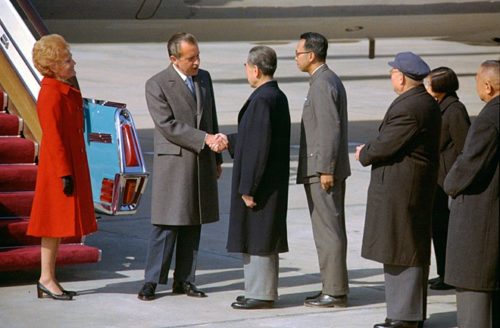
5. Richard Nixon — China
February 21–28, 1972
Relations between communist Russia and communist China had been chummy after World War II, but in the following years, the Chinese began resenting Russia’s proprietary attitude toward them. President Nixon saw this as an opportunity. He believed widening the gap between the countries would encourage Russia to put more effort in pursuing détente with the West. Meanwhile, China saw a Sino-American connection as a way to get back at Russia.
Nixon and Chinese officials worked out a bilateral agreement that would lead to America diplomatically recognizing communist China and cutting ties to its ally, Taiwan.

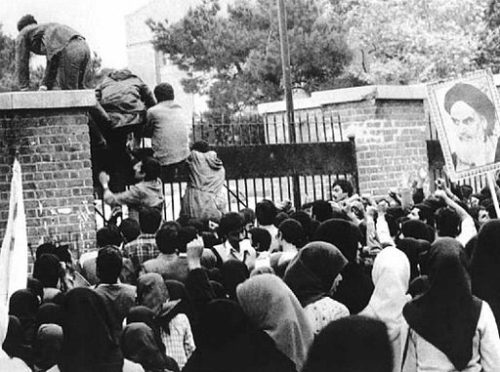
6. Jimmy Carter — Iran
December 31, 1977–January 1, 1978
President Carter visited the Shah and publicly complimented him for creating a stable nation within the turbulent Middle East. Iranian citizens knew better; the Shah remained in power only by the work of a security force that brutally put down all opposition. Iranians felt betrayed by Carter, who had spoked so highly of supporting human rights. When the Shah was deposed the following year, they remembered Carter’s words — and America’s refusal to hand over the Shah — as they stormed the U.S. embassy and took the staff hostage. America’s long support of the Shah is still recalled with bitterness in Iran.

7. Ronald Reagan — Geneva, Switzerland
November 19–21, 1985
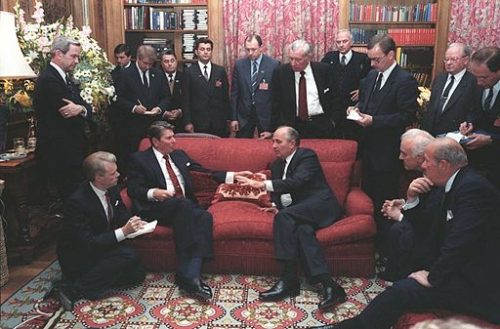
President Reagan had risen in politics on his reputation for bitterly opposing communism and the Soviet regime. But in 1985, at his insistence, he met with General Secretary of the Communist Party of the Soviet Union, Mikhail Gorbachev. The first meeting was contentious, and both leaders exchanged accusations over past differences. But the meeting led to four more that, in time, considerably eased East-West tensions and probably contributed to the collapse of the Soviet empire.

“Steam Tactics” by Rudyard Kipling
“To P.O. Emanual Pyecroft,
“Cape Station: H.M.S. Postulant.
“Dear Pyecroft — This should reach you about the time you turn over to the Hierophant at Zanzibar, and I hope finds you as fit as when we parted. I always thought, as you said three years ago, that it would be a sin and a shame not to make a story out of some of the things that have happened between you and Hinchcliff and me, every time we met.
“Now I have written out some of the tales. Of course, I ought to have stuck to what I knew would go down quietly; but one thing leading to another, I put it all in, and it made six Number One tales. I put in about the reply-telegram at Wool — when you and Cordery tried to help the dumb girl with the pig; I put in about the Plymouth baby — the night after the Belligerent paid off; and I put in about Portland Station and the Captain, and the penny-piece which we saw. Nevertheless, when it was all done, a man that I can trust in the literary line said that, to go down at all, those three last numbers would have to be translated into French; and he recommended me to hand them over to a captain in the French Navy called Loti. I did not care to accede to this, so I took them out and laid them by till happier times, and now people will never know what they have lost. However, enough residuum remains to amuse, if not to instruct; and I can always put the rest into a large, fine book.
“Hinchcliff had the Djinn at the Coronation Review. I met him on the beach afterwards, and I got him to check the story of our trips in the motors. He said he could guarantee your being agreeable to it, if I cut out all about what happened on the Cramberhurst Road, as it would hurt Agg’s feelings. I know, from what you said at the time, that you didn’t care about Agg’s feelings; so I suppose Hinchcliff and Agg have made it up.
“The other two tales you checked yourself, viva voce, before last Manoeuvres; but I put some more to them on my own later, and it is very likely that I have not got all the Navy minutiae quite right. About Antonio, you were not then in a condition to be accurate all through; and about No. 267, I was then in strange surroundings and rather excited myself. Therefore there may be much that is not technically true; but Hinchcliff says I have got the spirit all correct. You will see, as these stories come out, the care that I have taken to disguise your name and rating, and everything else that might reflect upon you. Unless you care to give yourself away, which I have never known you do yet, detection is quite impossible for you or Hinchcliff. Hence I am writing freely, and though accused of extravaganzas by some people, can rest confident that there is much more in these literary efforts of mine than meets the casual eye.
“Yours as before,
“Rudyard Kipling
“P.S. — Since writing the above there has been a hitch about the Antonio tale and the proceedings of No. 267; it being freely alleged that Antonio won’t go down, because it is a bit too thick (this shows how much people know), and 267 would be subversive to discipline as well as likely to annoy admirals. Consequently I have had to begin at the wrong end — with the motor trips — which is about the same as securing arms at the beginning of G.Q.’s, if I am right in my technical inferences. Both you and Hinchcliff will thus suffer from being presented to the public manoeuvring upon the land, which is not your natural element, instead of upon the sea, which is. Me, being an author, am not supposed to have any feelings.”
I caught sight of their faces as we came up behind the cart in the narrow Sussex lane; but though it was not eleven o’clock, they were both asleep.
That the carrier was on the wrong side of the road made no difference to his language when I rang my bell. He said aloud of motor cars, and specially of steam ones, all the things which I had read in the faces of superior coachmen. Then he pulled slantwise across me.
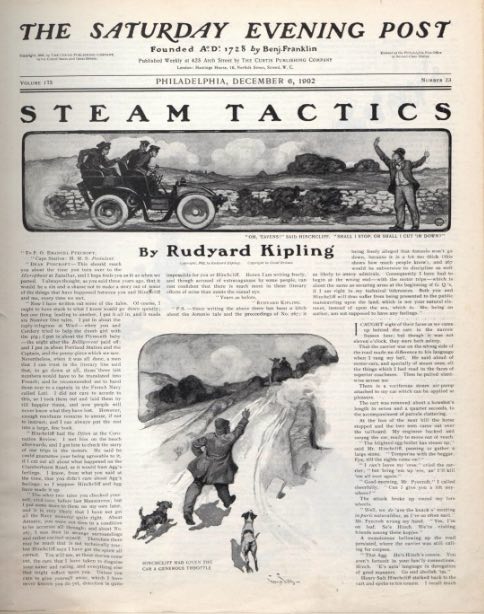
There is a vociferous steam air-pump attached to my car which can be applied at pleasure…
The cart was removed about a bowshot’s length in seven and a quarter seconds, to the accompaniment of parcels clattering.
At the foot of the next hill the horse stopped and the two men came out over the tailboard. My engineer hacked and swung the car, ready to move out of reach.
“The blighted egg-boiler has steam up,” said Mr. Hinchcliff, pausing to gather a large stone.” Temporise with the beggar, Pye, till the sights come on!”
“I can’t leave my ‘orse,” cried the carrier; “but bring ‘em up ‘ere, an’ I’ll kill ‘em all over again.”
“Good-morning, Mr. Pyecroft,” I called cheerfully. “Can I give you a lift anywhere?”
The attack broke up round my fore wheels.
“Well, we do ‘ave the knack o’ meeting in puris naturalibus, as I’ve so often said.” Mr. Pyecroft wrung my hand. “Yes, I’m on leaf. So’s Hinch. We’re visiting friends among these kopjes.”
A monotonous bellowing up the road persisted, where the carrier was still calling for corpses.
“That Agg, He’s Hinch’s cousin. You aren’t fortunit in your fam’ly connections, Hinch. ‘E’s usin’ language in derogation of good manners. Go and abolish ‘im.”
Henry Salt Hinchcliff stalked back to the cart and spoke to his cousin. I recall much that the wind bore to me of his words and the carrier’s. It seemed as if the friendship of years were dissolving amid throes.
“‘Ave it your own silly way, then,” roared the carrier, “an’ get into Linghurst on your own silly feet. I’ve done with you two runagates.” He lashed his horse and passed out of sight still rumbling.
“The fleet’s sailed,” said Pyecroft, “leavin’ us on the beach. Had you any particular port on your mind?”
“Well, I was going to meet a friend at Instead Wick, but I don’t mind — ”
“Oh! that’ll do as well as anything! We’re on leaf, you see.”
“She’ll ‘ardly hold four,” said my engineer. I had broken him of the foolish habit of being surprised at things, but he was visibly uneasy.
Hinchcliff returned, drawn as by ropes to my steamcar, round which he walked in narrowing circles.
“What’s her speed?” he demanded of the engineer.
“Twenty-five,” said that loyal man.
“Easy to run?”
“No; very difficult,” was the emphatic answer.
“That just shows that you ain’t fit for your rating. D’you suppose that a man who earns his livin’ by runnin’ 3o-knot destroyers for a parstime — for a parstime, mark you! — is going to lie down before any blighted land-crabbing steam-pinnace on springs?”
Yet that was what he did. Directly under the car he lay and looked upward into pipes — petrol, steam, and water — with a keen and searching eye.
I telegraphed Mr. Pyecroft a question.
“Not — in — the — least,” was the answer. “Steam gadgets always take him that way. We ‘ad a bit of a riot at Parsley Green through ‘is tryin’ to show a traction-engine haulin’ gipsy-wagons how to turn corners.”
“Tell him everything he wants to know,” I said to the engineer, as I dragged out a rug and spread it on the roadside.
“He don’t want much showing,” said the engineer. Now, the two men had not, counting the time we took to stuff our pipes, been together more than three minutes.
“This,” said Pyecroft, driving an elbow back into the mallow and the scabious of the hedge-foot, “is a little bit of all right. Hinch, I shouldn’t let too much o’ that ‘ot muckings drop in my eyes. Your leaf’s up in a fortnight, an’ you’ll be wantin’ ‘em.”
“Here!” said Hinchcliff, still on his back, to the engineer. “Come here and show me the lead of this pipe.” And the engineer lay down beside him.
“That’s all right,” said Mr. Hinchcliff, rising. “But she’s more of a bag of tricks than I thought. Unship this superstructure aft” — he pointed to the back seat — “and I’ll ‘ave a look at the forced draught.”
The engineer obeyed with alacrity. I heard him volunteer the fact that he had a brother an artificer in the Navy.
“They couple very well, those two,” said Pyecroft critically, while Hinchcliff sniffed round the asbestos-lagged boiler and turned on gay jets of steam.
“Now take me up the road,” he said. My man, for form’s sake, looked at me.
“Yes, take him,” I said. “He’s all right.”
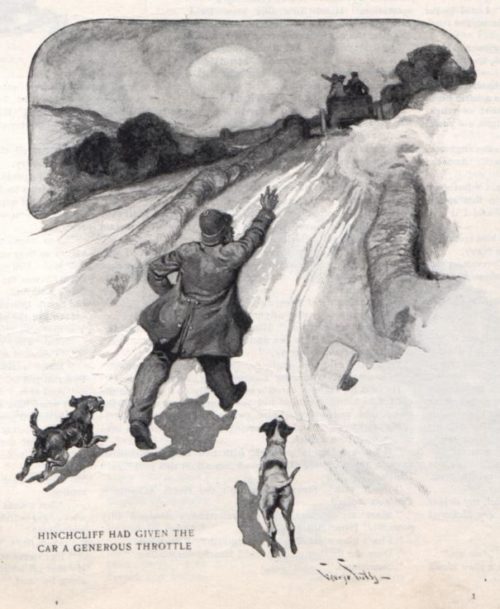 “No, I aren’t,” said Hinchcliff of a sudden — “not if I’m expected to judge my water out of a blighted shaving-glass.”
The water-gauge of a steam-car is reflected on a mirror to the right of the dashboard. I also have found it inconvenient.
“Throw up your arm and look at the gauge under your armpit. Only mind how you steer while you’re doing it, or you’ll get ditched!” I cried, as the car ran down the road.
“I wonder!” said Pyecroft, musing. “But, after all, it’s your steamin’ gadgets he’s usin’ for his libretto, as you might put it. He said to me after breakfast only this mornin’ ‘ow he thanked ‘is Maker, on all fours, that he wouldn’t see nor smell nor thumb a blighted bulgine till the nineteenth prox. Now look at ‘im! Only look at ‘im!”
We could see, down the long slope of the road, my driver surrendering his seat to Hinchcliff while the car flickered generously from hedge to hedge.
“What happens if he upsets?”
“The petrol will light up and the boiler may blow up.”
“‘Ow rambunkshus! And” — Pyecroft blew a slow cloud — “Agg’s about three hoops up this mornin’, too.”
“What’s that to do with us? He’s gone down the road,” I retorted.
“Ye — es, but we’ll overtake ‘im. He’s a vindictive blighter. He and Hinch ‘ad words about pig-breeding this morning. O’ course Hindu don’t know the elements o’ that evolution; but ‘e fell back on ‘is naval rank an’ office, an’ Agg grew peevish. I wasn’t sorry to get out of the cart… ‘Ave you ever considered how when you an’ I meet, so to say, there’s nearly always a remarkable hectic day ahead of us. Hullo! Be’old the beef-boat returnin’!”
He rose as the car climbed up the slope, and shouted: “In bow! Way ‘nuff!”
“You be quiet!” cried Hinchcliff, and drew up opposite. the rug, his dark face shining with joy. “She’s the Poetry o’ Motion! She’s the Angel’s Dream. She’s — ” He shut off steam, and the slope being against her, the car slid soberly downhill again.
“What’s this here? I’ve got the brake on!” he yelled.
“It doesn’t hold backwards,” I said. “Put her on the mid-link.”
“That’s a nasty one for the chief engineer o’ the Djinn, 31-knot T.B.D.,” said Pyecroft. “Do you know what a mid-link is, Hinch?” Once more the car returned to us; but as Pyecroft stooped to gather up the rug, Hinchcliff jerked the lever testily, and with prawn-like speed she retired backwards into her own steam.
“Apparently ‘e don’t,” said Pyecroft. “What’s he done now, sir?”
“Reversed her. I’ve done it myself.”
“But he’s an engineer.”
For the third time the car manoeuvred up hill.
“I’ll learn you to come alongside ‘properly, if I keep you ‘tiffies out all night!” shouted Pyecroft. It was evidently a quotation. Hinchcliff’s face grew livid, and his hand ever so slightly working on the throttle, the car buzzed twenty yards up hill.
“That’s enough. We’ll take your word for it. The mountain will come to Ma’ommed. Stand fast!”
Pyecroft and I and the rug marched up where she and Hinchcliff fumed together.
“Not as easy as it looks — eh, Hinch?”
“It is dead easy. I’m going to drive her to Instead Wick — aren’t I?” said the first-class engine-room artificer. I thought of his performances with No. 267 and nodded. After all, it was a little thing to accord to pure genius.”
But my engineer will stand by — at first,” I added.
“An’ you a family man, too,” muttered Pyecroft, swinging himself into the right rear seat. “Sure to be a remarkably hectic day when we meet.”
We adjusted ourselves and, in the language of Marryat’s immortal doctor, paved our way towards Linghurst, distant by mile-post 11 ¾ miles.
Mr. Hinchcliff, every nerve and muscle braced, talked only to the engineer, and that professionally. I recalled the time when I, too, enjoyed the rack on which he voluntarily extended himself.
And the County of Sussex slid by in slow time.
“‘Ow cautious is the ‘tiffy-bird!” said Pyecroft.
“Even in a destroyer,” Hinch snapped over his shoulder, “you ain’t expected to con and drive simultaneous. Don’t address any remarks to me!”
“Pump!” said the engineer. “Your water’s droppin’.”
“I know that. Where the ‘Eavens is that blighted bypass?”
He beat his right or throttle hand madly on the side of the car till he found the bent rod that more or less controls the pump, and, neglecting all else, twisted it furiously.
My engineer grabbed the steering-bar just in time to save us lurching into a ditch.
“If I was a burnin’ peacock, with two ‘undred bloodshot eyes in my shinin’ tail, I’d need ‘em all on this job!” said Hinch.
“Don’t talk! Steer! This ain’t the North Atlantic!” Pyecroft replied.
“Blast my stokers! Why, the steam’s dropped fifty pounds!” Hinchcliff cried.
“Fire’s blown out,” said the engineer. “Stop her!”
“Does she do that often?” said Hinch, descending.
“Sometimes.”
“Any time?”
“Any time a cross-wind catches her.”
The engineer produced a match and stooped. My car never lights twice in the same fashion. This time she back-fired superbly, and Pyecroft went out over the right rear wheel in a column of rich yellow flame.
“I’ve seen a mine explode at Bantry — once — prematoor,” he volunteered.
“That’s all right,” said Hinchcliff, brushing down his singed beard with a singed forefinger. (He had been watching too closely.) “‘As she any more little surprises up her blighted sleeve?”
“She hasn’t begun yet,” said my engineer, with a scornful cough. “Someone ‘as opened the petrol supply-valve too wide.”
“Change places with me, Pyecroft,” I commanded, for I remembered that the petrol-supply, the steam-lock, and the forced draught were all controlled from the right rear seat.
“Me? Why? There’s a whole switchboard full o’ nickel-plated muckin’s which I ‘aven’t begun to play with yet. The starboard side’s crawlin’ with ‘em.”
“Change, or I’ll kill you!” said Hinchcliff, and he looked like it.
“That’s the ‘tiffy all over. When anything goes wrong, blame it on the lower deck. Navigate by your blighted self, then! I won’t help you anymore.”
We navigated for a mile in dead silence. “Talkin’ o’ wakes — ” said Pyecroft suddenly.
“We weren’t,” Hinchcliff grunted.
“There’s some wakes would break a snake’s back; but this of yours, so to speak, would fair turn a tapeworm giddy. That’s all I wish to observe, Hinch… Cart at anchor on the port-bow. It’s Agg!”
Far up the shaded road into secluded Bromlingleigh we saw the carrier’s cart at rest before the post-office.
“He’s bung in the fairway. ‘Ow’m I to get past?” said Hinchcliff. “There’s no room. ‘Ere, Pye, come and relieve the wheel!”
“Nay, nay, Pauline. You’ve made your own bed. You’ve as good as left your ‘appy ‘ome an’ family cart to steal it. Now you lie on it.”
“Ring your bell,” I suggested.
“Glory!” said Pyecroft, falling forward into the nape of Hinchcliff’s neck, as the car stopped dead.
“Get out o’ my back-hair! That must have been the blighted brake I touched off,” Hinchcliff muttered, and repaired his error tumultuously.
We passed the cart as though we had been all Bruges belfry. Agg, from the post office door, regarded us with a too pacific eye. I remembered later that the pretty postmistress looked on us pityingly.
Hinchcliff wiped the sweat from his brow and drew breath. It was the first vehicle that he had passed, and I sympathised with him.
“You needn’t grip so hard,” said my engineer. “She steers as easy as a bicycle.”
“Ho! You suppose I ride bicycles up an’ down my engine-room?” was the answer.
“I’ve other things to think about. She’s a terror. She’s a whistlin’ lunatic. I’d sooner run the old South Easter at Simon’s Town than ‘er!”
“One of the nice things they say about her,” I interrupted, “is that no engineer is needed to run this machine.”
“No. They’d need about seven.”
“‘Common sense only is needed,’” I quoted.
“Make a note of that, Hinch. Just common sense,” Pyecroft put in.
“And now,” I said, “we’ll have to take in water. There isn’t more than a couple of inches in the tank.”
“Where d’you get it from?”
“Oh! — cottages and such-like.”
“Yes, but that being so, where does our much advertised twenty-five miles an hour come in. Ain’t a fly more to the point?”
“If you want to go anywhere, I suppose it would be,” I replied.
“I don’t want to go anywhere special. I’m thinkin’ of you who’ve got to live with her. She’ll burn her tubes if she loses her water?”
“She will.”
“I’ve never scorched yet, and I ain’t goin’ to begin now.” He shut off steam firmly. “Out you get, Pye, an’ shove ‘er along by ‘and.”
“Where to?”
“The nearest water-tank,” was the reply. “An’ Sussex is a dry county.”
“She ought to ‘ave drag-ropes — little pipe-clayed ones,” said Pyecroft.
We got out and pushed under the hot sun for half a mile till we came to a cottage, sparsely inhabited by one child who wept.
“All out haymakin’, o’ course,” said Pyecroft, thrusting his head into the parlor for an instant. “What’s the evolution now?”
“Skirmish till we find a well,” I said.
“Hmm! But they wouldn’t ‘ave left that kid without a chaperon, so to say . . . I thought so! Where’s a stick?”
A bluish and silent beast of the true old sheep-dog breed glided from behind an outhouse and without words fell to work.
Pyecroft kept him at bay with a rake-handle while our party, in rallying-square, retired along the box-bordered brick-path to the car.
At the garden gate the dumb devil halted, looked back on the child, and sat down to scratch.
“That’s ‘is three-mile limit, thank Heaven!” said Pyecroft. “Fall in, push-party, and proceed with land-transport of pinnace. I’ll protect your flanks in case this sniffin’ flea-bag is tempted beyond ‘is strength.”
We pushed off in silence. The car weighs 1200 lbs., and even on ball-bearings is a powerful sudorific. From somewhere behind a hedge we heard a gross rustic laugh.
“Those are the beggars we lie awake for, patrollin’ the high seas. There ain’t a port in China where we wouldn’t be better treated. Yes, a Boxer ‘ud be ashamed of it.”
A cloud of fine dust boomed down the road.
“Some ‘appy craft with a well-found engine-room! ‘Ow different!” panted Hinchcliff, bent over the starboard mudguard.
It was a claret-coloured petrol car, and it stopped courteously, as good cars will at sight of trouble.
“Water, only water,” I answered in reply to offers of help.”
There’s a lodge at the end of these oak palings. They’ll give you all you want. Say I sent you. Gregory — Michael Gregory. Good-bye!”
“Ought to ‘ave been in the Service. Prob’ly is,” was Pyecroft’s comment.
At that thrice-blessed lodge our water-tank was filled (I dare not quote Mr. Hinchcliff’s remarks when he saw the collapsible rubber bucket with which we did it) and we re-embarked. It seemed that Sir Michael Gregory owned many acres, and that his park ran for miles.
“No objection to your going through it,” said the lodgekeeper. “It’ll save you a goodish bit to Instead Wick.”
But we needed petrol, which could be purchased at Pigginfold, a few miles further up, and so we held to the main road, as our fate had decreed.
“We’ve come seven miles in fifty-four minutes, so far,” said Hinchcliff (he was driving with greater freedom and less responsibility), “and now we ‘ave to fill our hunkers. A pair of stilts would be quicker — my way of thinkin’.”
At Pigginsfold, after ten minutes, we refilled our petrol tank and lavishly oiled our engines. Mr. Hinchcliff wished to discharge our engineer on the grounds that he (Mr. Hinchcliff) was now entirely abreast of his work. To this I demurred, for I knew my car. She had, in the language of the road, held up for a day and a half, and by most bitter experience I suspected that her time was very near. Therefore, three miles short of Linghurst I was less surprised than any one, excepting always my engineer, when the engines set up a most bitter clamour and, spasmodically kicking, refused to rotate.
“Gawd forgive me all the ‘arsh things I may ‘ave said about destroyers in my sinful time!” wailed Hinchcliff, snapping back the throttle. “What’s worryin’ Ada now?”
“The forward eccentric-strap screw’s dropped off,” said the engineer, investigating.
“That all? I thought it was a propeller-blade.”
“We must go and look for it. There isn’t another.”
“Not me,” said Pyecroft from his seat. “Out pinnace, Hinch, an’ creep for it. It won’t be more than five miles back.” The two men, with bowed heads, mooned up the road.
“Look like etymologists, don’t they? Does she decant her innards often, so to speak?” Pyecroft asked.
I told him the true tale of a race-full of ball bearings, strewn four miles along a Hampshire road, and by me recovered in detail. He was profoundly touched.
“Poor Hinch! Poor — poor Hinch!” he said. “And that’s only one of her little games, is it? He’ll be ‘omesick for the Navy by night.”
When the search party doubled back with the missing screw, it was Hinchcliff who replaced it in less than five minutes, while my engineer looked on admiringly.
“Your boiler’s only seated on four little paper-clips like,” he said, crawling from beneath her. “She’s a wicker, willow lunch-basket below. She’s a runnin’ miracle! ‘Ave you ‘ad this combustible spirit-lamp long?”
I told him.
“And yet you was afraid to come into the Nightmare’s engine-room when we was runnin’ trials!”
“It’s all a matter of taste,” Pyecroft volunteered. “But will say for you, Hinch, you’ve certainly got the hang of her steamin’ gadgets in quick time.”
He was driving her very sweetly, but with a worried look in his eye and a tremor in his arm.
“She don’t seem to answer her ‘elm, somehow,” he said.
“There’s a lot of play to the steering-gear,” said my engineer. “We generally tighten it up every few miles.”
“Like me to stop now? We’ve run as much as one mile and a half without incident,” he replied tartly.
“Then you’re lucky,” said my engineer, bristling in turn.
“They’ll wreck the whole turret out o’ nasty professional spite in a minute,” said Pyecroft. “That’s the worst o’ machinery. Man dead ahead, Hindi — semaphorin’ like the flagship in a fit!”
“Oh, ‘Eavens!” said Hinchcliff. “Shall I stop, or shall I cut ‘im down?”
He stopped, for full in the centre of the Linghurst Road stood a person in pepper-and-salt raiment (ready-made) with a brown telegraph envelope in his hands.
“Twenty-three and a half miles an hour,” he began, weighing a small beam-engine of a Waterbury in one red paw. “From the top of the hill over our measured quarter-mile — twenty-three and a half.”
“You manurial gardener — ” Hinchcliff began. I prodded him warningly from behind, and laid the other hand on Pyecroft’s stiffening knee.
“Also — on information received — drunk and disorderly in charge of a motor-car — to the common danger — two men like sailors in appearance,” the man went on.
“‘Like sailors’! . . . That’s Agg. No wonder he smiled at us,” said Pyecroft.
“I’ve been waiting for you some time,” the man concluded, folding up the telegram. “Who’s the owner?” I indicated myself.
“Then I want you as well as the two seafaring men. Drunk and disorderly can be treated summary. You come on.”
My relations with the Sussex constabulary have, so far, been of the best, but I could not love this person.
“Of course you have your authority to show?” I hinted.
“I’ll show it you at Linghurst,” he retorted hotly — “all the authority you want.”
“I only want the badge, or warrant, or whatever it is a plain-clothes man has to show.”
He made as though to produce it, but checked himself, repeating less politely the invitation to Linghurst. The action and the tone confirmed my many-times tested theory that the bulk of English shore-going institutions are based on conformable strata of absolutely impervious inaccuracy. I reflected and became aware of a drumming on the back of the front seat that Pyecroft, bowed forward and relaxed, was tapping with his knuckles. The hardly checked fury on Hinchcliff ‘s brow had given place to a greasy imbecility, and he nodded over the steering-bar. In longs and shorts, as laid down by the pious and immortal Mr. Morse, Pyecroft tapped out: “Sham drunk. Get hint in the car.”
“I can’t stay here all day,” said the constable.
Pyecroft raised his head. Then was seen with what majesty the British sailor-man envisages a new situation.
“Met gennelman heavy sheeway,” said he. “Do’ tell me.”
“British gelman can’t give ‘ole Brish Navy lif’ own blighted ste’ cart. Have another drink!”
“I didn’t know they were as drunk as all that when they stopped me,” I explained.
“You can say all that at Linghurst,” was the answer. “Come on.”
“Quite right,” I said. “But the question is, if you take these two out on the road they’ll fall down or start killing you.”
“Then I’d call on you to assist me in the execution o’ my duty.”
“But I’d see you further first. You’d better come with us in the car. I’ll turn this passenger out.” (This was my engineer, sitting quite silent.) “You don’t want him, and, anyhow, he’d only be a witness for the defence.”
“That’s true,” said the constable. “But it wouldn’t make any odds — at Linghurst, you see.”
My engineer skipped into the bracken like a rabbit. I bade him cut across Sir Michael Gregory’s park, and if he caught my friend, to tell him I should probably be leather late for lunch.
“I ain’t going to be driven by him.” Our destined prey pointed at Hinchcliff with apprehension.
“Of course not. You take my seat and keep the big sailor in order. He’s too drunk to do much. I’ll change places with the other one. Only be quick; I want to pay my fine and get it over.”
“That’s the way to look at it,” he said, dropping into the left rear seat. “We’re making quite a lot out o’ you motor gentry.” He folded his arms judicially as the car gathered way under Hinchcliff ‘s stealthy hand.
“But you aren’t driving!” he cried, half rising.
“No… He ain’t,” said Pyecroft, and embraced him with one anaconda-like left arm.
“Don’t kill him,” said Hinchcliff briefly. “I want to show him what twenty-three and a quarter is.” We were going a fair twelve, which is about her limit.
The passenger said something and then groaned.
“Hush, darling!” said Pyecroft, “or I’ll ‘ave to ‘ug you.”
The main road, white under the noon sun, lay broad before us, running north to Linghurst. We slowed and looked anxiously for a side track.
“And now,” said I, “I want to see your authority.”
“The badge of your ratin’?” Pyecroft added.
“I’m a constable,” he said, and kicked. Indeed, his boots would have bewrayed him across half a county’s plough; but boots are not legal evidence.
“I want your authority,” I repeated coldly. “Some evidence that you are not a common, drunken tramp.”
It was as I had expected. He had forgotten or mislaid his badge. He had neglected to learn the outlines of the work for which he received money and consideration; and he expected me, the taxpayer, to go to infinite trouble to supplement his deficiencies.
“If you don’t believe me, come to Linghurst,” was the burden of his almost national anthem.
“But I can’t run all over Sussex every time a blackmailer jumps up and says he is a policeman.”
“Why, it’s quite close,” he persisted.
“‘Twon’t be — soon,” said Hinchcliff.
“None of the other people ever made any trouble. To be sure, they was gentlemen,” he cried.
“All I can say is, it may be very funny, but it ain’t fair.”
I labored with him in this dense fog, but to no end. He had forgotten his badge, and we were villains for that we did not cart him to the pub or barracks where he had left it.
Pyecroft listened critically as we spun along the hard road.
“If he was a concentrated Boer, he couldn’t expect much more,” he observed. “Now, suppose I’d been a lady in a delicate state o’ health — you’d ha’ made me very ill with your doings.”
“I wish I ‘ad. ‘Ere! ‘Elp! ‘Elp! Hi!”
The man had seen a constable in uniform fifty yards ahead, where a lane ran into the road, and would have said more but that Hinchcliff jerked her up that lane with a wrench that nearly capsized us as the constable came running heavily.
It seemed to me that both our guest and his fellow-villain in uniform smiled as we fled down the road easterly betwixt the narrowing hedges.
“You’ll know all about it in a little time,” said our guest. “You’ve only yourselves to thank for runnin’ your ‘ead into a trap,” and he whistled ostentatiously.
We made no answer.
“If that man ‘ad chose, ‘e could have identified me,” he said. Still we were silent.
“But ‘e’ll do it later, when you’re caught.”
“Not if you go on talking. ‘E won’t be able to,” said Pyecroft. “I don’t know what traverse you think you’re workin’, but your duty till you’re put in cells for a highway robber is to love, honour, an’ cherish me most special — performin’ all evolutions signalled in rapid time. I tell you this, in case o’ anything turnin’ up.”
“Don’t you fret about things turnin’ up,” was the reply.
Hinchcliff had given the car a generous throttle, and she was well set to work, when, without warning, the road — there are two or three in Sussex like it — turned down and ceased.
“Holy Muckins!” he cried, and stood on both brakes as our helpless tires slithered over wet grass and bracken — down and down into forest — early British woodland. It was the change of a nightmare, and that all should fit, fifty yards ahead of us a babbling brook barred our way. On the far side a velvet green ride, sprinkled with rabbits and fern, gently sloped upwards and away, but behind us was no hope. Forty-horse power would never have rolled wet tires up that verdurous cliff we had descended.
“H’m!” Our guest coughed significantly. “A great many cars think they can take this road; but they all come back. We walks after ‘em at our convenience.”
“Meanin’ that the other jaunty is now pursuin’ us on ‘is lily feet?” said Pyecroft.
“Precisely.”
“An’ you think,” said Pyecroft (I have no hope to render the scorn of the words), “that’ll make any odds? Get out!”
The man obeyed with alacrity.
“See those spars upended over there? I mean that wickyup-thing. ‘Op-poles, then, you rural blighter! Keep on fetching me ‘op-poles at the double.”
And he doubled, Pyecroft at his heels, for they had arrived at a perfect understanding.
There was a stack of hurdles a few yards downstream, laid aside after sheep-washing; and there were stepping-stones in the brook. Hinchcliff rearranged these last to make some sort of causeway; I brought up the hurdles; and when Pyecroft and his subaltern had dropped a dozen hop-poles across the stream, laid them down over all.
“Talk o’ the Agricultur’l ‘All?” he said, mopping his brow, “‘tisn’t in it with us. The approach to the bridge must now be paved with ‘urdles owin’ to the squashy nature o’ the country. Yes, an’ we’d better ‘ave one or two on the far side to lead her on to terror fermior. Now, Hinch! Give her full steam and ‘op along. If she slips off, we’re done. Shall I take the wheel?”
“No. This is my job,” said the first-class engine-room artificer. “Get over the far side, and be ready to catch me if she jibs on the uphill.”
We crossed that elastic structure and stood ready amid the bracken. Hinchcliff gave her full steam and she came like a destroyer on her trial. There was a crack, a flicker of white water, and she was in our arms fifty yards up the slope; or, rather, we were behind her pushing her madly towards a patch of raw gravel whereon her wheels could bite. Of the bridge remained only a few wildly vibrating hop-poles, and those hurdles which had been sunk in the mud of the approaches.
“She — she kicked out all the loose ones be’ind her, as she finished with ‘em,” Hinchcliff panted.
“At the Agricultural ‘All they would ‘ave been fastened down with ribbons,” said Pyecroft. “But this ain’t Olympia.”
“She nearly wrenched the tiller out of my ‘and. Don’t you think I conned ‘er like a cock-angel, Pye?”
“I never saw anything like it,” said our guest propitiatingly. “And now, gentlemen, if you’ll let me go back to Linghurst, I promise you you won’t hear another word from me.”
“Get in,” said Pyecroft, as we puffed out on to a metalled road once more. “We ‘aven’t begun on you yet.”
“A joke’s a joke,” he replied. “I don’t mind a little bit of a joke myself, but this is going beyond it.”
“Miles an’ miles beyond it, if this machine stands up. We’ll want water pretty soon.”
Our guest’s countenance brightened, and Pyecroft perceived it.
“Let me tell you,” he said earnestly, “I won’t make any difference to you whatever happens. Barrin’ a dhow or two Tajurrah way, prizes are scarce in the Navy. ‘Ence we never abandon ‘em.”
There was a long silence. Pyecroft broke it suddenly.
“Robert,” he said, “‘ave you a mother?”
“Yes.”
“‘Ave you a big brother?”
“Yes.”
“An’ a little sister?”
“Yes.”
“Robert. Does your mamma keep a dog?”
“Yes. Why?”
“All right, Robert. I won’t forget it.” I looked for an explanation.
I saw ‘is blighted photograph in full uniform on the mantelpiece o’ that cottage before faithful Fido turned up,” Pyecroft whispered. “Ain’t you glad it’s all in the family somehow?”
We filled with water at a cottage on the edge of St. Leonard’s Forest and, despite our increasing leakage, made shift to climb the ridge above Instead Wick. Knowing her as I did, I felt sure that final collapse would not be long delayed. My sole concern was to run our guest well into the wilderness before that Caine.
On the roof of the world — a naked plateau clothed with young heather — she retired from active life in floods of tears. Her feed-water-heater (Hinchcliff blessed it and its-maker for three minutes) was leaking beyond hope of repair; she had shifted most of her packing, and her water-pump would not lift.
“If I ‘ad a bit of piping, I could disconnect this tin cartridgecase an’ feed direct into the boiler. It ‘ud knock down her speed, but we could get on,” said he, and looked hopelessly at the long dun ridges that hove us above the panorama of Sussex. Northward we could see the London haze. Southward, between gaps of the whale-hacked downs, lay the Channel’s zinc-blue. But all our available population in that vast survey was one cow and a kestrel.
“It’s downhill to Instead Wick. We can run her there by gravity,” I said at last.
“Then he’ll only have to walk to the station to get ‘ome. Unless we take off his boots first,” Pyecroft replied.
“That,” said our guest earnestly, “would be theft atop of assault, and very serious.”
“Oh, let’s ‘ang him an’ be done,” Hinchcliff grunted. “It’s evidently what he’s sufferin’ for.”
Somehow murder did not appeal to us that warm noon. We sat down to smoke in the heather, and presently out of the valley below came the thick beat of a petrol-motor ascending. I paid little attention to it till I heard the howl of a horn that has no duplicate in all the home counties.
“That’s the man I was going to lunch with!” I cried. “Hold on!” and I ran down the road.
It was a big, black, black-dashed, tonneaued twelve-horse Octopod; and it bore not only Kysh my friend, and Salmon his engineer, but my own man, who for the first time in our acquaintance smiled.
“Did they get you? What did you get? I was coming into Linghurst as witness to character — your man told me what happened — but I was stopped near Instead Wick myself,” cried Kysh.
“What for?”
“Leaving car unattended. An infernal swindle, when you think of the loose carts outside every pub in the county. I was jawing with the police for an hour, but it’s no use. They’ve got it all their own way, and we’re helpless.”
Hereupon I told him my tale, and for proof, as we topped the hill, pointed out the little group round my car.
All supreme emotion is dumb. Kysh put on the brake and hugged me to his bosom till I groaned. Then, as I remember, he crooned like a mother returned to her suckling.
“Divine! Divine!” he murmured. “Command me.”
“Take charge of the situation,” I said. “You’ll find a Mr. Pyecroft on the quarter-deck. I’m altogether out of it.”
“He shall stay there. Who am I but the instrument of vengeance in the hands of an overruling Providence? (And I put ill fresh sparking plugs this morning). Salmon, take that steam-kettle home, somehow. I would be alone.”
“Filsey,” I said to my man, “help Salmon home with my car.”
“Home? Now? It’s hard. It’s cruel ‘ard,” said Filsey, almost with a sob.
Hinchcliff outlined my car’s condition briefly to the two engineers. Mr. Pyecroft clung to our guest, who stared with affrighted eyes at the palpitating Octopod; and the free wind of high Sussex whimpered across the heather.
“I am quite agreeable to walkin’ ‘ome all the way on my feet,” said our guest. “I wouldn’t go to any railway station. It ‘ud be just the proper finish to our little joke.”
He laughed nervously.
“What’s the evolution?” said Pyecroft, disregarding. “Do we turn over to the new cruiser?”
I nodded, and he escorted our guest to the tonneau with care. When I was in, he sat himself broad-armed on the little flap-seat which controls the door. Hinchcliff sat by Kysh.
“You drive?” Kysh asked, with the smile that has won him his chequered way through the world.
“Steam only, and I’ve about had my whack for today, thanks.”
“I see.”
The long, low car slid forward and then dropped like a bullet down the descent our steam toy had so painfully climbed. Our guest’s face blanched, and he clutched the back of the tonneau.
“New commander’s evidently been trained on a destroyer,” said Hinchcliff.
“What’s ‘is wonderful name?” whispered Pyecroft. “Ho! Well, I’m glad it ain’t Saul we’ve run up against — nor Nimshi, for that matter. This is makin’ me feel religious.” Our impetus carried us halfway up the next slope, where we steadied to a resonant twelve an hour against the collar.
“What do you think?” I called to Hinchcliff.
“‘Taint as sweet as steam, o’ course; but for power it’s twice the Furious against half the Jaseur in a head-sea.”
Volumes could not have touched it more exactly. His bright eyes were glued on Kysh’s hands juggling with the levers behind the discreet backward sloping dash.
“An’ what sort of a brake might you use?” he said politely.
“This,” Kysh replied, as the last of the hill shot up to one in eleven. He let the car run back a few feet and caught her deftly on the brake, repeating the performance cup and ball fashion. It was like being dapped above the Pit at the end of your uncoiled solar plexus. Even Pyecroft held his breath.
“It ain’t fair! It ain’t fair!” our guest moaned. “You’re makin’ me sick.”
“What an ungrateful blighter he is!” said Pyecroft. “Money couldn’t buy you a run like this . . . Do it well overboard!”
“We’ll just trundle up the Forest and drop into the Park Row, I think.” said Kysh. “There’s a bit of good going hereabouts.”
He flung a careless knee over the low raking tiller that the ordinary expert puts under his oxter, and down four miles of yellow road, cut through barren waste, the Octopod sang like a six-inch shell.
“Whew! But you know your job,” said Hinchcliff. “You’re wasted ‘ere. I’d give something to ‘ave you in my engine-room.”
“He’s steering with ‘is little hind-legs,” said Pyecroft. “Stand up and look at him, Robert. You’ll never see such a sight again!”
“Nor don’t want to,” was our guest’s reply. “Five ‘undred pounds wouldn’t begin to cover ‘is fines even since I’ve been with him.”
Park Row is reached by one bill which drops three hundred feet in half a mile. Kysh had the thought to steer with his hand down the abyss, but the manner in which he took the curved bridge at the bottom brought my few remaining hairs much nearer the grave.
“We’re in Surrey now; better look out,” I said.
“Never mind. I’ll roll her into Kent for a bit. We’ve lots of time; it’s only three o’clock.”
“Won’t you want to fill your bunkers, or take water, or anything?” said Hinchcliff.
“We don’t use water, and she’s good for two hundred on one tank o’ petrol.”
“Two ‘undred miles from ‘ome and mother and faithful Fido tonight, Robert,” said Pyecroft, slapping our guest on the knee. “Cheer up! Why, I’ve known a destroyer do less.”
We passed with some decency through some towns, till by way of the Hastings road we whirled into Cramberhurst, which is a deep pit.
“Now,” said Kysh. “We begin.”
“Previous service not reckoned towards pension,” said Pyecroft. “We are doin’ you lavish, Robert.”
“But when’s this silly game to finish, any’ow?” our guest snarled.
“You’ll fall in at six bells all right enough. Don’t worry about the when of it. The where’s the interestin’ point for you, sonny.”
I had seen Kysh drive before, and I thought I knew the Octopod, but that afternoon he and she were exalted beyond my knowledge. He improvised on the keys — the snapping levers and quivering accelerators — marvellous variations, so that our progress was sometimes a fugue and sometimes a barndance, varied on open greens by the weaving of fairy rings. When I protested, all that he would say was: “I’ll hypnotise the fowl! I’ll dazzle the rooster!” or other words equally futile. And she — oh! that I could do her justice! — she turned her broad black bows to the westering sun, and lifted us high upon hills that we might see and rejoice with her. She whooped into still hollows of elm and Sussex weed; she devoured infinite perspectives of grey split-oak park palings; she surged through forgotten hamlets, whose one street gave back, re-duplicated, the clatter of her exhaust, and, tireless, she repeated the motions. Over naked uplands she droned like a homing bee, her shadow lengthening in the sun that she chased to his lair. She nosed up unparochial byways and accommodation roads of the least accommodation, and put old scarred turf or new-raised molehills under her most marvellous springs with never a jar. And since the King’s highway is used for every purpose save traffic, in mid-career she stepped aside for, or flung amazing loops about, the brainless driver, the driverless horse, the drunken carrier, the engaged couple, the female student of the bicycle and her staggering instructor, the pig, the perambulator, and the infant school (where that disembogued on cross-roads), with the grace of Lottie Venne and the lithe abandon of all the Vokes family. But at heart she was ever Judic as I remember that Judic long ago — Judic clad in bourgeois black from wrist to ankle, achieving marvellous improprieties.
We were all silent — Hinchcliff and Pyecroft through professional appreciation; I with a layman’s delight in the expert; and our guest because of fear.
At the edge of the evening she smelt the sea to southward and sheered thither like the strong-winged albatross, to circle enormously amid green flats fringed by martello towers.
“Ain’t that Eastbourne yonder?” said our guest, reviving. “I’ve a aunt there could identify me.”
“Don’t worry her for a little thing like that,” said Pyecroft; and ere he had ceased to praise family love and domestic service, the Downs rose between us and the sea, and the Long Man of Hillingdon lay out upon the turf.
“Trevington — up left — is a fairly isolated little dorp,” I said, for I was beginning to feel hungry.
“No,” said Kysh. “He’d get a lift to the railway in no time… Besides, I’m enjoying myself… Three pounds eighteen and sixpence. Dam’ swindle!”
I take it one of his more recent fines was rankling in Kysh’s brain; but he drove like the Archangel of the Twilight.
About the longitude of Cassocks, Hinchcliff yawned. “Aren’t we ever goin’ to maroon the blighter? I’m hungry, too.”
“The commodore wants his money back,” I answered.
“If he drives like this habitual, there must be a tidyish little lump owin’ him,” said Pyecroft. “Well, I’m agreeable.”
“I didn’t know it could be done. S’welp me, I didn’t,” our guest murmured.
“But you will,” said Kysh. And that was the first and last time he addressed the man.
We ran through Penfield Green, half stupefied with open air, drugged with the relentless boom of the Octopod, and extinct with famine.
“I used to shoot about here,” said Kysh, a few miles further on. “Open that gate, please,” and he slowed as the sun touched the sky-line. At this point we left metalled roads and bucked vigorously amid ditches and under trees for twenty minutes.
“Only cross-country car on the market,” he said, as we wheeled into a straw-yard where a lone bull bellowed defiance to our growlings. “Open that gate, please. I hope the cattle-bridge will stand up.”
“I’ve took a few risks in my time,” said Pyecroft, as timbers cracked beneath us and we entered between thickets, “but I’m a babe to this man, Hinch.”
“Don’t talk to me. Watch ‘im! It’s a liberal education, as Shakespeare says. Fallen tree on the port bow, sir.”
“Right! That’s my mark. Sit tight!”
She flung up her tail like a sounding whale and buried us in a fifteen-foot deep bridle- path buttressed with the exposed roots of enormous beeches. The wheels leaped from root to rounded boulder, and it was very dark in the shadow of the foliage.
“There ought to be a hammer-pond somewhere.” Kysh was letting her down this chute in brakeful spasms.
“Water dead ahead, sir. Stack o’ brushwood on the starboard beam, and — no road,” sang Pyecroft.
“Cr-r-ri-key!” said Hinchcliff, as the car on a wild cant to the left went astern, screwing herself round the angle of a track that overhung the pond. “If she only ‘ad two propellers, I believe she’d talk poetry. She can do everything else.”
“We’re rather on our port wheels now,” said Kysh; “but I don’t think she’ll capsize. This road isn’t used much by motors.”
“You don’t say so?” said Pyecroft. “What a pity!”
She bored through a mass of crackling brushwood and emerged into an upward sloping fern-glade fenced with woods so virgin, so untouched, that William Rufus might have ridden off as we entered. We climbed out of the violet-purple shadows towards the upland where the last of the day lingered. I was filled to my moist eyes with the deep, instriking beauty of sense and association that clad it all.
“Does ‘unger produce ‘allucinations?” said Pyecroft in a whisper. “Because I’ve just seen a sacred ibis walkin’ arm-in-arm with a British cock-pheasant.”
“What are you panickin’ at?” said Hinchcliff. “I’ve been seein’ zebra for the last two minutes, but I ‘aven’t complained.”
He pointed behind us, and I beheld a superb painted zebra (Burchell’s, I think), following our track with palpitating nostrils. The car stopped and it fled away. There was a little pond in front of us from which rose a dome of irregular sticks crowned with a bluntmuzzled beast that sat upon its haunches.
“Is it contagious?” said Pyecroft.
“Yes. I’m seeing beaver,” I replied.
“It is here!” said Kysh, With the air and gesture of Captain Nemo, and half turned.
“No — no — no! For ‘Eaven’s sake — not ‘ere!” Our guest gasped like a sea-bathed child, as four efficient hands swung him far outboard on to the turf. The car ran back noiselessly down the slope.
“Look! Look! It’s blighted sorcery!” cried Hinchcliff.
There was a report like a pistol-shot as the beaver dived from the roof of his lodge, but we watched our guest. He was on his knees, praying to kangaroos. Yea, in his bowler hat he kneeled before kangaroos — gigantic, erect, silhouetted against the light — four buck-kangaroos in the heart of Sussex!
And we retrogressed over the velvety grass till our hind-wheels struck well-rolled gravel, leading us to sanity, main roads, and, half an hour later, the “Grapnel Inn” at Horsham.
. . . . . . .
After a great meal we poured libations and made burned offerings in honor of Kysh, who received our homage graciously, and, by the way, explained a few things in the natural history line that had puzzled us. England is the most marvellous foreign country in the world, but one is not trained to accept kangaroos or zebras as part of her landscape.
“An’ you say there’s three or four o’ these amateur zoological gardens in England kep’ up by gentlemen o’ fortune for love o’ natural history?” said Hinchcliff.
“We’ll drink all their healths as public benefactors ranking with but after you, Mr. Kysh. Of course these Chillingham bulls you talk about (in Norfolk, ain’t it?) would ‘ave developed more power in continuous steamin’, but for surprise parties you can raise steam quicker on kangaroos.”
When we went to bed, Pyecroft pressed my hand, his voice thick with emotion.
“We owe it to you,” he said. “We owe it all to you. Didn’t I say we never met in pup-pup-purls naturalibus, if I may so put it, without a remarkably ‘ectic day ahead of us?”
“That’s all right,’’ I said. “Mind the candle.” He was tracing smoke-patterns on the wall.
“But what I want to know is whether we’ll succeed in acclimatisin’ the blighter, or whether the keepers’ll kill ‘im before ‘e gets accustomed to ‘is surroundin’s?”
Someday I think we must go up the Linghurst Road and find out.
Post Travels: A Brief Visit to Ireland
Saturday Evening Post editorial director Steve Slon travels through Ireland, sharing his daily adventures.
Day 1: Getting There
Day 2: Being There
Day 3: A Bit of a Diversion
Day 4–6: The Wild Atlantic Way
An Interview with Mario Andretti
Post editorial director Steve Slon interviews Mario Andretti about growing up in a World War II refugee camp, falling in love with racing, and drinking his first milkshake in America.
You should also check out our profile on Andretti in the Post‘s May/June issue, as well as a an article we did on the racer back in June 1967.
Why Mario Andretti Is the Greatest Race Car Driver of All Time
For more on Mario Andretti, don’t miss Post Editorial Director Steve Slon’s interview with the IndyCar legend. We also republished a June 1967 profile on the racer by John Skow, “Dueling with Slingshots at 180 MPH”.
If you want to talk about Mario Andretti, start with the number 111. It’s a powerful number on the face of it, combining the number 1 and lucky 11. It’s also the number of checkered flags Mario took in his legendary five-decade career. Few can rival his accomplishments. He could make a bad car competitive and a competitive car victorious — on any track, on any surface — including ovals, road courses, drag strips, dirt, and pavement. He won some of the greatest races in the world, including the Indianapolis 500 and the Daytona 500. He was Formula One World Champion. He was the IndyCar National Champion four times. He was a three-time winner at Sebring and won the Pikes Peak Hill Climb. He won races in sports cars, sprint cars, and stock cars.
As far as honors go, let’s just say the trophy case is full to bursting. Andretti was named Driver of the Year in three different decades (the ’60s, ’70s, and ’80s), Driver of the Quarter Century (in the ’90s), and Driver of the Century in 2000. A fearsome competitor, he’s surprisingly modest about the accolades. “Well, you know,” he says, a trace of an accent betraying his immigration from Italy in 1955, “it’s the ultimate compliment to receive these honors. And I don’t say that lightly. I competed against racers I admired and drew inspiration from. So to be the one selected, I can only say, ‘Oh my God!’”
That phrase, “Oh my God!” is a frequent one. It comes up when talking about how overwhelmed he was to win a race or even to realize his youthful dream of competing in auto racing at all. It also comes up when he talks about the miracle of coming to this country at 15 and adopting it for his own, becoming an exemplar of the American Dream. But the expression never seems overused, because so many of Andretti’s experiences have an actual oh-my-God quality to them.
The future superstar of racing and his twin brother were born in Montona, Italy, in 1940. Montona, which is now part of Croatia, is about 35 miles from the city of Trieste, inland from the Adriatic Sea. Their father was self-employed and had made a decent life for the family owning and managing seven farms — mostly wheat fields and grapes.
World War II broke out around the time the twins were born. Even when the war ended, there was no peace because the borders were in dispute, as they always are following war. In 1945, Montona was ceded to communist Yugoslavia, “So our life changed dramatically,” Andretti says. “All our land was taken by the state. It was one thing for my parents to know deep down that they would never amount to anything under communist rule — and quite another to make a move. And move where? We stuck it out for three years hoping that the only world we had ever known would right itself.”
But when things hadn’t changed by 1948, the family of five, including Mario and his twin brother, Aldo, and their older sister, Anna Maria, traveled back to Italy. This was permitted as long as they didn’t take anything with them. Their first stop was a central dispersement camp in Udine. About a week later, they were transferred to a refugee camp in the medieval Tuscan town of Lucca.
For seven years, from 1948 until 1955, the Andrettis lived in the refugee camp that held 5,000 families. They shared a large room with about 25 other families, their quarters separated by blankets.
It was while living in Italy that the brothers fell in love with car racing. “In the town square, there was a parking garage,” Andretti says. “Aldo and I used to hang out there after school, and that’s actually where we learned to drive. The garage was always packed, and the cars parked in tight rows because space was such a premium. Businessmen who worked in the city would valet their cars and leave them for the day. Pretty soon, the two guys who owned the garage allowed us to park the cars. We would jump into these Lancias and Alfas and do burnouts! To this day, I’m wary of valet parking because I know what we used to do. We would practice standing starts, you know, like Formula One!”
The two guys who owned the parking garage further indulged the young racing fans by taking them to see local races like the Giro di Toscana. And one of Mario’s fondest memories is the sports car race called the Mille Miglia, a 1,000-mile lap around Italy. “One of the segments ran through the Abetone pass, near Florence. Every year, my brother and I would watch from the side of the road. Back home we would talk about nothing else for weeks. We were so jacked up.” Then in 1954 the fellows who owned the parking garage took the Andretti twins to the Italian Grand Prix in Monza. The boys were only 14, but the die was cast. Mario saw his idol, Alberto Ascari, and told himself: I’ll be back here someday.
Now all the while, their father was determined to move the family to America. It was going on seven years since they had been in the camp (for Mario and Aldo, that was age 8 to age 15). Then, all of a sudden, their visas came through and their parents gave them the news: We’re moving to America. An Uncle Tony who lived in Nazareth, Pennsylvania, said he would sponsor them, a commitment that included the guarantee of a job and a place to stay.
On the morning of June 16, 1955, the Andrettis arrived in New York Harbor on the ocean liner Conte Biancamano. “It was a beautiful morning, my sister’s 21st birthday, as we sailed under the Statue of Liberty,” Mario recalls. “The backdrop of the city looked so beautiful, colorful, with all the yellow cabs flying around. My cousin Johnny picked us up with a Plymouth station wagon.”
It was an immediate culture shock to be sure, more so for Mario’s dad than for the kids. “Along the way, we stopped for lunch at one of those typical chrome diners. We didn’t know what to order, and we didn’t speak much English, so Johnny ordered for us, some hamburgers and things. Now, my dad had a very sophisticated palate — he said the hamburgers tasted like cardboard. But Johnny ordered a milkshake for us kids. I’d never tasted anything like that before! Oh my God, I loved the milkshake!”
As fate would have it, their new home was not far from the Pennsylvania state fairgrounds. And inside the fairgrounds, lo and behold, was a race track. “We arrived in Nazareth on a Thursday,” recalls Andretti. “But on Sunday, after church, we were at Uncle Tony’s house, and about a mile away there are these bright lights, and all of a sudden in the background, we hear this big roar. I looked at Aldo and he looked at me and we just booked!”
They followed the noise until they reached the fairgrounds. “Looking through the fence, we see these brute-looking cars, not very sophisticated like grand prix cars we had seen in Italy. But they were fast as hell!”
They resolved to get into a race there. But how? “When you have that desire,” says Andretti, “it supersedes reason. You just go out there and somehow you get it done. We just wanted to do it so bad. Now, there are three ways to get a car: Steal it (against our principles), buy it (we didn’t have any money), or build it. We were in manic pursuit to build a car.”
They worked part-time at a gas station to put some money together, and by 1959, they had built a racing machine from a 1948 Hudson Hornet Sportsman stock car. Andretti credits his science-minded buddy Charlie Mitch for helping them think big about the project. Most of the other drivers on this local circuit were driving rebuilt Fords and Chevys, modified with big tires and big engines. Charlie said, “Instead of building cars like everyone else’s, let’s do something special.”
Charlie and the brothers got in touch with a NASCAR team driving Hudsons that had developed an ideal “setup” for the car — a program for tuning, wheelbase, suspension, and so forth. The boys bought the professional setup and built their car to those specs. Their car was different, and so was their appearance. “Everybody looked very scruffy, wearing jeans and T-shirts. But Aldo and I got ourselves racing uniforms from Salas Sports in Italy, one white and one blue, with all kinds of zippers so they looked official. We had the two guys from the parking garage send them to us.”
To the other competitors at this dirt track in rural Pennsylvania, they might as well have been from Mars. “People asked, ‘Where are you guys from?’ And we said, ‘Oh, we’re from Italy. We used to race there,’ which was, of course, total B.S.”
Also total B.S. were their driver’s licenses. By the time their car was ready to race, they were still two years shy of 21, which was then the minimum age for racing. They managed to get help changing their birth dates on the licenses — something that would almost derail their careers later on.
But now, they were ready to go.
Only one of them could drive in that first race. “Aldo and I had to toss a coin. He won the toss. I was actually glad,” Mario admits. “I was very nervous. I knew if he did well, I’d have a shot to do well at the next race. I was perfectly happy to watch.”
Because the boys had no track record, the promoters started Aldo last in the heat race, a 16-car trial with 10 laps. “He went out there and won the heat!” Andretti recalls. “Oh my God! I could not believe my eyes.”
The winner of the heat was paid $25 immediately.
“Then, they started him last in the feature race, and he won that too!”
The feature race paid $125. And the following week, it was Mario’s turn to drive and he repeated the same trick, winning both his heat and the feature. Between them, the boys had won $300 in two weeks’ time. Which was nice because they had run up about $1,000 in debt building their car.
The brothers became a formidable team, taking turns racing the Hudson on the minor league circuit. Then tragedy struck. Near the end of the 1959 season, Aldo was fighting for the lead in a race when he flipped over the guardrail, flinging the car end over end. He was taken to the hospital with a fractured skull. The doctors weren’t sure he’d make it, and a priest was called to administer last rites.
Their father was furious because he didn’t know the boys were racing. He had absolutely forbidden it because he felt it was too dangerous, so the boys had concealed their car-building project, working on the Hudson in a neighbor’s garage.
Aldo was in a coma for two long, scary months. When he finally awoke, his first words to Mario were, “I’m glad you were the one who had to face the old man!”
A year later, their new car was ready to go, and by then, their dad had come around a little bit. “He started realizing we were going to do this no matter what, so he might as well give in and join the party,” recalls Mario. “The way he did it was funny. After a race, he’d say to Aldo, ‘How did Mario do?’ and then he’d ask me, ‘How did Aldo do?’ For a while, he never asked directly.”
The boys kept racing, and they kept winning. Mario won 20 races in the sportsman stock car class in those first two seasons. Then, in 1961, the twins crossed the magic threshold of 21 years of age. “The reason we got away with fudging our age for so long was that these were local tracks, not sanctioned races,” Andretti explains. “But by the time I was 21, I didn’t want to be 23! In fact, I had a hell of a time getting back to 21!”
Mario’s first victory of consequence came the following year, on March 3, 1962, a 100-lap feature TQ Midget race at Teaneck, New Jersey. Then, on Labor Day in 1963, he won three midget features on the same day — one at Flemington, New Jersey, and two at Hatfield, Pennsylvania.
Midway through 1964, Mario finally was in a situation to gain national attention. His opportunity came when one of the drivers for an elite professional team was injured and Mario took over his seat. “That’s how it often worked,” Andretti says matter-of-factly. “You almost waited for a driver to get hurt (or worse) to get that chance.”
So for the second half of that season, Mario found himself racing against the best drivers in the world, driving the fastest cars of the day, on what is now known as the IndyCar circuit. It was the kind of challenge he’d dreamed of since he was a boy. “Finally I was able to compete against drivers like A.J. Foyt, Roger McCluskey, and so many others,” he recalls. “That first year, I had some good finishes, one third-place finish, and I won a 100-lap race at Salem, Indiana.”
Another personal triumph also occurred in 1964: Their dad finally came to watch Mario race. It was the first time he saw his son in action. It was also one of the first times Andretti raced against the elite of his sport. “I ended up finishing 11th, which I thought was okay,” Andretti says. “And I expected him to be very encouraging and say, ‘Hey you did really well against all these top dogs.’ Instead, he was disappointed. ‘I thought you were winning races!’”
In 1966, after 11 years in America, the Andrettis applied for U.S. citizenship. “We felt we were solidly established and this was going to be our home for the rest of our lives, and we were thankful for that,” Mario says. In the years that followed, Mario’s achievements would become legendary: The world watched as he won the top NASCAR race (the Daytona 500) in 1967, the top IndyCar race (the Indianapolis 500) in 1969, and the Formula One World Championship in 1978 — an unprecedented trifecta. To this day, no other race car driver has ever won all three titles.
The sad part about this story is that it didn’t work out for Aldo. He had a second accident in 1969, after which he was hospitalized for several weeks and suffered such severe facial injuries that he and Mario no longer looked like identical twins. It was the end of racing for Aldo. “He had worked just as hard as me,” Mario says. “And he had wanted it just as bad. It’s hard for me to put into words how tough this was.”
In the ’80s, Mario teamed up with his son Michael, establishing the first-ever father-son front row in qualifying for the 1986 Phoenix IndyCar event. In the 1990s, with his two sons (Michael and Jeff) and his nephew (John Andretti), Mario made another first as the four family members competed in the same IndyCar race at Milwaukee, June 3, 1990. The following year, the four Andrettis raced against one another for the first time in the Indianapolis 500. Jeff was voted Rookie of the Year, joining Mario (1965), Michael (1984), and years later Michael’s son Marco (2006) as the only four members of the same family to win the award.
In 1993, he won at Phoenix, becoming the oldest driver (at age 53) to win an IndyCar race. Mario retired from full-time racing in 1994, but he still works nearly every day, doing high-speed testing for Honda and making appearances for such national brands as Firestone, Bridgestone, Honda, and GoDaddy. You’ll find his name on a winery in Napa Valley and a petroleum business in California. And he’s still tearing up the track in the Honda-powered two-seat IndyCar with Lady Gaga, Donald Trump, and other VIPs as his passengers. “My wife says, ‘When are you going to grow up?’” he says with a laugh.
It’s been a great career and a charmed life, but not without personal tragedy. As mentioned, his two sons, Jeff and Michael, followed him into auto racing. While Michael became successful as a driver and now as owner of the Andretti Autosport race team, featuring his own son Marco as a driver, Jeff suffered a devastating crash in Indianapolis that ended his career, nearly costing him his legs.
While Mario himself never experienced a serious injury, he did wreck his fair share of race cars. One crash that still haunts him came during a Formula One race in Belgium in 1977. As he told the online racing magazine The Player’s Tribune, “It began to rain just before the start of the race. I had won two of the last three races and I felt like I was in a good early position to distance myself in points in the world championship standings. I was on pole in my Lotus, side by side with John Watson in his Alfa Romeo. It was a standing start. At the green light, I got too much wheel spin on the wet track and he beat me off the line — one of the very few times I got beat off the line. As I approached Turn 3 — still pissed that he beat me off the line — I thought, I’m gonna go get him.”
But when he tried to make a move, he bumped Watson, and they both spun out and were out of the race. The experience was instructive: “You can’t win a race on the first lap. But you can lose it,” he says today, adding, “you wish you had that one back.”

Considering the dangers of auto racing, did Andretti ever have qualms about putting not just himself on the line, but his brother, his sons, his nephew, his grandson? “No question, it’s a dangerous sport,” Mario says. “Did we dwell on it? No. We know of the hazard, but if you’re going to race, you have to accept that fact. You have to be willing to take the risk to reach your goals.”
What is the distinctive quality that makes him one of the greatest drivers of all time? “I have a clear thought about that,” Andretti says. “I loved driving. I wanted to do it so bad, oh my God, you have no idea! It goes back to the days when I was watching my idol Ascari on the track. I thought to myself, I would give anything, a limb, to be able to do that someday! And when it started happening, I felt so blessed and so fortunate. My passion and desire for the sport is unequaled anywhere. I still do love it. It all goes back to the fact that I had to overcome not just the obstacles, but I had to try to impress even my own father. I had to show him, ‘Dad, you have to realize how much I really want this.’”
Mario Andretti, who didn’t arrive in this country until age 15, today is as patriotic an American as you’ll find anywhere. “I represent a shining example of the American Dream, an immigrant who came to this country and this country gave me the opportunity to satisfy the ultimate dream,” he says. “When you look back at the tragedy of World War II, the tragedy of having to leave your home, the tragedy of having to live for seven years in a refugee camp — oh God, the living conditions — but all of that negative turned into a beautiful positive for us.”
Only in America?
Andretti answers: “I don’t think it could have happened anywhere else.”
Also read our June 3, 1967, profile of Mario Andretti from the Post‘s archive.
Steven Slon is the editorial director for The Saturday Evening Post. He wrote about Alaska in the March/April issue. Follow him on Twitter @steveslon.
This article is featured in the May/June 2017 issue of The Saturday Evening Post. Subscribe to the magazine for more art, inspiring stories, fiction, humor, and features from our archives.
Post Travels: A Brief Visit to Ireland — Day 3: A Bit of a Diversion
Steve Slon attends a conference of travel writers in Ireland and does a little sightseeing, as well. See the entire series.
In the morning, I host a panel with George Stone, editor-in-chief of National Geographic Traveler and Lorrie Lynch, executive editor of AARP’s website. The nominal subject is “Travel Writing — Past, Present and Future,” which gives us the leeway to talk about pretty much anything. Now, that’s my kind of panel discussion!
So, where is magazine publishing going? Well, obviously more and more online, the implications of which (how much writers get paid; what they have to do to sell a story; what publishers have to do to draw readers to their site) are of much more interest to those of us in the field than to the casual reader of magazines and consumer of web content, so I’ll spare you the details. It’s more of that “digital landscape” stuff, which does concern me immensely (though I studiously avoid using that term).
Okay, I see you’re not satisfied with my dancing around this subject. You want details? What I can say is that the Post is working on expanding its web offering to allow readers to peruse any of the 3000 magnificent illustrated covers from the 20th century, including over 300 by our most famous cover illustrator, Norman Rockwell. This, and another big project to post every edition of the magazine in our archive dating to 1821. It’s not ready yet, but it’s going to be a really great gift to our subscribers. We’ll keep you posted.
In the afternoon, I have another series of sessions with individual writers, where I hear more terrific ideas. Among them, cities in North America with a foreign flavor (think: Miami and New Orleans, but that’s just the tip of the iceberg); “the last wild protein” (the ocean fisheries and what can be done to protect them); a personal history by a woman who adopted a six-year-old child of a drug addicted mother (see, I told you this wasn’t only about travel ideas), and several more good ones.
The minute my scheduled sessions end, I make a mad dash for the front desk, where a taxi is waiting to whisk me away to Mt. Juliet for a round of golf. Yes, I’ve been obsessing about it since the evening before, and now I’ve found a way to squeeze it in. I actually reach the pro shop around 4:30 and, playing alone, finish about 7:30.

While playing, I get rained on three separate times, but the sun seems always to break out between the downpours. During the rainy parts, I remember the words of the cab driver, who had pointed out that “skin is waterproof.” An extremely useful attitude in these parts.
Bonus: on the way there, I managed to stop and return that expensive wall-socket adapter I had purchased on day 1 of this trip.
If you want to know how I did on the golf course, I will answer by saying only this: I had a really good time.
What? You want to know more? Okay, look, this is the toughest course I’ve ever played. That’s the context, okay? So, after losing four balls on the first three holes, I decided to stop keeping score. From then on, I relaxed and enjoyed the game – even made a few good shots. It was awesome! And I only lost two more balls the rest of the way.
—Steve Slon is the Editorial Director for The Saturday Evening Post. See the entire series.
Mickey Mantle: Troubled, Wounded Hero
This article and other features about baseball can be found in the Post’s Special Collector’s Edition, Baseball: The Glory Years. This edition can be ordered here.
Mantle is a heavyset, thick-necked man, but he would not stand out in the average crowd for reasons of extraordinary size or physique. The face is more unusual. It somehow seems older than the body, older than the face of a 34-year-old, although there are none of the conventional signs of premature age. The short-cropped hair is blond, not grizzled. The face is square and full, but not flabby or excessively wrinkled. In a hard-to-describe but easy-to-observe way, it is a worn, used face.
We stared at each other for a moment and then a strange look covered Mantle’s face — the Mantle Mask. The head sinks down on the shoulders, the eyelids are lowered, the mouth is closed tightly and the corners droop. All signs of inner feeling, interest, curiosity, even irritation and hostility disappear. The features go dead. Having put on the Mask, Mantle turned past an ordered hand and left the room.
In 1951, when Mantle came to the Yankees, he was nothing more or less than a small-town Oklahoma teenager. Yet almost immediately the boy was made into a famous man, more famous than most governors, congressmen, cabinet ministers. For 16 years, hundreds of strangers have been advancing on this man with outstretched hands and the same objective — to catch by force or ruse some part of him and bear it back triumphantly to a typewriter or microphone like a hunter. under these circumstances the Mask can be admired as a fairly sophisticated defensive device, like a porcupine’s quills, perhaps. Dealing with the Mask is somewhat like trying to open a clamshell barehanded.
— “Troubled Time for a Wounded Hero” by Bil Gilbert, Sept. 10, 1966
Blame Game
America’s habit of looking for a villain rather than a solution is a long, if not venerable, tradition. This excerpt from a 1917 Post editorial laments that fear (in this case, of food shortages) often leads to misplaced blame.

No matter what unpleasant condition afflicts us, the first thought is that some malevolent combination must be responsible for it. The country seems to have a firmly rooted opinion that nothing untoward can happen except as some sinister individuals deliberately will it.
Like devotees of good old melodrama, we demand a villain in every play. Adequate detective talent and a vigorous application of the policeman’s club would cure all the ills of mankind. Run down the rascals and the problem is solved, no matter what the problem may be. This produces a good deal of excitement; but, taking it in a large way, that is about all it does produce.
—“The Continuous Melodrama,” Editorial, January 13, 1917
This article is featured in the May/June 2017 issue of The Saturday Evening Post. Subscribe to the magazine for more art, inspiring stories, fiction, humor, and features from our archives.
Post Travels: A Brief Visit to Ireland — Day 2: Being There
Steve Slon attends a conference of travel writers in Ireland and does a little sightseeing, as well. See the entire series.
Ah, what a good night’s sleep does for you. Delicious Irish breakfast including the freshest eggs, the tastiest thick slabs of bacon, the richest butter and a hefty “Guinness” bread. Fortified for the day, I attend a few sessions at the conference where editors of various travel magazines talk about their strategies and travel writers take careful notes. (I’m going to leave out some details of this professional conference, but suffice to say, phrases like “digital landscape” are thrown about somewhat casually. I don’t suppose this kind of thing is of interest to people outside the world of publishing. But I do have to say that I lament the time when our business was simply about good writing.)
Sneak out in the rare bit of Irish sunshine for a walk around the grounds. Come across a beautiful pond.

In the afternoon, a series of one-on-one sessions with travel writers. Each individual session is 10 minutes long. I imagine it’s kinda like speed dating. Exhausting and exhilarating at the same time. Writers usually come to the session with a few pre-planned story ideas. The best ones come from writers who’ve read the Post and are familiar with its style and subject matter. (I’ve let people know they can think outside the travel category if they have something good.)
Sure enough, I get some excellent story ideas. Regular readers of the Post may see some of these in the coming months. Highlights include: books to die for (that is, first editions and manuscripts of famous books like the Irish Book of Kells that people have died trying to save – or, in some cases, steal); the history of grain elevators in America (after falling into disuse, grain elevators have been rediscovered and repurposed as museums, hotels, recreation centers and more); the lasting impact of prohibition (2018 marks the 75th anniversary of the repeal); companies that are helping prisoners re-enter society; restored WW2 POW camps in the U.S. for captured German soldiers (it’s notable th at German POWs were well treated by and large).
All this and several terrific suggestions for travel pieces about Ireland, of which I can only choose one!
I’m inspired. Head full of fresh story ideas for the Post. (Hmm, don’t know if I’ll have time to return that fancy adapter I bought yesterday).
Later that same evening, we were squired to the ultra-lux Mt. Juliet Estate for dinner. Driving onto the grounds, we were confronted with the stunning landscape of the famous Mt. Juliet golf course. A Jack Nicklaus course, it was the site of the Irish Open on three different occasions. Just beautiful.
As someone who has played golf indifferently for years, but has recently caught the golfing bug (which should possibly be classified as a terminal illness) I began to think about trying to finagle a round. But, about that, more later.
Our bus finally arrived at the end of the long driveway where we were greeted at the entrance to the grand manor by the hounds and huntsman.
As the dogs obediently follow him off to their kennel, we had a demonstration of falconry in which the falconer incited his Harris hawk to fly down from a tree just over the head of a volunteer. (I had my hand up, but so did half the group, and I was not selected).
As the bird swooped down, the volunteer couldn’t help emitting a bit of a yelp, which was all very entertaining for the rest of us.
On to a delicious dinner, a possible surfeit of wine and then drinks at the bar. Our scheduled return to Lyrath House was at 9 pm. The buses didn’t load until 11:30.
—Steve Slon is the Editorial Director for The Saturday Evening Post. See the entire series.
Cover Gallery: The Armed Forces
In celebration of Armed Forces Day, we share our favorite covers featuring the brave people who served our country.
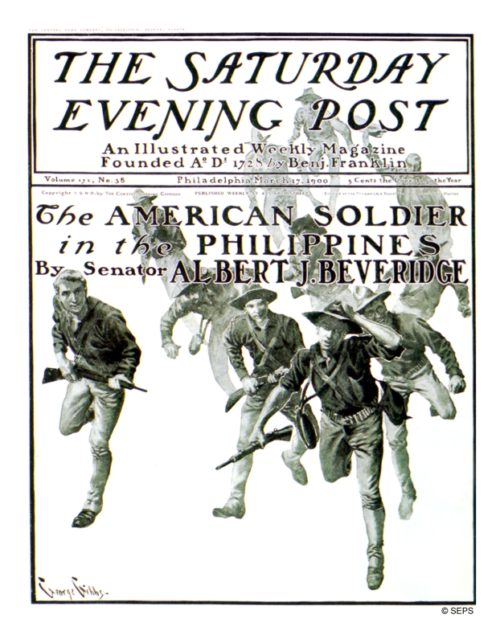
March 17, 1900
George Gibbs
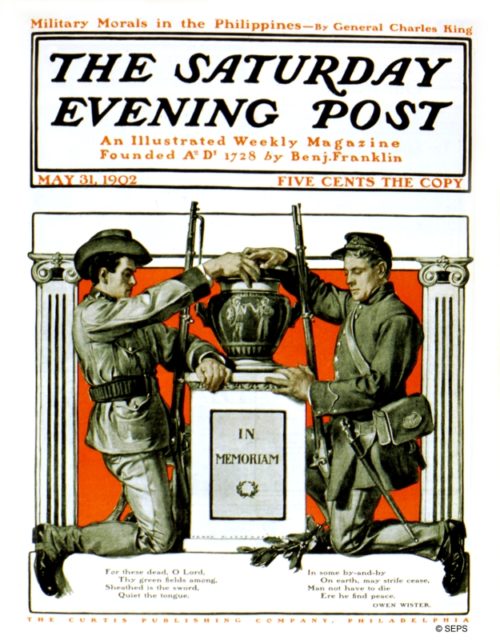
May 31, 1902
Frank X. Leyendecker
July 4, 1914
J. C. Leyendecker
May 11, 1918
Julian De Miskey
July 1, 1922
Ellen Pyle
January 18, 1919
Norman Rockwell
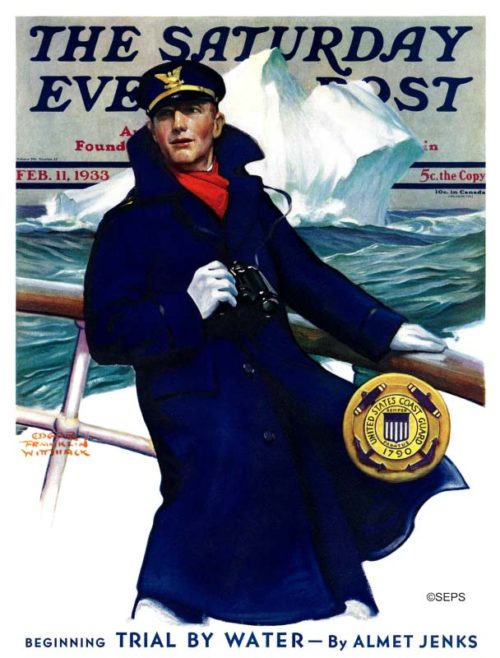
February 11, 1943
Edgar Franklin Wittmack
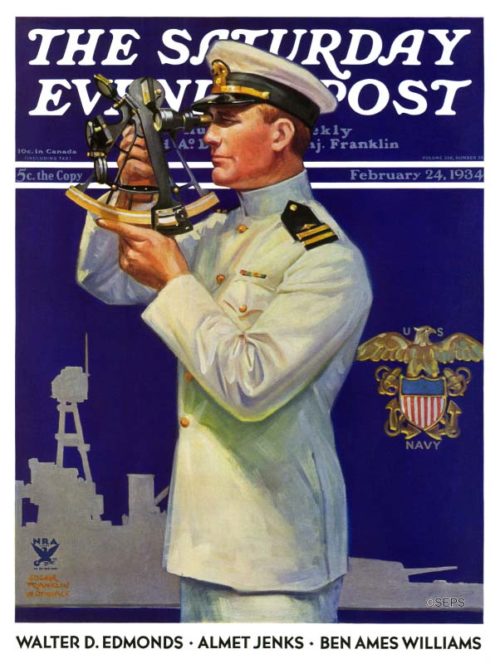
February 24, 1934
Edgar Franklin Wittmack
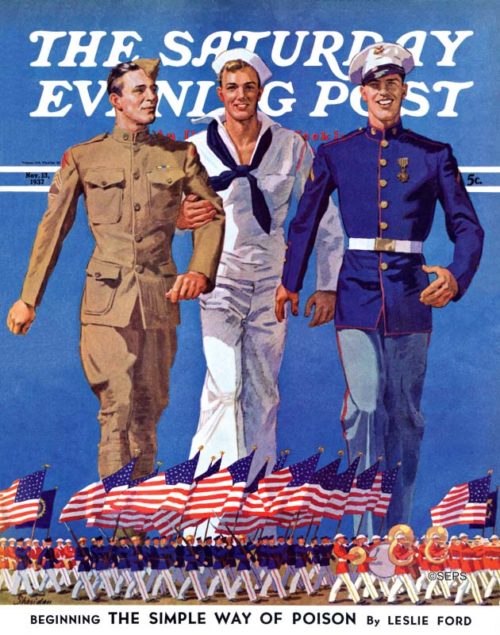
November 13, 1937
John E. Sheridan
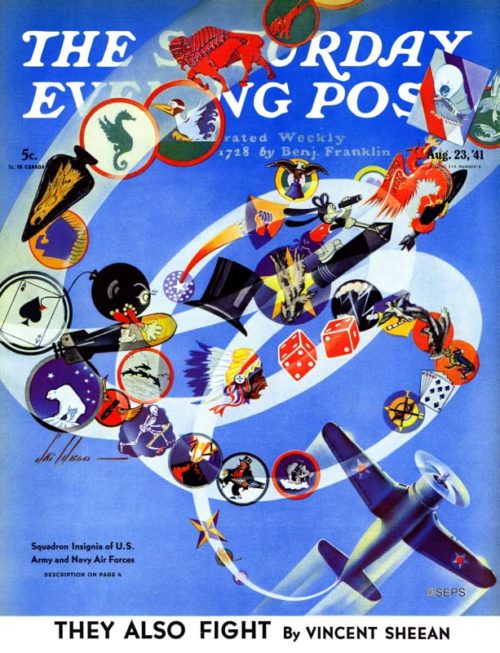
August 23, 1941
Ski Weld
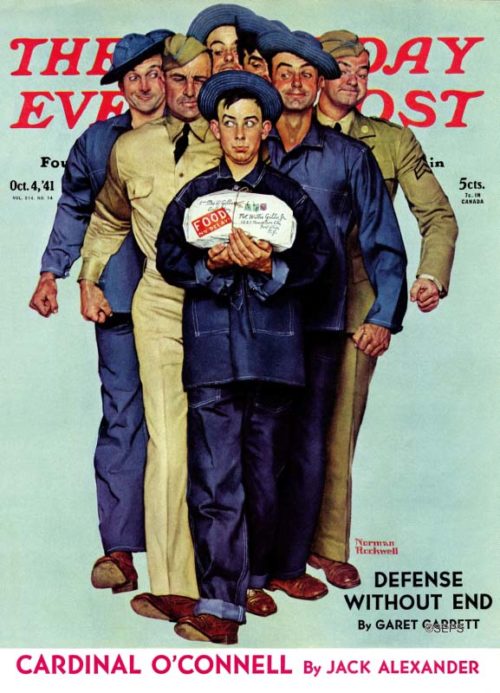
October 4, 1941
Norman Rockwell
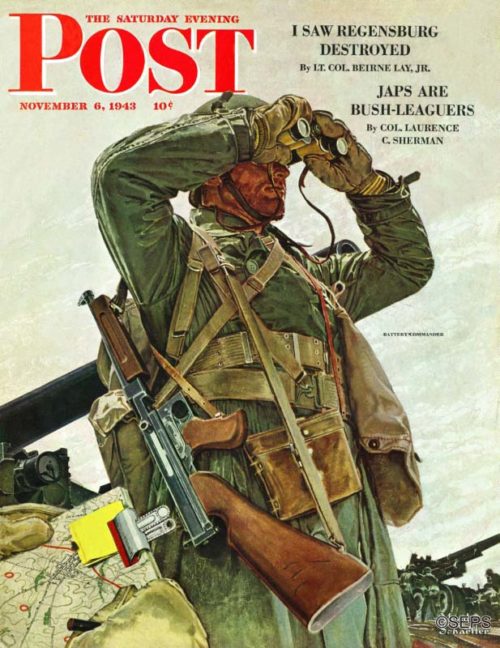
November 6, 1943
Mead Schaeffer
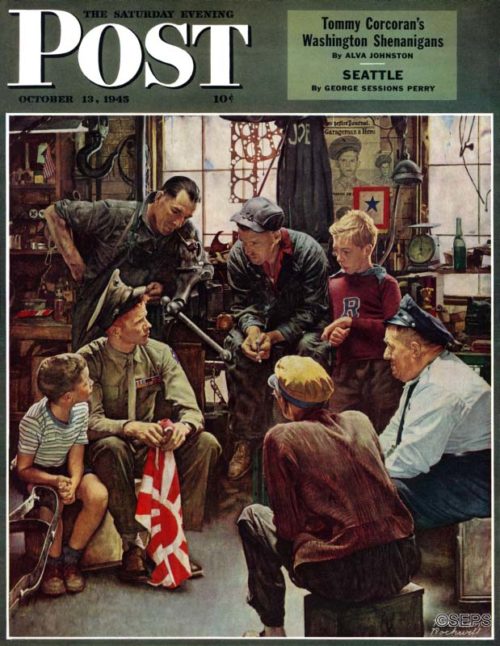
October 13, 1945
Norman Rockwell
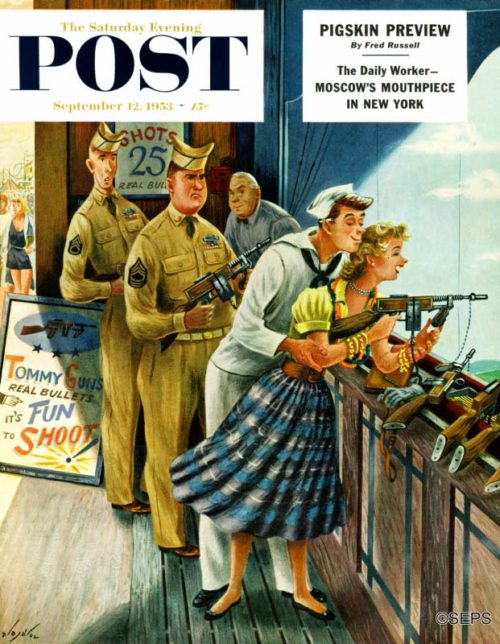
September 12, 1953
Constantin Alajalov
October 23, 1965
Jean L. Huens