News of the Week: Saturn’s Moon, Summer Reboots, and the Search for the Perfect Cookie
Ask Your Doctor about Enceladus
Enceladus is not the name of a new cholesterol medication. It’s the sixth-largest moon of Saturn, and it might be habitable.
NASA says that the Cassini spacecraft has sent back data that indicates Enceladus is releasing hydrogen, which means it could be habitable (hydrogen is an important ingredient for the life of microorganisms). And this isn’t the first signs of life the mission has discovered. Several years ago, Cassini found water on the moon’s surface.
Soon we’ll probably see a movie where a spacecraft from Earth lands on Enceladus and is attacked by one those microorganisms. It will probably be a summer movie, starring Miles Teller as “Jake” and Emma Watson as “Sara,” two astronauts who have to stop the creatures before they reach Earth. Naturally, they fall in love (Jake and Sara, not the creatures).
Summer Movies
I don’t get excited over the summer movie season like I used to. I don’t go to the movies that much anymore. I’m more of a wait-until-it’s-out-on-DVD-or-on-TV guy now, so I usually see “summer” movies in the winter or following spring. This means either that I like to save my money or that I have a terrible social life.
But summer movie season is about to start. Actually, it kinda has already with the release of Guardians of the Galaxy, Vol. 2 last week. Vulture has a list of the big blockbusters we’ll be seeing, along with a helpful list of movies that aren’t sequels, reboots, or remakes.
I’m more interested in Baby Driver than I am Spider-Man: Homecoming. I mean, how many times can they reboot that franchise?
You Can Rent Friends and Family in Japan
Are you lonely? Do you want people on Facebook to think you have a lot of friends? Do you live in Japan? If so, you might be interested in this segment from last weekend’s CBS Sunday Morning:
I don’t know if this will catch on in the U.S. in a big way, but I want to say I find it rather odd. I also want to say that I’m willing to be rented for the right price.
Create an Oreo, Win $500,000
Food companies really want your ideas for new products. Lay’s has an annual contest where people can invent a new potato chip flavor, and Quaker asks what new oatmeal flavor they should make. Now Nabisco wants you to come up with a new Oreo cookie. The winner gets a half-million bucks and the honor of saying, “Hey, I invented a cookie!”
Here’s my idea: Place a Norman Rockwell Oatmeal Cookie into the middle of an Oreo. Call them “The Ultimate American Cookie.” I’d say to call them a “Noreo,” but apparently that cookie already exists.
American Idol Is “Back”
Question: Can a TV show be rebooted if it never really went away?
It seems like American Idol was canceled by Fox only a minute and a half ago, but ABC is bringing it back. No word on when it will be back or who the judges or host will be, though it’s interesting that former host Ryan Seacrest was just hired by the very same network.
RIP Don Gordon, Michael Parks, Julius Youngner, Adolph Kiefer, Steve Holcomb, Stanley Weston, Edwin Sherin, Quinn O’Hara
Don Gordon was a veteran actor known for movies like Bullitt, Papillon, and The Exorcist III, as well as dozens of TV shows. He died April 24 at the age of 90.
Michael Parks was a veteran actor too, appearing in such films as Kill Bill, Argo, and Django Unchained; starring in the TV series Then Came Bronson; and appearing in many other shows and films. He died Wednesday at the age of 77.
Julius Youngner was one of the medical researchers responsible for the polio vaccine. He died April 27 at the age of 96.
Adolph Kiefer was America’s oldest living Olympic champion. He won the gold for the 100-meter backstroke at the 1936 games in Berlin. He was also a World War II veteran. He passed away at the age of 98.
Steve Holcomb was an Olympic medal winner too, winning gold and bronze for bobsledding in 2010. Holcomb died in his sleep Saturday at the age of 37.
Stanley Weston came up with the idea for G.I. Joe action figures. He died last week at the age of 84.
Edwin Sherin was a Pulitzer Prize- and Tony-winning theater director as well as a TV director. He died last Thursday at the age of 87.
Quinn O’Hara was an actress who appeared in the ’60s cult classic comedy The Ghost in the Invisible Bikini and several Jerry Lewis movies, along with TV shows like Dragnet, Dallas, Trapper John, M.D., and many others. She died last week at the age of 76.
This Week in History
Lusitania Sinks (May 7, 1915)
The British ocean liner, traveling from Liverpool, England, to New York City, was torpedoed by a German submarine, killing 1,198 people.
Irving Berlin Born (May 11, 1888)
The composer and lyricist penned dozens of classic songs, including “God Bless America,” “Happy Holiday,” “Easter Parade,” “There’s No Business Like Show Business,” “Alexander’s Ragtime Band,” “Blue Skies,” “Puttin’ On the Ritz,” “I’ve Got My Love to Keep Me Warm,” and, of course, “White Christmas.”
This Week in SEP History: Shopping for Mother’s Day (May 10, 1947)
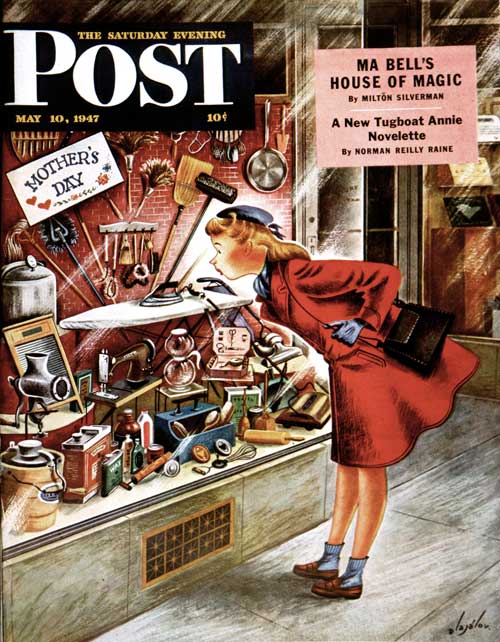
Constatin Alajalov
May 10, 1947
The woman in this great cover by Constantin Alajálov doesn’t seem too happy at the gift options in this store window. Come on, what woman wouldn’t be pleased to open a meat grinder on Mother’s Day?
National Chocolate Chip Cookie Day
Monday is National Chocolate Chip Cookie Day. With apologies to Oreo (and Norman Rockwell), chocolate chip remains my favorite cookie, so here’s the recipe for the classic Toll House Chocolate Chip Cookie. If you want to mix things up a bit, here’s one for White Chip Chocolate Cookies.
By the way, Toll House Cookies were invented in 1930 by Ruth Wakefield of the Toll House Restaurant in Whitman, Massachusetts. According to this New Yorker article, Wakefield sold the recipe to Nestlé for one dollar. She got a job with Nestlé and free chocolate for the rest of her life, but I’m thinking that was a pretty good deal for Nestlé.
Next Week’s Holidays and Events
Mother’s Day (May 14)
This Sunday, take your mom out to lunch. Maybe buy her a nice gift and a card. Or if you’re busy or out of town, at least call her and talk to her. But under no circumstances should you text her “Happy Mother’s Day!” with a smiley-face emoji.
Armed Forces Day (May 20)
This day that celebrates our military members and their families was announced in 1949, replacing Army, Navy, Marine Corps, and Air Force Days.
A Street of Bugles
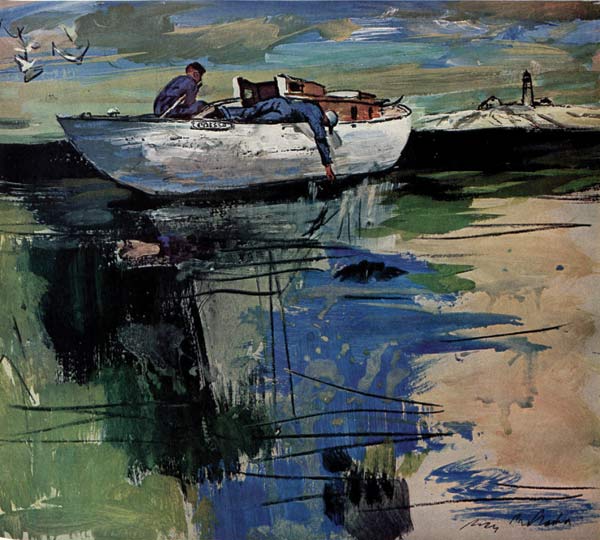
© SEPS
Originally published November 30, 1963
Every night, before he went to sleep, he saw a parade passing right before his eyelids. There was the public librarian, and Mr. Cain of Cain’s Dime Store, and his boss down at the shipyards and the town drunk and the preacher. Everyone in Balton was there, smiling gently and slowly, nodding as they came abreast of him — everyone who’d known him since he was born. Against the surrounding darkness their faces were bright and warm; their pace was stately, and they wore triumphant reds and purples that swept the ground as they walked past.
He took up his pistol and he shot them all down. One by one they fell, leaving not bodies but simply empty space, like a wooden duck would leave in the line at a county-fair shooting gallery. Each time he shot there was a kick from the gun that shook his whole body, but it left him tired and peaceful and his mind was cleared for sleeping.
He woke that morning with his mother saying “Sammy” in the doorway, standing there already anxious and frazzled, with her hands pulling nervously at the cord of her bathrobe. “You’ll be late for work, Sammy,” she said.
There were bars of light across his face from the morning sun coming through the blinds. He groaned and turned away from the light, but his mother still stood there, knowing he wasn’t awake enough yet for her to leave him alone.
“You getting up?” she said.
He sat up and peered at her, and only then did she leave. The sound of her scuffing slippers slid farther and farther away, down the narrow hallway and into the kitchen, where coffee would be perking now to start off Sammy’s day. He turned back toward the window and peered out, his young face blank from sleep and his hair tousled.
Below his window and down the slope lay Balton Harbor, with the Balton shipyards and the little town of Balton cuddled neatly around the black water. He could already hear the harbor noises — the far-off hum of boat engines, the jagged buzz of electric sanders and saws and drills, the pealing of the bell in the clock tower that stood on Samson Hill. As he dressed he separated the noises from one another, naming them, knowing each sound exactly and knowing if anything was different today. A yawl went by; he knew without looking whose it was, and that the engine would surely be in the shipyards within a week for him to work on, if its owner had any engine sense.
He put on his blue coveralls, which were stained with grease from probably every boat in Balton Harbor, and splashed cold water on his face before he went to breakfast. The water made his eyes suddenly wide-awake, and things struck him more clearly. When he came to the kitchen and saw his mother’s red-checked tablecloth, he blinked a couple of times at the sharpness of it.
“What you want for breakfast?” his mother asked.
“Just coffee, Mum.”
“Nothing else?”
“Coffee and a couple of cigarettes,” he said.
He pulled out a chair and sat down with his legs sprawled out in front of him and grinned at his mother.
“Sammy, you got to start eating more.”
“I’m not hungry yet, Mum.”
“You will be. How’d you like some bacon?”
“Nope.”
“Some coffee cake?”
“Nope.”
His mother poured him a cup of coffee and sat down opposite him, her hands clasping the table edge and her whole face strained toward him. She was a very thin woman, the kind that went whole nights without sleep. Her husband had had itchy feet and died someplace down South, a thousand miles from Maine and from her, and her older son, Phillip, had inherited those itchy feet and was gone from her forever. Anyone who didn’t know these things about her could have told it from her eyes, which seemed to be asking the same question over and over, and from her hands, which kept reaching out and touching people, almost grasping them, and then by sheer will were drawn in again quickly and folded in her lap.
Only once during breakfast did she touch Sammy. She reached out and touched the top of his head, where his hair grew thick and fair, falling down over his forehead. He smiled at her, and she put her hand on the table. “I could scramble some eggs,” she said.
“No, thanks, Mum.”
He stood up and took his cap from the counter, and she followed him to the door. “Be careful,” she said.
“I will.”
Your Story Here!
The 2018 Great American Fiction Contest is now underway. Enter for a chance to win $500 and have your work appear in the magazine that published F. Scott Fitzgerald, William Faulkner, and Kurt Vonnegut!
To enter, visit saturdayeveningpost.com/fiction-contest.
He set off down the little path toward the harbor, and his mother stood watching after him. She watched the bobbing of his head, the blue of his coveralls flashing through the weeds, and then she waved at his back and went inside, smiling a little, a crease between her eyebrows.
Halfway down the path, Sammy was joined by a group of children, the same ones who trouped behind him on every other day of the summer. A little boy named Porter led them; he came silently up behind Sammy and said, “Hello, Sammy,” and tugged gently at the sleeve of Sammy’s coveralls.
“Hello, Sammy,” the children said.
“Hi,” Sammy said. He took off his cap and put it on Porter’s head, backward, so that the visor hung down the back of his neck, and Porter grinned and straightened the cap around right.
“You going to the launching?”
“Sure am,” Sammy said.
“You going to be in the launching?”
“Yep.”
Porter drew in his breath with a little whistle and the other children echoed him, seriously, a chain reaction down the line. “Don’t I wish I were you,” Porter said.
Sammy grinned. “I’ll just be on the boat when she slides out,” he said. “Along with Barney. She ain’t got her masts in yet, so we’ll run her with the engine over to the wharf. It’s the Hope’s old engine, so we can start ourselves without the factory man.”
“You seen her up close yet?”
“Ayeh.”
“How big is she?”
“Oh, little. Thirty feet maybe, I don’t know. Prettiest boat they’ve made for years, though.”
The path descended a rocky bank so steep they all had to run as they went down. Rocks and sticks scattered beneath them, and their shoes slid. One of the children, the smallest little boy, stumbled and came sliding down most of the way on his stomach, but he didn’t cry, just looked up with round eyes while the other children dusted him off. Sammy handed him a handkerchief for his hands and looked off toward the harbor, where a few sails were already up and some fishing boats were puttering out to sea. It would be a good day for boats. The water gleamed in the sun, and the shipyard wharf, running up one side of the harbor, seemed new and almost white.
“I can spell etiquette,” Porter said at his elbow.
“Good for you,” Sammy said.
“Can I go on the Odessa with you when they launch her?”
“Nope.”
He took the cap from Porter’s head and put it on his own, pulling the visor down over his eyes so that he wouldn’t have to squint against the glare of the water. “It won’t take more than 15 minutes anyway; you wouldn’t have time to notice you were on her.”
He ruffled Porter’s hair and grinned at the other children. “So long,” he said.
“Can we walk you back home again tonight?”
“If you want.”
They scattered away, with little cries like far-off sea gulls, and their feet pattered up the bank. The little one who had fallen before fell again, not very hard, and when Sammy saw that he wasn’t hurt he went on his way toward the shipyards.
The shipyards were mainly the one wharf, already warm from the sun, with a cluster of small boats tied up to the pilings. Behind that was a great barnlike building, opening on the outer harbor, where the shipbuilders worked. Sammy spent most of his time working on boats already out on the sunny water, but they were launching the Odessa this morning, and he climbed over the rocky hillock that separated the wharf from the big shed and walked inside, into the cool darkness. Everything smelled of new lumber. The first thing he saw was the network of wood that was to be another boat someday — even better than the Odessa. It was like a fisherman’s net, tight and graceful. Just looking at it, he could feel the shape on his fingertips, and he stared at it a long time before passing on to the Odessa.
Around the Odessa there were maybe 50 people, all crowded together, leaning forward so they could see the iron tracks that were to slide her into the ocean. Sammy wormed his way through them, trying to keep his greasy coveralls away from the people nearest him.
“There’s Sammy,” a girl said.
Some children waved to him from a rafter, and the adults turned to smile at him.
“How’s your mother, Sammy?”
“She’s fine, ma’am.”
“Why don’t you ever come by for supper anymore?”
“Sammy, what you think of this boat here?”
“You going to be on her at the launching, boy?”
“Hear the owner can’t even sail himself; you going to run the engine?” Sammy worked sideways through the people, smiling at them as he passed, and dropped into the pit above which the boat was to begin her journey.
“How’s it going?” he asked Barney.
Barney looked up at him. “They’re greasing the tracks,” he said. “About five minutes more, I guess.”
He was a small man, gray and wrinkled, wearing mechanic’s coveralls exactly like Sammy’s. He was so small that he had to look up at everyone, and his forehead had taken on permanent creases that made him look constantly surprised. “Come and meet Mr. Flint,” he said. “He’s the owner; might be a good man for you to know if you ever want a job away from here.”
Mr. Flint was a big, red-faced man. Sammy had seen him standing around the shipyard on sunny days.
“You’re Sammy, huh?” he said.
“Yes, sir.”
Mr. Flint shook his hand, looking into Sammy’s face. “Heard a lot about you,” he said. “You’re kind of the fair-haired boy around here, from what they say.”
“Best man I’ve got,” Barney said. He looked surprised at himself, and clamped his mouth shut again.
“Think you and Barney can bring her in okay?”
“Yes, sir,” Sammy said.
“We’ll do it,” Barney said. “Sammy knows how. Would’ve gone off to college, Sammy would, if it weren’t for taking care of his mother and such.”
“Well, I’ll trust her with you,” Mr. Flint said. “If we could all get ready now … ” and he went stomping off, over to where old Captain Harding was showing Mr. Flint’s wife about the bottle of champagne.
When Sammy was actually on the boat, he could see everything that was taking place. The children on the rafters were quarreling about who would get to blow the bugle, the adults were pressing closer and closer, and Mrs. Elliott’s 2-year-old fell into the pit by mistake. They had no sooner recovered him than a sawhorse got dropped in, too, and a group of little boys clambered down to pull it out again. At the bow, Captain Harding was having the time of his life, swinging the champagne bottle as if it were a baseball bat to show Mrs. Flint how to do it, while Mrs. Flint, dressed all wrong in a bare-backed sun-dress and little bits of nothing for shoes, stood gracefully by and looked worried.
“All set, Sammy?” someone asked.
And a group of girls in the back called, “Good-bye, Sammy!” and waved thin, bare arms above the others’ heads.
Sammy smiled and sat down on the little deck. He could feel all around him the tightness of the boat, the hard strips of teakwood that made up the deck, and the graceful curves rising before him and behind him. It was the kind of boat you could hug. If he lay on his belly and dropped his arm over the side, he would feel that curve, warm and living, like the curve of a cat, something that would press against his hand. Maybe when he was out in the harbor he could hug her. Barney wouldn’t care.
They had removed the blocks from the dolly under the Odessa and only her own weight held her now. Barney had climbed aboard. At the bow, Mrs. Flint picked up the bottle of champagne, wrapped in ribbons and swinging by a ribbon from the bowsprit. “She’ll never smash it,” Barney said.
They could not see her swing it, but they could feel the tiny shock against the bow as it hit, and then the air pumps working that would move the dolly and set the boat free down the tracks.
“By God, she broke it,” Barney said.
The boat moved. It made its way slowly down the black greased tracks, and Sammy, looking over the neat white deck rails into the mechanized ugliness of those tracks, felt like some god, standing where no one else could stand, above all the ordinariness of iron and boat grease. The bugle calls began. He looked up into the rafters and saw that the children were sharing the bugle, passing it up and down the line, each blowing a blast in turn. The sound was high and very clear, and it pierced straight through him.
There was a moment, as the Odessa hit the water, when all of them held their breaths. But she barely paused, and then slipped on in. One second she was heavy and earthbound, and in the next she took heart and floated off, lilting up and away. And now the bugle really let forth, full of joy and relief and a strange kind of tenderness, echoing down from the warehouse and sounding out over the water, speeding the boat away and yet, at the same time, sadly, calling it back.
Sammy and Barney just sat there for a minute; nobody could blame them for that. They listened to the peaceful slapping of water against the boat, and to the gentle sort of breathing noise that every good boat makes. By then she was fairly far out with the tide, and the wharf seemed only a slender matchstick in the harbor.
“Got to take her in to the wharf, boy,” Barney said. “They’ll put the masts of her in after lunch.”
“Okay,” Sammy said.
Barney stood aside for Sammy to go to the stern and start the engine. It was a neat, tight little engine; Sammy let it idle awhile just to hear the sound of it. Then he pressed the gas and swung the tiller, heading out toward the open sea.
He couldn’t have said beforehand that that was what he was going to do. He had thought he was going to follow orders and work it the way he always had: turn her into the inner harbor, treat her gently, tie her to a piling, and leave her there. But what he did instead didn’t surprise him; that was the strange part. He pushed her for all she was worth and set out for the wide Atlantic, and his face was as calm as if he were asleep.
“Where you going?” Barney called. He was looking at Sammy mildly, thinking he was only playing. “Turn her, Sammy; no games now.”
“Ain’t a game,” Sammy said.
The wind was full in his face. He opened his mouth to taste the wetness of it and gave the engine all the gas it could take, to make the wind blow harder. It wasn’t an engine built for speed — probably it would only be used to putter her safely home at the end of a day’s sailing — but it made good time, and they were leaving Balton far behind.
“You gone out of your head?” Barney yelled.
He reached to grab the tiller, but Sammy held on and the boat only swayed to one side.
“Sammy,” Barney said, “Mr. Flint’ll be hopping!”
He sat down on one of the deck seats suddenly, and his face was small and gray.
Sammy switched the engine off.
“Don’t know what we’ll do,” Barney said. He seemed not to have noticed that the engine was off; he put his head in his hands and groaned.
Everything was very still now. The water lapped against the sides, and the sea gulls called behind them. Sammy leaned forward and touched Barney gently, and said, “Hey, Barney, we can go back.”
“I just don’t know what come over you,” Barney said.
Sammy leaned over the other side of the boat, away from Barney, and tried to touch the water with his fingertips. “I sure did like those bugles today,” he said.
“You had some kind of spell maybe.”
“Every time I hear a bugle, it goes straight sharp through me. Sometimes I think I could build a hundred-foot schooner by hand, and pound in the nails with my teeth, just to hear those bugles blowing when she slides down the tracks to the sea.”
Barney moved over beside him in the stern, being as quiet as possible about it, and started the engine again.
“You know, Barney, this town has got more damned bugles in it. All kinds of bugles. Go walking down Main Street and the whole street is full of them — hundreds of them, blowing too high for your ear to hear, and tightening you together, calling you like your mother calling you home for supper. And who’d go anywhere, with all those bugles blowing? Even if you’re crying to go, who could go?”
He was talking with his chin resting on the side of the boat, and the smell of fresh varnish right beneath his nose. He couldn’t see Barney’s face. There was no telling if Barney heard him or not, because Barney had the engine going and the boat was turning home. The wharf grew larger and larger, and Sammy turned to watch it.
“It’s such a damned loving town,” he said. “I didn’t really want to hear those bugles. Hey, Barney, you ever heard those bugles?”
But Barney was bent away from him, admiring the engine. When he straightened up and caught Sammy staring at him, he called, “Don’t worry, boy, I got an idea back there. You and me heard something funny in the engine, see, moment we started her up. So we took her out to check on it. Okay?”
“Sure,” Sammy said. He smiled and said, “Sorry, Barney.”
“Oh, hell, it’s okay.”
They came in alongside the wharf, crowded now with Balton people who had stayed to see Sammy and Barney bring the boat back. Someone grabbed the bow line. A man said, “How’d it go, Sambo?” and reached down to help him up. “Quite a ride for your money you got there.”
“Thinking of leaving us, Sammy?”
“How’d she run?”
They helped Barney up and then stood around with nothing to do but look at the Odessa and talk about other boats they remembered from the old days.
Sammy stopped listening to them, or to the breeze rushing past his ears. In his own private echoing silence, he polished the pistol of his dreams; he held it, heavy and shining, in the farthest reaches of his thoughts, while above him the sea gulls swung and called beyond the shore.
Born in Minneapolis, Minnesota, in 1941, Anne Tyler won a Pulitzer Prize for her novel Breathing Lessons (1988) and has had several works, including The Accidental Tourist (1985), adapted to the big screen. At 22, she wrote “A Street of Bugles,” which appeared first in the November 30, 1963, issue of the Post. The story “grew out of a summer I spent in a small coastal town in Maine,” Tyler said. “One of the ways in which the town seemed unusual was that no one, not even the young people, appeared to want to leave.”
This article is featured in the May/June 2017 issue of The Saturday Evening Post. Subscribe to the magazine for more art, inspiring stories, fiction, humor, and features from our archives.
The Soul of the First Amendment: An Interview with Floyd Abrams
Without free speech, there is no free society, says Floyd Abrams, a leading constitutional scholar and author of The Soul of the First Amendment. But anti-speech movements are insidious. “No one says, ‘I’m against free speech,’” says Abrams. “In history, totalitarian governments begin with enormous denunciations of the press.” And it’s only when the press has been publicly discredited and repudiated that “they really go after it and try to subjugate it.”
Abrams remembers well the incident that triggered his passionate involvement in protecting the 45 words in the First Amendment dedicated to freedom of expression. “I was a pretty young associate at my law firm, and the Nixon administration started to really crack down on the press. My firm represented NBC, and I got to do some of that work. I met reporters and I learned to understand the level of concern they had about being hauled into court to testify, the problems they had with gathering information if they couldn’t promise confidentiality to sources, and the risk they ran when they did. So I became more and more convinced that greater and greater First Amendment protections were needed.”
Jeanne Wolf: Cynics say we like to defend the ideas we agree with and oppose the ones we don’t like. You’ve written that it’s essential to defend even the words we hate.
Floyd Abrams: We don’t need the First Amendment to protect speech we agree with. The First Amendment basically says in America there is no wrong side, in terms of what is allowed to be said. That’s an overstatement, but that’s the broad First Amendment lesson: We will not let the government censor speech of any kind. If we didn’t have a First Amendment, we’d really be in a lot of trouble, bringing in the cops and shutting down publications. We remain, at this moment, the freest country in the history of the world in terms of free speech and a free press. However, the fact that the First Amendment protects speech here to a degree that would be unthinkable elsewhere does not mean that all speech is good or appropriate or should be complimented.
JW: Yes, some might say that free speech comes at the expense of fairness and civility.
FA: We have the ability to convey thoughts about anything at any time with very little in the way of sanctions. One of the downsides of that, and it comes with the territory, is that the internet has now become home for child pornographers, for Nazi sympathizers, for potential terrorists. Just as I defend freedom of expression, I would defend the right of the Facebooks of the world not to carry such material.
JW: There is also a spreading fear that a flood of unregulated information can be helpful to our enemies around the world.
FA: In national security, there is information which ought to be secret, and there are risks in certain information being made public. That said, we also live in a society in which overclassification has been the norm rather than the exception. It has been true in every administration — the amount of classified material dwarfs the number of real secrets. What happens is that WikiLeaks or Edward Snowden will come along and release thousands of pages of classified material. This can be harmful to our government, but, as critical as I’ve been of WikiLeaks, it could really be extremely dangerous to prosecute them. I very much hope that the administration does not proceed on that path, but I expect it will.
JW: What can ordinary citizens do to protect free speech?
FA: The most important thing is to use the First Amendment to speak out and to participate in the political process. Whether that’s handing out leaflets or making contributions or trying to persuade their friends. All of these things can be and should be the role of a citizen.
JW: Right now, it seems more frequent that we just indict people for one phrase they say on television or one overheard conversation — even a chance remark out of context. Are we overdoing that?
FA: People are more easily offended now by speech than any time that I can remember. You don’t have to be far off center to get some people angry. That would be okay if the people who were angry simply responded, but the problem is that the responses are often overdone. We hear cries of “Fire him!” Those kinds of responses are anti-speech and violate the spirit of the First Amendment.
JW: In your book, you called the First Amendment “the rock star of the American Constitution.” Why do you feel it’s that essential to our way of life and our country?
FA: I think free speech is the one element that makes us admired abroad and secure at home. Remember, one of the benefits of the First Amendment is that by not suppressing speech, you’re not forcing people to say things privately and in the dark. There’s a value in letting people have their say even if they’re wrong and offensive in what they say. I think that’s pretty well beaten into our fabric as a society in a way that generally serves us very well.
JW: When you watch the news (and I admit that I watch the news as if it’s a football game), how vocal are you and your wife when you see some of the outrageous things people say?
FA: Oh, I’d say that there are a lot of exclamations. I remember a month or two ago that there were crime statistics showing crime had decreased very significantly under President Obama, and President Trump was saying they had increased! The figures are the figures. It’s not a matter of opinion. Now and then, I’ve been heard to scream at the television screen.
—Jeanne Wolf is the Post’s West Coast editor.
An abridged version of this interview will appear in the July/August 2017 issue of the Post.
Allegation Nation: A Brief History of Presidents and Special Prosecutors
With lingering questions about Russian influence in the last U.S. presidential election, some legislators and citizens have called for a special prosecutor. Just how common is the use of a special prosecutor, and when have they been appointed in the past?
The federal government has been using special prosecutors since 1875. In 1978, after Watergate, Congress passed the Ethics in Government Act, which established formal rules for appointing a special prosecutor. Starting in 1983, these investigators were referred to as an independent counsel. The Ethics in Government Act expired in 1999, and the only person who can currently appoint a special prosecutor is the attorney general. Regulations are in place that limit the authority of the attorney general over a special prosecutor, but without a law in place, the enforceability of these regulations in unproven. Congress can’t independently appoint a special prosecutor without first passing a new law allowing them to do so. Before becoming law, the bill must, of course, be signed by the president.
Here’s a table of the men and women who have served as special prosecutor or independent counsel, the issue that each investigated, and the outcome. Special prosecutors have been appointed 29 times. President Clinton leads with 12 separate inquiries; President Reagan is a distant second with six.
History of Special Prosecutors and Independent Counsels
| Year | President | Special Prosecutor / Independent Counsel | Issue | Outcome |
| 1875 | Ulysses Grant | John Henderson | Politicians, whiskey producers, and government employees stealing alcohol tax revenues | There were 110 convictions, $3 million in recovered taxes, and an abiding air of corruption attached to the Grant administration. |
| 1881 | James Garfield | William Cook | Post Office officials taking bribes to award highly lucrative postal delivery routes | The “Star Route” scheme was shut down, but there were few convictions. |
| 1903 | Theodore Roosevelt | Judge Holmes Conrad, Charles Bonaparte | Bribery in the Department of the Post Office | Three hundred post office officials and private contractors were convicted. |
| 1905 | Theodore Roosevelt | Francis Heney | A railroad’s use of fraud to obtain resources on federal land | Over a thousand indictments were issued, but Heney narrowed prosecution to 35 people, including a senator and two congressmen, who all eventually escaped punishment. |
| 1921 | Calvin Coolidge | Atlee Pomerene, Owen Roberts | The sale to corporations of oil held in reserve for the U.S. Navy, most notably at Teapot Dome, WY | Teapot Dome led to the first conviction and imprisonment of a former Cabinet officer. |
| 1952 | Harry Truman | Newbold Morris | Corruption within the IRS | Attorney General Howard McGrath fired Morris. Truman fired McGrath. Over 160 IRS employees were fired. |
| 1973 | Richard Nixon | Archibald Cox | The burglary of the democratic headquarters at the Watergate office complex, and its subsequent cover-up | Nixon, unwilling to cooperate with Cox, ordered AG Elliot Richardson, then Deputy AG William Ruckelshaus, to fire Cox. They resigned instead. Solicitor General Robert Bork stepped in to dismiss Cox. The next year, the House Judiciary Committee filed the first impeachment charge. Nixon resigned two weeks later.
|
| 1978 | Jimmy Carter | Arthur Hill Christy | Accusations that Carter’s chief of staff had used cocaine | No one was indicted. |
| 1980 | Jimmy Carter | Gerald Gallinghouse | Accusations that Carter’s campaign manager had used drugs | No one was indicted. |
| 1981 | Ronald Reagan | Leon Silverman | Organized crime connections of Labor Secretary Ray Donovan | No one was indicted. |
| 1984 | Ronald Reagan | Jacob Stein | Accusations of AG Edwin Meese’s preferential treatment of a defense contractor | No one was indicted, but Meese resigned when Stein’s report was submitted. |
| 1986 | Ronald Reagan | Alexia Morrison | Obstruction of justice by Theodore Olsen, legal counsel to the president | No one was indicted.
|
| 1986 | Ronald Reagan | Lawrence Walsh | Charges that administration officials had secretly sold arms to Iran despite an arms embargo against that country | At least 12 individuals were indicted, including the Secretary of Defense and the National Security Advisor, and many were convicted, but all were pardoned, granted immunity, or given probation. |
| 1987 | Ronald Reagan | James McKay | Charges that former White House aide Lyn Nofziger engaged in improper lobbying after leaving office | No one was indicted. |
| 1987 | Ronald Reagan | James Harper | Charges of income tax evasion by Assistant AG Lawrence Wallace | No one was indicted.
|
| 1990 | George Bush | Arlin Adams | Charges that Samuel Pierce, HUD Secretary, had sold his influence while serving in Reagan’s cabinet | Several of Pierce’s aides were convicted on felony charges of favoritism, but Pierce was never charged.
|
| 1992 | Bill Clinton | Joseph diGenova | Possible illegal search of the passport files of President Clinton by officials of the former Bush administration | No one was indicted. |
| 1993 | Bill Clinton | Kenneth Starr | Accusations that Bill and Hillary Clinton had fired employees of the White House Travel Office to give the jobs to their friends | Neither Bill nor Hillary Clinton were indicted. |
| 1994 | Bill Clinton | Kenneth Starr | Charges of improper behavior by Clinton in the sale of property from the Whitewater Development Corporation | Neither Bill nor Hillary Clinton were indicted, but some of their former business partners were, and 15 of them were convicted. |
| 1994 | Bill Clinton | Donald Smaltz | Charges that Agriculture Secretary Mike Espy had accepted improper gifts | Espy was indicted, but later acquitted, of all 30 criminal charges. |
| 1994 | Bill Clinton | Kenneth Starr, Robert Ray | Death of White House Counsel Vincent W. Foster | No one was indicted. |
| 1995 | Bill Clinton | David Barrett | Charges that Henry Cisneros, Clinton’s HUD Secretary, had lied to the FBI during background checks | Cisneros was indicted on 18 counts of conspiracy and obstructing justice, but later pardoned by Clinton.
|
| 1995 | Bill Clinton | Daniel Pearson | Charges that Commerce Secretary Ron Brown had sold seats on U.S. federal planes on an international trade mission | No one was indicted. |
| 1996 | Bill Clinton | Curt Von Kann | Accusations that Eli Segal, former Clinton chief of staff, had violated conflict of interest rules while fundraising | No one was indicted.
|
| 1996 | Bill Clinton | Kenneth Starr | Charges of improper review of confidential FBI files of members of previous administrations | No one was indicted. |
| 1998 | Bill Clinton | Carol Elder Bruce | Charges that Interior Secretary Bruce Babbitt improperly intervened in an American Indian tribe’s application to open a casino | No one was indicted. |
| 1998 | Bill Clinton | Ralph Lancaster | Charges of influence-peddling and solicitation of illegal campaign contributions by Labor Secretary Alexis Herman | No one was indicted. |
| 1998 | Bill Clinton | Kenneth Starr | Charges that Clinton perjured himself when questioned about sexual relations with Monica Lewinsky | Clinton was impeached but later acquitted by the Senate. |
| 2005 | George W. Bush | Patrick Fitzgerald | Suspicions that members of the State Department had leaked the identity of a covert CIA officer for political ends | No one was indicted for the leak, but I. Lewis “Scooter” Libby was convicted on four felony counts of making false statement, perjury, and obstruction of justice. |
Featured image: Shutterstock
Rockwell Video Minute: Shiner
Learn about Norman Rockwell’s process of painting this iconic image from our May 23, 1953, cover, in which a girl — appearing victorious after a schoolyard dust up — waits for the principal.
See all of the videos in our Rockwell Video Minute series at www.saturdayeveningpost/rockwell-video.
How One Executive Order Devastated the Country
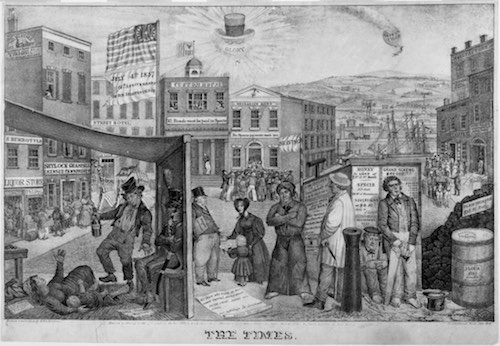
One of the worst economic panics in the U.S. was caused by a president’s executive order.
In the 1830s, America enjoyed a robust economy. Cotton prices were high, and there was a booming market in Midwestern land. Between 1834 and 1836, land sales jumped 500 percent.
Speculators were grabbing up land at bargain prices and paying with bank notes from unregulated state banks, which often didn’t have enough coin to back up those notes. Consequently, the value of a note of the same denomination might vary wildly from one bank to another. (As a service to businessmen, the Post regularly reported the fluctuating values of several important bank notes.)
Andrew Jackson worried that too much federal land was being bought with over-valued paper dollars. Remembering how his Tennessee constituents lost their fortunes in the Panic of 1819 because of land speculation and bank failures, he didn’t trust banks and he despised speculators.
As one of his last acts in office, in 1836, Jackson took action with an executive order — the Specie Circular — which required all future land sales to be paid in specie: gold or silver coin.
Suddenly, specie was in great demand, and banks couldn’t get enough of it. A specie shortage led to the collapse of the land market. The value of gold rose while the value of paper dollars fell, and bank customers began withdrawing their money in coin to avoid losing their savings, which only worsened the specie shortage.
Acknowledging that they no longer had enough hard assets to cover their bank notes, the banks of New York, on May 10, 1837, stopped paying depositors in specie. The New York decision started a run on banks across the country as hundreds of thousands of Americans tried to withdraw their money from banks. Following the example of New York, 800 banks across the country stopped paying in specie. Some states tried to shore up their economies by issuing bonds to support the banks, but the states defaulted on the bonds and had to declare bankruptcy. The money supply was reduced to a trickle.
Before the year was out, almost half of America’s banks had failed. Unemployment rose sharply — reaching 25 percent in some areas — and profits, prices, and wages fell. The Panic of 1837 had begun.
It took seven years for the U.S. economy to resume its former growth.
Jackson’s Specie Circular wasn’t his only contribution to the Panic. It was compounded by his decision to shut down the Bank of the United States. In 1836, he fulfilled a campaign promise to withdraw federal funds being held by the bank.
This action was also part of Jackson’s grudge against all banks. He believed the Bank of the United States, in particular, was too powerful and run by elites to benefit themselves. Just before he left office, he withdrew millions in federal funds and deposited them in state banks, many of which were unregulated.
Had the Bank of the United States still been operating in 1837, it might have been a steadying influence in the financial sector. It might have helped in the distribution of specie instead of letting it collect mostly in eastern banks. And it might have reassured the country that a strong, well-regulated, central bank was still conducting business.
Jackson’s moves against banks weren’t the only causes of the Panic of 1837, though. Another large factor was Great Britain’s move to stop British gold flowing into American investments. Not only did this throttle foreign investment, but it forced American banks to raise interest rates.
But Jackson must bear the greater responsibility for letting his fear of banks get the better of him, and of the country.
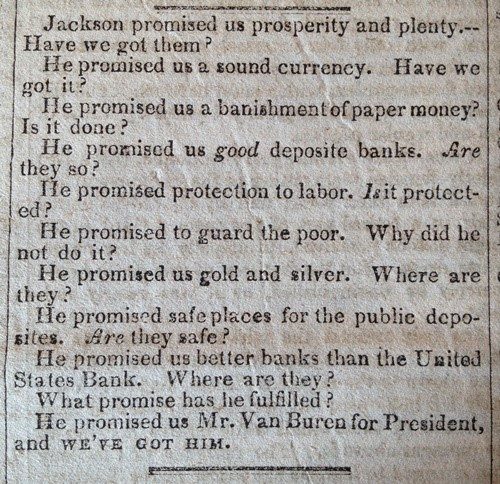
Fortunately for Jackson, he was able to dodge most of the blame. As often happens, the consequences of one president’s poor judgment become the responsibility of his successor. The New York banks’ specie policy was announced just five weeks into Martin Van Buren’s presidency, and he had to take the heat for Jackson’s policies.
“No Visitors Till Noon” by Dorothy Baker
That summer, somewhere along in July, Sibyl Armstrong, who was still the wife of Rex Armstrong, formed a habit of sliding the screens together — the house was of Oriental inspiration — and then pulling the curtains over them. She wasn’t sure why she did it, particularly after she had stumbled twice over a little wicker footstool, once when it was where it belonged and once after she’d moved it.
Perhaps the reason, although she did not really seek it, was that summer gloom was in her blood. Her mother kept the house back in Davenport, Iowa, where Sibyl grew up, as dark as possible in the summertime on the theory that if you don’t see the sun you don’t think about the heat. It’s an untenable theory, but here was Sibyl beginning to do things the way her mother had. A sign of age, or at least of maturity — of settling in with the ancestors.
It was hard to read in that house in Davenport, Iowa, in the summertime; Sibyl had not, in fact, done much reading. Summer was when she mostly sat in a big chair with one leg flung over a chair arm and thought about life — what she would be when she grew up, how she would look, what she would wear, and how deeply and imaginatively and stylishly her husband would love her after a wedding that could take, in her fancy, many forms, from a production in a church to an elopement involving the use of a ladder. She seldom, in the depths of the big chair, thought about what the children would be like or how many there might be, and this might in some way account for the fact that she and Rex hadn’t had any. What you don’t dream of you often don’t get, not that you always get what you do, of course.
In that big chair Sibyl dreamed of being rescued and married and maintained in a style to which she became thoroughly accustomed, well in advance of reality, during the heat of those adolescent summers. It was very fancy dreaming she did in that chair, but it had worked out accurately — up to a point. The rescue had been effected eventually from college, not from home. It was an elopement, too: a no-ladder elopement, but authentic, dramatic and uncontested. And the marriage was, in its way, a living reenactment of the dream — with all that love, all that style, all that elegance: the king-size bed in the master bedroom, the double dressing rooms, the pool, the terrace, and beyond it the teahouse — the one they built when they were on an inner-peace kick — with the great flat imported stones to leave shoes on. That’s how it was; name anything, the Armstrongs had one and knew how it worked.
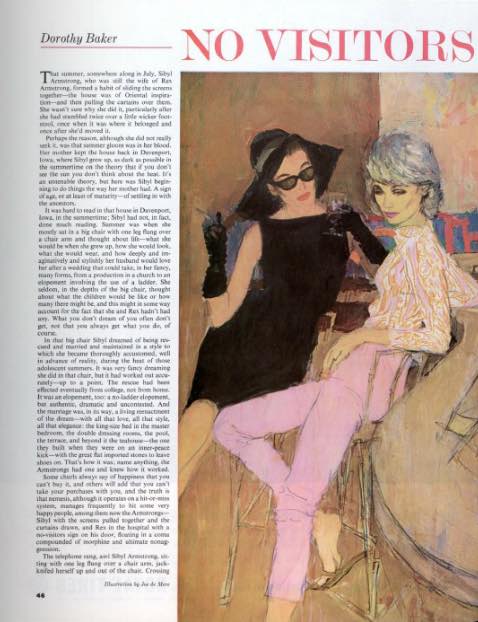
Some churls always say of happiness that you can’t buy it, and others will add that you can’t take your purchases with you, and the truth is that nemesis, although it operates on a hit-or-miss system, manages frequently to hit some very happy people, among them now the Armstrongs — Sibyl with the screens pulled together and the curtains drawn, and Rex in the hospital with a no-visitors sign on his door, floating in a coma compounded of morphine and ultimate non-aggression.
The telephone rang, and Sibyl Armstrong, sitting with one leg flung over a chair arm, jackknifed herself up and out of the chair. Crossing the room, she tripped over the footstool again, picked it up, took it with her, sat down on it and caught the telephone at the second ring. One way to keep track of a footstool is to sit on it, and sitting doubled up is one way to keep from shaking. She put the telephone against her knees, bent to it and said hello in a voice that cracked a little. She lived in fear, and her voice was untrustworthy. The other voice was cultured, female, nobody from the hospital. It asked, elaborately, for Mrs. Armstrong.
“Speaking,” said Sibyl, to her own surprise. It was the first time in her life she’d answered “speaking,” but at least she didn’t say “shaking.”
“Sib?” the other voice said, quite simply now. “Maggie Staples.”
No bell rang. No bell very well could. Sibyl Armstrong’s consciousness was taken up with one name only these days, in a very one-track way. She was excluded from the hospital room until noon, while the nurses did their things, but she was admitted at 12 and allowed to sit beside the bed until midnight or whenever somebody sent her home. And from six in the morning until noon she waited for the telephone to ring, hoping wildly that it wouldn’t. Not today, please, not today, some other day, and not by phone. Let me be there.
The name “Maggie Staples” meant nothing, and when she said, “Oh, Maggie Staples,” she brought so little conviction to it that her caller offered a short refresher course.
They’d lived straight across the hall from each other for three years at Biddle College (for Women) before Maggie Staples lit out and went on to higher things in the region about Times Square and Broadway. Maggie Staples kept it brief and said it quite gracefully, but Sibyl recalled that they’d both failed to graduate, and for much the same reason, except that Maggie’s marriage had been to a career. When you’re offered a meaty role on Broadway, you don’t tell the producer to wait until you’ve been handed a diploma and can therefore switch your tassel from one side of your silly hat to the other. You accept the role. You go.
“I know,” Sibyl said. “I think I saw a thing on you in one of the magazines.”
“Oh?” the voice said. “When was that?”
“Ages ago,” Sibyl said; “twenty years at least.”
If at this moment the hospital was trying to call her, they would be getting a repetitive sound indicating that the telephone was in use.
“It couldn’t have been that long,” Maggie Staples said, “because, goose girl, we’ve only been out of college seventeen years.”
“Fifteen, then,” Sibyl said, “or twelve. I never have had much sense of time. Anyhow, I remember we were very proud.”
“Bless you,” the voice said, most sincerely. “I’ve tried to live up to it — that pride. In a way it’s the actor’s first obligation.”
“Maggie — I’ll have to say it — I’m in a predicament.”
“Yes, dear,” the voice said quickly, “tell me.”
“It’s just that I’m expecting a call.”
“Oh. If it’s important, I’ll hang right up.”
“It is. But call again sometime.”
“That I’ll do,” the voice said. Bravely. And hurt. “That I’ll certainly do.”
“Look, Maggie” Sibyl said. “Where are you staying? I’ll call you when I can.”
“It’s an unlisted number,” Miss Staples said, “and I’m not there, and I can’t remember it. I’ve been out here six weeks only, and my mind’s a whirlpool of terribly important numbers, one of which is mine — but which one?”
“Then you call me,” Sibyl said, “sometime. It’s nice of you to remember me after so long.”
“Nonsense. ‘Bye, dear.”
Click. And if the hospital had tried to call during the course of this unpredictable conversation, it would call again. It was 9:30 now. Two and a half hours more and she could push open the door with the no-visitors sign on it and try to share the coma.
Nine-thirty was an odd time for an actress to be up and about, communicating with old college classmates uncommunicated with for how many? . . . 17? . . . years. A girl named Maggie Staples had lived straight across the hall from her for three years. But girls who lived across the hall that long ago tend to blur and become confused with a lot of other more or less memorable girls from across the hall. Right now, for instance, Sibyl Armstrong found it hard even to recall the face of her roommate of those three years. Her memory limited itself to collecting memorabilia directly connected with Rex Armstrong, and it served her lavishly with all manner of bits and pieces and larger reconstructions. It brought her details — significant, insignificant and mixed — the insignificant becoming significant. The mole, for instance, on the bottom of his left foot, flat and smooth, more like a freckle, but large, the size of a quarter, and of a handsome brown color. When did she first know he had it?
Well, reconstruct.
He was lying in the sand, on his stomach, with his feet toward the ocean. West, that is, of course, and she, Sibyl, the reconstructor, was lying at right angles to him, at his feet, with her head facing Santa Barbara. She was gazing with fascination at his feet and thinking profound thoughts about man, not men, but primates all the way from apes to fellows — how the backs of their hands are hairy, but their palms are smooth and so are their feet. Then she was off the general and onto the particular, as usual, and lost in admiration of these particular bare soles, and it was then that she discovered the particular distinguishing mark. It was on the bottom of the foot farther north, the one closer to Santa Barbara. She remembered thinking that if you had to have such a large handsome freckle, the sole of the foot was a brilliant place to have it. And that night they had dinner in Santa Barbara with shoes on — a night that was all stars and no moon.
She lifted the telephone from her knees to the desk and stayed where she was, on the footstool. She was still sitting there, reconstructing, when the doorbell made the flat impersonal summons which Armstrong Associates — and Mr. and Mrs. Armstrong also — preferred to chimes. She sat where she was and ignored it, impersonally. She could do this for three summonses, but not for the fourth. She got up and walked across the living room into the entrance hall and opened the door during the fifth buzz.
There was a woman standing there, and when the door opened, she withdrew her gloved hand from the button she was pressing. She wore dark glasses and a floppy black hat and a black linen dress. An obvious example of a witch in gloves, and she spoke in a voice she knew the use of, a cool light breeze of a voice.
“When I took my bearings,” she said, “it turned out I was so near that I came along.”
She stepped in, still speaking, and said what she meant, very directly — that she knew a great deal about trouble and that she’d heard the sound of it — unmistakably just now on the phone.
“You’re Maggie Staples. Already?” Sibyl Armstrong said with a logic of her own.
“Just like that,” said the light voice, and Maggie Staples snapped a gloved middle finger against a gloved palm. “Just like that, I came where I was needed.”
She walked past Sibyl to the far end of the entrance hall and turned back to say, “Or if I’m not needed, something quite obviously is. Can you tell me what?”
Sibyl closed the door and leaned back against it with her hand still holding the knob.
“Can’t you, Sibyl, make a try?”
She turned, tentatively, toward the living room, and Sibyl walked across the hall behind her. They went in together.
“Be careful of that stool,” Sibyl said, “that one in front of the desk.” She drew some curtains and separated the screens, and Maggie Staples stood in the center of the room and looked at the room from floor to ceiling and from wall to wall and gave a sigh of profound admiration.
“Marvelous room,” she said. “Absolute room.”
Sibyl looked at it too. It was the first time she’d seen it for a long, long time.
“An architect’s house has more or less of an obligation to be good,” she said.
“It lives up,” Maggie Staples said. She started toward a chair and then stood still and said, “Show me the kitchen, will you, Sib? That’s the test of a house.”
The kitchen also lived up. Gourmet to the very whisks was how Maggie Staples put it, and speaking of food, she was a little weak. She’d missed breakfast, for complicated reasons, but the custom of the country would suit her perfectly, if there happened to be any vodka in the house and any California orange juice toward the making of a screwdriver. Or better still, some tomato juice toward that other breakfast favorite out here — the Bloody Mary. Foolish custom of a foolish country, and how adaptable can you get? But she’d go back to soft-boiled eggs in New York. Meanwhile vodka, like the Romans when in Russia.
“Maybe we’d better go into the saloon,” Sibyl said.
“Saloon?”
“Well, it’s not a family room.” Sibyl led her in, and Maggie Staples laughed behind her all the way and found it beautifully stocked and wonderfully restful.
“Great relief from those bars all hung over with Toulouse-Lautrec. Aren’t you having one?”
“No, thanks,” Sibyl said and felt foolish, not for the decision but for the thanks. She had never liked to drink, except with Rex. When he stopped wanting to, she stopped wanting to. She looked at the telephone hanging low under the bar, touched it to ask it not to ring and then went around to the other side and sat on a stool beside the breakfast guest.
“What are you doing out here?” she said. “Television?”
Maggie Staples responded with a restrained double take. She heard it, couldn’t believe it, heard it again and appeared to choke slightly on the Bloody Mary.
“Do I look like television?” she asked. “Do I give the impression of being both adult and Western?”
“I don’t really know much about it,” Sibyl said. “Ours blew up and we never remember to have it fixed.”
“Good policy,” said Maggie Staples. “It’s the kind of sawmill I don’t care to get tangled up in. And whatever else you can say for me or against me, I haven’t.” She took a drink, set the glass down and added with emphasis, “Ever.”
The next question should be, logically, a narrowing down (Then what is this job? What are you doing?), but Sibyl’s guest answered it, in an oblique way, before she was asked.
“I’m trying to do a little good in a world where anxiety arrives and serenity departs.” She looked into her glass, saying it, and rattled the ice cubes like dice in a cup.
“I’m told your husband is very ill,” she said.
Sibyl jumped as suddenly as if she’d touched an open wire. She got off her stool and went around the counter to make certain the telephone was hanging properly on its hook.
Maggie Staples misinterpreted the move. Pushing her empty glass across the counter, she said, “Thanks, I will. You know, most women can cook passably, but very few can mix a decent drink. Why do you suppose that is?”
Her hostess, behind the counter, didn’t offer a guess. She found a small can of tomato juice and opened it, looking deeply preoccupied. Finally she looked up and said, “But how — ”
“How did I know? Sixth sense, I suppose. I knew you married a man named Rex Armstrong — as a matter of fact, I danced with him once when he came up to one of those dumb Biddle dances we used to go through every spring. Now he’s an important man. People hear about important men.”
She took off the dark glasses, and Sibyl saw her eyes and was seen seeing them. “Smog,” Maggie Staples said. “One more reason for me not to stay out here.”
She put the glasses back on and said quietly, “Sibyl, I hope you know I’d never presume on a college friendship, nor on my reputation, nor your husband’s, for that matter. How serious is it — do you know?”
“Do I know?” Sibyl said, but only to herself. She pared a sliver of peel from a lemon, gave it a twist and let it drop into the glass. It was quite a while before the answer came. And Maggie Staples waited for it, decently, with respect.
“The classification,” Sibyl said very slowly, “is terminal.” And she went on, faster: “Terminal’s the term, and it doesn’t mean where you change trains — it’s where you get off and stay off.”
She felt around for the tray of ice cubes, but it had gone somewhere. “End of the whole bumping line,” she said.
Maggie Staples watched her hunt for the tray and waited for her to find it be- fore she spoke. It was a trained voice — calm, kind, compassionate and dispassionate at once.
“It goes without saying,” she said, “that with your combined intelligences you’ve done everything that can possibly be done,” and Sibyl answered a little breathlessly that, intelligent or not, they’d tried first things first, and then, one after the other: the rays, the pills, the shots, the chemical approach.
“But nothing new is new enough. By now there should be a cure, but the geniuses all go into physics to help us get into a great big game of Russian roulette. Any number can play.”
“Don’t talk that way or think that way, Sibyl. It’s wrong, wrong, wrong.”
“What’s so wrong, wrong, wrong about it?”
“Bitterness won’t help. That’s really what I came to say — that you’ve got to learn to accept this and then prepare yourself for it. In spiritual ways and in practical ways.”
Sibyl put a glass in front of her, and Maggie curled her hand around it. “This for me? Shouldn’t you have one?”
“I had breakfast,” Sibyl said, “at six o’clock. That’s when the switchboard operator comes on duty. They close the board at midnight and open it at six, and if anything significant has happened during the night, after midnight and before six, they’ll telephone.” She folded a towel, dampened it and pushed it along the counter, with the grain. “At least they say they will,” she said. “and it gives me something to think about in the two minutes it takes me to eat my three-minute egg every morning at six o’clock.”
“You talk exactly the way you did in college.”
“Well, I don’t feel the way I did in college — exactly.” Sibyl hung the towel on a hook. “You’re right, I’m bitter as all gall.”
The dark glasses turned directly to her now, and the rich, light voice told her how to think of it. “Think of it this way.” The voice grew more rich than light. “You’ve had much more than most people ever have. You’ve had a wonderful life together. It’s been an achieved relationship.”
Sibyl Armstrong, behind the bar, picked up an ice cube, closed her hand on it and looked truly puzzled. “Has it?” she said.
“Hasn’t it?” Maggie Staples said, just audibly.
“Oh — achieved and a half,” Sibyl said, “but I didn’t know it had been written up in Variety.”
“You are bitter, Sib. Listen, girl, tell me about it. Just talk. Say anything. Believe me, it helps.”
Sibyl took the towel off the hook and folded it precisely, corner to corner. “What would I say if I talked? That he’s six feet three and a quarter inches and that he’s now edging a hundred and ten pounds? Does that help?”
“Doesn’t it? To get it off your chest — to an old friend?”
“No, it doesn’t. Not one — ” Not one what? Whit, jot, bit or smidgen? “No, it doesn’t help at all,” she said.
She unfolded the towel, twisted it, snapped it and looked at Maggie Staples’s glass, a third full. She drank fast, there was that about her old friend Maggie Staples. Sibyl looked at her closely, then at her watch and said, “I don’t remember you very clearly from college, to tell you the truth.”
“I’m sorry. Vain of me, but I supposed you would.”
There was now a fourth of the drink left and a little over an hour left before it would be time to go to the hospital.
“You were in the plays — the class plays and the Masquers.”
“Was I not!” said Maggie Staples. “All the way from Hedda to Jocasta through Sabina. I worked in those days, slaved. I still am, of course — still do, I mean.”
She laughed suddenly. “Am, do, be, was, been. Take your choice, it’s all the future imperfect or action completed in the past.” She laughed again.
“I hate to do, it,” Sibyl said, getting it in fast, “but I’m going to have to close the bar and get ready to leave. First, though, I’d like — ” She started it bravely enough, then stopped, upsure, and then said it. “I’d like to know what you want.”
Maggie Staples heard the question, drained her glass and pushed it across the counter. “The same thing, only this time a little less tomato juice and a touch heavier on the vodka, if you can stand a suggestion. Lots of people can’t.”
My own fault, Sibyl said to herself. I should have said, “Why did you come?” not, “What do you want?” But she mixed the drink, in line with the suggestion, and then she dried her hands on the towel, hung the towel on the hook and put both hands on the counter and both elbows out, an Irish stance, and said it clearly: “What do you want? You wanted to see me — for a reason. But you haven’t made the reason clear.”
Maggie Staples took it slowly. Yes, she was here for a reason, and she’d stated it earlier. She was here, knowing the trouble, with an offer of help. But this was not one of those vague let-me-know-if-there’s-anything-I-can-do offers. No. Not one of those. Her offer was a specific one, pragmatic, practical, and it meant that when the time came there would be no panic or indecision; distressing details would be taken care of, intelligently and with the utmost delicacy, by a staff of men and women skilled in solving problems of this sort. There would be no taking advantage of grief and distraction to drive a bargain.
“Though I fully realize,” Maggie Staples said, “that money is not a problem here, still it’s a matter of pride with me to be representing a group that I, personally, respect.”
Sibyl Armstrong’s voice became untrustworthy again, and when she said, “You represent a group?” the “group” came out falsetto.
“The best,” Maggie Staples said, and she sipped her drink while Sibyl Armstrong looked, rather stupidly but with fascination, at a brochure which now lay displayed on the counter before her.
She didn’t know how it got there; she didn’t touch it, but she did see it, more or less, and in a moment she said, “Why do they call it Crestview? Is there a view of a crest?”
“I don’t really know,” Maggie Staples said. “I’ve only been with them three weeks. Most of the staff is new.”
“But skilled, I believe you said,” said Sibyl, who suddenly had to sit down.
“Oh, very skilled, very highly,” Maggie said. “What’s the idea sitting on the floor? All these stools.”
“I like it here. It’s where I landed and I like it here. Let’s hear the proposition.”
There was no answer from above.
“How did you get my name?”
Still no answer. Silence at the bar.
“Go ahead, represent your group. How did you get my name?”
“Not yours. Your husband’s.”
Sibyl Armstrong heard that word, looked fast at her watch and saw that there was still a little time. She stood up, got a glass, poured herself a measure of bourbon and looked into it while she thought out the answer. Out loud. “Somebody gets to somebody who gets to an orderly who gets to a nurse who keeps informed on prognosis. And sells you the worthwhile names?”
It felt like a long speech, and when she’d finished it she drank off the bourbon and set down the glass.
“That make you feel any better?” Maggie Staples said.
“I didn’t drink it to feel better. I only needed something to toast one of Biddle College’s distinguished graduates.”
Maggie Staples started to get off the stool and then stayed where she was. “You’re forgetting. I didn’t graduate. I went on to higher things.”
“Yes.”
“How do you mean, yes?”
“I mean yes, higher things, yes you bet,” Sibyl said, and this time Maggie did get off the stool.
“All right, but it wasn’t always like this,” she said. “I was good. You read the notices, you saw the spread. I started strong.”
She took off the dark glasses and let her eyes show — red — and then she half sat on the stool again and said simply, “I don’t know. I don’t know what happened.”
She picked up the brochure, shoved it into her bag and laughed — a short one. “I even had to tell these ghouls who I am — I mean who I was.”
She put the dark glasses in the bag and felt around in it and brought out the black gloves and drew them on, finger by finger. She looked for a moment at what was left of her drink, then turned her back on it and started toward the kitchen, the way they’d come in.
Sibyl followed her. In the kitchen she said, “Maggie, I don’t really have to leave for another half hour, if you’d like another drink. Or something.”
Maggie Staples reached up and touched one of the wire whisks hanging from the hood of the stove. “I’d like to have eighty-nine other drinks,” she said. “Or something. But in eighty-nine other places.”
“Don’t feel that way,” Sibyl said. “Don’t be bitter.”
“That’s my line.”
“I know,” Sibyl said. “I got it from you.”
They crossed the living room, and Sibyl Armstrong opened the door, and Maggie Staples stepped out onto the bricks and felt in her bag for her dark glasses.
“Call me sometime, will you?” Sibyl said.
Maggie picked her way across the stepping-stones. “Let’s say this,” the voice called back from under the hat. “I won’t unless there’s absolutely no need to.”
“Either way,” Sibyl said.
She closed the door and stood looking at it and then moved to one side of it, opened a louver and looked out, and watched Maggie Staples in her floppy hat and black dress and black gloves taking the stepping-stones until there was none left to triumph over. At the curb she stopped to look first down and then up the street. There was no car parked in the block. Sibyl saw her raise her hands to her waist in a gesture that very delicately suggested the tightening of a belt, and then move off to the right. She walked well on flat ground. Anyone who has learned to walk across a stage, no matter how long ago, can walk down a street as far as the corner. And turn the corner and be out of sight.
In Rex Armstrong’s house the telephone rang. Sibyl Armstrong heard it, knew what it meant, closed the louver and heard it ring again. Then she took a deep breath, touched her hands to her waist in a gesture she’d seen somewhere, and crossed the room, fairly steadily, to answer it.
Logophile Language Puzzlers: Politicians, Pep Talks, and Chintz
Put on your thinking caps and take on Logophile’s latest language puzzlers, which appeared in the May/June 2017 issue of the Post. Answers and explanations are below.
- A politician who is meretricious
- has earned his position through hard work.
- is an excellent researcher.
- is insincere.
- Which team hit the field with more confidence?
- The Bluehawks were enervated after Coach Terry’ pep talk.
- The Redhawks were innervated after Coach Jean’s pep talk.
- Betty is afraid of a ghost but not a ghoul, of a biopsy but not an endoscopy, of chintz but not paisley, and even of her own name. What one thing is Betty really afraid of?
Answers
1. c. is insincere.
Meretricious comes from the Latin verb merēre, “to earn, gain, or deserve,” which also gave us the words merit, meritorious, and emeritus. But meretricious is synonymous with none of them.
Merēre is also the root of the Latin noun meretrix, “prostitute,” and so meretricious originally meant “relating to or having the nature of prostitution.” Shortly after the word was adopted into English in the 17th century, people also began to use it to refer to things that were superficially attractive but that lacked true value or integrity, and that’s how the word is most commonly used today.
A meretricious politician, then, is insincere — making attractive statements and grand promises but lacking the integrity to follow through on them.
2. b. The Redhawks
The verbs enervate and innervate are antonymous near-homophones — they sound very similar but mean the opposite of one another. Both stem from the Latin root nervus, “nerve or sinew.” Enervate begins with the Latinate prefix e-, meaning “out of,” and so means “to drain of nerve, strength, or vigor.” Innervate, on the other hand, begins with in-, which means (unsurprisingly) “in,” and the word means “to arouse or stimulate, or to supply with nerves.”
One who is enervated is “out of nerve,” and one who is innervated has been stimulated to action, so the correct answer is b; the Redhawks have more confidence.
Here’s a mnemonic device to help you keep the two words separate in your mind: If someone is innervated, they’ve (metaphorically) had nerves put in them; if a person is enervated, their nerve has escaped, exited, emptied out.
3. Betty fears alphabetical words.
Did you catch what characteristic the words ghost, biopsy, chintz, and Betty share that ghoul, endoscopy, and paisley don’t? Here’s a hint: Other words that share this property are accent, billow, chimps, glossy, and knotty.
Here it is: Betty is afraid of words whose letters are arranged in alphabetical order.
These three questions appeared in the May/June 2017 issue of the Post. Not a subscriber? You can start a new subscription here.
Body of Evidence: 7 Questions with a Forensic Pathologist
What do you know about post-mortem examinations? The reality of this specialized medical field differs from T.V. crime dramas. Dr. Brandon Reilly discussed the declining numbers of autopsies in the U.S. in the May/June article Secrets of the Dead. We spoke with forensic pathology fellow Grace Dukes, MD of the Cook County Medical Examiner’s Office about the ins and outs of performing autopsies for a living.
Did you always want to be a medical examiner?
I did not. I knew it would be something based in the science world. I sort of landed on medicine. I went to medical school, and I didn’t actually know about pathology until I got there. During my first year a pathologist spoke with us about the practice in general. I did a summer internship in forensic pathology, and I got to see forensic autopsies. That’s where it got started.
How does a typical day go? Do you often perform autopsies?
Yes, often. Not every day. Multiple people in our office will perform autopsies every day, and I’ll cut every couple of days.
A normal day — if I’m doing autopsies that day — I’ll come in in the morning, and I’ll read about my cases and try to learn everything about the medical histories and circumstances surrounding the death. Then I’ll go into the morgue and do the autopsy. After that, I’ll be dictating my findings, trying to wrap up loose ends, requesting things from investigators — additional pieces that I need.
When I’m not doing autopsies I’ll be writing reports, working with investigators to get additional pieces of the puzzle, interpreting toxicology findings, viewing microscopic slides. All of it is to come to a conclusion about the cause of death.
How long does an autopsy typically take?
It depends on the case. A relatively straightforward autopsy — with few anatomic findings — will take probably 45 minutes to an hour. If there are more complicated things we need to do — special dissections or retrieving bullets — that could take hours.
If we get a homicide, for example, with lots of injuries, we have to document those injuries both on our charts and photographically. If there are gunshot wounds we have to document the pathways of the bullets, the organs injured. If the person is holding a projectile from the gunshot that has to be retrieved. That can take a lot of time.
Are all autopsies the same?
We will do the same procedures in each case, if it’s a full autopsy. They vary by injuries and anatomic findings, but we examine the body in the same way. We do an external exam and an internal exam, looking at all of the organs. That process is the same for every case.
Would you say it differs from a typical Hollywood portrayal of a medical examiner?
It’s different.
I have seen some of the T.V. shows that portray medical examiners, but I did not grow up watching them. That’s not what got me interested in pathology, but since I’ve started I have gotten into it.
The biggest difference is probably the turnaround time for results. D.N.A. testing is a big one. That actually takes months usually. Toxicology testing can take weeks. A lot of that takes much longer than is portrayed on T.V.
Another big difference is within the morgue when you’re doing an autopsy. At our facility there are four different autopsy tables functioning at the same time. When you see it on T.V. it’s usually in an isolated, dark room, usually quiet. When we do our procedures it’s actually not quiet at all. There’s a lot going on.
Usually it’s for dramatic effect. Everyone’s focus is this one body and this one cause of death, and they can just look at the body and tell something immediately. That’s not usually the case when we’re actually doing an autopsy.
Have you ever faced a scenario on the job that shocked you?
We see things every day that the general public might describe as shocking.
We’re trained professionals. We’re trained to handle the things we see. When we’re here the focus is more on the job and cause of death determination and less on the fact that it’s shocking.
There’s a lot you could be unprepared for in that every case is so different, and the things you could see on a daily basis are always a surprise. You could get used to doing multiple gunshot wound cases, and there’s an aspect of it that becomes routine, but then there’s always a case where the circumstances are surprising. Nothing changes about what I would do during my work.
How does problem solving enter into your work?
Our job is to determine cause of death. Every case we encounter is — a problem is not the word — but it’s similar to a physician in a hospital with a patient with several pieces of the puzzle that may or may not add up. They have to use the information they’re given to come to a conclusion about the diagnosis. We really do that exact same thing. It just happens to be after the person has died.
Check out Secrets of the Dead from the May/June issue about autopsies in the U.S.
Cover Gallery: Celebrating World Red Cross Day
In recognition of World Red Cross Day ON May 8, we offer a series of classic Saturday Evening Post covers that honor the Red Cross.
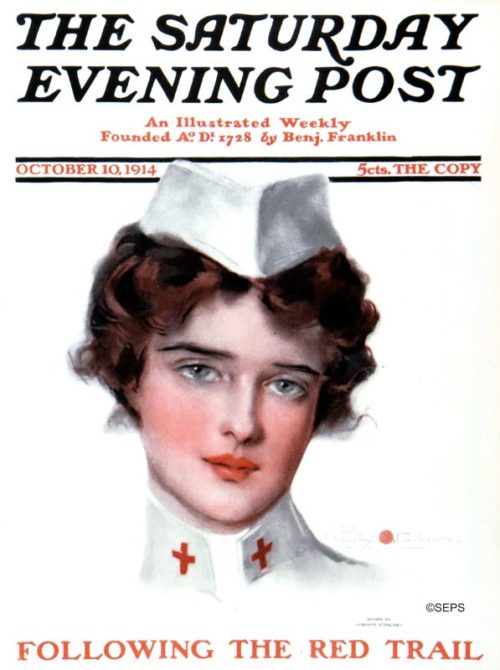
Penrhyn Stanlaws
October 10, 1914
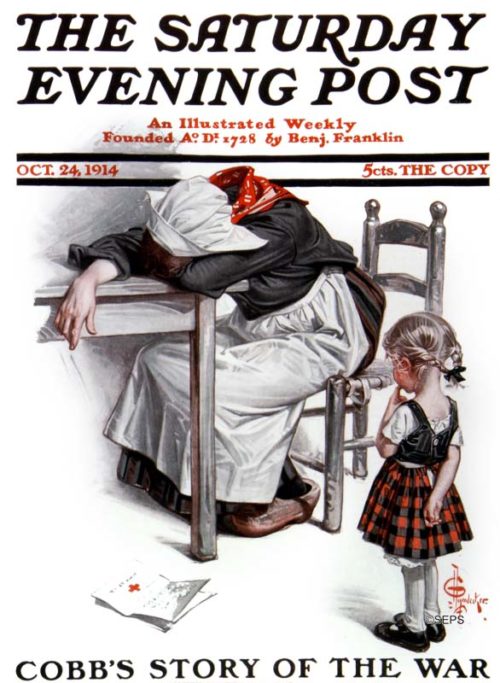
J.C. Leyendecker
October 24, 1914
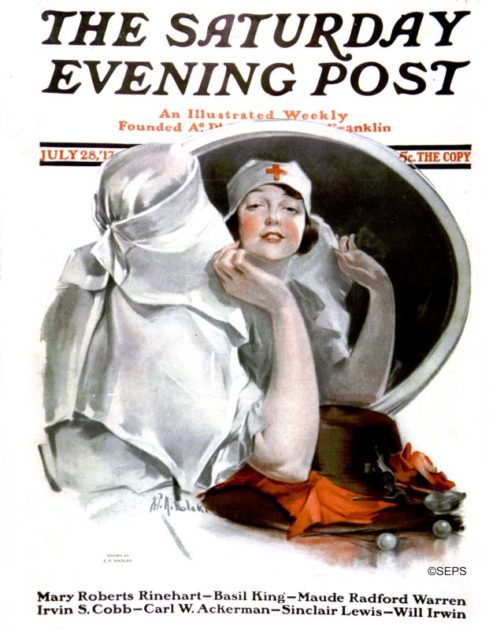
N.P. Zarokilli
July 28, 1917

J.C. Leyendecker
March 30, 1918
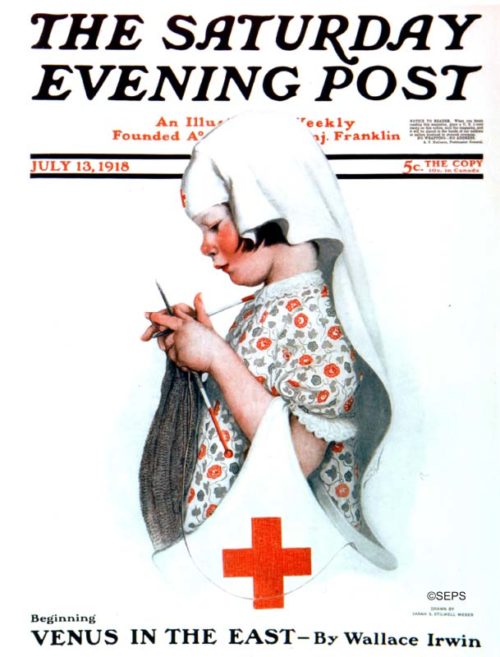
Sarah Stilwell-Weber
July 13, 1918
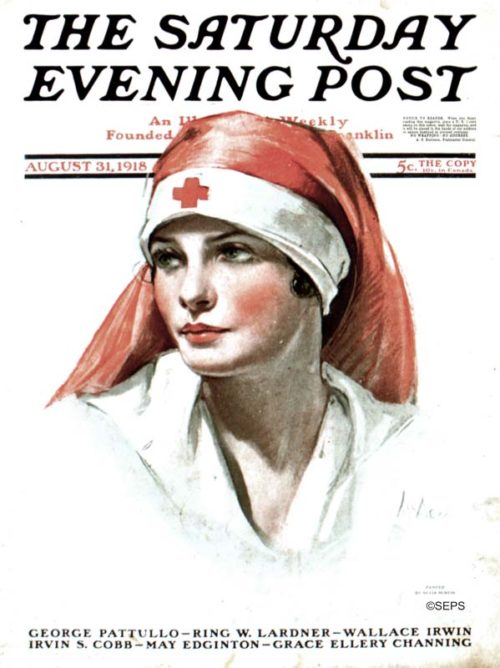
Neysa McMein
August 31, 1918
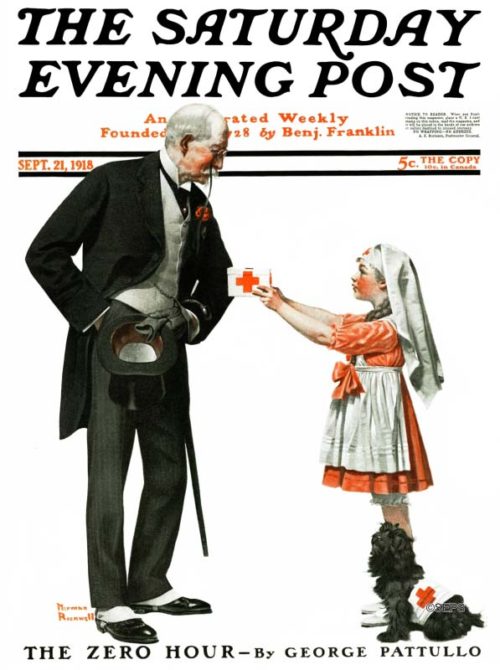
Norman Rockwell
September 21, 1918
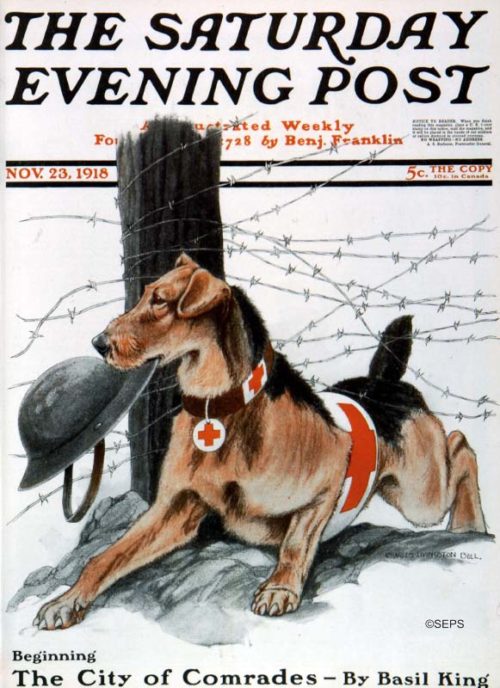
Charles Bull
November 23, 1918
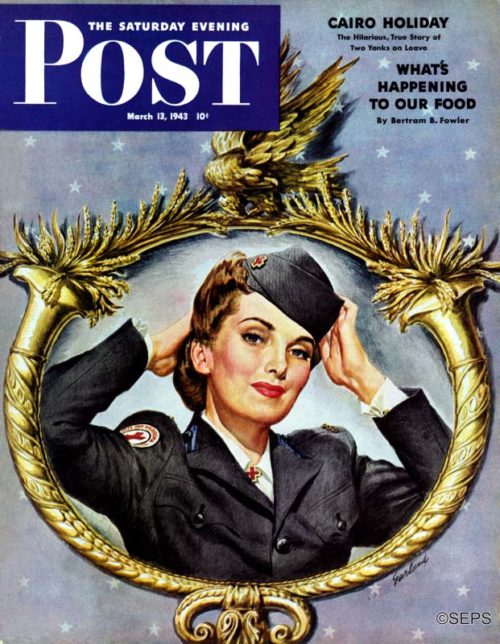
George Garland
March 13, 1943
The Red Sox, Cooperstown, and Firefighters: The Story of Ted Williams’ Ego
Sure, Ted Williams was big-headed, but if he didn’t believe in himself, who would?
This article and other features about baseball can be found in the Post’s Special Collector’s Edition, Baseball: The Glory Years. This edition can be ordered here.
His name is Williams — Ted Williams. They call him the Kid on the Red sox because, standing 6 feet 3 inches, scrawny and smooth- cheeked, and weighing only 170, he looks like one. actually, in a major-league baseball park, way out there in left field, he looks as if he’d blow away at a puff of wind.
The Kid himself will tell you what kind of a hitter he is. He wants other people to like him, it is true, but he is — and he knows he is — his own best fan. He is not bashful. His belief in himself is missionary in scope and he shouts it wherever he goes. so much so, indeed, that some saw more than chance in the fact that his last hit of last season, in Shibe Park, Philadelphia, was a booming line drive which carried to the right-center-field wall and tore a hole in one of the horns of the public-address system.
“All right,” he says, “so i think i’m one helluva hitter. Well, all i’m asking is, suppose i stop thinking it, then who do you suggest is going to?”
There is no answer.
— “I Wanna Be an Immortal” by Cleveland Amory, Jan. 10, 1942
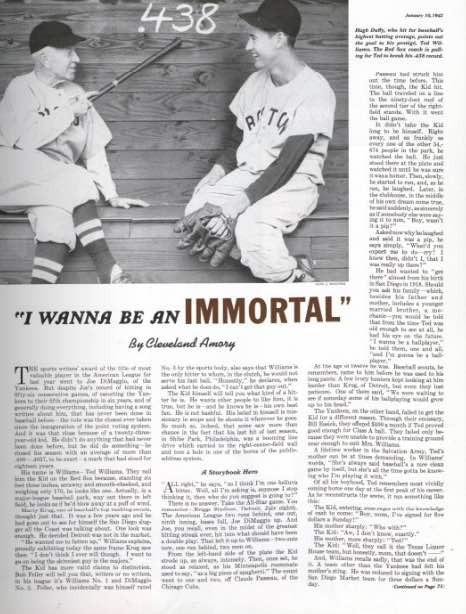
Why We Don’t Do Autopsies Anymore
Also check out Body of Evidence: 7 Questions with a Forensic Pathologist, an interview with a Cook County medical examiner.
I‘m in the morgue, not my favorite place. Heads loll, limp and ghoulish, as their bodies are hefted on and off the long chrome dissection tables. Big slabs of human beef, darkening by the minute, glisten under hot white lights. Right now, I’m looking at Ms. Dubois, an elderly Alzheimer’s patient with a giant heart clot we had seen on her echocardiogram a week earlier in the Emergency Department. Now, here, her heart has been cut out of her chest and put on a small examining table. My team and I gather around with the pathologist. The rest of Ms. Dubois lies next to us, her body respectfully covered with sheets, her face only a little more vacant than it was yesterday before she died. It wasn’t her dementia that killed her. Alzheimer’s disease empties you out, leaving behind a husk where the person used to be, but it doesn’t kill you. Something else — a heart attack, a stroke, pneumonia — does that. We’ve come down to the morgue to see what got Ms. Dubois.
With a twist of his wrist, the pathologist flips open Ms. Dubois’s disembodied heart, filleted along a plane that best shows her mitral valve. One of the doctors gasps when she sees Ms. Dubois’s artificial heart valve. The rest of us, including myself, are dumbstruck.
I haven’t seen a valve like Ms. Dubois’s since I was a medical student, observing open-heart surgery for the first time — it looks like a miniature metal birdcage with a Ping-Pong ball inside. But it’s not the antiquity of her heart valve that shocks us at the autopsy table. Until she wound up in the dementia unit of a local nursing home a few years ago, Ms. Dubois’s old birdcage valve had served her well for decades.
Jeez, one doctor says now, peering intently into Ms. Dubois’s heart. The whole thing came off!
Hmph, says another, unable to avert his eyes from the sight of it. I didn’t know that could happen.
I didn’t know it could happen either. The thrombus itself, a round red glob of congealed blood about two inches in diameter, is impressive enough, huge as heart clots go. But we’d known how big it was right from day one, and we’d also known why it was there; by mistake, her blood-thinner medication had been under-dosed for the past few weeks at her nursing home, putting her at risk for a stroke. Part of the clot could break off from her heart and travel through her circulation into her brain. On top of her advanced dementia, a stroke was the last thing Ms. Dubois needed. Treatment with an intravenous blood thinner, as we had done these past several days, almost always helps to dissolve the clot and prevent such complications. No one had anticipated that the whole clot could break off. But there it is, the entire blood clot, dislodged from the wall of Ms. Dubois’s heart, stuck in the struts of her old metal valve. It fills the old birdcage completely, obstructing any output of blood from her heart.
No wonder she couldn’t be resuscitated after her cardiac arrest. There’s no way to treat this; prevention is the only hope. That’s why we’d needed to see Ms. Dubois’s autopsy. Had she died without an autopsy, the doctors on my team probably wouldn’t remember her a few months from now, just another old lady whose time had come. But they’ll remember her now. They’ll remember that this is what can happen when mistakes are made, when meticulous care is not taken to manage risky medicines like blood thinners. I don’t know whether the nursing home will get sued for its error, but I make a mental note to call our hospital’s legal counsel after I call Ms. Dubois’s son to inform him about the autopsy findings.
 Almost 100 years ago, Sir William Osler, the most renowned and revered physician since Hippocrates, actually requested his own autopsy. Osler told family and friends that, given his lifelong interest in the case, he wished he could attend his own autopsy to see it for himself. Typically Oslerian, this choice of words was as precise as it was good-natured: The word autopsy literally means “to see for oneself.” Osler died at his home in England after a protracted battle with bacterial pneumonia in 1919, nine years before the discovery of penicillin. (In his renowned pre-antibiotic-era textbook, The Principles and Practice of Medicine, Osler had dubbed pneumonia “the captain of the men of death.”) Osler wanted his own physician, Dr. A.G. Gibson, to know why he had died, in the hope that this knowledge might help other patients in the future. So, as Osler famously had done more than a thousand times for his own patients, Osler’s doctor performed Osler’s autopsy. In the kitchen of the Osler family home.
In Osler’s time, autopsies were bellwethers and benchmarks. A high autopsy rate strengthened a hospital’s reputation; it indicated that the medical staff wanted to learn as much as possible about their sickest patients — the ones who died — in an effort to improve doctors’ diagnostic capabilities, perhaps gain scientific insights, and avoid error in the future. Since 1761, many hospitals had operated busy “autopsy theaters” where plaques on the wall read Hic est locus ubi mors gaudet succorso vitae (“This is the place where death rejoices to come to the aid of life”). Through the first half of the 20th century, about 50 percent of all patients who died in U.S. hospitals had autopsies; most major teaching hospitals exceeded that rate. In fact, in many teaching hospitals as recently as the 1970s, interns and residents openly competed to achieve the highest autopsy rate among their patients who had died. At Morbidity and Mortality (M&M) Conferences around the world, premortem diagnoses and treatments were compared with the indisputable gold standard, the patient’s post-mortem examination findings. In the days before CT scans and MRI machines, this was how doctors, young and old, looked inside their patients and “saw for themselves” why their patients had died. And, in some cases, how they might have been saved.
Osler’s own autopsy revealed no surprises. It showed that his doctors had done all they could have done, given the (primitive) state of medical science at the time. In this regard, Osler was luckier than most. In his era, autopsies frequently revealed misdiagnoses and missed opportunities to save the patient.
Remarkably, despite spectacular advances in medical care, such misdiagnoses remain commonplace today. In 1983, researchers at Brigham and Women’s Hospital in Boston — by all accounts, then and now one of the best hospitals in the world — asked whether autopsies were still worth doing. Conventional wisdom thought not. Medicine’s diagnostic armamentarium had grown dramatically since Osler’s time. Powerful new imaging technologies — ultrasound, nuclear scanning, computed tomography (CT), angiography — had transformed the practice of medicine, allowing doctors to peer inside living patients more clearly than ever before. Because autopsies are labor intensive, cost money (today, about $2,000), and sometimes make patients’ loved ones uncomfortable, regulatory agencies eliminated minimum mandatory autopsy rates as a criterion for accreditation of U.S. hospitals. The Brigham hospital researchers weren’t sure this change was a good idea and designed a study to examine whether modern diagnostic technologies had made misdiagnosis a thing of the past. They reviewed post-mortem examinations performed at the Brigham in 1960, 1970, and 1980 to compare the “yield” of autopsies in those decades.
These researchers found that autopsies in 1960 had revealed a major missed diagnosis in 22 percent, almost 1 in every 4 patients. Of these, about one-third (8 percent) showed that a correct diagnosis premortem could have led to the patient’s cure or improved survival. The remaining two-thirds (14 percent) found diagnostic errors that contributed to the patient’s death but probably could not have been treated successfully (in 1960). In other words, 1 of every 12 patients dying at one of the world’s best hospitals could have been saved had their doctors made the correct diagnosis. In addition, another 1 in 7 patients who died had diseases that, unrecognized by their doctors, contributed to their death. Little wonder that doctors at the Brigham in 1960, like those in Osler’s time, tried hard to obtain permission for autopsy whenever a patient died. This was how they learned. Doctors learned from their mistakes.
But what shocked many in the medical community was the finding that the rate of missed diagnoses documented by autopsy at the Brigham hospital hadn’t decreased at all 20 years later! In 1970 and in 1980, the rate of major missed diagnoses was 23 percent and 21 percent, respectively, no different from rates in 1960. This lack of improvement did not mean that the Brigham doctors were failing to learn from their autopsies. Clearly they were learning, because most of the fatal diagnoses missed in 1960 — blood clots in the lungs, bacterial infections such as pneumonia or meningitis, various cancers — were missed much less frequently in 1980. But, during those 20 years, medical progress had created new diagnostic challenges. For example, previously rare infections had become increasingly prevalent as complications of new treatments (immunosuppressive drugs) and new diseases (AIDS). As a result, autopsies in 1980 revealed significant changes in the specific type, but not the overall rate, of major missed diagnoses. The Brigham researchers concluded that, despite medical progress — indeed because of medical progress — the “autopsy remains a vital component in the assurance of good medical care.”
And yet today, three decades later, the autopsy rate in U.S. hospitals is less than 5 percent. Many hospitals perform none at all. In 2004, a new generation of researchers found that fatal diagnostic errors have declined somewhat in the past 40 years but estimated that, if autopsies were performed on 100 percent of patients who die in U.S. hospitals today, the rate of major missed diagnoses would range from a low of 8.4 percent (1 in 12 deaths) to a high of 24.4 percent (1 in 4 deaths). Even if one accepts the lower estimate in this range (8.4 percent), it means that more than 70,000 people die in U.S. hospitals every year with major missed diagnoses; about 30,000 of these patients would leave the hospital alive if their diagnosis were not missed. More chilling, these potentially preventable deaths are not included in the Institute of Medicine’s sobering estimate that up to 98,000 patients die annually in U.S. hospitals due to medical error.
The implications are grave, and not just because autopsies are an indispensable quality improvement tool in hospitals. Autopsies establish the cause of deaths, thus ensuring the accuracy of national vital statistics. Today, in the absence of autopsies, it is estimated that at least one-third of all death certificates are incorrect. Autopsies also keep medical educators honest, showing medical students and physicians-in-training the final truth about their patients who die. Autopsies reassure family members of the deceased, protect against false medico-legal liability claims, evaluate the effectiveness of new treatments, improve our understanding of the natural history of disease, and identify new or emerging diseases. Research about Alzheimer’s and other brain diseases, for example, depends on autopsies. (How else can one study cells deep in the brain, inaccessible during life?) Societal responses to public health threats, whether new diseases (such as HIV and SARS) or bioterrorism attacks (such as anthrax outbreaks), depend critically on autopsy findings, too.
Experts at the Mayo Clinic have concluded that “a wide range of medical, legal, social, and economic causes” are responsible for the decline of nonforensic autopsies and proposed no fewer than 46 interventions to reverse this trend. But much of this problem, like other ills afflicting U.S. healthcare today, boils down to three things: money, public misinformation, and doctors’ conflicts of interest.
First, follow the money. Payment for autopsies was built into Medicare’s reimbursement to hospitals decades ago because Medicare beneficiaries account for 75 percent of all deaths in the United States. Perversely, then, hospitals can increase their profits by not spending those resources on autopsies. Pathologists also can make more money by not doing autopsies, devoting their time instead to more lucrative services for the living.
Second, the public doesn’t care, because the public doesn’t understand the importance of autopsies. Many people refuse to consent to autopsies, mistakenly believing that the post-mortem examination disfigures the body or delays funeral arrangements. When doctors take the time to explain these things, autopsy rates tend to rise.
Finally, many doctors are conflicted themselves about the risks and benefits of autopsies. The risks to the doctor may seem obvious: If an autopsy shows that the doctor missed an important diagnosis, this would seem to increase the likelihood of medical malpractice complaints. In fact, lawsuits are less likely when deceased patients undergo autopsies. And, despite all evidence to the contrary, many doctors continue to believe that the accuracy of modern diagnostic testing is so great that it renders post-mortem diagnosis largely superfluous. In the majority of cases, they’re right, since about 80 percent of autopsies confirm the accuracy of doctors’ premortem diagnoses. But is this as good as we can do? Certainly not. We can and must do better.
Niels Bohr, the legendary Nobel laureate in physics, defined an expert as one “who has made every imaginable mistake in a very narrow field.” Ultimately, this is the most important benefit of autopsies: to improve doctors’ diagnostic expertise by letting them “see for themselves” their diagnostic mistakes. The quickening disappearance of the medical autopsy today poses a critical, unanswerable question: How will doctors achieve greater diagnostic expertise — how will we learn, and improve — if we don’t know what we’re missing?
Osler is turning over in his grave.
This article is featured in the May/June 2017 issue of The Saturday Evening Post. Subscribe to the magazine for more art, inspiring stories, fiction, humor, and features from our archives.
Dr. Brendan Reilly is a former executive vice chair of medicine at New York-Presbyterian Hospital/Weill Cornell Medical Center. A widely published clinical researcher and educator, Reilly has served as the chair of medicine and physician-in-chief at Chicago’s Cook County Hospital, which, during his 13-year tenure there, was the inspiration (and setting) for the hit NBC television series ER.
From One Doctor by Brendan Reilly, M.D. Copyright © 2013 by Brendan Reilly, M.D. Reprinted by permission of Atria Books, a division of Simon & Schuster, Inc.
10 Strangest U.S. Museums
If you can collect it, a museum probably exists for it — from the quirky and quaint to the macabre and mysterious.
1. The Vacuum Cleaner Museum
The small town of St. James, Missouri is host to a museum of more than 800 vacuum cleaners, and the admission is free. Several of the first vacuum models, from the early 1900s, are still in working condition too.
2. Lizzie Borden Bed & Breakfast
If you have ever wanted to stay overnight in a bedroom where an axe murder took place, the Lizzie Borden Bed & Breakfast Museum is for you. The house is decorated as it would have been in 1892 at the time of the murders, and tours are given seven days a week. There are even psychic readings and ghost hunting events for the supernaturally inclined.
3. Treasures in the Trash Museum
New York City sanitation worker Nelson Molina has saved thousands of items from the trash in his more than 30 years on the job. The massive collection includes typewriters, toys, instruments, art, glassware, and several artificial Christmas trees. Molina’s museum of treasures doesn’t have hours of operation, but visits can be arranged with the NYC Department of Sanitation at [email protected].
4. The Hammer Museum
“Man’s first tool” is celebrated at this small museum in Haines, Alaska. The Hammer Museum’s collection has grown to include ancient instruments, medical mallets, and a Tlingit warrior’s pick unearthed during the erection of the building itself.
5. National Mustard Museum
This shrine to the versatile condiment has set out to celebrate the illustrious history of mustard since opening in 1992. The founder and curator, Barry Levenson, served as Assistant Attorney General of Wisconsin until the call of the stone ground sauce prompted him to turn over a new leaf. If you visit the Middleton, Wisconsin location, keep your love of ketchup to yourself.
6. Dialysis Museum
Looking for a weird medical museum? Urine luck! You can find a museum for practically anything, as proven by Seattle’s Dialysis Museum. Less of a gift shop tourist attraction and more of a timeline and testament to the life-saving machine, the small gallery features models from the 1960s that were manufactured by the makers of ice cream machines.
https://www.nwkidney.org/about-us/dialysis-museum/
7. Museum of Death
The morbidly curious will have a hell of a time at the Museum of Death. Locations in both Hollywood and New Orleans display crime scene photos, replicas of execution devices, and “the world’s largest collection of serial murderer artwork.” Minors are technically allowed into the grisly gallery, but only mature audiences are recommended.
8. Museum of Broken Relationships
The original Zagreb, Croatia museum was, fittingly, started by a pair of artists who had broken up and who wished to display the remnants of their relationship. The Los Angeles location opened in 2016 and hosts a collection of sappy memorabilia donated by exes from around the world. The accompanying stories depict grief, revenge, healing, and (presumably) resilience. There’s even a gift shop.
9. The Hobo Museum
According to Oxford University Press, a hobo is a migrant worker. According to the Hobo Code of the Britt, Iowa Hobo Museum, “When no employment is available, make your own work by using your added talents at crafts.” The museum displays such crafts as well as many other artifacts from the free-spirited American tradition of hoboing. There is even a hobo convention in which attendees vote on a hobo king and hobo queen.
10. Ventriloquist Museum
More than 800 dummies await visitors to give blank stares and maybe a wisecrack or two at Vent Haven Museum in Kentucky. The collection, sprung from ventriloquism enthusiast William Shakespeare Berger’s obsession, has grown to include Edgar Bergen dummies as well as a “stunt double dummy for Farfel the Nestlé dog.”
See more weird museums in our 2011 article.
News of the Week: Two Spaces vs. One, Boomers vs. Millennials, and House Hunters vs. Vintage Homes
A Typing Controversy
Like a lot of people of a certain age, I took a typing class in high school. I hated it and didn’t do well, which always makes me chuckle because now I actually type for a living, every single day. I think what I disliked at the time was having to sit a certain way, holding my hands in a certain position, endlessly recording the events of all good men who come to their country’s aid. Like a kid who just wants to play the guitar instead of learning chords or how to read music, I just wanted to type. Also, my teacher looked a lot like Larry Fine of the Three Stooges, and that distracted me.
One thing I remember from typing is you needed to put two spaces after a period. But that’s not really true online, and that has a lot of people who still like to put in two spaces a little, well, irritated. In this piece at Mel, amusingly titled “For the Love of God, Stop Putting Two Spaces after a Period,” John McDermott explains in detail why you should now only put one space after a period. In this follow-up piece, McDermott explains how a lot of people didn’t like to be told to put only one space after a period and let him know it in often colorful, vulgar terms (and often using only one space after a period).
I’ve never really thought about how many spaces come after periods in print books and magazines and newspapers. It does really stick out when I get an e-mail where someone uses two spaces. Now I’m going to really notice it, and it’s probably going to drive me batty.
Boomers vs. GenXers vs. Millennials

Every generation complains about the generation that preceded them. Millennials blame Generation X for everything, Generation X blames Boomers for everything, and Boomers blame The Silent Generation, who then blame The Greatest Generation. At least I think that’s how it goes. It’s hard to keep track of who is named what when and why.
I have a slightly different take. I’m a GenXer, and I’ve never blamed Boomers for anything. It never occurred to me to blame Boomers. Instead, like any normal GenXer or Boomer, I complain about Millennials.
BuzzFeed has the results of a poll conducted by the Ipsos firm that found out what older people and younger people think they should do to be considered an adult. The topics range from living at home and doing your own laundry to paying your own bills and having an annual medical checkup.
Shouldn’t all of these numbers be near or at 100 percent? Not every category for every age group, of course, but some of these numbers seem low to me. Only 39 percent of people aged 35–54 consider cooking for themselves more than twice a week to be a sign you’re an adult? Only 43 percent of those aged 18–34 think getting no financial support from their parents is a sign you’re an adult? Only 16 percent of everyone polled gets a flu shot? I’d love to see a similar poll taken in 1980 or 1960.
Some of the results shock me, but not as much as finding out that the word adult is now used as a verb.
And the Tony Nominees Are …
I could go into detail about this year’s Tony nominations. About how this person or this show got a lot of nominations or how this person was snubbed or what the nominations mean. But I haven’t seen any of the shows, don’t really know much about the shows, and I’ve never been to a Broadway show. But here’s the list of this year’s nominees. You probably know more than I do.
The awards show will air June 17 on CBS.
Strike Averted!
Three weeks ago, I told you about a possible writers strike that was about to hit Hollywood. But now we don’t have to worry about it because the two sides came to an agreement at the last minute on Tuesday. It’s a three-year deal that gives writers more money (including increases in residuals), expanded contract protection, and changes to healthcare.
Now, if you were actually hoping for a Hollywood strike, you might be in luck: An actors strike could be next.
Frozen in Time
Whenever I watch House Hunters I get a little irritated, for two reasons. One, I don’t really believe that the show is completely honest. The setups seem staged, and everything is a little too scripted (and a 2012 investigation seems to back up that theory). Second, I hate when the couples are shown an older home, maybe a midcentury home with its original rooms and design and appliances, and the first thing that comes out of their mouths is “we have to tear this out!” I hate that. Those homes should be owned by people who want to keep most of the original features intact.
Like the people shown in this Wall Street Journal piece titled “Life Inside a Time Capsule.” It’s about people who buy older homes and decide to keep them the way they’ve always been, almost like living their lives the way the previous owners lived theirs decades ago. The slideshow is terrific, even if some of the designs of the ’70s homes may disorient you for a moment.
RIP Florence Finch, Norman T. Hatch, Colonel Bruce Hampton, Lorna Gray, Trustin Howard, Leo Thorsness, and Bruce Hall
Florence Fitch was a World War II hero whose bravery wasn’t even known to the public until decades later. She actually died on December 8 at the age of 101, but her family didn’t make the announcement until this week.
Norman T. Hatch had a connection to World War II as well. He was a Marine cinematographer whose shocking footage of a battle in the Pacific won him an Academy Award in 1946. He died April 22 at the age of 96.
Colonel Bruce Hampton was considered the “Godfather of the Jamband Scene” and played with such people as Frank Zappa, Blues Traveler, Spin Doctors, and Widespread Panic, as well as many of his own bands. He collapsed on stage on Monday during a birthday celebration. He was 70.
Lorna Gray was an actress who appeared in several shorts of the aforementioned Three Stooges and in movies with people like John Wayne and Buster Keaton, as well as many other films during the ’30s, ’40s, and ’50s. She passed away Sunday at the age of 99.
Trustin Howard was the head writer of The Joey Bishop Show and often acted in movies under the name Slick Slavin. He died in April at the age of 93.
Leo Thorsness was an airman held captive along with John McCain in the prison known as “The Hanoi Hilton” during the Vietnam War. He died Tuesday at the age of 85.
Bruce Hall was a CBS newsman for 20 years and an NBC newsman for 17 years. He covered space for both networks, as well as thousands of other stories. He died Tuesday at the age of 76.
This Week in History
Citizen Kane Premieres (May 1, 1941)
The classic Orson Welles film had its world premiere at the RKO Palace Theatre in New York City. The movie is usually on “best movies of all time” lists, including this critics poll in The Saturday Evening Post in 1978.
Hindenburg Explodes (May 6, 1937)
Here’s how reporter Herbert Morrison described the event on the ground. By the way, this is how Morrison actually sounded. The video we usually see has an audio recording that was running too fast, and Morrison’s voice has always sounded higher than it was.
This Week in Saturday Evening Post History: Stan the Man Cover (May 1, 1954)
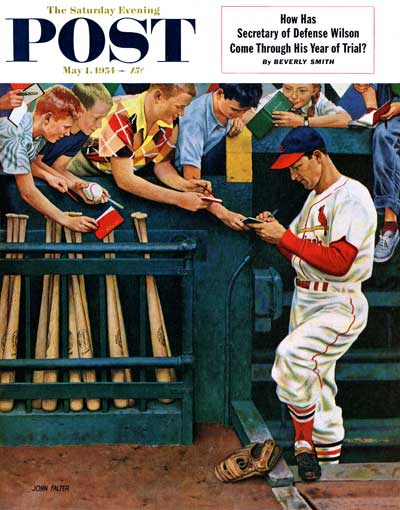
John Falter
May 1, 1954
The man called Stan was Stan Musial, outfielder and first baseman for the St. Louis Cardinals, and in this cover from John Falter, he’s shown signing autographs for fans. Here’s the profile from that issue of the Post, titled “The Mystery of Stan Musial.”
May Is National Hamburger Month
Who invented the hamburger? It’s an odd thing to think about since it seems to have been with us forever. Taking a look at the Wikipedia page for hamburgers (yes, there’s a Wikipedia page for hamburgers), a version of its origin story goes all the way back to 1758, but it’s not really the modern one we enjoy. Some people say the first hamburger was served at Louis’ Lunch in New Haven, Connecticut, in 1900. Others say it was Charlie Nagreen in 1885 (a meatball sandwich), while White Castle says it was the invention of Otto Kuase in 1881. And that’s only three of the many possible inventors. There’s a dispute because it all comes down to not only when it was invented but also what the exact definition of hamburger is.
Someone should make a movie about it.
Here are three burgers to make this month: a Spiced Buffalo Burger from Emeril Lagasse, a Turkey-Meatloaf Burger from Martha Stewart, and a Cheese-Stuffed Burger from country star Trisha Yearwood.
By the way, if you do get a hamburger this month and have to borrow the money to do so, make sure you pay it back by Tuesday. Like Wimpy.
Next Week’s Holidays and Events
V-E Day (May 8)
Also known as “Victory in Europe” Day, it’s the day in 1942 when we celebrated the formal surrender of Germany, which ended World War II in Europe.
National Teachers Day (May 9)
In April, the 2017 Teacher of the Year was honored at the White House. Her name is Sydney Chaffee, and she teaches at the Codman Academy in Boston.
Dating
Tossing Ted into the dating pool after 20 years of a dry marriage that finally withered away in divorce was like forcing the milquetoast accountant to skydive from a plane soaring over rugged mountainous terrain. He had no safe place to land.
Shy and laconic, Ted couldn’t even muster small talk about his one interest, gardening.
“I can cast circle and conjure up a love potion for you,” Ted’s Wicca-practicing neighbor, Tisha, offered after Ted had sculpted a magical garden plot for her herbs replete with a unicorn he handcrafted. Ted had lamented to Tisha that meeting women at bars didn’t mesh with being a teetotaler. He was loath to approach them in a garden store fearing he’d be sprayed with pest repellant, ditto the produce section at the market. Scratch online dating sites, too. Ted didn’t even have a Facebook account. And he couldn’t hold a conversation even if he started one.
Tisha swirled her tongue lasciviously in her mouth. Mischief swam in her dark doe eyes.
“Maybe you need a woman who’ll talk for you both.”
“Even then she’d have to look past what I look like,” Ted tutted as he ran a critical eye over his roly-poly 46-year-old body and scrubbed his balding dome. “I had my chance, but my ex even hated with a passion my one passion. I can’t get excited about dating because it can’t happen.”
Tisha glowered. “Never say can’t. It creates a ruinous vibration. Relax, Ted. There’s someone for you. You’ll see …”
Soon after following a waning full moon, a queen bee mysteriously descended on Ted’s lush garden and established a hive in a dangling birdhouse so furious with buzzing activity that Ted called a beekeeper to remove the intruders.
“Piece of cake.” Donna the beekeeper unleashed a colorful harangue from the moment she barreled up in her honey-colored truck. Ted couldn’t get a word in edgewise. He reveled in her buzz.
“A mature queen and her swarm have taken residence in your birdhouse, could be more than 10,000 bees packed in there,” Donna hopped onto the sprawling apple tree and took a gander.
Lithe with sinewy arms and legs and a golden ponytail, the beekeeper appeared to be in her late 30s. She wore smooth white pants and white long-sleeved shirt and leather gloves, with a wide-brimmed hat and attached veil hanging from her sunburned neck.
“They picked the perfect spot. Your garden is amazing. Lots of pollen and nectar. I imagine the scouts are doing a circle dance in the hive, letting the other worker bees know there’s food aplenty here. They gotta keep feeding the queen royal jelly. She’s laying eggs like they’re going out of style.”
Donna jumped down and bustled to her truck where she effortlessly gathered a ladder, a plastic bin, and a handheld smoker, then launched her attack.
“Need me to hold the ladder?” Ted bleated.
“Better keep your distance, Mr. Roberts. We don’t know what kind of honeybees these are. Italians are somewhat docile but German and African bees, look out. They’re aggressive as hell.”
Ted edged back a few steps but felt drawn to Donna like a lodestone.
“By the way, my first name’s Ted.”
“Donna,” the beekeeper chirped back as she strategically placed the open bin to catch the birdhouse, then, donning her hat and veil, she flew up the ladder, smoker poised for battle. A wary squadron of bees circled at 12 o’clock high. Fearless, moving slowly but deliberately, Donna shoved the smoker in the maw of the birdhouse and unleashed two puffs of smoke.
“Smoke calms the little buggers, but they’re not happy,” Donna peered into the hole. “The queen’s probably scurrying around spreading her pheromones, or maybe she took flight. Not easy for a layman to spot the queen. She’s a little bigger than the workers because they keep feeding her, every day of her life … Stop me if I’m, rambling, Ted, I just love bees.”
Spellbound, Ted basked in Donna’s energy. “Me, too, Donna,” Ted sputtered. “I mean, if it wasn’t for bees, I’d have no garden. They pollinate the flowers, fruit, and vegetables.”
Donna peered down at the lovesick gardener and beamed.
“Most folks just think bees are pests. They get into your walls and can cause some serious damage. Honey is not conducive to construction.”
Ted felt his rickety body shake with emotion. “Your husband’s lucky, Donna, you bring home money and honey,” he blurted, surprising himself by his recklessness.
Donna laughed and pulled off her left glove to show no ring. “Single. Guess I’m too flighty, no pun intended.”
Ted shared a laugh, then Donna pulled a small pocketknife from her pants and snipped the birdhouse string.
“Geronimo!” she yelled and the small birdhouse plopped into the plastic bin.
Ted approached gingerly. “Did you get the queen?”
Donna hopped down and swept the air with an expert eye. “Must’ve. See the bees shoving their fannies in the air? They’re signaling the other bees in flight that the queen has moved. Give them a few minutes, and they’ll find her, and I can get out of your hair.”
As Ted self-consciously covered his bald spot, he spied Tisha poking her head through the bamboo border like an Irish pixie. She held a teacup and started tapping it insistently, pointing to the beekeeper. Ted nodded assent.
“While we’re waiting for drifters, Donna, would you like a cup of chamomile tea?” Ted sheepishly offered.
Donna tossed her hat and veil and exposed a broad grin. “Sure thing, Ted, I’d like some tea. And I know where I can rustle up some honey.”
Could You Stomach America’s Wartime Sugar Ration? 75 Years Ago
 Life in America lost some of its sweetness in May of 1942. Not only was the country facing war with powerful enemies, but Americans had to cut their sugar consumption in half.
The U.S. no longer had access to the countries that had provided most of our sugar. Much of the remaining supply of sweetener was requisitioned by the War Department to ensure that America’s military personnel were well supplied. The U.S. Army, for example, provided its soldiers with more than twice the amount of sugar they had consumed as civilians. And still G.I.s craved more. A Navy study reported that when servicemen bought food to supplement their rations, 40% of their purchases were for candy.
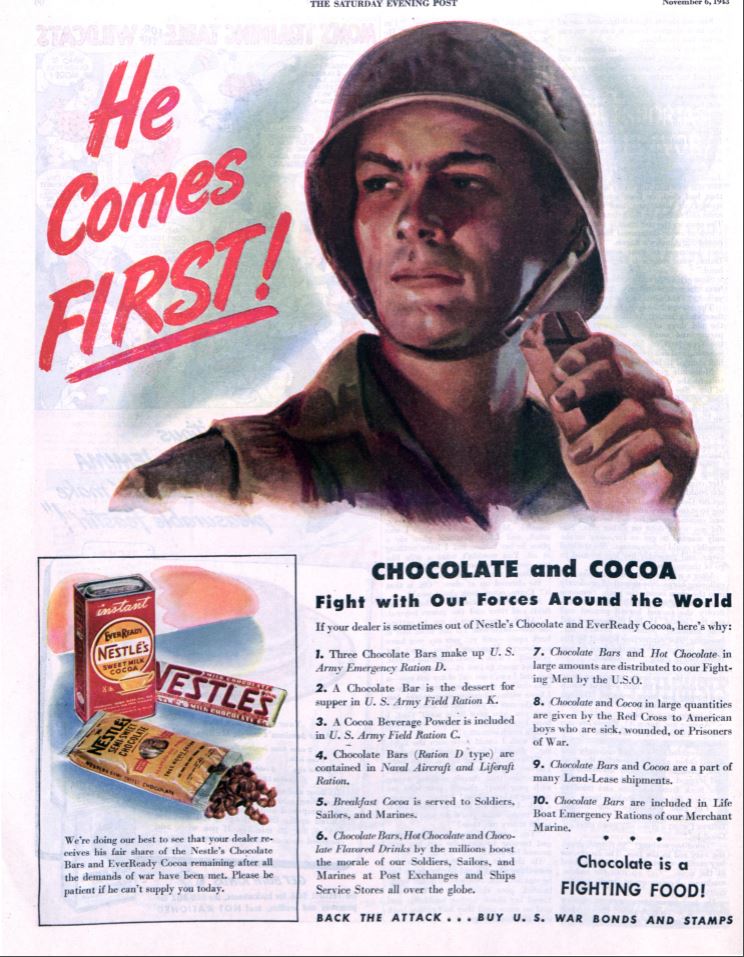
Normally, shortages drive up retail prices until only the well-off can afford the in-demand item. To ensure Americans’ sacrifice was evenly distributed, the Office of Price Administration limited all consumer purchases of sugar.
Before rationing, Americans consumed on average about one pound of sugar every week. When homemakers were asked, pre-rationing, what was the least amount of sugar they would need to get by, their answers averaged to around 0.6 pounds a week. As it turned out, this was still more than what would become their wartime ration of a half-pound.
On April 27, 1942, all sales of sugar were halted. Grocers began selling sugar again on May 5, but only to customers who presented their new war-ration books. Provided the grocer even had sugar to sell, he would tear out the coupon valid for the current two-week period. The shopper would pay about 8¢ and receive one pound of sugar, his or her allotment for that 14-day period.
Every American — adults as well as children — received a ration book, so parents didn’t have to take from their rations to feed their children.
Not only did Americans learn to get by on less sugar, they endured the shortage for five years, including 22 months after the war ended.

Could Americans today cut their sugar intake in half? And just what is their annual consumption? It’s not easy to determine. Many of the sugars we consume occur naturally in our foods. So researchers tend to focus on added sweeteners refined from sugar cane, beets, and corn.
But even the added sweetener numbers vary. Estimates of annual consumption range from 70 pounds to 150 pounds a year.
Even going by more conservative numbers means Americans eat, on average, 22 teaspoons of added sugar every day. About 20% of Americans eat 48 teaspoons, or one cup, of sugar every day.
Promoting the benefits of better health has done little to reverse the consumption rate. According to Stephan Guyenet, even with our awareness of sugar’s contribution to obesity, heart disease, and diabetes, our sugar diet is headed in only one direction.
Featured image: U.S. National Archives