The Rise and Fall of the John Birch Society: 50 Years Ago
 Barry Goldwater was widely known as a man with extreme views. He is still remembered as the man who said, “Extremism in the defense of liberty is no vice.” But even Goldwater thought Robert Welch went too far.
Welch founded the John Birch Society in 1958 to oppose what he saw as the growing communist influence in America. Through his publications, he attacked whomever he thought was furthering the interest of the Soviets. He also promoted the idea of impeaching Chief Justice Earl Warren and the withdrawing the U.S. from the United Nations.
He named the John Birch Society after an American military advisor in China who had been killed by communist forces. Welch thought Birch would be a suitable model for the anti-communist cause.
When Welch started his society, the hunt for communist agents and sympathizers was still going strong. Many politicians and journalists were gaining notoriety for their declarations of enmity to communism everywhere. But none were more committed than Welch, who attacked anyone he suspected of colluding with Soviet Russia.
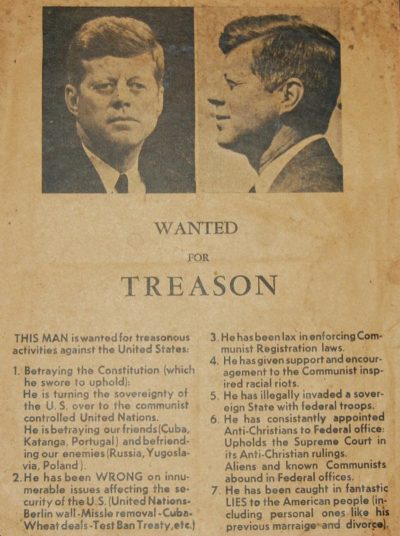
To many Americans, the society seemed extreme in its black-and-white thinking about patriots and traitors, loyalty and treason. But Welch’s message appealed to others. By 1965, its membership had grown to 95,000. It might have continued growing, too, but Welch didn’t know when to stop.
The zealotry of the John Birch Society alienated its potential allies. William F. Buckley, then a rising star in the new conservative movement, denounced Welch and the Society and urged the Republican Party to distance itself from the radical fringe group.
Senator Goldwater welcomed the Society’s support, which proved instrumental in helping him win the Republican nomination. But Goldwater could not accept Welch. He wrote, “I believe the best thing Mr. Welch could do to serve the cause of anti-Communism in the United States would be to resign.”
“Mutiny in the Birch Society,” from the April 8, 1967, issue of the Post, portrays Welch, and his organization, in decline. Emboldened by success, he had leveled charges of communism against Chief Justice Earl Warren and the aggressively anti-communist Secretary of State, John Foster Dulles, as well as accusing Defense Secretary Gen. George C. Marshall of being in league with the Soviets.
But when Welch accused President Eisenhower of either being a communist or being controlled by them, he went too far. He earned strong disapproval from a country that still liked Ike, and he began losing followers who doubted his judgment.
Welch, though, never regretted making the accusations. He worked hard to regain the Society’s momentum, but he was alone. His uncompromising nature had prevented him from forming helpful alliances. Only fringe members of the radical right were willing to associate with him, and these characters were alienating conservatives even more quickly with claims of Jewish conspiracies and that President Kennedy was killed by his Soviet bosses.
Another factor contributed to the decline of the John Birch Society: Americans’ attitudes toward communism were changing when this article appeared. Thousands of Americans had died in Vietnam, and thousands more would follow. Many Americans, particularly those of draft age, were starting to wonder whether the great crusade to stop communist expansion was worth it.
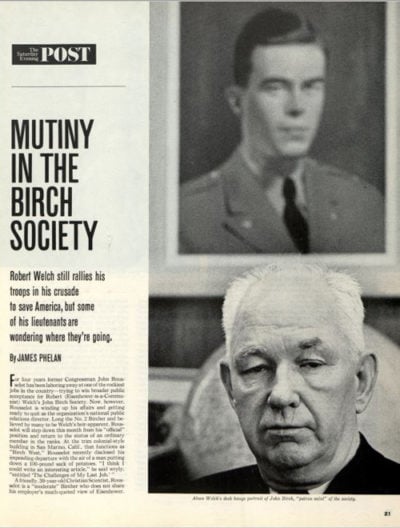
Featured image: Robert Welch from the April 8, 1967, issue of the Post. Photo by Bill Bridges
The Art of the Post: Rockwell Goes to War
During World War II, two Saturday Evening Post illustrators, Norman Rockwell and Mead Schaeffer, wanted to aid their country’s war effort. They were too old to enlist, and neither one was physically suited to be a fighter, but they felt they might be able to help with their art.
The two artists decided to paint patriotic pictures and offer them free to the Department of Defense for fundraising and enlistment campaigns. They worked hard developing their preliminary drawings; Rockwell decided to illustrate Franklin Roosevelt’s “Four Freedoms” while Schaeffer chose a series of military themes. When they finished mapping out their ideas, the two took the long train ride from their studios in Vermont to the U.S. Office of War Information in Washington, D.C. The illustrators excitedly showed their proposals but met a frosty reception.
The Assistant Director of the Office was Archibald MacLeish, a famed poet, future Pulitzer Prize–winning playwright, and proud intellectual who didn’t think much of illustration. Rockwell recalled being told, “The last war you illustrators did the posters. This war we’re going to use fine arts men, real artists.” MacLeish thought the military should use artists such as Salvador Dalí, Marc Chagall, and Stuart Davis to inspire the American public.
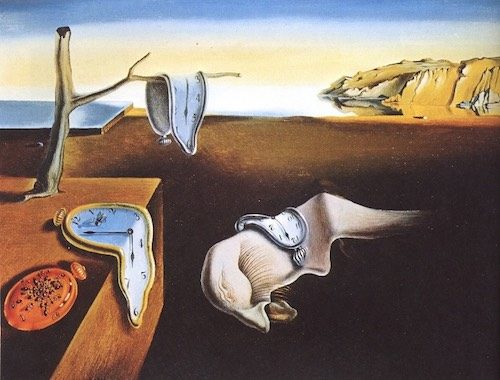
The Pentagon was not totally unsympathetic to Rockwell and Schaeffer. According to Rockwell’s autobiography, it offered them a consolation prize: “If you want to make a contribution to the war effort, you can do…pen-and-ink drawings for the Marine Corps calisthenics manual.”
Stung, the two illustrators took the long, depressing train ride home to Vermont. Schaeffer’s family recalls that when Schaeffer’s wife learned of the rejection, she spoke up: “To heck with the Army, why don’t you offer your pictures to the Post instead?”
The illustrators turned around and took the train back down to the Post’s offices in Philadelphia. There, editors reviewed the preliminary drawings and agreed to run Rockwell’s paintings as internal illustrations, followed by Schaeffer’s paintings in later issues.
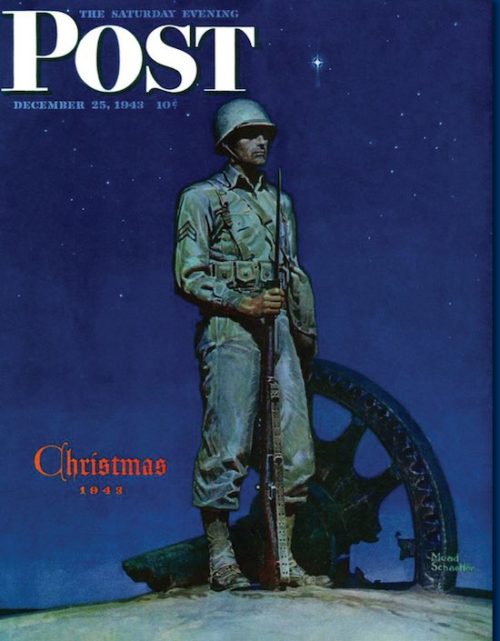
Rockwell’s Four Freedoms quickly became a national phenomenon. The Post received 60,000 letters about them. As editor Ben Hibbs later wrote:
The results astonished us all. … Requests to reprint flooded in from other publications. Various government agencies and private organizations made millions of reprints and distributed them not only in this country but all over the world. [Rockwell’s] four pictures quickly became the best known and most appreciated paintings of that era. They appeared right at a time when the war was going against us on the battle fronts, and the American people needed the inspirational message which they conveyed so forcefully and so beautifully.
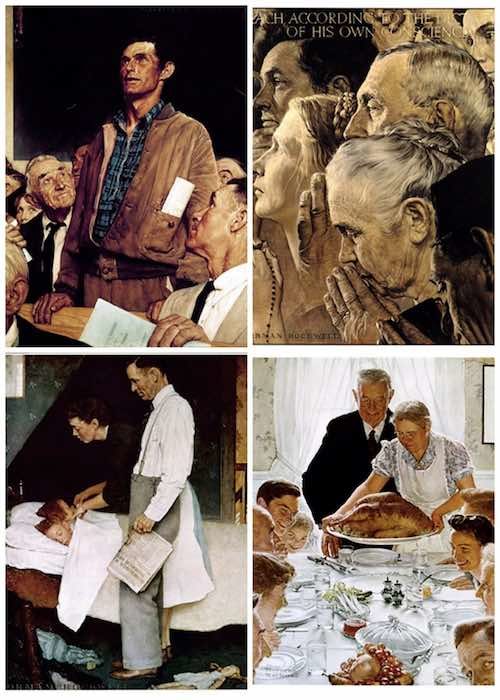
It began to occur to government officials that they might have made a mistake rejecting the paintings. Belatedly, they tried to jump on the bandwagon. With Rockwell’s permission, the Treasury Department took the Four Freedoms on a tour of the nation as the centerpiece of a Post art show to sell war bonds. The paintings were viewed by 1,222,000 people in 16 cities and were instrumental in selling $132,992,539 worth of bonds.
The illustrations proved far more effective than anything else the government had planned. The Pentagon even sent a film crew to Vermont to stage a documentary about the illustrations, implying (falsely) that Rockwell and Schaeffer had been working at the behest of the government all along.
As for MacLeish, he did not last long in his job. Rarely has a misguided act of cultural arrogance been so promptly, resoundingly, and satisfyingly refuted.
We Should Let the Dying Die

Modern medicine keeps prolonging our life expectancy, and this sounds like progress. But medical men, in their ardor to keep weary lungs breathing and exhausted hearts beating, have devoted relatively little attention to the elemental and inevitable phenomenon of dying. Dominant present-day medical attitudes, pushed to their logical extreme, will do away with natural death entirely. In this respect, life seems today to have become a matter of quantity, not quality. Spending up to 22 hours a day, for almost two months, in the hospital room of someone you love, witnessing not the prolongation of life but the long-drawing-out of dying, leaves you looking at such things quite differently from the way you ever had before. As I look back on my beloved sister’s purposeless agony, I hear an echo of the Fifth Beatitude: “Blessed are the merciful, for they shall obtain mercy.”
—“Let the Dying Die”
by Paul Moor,
September 9, 1966
This article is featured in the March/April 2017 issue of The Saturday Evening Post. Subscribe to the magazine for more art, inspiring stories, fiction, humor, and features from our archives.
Cover Gallery: Gone Fishin’
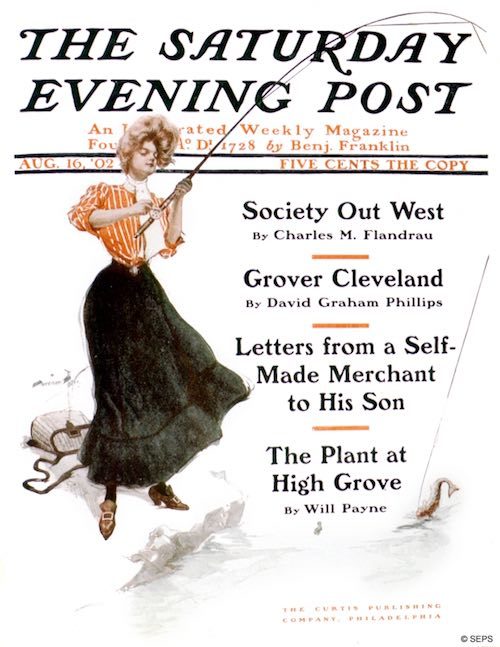
Harrison Fisher
August 16, 1902
Harrison Fisher (1877 –1934) was an American illustrator. Both his father and his grandfather were artists. As you might be able to tell from this cover, Fisher was considered a successor to Charles Dana Gibson, famous for his Gibson Girls.
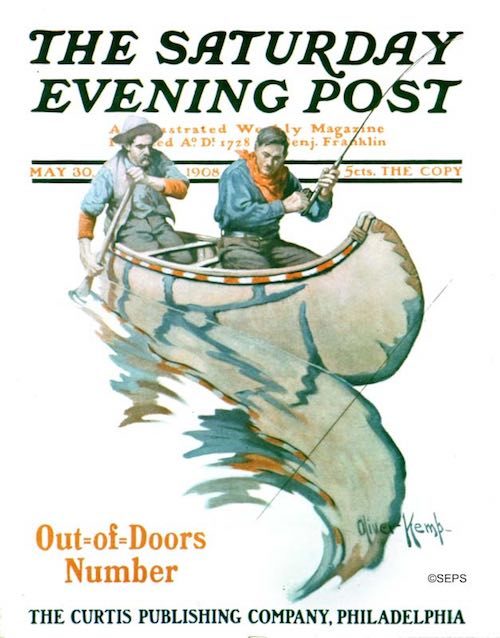
Oliver Kemp
May 30, 1908
Oliver Kemp (1887-1934) painted 11 covers for the Post. He made yearly trips to the Rocky Mountains and was fond of painting scenes of western America. His Post covers all depicted rugged men hunting, fishing, and canoeing, often with a pipe between their teeth.
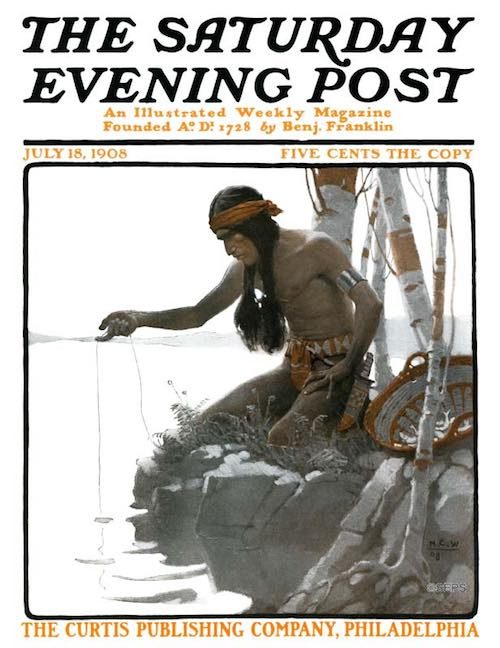
N.C. Wyeth
July 18, 1908
Newell Convers Wyeth (1882 –1945), was probably best known for his illustrations of Scribner’s classics, particularly Treasure Island. He spent part of his twenties out West, learning about cowboy and Native American culture. Wyeth painted his first cover for the Post when he was only 20; he was 25 when he completed “Indian Fishing.” N.C. Wyeth is the father of painter Andrew Wyeth.
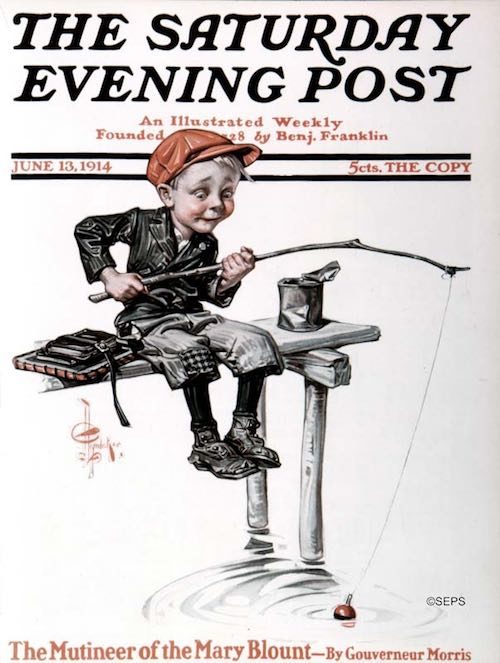
J.C. Leyendecker
June 13, 1914
J.C. Leyendecker was the most prolific cover illustrator for the Post, painting 323 covers. (Rockwell stopped at 322 out of respect for Leyendecker.) It was Leyendecker who popularized the images of a fat, jolly Santa and the New Year’s baby. While Leyendecker’s depictions of men were usually handsome and strapping, many of his children appeared emaciated and sickly, and often had bodies that were disproportionately smaller than their heads.
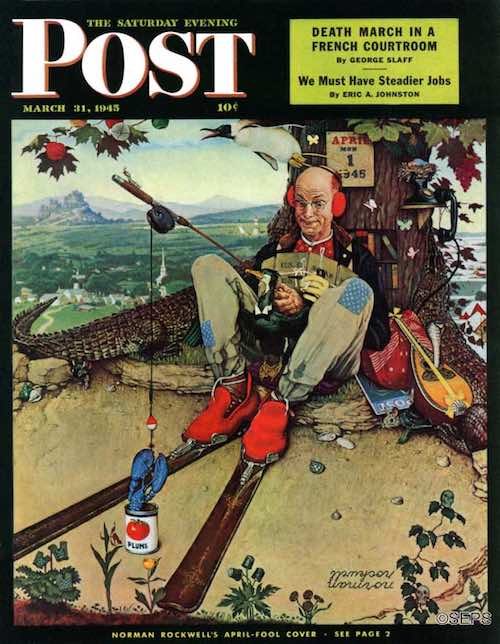
Norman Rockwell
March 31, 1945
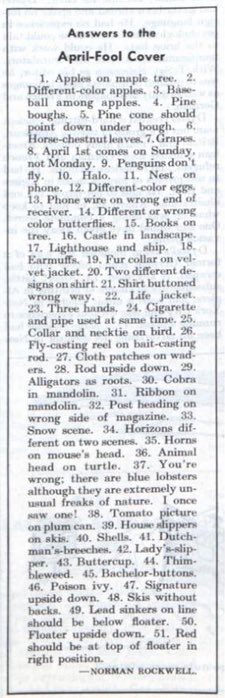
[From the editors of the March 31, 1945 issue] Probably no Post cover has ever been more popular than Norman Rockwell’s first April Fool cover. In this week’s cover, Mr. Rockwell is trying to fool you again, and he probably will succeed. Watch out for the blue lobster. As a matter of fact, we don’t think this one is quite fair, and we’re going to tell you that there is such a thing as a blue lobster. According to Charles Mohr, of the Academy of Natural Sciences in Philadelphia, the blue lobster is a rarity, but every once in a while one of them turns up in Maine waters, and it is completely blue. John Atherton, whose covers are well known to Post readers and who is a neighbor of Mr. Rockwell’s in Arlington, Vermont, once made a peculiar face while he was talking to Mr. Rockwell, and Norman remembered it and used Mr. Atherton with this particular expression as a model for this cover. There are at least fifty mistakes. See how many you can find and compare your findings with those listed on page 80.
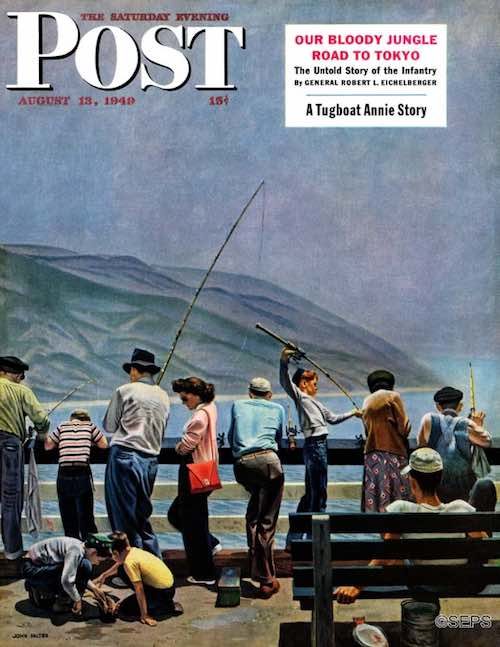
John Falter
August 13, 1949
[From the editors of the March 31, 1949 issue] On the long fishing pier at Santa Monica, California, tourists from all over the United States stand packed together like sardines while they try to catch fish. They are so grimly intent on their work or play or whatever it is that when a baited minnow smacks the water in all that silence, it makes quite a startling splash. Many of the fishermen go through their routine calmly and expertly; occasionally a greenhorn flies into a tizzy, yelps for the landing net and hauls in a dwarf flounder or something else depressing. The kids have a swell time fussing with starfish or reading a wet comic page which was wrapped around a wad of bait. Artist John Falter was non-committal about whether he caught anything—besides a Post cover.
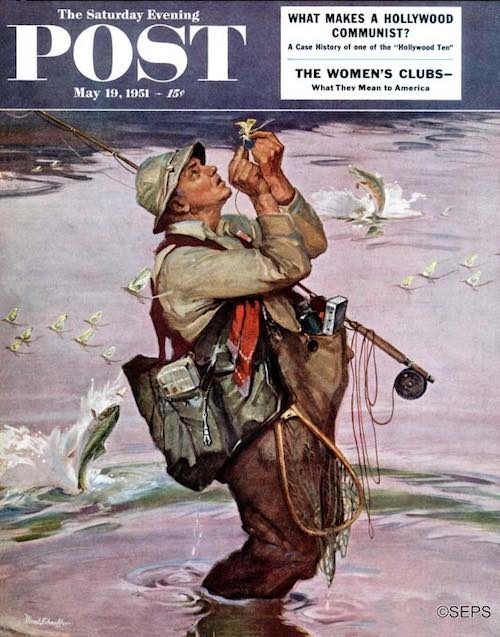
Mead Schaeffer
May 19, 1951
[From the editors of the May 19, 1951 issue] Those flies driving the man and the fish crazy are a variety known to fishermen as Green Drake. We don’t know what the fish call them. Just before this picture was painted, the man was calmly trying to feed the trout another variety of fly and they were calmly ignoring his hospitality. Suddenly, a countless family of Green Drake “nymphs,” which previously had risen to the surface of the water to hatch, discovered that they had wings, and decided to zoom into the wild blue yonder. Mead Schaeffer’s angler is trying to affix an artificial Green Drake to his line before the trout are so full of real Drakes that they sink to the bottom for a nap. Fishermen who experience such crises say that the general confusion is hard to imagine.
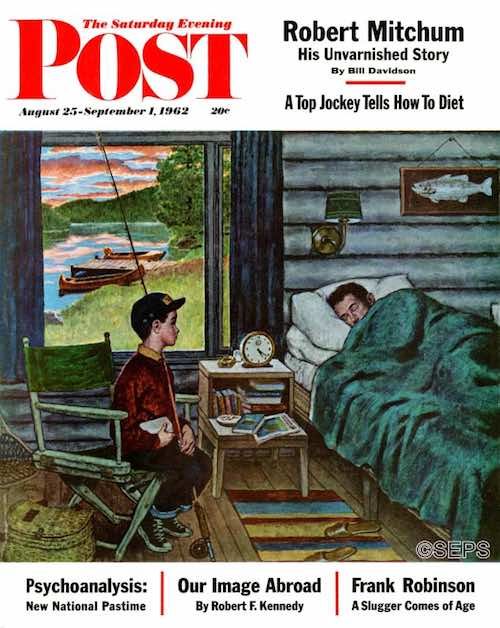
August 25, 1962
Amos Sewell
[From the editors of the August 25, 1962 issue] Forty more minutes to go, broods Amos Sewell’s thwarted young angler, and then Dad will waste still more time washing up and eating and dawdling over his coffee. From the look of this somnolent scene, it is clear that no fish will be disturbed until at least seven o’clock, and then, as any youngster knows, the fish will be settling for a siesta. Why, wonders the young sprat, can’t fathers coordinate their sleeping habits with those of fish?
The Medical Insurance Mess: How We Got Here
We shouldn’t be surprised that healthcare insurance has become a contentious issue. For most of our history, it developed with little planning or regulation. True, the U.S. has one of the most advanced healthcare systems in the world, but it has also become the most expensive.
Today, according to Forbes, the rising cost of healthcare is Americans’ chief financial worry.
And yet, for all we are paying, we may not be getting the best healthcare for the money.
A 2014 study found that the U.S. has consistently ranked lowest behind 11 leading European nations for effectiveness, safety, responsiveness, access, efficiency, equity, and life expectancy.
The problems with healthcare insurance reach back to the early 20th century. The first medical insurance policies were issued in 1890, but Americans didn’t generally adopt the idea. They preferred to pay for medical services as needed and avoid expensive hospital care if at all possible. They were so successful that, by the 1920s, hospitals in many cities were struggling to stay alive.
In 1929, an official at Baylor University hospital in Dallas noted that Americans annually spent more on cosmetics than on healthcare, but they didn’t mind their cosmetics expenses because the costs were small and continual. So Baylor hospital developed a program that collected a small monthly fee, on the scale of a household expense, to cover future healthcare needs. The program, which was offered to public school teachers for 50 cents a month, proved successful and eventually became the Blue Cross plan.
During the Depression, healthcare costs in many cities became unaffordable. The Roosevelt administration proposed a public-sector solution: a national health-insurance program similar to Social Security. However, the idea was strongly opposed by the American Medical Association, which feared that insurance providers would dictate how doctors would treat patients.
Employers became the primary source for medical insurance during World War II. Struggling to find enough qualified personnel, employers normally would have offered higher salaries to lure the best workers. But Washington had put a cap on wartime salaries. Fortunately, the IRS ruled that medical insurance could be added to employment packages without violating the wage ceiling. One company after another began offering health insurance.
When the war ended, President Truman tried another public-sector solution: an optional public health-insurance plan that would cover major medical expenses. Again, the AMA opposed the idea, along with the Chamber of Commerce, which labeled it socialism.
When it became clear that government health insurance would never pass, trade unions began bargaining with businesses for employer medical insurance. The IRS encouraged the idea by giving employers a 100% tax deduction for insurance costs. Medical benefits were also tax-exempt for employees.
This arrangement proved very attractive to businesses and workers. The number of Americans with health insurance rose 700 percent between 1940 and 1960, when about 70 percent of Americans had medical insurance. But three groups weren’t covered by employer-based healthcare insurance: the poor, the elderly, and the chronically sick. In 1966, President Johnson proposed Medicare and Medicaid to extend medical coverage to these groups.
This combination of private and public insurance programs might have served America indefinitely had costs remained static. But, as the graph below shows, healthcare costs rose steadily, and sharply.

Over the years, politicians have suggested public programs to make healthcare more affordable.
- Senator Ted Kennedy proposed a single-payer plan.
- President Nixon came up with a plan of mandates and incentives for employers.
- President Clinton took Nixon’s approach and added financial help for people who couldn’t afford insurance.
In 2010, President Obama managed to get his controversial Patient Protection and Affordable Care Act, dubbed “Obamacare,” passed. It was intended to improve health outcomes, lower costs, and make healthcare more accessible. Since its passage, this public program has been bitterly opposed by conservatives.
Opponents argue that the federal government can’t require Americans to pay into a healthcare program.
But this wasn’t the first government-run mandatory-contribution healthcare system in the U.S. In July 1798, Congress ordered the Collector of Customs to obtain 20 cents a month from every American sailor “to provide for the temporary relief and maintenance of sick or disabled seamen.” The system, which operated the government’s Marine-Hospital Service, remained in operation until 1870.
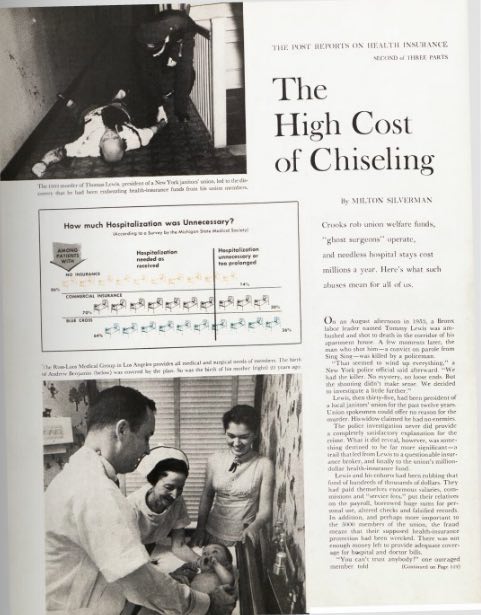
That information comes from “The Post Reports on Health Insurance,” a three-part report by Milton Silverman that the Post published in 1958. It offers today’s readers a picture of the medical industry before Medicare and Medicaid. Even then, there were concerns about “the upward soaring pattern” in healthcare costs, which were rising at 5 percent a year.
The series also explains how the insurance industry, in an attempt to hold down healthcare costs, monitored for signs of insurance fraud and overbilling. The final installment asked, “Is This the Pattern of the Future?” and described a new approach to medical insurance that should seem familiar to readers today: the policyholder pays a deductible and co-insurance fee for their care. In return, the insurance company covers the remainder of all expenses.
Obviously, the answer to Silverman’s rhetorical question was “yes.”
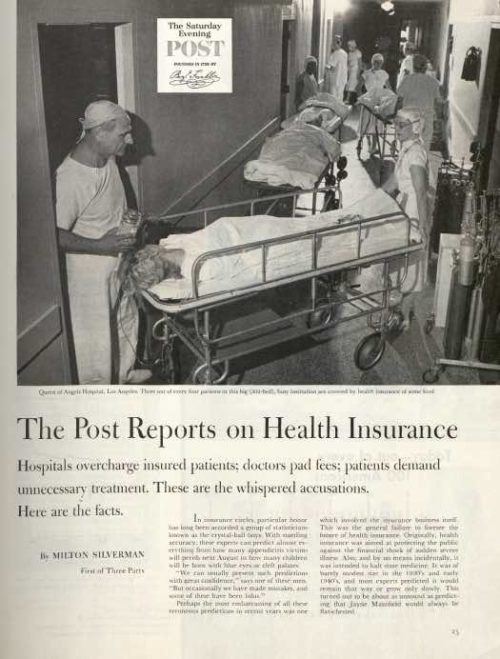
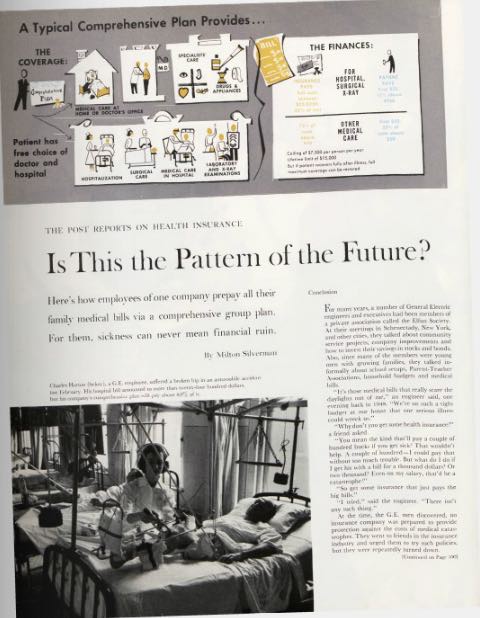

Featured image: Queen of Angels Hospital, Los Angeles. Three out of every four patients in this big (502-bed), busy institution are covered by health insurance of some kind.
Photo by Sid Avery
“Jellyfish” by Thomas Beer
A Saturday Evening Post regular and writer of more than 100 short stories in the early twentieth century, Thomas Beer was best known for his biography of Stephen Crane as well as his novel The Mauve Decade. Beer’s fiction evokes metaphors and complexity of characters that preceded work along the same vein from William Faulkner. “Jellyfish” is Thomas Beer’s 1919 short story concerned with the responsibility of military service, or refrain from it, as it relates to a sailor’s domestic life.
Mayberry Street has a singular summer music of its own, quite independent of the locust trees that overhang its pleasant length. After breakfast the veranda rocking chairs commence a calm creaking, which goes on with a silent interlude at luncheon time, until the wind comes cool from the shallow charming bay and the ladies of the dozen boarding houses go in to dress for dinner. In the dark hours the melody is much disturbed by the feet of young men and the clamor of virgins. Cigarette sparks move and flicker on the various steps, and sometimes there are bursts of amorous song.
Mr. Cooley preferred Mayberry Street by night. In daytime the slow movement of the placid ladies and the gentle flutter of their light sedate garments roused something acid in his nature. He could not walk past the verandas, undergoing polite inspection, without a desire to curse aloud. He loathed Mrs. Bayne’s boarding house as much as his wife delighted in it; and he chose to say so on a July evening when hooking Mrs. Cooley’s gown.
“Oh, don’t be so silly, George!” said Mrs. Cooley, tranquilly powdering her chins. “It’s the nicest place we’ve been in for years. And I couldn’t think of offending Mrs. Bayne by leaving, when we’ve taken her best room for the whole season.”
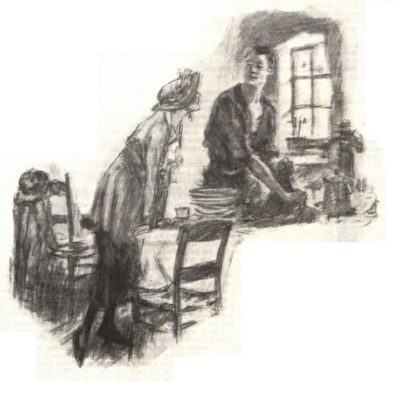
“Damn Mrs. Bayne!” Cooley grunted, breaking a finger nail.
“Now, George!”
“She and her daughters and her sisters,” he raged, “and all the rest of the old women!”
“Really, George!”
“The whole street’s a regular henroost,” he declared.
“Oh, I suppose” — she sighed — “you’d like a lot of bars and bowling alleys! George, there isn’t a single woman in this house who isn’t a lady. And Mrs. Bayne’s husband was a naval officer.”
“I hope some of his other widows,” Cooley sneered, “have more sense than she’s got.”
However, he admitted to himself that Mrs. Bayne had a financial grasp. The old house, he reckoned, cost nothing for repairs. Its handsome chambers were of the solid building favored by rich whaling captains. Its deep garden supplied much of the excellent food. It threw a patrician, permanent air over the boarders; and they paid accordingly.
“I think,” said Mrs. Cooley, “that Mrs. Bayne and her sisters are perfectly sweet; and so are the girls. I think it’s very pathetic that they have to take boarders, and I do wish Mrs. Bayne’s son would hurry up and get out of the Army, so as to take some of the burden off her.”
“I can’t see that she looks very squashed down,” Cooley stated.
“And if they’re so doggone poor why don’t the dear sweet girls go and work in the kitchen — or she — or her sisters? This is the second year we’ve been here and all I’ve heard out of Mrs. Bayne is: ‘Oh, if Henry was only home, so as to — ’”
“You’d better change your collar,” said Mrs. Cooley; “there’s the dinner gong.”
 Dinner irritated Cooley. Mrs. Bayne and her sisters — the Misses Lovett — were large pretty women. The Bayne daughters were also pretty; and the family group had an aureole of plaintive comfort, a dignified pathos. He could not imagine them in wrappers, scrubbing the kitchen floor. He could not imagine them in any useful posture; and all their guests, he thought, were of the same sort. He included Mrs. Cooley in this condemnation; he had been married thirty years.
“They’d a lot rather pay twenty-five a week and have somebody else make them comfortable than do anything for themselves,” he said, resuming the argument at bedtime.
“Well,” yawned Mrs. Cooley, “why not? And things are so expensive, George! Poor Mrs. Bayne has to pay that Portuguese boy a dollar a day just to pull vegetables and make ice cream. If her son was home — ”
“She’d save a dollar a day,” snapped Cooley. “Why doesn’t she let one of her daughters grind the ice cream freezer?”
“Good heavens, George,” said his wife, “that would never do!”
Cooley, having no taste for tennis or swimming, fretted a good deal over the interior politics of Mrs. Bayne’s establishment. It appeared insensate that Grace and Hilda should do nothing — outside the routine of manhunting; that the Misses Lovett — flatly their sister’s pensioners — should remain unoccupied. He could not see why Mrs. Bayne should hire a gaunt fisherman’s wife for the mending of her linen. His feelings, he found, were shared by the old captains who talked of whaling days so perpetually under the portico of the town library and limped up Ocean Street with gloomy stares at the summer folk.
“If it wasn’t for Henry Bayne,” said the venerable Eothen Hussey, “them women’d ‘a’ died of starvation. They’re bone idle an’ good for less’n nothing.”
“So Henry’s a good man of business?”
The venerable Eothen pondered, prodding the roots of an elm.
“I should guess so. His pa dyin’ when he was sixteen, he’d got to be. Yes; Henry’s a smart mower, I guess. He planted the garden. There wasn’t nothin’ but pansies there. He does all the chores. Yes; Henry’s a good kind of boy.”
The boarding ladies, on the other hand, knew nothing about Henry Bayne, though some of them had spent five summers under Mrs. Bayne’s care. Cooley assumed that the young man was self-effacing; but he was not prepared for Henry’s complete disappearance on arrival. The discharged soldier came and vanished. If Cooley had not seen his welcome home the existence of Henry in the house would have been unbelievable.
The noon steamboat whistled twice — once outside the long breakwaters that guard the harbor’s mouth, and once as it came to dock, and shortly there were carriages scattering past Mrs. Bayne’s veranda, bearing the pallor of new visitors. Cooley, smoking his pipe on the steps, noted these people and listened to the talk behind him. The Lovett sisters were praising Mrs. Bayne’s fortitude, in duet, for a chorus of ladies. It seemed that yesterday she personally had overseen the cleaning of the luncheon crabs.
“And the kitchen,” said one Lovett, “is so dreadfully hot!”
And a person has to stand over servants these days,” said the other. “You simply can’t trust them!”
The chorus groaned its assent. Cooley bit his pipestem, restraining oaths. A man in soldier clothes turned the corner from Ocean Street, striding along with a suitcase in one hand, the other swinging broadly; and Cooley stared at him with some relief of spirit. The delicate dialogue was rasping his self-respect; apparently effort was degrading to the Lovett sisters. The military person was tall and carried his big suitcase easily; so easily that he lifted it over Cooley’s head as he strode up the veranda steps.
“Why, Henry!” said the Lovetts.
There was a great screeching of rockers. The chorus of ladies rose, Cooley heard; and he heard Mrs. Bayne come out the front door, with an exclamation:
“Mercy, Henry! Did you see the girls at the dock? They were saying good-by to Miss Tyson.”
“No,” said Henry calmly; “I didn’t see them. Is anybody in my room?”
“Oh, no, dear. I couldn’t think of putting anyone in your room! I’m so glad you’ve come. Do see if you can get the freezer to work. I can’t think what’s the matter with it.”
“All right!”
“By gad!” whispered Cooley, dropping the pipe from his teeth.
He got up and walked hastily along the respectable street, swearing horribly. It was a hot day and he left his cap on the steps. Presently he thought the brains had commenced to boil inside his bald head. Certainly he was not quite sane, for, rounding a corner, he met a shabby old woman in black, and addressed her shamelessly:
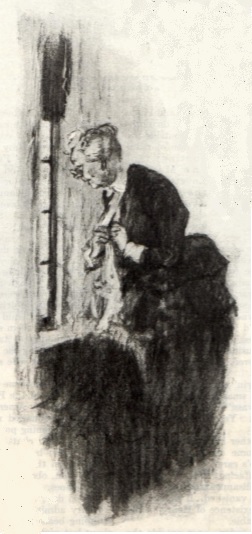 “If you had a son, and he came back from France, what would you do?”
The old woman looked at Cooley for a minute, putting a hand on her flat breasts, and grew very white.
“If Eddie could come back from France,” she said, “I’d fall down on my knees an’ praise Mary an’ all the saints there is; an’ I’d be a better mother to him than ever I was; an’ — God hears me — I did my best!”
She became a blur in Cooley’s eyes, which abruptly filled with burning dampness. He gave her a foolish bow.
“I just heard a woman meet her boy. Do you know what she told him? She told him to go and freeze the ice cream for lunch!”
“You’re a liar!” said the Irish woman. “There isn’t a woman living would do such a thing!”
At luncheon Cooley noticed that the ice cream was very good; but there was not another place set at the Bayne table, though all Henry’s relatives were smiling. Their light gowns seemed more crisp than usual and they spoke cheerfully of driving out to the golf links for tea.
“Isn’t it nice,” said Mrs. Cooley, “that Henry’s come home? It gives them so much more freedom!”
“I’m thinking of taking the whole lot out in a catboat and scuttling the boat!” Cooley answered.
“George,” his wife sighed, “I really think you’re perfectly silly!”
Henry did not come to dinner or to any following meal; but the songs of the Portuguese youth in the backyard were replaced by American whistling, and Cooley fancied that the ax sounded more vigorously in the woodshed. From the listening post of his bedroom he heard grocers’ boys and such chatting about bloodshed with a grave-voiced male; but it was a week before he saw Henry crouching in the bean forest of the kitchen garden and stalked him, observing his stained overalls and fifty-cent canvas shoes.
“Good day,” he mentioned.
Henry admitted that it was a good day and went on stripping beans into a tin pan, expecting some complaint about last night’s food.
“I was wondering,” said Cooley, “if you wouldn’t come sailing with me this afternoon.”
He made this offer timidly. He had no sons and his partners in the Detroit foundry were as old and potbellied as himself. He had no business playing with a long young fellow — a fighting man. Henry squatted, silent, alarmed by this condescension. However, it was his duty to please the tenant of the best room, and sailing away from Mayberry Street was something.
“I don’t see why I can’t.”
“Well then,” said Mr. Cooley, “let’s sneak off after lunch. I’ll meet you at the post office.”
He parried his wife’s attempt to take him driving and found Henry at the post office reading a letter.
“I expect,” Cooley suggested, “that you can sail a boat pretty well.”
“Oh, yes,” said Henry. “Let’s get one of Obed Bunkers’ tubs.”
Very dutifully he tried to put this most important letter out of his mind, though it crackled in his pocket, and selected one of Obed Bunkers’ catboats at the dank pier, helped his host into it and made sail.
The bay glittered like new brass under the sun, and its rim of sand bluffs and sandspurs shimmered white. The brown sail was barely filled and the boat glided steadily, its feeble wake leaving the clean bottom visible; so Henry could notice how little changed were the habits of pirate crabs and minnows in his absence. Cooley saw the smile.
“I expect,” he said, “you’re mighty fond of this island.”
“Oh, I don’t know! But I haven’t been sailing for a long time.”
Henry looked back at the town’s lovely profile of elms and spires, with the absurd whale walks floating like rafts among the trees and the windmill stretching its idle arms. He had come home to bondage; but there was, perhaps, some gilt on the chains. At least, pride made him say so.
“It’s a nice old place.”
“I should think,” said Cooley, “it would get hellish tiresome in winter.”
“It does.”
“And what do you do in the winter?”
“Work in the bank, sir.”
“My Lord Jehoshaphat!” said Cooley. “And what do your mother and your sisters and your aunts do?”
“Oh, nothing — that is, they go to Boston sometimes.”
“But you don’t,” Cooley asserted; “you stay here and work in the bank.”
Conversation halted, though they were thinking the same thing — that it was a dull existence. Cooley thought so from the vantage of Detroit; Henry, after twenty months of cities and camps and freedom. Also, he wondered whether another row between the cook and the head waitress would break out before dinner. But politeness bade him talk:
“I think you live in Detroit, sir. My captain’s from Detroit. He’s cashier of a bank — the Provost National.”
“Young Moulton? Yes; I know him. Fine fellow too.”
“Isn’t he?” Henry beamed. “I just got a letter from him.”
This provided a springboard. The sail flapped while they discussed Captain Moulton and fell still while Henry talked about battles. It developed that he had been Moulton’s top sergeant. Mr. Cooley’s deep reading of war news had taught him that a top sergeant, though less in degree than divisional commanders, is to be reverenced. He demanded the secret of Germany’s collapse and forgot that his neck was blistering. Henry leaned on the useless tiller and spoke. No one in Mayberry Street had asked about these matters. He even showed Mr. Cooley the queer purple streak across his biceps, which did not interfere with the freezing of ice cream.
“It must be funny to go through all that and come back here,” said Cooley, and glanced at the barely vibrant water. “Hello! Jellyfish!”
“It’s the sun,” Henry told him; “they like it.”
Just below the surface, now rising, now gracefully descending toward the shadow, they glistened, pink, mauve and silver — a hundred translucent, languid bodies. The light shot through their drifting fringes and round heads, courting the glow. Cooley stared at their lazy motion contemptuously.
“What do they live on?” he grunted. “They couldn’t catch anything.”
“Oh, bugs and chips of seaweed. They just run into things. The water feeds them.”
“All they’ve got to do,” Cooley said, “is eat and float — huh?”
Anger at anything so impertinent seized him. He grasped the boat hook and began to thrash the water. The jellies drew off and sank, still dignified, into the lower calm.
“I’ve a lot more use for a shark,” Cooley panted.
“Oh, well,” said Henry; “they don’t do any harm. They sting a bit if you run into them… ”
Enough wind rose late in the afternoon and they got home. The breach between the cook and the head waitress had not visibly deepened. Henry was glad, though his sisters reproached him courteously for failing to mend the veranda swing.
“Well, I’m mighty sorry. All you’ve got to do, though, is to tack the slats back. I’ll do it now.”
“Oh, no, Henry!” said Grace. “Everyone’s out in the chairs.”
“Well — thunder! — none of them knew me from Adam. I can’t see — ”
“Oh, no, Henry,” said Hilda; “that wouldn’t do!”
“All right! I’ll fix it while they’re at dinner,” he promised.
Cooley caught sight of him through the curtains and dropped his soup spoon. Against the afterglow the young man’s square chin and straight nose had the heroic romance of a well-designed poster.
“What a lot of hogs there are in the world!” he remarked.
“Good gracious, George! I think you were out in the sun too long. You’re dreadfully red!”
“Sixteen times twenty-five,” said Cooley, “is four hundred.” He was calculating the weekly income of Mrs. Bayne. Mrs. Cooley glared at him, frightened. “Let’s call it three months — the season. Three times sixteen hundred is forty-eight hundred; less taxes, servants’ pay, and so on. Three thousand, anyhow. She gets a pension? — I mean Mrs. Bayne.”
“Yes; some dreadfully little thing. She told me once that if they didn’t own this house they’d have nothing in the world but five hundred dollars a year. George, I’ve decided to ask the girls out for a month next winter.”
“If you do that,” he hissed, “I’ll spend every cent I’ve got on whisky; and I’ll come home drunk every night. So help me George Washington!”
Henry’s room was directly beneath the slates, and these had heated all day; so a smell of old wall paper lay heavy about his bed, conquering cigarette smoke. He sweated on the sheets and remembered, for comparison, the lower hold of the Caronia one night when the ventilators jammed. A passage from Captain Moulton’s letter buzzed in his ears:
“Though I know you would hate leaving home so soon after getting back, I should be very glad to have you here with me; and there is a good job waiting, any time you want it — two thousand a year. I know you can handle it.”
A wind crept through the tiny windows and stirred the circles of stagnant smoke into shapes like the languid jellyfish of that afternoon. Two thousand a year! He made ten a week at the bank — in winter. He had been making that ever since he was sixteen. If Robert Bunker died, sometime he would be promoted to twenty-five. Two thousand! It shouted itself. Henry got out of bed and walked round the floor.
“I do wish,” muttered Mrs. Cooley, “that Henry would stop tramping! I can’t get to sleep.”
“I’ll go up and stop him,” said her husband.
“I wish you would. I don’t like to speak to Mrs. Bayne about it. It hurts her so when she thinks — ”
“Ha!” Cooley snarled. “I’m glad something hurts her. I didn’t think anything could.”
He climbed the stairs and detected Henry’s door by the margin of light. The smoke made him sneeze and the heat brought sweat through his pyjamas instantly. He was not surprised that Henry did not wear night clothes. It appeared pure reason.
“I’m sorry,” said the guilty one. “I forgot you’d be in bed… Could a fellow live in Detroit on a thousand a year?”
“A fellow could. Got another cigarette? . . . I suppose you look after the furnace winters?”
“Yes.”
“And you’re twenty-five years old?”
“Yes, sir,” said Henry.
Mr. Cooley lit a cigarette and examined the shelf of books and the chair with one leg replaced by a wooden peg. After a while he turned an odd look of anger on Henry.
“When I was a kid my dad bought a colt. Well, he needed a plow horse pretty bad; so we broke in Hercules. I was plowing with hiss one day and a fellow drove by in a buggy and stopped. ‘That’s a good puller,’ he said. ‘So-so!’ said dad. ‘I’ll buy him off you for two hundred dollars,’ the man said. After dad got his breath he told me to unhitch Hercules. And that’s the last I saw of him — except his pictures every time he smashed things up at Saratoga… Well, good night!”
Henry was eating breakfast in the pantry when his mother came to him, smiling. Her white linen gown was fresh and her cheeks were very pink with the cool morning.
“I’m so glad I found you. Mrs. Fitch wants her bed moved to the other end of her room and the window doesn’t work in Mrs. Pell’s room.”
“I’ll fix them,” he said.
“And don’t forget about the bluefish for dinner.”
“I won’t forget.”
“Don’t, please! I’m going driving with Mrs. Cooley now. Oh, yes — tell Sarah she forgot Mrs. Pell’s ice water last night. It’s so nice,” she added, “having you home again, dear. It was so hard last summer! What’s that mark on your arm?”
“Just a bruise,” he said, rolling his sleeve down.
His whole body ached. He had not slept and there was a sour suffocating taste in his throat. He wanted to yell:
“That’s a scar! There were shells exploding all round my battery last summer. It was hot. Our canteens gave out. After I got hit my captain gave me the last swallow out of his. When we went forward we came on bodies smashed open, which were still alive and howled. It must have been hard — going riding with the boarders! You make me sick!”
Instead of this, he stood smiling before her pinkness until she strolled out. In the afternoon, as he had forgotten several things, his aunts consulted each other.
“It’s really dreadful! I suppose being in the Army’s made the poor boy careless,” said one.
The other was more charitable: “Oh, he’ll settle down again! And, of course, he doesn’t realize how selfish his going was — I mean to us! He was carried away by the excitement. He’ll get over being restless by and by.”
From his post on the steps Mr. Cooley heard this and directed a wild blow at a moth. He missed the insect and hurt something in his shoulder, which twitched all the evening and woke him just at sunrise, when little sounds concentrate on the ear and a variety of noises maintain themselves importantly.
Thus, he was aware of coal being shifted on the steamboat that leaves the island every morning at half past six, and a cart on the cobblestones close to the pier. And he heard the whir — instantly checked — of an alarm clock in the room overhead. Then he followed the phases of Henry’s dressing, which included the assumption of shoes with heels, not rubber soles, and the sudden sharp rap of a dropped collar button. Here Mr. Cooley sat up and swung his legs out of bed carefully. The fellow was putting on his best clothes before breakfast — long before breakfast — in time to catch the steamboat.
After a little while Cooley opened the door an inch and crouched there villainously. He had always longed to be a detective, and now he had the satisfaction of seeing Henry steal downstairs, suitcase in hand, and of watching him slide a note under Mrs. Bayne’s door. There seemed no need of viewing the stealthy march of this recreant along Mayberry Street, but Mr. Cooley craned brazenly out of a window, grinning. Presently, as maidservants appeared to dust the rocking-chairs, the whistle sounded.
“Only think,” said Mrs. Cooley, after the indescribable forenoon — “Henry’s gone to Detroit! He says he’ll send Mrs. Bayne a thousand dollars a year. But think of how hard it’s going to be for her!”
“Oh, well,” Cooley yawned; “all she’s got to do is sit and rock. The water feeds them!”
Coloring Book Contest
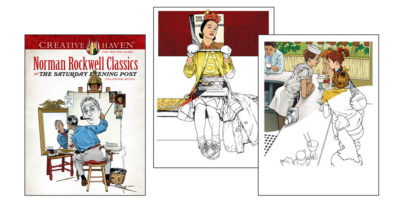
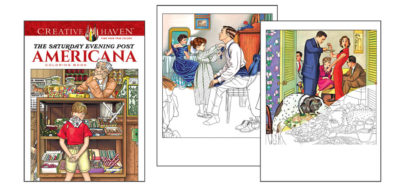
Adult coloring books have made therapeutic artistry the latest craze. Here is the perfect gift for the young or old Rockwell in your life. The iconic cover illustrations of The Saturday Evening Post have been assembled into two collectible coloring books from Dover Publications. Norman Rockwell Classics and Americana each feature 31 single-sided pages of ready-to-color illustrations based on historic covers of the magazine.
You can enter to win a free copy of each coloring book by liking the contest post on Facebook. Five winners will be selected at random on Friday, April 7, 2017.
Didn’t win or don’t want to wait? Click here to purchase these coloring books, and use the code WCAJ to save 25 percent off these titles from Dover Publications.
RULES:
NO PURCHASE NECESSARY. A PURCHASE WILL NOT IMPROVE YOUR CHANCES OF WINNING.
1. CONSUMER DISCLOSURE: No purchase or payment is necessary. A purchase will not increase your chances of winning. You have not yet won. Void where prohibited. Odds of winning will depend on the total number of eligible entries received. Starts April 3, 2017, and ends April 7, 2017.
Prizes: Winners will receive a copy of both Norman Rockwell Classics and Americana coloring books from Dover Publications.
2. ENTRIES: Your entry to the contest is signified by “liking” our Facebook post here.
3. ELIGIBILITY: Open to legal residents of the 50 United States and the District of Columbia who have reached the age of majority in their state of residence at time of entry. Void where prohibited by law. Employees of sponsor, its parents, affiliates and subsidiaries, participating advertising and promotion agencies, and prize suppliers (and members of their immediate family and/or those living in the same of household of each such employee) are not eligible.
4. RANDOM DRAWING: Winners will be selected at random from among all eligible entries by April 7, 2017. Odds of winning will depend upon the total number of eligible entries received.
Baseball: Opening Day
This article and other features about baseball can be found in the Post’s Special Collector’s Edition, Baseball: The Glory Years. This edition can be ordered here.
April 11, 1959
Richard Sargent
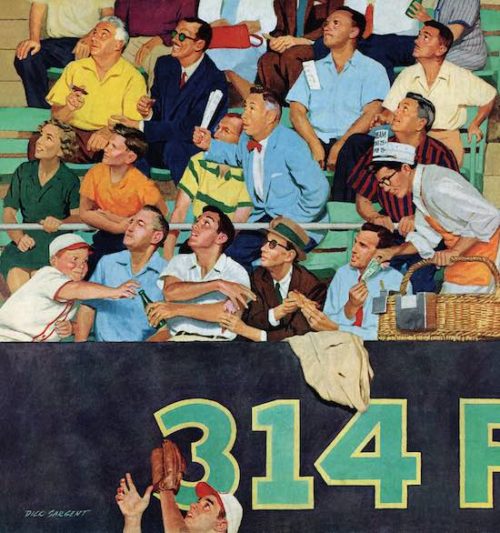
The stars generally find hidden resources on the third Tuesday in April, the day the sun always shines for the addicts. The excitement the fans have been building up for six months always spills over on the field and denudes the players of their studied nonchalance. Through the season the heroes cultivate a dead-pan attitude toward uproars in the stands, but their masks are left in the clubhouse on opening day.
“It’s just another ball game,” they say casually — the oldest, and truest, cliché in the trade. The first game is no more or no less important than the 153 that follow. Rookies bravely mouth the slogan and veterans may even believe it. But bushers and old pros alike are pushovers for the brass bands, the march to the flagpole, and the contagious enthusiasm of the fans. The emotional charge of opening day has inspired many of the most brilliant exploits on record. Year after year, it produces more hustling than the customers are likely to see the rest of the season — anyway until the World Series.
“You always get a special kick on opening day, no matter how many you go through,” Joe DiMaggio says. “There’s a lot of beefing during the season about sleeper jumps on trains, lousy hotel food, and living out of a suitcase half the year, but you forget the gripes on opening day. You look forward to it like a birthday party when you were a kid. You think something wonderful is going to happen.”
For all the natural drama that occurs at the season’s start, Clark Griffith probably deserves major credit for making opening day a national event. Griffith, owner of the Washington Senators, gave baseball a priceless public-relations boost when he conceived of the bright idea of having the president throw out the first ball.
The tradition which was instituted by William H. Taft in 1910 and has been observed every year since — pinch-hitters have acted for the president during wars and other crises — is by all odds the game’s best press-agent pitch.
— “Baseball’s Biggest Day” by Stanley Frank, April 12, 1952
News of the Week: Fallon, Phone Booths, and the Food of April Fools’
Jimmy Does Norman
The last thing I expected to see this week was Tonight Show host Jimmy Fallon doing an impersonation of Norman Rockwell.
In the cover story for this week’s Parade, Fallon talks about the new Tonight Show ride at Universal Studios in Florida that opens on April 6. It’s called Race through New York Starring Jimmy Fallon and features Fallon and other cast members traveling through the streets of the city on “the scariest roller coaster simulator you’ve ever been on,” going past the show’s set, the East River, the subway, Times Square, and other New York City locations.
In a photo that accompanies the article in print and online, Fallon recreates Rockwell’s famous Triple Self-Portrait from 1960. I don’t know if Fallon knows what he’s recreating — Rockwell isn’t mentioned in the piece at all — but maybe it’s such a famous image that they assume that a lot of people will know where it comes from (though probably not Fallon’s core Tonight Show demographic). Still, it’s great to see the homage. Fallon needs a pipe though.
The Phone Booths of Manhattan
I don’t know if Fallon goes by any phone booths in the ride, but I miss them. That sounds like an odd thing to say in a time when we have our own personal phones and no longer have to shove dimes and quarters into a dirty box on a street corner. But it’s an item from another time and place that I wish would be preserved, maybe not in the numbers they once were but in some small way. (On a related note, I also like phone books.)
The always great Mo Rocca of CBS Sunday Morning takes a look at the last four outdoor phone booths that remain in Manhattan (though booths for smartphone privacy are popping up), and he interviews a man who has a website that actually keeps track of the payphones that remain around the country. The part where Rocca calls his mom on one of those new internet kiosks is just perfect:
In other phone news, a restaurant in Pennsylvania is offering a discount to diners who don’t bring their phones to the table.
More Spring Books
In our current issue, Amazon editor Chris Schluep gave us his top 10 picks for spring books. Here are a half-dozen others you might want to pick up (and not just pick up, but also read):
The Death of Expertise, by Tom Nichols (Oxford University Press, out now). Nichols is a professor at the U.S. Naval War College and an expert on foreign affairs and policy. In this book he examines how things like the internet and the transformation of news has led to an erosion of the trust people once had in experts. This is truly a must-read in today’s world, to help figure out how the heck we got to this point.
Word By Word: The Secret Life of Dictionaries, by Kory Stamper (Pantheon, out now). If you’re a word geek like me and you love reading books on word origins and grammar, this looks like a fantastic read. Stamper tells us how dictionaries get made, not just what words to include but also how they go about defining them.
Richard Nixon: The Life, by John A. Farrell (Doubleday, out now). There have been a lot of books written on President Nixon of course, but this promises to be the definitive biography, detailing how the decisions he made as president affect us even today.
Hemingway Didn’t Say That, by Garson O’Toole (Little A, April 1). The subtitle of this collection is “The Truth Behind Familiar Quotations,” and gives the stories behind famous quotes that actually were never said by people like Ernest Hemingway, Woody Allen, Carl Sagan, Abraham Lincoln, and Mark Twain.
Dangerous to Know, by Renee Patrick (Forge Books, April 11). This is the second book in the series of mysteries by Patrick (aka Vince and Rosemarie Keenan). It’s set in 1938 Los Angeles and features the sleuthing team of Lillian Frost and Edith Head (yes, that Edith Head). I got an advance copy, and like the first novel, it’s a terrific, fun read (bonus: The Saturday Evening Post is mentioned!).
Chuck Klosterman X, by Chuck Klosterman (Blue Rider Press, May 16). Klosterman is the author of a series of highly entertaining/often infuriating books that focus on various aspects of pop culture. This new one (his 10th) is a collection of various essays he’s written over the past several years for places like Esquire, GQ, The A.V. Club, and The Guardian.
New Dylan
Yesterday saw the release of Bob Dylan’s new three-disc set, Triplicate, which is a collection of 30 classic cover songs, including “Stardust” and other American standards. Here’s our 1968 cover story on Dylan’s career and how he changed rock by going electric.
RIP Sib Hashian, Lola Albright, Jean Rouveral, Tony Terran, Darlene Cates, and Chet Cunningham
Sib Hashian was the former drummer for the rock group Boston. He played on the band’s first two albums, on such songs as “More Than a Feeling,” “Peace of Mind,” and “Long Time.” Hashian passed away at the age of 67 after collapsing on stage during a Legends of Rock cruise.

NBC Studios
The beautiful Lola Albright is probably best known for her role as Peter Gunn’s singer girlfriend on the TV series Peter Gunn. She also appeared on shows like The Bob Cummings Show, Gunsmoke, The Dick Van Dyke Show, Peyton Place, The Man from U.N.C.L.E., and Columbo, as well as movies like The Tender Trap, A Cold Wind in August, The Good Humor Man, and one of the great sci-fi movies of the ’50s, The Monolith Monsters. Albright died last week at the age of 92.
Jean Rouverol was a writer and actress. She wrote for TV shows like The Guiding Light, As The World Turns, Search for Tomorrow, and Little House on the Prairie, and movies such as The Miracle, and Face in the Rain. She was blacklisted in the 1950s with her husband, writer Hugo Butler (Lassie Come Home, Young Tom Edison, The Prowler, and the 1938 version of A Christmas Carol), during the House Un-American Activities Committee investigations, and the two fled to Mexico and lived there until 1964, when they returned to the U.S. She passed away last week at the age of 100.
Tony Terran was the trumpeter in Ricky Ricardo’s band on I Love Lucy. He was the last surviving member of the band and passed away last week at the age of 90. Besides his work with Lucy and Desi, Terran worked on The Carol Burnett Show. A member of the classic “Wrecking Crew” of studio musicians, he performed or recorded with The Beach Boys, Frank Sinatra, Sonny & Cher, Peggy Lee, Elvis Presley, Perry Como, and many others. He also released his own solo album in 1966 and played the trumpet in Close Encounters of the Third Kind and Enter the Dragon.
Darlene Cates was an actress best known for playing the mother of Leonardo DiCaprio and Johnny Depp in What’s Eating Gilbert Grape? She died Sunday at the age of 69.
Chet Cunningham was a prolific writer who wrote over 300 books. That’s not a typo. He actually wrote over 300 novels of various genres: Westerns, thrillers, action-adventure, along with several non-fiction books, too (you can see a list of the books at his site). He also founded the San Diego Book Awards and helped other writers in their careers. Cunningham passed away March 14 at the age of 88.
This Week in History
Tennessee Williams Born (March 26, 1911)
You may know that the playwright wrote A Streetcar Named Desire, Cat on a Hot Tin Roof, and The Glass Menagerie, but Flavorwire has 71 things you might not know about him.
This guy from an episode of Wheel of Fortune last week might want to read that list:
President Reagan Shot (March 28, 1981)
Our 40th president graced the cover of The Saturday Evening Post a year after he was shot in the chest outside of the Washington Hilton in Washington, D.C. Press secretary James Brady was also severely wounded, paralyzed from a gunshot to the head. Secret Service Agent Tim McCarthy and police officer Tom Delahanty were also injured.
This Week in Saturday Evening Post History: Rainy Wait for a Cab (March 29, 1947)
 Rainy Wait for a Cab
John Falter
March 29, 1947
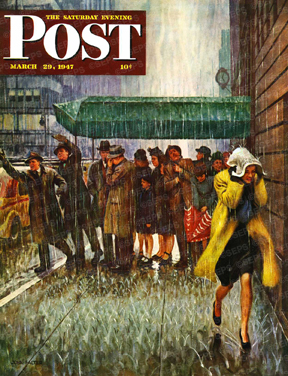
John Falter is one of my favorite Post artists, along with Rockwell (of course) and Constantin Alajálov. Oh, and Stevan Dohanos and Thornton Utz and … well, the point is we’ve had a lot of great artists over the years. This Falter cover is one of his best. It’s so alive and captures the rain, New York City, and the ’50s so well.
April Fools’ Day
Tomorrow is the day we surprise and annoy our friends and family with pranks and jokes and hope they don’t retaliate in some way. One of my favorites is to stand in front of someone and point to their chest, and when they look down, flick their face with your finger (all adult men are still 11 years old inside).
This is usually where I give links to recipes for a food holiday so I looked around the web to see if there was such a thing as food to make for April Fools’ Day … and there is! Taste of Home has a bunch of recipes for foods you might not expect, such as this cake that’s actually meatloaf, this sunny side up egg on toast that’s actually a dessert, and this sushi for kids that’s actually made with Fruit Roll-ups, licorice, and marshmallows.
Because, really, who would want to eat actual sushi?
Next Week’s Holidays and Events
National Humor Month begins (April 1)
I think every month is National Humor Month, but April is the start of the official month of laughing, and there’s even an official site for it. When you’re done there, come back here and browse our humor section.
International Children’s Book Day (April 2)
This day was started in 1967 by iBbY, the International Board on Books for Young People. The day is timed on or around the birthday of author Hans Christian Anderson.
Celebrity Encounters: Wilt Chamberlain

In 1962, I became chairman and general partner of the San Francisco Warriors, later to become the Golden State Warriors. The team was awful, but it did have 7’1″ “Wilt the Stilt” Chamberlain, the greatest player of all time as far as I’m concerned. Wilt and I became good friends. I owned harness horses in those days, and he loved to gamble, so he became my partner on several horses. Once, while at Roosevelt Raceway in New York to watch one of our horses race, he pulled out a huge stack of $100 bills, peeled off five or six, and handed them to a friend with betting instructions.
I pointed to the roll. “Hey,” I said, “put that away.”
“Why?” he asked.
“Someone’s liable to hit you over the head and grab that,”
I joked.
“Anyone who wants to hit me over the head is gonna need a ladder,” he snapped back. “If I see someone coming at me with a ladder, I’ll yell for help.”
–Matty Simmons
In our March/April 2016 issue, Simmons wrote “The Day Cash Died” about being one of the three men who invented the credit card and formed The Diners Club, the first credit card company.
This article is featured in the March/April 2017 issue of The Saturday Evening Post. Subscribe to the magazine for more art, inspiring stories, fiction, humor, and features from our archives.
Night Divine
On the Carrigaline Road, coming onto Carr’s Hill, traffic had slowed to a crawl. It was Christmas Eve, already after six, and full darkness had taken hold. Having made a promise to get home early, today of all days, I’d spent the afternoon trying to close off a particularly convoluted account, but because the phone kept ringing I was still the last one out of the office.
The rain of earlier had stopped, giving the roads a sheen inside the headlights, and the air was raw with the promise of worse to come, the outbreaks of sleet forecast for later in the night, possibly turning to snow on higher ground. In the car, with the heat turned up, I moved through the radio’s channels, but nothing held my interest, and I settled finally on a live choral performance of traditional carols, fixed the volume to an unobtrusive level and tried to relax.
Beside me, on the passenger seat, lay a small palm-sized parcel, wrapped in heavy gold paper and neatly ribboned. My wife’s Christmas gift. A month or so ago, when I’d broached the subject of shopping, Angie had suggested that we forego presents this year, because we were saving for a deposit on a house and really couldn’t afford the extravagance. Our plan was to rent for another year at least, and give the market a chance to settle. I shrugged and agreed, even though I was already, since early October, tied into a casual weekly installment plan on a beautiful quarter-carat diamond and crushed sapphire pendant necklace that I’d seen in the window of the jeweler’s on Castle Street. What she’d said made sense, but I didn’t want the first Christmas of our marriage to pass without some kind of gesture. And I knew how it would go. We’d argue but she’d be secretly happy. We’d argue, but then she’d lift her hair for me and ask that I fasten the clasp, and she’d admire the way it looked in the mirror, with me at her shoulder, and we’d kiss and make up. Because these are the kind of games played by people in love.
After a few minutes, I cleared the brow of the hill and saw the reason for the delay. Some 50 yards ahead, just at the turn-off to Hilltown, a two-car collision had taken place. One of the cars had run up onto the roadside verge and, from my distance, and in the darkness, looked relatively undamaged, but the other had turned over onto its roof. A fire truck was parked at a diagonal behind the wreckage, obviously a necessary maneuver but one that reduced the two-way traffic flow to a single available lane. Inside my car, the only sounds came from the radio, the choir segueing from “In the Bleak Midwinter” into something unmistakably Latin, the name of which escaped me though I knew the melody well enough to have hummed along, if I’d so chosen.
The heat built, and after a few minutes I was forced to crack a window. The initial flood of cold outer air felt good but then, in a lull between carols and through the rumble of car engines, I caught the angry sound of a machine, some sort of an electric saw, and through it, screams. A thin, wet voice, pitched at an angle that couldn’t be adult. Ahead of me, the cars again began to move, and I eased forward, into that sound, gaining perhaps 20 yards of road before once more coming to a stop. I could have shut the window, or turned up the music. There are times when denial is the only protection available to us. But I did neither. The choir began to sing one of my favorite carols, “I Saw Three Ships,” the voices in a deft arrangement folding together in a way that seemed to put an echo or a shadow around the words. I closed my eyes and drew three or four deep breaths. The machine groaned behind the music, a blade made for shredding metal, and the screaming came in gouts, filling every available pore of night. I focused on the music, not attaching anything much to the words but letting their sense evoke something older, the recollection of some bright night spent in front of the television as a child, sipping cocoa and watching George C. Scott as Ebenezer Scrooge stride the sullen, snow-clad streets of London. Music has a way of attaching itself to particular and apparently random moments in time, sealing them into a permanent state. When the song ended I drew another deep, cold breath and switched off the radio.
Again, the car ahead began to move. I watched it veer right by instruction, but held back a moment, counting heartbeats, then crawled another 20 yards until a pale young woman in a dark cap, heavy clothes, and a luminous yellow traffic vest stepped in front of me, raising a hand for me to stop. I met her eyes, and nodded. Because of the temporary lighting that had been set up, I could see that she was chewing one side of her lower lip, and that her cheeks were wet with tears. The accident lay just beyond, with the wrecked car and the assembled rescue units blocking off the entire left lane. Beads of glass littered the road, gleaming with the burn of the rigged halogens. Two firemen crouched beside the upturned car, seemingly braced for a release or a sudden collapse, while a third lay on his back and worked a small hand grinder against some snagged knot of metal. Yellow sparks spun in gouts away from the cut, and within seconds the air took on the gun-heavy stench of oxidized steel. A few more uniformed types, police and medics, stood some paces back, watching, wanting to help but not knowing how, wanting more than anything, probably, to run. And to one side, away from everyone, a body lay on the road, covered head to shins in a white sheet. Beneath the low hem, the right foot was bare but the left still wore its shoe, something sleek and low-heeled, with an open toe, the single detail that from my distance helped define gender. And still the screams kept on, fragile, fueled by terror and probably pain, but maybe also by some understanding.
I considered the car’s exposed underbelly, something I’d never seen before, veined and channeled with a crisscrossing of cables and pipes, wheels black and wet hunched into their cradles. Coming from just the wrong angle, though, the window holes gave me back only darkness, even with the halogens spilling hard over everything in between. For three or four minutes then, I watched the traffic being directed, the young woman with a practiced beckon, speaking semaphore to the line of cars in the opposite lane. Even shaken to tears, the work had to be done. She had her back to me, and I wondered if she had somebody waiting, if she would come home this Christmas Eve to a happy situation, let her hair down and allow herself to be kissed and held, and loved. I hoped so because, even turned away from me, I could picture the way her cheeks shone wet with tears.
Something happened then. The grinding sound cut out and the car seemed to slump, or give, and all the men who were standing hurried forward to assist. The cluster of bodies made it difficult to see the details, but it seemed that one of the firemen had been able to wrench open the mangled door. With the others supporting the vehicle’s weight, the man who’d been on his back crawled part of the way inside. Ahead of me, the young woman had abandoned her traffic duty to watch the scene unfold and was leaning on the front left corner of my car, the glow of the tamped headlight spilling up across her midriff. The screams that we’d been hearing reduced, gradually, to a softer crying, and I leaned forward and stared, praying, I think, though not in any conscious way, until a child was lifted from the wreckage, a girl of about 6, barefoot in a white bell-shaped dress with narrow shoulder straps that offered nowhere near enough warmth for this weather. I only caught glimpses of her face, not enough really to set her definitively in my mind, but she had long dark hair almost to her waist and a delicate, spidery body. In the fireman’s arms, she appeared unhurt but held her shoulders hunched, the rounded bones visible through the spill of hair, as if still braced against an impact. As I watched, I saw her turn her head and stare past the men to where the body lay covered, but then the young woman in charge of directing the traffic stepped across my view and gestured at me to move. I nodded, put the car in gear and let her guide me around the accident site and away.
For a while, the silence felt right, but when it became suddenly too much I again switched on the radio. I’d expected something to have changed, but nothing had. The choir was still caroling, “In Excelsis Deo,” “Adeste Fideles.” The traffic into Carrigaline was heavy but moving, and I listened to the music and watched the footpaths on either side thick with pedestrians: mothers holding children by the hand, idling teens, young women in packs, laughing and full of freedom, with their coats worn open and dressed to catch the eye, probably on their way to the last or merely the latest of the Christmas parties. Ropes of lighting stretched above the road, slightly bellying, the bulbs a staggered order of reds, yellows, blues, and greens adding something splendid to the night, painting an atmosphere that felt warm and slightly melancholic. Most of the shop and pub windows boasted some shade of the season, too: a bauble and tinsel-clad tree, a slow-moving half-sized Santa, a Happy Christmas message stenciled to the glass in gleaming, artificial snow. I moved through the town and turned right halfway up the hill, to follow a darker road home.
Framed by the living room window, Angie stood lighting mantelpiece candles. I parked on the road, but kept the engine running because I didn’t yet want to lose the music, or interrupt the scene with silence. The colored lights of our Christmas tree shifted to a set rhythm, giving the otherwise dim room its own kind of movement. We’d decorated that tree together, a fortnight or so earlier, the night after my birthday, and I remember threads of tinsel clinging to her hair and a fleck of glitter that I kissed away from one corner of her mouth when, still warm from our exertions, we settled down together on the settee. It is the morsels of detail that fill memories, etching a permanence in our minds and hearts, even if the moments themselves pass so quickly. That night, we sat holding hands, content in the dancing colors of the fairy lights, sipping mulled wine, tired and overjoyed at being together, knowing that whatever we had was only just beginning. Tomorrow, though, would be a new day, and next year a new year, and we both understood that things could change, whether we wanted them to or not.
On the radio now, a soloist was taking on “O Holy Night,” and I could feel the rest of the choir readying themselves to fall in. But for these seconds there was only one voice, a soft, pure soprano swelling unhurriedly toward an immense climax and then holding that impossible top note for longer than I could ever hold my breath. When I closed my eyes I found only colors, and then, through them, I saw again the twisted metal, the glass like hail across the surface of the road, and the shape beneath the sheet. And somewhere among the highest notes of the music, I heard the screams. That was enough. I killed the engine, locked the car and went inside.
Angie, in a white short-sleeved chiffon blouse with its string-drawn throat a good four inches undone and a teal-colored wool skirt that came to just below the knee, blew out the match she was holding and came and put her arms around me. Her hair, gathered up in a loose, tousled ponytail, deliberately careless, seemed unusually dark, muddy. We kissed, and I caught cider and cinnamon from the shampoo she’d earlier used, as well as a hint of wine on the tip of her tongue, but the stench of the match, slightly sulfurous, lay against everything.
“You’re late,” she said, finally slipping free. “You didn’t forget that Brian and Liz are calling, did you?”
“I didn’t,” I said, releasing her. “Sorry. I couldn’t get away. It’s just been that kind of day. And then the traffic was so heavy.”
She turned to the window, and the long red-stemmed candle set into a chunk of holly-clad beech or elm, and struck another match. The candle’s wick took the flame, guttered and steadied, and a warm yellow sheen spread across the windowpane, sealing us off from the world beyond. Her feet were bare, and she’d painted her nails a red that in the darkness, and set against the pale taupe carpet, made me think of newly drawn blood. I tried not to stare, but even after eight months of marriage, her details continued to astound me.
I dropped down onto the settee, and held a hand out to her. She looked at me, but remained out of reach.
“I need to get something into the oven. Liz always puts on such a spread.”
“Just for a minute,” I said. The fairy lights made her seem restless, though she was standing still. “They’ll be late. I told you. The traffic is heavy tonight.”
With reluctance, she came and sat beside me, perching on the edge of the settee. I put my hand to the small of her back, but she either ignored it or had already grown so used to my touch that she did not react. I could feel the bones of her spine through the chiffon, and it was in my mind to talk about the accident but something about the serenity of the room and the perfection of the moment made me hold my words. And happy, I suppose, or at least content, we sat there together for a minute or more, watching the tree, the lights, the soft burn of the candles. Then the telephone began to ring, and she stood and left the room.
Recruiting Heroes for the Air Corps: 75 Years Ago
It caught the world by surprise: During the spring of 1941, Germany conquered Luxembourg, Holland, Belgium, and France. It was a loud wake-up call for the U.S.
Suddenly, America realized that this new world war wouldn’t repeat the four-year stalemate of the last one. And, unlike World War I, military aircraft would play a crucial role in combat operations.
To meet the new challenge, President Roosevelt asked Congress to authorize construction of 50,000 modern aircraft. Many of these would be the Army Air Corps’ principal bomber, the B-17 Flying Fortress.
Military planners soon realized that flying one of these enormous bombers required better coordination between crew members, so they set out to change the training program.
Richard Thruelsen’s Post article “Heroes — Wholesale” introduced readers to the Air Corps’ “brand-new air force, 1942 style” and the “precision teamwork” it drilled into its air crews. The article describes the new selection process for pilots, navigators, bombardiers, and gunners. And it describes the formidable defenses of the B-17, which had enabled crews to fight off attacking Japanese fighters in the Philippines.
The article sometimes reads as a recruiting brochure. It reminds young men who haven’t been drafted yet that the Army dropped the minimum age for aviation cadets to 18. The Air Corps had also relaxed the medical restriction and eliminated any requirements for formal education. Potential aviators learned that any aviation cadet had the chance to become a pilot. Also, using the word heroes to describe aviators would have made the Army Air Corps sound even more appealing.
The appearance of this article on March 28, 1942, was well timed. Since the U.S. had entered the war, it had been able to do little more than fall back and secure its defenses. Americans wanted to know when their military was going to strike back at Japan.
Just three week later, the U.S. took the fight to the Japanese heartland, delivered by the hands of Army Air Corps bombers.
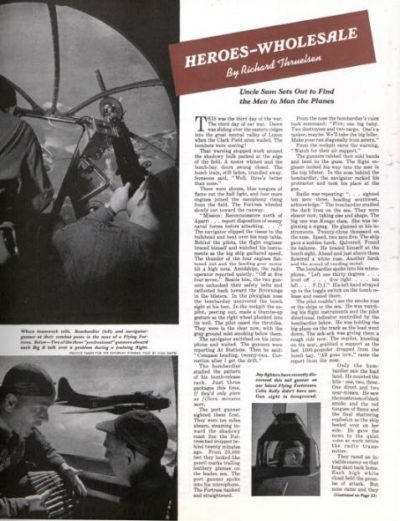
Featured image: Langley Field, Virginia. YB-17 bombardment squadron.
Library of Congress
Cover Gallery: Rainy Days
The weather may be dreary, but these rainy day covers will make you feel cheery!
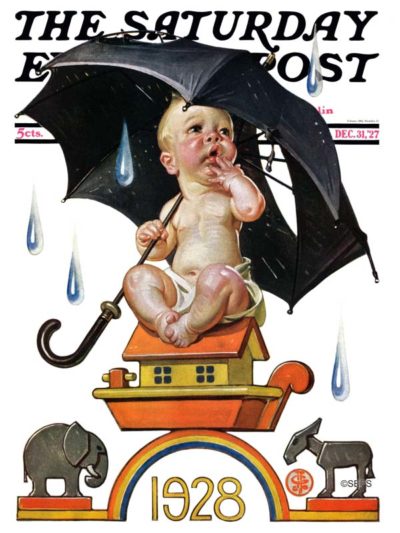
December 31, 1927
J. C. Leyendecker
Artist J. C. Leyendecker was well known for his Baby New Year illustrations that graced many Post covers from the 1910s through the 1940s. Our 1928 baby awaits the possible repeal of Prohibition, symbolized by “wet” weather.
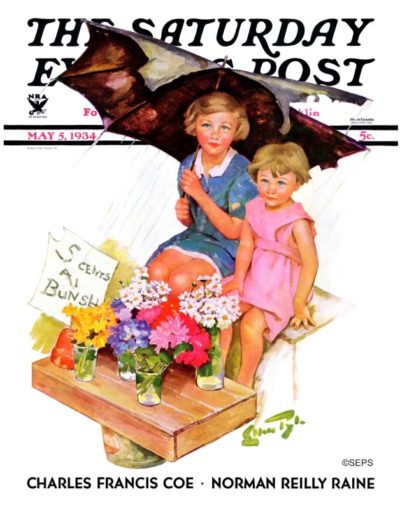
Ellen Pyle
May 4, 1934
The subjects in this illustration were likely artist Ellen Pyle’s own children; they served as the models in more than 20 of her Post covers.
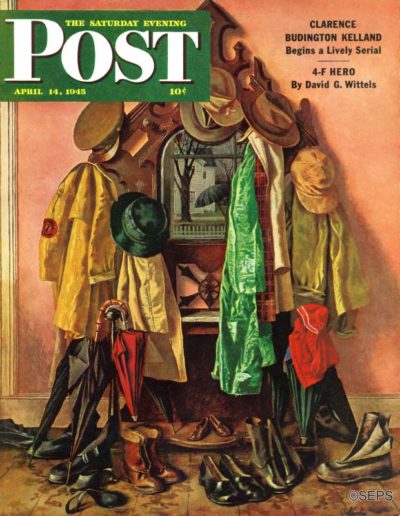
John Atherton
April 14th, 1945
[From the editors of the April 14, 1945 issue] Norman Rockwell suggested the idea to Atherton. The hatrack is in the hall of the Community House at Arlington, Vermont. Neighbors contributed the hats, coats and galoshes seen in the painting.
Stevan Dohanos
July 17, 1945
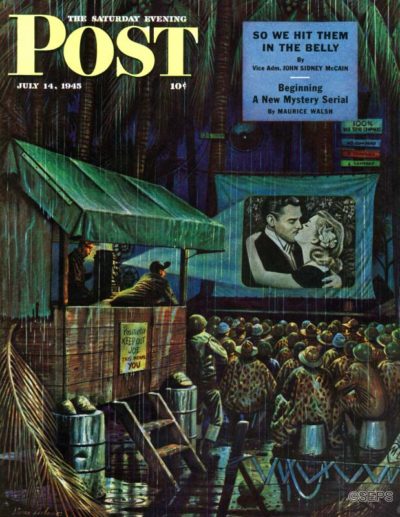
[From the editors of the July 17, 1945 issue] We imagine it is hard for anyone who has never sat on a Pacific spit kit of an island for months on end, contemplating the shapely curves of a can of tinned-pork products for emotional release, to understand Stevan Dohanos’ cover. After such soul-gnawing, a flickering, one-dimensional pin-up girl enlarged many times on an improvised screen must have the pulling power a naked electric-light bulb has for a moth. Most South Pacific movies are now first-run, sometimes world premieres; but when “Wilson” was shown on Okinawa before an audience just back from the front lines, there were eight air-raid interruptions, and the show assumed a three-and-a-half-hour Gone With the Wind proportion. Perhaps the reason why Dohanos’ G.I.’s are willing to sit in the rain is that their bucket seats are really magic carpets taking them home to Main Street for an hour or two.
Constantin Alajalov
August 31, 1946
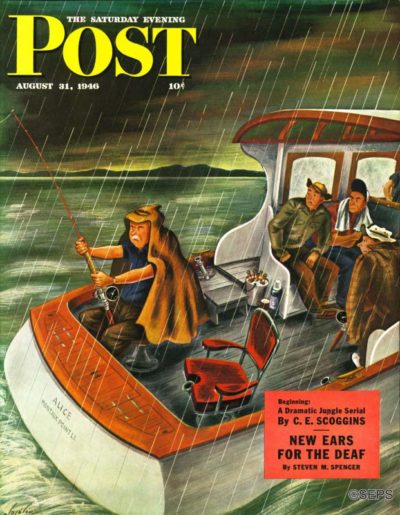
[From the editors of the August 31, 1946 issue] The man who has determined to go fishing, Constantin Alajalov observed when he was in Florida, will go fishing until he catches a fish, in spite of bad weather. Alajalov determined to paint this truth. There were a few things on which he needed to refresh his recollection, but to do this, he needed only to go out in a boat on a similar day. We don’t know how long the average determined fisherman has to wait for a sunny day. We do know how long Alajalov had to wait to catch a rainy one. One fair day followed another. He waited three weeks.
Norman Rockwell
April 23, 1949
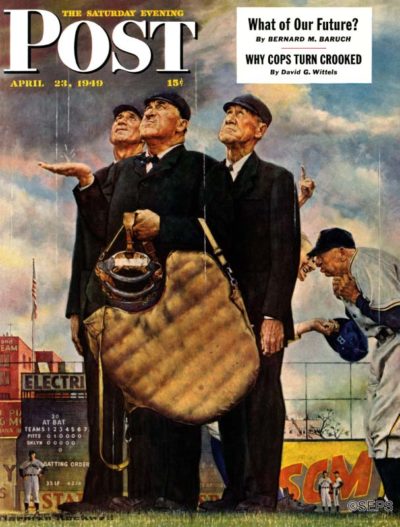
[From the editors of the April 23, 1949 issue] This week’s Norman Rockwell cover depicts Ebbets Field, the home of the Brooklyn Dodgers. Here, the Dodgers are trailing the Pittsburgh Pirates 1-0 in the sixth inning. If the arbiters—left to right, Harry Goetz, Beans Reardon and Lou Jorda—call the game because of rain, the score will stand as is, and Pittsburgh will win. This irks the Brooklynites, who dislike having other teams win. In the picture, Clyde Sukeforth, a Brooklyn coach, could well be saying, “You may be all wet, but it ain’t raining a drop!” The huddled
Pittsburgher—Bill Meyer, Pirate manager—is doubtless retorting, “For the love of Abner Doubleday, how can we play ball in this cloudburst?”
Stevan Dohanos
May 22, 1954
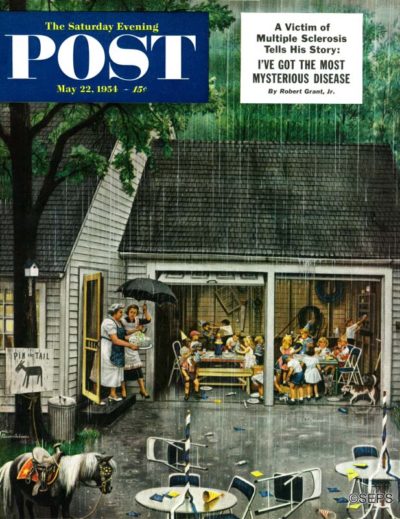
[From the editors of the May 22, 1954 issue] Rather than be depressed by Mr. Dohanos’ soggy scene, note how the deluge has improved the situation. Any birthday party is fun, even if nothing more happens than the duly expected games, grub and slight fights between incompatible little boys. But to arrange for the routine confusion to be stepped up into the joyous chaos of a garden party dispersed by a cloudburst, that’s a charming innovation indeed. And how delightful it is to throw a party in or into a garage, where tools and other weapons are available for favors as well as paper hats, where joy can he so much more unconfined than in an ordinary living-room hullabaloo. Even that pony thinks, Bless the rain—no more work. Fortunately, there isn’t space here for what mother thinks.
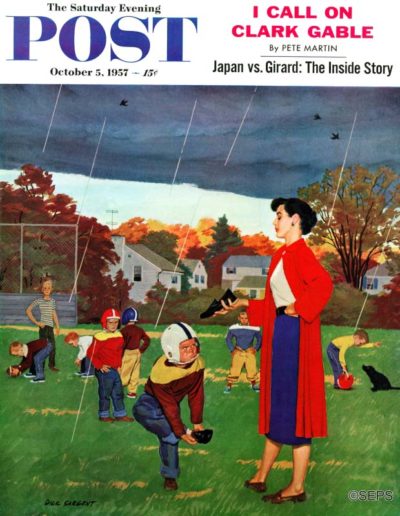
Richard Sargent
October 5, 1957
[From the editors of the October 5, 1957 issue] Women can be such a handicap sometimes—“Aw, ma, halfbacks don’t wear rubbers. Next thing, you’ll want me to make touchdowns with my poncho on. Next thing, you’ll want me to run the end with an umbrella.” To which mother replies, “James, football men obey the quarterback’s signals or get benched. The bench is home. Now then, four, eleven, forty-four, hip—on rubbers!” Well, the maxim says that mothers know best, and if James catches cold by getting wet everywhere except his feet, let’s switch to the maxim that only Monday-morning quarterbacks think of everything. This might have been some action picture if Dick Sargent hadn’t rung in mother; yet let’s settle for the maxim that when it comes to painting, painters know best.
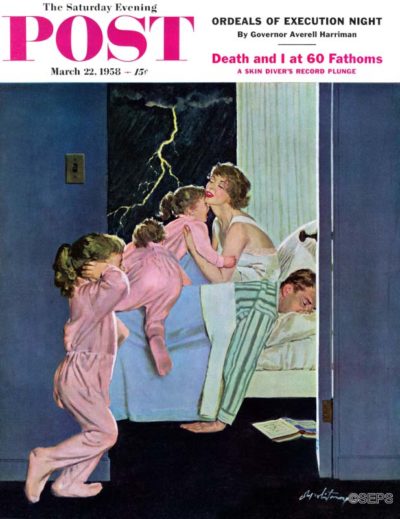
Coby Whitmore
March 22, 1958
[From the editors of the March 22, 1958 issue] Of course, the children haven’t been frightened by Papa’s snoring, but by the awful sounds of Nature on an electrical rampage. So mother will gather them in her arms and love away their fear—mustn’t it be wonderful to be a mother? If that lightning is bedeviling a far-north state, it should signify the breaking up of a winter which certainly needed breaking up; and yet not long ago some northern areas had thunderstorms followed by the blankety-blankest descent of snow for thirty-something years. Let’s leave forecasting to the weatherman, who is welcome to it. Coby Whitmore’s man of the house, buried there in the bed, must be the deepest sleeper this side of the proverbial log. How does mother get him up mornings—rap on his head with the book?
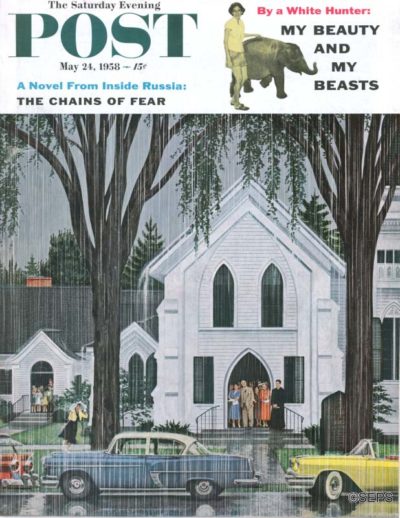
Melbourne E. Brindle
May 24, 1958
[From the editors of the May 25, 1958 issue] This wet cover had its origin in a drought. When crops withered in the Eastern states last summer, the Rev. Benjamin Axleroad, seen there at the door of St. Mark’s Episcopal Church in Bridgewater, Conn., included in his prayers a plea for precipitation. And one Sunday, just as his service ended, down came the rain, exit drought. Weeks later artist Melbourne Brindle, a St. Mark’s vestryman, puzzled some of the congregation by posing them at the church and refusing to tell them what it was all about—surprise, folks, you’re in the Post! Comments on the cover scene: (l) artistic license helped keep that grass green during the drought; (2) if any of the parishioners were out on a golf course during the deluge, how remorseful they must have been that they weren’t in church.
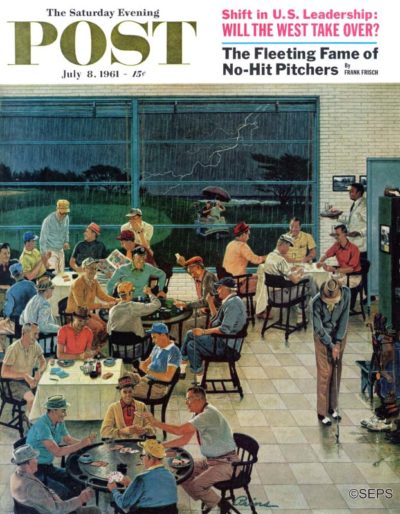
Ben Kimberly Prins
July 8, 1961
[From the editors of the July 8, 1961 issue] How do you like that? On Saturday afternoon—prime time at any golf club—comes the deluge. Well, that’s par for the course, we suppose, and the course in this Ben Prins cover belongs to The Dunes Club of Myrtle Beach, South Carolina. That wave in the background is a fringe of the Atlantic Ocean, not the crest of an oncoming flood. The three-wheeled vehicle under the umbrella is what is known as a caddy car, and its occupants are either fair-weather athletes scurrying toward the indoor recreation of the nineteenth hole, or spirited souls bent on challenging their fellow duffers to a game of motorized water polo. At any rate they’re not slowing down at the putting green. The weather being what it is, they’re probably less concerned about sinking putts than about sinking, period.
“The Life of the Party” by Irvin S. Cobb
After finding journalistic success at New York World alongside Joseph Pulitzer, Irvin S. Cobb reported on World War I with The Saturday Evening Post. Cobb traveled Europe extensively to cover the war, and he became known for his reporting as well as his humorous fiction. “The Life of the Party” follows the hapless Algernon Leary as he negotiates late-night New York City streets in ridiculous infantile garb after a Bohemian costume party. Cobb’s short story is filled with colorful language and dialect as Mr. Leary’s series of unfortunate events unfolds, or rather “unbuttons.”
It had been a successful party, most successful. Mrs. Carroway’s parties always were successes, but this one nearing its conclusion stood out notably from a long and unbroken Carrowayian record. It had been a children’s party — that is to say, everybody came in costume with intent to represent children of any age between one year and a dozen years. But twelve years was the limit; positively nobody either in dress or deportment could be more than twelve years old. Mrs. Carroway had made this point explicit in sending out the invitations, and so it had been, down to the last hair ribbon and the last shoe buckle. And between dances they had played at the games of childhood, such as drop the handkerchief and King William was King James’ son and prisoner’s base and the rest of them.
The novelty of the notion had been a main contributory factor to its success; that, plus the fact that nine healthy adults out of ten dearly love to put on freakish garbings and go somewhere. To be exactly truthful the basic idea itself could hardly be called new, since long before some gifted mind thought out the scheme of giving children’s parties for grown-ups, but with her customary brilliancy Mrs. Carroway had seized upon the issues of the day to serve her social purposes, weaving timeliness and patriotism into the fabric of her plan by making it a war party as well. Each individual attending was under pledge to keep a full and accurate tally of the moneys expended upon his or her costume and upon arrival at the place of festivities to deposit a like amount in a repository put in a conspicuous spot to receive these contributions, the entire sum to be handed over later to the guardians of a military charity in which Mrs. Carroway was active.
It was somehow felt that this fostered a worthy spirit of wartime economy, since the donation of a person who wore an expensive costume would be relatively so much larger than the donation of one who went in for the simpler things. Moreover, books of Thrift Stamps were attached to the favors, the same being children’s toys of guaranteed American manufacture.
In the matter of refreshments Mrs. Carroway had been at pains to comply most scrupulously with the existing rationing regulations. As the hostess herself said more than once as she moved to and fro in a flounced white frock having the exaggeratedly low waistline of the sort of frock which frequently is worn by a tot of tender age, with a wide blue sash draped about her almost down at her knees, and with fluffy skirts quite up to her knees, with her hair caught up in a coquettish blue bow on the side of her head and a diminutive fan tied fast to one of her wrists with a blue ribbon — so many of the ladies who had attained to Mrs. Carroway’s fairly well-ripened years did go in for these extremely girlish little-girly effects — as the hostess thus attired and moving hither and yon remarked, “If Mr. Herbert Hoover himself were here as one of my guests tonight I am just too perfectly sure he could find absolutely nothing whatsoever to object to!”
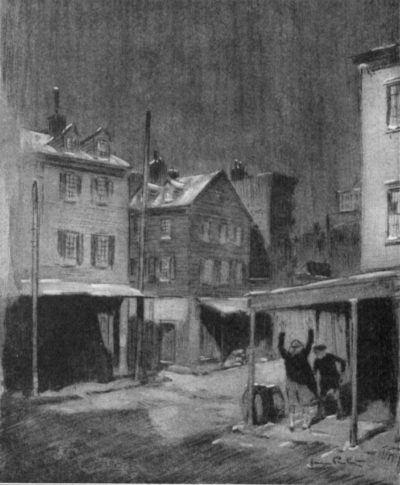 It would have required much stretching of that elastic property, the human imagination, to conceive of Mr. Herbert Hoover being there, whether in costume or otherwise, but that was what Mrs. Carroway said and repeated. Everyone came right out and agreed with her.
Now it was getting along toward three-thirty o’clock of the morning after, and the party was breaking up. Indeed for half an hour past, this person or that had been saying it was time, really, to be thinking about going — thus voicing a conviction that had formed at a much earlier hour in the minds of the tenants of the floor below Mrs. Carroway’s studio apartment, which like all properly devised studio apartments was at the top of the building.
It was all very well to be a true Bohemian, ready to give and take, and if one lived down round Washington Square one naturally made allowances for one’s neighbors and all that, but half past three o’clock in the morning was half past three o’clock in the morning, and there was no getting round that, say what you would. And besides, there were some people who needed a little sleep once in a while even if there were some other people who seemed to be able to go without any sleep; and finally, though patience was a virtue, enough of a good thing was enough and too much was surplusage. Such was the opinion of the tenants one flight down.
So the party was practically over. Mr. Algernon Leary, of the firm of Leary & Slack, counselors and attorneys at law, with offices at Number Thirty-two Broad Street, was among the very last to depart. Never had Mr. Leary spent a more pleasant evening. He had been in rare form, a variety of causes contributing to this happy state. To begin with, he had danced nearly every dance with Miss Milly Hollister, for whom he entertained the feelings which a gentleman of ripened judgment, and one who was rising rapidly in his profession, might properly entertain for an entirely charming young woman of reputed means and undoubted social position.
A preposterous ass named Perkins — at least, Mr. Leary mentally indexed Perkins as a preposterous ass — had brought Miss Hollister to the party, but thereafter in the scheme of things Perkins did not count. He was a cipher. You could back him up against a wall and take a rubber-tipped pencil and rub him right out, as it were; and with regards to Miss Hollister that, figuratively, was what Mr. Leary had done to Mr. Perkins. Now on the other hand Voris might have amounted to something as a potential rival, but Voris being newly appointed as a police magistrate was prevented by press of official duties from coming to the party; so Mr. Leary had a clear field, as the saying goes, and made the most of it, as the other saying goes.
Moreover, Mr. Leary had been the recipient of unlimited praise upon the ingenuity and the uniqueness expressed in his costume. He had not represented a Little Lord Fauntleroy or a Buster Brown or a Boy Scout or a Juvenile Cadet or a Midshipmite or an Oliver Twist. There had been three Boy Scouts present and four Buster Browns and of sailor-suited persons there had been no end, really. But Mr. Leary had chosen to appear as Himself at the Age of Three; and, as the complimentary comment proved, his get-up had reflected credit not alone upon its wearer but upon its designer, Miss Rowena Skiff, who drew fashion pictures for one of the women’s magazines. Out of the goodness of her heart and the depths of her professional knowledge Miss Skiff had come to Mr. Leary’s aid, supervising the preparation of his wardrobe at a, theatrical costumer’s shop uptown and, on the evening before, coming to his bachelor apartments, accompanied by her mother, personally to add those small special refinements which meant so much, as he now realized, in attaining the desired result.
“Oh, Mr. Leary, I must tell you again how very fetching you do look! Your costume is adorable, really it is; so — so cute and everything. And I don’t know what I should have done without you to help in the games and everything. There’s no use denying it, Mr. Leary — you were the life of the party, absolutely!”
At least twice during the night Mrs. Carroway had told Mr. Leary this, and now as he bade her farewell she was saying it once more in practically the same words, when Mrs. Carroway’s maid, Blanche, touched him on the arm.
“‘Scuse me, suh,” apologized Blanche, “but the hall man downstairs he send up word jes’ now by the elevator man ‘at you’d best be comin’ right on down now, suh, effen you expects to git a taxicab. He say to tell you they ain’t but one taxicab left an’ the driver of ‘at one’s been waitin’ fur hours an’ he act like he might go way any minute now. ‘At’s whut the hall man send word, suh.”
Blanche had brought his overcoat along and held it up for him, imparting to the service that small suggestion of a ceremonial rite which the members of her class invariably do display when handling a garment of richness of texture and indubitable cost. Mr. Leary let her help him into the coat and slipped largess into her hand, and as he stepped aboard the waiting elevator for the downward flight Mrs. Carroway’s voice came fluting to him, once again repeating the flattering phrase: “You surely were the life of the party!”
It was fine to have been the life of the party. It was not quite so fine to discover that the taxicab to which he must entrust himself for the long ride up to West Eighty-fifth Street was a most shabby-appearing vehicle, the driver of which, moreover, as Mr. Leary could divine even as he crossed the sidewalk, had wiled away the tedium of waiting by indulgence in draughts of something more potent than the chill air of latish November. Mr. Leary peered doubtfully into the illuminated countenance but dulled eyes of the driver and caught a whiff of a breath alcoholically fragrant, and he understood that the warning relayed to him by Blanche had carried a subtle double meaning. Still, there was no other taxicab to be had. The street might have been a byway in old Pompeii for all the life that moved within it. Washington Square, facing him, was as empty as a graveyard generally is at this hour, and the semblance of a conventional graveyard in wintertime was helped out by a light snow — the first of the season — sifting down in large damp flakes.
Twice and thrice he repeated the address, speaking each time sharply and distinctly, before the meaning seemed to filter into the befogged intellect of the inebriate. On the third rendition the latter roused from where he was slumped down.
“I garcia, Steve,” he said thickly. “I garcia firs’ time, only y’ hollowed s’loud I couldn’ und’stancher.”
So saying he lurched into a semi-upright posture and fumbled for the wheel. Silently condemning the curse of intemperance among the working classes of a great city Mr. Leary boarded the cab and drew the skirts of his overcoat down in an effort to cover his knees. With a harsh grating of clutches and an abrupt jerk the taxi started north.
Wobbling though he was upon his perch the driver mechanically steered a reasonably straight course. The passenger leaning back in the depths of the cab confessed to himself he was a trifle weary and more than a trifle sleepy. At thirty-seven one does not dance and play children’s games alternately for six hours on a stretch without paying for the exertion in a sensation of letdownness. His head slipped forward on his chest.
With a drowsy uncertainty as to whether he had been dozing for hours or only for a very few minutes Mr. Leary opened his eyes and sat up. The car was halted slantwise against a curbing; the chauffeur was jammed down again into a heap. Mr. Leary stepped nimbly forth upon the pavement, feeling in his overcoat pocket for the fare; and then he realized he was not in West Eighty-fifth Street at all; he was not in any street that he remembered ever having seen before in the course of his life. Offhand, though, he guessed he was somewhere in that mystic maze of brick and mortar known as Old Greenwich Village; and, for a further guess, in that particular part of it where business during these last few years had been steadily encroaching upon the ancient residences of long departed Knickerbocker families.
The street in which he stood, for a wonder in this part of town, ran a fairly straight course. At its western foot he could make out through the drifting flakes where a squat structure suggestive of a North River freight dock interrupted the sky line. In his immediate vicinity the street was lined with tall bleak fronts of jobbing houses, all dark and all shuttered. Looking the other way, which would be eastward, he could make out where these wholesale establishments tailed off, to be succeeded by the lower shapes of venerable dwellings adorned with the dormered windows and the hip roofs which distinguished a bygone architectural period. Some distance off in this latter direction the vista between the buildings was cut across by the straddlebug structure of one of the elevated roads. All this Mr. Leary comprehended in a quick glance about him, and then he turned on the culprit cabman with rage in his heart.
“See here, you!” he snapped crossly, jerking the other by the shoulder. “What do you mean by bringing me away off here! This isn’t where I wanted to go. Oh, wake up, you!”
Under his vigorous shaking the driver slid over sideways until he threatened to decant himself out upon Mr. Leary. His cap falling off exposed the blank face of one who for the time being has gone dead to the world and to all its carking cares, and the only response he offered for his mishandling was a deep and sincere snore. The man was hopelessly intoxicated; there was no question about it. More to relieve his own deep chagrin than for any logical reason Mr. Leary shook him again; the net results were a protesting semiconscious grunt and a further careening slant of the sleeper’s form.
Well, there was nothing else to do but walk. He must make his way afoot until he came to Sixth Avenue or on to Fifth, upon the chance of finding in one of these two thoroughfares a ranging nighthawk cab. As a last resort he could take the Subway or the L north. This contingency, though, Mr. Leary considered with feelings akin to actual repugnance. He dreaded the prospect of ribald and derisive comments from chance fellow travelers upon a public transportation line. For you should know that though Mr. Leary’s outer garbing was in the main conventional there were strikingly incongruous features of it too.
From his neck to his knees he correctly presented the aspect of a gentleman returning late from social diversions, caparisoned in a handsome fur-faced, fur-lined top coat. But his knees were entirely bare; so, too, were his legs down to about midway of the calves, where there ensued, as it were, a pair of white silk socks, encircled by pink garters with large and ornate pink ribbon bows upon them. His feet were bestowed in low slippers with narrow buttoned straps crossing the insteps. It was Miss Skiff, with her instinct for the verities, who had insisted upon bows for the garters and straps for the slippers, these being what she had called finishing touches. Likewise it was due to that young lady’s painstaking desire for appropriateness and completeness of detail that Mr. Leary at this moment wore upon his head a very wide-brimmed, very floppy straw hat with two quaint pink-ribbon streamers floating, jauntily down between his shoulders at the back.
For reasons which in view of this sartorial description should be obvious Mr. Leary hugged closely up to the abutting house fronts when he left behind him the marooned taxi with its comatose driver asleep upon it, like one lone castaway upon a small island in a sea of emptiness, and set his face eastward. Such was the warmth of his annoyance he barely felt the chill striking upon his exposed nether limbs or took note of the big snowflakes melting damply upon his thinly protected ankles. Then, too, almost immediately something befell which upset him still more.
He came to where a wooden marquee, projecting over the entrance to a shipping room, made a black strip along the feebly lighted pavement. As he entered the patch of darkness the shape of a man materialized out of the void and barred his way, and in that same fraction of a second something shiny and hard was thrust against Mr. Leary’s daunted bosom, and in a low forceful rumble a voice commanded him as follows: “Put up your mitts — and keep ‘em up!”
Matching the action of his hands everything in Mr. Leary seemed to start skyward simultaneously. His hair on his scalp straightened, his breath came up from his lungs in a gasp, his heart lodged in his throat, and his blood quit his feet, leaving them practically devoid of circulation, and ascended and drummed in his temples. He had a horrid, emptied feeling in his diaphragm, too, as though the organs customarily observable there had caught the contagion of the example and gone north.
“That’s nice,” spake the fearsome stranger. “Now stay jest the way you are and don’t make no peep or I’ll have to plug you wit’ this here gat.”
His right hand maintained the sinister pressure of the weapon against the victim’s deflated chest, while his left dexterously explored the side pockets of Mr. Leary’s overcoat. Then the same left hand jerked the frogged fastenings of the garment asunder and went pawing swiftly over Mr. Leary’s quivering person, seeking the pockets which would have been there had Mr. Leary been wearing garments bearing the regulation and ordained number of pockets. But the exploring fingers merely slid along a smooth and unbroken frontal surface.
“Wot t’ell? Wot t’ell?” muttered the footpad in bewilderment. “Say, where’re you got your leather and your kittle hid? Speak up quick!”
“I’m — I’m — not carrying a watch or a purse to-night,” quavered Mr. Leary. “These — these clothes I happen to be wearing are not made with places in them for a watch or anything. And you’ve already taken what money I had — it was all in my overcoat pocket.”
“Yep; a pinch of chicken feed and wot felt like about four one-bone bills.” The highwayman’s accent was both ominous and contemptuous. “Say, wotcher mean drillin’ round dis town in some kinder funny riggin’ wit’out no plunder on you? I gotta right to belt you one acrost the bean.”
“I’d rather you didn’t do that,” protested Mr. Leary in all seriousness. “If — if you’d only give me your address I could send you some money in the morning to pay you for your trouble — ”
“Cut out de kiddin’,” broke in the disgusted marauder. His tone changed slightly for the better: “Say, near as I kin tell by feelin’ it, dat ain’t such a bum benny you’re sportin’. I’ll jest take dat along wit’ me. Letcher arms down easy and hold ‘em straight out from yore sides while I gits it offen you. And no funny business!”
“Oh, please, please don’t take my overcoat,” implored Mr. Leary, plunged by these words into a deeper panic. “Anything but that! I — you — you really mustn’t leave me without my overcoat.”
“Wot else is dere to take?”
Even as he uttered the scornful question the thief had wrested the garment from Mr. Leary’s helpless form and was backing away into the darkness.
Out of impenetrable gloom came his farewell warning: “Stay right where you are for fi’ minutes wit’out movin’ or makin’ a yelp. If you wiggle before de time is up I gotta pal right yere watchin’ you, and he’ll sure plug you. He ain’t no easy-goin’ guy like wot I am. You’re gittin’ off lucky it’s me stuck you up, stidder him.”
With these words he was gone — gone with Mr. Leary’s overcoat, with Mr. Leary’s last cent, with his latchkey, with his cardcase, with all by which Mr. Leary might hope to identify himself before a wary and incredulous world for what he was. He was gone, leaving there in the protecting ledge of shadow the straw-hatted, socked-and-slippered, leg-gartered figure of a plump being, clad otherwise in a single vestment which began at the line of a becomingly low neckband and terminated in blousy outbulging bifurcations just above the naked knees. Light stealing into this obscured and sheltered spot would have revealed that this garment was, as to texture, a heavy, silklike, sheeny material; and as to color a vivid and compelling pink — the exact color of a slice of well-ripened watermelon; also that its sleeves ended elbow-high in an effect of broad turned-back cuffs; finally, that adown its owner’s back it was snugly and adequately secured by means of a close-set succession of very large, very shiny white pearl buttons — the whole constituting an enlarged but exceedingly accurate copy of what, descriptively, is known to the manufactured-garment trade as a one-piece suit of child’s rompers, self-trimmed, fastens behind; suitable for nursery, playground and seashore, especially recommended as summer wear for the little ones; to be had in all sizes.
Within a space of some six or seven minutes this precisely was what the nearest street lamp did reveal unto itself as its downward-slanting beams fell upon a furtive, fugitive shape, suggestive in that deficient subradiance of a vastly overgrown forked parsnip, miraculously endowed with powers of locomotion and bound for somewhere in a hurry; excepting of course no forked parsnip, however remarkable in other respects, would be wearing a floppy straw hat in a snowstorm; nor is it likely it would be adorned lengthwise in its rear with a highly decorative design of broad, smooth, polished disks which, even in that poor illumination, gleamed and twinkled and wiggled snakily in and out of alignment, in accord with the movements of their wearer’s spinal column.
But the reader and I, better informed than any lamp-post could be as to the prior sequence of events, would know at a glance it was no parsnip we beheld, but Mr. Algernon Leary, now suddenly enveloped through no fault of his own in one of the most overpowering predicaments conceivable to involve a rising lawyer and a member of at least two good clubs; and had we but been there to watch him, knowing, as we would know, the developments leading up to this present situation, we might have guessed what was the truth: That Mr. Leary was hot bent upon retreating to the only imaginable refuge left to him; to wit, the interior of the stranded taxicab which he had abandoned but a short time previously.
Nearly all of us at some time or other in our lives have dreamed awful dreams of being discovered in a public place with nothing at all upon our bodies, and have awakened, burning hot with the shame of an enormous and terrific embarrassment. Being no student of the psychic phenomena of human slumber I do not know whether this is a subconscious harking-back to the days of our infancy or whether it is merely a manifestation to prove the inadvisability of partaking of Welsh rabbits and lobster salads immediately before retiring. More than once Mr. Leary had bedreamed thus, but at this moment he realized how much more dread and distressing may be a dire actuality than a vision conjured up out of the mysteries of sleep.
One surprised by strangers in a nude or partially nude state may have any one of a dozen acceptable excuses for being so circumstanced. An earthquake may have caught one unawares, say; or inopportunely a bathroom door may have blown open. Once the first shock occasioned by the untoward appearance of the victim has passed away he is sure of sympathy. For him pity is promptly engendered and volunteer aid is enlisted.
But Mr. Leary had a profound conviction that, revealed in this ghostly plight before the eyes of his fellows, his case would be regarded differently; that instead of commiseration there would be for him only the derision which is so humiliating to a sensitive nature. He felt so undignified, so glaringly conspicuous, so — well, so scandalously immature. If only it had been an orthodox costume party which Mrs. Carroway had given — why, then he might have gone as a Roman senator or as a pirate chief or an Indian brave or a cavalier. In doublet or jack boots or war bonnet, in a toga, even, he might have mastered the dilemma and carried off a dubious situation. But to be adrift in an alien quarter of a great and heartless city round four o’clock in the morning, so picturesquely and so unseasonably garbed, and in imminent peril of detection, was a prospect calculated to fill one with the frenzied delirium of a nightmare made real.
His slippered feet spurned the thin snow as he moved rapidly back toward the west. Ahead of him he could detect the clumped outlines of the taxicab, and at the sight of it he quickened to a trot. Once safely within it he could take stock of things; could map out a campaign of future action; could think up ways and means of extricating himself from his present lamentable case with the least possible risk of undesirable publicity. At any rate he would be shielded for the moment from the life which might at any moment awaken in the still sleeping and apparently vacant neighborhood. Finally, of course, there was the hope that the drunken cabman might be roused, and once roused might be capable, under promise of large financial reward, of conveying Mr. Leary to his bachelor apartments in West Eighty-fifth Street before dawn came, with its early-bird milkmen and its before-day newspaper distributors and its others too numerous to mention.
Without warning of any sort the cab started off, seemingly of its own volition. Mr. Leary’s gait became a desperate gallop, and as he galloped he gave voice in entreaty.
“Hey there!” he shouted. “Wait, please. Here I am — here’s your passenger!”
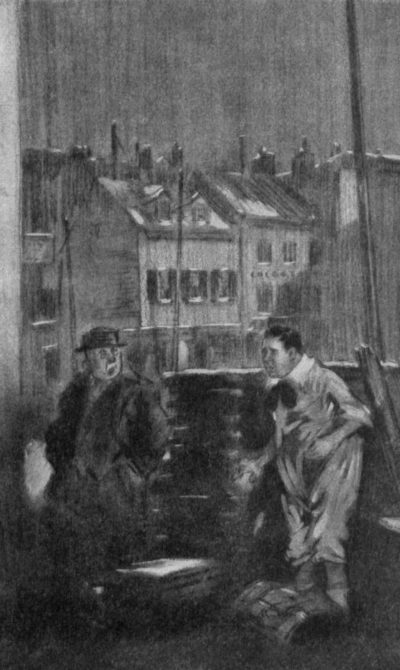 His straw hat blew off, but this was no time to stop for a straw hat. For a few rods he gained upon the vehicle, then as its motion increased he lost ground and ran a losing race. Its actions disclosed that a conscious if an uncertain hand guided its destinies. Wabbling this way and that it wheeled skiddingly round a corner. When Mr. Leary, roweled on to yet greater speed by the spurs of a mounting misery, likewise turned the corner it was irrevocably remote, beyond all prospect of being overtaken by anything human pursuing it afoot. The swaying black bulk of it diminished and was swallowed up in the snow shower and the darkness. The rattle of mishandled gears died to a thin metallic clanking, then to a purring whisper, and then the whisper expired, dead silence ensuing.
In the void of this silence stood Mr. Leary, shivering now in the reaction that had succeeded the nerve jar of being robbed at a pistol’s point, and lacking the fervor of the chase to sustain him. For him the inconceivable disaster was complete and utter; upon him despair descended as a patent swatter upon a lone housefly. Miles away from home, penniless and friendless — the two terms being practically synonymous in New York — what asylum was there for him now? Suppose daylight found him abroad thus? Suppose he succumbed to exposure and was discovered stiffly frozen in a doorway? Death by processes of congealment must carry an added sting if one had to die in a suit of pink rompers buttoning down the back. As though the thought of freezing had been a cue to Nature he noted a tickling in his nose and a chokiness in his throat, and somewhere in his system, a long way off, so to speak, he felt a sneeze forming and approaching the surface.
To add to his state of misery, if anything could add to its distressing total, he was taking cold. When Mr. Leary took cold he took it thoroughly and throughout his system. Very soon, as he knew by past experience, his voice would be hoarse and wheezy and his nose and his eyes would run. But the sneeze was delayed in transit, and Mr. Leary took advantage of the respite to cast a glance about him. Perhaps — the expedient had surged suddenly into his brain — perhaps there might be a hotel or a lodging house of sorts hereabouts? If so, such an establishment would have a night clerk on duty, and despite the baggage-less and cashless state of the suppliant it was possible the night clerk might be won, by compassion or by argument or by both, to furnish Mr. Leary shelter until after breakfast time, when over the telephone he could reach friends and from these friends procure an outfit of funds and suitable clothing.
In sight, though, there was no structure which by its outward appearance disclosed itself as a place of entertainment for the casual wayfarer. Howsomever, lights were shining through the frosted panes of a row of windows stretching across the top floor of a building immediately at hand, and even as he made this discovery Mr. Leary was aware of the dimmed sounds of revelry and of orchestral music up there, and also of an illuminated canvas triangle stuck above the hallway entrance of the particular building in question, this device bearing a lettered inscription upon it to advertise that here the members of the Lawrence P. McGillicuddy Literary Association and Pleasure Club were holding their Grand Annual Civic Ball; admission One Dollar, including Hat Check; Ladies Free when accompanied by Gents. Evidently the Lawrence P. McGillicuddys kept even later hours at their roisterings than the Bohemian sets in Washington Square kept.
Observing these evidences of adjacent life and merrymakings Mr. Leary cogitated. Did he dare intrude upon the festivities aloft there? And if he did so dare, would he enter cavortingly, trippingly, with intent to deceive the assembled company into the assumption that he had come to their gathering in costume? or would he throw himself upon their charity and making open confession of his predicament seek to enlist the friendly offices of some kindly soul in extricating him from it?
While he canvassed the two propositions tentatively he heard the thud of footsteps descending the stairs from the dance hall, and governed by an uncontrollable impulse he leaped for concealment behind a pile of building material that was stacked handily upon the sidewalk almost at his elbow. He might possibly have driven himself to face a multitude indoors, but somehow could not, just naturally could not, in his present apparel, face one stranger outdoors — or at least not until he had opportunity to appraise the stranger.
It was a man who emerged from the hallway entrance; a stockily built man wearing his hat well over one ear and with his ulster opened and flung back exposing a broad chest to the wintry air. He was whistling a sprightly air.
Just as this individual came opposite the lumber pile the first dedicatory sneeze of a whole subsequent series of sneezes which had been burgeoning somewhere up in the top of Mr. Leary’s head, and which that unhappy gentleman had been mechanically endeavoring to suppress, burst from captivity with a vast moist report. At the explosion the passer-by spun about and his whistle expired in a snort of angered surprise as the bared head of Mr. Leary appeared above the topmost board of the pile, and Mr. Leary’s abashed face looked into his.
“Say,” he demanded, “wotcher meanin’, hidin’ there and snortin in a guy’s ear?”
His manner was truculent; indeed, verged almost upon the menacing. Evidently the shock had adversely affected his temper, to the point where he might make personal issues out of unavoidable trifles. Instinctively Mr. Leary felt that the situation which had arisen called for diplomacy of the very highest order. He cleared his throat before replying.
“Good evening,” he began, in what he vainly undertook to make a casual tone of voice. “I beg your pardon — the sneeze — ahem — occurred when I wasn’t expecting it. Ahem — I wonder if you would do me a favor?”
“I would not! Come snortin’ in a guy’s ear that-a-way and then askin’ him would he do you a favor. You got a crust for fair!” Here, though, a natural curiosity triumphed over the rising tides of indignation. “Wot favor do you want, anyway?” he inquired shortly.
“Would you — would you — I wonder if you would be willing to sell me that overcoat you’re wearing?”
“I would not!”
“You see, the fact of the matter is I happen to be needing an overcoat very badly at the moment,’ pressed Mr. Leary. “I was hoping that you might be induced to name a price for yours.”
“Certainly I would not! M.J. Cassidy wears M.J. Cassidy’s clothes, and nobody else wears ‘em, believe me! Wot’s happened to your own coat?”
“I lost it — I mean it was stolen.”
“Stole?”
“Yes, a robber with a revolver held me up a few minutes ago just over here in the next cross street and he took my coat away.”
“Huh! Well, did you lose your hat the same way?”
“Yes — that is to say, no. I lost my hat running.”
“Oh, you run, hey? Well, you look to me like a guy wot would run. Well, did he take your clothes too? Is that why you’re squattin’ behind them timbers?” The inquisitive one took a step nearer.
“No — oh, no! I’m still wearing my- my — the costume I was wearing,” answered Mr. Leary, apprehensively wedging his way still farther back between the stack of boards and the wall behind. “But you see — ”
“Well then, barrin’ the fact that you ain’t got no hat, ain’t you jest as well off without no overcoat now as I’d be if I fell for any hard-luck spiel from you and let you have mine?”
“I wouldn’t go so far as to say that exactly,” tendered Mr. Leary ingratiatingly. “I’m afraid my clothing isn’t as suitable for outdoor wear as yours is. You see, I’d been to a sort of social function and on my way home it — it happened.”
“Oh, it did, did it? Well, anyway, I should worry about you and your clothes,” stated the other. He took a step onward, then halted; and now the gleam of speculative gain was in his eye. “Say, if I was willin’ to sell — not sayin’ I would be, but if I was — what would you be willin’ to give for an overcoat like this here one?”
“Any price within reason — any price you felt like asking,” said Mr. Leary, his hopes of deliverance rekindling.
“Well, maybe I’d take twenty-five dollars for it just as it stands and no questions ast. How’d that strike you?”
“I’ll take it. That seems a most reasonable figure.”
“Well, fork over the twenty-five then, and the deal’s closed.”
“I’d have to send you the money tomorrow — I mean today. You see, the thief took all my cash when he took my overcoat.”
“Did, huh?”
“Yes, that’s the present condition of things. Very annoying, isn’t it? But I’ll take your address. I’m a lawyer in business in Broad Street, and as soon as I reach my office I’ll send the amount by messenger.”
“Aw, to hell with you and your troubles! I might a-knowed you was some new kind of a panhandler when you come a-snortin’ in my ear that-a-way. Better beat it while the goin’s good. You’re in the wrong neighborhood to be springin’ such a gag as this one you just now sprang on me. Anyhow, I’ve wasted enough time on the likes of you.”
He was ten feet away when Mr. Leary, his wits sharpened by his extremity, clutched at the last straw.
“One moment,” he nervously begged. “Did I understand you to say your name was Cassidy?”
“You did. Wot of it?”
“Well, curious coincidence and all that — but my name happens to be Leary. And I thought because of that you might — ”
The stranger broke in on him: “Your name happens to be Leary, does it? Wot’s your other name then?”
“Algernon.”
Stepping lightly on the balls of his feet Mr. Cassidy turned back, and his mien for some reason was that potentially of a belligerent.
“Say,” he declared threateningly, “you know what I think about you? Well, I think you’re a liar. No regular guy with the name of Leary would let a cheap stiff of a stick-up rob him out of the coat offen his back without puttin’ up a battle. No regular guy named Leary would be named Algernon. Say, I think you’re a Far Downer. I wouldn’t be surprised but what you was anything else on the top of that. And wot’s all this here talk about goin’ to a sociable functure and comin’ away not suitably dressed. Come on out of that now and let’s have a look at you.”
“Really, I’d much rather not — if you don’t mind,” protested the miserable Mr. Leary. “I — I have reasons.”
“The same here. Will you come out from behind there peaceable or will I fetch you out?”
So Mr. Leary came, endeavoring while coming to wear a manner combining an atmosphere of dignified aloofness and a sentiment of frank indifference to the opinion of this loutish busybody, with just a touch, a mere trace, as it were, of nonchalance thrown in. In short, coming out he sought to deport himself as though it were the properest thing in the world for a man of years and discretion to be wearing a bright pink one-piece article of apparel on a public highway at 4 a.m. or thereabouts. Undoubtedly, considering everything, it was the hardest individual task essayed in New York during the first year of the war. Need I add that it was a failure — a total failure? As he stood forth fully and comprehensively revealed by the light of the adjacent transparency, Mr. Cassidy’s squint of suspicion widened into a pop-eyed stare of temporary stupefaction.
“Well, for the love of — In the name of — Did anywan ever see the likes of — “
He murmured the broken sentences as he circled about the form of the martyr. Completing the circuit, laughter of a particularly boisterous and concussive variety interrupted his fragmentary speech.
“Ha ha, ha ha,” echoed Mr. Leary in a palpably forced and hollow effort to show that he too could enter into the spirit of the occasion with heartiness. “Does strike one as rather unusual at first sight — doesn’t it?”
“Why, you big hooman radish! Why, you strollin’ sunset!” thus Mr. Cassidy responded. “Are you payin’ an election bet three weeks after the election’s over? Or is it that you’re jest a plain bedaddled ijiet? Or what is it, I wonder?”
“I explained to you that I went to a party. It was a fancy-dress party,” stated Mr. Leary.
Sharp on the words Mr. Cassidy’s manner changed. Here plainly was a person of moods, changeable and tempersome.
“Ain’t you ashamed of yourself, and you a large, grown man, to be skihootin’ round with them kind of foolish duds on, and your own country at war this minute for decency and democracy?” From this it also was evident that Mr. Cassidy read the editorials in the papers. “You should take shame to yourself that you ain’t in uniform instid of baby clothes.”
It was the part of discretion, so Mr. Leary inwardly decided, to ignore the fact that the interrogator himself appeared to be well within the military age.
“I’m a bit old to enlist,” he stated, “and I’m past the draft age.”
“Then you’re too old to be wearin’such a riggin’. But, by tripes, I’ll say this for you — you make a picture that’d make a horse laugh.”
Laughing like a horse, or as a horse would laugh if a horse ever laughed, he rocked to and fro on his heels.
“Sh-sh; not so loud, please,” importuned Mr. Leary in all humility, meanwhile casting an uneasy glance toward the lighted windows above. “Somebody might hear you?”
“I hope somebody does hear me,” gurgled the temperamental Mr. Cassidy, now once more thoroughly beset by his mirth. “I need somebody to help me laugh. By tripes, I need a whole crowd to help me; and I know a way to get them!”
He twisted his head round so his voice would ascend the hallway. “Hey, fellers and skoirts,” he called; “you that’s fixin’ to leave! Hurry on down and see Algy, the livin’ peppermint lossenger,before he melts away from his own sweetness.”
Obeying the summons with promptness a flight of the Lawrence P. McGillicuddys, accompanied for the most part by lady friends, cascaded down the stairs and erupted forth upon the sidewalk.
“Here y’are — right here!” clarioned Mr. Cassidy as the first skylarkish pair showed in the doorway. His manner was drolly that of a showman exhibiting a rare freak, newly captured. “Come a-runnin’!”
They came a-running and there were a dozen of them or possibly fifteen; blithesome spirits, all, and they fenced in the shrinking shape of Mr. Leary with a close and curious ring of themselves, and the combined volume of their glad, amazed outbursts might be heard for a distance of furlongs. On prankish impulse then they locked hands and with skippings and prancings and impromptu jig steps they circled about him; and he, had he sought to speak, could not well have been heard; and, anyway, he was for the moment past speech, because of being entirely engaged in giving vent to one vehement sneeze after another. And next, above the chorus of joyous whooping might be heard individual comments, each shrieked out shrilly and each punctuated by a sneeze from Mr. Leary’s convulsed frame; or lacking that by a simulated sneeze from one of the revelers — one with a fine humorous flare for mimicry. And these comments were, for example, such as:
“Git onto the socks!”
“Ker-chew !”
“And the slippers!”
“Ker-chew!”
“And them lovely pink garters!”
“Ker-chew!”
“Oh, you cutey! Oh, you cut-up!”
“Ker-chew!”
“Oh, you candy kid!”
“And say, git onto the cunnin’ elbow sleeves our little playmate’s got.”
“Yes, but goils, just pipe the poilies — ain’t they the greatest ever?”
“They sure are. Say, kiddo, gimme one of ‘em to remember you by, won’t you? You’ll never miss it — you got a-plenty more.”
“Wot d’ye call wot he’s got on ‘urn, anyway?” The speaker was a male, naturally.
“W’y, you big stoopid, can’t you see he’s wearin’ rompers?” The answer came in a giggle, from a gay youthful creature of the opposite sex as she kicked out roguishly.
“Well then, be thee, w’y don’t he romp a little?”
“Give ‘urn time, cancher? Don’t you see he’s blowin’ out his flues? He’s busy now. He’ll romp in a minute.”
“Sure he will! We’ll romp with ‘um.”
A waggish young person in white beaded slippers and a green sport skirt broke free from the cavorting ring, and behind Mr. Leary’s back the nimble fingers of the madcap tapped his spinal ornamentations as an instrumentalist taps the stops of an organ; and she chanted a familiar counting game of childhood:
“Rich man — poor man — beggar man — thief — doctor — loiryer — “
“Sure, he said he was a loiryer.” It was Mr. Cassidy breaking in. “And he said his name was Algernon. Well, I believe the Algernon part.”
“Oh, you Algy!”
“Algernon, does your mother know you’re out?”
“T’ree cheers for Algy, the walkin’ comic valentine!”
“Algy, Algy — Oh, you cutey Algy!” These jolly Greenwich Villagers were going to make a song of his name. They did make a song of it, and it was a frolicsome song and pitched to a rollicksome key. Congenial newcomers arrived, pelting down from upstairs whence they had been drawn by the happy rocketing clamor; and they caught spirit and step and tune with the rest and helped manfully to sing it. As one poet hath said, “And now reigned high carnival.” And as another has so aptly phrased it, “There was a sound of revelry by night.” And, as the same poet once put it, or might have put it so if he didn’t, “And all went merry as a marriage morn.” But when we, adapting the line to our own descriptive usages, now say all went merry we should save out one exception — one whose form alternately was racked by hot flushes of a terrific self-consciousness and by humid gusts of an equally terrific sneezing fit.
“Here, here, here! Cut out the yellin’! D’you want the whole block up out of their beds?” The voice of the personified law, gruff and authoritative, broke in upon the clamor, and the majesty of the law, typified in bulk, with galoshes, ear muffs and woolen gloves on, not to mention the customary uniform of blue and brass, plowed a path toward the center of the group.
“‘S all right, Switzer,” gayly replied a hoydenish lassie; she, the same who had begged Mr. Leary for a sea-pearl souvenir.
“But just see what Morrie Cassidy went and found here on the street!”
Patrolman Switzer looked then where she pointed, and could scarce believe his eyes. In his case gleefulness took on a rumbling thunderous form, which shook his being as with an ague and made him to beat himself violently upon his ribs.
“D’ye blame us for carryin’ on, Switzer, when we seen it ourselves?”
“I don’t — and that’s a fact,” Switzer confessed between gurgles. “I wouldn’t a blamed you much if you’d fell down and had a fit.” And then he rocked on his heels, filled with joviality clear down to his rubber soles. Anon, though, he remembered the responsibilities of his position. “Still, at that, and even so,” said he, sobering himself, “enough of a good thing’s enough.” He glared accusingly, yea, condemningly, at the unwitting cause of the quelled commotion.
“Say, what’s the idea, you carousin’ round Noo York City this hour of the night diked up like a Coney Island Maudie Graw? And what’s the idea, you causin’ a boisterous and disorderly crowd to collect? And what’s the idea, you makin’ a disturbance in a vicinity full of decent hardworkin’ people that’s tryin’ to get a little rest? What’s the general idea anyhow?”
At this moment Mr. Leary having sneezed an uncountable number of times regained the powers of coherent utterance.
“It is not my fault,” he said. “I assure you of that, officer. I am being misjudged; I am the victim of circumstances over which I have no control. You see, officer, I went last evening to a fancy-dress party and — ”
“Well then, why didn’t you go on home afterwards and behave yourself?”
“I did — I started, in a taxicab. But the taxicab driver was drunk and he went to sleep on the way and the taxicab stopped and I got out of it and started to walk across town looking for another taxicab and
“Started walkin’, dressed like that?”
“Certainly not. I had an overcoat on of course. But a highwayman held me up at the point of a revolver, and he took my overcoat and what money I had and my card case and — “
“Where did all this here happen — this here alleged robbery?”
“Not two blocks away from here, right over, in the next street to this one.”
“I don’t believe nothin’ of the kind!”
Patrolman Switzer spoke with enhanced severity; his professional honor had been touched in a delicate place. The bare suggestion that a footpad might dare operate in a district under his immediate personal supervision would have been to him deeply repugnant, and here was this weirdly attired wanderer making the charge direct.
“But officer, I insist — I protest that — “
“Young feller, I think you’ve been drinkin’, that’s what I think about you. Your voice sounds to me like you’ve been drinkin’ about a gallon of mixed ale. I think you dreamed all this here pipe about a robber and a pistol and an overcoat and a taxicab and all. Now you take a friendly tip from me and you run along home as fast as ever you can, and you get them delirious clothes off of you and then you get in bed and take a good night’s sleep and you’ll feel better. Because if you don’t it’s goin’ to be necessary for me to take you in for a public nuisance. I ain’t askin’ you — I’m tellin’ you, now. If you don’t want to be locked up, start movin’ — that’s my last word to you.”
The recent merrymakers, who had fallen silent the better to hear the dialogue, grouped themselves expectantly, hoping and waiting for a yet more exciting and humorous sequel to what had gone before — if such a miracle might be possible. Nor were they to be disappointed. The denouement came quickly upon the heels of the admonition.
For into Mr. Leary’s reeling and distracted mind the warning had sent a clarifying idea darting. Why hadn’t he thought of a police station before now? Perforce the person in charge at any police station would be under requirement to shelter him. What even if he were locked up temporarily? In a cell he would be safe from the slings and arrows of outrageous ridicule; and surely among the functionaries in any station house would be one who would know a gentleman in distress, however startlingly the gentleman might be garbed. Surely, too, somebody — once that somebody’s amazement had abated — would be willing to do some telephoning for him. Perhaps, even, a policeman off duty might be induced to take his word for it that he was what he really was, and not what he seemed to be, and loan him a change of clothing.
Hot upon the inspiration Mr. Leary decided on his course of action. He would get himself safely and expeditiously removed from the hateful company and the ribald comments of the Lawrence P. McGillicuddys and their friends. He would get himself locked up — that was it. He would now take the first steps in that direction.
“Are you goin’ to start on home purty soon like I’ve just been tellin’ you to; or are you ain’t?” snapped Patrolman Switzer, who, it would appear, was by no means a patient person.
“I am not!” The crafty Mr. Leary put volumes of husky defiance into his answer. “I’m not going home — and you can’t make me go home, either.” He rejoiced inwardly to see how the portly shape of Switzer stiffened and swelled at the taunt. “I’m a citizen and I have a right to go where I please, dressed as I please, and you don’t dare to stop me. I dare you to arrest me!” Suddenly he put both his hands in Patrolman Switzer’s fleshy midriff and gave him a violent shove. An outraged grunt went up from Switzer, a delighted whoop from the audience. Swept off his balance by the prospect of fruition for his design the plotter had technically been guilty before witnesses of a violent assault upon the person of an officer in the discharge of his sworn duty.
He felt himself slung violently about. One mitted hand fixed itself in Mr. Leary’s collar yoke at the rear; the other closed upon a handful of slack material in the lower breadth of Mr. Leary’s principal habiliment just below where his buttons left off.
“So you won’t come, won’t you? Well then I’ll show you — you pink strawberry drop!”
Enraged at having been flaunted before a jeering audience the patrolman pushed his prisoner ten feet along the sidewalk, imparting to the offender’s movements an involuntary gliding gait, with backward jerks between forward shoves; this method of propulsion being known in the vernacular of the force as “givin’ a skate the bum’s rush.”
“Hey, Switzer, loan me your key and I’ll ring for the wagon for you,” volunteered Mr. Cassidy. His care-free companions, some of them, cheered the suggestion, seeing in it prospect of a prolonging of this delectable sport which providence without charge had so graciously deigned to provide.
“Never mind about the wagon. Us two’ll walk, me and him,” announced the patrolman. “‘T’aint so far where we’re goin’, and the walk’ll do this fresh guy a little good, maybe’ll sober him up. And never mind about any of the rest of you taggin’ along behind us neither. This is a pinch — not a free street parade. Go on home now, the lot of youse, before you wake up the whole Lower West Side.”
Loath to be cheated out of the last act of a comedy so unique and so rich the whimsical McGillicuddys and their chosen mates fell reluctantly away, with yells and gibes and quips and farewell bursts of laughter. Closely hyphenated together the deep blue figure and the bright pink one rounded the corner and were alone. It was time to open the overtures which would establish Patrolman Switzer upon the basis of a better understanding of things. Mr. Leary craning his neck in order to look rearward into the face of his custodian spoke in a key very different from the one he had last employed:
“I really didn’t intend, you know, to resist you, officer. I had a private purpose in what I did. And you were quite within your rights. And I’m quite grateful to you — frankly I am — for driving those people away.”
“Is that so?” The inflection was grimly and heavily sarcastic.
“Yes. I am a lawyer by profession, and generally speaking I know what your duties are. I merely made a show — a pretense, as it were — of resisting you, in order to get away from that mob. It was — ahem — it was a device on my part — in short, a trick.”
“Is that so? Fixin’ to try to be off now, huh? Well, nothin’ doin’! Nothin’ doin! I don’t know whether you’re a fancy nut or a plain souse or what-all, but whatever you are you’re under arrest and you’re goin’ with me.”
“That’s exactly what I desire to do,” resumed the schemer. “I desire most earnestly to go with you.”
“You’re havin’ your wish, ain’t you? Well then, the both of us should oughter be satisfied.”
“I feel sure,” continued the wheedling and designing Mr. Leary, “that as soon as we reach the station house I can make satisfactory atonement to you for my behavior just now and can explain everything to your superiors in charge there, and then — ”
“Station house!” snorted Patrolman Switzer. “Why, say, you ain’t headin’ for no station house. The crowd that’s over there where you’re headin’ fur should be grateful to me fur bringin’ you in. You’ll be a treat for them, and it’s few enough pleasures some of them gets — ”
A new, a horrid doubt assailed Mr. Leary’s sorely taxed being. He began to have a dread premonition that all was not going well and his brain whirled anew.
“But I prefer to be taken to the station house,” he began.
“And who are you to be preferrin’ anything at all?” countered Switzer. “I’ll phone back to the station where I am and what I’ve done; though that part of it’s no business of yours. I’ll be doin’ that after I’ve arranged you over to Jefferson Market.”
“Jeff — Jefferson Market!”
“Sure, ‘tis to Jefferson Market night court you’re headin’ this minute. Where else? They’re settin’ late over there tonight; the magistrate is expectin’ some raids somewheres about daylight, I think. Anyhow, they’re open yet; I know that. So it’ll be me and you for Jefferson Market inside of five minutes; and I’m thinkin’ you’ll get quite a reception.”
Jefferson Market! Mr. Leary could picture the rows upon rows of gloating eyes. He heard the incredulous shout that would mark his entrance, the swell of unholy glee from the benches that would interrupt the proceedings. He saw stretched upon the front pages of the early editions of the afternoon yellows the glaring black-faced headlines:
WELL-KNOWN LAWYER
CLAD IN PINK ROMPERS
HALED TO NIGHT COURT
He saw — But Switzer’s next remark sent a fresh shudder of apprehension through him, caught all again, as he was, in the coils of accursed circumstance.
“Magistrate Voris will be gettin’ sleepy what with waitin’ for them raids to be pulled off, and I make no doubt the sight of you will put him in a good humor.”
And Magistrate Voris was his rival for the favors of Miss Milly Hollister! And Magistrate Voris was a person with a deformed sense of humor! And Magistrate Voris was sitting in judgment this moment at Jefferson Market night court. And now desperation, thrice compounded, rent the soul of the trapped victim of his own misaimed subterfuge.
“I won’t be taken to any night court!” he shouted, wrestling himself toward the edge of the sidewalk and dragging his companion along with him. “I won’t go there! I demand to be taken to a station house. I’m a sick man and I require the services of a doctor.”
“Startin’ to be rough-house all over again, huh?” grunted Switzer vindictively. “Well, we’ll see about that part of it too — right now!”
Surrendering his lowermost clutch, the one in the silken seat of the suit of his writhing prisoner, he fumbled beneath the tails of his overcoat for the disciplinary nippers that were in his right-hand rear trousers pocket.
With a convulsive twist of his body Mr. Leary jerked himself free of the mittened grip upon his neckband, and as, released, he gave a deerlike lunge forward for liberty he caromed against a burdened ash can upon the curbstone and sent it spinning backward; then recovering sprang onward and outward across the gutter in flight. In the same instant he heard behind him a crash of metal and a solid thud, heard a sound as of a scrambling solid body cast abruptly prone, heard the name of Deity profaned, and divined without looking back that the ash can, conveniently rolling between the plump legs of the personified Arm of the Law, had been Officer Switzer’s undoing, and might be his own salvation.
With never a backward glance he ran on, not doubling as a hare before the beagle, but following a straight course, like unto a hunted roebuck. He did not know he could run so fast, and he could not have run so fast any other time than this. Beyond was a crossing. It was blind instinct that made him double round the turn. It was instinct, quickened and guided by desperation, that made him dart like a rose-tinted flash up the steps to the stoop of an old-fashioned residence standing just beyond the corner, spring inside the storm doors, draw them to behind him, and crouch there, hidden, as pursuit went lumbering by.
Through a chink between the door halves he watched breathlessly while Switzer, who moved with a pronounced limp and rubbed his knees as he limped, hobbled halfway up the block, slowed down, halted, glared about him for sight or sign of the vanished fugitive, and then misled by a false trail departed, padding heavily with his galoshed tread, round the next turn.
With his body still drawn well back within the shadow line of the overhanging cornice Mr. Leary coyly protruded his head and took visual inventory of the neighborhood. So far as any plan whatsoever had formed in the mind of our diffident adventurer he meant to bide where he was for the moment. Here, where he had shelter of a sort, he would recapture his breath and reassemble his wits. Even so, the respite from those elements which Mr. Leary dreaded most of all — publicity, observation, cruel jibes, the harsh raucous laughter of the populace — could be at best but a woefully transient one. He was not resigned — by no means was he resigned — to his fate; but he was helpless. For what ailed him there was no conceivable remedy.
Anon jocund day would stand tiptoe on something or other; Greenwich Village would awaken and bestir itself. Discovery would come, and forth he would be drawn like a shy unwilling periwinkle from its shell, once more to play his abased and bashful role of free entertainer to guffawing mixed audiences. For all others in the great city there were havens and homes. But for a poor, lorn, unguided vagrant, enmeshed in the burlesque garnitures of a three-year-old male child, what haven was there? By night the part had been hard enough — as the unresponsive heavens above might have testified. By the stark unmerciful sunlight; by the rude, revealing glow of the impending day how much more scandalous would it be!
His haggard gaze swept this way and that, seeking possible succor where reason told him there could be no succor; and then as his vision pieced together this out-jutting architectural feature and that into a coherent picture of his immediate surroundings he knew where he was. The one bit of chancy luck in a sequence of direful catastrophes had brought him here to this very spot. Why, this must be West Ninth Street; it had to be, it was — oh joy, it was! And Bob Slack, his partner, lived in this identical block on this same side of the street.
With his throat throbbing to the impulse of newborn hope he emerged completely from behind the refuge of the storm doors backed himself out and down upon the top step, and by means of a dubious illumination percolating through the fanlight above the inner door he made out the figures upon the lintel. This was such and such a number; therefore Bob Slack’s number must be the second number to the eastward, at the next door but one.
Five seconds later a fleet apparition of a prevalent pinkish tone gave a ranging house cat the fright of its life as former darted past latter to vault nimbly up the stone steps of a certain weatherbeaten four-story-and-basement domicile. Set in the door jamb here was a vertical row of mail slots, and likewise a vertical row of electric push buttons; these objects attesting to the fact that this house, once upon a time the home of a single family, had eventually undergone the transformation which in lower New York befalls so many of its kind, and had become a layer-like succession of light-housekeeping apartments, one apartment to a floor, and the caretaker in the basement.
Since Bob Slack’s bachelor quarters were on the topmost floor Bob Slack’s push button would be the next to the lowermost of the battery of buttons. A chilled tremulous finger found that particular button and pressed it long and hard, released it, pressed it again and yet again. And in the interval following each period of pressing the finger’s owner hearkened, all ears, for the answering click-click that would tell him the sleeper having been roused by the ringing had risen and pressed the master button that released the mechanism of the street door’s lock.
But no welcome clicking rewarded the expectant ringer. Assuredly Bob Slack must be the soundest sleeper in the known world. He who waited rang and rang and rerang. There was no response.
Eventually conviction was forced upon Mr. Leary that he must awaken the caretaker — who, he seemed dimly to recall as a remembrance of past visits to Bob Slack, was a woman; and this done he must induce the caretaker to admit him to the inside of the house. Once within the building the refugee promised himself he would bring the slumberous Slack to consciousness if he had to beat down that individual’s door doing it. He centered his attack upon the bottom push button of all. Directly, from almost beneath his feet, came the sound of an areaway window being unlatched, and a drowsy female somewhat crossly inquired to know who might be there and what might be wanted.
“It’s a gentleman calling on Mr. Slack,” wheezed Mr. Leary with his head over the banisters. He was getting so very, very hoarse. “I’ve been ringing his bell, but I can’t seem to get any answer.”
“A gentleman at this time o’ night!” The tone was purely incredulous.
“Yes; a close friend of Mr. Slack’s,” assured Mr. Leary, striving to put stress of urgency into his accents, and only succeeding in imparting an added hoarseness to his fast-failing vocal cords. “I’m his law partner, in fact. I must see him at once, please — it’s very important, very pressing indeed.”
“Well, you can’t be seein’ him.”
“C-can’t see him? What do you mean?”
“I mean he ain’t here, that’s what. He’s out. He’s went out for the night. He’s ginerally always out on Friday nights — playin’ cards at his club, I think. And sometimes he don’t come in till it’s near breakfast time. If you’re a friend of his I sh’d think it’d be likely you’d know that same.”
“Oh, I do — I do,” assented Mr. Leary earnestly; “only I had forgotten it. I’ve had so many other things on my mind. But surely he’ll be coming in quite soon now — it’s pretty late, you know.”
“Don’t I know that for myself without bein’ told?”
“Yes, quite so of course; naturally so.” Mr. Leary was growing more and more nervous, and more and more chilled too. “But if you’ll only be so very kind as to let me in I’ll wait for him in his apartment.”
“Let you in without seein’ you or knowin’ what your business is? I should guess not! Besides, you couldn’t be gettin’ inside his flat anyways. He’s locked it, unless he’s forgot to, which ain’t likely, him bein’ a careful man, and he must a-took the key with him. I know I ain’t got it.”
“But if you’ll just let me inside the building that will be sufficient. I would much rather wait inside if only in the hall, than out here on the stoop in the cold.”
“No doubt, no doubt you would all of that.” The tone of the unseen female was dryly suspicious. “But is it likely I’d be lettin’ a stranger into the place, that I never seen before, and ain’t seen yet for that matter, just on the strength of his own word? And him comin’ unbeknownst, at this hour of the mornin’? A fat chancet!”
“But surely, though, you must recall me — Mr. Leary, his partner. I’ve been here before. I’ve spoken to you.”
“That voice don’t sound to me like no voice I ever heard.”
“I’ve taken cold — that’s why its altered.”
“So? Then why don’t you come down here where I can have a look at you and make sure?” inquired this careful chatelaine.
“I’m leaning with my head over the rail of the steps right above you,” said Mr. Leary. “Can’t you poke your head out and see my face? I’m quite sure you would recall me then.”
“With this here iron gratin’ acrost me window how could I poke me head out? Besides, it’s dark. Say, mister, if you’re on the level what’s the matter with you comin’ down here and not be standin’ there palaverin’ all the night?”
“I — I — well, you see, I’d rather not come for just a minute — until I’ve explained to you that — that my appearance may strike you as being a trifle unusual; in fact, I might say, ‘droll,’” pleaded Mr. Leary, seeking by subtle methods of indirection to prepare her for what must surely follow.
“Never mind explainin’ — gimme a look!” The suspicious tenseness in her voice increased. “I tell you this — ayther you come down here right this second or I shut the window and you can be off or you can go to the divil or go anywheres you please for all of me, because I’m an overworked woman and I need my rest and I’ve no more time to waste on you.”
“Wait, please; I’m coming immediately,” called out Mr. Leary.
He forced his legs to carry him down the steps and reluctantly, yet briskly, he propelled his pink-hued person toward the ray of light that streamed out through the grated window-opening and fell across the areaway.
“You mustn’t judge by first appearances,” he was explaining with a false and transparent attempt at matter-of-factness as he came into the zone of illumination. “I’m not what I seem, exactly. You see, I — ”
“Mushiful Evans!” The exclamation was half shrieked, half gasped out; and on the words the window was slammed to, the light within flipped out, and through the glass from within came a vehement warning:
“Get away, you — you lunatic! Get away from here now or I’ll have the cops on you.”
“But please, please listen,” he entreated, with his face close against the bars. “I assure you, madam, that I can explain everything if you will only listen.”
There was no mercy, no suggestion of relenting in the threatening message that came back to him:
“If you ain’t gone from here in ten seconds I’ll ring for the night watchman on the block, and I’ll blow a whistle for the police. I’ve got one hand on the alarm hook right now. Will you go or will I rouse the whole block?”
“Pray be calm, madam, I’ll go. In fact, I’m going now.”
He fell back out of the areaway. Fresh uproar at this critical juncture would be doubly direful. It would almost certainly bring Switzer, with his bruised shanks. It would inevitably bring someone.
Mr. Leary retreated to the sidewalk, figuratively casting from him the shards and potsherds of his reawakened anticipations, now all so rudely shattered again. He was doomed. It would inevitably be his fate to cower in these cold and drafty purlieus until —
No it wouldn’t either!
Like a golden rift in a sable sky a brand new ray of cheer opened before him. Who were those married friends of Slack’s who lived on the third floor — friends with whom once upon a time he and Slack had shared a chafing-dish supper? What was the name? Brady? No, Braydon. That was it — Mr. and Mrs. Edward Braydon. He would slip back again, on noiseless feet, to the doorway where the bells were. He would bide there until the startled caretaker had gone back to her sleep, or at least to her bed. Then he would play a solo on the Braydons’ bell until he roused them. They would let him in, and beyond the peradventure of a doubt, they would understand what seemed to be beyond the ken of flighty and excitable underlings. He would make them understand, once he was in and once the first shock of beholding him had abated within them. They were a kindly, hospitable couple, the Braydons were. They would be only too glad to give him shelter from the elements until Bob Slack returned from his session at bridge. He was saved!
Within the coping of the stoop he crouched and waited — waited for five long palpitating minutes which seemed to him as hours. Then he applied an eager and quivering finger to the Braydons’ button. Sweet boon of vouchsafed mercy! Almost instantly the latch clicked. And now in another instant Mr. Leary was within solid walls, with the world and the weather shut out behind him.
He stood a moment, palpitant with mute thanksgiving, in the hallway, which was made obscure rather than bright by a tiny pinprick of gaslight; and as thus he stood, fortifying himself with resolution for the embarrassing necessity of presenting himself, in all his show of quaint frivolity, before these comparative strangers, there came floating down the stair well to him in a sharp half-whisper a woman’s voice.
“Is that you?” it asked.
“Yes,” answered Mr. Leary truthfully. It was indeed he, Algernon Leary, even though someone else seemingly was expected. But the explanation could wait until he was safely upstairs. Indeed, it must wait. Attempted at a distance it would take on a rather complicated aspect; besides, the caretaker just below might overhear, and by untoward interruptions complicate a position already sufficiently delicate and difficult.
Down from above came the response: “All right then. I’ve been worried, you were so late coming in, Edward. Please slip in quietly and take the front room. I’m going on back to bed.”
“All right!” grunted Mr. Leary.
But already his plan had changed; the second speech down the stair well had caused him to change it. Safety first would be his motto from now on. Seeing. that Mr. Edward Braydon apparently was likewise late it would be wiser and infinitely more discreet on his part did he avoid further disturbing Mrs. Braydon, who presumably was alone and who might be easily frightened. So he would just slip on past the Braydon apartment, and in the hallway on the fourth floor he would cannily bide, awaiting the truant Slack’s arrival.
On tiptoe then, flight by flight, he ascended toward the top of the house. He was noiselessly progressing along the hallway of the third floor; he was about midway of it when under his tread a loose plank gave off an agonized squeak, and, as involuntarily he jumped, right at his side a door was flung open.
What the discomfited refugee saw, at a distance from him to be measured by inches rather than by feet, was the face of a woman; and not the face of young Mrs. Edward Braydon, either, but the face of a middle-aged lady with startled eyes widely staring, with a mouth just dropping ajar as sudden horror relaxed her jaw muscles, and with a head of gray hair haloed about by a sort of nimbus effect of curl papers. What the strange lady saw — well, what the strange lady saw may best perhaps be gauged by what she did, and that was instantly to slam and bolt the door and then to utter a succession of calliope-like shrieks, which echoed through the house and which immediately were answered back by a somewhat similar series of outcries from the direction of the basement.
Up the one remaining flight of stairs darted the intruder. He flung himself with all his weight and all his force against Bob Slack’s door. It wheezed from the impact, but its stout oaken panels held fast. Who says the impossible is really impossible? The accumulated testimony of the ages shows that given the emergency a man can do anything he just naturally has to do. Neither by training nor by habit of life nor yet by figure was Mr. Leary athletically inclined, but a trained gymnast might well have envied the magnificent agility with which he put a foot upon the doorknob and sprang upward, poising himself there upon a slippered toe, with one set of fingers clutching fast to the minute projections of the door frame while with his free hand he thrust recklessly against the transom.
The transom gave under the strain, moving upward and inward upon its hinges, disclosing an oblong gap above the jamb. With a splendid wriggle the fugitive vaulted up, thrusting his person into the clear snace thus provided. Balanced across the opening upon his stomach, half in and half out, for one moment he remained there, his legs kicking wildly as though for a purchase against something more solid than air. Then convulsive desperation triumphed over physical limitations. There was a rending, tearing sound as of some silken fabric being parted biaswise of its fibers, and Mr. Leary’s quaint after sections vanished inside; and practically coincidentally therewith, Mr. Leary descended upon the rugged floor with a thump which any other time would have stunned him into temporary helplessness, but which now had the effect merely of stimulating him onward to fresh exertion.
In a fever of activity he sprang up. Pawing a path through the encompassing darkness, stumbling into and over various sharp-cornered objects, bruising his limbs with contusions and knowing it not, he found the door of the inner room — Bob Slack’s bedroom — and once within that sanctuary he, feeling along the walls, discovered a push bulb and switched on the electric lights.
What matter though the whole house grew clamorous now with a mounting and increasing tumult? What mattered it though he could hear more and more startled voices commingled with the shattering shrieks emanating from the Braydon apartment beneath his feet? He, the hard-pressed and the sore-beset and the long-suffering, was at last beyond the sight of mortal eyes. He was locked in, with two rooms and a bath to himself, and he meant to maintain his present refuge, meant to hold this fort against all corners, until Bob Slack came home. He would barricade himself in if need be. He would pile furniture against the doors. If they took him at all it would be by direct assault and overpowering numbers.
And while he withstood siege and awaited attack he would rid himself of these unlucky caparisons that had been his mortification and his undoing. When they broke in on him — if they did break in on him — he would be found wearing some of Bob Slack’s clothes. Better far to be mistaken for a burglar than to be dragged forth lamentably yet fancifully attired as Himself at the Age of Three. The one thing might be explained — and in time would be; but the other? He felt that he was near the breaking point; that he could no more endure.
He stopped where he was, in the middle of the room, with his eyes and his hands seeking for the seams of the closing of his main garment. Then he remembered what in his stress he had forgotten — the opening, or perhaps one should say the closing, was at the back. He twisted his arms rearward, his fingers groping along his spine.
Now any normal woman has the abnormal ability to do and to undo again a garment hitching behind. Nature, which so fashioned her elbows that she cannot throw a stone at a hen in the way in which a stone properly should be thrown at a hen, made suitable atonement for this particular oversight by endowing her joints with the facile knack of turning on exactly the right angle, with never danger of sprain or dislocation, for the subjugation of a back-latching frock. Moreover, years of practice have given her adeptness in accomplishing this achievement, so that to her it has become an everyday feat. But man has neither the experience to qualify him nor yet the bodily adaptability.
By reaching awkwardly up and over his shoulder Mr. Leary managed to tug the topmost button of his array of buttons out of its attendant buttonhole, but below and beyond that point he could not progress. He twisted and contorted his body; he stretched his arms in their sockets until twin pangs of agony met and crossed between his shoulder blades, and with his two exploring hands he pulled and fumbled and pawed and wrenched and wrested, to make further headway at his task. But the sewing-on had been done with stout thread; the buttonholes were taut and snug and well-made. Those slippery flat surfaces amply resisted him. They eluded him; defied him; out-mastered him. Thanks be to, or curses be upon, the passionate zeal of Miss Rowena Skiff for exactitudes, he, lacking the offices of an assistant undresser, was now as definitely and finally enclosed in this distressful pink garment as though it had been his own skin. Speedily he recognized this fact in all its bitter and abominable truth, but mechanically, he continued to wrestle with the obdurate fastenings.
While he thus vainly contended, events in which he directly was concerned were occurring beneath that roof. From within his refuge he heard the sounds of slamming doors, of hurrying footsteps, of excited voices merging into a distracted chorus; but above all else, and from the rest, two of these voices stood out by reason of their augmented shrillness, and Mr. Leary marked them both, for since he had just heard them he therefore might identify their respective unseen owners.
“There’s something — there’s somebody in the house!” At the top of its register one voice was repeating the warning over and over again, and judging by direction this alarmist was shrieking her words through a keyhole on the floor below him. “I saw it — him — whatever it was. I opened my door to look out in the hall and it — he — was right there. Oh, I could have touched him! And then it ran and I didn’t see him anymore and I slammed the door — and began screaming.”
“You seen what?”
The strident question seemed to come from far below, down in the depths of the house, where the caretaker abided.
“Whatever it was, I opened the door and he was right in the hall there glaring at me. I could have touched it. And then he ran and I — “
“What was he like? I ast what was he like — it’s that I’m askin’ you!” The janitress was the one who pressed for an answer.
For the moment the question, pointed though it was, went unanswered. The main speaker — shrieker, rather — was plainly a person with a mania for details, and even in this emergency she intended, as now developed, to present all the principal facts in the case, and likewise all the incidental facts so far as these fell within her scope of knowledge.
“I was awake,” she clarioned through the keyhole, speaking much faster than anyone following this narrative can possibly hope to read the words. “I couldn’t sleep. I never do sleep well when I’m in a strange house. And anyhow, I was all alone. My nephew by marriage — Mr. Edward Braydon, you know — had gone out with the gentleman who lives on the floor above to play cards, and he said he was going to be gone nearly all night, and my niece — I’m Mrs. Braydon’s unmarried aunt from Poughkeepsie and I’m down here visiting them — my niece was called to Long Island yesterday by illness — it’s her sister who’s ill with something like the bronchitis. And so he was gone and she was gone, and here I was all alone and he told me not to stay up for him, but I couldn’t sleep well — I never can sleep in a strange house — and just a few minutes ago I heard the bell ring and I supposed he had forgotten to take his latchkey with him, and so I got up to let him in. And I called down the stairs and asked if it was him and he answered back. But it didn’t sound like his voice. But I didn’t think anything of that. But of course it was out of the ordinary for him to have a voice like that. But all the same I went back to bed. But he didn’t come in and I was just getting up again to see what detained him — his voice really sounded so strange I thought then he might have been taken sick or something. But just as I got to the door a plank creaked and I opened the door and there it was right where I could have touched him. And then it ran — and oh, what if — ”
“I’m askin’ you once more what it was like?”
“How should I know except that — ”
“Was it a big, fat, wild, bare-headed, scary, awful-lookin’ scoundrel dressed in some kind of funny pink clothes?”
“Yes, that’s it! That’s him — he was all sort of pink. Oh, did you see him too? Oh, is it a burglar?”
“Burglar nothin’! It’s a ravin’, rampagin’ lunatic — that’s what it is!”
“Oh, my heavens, a lunatic!”
“Sure it is. He tried to git me to let him in and — ”
“Oh, whatever shall we do!”
“Hey, what’s all the excitement about?”
A new and a deeper voice here broke into the babel, and Mr. Leary recognizing it at a distance, where he stood listening — but not failing, even while he listened, to strive unavailingly with his problem of buttons — knew he was saved. Knowing this he nevertheless retreated still deeper into the inner room. The thought of spectators in numbers remained very abhorrent to him. So he did not hear all that happened next, except in broken snatches.
He gathered though, from what he did hear, that Bob Slack and Mr. Edward Braydon were coming up the stairs, and that a third male whom they called Officer was coming with them, and that the janitress was coming likewise, and that divers lower-floor tenants were joining in the march, and that as they came the janitress was explaining to all and sundry how the weird miscreant had sought to inveigle her into admitting him to Mr. Slack’s rooms, and how she had refused, and how with maniacal craft — or words from her to that effect — he had nevertheless managed to secure admittance to the house, and how he must still be in the house. And through all her discourse there were questions from this one or that, crossing its flow but in nowise interrupting it; and through it all percolated hootingly the terrorized outcries of Mr. Braydon’s maiden aunt-in-law, issuing through the keyhole of the door behind which she cowered.
Only now she was interjecting a new harassment into the already complicated mystery by pleading that someone repair straightway to her and render assistance, as she felt herself to be on the verge of fainting dead away.
With searches into closets and close scrutiny of all dark corners passed en route, the procession advanced to the top floor, mainly guided in its oncoming by the clew deduced from the circumstance of the mad intruder having betrayed a desire to secure access to Mr. Slack’s apartment, with the intention, as the caretaker more than once suggested on her way up, of murdering Mr. Slack in his bed. Before the ascent had been completed she was quite certain this was the correct deduction, and so continued to state with all the emphasis of which she was capable.
“He couldn’t possibly have got downstairs again,” somebody, hazarded; “so he must be upstairs here still — must be right round here somewhere.”
“Didn’t I tell you he was lookin’ for Mr. Slack to lay in wait for him and murder the poor man in his bed?” shrilled the caretaker.
“Watch carefully now, everybody. He might rush out of some corner at us.”
“Say, my transom’s halfway open!” Mr. Bob Slack exclaimed. “And by Jove, there’s a light shining through it yonder from the other room. He’s inside — we’ve got him cornered, whoever he is.”
Boldly Mr. Slack stepped forward and rapped hard on the door.
“Better come on out peaceably,” he called, “because there’s an officer here with us and we’ve got you trapped.”
“It’s me, Bob, it’s me,” came in a wheezy plaintive wail from somewhere well back in the apartment.
“Who’s me?” demanded Mr. Slack, likewise forgetting his grammar in the thrill of this culminating moment.
“Algy — Algernon Leary.”
“Not with that voice, it isn’t. But I’ll know in a minute who it is!” Mr. Slack reached pocketward for his keys.
“Better be careful. He might have a gun or something on him.”
“Nonsense!” retorted Mr. Slack, feeling very valiant. “I’m not afraid of any gun. But you ladies might stand aside if you’re frightened. All ready, officer? Now then!”
“Please come in by yourself, Bob. Don’t — don’t let anybody else come with you!”
If he heard this faint and agonized appeal from within, Mr. Slack chose not to heed it. He found the right key on his key ring, applied it to the lock, turned the bolt and shoved the door wide open, giving back then in case of an attack. The front room was empty. Mr. Slack crossed cautiously to the inner room and peered across the threshold into it, Mr. Braydon and a gray-coated watchman and a procession of half-clad figures following along after him.
Where was the mysterious intruder? Ah, there he was, huddled up in a far corner alongside the bed as though he sought to hide himself away from their glaring eyes. And at the sight of what he beheld Mr. Bob Slack gave one great shocked snort of surprise, and then one of recognition.
For all that the cowering wretch wore a quaint garment of a bright pink watermelonish hue, except where it was streaked with transom dust and marked with ashcan grit; for all that his head was bare, and his knees, and a considerable section of his legs as well; for all that he had white socks and low slippers, now soaking wet upon his feet; for ‘all his elbow sleeves and his pink garters and his low neck; and finally for all that his face was now beginning, as they stared upon it, to wear the blank wan look of one who is about to succumb to a swoon of exhaustion induced by intense physical exertion or by acutely prolonged mental strain or by both together — Mr. Bob Slack detected in this fabulous oddity a resemblance to his associate in the practice of law at Number Thirty-two Broad Street.
“In the name of heaven, Leary — ” he began. But a human being can stand just so many shocks in a given number of minutes — just so many. Gently, slowly, the gartered legs gave way, bending outward, and as their owner collapsed down upon his side with the light of consciousness flickering in his eyes, his figure was half-turned to them, and they saw how that he was ornamentally but securely accoutered down the back with many large pearl buttons and how that with a last futile fluttering effort of his relaxing hands he fumbled first at one and then at another of these buttons.
“Leary, what in thunder have you been doing? And where on earth have you been?” Mr. Slack shot the questions forth as he sprang to his partner’s side and knelt alongside the slumped pink shape.
Languidly Mr. Leary opened one comatose eye. Then he closed it again and the wraith of a smile formed about his lips, and just as he went sound asleep upon the floor Mr. Slack caught from Mr. Leary the softly whispered words, “I’ve been the life of the party!”
What Happens When a Supreme Court Justice Goes Rogue?
As we all know by now, there’s a big difference between the federal government as it’s supposed to be and federal government that is. Nothing illustrates this better than the selection of Supreme Court justices.
In principle, judges are above politics, chosen for their ability to objectively apply the Constitution to legal questions.In real life, though, judges are often selected (or rejected) for their history of partisan decisions. Once approved, these judges are expected to bring their conservative or liberal biases with them into the court. For some, political slant shapes their decision so dependably that observers can predict how they’ll vote on an issue.
However, like most things in Washington, this arrangement doesn’t always work out as planned. Supreme Court justices can be unreliable servants of political parties.
Take Earl Warren for example. When nominated by President Eisenhower on September 30, 1953, the three-term governor of California and former vice-presidential candidate was a faithful Republican. In naming Warren, Eisenhower said, “He represents the kind of political, economic, and social thinking that I believe we need on the Supreme Court.”Years later, after Warren had overturned legal traditions covering race, religion, sex, reproductive rights, and criminal procedure, Eisenhower privately admitted that his choice of Warren was “the biggest damned-fool mistake I ever made.”
Within a year of coming to the Court, Warren brought the justices into a unanimous agreement on the ground-breaking Brown v. Board of Education case. The decision overturned the legal fiction of “separate but equal” citizens. Among other results, the decision opened the doors of well-funded “white only” schools to black children.
In following years, the Warren court outlawed mandatory school prayer, struck down the ban on interracial marriage, overturned state laws preventing the sale of birth control, compelled states to provide legal counsel to defendants who couldn’t afford a lawyer, and required police officers to inform suspects of their rights at the time of arrest.
Eisenhower’s misreading of Earl Warren was understandable. Everything about the man suggested he’d be a safe, predictable justice who’d support traditional interpretations of the Constitution. But as Stewart Alsop pointed out in his 1967 article, the Court has a curious effect on a judge’s outlook. Liberal judges can grow more conservative on the court, and conservatives can become more liberal.

And sometimes, a judge completely steps out of character and shakes up everything.
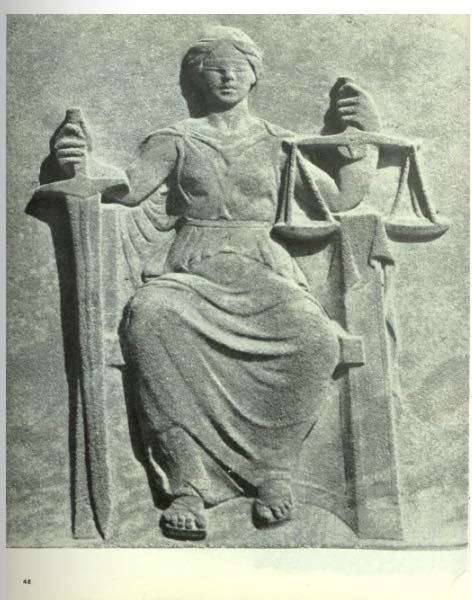
Featured image: Shutterstock
Connie Mack Remembers the Early Days of Baseball
This article and other features about baseball can be found in the Post’s Special Collector’s Edition, Baseball: The Glory Years. This edition can be ordered here.
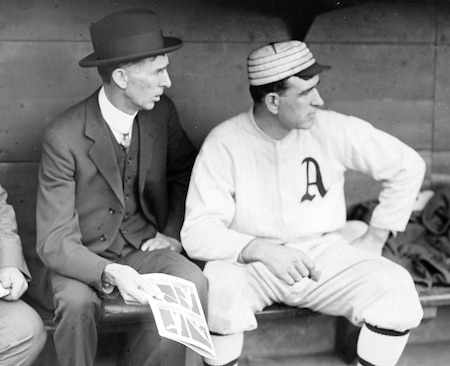
Bain News Service/Library of Congress
Cornelius McGillicuddy, aka Connie Mack, is best known for his long association with the Philadelphia Athletics. Mack managed the team for the baseball club’s first 50 seasons of play, starting in 1901. He finally retired in 1950 at age 87. He was also a player for 11 seasons, beginning in 1886, primarily in the role of catcher. In the following piece, he recalls the very different game he played in those days.
We made two rings 30 feet apart, with a batter in each ring. The pitcher stood outside of the ring and lobbed the ball weakly in to the batter. He wasn’t trying to make the batter miss it. That would spoil the fun. After hitting it, the batter would spring madly for the opposite ring. He was out if he was tagged with the ball between the circles. He could be put out by being hit with a thrown ball, and if the ball was caught on the fly, he was out. We used a flat bat and a soft, covered ball. Later on, when I grew a little older and taller, we began to play a game much nearer the present game of baseball and less like cricket. We had a home plate and three bases and a big bat and a leather-covered ball.
When I was 16 I went to work in the Green & Twichell shoe factory. I remember in that summer we chipped in and bought a glove for $2. It was made of buckskin and had no fingers. It was used in turn by one player after another, since it was common property. Up to that time we had played with our “meat” hands, and the catcher caught the pitcher’s offerings on the first bounce.
My father, who had worked in the shoe factory, had died when I was in my teens, leaving the business of feeding a sizable and hollow-legged Irish family squarely on my hat rack shoulder blades. Naturally, there was a pretty serious family conference in our little East Brookfield home when I told my mother I was thinking about signing with the Meriden club, of the Connecticut State League, in 1884. She gave her consent at last, reluctantly and with secret misgivings. But she made me promise I wouldn’t drink. She felt better after that.
Meriden was a big jump up from the little horse-and-buggy league called the Central Massachusetts League in which I had been playing, and which supported itself by passing the hat at the games and by the take from social functions, such as clambakes. With the Meriden club, I received my first professional baseball salary, the noble sum of $90 a month. And I was afraid to let the other boys on the club know.
In 1886 I broke into the major league as a member of the Washington club, then in the National League. When I started as catcher, we still took the ball on the bounce. The pitcher was 45 feet from the batter. He would turn his back and take a hop, step, and a jump, swinging his arm in a wide circle and letting the ball go with his hand below his hip, in a sort of underhand delivery. But from 45 feet away that ball came mighty fast, especially with all of the momentum worked up by the hop, step, and jump behind it. The fielders were still catching them meat-handed.
In the 1880s the rule for major-league batters was seven balls and three strikes, except for one year, 1887, when it was four strikes. The rules were in a constant state of flux. Up to 1880, a foul ball caught on the first bounce was an out.
When I first began to play for the Washington club, a batter was allowed to tell the pitcher what kind of ball he wanted pitched to him. Under those conditions, the pitcher was just a man who tossed them up the alley for the batter to hit. He was the hitter’s stooge. I liked high-ball pitching, and I got along pretty well lashing away at a steady stream of balls that floated up to me waist high or just under my chin. I would walk up there calm and confident, knowing that I could call for the kind of ball I wanted, and when at last it came along, I would take a cut at it and give it a ride.
But this pleasant state of affairs didn’t last long. During the winter of ’86 and ’87 the present rule was adopted which allows the pitcher to pitch to a point anywhere between the batter’s shoulder and knee. Under the new rule, I couldn’t hit for sour apples, and I wasn’t the only one. A flock of big-league batting heroes found the going too rough for them. Of course, some of them — the “naturals” — couldn’t be bothered. A natural hitter didn’t care one way or the other. It was all one to them. If the pitcher had been allowed to fling bird shot at them, they would have stepped up there and taken a cut at it, supremely confident that they could whale it up against the center field fence.
In those days a player bought his own glove, shoes, and bats. The club supplied the uniform. Those were the tools of your trade, and you were supposed to report for work with them just as a plumber or carpenter must show up with his own monkey wrench and saw and hammer. If you were unlucky enough to run into a pair of flying spikes, you brought out your own iodine and arnica and fixed up your own wounds. And you kept on playing, injury or no injury. There were no extra players lying around to take your place. You played if you could stand up. That was the custom, and we accepted it as a matter of course.
There was only one umpire, and he had to be tough. He stood behind the plate. Then, when a batter got on the bases, the umpire walked out into the middle of the diamond and stood behind the pitcher. Before 1882 an umpire was allowed to take testimony from a player or bystander to help him decide a disputed play.
If a ball was lost, strayed, or stolen, prior to 1886, the umpire called a recess of five minutes while all engaged in a hunt for the missing projectile. After five minutes had gone by with no success he was allowed to put a new ball into play.
It wasn’t until after the catcher moved up close to the plate that the big catcher’s mitt came into general use. The small finger glove worn by the catcher wasn’t enough protection when a catcher was taking them steaming hot instead of on the bounce. The first catchers to use the big mitt were held up to scorn as being softies by the old-timers, but when I think back and conjure up a mental picture of the average old-time catcher’s hands, the only wonder is that we didn’t start to use the big mitt sooner. Some of them kept on catching fireballs with their meat hands to the bitter end, although their fingers were gradually pounded into gnarled and twisted claws that looked like nothing human and had to be strapped together before a game. My own hands would not exactly qualify for a beauty show, as a matter of fact, and my fingers seemed to go off in odd directions from one another on private errands of their own, and then curl back unexpectedly toward one another at the tips.
— “The Bad Old Days” by Connie Mack, April 4, 1936