3 Questions for Carol Burnett
Carol Burnett is still standing after all those pratfalls. And she’s working on a pilot for a new ABC sitcom. Hollywood is welcoming her back to TV.
There are lots of giggles in her latest book, In Such Good Company: Eleven Years of Laughter, Mayhem and Fun in the Sandbox (Crown Archetype). Serious moments too: “Sadly, variety shows have gone the way of the dodo bird,” she writes. “A variety show today can never do what we did. Why? Money. The cost of clearing the songs would sink the Titanic. Sixty to seventy costumes a week? No way. A 28-piece orchestra? Major guest stars? … Dream on.”
Carol confessed that she always adored chasing after belly laughs. That “best medicine,” as she calls it, got her fame and love and served her well in sad times.
Jeanne Wolf: In your book, you describe how your mother lived down the hall and you hardly ever saw your dad. When you look back, was there a lot of pain?
Carol Burnett: Yes, but Nanny [her grandmother] was my rock. In her eyes I was the number-one person in her world, so I felt safe with her. Even though my dad was an alcoholic, he was never abusive. He was just useless. The greatest pain I ever had came after he had been on the wagon because his mother had leukemia and asked him to stop drinking. That period was joyful. Then she died and Daddy showed up at the apartment, and he was weaving. He said, “I’ve just had one little beer,” and he passed out. I got so angry. I said, “I hate you! You said as long as I prayed for you, you’d never drink again!”
JW: Did your mom or your dad ever get to see you after you became such a success in New York?
CB: No, but Nanny saw me a couple of times on Broadway and TV. Our apartment was in Hollywood, and Nanny knew all the extras in the movies because they hung out in our neighborhood. When I was already doing well, she had a mild heart attack. So she’s in the hospital and there’s this line of extras in costumes lined up at her door to cheer her up. There was a man with a harmonica playing while his daughter, wearing a tutu, was doing a tap dance, twirling a baton, and ending in a split! Once she finished, Nanny said, “Well, thank you very much, I’ll tell Carol about you. Send in the next one.” It was like she was auditioning them.
JW: What fuels your terrific optimism?
CB: I lost my daughter Carrie 14 years ago to cancer. When she was in the hospital lying in pain, bald from the chemo, one of the nurses stopped me and said,
“I have to talk to you about your daughter. She is such an upper. We go in there in the morning, and if I have a long face, she cheers me up.” So I asked her, “Carrie, how come you’re always so up and cheerful despite all of this?” Carrie said, “Every day I wake up and decide today I’m going to love my life.” The key word is decide. That was her mantra. When I wake up in the morning, I say that to myself. It doesn’t always work, but for the most part, I am one fortunate person and I am gonna love my life to the very end.
—Jeanne Wolf is the Post’s West Coast editor
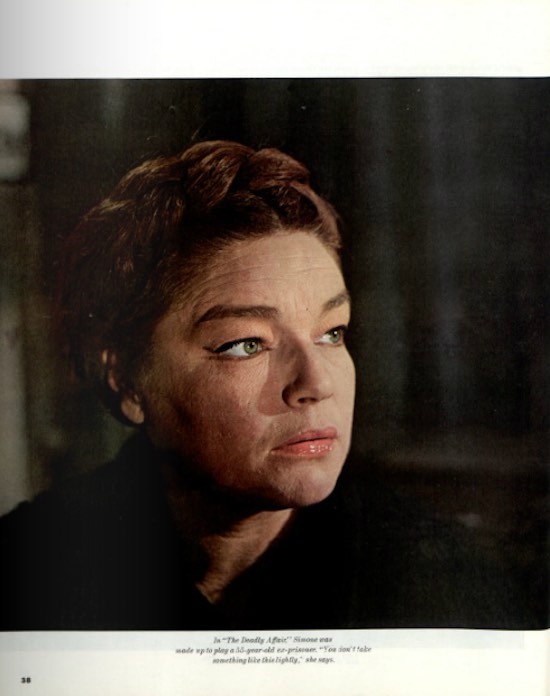
Oscar Winner Simone Signoret Defied Hollywood Ageism: 50 Years Ago
Fifty years ago, the Post honored an unconventional actress, Simone Signoret.
At age 46 in 1967, Signoret didn’t fit the ideals of the classic Hollywood beauty. She had matured beyond her early, youthful roles in French cinema in the 1940s.
Signoret supported her entire family with her early film career. Her father, who was Jewish, had fled to England. If Nazi authorities had learned of her father’s heritage, she would likely have landed in a concentration camp instead of on the silver screen.
By 1944, she had worked her way up to the leading roles in several French films, but it was a long time before American filmmakers began casting her. By the mid-1960s, she was no longer the ingénue. “I got old the way that women who aren’t actresses grow old,” she said. But she kept her remarkable talent.
Hollywood acknowledged her talent, giving her an Academy Award in 1959 for her performance in Room at the Top. That same year, the 38-year-old actress played a romantic lead in the film Ship of Fools, which earned her another Oscar nomination.
In an industry that often relegates mature actresses to bit parts or cameo performances, she managed to remain an accomplished, respected actress up to her last on-screen appearance — her 72nd — in 1986.
Cover Gallery: Let’s Go to the Movies
With the Academy Awards around the corner, we found some Post covers that make us want to grab a bucket of popcorn and watch a great flick!
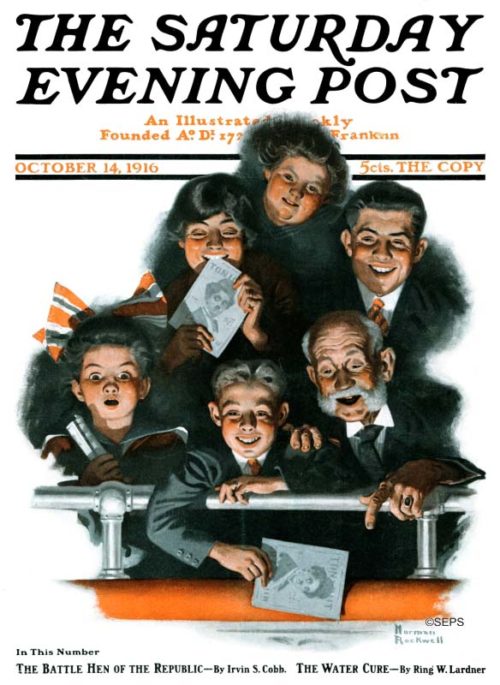
By Norman Rockwell
October 14, 1916
In 1916, Charlie Chaplin’s star was still rising rapidly. By 1916, at age 26, he was making $670,000 a year and in charge of his own studio. He had already appeared in 50 films, including his most well-known, The Tramp.
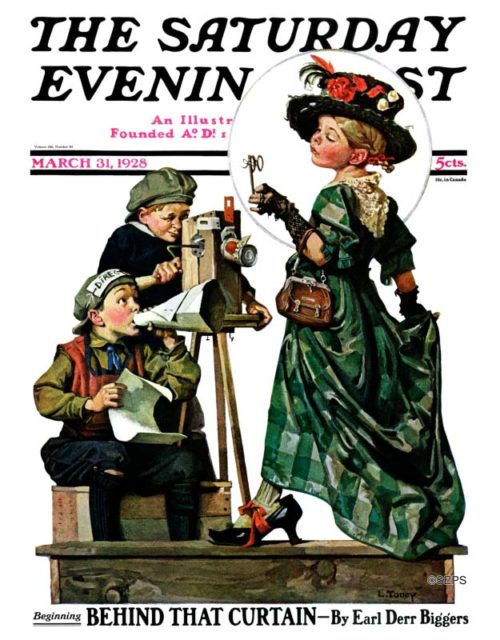
By Lawrence Toney
March 31, 1928
The movie bug has bitten these kids early – looks like we have a budding director, cinematographer, and actress in the making!
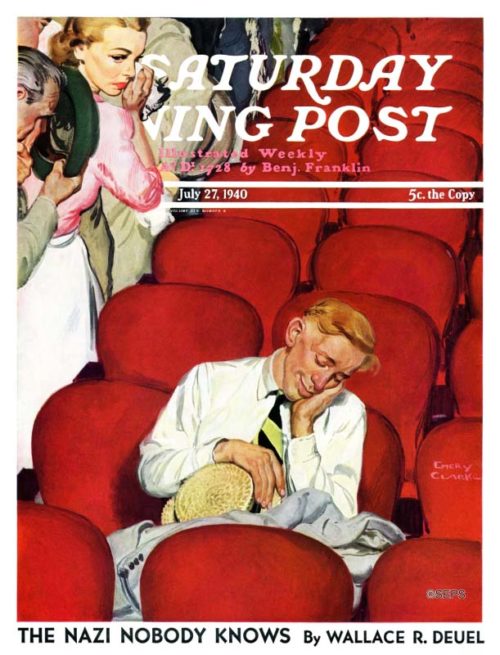
By Emery Clarke
July 27, 1940
He must have been watching Andy Warhol’s Empire.
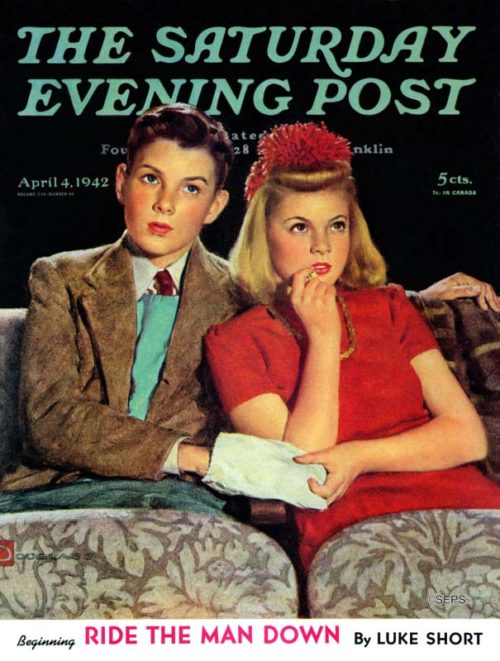
By Douglas Crockwell
April 4, 1942
Bags of popcorn have gotten larger and hair bows have gotten smaller since 1942.
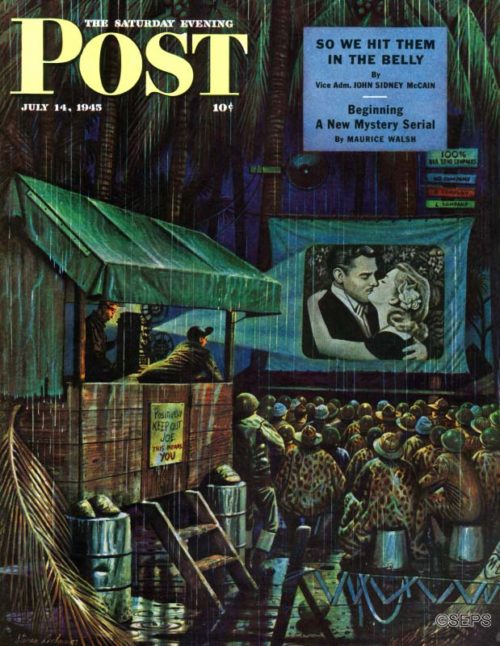
Stevan Dohanos
July 14, 1945
You can’t go wrong with a good romance, even in less-than-ideal circumstances.
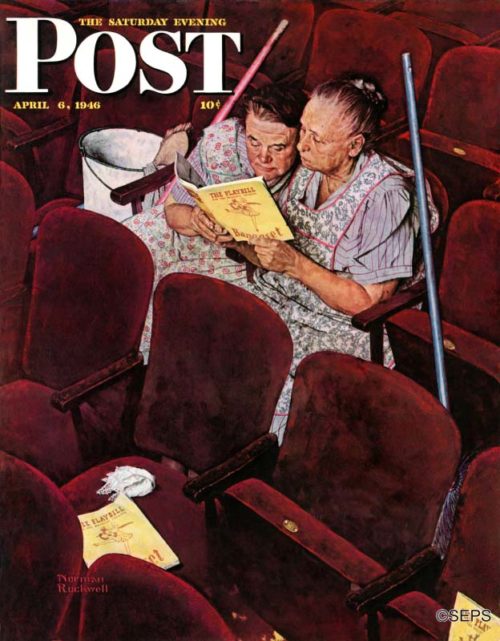
By Norman Rockwell
April 6, 1946
These cleaning ladies are at the theater, not the movies, but we couldn’t resist including this classic Rockwell illustration.
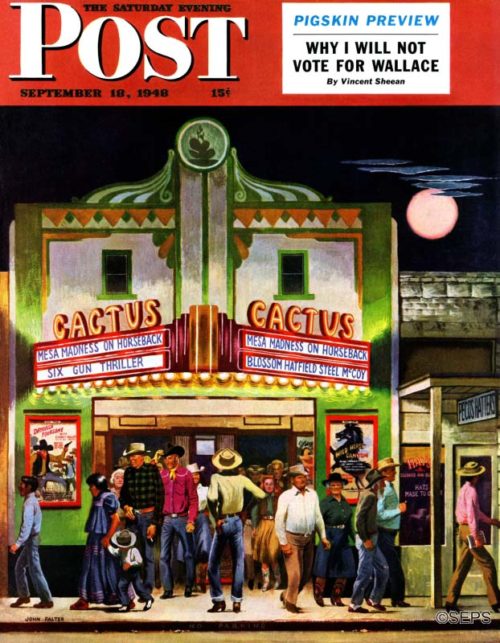
John Falter
September 18, 1948
Illustrator John Falter grew up in the Midwest and started his career in New York, and most of his paintings depict these locations. This southwestern movie theater is an outlier, but reflected Falter’s later interest in western art.
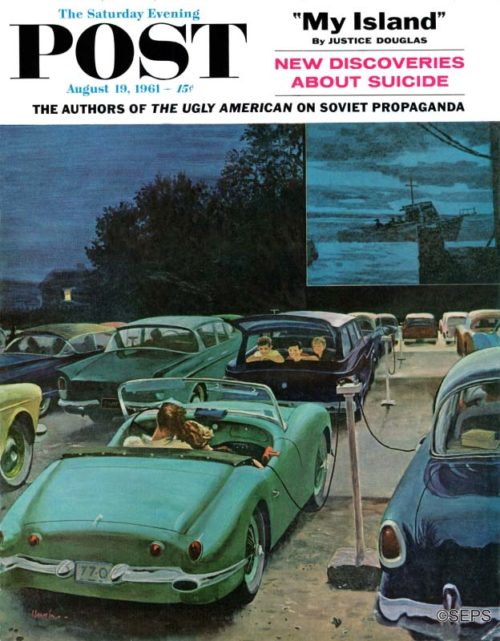
By George Hughes
August 19, 1961
Riding in the “way-back” of your parents’ station wagon has gone the way of the dodo, but you can still find a few drive-in movie theaters here and there.
Will La La Land be the Star of the Oscars?
The throwback musical hit starring cinema darlings Emma Stone and Ryan Gosling appears to be heading towards a triumphant night at the Academy Awards. With 14 nominations — a record shared with Titanic and All About Eve — La La Land could be the first musical since 2002’s Chicago to dominate the Oscars.
In some respects, La La Land is as classic as musicals get: the film is ripe with romantic tropes from Hollywood’s Golden Age. Gosling and Stone’s contentious courtship is reminiscent of Singin’ in the Rain. Gosling’s Sebastian is even a struggling jazz musician akin to Debbie Reynolds’ aspiring Shakespearean actress, Kathy Seldon. Just as Gene Kelly playfully mocks Debbie Reynolds for jumping out of a cake at a Hollywood party, Emma Stone’s Mia ridicules Sebastian for his part in a cheesy ‘80s cover band. The song and dance of “A Lovely Night” involves Mia and Sebastian all but imitating Fred Astaire’s and Ginger Rogers’ “Isn’t This a Lovely Day (to be Caught in the Rain)” from 1935’s Top Hat. The fantastical finale of La La Land even borrows a plot twist (and a stylized Parisian set) from An American in Paris.
There is just one hitch in La La Land’s nostalgic potential: Gosling and Stone are no Fred Astaire and Ginger Rogers. In 1978, The Post wrote of Astaire and Rogers, “They were together in 10 movies. They could take a line of Gershwin and put it into braille so you feel it in your soles.” Fans of old-time Hollywood will note this modern-day L.A. musical displays roughly half the raw talent of triple threat performers from the early days.
When describing his favorite role (Jerry Travers in Top Hat), Fred Astaire explained, “Nearly all the other screen musicals had dealt with the backstage problems of their characters. But in Top Hat I played the part of a successful professional dancer whose problems of love and romance came entirely from his private life” (1948). In La La Land, Mia and Sebastian are each aspiring performers, but there is never a sense that either is more or less than a regular person regardless of the success they achieve. Their love story takes place in mostly domestic settings, and Mia finds her “big break” by “playing herself” at an audition.
Many have praised Gosling’s and Stone’s performances as “charming” and “relatable.” The impact of the duo’s chemistry onscreen is unquestionable, and perhaps the song and dance is only supplementary. The two romantic leads will compete in the top acting categories, after all.
Much of the charm in La La Land can be attributed to director Damien Chazelle. The dreamy world of the musical is realized with long, sweeping shots and colorful sets. He has done his Hollywood homework, and it shows. Chazelle wrote and directed Whiplash in 2014, another jazz-centric film about a college drummer with an abusive teacher. The success of Whiplash allowed Chazelle the freedom to pursue an original musical in La La Land. A remake or Broadway transfer is generally a safer bet with studios nowadays given their pre-existing fanbases.
For all the cheery escapism La La Land offers, it will likely compete with two weighty dramas for Best Picture, Manchester by the Sea and Moonlight. The Academy’s pick will be anyone’s guess. Jimmy Kimmel will host the ceremony on Sunday, February 26th, and the night is sure to deliver old Hollywood magic even though Jimmy Kimmel isn’t exactly Bob Hope.
Check out Oscar Winners Inspired by the Post and America Goes Out to the Movies.
“Hobohemia” by Sinclair Lewis
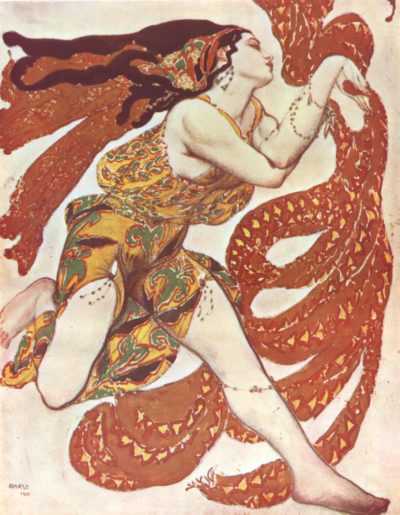 Originally published on April 7, 1917
When Miss Elizabeth Robinson changed her first name to “Ysetta,” Mr. Brown knew that there was danger of her becoming incurably artistic. Mr. Dennis J. Brown lived with his widowed mother on Maple Hill, which is the guest-towel section of Northernapolis. Mr. Brown was thirty-seven — twelve years older than Ysetta. He was the general manager of the Inland Lumber and Construction Company. He talked quickly, and had a well-shaped nose, and wasn’t too bald, and sang a colorado-maduro barytone, and made eleven thousand dollars a year, and loved Elizabeth-Ysetta true. He had plans for a bungalow, with a vacuum cleaner and Ysetta as modern improvements.
But Ysetta’s plans were entirely different. She had Aspirations, and she was going to have a Career also, as soon as she could decide what to career about. She felt that it wasn’t respectable for one who was Different to be respectable. She tried to make Mr. Brown understand how Different she was; but he would stare at her delicate face, framed in an oval by coiled flaxen braids, and chuckle: “She’s a peach. She’ll make the dandiest wife in town, when she settles down and cuts out the Urges.”
For four years now Ysetta had had a new urge every season. The minute her family got back from the summer cottage at the lake she would catch an Urge. One winter she painted. The next she did interpretative dancing. Her demonstration of Esprit de Printemps, which is believed to mean The Spring Drive, was greatly applauded. It consisted of a foul, a bunt and a long slide for base. But Ysetta caught cold from wearing a dancing costume consisting of faith, hope and a good deal of charity, and she changed her Urge to being Economically Independent.
She borrowed eight hundred dollars from her father and Mr. Brown, and started Ye Precious Shoppe, where she sold tea, cakes, irregular jewelry, and orange tables with scarlet borders — that is, she really did sell some of the tea. She was so successful at being economically independent that she was only a thousand dollars in debt at the end of the season; but her father, who was a large red man with curvature of the waistcoat, grunted that she was a darn sight more independent than economical, and wound up the business.
Ysetta didn’t much mind, because she was coming to see that her Métier — a Métier is an Urge that you cash in on — was to deal in wares more subtle than tables, even orange-colored tables with bright red borders. She decided that she was going to deal in mystical and singing words, and reveal America to itself — in fact, run a Poetic Sightseeing Coach.
Mr. Brown encouraged her — when he had done a few calculations on the office adding machine, and estimated that for the cost of one quite small orange table Ysetta could get enough paper and ink to write two volumes of verse and one long novel. He gave her a box party at the best movie house in town to celebrate her inauguration as a genius. He pictured a future in which his clever wife, Ysetta, would come a-running, bringing a new poem along with his slippers in the evening. Chestnut eyes shining, she would cry:
“Dennis, I have written a poem to you, my hero!”
In intervals of selling laths and portable houses, Mr. Brown tried to keep up with the books she was reading. Now he could get private satisfaction out of the financial columns or the literary efforts of the biographers of Jess Willard and Fred Fulton, but he did not find much entertainment in An Analysis of the Sociological Factor in Realistic Fiction. He was a patient wooer, however, and he even permitted Ysetta to toll him to the Maple Hill Literary and Short Story Club.
The Short Story Club met in the charming residence of Mrs. Solomon Smoot, with its tufted leather chairs and prints of red-coated huntsmen. They were a jolly bunch, very modest and informal, despite the marked talent which had been discovered among them. There was the Reverend Justus Fliff. There was Mrs. Fliff, who wrote the sweetest little sunshine stories, one of which had been published in the Sunday News and had attracted attention all over the state — though you would never guess it, to see the deprecating way in which Mrs. Fliff replied to questions by the less successful writers. There was Nittie Smith, the child wonder, who at thirteen had written more than one hundred poems.
Besides these professional authors, Mr. Brown was introduced to some thirty intellectuals, all of whom showed remarkable promise.
It must be said for feminism that most of them were women.
Cowering behind the gilded pine cone portière, Mr. Brown discovered a large embarrassed male whom he had met at the country club.
“My Lord, what you doing here?” they said to each other, and shook hands desperately, just as Ysetta and the spouse of the large male bore down on them and dragged them out into the parlor, where thirty church-social chairs were arranged in rows.
Mrs. Fliff read a short story which she had written all by hand — she prefaced it by observing that the use of the typewriter explained the low level of style exhibited by the so-called popular writers of the day. She drew a long breath, tucked her hair back over her right ear, smiled nervously at her admiring friends, and read the story, “Dora of the Redwoods.”
It was a virile composition regarding a young woman who resided among the Sequoias, also among numerous handsome mountains and sunsets, but went to the city and got in wrong. The strong silent man back home, who had a heart of gold, even if he did not own a toothbrush, had been waiting for Dora all the time. He went up to the city and brought her back, presumably to tend the redwoods for the rest of her life. Mrs. Fluff gathered her daintily written pages of manuscript, rolled them and tied them with a blue ribbon, and begged:
“I didn’t know how terribly bad it was till I read it to all you terribly severe critics, and now I want you to tell me how terribly bad it is. I don’t want praise — I just want you to say frankly what you think.”
Mrs. Solomon Smoot confessed that “Dora of the Redwoods” reminded her of Stevenson, Jack London and Marie Corelli.
Mr. J. Edwin Bindle wondered if it wouldn’t be better to call it “Dora of the Redwood Forests.” He didn’t, he submitted, wish to be crankorious, and aside from this teeney-weeney point, it struck him as how the story was pos-so-lute-ly perfect. Everyone smiled; Mr. Bindle was so whimsical and original in the words he used. But everyone’s smile became uneasy as the authoress objected:
“Really, I should think you could see that my title is more crisp and powerful. I chose it as having that simplicity which is the brand new keynote in art. Please understand, I do want all possible adverse criticism, it is so helpful; but in this it does seem to me that you are most unjust.”
Everyone stared coldly at Mr. Bindle.
The librarian of the Maple Hill Branch asked Mrs. Fliff if she had submitted the story to the magazines. The librarian said that, from her long professional literary experience, she knew that any magazine would be glad to have it.
“Oh, I guess they wouldn’t care for it,” said Mrs. Fliff bravely, “though I must say that when I read the stupid hackneyed stuff that all these editors do print, I often think I just couldn’t help doing as well as that anyway! Now I want you good people to give me further frank criticism. ‘Tis only by correction, you know, that we can climb to fame and a wider usefulness.”
But it seemed that “Dora of the Redwoods” was one of those chaste gems in which no one, save a smart aleck like J. Edwin Bindle, could find a single fault. One club member pointed out that the dénouement was perfectly splendid, while another preferred the local color and heart interest, and a third moved that they give three rousing cheers for dear “Dora of the Redwoods.”
Mr. Brown, of the Inland Lumber Company, had been suffering in a manner suggestive of a person afflicted with neuralgia at an ice cream party. He had kept himself from saying anything by fingering a cigar in his upper waistcoat pocket till he had cracked the wrapper. Under cover of the cheer he leaned toward Ysetta and humbly inquired:
“Say, am I right? It strikes me that dear Dora is indescribably rotten.”
Ysetta stared.
“Why, no! Of course poor little Mrs. Fliff hasn’t had the opportunities that some of us have, but it’s a very sweet little story.”
“You’ll admit it’s hackneyed, and any fool could guess how it was coming out, and dear Dora is about as human as a crank case?”
“I suppose so.”
“And the story had all the pep of the McMac pages in the phone book, and Mrs. Fliff doesn’t know anything about redwoods — she’s got ‘em balled up with firs.”
“Still, it is a sweet little — ”
“I see. Otherwise it’s all right.”
“Of course it is!”
Ysetta seemed excited over all forms of optimistic fiction, from dear Dora to the charlotte russes which they later got as refreshments. Mr. Brown could not understand her exhilaration.
He did understand, a week after the club meeting, when he received a note from Ysetta informing him that she was going to New York to live. She was to take courses in English literature and fiction writing at Columbia University, and devote herself to the Life Beautiful. He was able to see her only once before she went, and then she was illusive and rather exasperating. She appeared to have been snatched up to a plane higher than his. Only when he took his hat and said despairingly, “I don’t suppose you’ll miss poor old Dennis at all in N.Y.,” did she come down to his level. She ran to him and put her hands on his shoulders. She let him kiss her once.
“Maybe I shall miss you there,” she murmured. “I’ll be such a little nobody in New York, among all those frightfully wonderful Bohemian people. And you are so staunch and good, even if you haven’t any artistic impulses.” She broke from him and skipped upstairs.
Mr. Brown retrieved his good new hat from the floor, rubbed it with his sleeve, put it on carefully, then remembered that he was a lorn lover and assumed a terrific aspect of hopelessness.
“I’ve got to lay in a supply of artistic impulses, then,” he said to himself. “It will raise hob with the lumber business, but I’ve got to come to it. Why not? Never saw the business deal yet I couldn’t pull off. Les-see. I guess I could learn poeting in a couple weeks.”
He went home rather thoughtfully. He took from his prim desk a bunch of discarded stationery. On the back of a letter headed “Lumber that Lasts. Inland Co. for Keeps,” he indited a small poem entitled “Thine Lips, Dear Love.”
He read it aloud.
“Gosh, that isn’t so bad!” he mused.
All next week he read a riming dictionary in the office. “The old man is up to something,” whispered the office force. “Can you beat it — him that always wears two-dollar neckwear coming out with one of those fluffy socialist ties? Betcha a hat he’s going out for amateur dramatics.”
To Miss Ysetta Robinson, in New York, Mr. Brown was writing long biweekly letters descriptive of the state of his business. Miss Ysetta, in short fortnightly letters, replied that New York was very large, and her instructors in college perfect dears, and had Mr. Brown read the latest novel? Mr. Brown never had. But he paid his secretary three a week extra to keep in touch with the bookstores, so that he might be able to write her such passionately intellectual phrases as, “Have you got hold of Gaston Rakowsky’s new novel yet? Tremendous! Never read anything more realistic than R’s description of the back room of a butcher shop.”
With a plaintive hope that Ysetta would approve, Mr. Brown joined the Short Story Club. When Mrs. Smoot, in her cunning way, tapped him on the arm and said: “Naughty, naughty mans! Oo haven’t written one bitsie story yet, and we all want to hear from you so much!” then Mr. Brown understood the pleasures of frightfulness. But he sneaked out for a smoke, and was able to hang on and write Ysetta full details about her admired friends, Mrs. Fliff and Mrs. Smoot and J. Edwin Bindle.
Ysetta never commented on his tidings about the Sapphos and George M. Cohans of Maple Hill. Her letters grew more infrequent. At last, when he asked about her return to Northernapolis, she broke out with one long letter.
She hoped that she would never see the provincial hole again till she was an independent and famous woman, she wrote. Her finer self had been bound by tradition and bourgeois ignorance, in Northernapolis. And at last she had been in Hobohemia.
Hobohemia is the place and state of being talented and free. It is to be found adjacent to the bar of the Café Liberté. In Hobohemia, Ysetta had seen several women drinking ojen cocktails, and heard a man in a sky-blue shirt with a soft collar say that he was an anarchist. She had been introduced to an actor in the Hobohemian Players, and to Max Pincus, the celebrated landscapist, and to Mrs. Saffron, the radical leader; and with her own eyes she had seen Jandorff Fish, the novelist, eating hors d’oeuvres.
Then Mr. Brown realized that it was useless to implore Ysetta to come back. If he ordered hors d’oeuvres in any restaurant in Northernapolis, the waiter would bring a Swiss cheese sandwich. The only thing Mr. Brown could do was to go to New York and become hors d’oeuvry.
He took a three-months leave of the Inland Lumber Company. He estimated that three months would be enough for a man who believed in card catalogues, instead of ojen cocktails and sky-blue shirts, to succeed in literature.
II
Upon the eastbound train Mr. Brown sat in his compartment and wrote short stories. Whenever he found them getting interesting to himself, he decided that they probably were lowbrow, and tore them up and took a fresh start.
Mr. Brown had been in New York before. He knew it as two hotels, seven theaters, six cabarets, three offices, a lumberyard and a subway. He went airily to the Grand Royal Hotel and telephoned to Ysetta.
She did not sound particularly welcoming as she demanded:
“What are you doing here?”
“Just got in sminit. I’m here on business. May be kept in the city for some weeks, working up some deals.”
“Deals! This isn’t the city of deals! It’s the city of the strong red wine of life.”
“Yeh, I know, honey,” he humbly agreed. “I’m going to shoot a beaker of that myself, as soon as I get out of this hot phone booth. But say, Bess — Ysetta — whatcha doing tonight? Can I take you out to dinner?”
“No, not possibly tonight. But you may come up tomorrow afternoon, and I’ll give you some tea.”
Did Mr. Brown spend his first evening in wandering solitary about the streets? No, Mr. Brown did not. Mr. Brown telephoned to the chief lumber jobber in New York, arranged for an introduction to the managing editor of the Morning Chronicle, and dined cheerful at the Hotel Gorgonzola y Vino, which is so expensive that patrons try to slip by the hat boy without claiming their coats at all. He attended the new musical review, Can You Beat It, Bo? and applauded, not like a soul recently called to the finer life, but like a buyer who had come on without The Wife.
At midnight, very pink and cheerful and brisk, with a carnation in his buttonhole and a stick swinging, all as glossy and luxurious as the orange back of a new ten dollar bill, Mr. Brown arrived at the office of the Morning Chronicle, and talked to the managing editor for ten minutes. He wanted, he said, to hire a good press agent, and a man who could think up plots for stories but was too lazy to write them.
For the publicity, the editor suggested Bill Hupp, who had been press agent for the Vampire Film Company till the recent consolidation. As to plots, there was Oliver Jasselby, who was always so exhausted by telling what genius his plots showed that he never wrote a thing, and had to hold down a job on the Plumbers’ Gazette.
At seven in the morning, Mr. Brown rose to lead the life literary, and get it over. He telephoned to Bill Hupp and Oliver Jasselby to come to his hotel at nine. He hustled out, and before the real estate offices were open he had routed out the superintendents of three buildings, examined seven offices, and engaged one. He dashed by taxi to a shop on Third Avenue which rents secondhand office equipment, and hired desks, chairs, rugs and a dictation machine. He bought carbon paper, typewriter ribbons, boxes of paper.
At nine he was prancing up and down his hotel room, planning a poem. Bill Hupp, the press agent, was announced at nine-one.
Mr. Hupp was built on the general lines of a motor van. He loomed into the room, glanced at Mr. Brown, chucked his yellow chamois gloves and fur coat on the bed, cocked his long ivory cigarette holder NW by N, two points N, and boomed “Well, what’s the sordid task? What am I to perpetrate on the public prints? Nice line about having organized a League for the Prevention of Cruelty to the Heathen, or just plain case of breaking into society?”
“Neither. I want to be a literary genius.”
“My Gawd, you don’t want me. I can’t help you. I’m a press agent, not a bartender.”
“Sure. I savvy. I guess the game is bunk. But I’ve got a girl who is artistic, and I got to follow suit, see? Me, I’m a lumber merchant. I never wrote anything in my life but ads and letters.”
“Got ye. We’ll put you across. I’m engaged. Salary, one hundred a week, and all we can drag down from the padded expense account. Name’s Bill Hupp.”
“All right. Now I want you to put me on to the very latest styles in literature. I don’t want to waste time on anything that isn’t dead highbrow.”
“Sure. Well, first, there’s this vers libre.”
“Huh?”
“Why, vers libre — free verse — so called because it doesn’t pay. It’s choppy stuff with no rimes or rhythm. Walt Whitman in kid gloves. You’ve seen it — this kind of poetry that you wouldn’t know it was poetry if it wasn’t printed that way. Then there’s these one-act plays for little theaters, like the Hobohemian Players. The plays have either got to be gruesome — cheery little jamborees, like a murder in a morgue — or else highbrow kidding stuff taking off all the playwright’s friends down in Greenwich Village. Third, there’s Russian realistic novels. That’s all.”
“Fine, Bill. Here’s your first week’s salary. Say, can you buy me about twenty-five dollars’ worth of samples of all this stuff, so we can model our own lines after them?”
“Right, boss.”
Oliver Jasselby did not float in till ten. Mr. Jasselby, the plot-hound, was a small little man with sandy hair and eyeglasses on a silk ribbon. He bubbled and squeaked when he talked. He agreed to deliver weekly at the office the following raw materials: One novel plot, four short story plots, six ideas for vers libre, and one outline for a morbid play.
When Bill Hupp returned with a consignment of the latest novelties in high art, Mr. Brown and he planned the first publicity. Bill suggested that Mr. Brown’s first name be temporarily changed from Dennis to Denis. The newspapers were to be permitted to run modest notes to the effect that Denis Brown, the distinguished California poet and dramatist, had come to New York to live. Not that Mr. Brown did come from California, but California is a good safe place for geniuses, climate and election returns to come from.
When Bill had gone off to supervise the furnishing of their new office Mr. Brown waded into the sample literature. By twelve, he believed that he had mastered the mechanism of the three forms of art.
He saw that vers libre was exactly like advertising, except that usually it was not so well done. The rules were the same — short snappy stuff, breaking away from old phrases, getting a unified impression. Now Mr. Brown had written advertisements. He remembered his masterpiece: “Who, is the bugaboo man who flags you every time you dream of the Little Cottage for Two? It’s your local builder! Let us bully him for you, soz you’ll get what you want, old top! Buy an Inland Portable Bungalow — you can clamp your eyes on it first, and know you’re getting what you wanta get — not what Mr. Local Builder thinks you think you want. Then it’s ho! for the Little House o’ Dreams among the trees, with You and Her sitting out on the 10 by 22 porch in the good old twilight dreamtime.”
When he had completed this advertisement, two years before, Mr. Brown had been rendered violently ill by it. But it really had sold bungalows, and now he perceived that it had in it most of the essentials of these poems about colors and twilight and mist and young women.
As regards the little plays for little theaters, he decided that they were exactly like smoking-car stories, related with gestures and snickers — except, perhaps, that the smoking-car stories were more moral.
And the final gasp in recent art, the Russian realistic novels, resembled the detailed reports on lumber-tract conditions which Mr. Brown had made for lumber companies in his early days. There was the same serious attention to dull details, the same heaviness of style, and the same pessimism about the writer’s salary.
Mr. Brown chortled.
“It’s just as I guessed. The reason why these guys get away with literature is because no business man has taken the trouble to go in and buck them. Oh, it’s a shame to take the money.” He telephoned to Bill Hupp, at the office. “Say, Bill, if you don’t mind, will you start sneaking in some press stuff about a Russian realistic novelist named Zuprushin?”
“Who’s he?”
“He ain’t yet. But he will be.”
“Then how do I get any dope about him?”
“He’s planning to come over here. His novels are being translated into English. He’s an immoral old hound. Primeval brute. His latest novel is a cheery thing called Dementia.”
“I get him. But what’s the idea?”
“We’ll write his novels for him. Bill, you listen to me: Inside of two months we’ll have every highbrow in New York talking about Zuprushin. From what you tell me, these New York littery gents don’t have time to read any of these foreign authors — they’re too busy talking about them. They don’t even buy the books. That’s done by the nice little old maids that overhear the talk. So the highbrows won’t dare to let on they haven’t heard of any new literary joker, and once we familiarize them with Brer Zuprushin’s name, they’ll all talk about him.”
“Yes, but say, boss — Hello! Hello! Get — off — the — wire — willyuh, operator! But say, boss, what’s the use of creating this Cossack cockroach?”
“Why, when he’s going big I’ll tell my girl I invented him, and she’ll know I’m the family genius.”
“Gotcha.”
Mr. Brown went out, humming. In four hours and a half he had made a scholarly study of all literature, created the poet-dramatist Denis Brown, and gently guided that unfortunate child of genius, Zuprushin, through his boyhood, studenthood, and the writing of his novel Dementia. For a person who had not been a literary gentleman till seven o’clock that morning, Mr. Brown felt that he was not doing badly, and he was whistling loudly when he arrived at Ysetta’s flat for tea.
III
Ysetta’s flat, on Morningside Heights, was a somewhat arty abode. There were curtains and a couch cover of gunny sacking, seven brass jars which held nothing in particular, candles which lighted nothing at all, and a near-silver percolator which was out of order.
Ysetta received him with marked calm. “So you are here!” she surmised by way of greeting.
“Me? Where? Why no; I can’t be here, can I, honey? Why, I’m just a little old bourgeois from Northernapolis.”
“Please don’t be so boisterous, Dennis. I suppose you are finding your business trip very amusing.”
“I’ll tell you about that later. First, you’ll want to know the news about Mrs. Fliff and Mrs. Smoot and Mr. — ”
“No, I can’t say I do!”
“Huh?”
“Poor earnest souls — it’s amusing to think of them trying to write.”
“Why, gee whiz, Ysetta, I thought you said they were such ink-pitchers?”
“Did I? Would you like lemon or cream in your tea?”
Mr. Dennis Brown had been thinking up a neat line on the subway, and he had his cue. He looked her over cynically. He smiled and pinched his lips.
Ysetta frowned, and roused from her Olympian ennui to demand: “What is it you find so amusing?”
“You, my child. It tickles me to hear all you highbrows use the word ‘amusing’ for everything from Mrs. Fliff to yellow vases with black spots.”
“How amus — How pleasant it must be to be tickled,” she sniffed.
But she didn’t seem quite so sure of herself.
“The other thing is: I wonder how you can be so banal as to say ‘lemon or cream in your tea?’ I suppose that at the present second more than forty thousand poor bourgeois females are saying just that.”
Ysetta completely forgot her superior attitude, and yelped “Oh, you do, do you!” in a manner which recalled the days when young Dennis Brown had pulled the hair of the little girl, Elizabeth Robinson.
“Yes, I’m sorry for you. But, of course, with this frightful handicap of coming from west of Chicago, you couldn’t expect — ”
“Then you may be pleased to know, my dear Mr. Brown, that I have had a vers libre — if you know what that is! — accepted by Direct Action, the one big, bold, free magazine in America!”
“That’s bully! It happens that I have just had a vers libre accepted by Direct Action, also!”
“I don’t think it’s very nice of you to joke about it. I think you might congratulate me.”
Ysetta spoke plaintively. Again there was more than a hint of the little girl from Northernapolis.
“No, seriously, hon, I mean it. You see, the deals that brought me to New York aren’t deals in lumber, but in ideas! Since you left Northernapolis I have felt the call of literature, too, and I have come here to learn. Humbly. Though I must say that the editor of Direct Action swore my poem was the finest he had ever seen.”
“Hon-est-lee? Oh, what is its title?”
“ Its — Oh! Oh, I see; you want to know its title.”
“Yes.”
“Why — uh — why, its title is ‘The Color of Thought.’”
“Why, that’s a wonderful title! Oh, Dennis dear, I can’t tell you how excited I am that you have seen how heavenly New York is. I’m still bewildered by it, but I’m so glad! Come down and hear the Hobohemian Players with me tonight, and meet Mrs. Saffron.”
“Hoozis? Mrs. Saffron that writes all this Woman-Can-the-Shekels — I mean Shackles — stuff?”
“Yes. She is the leader of the fight for woman’s freedom. And such fire! Such wit!”
“Gladmeeter.”
“Come for me at seven. And now tell me about those funny pathetic old hexes at the Short Story Club. I wonder if I ever told you about a terribly amusing story called “Dora of the Redwoods” that Mrs. Fliff wrote? I’ll never forget it. Even you would have writhed over it.”
“Yes, maybe I would,” he said a little wearily.
He perceived that he was going to have something of a task in keeping pace with Ysetta in his new occupation of forgetting that there was such a place as Northernapolis, where the benighted people did their work and went home at night to play with the kids, instead of leading the life literary. But he escaped without committing that worst of social errors — saying what he thought.
Between five and seven he had to have “The Color of Thought” accepted by Direct Action. Also, incidentally, he had to have the same written. For he had not exactly lied about the poem, he had merely sold short.
He sat down on the steps of Ysetta’s apartment house and did a job of thinking. It may be that his thoughts did not have the fire and glory which fill the meditations of all regular licensed public authors, but he did get down to business.
He had chosen the title because he had noted that color was a favorite theme in vers libre. Now he had to get some attractive new hues. He dashed to the subway news stand and bought a fashion magazine. On the subway he read the descriptions of new gowns, and encountered the color words “taupe” and “beige.” Mr. Brown did not know whether taupe was a watery pea-green, or a pink resembling the ears of a rabbit, and he did not care. On the margins of the magazine he wrote his poem. Between the subway and his hotel he stopped in at a jewelry shop and inquired for the name of a gem “that most people don’t know much about.” The clerk suggested “chrysoprase.” With that word Mr. Brown filled a space in one line of his poem. At the hotel he hastily dictated the poem to a stenographer. The completed product was as follows:
THE COLOR OF THOUGHT
Red that is blood —
Blue, soggy with the sky —
Green of the hackneyed spring —
Me, I hate these raw old colors, and I hate
White of dull purity,
But!
Taupe and the mystery of beige,
Colors inarticulate, moving, twisting, blind,
And color of a seadrowned chrysoprase —
These are the hues of thought,
Cruel,
Dread,
Power!
He expected to have to trace the editor of Direct Action from his office to some abode of rum and anarchism, but by telephone he found him at the office. He arrived there in seven minutes, two of which were spent in an impassioned debate between his taxi driver and a traffic cop.
He bounced into the office of Direct Action and beheld a young man writing at a small table which was so surrounded by piles of realistic novels, vegetarian pamphlets, pacifist manifestoes, bills advertising socialist dances, and suffrage banners, that it resembled a trawler in the midst of the British fleet. The young man looked up wearily.
“Brother, I want to see the editor.”
“Comrade, he is me. It’s after hours, but what can I do for you?”
“Shall I make Congress pass your bill, or shall I expose the governor, or do you merely want to sell me a story at three cents a word?”
“Brother, I suspect that you are a regular guy. It is none of them things. I would fain subscribe to your sheet, which I have never seen a copy of; and while you are recovering, I would still fainer get you to accept this poem in vers libre, and you don’t have to pay for it. I just want to see it printed. Honest, it isn’t as bad as some I’ve read.”
“Comrade, let’s gaze upon it — and hurry up with the introduction.”
“Brother, I don’t get you.”
“Why, the introduction; the spiel about your deep inner meaning in writing it — about its being vorticist verse, or a fugue in words, or whatever it is that distinguishes you from the ordinary apprentices.”
“Brother, there ain’t a darn thing that distinguishes me!”
The editor thrust the poem, unread, into a pigeonhole marked “Copy ready for printer.”
“In that case,” he said, “I accept it. Either it will be so good it’s worth printing, or so bad that my readers will think it’s some new brand of genius. Comrade, my name is Jerry McCabe, and when I gaze on your sprightly young face I suspect that you are a good guy. But don’t let that make you forget those dulcet murmurs about subscribing.”
Denis Brown, poet, arrived at Ysetta’s house only ten minutes late, which meant that he had to wait in the lower hall for twenty minutes. She appeared, in a clinging gown of green silk with a border of orange stenciling, and insisted:
“Dennis, you were joking about having a poem accepted by Direct Action! Why, I bet you can’t even tell the name of the editor!”
“Why, Jerry McCabe, of course! By the way, old Jer may be down at the Hobohemian Players tonight too.”
“Well, I don’t understand it. You only arrived in town yesterday,” said Ysetta with a restlessness not unnatural in one who has just been emancipated, and discovers that her home town has been sneaky enough to go and get emancipated also.
IV
They had dined at the Cunning Rabbit Tea Shop, Mr. Brown and Ysetta, and had witnessed four one-act plays presented by the Hobohemian Players.
Everybody in New York is always delivering something from some shackles, and the Hobohemian Players are an organization for delivering the stage from the shackles of the commercialized managers, and for developing a Native American Drama. Tonight the Players presented Native American Dramas translated from the Polish, the Siamese and the Esquimo, and one apologetic little curtain-raiser written in the United States.
Mr. Brown didn’t care much for the plays or the acting; and the audience, which kept telling itself between acts how superior it was to Broadway audiences, made him feel feeble; but aside from that, he enjoyed the show; and afterward he obediently tagged after Ysetta to meet Mrs. Saffron and her group at the Café Liberté.
Ysetta warned him:
“Now, Dennis, I want you to be careful what you say to these people — they are so clever and subtle and all — and don’t get off any of the noisy jokes you used to in Northernapolis. I’m as careful as can be what I say, till I’m admitted into their inner circle, and you — ”
As Ysetta expressed her timid admiration for Mrs. Saffron, her books on eugenics, and her participation in clothing strikes; for Max Pincus, the landscapist, Jandorff Fish and Gaston Rakowsky, the novelists, and Miss Abigail Manx, the anarchist queen, Mr. Brown became nervous.
With the feeling of a small boy on his first day at a new school, he followed Ysetta into the basement of the Café Liberté. It was only a fair-to-medium basement; Mr. Brown owned as good a basement himself, in the family mansion. It was painted a plain tan, and filled with chairs and tables that looked much like other chairs and tables. But the people were terrifying. When he could make out the individuals, through the confusion of talk that sounded like a phonograph factory next to a recreation park, Mr. Brown decided that Hobohemia was not going to be easy. There were large, bland, round-faced young men, with an air of inexpressible superciliousness. Two lads in evening clothes were being humble to a dismayingly pretty girl with bobbed hair, who laughed at them and made love to a stolid hulk of a man with a dark face, weedy blue-black hair, and a mustache so much like one whole live cat that it might at any moment have been expected to fly across the room and out of a window. Seven nonchalant and good-looking women were dining together, and they looked him over till he felt shredded. Behind them were babbling millions.
“Some bunch!” said Mr. Brown weakly.
“Oh, these are just imitations — society slummers, and artists that are as disgustingly respectable as though they were merchants. The real Greenwich Villagers always go in the next room.”
“Well, let’s stay here in the compression chamber a minute and get used to the air pressure before we try the real wild ones,” he begged, but she pushed through into an inner room. Round the table in the center were a dozen people, who bawled at her:
“Bonsoir, Ysette. Join us!”
Mr. Brown was conscious that they were all giving him what in less spiritual surroundings might have been called “the once-over.” He timorously sat down between Ysetta and a stern, smooth, tailor-made woman of thirty-five to forty. She was introduced to him as Mrs. Saffron.
Mr. Brown had expected Mrs. Saffron to be a wild-haired bouncer in a smock. He was rather uncomfortable in the presence of her mannish efficiency. A chinless redhaired young man dropped into the seat on the other side of Mrs. Saffron, and bawled at her in a raw prairie voice:
“How are you, honey? What you drinking?”
Mrs. Saffron turned her back on Mr. Brown, and he was left alone, a child in the dark. On one side of him Ysetta was talking to Max Pincus, the painter, a short, solid young man with a heavy and pasty face. Mr. Brown instantly developed a considerable degree of dislike for Mr. Pincus. who did not talk of landscapes but of Sex, with a capital S and four exclamation points after the word. In his rolling voice Mr. Pincus was assuring Ysetta that free love was the only possible life for a genius. Ysetta was attending meekly, and smiling — with the clear chestnut eyes that Mr. Brown loved — into Mr. Pincus’ glistening little eyes.
On the other side Mrs. Saffron was permitting the red-haired person to make violent love to her. She chuckled at him, and yawned “Oh, go home, you baby; you make me tired”; but she let him hold her hand and assure her that she was the only one in the world who encouraged him to keep up his artistic photography.
Jerry McCabe, the editor of Direct Action, came by and bent over to whisper to Mr. Brown: “I condole with you.”
“Say, McCabe, how do I get on the inside with this bunch of intellectual giants?”
“Make love to Mrs. Saffron. Watch Red. He does it badly and promiscuously, yet it suffices to keep him in the foreground.”
Two minutes after, when Red had departed, Mr. Brown leaned confidentially toward Mrs. Saffron and crooned just as though she were not a radical leader:
“Honey, I could slay our young friend for monopolizing you. Why do you think I came here? To see you!”
Mrs. Saffron didn’t seem in the least indignant.
“Well, you do see me, don’t you?” she replied affably.
Whereupon Mr. Brown forgot that he was to be modestly retiring, and with a high percentage of perjury informed Mrs. Saffron that she was fair to gaze upon and charming to talk to, that her revolutionary efforts were the one thing that inspired him in his poetry, that he wanted to buy her some more drinks and lots more cigarettes, and that he didn’t care a hang who saw them holding hands under the table.
Ysetta, who had been ignoring Mr. Brown, began to notice that he seemed to be able to get along with the lofty Mrs. Saffron. Then she discovered that the whole table listened to Mr. Brown when he told about the latest Russian novelist, Zuprushin, and his novel Dementia. She amazedly saw that Mrs. Saffron was urgently introducing her “nice boy,” Mr. Brown, to the other nice boys, Jandorff Fish and Gaston Rakowsky, who listened feverishly as Mr. Brown outlined the plot of Dementia, which, apparently, had recently been translated from Russian into French.
The unlettered business man demanded fiercely of the master novelist, Jandorff Fish — temporarily employed by an interior decorator:
“Why, surely you’ve heard of Zuprushin?”
“Certainly I have! In fact I have one of his books at home, in French, though I haven’t got to it yet.”
Abigail Manx, who had joined the bunch without invitation, declared:
“Of course Zuprushin is superior to any American writer, but he doesn’t compare with Artzibashef, or even Andreyeff.”
Max Pincus deserted Ysetta to get on the bandwagon.
“Nonsense, nonsense!” he roared. “Mr. — Your friend, Ysetta, iss right. Zuprushin is the ver’ latest manifestation of the somber Russian soul!”
“I told you so!” exclaimed Mr. Brown. “Look, Pincus: you’ve read your Zuprushin in the original, while the rest of us only know him in French. Don’t you think that Dementia is infinitely more — oh, you know.”
“Oh, yaas!”
“But Gray — Zuprushin’s new novel, Gray — the one that hasn’t been translated from the Russian yet — can you tell me about it?”
Though he was rather vague about the plot and characters of Gray, Mr. Max Pincus gave a discourse on its “vital motivation” which really did him credit, considering that Zuprushin was now only about twelve hours old.
When Mr. Pincus had turned again to Ysetta, and Jandorff Fish and Abigail Manx had sunk into a bitter wrangle as to the reason why there were no Zuprushins in poor sodden America, Mr. Brown went the verbal rounds of the rest of the table, and one by one he asked the yearners whether they were good little radicals and knew their Zuprushin. They did, oh, indeed they did!
Again Mr. Brown indicated to Mrs. Saffron that he was desirous of buying her a fresh box of cigarettes and a lot more drinks, that if they two could get rid of all these Little People they would stride across the mountains together, and that he cared less than ever who saw them holding hands. To which Mrs. Saffron listened with mockery and delight.
Max Pincus, fulfilling the onerous duties of genius, had to go over to another table and make love to some girls who had just come in. Ysetta was left stranded. She turned to Mr. Brown with more interest than he had seen for many months. But he paid no attention to her. He wanted her to be just a little jealous, and —
And he was surprised to find that he was actually enjoying making love to Mrs. Saffron. Although she devoured his compliments raw he was none too sure that she was not thoroughly on, and in the game of trying to find out what she thought he was not excited by Ysetta’s naïve tactics. When the Liberté closed for the night Mrs. Saffron was telling him the story of her life — at least one version of the story.
The Hobohemians stood unhappily on the sidewalk — exiles with no smoky place to go, though it was only one o’clock and the talk just beginning to get interesting.
“All of you come over to my place!” cried Mrs. Saffron.
“Shall I come?” Ysetta asked timidly.
“Oh, you — you most of all funny little child from the West!” purred Mrs. Saffron. But as she looked over Ysetta’s shoulder into the eyes of Mr. Brown her expression indicated that it wasn’t Ysetta she liked best of all.
Though the socks-trade strike and the Dakota mine strike had both been planned there, Mrs. Saffron’s flat was not exciting, except that pillows were used in place of chairs. The talk faltered. There were only eleven people there, instead of the jolly crowd at the Liberté, and they discussed scarcely any subjects except the war, sex, Zuprushin, Mr. Max Pincus’ paintings, birth control, eugenics, psychoanalysis, the Hobohemian Players, biological research, Nona Barnes’ new way of dressing her hair, sex, H. G. Wells, the lowness of the popular magazines, Zuprushin, Mr. Max Pincus’ poetry, and a few new aspects of sex. So the party broke up as early as two-thirty, and they all went home to get a good night’s sleep for a change.
Mrs. Saffron had invited Mr. Brown to come in for tea, and bring “your nice little friend, Ysetta.”
Ysetta had overheard this, and after a strained silence in the taxi on the way home, she observed:
“Dennis, do you know that you forced your attention on Mrs. Saffron to such an extent that one would almost have thought it was you that took me to the Liberté! And you promised to be so careful. What were you talking to her about anyway?”
“Oh, about Zuprushin.”
“Well. . . . Well, I must read some more Zuprushin too. . . . When I get the time. . . .”
“Sure.”
Mr. Brown grinned in the darkness. But he was in a turmoil, whereof these were the component parts:
Three hours of mixed drinks and cigarette smoke.
A feeling that Ysetta would have to be thoroughly spanked.
A feeling that he ought to feel that Mrs. Saffron was a crank, but —
A feeling that he would jolly well like to know whether she really liked him or was merely having a good time with him.
V
The office of the D. J. Brown Literary Productions Company, in the Knee Pants and Overalls Building, on aristocratic Fifth Avenue, was in full activity. Bill Hupp was busy with the telephone, getting little notes about Zuprushin and Denis Brown, the poet, into all sorts of publications, from the New York papers to the Zoölogical Quarterly Review. The stenographer was on the jump, with manuscript copying, and letters to editors. Oliver Jasselby arrived weekly with children of the brain which were to be incubated by the Productions Company. Mr. Brown supervised everything, and when he had time actually did some writing. In the morning he devoted himself to vers libre and one-act plays; in the afternoon he turned out short stories and a novel for M. Zuprushin.
The Zuprushin brand rapidly became their chief line of manufacture. The verse of Denis Brown didn’t sell very well, and it attracted no attention, while the readers for the Hobohemian Players and the Cockatoo Theater turned down all his plays. His name wasn’t foreign enough! But Zuprushin was so popular with the radical magazines that after the publication of his two stories, “The Faun of Folly,” and “Fog of the Samovar,” in Direct Action, his American agents, Messrs. Brown and Hupp, received dozens of letters from small but fiercely iconoclastic magazines asking for contributions.
There may be a wonder as to how Mr. Brown, of the Inland Lumber Company, could write the stories of M. Zuprushin of Moscow.
Efficiency, always efficiency.
First, he would secure a thoroughly disagreeable plot from Mr. Oliver Jasselby. Then he would think of the meanest possible character. He preferred a gentleman who was the descendant of a prince with paralysis and a gypsy with kleptomania. By preference the lad suffered from vodka, carcinoma, neurosis, Anglomania, vegetarianism, cocaine and artistic vision. He killed his baby sister because she insisted on playing with dolls, which he regarded as a weakness unworthy of the Great Russian Gloom. Whenever he gave the toast “The ladies, God bless ‘em!” he always made a slight change in the verb.
Mr. Brown would sit and brood about this hero till he hated him ferociously, then dictate a lucid but not necessarily polished account of him, occasionally referring to Mr. Jasselby’s plot for suggestions as to what the lively spalpeen could do next. As Mr. Brown’s knowledge of Russian daily life was comparatively slight, except for having once sold an old suit to a Russian Jew in Northernapolis — an incident which had caused him to distrust the whole Tartar race — he wisely laid the scenes of his stories in Northernapolis or New York.
He shipped the product in to Mr. Bill Hupp, who had once been on a newspaper copy-desk and was qualified to put in the adjectives, the spelling and the punctuation. Then it was routed to the latest member of the staff, Mr. Mischa Knippensky. Mr. Knippensky was a slender, sallow, bad-tempered young man who worked on a Russian weekly.
He inserted the Russian names and local color, and a few jolts of pessimism carefully culled from Pryzbyszewski, Artzibashef, and Dostoieffsky.
When the masterpiece left Mr. Brown’s own hands it would read thus:
“This fellow John Henry is sitting in his room and he looks out at the mist rising from Muskrat Creek and thinks the creek is getting low, the banks are so muddy, just then a Twin-Two car goes up Main Street past his window and turns onto Floral Avenue and stops in front of the Hartford Lunch. John Henry says, Gee, I don’t hardly know whether that is an automobile or my heart pounding, I got to stop smoking so much, now wouldn’t I look like a boob dying of smoker’s heart when I could get more publicity by croaking myself or pinching a horse and getting shot up by a deputy. I guess maybe I wouldn’t mind kicking off by biting J. Edwin Bindle and getting hung. Just then Gwendolyn De Vere trots into the room. ‘I made a getaway after all, she says, my mother is gassing with Mrs. Fliff, and I sneaked out on her.’
“John Henry kisses her, then remembers how she bores him. ‘I got to go down to the office and get out a form letter,’ he says, he grabs his top coat and just as he gets to the door she grabs his razor and cuts her wrist, it bleeds something fierce. ‘My Gosh, cries John Henry, I bet I get hung for this, probably I better commit suicide after all.’
“Memo: Bill: See what you can do along above line. It’s rotten, but you get the idea. Tell Knippensky to get in lots of the agony stuff here, and get the copy out of him before you pay another advance. D.J.B.”
After the joint efforts of Bill Hupp, Mischa Knippensky and the stenographer, the gay little paragraph would be transformed into the following:
“The room was crepuscular. A mist, vague, choking, chill as the tomb and inescapable as the burden of continued living, rose from the sluggish Neva. The hoofs of a horse racing down the Nevskii Prospekt echoed like the tick of a death-beetle. . . . Were they hoofs? Or his own heartbeats? He had been smoking too many cigarettes of Cairo, Ivan Nicholaievitch thought. He must stop smoking. . . . It would kill him else — him who was so proud, who had planned to die in some manner more dramatic, more fine and tender, than by too much smoking. . . . He forgot the sinister fingers of the fog as he treasured the superb ways in which he could die. . . . Lingering consumption, a duel, the barricades, hashish, suicide. . . . Yes, most of all, suicide. They would find his body . . . Corpse . . . Crushed, scarce recognizable . . . They would cry: ‘One of us, at least, has found something interesting to do, in this meaningless treadmill of life.’
“Polina rushed into the room. ‘I have come to you!’ she cried. ‘My husband sits sodden with a decanter of vodka before him. I gave him the vodka, the dear little father vodka.’ Ivan Nicholaievitch kissed her violently. ‘You are so strong, so brutal, so wonderful, Ivan Nicholaievitch,’ she said. He put on his caftan, started for the door. ‘Why do you leave me?’ she groaned. ‘You smother me,’ he said. ‘I was in the midst of a speculation which would have solved all the restless quest of this transitional age.’
“Polina took from the table his little pistol and quietly shot herself. He looked at her. ‘She really is dying,’ he marveled. Though that strange gentle soul of his was ruffled by her utter thoughtlessness, he added no word of blame. He sighed, ‘And it was such a little pistol. I would not have thought it would have killed her so dead. . . . It is time to go down to the barracks, and flay a soldier. To keep up discipline. . . . Is it not humorous that one should keep up discipline now, when the question that would console all noble beings for having to live is wavering in solution in my mind — hanging or suicide — a splendid hanging, under the fresh morning clouds, kicking at the banal sky in an ecstasy of torture — or suicide at midnight, alone, palsied by the funereal fog of Mother Neva?’ Ivan Nicholaievitch went sadly out and closed the door. . . . Polina bled a good deal, but presently she was dead. . . . Quite dead. . . . In the kitchen Genitchka could be heard shucking an onion and grumbling that the milk had curdled.”
VI
Though the tales of that grand old fake author, M. Zuprushin, revealing the somber hinterlands of the Slavonic temperament, issued from it, yet the office of the D. J. Brown Literary Productions Company was not scary, as ordinary readers of Zuprushin might have imagined. Mr. Brown and Bill Hupp worked at large roll top desks; they wore green eye shades and silk shirts and long cigars; they yelped excitedly “Landed an item in the Literary Review, Denny”; or, “Gosh, Bill, I got a humdinger of a detail for the hero of ‘Mute Madness.’ You know where he kills his grandmother? I’m going to have him chew a strand of her blood-stained hair and whisper ‘It tastes gritty.’ Class, what?”
Mr. Brown was used to the bustle of an office, to telephone bells and typewriters and the bang of elevator doors, and the activity of his new establishment was an inspiration to him. Whenever he desired to describe the vast solid silence of the steppes, he went out and listened to the stenographer pounding his machine and whistling The Honey-hu-hu Rag.
The stories of Zuprushin in the magazines, and the mention of his coming novel, Dementia, in the literary columns, were seriously received. Mr. Brown heard comments on them every time he went to the Café Liberté, to Mrs. Saffron’s or to Ysetta’s. He would in a very few weeks be able to tell Ysetta the truth, and take her back to Northernapolis without being spiritually henpecked.
There was only one trouble in regard to Zuprushin. He had no one theory of life which the Hobohemians could grasp and talk about. Something could be done along the line of feminism. You could always get a hearing in Hobohemia by discovering a new way of repeating that women were the equals of men. Then why not declare that women were the superiors?
You who daily hear of the theory of katanthropos will scarce believe it, but it originated in the mind of Mr. Brown, lumberman, and was fully developed by him after reading two articles on biology in the cyclopedia, and asking Mischa Knippensky, translator and scholar, for a couple of good snappy Greek words.
Katanthropos means that men are to women what drones are to the worker bees. It is derived from the Greek “kata,” meaning “down,” and “anthropos” meaning man — and as the two words together don’t mean anything in particular, they have enormously puzzled the college professors, who have explained the combination in nine-page articles ballasted with footnotes. I now reveal the truth, which is that “katanthropos” was Mr. Brown’s simple-hearted translation of “Down with the men.”
In two stories in Direct Action, Mr. Zuprushin used the word “katanthropos,” and in an article in Psycho he came out flatfooted and said what he thought about katanthropos. He pointed out that among the lower animals, though the males might be showier than the females, they were merely parasites; and he suggested, with that powerful irony of his, that in our own human experience men certainly are the most complete dubs that can be imagined, and, therefore, women must be better.
Aside from being old as the hills, and biologically incorrect, katanthropos was really a nice new theory. All of Hobohemia instantly began to talk about it. It almost wiped out psychoanalysis and sex inhibitions as the popular topics for discussion at the Liberté. Mr. Brown himself couldn’t keep up with the latest twists given to it. If he sat with Ysetta at a table for two at the Liberté Max Pincus would come darkly lumbering in, drag another chair up to their table, demand that Mr. Brown buy him a drink, make love to Ysetta, then plunge into a monologue on katanthropos.
Mr. Pincus didn’t exactly say so, but he let it be inferred that long before Zuprushin had been heard of in America he, Max, had met him in Little Russia and heard all about katanthropos from the lips of the Master — sure, Max called him “the Master.”
Mr. Brown was really impressed on the evening when Gaston Rakowsky informed the group that all of five years before he had talked over katanthropos with Herr Professor Dr. Hans Heinrich Wukadinovitch, of the University of Bonn.
Mr. Brown was grateful to them for helping him to lay the groundwork for a good paying. business. Meantime, he was getting into literary society. He found that all he had to do was to be around, and he would be invited to at least nine parties a week. Some agitated lady, with back hair that ought to have been subjected to universal training, was always getting up a studio party, and wildly looking for guests, and inviting whole tablefuls.
He found that he could not keep up with his literary social engagements. The Liberté group was only the beginning. There were at least three hundred distinct artistic groups in town.
There were crystal ball and table-tipping parties at large bare studios in uptown loft buildings; teas in duplex apartments near Central Park; anarchist songfests in cellars on Mulberry Street; “quaint” restaurants on Washington Square, where social workers and writers went for dinner; lunch clubs of young editors and writers and artists, who disapproved of the Liberté, and talked solemnly about the publishing business; dinner clubs composed of ex-soldiers of fortune who wrote tales of adventure; poker parties at which literary but raucous young men drank growlers of beer; a social set frequently attended by dowagers with lorgnons; and even a commuting literary set, which would invite you to weekends. All he had to do was to be at one party, and he was asked to nine others. So that the last state of that man became a lot worse than the first; and Mr. Brown’s notion of a real entertainment was to go home, play his own records on his own phonograph for half an hour and go to bed.
He met almost every well-known writer and artist in America — and the sight considerably saddened him. He got used to asking “Who’s that meechin’ jack rabbit of a man over there drinking tea with his chin and talking about his lumbago?” and hearing the horrified reply: “Why, that’s the most famous writer of cow-puncher stories in America!”
Sometime during these social explorations Mr. Brown discovered that Ysetta was becoming interested in him — and that he wasn’t quite sure that he was still in love with Ysetta. Ysetta had too much Northernapolis air in her system to get herself ever really to like the thick-lipped, blue-faced fervidness of Max Pincus. She was always a little bewildered at the Liberté. Once Mr. Brown became a favorite and an insider, she began to admire him. She assumed that they two had been comrades in the fight for Culture back in poor Northernapolis.
Mr. Brown should have been gratified. But, like every business man, he was excited by pushing through a deal; and now he was interested in the game of literary success for its own sake. At first he had gone to parties only to see Ysetta; now she was not present at half the gatherings he frequented, and he called her up for tea only once a week.
So she began to telephone him, to implore him to take her for walks in the country. She began to call him “Big brother” whenever there was moonlight, and to sigh contentedly if he held her hand. When he informed her that M. Zuprushin had read one of his free verses and had actually written to him — he showed her the letter, which was in Mischa Knippensky’s very best French — Ysetta almost kissed him. But he did not notice her intention. At that moment he was engaged in thinking “Time to beat it — due at Jane Saffron’s.”
For in the midst of his social rush he managed to see Mrs. Saffron at least three times a week. Whenever he thought Mrs. Saffron was in love with him, she would laugh at him; whenever he thought he bored her, Mrs. Saffron would whisper:
“Denny, dear, I need you near me this evening. These boys of twenty-five, with their theories, are so old. But you have the heart of eternal youth and daring. I suspect you of having been a gallant soldier.”
It is yet to be discovered that the firmest pacifist objects to being told that he has been mistaken for a gallant soldier, or that the most solid business man finds anything ridiculous in the statement that he has a heart of eternal youth. Mr. Brown could always be depended on for tea at Mrs. Saffron’s.
He may have dreamed of Ysetta’s pale pure face, framed in an oval by her corn-colored hair, but that does not imply that he still desired to be her private worm, ready to be trod upon at all hours. He was beginning to feel that he, too, was a person with a soul, and that he would free the same or bust something.
At which dangerous period in the history of Mr. Brown’s soul, was published Dementia, the first complete novel of Zuprushin.
VII
So far, Zuprushin’s message of Katanthropos and Gloom had been known only to the hardy thinkers of the cigarette belt. Now it was to be revealed to the whole hungry land. Dementia, by Serge Zuprushin, translated from the Russian by Mischa Knippensky, had been completed, accepted by a revolutionary publisher who had four times been pinched upon complaint of the Worchester Purity Society, and was now to be issued.
The newspaper world was prepared in advance. Mr. Brown and Bill Hupp had gone down to the East Side, picked out one Moe Witzig, a prophetic-looking Russian Jewish ol’ do’ man with a long black beard and an epileptic derby, kidnaped him, disinfected him, photographed him and released him in a state of wealth and bewilderment. Moe Witzig was a respectable kosher man who read nothing but Vorwaerts, and he might have been astonished to learn that in every newspaper and magazine art room in America was his picture, labeled “Serge Zuprushin, the most startlingly pessimistic of Russian novelists.”
Dementia, as published, wasn’t exciting to behold. It had a gray-blue cover, and a bilious frontispiece presenting a large unkind gentleman staring at a young woman in a painter’s smock. But the jacket was a striking thing in green and crimson, announcing that Dementia was not a book for children or old-fashioned moralists, but that it was “shot through and through with a brilliant and perilous genius.”
The advertisements also murmured modestly that it was shot through and through with this brilliant genius; and two weeks after publication, when the reviews began to come in, there was the strangest coincidence — one which shows the solidarity of thought in our land. Thirty-six out of fifty reviews asserted that while Dementia was not a book “for children or old-fashioned moralists” it certainly was shot through and through with that same kind of projectile.
In a month the real critical articles, by college professors, were appearing. Mr. Brown was slightly dazed to find out what a genius he must be. He was more dazed when he read a disquisition by James Jouse, the celebrated British novelist who had left England during the war because he felt that the British were becoming almost prejudiced against his friends the Germans. Mr. Jouse made a few scornful references to the poor American boobs who dared to criticize the titanic personality of Zuprushin, and told chattily about meeting Zuprushin in Paris. Zuprushin had said to him:
“Jim, you are the only one of the blooming Britishers who can understand my philosophy, and of course no American ever will.”
Mr. Brown was pleased to find that at the end of his article Mr. James Jouse let the public right in on a letter which Zuprushin had written to Mr. Jouse all of seven years ago, before America had even heard of Zuprushin.
“Gosh, that’s a fine letter,” sighed Mr. Brown. “I don’t know where I got that line about Tartar temperament, but it sure sounds good. I’ve been plumb wasted on the Inland Lumber Company, if I wrote a letter like that seven years back.”
Far beyond the reach of the novel itself was carried the theory of katanthropos. It became the favorite word of the hour. Vaudeville teams used it, and sob-squad newspaper women asked their readers to write in what they thought about it; cartoonists began to make fun of it — to spell it “catanthropos” was always knockdown humor; ministers denounced it; a Boston women’s club defended it; a prominent antisuffragist blamed it on the suffragists, and a suffragist on the antis. Katanthropos was an easy word — once you had learned to accent it on the an and to look superior while you said it — and millions added it to their vocabularies. If a teamster’s wife in South Bend wished to convey her impression that her husband was a drunken bum, she made a sound like “you old katanthropos,” in the belief that it was a new cuss word; and if a polo player at Coronado wanted to show off before a curly-headed debutante, there was no possible means of preventing him from being witty about katanthropos.
The Zuprushin vogue began to get away from its starters.
Hundreds of women, from twenty to fifty, wrote to M. Zuprushin, care of his publisher; and Mr. Brown and Mr. Bill Hupp were dismayed as they read that every one of these women had crushed souls, and that they were using Zuprushin and his theories as excuse for eating all the candy they wanted, or deserting their husbands, or refusing to wash dishes. Messrs. Brown and Hupp were reasonably strong for suffrage, but as the diabolical word katanthropos was fired at them in scented feminine notes they began to wish to take M. Zuprushin and beat him to death.
It was Ysetta herself who finally frightened Mr. Brown. He was under the impression that Ysetta was still in love with him, as she had been for all of five weeks. He was tired, one early evening. He wanted to be quiet. With a realization that the use of the expression would have got him court-martialed for espionage, in Hobohemia, he confessed to himself that he wanted to feel “homy.” He telephoned casually to Ysetta that he was coming up.
He pictured her dear serious face — so fine and clean and keen, compared with the wallowing Pincuses and the weary Mrs. Saffron.
But he found Ysetta pale and abrupt and furtive. There was a change in her flat too. The picture Beethoven in Paris was gone, and in place of it hung a clever bit by Bakst, portraying a pea-green gentleman reclining beside a crimson bootjack and a delicately mauve caterpillar tractor.
“What’s trouble, Ysetta?” said Mr. Brown comfortably.
“Yes. . . . Yes, you may as well know now, and send the news back to Northernapolis, and be shocked with all the rest of your provincial neighbors and my family.”
“Why, gee, honey, I’ve canned every last shackle now. I’m as free a soul as the head waiter at the Liberté.”
“He isn’t free. He interrupts geniuses like Max Pincus to make them pay dirty, sordid, disgusting little bills.”
“Something to that. Yes, I wouldn’t call a head waiter that had as hard a job as that anything like free — ”
“And you, Dennis, despite your apparent interest in vers libre, you are at heart a Puritan.”
“Oh, no! Not that!”
“Yes! And you might just as well know that I have decided to enter into a free union with Max Pincus.”
Mr. Brown said a number of things which could not be reprinted except in a book by Zuprushin. He had learned to look calmly upon the “free union” — which means marriage to a man who is too near to get a marriage license now or a regular court divorce three years from now. But it was different to think of Ysetta in the same embarrassment. At the end of his few well-chosen remarks he classified Max Pincus as a “fat, dirty-fingered, unmanicured, hoggish, conceited, ignorant, loafing canvas-spoiler.”
“Even if I did agree with you,” said Ysetta in a bored manner which Mr. Brown recognized as an imitation of Mrs. Saffron, “I should still take Max under my wing and let his child-mind develop; because you see I have been converted to katanthropos, and I realize that, as a woman, I must control the inferior male.”
“Kat” groaned the stricken father of katanthropos.
“Yes. I have been reading Dementia, and I see what a thinly sentimental nation ours is. If I am unhappy with Max — and it may be that you are quite right in saying that he doesn’t bathe — my inner self will be developed by the splendid suffering. . . ‘Kicking at the banal sky in an ecstasy of torture.’”
“Say, for the love of Mike, do you mean to say you like that horrible Zuprushin rot?”
“My dear Dennis, your mode of expression — the elegance of your ‘love of Mike’ — excuses you from belonging to the group that can appreciate Zuprushin!”
“Now look here; you know perfectly well that I used to be one of the best little members of the Zuprushin Sewing and Conversation Circle, but I’ve come to see that the man’s plain crazy.”
“Oh, you think so, do you!” said Ysetta in a manner not entirely different from the way in which young women talk to fresh young men in Northernapolis.
Mr. Brown took a long breath. He said coldly, carefully:
“It may interest you to know that I have information from Paris that Zuprushin is a myth! A hoax! Some French journalist just faked him up!”
Ysetta neither fainted nor cried “My hero!” She changed the fingering on her cigarette and answered:
“And it may interest you to know that last night, at the Liberté, I met James Jouse — you know, the English novelist — and I heard him telling Max and Abigail that he has known Zuprushin personally for years! Oh, such a man! He says that Zuprushin drinks vodka before breakfast, and scorns all of us feeble Westerners who can’t stand manly drinks.”
“Say, look here, you aren’t trying this manly vodka before breakfast stuff, too, are you? I should almost think that was carrying your religious fervor too far.”
“No. I tried to drink some vodka once and it tasted like a sneeze. So I admire Zuprushin all the more.”
“When do you pull off this free union with dear old Max?”
“Well, I don’t know. I haven’t proposed it to him yet.”
“What d’yuh mean ‘proposed’?”
“Why, my poor Dennis, if I believe in katanthropos, naturally I shall direct both my life and his.”
It was indeed a homy evening at Ysetta’s.
VIII
Mr. Brown left Ysetta’s flat at nine-thirty to attend a conference with Bill Hupp at the office. He found Mischa Knippensky, the translator, there, unusually sallow and nervous. Mr. Brown looked at him with distaste.
“Say, Denny,” said Bill, “we got a letter from the Women’s Radical League asking us, as Zuprushin’s agents, to get him to come over to this country and lecture. They got a lot of pull too. Sort of a society anarchist bunch.”
“Nothing doing,” grumbled Mr. Brown.
Mischa Knippensky broke in:
“Yes, there is something doing.”
“What d’yuh mean?”
“I think I’ll have Zuprushin come over. Come over from the East Side of New York, anyway! I can find a good ringer for him, and tell him what to say.”
“What have you got to do with it, Knippensky?”
“Everything! I wrote him! You furnish a clumsy Yankee idea, and I make it live!”
“Yes, and you got paid for it.”
“Yes, and I get paid a lot more for it, Mr. Brown! Either I get a fifty-fifty cut on the royalties of Dementia, or I bring Zuprushin over to lecture — and remember I’m given in the book as his translator and representative.”
Bill Hupp was doing Swedish movements with his large square hands. He begged “Shall I choke him or just punch him, boss?”
“Wait.”
While Mr. Hupp and Mr. Knippensky glared at each other, Mr. Brown sat and smoked and thought.
“Knippensky,” he said, “I think I’ll let you bring Zuprushin over.”
“Oh, thank you!” caroled Mr. Knippensky, and, took leave.
“Look here,” said Bill Hupp: “I thought you said you had come to hate Zup as much as I do.”
“Sure do I, Bill. If we told the truth about him nobody would believe us, though. But I think maybe I see a way to slaughter him.”
IX
When he left the office Mr. Brown started on a walk, the object of which was to keep away from the Liberté. He told himself that he hated Hobohemia even more than, in Northernapolis, he had imagined he would. He walked briskly. He found that his steps tended to turn toward the Liberté, but that was merely because in that locality the streets were not so much torn into trenches and shell-pits by the subway. As he walked, violently anxious over Ysetta, loathing himself for having invented Zuprushin, he began to think of the Liberté as a warm and entertaining place. He felt lonely in these quiet side streets. Mrs. Saffron would be at the Liberté, with her curious exciting smile; and maybe that good soul Jerry McCabe, of Direct Action. He needn’t go near the nuts like Max Pincus and Abigail Mara. It would have taken Mr. Brown seventeen minutes to walk from his office to the Liberté, if he had been going to the Liberté. But as his chief object was to keep from going there, it took him all of twenty-seven minutes to get there.
He bolted in, and threw off his melancholy as Mrs. Saffron hailed him, “Come join us, Denny.” He sat down with Mrs. Saffron, Max Pincus, Abigail Manx, Jandorff Fish, and a man he had never seen before.
The stranger was introduced. He was no other than that monumental British novelist, the personal friend of Zuprushin, Mr. James Jouse.
Mr. Jouse was almost prominently dressed. He wore a light tan overcoat with a wine-colored collar, a check suit, a crimson waistcoat with canary-yellow buttons, a terracotta tie with a brass pin placed diagonally, two thumb rings of opal matrices, yellow shoes with rubber soles, and spats. A walking stick four feet long and a pearl-gray derby hung on his chair. From this debacle rose his round, smooth-shaven, red, foolish face, a bang of rope-colored hair, and a long Chinese tobacco pipe with a brass bowl, which he kept refilling with pinches of powdered tobacco. This refilling was of advantage in that it interrupted his talk, and the most important fact about his talk was that it ought to have been interrupted. It boomed an insulting bass, while Mr. Jouse informed his hearers — which meant everybody within a block of the Liberté — that England was an ignorant nation; that he had left England during the war because he could not stand its insular attitude toward his friends the Germans; that America was an ignorant nation, also insular; that we were ignorant of our only geniuses, Whitman and Max Pincus; that sex had an inevitable tendency to be sex; and that he, Mr. James Jouse, was the only modern who could appreciate Zuprushin.
Mr. Brown suddenly realized that he wasn’t being paid by the Inland Lumber Company to stand Mr. Jouse. He interrupted:
“Strikes me that this Zuprushin is simply a fad.”
Mr. Jouse came to a thunderous halt. He looked Mr. Brown all over. The Jouse fans began to snicker. Mr. Brown felt uncomfortable.
“Ah?” said Mr. Jouse. “It is very amusing to get the Typical American Business Man’s opinion of a great spirit like Zuprushin. I take it that you are a business man.”
“I certainly am!” growled Mr. Brown.
“Ah, my friend! You see? Only the Germans have been able to appreciate James Jouse’s penetrating vision. Now, my friend, have you found that your brain — which is doubtless a most tremendous brain for business problems — has it been able to stand the strain of reading clear through one whole chapter in Zuprushin?”
Max Pincus was laughing so merrily — Mr. Brown saw that if he did his duty, and beat both Mr. Pincus and Mr. Jouse, the Liberté would be in an unfortunate state. He ran away, pursued by the thunder of Mr. Jouse’s voice and the lightning of Mr. Jouse’s waistcoat. He found a perfectly respectable restaurant, into which he was sure no Hobohemian had ever gone. Pathetically solitary, he ate a Swiss cheese sandwich, while on the back of a couple of envelopes he wrote the following hate song:
I, Dennis J. Brown — of Northernapolis, by golly! — do hereby hate and do cuss out, for keeps, all authors of the following classes:
High brainy authors who do scorn and contemn commercialized writing guys.
Husky writing guys who play golf and wear brokers’ ties and scorn high authors and otherwise try to pretend that they are not authors also.
Radical authors with a mission.
Lady optimists.
Writers of moral stories about cow-punchers.
Writers of immoral sex stories.
Authors with social position, especially those related to the best families of the South.
Authors who write about the broad prairies of the Middle West.
Authors who write about the broad ocean at or adjacent to California.
Authors who write about authors.
He scratched his head for a moment, then firmly added to his list:
All other kinds of authors.
X
Here were no more masterpieces emanating from the office of the Brown Productions Company. The stenographer and Oliver Jasselby had been discharged. All day long Mr. Brown and Mr. Hupp sat around and hated Zuprushin and waited.
In about a week they were pleased to see large posters announcing that Zuprushin had secretly arrived from Russia and would give a revolutionary lecture on The Passing of the Male, at Yearner Hall. By speaking in false and sympathetic bird notes to Mischa Knippensky, Mr. Brown and Mr. Hupp learned that Mischa was going to use a Grand Street butcher as Zuprushin. The butcher had a criminal record, but he was a clever parrot and was busily learning a speech which Mischa had written for him.
Mr. Brown and Mr. Hupp had one of the standard press pictures of Zuprushin enlarged to a noble thing, nine feet by four. They informed the superintendent of Yearner Hall that, by orders of Zuprushin’s manager, Mr. Mischa Knippensky, this portrait was to be hung on the proscenic arch on the night of the lecture.
They sought the original of the Zuprushin picture, Moe Witzig, the dealer in old, very old and not very sanitary garments. They took along a trusty court interpreter, but even with his aid they had difficulty in making Mr. Witzig understand that he was to be paid large sums for the pleasant and easy work of heckling a Russian genius. Mr. Witzig was understood to observe that he would see himself in Gehenna before he would have anything more to do with two Goys who hitherto, in an hour when he had trusted them and believed them, had taken him and bathed him in a distressingly uncanonical manner, and practically ruined the appearance of his derby and the luxuriance of his beard. He was a poor man, but he was learned in the Talmud, and he would be verflucht before he would again trust himself to them. They had to out the petition entirely on moral grounds, and speak reasonably to his wife, who helped them to persuade Mr. Witzig, and was present on the afternoon before the Zuprushin lecture, when the wailing Mr. Witzig was again disinfected and arrayed in the Russian blouse with embroidered collar which he had worn when the Zuprushin picture had been taken.
The Zuprushin lecture was advertised like a prizefight. It was pulled off in Yearner Hall, and every yearner after culture from Weehawken to Flatbush was in evidence. Before eight o’clock a queue half a block long was in front of the ticket window for the gallery. It was not the typical gallery queue, but a line of entirely proper schoolteachers, social workers and club women, who felt that Culture demanded that they go and swallow a large bitter dose of Zuprushin. The smallest and most anæmic women in the bunch had stern words to say about the truth of katanthropos.
Mr. Brown had taken a box for Ysetta, Mrs. Saffron and himself. From the box they gazed on the somewhat undistinguished-looking heads of the most distinguished people in New York. Mrs. Vanzile Deuzen had brought a dinner party, which occupied a whole row in the orchestra. In two boxes were the owners of four-ninths of the real estate in New York. The most celebrated tenor in the world sat in a stall near that of the president of one of the state federations of women’s clubs.
The peculiar thing about this audience was that it did not wait decorously for the curtain, as did most of the gentle assemblages at Yearner Hall. Everybody talked loudly. They were all hot on the trail of the Newest Culture, and baying their quarry. Through a frog pond of weaving noises Mr. Brown could hear the basso-profundo of Mr. James Jouse informing the world that he had a rotten seat, in this rotten hall, to hear the rotten lecture of that discredited charlatan, Zuprushin, a person whom Mr. Jouse would certainly refuse to meet personally, even if he were invited to meet him.
Ysetta leaned over the edge of the box and sighed:
“Isn’t it wonderful, this tribute to Zuprushin!”
“Uh-huh!” said Mr. Brown nervously.
He was watching the stage box across the hall. He looked relieved when, just before the curtain went up, he saw Bill Hupp, in large, suave evening clothes, enter that box in company with a person swathed in a black cloak. Then Mr. Brown glanced up at the enlarged portrait of Zuprushin, hung over the proscenic arch, and he settled back contentedly.
When the curtain rose Mr. Mischa Knippensky came out, in evening clothes with a black tie and a pumpkin-colored waistcoat, and with his long fingers winnowing the air told the audience what he, personally, thought of Zuprushin, Dementia, katanthropos and Mr. Knippensky’s skill as translator. He bowed and bawled:
“Ladus and gentlemen, M. Serge Zuprushin!”
From the wings, with brutal shoulders swinging, deep jaws sagging, large crimson lips set in a sneer, and short, thick black beard jutting out harshly, waddled a pouched ball of a man, and ducked his head insultingly at the audience.
“Ladies — I address the ladies only — for you t’ings dat call yourself American men iss not wort’ addressing” began Zuprushin II.
The audience gasped. Then it muttered. Bill Hupp was stepping from his box to the stage, stooping to give a hand to his companion in the black cloak.
“Vell?” snarled Zuprushin II.
Bill Hupp came to the footlights. He looked big and clean and competent, and his voice was curtly commanding:
“I have a little announcement. I want to save my good friend Mr. Knippensky from a trick that has been played on him.”
Mr. Knippensky had sprung up, but he stopped, looked mystified.
“I have information,” said Bill Hupp, “that this person calling himself Zuprushin is a fake, and that the real Zuprushin is a prisoner in a lunatic asylum! A few of us have known that the so-called masterpieces of Zuprushin, including his novel, Dementia, and his absurd theory of katanthropos,’ are nothing but the ingenious ravings of a madman. To prove it, I have arranged with his keepers and brought the real Zuprushin!”
Mr. Moe Witzig removed the cloak and, in Russian blouse, stood out beside Bill.
Zuprushin II roared: “It’s a lie! I’m the real guy!”
Bill Hupp laughed.
“Note the change in this person’s manner! And if you’ll look at the portrait of the real Zuprushin, hung above the stage and familiar to most of you, you can judge which of these is the real Zuprushin. When the policeman whom I have waiting — ”
At the word “policeman” the fake Zuprushin — the more fake one — leaped out over the footlights, went thundering up the center aisle and out at an exit.
The audience merely moaned. In the Brown box Ysetta was slumped down in her chair, her lips open, her eyes large, while even the blasé Mrs. Saffron was gasping. But while Mr. Mischa Knippensky was admitting to the audience that he had been deceived, while Moe Witzig-Zuprushin, in the manner of a phonograph, informed the audience that he had been allowed out of the asylum only for the evening, and confessed that Dementia had been merely a diversion to while away the happy hours in the violent ward, Mr. Dennis J. Brown sat tapping his teeth with the nail of his right forefinger, beaming idiotically and humming “Oh, Misto Bailey, You’re My Ukalele Coon.”
XI
He took Ysetta and Mrs. Saffron to a restaurant guiltless of Hobohemians, after the lecture, and told the inside history of Zuprushin. Mrs. Saffron leaned across the table and raved:
“Oh, you wonderful man! I adore people who can put things across!”
Ysetta sat still — hard, cold, like the statue of a young goddess. She said slowly:
“I think you are disgusting! I can see now that the Zuprushin theories are absurd. I am glad you have killed them. But how dared you, dared you ever start them? It’s not that it was wicked — I think the Zuprushin stories were big, even if you did write them. But how dared you make a mock of this pathetic yearning of the young literary world? What if they are bad and mad, as you say? — though they really aren’t; they’re just a bunch of youngsters, without much money, being happy together. It’s only the madness of burning youth. You want to substitute the plush dullness of a Northernapolis parlor for this adventurousness of theirs, by holding them up to ridicule. Oh, yes, I’ll grant you, plush is nice and safe and sane — and dusty. I hate you for it; I hate you for your blindness in not seeing that Max Pincus is really honest and fine and ambitious, behind his clumsy blustering puppyness. I’ve been hesitating about proposing a free union with Max, but now you force me to it!”
She sprang up. Mr. Brown gaped in the direction of Mrs. Saffron, who whispered:
“Better go with her, but don’t say too much! Call me up.”
He rushed to the door, where Ysetta was stubbornly tramping away, her evening coat over her arm. He had to stop to pay his check; and with a feeling that numerous guests were snickering at him, he galloped out to the street and after her. He had to beg humbly before she would consent to his getting a taxi. Suddenly he saw this girl not as his little sweetheart of Northernapolis, not as Mrs. Saffron’s pet yearner, who could easily be won by the success of Denis Brown-Zuprushin, but as a woman, fire and passion and eternal wonder. He was afraid to talk to her on the way home. Only at her door did he nerve himself to say:
“Look, honey! I’m sorry, terribly sorry. Look: let’s leave this bum town and go back home. Whether I was good or bad, you’ve seen that I could be a reg’lar Russian genius, if I wanted to take the trouble, and you can’t call me a dub again. Come! We can make Northernapolis one live little burg, after knowing Jim Jouse and all the big bugs.”
From the burning and mobile lips of the goddess, as she slipped by him, came one celestial word: “Nope!”
She darted inside her apartment house. Mr. Brown stared till the chauffeur, who was now witnessing his third lovers’ quarrel for the evening, growled:
“Say, Bill, don’t let that make you forget you owe me a dollar and sixty cents!”
Mr. Brown trotted to the nearest open drug store and telephoned to Mrs. Saffron:
“Lady, can I come and tell you my troubles? It’s late, but —
“Yes,” said Mrs. Saffron.
It has been recorded that Mrs. Saffron’s living room was distinguished, even among Hobohemian interior decorators, by totally lacking chairs. When Mr. Brown arrived at midnight, Mrs. Saffron groaned:
“I can’t stand this horrible hole this evening. I’ll let you see my real living room. I know you’re on to my pose by now, so — here’s the real Joan Saffron!”
She took him into a room which resembled Northernapolis of 1890. There were chairs, easy-chairs of the dragonhead school, and an enormous soap-coupon leather rocker. There were six pictures of Saffron relatives on the wall, and the relatives did not look like Hobohemia. Side whiskers and moral bangs.
“This is the first room I’ve felt at home in since I hit New York,” sighed Mr. Brown. “But how come that you, the girl that sent out the first mobilization order for the free spirits and the economically independent women, have a room like a jolly old parasite woman back home?”
“Oh, how I would like to be a parasite woman for a while!”
“Huh!”
“I do get so tired of earning my own living, and buying eats for the men that drop around about dinner time, and pretending I like it!”
Mrs. Saffron hugged her knees with shining hands. She seemed very companionable. He could imagine her camping with him — getting breakfast and singing. Her eyes demanded his sympathy, and he, who was chilly from Ysetta’s scorn, felt warm and comforted in her presence.
“Look!” he cried. “Would you really like a big Northernapolis Sunday dinner, with fat dumplings and chicken and mince pie, and then have to go out and call on Mr. and Mrs. Solomon Smoot?”
“I’d adore it! And I’d make them think I was the most puritanical and comfy old soul in the world. And if I got restless I’d get busy in women’s club politics; maybe make the city council widen a street.”
“I really believe you would. Listen — I don’t know what Ysetta has told you, but I begin to see Northernapolis as consid’able burg. Why, do you know, we’ve got more blocks of White Way on Main Street than Minneapolis or Seattle — ”
Mrs. Saffron agreed with him that Northernapolis must be the queen among burgs. She also agreed that it would be entrancing to sneak off in the car, on a Sunday morning, and fish for trout in Cataract Creek. He began to visualize the manner in which the trained and not too young Mrs. Saffron would be able to capture Northernapolis; make the country club clamor for her presence at teas, and the Maple Hill Mardi Gras Association beg her to plan an original costume ball. His honest face shone as he rose to go, and she whispered to him:
“You make me want to — go home! Won’t you come to tea tomorrow? I warn you — I may propose to you!”
“And I warn you, Mrs. Saffron, I may accept you!”
XII
The newspapers next morning reported the mysterious appearance of from two to a dozen Zuprushins at Yearner Hall. Mr. Brown read the papers the more intently because he was trying to hide from himself. He wanted to see Mrs. Saffron, who might be his companion, but he was also lonely for Ysetta, round whom he had now molded all his life.
He dared not telephone to her, but at noon, when he knew that she would be back from her college classes, he knocked at her door.
“Well, Ysetta,” he said, “as I told you, I’m going to cut out this fool New York game and go home. Once more, won’t you come with me? Aw, come on to the redwoods, even if they’re only maples, old Dora.”
“Thank you, no.” She bit the words off neatly, as though they were basting threads. “I have thought it over carefully, but this Zuprushin hoax makes a wall between us.”
“But don’t you understand that I did it only to please you?”
She answered with her eyebrows.
“This is final?”
“Final.”
“Then — Look, Ysetta; maybe I respect you all the more for the way you gave me the deuce after the Zuprushin affair last night. I — uh — I want your advice before I absolutely decide about going home. Mrs. Saffron said — What do you think of Mrs. Saffron, by the way?”
“She’s the best fighter for reform in New York, and awfully sane and understanding and square. If she advises you to go back to Northernapolis, then go.”
“No, you don’t get the idea. ‘Slike this: New York has spoiled me. I wouldn’t be satisfied to marry a normal, sensible Northernapolis girl. Doggone it, I’m getting so I actually like to talk about these authors, even if it’s only to knock them. And if you won’t marry me — well, Mrs. Saffron will!”
“What! The cat! The traitor! Jane Saffron is the worst intriguer in town ! Why, that woman tried to steal Max Pincus off me, till she found I didn’t really like him. Then she lost interest. Now she wants to steal you! Dennis Brown, if you dare to try to marry that petticoated politician, I’ll — I’ll — oh, I’ll — ”
“Yes, honey dear! You’ll — ”
“I’ll marry you myself first!”
She began to blush. She stammered:
“Wh-why, now I’ve s-said it, I don’t know but what I’ll marry you anyway. Maybe I’ll be lonely — ”
“But, oh, honey, do you love me?”
“Oh, how can I tell! But I do know I’d rather quarrel with you than with anybody else.”
“Look here, Ysetta, you know my chief ambition has always been to marry you; but even so, I’m not going to have you bullying my poor dub soul all the rest of my life.”
“I’m glad you aren’t afraid of me, Denny.” She came to him quickly, held both his arms. “But I will bully you, just the same, and keep you alive and interesting.”
“Gosh, I suppose you will. And I’ll probably like it. Oh, well, maybe there is something to this here katanthropos. . . . Say, Bess, I never did notice, till I became the star Russian genius, how adorable your ears are.”
Highways to Heaven: The Early Interstate Promises Paradise
This article and other features about the early automobile can be found in the Post’s Special Collector’s Edition: Automobiles in America!
In this 1922 essay, the author points out that the vast changes underway to accommodate the automobile were about to vastly alter the character of towns across America, as was already happening in cities like New York and Chicago. But far from lamenting the coming changes, the writer describes them as essential to progress.
Tomorrow you may not know your own city. They have probably begun altering it already, or are planning to do so. Tomorrow your city will have wide boulevards cut through its narrow streets. These will accommodate four, six, and eight lines of traffic. They will start at the center and run miles out into the country. Thousands of buildings will be torn down. Sharp street corners will be rounded off and the circle and crescent take the place of the checkerboard.
Did your city fathers, years ago, lay out a downtown boulevard or two with a strip of parkway in the center? That beauty spot will be needed for traffic. Slums and tenements will disappear too. There will be a general grading up of living standards and an equalization of real-estate values.
When you drive a car the traffic cop will no longer be able to bawl you out, for he will disappear from street crossings, guiding traffic by electric signals from a point where he can see everything but say nothing — that is, if he doesn’t disappear altogether.
When you go for a walk it will be a far safer and more comfortable form of exercise than today, for the bulk of automobile traffic will either be transferred to elevated roads for automobiles alone, or disappear into tunnels. The trolley cars will disappear underground or be replaced by buses, which are not only more flexible than the trolley, dodging in and out of traffic, but are more flexible in routing.
Your city will be linked with others all over the state and country by great trunk motor highways, with lighted traffic signals, and perhaps traffic officers. Much of the motor travel between cities will be out of sight, on separate highways that do not enter the towns at all, but skirt them.
The automobile is at the bottom of all these changes. With the number of cars increasing to, in some cases, one for every two families, our cities have developed street traffic comparable with high blood pressure.
“Say, that thing’ll never be practical!” exclaimed a New Yorker when he first saw a horseless carriage. “Why, a man has to go ahead of it with a red flag!” Within five years he was driving an automobile himself. When horses and pedestrians became accustomed to the automobile, the man with the red flag was no longer necessary. But today he is again walking ahead, figuratively, as the traffic policeman. This is fundamentally wrong. “Speed limits on the automobile are a paradox,” says a New York trade-journal publisher. He writes: “The automobile is designed to run fast. That is its whole function, attraction, and service. Limit it, and you lose all its benefits. Speed limits and traffic control have become necessary because we have not yet learned to separate the automobile from slower traffic, and give it highways of its own.”
Few of our cities were really planned — for the most part they just happened — and even the best city plans of our fathers and grandfathers have been outgrown. The cowpath origin of city streets is familiar and amusing. People delight in its absurdities, getting lost in Boston’s old waterfront mazes, and verifying the fact that Pearl Street, in lower New York, crosses Broadway twice. A cowpath town was often most convenient for getting about, so long as everything was built within walking distance, allowing goods to be delivered by wheelbarrow. When it got larger, the cowpath section was extended on a checkerboard plan providing for growth, but usually with streets too narrow for present-day traffic, and with far too few parks and breathing places. If granddad was very farsighted he laid down a combination of checkerboard and turnpike, as in Washington and Indianapolis, the turnpikes radiating like the spokes of a wheel, providing lines of growth, and also highways by which farmers could bring in food from the surrounding country.
In general there are only these three kinds of towns, cowpath, checkerboard, and cartwheel. A cowpath town tends to congestion at the center rather than healthy growth at the radius, and makes dandy slums. The checkerboard town grows faster. The cartwheel town grows fastest of all, and most evenly and healthily.
Today we have better information than previous generations upon which to plan cities for the future. But we are dealing with city difficulties piecemeal. When traffic begins to tangle at a certain corner, we put a policeman at that corner to straighten traffic out. The tangle spreads up and down as traffic grows. We put more policemen on more corners, then lift them into towers and organize control in units of five or 10 blocks. But mere streets become impossible for handling all the traffic. Street cars, automobiles, motor trucks, horse vehicles, and pedestrians must be separated and given their own right-of-way where none can hamper or endanger the others.
—“Your Town Tomorrow,”
The Saturday Evening Post, April 1, 1922
Haunted by an Ugly Name
My name is Jane. That’s what I’ve been called for nearly 50 years. Mom or Mommy to my daughters, Janie to a couple of old friends. Otherwise it’s Jane. When I look at myself in the mirror, Jane looks back. Sometimes when I see my reflection I think, oh my, when did that happen? But I recognize the person looking back. That’s me. Jane.
At birth, 66 years before the story I’m about to tell, I was Martha Jane. But so many years had passed since I’d excised that despised first name that I rarely thought about it. Then early one August evening in 2015, while gathering the documents I needed for a bank loan, I went online to get a copy of a pay slip from the university that employed me.
A new system had been put into place so employees could easily access all of their information. There I was: Jane Bernstein. Of course. I’d been hired as Jane, married and divorced as Jane.
Jane Bernstein was on my daughters’ birth certificates, on my driver’s license and passport. Only Social Security sent letters to Martha Jane, and they didn’t seem confused that elsewhere I was Jane.
Now, though, I paused. Years earlier, while applying for a mortgage, the process had been held up because of a bill for $25 that had gone to a collection agency. This time I wanted the loan to be approved without any snags. Better make sure everything matches up perfectly, I thought. So I entered a change on the university website: Jane to Martha Jane. In the comment section, I briefly explained my long, comfortable, well-documented history as Jane. Then I logged off.
The next morning, I got an email response. To: Martha Bernstein. It was unsettling to see this name in print. I felt as if a ghost had risen.
When I went back online, the system wouldn’t let me retract what I had written the night before. Neither would the woman in human resources who answered the phone.
No, she said. I couldn’t restore what had been on file before. There were new IRS laws. New Social Security regulations. The university had to comply with them. It didn’t matter that in the past I’d been allowed to use Jane without legally changing my name. It was no longer possible. Henceforth, in all correspondence of every sort, written and electronic, I would be Martha Bernstein. I pointed out that I’d been hired by the university in 1991 as Jane Bernstein. “No one knows me as Martha Bernstein,” I said. “I don’t even know me as Martha Bernstein. I’ve never used it here. Not one time. Wouldn’t it seem a little strange if suddenly, apropos of nothing, I was called by another name?”
The woman in human resources repeated what she had said before. She was sorry. “Do you want to speak to my supervisor? She’ll be in the office later this afternoon.”
My voice was trembling. “Yes, I want to speak to your supervisor.”
I went outside. The tide was low and cormorants were lined up on the granite ledge. I was in Maine, standing in what to me was the most beautiful place on Earth. I was fine, my loved ones were fine. I had reached an age when I knew what truly mattered. Get a grip, I told myself. Stop crying over nothing. I could hear the voice of my long-dead mother telling me that. I agreed with her, or wanted to at least.
I knew what I could say to the supervisor if she told me nothing could be done. My sister was murdered — stabbed to death by a stranger — when I was 17, and I hadn’t used Martha since then. When I went to college a year after the murder, I left my name behind, as if that way I could shed my grief. But that was years after the heated, impossible-to-explain prior relationship with my name. Fourteen years, according to my mother. I was four when I told her there were light names and dark names, and Martha was dark. When she related what to her was a cute anecdote, I thought: Yes, that’s exactly right. Four years old and I knew that the name I was called was “dark,” wrong, ugly, not me.
Why? I recall nothing traumatic from those years when my family lived in a suburban garden apartment. I had two parents, a sister, canaries, tropical fish, a soulful, obedient dog. I was cute enough, bright enough, hardly friendless, and yet to say I hated Martha doesn’t capture how I felt when someone said my name. It made me squirm, filled me with shame. I’m not a Martha, I always thought, as if I was being labeled something foul-smelling, dark as sludge. A Martha. Something ugly I needed to cast off.
In elementary school, I tried hard to be called other names — Jinx and Lefty were the first futile attempts, then Patty and Matty, after I’d read they were diminutives for Martha. I inked these nicknames onto the canvas cover of my ring binder, wrote them in fancy script on notes to friends, announced my name change at breakfast. Nothing stuck. It was as if I was a Martha, no matter how much I protested.
The desire to be free of this dark, wrong, hated name grew. And then my sister’s murder, which ripped apart my family. Less than a year later, right before I left for college, I announced that, henceforth, I would only answer to Jane. I don’t remember making a decision to use my middle name, only that the moment I said “Jane” aloud, I knew it was right. I gave my friends and family no time to adapt. I was furious if someone slipped, or when I heard someone whisper that my real name was Martha.
Colleges are filled with kids who seize the chance to alter their hair color or image or name. It is, after all, a time when they get to make their own decisions, and a place where they are not yet known. I wonder how many rush up to their instructors on the first day of class, as I did, desperate to stop them before they called out the names on the rosters. But apart from these tense moments, I simply was Jane — to everyone I met. To myself. With Martha gone, so too was the ugly thing the name summoned from within me.
Years passed and my life began to fill with people who never knew there’d once been a Martha. It took until I was in my 40s before I’d tell a close friend that Jane had been my middle name. By then, I’d met many people who were no longer called by their birth names. I met other Marthas, too. What a nice name for you, I often thought, for I’d come to realize I didn’t dislike the name itself. Sometimes one of these Marthas would ask, “Did you legally change your name?” But why would I need to do that when I already was Jane, inside and out?
As a memoirist, I’ve unearthed much of my history. Though I never understood the extreme response I had to my first name at such a young age, the dreadful discomfort remains vivid. It was as if Martha was not my true gender, not the self at the age of four I demanded, without success, my parents see. I knew what I was — it was the label that pained me deeply.
Nearly 50 years had passed since I’d written that name as my own. Not me, I thought, as I filled in the boxes, one letter at a time. It still felt as if I’d been forced to swallow something bitter.
The supervisor from human resources called later that afternoon and said she was sorry, but nothing could be done.
In the end, it wasn’t really an impossible problem. The next day, the young woman in human resources who first took my call contacted Social Security and learned I was on record as both Martha and Jane. “Case # INQ0037979 resolved” said the subject header on an email sent to: Jane Bernstein.
Then it was as if none of this had happened. I went back to worrying about the refugee crisis, my daughter’s wellbeing in Eastern Europe, the syllabus I had yet to plan, the sentences in my manuscript, what I might make for dinner. In short, I was back to being Jane.
Right away the name thing began to feel trivial, but the depth of my distress continued to trouble me, and I found myself wondering if something awful had happened when I was young. For a while I looked for shadows, for some evidence of the harm that had been done to me by the incident or by repressing it. All I found was the name, and what was unearthed when I was called it.
Maybe my name is like the tumor on my spine that was detected by an MRI after a sports injury. What anxiety I’d felt in the days between the MRI and the results of a second diagnostic test.
What awful scenarios I’d imagined while I perched on the end of the exam table and waited for the news.
“The tumor?” said the doctor offhandedly. “You can forget about it. It’s just something you were born with.”
Jane Bernstein is the author of five books, including the memoirs Bereft — A Sister’s Story and Rachel in the World. Her essays have appeared in The New York Times Magazine and The Sun, among other publications. She is a professor of English at Carnegie Mellon University.
Bouncing Baby Boomers
Come to think of it, it is a great compliment to babies that despite the frequency of their appearance they retain their popularity. The Class of ’55 is expected to run well over 4 million in the United States alone. Babies are strictly wonderful. If you disagree, look at the faces of the adults during viewing time in the nursery of the Crawford W. Long Memorial Hospital, Atlanta, Georgia. There isn’t a sour expression in the lot, but there is awe, joy, wonderment, thoughtfulness and an over-all spirit of welcome. So, a toast in homogenized milk to the Class of ’55 — the inheritors of 6000 years of recorded human history with all its mistakes and triumphs; sixty centuries which encompass wars and philanthropy, soaring ideals and thermonuclear “devices,” love and cruelty, millions of daily kindnesses and intercontinental missiles, of patriotism and treason and flying saucers. Recommended reading for you young people (when you get around to it): Alice in Wonderland.
-“Citizens of the 21st Century,” Face of America, July 16, 1955
Photograph by Frank Ross
Little Basin, Big Bear, Tiny Star
Laila cannot sleep with her feet dirty, so she pulls on Nick’s favorite sweatshirt — frayed at the wrists, ripped to a V at the collar — and tiptoes outside the tent. He pitched it at the top of the Little Basin campsite, where the sloping ground briefly plateaus. Burly redwoods and peeling eucalyptus split the moonlight into shadows that boogie with the autumn breeze, trying to trick Laila into thinking they are more substantial than her. The scuttling, scampering things they hide, things more easily avoided in the daytime, have never been welcoming in the three years she has followed Nick here. Yet she grabs a folding chair and continues downhill undeterred, crunching leaves crisp and tan with age, beneath her boots. Her breath bursts free in ghost-white gusts as she slip-slides through a puddle, the same damn puddle responsible for muddying her hiking boots earlier. Off-balance, she nearly careens down the hill, and Nick would laugh at her if he were awake. You can’t expect cleanliness while communing with nature, he would say. But she cannot sleep with the grit rubbing between her toes like sandpaper, a grit allowed to grow unchecked for two days while the campsite shower — a doorless stall of cracked concrete and mold — remains out of order. So she steadies herself and marches to the spigot.
Nick inserted himself into her life three years ago atop another, much cleaner hill in the city. Laila was treating herself to afternoon tea at the Fairmont when Nick placed his business card on her table and pleaded for her to call his cellphone once he sat down. He wasn’t hitting on her, he said, but would pretend they were involved when she called. Granting him this favor, he said, would save his life. Before Laila could answer, he walked across the ballroom to a table beside the harpist, and sat facing a much younger woman. Only the woman’s profile could be glimpsed: a proud nose, a plush mouth, and an enviable daintiness. Nick looked more illustrious next to his date, like a jewel polished and pedestaled for maximum brilliance. She studied them awhile, the way the young woman reached out to him, tilting her head in adoration, as he leaned back in his chair, hiding his hands in his lap. His cellphone stood out like an ink spot on the white tablecloth; a guilty thrill pulsed through Laila. She called him: “Don’t break up with her. Finding someone who loves you is a rare thing. Believe me.” He hesitated, before replying: “You’re right. Love is a rarity, and my fiancée loves another man more than me. But she won’t admit it until she knows you’re real. Would you mind introducing yourself to her?” He extended the phone to his fiancée, who shrieked and poured her pot of tea over it. Despite the steam rising from his hand, he barely flinched, and Laila marveled at his strength.
Yet she stopped recounting the story of her first meeting Nick after her coworker — a recent divorcée — asked, “Have you ever wondered what happened to the woman he left so callously for you? Whether the accusations laid against her were true? Men do strange things when they don’t want to marry someone anymore.”
Laila imagines holding a steaming cup of Darjeeling in her hands — tingling toward cold-induced numbness — while untying a boot. Soon the mushroomy stench of damp wood overpowers any thought of warmth and her fingers curl protectively into crab claws. Claws, she learns, cannot pull stiff boots off easily; she breaks three crimson-lacquered nails in the struggle. Three nails, one for each year she’d loved Nick and been certain he loved her. But what about that other woman? Nick only mentioned her once, on Laila’s first trip to Little Basin, to say that his ex never went camping or hiking or did anything requiring too much exertion outside of a gym in all their seven years together. And now, because of love, Laila prepares to clean her dirty feet with what will be freezing water at the bottom of a hill in near darkness in Little Basin. As her stiff fingers attempt to retrieve a clean washcloth, somehow it catapults from her pocket and plops into a mud puddle around the spigot’s concrete base. The last two clean washcloths (there were five, but Nick used one for a flyswatter and the others for dishrags) are hidden inside her cosmetics bag. Retrieving another clean one would entail reshoeing her foot, trekking up the slick slope to the tent, battling to shed her boots (she cannot track dirt inside the tent — not that Nick could discern it from his own careless carryover), then reentering the wintry October night to repeat her journey down, down through the darkened wood, to the spigot. All under the pretense of not attracting more dirt along the way. She throws back her head and curses Little Basin.
She wore the boots only twice before, the last time on her third anniversary date with Nick. He had persuaded her to go on a nature walk beautified with spring wildflowers and appreciable views of the cities and rolling valley below. Not like the wooded trail he tricked her into laboring through two months before, where a sudden, chilling rain rendered her new athletic shoes a dingy, squishy mess and bestowed her with a flu-like cold. Not like the treacherous mountainside trail barely survived a few weeks later, which twisted her ankle horribly, despite the boots she wore. The nature walk, Nick promised, would be at a conversational pace with no ugly surprises. But their slow pace and the flowers did little to ameliorate what was really a death hike: 10 miles, most of it rocky uphill terrain, to Mount Diablo’s North Peak. When they set out in the early morning, she shivered from the wind rolling over her like an icy avalanche. By midday, only sweat shielded her from the glaring heat, a premature blast of summer. Startled by the close howl of a coyote, she almost stepped on a rattlesnake sunbathing beside the trail. She wanted to race down the mountain, but Nick pleaded with her to stay with him. The desperation in his eyes convinced her that a prize awaited her at the top. They continued hiking, and she began rubbing her left ring finger, imagining what he would say at the summit. Nick favored short, frank conversations over long, in-depth discussions, but perhaps a proposal would be different. He would extol her virtues, tease lovingly about her faults, and then say he knew she was his from the moment he saw her sipping tea. When they did reach the summit, he arranged an elaborate picnic over a blanket he laid on the ground. But that was the only surprise.
Laila substitutes Nick’s sweatshirt for the washcloth. After wetting the corner of a sleeve, she uses it to scour her right toes. With her knee tucked against her chest and her naked heel braced on the chair’s edge, she scrubs her foot red to counter the frigid water, tearing a hole in the fabric with her thumb. Her fingers enlarge the hole, yielding a pleasurable ripping sound, until her hand slips through. The light gray cotton has darkened with grime, so after reshoeing her clean foot, the other sleeve becomes the loofa sponge for her left foot. When she is finished, her feet throb as though they’ve endured a chemical peel and her arms shiver as the water leeches through the sweatshirt, which sports a second thumbhole. How will she explain the ruined sweatshirt to Nick, given her inability to explain little else to him? Not her hatred of the outdoors he relishes. Not her dismay at being the maid-of-honor at her last single girlfriend’s wedding next month. Not the dread at her upcoming birthday and dwindling childbearing years. Nor the fear she might have been married by now, had she ignored him at the Fairmont.
As she debates whether to fish the washcloth from the mud, a rattling catches her attention. Soft but insistent, the sound seems to encircle her, as if an earthquake is readying to split open the earth. Then the rattling escalates to a determined clang clang clang uphill, like her infant niece gaveling a cup on the table to demand more more more to eat. A loud sneeze — no; a wet snort, too deep to be Nick — interrupts the clanging. Her heart freezes. Laila looks uphill.
She recognizes the bear not by its physique, fur, or any other distinctive visual marker of its presence, but by the absence of anything else in its space. It is a hulking mass of darkness, like a living black hole, swallowing all the light around it. None of the bear facts Nick shared come to her mind except that the babies — no, cubs — stay with their mother for a few years. The possibility of a family mauling her, gutting her barren womb, feels so cruel, but there are no cubs nearby and the menacing size of it could only be carried by a “he.” And so he paws at the ground around the picnic table, wrangles with the food locker, then snorts in apparent frustration. Laila wonders desperately if her mind is playing tricks on her — raccoons grow big, don’ t they? — but the darkness turns its head — instinctively, she crouches, freezes, stifles a whimper — and his glowing amber eyes rove over her like searchlights. He snorts again and the air frosts like icy dragon fire around his large snout. Suddenly, his head lifts higher, then stills. He ambles toward the tent. Toward the stash of chocolate hiding in her cosmetics bag. Toward Nick.
Laila charges uphill — fighting the slick ground with her stubby left toes, shouting “No!” screaming “Nick!” then simply shrieking — but the bear throws her a trivial glance and refuses to stop. She slips, slams face-first into the dirt, grapples with the sludge, clambers toward Nick, but fails to rise fast enough. Halfway up, she remembers the boot clutched in her left hand and hurls it at the bear. It flies between the predator and the tent. Uselessly, she fears. Until the bear halts, shreds the ground, then raises onto his back legs. His eyes pinpoint her like lasers and he growls.
A long whistle issues from the tent, and Nick steps out, his long johns thinning down his lanky build to a worrisome vulnerability. Laila cries as he waves his outstretched arms crazily and calls to the bear looming ten feet away from him. Death drops to all fours, growling, and Nick flings something far into the woods. The bear lifts his head, snorts, then gallops after it.
Nick sprints downhill, jingling car keys, skiing over the slippery spots with his socks, to Laila. Hand-in-hand, they run past the spigot, down the trail leading to the bathroom, down the adjacent staircase two steps at a time, to the asphalt parking lot. As they race to the car, Nick unlocks it remotely, and when they jump inside Laila cannot remember being happier. They are alive. Cold and dirty, but alive.
“You only hide food with your makeup, right?” he asks.
His soft demeanor shames her though she knows he doesn’t intend to do so. Her face reddens as she nods. “Sorry for not taking your rules seriously.”
Nick grasps her and kisses her fiercely before starting the car, presumably to warm them. His face now wears the same forest floor sprinkling as hers. “We can sleep in here tonight. I’ll pack up the camp as soon as it gets light out.”
“We’ll go together.”
He glances at her feet, roars with laughter, then looks thoughtful. “I’ve got an extra pair of socks somewhere in here. Let me get them for you.” He reaches under the driver’s seat and retrieves a burgundy velvet box. Inside, mounted on a platinum band, is a tiny star.
Laila’s hand trembles as he slides the ring onto her mud-crusted finger. The longer she gazes at the brilliance, the greater it grows, bathing Nick in penumbral perfection, eclipsing the shadows of Little Basin with fervent light.
News of the Week: Westminster Dogs, Cheesy Wedding Gifts, and 51 Ways to Make Meatloaf
Fact Check: Rumor Wins
It seems appropriate that a dog named Rumor won Best in Show at this year’s Westminster Kennel Club Dog Show (what, there were no dogs entered in the contest named Fake News?). The German Shepherd was by far the most popular dog at the show, being called “magnificent” by judge Thomas Bradley. She almost won last year but lost to a Shorthaired Pointer named California Journey.
I always get a kick out of how the dog owners/handlers parade the dogs around during these contests. Jimmy Kimmel Live shows us what it would look like if the dogs were magically erased:
I had a German Shepherd/Collie mix when I was a kid. I loved her dearly, even if she did bite my ankles all the time.
Give the Gift of Pepperoni
Never mind nice china or table linens or furniture, what newlyweds really want is a medium deep-dish pizza with extra cheese and a liter of Diet Coke.
Domino’s Pizza has started a wedding registry. You can give $25 for the couple to use on their wedding night, $25 for something called a Post-Honeymoon Adjustment to Real Life, and even $60 for bachelor and bachelorette parties. Unfortunately, if you wanted a diamond engagement ring in the shape of a slice of pizza, you’re a little late. That contest has already ended.
Your move, Burger King. May I suggest you ordain that creepy king and have him perform weddings at various locations around the country?
RIP Al Jarreau, Bobby Freeman, and Bruce Lansbury
Two singers passed away this week:
Jazz singer Al Jarreau performed for 50 years and earned seven Grammy Awards. He sang such songs as “We’re In This Love Together,” “We Got By,” “Breakin’ Away,” and “After All.” Fans of the ’80s TV series Moonlighting will recognize his voice; he sang the theme song.
Jarreau died Sunday at the age of 76.
The name Bobby Freeman might not be known to you, but one of the songs he sang certainly will be.
His song “Do You Want to Dance” was later recorded by everyone from The Beach Boys and Bette Midler to John Lennon and The Ramones.
Freeman passed away on January 23 at the age of 76, though the death is only now being reported.
We also lost Bruce Lansbury, brother of Angela Lansbury and a producer/writer on her hit show Murder, She Wrote. He was also a producer on The Wild Wild West, Mission: Impossible, Knight Rider, Wonder Woman, Buck Rogers in the 25th Century, and several other shows and TV movies. He served as VP of Creative Affairs for Paramount TV, where he oversaw shows like The Odd Couple, The Brady Bunch, and Happy Days. He also created The Magician, the ’70s CBS series that I really loved as a kid.
Lansbury died Monday at the age of 87.
What’s on Second?
There’s an old saying — usually attributed to football coach Barry Switzer — about how some people are born on third base and they go through life thinking they hit a triple. Now Major League Baseball is trying something like that.
In a move that MLB is calling a “testing” but baseball fans will probably call “stupid,” at the start of extra innings, a player will automatically be placed on second base. Right now it will be tested only in the minor leagues, and it might be a few years before it takes effect in the majors. The idea is getting a thumbs-up from many baseball executives, including Joe Torre, the former New York Yankees manager and the MLB’s current CBO (Chief Baseball Officer, seriously). Say it ain’t so, Joe!
This is another ill-advised attempt to “speed up” and “improve” baseball. As I mentioned a while back when MLB wanted to make other changes to the game, baseball doesn’t need to be sped up. It’s a game for warm summer days and nights, where you sit back and relax and drink cold beverages for a few hours. If I want speed, I’ll watch basketball or hockey.
Nudity Is Back!
In an earlier column, I told you that Playboy magazine was getting rid of nude women in its print magazine as of last March, which at the time I said was like McDonald’s deciding to stop selling burgers. But just a year later, they’ve changed their minds. Starting with the March/April issue, the magazine will once again feature females sans clothing. Cooper Hefner, CEO of the company and Hugh Hefner’s son, says that they’re also bringing back the Party Jokes and the Playboy Philosophy pages but getting rid of the famous cover tagline “Entertainment for Men.” They’re dropping that because “as gender roles continue to evolve in society, so will we.” No, I don’t have any idea what that means either.
The issue’s cover will say “Naked Is Normal,” and while that’s a catchy headline, I’d still put on clothes when you go to Domino’s if I were you.
This Week in History
Thomas Edison Born (February 11, 1847)
Here’s a terrific piece by Saturday Evening Post Archive Director Jeff Nilsson, “Edison and the Pirates: The Inventor’s Solution to Copyright Theft.”
The St. Valentine’s Day Massacre (February 14, 1929)
Seven members of Chicago’s North Side Irish gang were gunned down by members of Al Capone’s gang.
This Week in Saturday Evening Post History: Billboard Painters in Winter (Feb. 14, 1948)
It has reached that point in the winter when you’re starting to think about the spring. You’re sick of the icy steps and the snowbanks that have turned black, and you want warmth and color. That’s probably what Stevan Dohanos was thinking when he painted this cover for the February 14, 1948, issue of The Saturday Evening Post.
By the way, Dohanos was a fantastic artist. Here’s more about his life and work, and here’s a gallery of the covers he did for us.
Comfort Food
Vacations and daydreaming aside, we do have a while left in winter, so we need some food to warm our bones and souls. There’s a new recipe book out with a couple of interesting twists: Not only are all 50 recipes in the book for meatloaf, they’re provided by some well-known figures from politics, journalism, and cooking, including Mario Batali, Speaker Paul Ryan, Senator Chuck Schumer, Congresswoman Nancy Pelosi, and chef Alex Guarnaschelli’s mom. It’s called A Meatloaf in Every Oven, and it’s from Frank Bruni and Jennifer Steinhauer.
Wait, did I say 50? Make that 51 with this Crock Pot Turkey Meatloaf recipe.
Next Week’s Holidays and Events
Presidents’ Day (February 20)
George Washington’s birthday is on the 22nd, but we celebrate it on the 20th, the same day we celebrate the lives of all our presidents, even though this day started out as a celebration of just Washington and Abraham Lincoln, whose birthday is actually on February 12. Got that?
Love Your Pet Day (February 20)
Sure, they can call this Love Your Pet Day, but we all know that they’re talking mostly about dogs.
Kinkers, Cons, and Canvasmen: Circus Scams Circa 1900
An anonymous con man explains how he separated men from their money in 1909.
For more on scams, please read
- Post Perspective: The Art of the Con by Maria Konnikova (from the January/February 2017 issue of the Post)
- 7 Tips for Staying Ahead of Scammers by Nicholas Gilmore
In 1909, Post reporter Will Irwin found a gambler willing to describe the con games he operated. The gambler, who remained anonymous, was generous with the details.
He described how he and a band of fellow “grafters” followed travelling circuses as they toured the country. They knew how to spot, and play, the gullible “marks” in the crowd of circus-goers. The pickings were particularly good when the circus toured small farm towns. The circus, being perhaps the only professional entertainment the farm families saw all year, drew customers from miles away. And farmers made easy targets.
The nameless gambler here describes several of the games used: the “cloth,” the “roll-out,” and, of course, the shell game.
The gambler admits that the games, when described, seem so obviously rigged that even the most ingenuous country boy could have seen through them. But “natural greed” blinds the victims to the scam “until his eagerness for big money kills his common-sense.”
While it took a calm head and a steady hand to cheat people with cards, dice, and peas under a shell, eluding the consequences was more challenging. A grafter acting as the “fixer” would visit the local guardians of morality — sheriff, justice of the peace, or judge, even an accommodating mayor — and bribe them for permission to run con games in their town, usually for the price of a few circus tickets.
The real test was not mastering the trick of a rigged game, though. It was finding the cunning, muscle, and quick reflexes to avoid the consequences when a sucker realized he’d been cheated.
The Confessions of a Con Man: Life with the Old-Time Circus
March 6, 1909
This circus was a little nine-car concern which had some territory in Indiana and Michigan — we cut a zigzag course all the season. We showed a few poor trapeze and bareback turns, a small menagerie, and some clowns.
It is an axiom in the circus business that first-class ring acts don’t pay in the country. When you strike the cities you find them more critical. Farm people care mainly for the menagerie. A circus is always divided into two camps, the performers — we call them “kinkers” — and the gamblers. The kinkers are the most retiring and exclusive people in the world. Half of them can’t tell you the name of the town they’re playing. They don’t seem to have any interest in anything but their acts. They go to their bunks when the performance is over, get up next morning at the stop, practice, do their turns, eat, and back to the bunks again. They hate the grafters on principle, because the gambling games make so much noise and trouble. The canvasmen, as a rule, side with the grafters.
We had two shell games, a “cloth” and a “roll-out” team. I don’t have to explain the shell game, I guess.
“Cloth” is an easy-money dice game. The operator has before him a sheet of green felt, marked off into figured squares—eight to forty-eight. The player throws eight dice, and the dealer compares the sum of the spots he has thrown with the numbers on the cloth. Certain spaces are marked for prizes, five or six are marked ” conditional,” and one, number twenty-three, is marked “lose.” The dealer keeps his stack of coins over the twenty-three space, so that it isn’t noticed until the time to show it.
These spaces marked “conditional” are used in a great many gambling games, such as spindle; they’re the most useful thing in the world for leading the sucker on. For when he throws “conditional,” the dealer tells him that he is in great luck. He has thrown better than a winning number. He has only to double his bet, and on the next throw he will get four times the indicated prize, or, if he throws a blank number, the equivalent of his money. He is kept throwing “conditionals” until his whole pile is down; and then made to throw twenty-three — the space which he failed to notice, and which is marked “lose.”
You may ask how the dealer makes the sucker throw just what he wants. Simplest thing in the world. The man is counted out. The table is crowded with boosters, all jostling and reaching for the box, eager to play. The assistant dealer grabs up the dice, adds them hurriedly, announces the number that he wants to announce, and sweeps them back into the box. If the sucker kicks, a booster reaches over next time the dice are counted, says “my play,” and musses them up. The player never knows what he has thrown.
“Roll-out” has many variations. The operator stands in a buggy, spieling for a new line of licorice candy. He announces that, in order to introduce the goods, he is going to take an extraordinary measure. He is going to wrap up a twenty-dollar bill in one of the packages and sell it at a reduced figure to a gentleman in the audience. After a little bidding, a booster buys it for fifteen or sixteen dollars and shows his twenty-dollar bill to the crowd. This pulls on the sucker, who has been marked and felt out from the moment that he arrived on the grounds. When he buys his twenty-dollar bill — maybe it is fifty or a hundred if he looks good for it — he finds only a dollar bill in the package — a sleight-of-hand trick does the work.
Doesn’t it sound foolish for me to sit here and tell you that people are roped into such a play as that? But if I could tell the whole story of one of these swindles, put in the dialogue, the little gestures and stage business, you would see how gradually his natural greed is brought out in the sucker until his eagerness for big money kills his common-sense. Human greed is the best booster of the confidence man.
In my time with this show I saw the rise and development of one of the greatest American gamblers. I call him Big Blackey, which is near to his name. When I joined he was just an ignorant canvasman from the West Virginia mountains. I used to see him hanging around the shell games—a great, big, raw-boned fellow, with a face a good deal like Lincoln’s. He watched the shells until he saw how they did it, borrowed some apparatus, and learned to be a good manipulator. By the end of the season we had him regularly at work.
Really, there isn’t a lot in manipulating shells. The “pea” is a little ball of very soft rubber, like the composition they use in printing rollers. It is so squashy that when pressed it becomes as thin as paper. The manipulator never has to lift his shell at all. He simply catches the pea under the edge of the shell, and rubs until it pops out under his hand. He picks up the pea between two of his fingers and holds it there until he is ready to roll it back—under the wrong shell. It was in understanding suckers and handling men that Blackey shone. That big, fishy eye of his saw the soft one the minute he stepped into the crowd. When Blackey had his man spotted he used all his boosters and tappers to the very best advantage — even in the first season I used to stand around and watch him, as an education in keeping things going. He had plenty of nerve and could fight with the best of us when there was any trouble. But he kept out of trouble all he could—he was strictly business, that Blackey.
I got my first real experience as fixer that year, and I learned a lot about stalling. When the show struck town I saw the chief of police first — he was generally easy. I have bribed them with tickets alone. Next I fixed the justices of the peace, and once in a while I attended to the mayor. Ten or twenty dollars apiece would usually satisfy the officials of a small town. I’d explain carefully that we didn’t intend to take away big Money from any one. All we wanted was permission to run a few legitimate games of chance. There should be a little license allowed on circus day.
Mayors that I couldn’t buy I worked in another fashion. I could always give them free tickets for themselves and families. When the mayor’s party arrived my assistant would take them in hand, and keep them entertained about the big top until supper-time.
The town authorities, no matter how heavily they were bribed, seldom let the shows run all day. Generally, some skinned sucker would put up such a kick that the authorities would awake to the nature of our harmless little games, and close us out. I’d stall the police as long as I could; when I reached the end of my devices I would let them arrest a dealer or two. In ninety-nine cases out of a hundred, the prisoners would be taken before one of my bribed justices and let off with a little fine, which came out of the “nut.” On account of this danger we started the games as soon as the parade began, threw in a lot of boosters, and kept things going at top speed. If we had taken in a thousand or twelve hundred dollars before the police came down on us, we were satisfied.
The hardest part of my job, though, was stalling the weeping suckers who came around to demand their money back. My methods varied with the man. In the case of a big, blustering, cowardly fellow, a straight, swift punch in the jaw was sometimes the best medicine. If he got me arrested for it I could always bring witnesses to show that he had started a disturbance and threatened me. Sometimes I would laugh at my man, telling him that he got what he might expect. Sometimes I’d sympathize, promise on behalf of the management that the affair would be looked into. I learned one thing early — never give anything back unless you give it all back. For if you do return a part it proves the weakness of your position, and the’ sucker howls harder than ever for the rest. Moreover, the other suckers hear about it, and you have to settle with them all. On one occasion I had to hand over a roll of three hundred and fifty dollars which we had taken at the shells. The sucker, it turned out, was brother-in-law of the chief of police; and though the chief was bribed, it didn’t prevent him from threatening to arrest the whole outfit unless we gave up.
As we struck into the Michigan woods we began to come against the French-Canadian lumbermen — soft but troublesome. When they lost they always wanted to fight. They were big, strong chaps, but their methods were unscientific—mostly wrestling and clawing the air. Scraps became more and more common around the show. We made so much noise at night, settling up with the day’s picking, that the kinkers threatened to quit. The farther north we went the more troublesome they got. It culminated in a border town of Michigan — Oscoda, I think. We had put in a great day. I had the officials sewed up, and the games went on until late at night. In the early afternoon we caught a big lumberman, who seemed to be a kind of leader, for seventy-five dollars at “roll-out.” He raged up and down, trying to stop the circus. The canvasmen threw him out of the lot. His mates ran up to help him. I scraped my way through the mob and got to the leader. Instead of listening to me, he came at me with his arms flying. I let him have it in the jaw. I don’t know what might have happened if the town police hadn’t broken up the mob.
I thought the police would close us out right there; but they were too well fixed. Nevertheless, I saw trouble; and I went from game to game advising the boys to go easy. The money was rolling in like water, and they only said, “Let ’em come on.”
“All right,” said I; “they will.”
At half-past eight, with the performance going on inside and the games still drawing in the side-show tents, I heard that “zaa-zaa” sound of a mob. I ran to the corner of the lot. About two hundred men in their shirt sleeves were approaching in a bunch. It appears that a little Frenchman, who had been done out of fifty in the shell game, had gone down to their hang-out and aroused his mates. They were coming to lick the circus.
I ran toward the side-shows, yelling “Laying-out pins!” at the top of my voice. That call always brings the grafters out for a fight. A laying-out pin is a thin iron stake which the boss canvasman uses to mark out the tent space; it is a great weapon in a fight—just heavy enough to lay a man out, and just light enough to bend over his head without breaking his skull.
The grafters, about twenty-five in all, jumped to their pins and gathered in front of the big tent. The French-Canadians stopped at the corner of the lot, howling and yelling. I said, “Boys, if they come in a bunch, beat them to it.” I knew that if the fight came off close to the tent we stood to lose good canvas, besides making a panic inside.
And all at once the Frenchmen rushed at us in a long line.
“Now,” said I. The grafters charged in a compact bunch like one of those football wedges. They hit the mob right in its center, and went through. I didn’t have time to see what happened next, for I found my own hands full. I had stayed back, like a general, to direct things. Well, when our fellows went through, the end of the line kept on, and a few stragglers reached the big tent. They were about crazy with excitement, and they seemed to have some idea of wrecking the show. Three of them grabbed
the stake-ropes and began to pull. I came up from behind and let the nearest one have it with my laying-out pin. The others dropped the ropes and came at me separately.
I got the leader with a punch in the pit of the stomach — quarters were too close for the pin. The canvasmen attended to the other fellow. When I had time to look around the Frenchmen were flying in every direction, with the grafters chasing them in bunches of three or four. It appears that our wedge had gone clear through the line. Before the enemy could form again our fellows had turned back and charged through them in the opposite direction, taking some of them in the rear. That finished them; they just turned and beat it.
We carted off seven Frenchmen to the hospital. I don’t know that any of them were disabled for life, but some looked to be pretty badly hurt. Besides a few bruises and cut heads, the only injury we had was one broken arm.
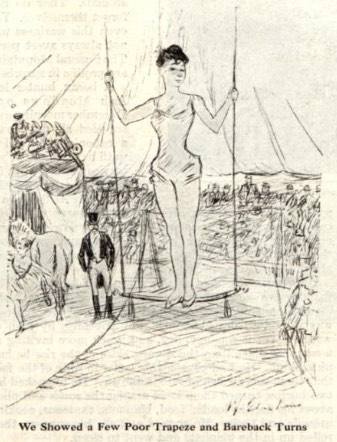
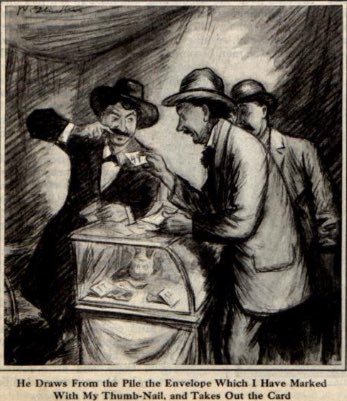
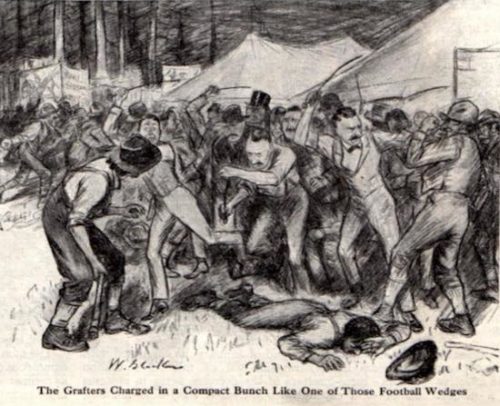
Featured image: All illustrations from “The Confessions of a Con Man” by Will Irwin from the March 6, 1909, issue of The Saturday Evening Post
November/December 2016 Limerick Laughs Winner and Runners-Up
Observing that Christmas is looming,
Our puppy is silently fuming:
“I’ve made it well known
That I wanted a bone,
Yet instead it’s a year of good grooming!”
Congratulations to Jeff Foster of San Francisco, California! For his winning limerick, Jeff wins $25 and our gratitude for his witty and entertaining poem describing Charles Kaiser’s 1942 Christmas cover Dog Basket (above). If you’d like to enter the Limerick Laughs Contest for our next issue of The Saturday Evening Post, submit your limerick through our online entry form.
We received a lot of great limericks. Here are some of the other ones that made us smile, in no particular order:
He had wanted a drink with an egg.
For that nog he would constantly beg.
But a basket was gift.
His reaction was swift,
As he smelled it and lifted his leg!
—Ryan Tilley, Altamonte Springs, FloridaThis might be some hard news to take,
But Santa Claus made a mistake!
He got me mixed up
With some other pup,
‘Cause I asked for some toys and a steak!
—Guy Pietrobono, Washingtonville, New YorkI cannot imagine what drove her
To purchase this present for Rover.
Instead of a treat
Involving some meat,
It seems he shall have a makeover!
—Deborah Jones, Modbury, Devon, Great BritainThere’s a basket that sits ‘neath the tree,
Filled with Christmas gifts all meant for me.
I see powder for fleas
And some bath stuff, but please—
How clean must a young puppy be?
— Steve Moore, Redondo Beach, CaliforniaOur holiday gifts are all set,
And our puppy’s we did not forget,
For his Christmas surprise
Is these grooming supplies
To say “Fleas Navidad!” to our pet.
—Dorie Jennings, Penfield, New YorkCould someone explain to me, please,
How come you’re giving me these?
‘Cause Santa could see
What’s under our tree…
Now Santa Claus knows I have fleas!
—Guy Pietrobono, Washingtonville, New YorkHe looks at the gift with disdain.
His dislike for it is quite plain.
He thinks to himself,
‘I’ll get that darn elf
That caused me such sorrow and pain.’
—Angie Gyetvai, Oldcastle, Ontario, CanadaI need to give Santa a clue
As to gifts I’d prefer to eschew.
Perhaps with this glare
He’ll become more aware
Of my dislike for puppy shampoo.
—Paul Desjardins, West Kelowna, British Columbia, CanadaThere isn’t a bone in that basket.
I know without having to ask it.
For if it were there
It would perfume the air,
And not even dog wash would mask it.
—Helen Meikle, South West Rocks, New South Wales, Australia
Honorable mention, as chosen by the canine contingent at The Saturday Evening Post:
Woof woof arf, woof woof woof arf, woof.
Grrrr, woof woof, arf growl grr grr woof!
Whine whimper, ahhh-ooooh,
Sigh, whimper, grrr — ooooh!
Grrr WOOF woof grr ARF grrr ARF WOOF!
—Rebekah Hoeft, Redford, Michigan
Curtis Stone’s Grilled Ginger-Sesame Chicken Salad
Try out some of Curtis Stone’s other fresh, tasty recipes.
I had never had a Chinese chicken salad until I came to the States. I’m just going to say it out loud — I love it. And I love it as a light and lovely main course salad. The secret to this dish is the dressing: sweet hoisin, spicy Sriracha, salty soy, and rich sesame oil, with the fresh flavor of ginger punching through it all. It’s so good that I use it as the chicken marinade as well. Includes spring’s snow peas, spring onions, and carrots.
(Makes 4 servings)
Ginger-Sesame Marinade/Dressing:
- ¼ cup reduced-sodium soy sauce
- 3 tablespoons very finely chopped peeled fresh ginger
- 3 tablespoons canola oil
- 2 tablespoons hoisin sauce
- 1 tablespoon toasted sesame oil
- 1 teaspoon Sriracha sauce
- 1 teaspoon kosher salt
- 2 boneless, skinless chicken breast halves (about 9 ounces each)
- ¼ cup red wine vinegar
- ¼ cup minced scallions (white and green parts)
Salad:
- 1 pound napa cabbage, halved lengthwise and very thinly sliced crosswise
- 2 carrots, cut into matchstick-size strips
- 3 scallions (white and green parts), thinly sliced on a sharp diagonal
- ⅔ cup lightly packed fresh cilantro leaves
- ½ cup slivered almonds, toasted
- 1 teaspoon white sesame seeds, toasted
- 1 teaspoon black sesame seeds (optional)
To make marinade:
- In medium bowl, whisk soy sauce, ginger, canola oil, hoisin sauce, sesame oil, Sriracha, and salt to blend.
- Transfer 3 tablespoons of mixture to baking dish.
- Add chicken and turn to coat it.
- Cover and refrigerate for 30 minutes, turning after 15 minutes, or up to 1 day, turning occasionally.
To make the dressing:
Whisk vinegar and scallions into remaining marinade. Set aside.
For the chicken:
- Heat grill pan over medium-high heat.
- Remove chicken from marinade, add to grill pan, and cook for about 4 minutes per side, or until chicken shows no sign of pink when pierced in thickest part with tip of small sharp knife.
- Transfer to cutting board and let cool for 15 minutes.
- Cut chicken crosswise into ¼-inch-thick slices.
To assemble the salad:
- In large bowl, toss chicken, cabbage, carrots, scallions, and cilantro with enough dressing to coat lightly.
- Mound salad in center of four plates.
- Rewhisk dressing and drizzle a little over and around salad. Sprinkle almonds and sesame seeds over and serve.
Nutrition Facts
Per serving
Calories: 437
Total Fat: 26 g
Saturated Fat: 3 g
Sodium: 1321 mg
Carbohydrate: 16 g
Fiber: 5 g
Protein: 36 g
Diabetic Exchanges: 1 ½ vegetables, 3 ½ lean meat, 5 fat
Try out some of Curtis Stone’s other fresh, tasty recipes.
Cover Gallery: Setting Sail
Have the doldrums? These illustrations of schooners and sloops will buoy your spirits in no time.
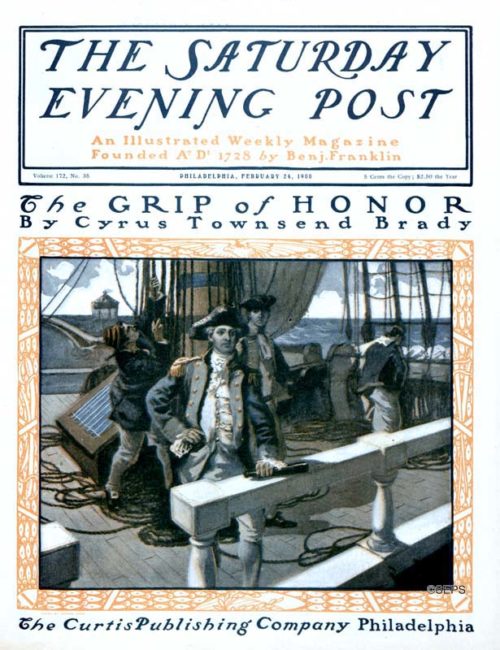
By George Gibbs
February 24, 1900
Illustrator George Gibbs was also an author, having written more than 50 books. Most of his books fell into the the spy and adventure genres, making him a perfect fit to paint this cover to accompany Cyrus Townsend Brady’s story. Gibbs was the illustrator of the first color cover of the Saturday Evening Post, which was published on December 30, 1899.
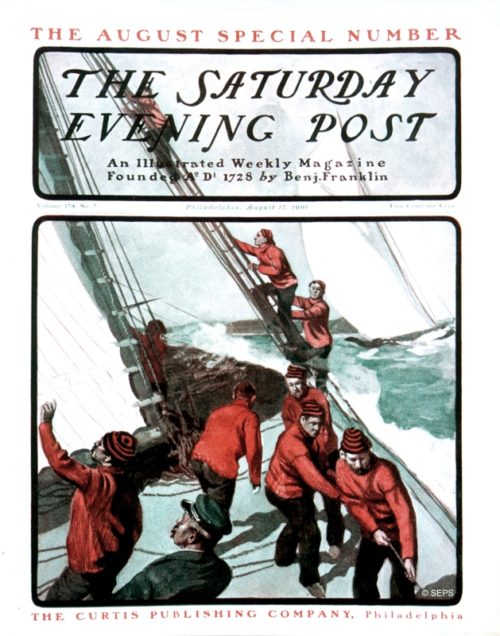
Artist Unknown
August 17, 1901
This cover by an unknown artist was drawn a year after sailing first debuted at the Olympics, in Paris, France in 1900. A Swiss sailor at the games, Hélène de Pourtalès, was the first ever female Gold medalist of the modern Olympic era, according to sailing.org.
By Eugene Iverd
February 04, 1928
Artist Eugene Iverd grew up in Minnesota, giving him plenty of opportunities to observe ice boating. Iverd was known for painting indelible childhood moments of kids around the campfire, on the football field, in the swimming pool, or on a windswept, frozen lake.
By Anton Otto Fischer
September 20, 1930
Anton Otto Fischer painted hundreds of covers and interior illustrations for the Post. He also illustrated books such as Moby Dick, Treasure Island, and 20,000 Leagues Under the Sea.
By Anton Otto Fischer
January 23, 1932
This Fischer illustration beautifully captures a moment of drama and also serves as a metaphor for the encroachment of the industrial age over the old ways.
By Norman Rockwell
November 8, 1930
This illustration by Norman Rockwell is a departure from his typical “slice-of-America” scenes.
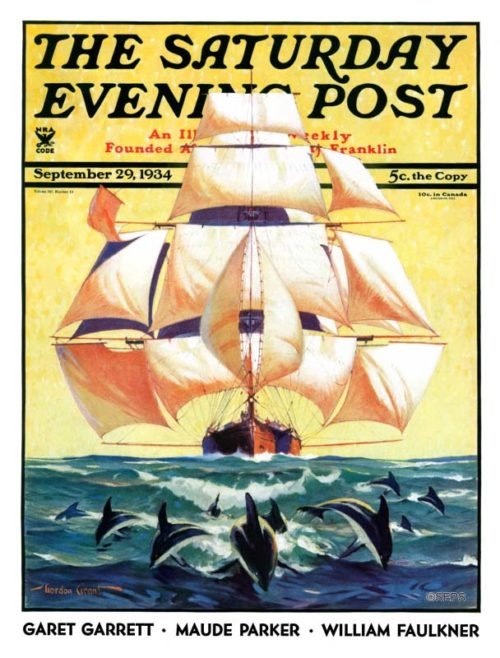
By Gordon Grant
September 29, 1934
Artist Gordon Grant was well known for his maritime covers, particularly his watercolor of the USS Constitution. He was also the cover designer for the first edition of the Boy Scout Handbook in 1911.
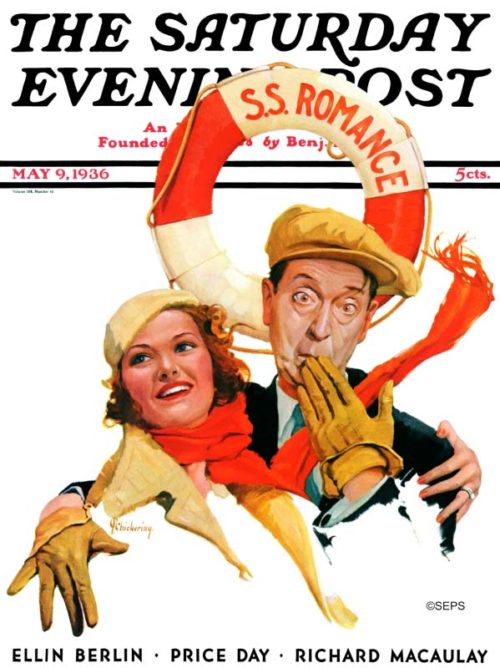
By Charles R. Chickering
May 09, 1936
Charles Chickering got his start as a medical illustrator of the wounded and dead during the World War I, and went on to a career as a postage stamp designer, before painting this winsome cover for the Post.
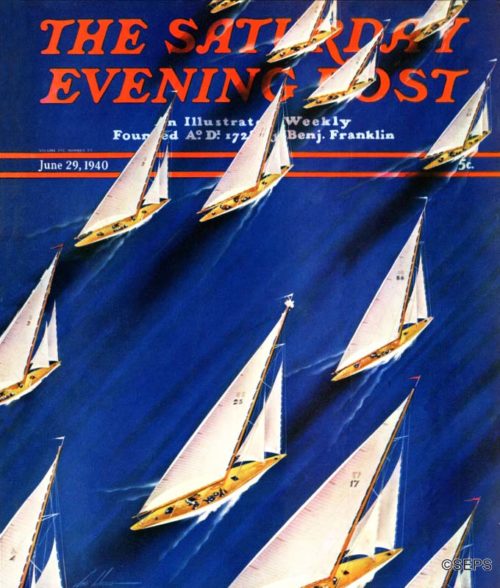
By Ski Weld
June 29, 1940
Ski Weld’s covers always depicted action – skiers jumping, snow geese flying, or, in this case, a stunning regatta of boats sailing.
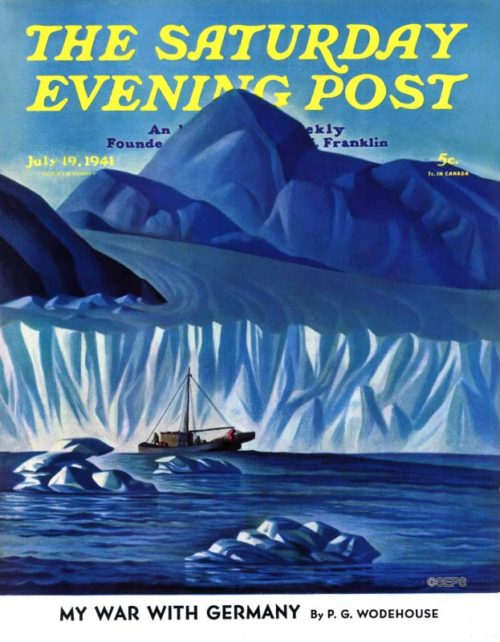
By Dale Nichols
July 19, 1941
Dale Nichols was best known for his paintings of red barns in rural, Midwestern landscapes. This northern scene was a departure from his usual subject matter.
By Richard Sargent
August 22, 1959
Artist Richard Sargent (1911-1979) painted 47 Post covers between 1951 and 1962, when photographs were rapidly replacing magazine illustrations. Sargent often used a playful narrative style where one picture did indeed express a thousand words.
What I Learned From My DNA Test Kit

Among the big, eternal questions, the most compelling may be: Who am I, what do my genetics predict about my future, and will The Real Housewives series ever be canceled?
Only a dozen years ago, it cost tens of thousands of dollars to get these questions answered (except for the matter of The Real Housewives’ durability, which defies the laws of both science and taste). Arranging for a laboratory to sequence your DNA — that is, to parse the vast network of chromosomes that makes each of us a uniquely lovable human — was a huge deal. Neighbors would have been impressed by your dedication to self-inquiry, not to mention your expenditure.
Today, all you need is an easy-to-obtain home testing kit. For the cost of having a couple of cars expertly washed and waxed, a team of geneticists will decipher your biological code.
And even if you don’t know a chromosome from a chrome doorknob, you’re bound to learn lots. You might even be startled by the findings, which can be a good thing or a bad thing, depending on how you feel about hearing that huggable Grandma Heloise likely shared more than her wisdom during her year-long Tahiti “adventure.”
Several companies now offer direct-to-consumer DNA kits. The industry leader, 23andMe, already has 1.5 million customers. New labs, with their own gimmicks and hooks, come to market all the time. (Among the latest is TeloYears, which checks your DNA for hints about how well you’re aging.)
Whichever company you choose, the drill is the same: Once the tidy little kit arrives, you spit into the supplied tube (gobs and gobs of spit; you may want to save up!) and mail the thing off. A couple months later you receive your report. The companies don’t fully sequence the 23 pairs of complex chromosomes that make you … well, you; rather, they do a sort of CliffsNotes version, paying attention to the recessive carrier traits that matter most to the average customer. They call this genotyping.
Recently, in the great tradition of first-person journalism, I submitted my very own personal spit to the two best-known companies in this arena: the aforementioned 23andMe (which focuses on who I am) and AncestryDNA (with a focus on where I came from). I’ve got to be honest: I secretly hoped to discover that I am an exotic cocktail of ethnicities. Maybe a little Irish, a touch of Brazilian, a hint of Fijian. Alas, not to be. According to AncestryDNA, I’m exactly as uninteresting, ancestry-wise, as I had suspected: 97 percent European Jewish. (Glimmer of hope: The remaining 3 percent suggest that some long-ago relatives hailed from Great Britain or the Iberian Peninsula, two nice places. Reminder to self: Visit more often.)
So, what did 23andMe reveal about Cable Neuhaus? Essentially, nothing I didn’t already know, but its report was “fun,” as the company promised it would be. For example, it said my DNA indicated I had a 44 percent chance of having a “second toe longer.” Bingo — that’s my foot, precisely. Also: a 66 percent chance that I “can’t taste” bitter. (Correct.) A 72 percent chance of “little upper back hair.” (Yep.) A 91 percent chance of “little or no unibrow.” (Oh, geez, thank goodness true.)
There were no references to diseases that might one day fell me, because the Federal Drug Administration doesn’t allow 23andMe to go there. Acknowledging that the whole idea of direct-to-consumer DNA testing has been “controversial,” Robert C. Green, a medical geneticist at Harvard Medical School and Brigham and Women’s Hospital, told me that the FDA’s concerns are legitimate, but research shows that consumers of inexpensive DNA analyses aren’t likely to “misunderstand or experience distress or have medical follow-up they do not need.” In other words, buyers of these tests generally have not freaked out over their results.
“People are basically curious about the things that make them who they are, it’s fascinating to them,” Green said. At the current price point, and given that the tests genotype rather than fully sequence, that’s a fair deal, according to Green and others. There are initiatives underway to offer more predictive testing — Am I likely to be a cancer victim? What about heart disease? Dementia? — but those results will probably get routed to a medical professional before they pop up in your inbox.
A few weeks ago I asked the nice folks at 23andMe if they ever receive complaints from customers who, for whatever reason, don’t love what their DNA reveals. Well, sure they do. “Sometimes finding out something you don’t expect, or expecting something that’s not in the product, can turn into a kind of disappointment,” a company spokesperson acknowledged in an email.
Consider the case of Bill Griffeth, a CNBC TV anchor and longtime genealogy buff who several years ago had his genome analyzed by a company called Family Tree DNA. The shocker — confirmed by a second test — was that the man he believed was his father was, uh, not. Oops. Griffeth wasn’t disappointed so much as stunned. Who was he, really? How could he have been fooled for so long? His dramatic tale was documented last year in the memoir The Stranger in My Genes.
It’s inevitable in this age of cheap genome test kits that, as we gain an ever clearer understanding of what we are, biologically speaking, we’re going to stir up some thorny questions about who we really are as complicated, emotional individuals. That mystery is not about to be solved in anyone’s laboratory.
Cable Neuhaus writes about popular culture and media.
This article is featured in the March/April 2017 issue of The Saturday Evening Post. Subscribe to the magazine for more art, inspiring stories, fiction, humor, and features from our archives.
The Magic of Wild Alaska

Photo by Laura Grier
You go to Alaska to experience the world on a grand scale — bigger than what you’ll find anywhere else in America. To actually see and get a taste of what our land was like before it was stripped, slashed, fracked, and cluttered with strip malls. As Thoreau wrote, “Think of our life in nature, — daily to be shown matter, to come in contact with it, — rocks, trees, wind on our cheeks! The solid earth! The actual world!”
Yes, think of it! In T.C. Boyle’s novel Drop City, a band of hippies decides to “fall off the map” and head for Alaska because, as one character says, “Alaska’s the real thing, the last truly free place on this whole continent.” It all ends badly, as their idealism masks a remarkable naiveté about what it takes to survive a 40-below winter.
Maybe that’s another reason Alaska fascinates. It can kill you. Plenty have died there, including pioneers, climbers, and of course the gold miners who came at the turn of the 20th century, succumbing to scurvy, dysentery, malaria, typhoid, bears and wolves, or just plain starvation and frigid weather. In modern times, we have the example of Christopher McCandless, a bright but disturbed young man who imagined he could be set free from the blight of civilization if he could but survive alone on the Alaskan tundra. He couldn’t, as you’ll remember from Into the Wild.
Few of us have that kind of death wish, but many nonetheless want to (safely) experience the magic and wonder of this great northern land. My wife, Estelle, and I had the opportunity to do so this past September, traveling with Princess Cruises, which runs many tours of the region, the best of which are land and sea combinations that start you off (or finish you up, depending on which direction you choose to travel) in Fairbanks, roughly the middle of the state. If you travel southward, as we did, you next go by bus down through Denali National Park and then by train to the ship’s debarkation point in Whittier. The ship takes you through Prince William Sound into magnificent Glacier Bay, then down the Inside Passage, with stops at Skagway, Juneau, and Ketchikan, ending in Vancouver or San Francisco.
Along the way, we experienced nature, as advertised, including plenty of animals: moose, bear, caribou, wild mountain sheep, ptarmigan, eagles (bald and golden), whales (humpback and killer), seals, porpoises, and more. Then, there’s the bigger-than-anywhere-else Alaskan landscape: spectacular glaciers, their fissures gleaming azure; the braided, silt-filled rivers that flow from them; the vast, spongy tundra; and the snow-capped spires of Denali (formerly Mt. McKinley), our nation’s highest peak. So much, so big!
Our starting point is subarctic Fairbanks, which, being in central Alaska, is subject to extreme temperature swings, from minus 40-degree (Fahrenheit) days in winter to 90-degree days in summer. It’s also a region where the sun pretty much doesn’t quit in summer, but barely shows up for work in winter. As we were there in the waning days of August, there was already a slight chill in the air, foretelling the savagely cold weather to come. (A local brag is that parking spaces downtown need to be outfitted with electric sockets into which to plug the engine warmers required in cold months.)
For a sample of what that weather feels like, there’s a refrigerated “40 below” room at the embarkation point for the Riverboat Discovery stern-wheeler cruises that ply the Chena River for the benefit of tourists like ourselves. We take the cruise, where 23-year-old Captain Madison Binkley somewhat recklessly allows me briefly to take the wheel. I immediately oversteer coming out of a turn, but she expertly talks me back on track. Afterward, I can’t resist the temptation of the “40 below” experience. You start in an antechamber, like walking into a freezer, then, through another door, you enter a deeper freeze, where the huge thermometer indicates 58 below. Immediately, the inside of my nose starts icing up, and then the cold begins to penetrate my clothes, my skin, my bones. I last about five minutes, but feel the chill for a couple hours afterward.
For its land tours, Princess operates its own hotels. We spend the first night at their Fairbanks lodge, along the Chena River, feasting on salmon and crab legs. Wine tasting, too!
The next day, we’re off by bus to the Denali Princess Wilderness Lodge, just inside the fringe of Denali National Park along the Nenana River. In the afternoon, with a group of eight, I ride a helicopter for a hiking expedition up on the tundra, while Estelle goes whitewater rafting on the river with a young guide who playfully asks, “Hey, want to get wet?” and then, after he promises to fish her out safely if the raft flips, maneuvers them into the frothiest part of the river for a truly wild ride.
For us hikers, it’s a short flight to a ridge at about 4,500 feet, along the way passing a cluster of Dall sheep that look like puffs of cotton clinging to minuscule ledges along the black stone spires. In just a few minutes we reach the tundra, a flat, treeless region where the subsoil is permanently frozen. It looks like a huge meadow set high in the sky — all lichens and mosses and low, hardy grasses interspersed with tiny flowering plants and wild berries. The ground is spongy with snowmelt that sits on top of permafrost. Due to its location, the region gets little rain and wind, so there’s barely any erosion. “We’re looking at a vista that is very likely just as it was at the end of the ice age, about 11,500 years ago,” says our guide.

Photo by Laura Grier
It’s a clear day, and about 80 miles away to the south, we make out the 20,310-foot peak of Denali. All around us are steep, treeless mountains, green valleys, and white glaciers, no visible signs of human habitation in any direction, a top-of-the-world feeling.
We start out along a ridge, looking for signs of wildlife — slight depressions where sheep have spent the night, bear scat, caribou tracks. We find geodes, petrified wood, caribou antlers. “Don’t take anything,” says the guide, but I can’t resist slipping a tiny geode and a sliver of petrified wood into my pocket as reminders that this was not a dream.
Descending into a bowl, we come across a patch of mossberries, black in color, bland in flavor — then some cranberries. A golden eagle swoops low over a rise nearby. Suddenly we come across wild blueberries. Kneeling on the ground, staining my pants blue, guzzling handful after handful of the sweet berries, I feel that I could be setting some kind of record, until I learn that grizzlies are capable of consuming up to 100,000 blueberries in a day.
Some signs of change: warmer-than-normal temperatures have melted a steep section of what had previously been permafrost, causing a mudslide that looks like a man-made excavation — which, in a sense, it is. Here and there, we also see fir trees poking up out of the low undergrowth. There are not supposed to be trees of any kind on the tundra, and our guide remarks that about 10 years earlier, when he saw the first invaders pushing through the low undergrowth, he would uproot them as he hiked by, vainly attempting to stop the unstoppable. He pretty soon gave up that battle.
The next day, our group of about 15 takes a school bus into Denali Park. With few exceptions, private cars are not allowed. That means less air pollution and fewer people in the park. Anyone who’s been to the garbage-strewn traffic jams of Yellowstone knows how important that is.

Photo by Laura Grier
The bus is outfitted for sightseeing with oversized windows. There are also video monitors linked to a telescopic video lens controlled by the driver so you can get closer looks at wildlife along the way. And we do see plenty of animals: caribou (a group of four bulls resting together, each one supporting a huge rack of antlers, the velvet peeling off in loose tatters), a moose, then suddenly a large male grizzly. The bear is cooling off in a stream, mere yards from the road, panting like a dog on a hot day. After several minutes, he clambers to his feet, shakes off, and disappears into the brush.
The turnaround point is about 40 miles in, just over a rise, giving way to a view of Denali. The mountain is glorious, and importantly, visible. Denali, which has its own microclimate, is frequently enveloped in clouds even on a sunny day. But here it is!
Late afternoon brings another helicopter excursion, this time to a glacier. Stepping off the copter, looking out across the vastness of the ice, the deep blue shade of the pooling meltwater, the immensity of the mountains roaring up around us, I am, for a moment, ecstatic. (“The actual world!”)
The night brings more spectacle, the aurora borealis enhancing the sky in swirling greens, reds, and purples — a light show I will never forget.
The next day begins with a long bus ride to Princess’ McKinley lodge, where, thanks to another crisp, clear day, we are treated again to a spectacular view of the mountain — this time from the south side.
In the afternoon, we head to the nearby one-horse town of Talkeetna, which accommodates tourists and serious mountain climbers with equal affability and a bit of Wild West edginess. (A sign at an ice cream shop warns playfully, “Patrons taking more than 3 seconds to choose a flavor will be shot.”) From multiple choices of excursions — horseback rides, float trips, flightseeing tours — Estelle and I choose a jet boat ride that takes us up and around three rivers (the Chilitna, Talkeetna, and Susitna, each one a slightly different shade of silty gray). The water is shallow (hence the need for the jet boat, which only draws about one-and-a-half feet of water), swirling around boulders and logs, forming Rorschach patterns on the surface, challenging the captain. Several bald eagle sightings, including one bird that swoops low, maybe 10 feet over our boat. The boat is glassed in, but Estelle and I step out onto the tiny rear deck for fresh air. Above us, a deep blue cloudless sky and piercing sun. Around us, only rushing water and still woods. The wind blows Estelle’s hair in her face and she laughs with joy. Damn, she looks good! Forty years of marriage, but I just can’t help myself; I’m falling in love all over again.
A day later, we’re back in Talkeetna for a small-plane tour up and around the spires of the Alaska Range, ultimately within 500 feet of Denali itself. After the plane ride, a quick stop for lunch and a flight of delicious beers at Denali Brewing Company, and then almost before we can clean our plates, it’s off to the Alaska Railroad station, just outside of Talkeetna, where railway cars await to take us down to our ship in Whittier.
It’s raining in Whittier. It’s always raining in Whittier, which ranks as one of the top 10 rainiest cities in America. We dash under awnings for the short walk to the Star Princess. She’s one of the larger cruise ships, 951 feet long, 201 feet high, capable of holding 2,600 passengers. To give you an idea of the scale, each week the 150 galley staff bake upwards of 24,000 fresh bread rolls, grind nearly 3,000 pounds of beef for burgers, and serve more than 10,000 slices of pizza. Over the course of the voyage, let’s just say we are well fed: crab legs, salmon, steak, shrimp, lamb chops — sometimes all of the above. But overindulging is one of the perks of taking a cruise, and who are we to argue?
One day in, we find ourselves anchored in Yakutat Bay, just a few hundred yards from Hubbard Glacier. This massive display of nature’s power is sooty black and white, with streaks of blue light flaring through the cracks. The leading edge stands 350 feet high and extends another 250 feet below water. We crowd the forward deck, 12 stories high, about midway up the side of the front glacier wall, oohing and aahing as city-building-sized chunks break off (a process known as calving) and fall into the sea with cannon-like booms. These ice chunks are 400 years old, having traveled 76 miles down the valley from the mountains beyond, moving like a very slow river at a pace of just a few feet each day.
Two days later, we make Skagway, the first of three stops in small historic Alaskan towns, visiting one per day. While many passengers disembark to roam the streets hunting for deals on hats, sweatshirts, and jewelry, for me, the secret is to sign up for one of the excursions that get you out of town. At each stop, there are numerous options, from flightseeing to rafting to train rides to hikes in the woods.
At Skagway, I’ve booked a tour to a dogsled camp, which requires a bus ride out of town, transferring to a four-track to navigate a steep logging road that leads to the camp. Up in the high country, we meet and play with sled dogs and are taken for a spin in a (wheeled) sled pulled by a dog team. Running the one-mile circular track is a lark for these canine master-athletes — the dogs howl and bark in anticipation of the command “mush!” seeming to want nothing so much as to run.
There’s a somewhat touristy feel to this excursion — the way we’re expertly moved from the dog sled lecture station to the pet-the-puppies kennel to the 10-minute dogsled ride to the gift shop, all in about an hour — but what makes it authentic is that these are real working sled dogs. They’re here, not for our benefit, but to train for their winter in competitive dogsled races like the 1,000-plus-mile Iditarod from Anchorage to Nome, during which they will run at an average pace of 10 to 12 miles per hour for five-hour stretches, followed by five hours of rest, on and off for eight to ten days straight. As the Iditarod race approaches the northern city of Nome, temperatures routinely get down to 40 below or colder, so frostbite is a serious hazard. We learn that it’s common for sled drivers to be missing a finger or two. The dogs are better protected, thanks to the natural insulation of their coats. In fact, we learn the only part of the sled dog that isn’t safe from frostbite is the penis. (Special doggie pants are fitted on the males for the coldest parts of the run.)
A day later, in Juneau, Estelle and I take a bus ride out of town, happily skirting the touristy hustle (“Closeout Diamond Sale!,” “$5 T-Shirts!”) to go on a short nature hike to Mendenhall Lake, about a mile across, looking at the terminus of the Mendenhall Glacier. About 120 years ago, there was no Mendenhall Lake, only the glacier.

Photo by Laura Grier
Another day at sea and we’re in Ketchikan, where we’ve signed up to go salmon fishing. As we walk along the dock to the small fishing boat, the gloomy captain greets us with a warning that “this has been the worst fishing season in 40 years.” And indeed, out of four boats that go out that morning as part of our group, only three legal salmon are caught — none in our boat. Still, even with slack fishing lines, it’s a beautiful day on the water, with a pod of humpback whales spouting and diving nearby.
For the dearth of salmon in the waters, our captain blames “fish factories,” the mammoth ships of foreign registry that scour the sea floor just beyond our territorial waters for everything and anything they can dredge up. These boats are taking in excessive quantities of herring, he says, which the humpback whales normally feed on in addition to plankton and shrimp-like krill. He theorizes that the whales turn to salmon fingerlings when herring is in short supply, and as a result, the precious salmon population takes a hit.
Two days later, we’re in Vancouver, the end of the line. We spend a day there, and I rent a bicycle to take a ride around Stanley Park, with its terrific views of the harbor. I watch as the Star Princess, fully loaded and replenished, disembarks for the return trip up to Whittier.

Photo by Laura Grier
Across the harbor, the ship is grand. But you don’t take the Alaska cruise to experience the ship. You go for the pristine landscape, for the diverse wildlife, and for indelible memories of flying through heaven-scraping mountains, hiking on frozen tundra, watching eagles soar and whales spout and dive, witnessing a glacier slowly melting before the inexorable onslaught of a warming climate, and thrilling to those amazing northern lights — the greatest light show on the planet.
Steven Slon is editorial director of The Saturday Evening Post. In the last issue, he interviewed artist Mort Künstler. See more of Laura Grier’s awe-inspiring travel photography at lauragrier.com.