Cover Gallery: Dogs with Jobs
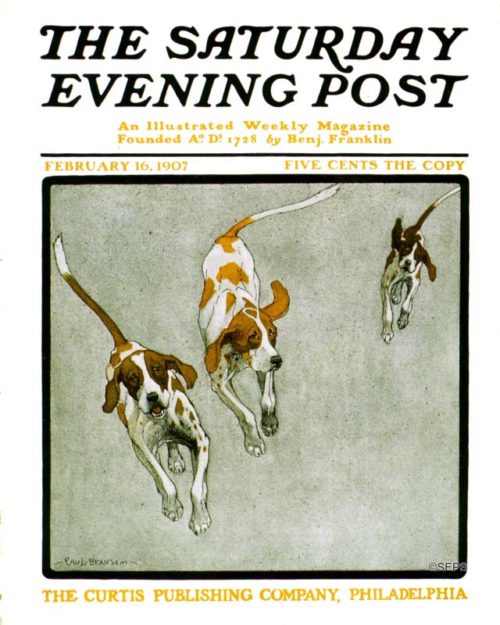
Paul Bransom
February 16, 1907
Paul Bransom illustrated numerous animal covers for the Post. A longtime resident of New York City, Bransom spent summers at Canada Lake in the Adirondacks, where he found much of his inspiration.
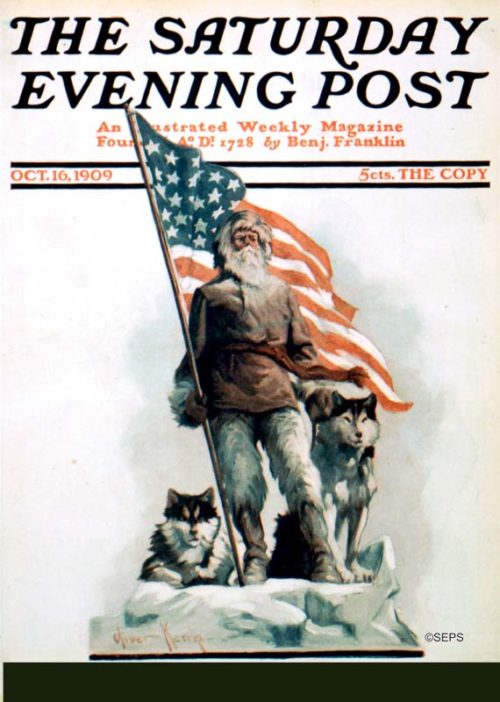
Oliver Kemp
October 16, 1909
Peary made numerous attempts to reach the North Pole, many with the assistance of sled dogs. Whether he actually reached the North Pole is widely debated.
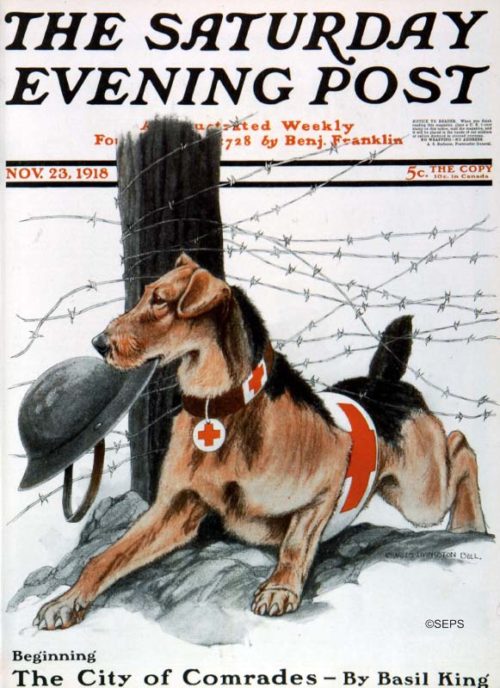
Charles Bull
November 23, 1918
During World War I, dogs were used to locate wounded soldiers on the battlefield and bring back help. Approximately 10,000 dogs were in use by the end of the war.
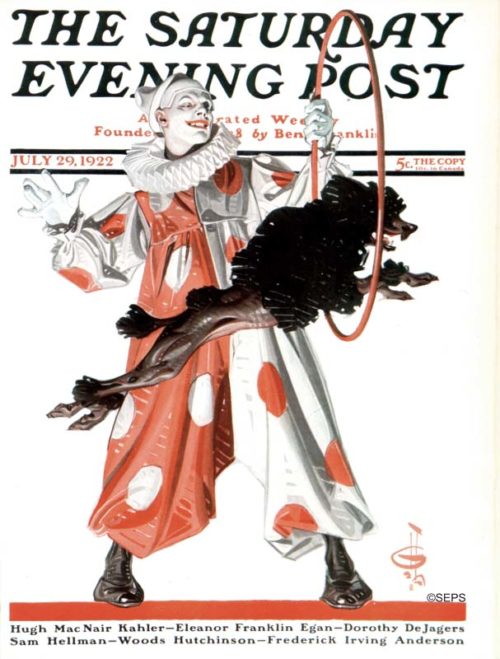
J. C. Leyendecker
July 29, 1922
In the mid-1800s, the Standard Poodle became a popular circus performer because of its intelligence and stamina.
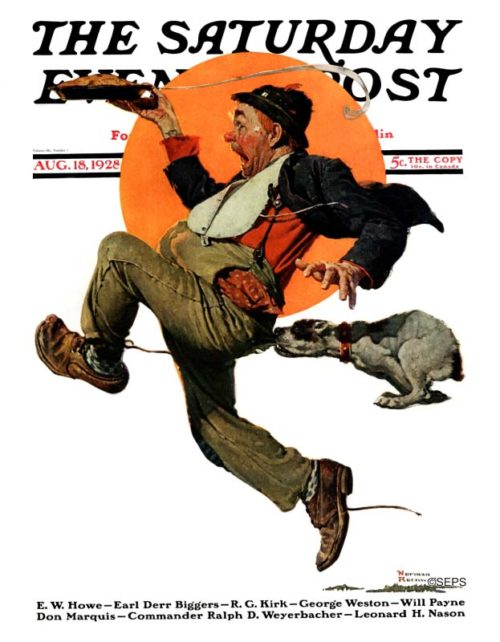
Norman Rockwell
August 18, 1928
The dog has long served in the role of family guardian. Norman Rockwell had earlier portrayed dogs with “hobos” who were down on their luck, but this was the first illustration of the culprit getting a nip in the seat!
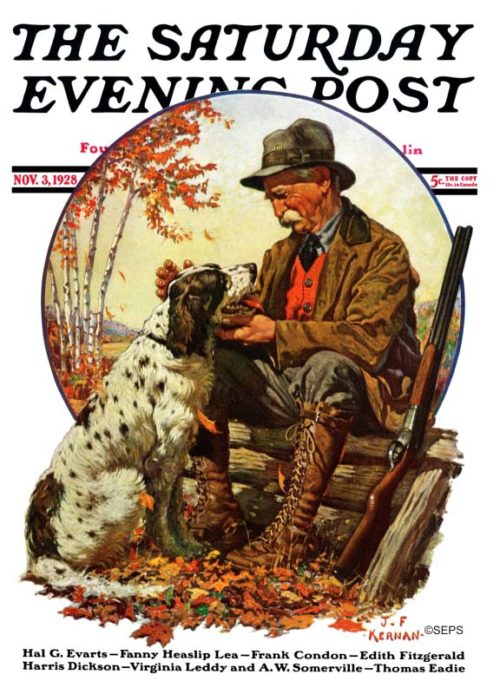
J. F. Kernan
November 3, 1928
An athlete and outdoorsman, artist Joseph Francis Kernan was known as the “poor man’s Norman Rockwell.” But Kernan was a superb illustrator in his own right. His art featured, as he described it, “the human side of outdoor sports, hunting, fishing, and dogs.”
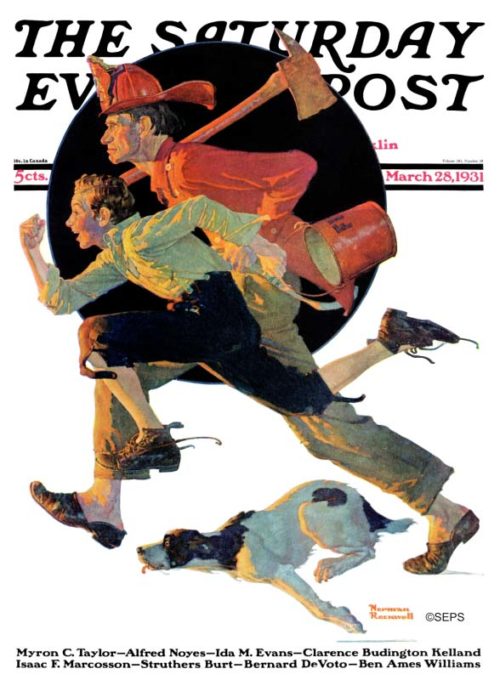
Norman Rockwell
March 28, 1931
A new approach to painting developed by Jay Hambridge – “dynamic symmetry” – was emerging, and Rockwell’s artist friends told him that he had better begin using it. This painting was his first attempt at the technique. Rockwell deemed the idea a failure, and gave the painting to a cousin who lived in Philadelphia. He vowed never to wander from the time-tested formulas that had worked so well in the past.
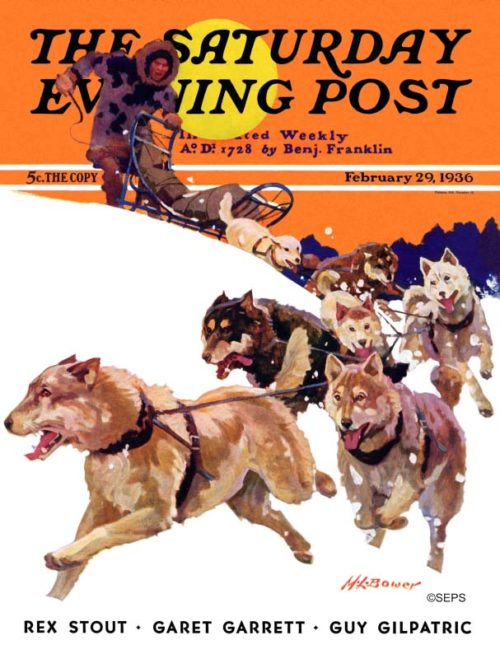
Maurice Bower
February 29, 1936
Maurice Bower primarily painted horses and sports scenes for the Post; this was his only cover featuring dogs.
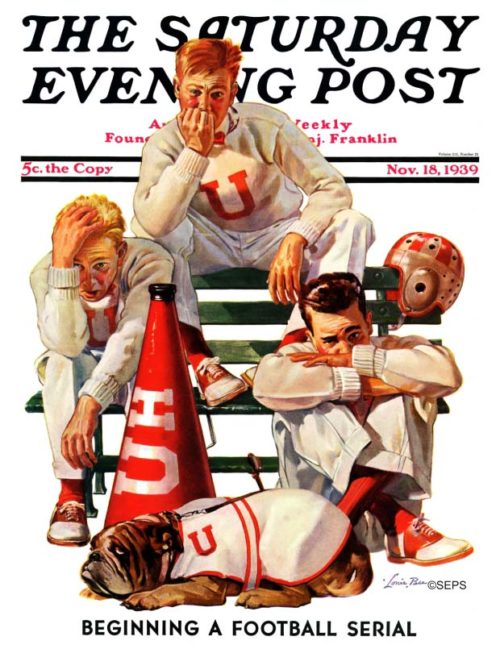
Lonie Bee
November 18, 1939
All of Lonie Bee’s cover illustrations were about the lighter side of sports – in this illustration, the dog seems as sad as the cheerleaders!
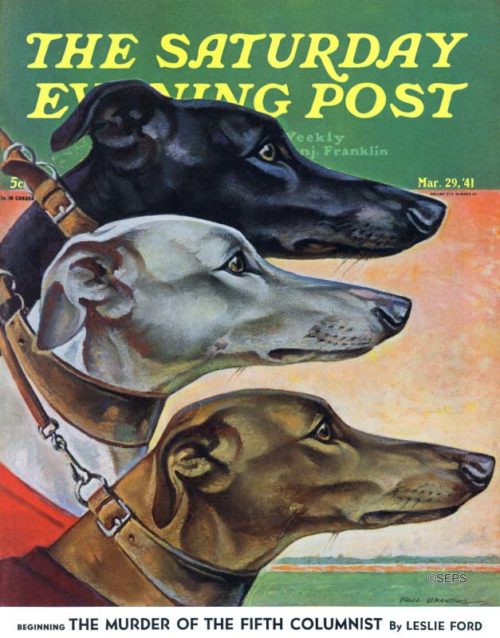
Paul Bransom
March 29, 1941
In the 1930s, dog racing was illegal, and considered by many to be unsavory because of its affiliation with mobsters. When Bransom painted this cover in 1941, only four states had legalized greyhound racing: Florida, Oregon, Massachusetts, and Arizona.
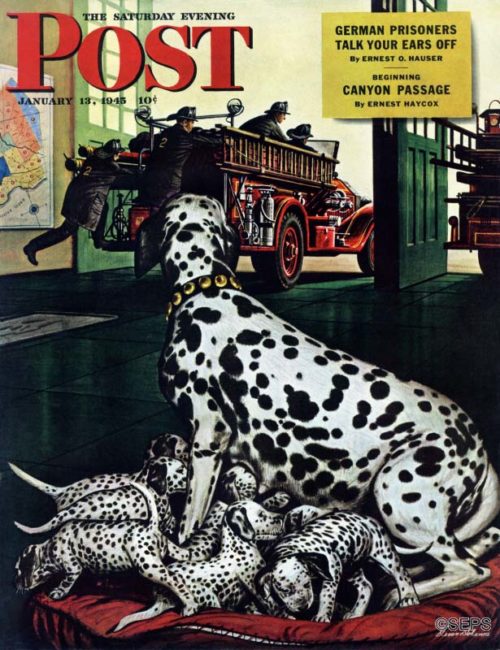
Stevan Dohanos
January 13, 1945
After painting 123 covers for the Post, Stevan Dohanos became chairman of the National Stamp Advisory Committee where he oversaw the art design for over 300 stamps. His depictions include presidential portraits, NATO commemorative stamps from 1959, and the 1967 John F. Kennedy commemorative stamp.
Can Government Censorship Be a Good Thing? 75 Years Ago This Week
In this editorial from January 24, 1942, the Saturday Evening Post analyzed the role of wartime censorship implemented by the Office of Censorship and extended by the cooperation of newspaper editors. The assumptions in this editorial — that the citizens will trust the government to censor information as it sees fit, that the press and the politicians can find mutually agreeable terms of censorship, that the press will exercise discretion in what it chooses to publish — would be unlikely to find much support today.
The Post noted that wartime censorship required “a pledge of unlimited confidence to be exchanged between the Government and the people.” While this point of view may have found favor 1942, it’s doubtful that Americans would agree with this sentiment 75 years later, even if we found ourselves in similar circumstances. Whether you call it cynicism or wisdom, too much has changed.
Censorship
Originally published January 24, 1942
It says much for the powers of self-discipline in a free and willful people that liberty of the press very willingly submits to put itself in a strait jacket for the duration of the war. Everyone uncomplainingly takes it for granted that communications will be censored and that news will be controlled at the source, and that this will be done not as the law says it may be but as military judgment says it shall be. Censorship on those terms requires a pledge of unlimited confidence to be exchanged between the Government and the people; and so, happily, it begins. But we shall do well at the same time not to underestimate the difficulties.
The Government lays down what appears to be a very legible rule to govern the release of news. The conditions are two. First, the facts must be fully verified; second, publication of them is forbidden if they tend in any way, direct or indirect, to give aid and comfort to the enemy. But you could not invent a general rule that would leave more to arbitrary discretion in its application to a particular case.
News is of two kinds — good and bad. Any bad news at all tends to give aid and comfort to the enemy. Then what will you do with it? Withhold it from the people until it is certain that the enemy already has it?
Take the communiqué. In its daily report to the people the Government cannot tell everything that has happened, and the more critical the situation is the more this will be true. Why? Because the enemy is reading it too. You cannot have two reports — one for the people and one for the enemy.
In the business of bombing, for example, the enemy’s only firsthand knowledge of his hits is from his own pilots, who tend naturally to exaggerate what they think they have done and are liable in any case to be mistaken. The enemy, therefore, anxiously watches the news on the other side in order to check the claims of his own pilots; and one of his artful tricks is to put forth fantastic claims in his own communiqué with intent to provoke on the other side a denial, on the chance that the denial will be informing. Thus, it was very important for the Japanese to know whether or not they had got an aircraft carrier at Pearl Harbor, as their own pilots said they had.
The communiqué, indeed, now is one of the weapons of strategy. The Russians in theirs were most despondent just on the eve of the unexpected counteroffensive that forced the German war machine suddenly into reverse. The purpose was probably twofold. One part of it was to deceive the Germans; the other was to hasten American and British aid.
On the free, Anglo-American side there is no likelihood of bad military news being suppressed or long withheld for fear the people cannot take it. The British are extremely the other way. They are nourished by bad news. “It must be remembered,” said Mr. Churchill, in a recent review of the war before the House of Commons, “that here at Westminster and in Fleet Street” — newspaper row — “it has been sought to establish the rule that nothing must be said about the war that is not altogether discouraging. Although I must admit the British people seem to like their food cooked that way, a military spokesman addressing a large army might do more harm than good if he always put things at their worst, and never allowed buoyancy, hope, confidence and resolve to infect his declarations.” He was defending the military spokesman at Cairo, whose reports on the North African campaign, the English people thought, had been disgustingly optimistic, and they were complaining of him on that ground.
But there is another kind of bad news which, although it is not strictly military in character, does tend nonetheless to give aid and comfort to the enemy; and the question about it is not whether the people can take it but whether the Government can, because it is news of the Government, of its own blunders and failures and mistakes of political judgment. What will the censor do with facts of that order? What ought he to do with them?
This is the kind of news that free criticism tends to reveal; and here it is that censorship faces what is perhaps its most unruly problem. For all the aid and comfort it may afford the enemy, shall criticism be free? In England it is. Mr. Churchill has at times complained of it, yet very mildly and with grim understanding. Suppression of criticism would be incomprehensible in England. So it would be here. Free criticism is troublesome. It does present a problem. Nevertheless, it is one that will solve itself if let alone. A government in the popular principle, being trusted by the people to control their news at the source and censor their communications for military reasons, must in turn trust criticism to censor itself. And this it does much more than can be realized by those who know only when it errs and have no idea how many times it makes the right answer when it asks itself this question: All things considered, will the saying of this truth do more good than harm? And if, in a given case, it comes too often to the wrong answer, then people themselves by their extreme disapproval will extinguish it, with no aid from the censor.
Good news, you might suppose, offers the censor no problem at all. Nevertheless, good news can be a liability. People may make too much of it. Bad news moves them to greater exertion, whereas good news may tempt them to relax. In his very fine sermon on “must” to the representatives of labor and management just before they sat down to work out a truce for the duration of the war, President Roosevelt said: “Don’t believe everything you read in the newspapers. … I was reading a paper this morning which was telling how inevitable … a victory would be. I want to see what we can do.”
To be on the safe side, we must expect a long hard war. News tending to belittle the resources of the enemy or to make us complacent about our own must be discounted. How? Not by suppression and certainly not by distortion, but by mixing bad news with good, by emphasis, by keeping the facts in perspective. Thus you come to censorship policy, touching the handling, timing and spacing of the news, for its effect upon public morale.
The poet said, “Let me write the ballads of the people and I care not who may write their laws.” This was paraphrased by a New York managing editor who said: “Let me write the headlines and anyone who likes may write the ballads.” He would not touch a word of the news to alter it, nor would he write a false headline. He would produce his effects entirely by selective emphasis. If there could be anything like that power of propaganda in mere headlines, and truthful headlines at that, imagine what lies in the hands of a censor, a national managing editor, acting upon news at the source, not to change any of the facts, but to time the release of them, to counterweight good ones with bad ones, and so control the perspective. Whose perspective? Not his own. The censor has no policy of his own. He executes the government’s policy, and when he fails to do that, there is a new censor.
Censorship is unavoidable. Although it may be authorized by a wartime statute, and is in that sense lawful, it cannot be administered by any rule of law. You may read in the Constitution that the Congress shall pass no law to abridge freedom of speech or freedom of the press; but when drums beat, the law flies away, says the proverb. Moreover, censorship entirely innocent of propaganda belongs to some faraway realm of the ideal. The subtle power of propaganda that is implicit in control of the news is bound to be exercised, because, first, a government is human, and for the reason besides that every government is obliged to believe that it knows what is best for the total good.
This is our second experience. In the war before, it was the Committee on Public Information. Now it is the Office of Censorship, which has a more honest and a more severe sound and, we suppose, a more severe intention. Even so, there will be, we think, forbearing to almost any point, no want of co-operation and no unfair criticism, so long as the Government holds free of hurt and trespass that confidence with which people, both the believing and the unbelieving, have suddenly overwhelmed it.
Edith Wharton: War Reporter?
Edith Wharton, who was born 155 years ago today, is best remembered for her Pulitzer Prize-winning novel, The Age of Innocence. Though she often wrote about American high society, she was well aware of the sufferings of the disadvantaged. During the First World War, she helped set up shelters for the thousands of refugees streaming into Paris from Belgium. She gathered clothing and food and raised money for the relief efforts. Her Children of Flanders Rescue Committee sheltered almost 900 refugee children and their families.
She was recognized for her work in 1916, when the French government awarded her the prestigious Legion of Honor. Appreciative French officials also gave her permission to visit the front lines and report on the fighting. She toured the French lines from Dunkirk to Belfort, in eastern France.
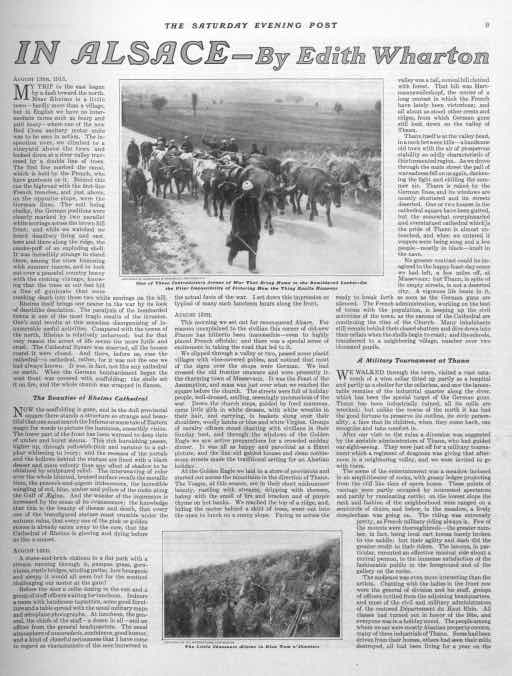
“In Alsace,” which appeared in the November 20, 1915, issue of the Post, she prominently mentions the destruction of the cathedral at Rheims. At this early point of the war, before the casualties reached into the millions, the German shelling of the cathedral could still be considered one of the worst results of the war.
Another interesting point about Wharton’s report is her mention of the French cavalry. In previous European wars, the cavalry had been greatly feared by the common soldier. But the arrival of the machine gun eliminated any threat posed by men on horseback with lances.
The front lines of the war had stabilized a few miles outside of Rheims, and would remain there for the next three years. In 1918, it would see Germany’s last, desperate attempt to win the war with a new offensive. The Germans started falling back and continued to withdraw for the next 100 days until they signed the armistice.
Alsace was not only the most forward position of the French army, its recapture was a matter of pride to the French, which had surrendered it in the Franco-Prussian War. The fighting in this region was so important to the national cause that no visitors, including high-ranking officials, were permitted to enter.
It is a mark of the high regard the French government felt for Edith Wharton that she was allowed to visit this crucial point of the western front.
Featured image: Edith Wharton (Beinecke Rare Book & Manuscript Library, Yale University/ Public Domain)
Norman Rockwell Paints an Intimate Tour of the West Wing
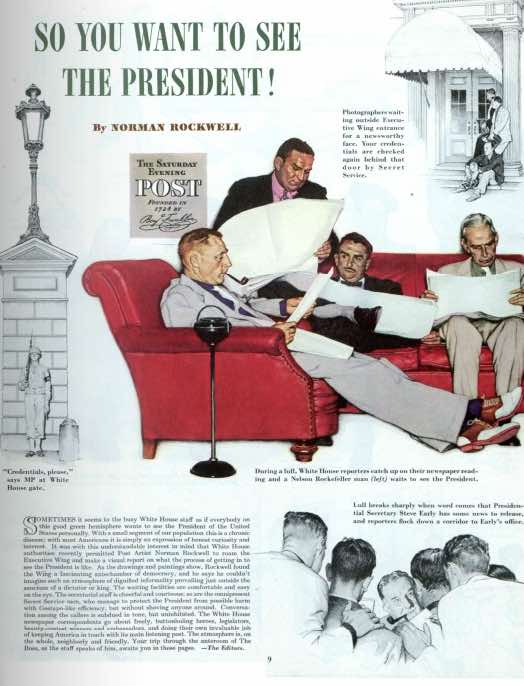
In 1943, Norman Rockwell was permitted to roam the Executive Wing of the White House. His drawings perfectly capture the “dignified informality” of the era. Click on the image below to see the complete four-page spread.
“The Little Terror” by Will F. Jenkins
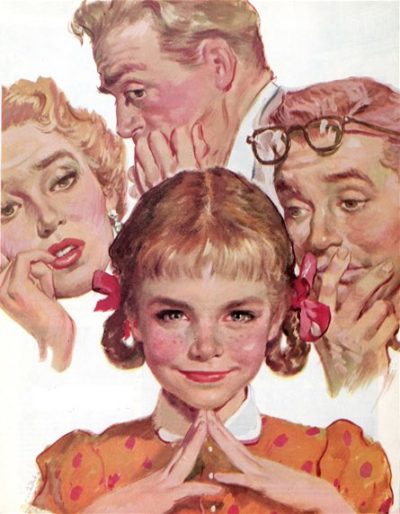 Originally published on August 22, 1953
There was no crashing roll of thunder when the principles of psychological acosmistic idealism became practicalities in the world inhabited by Nancy. Her mother had no twinge of uneasiness, and her father was reading his newspaper. There was no breathless hush over the earth at the bloodcurdling instant, though possibly Bishop Berkeley (1685-1753), up in heaven, was pleasantly interested. Joe Holt, who was a practicing psychiatrist and might be presumed to have a feeling for such things, hadn’t the trace of an intuition of it. The skies did not darken suddenly, nor were there deep rumblings underground. There was not even an unnatural gray twilight in which birds chirped faintly and cattle affrightedly rolled their eyes. There was no sign whatever that the most alarming moment in history was at hand. But still —
Nancy went to the gate with her grandfather. She was six and he was sixty, and they were very congenial. Nancy skipped, because she never walked when she could skip or, preferably, run. It was nearing dusk, but there was still a ruddy sunshine in the air, yet the sky was perceptibly darkening.
At the gate Nancy permitted her grandfather to kiss her good-by, in the benign, smug condescension of little girls who know they are irresistible.
Then she said, “Make a penny go away, granddaddy.”
Her grandfather obediently took a copper penny from his pocket. He put it between his thumb and middle finger and offered it gravely for Nancy’s inspection. She held her breath. Her grandfather snapped his fingers. The penny vanished.
Nancy beamed. “Do it again, granddaddy!”
Her grandfather prepared to repeat. Nancy put her eyes within inches of the coin. She watched with rapt fascination.
The penny vanished a second time.
“It’s real magic?” asked Nancy hopefully. She was beginning to discover that one could not count on fairy godmothers — not confidently, at any rate — in moments of despair. But still she hoped.
“It’s real magic,” agreed her grandfather.
“Show me how!” begged Nancy. “Please!”
Her grandfather whispered confidentially in her ear, “I say oogledeboo’ and it vanishes. Can you say that?”
Nancy whispered, “Oogledeboo.”
“Splendid!” said her grandfather. He straightened up. “Now you say oogledeboo’ at this penny, and see what happens!” He held the penny as before, between thumb and middle finger.
Nancy giggled at it. She said, “Oogledeboo!”
Her grandfather’s fingers snapped. The penny vanished.
Nancy beamed. “Again, granddaddy?”
“Once more,” conceded her grandfather. He proffered the penny. It was the same one, but Nancy did not reflect upon that. He took it in his fingers. Her eyes sparkled. She said, “Oogledeboo!”
The penny vanished. Her grandfather looked slightly surprised. But it was natural. He had never heard of Bishop Berkeley’s dictum that esse is percipi, nor drawn inferences from the statement. However, he beamed at Nancy.
“Now I have to go, Nancy. Good night.”
Nancy waved cheerfully as he walked down the street. When he was out of sight, she skipped back to where she had been playing. She did not notice that her grandfather was shaking his coat sleeve absently, as if to make something come out of it — something that did not come.
Nancy settled down placidly to play alone. There was a caterpillar on the doll she had neglected for her grandfather. Nancy regarded it with disfavor. She said sternly, “Oogledeboo!”
The caterpillar vanished. Nancy played with her doll. The sunset proceeded. Twilight fell. Nancy’s mother called her, and she went in cheerfully, dragging the doll by one arm. She ate her supper with excellent appetite and beamed at her father and mother. There was only one alarming incident, and it happened to pass unnoticed. Nancy did not want to finish her milk. Her mother said firmly that she must. Then the telephone rang, and her mother got up to answer it.
Nancy looked confidently at the milk in her glass and said, “Oogledeboo.”
The milk vanished.
Nancy went happily to bed later, after kissing her father and mother with extravagant affection. She went dreamlessly and placidly to sleep. She slept blissfully all night long.
All was serene through all the cosmos. There was no hint of the appalling thing that had happened. Nobody cringed in nameless horror. Nobody trembled in justified apprehension. Nobody, it appears, happened to be thinking of the Right Reverend George Berkeley, of the Anglican Church, who wrote books of philosophy and died in 1753.
Nancy woke next morning in her customary ebullient mood. She sang lustily as she was dressed, and there was no hint of disturbance until breakfast was served. Then there was a slight collision of wills over Nancy’s reluctance to eat her cereal. But just then the milkman came to collect, and her mother went to pay him. When her mother came back, the cereal bowl was quite empty. Nancy’s mother praised her warmly. Nancy giggled.
It was a charming morning. Nancy, scrubbed to radiance and wearing a playsuit of healthful brevity, went out to play in her sand box behind the house. She sang as she played. She was a delightfully happy child. Presently Charles, the little boy next door, came over to play with her. She greeted him with that cordial suspicion with which little girls regard little boys. He stepped on a sand house she had decorated with small stray sticks and cherished bottle caps. She scolded.
“Huh!” said Charles scornfully. “That’s no fun! Let’s play going to the moon. Let’s fight the cat men. Rnnnnnnnh! Bang-bang!”
Nancy demurred.
“Let’s play space ship,” insisted Charles. He began to hop excitedly. He shouted, “Whoooooooom! Three grays! Four! Turn on the stern rockets! Whooooooooooom! There come the space pirates! Warm up the disintegrators! Shoot the space warp! Bang! Bang! Rnnnnnnnnnnh! Bang!”
He rushed about madly, fighting a splendid space battle with space pirates from the rings of Saturn, while Nancy placidly practiced interior decoration in her sand pile. She set a wilted buttercup on a dab of sand which to her represented a sideboard — undoubtedly Sheraton. She reflectively arranged another dab of sand into a luxurious sofa. She began to smooth out wall-to-wall carpeting, with the intent to add a grandfather’s clock next to her sandpile scheme for gracious living.
Charles got into difficulties. A fleet of black space ships from Sirius winked into existence from the fourth dimension over by the back-porch steps. They sped toward him, disintegrator rays flaming. He flashed into faster-than-light attack, throwing out atomic bombs and with tractor and pressor beams busy. Then came a despairing call from an Earth passenger space liner under attack by pirates near the hydrangea bush.
“Whoooooooom!” shouted Charles ferociously. “Coming, Earthship, with all jets firing! Rnnnnnnnnh! Take that! And that! Bang! Bang! Here’s an H-bomb for you! Boom!”
Disaster struck. Charles, rushing to the defense of the helpless passenger craft, cut across the sand pile. One sandaled foot landed in the kitchen of Nancy’s ranch-type sand house. Kitchen sink, dishwasher and breakfast nook — they were marked by rather wobbly lines of pebbles — were obliterated as if by collision with a giant meteor in space. Sand sprayed on Nancy.
“Bang, bang!” roared Charles in his high treble. “Rnnnnnnnh! Take that, you old pirates! Calling Earth! Space-patrol ship reporting pirates wiped out! I’m taking off for Pluto!”
Nancy trembled with indignation. She said sternly, “You go home!”
“Huh?” said Charles. He stopped short. “I’m Captain Space! I’ve got to fight space pirates and things, haven’t I?”
“You go home!” said Nancy sternly. “You stepped on my house! You go home or I’ll say something at you!”
If she had threatened to tell her mother on him, it might have been effective. But this threat had no meaning to Charles. He shouted, “Whooooooom! Taking off for Pluto! Invaders from space! Coming, Earth garrison! Hold on, I’m coming with all jets firing! Whooooom!”
He started for Pluto. Unfortunately, it appeared that Pluto lay somewhere in the general direction of a yellow tea rose bush at the edge of the lawn. Charles’ orbit would coincide with the sand pile again.
Nancy said vengefully, “Oogledeboo!”
Charles vanished.
Silence fell, and Nancy returned to the building of a sand-pile ranch house. Presently she sang happily as she worked. Presently, again, she went into the house and asked for cookies. Having skipped her breakfast cereal, she was hungry.
Her mother said, “Where’s Charles? Didn’t I hear him playing with you?”
Nancy bit into a cookie and said placidly, “I said ‘oogledeboo’ at him and he went away.”
Nancy’s mother smiled absently and went about what she thought were more important affairs. Which was a mistake. There were no more important affairs. According to the principles laid down by Bishop Berkeley between 1685 and 1753, things exist because a mind thinks of them as existing. Nancy had acquired the ability to think confidently of things as ceasing to exist — a gift no adult can acquire. So — by a natural extrapolation of Bishop Berkeley’s principle — when she thought of something as ceasing to exist, it did. All of us have wished for such a talent at some time or another, but Nancy had it.
When she was at lunch, the voice of Charles’ mother could be heard, calling him. He did not answer, and presently she was at the door. Nancy had arrived at the custard-with-strawberry- jam stage of her lunch then, and she worked zestfully with a spoon. Her mother went to confer with Charles’ mother about his whereabouts.
“Why, no, “Nancy heard her say. “He was playing with Nancy, but he left.” She called, “Nancy! Do you know where Charles went?”
“No, mother-r!” Nancy sang out happily. She worked further on the custard. She was absorbed.
There was talk at the door. Nancy got some strawberry jam on the large napkin her mother spread over her at mealtime. She was enjoyably licking it off when her mother returned.
“Charles’ mother is worried,” said Nancy’s mother. She frowned a little. “He doesn’t usually wander away. You’re sure you didn’t notice which way he went?” Nancy shook her head. “He didn’t go with anybody?” her mother asked uneasily.
Nancy got a big spoonful of custard. “No,” she said placidly. “I said ‘oogledeboo’ at him and he went away.”
Her mother did not inquire further. But she looked unhappy. A parent of a small child always shares the anguish of another parent when a small child can’t be found. But it didn’t occur to Nancy’s mother that she might have heard a complete and accurate description of Charles’ disappearance.
Immediately after lunch, Nancy’s mother dressed her up to go downtown. There was to be a parade, and Nancy’s mother was making the sacrifice of an afternoon to Nancy’s pleasure. Of course Nancy loathed being dragged through stores, but since her mother was devoting an entire afternoon to her, it was only reasonable that they should start early, to do some shopping, and do more shopping later. This is what is called thinking only of one’s children.
Nancy had no forebodings. She adored being dressed up, and wriggled with pleasure as her mother attired her in a very frilly dress, a very frilly hat, a smart little coat and tiny white gloves which to Nancy were the ultimate of bliss. She sang and paraded before a mirror as her mother prepared for the outing.
She sang, also, as her mother drove downtown. When the traffic grew thick and they stopped at traffic lights, Nancy continued to sing lustily and without self-consciousness. People looked at her and smiled, thinking of innocent and happy childhood.
There were mobs in every store. Other self-sacrificing mothers were out to show their children the parade. They constituted an outrageous crush by a ladies’-purse counter. A fat woman jammed Nancy against a counter. She was enraged. Somebody protested, and the fat woman turned indignantly, and in pivoting, that protruding part of her body which was at the height of Nancy’s six-year-old head sent Nancy reeling.
Nancy said wrathfully, “Oogledeboo!”
There was no fat woman.
Somebody screamed in a stifled fashion. But nobody believed it. There was a surging of bodies to fill the space where a fat woman had been, and Nancy was banged again and wailed, and grabbed her mother hysterically by the legs.
Her mother completed the purchase of a handbag and harassedly got Nancy out of the crowd. Nancy’s frilly hat was dangling and she was very unhappy.
“There, darling!” said her mother penitently. “I shouldn’t have brought you into such a crowded place! We’ll go upstairs where there won’t be so many people.”
They got into an elevator. Then a mob charged it. A horde of women resolutely thrust and pushed and shoved, while small children howled. Women are less than ladylike when there are no men around. The elevator operator tried to stem the flood, to no avail.
Nancy was crushed ruthlessly. She became terrified. She gasped, “Oogledeboo!”
There were only five people in the elevator. There was not even a crowd trying to push in.
Nancy’s mother trembled for a considerable time after that. Of course it could not possibly be true. Even the elevator operator merely stammered unintelligibly when a floorwalker questioned him. There was nothing to tell. The elevator had been crowded, and suddenly it wasn’t. There had been no outcry. The crowd hadn’t even visibly faded. It just was — and then it wasn’t. So the elevator operator, completely overwrought, was relieved of duty and the floorwalker apologized to the few passengers remaining. They were all remarkably pale, and they all went quickly out of the store. But of course they didn’t believe it either. Not even Nancy’s mother.
But Nancy felt much better. More confident. Now, she knew placidly, she could always get room around her if people pushed. Her mother drank a cup of tea in the nearest tea room, and tried tremblingly to remember the psychiatric meaning of the delusion that people vanished before one’s eyes. But while her mother trembled, Nancy ate a small plate of vanilla ice cream, with relish.
Nancy’s mother really wanted to go straight home then. Already she had made up her mind to ask Joe Holt about the experience. He was the only psychiatrist she knew personally, but he and his wife were fairly close friends. She could mention it in an offhand manner, perhaps. But Nancy had been promised the parade. So they saw it.
It began appropriately with motorcycle policemen, at whom Nancy waved enthusiastically. Her mother had been able to get a place at the very curb, so nothing would interfere with Nancy’s view. There came a high school band, with drum-majorettes strutting in costumes which would have caused their great-grandmothers to die of heart failure. There came a cadet corps. And then the floats.
Nancy was thrilled by a float in the shape of a swan, decorated by young girls in tinsel dresses and fixed smiles. There was a float showing embarrassed Boy Scouts about a campfire. A float resembling a battleship. A Girl Scout float.
There came a traveling squealing down the street. Children’s shrill voices shrieked and shouted. Nancy squirmed to look. Her mother held her tightly. But Nancy’s mother was thinking desperately that she’d never expected to call on Joe Holt professionally, but, after all, he was a psychiatrist and he played golf with —
Nancy squealed in pure excitement. Her mother looked numbly at the float which caused all the high-pitched tumult. It represented a dragon. It was a very ambitious job. The body of the beast completely hid the truck on which it was built, and a long and ungainly hooped-canvas tail trailed three car lengths behind. But it was what went on before that caused the excitement.
The dragon had a twenty-foot movable neck of hooped canvas painted red, with a five-foot head at the end of it. The head had short, blunt horns. It had eyes the size of saucers, and an expression of imbecilic amiability, and smoke came lavishly out of its nostrils. And its head moved from side to side on the movable neck, and it turned coquettishly and seemed to gaze at the spectators wherever it turned with an admirable look of benign imbecility.
Children squealed and shrieked and cheered as the dragon proceeded down the main street. Those at whom it seemed to look shrank back in delighted terror. Those from whom it looked away yelled in sheer excitement.
Nancy trembled in delicious thrill. She jumped up and down. She squealed.
Opposite her, the long, articulated neck swung in her direction. The dragon’s head turned toward her. It seemed to look directly at her, in a sort of walleyed cordiality. Smoke welled from its nostrils. It swung still closer, as if to take an even closer and even more admiring look.
Nancy said zestfully, “Oogledeboo!”
A smoke pot fell to the pavement and smashed. It scattered strangling, smoldering stuff over five yards of asphalt. A man fell with a clank, landing astride the hood of a battered motor truck which had been hidden by the dragon’s body. His expression was that of stunned bewilderment, and he stared at his hands. They had held ropes by which he moved the dragon’s neck and head. Now they were empty. There were four men in their undershirts, riding in the truck, and they regarded their public incredulously. Because there was no longer a dragon to hide them.
There was, though, an impressive smoldering conflagration on the street. It called for fire engines. They came.
Nancy’s mother was in a chaotic state of mind when she managed to fight her way, with Nancy, to where her car was parked. Her expression tended to be on the wild-eyed side, but she got Nancy into the car and herself behind the wheel. Then she doubted frenziedly whether she was in a fit state to drive. She started off, finally, on the dubious premise that somebody who is really crazy never suspects it.
They were late getting home, and Nancy’s father was beginning to be worried. He’d been informed of the disappearance of Charles, next door, and of the feverish hunt for him by police and all the neighbors.
He was relieved when Nancy and her mother turned up, but Nancy’s mother got out of the car and said tautly, “Get Joe Holt to come here at once. “Nancy’s mother spoke in the level, tense tone of one who is likely to scream in another split second. “He’s a psychiatrist. I have to see a psychiatrist. Everything’s happened today! Charles disappeared. An elevatorful of people vanished before my eyes and a dragon faded to nothingness while I was looking at it. Things like that don’t happen! I’m going crazy, but maybe Joe Holt can do something! Get him, quick!”
Then she collapsed, blubbering. She was thinking of Nancy. Already she envisioned a broken home, herself a madwoman and divorced, Nancy’s father remarried to someone who would be cruel to Nancy, and Nancy haunted by the specter of madness looming ever before her. Nancy’s mother did not worry about her husband. Perhaps that was significant.
But Nancy’s father knew when not to try to be reasonable. Also, he was frightened. He grabbed the telephone and spoke with such desperate urgency that in five minutes Joe Holt, that rising young psychiatrist, had got into his car, raced the necessary five blocks, and was looking anxiously at Nancy’s mother, in his house slippers and without a necktie.
“What the hell?” asked Joe Holt unprofessionally.
Nobody noticed Nancy. Her mother began to tell her wholly incredible story. Her tone was pure desperation. She suddenly remembered the fat woman. She told about it, shrilly.
Nancy said reassuringly, “But that was all right, mother-r! I said ‘oogledeboo’ at her!”
Her mother paid no heed. Nancy’s father moved to take her out of the room. She clung convulsively to her mother, and her mother to her. Nancy’s father was in an unenviable spot for a moment, there.
“Don’t take her away!” panted her mother despairingly. “Not yet! Wait! . . . And five minutes later an elevatorful of people vanished before my eyes!”
She sobbed suddenly. Nancy’s father ran his hands through his hair.
Nancy’s voice said consolingly, “But mother-r, they were crowding us! That’s why I said ‘oogledeboo’ at them. Like Charles was bothering me and I said ‘oogledeboo’ at him and made him go away.”
Her mother’s whole body jerked. She stared at Nancy. And then her anguished face smoothed out suddenly. She said in a quiet and interested tone, “Did you, darling?” But she turned tragic eyes upon Joe Holt. “You see, Joe? Listen to her! The things that’ve happened have turned her little brain too! Don’t bother about me, Joe! Do something for Nancy!”
Joe breathed a small sigh of professional relief. All this business was com- pletely bewildering, but he did know that sometimes a woman will do anything for her child — even stay sane, if necessary.
So he said cheerfully to Nancy, “So you made things go away? That’s interesting, Nancy. Tell us about it.”
Nancy beamed at him. She liked people. They found her irresistible. So she told how her granddaddy had told her how to do magic. One said “oogledeboo” at things and they went away.
“I said it to the penny,” she finished happily, “and to a caterpillar on my doll, and my milk last night, and my cereal this morning, and Charles, and a fat woman, and the people in the elevator, and the dragon. It’s easy,” she finished generously. “Want me to show you?”
Her mother gasped. But Joe Holt noticed that she wasn’t thinking of her- self any longer but of Nancy. And as a practical matter, nobody is neurotic who sincerely cares about anybody else. Joe didn’t understand anything, but he began to have hope.
“Why, yes, Nancy!” he said blithely. “Make this — h’m — this vase of flowers go away, will you?”
Nancy’s mother said involuntarily, “That’s my best vase.” But then she said calmly, “Yes, darling, make that go away.”
So Nancy, blithe and beaming and six years old, looked at her mother’s most-prized almost-Ming vase and said happily, “Oogledeboo.”
And of course the vase went away.
It was two o’clock in the morning and raining heavily when they got Nancy’s grandfather out of bed to answer the bell. Then Nancy’s father and Joe Holt crowded inside the door to talk desperately to him with rain-wet, disheveled faces. He stared.
“You’ve got to come to the house, sir!” said Nancy’s father feverishly. “Nancy’s got a psychological acosmistic idea from you, and it’s got to be cured!”
Joe Holt said reprovingly, if harassedly, “Not idea. Ability. It’s a psychokinetic ability.” Nancy’s grandfather said in a rising tone, “Nancy’s sick? Sick? And you talk? Come on!”
He grabbed an overcoat and flung out of the house, pulling the coat on over his pajamas. Rain poured down. Lightning glinted on it as it fell. They piled into Joe’s convertible and he started it off at frantic speed.
Nancy’s grandfather snapped, “How’s she sick? When did it start?”
“She says ‘oogledeboo’ at things!” panted Nancy’s father. “And they vanish! We’ve got her to bed now, but she’s got to be cured! Think what she may do next! She says `oogledeboo’!”
Nancy’s grandfather barked, “Oogledeboo? What’s the matter with saying ‘oogledeboo’? I say ‘oogledeboo’ if I feel like it! I taught her to say it!”
“That’s just it,” said Joe Holt, swallowing. He turned to gesticulate. “You showed her that a penny vanished when she said it. She believed it! It’s — idealistic immaterialism! . . . Oops!”
He yanked at the wheel and pulled the car out of a skid as it headed for a telephone pole aglitter with wetness.
“It was Bishop Berkeley,” panted Nancy’s father. “Joe just showed me! In a book! Bishop Berkeley said that matter cannot exist without mind. A mind has to perceive something in order for it to exist. It’s been a big argument for years. Locke, Hume, Kant, Hegel and all the rest.”
The car plunged through a black puddle on the pavement, pockmarked with falling rain under an arc light. Sheets of water, like shining wings, rose on either side of the car.
“Esse,” said Joe Holt, gulping, “is percipi. If a thing isn’t perceived by some mind somewhere, it isn’t. But when we know something is, we have to let it go at that. Nancy doesn’t. You fixed it so she doesn’t. When she says ‘oogledeboo’ at something, she’s able to think of it as ceasing to exist. So it does cease to exist. Nobody else in the world, thank God, can do that! But Nancy can!”
In the racing, leaking car, Nancy’s grandfather stared suspiciously at the water-soaked and nerve-racked individuals beside him. His pajama collar rose out of his overcoat. His white hair bristled.
“And you’re telling me Nancy’s sick!” he roared. “You two lunatics!”
They babbled further details. Preposterous details. They explained what he had to do. Then, suddenly, Joe Holt swung into the driveway of the house Nancy lived in. As if on signal, the rain stopped. The two younger men piled out of the car and raced into the house. Nancy’s grandfather plodded after them. He entered to hear the chattered query, “She’s — still asleep?”
“Yes, the darling!” said Nancy’s mother in a warm, throaty voice. She hugged Nancy’s grandfather. “Daddy! I’m so glad — ”
The living room looked like a shambles. The piano was gone. The almost-Ming vase — of course. The picture over the mantel. Two chairs. A scatter rug.
“We experimented!” babbled Joe Holt desperately. “She made the vase vanish. We couldn’t believe it. So she said ‘oogledeboo’ at the piano. It wasn’t there. The picture over the fireplace! It got to be a happy game! She stood there beaming and saying oogledeboo.’ She looked at me once — ” He shuddered violently.
Nancy’s grandfather could not believe. Naturally! But Nancy’s mother pleaded with him. The three of them Nancy’s parents and the psychiatrist — argued hysterically. Their voices rose.
Then there was a delighted giggle from the doorway. Nancy stood there, smiling brightly at her grandfather. She wore her very favorite blue pajamas with Mickey Mouse figures printed on them.
She was sleepy-eyed, but very glad to see her grandfather.
“Hello, granddaddy!” she said happily. “You waked me up. I can do magic like you told me. Want to see?”
Her grandfather gulped suddenly. He had a moment of dreadful doubt. His daughter had turned wholly pale. Nancy’s father was speechless. Joe Holt wrung his hands.
“Wait, now,” said Nancy’s grandfather shakily. “Just try it on a little thing, Nancy. Just a little thing.”
With the sure instinct of a grand- father, he remembered that his overcoat was wet. He put it down on a remaining chair before he took Nancy in his arms. Stout elderly man and beam- ing six-year-old, they made a pleasant picture in their pajamas.
“There, there,” said Nancy’s grandfather fondly.
“Su-su-suppose,” said Joe Holt, “you make your granddaddy’s overcoat go away, Nancy?”
Nancy giggled. Her soft, happy voice pronounced the fateful syllables. Her grandfather’s overcoat abruptly was not. Her grandfather sat down suddenly. Nancy slipped from his arms to his knee.
She said benignly, “Are you cold, granddaddy? You’re shivering!”
Nancy’s grandfather swallowed, loudly. Then he said with infinite care, “Why, yes, Nancy. I am cold. I shouldn’t have taken off my overcoat. I need it back. Will you get it back for me, Nancy?”
Nancy said fondly, “But I don’t know how, granddaddy!”
“Why — er — you say ‘oogledeboo’ backwards, Nancy. But you have to say it. You made my overcoat go away, so you have to make it come back. ‘Oogledeboo’ backwards is — ah is — ”
“Oobedelgoo,’” said Nancy’s father hoarsely. “Oogledeboo spelled backwards is ‘oobedelgoo.’ Oobedelgoo!”
Nancy considered, and snuggled against her grandfather. “You say it, granddaddy!”
“It’s no good when I say it,” said her grandfather, with false heartiness. “See? Oobedelgoo! But it will work for you! And — now — Wait a moment, Nancy! When you say it, don’t say it at just my overcoat. You say it at all the things you said ‘oogledeboo’ at, all at the same time, and they’ll all come back at once. Won’t that be nice?”
“No,” said Nancy. “Charles bothers me.”
Joe Holt moaned.
Nancy’s mother said softly, “But he won’t any more, darling! Just say ‘oobe — oobedelgoo’ nicely, darling, for mother, at all the things you said the other word to!”
Nancy considered again. Her mother stroked her hand. And presently Nancy said, without enthusiasm, without verve, but with a sort of resigned acquiescence, “Oobedelgoo.”
The almost-Ming vase came back, and her grandfather’s overcoat, and the piano, and the picture over the mantelpiece and a scatter rug and two chairs. Out on the lawn there was suddenly the howling wail of a scared small boy, “Wa-a-a-ah!” That was Charles, who found himself suddenly in the dark on a rain-wet lawn. He howled. Those in Nancy’s house heard doors open next door and shrieks of joy. Nancy’s mother closed her eyes and imagined other screams: A fat woman suddenly finding herself alone in the ladies’-purse department of a closed-up department store. An elevatorful of people finding themselves parked in the cellar of the same store, to wait for morning. The night watchman of that store would have a busy half hour.
The policeman who suddenly found a dragon in the middle of the street would be upset, too, as would the hard-working detectives now busily hunting for a small boy who would insist frantically that he hadn’t been anywhere. And he hadn’t. He’d been nowhere.
Even a caterpillar, which had been crawling on Nancy’s doll until she said “oogledeboo” at it, would have a difficult time finding a proper place to hide from the rain. It happened to be a diurnal caterpillar, not used to being out at night.
Then Nancy’s grandfather spoke with very great care and painstaking charm.
“I forgot to tell you, Nancy,” he said with seeming ruefulness, “that now you’ve said ‘oobedelgoo,’ saying oogledeboo’ won’t work for you any longer. That’s why I can’t work that magic any more myself. But you won’t mind things not going away when you say ‘oogledeboo,’ will you?”
“Won’t they?” asked Nancy disappointedly. She said loudly, “Oogledeboo!”
Her father and mother and Joe Holt jumped a foot.
But nothing happened. The four grownups sat still, weak with relief. Nancy cuddled against her grandfather. She sighed. Presently her eyelids drooped sleepily.
There had been no rolling of thunder or flashing of lightning, or earthquakes when the most bloodcurdling instant in history began. But, now that everything was all over, there was a blinding flash of lightning and a reverberating roar of thunder, and the rain began to pour down again.
Motoring Milestones: How Many of These Facts About the Early Automobile Do You Know?
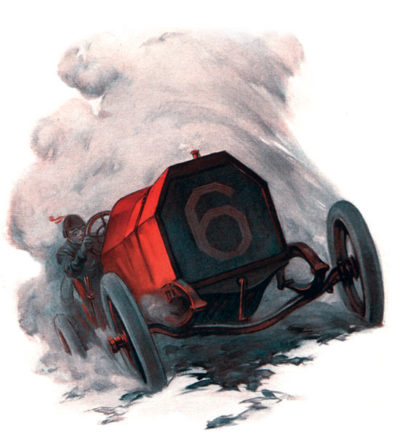
Automobile Racing
Fousey
October 23, 1909
Motoring milestones and other features about the early automobile can be found in the Post’s Special Collector’s Edition: Automobiles in America!
The Inventors
1885
Click it. Edward J. Claghorn of New York receives patent for seat belt.
1887
It still spills all over his shoes. First gas pump is patented by one Sylvanus Freelove Bowser.
1891
Range: 50 miles. Top speed: 20 mph. First successful electric car built in U.S. by William Morrison.
1895
Gasoline firsts. Duryea Motor Wagon Company is earliest company formed to build gas-powered cars. (But Winton claims first auto sale).
1896
Officer, I didn’t see her coming. In the first recorded auto accident, a Duryea Motor Wagon strikes a woman on a bike, breaking her leg. Driver spends night in jail.
1898
Going without the “Flo.” First auto insurance policy is purchased by Dr. Truman Martin of Buffalo, New York. $5,000 in liability coverage costs him $12.25.
Doing the best they can. New York City Police Department uses bicycles to chase speeding motorists.
1901
Rules of the road. Connecticut enacts first speed limit law for motorists — 12 mph in the city and 15 mph on country roads.
1903
A real adventure! Horatio Nelson Jackson and Sewell K. Crocker are first to drive cross country. 64-day trip is made in Winton Touring Car.
What’s in a number? Massachusetts is first state to issue license plate. It’s made of porcelain.
I can see clearly now. Inventor Mary Anderson develops first windshield wiper. Manual device is operated by a handle. Automatic wipers would arrive in 1917.
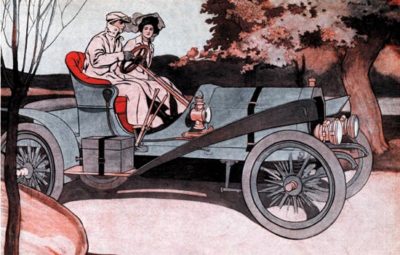
Oldsmobile advertisement originally appeared in the Post on May 5, 1906
1904
Pull over! First paper speeding ticket is issued in Dayton, Ohio, to Harry Myers for going 12 mph in a 5 mph zone.
Pull over, part deux. U.S. surpasses France in car production.
1905
Temptation for speedsters. H.H. Buffum produces first American V8.
Dirty rags and all. First purpose-built U.S. gas station is recorded in St. Louis.
1909
POTUS gets a lift. The first official White House car is a 1909 White Steamer, ordered by President Taft, over congressional objections about cost and safety.
Ahead of her time. 22-year-old Alice Ramsey is first woman to drive cross country. Trip is made in Maxwell DA touring car and takes 59 days.
The Innovators
Birth of a classic. The first running of the Indy 500. Winner Ray Harroun averages 74.6 mph.
Watch out behind you! The first rearview mirror is used by Harroun in Indy 500. (Other drivers placed their mechanic in the backseat to keep an eye out for cars coming from behind.)
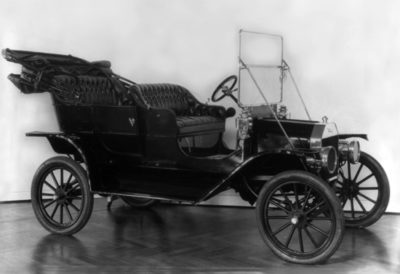
Model-T
1913
Chevrolet makes its marque. The iconic bow-tie emblem appears for the first time on 1914 models.
1914
Hard bodies. Dodge introduces first car body made entirely of steel.
Cadillac produces its signature V8. Known as the L-head, the engine is first mass-produced, water-cooled V8.
It’s a machine, but you have to obey it anyway. Cleveland installs first electric traffic light.
1915
Noise ordinance to follow. The first car to get the horn button in the center of the steering wheel is the Scripps-Booth Model C. In another first, the car sports electric door latches.
Now that’s power! Packard’s Twin-Six is first production car to offer a V12. The car, used in Italy during WWI, would later inspire Enzo Ferrari to design a V12 of his own.
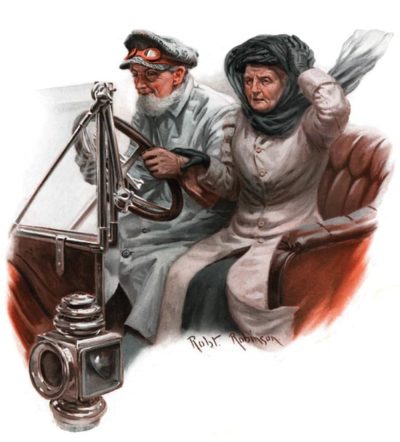
Robert Robinson
January 11, 1913
1916
Federal Aid Road Act. President Wilson signs law giving federal aid for state highway costs.
Ford leads the way. As prices drop and production surges on the Model T, Ford captures 55 percent of the auto market. The record has never been beaten.
1918
Stop, go, and huh? First tri-color stoplight is installed. In Detroit, of course.
Cars for All
1921
Design fails to include arches. The first drive-in restaurant in the U.S., J.G. Kirby and Reuben W. Jackson’s Pig Stand, opens in Dallas.
No umbrella? No problem. Hudson introduces the Essex Coach, the first affordable enclosed sedan, marking the beginning of a shift away from open vehicles. By the end of the decade, nearly 90 percent of all cars feature a closed carriage.
1922
Huge difference in stopping power. The Duesenberg is first to offer four-wheel hydraulic brakes.
Finally, a car for the whole family. The first production station wagon is offered by Star, a division of Durant Motors.
They didn’t reckon on Howard Stern. The radio is offered as an accessory for the first time.
1925
Sleepover date! First motel opens in San Luis Obispo, California.
Dogs and kids in the back. The first factory-assembled pickup truck is based on the Model T, but with rear cargo box. It sells for $281.
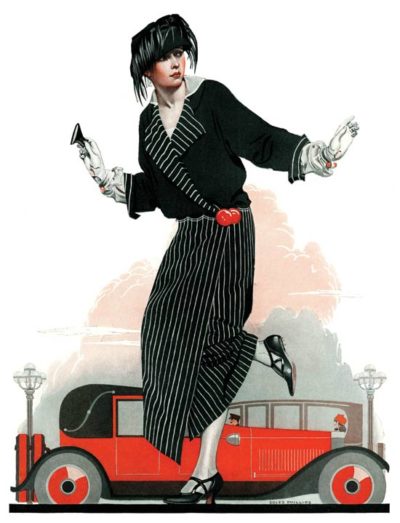
Coles Phillips
September 23, 1922
1926
Easy turning. Pierce-Arrow is first to be outfitted with power steering.
1927
15 million sold. The Model T, by the end of its run, hits a sales milestone.
New kid in town. Ford replaces the Model T with its (second) Model A, powered by a four-cylinder 40 hp motor. The car sports innovations such as safety-glass windshield, roll-up side windows, and three-speed transmission.
1928
Lincoln Highway completed. First road to span America, running from New York to San Francisco.
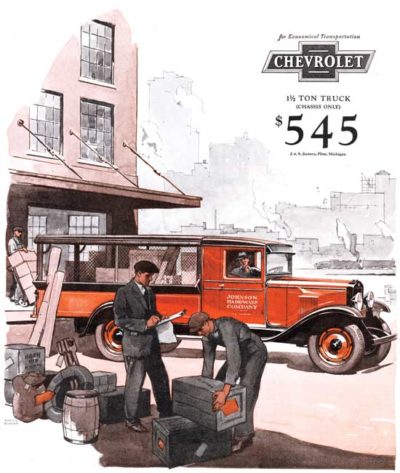
Chevrolet advertisement originally appeared in the Post on August 3, 1929
The Classic Era
1930
Power surge! Cadillac 452 series is first production V16.
Hey! Slow down! There is still no speed limit in 12 states.
Whiz kid. Billy Arnold crosses 100 mph barrier at Indy 500: average speed 100.448 mph.
Anything for the record books. Charles Creighton and James Hargis drive roundtrip from New York to Los Angeles using only reverse gear. The trip, in a Ford Roadster, takes 42 days.
1932
Bigger is better! Ford introduces its famous flathead motor. The V8 becomes an option in the Model B and 18. Later that year it becomes an option in Ford trucks.
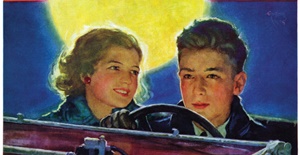
Moonlit Car Ride, Eugene Iverd, January 7, 1933
1934
No such thing as bad publicity. Bank robbers Bonnie Parker and Clyde Barrows endorse the 1934 Ford Model 730 Deluxe Sedan: “I have drove Fords exclusively when I could get away with one. It has got every other car skinned, and even if my business hasn’t been strictly legal it don’t hurt anything to tell you what a fine car you got in the V-8.” Ford responds with thank-you note.
1935
The original one-armed bandits. The first parking meters go into service in Oklahoma City.
Strength in numbers. United Auto Workers union is formed.
The hard part is remembering to switch them off. Flashing turn signals introduced. (They become standard on Buicks in 1938.)
1936
Rig Leader. Ford is tops in truck sales with 3 million units sold.
1937
Song to follow. Route 66 completed.
1939
Look ma, no hands! GM introduces first fully automatic transmission, the Hydra-Matic Drive, in its 1940 Oldsmobile models.
Mort Künstler on Painting the American Adventure
Mort Künstler is revered today for his intricately detailed and painstakingly researched historical paintings, but those works tell only part of the story of his extraordinary 60–year career. This is a man who loves to paint, or rather lives to paint, a man who will tell you he gets as much satisfaction creating an ad for household soap as crafting a fine-art portrait of Lee and Grant at Appomattox. And indeed, before turning his attention to great moments in American history, Künstler took on all commissions, painting innumerable magazine illustrations — including for the Post — as well as advertisements, book covers, movie posters, even model kit box covers and stamps. In fact, if you think you don’t know his work, well, it’s almost certain that you’ve seen it in some form somewhere.
Künstler was born in Brooklyn, New York, in 1927. His parents recognized his talent at an early age and bought him art supplies and drawing lessons before he started school. Sickly as a young boy, he began exercising and developed into a talented athlete, becoming the first four-time letterman at Brooklyn College. After three years, he transferred to UCLA on a basketball scholarship, but soon returned home when his father suffered a heart attack. Back in New York, he enrolled in the Pratt Institute.
After graduating from Pratt with a certificate in illustration in 1950, Künstler quickly found work. Simply put, his artwork sold magazines, and publishers kept coming back for more.
Even as he was composing lurid covers for men’s adventure magazines (a soldier blasting his way through a pack of rabid wolves with a machine gun; a furious grizzly hoisting a hunter in its jaws), Künstler showed a knack for engaging the viewer in a human way reminiscent of Norman Rockwell. “Mort has the ability to express the power of the individual, often at a moment of triumph, confusion, or humor,” says Martin Mahoney, director of collections and exhibitions at the Norman Rockwell Museum.
A 1966 assignment from National Geographic on the early history of the town of St. Augustine and another one on the discovery of San Francisco Bay would be game changers for the artist.
Employing his innate sense of drama, he brought these historic moments to life. Soon, he was painting scenes from the Civil War. Mahoney describes his own excitement when, as a boy, he was given a copy of Künstler’s Images of the Civil War. In the introduction to a major exhibition of Künstler’s work that Mahoney curated at the Norman Rockwell Museum, he describes the book as “a tipping point. … Suddenly the events of the era crystallized, and historical figures that lived, breathed, and died during this traumatic period of our country’s history became real.”
These historical paintings also reveal Künstler’s evolution as an artist, says Mahoney. “You see that he’s capturing that moment of excitement, which comes from adventure illustration, but he really began to develop his research chops as well as his artistic ones. He’s getting the saddles right; he’s getting the way the mule is loaded correctly; he’s got the way the cloaks will fall if you’re riding a horse.”
At 89, Künstler has no intention of slowing down. His paintings today fetch up to $250,000, and many adorn museum walls and are featured in traveling exhibitions, including a new one — Mort Künstler: The New Nation — at the Heckscher Museum of Art in Huntington, New York, running through April 2. I was able to squeeze in a phone call during a brief break in his busy work schedule.
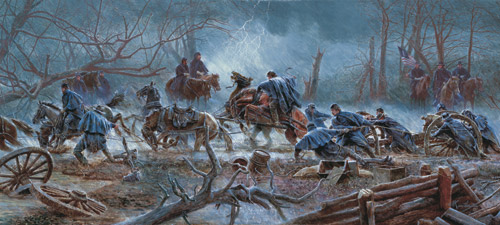
From the original painting by Mort Künstler, The Mud March © 2005 Mort Künstler, Inc.
Steven Slon: You’re a master of what’s often called narrative art — which is a fancy word for illustration. And you certainly are a rarity in the sense that most successful artists today, the ones whose work is in museums, tend to be abstract artists. But you, like Norman Rockwell, have always stayed true to the kind of art that tells a story.
Mort Künstler: I don’t know if you know this, but I own seven Rockwells.
SS: I did read that you were a collector and a fan.
MK: I am sitting in a room right now, looking at one of Rockwell’s magnificent Post covers from the ’30s. I also have the two full-scale charcoal drawings that he did from life of the two models. So the three works hang in a row here on this one wall. What’s so fascinating when I look at this picture is that I see the stuff that he changed from the studies that he did. Some of the changes I don’t even agree with, but every one was done for a reason — the folds in the clothing for the final version, for example.
You get to see the thinking. I just love that.
SS: What did you learn from studying Rockwell?
MK: The key thing is the way he creates a character. I am very conscious of characterization. And storytelling. It’s immediate, his storytelling ability. Also, people don’t understand what a great designer he is; he makes the eye go where he wants it to go. And that, too, I tried to learn from him. He uses every element, such as color, line, perspective — every device — to call attention to the story, never losing sight of the story. All this I learned from Rockwell and the other great illustrators, such as J.C. Leyendecker, who I also collect. Rockwell studied Leyendecker, who was another master of telling a story.
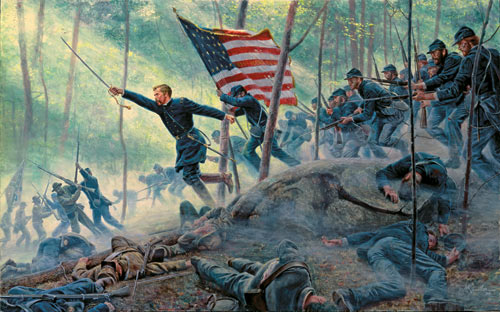
From the original painting by Mort Künstler, Chamberlain’s Charge © 1994 Mort Künstler, Inc.
SS: Is there anything specific about how Rockwell painted that drew you to him?
MK: Hands are very difficult to do, probably more difficult than faces, and Rockwell’s hands were always impeccable. I always try to get hands in a picture, because hands can be as expressive as faces. I knew so many artists that would look for shortcuts; they would hide the feet in the tall grass and the hands in pockets. But I would put a hand on the guy’s chin if that’s what was needed, just to get hands in.
SS: What distinguishes your work from Rockwell’s?
MK: I do complex things, frequently with many more characters. I seem to have a knack for action and complexity to tell the story.
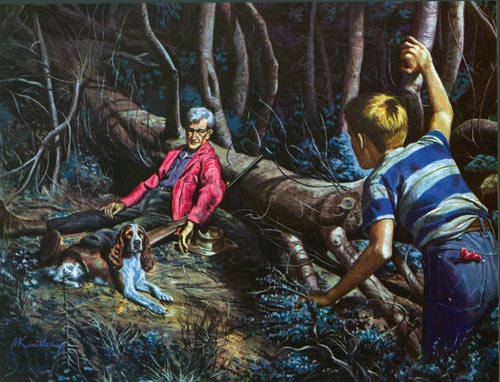
© SEPS; From the original painting by Mort Künstler
SS: Yes, Martin Mahoney, who curated your recent show at the Norman Rockwell Museum, pointed out that you have an ability to create these moments of intimacy, even in your cast-of-thousands Civil War battle scenes. Every one of your characters is real. They’re not just extras, not just generic soldiers.
MK: Well, Rockwell did that, too. He would be up on a ladder, for example, painting a scene at Grand Central Station or Penn Station, with crowds of people coming and going, and you look, and every character is different.
SS: Rockwell always considered himself an illustrator. What, if anything, is the distinction between fine art and illustration?
MK: You’re correct that Rockwell always said that he was an illustrator. But after all, so was Michelangelo — his page size was different, his art director was the pope, and his publisher was the church. So, to me, the biggest distinction is whether you’re commissioned to do the work or not. Some of the stuff they call fine art in museums is the worst garbage I’ve ever seen.
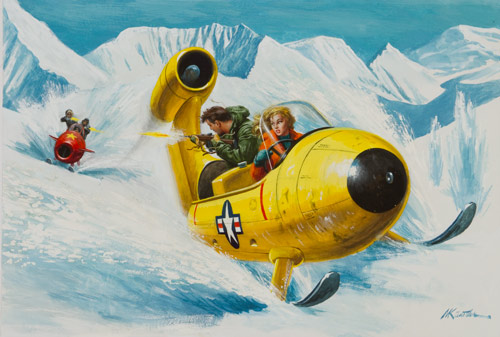
Jet-Sled Raid on Russia’s Ice Cap Pleasure Stockade © 1967 Mort Künstler, Inc.
SS: A question I asked Martin Mahoney, which I’m also putting to you, is, what causes an artist’s work to rise from a category of commercial excellence, let’s say, to being museum-worthy? He answered by pointing, in your case, to the way you evolved.
MK: Well, I started out in the early ’50s with all these men’s adventure magazines, which were flourishing at the time, and it was low-paying work, and I got a lot of it. And, because I was good at it, I ended up getting paid twice what everyone else did without asking for a raise. It seemed my covers sold the magazines, and other publishers started to call. What it did was start me off in this direction of action, complexity, and telling a story. If you look at everything throughout my career, you’ll see that it’s all based on this early training. That’s what prepared me to do all sorts of genres later.
The constant through my career is that I have enjoyed every minute of it. I remember doing some advertising art, a woman holding a cake of Camay soap. Now, advertising paid well, and it was very easy work compared to the men’s adventure magazines. But I had as good a time painting that as anything I’m painting today. I just enjoy pushing a paintbrush I guess.
SS: Other than the pleasure of painting, what else drives you?
MK: In the early days, what I think drove me was that I couldn’t believe that I was being paid to do this work. When I got my first job after art school, the illustration field was already dying. It was the ’50s and, as you know, the big magazines that still relied on illustration were the Post, Collier’s, and Liberty. But people were getting into TV, and magazines were just folding or turning to photography. But I was getting this work and making a good living. I couldn’t believe that, and when I saw my work getting reproduced, I was so thrilled. When I got my first check, I said to my wife, “I can’t believe they pay you for this!” Pretty soon, I was making quite a bit of money, but I was working all the time. There was no Saturday or Sunday. Now, I do take weekends off.
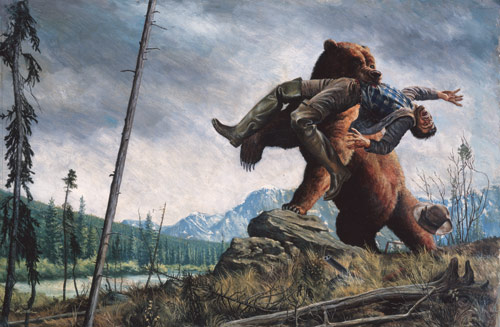
From the original painting by Mort Künstler, The Shy Killer © 1955 Mort Künstler, Inc.
SS: You were quoted once as saying that the secret to being successful as an artist is the three H’s: the hand, the head, and the heart.
MK: When I say the hand, I mean you should be able to draw and paint; otherwise, you shouldn’t even be thinking about it. The head, you have to say, “By God, what can I do — given that everyone can draw or paint as well as me — what can I do that’s going to be different?” The heart part is, if you don’t have the passion or the desire to paint, then all the rest is gone.
SS: One of the things that’s fascinating about your work is that you create images that couldn’t be replicated by a camera.
MK: I always go with the premise, why bother with painting a picture if a photograph could do it? That was a major problem with the first space shuttle, because I was commissioned by Rockwell International to document it, and it ended up being the most photographed event in history. I think there were more than 2,000 photographers there. By examining it, looking at it in every possible way, I came up with the one angle that cameras could not get. It was from the point of view of an escape route that was kept clear so the astronauts could get out if something should happen on the launch pad. And of course, I painted another one from high above the shuttle looking down as it is being launched, another unique perspective.
SS: What are you working on these days?
MK: I have a big one in the works about baseball during the Civil War. About three years ago, I decided I’m not painting any more Civil War. I felt I had painted everything I had to paint on the subject. Turns out, I got drawn in again thanks to a book, Baseball in Blue and Gray: The National Pastime during the Civil War. Now, most people think the sport developed later in the century, but baseball had actually become popular in the 1830s based on the English games of rounders and cricket, and by the 1860s it was quite popular. So my painting is of a game played on the White House lawn during the war. It’s an autumn scene, so the leaves are turning. There are pretty women in gowns watching the game. The men have taken their jackets off, and you can see that they’re servicemen. I’m very pleased with it so far.
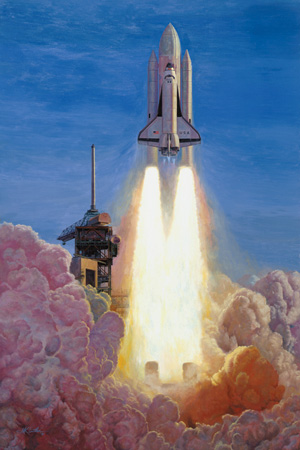
From the original painting by Mort Künstler, Launch of the Space Shuttle Columbia, April 12, 1981, 7:00:10 © 1981
SS: As you look back today on all your work, all you’ve accomplished, is there anything you wish you’d done differently?
MK: Not a thing. I will say that, early in my career, I worked myself to the point where we were doing very well financially, but I was ignoring my family. My wife was smart about it because she was on the verge of leaving me. That’s when I realized the men’s adventure magazine people wanted my work so much, and they were paying so well. Instead of just working all the time, I’d work half-time, and we’d enjoy ourselves with our three kids. So we picked up and moved the whole family to Mexico and lived there in 1962 and 1963. I did half of what I was doing before, and we spent our time traveling, having a good time. In fact, for a while, we even considered living there permanently. But after a year, we came back to the U.S. I look back upon that as a great experience, one of the best of my life.
So, no, I can’t say there’s anything I’d do over, anything at all. I’ve enjoyed it all the way, and I’m still in disbelief at my good fortune, because, really, I’ve never worked a day in my life.
Steven Slon is the editorial director for The Saturday Evening Post.
Getting Home
I’m driving my son, Michael, down to this fundraiser at the Canton Public Library so he can get his ball glove signed by Willie Jackson, the All-Star outfielder for the Cleveland Indians. He’ll never know that I tossed around the idea of just giving him a model rocket for his birthday instead. Last time I saw Willie Jackson, we played together on the Little League Red Sox, and things didn’t end too well. But here we are gliding along I-77 South. The pale dome of the McKinley Monument crouches before the skyline of a few hotels, bank buildings, the Stark County Courthouse, church steeples, a radio tower and factory smokestacks in the distance. Things haven’t changed here a whole lot since the ‘60s. Maybe less pollution since the factories closed.
“This will be great.” My son slaps the ball into his glove then reaches over to the radio.
“Yep,” I say, though I wish we were going someplace else. When Michael was about 5, I came home and found my wife making out with some strange guy on our couch. I don’t know what bothers me more: the fact that since she followed her lover to California, she hasn’t even sent Michael a card or that I’d chosen someone like her to make a home with. But since his mother and I divorced, I learned that as a single parent, you just can’t avoid talks with teachers about improving homework or reprimands from coaches about being on time for practice or driving downtown to meet someone you’d rather not see. It’s times like these I wish my father had shown a little more effort teaching me how to deal with things.
Michael turns the volume up on WINW’s 1987 Top 40 Countdown. “I wish you’d take me to an Indian’s game.”
I just nod. I hate the sport, because I was forced to play. But he loves it. I suspect he chalks up my apprehension to the idea that I don’t like baseball. But he doesn’t know why. I never told my son about Willie Jackson and me. It should’ve been easy enough to forget; after all I’d been only 12, a year older than Michael will be later this month. I’d boxed up those memories good, along with my old glove, cleats, comic books, and Civil War relics, and packed them all away in the garage. Still, I can’t get Willie’s bloodied face out of my mind.
Michael whistles to the radio with the feeling of a kid who’s getting what he wants. In my side mirror, the pale dome of McKinley’s monument ascends just above the surrounding trees from the park below.
My dad whistled and then puffed his soggy Dutch Masters cigar as he took me to practice. He drove down our street in the ‘66 Oldsmobile Toronado — the new car he bought when he was appointed to the mayor’s cabinet as safety commissioner of Canton. The car retained a slight plastic new car smell underneath the musky odors of cigars, sweat, and Old Spice. I liked the car because its sleek fins and hidden headlights made it look like a sporty spaceship.
Earlier that summer, on our vacation to Gettysburg, I pretended the car was fitted with laser beams and force fields. My mom smiled while reclining with a paperback in the backseat, but Dad had scolded me for messing with the knobs on the dashboard.
“I bet you could show Tom a few things,” my father said.
“He’s better than me.” I countered. Tom, my new friend, was playing for the first time in the Canton Little League. He’d just moved up from Texas. His father worked at the school district bus garage as a mechanic. My father was a politician.
Dad winked at me, and I knew that meant he was going to start one of his “beginning of baseball season” lectures.
“Choke up on the bat and stand your ground. No squatting,” he said, steering with two fingers and smoking the cigar with his free hand.
I nodded. Driveways, lawns, and side streets passed while I traced the path I’d taken the year before through alleys and backyards when I’d walked home from practice with Willie Jackson.
“And when you step up to the plate, look the pitcher in the eye. Then take a couple of quick swings.”
I listened halfheartedly. I was looking forward to seeing my friends, but I’d have been just as happy hanging out in my driveway, playing with matchbox cars, army soldiers, and sketchpads. I even preferred drawing sketches of The Avengers, Metal Men, or Gunsmoke Western, rather than follow the RBI or home run records of Rocky Colavito and Luis Tiant the way my father and Tom did. Being labeled the “creative” one by my mom didn’t console me. All that meant was I’d rather use my Louisville Slugger to imitate John Wayne charging the beachhead in The Longest Day than honor the sacred purpose it held for my dad.
“Don’t forget always keep your eye on the ball,” my father said.
I knew he meant for both batting and fielding. He hadn’t yet put me through the drills in the backyard. I would have to catch every grounder, line drive, and fly ball he threw at me, or else we would start over. My father had told me that even though he’d only signed on with the Phillies after the war for a season, he knew he’d need routine and discipline to become great. One night, we stayed out after the sun had long set, and he kept throwing harder balls. He only stopped the routine whenever he needed me to run into the house and get him another Blatz or to turn on the floodlights. I pretended to be sick the next time he asked me to practice. He made me practice with him anyway. To spite him, I kept missing the ball. He just smirked, sipped beer, and kept throwing the baseball.
Dad drove along Harrisburg Avenue, next to the railroad on the way to the park. I imagined we could blast off above the ballpark, the tracks, and the small ranch homes, to a place where it was somehow open and blue. As usual, though, only gray skies prevailed.
That ballpark was oddly placed. The city planners seemed to have suddenly remembered this small patch of grass that neither the railroads nor the steel factories wanted. So they decided to herd recreation into the green and muddy space. The square field, crammed between its gravel parking lot and the train tracks that ran alongside a narrow strip of woods, held four baseball diamonds. In the hazy distance, the rusty gates of Republic Steel rose before the ballplayers like a metal dragon whose sulfuric breath I, and all Canton residents, had long learned to ignore.
I got out from the car, shut the door, and looked back inside.
Dad leaned forward, his face divided by a curve of light coming through the windshield, and said, “Hey, Petey, can you get a ride home with Tom’s dad? I’ve got a meeting to get to.”
I nodded but wondered what kind of meeting he needed to go to on a Saturday. I learned a long time later that he’d squandered his savings on cards, parlays, and visits to the Thistledown Horse Racing Track near Cleveland.
I joined in, but dreaded, the batting, pitching, and catching drills to see who would play which positions. As usual, I ended up in the outfielder’s group, but this year with Tom and Willie. I was glad to have Willie on our team again because no one in the whole league could run faster or hit harder than him. We stood in a circle, and tossed to one another. I bragged about my family’s trip to Gettysburg and the Civil War-era Spencer .52 caliber bullet I’d brought with me to show Tom later.
“What’s so great about Gettysburg?” Tom shouted, and he lobbed a fly ball to me. “My dad and I seen Fantastic Voyage and El Dorado. You should’ve came.”
I recognized the hint of envy in my friend’s voice, and I felt sorry that I’d mentioned the vacation at all because I knew neither of them would be going anywhere that summer. I became self-conscious about my new cleats, for Tom had on the one pair he’d use for practice and games, and Willie wore gym shoes. One of them should’ve been wearing these new baseball shoes. I tossed the ball to Willie and asked, “So, Willie. You do anything this summer?”
Willie kicked the dirt, looked up, and caught the ball. He looked at me and said, “Working at my uncle’s garage.” He fired a line drive over to me, and I winced as the ball slapped hard against my palm.
I tossed a high fly ball in the air between Tom and Willie. I followed the ball’s rising arc, imagining it was spinning out a web from my palm like it would from Spider-Man. I hoped Tom would get to the ball first, but Willie easily outran him.
“Hey,” Tom said. “That was mine.”
Willie looked at me, then back at Tom. He shrugged his shoulders, and flipped the ball to me. “Tough luck.”
We continued our warm-ups, trying to see who could go the longest without dropping one. As we played, I looked at them and realized that I’d known Willie longer but had already spent more time with Tom. My father had hired Willie’s dad and other black cops, he said publicly, because the city needed a more representative police force. But my father would make fun of blacks driving in big cars — as if they all were cheating welfare.
I never told Willie, or anyone, about that. Not that I’d had the chance. We’d walked home from practice only once the year before. Even though we both liked art class on the odd rainy day when the nuns offered it, we hadn’t become good friends.
The coach called us in. He made up two sides and began the team’s first practice game. In right field, I missed a line drive that bounced wildly just before reaching me, and when I caught the only fly ball that came to me, Tom took off his glove, and clapped.
I liked Tom’s antics. He’d been allowed to spend the night at my house several times, and though we had different ideas about what was fun, I went along with my friend’s suggestions. Our hide-and-seek play brought us from the dark alley behind the Lawson’s store, where we choked on a Lucky Strike he’d taken from his dad’s pack, to the sad grounds of the old Presbyterian cemetery, where we reenacted Boris Karloff films with the Miller twins, who acted out the helpless female victims. The last time he stayed over at my house, our fathers, looking strangely identical in Bermuda shorts, sat around the TV drinking Blatz in frosted mugs. Tom’s father had even invited me to go with them the next time they returned to Texas for a visit.
The coach blew the break whistle, and everyone jogged up to the water fountain. Tom, Willie, and I were last in line.
“That was some hitting, Willie,” I said.
“That’s nothing,” Willie said. “I’m gonna hit a grand slam next week.”
At the water fountain we took turns drinking. Last year we all got wet because we’d sprayed each other at the water fountain. Now the coach patrolled the area.
A few boys chanted “Willie” as he took a drink.
The coach pulled off his red cap with his left hand and rubbed his oily hair back with his right hand. He spoke in a tone of approval that I knew I’d never get. “Jackson, keep hitting like that, and we’ll make the play-offs.”
Willie paraded his glove around like a trophy.
Tom whispered to me, “Look at that show-off.”
My gut tightened. “Don’t say that.”
“Why? He ain’t your friend.”
I didn’t know how to answer that because, in a way, Tom was right. I’d never spent any time with Willie outside of school or baseball. I suppose that had to do with how my father kept our home separate from his public duties. He never suggested that I invite Willie over to our house. Still, something felt wrong about what Tom said. So, I had to do something to show him that he shouldn’t act that way.
I held the .52 caliber bullet in my hand and arranged it between my fingers so it pointed out. I moved it toward Tom and tapped him on the chest. “Bam. You’re dead.”
“What’s that?” Tom asked.
I opened my hand and let it roll in my palm. “The Civil War bullet I got at Gettysburg.”
“Huh. Looks like a pebble is all.” Tom rolled his eyes and half-smiled in a way that told me he was scheming. “Watch this.” He picked up a few gray stones from the gravel lot and walked back toward the field. He pointed to the backstop where two crows perched on the thick silver frame bar. Tom aimed and flung a stone. It arched just over the head of a crow. The bird cawed and then flew up into an oak tree.
“Let me try,” I said. My stone missed the other birds and hit the metal bar, causing a ring that echoed like a ricochet in a Western film.
“You couldn’t hit a barn,” Tom said, and he took aim, and threw at the oak tree.
Willie joined us and said, “Pete, you wanna walk home later?”
Before I could answer, Tom held out his palm of stones and said, “Hey there, Willie Mays. Let me see ya hit one of them crows.”
“I don’t wanna.”
I grabbed one of the rocks and threw it at the crow in the oak. The crow cawed and Willie shook his head. Tom snickered. I kicked the dirt, averting my glance from his.
“Watch this,” Tom said and grabbed Willie’s hand to put a rock in it. “Throw it, you sissy.”
Willie pulled his arm away and stepped back but looked Tom in the face. “Man, don’t touch me. I said no.”
“You afraid to hit a little ole bird, Willie Mays?”
“Name’s Jackson, you punk. And leave them birds alone. They didn’t do nothing to you.”
“Who you calling punk?” Tom yelled, just as the coach blew the whistle for practice to resume.
My teammates and I suffered in the humid grass, missing line drives and fly balls. The coach shook his head. His remedy was to make us “work it out” by running laps at the end of practice. As we ran, I thought about Willie’s question. Then I turned to Tom, jogging alongside him, and said, “Hey, Tom, I think I’ll walk with Willie today.”
Tom shrugged and said, “Suit yourself.” Then he sped up.
We headed down the path, lined with a row of hedges and withering lilac bushes that abutted the gravel embankment to the railroad tracks. Dust clung to the grass, the backstops, and our clothes. My throat burned for refreshment.
The others were gone by the time Tom, Willie, and I jogged around to the fountain. Someone, probably the coach, had propped up my Louisville Slugger against the backstop. Tom reached the fountain first and yelled, “I’m king of the water fountain!” Then he sprayed water toward us. I ran into the spray as if I were five years younger. The water felt cool on my gritty face.
Willie said, “Man, I jus’ wanna drink.”
Tom hogged the water fountain, then stepped away to let me have a drink. The water tasted cool and metallic, but I felt relief.
“Hurry up, man,” Willie said, tapping me.
“What for?” Tom said. “This fountain’s for us white kids.”
For a moment I heard nothing but the sound of the water gurgling beneath the pipes and bricks. I thought that at any second Tom would reach out to shake Willie’s hand or say he’d been joking. But he didn’t. I backed away and stared at Willie.
Tom stepped between the fountain and Willie. “Ain’t that right, Pete?” he asked over his shoulder.
I didn’t answer, but I laughed a nervous laugh. My heart beat fast. My gut twisted. Why didn’t Tom understand that people up here didn’t talk in public like that? Didn’t he watch the news?
Willie planted himself in front of Tom and said, “What’d you say?”
“I said you ain’t allowed to drink here.”
“That so?” Willie said, never taking his eyes off Tom. A plane growled across the reddened sky. The crows behind the backstop cawed.
Willie looked calm. He turned away, took a step, then spun and punched Tom in the face.
Tom’s nose bled quickly, and he swung at Willie, and missed.
Willie hit him again.
Tom lunged, and they wrestled and grunted in the grass and dirt.
I felt my insides spinning, but when I closed my eyes for it to stop, I felt as if the ground spun around, like the feeling I’d get when trying to stand still just after getting off the Twirl O Wheel at Meyers Lake.
Tom freed himself and ran to the backstop. He picked up my bat.
Willie charged him.
But Tom made a half-swing and brought it down on Willie’s face, just above his right eye. The wood thumped against Willie’s head.
I cringed. Blood trickled down, and Willie struggled to hold Tom back while wiping the blood from his eye.
I wanted all at once to do something brave or stupid, but I just watched.
Tom kicked him in the balls. He brought the bat down across Willie’s back.
Willie fell.
Tom stood over him.
Willie shot a glance at me for help. A red trail curled into his eye socket, but he didn’t close his eyes. The blood gathered there, and dripped like a long tear down his cheek.
My shoes seemed stuck in tar.
Willie used his right hand to cover his bloody eye while he blocked the bat with his left. I heard gravel crunching and looked up to see Tom’s dad pulling up in their Dodge Charger.
Mr. Schauer, in his work overalls, ran over and said, “What’s going on here?” He lifted Tom off of Willie and wrestled the bat from his son’s hands.
Willie got up. He stumbled against the backstop and the metal fencing rang out like snapping telephone wires.
Tom wiped blood from his face with his sleeve. “He started it.” I recognized tremors of pain and fear in my friend’s voice.
“Bull,” Willie said. He used the bottom of his T-shirt to wipe blood from his eye.
Mr. Schauer pointed the bat at Tom and shook his head. “What the hell makes you think about a bat, huh?” For a second every muscle in his body struggled under some invisible pressure … as if he wanted to hit Tom. “Didn’t I teach you?” He flipped the bat onto the grass away from the three of us. Then he turned to me and said, “Why didn’t you step in?”
I wanted to walk home and never come back. My gut knotted up. Tom must have been hurt, but I couldn’t believe he’d actually used a bat on Willie. I’d never seen him so crazy. I looked at Willie on the ground, his back against the backstop, but he just turned his head away. I felt as if I’d swallowed my own heart whole; then, in quiet embarrassment, I said, “Tom said only whites could use the fountain, but that’s not true.”
“Come on, Tom,” Mr. Schauer said.
I looked down at my cleats until I heard their engine start. They drove over the gravel and up to Harrisburg Avenue. My chest went from hollow to heavy as I fought back tears. I left my bat on the grass where Mr. Schauer had tossed it. I didn’t want anything to do with it. I walked toward the fountain.
Willie stood, picked up his glove, and walked away.
I said, “Don’t you want a drink?”
“Nah,” he said.
I caught up with him. “You fought like Cassius Clay,” I said patting him on the shoulder.
Willie increased his pace, and I kept up with him.
“Willie, I’m sorry. I wanted to be on your side.”
Willie spun around quickly, facing me. “It’s Ali, Muhammad Ali, man. And I don’t need you to do nothing.” He turned to go, stopped, and looked back at me. “Walk your ownself home.”
Willie walked away on the gravel lot towards Harrisburg Avenue. Traffic snarled, and a gritty veil of exhaust fumes hovered over the vehicles. My whole body felt small and cold like the bullet I touched in the dark of my pocket. I wondered where my father was and hated him for making me play baseball.
Eventually, a policeman drove up, just on regular patrol, and, knowing whose son I was, gave me a ride home.
I faked sick the rest of the week. I didn’t show up for picture day. After missing a couple of games, I turned in my uniform. One Sunday morning, in our den, reading over the sports pages strewn across his lap, my father shook his head and said, “Quitting is no way to handle it.” That was all he ever said. It was strange because, after I quit baseball, I think he quit on me.
We stand at the entrance of the Canton Public Library in a line that stretches along the left wall of the meeting room. I know this because I can see the ghostly movements of Little Leaguers and their fathers reflected in the glass of the room’s open doors. They look as if they’ve come from all over the county. We propel along with the crowd and enter the room. The air is stagnant with leather and permanent ink pens, the sweat and excitement of young boys waiting to meet sports heroes. A large banner for the fundraiser stretches across the back wall. The famous athletes, stationed behind long rectangular tables near the back wall, reach across and shake hands with eager fans.
“There’s Willie Jackson. Cool,” Michael says, pointing to the table just ahead. “This is great, Dad.”
I recognize him at once. He is dressed in his Indians uniform, and his cap is tilted a little to the right. He looks like the Willie I knew, but larger, stronger. I don’t know if he’ll recognize me, or if I want him to. I can wait and see. I don’t have to tell Michael about what happened. But what if Willie remembers? What if he says something about it? How will I tell Michael? I start to feel closed in. I look around and notice the two red exit signs. Our place in line advances to the table. I could tell Willie about how Tom ended up dropping out of high school and getting busted for selling drugs. Maybe he’d feel some kind of sweet revenge. More than likely, however, he won’t even remember me. My stomach begins to spin a little like it did that day when we were younger and meaner. But I don’t close my eyes. I fasten them on his face where I imagine the tiniest of scars above his right eye.
He looks directly at Michael and says, “What’s your name, son?”
“Michael, Michael Flanagan.”
The athlete looks at me.
“Hey. I’m Pete. Pete Flanagan.”
A smile breaks on Willie’s face. He reaches out his hand and we shake. “Pete, man. How you doing? It’s been a long time.” He glances at my son.
Michael stares wide-eyed at the athlete then back at me. “Dad, you know Mr. Jackson?”
“Well, we were just kids, you know, Michael. I’ll tell you about it sometime.” I feel like a real idiot. Of course it was going to come out. I should have prepared Michael. I feel a strange distance opening up between us. I wonder how my father, the politician, would have handled this situation. I guess I’m doing no better.
“Well, I’ll tell you. Your dad and me played Little League back when we were your age. Your dad was a pretty good ballplayer, too.” He signs the glove, hands it back to Michael, and looks up at me, his large brown eyes searching mine for a more vivid memory. “It was the Yank — I mean the Red Sox.”
“That’s right.” I stop before saying more. One minute I’m coming here for my son, next minute I’m 12 years old myself. I don’t know what to call him or how to say anything that I might have come here to say. I’m trying to find words about Tom, about that day, about how I felt stuck in tar. Then I hear him clear his throat.
He glances over my shoulder, and I feel the impatient sighs of young boys and their fathers waiting for their turn.
“So what are you doing now?”
“I teach high school American history.”
“Well, that’s great,” he says and nods. He picks up a miniature souvenir bat with the Cleveland Indians logo and several autographs embossed on it. In his face I see a flicker of the old show-off. He swings, and then, releases the small bat in his right hand. It spins through the space between us.
I feel a small gust of air. I flinch involuntarily. I didn’t expect he’d fling the bat so close to my face. I notice his eyes, looking at me with the twinkle half gone. I detect a sense of disappointment in his smile. I should have done more with my life, they seem to say.
He catches the bat with his left hand and offers it to Michael.
“Thanks, Mr. Jackson.” Michael shakes Willie’s hand.
“My pleasure. Your dad gonna bring you up to one of our games?”
Michael looks up at me, and I realize I’ve let go of the phony smile I’d carried up to the table. I feel a swelling in my heart. I want to say something to Willie. I want to tell him I’m sorry now. That I should have done something. Maybe if I had, my life since then wouldn’t have been so sadly messed up.
Michael pulls on my sleeve. I bend down and he whispers, “Ask him for tickets, Dad.”
I know that Willie can hear him. I also know that I can’t stand facing him for another moment without saying something. I take a deep breath and face Willie. “Listen, I know this isn’t the best time, you know, to talk about those days. But I want to say …”
Willie raises his hands, palms facing me. “Don’t,” he says in his old defiant tone. Then, like that day at the water fountain, he turns away from me. He reaches for the next glove, but before he signs it, he looks back at me. My heart lifts with the hope that he might yet hear me out. He smiles wryly and says, “So, Pete, you ever get home?”
I flinch involuntarily at his remark. I realize that I’d hoped he’d say, “Forget it, we were just kids,” but he didn’t. I can’t think of anything else to say amid the noise of kids and their parents. I put my hand on Michael’s shoulder. “I did.” We finish the rounds of the other athletes, and all the while, I’m feeling like I’ve forgotten something. I look back and notice Willie spinning a bat and catching it for another fan.
On the ride home, Michael sits next to me cradling the small bat in his glove like a bird in its nest. He is all smiles and daydreams. We pull into the drive, and I turn to him. “Listen, Michael,” I say to him. “If you really want to go to an Indian’s game, we’ll go.”
“Yeah!” He lifts his glove, opens the door, and when he is halfway out, he turns around. “Can I hear more about you and Willie Jackson?”
We lean against the Taurus enjoying the sun. I tell Michael about that day. Not everything but enough so he understands the gist of it; the fight, the senseless reason for it, the outcome, and my freezing up.
For a few minutes he just kicks at the stones in the driveway. He shakes his head slightly. “Where was your dad?”
“I guess he was busy or something. But just so you know, Michael, you don’t have to stand by if something bad is happening. You can do something to stop it.”
His eyes tear. I can tell what’s coming next. My heart already feels the brunt of his anger and sadness.
“So why didn’t you stop her?”
I feel the thousand injuries that I have endured over the years since she cheated me and left, and I realize they’re nothing compared to the emptiness he has felt from a mother gone out of his life for no good reason. I can’t tell him why because I don’t know why she cheated. Only that she did have to go.
“Sometimes you can stand and do nothing, and bad will come from it. Sometimes you do all you can, and still it turns bad. But at least if you tried, then that’s what makes a difference.”
He leans into me like he’d do when he was younger, when it seemed we were both alone in our home without her. I hold him.
“What did Mr. Jackson mean about you getting home?”
“I guess he was asking if my life turned out okay.” I tighten my grip. “And it has, Michael. With you it has.”
He cries a little. Funny how one thing that bothers you will end up stirring up other things? I wonder if my father had done this, maybe shared with me a reason for his gambling, or anything, that maybe we’d have been closer. At least, right now, I feel at home knowing that Michael and I share this moment. One less regret. One less emptiness.
News of the Week: The Circus Leaves Town, an Alligator Visits, and We Have a New President
Goodbye Ringling Brothers
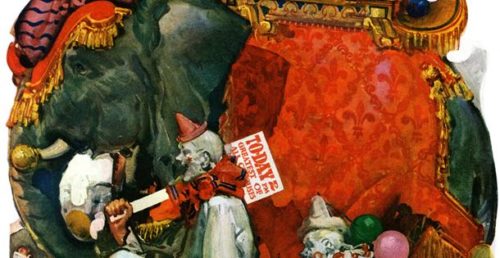
I went to the Ringling Brothers and Barnum & Bailey Circus once in my life, during a class trip in the late ’70s, and the only memory I have of it is of my friend Pete irritating the vendors. Our teachers specifically told us that if we wanted some tonic (which is what we in New England used to call soft drinks, and maybe some still do), we had to say “pop.” Of course, when you tell middle-school kids to do something, you can pretty much guarantee they’ll do the opposite, which is what Pete did. He told the vendor he wanted tonic, and when the vendor said to him “we call it pop,” he smirked and said, “well, I want tonic!”
The famed circus announced this week that it’s closing after a history that stretches back 146 years. Here’s a great Post Perspective on Ringling Brothers from David G. Wittels and Jeff Nilsson.
That’s Not an Alligator, That’s a Dinosaur
This looks like one of those fake viral videos that someone makes and we all believe it until it’s debunked a day later, but it’s 100% real. I have no idea why those people are just standing there filming it.
House of Wax
What is President Abraham Lincoln worth? $8,500.
I’m talking about his wax likeness, which went for that amount this week during an auction of wax presidents at the Hall of Presidents and First Ladies Museum in Gettysburg, Pennsylvania (the museum closed in November). Check out the pics of former presidents and first ladies being hauled off in this USA Today article. Bess Wallace Truman and Mary Arthur McElroy look like they’re going to star in a weird remake of Thelma & Louise.
Lincoln was the top seller, by the way. The wax version of Theodore Roosevelt went for $8,000, and Jackie Kennedy went for only $550. Outgoing president Barack Obama brought in $2,000.
RIP Miguel Ferrer, William Peter Blatty, Gene Cernan, Dick Gautier, Tony Rosato, and Tommy Allsup
Miguel Ferrer was a veteran TV actor, known for everything from NCIS: LA and Crossing Jordan to Twin Peaks and Desperate Housewives. He also appeared in Magnum P.I., ER, Will & Grace, Lateline, the Bionic Woman reboot from 2007, and dozens of other live-action and animated shows. You also saw him in movies like Iron Man 3, Star Trek III: The Search for Spock, Robocop, Traffic, Mulan, and many more. He’ll appear in the new Twin Peaks series on Showtime in May.
Ferrer came from a talented family. His father was actor Jose Ferrer, his mother was Rosemary Clooney, and his cousin is George Clooney. Ferrer passed away yesterday after a battle with cancer. He was 61.
I had no idea that William Peter Blatty had written the screenplays for the Pink Panther film A Shot in the Dark and What Did You Do in the War, Daddy? Of course, he’s most famous for writing the novel The Exorcist, which spawned several movies and a current TV series. Blatty passed away at the age of 89.
Gene Cernan was the last man to walk on the moon (but hopefully not the last, period). He did it during the Apollo 17 mission in 1972. He later went on to help develop the Apollo-Soyuz space mission. Cernan died on Monday at the age of 82.
You might know Dick Gautier from a million things, including the original production of Bye Bye Birdie in 1960 and TV shows like When Things Were Rotten, Mr. Terrific, Charlie’s Angels, The Mary Tyler Moore Show, and Love, American Style, as well as dozens of cartoons. But he is probably best remembered by classic TV fans as Hymie the Robot on Get Smart, even though he only appeared in six episodes of the series. Gautier passed away at the age of 85.
Tony Rosato was a comedian and actor who appeared on both SCTV and Saturday Night Live, as well as providing the voice of Luigi on the Super Mario Bros. TV series. He passed away of a heart attack at the age of 62.
Guitarist Tommy Allsup’s life was saved because of the flip of a coin. He was going to get on the plane that carried Buddy Holly and other musicians on February 3, 1959, but had to take a bus when he lost a coin toss to Richie Valens. Flying in snow, the plane crashed, killing everyone on board. Allsup went on to work with people like The Ventures, Roy Orbison, and Willie Nelson and produced several albums for Asleep at the Wheel. He passed away at the age of 85.
In brighter news, Betty White turned 95 this week!
Winter Books
In our current issue, we pick some great reads for curling up on the couch with on these cold winter nights, including J.P. Delaney’s thriller The Girl Before, Kevin R.C. Gutzman’s Thomas Jefferson — Revolutionary, Christopher Bohjalian’s The Sleepwalker, Douglas Preston’s The Lost City of the Monkey God, and Portraits of Courage, which showcases the paintings of George W. Bush. He’s actually quite good!
To that list I would add Please Don’t Eat the Daisies. Yes, I know it was released in 1957, but I’m just now catching up with it (I’m a little behind). It’s a really great read. It’s a book of humorous essays on family and work life by Jean Kerr (you may have seen the popular Doris Day movie), who wrote several pieces for The Saturday Evening Post, including “Children Really Are Not People,” which is included in the book (under the title “Where Did You Put the Aspirin?”). It’s out of print (a travesty), but you can search for a used copy online at AbeBooks.
This Week in History
Andy Rooney Born (January 14, 1919)
The acclaimed writer and 60 Minutes essayist talked to The Saturday Evening Post in 1984 about his career, how he handles his fame, and how woodworking is like writing.
Ronald Reagan Becomes Oldest President (January 20, 1981)
The 40th Commander-in-chief — a famous midlife career changer — was 69 years old when he took the oath of office. Donald Trump becomes our oldest president elected at the age of 70 when he puts his hand on the Lincoln Bible today.
USS Nautilus, First Nuclear-Powered Sub, Launches (January 21, 1954)
The submarine was decommissioned in 1980 after 26 years of service.
This Week in Saturday Evening Post History: Benjamin Franklin’s Birthday
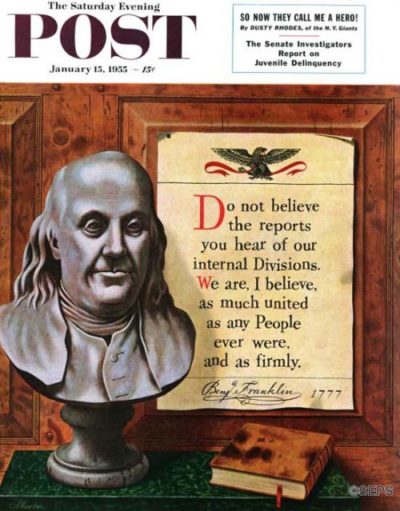
The talented Founding Father was born on January 17, 1706, and he’s partly responsible for the existence of The Saturday Evening Post.
Feeding the Presidents
By the time you read this, we will have a new president. I thought it would be good to link to some recipes that past presidents enjoyed.
Here’s George Washington’s Morning Corn Cakes, Dwight D. Eisenhower’s Vegetable Soup, Lady Bird Johnson’s Pedernales River Chili, and for dessert, White House pastry chef Bill Yosses’ recipe for Apple Pie, a favorite of the Obama family.
I mentioned above that Donald Trump would be sworn in today with his hand on the Lincoln Bible. Did you know that Lincoln loved gingerbread men? He did! He even mentioned it at the Lincoln-Douglas debates. Here’s the recipe.
As for Trump, we don’t know what his favorite meals will be in the White House, so until we learn more, we’ll just have to Make Vegetables Great Again.
Next Week’s Holidays and Events
National Handwriting Day (January 23)
Here’s what I think you should do next week: buy some stationery and some stamps and write an actual letter to a friend or family member, or even a company you’re mad at for some reason. It doesn’t matter, just write something. In this day and age of texting and short social media posts, you’ll be amazed at how good it feels, and the person who receives the letter will be shocked and happy. Handwriting still matters, no matter what some people may say.
Chinese New Year (January 28)
The Year of the Rooster begins in 2017, and the celebration lasts until February 15, 2018.
Inaugural Addresses: the Good, the Bad, and the Confused
This week, when a new president is sworn into office, America will hear its 58th inaugural address. The country has been listening to presidents’ introductory speeches since the tradition began 228 years ago with George Washington.
It’s surprising that we remember so little of those speeches.
We know the inspiring words of Lincoln’s second inaugural address: “With malice toward none, with charity for all…” And most Americans are familiar with the phrase, “The only thing we have to fear is fear itself,” even if they don’t know it came from Franklin Roosevelt’s first inaugural address. A generation was inspired by John Kennedy’s inaugural address, with its memorable line, “ask not what your country can do for you …”
The inaugural address has been the president’s chance to present the vision and goals for his administration, but it has also been a time to express his trust in the country and its people. This is how Theodore Roosevelt articulated it: “We have faith that we shall not prove false to the memories of the men of the mighty past. They did their work, they left us the splendid heritage we now enjoy. We in our turn have an assured confidence that we shall be able to leave this heritage unwasted and enlarged to our children and our children’s children.”
The presidents have also addressed the partisan divisions created by the electoral process. In 1989, George H.W. Bush noted the divisiveness in the U.S. “We have seen the hard looks and heard the statements in which not each other’s ideas are challenged, but each other’s motives. And our great parties have too often been far apart and untrusting of each other… the old bipartisanship must be made new again.”
It was the same message delivered by Thomas Jefferson back in 1801. Having won the presidency after a bitter campaign, he acknowledged that the election had produced strong words and hard feelings. But the election had been decided according to Constitution, and all Americans would “unite in common efforts for the common good. All, too, will bear in mind this sacred principle, that though the will of the majority is in all cases to prevail, that will to be rightful must be reasonable; that the minority possess their equal rights, which equal law must protect, and to violate would be oppression. Let us, then, fellow-citizens, unite with one heart and one mind.”
No president made a more eloquent appeal for national unity than Abraham Lincoln. At his first inauguration, he appealed to the southern states not to secede but to remain in the Union.
“We are not enemies, but friends. We must not be enemies. Though passion may have strained, it must not break our bonds of affection. The mystic chords of memory, stretching from every battlefield and patriot grave to every living heart and hearthstone all over this broad land, will yet swell the chorus of the Union, when again touched, as surely they will be, by the better angels of our nature.”
It hasn’t always been easy for presidents to find the right thoughts for the occasion, or the best words to express them. Some presidents tried too hard to present a tone of dignity and statesmanship. Take John Quincy Adams, for example, who launched his address with this overblown monster of a sentence:
“In compliance with an usage coeval with the existence of our Federal Constitution, and sanctioned by the example of my predecessors in the career upon which I am about to enter, I appear, my fellow-citizens, in your presence and in that of Heaven to bind myself by the solemnities of religious obligation to the faithful performance of the duties allotted to me in the station to which I have been called.”
William Henry Harrison put a lot of effort into his inaugural address and produced the longest speech ever delivered, even after Daniel Webster had edited it. It took Harrison two hours to deliver his address on a cold, wet day.
Warren Harding had been criticized for having little qualification for the office other than looking like a president. His speeches were filled with clichés and platitudes, and he was dismissed as less than bright. Then, in his inaugural address, when he said, “we must strive for normality to reach stability,” he accidentally said “normalcy,” which wasn’t a common word in 1921. His critics never let him forget it.
Why have some speeches inspired Americans with hope and purpose, while others have left them cold? According to a Post editorial from January 20, 1945, called “Has Our Ideology Run Out of Words?,” the empty, forgettable speeches, so common in modern America, come from a lack of direction. A speaker can reach the mind and hearts of Americans only if his goals are clear and positive. So, in this sense, an inaugural address is not simply a tradition. It is a weather forecast for the next four years.
Has Our Ideology Run Out of Words?
Originally published January 20, 1945
We were thinking the other day about the poverty of good phrasemakers in our public life, and it occurred to us that the probable reason for this poverty is our lack of a coherent sense of direction. Wading through the pages of The Congressional Record, you occasionally come across a competent speech floating in the bouillabaisse, but when you lay the Record down or when you finish reading a newspaper report of a speech, you feel like a man who walks home from a musical show slightly annoyed because there wasn’t a whistleable tune in the whole score. There is nothing to remember, nothing to clasp to the breast as if it were a happy discovery, nothing to cherish as if it were a bride or a new baby; only fustian and clichés set like crossbeams amidst an uninspired framework that a carpenter might toss up for a neighbor on a vacation week end.
Some of our public men, among them President Roosevelt, have a pleasing way of talking which makes commonplace phrasing, at the time of delivery, sound amazingly good, but the effect is theatrical and it wears off quickly. General MacArthur occasionally comes up with a rememberable sentence, but his phrasing is, on the whole, discouragingly florid. At the far end of the scale we have Secretary Ickes, whose phrasing and irritating delivery have done much to make unpopular both the English language and honesty in public office.
What brought all this up was a single sentence that cracked like a snapped thong during the Commons uproar on the civil disorder in Greece: “Democracy is not a harlot to be picked up in the street by a man with a tommy gun.” This masterful expression was molded in a man’s brain in the heat of debate — unless Mr. Churchill had it penciled on his cuff for just such an emergency — and it was one of the finest examples of forensic hip-shooting we have ever come across. Mr. Churchill, of course, is the master phrasemaker of the era. In the worst of crises he has been ready with phrases which have heartened Englishmen and men all over the world who were concerned with England’s fate. Anyone can remember at least two or three of them. Has Mr. Churchill a sense of direction? A Prime Minister of Great Britain cannot afford to be without one, and Churchill has stated his bluntly, to the annoyance of those who dislike candor: he didn’t, you may recall, become His Majesty’s first minister to preside over the liquidation of the Empire.
America’s destiny was not always as clouded as it is today. What we seem to be seeking is security, and security is a negative goal. In the Revolutionary period, and thereafter, we wanted not only security but more land to occupy. And in that era we had some historic phrasemakers, among them Washington and Jefferson. During the Civil War, when we gambled security to solidify the states into a true Union, there emerged Lincoln, a self-educated prairieman whose phrases added dignity to the language of America and to the language of free government. We haven’t seen his like, or anyone approaching his like, since then, unless it was Franklin Roosevelt stating, on March 4, 1933, that we had nothing to fear but fear itself. But, at that time, Franklin Roosevelt had a sense of direction.
Offhand, you might say that good phrasemaking was a symptom of healthy reaction to national danger, but, unfortunately, that diagnosis doesn’t fit the present situation. The people are in danger, and they are often spoken down to by politicians in terms of the baseball diamond, or of the radio commercial, or in the omniscient patter of the syndicated columnist. Our ideals are the victims, often of slang, but more often of good words which have lost their freshness through too much handling.
We don’t say that good phrases will confer upon a nation a sense of direction; rather, we feel that good phrasing among political leaders is, historically, symptomatic of a nation whose leaders have plotted a firm course. Words, even brave words, aren’t bullets or an adequate substitute for bullets, but they can supply men with the motivation for shooting bullets and for facing the bullets of an enemy. Sincerely and competently used, they can make nations do many fine things. They are the currency by which we conduct our trade in precious thoughts, and our currency is presently debased from slovenly phrasing and incessant repetition. We shall feel a good deal better when a few genuinely memorable phrases emerge from the mouths of our statesmen.
Featured image: Wikimedia Commons, SSgt Mark Fayloga / defenseimagery.mil, public domain

10 Most Bizarre Inauguration Facts
If you thought you knew everything about presidential inaugurations, here are some facts that might be new to you. Know of other interesting inauguration details? Tell us in the comments.
- Two presidents have taken the oath of office four times: Franklin D. Roosevelt (who was elected four times) and Barack Obama. At Obama’s first inauguration, Chief Justice John Roberts flubbed the wording of the oath. Obama re-took the oath in private a few days later, and then for good measure, recited the oath again in public. The oath for his second term brings the total to four.
- The podium at John F. Kennedy’s inauguration caught on fire because of a faulty space heater hidden under the lectern.
- At least three presidents did not swear the oath on a bible: John Quincy Adams, Teddy Roosevelt, and Lyndon B. Johnson. Johnson took the oath on Air Force One following Kennedy’s assassination, and in the chaos, mistook Kennedy’s Catholic missal for a bible.
- Three presidents didn’t attend the inauguration of their successors: John Adams, John Quincy Adams, and Andrew Jackson.
- The longest inaugural address was given by William Henry Harrison, who talked for more than two hours on a cold, wet day.
- The shortest inaugural address was George Washington’s second. It was 136 words long.
- The first president to wear long pants to his inauguration was John Quincy Adams. (Earlier presidents wore knee-length breeches.)
- Warren G. Harding was the first president to go to his inauguration in a car. It was a Packard Twin Six supplied by the Republican National Committee.
- Only one president both took and administered the presidential oath. William H. Taft took the oath when he became president in 1909, and later, when he was chief justice of the Supreme Court, he administered oaths to Calvin Coolidge and Herbert Hoover.
- The only president sworn in by a woman was Lyndon B. Johnson. Federal district judge Sarah Hughes administered the oath to Johnson on Air Force One, following Kennedy’s assassination.
Do You Talk Funny? Embracing Your Dialect
Today we mark Thesaurus Day, the anniversary of the birth in 1779 of Mark Peter Roget, author of 1852’s Thesaurus of English Words and Phrases. Today, the name Roget is synonymous with thesaurus in the same way that Webster means dictionaries. Thesaurus Day isn’t so much about a specific book, tome, volume, publication, or compendium, but is instead a time to reflect on and rejoice in the seemingly infinite variety of the English language.
When we have so many words that mean the same thing, why do we always seem to use the same ones? The following essay from English language expert and logodaedalist Richard Lederer illustrates how the synonym you choose, and how you pronounce it, is largely determined by where you’re from.
All-American Dialects
By Richard Lederer
Midway through John Steinbeck’s epic novel The Grapes of Wrath, young Ivy observes, “Ever’body says words different. Arkansas folks says ’em different, and Oklahomy folks says ’em different. And we seen a lady from Massachusetts, an’ she said ’em differentest of all. Couldn’t hardly make out what she was sayin’.”
One aspect of American rugged individualism is that not all of us say the same word in the same way. Sometimes we don’t even use the same name for the same object.
I was born and grew up in Philadelphia a coon’s age, a blue moon, and a month of Sundays ago — when Hector was a pup. Phillufia, or Philly, which is what we kids called the city, was where the epicurean delight made with cold cuts, cheese, tomatoes, pickles, and onions stuffed into a long, hard-crusted Italian bread loaf was invented.
The creation of that sandwich took place in the Italian pushcart section of the city, known as Hog Island. Some linguists contend that it was but a short leap from Hog Island to hoagie, while others claim that the label hoagie arose because only a hog had the appetite or the technique to eat one properly.
As a young adult I moved to northern New England (N’Hampsha, to be specific), where the same sandwich designed to be a meal in itself is called a grinder — because you need a good set of grinders to chew them. But my travels around the United States have revealed that the hoagie or grinder is called at least a dozen other names — a bomber, Garibaldi (after the Italian liberator), hero, Italian sandwich, rocket, sub, submarine (which is what they call it in California, where I now live), torpedo, wedge, wedgie, and, in the deep South, a poor-boy (usually pronounced poh-boy).
In Philadelphia, we washed our hoagies down with soda. In New England we did it with tonic, and by that word I don’t mean medicine. Soda and tonic in other parts are known as pop, soda pop, a soft drink, Coke, and quinine.
In northern New England, they take the term milk shake quite literally. To many residing in that little corner of the country, a milk shake consists of milk mixed with flavored syrup — and nothing more — shaken up until foamy. If you live in Rhode Island or in southern Massachusetts and you want ice cream in your milk drink, you ask for a cabinet (named after the square wooden cabinet in which the mixer was encased). If you live farther north, you order a velvet or a frappe (from the French frapper, “to ice”).
Clear — or is it clean? — or is it plumb? — across the nation, Americans sure do talk “different.”
What do you call those flat, doughy things you often eat for breakfast — battercakes, flannel cakes, flapjacks, fritters, griddle cakes, hotcakes, or pancakes?
Is that simple strip of grass between the street and the sidewalk a berm, boulevard, boulevard strip, city strip, devil strip, green belt, the parking, the parking strip, parkway, sidewalk plot, strip, swale, tree bank, or tree lawn?
Is it a cock horse, dandle, hicky horse, horse, horse tilt, ridy horse, seesaw, teeter, teeterboard, teetering board, teetering horse, teeter-totter, tilt, tilting board, tinter, tinter board, or tippity bounce?
Is it a crabfish, clawfish, craw, crawdab, crawdad, crawdaddy, crawfish, crawler, crayfish, creekcrab, crowfish, freshwater lobster, ghost shrimp, mudbug, spiny lobster, or yabby?
Depends where you live and who or whom it is you’re talking to.
I figger, figure, guess, imagine, opine, reckon, and suspect that my being bullheaded, contrary, headstrong, muley, mulish, ornery, otsny, pigheaded, set, sot, stubborn, or utsy about this whole matter of dialects makes you sick to, in, or at your stomach.
But I assure you that, when it comes to American dialects, I’m not speaking fahdoodle, flumaddiddle, flummydiddle, or flurriddiddle — translation: nonsense. I’m no all-thumbs-and-no-fingers, all-knees-and-elbows, all-left-feet, antigoddling, bumfuzzled, discombobulated, flusterated, or foozled bumpkin, clodhopper, country jake, hayseed, hick, hillbilly, hoosier, jackpine savage, mossback, mountain-boomer, pumpkin-husker, rail-splitter, rube, sodbuster, stump farmer, swamp angel, yahoo, or yokel.
The biblical book of Judges (12:4-6) tells us how one group of speakers used the word shibboleth, Hebrew for “stream,” as a military password. The Gileadites had defeated the Ephraimites in battle and were holding some narrow places on the Jordan River that the fleeing Ephraimites had to cross to get home. In those days it was hard to tell one kind of soldier from another because soldiers didn’t wear uniforms.
The Gileadites knew that the Ephraimites spoke a slightly different dialect of Hebrew and could be recognized by their inability to pronounce an initial sh sound. Thus, each time a soldier wanted to cross the river, “the men of Gilead said unto him, Art thou an Ephraimite? If he said, Nay, then they said unto him, Say now Shibboleth: and he said Sibboleth: for he could not frame to pronounce it right. Then they took him and slew him at the passages of Jordan: and there fell at that time of the Ephraimites forty and two thousand.”
During World War II, some American officers adapted the strategy of the Old Testament Gileadites. Knowing that many Japanese have difficulty pronouncing the letter l, these officers instructed their sentries to use only passwords that had l’s in them, such as lallapalooza. The closest the Japanese got to the sentries was rarraparooza.
These days English speakers don’t get slaughtered for pronouncing their words differently from other English speakers, but the way those words sound can be labeled “funny” or “quaint” or “out of touch.” In George Bernard Shaw’s play Pygmalion, Professor Henry Higgins rails at Liza Doolittle and her cockney accent: “A woman who utters such depressing and disgusting sounds has no right to be anywhere — no right to live. Remember that you are a human being with a soul and the divine gift of articulate speech: that your native language is the language of Shakespeare and Milton and the Bible; and don’t sit there crooning like a bilious pigeon!”
Most of us are aware that large numbers of people in the United States speak very differently than we do. Most of us tend to feel that the way “we” talk is right, and the way “they” talk is funny. “They,” of course, refers to anyone who differs from “us.”
If you ask most adults what a dialect is, they will tell you it is what somebody else in another region passes off as English. These regions tend to be exotic places like Mississippi or Texas — or Brooklyn, where oil is a rank of nobility and earl is a black, sticky substance. Speaking of Brooklyn, Bernie Sanders, who was born in Brooklyn, and Donald Trump, born in Queens, both pronounce the adjective huge as “yuge.”
If the truth about dialects be told, we all have accents. Many New Englanders drop the r in cart and farm and say caht and fahm. Thus, the midwesterner’s “park the car in Harvard Yard” becomes the New Englander’s “pahk the cah in Hahvahd Yahd.” But those r’s aren’t lost. A number of upper northeasterners, including the famous Kennedy family of Massachusetts, add r’s to words, such as idear and Cuber, when those words come before a vowel or at the end of a sentence.
Now is the time to face the fact that you speak a dialect. When you learned language, you learned it as a dialect; if you don’t speak a dialect, you don’t speak. Dialect isn’t a label for careless, unlettered, nonstandard speech. A dialect isn’t something to be avoided or cured.
Each language is a great pie. Each slice of that pie is a dialect, and no single slice is the language. Don’t try to change your language into the kind of English that nobody really speaks. Be proud of your slice of the pie.
In the early 1960s, Steinbeck decided to rediscover America in a camper with his French poodle Charlie. The writer reported his observations in a book called Travels with Charlie and included these thoughts on American dialects:
One of my purposes was to listen, to hear speech, accent, speech rhythms, overtones, and emphasis. For speech is so much more than words and sentences. I did listen everywhere. It seemed to me that regional speech is in the process of disappearing, not gone but going. Forty years of radio and twenty years of television must have this impact. Communications must destroy localness by a slow, inevitable process.
I can remember a time when I could almost pinpoint a man’s place of origin by his speech. That is growing more difficult now and will in some foreseeable future become impossible. It is a rare house or building that is not rigged with spiky combers of the air. Radio and television speech becomes standardized, perhaps better English than we have ever used. Just as our bread, mixed and baked, packaged and sold without benefit of accident or human frailty, is uniformly good and uniformly tasteless, so will our speech become one speech.
More than 50 years have passed since Steinbeck made that observation, and the hum and buzz of electronic voices have since permeated almost every home across our nation. Formerly, the psalmist tells us, “the voice of the turtle was heard in the land,” but now it is the voice of the broadcaster, with his or her immaculately groomed diction. I hope that American English does not turn into a bland, homogenized, pasteurized, assembly line product. May our bodacious American English remain tasty and nourishing — full of flavor, variety, and local ingredients.
Excerpted from the book Lederer on Language (Marion Street Press, 2013). Used by permission.
100 Years Ago This Week: Were Women Better Workers Than Men?
In early 1917, America was still several months away from entering the Great War, but wartime production was already underway. In article from the January 20, 1917, issue of the Post, the author was astonished to find that, when women stepped into factory jobs normally done by men, they performed as well as the men, if not better. Even as he reported anecdotes from various factory managers, he cast doubt on the idea, noting that the claims “seemed incredible and altogether too much to ask readers to believe.”
“If that’s too much for you,” exclaimed this man in authority over hundreds of women workers at lathes, punches and presses, “you certainly can’t stand for a statement of some of the things that have happened right here under my own eyes.”
“Well; tell me the worst,” I replied.
The manager went on to tell the tale of a woman who could put out 51 pieces per hour to her male predecessor’s measly six. On top of that, he paid her only 19 cents an hour compared to the man’s 60 cents. (Women also broke fewer tools.)
The need for women in munitions plants created more demand for “typical” women’s jobs – stenographers and bookkeepers. Workers could be choosey, and wages began to rise; the average pay for a stenographer was $13 a week — 60 cents more than a decade earlier.
Demand was great enough that women could be assured that not even age was a detriment. An employment agent pointed out, “Do not think for a moment that gray hairs are a handicap to a woman applicant for a position of this class and character. If anything gray hairs count as a help.”
The article moves on to average wages for other workers of the era, including railroad station agents ($75/month), grocery clerks ($50/month), and bank executives ($200/month). But the larger issue of women entering the workforce – and perhaps staying – loomed large. As one manager observed, “Both American industry and American workingwomen have found out something by this experience that neither is going to forget.”
Cover Gallery: Presidents
The Saturday Evening Post has featured many U.S. presidents on its cover in its nearly 200-year history. Here is a gallery of the men who have helped shape our nation.
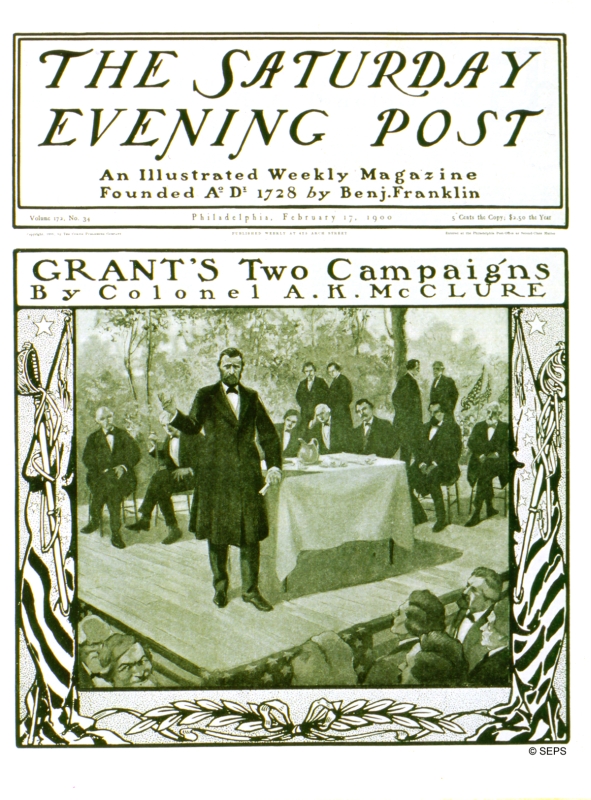
By Karl Kleinschmidt
February 17, 1900
Fifteen years after his death and 23 years after leaving office, Grant appeared on the cover of the Post, in one of a series of articles by Colonel A. K. McClure on “How We Make Presidents.” Grant oversaw the elimination of Confederate nationalism and slavery, protected African-American citizenship, and supported industrial expansion.
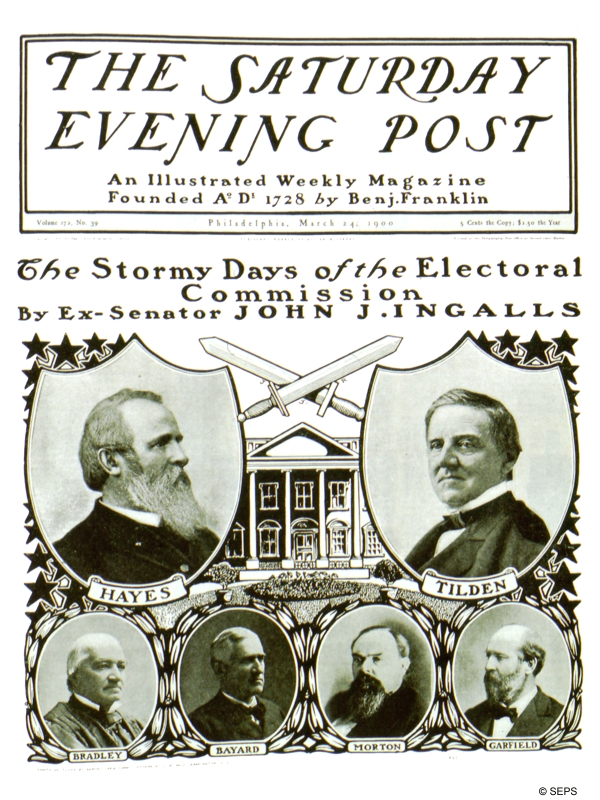
By Sarony & Bell
March 24, 1900
The election of 1876 was one of the most contentious in U. S. history. It was one of only five elections in which the person who won the most popular votes did not win the election. At one point, Tilden had 19 more electoral votes than Hayes. But a deal was brokered in which 20 disputed electoral votes were awarded to Hayes in exchange for withdrawal of federal troops from the South, putting Hayes in the White House by one vote.
By Guernsey Moore
February 16, 1901
As he was handing over the reins of the presidency to his successor, John Adams, Washington wrote, “I hold the maxim no less applicable to public than to private affairs, that honesty is always the best policy.”
By George Gibbs
April 26, 1902
Grover Cleveland was only U. S. President to serve two non-consecutive terms in office. He appeared on seven Saturday Evening Post covers and wrote several articles for the magazine on hunting, fishing, and the plight of democracy (not necessarily in that order of importance). He is remembered for being the only president to marry while in the White House, and for his deathless statement, “What is the use of being elected or re-elected unless you stand for something?”
By J. C. Leyendecker
March 6, 1909
An article in this issue of the Post proclaimed Taft to be “the heaviest President, the most traveled President, the best-natured President and the first golf player to occupy the White House.” He was among the most amiable and least ambitious men to be elected to the office. He continued most of the policies of his predecessor and friend, Teddy Roosevelt, but the two became estranged and ran against each other in 1912.
All his life, Taft tried in vain to reduce his weight. He reached 355 pounds while he served unhappily as president. He was also the only president to also serve as a justice on the Supreme Court, where he was far happier.
By J. C. Leyendecker
October 26, 1912
The Post was fascinated and charmed by Theodore Roosevelt, an energetic, progressive, young president who interrupted the long line of serious old men in the White House. Post editorials applauded his campaigns against “malefactors of great wealth” and his enthusiasm for making the U.S. a global power. Coming to the presidency in 1901 after President McKinley was shot, he was elected to a full term in 1904. He stepped aside in 1908 to let his friend, William H. Taft, successfully run for office. But in 1912, when this boy carved his pumpkin with TR’s toothy grimace and pince nez glasses, he was trying unsuccessfully for another term.
By J. C. Leyendecker
February 12, 1938
In 1862, with the country at the end of a Civil War, Lincoln called on Americans to face the challenges ahead without looking backward. He also reminded members of Congress that they would all be remembered for what they did in those perilous times:
“The dogmas of the quiet past, are inadequate to the stormy present. The occasion is piled high with difficulty, and we must rise — with the occasion. As our case is new, so we must think anew, and act anew. We must disenthrall ourselves, and then we shall save our country.
“Fellow-citizens, we cannot escape history. We of this Congress and this administration, will be remembered in spite of ourselves. No personal significance, or insignificance, can spare one or another of us. The fiery trial through which we pass, will light us down, in honor or dishonor, to the latest generation.”
By John Launois
June 13, 1964
This photograph of former President Truman was taken in front of his Independence, Missouri home. In an article that Truman wrote for the Post, the 80-year-old looked back over his controversial career and explained the principles that guided him in making the most difficult decisions of his Administration — including the “firing” of Douglas MacArthur.
By Norman Rockwell
October 13, 1956
The Post hadn’t featured a sitting president on its cover since Taft’s appearance in 1909. A popular president, Eisenhower authorized the establishment of NASA, invoked executive privilege to help end McCarthyism, expanded social security, launched the interstate highway system, and established the Defense Advanced Research Projects Agency which led to the development of computer networking and graphical user interfaces.
By Norman Rockwell
October 29, 1960
Among his many better known accomplishments, Kennedy also won a Pulitzer Prize (for “Profiles in Courage”), was awarded a Purple Heart, and donated his salary to charity. He represented the new generation of politicians: he was young, good-looking, smart, and funny, and drew international admiration. Kennedy spoke of idealism at a time when the country wanted to move on to new horizons, but his aggressive stance against communism brought the country close to one war and involved it in another, in Vietnam.
This Rockwell portrait appeared a second time when the Post ran its memorial issue after Kennedy’s assassination.
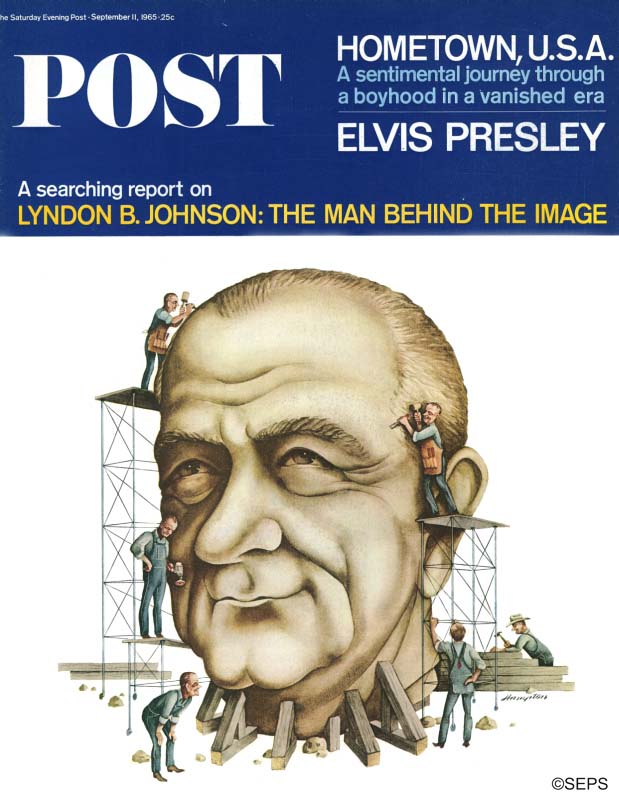
By Blake Hampton
September 11, 1965
President Johnson was a politician’s politician, and he was a paradox. He was cynical and calculating enough to be a powerful force in Washington, but also a champion of the poor and the man who launched a “War on Poverty. Johnson signed several civil rights bills that banned racial discrimination in public facilities, interstate commerce, the workplace, and housing. He signed the Voting Rights Act and the Immigration and Nationality Act into law. When he came to the White House after Kennedy’s assassination, he enjoyed a long honeymoon period with the press. But he lost the support of the media, and many Americans, with his determination to continue sending American soldiers to Vietnam.
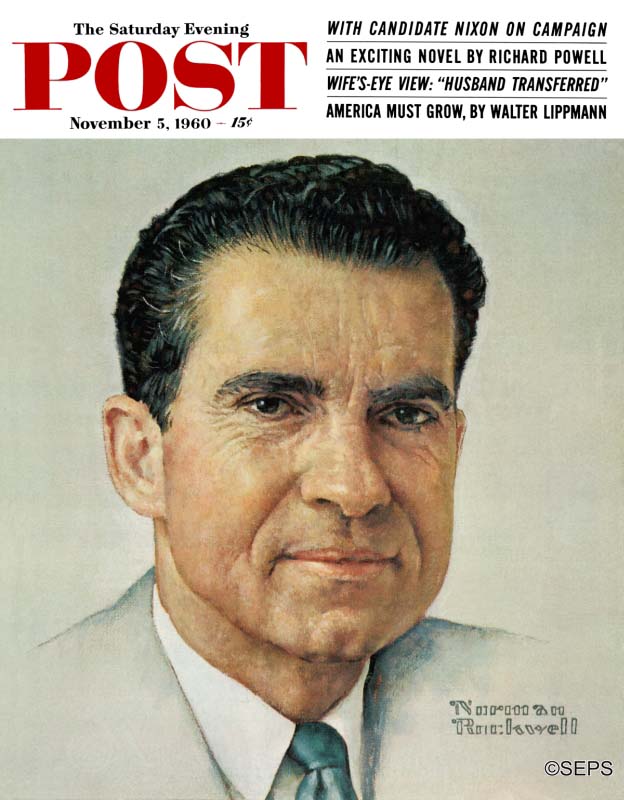
By Norman Rockwell
November 5, 1960
President Nixon is best remembered for the Watergate scandal and his subsequent resignation, but he also opened diplomatic relations with China, initiated détente with the Soviet Union, and established the Environmental Protection Agency. He ended U.S. involvement in Vietnam, and supported the Equal Rights Amendment, affirmative action, and the food stamp program. It was ironic that a man who rose in politics through his anti-communist stance made such significant progress with the communist governments of Russia and China.
Rockwell painted this portrait of candidate Nixon nine years before Nixon won the presidency.
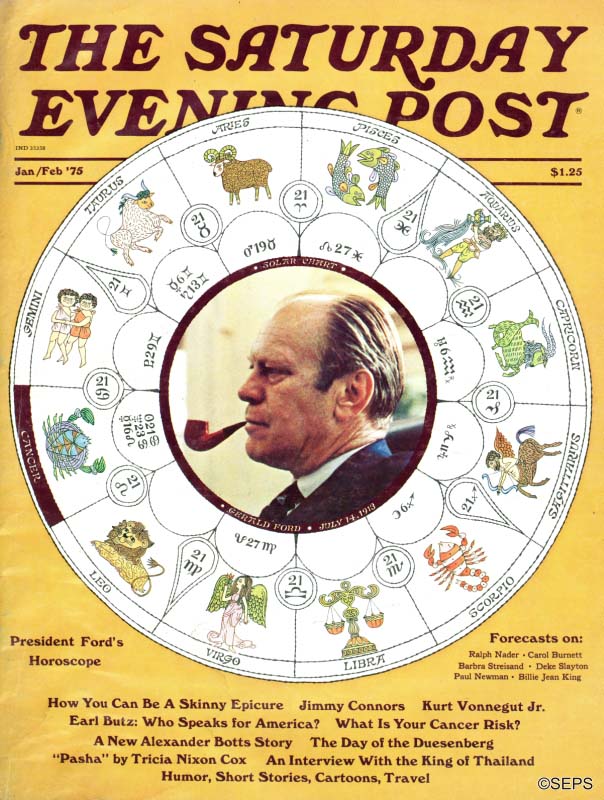
By J. Moore
January 1, 1975
In this feature in the Post, “astrologer to the stars” Carroll Righter analyzed President Ford’s astrological profile, terming him a Moonchild. Ford has the distinction of being the only person to have served as both Vice President and President of the United States without being elected to either office. It has not been determined if the alignment of the stars or planets was a factor.
Entering the White House abruptly when President Nixon resigned, he drew broad support by pardoning the men who’d avoided serving in Vietnam by illegally dodging the draft. But much of his popularity melted away when he also pardoned Nixon, sparing the nation a long, rancorous, divisive spectacle of a trial.
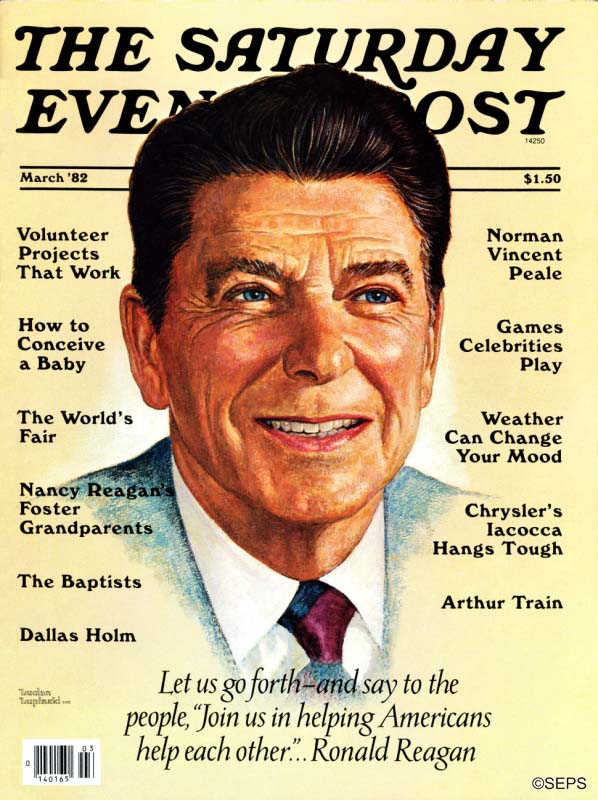
By Lucian Lupinski
March 1, 1982
Once a Democrat, Reagan switched to the Republican party as his views became more conservative. As president, he supported Afghan rebels opposing Russia’s invasion of their land and pushed for a space-based missile system to protect America from a nuclear attack. In the end, though, he was the president whose policies and tactful diplomacy with Russian leaders would end the Cold War.
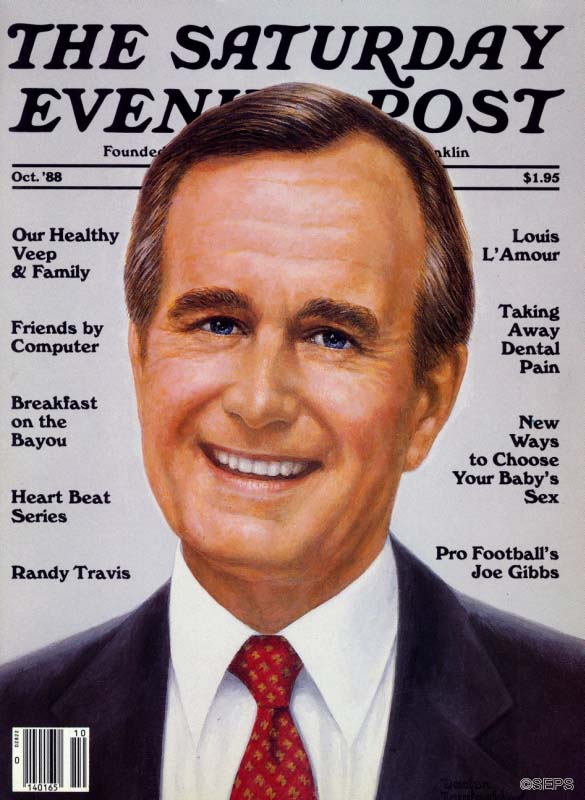
By Lucian Lupinski
October 1, 1988
George H. W. Bush appeared on the Post cover when he was still vice president, but was poised to win the presidential election, held a month later. He is the oldest living former president and vice president.
Bush continued many of Reagan’s policies, but he bridled when journalists compared him unfavorably to the charismatic Reagan. He was portrayed by some as being weak, sheltered, and a wimp. Yet it was Bush, not Reagan, who served in World War II and survived being shot down as a Navy pilot. His single term was noted for his authorization of the military overthrow of a corrupt dictator in Panama and the smashing of Iraq’s force in Kuwait though Operation Desert Storm.
The Last of the Greatest Show on Earth
When it combined with the Barnum & Bailey circus in 1919, Ringling Brothers proclaimed itself “The Greatest Show on Earth.” But this May, the show will take down its tents for the last time.
Ringling’s decision won’t surprise many Americans, who can’t imagine how circuses could stay alive today. How could trapeze artists, high-wire walkers, bareback horse riders, subdued lions, waltzing elephants, and clowns still make money? Today they must compete with video games and computer-animated blockbuster movies. Ticket sales have declined sharply, and operating costs have steadily risen. Yet these weren’t the critical factors.
The end came when the circus, under pressure from animal-rights groups, agreed to stop using elephant acts on tour. When the elephants departed, so did the big audience numbers.
In the past, circuses rode out the hard times. As the December 2, 1944, article “Jinx Over the Big Top” shows, they had survived the Depression, fires, striking workers, and — as the article explains — implacable jinxes.
But Ringling couldn’t survive a public that had become uncomfortable with the idea of training wild animals to perform tricks.
The circus is not dead. It’s only Ringling Brothers that’s folding up its big top. Smaller circuses will continue to tour the country, setting up alongside rodeos, state fairs, and mall parking lots. They’ll feature the traditional high-wire walkers, trapeze artists, and, of course, clowns. But any circus had better have a replacement for its trained animal acts, because they won’t be coming back.
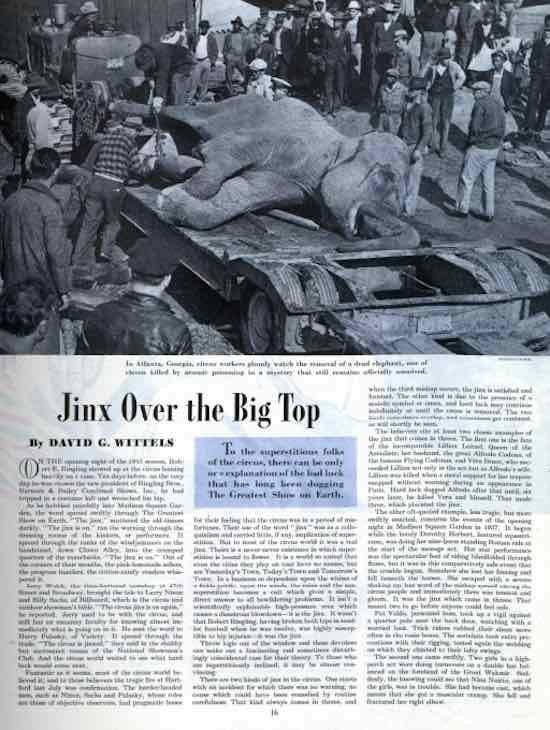
Featured image: SEPS
“The Uranium Prospector” by Hughes Rudd
Jasper C. Graf was far and away the best mortician we ever had in our town. At the time this all happened about the Arab woman and the uranium hunter, we had two, but he was far and away the best.
If you live in a big town maybe you never think of morticians, or at least maybe you never think of one of them as better than any of the others. But in a little town like ours, it’s different. When you only have two, the difference is bound to come out. Like I say, it’s probably something peculiar to little towns, or maybe to little towns out west, where our town is, where there isn’t an awful lot to take your mind off your life or your job or your wife. You know how it is? People out west are interested in morticians as a rule, I think.
And Jasper C. Graf was a fine mortician. There’s more to it, you know, than just the embalming or the services: A man can make a good living in a town if he’s good at those things, of course, and if he knows how to sell the more expensive caskets, but that isn’t what I mean when I say Jasper C. Graf was a fine mortician. It’s more difficult for a mortician to be a part of the town, a real part, you know. What I mean is, he sort of stands off to one side, or at least people put him off to one side; and if he’s an ordinary man, that’s where it ends, like with a preacher. But Jasper C. Graf was just about as pleasant a fellow as you ever saw. He only had one enemy that I ever heard of in our town, and that was Howie Loveless, the other mortician. Howie kept all that talk about the Arab woman going; and as our coroner, he got all mixed up in the other business too.
You could always feel a depth of something in Jasper C. that you couldn’t feel in many men. You always felt like whatever he said or whatever he did, you were just hearing or seeing the ripples on the surface: The movement, the thing that was really happening, was deep down inside somewhere, like when a sunken tree will shift in a river, underwater, unseen, making a bulge, a ridge where the water meets the light and air.
And Jasper C. Graf was such a big man, with such style to him, such a commanding man, that you always felt you were looking at somebody you knew was famous; but right that minute you couldn’t remember exactly what it was he was famous for: straight and tall and above six feet, with a very thin grin crease around the corners of his mouth, as though someone was looking at him and he had to behave just so. He had a great depth to him.
Now, Howie Loveless was about as depthless a man as you ever came across. You could wade around in him all day and never even get your shoes wet. He was little, and he had a bad limp that nobody ever knew the straight facts about, and he was a hypocrite and a bad mortician. I mean, really a bad mortician: His people all looked the same when he got through with them; everybody always said so, and I heard Mrs. Angelovic say at her husband’s funeral in Howie’s place that he looked just fine but it didn’t look like him. If you’d been to one of Howie’s funerals, you’d been to them all. He — well, the details are pretty bad, but the fact was he was careless. He just pumped everybody full of fluid until no more would go in and of course you can’t do it that way: It makes for round faces on everybody. And a hypocrite: He was married and had three dark little children just like himself, but he used to sneak off to Big Mary’s place all the time. That’s the kind of mortician Howie Loveless was. I used to be scared to death I’d get killed somehow or other while he was coroner.
Because, of course, whoever is coroner has first chance at the accidentals. Or should have. The fact was, Jasper C. Graf’s ambulance usually got there first, because he had such a good driver, Fat Jim. Fat Jim just worshiped Jasper C. He never said so but you could tell it, the way he followed him around and was always on call twenty-four hours a day, even though he was supposed to be the photographer on the paper. He used to get some wonderful accident pictures that way, and once Howie accused him at a coroner’s inquest of moving a fellow’s body in a car so it would make a better picture. It was just that Jasper C. Graf and Fat Jim paid more attention to their business, took it more seriously than Howie did. They were professionals; and Howie, in spite of his diploma from the school in San Francisco, wasn’t, somehow. He was too much like everybody else and, of course, most of us are amateurs, as long as we live. You have to give yourself up pretty thoroughly to anything if you want to become professional at it, and most of us won’t do it; we’d rather please ourselves.
That’s the way it was with Howie, if you want to be charitable. All he wanted was to make a living and enjoy himself, and at every turn he ran smack into those two professionals. It grated on Howie.
“Damn it,” he said to me on the street one day before all the trouble, “why don’t them two relax for a while?”
That was another thing: Jasper C. Graf never swore. And Fat Jim, why he never even smoked or drank or anything. You could tell Jasper C. just didn’t think it was fitting, but that was the kind of thing that was lost on Howie. Still, he was an easygoing fellow, content with the leftovers, like the runt of the litter always is, but he knew people expected him to be upset every time Fat Jim beat him to a case on the highway and so he acted upset. And I think it might have gone on that way for years, maybe forever, if it hadn’t been for the uranium hunter.
That’s what we thought he was at first. He came in on the 4 a.m. train from Denver. We don’t get any tourists in our town, except a few buying gas over on the highway, so somebody noticed him right away, and they told somebody else and then everybody heard he was in the hardware store buying a scintillometer.
Well, we all went up there, because we’d never heard of anything like that. Out in our part of the country, people from town and a few ranchers are our only uranium hunters. They don’t find much, and outsiders aren’t attracted to it. And now here was this skinny little man standing in the store and reading out a long list in a whiny voice, laughing every once in a while.
There must have been 20 of us in there watching, and not one of us could believe it.
“By God,” somebody near me said, “that fellow’s crazy.”
“He just said he didn’t need no compass,” somebody else said. “Did you hear that? They tried to sell him a compass, a azimuth compass, and he said he didn’t need one.”
He was the skinniest little man, with a skinny voice and a skinny laugh, and his clothes were all wrong. They’d started out right, somewhere, in some war-surplus or Army and Navy store in Denver, maybe, but now they were all wrong. He had on a pair of jeans, but they looked like they were made out of blue plastic, they were so thickly new and shiny — the copper rivets glittered in points in the store. And the back of his canvas hunting jacket had a fold in it so deep it looked like the two halves had not yet been stitched together but hung there on each shoulder, the edges lapped together waiting for the needle. The seams where the sleeves joined the jacket were outlined with white tacking thread, and the stitching around the soles of his jack boots was fresh and clean and glaring.
“He must’ve put all that on in the train,” somebody said, and we turned and went out the door and across the street to the town’s bar. I could see that little man in the tiny toilet room on the chair car, struggling silently into those clothes while the sweat burst out on his forehead and back and chest, struggling into the stiff, unwieldy clothes behind the locked door of the room no bigger than a telephone booth.
We all had a drink without anybody saying anything for a minute.
“Where the hell,” somebody finally said, “did that fellow ever get such a damn-fool idea as that? Can anybody here tell me that? I don’t want to hear another damn thing but that.”
“I tell you he’s crazy,” Bye Jenkins said.
“What about the railroad?” somebody said. “You think the railroad ain’t crazy for selling him a ticket?”
“Well, what beats me,” Bye said, “is his color. I wouldn’t worry about it if he was some damn fool from Denver. But he’s so pale-looking. I bet the fellow’s a tourist.”
That was what upset us, of course, As I say, there aren’t any tourists in our town, I don’t know why, and this fellow arriving on the four a.m. train to hunt uranium was impossible, strange, unnatural. We don’t dislike tourists as tourists: That wasn’t it at all.
We sat there talking about it and thinking and worrying about it, and I was thinking I’d ask Jasper C. Graf what he thought about it when next I saw him, when all of a sudden Charley Harper the druggist came running in.
“Have you seen her?” he said, hanging onto the bar and staring at us with his mouth twitching at one corner the way it always does. “Have any of you seen her?”
“Her?” Bye Jenkins said. “You mean him? The little tourist over at the hardware store?”
“No,” Harper said. He drank down a whole glass of beer and took out his handkerchief to wipe his mouth. “The Arab woman,” he said. “I just seen Jasper C. Graf going around the corner in his Cadillac, and there was a Arab woman in a white sheet sitting next to him,” he said, and a big bubble of gas burst in his throat before he could say any more, and we just sat, looking at him.
I went up to see Jasper C. Graf right after Charley Harper told us that. He was sitting in the mortuary office, just sitting in his big leather chair with his legs crossed so neatly for a big man, smoking a cigar and looking at the wall.
“Sam,” he said, and motioned me to take a chair.
I did, and just sat looking at him for a minute. I wasn’t thinking about how I was going to ask him about the Arab woman: Jasper C. wasn’t the sort of man you asked a question like that. You asked his advice, but you didn’t ask him anything personal. No, I was thinking about that tourist fellow, and I thought, now why should Jasper C. Graf even care about such a thing? He goes away to conventions; he knows more about the country than the rest of us. Probably it won’t concern him at all, I thought.
“The darnedest thing has happened,” I said. I started to say, “You won’t believe it,” but I knew he would believe it, because it struck me that back over south, where he came from, they must be used to such unusual things.
“Yes,” he said, looking at me.
“There’s a fellow getting ready to go uranium hunting,” I said.
Jasper C. just kept looking at me for a minute, and then he looked down at his desk and picked up a nail file he kept there and started cleaning his nails, although there wasn’t a speck of dirt under them I could see.
“Kind of late in the year, isn’t it?” he said, looking at his nails.
“It sure is,” I said. “They had thirty-two degrees at the post office yesterday morning.”
“Out-of-town fellow?” Jasper C. said, and I nodded.
“He’s not from around here,” I said. “His clothes are all brand new and he’s not from out west.”
“You fellows try to stop him?” Jasper C. said, still watching the nail file go along under his nails.
“No,” I said. “He’s not the sort of fellow you can say something like that to, I guess. He’s a skinny little tourist fellow with a city kind of a laugh.”
Jasper C. stopped moving the nail file, and a bright little bubble of red appeared at the tip of his little finger, where the file was.
“Now look at that,” I said. “You’ve dug into yourself with that thing.”
Jasper C. Graf was always going to conventions. In that business you have to keep up with the latest, I guess, and you have to make yourself known to other morticians from around the country so that when they have a person to ship to our town for burial, you know. That way you can be put in charge of local arrangements. Howie Loveless used to say Jasper C. went to those conventions just to “get a workout,” because Howie never went to any conventions and that’s what he called going down to Big Mary’s, “getting a workout.”
“He pussyfoots around here and then goes off to those conventions and has himself a big fat time,” Howie used to say. “He gets on that big Pullman and sleeps all the way back out here, and butter wouldn’t melt in his mouth. That’s the kind of a man I just can’t stand.”
But that was all a lie, of course, just Howie’s jealousy. Jasper C. Graf didn’t fool around with women like that. It seemed he just didn’t need to or something — he was busy looking at whatever it was that was down inside of him, I always thought.
But thinking like he did, Howie Loveless started talking up that Arab woman business as soon as he heard about it.
“Why, sure,” he said. “He brought her back with him from that convention in San Francisco. They got any kind of woman you can think of out there. I bet he give her a big bunch of money to come back here with him, and now he’ll hide her out and act like nothing was going on at all and laugh at us. That’s just the kind of a fellow he is, that’s all.”
“But why?” Bye Jenkins wanted to know. “Why’d he bring back a Arab woman? It just don’t make sense.”
“Why, sure it does,” Howie said, and his eyes got beady and he looked back over his shoulder, to see if his wife was coming up to the corner, I guess. “It’d be different, wouldn’t it? I wouldn’t mind a Arab myself. Come on,” he said, “I’ll show you something,” and he took us across the street into the depot and pointed at the wall. “Look at there,” he said.
There was a big poster on the wall next to the one of the Western Union boy coming up to the door with the message for Mother, and it showed a dark-skinned woman in a big white veil looking away off somewhere. She had a white cloth draped over her head too, so all you saw was her eyes, as big as Jordan almonds and black as night. Back in the distance was some kind of a little town, and down below in big letters it said, ALGÉRIE, PAYS DE LUMIÈRE.
“Well, I’ll be damned,” said Bye.
It was a new poster. “Now that,” said Howie, “is a Arab woman.”
You couldn’t argue with him: The face on the poster had the most female-looking eyes I’ve ever seen, and you wanted to see the rest of her, but of course you couldn’t, because of the robe and veil, and that just made you that much surer that what was under there was a beautiful woman, like one you’d never seen in your life before.
We were just standing there looking and not saying anything, when I’ll be darned if Charley Harper didn’t come loping into the depot all lathered up and puffing.
He grabbed Bye Jenkins by the arm and shook him.
“I just saw all three of them,” he said. “They went around the corner just when I came out of the store.”
“What?” Bye said, and he pulled his arm away. “What the hell’s the matter with you, Charley?”
“The tourist and the Arab woman,” Charley said, looking around at us. “They were sitting on the seat right next to Jasper C. Graf, and the tourist was laughing with his head throwed back. I could see his teeth.”
We all looked at Bye. He’s an old man and he has quite a story behind him, and we all looked at him.
“What was Jasper C. doing?” Bye said to Charley.
“Nothing,” Charley said. “He wasn’t doing nothing but driving the car and looking straight ahead.”
Bye looked around at us but nobody said anything.
“Well, damn it,” he said to Charley, “was he laughing?”
“No,” Charley said. “He wasn’t laughing.”
The tourist walked out of town the next morning, in plain sight of everybody, walking straight and unswerving toward some point on the horizon the rest of us couldn’t see, climbing the first hill and disappearing into the desert.
That was about nine o’clock. There was a stiff northwest wind blowing, and you could feel snow coming, and every once in a while a tumbleweed would appear around the corner from nowhere and go rolling and bumping across the street and out of sight.
Everybody was in the bar.
“I’ll tell you what it is,” Bye Jenkins was saying as I walked in. “It’s thoughtless, just plain thoughtless.”
Bye is an old, old man, and his story reaches clear back to the Wild Gang, and the Brown’s Park crowd, to Butch Cassidy and a lot of those other fellows. They were outlaws, and Bye started riding with them when he was fourteen, back in the ‘90’s. He’s the only one that didn’t get hanged or shot, I guess, and they say he killed a lot of men: You can find stories about him in the old copies of the paper, they say, but nobody ever bothers to look them up. If we have a first citizen, I guess Bye’s it.
“Here it’s going to snow,” Bye was saying, “and that fellow just walks off out there into the brush like he knowed what he was doing and where he was going, and none of you even asked him where he was headed or if he even knew himself where he was headed. Now, how’re we ever going to find him?”
Because Bye knew that: We’d have to go out and find him. We knew he wasn’t going to come walking back, because his clothes were so new and because he was different. Can you understand that? It’s not that you have to look a certain way to handle this country: That’s the mistake dudes always make. It’s just that if you’ve learned this country, you look a certain way; learning it gives you that look of belonging to it, the look the tourist didn’t have.
So we knew we’d have to go and find him, and most of the fellows got pretty mad about it: The whole thing was so crazy. Me, I didn’t mind: I wanted to see him again, maybe to find out what it was that had moved him out here into our town, an alien in the rock and brush and wind.
“You might as well all go home and get ready,” Bye said. “If we start this afternoon, he won’t have such a head start on us,” telling us to start now to save the man who’d just left town, because Bye was that certain of the fellow’s mistake.
And then Howie Loveless came limping in the door all rigged up like he was going on a hunting trip: boots, Mackinaw and hunting knife, and a big water bag slung over his shoulder, and so mad I thought he’d start crying any minute.
“Now, listen!” he said. “I want you all to be witnesses that I said it and by God I’ll make it stick. I’m telling you, there ain’t nobody to move that body when it’s found until I get there and declare it dead, you hear me? I’ve had just about enough of this, now.”
“Hold on,” Bye said. “You ain’t neither one of you got him yet.”
“Now, I tell you, it’s me that’s coroner,” Howie said, and he cut a big glare around at everybody.
“But Howie,” I said, “Jasper C. doesn’t even know about it yet. We haven’t told him yet.” And I thought: And you don’t know about it yet, either, not really; so what makes you so sure?
“Oh, no?” Howie said. “Oh, no? Well, how’d you like it if I told you I just seen Jasper C. Graf and that fat boy scooting out of town about 150 miles an hour right on that fellow’s trail?”
After a minute Bye cleared his throat. “Well, now,” he said. “Old Jasper didn’t try to stop him either, and now he’s really humping, ain’t he?”
“Was there anybody with them?” Charley Harper said to Howie. “Did you see anybody else?”
“What?” Howie said, and he frowned. “Of course not. They were in the jeep, and they’ve got the sides on it.
“Oh,” Charley said, his mouth twitching, and he looked back down into his beer.
It all happened so fast after that I didn’t get a chance to say goodbye to Jasper C. Graf or anything. None of us did. We had to get it all from Fat Jim, because by the time we found the place where they were in the desert, he was the only one. Nobody knew where Jasper C. Graf was.
“It was terrible,” Fat Jim said to us after we got some dry clothes on him. He was sitting by the fire trying to drink some hot coffee, but he couldn’t seem to get his lips to come down on the cup edge; they kept skittering away from it.
“He acted like he was crazy or something,” Fat Jim said. “We found the tourist fellow without any trouble at all, but we had to walk in the last four or five miles and cross the river. He was lying on his back just as peaceful as anything, and the snow had banked up along one side of him like he was a log or a piece of driftwood, and a tumbleweed was caught around his head like a mess of bob wire. I thought he was dead, but Mr. Graf knew right away he wasn’t. I guess he knew even before we left town the fellow wouldn’t be dead.”
“What?” Howie said. “What are you trying to tell me? You trying to — ”
“That tourist started cackling at us as soon as he saw us,” Fat Jim said, looking up at us. “He like to scared me to death. Mr. Graf just stood there looking down at him for a minute and then he said, ‘Get up.’ Just like that. ‘Get up.’ But the tourist just lay there looking up and laughing, and Mr. Graf finally bent over and picked him up and slung him over his shoulder. ‘I’m going to ruin you, Jasper,’ the tourist said, laughing right into Mr. Graf’s face with all them big yellow teeth. Mr. Graf, he just set his face a little and said to me, ‘We got to get this man out of here before he freezes to death.’ ‘Oh, no,’ says the tourist, ‘I won’t never freeze, Jasper, not while I got you to keep me warm. You ain’t never going to let me freeze, are you, Jasper?’ he says to Mr. Graf, but Mr. Graf just started walking, with me trotting along behind begging him to let me help.”
“The most high-handed thing I ever heard of in my entire life,” Howie said. “A criminal act, you all hear that? Moving that fellow before we — “
“And then the tourist fellow started bragging about all the things he could do, and Mr. Graf couldn’t touch him for them because of what had happened,” Jim said, shaking his head. “He said he’d follow Mr. Graf forever just like he’d followed him for twenty years now, and he’d ruin him every time. ‘No matter where you go,’ he says, laughing into Mr. Graf’s face, right into his ear, with his feet dangling down behind. ‘I’ll keep on following you, Jasper, and I’ll keep on making you pay for what you done.’”
“Done?” Howie said, bending down over Jim. “Done what? What did old Jasper do?”
“Finally we come to the river,” Jim said. “Mr. Graf never even slowed down. He missed the ford and just started walking out into it with that tourist cackling on his back and saying, ‘Now, don’t you get my feet wet, Jasper,’ and me splashing along behind hollering for Mr. Graf to look out. But he just kept walking. He didn’t even look back and all of a sudden he went under. I started really yelling at him then. I’m surprised you fellows didn’t hear me in town. Then Mr. Graf bobbed back up and he commenced to fight that water like a crazy man, with that tourist still on his back. Only now that fellow was upset. ‘You’re trying to drown me!’ he was hollering, and all the time Mr. Graf was fighting for both their lives. It was terrible. ‘You’re going to add murder to your list, are you!’ that fellow screamed in Mr. Graf’s ear, and then they went under again, Mr. Graf pumping his legs up and down and kicking and flaying at the water with his elbows and never letting out a sound or even changing expression. It was awful. And they went under, and this time the tourist come up first, shooting half out of the water like a dynamited snag and yelling his head off the minute he broke out, still yelling while he flew up in the air and flopped back. It was terrible.”
“What was he yelling?” Howie said. “I got a right to know, you hear?”
“Mostly it seemed like he was yelling ‘Murderer,’” Jim said, looking into his coffee cup.
“Ah, ha!” cried Howie. “I told you! I told you there was something sneaky about that Jasper C. Graf! I been telling you that for years, and you wouldn’t listen. Goes a-running off out here and kills a man by drowning — ”
“No,” Jim said. “After he shot up, the tourist fellow splashed back in the water and went spinning downstream a way, then he banged up against the other bank and climbed out. He just sat there yelling at us, but he was so far away I couldn’t understand a word he was saying.”
“And what about Jasper C., Jim?” Bye said.
“He told me all about it,” Jim said. “He clawed his way back to where I was. He didn’t swim. He just clawed at that water, and I helped him out. We sat there a minute, and then he said, ‘Jim, I might as well tell you. You can tell everybody in town and it don’t make no difference anymore, anyway. If you don’t tell them, he will, and at least you can tell them straight. I made a mistake once, back in Missouri,’ he said. ‘There was this woman; she was this fellow’s wife, and I made a mistake.’”
“Now, there you are!” Howie said, looking around at us. “Butter wouldn’t melt in his mouth and here he was, messing with — ”
“No,” Jim said. “Not like that. He thought she was dead. They didn’t have no doctor in that town, and they brought her to Mr. Graf after she’d fell in a pond in the wintertime. She was drunk, Mr. Graf said, and everybody thought she’d fallen into the pond while she was drunk and had died, and her husband wanted to ship the body out right away to St. Louis before the roads got too bad, so Mr. Graf started to embalm her. But she wasn’t dead, she was just almost dead. It must have been a terrible thing,” Jim said.
“Negligence!” said Howie. “Professional negligence, that’s what it was.”
“Mr. Graf was a young mortician then,” Jim said. “He found out right away what was wrong and he stopped everything and saved her life, but it didn’t do no good. Ever after that she tells folks Mr. Graf resurrected her from the dead; and her husband, he says Mr. Graf has damaged his reputation for life because Mr. Graf had his wife lying there in the mortuary without her clothes on. And they follow him wherever he goes, they won’t never stop it, Mr. Graf said. And he has to run off every few years when they find him. It’s terrible.”
“Well, I’ll be damned,” Bye said. “You mean we got to lose a good mortician because of something like that?”
“And that’s why she wears them Arab clothes,” Jim said. “Because she was resurrected, she says. She thinks she’s somebody out of Scripture, Mr. Graf said.”
“But why?” Howie said, sitting down next to Jim. “Why did that fellow buy that stuff and come walking way out here? And why did Jasper C. Graf bother to come after him? Why?”
“Just to devil Mr. Graf,” Jim said, closing his eyes. “He knew Mr. Graf would come get him. It was just his devilish way of announcing he was here, of showing Mr. Graf how mean he was.”
“But why go get him?” Howie said, looking around at us. “Why didn’t he let that fellow just lay out there and freeze?”
Bye Jenkins looked down at Howie. “Because he ain’t that kind of a man,” Bye said. “If he’d been that kind of a man, that fellow never could have bothered and hounded him at all. He couldn’t have hounded you, could he, Howie?”
Howie didn’t say anything.
When we got back to town, Jasper C. Graf’s office with the big leather chair was there, with a dead cigar in the ashtray and the nail file lying on the desk, but Jasper C. Graf and his Cadillac were gone. That afternoon the tourist and the woman came around a corner and into the depot, and when the 6 p.m. train for Denver came in, they got on board, the man looking angrier than a tornado and the woman so wrapped up in sheets you couldn’t see what she looked like.
And that was how we lost the best mortician our town ever had. Charley Harper must have had his eye on the mortuary business for a long time, because it wasn’t two weeks later that he opened up a funeral parlor himself, on an apprentice license he says he’s had for years, and nobody’s surprised by it anymore: It sort of goes with the drugstore business in a town like ours, and Howie Loveless is altogether too careless, and of course his reputation is just terrible: It seems to get worse all the time.